
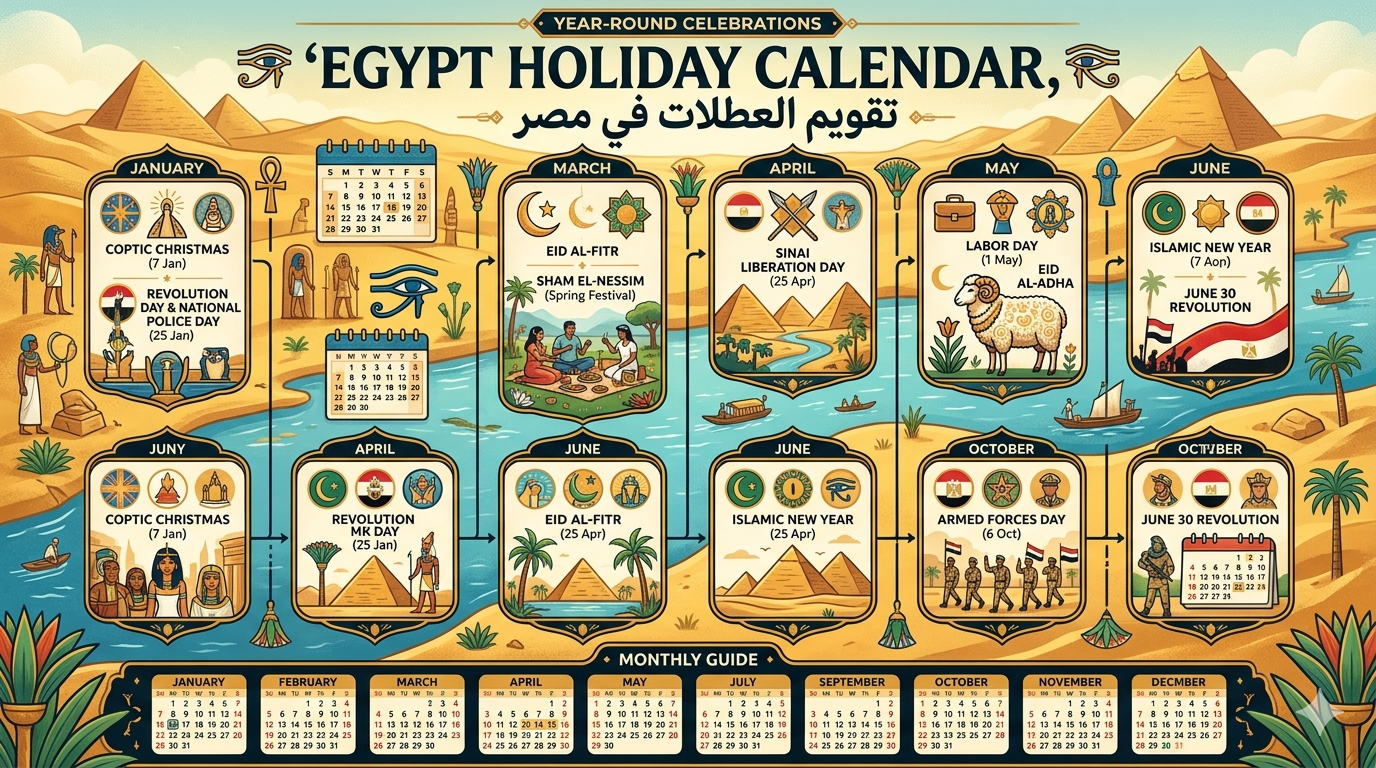
Egypt does not run on one calendar. It runs on three at once: fixed national days, a Coptic calendar behind Christmas and Sham el-Nessim, and an Islamic lunar calendar that moves Ramadan and the two Eids about ten days earlier each Gregorian year. Add the government’s habit of shifting some days off to a Thursday for a long weekend, and you have the main reason travellers get caught out, arriving to find museums closed, offices shut when they need a permit, or a festival missed by a single day. This calendar untangles that for 2026, tells you what actually changes for a visitor on each holiday, and flags every date that must be rechecked before you book. The key insight is that a holiday in Egypt is rarely just a day off. It changes crowds, transport, opening hours, prices and atmosphere, sometimes all at once, and those changes matter more to a visitor than the ceremony itself. A national day may close government offices while leaving temples open, an Eid may fill trains and hotels for a week, and a spring festival may turn every park in Cairo into a picnic ground. Understanding which kind of holiday you are facing is therefore the first planning skill for Egypt, before flights, before hotels, and certainly before a day-by-day itinerary is fixed. The table below gives the whole year at a glance, and the sections that follow explain each season in the detail a planner needs, including what to book early, what to expect on the ground, and which dates are solid and which are not. Treat this guide as a framework for decisions, not as a printed timetable, because the single most important habit in Egyptian holiday planning is the habit of rechecking close to departure.
One warning first, because sources disagree by a few days on the lunar holidays, and because that disagreement is not a minor footnote but the central fact of the whole calendar: the table below follows the most widely reported 2026 official day-off pattern, but Islamic dates depend on moon sighting and government decree. Treat Eid al-Fitr, Eid al-Adha, Arafat Day, Islamic New Year and Mawlid dates as tentative, and check the official site before visiting for your exact travel year, because a date quoted in a guide, including this one, may shift by a day when the moon is sighted, and a day off may be moved to a Thursday by decree after a calendar is printed. The same caution applies to Coptic Easter and its Monday, Sham el-Nessim, which move year to year, and to the shifted Thursday days off, which are a pattern rather than a promise, since the government decides the substitution each year. Fixed dates, such as Coptic Christmas on 7 January, Sinai Liberation Day on 25 April, July 23 Revolution Day, and Armed Forces Day on 6 October, are more reliable, though even a fixed anniversary can have its day off shifted. The practical rule is simple and should be applied to every date in this guide: use the table to choose your season and to book refundable arrangements early, then recheck the official calendar close to departure, confirm the exact day off for your week, and adjust museum days, transport bookings and office-dependent plans accordingly. A traveller who does that will enjoy Egypt’s holidays as highlights rather than surprises, while a traveller who treats a tentative lunar date as fixed may arrive to a closed office, a full train, or a festival that happened yesterday.
At a Glance
| 2026 date / period | Holiday | Type | Visitor effect |
|---|---|---|---|
| 7 January | Coptic Christmas Day | Religious, public holiday | Offices and schools close; churches busy, especially in Coptic Cairo |
| 29 January (observed) | January 25 Revolution & National Police Day | National | Day off shifted from 25 January; official ceremonies |
| 19–23 March (holiday period) | Eid al-Fitr | Religious, tentative lunar dates | Family feasts, travel surge, some closures then festive crowds |
| 13 April | Sham el-Nessim | Seasonal spring festival | Parks, Nile banks and coast crowded with picnics |
| 25 April | Sinai Liberation Day | National | Government offices and schools close |
| 7 May (day off for 1 May) | Labour Day | National | Day off shifted; check exact observance for your year |
| 26 May | Arafat Day | Religious, tentative | Start of Eid al-Adha period |
| 27–31 May (holiday period) | Eid al-Adha | Religious, tentative lunar dates | Family gatherings, charity meat distribution, busy transport |
| 18 June (observed) | Islamic New Year | Religious, tentative | Day off observed; quieter religious observance |
| 2 July (day off for 30 June) | June 30 Revolution | National | Day off shifted; official events |
| 23 July | July 23 Revolution Day | National | Government offices close; ceremonies |
| 27 August (reported) | Prophet Muhammad’s Birthday (Mawlid) | Religious, tentative | Sweets, processions and family visits; dates vary by source |
| 6 October | Armed Forces Day | National | Government offices close; military commemorations |
Ramadan itself is not a month-long public holiday. It is a season that changes daily rhythms — fasting from dawn to sunset, busy iftar evenings, adjusted business hours — and it deserves its own section below. Coptic Easter and its Monday, Sham el-Nessim, fall in spring; their 2026 dates should also be rechecked, as Coptic Easter moves year to year.
January to April: Christmas, Revolution Day and Spring
January opens with Coptic Christmas on 7 January, a nationwide public holiday marking the birth of Jesus in the Coptic tradition, and it is worth understanding both its religious meaning and its practical effect before planning around it. For visitors, the practical effect is closures in offices and schools, plus busy churches in Old Cairo, where services, decoration and family gatherings fill the Coptic quarter, and a visitor who goes to Coptic Cairo on this day will find a living celebration rather than a quiet museum district. That is a reason to visit, not a reason to avoid the area, provided the visit is planned as a church and neighbourhood experience rather than as a day for administrative business, which will simply not be available. Later in January, the January 25 Revolution and National Police Day anniversary, dated 25 January, is commonly observed as a day off on a nearby Thursday, 29 January in the 2026 pattern reported by several calendars, and the character of the day is official rather than festive. Expect ceremonies, media tributes and a general sense of commemoration rather than street festivals, and expect government offices to be closed on the observed day, so any trip that depends on paperwork, permits or school visits should be scheduled around it. January in Egypt is also one of the most comfortable months for sightseeing, with cooler weather in Cairo and the Nile Valley, so a visitor who accepts the office closures and plans museum and temple days around them will find the month rewarding, with the Coptic Christmas atmosphere as a genuine cultural bonus rather than an inconvenience. The key is to separate the two kinds of January effect: the religious celebration, which adds to a visit, and the official closure, which only subtracts if you needed an office that day.
Spring is where Egypt’s calendar becomes most rewarding, and most crowded, because two very different celebrations fall close together and transform the country in opposite ways. Eid al-Fitr, marking the end of Ramadan, brings a multi-day holiday period in March 2026, reported as 19 to 23 March for days off, with the festival days themselves around 20 to 22 March depending on moon sighting, and the atmosphere is family, feasting and travel all at once. Families gather for feasts, children receive Eidiya, crisp new banknotes as gifts, and kahk biscuits appear in every bakery, while transport and hotels fill up as Egyptians travel to visit relatives, to the coast, and to their home towns. Book Eid travel weeks ahead, or deliberately travel just after the holiday for quieter sites. Sham el-Nessim, on the Monday after Coptic Easter, 13 April in the 2026 day-off pattern, is unlike any other holiday on this list, because it is not Islamic or Coptic in origin but dates back some 4,500 years to pharaonic spring celebrations, when it marked renewal of life and the start of the agricultural year. Today families picnic in parks, on the Nile banks, at the zoo and on the coast, eating coloured boiled eggs, spring onions, lettuce and, for the brave, feseekh, fermented salted mullet, and renga, smoked herring. Visitors should enjoy the spectacle, stick to the eggs, greens and lupini beans if unsure about feseekh preparation, and expect every green space in Cairo to be full, Together, Eid and Sham el-Nessim make spring the most festive, and the most demanding, season to plan, and a traveller who books early and chooses the right kind of day for each festival will enjoy both, while a traveller who treats spring as ordinary sightseeing season will be surprised by crowds in exactly the places they planned to be quiet.
Ramadan and Eid al-Fitr: What Changes for Travellers
Ramadan in Egypt is atmospheric in a way few other travel seasons match, and that atmosphere is the reason many experienced travellers deliberately choose to visit during the holy month, provided they understand what changes and what does not. Streets are decorated with fanoos lanterns, mosques hold tarawih prayers after sunset, and a nightly transformation takes place when iftar meals, suhoor gatherings and markets bring cities alive, with a warmth and a social energy that ordinary tourist season rarely offers. It is also a season that requires adjustment, and the adjustment should be made with respect rather than with resentment, because the changes are not obstacles imposed on visitors but the normal life of a country observing a central religious practice. During daylight, many Muslims fast, so visitors should dress modestly, avoid eating, drinking or smoking conspicuously in public during fasting hours, and expect some restaurants and attractions to shorten daytime hours, with staff working at a slower pace and some smaller businesses closing until evening. Traffic intensifies before sunset as people hurry home for iftar, then eases into a long, social evening, when restaurants fill, streets brighten, and the city stays awake far later than usual. Major monuments generally stay open, which is an important reassurance, because a Ramadan trip is not a trip to closed sites, but the rhythm of the day is inverted: quiet mornings, a rush before sunset, and a long, lively night. A visitor who respects those hours, and who saves sightseeing energy for the evening, will find Ramadan in Egypt welcoming rather than restrictive. A visitor who plans around that rhythm, with early temple visits, a rest in the afternoon, and an evening spent in a market or at an iftar invitation, will experience a side of Egypt that a daytime-only itinerary never shows.
For planning, Ramadan is a trade-off, not a reason to avoid Egypt, and the trade-off should be weighed honestly against the alternative of travelling in a different month. On the positive side, evenings are uniquely lively, hotel prices can be softer, daytime sites can be quieter, and the lanterns, prayers and shared meals give the trip a cultural depth that no museum label can provide. On the negative side, daytime energy is lower, some tours start later, some restaurants are closed during the day, and the days immediately before sunset can be tiring, with traffic, heat and crowds converging at iftar time. Eid itself, at the end of Ramadan, is a separate peak, because it converts the quieter Ramadan rhythm into a full domestic travel surge, with families travelling, hotels filling, and transport booked out, so the choice of dates within the season matters as much as the choice of season itself. If you want the Ramadan atmosphere without the Eid crowds, travel during Ramadan and depart before Eid, enjoying the lanterns and the evenings while leaving before the surge. If you want family celebration at its height, travel for Eid and book everything early, accepting crowds as part of the celebration rather than as a problem to be solved. In either case, check the official site before visiting for the exact Ramadan and Eid dates for your year, as they move annually by about ten days, and confirm daytime opening hours for the specific sites you plan to visit, because a single confirmation can save a wasted morning. Ramadan rewards the traveller who adapts, who eats late, who walks in the evening, and who treats the month as a different Egypt rather than as Egypt with inconveniences attached.
April to July: Sinai Day, Labour Day and the Summer Eids
Sinai Liberation Day on 25 April commemorates Egypt’s reclamation of the Sinai Peninsula in 1982, and it sets the tone for the whole April to July stretch, because most of the holidays in this period are national days whose main visitor effect is closure rather than celebration. It is a national day off, marked by patriotic events and closures of schools and government offices, but with little direct effect on tourist sites beyond normal holiday crowds, so a visitor can still visit temples and museums on the day while expecting offices to be shut. Labour Day on 1 May follows the same pattern, with its day off commonly shifted to a nearby Thursday, 7 May in the 2026 pattern, so do not assume the anniversary and the day off are the same weekday, and do not plan office-dependent tasks for either date without checking which weekday the government has actually declared. The practical lesson of these spring national days is one of scheduling discipline: keep sightseeing on the holiday itself, move paperwork, bookings that need local offices, and school visits to a working day, and allow for ceremony traffic in central Cairo, where official events can close roads or slow movement even when sites remain open. For most tourists, these national days are background rather than foreground, a day when Egypt pauses officially while continuing to welcome visitors, and a well-planned trip barely notices them except for the closed office it wisely avoided. That quiet character is itself useful, because it means April to July, outside the Eids, can be a good time for sightseeing, with spring light, fewer festival crowds, and a calendar that only occasionally interrupts a plan.
Late May brings the second Eid, and with it the period’s real planning challenge, because Eid al-Adha is not a quiet national day but a full family and travel event. Arafat Day, 26 May in the tentative 2026 pattern, precedes Eid al-Adha, whose holiday period is reported as 27 to 31 May, and the festival is known as the Big Eid or Feast of Sacrifice, with themes of charity and family at its centre. Meat is distributed to those in need, men often wear white galabeyas for morning prayers, and parks and the Nile Corniche fill with picnics and boat rides, creating an atmosphere that is festive, communal and busy all at once. The signature dish is fattah, layers of toasted bread, vinegar-and-garlic rice and boiled meat, and a visitor who is invited to share a family meal during Eid al-Adha will experience Egyptian hospitality at its most generous. Like Eid al-Fitr, this is a peak domestic travel window, so book transport and hotels early, expect busy roads out of Cairo, and plan for fuller trains, fuller hotels and fuller sites. Islamic New Year, Muharram, and the June 30 Revolution follow in June and early July, and they return the calendar to the quieter national-day pattern. Islamic New Year is a tentative lunar date, observed as a day off on 18 June in the 2026 pattern, while June 30 Revolution’s day off is commonly shifted to 2 July, and July 23 Revolution Day, marking the 1952 revolution, is a fixed national holiday. None of these is a major tourist festival, but all can mean closed offices, and all fall in the hottest months, when Luxor and Aswan become genuinely punishing at midday, so summer holiday planning should pair any festival interest with Red Sea or coastal days rather than with a first temple-heavy trip.
August to October: Mawlid, Armed Forces Day and the Sun Festival
Prophet Muhammad’s Birthday, Mawlid al-Nabi, is reported around late August 2026, 26 to 27 August depending on the calendar and moon sighting, and it is a good example of a holiday whose date uncertainty matters more than its crowd effect. It is celebrated with sweets, family visits and religious gatherings, with special Mawlid sweets, decorated stalls and a warm, family atmosphere, but unlike the Eids it does not usually create a multi-day travel surge, so a visitor who happens to be in Egypt for Mawlid will find a pleasant celebration rather than a logistical crisis. The date itself, however, must be rechecked, because sources vary by a day or more, and the 2026 table in this guide lists 27 August as the reported date while other calendars place the observance a day earlier. Armed Forces Day on 6 October, commemorating the October 1973 war, is a fixed national holiday with military ceremonies and government closures, and its day off is sometimes shifted to a nearby Thursday, so check the pattern for your year rather than assuming the anniversary weekday is the day off. October is also peak tourist season, with comfortable weather returning after the summer heat, so Armed Forces Day falls in a period when hotels, flights and sites are already busy, and the holiday adds official ceremonies and closures to an already full calendar. For a visitor, the combination is manageable provided office-dependent plans are moved off the holiday and sightseeing is booked early, because the sites themselves generally remain open. The August to October stretch therefore rewards the same discipline as the rest of the year: treat Mawlid as tentative, treat Armed Forces Day as fixed in date but possibly shifted in day off, and treat October as a month to book early for independent reasons, with the holidays as an added factor rather than the main one.
Separate from public holidays, but essential for calendar planning, is the Abu Simbel Sun Festival on 22 February and 22 October, when sunrise lights the inner sanctuary of Ramesses II’s temple for about 20 to 25 minutes, and this event deserves more planning attention than most official holidays. Visitors queue in the dark for a brief, extraordinary alignment tied in tradition to the king’s coronation and birth anniversaries, and the experience is genuinely unlike any other in Egypt, because the light moves slowly across the sanctuary, illuminating statues that have stood in darkness for most of the year, in a temple built for a king who intended exactly this effect. It is not a public holiday, it is crowded, and it rewards booking Abu Simbel transport and accommodation months ahead, especially the October date, which falls in peak tourist season, when Aswan and Abu Simbel hotels fill, flights and road convoys are booked out, and a traveller who arrives without a reservation may find no room at all. The February date, by contrast, falls in cooler weather and a quieter season, though it still requires early booking, because the sanctuary holds only a limited number of visitors and the pre-dawn queue forms hours before sunrise. Practical planning for the Sun Festival should include an overnight stay in Abu Simbel or a very early departure from Aswan, warm clothing for the pre-dawn wait, and a flexible attitude to the brief duration of the alignment itself. For a calendar guide, the Sun Festival is the clearest proof that the most important dates in Egypt are not always the official days off, because a twenty-minute sunrise in a desert temple can matter more to a trip than a whole national holiday, and a traveller who plans around it will remember Egypt differently from one who only plans around closures.
How to Plan Around Holidays: Closures, Crowds and Best Months
The table below is the practical heart of this guide, because it converts the whole calendar into five planning decisions, each with a clear expectation and a clear booking priority, and a traveller who works through those five rows before booking anything will avoid most of the classic Egypt holiday mistakes. During Eid al-Fitr or Eid al-Adha, expect a festive atmosphere, family crowds, and busy transport and hotels, so book flights, hotels and intercity transport weeks ahead, and accept that the trip will be social, lively and crowded rather than quiet. During Ramadan, but not Eid, expect quieter days, lively evenings and adjusted hours, so book evening restaurant and tour timings carefully and confirm daytime openings, because the day’s rhythm is inverted and a plan built for ordinary hours will misfire. On Sham el-Nessim, expect parks and the coast to be packed with joyful, communal picnics, so book coastal stays early and plan a park or Nile day, not a museum marathon, because the holiday’s pleasure is outdoors and communal. On a national day in January, April, July or October, expect office and school closures while sites usually stay open, so book nothing special for sites but allow for ceremony traffic, especially in central Cairo. For the Abu Simbel Sun Festival, expect pre-dawn queues and full hotels in Abu Simbel and Aswan, so book transport and stays months ahead, not weeks. The pattern across all five rows is the same: the booking that matters is the one that matches the holiday’s real effect, not a generic early booking, and a traveller who books the right thing early, whether that is a train for Eid, a hotel for the Sun Festival, or nothing at all for a national day, will spend less and enjoy more than a traveller who books everything late or everything blindly.
The best months for combining good weather with festival interest are October to April overall, with March to April offering Sham el-Nessim and spring light, and October offering the Sun Festival and Armed Forces Day in peak season, and that window should be the default choice for a first trip that wants both comfortable sightseeing and a festival bonus. Summer holidays in June to August coincide with extreme heat in Luxor and Aswan, so festival interest alone rarely justifies a first trip then, unless you plan Red Sea or coastal days, where the heat is offset by swimming, and where a summer national day can be enjoyed from the coast rather than endured in a temple courtyard at midday. Whatever your month, recheck the official calendar close to departure, because lunar dates shift, day-off Thursdays change, and a single decree can move a holiday you planned around, and that recheck should cover not only the holiday dates themselves but also the practical consequences: site hours for your week, transport timetables for your travel days, and hotel cancellation terms in case a shifted holiday changes your plan. It is also worth building one buffer day into any holiday-period trip, because a delayed train, a fuller-than-expected hotel, or a site closed for a ceremony can otherwise unravel a tight schedule, and a spare day lets you revisit the place you liked most. The best Egypt trips are rarely the most tightly scheduled ones, and a calendar-aware trip, with festival days chosen deliberately, closures avoided, and one day left unplanned, will feel both festive and relaxed, which is exactly the combination that makes a holiday period worth travelling for in the first place, rather than worth avoiding.
| If you travel… | Expect | Book first |
|---|---|---|
| During Eid al-Fitr or Eid al-Adha | Festive atmosphere, family crowds, busy transport and hotels | Flights, hotels and intercity transport weeks ahead |
| During Ramadan (not Eid) | Quieter days, lively evenings, adjusted hours | Evening restaurant and tour timings; confirm daytime openings |
| On Sham el-Nessim | Parks and coast packed; joyful, communal picnics | Coastal stays early; plan a park or Nile day, not a museum marathon |
| On a national day (Jan, Apr, Jul, Oct) | Office and school closures; sites usually open | Nothing special for sites, but allow for ceremony traffic |
| For Abu Simbel Sun Festival | Pre-dawn queues, full hotels in Abu Simbel and Aswan | Transport and Aswan / Abu Simbel stays months ahead |
Further reading on this site: Egypt Travel Guide for the full Cairo–Luxor–Aswan itinerary to fit around these dates, Pyramids of Giza for Giza planning, and Seven Wonders of India for a contrasting festival-and-heritage journey. External context: Public Holidays in Egypt, Egypt Public Holidays 2026, Egyptian Traditions & Festivals, and Festivals in Egypt.
Conclusion
Egypt’s holidays are not obstacles to work around; they are the country at its most itself, picnics that predate the pharaohs’ successors by millennia, lantern-lit Ramadan nights, Eid family tables, and a sunrise that still finds its way into a temple built for a king, and a traveller who understands that will plan differently from one who sees holidays only as closures. Plan around the closures, book early for the Eids and Abu Simbel, recheck lunar dates before you travel, and let at least one holiday find you in Egypt rather than in a guidebook, because a holiday experienced on the ground, with its food, its music, its crowds and its quiet moments, teaches more about Egypt than any number of museum labels. The calendar in this guide gives you the structure for that experience: fixed national days that close offices but leave sites open, a Coptic spring that fills parks with picnics, a lunar calendar that moves Ramadan and the Eids each year, and a desert sunrise that rewards months of advance booking. Each of those elements asks for a different kind of planning, and each rewards a different kind of attention, from the discipline of checking a Thursday day off to the patience of queuing in the dark at Abu Simbel. A trip that respects those differences will feel varied, because it will include both the festive and the quiet, both the crowded and the solitary, and both the ancient and the living Egypt, in a single journey. The holidays are also a reminder that Egypt is not a museum but a country, with families, faiths, seasons and working lives that continue alongside tourism, and a visitor who travels during a holiday is a guest in that continuing life, not an observer of a performance staged for tourists.
The final advice is therefore simple, and it applies to every season covered in this guide: choose your month by weather and festival interest together, book the right things early for the holiday you have chosen, recheck the official calendar close to departure, and leave one day unplanned for the holiday, the conversation, or the sunset that was not on your itinerary. If you have only a week, do Cairo and Luxor properly and save the Eids and the Sun Festival for a return trip, because a rushed Egypt is a wasted Egypt, and the country will still be there, with the same pyramids, the same temples and the same river, whenever you come back. If you have ten to twelve days, add Aswan and Abu Simbel, and let a holiday period, if it falls in your dates, become one of the highlights rather than a problem to be managed. If you have two weeks or more, add one extension, the Red Sea for rest or the Western Desert for silence, and resist the temptation to add both, because a holiday needs at least one place where nothing is scheduled. Above all, remember the warning with which this guide began: lunar dates are tentative, moon sighting and government decree can move them, and a single recheck before departure is worth more than any printed table, including this one. Travel with that caution, with early bookings for the peaks, and with openness to the unplanned. That openness, more than any single booking or date, is what turns a calendar of holidays into a journey worth remembering. Egypt’s holidays will give you what they give Egyptians themselves: family, food, light, music, and a sense of a country celebrating itself, season after season, year after year.
FAQs
Q: How many public holidays does Egypt have in 2026?
A: Sources count 13–16 statutory days off depending on whether substitute Thursday days are included. The table above lists the main national and religious days off; check the official site before visiting for the final count for your year.
Q: Are Eid dates in Egypt fixed?
A: No. Eid al-Fitr, Eid al-Adha, Arafat Day, Islamic New Year and Mawlid follow the Islamic lunar calendar and depend on moon sighting, so they move about ten days earlier each year and may shift by a day.
Q: Is Ramadan a public holiday in Egypt?
A: No. Ramadan is a month of fasting and evening celebration, not a month-long holiday. Business hours adjust, evenings become lively, and Eid al-Fitr at its end is the public holiday period.
Q: What is Sham el-Nessim?
A: An ancient spring festival on the Monday after Coptic Easter, dating back to pharaonic times. Families picnic outdoors and eat coloured eggs, spring onions, lettuce and traditional salted fish.
Q: Do museums and temples close on public holidays?
A: Major tourist sites usually stay open on national days, though government offices and schools close. Eid periods can mean altered hours and larger crowds, so check the official site before visiting for your specific date.
Q: When is the Abu Simbel Sun Festival?
A: On 22 February and 22 October each year, when sunrise briefly lights the inner sanctuary. It is a festival event, not a public holiday, and requires early booking.
Q: What is the best holiday period to visit Egypt?
A: For atmosphere, Eid or Sham el-Nessim in spring; for comfortable sightseeing with a festival bonus, October around the Sun Festival and Armed Forces Day. Book early for all three.





2 Comments