Luxor City Guide: Karnak, Valley of the Kings & the Nile
Luxor, ancient Thebes, packs more major monuments into one small city than anywhere else in Egypt — and that density is both the attraction and the planning problem, because a visitor who tries to see everything in a single day will end up seeing a great deal badly, while a visitor who plans by river bank will see the headlines well and still have time for the city itself. The answer is to think in banks, not in a list: spend one day on the East Bank, where the living city and its great temples stand, and one day on the West Bank, where kings were buried, and let the Nile between them set the rhythm of the trip. Two full days cover the headlines comfortably; three days let you add museums, lesser-visited temples and a dawn balloon flight without rushing, and a third day also gives you the breathing room to revisit a favourite site in different light. This guide gives you that structure, with what each site actually offers in brief, so you can build an itinerary around your energy, not just your ticket list, and so you know which parts of Luxor deserve a whole morning and which deserve an evening. For a deep dive on one temple, see our Luxor Temple guide; for where to base yourself, see our where to stay in Luxor guide. Those two guides carry the temple detail and the hotel detail, while this guide keeps its focus on the city as a whole: how Luxor is laid out, how its banks differ, how its sights fit together, and how to move between them without wasting the best light of the day.
The city works best when you respect its ancient logic, because Luxor is still organised by the same division that organised Thebes: the East Bank was the city of the living, with temples, houses and markets, while the West Bank was the city of the dead, with tombs and mortuary temples set against the desert hills. That division is not just history; it is practical advice, because the East Bank sites — Karnak, Luxor Temple, the two Corniche museums — can be walked between, or reached by short taxi rides, in a single day, while the West Bank sites are spread across a dry plain and need a car or a driver to link them efficiently. A felucca on the Nile at sunset then becomes more than a pleasant extra: it is the moment when the two banks come into a single view, with the Corniche and the West Bank hills in the same frame, and it helps you understand why the river was the city’s main street as well as its boundary. Luxor also rewards an early start, because the desert heat builds quickly, the great halls are at their most atmospheric before coach groups arrive, and a morning spent at Karnak or in the Valley of the Kings leaves the hot midday for museums, rest or a slow Corniche walk. Check the official site before visiting for current hours, tickets and prices, and confirm prices before booking any guide, balloon flight or Nile cruise, because entry arrangements and operator prices change and because a city with this many sites has many different ticket combinations. Plan by bank, start early, and leave the evenings for Luxor Temple and the Nile, and Luxor will feel manageable rather than overwhelming.
At a Glance
| Detail | What to know |
|---|---|
| Ancient name | Waset, called Thebes by the Greeks; capital of the New Kingdom for about five centuries |
| UNESCO status | Ancient Thebes with its Necropolis, inscribed as a World Heritage Site in 1979 |
| East Bank | Karnak Temple, Luxor Temple, Luxor Museum, Mummification Museum, Corniche |
| West Bank | Valley of the Kings, Valley of the Queens, Hatshepsut Temple, Colossi of Memnon, Medinet Habu, Deir el-Medina |
| Ideal stay | 2 days minimum, 3 days comfortably |
| Best season | October to April; check the official site before visiting for current hours, tickets and prices |
History: From Thebes to Modern Luxor
Luxor stands on Thebes, the city that ruled Egypt at the height of New Kingdom power — the Egypt of Hatshepsut, Tutankhamun and Ramesses II — and that pedigree is visible everywhere, because the city is not a museum built around a single ruin but a living town grown up inside and around a vast ancient capital. Its East Bank temples honoured the gods of the living, above all Amun of Karnak, whose great precinct was enlarged by successive pharaohs for roughly two thousand years, so that Karnak alone is less a single monument than a layered archive of kingship, religion and art, with each ruler adding a pylon, a hall or an obelisk to what his predecessors had built. Its West Bank necropolis, by contrast, housed royal tombs cut into the desert hills, together with the mortuary temples where the dead kings were honoured, so that the two banks together tell a complete story: temples for the gods and for the living king on one side of the river, tombs and memorial temples for the dead king on the other. Later, Romans, Christians and Muslims reused its temples, and the modern town grew up around — and sometimes inside — the ancient fabric, most visibly at Luxor Temple itself, where a still-active mosque stands within the temple precinct and where modern streets run beside ancient columns. Understanding that east-living, west-dead division makes every day in Luxor easier to plan, because it tells you which sites belong together, which order to visit them in, and why a day spent crossing between banks for single sites wastes more time than a day spent working one bank properly. That bank-by-bank thinking also helps with transport, because it keeps West Bank driving to one day and East Bank walking to the other.
The modern city that visitors walk through is therefore a layer as much as a backdrop, and it deserves attention in its own right rather than being treated as a mere gateway to the monuments. The Corniche, with its hotels, museums and Nile views, is the East Bank’s spine, and it is where most visitors stay, eat and stroll in the evening, while the West Bank remains quieter, greener in its irrigated fields and more village-like, with small settlements, donkey carts and palm groves between the great sites. That contrast is part of the experience: an East Bank evening feels urban and riverside, with lights, restaurants and the floodlit temple, while a West Bank morning feels rural and desert-edged, with cliffs, fields and the long, straight roads that link the tombs. Ancient Thebes with its Necropolis was inscribed as a UNESCO World Heritage Site in 1979, and that inscription covers the whole ensemble — temples, tombs, museums and landscape — rather than a single building, which is another reason to think of Luxor as a city rather than a checklist. A visitor who understands the city’s history will also understand why some sites feel crowded and others feel empty: the headline temples and tombs draw the coaches, while Medinet Habu, Deir el-Medina and the Valley of the Queens, all covered in this guide, reward a third day with quieter courtyards and a more intimate sense of the ancient city. For the wider Egyptian context, see our places to visit in Egypt guide and our Egypt travel guide, which place Luxor on a Cairo-to-Aswan route, while this guide stays with the city itself and how its history shapes a visit.
Karnak Temple
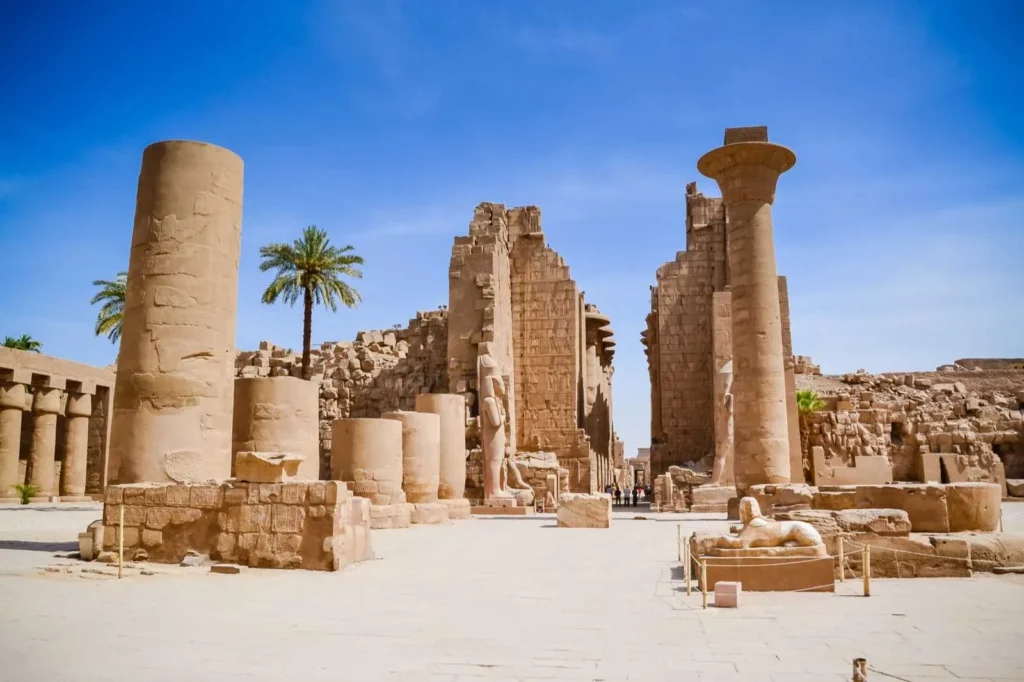
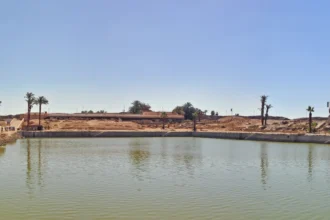
Karnak is the largest religious complex ever built, and it needs half a day, not a quick stop, because its scale, its layers and its sheer number of courts, halls and pylons cannot be grasped in an hour spent hurrying from entrance to exit. Construction began in the Middle Kingdom under Senusret I and continued for about two millennia, with the Precinct of Amun at its heart, plus the Precincts of Mut and Montu, so that Karnak is best understood as a city of temples rather than as one temple, with different precincts, different building phases and different gods sharing a single walled area. Its centrepiece is the Great Hypostyle Hall, begun by Seti I, who reigned from about 1291 to 1279 BCE, and completed by Ramesses II, who reigned from about 1279 to 1213 BCE: 134 sandstone columns, the central twelve about 21 metres high, covering roughly 5,000 square metres, and walking slowly through that forest of stone is the single most memorable indoor experience in Luxor. Walk the hall slowly, then look for Hatshepsut’s standing obelisk, nearly 30 metres high, the Sacred Lake, where priests once purified themselves and where visitors now rest in the shade, the Festival Temple of Thutmose III, with its unusual botanical reliefs, and the Avenue of Sphinxes leading south toward Luxor Temple, which links the two great East Bank temples along the ancient festival road. Go at opening if you can — the light is better, the heat lower, and the hall is at its most atmospheric before coach groups arrive, when the columns stand in relative quiet and the scale of the hall can be felt without a crowd. That early start also gives you time to return to a favourite court later in the day, when the light has changed completely.
A good Karnak visit is planned around light and sequence, because the complex is so large that a random walk will waste the best hours and miss the quieter corners that reward a slower pace. Start at the Avenue of Sphinxes and the great first pylon, then move through the courts towards the Hypostyle Hall, allowing time to stand among the columns and look up, rather than photographing the hall from a single viewpoint and moving on, because the hall’s effect depends on being inside it, with columns on every side and light falling between them. After the hall, the inner sanctuaries, the obelisks and the Sacred Lake repay a slower circuit, and the Festival Temple of Thutmose III, at the eastern end, is quieter than the hall and worth the walk for its different, more intimate scale and its carved plants and animals. Karnak’s size also means that shade, water and rest matter: carry water, wear sun protection and a hat, wear comfortable shoes for stone floors and uneven ground, and plan a shaded break at the Sacred Lake or in the open-air museum area before tackling the outer precincts. Check the official site before visiting for current hours and ticket details, and confirm prices before booking any guided visit, because Karnak has several ticket and guide options and because a guide who explains the building phases will add more here than at a smaller, more self-explanatory site. For the wider temple story, our tourist attractions in Egypt guide places Karnak among Egypt’s great experiences, while this city guide keeps Karnak in its proper place: as the East Bank’s great morning site, paired with the museums at midday and with Luxor Temple in the evening.
Luxor Temple (in Brief)
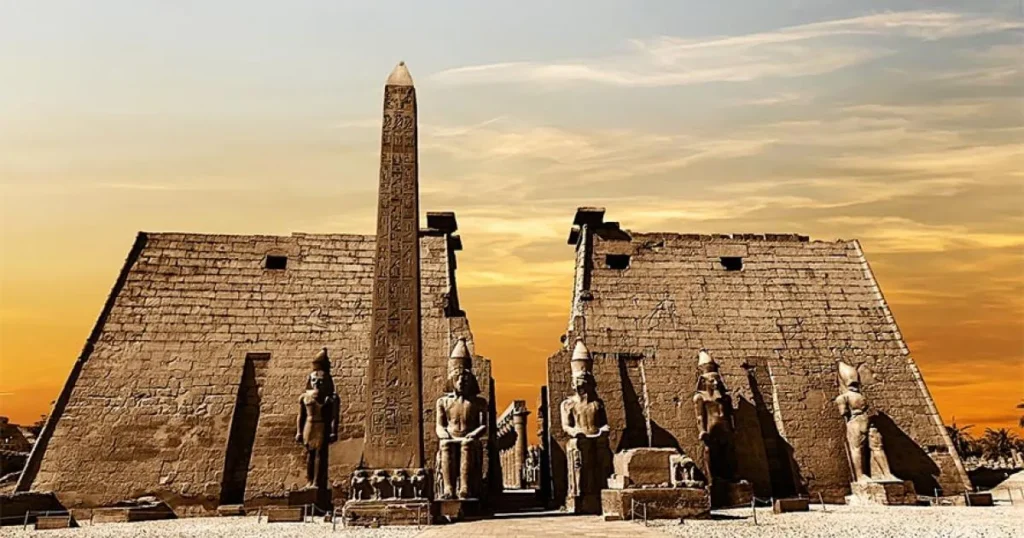
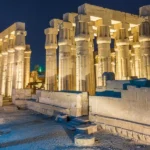
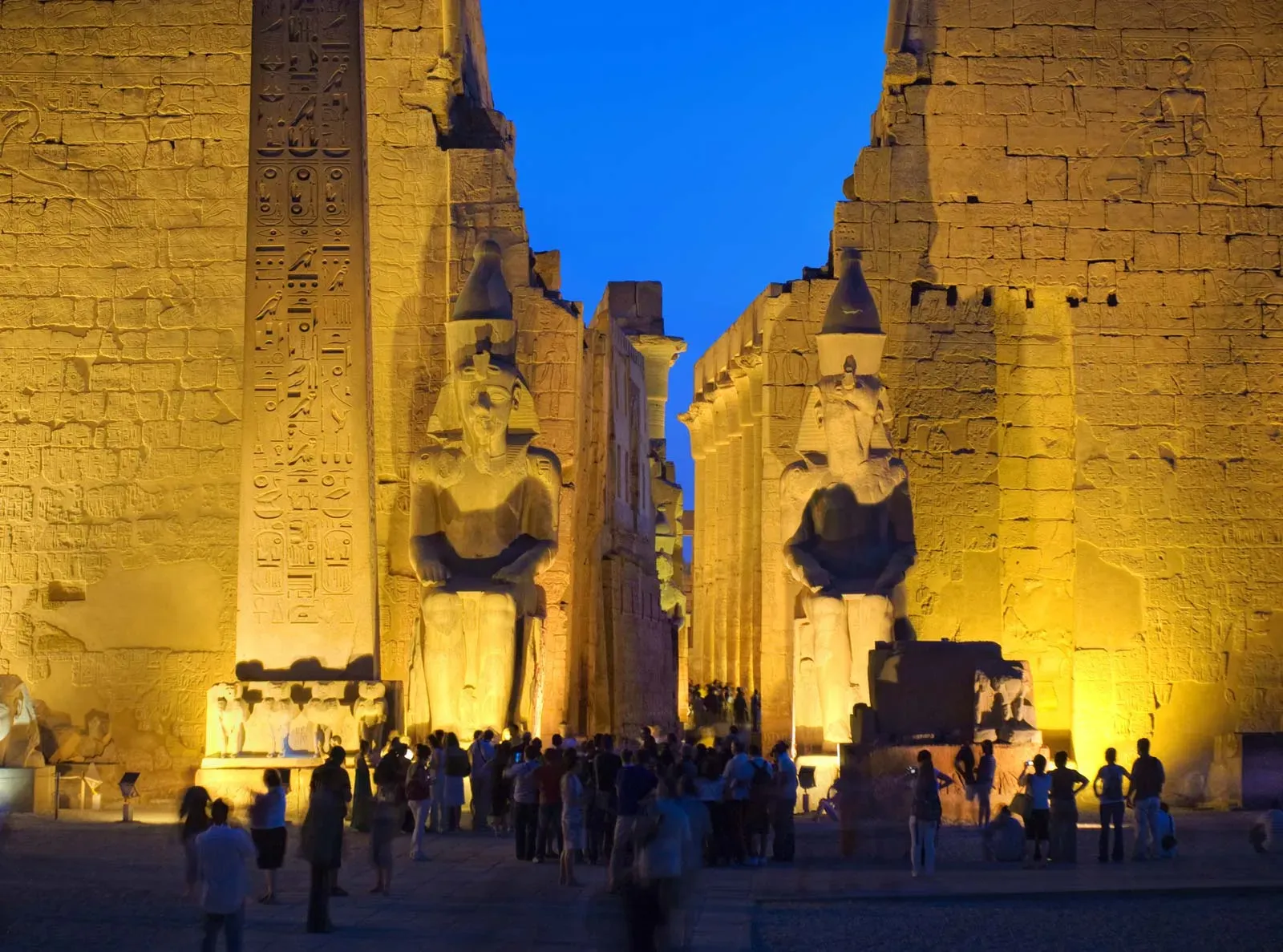
Luxor Temple, built mainly around 1400 BCE under Amenhotep III and expanded by Ramesses II, is the compact, riverside counterpart to Karnak — and the best evening site in the city, which is why this city guide deliberately keeps it brief and why the order of your days matters more than the number of sites you tick off. Save it for late afternoon and floodlit night rather than pairing it with Karnak in a single rushed morning, because the temple’s character changes completely between daylight and floodlight: by day you can read its carving, its campaign reliefs and its Divine Birth scenes in clear light, while by night the sandstone glows, crowds thin, and the temple feels like a living place rather than a museum. Its pylon, Court of Ramesses II, Great Colonnade, Court of Amenhotep III, Alexander chapel and still-active Abu al-Haggag Mosque tell the kingship story in one walkable site, from the thunderous entrance in the north to the quiet sanctuary in the south, and that compact, coherent plan is what makes it such a good evening counterpart to Karnak’s vast, multi-period sprawl. The temple sits on the Corniche in central Luxor, within easy walking distance of East Bank hotels, so an evening visit can be followed by dinner on the Corniche without a taxi or a long journey, and that convenience is part of its appeal as a first or last stop in the city. This city guide keeps the temple brief on purpose: our full Luxor Temple deep guide covers its phases, architecture and evening visit in detail, and repeating that detail here would turn a city guide into a temple guide and crowd out the West Bank, the museums and the Nile.
For city planning, the practical point about Luxor Temple is timing, not detail, because a temple that is visited at the wrong hour feels like a different building from the same temple visited at the right hour. Arrive in the late afternoon, walk the temple in daylight in its natural order from pylon to sanctuary, stay as the floodlights come on, and then walk the Corniche or take a short Avenue of Sphinxes stroll if time and heat allow, rather than rushing from Karnak to Luxor Temple in a single morning and seeing both badly. The temple needs about one and a half to two hours, which fits neatly into an East Bank day that begins with Karnak at opening, moves to the museums at midday, and ends here in the evening, and that rhythm — great hall in the morning, galleries at midday, floodlit temple at night — is the most comfortable East Bank pattern for most visitors. Dress modestly throughout, and particularly near the mosque, keep voices low where worship is taking place, and ask before photographing worshippers, because the temple is still in use and because respect for its living layer is part of a good visit. Check the official site before visiting for current evening hours and ticket details, since evening opening can vary, and confirm prices before booking any guided evening visit, because a standard entry and a guided commentary are different things. If you have only one evening in Luxor, spend it here rather than adding another rushed site, because a floodlit Luxor Temple, seen slowly after a day at Karnak, is the evening that most visitors remember best from the whole city. A quiet Corniche walk after the temple, with the river beside you, is a fitting end to that East Bank day.
Valley of the Kings
On the West Bank, the Valley of the Kings is a dry, cliff-walled wadi holding the rock-cut tombs of New Kingdom pharaohs of the 18th, 19th and 20th Dynasties — Tutankhamun, Seti I, Ramesses VI and many others among more than 60 tombs and chambers discovered so far — and it is the West Bank’s great morning site, best visited early before heat and crowds build. Only a rotating selection is open at any time, to protect the painted walls, so check on arrival which tombs are open and choose three or four rather than trying to see everything, because a valley visit is about depth inside a few tombs, not about a race through many, and because the colour inside is the surprise for first-timers who expect bare stone. The vivid scenes from Egyptian mythology on walls and ceilings — gods, journeys through the underworld, the king’s passage to the afterlife — are painted in colours that have survived remarkably well in the dry, sealed tombs, and each tomb has a different character: some are long and steep, some are compact and richly decorated, and some, like Tutankhamun’s, are famous more for what was found in them than for their size. The valley itself is stark and beautiful, a dry wadi enclosed by cliffs, and the walk or shuttle ride from the entrance to the tomb area already sets the mood, because the landscape explains why kings chose this hidden, easily guarded valley for their burials. Go early: the valley is hottest and busiest by midday, and photography rules inside tombs vary, so follow the signs and guides on the day rather than assuming that what was allowed last year, or in another tomb, applies everywhere.
Planning a Valley of the Kings morning well means planning for heat, walking and choice, because the valley rewards visitors who arrive early, choose carefully and rest between tombs, and punishes visitors who arrive late and try to see too much. Arrive at opening, carry water, wear sun protection and a hat, wear comfortable shoes for steep tomb corridors and uneven ground, and allow time to sit in the shade between tombs, because the valley offers little natural shade and because the painted interiors are best appreciated slowly, with time to look at ceilings as well as walls. Choose three or four open tombs that interest you — a mix of a famous tomb, a richly painted tomb and a quieter tomb often works better than a list of only the most famous names — and ask at the entrance or your guide which tombs are open that day, since the rotating selection changes to protect the paintings. Photography rules vary by tomb and by season, so check the signs at each tomb entrance, follow any no-photography rule without argument, and remember that flash and touching walls damage the very paintings you have come to see. The valley pairs naturally with Hatshepsut Temple on the same West Bank morning, as the itinerary table in this guide shows, because the two sites are close enough to combine without a long journey, and because a morning that moves from tombs to a mortuary temple gives a fuller picture of how kings were buried and honoured. Check the official site before visiting for current ticket arrangements, since the valley’s ticket system covers a set number of tombs with extras for certain famous tombs, and confirm prices before booking any guided valley visit.
Temple of Hatshepsut at Deir el-Bahari
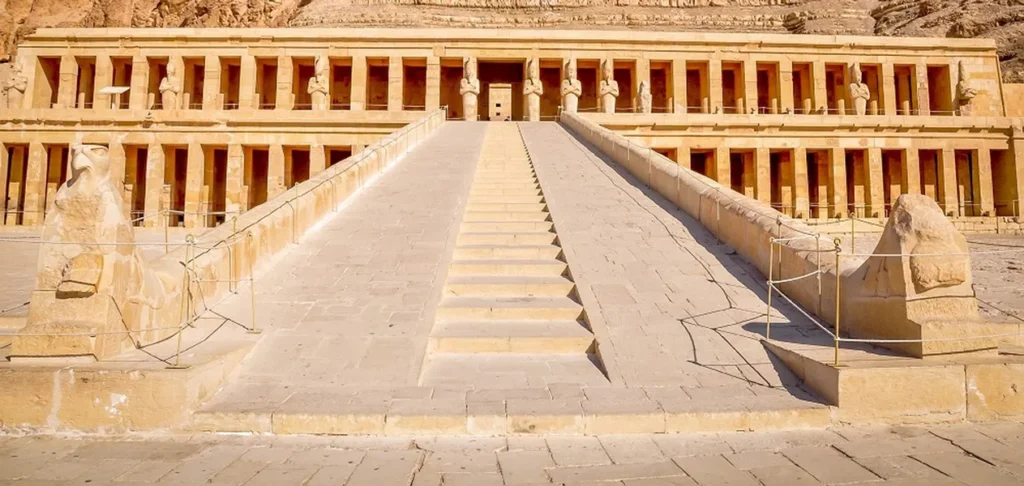
Hatshepsut’s mortuary temple, built from about 1479 to 1458 BCE to designs attributed to her steward Senenmut, is the most architecturally modern-looking monument in Luxor: three broad colonnaded terraces rising against the cliff at Deir el-Bahari, linked by ramps, with a symmetry and a horizontal calm that look strikingly different from the towering pylons and columns of Karnak and Luxor Temple. Hatshepsut, fifth pharaoh of the 18th Dynasty, ruled with full royal authority for about two decades, and her temple’s reliefs record her divine birth story and the famous trading expedition to the Land of Punt — Egyptian ships, stilt houses, myrrh trees and exotic animals carved in narrative detail — so that the temple is both an architectural landmark and a historical document. The Punt reliefs are especially rewarding, because they show a real expedition in carved form, with goods, people and landscapes that give a sense of Egypt’s wider world, and because they were carved to justify Hatshepsut’s reign by showing her bringing wealth and divine favour to Egypt. Later attempts to erase her name and image, after her death, only make the surviving carving more poignant, because the erasures are visible in the stone and because they tell a story of political memory as well as of architecture. Allow 90 minutes to two hours, and combine it with the Valley of the Kings on the same West Bank morning, because the two sites are close, because the temple’s terraces are best in morning light, and because a morning that moves from tombs to temple gives a complete West Bank picture. The temple therefore rewards a visit that is both architectural and historical, rather than a quick photograph from the plain below.
The temple’s setting is as important as its architecture, because the cliff behind the terraces frames the building in a way that no photograph quite captures, and because the approach — across the plain from the valley, with the cliffs rising ahead — builds anticipation in a way that a city temple, surrounded by streets, cannot. Walk the terraces slowly, from the lowest level up the ramps to the upper terrace, noting how the colonnades frame views of the plain below and how the reliefs change from terrace to terrace, with the Punt expedition and the divine birth story among the most detailed carvings in Luxor. The temple is also a good place to understand Hatshepsut herself, because her reign, her building programme and her erasure are all visible in the same building, and because a guide or a good guidebook will help you spot the places where her name was chiselled away and where it survived. In practical terms, the temple is exposed and hot by midday, so a morning visit, with water, sun protection and a hat, is far more comfortable than an afternoon one, and comfortable shoes matter for the ramps and terraces, which involve more walking than a single-level temple. The temple pairs well with the Colossi of Memnon on the way back towards the river, since both lie on the West Bank plain and since the colossi, photographed in early morning light, make a natural stop on the way to or from the valley. Check the official site before visiting for current hours and ticket details, and confirm prices before booking any guided West Bank day that includes this temple, because West Bank driver and guide prices vary and because a driver who knows the West Bank order will save you more time than a driver who simply follows a list.
Colossi of Memnon and Medinet Habu
The Colossi of Memnon are all that remains standing of Amenhotep III’s vast mortuary temple: two massive seated statues alone in the fields, best photographed in early morning light on the way to or from the valley, and their isolation is precisely what makes them memorable, because they stand as a reminder of a temple that has otherwise vanished into the plain. The statues, which once guarded the entrance to a mortuary temple larger than Karnak’s main precinct in its own way, now stand in open fields with the West Bank hills behind them, and that open setting gives photographers a clean, uncluttered view that the great temples, surrounded by walls and crowds, do not always offer. Early morning light is best, because the low sun models the stone, because the fields are quiet, and because a stop here on the way to the valley costs only a few minutes while giving one of Luxor’s most iconic images. The colossi also have a story beyond their size: in antiquity, one of them was said to sing at dawn, a sound caused by temperature changes in the cracked stone after an earthquake, and that legend drew Roman visitors to Luxor long before modern tourism, which is a reminder that Luxor has been a destination for two thousand years. If you have a third day, continue to Medinet Habu, the mortuary temple of Ramesses III, whose well-preserved reliefs and quieter courtyards reward visitors who have already seen the headline sites, because Medinet Habu is less crowded, more complete in its wall decoration, and more intimate in scale than Karnak, while still showing the full range of temple art. A few minutes here, in good light, often produces a better photograph than a hurried hour at a crowded temple.
Medinet Habu deserves a third-day slot rather than a rushed addition to a two-day trip, because its reliefs — including the famous Sea Peoples scenes, which record Ramesses III’s battles against invaders — repay slow looking, and because its courtyards, chapels and surrounding walls give a sense of a complete mortuary temple complex that the Colossi alone cannot give. The temple’s quieter atmosphere is itself a reward after the headline sites, because visitors can walk its courts without coach groups, study its reliefs at leisure, and appreciate the colour that survives on some walls, which is better preserved here than in many more visited temples. Nearby Deir el-Medina, the village of the artisans who built the royal tombs, with its small tombs and houses, is the best place in Luxor to grasp ordinary life behind the monuments, because it shows where the tomb builders lived, how they decorated their own small tombs, and how a community of skilled workers sustained the royal necropolis for generations. Deir el-Medina’s small, vividly painted tombs are a striking contrast to the great royal tombs, because they are personal, domestic in scale and rich in everyday detail, and because they remind visitors that the Valley of the Kings was built by people, not only by kings. Together, the Colossi, Medinet Habu and Deir el-Medina make a coherent third-day West Bank circuit, best done by private car or taxi with a driver who knows the plain, and best started early, with water, sun protection and a hat, since the West Bank plain offers little shade. Check the official site before visiting for current hours and ticket details for each site, since West Bank tickets are site-specific and since a third day is the right time to add these quieter sites rather than squeezing them into an already full second day.
Luxor Museum and Mummification Museum
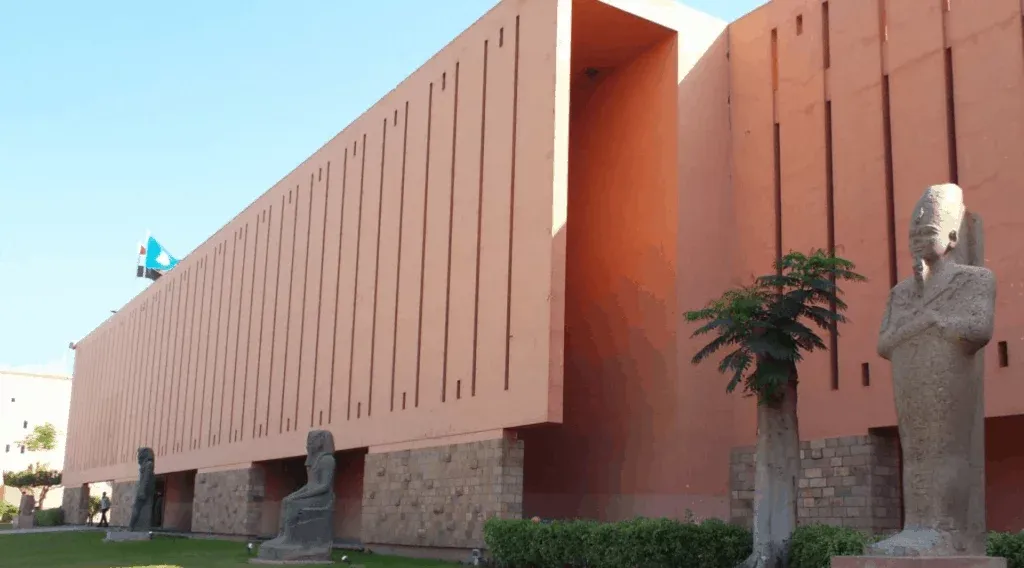
Both East Bank museums are worth a midday or late-afternoon slot, when outdoor sites are hottest, because they turn the hottest hours of the day into some of the most rewarding hours of a Luxor trip, and because they give context that makes the temples and tombs more intelligible rather than simply adding more objects to a long list. Luxor Museum, on the Corniche, displays exceptional sculpture and funerary material in spacious, well-lit galleries — a calmer counterpoint to the temples, and a good place to understand what was found where, because its objects are displayed with room to breathe, with clear labelling, and with a focus on quality over quantity that suits a midday visit. The museum’s sculpture, in particular, rewards slow looking: statues and reliefs that were once part of temples and tombs are shown at eye level, in good light, so that details of carving, expression and material that are hard to see on a temple wall become clear in a gallery. The smaller Mummification Museum, also on the Corniche, explains embalming through tools, materials and preserved remains, and it turns a subject that can seem macabre into a coherent story about belief, death and craftsmanship, because it shows how Egyptians prepared the body, what materials they used, and why they believed preservation mattered for the afterlife. Together they turn a temple-and-tomb trip into a coherent story about belief, death and craftsmanship, rather than a series of impressive but disconnected monuments, and that coherence is why a museum slot belongs in a two-day itinerary rather than being left for a spare hour. The galleries also help younger visitors, because objects at eye level are easier to understand than carvings high on a temple wall.
Planning the museums well means using them as the hinge of an East Bank day, because they sit naturally between Karnak in the morning and Luxor Temple in the evening, and because that order — great hall, galleries, floodlit temple — uses the day’s light and heat to best advantage. Visit Karnak at opening, when the hall is at its most atmospheric, then move to the museums when the sun is highest and the outdoor sites are hottest, and finish with Luxor Temple in the late afternoon and evening, when the light softens and the temple is floodlit, and you will have used each part of the day for the site that suits it best. The museums are also a good option for visitors who want a slower pace, for families who need a shaded, seated break between temples, and for anyone who has already seen the headline sites and wants to understand them better, because a gallery visit gives time to sit, to read and to look closely without the pressure of a large site. Both museums are on the Corniche, within walking distance of East Bank hotels and of Luxor Temple, so they can be combined with a Corniche walk, a riverside lunch or a felucca booking without a taxi, which makes them easy to fit into a day even when plans change. Check the official site before visiting for current hours and ticket information, since museum hours can differ from temple hours, and confirm prices before booking any combined museum-and-temple guide, because museum entry and temple entry are usually separate. For a first-time visitor, the museums are not optional extras but the connective tissue of a Luxor trip, and a two-day itinerary that skips them will feel less coherent than one that includes a midday gallery hour.
The Nile, Feluccas and Hot-Air Balloons
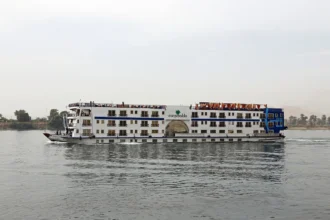
Luxor’s non-temple experiences are not filler, and they deserve a place in a city guide because they give the city a dimension that temples and tombs alone cannot: the river, the light and the landscape that shaped Thebes in the first place. A felucca sail on the Nile at sunset, with the Corniche and West Bank hills in view, is the gentlest hour in the city, because a felucca moves slowly, without engine noise, and because the sunset light on the water, the hills and the temple silhouettes gives a view of Luxor that no ground visit can match. A felucca is also the most accessible Nile experience, since it needs no advance cruise booking, can be arranged through a hotel or directly on the Corniche, and can be as short as an hour, which makes it easy to fit into an East Bank evening after Luxor Temple or into a free afternoon between sites. A dawn hot-air balloon flight over the West Bank — launching near Medinet Habu in the hour after dawn, according to competitor guides — gives the one view no ground visit can: temples, fields, desert and tombs in a single panorama, with the green irrigated strip, the desert hills and the great sites laid out below in a pattern that explains Luxor’s geography at a glance. The balloon view is especially valuable for a city guide, because it shows the east-west division, the Nile’s curve and the relationship between fields, desert and monuments in a way that ground visits, which move from site to site, cannot easily convey. Both experiences also remind visitors that Luxor is a river city first, and that its monuments were built to be seen from the water.
Booking these Nile and balloon experiences well requires the same caution as booking any Luxor activity, because operators and prices vary, and because safety and timing matter more than a bargain price. Balloon operators and prices vary, so book through your hotel or an established operator and check the official site before visiting for safety and booking details, and confirm prices before booking, including what is included, what time you will be collected, and what happens if weather cancels a flight, since dawn flights depend on wind and visibility and can be cancelled at short notice. A balloon flight is an early start — collection is usually well before dawn — and it suits visitors who are comfortable with heights and with an early morning, while visitors who are not comfortable with heights should not feel they are missing the city, because the same dawn light from a West Bank rooftop or the Corniche is still beautiful, and because a felucca at sunset gives a comparable sense of the river and the hills without leaving the ground. For feluccas, agree the duration and price before boarding, confirm whether the price is per boat or per person, and choose a sunset hour rather than a midday hour, when the light is harsh and the river is less atmospheric. Both experiences also pair naturally with the itinerary in this guide: a balloon flight belongs on a third, comfortable day, when an early start does not force a rushed temple day afterwards, while a felucca belongs on any East Bank evening, as a gentle close to a day that began at Karnak and ended at Luxor Temple. Done that way, the Nile is not an extra but the thread that ties the two banks together.
Practical Itinerary, How to Reach and Best Time
| Plan | Day by day |
|---|---|
| 1 day (tight) | West Bank morning: Valley of the Kings and Hatshepsut Temple; East Bank afternoon and evening: Karnak, then Luxor Temple floodlit |
| 2 days (recommended) | Day 1 East Bank: Karnak at opening, museums, Luxor Temple in the evening. Day 2 West Bank: Valley of the Kings, Hatshepsut Temple, Colossi of Memnon |
| 3 days (comfortable) | Add a balloon flight, Medinet Habu, Deir el-Medina, Valley of the Queens and a felucca sunset |
| How to reach | Flight from Cairo (about 1 hour), overnight sleeper train from Cairo, or Nile cruise from Aswan; check schedules before booking |
| Getting around | Private car or taxi for West Bank days; local ferry between banks; walking on the East Bank Corniche |
| Best time | October to April for comfortable temperatures; summer visits need early starts, water, hats and shade breaks |
Use the table above as your starting point, then adjust it to your energy: two days by bank is the recommended pattern, three days is comfortable, and one day, while possible, should be treated as a tight highlights day rather than a full Luxor visit. For where to stay while you follow this itinerary, see our where to stay in Luxor guide.
Conclusion
Luxor works best when you let the river organise you: East Bank for temples and city life, West Bank for tombs and quiet mornings, and the Nile itself for sunset perspective, because that simple rule prevents the most common Luxor mistake, which is to treat the city as a list of famous names and to cross the river repeatedly for single sites. Two days give you the essentials — Karnak and Luxor Temple on the East Bank, the Valley of the Kings and Hatshepsut Temple on the West Bank, with museums and the Corniche in between — while three days give you the city at a human pace, with a balloon flight, Medinet Habu, Deir el-Medina, the Valley of the Queens and a felucca sunset added without rushing any of them. Do not try to compress Karnak, Luxor Temple, the Valley of the Kings and Hatshepsut Temple into a single day, because each deserves its own morning or evening, and because a single day that tries to cover all four will leave you with photographs but not with understanding, and with exhaustion rather than with the sense of a city. Luxor rewards the traveller who gives it time, who starts early, who rests at midday, who saves Luxor Temple for the evening, and who lets the Nile set the pace, and that traveller will leave with a coherent picture of Thebes: a living city on one bank, a necropolis on the other, and a river between them that still defines both. That coherence is the real souvenir of Luxor, more lasting than any single temple photograph. That river-centred pattern also leaves room for unplanned moments, such as a market walk or a quiet museum hour.
The practical choices that make that coherent visit work are simple, and they are worth repeating at the end because they are easy to forget in the excitement of planning: choose a season first, with October to April the most comfortable, then choose a bank pattern, with two days recommended and three days comfortable, then book early for the big sites and for festival and holiday weeks, and confirm prices before booking accommodation, transport, guides and balloon flights. Check the official site before visiting for current hours, tickets and prices, since entry arrangements change and since a city with this many sites has many different ticket combinations, and check schedules before booking flights, sleeper trains and Nile cruises, since Luxor is reached by air, by rail and by river and since each route has its own timetable. Pack for desert heat even in winter, with sun protection, a hat, water and comfortable shoes, and pack a light layer for cooler evenings on the Corniche and for early balloon mornings, because Luxor’s days and nights differ more than visitors expect. Done that way, Luxor is not a rushed checklist but a city visit: temples in the morning, museums at midday, a floodlit temple and a Nile sunset in the evening, tombs in the quiet of a West Bank morning, and a third day, if you have it, for the quieter sites that show ordinary life behind the monuments. Luxor, ancient Thebes, has been a destination for two thousand years, and it still rewards the visitor who gives it the time it deserves. A city that has welcomed visitors for two thousand years still rewards patience, early mornings and an unhurried evening by the Nile.
FAQs
How many days do I need in Luxor?
At least two full days, one per bank. Three days is ideal for balloons, museums and lesser-visited West Bank sites.
What is the best time to visit Luxor?
October to April is generally most comfortable. In summer, visit sites early, rest at midday and return in the evening.
Should I visit Karnak or Luxor Temple first?
Visit Karnak in the morning for scale and light, and save Luxor Temple for the evening, when it is floodlit and at its most atmospheric.
How many tombs can I visit in the Valley of the Kings?
Your ticket normally covers a set number of open tombs, with a rotating selection open at any time. Choose three or four and take your time rather than rushing through more.
How do I get between the East and West Banks?
By local ferry or bridge, by taxi, or by private car arranged through your hotel. West Bank sites are spread out, so a driver is the most efficient option.
Is Luxor suitable as a day trip from Cairo?
It is possible by early flight, but it makes for a very long, rushed day. An overnight stay — ideally two nights — gives a far better experience.
External reading: Pyramids Land — Luxor travel guide, Discovery Tours Egypt — Luxor, and Egypt Ministry of Tourism and Antiquities — Karnak.