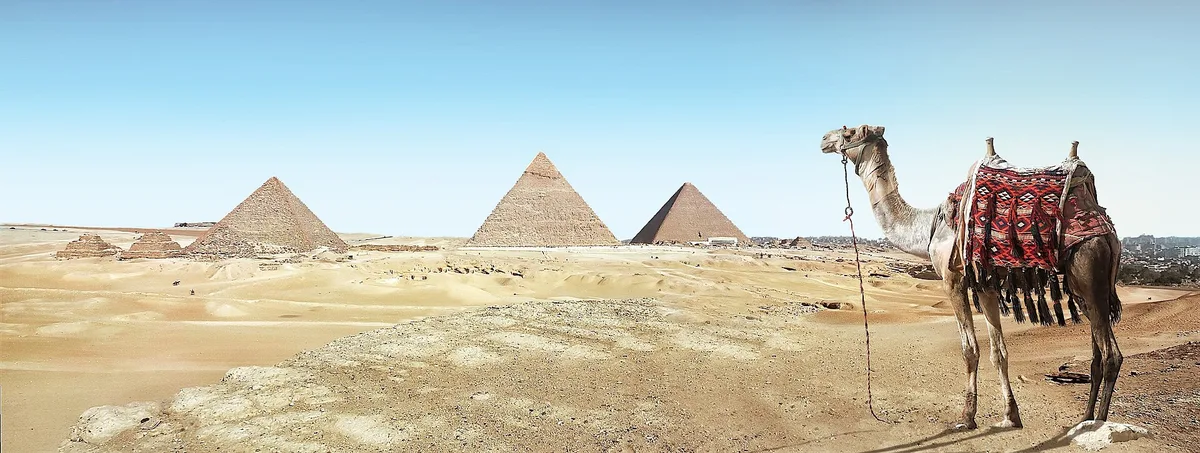
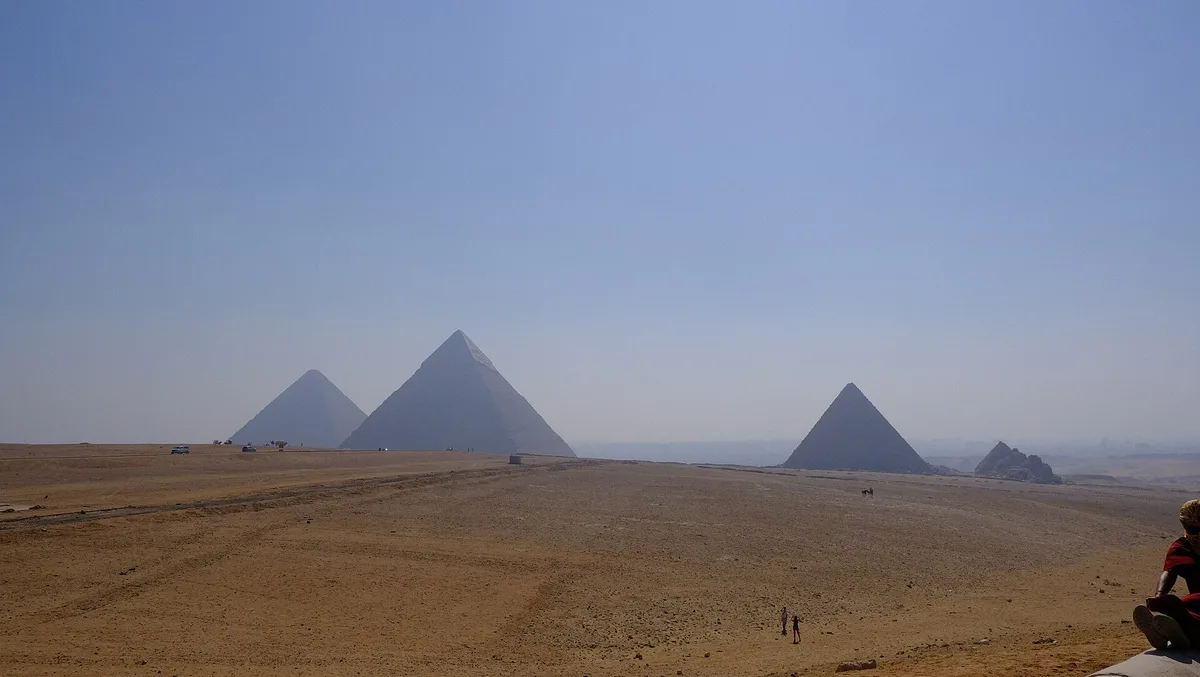
Most people meet Giza the wrong way round. They are driven up the hill in the late morning, walked around three enormous pyramids in the building heat, photographed at the Sphinx, and driven away by lunch, having seen everything and understood the shape of none of it. This giza travel guide is built to prevent exactly that day. Giza is not a photo stop on the edge of Cairo. It is a royal cemetery city of the third millennium BC — three pyramid complexes with their temples and causeways, officials’ cemeteries, the builders’ town, and the Great Sphinx watching the sunrise — and since November 2025 it has had a second anchor, the Grand Egyptian Museum, two kilometres away, holding the complete treasures of Tutankhamun. Seen whole, and in the right order, it is the single most rewarding day in Egypt. Seen in a rushed hour, it is a queue in the sun.
Two changes have remade the visit in the last two years, and older guides have not caught up with either. First, the plateau was reorganised in April 2025: the main entrance moved to a new visitor centre — the Great Gate — on the Cairo–Fayoum Desert Road, private cars and tour buses now stop outside, and electric shuttle buses loop the monuments. The old gate by the Mena House hotel, where generations of visitors arrived, is no longer the way in. Second, the museum arrived: the objects that explain the plateau, from Khufu’s great cedar boat to the burial gold, now sit beside the pyramids in a building aligned on them, instead of across the city in Tahrir Square. A modern giza travel guide has to plan around both facts, because together they decide where your day starts and what must be booked before you leave home.
What follows is organised the way the visit itself is organised. The practical machinery comes first — the new entrance system, the tickets and what they honestly cost, the opening hours as the official sources give them — because at Giza the logistics decide whether the day is good or spoiled. Then the monuments in the order you will meet them, the museum, where to sleep and how to arrive, and a one-day route that fits plateau and museum together. Prices are given only where Egypt’s Ministry of Tourism and Antiquities publishes them itself, and where the Ministry’s own channels currently disagree, this guide says so and tells you which figure to budget. Everything else is mechanism: what you pay for, where, and what is extra. The rest of this giza travel guide is that promise kept, section by section.
One boundary is worth drawing before we start. The deep monument-by-monument walk — each pyramid’s chambers, temples and building history in full — has its own home on this site, in our Pyramids of Giza guide, and this page does not repeat it. This is the planning guide: the Giza of gates, tickets, routes, beds and museum slots, written so that when you stand in front of the stones, the day has already been solved.
Giza Travel Guide at a Glance
| Need to know | Detail |
|---|---|
| Where | The Giza plateau, on the west bank of the Nile at the desert edge of the city of Giza, about 13 km south-west of central Cairo |
| What is here | The pyramids of Khufu, Khafre and Menkaure, six queens’ pyramids, the Great Sphinx, valley and mortuary temples, causeways, boat pits, officials’ cemeteries and the builders’ town |
| Main entrance | The Great Gate visitor centre on the Cairo–Fayoum Desert Road (since April 2025); the older Sphinx-side gate at Nazlet el-Semman also operates |
| Moving inside | Electric hop-on, hop-off shuttle buses loop the plateau’s stops on your ticket; you may also walk between stops |
| Plateau ticket | EGP 700 foreign adult, EGP 350 foreign student – the Ministry of Tourism and Antiquities’ published list, checked 1 November 2026 |
| Pyramid interiors | Separately ticketed and capped daily – the Great Pyramid is EGP 1,000 on the Ministry’s list but EGP 1,500 as currently listed on the official booking portal; budget the higher figure |
| Opening hours | The official list gives the plateau 7:00am to 5:00pm; official pages differ on the opening hour and last entry, so confirm on the portal when you book |
| Time needed | Half a day for the plateau alone; a full, well-paced day for the plateau plus the Grand Egyptian Museum |
| The pairing | The Grand Egyptian Museum stands about 2 km away – book its timed slot for late morning, or for a Wednesday or Saturday evening |
| UNESCO | The plateau is the northern anchor of “Memphis and its Necropolis”, a World Heritage property inscribed in 1979 |
Read the table as a set of decisions rather than a list of facts, because that is what it is. The entrance decides where your driver waits. The interior tickets decide how early you must arrive. The museum slot decides whether the plateau gets the cool of the morning or the museum does. Every giza travel guide can tell you the Great Pyramid is big; the useful ones tell you that its interior tickets are limited, that they are sold separately, and that the traveller who decides about them at the gate at eleven o’clock has usually decided too late.
Notice, too, what the table does not contain: a single “best” anything. Giza rewards sequencing more than selection — the same stones in the wrong order produce the disappointing trip that fills the review sites. The sections below put them in the right order.
Why Giza Is More Than a Cairo Morning
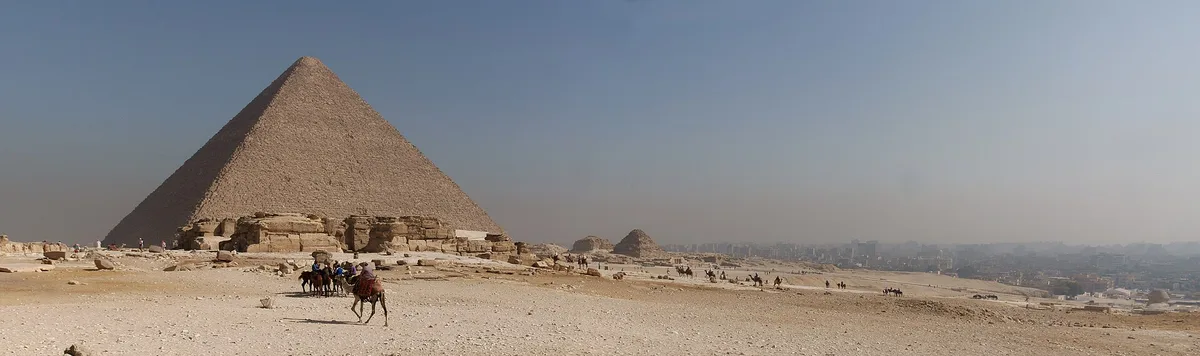
Start with the geography, because it explains everything else. Giza is not a suburb that Cairo happens to contain; it is a separate city and governorate on the Nile’s west bank, facing the capital across the river, and the plateau sits on its desert edge where the farmland stops and the sand begins. That edge mattered to the builders. The west bank was the side of the setting sun, and in Egyptian belief the side of the dead, which is why the royal cemetery stands here and not beside the palaces of the living. The ground was chosen with an engineer’s eye as well: a limestone plateau solid enough to carry the pyramids, close enough to the river for stone to arrive by boat, and high enough to be seen across the whole valley.
The second thing to understand is that the plateau is one designed landscape, not three separate attractions sharing a car park. Each pyramid was the peak of a complex that ran downhill in a deliberate sequence: mortuary temple against the pyramid’s east face, a covered causeway descending the slope, a valley temple at the edge of the cultivation where the funeral barge arrived, and around that spine, the queens’ pyramids, the boat pits, and cemeteries where officials were buried in mastaba tombs, close to their master for eternity. Walk the plateau with that sequence in mind and the ground starts to read like a diagram. Which is why our companion guide to the Pyramids of Giza walks the complexes one by one, while this guide keeps to the visit as a whole.
Finally, Giza today is a living place, and pretending otherwise sets visitors up for friction. The village of Nazlet el-Semman crowds against the plateau’s eastern foot under the Sphinx, its families having worked the site as guides, drivers and animal handlers for generations. A giza travel guide that treats the plateau as an empty archaeological park will leave you unprepared for the human reality of it: busy, commercial, occasionally pushy, and — once the new entrance system has filtered you onto the plateau proper — suddenly, surprisingly calm. Both halves of that sentence are true, and the next section explains the system that separates them.
The New Way In – the Great Gate, the Visitor Centre and the Shuttle Buses
For over a century, visiting the pyramids meant arriving at the gate beside the Mena House hotel, in a scrum of coaches, taxis, horses and hopeful salesmen, and being driven around the plateau from monument to monument. In April 2025, under a redevelopment of the plateau run by the Ministry of Tourism and Antiquities with Orascom Pyramids Entertainment, that system was switched off. The main entrance is now a purpose-built visitor centre — the Great Gate — on the Cairo–Fayoum Desert Road, on the plateau’s western side, roughly facing the Grand Egyptian Museum. Private cars and tour buses stop there. What happens next is orderly by design: tickets, a security check, an orientation space, and then the plateau itself, reached by shuttle.
Movement inside is now part of the ticket. A loop of electric buses runs between designated stops — the Great Pyramid area, Khafre, Menkaure and the panorama, and the Sphinx and valley temples — and you hop off, look for as long as you like, and hop on the next one. Walking between stops is allowed and often preferable: the distances are real but walkable, the desert between the monuments is half the experience. What the new system removes is the old freedom for every vehicle to roam, and with it much of the noise, fumes and chaos that used to define the site. Animal handlers and vendors, similarly, have been moved into designated areas rather than roaming the whole plateau — the encounters still happen, but they happen in places, which changes their character.
Two practical consequences follow. First, tell any driver or tour you book exactly which gate you mean. “The pyramids entrance” is no longer a sufficient instruction: a driver working from habit may still head for the Mena House side, and older map pins, hotel advice and guidebook directions point there too. The address you want is the visitor centre on the Fayoum road. Second, the older Sphinx-side entrance at Nazlet el-Semman still operates and suits anyone staying in the village hotels — but for a first visit with a museum slot to protect, the Great Gate is the entrance the system is built around. A giza travel guide written before 2025 will not tell you any of this; check the date on anything you read.
Tickets, Prices and Opening Hours – What the Official List Actually Says
Here is the part of a giza travel guide that can be settled exactly, because the state publishes it. Egypt’s sites are ticketed by the Ministry of Tourism and Antiquities, which maintains a single official price list; Giza’s tickets are sold through the official booking portal, egymonuments.com, and at the site. The structure matters more than any single figure. There is one plateau ticket, which admits you to the archaeological area — the pyramids from outside, the Sphinx, the valley temples, the cemeteries, the panorama, and the shuttle loop. Everything that involves going inside something is a separate ticket stacked on top of it, and the interiors are where numbers run out: entry is limited each day, for conservation and because the passages hold only so many people.
The prices themselves, as this giza travel guide promised at the top — foreign adult, with foreign student in brackets, in Egyptian pounds, as published by the Ministry of Tourism and Antiquities (checked 1 November 2026). The plateau ticket is EGP 700 (350). The Great Pyramid’s interior is a separate ticket, and here the official channels disagree: the Ministry’s published list gives EGP 1,000 (500), while the official booking portal egymonuments.com has been listing EGP 1,500. Budget for the higher figure and take the portal’s price at booking as the truth. Khafre’s pyramid interior, when it is the one open, is EGP 280 (140) on the published list. Menkaure’s interior and the plateau’s smaller separately-ticketed sights — the tomb of Queen Meresankh III in the Eastern Cemetery, and the Workers’ Cemetery above the builders’ town — are also extra tickets, sold according to what is open on the day; let the portal or the ticket desk on the day be the authority for them.
Three rules of the system are worth more than the numbers. First, interiors rotate: the pyramids are closed in turn for conservation and cleaning, so on a given day the Great Pyramid and usually one of the other two will be enterable, and sometimes the choice is made for you. Second, foreign students with valid student identification pay half the foreign adult price on these tickets, it is the largest legitimate discount in Egyptian travel, and the most often left unclaimed. Third, carry a working bank card as well as cash: payment at the major sites has moved steadily toward card and online.
On hours, honesty requires admitting that the official sources do not perfectly agree. The Ministry’s published list gives the plateau’s hours as 7:00am to 5:00pm, though other official pages show an 8:00am opening and an earlier last entry, and hours shift in Ramadan. The practical reading is consistent: the plateau opens early, last entry is well before closing, the interiors close earlier than the grounds. Confirm the current hours on the official portal when you book, and build the plan around an early start — at Giza, the timetable is not a detail, it is the strategy.
The Great Pyramid of Khufu – the Last Wonder Standing
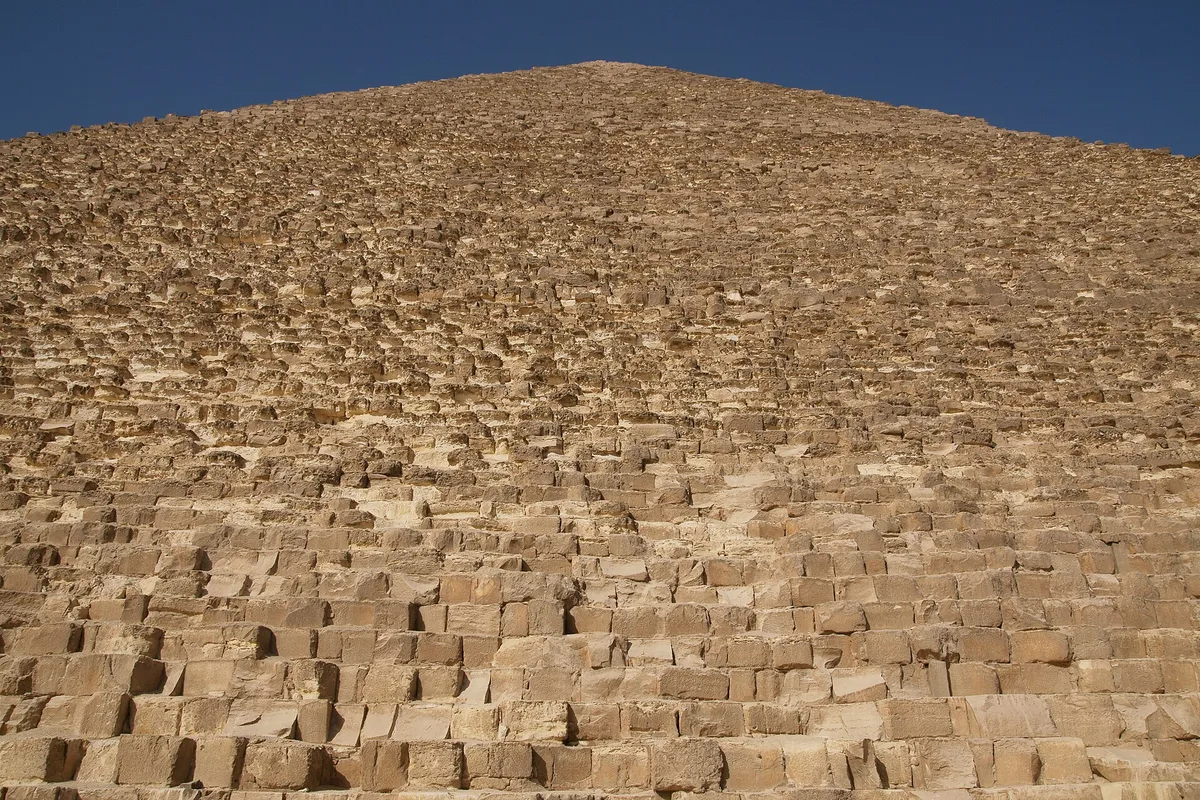
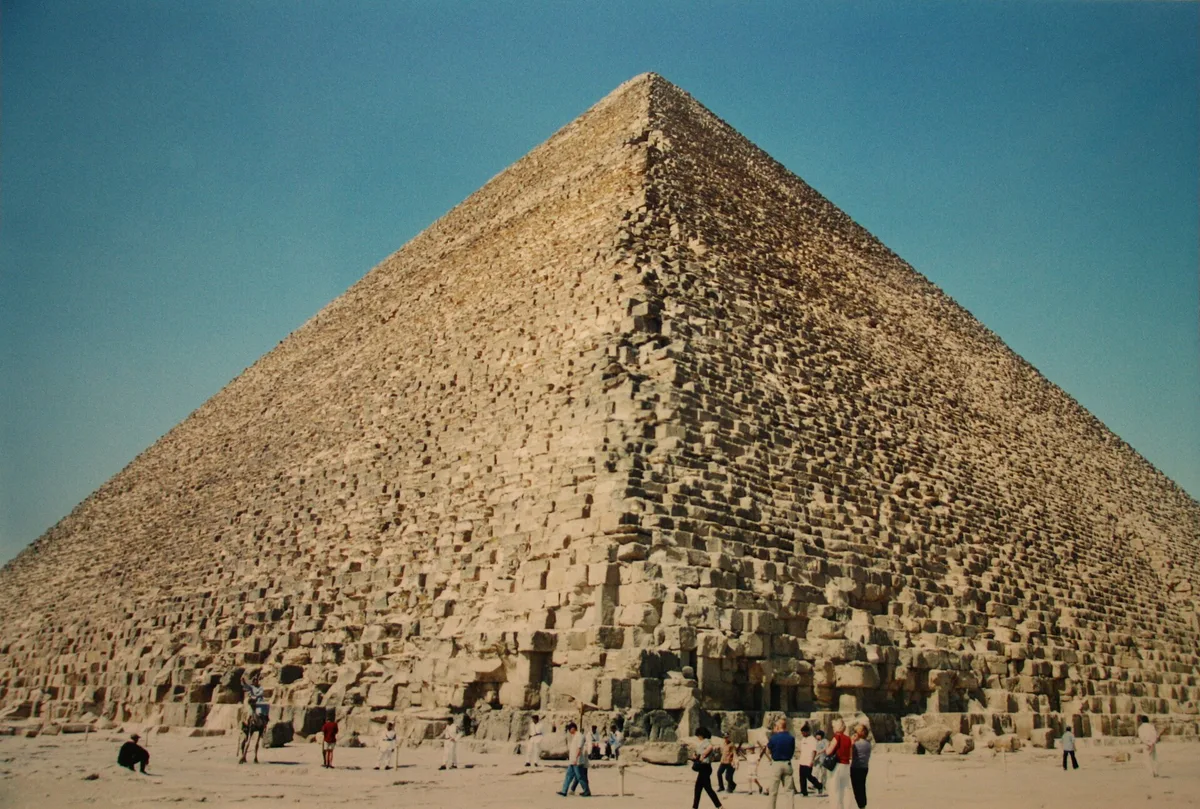
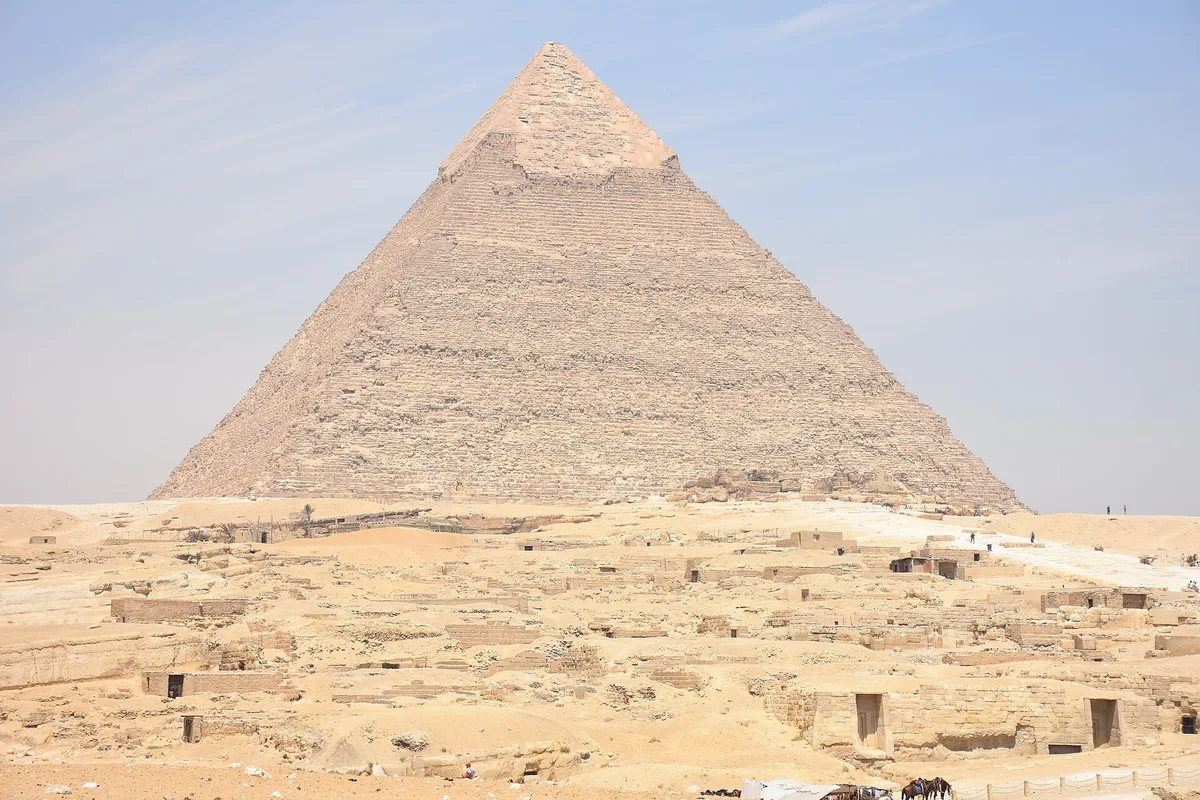
Everything on the plateau is an argument with this building. The Great Pyramid was raised for Khufu, second king of the Fourth Dynasty (reigned c. 2589–2566 BC on the Ministry’s timeline), and completed around 2560 BC. It stood originally about 146 metres high — it has lost its summit and its casing, and now reaches roughly 139 metres — on a base more than 230 metres square, and it is built of an estimated 2.3 million blocks averaging around two and a half tonnes each. For more than 3,800 years it was the tallest human-made structure on earth, and it is the only one of the Seven Wonders of the Ancient World that survives. The statistics are familiar to the point of numbness, which is why the honest advice in any giza travel guide is physical rather than numerical: walk beside it. The scale arrives at ground level, where single blocks stand taller than you and the base runs on past where your eye expected it to end.
Look, while you walk, for the pyramid’s lost skin. The stepped stone mountain in front of you is the core; the finished monument was cased in smooth white limestone from Tura, across the river, polished until the whole structure gleamed — a white, shining landmark visible across the valley, closer to geometry than to ruin. Most of that casing was stripped in the middle ages to build Cairo, which is why the pyramid reads today as a staircase of rough blocks. Near the base, traces of the original surface survive: they show the building as its makers finished it — the weathered texture everyone photographs is the pyramid with its clothes removed.
Around the pyramid, give the complex its due rather than treating the surroundings as foreground. On the east side stand the remains of Khufu’s mortuary temple and the three small queens’ pyramids; in the rock nearby are the boat pits, one of which held the king’s great cedar ship, excavated in 1954 and now reassembled in its own museum inside the Grand Egyptian Museum, two kilometres away. The old Solar Boat Museum that stood by the pyramid has closed; the boat has moved in with the treasures. The full building history of this complex — the chambers, the construction debates, the Diary of Merer papyri that record Khufu’s own stone-boat crews at work — belongs to our Pyramids of Giza guide. This is the centre of the plateau, it deserves the morning’s best hour, and it is the one monument whose interior, if you are going inside anything, the next section is about.
Inside the Great Pyramid – the Climb to the King’s Chamber
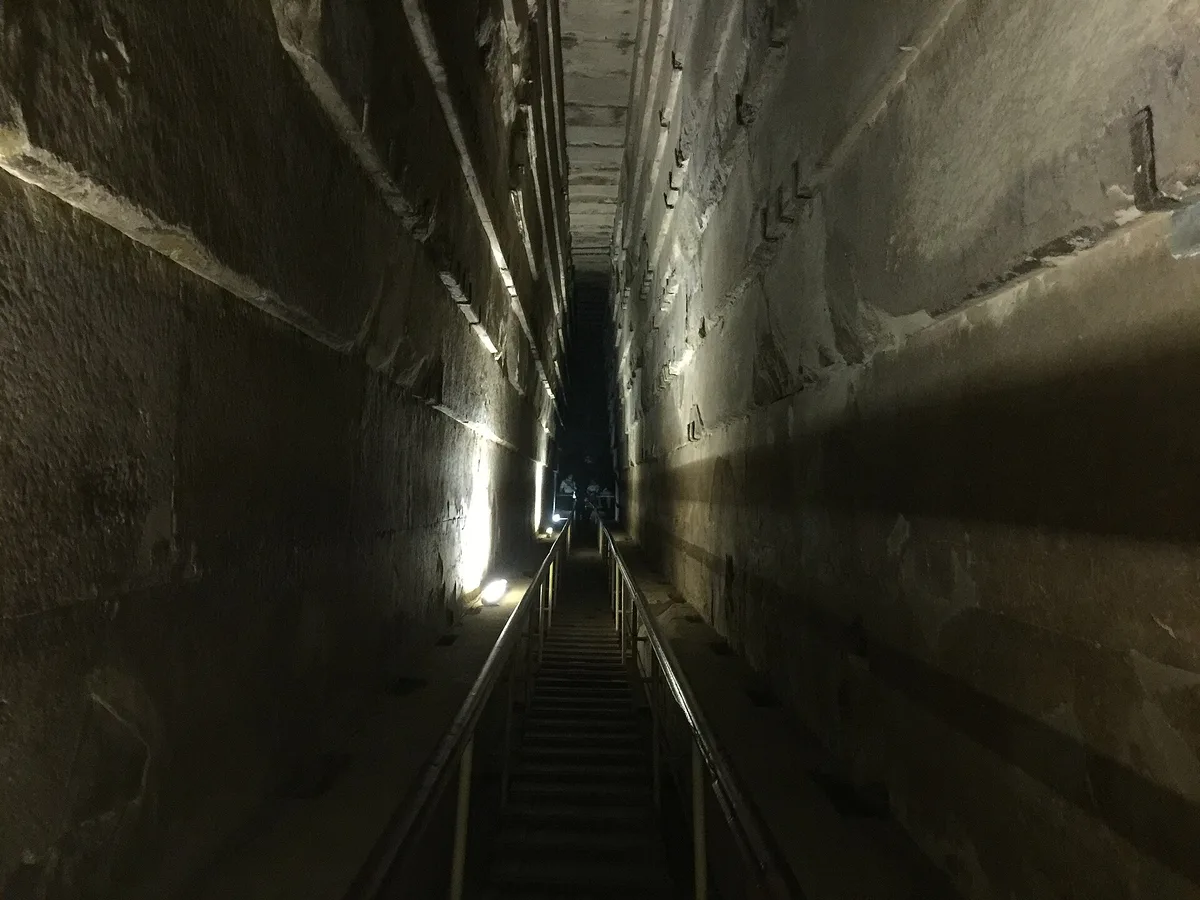
Going inside the Great Pyramid is the plateau’s great optional extra, and it should be chosen with open eyes, because what you are buying is not a decorated tomb — and any honest giza travel guide should say so before you pay. There are no painted walls, no treasure, no furniture; the pyramid was robbed in antiquity and its chambers are bare stone. What you are buying is the experience of moving through the most ambitious interior of the Bronze Age: in through the forced entrance cut by treasure-hunters in the ninth century, up the low ascending passage — a stooping, hands-and-knees-adjacent climb in warm, still air — and then into the Grand Gallery, a corbelled corridor some 47 metres long and over eight metres high whose stepped ceiling is one of the great rooms of the ancient world. Beyond it, through a low portcullis passage, lies the King’s Chamber: red granite from Aswan, an empty granite sarcophagus, and the peculiar, absolute quiet of being inside 2.3 million blocks of stone.
That description contains its own warnings, and a responsible giza travel guide should not soften them. The passages are narrow, steep and hot, the climb is sustained stooping, and the route is one-way in effect — you will pass descending visitors in the same confined space. Anyone with claustrophobia, significant mobility limits, or a heart or breathing condition should take the plateau’s honest advice and enjoy the pyramid from outside, where most of its meaning lives anyway. Photography rules inside the pyramids have changed over the years and are posted at the ticket point; expect restrictions and follow them rather than arguing the point underground.
Practically: decide before you arrive, arrive early, and buy the interior ticket with the plateau ticket, because numbers are capped and the Great Pyramid’s allocation can sell out on busy days. Go inside first, while your legs and the morning are fresh, and let the rest of the plateau be the relaxed part of the day. Hold the experience at the right size afterwards: the interior takes perhaps thirty to forty minutes, it is unforgettable in the body rather than in the camera, and a complete Giza day without it is entirely possible. The pyramid you must not skip is the outside of this one.
Khafre – the Pyramid That Looks Tallest
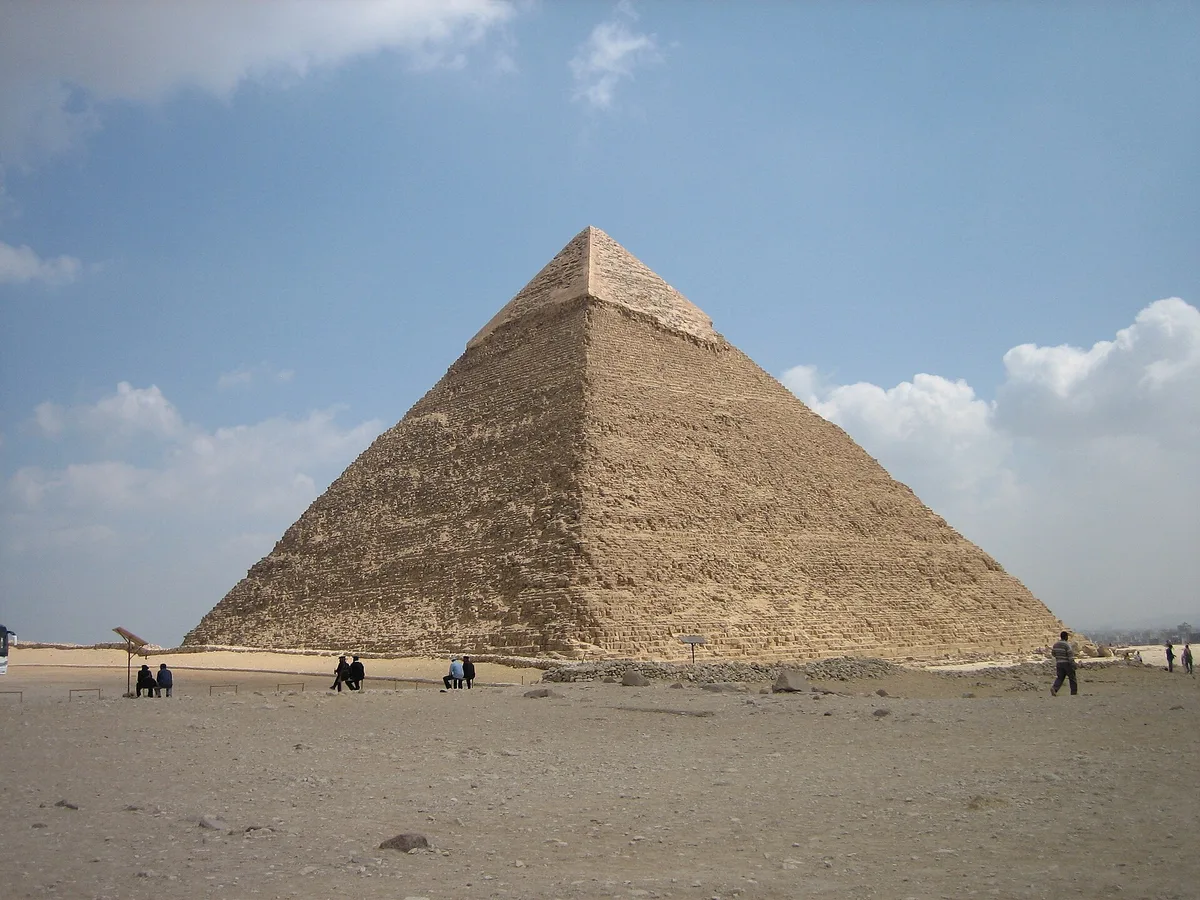
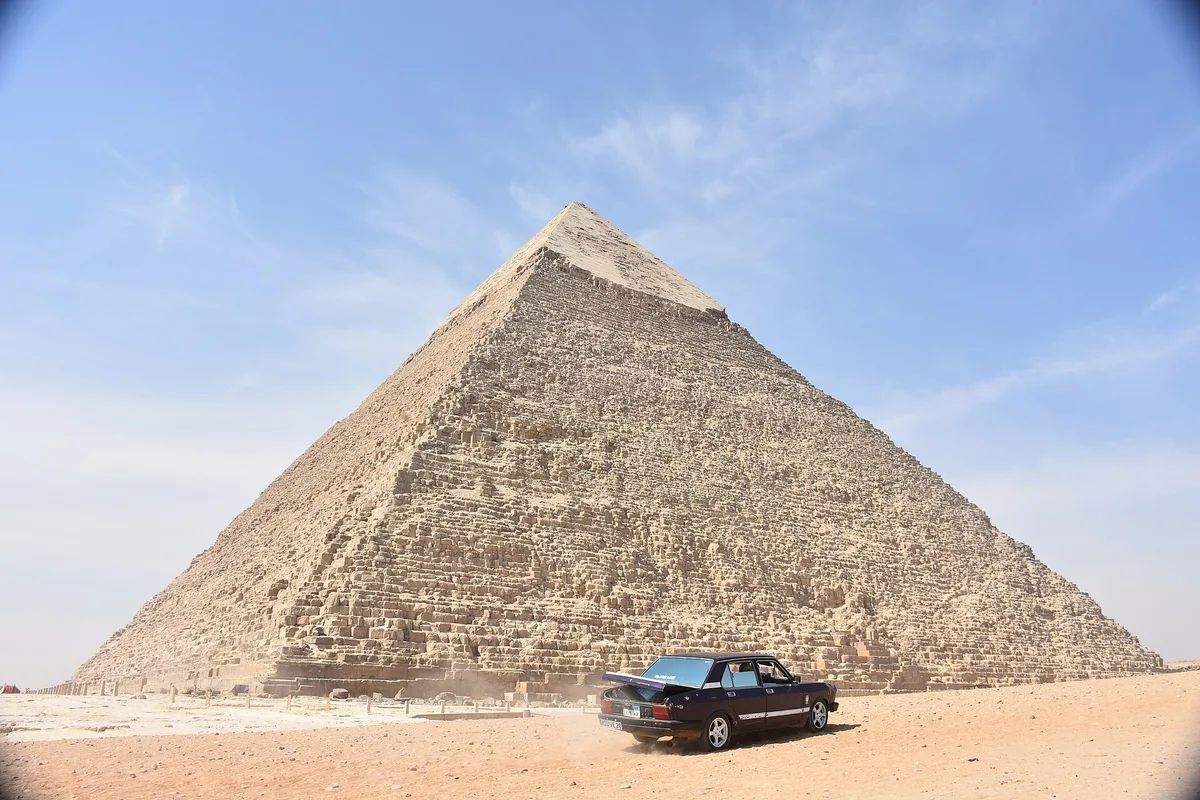
Ask a group of first-time visitors which Giza pyramid is the biggest and most will point at the wrong one. Khafre, Khufu’s son, built his pyramid slightly smaller than his father’s — about 143 metres originally, against Khufu’s 146 — but he built it on higher bedrock and at a marginally steeper angle, and the ground falls away in front of it, so from the plateau’s main viewpoints his monument stands higher in the sky and reads as the giant of the three. The illusion is completed by its summit. Khafre’s pyramid alone kept a cap of its original casing, the smooth Tura limestone still clinging around the peak, so it wears a white crown over a stepped stone body — exactly the contrast the whole plateau once presented, preserved on one apex.
Khafre’s complex is also the most complete on the plateau, and it rewards being read as a set. His mortuary temple, against the pyramid’s east face, was built on a scale and in materials — granite and alabaster alongside limestone — that Khufu’s plundered equivalent only hints at. From it, his causeway runs down the slope in a line you can still trace with your eye, to the valley temple beside the Sphinx: the best-preserved building of its kind in Egypt, and the subject of its own section below. A visitor who walks that line today, even roughly, follows the most coherent single route the Old Kingdom left behind.
The interior, when Khafre’s pyramid is the one open in the rotation, is the connoisseur’s alternative to Khufu’s: a simpler plan, a burial chamber cut partly into the bedrock with a granite sarcophagus sunk into its floor, and — the deciding factor for many — a fraction of the crowd. It is no failure of ambition to choose this climb over the famous one, and on a hot or busy day it may simply be the better hour. Either way, the giza travel guide verdict on Khafre is the plateau’s standing lesson in not trusting first impressions: the pyramid that looks largest is not, the temple that looks like a ruin is the masterpiece, and the king who built second built the complex that survived best.
Menkaure and the Queens’ Pyramids – the Quiet End of the Plateau
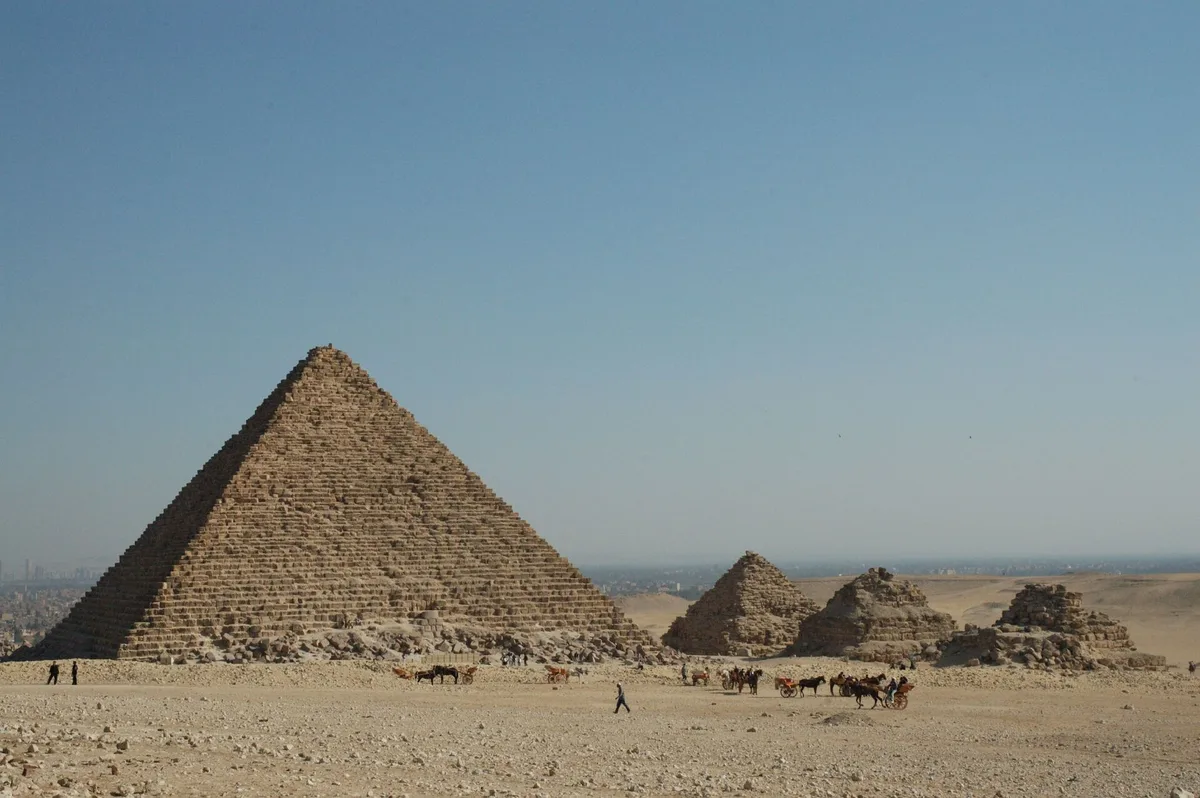
At the plateau’s southern end the scale changes, and so does the mood. Menkaure, Khafre’s son, built the third pyramid at roughly a quarter of his grandfather’s volume — about 65 metres high as designed — and the reduction is usually read as economics and theology shifting together: the age of the supergiant pyramid was ending, royal resources were spread across more temples and more gods, and the king’s eternity could apparently be secured at a more human size. What Menkaure’s pyramid lost in height it partly kept in richness. Its lower courses were cased not in limestone but in red granite from Aswan, some of it left visibly unfinished, and its temples produced the age’s finest small sculpture: the greywacke triads of the king between goddesses.
Beside each of the great pyramids stand their supporting casts, and the southern group is the clearest: three small queens’ pyramids in a row by Menkaure’s, matched by the three beside Khufu’s at the plateau’s other end. These tombs of royal wives and mothers are why the classic panorama photograph counts nine pyramids, not three. Visitors rush past them on the way to the viewpoint, which is a pity, because at this end of the plateau the crowds thin to almost nothing, the desert takes over from the archaeology, and the whole necropolis can be contemplated at walking pace — the corner of the site this giza travel guide would save for the hour when the light begins to turn.
Menkaure’s interior opens in the rotation like the others and is the shortest and simplest of the three climbs — a descending passage, chambers below the pyramid’s base, and none of the Grand Gallery’s theatre. But the honest reason to walk to this end of Giza is not the interior at all. It is the completeness of the view back: from Menkaure’s ground, the diagonal of the three pyramids lines up across the plateau exactly as the builders laid it out, grandfather, father and son in descending size and ascending ground, with the city waiting beyond and the desert at your back — the single best place on the plateau to understand what the whole thing is.
The Great Sphinx – the Guardian at the Foot of the Slope
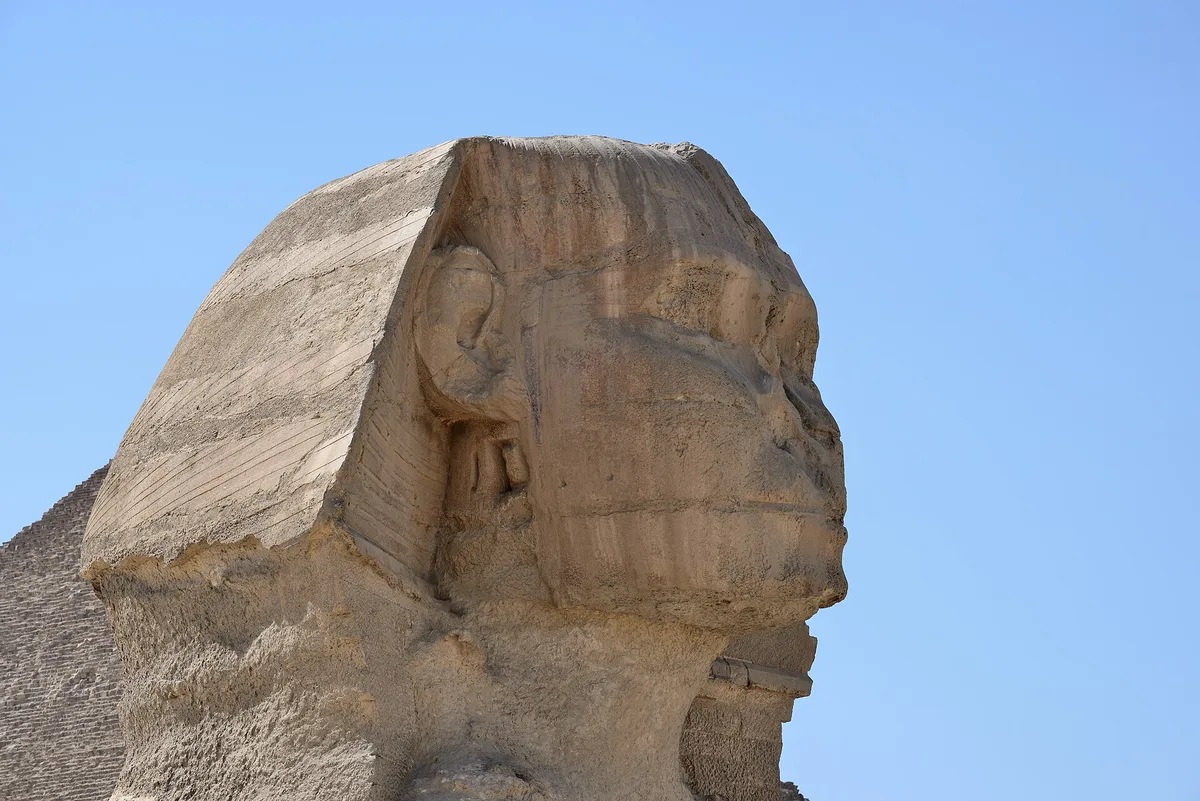
Every giza travel guide eventually runs out of comparisons for the Sphinx, so let the measurements speak first: about 73 metres long and 20 metres high, a lion’s body with a king’s head, carved not from brought stone but from a single ridge of the plateau’s own bedrock, left standing when the surrounding rock was quarried away. It is the largest surviving statue of the ancient world, generally attributed to Khafre’s reign, around 2500 BC, its face understood as the king’s own. It faces east, across what was the floodplain, towards the rising sun, and its position is not decorative: it stands at the foot of Khafre’s causeway, where the valley temple met the desert road, guarding the approach to the whole complex.
The statue has had a longer biography than most buildings. Between its paws stands the Dream Stela of Thutmose IV, a New Kingdom prince who — by the inscription’s own account — fell asleep in the Sphinx’s shadow when it was already a thousand years old and buried to its neck in sand, dreamed that it promised him the throne if he cleared the sand away, and did. Its nose was already missing centuries before Napoleon’s army arrived — drawings made decades before the French expedition show the face exactly as noseless as it is today, whatever the legend of target practice says. The beard fell, and the paint is weathered to traces. What remains is a monument that has been ancient for almost as long as it has existed.
See it properly by seeing it slowly. You view the Sphinx from a raised platform beside its temple forecourt — you cannot walk up to it, and the enclosure keeps everyone at the same respectful distance. Go when the shuttle or your walk brings you down the hill in the morning if you can: the face looks east, the light is on it early, and by mid-morning the viewpoint carries the full weight of the day’s groups. Then stand a moment longer than the photograph requires. The Sphinx has been watching travellers arrive at Giza for four and a half thousand years, and there is a particular pleasure in being, briefly, one of the watched rather than the watchers.
The Valley Temple of Khafre – the Building the Tours Rush Past
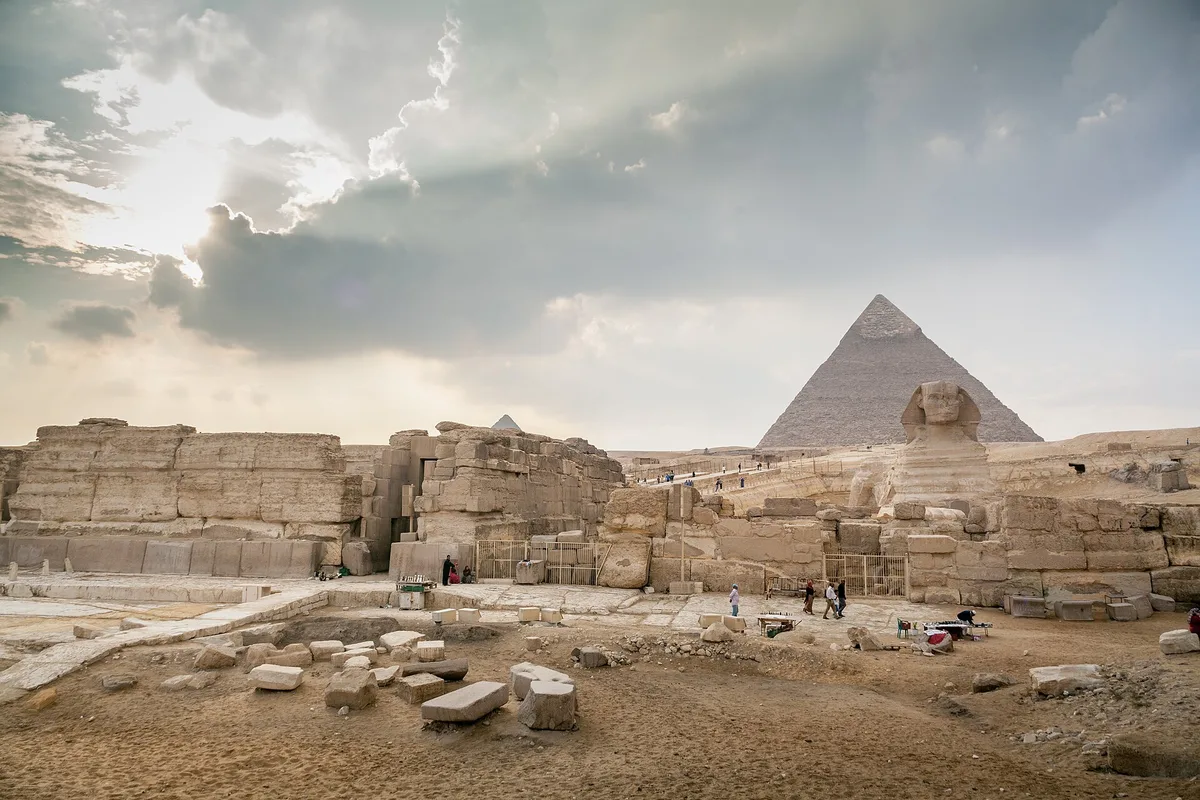
Between the Sphinx and the modern village, half-sunk in the ground at the plateau’s edge, stands the building that best explains how a pyramid complex actually worked — and the one most rushed itineraries cross in four minutes on their way to the viewpoint. Khafre’s valley temple is where the king’s body arrived by water. In the Old Kingdom the Nile’s flood reached close to this ground; the funeral barge docked here, and in this temple of massive limestone core blocks faced with red granite, the king’s body was received, purified and prepared before the procession carried it up the causeway to the mortuary temple and the pyramid. The architecture makes the purpose legible: no painted walls, just enormous weight — granite pillars, an alabaster floor, a hall built like a piece of the earth’s crust.
This was also a treasure house of sculpture. In a well in the temple’s hall, excavators in 1860 found the diorite statue of Khafre enthroned, the hawk of Horus spreading its wings behind his head — by general consent one of the supreme works of Egyptian art, now in the Egyptian Museum in Tahrir Square in Cairo. Some twenty-odd statues of the king once stood in this hall; it was a gallery of granite kings. Beside it stands the Sphinx Temple, aligned on the statue itself — together they make the point that this was a working religious waterfront, not a sculpture park.
Give the valley temple the ten unhurried minutes it asks for, ideally on your way down rather than up, when it becomes the final piece of the complex’s logic rather than an unexplained ruin. It is cooler inside than anywhere else on the plateau, quieter than anywhere else on the plateau, and — because the tour groups photograph the Sphinx from the platform and leave — frequently the emptiest major building at Giza. It is also the stop this giza travel guide would protect if the day ran short: in a visit of superlatives, it is the connoisseur’s room, and it is included in the ordinary plateau ticket that brought you to the gate.
The Panorama, the Cemeteries and the Workers’ Village – the Plateau Beyond the Postcards
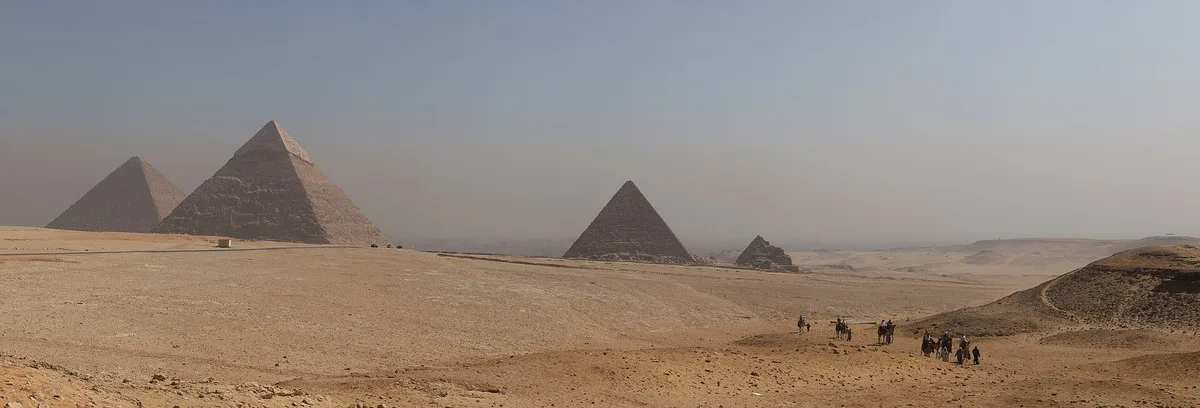
South-west of the pyramids, the desert rises to the viewpoint every visitor is eventually brought to: the panorama, where the diagonal of the three great pyramids lines up with the queens’ pyramids beside them and the whole necropolis compresses into a single frame — the nine-pyramid photograph that has advertised Egypt for a century. It is the best wide view on the plateau, and the shuttle loop stops here for a reason. But the honest secret of the panorama is that it is a beginning, not an end: from this ground the plateau’s second landscape opens up, the one made not of kings but of everyone who served and built for them, and it is the part of Giza that separates a visit from an education.
To the east and west of Khufu’s pyramid, the cemeteries of his court stretch away in planned streets of mastaba tombs — flat-topped, bench-shaped monuments (mastaba is Arabic for bench) in ordered rows, where the king’s family, priests and officials were buried within sight of his pyramid. The tomb of Queen Meresankh III, in the Eastern Cemetery, is the famous one, separately ticketed when open and worth its extra on any day it is offered. Most visitors walk through these fields without registering them, seeing rubble between viewpoints. Slow down: eternity at Giza was a hierarchy, and your address in it was your rank at court.
Below the plateau’s south-eastern edge lies the answer to the plateau’s oldest question. The builders were not slaves, and their town survives: Heit el-Ghurab, the workers’ settlement excavated over decades by Mark Lehner’s team — galleries that slept the rotating labour gangs, industrial bakeries and breweries that fed them in bulk, beef in quantities that speak of a workforce the state valued. Above the town, the Workers’ Cemetery holds the builders’ own tombs — overseers’ modest pyramids and labourers’ graves together — separately ticketed, capacity-limited, and the most quietly moving ground at Giza, the ground this giza travel guide most wants you not to skip. Stand there after the panorama and the whole place re-reads itself: the wonder was not the stones, it was the organisation — a state that could feed, house and direct thousands, and workers buried, with honour, in the monument’s shadow.
Camels, Horses and Carriages – Riding the Plateau Honestly
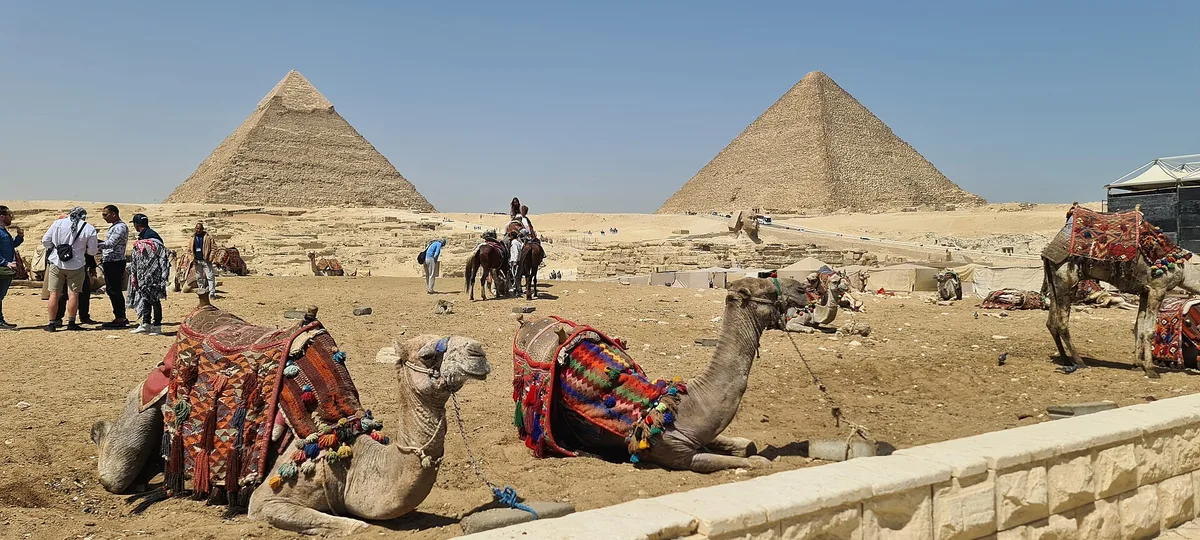
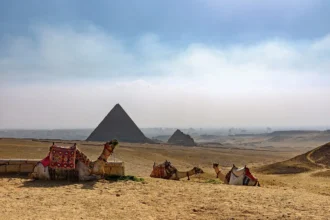
Sooner or later on the plateau, usually at the panorama, someone will offer you a camel. The ride itself can be the best money of the day — out into the open desert south of the pyramids, where the crowds vanish, the silence arrives, and the view back across the necropolis is the one the postcards are made from. Camels are the right vehicle for that ground: unhurried, high enough to see over the plateau’s folds, and phlegmatic about sand in a way horses are not. Since the 2025 reorganisation, handlers operate from designated areas rather than roaming the site, which has formalised the encounter without removing the need for the rules below — the single page of this giza travel guide, in other words, that can save your afternoon.
The rules are few and absolute. Agree everything before the animal moves: the route, the duration, and the total price, for the whole ride, in a stated currency — and say the total back to the handler so there are two witnesses to it. The classic misunderstandings are all variations on vagueness: a price that turns out to be per person, or one-way, or in a different currency, or for the mount but not the dismount. Carry small notes, because the absence of change has ended more Giza afternoons than any disagreement about history. None of this requires suspicion — most handlers are working men pricing a working animal’s day, and a clear agreement treats both sides fairly — but it does require doing the negotiating while your feet are still on the ground.
Judge the animal as well as the price. A camel or horse in visibly poor condition — ribs showing, sores under the saddle, exhaustion in mid-morning — is a ride to decline, and the plateau’s reorganisation, with its designated areas and oversight, has slowly raised the floor on welfare; your choices are part of that pressure, and choosing a healthy animal from a handler who keeps it well is the most practical vote you will cast all day. If riding is not for you, lose nothing: the shuttle loop covers the plateau’s distances, the panorama is a bus stop, and the desert south of the pyramids can be walked a little way in the morning cool. The pyramids were impressive for four thousand years before the first tourist climbed onto a camel.
The Grand Egyptian Museum – the Other Half of a Giza Day
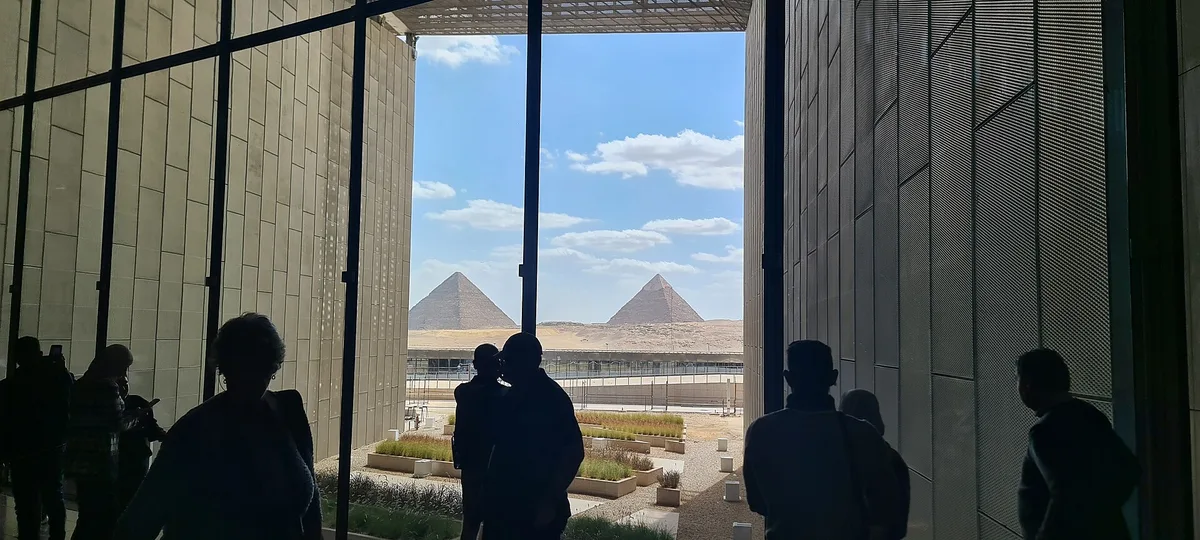
Two kilometres from the Great Pyramid, at El Remayah Square on the Cairo–Alexandria Desert Road, stands the reason a modern giza travel guide has to be twice as long as an old one. The Grand Egyptian Museum — the GEM — fully opened in November 2025, after a build begun in 2002, and it is the largest museum in the world devoted to a single civilisation. Its geometry states its purpose: the vast triangular building is aligned on the pyramids, so that from the top of its Grand Staircase the monuments appear framed in glass, and the collection — over 100,000 objects, twelve main galleries from prehistory to the Graeco-Roman age — is presented as the plateau’s other half. What the desert holds as architecture, this building holds as evidence: the statues, the furniture, the boats, the gold.
The headline is Tutankhamun. The boy king’s complete collection — 5,398 objects from the tomb Howard Carter opened in 1922 — is displayed together, entire, for the first time, in two dedicated galleries: the mask and shrines, yes, but also the sandals, clothing and food of a working burial, which explain more than the treasure alone. Around it the museum stacks its other certainties: the colossus of Ramesses II standing eleven metres tall in the Grand Hall, moved here from outside Cairo’s main station where it stood for half a century; the Grand Staircase itself, lined with dozens of royal statues; the Hanging Obelisk at the entrance, suspended so you can walk beneath it; and, in its own hall, Khufu’s boat — the 43-metre cedar ship buried beside the Great Pyramid, the single most direct bridge between the museum and the plateau outside its windows. Our dedicated Grand Egyptian Museum guide walks the museum gallery by gallery; this guide’s job is the planning, and the planning is dominated by one system.
Tickets are the system. Every GEM ticket is booked online in advance for a timed entry slot — the museum’s official FAQ directs you to its official ticketing page for current prices, which vary by the experience chosen, by nationality and by age, and which were revised again from 1 November 2026; for that reason this guide prints no GEM price, and you should distrust any guide that prints a confident one. What the official museum FAQ does publish, checked on 1 November 2026, is the shape of the day: galleries open 9:00am to 6:00pm, with the complex opening at 8:30am, and on Wednesdays and Saturdays the galleries stay open to 9:00pm and the complex to 10:00pm — evening sessions that are the connoisseur’s slot, when the crowds thin and the gold is lit as it deserves. Children under six enter free, visitors with disabilities receive complimentary admission, large bags go to the free lockers, and Tutankhamun-gallery photography is by mobile phone only. Book the slot to fit the plateau, not the reverse; the one-day route below shows the two ways of fitting them together.
Where to Stay in Giza – Sleeping Within Sight of the Pyramids
Every giza travel guide has to answer one question before all the others: sleep in Giza, or sleep in Cairo and commute? Cairo has the deeper bench of hotels, the restaurants and the evening life. But Giza makes an argument no Cairo hotel can match, and it is made of mornings. Stay on the west bank and the plateau is minutes away rather than a traffic negotiation across a megacity; you can be at the Great Gate as it opens, walk the pyramids in the cool, and be at breakfast while the day-trippers are still crossing the Nile. For a trip built around the plateau and the museum — two days, say, with Saqqara in reach — Giza is not the compromise base. It is the correct one.
Within Giza, the neighbourhoods divide by view and by character. Nazlet el-Semman, the village packed against the plateau’s eastern foot below the Sphinx, is where the famous rooftop views live: a dense quarter of small hotels and guesthouses whose terraces face the pyramids across a few hundred metres of sand, where breakfast comes with the Sphinx in frame and the evening call to prayer rolls over the rooftops. It is lively and not quiet — the village works the site — but for travellers who want to wake inside the postcard, nothing in Egypt competes. Along Al Haram, the long avenue running from Giza Square towards the plateau, and around the museum district by El Remayah Square, the larger hotels gather; these give you scale, pools and quiet at the price of a short drive to the gates.
Choose by itinerary rather than by star rating. One night, pyramids only, a dawn start: Nazlet el-Semman, and take the rooftop. Two or three nights mixing plateau, museum and a Cairo day: the Al Haram corridor or the museum side. A long Cairo stay with Giza as one day among many: sleep in Cairo and come out early — the city’s own bases sit within our wider coverage of places to visit in Egypt, which puts Giza in its national context. What does not work, in any configuration, is sleeping far out and arriving late. At Giza, the bed is a timing decision wearing a hospitality costume.
Getting to Giza – Airports, Roads and the Metro Question
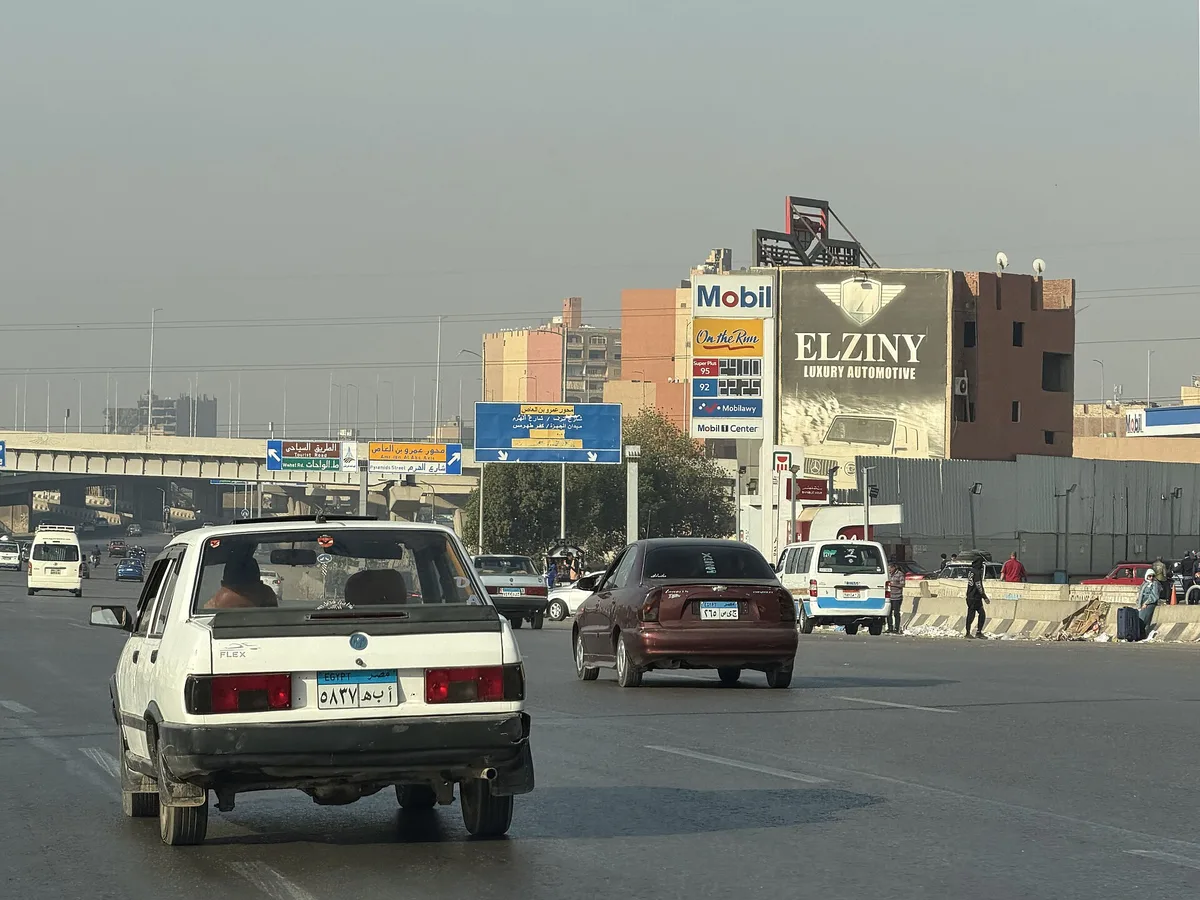
Giza’s complication is that it is simultaneously very close and, at the wrong hour, very far. The plateau stands about 13 kilometres from central Cairo as the map measures it, and in free-flowing traffic the drive is short; in the traffic Cairo actually produces, the same journey can take over an hour, and a timed museum slot does not care which journey you got. Every plan in this guide is built on that single fact: travel across the city in the early morning or not at all, add a buffer that feels excessive, and never chain a plateau morning, a museum slot and a cross-town transfer with no slack between them. Ride-hailing apps work well in Greater Cairo and remove the fare negotiation from the day; white taxis require the fare to be agreed before the car moves, a rule as old as the city and unchanged by it.
Arriving in Egypt, most international visitors land at Cairo International Airport, on the far, eastern side of the metropolis — which makes the airport-to-Giza run the longest common journey in Egyptian tourism, a cross-city drive to plan at an hour and a half in ordinary traffic rather than the figure the map suggests. There is a nearer alternative worth knowing: Sphinx International Airport, west of the city and substantially closer to Giza, handles a growing schedule of domestic and regional flights, and for travellers routing through it, the pyramids are the local landmark rather than a cross-town expedition. Check routings against both airports when you book; the saving is measured in hours.
The metro question deserves a straight answer in any giza travel guide, because every visitor asks it. Cairo’s metro serves Giza city — Line 2 crosses the river to stations there — but there is no station at the plateau, and the last stretch to the gates is a road journey regardless. A further line is being built towards the museum district, and the GEM’s own site lists metro details as coming soon; until it opens, do not plan a Giza day around a train that does not yet arrive there. The honest summary of getting to Giza is unglamorous: it is a road destination, reached early, by a car someone else is driving, booked the night before. Every experienced Egypt hand does it this way, because it works.
One Day in Giza – the Route That Works
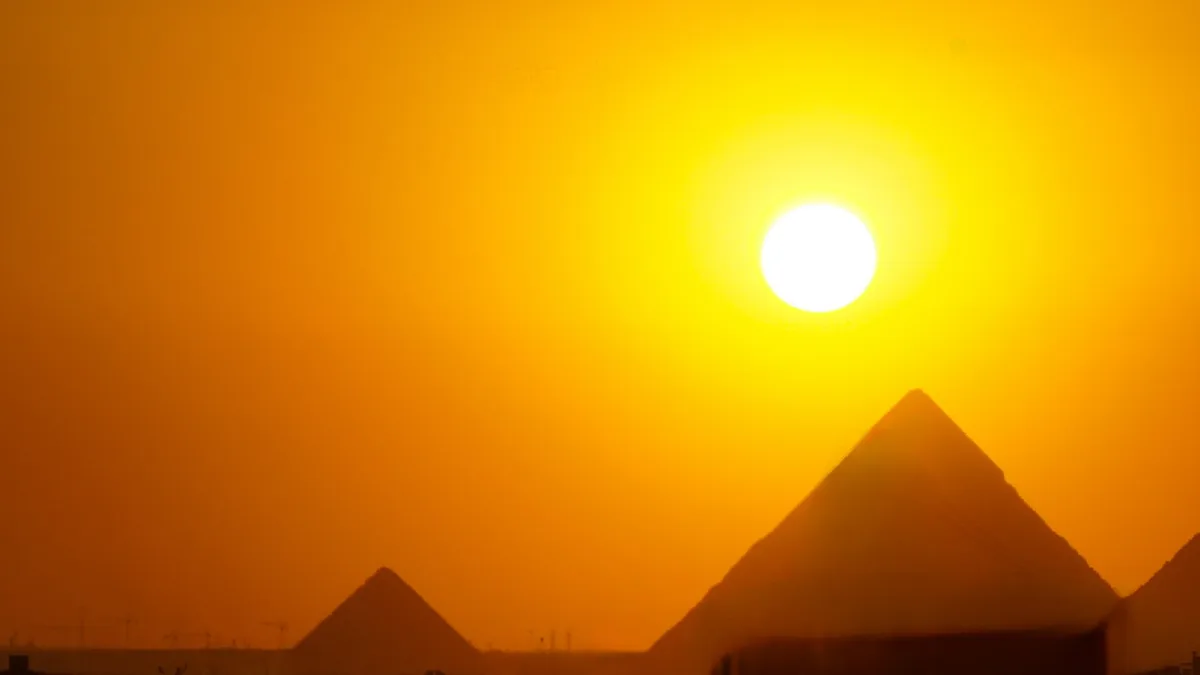
Here is the route this giza travel guide exists to give, in order, with the reasoning exposed — adapt the hours to the season, but keep the sequence, because the sequence is the substance. Arrive at the Great Gate for opening, tickets bought beforehand, and go directly to the Great Pyramid while the air is cool and the site is empty. If you are going inside anything, go inside Khufu now: legs fresh, passages at their least crowded, and the rest of the day freed from the one appointment the plateau imposes. Emerge, walk the base slowly, and let the scale settle — this first hour and a half is worth more than the average visitor’s entire visit.
Mid-morning, work down the plateau the way the complexes were built. Take the shuttle or walk to Khafre — casing cap, mortuary temple, the diagonal view back to Khufu — then continue to Menkaure and the queens’ pyramids at the quiet southern end, and double back to the panorama for the wide nine-pyramid view and, if you are riding, the camel into the desert silence. Then descend the eastern side as the funeral processions did: down to the valley temple and the Sphinx itself, which by now has the light on its face. You have now walked the whole necropolis in its own logic — pyramid to temple to river — and it is not yet lunchtime. Eat in Nazlet el-Semman, on a rooftop if you can, while the plateau bakes in the midday you have already escaped.
The afternoon belongs to the museum, and there are two good ways to time it. The standard version books the GEM for a mid-afternoon slot: give the Grand Staircase and the main galleries their hours, finish in the quieter Tutankhamun galleries, and see Khufu’s boat last, with the morning’s pyramid fresh behind it — the boat you read about at the plateau’s east side at nine is under this roof at four, and the recognition is the day’s best moment. The alternative, on a Wednesday or a Saturday, is to book the museum’s evening session instead: rest through the heat at your hotel, and walk into a half-empty, floodlit museum whose galleries stay open to 9:00pm. With two days, split the pair outright — plateau on day one, museum and Saqqara on day two; readers planning a longer Egyptian journey will find this day’s place in the whole in our Egypt travel guide. One day, honestly used, is enough for Giza. It is not enough for Egypt, and Giza does not pretend otherwise.
Best Time to Visit Giza – Season, Day and Hour
Egypt’s climate decides Giza’s calendar more than any festival schedule does. The plateau is open desert at the edge of a desert city: shade is a rumour, summer heat is a physical force, and the differences between seasons are not preferences but different trips. The kindest months run from October to April, when days are warm rather than punishing and mornings are genuinely cool — the Egypt of the classic season, and with good reason. Late autumn and early spring hold the balance best: November brings warm days, cool evenings and the settled, golden version of the plateau. December and January can surprise visitors expecting eternal summer — Cairo winters are mild but real, with cold desert mornings at the gate and wind on the exposed plateau — so the layer you pack for the dawn start is not wasted weight.
May to September is the hard season, and it should be approached as a specialist rather than dismissed. The monuments do not close, the crowds thin beautifully, and prices across the city soften — but the working day on the plateau must be compressed into its edges: at the gate for opening, indoors or under a roof by eleven, and nothing exposed attempted in the afternoon. Ramadan shifts the city’s rhythms and can adjust site and museum hours; check the official pages for your dates. Egyptian holidays bring the plateau’s most joyful complication — the site is beloved by Egyptians themselves, and a holiday crowd at Giza is a festival of families; plan around the major holidays for quiet, or straight into them to see Egypt enjoying its own inheritance.
Day and hour matter almost as much as month. The tour traffic of the entire city converges on Giza between roughly ten and two; the visitor who starts at opening has the Great Pyramid to a handful of people. Fridays carry the local weekend’s weight, and the museum’s late Wednesday and Saturday sessions are, as noted, the insider’s answer to its crowds. Set against all of it, the standing rule of this giza travel guide is simple enough to write on the ticket itself: at Giza, you do not beat the heat and the crowds by choosing what to see. You beat them by choosing when — and the when is early.
Giza After Dark – the Sound and Light Show at the Sphinx
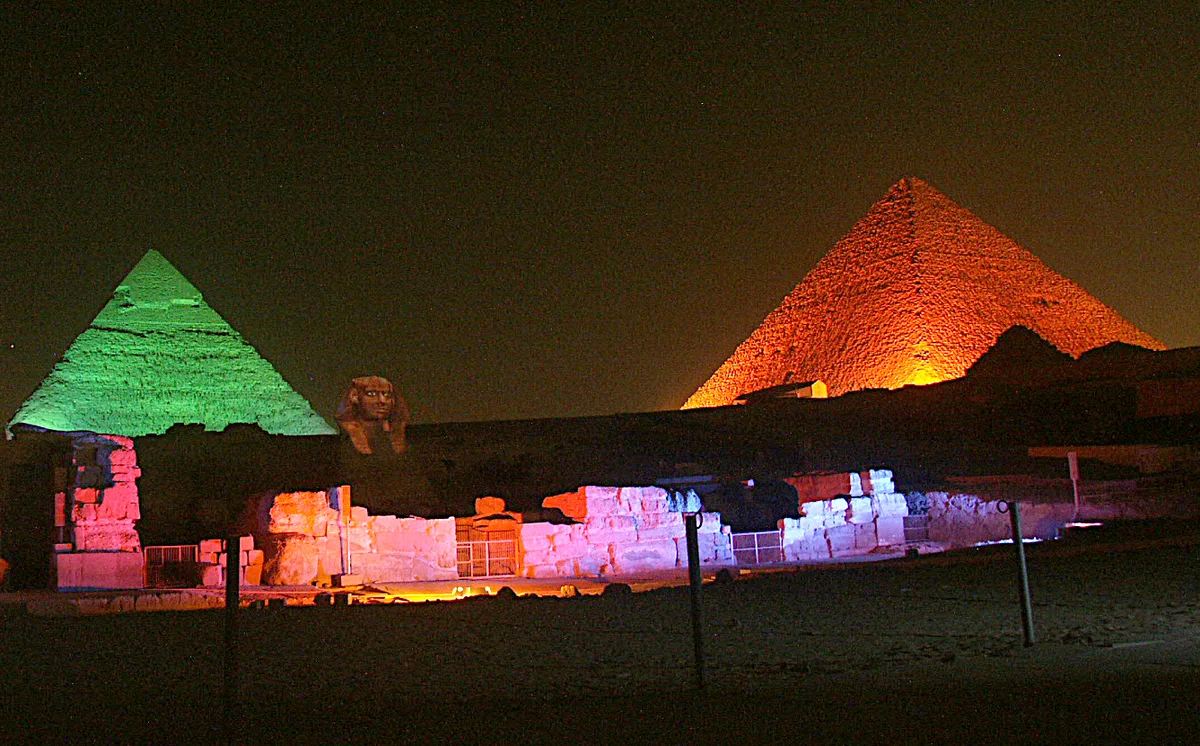
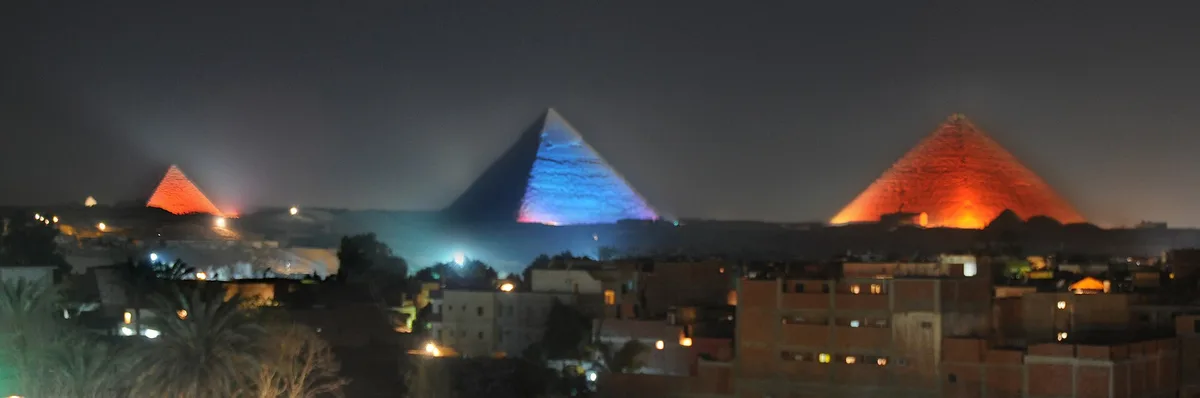
When the plateau closes, Giza does not entirely go dark. At the Sphinx’s feet, on ground that was once the floodplain’s edge, an evening show has run for decades: the pyramids and the Sphinx floodlit in changing colour while a recorded narration, in the Sphinx’s own voice, retells the story of the plateau — the kings, the builders, the travellers who have stood where the audience now sits. It is unabashed theatre, of its era in the best and worst senses, and it has outlasted every fashion in Egyptian tourism because the raw material is unbeatable: there is no light show on earth with a better set. Visitors staying in Nazlet el-Semman can instead take the village version: dinner on a rooftop as the floodlights come up, the show’s music drifting across the sand for free.
Practically, the show runs in the evening with performance languages rotating by the night — English on many nights, other languages on others — and its schedule and ticket prices are published by its operator and change often enough that this guide prints neither; check the current timetable for your specific evening before promising anyone a language or an hour. Book official tickets through official channels, beware of the unofficial markups that gather around any famous evening, and bring a layer: desert evenings cool quickly once the sun leaves the stone, in every month of the year. Judge the show on its own terms — spectacle and atmosphere, not scholarship — and it delivers exactly what it promises, and no giza travel guide should pretend it is more than that.
For most visitors, the evening show is a garnish rather than a main course, and the one-day route above works perfectly well without it. But for the traveller sleeping in Giza it holds a quieter value: it gives the plateau an ending. A day that began at the Great Gate in the dawn ends with the same stones, lit and storied, above the village rooftops. Stay for that if you can.
Beyond the Plateau – Saqqara, Dahshur and Memphis
Giza is the famous end of a much longer story, and the necropolis it anchors runs south along the desert edge for some thirty kilometres — the whole of it, from Giza to Dahshur, inscribed together on UNESCO’s list in 1979 as Memphis and its Necropolis. Half an hour south, Saqqara is where the pyramid idea was born: the necropolis of Memphis, holding Djoser’s Step Pyramid, the first great stone building in Egypt, rising in six giant steps around 2670 BC, a full century before Khufu. Where Giza is three kings in one blinding generation, Saqqara is the whole civilisation in cross-section — painted Old Kingdom mastabas, later pyramids, catacombs, and tombs still emerging from its sand. If Giza is the headline, Saqqara is the book — and a complete giza travel guide has to say plainly that the book is worth a day of its own.
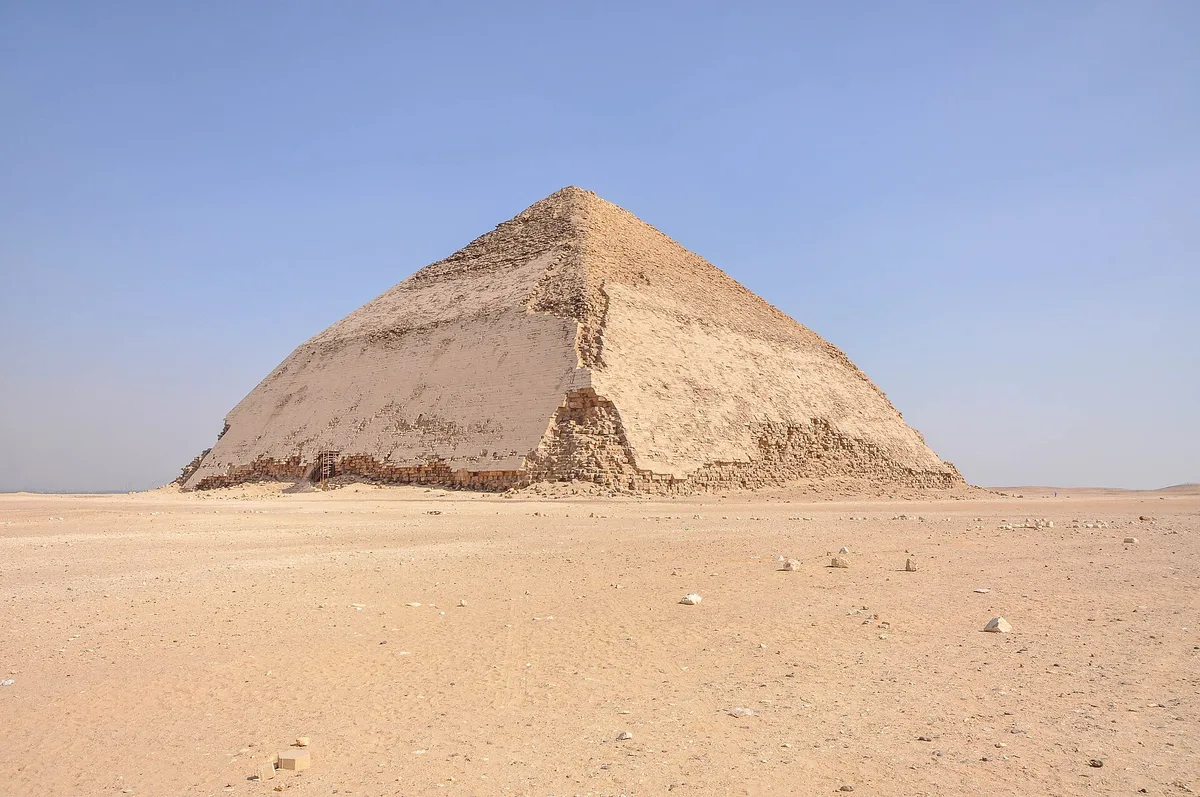
Further south again, Dahshur holds the missing link, and for pyramid students it is the essential stop of the three. Here Sneferu, Khufu’s father, ran the experiments his son inherited: the Bent Pyramid, begun at one angle and finished at a shallower one when the structure protested, still wearing most of its smooth casing and looking, uniquely, almost as it did when finished — and beside it the Red Pyramid, the correction, the first successful true pyramid, whose interior is open, uncrowded and free of the plateau’s theatre. Between them stands Memphis itself, the first capital, now palm groves and an open-air museum around a fallen colossus of Ramesses II. The three sites combine into one natural southern day from a Giza base, and they reframe everything: after Dahshur, the Great Pyramid stops looking like a miracle and starts looking like what it was — the perfected third draft of an idea a father taught his son.
Hold the priorities straight, though. These southern sites deepen a Giza trip; they do not compete with its centre. A first visit should give the plateau and the museum their full day before spending the next one southward, What the south offers the returner — and almost everyone who sees Giza properly plans to be a returner — is the proof that the pyramids were not an isolated wonder but a tradition: two centuries of kings building in stone along one desert edge, each correcting the last, until the tradition produced, once, the building that outlasted the world that made it.
Giza Travel Guide Questions, Answered
How much does it cost to visit the pyramids of Giza? The plateau ticket is EGP 700 for a foreign adult and EGP 350 for a foreign student, as published by the Ministry of Tourism and Antiquities (checked 1 November 2026). Everything inside anything is extra: the Great Pyramid’s interior is EGP 1,000 on the Ministry’s list but EGP 1,500 as currently listed on the official booking portal — budget the higher figure — Khafre’s interior is EGP 280 on the list, and the Grand Egyptian Museum is a separate timed online ticket, priced on the museum’s own ticketing page. This guide prints figures only from the Ministry’s own list; distrust any total claiming more precision than that.
What are the Giza pyramids’ opening hours? The Ministry’s published list gives the plateau 7:00am to 5:00pm, but other official pages have shown an 8:00am opening and an earlier last entry, and hours move with the season and Ramadan. Confirm the current hours on the official booking portal, egymonuments.com, when you book — and arrive for opening regardless; the first two hours are the visit.
Which entrance should I use for the pyramids? Since April 2025, the main entrance is the Great Gate visitor centre on the Cairo–Fayoum Desert Road, where private cars and tour buses now stop and the shuttle loop begins. The older gate by the Mena House hotel is no longer the general entrance, though the Sphinx-side gate at Nazlet el-Semman still operates and suits visitors staying in the village. Tell your driver the Great Gate explicitly — habit still sends cars to the old gate.
Is it worth going inside a pyramid? Yes, once, if your body allows it. You are buying the ascent through the passages and the Grand Gallery to a bare granite chamber, not painted walls or treasure. The climb is steep, stooped, hot and narrow throughout, and unsuitable for anyone claustrophobic or with limited mobility. Khafre’s interior is quieter and simpler; interiors rotate for conservation, so which are open is decided by the site on the day.
Can I visit the pyramids and the Grand Egyptian Museum in one day? Yes — that pairing is the modern Giza day, and this giza travel guide’s one-day route is built on it. Plateau at opening, Sphinx by lunchtime, then the museum on a timed slot — mid-afternoon on an ordinary day, or the late session on a Wednesday or Saturday when the galleries stay open to 9:00pm. Book the museum ticket online in advance; it cannot be improvised.
How do I get from Cairo airport to Giza? Cairo International Airport sits across the whole city from Giza, and the drive can take an hour and a half or more in traffic — go by pre-arranged driver or ride-hailing; never plan a tight museum slot that day. Sphinx International Airport, west of the city, is far closer. There is no metro station at the pyramids; Giza is reached by road, early.
Is Giza safe to visit independently? The plateau itself is a managed, ticketed site with security checks at its gates, and since the 2025 reorganisation it is calmer and more orderly inside than at any time in living memory. The realistic frictions are hassles, not dangers — overcharging, unsolicited guiding, vague camel negotiations — answered by the habits this giza travel guide keeps repeating: agree every price fully before anything moves, buy through official channels, and use the shuttle system the ticket includes.
What should I bring for a day at Giza? Sun protection without negotiation — hat, sunscreen, sunglasses; water, bought before the gate rather than at plateau prices; a layer for the museum’s air conditioning and the desert evening; small notes for the small payments; your student card if you have one, worth half the ticket; and a power bank.