Start with a confession this albanian food guide owes you at the top: Albania is not a country where the famous dishes are the whole story. The famous dishes are excellent – the flaky byrek, the lamb baked under yoghurt in tavë kosi, the peppers and curd cheese of fërgesë – and this guide gives every one of them its full section. But what actually decides whether you eat well in Albania is the layer underneath the dish list: what kind of shop you are standing in, which region’s kitchen you have walked into, whether the thing in the clay dish is the version with liver or the version without, and why a coffee and a small glass of raki keep appearing around the food like punctuation. Learn the dishes and you can order lunch. Learn the system and you can order anywhere.
That system is a layered one. Albanian cooking is Balkan, Mediterranean and Ottoman at once: the filo pastry, stuffed vegetables and syrup-soaked desserts of the Ottoman centuries; the grilled meats, bean stews and corn breads of the Balkan mountains; the olive oil, seafood and salads of two seas, the Adriatic and the Ionian. Over the geography sits a sharp regional split – the lamb-and-yoghurt centre, the fish coast, the slow mountain cooking of the north, the beer-and-pastry east around Korçë – and a calendar of home rituals, from the hours-long making of flia to the morning queue at the byrektore. This guide works through all of it, dish by dish and region by region, so that a menu in Tirana, a market stall in Gjirokastër or a farm table in the north all read as variations on one cuisine rather than three different countries.
Two honest ground rules before the food, the same rules this site keeps everywhere. This guide prints no prices, because Albania’s prices have been moving fast as the country grows more popular, and a lek figure copied from guide to guide is how misinformation reproduces. And it recommends no named restaurants as “tested”, because a well-researched guide is not the same thing as a claimed firsthand tour of other people’s kitchens. Instead it tells you how to recognise the good places yourself – the short menu, the single speciality, the room full of locals. The routes those meals belong to are covered in our Albania travel guide; this page is about what happens at the table.
Albanian Food Guide at a Glance
| Dish or ritual | What it is | Where and when it belongs |
|---|---|---|
| Byrek | Hand-stretched filo pastry, filled with gjizë, spinach, meat or potato | Everywhere, all day; the byrektore is its home |
| Tavë kosi | Lamb baked with rice under a yoghurt-and-egg crust | Central Albania; the Elbasan dish treated as the national dish |
| Fërgesë | Peppers, tomatoes and gjizë baked in a clay dish, sometimes with liver | Tirana and the centre; a starter that eats like a main |
| Qofte | Spiced minced-meat balls or rolls, grilled or fried | The qebaptore grill houses; the working lunch |
| Kërnacka | Elongated grilled minced meat, Korçë’s signature | The east; always a grill order |
| Mish në saç | Meat roasted under an ember-covered iron lid | The north and mountain guesthouses |
| Gjellë | The everyday stew pot – beans, meat, seasonal vegetables | Home kitchens and no-menu lokals |
| Speca të mbushura | Peppers stuffed with rice, herbs and usually minced meat | Summer, everywhere; a home dish on restaurant menus |
| Japrak | Vine or cabbage leaves rolled around rice and herbs | Shared Balkan table; meat and meatless versions |
| Flia | Layered crepe-like batter baked layer by layer under the saç | The north; hours of work, made for guests |
| Seafood and lake fish | Whole grilled fish, mussels, prawns; carp and trout inland | The Ionian and Adriatic coasts; Shkodër and Ohrid lakes |
| Petulla | Puffed fried dough, with cheese, honey or jam | Breakfast, especially at weekends and in guesthouses |
| Trahana | Fermented grain-and-yoghurt porridge | Winter breakfasts; the village store cupboard |
| Çaj mali | Mountain tea from Sideritis, sold in dried bundles | Markets everywhere; the house remedy |
| Kafe | Turkish-style coffee and espresso | All day; the country’s social operating system |
| Raki | Grape or plum spirit, usually homemade | Before meals, at celebrations, from hosts |
| Bakllava | Layered pastry with walnuts, in syrup | Feast days – Bajram, New Year, weddings |
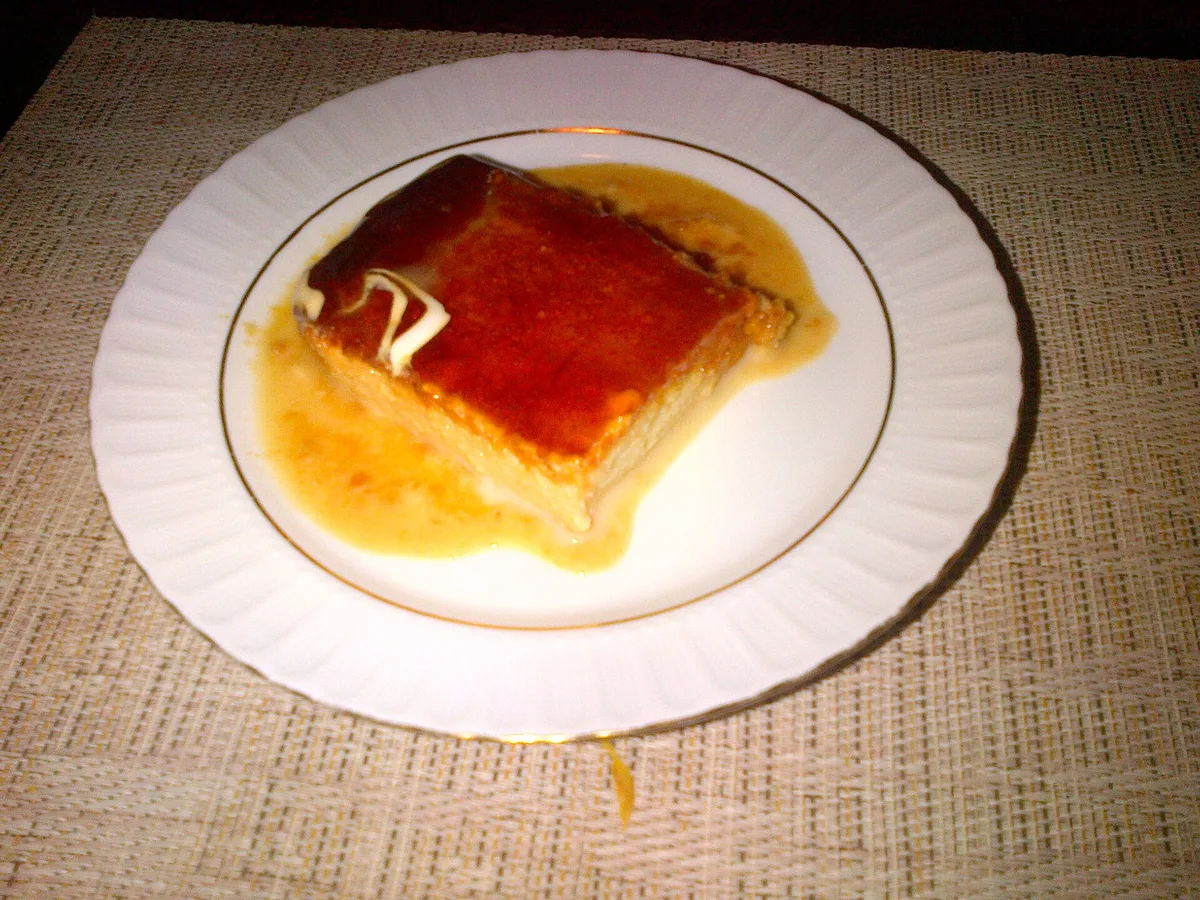
| Trilece | Sponge soaked in three milks under caramel | Pastiçeri counters everywhere; the modern favourite |
Read the table as geography, not as a ranking. Byrek is any hour of any day. Tavë kosi is the centre of the country speaking. Flia is the north, and it costs someone an afternoon. Seafood is the coast in summer and lake fish is the north’s other water. The towns keep their own signatures inside the national list – Elbasan claims tavë kosi, Gjirokastër fries herb-flecked rice balls called qifqi, Shkodër bakes its lake carp as tavë krapi, Korçë grills kërnacka – and a traveller who learns even three of those local claims will eat better than one who memorises the whole table. An albanian food guide, honestly used, is a map of places wearing the disguise of a list of dishes.
Notice, too, what the table is built from. Dairy runs through everything – yoghurt (kos), the salty curd cheese gjizë, white cheese, kaçkavall – because this is a herding country as much as a farming one. Bread appears at every meal and pastry at half of them. Pastry is the second constant: a cuisine that stretches dough by hand for its daily snack, its two-layer Sunday pie and its feast-day sweet is a cuisine that thinks in sheets. The third constant is seasonality worn openly – the table’s salads, stuffed vegetables and grilled fish are summer’s list, while its beans, trahana and preserved peppers are winter’s, and a menu that ignores the calendar is a menu aimed at visitors. Meat is respected rather than constant: the everyday pot is beans and vegetables, and lamb is the celebration centre. Drinks close the system: coffee outside the meal, raki at its edges, dhallë against the pastry’s richness. And nearly everything is built to be shared from the middle of the table, which is where the next section begins.
How an Albanian Meal Actually Works
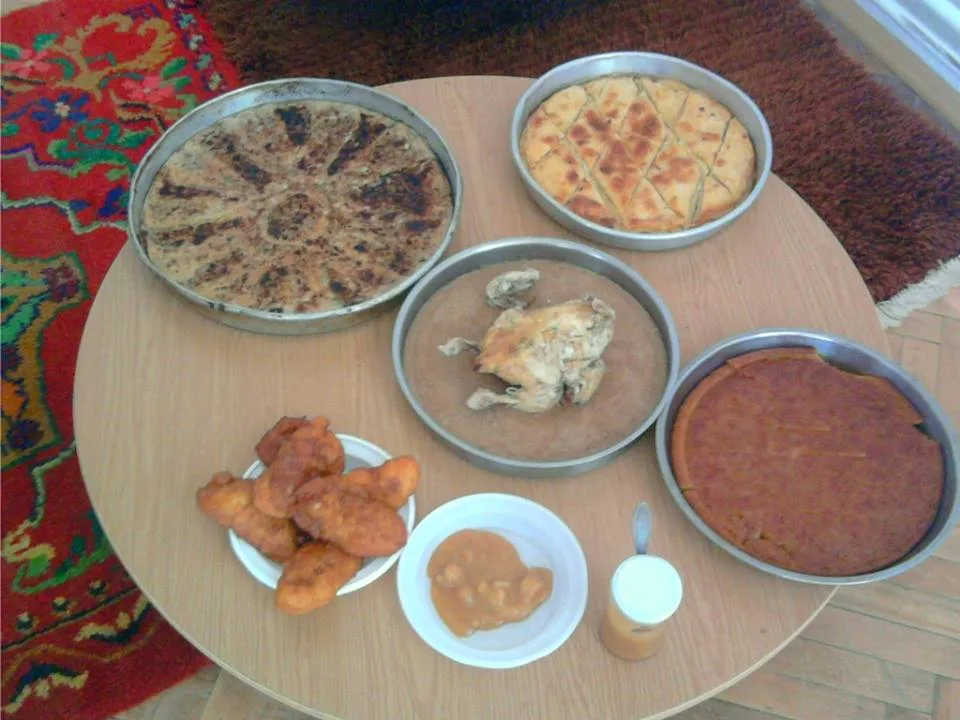
The traditional Albanian table is the sofër, a low round table around which people sit on low stools or cushions, and although most restaurants will give you a standard table at standard height, the sofër explains the meal’s geometry: everything is placed in the middle, everything is shared, and the dishes arrive as a collective spread rather than as personal courses. A salad – tomatoes, cucumber, onion, white cheese, olives, dressed with olive oil – lands early and stays. Bread lands with it and keeps landing. The main dishes join them in the centre, and a bowl of kos, thick tangy yoghurt, is as standard a piece of table furniture as the bread basket.
The order of things is looser than a northern European menu suggests. Soup may open the meal – a bean soup, a vegetable soup, a light meat broth – or may not appear at all. Starters and mains overlap: a clay dish of fërgesë ordered “for the table” is both. The main event is likely to be plural – a grill plate, a tavë from the oven, a stew – and is eaten communally, each person taking from the shared dishes onto their own plate or, in family settings, directly. Dessert is often not a restaurant course at all; it is fruit, or something sweet with coffee afterwards, or a stop at a pastiçeri on the walk back. No albanian food guide can make this tidier than it is, and it is not meant to be tidy: the meal is a table, not a sequence.
Hospitality is the force that bends every rule. Albania’s guest culture – the besa tradition of honour-bound welcome – means a visitor in a home, a guesthouse or even a village café may find dishes appearing that were never ordered, a glass of raki arriving with the coffee, fruit or preserves materialising at the end. Accept what you can, thank people properly, and do not try to settle the account of a home invitation: the hospitality is the point, and paying for it would miss it. In restaurants the mechanics are ordinary – order, eat, pay at the end – and one practical habit is worth copying from locals: in the small family places (lokals) with no printed menu, ask what is cooked today. The answer is the menu, and it is usually the best one available.
A word on timings, because they shape what you will find. Lunch is a real meal in Albania, eaten from midday into the early afternoon, and the no-menu lokals do their best work then. Dinner runs later in summer, especially on the coast, when the evening stroll – the xhiro – precedes eating and restaurants fill from nine onwards. Coffee is not tied to meals at all; it is a separate institution with its own section below. And the day’s eating often begins the night before, in a sense: the byrek for breakfast is bought in the morning from shops that started stretching pastry before dawn, which is where this guide turns next.
Byrek – the Pastry That Runs the Country
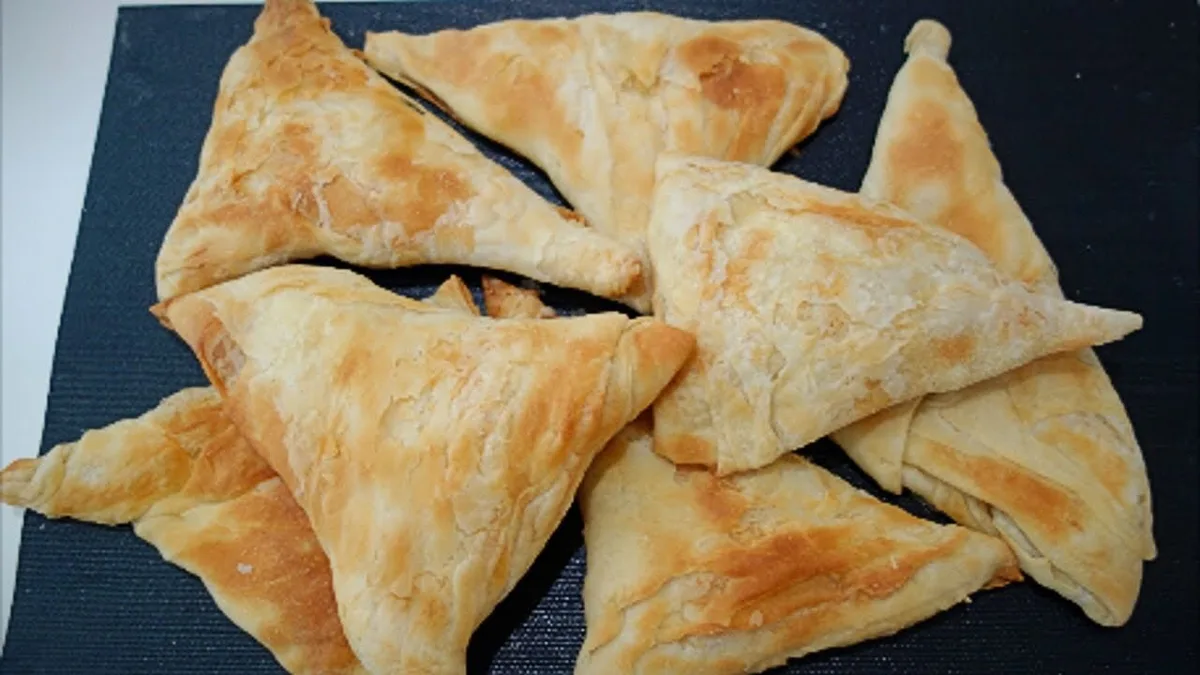
If Albania has an edible flag, it is byrek: sheets of hand-stretched dough – petë, stretched thin enough to read through – layered or rolled around a filling, brushed with oil or butter and baked until the top shatters. The fillings map the pantry. Gjizë, the salted curd cheese, is the default. Spinach (spinaq), sometimes with cheese, is the other constant. Minced meat (mish) makes the richest version; potato, leek, tomato-and-onion and pumpkin all have their regions and seasons. The forms vary too: triangles for the hand, spirals and long rolls in trays, and the big round tepsi pies cut into wedges. Every version shares the same test – the pastry must be crisp, distinct and audibly flaky, never a soft dough blanket over a damp filling.
Byrek has its own institution, the byrektore: a small specialist shop, often little more than a counter, an oven and a display of trays, selling byrek by the piece or by weight from early morning. This is where the country’s breakfast and working snacks come from, and the etiquette is simple – queue, point, eat it warm standing up or walking, and wash it down with dhallë, the salted yoghurt drink that is byrek’s traditional partner and cuts its richness exactly. Bakeries (furrë buke) sell byrek too, alongside bread, but the specialist byrektore is the connoisseur’s address, and the morning queue outside one is a reliable quality signal anywhere in the country. Any albanian food guide that did not start here would be lying about how Albania actually eats: more byrek is eaten in a day than all the famous tavë dishes together.
Two honest qualifications complete the picture. First, byrek is not an Albanian invention to be defended against neighbours: it belongs to the whole börek family that spread across the Balkans and Anatolia in the Ottoman centuries, and Greeks, Turks, Bosnians and everyone between make their own. What is Albanian is the local grammar of it – the gjizë filling, the dhallë pairing, the byrektore on every street. Second, quality varies enormously and the difference is the pastry: hand-stretched petë, made in the shop, against bought-in filo. The hand-made version is thinner, crisper and less greasy, and once you have had two or three you will be able to tell them apart at a glance through the counter glass.
The family tree has one more branch worth knowing, because menus confuse visitors with it: lakror. Where byrek wraps its filling in many leaves, lakror is a two-layer pie – a bottom and a lid of dough with the filling between – associated above all with the Korçë region in the east and cooked traditionally under the saç. Fillings run to leek, spinach, tomato and onion, or gjizë. If byrek is the daily bread of the pastry culture, lakror is its Sunday relative: slower, thicker, and a regional point of pride. Order it where it is claimed, in the east, and you are eating the pastry culture at its most local.
Tavë Kosi – the National Dish, With an Asterisk
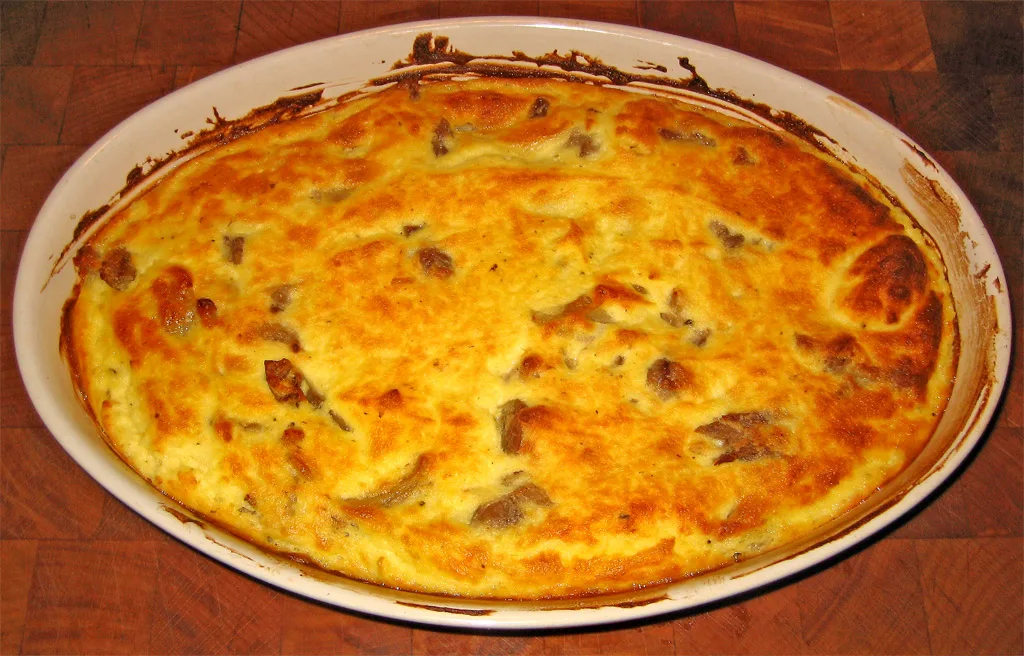
Tavë kosi is lamb – baked first until tender, then finished under a thick sauce of yoghurt beaten with egg and a little flour, with rice cooked into the base – that comes out of the oven set like a savoury custard, bronzed on top, tangy and rich underneath. The chicken version (me pulë) exists and is lighter; the lamb version is the benchmark. It is, by near-universal common usage, Albania’s national dish. The asterisk this guide promised is simply honesty about what that phrase means: no official act designates a national dish of Albania. Tavë kosi holds the title the way national dishes usually do – by repetition, by menus, by families, and by being the dish Albanians name when foreigners ask. That is a real title. It is just a customary one, and it is stronger for being described accurately.
The dish’s home address is Elbasan, the city south-east of Tirana, where it is also called tavë Elbasani and where its yoghurt sauce is a matter of civic pride. The construction explains the geography: this is the dairy centre of the country performing its signature trick, turning the shepherd’s yoghurt into a sauce that roasts. The yoghurt must be thick and properly sour – the strained kos of the Albanian table, not a sweetened approximation – and the baking is a judgement call, long enough for the crust to colour and the sauce to set around the meat, short enough that it stays supple. Eaten with bread and a salad, it is a complete argument for the cuisine in one clay dish: pasture, oven, patience.
For the visitor, tavë kosi teaches the most useful menu word in this whole albanian food guide: tavë. A tavë is the earthenware or metal baking dish, and by extension anything baked in it – tavë dheu (a clay dish of liver or meat with gjizë, a Tirana classic), tavë me perime (baked vegetables), tavë krapi (baked carp, in Shkodër). Once you can read tavë on a menu, half the oven cooking of the country is legible. And the kosi half teaches the second lesson: yoghurt in Albania is not a breakfast garnish but a cooking medium, a sauce base, a drink and a side dish all at once. The national dish is simply the place where the country’s two constants – lamb and yoghurt – meet in their most formal dress.
Fërgesë – Peppers, Tomatoes and Gjizë From the Clay Dish
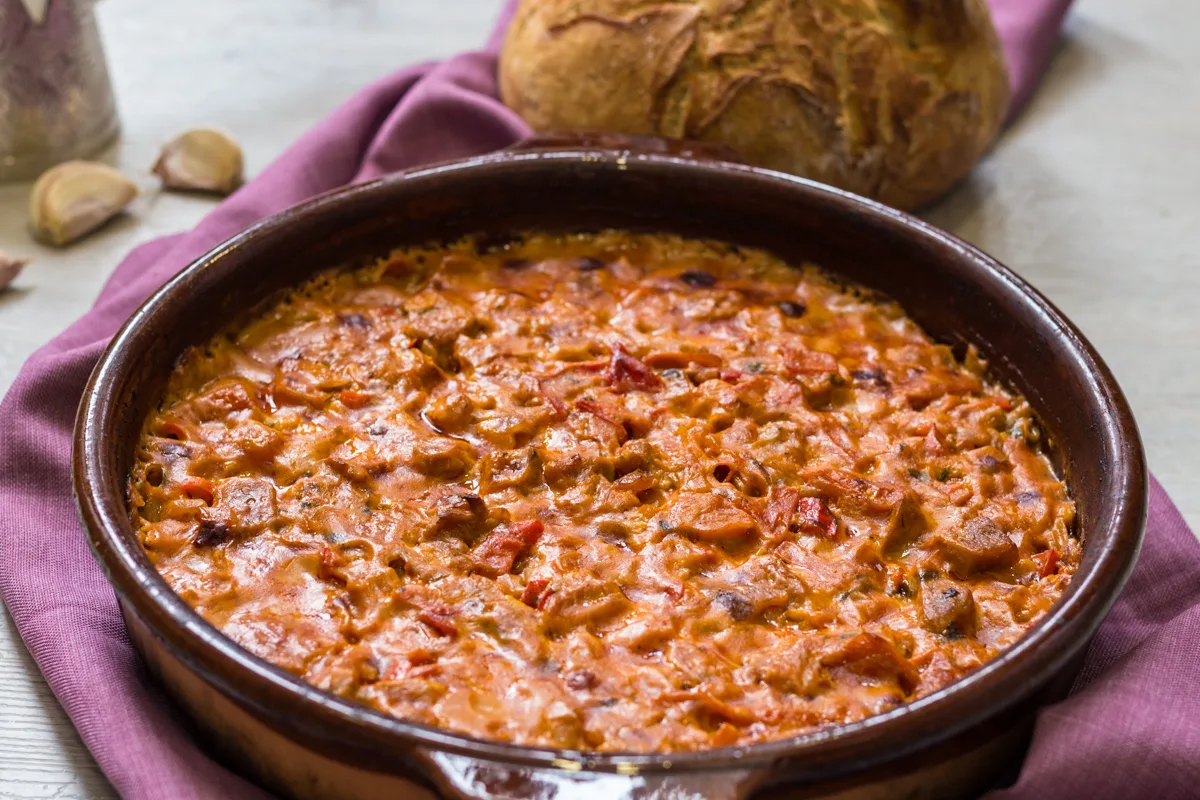
Fërgesë is what happens when the Albanian summer garden meets the Albanian dairy in one clay dish: peppers – sweet ones, sometimes with a hot one among them – and tomatoes cooked slowly down with onion until they collapse into a thick, rust-red sauce, finished with gjizë crumbled or stirred through, and baked or rested until the cheese softens into the vegetables. It arrives bubbling in the dish it cooked in, and it is eaten the way the photograph suggests: scooped with torn bread, no cutlery required or wanted. As a starter it is generous; with bread and a salad it is quietly a main course, and it is one of the dishes in this albanian food guide that vegetarians should memorise – with one important warning, which comes two paragraphs down.
The named version is fërgesë e Tiranës, the capital’s own, and its defining ingredient is the gjizë – the salted, drained curd that gives the dish its savoury depth and slight tang. Recipes argue about the pepper-to-tomato ratio and about whether the peppers should be roasted first; the constants are the clay dish, the slow cooking and the curd. In Elbasan and elsewhere you will meet regional readings of the same idea, and in winter a preserved-pepper logic replaces the fresh garden one. What never changes is the dish’s character: this is not a sauce or a side but a complete small meal built from the three things an Albanian summer produces in surplus – peppers, tomatoes and milk.
Now the warning, and it is the single most useful sentence in this section for a vegetarian reader: fërgesë has a second, meat-eating form. Fërgesë me mëlçi is made with liver – veal or lamb liver cooked into the same pepper-and-tomato base – and tavë dheu, the related Tirana clay dish, is also typically a liver dish. Menus do not always make the distinction obvious, and the word fërgesë alone on a board can mean either. The fix is one question, asked before ordering: “me mëlçi?” – with liver? If the answer is yes and you do not eat meat, you have lost nothing and learned the dish’s full family. If the answer is no, what arrives is one of the great vegetable dishes of the Balkans, and the bread basket will need refilling.
Qofte, Kërnacka and the Grill – the Qebaptore Counter
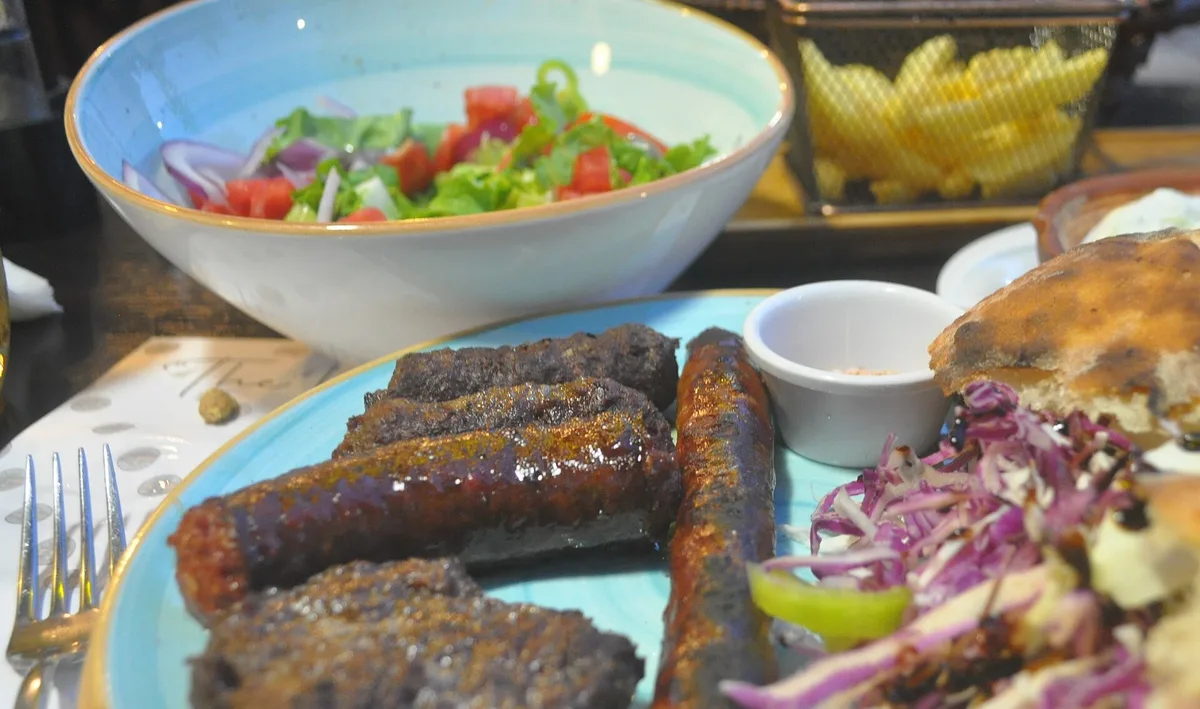
Every Albanian town has a qebaptore – a grill house, usually small, usually smoky, devoted to minced meat over charcoal – and its headline act is qofte: minced beef, lamb or a mixture, seasoned with onion, herbs and spices, shaped into balls or stubby rolls and grilled or fried until the outside chars at the edges and the inside stays juicy. Qofte are the working lunch of the country: eaten in bread, or on a plate with salad, grilled peppers, onion and a dollop of kos, they are the dish Albanians eat the way other nations eat a sandwich. The seasoning is the house signature – mint, oregano, black pepper, sometimes a little crumbled cheese in the mix – and the Korçë version of the family, below, is famous enough to have its own name.
Kërnacka are Korçë’s contribution: elongated, finger-shaped rolls of spiced minced meat, grilled and served in generous piles, the east’s answer to the ćevapi of the northern Balkans – which is exactly what they are, cousins in the great Ottoman-era family of skinless grilled minces that stretches from Bosnia to Bulgaria. This albanian food guide states the kinship plainly because Albanians themselves do: these dishes are shared Balkan heritage, and the local pride is in the seasoning and the grill craft, not in a claim of sole invention. Order kërnacka in Korçë, qofte anywhere, and judge the qebaptore by the same signs as everywhere in this guide – charcoal, not gas, where you can see it; a short menu; a room that empties and refills with locals at pace.
The grill’s second technique is older than the grill house: mish në saç, meat cooked under the saç. The saç is a heavy iron or earthenware dome lid, set over a pan and heaped with embers, so the food cooks from above and below at once – a portable oven older than any kitchen range. Under it, lamb or chicken roasts in its own juices, potatoes cook in the meat fat, and in the north whole meals assemble. You will meet saç cooking at mountain guesthouses, agritourism farms and traditional restaurants rather than at the town qebaptore, and it is worth ordering wherever it is offered: it is the mountain kitchen’s core technology, the same lid that bakes the north’s flia in the next-but-one section, and it produces a depth of roast flavour that a modern oven imitates rather than equals.
Gjellë – the Everyday Pot, and the Filled Dishes
If byrek is the country’s snack and tavë kosi its ambassador, gjellë is its daily bread in stew form. The word means, roughly, “cooked food” – the pot of the day – and it covers the whole everyday repertoire: white beans simmered with onion and pepper (fasule, the great staple), beans with meat, meat with potatoes, meat with okra or green beans or cabbage, whatever the season and the market dictate, cooked slowly in its own juices with tomato and paprika warmth rather than chilli heat. Gjellë is what the no-menu lokal has cooked that morning, what home kitchens produce on rotation, and what a traveller who asks “what is the gjellë today?” will eat better than one who demands the printed classics. It is rarely beautiful and frequently the best thing on the trip.
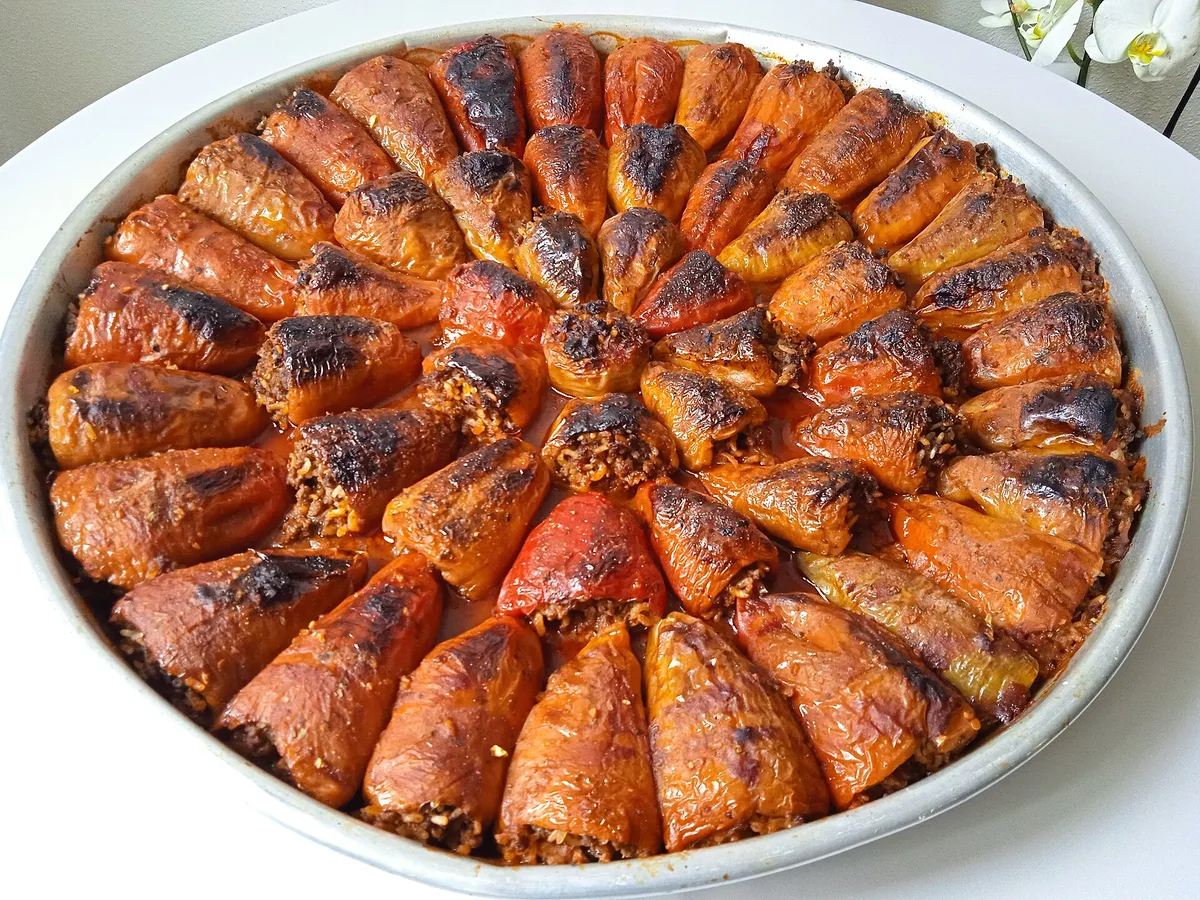
Beside the pot stands the filled-dish family, the other great everyday structure. Speca të mbushura – peppers stuffed with rice, onion, herbs and usually minced meat, baked in a tray until the peppers slump and the rice drinks the juices – is the summer monument of the type, and the photograph above, a full tray of them, shows the scale at which Albanian home cooking thinks: not four peppers but forty, because family, neighbours and tomorrow are all part of the recipe. Meatless versions, filled with rice and herbs alone, are traditional rather than a modern adaptation – a fact vegetarians should file away. Aubergines and tomatoes get the same treatment (mbushura), and the family’s rolled branch is japrak: vine leaves in spring and early summer, cabbage leaves in the cold months, wrapped around rice and herbs – with minced meat in many kitchens, without it in others, which is why japrak, like fërgesë, requires the one clarifying question before a vegetarian orders it.
Honesty about origins belongs in this section as much as anywhere, because the filled dishes are where national claims get loudest. Stuffed peppers, rolled leaves and bean stews are the shared inheritance of the whole Ottoman Balkans – the dolma family, in its widest sense – and Albania’s versions are local dialects of a regional language, distinguished by the rice seasoning, the peppers themselves, and the yoghurt that so often arrives beside them. An albanian food guide serves its readers better by saying so than by planting flags in a tray of peppers. What is genuinely distinctive is not the dishes’ existence but their place in the day: nowhere else in the region does the gjellë pot still anchor the working lunch of a capital city quite the way it does in Tirana’s lokals.
The Coast – Fish, Seafood and the Lakes
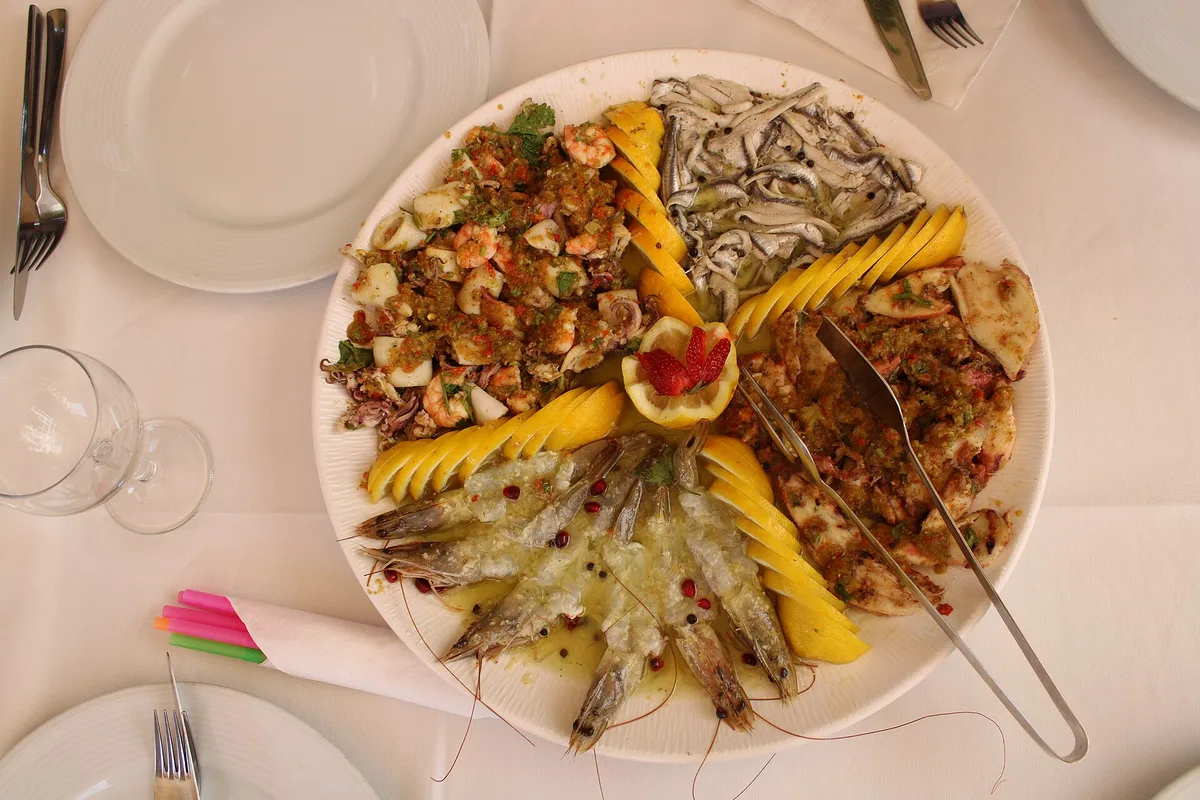
Albania has two seas and cooks them slightly differently. On the Ionian south – Sarandë, Ksamil, Himarë, the Riviera – the water is deep and clear and the cooking leans Italian-facing: whole fish grilled and dressed with olive oil and lemon, prawns, calamari grilled or fried, mussels in their shells, octopus when it appears. On the Adriatic – Durrës, Vlorë, the lagoons – the water is shallower, the fish smaller and the tradition includes the lagoon harvest: eels and mullet from Karavasta and Narta, and mussels, which Albania farms in the Butrint lagoon in the far south and which appear on southern menus as a local point of pride. Everywhere the grammar is the same and it is a Mediterranean one: the fish is the ingredient, the grill is the method, and the cook’s job is to not get in the way.
The rules this albanian food guide gives for the coast are the ones that work on every Mediterranean shore, applied with Albanian specifics. Eat fish where the boats and the locals both are; be wary of a thirty-species menu in a place with no visible harbour; expect the good places to offer what the day brought – sea bass (levrek), sea bream (koca), red mullet, sardines – rather than a frozen catalogue. Whole grilled fish with a salad, grilled vegetables and bread is the coast’s default great meal, and the mixed fruta deti platter in the photograph is its celebratory form. Inland, the lakes run a parallel fish cuisine of their own: Shkodër bakes its carp as tavë krapi, with onion, tomato and prune depth, and around Lake Ohrid the famous local trout, the koran, is strictly protected – if it is offered casually, the honest response is to order something else and let the lake keep its fish.
One structural note completes the coast’s picture: Albania’s seafood season is the tourist season, and winter changes the offer. Out of season, coastal towns cook for themselves – more gjellë, more grill, the preserved and the stored – and the traveller who comes in May or September rather than August meets the coast at its most itself: the same fish, the same grills, a fraction of the crowd. The best places to visit in Albania on this site are mostly coastal or near it, and timing a trip to eat the coast properly is the same decision as timing it to see it properly.
The North – Flia and the Mountain Kitchen
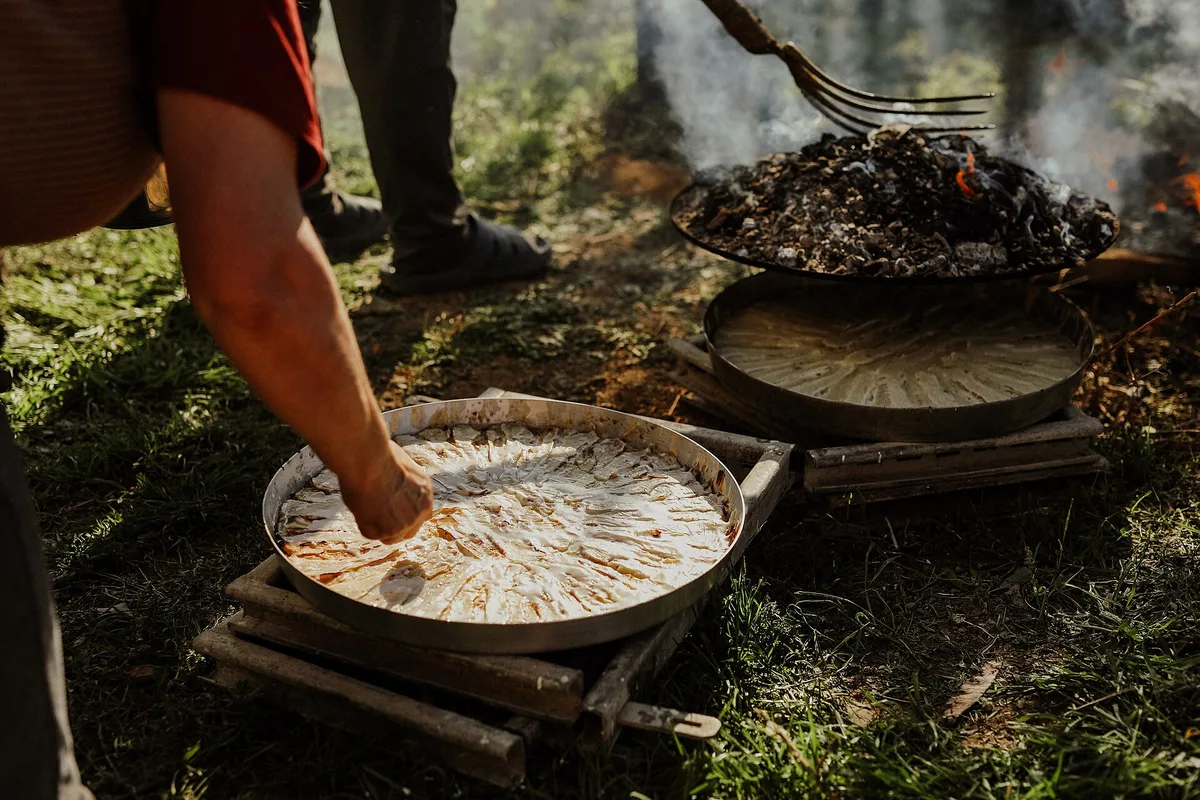
Flia is less a dish than a commitment. It begins as a thin batter of flour, water and salt – in some kitchens with egg or milk – and it is built one crepe-like layer at a time: a ladle of batter spread in spirals over a hot pan, the saç lid heaped with embers set over it until that layer bakes, then the lid lifted, the layer brushed with butter, cream or kajmak, and the next ladle spread over it. Layer by layer, an hour becomes two, two become three, and the finished flia – dozens of strata, crisp-edged, soft-hearted – is cut like a cake and served with cheese, honey or kos. The photograph shows the process honestly: a hand, a pan, embers, patience. There is no shortcut version that is still flia, which is precisely why it is made for guests: the labour is the message, and in the northern highlands serving flia is how a household says the visit mattered.
Its homeland is the Albanian north – the highlands of Tropojë, Kukës and the Accursed Mountains – and, stated with the neutrality the subject deserves, flia is shared across Albanian lands: it is made with the same method and the same pride in Kosovo, where many families’ flia traditions run in parallel. This is one culture cooking on both sides of a modern border, and any account that assigns the dish exclusively to one state is drawing a line the batter does not recognise. In this albanian food guide it sits in the north section because that is where a traveller in Albania will meet it: in Theth and Valbona guesthouses, in Shkodër’s traditional restaurants, at village tables where the saç is still standard equipment.
Around flia, the mountain kitchen keeps its own pantry, and it explains itself through altitude. Corn bread (bukë misri) replaces wheat where wheat grows badly. Dairy concentrates: hard cheeses, butter, kajmak, kos thick enough to stand a spoon in. Meat is lamb and kid, roasted under the saç or on the spit for occasions; the everyday pot is beans and potatoes. The seasonal movement behind this pantry – herds walked up to high pastures in spring and down in autumn – is transhumance, and it is recognised at the highest level: Albania is one of the ten countries on UNESCO’s Intangible Cultural Heritage inscription for transhumance, the seasonal droving of livestock, whose listing notes that a whole way of life, “from gastronomy to local handicrafts”, is built around the herds’ movement. The mountain table is that gastronomy at first hand.
Korçë – Beer and the Cooking of the East
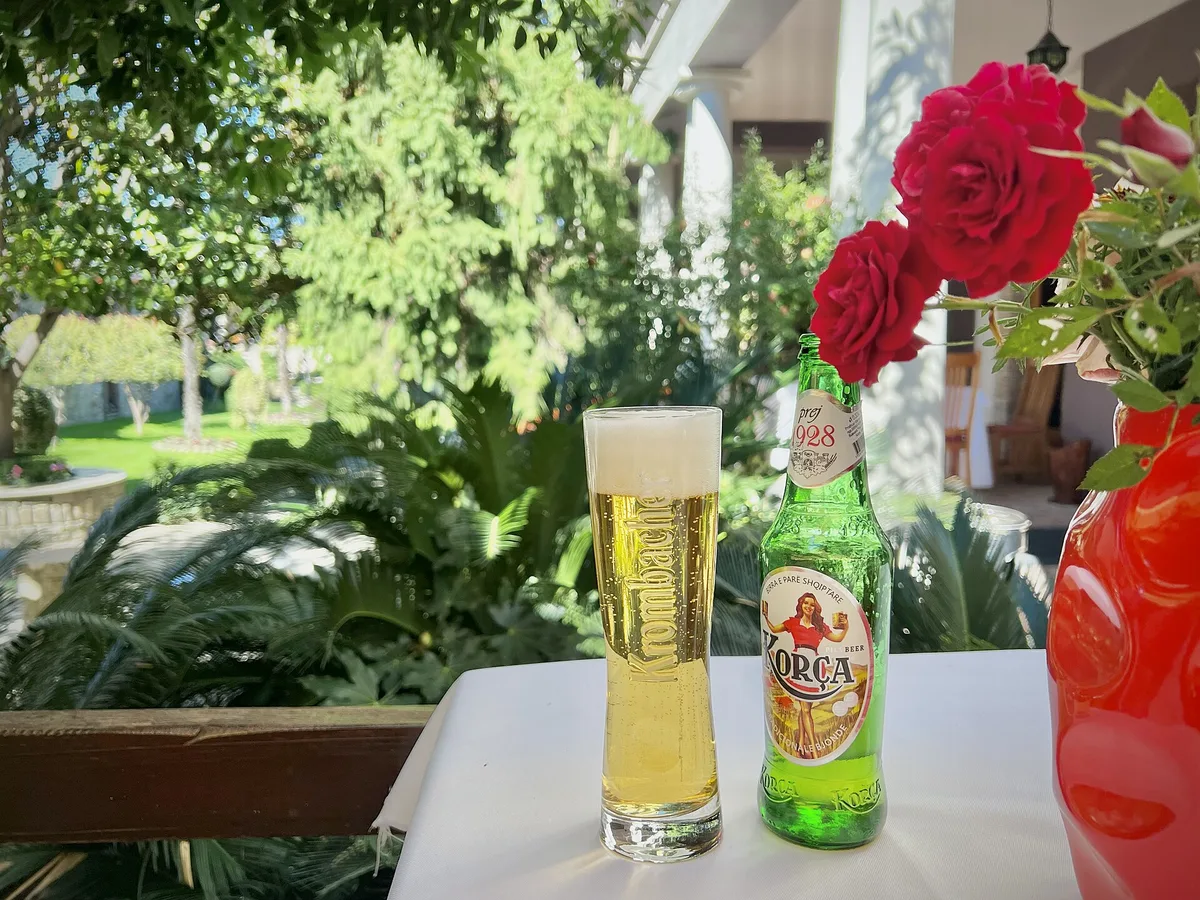
Korçë, the city of the south-east, is Albania’s most self-consciously culinary town: a cafe-lined boulevard culture, a serenade tradition, and the country’s oldest brewery. Birra Korça was founded in Korçë in 1928, by an Italian investor, Umberto Umberti, and a local one, Selim Mboria, and it was the first beer brewed in Albania – a claim the brewery itself has printed on the bottle’s neck ever since, where the founding year appears on the label. The company’s own history records an initial capacity of 20,000 hectolitres a year, producing blonde and dark ales alongside bottled water and ice; the brewery, rebuilt under its modern owners, still operates in the city, and its beer garden is the natural place to drink the local lager in the town that invented it. In a country whose signature drinks are coffee and raki, Korçë adds the third: beer, with a hometown attached.
The food around the beer is the east’s own dialect. Kërnacka, the elongated grilled minces from the grill section, are Korçë’s signature order. Lakror, the two-layer pie from the byrek section, belongs to this region and is still cooked under the saç here. The surrounding countryside is orchard and vineyard country – Korçë’s plum raki has its own reputation among the country’s homemade spirits – and the eastern table generally shows more pastry, more grilling and a heartier hand than the coast’s. The city also eats its history: this was a wealthy merchant town in the Ottoman and early national periods, and its old bazaar quarter and big townhouses frame a dining scene that takes itself pleasantly seriously.
For the traveller, Korçë earns its place in this albanian food guide as the proof that Albanian food is not one cuisine but several in negotiation. A southern loop that runs Tirana, Berat, Gjirokastër and the coast will give you the yoghurt centre, the stone-town south and the fish shore. Adding Korçë adds the east: the brewery, the kërnacka grill, the lakror under its embers. Most itineraries treat the city as optional. The stomach’s vote differs, and a route that includes it eats noticeably better than one that does not.
Markets – Gjizë, Mountain Tea and What to Look For
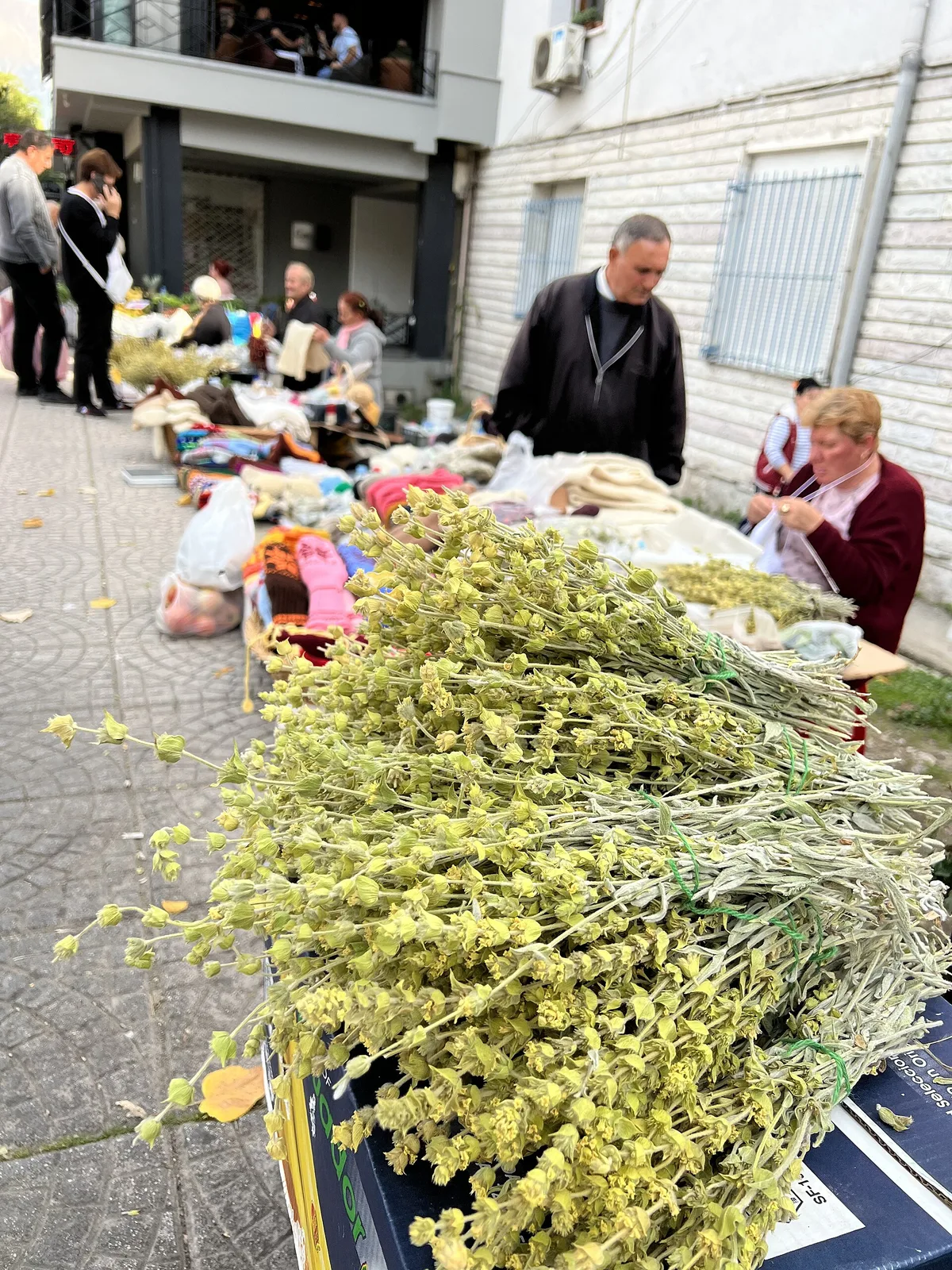
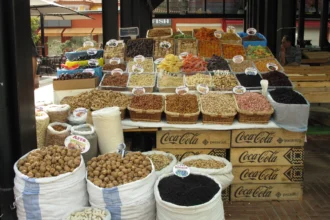
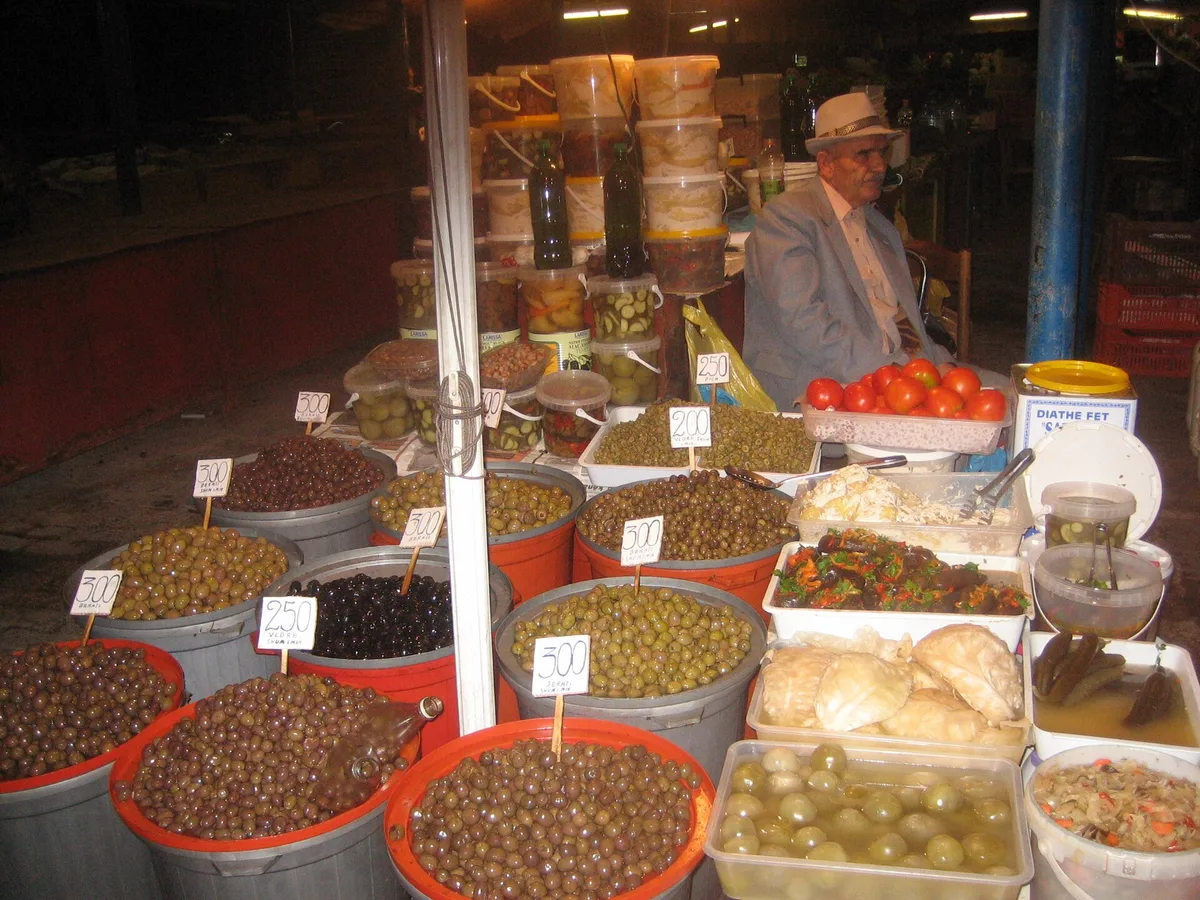
The Albanian market is where this cuisine keeps its stores, and learning to read one is worth an hour of any trip. Tirana’s Pazari i Ri, the New Bazaar on Sheshi Avni Rustemi, is the capital’s showcase version – a renovated market hall and surrounding stalls with the full national pantry on display – and every town has its own working equivalent, less polished and just as instructive. The stalls organise themselves into the cuisine’s building blocks: olives by the bucket, white cheeses and gjizë by the slab and scoop, kaçkavall wheels, pickles (turshi) in jars, dried beans in sacks, honey, walnuts, dried figs, herbs in bundles, and raki in unlabelled bottles whose provenance is the seller’s word and the market’s reputation.
Two purchases define the market for a visitor. The first is gjizë itself – the salted curd that runs through fërgesë and byrek – sold loose, tangy and crumbly, a cheese with no real northern-European equivalent and the single ingredient that most explains the flavour of central Albanian cooking. The second is the bundle in the photograph: çaj mali, mountain tea, dried flowering stems of Sideritis sold by the bunch in markets across the country. The plant behind it can be named precisely, because Albania’s mountain tea has been studied precisely: it is chiefly Sideritis raeseri, a Balkan endemic ironwort that grows wild in Albania’s mountains – documented in the country’s Red Book of endangered plants, and gathered and sold as the house tea and folk remedy for colds and winter evenings, brewed stems, leaves and flowers together, often with honey. A bundle is light, legal, packable and genuinely of the place: the best edible souvenir in this albanian food guide.
The market rules are the Mediterranean’s usual ones, applied gently. Morning is the real market; by midday the best of the day has gone. Small quantities of many things beat a large quantity of one. Ask what things are – stallholders answer through gesture and goodwill where language runs out – and expect tastes to be offered for cheese, olives and honey. And treat the market as a lens rather than a checklist: what is heaped highest is what the season is, from spring’s first greens to autumn’s peppers being bought in sacks for winter preserving, which is itself one of the great sights of the Albanian food year.
Agritourism – the Farm Table
Albania has built one of Europe’s most likeable food institutions almost by accident: the agroturizëm, the working farm that cooks. The pattern, repeated from the hills behind Durrës to the valleys of the south and the approaches to the Alps, runs like this. A family farm – vineyard, olive grove, orchard, kitchen garden, animals – opens a restaurant on its own land, and the menu is the farm: grilled vegetables and salads from the garden, byrek and bread from its own oven, cheese and kos from its own animals, lamb or chicken raised within sight of your table, and the farm’s own wine and raki to finish. There is usually no menu in the printed sense, or only a short one; the meal arrives as a sequence agreed with the host, priced as a whole in the local way (this guide, as ever, prints no figures), and eaten slowly, often outdoors, often with the farm doing its ordinary work around you.
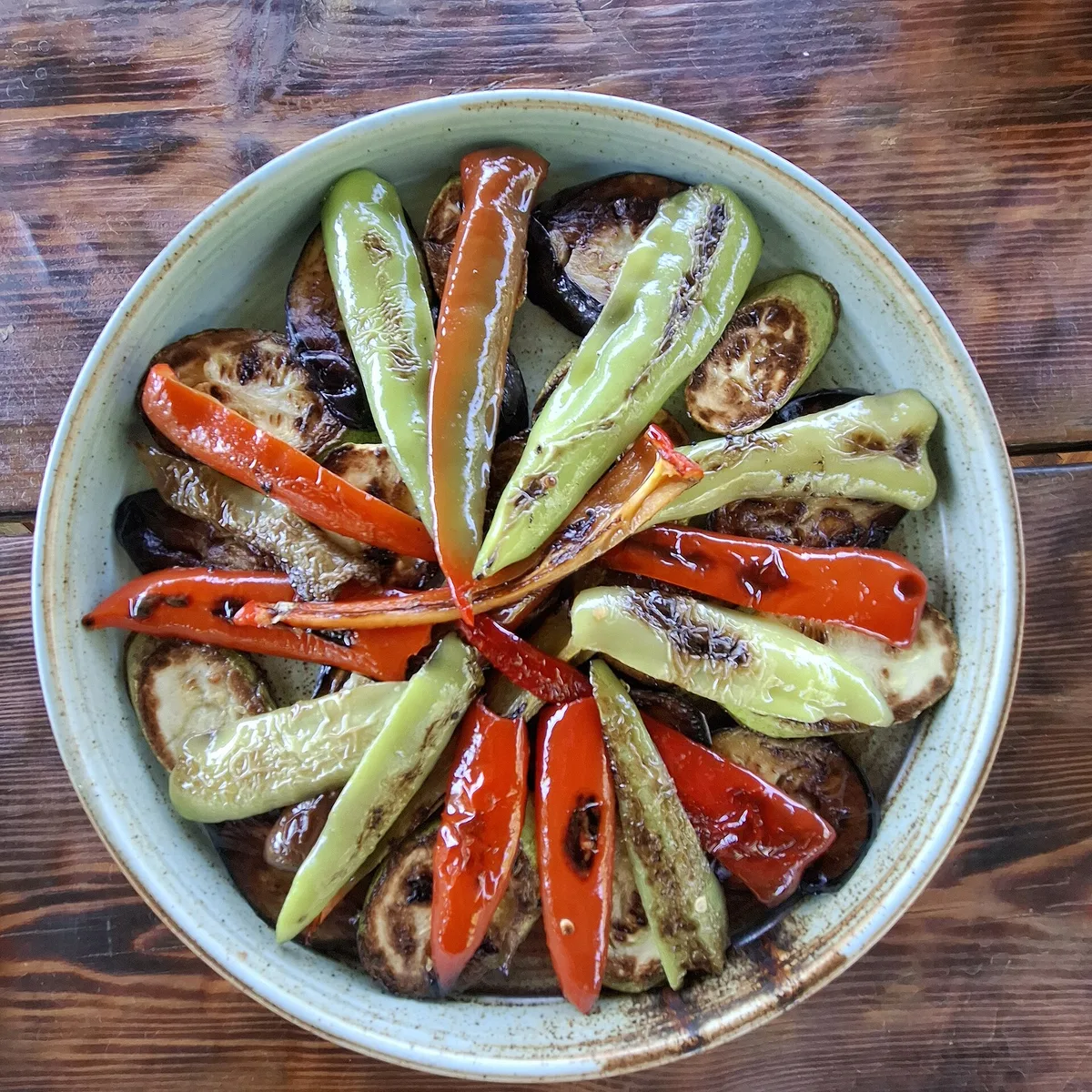
The institution matters to this albanian food guide because it closes the cuisine’s circle. Everything the earlier sections described separately – the gjellë pot, saç roasting, the dairy, the garden vegetables, the home raki – exists on one farm, cooked by the people who produced it. Albania’s best-known agritourism farms have become destinations in their own right, booked out in season, but the traveller does not need the famous names to use the pattern: any agroturizëm sign on a rural road is an invitation, and the smaller and more working the farm looks, the closer to the source the meal usually is. The photograph’s grilled peppers and aubergines are the honest emblem of the form: nothing on the plate travelled, and nothing needed to.
Practical notes, briefly. Agritourism farms are reached by car or taxi, not by bus routes; many are lunch institutions above all, and in season the good ones fill, so arriving early or asking your accommodation to phone ahead is the local method. Portions assume the farm’s idea of hunger, which is generous; a table that orders “a little of everything” will still be negotiating with abundance by the cheese course. And the meal will almost certainly end with the farm’s raki and an offer to see the animals, the vines or the still. Accept both. That is not an upsell; it is the institution working as designed. This albanian food guide’s summary is shorter still – if a rural road offers you one meal, take the farm’s.
Breakfast – Petulla, Trahana and the Shape of the Morning
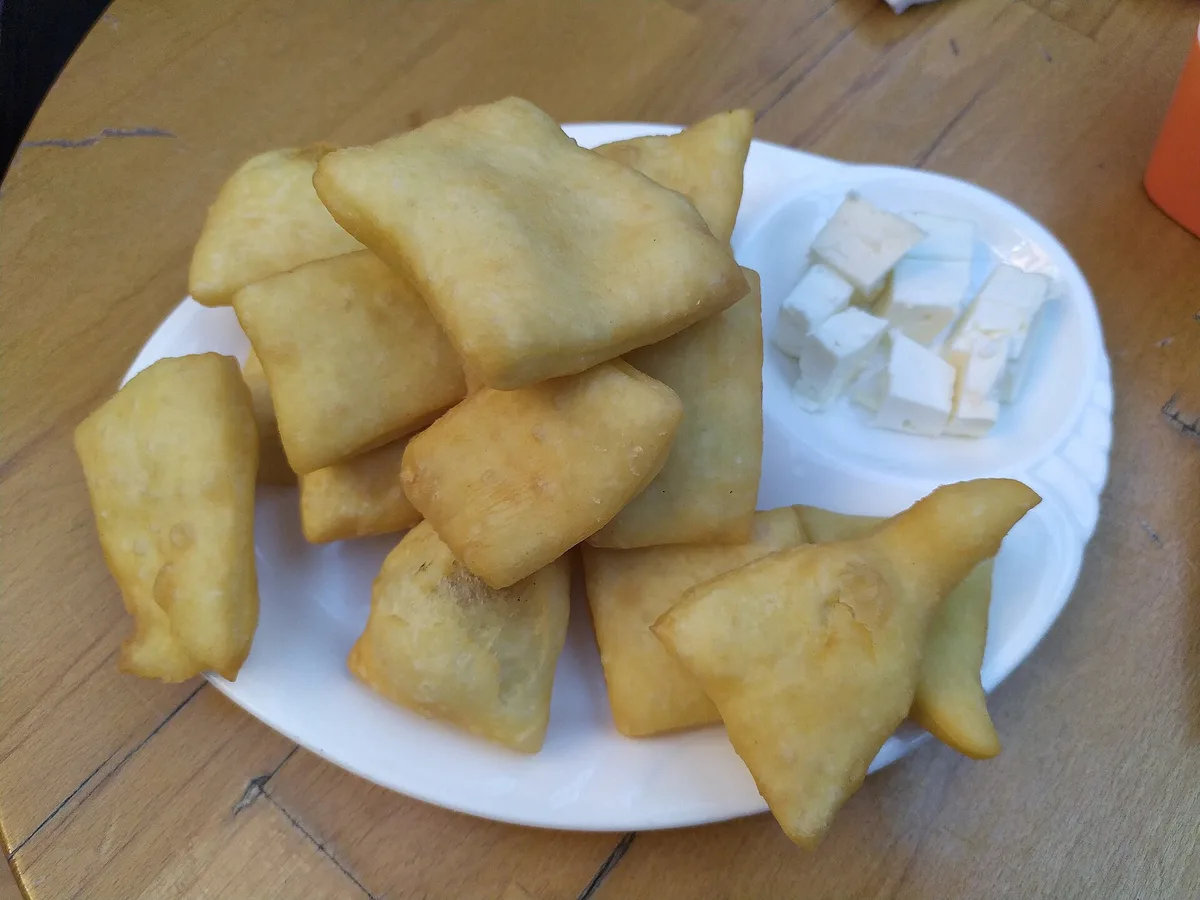
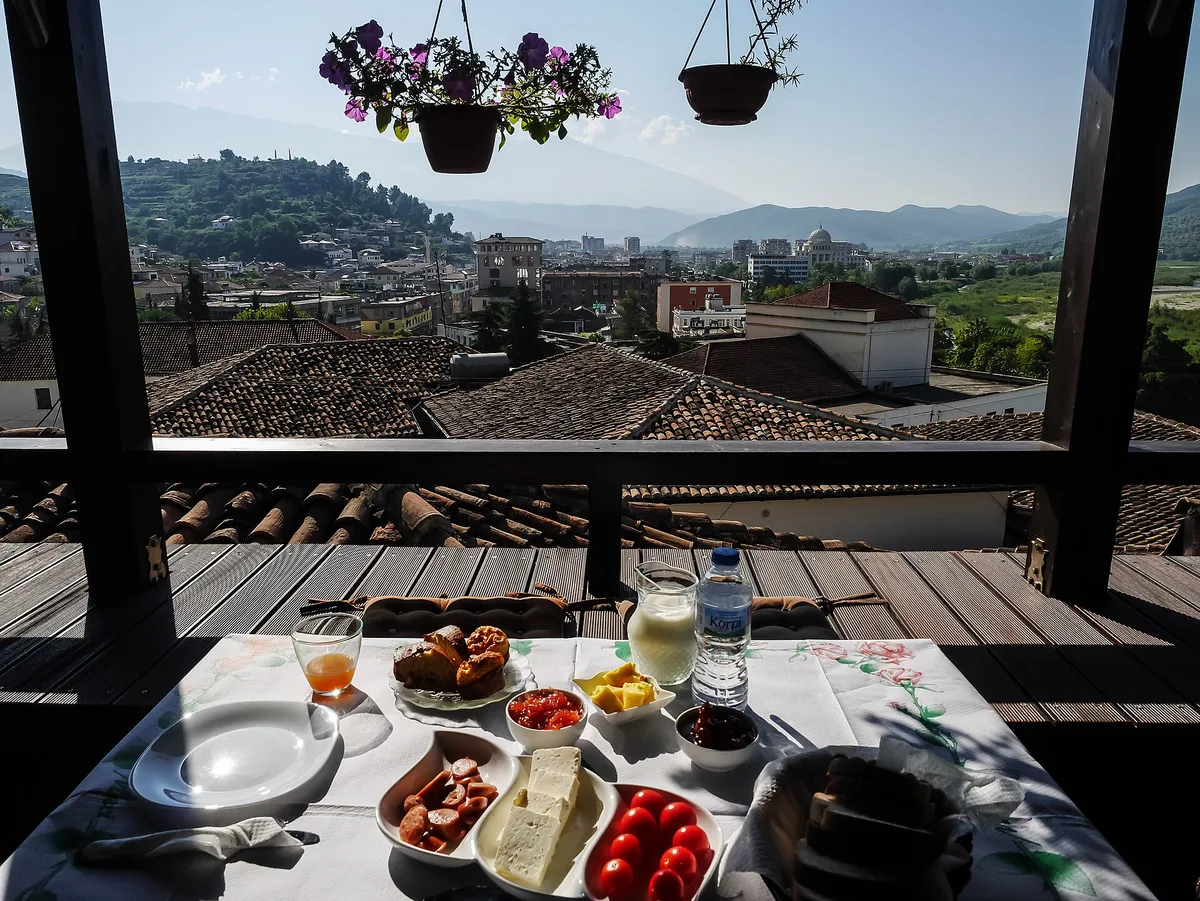
Albanian breakfast has two forms, the weekday dash and the weekend table, and the visitor will meet both. The weekday form is byrek from the byrektore, eaten warm with dhallë or coffee – breakfast as the pastry section already described it, fast and complete. The weekend and guesthouse form is a spread: white cheese, olives, tomatoes, eggs in some form, honey or jam, butter, bread, and the two dishes that belong to the morning alone. The first is petulla: pieces of yeasted dough fried until they puff into golden pillows, served hot with white cheese to tear and dip, or with honey or jam for the sweet version. Petulla are guesthouse theatre as much as food – they come from the kitchen in batches and do not survive waiting – and the photograph’s plain plate of them, with cheese alongside, is exactly what a good Albanian morning looks like.
The second morning dish is the winter one, and the one foreign visitors least expect: trahana. Trahana is a fermented preserve – grain, usually wheat, worked with yoghurt or soured milk, dried into crumbs and stored – that cooks in minutes into a thick, tangy porridge-soup, often with butter and crumbled cheese or a beaten egg. It tastes of the store cupboard and of care: this is food designed by village households to carry good nutrition through a mountain winter, and it is served to guests as a point of honour in the cold months. Around these two anchors, the hotel and guesthouse table assembles itself; coffee, as the next section explains, is usually not on it – coffee is afterwards, in a cafe, on its own schedule.
One more morning pattern is worth knowing because travellers misread it: Albania does not really do the cafe breakfast. The cafe is for coffee; the bakery and the byrektore are for eating; the two institutions sit side by side and the locals combine them without thinking – byrek in hand, then coffee at the cafe next door. Copy the combination and the morning organises itself. This albanian food guide’s own recommendation for a first Albanian breakfast is the simplest in the whole document: a spinach or gjizë byrek still warm, a glass of dhallë, then a coffee standing at a cafe counter while the town wakes up around you.
Coffee – the Cup That Organises the Day
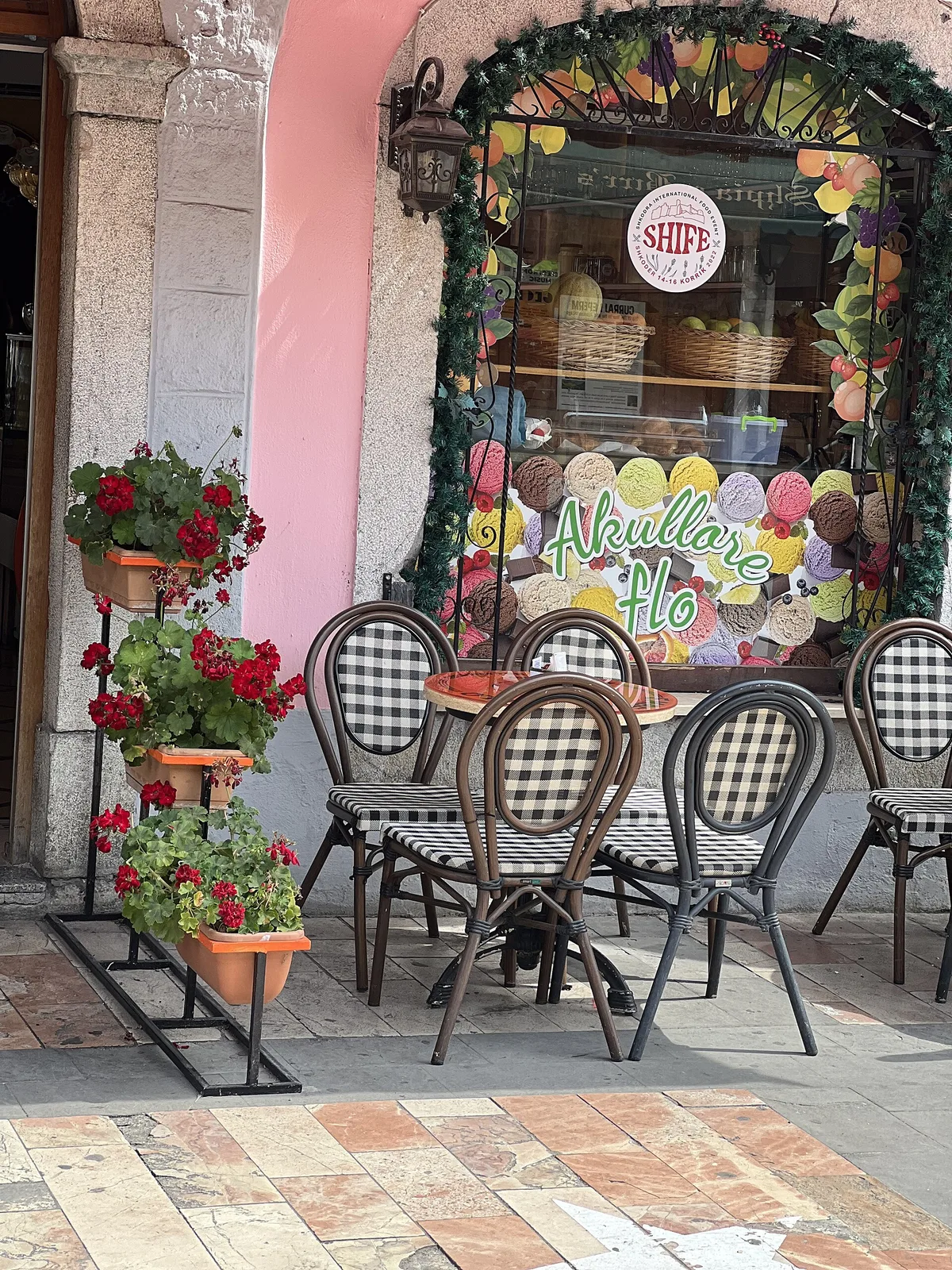
Albania runs on coffee to a degree that visitors consistently underestimate. The cafes are everywhere – every street, every village square, every petrol station on the highway – and they are full at hours when other countries’ cafes are empty: mid-morning, mid-afternoon, all evening. The coffee itself comes in two dialects. Kafe turke, Turkish-style coffee, is brewed unfiltered in a small pot – a xhezve – and served in a small cup with its grounds, sweetened to order or not at all; it is the coffee of homes, older cafes and ceremony. Espresso, the Italian inheritance across the Adriatic, is the coffee of the modern cafe, pulled fast and drunk faster, often standing at the counter. Both are cheap by any visitor’s standard (this guide still prints no prices), both are good, and choosing between them is a mood, not a rule.
The point of the institution is not the drink but the appointment. In Albania, “a coffee” – një kafe – is the unit of social and business life: you do not schedule a meeting, you have a coffee; you do not catch up with a friend, you have a coffee; a negotiation, an apology, a celebration and a killing of time are all conducted over the same small cup, and a coffee can last ten minutes or two hours with the cup empty for most of it, because the cup was never the point. For the traveller, the working rules are simple. Never refuse a first coffee from a host; it is the welcome itself. Expect coffee to appear after meals, with raki at celebrations, and at moments of decision. And do as the country does at least once a day: sit in a cafe with no purpose beyond the cup and the street, and watch Albania conduct its affairs around you.
It is worth saying plainly, because guides romanticise it: the cafe density is also ordinary sociology, a young country’s inexpensive public living room in a climate that favours sitting outside. Shkodër’s terrace in the photograph could be any town in the country, and that is the observation – in Albania the cafe is not a treat or a tourist amenity but infrastructure, as basic as the bakery. An albanian food guide that treated coffee as a footnote would miss the room in which half the country’s food decisions, including most of its restaurant plans, are actually made.
Raki – the Toast That Comes First
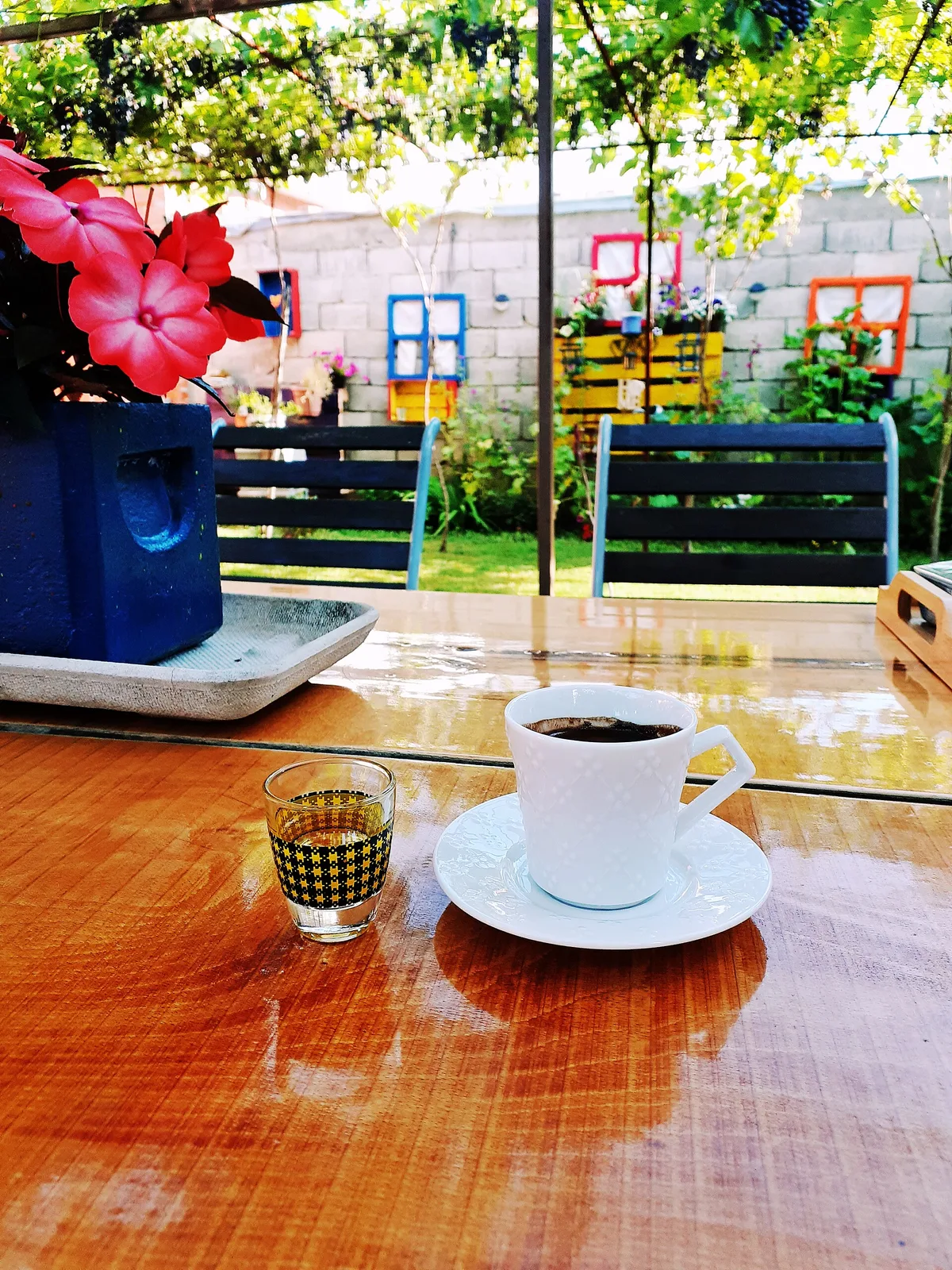
Raki is Albania’s spirit and its handshake. The standard is raki rrushi, distilled from grapes; the east and north also make raki kumbulle, from plums; and a great deal of what is drunk is homemade – distilled by families from their own fruit, stored in demijohns and bottles with no label but the maker’s name, and poured for guests as a matter of honour. It is served in a small glass, a teke, usually before the meal or alongside the meze and coffee, and it is strong in the way homemade spirits are strong: unstandardised, variable, and to be sipped rather than shot. The toast is “Gëzuar!” – to health – glasses are touched, eyes are met, and the first sip is a small ceremony of welcome that no visitor should rush.
The etiquette is hospitality’s etiquette, and it cuts both ways. A host offers raki because offering it is respect; a guest who accepts a glass, drinks it slowly and compliments the maker has done the correct thing. A guest who genuinely cannot drink – health, belief, pregnancy, a long drive ahead – can decline, and the decline is better made early, warmly and once, ideally with a substitute glass in hand (coffee, water, a soft drink) so the toast can still be joined. What does not work is the half-refusal followed by a full glass drained under pressure and regretted: homemade raki forgives nothing. Drivers should treat the whole subject as closed: the glasses are small, the spirit is not, and the offer will be repeated with love. This albanian food guide’s line is the local one – the passenger drinks; the driver is toasted.
Around the glass sits a small economy worth understanding. Raki is made in autumn, when the fruit comes in; it is given as a gift, carried to family in the city, produced at weddings and rakija-making days that are social events in themselves. Market raki in unlabelled bottles is the traveller’s version of the gift economy – buy it where the seller is known, taste before committing, and understand that you are buying a household’s surplus, not a brand. And when a guesthouse host produces a bottle “from my father’s village” or “from our own vines”, the correct response is the response this section began with: Gëzuar, a slow sip, and thanks. In Albania the raki is rarely just a drink; it is the family introducing itself.
The Sweet Shelf – Baklava, Trilece and Honest Origins
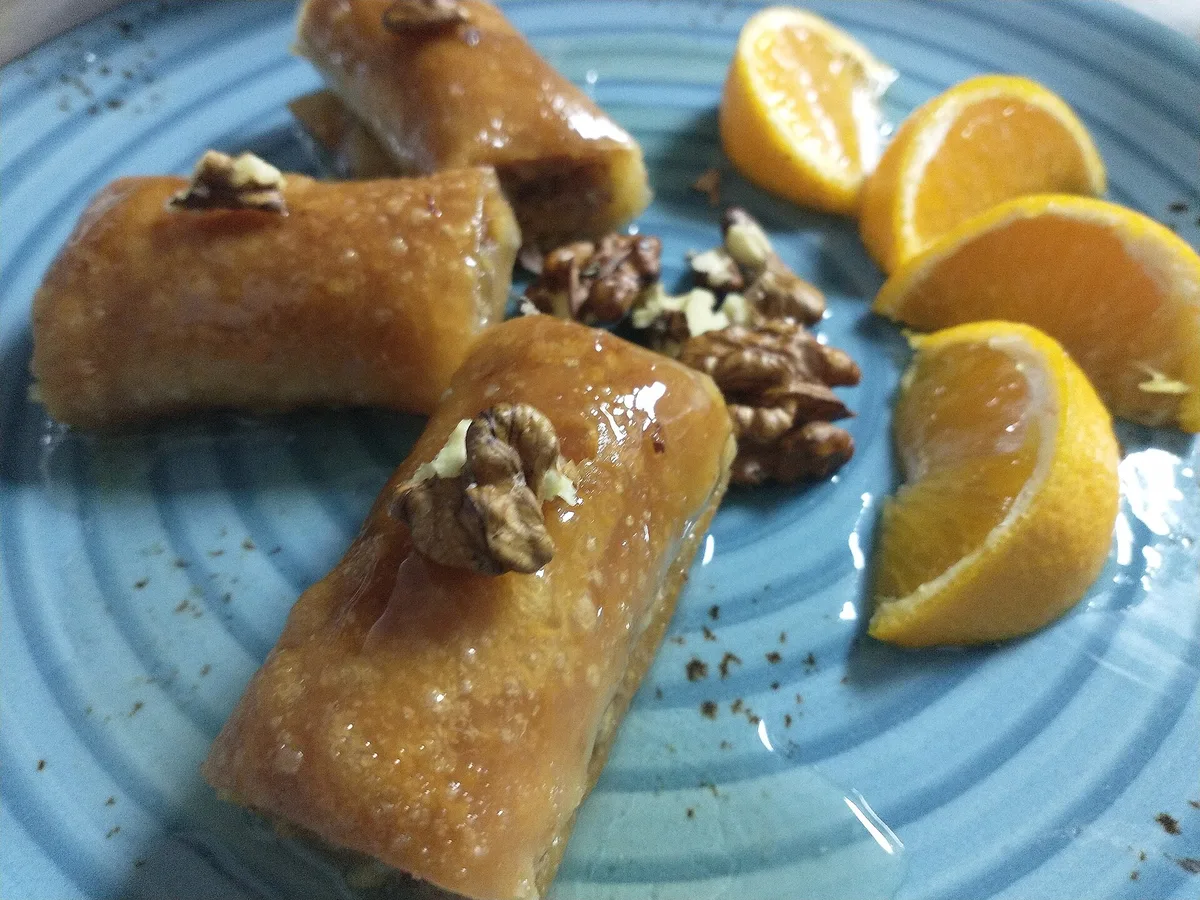
The pastiçeri – the pastry shop – is the last of this guide’s institutions, and its counter runs on syrup. The anchor is bakllava: layer upon layer of hand-stretched pastry with ground walnuts, baked and soaked in syrup, made at home in great trays for the calendar’s peaks – Bajram (Eid), New Year, weddings – and sold by the piece all year. Beside it sit its Ottoman-era relatives: kadaif, shredded pastry with nuts in the same syrup logic; revani, a semolina sponge drenched rather than soaked; sheqerpare, syrup-poached biscuits. All of them are shared Balkan and Anatolian heritage, and none of them needs a flag planted in it: the Albanian note is the walnut (where pistachio is the richer neighbour’s habit), the home tray, and the feast-day timing. Sweetness in Albania is not an everyday course; it is an occasion, and the pastiçeri exists so the occasion can also be a Tuesday.
And then there is trilece, the modern favourite, whose story this albanian food guide promised to tell honestly – because it is the rare dessert whose origin is a genuinely open question. Trilece is a light sponge soaked in three milks and topped, in its Balkan form, with a layer of caramel; the name is the Spanish tres leches wearing Balkan spelling, and the cake is kin to the Latin American tres leches. How it crossed the world is debated in print, and the debate itself is the fact: one well-repeated theory credits Latin American soap operas, hugely popular in Albania, whose cake Albanian cooks reverse-engineered; another credits the tres leches recipes printed on condensed-milk packaging from the 1940s; a third names a specific Italian chef at a Tirana restaurant in the early 2000s, returning from the Dominican Republic. Albania is generally placed first in the Balkan chain, with the cake spreading onward to Turkey and the region. The Albanian version is sometimes made, proudly and literally, with three animals’ milks – cow, goat and water buffalo.
What can be said without hedging is the cake’s present: trilece is now the default celebration and cafe dessert of urban Albania, the slice ordered with coffee, the tray taken to family events, and its lightness – soaked but never soggy, sweet but caramel-bittered – explains the conquest. Order it where the counter is busy and the trays turn over. And let the two desserts of this section stand as the cuisine in miniature: bakllava, centuries old, shared with a dozen neighbours, claimed modestly; trilece, a generation old, arrived from across an ocean by a route nobody can quite prove. Albanian food has always absorbed the world this way – the table in the next sections is simply where the absorption gets eaten.
Eating Vegetarian in Albania – the Honest Version
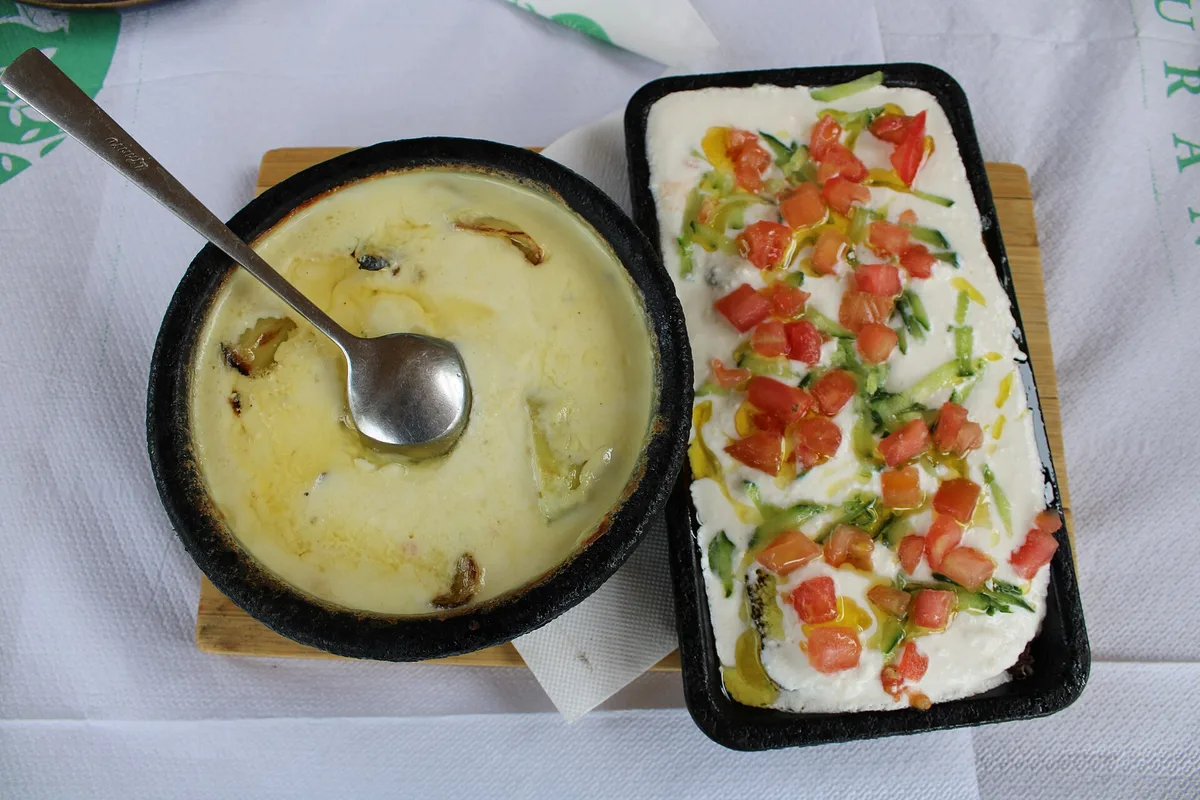
The good news first, because it is genuinely good: Albania’s everyday cooking is built on beans, vegetables, eggs and dairy, and a vegetarian who knows the repertoire eats very well here. The core list is long. Byrek with spinach, leek, potato or gjizë, from any byrektore. Fërgesë in its vegetable form. Speca në ajkë, peppers simmered in cream, in the photograph. Stuffed peppers filled with rice and herbs alone, a traditional version rather than a concession. Fasule, the white-bean gjellë, in its meatless form. Baked vegetables (tavë me perime), grilled vegetables at any agritourism farm, the big dressed salads that open every meal, kaçkavall fried or grilled, eggs, kos, and the whole market in edible form. This is not a cuisine where vegetables are a side thought; the summer garden is half the cooking.
Now the honesty this section exists for, because the traps are specific. Three dishes that look vegetarian may not be: japrak, which many kitchens roll with minced meat in the rice; bean and vegetable gjellë, which are often cooked with meat or meat stock for depth; and fërgesë, whose liver version was flagged in its own section. Byrek fillings rotate through the day, so the tray that was spinach at nine may be meat at noon – point and ask, every time. The language that solves all of it is short: “Pa mish, ju lutem” – without meat, please – and “Unë jam vegjetarian” (vegjetariane, for a woman) – I am vegetarian. Kitchens respond to these the way Albanian kitchens respond to everything: by feeding you, copiously, from the parts of the menu that were always meatless.
Vegans should read the same map with colder eyes. Dairy is the cuisine’s connective tissue – gjizë in the pastry, kos beside the main, cheese on the salad, butter and cream in the clay dishes – and a strict vegan will be eating salads, grilled vegetables, bread, meatless bean pots where the stock question is settled, and market fruit, which is a workable but narrower table. In cities and at agritourism farms, where the cook is in the room and proud of the garden, ask directly and early: the farm pattern, in particular, can build a meal from its own vegetables, beans and oil with real pleasure. An albanian food guide owes vegans that unvarnished paragraph rather than a cheerful paragraph that collapses at the first byrek counter.
Albanian Food Guide Questions, Answered
What is the one dish I should try first? Byrek, because it is the cuisine’s daily bread, then tavë kosi, because it is the formal ambassador. Between those two plates – the byrektore counter and the clay dish – you have the whole range of Albanian food from street to ceremony, and everything else in this albanian food guide is commentary on them.
Is tavë kosi really the national dish? By common usage, yes; by official designation, no. No law or decree names a national dish of Albania. Tavë kosi holds the title by acclamation – it is the dish Albanians themselves name, the one associated with Elbasan and served everywhere – and this guide treats the customary title as the true one, while telling you it is customary.
What does a byrektore sell, and what is a qebaptore? A byrektore sells byrek and little else – pastry by the piece or by weight, plus dhallë to drink with it. A qebaptore is a grill house: qofte, kërnacka where regional, and other charcoal-grilled meats. Add the lokal (the small family restaurant of the day’s cooking), the furrë buke (bakery), the pastiçeri (pastry shop) and the agroturizëm (farm restaurant) and you can read any Albanian street.
I am vegetarian. What are the traps? Liver in one version of fërgesë, minced meat in many japrak, and meat stock in bean and vegetable gjellë. Ask the three questions in the vegetarian section – “pa mish” covers most of it – and build your table from byrek, fërgesë, speca në ajkë, salads, beans and the market. You will not go hungry; you will go home full.
What is flia, and where do I eat it? Flia is the north’s layered celebration dish: thin batter baked layer by layer under an ember-covered saç, brushed with butter or cream as it grows, and cut like a cake. It takes hours, so it appears where time is part of the hospitality – mountain guesthouses in Theth and Valbona, traditional restaurants in Shkodër, agritourism farms and family tables. It is shared across Albanian lands, Kosovo included; order it where it is offered and do not expect it fast.
What is çaj mali, and should I take some home? Yes, if you take one edible thing. Çaj mali is mountain tea, the dried flowering stems of Sideritis – chiefly Sideritis raeseri in Albania – sold in bundles at markets, brewed stems and all, and drunk plain or with honey as the house tea and cold remedy. It is light, it packs flat, and it is genuinely of the mountains it came from. Look for full, fragrant bundles with the flowers on.
How does tipping work? Simply: service is personal, wages are modest, and leaving a small tip or rounding the bill up appreciably is the local habit in sit-down restaurants – appreciated rather than demanded, and never the subject of a scene either way. In byrektore and cafes, small change left on the counter is the norm. This albanian food guide prints no prices, so it prints no percentages either; the habit to copy is the rounding, generously done.
What should I drink with the food? Coffee before and after, dhallë with byrek, beer with the grill in Korçë’s honour, water and kos at the family table – and raki when it is offered, which it will be, because raki is how Albania says the meal matters. Sip it, toast “Gëzuar!”, and let the host’s bottle be the souvenir story rather than a test of endurance.
The Short Version
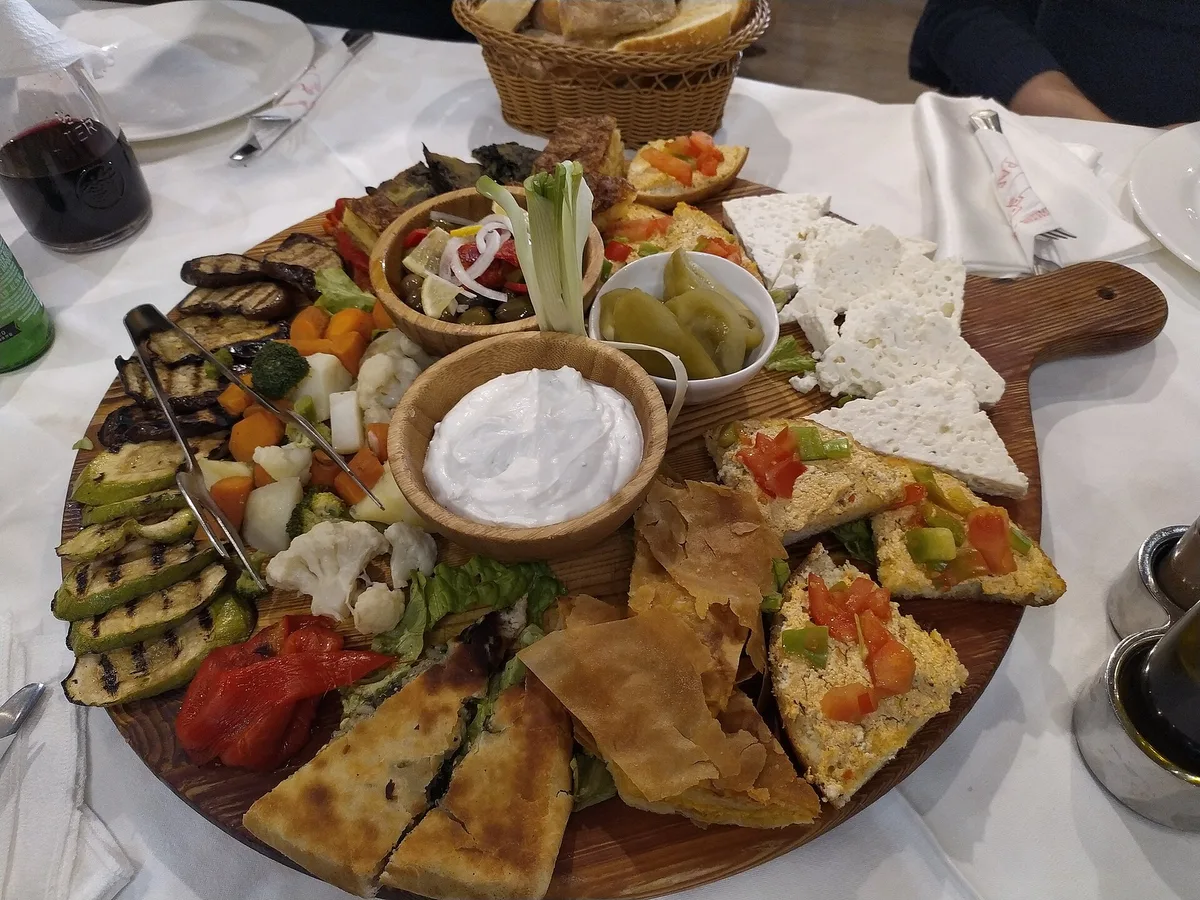
If this albanian food guide had to fit on an index card, it would say this. Albania eats from the middle of the table: shared dishes, bread at every meal, yoghurt as a sauce, a drink and a side, and hospitality that treats a guest’s appetite as an honour to be answered. Learn five addresses – byrektore for byrek, qebaptore for the grill, lokal for the day’s gjellë, pastiçeri for the syrup shelf, market for the ingredients – and the country’s food system is yours. Learn five dishes – byrek, tavë kosi, fërgesë, flia, and whatever the coast grilled that morning – and its range is yours too.
Eat regionally, because the cuisine is several: yoghurt and lamb in the centre, fish on two seas and carp in the northern lake, corn bread and saç cooking in the mountains, beer and kërnacka in Korçë’s east. Eat seasonally, because the market decides: peppers and tomatoes in their summer flood, beans and trahana in winter, mussels and greens in their turns. Eat the dish on its home ground where you can – tavë kosi thinking of Elbasan, qifqi if Gjirokastër offers it, tavë krapi in Shkodër – and let the Albania itinerary for 7 days carry you between those grounds in an order that makes sense of them.
And so to the table itself, which is where every section of this guide has been walking. Sit down, let the dishes be ordered as they are, and let the table fill. Albania will handle the rest – it has been feeding guests, ceremonially and well, for a very long time.