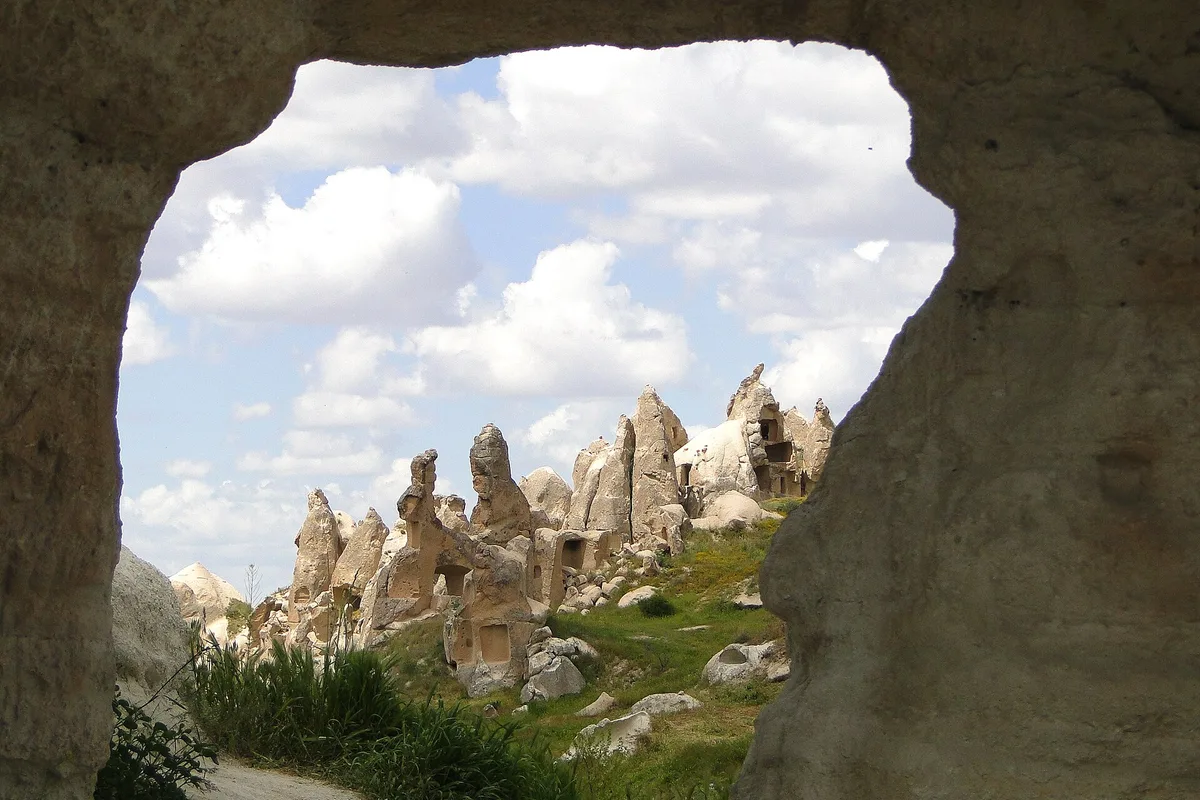
The museum begins before the gate, in a way no building museum can. You walk out of Goreme town, up the road the tour buses take, and the valley closes in around you – pale cliffs on both sides, cones of soft rock standing between the road and the sky, and then, cut into the cliff faces, doorways. Windows. A whole honeycomb of carved openings, some at ground level, some three storeys up a rock face with no visible stair. This goreme open air museum guide starts from the fact that surprises most visitors at the ticket barrier. There is no museum building here, and nothing in it was collected. The Goreme Open-Air Museum is a Byzantine monastic settlement exactly where its monks left it – churches, chapels, refectories, kitchens and cells cut into one short stretch of valley – and the museum is simply that settlement with a gate at the entrance, a path through it, and a thousand years of painting still on its walls.
That is why this site, of all the sights in Cappadocia, repays a guide of its own. The wider region gets its own overview in our Cappadocia travel guide, and the town of Goreme – its cave hotels, valleys and balloons – gets a separate town guide on this site. This goreme open air museum guide stays inside the fence. It walks the museum in the order the path walks it, church by church – Tokali, the Dark Church, Elmali, Barbara, Yilanli, Carikli and the smaller chapels – and it deals plainly with the two things the highlight reels skip. The first is how the place actually worked as a monastery, refectory tables and all. The second is how its ticketing actually works, because the museum runs on three different pieces of paper – its own ticket, a regional pass, and a separate extra ticket for its single most famous church – and the difference between them decides both your budget and your morning.
A word on what kind of visit this is, so the rest of the guide makes sense. The paintings here are not decorations on a church visit. They are the visit. After Iconoclasm ended in 842 and figurative painting returned to Byzantine churches, the carvers and painters of this valley covered their rock-cut walls with some of the finest surviving painting of the period – which is precisely why UNESCO inscribed the area in 1985 and why the frescoes, not the fairy chimneys, are the reason this valley was protected. Go for the landscape and you will enjoy an hour. Go for the paintings, in the order this goreme open air museum guide takes them, and you will understand why a small valley in central Anatolia holds a place on the World Heritage List at all.
Goreme Open-Air Museum at a Glance
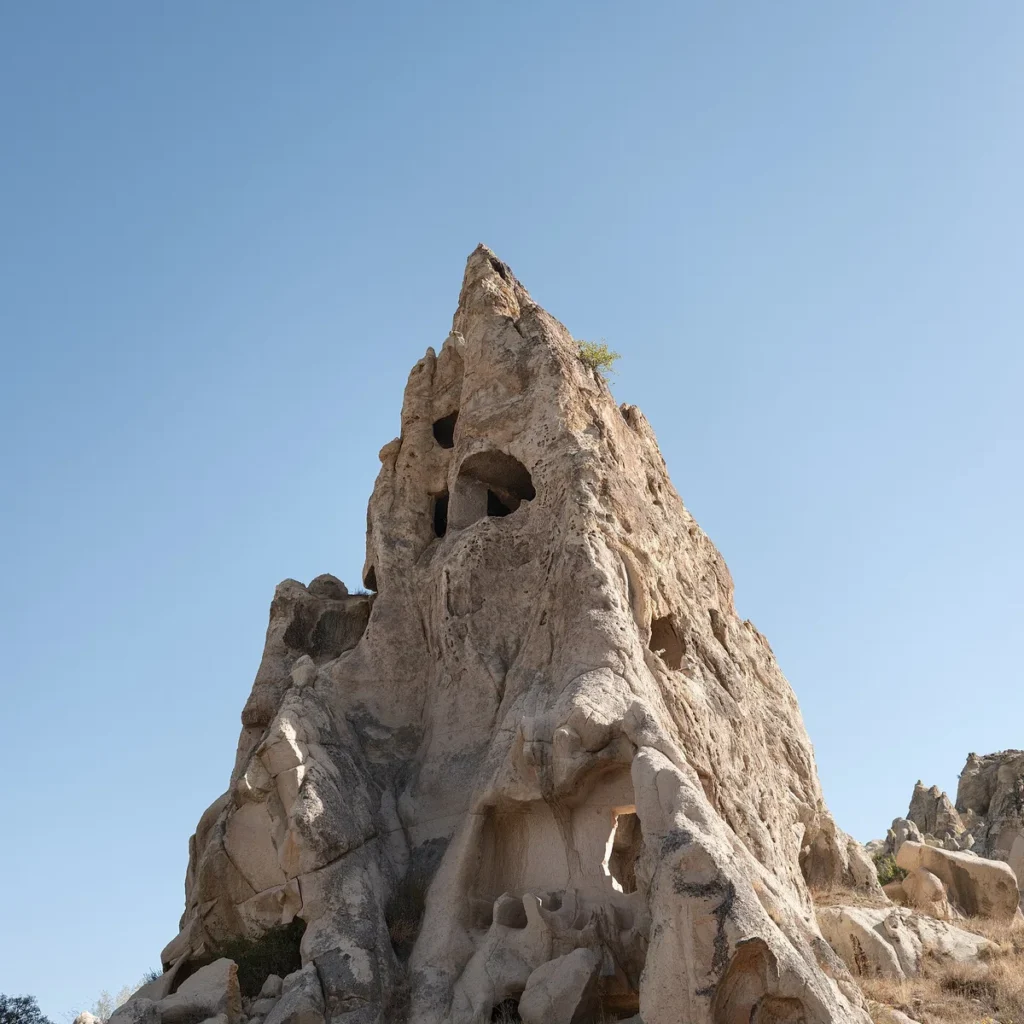
The single most useful thing to grasp before you enter is that the museum’s unit is not the building but the rock block. Almost every cone and cliff face along the path contains a complete small world – a church or chapel at its heart, rooms around it, a refectory or a kitchen within a few steps – because that is how the monastic community here organised itself, in clusters around its places of worship. The Ministry of Culture and Tourism, which runs the site as the Goreme Archaeological Site, lists the churches on the circuit as the Girls and Boys Monastery, Saint Basil’s Church, Elmali Church, Saint Barbara Church, the Serpent Church, the Malta Crusader Church, the Dark Church, Saint Catherine Church, Carikli Church and Tokali Church. Read that list as a walking order rather than a catalogue and the visit organises itself.
The practical shape of the visit is equally simple. One gate, one main ticket, a loop path that climbs gently through the valley past the churches in sequence, one church – the Dark Church – holding a separate ticket of its own, and one great church, Tokali, standing just outside the main gate across the road and visited on the museum’s ticket. The site is open every day. Most visitors who take the churches seriously, Tokali and the Dark Church included, spend two to three hours inside; visitors who walk the loop at tour-group pace do it in half that and remember half as much. This table carries the whole goreme open air museum guide in miniature.
| Question | Answer |
|---|---|
| What is it | A Byzantine monastic settlement cut into the rock – churches, chapels, refectories and cells – protected as part of the UNESCO property inscribed in 1985 |
| Where | On Muze Caddesi above Goreme town, Nevsehir province – roughly twenty minutes uphill on foot from the town centre |
| Run by | The Ministry of Culture and Tourism, as the Goreme Archaeological Site; the official source for hours and ticketing is its museum portal, muze.gov.tr |
| Opening pattern | Open every day; the portal lists a daytime session from 08:00 and, in season, a night-museum programme – confirm the day’s pattern on muze.gov.tr |
| Tickets | The museum’s own ticket or the Museum Pass Cappadocia for the main circuit and Tokali; the Dark Church always takes a separate extra ticket |
| Time needed | Two to three hours including Tokali and the Dark Church; ninety minutes for the loop alone at a brisk pace |
| Do not miss | Tokali’s painted cycle, the Dark Church, Elmali’s domes, one refectory walked at full length |
| Conditions | An outdoor site of paths, steps and low carved doorways; painted interiors are small and dim, and photography inside them is restricted |
Note the ticket line in particular, because it is where this museum differs from almost every other major sight in the region. The Dark Church’s separate ticket is not a scam, an upsell or a recent invention – it is a long-standing arrangement that protects the most fragile painted interior in Cappadocia by keeping its visitor flow deliberate, and every pass product in the region leaves it outside. The ticketing section later in this guide takes the whole system slowly. First, the monastery itself.
What the Museum Actually Is – a Monastery Cut Into a Valley
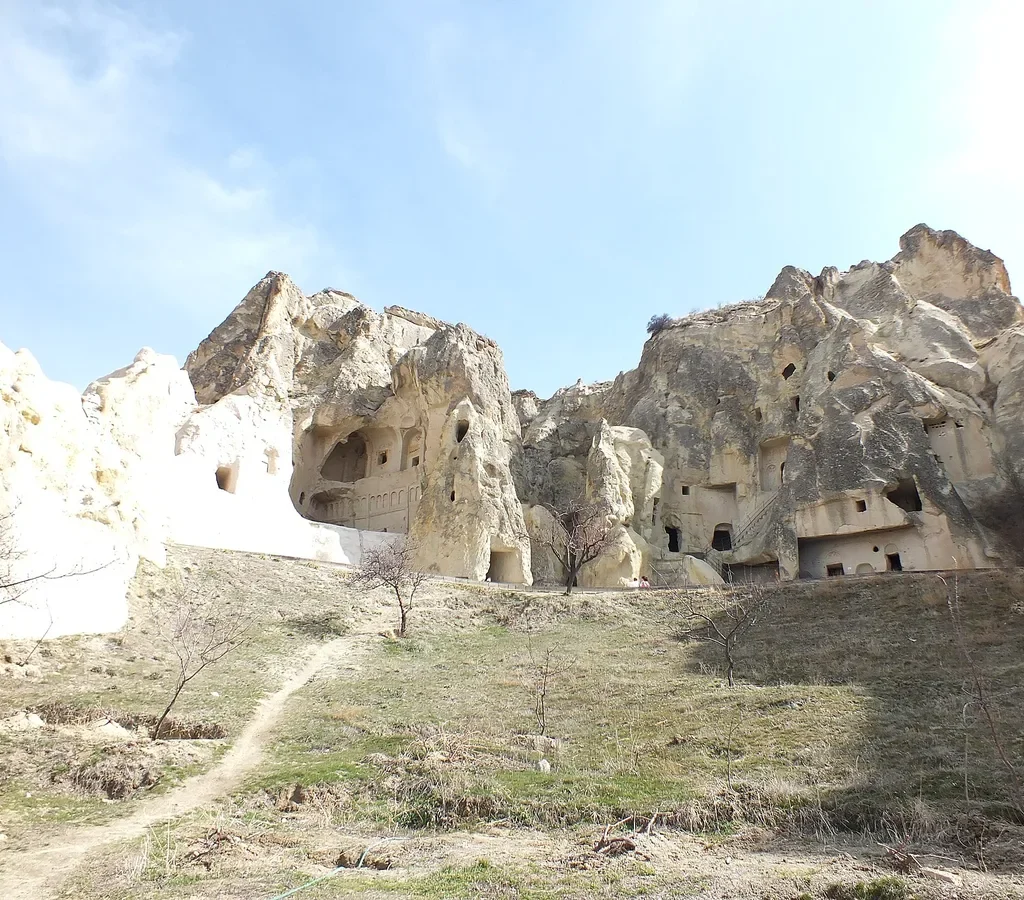
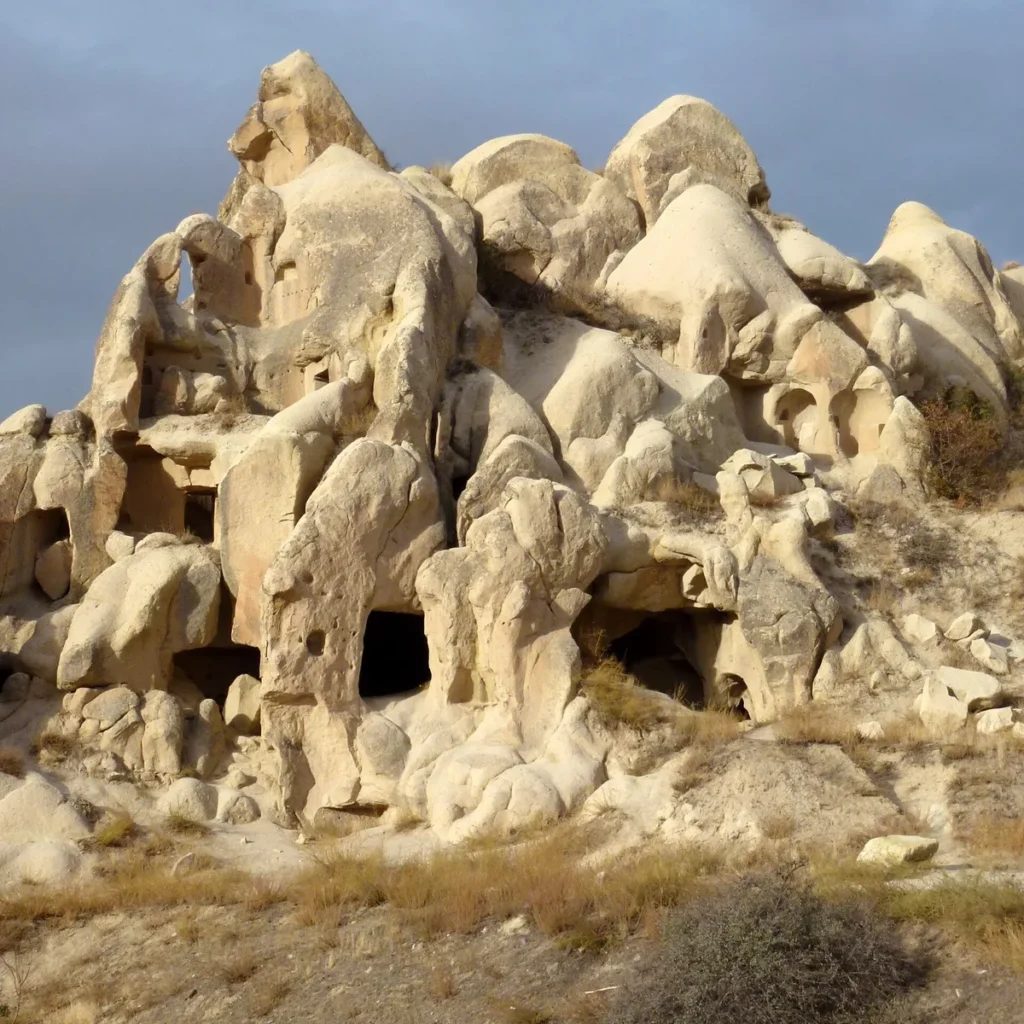
Stand anywhere on the museum path and look at the cliff in front of you, and you are looking at the argument of this whole article. The rock is tuff, the compacted ash of ancient eruptions, soft enough to cut with hand tools and firm enough, once cut and exposed to the air, to hold a room’s shape for a thousand years. The monks who settled this valley did not build their monastery. They subtracted it, room by room, from the cliffs and cones – which is why the settlement feels less like architecture imposed on a landscape than like the landscape itself, edited. UNESCO’s listing for Goreme National Park and the Rock Sites of Cappadocia makes the same point in the language of heritage law, noting that the property’s churches and dwellings were hewn from the living rock and that the technique shaped everything the builders could attempt.
The human story starts earlier than the paintings. The Ministry’s account of the site records ascetic monks living as hermits around Goreme as early as the second century AD, and traces organised monastic life here to the fourth century and the influence of Basil the Great, bishop of nearby Caesarea – one of the three Cappadocian Fathers whose teachings shaped eastern monasticism. Basil’s model was communal rather than solitary. Monks were to live, eat, work and worship together, and the valley you are walking is that model made stone. Cells for sleeping, chapels for prayer, churches for the community’s worship, refectories where the community ate in rows, kitchens and stores to feed it – the full apparatus of a working monastery, repeated cluster by cluster up the valley. The Ministry dates the valley’s monastic life from the fourth century to the thirteenth, which means this small valley was a functioning religious community for the better part of nine hundred years.
The famous painting belongs to the later, greater part of that span. During Iconoclasm, roughly 725 to 842, figurative images were restricted across the Byzantine world, and Cappadocia’s early sanctuaries kept, in UNESCO’s words, a strict minimum of symbols – the sculpted and painted crosses you can still see in the oldest chapels here, and the red-ochre sign language of churches like Saint Barbara’s. When Iconoclasm ended in 842, the restraint ended with it. Church after church in the Goreme valley was cut and then covered in bright figurative painting – cycles of the life of Christ, ranks of saints, donors, angels and archangels – until the valley held what UNESCO calls one of the leading examples of post-iconoclastic Byzantine art anywhere. The churches this goreme open air museum guide walks you through are that flowering, dated by UNESCO in sequence. Tokali and El Nazar belong to the tenth century, Saint Barbara to the eleventh, and Elmali and the Dark Church to the end of the twelfth and the beginning of the thirteenth.
The museum, as a museum, is young by comparison. The Ministry records that the site was opened to visitors in 1967, and in 1985 the valley took its place inside the UNESCO World Heritage property – a mixed cultural and natural inscription, recognised for the art, for the fossilised image of a Byzantine province, for the traditional settlement, and for the erosional landscape itself. That double status matters on the ground. You are not visiting a gallery that happens to be outdoors. You are visiting a protected landscape in which a monastery is the centrepiece, and the fences, the controlled doorways and the photography rules inside the painted churches all follow from it.
The Layout and the Walking Route Through the Museum
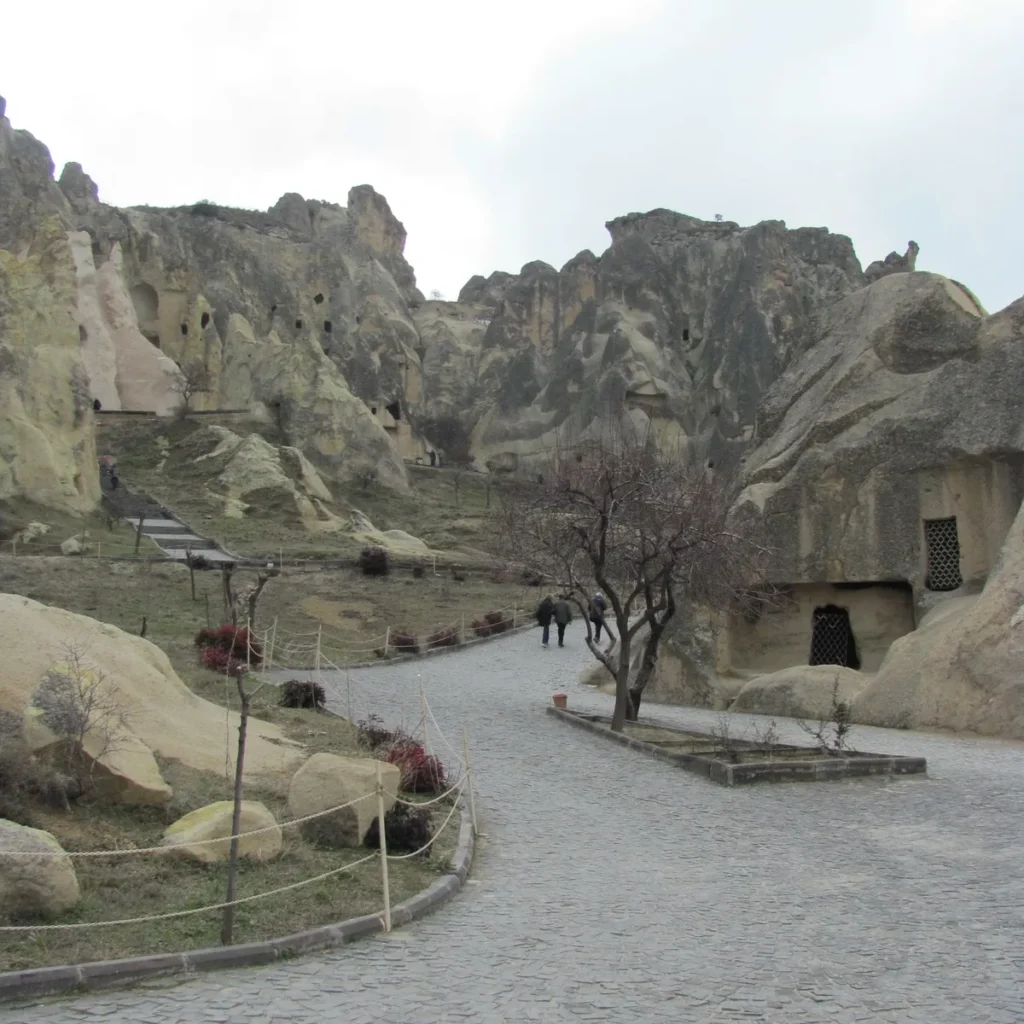
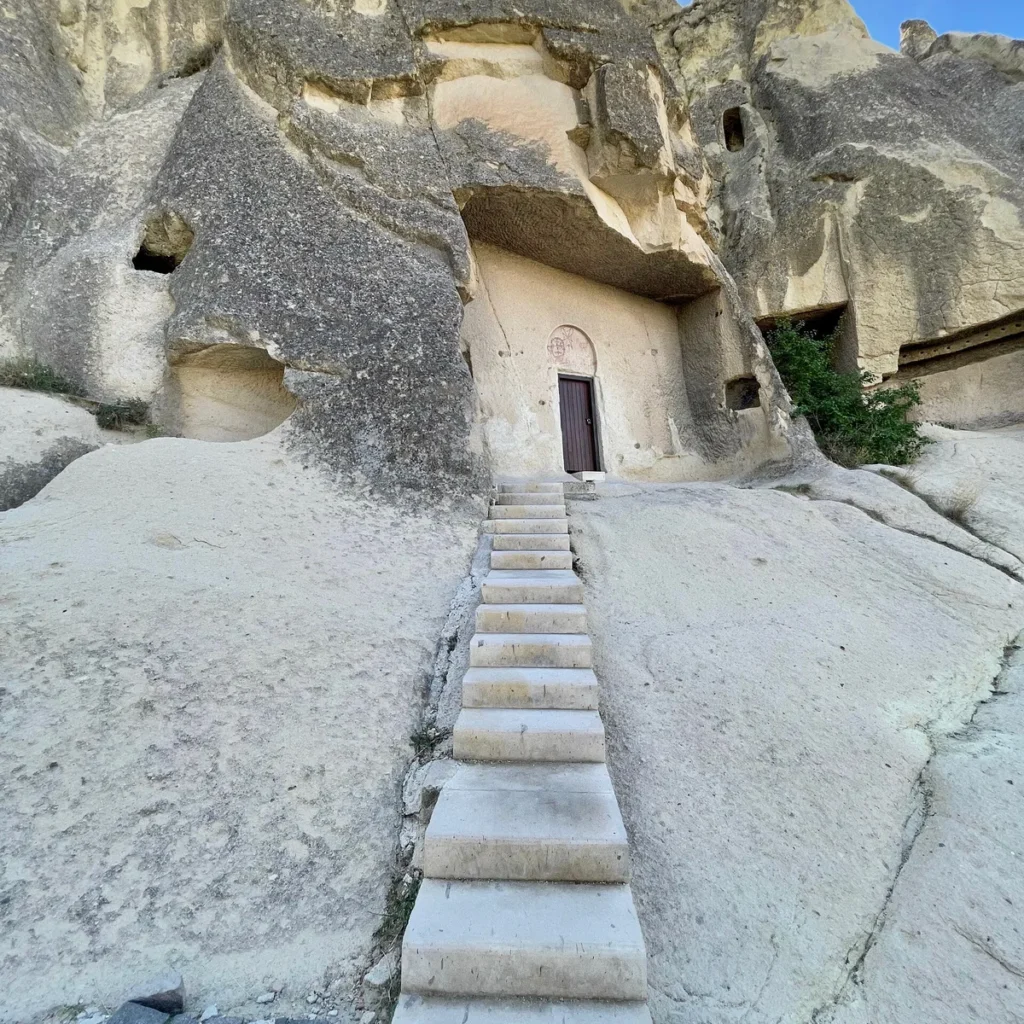
The museum occupies a single short valley, and its geography is a gift to the visitor because it enforces an order. From the gate, the path runs into the valley past the great carved cliff of the Nunnery, then works along the church clusters in sequence – Saint Basil’s chapel near the start, then Elmali, Saint Barbara and the Serpent Church, the Malta Crusader Church and the Dark Church in their part of the valley, Saint Catherine and Carikli beyond – before the route brings you back down. Tokali, the largest church of all, stands apart, across the road outside the main gate, and is best treated as either the overture or the finale rather than squeezed into the middle. Walked in that order, the valley teaches its own history. The plain early chapels come first, the painting grows richer as you climb, and the Dark Church arrives near the end as the climax it deserves to be.
Two features of the route deserve honesty before you start. The first is that it is a real outdoor path, not a museum corridor. It climbs, it narrows, it passes over worn rock, and the churches themselves are reached by steps and through doorways that were cut for monks, not for visitor flow – low, narrow and occasionally steep. Anyone who expects a flat, step-free museum route will be frustrated here, and travellers with limited mobility should read the terrain plainly. Historic rock sites of this kind cannot be made fully accessible without destroying what they are, and this one has not been. The second feature is the interiors themselves. These are small rooms, most of them no larger than a generous living room, with controlled entry at busy times. A queue at a church doorway here is not a failure of management. It is the building’s capacity, and it moves.
Practical orientation belongs in this section of the goreme open air museum guide rather than in a tips box, because the route decisions are the visit. Take the churches in path order and do not criss-cross the valley chasing highlights – the backtracking costs more time than any single doorway queue. Keep Tokali for last if you arrive at opening, when the main valley is at its emptiest and Tokali can wait an hour without filling; keep it for first if you arrive late in the day, when the valley’s groups are already inside and Tokali’s larger hall absorbs visitors more gracefully. And wherever the path offers a choice between a famous church with a queue and a quiet chapel without one, take the chapel. The valley’s small rooms reward exactly the attention the crowds deny the famous ones, and the queue will be shorter when you come back to it.
The Nunnery and the Refectories – How the Community Lived
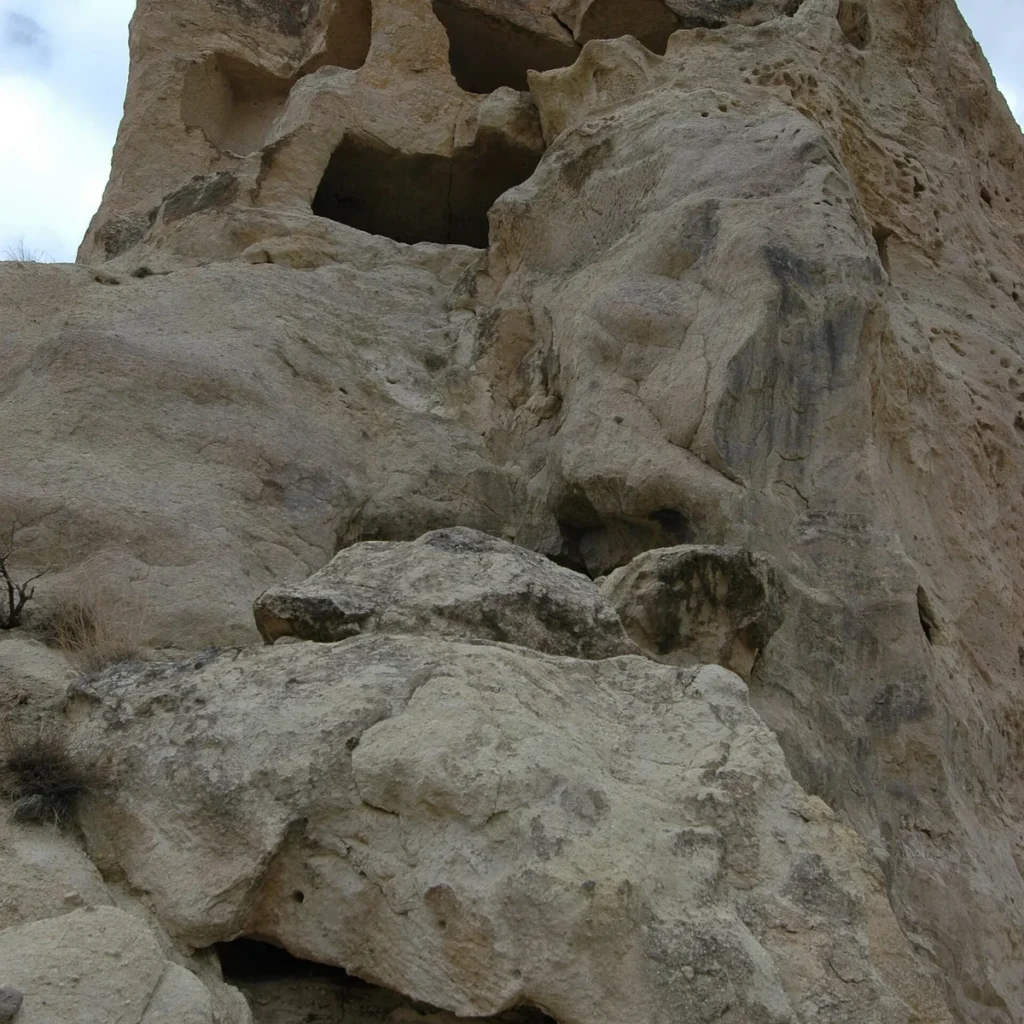
The first great carved face inside the gate is not a church at all, and most visitors photograph it without learning what it is. The towering cliff of openings is the Nunnery – the Girls and Boys Monastery of the Ministry’s church list – a multi-storey monastic residence cut vertically into the rock. Storey rises above storey of cells, small chapels, refectories and connecting tunnels, a convent organised like a cliff dwelling because, in this valley, that is what a convent was. Not all of it is open or safely reachable, and much of it is read from the path rather than entered, but even from outside it does the essential work of the visit. It establishes scale. Before you have seen a single famous fresco, you have seen where dozens of religious lived their entire lives, sleeping, praying and eating inside one rock face.
That daily life is the half of the museum the highlight tours skip, and it is the half that turns a gallery of paintings into a society. The monastic clusters along the path repeat the same domestic grammar. A church or chapel for worship. Cells for the religious. A kitchen, recognisable by its domed oven space and soot. Store rooms and pigeon holes. And, again and again, the room this guide most wants you to enter slowly – the refectory.
The Refectories – One Table, Cut From One Rock
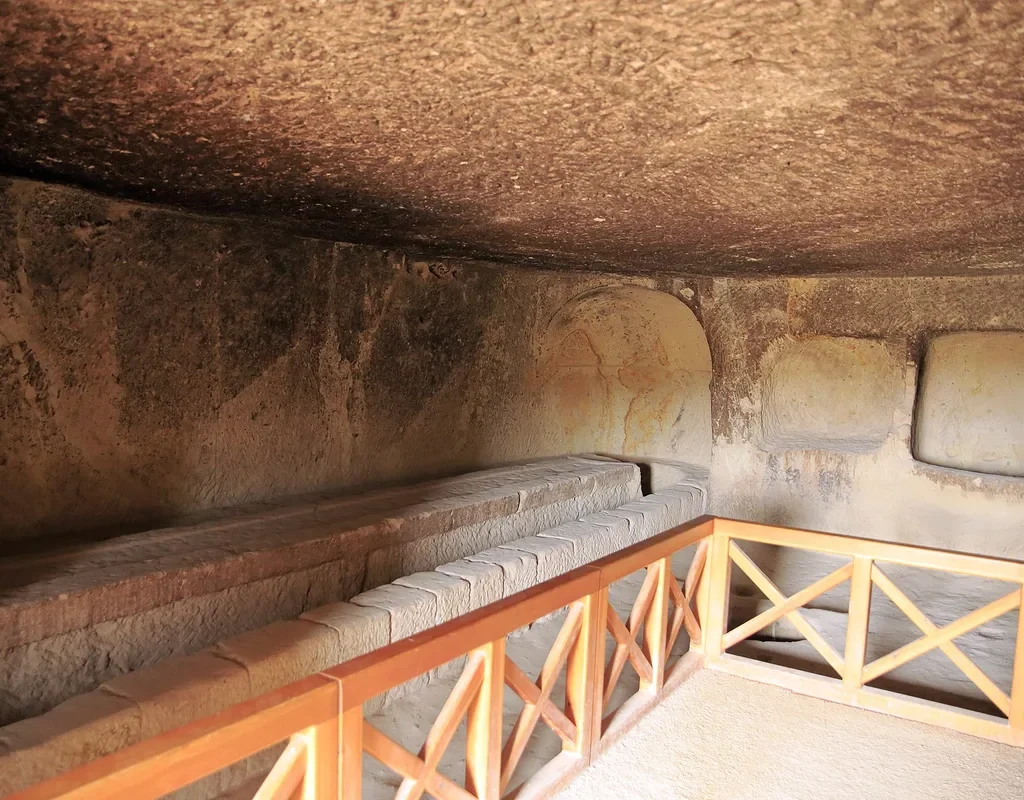
A Goreme refectory is a long room holding a long table, and both the table and the benches along it are carved from the same rock as the walls and floor – one continuous act of subtraction, furniture and architecture in a single material. Walk the length of one and the monastery’s social order becomes physical. The community ate together, in rows, at a table that could seat dozens, in an order and a discipline that Basil’s communal model prescribed. Meals in such rooms, across the monastic world, were working parts of the religious day – eaten in silence, accompanied by readings – and the rooms here are sized and shaped for exactly that, neither refectory-as-dining-hall nor chapel, but a third thing between them.
Do not rush these rooms on your way between the painted churches, which is what the pace of a guided loop encourages. They are the evidence that the valley was lived in, not just worshipped in, and they calibrate everything else in this goreme open air museum guide. The frescoes were painted for the people who ate at these tables. The small dark chapels were prayed in by the people who slept in the Nunnery’s cells. A museum that keeps the bedrooms and the dining rooms alongside the churches is telling you the whole story, if you let it – and Goreme, almost alone among great church sites, still can.
Tokali Church – the Largest Church and Its Blue Story Cycle
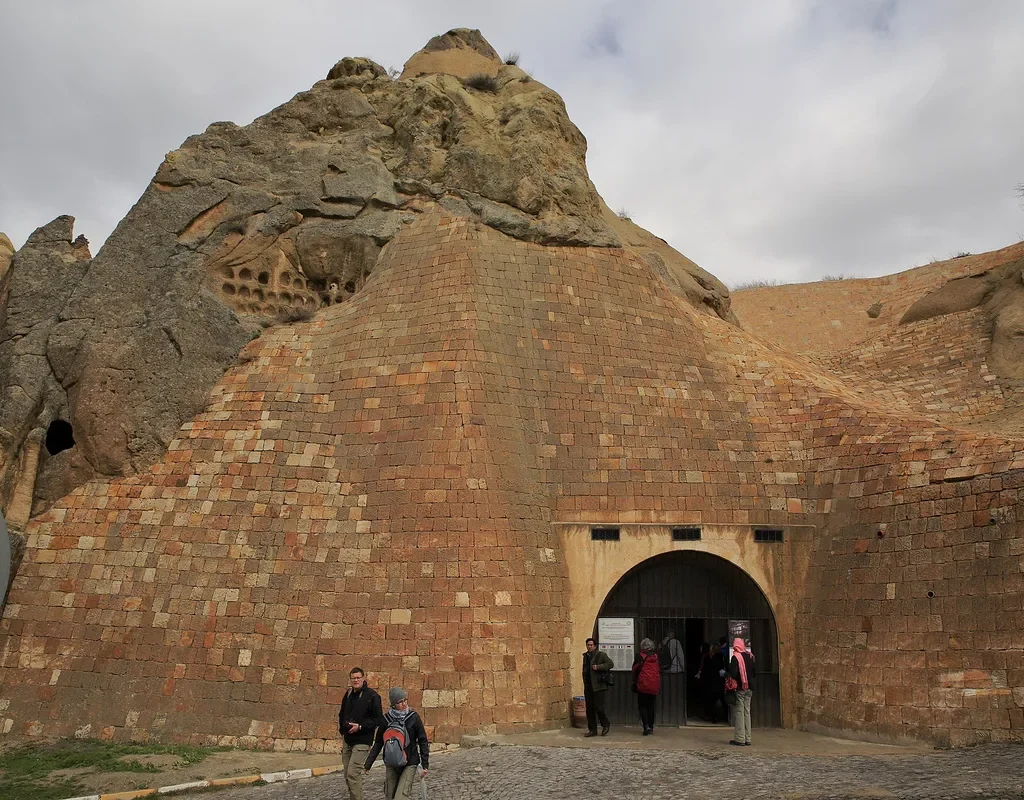
Tokali Kilise, the Buckle Church, is the museum’s great paradox. It is the largest church in the valley and, for many visitors, the finest – and it stands outside the main fence, across the road from the gate, where a steady stream of people walk past it on their way in and out without realising it is part of the same museum and the same ticket. Do not be among them. In current arrangements Tokali is visited on the museum’s main admission, an arrangement the site’s own live guide at the gate will confirm on the day, and on any honest ranking of Cappadocia’s painted interiors it stands at the very top with the Dark Church.
The church is really a complex that grew in stages. The oldest part, the Old Church, is a single-naved tenth-century chapel – UNESCO dates Tokali to the tenth century – and it now serves as the entrance passage. Behind it, the New Church opens into a wide rectangular hall, and the whole complex also includes a lower church and a side chapel. The effect of the sequence is deliberate-feeling even if it was accumulated rather than planned. You pass through the small, earlier, more intimate space, and then the great hall opens, its walls and vaults carrying one of the most complete painted cycles of the life of Christ to survive from the Byzantine world – scene upon scene in sequence, the Annunciation, the Nativity, the miracles, the Passion, the Crucifixion and the Ascension, each panel captioned in Greek for a congregation that read its scripture on its walls.
The Blue of the New Church
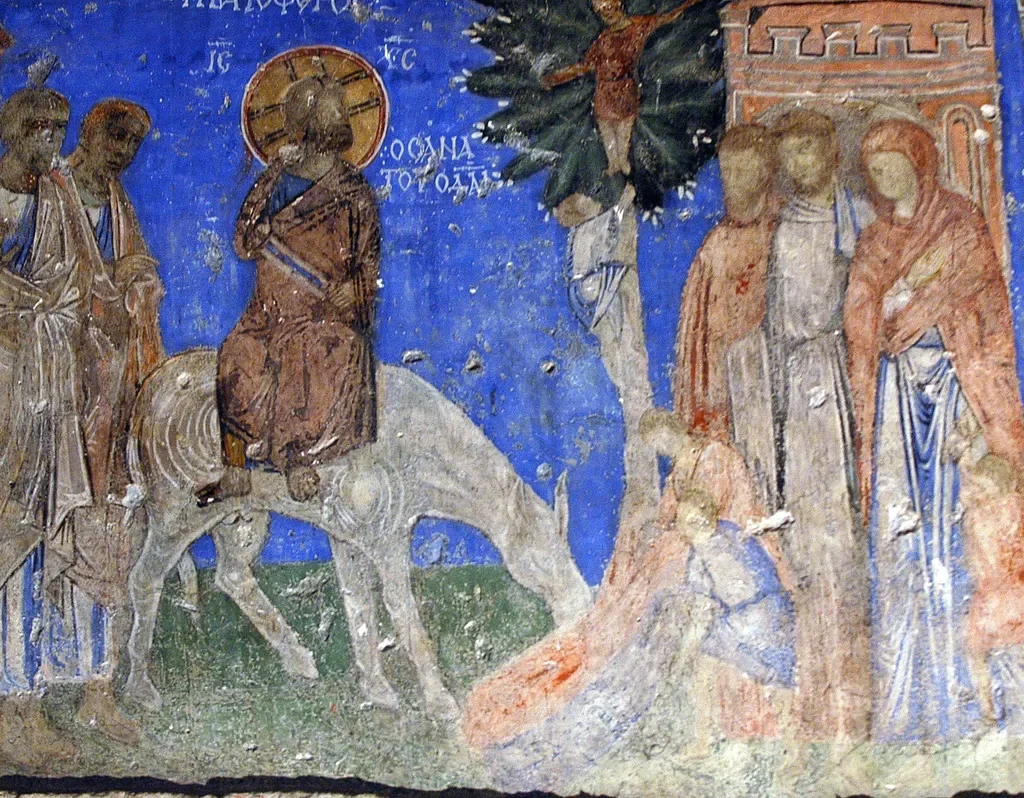
What stays with every visitor is the colour. The backgrounds of the New Church paintings are a deep, saturated blue that glows in the low light, and it is not an accident of taste. Blue pigment of that quality was expensive, and its lavish use across a hall of this size is a statement about patronage – someone with resources paid for this room to look like this. The painting itself matches the material. The figures carry a confidence and narrative clarity that the valley’s smaller chapels, for all their charm, do not attempt at this scale. This goreme open air museum guide’s advice for Tokali is simply about time. Tour groups are moved through the hall in minutes, because the hall is big enough to feel processed quickly. Enter as a group leaves and you may have the cycle almost to yourself for a while. Read it slowly, panel by panel, in the order the story runs. It is one of the few rooms in Cappadocia that rewards the full attention you would give a gallery’s masterpiece, because that is what it is.
One more practical note belongs to Tokali alone. Because it sits outside the main gate, its rhythm differs from the valley’s. It can be visited before you enter the main site or after you leave it, which makes it the flexible piece in a crowded morning – the church to hold back for the hour when the main valley is at its worst. The section on timing later in this guide returns to that calculation. For now, register the name and the location. The largest church in the museum is the one that is not, visibly, in it.
The Dark Church – Why Darkness Kept the Colour
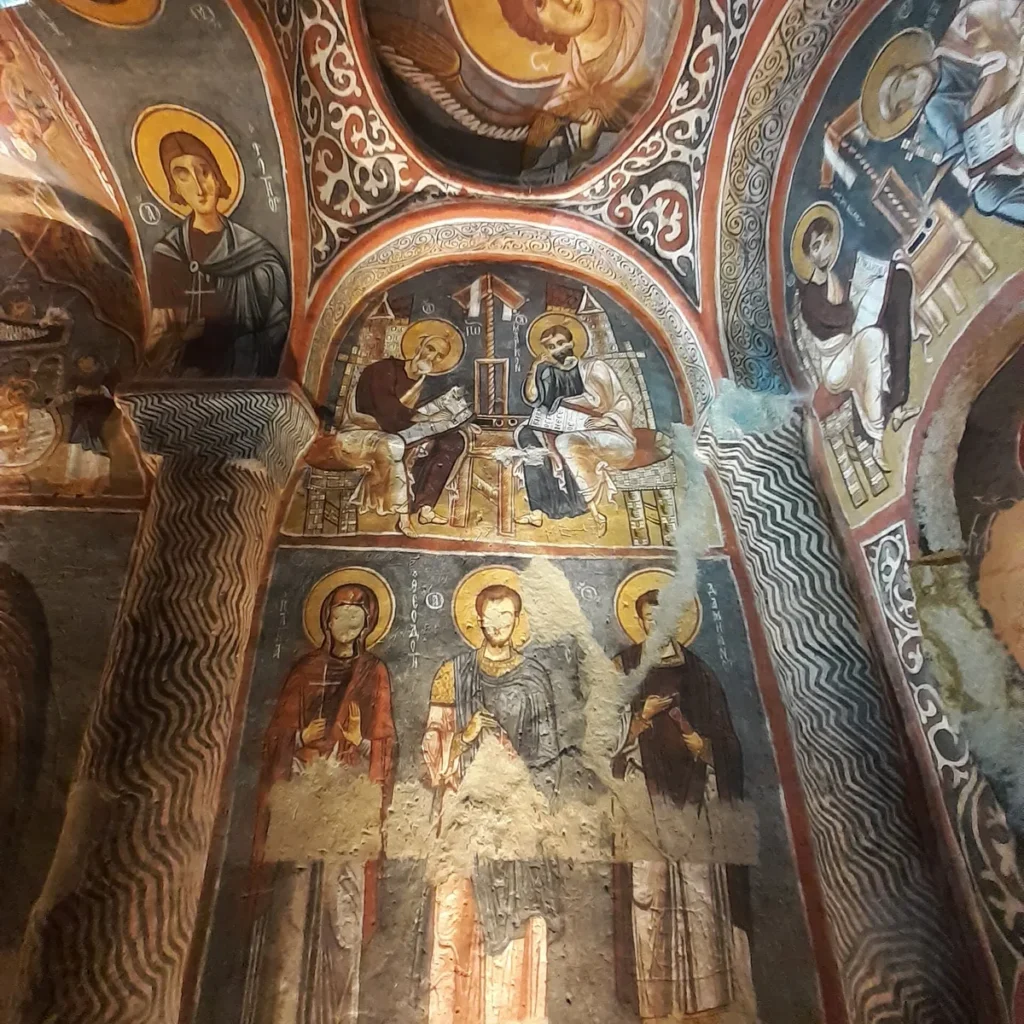
Karanlik Kilise, the Dark Church, is the museum’s masterpiece and its most instructive room. UNESCO dates Elmali and the Dark Church together, to the end of the twelfth and the beginning of the thirteenth century – among the last great churches painted in the valley. Its plan is the most developed in the museum, a cross-in-square church with a central dome, apses and a narthex, carved and painted as a complete small cathedral in rock. And it has, by design or by the geology of its cliff, almost no windows. The only significant light enters through one small opening in the narthex. For eight centuries, give or take the years of its later uses, the interior of this church sat in something very close to darkness.
Darkness, it turns out, is the finest art storage ever devised. Sunlight is what fades fresco pigment, bleaching blues and reds toward pastel over centuries of exposure, and the Dark Church admitted almost none. When the church fell out of religious use, the story the site tells is that it served for a long period as a pigeon house, the birds coming and going through the same small opening – a use that sounds like desecration and functioned, in fact, as protection, keeping the room sealed, dark and undisturbed. When conservators finally cleared and studied it, the paintings beneath were in a state no other church in the valley could match. The dome carries a monumental Christ Pantocrator. Around the walls and vaults run the scenes of the life of Christ – among them the Nativity, the Last Supper, the Betrayal, the Crucifixion and the Deesis – painted with a freshness that makes them look, in the dim light, almost wet.
The Paintings, and Why They Look New
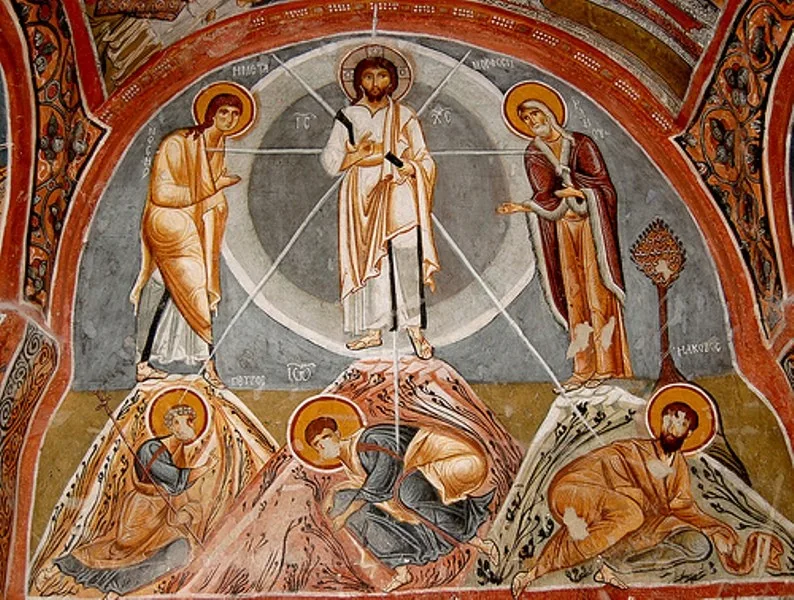
Look at the Transfiguration in the photograph above and the preservation argument makes itself. The whites are still white. The modelling of the figures still reads. In the valley’s other churches, however fine, time and light have taken a toll you can see; here the toll was refused entry for eight hundred years. Two practical consequences follow, and this goreme open air museum guide states them plainly. First, the church is kept deliberately dim and its visitor flow is controlled, so expect a short wait at its door in busy periods and a hushed, close few minutes inside a small space – the experience is intense rather than spacious, and it is better for it. Second, the church is the reason the museum’s ticketing has its famous wrinkle. Entry is sold as a separate ticket on top of main admission, bought for this church alone, and no pass in the region covers it. The arrangement is dealt with in full in the ticketing section, but the decision belongs here, at the door. Pay it. Inside the most expensive part of a Cappadocia trip, the separate ticket for the single best-preserved painted interior in the region is not the place to economise.
Elmali Church – Nine Domes in a Room the Size of a Chapel
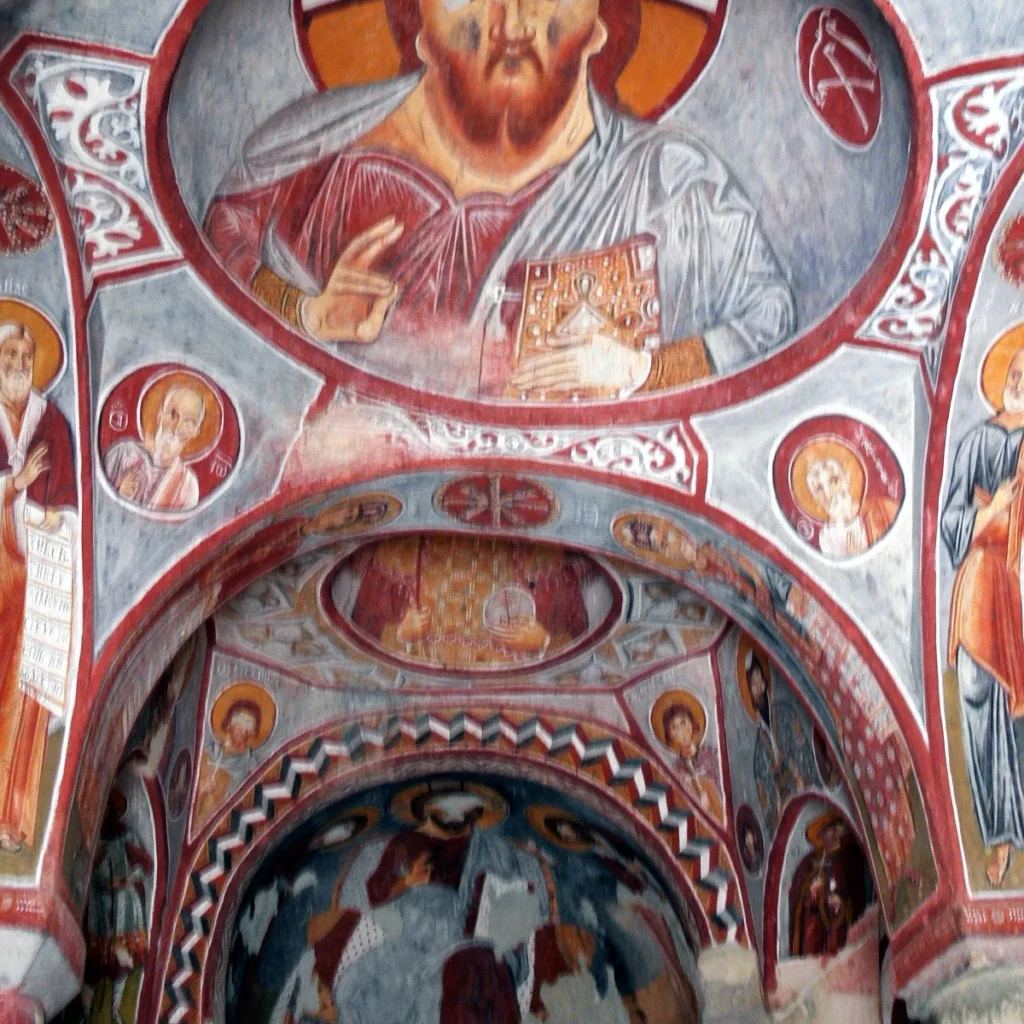
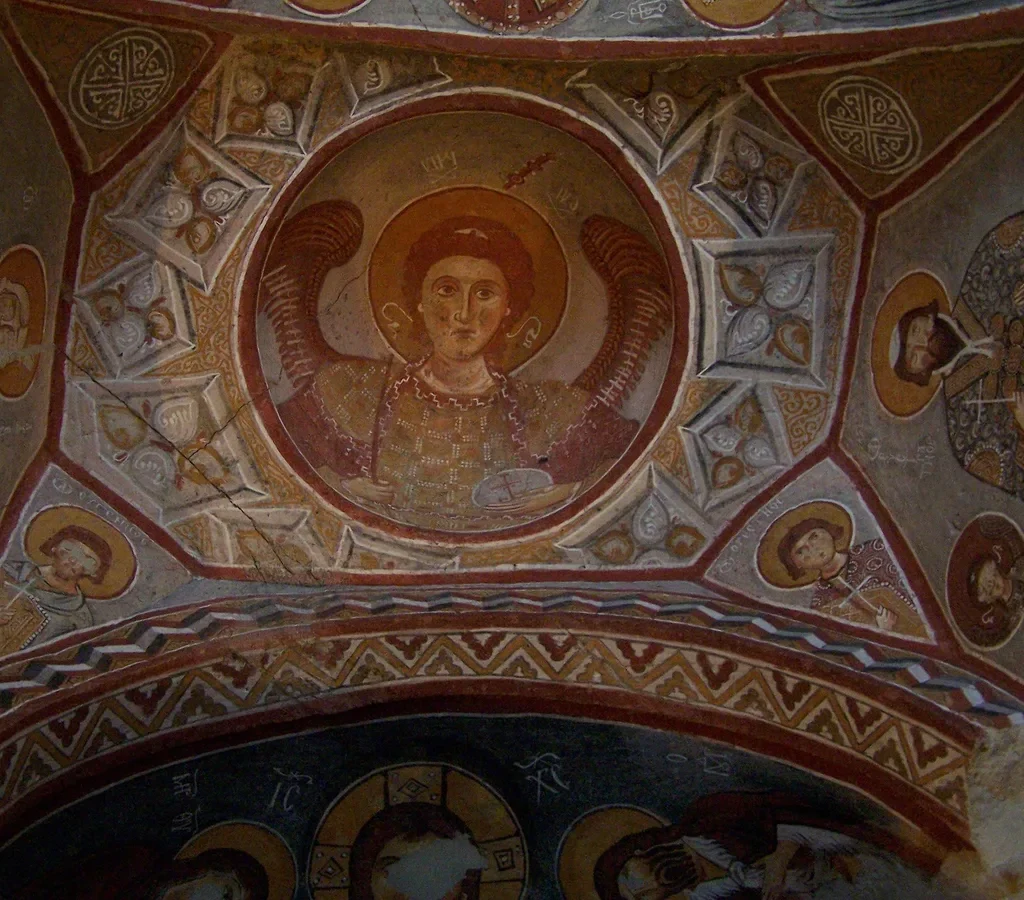
Elmali Kilise, the Apple Church, is the museum’s lesson in compression. It is a small church – a cross-in-square plan not much larger than a generous room – and into that small volume its carvers packed a central dome ringed by smaller domes, columns, arches and apses, and its painters then covered effectively every surface with painting. Saints, angels, archangels and scenes from the life of Christ crowd the domes and walls in strong reds and blues, and the Pantocrator in the central dome, in the photograph above, presides over a programme that a stone cathedral ten times the size would be proud to carry. UNESCO dates Elmali, with the Dark Church, to the end of the twelfth and the beginning of the thirteenth century, and it shows the valley’s painting at its most confident and most dense.
Even its name is a small museum of how these churches were remembered. Two traditions explain Elmali, the apple, and guides tell both. One points to an apple orchard that once stood near the church. The other points inside, to the round orb held in the hand of the Archangel Michael in one of the paintings, which at a distance, in the dim light, reads as an apple. Neither can be proved, and this guide declines to choose; the honest charm of the story is that both a landscape and a painting were plausible parents for the name. What is certain is the experience of the room. Stand in its centre and turn slowly. There is no undecorated direction to rest your eyes. In a valley of painted churches, Elmali is the one that makes the fullest use of the least space, and for many visitors it is the small church they remember longest.
Saint Barbara Church – Red Ochre and the Language of Symbols
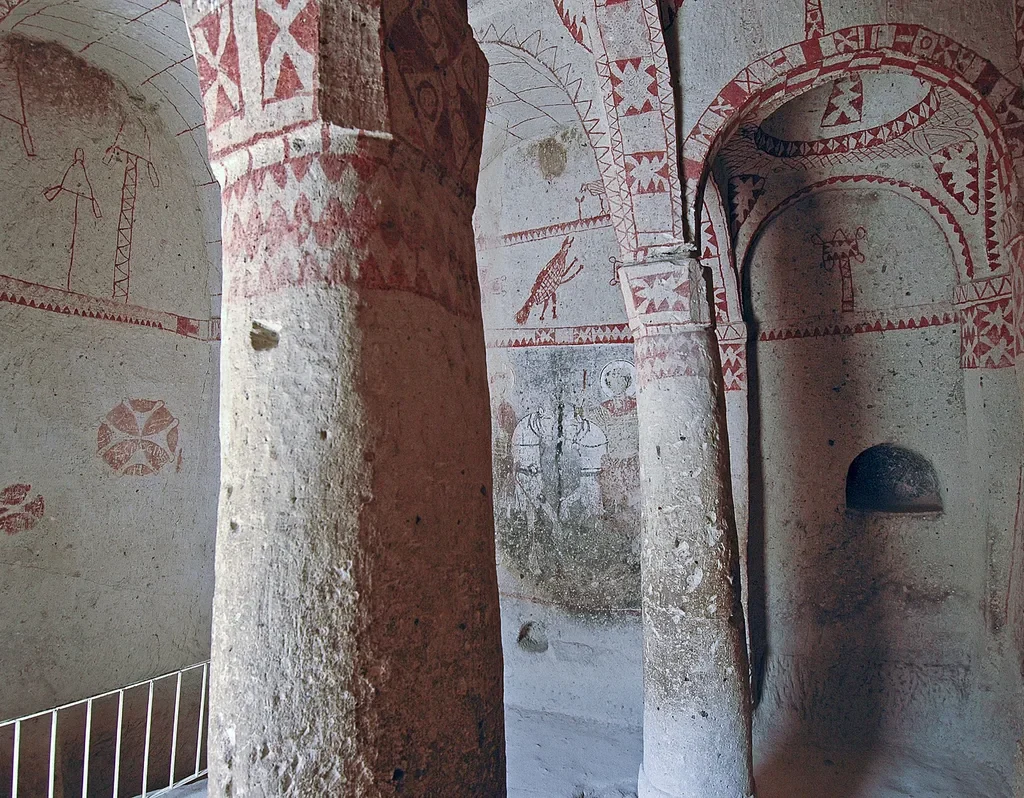
After Elmali’s saturated colour, Saint Barbara’s Church can look, at first glance, like a disappointment – and that first glance is a failure of reading that this section exists to prevent. Barbara’s decoration belongs to an older and stranger visual world than the great narrative churches. UNESCO dates the church to the eleventh century, and its walls were decorated largely in red ochre painted directly onto the rock, in a language of symbols rather than stories. Crosses, geometric patterns, a fish, a rooster, stylised figures and motifs whose meanings were obvious to their makers and are debated by scholars now – this is painting from the long shadow of the iconoclastic centuries, when images of holy figures were restricted and the valley’s artists worked in sign and emblem.
Stand a moment longer and the church changes. The restraint is the point. Where the Dark Church overwhelms with narrative, Barbara communicates in shorthand, and the shorthand has its own austere beauty – the red lines warm against the pale rock, the symbols spaced like characters in a text you almost know how to read. Figures do appear here, including soldier saints, but they are drawn in the same linear, emblematic spirit, closer to inscription than to portraiture. The individual symbols repay slow looking precisely because they resist it. The rooster has been read as vigilance and as a reference to Peter’s denial; the fish is among the oldest Christian signs of all; the crosses are drawn in forms that multiply across the ceiling like a woven pattern. None of these readings is certain, and the uncertainty is itself the historical evidence – a community painting at the edge of an empire’s argument about images, choosing signs that could carry meaning without settling the argument. The museum is profoundly richer for keeping both registers side by side. Within a few minutes’ walk you can stand in an eleventh-century room that speaks in symbols and a thirteenth-century room that speaks in full colour narrative, and the distance between them is the distance Byzantine art itself travelled in this valley. Skip Barbara and you have seen only the destination. See it, and you have seen the journey.
Yilanli Church – Saints, a Serpent and an Honest Folk Style
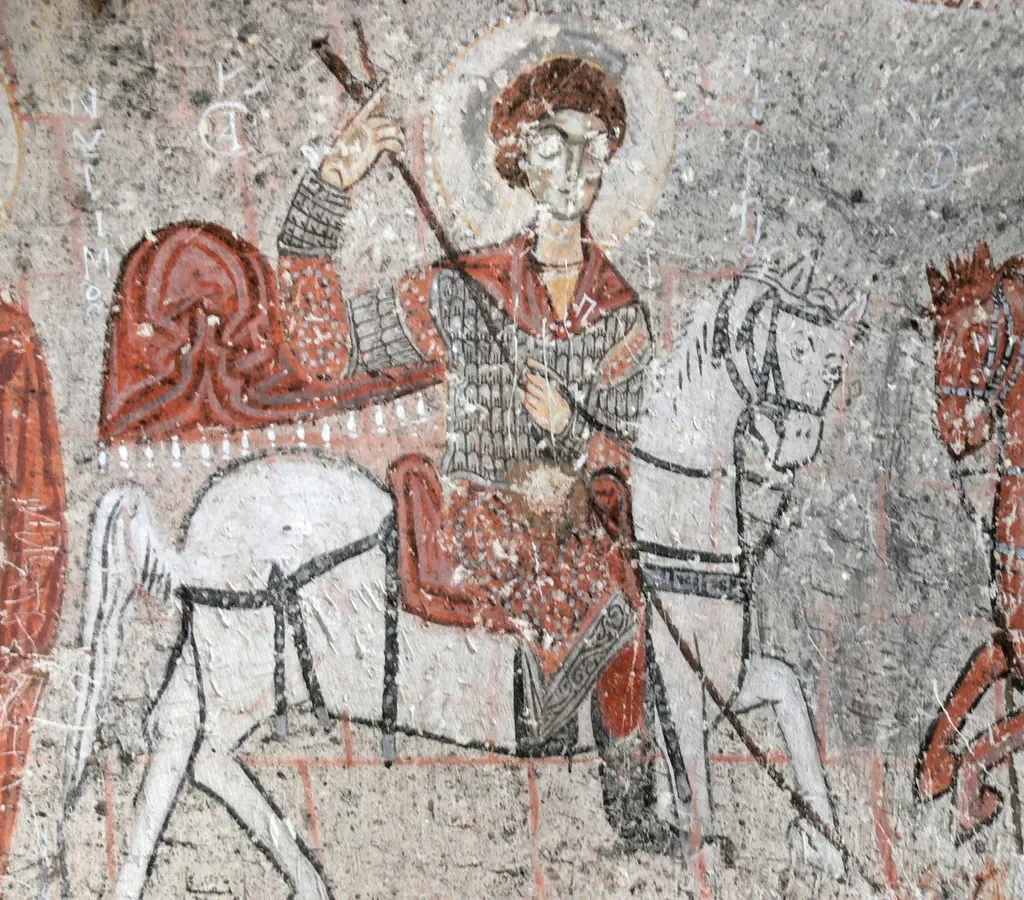
Yilanli Kilise, the Serpent Church, takes its name from the painting on its wall – Saint George, and in the fuller version of the scene Saint Theodore beside him, on horseback with spears levelled at the serpent writhing beneath the horses’ hooves. It is one of the most direct images in the valley, painted in a flatter, more linear style than the Dark Church’s sophisticated modelling, closer to folk art in its energy, and all the more immediate for it. The serpent in question does double duty in the popular telling – dragon to the saints, and in some accounts a stand-in for the diseases and evils the church’s healing associations were meant to defeat – but the painting needs no decoding to work. Two riders, one monster, no ambiguity about the outcome.
The church holds more than its namesake. Constantine and Helena appear holding the True Cross between them, an image of imperial and religious authority paired as only Byzantine art pairs them. The hermit Saint Onuphrius appears too, a figure whose presence in a monastic valley is its own quiet commentary – the solitary ideal, preserved on the wall of a communal monastery. Yilanli is a small, low church, and its painting will not out-argue Tokali or the Dark Church on quality. It does something else. It shows the valley’s art at its most popular and legible, the register in which these stories were told to ordinary worshippers, and visitors consistently find it one of the most likeable rooms in the museum. In the sequence of this goreme open air museum guide it earns its place as the counterweight. Not every church here was a masterpiece commission. Some were parish rooms with painters who told good stories plainly, and the museum would be a colder place without them.
Carikli Church – the Church of the Sandals
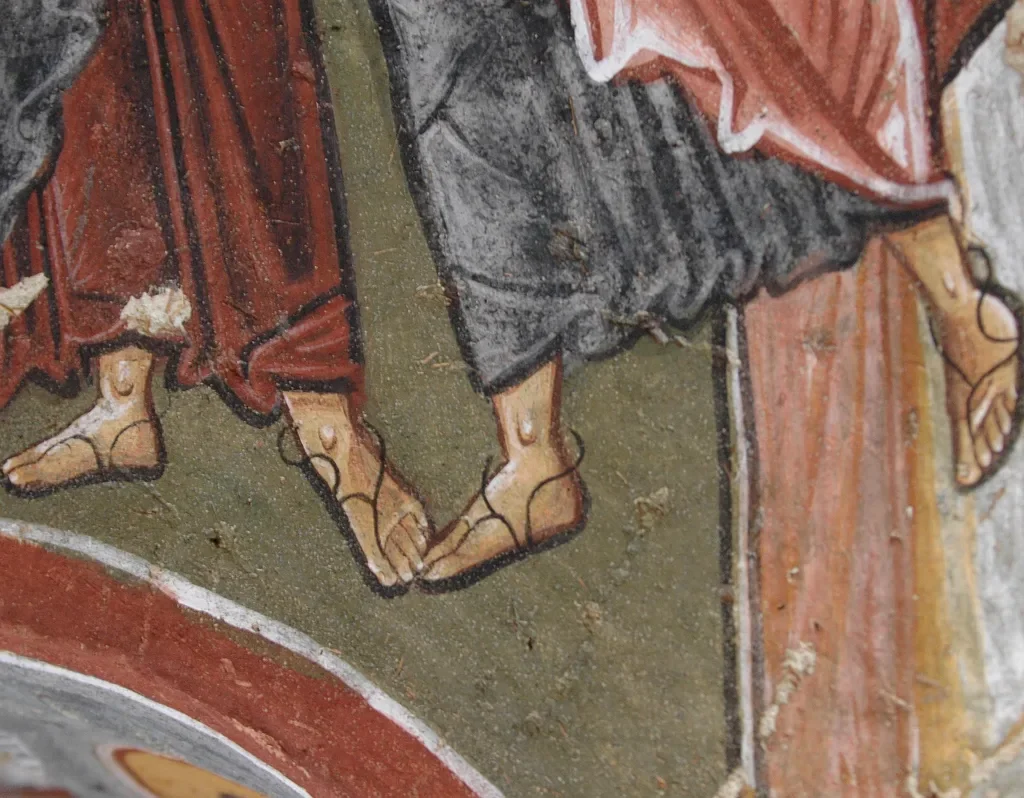
Carikli Kilise, the Church with the Sandals, carries the strangest name in the museum and, unusually, the name can be pointed at. Beneath its fresco of the Ascension are two painted footprints – the marks in the photograph above – said to resemble the prints that sandals would leave, and tradition fastened on them so firmly that the church is known by them still. It is a fittingly odd namesake for a church whose paintings are anything but odd. Carikli’s cycle is dense and dramatic – the Ascension itself, the Crucifixion, the Deesis and the Transfiguration among its scenes – and its painters worked in a register that scholars have long compared to the great shrine churches of the Holy Land, an influence that travelled the pilgrimage routes into this Anatolian valley.
The footprints deserve a second thought beyond the curiosity, because they show how these rooms lived in local memory. The valley’s churches accumulated names the way places always do – from a feature, a story, a misreading, an orchard, a pair of painted feet – and the names stuck harder than any dedication. Carikli’s formal identity matters less, in the end, than the fact that generation after generation of local people knew exactly which church you meant by the sandals. Read its programme with the habit the fresco section below teaches – dome and apse first, then the narrative scenes in sequence, then the saints at the edges – and Carikli becomes one of the most legible rooms in the valley, a complete statement of the faith’s central scenes made at intimate scale. Pair Carikli with Elmali, as the path invites you to do. Two small churches, close in date and ambition, each holding a full painted programme in a space the size of a room – and between them they make the museum’s central artistic point better than any panel text could. In Goreme, scale meant nothing. A chapel the size of a bedroom could hold painting as serious as any cathedral in the empire.
Saint Basil, Saint Catherine and the Smaller Chapels
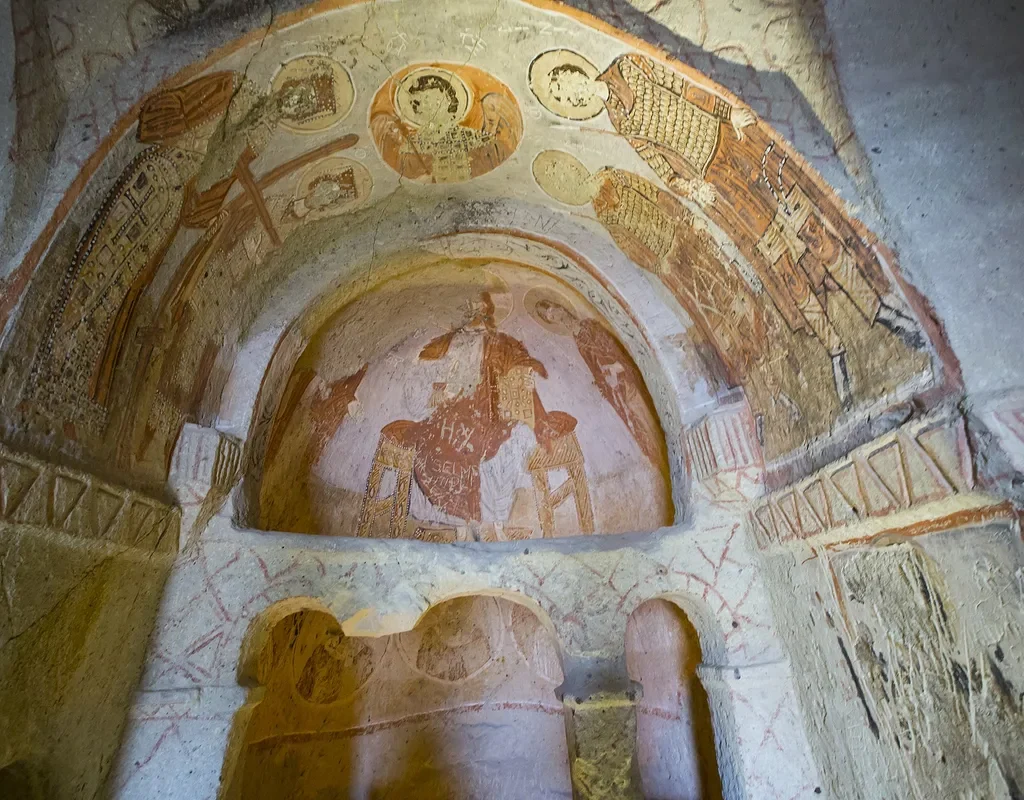
Near the start of the route stands the right overture to the whole museum – Saint Basil’s Church, a modest barrel-vaulted chapel named for the bishop whose teachings founded the valley’s monastic life. It is small, comparatively plain beside the great churches ahead, and exactly where a thoughtful visit should begin, because it sets the valley’s baseline. This is what an ordinary working chapel of the community looked like. Everything richer that follows is measured against it. The Ministry’s list also includes the Malta Crusader Church, a name that carries the valley’s later history in it – the Crusader centuries touched even this inland monastery world, and the name itself is a reminder that the valley’s story did not end with the last Byzantine painter, however completely the great churches dominate its telling – and Saint Catherine’s Church, the chapel in the photograph above, small and fully painted, with a programme of scenes and saints that holds its own at miniature scale.
These smaller rooms are where the museum’s crowd logic inverts most usefully. The famous churches develop doorway queues by mid-morning; the chapels, a few steps away, often stand empty, their paintings unshepherded and their silence intact. None of them will replace the Dark Church in a highlight list, and this goreme open air museum guide will not pretend otherwise. But a visit built only of highlights misses what a monastery actually was – dozens of working religious spaces of descending grandeur, most of them modest, all of them used. Give the small chapels the minutes the tour groups give only to the masterpieces. The valley’s story is told in full only when the plain rooms are allowed to speak, and they speak best, as they always have, to whoever is actually standing in them.
How to Read the Frescoes – Two Techniques and a Thousand Years
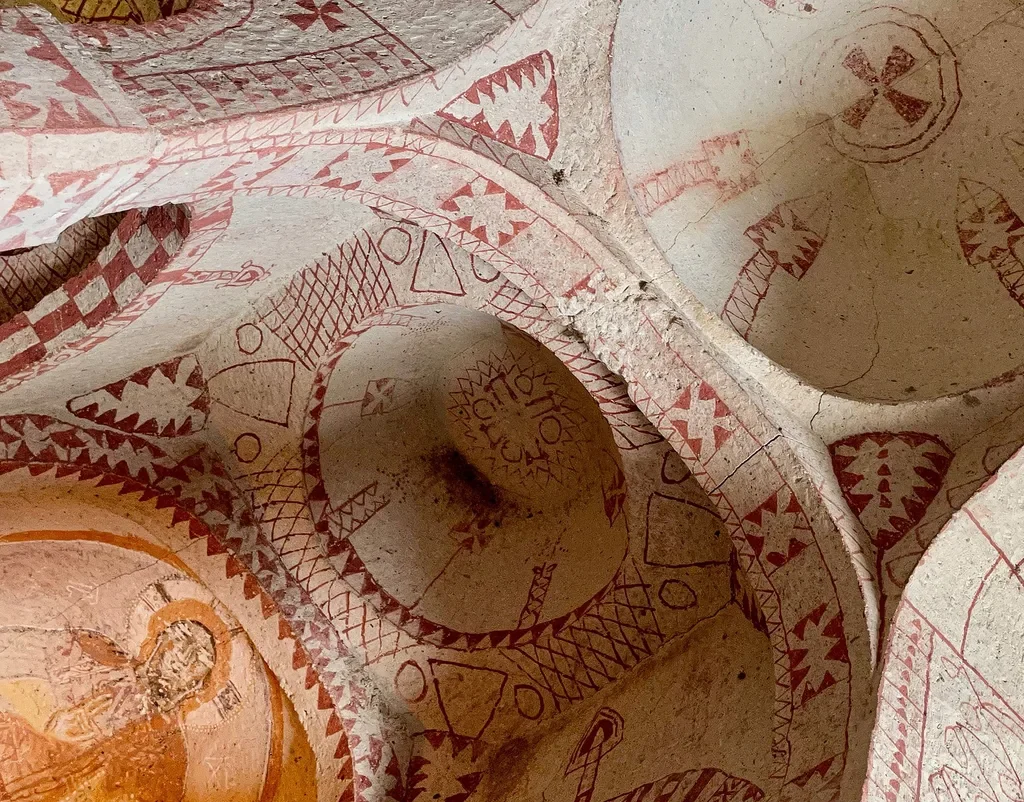
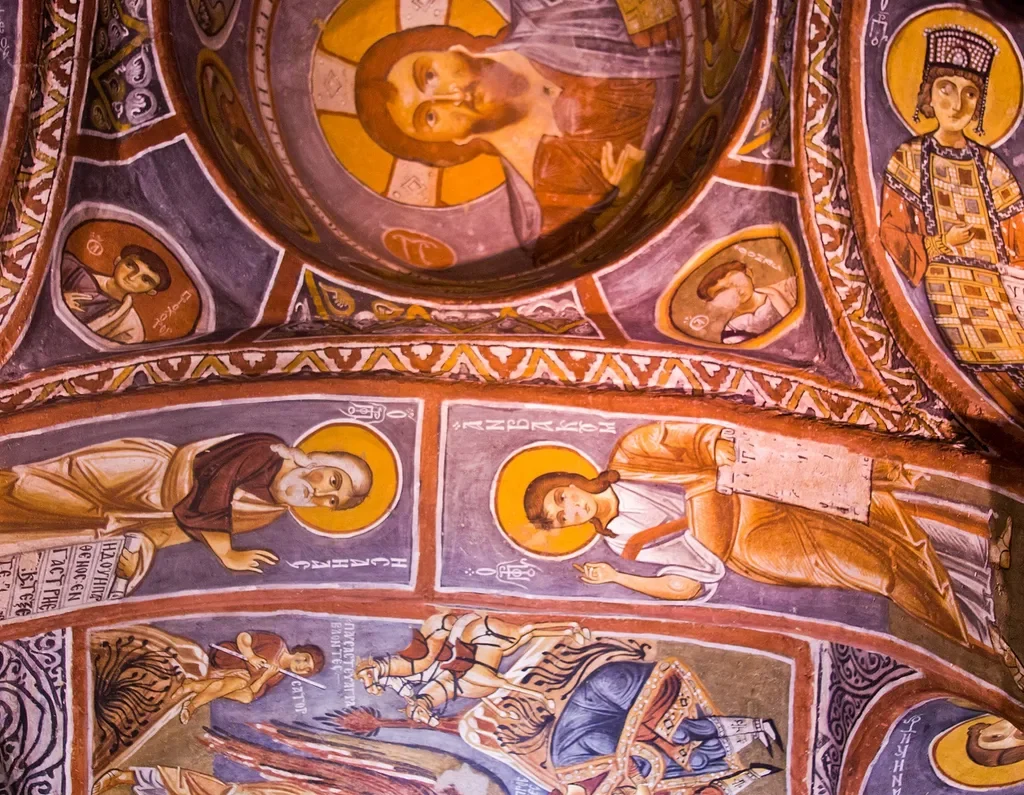
Everything you have seen on the route was made by one of two methods, and the Ministry’s account of the site names them precisely. The first and older technique is painting directly onto the rock surface, the tuff smoothed and the pigment applied to the stone itself – the method of the red-ochre churches, of Barbara’s symbols and the earliest chapels. The second is fresco-secco, tempera painting applied to a prepared plaster layer laid over the rock. Strictly, secco painting is done on dry plaster rather than into wet plaster as in true fresco, and the distinction matters to conservators, but for the visitor the visible difference is simpler. Painting on prepared plaster carries richer colour, finer modelling and greater detail, and it is the technique of the valley’s great narrative cycles – Tokali’s blue halls, the Dark Church’s vivid scenes, Elmali’s domes.
Reading the paintings themselves needs no specialist training, only a habit. The cycles run as picture scripture. The life of Christ unfolds in sequence – Annunciation, Nativity, Baptism, miracles, Last Supper, Betrayal, Crucifixion, Resurrection appearances, Ascension – with the major feasts of the church year given the largest panels, and Greek captions naming each scene for a congregation that followed the story on the walls. Around the narrative core stand the ranks of the holy. Christ Pantocrator in the domes, the Virgin in the apses, archangels at the thresholds, soldier saints like George and Theodore on their horses, hermits like Onuphrius in their wildness, and, quietly, the donors – the people who paid for the painting, portrayed at the feet of the holy figures they commissioned, buying themselves a permanent place in the congregation. Once you can spot those layers, dome, narrative, saints, donors, every church in the valley becomes legible in the same grammar, and the differences between them become arguments about emphasis rather than mysteries.
The last reading skill is about survival, and the UNESCO listing states the valley’s condition honestly. These paintings have endured a thousand years not because tuff is a safe home for art but almost in spite of it. The same softness that made the rock carvable makes it erodible; water, salt, light and touch all take their toll, and UNESCO names erosion and tourism among the pressures on the property. That is why the interiors are dim, why entry to the most fragile church is rationed by a separate ticket, and why photography inside the painted churches is restricted. Look properly, with your eyes, for as long as the room allows. The paintings have survived a millennium by being left in the dark. The least a visitor can do is not hurry them toward the light.
Tickets, Passes and Hours in This Goreme Open Air Museum Guide
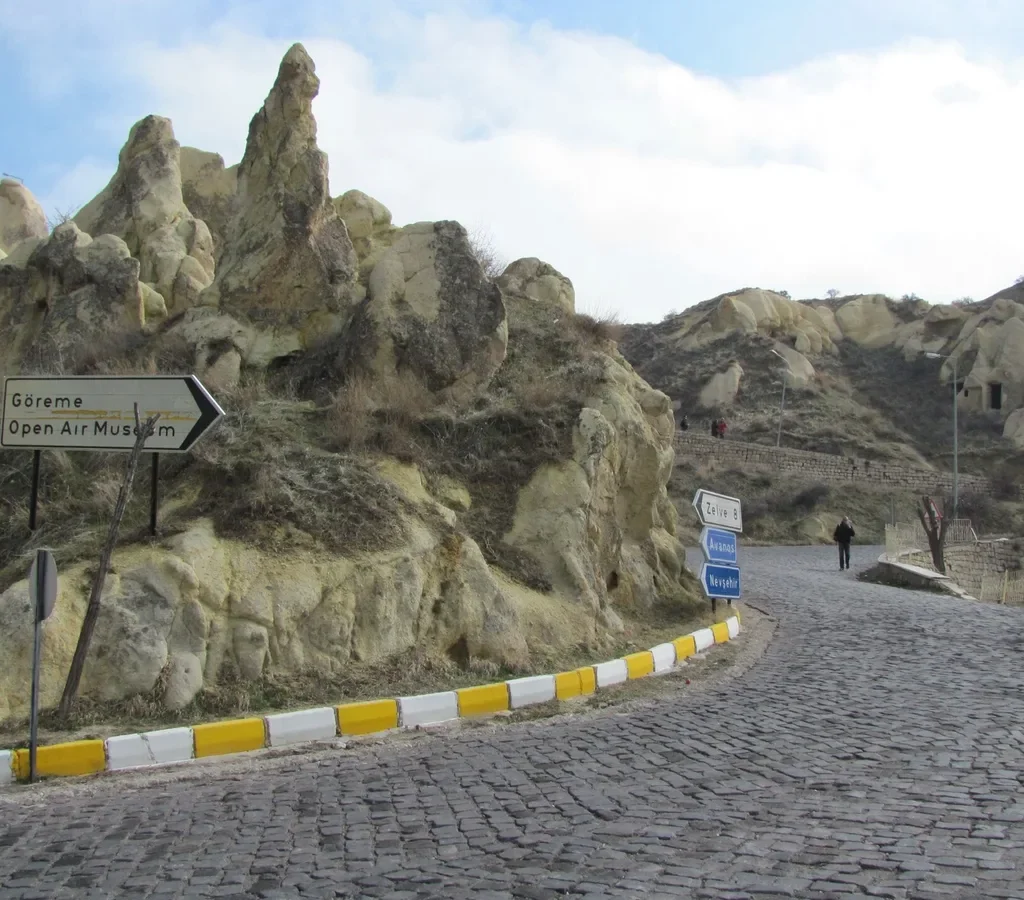
Ticketing at Goreme involves three separate products, and this section of the goreme open air museum guide takes them one at a time, because nearly every misunderstanding at the gate comes from treating them as one. The first product is the museum’s own admission. The main ticket covers the main valley circuit – the Nunnery from the path, the chapels and churches in sequence, the refectories – and, in current arrangements, Tokali Church across the road. It is bought at the box office by the gate, and an audio guide service is available at the site, which the Ministry lists and which genuinely helps in churches where panel text is brief. The second product is the Dark Church’s separate ticket, covered below. The third is the regional pass.
The Museum Pass Cappadocia is the pass that fits this region, sold through the Ministry’s museum system. Its mechanism is simple. It runs for three days from your first entry, not from the day you buy it, and it admits you once to each of the Ministry’s sites across Cappadocia – on the pass’s own listing, the Goreme Open-Air Museum, Zelve and Pasabag, the underground cities of Derinkuyu, Kaymakli and Ozkonak, the Ihlara Valley and Selime among them. The arithmetic follows from your own itinerary. A traveller doing this museum, one underground city and Ihlara inside three days – which is most travellers on a standard Cappadocia shape – will usually find the pass beats single tickets. A traveller doing this museum alone will not. The pass changes nothing at Tokali, which the main admission already covers, and it changes nothing at the Dark Church, which it does not cover at all. Decide at the gate with your next three days in front of you, not from any blog’s verdict, this one included.
The Dark Church ticket is the constant. Whatever you hold – a single museum ticket, the Museum Pass Cappadocia, or a Muzekart, the card the Ministry’s Goreme page confirms is valid for Turkish citizens at the main site – the Dark Church takes its own separate extra ticket, bought for that church. Treat it as a fixed line in the budget from the moment you plan the visit, not as an optional upgrade to deliberate about at its door. This guide deliberately prints no figure for any of these products. The tariffs are set by the Ministry, they are revised as the lira moves, and the price tables on the pages that currently rank for this museum’s name already disagree with each other in three currencies. The only figures worth trusting are the ones on the Ministry’s museum portal, muze.gov.tr, and on the board at the gate on the day. Check them there, in the week you travel.
Hours follow the same discipline. The Ministry’s Goreme page lists the site as open every day, with the daytime session opening at 08:00 – the portal showed a daytime closing in the early evening and a box office closing shortly before it when this guide was checked – and it also lists a night-museum programme with evening hours on the same page, confirming that after-dark opening exists at this site in at least part of the year. Seasonal patterns at Ministry sites shift between summer and winter schedules, and the night programme is a seasonal product rather than a permanent arrangement. So the honest rule is the one this whole goreme open air museum guide runs on. The museum opens every day and opens early; everything more precise than that belongs to muze.gov.tr on the day you go, not to a printed page, including this one.
Timing, Crowds and How to Walk the Museum Well
The museum has one real problem, and it is not the ticket price. It is synchronisation. This is the most visited site in Cappadocia, its churches are small rooms with controlled doorways, and the region’s tour machinery delivers its visitors in waves from mid-morning onward. The same valley that stands hushed and almost private at opening becomes, by eleven, a procession – queues at the Dark Church door, groups banked up at Elmali, the path moving at the pace of its slowest guided party. None of this is a reason to skip the museum. It is a reason to treat its timetable as the single most valuable planning fact in this guide, ahead of any ticket arithmetic.
Come at opening. The 08:00 start the Ministry lists is the museum’s best hour in every sense – the light is low and warm on the cliffs, the valley is cool, the churches are empty enough to read properly, and the Dark Church, when you reach it in sequence, can be entered without the wait that defines it later. Second-best is the last part of the day, when the tour tide has ebbed toward the hotels and the valley empties from the far end. The window to avoid, in season, is the broad middle of the day. If your itinerary forces you into it anyway, reverse the highlight order. Walk past the crowded famous churches to the quiet chapels and refectories first, let the wave break against Tokali – whose larger hall, outside the gate, absorbs people more gracefully and whose timing is flexible – and return to the Dark Church as the groups thin. The museum rewards the visitor who treats its route as a system to be timed, not a checklist to be endured.
Allow the time the place actually asks for. Two hours covers the loop and the Dark Church at a reading pace; three hours adds Tokali properly and the refectories at full length, and three hours is what this goreme open air museum guide recommends for a first visit. Practical comfort notes, because they decide more visits than the queues do. The site is outdoors and unsheltered, so the sun protection and water that Cappadocia demands everywhere apply on the path between churches even though the interiors are cool. The rock steps and thresholds are worn smooth in places, and grip matters. The interiors are genuinely dim, which is conservation, not neglect – give your eyes a moment at each doorway rather than reaching for a torch the paintings do not want. And there is no honest way to rush a queue at a thousand-year-old church door. Build the slack in, and the museum gives you the hush it gives everyone who arrives before the convoy.
How This Museum Differs From the Wider Goreme Visit
It helps, near the end, to place the museum precisely among its neighbours, because Cappadocia sells several experiences under one name and they are not interchangeable. The town of Goreme, twenty minutes down the road, is the base – cave hotels, restaurants, agencies, the balloon terraces at dawn. The valleys around it are the landscape – Rose and Red, Love, Pigeon, Sword and Zemi, walked freely, their carved churches unshepherded and their dovecotes open to the sky. The underground cities, Derinkuyu and Kaymakli, are the region’s defensive other half, whole towns cut downward as refuges. And this museum is the concentrated core of the whole system – the one place where the painting, the monastic planning and the daily life of Byzantine Cappadocia survive together at full density, protected, interpreted and, inevitably, queued for. A complete trip needs the base and at least one valley and, if time allows, one descent underground. But if Cappadocia gave you a single morning, this goreme open air museum guide’s verdict is that the museum is where the morning belongs.
Sequencing follows from that. The museum pairs naturally with an afternoon in the valleys, when its morning crowds have dispersed to exactly those trails, and with an underground city on a separate day, since Derinkuyu and Kaymakli sit on the southern road and ask for wheels and half a day of their own. Travellers continuing from Cappadocia to the capital of the old town will find the same ticket discipline waiting in our Istanbul travel guide – a ministry museum system there too, passes that cover some sights and not others, and famous interiors whose separate arrangements reward anyone who checks the official portal first. The habit this museum teaches, of reading a site’s own gate rules rather than a reseller’s summary, is the most transferable souvenir in Turkish travel. The paintings are the reason to come. The habit is the reason the trip after this one goes better.
Frequently Asked Questions
How much does the Goreme Open-Air Museum cost?
This goreme open air museum guide deliberately prints no figure. The main admission, the Dark Church’s separate ticket and the Museum Pass Cappadocia are all Ministry tariffs that are revised as prices move, and the tables on currently ranking pages already quote mutually contradictory figures for all three. The official tariff for your visitor category is published on the Ministry’s museum portal, muze.gov.tr, and displayed at the gate. Check it there in the week you travel.
Is the Dark Church worth its separate ticket?
Yes. It is the best-preserved painted interior in Cappadocia, the church whose frescoes survived eight centuries of darkness with their colour nearly intact, and the one room visitors describe months later. The separate ticket is charged on top of every form of main admission, passes included, so plan for it as a certainty rather than an upgrade – and do not skip the museum’s finest church to save the smallest line in a Cappadocia budget.
Does the Museum Pass Cappadocia cover the whole museum?
It covers the main museum circuit, and in current arrangements the main admission covers Tokali across the road as well. It does not cover the Dark Church, which always takes its own ticket. The pass runs for three days from first entry across the Ministry’s Cappadocia sites, so its value depends entirely on how many of those sites – the underground cities, Zelve, Ihlara among them – your own three days actually include.
What are the Goreme Open-Air Museum opening hours?
The Ministry lists the site as open every day, opening at 08:00, with seasonal daytime closing times and a night-museum programme listed on the same official page in season. Because the seasonal pattern and the evening programme change, confirm the day’s exact hours on muze.gov.tr before you set out rather than trusting any printed guide, this one included.
How long do you need at the Goreme Open-Air Museum?
Two hours for the main loop and the Dark Church at a proper reading pace; three hours to add Tokali and the refectories without rushing. Ninety minutes is possible at a brisk walk outside peak hours, but it turns the museum into the highlight procession this guide exists to prevent.
Can you take photographs inside the churches?
Photography inside the painted churches is restricted, as it is at fragile painted sites across the region, and the rules posted at each doorway on the day govern. Expect to look with your eyes rather than through a screen in the finest interiors – which, in rooms this small and this dim, most visitors end up preferring anyway.
Is the Goreme Open-Air Museum worth visiting if I have seen other Cappadocia churches?
Yes, and the comparison is the point. The valleys hold individual carved churches scattered through a landscape; the museum holds the densest surviving cluster of them, with the monastic buildings that explain them, in one protected valley. It is the difference between meeting the members of a society one at a time and walking through its capital.
The Short Version of This Goreme Open Air Museum Guide
If this goreme open air museum guide had to fit on an index card, it would read like this. The Goreme Open-Air Museum is a Byzantine monastery subtracted from a valley of soft rock above Goreme town – churches, chapels, refectories and cells in one protected stretch of cliff, opened as a museum in 1967 and inscribed by UNESCO in 1985 as the artistic heart of Goreme National Park and the Rock Sites of Cappadocia. Walk it in path order and in the morning. Begin with Basil’s plain chapel and the Nunnery’s cliff of cells, eat the valley’s story in its refectories, and let the painting build – Barbara’s red symbols, Yilanli’s serpent, Carikli’s sandals, Elmali’s nine domes – until the two great rooms. Pay the Dark Church’s separate ticket without deliberating, because eight centuries of darkness kept its colour like nowhere else in Cappadocia, and give Tokali, across the road on the same admission, the slow half hour the tour groups deny it. Check the day’s hours and every price on muze.gov.tr and nowhere else, hold the Museum Pass Cappadocia only if your three days will fill it, and leave the valleys, the balloons and the underground cities to their own guides. Arrive at the 08:00 opening if you possibly can, because the first hour is the museum’s best hour – cool, quiet and empty enough to hear the valley – and let the tour tide spend itself against churches you have already read in peace. This one room of a valley, read properly, is the whole of Byzantine Cappadocia in miniature – and it is enough.