Cappadocia is not a town, a park or a viewpoint. It is a whole volcanic plateau in central Türkiye that erosion has cut into valleys of pale rock, and that people then cut into further — churches, monasteries, houses and entire cities below ground. That double scale is what trips up first-time planning. Visitors arrive expecting a sight, something you stand in front of for an hour, and find instead a region: three or four small towns, a dozen valleys, two famous underground cities and one very famous sunrise, spread over an area you cross by road, on foot and — weather permitting — by balloon.
This cappadocia travel guide is organised around how the region actually works. Choose a base town first, because the base decides your evenings and your walking. Understand the geology briefly, because once you see how a fairy chimney forms, every valley reads differently. Then take the sights in the order the ground suggests: the rock churches of Göreme above ground, Derinkuyu and Kaymaklı below it, the valleys on foot, and Ihlara as the long day out. The balloon gets its own section, treated plainly — what it costs depends on things we will name, no fare is printed here because no printed fare survives contact with the season you travel in, and the flight happens only on mornings the weather allows.
At a Glance
| Question | Short answer |
|---|---|
| How long do I need? | 2 full days for the highlights; 3 to do it properly with a spare balloon morning; 4 to add Ihlara |
| Where do I base myself? | Göreme for a first trip on foot; Uçhisar for views and quiet; Ürgüp for a calmer, more polished town |
| Which airports? | Kayseri (ASR) and Nevşehir (NAV) — both served by domestic flights from Istanbul, then a road transfer |
| What is the one booking rule? | Put the balloon on your first morning and keep the other mornings spare — cancellations are normal |
| What needs checking before I go? | Museum Pass Cappadocia coverage and the Dark Church ticket arrangement — both on muze.gov.tr |
| What is the one planning rule? | Cluster by geography — the sights form a north group around Göreme and a south group on the Ihlara road |
How Cappadocia Works – One Region, Three Bases
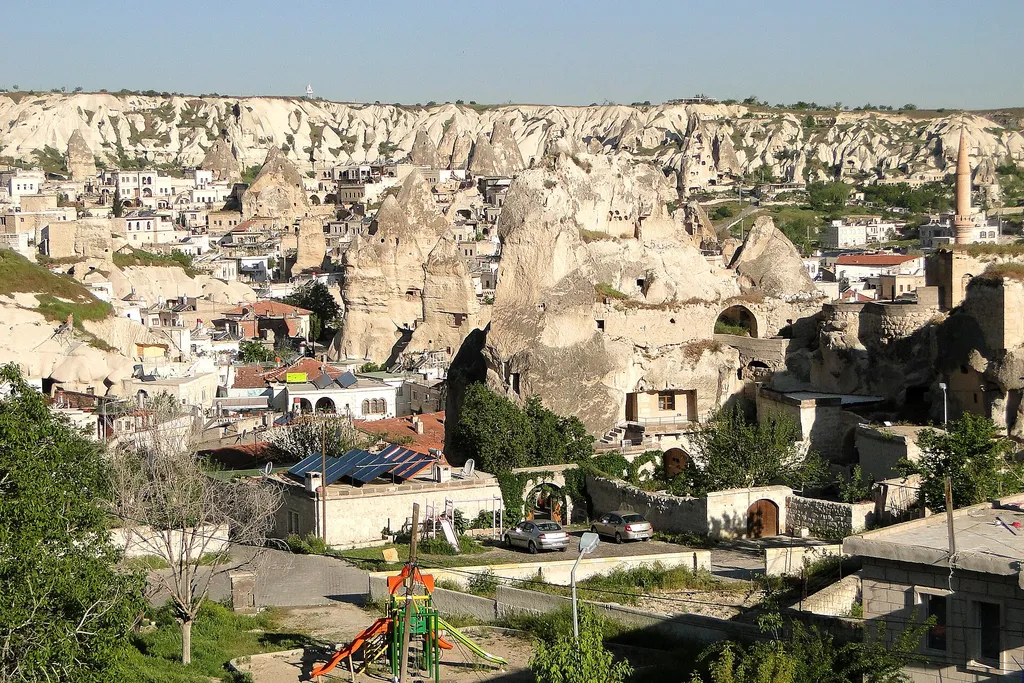
The visitor’s Cappadocia sits inside a rough triangle between the towns of Nevşehir, Ürgüp and Avanos, in the volcanic country between Mount Erciyes and Mount Hasan. UNESCO drew its boundary around much the same ground in 1985, inscribing “Göreme National Park and the Rock Sites of Cappadocia” — a property that takes in the Göreme valley, the rock sites around it and, notably, the subterranean cities of Kaymaklı and Derinkuyu some distance to the south. The sights sort themselves into two clusters. The northern cluster — Göreme town, the Open Air Museum, the valleys, Uçhisar, Paşabağ, Zelve, Avanos — packs into a compact area you can partly walk. The southern cluster — the underground cities and the Ihlara canyon — sits along one road south and asks for wheels and a full day.
Göreme is the default base, and for a first trip it earns that status. It is a working village threaded between fairy chimneys, with the widest spread of places to stay and eat at every level, the balloon companies and tour desks on its main street, and the Open Air Museum and several valleys reachable on foot. Its cost is popularity: the centre is busy in season, and the dawn balloon launch happens almost overhead, which is either the point or a noise problem, depending on the traveller. Uçhisar, a few kilometres west, is the opposite trade — a smaller, quieter village wrapped around the region’s great rock castle, with the grandest views and many of the most polished cave hotels, but a thinner choice of restaurants and almost everything else a drive or a valley walk away.
Ürgüp, east of Göreme, is the third option and the most town-like: a settled, slightly more upmarket base with good restaurants and wine houses, well placed for the eastern valleys and for travellers who want a proper town over a traveller village. Around these three sit the supporting cast. Ortahisar is a smaller, quieter castle village that keeps a local feel. Avanos, on the Kızılırmak river, is the pottery town — its workshops use the river’s red clay — and a pleasant half-day rather than a base for most. Nevşehir itself is the provincial city: practical, rarely the right base for a sightseeing trip. Pick the base that matches your evenings, not just your map — you will sightsee everywhere, but you will sleep, eat and watch the balloons from one place.
Fairy Chimneys – Volcanoes First, Then Rain
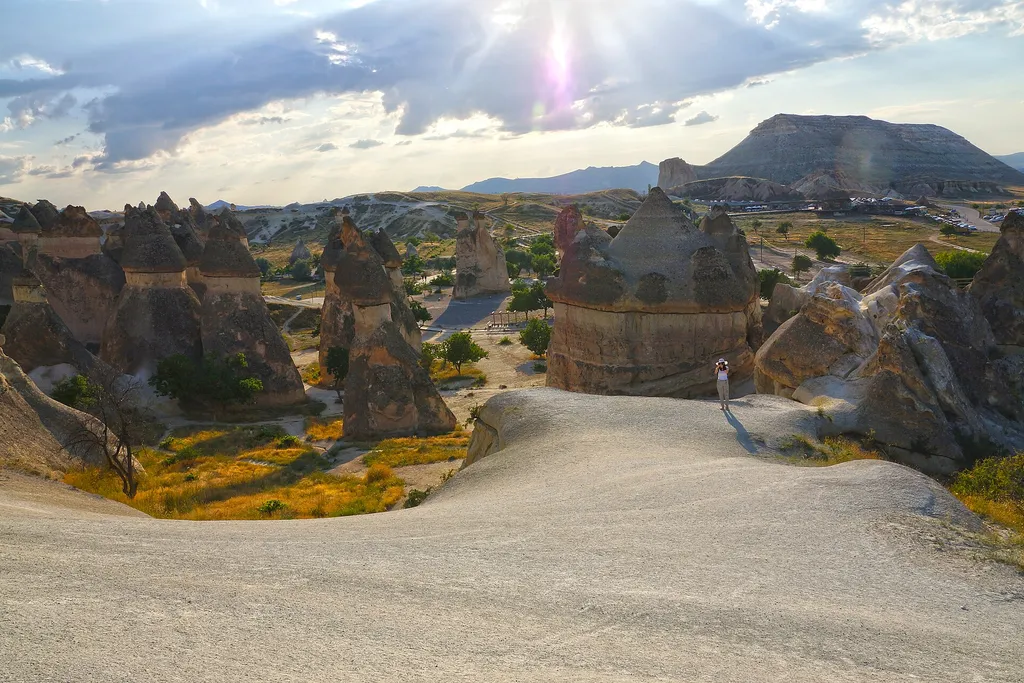
The landscape begins with fire. Millions of years ago the volcanoes of the region — Erciyes and Hasan Dağı above all — buried this plateau under layer upon layer of ash and lava. The ash compacted into tuff, a soft, pale rock; in places a harder skin of basalt or solidified lava settled on top of it. Then water and wind went to work on the difference. Rain and streams cut down through the soft tuff far faster than through the hard skin, so wherever a slab of caprock survived, it sheltered the column beneath it while everything around was carried away. The result is the fairy chimney: a pillar of soft rock wearing a hat of hard rock, the hat being the entire reason the pillar still stands. UNESCO’s nomination describes pillars reaching forty metres; once the cap finally topples or cracks, the unprotected column below melts away comparatively quickly, which is why the valleys hold chimneys at every stage from newborn spike to stump.
Paşabağ, also sold as Monks Valley, is where the mechanism shows itself most clearly — thick, twin- and triple-capped chimneys standing in a vineyard clearing, some of them hollowed into chapels and hermit cells in the Byzantine centuries. Devrent, the so-called Imagination Valley, is the counterpoint: no carving at all, just erosion left alone until the rocks suggest camels, seals and whatever else a guide’s patter requires. And Zelve, three connected valleys of cave houses and churches, was a lived-in village into the 1950s before erosion risk emptied it — the clearest proof in the region that this rock was never scenery to the people here. It was building material, shelter and farmland all at once.
Keep the geology in mind because it explains the whole human story that follows. Tuff is soft enough to cut with simple tools and hardens somewhat on exposure to air, so a family could excavate a room in days and a community could excavate a city in generations. It is also a poor, dramatic material — it erodes, it collapses, it needs constant maintenance — which is why so many sites are fenced, restored or quietly fenced off again. Cappadocia’s monuments are not stone buildings that happen to stand in a strange landscape. They are the landscape, edited.
Göreme Open Air Museum – the Region in One Valley
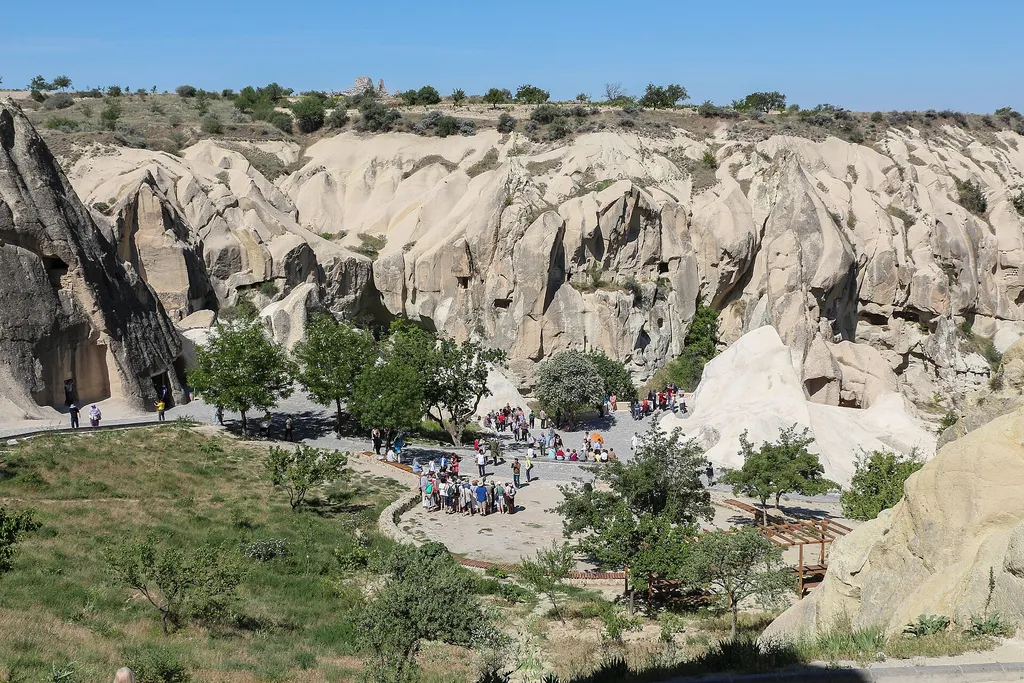
A short walk east of Göreme town, a small valley holds the densest concentration of what the UNESCO inscription celebrates: a monastic complex of rock-cut churches, chapels, refectories and dwellings, carved and painted mainly between the 10th and 12th centuries. Monastic life in Cappadocia reaches back far earlier — to the 4th century, when anchorite communities following Basil of Caesarea, the bishop of what is now Kayseri, first cut cells into these cliffs — but the painted churches are the Byzantine flowering of that tradition, and their fresco cycles are the finest surviving evidence of post-Iconoclastic Byzantine art in the region. That, in UNESCO’s own framing, is a large part of why this ground is on the World Heritage List.
The visit has a shape. A loop path runs past a series of small churches — among them the Apple Church, the Church of Saint Barbara, the Snake Church and the Sandals Church — each a room or two cut into a cone or cliff face, each painted with biblical scenes in reds and blues that survive best where light has touched them least. The refectory, a long rock-cut hall with a table and benches carved from the same stone, gives the monastic community its human scale better than any panel text. Just outside the main fence stands the Tokalı Church, the largest of them, its vaults covered in an extensive fresco cycle; in current arrangements it is visited on the same ticket as the museum, but check at the gate, because the arrangement of these secondary entrances is exactly the kind of detail that changes.
One church is ticketed apart from all the others, and it is the one most people most want to see. The Dark Church (Karanlık Kilise), a late 11th- or early 12th-century church whose single small window kept its frescoes in near-darkness for centuries, holds the most vivid painting in the valley — and entry to it is sold as a separate special ticket inside the site. In current arrangements the Museum Pass and MüzeKart do not waive that separate charge; you pay at the Dark Church’s own door. That is the arrangement consistently reported through 2026, but treat muze.gov.tr, the Ministry of Culture and Tourism’s museum portal, as the deciding source in the week you travel, and treat any page — including the ones that rank above this one — that prints you a confident euro figure for either ticket as a page that will quietly be wrong later. We print no price for the same reason.
The pass question deserves thirty seconds of arithmetic, because Cappadocia is one of the few places in Türkiye where the regional pass genuinely fits the sightseeing. The Museum Pass Cappadocia, sold through muze.gov.tr, runs for three days from your first entry and covers the Ministry’s sites across the region — the Göreme Open Air Museum, Zelve and Paşabağ, the underground cities of Derinkuyu, Kaymaklı and Özkonak, the Ihlara Valley and Selime among them, per the pass’s own listing on the portal. A traveller doing the museum, one underground city and Ihlara inside three days — which is to say, most travellers on this guide’s three-day shape — will usually find the pass beats single tickets; a traveller doing the museum alone will not. The Dark Church stays outside it either way. Decide at the museum gate with your own next three days in mind, not from a blog’s verdict, ours included.
The Underground Cities – Derinkuyu and Kaymaklı
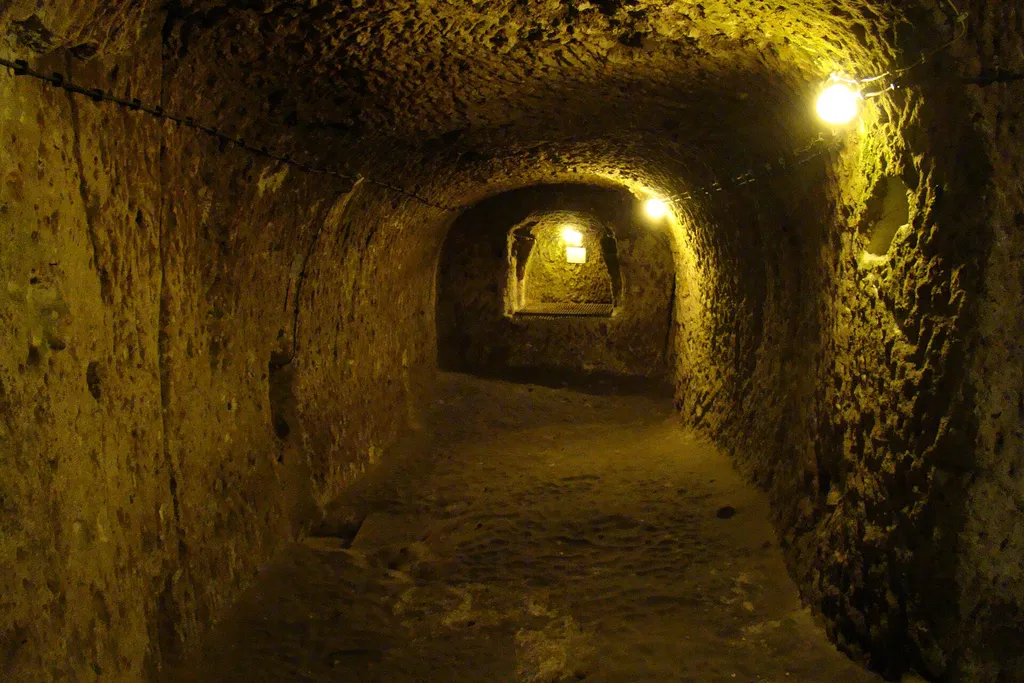
South of Göreme, the plateau hides its strangest works. At Derinkuyu and Kaymaklı, whole communities cut downward into the tuff — not a cave, not a bunker, but a stacked underground town of stables, storage rooms, kitchens, wineries, living quarters, chapels and schools, connected by tunnels and served by a central ventilation shaft that doubles as a well. Both cities are named components of the UNESCO property, and both were built as refuge: when danger came overland, the population could disappear below their own fields, seal the passages behind them with great rolling stone discs — millstone-like doors that can only be opened from inside — and wait. The stables sit on the upper levels, because animals went down first and could not manage deeper stairs; the living and working rooms follow below; the whole system breathes through its shaft.
A warning about numbers, because this is where Cappadocia writing most often leaves the truth. Tour leaflets and older guidebooks quote confident figures for Derinkuyu — this many levels, that many metres deep, room for tens of thousands of people. The figures vary from source to source, no single official figure is published on the UNESCO listing or the museum portal, and the honest version is this: the excavated cities descend through level after level far below the surface, only part of Derinkuyu’s depth is open to visitors, and any exact depth or capacity you are quoted should be treated as folklore with good PR. What needs no exaggeration is the engineering in front of you — the shaft that is simultaneously chimney, well and spine, the tunnels cut deliberately low and single-file so that anyone forcing them came one at a time, the stone doors still sitting in their slots.
Choose between the two by temperament and knees. Derinkuyu is the deeper, more dramatic descent and the more famous name; its open route goes further down and feels more like a city. Kaymaklı, closer to Nevşehir, spreads wider on gentler levels and is often the kinder visit — its passages are a little less punishing, and it pairs more easily with a Nevşehir-side day. Both are genuinely demanding in the same ways: low ceilings, narrow stairs, single-file tunnels, no exit except the way you came, and a press of people at midday in season that can make the lowest levels feel airless. Anyone with claustrophobia, a bad back or unhappy knees should think honestly before descending, and everyone should go early — the first hour of opening is a different, emptier place. Both cities sit under the Ministry, so the Museum Pass Cappadocia covers them; confirm the current position on muze.gov.tr before you build a budget around it.
The Balloon Flight, Without the Fairy Dust
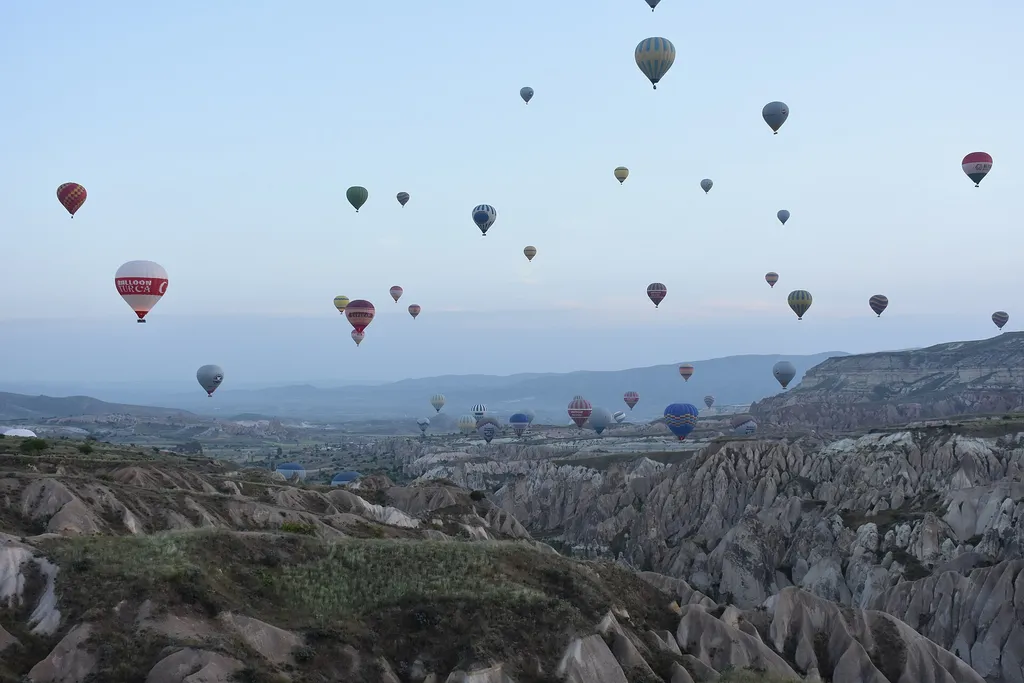
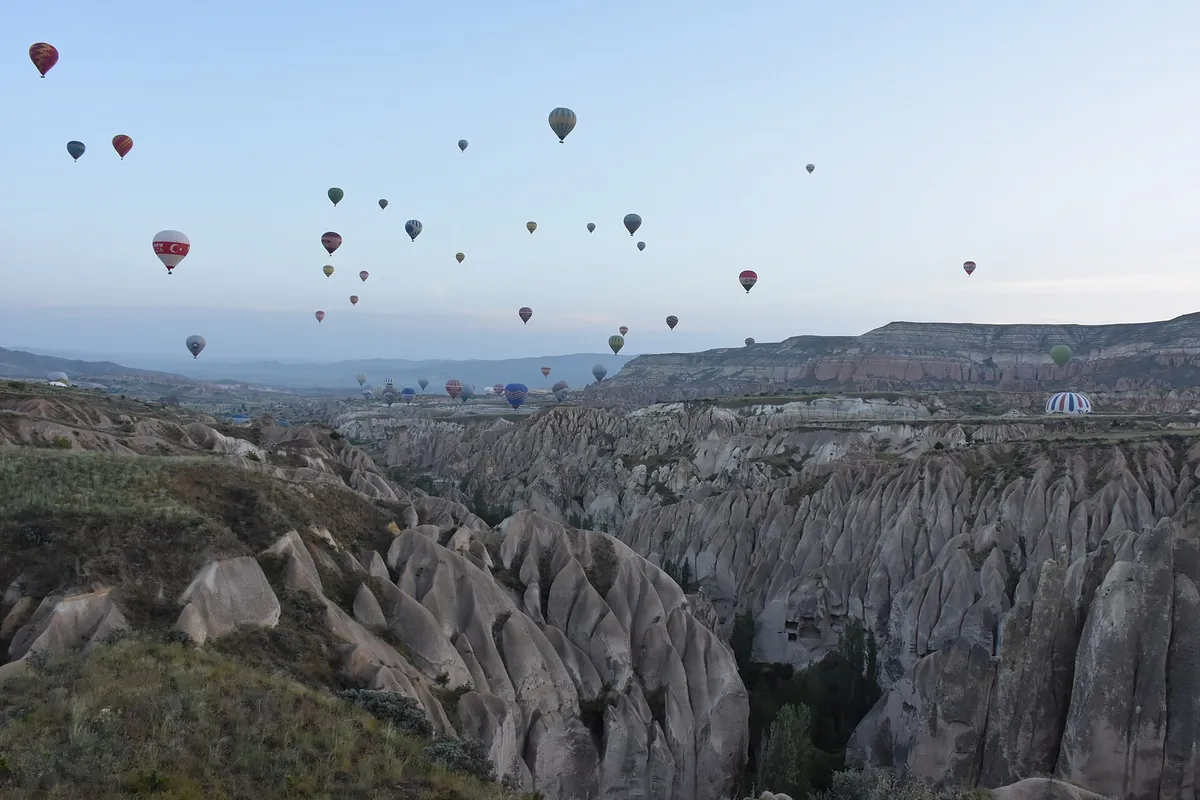
The balloon flight is Cappadocia’s signature for a reason: on a clear morning, the sky over the Göreme valleys fills with balloons rising in the first light, and the view from a basket — fairy chimneys below, Erciyes on the horizon, a hundred other balloons at every height — is genuinely unlike anything else in Türkiye. It is also the most weather-exposed purchase in Turkish tourism, and the guides that sell it as a guaranteed sunrise are selling you something no operator can promise. Flights are licensed and overseen by Türkiye’s civil aviation authority, which gives or withholds permission for each morning based on the weather — wind above all. When the answer is no, every balloon in the region stays on the ground, whatever your ticket says, and cancellations come in runs: a still autumn week can fly daily, a unsettled one can cancel three mornings in a row, in any season.
So the planning is the product. Book the flight for your first morning in Cappadocia, and treat every following morning as a rebooking chance; operators roll cancelled passengers to the next flyable day as space allows, which is precisely why the last morning of a trip is the worst possible choice — a cancellation then is not a disappointment, it is a refund and a story about a balloon you never took. Give the trip a spare morning the way you would give it a spare tyre. And hold a second, quieter plan in reserve: the same dawn from the ground — a hotel terrace in Göreme or Uçhisar, the viewpoint above Red Valley — is free, uncancellable in its own way (the balloons may not fly, but the light always comes), and on a flyable morning nearly as theatrical.
On price, this guide prints no fare, deliberately — and you should distrust any page that prints one without a date attached, because Cappadocia balloon pricing moves with the season, the exchange rate and demand faster than articles are updated. What can be explained is what the fare is made of, so you can compare like with like. The biggest driver is basket size: standard flights carry large baskets with many passengers, while smaller-basket flights — fewer people, more room, a higher price — are sold as the premium tier. Then come season and demand (spring and autumn peaks price highest, and spaces sell out), flight length (the standard flight is about an hour; longer flights cost more), and inclusions — hotel pick-up in the small hours, a light breakfast, insurance, and the small ceremonies afterwards vary by operator and are worth reading in the booking terms rather than the brochure. Book with a licensed operator — your hotel desk, whatever its other faults, sells licensed flights because its reputation rides on them — book early in peak season, and confirm the cancellation and rebooking terms before you pay, because those terms, not the fare, are what a windy week will test.
The Valleys – Cappadocia on Foot
Under the balloon photographs, Cappadocia is walking country, and the valleys are where the region slows down to its proper pace. Marked trails thread between the towns — Göreme to Uçhisar, Göreme to Çavuşin, Çavuşin through the Rose and Red valleys — passing rock-cut churches that appear on no ticket, dovecotes in cliff faces, orchards and vineyards in the valley floors. You need no guide and no ticket for most of it, just water, a hat and an early or late start in the hot months, because the tuff reflects heat and shade is rationed.
Three valleys carry a first trip — two of them walkable from a Göreme base, the third a full day south that pairs with an underground city.
Rose and Red Valleys – the Evening Walk
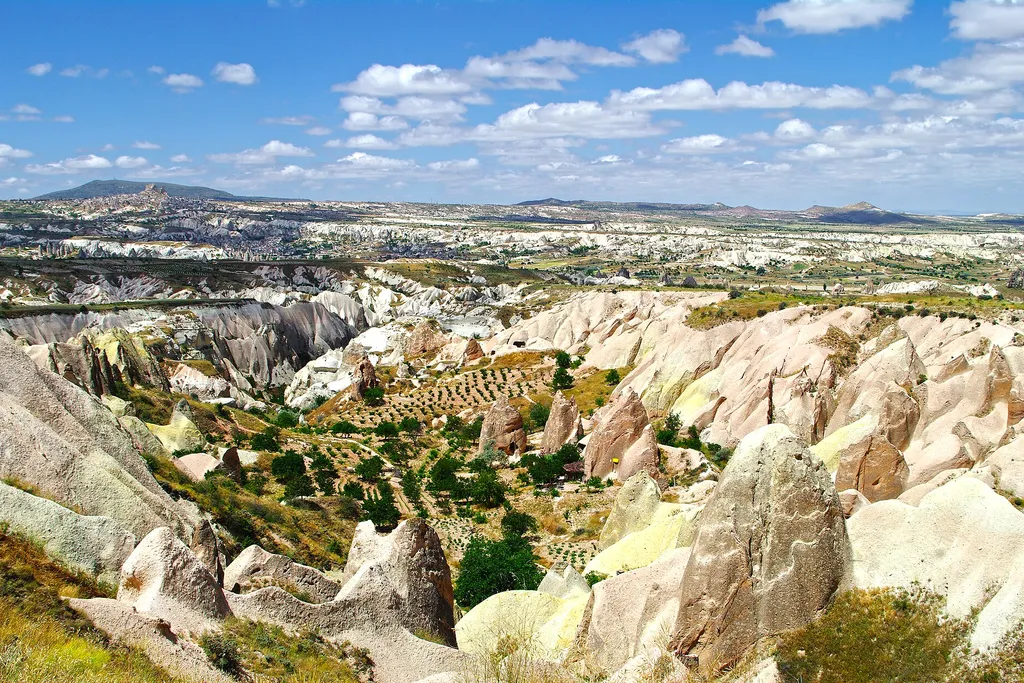
Between Göreme and Çavuşin, two adjoining valleys — Güllüdere, the Rose Valley, and Kızılçukur, the Red Valley — fold together into the region’s best half-day walk. The rock here carries iron in it, and the colours shift through the day from cream to apricot to something close to rose, which is why the standard advice is to walk them in the late afternoon and be at the Kızılçukur viewpoint, above the Red Valley, for sunset. It is good advice, and everyone has heard it; the walk itself, in the valleys rather than above them, stays surprisingly quiet even when the viewpoint fills.
The route is a network rather than a line, and that is its pleasure. Trails drop from the Göreme–Çavuşin road, split around carved churches — the Crusader Church and the Church of the Three Crosses among the named stops — and thread through orchards where the valley farmers still work small plots under the cliffs. Allow half a day, carry water (there is little to buy inside the valleys), and download or photograph a trail map before you start: the paths are marked, but junctions in tuff gullies all look alike by the third one. Walked end to end, the valleys deliver you to Çavuşin, a half-ruined old village under its cliff of cave houses, from where the road returns you to Göreme.
Pigeon Valley and Uçhisar Castle – the High Ground
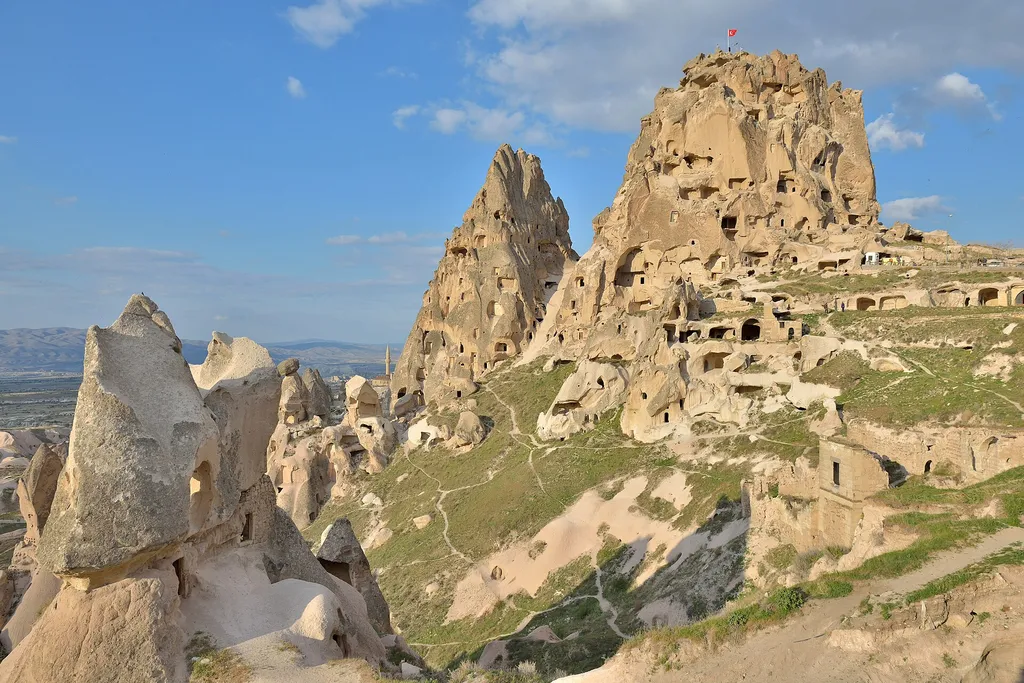
The walk from Göreme to Uçhisar runs up Pigeon Valley, named for the dovecotes cut by the hundred into its cliffs. The cotes were not decoration: pigeon droppings were collected as fertiliser for the valley orchards and vineyards, and the birds were kept the way other farms keep livestock. The trail is a gentle climb of a few kilometres through a green, stream-threaded valley — one of the easiest and prettiest walks in the region — and it delivers you to the foot of the one landmark visible from everywhere.
Uçhisar Castle is not a castle in the built sense. It is the region’s highest fairy chimney, a great rock honeycombed with rooms, tunnels and cisterns and used for centuries as a lookout and refuge — the high point of Cappadocia, with a summit terrace that takes in the whole plateau: Göreme below, the valleys around, Erciyes floating on the horizon in clear weather. It is separately ticketed at its own entrance, it is climbed by stairs through the rock, and it earns its place on a first trip as the orientation point — go up on your first day if the weather is clear, and the rest of the region’s geography will arrange itself under you. Sunset is its famous hour and its crowded one; morning light is emptier and nearly as kind.
Ihlara Valley – the Day Trip South
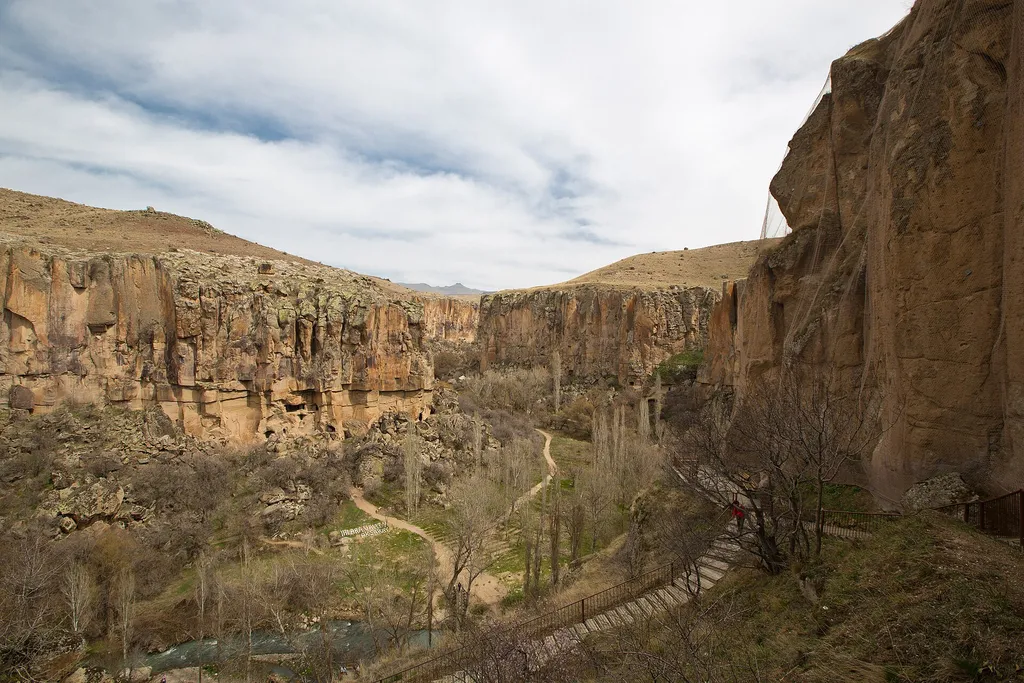
An hour and more south of Göreme, in Aksaray province, the Melendiz river has cut a deep, green canyon through the plateau, and the canyon walls hold another whole chapter of the Cappadocia story: rock-cut churches and dwellings cut into the cliffs above a riverside path. Ihlara is the region’s great contrast. Everything around Göreme is dry, pale and exposed; Ihlara is shaded, watered and enclosed, a walk beside a river under poplars, past churches painted in a rougher, more provincial Byzantine hand than the Göreme valley’s polish. The main entrances drop you down long staircases to the valley floor, and the classic walk runs along the river to Belisırma village, roughly halfway, where restaurants sit by the water.
Plan Ihlara as what it is: a full day, not an add-on. The drive south is the longest of a Cappadocia trip, the canyon walk itself deserves hours rather than a token descent, and the day combines naturally with the journey’s other southern stop — an underground city, Derinkuyu or Kaymaklı, on the same road. This pairing is exactly the shape of the classic southern day tour (the “Green Tour” of the Göreme desks), and for once the tour structure exists for a sound geographic reason rather than mere packaging: the distances are real, and a driver earns his fee on this day more than any other. At the canyon’s northern end stands Selime, where a whole monastery complex — cathedral-sized, by Cappadocian standards — is cut into a rising rock face; if your day has a final hour, spend it there rather than in a second riverside tea.
Sleeping in the Rock – Cave Hotels, Honestly
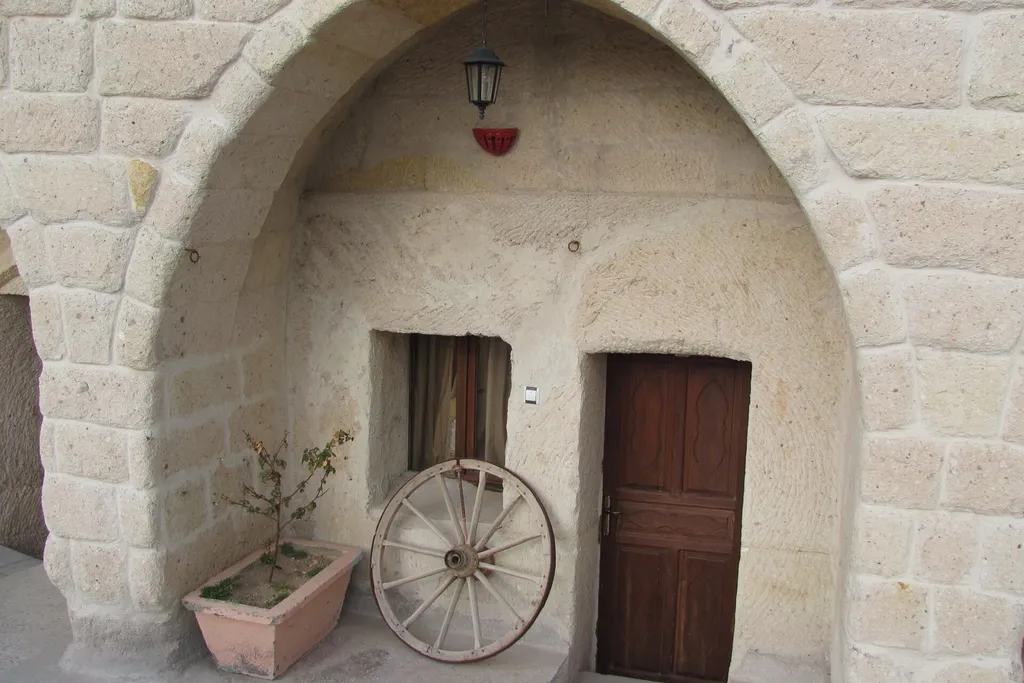
Cappadocia’s famous places to stay need one piece of honest decoding before you book: “cave” on a hotel listing is a spectrum, not a category. At one end are rooms genuinely cut into the tuff — a doorway in a cliff face, walls that are the inside of a fairy chimney, the real and rather wonderful thing. In the middle are hybrid properties, carved rooms below and stone-built rooms above in the local style. At the far end are ordinary stone hotels whose “cave suites” are standard rooms dressed with an arched ceiling and a rock-effect wall. None of this is a scam, exactly — but the price differences across the spectrum are large, and the listing photographs are chosen to blur precisely the distinction you are paying for. Read the room description, not the property name: a true cave room will say it is carved into the rock; if the description praises its stone architecture and large windows, you are booking the far end of the spectrum, which may suit you perfectly — at the right price.
The genuine cave room has its own character, and not all of it suits everyone. The rock holds a steady temperature, so cave rooms stay cool in summer and hold warmth in winter — the original reason people lived in them. Many have small windows or none at all, which is authentic, cave-like and, to some travellers, airless by the second night; if you are unsure, book a carved room with a real window and treat the windowless suites as the connoisseur’s choice. What the best Cappadocia hotels sell above all is neither cave nor stone but the terrace: the dawn hour when the balloons rise over the valleys is the region’s daily theatre, and a hotel whose terrace faces it — in Göreme and Uçhisar especially — gives you the spectacle in a dressing gown with coffee in hand. When comparing two similar properties, the terrace and its view are worth more than one category of room.
By town, the character runs like this. Göreme has the full range — family pensions in carved houses, mid-range cave hotels, and a top end of polished suites — and the convenience of walking to dinner. Uçhisar concentrates the grand end: fewer properties, bigger views, quieter nights, higher prices, dinner often at the hotel itself. Ürgüp runs to established, town-hotel comfort with cave character woven in, and Ortahisar keeps a smaller, more local version of the same offer. We name no prices — they swing with season as hard as the balloon fares do — but the honest order of spending is the one above, and it is stable enough to plan around.
Getting There and Getting Around
Cappadocia has no airport of its own name in the town you will sleep in, and no railway station worth the name for visitors; almost everyone arrives through one of two airports. Kayseri Erkilet (ASR), the larger, is served by frequent domestic flights from Istanbul and sits roughly an hour to an hour and a quarter by road east of Göreme — close enough that Kayseri itself is worth a half-day if your flights strand you there, as our guide to things to do in Kayseri sets out. Nevşehir Kapadokya (NAV) is the smaller, nearer field — under an hour from Göreme — with fewer flights. From either, the standard arrival is a pre-booked shuttle or transfer, usually arranged through your hotel, which will ask for your flight number and meet the plane; book it before you land, because neither airport is a place to improvise from. Most visitors reach Cappadocia from Istanbul, and the flight-plus-transfer combination is the sane default for that leg. The alternative is the overnight bus — comfortable, inexpensive by the standards of the journey, and run from Istanbul, Ankara, Antalya and other cities to Göreme and Nevşehir bus stations — which saves a hotel night and costs you a night’s sleep in exchange.
Once based, the region divides by transport logic. Göreme’s own sights — the Open Air Museum, Rose and Red valleys, Pigeon Valley — are walkable, and a first trip based in Göreme can be run largely on foot with taxis for the edges. Everything further asks for wheels, and there are three honest ways to provide them. The organised day tours — the desks’ “Red Tour” for the northern cluster and “Green Tour” for the underground city and Ihlara — exist because the sights are spread out; they bundle transport, a guide, entrance logistics and lunch, and their weakness is the fixed pace and the obligatory workshop stop. A hire car gives the same ground at your own speed and suits travellers comfortable driving rural Türkiye. Local buses and dolmuş link the main towns — Göreme, Uçhisar, Ürgüp, Avanos, Nevşehir — cheaply and often, but they serve the towns, not the trailheads, and building a valley day around them costs more time than it saves money. Mix the three by day rather than marrying one: walk the north, tour or drive the south.
How Many Days – and When to Come
Two days is the version most itineraries sell, and it works as a highlights reel with no slack in it. Day one in the north: the Open Air Museum, Paşabağ, Zelve or Devrent, Uçhisar for the view. Day two in the south: one underground city and, if the driving is shared, a token taste of Ihlara — or the valleys on foot instead. The balloon goes on the first morning and, if it cancels, quite possibly never happens. Two days shows you Cappadocia; it does not let you settle into it, and it gambles the signature experience on a single morning’s weather.
Three days is this guide’s honest recommendation, because the third day is not more sights — it is insurance and depth. The balloon gains its spare mornings. The south gets its full day: underground city and Ihlara together, at walking pace. And one valley — Rose and Red at sunset, or Pigeon Valley up to Uçhisar — gets walked properly instead of photographed from a tour-bus stop. Four days adds the region’s second tier, which is real: Avanos and its pottery workshops, Ortahisar’s castle, Zelve given its own slow morning, a second underground city, wine in Ürgüp. Travellers who take the fourth day rarely call it wasted; travellers squeezed into two routinely call the trip rushed. Match the days to the region’s two-cluster geography — north day, south day, walking day, spare day — and the itinerary builds itself.
The seasons divide the year into a clear recommendation and three workable alternatives. Spring (April to June) and autumn (September to October) are the consensus best: walking weather, green or golden valleys, flyable mornings at their most frequent, and crowds that are present rather than overwhelming. Summer brings the most reliable flying weather of the year and the hardest midday heat — sightseeing reorganises around early starts, long lunches and evening valleys — plus the peak-season prices and the need to book balloons and hotels well ahead. Winter is the connoisseur’s risk: snow on the fairy chimneys is the region’s most beautiful photograph, the sites stand empty, and the balloon cancels often enough that a winter trip must want the landscape first and treat any flight as a gift. There is no month in which Cappadocia is not worth seeing; there are only months in which the thing you came for is more or less likely to happen.
Mistakes to Avoid
- Booking the balloon for your last morning. A cancellation then cannot be rebooked — it can only be refunded. First morning, every time, with the other mornings as insurance.
- Giving Cappadocia one night. One night means one balloon chance, one cluster of sights and a transfer at each end. The region needs two nights at an absolute minimum, and three to breathe.
- Paying cave prices for a stone room. “Cave” on a listing runs from genuinely carved to merely themed. Read the room description for whether the room is cut into the rock before you pay the carved-room premium.
- Trusting printed prices — for balloons, tickets or passes. They move with the season and the currency faster than articles update. Use muze.gov.tr for the museum figures and operators’ live booking pages for balloons; budget from the cost drivers, not from a blog’s number.
- Quoting Derinkuyu’s depth back as fact. The levels and metre figures on leaflets and older pages contradict each other and carry no official source. Enjoy the structure in front of you; leave the statistics alone.
- Doing the underground city at midday in season. Single-file tunnels plus tour-group volume equals the worst version of a great place. First hour of opening transforms it.
- Treating Ihlara as a half-day from Göreme. The drive, the canyon walk and Selime fill a day honestly. Bolting it onto a museum morning short-changes both.
- Skipping the museum because “the valleys are free.” The Open Air Museum holds the region’s reason for UNESCO listing — the painted churches. The valleys are the landscape; the museum is the art. A first trip needs both.
Frequently Asked Questions
How many days do I need in Cappadocia?
Three full days is the comfortable answer: one for the northern cluster around Göreme, one for the southern day of an underground city and Ihlara, and one for the valleys on foot — with the balloon booked for the first morning and the following mornings held as weather insurance. Two days covers the highlights at a push and gambles the balloon on a single morning. Four days adds Avanos, Ortahisar and Zelve at a proper pace.
Which underground city should I visit, Derinkuyu or Kaymaklı?
Derinkuyu if you want the deeper, more dramatic descent and the famous name; Kaymaklı if you would rather have a wider, gentler layout and a slightly easier time in the passages. Both are UNESCO-listed components, both work on the same principle of shaft, tunnels and rolling stone doors, and for most visitors one city, visited early and slowly, teaches more than both visited in a rush. If underground spaces worry you at all, Kaymaklı is the kinder first test.
Is the balloon flight worth it?
On a flyable morning, for most travellers, yes — it is the region’s signature experience and the landscape reads from the air in a way it never quite does from the ground. But it is worth it only inside the right structure: booked for your first morning, with spare mornings behind it, from a licensed operator, with cancellation terms you have read. A balloon booked for the last morning of a two-day trip, at a fare you stretched for, is a gamble wearing the costume of a plan. And if the fare itself would strain the trip, the dawn from a Göreme or Uçhisar terrace is a genuinely fine second — the same sky, watched rather than ridden.
Do I need to join the Red and Green tours?
No — but understand what you are replacing. The tours exist because the sights are spread across a plateau with thin public transport between them; they sell you driving, guiding and sequencing more than sights. Independent travellers with a hire car can cover the same ground at their own pace, Göreme-based walkers can cover the northern cluster on foot entirely, and the southern day is the one where the tour’s logic is hardest to beat without a car. Many good trips mix all three: walk the north, take the southern tour, keep a day free.
Is the Museum Pass Cappadocia worth it?
If your three days include the Göreme Open Air Museum, an underground city and Ihlara — the standard shape — usually yes: the pass runs three days from first entry and covers those Ministry sites, so price your own list against it on muze.gov.tr before you travel. If you are visiting the museum alone, or spreading the paid sites across four or more days, single tickets will usually win. The Dark Church at Göreme is outside the pass in current arrangements and is paid separately either way.
When is the best time to visit Cappadocia?
Spring (April to June) and autumn (September to October), when the walking, the light and the balloon odds align. Summer flies most reliably but walks hardest at midday and prices highest. Winter is beautiful, empty and cancellation-prone — go for the snow-dusted landscape, not for a guaranteed flight. Within any season, the early morning is Cappadocia’s best hour, in the air and on the ground alike.
Plan Your Next Step
Fix the shape before the details: base town first (Göreme unless you have a reason otherwise), three days if you can possibly give them, the balloon on the first morning with the rest held spare, and one day each for the north, the south and the valleys. Then check the two things in this guide most likely to have moved — the Museum Pass Cappadocia coverage and the Dark Church arrangement — on muze.gov.tr, and the UNESCO listing itself at whc.unesco.org if you want the official word on why this plateau matters. If Cappadocia is one stop on a longer Turkish route, our istanbul travel guide plans the city most travellers pair it with, and Go Türkiye is the official national starting point. The region rewards the traveller who plans its geography and then walks it slowly — everything else is weather, and the weather, given enough mornings, usually relents.