The best things to do in Kayseri combine a volcano, a Seljuk old city and one of Turkey’s most distinctive food cultures, and that combination is what makes the city more than a transit stop on the way to Cappadocia. Ski or hike on Mount Erciyes, the extinct stratovolcano that dominates the skyline south of the city, walk the compact historic centre around Kayseri Castle, step inside thirteenth-century Seljuk hospitals, mosques and madrasas, then eat tiny mantı dumplings and spiced pastırma in the covered bazaar quarter, where traders have sold food, textiles and copper for centuries. If you have an extra day, Kayseri also works as a practical base for Cappadocia, with Göreme and its fairy-chimney valleys roughly an hour away by road, so a Cappadocia day trip fits naturally without moving hotels. This guide puts the active experiences first, so you can plan around the mountain and the seasons rather than just ticking off monuments, and it treats the old city as a walk to be enjoyed slowly, courtyard by courtyard, rather than as a list of buildings to photograph from the street. Kayseri rewards that slower approach because its most interesting places are close together, its food is best eaten in specialist shops and small restaurants rather than in generic tourist venues, and its mountain changes completely between winter snow and summer hiking. The city is also a working Anatolian city, not a museum town, so mornings in the bazaar, afternoons in Seljuk courtyards and evenings over mantı give a truer sense of the place than any single landmark alone. Plan one day for the mountain, one day for the old city and the bazaar, and a third day for Cappadocia or for the slower second-day ideas at the end of this guide, and Kayseri will feel complete rather than rushed.
Planning where to sleep matters less than planning what to do first, because Kayseri’s historic centre is compact and its mountain is a day trip rather than a separate destination, so most visitors are best served by a city base with restaurants, transport and evening life close at hand. For the detail on areas, hotel types and budgets, see our places to stay in Kayseri guide, which covers the city centre, the Erciyes road and Talas, while this guide stays focused on activities, sights, food and day trips. That division keeps both guides useful: the stay guide answers where to base yourself, and this guide answers what to do once you are there, in an order that works on the ground. Start with the mountain if snow or hiking conditions are at their best, because mountain weather and lift status change more quickly than museum hours, and build the old-city walk around the bazaar’s daytime hours, when shops, cafés and food stalls are liveliest. Check the official site before visiting for current opening hours, lift status and any seasonal closures, and confirm prices before booking ski passes, lessons, paragliding, balloon flights or guided tours, because none of those details is fixed year-round. Kayseri is also a good city for travellers who like contrast, since a single trip can include powder snow, Seljuk stone carving, a working bazaar, a wetland full of migratory birds and a Cappadocia valley, all within short drives of one another. The sections below follow that practical order, beginning with the overview table, then the history that explains the old city, then the mountain, then the Seljuk centre, the bazaar, Cappadocia and the second-day ideas, ending with a practical itinerary, a conclusion and answers to the questions visitors ask most often.
At a Glance
| Experience | Best for | Allow |
|---|---|---|
| Mount Erciyes skiing or hiking | Winter sport; summer views and trails | Half day to full day |
| Seljuk centre walk: castle, Hunat Hatun, Gevher Nesibe | History and architecture | Half day |
| Covered bazaar and food tasting | Pastırma, sucuk, mantı, carpets and copper | 2–3 hours |
| Cappadocia day trip | Göreme valleys, fairy chimneys, underground cities | Full day |
| Talas old houses and Sultansazlığı birdwatching | Slower second day | Half day each |
The table above is best read as a planning shortcut rather than as a ranking, because Kayseri rewards a trip built around the mountain and the seasons rather than around a single must-see list. Mount Erciyes comes first for most visitors, whether for winter skiing or for summer hiking, since lift status, snow conditions and mountain weather change more quickly than anything else in the city, and a mountain day needs an early start, the right clothing and a realistic allowance of a half day to a full day. The Seljuk centre walk comes second, and it needs only half a day because the castle, Hunat Hatun and Gevher Nesibe sit close together in a walkable quarter, with Republic Square as a natural meeting point and the covered bazaar nearby for lunch and shopping. The bazaar itself deserves two to three unhurried hours rather than a quick pass, because its pleasure lies in browsing pastırma and sucuk shops, copperware and carpet stalls, and the surrounding hans, and in sitting down for mantı, yağlama or a tradesmen’s lunch. A Cappadocia day trip needs a full day, including the drive to Göreme, time in the valleys and at a rock-cut church site, and the return to Kayseri, while Talas and Sultansazlığı each suit a slower half day on a second or third day. Travellers with limited mobility should use the table to judge distances honestly, since the old centre is flat and walkable, but Erciyes, Talas and the wetland involve transport, walking on uneven ground or both, and those outings should be planned with transport confirmed in advance. A car, a tram ride or a confirmed taxi therefore matters more for those outings than for the walkable old city itself.
Getting the order right matters more in Kayseri than in many Turkish cities, because the mountain, the old city and Cappadocia pull in different directions and each rewards a different kind of day. If you arrive in winter, protect the ski day first, check lift and snow conditions before you travel, and keep the old-city walk for a second day when the mountain is windy or visibility is poor, since a flexible order turns bad mountain weather into a good museum day rather than a wasted day. If you arrive in spring or autumn, when city walking and hiking are at their best, the old-city walk and the bazaar can come first, with Erciyes as a hiking day and Cappadocia as a full third day, and the slower pace of those seasons makes Talas and Sultansazlığı easier to enjoy. In summer, when the city is hot and dry, plan the old-city walk for the morning, the bazaar for midday shade and food, and Erciyes for cooler high-altitude air, and treat Cappadocia as an early-start day to avoid the hottest hours. Check the official site before visiting for current opening hours, lift status and any seasonal closures, as these change and are not fixed year-round, and confirm prices before booking passes, lessons, tours or balloon flights. For stay planning alongside this activity order, see our places to stay in Kayseri guide, so that your base supports the order you choose rather than forcing extra travel each morning. A short planning pause here, matching base, season and mountain conditions, is the detail that most often turns a good Kayseri trip into a smooth one. That pause also helps with luggage, walking distances and early mountain departures, which are the details that most often surprise first-time visitors.
Kayseri in Brief: From Kültepe to the Seljuks
Kayseri’s story starts long before its Seljuk stonework, and knowing that longer story makes the old-city walk far more rewarding than a simple monument tour. The nearby site of Kültepe, ancient Kaneš, was a major Assyrian trading settlement by around 2000 BC, and its clay tablets remain one of the richest records of early Anatolian trade, showing merchants, contracts, caravans and families in remarkable everyday detail. That trading past matters because Kayseri has rarely been an isolated town: it has sat on east-west routes for thousands of years, and its bazaar, its hans and its reputation for food and craft all grow from that position as a place where goods, people and ideas passed through and stayed. Under Rome the city was known as Caesarea in Cappadocia, a regional capital whose name still echoes in the modern name Kayseri, and Roman foundations underlie parts of the later citadel, even though the visible walls and towers owe much more to later rebuilding. Its most visible golden age came under the Anatolian Seljuks in the twelfth and thirteenth centuries, when rulers, princesses and viziers endowed hospitals, mosques, madrasas and tombs that still shape the centre today, and when stone carving, courtyard planning and multi-use complexes gave the city a distinctive architectural language. Later Ottoman additions, such as the clock tower of 1906 on Republic Square, sit beside those Seljuk buildings rather than replacing them, which is why a short walk here reads like a layered timeline, with Roman, Seljuk and Ottoman traces within a few streets. A visitor who walks with that timeline in mind will notice Roman foundations, Seljuk portals and Ottoman additions as successive chapters, rather than as unrelated old buildings, in a single compact quarter.
That layered timeline is best understood before you walk, because it explains why the monuments cluster as they do and why they take the forms they take. Seljuk Kayseri was not built as a set of isolated showpieces, but as a working city in which a hospital taught medicine, a mosque complex combined worship, learning, burial and bathing, a madrasa trained students, and a bazaar and its hans moved goods, and the buildings below in this guide should be read in that functional sense rather than as empty shells. Gevher Nesibe pairs a hospital with a medical school, Hunat Hatun groups a mosque, madrasa, tomb and bathhouse around a shared courtyard, Sahabiye Madrasa now holds shops and cafés in its courtyard, and the Döner Kümbet shows the classic Seljuk tomb form, so each stop adds a different piece of how the city worked. The Ottoman clock tower, the castle walls and the bazaar quarter then show how later centuries kept using, repairing and adding to that Seljuk core, rather than clearing it away, and that continuity is part of Kayseri’s charm. That continuity is also visible in street names, building materials and the bazaar quarter, so a slow walk rewards anyone who knows the basic dates. For background on the city’s trading past, see the Erciyes University introduction to Kayseri’s history: Erciyes University — Discover Kayseri, and use it as context rather than as a substitute for checking current museum hours and access before you visit. A visitor who knows the Kültepe tablets, the Roman name Caesarea and the Seljuk building boom will see the old city not as a random collection of old stones, but as a trading city that kept reinventing itself while keeping its centre intact.
Ski, Snowboard or Ride the Lifts on Mount Erciyes
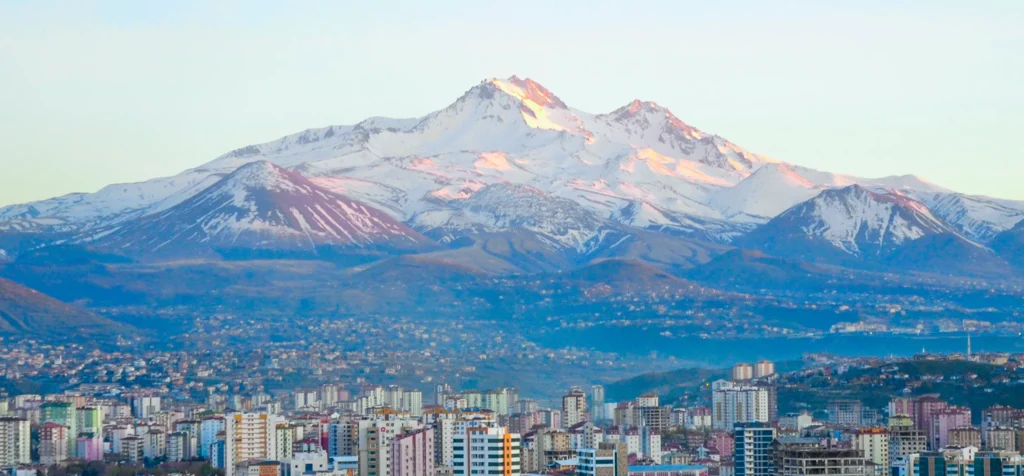
Mount Erciyes, the extinct stratovolcano that dominates the skyline south of the city, is Kayseri’s headline activity, and it deserves a full day rather than a rushed half-day add-on. In winter it is one of Turkey’s most developed ski areas, with groomed runs for different levels, modern lifts and rental and ski-school services at the base, and its scale is large enough that beginners, intermediates and confident skiers can each find suitable terrain without sharing the same crowded slopes all day. Even if you do not ski, a lift ride for the panorama over the Central Anatolian plain is worthwhile on a clear day, because the view from altitude explains the whole region at a glance: the city below, the plain stretching outward, and the volcanic landscape that Erciyes itself helped to form. The mountain’s height also means that conditions at the top can differ sharply from conditions in the city, with wind, cold and visibility changing quickly, so a clear morning in Kayseri does not guarantee a clear day on the upper slopes, and a windy day at altitude can still offer good skiing on sheltered runs. Ski schools and rental shops at the base make Erciyes accessible to first-timers, but first-timers should still book lessons and equipment in advance in peak season, allow time for fitting and instruction, and choose runs honestly rather than following more experienced friends onto steep terrain. Families will find the base area practical, with services close together, while experienced skiers will value the vertical, the variety of runs and the chance to ski a major Turkish resort without the prices and crowds of better-known European destinations. Early booking in peak winter weeks also helps, since lessons, rentals and popular runs fill first and last-minute choices often add waiting time.
Practical planning for Erciyes is simple, but it benefits from the same checks that run through this whole guide, because mountain details change by season, by week and sometimes by day. Base yourself in Kayseri city if you want more restaurants and hotels, and travel up for the day; stay at the ski base only if maximising time on snow matters most, since a base stay trades city evenings and food choice for first-lift convenience. Check the official site before visiting for lift opening dates, snow conditions and pass details, and confirm prices before booking passes, lessons, rentals or transport, since none of those details is fixed year-round. Dress for wind at altitude even when the city feels mild, with layers, gloves, eye protection and sun protection, because sun on snow and wind at height combine to make a mild city day feel cold on the mountain. Allow extra time for the drive up and back, for parking and for lift queues on weekends and holidays, and keep a flexible second plan, such as the old-city walk or the bazaar, for a day when wind or visibility closes upper lifts. In summer the same mountain changes character completely: the snow gives way to hiking and mountain-biking routes, cooler air than the city below, and long views toward Cappadocia’s volcanic landscape, which Erciyes itself helped to form, so a summer visitor should treat Erciyes as a hiking and viewpoint day rather than as a closed winter resort. Whether you ski, ride a lift or hike, Erciyes is the activity that gives Kayseri its scale, and it should be planned first, not fitted around everything else. A flexible second plan, such as the old city or the bazaar, also protects the day if wind closes the upper lifts.
Hike Erciyes in Summer and Try Paragliding from Ali Mountain
Summer visitors should not treat Erciyes as a winter-only mountain, because its summer character is entirely different and, for walkers, often more rewarding than a ski day. Marked trails suit a half-day walk, and the change in vegetation and temperature as you climb is part of the appeal, with the hot, dry city air giving way to cooler mountain air, different plants and, on a clear day, long views across the plain toward Cappadocia. A half-day walk is the right ambition for most visitors, rather than a full summit attempt, because altitude, sun and the change in terrain make even a moderate trail feel longer than its distance suggests, and because a half-day leaves time to return to the city for a bazaar lunch and a hammam in the evening. Take water, sun protection and a layer, and start early on hot days, since mountain sun is strong, shade can be scarce on open slopes, and an early start also leaves a margin for slower walking, for photographs and for a rest at a viewpoint. Wear sturdy shoes with grip rather than city shoes, carry more water than you think you need, and check the route before setting out, including whether the trail you intend is open, whether any sections are closed for work or for seasonal reasons, and what the weather at altitude is expected to do during the day. Walkers who prefer a gentler outing can choose a shorter, lower trail and still enjoy the mountain’s air and views, while fitter walkers can extend the day with a longer route, but both should treat Erciyes as a real mountain rather than as a city park, with the same respect for weather, water and footing.
For a different kind of altitude, paragliding from Ali Mountain is the activity most often paired with an Erciyes trip by local operators, and it suits travellers who want a mountain thrill without a full day of skiing or hiking. A tandem paragliding flight, where an experienced pilot flies with you, is the usual option for first-timers, and it offers a completely different view of Kayseri and its plain, with the city, the mountain and the surrounding landscape spread out below in a way that no ground viewpoint can match. Check the official site before visiting for current operators, age and weight rules, and weather-dependent availability, and do not assume a flight will run on a windy day, since paragliding is highly weather-dependent and a responsible operator will cancel or postpone rather than fly in unsafe conditions. Confirm prices before booking, including what is included, such as transport to the launch site, equipment, insurance and any photographs or video, because packages vary and a headline price may exclude one or more of those items. Allow flexibility in your itinerary if paragliding matters to you, keeping a second possible day free, since a flight booked for a single morning can easily be lost to wind, and a traveller with no spare day will miss it entirely. Combine a paragliding morning with an afternoon in the old city or the bazaar, rather than with a long drive to Cappadocia, so that a delayed or cancelled flight does not unravel the whole day. Done that way, with weather checks, a reputable operator and a flexible plan, Ali Mountain paragliding and Erciyes hiking together give Kayseri a summer mountain programme that rivals its winter skiing, and they show the mountain at its most varied.
Walk the Seljuk Centre: Kayseri Castle and Republic Square
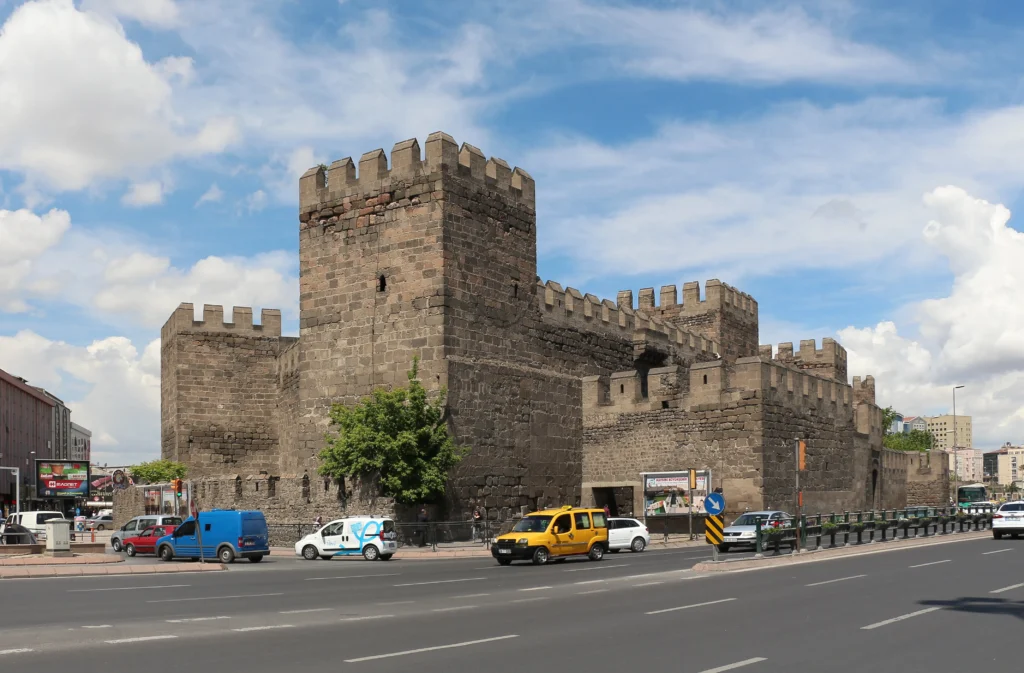
Start the city walk at Cumhuriyet Meydanı, Republic Square, where Kayseri Castle’s dark volcanic walls anchor the old centre and give the whole quarter its sense of place. The citadel has Roman origins but was substantially rebuilt and fortified under the Seljuks, and its walls and towers are best appreciated from outside and from the square before you head into the quieter streets behind it, because the scale of the walls, the darkness of the volcanic stone and the contrast with the modern square are clearest from that open viewpoint. Nearby, the 1906 clock tower gives you a useful meeting point and a reminder that Kayseri kept building through the late Ottoman period, and it also serves as a practical landmark if your group splits up in the bazaar or the side streets. This is a walkable quarter, so plan it on foot, not by car, allowing time to duck into courtyards and side streets between the main monuments, to notice carved portals, small mosques and old houses, and to stop for tea or a snack when the walk, rather than the itinerary, suggests it. The streets behind the castle are quieter than the square, and that quiet is part of their appeal, because it lets you see how the old city still functions as a neighbourhood, with workshops, small shops and homes alongside monuments, rather than as a fenced-off historic zone. A morning walk works best, when the light on the stone is softer and the bazaar is opening, while a late-afternoon walk gives a different light on the walls and a livelier square, so either time suits, provided you allow at least two hours for the castle, the square and the surrounding streets.
Walking the Seljuk centre well means treating the castle and the square as a starting point rather than as the whole walk, because the richest parts of the quarter lie in the streets and courtyards that connect the big monuments. From Republic Square, walk toward Hunat Hatun and Gevher Nesibe, pausing at Sahabiye Madrasa and the Döner Kümbet on the way, so that the walk builds a coherent picture of Seljuk Kayseri rather than a series of disconnected photographs. Look up as you walk, because Seljuk carving rewards attention to portals, inscriptions, geometric patterns and the junctions where walls meet roofs, and many of the most interesting details sit above eye level, where a hurried walker looking only at shopfronts would miss them. Wear comfortable shoes, since the quarter is best explored on foot and its streets, courtyards and steps involve uneven surfaces, and carry water in summer, when the dark volcanic stone radiates heat and shade can be scarce on the square itself. Check the official site before visiting for any restoration closures or changes to access, since individual monuments within the quarter may close for work, and a closure that you know about in advance can be planned around, while one discovered on arrival can waste a morning. If a particular building is closed, use the time for the bazaar, for a longer courtyard walk or for a food stop, rather than treating the closure as a failed day, because the quarter’s strength is its overall atmosphere as much as any single interior. Done slowly, on foot, with the castle and the square as anchors, this walk gives the clearest introduction to Kayseri’s Seljuk identity, and it sets up every later stop in the old city.
Step Inside the Gevher Nesibe Medical Complex (1204–1206)
The Gevher Nesibe complex, also called Çifte Medrese, is Kayseri’s most remarkable Seljuk building, and the one that best explains why the city matters beyond its bazaar. Commissioned in 1204 and completed in 1206, it paired a hospital, a darüşşifa, with a medical madrasa, making it one of Anatolia’s earliest integrated hospital-and-school foundations, where treatment and teaching happened side by side rather than in separate institutions. Tradition links it to Princess Gevher Nesibe, whose wish was said to be for a hospital offering free care, and its wards famously included treatment for mental illness using music and water sounds alongside other medieval therapies, a detail that surprises modern visitors and that shows a humane, holistic approach to care centuries before modern psychiatry. The building’s plan itself tells that story: stone courtyards, iwans and a tomb chamber frame a complex designed for patients, students and teachers to move between wards, classrooms and quiet spaces, and the architecture, with its carved portals and restrained stonework, reflects a Seljuk ideal of learning and charity expressed in durable form. Allow time to look at the courtyards as spaces, not just as routes between rooms, because the light, the scale and the sound of the stone give a sense of how a medieval hospital felt to live and work in, and because the tomb chamber, with its own carving and atmosphere, adds a personal, memorial dimension to the institutional story. Gevher Nesibe is also a useful corrective to any idea that medieval medicine was only superstition, since its combination of hospital, school, music and water shows a systematic, if pre-modern, attempt to treat the whole person. That humane emphasis, expressed in music, water and teaching as well as in medicine, is why the complex still feels modern despite its medieval date.
Today the complex houses the Seljuk Civilization Museum, where the stone courtyards, iwans and tomb chamber frame exhibits on Seljuk medicine, science and daily life, and that museum setting is the right way to experience the building, since it lets you move between architecture and explanation without rushing. Allow time to look up at the carved portals rather than rushing through the rooms, because the portals carry the finest carving in the complex, with geometric and floral patterns that reward close looking, and because the contrast between the plain courtyard walls and the richly carved entrances is a classic Seljuk effect. Read the museum’s explanations on medicine, astronomy, daily life and craft, since they connect the building to the wider Seljuk world, showing how Kayseri’s hospital fitted into a network of learning that stretched across Anatolia and beyond, and how its doctors, students and patients lived. Further reading: Gevher Nesibe — history of the complex, which gives a useful overview of the foundation, the princess tradition and the building’s later history, though the museum itself and the official site should be checked before visiting for current hours and access. Families will find the museum a good introduction to Seljuk history, because its objects, models and explanations are visual and concrete, while visitors interested in architecture will appreciate the courtyards, iwans and tomb chamber as a complete Seljuk complex rather than as a single façade. Pair Gevher Nesibe with Hunat Hatun, described next, since the two complexes together show two different Seljuk models, a hospital-school and a multi-use mosque complex, and that pairing is the quickest way to understand Seljuk Kayseri. A slow courtyard pause also helps visitors notice how the buildings relate to one another. Check the official site before visiting for current opening hours and any restoration closures, and confirm prices before booking any guided tour, since hours and tour options change.
Visit the Hunat Hatun Complex (1238)
A short walk from the castle, the Hunat Hatun Külliyesi, completed in 1238, is the first multi-use Seljuk complex of its kind in Anatolia, and it repays a slow visit more than a quick photograph of its portal. Commissioned by Mahperi Hunat Hatun, wife of Sultan Alaeddin Keykubad I and mother of Sultan Gıyaseddin Keyhüsrev II, it groups a mosque, madrasa, tomb and bathhouse around a shared courtyard, so that worship, learning, burial and bathing, the core activities of a Seljuk urban community, happened within a single, planned ensemble. That grouping is the point of the complex, and it is worth understanding before you arrive, because a visitor who sees only the mosque will miss the way the parts relate to one another, while a visitor who walks the courtyard, looks at each building in turn and notices the shared scale and materials will grasp the Seljuk idea of a külliye as a small, complete city within the city. Look closely at the mosque portal’s geometric and floral carving, which is among the finest in Kayseri, with patterns that reward unhurried looking and that show the skill of Seljuk stone carvers at their peak. Then step into the courtyard for the octagonal tomb, where Hunat Hatun herself is buried, and notice how the tomb’s form, a tall, faceted structure with a conical roof, echoes the Döner Kümbet described later in this guide, while its courtyard setting gives it a more intimate, memorial character. The complex’s later history, as madrasa, museum and cultural centre, is part of its interest too, since it has rarely stood empty, and each later use has left traces that a careful visitor can still read. That continuity makes Hunat Hatun feel lived in rather than preserved behind glass.
Source for the 1238 date and the complex’s layout: Hunat Hatun Mosque and Complex — Kayseri, which is a useful starting point for the foundation, the patron and the grouping of buildings, though current hours and access should always be checked on the official site before visiting. Practical planning for Hunat Hatun is straightforward, since it sits within the walkable old-city quarter, a short walk from the castle and from Gevher Nesibe, and it pairs naturally with both, forming a half-day Seljuk walk that also includes Sahabiye Madrasa and the Döner Kümbet. Allow at least an hour for Hunat Hatun itself, including time at the portal, time in the courtyard, time at the tomb and time simply sitting in the courtyard to absorb the scale, since a rushed visit will reduce a complex ensemble to a single façade photograph. Visitors should dress respectfully for a working mosque, covering shoulders and legs and removing shoes where required, and should check whether any part of the complex is closed for prayer, for restoration or for an event, since a mosque complex, unlike a museum, remains in religious and community use. Photographers will find the portal best in soft morning or late-afternoon light, when the carving casts shadows that reveal its depth, while midday light can flatten the same patterns. Hunat Hatun, visited slowly and in combination with Gevher Nesibe, gives the clearest sense of Seljuk Kayseri as a lived city, with a powerful woman patron, a planned community of buildings and a tradition of charity and learning that still shapes the quarter today. It is, for many visitors, the single most satisfying stop in the old city. That satisfaction comes from the ensemble as a whole, not from any single carving or room.
Browse Sahabiye Madrasa and the Döner Kümbet (1276)
Opposite the Hunat Hatun quarter, Sahabiye Madrasa, commissioned in 1267, now holds small shops and cafés inside its Seljuk courtyard, and that living use is precisely what makes it worth a stop. It is a good place to pause rather than a formal museum visit, because its pleasure lies in sitting in a thirteenth-century courtyard, drinking tea or coffee, browsing small shops and noticing how a medieval learning institution still functions as a social space, with students replaced by shopkeepers and visitors but the courtyard logic intact. The madrasa’s architecture, with its courtyard plan, its arched porticoes and its carved details, is best appreciated at a leisurely pace, since a quick pass through the entrance would miss the way the courtyard frames the sky, the way the shops animate the ground floor and the way the building’s scale feels intimate after the larger Hunat Hatun complex. Sahabiye also shows a different side of Seljuk Kayseri from the hospital and the mosque complex, because a madrasa was a place of teaching, debate and student life, and imagining students living, studying and arguing in that courtyard adds a human dimension to the stone. It is a natural break in the old-city walk, between the larger monuments, and it works well as a rest stop, a tea stop or a browsing stop, depending on your pace. Visitors who prefer formal museums may find Sahabiye less obviously impressive than Gevher Nesibe or Hunat Hatun, but those who enjoy living historic quarters will find it one of the most charming stops in Kayseri, precisely because it is not frozen as a museum. A tea stop there also breaks the monument walk pleasantly, giving time to rest, to look at the courtyard again and to plan the next stop without rushing.
A little further on, the Döner Kümbet, the cylindrical Revolving Mausoleum dated 1276, shows the classic Seljuk tomb form at its most refined, and it completes the old-city walk’s picture of Seljuk burial architecture. Its form is a stone drum with a conical roof and dense surface carving, a shape that looks simple from a distance but reveals, on closer inspection, bands of geometric and floral patterns, inscriptions and carefully cut stonework that reward slow looking. The name Döner Kümbet, often translated as Revolving Mausoleum, has attracted various explanations, and visitors should treat those stories as local tradition rather than as settled fact, enjoying the building’s form and carving without needing a single definitive explanation for its name. Together, Sahabiye Madrasa and the Döner Kümbet turn a monument walk into a sense of how Seljuk Kayseri actually functioned, with learning, burial and commerce side by side, and with buildings that served students, patrons, merchants and families within a few streets. That functional picture is the real reward of the old-city walk, since it replaces a list of dates with an understanding of a working city. Check the official site before visiting for any access changes, since Sahabiye’s shops and cafés have their own hours and the tomb is best viewed from outside, and allow time to walk between the two stops slowly, noticing the streets, houses and small workshops that connect them. Paired with Gevher Nesibe and Hunat Hatun, these two smaller stops give the Seljuk centre its completeness, and a visitor who has seen all four will leave with a far richer picture than a visitor who has seen only the castle and the square. That completeness is the real reward of the old-city walk, and it is why these smaller stops deserve the same unhurried attention as the larger complexes.
Shop and Eat Your Way Through the Covered Bazaar
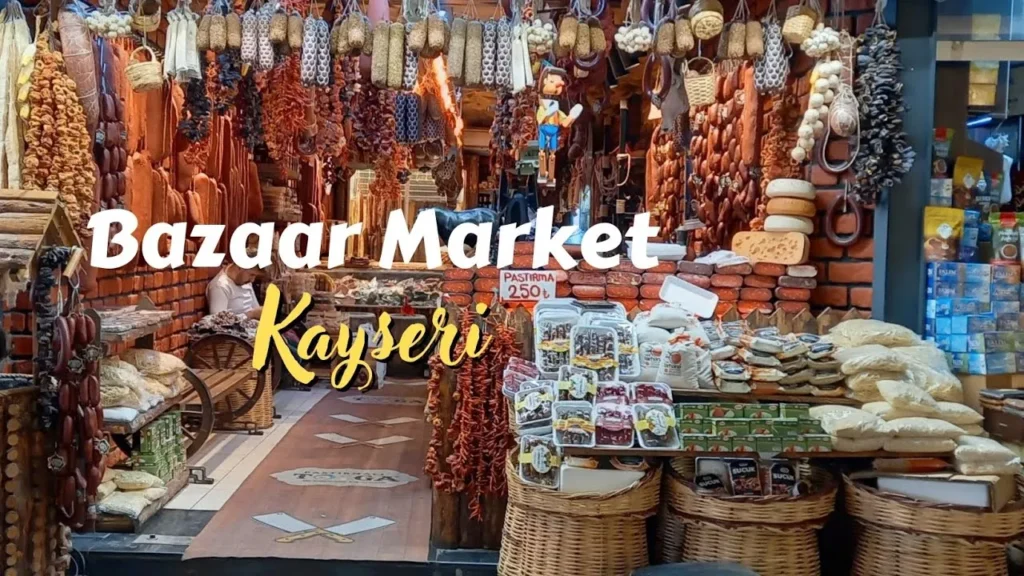
Kayseri’s Kapalı Çarşı is one of Turkey’s largest covered bazaars still in daily use, and it rewards slow browsing rather than a quick pass, because its character lies in its working life rather than in any single shop. Stalls sell pastırma and sucuk, dried fruit, textiles, copperware and hand-woven carpets, and the surrounding hans, caravanserais such as Vezir Han, recall the city’s role on east-west trade routes, when merchants, animals and goods needed secure courtyards, storage and lodging. Walking the bazaar well means allowing the covered streets to set the pace, following the sequence of sections, from food to textiles to copper, rather than rushing toward an exit, and pausing to look at craft, to ask about products and to watch traders at work. Buy food from shops that vacuum-pack for travel if you are flying home, since pastırma, sucuk and dried fruit travel far better vacuum-packed than loose, and ask before photographing vendors, since many traders are happy to be photographed if asked politely but dislike being treated as exhibits. Bargaining is part of bazaar culture, but it should be gentle and good-humoured, especially for carpets and copper, where prices reflect craft, materials and time, and where a respectful conversation will usually achieve a better result than aggressive haggling. The bazaar is also a social space, with tea houses, small cafés and meeting points where traders and regular customers gather, and sitting for tea is as much a part of the bazaar experience as shopping. Allow two to three hours for the bazaar and its hans, longer if you intend to buy a carpet or to eat a full lunch inside, since both deserve unhurried time. A tea break in a han also fits naturally into that unhurried pace.
Food is not a side note here, because it is the reason many Turkish visitors come to Kayseri, and the bazaar quarter is the best place to eat it properly. Order mantı, the famously tiny dumplings served with yoghurt and chilli butter, at a specialist restaurant rather than a generic kebab house, since the size, the filling and the sauce are the whole point, and a specialist will make dumplings small enough to fit many on a spoon, as tradition demands. Try pastırma thinly sliced, sucuk grilled or in beans, and yağlama, Kayseri’s layered flatbread dish, if it is on the menu, since those three dishes together give a concise picture of Kayseri’s spiced, meat-based food culture, with pastırma’s fenugreek coating, sucuk’s garlic and spice, and yağlama’s layered bread and meat. For a local-style lunch, look for an esnaf lokantası, a tradesmen’s restaurant serving home-style dishes at midday, where the menu changes daily, the food is cooked in quantity for workers, and the atmosphere is busy, plain and welcoming rather than tourist-oriented. A tradesmen’s lunch is also good value, since prices reflect local trade rather than visitor demand, though menus may not be in English and a little pointing, asking and good humour will go a long way. Confirm prices before ordering where menus are unclear, especially for pastırma and sucuk sold by weight, since those items are priced by the kilo and a generous portion can cost more than expected. Food shopping and food eating together make the bazaar quarter the most memorable part of Kayseri for many visitors, and a traveller who eats mantı in a specialist restaurant, buys vacuum-packed pastırma for home and drinks tea in a han will understand Kayseri’s food culture far better than one who only photographs the stalls.
Take a Cappadocia Day Trip from Kayseri
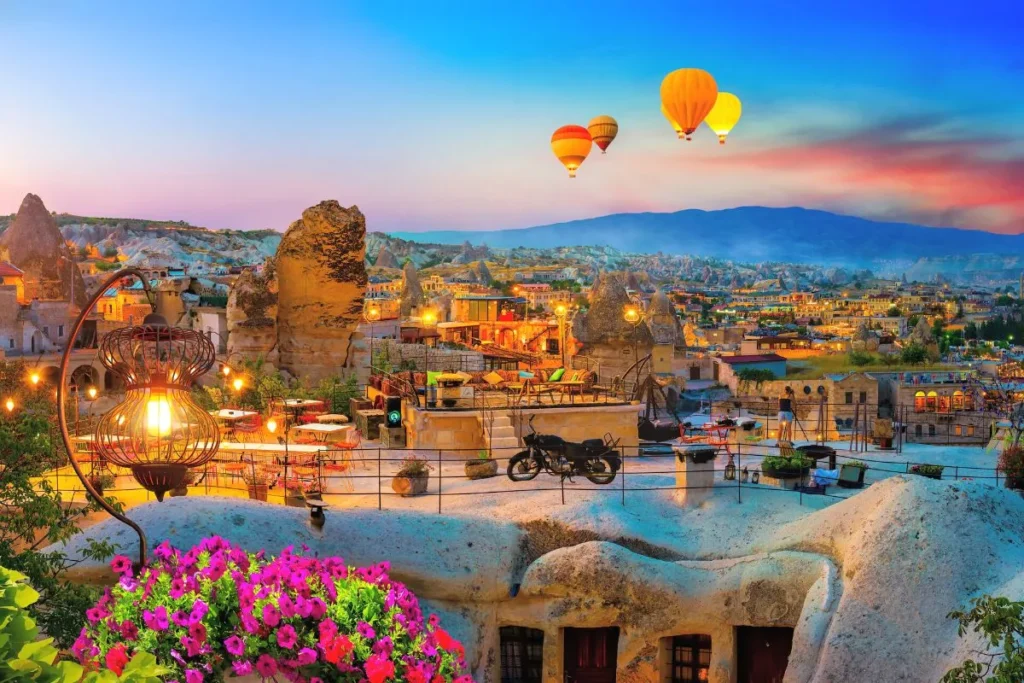
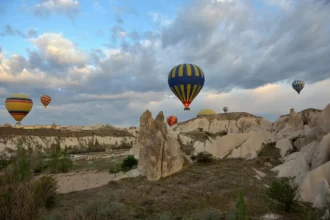
Kayseri’s airport is the main gateway to eastern Cappadocia, and Göreme and its valleys are roughly an hour’s drive away, so a day trip is realistic without moving hotels, provided you start early and plan the day as a full day rather than as a half-day excursion. A typical day covers Göreme’s fairy-chimney valleys, an open-air museum or rock-cut church site, and, if time allows, an underground city, and that combination gives a concise introduction to Cappadocia’s volcanic landscape, its rock-cut churches and its underground world, even though it cannot cover the region in depth. The fairy-chimney valleys are best in morning light, when the soft volcanic rock glows and the valleys are quieter, while an open-air museum or church site adds the human, religious dimension, with frescoes, chapels and dwellings carved directly into the rock. An underground city, if included, should be chosen carefully, since the deep, narrow passages suit some visitors far better than others, and a traveller who dislikes confined spaces should skip the deepest levels or choose a valley walk instead. Transport for a Cappadocia day trip can be a rental car, a private driver or an organised tour, and each suits a different traveller: a car gives flexibility for valley stops, a driver removes navigation and parking worries, and a tour adds a guide’s explanation, which is especially valuable at church sites where frescoes and history need interpretation. Whichever option you choose, confirm prices before booking, including entry fees, guide fees and any balloon or lunch inclusions, since day-trip prices vary widely and a cheap headline price may exclude the very sites you most want to see. A guided tour is especially valuable at church sites, where frescoes, inscriptions and rock-cut rooms need explanation to be understood rather than merely photographed.
Balloon flights require a very early start and are weather-dependent, so treat them as a separate, book-ahead plan rather than as a casual add-on, and keep your expectations realistic about cancellations. A balloon morning typically begins before dawn, with transport to a launch site, a safety briefing and a flight over the valleys at sunrise, followed by a landing and a return to Göreme, and the whole experience can take half a morning, which means it cannot easily be combined with a full Cappadocia sightseeing day from Kayseri on the same day. If a balloon flight matters to you, consider staying a night in Göreme instead and returning to Kayseri the next day, since that overnight stay removes the early-morning drive from Kayseri, gives a margin for a weather-cancelled flight to be rebooked, and lets you enjoy Göreme’s evening atmosphere. If you prefer to linger in Cappadocia without a balloon, the same overnight logic applies, since a second day allows a slower valley walk, a second church site or a pottery village, all of which are rushed on a single day trip. A sample three-day structure is outlined by MileHacker: Kayseri itineraries — 3 days, 1 week and budget travel, which is useful for comparing a three-day Kayseri-plus-Cappadocia plan with a longer, slower itinerary. Check the official site before visiting for current conditions at Cappadocia sites, since opening hours, access and any restoration work change, and confirm prices before booking any tour, balloon flight or underground-city visit. Done as a full, early-start day, or better as an overnight stay, a Cappadocia trip from Kayseri is one of the most rewarding extensions in Central Anatolia. An overnight stay in Göreme also lets you enjoy the town’s evening atmosphere, its cave hotels and its restaurants without a late drive back to Kayseri.
Second-Day Ideas: Talas, Ağırnas and Sultansazlığı
With a second day, head to Talas, whose old stone houses and quiet lanes feel like a village inside the modern city, and whose atmosphere offers a deliberate contrast to both the busy bazaar and the mountain. Talas rewards slow walking, with stone houses, courtyards, small cafés and views back toward Kayseri, and its quiet lanes give a sense of how the city once looked and lived before modern apartment blocks spread across the plain. Allow a half day for Talas, including the journey there, a walk through the old lanes, a café stop and time simply to absorb the quieter pace, rather than treating it as a quick photograph stop on the way elsewhere. Talas also works well as an evening destination, when the lanes are cooler, the light is softer and the cafés fill with local visitors, though a morning visit suits travellers who want to combine Talas with an afternoon elsewhere. From Talas, or as a separate half-day outing, consider Ağırnas, birthplace of the Ottoman architect Mimar Sinan, where underground spaces are carved into volcanic rock and where the connection between a small Anatolian town and the empire’s greatest architect becomes tangible. Ağırnas is less visited than Talas, and its underground spaces, with their carved rooms and passages, deserve a guide or a good explanation, since their purpose and history are not obvious from the rock alone. Together, Talas and Ağırnas show Kayseri’s surroundings as a lived landscape of stone houses, villages and underground ingenuity, rather than as empty countryside between monuments. Both places reward a slow pace, with time for stone houses, carved rooms, café stops and views, rather than a hurried drive between viewpoints. That slow rhythm is the point of Talas and Ağırnas alike.
Birdwatchers should consider Sultansazlığı National Park, a wetland south-west of the city known for migratory birds, and it deserves a half day of its own rather than being squeezed into a Talas morning. Bring binoculars, keep to paths, and check the official site before visiting for access and seasonal conditions, since wetland access, water levels and bird presence all change with the season, and since a visit timed for migration will be far richer than a visit in a quiet period. Sultansazlığı’s value lies in its scale and its wildness: a flat, open wetland where birds, reeds and sky dominate, and where patience, quiet walking and early-morning light matter more than any single viewpoint. Allow time for slow observation, for a walk along paths and for a rest at a viewpoint, rather than rushing through, and dress for open, exposed conditions, with sun protection, water and layers for wind. A traditional hammam in a historic bathhouse is a fitting end to a day of walking and skiing, especially in winter, when a hot, steamy bathhouse after a cold mountain or wetland day feels like a reward rather than a luxury. Choose a historic bathhouse where possible, since its architecture and atmosphere add to the experience, check the official site before visiting for hours and any gender-specific sessions or rules, and confirm prices before booking any treatment, since hammam prices vary by service. A second day built from Talas, Ağırnas, Sultansazlığı and a hammam gives Kayseri a slower, more local rhythm, and it is the right choice for travellers who have already done the mountain and the old city and who want to see the city as its residents do, at village pace, in nature and in a bathhouse at the end of the day.
Practical Guide: Itinerary, Getting There and Best Time
| Plan | Detail |
|---|---|
| 2-day itinerary | Day 1: Castle, Hunat Hatun, Gevher Nesibe, bazaar and mantı dinner. Day 2: Mount Erciyes (ski or hike), then hammam and evening in the centre. |
| 3-day itinerary | Add a full Cappadocia day trip, or split it into Talas and Sultansazlığı for a slower pace. |
| Getting there | Erkilet International Airport is a short drive from the centre, with connections via Istanbul and Ankara. The centre is walkable; use tram, bus or taxi for Erciyes and outlying sites. |
| Best time | Winter (December–March) for skiing; spring and autumn for city walking and hiking; summer is hot and dry but good for high-altitude escapes. |
| What to check first | Check the official site before visiting for museum hours, lift status, balloon weather and any restoration closures. |
The table above gives a workable framework, but the best Kayseri itinerary is one that protects its slow parts rather than one that tries to add extra stops, and the two-day and three-day shapes in the table show that principle clearly. A two-day trip works as one old-city day and one mountain day, with the old-city day covering the castle, Hunat Hatun, Gevher Nesibe, the bazaar and a mantı dinner, and the mountain day covering Erciyes skiing or hiking, followed by a hammam and an evening in the centre, and that shape balances history, food and activity without rushing any of them. A three-day trip adds either a full Cappadocia day, for travellers who want the region’s headline extension, or a slower split into Talas and Sultansazlığı, for travellers who prefer villages, nature and a hammam to another long drive, and that choice, Cappadocia or slower second-day ideas, is the most personal decision in a Kayseri itinerary. Getting there is straightforward: Erkilet International Airport is a short drive from the centre, with connections via Istanbul and Ankara, and the centre itself is walkable, with tram, bus or taxi for Erciyes and outlying sites, so a car is useful but not essential for the old city and the bazaar. Best time follows the mountain and the walking seasons: winter, from December to March, for skiing; spring and autumn for city walking and hiking, when temperatures are mild and the old city is at its most comfortable; and summer, hot and dry in the city but good for high-altitude escapes on Erciyes and for Cappadocia. Check the official site before visiting for museum hours, lift status, balloon weather and any restoration closures, since those details decide the day more than any fixed itinerary.
For stay planning alongside this itinerary, see our places to stay in Kayseri guide, which covers city-centre, Erciyes-road and Talas bases, budgets and booking timing, while this practical section stays focused on route, transport and seasons. For a wider Central Anatolia context, see: Central Anatolia travel guide for first-time visitors, which helps place Kayseri alongside neighbouring regions and routes for first-time visitors to the area. You may also like our Mersin guides: Top Things to Do in Mersin and Top Places to Visit in Mersin, which offer a Mediterranean contrast to Kayseri’s Central Anatolian mountain and Seljuk programme, with a different climate, coastline and food culture. Transport within Kayseri deserves a final practical note: the historic centre is compact and best explored on foot, but Erciyes, Talas, Ağırnas and Sultansazlığı each need a taxi, bus, tram or car, and those journeys should be confirmed in advance, especially for an early mountain departure, a balloon morning or a wetland visit at dawn. In winter, allow extra time for mountain roads, for parking and for lift queues, and in summer, allow extra time for heat, for shade breaks and for water stops, since both seasons punish a tight schedule. Book the essentials in advance in peak periods, including ski lessons and rentals, paragliding, balloon flights and any guided Cappadocia tour, and confirm prices before booking, since availability, not just price, can limit plans in winter and in Cappadocia’s peak weeks. With base, route and season matched, Kayseri works as a compact, varied and deeply satisfying Central Anatolian trip. That matched plan also leaves room for food, conversation and unexpected discoveries, which are often the moments travellers remember longest after returning home.
Conclusion

Kayseri rewards visitors who do things, not just look at things: climb or ski a volcano, walk a Seljuk courtyard, haggle gently in a working bazaar and sit down to a plate of mantı made by hand, and that active quality is what separates a good Kayseri trip from a merely scenic one. Pair one mountain day with one old-city day, add Cappadocia if you have a third, and you will leave with a far richer picture of Central Anatolia than a transit stop through its airport would ever give, because the mountain, the Seljuk buildings, the bazaar food and the Cappadocia valleys together tell a coherent regional story. The mountain gives scale and seasons, with winter powder and summer hiking on the same volcano, while the old city gives history and craft, with hospitals, mosques, madrasas and tombs that still shape daily life, and the bazaar gives taste and trade, with pastırma, sucuk, mantı and yağlama eaten where they are made and sold. A traveller who does all three, even briefly, will understand Kayseri as a trading city, a Seljuk capital and a mountain city at once, rather than as any one of those identities alone, and that layered understanding is the real souvenir of the trip. Kayseri also rewards a slower second day, with Talas lanes, Ağırnas underground spaces, Sultansazlığı birds and a historic hammam, for travellers who have time to go beyond the headline sights. Those slower stops do not compete with Erciyes and the old city; they complete them, by showing the villages, wetlands and bathhouses that surround and support the city, and by giving the trip a local rhythm that a rushed itinerary cannot offer.
Plan Kayseri the way its own geography suggests, with the mountain first when conditions are best, the old city on foot when the bazaar is liveliest, and Cappadocia as a full, early-start day or an overnight stay rather than as a rushed add-on, and the trip will feel natural rather than forced. Check the official site before visiting for museum hours, lift status, balloon weather and any restoration closures, confirm prices before booking ski passes, lessons, paragliding, tours or balloon flights, and keep one flexible day or half-day in reserve for mountain weather, for a closed monument or for a wetland visit timed to birds rather than to a timetable. For stay planning, use our places to stay in Kayseri guide, so that your base supports the mountain, old-city and Cappadocia order you choose, rather than adding unnecessary travel each morning. Done that way, with one mountain day, one old-city and bazaar day, and a third day for Cappadocia or for Talas and Sultansazlığı, Kayseri gives a complete Central Anatolian experience in a compact, walkable and delicious form, and it leaves most visitors planning a return, whether for winter snow, for spring walking, for autumn food or for a longer Cappadocia journey. Take your time here, and enjoy it properly, because Kayseri, more than many Turkish cities, rewards travellers who do things, eat well and walk slowly, and who let a volcano, a Seljuk courtyard and a plate of mantı tell the story together. A well-paced trip also leaves room for a return visit, whether for winter snow, spring walking, autumn food or a longer Cappadocia journey in a future season. Kayseri rewards that return because its mountain, its old city and its food change with the seasons, offering a different trip each time.
FAQs
What is Kayseri best known for?
Mount Erciyes, Seljuk architecture and food — especially mantı, pastırma and sucuk — plus its role as a gateway to Cappadocia.
Can you ski on Mount Erciyes without experience?
Yes, in season. Rental and ski schools operate at the resort, and there are runs for different levels. Check the official site before visiting for current lift and lesson availability.
How far is Cappadocia from Kayseri?
Göreme is roughly an hour’s drive from Kayseri city, making a day trip feasible. Allow a full day, and book balloon flights separately and well ahead.
What is the Gevher Nesibe complex?
A Seljuk hospital and medical madrasa built in 1204–1206, now home to the Seljuk Civilization Museum. It is one of Anatolia’s earliest hospital-school foundations.
When is the best time to visit Kayseri?
Winter for skiing, spring and autumn for walking and hiking, and summer for Cappadocia and high-altitude escapes. Kayseri is a year-round destination.
Is Kayseri walkable?
The historic centre is compact and best explored on foot. Use a taxi, bus or tram for Mount Erciyes, Talas and other outlying sites.