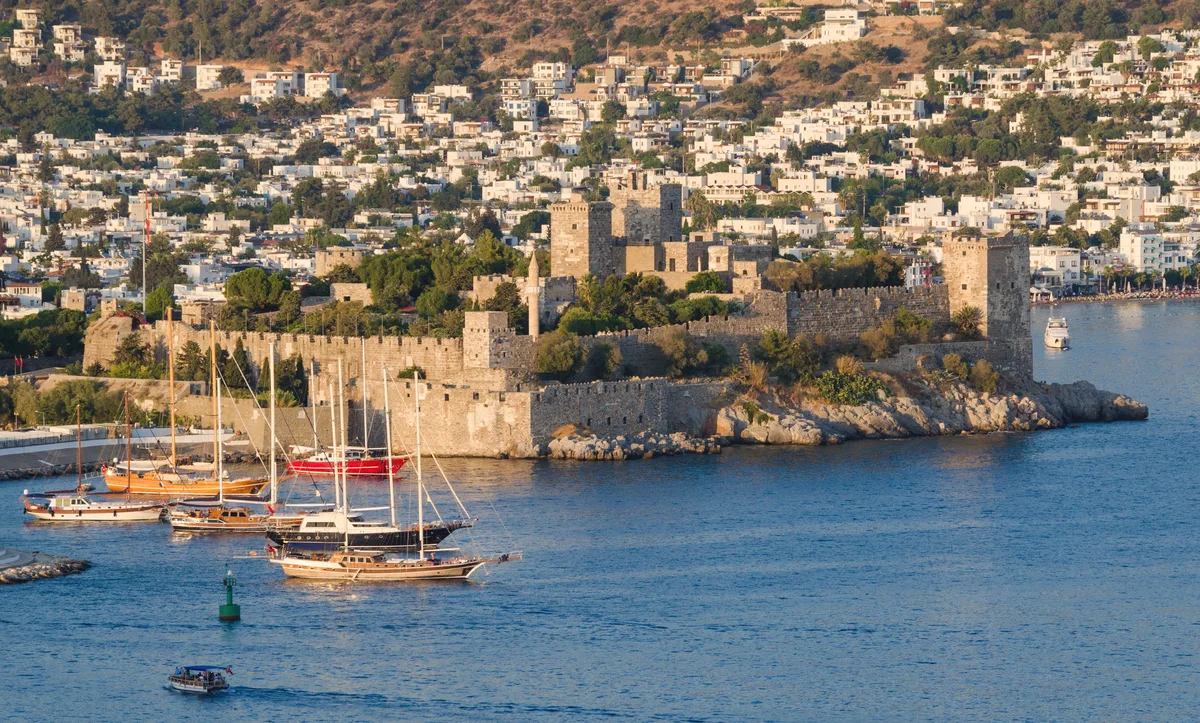
Most Turkish resort towns are a beach with a town attached. Bodrum is the other way round – a real, layered, working town that happens to sit at the root of a whole peninsula of bays, and this bodrum travel guide is written for travellers who want both halves of that bargain. In the space of one morning you can walk from the tomb that gave the world the word “mausoleum” to a crusader castle full of Bronze Age shipwrecks, eat lunch in a whitewashed lane that has not changed its mind in a century, and be swimming off a wooden gulet by three. Few places in Türkiye compress that much into that little geography, and none of them do it with Bodrum’s particular swagger.
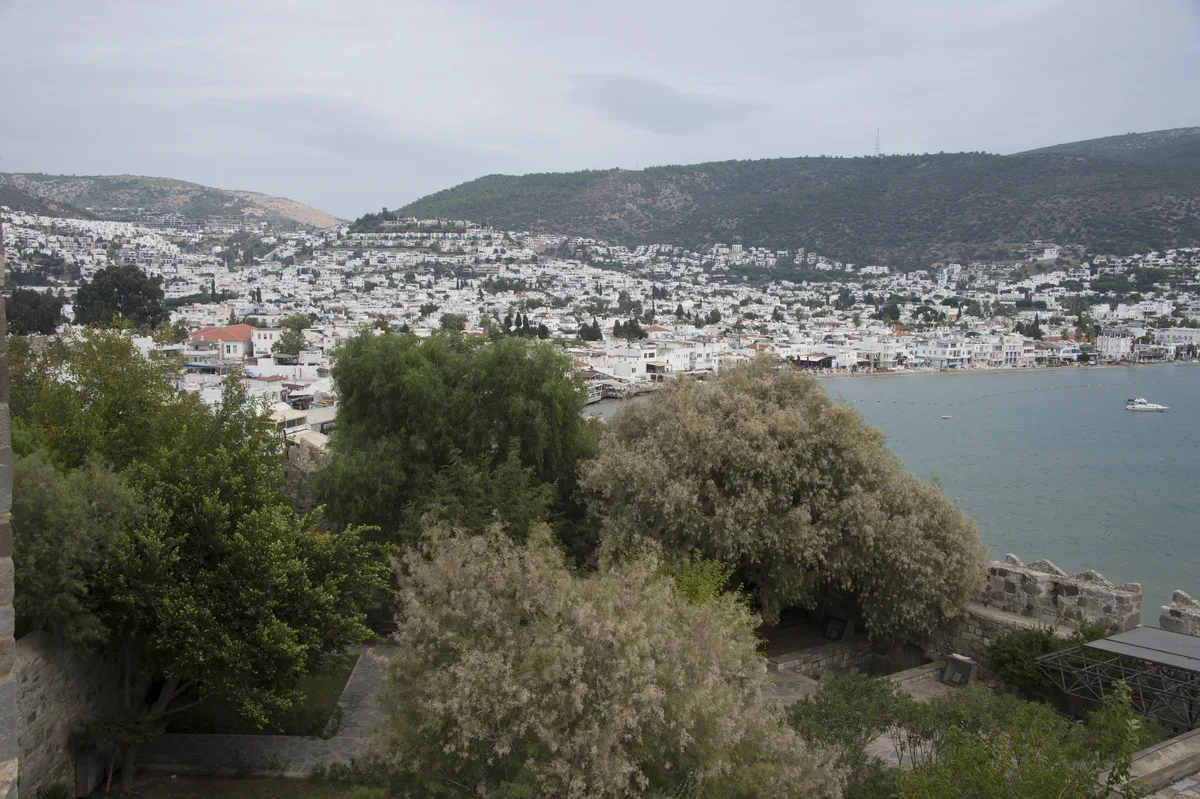
Understand the shape first. Bodrum town sits where the peninsula meets the Aegean, wrapped around two harbours divided by the castle rock. West and north of it, the peninsula fans out into a necklace of bays and villages – Gümbet and Bitez within a dolmuş ride, Ortakent across the middle, Gümüşlük at the slow west end, Türkbükü and Yalıkavak up on the fashionable north shore – each with its own water, its own crowd and its own idea of what a day is for. The town is the peninsula’s brain and bus station; the bays are its moods.
The second thing to understand is that Bodrum runs on two economies at once. It is Türkiye’s most self-consciously upmarket resort region – the marina quarter and the north-shore beach clubs price themselves against the Mediterranean, not against Anatolia – and at the same time it is a provincial Turkish town with a bazaar, a bus station, fishermen mending nets and grandmothers who have never set foot in a beach club. Both Bodrums are real, and the skill of a visit is knowing which one you are in at any given hour. The honest downsides section near the end of this guide is blunt about the first economy’s prices; the castle, the museum and the old town belong firmly to the second.
There is also a literary ghost in the streets. In the 1920s the writer Cevat Şakir Kabaağaçlı was exiled to Bodrum and, instead of counting the days, fell for the place so completely that he became famous as the Fisherman of Halicarnassus. He and the friends he lured down from Istanbul more or less invented the Blue Cruise – long, slow gulet voyages along this coast – and talked a sleepy sponge-diving port into becoming the town that now fills your feed. Bodrum’s polish is recent; its stories are not.
This bodrum travel guide is organised the way a stay actually unfolds. First the town, sight by sight – castle, museum, Mausoleum, theatre and gates – then the old town and marina quarters, then the peninsula bay by bay, the boats and the Greek-island ferry, and finally the machinery: getting here, getting around, seasons, where to sleep, what to eat, and the downsides stated plainly. If you are stringing Türkiye into one trip, our Istanbul Travel Guide covers the first chapter and the Cappadocia Travel Guide the inland one; this page is the Aegean chapter, and it argues for more nights than the brochures suggest.
At a Glance
| Question | Short answer |
|---|---|
| Where is Bodrum? | On Türkiye’s south-west Aegean coast, at the root of the Bodrum peninsula in Muğla province, opposite the Greek island of Kos |
| What is it, in one line? | Ancient Halicarnassus under a whitewashed sailing town – a crusader castle, a Wonder of the Ancient World and a peninsula of bays |
| Airport | Milas-Bodrum (BJV), north of the peninsula past Milas; plan on the better part of an hour by road to Bodrum town, longer to the far bays |
| Main sights | Bodrum Castle and the Museum of Underwater Archaeology, the Mausoleum of Halicarnassus, the ancient theatre, the Myndos Gate, the windmills |
| Museum status | The Underwater Archaeology Museum is listed as open to visitors on the official muze.gov.tr portal, every day, MüzeKart valid for Turkish citizens (checked 31 October 2026) |
| The signature journey | A day on a wooden gulet – Bodrum is the home port of the Blue Cruise |
| Best bays | Bitez for families, Gümüşlük for slow evenings, Türkbükü and Yalıkavak for the polished north shore, Gümbet for nightlife |
| The day trip | Kos, Greece – a short ferry crossing from Bodrum’s harbour; carry your passport and check your Schengen position before you sail |
| Best months | May to June and September to October; July and August are the hottest, busiest and most expensive weeks of the year |
| How long to stay | Three full days for the town; five to seven if the peninsula bays and a boat day are the point |
| Getting around | Dolmuş minibuses on set routes link the town with every bay; the town centre itself is a walker’s place |
Read the table as a warning as much as a summary. Bodrum’s sights are concentrated and genuinely world-class, but they sit inside a resort economy that peaks hard in midsummer, and the difference between a good Bodrum trip and a frazzled one is mostly timing – of the year, of the week, and of the day. On this peninsula, timing is not a detail. It is the strategy.
Bodrum Castle – the Fortress Between Two Harbours
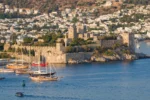
Every Bodrum photograph you have ever seen is anchored by the same silhouette. Bodrum Castle – the Castle of St Peter – spreads across the low rocky headland that splits the town’s waterfront in two, its towers and curtain walls built right into the sea on both sides. The Knights Hospitaller, the crusading order based on Rhodes, began it at the very start of the 15th century and named it for St Peter; for a little over a hundred years it was the mainland outpost of a Christian military order planted in a Muslim sea, garrisoned by knights drawn from across Europe and supplied by boat. When Rhodes fell to Suleiman the Magnificent at the end of 1522, the knights withdrew within weeks, and the fortress passed into Ottoman hands without the epic siege its walls seem to promise.
Look at how it was built and the castle becomes a history lesson in stone. It was an international project, and its great towers still carry the names of the nations that raised and manned them – the English Tower, the French Tower, the Italian Tower, the German Tower and the Snake Tower – while hundreds of carved coats of arms stud the walls, the visiting cards of the knights who served here. More remarkably, the builders helped themselves to the greatest ruin in town. Dressed marble, columns and carved reliefs from the Mausoleum of Halicarnassus, by then a thousand years old and already partly ruined, were built straight into these walls; Greek faces and frieze fragments keep surfacing in the medieval stonework. The castle is, quite literally, the Wonder of the Ancient World recycled – a fact that ties this section and the Mausoleum section below into a single story told at two addresses.
Plan the visit as a half day, not an hour. The fortress is a small walled town in itself – courtyards at several levels, gardens shaded by pines, towers to climb for the harbour views, and the museum halls threaded through it all. From the towers you read the whole geography of this guide at once – marina, old town, Gümbet’s curve, the Greek islands blue on the horizon. The castle also has residents. Peacocks wander the courtyards with the confidence of staff, and meeting one displaying under a pine tree, entirely unbothered by the Bronze Age downstairs, is the kind of detail that makes children – and most adults – remember the fortress over the artefacts.
Practical honesty belongs here. The castle is a medieval fortress, not a modern museum building, and it shows its age on your legs: the circuit involves repeated flights of steep stone stairs, uneven surfaces and very little shade on the upper works. Go early in the day in summer, carry water, and treat the climb to the highest towers as the workout it is rather than a stroll. The castle stands on Türkiye’s UNESCO World Heritage Tentative List, and it earns the nomination on both its stories – the knights who built it, and the far older monument they built it out of.
Courtyards, Gardens and Resident Peacocks
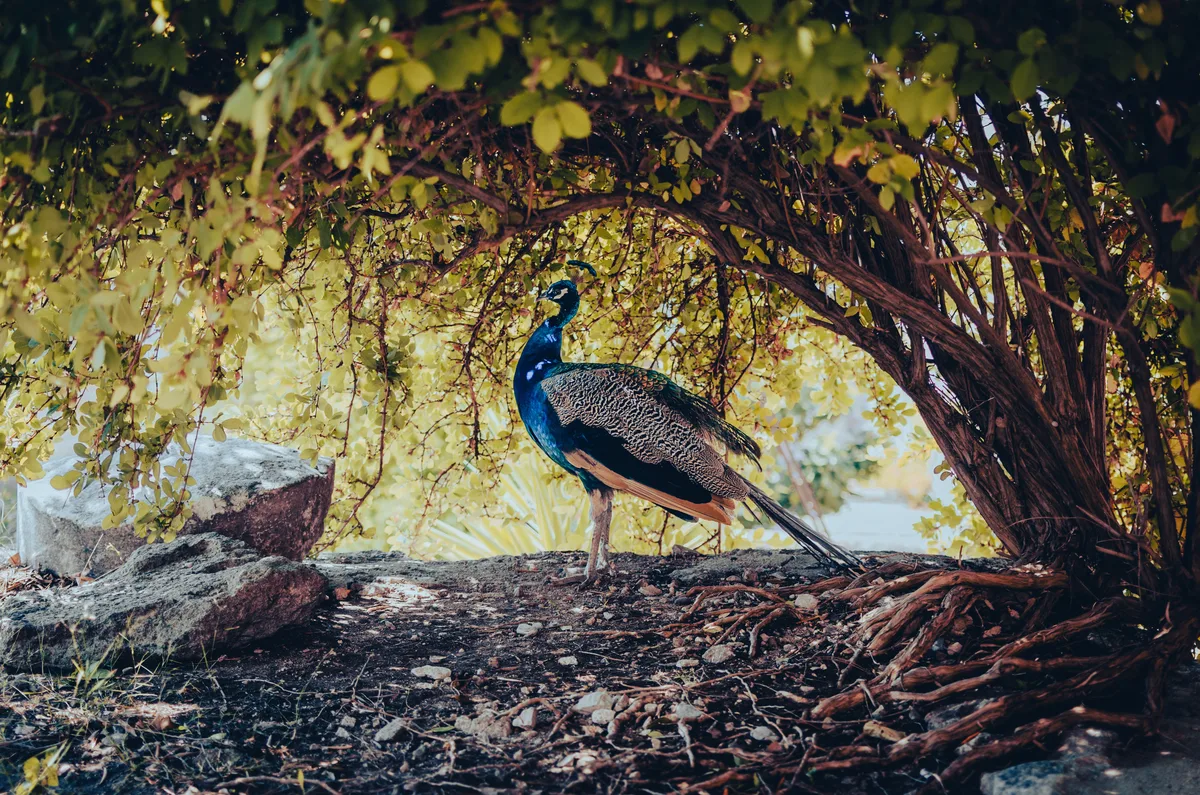
Between the towers, the castle’s courtyards run as gardens – pine shade, planted beds and quiet corners where the excavated stone of three civilisations is stacked, labelled and left to weather picturesquely. This is the part of the visit nobody photographs for the brochure, and for many visitors it is secretly the best of it. The museum’s halls are dense with information; the courtyards are where you sit down with a cold drink, let the Uluburun’s cargo settle in your mind, and watch swallows work the walls. Allow the visit its pauses. A castle-museum seen at a march feels like homework; the same circuit with garden breaks feels like a morning in a walled town that happens to contain a great museum.
A small population of peacocks lives in the grounds, drifting between the courtyards – the castle’s unofficial guides, heard before they are seen. They are also a useful honesty check on the whole experience. Any site where the wildlife is this relaxed has space and calm designed into it somewhere, and Bodrum Castle, for all its summer visitors, keeps both. If the halls are at their busiest when you arrive, walk the walls and gardens first and let the tour groups thin; the Bronze Age will wait, and it reads better in a quieter room.
The Museum of Underwater Archaeology – Shipwrecks in a Castle
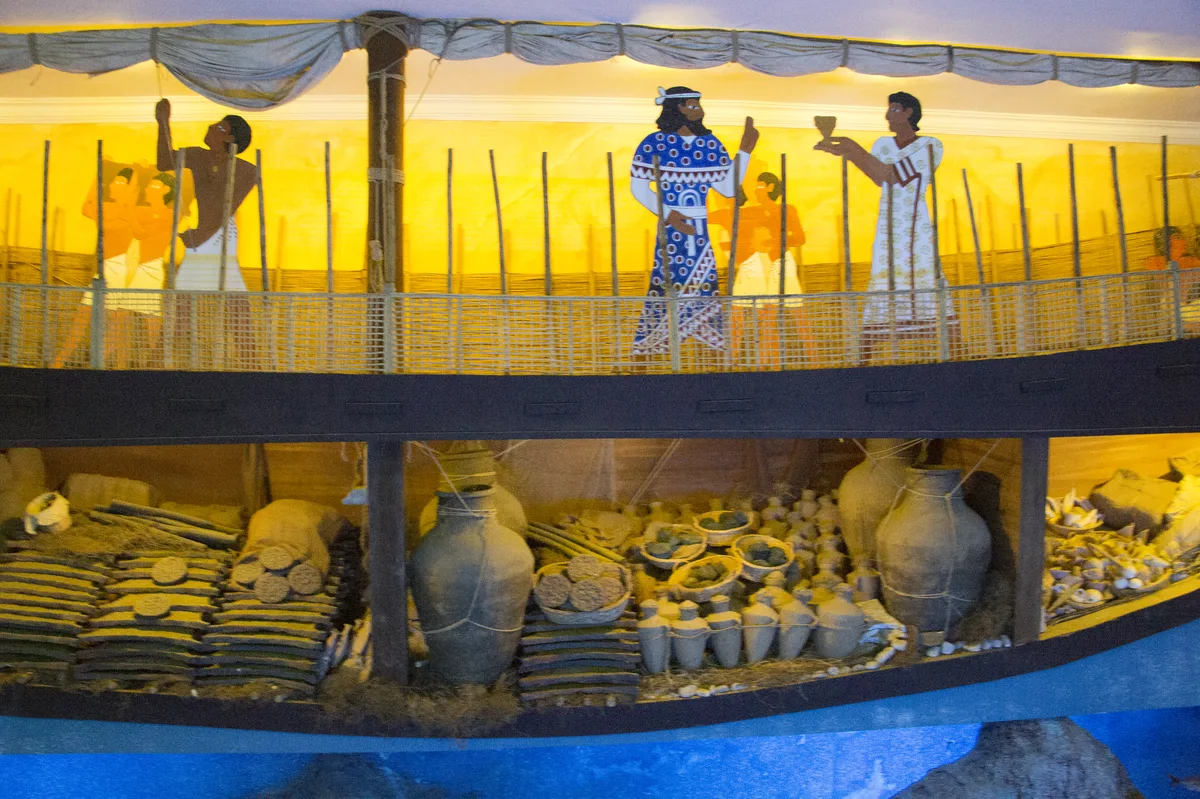
Inside the castle’s halls sits the reason Bodrum matters to archaeology far beyond Türkiye. The Museum of Underwater Archaeology, open since 1964, is the only museum in the country devoted to the subject and one of very few in the world – a collection built almost entirely from excavated shipwrecks, raised piece by piece from the seabed along this coast since 1960. The official museum portal, muze.gov.tr, lists it as open to visitors and open every day, with the MüzeKart valid for Turkish citizens and an audio guide available – checked for this guide on 31 October 2026. What that dry listing cannot convey is the density of what is inside: hall after hall of cargoes that went down between the 16th century BC and the 16th century AD, each one a sealed time capsule of its age.
The star is the Uluburun shipwreck, a Late Bronze Age merchantman of the 14th century BC whose cargo – copper and tin ingots, glass, resin, jars of goods from half the known world – the ministry itself calls the most significant discovery of the 20th century in underwater archaeology. Stand in front of it and you are looking at international trade three and a half thousand years old, itemised. Around it the portal’s own hall list reads like a syllabus of the sea: the Late Bronze Age Shipwrecks Hall, the Tektaş and Bozukkale Archaic wrecks, the Yassıada shipwrecks spanning Rome and Byzantium, an amphora exhibition drawn from one of the largest collections of its kind in the world, and a hall on the discipline’s own history, which begins with Bodrum’s sponge divers.
Give the museum its own time rather than treating it as the castle’s contents. The two visits share a ticket gate and a site, but they reward different speeds – the fortress wants wandering, the museum wants reading – and trying to rush both in ninety minutes short-changes each. A workable rhythm for any bodrum travel guide to recommend is ramparts first, in the good light, then the halls at midday, when their stone coolness is a feature rather than a circumstance. One honest caution: individual halls in a working museum can close for conservation at any season, so if one specific wreck is the reason for your trip, check the museum’s official page in the week you travel rather than trusting any guidebook – this one included.
The Serçe Limanı Glass Wreck – a Thousand-Year-Old Recycling Run
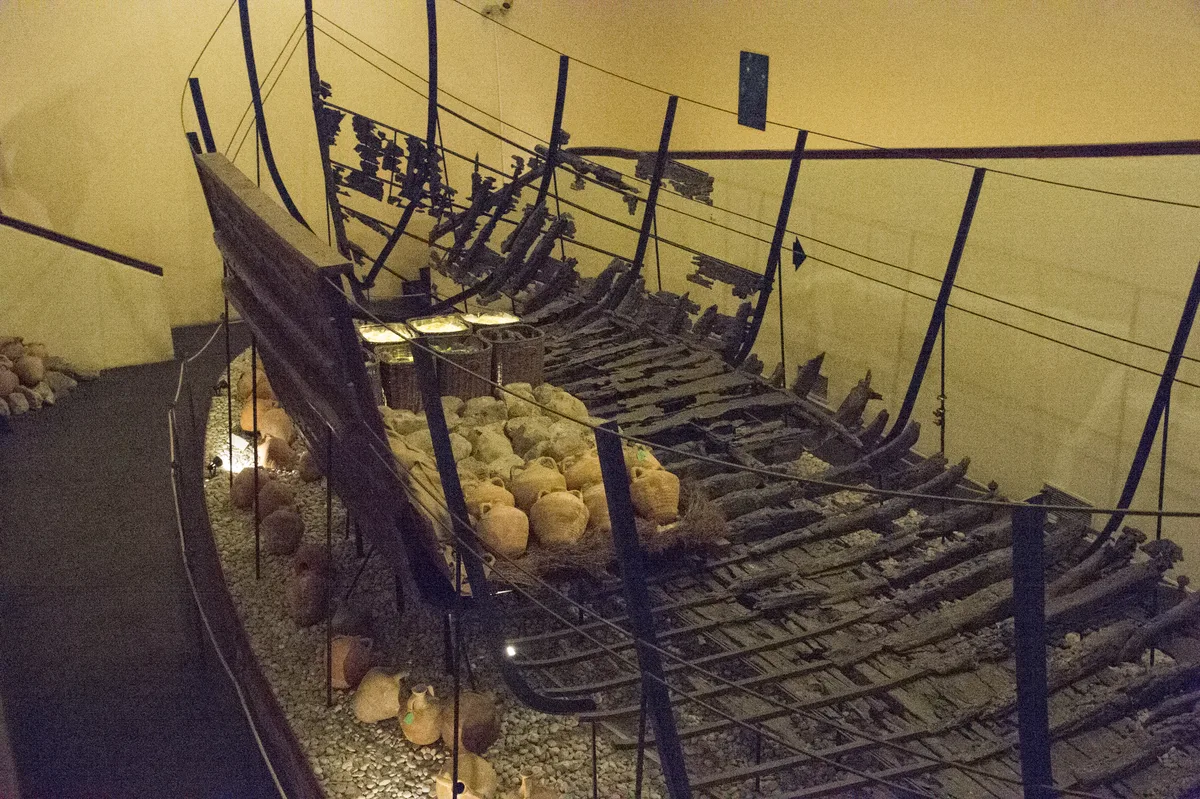
If the Uluburun is the museum’s deep past, its most human story sank in the 11th century AD in a little bay called Serçe Limanı, down the coast from Bodrum. The ship that went down there was carrying, among more ordinary freight, tonnes of glass – finished vessels from Syria, then the great Islamic glassmaking centre of the medieval world, and a hold full of broken glass cullet being carried for recycling, a thousand years before recycling was a slogan. Raised and reconstructed, wreck and cargo together became the museum’s celebrated Glass Wreck hall, and the collection it produced is described by the ministry as the largest group of medieval Islamic glass of its kind. The charm of it is its ordinariness: not a royal treasure ship, just a working vessel on a working run, whose bad day preserved an entire industry’s output intact.
The wreck halls also carry a quieter lesson that the best bodrum travel guide should not skip, because it explains why this museum exists here at all. Underwater archaeology as a discipline was effectively invented on this coast in the 1960s, when archaeologists working with Bodrum’s sponge captains – men who had been reading the seabed since boyhood – began excavating wrecks scientifically instead of salvaging them. The museum’s hall on the history of the field tells that story with the divers’ own equipment. You are not just looking at old ships; you are looking at the birthplace of a science, housed in a crusader castle, in a town whose fishermen midwifed it. Türkiye has grander museums. It does not have a better story than that.
The Mausoleum of Halicarnassus – a Wonder You Have to Imagine
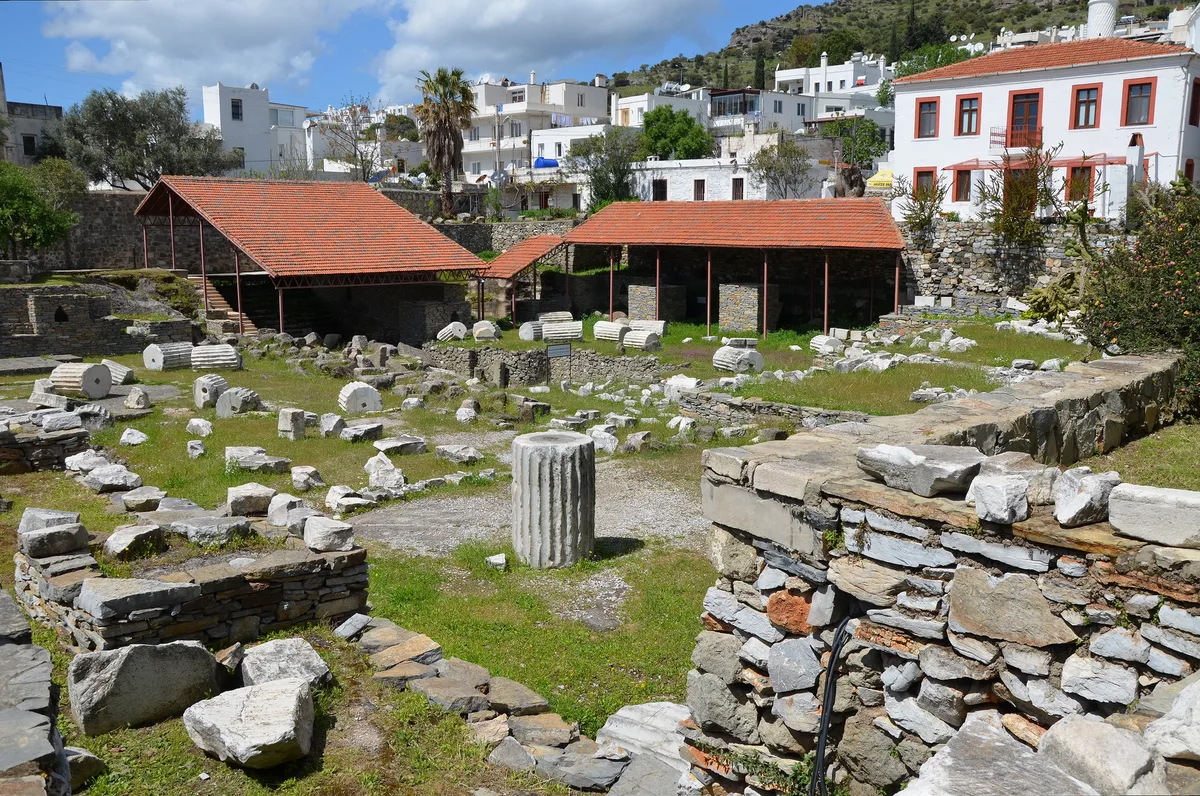
Ten minutes’ walk uphill from the marina, on an ordinary street in the Tepecik neighbourhood, a fenced plot of excavated ground holds one of the most famous addresses in the ancient world. This is the site of the Mausoleum of Halicarnassus, the tomb of Mausolus, the 4th-century BC ruler of Caria, completed after his death in 353 BC under his wife and sister Artemisia – and so magnificent that his name became the generic word for every grand tomb built since. It was counted among the Seven Wonders of the Ancient World, and unlike most of the others it stood for an almost absurd length of time: some sixteen and a half centuries, through Rome, Byzantium and the early Ottomans, before a series of medieval earthquakes finally brought it down. The ministry’s own museum listing gives you its shape: on a terrace roughly 105 by 242 metres stood a high podium, a colonnade of 36 Ionic columns, a stepped pyramid roof of 24 stairs, and at the summit a four-horse chariot carrying statues of Mausolus and Artemisia, the whole rising to around 45 to 50 metres. The four most celebrated sculptors of the age – Scopas, Bryaxis, Leochares and Timotheus, if Pliny is to be believed – each took a side.
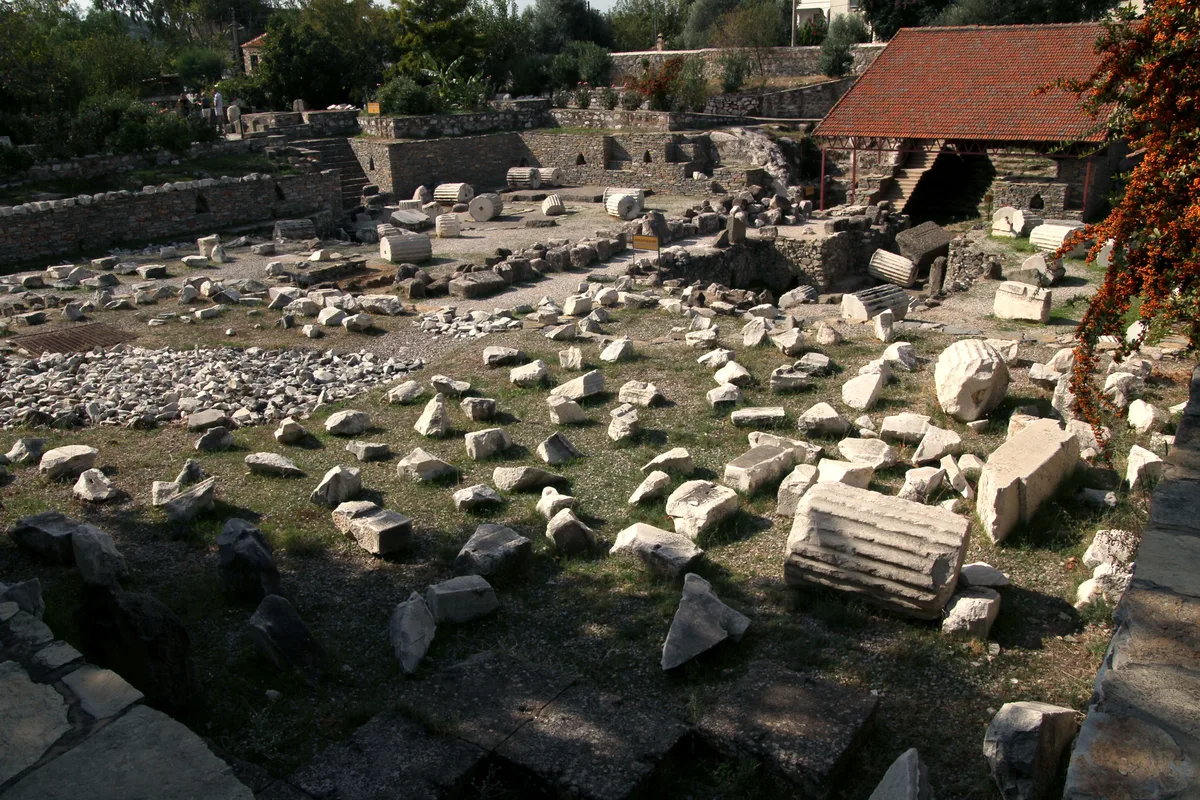
Now the honesty this site demands, because the gap between the Wonder and the visit is the widest in this entire guide. What you see today is the footprint: the great foundation pit cut into the bedrock, drainage channels, the corridor of the burial chamber, scattered marble fragments and column drums, and a modest exhibition space with models and reliefs that work hard to rebuild the monument in your head. The tomb’s sculpture is mostly not here. What the earthquakes left, the Knights of St John carried off to build their castle – you have already walked past Mausoleum marble in its walls – and what the knights left, 19th-century British excavations under Charles Newton shipped to the British Museum, where the great friezes and the chariot horses stand in London to this day. Danish excavations in the 1960s and 1970s mapped what remained, and the site has been organised as a small memorial museum since 1982, listed on the ministry’s museum portal as the Muğla Bodrum Mausoleum Memorial Museum – the portal lists it as closed on Mondays, so check the listing before you plan the day around it.
And yet it belongs on your itinerary, for two reasons no photograph of ruins can argue with. The first is that imagination is a genuine travel pleasure when the material is this good: stand in the foundation pit with the model’s image in mind and the scale lands – this modest plot held a building taller than a fifteen-storey block, in a provincial capital, in 350 BC. The second is that the Mausoleum explains Bodrum. The castle is built of it, the museum’s land halls hold its city’s dead, the theatre below was raised by the same dynasty. Skip the site and the town is a resort with antiques; visit it, and the whole place becomes one connected story about a Carian kingdom that decided to be remembered forever – and succeeded.
Halicarnassus Beyond the Mausoleum – Theatre, Walls and a Hilltop Town
The ancient city did not end at the tomb, and neither should your walking. Halicarnassus was rebuilt as a showpiece capital by Mausolus himself – a purpose-built city of walls, terraces and temples behind its two harbours – and pieces of that city still surface all over the modern town, most of them free, unfenced and folded into ordinary streets. Give them an hour together, ideally in the late afternoon when the stone cools, and they add the connective tissue this bodrum travel guide keeps promising: proof that the castle and the museum are episodes in a much longer urban story.
None of the three stops on this walk asks for a ticket desk, a queue or a plan, which is part of their charm. The theatre is an open hillside, the gate is a roadside ruin, and Pedasa is a walk in the woods – Halicarnassus at its least packaged, and the version of the ancient city that locals actually live alongside.
The Ancient Theatre – Mausolus’s Other Monument
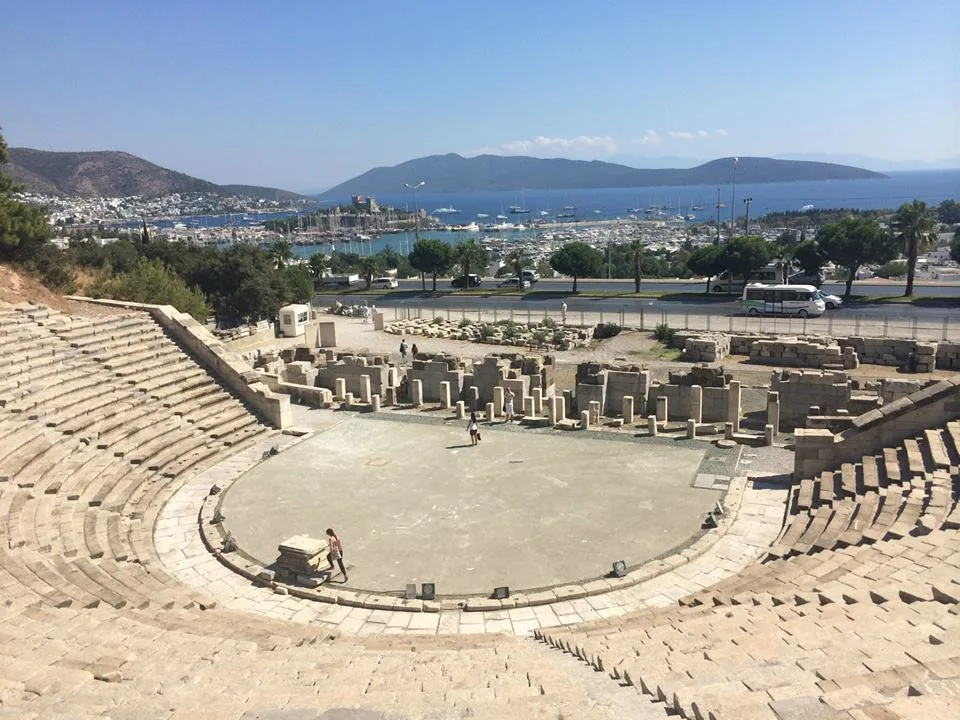
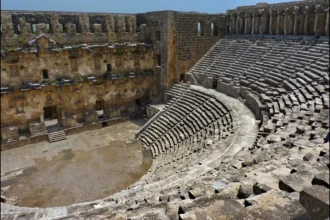
On the hillside above the harbour road, its seats cut into the slope in a great stone fan, sits the ancient theatre of Halicarnassus – built in the 4th century BC in Mausolus’s reign and enlarged in the Roman period, when the city it entertained was already ancient. It is the most complete survivor of the dynasty’s building programme, and the most sociable: restored in modern times, it still hosts concerts and performances, so the odds are decent that the stage below the ancient seats is dressed for something modern when you visit. Even empty, the theatre earns its climb twice over – once for the building itself, its orchestra and stage house legible in the stone, and once for the view, which frames castle, harbour and islands in a single sweep and explains better than any map why the city was planted exactly here.
Visit it as part of the same walk as the Mausoleum, five or ten minutes away on foot, and notice what the pairing tells you. The tomb was the dynasty’s message to eternity; the theatre was its message to its own citizens, that Halicarnassus was a Greek city of culture and not merely a satrap’s stronghold. Both messages survived the messenger by more than two thousand years. Grander theatres exist in Türkiye, but few still sit inside a living town, walked past by schoolchildren and used for summer concerts, quite as unceremoniously as this one.
The Myndos Gate – Where Alexander Bled
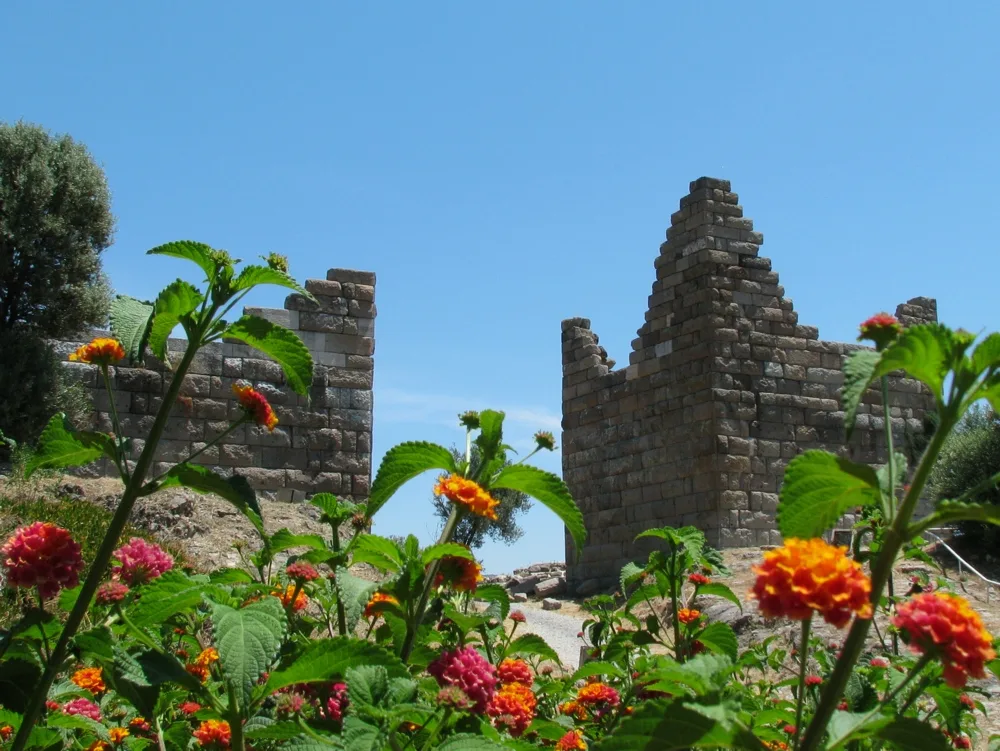
At the western edge of the old city, where the road runs out toward Gümbet, two weathered towers and a stretch of wall stand in a scrap of open ground. This is the Myndos Gate, the western gate of Mausolus’s city walls – and the scene of some of the hardest fighting of Alexander the Great’s career. When Alexander besieged Halicarnassus in 334 BC, the defenders sortied from this gate and the ditch before it filled, by the ancient accounts, with the dead of both sides; it was among the most stubborn resistance he met in Anatolia, and the city he eventually took was half-abandoned and burning. Nothing at the quiet, bougainvillea-framed site announces any of this. You have to bring the story with you, which is precisely the pleasure of it.
The gate also makes a useful navigation point, because it marks where the ancient city ended and the peninsula began – everything west of here in this guide, Gümbet first of all, is the modern resort’s territory. A few kilometres inland and uphill, serious walkers can add one more layer: the hilltop settlement of Pedasa, above Konacık, a far older Carian-Lelegian town of domed tombs and rough stone walls in the pine woods, excavated in recent decades and still blissfully unvisited compared with the coastal sights. The museum in the castle keeps a whole hall for Pedasa’s finds. Between the gate, the theatre and the hill, a traveller with one free afternoon can read Bodrum’s story backwards for three thousand years without spending a lira on transport.
The Old Town – Whitewashed Lanes, the Bazaar and Bar Street
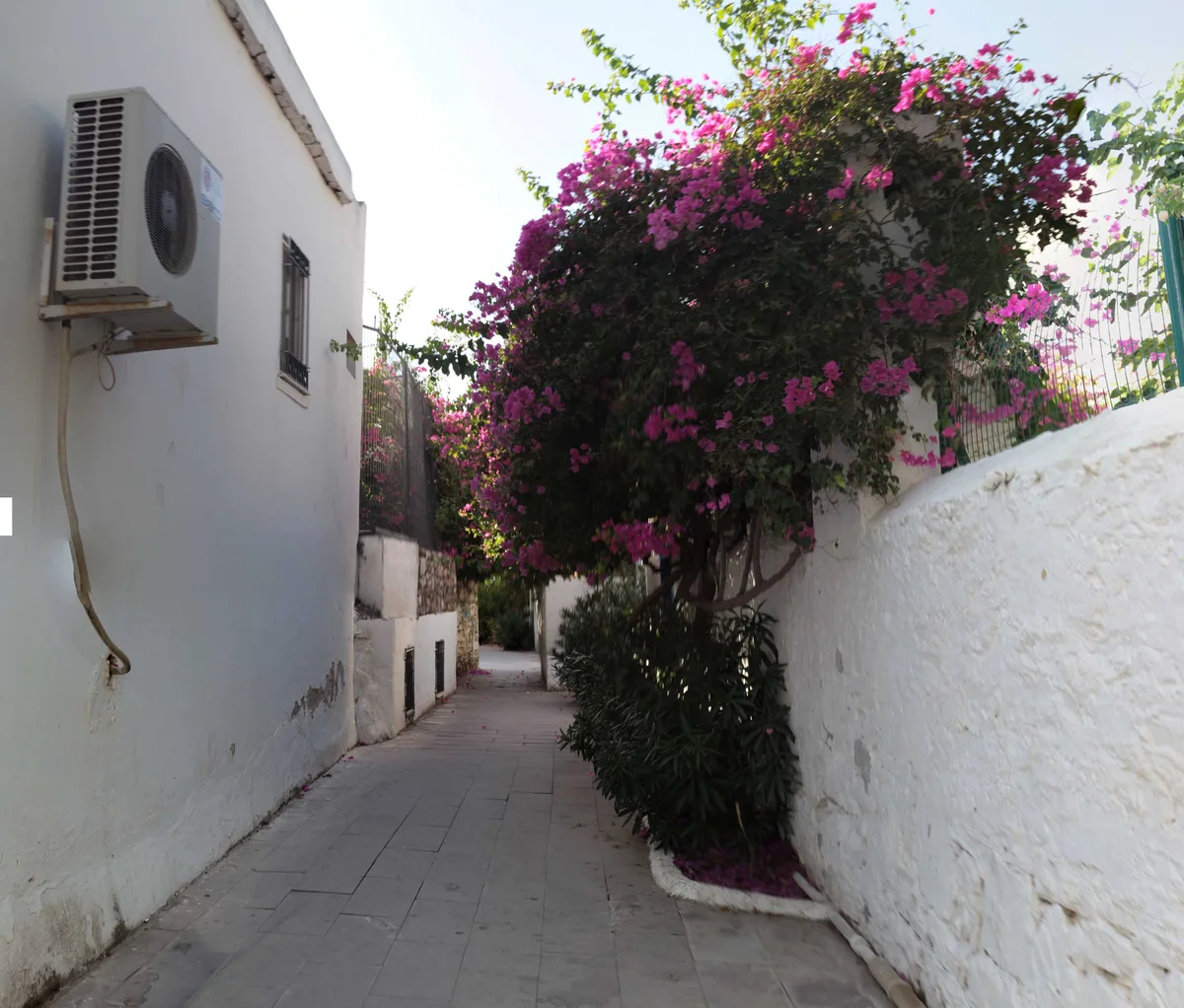
Turn inland from the harbour, away from the yachts, and Bodrum changes tense. The old town is a tight grid of lanes between the castle and the bus station where the houses are white, cubic and flat-roofed by a building tradition so consistent it amounts to a local law of aesthetics – whitewash, blue shutters, bougainvillea doing the decorating. Bodrum houses became so emblematic that the style is imitated up and down the Aegean; here it is not a style, it is just the housing stock, and the lanes behind the bazaar are where the town still lives in it. Walk them in the early morning, when the cafes are setting out chairs and the only crowd is cats, and you will understand why writers kept getting exiled here and refusing to leave.
Two streets organise the quarter’s public life. The bazaar streets around the old market sell the peninsula’s real economy – leather, textiles, jewellery, spices, beach gear and a cheerful tide of lookalike luxury – with the haggling dial set noticeably lower than in Istanbul’s Grand Bazaar and the shopkeepers correspondingly less theatrical. Parallel to the harbour runs the town’s famous nightlife strip, known to everyone simply as Bar Street, a canyon of clubs and music bars that operates at industrial volume in season. Bar Street is genuinely fun if it is your scene, honestly skippable if it is not, and the old town’s lanes two streets back remain quiet enough that you can choose your Bodrum each evening and change your mind by morning.
What the old town does best is feed the in-between hours. The meyhane taverns and fish restaurants in the lanes off the harbour serve the Aegean dinner in its classic sequence – a table of cold meze, something hot and herby, the day’s fish – to a crowd that is still mostly Turkish well into the evening, while the tea gardens and coffee houses hold the daytime shift. Base yourself anywhere near here and the town’s whole double life is within a ten-minute walk: castle and museum by day, bazaar at dusk, dinner in a lane, and the harbour lights for the walk home. It is the strongest argument in this guide for sleeping in town rather than out in the bays.
The Marina Quarter – Gulets, Yachts and the Evening Waterfront
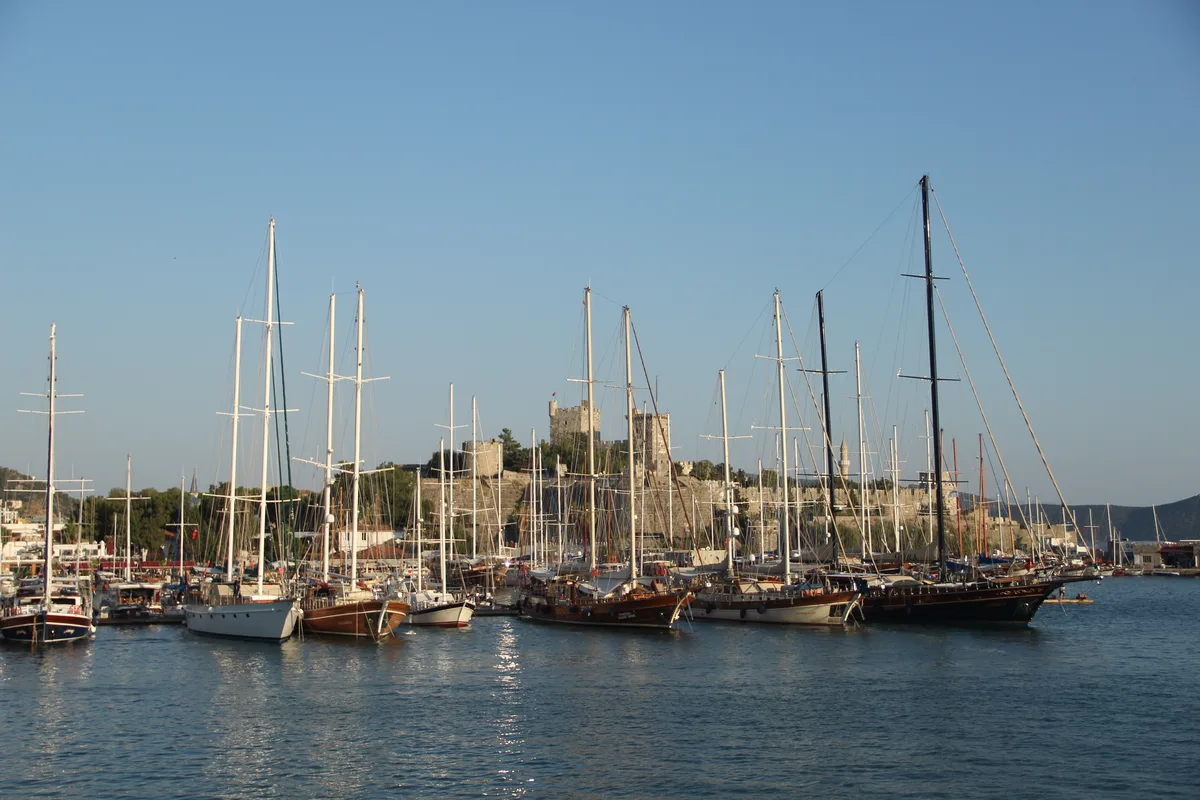
Bodrum’s two harbours do different jobs, and the waterfront makes most sense once you see the division. The western bay is the working heart: rows of wooden gulets – the broad, handsome, locally built sailing cruisers that are Bodrum’s gift to Mediterranean yachting – moored raft upon raft along the quay, their crews varnishing, provisioning and touting day trips in a dozen languages. The eastern side, under the castle, is the polish: the town marina with its forest of yacht masts, its chandleries and cafes, and the evening promenade where the whole town comes to walk off dinner. Between them the castle watches over both, exactly as it was built to do.
Spend time on the gulet quay even if you never board one. Bodrum is where the modern Turkish yacht industry grew up – the boatyards in the town’s İçmeler district still build and refit wooden yachts by methods that mix traditional timber work with superyacht budgets, and the harbour fleet ranges from scruffy day boats to floating palaces. The promenade at sunset is the town’s daily theatre: families with ice creams, fishermen selling the evening catch off the stern, captains chalking tomorrow’s routes on boards, and the light doing spectacular things to whitewash and water. The marina quarter’s one flaw is that its cafes know what a harbour view is worth: the closer your chair is to the water, the more of the bill is scenery.
The marina is also where the peninsula’s class divide is most politely visible. Bodrum town’s harbour serves everybody – trip boats, fishing boats, ferries, superyachts – and a ten-minute waterfront walk takes you past all of it, which is more democratic than the north shore’s gated marinas manage. The town is not the sealed, expensive Monaco of its reputation. It is a port that got famous – the port part still works, still smells of diesel and fish, and still puts on its best show free every evening at the water’s edge.
The Windmills and Gümbet – the Party Shore Next Door
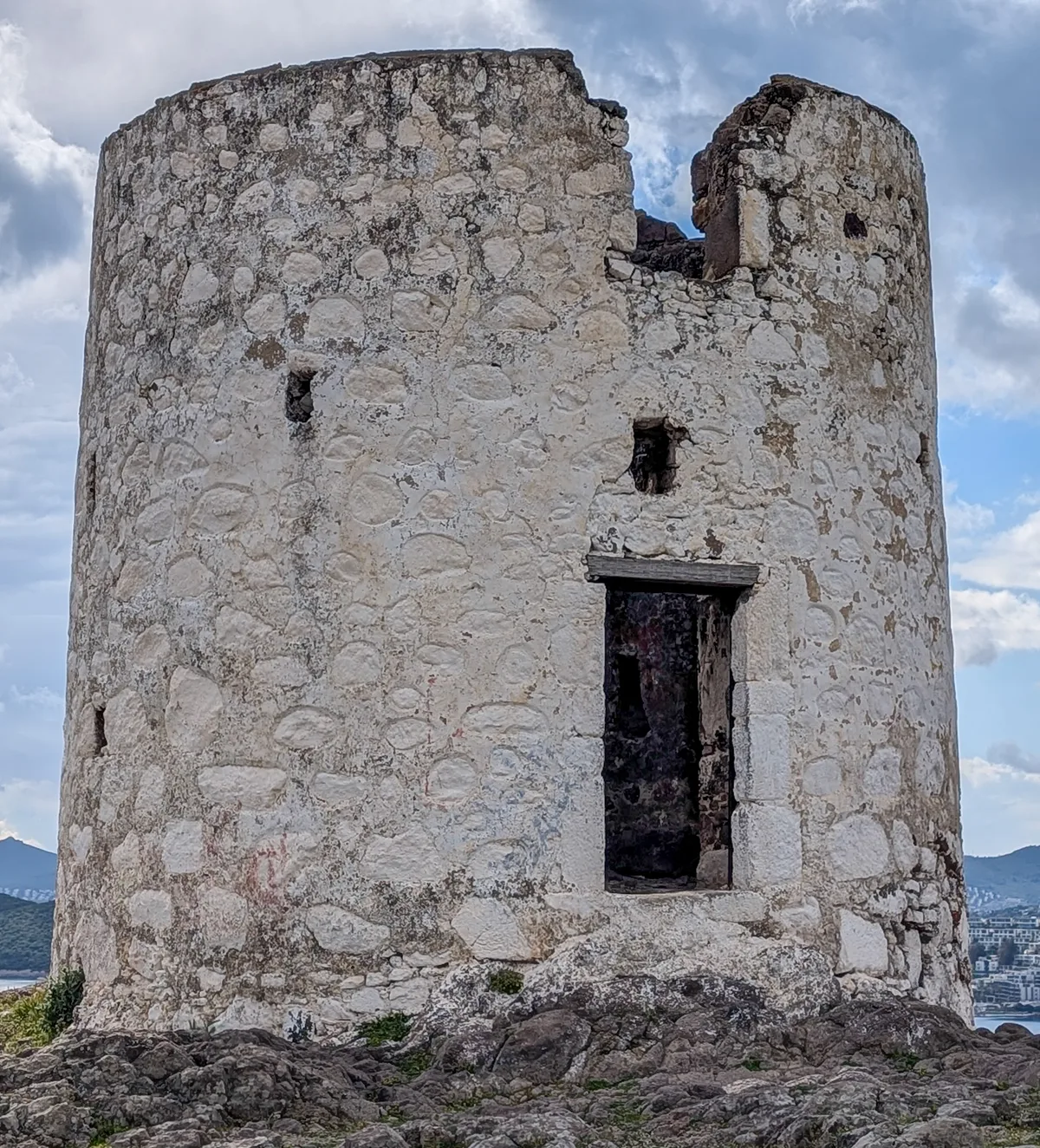
On the ridge between Bodrum town and Gümbet bay stands a row of cylindrical stone windmills, whitewashed, sail-less and quietly crumbling, facing the wind they were built to catch. They ground the peninsula’s grain in the centuries before engines, and today they do a different job: they are the hinge between the two Bodrums, the town behind you and the resort in front, and the walk up to them at sunset – twenty minutes of uphill lanes from the harbour – is one of the best free evenings in this guide. From the ridge the whole local geography lines up for inspection: castle and old town behind you, Gümbet’s hotels spread below, the islands turning the colour of the light.
Gümbet itself needs no selling and one honest paragraph. It is Bodrum’s nearest resort bay, a curving beach of hotels, water-sports jetties and beach clubs that runs loud and late – its own bar street has rivalled the town’s for decades, and its crowd is the youngest and most package-holiday-shaped on the peninsula. In its favour: it is walkable or one short dolmuş from everything in the town sections above, its swimming is easy, and its prices sit a clear rung below the north shore. Against it: in high season it can feel like an industry rather than a place, and light sleepers should read hotel reviews for the word “noise” with great care. Choose Gümbet if your trip’s centre of gravity is beach by day and bars by night with the castle as a day trip; choose the town or Bitez if the equation runs the other way.
Bitez – the Peninsula’s Family Bay
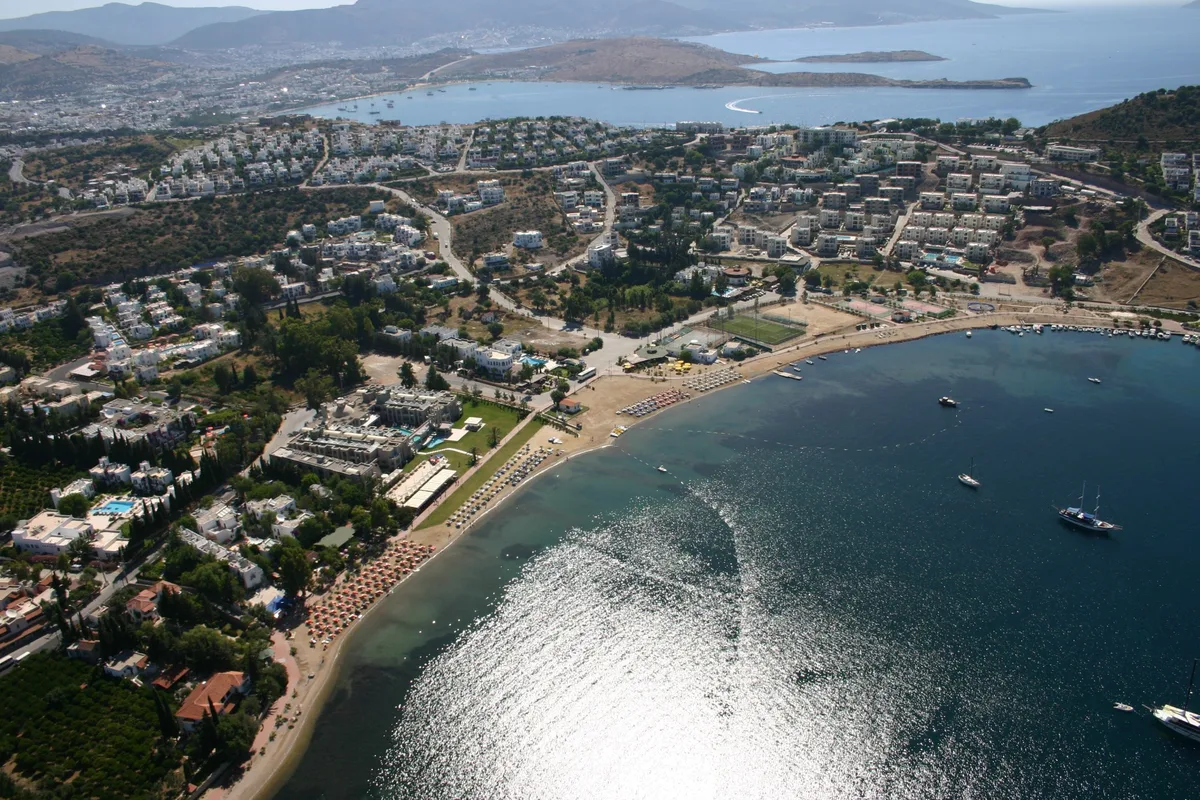
One bay further west, the tempo drops by half. Bitez fills a green valley famous for its tangerine groves – the land behind the beach is still orchards and gardens rather than hotel blocks – and its bay is a long, sheltered crescent of sand shelving so gently into clear water that small children can wade out a heroic distance and still be standing up. That single piece of geography explains the whole village: Bitez is where Turkish families from the big cities take their summers, where the beachfront is a lane of low-key cafes and family-run hotels rather than clubs, and where the loudest scheduled event is the afternoon breeze arriving to remind the windsurfers at the bay’s end that it is their shift.
The bay divides by temperament along its length. The village end keeps the cafes, the mosque and the slow local morning; the middle is beach clubs and hotel gardens at a civilised volume; the far end picks up the wind that makes Bitez a boardsailing name, with schools renting kit to beginners in the safe shallows. Behind the beach, the valley lanes run up through the tangerine groves toward Ortakent – a green, shaded walk or cycle that feels a world away from the marina quarter and is, in distance, barely four kilometres. Any bodrum travel guide should say plainly that Bitez is the peninsula’s easiest recommendation for families: close to town, kind water, honest food, and in bed at a human hour without feeling the holiday ended at nine.
The North Shore – Türkbükü and Yalıkavak
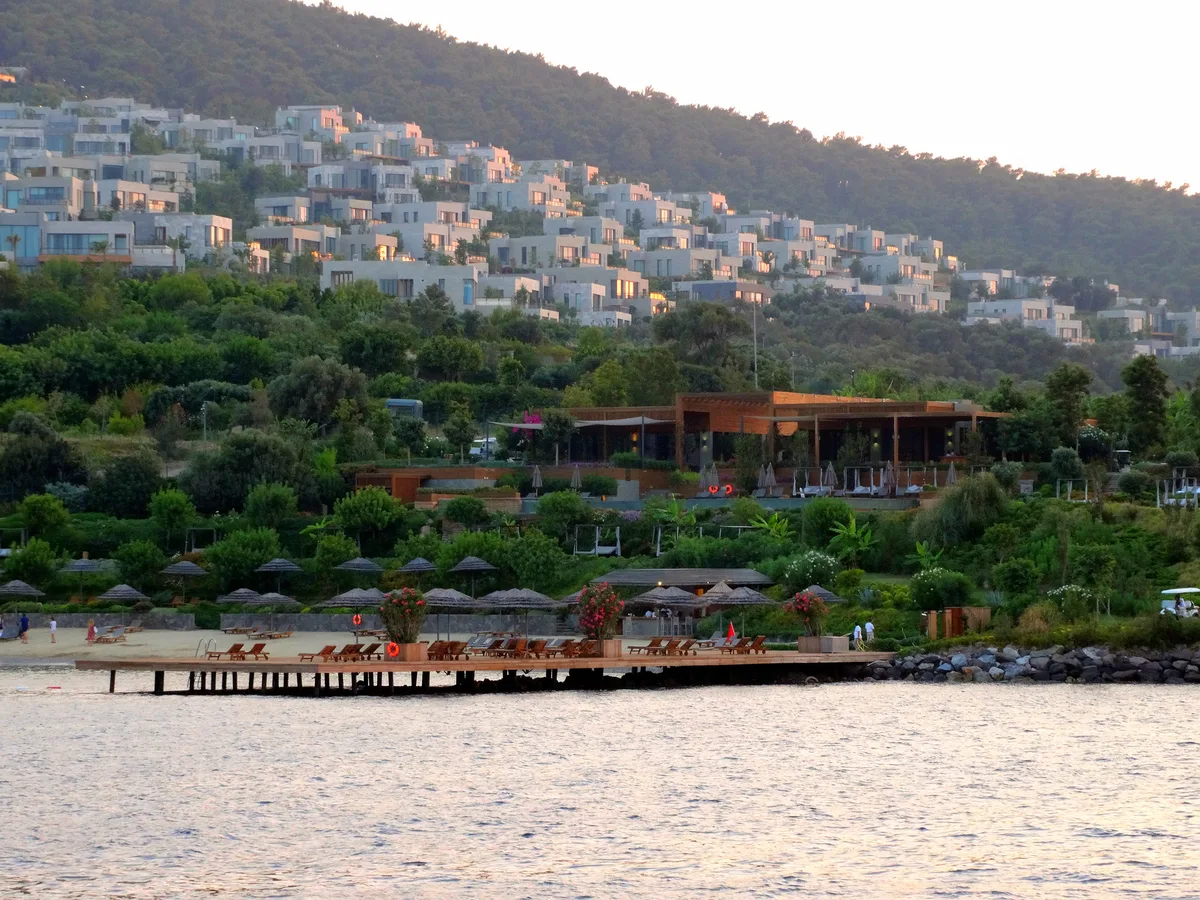
Cross the peninsula’s spine and the road drops to a different republic. The north shore – the string of bays from Torba through Türkbükü and Gölköy to Yalıkavak – is where Bodrum’s reputation was minted: the shore of superyachts at anchor, beach clubs with booking lists, and summer houses belonging to Istanbul’s business and media dynasties. Türkbükü, the twin village of Göltürkbükü wrapped around its bay, is the epicentre. Its waterfront is a near-continuous deck of restaurants and beach clubs built out over water so clear the fish audit your lunch, its anchorage fills with serious yachts in season, and its social mechanics – who is at which club, on which jetty, in which boat – are covered by the Turkish press the way other countries cover football.
Go anyway, at least for a day, because the north shore is also genuinely beautiful and genuinely good at the things it sells. The water on this coast is the peninsula’s clearest, the swimming off the jetties is superb, the fish restaurants are among the best in the region, and a long lunch on a Türkbükü deck – grilled fish, cold meze, the bay glittering – is one of the great Aegean pleasures at any budget that can stretch to it once. The honest framing is seasonal: in July and August this shore runs at full celebrity wattage with prices and booking pressure to match, while in May, June and September the same decks, the same water and the same kitchens operate at a humaner register. The dolmuş network reaches Türkbükü from Bodrum town, so the north shore works as a day trip from a town base as well as a base in itself – which is how most travellers in this guide’s budget will enjoy it best.
Yalıkavak – the Marina Village That Ate the Luxury Market
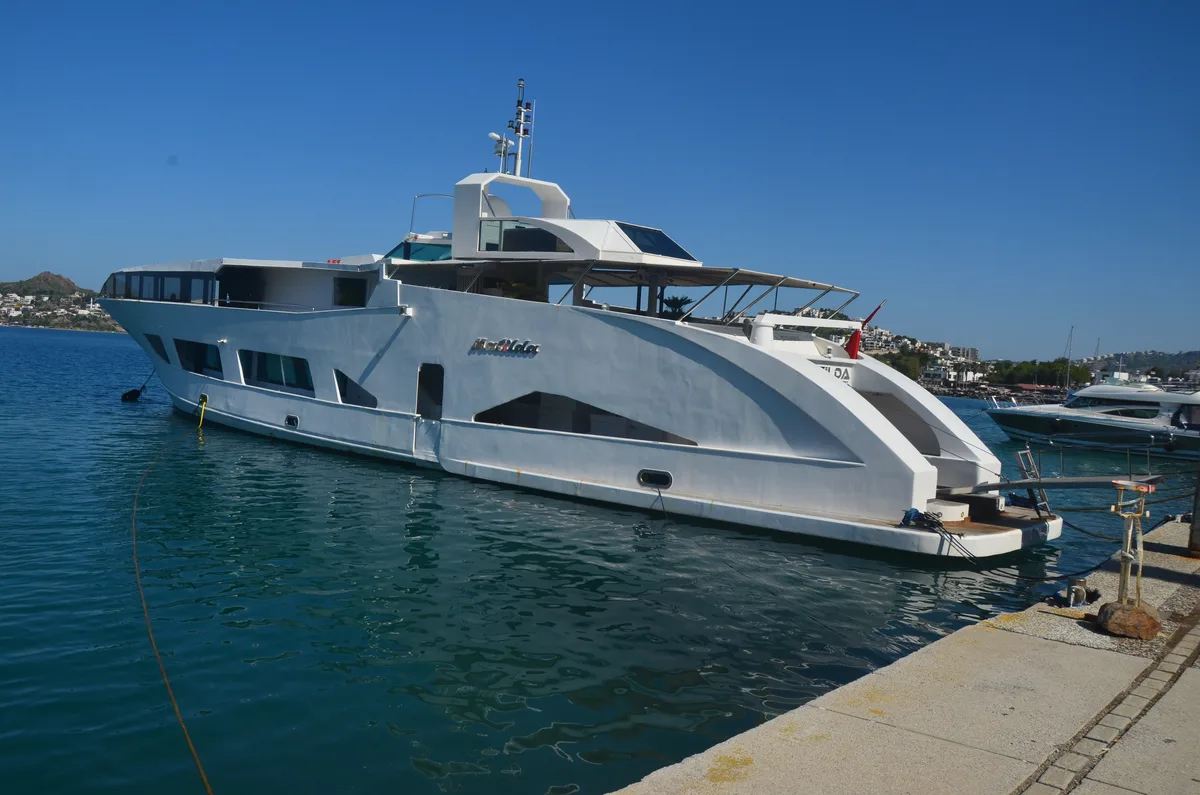
At the peninsula’s north-western corner, Yalıkavak completes the north shore’s argument. A generation ago it was a sponge-fishing and tangerine village known for its sunsets and its windmills; today its marina is one of the largest and most decorated in the Mediterranean, a small city of superyachts with a shopping avenue of international brands, an open-air concert programme in season and a promenade built for the evening yacht inspection ritual. The old village survives behind it – Thursday’s market, the fish restaurants along the older harbour, lanes of white houses climbing toward the windmills – and the two Yalıkavaks coexist with less friction than you might expect, the marina’s money having plainly done the village no harm at all.
Yalıkavak is the north shore’s best base if you are staying on it, precisely because it is a real place wearing its marina rather than a resort pretending to be one. Its sunsets are the peninsula’s famous ones – the sun drops into the Aegean between the Greek islands, and the whole western waterfront arranges its evening around the ten minutes when it happens. Its weakness is distance from the town sights: the castle and museum are a dolmuş ride of the better part of an hour away, so Yalıkavak guests tend to see Bodrum town once, thoroughly, rather than drifting in and out of it. Treat the peninsula’s geography with respect when you choose where to sleep, and the choice makes itself: town for the sights, north shore for the scene, and the west end – next – for the quiet.
Gümüşlük – the Slow West End
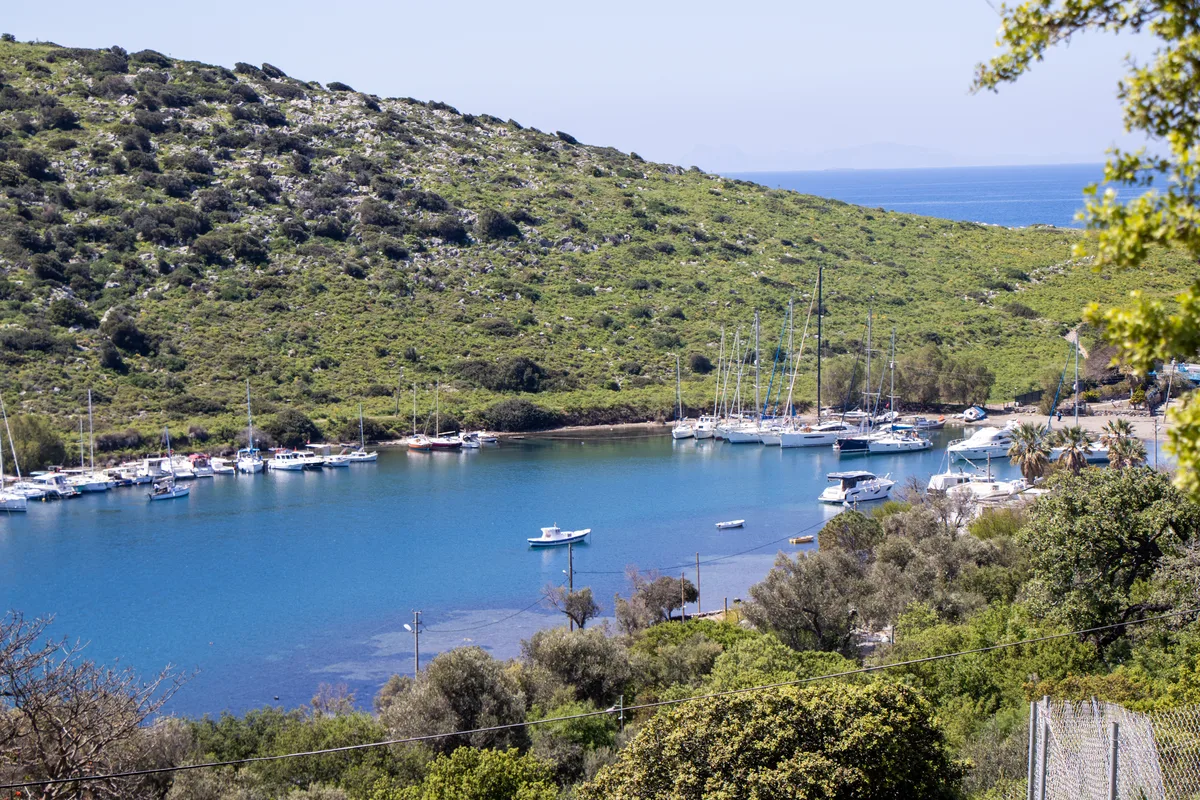
At the peninsula’s western tip, down a road that narrows through tangerine groves and suddenly gives up, Gümüşlük is the anti-Türkbükü: a small fishing village built over the sunken remains of ancient Myndos, where the development stayed low, the evenings stayed quiet, and the village’s one famous luxury is time. The bay is sheltered by Rabbit Island, which you can reach by wading the shallow line of the ancient harbour mole – the stones under your feet are the drowned city’s own – and the waterfront is a string of fish restaurants whose tables stand in the water’s edge shallows, famous across Türkiye for sunset dinners eaten with the Aegean rearranging the light around your ankles.
The village has rules that reveal its character. Building stayed restricted here for decades, the big-hotel model never landed, and what grew instead was a colony of writers, musicians and escapees from Istanbul who keep the place at a deliberate simmer. Days in Gümüşlük organise themselves: a swim off the village beach or the island, a long shade-of-the-tamarisk lunch, a walk up to the old church on the hill, and then the waterfront’s nightly performance as the restaurants fill and the sun goes down behind the island. It is the peninsula’s best sunset dinner and its worst nightlife, and both halves of that sentence are the same fact.
Practically, Gümüşlük sits at the end of a dolmuş route from Bodrum town that takes the better part of an hour, winding through Ortakent and Turgutreis, which is exactly the friction that has kept it slow. Stay here if your trip wants a village first and Bodrum’s sights as excursions; day-trip here, arriving by late afternoon, if it does not – the sunset dinner run from a town base is one of the classic evenings in this guide, and the dolmuş back through the dark peninsula afterwards is part of the memory. Either way, do not rush it. Gümüşlük punishes schedules and rewards drift more completely than anywhere else on the peninsula.
On the Water – Boat Trips and the Blue Cruise
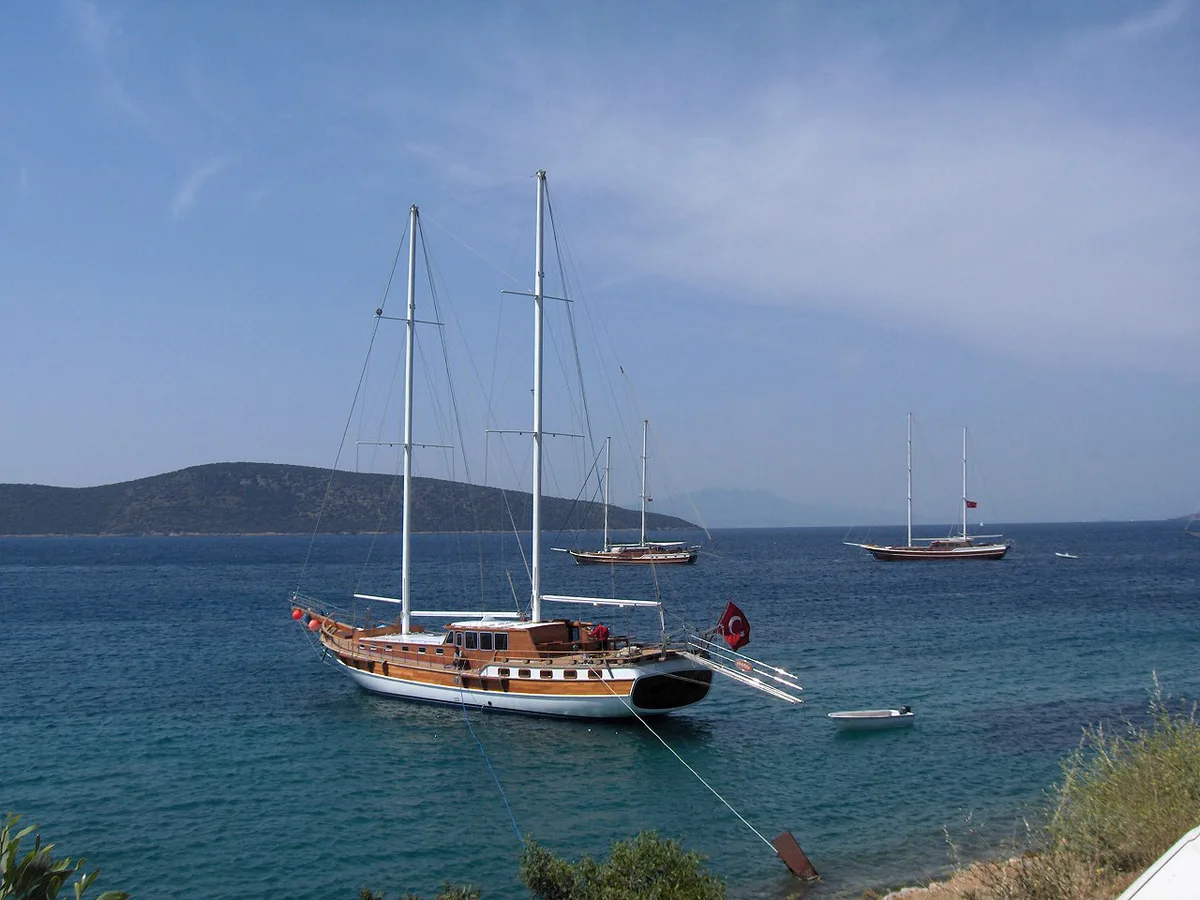
Bodrum from the land is a town; Bodrum from the water is an archipelago of possibilities, and the town’s oldest industry is taking you out to them. The day-boat fleet works the harbour quay on a simple, well-worn mechanism: boats advertise their routes on boards each evening and morning, you compare two or three, and by mid-morning you are anchored in water the colour of bottled glass in a bay no road reaches. The standard circuit of swim stops takes in the bays around the peninsula’s near islands – Black Island, just offshore, known for its warm mineral spring in a cave at the waterline, the aquarium-clear coves off Orak Island further east, and a rotation of nameless-feeling inlets where the only building is a fisherman’s hut. Lunch is cooked on board, the afternoon stop is the longest, and the boat walks you back into harbour in the golden hour with the castle lit up ahead. It is a formula because it works.
Beyond the day boats lies the tradition Bodrum invented. The Blue Cruise – the multi-day gulet voyage that Cevat Şakir and his friends pioneered down this coast in the middle of the last century – remains the definitive way to spend a week here: a wooden yacht, a small crew, a route east into the Gulf of Gökova’s pine-fringed bays or west and north around the Greek islands’ Turkish neighbours, and days measured in anchorages rather than hours. Boats charter whole, by the cabin on set departures, in every register from backpacker-basic to floating boutique hotel. This bodrum travel guide will not pretend to referee that market from a paragraph; its advice is mechanical and reliable. Book through operators you can visit in the harbour itself, read the actual boat’s recent reviews rather than the fleet’s brochure, confirm what the price includes in food, fuel and harbour fees before you fall for the headline figure, and travel in June or September if you can, when the anchorages empty and the water is at its warmest.
One caution applies to every boat in this harbour, day or week: the meltemi, the summer northerly, is a real wind, and on its strong days the sea beyond the headlands is a different element from the millpond inside the bay. Good captains adjust routes, delay departures or stay put; the itinerary on the board is a plan, not a promise. Travellers prone to seasickness should pick the bigger boats, sit amidships, and treat the sheltered Gökova side as their friend. None of this stops the boats being the best day out in Bodrum. It just rewards the visitors who read the weather board as carefully as the route board.
The Kos Ferry – a Greek Island from a Turkish Base
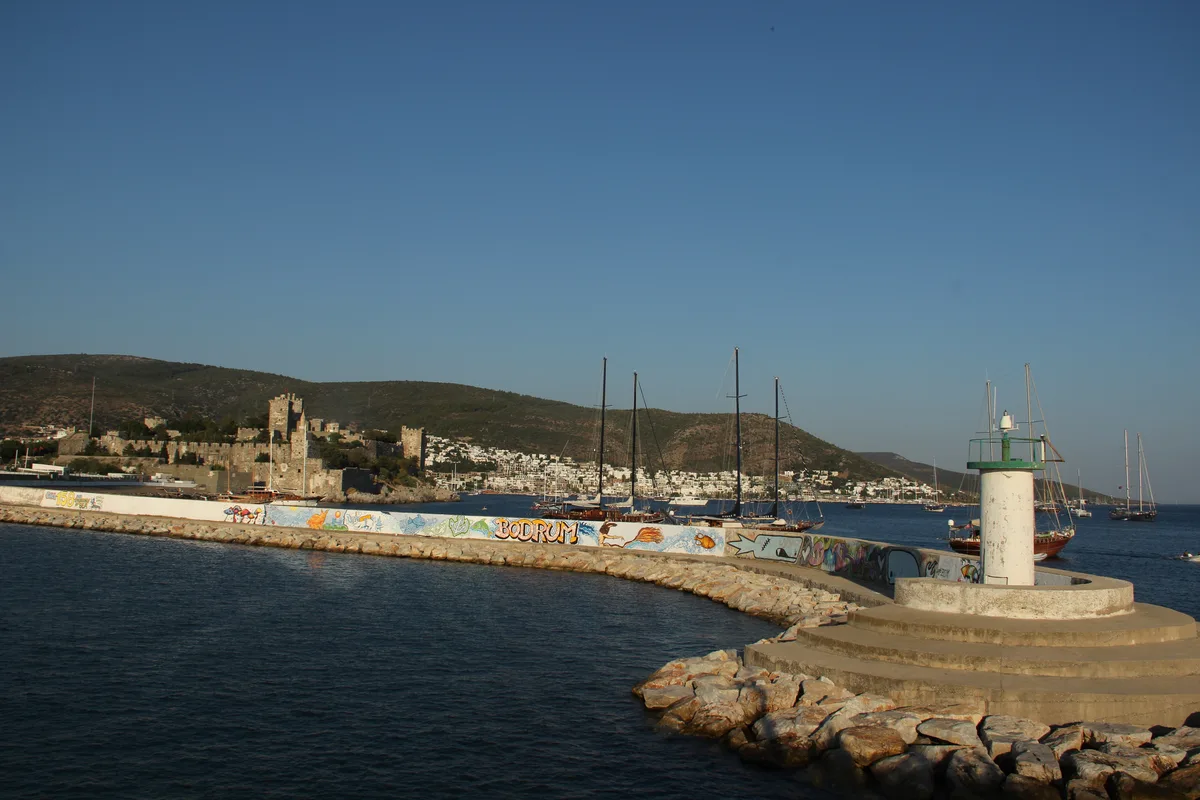
Look south from any Bodrum waterfront and the blue silhouette on the horizon is not a promise, it is a country: Kos, Greece, close enough that on a clear morning you can pick out its castle and harbour town with the naked eye. Ferries cross between the two ports through the season, and the day trip to Kos has become a standard move in the Bodrum repertoire – a morning sailing, a day in a Greek island capital with its own castle, its own ancient agora and the plane tree under which Hippocrates is said to have taught, and an evening sailing home to dinner in Bodrum. Two countries, two currencies, two breakfast cultures, one short stretch of Aegean: there is no cheaper way to feel the geography of this corner of the Mediterranean in your bones.
The mechanism deserves care, because this is an international border wearing a day trip’s clothes. You need your passport, full stop, and you need your paperwork position settled before you queue: Kos is Greece, Greece is the Schengen area, and whether you can enter on your nationality’s terms – visa-free, with an existing multiple-entry Schengen visa, or not at all – is a question for the official sources, not for the ticket desk. Turkish exit and Greek entry formalities happen at both ends, queues build in high summer, and the crossings are seasonal and weather-sensitive, thinning right down outside the main months. Book ahead in season, arrive at the ferry port with time in hand, and build the day with slack: the last sailing back waits for nobody, and a night on Kos you never intended, while hardly a tragedy, rearranges an itinerary.
Plenty of travellers run the same trip in reverse – based on Kos, day-tripping to Bodrum for the castle and the bazaar – and the harbour on a summer morning carries both currents at once. If you sail, go early enough to give Kos town its cool hours, eat where the harbour crowds thin, and leave something in the tank for Bodrum’s own evening, because the sunset sail home, with the castle growing out of the haze and the town lights coming on, is quietly the best seat of the whole day.
Getting to Bodrum
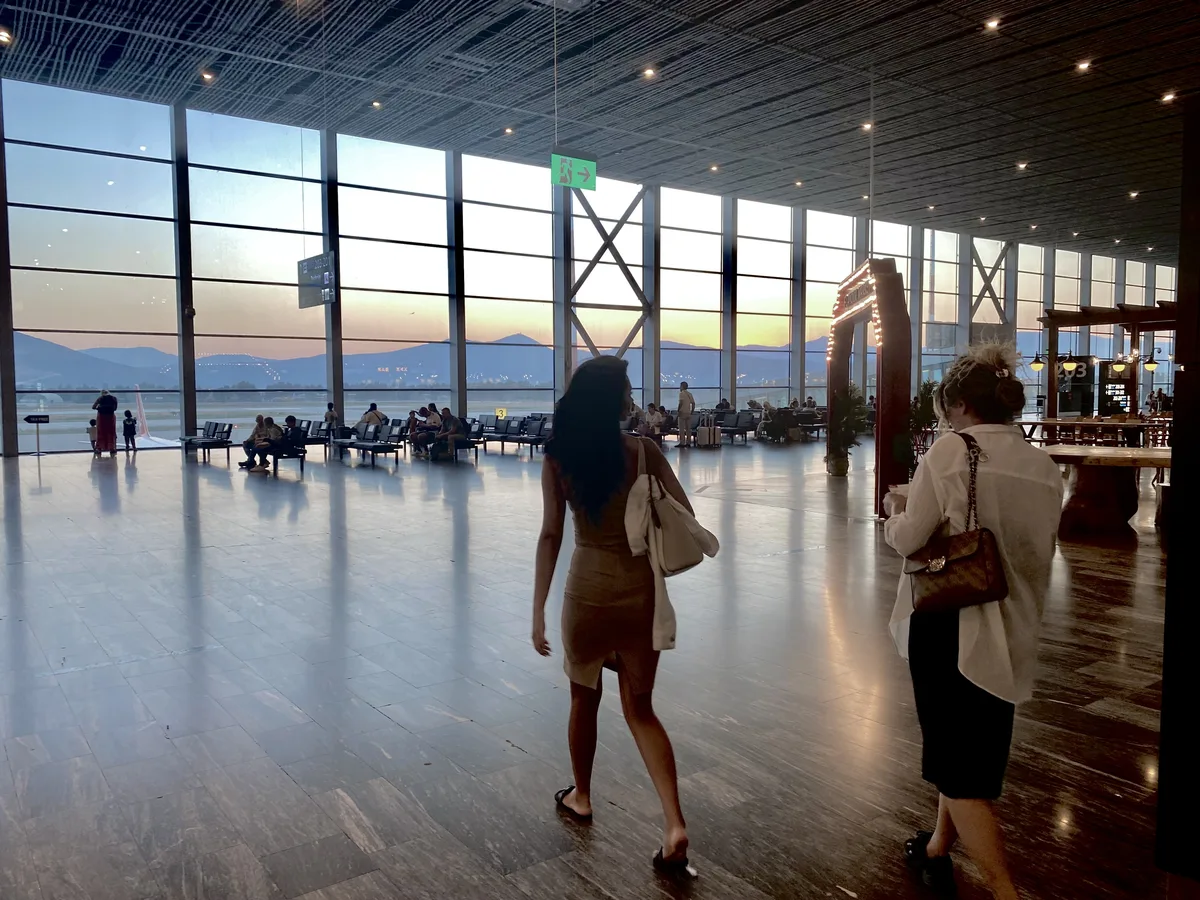
Nearly everyone arrives the same way: a flight into Milas-Bodrum Airport, the peninsula’s air gateway up beyond Milas, followed by the transfer down to the coast. Set your expectations for that transfer now and it will never annoy you: the airport is not at Bodrum, it serves a whole region, and the road journey runs from the better part of an hour to Bodrum town to considerably longer for the far bays of the north and west shores in summer traffic. Airport shuttle buses meet the domestic and international arrivals for the town’s bus station, tour operators run their own coaches for package guests, and taxis and pre-booked transfers fill the gaps. The mechanism that saves money and dignity alike is the one this guide repeats everywhere: decide your transfer before you land, because the arrivals hall at midnight is the worst travel agency in the world.
By land, Bodrum is the end of the line in the best sense. Intercity coaches connect the town’s bus station with Istanbul, Izmir, Antalya and Ankara on Türkiye’s excellent long-distance network, and drivers reach the peninsula on good highways from Milas. By sea, the town is a port of call in its own right: beyond the Kos ferries covered above, a car ferry crosses the gulf to Datça, halving the road distance to that other peninsula. However you arrive, the last leg is the peninsula road fanning out from the town – which is one more reason the town makes the natural base for a first visit, and the bays make better second addresses than first ones.
Getting Around the Peninsula
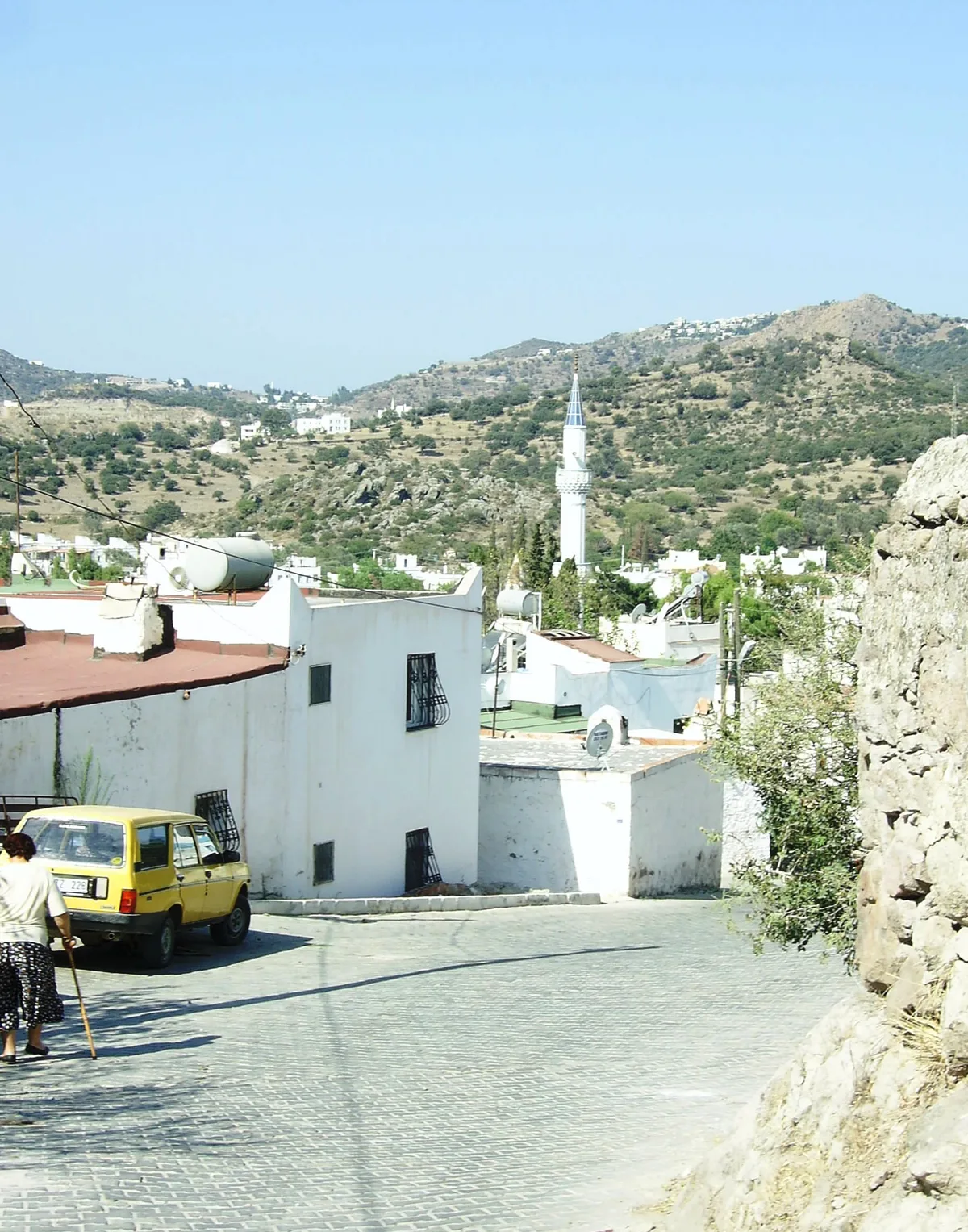
One system runs this peninsula, and it is the dolmuş. The shared minibuses – the word means “stuffed”, and in August they earn it – run set routes out of Bodrum town’s bus station to every bay in this guide: Gümbet and Bitez in minutes, Ortakent at the crossroads, then the fan of routes west to Turgutreis and Gümüşlük, north to Türkbükü and Yalıkavak. They run frequently through the day in season, thin out in the evening, and stop running altogether sooner at night than visitors expect. The method is simple and unchanged in decades: board, tell the driver your village, pay as you go, and call out when your stop approaches. For the distances involved it is one of the great bargains of Turkish travel, and it turns the whole peninsula into a single resort with a very scenic bus network.
Taxis cover the gaps the dolmuş will not – late nights, airport runs, the villa at the end of an unmarked lane – and the universal Turkish rule applies: confirm the meter is running or agree the fare before the door closes, and the stories you have heard will happen to somebody else. Renting a car makes real sense for exactly one itinerary shape: a stay based in a quiet bay with sights ambitions, where the freedom to reach Pedasa at opening time, Gümüşlük before the lunch crowd and a north-shore cove in between outweighs the costs of peninsula traffic and town parking. Within Bodrum town itself, walk: the town sights form a cluster inside a couple of kilometres, and the narrow lanes and one-way habits punish driving far more than they punish walking.
When to Go – Bodrum’s Seasons
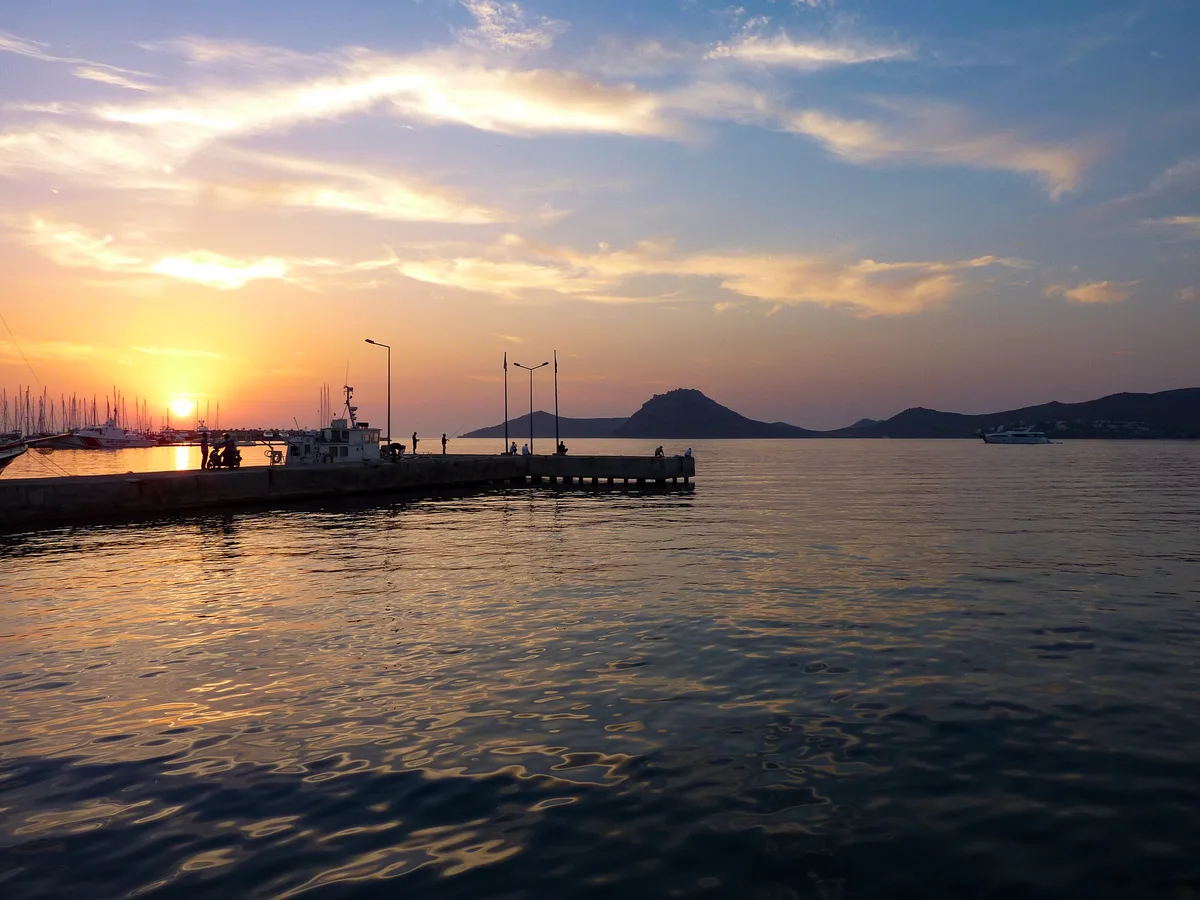
Bodrum’s year divides into three trips wearing one name. The first is the shoulder-season peninsula – roughly May into June, and September into October – and it is the one this guide recommends without hesitation. The sea has warmed or is still warm, the light is long and kind, the castle and museum are visitable at a thinking pace, the bays keep their restaurants and lose their queues, and the town remembers it is a town. If your diary has any flexibility at all, spend it here.
The second trip is the high summer peak, July and August, and it should be chosen with open eyes rather than by default. This is when Bodrum is most itself in the celebrity sense – the north shore at full wattage, the marina impassable with admirers, every beach club booked and every bay at its glittering best – and simultaneously at its hottest, its most crowded and its most expensive by a margin that shocks travellers calibrated on the rest of Türkiye. The meltemi breeze takes the edge off most afternoons, the sea is bathwater-warm by August, and the nightlife runs at a level the shoulder months never see. Go in peak season if the scene is the point; understand that you are paying peak prices for a town with twice the people in it, and book everything that can be booked.
The third trip is winter, and it is a connoisseur’s secret with honest limits. From November to March the resort machinery mostly shuts – beach clubs board up, many hotels and restaurants close, the Kos ferries thin to a skeleton, and the bays return to the fishermen. What remains is the town: the castle and museum in near-solitude, the bazaar selling to locals, mild grey-green weather broken by luminous days, and a Bodrum that resembles the one the Fisherman of Halicarnassus fell for. Winter is the wrong season for a beach holiday and the right one for a writing retreat, a history trip, or a traveller who wants the peninsula’s soul without its summer skin. This bodrum travel guide’s only firm seasonal advice is to pick which of the three trips you are taking, deliberately. The mistake is arriving in one while dressed, budgeted and expectationally packed for another.
Where to Stay – Town, Bays or Peninsula
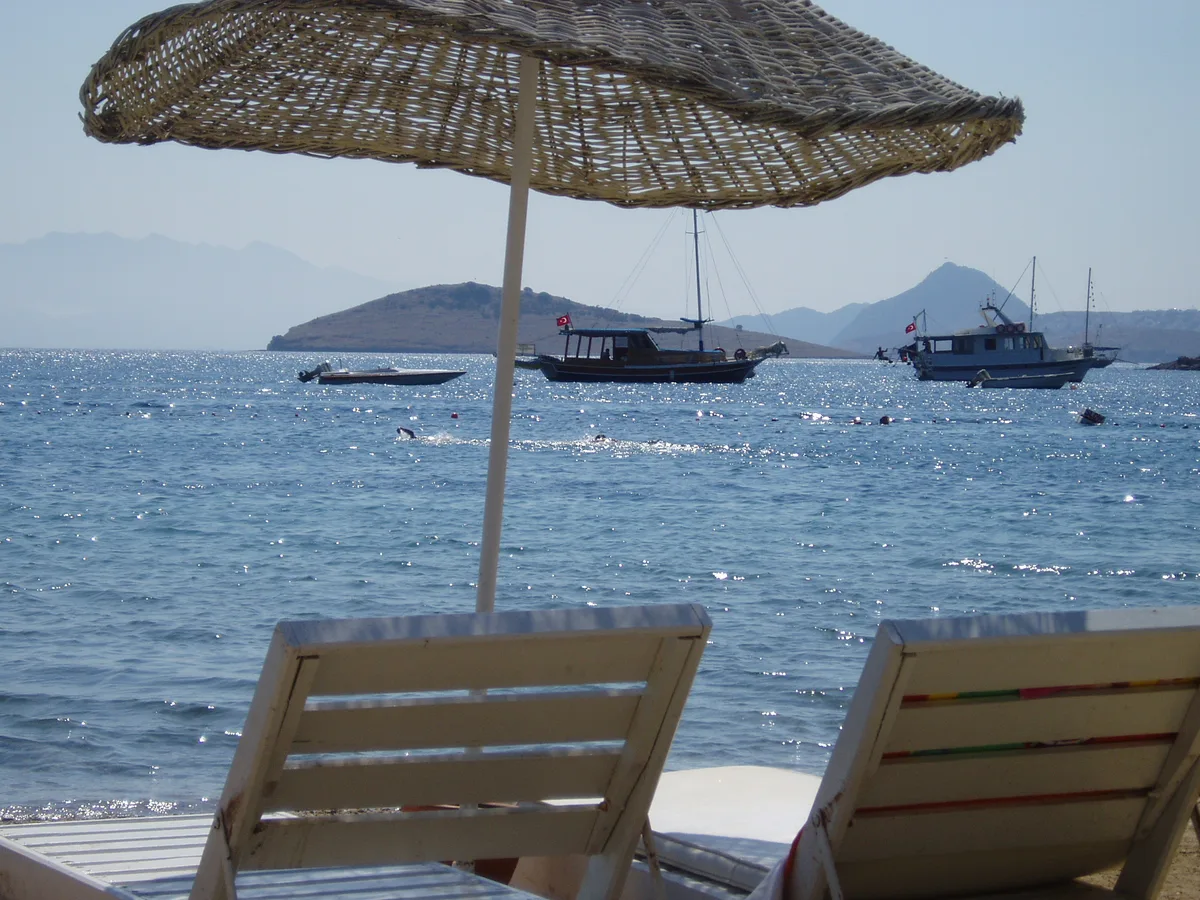
On this peninsula the address is the amenity, and choosing where to sleep is the single decision that most shapes the trip. Bodrum town is the sightseer’s base and this bodrum travel guide’s default answer: the castle, museum, Mausoleum, bazaar, bus station, boat quays and ferry port are all in walking or short-ride range, the evening restaurant choice is the peninsula’s widest, and the trade-off is simply that the town’s own beaches are its weakest feature – you sleep in the town for everything except the sand. Gümbet, ten minutes away, inverts the deal: the beach and the bars on your doorstep, the town as your excursion, and the noise question to be managed through careful hotel choice. Bitez splits the difference most gracefully for families, with calm water, a village heart and the town a short dolmuş away.
The mid-peninsula and west are about texture. Ortakent-Yahşi, at the crossroads, has one of the peninsula’s longest beaches and the easiest access to everywhere else, at the cost of being nobody’s postcard. Turgutreis, the west coast’s small town, trades on sunsets, a working local centre and big resort hotels along its shore. Gümüşlük, the far west end, is the slow stay: a village, its fish restaurants, and the sights as day trips rather than neighbours. The north shore – Türkbükü for the scene at its purest, Yalıkavak for the marina life with a real village behind it – suits travellers whose holiday centres on the water, the clubs and the boats, and who will drive or dolmuş to the castle once, gladly, rather than live beside it.
Two structural warnings complete the section, because they decide money. First, “Bodrum” in a hotel listing is a region, not a town: properties an hour apart share the word, and the map, not the name, tells you which holiday you have booked. Second, much of the peninsula’s beach access runs through beach clubs and hotel decks rather than public sand, especially on the north shore – a model that buys you service, shade and excellent swimming platforms, and costs accordingly. Read what your stay actually includes for the shore, check your bay on the map against the sections above, and the peninsula’s geography stops being a surprise and becomes the plan.
What to Eat in Bodrum – Fish, Meze and Tangerines
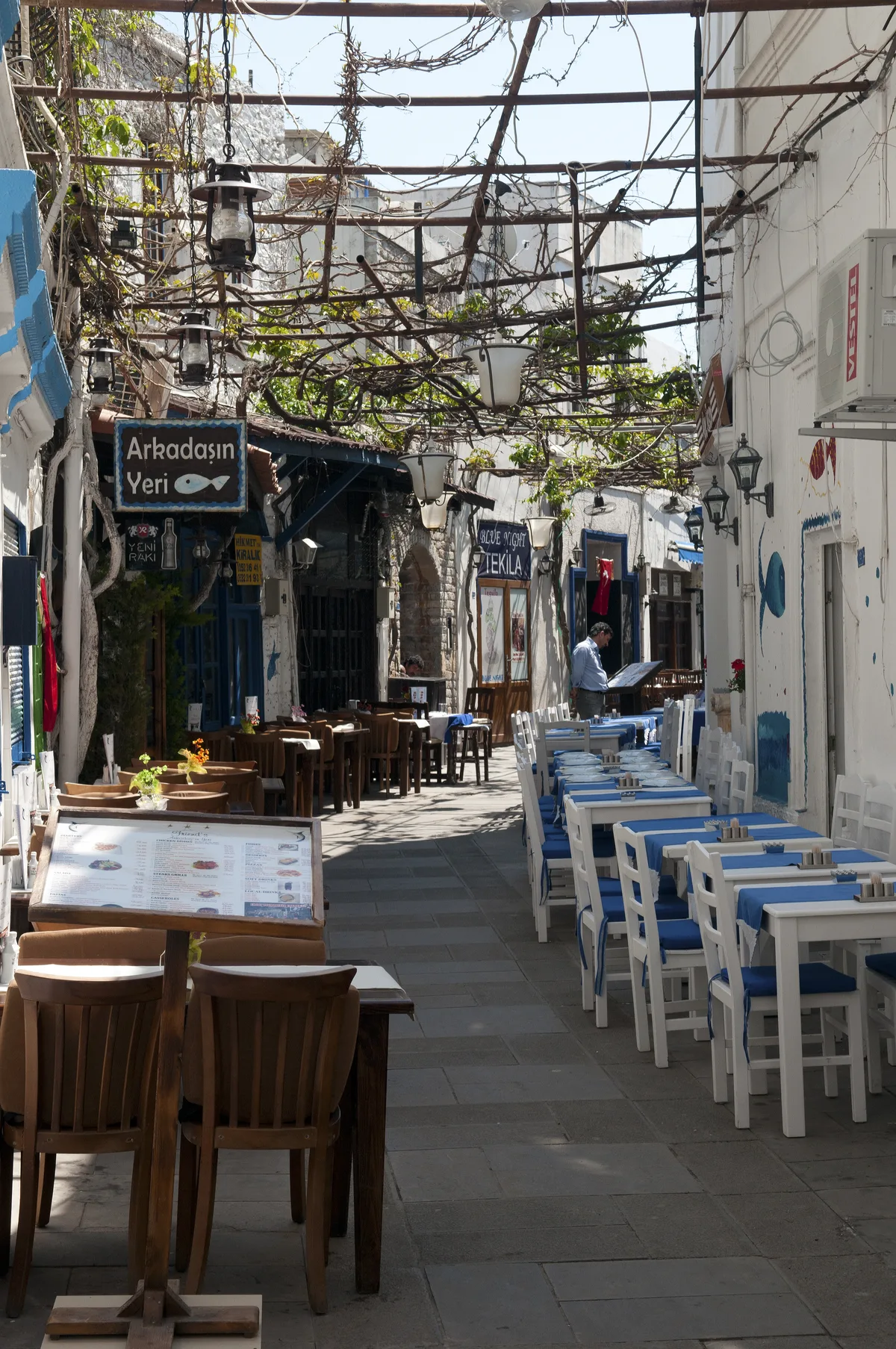
Bodrum eats Aegean, which is to say it eats what the boats, the gardens and the olive groves provide, in the order the Aegean has always eaten it. The classic dinner – in the marina taverns, the Gümüşlük waterfront, the village restaurants of the north shore – runs as a sequence rather than a plate: a spread of cold meze built on olive oil, wild herbs and the sea’s smaller gifts; a hot starter or two; and then the fish, chosen from the day’s display, priced by weight, grilled plainly and argued over happily. The mechanism matters more than any dish name: look at the fish before you order it, agree what the plate includes, and let the kitchen’s confidence rather than the menu’s length guide you. The tables around you, in the restaurants this guide would send you to, are mostly Turkish – the surest review system in the country.
The peninsula keeps two specialities of its own that every bodrum travel guide should name. The first is çökertme kebabı, the dish of the Milas-Bodrum villages: fine matchstick potatoes fried crisp, spread with garlic yoghurt and tomato sauce, and topped with strips of marinated beef – a plate that looks like a bar snack and eats like a feast. The second is the Bodrum tangerine, the fragrant, loose-skinned mandarin of the Bitez and Ortakent groves, protected as a local product and turned by the town into sodas, lokum, marmalades and a small industry of gifts that actually taste of the place they came from.
For the rest, eat the region. The peninsula’s herb dishes and olive-oil vegetables follow the Aegean’s spring and autumn larder; the bazaar and the weekly village markets – Yalıkavak’s is the famous one – are where the produce shows itself; and the harbour-side bakeries and tea houses run the town’s daytime shifts. Finish, at least once, with the full meyhane evening done slowly: meze arriving in waves, rakı or local wine doing its work, the harbour lights on the water and no plan for afterwards. It is not an activity to schedule between others. In Bodrum it is the main event, and it has been since long before the superyachts arrived to watch it.
The Honest Downsides – What Every Bodrum Travel Guide Should Admit
First, the money, because it is the surprise that ambushes the most visitors. Bodrum in high season is priced at a level the rest of Türkiye never reaches: the north shore’s beach clubs and marquee restaurants operate in the same bracket as the expensive Mediterranean, the marina quarter knows its worth, and even the town’s ordinary pleasures cost more here in August than they would in Izmir or Antalya. None of it is a scam – the product is real, the season is short, and the demand is international – but a budget built on generic Turkish prices will come home wounded. The countermeasures are in this guide’s own logic: travel in the shoulder months, sleep in the town or Bitez rather than on the north shore, eat where the tables are Turkish, and treat one north-shore lunch as the splurge it is rather than the daily routine it is marketed as.
Second, the crowds and the traffic. The peninsula’s road system is a fan of two-lane roads feeding one town, and in July and August it carries a metropolitan population of visitors on infrastructure built for villages. Dolmuş journeys double in length, the town’s parking becomes a blood sport, the castle and museum at midday carry the full weight of the coach schedule, and Bar Street and Gümbet run at a volume that makes nearby sleep a negotiation. None of it ruins a trip that plans around it – early starts for the sights, the bays on weekdays, evenings in the villages – but a midsummer Bodrum improvised hour by hour is a queue with scenery.
Third, manage the past. The Mausoleum, for all its fame, is foundations and imagination; the castle’s museum halls reward readers and can tire small children; the theatre and the Myndos Gate are fragments whose power is in their stories rather than their size. Bodrum’s history is genuinely world-class and genuinely ruinous in the literal sense, and travellers who arrive expecting Ephesus-style standing cities will spend their first day recalibrating. The recalibration is worth it – the story Bodrum tells, of a Wonder recycled into a castle and a science born in a sponge port, is better than a colonnade – but a guide that skipped the warning would not be doing its job. Add the small print: the castle’s stairs are steep and shadeless, the Aegean here runs cooler than the Mediterranean shore at Antalya, and winter closes half the peninsula. Bodrum on honest terms is still the best town on the Turkish Aegean. It is simply a town, not a theme park, and it charges and crowds like one that knows its value.
Bodrum Travel Guide – Frequently Asked Questions
Is Bodrum worth visiting, or is it just a beach resort?
It is worth visiting in its own right, and the “just” does the town an injustice. The castle, the shipwreck museum and the Mausoleum site would anchor a city break anywhere in Europe; the peninsula of bays and the gulet harbour are what Bodrum adds on top. Give the town itself at least two full days before you judge it by its beaches.
How many days do I need in Bodrum?
Three full days cover the town properly – castle and museum, Mausoleum and theatre, old town and marina, one boat day. Five days adds the peninsula’s bays at a human pace; a week lets you base in one place, day-trip the rest, and take the Kos ferry without rushing any of it.
Is the Museum of Underwater Archaeology open?
It is listed as open to visitors on the official muze.gov.tr portal – open every day, with the MüzeKart valid for Turkish citizens and an audio guide available (checked 31 October 2026). Individual halls can close for conservation, so check the official listing in the week you travel if one wreck is your main reason for going.
What actually remains of the Mausoleum of Halicarnassus?
The footprint, honestly presented: the foundation pit cut into bedrock, the burial chamber corridor, drainage works, scattered marble fragments, and a small exhibition with models and reliefs. Most of its sculpture is in the British Museum, and much of its stone is in Bodrum Castle’s walls. Go for the story and the scale your imagination has to build – it is a Wonder you reconstruct, not one you photograph.
Can I visit Kos as a day trip from Bodrum?
Yes, in season, and it is one of the great two-country days in travel. But it is a real border: take your passport, confirm your Schengen entry position from official sources before you sail, book ahead in summer, and leave slack around the return sailing. Outside the main season the crossings thin out and become weather-dependent.
Which bay should I stay in?
Bodrum town for the sights and the evenings, Bitez for families and calm water, Gümbet for nightlife near the beach, Ortakent-Yahşi for a central beach base, Gümüşlük for quiet and sunset dinners, Türkbükü for the scene, Yalıkavak for marina life with a real village behind it. Check any listing’s actual map position – “Bodrum” in a hotel name describes a whole peninsula.
How do I get from the airport to Bodrum?
Milas-Bodrum Airport sits well inland of the coast, past Milas. Airport shuttles run to Bodrum’s bus station, tour operators coach their package guests, and taxis and private transfers cover the rest. Plan on the better part of an hour to the town and longer to the far bays, and arrange the transfer before you land rather than in the arrivals hall.
Is Bodrum expensive?
By Turkish standards, yes – in July and August, seriously so, especially on the north shore and around the marina. By expensive-Mediterranean standards it remains competitive, and the shoulder seasons and the village bays bring it back toward Turkish prices.
The Short Version – This Bodrum Travel Guide on One Screen
Base yourself in Bodrum town for three to five nights and work outward. Spend the first day on the castle and the Museum of Underwater Archaeology – ramparts in the morning light, the Uluburun and the glass wreck in the cool of the halls – and the second on the rest of Halicarnassus: the Mausoleum site with its model in your head, the theatre above the harbour, the Myndos Gate where Alexander bled. Walk the old town’s lanes, eat the Aegean dinner in a harbour meyhane, and take the sunset promenade along the gulet quay. Then spend the rest of the stay on the peninsula’s geography: Bitez for the calm swim, Gümüşlük for the sunset fish dinner with your feet near the water, a north-shore day at Türkbükü or Yalıkavak for the clear water and the spectacle, and one full day on a boat, because Bodrum invented the Blue Cruise and the bays are the point. Sail to Kos if the season and your passport allow. Come in May, June, September or October if you can, use the dolmuş like a local, check the museum listings on muze.gov.tr before you plan, and let a working Turkish town with a Wonder in its walls and a fleet in its harbour show you how much more than a beach resort it is.