Ten days is the first trip length at which Morocco stops being a highlights reel and starts being a country. A week forces a choice between the imperial cities and the desert; a long weekend barely leaves Marrakech. A morocco itinerary 10 days, built properly, holds both – the medinas of the north, a Roman ruin, the Middle Atlas, a night at the edge of the Sahara and the High Atlas crossing – without turning any of it into a windscreen tour. The catch is that ten days only works in one direction. This route runs in a single line, Casablanca to Marrakech by way of Rabat, Chefchaouen, Fez and the desert, and it never doubles back on itself. Every night is further along the line than the night before, which is what buys the time for everything in it.
The line matters more than any single stop on it. Travellers who base themselves in Marrakech and day-trip outward spend ten days re-crossing the same motorways; travellers who string the country into one open line spend those days inside it. So this morocco itinerary 10 days starts where most international flights land – Casablanca – and ends in Marrakech, with the desert in the middle where it belongs, reached slowly through the Atlas foothills and left slowly through the southern valleys. Fly into one city and out of the other if you can. That single booking decision, the open-jaw ticket, is worth roughly a full day of sightseeing.
Two ground rules before the days themselves. This guide prints no prices – not for trains, camps, guides or meals – because Moroccan prices shift with season and negotiation, and a printed figure would be wrong by the time it mattered; where a mechanism decides the question (how camps are booked, how the Hassan II Mosque admits visitors, how grand taxis fill and leave), the guide explains the mechanism instead. And the plan assumes you read it as a whole trip, not a menu: the days lean on each other, the long drives sit where the scenery pays for them, and the one hard transfer – Fez to the dunes – is named as such. For the country’s regions, entry rules and the wider planning picture, start with our Morocco travel guide; this page is the route itself.
Morocco Itinerary 10 Days at a Glance
| Day | Base | The point of the day |
|---|---|---|
| Day 1 | Casablanca | Arrive, settle, and give the Hassan II Mosque the late light |
| Day 2 | Rabat | The calm capital – the Kasbah of the Udayas and a medina without the hard sell |
| Day 3 | Chefchaouen | Overland into the Rif and an evening in the blue lanes |
| Day 4 | Fez | South via Roman Volubilis, arriving in Fez by late afternoon |
| Day 5 | Fez | One full, slow day inside Fes el Bali |
| Day 6 | Merzouga | The long drive south – Middle Atlas, Ziz Valley, first dunes at dusk |
| Day 7 | Tinghir / Todra area | Sunrise in Erg Chebbi, then west along the southern valleys |
| Day 8 | Boumalne Dades | Todra Gorge in the morning, the Dades Valley by afternoon |
| Day 9 | Marrakech | Ait-Ben-Haddou, then over the Tizi n’Tichka pass and down to the city |
| Day 10 | Marrakech (depart) | One full medina day – Koutoubia, palaces, souks – and the flight out |
Read the table as a gradient, because that is what it is. The first half of this morocco itinerary 10 days is urban and northern – Atlantic light, imperial history, medinas that get older and denser as you move inland. The second half is southern and geological – valleys, gorges, kasbahs and one very large pile of sand. The desert sits on days 6 and 7 for a practical reason: it is the far point of the line, and everything after it is the journey home by another road, through country you have not seen yet. Nothing repeats. That is the whole design.
One honest warning belongs in the glance. This plan contains two long road days – day 6 especially – and two one-night stands in the south; that is the price of holding the north and the desert in a single ten-day trip, and the sections below do not pretend otherwise. What the plan refuses is a third long day: no Essaouira detour, no second desert, and no Atlas day trip from Marrakech, because on day 9 you cross the High Atlas properly, as transport rather than excursion.
How This Route Works – Direction, Airports and the Open-Jaw Trick
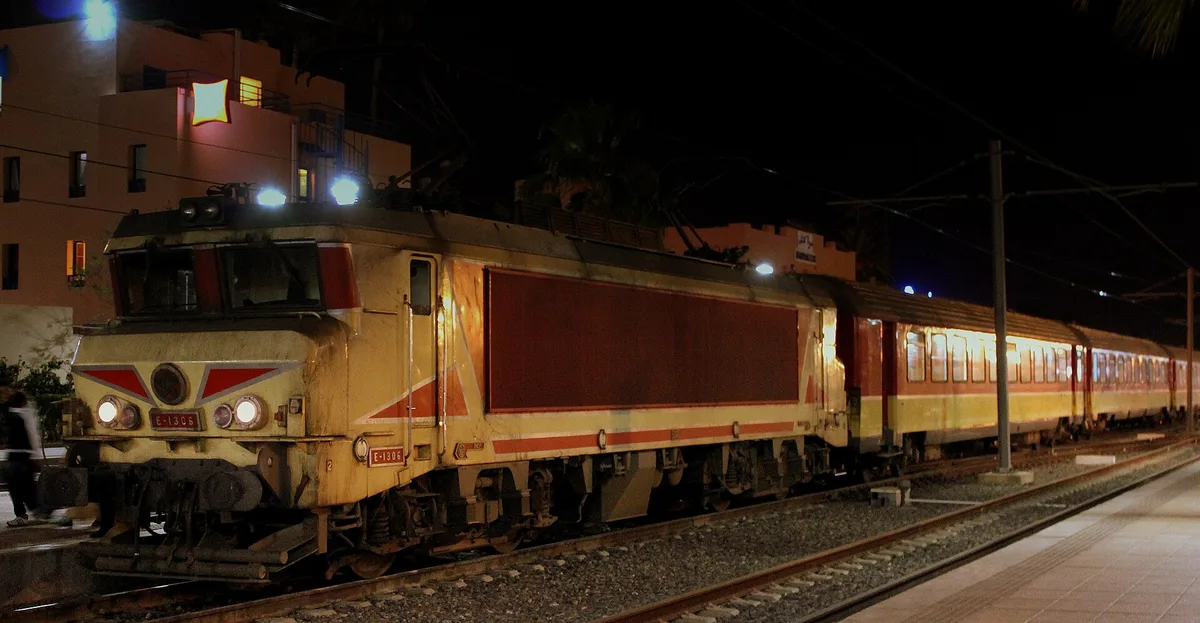
The route works because Morocco’s geography is a rough triangle, and a morocco itinerary 10 days built as a line walks two sides of it. Down the Atlantic side sit Casablanca and Rabat, an hour apart by train. Inland and north-east lies Fez, with Chefchaouen folded into the Rif mountains between the coast and Fez. South of Fez the country changes: the Middle Atlas, then the pre-Saharan valleys running west from the dunes at Merzouga – Todra, Dades, Ouarzazate – and finally the Tizi n’Tichka pass dropping into Marrakech. Drawn on a map it is a long, open loop with no repeated segment, and every transport mechanism in the country – train, coach, grand taxi, rental car – has a leg where it is the right tool and legs where it is not.
Airports decide the rest. Casablanca’s Mohammed V Airport takes the widest spread of long-haul arrivals and connects directly by train to both Casablanca’s stations and Rabat, which is why day 1 is a light day rather than a travel day. Marrakech Menara, at the other end, is the natural exit, with dense connections to Europe and a growing number beyond it. Booking into Casablanca and out of Marrakech – the open-jaw ticket – removes the single most wasted day in Moroccan travel, the full-day return across country to your arrival airport. If your fares force a Casablanca return, the honest fix is the train on the evening of day 10 or the morning after, not a sacrificed day earlier in the route; Marrakech to Casablanca is a routine rail journey of a few hours, and it belongs after the trip, not inside it.
Direction can be reversed, and some travellers should reverse it. Run Marrakech to Casablanca and the desert falls on days 4 and 5 instead, the medinas get progressively calmer rather than denser, and Fez arrives when you are travel-hardened rather than fresh. The version printed here runs north-first for two reasons: the Casablanca arrival is gentler, and the route builds toward its two biggest set pieces, the dunes and Marrakech, rather than spending them early. But the bones are identical either way, and everything below reads the same in mirror image.
Season bends the plan without breaking it. Spring and autumn give the route its easiest temperatures end to end; winter brings snow risk to the Tizi n’Tichka and cold desert nights but clear medina days; high summer makes the southern valleys genuinely fierce at midday while the north stays pleasant, and argues for earlier starts and longer lunches rather than a different route. Our best time to visit Morocco guide works through the month-by-month trade-offs; whichever window you choose, keep one habit from this page – book the desert night and the Fez day with slack around them, because those are the two fixed points everything else hangs from.
Day 1 – Casablanca and the Mosque on the Ocean
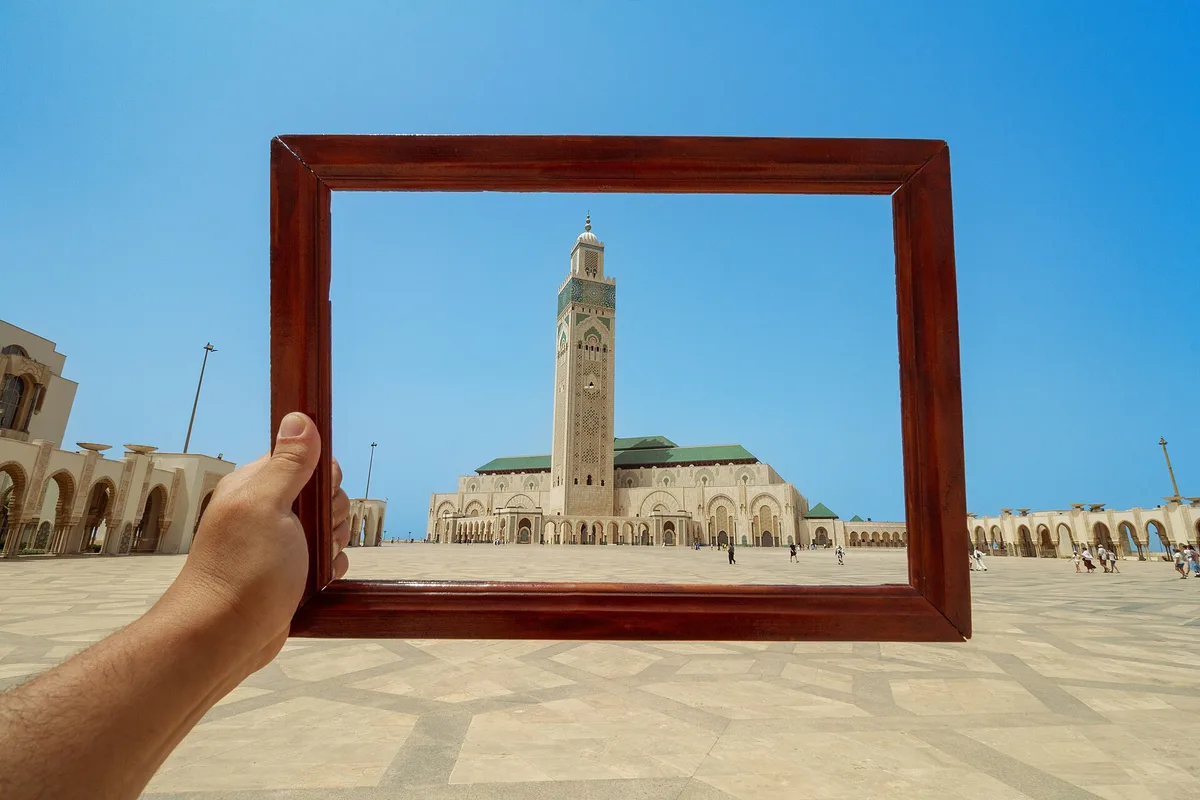
Resist the urge to leave Casablanca immediately. Most itineraries treat it as a pure arrival hall, and for a three-day trip that is fair – but this morocco itinerary 10 days spends its first afternoon here because the city holds one building that justifies a night on its own, and because a gentle first day is worth more than a heroic one. Land, get to your hotel by the airport train or a pre-arranged transfer, sleep off the flight if you need to, and give the late afternoon to the Atlantic corniche. Casablanca’s real texture is there anyway – a working metropolis rather than a tourist city, all Art Deco facades, traffic and ocean light, experienced best at walking pace while your body catches up with the time zone.
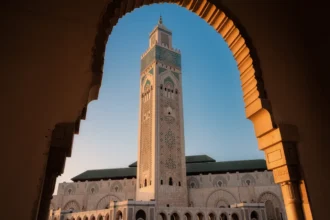
The Hassan II Mosque is the point of the day, and it is not close. Completed in 1993 under King Hassan II to a design by the French architect Michel Pinseau, it stands on a promontory at the city’s edge, its prayer hall built partly out over the Atlantic – a deliberate piece of symbolism, the throne of God upon the water, executed at a scale few modern religious buildings attempt. Its minaret, at around 210 metres, is the tallest in the world, and the craftsmanship inside – carved plaster, zellige tilework, painted cedar, a retractable roof over the hall – represents the Moroccan decorative traditions working at full stretch, all of them traditions you will meet again in older form in Fez and Marrakech. On a morocco itinerary 10 days the order is lucky: seeing the modern masterpiece first is a good education for reading the historic ones.
The visiting mechanism matters here, because this is the one great Moroccan mosque that non-Muslim visitors may enter, and entry runs on rails: visitors join guided tours, offered in several languages at set times through the day, booked at the mosque’s own ticket office on site. You do not need to arrange anything days ahead – you need to arrive in time for a tour rather than between tours, cover shoulders and knees, and expect to remove your shoes inside. Our dedicated Hassan II Mosque guide carries the practical detail; for this itinerary, the planning point is simple – anchor day 1 around one tour, photograph the building from the esplanade in the evening light when the stone warms and the crowds thin, and let the day end early. Tomorrow the route starts moving.
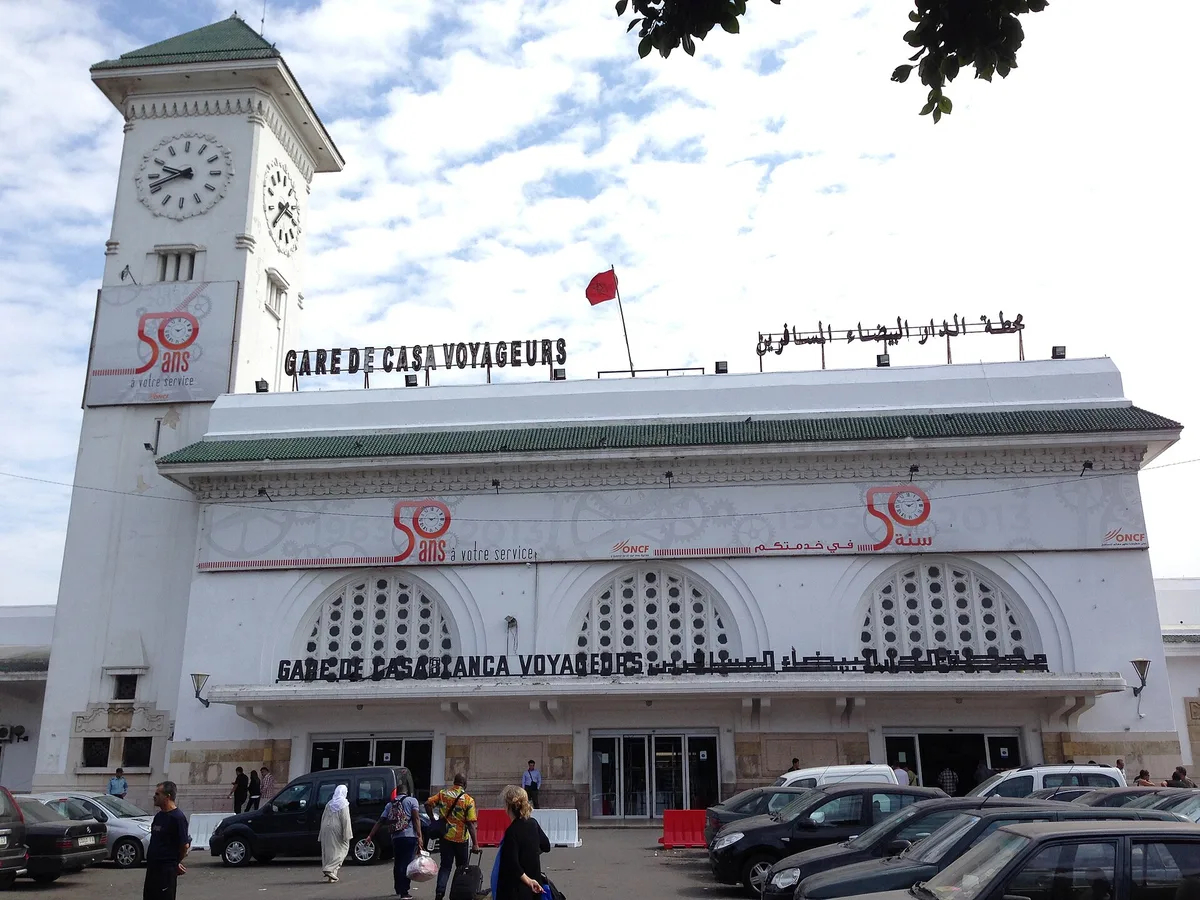
Sleep in Casablanca, near the centre or the Casa Voyageurs station quarter if an early train suits you. Dinner needs no research – the city feeds its own residents well, from corniche seafood to the old centre’s grills – and the medina, small and workaday beside what is coming in Fez, can wait or be skipped without loss. Day 1 of a good morocco itinerary 10 days is deliberately the least ambitious day of the ten: arrive, see the one great sight properly, eat, sleep. The line starts tomorrow.
Day 2 – Rabat, the Capital That Earns Its Night
The train from Casablanca to Rabat takes about an hour, and it is the easiest leg of the whole route – frequent, comfortable, and city-centre to city-centre. Take a morning service, check into a hotel in or near the medina or the ville nouvelle, and you have a full afternoon and evening in the capital. Rabat is the stop travellers most often cut from a morocco itinerary 10 days and the one its defenders argue about hardest, so be clear about what the night buys: not a headline sight on the scale of Fez, but the gentlest introduction to Moroccan medina life anywhere in the country, plus one kasbah that belongs on any list of the country’s beautiful places.
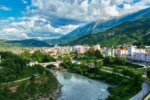
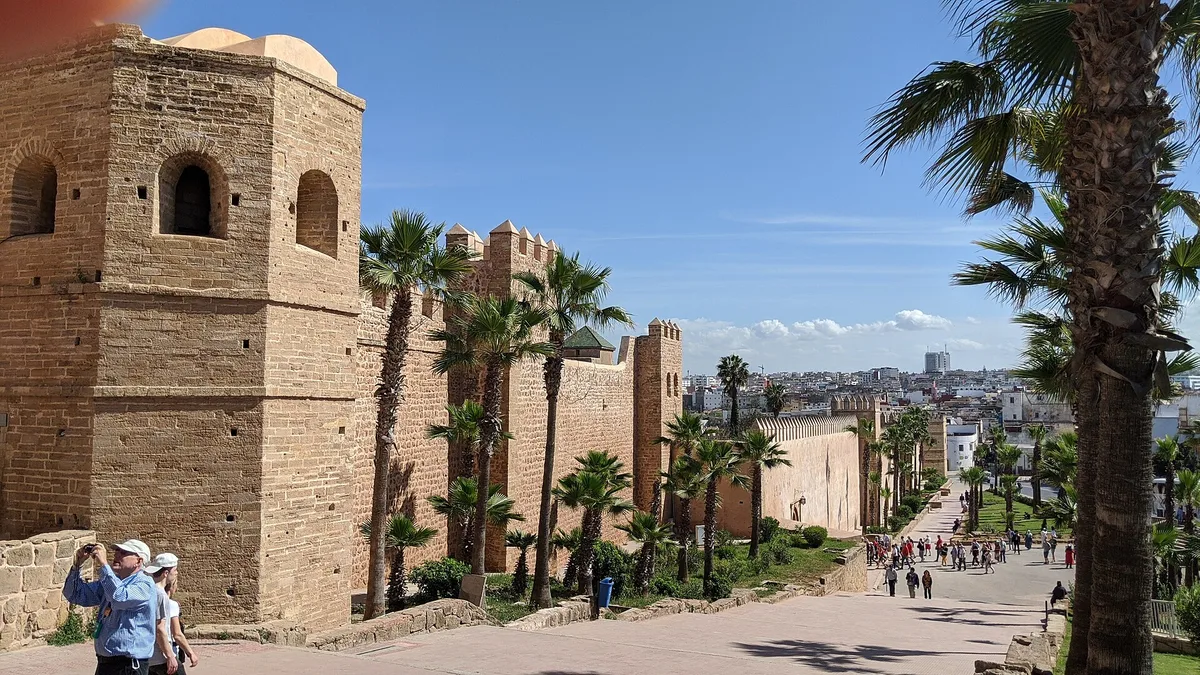
That kasbah is the Kasbah of the Udayas, the twelfth-century Almohad fortress-quarter at the mouth of the Bou Regreg river, whose great gate, Andalusian garden and blue-and-white lanes sit inside walls like the ones in the photograph. Rabat’s whole historic ensemble – kasbah, medina, ramparts and the planned twentieth-century capital beside them – was inscribed by UNESCO in 2012, a story our UNESCO World Heritage Sites in Morocco guide tells in full. Walk the kasbah in the late afternoon, take mint tea on its terrace above the river mouth, and watch Salé light up across the water. It is the most peaceful hour this itinerary contains.
The rest of the day fills without effort. The Hassan Tower – the stump of a vast unfinished Almohad mosque – faces the modern mausoleum across an esplanade of columns, medieval ambition and modern state ceremonial in one frame. The medina, south of the kasbah, sells to its own neighbourhood first and visitors second, which makes it the right place for a first unhurried wander and a first small purchase, at a pressure level far below what Fez will ask of you. The Chellah, a walled Roman and Marinid necropolis garden south of the centre, rewards a spare hour and a fondness for storks, which nest on its ruined minaret in numbers.
Sleep in Rabat and leave in the morning for the mountains. If the one-night logic troubles you, the alternative is real: push through to Chefchaouen on day 2’s evening and give the blue town two nights instead, at the cost of Rabat seen in a rush or not at all. This itinerary keeps the Rabat night – the first three days are meant to decelerate you, airport, capital, mountain town, before Fez raises the intensity – but it is the most negotiable night in the plan, and the trimming section below returns to it.
Day 3 – Chefchaouen, the Blue Town in the Rif
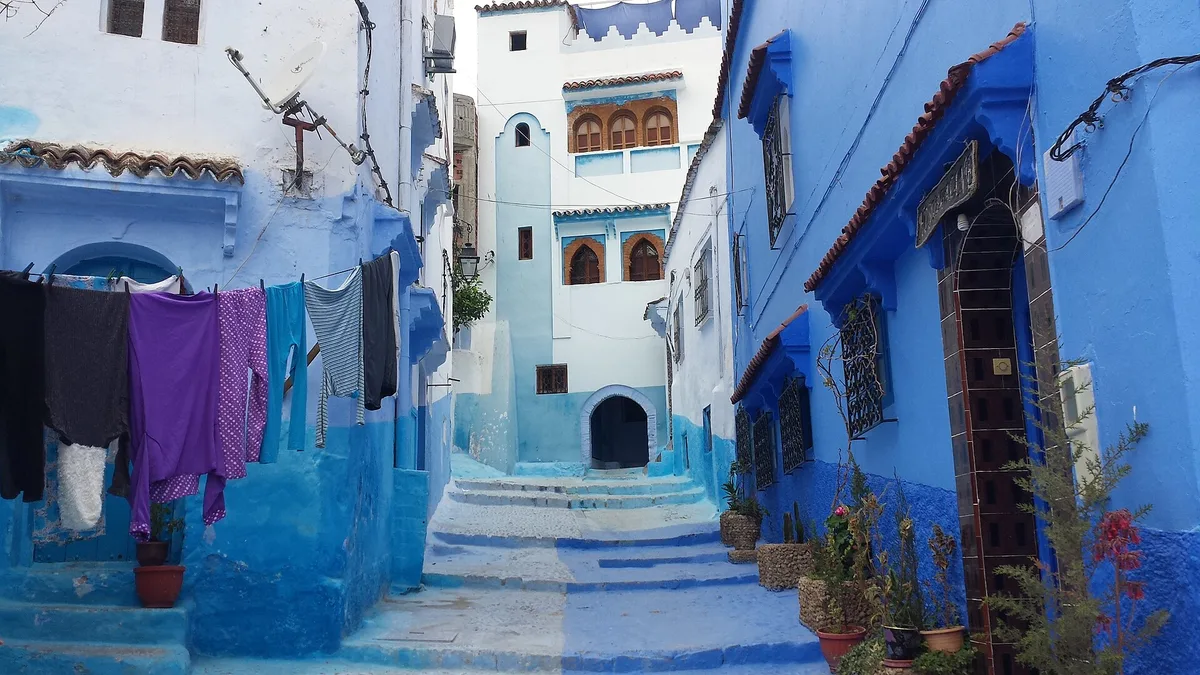
There is no railway to Chefchaouen, and the road is the point. From Rabat the route climbs north-east into the Rif, the green, folded mountain range that walls Morocco’s Mediterranean edge, on a journey of roughly four to five hours by coach, grand taxi or rental car depending on how you have organised it – the transport section below compares the mechanisms honestly. However you travel, travel it in the morning: the medina of Chefchaouen is at its best in the late afternoon and early morning, and arriving by mid-afternoon gives you both ends of the day. The town appears the way good places should, gradually – first the white town on its saddle between two peaks, then, as you climb into the medina, the blue.
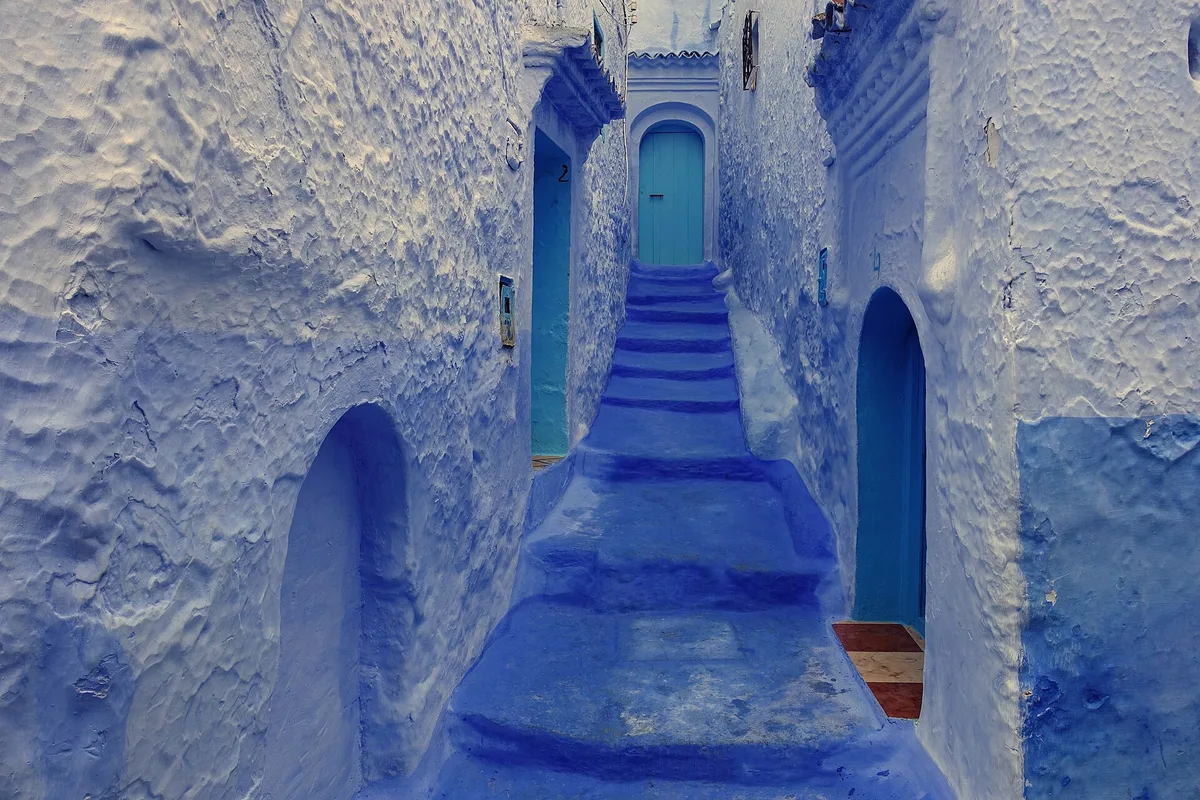
The blue is real and so is the argument about it. Chefchaouen was founded in 1471 as a fortress against Portuguese expansion, grew with Muslim and Jewish refugees from Spain, and stayed half-hidden in its mountains for centuries; the famous blue-washing is largely a twentieth-century practice whose origins – spiritual symbolism, mosquito folklore, a municipal eye for beauty – are debated with more confidence than evidence. The effect is not debated: whole lanes washed in graduated blues, the colour deepening in shadow and flaring where the sun hits. Photographers lose hours here happily. Everyone else should simply walk – uphill toward the Ras el-Maa spring where the town’s water arrives under the rock, and back down through lanes chosen by colour rather than direction.
Chefchaouen is the one stop on this morocco itinerary 10 days with almost no monuments, and that is its function. There is a small kasbah and ethnographic museum on the main square, Plaza Uta el-Hammam, and the square itself – cafés, the Great Mosque’s unusual octagonal minaret, mountains on every side – is the town’s living room and the right place for dinner. The Spanish Mosque on the hill east of town makes an easy sunset walk and the classic panorama back over the blue medina. Otherwise the town asks nothing of you, which after two days of capitals and before two of Fez is precisely calibrated. Shop if you like – the Rif’s woven blankets and the local goat cheese are genuinely of the place – but buy slowly or not at all.
Stay inside or just below the medina, and be up early enough on day 4 to see the lanes empty once before you leave. The road south is a full day in its own right, and it begins the route’s second movement: out of the green north, across the plains and Roman stones, and down into Fez – the oldest, densest and most demanding of Morocco’s imperial cities, and the stop this whole northern arc has been preparing you for.
Day 4 – South to Fez With Volubilis on the Way
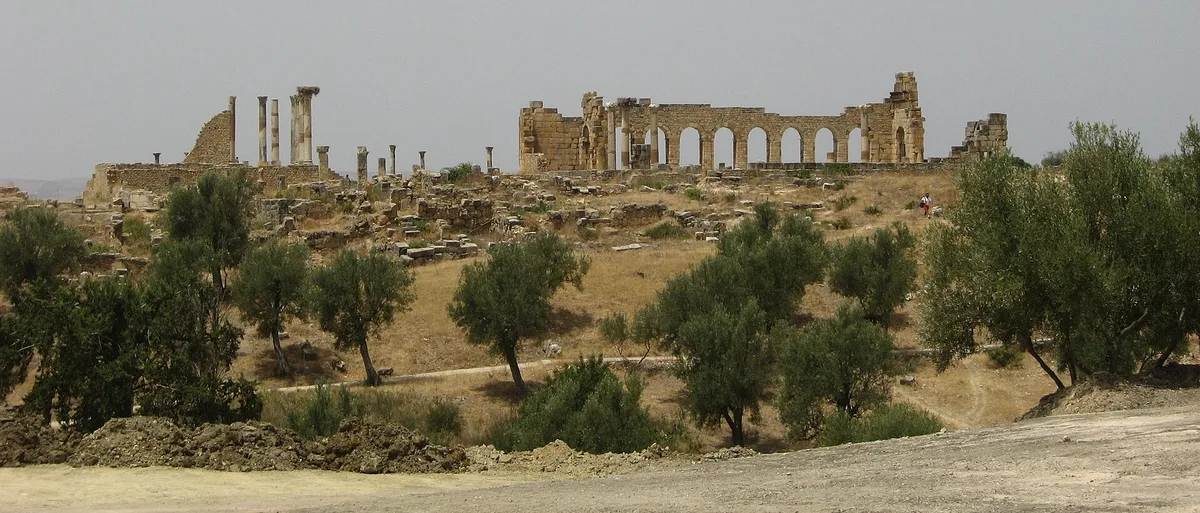
On a morocco itinerary 10 days, day 4 is a travel day with one great sight folded into it, and it works because the sight sits almost exactly on the road. Leave Chefchaouen after breakfast and drive south through the Rif foothills toward Meknes and Fez – roughly four to five hours of driving all told – and break the journey at Volubilis, the Roman city on its low hill above the Zerhoun plain. By car this is a simple detour off the main road; by public transport it is a grand taxi or local taxi hop from Meknes or Moulay Idriss, which is one of several reasons the transport section below suggests wheels, hired or rented, for the middle of this route. Either way, give the ruins ninety minutes to two hours. They earn them.
Volubilis was Rome’s administrative centre for this corner of Africa, a grain-and-olive-oil city of several thousand people at the empire’s south-western edge, and its survival is an accident of abandonment – never built over, its streets, basilica, triumphal arch and grand houses simply waited in the fields. What distinguishes it from grander ruins elsewhere is the floors: mosaic after mosaic still in place in the merchants’ houses, Orpheus charming the animals, the labours of Hercules, bathers and acrobats rendered in stone tesserae where their owners commissioned them. UNESCO inscribed the site in 1997. Walk the Decumanus, the main street, from the arch toward the basilica, step into the houses as the site’s layout invites, and look back at Moulay Idriss on its twin hills – the holy town where Morocco’s first Islamic dynasty begins, and your second possible stop if the day is running kindly.
Then finish the drive into Fez, arriving by late afternoon. The approach matters: Fez announces itself from the hills before you reach it, a pale ocean of rooftops in a bowl of land, minarets standing out of it like masts. Check in – ideally in or near Fes el Bali if your tolerance for car-free lanes is good, or in the ville nouvelle with medina days organised from there; our where-to-stay guidance is folded into the booking section below – and spend the evening the way the medina’s residents do, on a rooftop or in a café as the call to prayer rolls across nine centuries of city. Do not start sightseeing tonight. Fes el Bali deserves a fresh morning and your full attention, and day 5 gives it exactly that.
One piece of day-4 honesty: this is the day the transport choice bites hardest. On coaches alone, Chefchaouen to Fez is slower and connection-dependent, and Volubilis may have to be sacrificed to the timetable – the day survives the loss, but it is a real one. With a rental car or a driver for the middle days, day 4 becomes one of the trip’s pleasures, all green hills and one golden ruin. Same itinerary, different machinery; the getting-around section exists to help you choose which one you are actually buying.
Day 5 – Fez, One Full Day Inside Fes el Bali
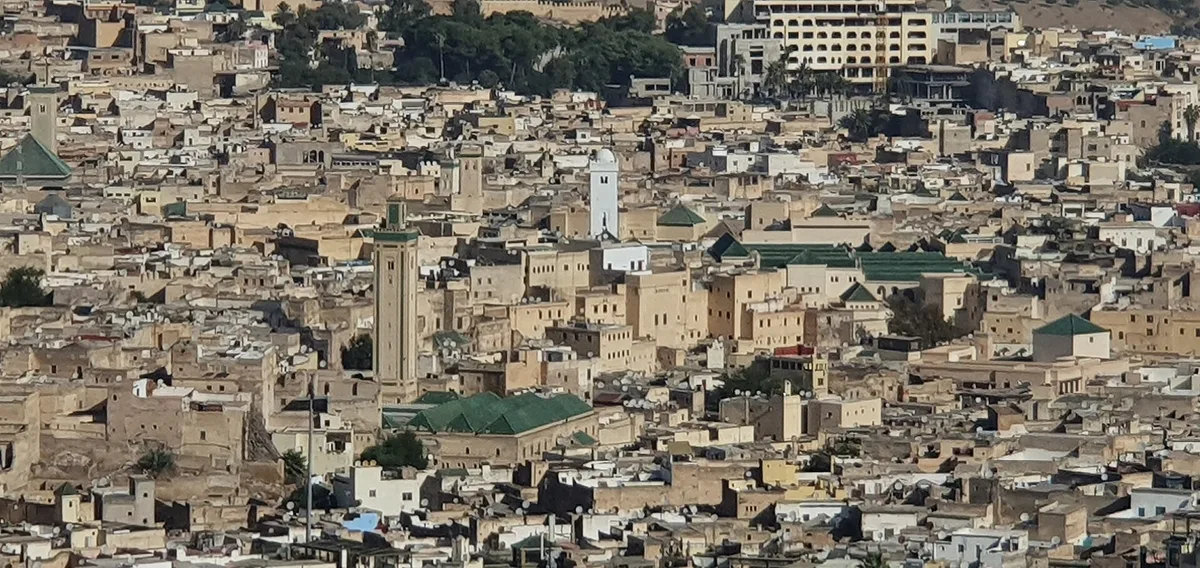
Fez is the intellectual centre of this morocco itinerary 10 days, and it gets the route’s only full, unhurried city day in the north – no driving, no checkout, no onward leg. Fes el Bali is the largest living medieval medina in the Arab-Muslim world: a car-free labyrinth of lanes, often counted at more than nine thousand, organised by trade, water and slope rather than by any plan a map can hold. Inscribed by UNESCO in 1981, it is not a preserved quarter but a working city of dyers, tanners, coppersmiths, bakers and porters, its monuments woven through the labour rather than fenced off from it. Enter at Bab Bou Jeloud, the blue-and-green tiled gate, after breakfast, and accept the medina’s terms: you will get lost, and getting lost is how it teaches itself.
Structure the day loosely around two descents. The two great artery lanes, Talaa Kebira and Talaa Seghira, drop from Bab Bou Jeloud toward the Qarawiyyin at the medina’s heart, and most of what you want lies on or near them: the Bou Inania Madrasa, the one great religious college visitors may enter, a fourteenth-century masterclass in carved plaster, zellige and cedar; the Nejjarine fondouk and fountain, now a woodworking museum in a jewel of a courtyard; the Al-Attarine Madrasa’s almost impossibly fine courtyard. The Qarawiyyin itself – mosque and university founded in 859 and often described as the oldest existing university in the world – is admired from its doorways, entry being reserved for worshippers. Our Fes el Bali medina guide walks these lanes route by route; this itinerary’s advice is pacing – one artery down in the morning, the tannery quarter by midday, the second artery back up in the afternoon.
The Chouara Tannery is the medina’s emblem and its honest test. From the leather-shop terraces around it you look down on the stone vats – white with lime at one end, jewel-coloured with dye at the other – where hides are still processed by hand and foot as they have been for centuries. It is beautiful and it smells exactly like a tannery; the sprigs of mint offered at the terraces are not a joke. Go, look properly, understand that this is a workplace photographed from above rather than a show staged for you, and let it stand for the whole medina’s character. Fez does not perform itself. That is why it is the city travellers argue about on the way home – some found it overwhelming, some found it the realest place in Morocco, and both are describing the same streets accurately.
Decide the guide question before you arrive, not at the gate. An official medina guide converts getting lost from a tax into a curriculum and opens workshop doors that stay shut to wanderers, at the cost of the serendipity of wrong turns; going alone keeps the serendipity and adds freelance guides and shop invitations as a constant negotiation. Either is defensible; drifting between them is not. End the day as the light goes, on a rooftop above the bowl of the city or up at the Marinid Tombs on the northern hill, where the whole medina lies below you and day 6’s road south can be traced toward the darkening hills.
Day 6 – The Long Drive South – Middle Atlas, Ziz Valley and the Dune Edge
Name it plainly: day 6 is the long one. Fez to Merzouga is in the region of 460 kilometres and seven to nine hours on the road with stops, and no honest morocco itinerary 10 days can make it otherwise – the dunes are far from everything, which is rather the point of them. What planning can do is make the drive a journey instead of a transfer, and this one is: the road south crosses four distinct landscapes, each announcing the next, and by the time the first dune rises at the road’s end you have watched Morocco change climate zones through the window. Start early – at dawn if your party can bear it – and treat the stops below as the day’s structure rather than its delays.
Out of Fez the road climbs first into the Middle Atlas, a Morocco first-timers never expect: cedar forests, cold upland towns and, at Ifrane, a chalet-roofed resort town that looks transplanted from the Alps. The cedar country around Azrou is Barbary macaque habitat; a leg-stretch among the trees is the morning’s natural pause. Then the road tips over the high plateau toward Midelt, the apple town between the Middle and High Atlas where the landscape dries and opens, and where lunch – grilled, simple, roadside – breaks the day roughly in half. Nothing about the morning is desert-like. That is what makes the afternoon work.
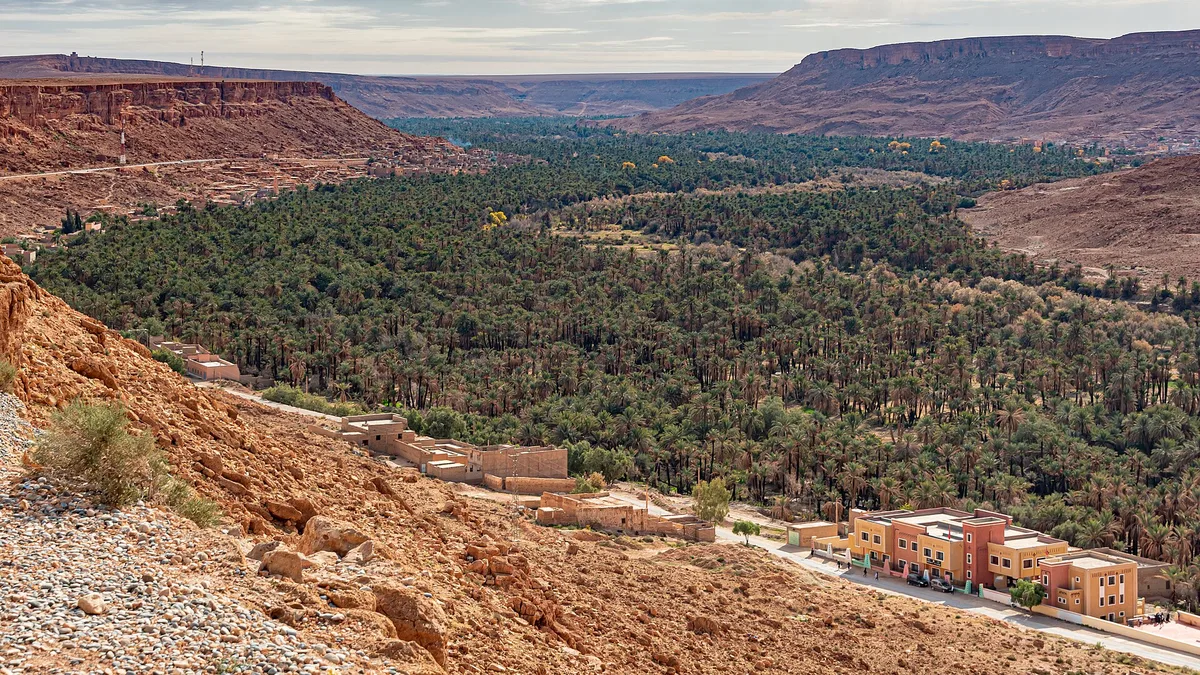
South of Midelt the road descends through the Ziz Gorges and opens onto the Ziz Valley, the great palm gorge in the photograph: a river of date palms running for miles through red rock, ksour – fortified mud villages – standing along its banks, the whole valley a green argument that water, not sand, is the Sahara’s organising fact. Stop at the viewpoints above the palmery; this is the moment the trip changes register. From Errachidia and Erfoud the country flattens into hamada, stony desert pavement, and then, near Rissani and Merzouga, the Erg Chebbi dunes rise at the roadside without preamble – a wall of orange sand, in places around 150 metres high, that has been photographed so often it still manages to look unreal in person.
The day’s mechanics should be settled before you set out. Most travellers sleep at the dune edge – in a village hotel in Merzouga or Hassi Labied, or out among the dunes in a camp reached by camel or 4×4 at dusk – and the choice belongs to the booking section below; what matters tonight is arriving before sunset, to ride out onto the sand as the light drops and watch the dune field change colour. If your party cannot face the dawn start, the honest alternative is to split day 6 at Midelt or Errachidia and reach the dunes at midday on day 7 – a morocco itinerary 10 days survives that, but sunrise becomes sunset, and the trimming section is frank about the trade. Most people, asked afterwards, are glad they set the alarm.
Day 7 – Sunrise in Erg Chebbi, Then the Road West to Todra
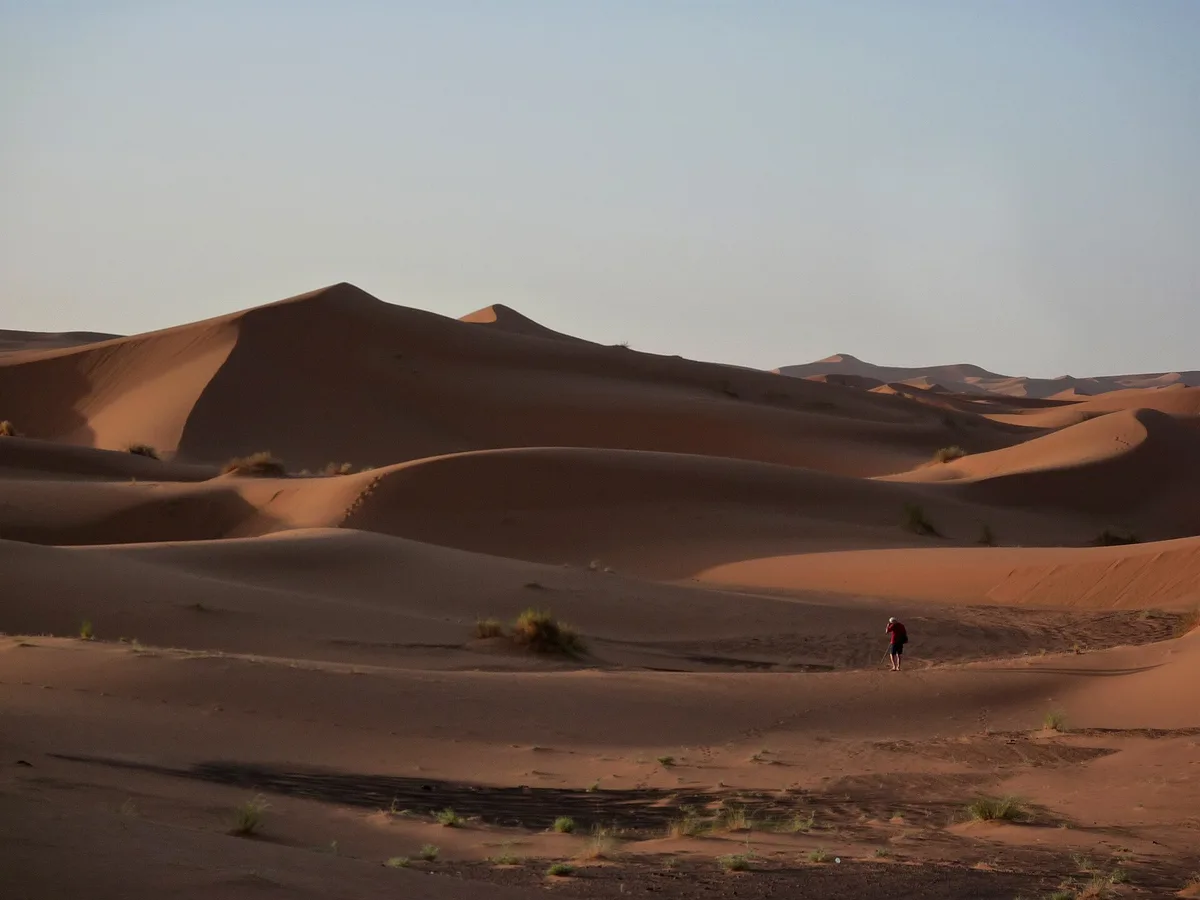
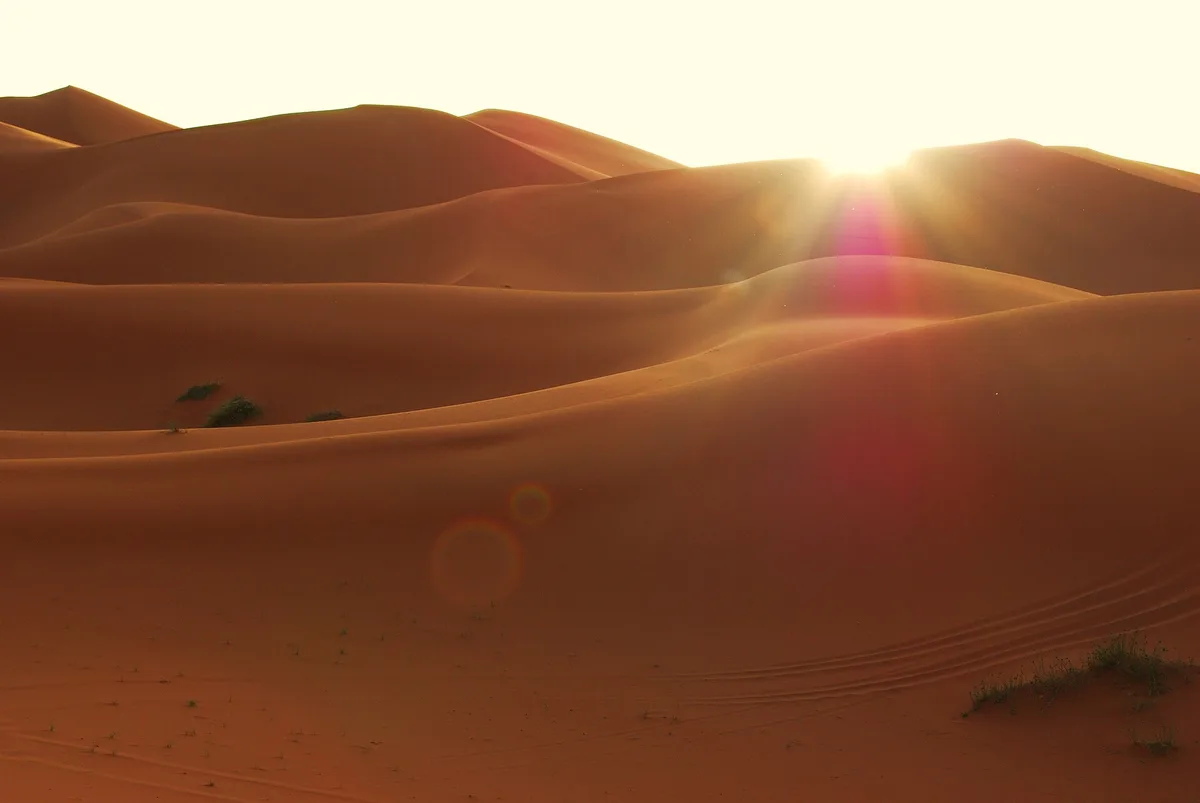
However tired the alarm feels, get up for the sunrise. The Erg Chebbi field is a compact sea of dunes – some twenty-odd kilometres long and a few wide, which is small as ergs go and exactly why it works for travellers: the whole of it is comprehensible from one high ridge. In the first hour the sand runs through more colours than it owns at noon, the camps empty onto the crests, and the lone walker in the photograph has the scale of it right – this is a landscape that makes people quiet without asking. Breakfast back at camp or the dune-edge hotel, sand out of everything, and then the second half of the desert day, which is the part the brochures skip: the morning is yours, in Merzouga village, around the seasonal lake Dayet Srij when it holds water and flamingos, or simply doing nothing in the shade while the heat builds. A morocco itinerary 10 days earns its afternoons of rest by spending them in places like this, where there is nothing to miss.
By early afternoon, turn west. The road from Merzouga to Tinghir runs back through Rissani – the Alaouite dynasty’s ancestral town, with a souk on market days that serves the whole region – then along the southern foothill road through a string of oasis towns, each a strip of palms under a ksar, the desert trading sand for stone. The drive runs three to four hours with stops, the gentlest road day of the southern loop: palm groves, ruined towers and the Atlas wall keeping pace on your right. Sleep in or near Tinghir, at the Todra Gorge’s mouth, so tomorrow’s gorge gets the morning light; Todra at midday is a lesser thing than Todra at nine, and this plan hoards its mornings carefully.
A word about the desert tours most visitors actually take, because day 7 is where they fit. The standard shared or private desert excursion – Marrakech or Fez at one end, a camp night in the middle – is essentially this route’s days 6 to 9 compressed and driven by someone else, and for travellers without wheels it is a legitimate way to buy the southern loop as one booking; our desert tours from Marrakech guide explains how those packages are built and what to check in them. If you are driving yourself, you do not need the package – you are already driving its route at your own pace, which is the better instrument. What you should not do is both: a packaged tour inside a self-driven itinerary duplicates cost and strands the rental. Choose the machinery once, here.
Evening in Tinghir is a small-town affair – a walk in the palmeraie if the light allows, dinner, an early night. The southern valleys run on agricultural time, and syncing with it gets you the gorges empty and the passes clear. Tomorrow is the valleys’ best day.
Day 8 – Todra Gorge in the Morning, the Dades Valley by Afternoon
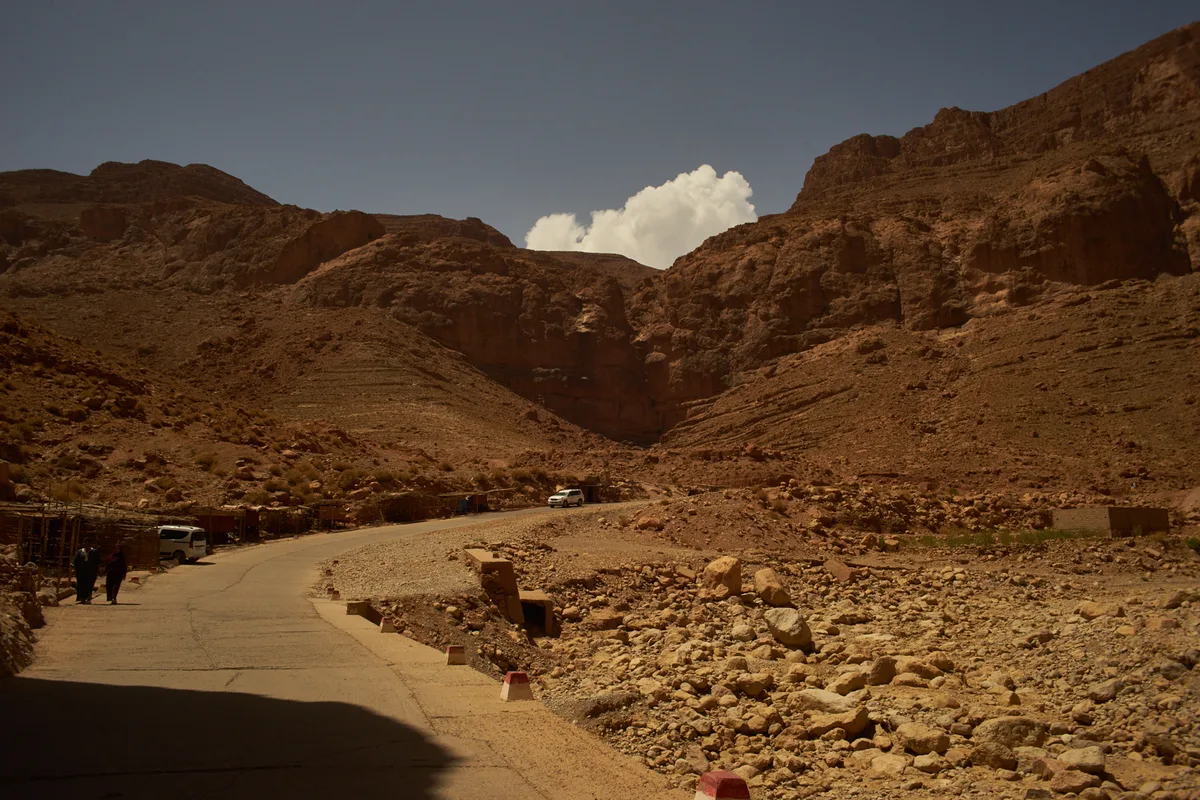
From Tinghir, a short drive up a palm-lined valley road brings you to the Todra Gorge, and arriving early is the whole strategy. The gorge is a slot cut through the Atlas’s southern wall, where river and road pass between cliffs that rise, in the narrowest stretch, a few hundred metres on either side – walls so close and high that the sun reaches the floor for only part of the day. Walk it in the morning: through the narrows where climbers work the bolted faces – Todra is Morocco’s rock-climbing centre, and their coloured ropes against the red stone are part of the scene now – and out the far side where the valley opens. An hour or two covers it honestly. The gorge is a single, superb gesture rather than a day’s programme; travellers who understand that leave delighted, and travellers sold it as a destination in itself leave puzzled. In this morocco itinerary 10 days it is used correctly – as the morning of a valley day.
The road west from Tinghir to Boumalne Dades, roughly an hour or so, runs the Valley of the Kasbahs in earnest: a corridor of palm groves, earthen towers and terraced fields under the Atlas, with a fortified granary or a ruined kasbah on every skyline. Then turn up into the Dades Valley itself for the afternoon. The Dades is Todra’s gentler sibling – a green river valley switchbacking up into red gorge country, famous for the hairpin bends photographed from its upper café terraces and for the eroded rock formations, nicknamed the monkey fingers, where the river has worried the stone into fists and organ pipes. Drive as far up the bends as the afternoon allows, walk a stretch of valley floor among the fig and almond trees, and come back down to sleep in Boumalne, the valley’s market town. Between the two gorges you will have seen the southern valleys’ full argument: water carving stone, and people answering with mud architecture and terraced green.
Food belongs in this day, because the south is where the route’s eating changes character – roadside grills, valley guesthouses cooking what the terraces grow, tagines that taste of somewhere specific. Our Moroccan food guide maps what Morocco puts on the table; for day 8 the practical point is that Boumalne’s guesthouses feed travellers well without booking theatre, and dinner on a terrace as the rock goes the colour of the tagine is one of this itinerary’s unadvertised evenings.
Sleep in Boumalne Dades or just up the valley. Tomorrow is the south’s second long day – Ait-Ben-Haddou in the morning, the High Atlas in the afternoon, Marrakech by night – and it rewards an unhurried breakfast and a start before the day-tour coaches reach the ksar. Charge everything tonight. The pass has weather opinions of its own, and day 9 is written to absorb them.
Day 9 – Ait-Ben-Haddou, the Tizi n’Tichka and Down to Marrakech
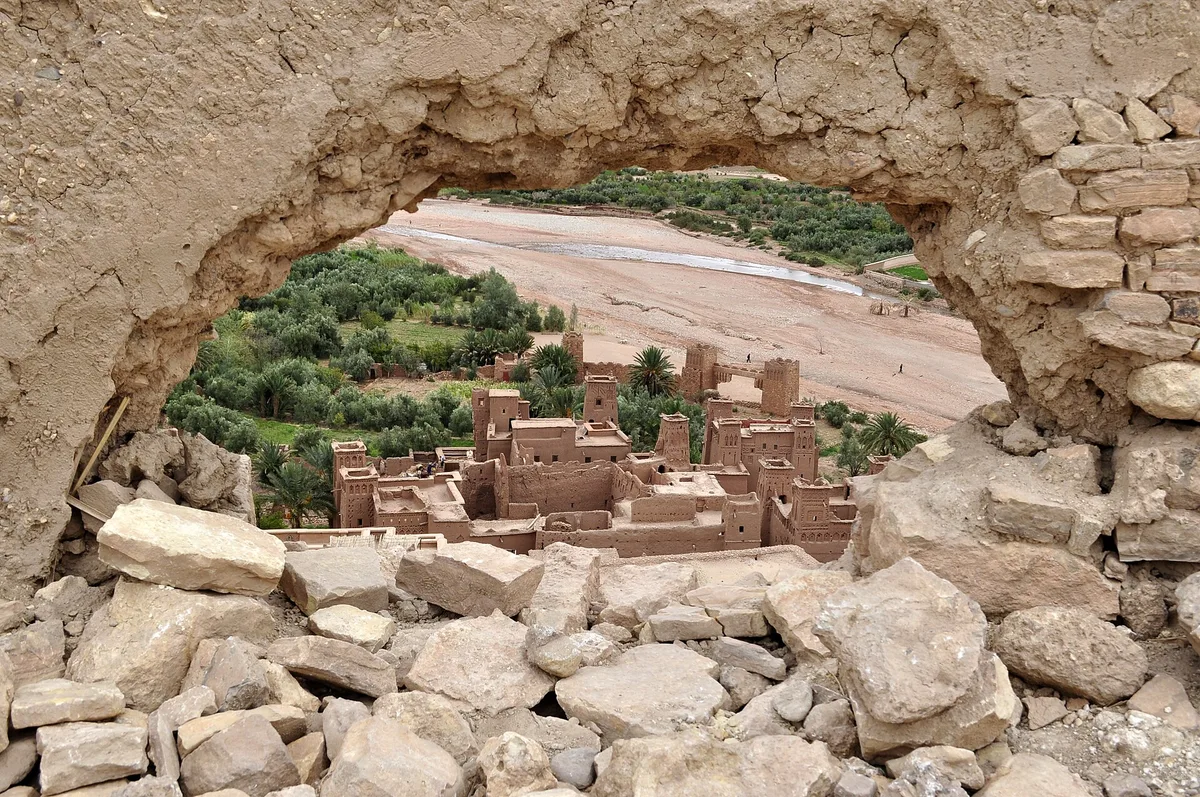
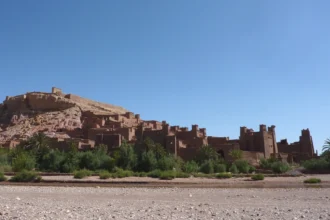
West from Boumalne the road runs through Kelaat M’Gouna, the rose town – in spring the valley of roses is a genuine event, harvest and festival together; out of season it is a pleasant stop for rosewater – and on to Ouarzazate, the film-studios town at the south’s crossroads. Then, a short detour north of the main road, the day’s first set piece: Ait-Ben-Haddou, the earthen ksar in the photograph, a fortified village of mud-brick towers stacked up a hill above the Ounila riverbed, inscribed by UNESCO in 1987 as the type specimen of southern earthen architecture. Cross the riverbed, climb through the lanes to the granary ruin on the summit, and read the place as what it was: a collective insurance policy in mud on the old caravan route – toll post, warehouse and fortress in one. Our dedicated Ait Benhaddou guide covers its film fame and fabric in depth; here, ninety minutes to two hours in the morning, before the excursion crowds, is the measure of it.
Then the pass. The road climbs the Tizi n’Tichka, the highest major road pass in Morocco at about 2,260 metres, on a long staircase of switchbacks over the High Atlas’s main wall. It is one of the great mountain roads of North Africa and the honest price of the southern loop: a half-day’s drive from the ksar to Marrakech in normal conditions, longer if weather or roadworks intervene, and in winter occasionally closed by snow altogether – the FAQ below deals with that honestly. Drive it in daylight, stop at the summit cafés and the viewpoints, and enjoy the descent: alpine stone unrolling to olive plain to, at last, the red walls of Marrakech in the heat haze. Our Atlas Mountains guide covers the range this road crosses, for travellers who want the country behind the windscreen tour. For a morocco itinerary 10 days, this crossing is the hinge the whole second half swings on.
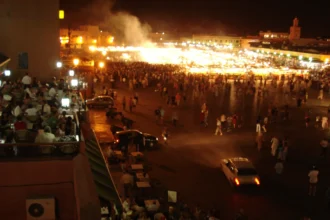
Arrive in Marrakech by late afternoon and do the one thing the city demands first: be in Jemaa el-Fnaa at dusk. The square is the medina’s hearth, filling as the light drops with food stalls, drummers, storytellers and half the city, and arriving fresh from the mountains into its noise and smoke is the best entrance this itinerary can stage-manage. Eat at the stalls if the theatre appeals, or watch from a café terrace and eat after; either way, night 9 – medina riad, or a hotel in Gueliz or Hivernage – ends the travelling part of the route. Every mile is behind you. Day 10 is one city, on foot, at whatever pace is left in you.
Day 10 – Marrakech, One Full Day and the Flight Out
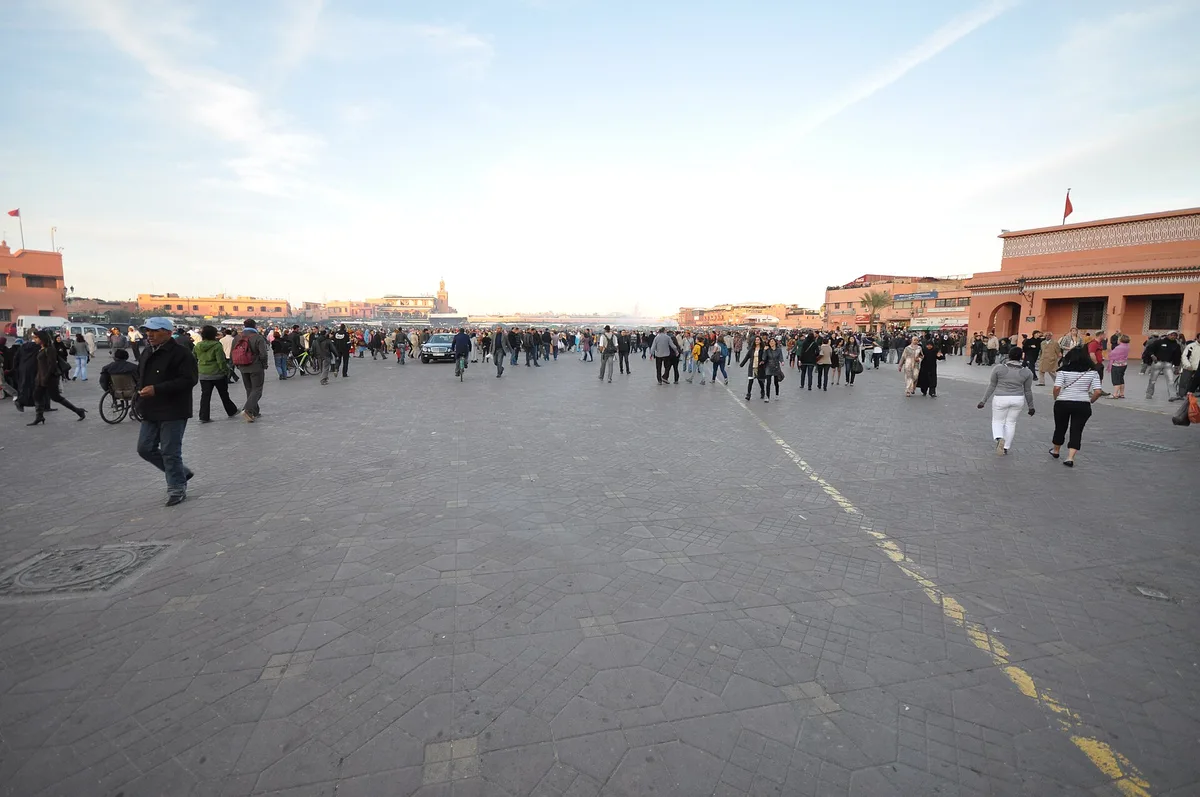
One day in Marrakech is what a morocco itinerary 10 days can honestly give the city – a tasting menu, not the meal – with the option, priced into the trimming section below, of adding the second and third days it deserves. Spend the day in the medina’s southern half, where the monuments cluster densely enough for one day’s walking. Start at the Koutoubia, the twelfth-century Almohad minaret in the photograph – some 77 metres of carved stone that has oriented every traveller since, and the medina’s fixed point whenever the lanes confuse you. Non-Muslim visitors do not enter the mosque, but the building is read from outside anyway: the gardens, the scale, the silhouette over the rooftops at every turn.
From the Koutoubia, walk east into the medina’s working heart. The Bahia Palace, a nineteenth-century ministerial residence of courtyard after courtyard in painted cedar, zellige and carved plaster, shows the decorative arts at their most sumptuous; the Saadian Tombs, hidden for centuries behind a sealed wall beside the Kasbah Mosque, hold the dynasty that built half the city; the ruined El Badi Palace nearby is their vast, roofless counterweight. Between them, the Mellah and the souks: covered lanes organised by trade – metalworkers, dyers, leather, lamps – where one unhurried pass, buying nothing or buying one thing properly, teaches the medina better than a checklist of stalls. If day 9’s evening was your only square, return to Jemaa el-Fnaa in daylight too, when the juice carts and water sellers hold it and it reads as the city’s front yard rather than its theatre.
Sequencing help exists for exactly this day. Our things to do in Marrakech guide ranks the city’s sights by value, and the Marrakech itinerary 3 days plan shows how today expands into a full city break – the obvious move for anyone whose ten days are really a Marrakech trip with a desert attached, and the stretch option below formalises it. If the flight out is this evening, build the day backwards from it: the airport is close to the medina by capital-city standards, but Marrakech traffic argues for a generous margin, and a last mint tea on a rooftop is a better farewell than a sprint. If the flight is tomorrow, the day gains an evening: a hammam, the square at full night roar, and dinner in the medina or out in Gueliz’s avenues.
However it ends, notice what the route has done. Ten days ago you landed in a modern Atlantic metropolis; since then the country has run backwards through its history and forward again – Roman stones, the oldest of the imperial cities, a night in the sand, and now this red, loud garden-city. A morocco itinerary 10 days cannot hold all of Morocco: the Atlantic ports, the deep south and the far north are still out there. What it holds is the country’s spine, travelled once, in the right order, at a human pace. That is what the ten days are for.
Getting Around – Trains, Buses, Grand Taxis and a Rental Car Compared
Four mechanisms move this itinerary, and the craft of the trip is matching each leg to the right one. The railway first: Morocco’s ONCF network is genuinely good where it exists – modern trains, sane stations, first and second class on the main lines – and it covers the northern spine, Casablanca to Rabat to Fez via Meknes, plus the Marrakech exit. The Al Boraq high-speed line, Africa’s first, runs Tangier to Casablanca; its mechanics and the classic network’s are explained in our trains in Morocco guide. But the railway has edges, and this route crosses both: no trains to Chefchaouen, none down the southern valleys, none at all south of Marrakech. A rail-pass mentality strands you exactly where the trip gets interesting.
Coaches fill the gaps with dignity. CTM and Supratours – the latter the railway’s own affiliated coach operator, which is why its services dovetail with railheads like Fez for the desert run – run modern, air-conditioned intercity buses on the routes this itinerary needs, Chefchaouen included, and booking a seat in advance on their websites or at the station is the whole art of it. Grand taxis, the shared intercity Mercedes that leave when full from ranks outside stations, are faster, more flexible and more Moroccan: you buy a seat, or two for comfort on a long leg, and the car leaves when its seats sell. They suit the medium hops – Meknes to Volubilis country, Chefchaouen onward where coach times fail – better than the all-day hauls. Our getting around Morocco guide compares all of it leg by leg, including the petits taxis that handle the in-city runs.
The rental car is the fourth mechanism and, for this route, arguably the lead one for the middle. Days 4 to 9 – Volubilis at your own hour, the Fez-to-dunes drive with its stops, the valleys at walking pace, the pass in daylight – are transformed by wheels, and a one-way rental collected in Fez and dropped in Marrakech is a standard agency product, usually carrying a one-way fee to confirm rather than assume. The honest costs are real too: medina-edge parking, assertive city traffic, routine police checkpoints, and a driver who cannot look at the scenery on the pass. The fifth mechanism – a car with driver, hired for the middle days through your hotel or a reputable agency – buys most of the freedom with none of the driving, at the most season-variable price in the whole trip.
Choose once, by leg, and write it down before you book anything else. A workable default for this morocco itinerary 10 days: trains for Casablanca-Rabat and any Casablanca return, coach or grand taxi to Chefchaouen, wheels – rented or driven – from Fez to Marrakech, and your own feet everywhere inside the medinas. Every element of that default can be swapped, and the sections above show where each swap costs or pays. What cannot be done is to decide it all on arrival; the desert night and the Fez day depend on the machinery around them being settled while you are still at home, which is the subject of the next section.
What to Book Before You Fly – and What to Leave Loose
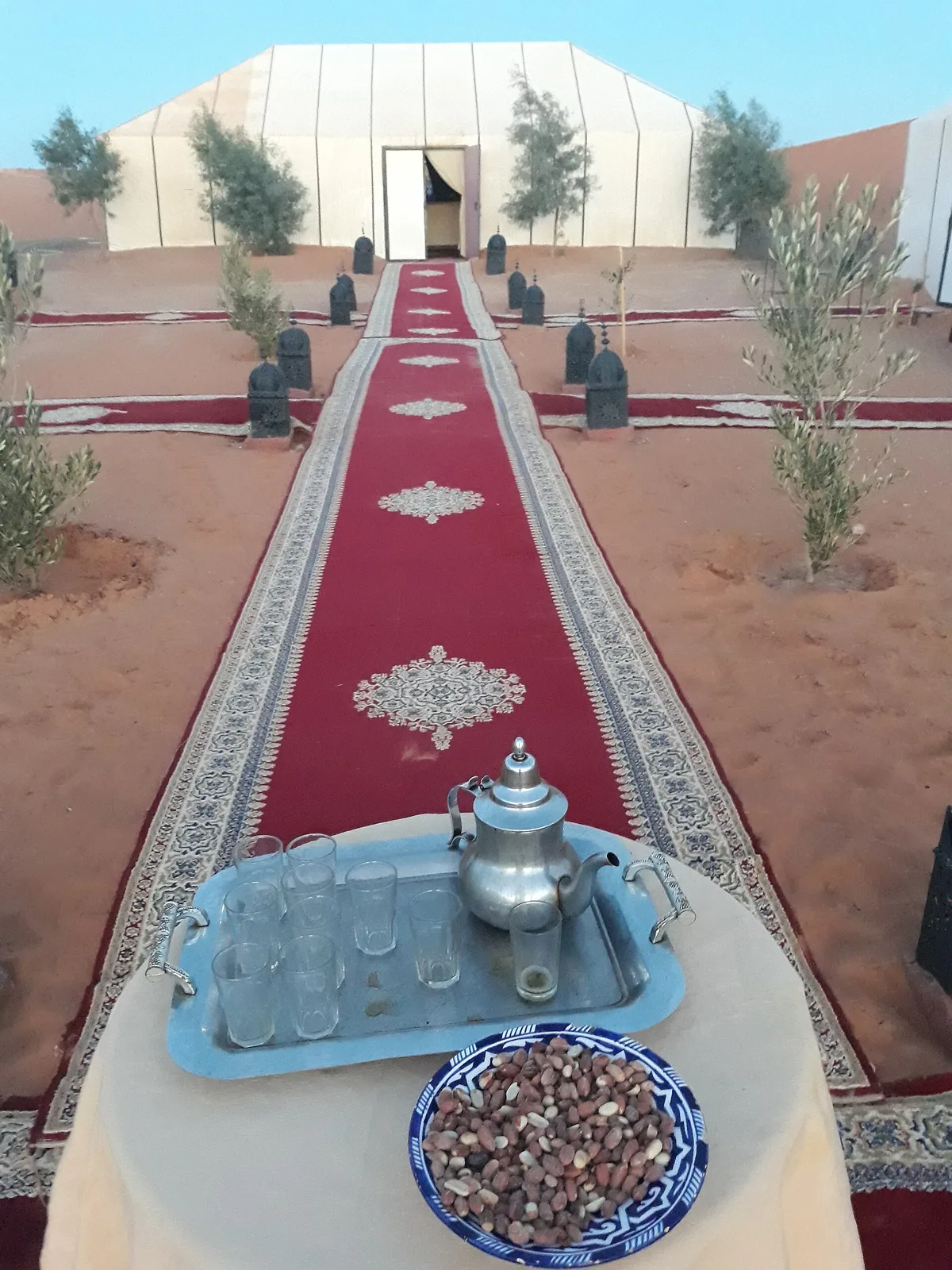
Book the desert first. The night at the dune edge – camp or village hotel, and the camel or 4×4 timing that frames it – is the one element of this morocco itinerary 10 days with real scarcity at peak season and real quality variance at every season, and it is the booking everything south of Fez leans on. Decide the camp question at home: a night out among the dunes in a camp – anything from a simple traditional tent camp to the carpeted, white-tent comfort in the photograph – is the romantic default and the right choice for most, with the honest caveats that winter nights are properly cold, summer ones warm, and the ride in and out is part of the product. A dune-edge hotel swaps some romance for a door that locks, a pool the next afternoon and no dependence on the camel timetable. Either is bookable directly or through your Fez or Merzouga accommodation; what matters is that it is booked, with the pickup point and the morning-after plan agreed in writing, before day 6’s dawn start.
Book the Fez guide, if you are having one, and the first two nights. An official medina guide for day 5 should be arranged ahead through your riad or the official channels – the good ones diary up, and the medina gate is the worst place in Morocco to conduct that negotiation fresh. Casablanca and Rabat hotels are ordinary bookings with deep supply. Beyond that, this itinerary deliberately leaves things loose: the southern valley nights have walk-in depth outside peak weeks, the Marrakech night can be booked once your crossing timing firms up, and restaurant reservations barely feature outside Marrakech’s fashionable end. Over-booking a road trip is its own failure mode – every delay becomes a forfeiture – and six fixed nights against four floating ones is roughly the right ratio for this line.
Two cultural bookings of the soft kind are worth making mentally rather than financially. First, read enough of the country’s etiquette to move gracefully through it – greetings, the right hand, photography asked rather than assumed, mosque thresholds respected; our Moroccan culture and etiquette guide is the primer this route assumes. Second, decide your haggling temperament before the souks decide it for you: prices in the medinas are negotiated by design, the process is a social ritual rather than a trap, and the travellers who enjoy it treat the first figure as an opening line, answer with good humour and a lower one, and walk away content with whatever the middle turns out to be. Our where to stay in Morocco guide covers the riad-versus-hotel question city by city for the nights you do book.
Leave unbooked, on purpose: the hammam (every medina has them; ask locally), a cooking class in Fez or Marrakech (bookable a day ahead in both), and any Atlas day trip proposed for day 10 – refuse politely, since you crossed the Atlas as a journey on day 9. The plan’s white space is allocated to rest, weather and the lane you did not mean to find. Protect it.
Shorter or Longer – Trimming to 7 Days, Stretching to 12 or 14
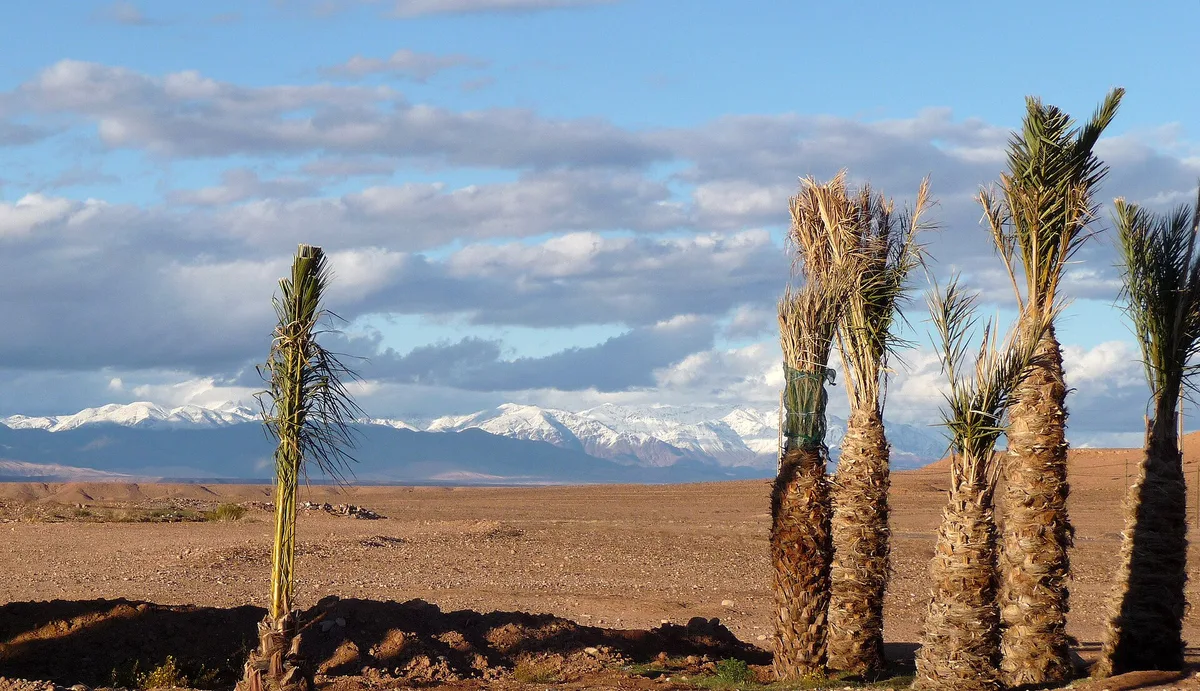
If you have seven days, do not compress this route – cut it. Compress it and every day becomes a transfer with sightseeing attached; cut it and what remains keeps its shape. The honest seven-day version keeps the line and drops its northern fold: fly into Casablanca or straight to Fez’s region, keep Fez’s full day, the desert night and the southern valleys, and end in Marrakech with one day – which is, give or take the arrival city, the shape of our Morocco itinerary 7 days plan, and the reason that plan exists alongside this one. What goes is Rabat and Chefchaouen entire. Travellers whose hearts are set on the blue town should make the opposite cut instead – north only, desert surrendered – and accept that a seven-day trip is one of Morocco’s halves, well seen, rather than the whole country at speed. Both cuts are honourable. The dishonourable version is the seven-day full route, which this page declines to print.
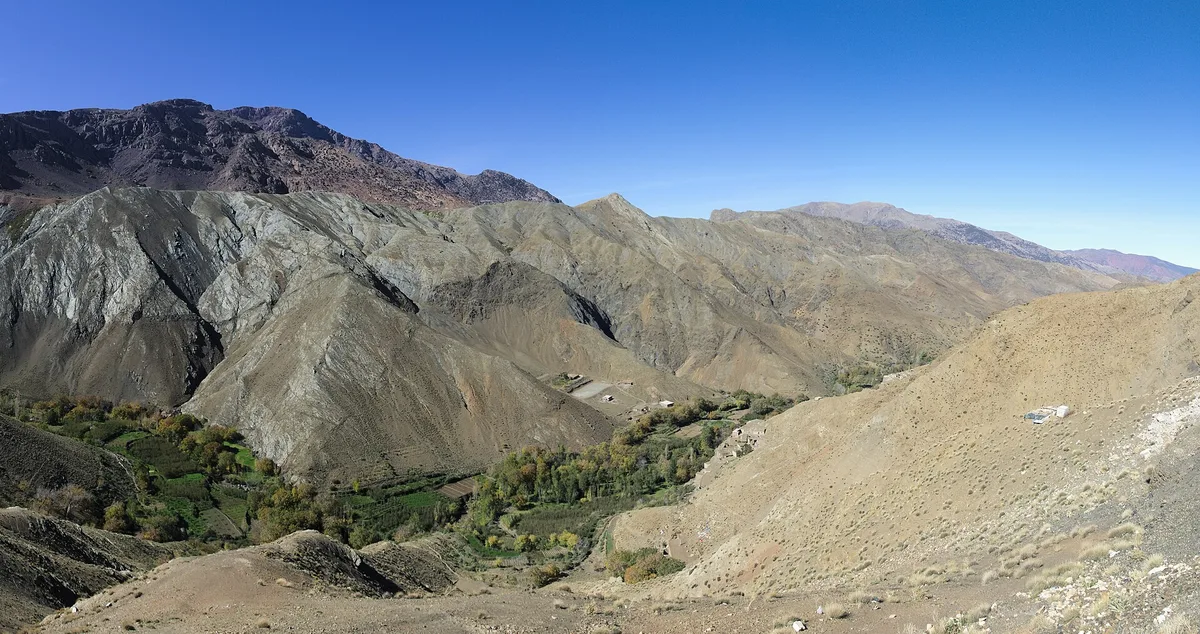
If you have twelve to fourteen days, spend the surplus where a morocco itinerary 10 days is thinnest, in this order. First, a second night in Marrakech – day 10’s tasting menu becomes a meal, with the Majorelle garden, a hammam and a slower souk all fitting at last. Second, a second Fez night, or a night in Meknes paired with Volubilis at opening time. Third, a desert-side extra: a second night at the dunes or in the Dades Valley turns the south from a traverse into a stay, and the valleys in the photograph are where an unhurried day pays best. Fourth, the coast: Essaouira, two or three hours from Marrakech, bolts cleanly onto the end of the line as a decompression stop of white walls and Atlantic wind – the only addition that does not disturb the route’s geometry.
What not to add, at any length: a second desert (Erg Chigaga is a different and longer expedition, not an upgrade), a Tangier start unless the whole route is re-planned around it, and any itinerary that crosses the Tizi n’Tichka twice. The morocco itinerary 10 days printed here is a load-bearing structure, and its virtue at twelve or fourteen days is that the additions hang off its ends and its thinnest joints rather than prising its middle apart. Lengthen it like a building, not like a list.
Morocco Itinerary 10 Days – Questions Travellers Ask
Is 10 days enough for Morocco? Enough for the country’s spine – the imperial cities of the north, the Middle Atlas, one desert night and the southern valleys to Marrakech – at a pace that stays enjoyable, which is exactly what this morocco itinerary 10 days is built to prove. It is not enough for everything: the Atlantic coast south of Casablanca, Tangier and the far north, and the deep south all wait for another trip, and pretending otherwise is how itineraries collapse. Ten days done as one line beats fourteen done as a scramble.
Can this route be done entirely by public transport? Yes, with one honest adaptation. Trains cover Casablanca, Rabat and Fez; coaches and grand taxis cover Chefchaouen and the Fez-to-Merzouga leg, including the railway-affiliated Supratours service built for exactly that run; the southern valleys are served along the main road, with local taxis for the gorges. The adaptation is day 4: Volubilis becomes a taxi hop from Meknes rather than a pause on a drive, and your timings bend around departures. Nothing on a morocco itinerary 10 days is unreachable by public transport; it is simply less forgiving of a late start.
What happens if the Tizi n’Tichka pass is closed by snow? In winter it can happen, and the plan absorbs it in three ways. First, Marrakech is the destination, not a connection – a delayed crossing costs hours or a night, not a flight, provided your departure is not the same evening. Second, the practical response is patience rather than a detour: wait out the closure in Ouarzazate or Ait-Ben-Haddou, since snow closures are usually measured in hours to a day while crews clear the road. Third, build the slack in advance – a late or next-day flight after day 10 if you travel between December and February. Check conditions the night before day 9; your accommodation in Boumalne will know before any website does.
Do I need a visa or any special preparation for this route? Most nationalities visitors arrive from – including the EU, UK, US, Canada and Australia – enter Morocco visa-free for tourism stays of up to 90 days at the time of writing, with a passport valid for the stay; the rules, the entry stamp’s importance and the full country list are set out in our Morocco visa guide, and you should confirm your own position there before booking, because entry policy is the one fact in this itinerary that can change without asking anyone. Beyond paperwork, preparation means the soft kind: modest dress for medinas and mosque visits, small notes for taxis and tips, and a phone that works locally or a willingness to navigate without one.
Is this route safe to drive and travel independently? Morocco’s main roads, including the pass, are travelled by thousands of independent visitors every season, and this route keeps entirely to them; official travel advice, including the current position on the desert areas near borders that this itinerary does not enter, is summarised in our Is Morocco safe guide – read it rather than taking this page’s word for it. The everyday cautions are ordinary: agree taxi terms before the car moves, treat unsolicited medina guidance as a sales opening, drive mountain roads in daylight, and keep the road sense you would use on any rural highway at home.
Which is better, this route or starting in Marrakech? Neither in the abstract; it depends on your flights and temperament. Starting in Casablanca gives the gentler arrival, saves the two great set pieces – the dunes and Marrakech – for the second half, and lets the medinas build from calmest to most intense. Starting in Marrakech front-loads the energy and suits travellers flying in and out of Menara on the best fares. The days, drives and booking logic are identical in mirror image; choose by flight prices first and appetite second.
The Short Version
Fly into Casablanca and out of Marrakech. Spend day 1 with the Hassan II Mosque and an early night; day 2 on the train to Rabat and in the Udayas kasbah above the river; day 3 in blue Chefchaouen; day 4 driving south past Roman Volubilis into Fez; day 5 entirely inside Fes el Bali. Day 6 is the long, beautiful drive – cedars, Midelt, the Ziz palm gorge – to the dune edge at Merzouga.
Wake on day 7 in Erg Chebbi, then run west through Tinghir; give day 8 to Todra Gorge and the Dades Valley; day 9 to Ait-Ben-Haddou and the Tizi n’Tichka crossing, ending in Jemaa el-Fnaa at dusk; and day 10 to Marrakech itself before the flight out. Book the desert night, the Fez guide and the first two nights from home, travel the north by train and the south with wheels, and leave the rest loose. That is the whole morocco itinerary 10 days – one line, no backtracking, and the country in the right order.