Most guides to this subject start with a list of hotels. That is the wrong place to start, because the real question behind where to stay in Morocco is not which property — it is which kind of place. A night in a medina riad, a night in a restored kasbah and a night in a desert camp are three completely different experiences that happen to share a country, and choosing between them shapes a trip more than any single sightseeing decision. Get the types right and the specific property almost chooses itself; get them wrong and even a well-reviewed address will irritate you for reasons nobody warned you about.
So this guide names almost no properties and quotes no prices. It answers where to stay in Morocco at the level of types, explaining how each kind of Moroccan accommodation actually works in practice — what a riad is architecturally, what a dar is and why the difference barely matters, what "luxury" means when it is printed on a tent, why dinner is not optional in the south, and where the cash-versus-card line really falls. The catches are stated as plainly as the pleasures, because in Morocco the catch is usually the thing that decides whether you loved a place or merely photographed it.
The country divides into five sleeping zones, and most trips touch at least three of them. There are the old medinas of the imperial cities, where courtyard houses hide behind blank walls in lanes no car can enter. There is the kasbah country of the south, strung along the valleys between the High Atlas and the desert. There are the two great dune seas, Erg Chebbi and Erg Chigaga, where the accommodation is a camp and the camp is the point. There are the Atlas valleys, where family gîtes exist to feed and sleep walkers. And there is the coast, which splits between medina riads in Essaouira and a purpose-built resort strip in Agadir. Our Morocco travel guide covers the routes that connect these zones; this page covers the beds at each end of them.
One honest warning before the detail. Moroccan accommodation runs on personal contact in a way that surprises visitors used to anonymous hotel systems. Small houses have no front desk in the hotel sense, desert camps have no street address, and a mountain gîte may confirm your stay with a phone call rather than a booking engine. None of this is a defect — it is simply how the country works, and the sections below treat it as information, not as a problem to be solved.
Where to Stay in Morocco at a Glance
| Type | Where you find it | Best for | The catch |
|---|---|---|---|
| Medina riad | Marrakech, Fes, Essaouira, Chefchaouen medinas | Atmosphere, architecture, being inside the old city | No car access; you walk the last stretch, sometimes a long one |
| Dar / maison d’hôte | The same medinas, usually smaller streets | The riad experience at a simpler scale | Fewer rooms and facilities; quality varies house by house |
| New-town hotel | Gueliz in Marrakech, the ville nouvelle in Fes, central Casablanca and Rabat | Easy arrivals, lifts, parking, predictable systems | You sleep outside the Morocco you came to see |
| Kasbah guesthouse | Skoura, the Dades and Todra valleys, the Draa | The desert run; scenery; silence | Half-board by necessity; early nights; long distances either side |
| Standard desert camp | Erg Chebbi, Erg Chigaga | The dune night itself, at an honest level of comfort | Shared bathrooms, simple tents, real cold after dark |
| Luxury desert camp | Erg Chebbi mainly, a few at Erg Chigaga | A proper bed and a private bathroom in the dunes | "Luxury" is relative to sand, not to a city hotel |
| Mountain gîte | Imlil and the Atlas valleys | Walking bases; village life; home cooking | Basic rooms, shared spaces, cash, cold nights |
| Coastal medina riad | Essaouira | Slow days, sea air, an easy medina | Atlantic wind and salt damp are part of the deal |
| Resort hotel | Agadir bay, Taghazout Bay | Pool-and-beach holidays, winter sun, families | A resort that could be anywhere; the medina experience is absent |
| Surf lodge | Taghazout, Sidi Kaouki | Surf weeks with guiding and boards included | Communal living; not a quiet couples’ format |
Read the table with one principle in mind: in Morocco you are rarely choosing between good and bad accommodation, you are choosing between different frictions. The riad’s friction is access — a walk through lanes with your bag on a handcart. The kasbah’s friction is distance and a fixed dinner hour. The camp’s friction is a shared bathroom and a cold tent at 3 a.m. The resort’s friction is that you could be anywhere on earth. None of these frictions is a reason to avoid the type; each is simply the price of the thing that makes it worth doing, and knowing the price in advance is most of enjoying the stay.
Seen whole, the where to stay in Morocco question is really ten smaller questions wearing one coat — one per row of that table — and the rest of this guide takes them in turn.
It is also worth saying what the table cannot show: the same building type changes character completely with management. A riad run by its owner, who meets you at the door and cooks or supervises breakfast, is a different product from an identical house run as an absentee investment with rotating staff. Moroccan small-scale accommodation is personal in a way that star ratings do not capture, which is why this guide keeps returning to mechanics — how a place receives you, feeds you and communicates with you — rather than to décor.
The Riad, Explained Properly
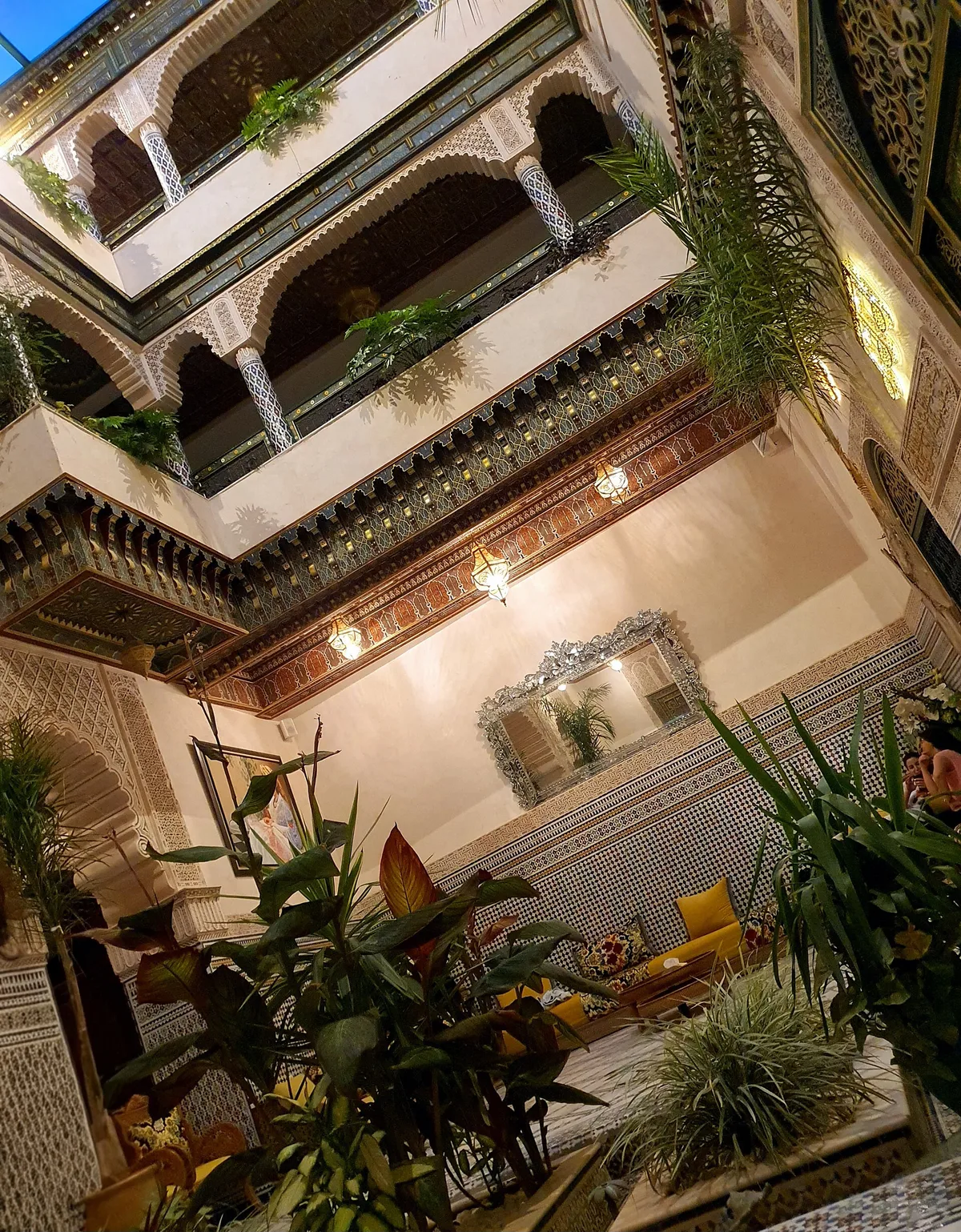
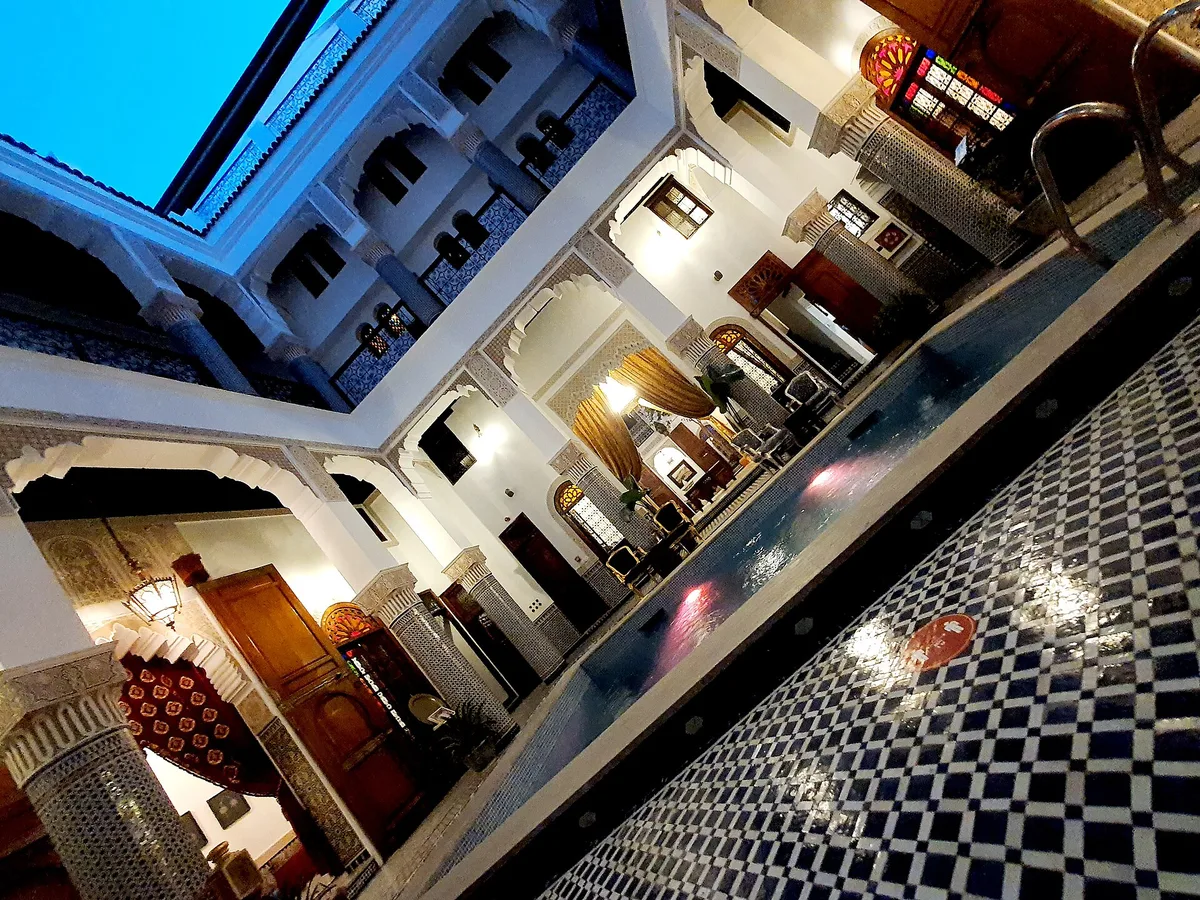
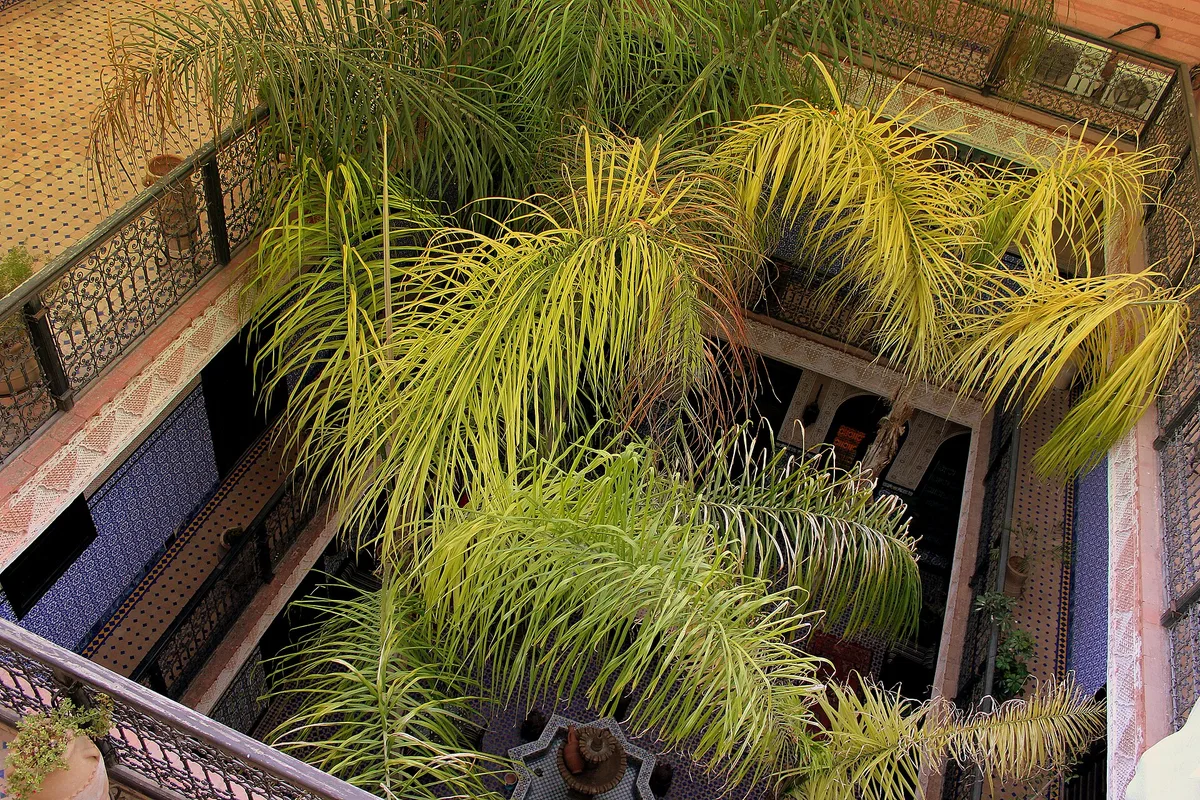
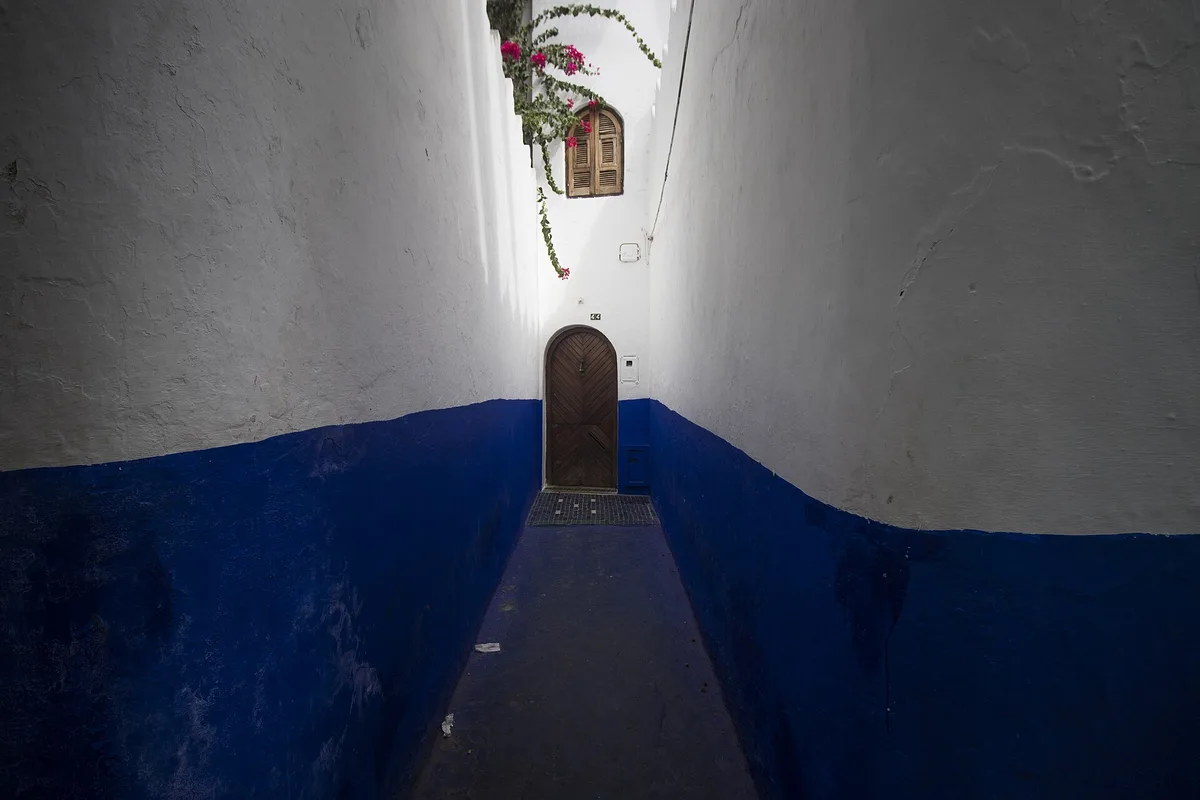
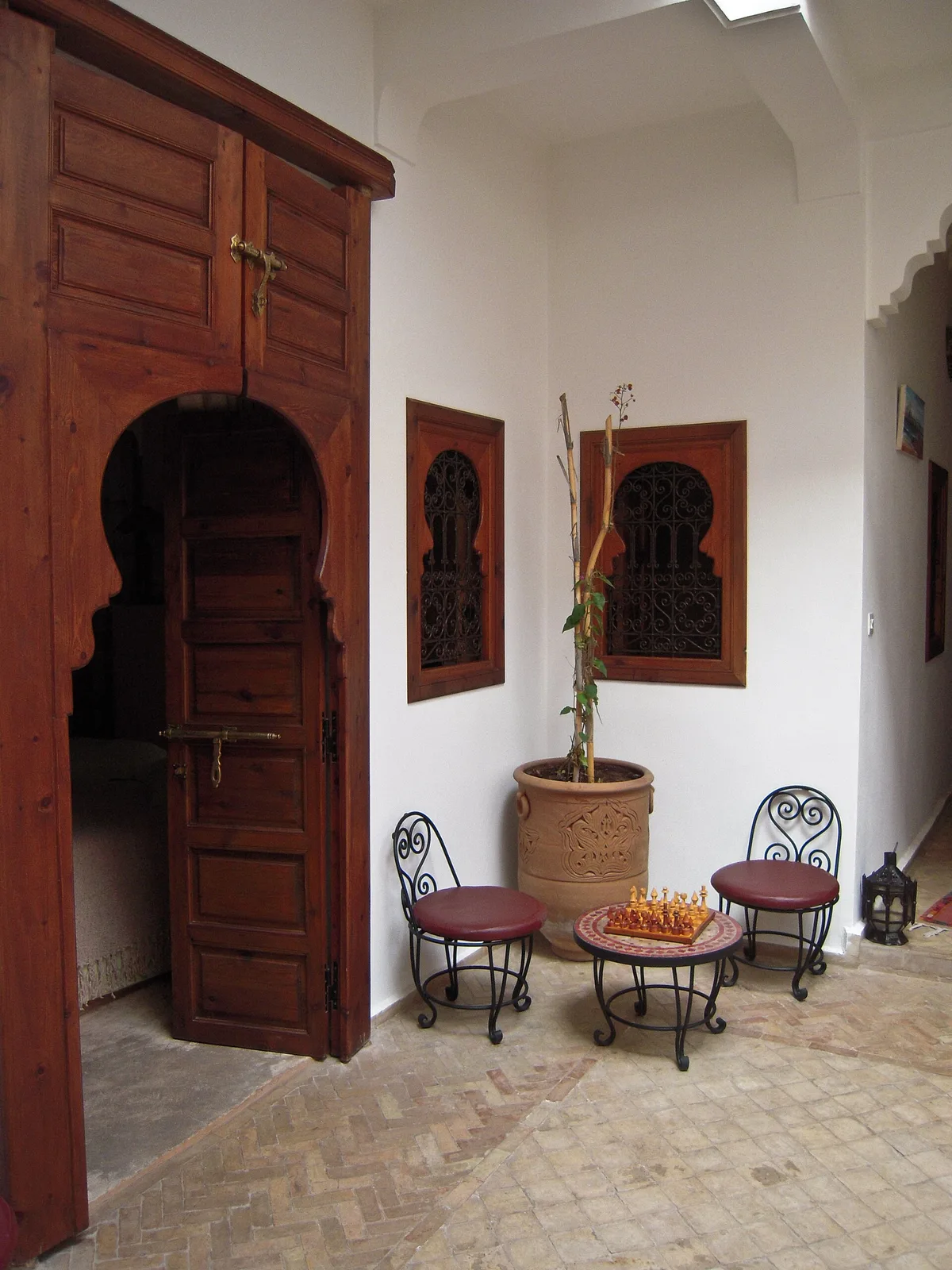
A riad is a house built around a garden, and everything about staying in one follows from that single fact. The word comes from the Arabic ryad, meaning garden, and in the traditional houses of Morocco’s old cities the garden is not behind the house or in front of it — it is the centre of it. Rooms are arranged on two or three floors around a rectangular courtyard, the wast ad-dar, and the courtyard is planted: classically divided into four parts by two crossing paths, with a fountain at the centre and citrus trees — bitter orange above all — giving shade and scent. Every door and window of any importance faces inward onto this green court. The street outside gets a blank wall and a single, often surprisingly modest, door.
This inwardness was not an aesthetic whim. It protected family privacy in dense cities where houses stood wall to wall, and it worked as climate control centuries before the term existed: the courtyard pulls cool air down, the thick walls hold the day’s heat out and the night’s cold in, and the fountain’s evaporation takes the edge off dry heat. The rich decoration of a traditional house — zellige tilework, carved plaster, painted cedar — is concentrated inside, on the surfaces the family lived among, rather than spent on a façade for strangers. A riad seen from its lane tells you nothing; a riad from its courtyard tells you everything. That contrast, the plain door opening onto a planted court, is still the single most reliable pleasure of the type.
The houses you can sleep in today were mostly built as family homes — some modest, some palatial — in medinas like those of Fes and Marrakech, the oldest of which are UNESCO-listed; the Medina of Fez alone has been a World Heritage site since 1981 and is often described as one of the best-conserved historic towns of the Arab-Muslim world. Conversion to a guesthouse usually means bathrooms added room by room, a kitchen rebuilt for guests, and the roof terrace — traditionally a working space — turned into the house’s social heart. The number of rooms stays small by hotel standards, commonly somewhere between four and a dozen, which is why a riad feels staffed by a household rather than by a company.
Two practical consequences follow from the architecture. First, light and air in your room come from the courtyard, not the street, so rooms are quiet in a way city-centre hotel rooms rarely are — the medina’s noise stops at the front door. Second, the courtyard is a shared vertical space: sound carries upward, doors open onto galleries above other guests’ breakfast, and the house has a domestic rhythm — people rise early for tours, staff move about from dawn — that light sleepers should know about. A riad is not a private villa with other guests edited out; it is a house, and staying in one means joining its household for a few days, which is either the charm or the problem depending on the traveller.
Staying in a Riad, Day to Day
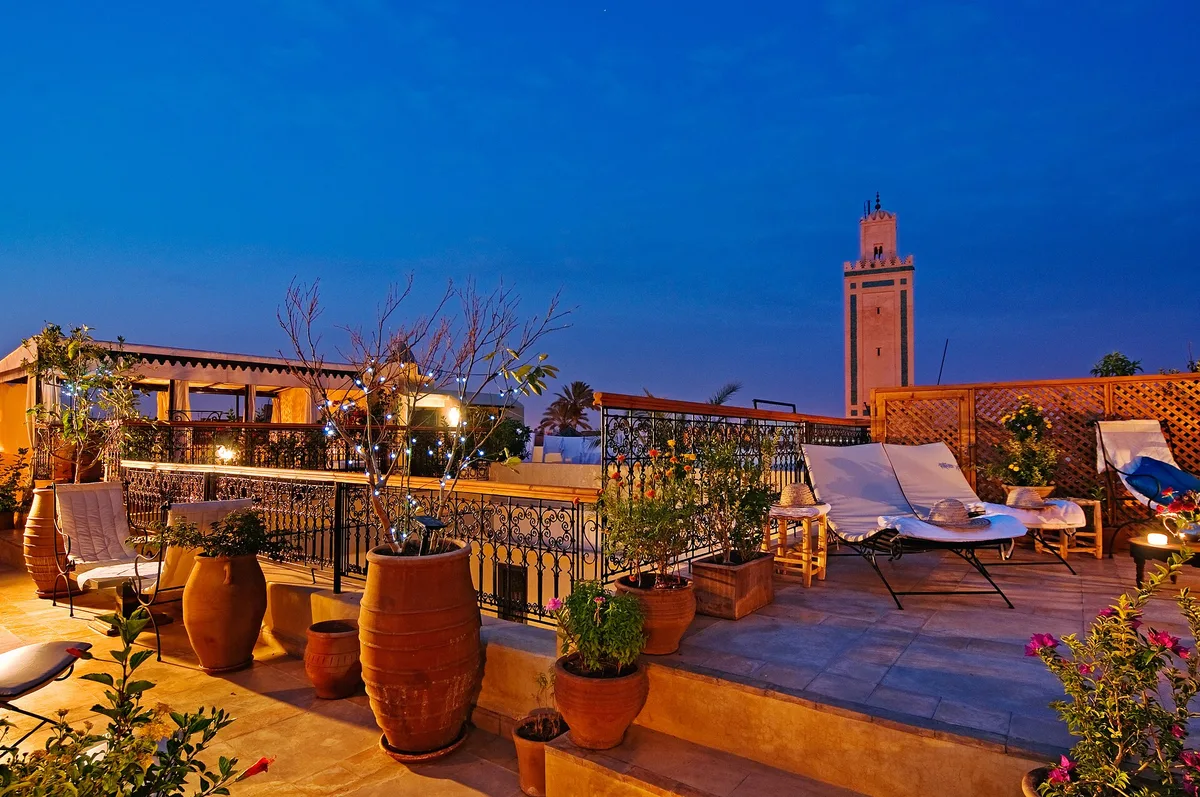
The first thing staying in a riad involves is arriving, and arriving is an education in medina geography. Cars cannot reach the door. In Fes el-Bali, which is widely described as one of the largest car-free urban areas in the world, they cannot even reach most of the neighbourhood; in Marrakech they reach the medina gates and a few main arteries and no further. So the standard arrival runs like this: your taxi or transfer stops at a gate or a small square, and someone from the house meets you there — arranged in advance by phone or message — and walks you in, with your bags following on a handcart or carried by a porter. First-time visitors routinely describe this walk as the moment the trip starts: two minutes of lanes too narrow for a car, past shops and doorways, and then a plain door opens onto the courtyard.
This is why every practical guide to riads says the same thing: arrange the meeting before you arrive, and keep the house’s phone number to hand. A riad address on a booking confirmation is close to useless for finding the place yourself — lanes are unsigned, numbering is local logic, and map pins in medinas are approximations. The meeting-at-the-gate system is not a charming extra; it is the mechanism that makes medina accommodation work, and houses are good at it precisely because they do it every day. If you arrive independently by train or bus, the same applies: get to the agreed gate, call, and wait to be collected.
The day itself runs on household rhythms. Breakfast is the institution: served in the courtyard or, in good weather, on the roof terrace, it is a Moroccan spread of breads and msemen flatbreads, olives, cheese, eggs, jams and mint tea or coffee — generous, unhurried, and rarely at a hotel’s buffet scale or anonymity. Many houses will cook dinner on request, ordered that morning, and a home-cooked tagine eaten in the courtyard is often better than the medina’s tourist-facing restaurants; equally, staff will happily point you outward, book tables and arrange hammams and guides, because in a small house the staff are the concierge service. Expect a handful of people — a manager or owner, a cook, a night watchman, cleaning staff — several of whom you will know by name within a day.
The trade-offs are physical. There is almost never a lift, and stairs in old houses are steep; ground-floor courtyard rooms exist but are the exception, so a riad is a considered choice for anyone with serious mobility limits. Bathrooms retrofitted into historic fabric can be small, and water pressure is a house-by-house lottery. Winter nights in unheated stone houses are genuinely cold, summer afternoons in courtyard-facing rooms depend on modern air conditioning that not every house has fitted equally well. And the walk home after dark is through lived-in lanes that are safe in the ordinary medina way but unlit and maze-like until you know them — the house will tell you which route to use, and after the first day it feels like yours.
Riad, Dar or Hotel – the Differences That Matter
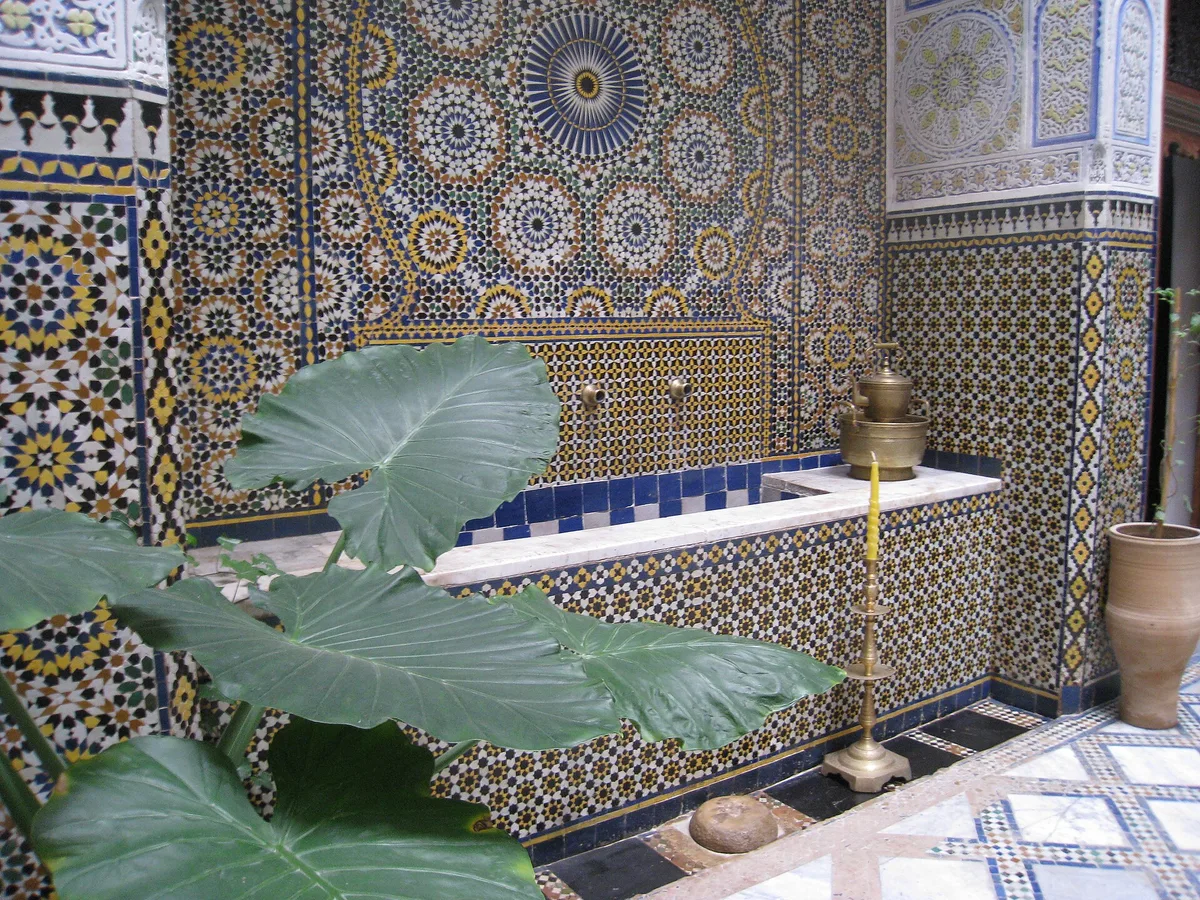
If the riad is the famous word, the dar is the one that quietly houses half its guests. Architecturally the distinction is precise and, for a guest, almost irrelevant: a dar is a courtyard house whose central space is paved rather than planted. Same inward plan, same galleries, same blank street wall — but where the riad’s court is a garden with trees and a fountain, the dar’s is a tiled patio, a light well, sometimes covered, that brings air and daylight into the middle of the house. Dars tend to be smaller and less grand than the great riads, and a large share of the houses marketed to visitors as "riads" are, by the strict architectural definition, dars. This matters not at all to your sleep. What it does explain is why two properties both calling themselves riads can feel so different in scale — one a garden palace of ten rooms, the other a handsome patio house of four.
Layered over both words is a third term you will see everywhere, maison d’hôte — guesthouse — which is not an architectural label at all but the operating category under which most medina houses receive paying guests. When a booking site lists a "riad" you are reading marketing; when the house calls itself a maison d’hôte it is describing how it runs: a small, personally hosted house, meals cooked on the premises, the owner or a manager present. Our advice is to ignore the noun and read the mechanics — how many rooms, where exactly in the medina, who meets you, what is cooked in-house — because those, not the riad/dar label, decide the quality of a stay — and they are the details that actually settle the where to stay in Morocco decision in the medinas.
The hotel is the genuine alternative, and it is a different organism rather than a worse one. A hotel gives you a lift, a desk staffed around the clock, a bar and restaurant that do not need ordering in advance, sound insulation designed rather than inherited, and a door a taxi can reach. It also gives you a corridor, a key card and a room that could be in any warm country on earth. The honest comparison is not character versus blandness — good hotels in Gueliz or the Palmeraie have real character, and poor riads exist — but system versus household. Travellers who value predictability, are arriving late at night, are working, or are moving every night tend to be happier in hotels. Travellers staying three nights in one city, who eat breakfast slowly and ask staff for advice, get more from the household end of the spectrum. Many good trips mix both, deliberately, city by city.
One legal-practical difference is worth knowing. Medina houses operate within old buildings under medina constraints: no vehicle access for deliveries or emergencies, limited scope to expand, water and drainage inherited from another century. Hotels in the new towns operate as conventional businesses with conventional infrastructure. This is the root of most of the practical differences above — the riad’s charms and its frictions are the same inheritance seen from two sides, and the traveller who understands that tends to forgive the water pressure and love the courtyard.
Medina or New Town – Where Your Base Changes the Trip
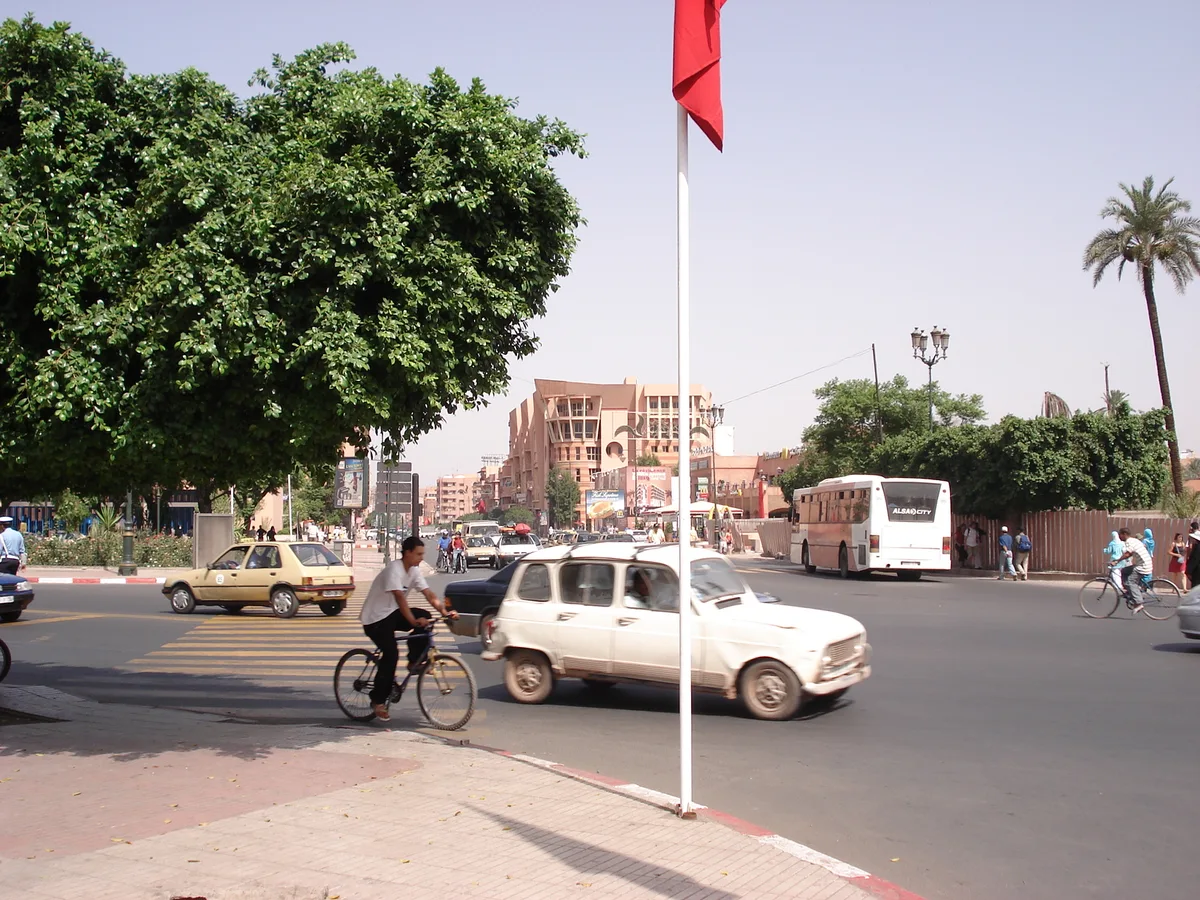
Every old Moroccan city is really two cities, and where you sleep decides which one you live in. The medina is the historic core — Marrakech’s red lanes, Fes el-Bali’s hillside maze — and beside it, usually a short taxi ride west or downhill, sits the ville nouvelle, the new town built in the French protectorate era and expanded ever since: Gueliz in Marrakech, the ville nouvelle in Fes, with wide avenues, apartment blocks, cafés, supermarkets and the larger hotels. Marrakech adds two further zones: Hivernage, a leafy hotel district between the medina and Gueliz, and the Palmeraie, the palm grove on the city’s edge, where resort hotels and villas spread out behind walls with big pools and gardens.
The medina case is immersion and friction in equal measure. You walk out of your door into the souks; the monuments, the food stalls and the evening life are your neighbourhood; breakfast is on a roof above the lanes. Against that: the walk in with luggage, the impossibility of a hire car at the door, early starts by the medina’s own noise — though, as noted, the courtyard swallows most of it — and the simple fact that finding your own front door takes a day to learn. For a first stay of two nights or more in Marrakech or Fes, most travellers who choose the medina are glad they did, because the medina is the destination in those cities, and commuting into it from outside changes the experience fundamentally.
The new-town case is logistics. A hotel in Gueliz receives your taxi at the door, stores your hire car, feeds you at whatever hour you arrive, and puts supermarkets, pharmacies and modern cafés on your street. Business travellers, one-night stops between trains, travellers with heavy luggage or mobility constraints, and anyone self-driving all have rational reasons to sleep outside the walls. The cost is that you visit the medina rather than inhabit it: each trip in is an excursion with a taxi negotiation attached, and evenings default to the new town’s restaurants rather than the old city’s streets. Neither choice is wrong; they are different trips wearing the same itinerary.
A useful rule of thumb is to match the base to the city’s purpose. In practice, where to stay in Morocco is decided one city at a time, and the base is the decision that frames all the others. In Marrakech and Fes, where the medina is the point, stay in it unless logistics forbid. In Casablanca, which most visitors pass through for the Hassan II Mosque and onward connections, a conventional hotel in the centre or along the Ain Diab corniche is the sensible default — the city’s small medina does not anchor a stay the way the imperial medinas do. In Rabat the medina and the Kasbah of the Udayas reward a small house if you are lingering, a hotel if you are not. And in the Palmeraie’s case, be honest with yourself: a resort there is a holiday at Marrakech rather than in it, which suits some trips — particularly with children and a pool-centred plan — perfectly well.
Kasbah Stays in the South – Skoura, the Dades and Todra
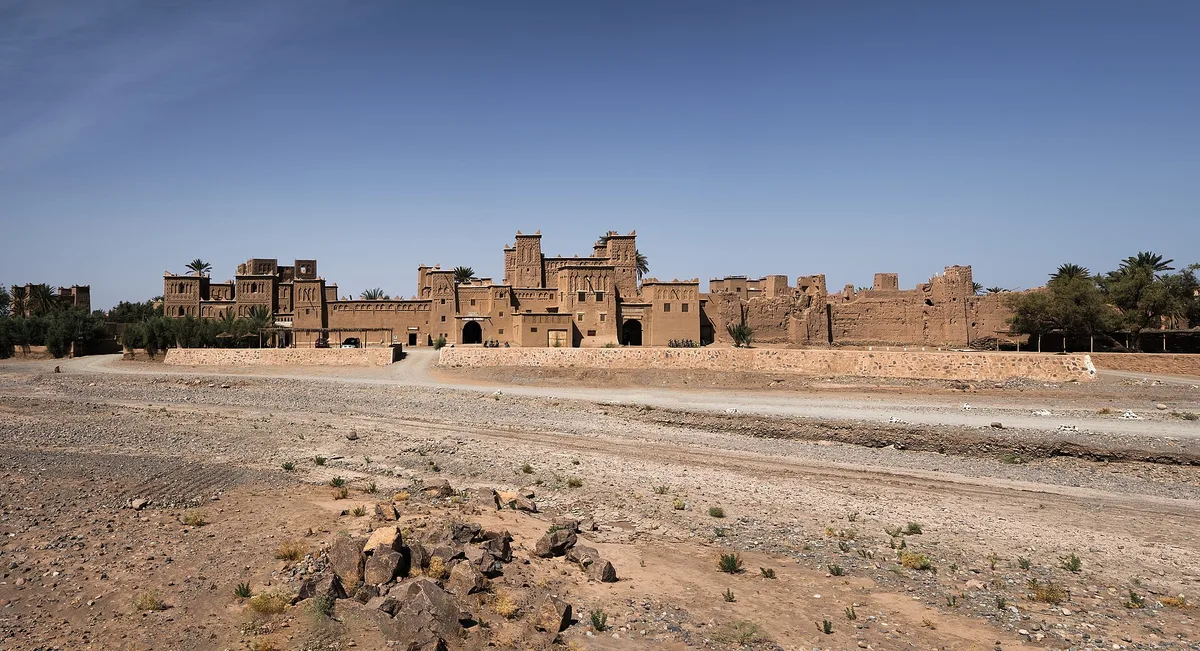
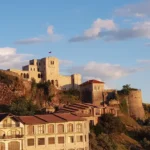
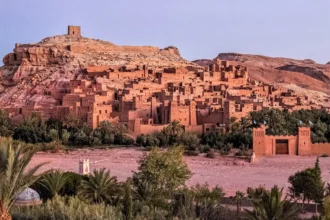
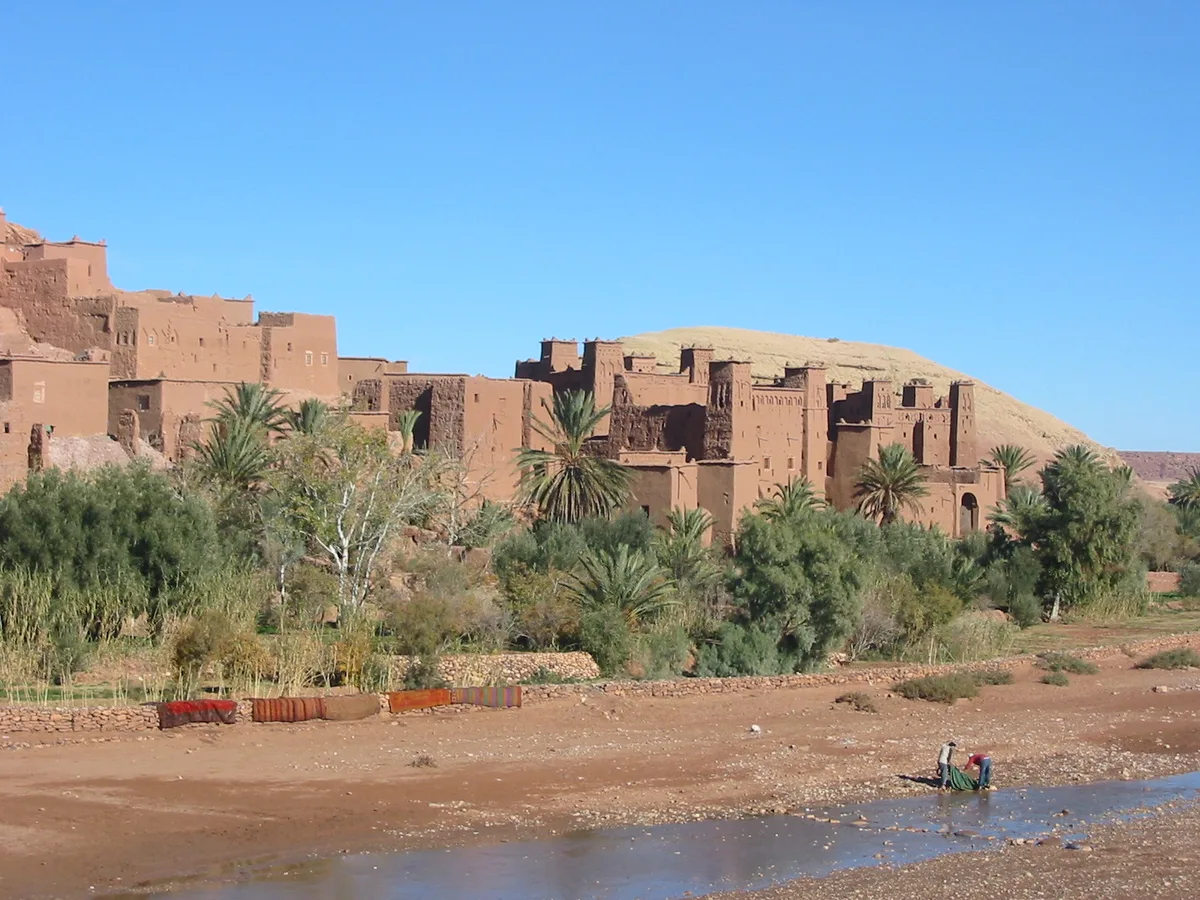
South of the High Atlas, the building that defines the landscape is the kasbah: a fortified, multi-storey house of rammed earth and mud brick, raised by a powerful family, with corner towers, small windows and decoration pressed into its upper walls. A ksar, by contrast, is a whole fortified village — Ait Benhaddou is the famous one — and confusing the two is the region in miniature: kasbahs were strongholds and statements, ksars were communities under one wall. The valleys east of Ouarzazate — the Skoura palm grove, then the Dades and Todra valleys on the road to the desert — are so dense with them that the route is nicknamed the Road of a Thousand Kasbahs, and many of the finest, like Skoura’s seventeenth-century Kasbah Amridil, survive as museums or ruins rather than as places to sleep.
What you actually sleep in, on a typical desert run, is one of three things: a restored old kasbah converted into a guesthouse, towers and all; a newer guesthouse built in kasbah style, in the same earth colours and crenellations but with modern plumbing behind them; or a simple family auberge in a valley village. All three share the southern pattern. Rooms are thick-walled and cool; the building stands in a palm grove or above a river of gardens; and dinner and breakfast are at the house, full stop. This is the half-board reality of the south, and it is not a sales technique: in Skoura’s grove or a village up the Dades, there is no row of restaurants to stroll to. The house cooks, you eat, and the meal — soup, tagine, bread, fruit, eaten on a terrace or in a salon — is usually a highlight of the route rather than a compromise.
The honest catches are distance and rhythm. These stays sit inside long driving days — the classic run from Marrakech over the Tizi n’Tichka pass to the desert takes the better part of two days with a kasbah night breaking it — so a kasbah stay is a night, occasionally two, never a base. Evenings are early and quiet: dinner, stars, bed, because tomorrow’s drive starts at dawn and there is, by design, nothing else to do. Travellers who need nightlife will find the south austere; travellers who need sleep will find it magnificent. Facilities scale with the category — restored kasbahs and kasbah-style hotels may have pools and gardens, village auberges may have a shared terrace and the family’s company — but heating and cooling everywhere lean on the earth’s own insulation, and winter nights at altitude in the Dades are properly cold inside as well as out.
Choose your night by route logic rather than romance alone. Skoura suits the traveller who wants the palm grove and Amridil and a gentler first day out of Marrakech. The Dades valley suits the traveller who wants the gorge road and the switchbacks as part of the stay. Todra, by Tinghir, suits walkers and climbers who can give the gorge a morning. In each case the kasbah is not a detour from the desert trip — it is the hinge that makes the desert trip civilised, and most people remember the earth towers and the terrace dinner long after they have forgotten the drive. When travellers ask where to stay in Morocco’s south, this hinge night is the answer: not in a town hotel on the main road, but inside the valley you have spent the day driving through.
Desert Camps – One Night in the Dunes
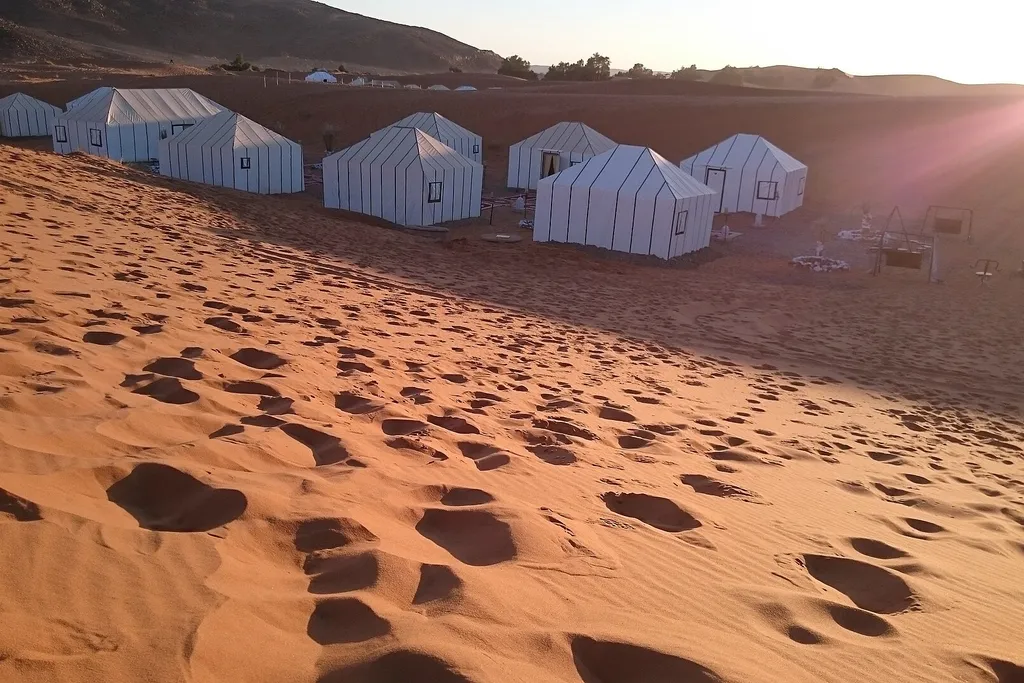
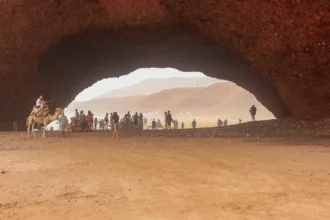
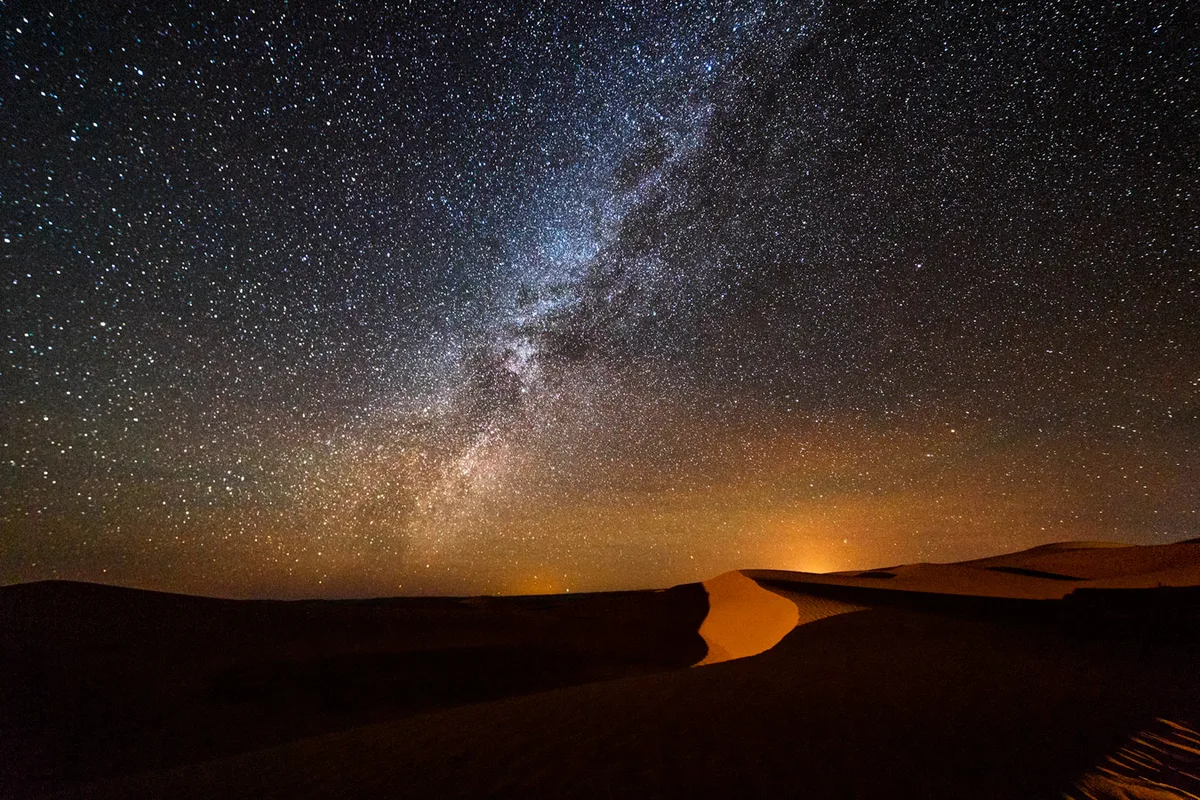
A desert camp is not a hotel that happens to be sandy; it is a small, temporary-feeling settlement that exists to put you inside the dunes for one night, and understanding its mechanics in advance is the difference between a magical night and a confusing one. Of all the where to stay in Morocco choices, it is the one where the gap between expectation and reality is widest — in both directions. The standard pattern at Erg Chebbi runs like this. You leave your main luggage at the operator’s hotel or auberge in Merzouga — or in the vehicle, on an organised tour — and travel the last stretch into the dunes in the late afternoon, by camel at walking pace, by 4×4, or a mixture. The camp is a ring or cluster of tents around a communal space, with a dining tent or terrace. You watch sunset from the dune crest, eat dinner — cooked on site, eaten together — and then there is music around a fire, drums and singing led by the staff, and the sky does the rest. In the morning you are woken for sunrise, eat breakfast, and ride or drive back out. The whole experience is choreographed around two events of light, and its brevity is the point.
Within that pattern, "standard" and "luxury" describe specific, checkable differences — not vibes. A standard camp gives you a simpler tent, often of heavy traditional fabric, with real beds and blankets but a shared bathroom block a short walk across the sand, and water and power rationed by the fact that everything arrives by vehicle: expect solar or generator electricity, a few hours of light and charging, and a short, purposeful shower. A luxury camp gives you a large, standing-height tent — increasingly a semi-permanent structure — with a proper bed and bedding, a private en-suite bathroom with a flush toilet and hot shower, and more space, privacy and furnishing between you and the neighbours. What luxury in the dunes does not mean is a city hotel’s systems: the water is still tanked, the power still local, the staff still small. The honest way to read a camp listing is to check the bathroom question first — private or shared — because that, more than thread counts, is the line between the two products.
Then there is the cold, which brochures underplay. Desert sand radiates the day’s heat away fast, and nights in the Moroccan Sahara are cold for much of the year — in winter, genuinely near freezing before dawn, with the tent unheated or heated only in the luxury category. Summer inverts the problem: the tent is stifling until late, and the night only becomes comfortable towards morning. Dress for the night, not the sunset photograph: warm layers in winter even inside the blankets, and accept that a 5 a.m. sunrise wake-up in January is a bracing experience. None of this should put you off — the cold is part of why the stars look the way they do — but it should be packed for.
Why one night? Because a camp offers one evening and one morning, and both repeat: the second night is the same sunset, the same dinner hour, the same fire. One night is the near-universal pattern and satisfies most travellers completely. The exceptions are photographers, who gain from a second attempt at the light and the Milky Way, and travellers at remote Erg Chigaga, where the journey in is long enough that arriving and leaving on consecutive days feels rushed. If energy remains after the camp night, it is better spent on the kasbah valleys or a dune-edge auberge with a pool at Merzouga than on a second identical night under canvas.
Erg Chebbi or Erg Chigaga – Two Very Different Deserts
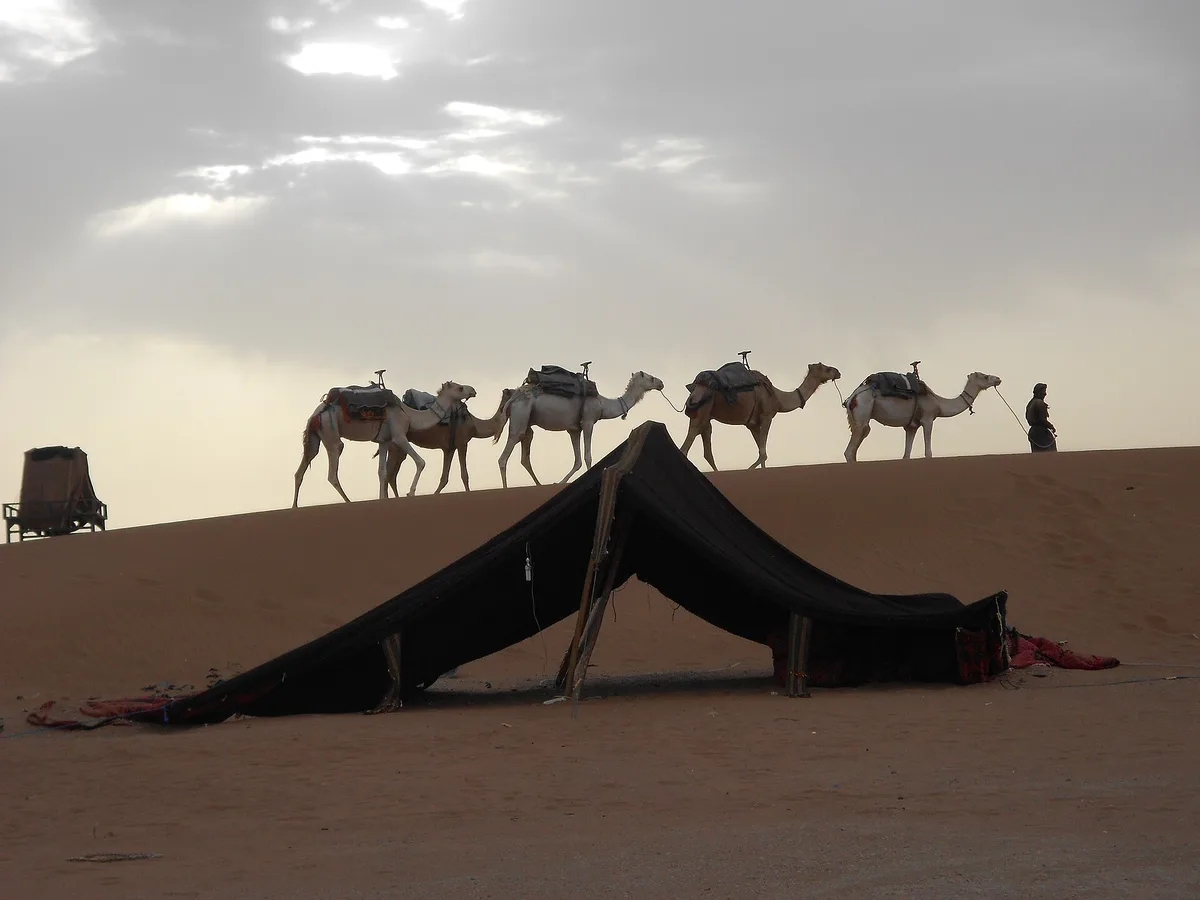
Morocco has two great sand seas, and they produce two different trips. Erg Chebbi, beside the village of Merzouga in the south-east, is the accessible one: a compact field of high, sculpted dunes — commonly cited as rising up to around 150 metres — reached by paved road right to the dune edge, with Merzouga’s hotels and auberges strung along its western foot and camps of every level tucked among the dunes. Because access is easy, Chebbi is on every itinerary and every multi-day tour from Marrakech and Fes; it is busy in season, its camps numerous and close enough together that lights from the next camp can freckle the horizon. In exchange you get the tallest, most photogenic dune forms in the country with the least effort, and the full range of camp standards to choose from.
Erg Chigaga, reached from M’Hamid el Ghizlane in the far south, is the connoisseur’s alternative. The dune field is broader and lower-slung, the camps far fewer, and the journey is the filter: from M’Hamid, where the paved road effectively ends, the last stretch is a couple of hours or more of off-road 4×4 driving across hamada and soft sand. There is no way to do Chigaga casually as an add-on, and that is precisely its appeal — nights there feel genuinely remote, the horizons are empty in a way Chebbi at peak season is not, and the camp you sleep in is likely to be one of a handful in the whole erg. The price, beyond money, is time: Chigaga realistically demands a dedicated southern loop rather than a standard three-day tour, and a rougher ride in and out.
A warning belongs here, because the geography is routinely blurred in tour marketing. Zagora, the town many cheap desert tours use as a base, sits near modest dunes at Tinfou that are a taster, not a sand sea; a "desert night from Zagora" is not equivalent to a night at Chebbi or Chigaga, whatever the brochure implies. Similarly, the Agafay, the stony desert an hour from Marrakech where many luxury camps now operate, is a beautiful rocky wilderness with Atlas views — but it is not the Sahara dune experience, and the camps there, however comfortable, should be chosen as what they are. Decide which desert you actually mean before you book anything with the word "desert" in it.
The first-trip verdict is straightforward. Choose Erg Chebbi if this is your one Moroccan desert night: highest dunes, easiest logistics, the widest choice of standard and luxury camps, and it fits the classic Marrakech-to-Fes or return routes without contortion. Choose Erg Chigaga if you have already done Chebbi, or if remoteness itself is the luxury you are buying and your itinerary has the days to reach it properly. What you should not do is let a tour’s mileage decide for you — the two ergs appear interchangeable in sales copy and are nothing of the kind on the ground.
Mountain Guesthouses in the High Atlas – Imlil and the Valleys
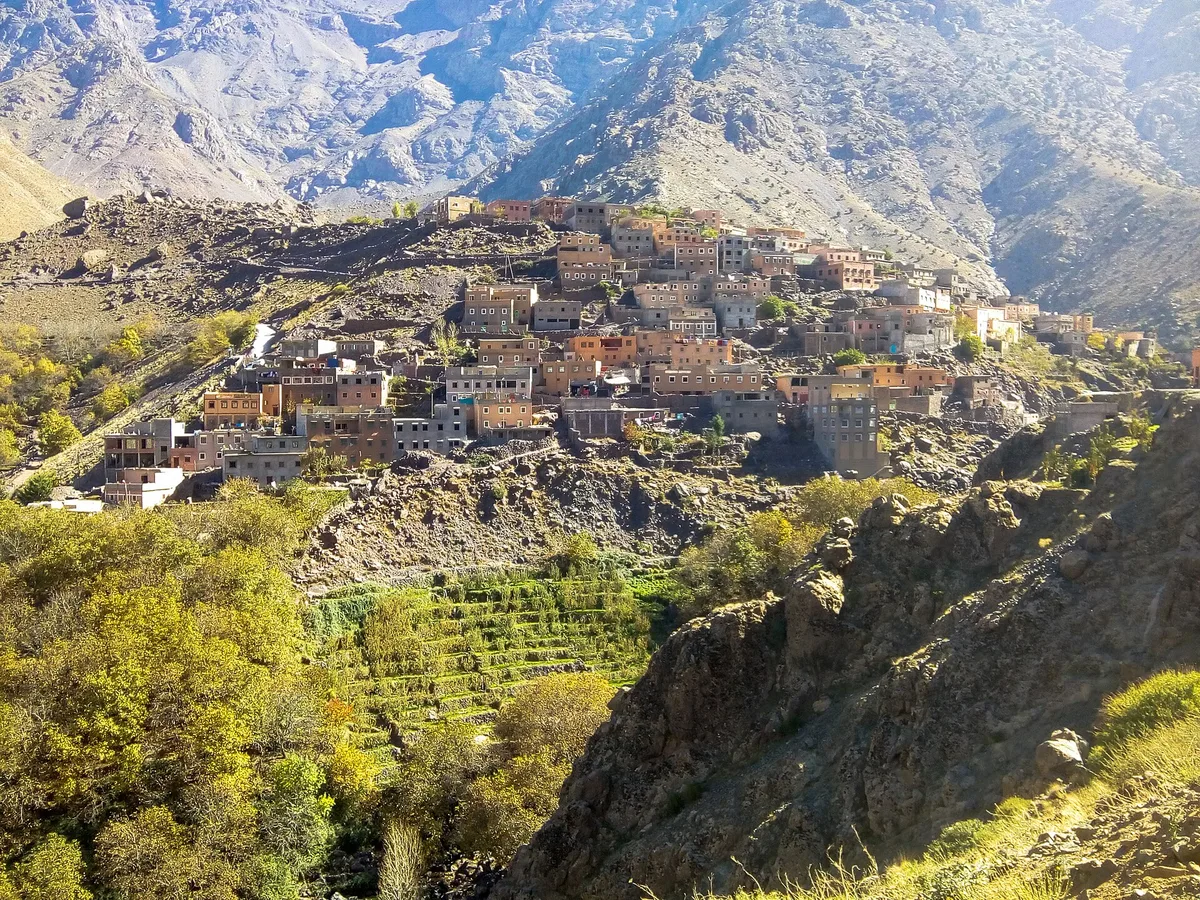
An hour and a half or so by mountain road south of Marrakech — allow more when traffic or weather interferes — the village of Imlil sits at about 1,740 metres at the end of the Mizane valley, and it exists, functionally, as the trailhead for Jebel Toubkal, at 4,167 metres the highest summit in North Africa. The accommodation built for this purpose is the mountain gîte: a family house, or a small purpose-built guesthouse, in Imlil itself or in the satellite villages of Aroumd, Armed and their neighbours, offering simple rooms, a terrace facing the peaks, and meals cooked by the household. Staying in one is less like checking into a hotel and more like being billeted, warmly, on the valley’s walking infrastructure.
The logic of the gîte is the walker’s day. You arrive, eat the dinner the family cooks — half-board is the near-universal pattern, because the village’s handful of cafés is not a dining scene and the kitchen is part of the product — sleep early, breakfast before dawn if a summit is planned, and walk out of the door onto the path. For Toubkal itself, the climb runs through a night at the mountain refuges above the village, which are a separate, more basic category again: dormitory bunks and communal meals at altitude, booked for the summit push, with the gîte night before and after providing the comfort at either end. On multi-day valley treks, the pattern becomes a chain — a gîte in a different village each night, your bag arriving by mule, dinner wherever you sleep. This is one of the great pleasures of the Moroccan mountains, and it only works because the gîtes operate as a network of households rather than as competing hotels.
Standards have risen and now span a range: simple family gîtes with shared bathrooms and mattresses on terraces in summer, established guesthouses with en-suite rooms and proper heating, and a small number of celebrated lodge conversions — including a famous converted kasbah on the hill above Imlil — that operate at international comfort levels while keeping the half-board, walk-out-the-door format. What does not change across the range is the domestic scale: no lifts, no bars, no room service, and a host who is also your best source of route conditions, guide arrangements and weather judgement. Guides and mules are arranged through the house or the village bureau, and a good gîte will be frank about what a proposed walk involves.
Practicalities are mountain practicalities. Nights are cold most of the year and snow closes the high routes in winter, so heating — often a wood stove in the salon and portable heat or heavy blankets in rooms — is a fair question to ask when booking. Cash is the valley’s currency in practice: cards are not reliably accepted in small houses, and you should arrive with dirhams rather than count on finding a machine. Phone signal exists but data can be thin; walkers should treat the gîte’s advice, not an app, as the authority on conditions. And the road in matters: Imlil is close to Marrakech on the map and a genuine mountain journey in fact, which is why a night there feels like a different country from the medina you left after breakfast.
Essaouira – Medina Riads Behind the Ramparts
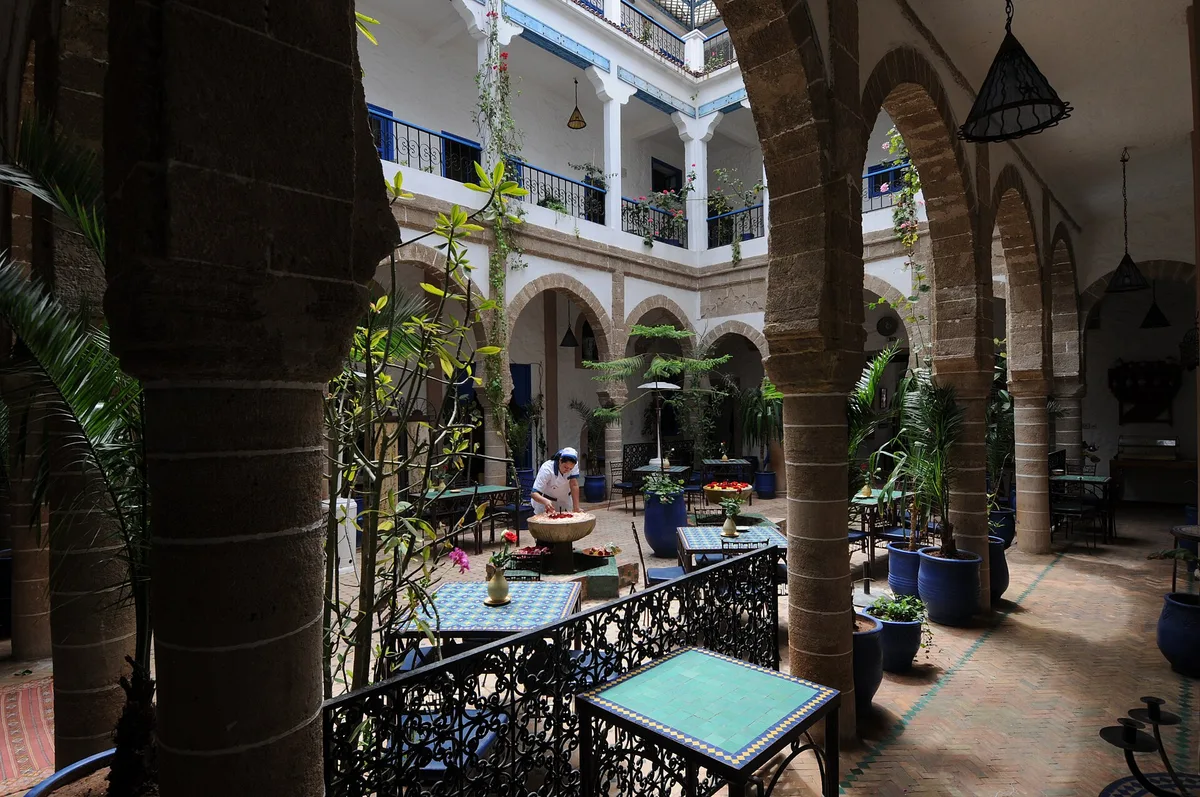
Essaouira is where the medina stay becomes easy, and for many travellers it is the version of Morocco they settle into longest. The medina here is an eighteenth-century planned grid inside sea ramparts — straight, legible streets rather than a maze — and it is small enough that nowhere is far from a gate where cars wait. Its riads and dars share the courtyard DNA of Fes and Marrakech but wear it more lightly: stone arcades, blue-and-white paint, tadelakt in sea colours, and a scale that reflects a port town rather than an imperial capital. Because the walk in is short and the grid is forgiving, Essaouira is the gentlest place in the country to test whether the courtyard-house format suits you.
The town’s real variable is the Atlantic. The trade winds that make Essaouira a windsurf and kitesurf base blow through the medina too, and the coast’s salt air is hard on buildings: expect a beautiful, slightly weathered patina rather than Marrakech polish, and the occasional conversation about damp in winter rooms. In exchange you get the coolest summer temperatures of any destination in this guide, sea views from the better roof terraces, and a medina that still works — fishing port, boat builders, woodworkers, fish grills by the harbour — rather than performing. Breakfast on an Essaouira roof, with gulls instead of swallows and the ramparts below, is a different and quieter pleasure than its imperial equivalents.
Outside the walls, a line of larger beach hotels runs along the bay to the south, offering pools and sea-facing rooms for travellers who want Essaouira as a backdrop rather than a household. Both patterns are legitimate; the town is forgiving either way because its distances are human. What seasoned visitors tend to recommend is the medina house, on a simple ground: in a town this small and walkable, the resort strip’s advantages shrink and the riad’s atmosphere wins by default. Stay inside the ramparts, eat where the port eats, and let the wind be part of the address.
Agadir and Taghazout – the Resort Coast
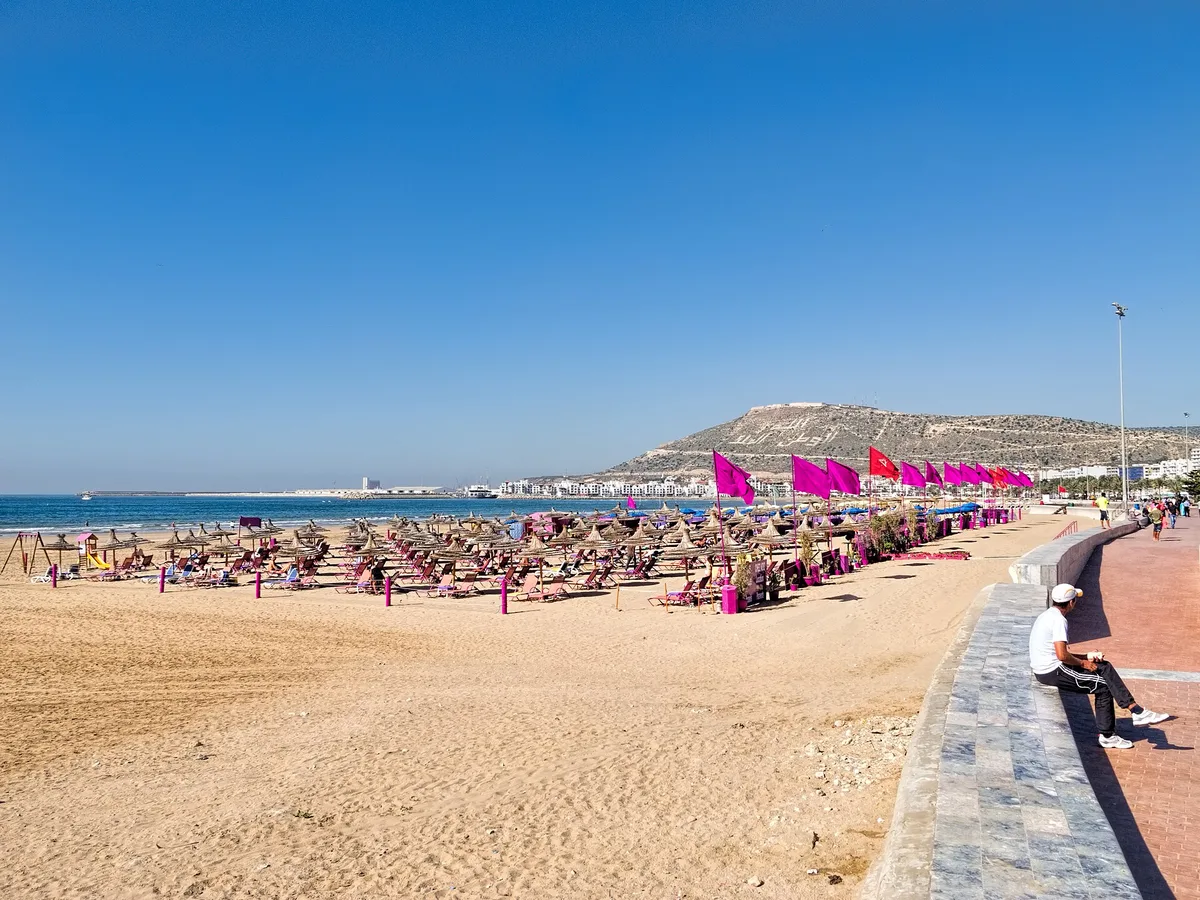
Agadir is the one Moroccan destination where the resort is not an alternative to the local accommodation culture — it is the local accommodation culture. The old city was destroyed by the earthquake of 1960 and rebuilt as a modern resort town along a broad, sheltered bay, so it offers no medina of consequence and asks to be judged by beach-holiday standards: a long promenade, big hotels with pools and gardens along the sand, apartment residences, and a winter-sun climate that fills them when Europe is grey. Judged on those terms it is very good at its job, particularly for families, older travellers, and anyone whose holiday arithmetic is pool, beach, promenade, repeat.
The honest catch is interchangeability. A week inside an Agadir resort bubble could be spent in several countries, and travellers who came to Morocco for the medinas sometimes book Agadir by mistake — seduced by the flight prices — and feel they have missed the country entirely. The fix is not to avoid Agadir but to sequence it: as the beach finish after Marrakech and the south, or as a winter base with day trips, it works beautifully; as your only Moroccan address, it gives you the kingdom’s least Moroccan week. Facilities, accessibility and car access are the best in this guide, which for some travellers settles the question the other way, and reasonably so.
North along the coast, Taghazout answers the resort with a different model: the surf lodge. This former fishing village, now a surf town, houses its visitors in shared villas and small lodges where the package is guiding, board hire, yoga on the roof and communal dinners, and the social life of the house is half the product. Sidi Kaouki, south of Essaouira, runs a quieter version of the same idea. If your coast is about waves, this format — not a resort — is the authentic one, and it is where the coast’s younger travellers concentrate. Families and comfort-first travellers go to Agadir’s strip; surfers go to Taghazout’s lodges; and both groups are right.
Where to Stay in Morocco, City by City
| City or base | Stay in | Best type | The catch |
|---|---|---|---|
| Marrakech | The medina, near a gate you can reach by taxi | Riad or dar | Lane access; book the meeting point, not just the room |
| Fes | Fes el-Bali, towards its edges rather than its depths | Riad or dar | The deepest lanes defeat luggage and first-night navigation |
| Chefchaouen | Inside the small blue medina | Dar or small riad | Steep lanes, small stock, weekends book out |
| Essaouira | Inside the ramparts | Medina riad | Wind and salt damp; polish is not the local style |
| Agadir | The bay and promenade | Resort hotel | Atmosphere is the beach’s, not Morocco’s |
| Casablanca | The centre, Maârif or the Ain Diab corniche | Conventional hotel | A working city, not a medina stay; one or two nights suffice |
| Merzouga | A dune-edge auberge for the base night, a camp for the dune night | Auberge plus camp | The camp is an excursion from the village, not a standalone address |
| M’Hamid | The village for the night before and after | Small hotel or guesthouse | Erg Chigaga’s camps are hours away by 4×4 — the gateway night is unavoidable |
The table above is the where to stay in Morocco answer compressed to a line per city; the paragraphs below it are the fine print, and two entries repay a second thought. The first is the desert gateways, because their logic is unlike anywhere else in the table. At Merzouga the village and the dunes are one continuous system: the auberge at the dune’s foot is your base, bathroom and luggage store, and the camp is where you go for the night — many travellers book both with the same operator precisely so the handovers disappear. M’Hamid works the same way with a longer fuse: because Erg Chigaga’s camps sit hours into the desert, the village night before is built into every sane itinerary, and treating M’Hamid as a mere fuel stop misses a palm-grove town with its own quiet claims.
The imperial cities reward the opposite instinct: position within the medina matters more than the property’s stars. In Fes especially, a modest house near the medina’s edge — within a short, learnable walk of a gate — beats a grander one in the depths, because you will walk that route twice a day and the depths of Fes el-Bali are genuinely disorienting after dark. In Marrakech the same logic applies at a smaller scale: the southern medina near the Kasbah and the palaces is calmer, the northern medina near the souks and Ben Youssef is livelier, and Gueliz removes the question entirely at the price of the atmosphere. Choose the quarter before the house, and the house will usually take care of itself.
Two cities sit outside the table because most visitors pass through rather than settle. Tangier splits between its small medina and kasbah — where a handful of houses offer the full courtyard format above the port — and a modern bayfront of conventional hotels; pick the medina if the city itself is your subject, the bayfront if the ferry or train is. Rabat, the capital, rewards its medina and the Kasbah of the Udayas with a night or two in a small house if you are lingering, and files under "efficient hotel" if you are not.
How Booking Actually Works in Morocco
The mechanics of booking Moroccan accommodation split by scale, and knowing which game you are playing saves the most common misunderstandings. Larger hotels behave like larger hotels anywhere: booking platforms and direct reservations, card guarantees, formal cancellation terms. Small medina houses, kasbah guesthouses, gîtes and camps run closer to the country’s person-to-person grain. Platforms list many of them and are genuinely useful for comparison, reviews and a first confirmed night; but a great deal of the real business — the meeting point at the gate, the transfer, the dinner, the camp’s bathroom standard — is settled by direct message with the house, commonly by phone or WhatsApp, and houses generally prefer it that way. Booking direct also frequently produces the more flexible arrangement, because you are negotiating with the person who will actually cook your breakfast.
Money follows the same split. Cards are accepted as a matter of course by city hotels and resorts; in medina houses, gîtes and small southern guesthouses, cash in dirhams is still the working assumption for balances and extras, whatever the booking page implied. The practical rule is to ask, in your confirmation message, exactly how the balance is to be paid — card, cash, or a mixture — and to carry the cash answer with you rather than discover it at a courtyard desk an hour before your train. ATMs cluster at medina gates and in the new towns; remote areas have few or none, so the desert and mountain legs should be entered with the money for them already in your pocket. Morocco’s official tourism portal, Visit Morocco, is a useful sanity check on regions and seasons when planning these legs.
What to confirm, for each type, is short and specific. For a riad: the meeting point and the phone number for arrival, whether breakfast is included, and how the balance is paid. For a kasbah or gîte: that dinner is included or ordered, because there is no alternative, and what time it is served. For a camp: whether the bathroom is private or shared, how you reach the camp — camel, 4×4 or both — where your luggage stays, and what happens in bad weather. For a trek: which nights are gîtes, which are refuges, and who carries what. Houses that answer these questions crisply are telling you something about how they run; vague answers are also information. Finally, tell small houses your arrival time and keep them updated — in a household of eight rooms, a late arrival is a person waiting up, and the personal system works because guests play their part in it.
The First-Trip Pattern That Works for Most People
If this is your first trip and the choices above feel like a lot, there is a default pattern that suits most travellers, built from the accommodation types rather than from specific properties. It is the simplest honest answer to where to stay in Morocco on a first trip, and it goes like this. Start with a medina riad in Marrakech for three nights: long enough for the house’s rhythm to become familiar, for the lane to your door to become yours, and for the city to be lived in rather than toured. Then go south and break the mountain crossing with one kasbah night — Skoura or the Dades — on half-board in the palm groves, because it converts a punishing drive into two good days and is many travellers’ favourite single night of the trip. Follow it with one night in a desert camp at Erg Chebbi, choosing standard or luxury by the bathroom question alone, and wake for the sunrise as the choreography intends.
Close the loop with a riad in Fes for two or three nights: a deeper, older medina than Marrakech, where the same courtyard-house format you already understand now delivers a different city. If the trip has a fifth act, add the coast — Essaouira for the slow version, two nights inside the ramparts — rather than a second desert or a second mountain night, because variety of types is what this country’s accommodation does best. This pattern follows the classic route day by day in our 7-day Morocco itinerary; the point here is that its nights alternate deliberately: household, fortress, tent, household, each resetting the others.
Two variations cover most exceptions. Walkers should swap the kasbah night’s onward push for two nights in an Imlil gîte, walking out of the door each morning and eating with the household each night — the mountains reward lingering more than the desert road does. Beach-first travellers, especially in winter, should bookend the same pattern with Agadir resort nights rather than replacing the middle of it. What the pattern avoids, deliberately, is the two classic first-trip errors: a whole week in new-town hotels, which turns Morocco into a series of day trips, and a camp or kasbah booked for three nights out of enthusiasm, which turns the two most intense formats into overstays. Intensity in this country is best taken one night at a time.
Frequently Asked Questions About Staying in Morocco
Is a riad a hotel? Not in the systems sense. A riad is a small guesthouse in a converted courtyard house, run as a household: no lift, usually no 24-hour desk, meals cooked to order, staff who double as concierges. If you book one expecting hotel machinery you will be confused; if you book one expecting a house, you will likely be delighted.
What is the difference between a riad and a dar? A garden. A riad’s courtyard is planted — classically in four parts with a central fountain — while a dar’s courtyard is paved. Many houses sold as riads are technically dars, and for a guest the distinction changes nothing about comfort; room count, position in the medina and management matter far more.
Can a car reach my riad? Almost never to the door. Medinas are pedestrian worlds; in Fes el-Bali cars barely enter the quarter at all. The house meets you at a gate or square and walks you in, with bags on a handcart. This is normal, organised and part of the format — arrange the meeting in advance.
What does "luxury" mean in a desert camp? A big tent you can stand up in, a real bed with proper bedding, and above all a private en-suite bathroom with a flush toilet and hot shower, against a standard camp’s simpler tent and shared bathroom block. It does not mean city-hotel systems — water and power are still generated and tanked on site.
Erg Chebbi or Erg Chigaga for a first desert night? Erg Chebbi. The dunes are higher, the road reaches them, every camp standard exists, and it fits the standard Marrakech-to-Fes routes. Erg Chigaga is the remoter, emptier choice for a second trip or a dedicated southern itinerary with the days its off-road approach demands.
Do I need cash for accommodation in Morocco? Often, yes. City hotels and resorts take cards routinely; small medina houses, gîtes, kasbah guesthouses and camps frequently settle balances in cash dirhams. Ask when you book how the balance is paid, and enter the mountains and the south already carrying what those nights will cost.
Why is dinner always included in the south and the mountains? Because there is nowhere else to eat. In the Skoura palm grove, a Dades village or Imlil, the guesthouse kitchen is the restaurant, so half-board is the default rather than an upsell. The food is home cooking and is usually a highlight — but tell the house about dietary needs in advance, since the kitchen shops for a set menu.
Where should families stay in Morocco? The pattern that works is a riad with a courtyard for city nights — children are welcomed in Moroccan households as a matter of course — plus resort nights in Agadir if pool time matters, and one standard camp night, which children tend to remember above everything. New-town hotels earn their place for one-night stops with tired children and heavy luggage.
How many nights should I spend in a desert camp? One. A camp is built around a single sunset and sunrise, and a second night repeats both. The exceptions are serious photographers and travellers at Erg Chigaga, where the journey in is long enough to justify staying put. Spend the extra night in the kasbah valleys or at a Merzouga auberge instead.
Is it better to stay in the medina or outside it? In Marrakech, Fes and Essaouira, the medina is the destination, so stay inside it unless luggage, mobility or a one-night schedule argues otherwise. In Casablanca, a conventional hotel is the sensible default. The question is really about each city, not about Morocco in general — and the city table above gives the answer city by city.
The Short Version
Deciding where to stay in Morocco is deciding among households, fortresses, tents and resorts, and each has a fair price in friction. The travellers who enjoy this country most are not the ones who found the single best property; they are the ones who matched each night to the place it was in — who let Fes be a household, the Dades be a fortress, the dunes be a tent and Agadir be a beach, instead of asking one format to do every job.
So the short version is a sequence, not an address. Choose the medina riad for the imperial cities and accept the walk in; choose the kasbah for the night that breaks the desert road and accept the fixed dinner; choose the camp for exactly one night and pack for its cold; choose the gîte when your days are measured in footpaths; and choose the resort when the beach, honestly, is the point. Arrange your meeting point, confirm your bathroom, ask how the balance is paid, carry cash for the mountains and the south — and the country’s accommodation, which runs on people rather than systems, will repay you in the currency it deals in: being looked after.