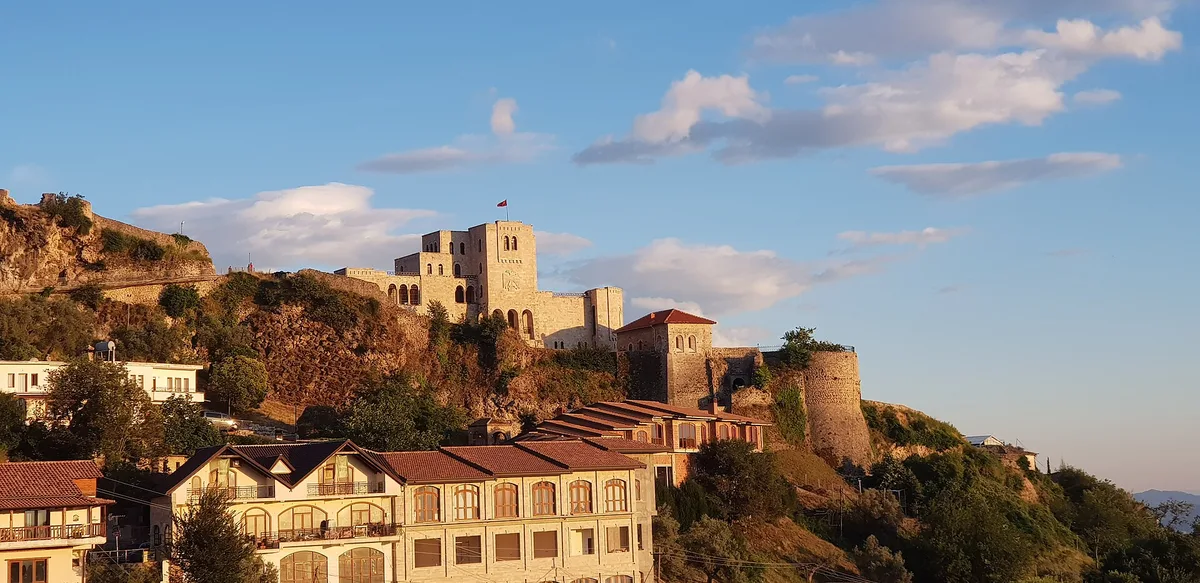
Every country has one place where its national story is stored, and for Albania that place is a small mountain town an hour from the capital. Kruja Albania means, above all, one man and one fortress. In 1443 the Albanian lord Gjergj Kastrioti — Skanderbeg — broke with the Ottoman Empire he had served, raised his flag over Kruja Castle, and held this ridge against the greatest military power of the age for the rest of his life. The castle is still here, on its rock above the town. So is the museum built inside it to tell his story, the bazaar street that climbs towards its gate, and the great house where the town’s later rulers lived. Few day trips in Europe compress so much of a country’s identity into so walkable a space.
That compression is also the trap, because Kruja is usually sold as a checklist — castle, museum, bazaar, back on the bus — and at checklist speed it becomes a souvenir lane with a view. Taken properly it is three visits braided into one. There is the fortress itself, a real piece of military geography whose walls, towers and sightlines explain the history better than any panel. There is the pair of museums inside it, one a monumental 1980s memorial to Skanderbeg, the other a beautifully kept 18th-century house that shows how ordinary wealthy life worked in the same walls. And there is everything the tour circuit underplays: a Bektashi shrine tucked into the castle’s southern corner, a holy cave on the mountain high above the town, and the working plain town of Fushë-Krujë below, which is where the journey actually begins.
This guide takes Kruja at the slower speed. It gives the history straight, including where the record ends and the legend starts; it is honest about the museum’s famous helmet being a replica and about how much of the bazaar is genuinely local craft and how much is imported stock; and it answers the practical question every visitor actually faces — half a day, a full day, or a night — without printing a single price, fare or timetable, because those are exactly the details that change faster than any article can be corrected. For the wider country first, start with our Albania travel guide; this page is the town itself.
Kruja at a Glance
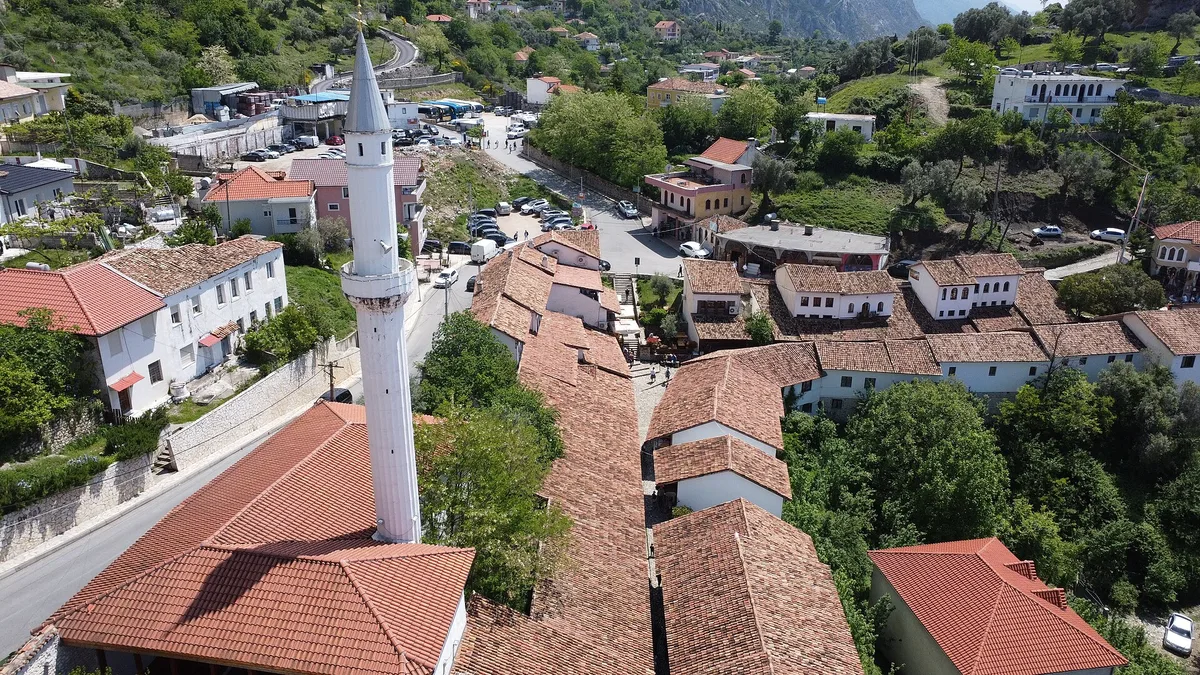
Kruja divides into four pieces, and a good visit touches all of them: the castle on its ridge, the bazaar street climbing to its gate, the newer town spreading below, and the mountain rising behind, with the Sari Salltik shrine near its top. The castle stands at roughly 557 metres above sea level on a rocky ridge under Mount Kruja, close enough to the coast that the Adriatic plain opens below it. Nothing here is far from anything else — the whole historic core is a steep walk — but the pieces reward being taken in the right order, and the table below is that order in miniature – Kruja Albania in four pieces, in the order they reward being seen.
| Place or thing | Why it earns its place | Time character |
|---|---|---|
| Kruja Castle | Skanderbeg’s stronghold – walls, towers and the view the defence was built on | One to two hours, unhurried |
| The Skanderbeg Museum | The national memorial inside the castle – the resistance told at monumental scale | About an hour |
| The Ethnographic Museum | The Toptani family’s 1764 house – one of Albania’s best house-museums | About an hour |
| The Old Bazaar | The Dërhemi bazaar street – felt, copper and kilims beside imported souvenirs | An hour, more if you shop seriously |
| The Dollma Teqe and castle remains | A painted Bektashi shrine, the Fatih mosque ruins, clock tower and hamam | Half an hour inside the castle visit |
| Sari Salltik | The Bektashi cave shrine on Mount Kruja, high above the town | A half-day addition by road, or a long hike |
| Fushë-Krujë | The plain town below – the junction every arrival passes through | A pass-through, not a stop |
Two judgements sit behind that table. First, the museums are not alternatives to the castle; they are inside it, and the visit works when fortress, memorial and house are read together as one site’s three centuries. Second, Kruja is small enough to be rushed and layered enough to punish rushing — the difference between the two-hour version and the full-day version is not more sights, it is the bazaar browsed rather than marched, the ethnographic house given its hour, and the castle seen in the late light after the tour buses have gone. How long to give it gets its own section below.
The Castle – Walls, the Climb and the View
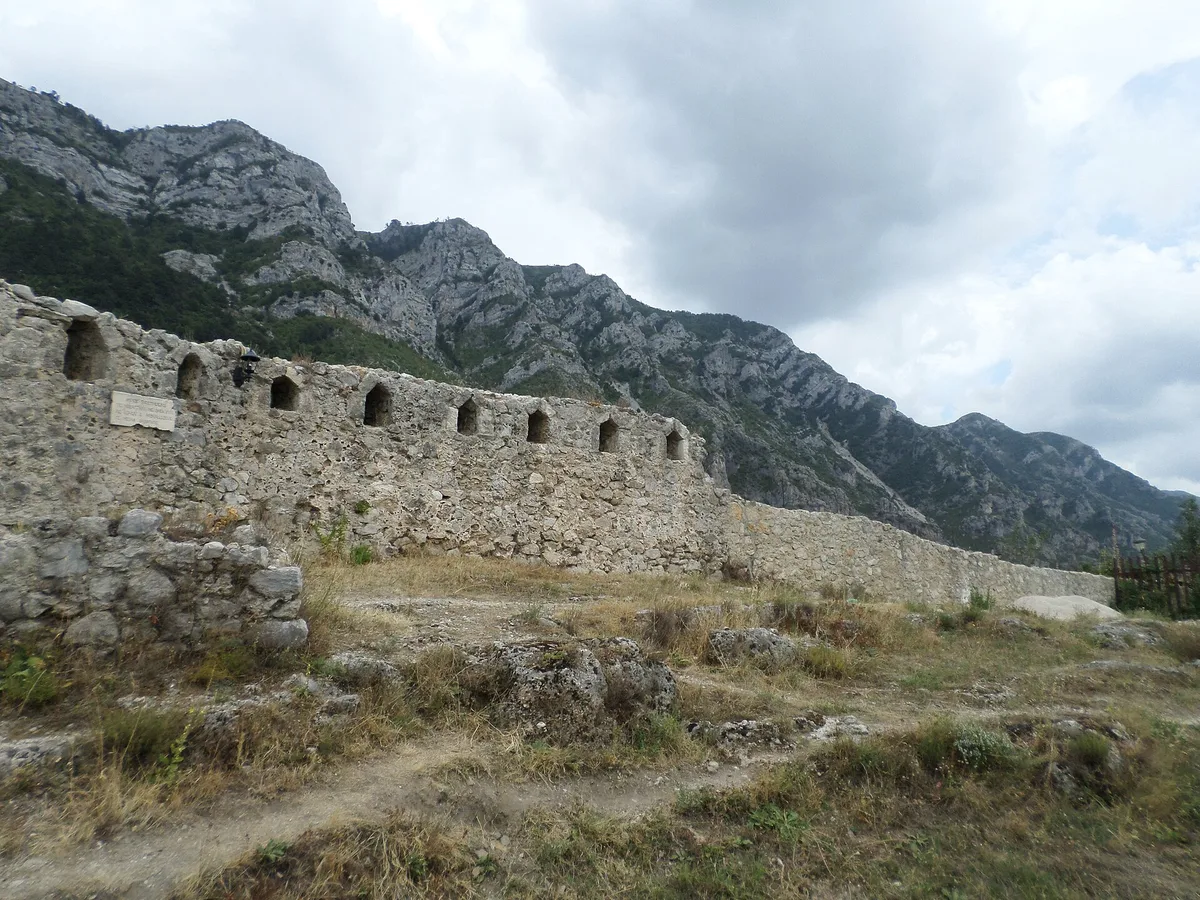
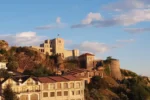
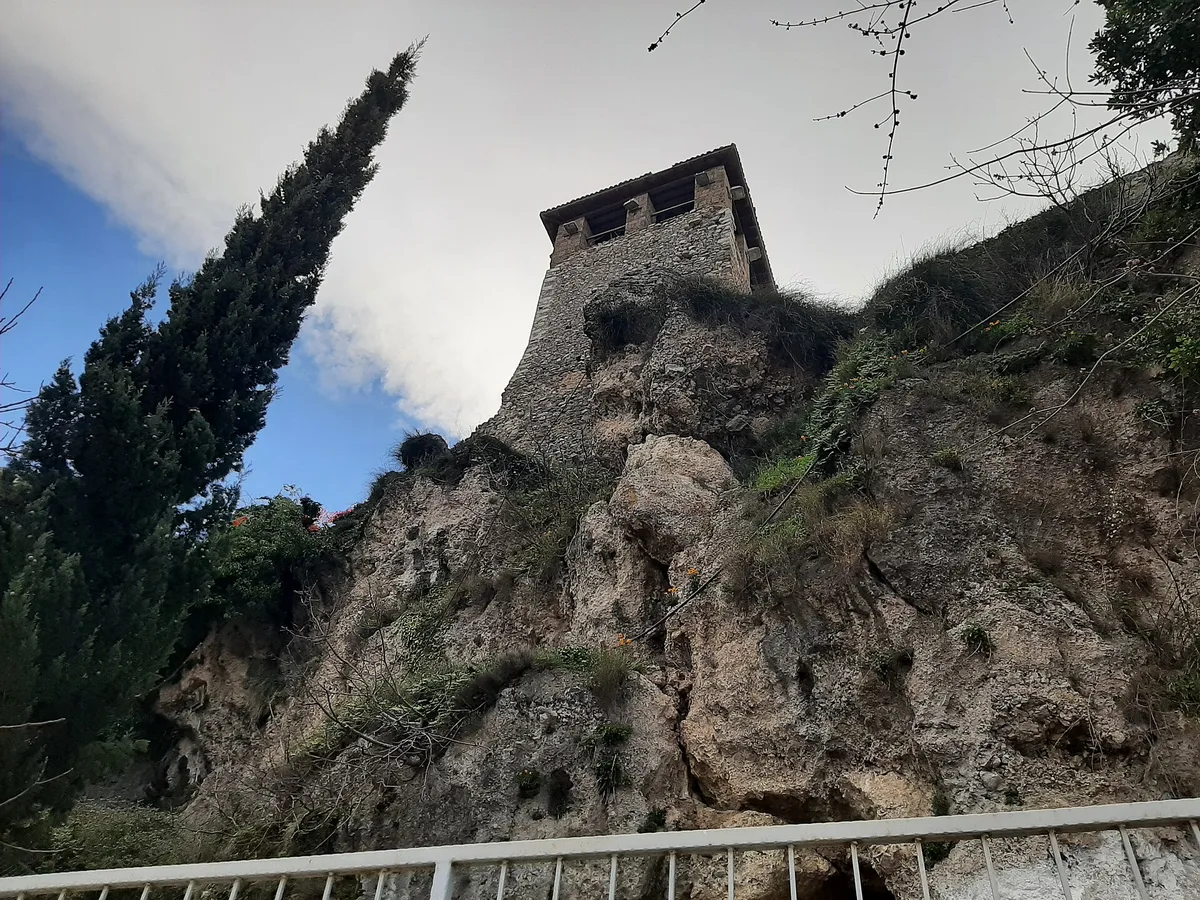
Begin with the ground, because at Kruja the ground is the argument. The fortress occupies an elongated rocky ridge, its walls following the contours of a crag that falls away steeply on the sides facing the plain. A fortress here is recorded from the 5th or 6th century, Byzantine in origin, and the position explains itself the moment you stand on the walls: whoever held this ridge watched the coastal plain, the road north towards Shkodra and the passes into the interior all at once, from a perch that a besieging army could approach only uphill, in the open. Skanderbeg did not choose Kruja out of sentiment — it was his family’s seat, and it was also the strongest defensible point in his world. Both things are true, and the castle makes more sense when they are held together.
The climb is part of the visit, and it is honest exercise. From the bazaar at the gate, the way in rises through the castle entrance into a grassed, open interior — less a single keep than a walled hilltop, with the ground sloping inside the circuit of walls. Wear shoes that grip: the stone underfoot is worn, the gradients are real, and after rain the surfaces polish to a shine. Inside, the layout rewards a slow circuit rather than a dash to the museum door. Walk the walls first if the day allows. The surviving curtain wall, its towers and the watchtower at the high end give you the fortress as its defenders knew it — a perimeter to be patrolled, with the ground falling away outside it — and they give you the second thing the castle is for, which is the view.
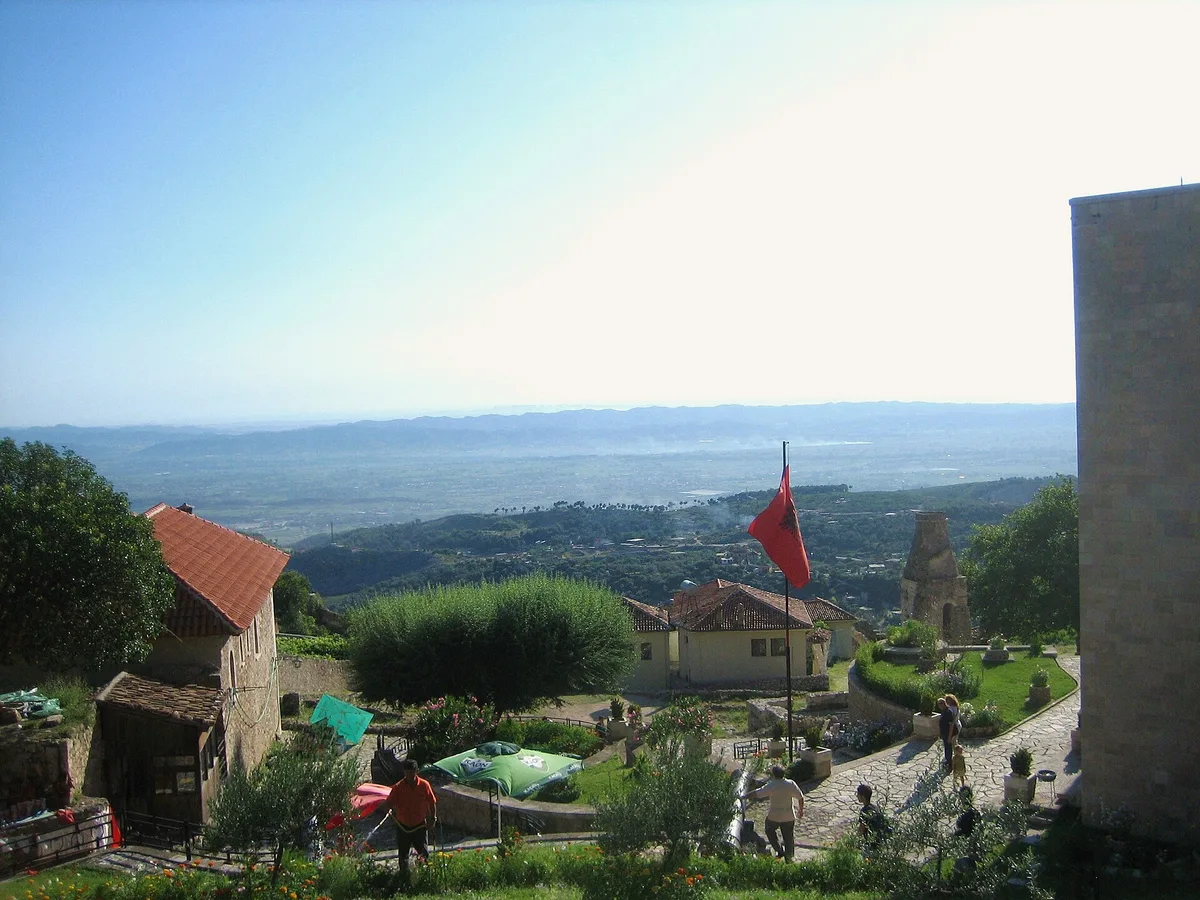
That view deserves its reputation, with one condition attached: the weather. On a clear day the panorama from the walls runs west across the Ishëm plain, over the lower town and Fushë-Krujë, to the Adriatic itself, with Durrës on the coast and the sea as a bright line beyond — the same prospect Skanderbeg’s lookouts scanned for the dust of an approaching army. On a hazy summer afternoon the sea vanishes and the plain flattens into glare, which is why the castle repays a morning visit or a late one over a midday one. Either way, stand a moment at the western walls and read the landscape as the garrison read it: everything an enemy needed — water, forage, road, room to camp — lay in the plain below, and everything the defence needed was up here, behind stone, on rock. The sieges described in the next section were lost and won on exactly that geometry.
One practical note, stated the way this guide states all of them. There are ticketing arrangements at the castle and its museums, and they change often enough that no figure belongs in print; carry lek in small notes, expect the sums involved to be modest by European standards, and confirm the day’s arrangements at the gate. What does not change is the shape of the place — walls, museums, shrine and lanes inside one circuit — and a visit planned around that shape will survive any change of price or hour.
The Story – Skanderbeg and the Twenty-Five Years
The history first, told as plainly as the sources allow, because Kruja’s version of it is usually told as myth and the real record needs no inflation. Gjergj Kastrioti was born in 1405, a son of Gjon Kastrioti, an Albanian lord of the northern country. As a boy he was given as a hostage to the Ottoman sultan — a standard instrument of Ottoman rule over subject lords — and he was raised and educated at the court in Edirne, converted to Islam, and given the name Iskander, after Alexander the Great, with the rank of bey. Skanderbeg, the name history kept, is simply that name and title worn down by use: Iskander Bey. For some twenty years he served the empire that had taken him, and served it well enough to rise — which is the first fact the legend tends to skip, and the one that explains everything after. He knew the Ottoman army from inside: its organisation, its logistics, its commanders and its limits.
In November 1443, during the Ottoman defeat at Niš in Serbia, he deserted. With a small body of loyal men he rode for Albania, took Kruja — tradition says by means of a forged letter from the sultan ordering the fortress handed over, a story told early and often, and best repeated as tradition rather than document — and on 28 November 1443 raised his flag over the castle and renounced the faith and the service he had been raised in. The following spring, on 2 March 1444, the Albanian lords met under Venetian protection at Lezhë and formed the alliance historians call the League of Lezhë, with Skanderbeg as its commander in chief: the Arianiti, Dukagjini, Muzaka, Thopia and other great families binding themselves to a common war. It was not a nation-state and never became one — the League was a military federation of rivals, and it frayed often — but it was the nearest thing to a united Albania the Middle Ages produced, and Kruja was its stronghold and symbol. Encyclopaedia Britannica’s biography of Skanderbeg gives the same bones in a few lines: hostage, convert, deserter at Niš in 1443, the league organised in 1444, and a resistance that made him famous across Europe.
What followed was twenty-five years of war, from 1443 until his death — not a single heroic siege but a long, grinding strategy of refusing the battle the Ottomans wanted. The castle’s role in that strategy is the detail most accounts miss. When the great sieges came, Skanderbeg typically did not sit inside Kruja and await them. A garrison — usually no more than two or three thousand men, under a trusted commander such as Vrana Konti in 1450 — held the walls, while Skanderbeg stayed mobile in the mountains with the field army, burning crops, ambushing supply columns and making the besiegers starve in a stripped countryside. In 1450 Sultan Murad II came in person with a great army, and left without the castle. In 1466 his son Mehmed II, the conqueror of Constantinople, came in person, and failed; the siege effort ran on into 1467 and failed again. Between the sieges were battles, raids, alliances bought from Venice and Naples and the papacy, and a fame in Western Europe that was real and politically useful to him. None of it made his position safe. It made it durable — for exactly as long as he lived.
He died at Lezhë on 17 January 1468, reportedly of fever — malaria is the usual diagnosis given — while meeting the Venetian allies whose war he had joined. He was sixty-two. The resistance outlived him by a decade, weakening year by year, and in 1478, after a final siege, Kruja fell to the Ottomans; within a short span the rest of Albania followed, and the country remained under Ottoman rule for more than four centuries. That ending matters to how the castle should be read. Kruja is not a fortress that never fell. It is a fortress that held for a generation against the strongest empire of its century, because of a conjunction — ground, garrison and a commander of genuine ability — that could not survive the commander’s death. The legend says Skanderbeg was invincible. The record says something better: that he was mortal, outnumbered throughout, and held anyway.
The Skanderbeg Museum – a Memorial Built Like a Fortress
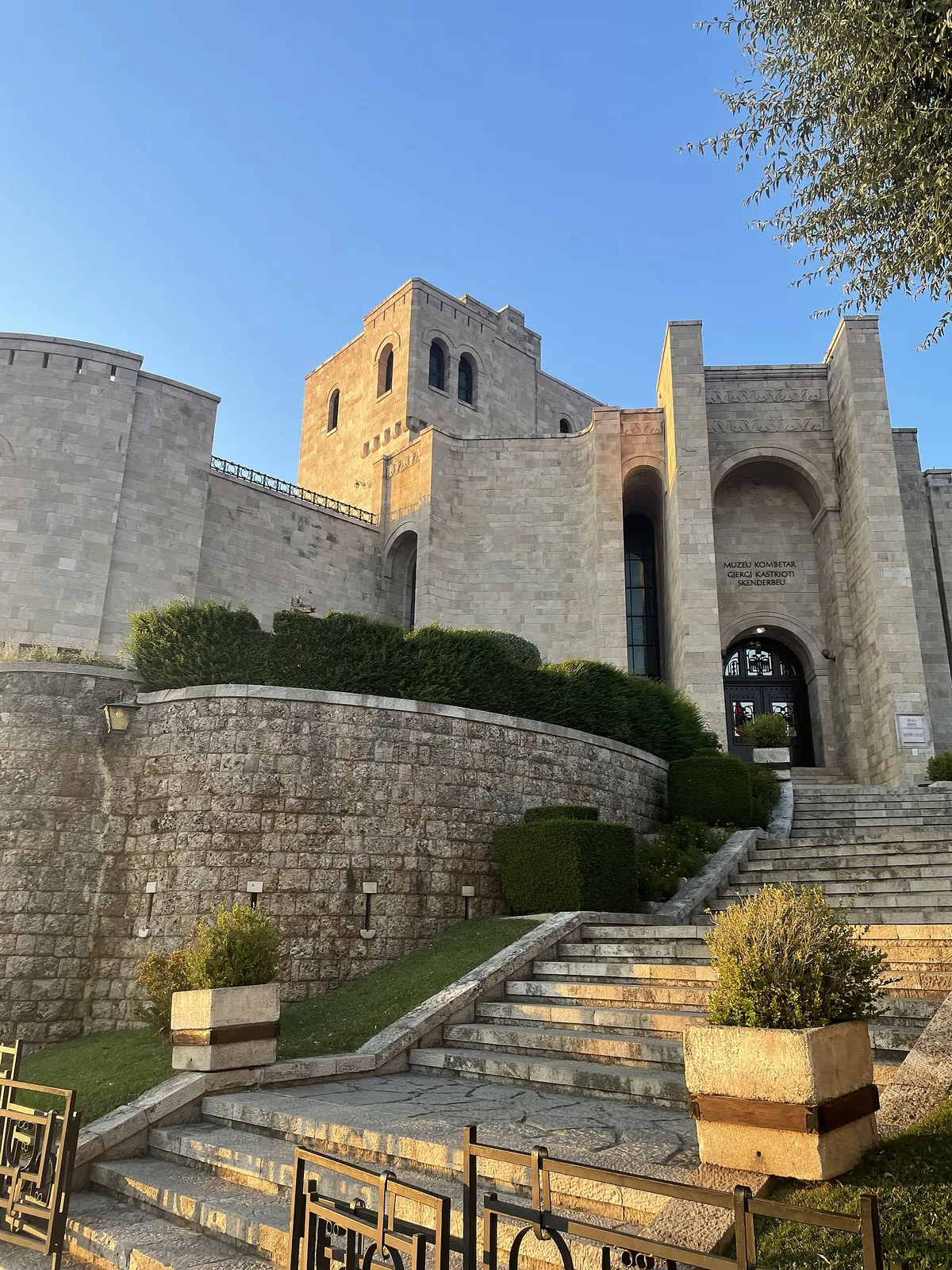
The building announces itself before you reach it. Rising inside the castle walls is a great stone pile that reads at first glance as another fortress — towers, battlements, sheer masonry — and is in fact a museum, and a young one. The National History Museum “Gjergj Kastrioti Skënderbeu”, universally shortened to the Skanderbeg Museum, was built at the end of the 1970s and inaugurated on 1 November 1982. Its architects, Pirro Vaso and Pranvera Hoxha, designed it in deliberate quotation of Albania’s traditional stone tower-houses and medieval fortress building — a memorial with, as its own descriptions put it, the character of a monument rather than a gallery. The second architect’s surname is part of the exhibit, whether the museum says so or not: Pranvera Hoxha was the daughter of Enver Hoxha, Albania’s communist dictator, and this museum was the regime’s grandest act of national storytelling, built to place the ruling ideology’s preferred hero — the patriot who united the country against foreign empire — at the centre of the state’s account of itself. That origin does not make the museum false. It makes it double: an exhibition about the fifteenth century, and itself an artefact of the twentieth.
Inside, the arrangement is chronological and heroic in the literal sense. The halls carry the visitor through the age and the life in order: the Albanian principalities and the Ottoman advance; Skanderbeg’s campaigns, told in maps, murals and dioramas of the great battles; the diplomacy of the League, in copies of the correspondence with Venice, Naples and Rome; the weapons and armour of the period — swords, shields, helmets, cannon — and the sculptural group at the heart of the building, Skanderbeg among his captains, that supplies the museum’s most photographed interior. The presentation is of its era: dramatic, didactic, certain of its story. A visitor who has read the history section above will notice what the museum leaves at the edges — the fraying of the League, the Venetian quarrels, the sheer precariousness of the whole enterprise — and that noticing is not a reason to skip it. It is the correct way to visit. The museum is the national memory doing what national memories do, in a building that is itself the loudest object in the collection.
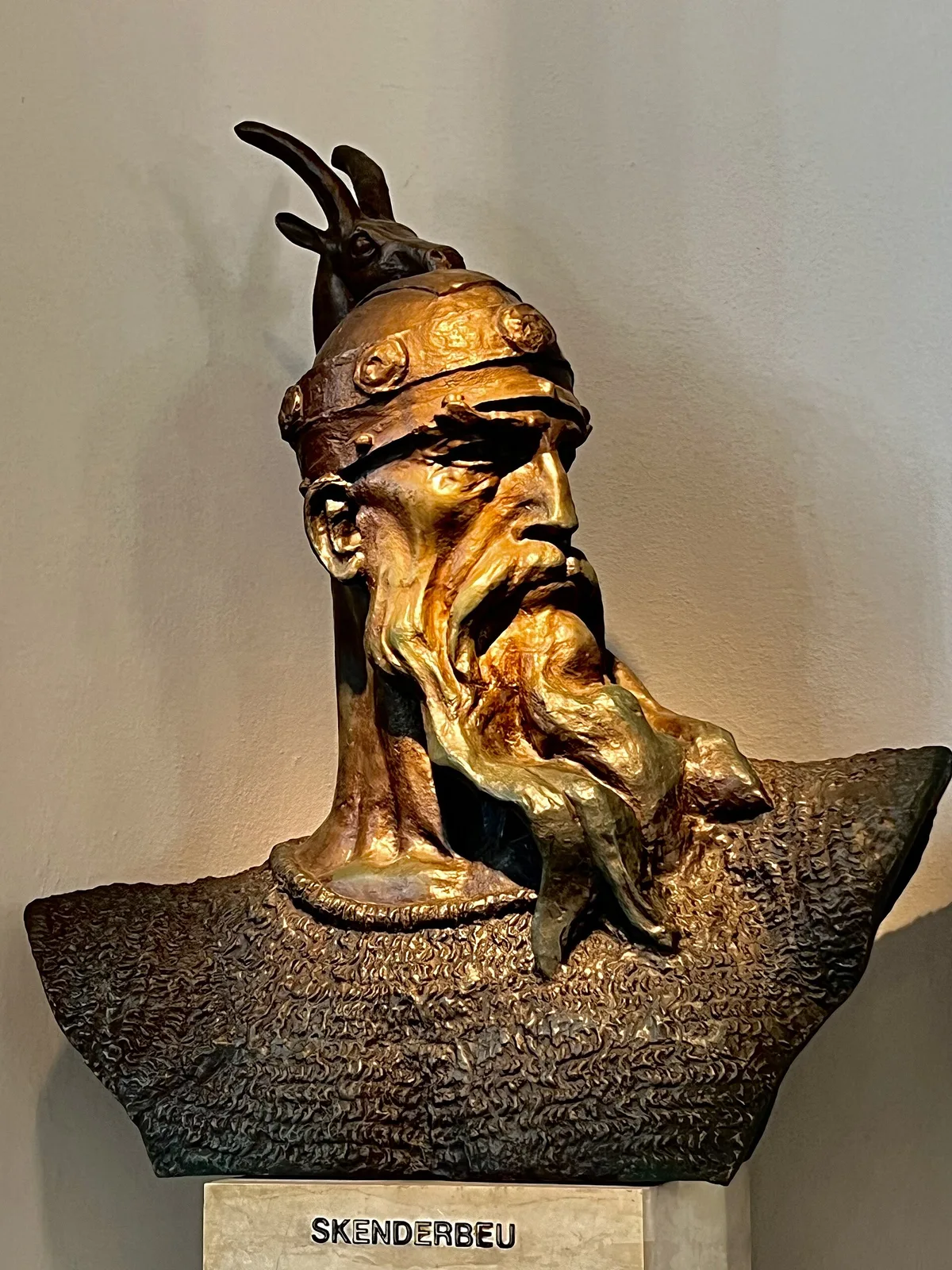
One exhibit needs its truth told plainly, because it is the one every visitor asks about. The museum displays the hero’s famous goat-horned helmet and his sword, and they are replicas. The originals — the helmet with its gilt goat’s head, and the sword long attributed to Skanderbeg — are held by the Kunsthistorisches Museum in Vienna, where they have been for centuries, having passed through Habsburg collections. This is sometimes presented, by guides in a hurry, as a grievance or an embarrassment. It is better understood as the normal fate of famous objects, and the museum itself does not hide it: the copies are displayed as copies, centrepieces of a gallery whose real subject is not the objects but the campaigns. Go and look at them with that understood, and spend the saved disappointment on the exhibits that are genuinely of the period and genuinely here — the weapons, the documents’ evidence of a small country negotiating with empires, and the building itself. Opening arrangements for the museum are set by the national museum service and change; this guide prints no hours, deliberately, and the correct check is the museum’s own current notice, locally, before you climb.
The Ethnographic Museum – the Toptani House
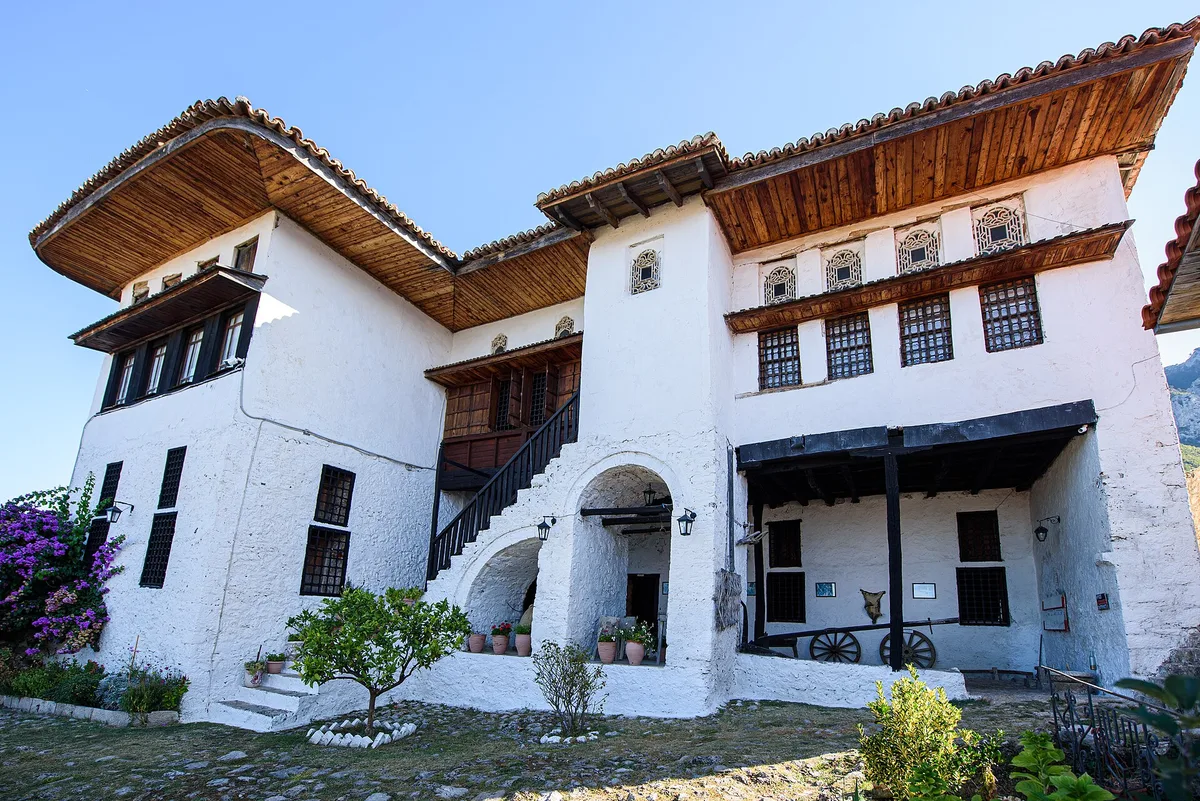
Walk down from the memorial, inside the same walls, and the register changes completely. If the memorial is Kruja Albania as the state wished it remembered, this house is Kruja as it was actually lived. The Ethnographic Museum of Kruja occupies the house of the Toptani family, built in 1764 — a grand, white, galleried house of stone and timber, with its own yard, its own well and the air of a small estate folded inside a fortress. The Toptanis were Kruja’s great landowning family of the Ottoman centuries, the local power after the age of heroes, and their house is the museum: a first-category cultural monument whose architecture — the open çardak gallery, the divided rooms for family and guests, men and women, work and ceremony — is itself the largest object in the collection. The official tourism description of the museum, kept by Albania’s National Tourism Agency, calls the building a testimony to the lifestyle of wealthy Albanian families of the 18th century, and that is exactly its use. The Skanderbeg Museum tells you how the castle fought. This house tells you how it lived.
The museum opened to the public on 20 November 1989, and its rooms work through the material life of such a household at a density few house-museums anywhere match. The official description counts around a thousand authentic objects, some of them up to five centuries old: tools and textiles, folk costume, household furnishings, weapons, the equipment of the crafts the house depended on — olive oil pressing, wool working, milling, distilling — laid out in the workrooms where those crafts were actually done, and the living rooms arranged by their social logic, the guest room richest, the family’s rooms plainer, the whole hierarchy of an Ottoman-era great house legible in furniture. Most of the objects are original rather than reproduced, which gives the place its particular density: this is less a display about a vanished world than that world’s furniture, still in its rooms.
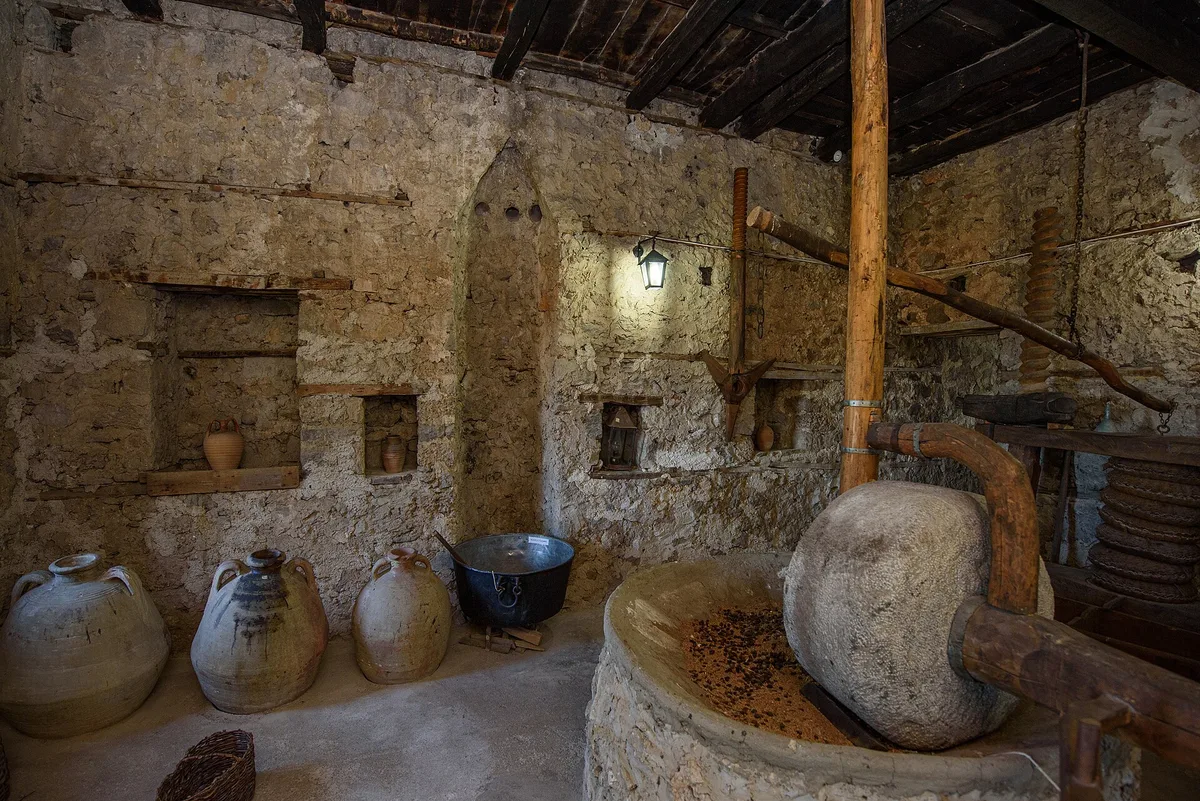
The house also carries the country’s recent history in its fabric, and its current state is good news that should be reported accurately. The building was damaged in the earthquake of November 2019, and it has since been restored under the EU-funded EU4Culture programme, implemented with UNOPS and the Albanian culture ministry, and reopened to the public — with the exhibition rethought in the process: interactive screens, audio and multimedia interpretation, even a virtual dressing room for trying on traditional dress, layered onto the old rooms. The Albanian Telegraphic Agency’s report of the reopened museum calls the result a place “where tradition meets innovation”, which for once is a fair summary rather than a slogan. Two cautions belong with the praise. The restoration means the house you see is carefully conserved, not untouched — no great house that has been a museum since 1989 is untouched, and it does not pretend to be. And day-to-day opening follows the museum service’s current practice, which this guide does not print: check locally, and if you must choose only one of the castle’s two museums on a short visit, understand the trade — the memorial for the national story, this house for the better museum.
The Old Bazaar – Felt, Copper, Kilims and Honest Imports
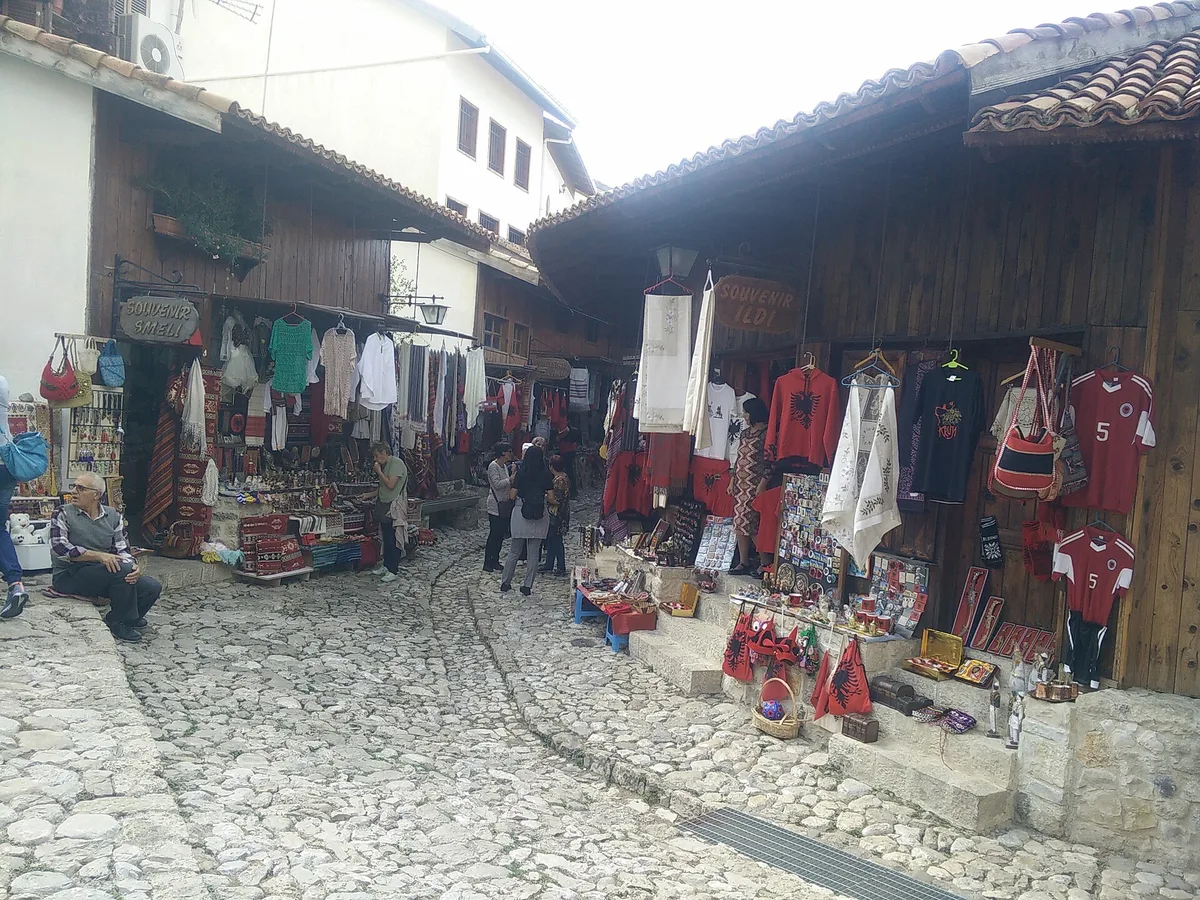
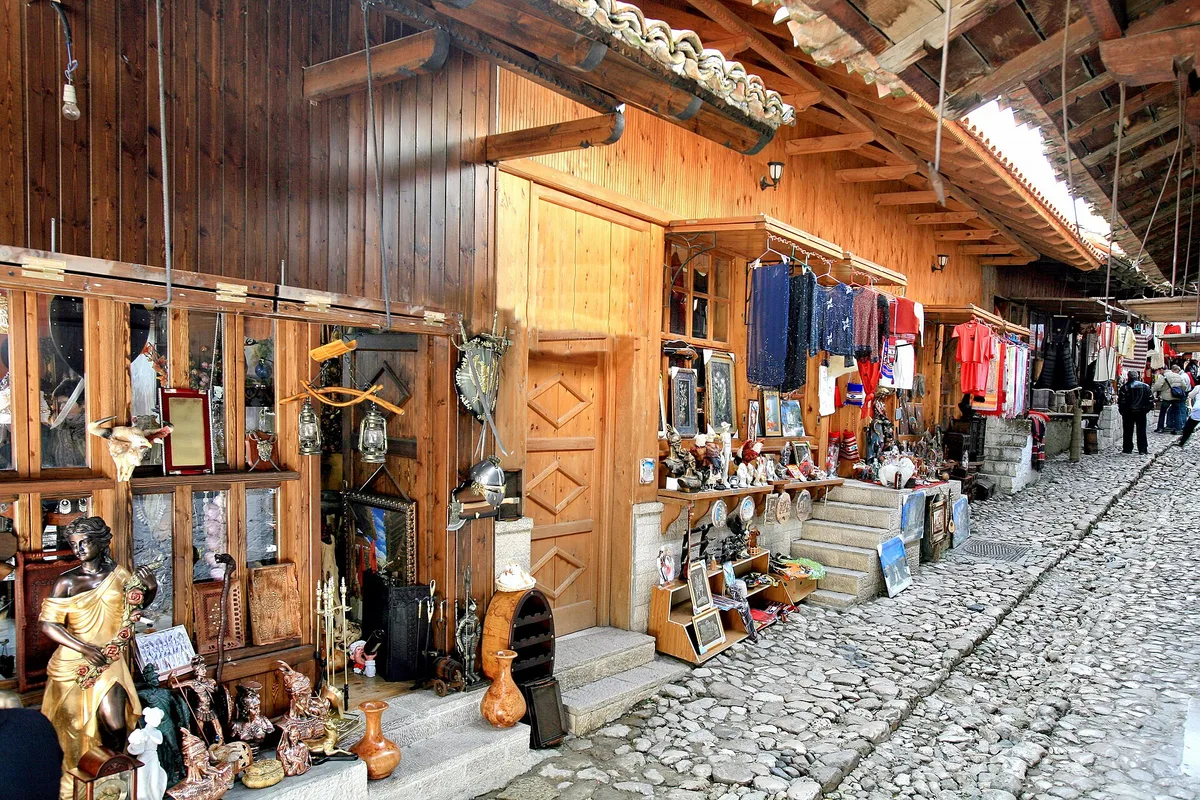
The bazaar is the street you cannot miss, because it is the road: one cobbled lane climbing from the lower town straight to the castle gate, lined on both sides with low wooden shops under a continuous sloping roofline, their goods spilling onto the stones. Locally it is the Dërhemi bazaar — the street also carries the name Derexhiku in older usage — and its lineage runs back through the Ottoman centuries, when this was the commercial throat of the town, the market through which everything entering or leaving the fortress passed. In its busiest age the bazaar was far larger than today’s single street; what survives and has been carefully restored is the handsome final stretch below the gate. It is, by any Balkan standard, a beautiful piece of street-making — and it is a market, which means its contents need sorting rather than swooning over.
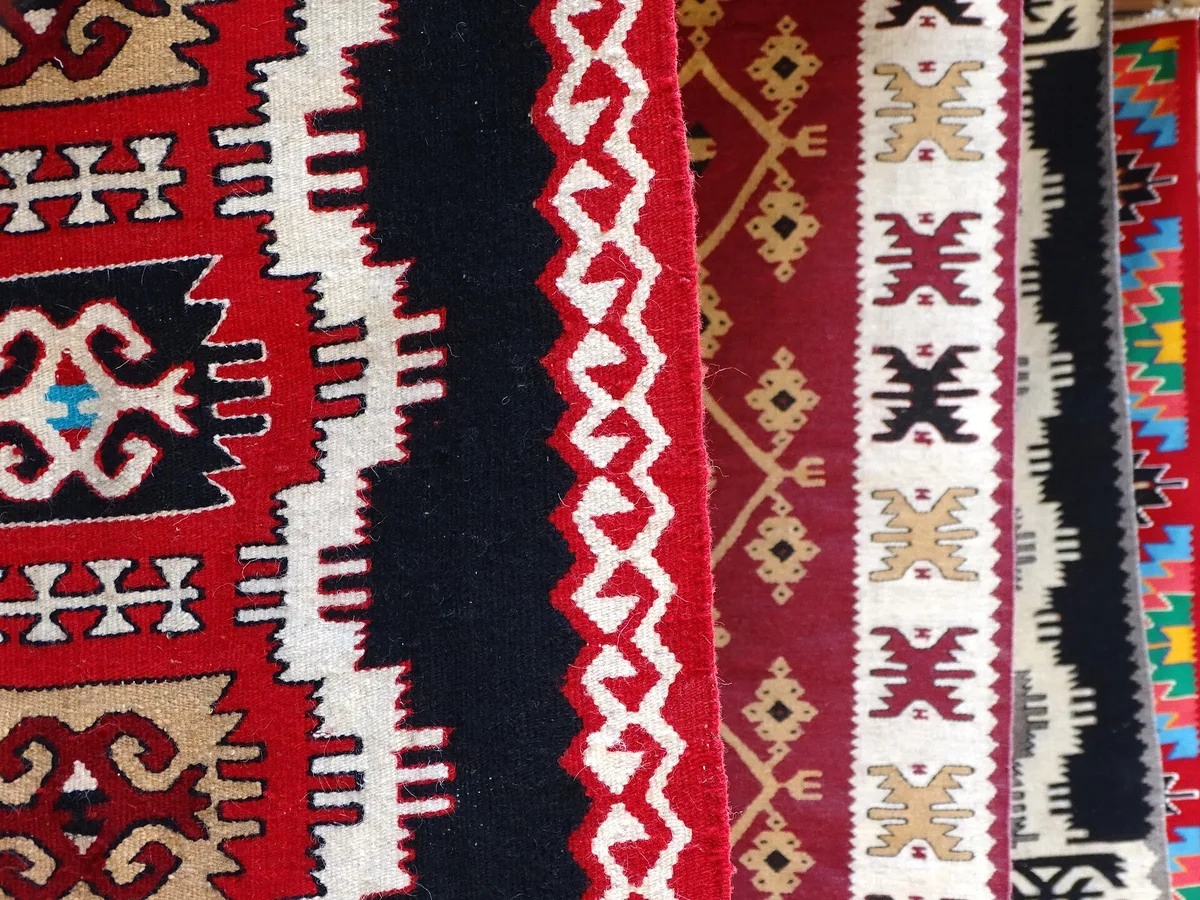
Start with what is genuinely of this place, because Kruja’s best crafts are real and specific. The town’s signature product is felt. The qeleshe — the white felt skullcap of northern Albanian dress, domed in the Gheg style — is made here by hand from wool, washed, beaten, shaped and shaved through a process that takes many stages, and in the bazaar’s felt workshops you can watch it happen and buy from the family that made it; felt slippers and bags come from the same benches. Copper work is the second tradition: trays, coffee pots — the long-handled xhezve — and engraved ware from Kruja’s coppersmiths, some of it new-made in the shops, some of it genuinely antique, and the difference is something a good seller will explain if asked. Third come the textiles: kilims and woven rugs in the red-black-cream geometry of the north, embroidered cloth and pieces of traditional costume, the best of them hand-woven and priced like it. Add filigree silver, carved wood, olive oil and raki from the surrounding hills, and a stratum of true antiques — coins, weapons, household brass — that rewards a knowledgeable eye.
Now the honest half, which rival guides mostly skip. A large share of what fills the bazaar’s stalls is imported souvenir stock — factory-made flags and double-headed eagles, printed T-shirts, moulded trinkets and generic “Albanian” souvenirs made nowhere near Kruja — sitting, often on the same counter, beside the handmade goods. This is not a scandal; it is what every famous bazaar in Europe looks like once day tours arrive daily, and Kruja’s is better than most because the genuine workshops still anchor the street. But it does mean the visitor’s task is discrimination, and the rules are simple. Look for the workshop, not just the shop: things made on the premises, or by a named family, carry their making in their finish — irregular stitching, hammer marks, the weight of real copper and real wool. Ask directly whether a piece is made here or imported; Kruja’s sellers are, in the main, straight about it when asked. Expect the genuine article to cost meaningfully more, and treat that difference as the price of the craft continuing to exist. Bargaining is normal and expected on larger pieces, conducted in the usual spirit — offered with a smile, settled without rancour. Go in the morning if you can, when the workshops are working and the street is the town’s before it is the tours’.
The Dollma Teqe and the Castle’s Other Remains
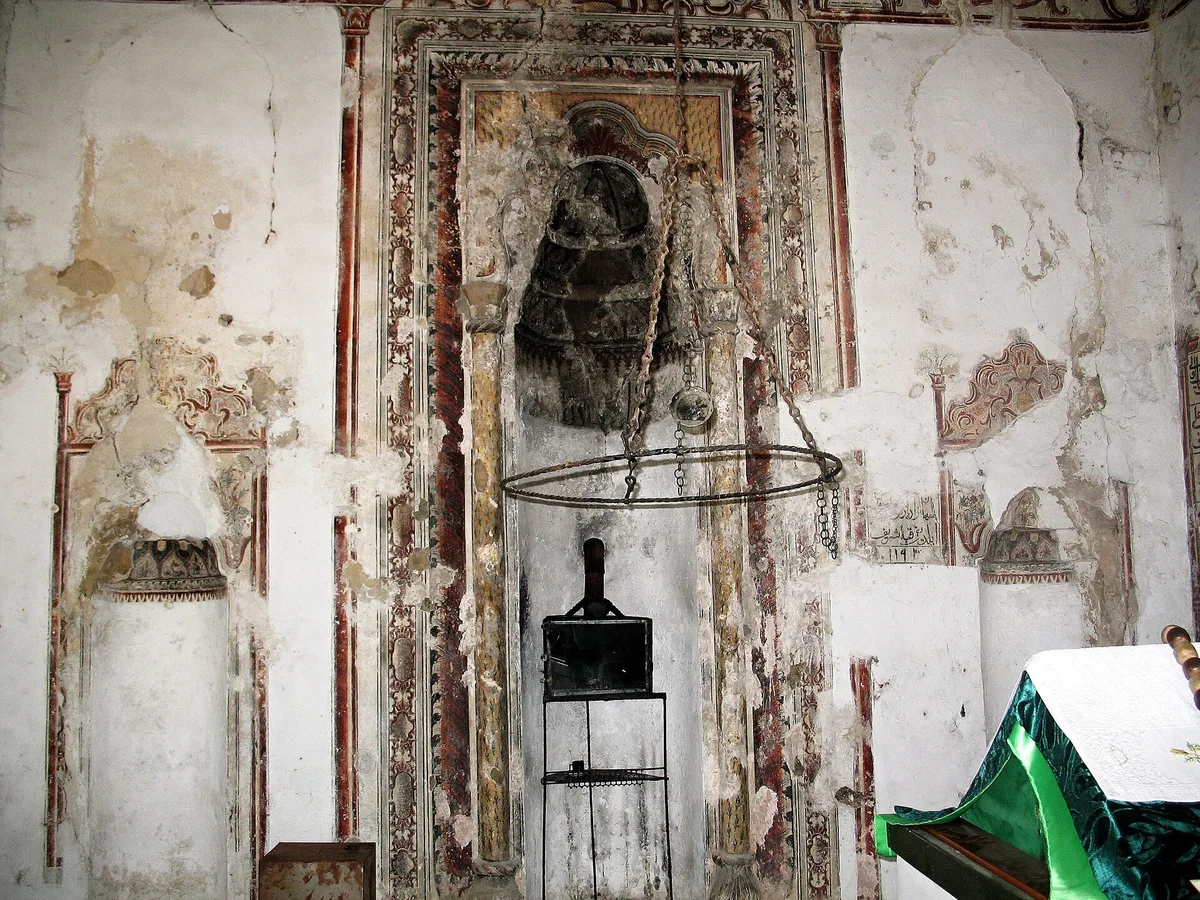
Most visitors walk the castle as a two-stop site — memorial, house museum, out — and miss the quieter layer that fills its corners. Start at the southern end, where the walls turn, and you find the Dollma Teqe: a small Bektashi shrine, all painted plaster and draped tombs, that is in some ways the most atmospheric interior in the fortress. It was completed in 1193 of the Hijra — 1779 to 1780 — by Adem Aga Toptani, whose marble tomb stands inside it; the mihrab among its painted walls suggests it may first have served as a mosque before becoming the Dollma family’s tekke, a lodge and shrine of the Bektashi order, the Sufi tradition woven deep into Albanian religious life. Before the communist dictatorship suppressed it — the teqe was damaged and used for profane purposes in the atheist decades, as Bektashi sites were across the country — the shrine was said to hold some 360 holy graves and was honoured with the nickname “Little Khorasan”, after the Persian homeland of saints. Treat the number as tradition rather than census. What is documented is the use: pilgrims gathered here for the feast of 11 August, and the shrine, cared for again since the 1990s, still draws them. Outside stands an ancient, gnarled olive tree that local telling links to Skanderbeg’s own wedding day — repeat it as the telling it is, and enjoy it on those terms.
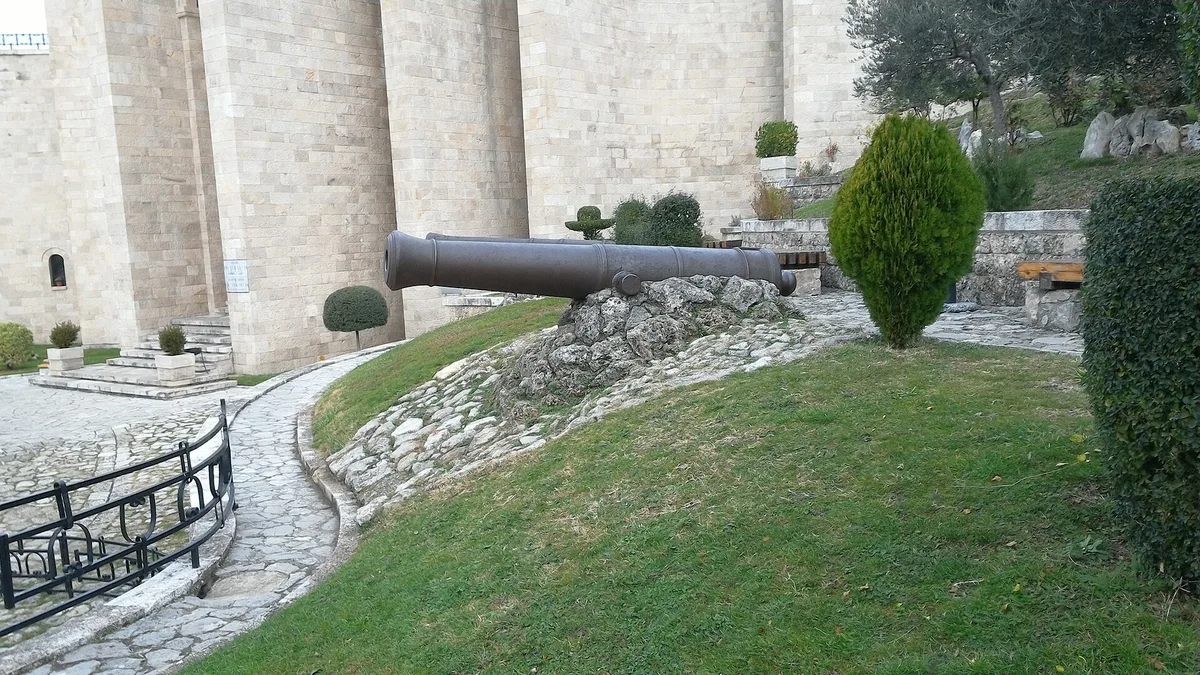
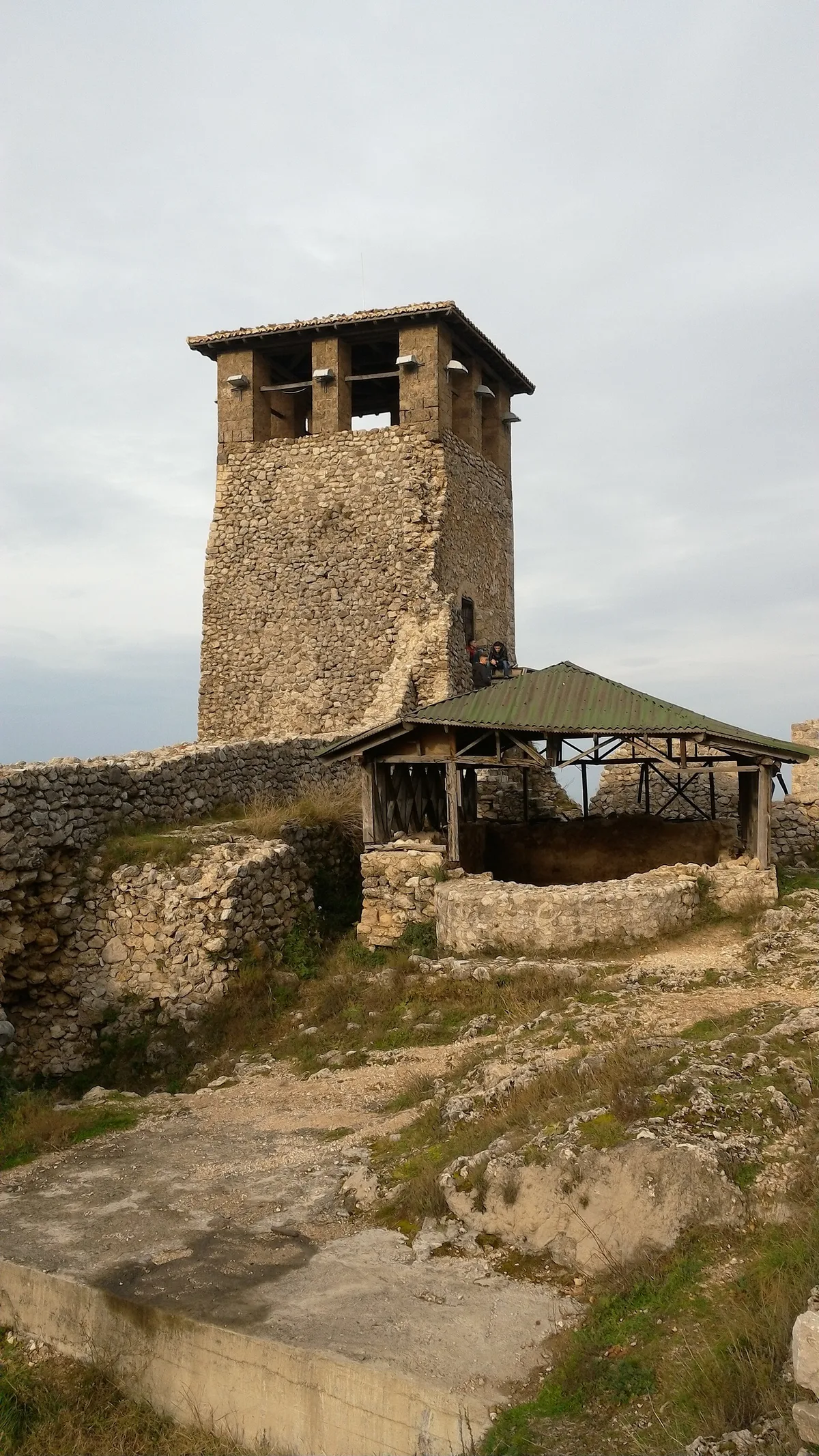
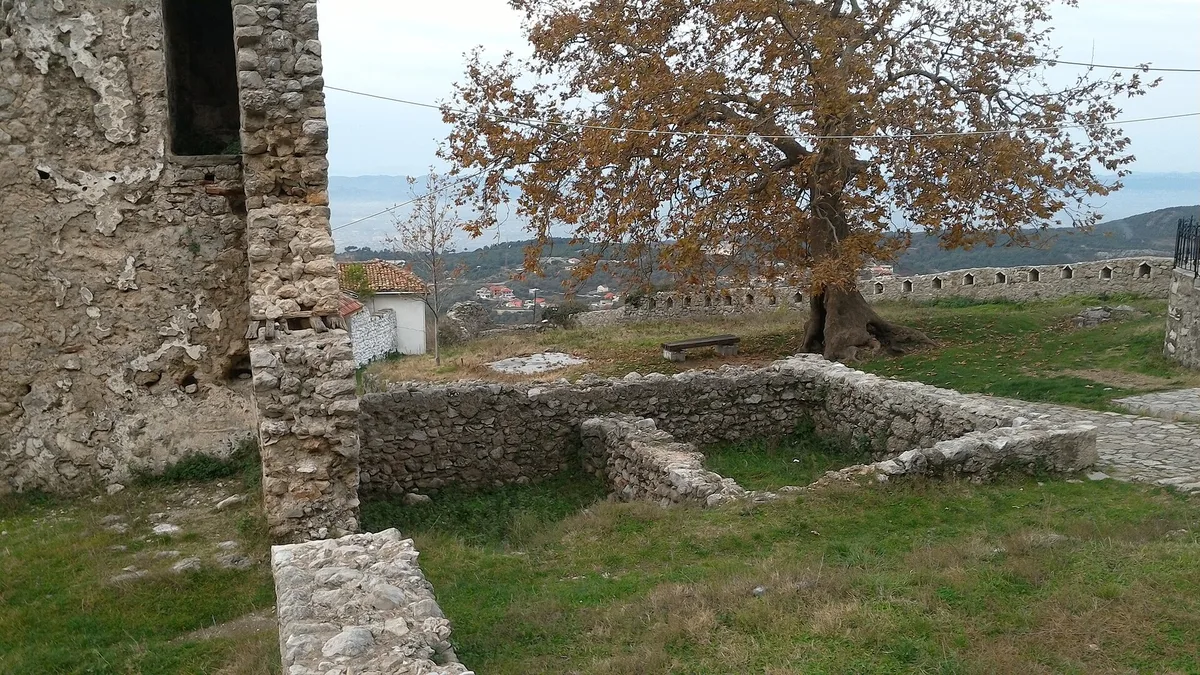
The rest of the castle’s small remains reward the same unhurried circuit. Near the museum stand the ruins of the Fatih Mosque — the mosque of Mehmed the Conqueror, raised in the years after the castle’s fall, before 1481 by the usual dating — of which the base and stump of its minaret and low walls survive: the conqueror’s mark on the fortress he could not take in its defender’s lifetime, left as a fragment. The clock tower, counted among the castle’s few surviving medieval structures, stands on its crag within the walls; it was damaged in the 2019 earthquake and has been under conservation since, so whether you can approach or climb it depends on the state of the works — ask at the gate rather than assuming. A medieval hamam, the bathhouse that served the castle’s households, survives at the south-western edge, more read than visited. And scattered through the grounds are the unlabelled things: stretches of domestic ruin, the church foundations of the castle’s older Christian centuries, cannon and wall-fragments that no panel explains.
Taken together, these remains are the argument for giving the castle its full time. The museums tell edited stories, superbly; the corners tell the unedited one — a fortress that was Byzantine, Kastrioti, Ottoman, Bektashi and communist-memorial in turn, with each age’s buildings left standing in the others’ company. A circuit that includes the teqe, the mosque stump and the tower takes perhaps half an hour beyond the museums, and it is the half hour that turns Kruja Castle from an attraction into a place.
Sari Salltik and Fushë-Krujë – the Mountain Above, the Town Below
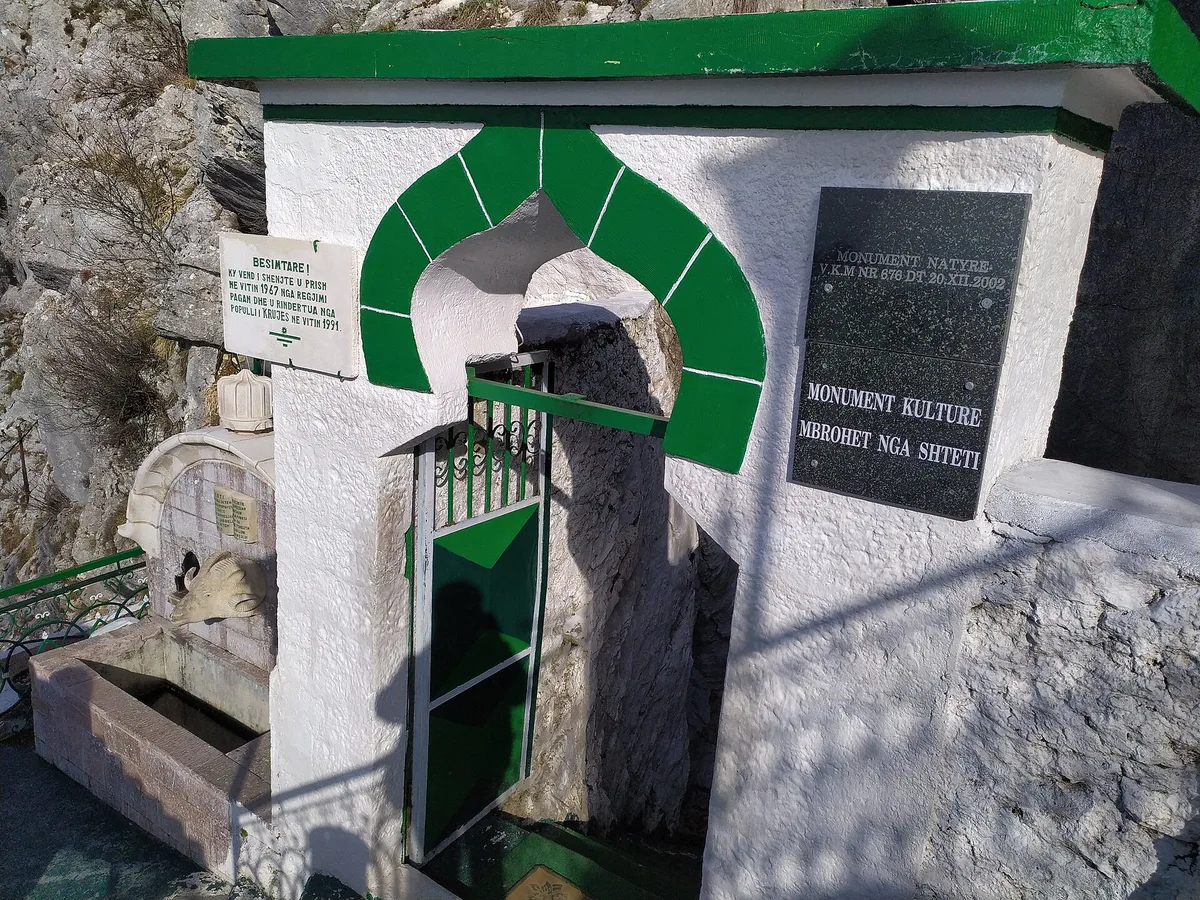
Beyond the castle, Kruja Albania has a second sacred geography, and it is vertical. Above the castle, the road and the paths climb Mount Kruja to the shrine of Sari Salltik, at around 1,176 metres by the usual figure — nearly twice the castle’s height, and a different world of pine, rock and weather. Sari Salltik was a 13th-century dervish of the Bektashi tradition, a missionary-saint whose cult spread across the Balkans and whose shrines stand from Albania to Turkey; the Kruja site, his most famous in Albania, centres on a cave in the mountainside — described in the sources as some fifteen metres deep — with a spring within it, a small mosque and teqe beside it, and the saint’s tomb as tradition holds it. The link between the saint and this mountain is not merely legendary: an Ottoman tax register of 1567–68 already mentions the “Road of Sari Saltuq” up to his tomb as needing repair, which makes this one of the older continuously used pilgrimage routes in the country. Pilgrims still climb it, in numbers on the order’s feast days — a May gathering is the best attested of the modern ones — and the devout of Kruja town, traditionally a Bektashi place, have treated the ascent as a duty and a pleasure for centuries. Visitors are generally welcome at the shrine in the pattern of Bektashi hospitality, but it is a living sanctuary, not a viewpoint with a chapel attached: dress and behave accordingly, and accept that access, opening and the state of the road are things to confirm in Kruja on the day, not facts any article can fix.
The ascent itself comes in two honest versions. The full pilgrim version is on foot — a long, steep climb from the town, measured in hours, on paths that ask for boots, water and a morning start. The version most visitors take is the winding mountain road, driven or ridden in a local taxi, with a short walk at the top: the road is narrow and switchbacked, the drive is part of the experience, and the reward is the panorama from the ridge — Kruja and its castle reduced to a toy below, the plain beyond, and the Adriatic on the horizon on any day clear enough. Treat Sari Salltik as a half-day addition, not a bolt-on to a rushed castle visit, and treat its weather seriously: the summit keeps mountain conditions in months when the town is in shirtsleeves.
Below, at the other end of the day, lies the Kruja nobody photographs. Fushë-Krujë — “Kruja of the plain” — is the flat, working town at the mountain’s foot, the junction through which every arrival passes: the main road between Tirana and the north runs by it, the road up to Kruja branches from it, and its cement works and roadside commerce give it the unglamorous energy of a place that makes things. It had one unlikely moment of world fame — in 2007 it hosted the first visit of a sitting American president to Albania, a stop still marked and remembered locally — but its real role in a Kruja trip is logistical and worth understanding: this is where the through buses run, where the climb begins, and where the traveller changing from an intercity bus to the local run up the hill will spend a few minutes learning how Albanian transport actually connects. Give it patience rather than time, and it will give you the mountain.
Getting There from Tirana – the Hour Uphill
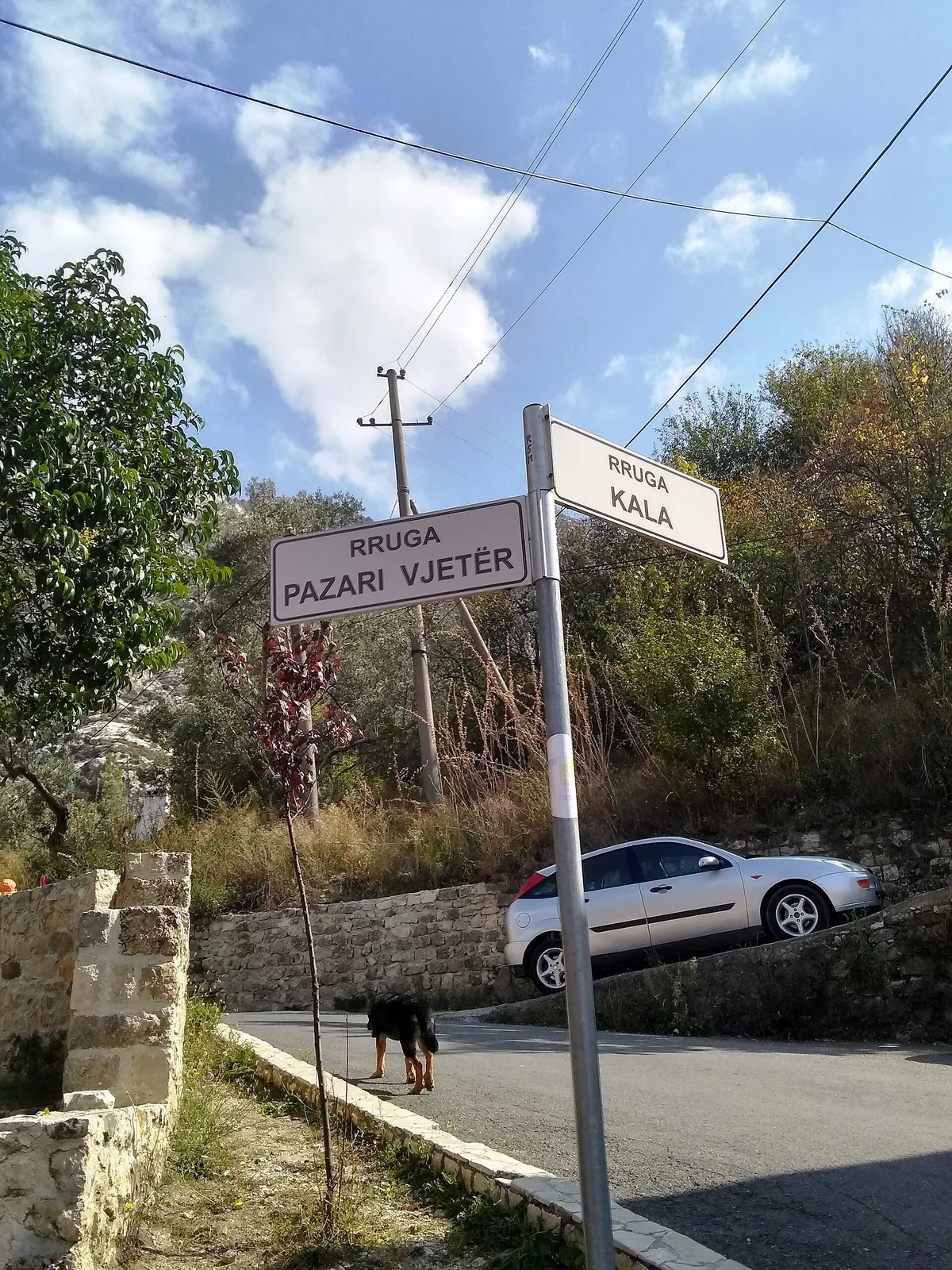
Kruja Albania stands about 32 kilometres north of Tirana, and the journey is best planned as roughly an hour — a good deal less on a clear run by car, a good deal more on a slow one — because the shape of the trip matters more than any timetable. The route runs north from the capital through the plain to Fushë-Krujë, and there it turns and climbs: the last stretch is a winding hill road up to the town and the castle ridge. Every way of making the trip is a version of that shape, and this guide gives mechanisms, not fares or departure times, because in Albania those are set by the week and the day, not by anything an article can responsibly print.
By bus and minibus, the pattern is the standard Albanian one, in two legs. Intercity services run from Tirana towards the north and serve Fushë-Krujë on the main road; from Fushë-Krujë, local minibuses and taxis climb the hill road to Kruja town, setting you down a short walk below the bazaar. Some services at some seasons run more directly towards Kruja itself — the pattern shifts, which is the point of describing it as a pattern: confirm the current departure point in Tirana and the current shape of the connection with your accommodation or at the terminal before you set out, and confirm the last return before you climb to the castle, because the return leg is the frame of a day trip. By taxi, the trip is a single hire from Tirana — agree the whole arrangement, including whether the driver waits in Kruja or returns for you, before you leave the capital. By car it is the most flexible version and the one that unlocks Sari Salltik on the same day: north through Fushë-Krujë, up the hill road, and park below the old town — in the busy season, expect the parking near the bazaar to fill by late morning, and take the first sensible space rather than hunting for the perfect one. Organised day tours from Tirana package all of this — castle, bazaar, museums, sometimes the mountain — and for a traveller with one day and no appetite for transport logistics they are a rational purchase; what they cannot give you is the town after five o’clock, which is the subject of the next section.
How Long Kruja Needs – Half a Day, a Full Day, or a Night
The half-day version is real, and this guide will not pretend otherwise. Castle walls and view, the Skanderbeg Museum, a walk down the bazaar with a purchase or two, and back to Tirana: four or five hours door to door, and a traveller whose Albania is a long weekend based in the capital will get the essential Kruja Albania from it. What the half day cannot hold is everything that makes the place linger — the ethnographic house, the teqe, an unhurried bazaar — and it arrives and leaves in the site’s busiest, hottest hours, in the company of every other half day in Albania.
The full day is the version this guide recommends to most visitors. It adds the Toptani house given its proper hour rather than a glance, the Dollma Teqe and the castle’s corners, lunch in the old town, and a bazaar browsed at workshop pace; with an early start or a hired car it can also carry the drive up to Sari Salltik, though the mountain plus everything else makes a long day and a full one. The overnight is the connoisseur’s version, and its argument is a single hour: the hour after the day tours leave, when the bazaar empties to the town’s own people, the light goes long and gold across the castle rock, and Kruja becomes again what it was for five hundred years — a small mountain town that happens to hold a nation’s founding story. Staying also buys the castle in the early morning, empty, and the mountain road in cool air. Kruja has guesthouses and small hotels in and below the old town, including rooms with the castle for a view; this guide names areas rather than properties, because the stock changes faster than print. Half a day if you must, a full day if you can, a night if you understand what evenings do to famous places — that is the honest scale.
Where Kruja Albania Fits an Itinerary
Kruja’s place in a trip is fixed by its geography: it is the classic excursion of the centre, and the natural companion piece to a Tirana stay. In the round-up of the best places to visit in Albania on this site it sits where it belongs, among the first stops a first trip should make — and its best use is as the day that gives a Tirana-based opening its depth, taken after the capital’s own museums and before the road south to Berat, so that the Skanderbeg story arrives early enough to echo through everything after it: the castle towns, the Bektashi teqes, the bazaars of the south all read differently once Kruja has been understood. Travellers driving north can equally take it on the way to Shkodra, leaving Tirana in the morning, giving Kruja its day, and sleeping in Shkodra — the road passes Fushë-Krujë in any case, and the detour up the hill costs an hour of driving for the country’s most important castle.
Eating in Kruja follows the mountain pattern rather than a list of addresses. The old town and the castle quarter have traditional restaurants and cafes serving the central-Albanian kitchen — grilled meats, oven dishes, baked lamb in the regional style, salads, and the strong small coffees that punctuate every Albanian day — with the terrace tables near the castle and along the bazaar doing double duty as viewpoints. The bazaar itself covers the portable end of eating: byrek from the bakeries, fruit in season, and raki and olive oil to carry away. As with the bazaar goods, the honest advice is to eat where the town eats, at the hours the town eats — lunch after the castle, in a family place a street back from the bazaar’s frontage, will beat the famous terrace at tour-group noon almost every time.
Frequently Asked Questions
Is Kruja worth a day trip from Tirana?
Yes — as a day trip from the capital, Kruja Albania is the strongest option Tirana offers. The journey is roughly an hour each way, and the town holds Albania’s most important castle, its national memorial museum, one of its best house-museums and its most famous bazaar in one steep, walkable core. A half day covers the headlines; a full day covers the place.
Are Skanderbeg’s helmet and sword in the museum original?
No, and the museum does not pretend otherwise. The helmet with the goat’s head and the sword displayed in Kruja are replicas; the originals are held by the Kunsthistorisches Museum in Vienna, where they have been for centuries. The Kruja galleries earn their visit on the campaigns, the period weapons and documents, and the memorial building itself.
What is genuinely worth buying in the Old Bazaar?
The handmade work of Kruja itself: felt qeleshe caps and felt goods from the workshops that still make them on the street, coppersmiths’ trays and coffee pots, hand-woven kilims, embroidered textiles and filigree silver. Ask whether a piece was made locally — much of the souvenir stock beside the crafts is imported, and sellers will generally tell you plainly when asked.
How long do I need inside Kruja Castle?
Give the whole castle — walls, both museums, teqe and corners — three to four hours at an unhurried pace. The Skanderbeg Museum takes about an hour, the Ethnographic Museum about an hour, and the walls, view and small remains the rest. A single hour inside the walls is a photograph, not a visit.
Can I visit Sari Salltik on the same day as the castle?
Yes, with transport and an early start. The shrine stands high on Mount Kruja at roughly twice the castle’s altitude; most visitors drive the winding mountain road and walk the last stretch, while the full climb on foot is a half-day hike in itself. Confirm the road, the weather and the shrine’s arrangements in Kruja on the day — it is a living pilgrimage site, not a scheduled attraction.
When is the best time of day to visit Kruja?
Morning, before the day tours fill the bazaar and while the castle view west to the Adriatic is at its clearest — or late afternoon into evening, when the tours have gone and the light turns on the castle rock. Midday in high summer is the version to avoid if your plans allow any choice: the climb is exposed, the street is at its most crowded, and the view hazes over.
The Short Version
Kruja Albania is the national story kept in one small mountain town: a Byzantine ridge fortress that a hostage turned commander made, in 1443, into the stronghold of a twenty-five-year resistance, and that fell only in 1478, a decade after his death. Go up through the bazaar in the morning — felt caps, copper and kilims among the imports, all of it honestly labelled by the sellers if you ask — and give the castle its full circuit: the walls and the view to the sea, the great 1982 memorial museum with its replica helmet and its real history, the Toptani family’s house of 1764 with its thousand objects of ordinary life, and the painted Dollma Teqe in the southern corner. Add the mountain if the day allows: Sari Salltik’s cave above, Fushë-Krujë’s working plain below. Then decide, with the evidence in front of you, whether Kruja was a stop on your trip or one of its summits. Taken at its own pace, it is almost always the second.