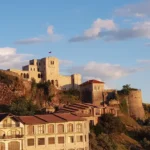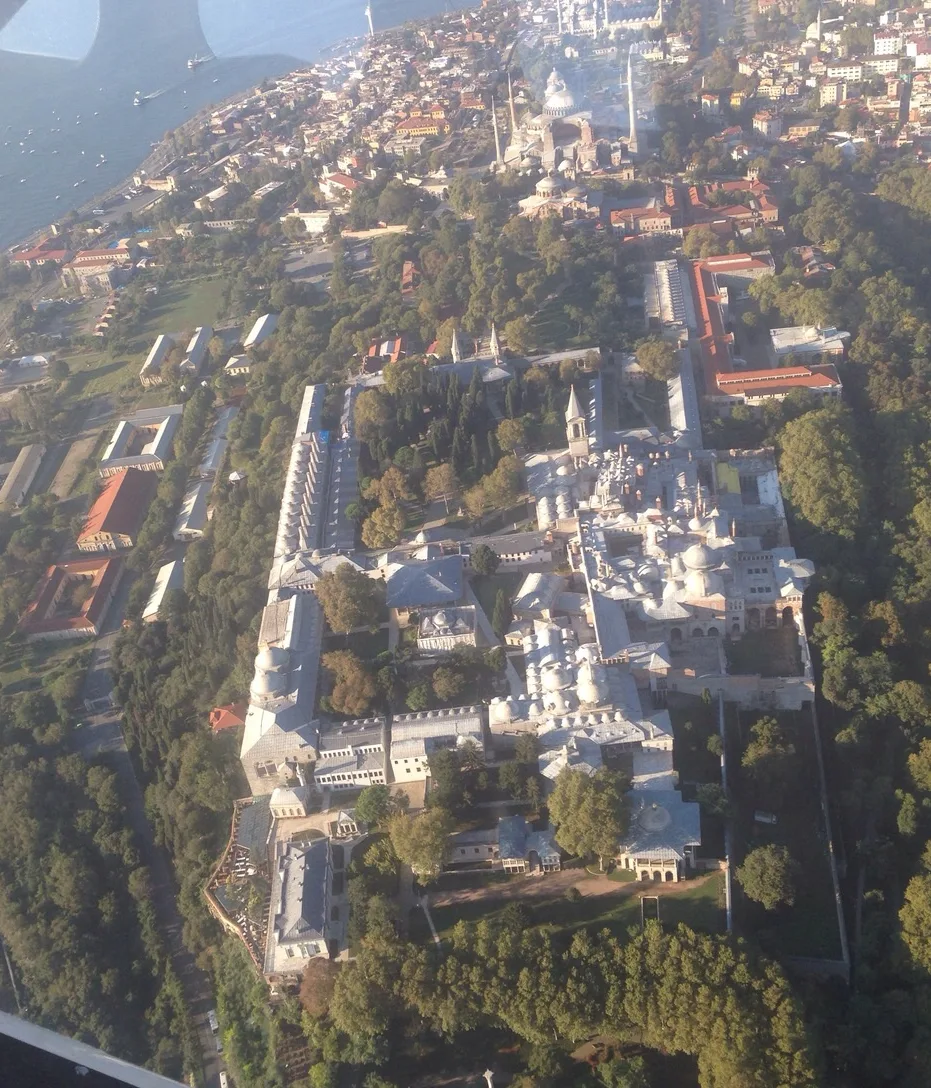
Topkapi Palace is not a palace in the European sense of one grand building with wings. It is a walled city of courtyards, pavilions, kitchens, barracks, gardens and treasury rooms, spread across the first hill of Istanbul where the Bosphorus meets the Golden Horn, and for nearly four centuries it was the seat of the Ottoman sultans and the working heart of their empire. This topkapi palace guide walks you through it the way the palace itself is organised – gate by gate and court by court, from the public First Court where anyone could enter, through the government offices of the Second, into the sultan’s private Third Court and the pleasure pavilions of the Fourth, and finally into the Harem, the household behind the walls that ran the dynasty. Follow the order and the building stops being a maze of domes and becomes a diagram of how the Ottoman world was run, which is a far more interesting thing to walk through.
A little orientation first, because Topkapi rewards readers who know what they are looking at. Mehmed II, the conqueror of Constantinople, began the palace in 1459, six years after the conquest, on the site of the Byzantine acropolis; it grew piece by piece for almost four hundred years as each sultan added a pavilion, a kitchen range or a tiled chamber to suit his reign. The court finally left in the 1850s, when Abdülmecid I moved to the European-style Dolmabahçe Palace on the Bosphorus, and Topkapi opened as a museum in 1924, in the first years of the Turkish Republic. It forms the centrepiece of the Historic Areas of Istanbul, inscribed by UNESCO in 1985, and it is administered today not by the ministry museum system but by Türkiye’s Directorate of National Palaces – a distinction that matters when you come to buy a ticket, as the visiting section of this guide explains.
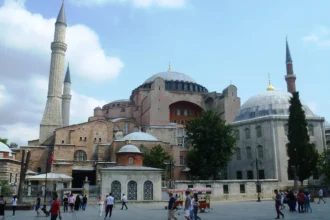
If Topkapi is one stop in a longer stay, plan the rest of the old town around it with our Istanbul travel guide – the palace sits in Sultanahmet, minutes from Hagia Sophia and the Blue Mosque, and it pairs naturally with both. What it does not pair with is haste. Give this topkapi palace guide a half day to work with, arrive at opening time if you possibly can, and expect the palace to take longer than the ticket resellers promise. The sections that follow are written in walking order, so you can read them on the move, court by court, as the palace unfolds in front of you.
Topkapi Palace at a Glance
The single most useful thing to understand before you enter is the gradient of the place. Topkapi is arranged as a series of four courtyards in a line down the promontory, and the further you walk, the fewer people were historically allowed to follow. The First Court was almost a public park, open to petitioners, tradesmen and soldiers. The Second Court was the empire’s office floor, where the council governed and the kitchens fed thousands. The Third Court was the sultan’s own domain, entered through one gate by invitation and service alone. The Fourth Court was his garden – terraces, pavilions and views over two waterways. The Harem hangs off this spine to one side, a separate household world of its own. Every gate you pass narrows the world, and the palace’s famous objects – the Spoonmaker’s Diamond, the dagger, the relics – sit at the narrowest end of it.
| Question | Answer |
|---|---|
| What is it | The Ottoman sultans’ palace and seat of government, built from 1459, a museum since 1924 |
| Where | Sultanahmet, Istanbul, at the point where the Bosphorus meets the Golden Horn |
| Administered by | The Directorate of National Palaces (millisaraylar.gov.tr) – not the muze.gov.tr museum system |
| Weekly closing day | Tuesday (checked 31 October 2026 – confirm on the official site before you go) |
| Tickets | Combined palace, Harem and Hagia Irene ticket is the standard foreign-visitor purchase; the Harem and Hagia Irene are also sold separately |
| Time needed | Half a day minimum – three and a half to five hours for the full palace |
| Do not miss | The Imperial Treasury, the Harem, the Divan chamber, the Fourth Court terrace |
| Photography | Rules are posted at each chamber door; behave in the Sacred Relics chamber as you would in a place of worship |
The table above carries the whole visit in miniature, and the rest of this topkapi palace guide simply fills in its rows. Note the closing day in particular. More travellers lose their Topkapi visit to the Tuesday closure than to any queue, because the reseller sites that rank for this palace bury it under ticket tables, and because Istanbul itineraries built around “museum Monday” logic assume the palace follows the pattern of somewhere else. It does not. Check the current arrangements on the Directorate’s site before you fix your days, and then build the visit on any morning that is not a Tuesday.
The Imperial Gate and the First Court
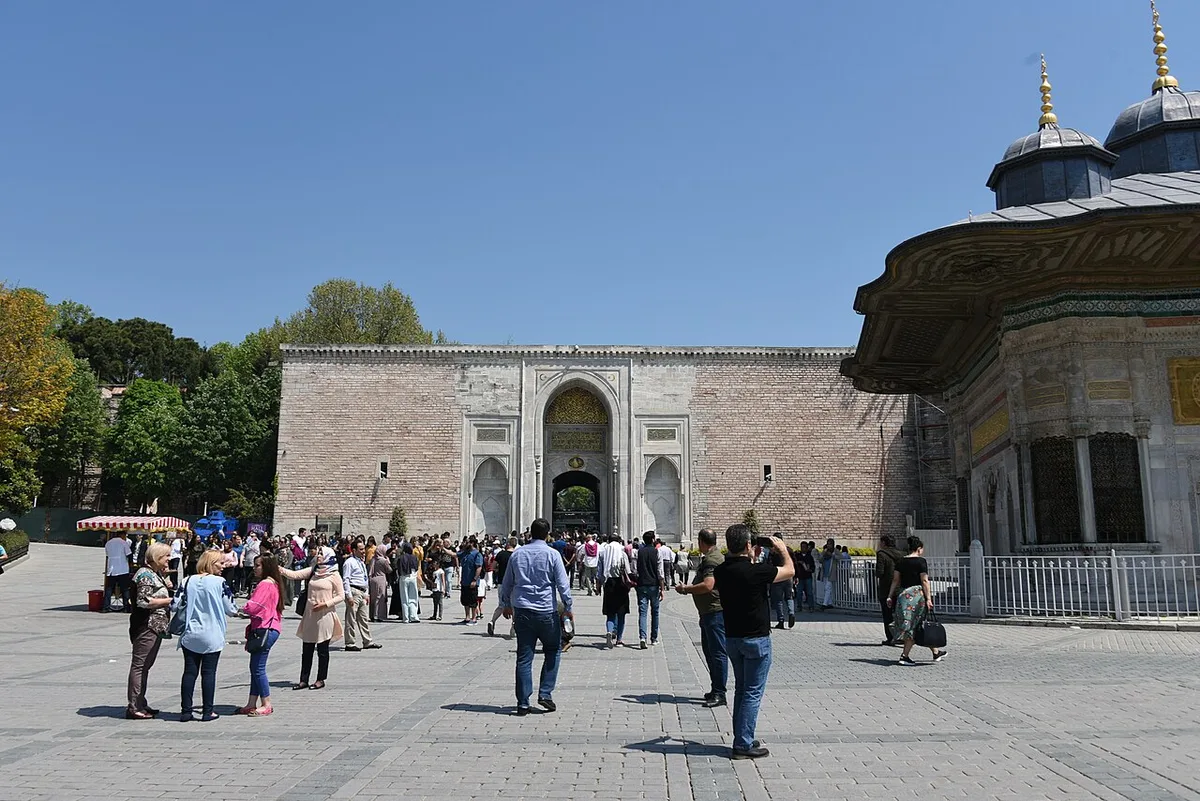
Every visit begins in the square behind Hagia Sophia, at the Imperial Gate – the Bab-ı Hümayun – a broad, rather austere stone portal whose inscription dates it to 1478, when Mehmed II’s palace was still new. Pass the rococo Fountain of Ahmed III on your right, one of the prettiest pieces of street furniture in Istanbul, and look at the gate itself before you go through. Its marble frame carries the sultan’s tughra, his calligraphic monogram, and the niches flanking the arch have a grimmer history – in earlier centuries the heads of executed offenders and rebels were displayed in them as a public warning, the palace’s way of making its justice visible at its very threshold. The gatehouse above the arch once held lodgings and a small treasury of valuables deposited for safekeeping, which tells you something about the traffic this doorway handled – this was less a front door than a checkpoint between the city and the state.
Beyond it, the First Court opens as a long, sloping park of lawns, cypresses and plane trees, running downhill from the gate towards the water. This was the Court of the Janissaries, and it was never truly private. Petitioners crossed it on their way to present written complaints. Tradesmen, water-carriers, woodcutters and officials passed through on palace business, and the buildings along its edges were working buildings – a bakery, a hospital, workshops, the palace mint and the church of Hagia Irene, with the outer treasury and stables of the outer service beyond. Foreign ambassadors processed up this slope on audience days in full ceremonial dress, which was precisely the point – the long walk through a court full of soldiers and servants was the first act of the theatre that ended, hours later, in the silence of the Audience Chamber.
Walk it slowly, because the First Court sets the palace’s tone better than any single room. Nothing here is ornamental in the palace sense; it is a landscape of logistics, the outer ring of a complex that at its height housed and fed several thousand people. Two stops deserve your time before you reach the second gate. The Imperial Mint, housed in a group of 18th-century buildings on the eastern side, struck the empire’s coinage here for generations, and the Directorate has in recent years been opening museum displays inside its halls – in October 2026 it inaugurated exhibitions of coins, medals and kaftans in the old mint buildings, and the displays make a worthwhile short stop if they are open on your day. And on the same side stands the building that dominates the whole court, older than the palace, older than the conquest – Hagia Irene.
Hagia Irene and the Imperial Mint
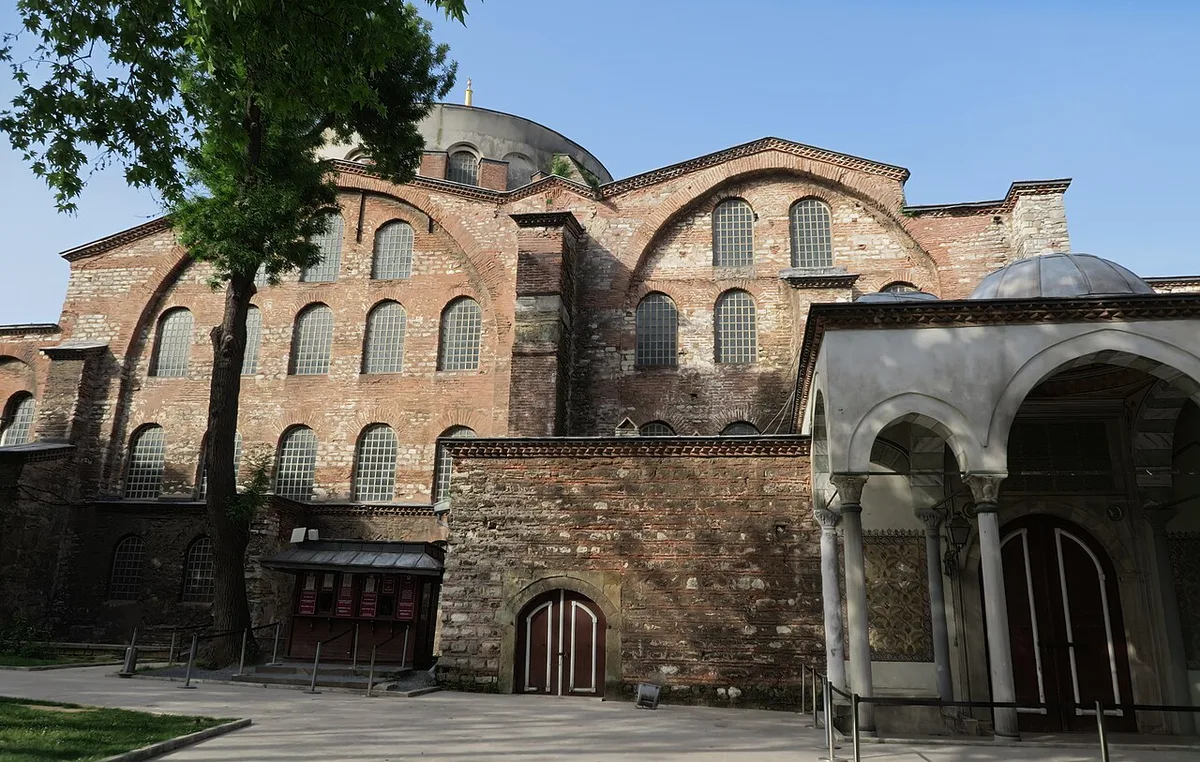
Hagia Irene – the Church of the Holy Peace – is one of the oldest surviving churches in Istanbul, first built under Constantine in the 4th century and rebuilt under Justinian after fire in the riots of 532 destroyed its predecessor. Its brick dome and great apse, with the simple cross that icon-era decoration left in the semi-dome, were already nine centuries old when Mehmed II arrived. What saved it is one of the palace’s quiet curiosities: standing inside the palace walls, the church was never converted into a mosque. The Ottomans used it instead as an arsenal and store for armour, weapons and captured equipment, and later as a repository for antiquities – effectively an early museum store – which preserved its Byzantine shell while the centuries rearranged everything around it.
Today Hagia Irene is visited as a separate section of the palace complex, covered by the combined ticket or by its own ticket, and its interior is used for concerts and exhibitions as much as for sightseeing – the acoustics of that great brick nave are famous among Istanbul musicians. Look up before you leave at the apse’s great cross, almost the only decoration the icon-era church allowed itself, and one of the very few such survivals in the city; the building that began as a church spent its Ottoman centuries as the Cebehane, the palace armoury, which is why its mosaics were never plastered over for prayer and its walls still carry racks’ and stores’ scars alongside the Byzantine brickwork. Even if you do not go inside, stand in front of it for a moment. Between the church, the mint and the Janissaries’ park, the First Court contains the palace’s whole argument in embryo – an Ottoman Islamic court governing from inside a much older Christian and Roman city, absorbing what it found rather than erasing it. Then walk up the slope to the second gate, where the public world ends.
The Gate of Salutation and the Second Court
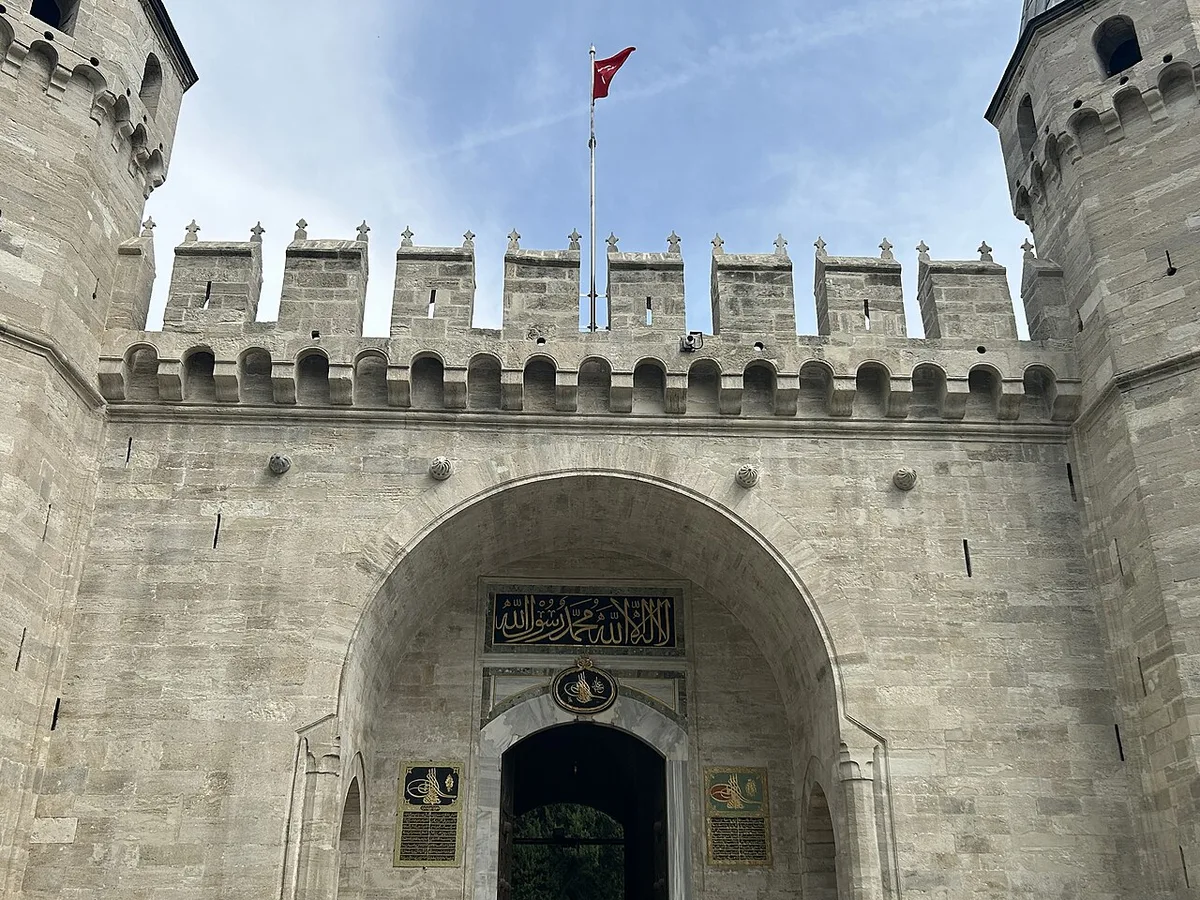
The Gate of Salutation, the Bab-üs Selam, is the palace’s true front door – a crenellated stone gatehouse between two octagonal towers, rebuilt in its present form in the reign of Süleyman the Magnificent. Its rules were absolute. Everyone dismounted here. Ambassadors, viziers and princes left their horses and their retinues at this gate and walked on; only the sultan rode through, and the great central arch framed him alone on audience and campaign days. The tughras set into the facade – Mahmud II’s among them – and the inscription over the arch declare whose ground begins here, and the gate’s broad eaves and twin towers give it a silhouette that appears in nearly every period view of the palace. This is also where your ticket is checked, and it is worth registering that everything beyond it was, in the palace’s working centuries, forbidden ground to the city outside.
Inside, the Second Court spreads out as a garden – lawns, cypress and plane trees, gravel paths – and the first surprise for most visitors is how little it resembles a courtyard. It is laid out like a park, because that is what it was: a ceremonial landscape through which the business of government moved. Along the eastern side runs the long, domed range of the imperial kitchens, chimney after chimney. On the western side stands the Divan, the council chamber, with the Tower of Justice rising behind it. The stables of the privy household occupy the south-eastern corner, and the building that housed the Divan’s treasury now displays the palace’s collection of arms and armour. On great days – the sultan’s accession, the greeting ceremonies of religious festivals, the departure of armies – this garden filled with thousands of officials arranged by rank, in a silence European ambassadors wrote home about in disbelief.
That silence was policy. The Second Court was where the empire showed itself to itself, and its choreography was rehearsed to the level of where each rank of official might stand, sit or eat. Ordinary days were quieter but no less ordered: petitions from subjects were received here and passed to the Divan, officials came and went to the council and the finance offices, and the kitchens along the eastern wall ran from before dawn. Treat the court as you would a great office quadrangle and give its two working ends – the Divan and the kitchens – the attention they deserve. They are the twin engines of the palace, government and food, and the next two sections of this topkapi palace guide take them in turn.
The Divan – Where the Empire Was Governed
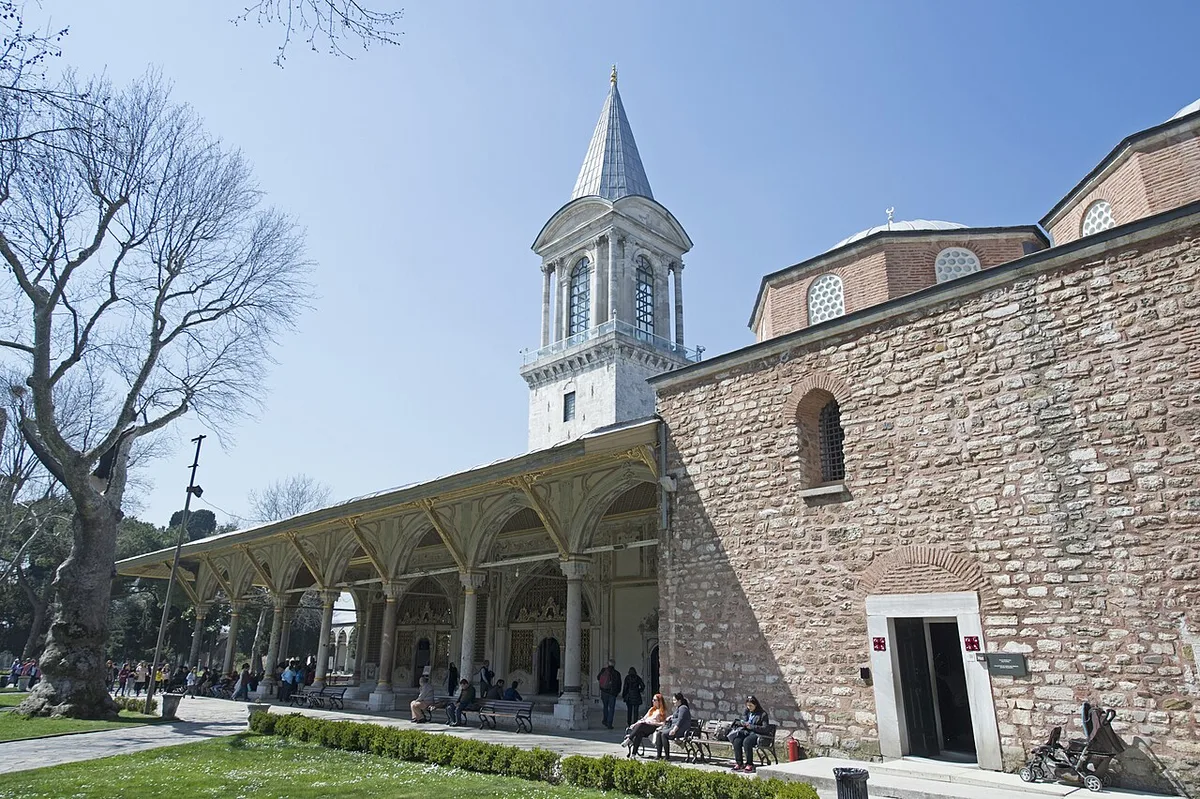
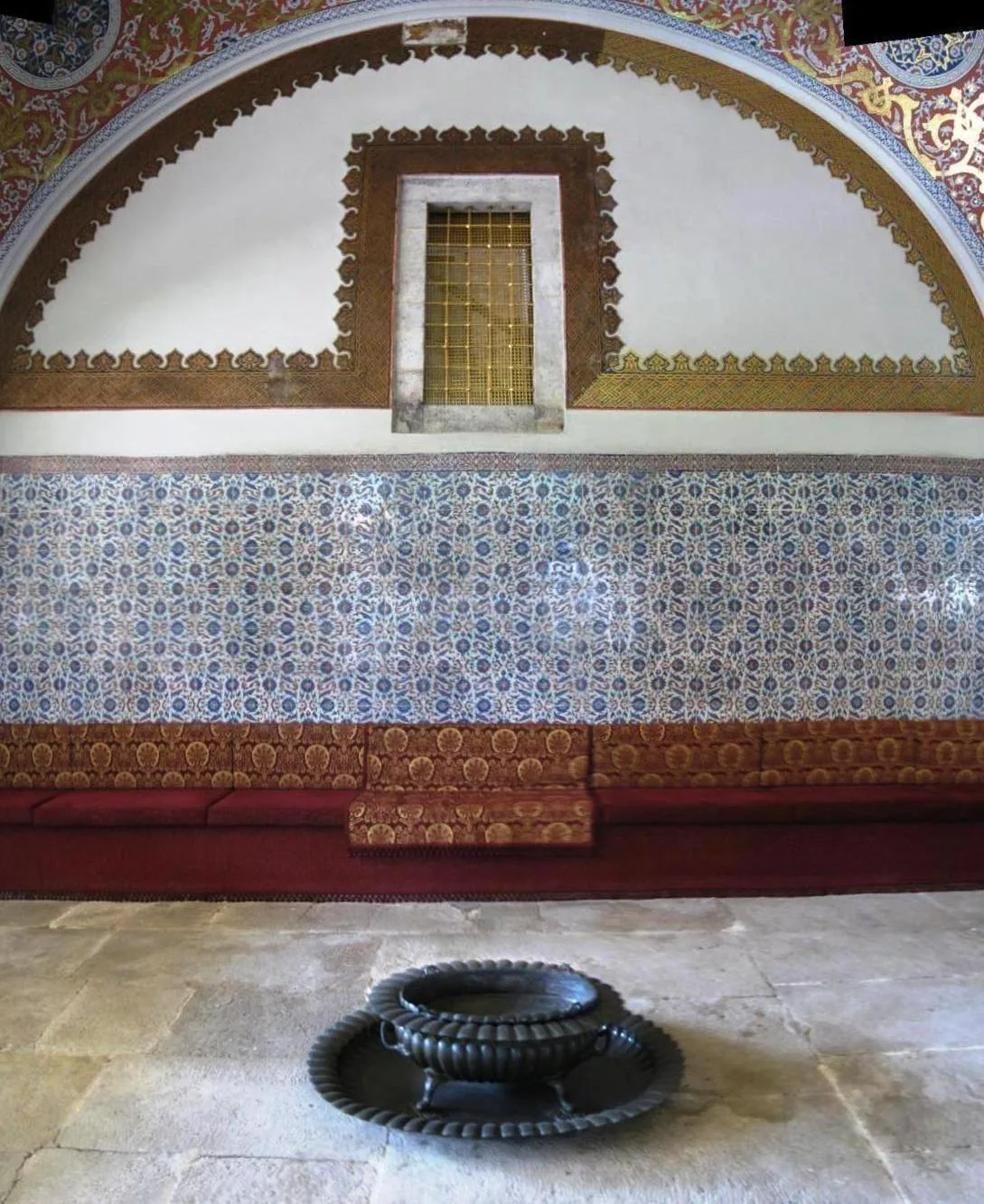
In the north-western corner of the Second Court, under a wide portico, stands a modest domed chamber that governed an empire on three continents. This is the Divan-ı Hümayun, the Imperial Council chamber – the Kubbealtı, “under the dome” – where the grand vizier presided over the empire’s senior ministers, its chief judges and its treasurers. The council met here on set days each week, working through military appointments, provincial reports, tax disputes and the petitions of ordinary subjects that had been gathered at the palace gates. There was no throne in this room and usually no sultan either. The viziers sat on the low, cushioned bench that runs along its walls and did the state’s business in a businesslike way, which is one of the Ottoman system’s more interesting features – the sovereign ruled, but the government sat here, in a room deliberately kept smaller and plainer than its power would suggest.
The room’s one theatrical device is easy to miss, and it is the detail the whole chamber is organised around. High in the wall above the grand vizier’s seat is a small window closed by a gilded lattice. Behind it, unseen, the sultan could listen to the council at work – or leave the lattice shut and let the viziers wonder whether he was listening at all. The tradition is that a sultan who disapproved would knock or have a message passed, and a council that knew it might be overheard governed itself accordingly. It is the most economical piece of political architecture in the palace: one grille, doing the work of an entire inspectorate. Look for it when you stand in the chamber, and notice how every seat in the room is, in effect, arranged to perform for that window.
Behind the chamber rises the Tower of Justice, the slender stone tower that is the palace’s vertical accent, visible from the Golden Horn and the Bosphorus in every historic view. Its name is its message. The tower declared that justice flowed from this place, and later sultans rebuilt and heightened it into the landmark it is today – from its upper chamber the sultan could survey both the city and his own court, a sightline that joined the tower’s symbolism to the Divan’s grille in a single idea: the ruler sees, the ruler hears, and the machine below knows it. The Divan complex also held the offices where the council’s decisions were written, sealed and archived, and the treasury of the outer service; the neighbouring halls now carry exhibitions, but the chamber itself, with its İznik-tile dadoes, its painted dome and its silent bench, remains the room to stand in if you want to understand what the palace was for.
The Imperial Kitchens and the Porcelain of Empires
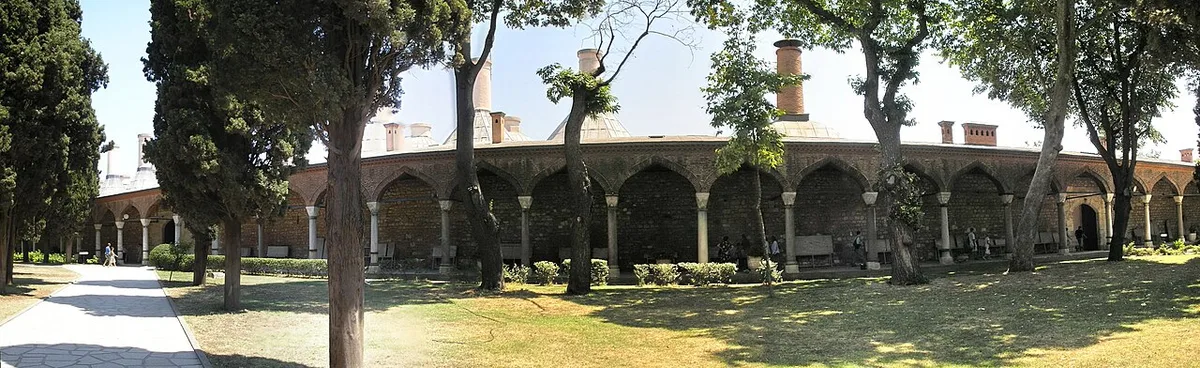
Walk back across the Second Court and the whole eastern side of it belongs to food. The imperial kitchens run in a long range of ten domed halls beneath a picket line of tall conical chimneys, the most recognisable skyline inside the palace after the Tower of Justice. They were rebuilt in their present form in the 16th century, after a fire destroyed their predecessor, in the era when the palace’s population and appetites were at their height – and those appetites were industrial. The kitchens fed the sultan’s household, the court, the council on sitting days and a palace population that ran into the thousands, with separate sections for the sultan’s dishes, for the valide sultan and the Harem, for the Divan’s officials and for the palace at large, and a confectionery – the helvahane – that produced the halvas, sherbets, preserves and pickles the court consumed in quantity. The kitchen staff numbered in the hundreds, organised in a guild-like hierarchy of master cooks, and the whole operation ran on an annual calendar of provisions that reached across the empire’s farms and ports.
The scale becomes clearer when you remember what the kitchens were for beyond feeding people. Food was a language of rank at this court. The Janissaries’ loyalty was bound up with palace food – their regiments were organised like a kitchen brigade, their insignia were cauldrons and ladles, and overturning the soup cauldrons in the square was the recognised signal of revolt. The Divan’s members dined after council on dishes sent from these ranges. Foreign ambassadors were fed at audiences in courses counted to display abundance. When you stand in the kitchen halls today, among the great cauldrons, ladles and roasting equipment the museum displays, you are standing in the palace’s second engine room – the one that turned revenue into loyalty, three meals a day. The range also gained a new room in 2026, when the Directorate reopened the old sherbet house within the kitchens complex as a display of the court’s sherbets and sweet drinks, with hundreds of vessels and implements – look for it along the range.
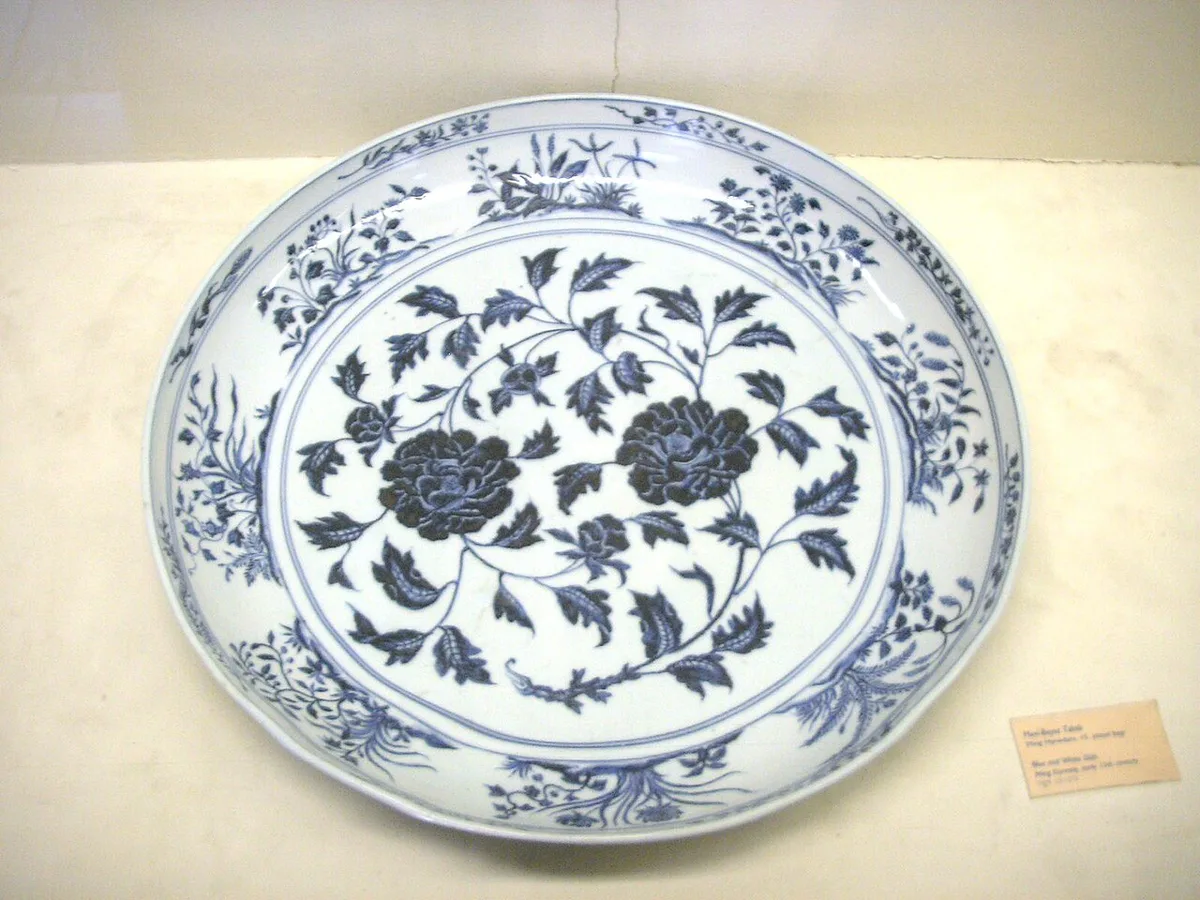
The kitchens’ second treasure is what the food was served on. The palace accumulated one of the world’s great collections of Chinese porcelain – blue-and-white, celadon and famille pieces that arrived along the Silk Road and by sea, as trade goods, tribute and diplomatic gifts, and were prized at court far above their weight in precious metal. Celadon in particular carried a useful reputation in palace lore: it was believed the glaze would change colour or crack in the presence of poison, which made it the safest tableware a suspicious century could imagine. The sultans’ collection of Chinese ceramics, more than ten thousand pieces by the usual published count, together with a smaller and finer holding of Japanese porcelain, is now displayed in the kitchen halls – an accidental museum of East Asian art assembled not by collectors but by cooks, who kept what the centuries did not break. Give the cases time. Seen together, the cauldron the size of a cart and the Ming dish painted with peonies describe the palace’s whole range, from feeding a garrison to dining like the centre of the world.
The Gate of Felicity and the Third Court
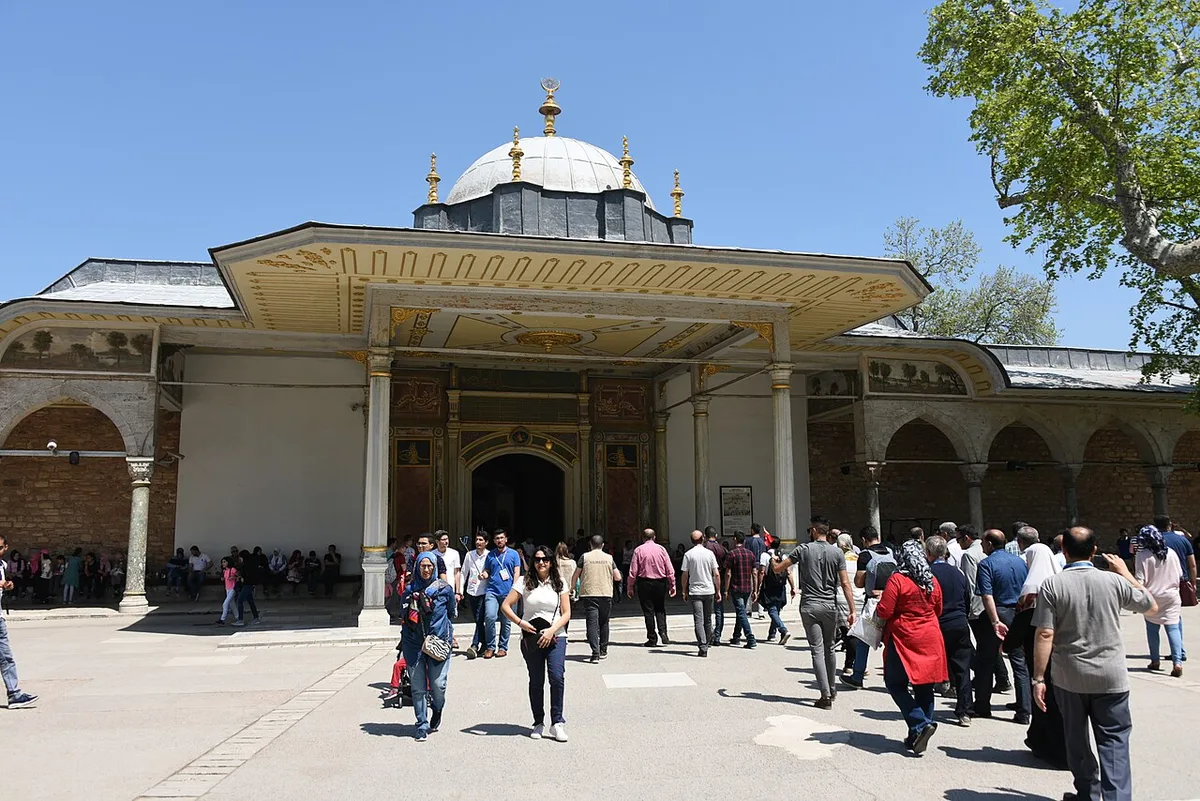
At the head of the Second Court, facing down its garden, stands the gate that divides the palace’s public machinery from the sultan himself. The Gate of Felicity – the Bab-üs Saade – is a domed, marble-fronted portal under sweeping eaves, its present decoration largely 18th-century rococo work over an older core, and it was guarded not by soldiers but by the white eunuchs of the inner court, whose chief, the Babüssaade Ağası, was one of the half-dozen most powerful men in the empire. No one passed this gate on business alone. Beyond it lay the Enderun, the inner palace: the sultan’s residence by day, his audience chamber, his treasury, his relics and the palace school that trained the empire’s highest administrators. The gate was also a stage. New sultans were enthroned on the throne set before it at their accession, the court assembled here for the greeting ceremonies of the great festivals, and the sacred banner of the Prophet was brought out through this gate when the army marched to war in the empire’s campaigning centuries.
The Third Court beyond is a different world in scale – a quiet garden court, paved and planted, where the noise of the Second Court drops away. Its buildings are a ring of low, elegant pavilions rather than offices. On one side stands the Audience Chamber, where ambassadors were presented. Behind it, along the seaward edge, stretches the Fatih Pavilion, the Conqueror’s own kiosk, which holds the Imperial Treasury. Across the court are the chambers of the Enderun school – the palace pages, boys taken into the sultan’s service and educated here in the court’s own system, graded through a ladder of services from the pantry and wardrobe up to the privy chamber itself, from which the empire’s grand viziers and provincial governors were regularly drawn. And at the court’s heart, freestanding in marble, sits the Library of Ahmed III. The next sections of this topkapi palace guide take the court’s rooms in the order most visitors meet them – audience, treasury, relics, library – before the ground opens out into the gardens of the Fourth Court.
The Audience Chamber – the Theatre of the Sultan
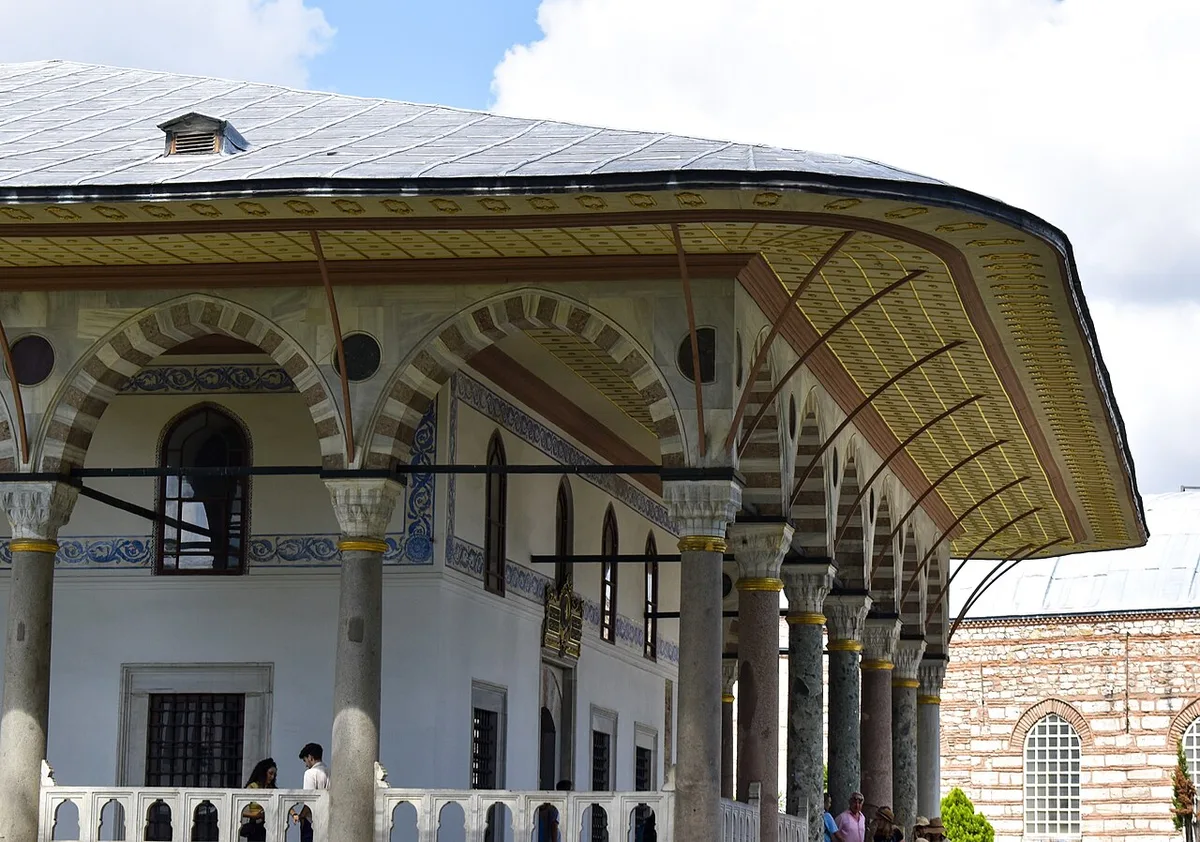
The Audience Chamber, the Arz Odası, is a small domed pavilion of Mehmed II’s era, wrapped in a marble colonnade and a roof of famously sweeping eaves, and it was built for exactly one performance: the moment a foreign ambassador, or a vizier presenting a report, came face to face with the sultan. The ceremony was choreographed to the inch. The ambassador had already been feasted in the Divan, dressed in a robe of honour paid for by the court, and made to wait. He was then led across the Third Court, held firmly by the arms by two officials – a courtesy that doubled as a restraint, so that no visitor could ever raise a hand near the sovereign – and brought through the chamber’s door into a room arranged like a stage set, where the sultan sat enthroned on a great canopied couch, hung with pearls and embroidery, and said nothing at all. Protocol required the sultan’s silence. The grand vizier spoke; the ambassador kissed the hem of the imperial robe; gifts were displayed and carried away to the treasury. European envoys left half-hypnotised by the stillness of it, and wrote accounts that shaped the West’s picture of the Ottoman court for centuries.
Stand in the chamber now – visitors view it through its doorways – and the machinery is still legible. The throne platform dominates one wall; the fountain set into the wall by the door served a double purpose, cooling the room and, by its murmur, making private conversation beside the sultan impossible to overhear-proof – courtiers could not whisper plots under the sound of falling water within earshot of the throne. The tiles, the painted ceiling and the chamber’s small scale all work toward a single effect: the visitor was meant to feel that he had stepped out of the large, loud empire of the outer courts into the presence of something concentrated and still. Of all the rooms in the palace, this is the one where the Ottoman theory of power – magnificent, silent, remote – was performed most purely, and it rewards a few unhurried minutes even in a crowd.
The Imperial Treasury – the Spoonmaker’s Diamond and the Topkapi Dagger
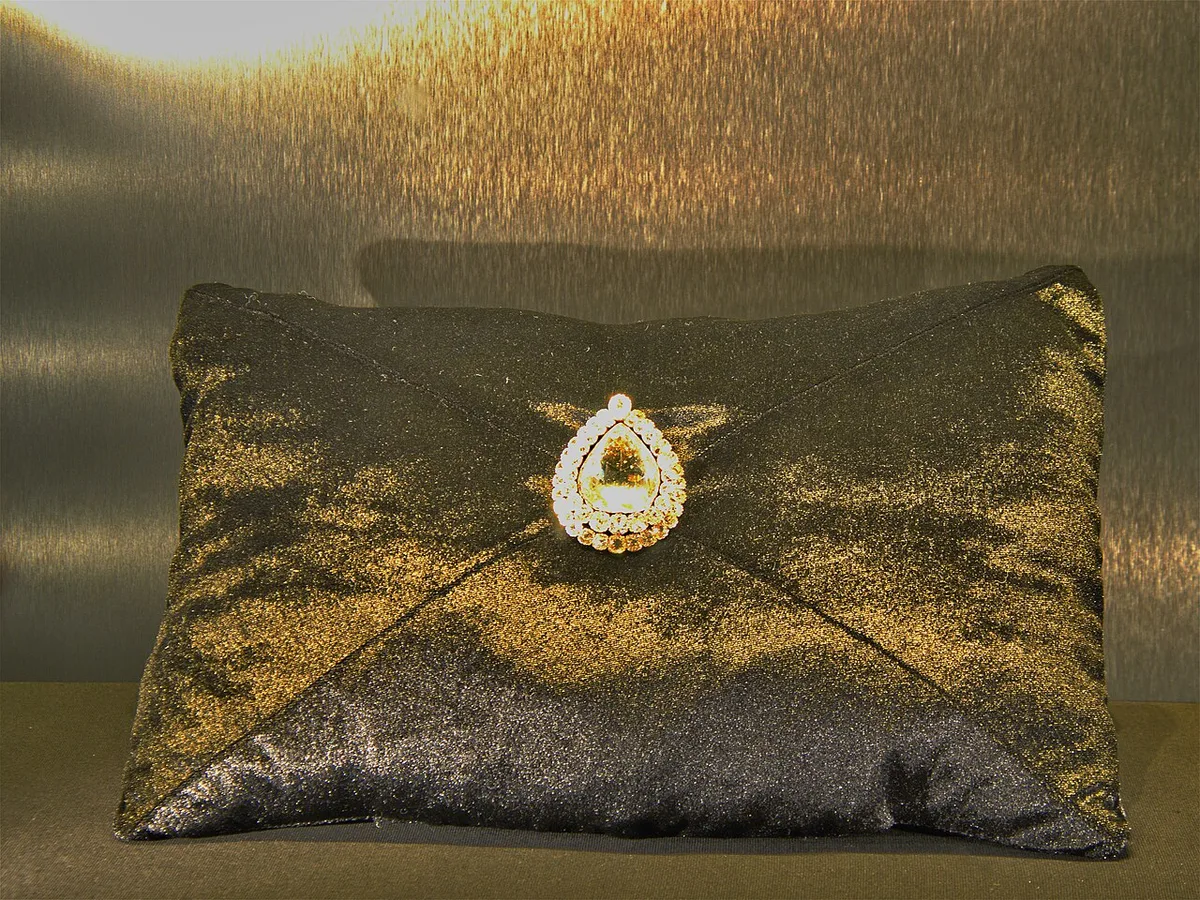
The palace kept its greatest portable wealth along the seaward edge of the Third Court, in the Fatih Pavilion – the oldest surviving pavilion of Mehmed II’s palace, a two-storey kiosk with a terrace over the water. Its ground-floor rooms hold the Imperial Treasury, the collection whose two star objects most visitors have crossed the world to see. The rooms proceed as a slow crescendo of goldsmiths’ work – jewelled flasks, emerald-studded boxes, thrones, weapons crusted with gems – and the discipline the museum imposes is the right one: look at the craftsmanship before the carats. These objects were not ornaments in the modern sense. They were the empire’s reserve and its diplomatic ammunition, gifts calculated to overwhelm, regalia that made rank visible, and craftsmanship patronised at a level no private buyer in the world could match.
The first star needs no label to find. The Spoonmaker’s Diamond – the Kaşıkçı Elması – is an 86-carat, pear-shaped diamond of extraordinary clarity, set in silver and ringed by 49 smaller brilliant-cut diamonds, displayed on its cushion in a blaze of case lighting. Almost everything told about its arrival at the palace is legend, and the honest guide labels it as such: the best-known version has a poor man finding the stone in a rubbish heap at Eğrikapı and selling it to a spoonmaker for three wooden spoons – hence the name – after which it passed from dealer to dealer until the grand vizier bought it for the sultan’s treasury in the late 18th century. The story is too neat to trust and too good to omit, but its last act at least rests on the treasury’s own records: the stone was set in its present frame under Sultan Mahmud II in the early 19th century. What no legend exaggerates is the object itself. It sits very still and very bright, and the crowd around its case is the densest in the palace – come early, as the visiting section advises, if you want it without thirty shoulders in front of you.
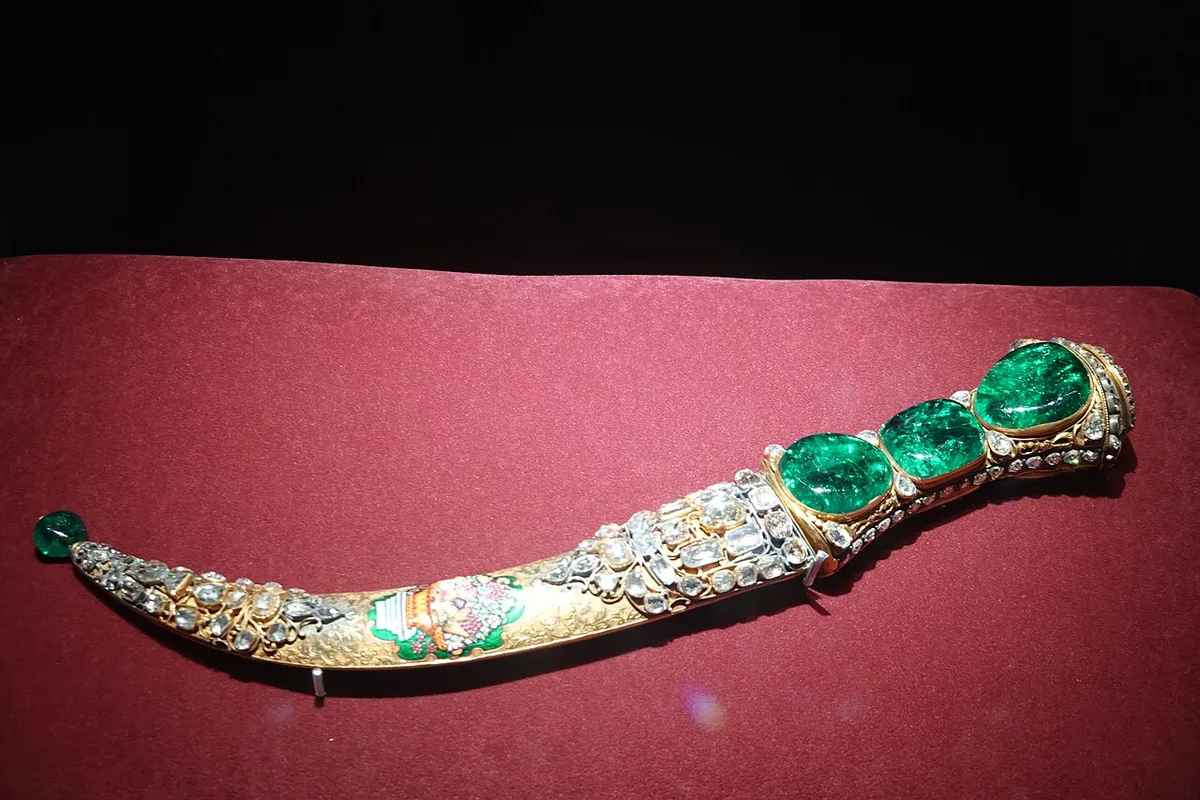
The second star has the better documented story, and the stranger one. The Topkapi Dagger, made in the palace workshops in 1741, was Sultan Mahmud I’s gift to Nader Shah of Persia – a jewelled dagger whose gold hilt carries three enormous emeralds in a row, a fourth in the pommel concealing a small watch, with diamonds and enamel flowers running down its scabbard. The embassy carrying it had reached Persia when news arrived that Nader Shah had been assassinated in 1747; the mission turned around, and the dagger came home to the treasury it had been made in, where it has remained ever since – a masterpiece of Ottoman goldwork that survives, essentially, because its recipient died before it arrived. It became world-famous a second time as the McGuffin of the 1964 film Topkapi, which borrowed the dagger and the diamond’s glamour for a heist story. Beyond these two, do not rush the remaining rooms: the jewelled throne sent by Nader Shah’s Persia in return, the rock-crystal and jade, the sultans’ jewelled aigrettes and the sheer accumulation of emerald and ruby work add up to the clearest statement in the palace of what Ottoman wealth looked like when it was meant to be carried, worn and given away.
The Chamber of the Sacred Relics
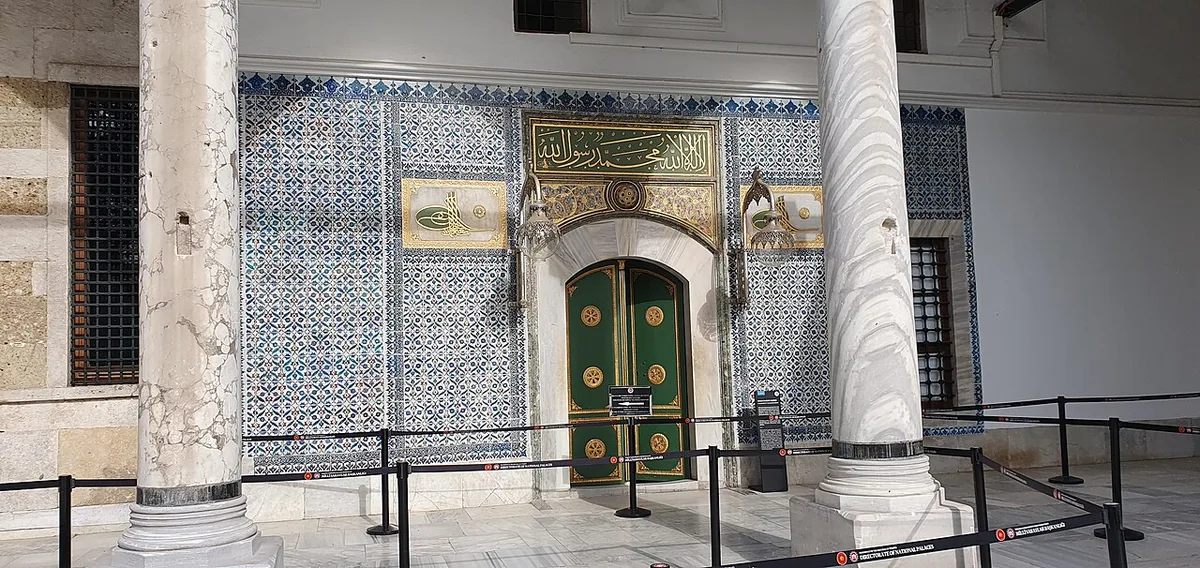
Behind the Audience Chamber, in the oldest part of the inner palace, stands the pavilion that served as the sultan’s Privy Chamber – and since the early 16th century it has housed the collection the palace holds most sacred. The Sacred Relics came to Istanbul in the wake of Selim I’s conquest of Egypt in 1517, when the Ottoman sultan assumed the caliphate and the guardianship of Islam’s holy cities, and relics that had been kept in Cairo were brought to the palace in state. They were installed here, in the sultan’s own apartments, under the care of the privy chamber’s officers, and for centuries the room was attended by reciters who read the Qur’an in continuous rotation, day and night, in the chamber’s presence – a tradition maintained in shifts for some four hundred years. The atmosphere survives the museum conversion. This is the quietest room in the palace, and visitors of every background tend to lower their voices in it without being asked.
What the chamber displays, it presents with the language of veneration, and this topkapi palace guide follows the museum’s own framing. The centrepiece is the Holy Mantle, the Hırka-i Saadet – a mantle venerated as the Prophet Muhammad’s, kept in its golden chest and historically brought out for the sultan’s family to visit in state each Ramadan. Around it the collection presents the Prophet’s standard, his seal, a footprint relic, hairs of his beard and a tooth relic, together with letters attributed to him. Other cases hold objects venerated as the staff of Moses, the turban of Joseph, a relic of John the Baptist, and the swords of the Prophet’s companions and the first caliphs, with the keys and the door-lock of the Kaaba and fragments of its covering completing the treasury of the holy cities. None of these attributions is a thing a guide should assert or dispute; they are what four centuries of custodians have held them to be, and the chamber is best approached as the record of that custody – the material form of the caliphate’s claim to guard Islam’s most precious objects.
Practically: the relics chamber sits a step off the main Third Court circuit and is sometimes missed by visitors hurrying to the treasury, which is a shame, because it is the one room in the palace where the Ottoman state explained itself to itself. Photography rules at the chamber door should be followed exactly, dress and behaviour should match the place’s character, and the visit deserves unhurried minutes rather than a pass-through. The room also closes the Third Court’s argument neatly – audience, treasury, relics: power performed, power stored, and power sanctified, all within a hundred paces of the gate that almost nobody was allowed through.
The Library of Ahmed III
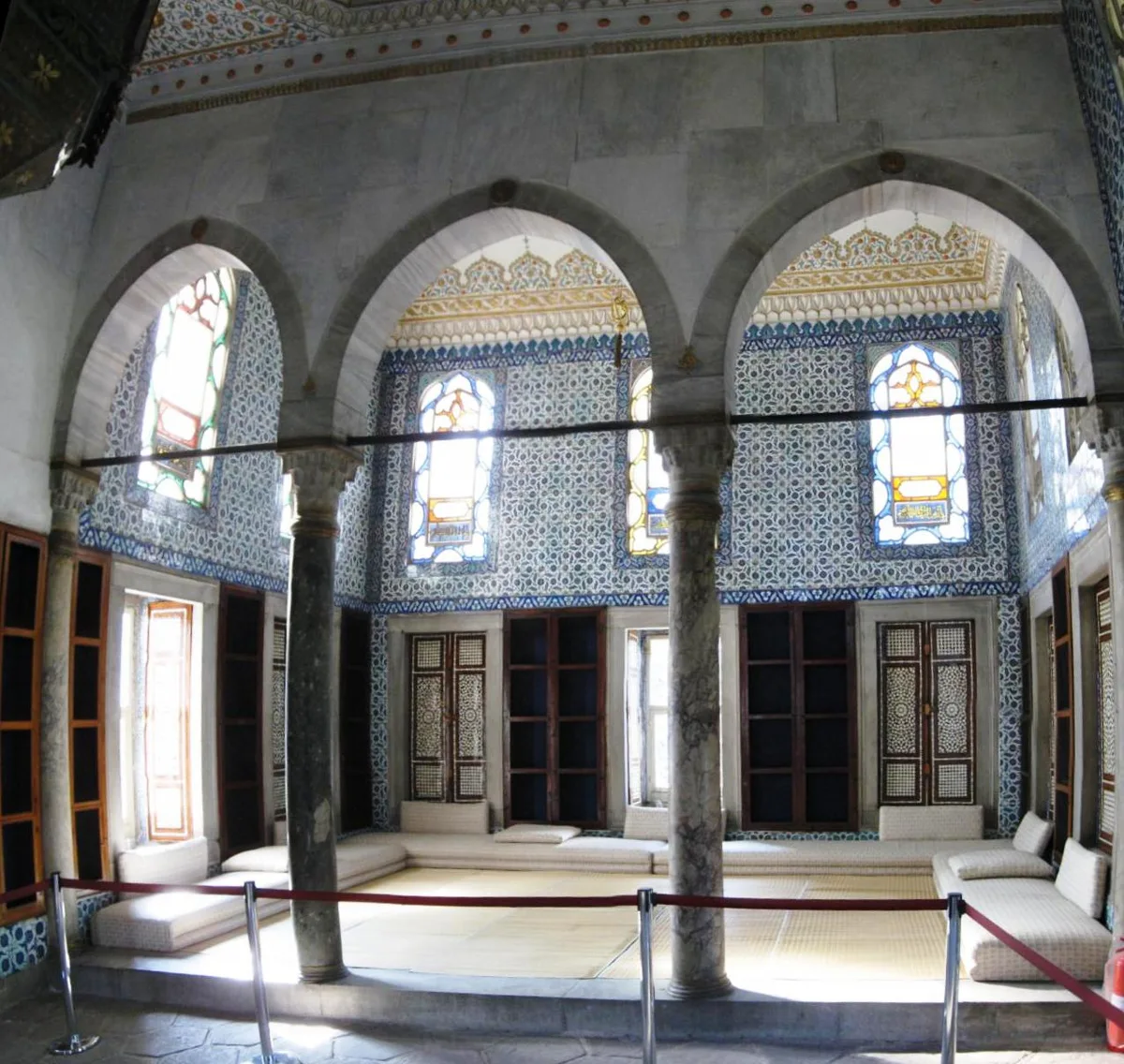
In the middle of the Third Court stands a small, bright building in white marble that breaks the palace’s usual pattern of low pavilions: the Library of Ahmed III, built in 1719 for the library of the Enderun, the palace school. Ahmed III was the sultan of the Tulip Era, the brief, brilliant flowering of Ottoman court culture in the early 18th century, and his library is its most intellectual monument – a purpose-built reading room, raised on a vaulted basement to keep its books dry, where the palace’s manuscripts in Turkish, Arabic and Persian were gathered from the court’s scattered collections into one working library for the pages and scholars of the inner service. Its plan is a domed central hall with vaulted bays, lit by two tiers of windows, and the interior is exactly as calm as a library should be: book cupboards with pierced and painted doors line the walls, a broad divan runs beneath the windows for readers, and the İznik tiles and painted ceilings keep the decoration quiet enough to think in.
The library matters to this topkapi palace guide out of proportion to its size, because it corrects a lazy assumption about the palace. The Enderun was a school before it was anything else – the boys of the inner service were taught languages, calligraphy, music, wrestling and administration in these courts for years before they governed provinces, and the library was the summit of that system, built by a sultan who collected manuscripts and patronised the first Turkish printing press of the same era. Stand in the reading room and the palace’s other rooms rearrange themselves around it: the Divan was staffed by this school’s graduates, the treasury was inventoried by them, and the relics were guarded by the privy chamber they aspired to join. The building is often entered quickly and left quietly; give it the five slow minutes it asks for, and read a shelf of painted cupboard doors as the empire’s filing system for its own memory.
The Fourth Court – Pavilions Above the Bosphorus
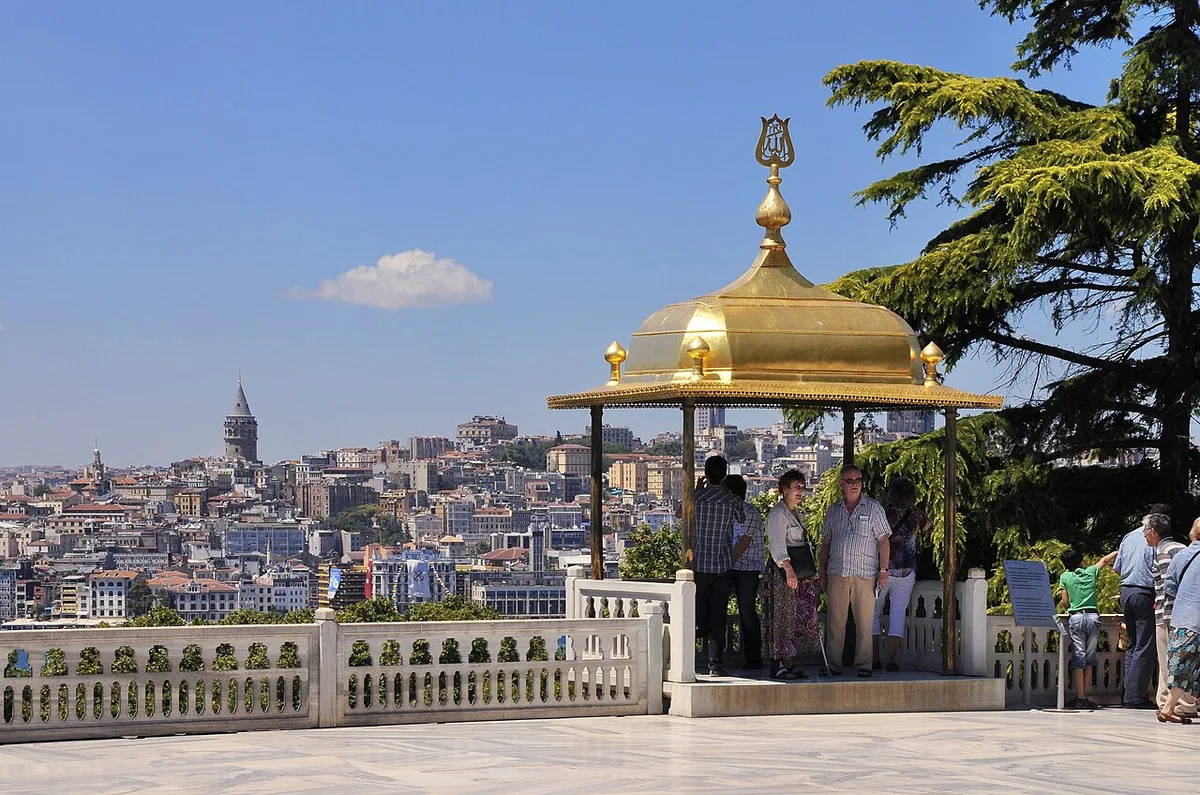
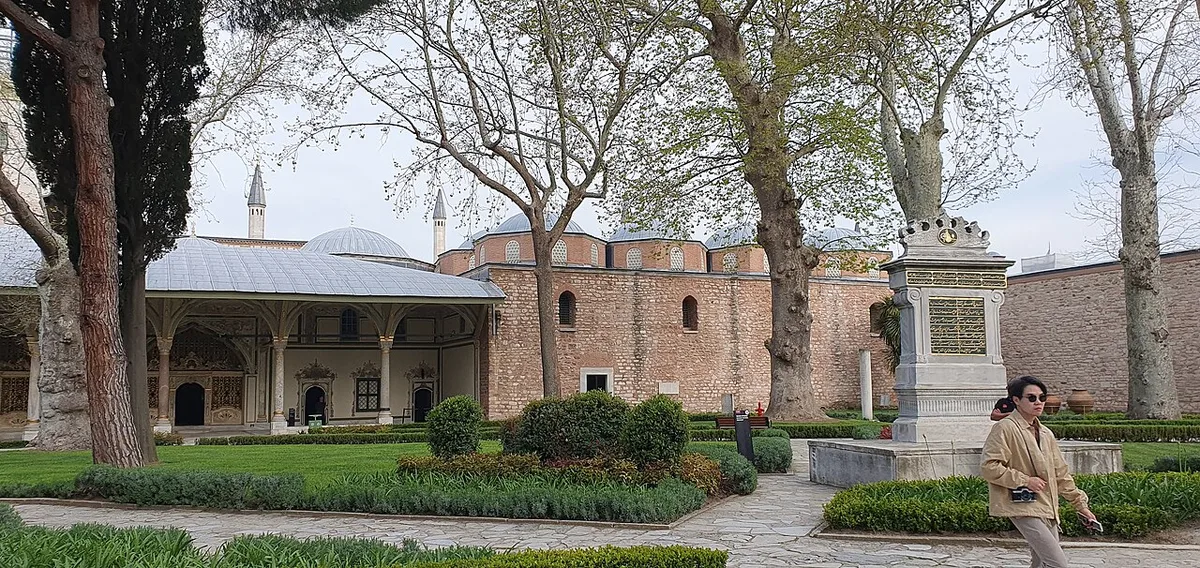
Beyond the Third Court the palace changes key. The Fourth Court is not a court at all in the administrative sense; it is a terraced garden hanging above the Bosphorus and the Golden Horn, planted with tulips and cypresses, arranged around a marble terrace and a great pool, and studded with the small, perfect pavilions the sultans built for pleasure. After the treasury’s blaze and the relics’ hush, the Fourth Court is where the palace breathes. The sultans came here to take the air, to watch the shipping on two waterways, to break the Ramadan fast at sunset and to celebrate family occasions, and the buildings record those uses with unusual intimacy – this is the domestic end of the palace, at garden scale, and it holds some of the finest İznik tilework anywhere in the complex.
The terrace itself is the centrepiece: a broad marble platform at the promontory’s edge, from which the view takes in the Bosphorus running north, the Asian shore opposite, the Golden Horn opening to the west and the Sea of Marmara behind you – a three-water panorama that explains, better than any map, why this hill has been a seat of power since Byzantium. On the terrace stands the Iftariye, a small gilded bower on slender columns where the sultan traditionally broke his fast during Ramadan, positioned to catch the sunset over the Golden Horn at the moment the fast ended. The last and largest building of the court, the Grand Kiosk built for Abdülmecid I in 1840, shows the palace’s final taste turning European – a waterside pavilion in the empire’s new style, raised by the last sultan to live at Topkapi before the court left for Dolmabahçe. Walk the terrace slowly, sit where the court sat, and then turn to the two pavilions that guard its corners, each built to celebrate a victory.
The Baghdad and Revan Kiosks
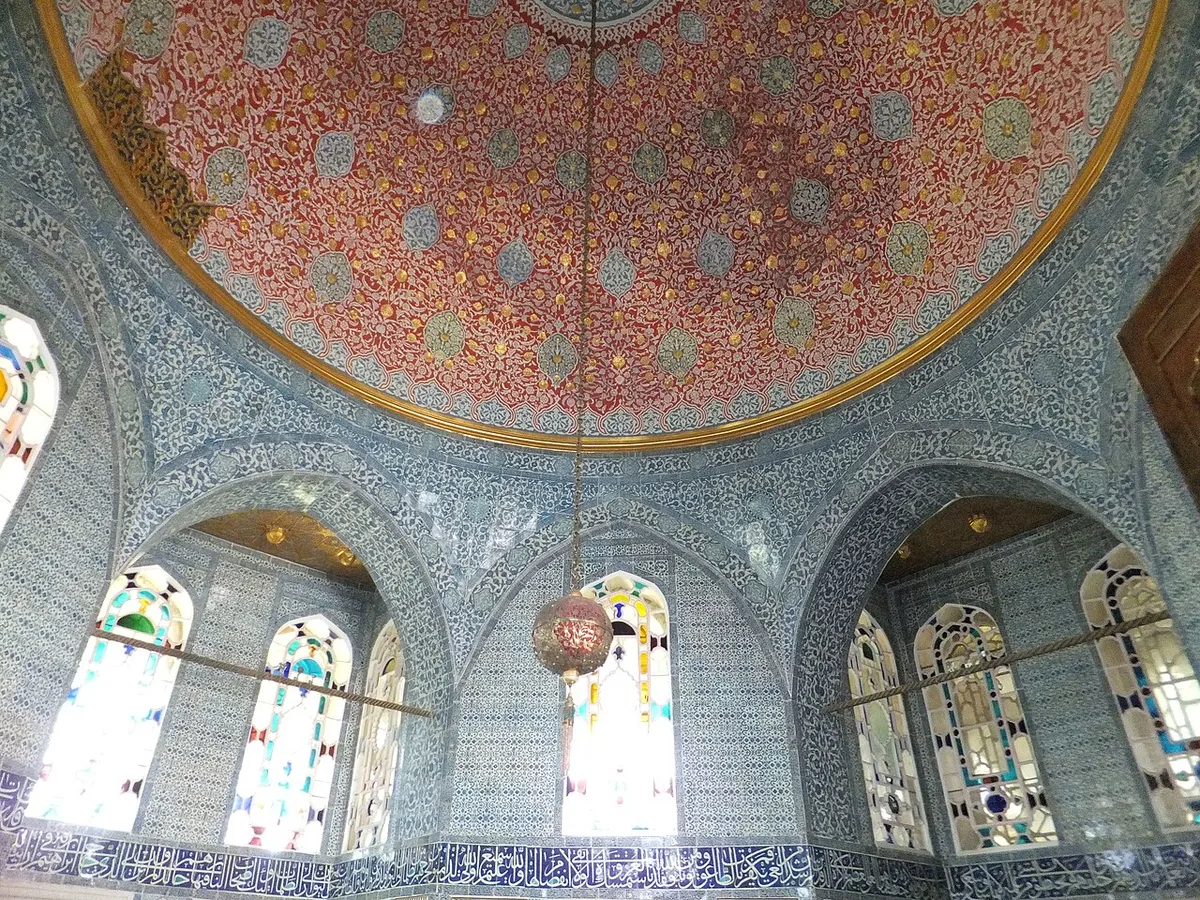
Murad IV, the formidable 17th-century sultan who reconquered Yerevan and Baghdad from Persia, marked each victory with a kiosk on this terrace, and the pair of them are the Fourth Court’s masterpieces. The Revan Kiosk of 1635, named for Yerevan, is an octagonal pavilion faced outside with marble and tiles and lined inside with some of the palace’s most admired İznik work. The Baghdad Kiosk of 1639, raised for the greater victory, goes further: a domed pavilion whose interior is a complete environment of blue-and-white İznik tiles, mother-of-pearl and tortoiseshell inlay on its shutters and cupboard doors, and a dome painted in reds and golds overhead. It served as a retreat and library for the sultan’s private hours, and it is usually singled out – rightly – as the last great flowering of the classical Ottoman kiosk, the moment the style that began with Mehmed II’s pavilions reached its most refined form before tastes turned.
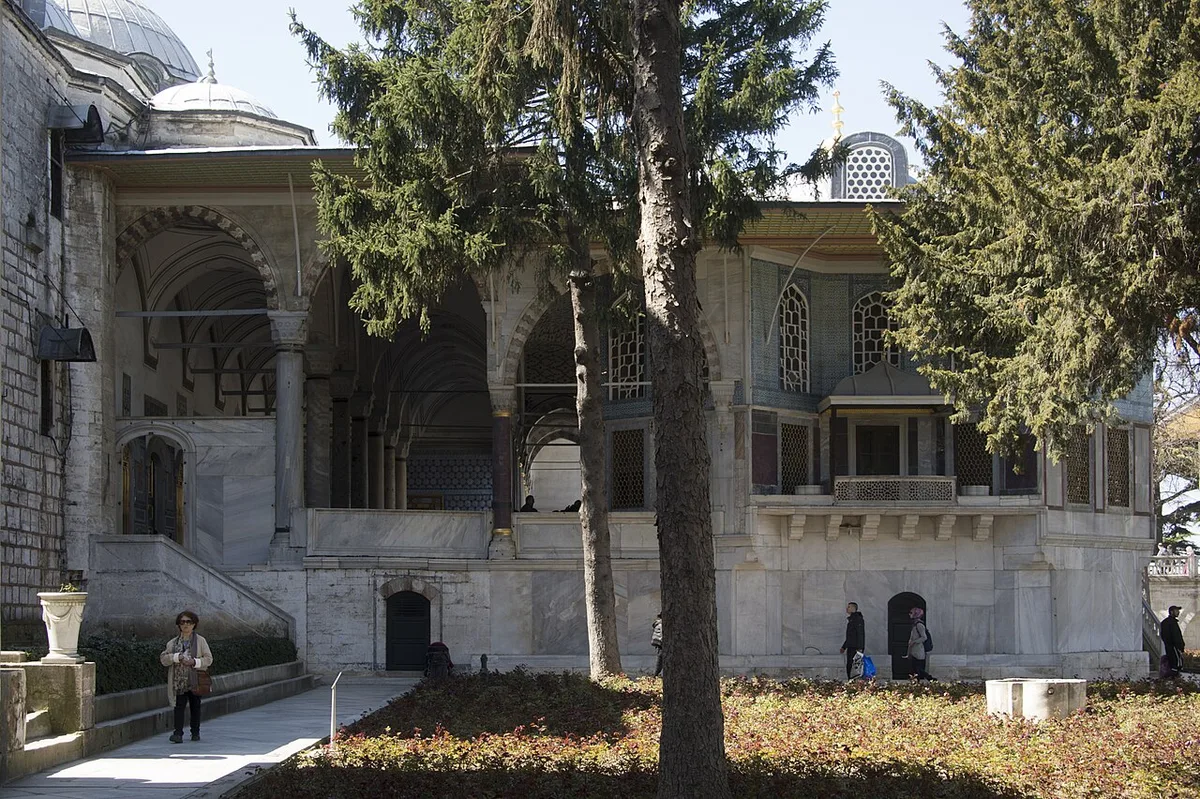
Both kiosks reward the same reading strategy: stand outside first and take in how modest they are – garden pavilions, not palaces – then step in and let the interior density land. The contrast between the plain garden walls and the jewel-box rooms inside is the whole Ottoman domestic aesthetic in miniature, the opposite of a European palace’s decorated facade. Between the two kiosks, the terrace’s gardens held the court’s tulip beds, and the flowers that gave Ahmed III’s era its name were cultivated on this hillside while the festivals of the Tulip Era lit the gardens below. In spring the palace still plants tulips across the Fourth Court and the First, and a visit in April catches the modern display doing its best to live up to the paintings.
The Iftariye and the Circumcision Room
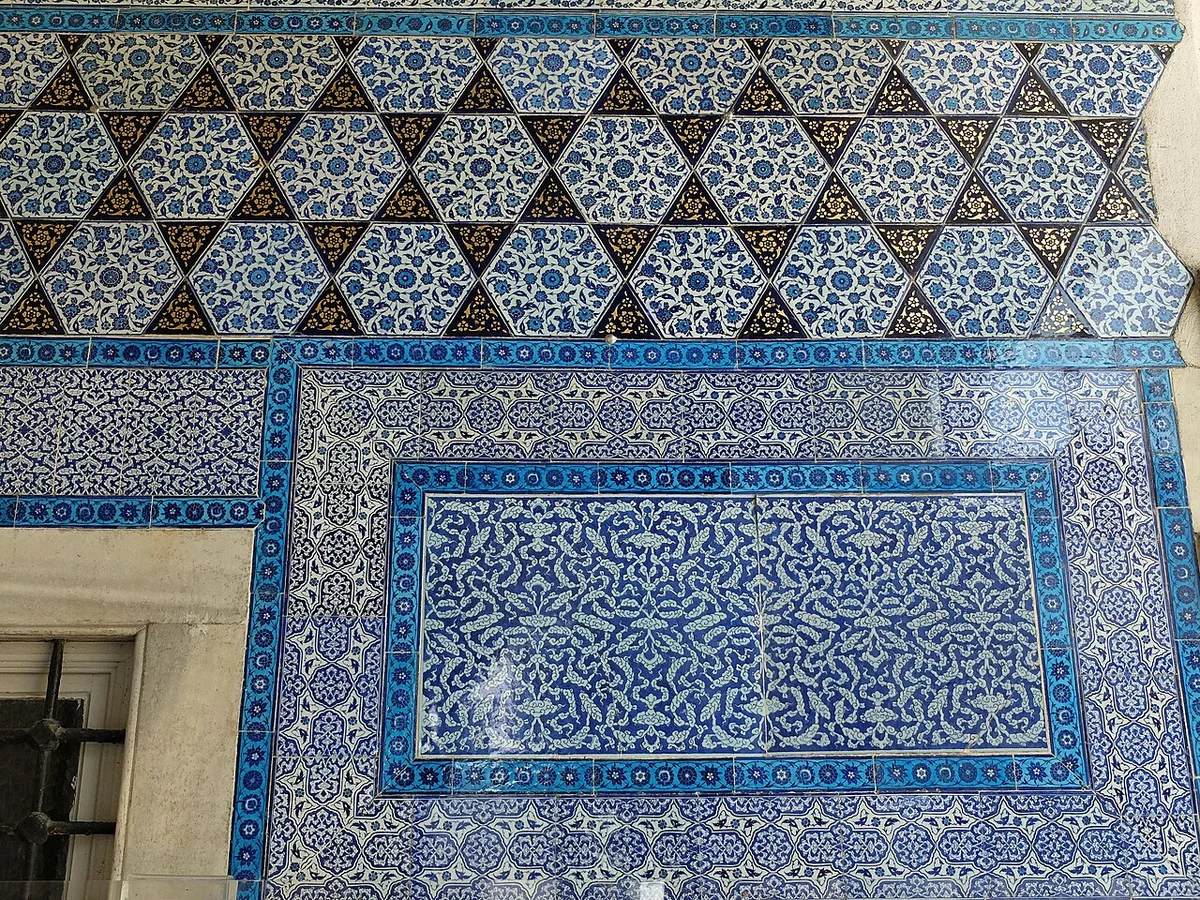
At the terrace’s edge, a small pavilion carries the finest exterior tilework in the palace. The Circumcision Room, the Sünnet Odası, was built under İbrahim I around 1640 as the chamber where Ottoman princes were circumcised in the court’s great coming-of-age ceremonies, and its outside walls are a patchwork anthology of İznik tiles – panels of different dates and firings set together, including celebrated blue-and-white panels with hexagonal and floral designs that tile historians travel to study. The room demonstrates something the palace does repeatedly and well: a function of high dynastic seriousness dressed in the most beautiful surface available, because at this court the quality of the ornament was itself a statement about the weight of the rite.
The Iftariye bower nearby makes the same point at smaller scale – a gilded canopy for one man’s sunset meal, raised to the standard of a monument. Between the two buildings the terrace’s great pool stretches along the garden’s edge, where the court took the evening air in summer within sight and sound of the Bosphorus shipping, and where the sultans’ parties watched the fleet and the festival fireworks over the water. Taken together, the Fourth Court’s little buildings are the palace’s most likeable rooms, and they are the natural place to slow down at the visit’s end, or to recover in the middle of it. The gardens between the pavilions hold benches, shade and the palace’s best people-watching, and the cafe terrace on the court’s Marmara side, by the Grand Kiosk, occupies one of the great viewpoints of Istanbul. If your energy is rationed, this court is where to spend the surplus – the treasury will impress you, but the terrace is what you will describe to people at home.
The Harem – the Sultan’s Household, Not a Fantasy
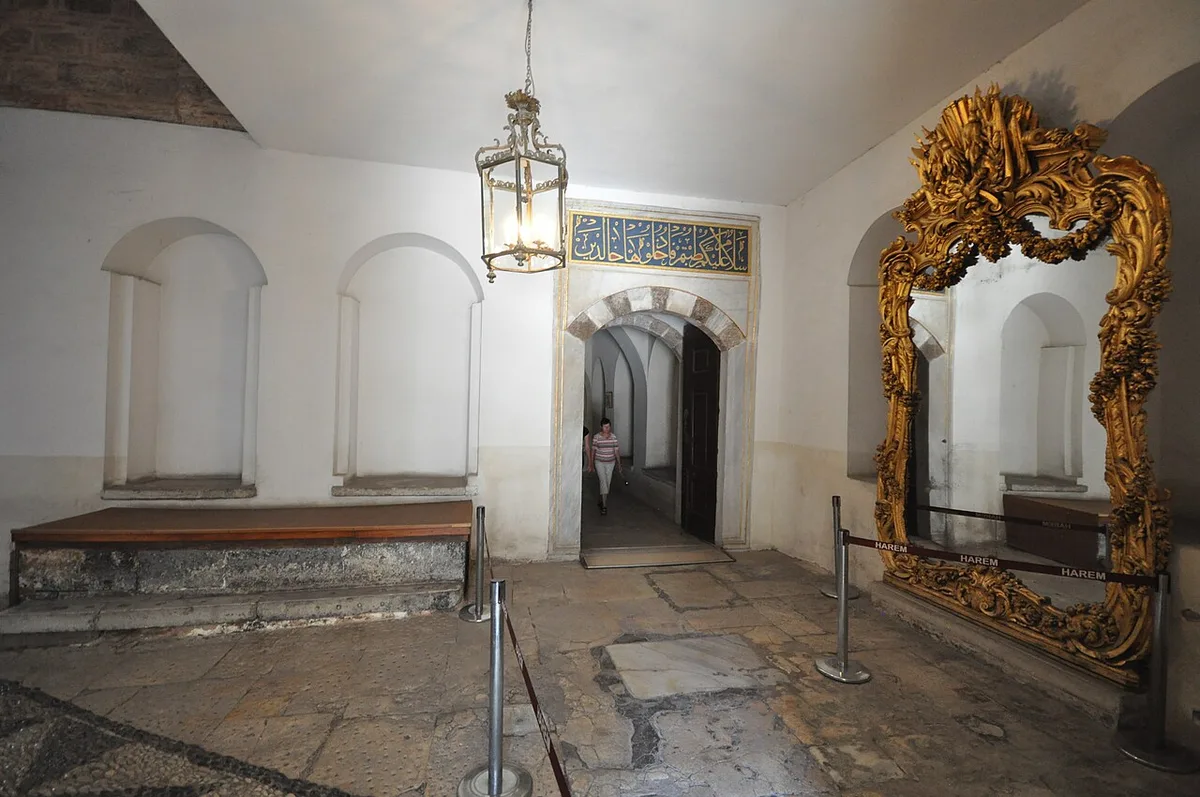
Every palace guide eventually has to take its readers into the Harem, and most take them in with a wink. Resist it. The word harem comes from a root meaning forbidden and sacred – the protected private zone of a household – and the Topkapi Harem was, in institutional terms, the sultan’s family house and the dynasty’s reproductive and administrative core: the apartments of the sultan’s mother, his consorts, his children, the household’s senior women officers and the eunuchs who guarded and ran it, arranged as a dense small town of some three hundred rooms by the usual count, threaded by corridors, courtyards and baths behind a single guarded door. Its entrance from the palace side is deliberately unimpressive – a door off the Second Court’s edge, by the Carriage Gate – because the whole point of the institution was that the world should not see in. What you visit today is a one-way route through its principal courts and chambers, and it is, room for room, the most richly decorated part of the palace.
The Harem grew into its present form over two centuries. The early sultans kept their families at the Old Palace across the city; the household moved into Topkapi in the later 16th century – the great valide sultans of the era, above all Murad III’s mother and consorts, drove the building campaigns that produced the tiled courts you see now – and it kept growing, fire by fire and reign by reign, into the 19th century. That layered growth is why the Harem feels different from the courts outside: not a planned diagram but an accreted warren, rococo apartments beside classical tilework, narrow stairs dropping between levels, rooms at half-levels with windows onto internal courts. It is the palace as a lived-in house rather than a state machine, and its decoration – tiles, painted ceilings, carved and gilded woodwork, European furniture arriving in the later rooms – records the tastes of the women who commissioned much of it.
How the Harem Worked
The institution ran on hierarchy, and the hierarchy’s apex, after the sultan himself, was his mother – the valide sultan. She was the Harem’s sovereign in daily fact: she held its largest apartments, controlled its budget and patronage, received reports from its officers, and in the eras when sultans came to the throne as children, she governed the empire as regent in all but name. Below her stood the senior women of the household – the chief administrative officer, the hazinedar usta, who ran its treasury and staff; the ketkhüda and the corps of kalfas, the trained senior servants who supervised its departments; the sultan’s consorts, ranked by favour and by the sons they had borne; the princesses; and the hundreds of women of the service – many of them brought to the palace as girls from the Caucasus and the Black Sea world, educated in its school in music, needlework, letters and household arts, and promoted through its ranks or married out, with pensions, to officials of the court.
The household’s other pillar was the black eunuchs, the corps of African eunuch officials who guarded the Harem’s door and administered its interface with the world. Their courtyard is the first space on the visitor route – a tiled, colonnaded court with their guardrooms around it – and their chief, the Darüssaade Ağası, keeper of the Abode of Felicity, ranked among the half-dozen most powerful officials in the empire: he controlled access to the sultan’s private world, administered the great pious foundations of Mecca and Medina, and stood third in the palace’s order of precedence after the grand vizier and the chief white eunuch. The Harem’s physical plan enacts this double government. The eunuchs’ court guards the threshold; the Golden Road, the corridor along which the sultan passed and, tradition says, scattered gold coins to the household at festivals, runs from his apartments into the women’s courts; and the valide’s courtyard, the largest in the Harem, opens beyond – power flowing from guard, to sovereign’s passage, to mother’s court, in the order you still walk it.
The Valide Sultan’s Court and the Imperial Hall
The Courtyard of the Valide Sultan is the Harem’s ceremonial centre – a domed, arcaded court around which the apartments of the valide, the chief black eunuch and the household’s senior women are arranged. The rooms that open off it carry the institution’s history in their fabric: the valide’s own apartments with their painted ceilings and, opening from them, the small private worlds of prayer rooms, baths and reception chambers that a queen mother required; the apartments of the sultan’s consorts across the court; and the Harem’s mosque, where the household worshipped apart from the palace’s public religious life. Fires repeatedly gutted these rooms and each rebuilding redecorated them in the taste of a new reign, so the court reads as an anthology of Ottoman domestic style from the 16th to the 19th century – tiled classical chambers giving way to painted rococo and then to Europeanised salons with chandeliers and framed mirrors.
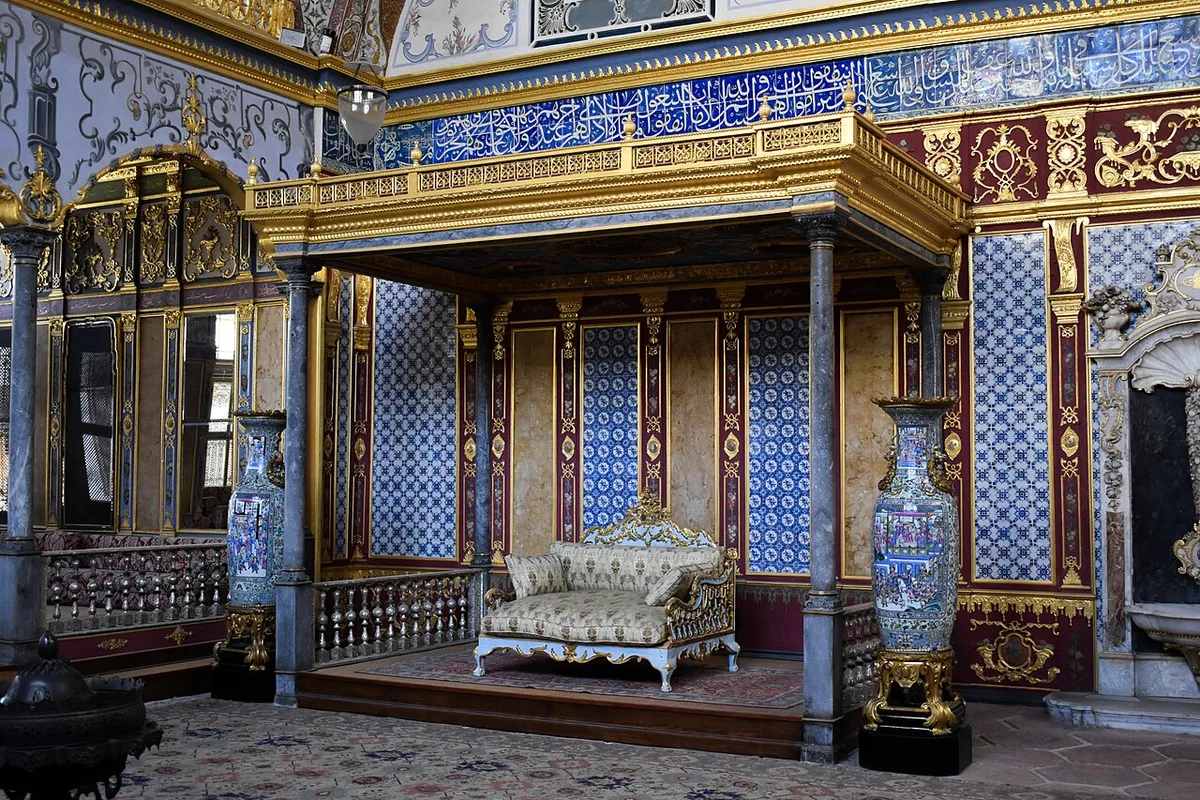
Above the courtyard’s level stands the room the whole household oriented itself around: the Imperial Hall, the Hünkâr Sofası, the largest domed chamber in the palace. This was the sultan’s throne room within the Harem, where he received his family and the household’s senior women on festival days, attended its entertainments and presided over its weddings and celebrations. His throne stands under a gilded canopy at the hall’s centre; a gallery above served the household’s musicians; the walls run with a famous frieze of calligraphy and İznik tile; and two great Chinese vases flank the throne as a reminder that the palace’s global trade reached even this most private room. Stand in the Imperial Hall and the Harem’s real nature resolves itself: not a pleasure garden but a court in miniature, with its own throne room, its own ranks, its own ceremonies – a second palace, run by women and eunuchs, sealed inside the first.
Murad III’s Chamber, the Fruit Room and the Princes’ Rooms
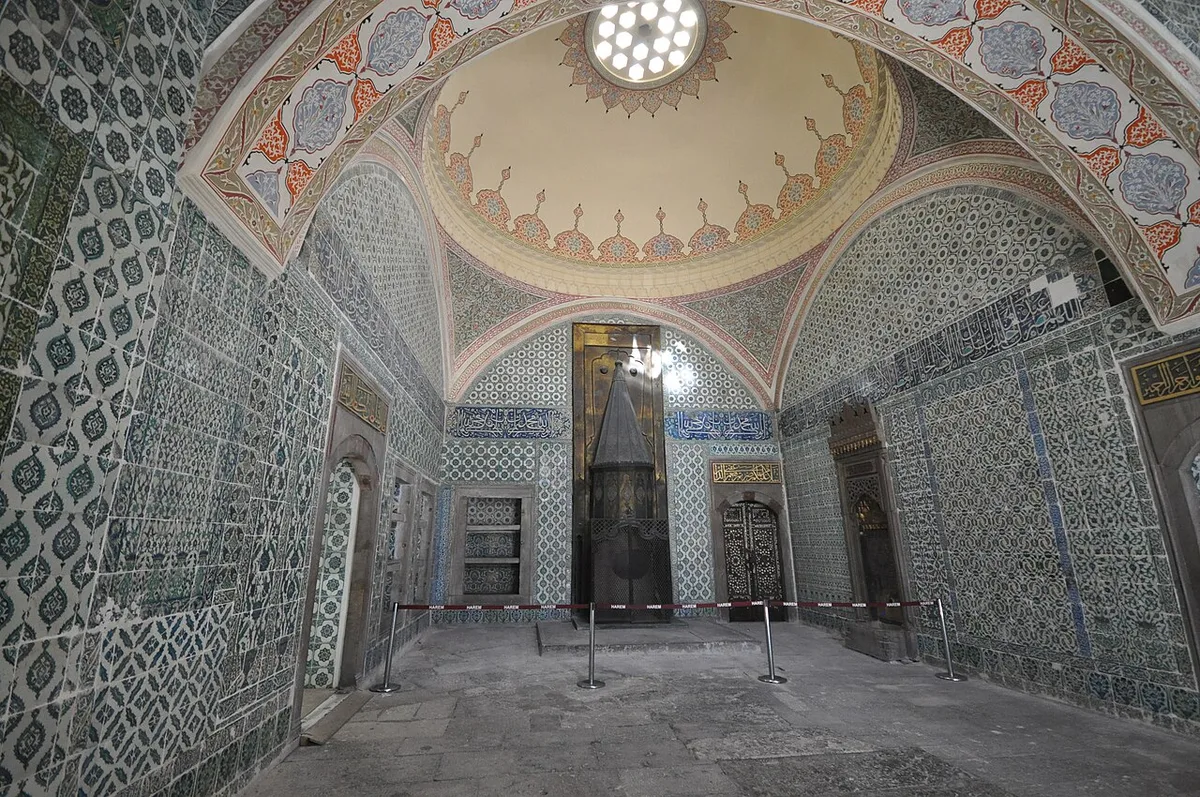
The Harem’s single greatest interior is its oldest royal chamber. The privy chamber of Murad III, built in 1578-79 and attributed to the imperial architect Sinan, is a domed room wrapped floor to cornice in İznik tiles of the potteries’ greatest decade, with a monumental hooded fireplace, a fountain whose water-music guarded conversation, and an upper gallery for the court’s musicians. It is the room where the Harem’s move into Topkapi becomes architecture – a sultan building himself a private apartment of palace quality inside the women’s world – and its tiles alone justify the Harem ticket: deep blues and greens in repeating patterns, calligraphic bands running around the dome’s base, every surface considered. A generation of tile-makers’ best work survives here in situ, in the room it was made for, which is a rarer thing than any museum case can offer.
Two later rooms show where the household’s taste went next. The Fruit Room of Ahmed III, from the Tulip Era’s first decades, abandons tile for paint – its walls are covered in still-life panels of fruit bowls and flower vases, fresh as a market stall, in the new naturalistic style the court adored. And the double kiosk of the princes, the twin-domed apartment known as the Kafes, the Cage, opens a sadder chapter: from the 17th century, Ottoman princes were no longer sent out to govern provinces but kept in the palace, in guarded apartments like these, waiting out reigns they might never succeed to. The room is beautiful – painted ceilings, tile fireplaces, windows over the gardens – and the beauty does not soften the institution it served. Read together, these three rooms carry the Harem’s whole story in an hour: classical power, Tulip-Era delight, and the long, gilded confinement that shadowed the dynasty’s later centuries.
Visiting Topkapi Palace – Tickets, the Closed Day and Beating the Crowds
The practical facts first, because they are the ones the ticket-sellers blur. Topkapi Palace is administered by the Directorate of National Palaces, the Presidency body that runs Türkiye’s great Ottoman palaces – it has been a National Palaces site since September 2019, when it was transferred from the Ministry of Culture and Tourism. That is why the palace does not sit inside the muze.gov.tr museum system that runs most Istanbul museums, and why pass coverage needs care: under the Directorate’s published arrangements, the Turkish MüzeKart is accepted for the main palace but is not valid for the Harem or Hagia Irene sections, and foreign-visitor pass products should be checked against the Directorate’s own site – millisaraylar.gov.tr – before you rely on any of them covering the whole complex. For foreign visitors the standard purchase at the palace is now a combined ticket covering the palace, the Harem and Hagia Irene together, and the Harem and Hagia Irene are also sold as separate tickets of their own. This guide prints no ticket price on purpose: the sources that quote the official tariff currently disagree with each other about the current figure, and the Directorate adjusts prices in season. Check the figure on the official site in the week you travel and treat any reseller’s price table – this week’s ranking pages contradict each other by a factor of two – as marketing, not information.
The closing day is the fact this topkapi palace guide most wants you to carry away: the palace is closed on Tuesdays, and also on the first day of the Ramadan festival (Ramazan Bayramı), confirmed against sources citing the official tariff as checked on 31 October 2026. Seasonal opening hours are set by the Directorate and change through the year – the ticket offices open in the morning and last entry runs ahead of closing, with the Harem and Treasury rooms typically closing before the courtyards – so confirm the day’s times on the official site rather than from any guide’s table, this one included. In recent seasons the palace has also run ticketed Saturday-evening openings in the warmer months; if a night visit appeals, the Directorate’s site is again the place that will tell you whether it is running.
Crowd strategy is simple, because the palace’s crowds follow one daily wave. Arrive for opening and walk against it: the wave spends its first hour in the Second Court and the Divan, so go straight through the Gate of Felicity to the Third Court – the Treasury and the Spoonmaker’s Diamond are never quieter than in the first forty-five minutes – then take the Harem before the late-morning build-up fills its corridors, and leave the Second Court’s kitchens and the Fourth Court’s gardens for the afternoon, when they absorb crowds easily. If you arrive at midday instead, reverse it: Harem first before its one-way route clogs, gardens while the treasury queues peak, treasury last. Time honestly, allow three and a half to five hours for the full circuit this topkapi palace guide walks; two hours buys a highlights pass – Treasury, Imperial Hall, Divan and the Fourth Court terrace – and anything less is a photograph of a gate. If you must skip, skip the mint exhibitions and Hagia Irene’s interior unless Byzantine building is your passion, skim the kitchens’ cases rather than their halls, and never skip the Harem to save time: it is a third of the palace’s meaning, and the combined ticket has already paid for it.
Questions Travellers Ask About Topkapi Palace
Is Topkapi Palace closed on Tuesdays?
Yes. Tuesday is the palace’s weekly closing day, and it also closes on the first day of the Ramadan festival – confirmed against the Directorate’s arrangements as checked on 31 October 2026. It is the single most common way to lose a Topkapi visit, so fix your Istanbul days around it and re-confirm on millisaraylar.gov.tr before you travel.
Is the Harem included in the Topkapi Palace ticket?
For foreign visitors, the standard ticket sold at the palace is now a combined ticket covering the palace, the Harem and Hagia Irene. The Harem is also sold as a separate ticket, which matters for pass holders and return visitors – the Directorate’s published arrangements keep the Harem and Hagia Irene outside MüzeKart coverage even where the card opens the main palace. Check what your own ticket covers at the desk before you walk past the Harem’s door.
How long does Topkapi Palace take?
Half a day, honestly – three and a half to five hours for the four courts, the Treasury and the Harem at a pace that reads the rooms rather than photographing them. Two hours covers the highlights at a push. The palace is a small city of some three hundred Harem rooms alone; the two-hour figures on ticket sites describe a walk-through, not a visit.
Can you take photographs inside Topkapi Palace?
In the courtyards and gardens, freely. Indoors, the palace posts its rules at each chamber door and they vary by room – expect restrictions in the Treasury and the Sacred Relics chamber and follow the signs and staff. The relics chamber in particular is a place of active devotion; treat it as you would a working place of worship, in dress, voice and behaviour.
Is Topkapi Palace part of the Museum Pass?
Not in the straightforward way the reseller sites claim. The palace belongs to the Directorate of National Palaces, not the ministry’s muze.gov.tr system. The Directorate’s own published scope accepts the Turkish MüzeKart for the main palace but not for the Harem or Hagia Irene, and foreign pass products vary – verify your pass against the Directorate’s site, not a reseller’s, before counting on it.
What should I not miss at Topkapi Palace?
The Spoonmaker’s Diamond and Topkapi Dagger in the Treasury, the Divan chamber’s listening grille, the Harem’s Imperial Hall and Murad III’s tiled chamber, and five quiet minutes on the Fourth Court terrace above the Bosphorus. If the day allows one thing beyond those, make it the Sacred Relics chamber – the room where the palace kept what it held most sacred, and the still point of the whole complex.
The Short Version of This Topkapi Palace Guide
If you keep only five facts from this topkapi palace guide, keep these. Topkapi is a city of four courts arranged from public to private, and it makes sense the moment you walk it in order. It is closed on Tuesdays – check the Directorate of National Palaces site, millisaraylar.gov.tr, for the day’s hours and the current ticket before you go, because the palace is not part of the muze.gov.tr museum system and reseller prices contradict each other. The foreign-visitor ticket is a combined palace, Harem and Hagia Irene ticket; buy nothing sight unseen from third-party tables. Arrive at opening, take the Treasury first and the Harem before its corridors fill, and give the whole visit half a day. And when you reach the far terrace, with the Bosphorus below you and four centuries of domes behind, you will understand why every topkapi palace guide runs out of superlatives at exactly the same place – the palace was built to end at that view.