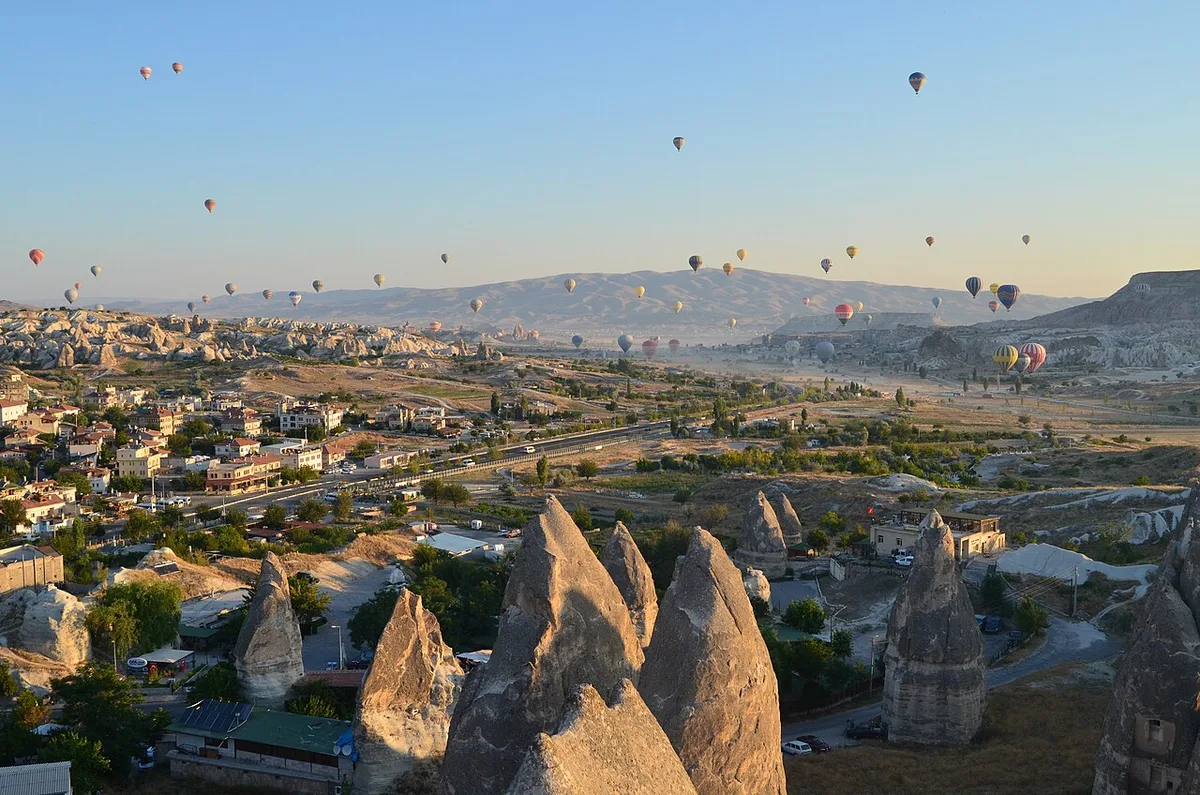
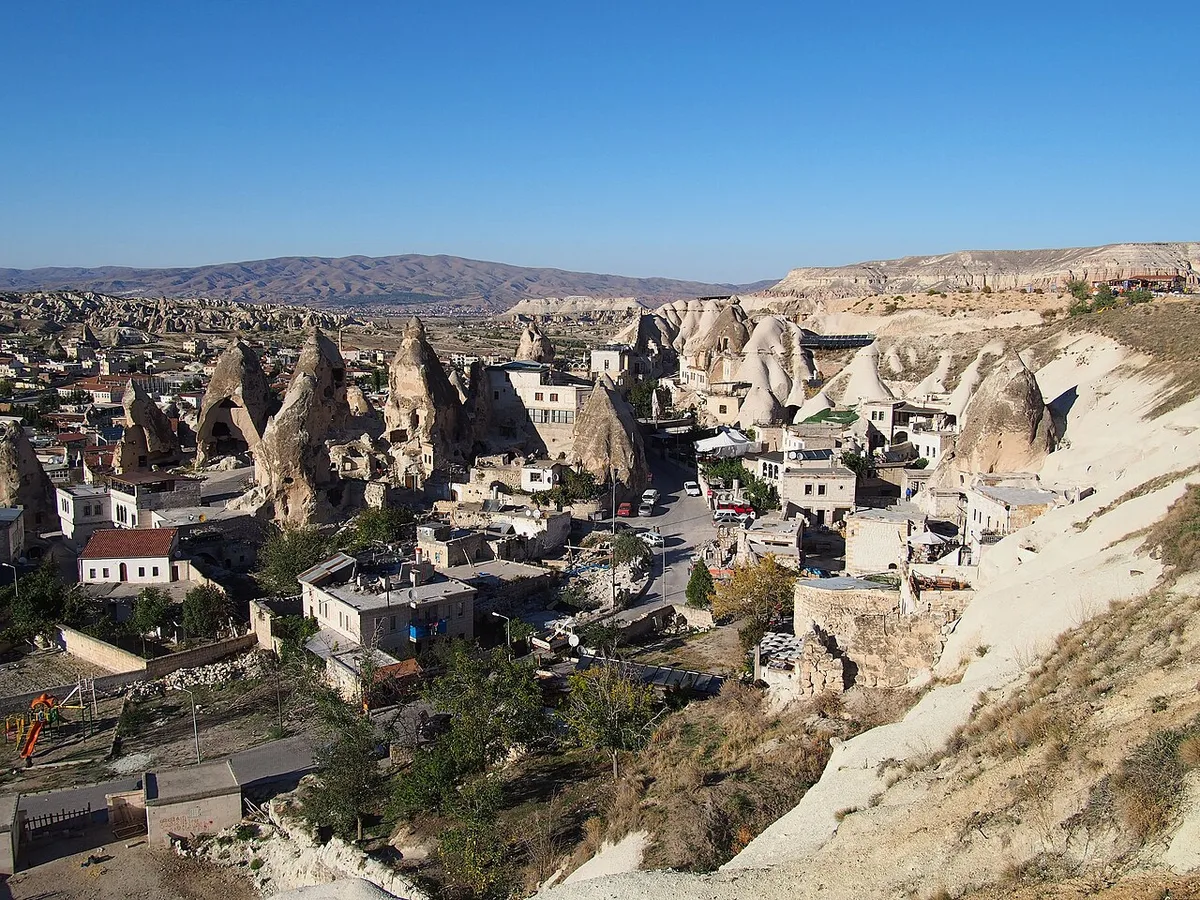
Most people arrive in Göreme the same way, half asleep on an airport shuttle, watching the road drop into a valley that does not look entirely real. Cones and spires of pale rock stand between the houses. Some of them have windows. A few have hotel signs. By the time the shuttle reaches the little bus station in the middle of town, you have already seen the essential fact of the place – Göreme is not a town built near a strange landscape. It is a town built inside one, and everything in this goreme travel guide follows from that.
That is also what separates it from our regional overview. The wider Cappadocia travel guide on this site covers the whole region – its history, its airports, its full spread of valleys and underground cities. This article stays at street level. It is about the one town most visitors actually sleep in – its museum, its cave hotels, its five walkable valleys, its dawn balloons – and about the trade-offs of basing yourself here rather than in quieter Uçhisar, working Ortahisar or larger Ürgüp.
The short case for Göreme is simple. The Göreme Open-Air Museum, the densest cluster of painted Byzantine cave churches anywhere, is a walk from your hotel door. So are the trailheads. The town sits inside Göreme National Park, part of the UNESCO World Heritage property inscribed in 1985 as Göreme National Park and the Rock Sites of Cappadocia, recognised both for the landscape and for the art carved into it. No other base in Cappadocia puts this much within walking distance.
The honest case against it deserves equal space, and this guide gives it – balloon prices that have climbed steeply, a museum that fills with tour groups by mid-morning, and cave rooms that are not always what the booking photos promise. Read the downsides section before you book, not after. But start with the town itself, because once you understand why the rock looks the way it does, everything else in Göreme – the churches, the hotels, the dovecotes, even the balloons – falls into place.
Goreme at a Glance
| Question | Short answer |
|---|---|
| Where is Göreme | A small town in Nevşehir province, central Turkey, inside Göreme National Park |
| Why base here | The Open-Air Museum and five valley trailheads are walkable from most hotels |
| The one essential sight | The Göreme Open-Air Museum, especially Tokalı and the Dark Church |
| How long to stay | Three nights minimum – one museum morning, one valley day, one balloon buffer |
| Best all-round months | Late spring and early autumn, when trails are dry and mornings are mild |
| Signature experience | Balloons over the valleys at dawn, whether you fly or watch from a terrace |
| The honest warning | It is the busiest, most tourist-facing base in Cappadocia – plan around the crowds, not against them |
Göreme town is small enough to learn in an hour. One main street runs through it, lined with restaurants, carpet shops, tour agencies and the bus station, and lanes climb away from it into neighbourhoods where fairy chimneys stand in people’s gardens. Most hotels sit within a ten-minute walk of the centre, which matters more than it sounds – it means the museum, the sunset viewpoint and half the valleys in this guide need no vehicle at all.
Almost everyone arrives through one of two airports, Nevşehir Kapadokya or Kayseri, both served by shuttles that drop you at your hotel door, and most itineraries pair Cappadocia with Istanbul at one end of the trip. Sort the shuttle when you book the room, keep one full spare morning in hand for the balloon weather lottery, and treat everything else in this goreme travel guide as modular – the museum, the walks and the wider circuit can be shuffled into whatever order the weather allows.
How the Landscape Was Made – Volcanoes, Ash and Patient Water
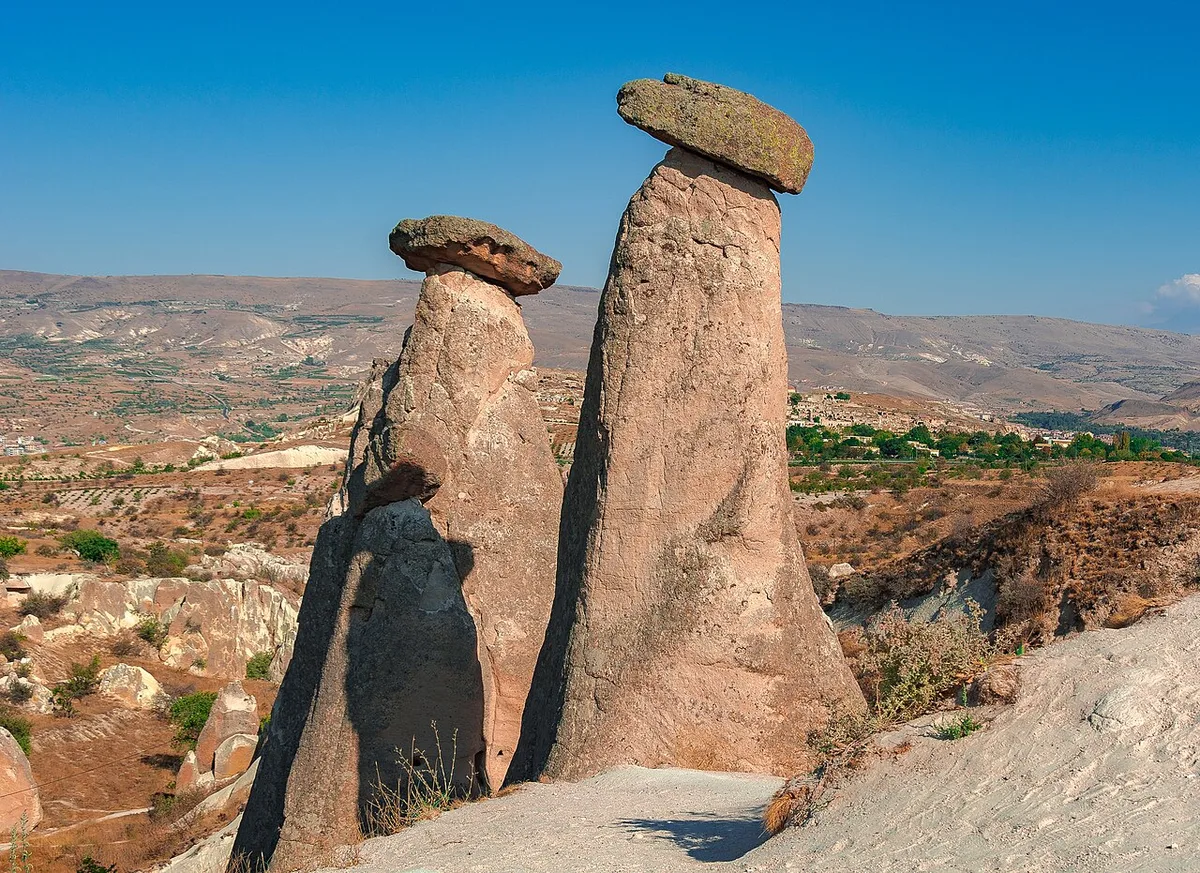
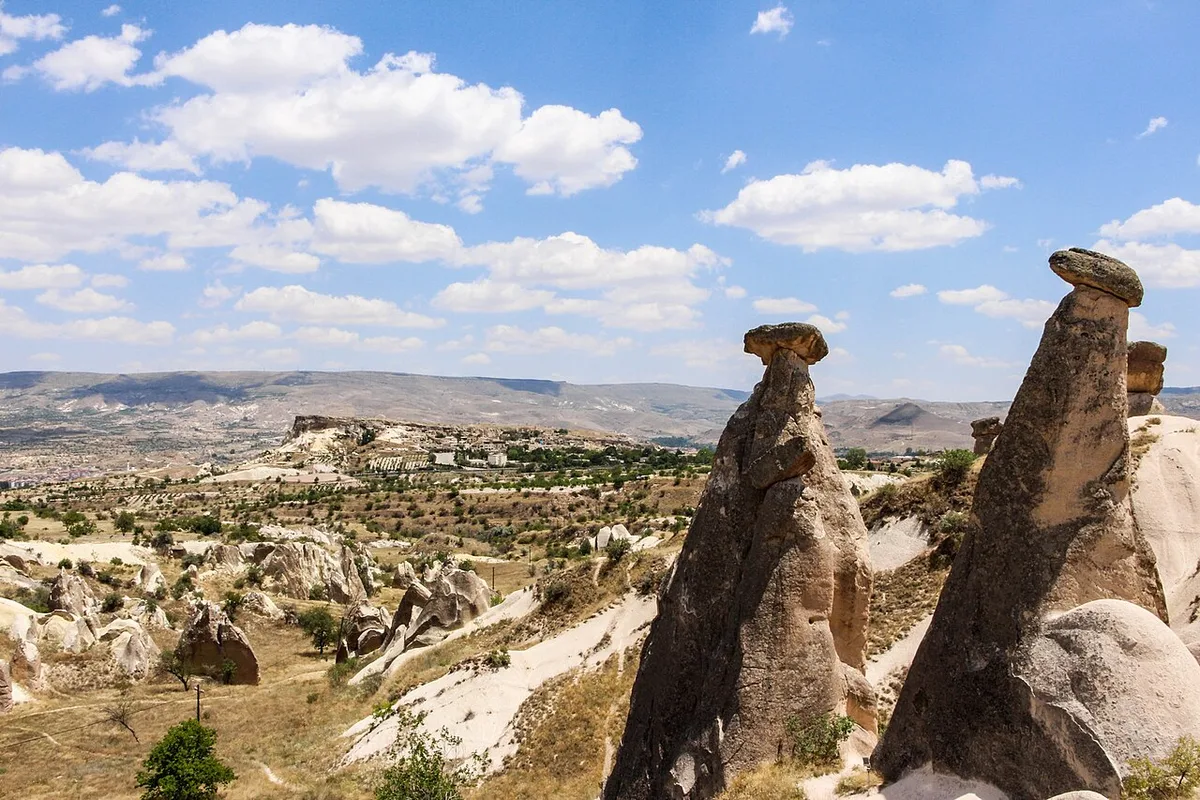
The fairy chimneys begin with fire. Millions of years ago, volcanoes around the central Anatolian plateau – Erciyes Dağı to the east, Hasan Dağı to the southwest and the smaller Göllüdağ among them – erupted again and again, spreading ash, mud and lava across the region in layer after layer. The ash settled and compacted into tuff, a soft, pale stone you can cut with a saw and, in places, almost crumble between your fingers. In some places harder flows of basalt and dense ignimbrite cooled on top of the tuff, forming a tougher skin over the softness beneath.
Then the water and wind went to work, and they have never really stopped. Rain ran off the plateau in floods, carving valleys. Frost split the rock in winter and sun loosened it in summer. Where the hard skin survived, it sheltered the tuff directly underneath it, and the unprotected rock around that sheltered column washed and blew away. What remained were the chimneys – a cone or pillar of soft stone wearing a boulder as a hat. Look at the two chimneys in the photograph above and you can read the whole mechanism at a glance. The caprock is not decoration. It is the cause.
It is also temporary. Every chimney is a stage in a process, not an end point. A cap eventually cracks, shifts or falls, and once it goes, the cone it protected is exposed to the same rain that carved everything around it – geologists describe the chimneys as being born, maturing and dissolving in a slow cycle that is still running. UNESCO, which lists the landscape under its natural criterion as well as its cultural ones, describes the Göreme valley and its surroundings as a globally renowned display of these erosional landforms. The formations you photograph this year are, in the strictest sense, mid-collapse.
The final twist is the one that made Göreme a town. Tuff is soft enough to carve with hand tools yet, once exposed to air, hardens into a durable surface – a building material you do not quarry or carry but simply hollow out where it stands. So generation after generation did exactly that. Homes, stables, churches, monasteries, dovecotes and entire underground cities were cut into the chimneys and cliffs, which is why this goreme travel guide keeps returning to the same double truth – the landscape is the architecture, and the architecture is the landscape, and you cannot understand either one alone.
The Goreme Open-Air Museum – A Monastery Cut Into a Valley
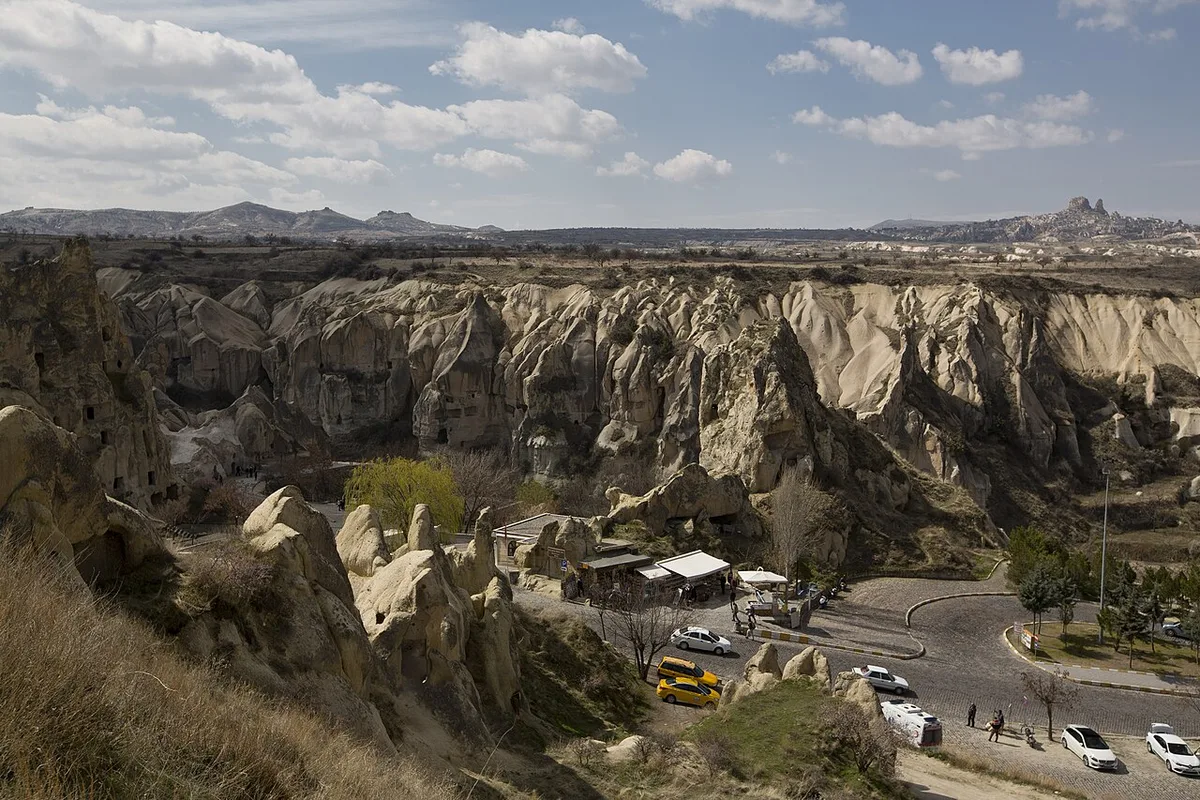
A kilometre and a half up the road from town, the valley narrows into an amphitheatre of carved cliff, and that amphitheatre is the museum. It helps to stop thinking of it as a museum in the building sense. Nothing here was collected or arranged. This was a working monastic settlement – churches, chapels, refectories with long stone tables, kitchens, cellars and monks’ cells all cut into one short stretch of valley – and the museum is simply the settlement with a ticket gate at the entrance and a path laid through it.
The religious roots run deep. Monastic life in the Göreme valley is traced to the fourth century and the influence of Saint Basil the Great, bishop of nearby Caesarea, whose teachings shaped the anchorite communities that first hollowed cells into the rock. The Ministry of Culture’s own account of the site notes hermit monks in the area as early as the second century and describes monastic life continuing here into the thirteenth. The painted churches that make the museum famous mostly belong to the great flowering after Iconoclasm ended in 842, when figurative painting returned to Byzantine churches and Cappadocia’s carvers and painters covered their walls with some of the finest surviving work of the period – the reason UNESCO calls these sanctuaries a leading example of post-iconoclastic Byzantine art.
The ministry lists the churches on the circuit as the Girls and Boys Monastery – the tall, multi-storey Nunnery that faces you at the entrance – together with Saint Basil’s, Elmalı, Saint Barbara, Yılanlı the Serpent Church, the Malta Crusader Church, the Dark Church, Saint Catherine’s, Çarıklı and Tokalı.
Do not rush past the unglamorous rooms on your way between the famous ones, because they are what turn a gallery into a settlement. The Nunnery rises several storeys up the cliff in a honeycomb of cells, chapels and tunnels. The refectories hold long tables and benches carved whole from the rock, where a monastic community ate in rows – walk the length of one and the museum stops being about paintings and becomes about a working society that fed, taught and buried its members inside a single valley. Saint Basil’s little chapel, near the entrance, is the right overture – barrel-vaulted, modestly decorated, and named for the bishop whose teachings started all of this. Take the circuit slowly and in order, and by the time you reach the great churches you will understand whose walls you are looking at. Painting here was done two ways, the ministry notes – directly onto the smoothed rock surface, or in fresco-secco, tempera applied to plaster – and the difference is visible as you walk, from red-ochre line drawings in the oldest chapels to full, saturated colour in the great churches. The site was opened to visitors in 1967 and has been the most visited place in Cappadocia ever since, which is both its glory and its one real problem, dealt with honestly at the end of this section.
Tokali Church – The Largest Room in the Museum
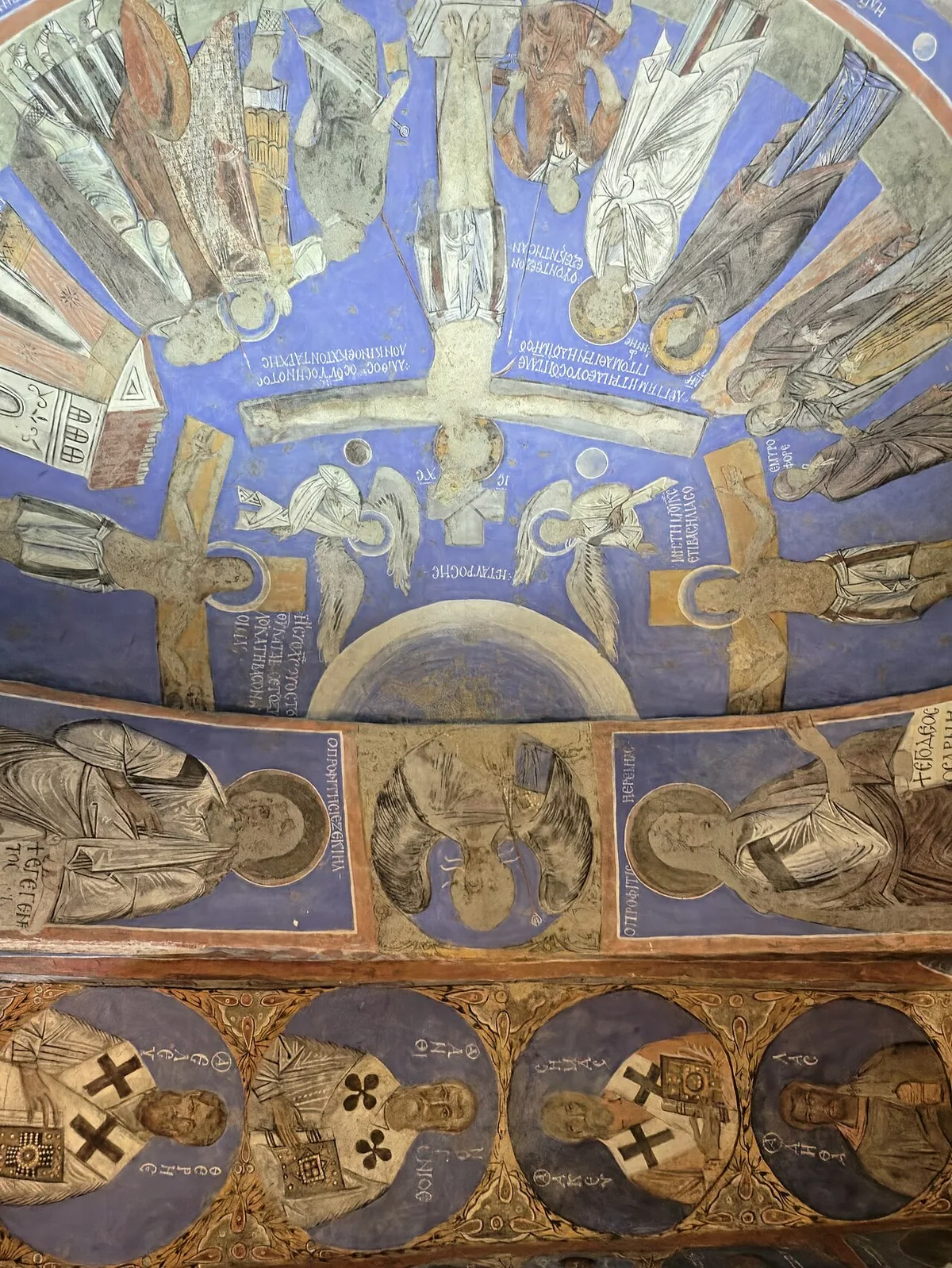
Tokalı, the Buckle Church, stands slightly apart from the rest, across the road from the main gate – and it is part of the same museum, so do not do what many visitors do and walk past it on the way out. It is the largest church in the museum and, for many people, the finest. Tokalı is really two churches joined together. The Old Church, a single-naved tenth-century chapel, serves as the entrance passage, and behind it the New Church opens into a wide rectangular hall whose walls and vaults carry one of the most complete painted cycles of the life of Christ in Cappadocia – scene after scene, from the Annunciation through the miracles to the Crucifixion in the apse and the Ascension, each panel captioned in Greek for a congregation that read its scripture on the walls.
What stays with you is the blue. The backgrounds of the New Church paintings are a deep, expensive-looking lapis tone that glows even in the low light, a sign of serious patronage – pigment like that did not come cheap, and neither did the artists who used it this well. UNESCO dates Tokalı to the tenth century and names it among the valley’s outstanding churches. Give it time. Most tour groups are marched through in minutes; if you enter as one leaves, you may get the hall almost to yourself, and the cycle rewards slow reading in a way the smaller chapels cannot match.
The Dark Church – Why Darkness Kept the Colour
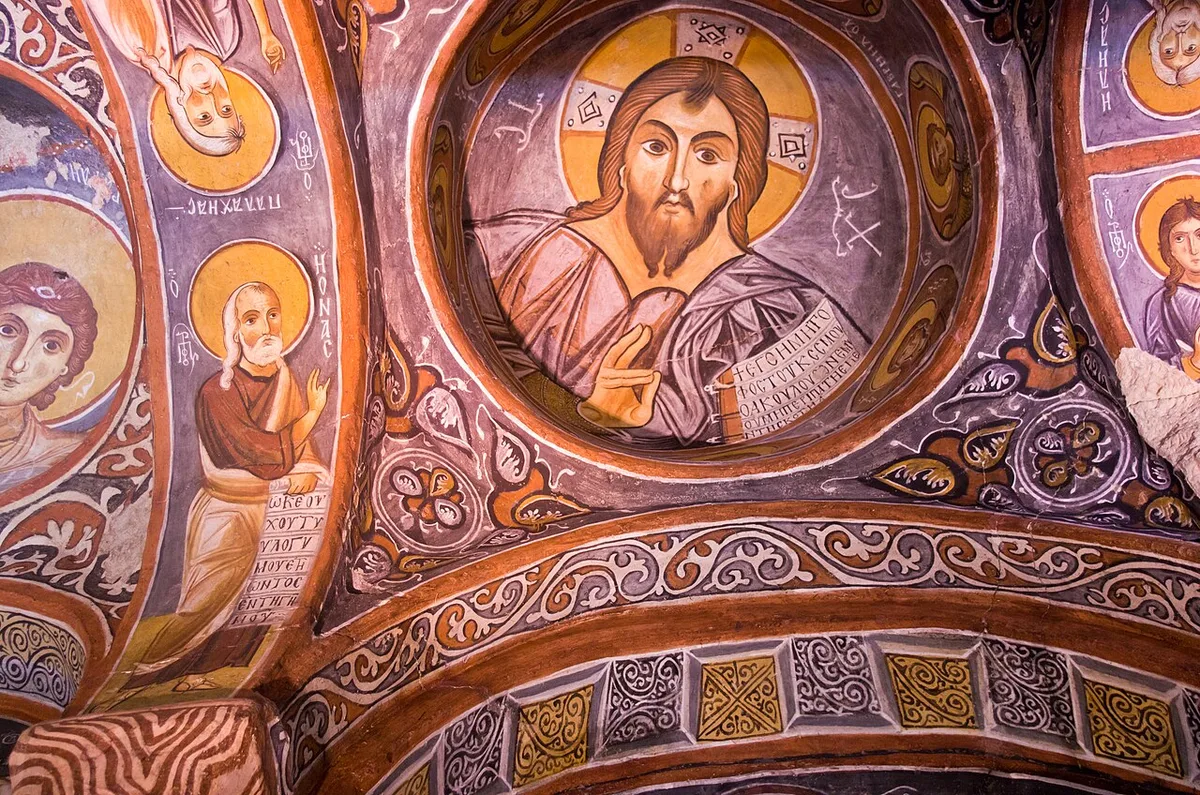
The Dark Church, Karanlık Kilise, is the museum’s masterpiece and its lesson in unintended conservation. It was a monastic church of the late twelfth to early thirteenth century, by UNESCO’s dating among the last great churches painted in the valley, built with a cross-in-square plan, a central dome and a narthex – and almost no windows. The only real light source is one small opening in the narthex, which means the interior spent eight centuries in something close to darkness.
Darkness, it turns out, is the best art storage ever devised. Sunlight is what fades fresco pigment; with almost none admitted, the Dark Church’s paintings survived with their colour nearly intact. After the church fell out of religious use it served for years as a pigeon house – the birds came and went through the same small opening – and when conservators finally cleared it, the scenes beneath were astonishingly vivid. The dome carries a calm, monumental Christ Pantocrator, and around the walls run scenes of the life of Christ and the Deesis, painted with a confidence and freshness that make the other churches in the valley look, unfairly, like faded copies.
Two practical consequences follow. First, the church is kept deliberately dim and visitor flow through it is controlled, so expect a short wait at its door in busy periods and a hushed, almost crowded few minutes inside its small space. Second, entry to the Dark Church is handled as a separate ticket on top of main museum admission – decide before you reach its door that you are paying it, because turning back at that point means missing the single best-preserved painted interior in Cappadocia. This is the one upgrade in this goreme travel guide that is not really optional.
Elmali and Carikli – Two Small Churches With Big Ceilings
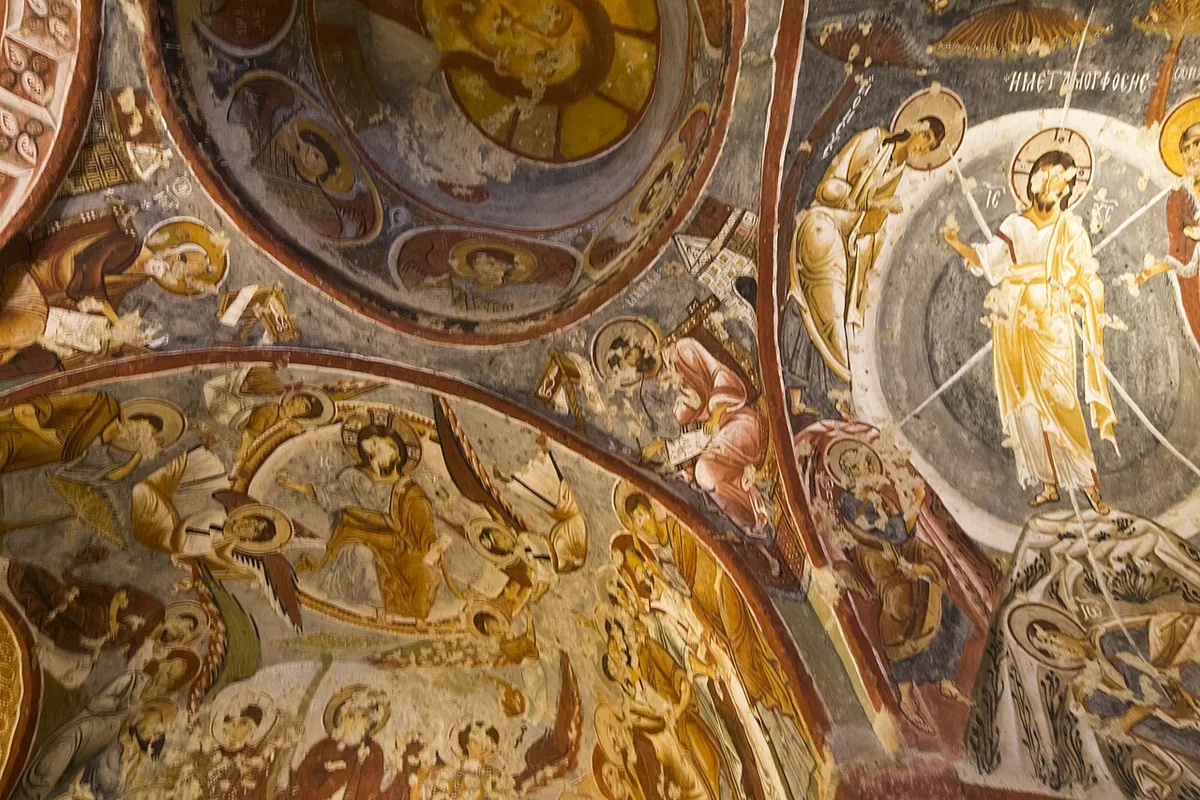
Elmalı, the Apple Church, is a small church with an outsized interior. Carved in the late twelfth to early thirteenth century on UNESCO’s dating, its cross-in-square plan packs a central dome and a ring of smaller domes into a space not much bigger than a living room, and every surface is painted – saints, angels and scenes from the life of Christ in strong reds and blues. Even its name is a small mystery that guides tell two ways – after an apple orchard that once stood nearby, or after the round orb held by the Archangel Michael in one of its paintings, mistaken at a distance for an apple. Either way, it is the church that best shows how much art the valley’s painters could fit into a very small room.
Çarıklı, the Church with the Sandals, takes its name from something stranger – two footprints painted beneath its fresco of the Ascension, said to resemble the prints left by sandals. Its paintings, dense and dramatic, include the Crucifixion, the Deesis and the Transfiguration shown in the photograph above, and art historians have long noted the church’s echoes of the great shrine churches of the Holy Land. Standing in these two small, glowing rooms one after the other makes the museum’s central point better than any panel text – in Göreme, scale meant nothing. A chapel the size of a bedroom could hold painting as serious as any cathedral.
Yilanli and Barbara – Serpents, Saints and Red Ochre
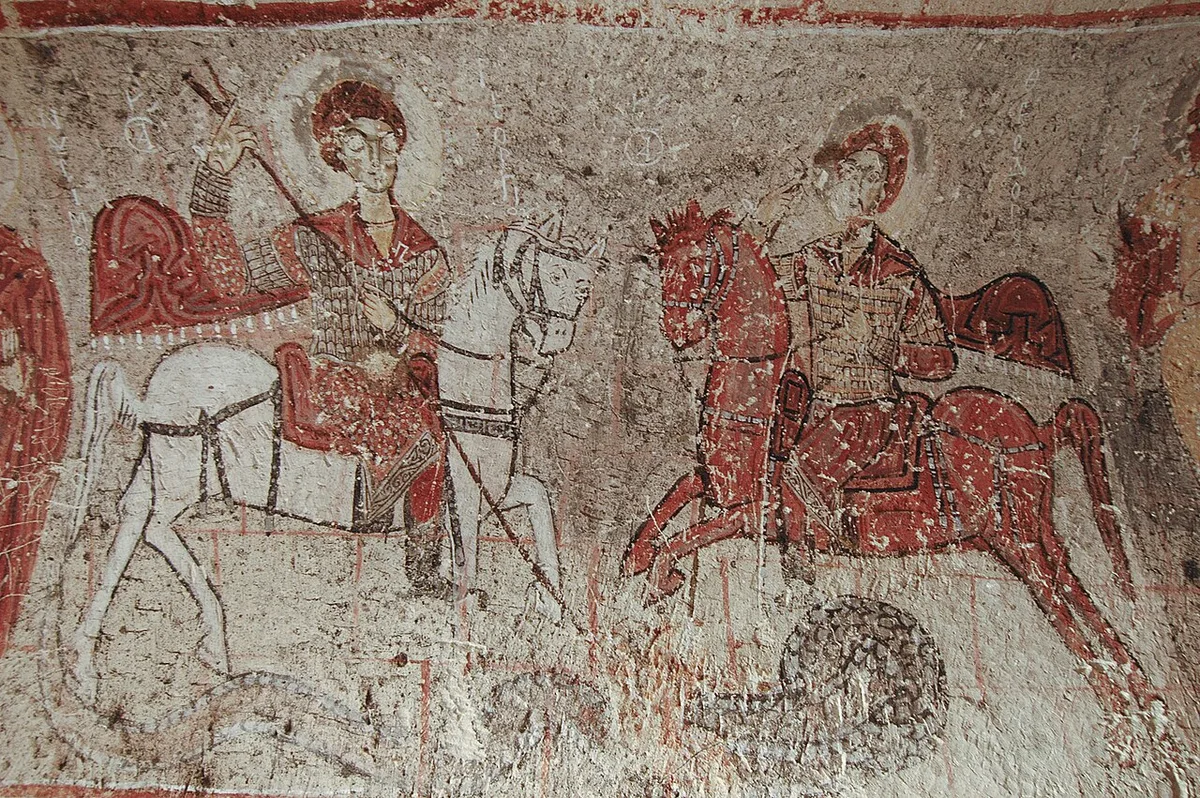
Yılanlı, the Serpent Church, is named for the fresco in the photograph above – Saints George and Theodore on horseback, spears levelled at the writhing serpent beneath their horses’ hooves. The painting style here is flatter and more linear than in the Dark Church, closer to folk art, and all the more direct for it. The same church shows Constantine and Helena holding the True Cross between them, and the hermit Saint Onuphrius – a reminder that these walls taught a whole cast of holy lives, not just the Gospel story. It is a small, low church, and one of the most likeable in the museum.
Saint Barbara’s Church, which UNESCO dates to the eleventh century, belongs to an older and stranger world. Its decoration was painted straight onto the rock in red ochre, and instead of full narrative scenes it deals largely in symbols – crosses, a fish, a rooster, geometric patterns – the visual language of the iconoclastic centuries, when images of holy figures were restricted and painters worked in sign and emblem. After the saturated colour of Elmalı and the Dark Church, Barbara’s spare red drawings can look plain. Stand a moment longer. This is what the valley’s faith looked like before the great painted age, and the museum is richer for keeping both.
A few practical words before you leave the valley. The ministry lists the site as open every day, with hours that change by season – check the current times on muze.gov.tr before you set out rather than trusting any printed guide, this one included. An audio guide is available at the gate and genuinely helps in the churches, where panel text is brief. Photography is restricted inside the painted churches, so look properly instead of through a screen. Above all, go at opening time or late in the day – by mid-morning the tour buses arrive in convoy, the small churches develop queues, and the hush that makes this place extraordinary is gone until evening.
Sleeping in a Cave – What a Cave Hotel Really Is

The phrase cave hotel covers more variety, and more marketing, than any other term in Göreme. At one end of the truth there are rooms genuinely carved into a fairy chimney or a cliff face – you sleep inside the rock, surrounded by tuff on most sides, in a space that began life as a dwelling, a stable or a storeroom centuries before it had an en-suite. At the other end there are entirely modern stone buildings whose rooms are called cave because their walls are thick, their ceilings are arched and their windows are small. Many properties, like the one in the photograph, are honestly both – carved rooms below, built rooms above, and a terrace stitching them together. Nothing about that is a scam, provided you know which of the two you have actually booked.
A true cave room has a particular feel that photographs flatten. The walls are the rock itself, cool to the touch, sometimes gently uneven, with the marks of carving still visible in the less renovated examples. Because tuff is a natural insulator, the temperature inside barely moves – cave rooms stay pleasantly cool through a Cappadocian summer day without air conditioning working hard, which generations of cave dwellers understood long before hoteliers did. Sound behaves oddly too. Thick rock swallows noise from the street, but a corridor or a neighbouring room can carry surprising echoes through shared ventilation and thin internal doors.
Now the caveats, because this goreme travel guide is not in the business of selling you a room. A space with few or no windows has little natural light and limited airflow, and in the cool, wet months some cave rooms – particularly the cheapest, deepest ones – can smell faintly of damp rock until the heating has run for a while. Rock is also honest about plumbing. Every bathroom in a cave hotel is a retrofit threaded through stone that predates drains, and in the oldest properties that can mean modest water pressure and layouts squeezed into whatever space the carving allowed. None of this ruins a stay. All of it is better known before you pay than discovered at midnight.
Read listings with the vocabulary in mind. A cave room or fairy chimney room should mean space carved into rock. A stone room usually means a built room in a traditional stone house – often brighter, with real windows, and preferred by many repeat visitors for longer stays. Suites with terraces cost more because the terrace is the real product – it is where breakfast happens, where the balloons drift past at eye level, and where the town’s whole dawn performance is watched in a dressing gown. And wherever you stay in Göreme, expect steps. The town is built on slopes, the hotels climb their own chimneys and hillsides, and almost none of it was designed with a lift in mind. If mobility matters, ask the hotel directly how many stairs stand between the street and your specific room – not the lobby, the room.
Where in town matters almost as much as what. The centre puts every restaurant and the bus station within a stroll, at the price of the main street’s bustle and the dawn chorus of balloon burners at closest range. The Aydınlı neighbourhood, climbing the slope on the museum side of town, is Göreme’s traditional hotel quarter – older cave houses, quieter lanes, the sunset hill at its back and the balloons passing almost overhead. The edges of town toward the valleys suit walkers who would rather step onto a trail than into a taxi rank. There is no wrong answer, but there is a wrong way to choose, and it is by room photographs alone – in Göreme, the map is half the booking.
The Valleys on Foot – Five Walks From the Town Edge
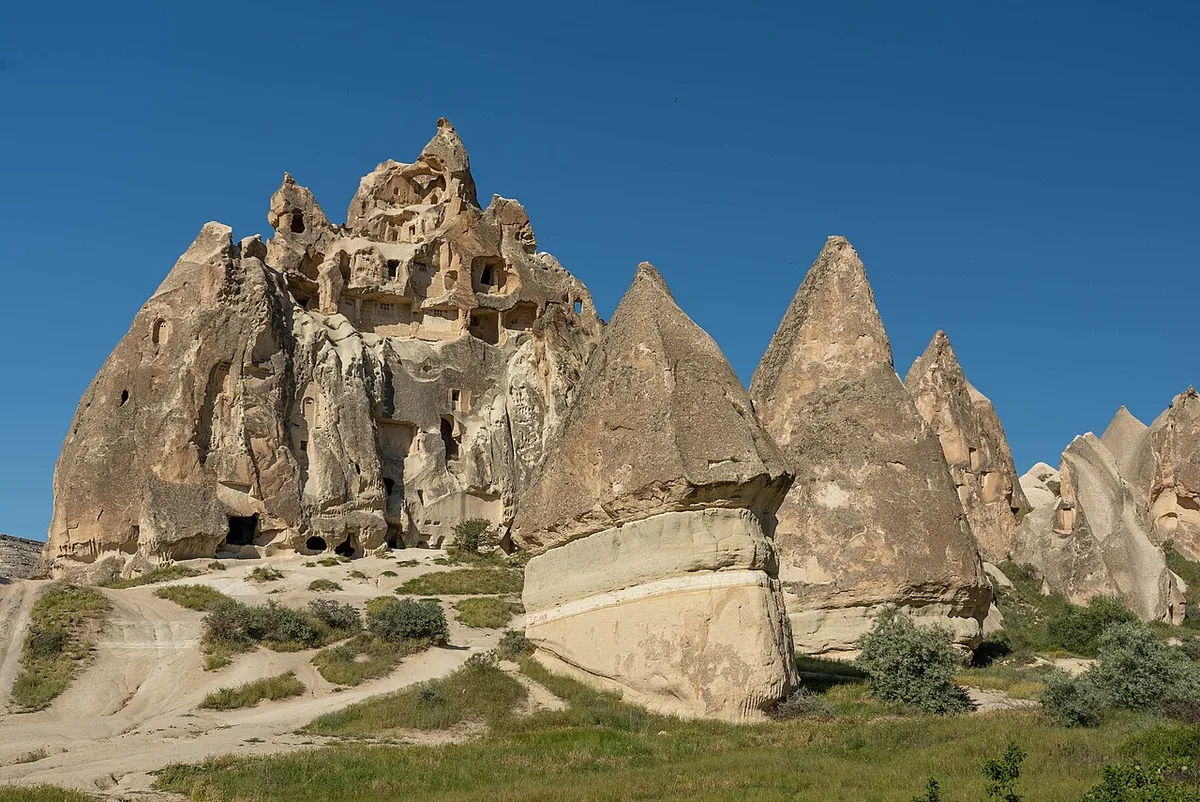
Göreme’s great unfair advantage is that its trailheads begin where its streets end. Five distinct valleys radiate from the town, each with its own colour, character and difficulty, and all of them walkable without a tour, a ticket or a vehicle. Waymarking exists but is patchy – painted flashes appear and vanish, paths braid and rejoin – so carry an offline map, real footwear, water and sun protection, and treat the times in this section as honest ranges rather than promises. What follows is the walking core of this goreme travel guide, and for most visitors it ends up mattering more than the museum.
Rose and Red Valleys – The Sunset Walk
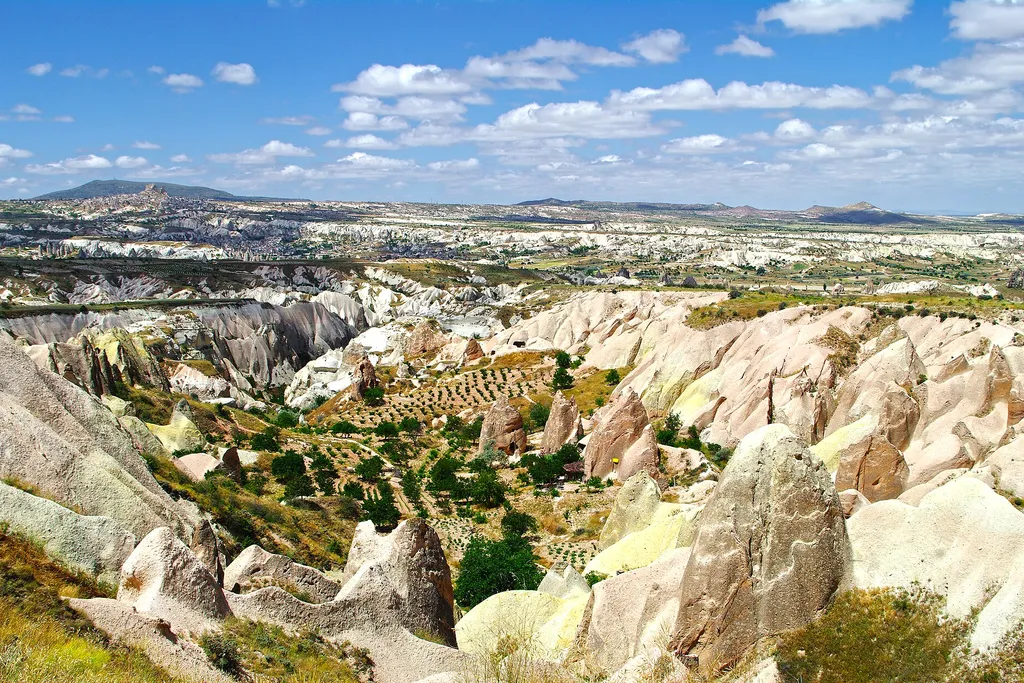
Rose Valley and its deeper-hued neighbour Red Valley – Gülüdere and Kızılçukur – run between Göreme and the village of Çavuşin, and together they make the classic half-day walk of the area. The valleys are soft in colour for most of the day, cream and blush and pale apricot, threaded with orchards, small vineyards and pigeon houses, and dotted with carved churches of their own – modest cousins of the museum’s churches, reached by scrambling paths rather than ticket gates. The walking is moderate rather than hard, a mix of valley floor, gentle climbs and a few short, steep or tunnel-like sections where you duck through carved passages, and a loop from Göreme through both valleys and back runs to roughly three or four unhurried hours.
The reason everyone tells you to time this walk for evening is standing on the ridge at the far end. At the Kızılçukur viewpoint the red rock does at sunset what the valley’s name promises, flushing rose and then crimson as the light drops, and on a clear evening it is the single best free show in Cappadocia. The honest footnotes – the viewpoint has a small cluster of stalls and can be busy at peak season, and walking back to Göreme in the fading light needs a torch or a phone with battery to spare. Neither changes the verdict. If you walk only one valley, walk this one, and walk it late.
Love Valley – The Pillars Everyone Photographs
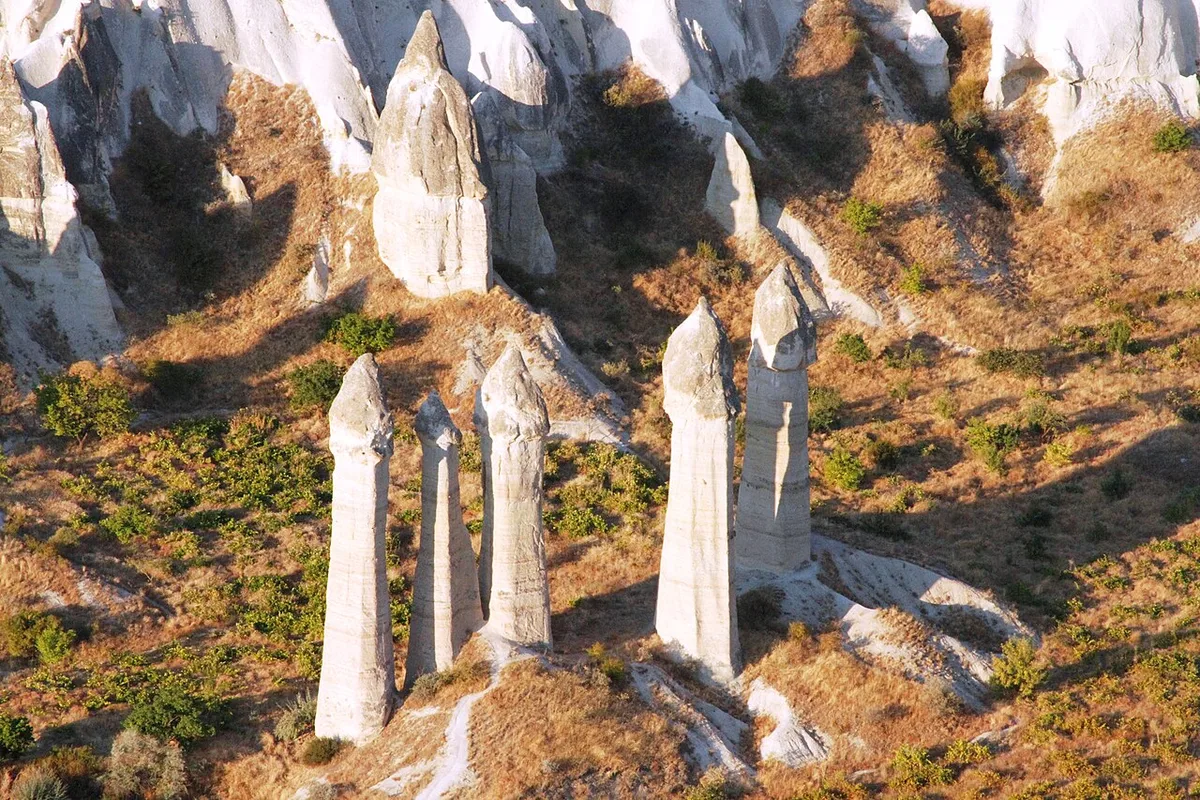
Love Valley, the Bağlıdere valley running from near Uçhisar towards Göreme, holds the most photographed rock formation in Cappadocia after the balloons – a stand of tall, smooth, unmistakably phallic pillars rising from the valley floor, which is exactly how the valley earned the name the whole world now uses. Most visitors see it in four minutes from the rim viewpoint, where the tour minibuses stop. The pillars deserve better, and the valley floor gives it – walking beneath them, they read less as a joke and more as a strange stone forest, each column a chimney whose cap fell long ago and whose sides the rain has planed smooth.
As walking, it is among the gentler options in this guide. The valley floor path is mostly level, the route from the Göreme side is straightforward, and the full walk through to the Uçhisar road and back fits comfortably into two to three hours with stops. Combine it with Pigeon Valley, next in this guide, and the two make a natural loop of Göreme’s western valleys – out one valley, back through the other, with Uçhisar’s castle rock watching over both. Go in the morning if you can. By midday the white rock bounces the heat back at you and the valley’s shade is limited.
Pigeon Valley – Dovecotes Between Goreme and Uchisar

Pigeon Valley, Güvercinlik, runs between Göreme and Uçhisar, and it is the most instructive walk in the region – the one that explains how people actually lived off this landscape. Its cliffs are pierced with thousands of small square openings, the flight holes of carved dovecotes, some fronted with painted and decorated facades like the one in the photograph. The birds were not pets or decoration. Their droppings were collected as rich fertiliser for the valley’s vineyards and orchards – Cappadocia’s famous grapes grew on pigeon power – and the valley is a working farm building disguised as scenery.
The walk itself is a point-to-point of roughly an hour to ninety minutes, descending from Göreme’s edge, crossing the valley floor among orchards and chimneys, and climbing at the far end to Uçhisar, the rock citadel town visible for the whole route. It is the easiest of the five walks to follow and the most varied per kilometre – one short section is steep and can be slippery after rain, and the stream crossings at the valley bottom turn muddy in the wet months, but in dry weather this is a walk for ordinary shoes and unhurried legs. Arriving in Uçhisar, climb the castle rock if the day is clear. The view back down the valley you have just walked, with Göreme at the far end, closes the story of this goreme travel guide’s home town in a single panorama.
Sword and Zemi – The Quiet Pair Behind Town

Sword Valley, Kılıçlar, begins almost inside Göreme itself, a few minutes from the bus station, and yet most visitors never enter it. Its chimneys are drawn out into blades and points – the swords of the name – and its floor is given over to horse farms, whose riding tours clip-clop through the valley at walking pace all day, as in the photograph. On foot it is the shortest commitment in this section, an hour or so of easy wandering among carved facades and small churches, and it is the walk to choose on an arrival afternoon when you want the landscape without an expedition.
Zemi Valley is Sword’s opposite in temperament – longer, greener and wilder, running south from Göreme with a stream along its floor, poplars and fruit trees where the other valleys have bare rock, and a proper sense of leaving town behind. Its hidden prize stands near its start – El Nazar, the Evil Eye Church, a tenth-century church that UNESCO names among the valley churches of the World Heritage property, carved into a single great cone with a T-shaped plan and frescoes that almost nobody queues for, because almost nobody knows it is there. Allow half a day for Zemi if you walk deep into it, carry everything you need, and expect the path to feel like a hike rather than a stroll – that contrast with manicured Sword Valley is precisely its charm.
Balloons at Dawn – Flying, Watching and the Weather Lottery

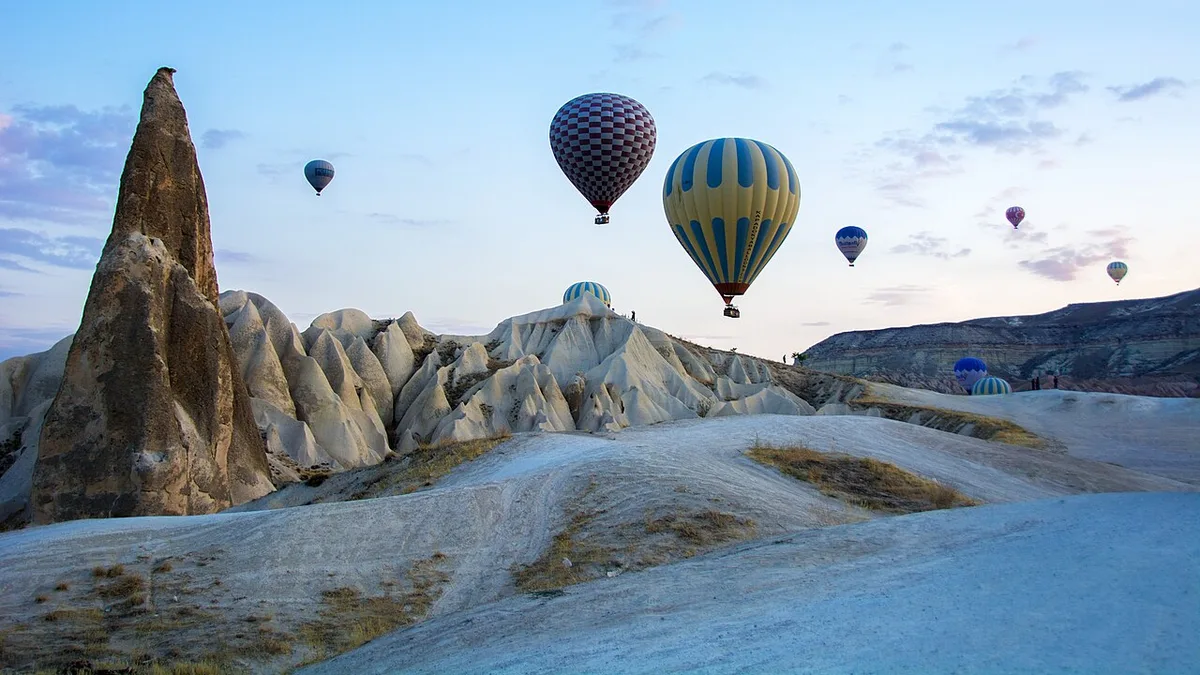
The balloons are not a tour that happens to start early. They are an aviation operation that runs on a strict daily logic, and understanding the mechanism makes both flying and watching better. Ballooning in Cappadocia is regulated by Turkey’s civil aviation authority, which controls the slots and the airspace over the valleys, and flights are concentrated into the first hour or so after sunrise for a simple physical reason – that is when the air is coolest and the winds over the valleys are at their calmest and most predictable. On a good morning the launches ripple across the fields east and north of Göreme, and the sky can fill with a hundred balloons or more, drifting low over the chimneys before climbing away.
The corollary is the one nobody puts on the brochure cover – balloons do not fly in wind, rain or poor visibility, and the decision is made on the morning itself, sometimes only an hour before launch. Cancellations happen in every season, including the height of summer, and can run for two or three days in a row when the weather sits wrong. This single fact should shape your whole itinerary. Book your flight for your first morning in Göreme, never your last, so a cancellation rolls forward to the next day rather than expiring as you leave. Keep at least two, ideally three mornings in town. The travellers who go home disappointed are almost always the ones who gave the weather a single chance.
If the morning is flyable, the experience itself runs like this. You are collected in the dark, driven to a launch field outside town, and fed coffee and something warm while the envelope is spread on the ground and inflated – first with fans, then with the burners, the fabric rising and glowing in stages until it stands over the basket like a lit building. The flight itself is the strange part, because a balloon has no steering beyond up and down. The pilot reads the winds at different altitudes and rides the layers, which is why no two flights follow the same line and why landing happens wherever the valley and the breeze agree, with a ground crew and a trailer appearing below as if by arrangement. Most flights spend around an hour in the air, low over the chimneys at first, high above the plateau as the sun strengthens. People expect drama and report serenity – the loudest thing up there is the burner, and between its blasts the loudest thing is the silence.
On price, this goreme travel guide will be straight with you rather than specific. Fares are not printed here because they move constantly and any number published would be wrong within the season – but the direction of travel is no secret. Ballooning in Cappadocia was once a mid-range treat; in recent years prices have climbed steeply, fuelled by capped flight slots, high demand and the region’s social media fame, and a flight is now a serious line in most travel budgets. Treat any quotation as valid only for the day it was given, compare what is included rather than just the headline – basket size, flight length and transfers all vary – and be suspicious of any offer far below the going rate, because the corner being cut is usually the one you cannot see.
Watching From the Ground – Terraces, Viewpoints and the Launch Fields
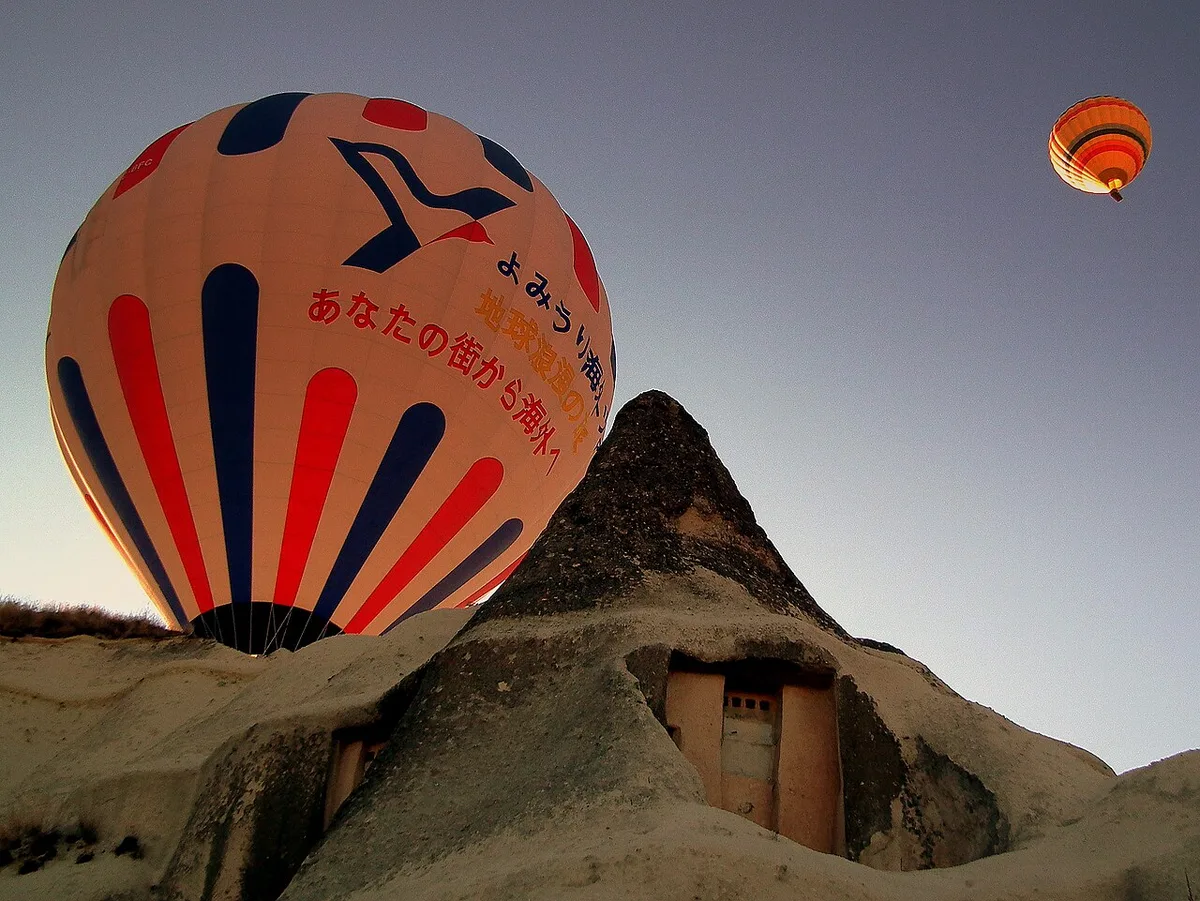
Here is the local open secret – some of the best balloon experiences in Göreme cost nothing at all, because you do not have to be in a basket to be inside the spectacle. The balloons launch around the town, drift over it, and on many mornings pass so low over the rooftops that you can hear the burners fire and see the passengers waving. Göreme’s hotels understood this long ago, and the rooftop terrace – cushions, blankets, coffee, a sky full of colour – has become the town’s second signature experience, available to anyone whose room comes with a view and an alarm clock.
For the full panorama, climb to the viewpoint above town – the hill locals call Aydın Kırağı, signposted as the sunset point, repurposed at dawn by everyone in the know. From there the fleet rises in front of you with the valleys spread below, and the same hill that hosts the sunset crowds hosts a quieter, colder, more magical crowd at six in the morning. The launch fields themselves are the third option and the most visceral – stand at the edge of one, as the photograph above was taken, and the balloons inflate around you like slow buildings, glowing each time the burners fire, then lifting away one by one into the half-light. Whichever you choose, the rules are the same – set the alarm, dress warmer than you think, and accept the bargain this section of the goreme travel guide keeps repeating. In Göreme, the dawn is the main event, and it starts whether you are awake for it or not.
Goreme or Somewhere Else – Choosing Your Base
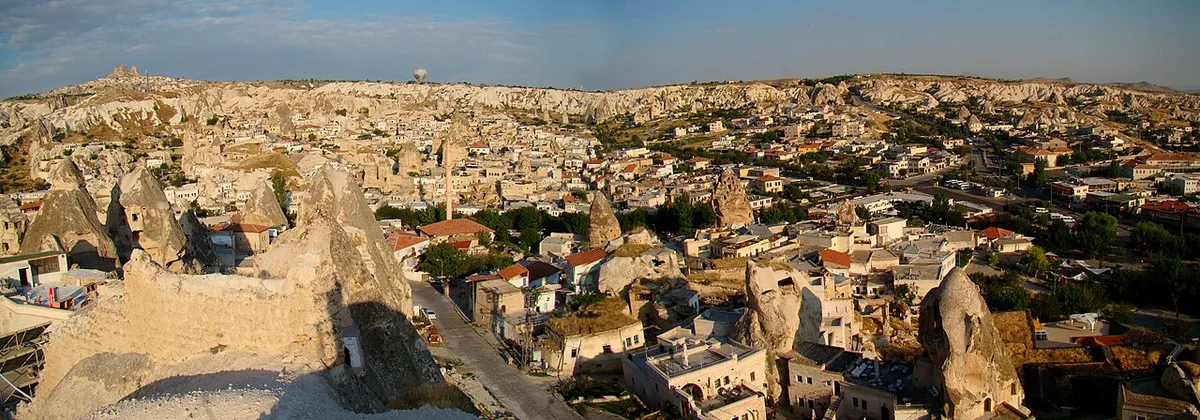
Every Cappadocia trip begins with this decision, and there is no universally right answer – only the right answer for the trip you are taking. Göreme’s case has been made throughout this guide. It is the base of maximum convenience, the only town where the museum, the valleys, dozens of restaurants and every agency and shuttle route are all within walking distance, and the natural choice for first-time visitors, walkers and anyone travelling without a car. Its costs are equally clear – the busiest streets, the most tourist-facing restaurants, the highest prices for equivalent rooms, and a centre that can feel more like a resort than a town in high season.
Uçhisar, ten minutes away at the region’s highest point, is Göreme’s polished opposite. Its castle rock gives it the best views in Cappadocia, its hotels skew upmarket and quiet, and its evenings belong to residents and a handful of diners rather than a main street of agencies. Choose it for romance, for views and for calm – and accept that you will drive or taxi to almost everything, including dinner choice beyond a short list. Ortahisar, further east, is the least tourist-shaped of the three smaller bases, a working town wrapped around its own great castle rock, with a smaller, more local selection of cave hotels and restaurants and prices that have not fully caught up with its neighbours. It suits repeat visitors and anyone whose favourite travel word is unhurried.
Ürgüp, the largest town of the group, plays a different role altogether – a real town with a full commercial centre, a long wine-making tradition, conventional hotels alongside cave properties, and the widest choice of restaurants at local rather than resort prices. It is a comfortable, civilised base, but it sits further from the museum and the walkable valleys, so staying there means organising transport as a daily habit rather than an occasional taxi. The honest summary of this goreme travel guide’s position – stay in Göreme first, walk everywhere, and learn the region on foot. Then, if Cappadocia pulls you back for a second trip, you will already know which of the quieter towns was calling to you from across the valleys.
The Wider Circuit – What a Car or Tour Day Adds
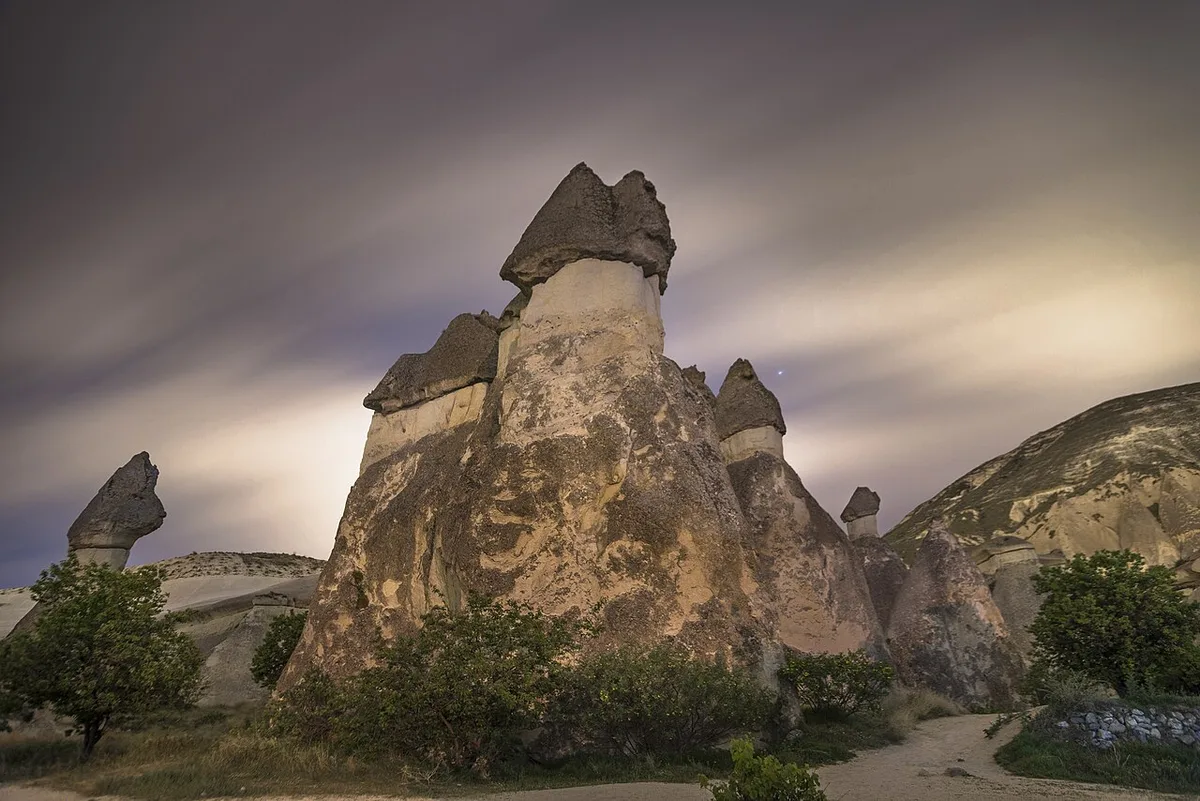
Everything so far has been walkable, and deliberately so – but a ring of sights just beyond walking range completes the region, and one organised day, by rental car or small-group tour, is how most visitors collect them. Start at Paşabağ, Monks Valley, a few kilometres north, where the fairy chimneys reach their most exaggerated form – thick twin and triple trunks carrying great mushroom caps, some of them carved, one famously holding a hermit’s chapel attributed to the followers of Saint Simeon. It is the geology of this guide’s opening section pushed to caricature, and precisely because of that, the best place in Cappadocia to understand it.
From Paşabağ the circuit runs naturally through its neighbours. Devrent, Imagination Valley, is a roadside field of uncarved chimneys worn into animal shapes – a camel most famously, but the game is to find your own – and the only major valley where the entertainment is pure erosion with no human carving at all. Zelve is the opposite extreme, an entire cave town spread across three joined valleys, inhabited for centuries and finally emptied in the 1950s when rockfalls made it unsafe, its people moved to a new village nearby. Walking its silent streets, churches and mosque makes an instructive counterweight to the museum – the same architecture, but a town rather than a monastery, and with a fraction of the visitors.
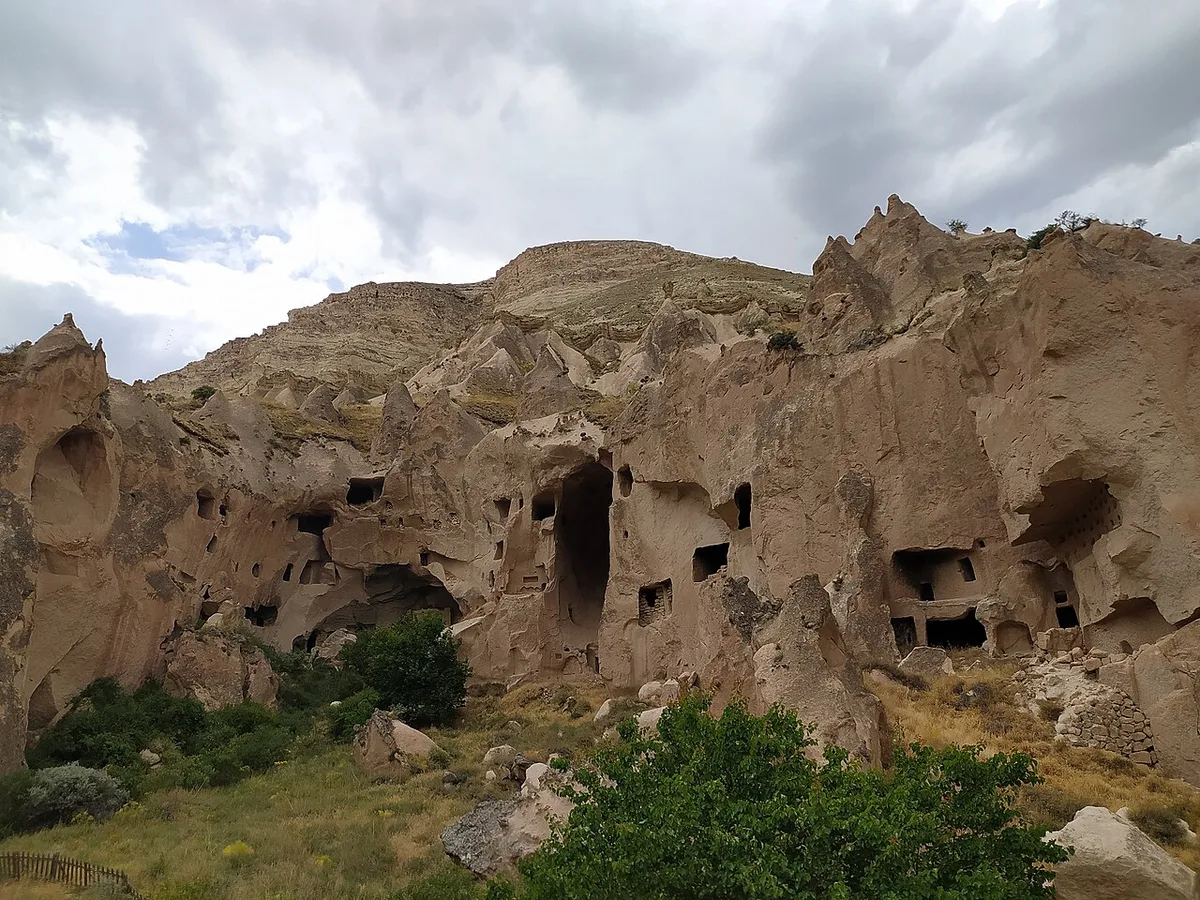
Çavuşin, on the road back to Göreme, adds the last layer – an old Greek village of grand carved and stone houses beneath a cliff of abandoned cave homes, with the great early church of Saint John the Baptist above it.
One planning note for the whole circuit, because it decides whether the day feels rich or rushed. These stops are close together on the map and very different in weight. Paşabağ and Devrent are essentially outdoor sculpture parks – thirty to forty-five minutes each serves them well. Zelve deserves two hours and your full attention. The underground cities, next in this guide, deserve half a day on their own if you can give it. The classic organised tours of the region bundle these sights into fixed routes for a reason – the geography cooperates – but a rental car buys you the two things the tours ration, which are time at Zelve and an early or late slot underground.
Down Into the Underground Cities

The underground cities are the region’s other world, and one of them belongs in every itinerary. Two are fully opened and easy to reach from Göreme. Kaymaklı spreads wide rather than deep, a honeycomb of stables, kitchens, wineries, living quarters and a church arranged around ventilation shafts, its levels connected by tunnels you often walk bent double. Derinkuyu, a little further south, is its famous rival – the deepest of the excavated cities, descending level after level, with a missionary school, a cruciform church and a well shaft that also served the levels above. UNESCO includes both within the World Heritage property and describes their role plainly – when invasion threatened, the region’s people went underground, rolling great stone disc doors across the tunnels behind them, each door movable from inside and effectively immovable from out.
Who dug them, and when, is a longer story than any guide fully settles. The oldest carving is often attributed to the early peoples of Anatolia and the cities were expanded over centuries, reaching their greatest extent in the Byzantine centuries when Arab raids made refuge a recurring necessity – communities could shelter below for weeks, with stored food, water and air, while the world above waited. Two honest warnings before you descend. The tunnels are genuinely low and narrow, the visit is largely one-way in flow, and in high season the pinch points develop queues in the dark – if confined spaces trouble you, Kaymaklı’s shallower, wider early levels give you the idea of the place without the deepest commitment. Go early or late in the day, and let the crowds take the midday slot in this part of the goreme travel guide’s circuit, as at the museum.
When to Go – Seasons Told Straight
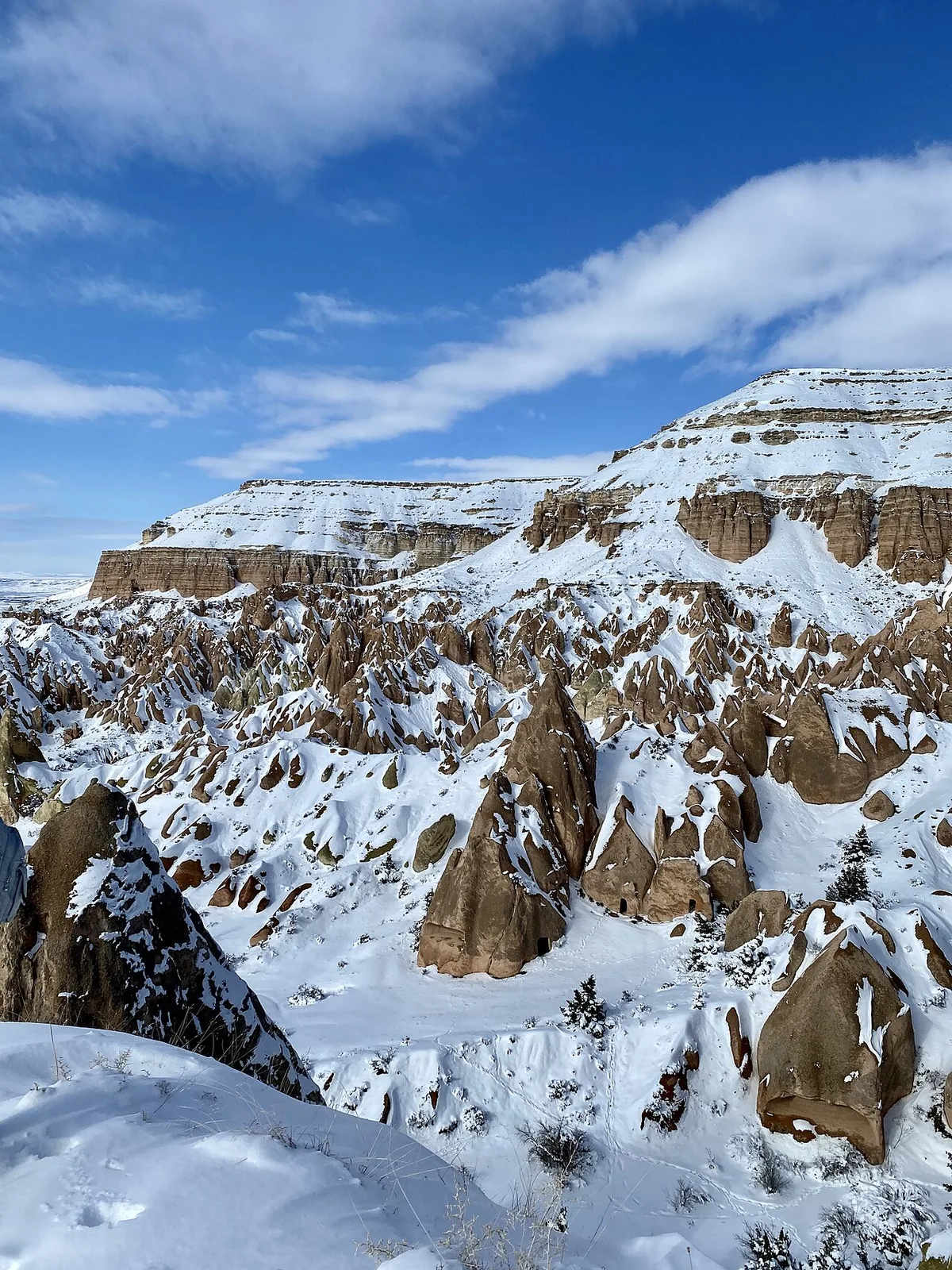
Göreme sits on the high central Anatolian plateau, well over a thousand metres up, and its seasons are more continental than most visitors expect from Turkey. Late spring and early autumn are the consensus sweet spots for good reason – the trails are dry, the valley orchards are green or turning, mornings are cool enough for balloons to fly reliably and afternoons warm enough for terrace life. If you can choose freely, choose those shoulders, and know that everyone with a choice is choosing them with you.
Summer brings the heat and the crowds together. The tuff valleys reflect the sun, midday walking becomes something to schedule around rather than enjoy, and the museum and the sunset viewpoint run at full pressure. Summer mornings, though, are glorious – the balloon season is at its most reliable, the light is superb, and a rhythm of dawn starts and shaded afternoons suits Göreme better than almost anywhere. Winter is the season this goreme travel guide refuses to sell you short on either way. Snow transforms the valleys into something from a fable, the museum stands nearly empty, hotel rates fall, and a cave room with the heating on is a deeply cosy place. Against that, nights drop well below freezing, some restaurants and smaller hotels close, trails turn icy in the shade – and the balloons, facing the year’s worst weather, cancel far more often. Come in winter for the landscape and the quiet, not on a balloon-or-bust promise.
The Downsides Nobody Puts in the Brochure
Begin with the money. Göreme’s fame has made it the most expensive base in Cappadocia, and the balloon – the experience most people come for – has seen the steepest rises of all, to the point where a family flight can rival the cost of the rest of the trip. Add terrace-view room premiums, resort-priced main-street restaurants and tour commissions layered into almost every bookable activity, and a Göreme trip assembled carelessly costs far more than the same days organised with your eyes open. The single best defence is the one this whole article is built on – in Göreme, the finest things, the valleys, the viewpoints, the dawn sky watched from a hill, are the free ones.
Then the crowds, which have a timetable you can learn and evade. The museum is serene at opening and a procession by eleven. The sunset viewpoint is a festival at seven and a whisper at six in the morning. The famous valleys empty beyond the first kilometre. Göreme does not really have a crowd problem so much as a synchronisation problem – five hundred people doing the same thing at the same hour – and the traveller who shifts everything ninety minutes earlier or later walks through a different, calmer town. Two smaller honesties complete the picture. The balloons that drift so silently in photographs are punctuated by burner blasts, and at dawn in high season your hotel will hear them, which is either atmosphere or an alarm clock depending on your plans. And the very softness that made this landscape carvable makes it fragile – UNESCO itself notes tourism pressure among the threats to the property. Stay on paths, do not climb the chimneys, and leave the carved rooms as you found them.
Questions Travellers Ask Before Booking Goreme

How many days do I actually need in Göreme?
Three nights is the honest minimum this goreme travel guide recommends – one morning for the museum, one day for the valleys, and at least two mornings exposed to the balloon weather lottery, since one is regularly lost. Four or five nights turns the trip from a highlights reel into a stay, adding the underground cities and the wider circuit without a single rushed day.
Is the Dark Church worth its separate ticket?
Yes – it is the best-preserved painted interior in Cappadocia, and the extra ticket on top of museum admission buys the one room people are still describing months later. If painted churches are not your interest at all, the rest of the museum still justifies the visit, but do not skip the Dark Church to save a small sum inside the most expensive part of your trip.
Should I book the balloon before I arrive, or in town?
Book for your first morning, through a reputable operator, before you arrive in high season – slots are capped by the aviation authority and the good mornings sell out. The booking rule that matters more than where you book is when – the first morning, so cancellations roll forward. That discipline is the closest thing to a guarantee this goreme travel guide can offer.
Can I walk to the Open-Air Museum, or do I need a tour?
Walk. It is roughly twenty minutes uphill from the town centre on a pavements-and-road route, the same road the tour buses take, and arriving on foot means arriving on your own schedule – ideally at opening time. Nothing about the museum requires a tour; an audio guide from the gate covers the interpretation well.
Are cave hotels suitable for children and older travellers?
Mostly, with homework. Children generally love the cave rooms, and many hotels are family-run and genuinely welcoming – but terraces, stairs and carved steps are everywhere, and room layouts vary wildly. For older travellers or anyone with limited mobility, ask the hotel the exact stair count to your specific room before booking, and favour stone rooms at street level over chimney-top suites.
What happens if my balloon flight is cancelled?
You roll to the next morning if you have one – which is why this guide insists on spare mornings – or you are refunded under the operator’s cancellation terms. Weather cancellations are the operator’s call, made on aviation safety grounds, and no agency can override them. Build the buffer, and a cancellation becomes a lie-in and a valley walk instead of a ruined trip.
Is Göreme just a base, or a place in itself?
Both, and the second half is underrated. Between the museum mornings and valley days, Göreme has its own small pleasures – pottery and carpet workshops in the lanes, testi kebab cooked in a clay pot and cracked at the table, the hammam, sunset from the hill above town with a glass of Cappadocian wine. The town rewards the traveller who stops treating it as a dormitory.
The Short Version – Goreme in One Page
If this goreme travel guide had to fit on an index card, it would read like this. Göreme is a small town inside a UNESCO-listed landscape of volcanic tuff, where erosion made the fairy chimneys and people carved everything else – churches, homes, hotels and dovecotes – into the same soft rock. Base yourself here to walk. The Open-Air Museum is twenty minutes on foot and holds the finest cluster of Byzantine cave churches anywhere; go at opening, pay the Dark Church’s separate ticket without hesitating, and give Tokalı, across the road, the time the tour groups do not.
Sleep in a cave if the idea delights you, but book knowing the vocabulary – true cave rooms are atmospheric, dim and occasionally damp at the edges, stone rooms are brighter and often better for long stays, and the terrace above either is worth more than the room below it. Walk the valleys in the long light – Rose and Red for sunset, Love and Pigeon for easy beauty, Sword and Zemi for quiet – and give one day to the wider circuit of Paşabağ, Zelve and an underground city. Rise at dawn at least twice, once for the balloons from a basket if the budget and the weather agree, and once simply to watch them from a terrace or a launch field, which costs nothing and loses surprisingly little.
For the regional picture – how Cappadocia hangs together, its further valleys and its full history – pair this guide with our Cappadocia travel guide, which covers the region this article deliberately zooms past. Göreme is the zoom. It is busy, it is not cheap, and parts of it are unashamedly built for visitors. It is also the most walkable, most concentrated and most quietly astonishing small town in central Turkey, and three mornings of its dawns will explain, better than this or any guide can, why people keep coming back to a valley full of carved stone.