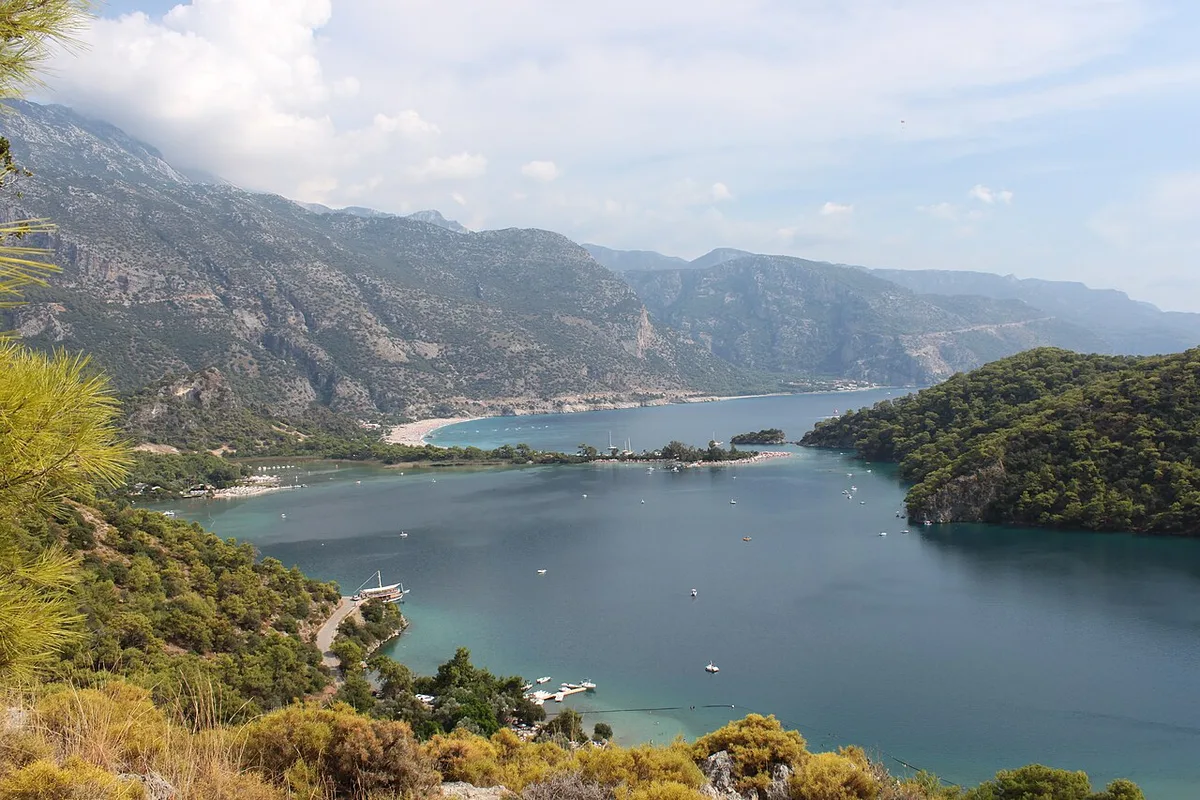
Most Turkish resort towns are a famous beach with a settlement attached, and the settlement is usually the disappointing part. Fethiye runs the other way. The beach the world knows – the Ölüdeniz lagoon, photographed from the air until its curl of sand is a logo – sits a quarter of an hour south of a real, working harbour town that most lagoon visitors barely enter, and this fethiye travel guide is written on the argument that the town is not the lagoon’s dormitory. It is the main event’s other half. Fethiye has a 2,300-year-old city’s bones in its streets, a fish market that feeds the town before it entertains it, a Tuesday market that takes over whole streets, and a harbour that still launches fishing boats alongside the yachts.
Understand the geography first, because every planning mistake here is a geography mistake. The town sits at the head of a deep, island-strewn gulf, under a wall of mountains, facing the sunset shore of Çalış. South of the town the coast road climbs over a pine-covered ridge and drops to Ölüdeniz, a separate small resort wrapped around two different beaches – the open-sea strand of Belcekız and, behind its sand spit, the sheltered lagoon. Behind everything stands Babadağ, just under 2,000 metres, whose summit launches paragliders over the whole arrangement. Town, lagoon, mountain, gulf – four different holidays sharing one name, and where you sleep decides which one you get.
The second thing to understand is how much of the Lycian world is folded into this one district. The Lycians were the people of this coast long before it was Türkiye, and their calling card was the carved tomb – temple-fronted chambers cut into cliffs, stone sarcophagi shaped like upturned boats. Fethiye is ancient Telmessos, and its cliff face still carries the greatest of those tombs above the rooftops. An hour inland, the cities of Tlos, Letoon and Xanthos hold some of the finest Lycian remains anywhere, the last two of them on the UNESCO World Heritage List. Add a ghost village emptied in 1923, an 18-kilometre slot canyon, a valley reachable only by boat and a 540-kilometre waymarked trail starting above the lagoon, and the shape is clear. This is not a beach with extras. It is a region that happens to contain a famous beach.
This fethiye travel guide is organised the way a stay actually unfolds. First the town, sight by sight – the rock tombs, the theatre, the museum, the old town, the fish market and the great Tuesday market. Then the lagoon and the mountain. Then the days out in widening circles – Kayaköy, Butterfly Valley, Saklıkent, the boat day around the gulf’s islands, the first steps of the Lycian Way, and the ancient cities. Finally the machinery – getting here, seasons, where to sleep, and the downsides stated plainly. Travellers stringing Türkiye into one journey will find the first chapter in our Istanbul Travel Guide and the inland chapter in the Cappadocia Travel Guide. This page is the Lycian chapter, and it argues for using the town as the base and the lagoon as the day trip.
Fethiye at a Glance
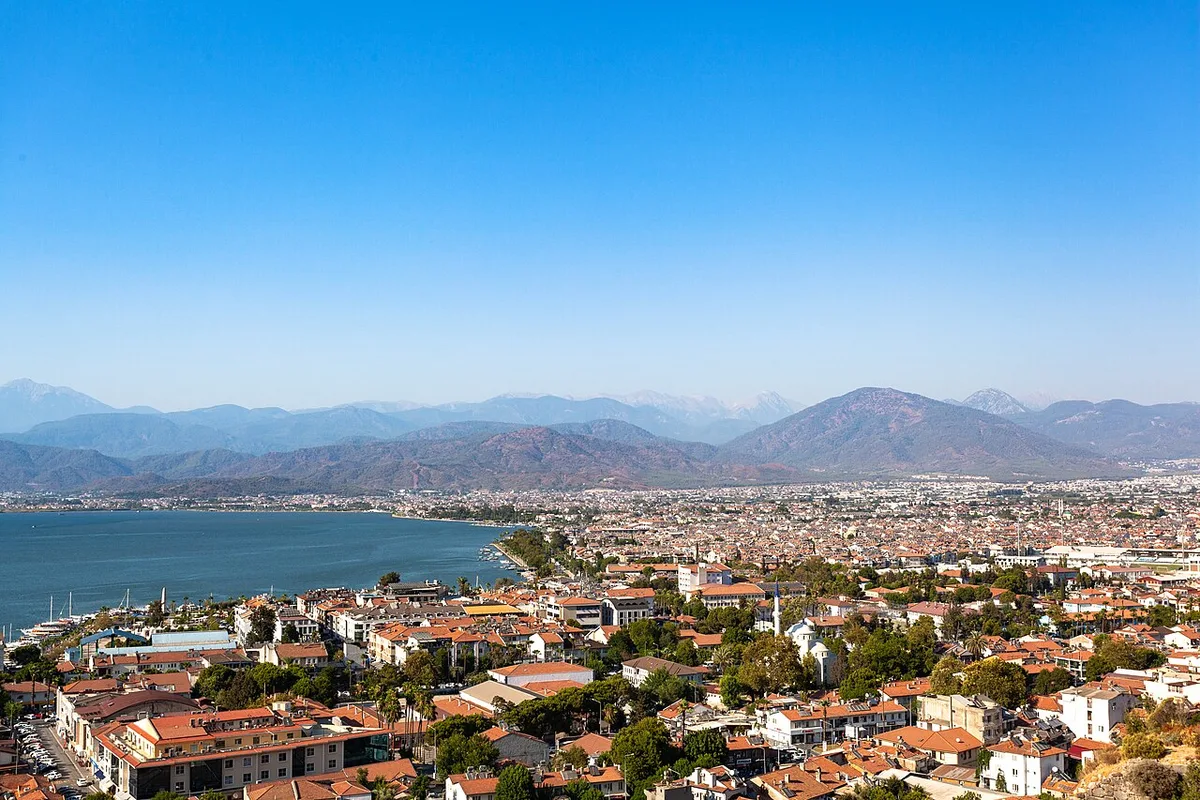
Here is the whole district on one screen. The sections after this table take each row in turn.
| Question | Short answer |
|---|---|
| What is Fethiye | A working harbour town at the head of a gulf in Muğla province – and the name of the whole district around it, lagoon included |
| The famous beach | Ölüdeniz, about 14 km south – an open-sea beach at Belcekız and the sheltered Blue Lagoon behind the Kumburnu spit |
| The ancient city | Telmessos – Lycian rock tombs in the cliff above the town, a theatre by the harbour, sarcophagi in the streets |
| The mountain | Babadağ, just under 2,000 m – tandem paragliding down to the beach, and a cable car up |
| The ghost village | Kayaköy, 8 km south – a Greek town emptied by the 1923 population exchange, now a Ministry-run open-air site |
| The big days out | Saklıkent Gorge, Butterfly Valley by boat, the 12 Islands boat day, and Tlos, Letoon and Xanthos inland |
| The trail | The Lycian Way starts at Ovacık above Ölüdeniz and runs roughly 540 km to Antalya |
| How long do I need | 3 full days for town, lagoon and one day trip; 5 to do the district justice |
| The one planning rule | Sleep in the town or Çalış for the region, in Ölüdeniz for the beach – and day-trip to the other |
Two warnings belong at the top. First, Fethiye town itself has no real swimming beach – every swim involves a bus, a boat or a walk, and the where-to-stay section below is blunt about which base gives what. Second, the district runs on two calendars. From about May to October everything operates – boats, beach clubs, the cable car, the full dolmuş network. From November to April the town carries on while Ölüdeniz largely shuts, and a winter visit is a different, quieter trip that should be chosen knowingly rather than by accident.
Ancient Telmessos and the Lycian Rock Tombs
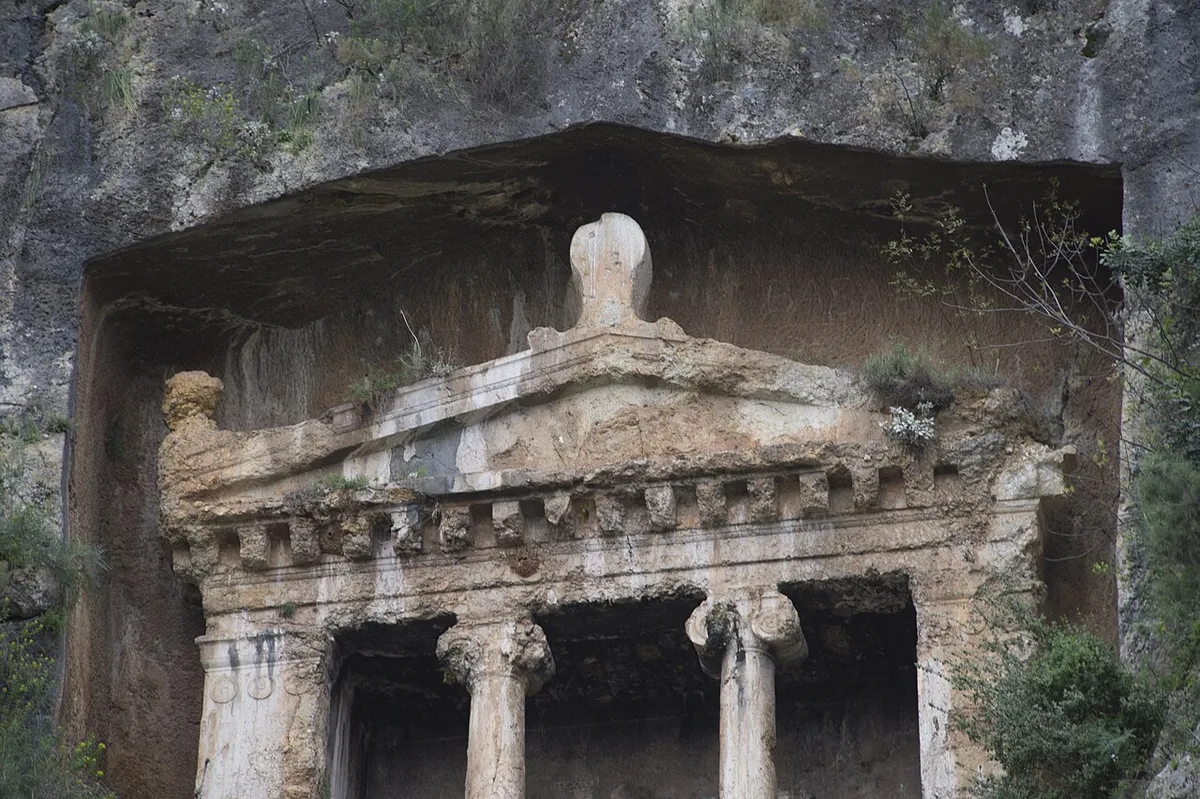
Fethiye’s first identity was Telmessos, a Lycian port city wealthy enough to be famous in the ancient world for its seers, and the Lycians built for the dead the way other civilisations built for gods. The cliff that walls the southern side of the modern town is cut with tombs – dozens of them, in rows and clusters, their facades carved to imitate the wooden and stone architecture of Lycian houses and temples, complete with beams, doors and pitched roofs rendered in rock. They date mostly from the 4th century BC, and weather, earthquakes and stone-robbing have not taken the strangeness out of them. A temple front, twenty metres up a cliff, above a street of scooter repair shops. The town has simply grown up underneath its cemetery and got on with things.
The tombs are a Ministry archaeological site – the Amynthas Archaeological Site on the Ministry’s museum portal – reached by climbing the streets of the Kesikkapı quarter behind the harbour, a ten-minute uphill walk from the waterfront. The path passes smaller tombs cut at street level and sarcophagi stranded in gardens, and one famous sarcophagus stands in the middle of a road, traffic splitting around it without comment – in Fethiye, a 2,300-year-old tomb is street furniture. From the site’s terrace the whole town and gulf open out below.
The grandest tomb gives the site its name. The Tomb of Amyntas fills its cliff niche with a full Ionic temple facade – two columns between pilasters, a carved pediment, a doorway that once held a stone door – cut in the 4th century BC for a man the inscription names as Amyntas, son of Hermapias. Whether he was a king, a dynast or simply the richest man in Telmessos is not recorded, and the honest guides say so. What is recorded, in Greek letters beside the door, is his name, and it has outlasted everything else about him by two and a half millennia. Stand in front of it in the early morning, before the heat builds on the rock, and the carving is crisp enough to read as architecture rather than archaeology.
The Theatre and the Castle Hill
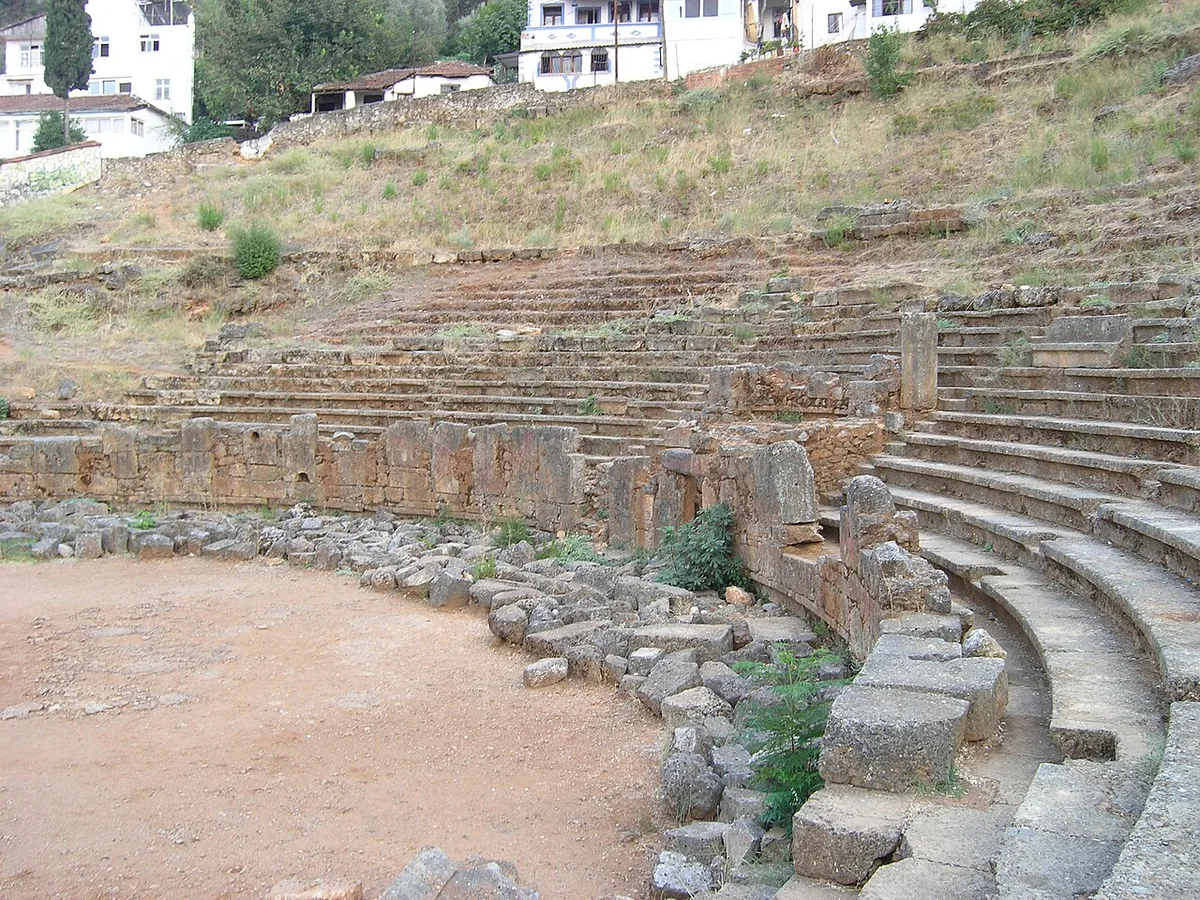
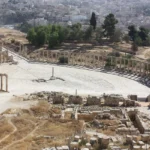
Down at sea level, behind the marina, the other half of Telmessos survives in a lower key. The ancient theatre stands a few steps from the harbour promenade, its semicircular rows of stone seating climbing the slope below the castle hill – Hellenistic in origin, rebuilt in Roman times, excavated and consolidated in recent decades, and now used the way Fethiye uses all its antiquities, as part of the furniture of the town. It is not a grand theatre by the standards of Ephesus or Aspendos, and this fethiye travel guide will not pretend otherwise. It is a neighbourhood theatre, and its charm is precisely that – antiquity at the scale of a morning coffee rather than a pilgrimage.
Above it, the hill carries the town’s medieval layer, a ruined fortress whose walls are generally credited to the age of the Knights of Rhodes, who held this coast’s islands and menaced its ports in the fifteenth century. Little stands but the outline of walls and a superb viewpoint, and the climb pairs naturally with the tombs on the opposite slope. Between theatre, castle and tombs, the town’s whole biography is walkable in a morning – Lycian port, Roman town, medieval stronghold – and then the modern chapter, which the earthquakes of April 1957 wrote brutally. The low, plain, grid-planned town centre of today is the rebuild, and Paspatur, the next sections’ subject, is where the pre-earthquake town survives in fragments.
Fethiye Museum and the Trilingual Stone
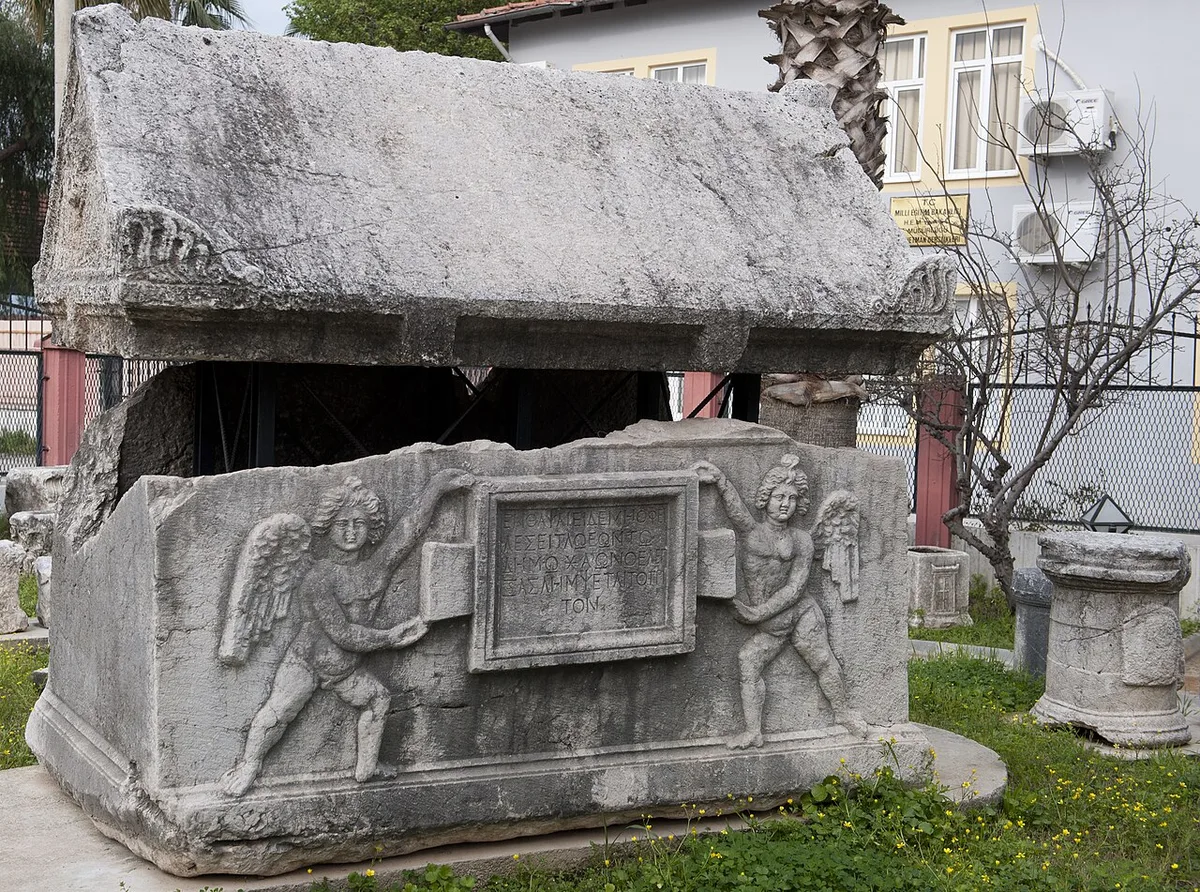
The finds from all of it – the tombs, Tlos, Letoon – gather in Fethiye Museum, a modest museum in the Kesikkapı quarter whose current building opened in 1987 and whose garden is a lapidary of sarcophagi and carved stone. The star object is a stone that matters far beyond this town. The Trilingual Inscription, found at Letoon in 1973, carries the same decree in Lycian, Greek and Aramaic on its three faces, and it was one of the keys that let scholars read the Lycian language at all – Lycia’s own small Rosetta Stone. Around it the halls run chronologically from the Bronze Age to the Ottomans, with the Izraza Monument, offerings to the rider-god Kakasbos, and statues from Tlos among the pieces that reward a slow half hour.
One honest caution belongs in any current fethiye travel guide, and it is this. Local reporting through 2024 described the old museum as closed while a move to new premises was prepared, and museum arrangements in Türkiye have been changing fast. The Ministry’s portal still lists the museum and its collection, and the portal – muze.gov.tr – is where the current position, and the current visiting arrangements for every site in this article, should be confirmed in the week you travel. If the museum is open, it is the best forty minutes of context the town offers, ideally before the day trips inland.
The Harbour, the Marina and Paspatur Old Town
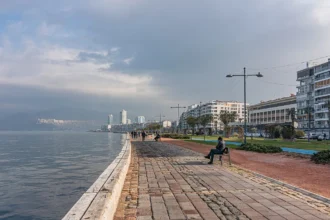
Fethiye’s waterfront is a long, civilised sweep – a promenade running from the marina past the theatre and the town square, then east along the bay through the lawns and playgrounds of Şehit Fethi Bey Park towards Çalış. The park is named for Tayyareci Fethi Bey, the aviator in whose honour Makri was renamed Fethiye in 1934. The promenade is where the town takes its evening constitution – families, fishermen, tea glasses, the whole population in motion as the light goes down over the gulf. It is the town’s living room.
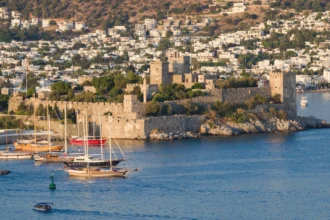
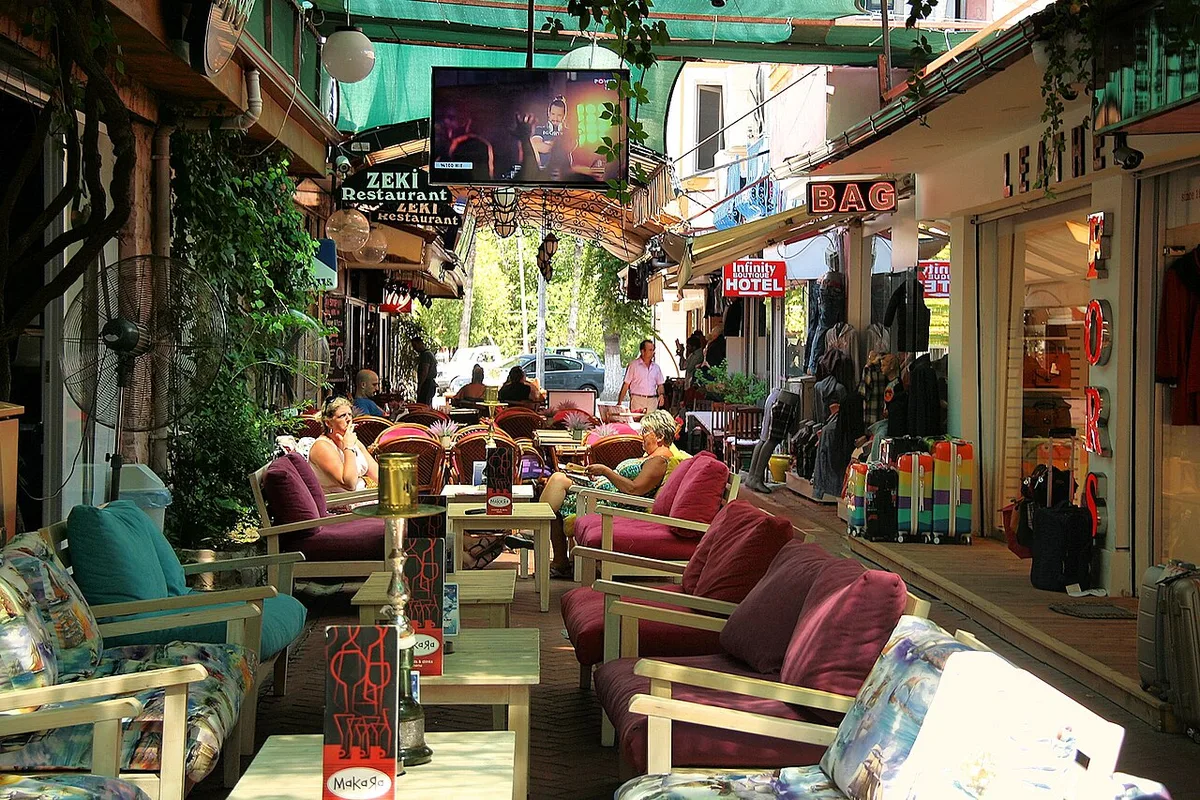
The marina end of the waterfront runs on money – a forest of masts, charter fleets, yacht brokers and the cafes that serve them, because Fethiye is one of the great natural harbours of the Turkish coast. Behind the harbour, the streets change key. Paspatur, the old town, is a tight grid of lanes around the Old Mosque and the old hamam, filled with carpet and leather shops, jewellers, barbers, cafes with cushions on the floor and a couple of venerable lokantas feeding the town. It is touristy in its front rows and genuinely local two streets back, and the honest way to enjoy it is to treat the carpet-shop tea as entertainment – the theatre of selling is an old Fethiye art, and nobody’s holiday was ever ruined by a polite no.
The practical point of the harbour is that it is the district’s transport interchange – the trip boats and the Rhodes catamaran sail from here in season, the water taxis cross to Çalış and Şövalye Island, the dolmuş terminus sits a few streets inland and the fish market is around the corner. A traveller based in the town has all of it on foot. A traveller based at the lagoon has a bus ride between them and every one of these things, which is the whole argument of this fethiye travel guide in miniature.
The Fish Market and Eating in Town
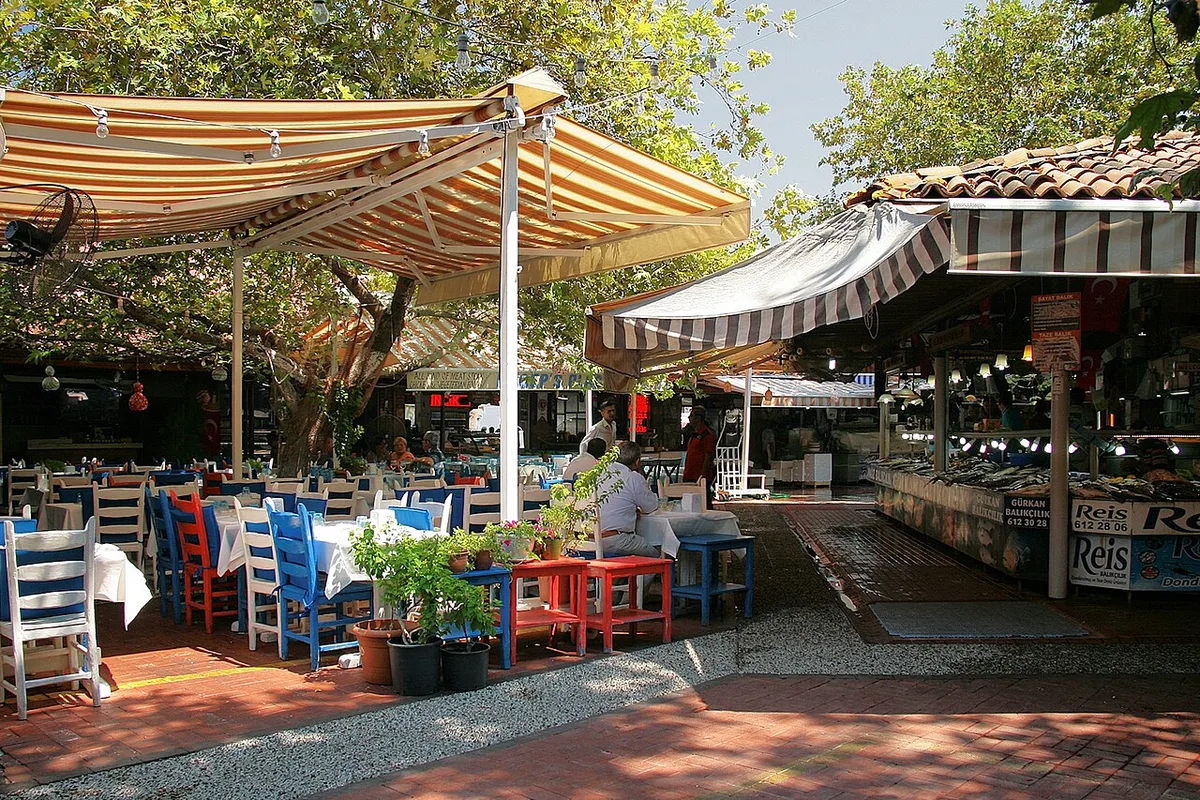
Fethiye’s fish market is the town’s best piece of food theatre, and it works on a mechanism every visitor should understand before sitting down. In the middle of a covered courtyard stand the fishmongers’ stalls, selling the day’s catch by weight. Around the courtyard stand the restaurants. You buy your fish – sea bream, sea bass, red mullet, prawns, calamari, whatever the boats brought – from a stall, pay the stallholder for the fish, and hand it to one of the surrounding restaurants, which cooks it for a charge and serves it with salad and bread. The fish is priced as fish, the cooking as a service, and the arrangement is older than the tourism around it.
It rewards a little strategy. Go at lunch, when the courtyard is full of Fethiye rather than full of tour groups. Look at the whole row of stalls before buying, and let the stallholder’s suggestion about what is best today carry weight – it is usually honest, because his customers are mostly repeat ones. Then eat slowly, because the courtyard at midday, shaded and smelling of charcoal and lemon, is one of the great cheap pleasures of the Turkish coast. Beyond the market, the town eats well in the unglamorous way provincial Türkiye eats well – pide shops, fish restaurants along the harbour road, and the lokantas of Paspatur serving the day’s trays to the town. Nobody needs a reservation list to eat well in Fethiye. They need to eat where the town eats.
The Tuesday Market
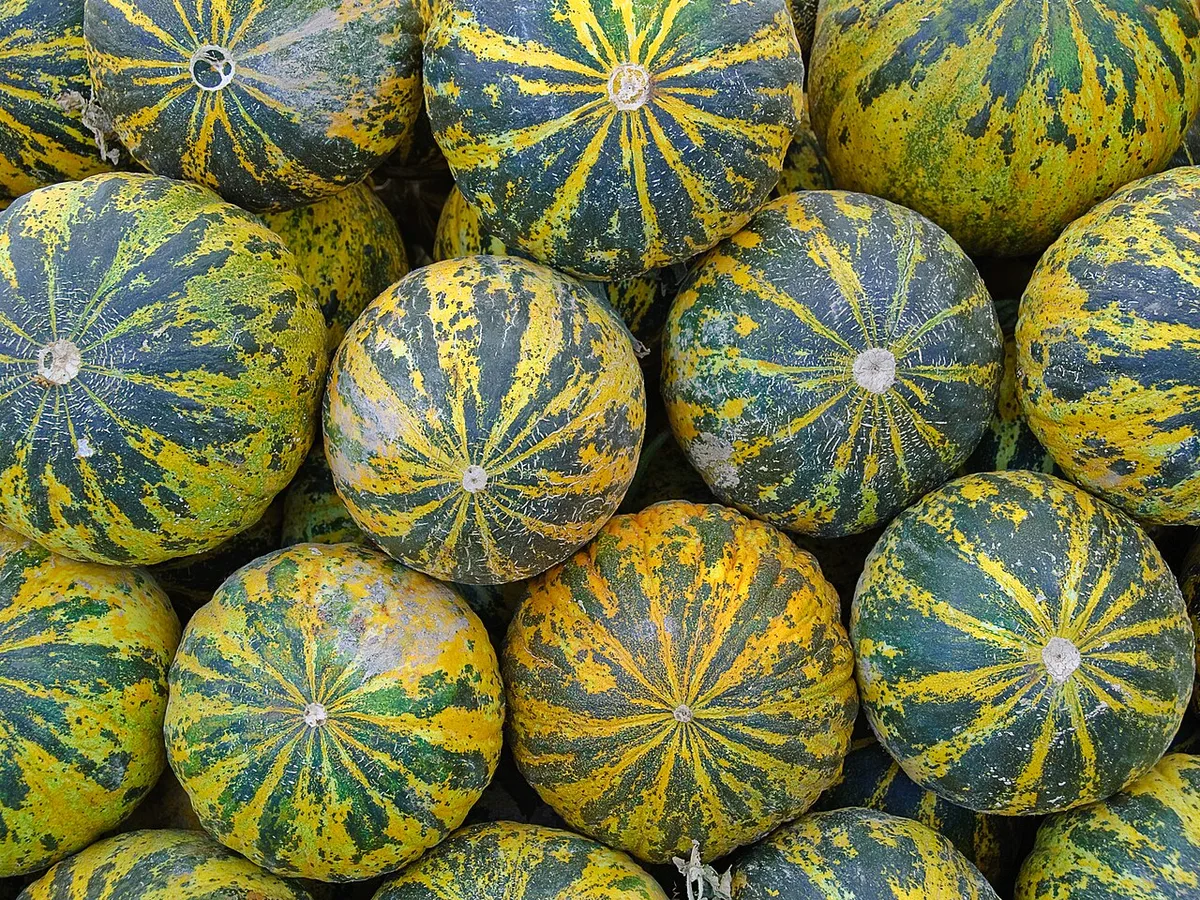
On Tuesdays, Fethiye holds one of the largest weekly markets on this coast, spread over the market ground and the streets around the canal, and for half a day the town’s centre of gravity shifts entirely. The market has two halves, and they serve two different populations. The produce half is the real one – stall after stall of whatever the villages of the Fethiye plain and the mountain valleys are harvesting, tomatoes and peppers in improbable volumes, melons stacked like ammunition, olives, cheeses, honey, dried figs, mountains of herbs, eggs, flowers, and the flat breads and gözleme that fuel the shopping. Prices are written on card, haggling is gentle at most, and this is where the town’s restaurants and grandmothers both do their weekly business.
The other half – clothes, shoes, bags, sunglasses, watches, household plastic in every colour – is aimed at visitors, and honesty requires describing it as it is. Much of it is replica branded goods of wildly variable quality, sold with good humour to buyers who mostly know exactly what it is. The patter is part of the day, the prices asked are opening positions, and the correct spirit is amused and unhurried. Travellers who hate markets will hate this half; those who enjoy the theatre will find it one of the funniest mornings of the holiday. Either way, the produce half justifies the visit on its own, and the combination is a genuine slice of how this town works – an agricultural market and a tourist bazaar sharing one ground, each largely ignoring the other.
Practicalities are simple. Go in the morning before the heat and the worst of the coach-party peak, carry small notes, and take a bag – you will buy more produce than you planned. A smaller farmers’ market runs on Fridays on much the same ground, produce-led and more local in feel, and between the two they bracket the week of any traveller based in the town.
Ölüdeniz and the Blue Lagoon
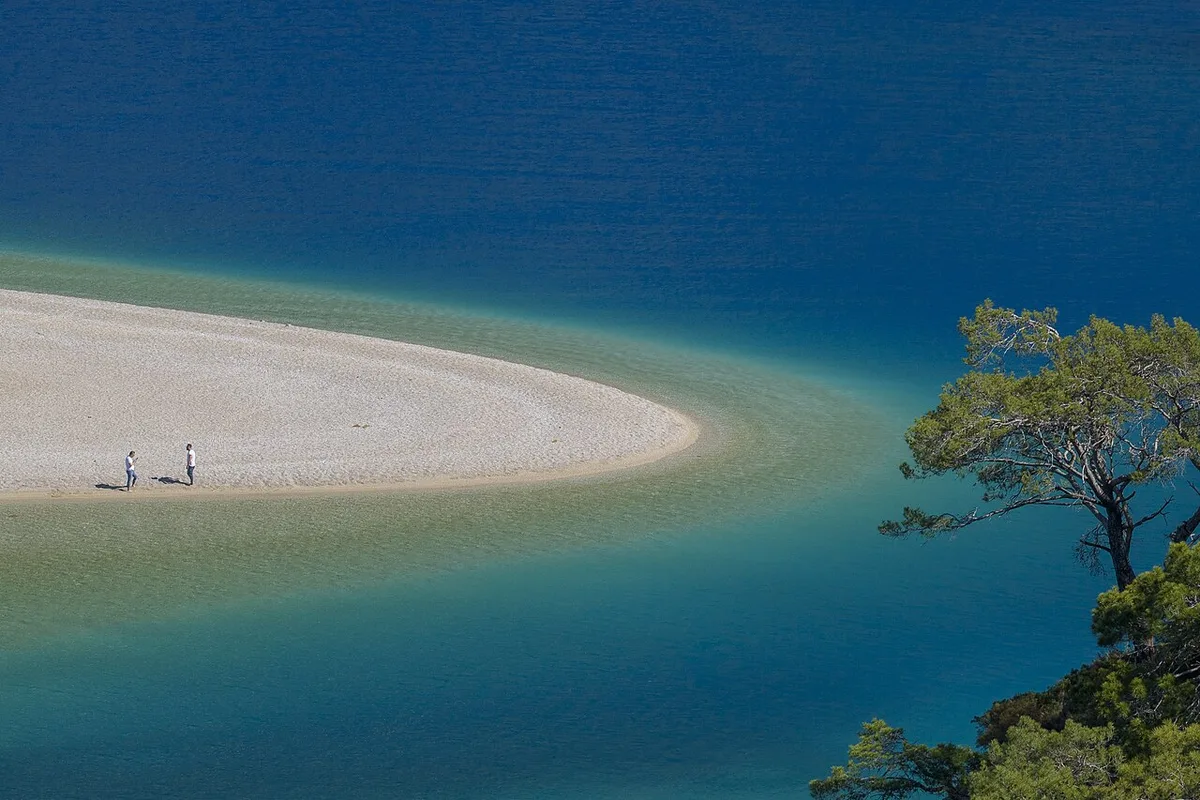
Fourteen kilometres south of the town, the road drops to Ölüdeniz, and the first thing to understand is that the name covers two beaches that behave completely differently. Belcekız is the beach you arrive at – a long, open strand of pale shingle and coarse sand facing the open sea, with the beach bars, the sunbed rows and the paraglider landing zone along its promenade. It is handsome, lively and entirely public. Behind it, curving away to the north, the sand spit of Kumburnu shelters the lagoon – the Blue Lagoon of the photographs, a body of still, pale-turquoise water cut off from the sea’s swell, where the swimming is calm enough for the least confident swimmer and the view back across to Babadağ is the one on the posters.
The lagoon is protected, and the protection has a name and a gate. It lies within the Ölüdeniz-Kıdrak Nature Park, a tabiat parkı administered under Türkiye’s nature conservation authority and first designated in 1983, and entry to the lagoon beach is through the park’s entrance, where a fee is charged per person and per vehicle on a tariff the park sets. Inside, the beach is run by concessions – rows of loungers and umbrellas for hire, cafes, kayaks and pedalos, showers and shade – and the far end of the spit, reached by walking the curl of sand, is quieter and prettier than the gate end. The water deserves its reputation. On a still morning it is glassy, warm and an almost unreal blue-green. It is also a shallow, enclosed lagoon at the centre of a major resort, and by a busy August afternoon it can cloud and smell faintly of sunscreen. Come early, walk the spit, and it is everything the photographs promised.
The village behind Belcekız is a purpose-built resort strip – hotels, bars, tour desks, a main street of restaurants – pleasant, efficient and almost entirely seasonal. The dolmuş run from Fethiye town is frequent in season and drops you at the beach. Kıdrak, the third beach of the nature park, lies a walk or a short ride beyond the lagoon – a pine-backed cove, quieter, locally loved, and the swim to choose when the lagoon is at full roar. Between the three, Ölüdeniz offers a beach for every tolerance of company. What it does not offer, in season, is solitude before ten in the morning anywhere except the far spit and the path to Kıdrak.
Paragliding from Babadağ
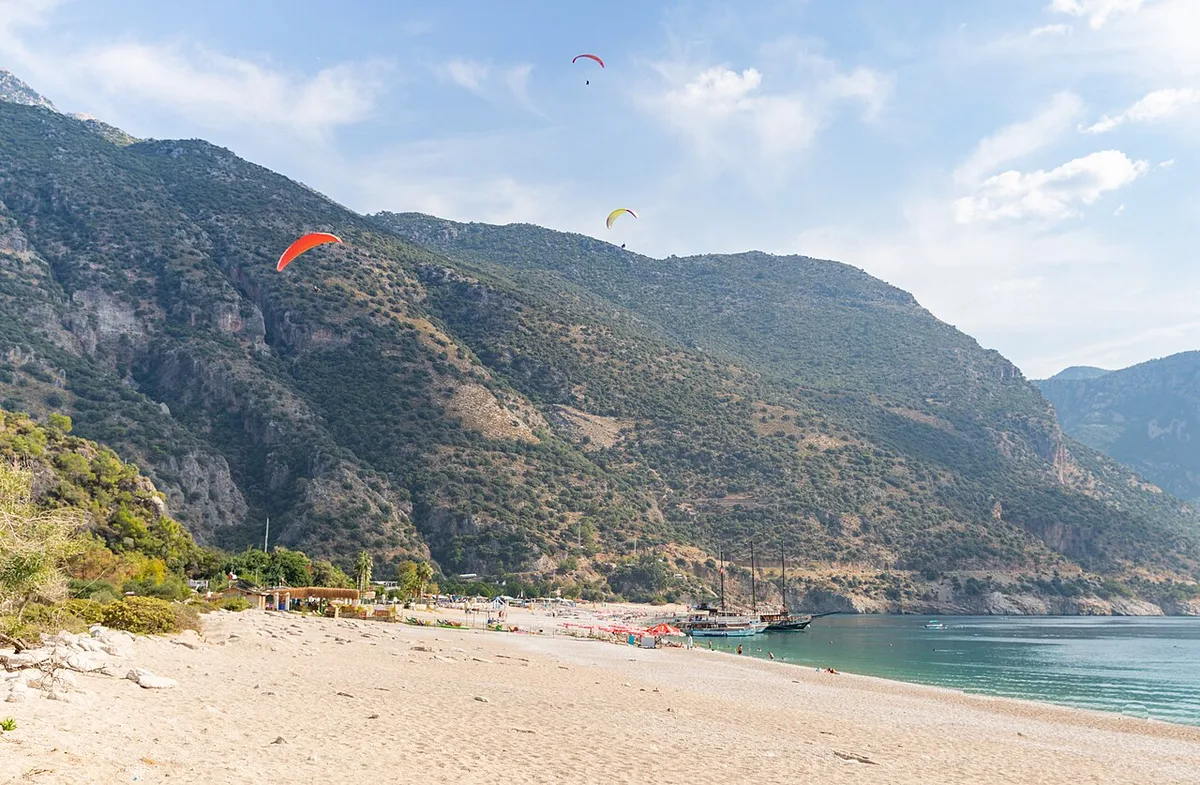
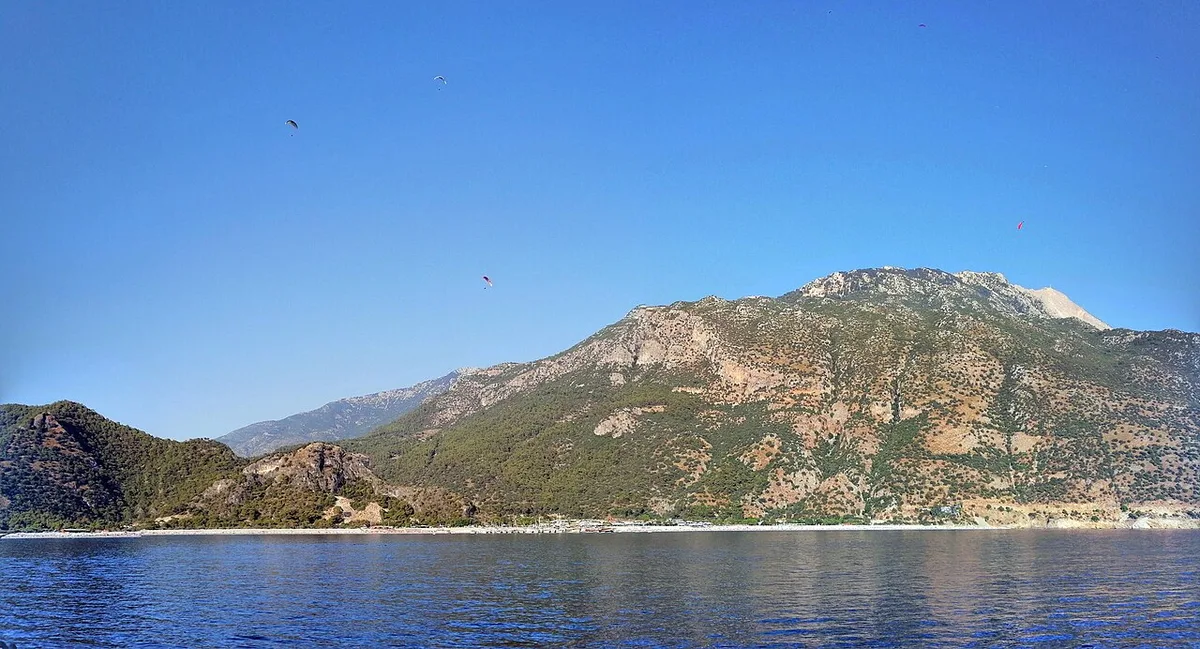
Every clear day at Ölüdeniz, the sky fills with wings. Babadağ – Father Mountain – rises to just under 2,000 metres directly behind the beach, and its height, its smooth sea-facing slopes and its reliable thermals have made it one of the world’s celebrated tandem paragliding sites. The mechanism is simple and worth understanding before you buy. Licensed companies take passengers up the mountain by road – a winding climb of three quarters of an hour or so – or, since 2021, partly by the Babadağ cable car. Launches use different levels of the mountain according to the wind, the main summer take-off at around 1,700 metres. You are harnessed in front of a licensed pilot, run a few steps off a carpeted slope, and the mountain simply removes itself. The flight down takes around half an hour in ordinary conditions.
What the brochures understate is the weather’s veto. Flights happen only when the wind and cloud say so, mornings are cancelled and afternoons postponed, and a booking is a hope with a refund policy rather than a promise – book early in your stay so a cancelled day can roll to the next. What they also understate is how much of the experience is the view rather than the adrenaline – the lagoon’s famous curl beneath you, the gulf’s islands scattered west, Butterfly Valley’s cleft in the cliffs to the south. Nervous passengers should know the standard flight is a gentle descent, not a stunt; aerobatics are an optional extra a pilot adds only if asked. Prices move with the season and the currency and no figure printed here would survive the summer, so this fethiye travel guide prints none. Compare two or three companies on the beach strip, check what the price includes – photos and video are usually the extra – and fly with the operator whose briefing you liked, not the tout whose patter you heard first.
For everyone else, the mountain still gives. The cable car carries non-flyers up for the panorama and the summit restaurant, and the evening ritual of watching the last wings spiral down into the sunset over Belcekız costs nothing at all.
Kayaköy, the Empty Village
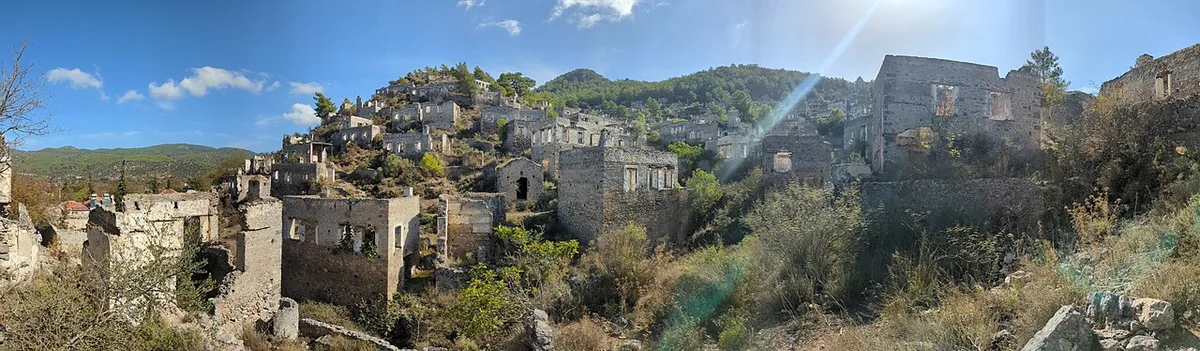
Eight kilometres south of Fethiye, on a hillside above a farming valley, stands the strangest sight in this district and, for many visitors, the most affecting one in all of Türkiye. Kayaköy is a town with nobody in it. Several hundred stone houses climb the slope in streets – two-storey houses, most of them small, each careful not to steal its neighbour’s light – together with schools, chapels, a great church at the top and another at the bottom, all roofless, all empty, all slowly returning to the hill. In the ancient world the site was Karmylassos. The town that stands is the Greek town of Levissi, built mostly in the eighteenth and nineteenth centuries by its Greek Orthodox inhabitants, and its emptiness has a date. In 1923, under the population exchange agreed between Türkiye and Greece at Lausanne, Levissi’s Greek residents were sent to Greece and the town was left to the weather. Muslim families exchanged into the valley largely declined to settle the hillside houses, and the 1957 earthquake finished what abandonment began. Louis de Bernières built his novel Birds Without Wings on a fictionalised version of this village.
Kayaköy is now a Ministry-run archaeological site – the ruins are entered through a ticket gate, and the Ministry’s museum portal carries the current arrangements. Walk it slowly and early. The upper church, the Taksiyarhis, stands at the settlement’s crown inside a court paved with black-and-white pebble mosaic. The lower church, Panayia Pirgiotissa, survived better for a poignant reason – it served as a mosque into the 1960s. Between them the streets run with the whole apparatus of a town – fountains, cisterns, schoolrooms, a square – and the silence is total in a way that photographs do not prepare you for. Allow two hours, carry water, and wear shoes for rough stone.
The living village below the ruins – modern Kaya, of pensions, cafes, art workshops and riding stables in the valley – makes the day easy, with lunch under the vines after the climb. From Kayaköy, paths drop south to Gemiler Bay and its island, and the old stone road over the hill back to Fethiye, now a waymarked walking route of a couple of hours, is one of the finest short walks in this guide – downhill through pines to the harbour, with the gulf opening ahead.
Butterfly Valley
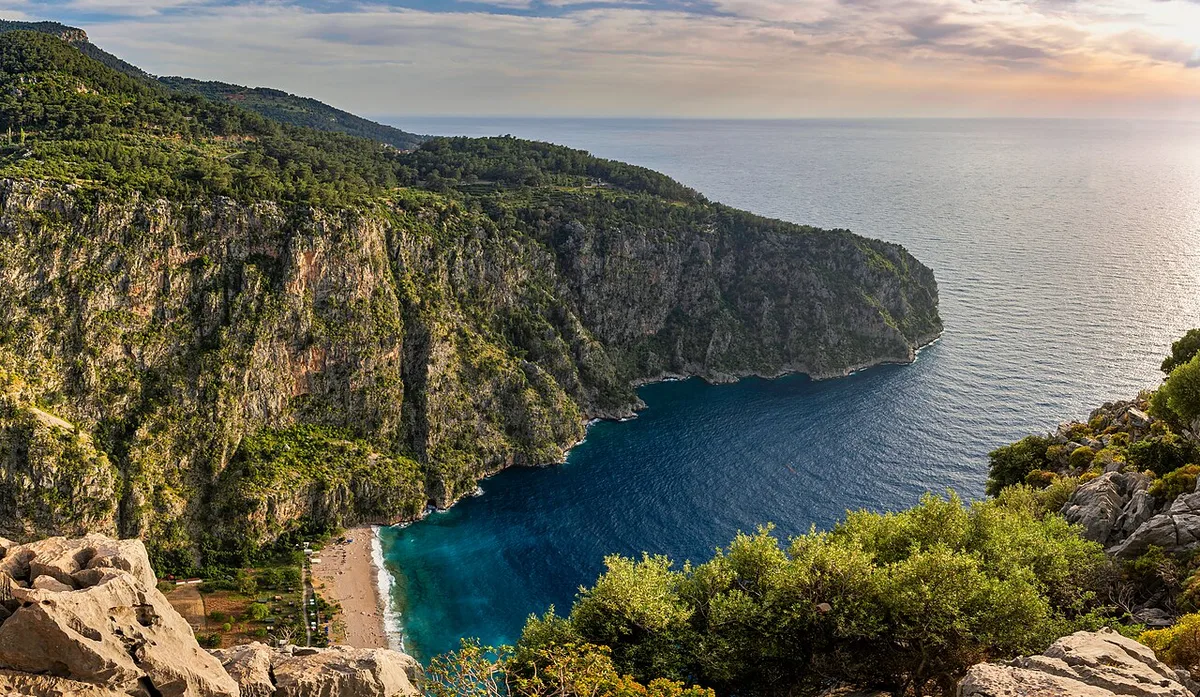
South of Ölüdeniz, the coast breaks into cliffs, and one cleft in them holds Butterfly Valley – Kelebekler Vadisi – a deep, green gash in the rock below the village of Faralya, opening to a narrow beach between cliffs that rise hundreds of metres on three sides. There is no road. The valley is reached by water – shuttle boats and water taxis from Ölüdeniz beach in season, and the 12 Islands and Ölüdeniz day boats that pause at its mouth – or on foot down a path from Faralya that this guide will describe honestly in a moment. The valley floor runs back through orchards and a small settlement of camps and gardens to a stream, and the stream leads to a waterfall at the valley’s head.
The name is earned, in season. The valley’s sheltered, watered greenery supports dozens of butterfly and moth species, the famous one being the Jersey tiger moth, whose cream-and-black wings crowd the shady rocks near the stream in the heat of summer. Sightings are a matter of month and luck – spring and early summer are the kinder seasons, and nobody should promise you a cloud of wings in August. What is guaranteed is the place itself, a coast the twentieth century forgot to develop. The waterfall walk is the valley’s small adventure – a roped scramble up the stream bed over wet rock, an hour or so there and back, in shoes that can get soaked.
Now the honesty. The path down from Faralya is not a walking trail in the Lycian Way sense, whatever the view from the top suggests. It is a steep, exposed descent with fixed ropes on the worst pitches, loose stone, and a record of serious accidents involving visitors who attempted it in beach footwear or by the wrong line. The Lycian Way itself passes along the cliff top through Faralya – it does not descend into the valley, and descending is a choice, not part of the trail. The boat is the valley’s natural door, the swim at its beach is lovely, the shade is real, and the day boats that call give you an hour or two, which is enough for the beach and the stream. Staying overnight in the valley’s simple camps is the only way to have it quiet. Arrive by water, and leave the cliff path to the sure-footed and properly shod.
Saklıkent Gorge
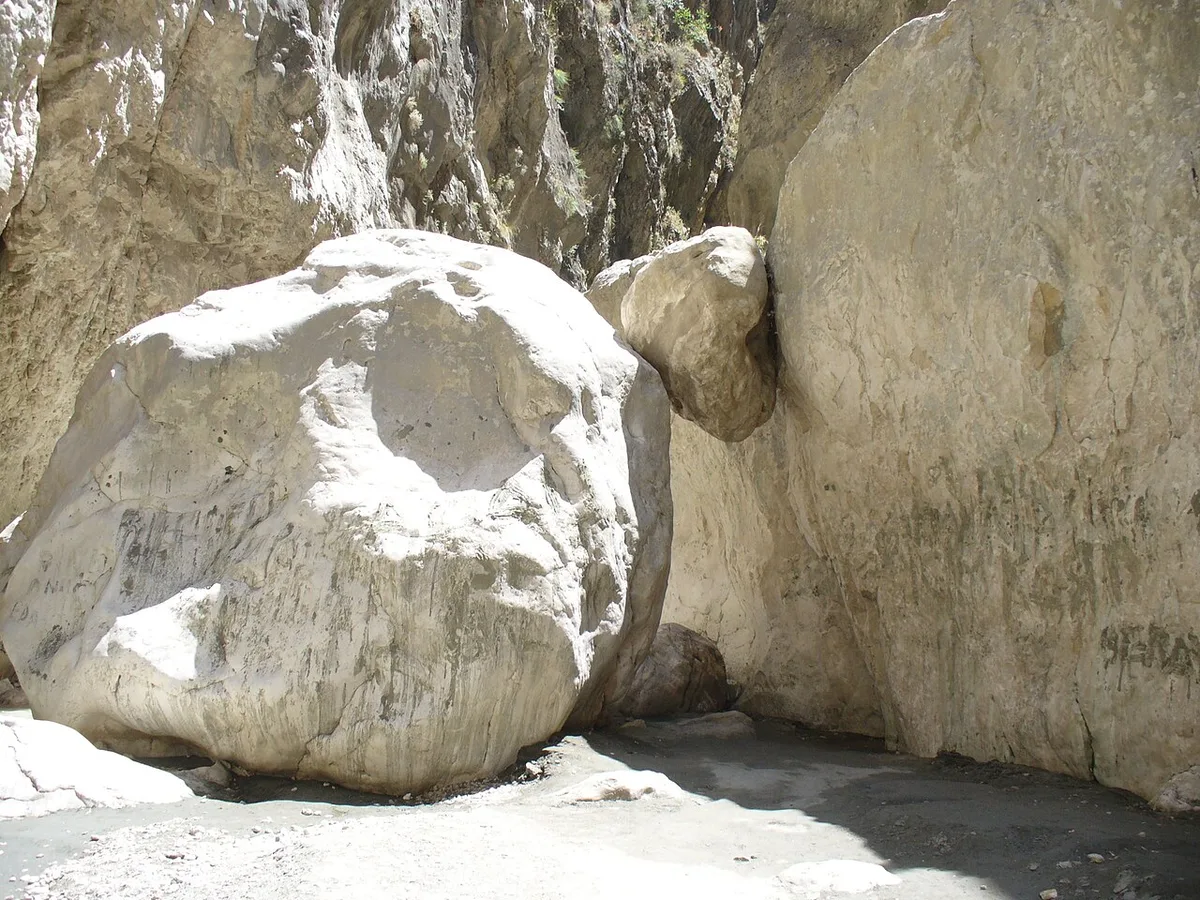
Fifty kilometres inland, the land does the opposite of the lagoon. Saklıkent – the Hidden City – is a gorge cut by the Karaçay stream into the foothills of the Akdağ range, roughly 18 kilometres long and up to 300 metres deep, protected since 1996 as Saklıkent National Park. The visit begins on a boardwalk fixed to the cliff above the river’s roar, where the gorge is a slot of shadow and spray, and continues – this is the part the photographs skip – on foot, in the river. Beyond the boardwalk the canyon floor is the stream itself, milky with limestone, numbingly cold in every month, and the walk upstream is a wade, a scramble and occasionally a swim, between walls so high that the sun reaches the floor for a few hours a day. In the settled summer season the first few kilometres are walkable by anyone with water shoes and a tolerance for cold; guides with helmets wait at the entrance for those going further, and in spring, when the snowmelt is up, the river closes the question itself.
The gorge was found late – local accounts credit a shepherd searching for a lost goat in the 1980s – and its discovery turned a shepherd’s shortcut into one of the region’s great day trips. The entrance area has grown the usual apparatus of a Turkish attraction – trout restaurants on platforms over the icy stream, rafting and tubing operators, ziplines – and the classic circuit sold everywhere in Fethiye works best. Tlos in the morning, a trout lunch, then the gorge in the afternoon when the light gets into it.
Go prepared and Saklıkent is magnificent; go in flip-flops with a phone in your hand and it is a bruising wade. Rent the plastic water shoes sold and hired everywhere at the entrance if yours are wrong, leave anything you cannot afford to drown, and respect the water absolutely – the river that carved 300 metres of rock is not a paddling pool, and the wardens close the canyon when it rises. The cold, by the way, is the point. On an August day when Fethiye is at 38 degrees, Saklıkent is the district’s air conditioning, and the shock of that green water is the sensation half of Fethiye has driven out for.
The 12 Islands by Boat
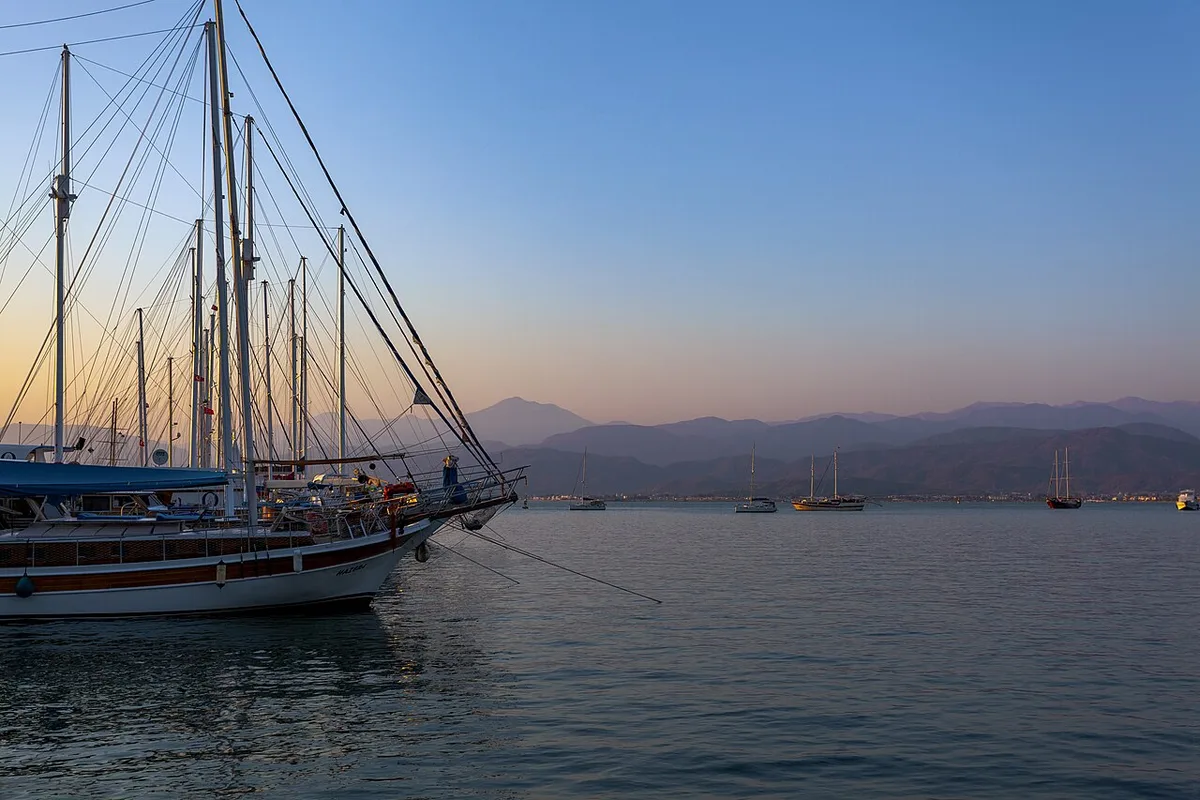
The gulf in front of Fethiye is scattered with islands – a dozen by the local count that gives the trip its name – and the boat day around them is the district’s other essential excursion. The mechanism is standardised and simple. In season, boats leave the harbour in Fethiye in the mid-morning and return in the early evening, having spent the day moving between swim stops in water of a clarity the mainland beaches cannot match. The fleet runs from large shared trip boats – music, a barbecue lunch cooked on board, a crowd of fellow travellers – through mid-sized boats run by the local boat cooperative and the harbour’s established operators, to private charters of every size up to the great wooden gulets. The price climbs steeply with privacy, and no figure is printed here because the spread is too wide to summarise honestly. Book at the harbour the evening before, look at the actual boat, and ask what is included – lunch, hotel pickup, and the drinks bill are the three variables that decide whether a cheap ticket was cheap.
The stops vary with the captain, the weather and the fleet, but the geography is constant. Yassıca Islands are the postcard – low, pine-covered islets joined by sand spits you can wade between, with shallows made for the day’s longest swim. Tersane Island, the largest in the gulf, carries the ruins of a settlement and the shipyard that gives it its name – tersane is the Turkish for shipyard – its broken stonework standing in olive scrub above a deep, sheltered anchorage. Şövalye Island, opposite the harbour, is the odd one out – inhabited, car-free, served by its own dolmuş boats all day, and close enough to be an evening out rather than a day trip. Beyond the islands the bay runs on to Göcek, the yachting town at the gulf’s head, whose cruising ground this is.
Choose the boat by temperament, because the day is long and the boat is the day. Families thrive on the big boats. Travellers who want quiet should pay for the smaller cooperative boats or charter a private one, go on a weekday, and ask for the early departure. The run home across the gulf in the late light, with the town turning gold, is the day’s best photograph – free with every ticket.
Gemiler Island and the Bay Below Kayaköy
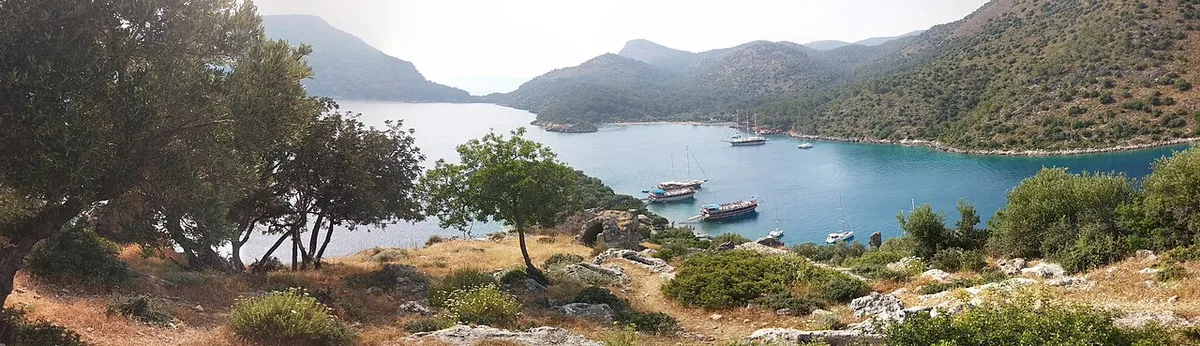
One island deserves its own paragraph. Gemiler Island, lying just off the bay below Kayaköy about 9 kilometres from Fethiye, was a place of pilgrimage in the Byzantine centuries – a religious settlement of the fifth to seventh centuries whose churches, chapels, cisterns and houses cover the little island. The great church on the summit and the covered processional way that climbs to it make the island a small, complete Byzantine town preserved by its own awkwardness, and it is a Ministry site like the others in this guide.
Boats from Gemiler Bay run visitors across in season, some 12 Islands itineraries call, and the bay itself – reached by the road through Kayaköy – is one of the district’s best swims, a pine-fringed cove with the island for a view. Pair it with the ghost village above it and you have one of the finest half days in the district – ruins of two different abandoned worlds, with lunch and a swim between them.
The Lycian Way from Ovacık
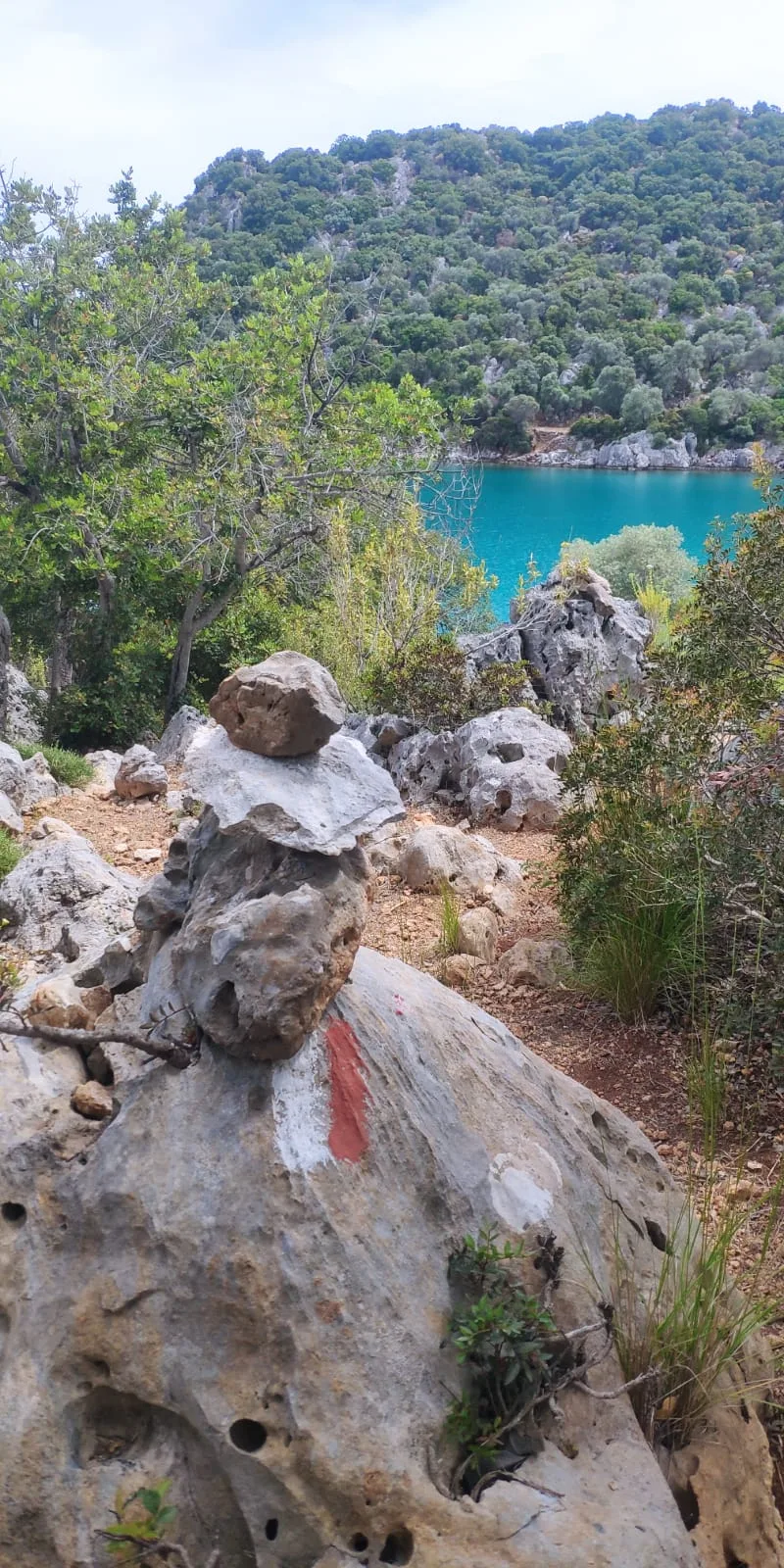
On the hill above Ölüdeniz, at Ovacık, a waymarked arch and a set of red-and-white painted blazes mark the start of one of the world’s great long walks. The Lycian Way runs from Fethiye to Antalya along the coast of ancient Lycia – roughly 540 kilometres of Roman roads, goat tracks, forest paths and village lanes, waymarked in the late 1990s and maintained by Türkiye’s Culture Routes Society. Its genius is that it strings the whole subject of this article into a single line – the tombs’ city, the ghost village’s hill, the sanctuary cities and a dozen beaches reachable only on foot. Nobody is asking you to walk all of it. The point for most Fethiye visitors is that its first stages are also the district’s best day walks, and they start a dolmuş ride from anywhere in this guide.
The opening stage, Ovacık to Faralya, is the classic. The path climbs from the trailhead around the shoulder of Babadağ, high above the lagoon – the view that sells the walk in every photograph – and works its way south along the cliff tops to Faralya, the village above Butterfly Valley, in around four hours of walking. It is stony, exposed to the sun and entirely magnificent, and in spring it runs through wildflowers at exactly the season the full-distance walkers set out. Shorter tastings exist. The old road from Fethiye over the hill to Kayaköy gives two hours of waymarked walking and a ghost village at the end.
Practicalities are those of any serious trail. Walk in spring or autumn – the summer stages are a heat punishment this coast does not forgive, and water sources dry up. Carry more water than the map suggests, follow the red-and-white blazes rather than a phone’s guess, and tell your hotel the plan. The full trail takes four to five weeks, sleeping in village pensions. For the day walker, one stage is enough to understand why people come from three continents to follow these paint marks – and to see the lagoon from the angle the paragliders get, at walking pace, for free.
Day Trips Inland – Tlos, Letoon and Xanthos
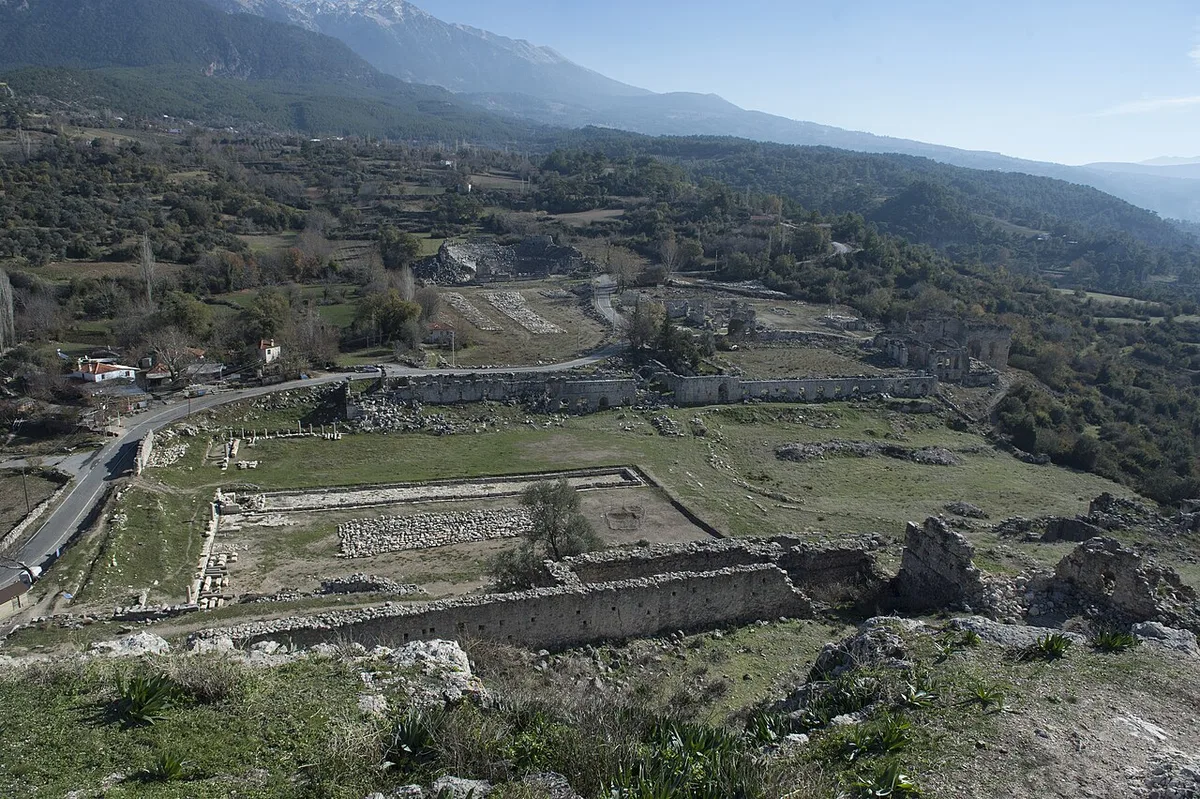
The coast gets the crowds, but Lycia’s heart was inland, in the valley of the Xanthos River – the modern Eşen – and an hour’s driving east of Fethiye puts three of its greatest cities within one day’s circuit. The road itself is part of the pleasure, climbing through pine forest and farmland into a green valley that feels like another province. Tours run the circuit daily in season, usually packaging Tlos with Saklıkent Gorge, and independent travellers with a hire car can do the same loop. The Tlos page of the Ministry’s museum portal carries the site’s current arrangements, as the portal does for every stop in this section.
Tlos, roughly 40 kilometres from Fethiye near the village of Yaka, is among the oldest and largest of the Lycian cities – one of the six great cities that held three votes in the Lycian League – and it is the most complete day out of the three. Its acropolis climbs a steep rocky hill crowned, in the way of this palimpsest of a region, by the small Ottoman fortress of Kanlı Ali Ağa, a local strongman who built his castle out of the ancient city in the nineteenth century. The acropolis slopes are honeycombed with house-like rock tombs, one of them – the so-called Bellerophon tomb – carrying a relief of the hero with his winged horse Pegasus, the myth the city claimed as its own. Below spreads the Roman city – a stadium, great baths, a basilica, a theatre – and around it all, the valley’s green floor and the white wall of the Akdağ range. Tlos has been on UNESCO’s Tentative List since 2009, and on a weekday morning you may have the stadium to yourself.
Letoon, the Sanctuary of the League
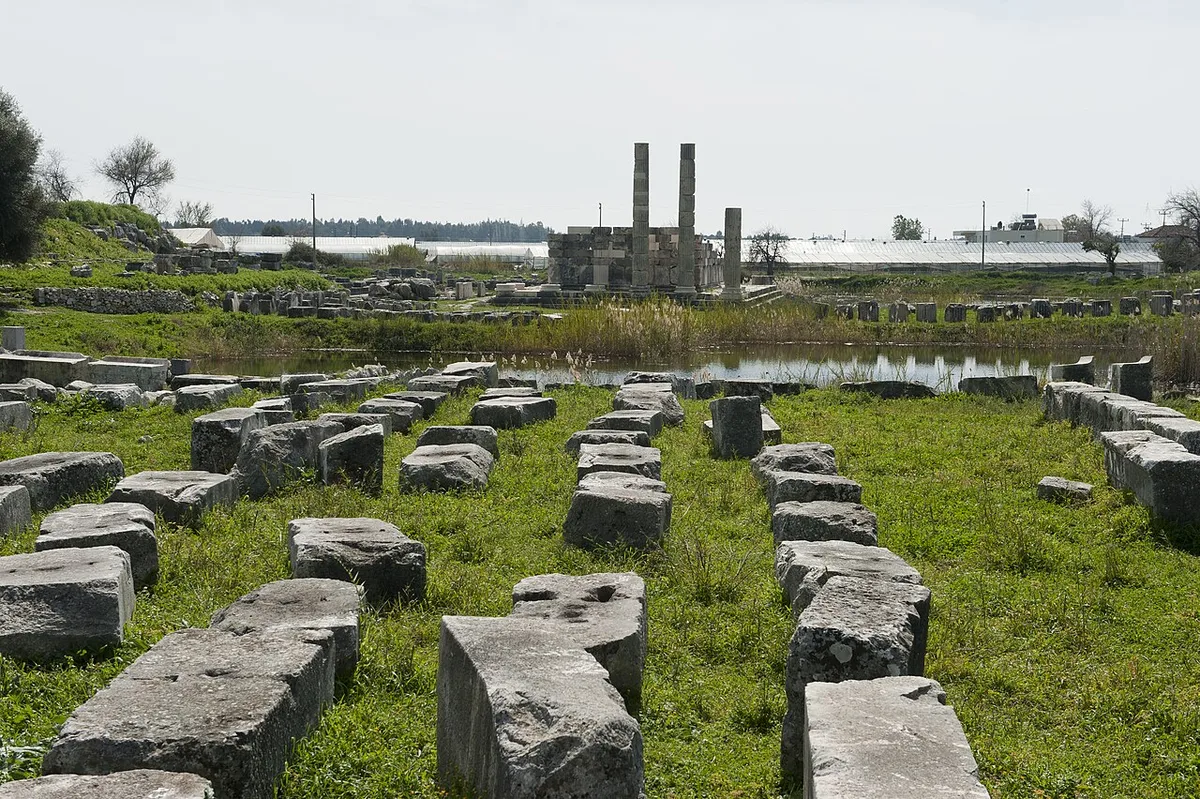
Letoon, near Kumluova at the valley’s southern end, was not a city but something rarer – the federal sanctuary of the whole Lycian League, the place where the league’s cities met, worshipped and published their decisions. Its heart is a row of three temples standing side by side, dedicated to Leto and her children Artemis and Apollo, their foundations and partly re-erected columns rising from a watery, reed-fringed hollow that floods prettily in spring. Beside them stand a nymphaeum built over the sacred spring, a Hellenistic theatre, and the remains of the porticoes where the league’s business was done. It was here, in 1973, that excavators found the Trilingual Inscription now in Fethiye Museum – the decree carved in Lycian, Greek and Aramaic that helped unlock the Lycian language.
Letoon pairs with Xanthos, a few kilometres away across the valley, and the pair were inscribed together on the UNESCO World Heritage List in 1988. The honest expectation to set is of atmosphere over spectacle. The temples stand at foundation and lower-column height, the site is small, and the greenhouses of the Kumluova plain press close around it. What Letoon offers is the rarest thing in classical archaeology – a federal sanctuary, the religious capital of a nation – in a hollow that still feels like a sanctuary. Give it an hour and let the quiet do the work.
Xanthos, the Capital
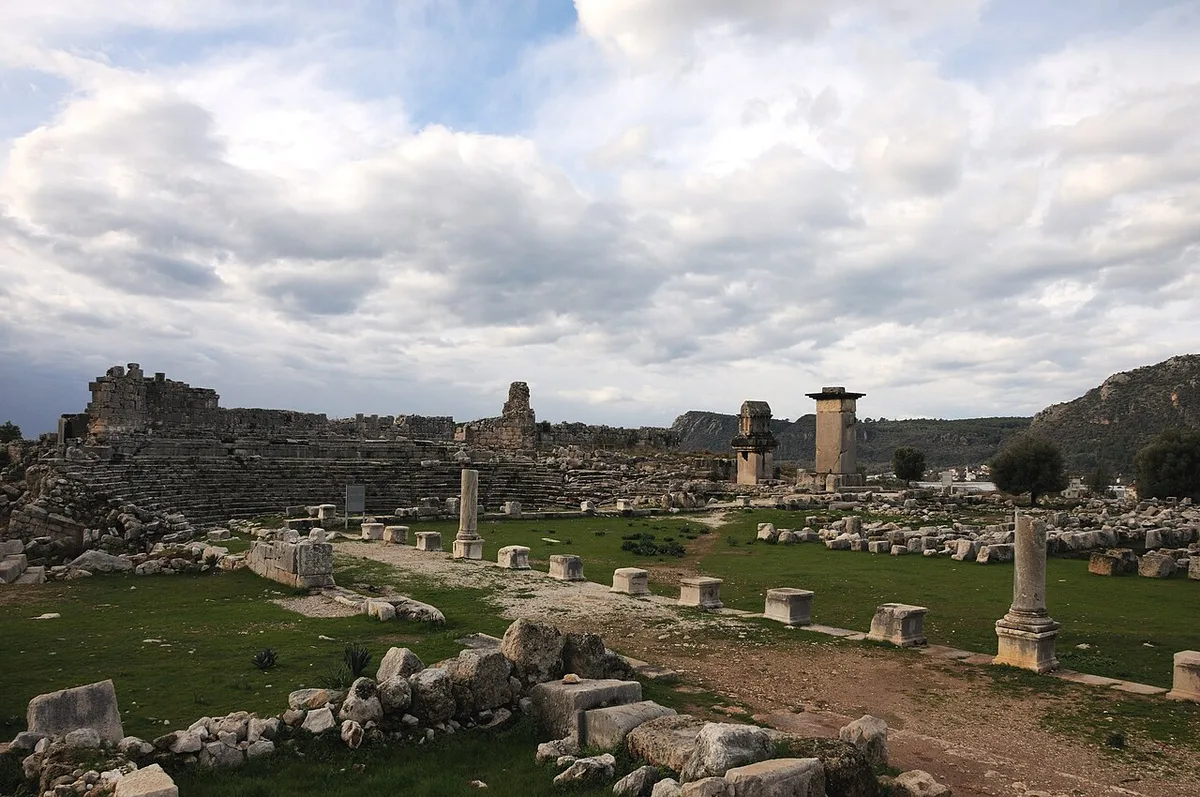
Xanthos, beside the modern village of Kınık above the Eşen River, was the capital of ancient Lycia and its greatest city, and its story is the Lycian story at full intensity – a wealthy, stubborn city that twice in its history, facing conquest, chose mass self-destruction over surrender, episodes Herodotus and later writers recorded with horrified respect. The site spreads over a broad hill in two zones – the old Lycian acropolis by the river and the Roman city beyond the gate – and its signature monuments are the tombs. Lycian pillar tombs rise on tall stepped bases, sarcophagi mounted on monoliths, and the theatre stands in good Roman order below them. The famous pieces are, in part, not here. In the nineteenth century the Nereid Monument, the Harpy Tomb’s reliefs and the Tomb of Payava were taken to the British Museum, where they remain the glory of its Lycian rooms – and knowing that sharpens rather than spoils the visit.
UNESCO’s inscription of Xanthos-Letoon in 1988, under criteria for its influence on the region’s architecture and its testimony to the Lycian civilisation, puts this quiet valley on the same list as the Göreme of our Cappadocia guide. It receives a fraction of Cappadocia’s visitors. Combine the three sites as one long day – Tlos in the morning, Letoon at midday, Xanthos in the afternoon when the pillar tombs catch the sun – and you have done the thing this fethiye travel guide exists to argue for. The valley is the district’s second destination, hiding in plain sight behind the beach.
Çalış Beach and the Sunset Shore
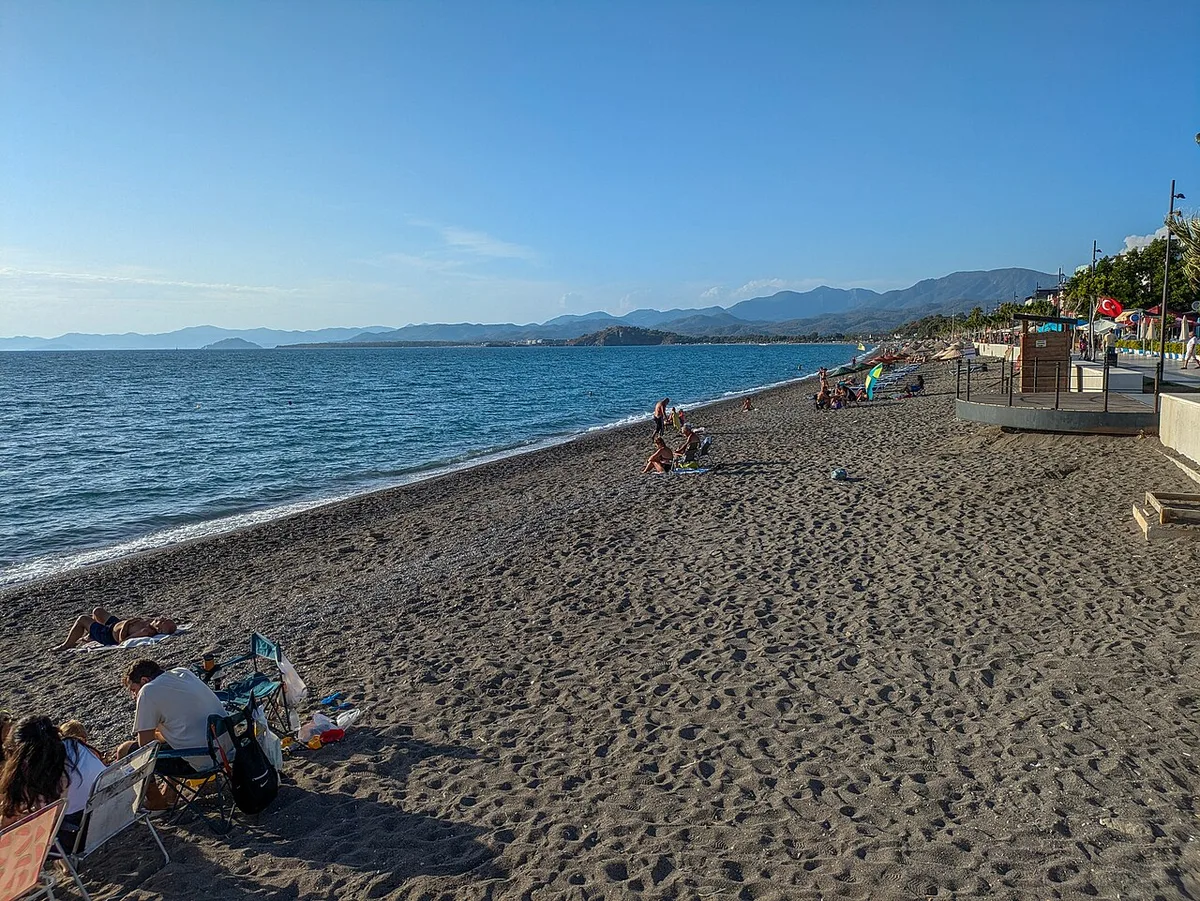
Across the bay from the harbour, a short ride or a water taxi away, Çalış is Fethiye’s other face – a long, straight, west-facing beach of dark sand and shingle running for some four kilometres along the gulf’s northern shore, backed by a promenade of restaurants, small hotels and apartments. Çalış does one thing supremely well, every clear evening. The sun sets over the water here, dropping between the gulf’s islands, and the whole promenade times its dinner to it. Of all the bases in this guide, Çalış is where the day’s best moment is free, nightly and visible from your table.
By day it is a gentler, more local resort than Ölüdeniz – a long shore with room on it, beach clubs and public stretches, a bird sanctuary in the reeds behind its northern end, and a population that mixes Turkish holidaymakers, a settled community of foreign residents and repeat visitors who have been coming for decades. The sea here is the open gulf, breezier and less glassy than the lagoon, and the afternoon wind that ruffles it is exactly what the kite-surfers at its far end are waiting for. The beach is also a nesting shore for loggerhead turtles in the summer months, part of the specially protected Fethiye coast, which is why the loungers are managed and the night beach is the turtles’.
Çalış is the base this fethiye travel guide recommends to travellers who want a beach at the door without the Ölüdeniz bubble – cheaper than the lagoon, quieter than the town’s bar streets, and connected to everything by the water taxi and the dolmuş. For sunsets alone, half the town crosses the bay in the evening to sit where Çalış residents sit every night.
Getting to Fethiye and Around the District
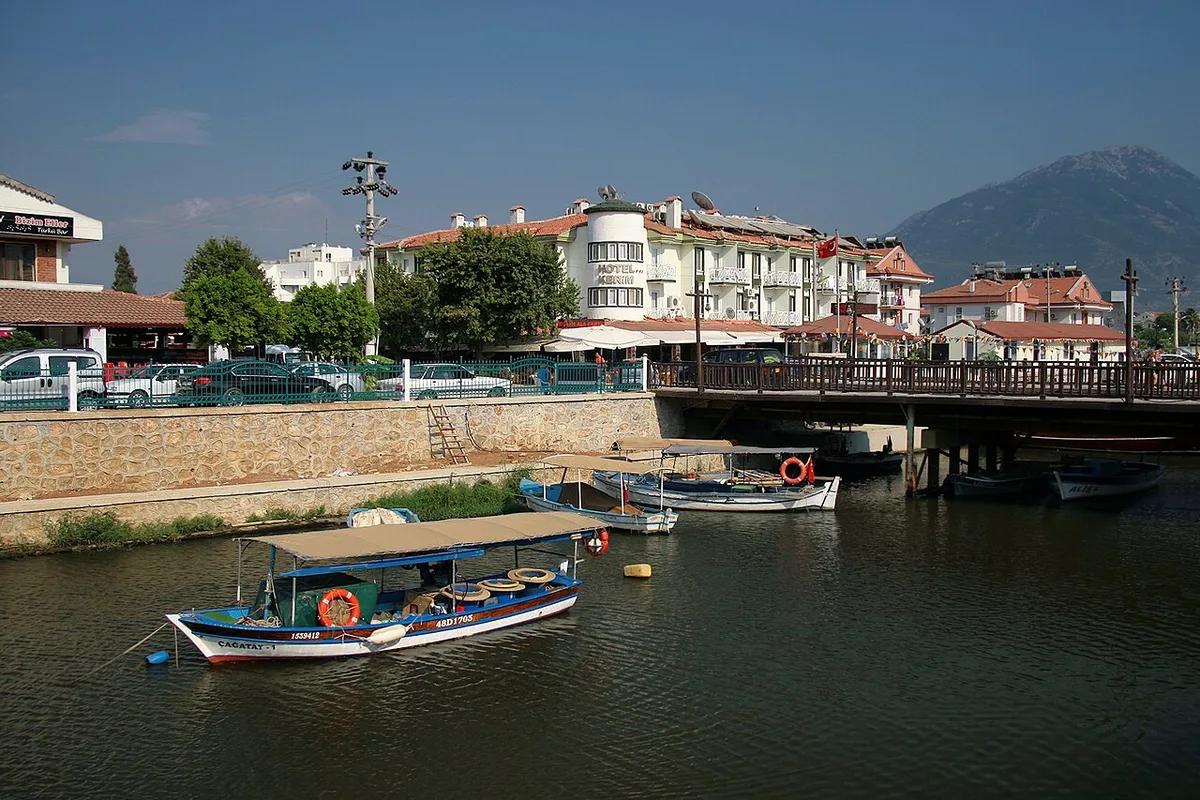
Fethiye’s gateway is Dalaman Airport, roughly an hour’s drive west, served by domestic flights from Istanbul year-round and by a dense web of summer services from the UK and Europe. The onward journey runs on the usual Turkish machinery, all of it reliable – airport shuttle buses timed to flights that drop at Fethiye’s otogar, the intercity bus station; shared and private transfers booked by every hotel; and taxis for those who value the door-to-door hour. The otogar itself is a hub worth knowing, with long-distance coaches to Antalya, İzmir and Istanbul, because Fethiye sits on the great coastal road. In season, fast catamarans also cross from the harbour to Rhodes, making a Greek island day possible without an airport – check the current season’s sailings and your own visa position before building plans on them.
Inside the district, the dolmuş is king. The covered minibuses run constantly in season on the routes that matter – town to Ölüdeniz via Hisarönü and Ovacık, town to Çalış, town to Kayaköy, town to the Saklıkent road as far as demand carries them – leaving from the terminus streets behind the harbour and from stops all over town, flagged down anywhere on route, paid in cash or by the local transport card. They are frequent enough that no timetable is needed. On the water, the Çalış water taxi crosses the bay from the canal bridge in season – the prettiest commute in the district and a small excursion in itself – and dolmuş boats serve Şövalye Island from the harbour. Taxis are plentiful and metered, hire cars are the key to the inland sites at your own pace, and the one transport truth every fethiye travel guide should repeat is this. Everything in this guide is within an hour of everything else, and the dolmuş network is why a town base works.
When to Go
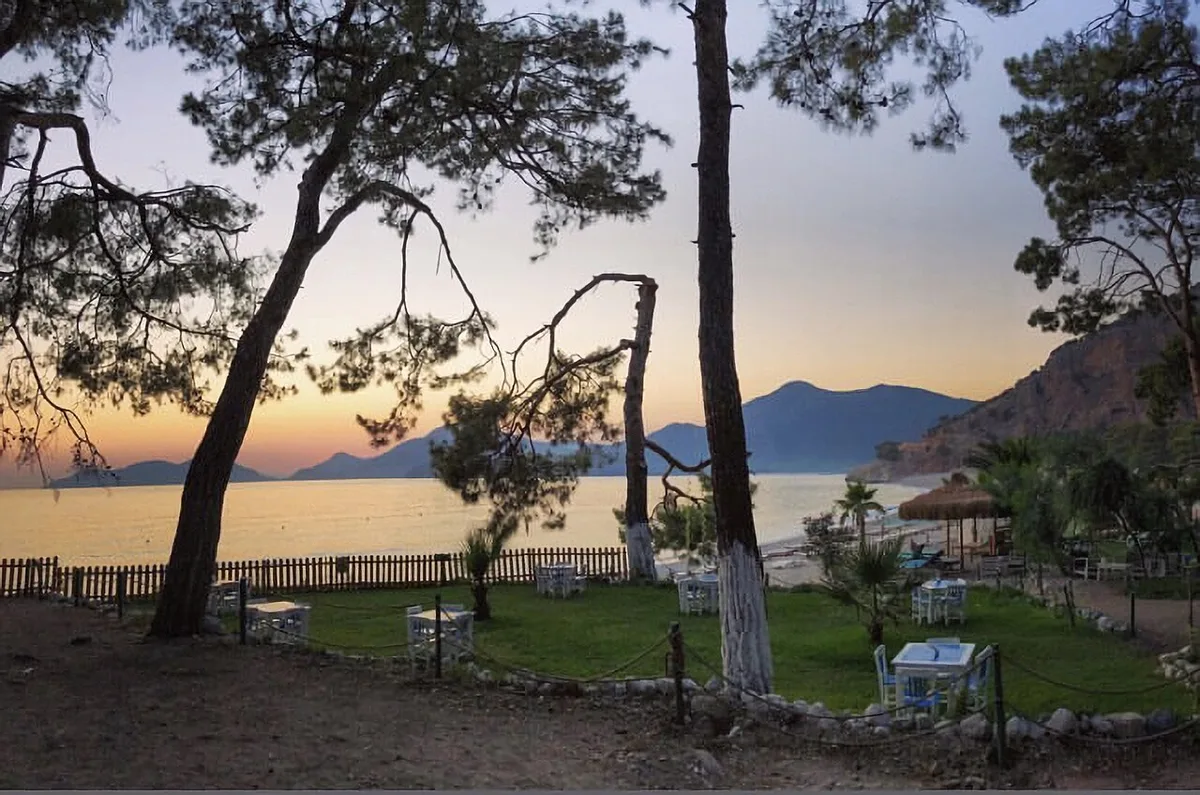
Fethiye’s season has a shape, and choosing your place in it matters more than choosing your hotel. Late April, May and June are the connoisseur’s months – the sea warming, the hillsides green and flowered, the Lycian Way at its best, the sites empty, the paragliding reliable and the town in its working clothes. September and October answer with the warmest sea of the year, the crowds gone and the walkers back on the trail. Between them, July and August are the full summer statement – air temperatures in the high thirties, the sea at bath heat, every boat full, every beach at capacity and the whole apparatus of Turkish domestic tourism added to the international crowd. It is the Fethiye of the posters and the Fethiye of the long lines, simultaneously, and the downsides section prices it honestly.
Winter is the district’s secret half. From November to April the town is a town – the market at full local strength, the fish market feeding Fethiye, the cafes full of residents – while Ölüdeniz closes down to a near-ghost of closed shutters and empty promenade, a melancholy sight that startles visitors who arrive expecting the resort. The weather is mild by northern standards and wet by local ones, the ancient sites are empty and magnificent, and prices fall to local levels. Walkers time the Lycian Way’s full length for the spring and autumn shoulders, because the summer stages punish and the winter ones rain. The single-sentence version is the one every fethiye travel guide should print – come in May, June, September or October if you can choose, and come in August only with your eyes open and your bookings made.
Where to Stay – Town, Lagoon, Çalış or the Hills
The base decision is the trip, so take it slowly. Fethiye town – the harbour, Karagözler and the streets behind Paspatur – is the base for the region rather than the beach. Its hotels run from family pensions to polished marina-front properties, every dolmuş and boat in this guide leaves from its streets, and eating well costs what it costs the town. Its single lack is the one already stated – there is no swimming beach in the town itself, and the nearest proper sand is a dolmuş ride away at Çalış or a longer one at the lagoon. Travellers who sightsee daily and swim opportunistically should sleep here and never regret it.
Ölüdeniz is the base for the beach itself – wake above Belcekız, walk to the lagoon gate, fly off the mountain, and let the resort strip feed you. It suits travellers whose holiday is the water, families who value the lagoon’s calm shallows for small children, and anyone who wants the paragliding on tap. Its prices are the district’s highest for what you get, its season is a hard May-to-October, and its evenings belong to the strip’s bars and restaurants rather than to any Turkish town. Hisarönü and Ovacık, on the ridge between town and lagoon, are its supporting villages – Hisarönü a lively, unapologetically British-facing bar and restaurant village, Ovacık quieter and villa-dotted and cooler at night, both on the dolmuş line and neither on a beach.
Çalış is the compromise this guide keeps recommending – a real beach at the door, sunsets over the water, the town ten minutes away by water taxi or dolmuş, and prices a step below the lagoon’s. Kayaköy and the valleys – pensions and small hotels around the living village below the ruins – suit walkers, riders and travellers who want the district’s quiet rural face, with a car or the dolmuş as a daily necessity. Choose by the holiday you actually want – the region, the beach, the sunset or the hills – because in Fethiye the base is not where you sleep. It is the trip you get.
The Honest Downsides
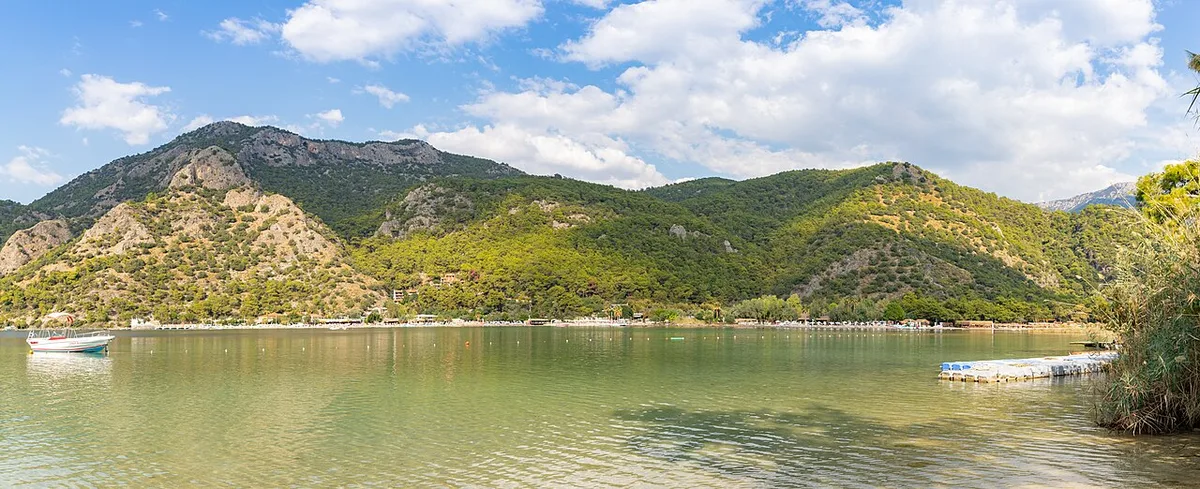
A fethiye travel guide that only sells the turquoise is a brochure, so here is the other ledger. The lagoon in August is the first item. The lines at the nature park gate build from mid-morning, the concession rows stand lounger-to-lounger by midday, everything inside the fence is charged for, and the famous water – shallow, enclosed, and hosting several thousand swimmers a day – can cloud and green by afternoon in a way the aerial photographs never show. It remains lovely at nine in the morning and at the far end of the spit; at two in the afternoon in mid-August, Belcekız’s open sea is the better swim, and Kıdrak better than both.
The heat is the second. July and August in Fethiye are fiercely hot by any standard, the rock tombs are a furnace climb at midday, the Lycian Way is effectively closed by common consent, and the district’s whole rhythm – sites at dawn, shade at noon, life after seven – is an adaptation the visitor ignores at their peril. Third, the geography tax. The town has no beach, the lagoon has no town, and the district’s pleasures are spread across an hour of dolmuş routes – Fethiye’s bargain is variety bought with motion. Fourth, the resort strip’s economy. Ölüdeniz and Hisarönü in season price for a captive international audience in a way the town pointedly does not, and travellers based up there who never eat in Fethiye pay the strip’s premium for the whole holiday.
Smaller items, plainly. Belcekız is shingle, not sand – swim shoes earn their packing space. The Tuesday market’s clothes half is a replica bazaar whose charms are theatre, not quality. Paragliding is weather’s hostage and cancellations bunch. The Ölüdeniz road jams on summer evenings. And the Fethiye Museum’s arrangements, as its section said, need checking before you cross town for it. None of this outweighs the tombs at dawn, the valley circuit, the boat day and the sunset shore. It is simply the shape of the place – a working town, a protected lagoon and a mountain, asking to be met on their own terms.
Frequently Asked Questions
Is Ölüdeniz a different place from Fethiye?
Yes – and the confusion is the district’s most common planning error. Ölüdeniz is a separate small resort about 14 kilometres south of Fethiye town, reached by a road over the ridge. Fethiye is the harbour town – the tombs, the markets, the boats. They share a district and a dolmuş route, and most good trips use both.
How many days do I need in Fethiye?
Three full days cover the shape – one for the town and the tombs, one for the lagoon and the mountain, one for a day trip. Five days lets you add both the inland circuit of Tlos, Letoon and Xanthos and the 12 Islands boat day, plus Kayaköy without rushing. A week is not too long.
Is the Blue Lagoon free to enter?
No. The lagoon beach lies inside the Ölüdeniz-Kıdrak Nature Park and is entered through the park gate on a tariff the park sets, charged per person and per vehicle, with loungers and umbrellas run as concessions on top. Belcekız, the open-sea beach, is the free alternative, and Kıdrak is the quieter one. This guide prints no figures, because park tariffs change; the gate is the source.
Can I walk into Butterfly Valley?
You can, and most people should not. The descent from Faralya is steep, exposed and roped in places, with a record of accidents, and it is not part of the Lycian Way. The valley’s easy door is the water – shuttle boats from Ölüdeniz beach in season and the day boats that call at its mouth.
Is the paragliding safe, and can I just turn up?
Tandem paragliding here is a licensed, long-established industry flying with trained pilots, and Babadağ is one of its world centres. But every flight is weather’s decision, cancellations and postponements are routine, and booking early in your stay – with a company whose briefing you trust, at a price whose inclusions you have checked – is the mechanism. Nobody should build their last day around a flight.
What is the best month to visit Fethiye?
May, June, September and October are the sweet spot – warm sea, kind air, emptier beaches. July and August bring heat and peak crowds. Winter is mild, wet and quiet, the town fully alive and Ölüdeniz largely closed – a good trip, but a different one.
Can I visit Kayaköy and Gemiler Island together?
Yes, and it is one of the district’s best half days. Walk the ghost village in the morning, drop down to Gemiler Bay for lunch and a swim, and take a boat across to the island’s Byzantine churches if they are running. The valley road from Fethiye passes Kayaköy on the way to the bay, so the geography does the planning for you.
Do I need a car for Tlos, Letoon and Xanthos?
No, but it helps. Organised day tours from Fethiye and Ölüdeniz run the circuit in season, usually with Saklıkent attached, and dolmuşes reach the valley towns for the patient. A hire car turns it into the district’s most flexible day, and the roads are good.
Is Fethiye a good base for the Lycian Way?
It is the start of it. The trail begins at Ovacık above Ölüdeniz, and the opening stages double as superb day walks from any base in this guide. Full-distance walkers start here in spring and autumn, and the Fethiye to Kayaköy path gives everyone else a two-hour taste.
The Short Version of This Fethiye Travel Guide
Base yourself by intent – the town for the region, Çalış for the sunset shore, Ölüdeniz for the lagoon at the door. Give the town a full day of its own. The Lycian tombs at dawn, the theatre by the harbour, Paspatur’s lanes, lunch inside the fish market’s mechanism, and the Tuesday market if the week aligns. Give the lagoon its morning – through the nature park gate early, down the spit, a swim before the crowds, and a tandem flight off Babadağ if the wind agrees. Then spend the days the brochures skip. Kayaköy’s silent streets, the boat into Butterfly Valley, the cold green shock of Saklıkent, a day among the 12 Islands, the Lycian Way’s first stage above the lagoon, and the valley circuit to Tlos, Letoon and Xanthos, an hour from the beach. Come in May, June, September or October if you can, and carry swim shoes and more water than you expect. The famous photograph is real – and it is the least of what is here.