Nine places in Morocco have been judged important not just to Morocco but to everyone, and they are not the nine most visitors would guess. There is no desert camp on the list, no blue city and no beach. Instead, the unesco world heritage sites in morocco are four great medinas, an imperial capital built by one sultan’s willpower, a Roman city preserved by its own abandonment, an earthen fortress village in the south, a Portuguese star fort on the Atlantic and a modern capital planned a century ago around the older city it refused to demolish. Between them they cover roughly two thousand years, from Roman mosaics to twentieth-century town planning, and they trace the whole argument of Moroccan history – that this country has always stood where Africa, Europe and the Islamic world trade ideas as well as goods.
Morocco ratified the World Heritage Convention in October 1975 and won its first inscription, the Medina of Fez, in 1981. All nine of its sites are cultural; Morocco has no natural or mixed site, which surprises travellers who arrive thinking of the Atlas and the Sahara. That absence is itself a clue to how the list works. A place is inscribed only after the state nominates it, expert bodies evaluate it, and the World Heritage Committee accepts that it holds what UNESCO calls outstanding universal value, expressed through one or more of ten criteria – masterpieces of human creativity, exchanges of influence between cultures, testimony to civilisations living or vanished, outstanding examples of a building type or a landscape, and associations with events and traditions of universal significance. When this guide says a medina was inscribed under criteria (ii) and (v), that shorthand is doing real work: it is the committee’s own compressed answer to the question of why this place, and no substitute, matters.
There is a discipline to reading the list that repays learning early. Inscription is not a tourism award, and it is not a permanent condition in any simple sense: each site is monitored, its state of conservation reported on, and its management judged against the promises made when it was listed. Several of Morocco’s nine carry standing warnings in their UNESCO files – about development pressure on the medinas, about earthen fabric decaying faster than it is repaired, about whole quarters of an inscribed port falling into ruin – and those warnings are part of the heritage, not footnotes to it. Where they change what a visitor will actually see, this guide says so.
This guide takes the nine in inscription order, and treats each the same way: what it is, why UNESCO inscribed it, what a visitor actually sees, who should prioritise it, and the honest catch that the brochures leave out. It then groups the nine into trips that can really be driven or ridden, deals separately with Morocco’s Tentative List – fourteen further places that are candidates, not World Heritage Sites, whatever some websites claim – and answers the questions travellers actually ask. The list itself is UNESCO’s, checked against the Morocco page of the World Heritage Centre on 1 November 2026; for routes and the wider shape of a first trip, it sits alongside our Morocco travel guide.
UNESCO World Heritage Sites in Morocco at a Glance – the Whole List on One Table
Read the table as a map before it is a ranking. The unesco world heritage sites in morocco cluster in the north and centre of the country, with one southern outlier, and that geography – not fame – is what should decide how many of them your trip can honestly hold.
| Site | Inscribed | Region | Go for | The honest catch |
|---|---|---|---|---|
| Medina of Fez | 1981 | Fez, north-central | The deepest living medieval city in the Arab-Muslim world | You will get lost; it is a working city, not a monument park |
| Medina of Marrakesh | 1985 | Marrakech, centre | The great monuments – Koutoubia, palaces, tombs, Jemaa el-Fnaa | The most visited medina in Morocco, with the hassle to match |
| Ksar of Ait-Ben-Haddou | 1987 | Ounila Valley, south | Earthen architecture at its most complete | Fragile mud-brick, a long way from everywhere, best at day’s edges |
| Historic City of Meknes | 1996 | Meknes, north-central | Moulay Ismail’s monumental imperial city | Overshadowed by Fez; some monuments in slow repair |
| Archaeological Site of Volubilis | 1997 | Zerhoun plain, north-central | Rome’s frontier city, mosaics in place | Exposed, shadeless and small – an hour or two, not a day |
| Medina of Tétouan | 1997 | Tétouan, far north | The most complete, least altered medina | The least visited of the nine; few travellers build a trip around it |
| Medina of Essaouira | 2001 | Atlantic coast | A planned 18th-century port town inside Vauban-style walls | Wind, always; the medina is small beside the ocean’s pull |
| Portuguese City of Mazagan | 2004 | El Jadida, Atlantic coast | A Renaissance star fort and its flooded cistern | A half-day stop, not a destination in itself |
| Rabat, Modern Capital and Historic City | 2012 | Rabat, Atlantic coast | A 20th-century capital layered over older quarters | Its value is urban and diffuse, not a single showpiece |
One pattern is worth seeing before the detail. Five of the nine are living cities, or quarters of living cities, whose residents did not move out when the plaque went up; two are ruins; one is a village largely emptied by the economics that inscription was meant to reverse; and one is a capital still doing its job. That mix is why the unesco world heritage sites in morocco reward travellers who read them as places first and honours second – and why the catches in the right-hand column are mostly about crowds, distance and weather rather than about quality.
Notice, too, what the criteria pattern tells you. The earliest inscriptions lean on the medinas as living traditional settlements; the archaeological and military sites trade on completeness and survival; and Rabat, the newest, is valued for an idea – that a modern capital could be planned as an act of conservation. Read the nine in inscription order and you are reading the World Heritage idea itself maturing, from monuments, to cities, to whole urban arguments. That is a longer story than any single site can tell, and it is the real reason the unesco world heritage sites in morocco work best as a set.
Medina of Fez – Inscribed 1981, the Oldest and the Deepest
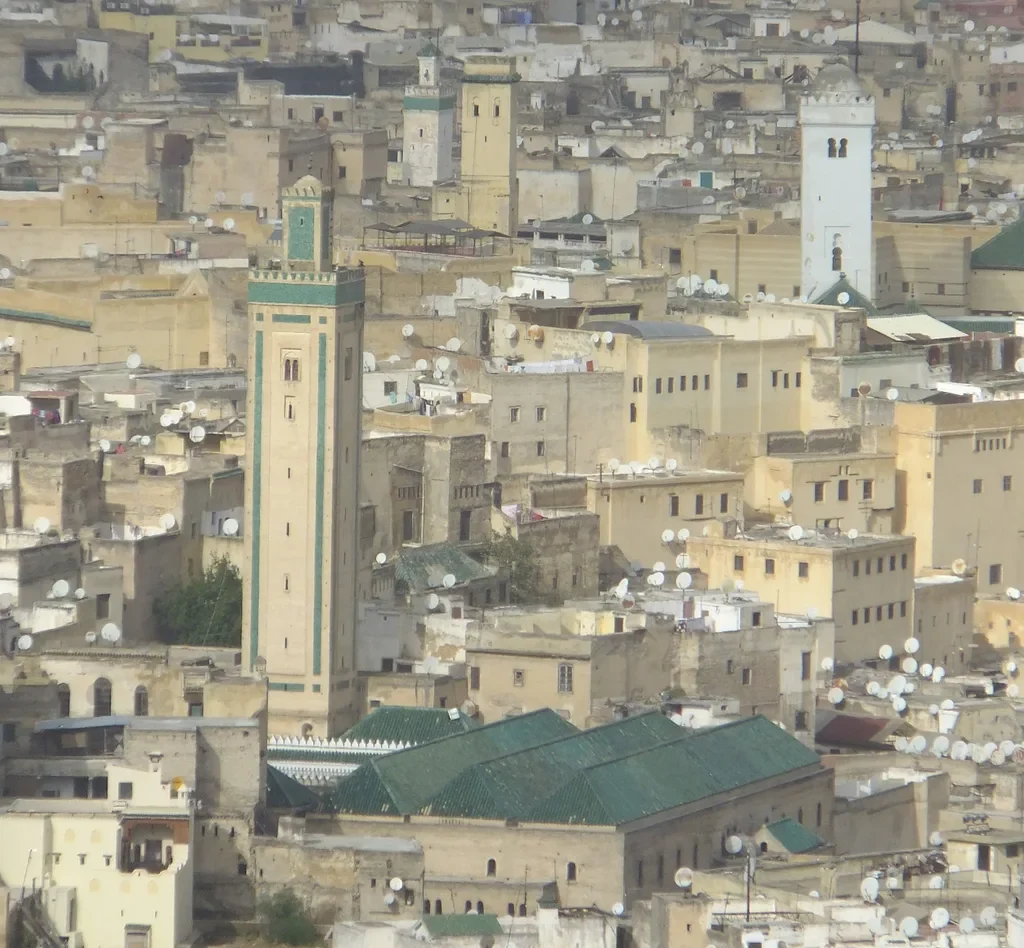
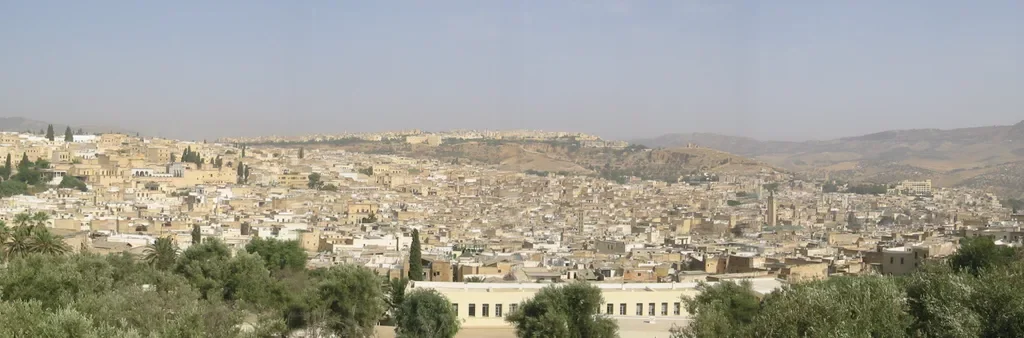
Fez was the first of the unesco world heritage sites in morocco, and it remains the benchmark the others are measured against. The capital founded by the Idrisid dynasty between 789 and 808 began as two fortified quarters on facing banks of the Fez river – one settled from Andalusia, one from Kairouan in modern Tunisia – and the Almoravids later united them inside a single rampart. Under the Almohads the old town, Fes el Bali, grew to roughly its present size, and in 1276 the Merinids added a second city beside it, Fes el Jadid, with the royal palace and the garrison. UNESCO inscribed the medina in 1981 under criteria (ii) and (v): for the influence this flourishing city exercised on architecture, monumental art and town planning across North Africa, Andalusia and sub-Saharan Africa between the twelfth and fifteenth centuries, and as an outstanding example of a medieval town founded in the first centuries of Morocco’s Islamisation, still occupied in the traditional way.
What a visitor actually sees is the largest and most complete living medina in the Arab-Muslim world, and the word living does the heavy lifting. This is not a preserved quarter with a city attached; it is a dense working city of lanes too narrow for cars, organised by trade – dyers near the river, metalworkers around their square, food stalls along the two great arteries that drop from the gates toward the Qarawiyyin mosque at the centre. Its monuments are woven into that working fabric rather than fenced off from it: the Bou Inania Madrasa with its carved plaster and cedar, the Nejjarine fondouk and fountain, the Al-Attarine Madrasa, and the Qarawiyyin itself, a mosque-university complex visitors admire from its doorways because entry is reserved for worshippers. Our separate Fes el Bali medina guide walks the lanes route by route; this page’s job is to place the medina on the national list, and on that list it is the site against which the phrase world heritage stops being abstract.
Two practical textures define a Fez visit. The first is the medina’s two poles: Fes el Bali, the ninth-century core around the Qarawiyyin, and Fes el Jadid, the thirteenth-century royal extension with the palace and the old Jewish quarter beside it – the inscribed property is the pair of them, and walking from one to the other is walking from the founder dynasty’s city to its great medieval remake. The second is the restoration economy you will see everywhere: scaffolding on a madrasa, a fondouk reopened as a craft centre, lanes being repaved quarter by quarter. UNESCO’s own file on Fez is blunt that new construction and heavy tourism press against the medina’s authenticity even as rehabilitation rescues its buildings, and both halves of that sentence are visible from any rooftop. Among the unesco world heritage sites in morocco, Fez is where conservation is not a department but a permanent condition of the city.
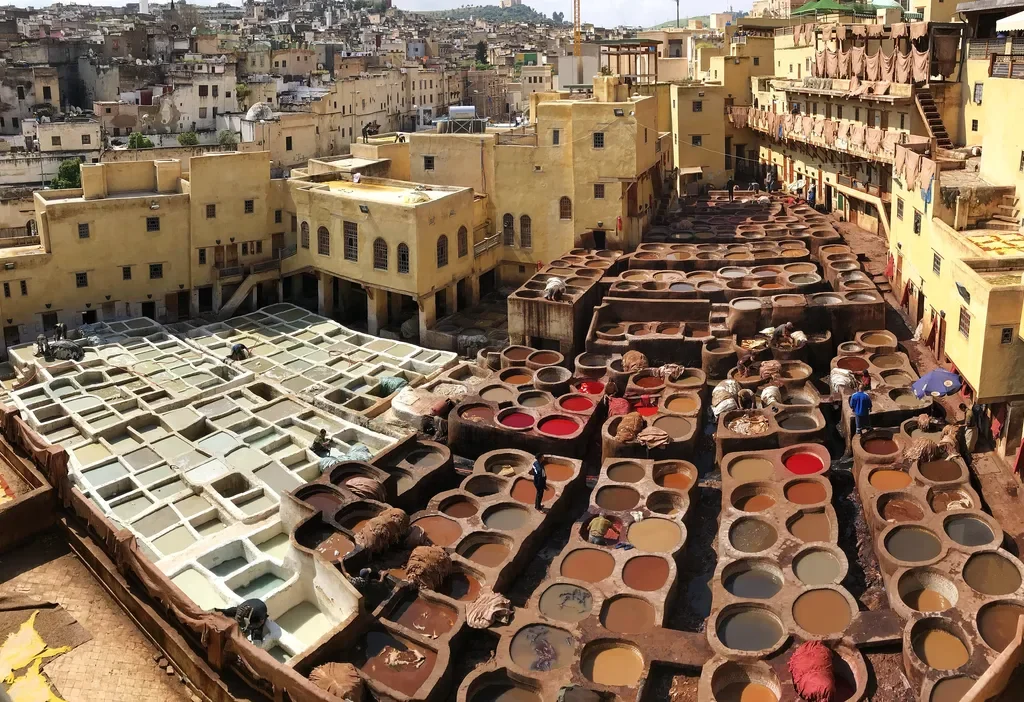
Who should prioritise Fez? Anyone who wants the single most substantial historic city in Morocco, and travellers who like their heritage inhabited rather than curated. The medina’s emblematic sight, the Chouara Tannery, is the perfect emblem of the whole inscription: a bowl of stone vats, white with lime at one end and jewel-coloured with dye at the other, watched from leather-shop terraces while men stand waist-deep in the pits doing a job their trade has done here for centuries. It is beautiful, it smells exactly as a tannery smells, and nobody has tidied it up for you. UNESCO’s own assessment notes the flip side with unusual candour: the medina’s fabric deteriorates, its lanes are over-populated, and houses threatened with collapse are a standing concern of the rehabilitation programme that works here permanently.
The honest catch is that Fez demands the most of any site on this list. You will get lost – the medina’s logic is water, slope and trade, not cartography – and the choice between hiring an official guide and surrendering to that lostness happily is the main decision of a Fez day. Of all the unesco world heritage sites in morocco, this is the one where a plaque tells you least about what you are standing in; give it two days if you can, and go in the morning, when the lanes belong to the people who work in them.
Medina of Marrakesh – Inscribed 1985, the Imperial Showpiece
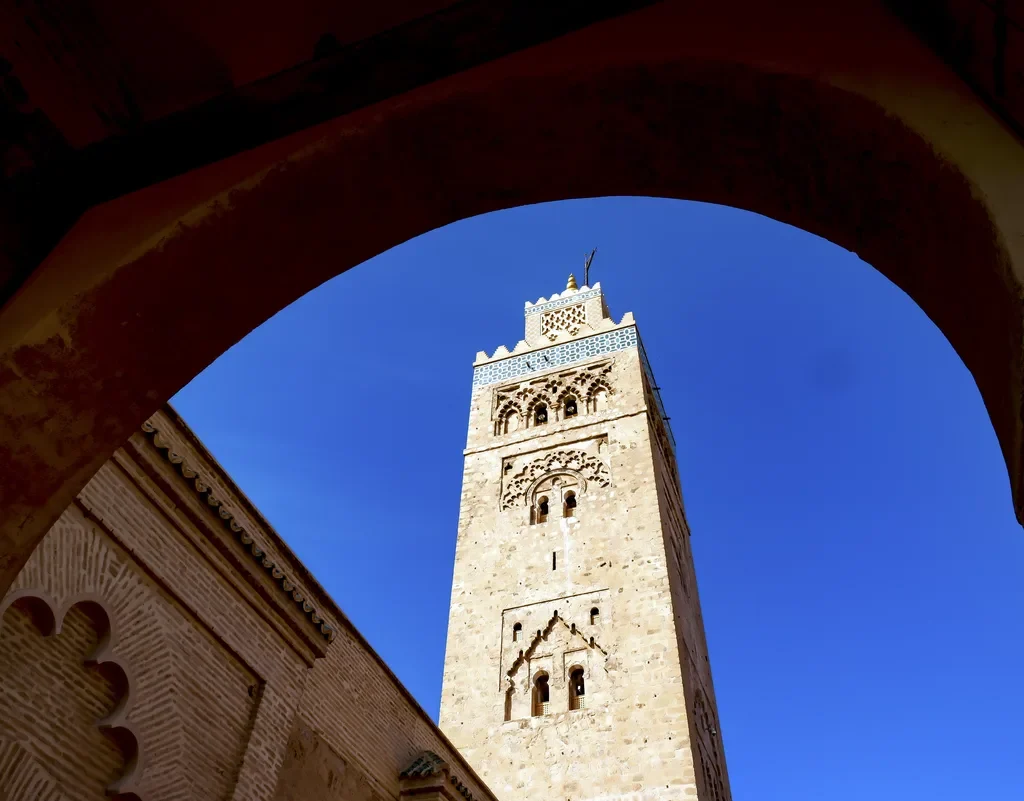
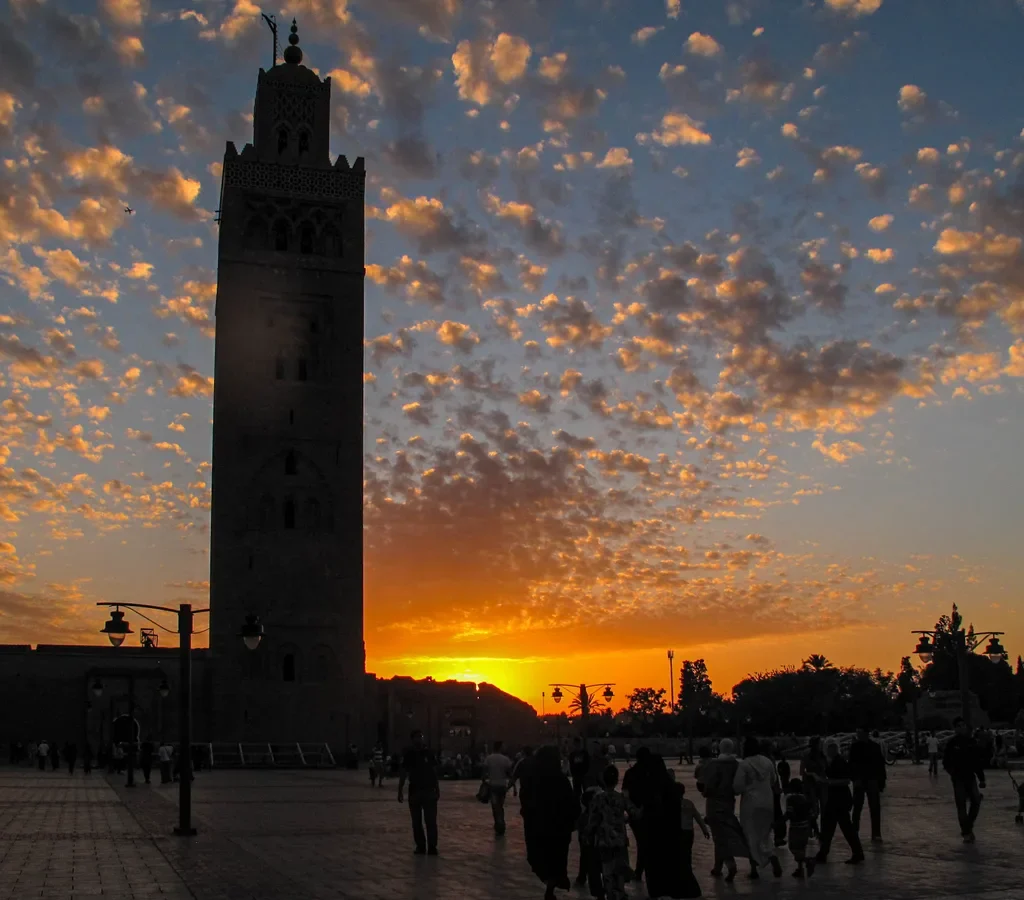
If Fez is the deepest of the unesco world heritage sites in morocco, Marrakesh is the grandest. Founded in 1070-71 by the Almoravids and built on the Haouz plain beneath the High Atlas, the city spent two golden ages – Almoravid, then Almohad – as capital of an empire reaching into Spain, and UNESCO inscribed its medina in 1985 under four criteria, (i), (ii), (iv) and (v), the widest spread on the Moroccan list. The framing is accumulation: founded by one dynasty and aggrandised by the next, Marrakesh preserves an impressive series of masterpieces rather than a single one, the product of successive sovereigns each endowing the capital afresh, and its medina remains an outstanding example of a living historic Islamic town. The Koutoubia Mosque and its 77-metre minaret are the city’s fixed point, visible from almost everywhere in the medina and copied, in spirit, across the Maghreb.
The density is the point. UNESCO’s description of the medina reads almost like an inventory of endowments – mosques and madrasas, the kasbah, the royal palace quarter, hammams, fondouks, monumental gates and fortifications, and the gardens that made a city on a dry plain famous for green: the Agdal’s vast orchard and reservoir, the Menara’s pavilion above its water, the Palmeraie beyond the walls. Most old cities have some of these; Marrakesh was endowed afresh by dynasty after dynasty with all of them, and the inscription honours that completeness – a capital equipped, across five centuries, with everything an Islamic imperial city was supposed to contain.
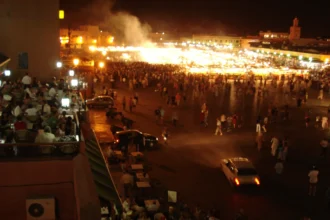
What a visitor sees divides into monuments and atmosphere, and Marrakesh deals generously in both. The monuments are the strongest single collection on the list: the Koutoubia’s minaret; the kasbah quarter with the Saadian Tombs, their carved cedar and Carrara marble hidden for centuries behind a sealed wall; the ruined El Badi Palace, a sixteenth-century shell of vast courtyards and sunken gardens; the Ben Youssef Madrasa, the medina’s great theological college; and the Bahia Palace, a nineteenth-century minister’s residence of painted cedar and courtyard after courtyard. Around them lies the 700-hectare medina itself – ramparts, royal gates, the souks’ covered lanes, the palm grove beyond the walls and the Agdal and Menara gardens, planted by the city’s early dynasties and still working landscapes rather than parks. And at the centre of everything, Jemaa el-Fnaa, the square that turns from orange-juice stalls by day into an open-air theatre of food stalls, storytellers and musicians by night; UNESCO lists the square separately on its Intangible Cultural Heritage list, which is the organisation’s way of saying the performance matters as much as the place.
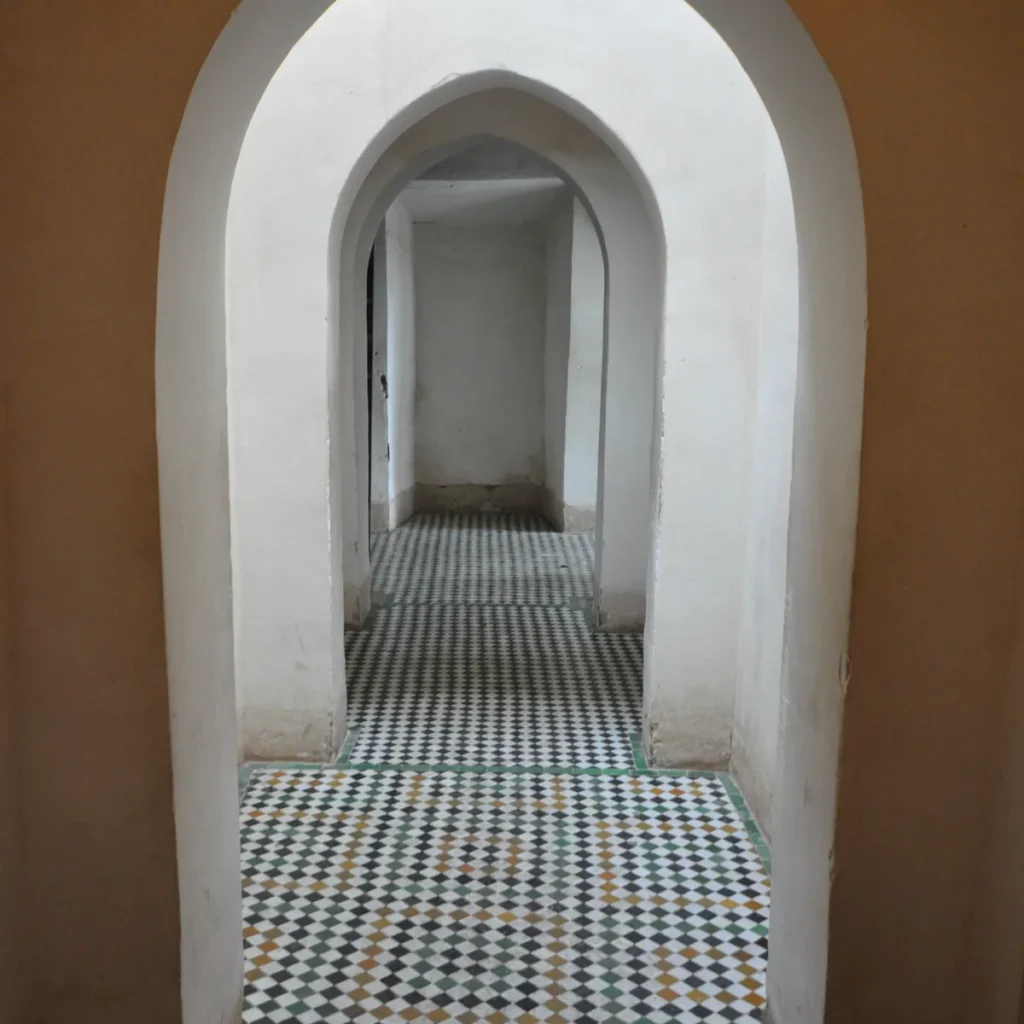
Who should prioritise it? First-time visitors, because Marrakesh concentrates more major monuments into one walkable medina than any other Moroccan city, and because its pleasures are not only architectural – this is the best of the nine sites for travellers who want their heritage with dinner afterwards. The wider things to do in Marrakech list spreads the days out; the heritage core described here fills two full ones comfortably. The honest catch is popularity, in every sense. Marrakesh is Morocco’s most visited city, its famous square is a managed chaos of touts and stallholders that some travellers love and some endure, and the medina’s very success means the showpiece monuments run busy in season while Fez, four hours north, feels like a different century. Of all the unesco world heritage sites in morocco, this is the one where booking nothing, arriving early and keeping your sense of humour are practical heritage skills, not lifestyle tips. UNESCO’s file carries the same caution it applies to Fez – rapid urbanisation and tourism growth press on the medina’s fabric and its way of life – which is one reason the newest big hotels cluster in the modern city while the old town’s workshops still outnumber its boutiques.
Ksar of Ait-Ben-Haddou – Inscribed 1987, the Earthen Fortress Village
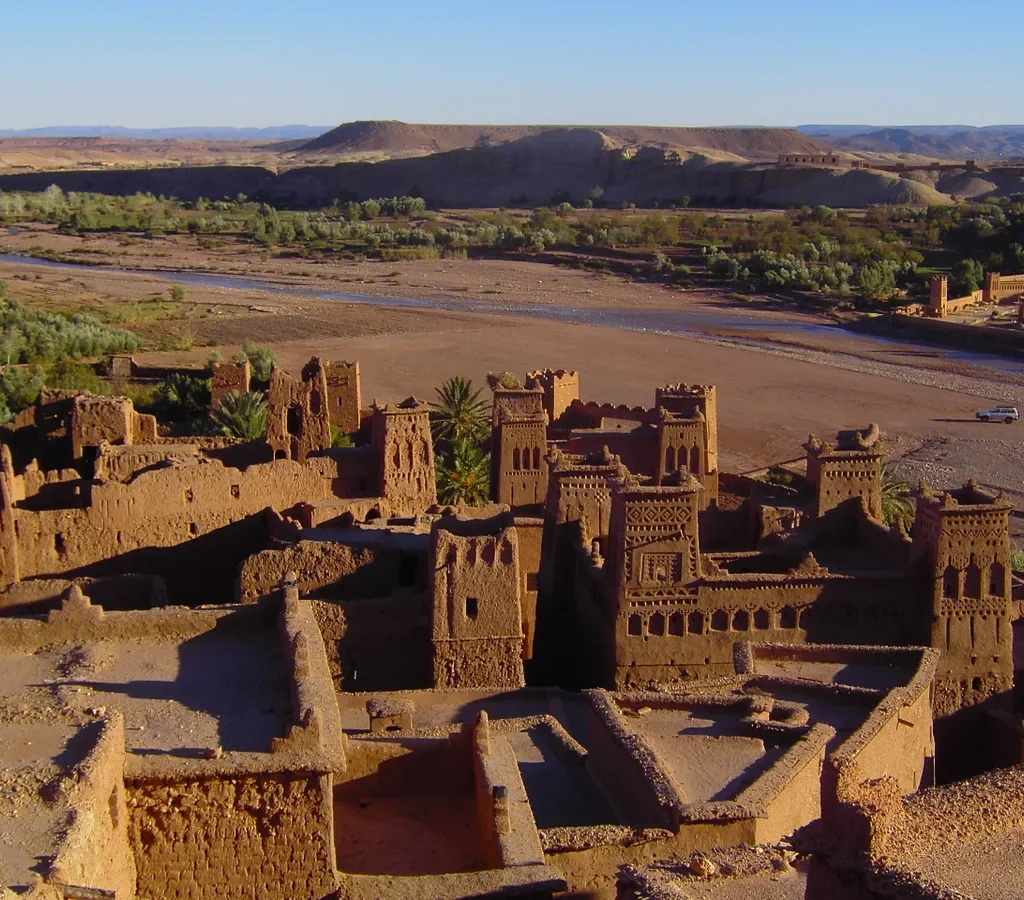
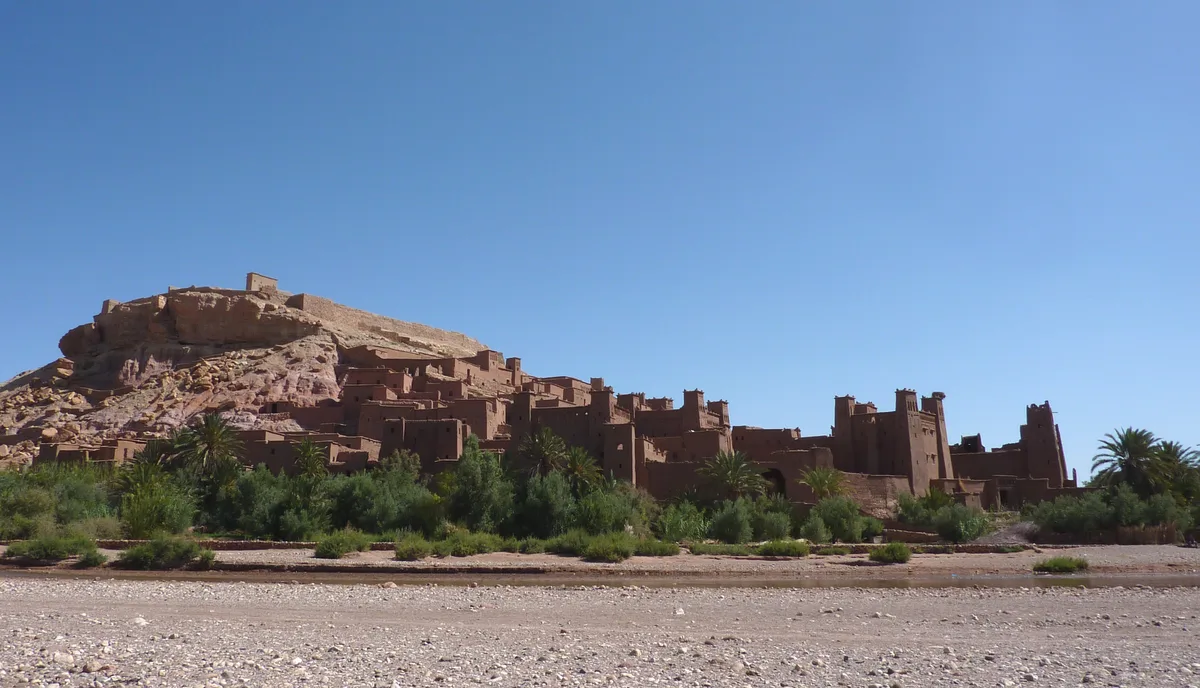
A ksar is a fortified village of southern Morocco, a cluster of earthen houses gathered inside defensive walls, and Ait-Ben-Haddou, in the Ounila Valley in the province of Ouarzazate, is the type specimen – the one UNESCO chose in 1987, under criteria (iv) and (v), to stand for all of them. The framing matters: a pre-Saharan earthen settlement of this kind is an outstanding example of a building tradition and a way of life, complete in a way few others survive. Within the ramparts the whole social architecture of the valley is still legible – collective dwellings pressed together, the houses of wealthier families rising as small earthen castles with tall corner towers and upper rooms decorated in fired brick, a mosque, a public square, threshing areas outside the walls, a caravanserai for the trade that built the place, Muslim and Jewish cemeteries, and the sanctuary of Sidi Ali ou Amer on the hill. The village stood on the trans-Saharan route that ran from Sudan to Marrakesh through the Draa Valley and the Tizi n’Telouet pass, and its prosperity was toll and warehouse prosperity.
The social plan deserves a slow read, because it is the real exhibit. A ksar was a collective insurance policy built in mud: one wall for the whole community, a single baffled gate a stranger’s camel could not rush, granary space under collective guard, and inside, a ranking made architectural – the plainer houses low and tight, the wealthy families’ dwellings rising as small castles with tall corner towers and upper storeys decorated in brick patterning. UNESCO valued Ait-Ben-Haddou precisely because that whole hierarchy survives legibly in one place, from the summit granary down to the threshing areas where the community’s other shared wealth, its harvest, was processed in the open. Film productions later dressed the same streets as biblical and fantasy sets, but the set was a diagram of a society first.
What a visitor sees depends on the light, because the building material is the valley itself – red earth over stone foundations, stamped and dried in the sun. Cross the Ounila riverbed, usually dry, and climb through the lanes to the ruined granary on the summit; the ksar reads best from above and from across the river, where the towers stack against the hills. UNESCO is precise about the chronology: despite the site’s ancient air, the oldest constructions are no earlier than the seventeenth century, because earth is not a permanent material – it is a permanent practice, renewed wall by wall, generation by generation. That is also the honest catch, and it is a serious one. A ksar survives only while people inhabit and repair it; Ait-Ben-Haddou’s families have mostly moved to the modern village across the river, and the inscribed fabric depends on the residents who remain and on the monitoring of CERKAS, the state centre for southern Morocco’s earthen heritage. Go early or late in the day, when the tour groups thin, the earth glows and the place is quiet enough to hear what kind of settlement it was. Our dedicated Ait Benhaddou guide covers the approach, the film history and the walk up; among the unesco world heritage sites in morocco, this is the one that most needs you to slow down rather than speed up.
Historic City of Meknes – Inscribed 1996, Moulay Ismail’s Imperial Dream
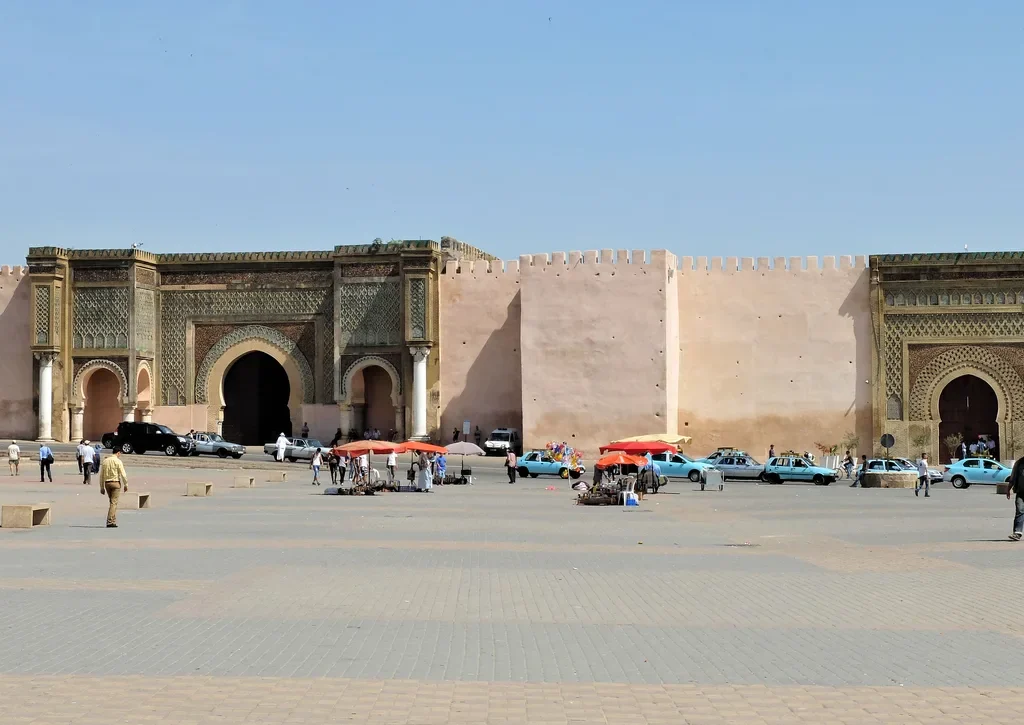
Meknes began modestly, founded in 1061 as an Almoravid military stronghold that became a medina town of mosques and madrasas, and it would be a pleasant footnote among the unesco world heritage sites in morocco if one man had not chosen it. Sultan Moulay Ismail, who reigned from 1672 to 1727, made Meknes the capital of his Alaouite kingdom and rebuilt it on a scale Morocco had never attempted: a palace-city of ramparts up to 15 metres thick in places, nine monumental gates, vast granaries and stables, reservoirs, gardens and a kasbah of palaces, built with a huge workforce over five decades. UNESCO inscribed the Historic City of Meknes in 1996 under criterion (iv), for the remarkably complete combination it preserves of the historic medina and the remains of the seventeenth-century royal city – the first great work of the Alaouite dynasty, showing the Hispano-Moorish style of the period and an early, deliberate mixture of Islamic and European ideas of planning and architecture.
The scale was administrative as much as decorative. Moulay Ismail intended a capital that could feed, mount and supply his kingdom from its own stores: the Heri es-Souani granaries engineered to hold grain against a siege, stables beside them for the royal cavalry, a reservoir to water the gardens, and a kasbah housing the court, the guard and the machinery of rule inside one walled system. UNESCO’s assessment stresses that the medina and the kasbah survive as complementary ensembles – the pious, commercial old town and the royal city facing it across the square – and that completeness is what separates Meknes from the many Moroccan capitals that kept one half of themselves and lost the other. Of the unesco world heritage sites in morocco, it is the only one that reads as a single reign’s autobiography.
What a visitor sees is monumentality before intimacy. Bab Mansour, the great gate facing the square of El Hedim, carries a facade of zellige tilework and marble columns taken from Volubilis, a short drive away; behind it, the imperial city unrolls in walls and empty grandeur – the mausoleum of Moulay Ismail, the Heri es-Souani granaries, enormous vaulted halls built to feed a capital and its army, and the Agdal reservoir that watered it. The older medina across the square is the counterweight: 25 mosques, ten hammams, palaces, fondouks and a souk that serves Meknes itself more than its visitors. Who should prioritise it? Travellers doing the Fez-Meknes-Volubilis triangle anyway – Meknes is the triangle’s third point, not a detour – and anyone interested in how a single ruler’s ambition gets built in rammed earth and tile. The honest catch is comparison and condition: Meknes sits in Fez’s shadow, its monuments are spread across a large area rather than gathered in one medina, and parts of the imperial fabric are in slow, continuing repair, so the effect is of a magnificent skeleton rather than a furnished house. Accept that, and it is one of the most rewarding stops on the list.
Archaeological Site of Volubilis – Inscribed 1997, Rome at the Edge of the Empire
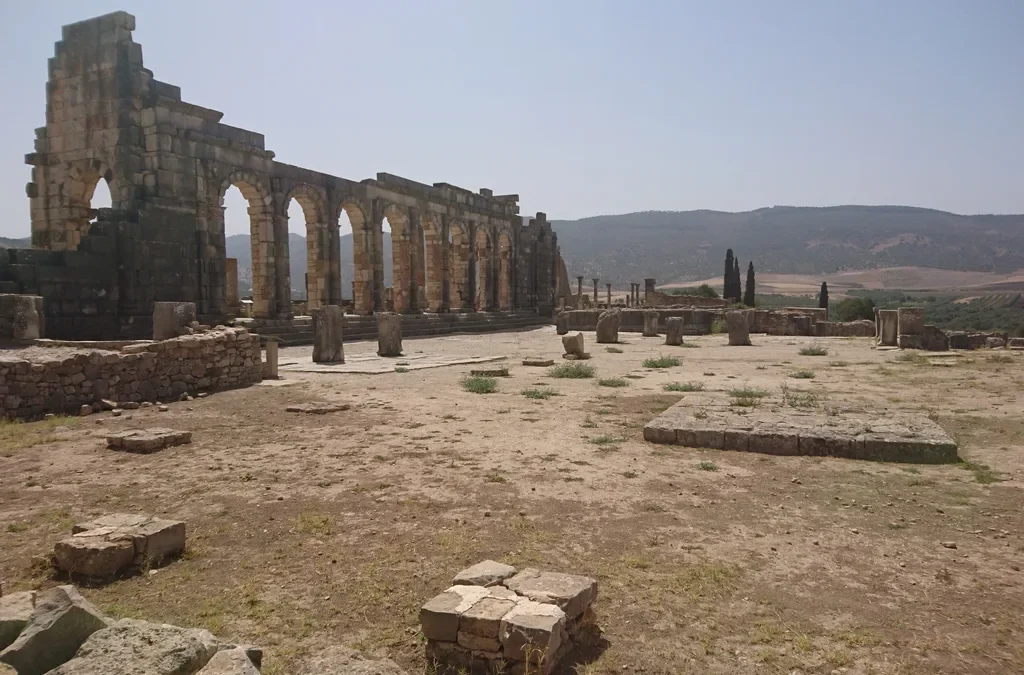
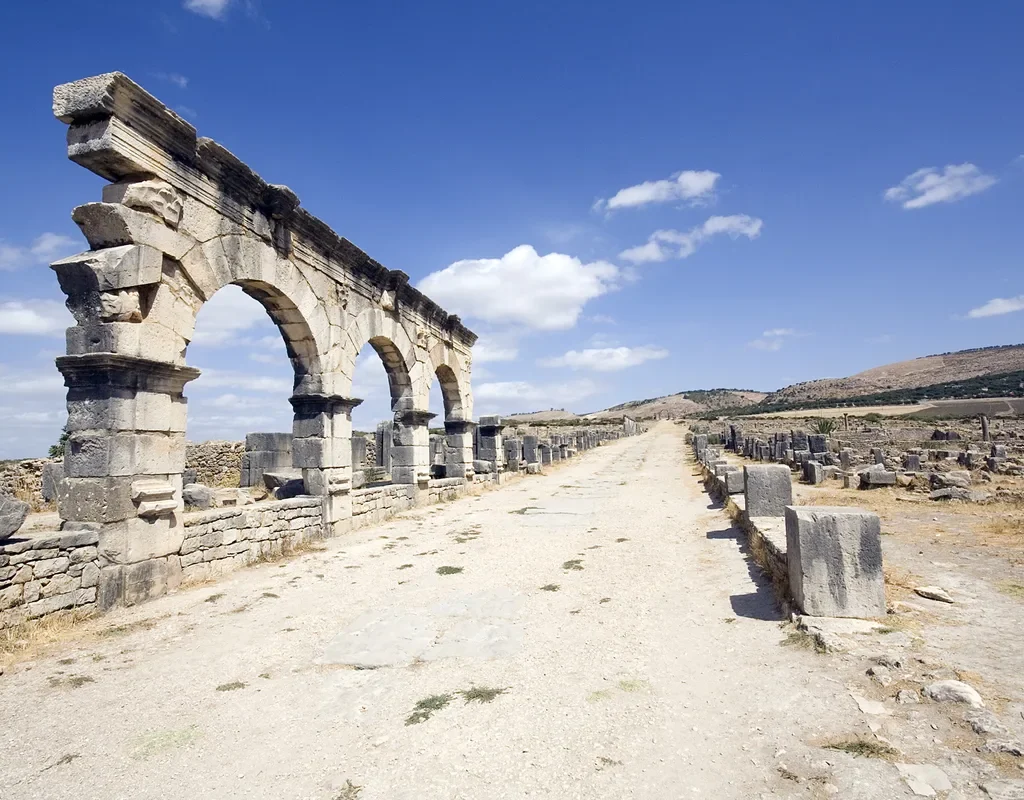
Volubilis is the exception on this list: the one site whose greatness predates Morocco’s Islamic history, and the one where abandonment – usually the enemy of heritage – is exactly what preserved it. The 42-hectare site at the foot of Jebel Zerhoun became the capital of the kingdom of Mauretania under Juba II, then a Roman municipium, capital of Mauretania Tingitana, with a rampart built in 168-169 AD, a forum, basilica, temples, triumphal arch, baths, olive presses and grand houses floored with mosaics. UNESCO inscribed it in 1997 under four criteria – (ii), (iii), (iv) and (vi) – as an exceptionally complete, well-preserved example of a large Roman colonial town on the fringes of the empire, bearing witness to exchanges between Roman, Christian, Arab and Idrisid cultures across ten centuries of occupation, and associated with the tomb of Idris, founder of the first Moroccan dynasty, buried in the town beside it and still honoured by an annual pilgrimage. When Rome’s administration withdrew, nobody demolished Volubilis or built over it; the site simply emptied, and lay largely undisturbed for a thousand years.
The phases matter, because this is not a single-period ruin. Before Rome it was a Mauritanian royal capital with Punic and Hellenistic threads in its culture; under Rome it became the rich grain-and-olive town whose presses and mosaics you see; after Rome it lived on as a Christian and then an early Islamic settlement, and it was here, at the edge of the old Roman world, that the Idrisid story of Morocco effectively began. UNESCO’s criteria catch that whole arc, including the living association, criterion (vi), with the tomb of Idris in the neighbouring town and the pilgrimage that still climbs to it each year. Few fields anywhere let you watch a country’s founding layers stacked in one view.
What a visitor sees is that emptiness, organised. You walk the Decumanus Maximus, the main street, past the Arch of Caracalla toward the basilica and forum, and step off it into houses whose mosaics – the labours of Hercules, Orpheus charming the animals, bathers and acrobats – still lie where their owners commissioned them, protected in some cases by low shelters, in others simply open to the sky. Storks nest on the column tops; the Zerhoun mountain and the holy town of Moulay Idriss frame the views; the on-site museum gathers the bronze busts and inscriptions, hundreds of them, that the fields gave up. Who should prioritise it? Anyone crossing between Fez and Meknes, for whom it is almost on the way, and travellers who find one honest ruin worth ten rebuilt medinas. The honest catch is exposure and scale: Volubilis is a half-day at most, entirely open-air, shadeless in summer and an hour from the nearest real town, so it rewards an early start and punishes a midday one. It is also the clearest proof among the unesco world heritage sites in morocco that inscription is about evidence, not size – a modest field of stones that documents a frontier better than any standing city could.
Medina of Tétouan – Inscribed 1997, the Andalusian Time Capsule
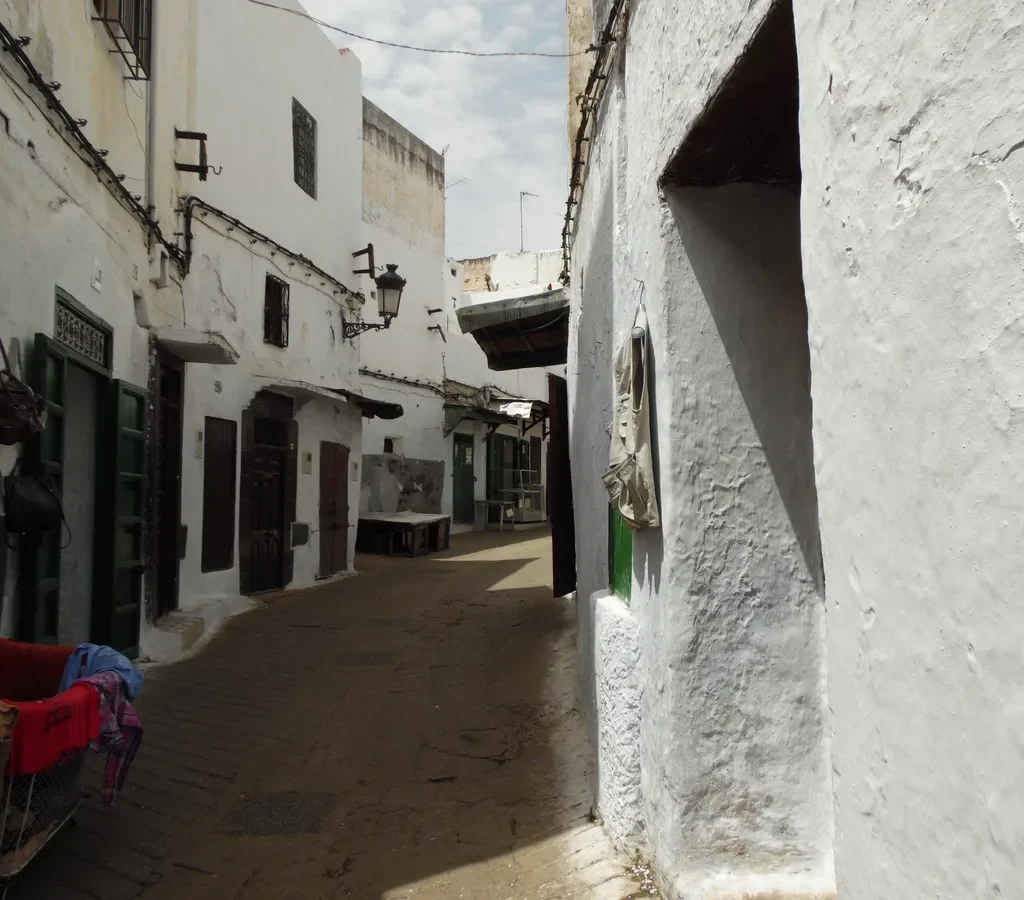
Tétouan, on the slopes of Jebel Dersa in Morocco’s far north, is the medina that history rebuilt. The town served as Morocco’s link with Andalusia from the eighth century, then fell into ruin, and was rebuilt from the end of the fifteenth century by refugees expelled from Spain after the Reconquista – craftsmen and families who carried their architecture, their tilework, their carpentry and their cuisine across the strait and recreated an Andalusian city on African soil. UNESCO inscribed the Medina of Tétouan in 1997 under criteria (ii), (iv) and (v), and its judgement is the most quotable on the Moroccan list: Tétouan is one of the smallest of the Moroccan medinas, but it is the most complete, and the one that has remained the most untouched by external influences. The rampart runs about five kilometres with seven gates, and inside it the street pattern, the houses and the craft quarters survive with their original grain.
What a visitor sees is a white city that feels different from Fez or Marrakesh within minutes: narrower in its lanes, quieter in its souks, with houses that turn courtyards and carved wooden doors to the street, green-tiled roofs over the whitewash, and a craft tradition – the Dar Sanaa school of traditional arts is its institutional face – that still teaches the old techniques in the old buildings. The medina’s mellah and its later Spanish-era streets at the edge mark the other chapters of the town’s layered past. Who should prioritise it? Travellers touring the north – Tangier, Chefchaouen, the Rif – who want the medina experience without the Fez intensity, and anyone who has been to Andalusia and wants to see what crossed the water when Spain expelled its Muslims and Jews. The honest catch is simply geography and fame: Tétouan is the least visited of the unesco world heritage sites in morocco, sits in a corner of the country most itineraries skip, and has the fewest famous individual monuments of the nine. Its value is the ensemble, whole and unrenovated, and travellers who need a headline sight per day will under-rate it; travellers who read towns whole will not.
The Andalusian inheritance is unusually specific here. The returning exiles did not merely bring a style; they brought guilds, crafts, musical traditions and a house type – patio-centred, inward-looking, tiled and carved in the manner of the cities they had been expelled from – and rebuilt a ruined town around them within a generation. Because later centuries left Tétouan largely alone, UNESCO’s experts could still read that transplantation whole, down to the street plan and the organisation of the craft quarters, which is why completeness, not size, is the word its inscription keeps using.
Medina of Essaouira – Inscribed 2001, the Planned Port Inside Old Walls
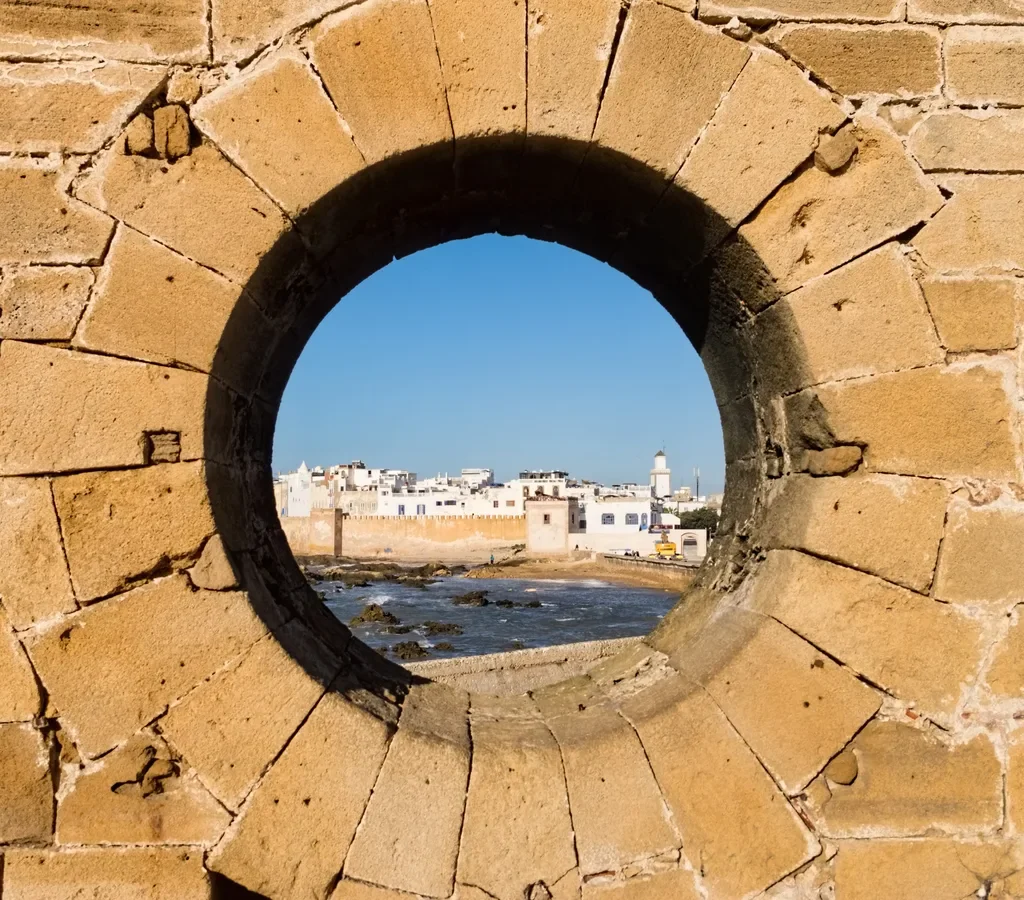
Every other medina on this list grew; Essaouira was drawn. The town occupies an ancient trading post – its name descends from the Phoenician Migdol, a small fortress – but the medina you walk today was founded in the mid-eighteenth century by Sultan Sidi Mohammed Ben Abdallah, who chose the bay as his kingdom’s royal port and had it laid out by a French architect working in the tradition of Vauban’s fortifications at Saint-Malo. UNESCO inscribed the Medina of Essaouira in 2001 under criteria (ii) and (iv) as an outstanding and complete example of a fortified seaport town of that period, influenced by European design and transposed to North Africa – the “Port of Timbuktu”, built to carry the caravan trade of sub-Saharan Africa to Europe and the Americas, and multicultural and multiconfessional from its first day, its merchants, consuls and craftsmen drawn from across the region’s faiths.
Its design brief was trade, and the town still honours it. The sultan concentrated the kingdom’s European commerce here, foreign consuls and merchant houses ran the caravan goods out to the ships, and the port’s artillery – the line of bronze cannon along the Skala – was aimed at protecting that traffic rather than projecting power. UNESCO notes, with less romance, that the inscribed property also carries a standing wound: parts of the old Mellah quarter have fallen into decay and some have been lost, a reminder written into the official file that inscription freezes nothing, and that even the best-planned port needs its buildings kept.
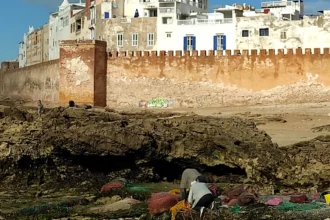
What a visitor sees is the plan’s clarity: a grid you cannot get lost in, which medina veterans find almost suspicious; the Skala ramparts with their bronze cannons aimed at an ocean that still throws spray over them; a working fishing port of blue boats and gulls at the gate; and a small, white, manageable medina of art galleries, thuya-wood workshops and cafes that has become a byword for Morocco at low volume. The Mogador archipelago offshore, part of the inscribed property, frames the sunsets. Who should prioritise it? Travellers who want a medina they can learn in an afternoon, beach-town people who also want substance, and anyone building a trip down the Atlantic coast, where Essaouira pairs naturally with Mazagan to the north. The honest catch is the wind – Essaouira is famously, relentlessly breezy, which is why the kite-surf schools are here and why your rampart photos will include your own hair – and a certain gentleness: of the unesco world heritage sites in morocco, this is the one where the heritage is most likely to feel like a pleasant backdrop to lunch. That is not a failure of the site. It is, arguably, what a planned port town was always for.
Portuguese City of Mazagan – Inscribed 2004, a Renaissance Star Fort on the Atlantic
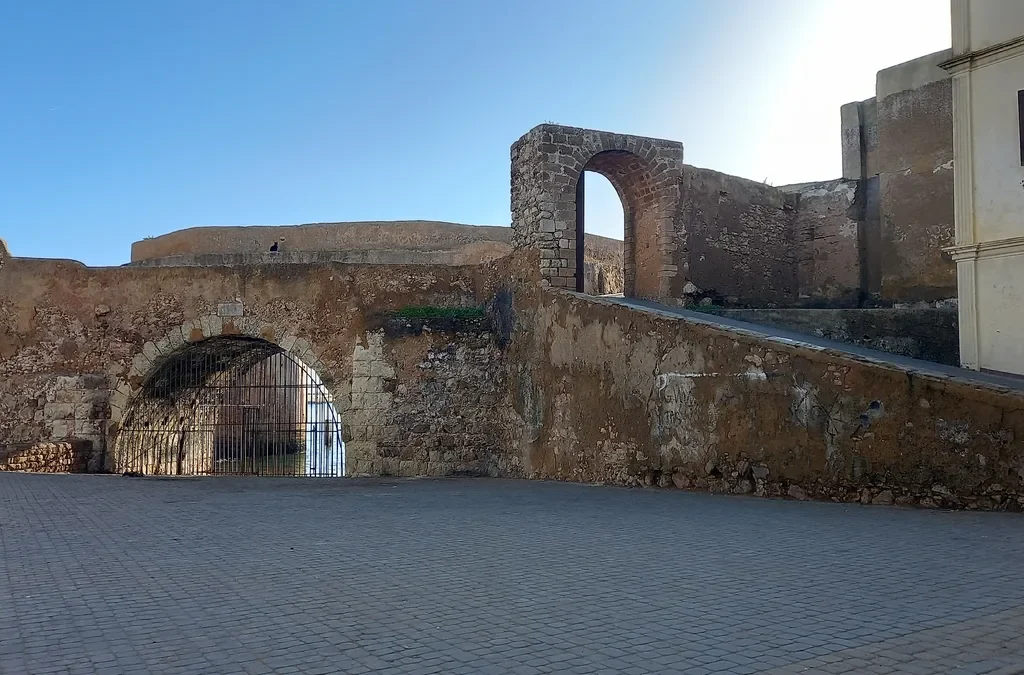
Mazagan, inside the modern town of El Jadida 90 kilometres south of Casablanca, is the list’s most unlikely geography lesson: a piece of Renaissance Europe, engineered for gunpowder, standing complete on the African Atlantic coast. The Portuguese, who had held positions on this coast since the fifteenth century, built first a fortified place in 1514 under the Arruda brothers, then, in 1541-48, rebuilt it as a star fort to plans by the Italian engineer Benedetto da Ravenna – among the first fortifications anywhere designed specifically for the age of firearms, its angled bastions and thick, low walls laid out so cannon could sweep every approach. UNESCO inscribed the Portuguese City of Mazagan in 2004 under criteria (ii) and (iv), as an outstanding example of the interchange between European and Moroccan cultures, visible in its architecture, its technology and its town plan. The Portuguese held it for over two centuries, then sailed away in 1769; the town stood semi-abandoned until the mid-nineteenth century, when it was repopulated and renamed El Jadida – the New – and grew around and through the old citadel, whose inhabitants today are Muslim and Jewish Moroccans living inside a Portuguese plan.
The engineering repays attention even if fortifications are not your subject. Mazagan was drawn in the first generation of gunpowder geometry, when military engineers were replacing tall medieval walls with low, thick, angled bastions that could absorb shot and fire back along every face; UNESCO counts it among the earliest surviving works of that revolution in fortress design, and the latest flowering of the Portuguese Manueline style stands a street away in the church and the cistern. That the whole experiment survives in Africa at all is the accident of 1769: Portugal gave the town up, withdrew its people overseas, and the fortress spent decades half-empty – too solid to demolish, too useful to ignore.
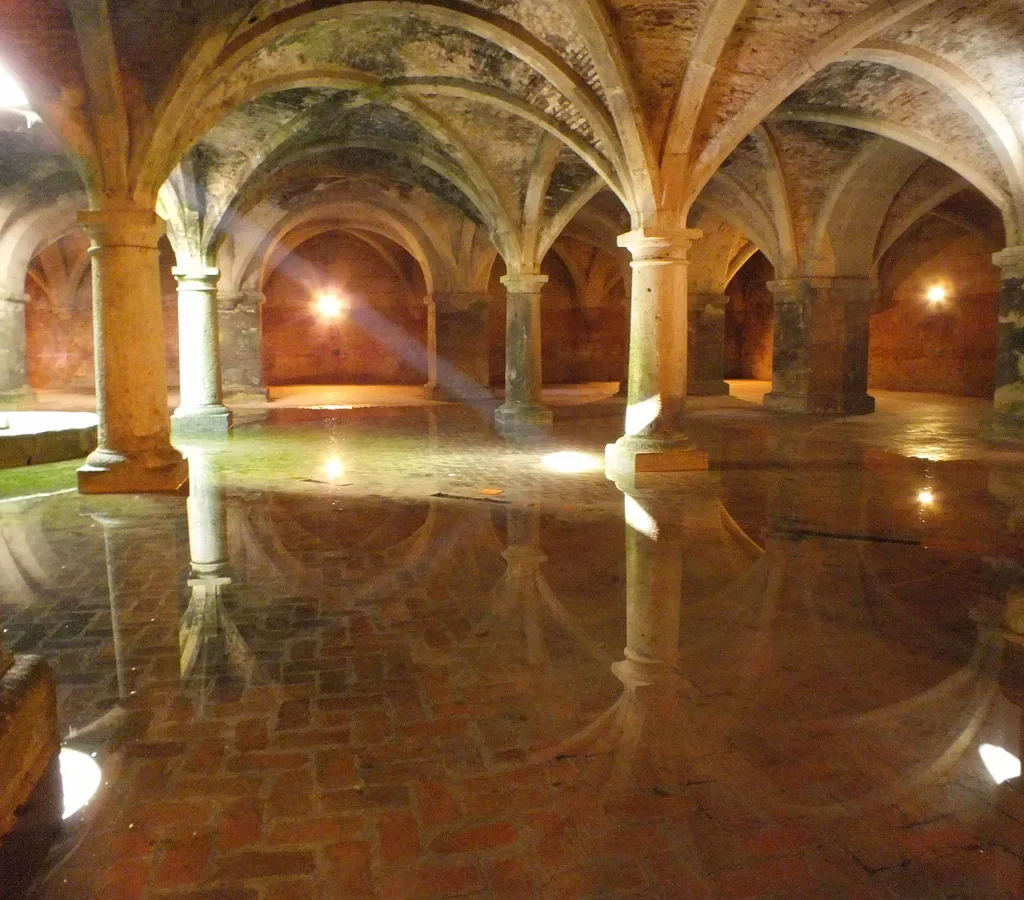
What a visitor sees is compact and dense: the fortress walls and their bastions above the harbour, the main street running straight as a survey line, the Manueline Church of the Assumption, and below ground the site everyone remembers – the Portuguese Cistern, a vaulted hall of stone columns standing in shallow water that doubles them in reflection, lit from a single opening above. It is one room, and it justifies the stop by itself. Who should prioritise Mazagan? Coast-route travellers between Casablanca and Essaouira, military-architecture people, and photographers, for whom that cistern is a small perfect subject. The honest catch is scale and setting: this is the smallest of the unesco world heritage sites in morocco, a half-day visit folded inside an ordinary modern resort town, and travellers expecting a quarter the size of Fez will be back at the corniche by lunch wondering if that was all. It was – and the fact that a complete Renaissance fortress survives at all, this far south, is precisely the point of its inscription.
Rabat – Inscribed 2012, the Modern Capital That Kept Its Past
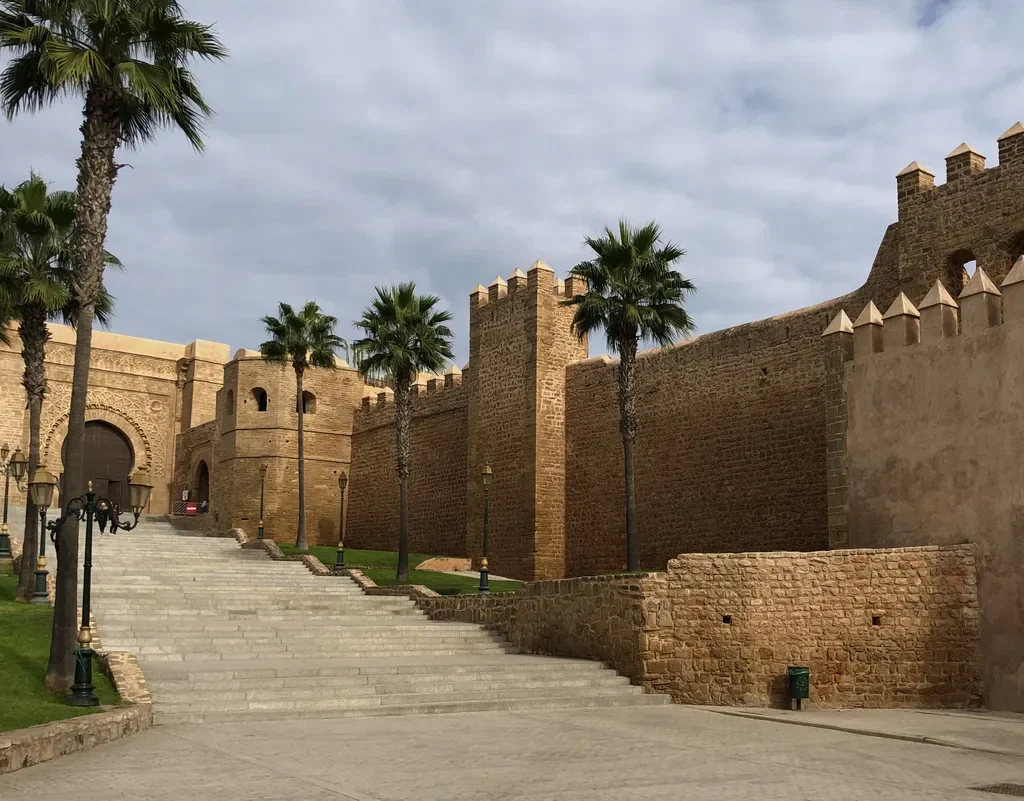
The newest of the unesco world heritage sites in morocco is also the most counterintuitive, because its outstanding value is partly twentieth-century. When Morocco became a French protectorate in 1912, Rabat was chosen as the capital and planned afresh by some of the era’s leading town planners – but planned, unusually for a colonial project, in a spirit of protection toward what already stood there: the Almohad walls, the medina, the Kasbah of the Udayas on its cliff above the river, the royal palace and the traditional quarters. The new city of wide avenues and administrative quarters was laid out around and between the older fabrics rather than over them, and a century later UNESCO inscribed the whole ensemble in 2012, under criteria (ii) and (iv), as “Rabat, Modern Capital and Historic City: a Shared Heritage” – shared, in UNESCO’s framing, by the ancient, Islamic, Hispano-Maghrebian and European cultures whose layers the city preserves side by side, from the Roman and Marinid remains at Chellah to the neo-traditional Habous quarter of Diour Jamaâ, built in the 1910s for a growing population.
The components reward being read as one argument. Chellah gives the deep past – Roman stones under a Marinid royal necropolis, its minaret now colonised by storks. The Kasbah of the Udayas and the medina give the pre-colonial city, and the Hassan Tower its great Almohad gesture, an unfinished mosque whose scale announced an empire. The protectorate quarters then give the experiment: administrative avenues, garden suburbs and Diour Jamaâ itself, where traditional Moroccan house forms were rebuilt with modern methods for a modern population. UNESCO’s phrase for the result – a shared heritage – is sometimes mistaken for politeness; standing at the kasbah gate with the planned city on one side and the medieval lanes on the other, it reads more like a planning policy a century of capitals might envy. As the youngest of the unesco world heritage sites in morocco, Rabat is also the one still visibly becoming itself.
What a visitor sees is therefore a sequence rather than a single sight: the blue-and-white lanes of the Kasbah and its Andalusian garden, the Hassan Tower – the stump of a vast Almohad mosque that was never finished – facing the modern mausoleum across an esplanade of columns, the Chellah’s ruined walls and stork-covered minaret down by the river, and then the protectorate-era boulevards, where the capital’s ministries and cafes occupy the planned city the inscription honours. Rabat is also, not incidentally, the easiest of the nine to visit: it is the seat of government, orderly, coastal and well served by the train line that threads the Atlantic cities together, and our run through the best places to visit in Morocco gives it its due as a base as well as a stop. Who should prioritise it? Travellers who arrive or leave by the capital’s airport, anyone interested in how cities argue with their own pasts, and visitors short on time who want several layers of Morocco in one unhurried day. The honest catch is diffuseness: Rabat’s value is urban and spread across neighbourhoods, there is no single gate or square to stand in front of for the photograph, and its monuments individually rank below Fez’s or Marrakesh’s. Judge it as a palimpsest rather than a page, and it completes the list’s story – the site where Morocco stopped only preserving its past and started, deliberately, planning around it.
Grouping the Sites Into Trips That Actually Work
Nine inscriptions, one country, and no itinerary that covers all of them in less than a serious expedition – so the practical question is which of the unesco world heritage sites in morocco genuinely belong to the same trip. Three of them answer that question by themselves. The northern imperial loop – Fez, Meknes and Volubilis – sits inside a small triangle of the north-central plains, joined by road and rail, and can be done justice in four or five days without a single heroic drive: base in Fez for the medina, day-trip or overnight to Meknes for Moulay Ismail’s capital, and take Volubilis on the Meknes day or the road between them, stopping at the holy town of Moulay Idriss on the ridge above the ruins. This is the classic heritage circuit of Morocco and the one to choose if you only ever make one.
The Atlantic line forms the second natural group. Rabat, Mazagan at El Jadida and Essaouira string down the coast in that order, linked by the motorway and the coastal road, and they read as a deliberate essay in ports: the shared-heritage capital, the Portuguese fortress, the planned royal harbour. Three or four days covers all three at a humane pace, with Casablanca as the arrival point rather than a site – its twentieth-century centre is, for now, only a tentative-list candidate. Marrakesh and Ait-Ben-Haddou pair as the third group, the imperial city and the southern ksar joined by the High Atlas crossing at Tizi n’Tichka: two days in the medina, then over the pass to the Ounila Valley as a day trip or, better, as the first night of a loop onward toward the Draa and the desert. Tétouan is the honest exception – it groups with Tangier and the north, on a Rif trip of its own, and travellers who bolt it onto a Fez week usually see it tired and briefly. Chasing all nine in one visit is possible in about two weeks of disciplined driving; chasing them in nine days produces nine photographs and no understanding. Choose the loop that matches the rest of your trip, and let the list wait – it has waited, in some cases, for eight hundred years.
Two practical notes shape every version of these routes. First, Morocco’s rail backbone runs where the sites are: the line threads Rabat, Casablanca, Fez and Meknes together, which is why the northern loop and the Rabat end of the Atlantic line work so comfortably without a car – Volubilis and Mazagan are the two stops the railway misses, reached by local taxi or organised trip from Meknes and El Jadida respectively. Second, sequence matters more than speed: medinas repay mornings, Volubilis punishes midday heat, and Ait-Ben-Haddou is a different place at nine in the morning than at two in the afternoon. Build the unesco world heritage sites in morocco into a route at the pace each one asks for, and the nine inscriptions stop being a checklist and become what they actually are – a connected history of the country, told in the order the roads choose.
The Tentative List – Promising, But Not Inscribed
Below the inscribed list sits the Tentative List: the inventory of places a country is considering nominating, formally submitted to UNESCO but not evaluated, not approved and not entitled to call themselves World Heritage Sites. Morocco’s Tentative List currently holds fourteen entries, some waiting since 1995, and travellers will meet them sold online as tomorrow’s inscriptions – treat that as marketing. Tentative status means a file exists in Paris, nothing more; some candidates wait decades, and some will never be nominated at all. What the list does offer is a map of what Morocco itself thinks might be next, and several entries are genuinely worth a traveller’s time on their own merits.
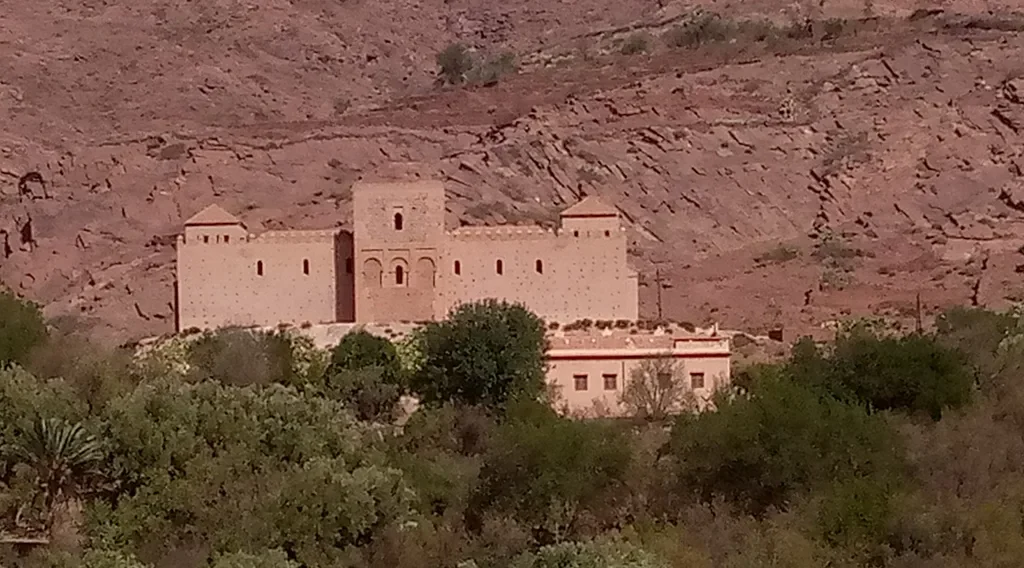
The names most likely to cross your route are these. The mosque of Tinmel, in the High Atlas valley that was the Almohad movement’s spiritual home before Marrakesh was its capital, has been tentative since 1995. So has Lixus, the Phoenician and Roman port near Larache whose ruins look over the Loukkos estuary – the coast’s missing piece between Volubilis and the strait. Moulay Idriss Zerhoun, the holy town above Volubilis where Idris I is buried, is tentative in its own right and already receives the pilgrimage that earned Volubilis one of its criteria. The Oasis of Figuig, nominated in 2011, would give the list its first desert-edge palm oasis if it proceeds; the twentieth-century city of Casablanca, tentative since 2013, would extend the Rabat story of planned modernity. The rest of the fourteen – among them the great mosque of Taza, the Taforalt cave, the Talassemtane park and the Khnifiss lagoon – range from archaeology to natural areas, a hint that any future Moroccan inscription may finally add the natural site the current nine lack. Until the committee says so, though, the unesco world heritage sites in morocco number exactly nine, and the difference between the two lists is the whole subject of this guide.
UNESCO World Heritage Sites in Morocco – Questions Travellers Ask
How many UNESCO World Heritage Sites are there in Morocco? Nine, all of them cultural, inscribed between 1981 (the Medina of Fez) and 2012 (Rabat). Morocco has no natural or mixed World Heritage Site; the places sometimes advertised as further sites, such as Tinmel or Lixus, are on the Tentative List, which is UNESCO’s waiting room rather than the list itself.
Which of the unesco world heritage sites in morocco should a first-time visitor prioritise? Marrakesh and Fez, in whichever order your route allows: Marrakesh for the greatest concentration of monuments and the energy of Jemaa el-Fnaa, Fez for the deepest and most complete living medina. Add Volubilis and Meknes if you are anywhere near their triangle – they cost a day between them – and Ait-Ben-Haddou if your trip crosses toward the desert.
Can all nine sites be visited on one trip? Yes, but only just, and only on a trip of roughly two weeks built around them: the northern loop (Fez, Meknes, Volubilis), the Atlantic line (Rabat, Mazagan, Essaouira), Marrakesh with Ait-Ben-Haddou, and a separate northern leg for Tétouan. On a shorter trip, pick one loop and do it properly; the sites reward hours inside them, not ticks beside them.
Are the medinas on the list living cities or open-air museums? Living cities, decisively. The medinas of Fez, Marrakesh, Tétouan and Essaouira are inhabited, working urban quarters whose residents shop, worship, manufacture and raise families inside the inscribed boundaries – which is exactly why UNESCO valued them, and why visiting one feels different from visiting the ruins at Volubilis. Conduct follows from that fact: you are a guest in somebody’s city, a point our Moroccan culture and etiquette guide works through in practical detail.
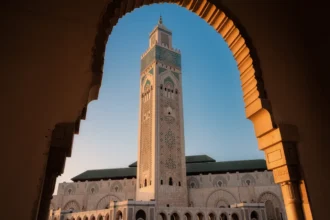
What does it cost to enter the sites? There is no single ticket for the unesco world heritage sites in morocco, because most of them are not gated attractions at all – you enter a medina by walking in. The managed monuments inside them (palaces, madrasas, the Volubilis archaeological park, the Mazagan cistern) charge individually at their own doors, mosques are generally closed to non-worshippers with the great exception of the Hassan II Mosque in Casablanca – which, ironically, is not itself a World Heritage Site – and prices and arrangements change often enough that this guide deliberately prints none. Budget for small payments at several doors per city and treat any exact figure quoted from memory, ours or anyone’s, with suspicion.
Is Ait-Ben-Haddou just a film set? No, though films made it famous. The ksar is a genuine earthen settlement on the old Sudan-to-Marrakesh trade route, inscribed for the completeness of its collective architecture – houses, mosque, square, caravanserai, cemeteries – and its fame on screen is a side effect of being the best-preserved example of its kind. The film crews leave; the repair of the mud-brick, on which its survival depends, does not stop.
Which sites work best with limited time or mobility? Essaouira, whose planned grid is flat, compact and impossible to get lost in, and Mazagan, which is a single small fortress quarter. Volubilis is open and mostly level along its main street but exposed. Fez is the most demanding – steep, stepped and disorienting by design – and rewards either a guide or the willingness to treat getting lost as the activity itself.
The Short Version
Morocco’s nine World Heritage Sites are the country’s official autobiography, and it chose well. Four living medinas carry the urban story – Fez the deepest, Marrakesh the grandest, Tétouan the purest, Essaouira the most planned – while Meknes preserves one sultan’s monumental ambition, Volubilis preserves Rome’s frontier by the accident of its abandonment, Ait-Ben-Haddou preserves the earthen south in mud that must be rebuilt forever, Mazagan preserves a Renaissance fortress improbably intact on the Atlantic, and Rabat preserves the rare twentieth-century decision to plan a capital around its past rather than through it. Do one loop properly – the northern triangle, the Atlantic line, or Marrakesh and the ksar – and you will understand the unesco world heritage sites in morocco better than a traveller who photographs all nine in a week. The list is short enough to be a life’s travelling, and old enough not to mind waiting for yours.