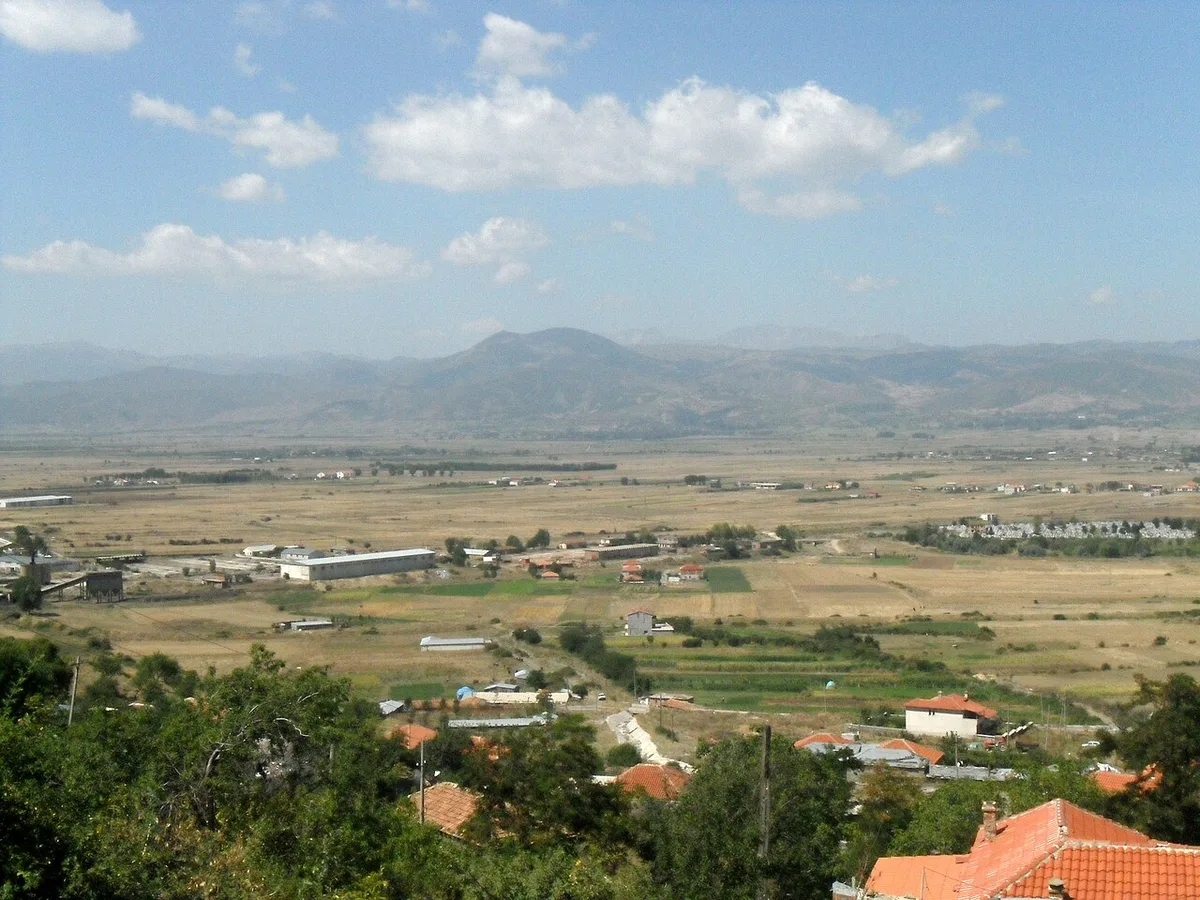
Most foreign visitors cross Albania without ever reaching Korçë, and the ones who do usually arrive with low expectations and leave talking about it for weeks. This is the country’s eighth-largest city and the biggest in the east – a high, flat-floored basin town ringed by the Morava Mountains, closer in feel to the Balkans’ old trading cities than to the Mediterranean Albania of the brochures. It has a restored Ottoman bazaar, a 15th-century mosque, one of the finest icon collections in the Orthodox world, the building where Albanian was first taught in a schoolroom, a brewery that has been running since 1928, and a self-image built on serenades sung under windows at night. A good korca travel guide has to hold two truths at once – this is a genuinely cultured, handsome city, and it is also a working provincial centre that nobody has polished into a theme park, with all the small frictions that implies.
Set the expectations correctly and Korçë rewards you. Come for the National Museum of Medieval Art above all – travellers who have seen icon collections across Greece and the Balkans consistently rate it the city’s outstanding sight – and stay for the slow pleasures around it – coffee that takes an hour, a bazaar built for wandering, beer from the hometown brewery in a taverna garden, and mountains in every direction. The honest catches belong in any korca travel guide too – the city sits roughly three to four hours by road from Tirana, its winters are properly cold, its famous bazaar is a restoration rather than a survival, and its day-trip villages can feel very quiet outside summer weekends. None of that cancels the appeal; it just describes the real city instead of the postcard one.
This guide covers Korçë as a destination in its own right – the sights in the order you will naturally walk them, the history that explains them, and the three day trips that complete the picture – Pogradec on Lake Ohrid, the painted churches of Voskopojë, and the mountain village of Dardhë. It also places the city honestly in an Albania itinerary, because Korçë competes for your days against two UNESCO-listed towns, Berat and Gjirokaster, and pretending otherwise would not help you plan. Everything here is written to be used at street level – mechanisms rather than timetables, judgements rather than brochures – exactly what a korca travel guide should be.
Korca at a Glance
| Question | Short answer |
|---|---|
| Where is Korçë? | South-east Albania, on a high plain at about 850 metres, ringed by the Morava Mountains; the largest city of eastern Albania |
| Why go? | The National Museum of Medieval Art and its icons, the Old Bazaar, Albania’s first school, the hometown Birra Korça brewery, and a café-and-serenade city culture unlike anywhere else in the country |
| Headline sights | Old Bazaar (Pazari i Vjetër), Mirahor Mosque, National Museum of Medieval Art, Resurrection Cathedral, Mësonjëtorja first school |
| Best day trips | Pogradec and Lake Ohrid (UNESCO-listed lake), Voskopojë’s painted churches, Dardhë village and ski slope |
| Time needed | Two nights for the city alone; three to four if you add the day trips properly |
| Getting there | Road only – buses and furgons from Tirana and other cities, or by car via Elbasan and Pogradec |
| Best months | May to June and September to October for the city; December to February for Dardhë skiing; June for the carnival festival |
| Character in one line | A cultured, unhurried trading city that still lives in its old centre rather than performing it |
The table gives you the shape of the place; the detail is in the sections below. One thing the table cannot show is the altitude’s effect – Korçë is a mountain city wearing a town’s clothes, so evenings cool down fast even in summer, summer days rarely swelter the way the coast does, and winter brings real snow. It is also worth knowing early that almost everything in this korca travel guide sits within a compact, walkable centre – the bazaar, mosque, school museum and boulevards are minutes apart on foot, and only the medieval art museum, out on Fan Noli Boulevard, asks for a longer walk.
That compactness changes how you plan. You do not need a base, a route or a strategy for Korçë itself; you need time in the day for coffee and evenings left deliberately unplanned, because the city’s best hours are the ones after the sights close. The sections that follow are ordered the way most people actually experience the city – starting with the old core where Korçë began, then the museums and monuments around it, and finishing with the wider region.
A Short History – Bazaar Town to Cultural Capital
Korçë begins with a mosque and a market. The urban core of the city – the quarter you still walk today around the Old Bazaar – was founded in the late 15th century by Iljaz Bey Mirahori, an Ottoman Albanian nobleman who served as Master of the Stables to Sultan Bayezid II and who endowed the mosque that still carries his name. The city’s own name is older and Slavic in origin – from gorica, a little hill – and it passed through forms like Goritsa and Görice before settling into Korçë. That layered naming tells the story in miniature – this has always been a crossroads town, governed from elsewhere, trading with everyone, and belonging stubbornly to itself.
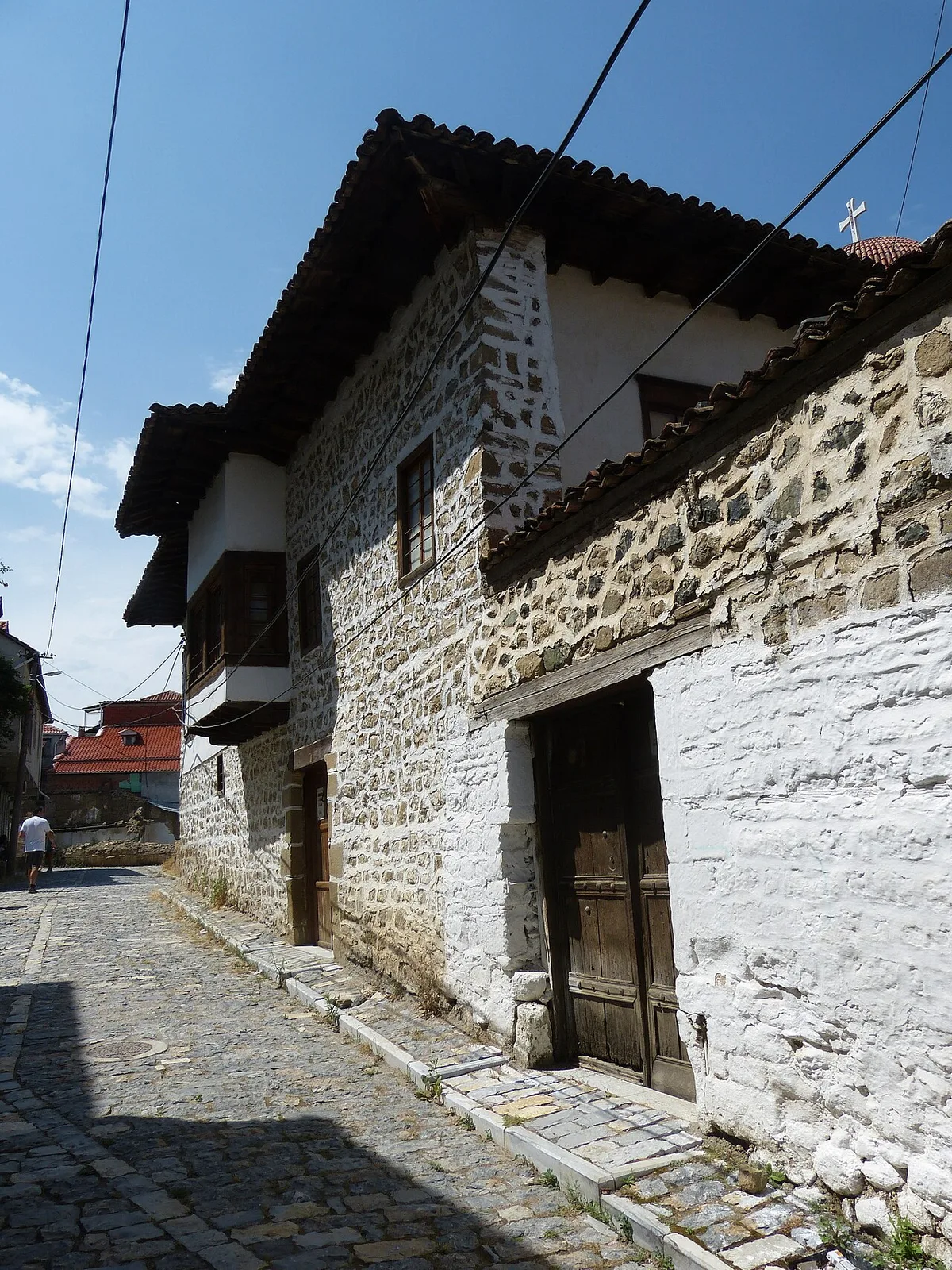
Through the Ottoman centuries Korçë grew into one of the important market towns of the southern Balkans. Its bazaar played a dominant role in Albania’s market history, drawing traders from across the region, and the town’s position – on routes between the Adriatic side of Albania, Macedonia and Greece – made its merchants rich and its craftsmen skilled. The wealth shows in the housing stock that survives – two-storey stone houses with overhanging upper floors, built by families whose fortunes came from trade, the crafts, and later from a far-flung diaspora that sent money home from America, Egypt and Romania. The bazaar burned and was rebuilt more than once, which is why the fabric you see today is mostly 19th century – the period of the city’s fastest growth – rather than medieval.
The 19th century also made Korçë an intellectual capital out of proportion to its size. Its schools, printing connections and reformist families put it at the centre of the Albanian national awakening, and in 1887 the city hosted the first school to teach in the Albanian language – an event Albanians still mark every 7 March as Teachers’ Day. The First World War then gave Korçë the strangest chapter in its history – four years under French military protection during which an autonomous Albanian republic ran the city, an experiment covered in its own section below because no korca travel guide can skip it. The communist decades industrialised the plain, built the apartment blocks that ring the old core, and demolished the old cathedral in the atheist campaign of the late 1960s – a loss the city answered after 1991 by building one of the largest new Orthodox cathedrals in the country on the same ground. Korçë today is that whole history at once – Ottoman market, national-awakening school town, French interlude, and post-communist city still visibly rebuilding its confidence.
The Old Bazaar – Pazari i Vjetër
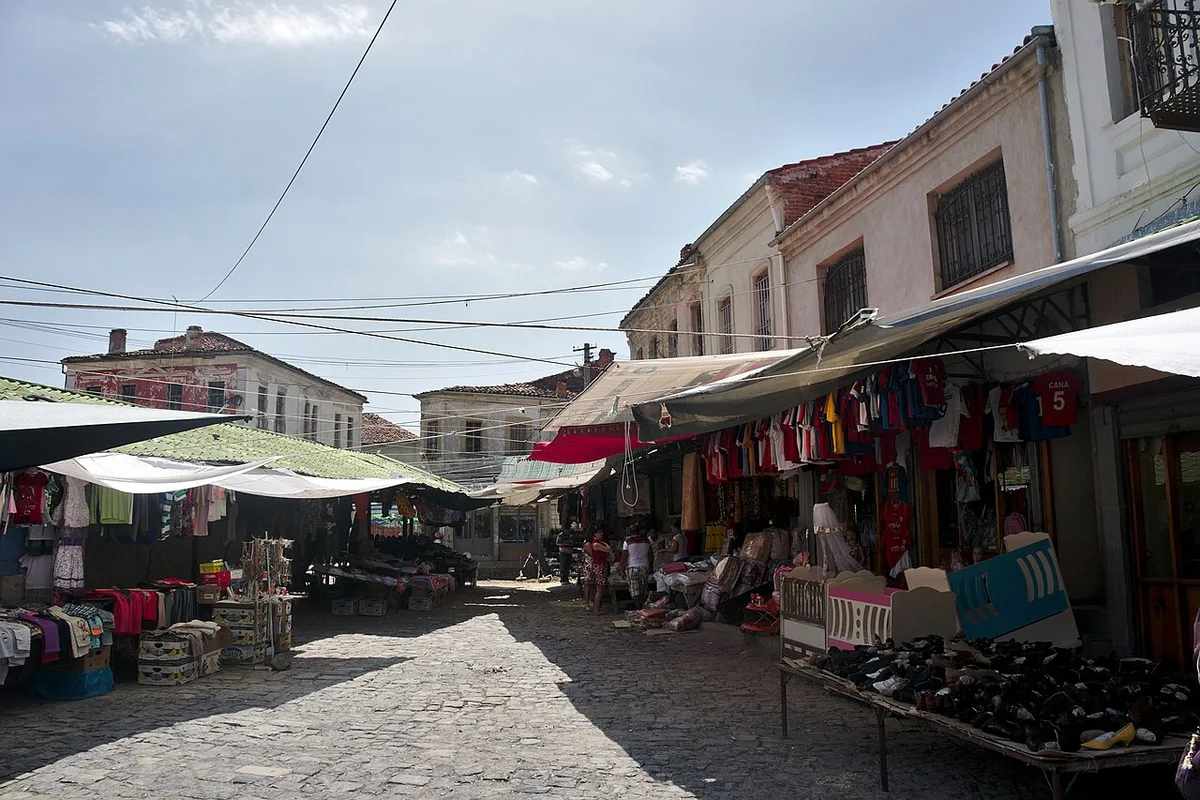
The Old Bazaar is where Korçë started and where an evening in the city still tends to end up. The Pazari i Vjetër spreads around the Mirahor Mosque quarter in a grid of cobbled lanes lined with low, tile-roofed shop-houses – the physiognomy is 19th century, from the decades when this was one of the great marketplaces of the southern Balkans and caravans and traders from across the region worked its stalls. Within the quarter stands the Han i Elbasanit, a surviving caravanserai that once lodged travelling merchants and their animals, and whose courtyard form tells you exactly what the bazaar was for – this was infrastructure for long-distance trade, not a souvenir market that grew old.
Its recent history needs stating plainly, because it shapes what you see. The bazaar decayed badly in the late communist and early transition years – photographs from a decade ago show peeling facades and half-ruined lanes – and the quarter has since been comprehensively restored, its streets re-cobbled and its shopfronts rebuilt in period style. The restoration is handsome and it saved buildings that were close to collapse; it also gives parts of the bazaar a polished, slightly stage-set neatness that purists grumble about. Both things are true, and the honest way to enjoy the place is to take it as a living quarter that has been repaired rather than a museum that has been preserved – the cafés, small restaurants, craft shops and bars now filling the lanes are real businesses serving a real city, not concessions serving a monument.
Time in the bazaar is best spent unstructured. Come in the morning when the market side of the quarter is awake and the lanes smell of coffee and baking, and come back after dark when the restaurants fill and the whole quarter becomes the city’s sitting room. This is also where the serenade tradition touches the tourist – the bazaar earned the nickname “Bazaar of the Serenades” and musicians still surface here on summer evenings. Order the two dishes Korçë claims as its own while you are in the quarter – lakror, a layered pie traditionally filled with wild greens, and qernacka, the city’s spiced meatballs – and treat the bazaar as the anchor of your stay rather than a sight to be ticked off; in this korca travel guide it is deliberately first among the sights, because it is the place you will return to every day without planning to.
The Mirahor Mosque and the Clock Tower
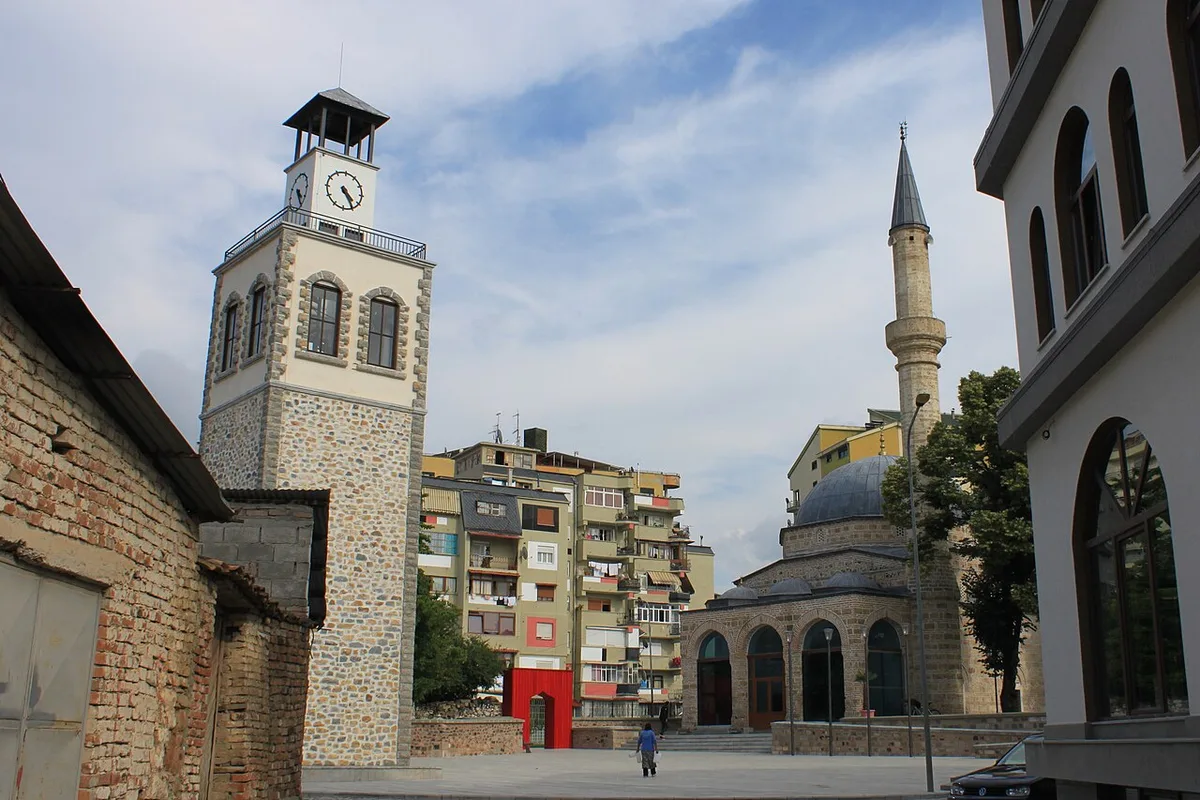
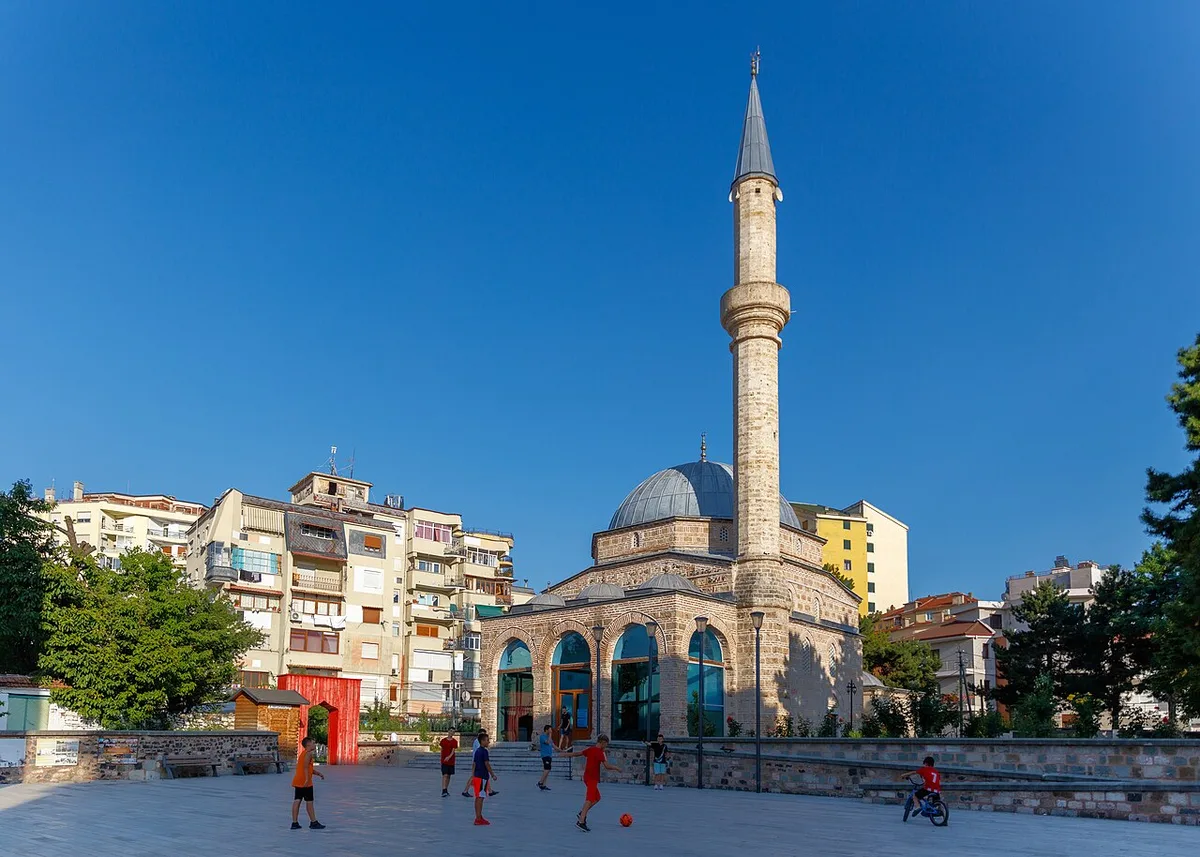
Standing at the edge of the bazaar quarter, the Mirahor Mosque is the oldest building in Korçë and the reason the city exists where it does. It was founded by Iljaz Bey Mirahori – the Ottoman Albanian grandee whose endowment created the urban core – and built in the 1490s, which makes it the second-oldest mosque in Albania after the Sultan’s Mosque in Berat and one of the country’s leading surviving examples of early Islamic architecture. The form is the classical early Ottoman one – a single great dome over a square prayer hall, a portico in front, and a slender minaret – executed in the mixed stone-and-brick masonry typical of the period, and the interior carries painted decoration that rewards the short detour inside when the mosque is open to visitors outside prayer times.
Beside it stands the clock tower, and the tower teaches a useful Korçë lesson – read dates on buildings here with care. The original tower was an 18th-century structure, repeatedly damaged by the earthquakes that periodically shake this seismic corner of Albania, and the tower you photograph today is a faithful reconstruction completed in 2016. That is not a deception; it is how this city has always treated its landmarks, rebuilding them on their footprints because the alternative was a gap in the skyline. The mosque itself has needed repairs across the centuries for the same reason – standing fabric in Korçë is often a palimpsest, and the honest traveller enjoys it more for knowing so.
Practically, the mosque and tower work best as the hinge of a bazaar walk – photograph them from the square in the morning light, combine them with the Han i Elbasanit and the bazaar lanes, and be dressed respectfully if you step inside. There is no ticket office and no queue; this remains a functioning mosque in a working quarter, which is precisely its atmosphere. Of all the monuments in this korca travel guide, this is the one that connects most directly to the founding act of the city – everything else in Korçë, from the bazaar to the brewery, ultimately grew up in the market town this mosque anchored.
The National Museum of Medieval Art
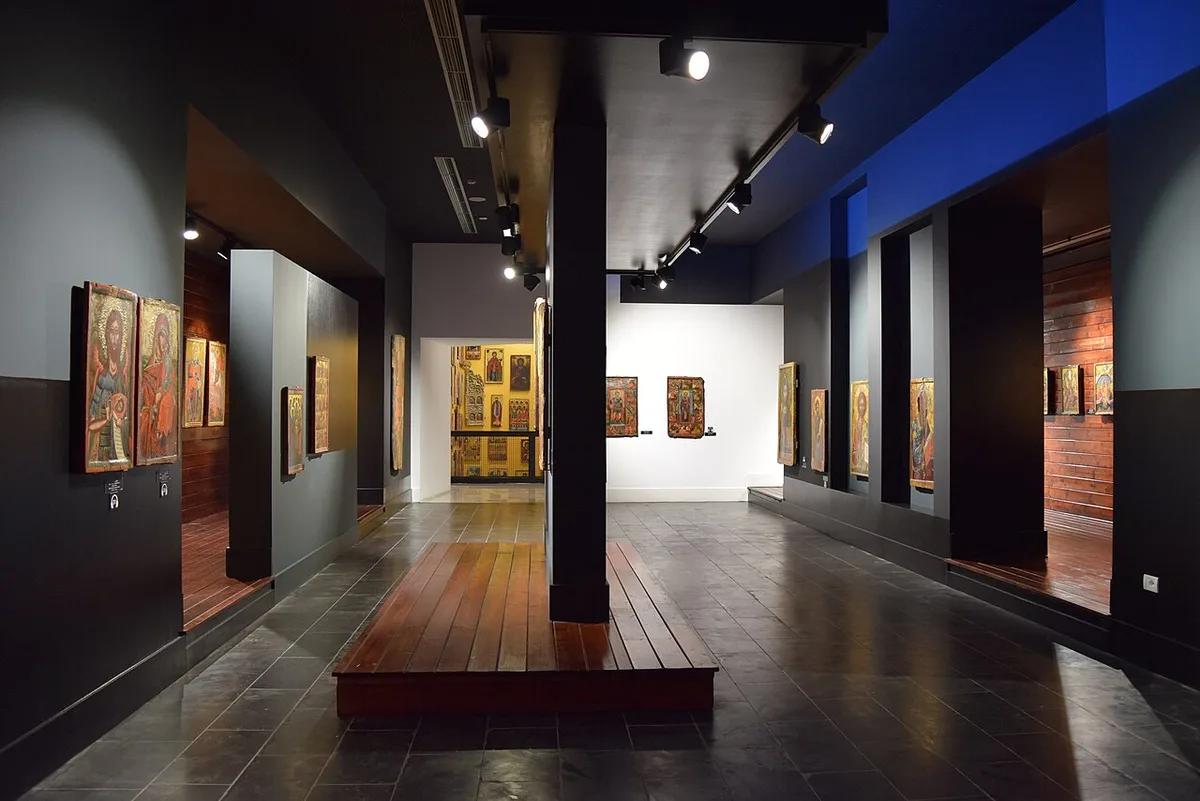
If you see one thing in Korçë, see this. The National Museum of Medieval Art holds Albania’s great collection of Byzantine and post-Byzantine religious art, and its story explains how such a collection came to exist at all. Under the communist regime Albania declared itself the world’s first atheist state and set about closing, demolishing or converting its churches; icons and liturgical objects from across the south-east were gathered into state custody rather than destroyed outright, and the former cathedral of Korçë became the central repository. The museum created from that repository at the end of the 1970s was therefore an act of salvage as much as of scholarship – a warehouse of rescued sacred art, kept through decades when displaying it carried an obvious tension.
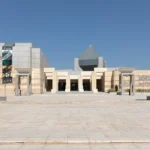
The numbers, from the museum’s own directorship, give the scale – roughly 8,200 inventoried objects, of which about 6,400 are icons. Only a few hundred can be shown at any one time, and since 2016 they have been shown properly – the museum moved that year into a contemporary purpose-built building on Fan Noli Boulevard, where dark-walled galleries, controlled light and themed halls replaced the old improvised display. The organisation is roughly chronological, from 14th- and 15th-century Byzantine panels through the great age of the Albanian icon schools in the 16th and 17th centuries and into the more folk-inflected work of the 18th and 19th, with carved iconostases, metalwork and textiles filling out the picture of what an Orthodox church interior of the period actually contained. You can confirm current opening hours and any entry fee on the museum’s own website before you go – this korca travel guide deliberately prints neither, because both change and stale figures in print help nobody.
Give the museum at least two hours and do not rush the early rooms; the power of the collection is cumulative, face after painted face, until the conventions of icon painting stop looking repetitive and start looking like a language you are learning to read. English labelling has improved with the new building, though a guided visit or a good guidebook chapter still adds a great deal, because the difference between a routine workshop panel and a masterpiece by one of the named masters is exactly what the labels only partly explain. The museum sits a walk from the bazaar quarter rather than inside it, which thins the crowds to almost nothing – on many days you will share the galleries with a handful of other visitors, a luxury no comparable collection in Greece would give you.
Onufri and the Icon Painters
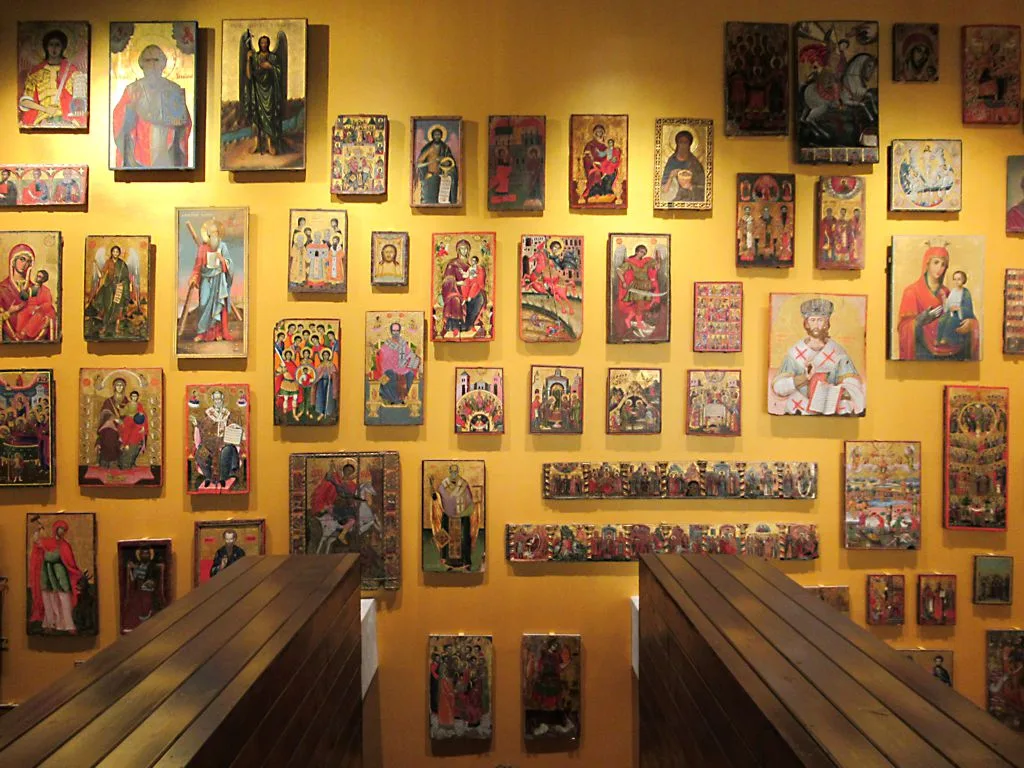
One name towers over Albanian icon painting, and the museum in Korçë is where his work is best understood in depth. Onufri, active in the mid-16th century, was the master who effectively founded the Albanian school of icon painting – a painter of extraordinary intensity whose figures burn with a distinctive red pigment that art historians still call “Onufri’s red”, and whose work in the churches of Berat and Kastoria set the standard for two generations of followers, including his son Nikolla. The museum’s directorship describes its holding as the largest collection of Onufri icons anywhere, with eleven of his works exhibited, pieces that began their lives on the iconostases of churches in Berat – the Holy Trinity, the Annunciation, and Saints Constantine and Helena. Handle that claim the way this korca travel guide handles all of them – it is the museum’s own account, and it is plausible precisely because the Korçë repository was where the regime concentrated the south-east’s church art.
Around Onufri the collection fills in the whole family tree of the craft. There is Onufër Qiprioti, the Cypriot-trained painter of the later 16th century; Kostandin Shpataraku in the 18th; David Selenica, whose frescoes you can meet again in their original setting in the church at Voskopojë if you take the day trip described below; the Zografi brothers; and the Çetiri family of painters who carried the tradition into the 19th century. Seeing the works shoulder to shoulder is what makes Korçë special – in their home churches these panels are scattered across a dozen villages and half of them are locked away, while here the development of a regional art across four centuries hangs in sequence. One honest clarification for the itinerary-minded – the famous museum that carries Onufri’s name is in Berat, inside the church where he painted, and if you visit Berat on the same trip the two collections complement rather than duplicate each other – Berat gives you the master in situ, Korçë gives you the school entire. Both belong in a serious Albania art itinerary, and the Albania travel guide on this site shows how the two cities combine on one route.
The Resurrection Cathedral
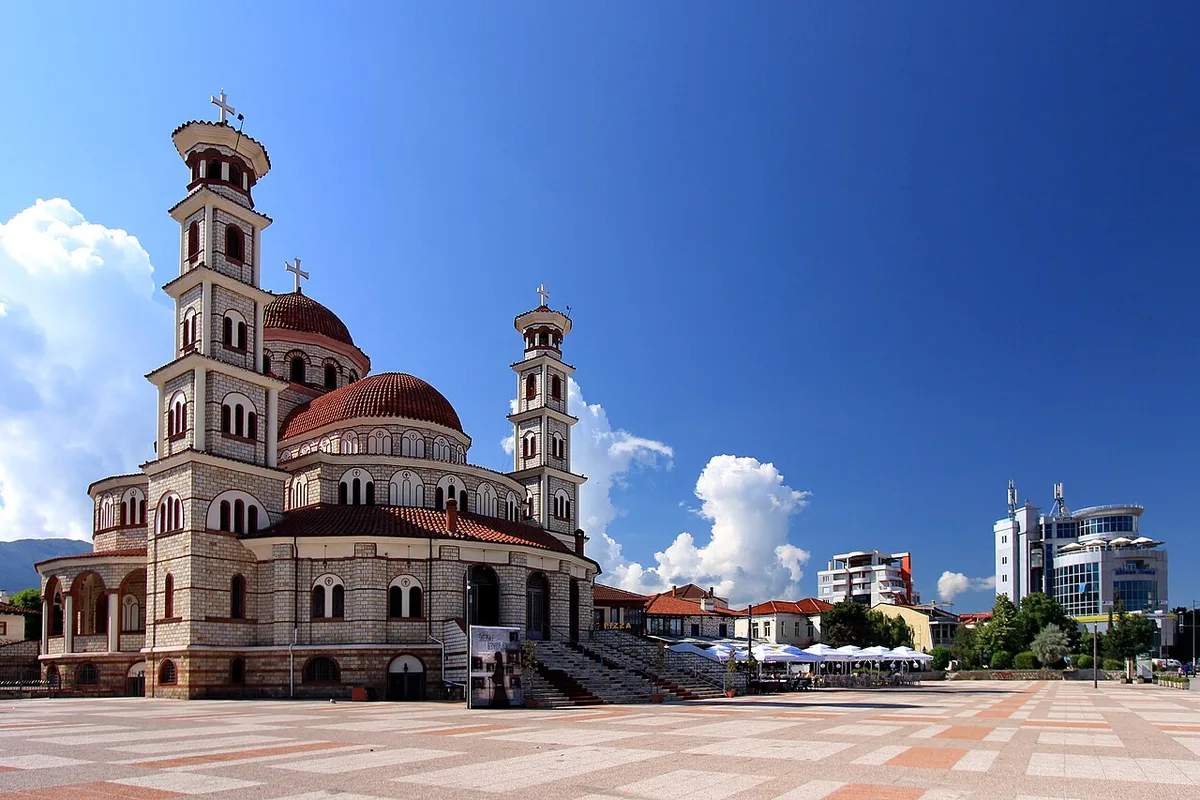
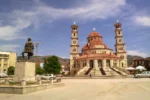
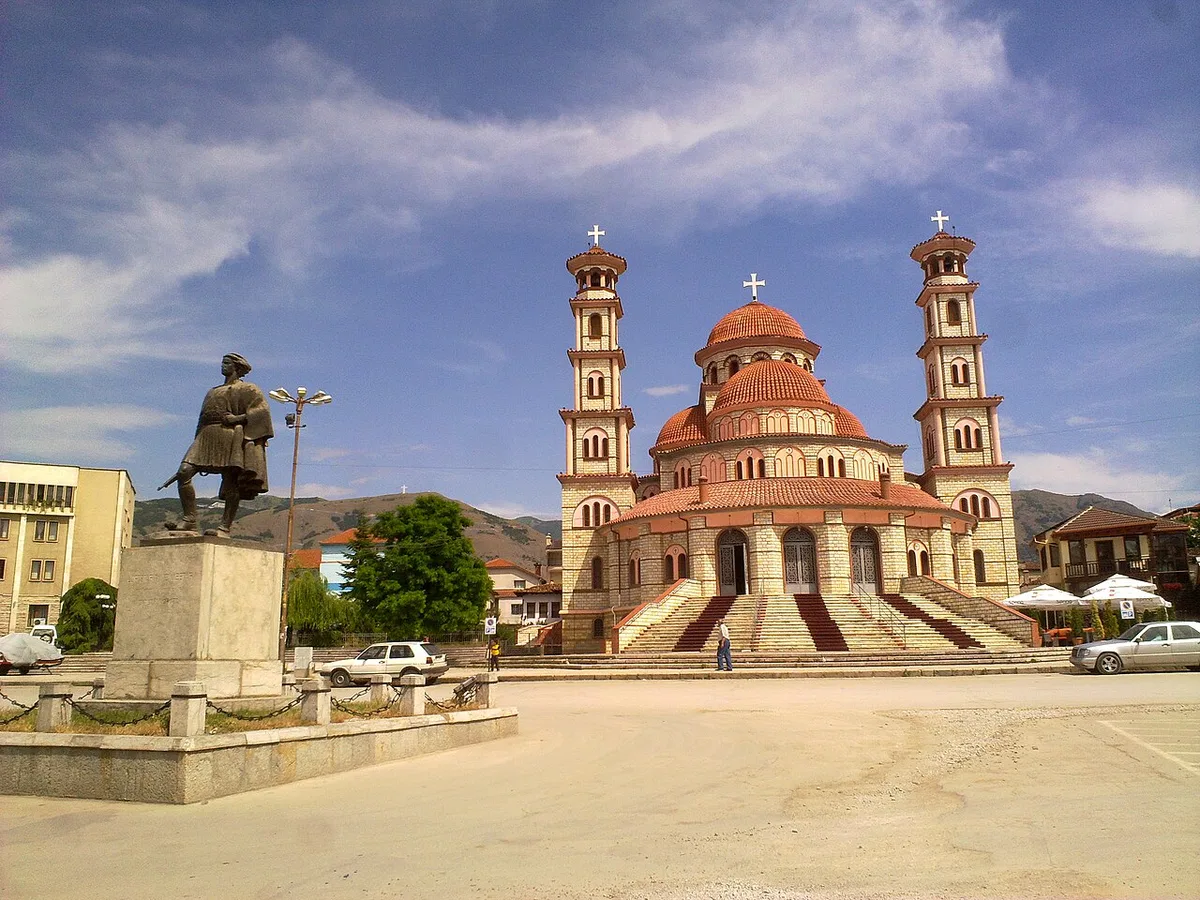
You cannot miss the Resurrection Cathedral, and you are not meant to. Korçë’s main Orthodox church rises over the central square in a swirl of pink, blue and brown masonry, multiple towers and red-tiled domes – a building designed to announce, as loudly as architecture can, that the faith it serves is back. The announcement has a specific target. On this site stood St George’s Cathedral, the city’s old principal church, until the communist authorities demolished it in 1968 at the height of the atheist campaign that also filled the medieval art museum with rescued icons. Ground was broken for the replacement in 1994, in the first flush of post-communist religious revival, and the new cathedral was completed and consecrated in 2002.
Inside, the centrepiece is the enormous carved wooden iconostasis that screens the sanctuary – a wall of gilded, intricately worked timber in the Balkan tradition, and the single most impressive piece of modern religious craftsmanship in the city. The interior is bright, spacious and unmistakably contemporary, which is the honest point to make about the whole building – this is not an old cathedral, and travellers who arrive expecting Byzantine atmosphere sometimes react to its wedding-cake colours and clean lines with a sniff. That reaction misses what the building is for. The Resurrection Cathedral is a civic statement by a city whose old cathedral was dynamited within living memory, and judged as a statement – by its congregation, whose church this is – it succeeds completely. Services fill it; the square in front is the city’s natural meeting point; and the Monument of the National Fighter standing nearby ties the religious revival to the national story Korçë tells about itself.
Practical notes are simple. The cathedral stands on the main square at the heart of the centre, a few minutes’ walk from both the bazaar and Bulevardi Republika, and it is at its most photogenic in morning light or lit up after dark. Dress modestly if you go in, expect it to be busiest around services, and combine it with the medieval art museum in the same day if you can – the pairing is the most instructive in this korca travel guide, because the museum shows you what the regime took out of Albania’s churches and the cathedral shows you what the city built when it could build again.
The First Albanian School – Mësonjëtorja
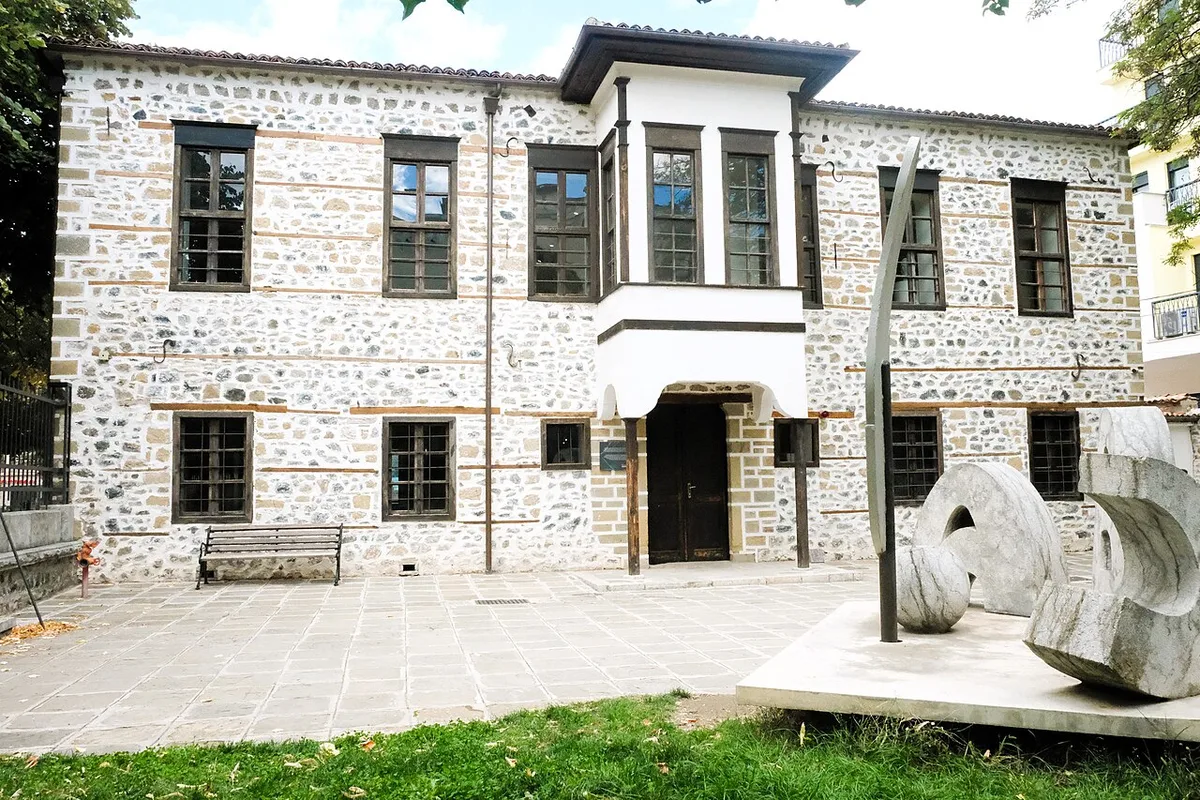
Every Albanian knows the date 7 March, and this modest stone house in Korçë is why. On 7 March 1887 the Mësonjëtorja opened here – the first school in the country to teach in the Albanian language – in a period when Albanian-language education was effectively forbidden in the Ottoman Empire and the language was taught, if at all, in secret. The school was organised by the city’s Secret Committee with support from the Frashëri brothers, the intellectual dynasty of the national awakening; Naim Frashëri used his position in Istanbul to extract the Ottoman permission, which nominally restricted the school to Christian children – a condition quietly ignored in practice, as Muslim children enrolled too. Its first director was Pandeli Sotiri, and its pupils learned from primers like Naum Veqilharxhi’s Abetare, the alphabet book that had started the language movement decades earlier. Pressure from the authorities and the church hierarchy eventually closed the experiment – the school was shut and vandalised by 1902 – and four years after it opened, the city added a second first, the first Albanian girls’ school, associated with Sevasti Qiriazi.
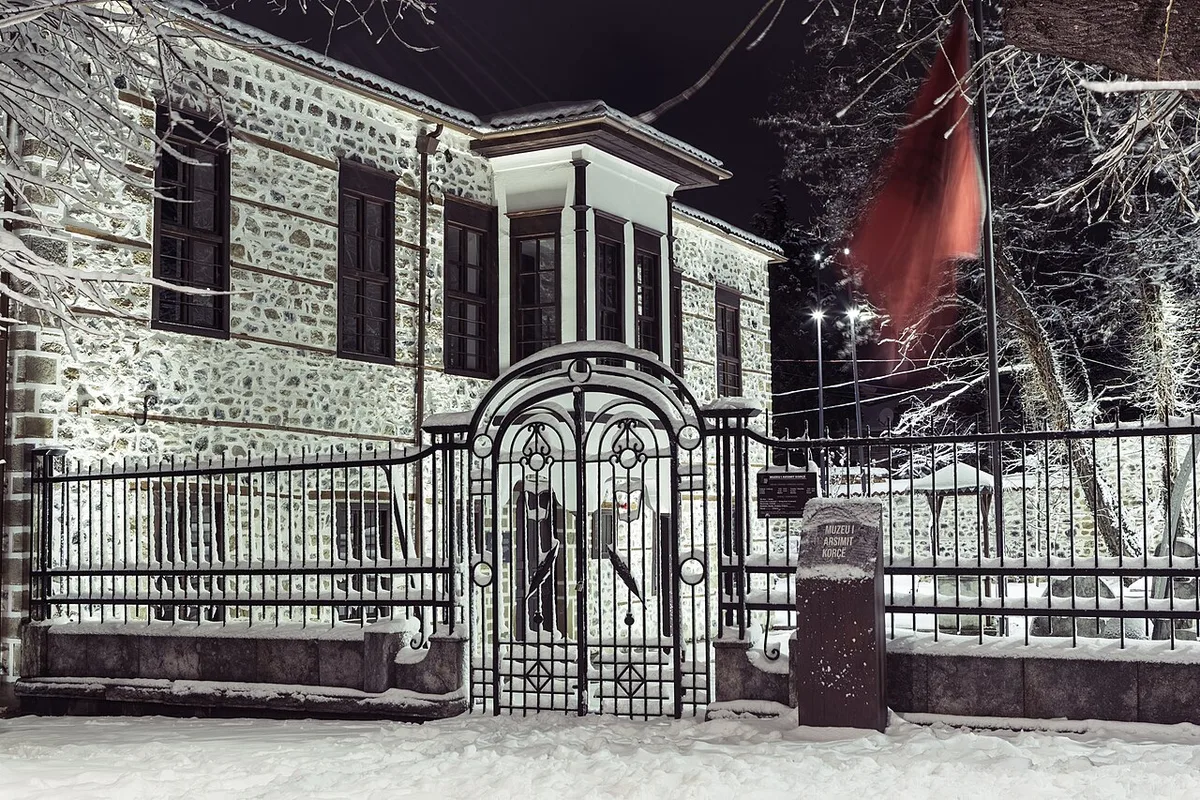
The building now houses the National Museum of Education, and it is one of those small museums whose significance outruns its size. The displays trace the school’s story and the wider struggle for Albanian schooling – primers, documents, classroom reconstructions – and the house itself, a fine stone merchant’s house of the period with its ABC sculpture in the courtyard, is half the exhibit. Teachers’ Day is still marked across Albania every 7 March in memory of this school, which tells you how central the Mësonjëtorja is to the national story – in a country that had to fight for its own alphabet, the first legal classroom is a founding monument.
Visit it in the bazaar quarter circuit, where it stands a short walk from the mosque and the old market lanes, and allow the better part of an hour. Labelling is thinner than at the medieval art museum and the story lands hardest if you already know the outline given here – which is precisely why this korca travel guide gives the school a full section rather than a paragraph. Travellers skip it because “small museum of education” sounds dry; Albanians queue to photograph it because they know what it cost. Both reactions are understandable, and the second one is right.
The French Years – 1916 to 1920
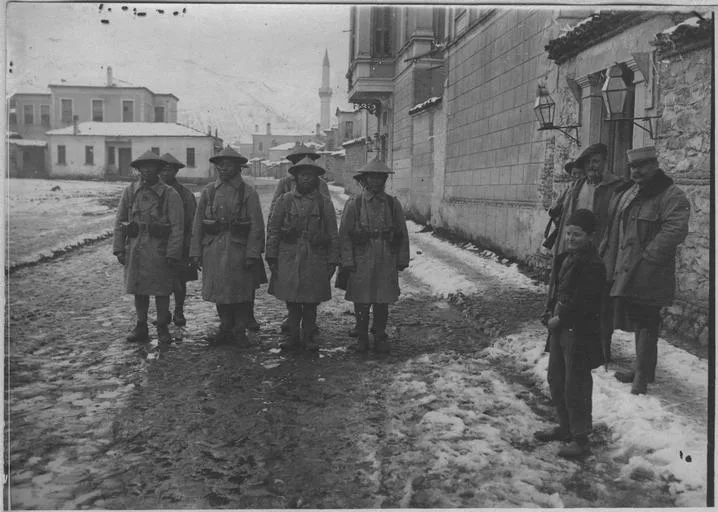
Between 1916 and 1920 Korçë lived the most extraordinary episode in its history, and the city still keeps the evidence – a French military cemetery on its edge and a generation of family stories. During the First World War the Macedonian Front ran not far to the east, and French forces of the Allied Army of the Orient moved into the Korçë region to protect their flank. What General Sarrail’s command chose to do next was unusual – rather than rule through occupation alone, the French worked with local leaders, and on 10 December 1916 fourteen Albanian delegates, seven Muslim and seven Christian, proclaimed the Autonomous Albanian Republic of Korçë under French military protection, with the patriot Themistokli Gërmenji at its head, under a protocol signed with the French commander Colonel Descoins.
For a little over a year the republic actually functioned, and historians treat it as a genuine experiment in Albanian self-government rather than a puppet arrangement – it minted its own coinage, printed its own stamps, flew its own flag, ran its administration in Albanian, and oversaw a remarkable burst of schooling, with around two hundred Albanian schools opened across the zone while Greek schools were closed. It also ended badly for its leader. Gërmenji was arrested and executed after a French military tribunal – a verdict later recognised as a grave judicial error – and in February 1918 Sarrail’s successor formally abrogated the proclamation, though the republic’s administration and flag effectively lingered until the French withdrew and Albanian authority took over in 1920. The episode matters beyond Korçë – it demonstrated, four years before the modern Albanian state consolidated, that Albanian officials could run a mixed Muslim-Christian administration competently, and the city remembers it with pride rather than embarrassment.
Traces for the visitor are modest but real – the French war cemetery, maintained to this day, where the soldiers of the Army of the Orient who died here are buried; the Gërmenji monument in the city; and period photographs, like the one above, of French troops in snowy Koritza streets that hang in local collections. This section is deliberately careful, because the French years attract inflated retellings; the account here follows the scholarly record of the proclamation, the protocol and the republic’s short life. For a traveller, the value of the story is what it explains about Korçë itself – a city whose civic confidence, bilingual polish and ease with outsiders were all sharpened by having once, briefly, governed itself. No korca travel guide could leave it out, and none should exaggerate it either.
Boulevards, Cafés and Serenades
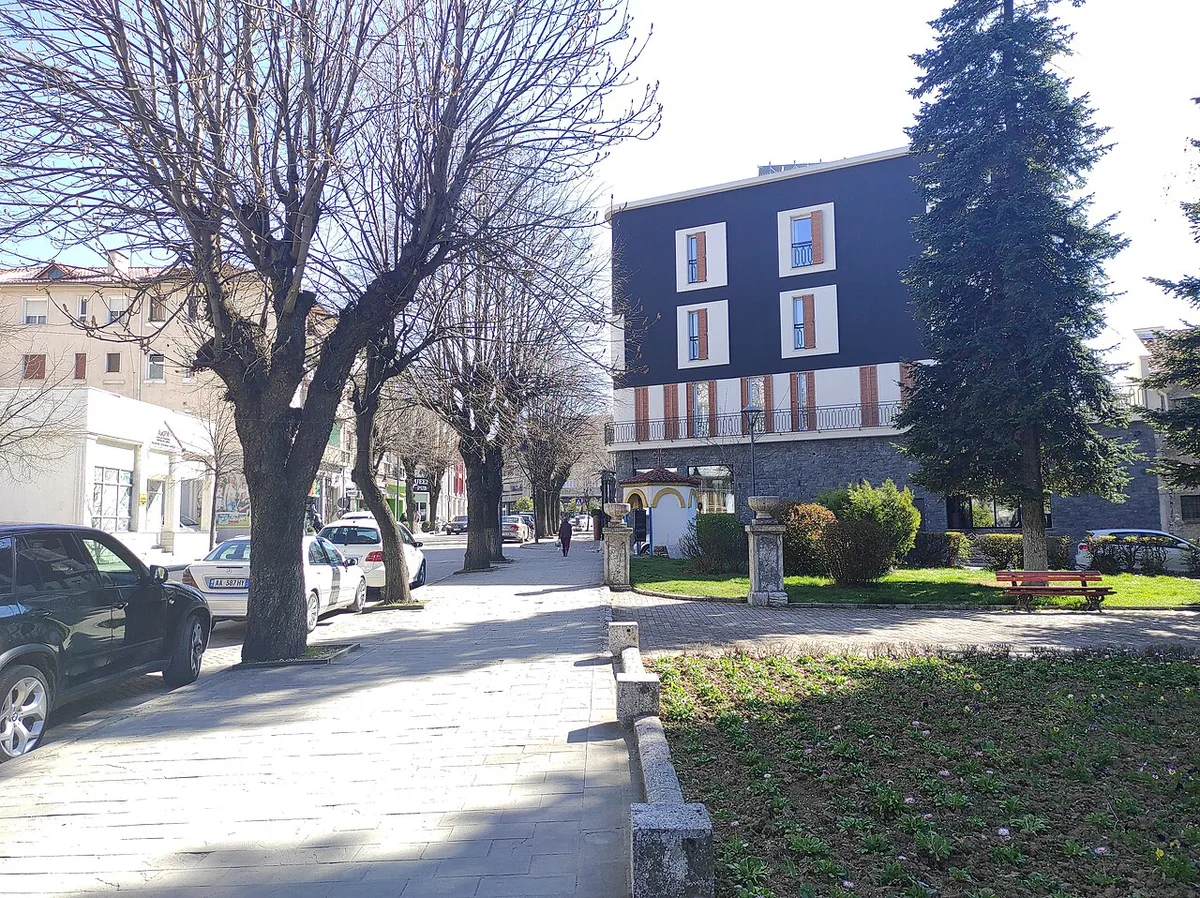
Ask an Albanian from Tirana what Korçë is for and the answer comes quickly – serenades, coffee, and winter. The city’s modern personality was built on its boulevards. Bulevardi Republika and the pedestrianised streets around the cathedral form the stage set – broad, tree-lined, café-fronted avenues where the whole city takes its evening xhiro, the unhurried promenade that remains the basic unit of Albanian social life. Korçë does the xhiro with particular commitment; its café culture is a matter of local pride, its coffee is taken slowly and seriously, and the boulevard terraces fill in a daily rhythm that has nothing to do with tourism. Add the Fan Noli Boulevard running out toward the medieval art museum and you have the city’s two walking axes – one for sights, one for sitting still in public, which here counts as an activity in itself.
The serenades are the romantic layer on that café culture, and they are real. Korçë calls itself the city of serenades, and the tradition is specific – love songs sung to guitar and mandolin beneath a beloved’s window, a courtship custom of the old city that professionalised into a beloved genre of Albanian music, performed today by serenade groups at festivals, weddings and, in summer, in the bazaar quarter that long ago earned the name “Bazaar of the Serenades”. You are unlikely to witness the under-the-window original on a short visit – it belongs to private life – but you will hear the repertoire everywhere, and the city’s summer calendar leans into it with serenade evenings and festivals. The carnival belongs to the same civic personality; the tradition predates communism, which suppressed it, and in recent years Korçë’s carnival has run as an international festival at the start of the summer season, filling Republika Boulevard and the Old Bazaar with costume parades – worth building a June trip around if your dates can bend.
The practical translation for visitors is simple – schedule like a local. Sightsee in the morning, take coffee as a destination rather than a pause, and keep evenings free for the boulevard and the bazaar, because Korçë after dark is the version of the city its own people love most. It is also the cheapest entertainment in this korca travel guide; the price of a coffee buys you an hour in the front row of the city’s daily theatre, and no ticket office is involved.
Birra Korça – the City’s Own Brewery
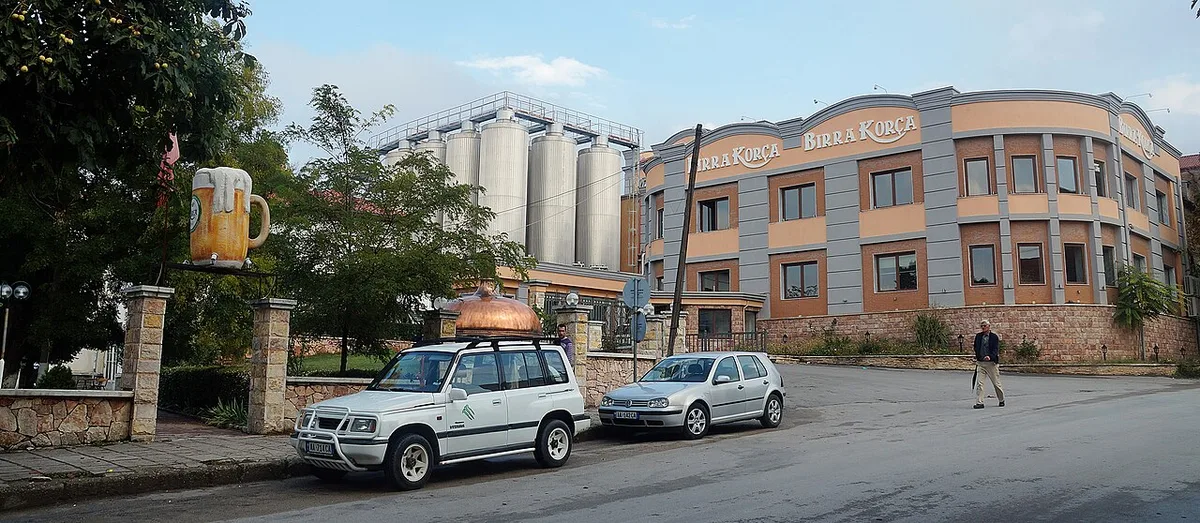
Most cities have a beer; Korçë has the beer, and the distinction matters to the people who live here. Birra Korça was founded in 1928 – Albania’s first brewery – by an Italian investor, Umberto Umberti, and a local partner, Selim Mboria, with a starting capital of 950,000 francs and an initial capacity of about 20,000 hectolitres a year. The brewery produced blonde and dark ales alongside “Kristal” bottled water and ice, drawing its brewing water from the springs of the Morava Mountains above the city – the detail locals still cite when they explain why the beer tastes of Korçë. After the Second World War the brewery passed into state hands with the rest of Albanian industry, and in 2004 it was bought by the businessman Irfan Hysenbelliu’s IHB Group, returning it to private ownership and to the national market as the flagship beer of its home city.
For the visitor the brewery functions on three levels. It is a sight – the plant still operates on its site in the city, its silos and the giant beer-mug sign visible in the photograph above, and it anchors the eastern side of the centre the way the cathedral anchors the middle. It is a taste – order Birra Korça in the city and you are drinking the local product in the local way, in the brewery’s own beer garden and in tavernas across the bazaar quarter, where the dark ale in particular has its devoted following. And it is a date – in recent years the city has staged a beer festival in August built around its brewery, days of concerts and crowded stands that turn the hometown product into a civic celebration. This korca travel guide prints that festival detail with a deliberate “in recent years”, because editions and exact dates shift; check the city’s announcements if you are timing a trip to it.
The brewery also explains something structural about Korçë that the museums do not – this was an industrial and commercial city as well as a cultural one, and its self-respect was built on making things. Beer, in that sense, belongs in the same story as the bazaar, the printing connections and the schools – a city that produced. Drink it in the city, at source, and the point makes itself.
Where Korca Fits an Albania Itinerary
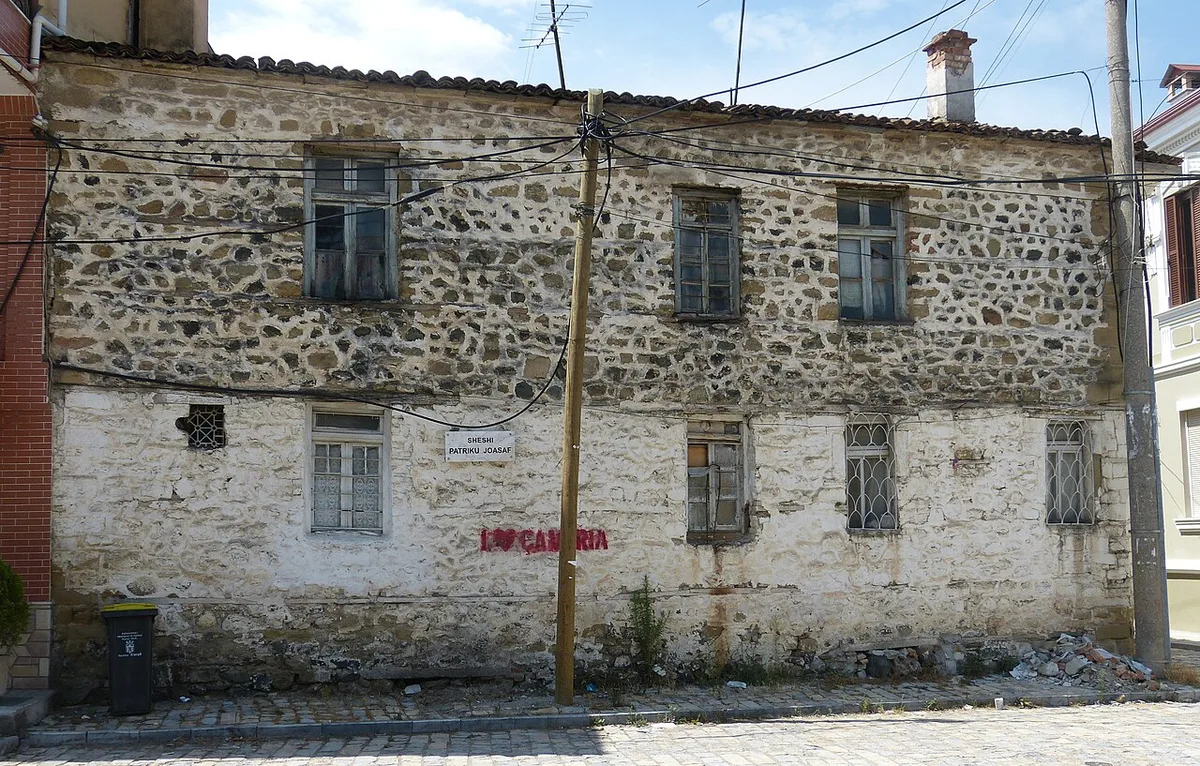
Honest positioning first, because this is the decision most readers are actually making – Korçë is not a UNESCO town, and if your Albania trip has room for only two historic bases, Berat and Gjirokaster will usually win. Both are World Heritage listed, both are more dramatically sited, and our Berat travel guide and Gjirokaster travel guide cover them in the same depth as this korca travel guide covers Korçë. Korçë does not beat them at their own game, and a guide that claimed otherwise would be wasting your trust. What Korçë offers instead is a different category of pleasure – a living, working city with two museums of national importance, a café culture the UNESCO towns cannot match at this scale, and a position in the east that neither Berat nor Gjirokaster can serve.
That position is the practical argument. Korçë is Albania’s natural gateway to Lake Ohrid and to the borders beyond it – the crossing into North Macedonia at Qafë Thanë sits just past Pogradec, and the Greek border at Kapshtica is close in the other direction – which makes the city the obvious Albanian stop on any overland loop linking Tirana with Ohrid town, Lake Prespa or northern Greece. It also anchors the eastern end of the classic first-trip route described in our list of the best places to visit in Albania – travellers who finish the standard circuit at Gjirokaster and double back miss the entire south-east, while those who add Korçë complete the country’s full loop and collect Lake Ohrid on the way. Scan the wider list of things to do in Albania and you will notice how many of its eastern entries – Ohrid’s shore, Voskopojë, the Prespa lakes – assume a Korçë base without saying so.
Time is the real price. The city needs two nights to breathe – one full day for the bazaar, mosque, school and museum circuit, one evening given over to the boulevards – and three or four nights if the day trips below are to be enjoyed rather than endured. Given those nights, Korçë stops being a detour and becomes what it is for Albanians – the country’s cultural second city, and the place whose locals are most likely to tell you, accurately, that their town is the most civilised in Albania. Among the headline Albania tourist attractions it is the one that behaves least like an attraction and most like a home – which, depending on the traveller you are, is either the catch or the entire point.
Getting There and Getting Around
Korçë is a road city, and everything about reaching it follows from that. There is no airport and no passenger railway – buses, furgon minibuses and cars do all the work. The main corridor from Tirana runs via Elbasan and Pogradec, crossing the mountains to drop onto the Korçë plain; reckon on roughly three to four hours by road depending on route, vehicle and stops, and treat any source promising you a precise scheduled time with suspicion, because intercity transport in Albania still runs substantially on the fill-and-go principle – vehicles leave the terminal area when they are full enough rather than to a printed timetable. Intercity buses and furgons for Korçë use Tirana’s regional bus terminal; in Korçë itself, arrivals and departures concentrate at the city’s bus station on the edge of the centre, a walkable or short taxi ride from the bazaar quarter. Connections also run to Pogradec, and eastward the city is a cross-border junction – the Qafë Thanë crossing into North Macedonia beyond Pogradec, and the Kapshtica crossing into Greece to the south-east – both relevant if Korçë is one stop on a longer Balkan loop rather than a there-and-back trip.
Driving is the most comfortable way to do this region, and this korca travel guide recommends a car for anyone planning the day trips seriously – the Tirana to Korçë road is a proper mountain highway, the plain itself is flat and easy, and a car turns Pogradec, Voskopojë and Dardhë from negotiated excursions into simple drives. Within Korçë you will not need it; the centre is compact and flat, the sights in this guide are all walkable from the bazaar quarter, and the one longer stroll – out Fan Noli Boulevard to the medieval art museum – is a pleasant one. Taxis are the fallback for the museum, for the bus station with luggage, and for day trips if you are not driving; agree the arrangement with the driver before you set off, keep small notes handy, and build your day around the villages’ quietness rather than around return transport, which is the negotiating mistake most visitors make here.
Day Trip – Pogradec and Lake Ohrid
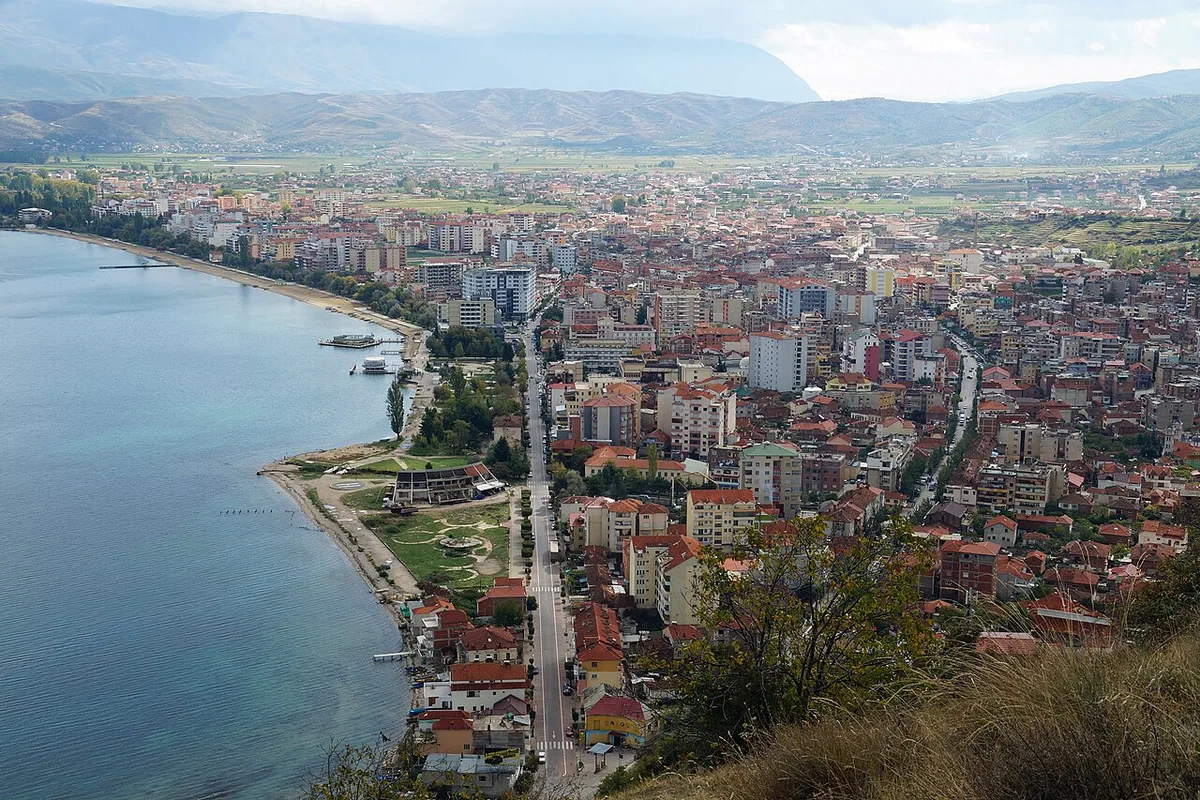
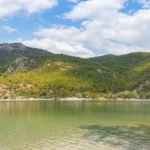
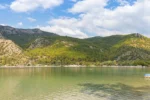
Forty minutes or so north-west of Korçë the mountains open onto one of Europe’s great lakes, and the day trip to Pogradec is the one excursion in this korca travel guide that nobody should skip. Lake Ohrid is an ancient tectonic lake, two to three million years old, and a global byword for endemism – UNESCO’s listing for the Ohrid region records more than 200 endemic species in its waters, including 17 endemic fish, among them two trout species, of which the famous koran is the one that ends up celebrated on Pogradec dinner tables. The lake’s North Macedonian side has been World Heritage listed since 1979-80, and in 2019 the property was extended to the Albanian side – UNESCO’s page for the Ohrid region describes the Albanian shore’s protection under the Pogradec Terrestrial and Aquatic Protected Landscape, designated in 1999. Pogradec itself is the shore’s Albanian town – a relaxed lakeside place with a promenade, town beaches, grilled fish restaurants and a castle hill above the rooftops that gives you the photograph in this section.
The shore repays a full day rather than a photo stop. South of Pogradec, the road hugs the water through Tushemisht – a village of springs and fish restaurants known to Albanians as a former royal and presidential retreat – and past the Drilon springs, a willow-shaded park of channels and clear spring pools that is prettier than its modest fame suggests. North of town, the Lin Peninsula juts into the lake below a village of fish restaurants; on its hilltop stand the remains of an early Christian church founded in the mid-6th century, its mosaic floors notable enough to be named in the UNESCO listing itself, with the lake falling away on three sides below. Honest scoping for the traveller – the Albanian shore is the lake’s quieter side, its pleasures are swimming, fish lunches and slow views rather than sights, and the famous monastery shore and Ohrid town itself lie across the border in North Macedonia, reachable as a much longer day or a next stop rather than a casual extension. Come back to Korçë for dinner; Pogradec in a day, the city at night, is exactly the right ratio.
Day Trip – Voskopojë and Its Painted Churches
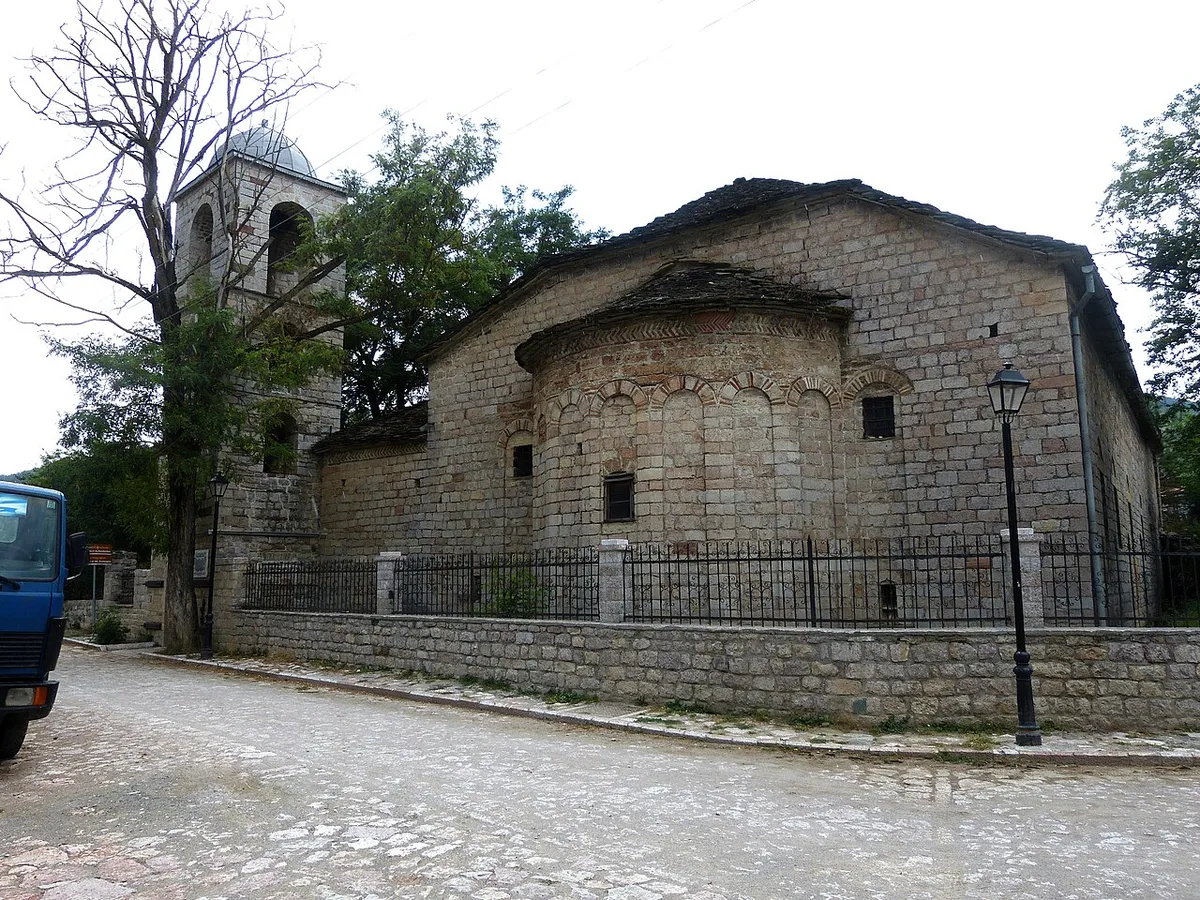
Twenty-one kilometres west of Korçë, an ordinary mountain road delivers you to one of the great might-have-beens of Balkan history. The village of Voskopojë, at about 1,160 metres, is small and quiet today – but in the 18th century, as Moscopole, it was the cultural and commercial capital of the Aromanians and one of the largest cities of the Ottoman Balkans, a trading metropolis linked to Venice, Vienna and Leipzig that hosted the first printing house in the Ottoman Balkans outside Constantinople, alongside academies and dozens of churches. Its destruction came in stages – raids in 1769, devastation in 1788 and a final blow from the campaigns of Ali Pasha – and its people scattered across the region, some of its merchants and craftsmen relocating to Korçë itself and carrying their skills into the city this guide has been describing. Walk the village with that in mind and the quiet becomes eloquent – the streets are laid out for a city, and almost nobody is in them.
What survives is the churches – a handful of them, from the dozens the city once held, kept by the local Orthodox community as holy places. The essential one is St Nicholas, built in the early 1720s, whose frescoes are the work of David Selenica, a master you will already have met in the medieval art museum in Korçë – seeing his painting on the wall it was made for, rather than in a gallery, is the single best reason to make this trip. Other churches of the village preserve their own painting and carved woodwork in varying states of repair. Practical honesty – the churches are not a staffed attraction; they may be locked, access depends on finding the caretakers, and there are days when you will see exteriors only and should be content with them. Combine the village with lunch in one of its mountain tavernas, go by car or hired taxi from Korçë, and treat Voskopojë as a half-day of atmosphere and one great church rather than a checklist – in this korca travel guide it earns its place on quality, not on visitor infrastructure, which barely exists.
Day Trip – Dardhë Village and the Bigëll Slopes
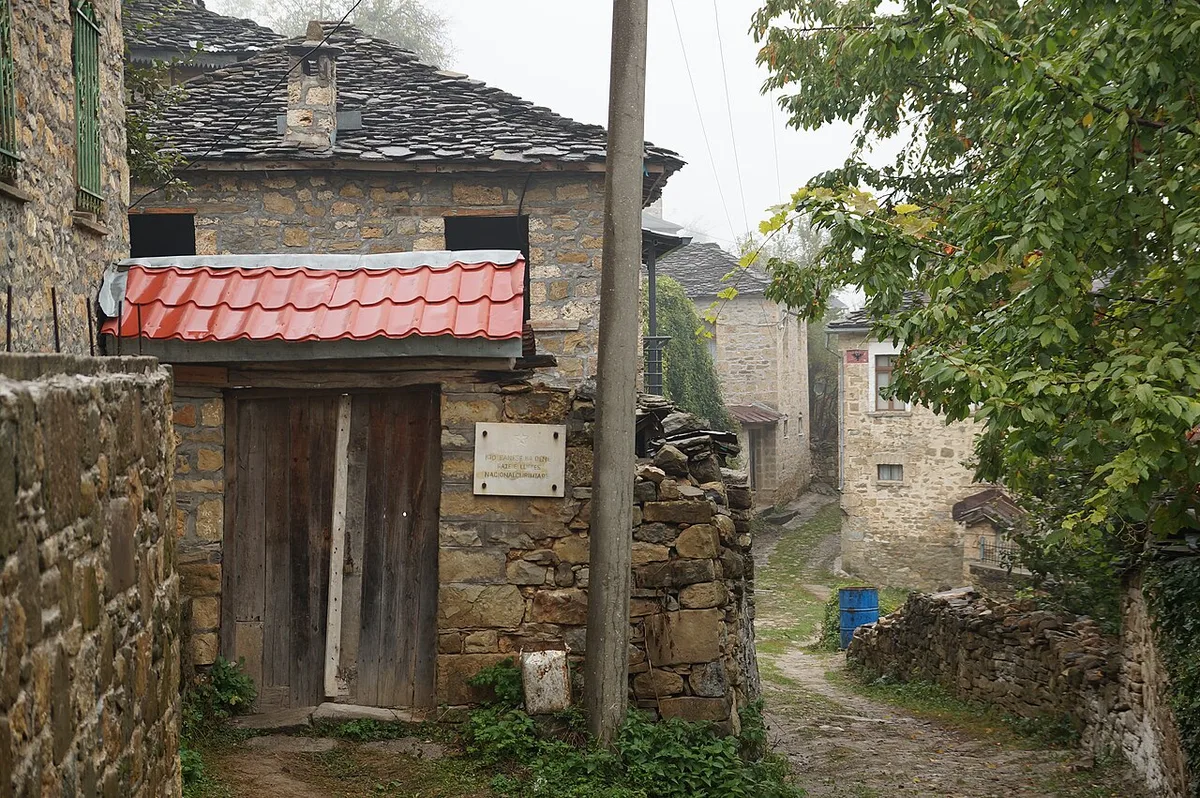
South of Korçë the road climbs into the Morava range to Dardhë, a stone-built mountain village at around 1,344 metres that plays two roles in the city’s year. In summer it is the cool escape – traditional houses with slate and stone, village lanes, cold springs, walking in the surrounding hills and the kind of mountain air that Korçë families have been prescribing themselves for generations; the village fills at weekends with city people in second homes and guesthouses, and sleeps again during the week. In winter it becomes something Albania has almost nowhere else – a ski village. The Bigëll slope above Dardhë is the country’s one organised ski area, with lifts and beginner-friendly pistes that serve a devoted domestic scene of Korçë families teaching their children to ski. Set expectations honestly – this is a small local slope, not an Alpine resort, its season is snow-dependent and typically a winter-months affair, and you come to Bigëll for the pleasure of skiing in Albania at all, not for the vertical drop.
Dardhë works in every season as the third leg of the Korçë triangle, and it is the day trip that changes most with the calendar – which is why this korca travel guide pairs it with the “When to Go” advice below. The drive from the city is well under an hour on a mountain road that improves as it climbs, the village itself offers guesthouses and tavernas serving mountain cooking, and the combination of a bazaar morning, a lakeside lunch at Pogradec and a mountain evening is impossible – do not try to compress all three day trips into a day each on a two-night stay. Choose two, do them slowly, and let the third be the excuse to return. Travellers consistently underrate how much of Korçë’s appeal is this hinterland – the city is the base camp of a small, complete region, and Dardhë, the softest and gentlest of its excursions, is the proof.
When to Go
Korçë has four real seasons and the altitude guarantees all of them, so timing matters here more than on the coast – the region-wide picture in our guide to the best time to visit Albania applies, with a mountain correction. Late spring and early autumn are the city’s sweet spots – May and June bring long, warm days without the coast’s humidity, green hills for Voskopojë and Dardhë, and the lake at Pogradec warming toward swimmable; in recent years June has also carried the carnival festival at the start of summer, the city’s most exuberant weekend. September and October are the connoisseur’s choice – harvest season on a farming plain, golden light, cool evenings made for the boulevard, and the day-trip villages emptied of their summer crowds.
Summer itself splits in two – July and August are hot on the plain by day, though evenings stay mercifully cooler than Tirana’s, and Korçë fills with returning diaspora, weddings and serenades, which makes it the most atmospheric and the most crowded season at once; the beer festival has been staged in August in recent years for those who want the city at full volume. Winter is the season this korca travel guide refuses to oversell and refuses to dismiss – December to February brings real cold and periodic snow to a city at 850 metres, the Bigëll slope above Dardhë runs when the snow allows, the bazaar cafés turn inward and cosy, and the museums empty to near-solitude. If your trip is built around the icons and the old town rather than the landscape, a crisp winter weekend is a legitimate choice; if you are dreaming of lakeside lunches and open mountain churches, come between May and October and let the snow photos stay photos.
Frequently Asked Questions
How many days do you need in Korçë?
Two nights is the honest minimum for the city itself – one full day covers the Old Bazaar, the Mirahor Mosque, the Mësonjëtorja and a proper two hours at the medieval art museum, with the evening left to the boulevards; any korca travel guide that promises the city in a day is selling you a drive-through. Add a third and fourth night if you want Pogradec and one of Voskopojë or Dardhë done slowly, which is the version of the trip people actually remember.
Is Korçë worth visiting compared with Berat and Gjirokaster?
Yes, but for different reasons, and the order matters – Berat and Gjirokaster are UNESCO-listed showpieces and deserve their priority on a first trip; Korçë is a living city with two museums of national importance, the better café culture, and the only practical base for Lake Ohrid’s Albanian shore and the south-east. If your route already runs toward Ohrid, northern Greece or the Prespa lakes, skipping Korçë would be the real mistake; if you are choosing one historic base for a short southern trip and it is not on your route, the UNESCO towns win and this korca travel guide will not pretend otherwise.
What is the National Museum of Medieval Art, and why does everyone rate it?
It is Albania’s national collection of Byzantine and post-Byzantine art – some 8,200 inventoried objects including about 6,400 icons, gathered from churches across the south-east when the communist regime closed them, and displayed since 2016 in a purpose-built museum on Fan Noli Boulevard. Its Onufri holdings are the draw – the museum’s directorship describes the largest collection of the master’s icons anywhere – and the experience of four centuries of icon painting in sequence, in near-empty galleries, is what travellers are rating. Check the museum’s own website for current hours and entry fees before you go; any korca travel guide printing figures risks handing you stale ones.
How do you get to Korçë from Tirana?
By road – there is no airport and no passenger train. Buses and furgon minibuses run from Tirana’s regional bus terminal via Elbasan and Pogradec in roughly three to four hours, many of them leaving on a fill-and-go basis rather than a fixed timetable, and a hire car on the same corridor is the most flexible option and the best base for the day trips. The road itself is good mountain highway for most of its length, and the approach across the mountains onto the Korçë plain is one of the prettier arrivals in Albania.
When is the best time for Dardhë and the skiing?
The Bigëll slope above Dardhë is a small, snow-dependent local ski area – Albania’s only organised one – and its season is a winter one, typically the cold months from around December into February or March when the snow holds. Conditions vary year to year, so treat skiing as a possible bonus to a winter Korçë trip rather than its guaranteed centrepiece, and remember the village works in summer too, as the city’s cool mountain escape. This korca travel guide gives no piste statistics, because none are published reliably enough to print.
Can you visit Lake Ohrid and Voskopojë as day trips from Korçë?
Easily – they are the city’s two classic excursions. Pogradec on Lake Ohrid’s western shore is under an hour away, with the Lin Peninsula’s 6th-century mosaics and the Drilon springs along the same shore, while Voskopojë and its painted churches, including David Selenica’s frescoes in St Nicholas, are 21 kilometres west in the mountains. Both are simplest by car or hired taxi; allow Pogradec a full day if you swim and linger over a fish lunch, and Voskopojë a half day with the understanding that its churches may be locked and are a privilege when open. A fuller korca travel guide route for combining them with the city sits in the itinerary section above.
The Short Version
Korçë is Albania’s cultural second city – a high-plain trading town in the south-east that most first-time visitors skip and many second-time visitors rank first. Its Old Bazaar has been restored into the city’s living room, its Mirahor Mosque dates to the 1490s, its National Museum of Medieval Art holds some 6,400 icons including the great Onufri collection, its Mësonjëtorja hosted the first Albanian-language school in 1887, it briefly governed itself as an autonomous republic under French protection in 1916, and it brews Albania’s oldest beer while singing serenades under its windows. That is the whole argument of this korca travel guide in one paragraph – no other Albanian city stacks its history this deep in streets this walkable.
Come for two nights at least, three or four if you add Pogradec on Lake Ohrid, the painted churches of Voskopojë and the mountain village of Dardhë. Give the icons two unhurried hours, the bazaar your mornings and evenings, and the boulevard a coffee a day without agenda. Korçë will not overwhelm you the way the UNESCO towns do; it will do something rarer – it will make you feel, briefly, like a citizen rather than a visitor, and a korca travel guide can promise no better souvenir than that.