Gjirokaster Travel Guide – Stone Roofs, a Giant Castle and the Town That Faces Berat
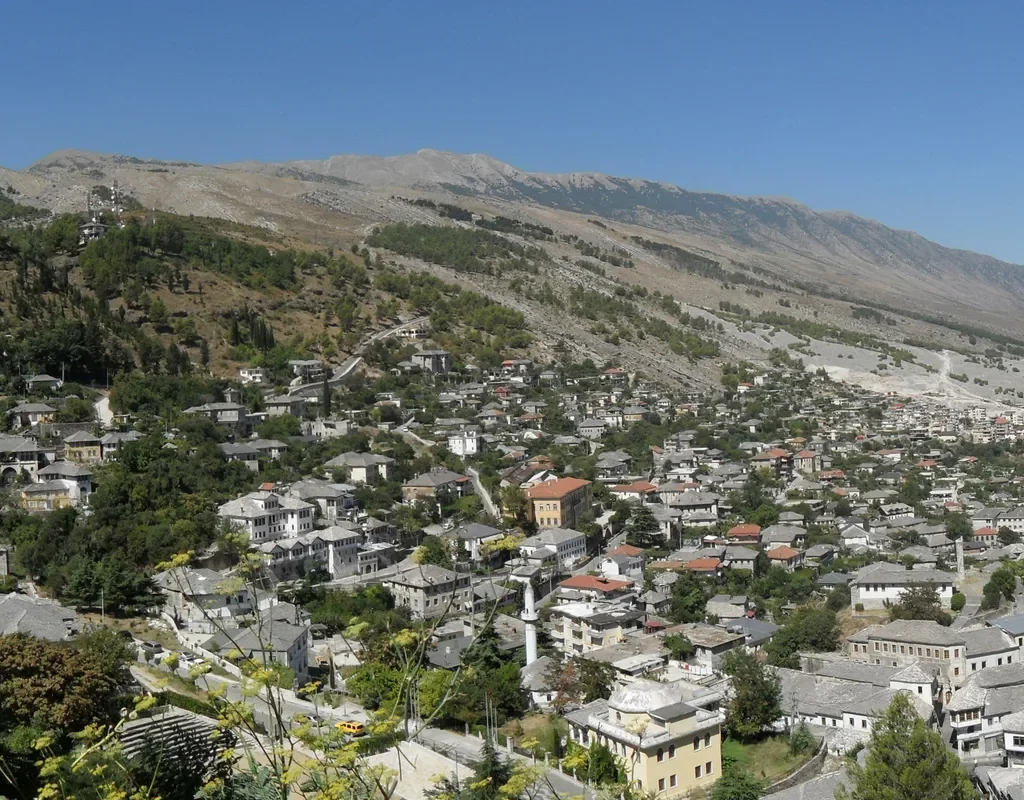
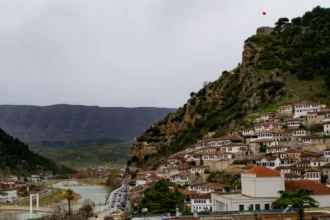
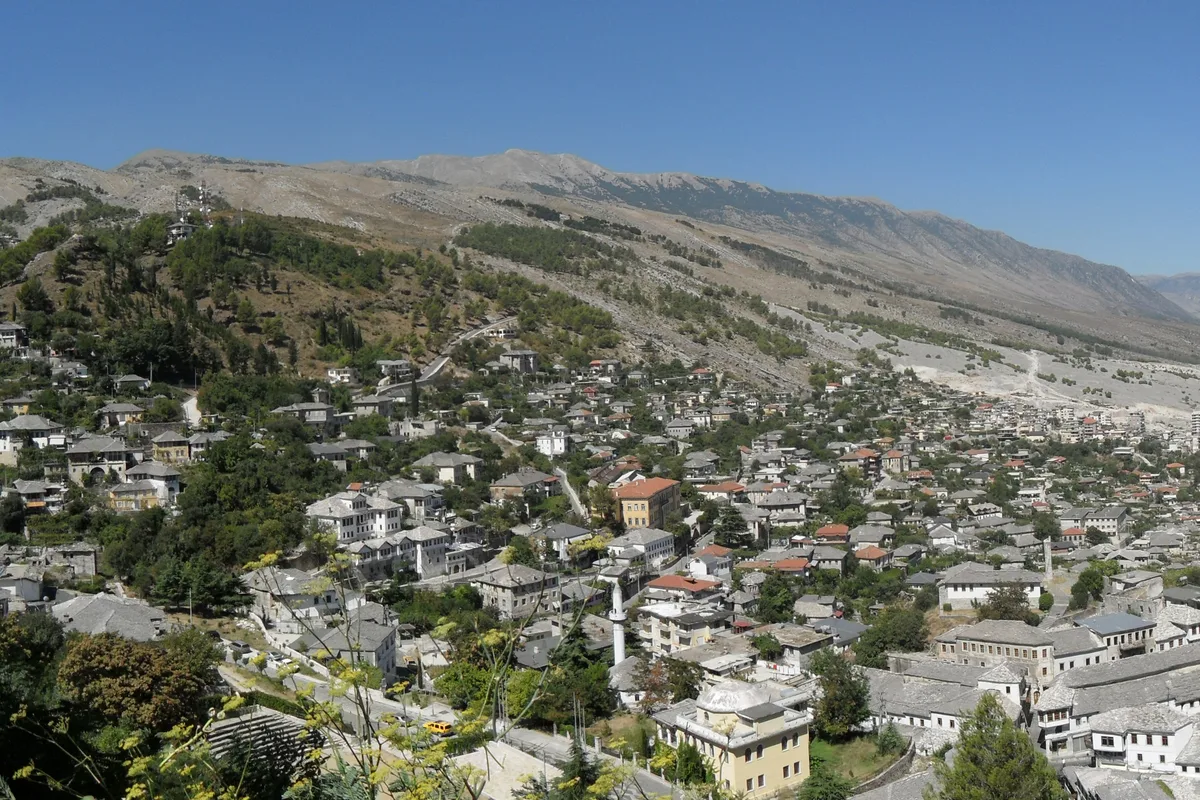
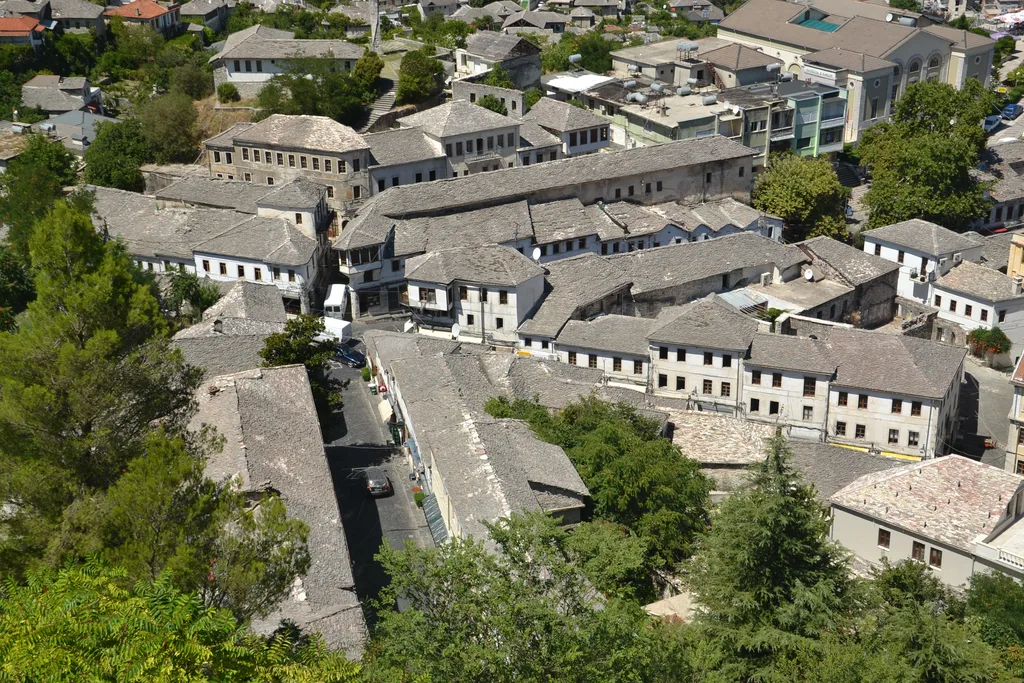
Most Albanian towns introduce themselves politely. Gjirokaster does not bother. The road bends, the valley opens, and there it is – a fortress of frankly unreasonable size riding a long rocky ridge, and below it a whole town built from the same grey stone, roofs included, as if someone had carved the settlement out of the hillside and then roofed it with the offcuts. This is the town Albanians themselves call the city of stone, and the name is not poetry. It is a materials list. Houses, streets, roofs, castle – nearly everything you can see from the valley floor is the local limestone and slate, and the result is one of the most visually unified old towns in the Balkans.
Gjirokaster also comes with a built-in travelling companion. Since 2008 it has shared one UNESCO World Heritage listing with Berat, the white Ottoman town a few hours north, under the joint name Historic Centres of Berat and Gjirokastra – Gjirokastra was inscribed first, in 2005, and Berat was added as an extension three years later. The pairing is more than administrative. Berat is the town of a thousand windows, all light and whitewash; Gjirokaster is its sterner sibling, grey, steep and fortified, a town built by wealthy landowners who wanted their houses to double as strongholds. Almost every traveller doing southern Albania properly visits both, and this guide treats them as the pair they are – two halves of one listing, best read against each other. The full country context sits in our Albania travel guide; this page is everything you need for Gjirokaster itself.
Who is it for? Anyone who likes their history load-bearing. One long day covers the castle and the headline houses, but the town rewards a slower hand – two nights lets you do the fortress in the cool of the morning, the tower houses without hurrying, and an evening in the bazaar when the tour groups have gone. A note on this guide’s honesty policy, stated once and applied throughout: opening times and entry fees in Albania change quietly and often, so we do not print them. Check the current figures at the gate or the tourist information office in the old town, and treat every journey time here as the approximation it honestly is.
Gjirokaster at a Glance
Gjirokaster sits in the Drino valley in far southern Albania, close enough to Greece that the border crossing at Kakavija is a short drive south and the mountains change their names across it. The old town climbs the eastern slope of the valley beneath the castle ridge, at roughly 300 metres above sea level, while the modern town spreads across the flat valley floor below – two settlements, really, one built for defence and beauty, the other for buses, banks and ordinary life. You will use both, but you will photograph only one.
| Where | Drino valley, southern Albania, near the Greek border |
| Famous for | One of the largest castles in the Balkans; stone-roofed UNESCO old town; Ottoman tower houses |
| UNESCO status | Inscribed 2005; joint property with Berat since 2008 (criteria iii and iv) |
| Do not miss | The castle and its two museums, Zekate House, Skenduli House, the old bazaar at dusk |
| Time needed | One long day minimum; two nights is the comfortable version |
| Pairs with | Berat (same UNESCO listing), Saranda and the coast, the Blue Eye spring |
| Effort level | Steep – the old town is a hillside of cobbles; bring shoes that grip |
| Good to know | Birthplace of both Enver Hoxha and the novelist Ismail Kadare |
That effort line deserves emphasis before anything else in this guide. Gjirokaster’s old town is not mildly hilly – its lanes are steep, cobbled with smooth-worn stone, and polished slippery by generations of feet. The castle sits at the top of the slope on purpose. None of this is a reason to stay away; it is a reason to pack flat shoes with tread, to do the climbing early or late in summer, and to understand that in Gjirokaster the view is always earned. The town’s compensations – the fortress, the houses, the roofs, the food – are set out section by section below.
The Castle – One of the Largest Fortresses in the Balkans
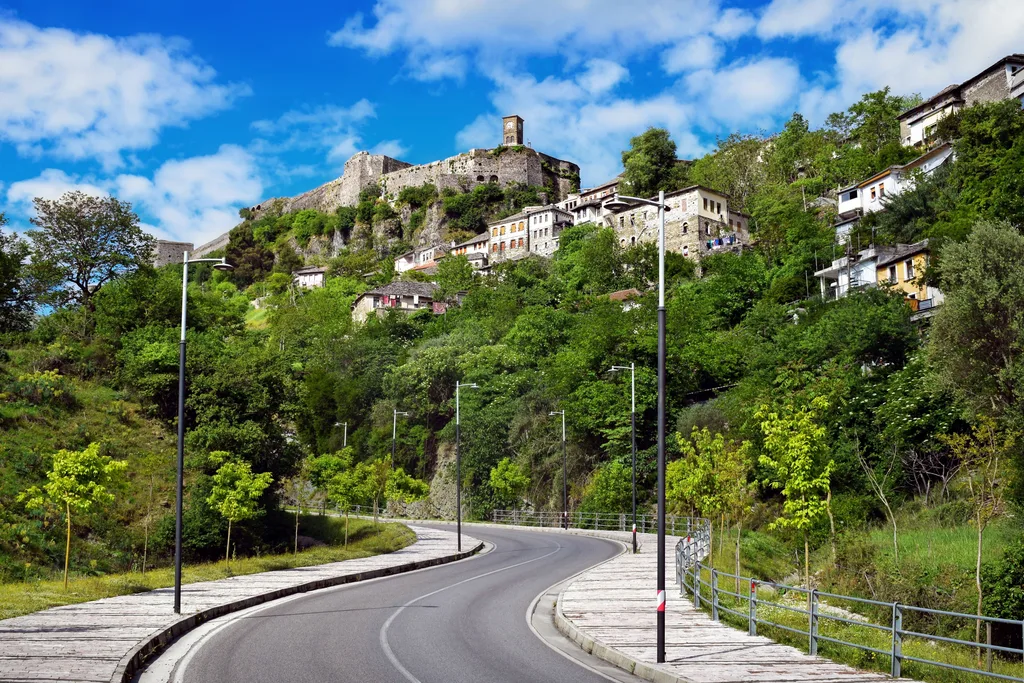
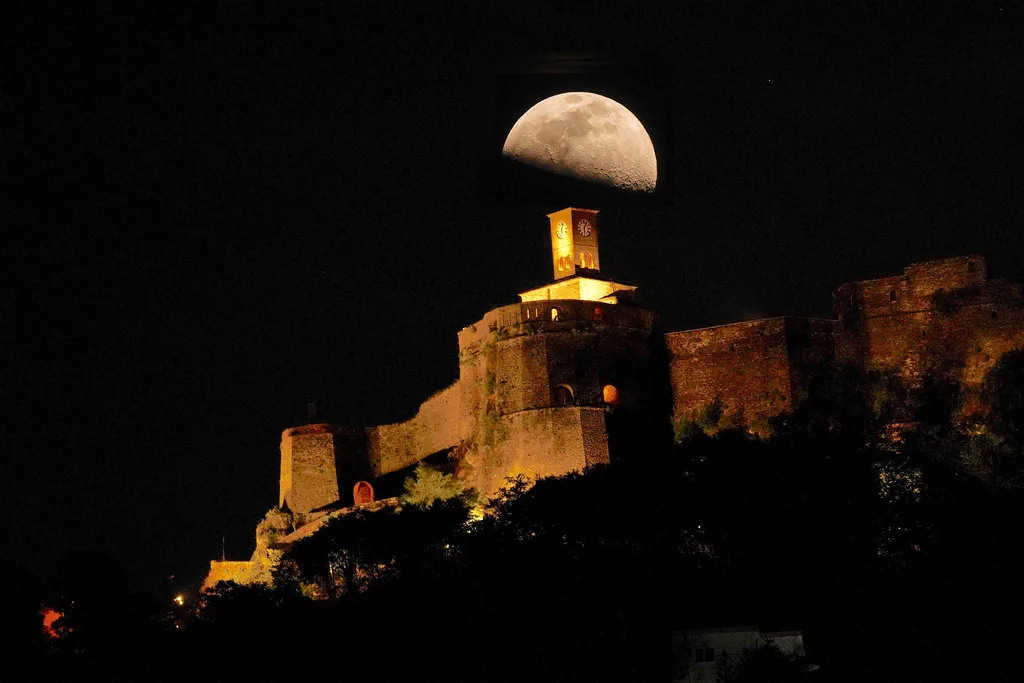
Start with the scale, because the scale is the story. Gjirokaster Castle is routinely described as one of the largest castles in the Balkans – the town’s own tourist board calls it the second largest – and standing under its western walls, looking up at fortifications that run the length of the ridge, the claim needs no persuading. This is not a keep with a courtyard. It is a fortified small town in its own right, a long stone ship of walls, towers, vaulted galleries, cisterns and open ground, from whose ramparts the whole Drino valley unrolls in both directions – north towards the rest of Albania, south towards Greece. On a clear day the views alone justify the climb; the museums, prison and plane parked inside are the second act.
The fortress grew in layers, and the layers are the history of the region written in masonry. The first major fortifications went up in the 12th and 13th centuries, when the town belonged to the world of the Despotate of Epirus; the Ottoman sultan Bayezid II ordered further works around 1490, after the town had passed under Ottoman rule; and the castle you mostly see today is the doing of Ali Pasha of Tepelena, the formidable Ottoman-Albanian ruler who took Gjirokaster in 1811 and rebuilt and extended the fortress in 1811-12 – adding the clock tower that still marks the skyline, extending the walls to the southwest, and building a 12-kilometre aqueduct to fill the castle’s cisterns, whose arched remains, known as the Bridges of Ali Pasha, still stand in the hills west of town. A castle that had to be able to hold out needed its own weather system, and the cisterns and vaulted water stores inside the walls are as impressive, in their way, as the guns.
Walk it as a circuit and the fortress explains itself. The cobbled climb from the bazaar delivers you to the gate, and from there the natural route runs along the walls – vaulted galleries that stay cool at noon, open terraces where the festival stage sits, gun positions and cistern mouths, and at the eastern end the rampart view that takes in the whole geometry of the place: old town under your boots, new town on the flat, the Drino running south and the pale Lunxhëri ridge walling off the horizon. Do the museums on the way through rather than doubling back, and save the western walls for last if the light is building towards evening – that is when the stone turns gold and the valley haze does the castle its favourite favour. Budget the fortress a minimum of two hours; three is honest, and visitors who give it less tend to describe the view and miss the contents.
Even the name may carry the castle inside it. Gjirokaster is usually explained from the Greek Argyrokastro – “silver castle” – and the town appears in Byzantine records under a form of that name as early as 1336. A folk tradition prefers a heroine, the princess Argjiro, who is said to have leapt from the walls rather than surrender; enjoy the legend for what it is, a legend, and note that the “silver” may simply describe how the pale stone fortress shines above the valley after rain or in low sun. Either way, the town and its castle share one identity so completely that from the valley floor it is hard to say where the fortress ends and the town begins – which, for the centuries when the castle’s guns were the town’s insurance policy, was rather the point.
Inside the Castle – Guns, a Prison, an American Plane and a Secret Tunnel
A lot of Balkan castles are empty shells with good views. Gjirokaster’s is full, and what it is full of is the 20th century. Two museums sit inside the walls. The older is the National Museum of Armaments, opened in 1971, whose galleries of Albanian weaponry run from independence in 1912 to the end of the Second World War, with the emphasis firmly on the partisan resistance – rifles, artillery and captured equipment arranged in the castle’s long vaulted spaces. The second, the Gjirokastra Museum, opened in 2012 and tells the town’s own story – its Ottoman centuries, its crafts, its famous citizens – and between them they turn a walk around the ramparts into a proper half-day rather than a photo stop. The castle charges a single modest entry that covers the site and its museums; check the current price and hours at the gate, where they are posted.
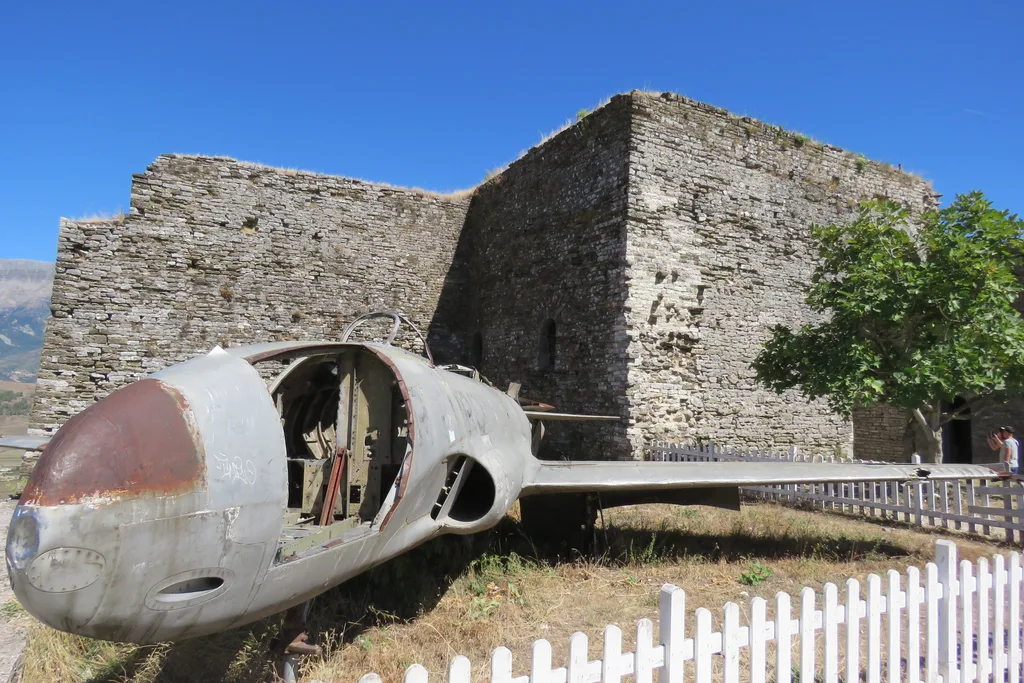
Then there is the prison, which no honest guide should skip. A prison block was completed here in 1932, under King Zog, and the cells went on to serve every power that followed – Zog’s regime, the Italian and German occupations, and the communist government, which held political prisoners in the castle until 1968. Walking the corridor is a sobering counterweight to the folk costumes and wedding photographs elsewhere in the fortress, and it belongs in the visit: Gjirokaster’s beauty and Gjirokaster’s suffering were administered from the same hilltop for much of the last century. Keep the same clear head on the open ground nearby, where the castle’s oddest resident sits behind a fence – the stripped, weathered hulk of an American T-33 Shooting Star. In December 1957 the aircraft came down near Tirana after technical problems, in the telling the Americans gave; Albania’s communist government announced it had forced down a spy plane, and kept both the machine (the pilot was returned) as a trophy. An interpretation panel at the site now lays out both versions side by side under the heading “a plane with two tales”, which is exactly the right spirit in which to look at it.
The Tower Houses – Zekate, Skenduli and the Fortified Homes of the Rich
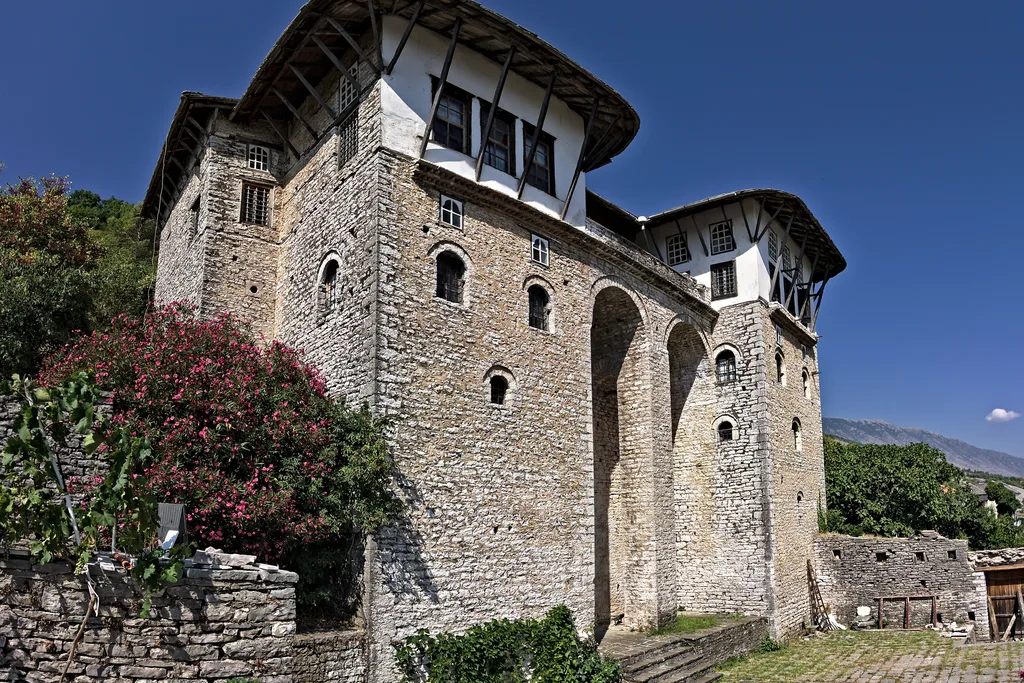
Below the castle, the old town’s second act is domestic – but only just. Gjirokaster’s grand Ottoman houses are called kule, tower houses, and the word is exact: these are fortified residences, built by the wealthy landowning families who, UNESCO’s assessment notes, raised this citadel town around its fortress. The pattern repeats with variations – a near-windowless stone ground floor for storage, animals and the water cistern, family rooms above it, and a top floor built for show, with carved wooden ceilings, frescoed walls, a fireplace and rows of windows for the views the lower floors were denied. In an age when a rich man’s house was also his strongbox and his bunker, the tower house was the rational design, and Gjirokaster preserves the finest cluster of them anywhere in Albania.
The summit of the type is the Zekate House, built in 1811-12 for Beqir Zeko, a local administrator in Ali Pasha’s service – the same years, and the same regime, as the castle’s rebuilding above it. It stands in the Palorto quarter above the bazaar, twin-towered, its facade carried on great double arches, three storeys of pale stone over a walled courtyard. Inside, the top-floor reception room keeps the full Ottoman merchant-prince kit – frescoes, a carved ceiling, a formal fireplace – and the architecture professor Emin Riza, who studied these houses for decades, judged Zekate the best surviving example of its kind in Gjirokaster. The house stands empty now, which gives its rooms a stillness the furnished museums cannot match. The practical arrangement is part of the charm and worth knowing before you climb up: the key is traditionally kept by a neighbour, and visits are arranged through the tourist information centre in the bazaar – ask there first rather than rattling the gate.
The necessary counterpoint is the Skenduli House, a few lanes away, which shows you the same architecture still attached to a family. Built in the 1820s and owned by descendants of the original Skenduli family to this day, it served for a period in the communist era as the town’s ethnographic museum – the state borrowing the house to explain houses like it – before returning to the family, who now show visitors around themselves. A family tour here comes with the famous inventory, reeled off with justifiable pride: nine fireplaces, six bathrooms, a dozen rooms, dozens of doors and windows and several hamams, in a house that once had to run weddings, winters and feuds under one slate roof. See Zekate for the architecture at its purest and Skenduli for the architecture as a lived-in family argument – together they explain the old town better than any panel text, and both belong on the same morning’s walking loop from the bazaar.
Why does this one town keep so many of them? Partly because Gjirokaster was declared a museum city in the communist era, which froze the old town’s fabric in place – nobody was modernising a protected monument, whatever else the period cost the town. Partly because the decades after communism were hard on the houses instead: UNESCO’s own assessment notes the damage done by illegal construction in the late 1990s, and for years grand roofs quietly failed over empty rooms as families left for Tirana or abroad. The current chapter is better – a visible restoration wave, roofs being re-slated in the original grey, houses returning as guesthouses and museums – and it is one reason to visit now rather than in some theoretically perfect future. The tower houses are not a finished exhibit; they are a rescue in progress, and your entry fees and guesthouse bills are part of its funding.
The Old Bazaar – Cobbles, Crafts and the Neck of the Town
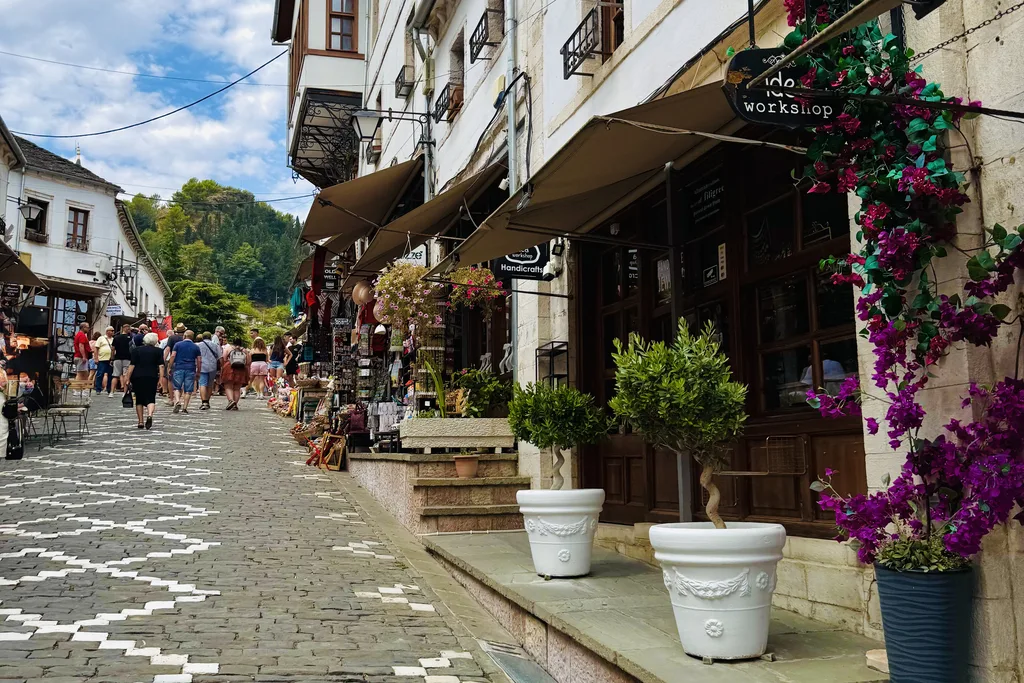
Every old town needs a hinge between its monuments and its daily life, and in Gjirokaster the hinge is the old bazaar. The quarter grew up from the 15th century outside the castle’s northern gate, where the road down from the fortress met the road up from the valley, and its lanes still organise the town: the castle climb starts here, the tower-house quarters branch off here, and the crossing at its centre, known as Qafa e Pazarit – the neck of the bazaar – is the address everyone gives and nobody needs explained. An Ottoman mosque stands at the heart of the quarter, a reminder that this was never only a market; it was the town’s civic room, where trade, worship and gossip shared the same few hundred metres of cobble.
Today the bazaar is given over to the crafts the town has always made, sold from stone shopfronts under slate roofs of exactly the same grey as the houses above. Stone carving is the local signature – the material is the town, after all – alongside woodwork, embroidery and lace, woven goods, and the inevitable cheerful ranks of souvenirs. Quality varies as it does everywhere; the genuine workshops, where you can hear the work being done in the back room, are easy to tell from the import stalls, and buying from them is the single most useful thing a visitor’s money does in the old town. Prices are for you and the shopkeeper to settle between you – this guide does not quote them, and haggling expectations here are gentle by regional standards.
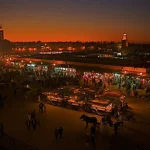
Time the bazaar twice if you can. Come in the morning for the workshops and the coffee, when the lanes are the town’s own; and come back at dusk, when the day-trippers have drained away down the hill, the cafe awnings glow, the cobbles hold the last of the light and the castle above turns the colour of weak tea. The bazaar at that hour is not a sight to be ticked off – it is simply the old town being itself, with the restaurants filling and the neck of the bazaar doing its five-century-old job of gathering everyone in. Several of the eating places recommended in the next sections sit on these lanes, which is no coincidence: in Gjirokaster, the bazaar is where the day ends.
The Ethnographic Museum and the Town’s Two Famous Sons
Gjirokaster produced the two most famous Albanians of the 20th century, and they were not friends. Enver Hoxha, who ruled the country as communist dictator from 1944 until his death in 1985, was born here in 1908; Ismail Kadare, the novelist whose books carried Albanian literature to the world, was born here a generation later and wrote about his stone hometown more memorably than anyone – his Chronicle in Stone is the single best book to read before, during or after a visit. The town handles this double inheritance with more grace than might be expected, and the Ethnographic Museum is where to see how.
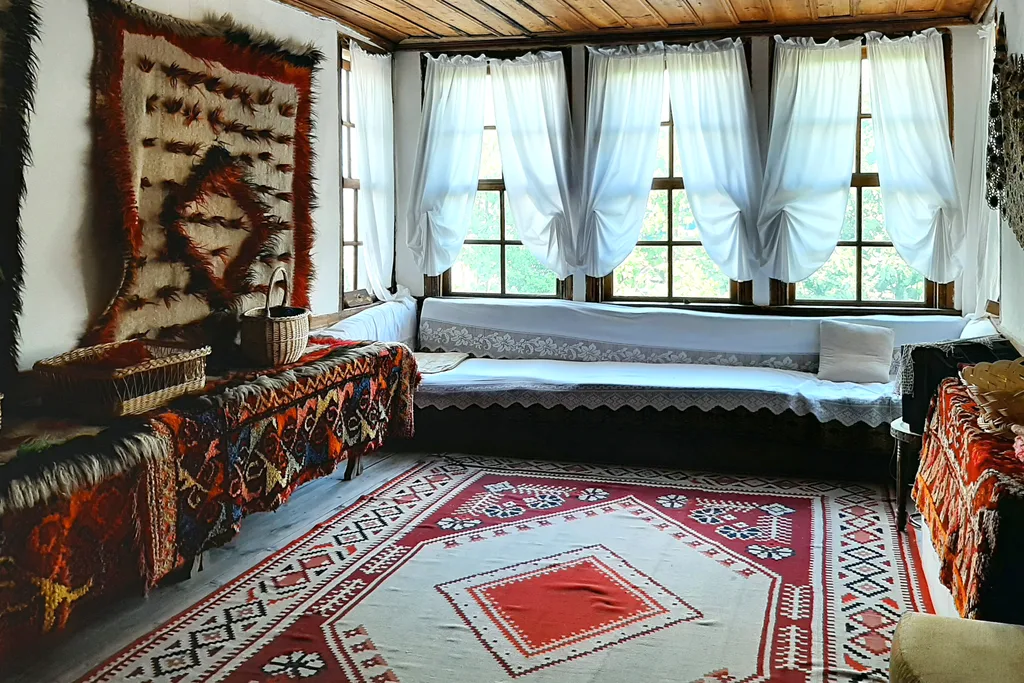
The museum occupies a grand traditional house in the old town – and the site carries the history plainly: it stands where Hoxha’s birthplace house once stood, the original building having been lost and the present museum house built in the traditional style on its footprint. Inside, the emphasis is ethnographic rather than political: furnished reception rooms with the long window seat and layered kilims of a prosperous household, traditional costumes of the region, craft tools, copperware and the domestic equipment of the town’s Ottoman-era families. As a primer it is excellent – walk through here first and the Zekate and Skenduli houses afterwards will read far more clearly, because you will have seen the furniture, textiles and room arrangements in their teaching example. The museum states its facts, including the birthplace connection, without celebration, and visitors can make of the town’s dictator what they will; the building’s own argument is that Gjirokaster is bigger than any one of its sons.
Kadare’s birthplace house, a short walk away in the same lanes, has likewise been restored and opened to visitors as a small museum of the writer’s life and the town that formed him. Seeing the two houses in one morning – the dictator’s site and the novelist’s actual rooms – is one of the more quietly powerful experiences in Albanian travel, and a very Gjirokaster one: in no other town did the man who imprisoned writers and the writer who outlasted him grow up within sight of the same castle. If the museum hours are a moving target during your visit, the tourist information office in the bazaar keeps the current arrangements for both houses; build the morning flexibly and let the tower houses fill any gap.
Eating and Drinking in Gjirokaster
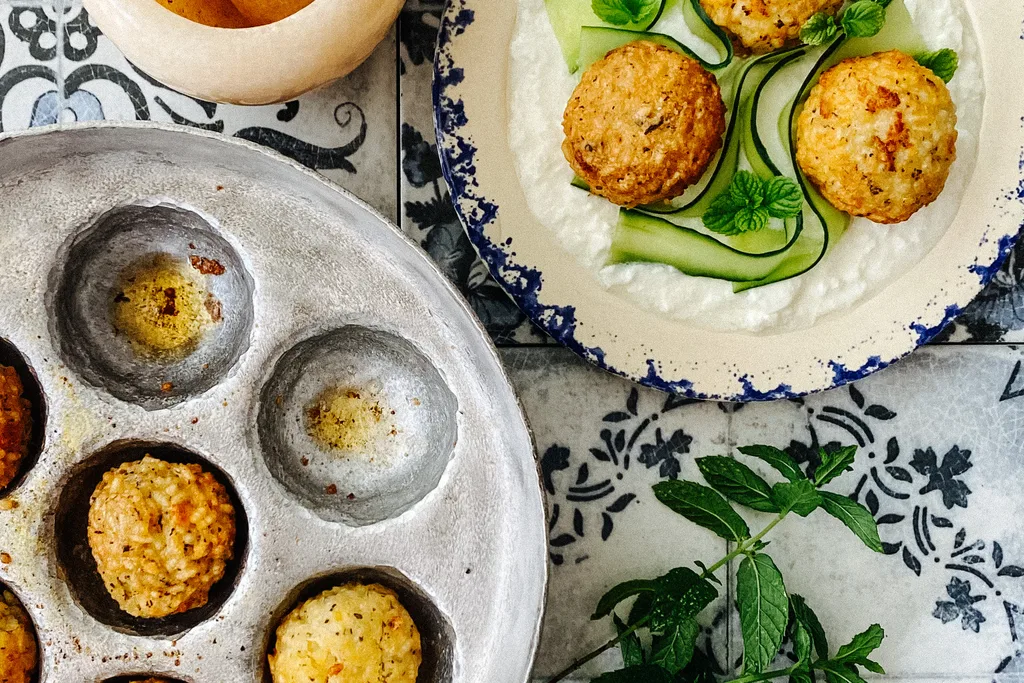
Every town in this region grills meat well, and Gjirokaster is no exception – but it also owns a dish outright, and you should order it. Qifqi is the town’s signature: rice mixed with egg and mint, seasoned, and cooked in a special pan with hemispherical dimples that shape the mixture into firm little balls, crisped outside and soft within. It is simple, herby and unlike anything else on an Albanian menu, and the bazaar restaurants serve it as a point of civic pride. Order it as a starter to share, because the rest of the southern table will follow in quantity – grilled lamb and veal, village salads under slabs of white cheese, byrek from the bakeries, stuffed peppers and slow stews of the kind the whole Greece-facing south cooks well.
Dessert carries a local name too: oshaf, a traditional pudding of figs and sheep’s milk, is the Gjirokaster sweet to ask for when it is available – “when” being the operative word, since the old town’s kitchens cook seasonally and small. More reliably present are the coffee and the raki, the twin fuels of bazaar life. Coffee here follows the regional liturgy – small, strong, taken slowly at a lane-side table while the old town walks past – and a glass of local raki will find you in the evening whether you go looking for it or not; accept the first, pace the rest, and remember that tomorrow’s castle climb is steep in every sense. The bazaar quarter holds the densest choice of restaurants and cafes, with a few more around the neck of the bazaar and along the old town lanes; for the valley’s wider table, the modern town below adds ordinary, good-value grill houses where the old town’s view premium does not apply. This guide names no prices – menus are posted, portions in the south are generous, and your bill will not be the alarming part of the trip.
Where to Stay in Gjirokaster
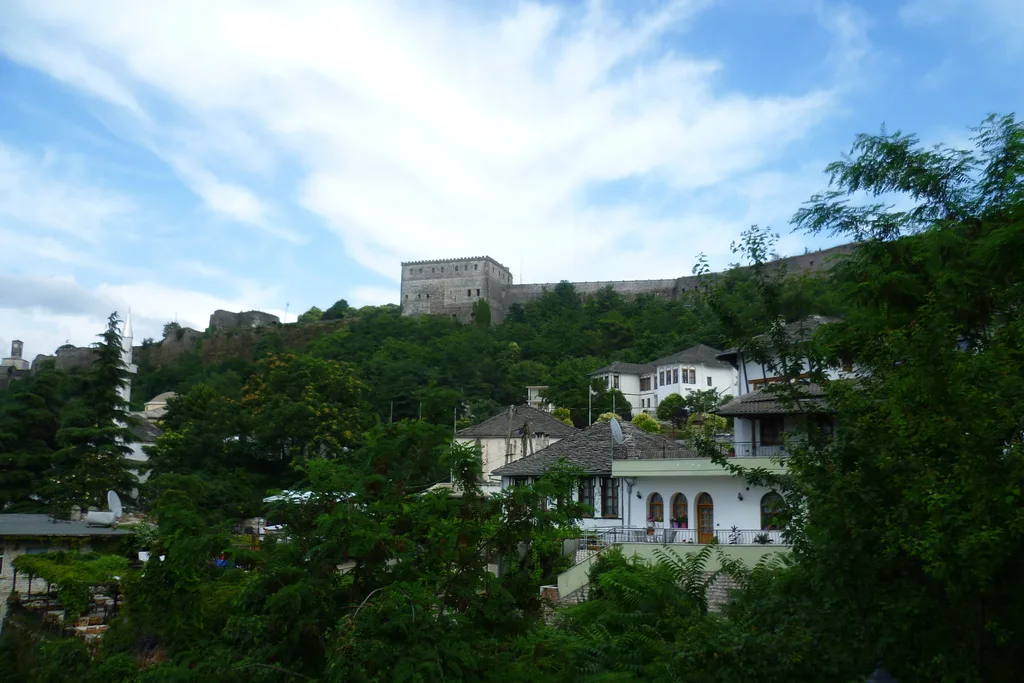
The choice in Gjirokaster is a genuine fork, and it is about legs. Sleep in the old town, and you sleep inside the museum piece – family-run guesthouses and small hotels installed in the stone houses themselves, thick walls, wooden ceilings, terraces aimed at the castle or down the valley, and breakfasts of the petulla-and-mountain-tea school that justify the genre. The town’s guesthouse tradition is strong and personal; several of its houses have been taking travellers for decades, and being walked to your room through a courtyard by someone whose family has always lived on this lane is a different product from a hotel corridor. The trade is the hill: every return home is a climb on cobbles, luggage wheels are decorative here, and if your knees object to stairs on principle, factor that in honestly.
Sleep in the new town, down on the valley floor, and you get the practical Albania – larger hotels with parking at the door, level streets, the bus station in walking distance and prices without the old town’s romance premium, all under a view of the castle lit up on its ridge at night. It is the sensible base for a one-night road-trip stop, for drivers, and for anyone catching an early bus onwards; it is also, be honest, not the reason anyone dreams about Gjirokaster. The first-time recommendation of this guide is the old town, for two nights, in a house with a terrace – the town at dawn, quiet and grey-gold before the day visitors arrive, is the version of Gjirokaster that stays with people, and you only get it by waking up inside it. Whichever you choose, book old town rooms early for festival periods and high summer: the historic housing stock is small, and the best terraces go first.
Getting to Gjirokaster – and Pairing It with Berat
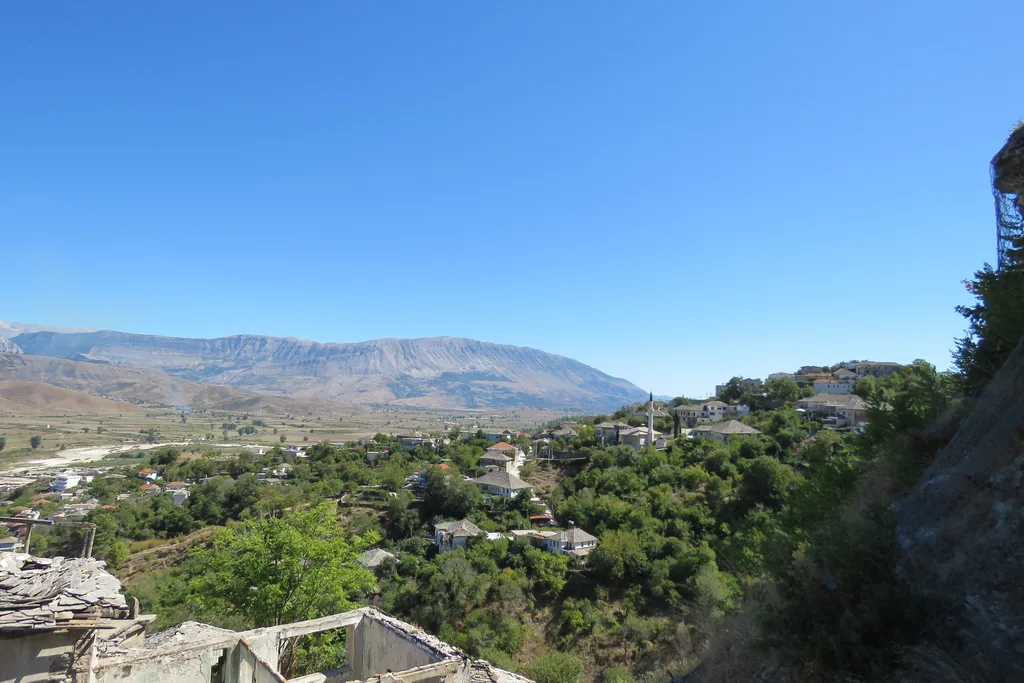
Geography first, because in southern Albania geography is the timetable. Gjirokaster stands on the main north-south road up the Drino valley, with Greece at Kakavija just to the south, the coastal city of Saranda over the mountains to the west, and the rest of Albania unrolling northwards. From Tirana, allow around four hours by bus – faster by car, in the region of three hours and a bit on the motorway-and-valley route, and always treat such figures as fair-weather estimates, because mountain roads and summer traffic write their own schedules. Buses from the capital and from other southern towns arrive at the station in the new town, at the entrance to Gjirokaster on the valley floor. From there the old town is a stiff 25-to-30-minute walk uphill, or a short taxi ride; arrive in the heat of the day and the taxi earns its fare before you have seen a single monument.
From the coast the approach is prettier. Saranda lies roughly one to one and a half hours away by road over the mountain pass, which makes Gjirokaster the classic inland partner to a beach stay – and makes Saranda the classic way in for travellers arriving by ferry from Corfu, who can be in Gjirokaster’s bazaar by lunchtime after a morning crossing. On the Saranda road, about half an hour out of town, sits the Blue Eye – Syri i Kaltër – a deep karst spring of impossible blue in a green hollow, and the natural half-hour stop of any Gjirokaster-Saranda journey. It earns its own full treatment elsewhere on this site; here it is enough to know it belongs on the same road and the same day as your coastal transfer, not as a separate expedition. Gjirokaster also features, unsurprisingly, in our round-up of the best places to visit in Albania – it is the south’s anchor sight, the place every itinerary in this part of the country is quietly built around.
Coming from Greece is the third door into town, and the one the geography always intended. The Kakavija border crossing sits a short drive south, on the road that runs on down to Ioannina, so Gjirokaster pairs naturally with a Greek itinerary – Epirus on one side of the line, the Drino valley on the other, and the mountains entirely indifferent to the border drawn across them. Drivers should know that the old town itself is effectively pedestrian: park in the new town or in the designated areas below the bazaar and walk in, because the lanes above were laid out for donkeys and have not widened their opinion since. None of Gjirokaster’s approaches is difficult; all of them are scenic in the specific southern-Albanian way, where the road, the valley and the mountains negotiate the whole journey in plain sight.
And then there is the pairing this article has promised from its first paragraph. Berat lies around three hours north, and the two towns are one UNESCO property – Berat the white, Gjirokaster the grey; Berat all windows, Gjirokaster all walls. Visit Berat first and Gjirokaster reads as its fortified answer; visit Gjirokaster first and Berat feels like the exhale. Either order works, and the route logic does the rest – Tirana, down to Berat, onwards south to Gjirokaster, then over the pass to Saranda and the coast (or the whole thing in reverse, off a Corfu ferry) is the natural southern Albania line, and it wastes almost no motion. Give the pair a minimum of two nights each if the trip allows; both towns are at their best in the early morning and the evening, and day-tripping either one from the other means seeing it only in its crowded, hottest, worst-lit hours. The two halves of the listing deserve, and repay, equal time.
Best Time to Visit Gjirokaster
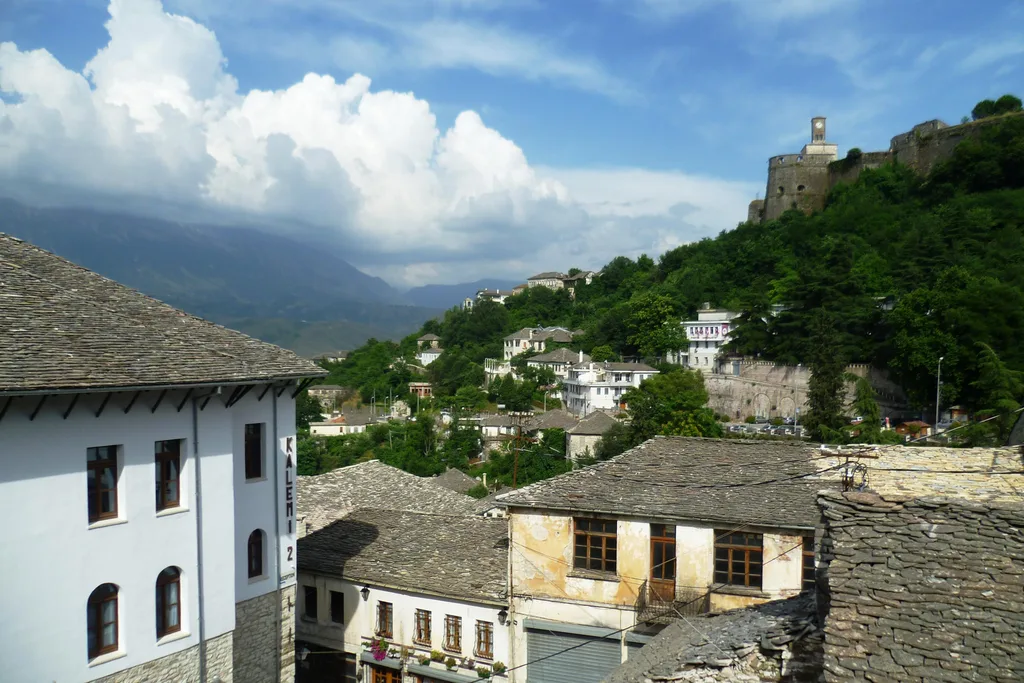
Gjirokaster’s seasons are the inland south’s seasons, sharpened by stone. Late spring – roughly April to June – is the town at its kindest: the valley is green, the castle climb is exercise rather than ordeal, the bazaar terraces are open, and the summer crowds have not yet found the lanes. Early autumn, September into October, runs it close, with warm stone, soft light and the Drino valley turning gold; if the National Folk Festival’s five-year cycle lands in your autumn, that settles the question entirely. The wider seasonal picture for the country follows the same Mediterranean rhythm, but for Gjirokaster specifically the shoulder seasons are not a compromise – they are the point.
Summer is when the town is busiest and the stone does what stone does, holding the heat and handing it back at you off every wall; July and August visits are entirely doable, but they should be scheduled like a local – castle at opening time, tower houses before noon, a long lunch and a longer pause, then the bazaar and the viewpoints in the evening, when the whole town agrees to be beautiful at once. Winter is the connoisseur’s gamble: cold, sometimes wet, genuinely atmospheric – mist in the valley, smoke from the chimneys, empty lanes and the castle to yourself – but some guesthouses and smaller museums keep reduced arrangements, and the cobbles in the rain demand respect. Whenever you come, bring the shoes from the At a Glance table; Gjirokaster in the wrong footwear is the only version of Gjirokaster this guide advises against.
Gjirokaster Travel Guide – Frequently Asked Questions
How many days do you need in Gjirokaster?
One long day covers the castle, its museums and one tower house at a civilised pace. Two nights is the comfortable version this guide recommends: the castle on the first morning, Zekate and Skenduli without clock-watching, the Ethnographic Museum, and an evening in the bazaar when the day visitors have gone. A third day buys the Cold War tunnel tour, the Ali Pasha aqueduct remains, or a lazy second circuit of everything you rushed – nobody leaves Gjirokaster complaining it was given too much time.
Is Gjirokaster worth visiting?
Yes – and not only as an add-on to the coast. It holds one of the largest castles in the Balkans, half of a UNESCO listing, the finest Ottoman tower houses in the country and a signature dish of its own, all inside one walkable, if steep, hillside. If southern Albania gets only one inland stop on your trip, this is the stop. The honest caveats are the hills, the cobbles and summer heat at midday, all manageable with timing and footwear.
How do you pair Gjirokaster with Berat?
As equals. The two towns form a single UNESCO property – Berat inscribed by extension in 2008, Gjirokaster in 2005 – and sit about three hours apart on the natural north-south route through Albania. Give each at least one night, two if you can; visit them in either order, and let the contrast do the work – Berat white and open, Gjirokaster grey and fortified. Day-tripping between them short-changes both.
Can you visit Gjirokaster as a day trip from Saranda?
You can, and many do – the road over the pass takes roughly one to one and a half hours each way, and the Blue Eye spring sits conveniently on the route. A day trip comfortably covers the castle and the bazaar. What it cannot give you is the old town in the evening or early morning, which is when the place is at its best; if your itinerary allows one inland night, spending it in Gjirokaster beats the return drive in the dark.
What should you not miss in Gjirokaster?
The castle, whole and unhurried – walls, both museums, the prison corridor and the American plane. Then the Zekate House for the architecture, the Skenduli House for the family, the Ethnographic Museum for the primer, and qifqi for dinner. If you leave having done those five things, you have done Gjirokaster properly; everything else in this guide is enrichment.
Is Gjirokaster hard to walk around?
It is steep, and there is no point pretending otherwise. The old town climbs the slope under the castle on smooth-worn cobbles that turn slippery in rain, and the castle itself crowns the hill. Visitors with reasonable mobility and shoes with tread manage it happily by taking the climbs slowly; anyone with significant mobility difficulties should plan on taxis between the valley floor and the bazaar, and treat the castle ascent as the one deliberate expedition of the day.
The Short Version
Gjirokaster is Albania’s stone citadel town: a giant Ali Pasha-era castle over a UNESCO old town of slate roofs and fortified tower houses, sharing one World Heritage listing with Berat and doing the sterner, greyer half of the job superbly. Give it two nights in the old town. Climb to the castle early for the walls, the two museums, the prison and the plane; walk down to the Zekate and Skenduli houses and the Ethnographic Museum; eat qifqi in the bazaar at dusk; and then carry on to Berat, three hours north, to meet the other half of the listing. That is the whole argument – the rest of this guide is the evidence.