Abu Simbel Temples – Ramesses II’s Cliff Temples and the Rescue That Moved a Mountain
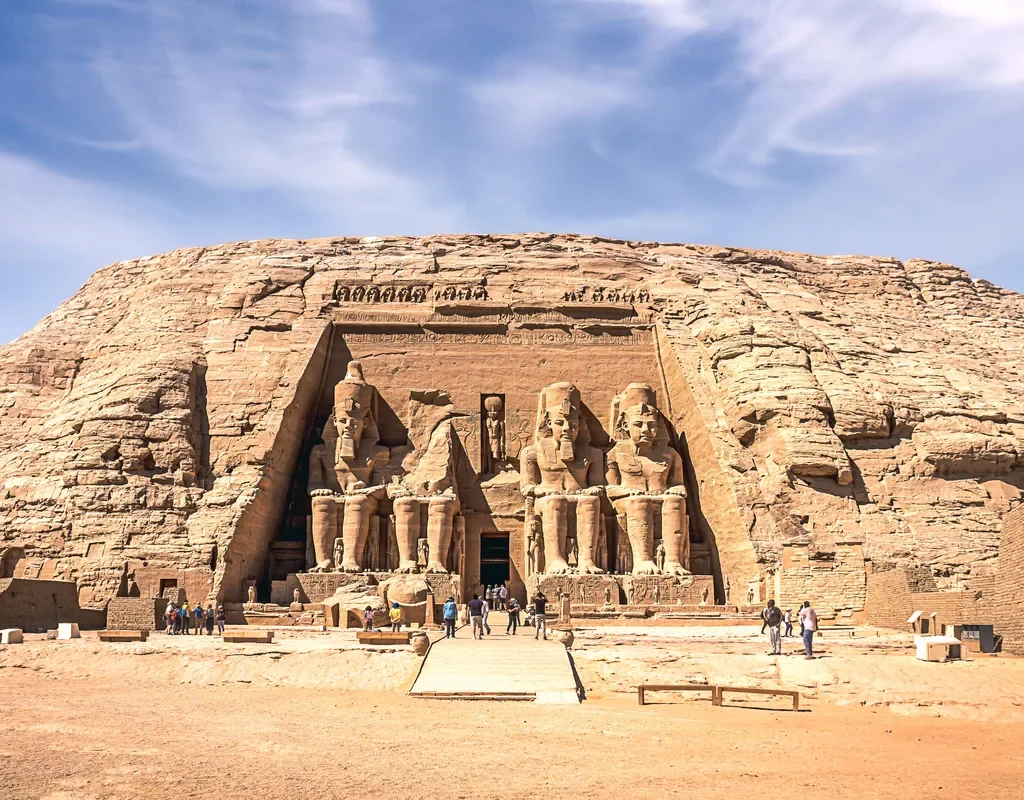
There are two stories at Abu Simbel, and every visitor gets both whether they came for them or not. The first is the one carved in the thirteenth century BC: two temples cut straight into a sandstone cliff on the west bank of the Nile, in what was then Egypt’s conquered south, fronted by four seated statues of Ramesses II so large that each one is as tall as a six-storey building. The second story is the one that explains why you can still stand in front of them: in the 1960s, with Lake Nasser rising behind the new Aswan High Dam, an international rescue cut both temples into hundreds of blocks, lifted them clear of the water and rebuilt them inside an artificial mountain — the most famous salvage operation in the history of archaeology. The abu simbel temples are not a ruin that survived by luck. They are a ruin that survived by decision, and that decision is half of what you are looking at.
The setting does the rest. Abu Simbel stands some 280 kilometres south of Aswan by road, close to the Sudanese border, on the western shore of Lake Nasser — the immense reservoir that nearly destroyed it. There is no city here, no valley of other sights competing for the day: a small Nubian village, a jetty, an airstrip, and the temples. Almost everyone arrives on a deliberate journey, most of them before dawn — you do not stumble across Abu Simbel. This guide takes the site in the order a good visit takes it: the Great Temple’s facade and halls, the sanctuary where the sun arrives twice a year, the smaller temple Ramesses built for Nefertari, the centuries when the whole thing lay buried in sand, the rescue that moved it, and then the practical questions — how to get here, how long to stay, and whether to sleep in the village or ride back to Aswan. For the country-wide picture that frames the trip, our egypt travel guide carries the full route.
At a Glance
Short on time? Here is Abu Simbel on one screen — what there is, why each part earns its place, and the time it honestly asks for. Nothing in this guide prints a ticket price or an opening hour, deliberately: prices at Egypt’s sites change by decree and have changed repeatedly in recent seasons, so any figure you find in print — here or anywhere — should be re-checked on the official site before you budget on it.
| Place or thing | Why it earns its place | Time it honestly takes |
|---|---|---|
| The Great Temple facade | Four 20-metre colossi of Ramesses II – the most famous temple front in Egypt | Twenty minutes, and again on the way out |
| Inside the Great Temple | Osiride-pillared halls, Battle of Kadesh reliefs, side chambers | Forty minutes to an hour |
| The sanctuary | Four seated gods in the innermost room – the sun alignment’s target | Ten minutes, inside the Great Temple visit |
| The Small Temple | Nefertari carved at the king’s own scale – almost unheard of in pharaonic art | Thirty to forty minutes |
| The artificial mountain | The 1960s rescue itself – walk behind the temples and the hill gives the secret away | Fifteen minutes around the site |
| The Sun Festival | The alignment, on around 22 February and 22 October | A very early start, on those two dates only, in a crowd |
| The Sound and Light show | The temples floodlit and narrated after dark | An evening – realistically an overnight stay |
| Lake Nasser | The water that threatened the temples, now their foreground | Seen from the site; days, if you cruise it |
Two judgements sit behind that table. First, the standard day trip gives you roughly two hours at the site, and two hours is genuinely enough to see both temples properly — the place is compact, and its power is concentration, not sprawl. Second, Abu Simbel is the southernmost anchor of a single UNESCO property, the Nubian Monuments from Abu Simbel to Philae, inscribed in 1979, whose ten components run from this cliff north to Aswan’s islands and quarries; the official record at whc.unesco.org describes the Great Temple as a masterpiece “carved out of an escarpment of solid rock” by order of Ramesses II. The temples below are the finest hour of that whole property — and the only part of it that had to be moved bodily to survive.
The Great Temple – Four Giants in the Cliff Face
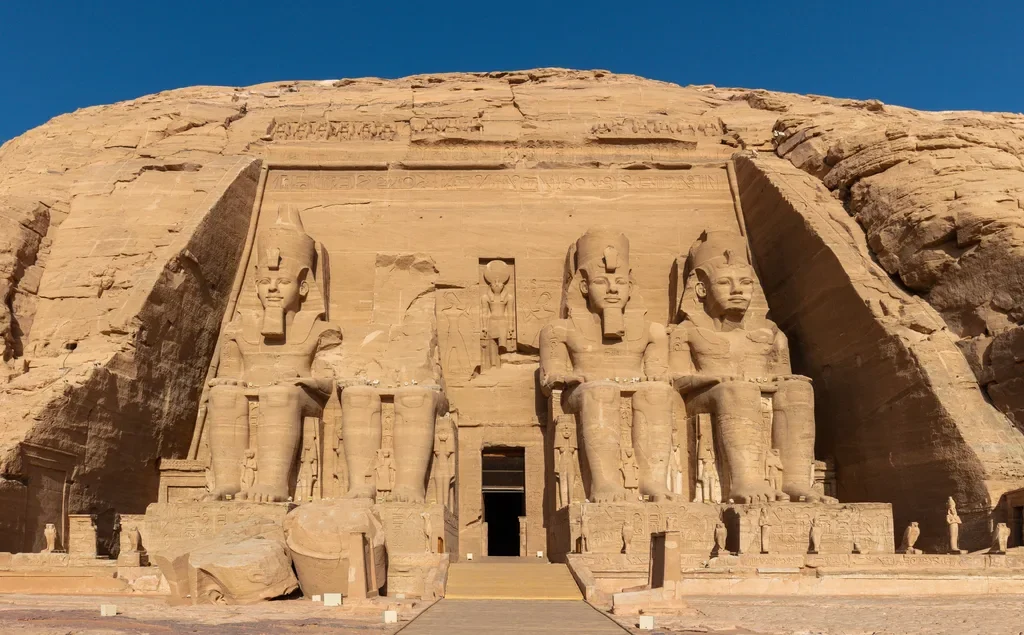
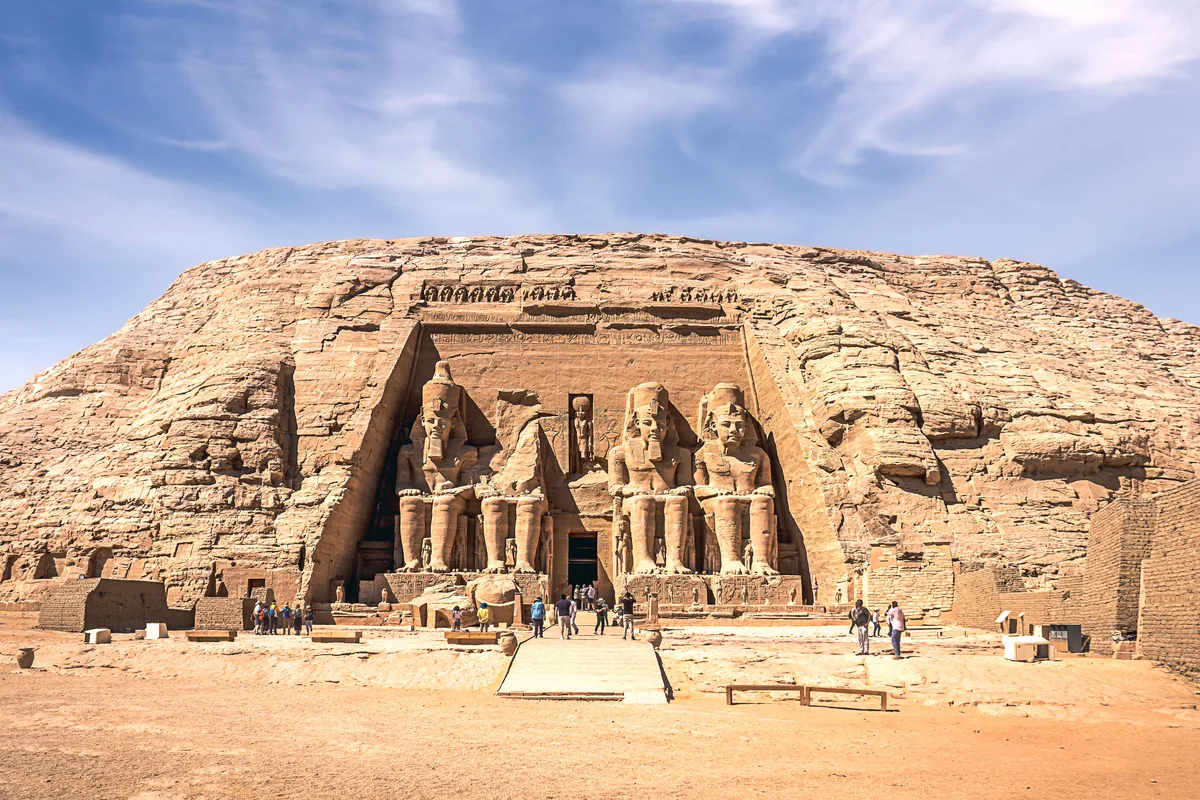
The approach is staged, whether the builders planned it for you or not: you come around the side of the hill, and the facade opens all at once. The Great Temple’s front is a sloping cliff wall more than thirty metres high, and set into it, two on either side of the doorway, sit the four colossi — Ramesses II on his throne, over and over, each figure some twenty metres from the top of its double crown to the soles of its feet. Above them runs a frieze of baboons, paws raised to greet the rising sun; in the niche over the door stands a falcon-headed statue of the sun god Ra-Horakhty; and cut around the great statues’ legs, at knee height and below, stands the family the king wanted remembered with him — his mother, his wives including Nefertari, and a file of sons and daughters, none of them reaching much above a colossus’s shin. The message was not subtle, and it was not meant to be: this was Egypt’s southern face, turned towards Nubia and the African interior, and it was designed to be understood from a boat.
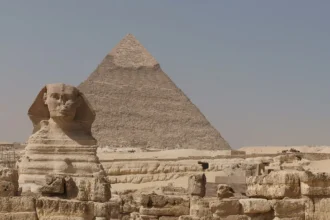
One of the four is broken, and the breakage is part of the visit. The second colossus from the left lost its head and upper body in an earthquake in antiquity — Egypt’s official monuments portal puts it plainly: one of the statues “collapsed because of an ancient earthquake, and its fragments can still be seen on the ground.” The head still lies in the sand in front of the facade, face up, exactly where it fell, and when the rescuers of the 1960s moved the temple they moved the fallen head as they found it and set it down in the same relative position, rather than repair three thousand years of history out of existence. Look also at the legs of the southern colossi, where Greek mercenary soldiers serving an Egyptian king scratched their names into the stone in the sixth century BC — graffiti that became some of the earliest dated Greek writing anywhere. The facade is a billboard, a family portrait and a visitors’ book, all in one wall.
Inside the Great Temple – Pillars, Reliefs and Side Chambers
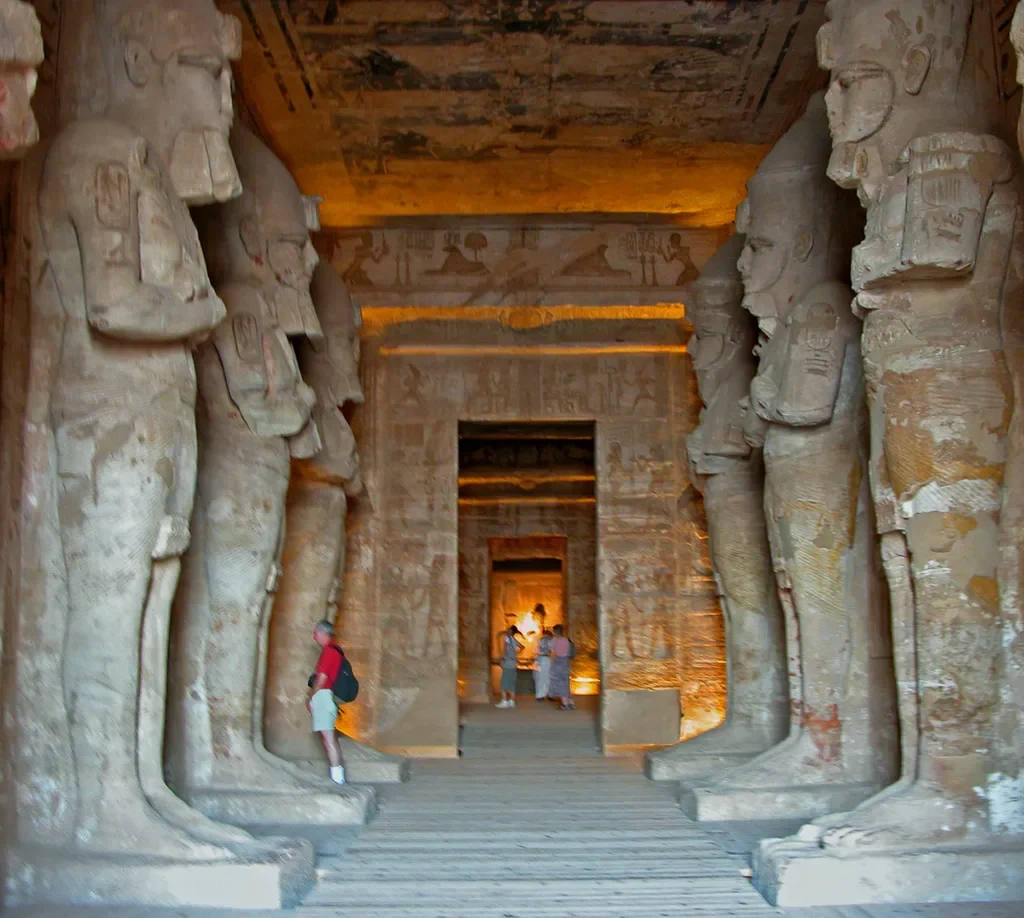
Step through the door and the temple swallows the light by degrees. The Great Temple runs some sixty metres back into the rock through a sequence of halls, each smaller and darker than the last, and the first of them is the grandest interior in Nubia: a pillared hall lined with eight standing statues of the king in the crossed-arm attitude of Osiris, god of the dead — the Osiride pillars — each around ten metres high, four to a side, with the visitor walking between them down the central aisle. The walls around them carry the temple’s great narrative relief: Ramesses at the Battle of Kadesh, the set-piece chariot charge against the Hittites in Syria that the king’s inscriptions turned into a personal triumph, carved across the northern wall in registers of camp, charge and slaughter. Modern historians read Kadesh as something much closer to a draw, and part of the pleasure of this hall is watching propaganda at its most accomplished — the king needed the victory carved in stone on his southern frontier precisely because the real one had been so much less tidy.
Beyond the first hall the programme changes key. A second, smaller pillared chamber — sometimes called the hall of offerings — shows the king and Nefertari presenting gifts to the gods of the temple, and around the two main halls opens a ring of side chambers that served as treasuries and storerooms for the cult. From the offering hall a vestibule narrows the way, the ceiling lowers, the floor rises almost imperceptibly, and the axis that began at the colossi on the cliff face runs on, straight as a surveyor’s line, to the small dark room at the very back. Everything in the building — the shrinking rooms, the rising floor, the fading light — is engineered to concentrate attention on that room. Hold the plan in mind as you walk it: facade, hall, hall, sanctuary — one deep breath of a building, with the sun itself cast in the final scene.
The Sanctuary – Where the Sun Arrives Twice a Year
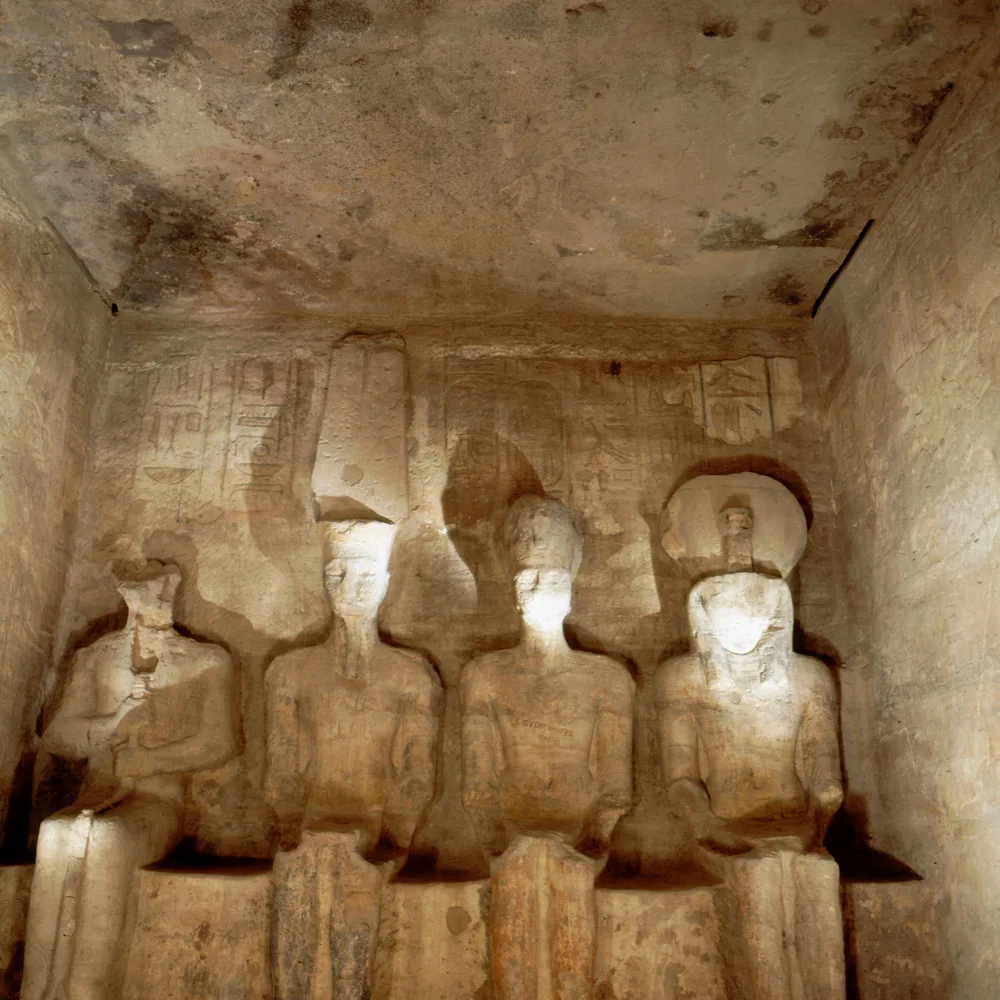
The innermost chamber of the Great Temple is small, plain and — for two mornings a year — the most precisely aimed room in ancient Egypt. Against its back wall sit four seated statues, carved from the living rock: Ptah of Memphis, Amun-Ra of Thebes, the deified Ramesses II himself, and Ra-Horakhty of Heliopolis — the three great state gods of the New Kingdom, with the king seated among them as a fourth, which was, of course, the point. Egypt’s official monuments portal describes what the builders did with this arrangement: “on two days a year, the 22nd of February and 22nd of October, the sun’s rays enter the temple, cross the main hall, and illuminate the innermost statues.” The beam travels the full length of the temple — past the colossi’s door, down the Osiride hall, through the narrowing chambers — and falls on the sanctuary row, lighting Amun-Ra, Ra-Horakhty and the king. The fourth statue, Ptah, connected with darkness and the underworld, stays in shadow even at the alignment’s height; the Ministry of Tourism and Antiquities’ own account of the phenomenon points out that he is left dark, as befits a god of the dark.
Those two mornings — around 22 February and around 22 October — are now celebrated as the Abu Simbel Sun Festival, and they break every rule about crowds and calm in this guide: visitors gather in the dark, hours early, for a few minutes of light in a small room only a fraction of them can see into, and the atmosphere is closer to pilgrimage than tour stop. Two honest footnotes belong here. The famous dates are the rebuilt temple’s dates: the relocation preserved the alignment with extraordinary care, but moving a building changes geometry by degrees, and the effect is generally said to fall about a day later now than in the temple’s original position. And the popular explanation — that the dates mark Ramesses’ birthday and coronation — is tradition rather than established fact; the honest version is that the alignment is real, the astronomy is deliberate, and the king’s reasons are his own. On any other morning the sanctuary is quiet, dim and entirely yours, which a good many visitors end up preferring.
Why Ramesses Built at the Edge of the World
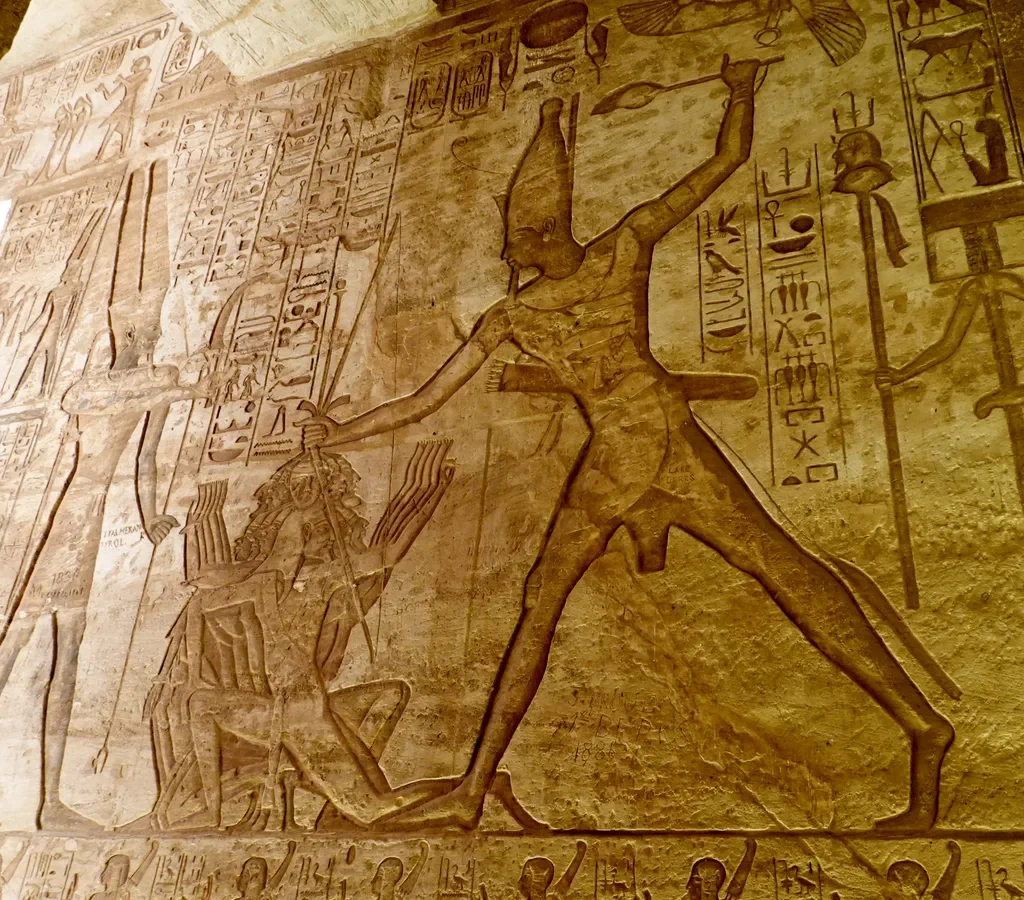
Abu Simbel was not built where Egyptians lived. It was built where Egypt ended — on a cliff above the Nile in Lower Nubia, in territory Egypt had conquered, garrisoned and taxed, astride the river road that carried gold, ivory, ebony and troops between the two lands. Ramesses II began the temples around 1264 BC, early in a reign that would run for more than six decades, and the work went on for some twenty years. The audience was double. To the Nubian chiefs and river traffic below, the four colossi announced that the king of Egypt was present at his frontier in person and at twenty metres tall, forever, in a region where Egyptian power had always depended on being believed in. And to the gods — and to Ramesses himself — the temple did something subtler: it installed the deified king in the sanctuary beside Amun-Ra, Ra-Horakhty and Ptah, worshipped in his own temple in his own lifetime, in the far south where his cult could anchor Egyptian religion as firmly as his statues anchored Egyptian fear.
The place was not empty of meaning before the king arrived, and he knew it. The stretch of cliff was already sacred ground in Nubian tradition, associated with local forms of Horus and with Hathor of Ibshek — which is one reason the second temple, dedicated to Hathor, rose a short walk from the first: Ramesses built his monument onto a holy site and let the older sanctity endorse the new one, a standard piece of pharaonic statecraft executed at unusual scale. The temples also formed part of a chain — a string of rock temples and fortresses along the Nubian Nile through which Egypt administered its southern province — but Abu Simbel was always the chain’s exclamation mark, the largest rock-cut temple complex of the Egyptian world. Read the Great Temple with that in mind and its odd mixture resolves: it is a fortress’s threat, a cathedral’s theology and a personality cult’s shrine, dressed as one building.
The Small Temple – Nefertari at the King’s Scale
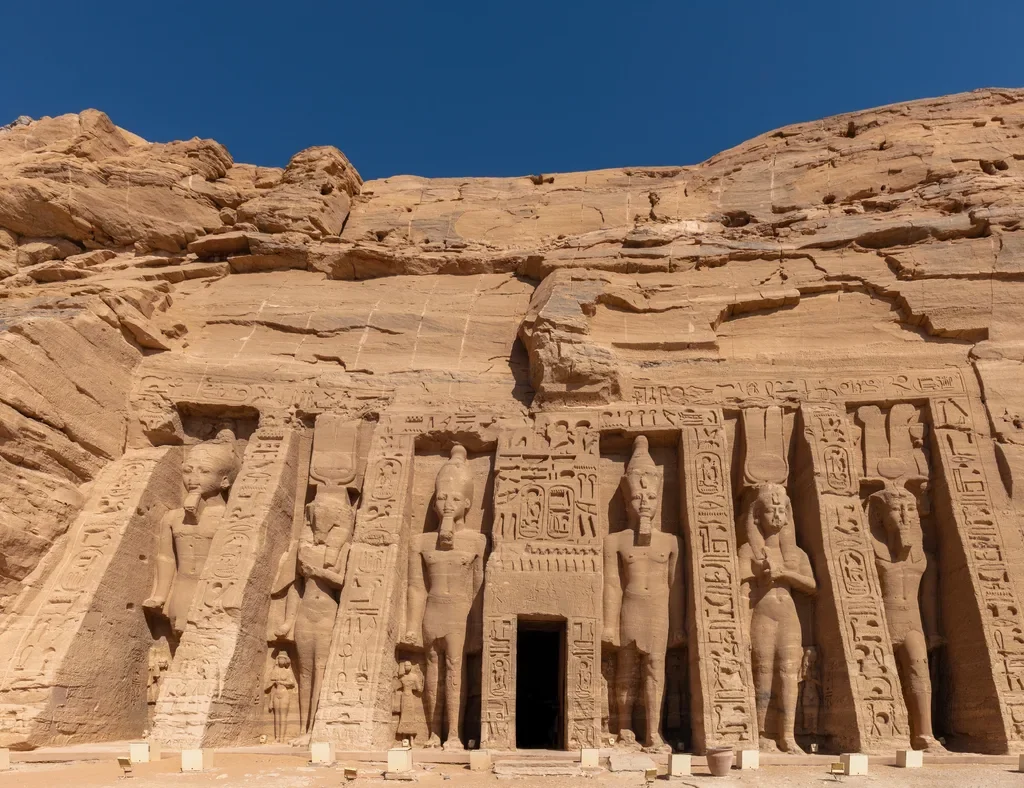
A short walk north of the Great Temple, the cliff opens a second time — smaller, quieter, and in its own way the more startling of the two. The Small Temple is dedicated to Hathor, goddess of love, music and the desert fringe, and to Ramesses’ Great Royal Wife Nefertari, whom the dedicatory inscriptions treat as the goddess’s earthly counterpart. Its facade is a screen of six standing colossi, each around ten metres high, set in deep niches divided by sloping buttresses covered in hieroglyphs: four of the king, and two of the queen — and here is the detail that Egyptologists still stop for. Nefertari’s statues are carved at the same height as her husband’s. Egypt’s official monuments portal calls it what it is: “her colossi are the same size as those of her husband, a very rare example of such display.” In a civilisation whose art scaled figures by importance almost without exception, a queen at full royal scale, on a state temple, was a statement no visitor in antiquity could have missed.
Nefertari was, by the evidence of his monuments, the great attachment of Ramesses’ life — “the one for whose sake the sun shines” is how a dedication elsewhere addresses her — and this temple is one of only two occasions in all of pharaonic history on which a king dedicated a temple to his wife. Inside, the mood softens accordingly: a hall of Hathor-headed pillars, reliefs in which king and queen appear together making offerings to the gods, and a sanctuary where a statue of the goddess as a cow shelters the king. The workmanship is finer-grained and more intimate than the Great Temple’s thunder, and the visit has a different rhythm — fewer superlatives, more looking. Come here second, as most visitors do, but do not come here briefly: the Small Temple is where Abu Simbel stops boasting and starts speaking, and travellers who rush it underrate the best half-hour of the site.
Swallowed by Sand – The Temples the World Forgot
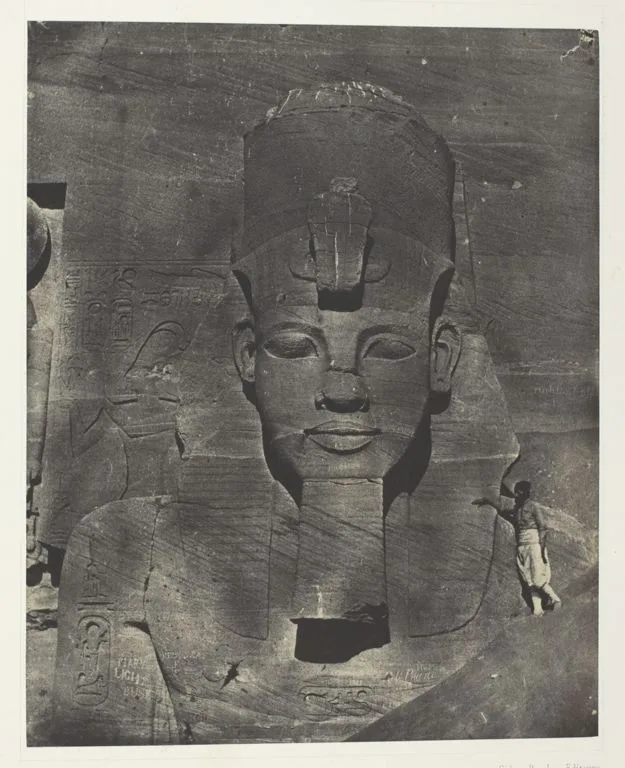
For most of their existence, the temples guarded a frontier of an empire that no longer existed, and slowly the desert took them. Sand drifted against the facade year after year, century after century, until the Great Temple’s door was choked and buried and the colossi stood in the dune to their necks, staring over a beach of sand at a river almost no traveller reached. The site never vanished from local knowledge — people of the region always knew the stone kings were there — but to the outside world Abu Simbel effectively ceased to exist, and it re-entered history the way several Egyptian monuments did, through a single determined traveller. In 1813 the Swiss scholar Johann Ludwig Burckhardt, riding through Nubia in disguise, was shown the site and recorded the half-buried facade; local tradition, repeated ever since and impossible to prove, holds that the boy who guided him was named Abu Simbel, and that the temples took their modern name from him.
Burckhardt could see the colossi but could not get inside — the doorway was somewhere under the sand. The entry fell four years later to the most colourful strongman of early Egyptology, Giovanni Battista Belzoni, the former circus performer turned excavator, who in 1817 organised the digging that cleared the door and made his way down the sand-choked axis into the halls. The nineteenth century’s photographs — Maxime Du Camp’s calotypes of 1849–51 among the earliest ever made of an Egyptian monument — still show the facade drowning, a single great head rearing out of the drift. Clearance and recording filled in over the following century, and by the early twentieth century the temples stood free and famous. But the rescue the century demanded of Abu Simbel was not finished with sand. It was about to be demanded by water, at a far greater scale.
The Rescue – Cutting a Mountain into Blocks
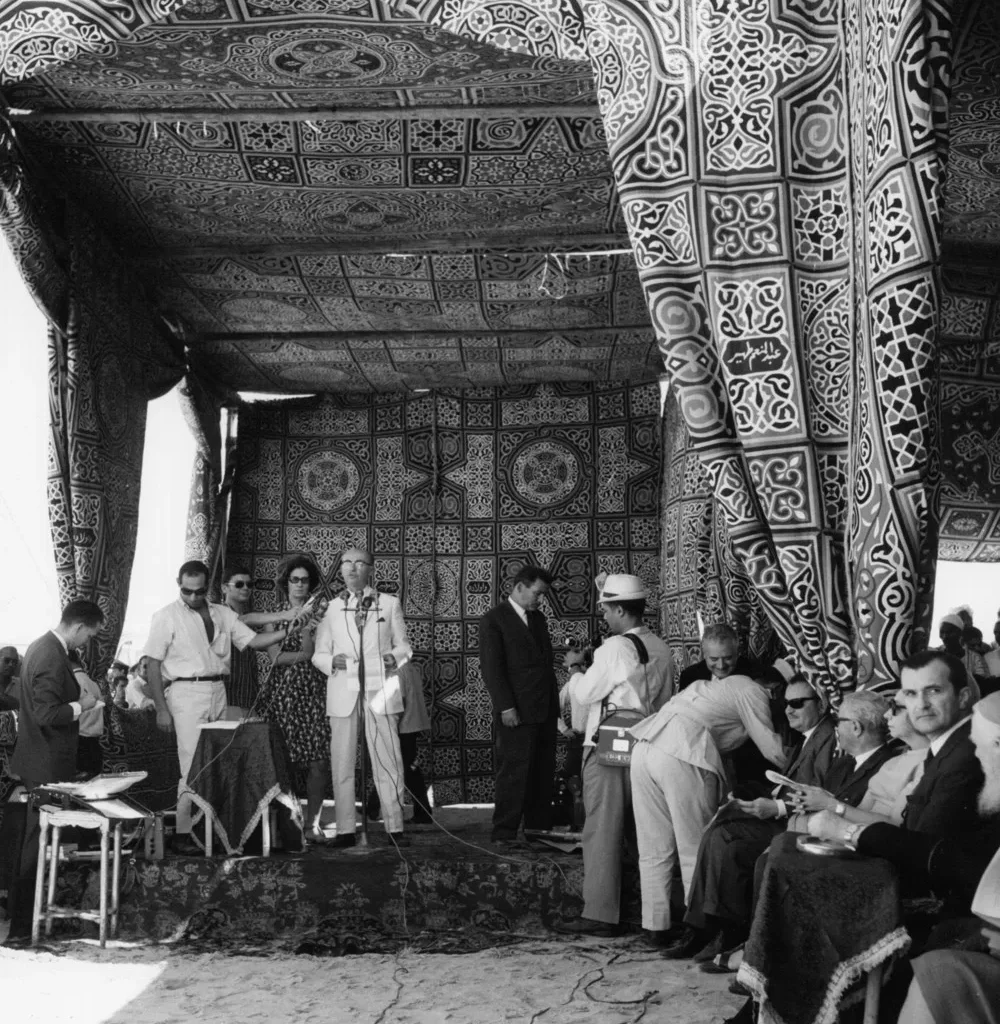
The crisis was announced by engineering. Egypt’s plan for the Aswan High Dam — built through the 1960s to control the Nile flood, irrigate the valley and generate power — would turn the river behind it into Lake Nasser, a reservoir hundreds of kilometres long, and everything in Nubia below the future waterline would drown, Abu Simbel included. In 1959–60 Egypt and Sudan appealed to UNESCO, and the answer became the International Campaign to Save the Monuments of Nubia: more than fifty countries contributed money, equipment and engineers, in what remains the founding epic of the world heritage idea — the campaign out of which the World Heritage List itself grew. Temples across Nubia were dismantled and rebuilt on high ground, gifted to donor nations, or recorded and surrendered to the lake. Abu Simbel, the largest and most famous of them all, got the campaign’s most audacious solution.
The work ran from 1964 to 1968, and its logic was brutal elegance. Engineers first threw a cofferdam across the riverfront to hold the rising water off the working site, then stripped the cliff away from above and around the temples, exposing the carved rooms as a free-standing core of rock. Saws and drills then cut the temples themselves into hundreds of blocks — the largest weighing around thirty tonnes — each one numbered, mapped and lifted away by crane. The blocks travelled some two hundred metres back and around sixty-five metres up, where the temples were reassembled piece by piece on reinforced foundations, the colossi re-aligned on the same axis, the sanctuary restored to its old relationship with the sun. The cost ran to tens of millions of dollars in the money of the time, and the standard of the work was set by choices like the fallen colossus: the great head that had lain in the sand since antiquity was lifted, transported and laid down again in its fallen position, because what was being saved was a historical monument, not a theme-park reconstruction. In September 1968 the completed site was formally inaugurated — and in 1979 Abu Simbel took its place, with the other rescued Nubian monuments, on the new World Heritage List, as the property’s first and most famous component. If you want the single-sentence version: the temples were not moved despite being made of mountain. They were moved by treating the mountain as a kit of parts.
The Mountain That Is Not a Mountain
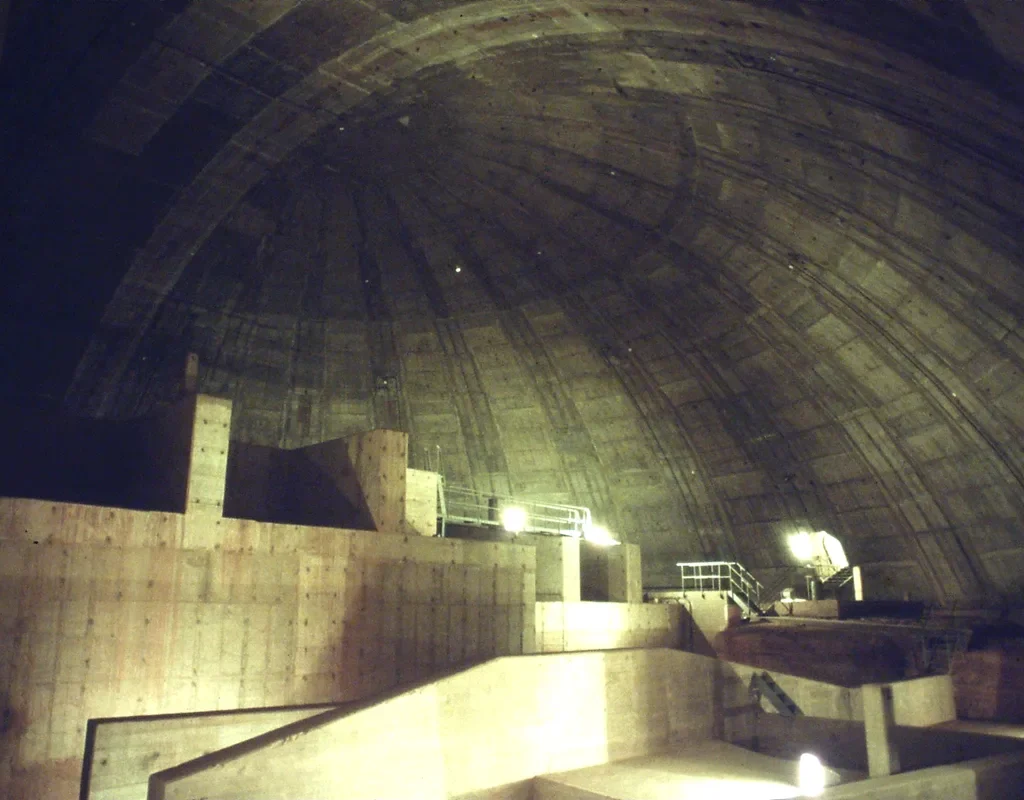
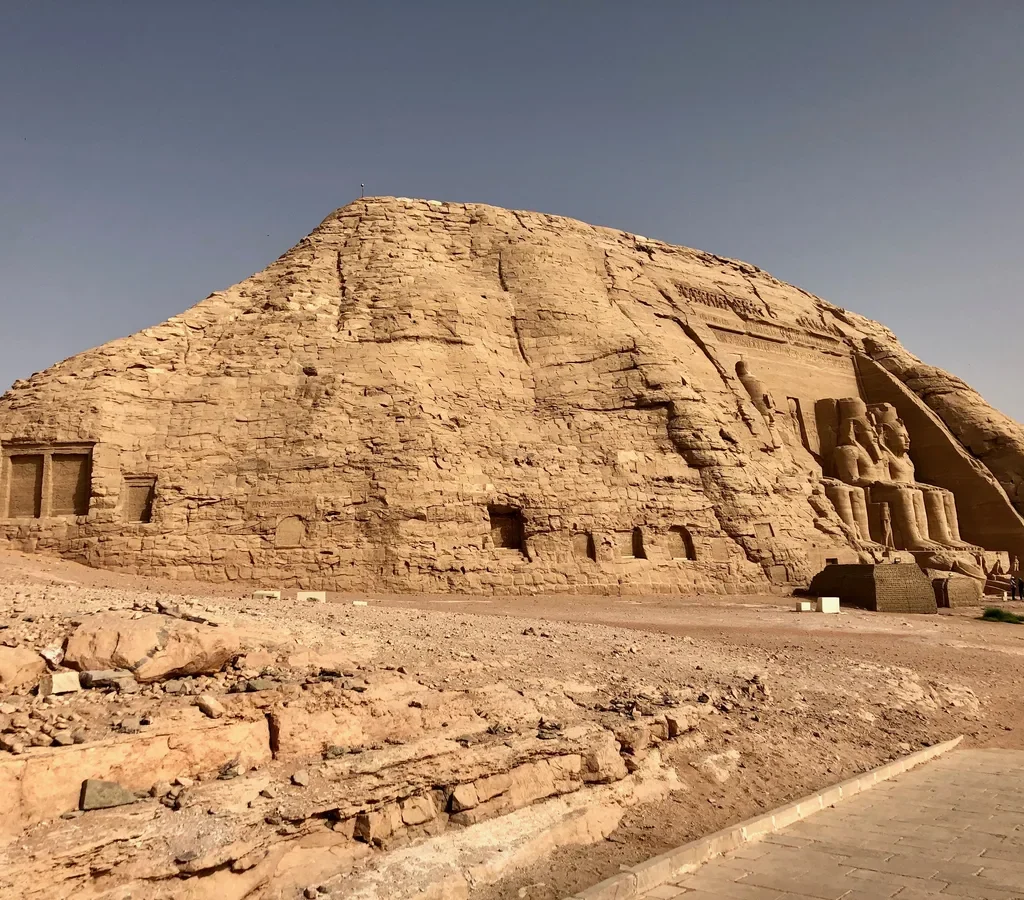
The cleverest part of the rescue is the part you are not supposed to notice. The temples’ new home had to look like their old one — a cliff on a bend of the river — but there was no suitable cliff at the safe height, so the engineers built the mountain too. The rebuilt temples stand inside an artificial hill of rock and fill, and over the Great Temple’s halls, hidden within that hill, spans a vast concrete dome: it carries the weight of the fake mountain above, so that no load presses on the ancient carved rooms below, and it is one of the largest structures of its kind. You cannot see the dome from the plaza — that is its triumph — but walk the path around the side and back of the site and the illusion quietly fails: the hill’s rear slopes are raw, gravelled and obviously tipped there, and a commemorative plaque set in the rock records the unveiling of the reconstructed temples in September 1968 and names the work for what it was, an act of international collaboration carried out with UNESCO. Take those ten minutes around the back. The front of Abu Simbel is the thirteenth century BC; the back of it is the twentieth century AD, and the site is greater for holding both.
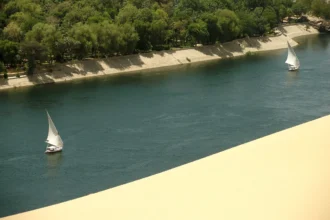
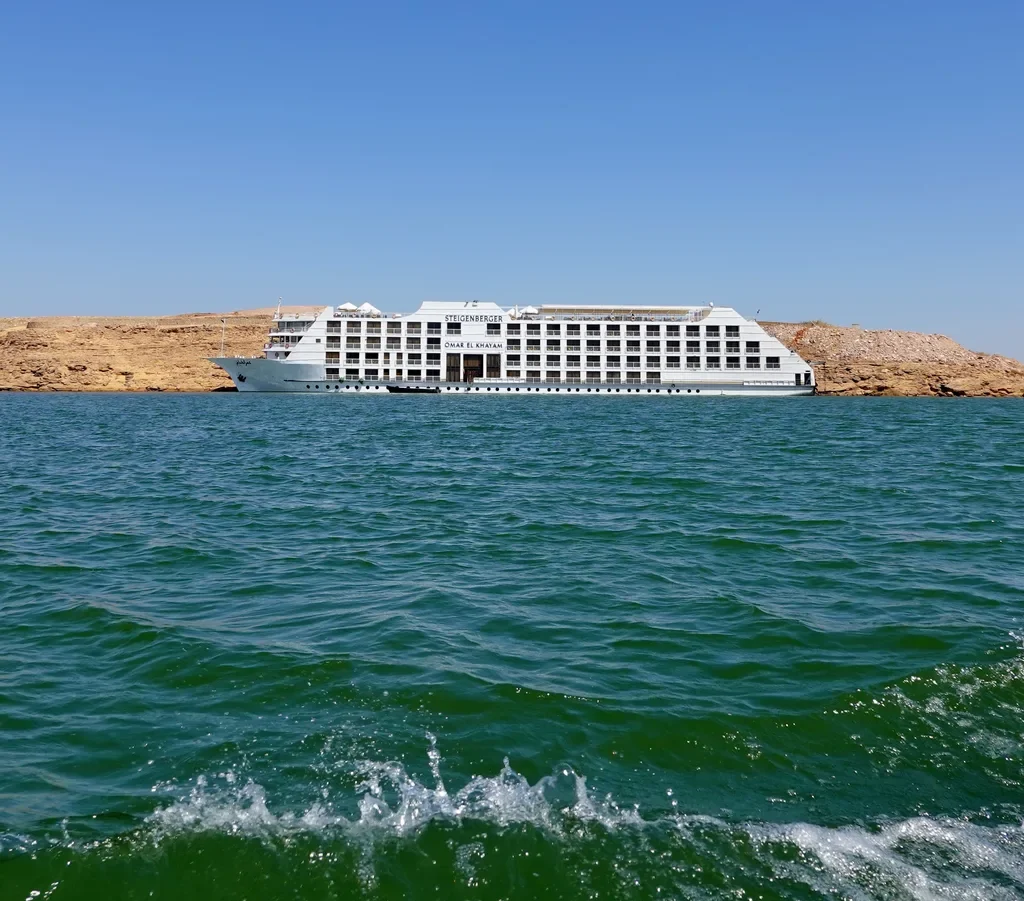
The water, meanwhile, completed its side of the story. Lake Nasser filled through the late 1960s and 1970s to become one of the largest artificial lakes on Earth, some five hundred kilometres long counting its Sudanese reach, and it stands today where the Nile ran when Ramesses’ boats passed below the colossi — the temple forecourt looks out not on a river but on a still, blue, sea-like expanse, dotted occasionally with a cruise ship. The lake took the Nubian homeland, its villages and the greater part of its archaeology, and no honest account of Abu Simbel can treat the rescue as an unmixed triumph: what was saved here was saved magnificently, and what was lost around it was lost completely. The temples in their rebuilt hill are the campaign’s monument and its memorial at once.
Getting There from Aswan
There are three ways to cover the ground between Aswan and Abu Simbel, and choosing between them is the main planning decision of the visit — note first what is not among them: Abu Simbel is not on the standard Luxor–Aswan Nile cruise route, and no amount of wishing puts it there; it lies far south of Aswan, on a different body of water, and every visit is a deliberate expedition. By road, the great majority go: a desert highway runs the roughly 280 kilometres south, a drive of around three and a half hours each way, and organised trips leave Aswan long before dawn to reach the temples in the cool early morning and be back by mid-afternoon. The road journey has a frontier character of its own — tour vehicles have traditionally made the run together in the early hours, paperwork is handled by the operator, and passports are checked at checkpoints along the way, so carry yours. A public bus also serves the route for independent travellers on a budget, at the cost of the tour’s door-to-door ease.
By air, the journey shrinks to a hop: flights connect Aswan with Abu Simbel’s small airport, a flight of well under an hour, with a bus meeting the plane for the few minutes to the site. Flying trades the pre-dawn drive for a higher fare and a tighter, more scheduled visit — the flight day is built to give you your couple of hours at the temples and bring you back the same day — and in peak season the seats are a planning item, not an afterthought. By water, the third way, is the connoisseur’s: Lake Nasser cruise ships sail between Aswan and Abu Simbel over several days, calling at the other temples the UNESCO campaign rescued along the lake — Kalabsha, Wadi es-Sebua, Amada and their neighbours — and arriving at Abu Simbel itself from the lake, as every traveller did before the road. It is by far the slowest option and, for anyone with the days, by most accounts the finest: you reach the colossi across the water they were carved to command, and the lake’s other rescued temples come as part of the same story rather than as footnotes.
The Sound and Light Show
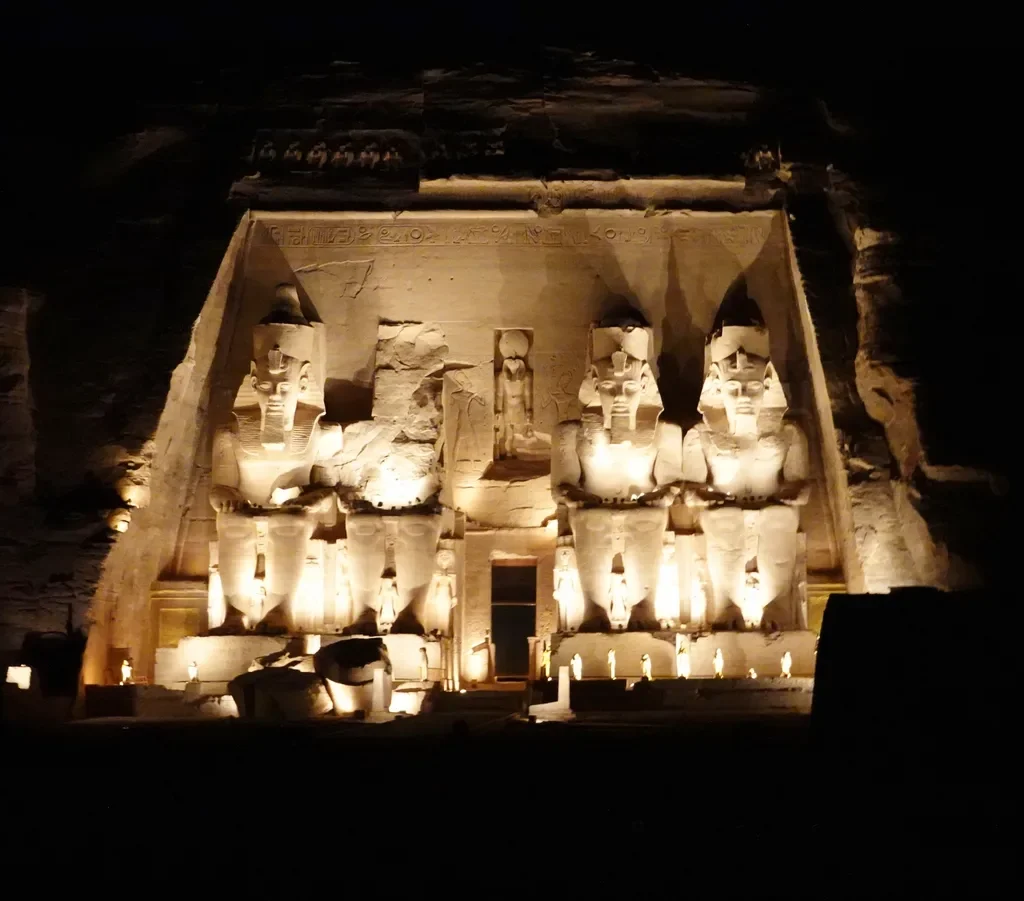
Abu Simbel has a second performance in it, and the day trip almost never sees it. Like several of Egypt’s great sites, the temples host a Sound and Light show after dark: the facades are floodlit against the black cliff, images are projected across the colossi, and a narration tells the twin story of Ramesses and the rescue while music rolls out over the lake shore. Judged as theatre it is of its genre — solemn, old-fashioned and entirely dependent on the stones, which happen to be magnificent — but as a way of seeing the temples it offers something the morning cannot: the facade lit like a stage set, the crowds gone, the desert cold coming down. The show is also the strongest argument in the day-trip-versus-overnight argument, because it belongs to the evening: catching it means being in Abu Simbel at night, which in practice means sleeping in the village or arriving by cruise ship, whose programmes are built to include an evening at the temples.
Keep the practical expectations honest. Show schedules, languages and running days vary by season and are exactly the kind of detail that changes without notice — confirm the current arrangement locally rather than trusting any printed timetable. What does not change is the arithmetic: a visitor who rides down from Aswan at dawn and back in the afternoon will not be there when the lights come on, and no itinerary gymnastics can square that circle. If the floodlit colossi matter to you, plan the overnight first and let the rest of the trip arrange itself around it.
How Long to Spend – Day Trip, Overnight or Cruise
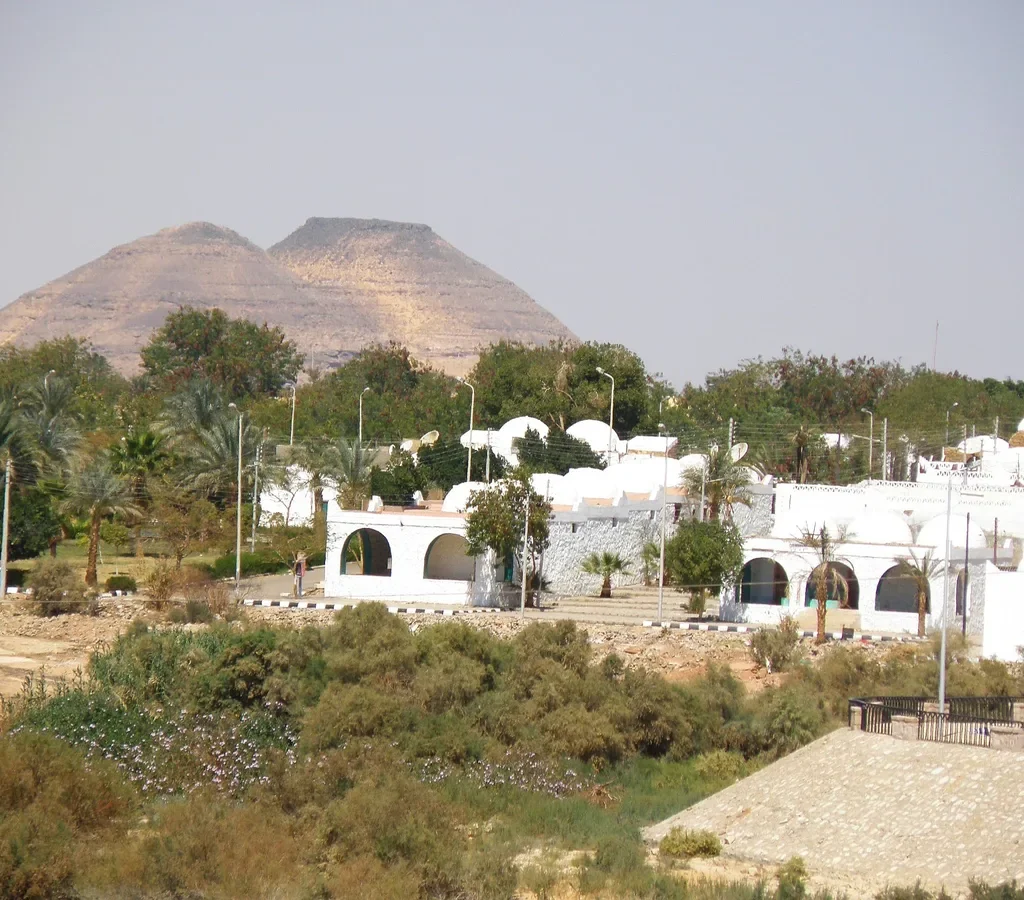
The site itself is not large, and this guide will not pretend otherwise: both temples together deserve between an hour and a half and two and a half hours of honest looking, and the standard day trip’s allowance of roughly two hours on site is enough to do them justice — the Great Temple’s halls, the sanctuary, the Small Temple, and the walk around the back to see the artificial hill give itself away. What the day trip cannot give you is the site’s two best lights. Abu Simbel faces east, the facade takes the morning sun full on the colossi’s faces, and the day-trip crowds all arrive in the same few hours to share it; the temples at dawn before the buses, and again in the last hour of the afternoon when they have gone, are a different and much quieter place. That is the whole case for sleeping in the village: not more time in the temples, but better time — an evening Sound and Light show, a dawn visit with the facade nearly empty, and a night in a small Nubian community whose whitewashed guesthouses and lakeside cafes run on local, not itinerary, time.
The cruise visitor gets the best of both schedules by accident of timing — a Lake Nasser sailing typically reaches Abu Simbel in the afternoon, when the day fleets have left, with the chance of an evening show and a return to the temples at dawn before the next day’s flights land. Against all this, the day trip’s defence is real: it is cheaper, simpler, and it returns you to Aswan’s hotels and onward connections the same day, and for a traveller whose Egypt days are counted it is the right call far more often than the romantics admit. Choose by what you are actually short of. Short of days: the day trip, without a flicker of guilt. Short of nothing but travelling with a photographer, a romantic or a temple obsessive: the overnight. And readers planning the full Egypt arc — the grand egyptian museum at Giza at one end of the trip and this cliff at the other — should know that Abu Simbel is the natural final chapter: the furthest south, the earliest start, and the monument that had to be rescued to be read at all.
Best Time to Visit Abu Simbel
Abu Simbel sits deep in the desert south, and its calendar is a sterner version of Aswan’s: the visiting season in practice runs from October to April, when the days are warm rather than ferocious and the pre-dawn drive is a pleasure instead of a penance. Winter mornings can be genuinely cold before sunrise — the desert gives back its heat all night — so the day trip’s early hours ask for layers that midday will make ridiculous; that swing, cold bus to hot cliff, is the authentic Abu Simbel costume. Within the season, the facade’s east face means the light question answers itself: morning is the temples’ hour, the colossi lit head-on, the reliefs in the halls at their most legible, and the heat still gathering rather than arrived.
Summer is a specialist’s choice and should be made knowingly. From May to September the thermometer climbs to heights that turn a midday plaza into an endurance test, the drive lengthens in effect if not in hours, and sightseeing compresses into the first hours of the day. The compensations are the ones desert places always offer in the heat — a fraction of the season’s visitors, the temples nearly to yourself, the lake at its bluest — and travellers who take them knowingly tend to rate the trip highly; travellers who stumble into a July midday by accident do not. And then there are the two dates that break every rule in this section: the Sun Festival mornings around 22 February and 22 October, when the site runs at its absolute fullest before dawn and the visit becomes a festival first and a sightseeing exercise second. Go on those dates for the event, in full knowledge of the crush — or avoid them by a week either way and take the alignment’s quiet other 363 days.
Frequently Asked Questions
Is Abu Simbel worth the trip from Aswan?
Yes — by the near-unanimous verdict of the people who make it, including the ones who complained about the alarm clock all the way south. The temples are among the supreme monuments of the ancient world, the rescue story doubles their interest, and the journey itself — desert road, frontier checkpoints, the lake appearing at the end — is part of the experience rather than a tax on it. The honest qualification is about expectations: this is a half-day’s travel for about two hours at a compact site, so go for intensity, not acreage. Travellers who arrive expecting another Valley of the Kings, with tombs for days, are the only ones who leave disappointed.
How long do you need at Abu Simbel itself?
Between an hour and a half and two and a half hours covers the site properly — the Great Temple’s halls and sanctuary, the Small Temple, and the walk around the back of the artificial hill. A guided visit runs at the efficient end of that range; photographers, relief-readers and anyone timing a second look at the facade in changed light should hold out for the longer end. The standard day trip’s roughly two hours on site is, for once, a well-judged allowance rather than a rushed one.
When is the Sun Festival, and is it worth the crowds?
On the mornings of around 22 February and 22 October, when the rising sun’s rays travel the length of the Great Temple and light the sanctuary statues — leaving Ptah, god of darkness, in shadow. It is the site’s most famous event and its busiest: expect a pre-dawn gathering, a festival atmosphere, and a view of the actual illumination that is rationed by the size of a small room. Go if the event itself is the point; go a week either side if the temples are. The alignment happens on the same dates regardless — on festival mornings, patience is the ticket that matters.
Can you visit Abu Simbel without a tour?
Yes. The organised day tour is simply the default, not a requirement: independent travellers fly from Aswan, ride the public bus, sail on a Lake Nasser cruise booking, or arrange a private car and driver through their hotel — the road’s checkpoints and paperwork are handled by licensed drivers every day, and your responsibility is to carry your passport. What independent travel cannot remove is the geography: 280 kilometres of desert road each way on the road options, so the early start survives every form of the trip.
Why is one of the colossi broken?
Because an earthquake broke it in antiquity — the head and upper body of the second colossus from the left fell long after the temple’s working life, and possibly while it was still in use; the fragments have lain in front of the facade ever since. Egypt’s official monuments portal records the collapse and notes that the fragments “can still be seen on the ground” — and the most telling detail belongs to the 1960s: the rescuers who moved the entire temple lifted the fallen head with the rest and set it down, still fallen, in the corresponding place at the new site. The damage is part of the monument’s biography, and the rescue honoured it as such.
Was the temple really moved – and can you tell?
Really moved — cut into hundreds of numbered blocks between 1964 and 1968, carried some sixty-five metres higher and two hundred metres back, and rebuilt inside a purpose-built artificial hill, under a concrete dome that carries the hill’s weight. From the front, you cannot tell: the facade, the alignment and the view over the lake are as the builders left them, which is precisely the achievement. From the back, you can: walk around the site and the hill’s raw rear slopes and the 1968 commemorative plaque tell the twentieth century’s half of the story. Most visitors find the knowledge adds to the temples rather than subtracting from them.
The Short Version
Abu Simbel is two temples, one cliff and the greatest rescue in archaeology, and it asks half a day’s travel for about two hours of looking — a trade every honest account says is worth it. Stand first in front of the Great Temple, where four twenty-metre Ramesseses sit over the lake and the broken second colossus keeps its fallen head in the sand as it has for three thousand years. Walk the axis the builders drew: the Osiride hall with its Kadesh walls, the offering rooms, and at the end of sixty metres of darkening stone the little sanctuary where Amun-Ra, Ra-Horakhty, Ptah and the deified king wait for the sun that finds three of them, twice a year, around 22 February and 22 October. Give Nefertari’s temple its full half hour — the queen at the king’s own scale is the quietest astonishment in Egypt — then walk around the back and let the artificial hill confess: the sawn blocks, the concrete dome, the plaque of September 1968. Come from Aswan by road before dawn, by air if the day is short, or by lake if it is long; sleep in the village if the floodlit show and an empty dawn facade are worth a night to you; come between October and April if the choice is free. Cairo shows you Egypt’s ambition and Luxor its glory, but only Abu Simbel shows you both the pharaohs’ certainty and the modern world’s answering one — that what was carved for eternity still needs someone to show up and save it.