Most visitors arrive in Cairo with a two-museum mental map – the old Egyptian Museum in Tahrir Square and the Grand Egyptian Museum out at Giza – and then discover, usually from a taxi driver or a hotel receptionist, that there is a third. The national museum of egyptian civilization stands in Fustat, in the oldest Islamic quarter of the city, on the shore of a natural lake called Ain El-Sira, and it was built to do something neither of the other two attempts. Tahrir is a treasury of pharaonic art. The GEM is a monument to one civilisation’s greatest hits, Tutankhamun above all. This museum tells the whole story of a country – from a hunter buried beside the Nile 35,000 years ago to a sculptor working in the twentieth century – in one continuous walk, and it keeps, in a dark hall below ground, the actual bodies of twenty-two of Egypt’s kings and queens.
That last fact is the one that fills the building. In April 2021 the royal mummies were carried across Cairo in the Pharaohs’ Golden Parade, a televised night procession that served as this museum’s inauguration, and the museum has been, ever since, both a museum of everything and the royal tomb of record. The combination sounds odd and works surprisingly well. The bright Main Exhibition Hall upstairs is a chronological survey of Egyptian life across every era, pharaonic, Greek, Roman, Coptic, Islamic and modern, while the Royal Mummies Hall below is deliberately tomb-like and quiet. You can do the whole building in two unhurried hours, and many visitors pair it with the churches and mosque of Old Cairo a short distance away. If you are planning the wider trip, read this alongside our Egypt travel guide, because Fustat makes most sense as one day inside a longer Cairo stay.
This guide walks the museum in the order a visit actually unfolds – what the building is and why it exists, the main hall and its standout objects, the mummies and the parade that brought them, the textile hall and the medieval dye house most visitors walk past, and then the practical machinery of tickets, hours and getting there. It is also honest about the catches. The national museum of egyptian civilization is the most coherently told of Cairo’s three big museums, but it is not the biggest, its labels are thinner than the GEM’s, and the single most famous room in it is one where your camera stays in your pocket. What follows separates the two judgements – the story, which is superb, and the polish, which is still catching up.
National Museum of Egyptian Civilization at a Glance – the Whole Country in One Building
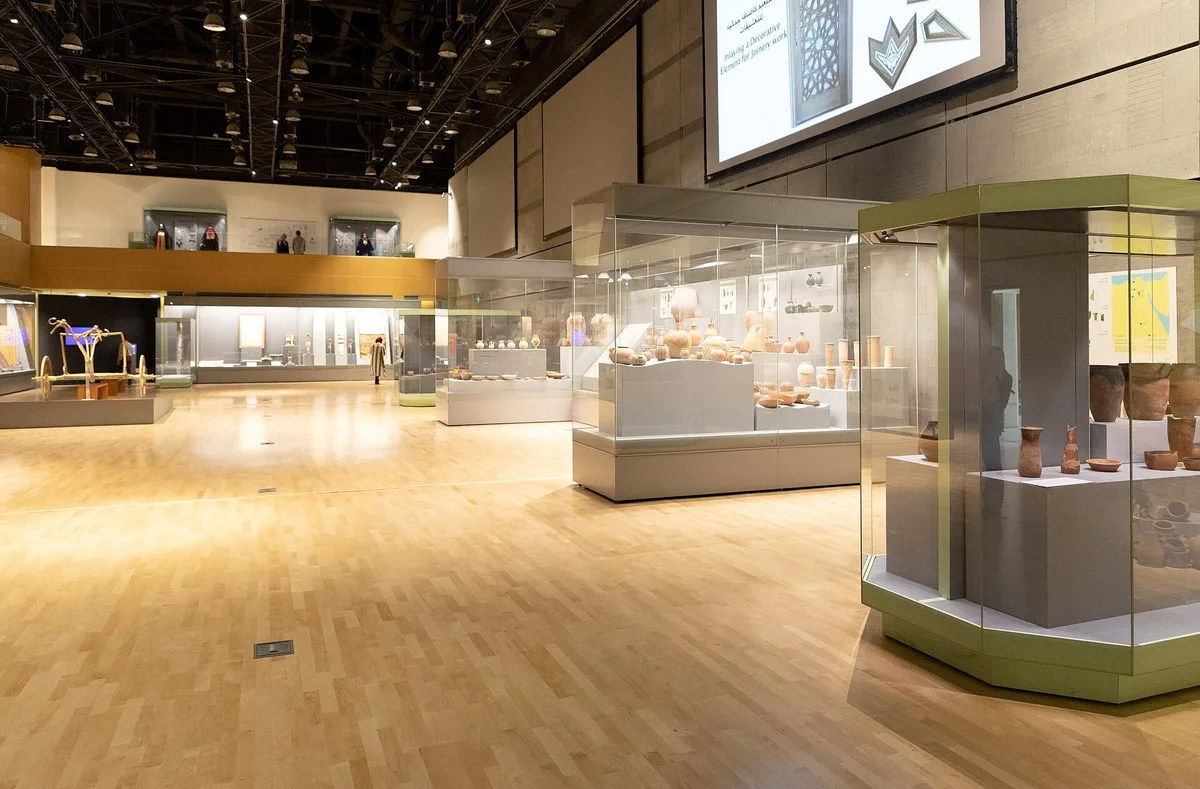
Start with the museum’s own claim, because for once it is accurate. NMEC, as everyone calls it, describes itself as the first museum of its kind in Egypt and the Arab world – a museum of a civilisation rather than of a single period. Its collection runs to some 50,000 artefacts, models, photographs and manuscripts, gathered from museums across Egypt, and the permanent displays are organised two ways at once: a chronological spine that runs from prehistory to the present day, and a set of themes – the Nile, writing, state and society, material culture, beliefs and thinking – that keep reappearing across the eras. A Roman statue of the Nile god and a pharaonic water clock end up making the same point three thousand years apart, and that, in one sentence, is the idea of the place.
The practical shape of the national museum of egyptian civilization is simple enough to hold in your head. There are two halls you must not miss: the Main Exhibition Hall, bright and spacious, which carries the long chronological story, and the Royal Mummies Hall below it, where the twenty-two royal mummies rest in individual, dimly lit bays. Around them sit a dedicated Egyptian Textile Hall, a Fatimid-era dye house preserved on the site where it was found, temporary exhibition space, and – behind the scenes, and larger than most visitors realise – a conservation centre and scientific laboratories that now receive and treat antiquities from across the country. The museum also runs a theatre, a cafe and restaurants, workshops and a children’s programme, which is why Egyptians treat it as a cultural centre as much as a gallery.
Who is it for? Anyone who wants the narrative of Egypt in one visit rather than the greatest hits; travellers who have done Giza and Tahrir and want the connective tissue; and, frankly, anyone who wants to stand a metre from Ramesses II. Who should think twice? Visitors with only one museum day in Cairo and a Tutankhamun-shaped hole in their plans – the boy king is at the GEM, not here – and anyone expecting the GEM’s scale, because the national museum of egyptian civilization is a half-day building, not a full-day expedition. Judged on its own terms, though, it is the museum that explains Egypt, and the sections below take it piece by piece.
Why Egypt Built a Museum of Civilization – Forty Years From Idea to Opening
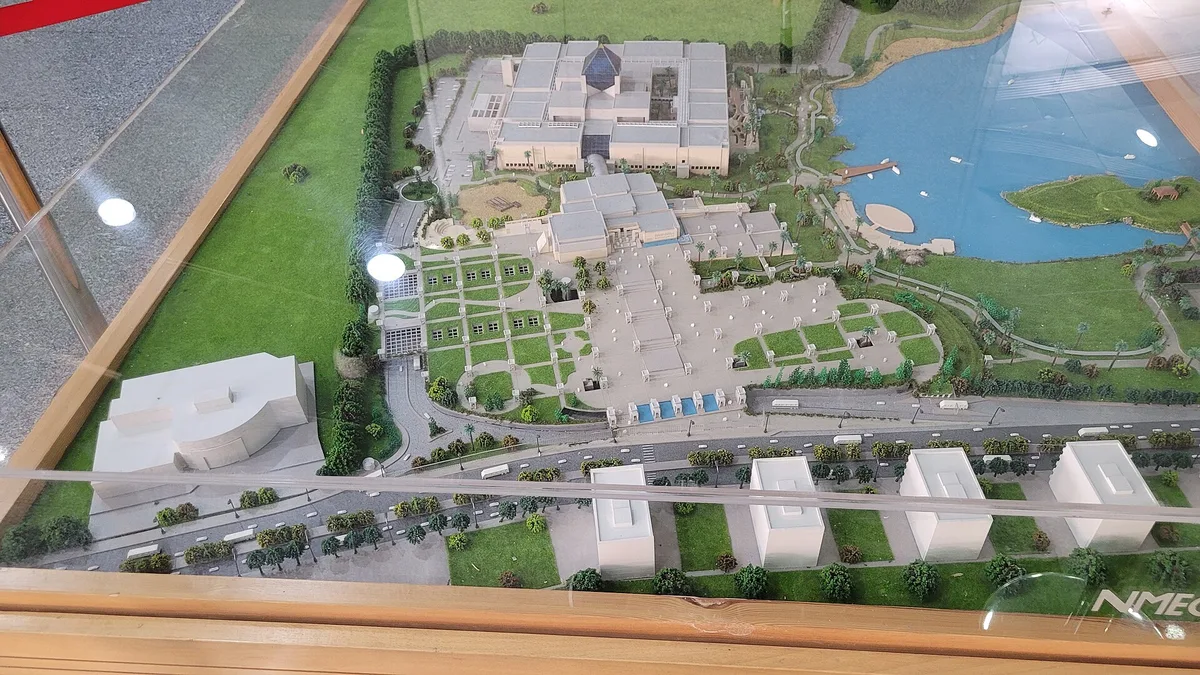
The museum’s own history page tells a story of unusual patience. In 1982 UNESCO launched, at the Egyptian government’s request, an international campaign to establish two museums – the Nubia Museum in Aswan, which opened in the 1990s, and a museum of Egyptian civilisation in Cairo. An Egyptian architect’s design won the international competition. Then the project waited. Only in 1999 was the present site in Al-Fustat settled on, replacing an earlier choice near the Opera, and the foundation stone was laid in 2002, on ground where archaeological excavation had already begun – excavation that would later turn up the medieval dye house described further down this page. The national museum of egyptian civilization was, in other words, a forty-year idea before it was a building.
The reason for the long gestation is the concept itself. Egypt already had great period museums; what it lacked, and what UNESCO’s campaign envisaged, was an institution that treated Egyptian culture as one continuous, layered product – the museum’s mission statement speaks of civilisation as the accumulated result of the Egyptian people’s interaction with their land across all of history, tangible heritage and intangible heritage together. That is why the displays here reach past antiquities to crafts, dress, ritual and modern art, and why the museum collects manuscripts, photographs and oil paintings alongside statues. It is a national museum in the true sense, closer in spirit to a museum of a people’s whole biography than to a gallery of masterpieces.
The building finally opened in stages. A temporary exhibition hall, “Egyptian Crafts through the Different Eras”, was inaugurated in 2017 in the presence of UNESCO’s director-general, showing some 400 artefacts across the four crafts that shaped Egyptian culture – pottery, wood, textiles and ornaments. The full opening came on 3 April 2021, when the museum was inaugurated on the same night its most famous residents arrived by parade. The national museum of egyptian civilization has been receiving both visitors and newly excavated antiquities ever since, and its conservation centre now functions as a national facility, which is why new discoveries in Egypt so often pass through Fustat before anywhere else.
The Building and the Lake – Modern Stone Above Ancient Fustat
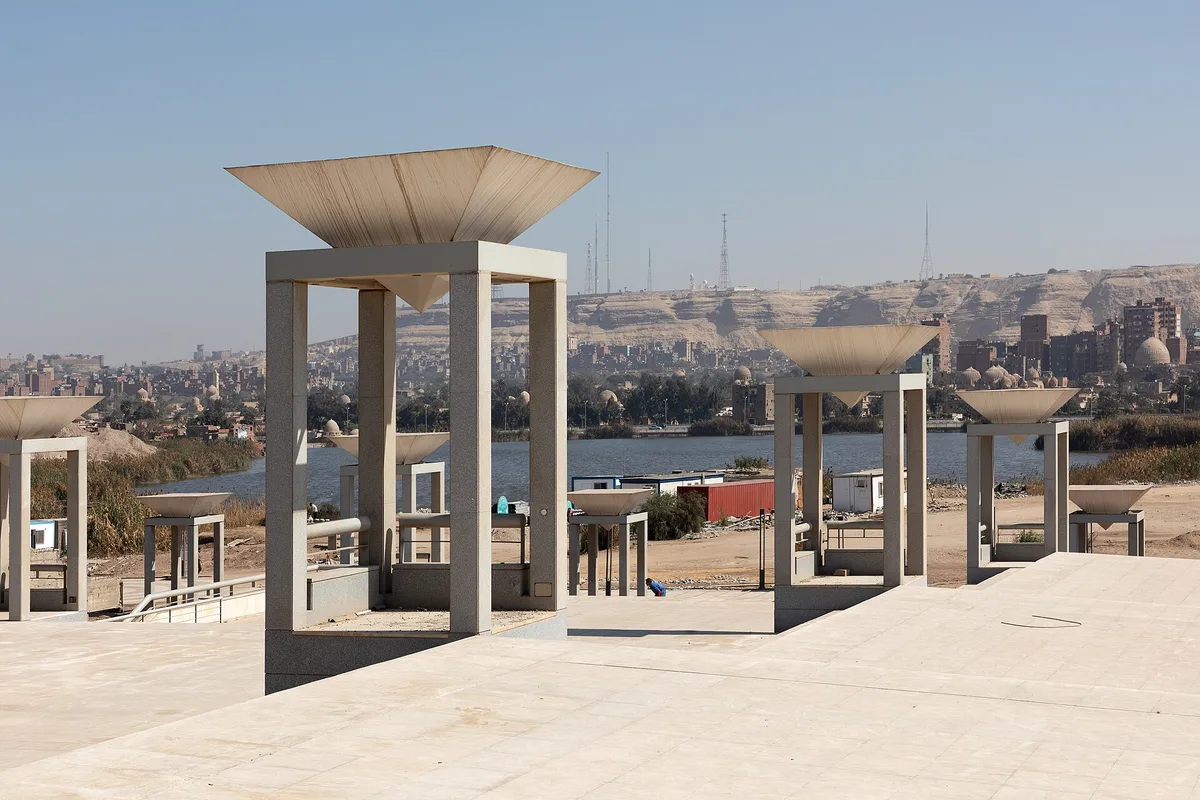
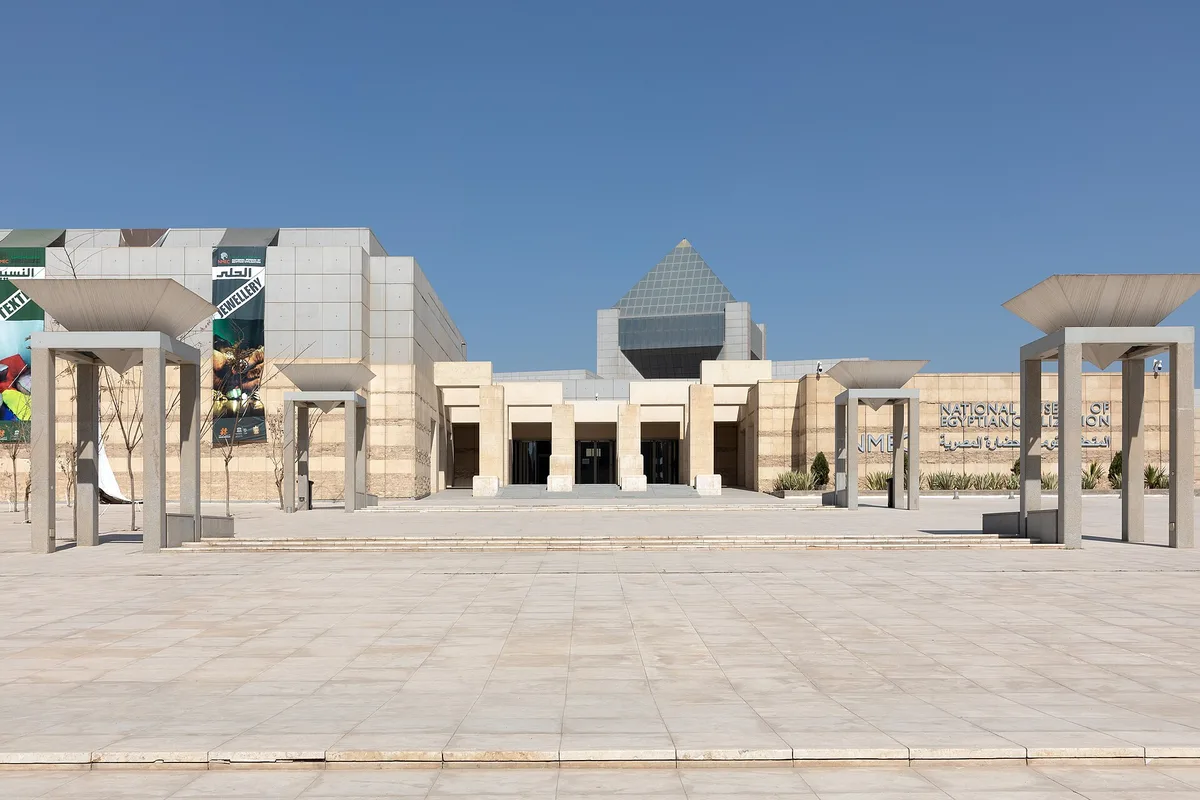
The setting does half the work before you see a single object. The museum occupies some 33.5 acres in Fustat, the site of the first Islamic capital of Egypt, in what is now Old Cairo, and its terraces look out over Ain El-Sira, a natural lake fed by springs – a sheet of open water in a dense city, with the Citadel’s hill on the skyline. The building itself, designed by the Egyptian architect Dr El Ghazzali Kosseiba, whose competition-winning scheme dates to 1984, is a long, low composition of pale stone, colonnades and shaded courts, with the exhibition spaces designed by the Japanese architect Arata Isozaki. It reads as modern without showing off, and it is deliberately calm: wide plazas, pergola-shaded terraces, gardens running down towards the lake.
One architectural flourish is worth knowing about before you go, because it surprises people. The complex is topped by a pyramid-shaped hall – the museum calls it the Hall of the Pyramid, or Top Panorama Hall – fitted with nine 3D screens on its walls presenting Egyptian history and antiquities in sound and image, with a stereoscopic model of the whole museum at its centre. The allusion is not subtle, a pyramid rising from a museum of everything Egyptian, but from the plaza it gives the low building its one landmark, and you will see it in the featured photograph at the top of this page. Inside, the plan is mercifully legible: entrance, the great main hall, the descent to the mummies, and the textile hall and facilities arranged around them.
The ground itself is part of the exhibit. Fustat was a working city for well over a millennium – founded as Egypt’s first Islamic capital, later absorbed into Cairo – and the national museum of egyptian civilization stands in a district layered with that history: the oldest mosque in Egypt, the Coptic churches of Old Cairo and the Ben Ezra Synagogue are all in the surrounding streets. Excavations on the museum’s own plot before construction found the Fatimid dye house that now sits preserved within the complex, a reminder that the museum did not just land on this neighbourhood – it grew out of ground that had been making and dyeing cloth a thousand years before it. The lake, the gardens and the archaeology make the site feel less like a box of objects and more like a small cultural park, and on a winter morning, with the water flat and the terraces empty, it is one of the most peaceful places in Cairo.
The Main Exhibition Hall – One Walk Through Seven Thousand Years
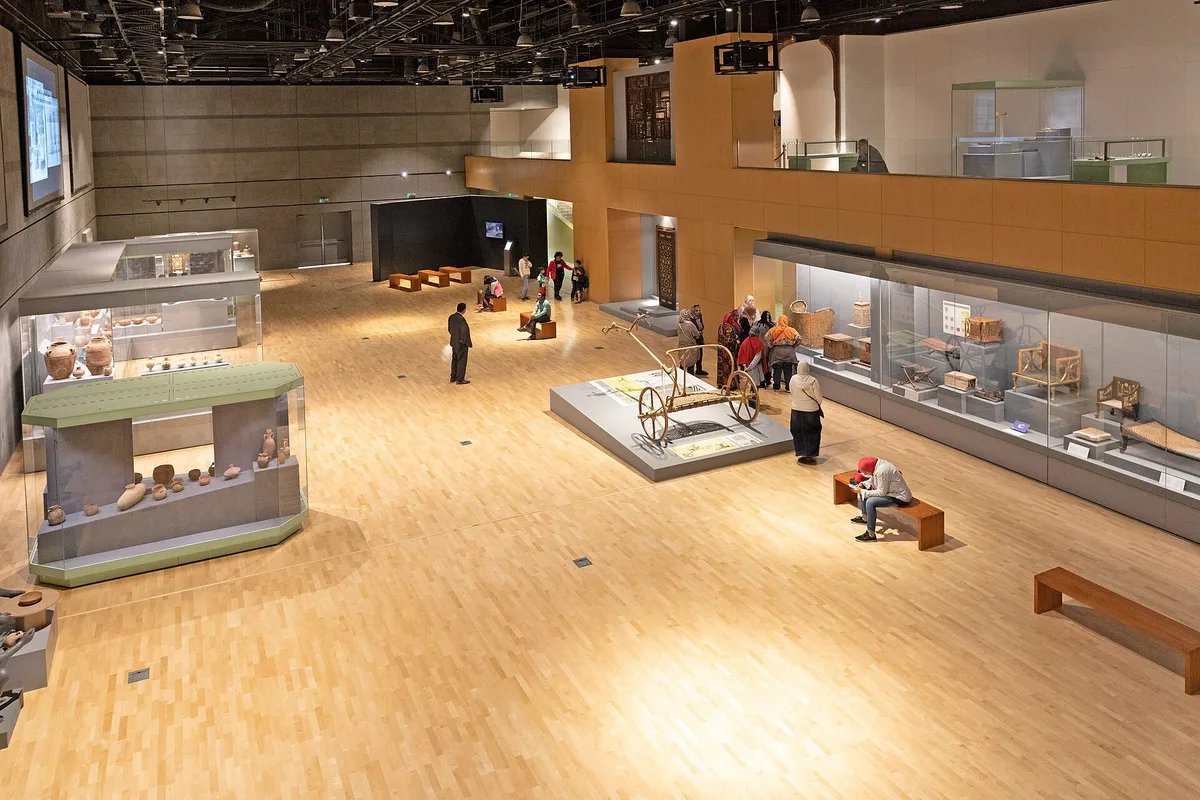
The Main Exhibition Hall is the museum’s spine, and the right way to treat it is as a walk through time rather than a cabinet of treasures. You begin in prehistory, with the stone tools and burials of the peoples who lived along the Nile before writing, kings or pyramids, and you proceed – dynastic Egypt, then the Greek and Roman centuries, then Coptic Christian Egypt, then the Islamic era in all its dynasties, and finally the modern and contemporary age, where the story ends, pointedly, with living Egyptians rather than with ruins. The hall is arranged so that the eras follow one another in a single legible sweep; you are rarely in doubt about which millennium you are standing in, which is more than can be said for older Egyptian museums.
What distinguishes the display is the company the famous pieces keep. A colossal pillar statue of Akhenaten from Karnak stands in the same narrative as a Roman-era treasure hoard, a Coptic painted dome and a Mamluk-era mosque pulpit, because the hall’s argument is continuity – that these are chapters of one story, not separate civilisations that happened to share a river. Everyday material gets equal billing with royal material: baskets, tools, toys, medical instruments, the equipment of workshops and kitchens. The effect, at its best, is of a country explaining itself to you in chronological order, and the national museum of egyptian civilization is at its most persuasive in this hall – the displays were designed as a set, by one team, for one argument, and it shows.
Pace yourself by era rather than by object. The pharaonic sections are the densest and will consume whatever time you give them; the later galleries – Coptic, Islamic, modern – are where this museum most differs from Tahrir, and they repay the energy you saved. Highlights named by the museum itself, and worth deliberately hunting for, include the leather Tent of Purification made for a queen’s funerary rites around 1000 BC, the gilded chariot of Thutmose IV, an alabaster water clock carved for Amenhotep III whose inscriptions map the Egyptian zodiac, the great Roman statue of Nilos, the Nile personified as an old man ringed by sixteen children for the sixteen cubits of a perfect flood, and, in the final gallery, Mahmoud Mokhtar’s sculpture Al Falaha, the peasant woman who became an emblem of modern Egypt. The next section picks out the handful of objects that stop even hurried visitors in their tracks.
The Objects That Stop People – a Skeleton, a Coffin and a Wooden Toe
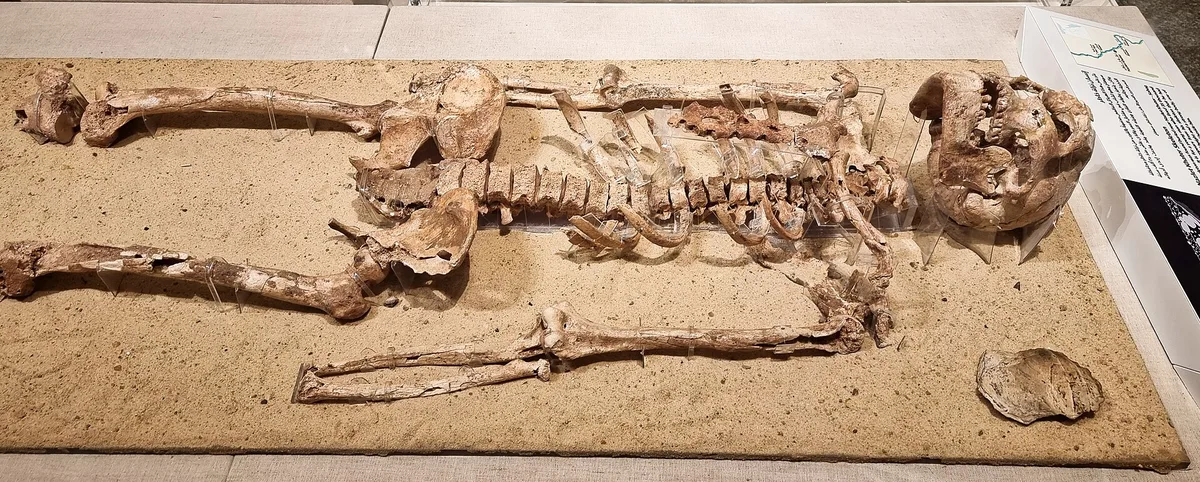
The first great object in the building is also its oldest resident. The Nazlet Khater skeleton, which the museum identifies as the second-oldest skeleton known from Egypt, is the burial of a young man laid in the ground near the Nile some 35,000 years ago, in the Upper Palaeolithic, tens of thousands of years before the first pyramid. He opens the exhibition because he is the exhibition’s thesis in a single case: this museum begins not with pharaohs but with a person, an ordinary Egyptian ancestor from before agriculture, writing or the state. Stand there a moment. Everything else in the building – the gold, the mummies, the mosques – is this man’s posterity, and the curators clearly intend you to feel the depth of time before the splendour starts.
At the other end of the ingenuity scale sits a small object most visitors nearly miss: a prosthetic toe, carved from wood and leather around 1000 BC for a woman of Luxor named Tabaketenmut, and made to be worn – it flexes, it was fitted, it worked. The museum displays it, rightly, as evidence of ancient Egyptian medicine as a practical craft rather than a priestly mystery, and it belongs to a family of quietly astonishing functional objects in the hall: surgical and medical instruments, the water clock, the tools of surveyors and scribes. Nearby, the painted coffin of Sennedjem tells the complementary story from the craftsman’s side – Sennedjem was a tomb-builder of Deir el-Medina who worked on the tombs of Seti I and Ramesses II in the Valley of the Kings, and his inner coffin, decorated with scenes from the Book of the Dead, is the work of a man decorating eternity for himself with the same hands he used for kings.
Taken together, these are the objects that explain why the national museum of egyptian civilization rewards slow looking more than trophy hunting. The Tahrir museum has greater single masterpieces and the GEM has Tutankhamun entire, but no other Egyptian museum makes a 35,000-year-old burial, a working wooden toe and a tomb-builder’s own coffin carry the opening argument of the national story. If your time is short, the museum’s own shortlist is the sensible route: the skeleton, the purification tent, Sennedjem’s coffin, the chariot, the prosthetic toe, the water clock, Nilos, the Coptic dome, the minbar of Abu Bakr Ibn Mizhar, the Mahmal that once led the Kiswa procession to Mecca, and Mokhtar’s Al Falaha – twelve objects that, between them, touch every era the hall covers.
Writing, the Nile and Belief – the Themes Beneath the Chronology
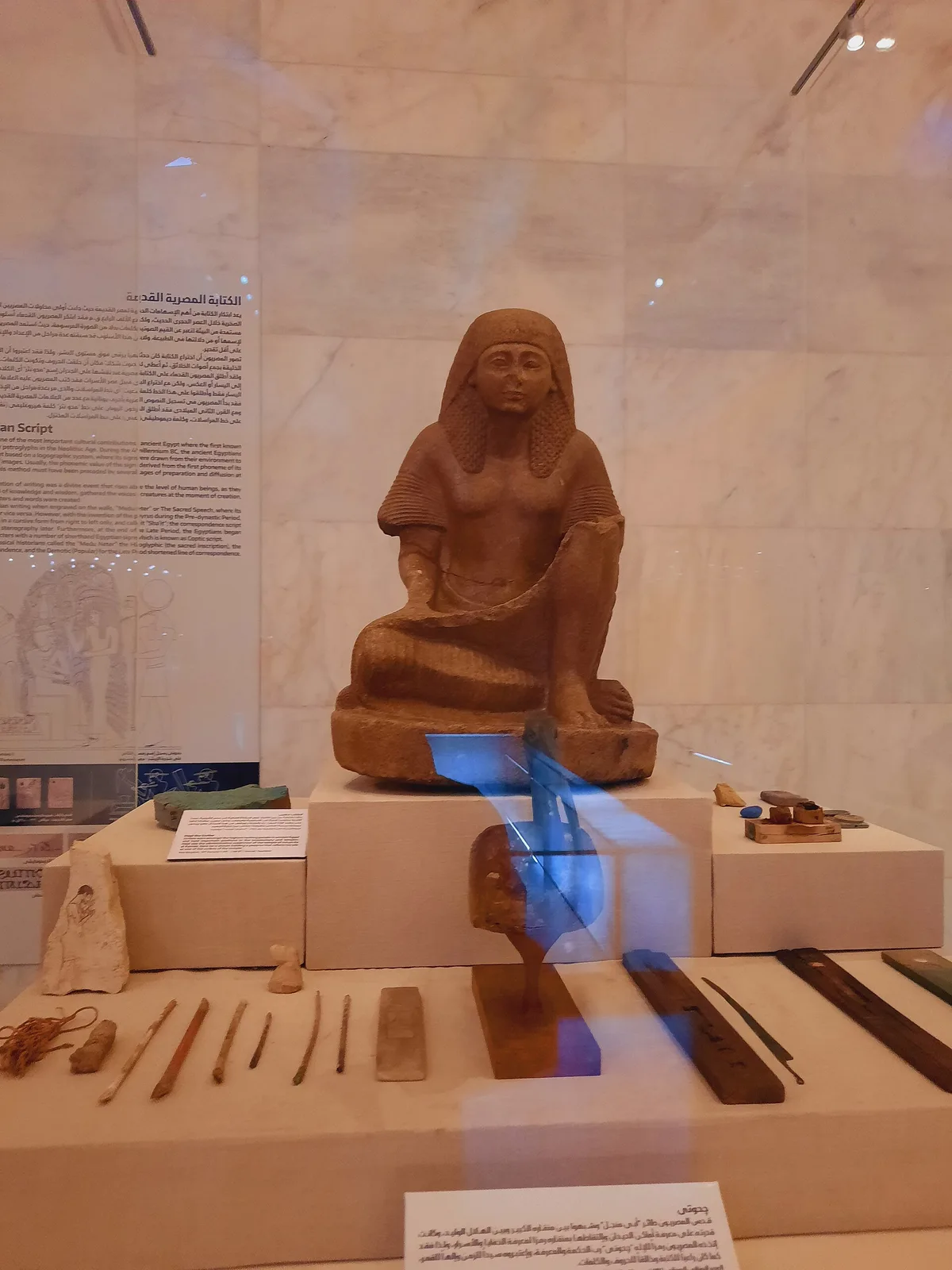
Running underneath the chronology is the museum’s second organising idea, and it is the one that lingers after the visit. The core exhibition was conceived around themes that recur in every age: the dawn of civilisation on this land, the Nile as the country’s engine, writing as its memory, state and society as its skeleton, material culture as its daily texture, and beliefs and thinking as its inner life. The displays keep quietly cross-referencing – a pharaonic nilometer’s logic beside later flood records, hieroglyphic inscriptions giving way to Coptic and then Arabic scripts in a single unbroken scribal tradition, funerary belief evolving from the Book of the Dead to Coptic martyrdom to Islamic endowment inscriptions. No other museum in Egypt asks you to think in quite this way, and it is the clearest sign that the national museum of egyptian civilization was designed by scholars with a thesis, not just a storeroom with a thesis-shaped hole in it.
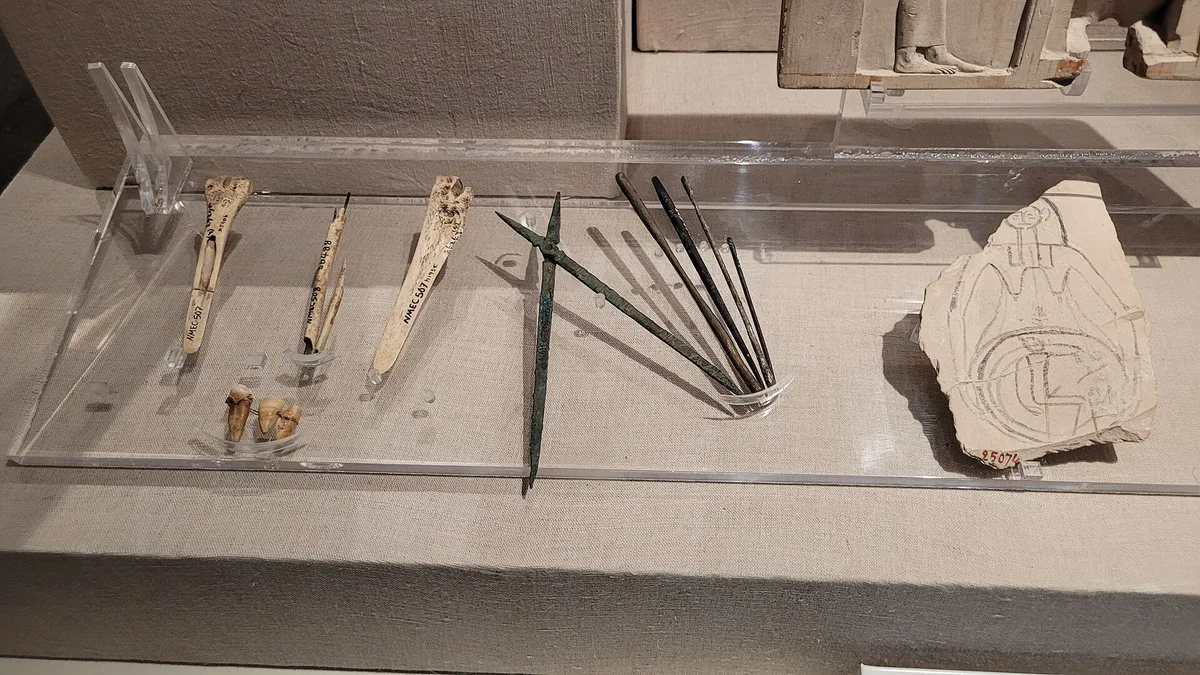
The writing thread is the most tangible of the six. Egypt kept records for longer than any civilisation on earth, and the hall lets you watch the handwriting change across four thousand years: carved hieroglyphs, the flowing ink of papyri unrolled in their cases, reed pens and palettes of the kind the seated scribe in this section’s photograph has laid out before him, figured ostraca used as scratch paper, Coptic manuscripts, and the carved and woven calligraphy of the Islamic centuries. For travellers who enjoy museums as arguments, this thematic layer is the real reason to come; for everyone else it simply means the labels, when they are good, connect objects you would otherwise have walked past separately.
A word of honest calibration: the themes are an undercurrent, not a separate set of galleries with their own doors, and a visitor marching determinedly from case to case can miss them entirely. They reward the visitor who reads the section introductions – the museum’s wall texts, at their best, are short essays in themselves – and who backtracks occasionally to compare across eras. Think of the chronology as the road and the themes as the river running beside it; the national museum of egyptian civilization is the only one of Cairo’s museums where both are flowing at once, and the visit is noticeably richer if you keep an eye on each.
The Royal Mummies Hall – Twenty-Two Kings and Queens at Rest
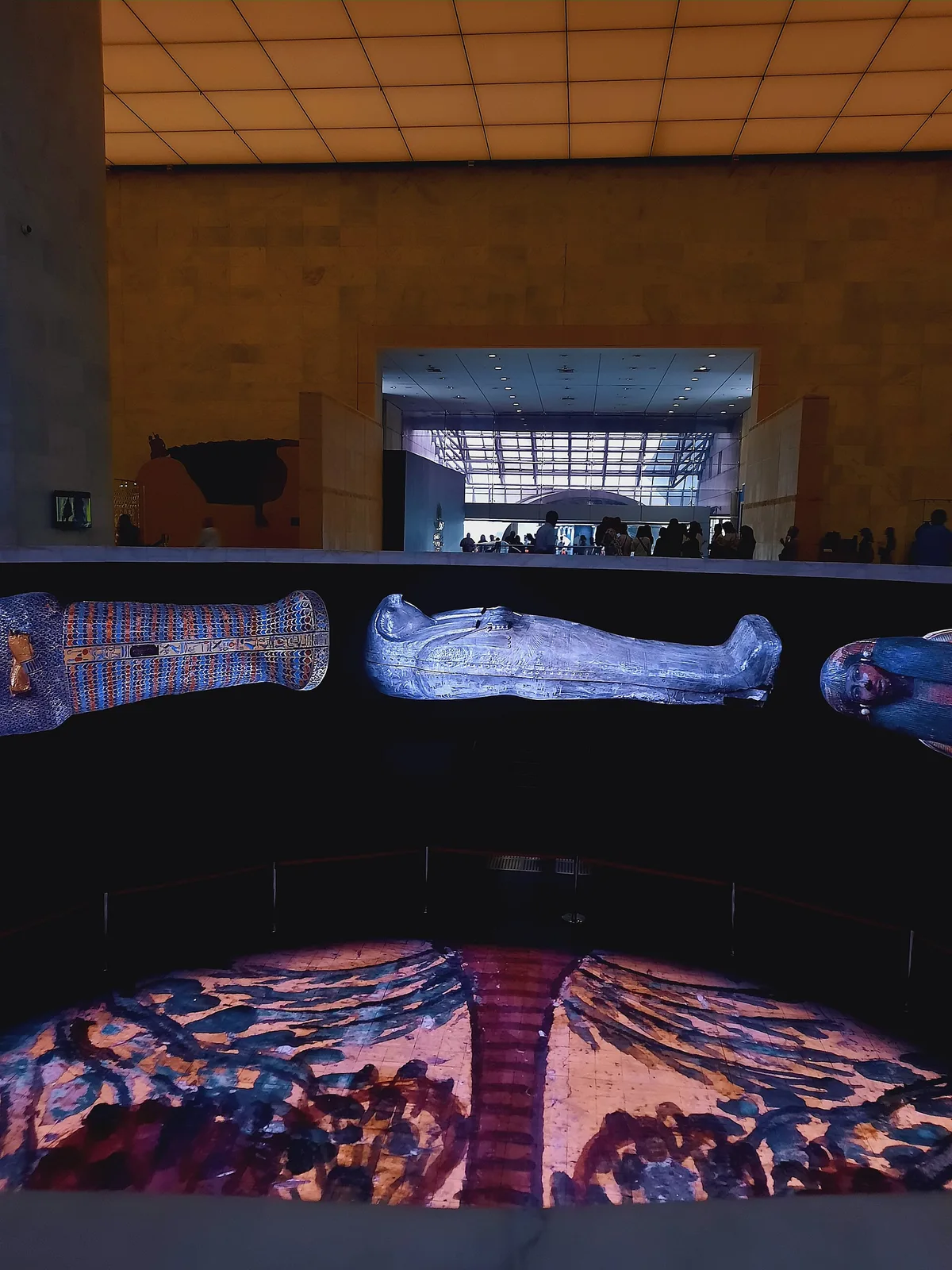
Below the main hall, reached by a descent the museum clearly intends to feel like entering a tomb, lies the room the whole country watched being filled in April 2021. The Royal Mummies Hall holds the twenty-two royal mummies – eighteen kings and four queens of the 17th to the 20th dynasties, the great rulers of the New Kingdom and the turbulent centuries around it. Among them are Seqenenre Tao, who died fighting the Hyksos; Ahmose Nefertari, the revered queen whose vast outer coffin is displayed here; Amenhotep I, whose mummy survives intact and undisturbed, still wearing its funerary flower garlands, one of the very few royal mummies never unwrapped in modern times; Thutmose III, the empire-builder; Seti I; and Ramesses II, the most famous pharaoh of all. The hall was designed, in the museum’s own framing, to give the visitor the feeling of walking through the Valley of the Kings, where most of these bodies were first laid – low light, dark walls, and each mummy resting in its own bay with its coffin and its story.
The display philosophy is worth understanding, because it differs from the old mummy rooms in Tahrir that many visitors remember. There, the kings lay in bright cases in rows, and the atmosphere could feel uncomfortably like a warehouse of the famous dead. Here the presentation is funerary rather than clinical: subdued, spacious, and supported by the interactive technology the museum makes much of, which uses CT scans and modern imaging to show what lies beneath the wrappings – faces, amulets, injuries, the evidence of the embalmers’ craft – without disturbing a single bandage. The canopic chest of Amenhotep II and the faience vessels of Thutmose IV’s funerary equipment stand for the apparatus of royal burial that surrounds the bodies themselves. It is, by design, the most solemn room in any Egyptian museum, and visitors behave accordingly; the hall is noticeably quieter than the rest of the building.
Two practical truths belong in this section rather than the small print. First, photography is forbidden inside the Royal Mummies Hall – completely, phones included, and the rule is enforced by staff at the door; it is a rule of respect and of preservation, and the images in this guide of the hall’s multimedia displays were taken outside the mummy bays themselves. Second, the hall is not a horror exhibit and not a freak show, a distinction the museum works hard to maintain and mostly succeeds in; children who are prepared for what a mummy is generally cope well, and the interpretation stresses who these people were in life. The national museum of egyptian civilization treats this hall as a royal necropolis that happens to admit visitors, and if you meet it on those terms – slowly, quietly, reading the names – it is the single most affecting room in Cairo.
The Pharaohs’ Golden Parade – the Night the Kings Moved House
On the evening of 3 April 2021, Egypt staged the most extraordinary museum transfer in history, and it is impossible to understand this building’s place in Egyptian life without it. The Pharaohs’ Golden Parade carried the twenty-two royal mummies, together with seventeen royal coffins, from the Egyptian Museum in Tahrir Square to their new home in Fustat, and the journey was choreographed as a royal funeral in reverse – a procession of honour for kings dead three thousand years. The mummies travelled in chronological order of reign, Seqenenre Tao first and Ramesses IX last, each sealed in a climate-controlled, nitrogen-filled capsule and carried on a purpose-built, gilded vehicle styled like a pharaonic boat-chariot, bearing its royal passenger’s name in Arabic, English and hieroglyphs, its suspension specially engineered to spare the fragile bodies every jolt of the modern road.
The scale of the production matched the conceit. The convoy left Tahrir at half past six in the evening, circled the square’s newly installed obelisk and sphinxes, and processed along the Nile corniche to Fustat, escorted by horsemen, chariots, motorcycles and a full orchestra and choir performing new music composed for the night. It arrived at the national museum of egyptian civilization at half past eight, where the mummies were received with a twenty-one-gun salute by the President of Egypt, who had formally inaugurated the museum the same evening. The event was broadcast live on more than two hundred television channels around the world, and for a country whose tourism industry had endured a brutal decade, it was a deliberate statement: Egypt presenting its heritage to the planet as a single, confident spectacle.
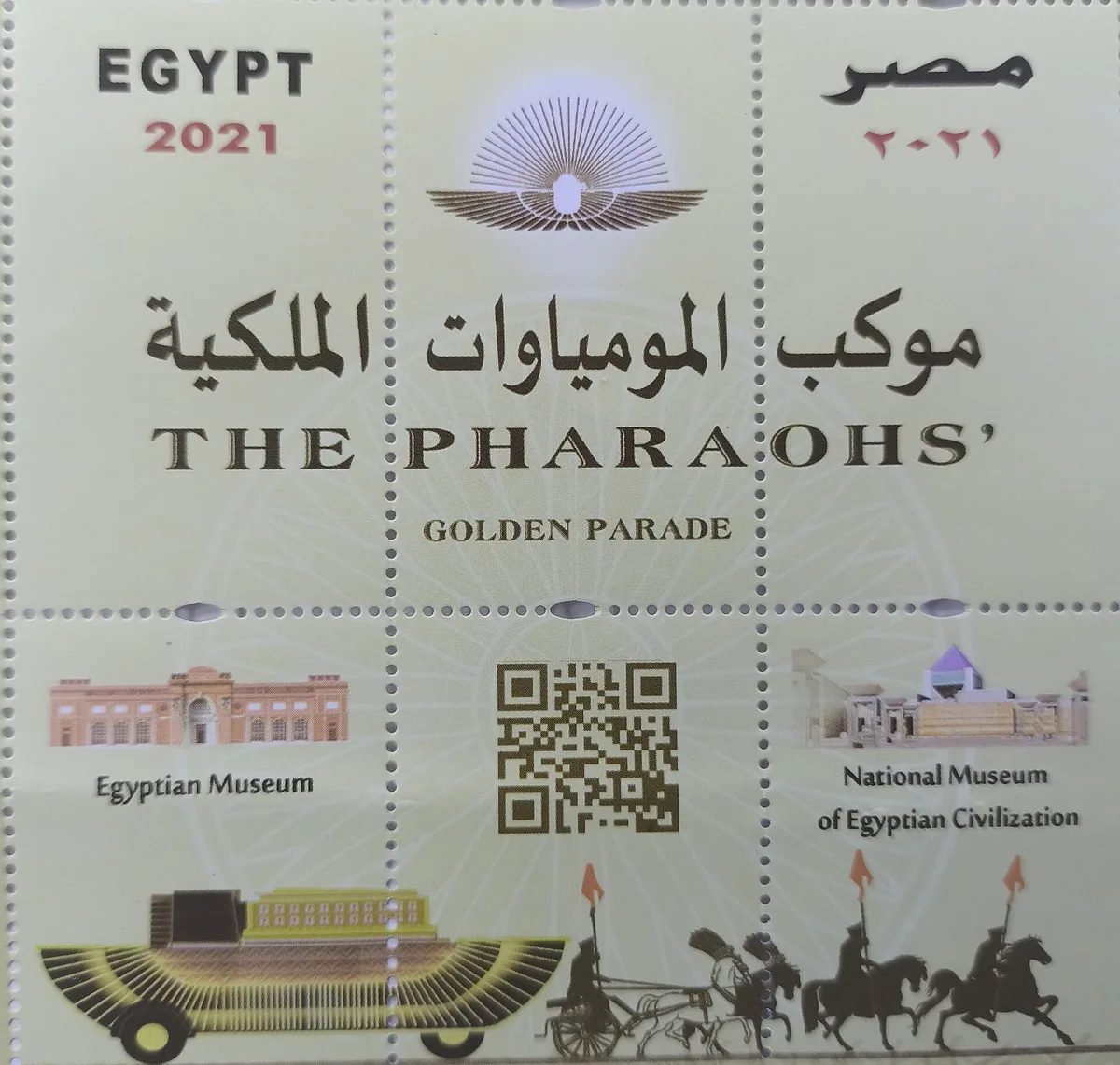
The parade’s aftermath is written into the visit. The mummies rested in the museum’s laboratories for a fortnight before the Royal Mummies Hall opened to the public on 18 April 2021, World Heritage Day. Egypt Post issued commemorative stamps – the sheet photographed for this section shows the two museums and a parade vehicle – and the parade’s gold-and-winged-sun logo still brands the mummies’ floor of the museum, so that the event functions as the building’s founding myth. Critics at the time debated the taste of moving the royal dead as television; what is not debatable is the result. The parade made the national museum of egyptian civilization famous worldwide overnight, fixed the mummies’ new address in the public mind, and gave Fustat a claim on the tourist map that forty years of planning alone might never have achieved.
The Textile Hall and the Fatimid Dye House – the Museum Most Visitors Miss
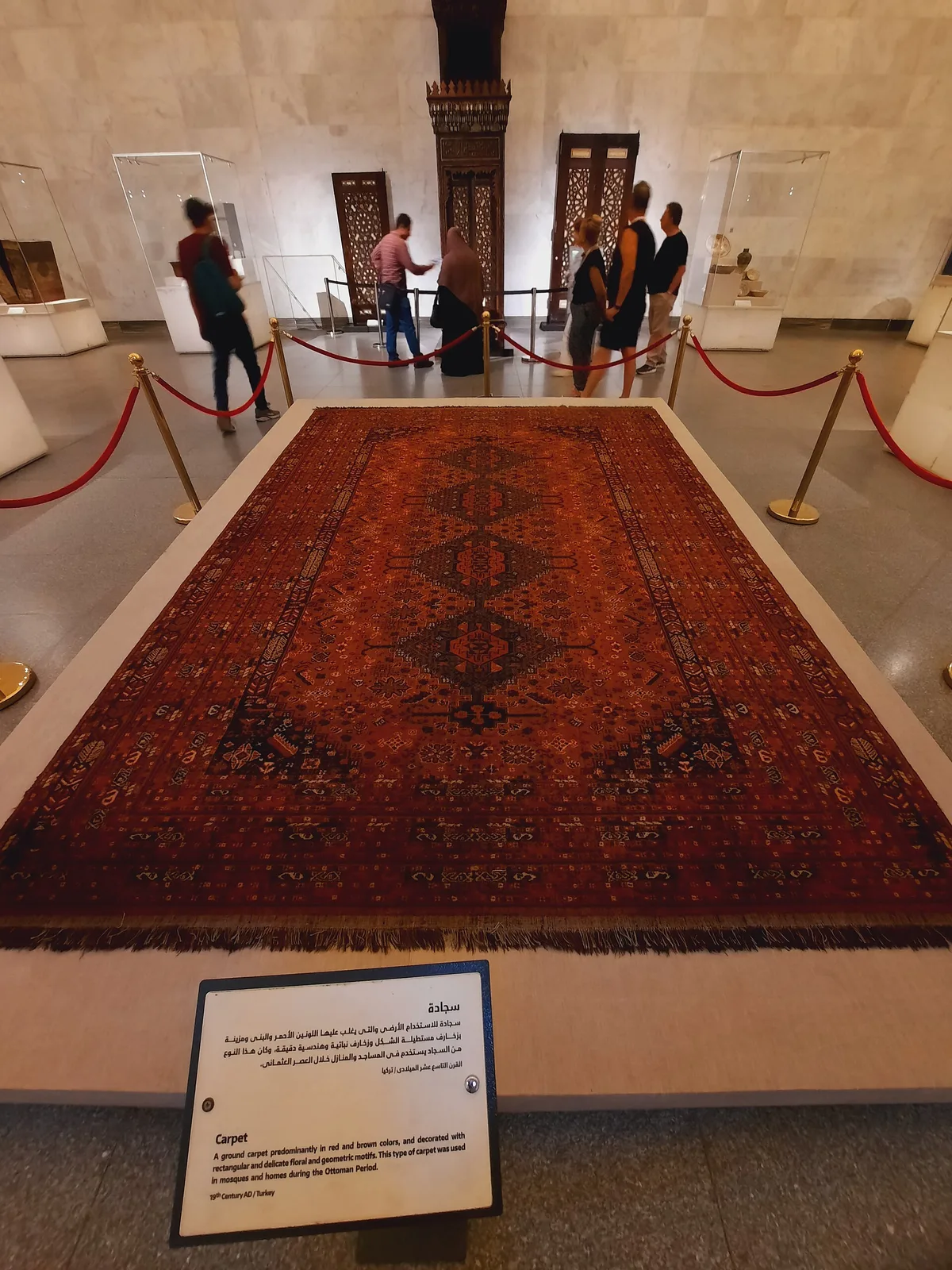
Egypt’s claim to be a textile civilisation is older than its claim to be a stone one – linen was being woven here millennia before the pyramids – and the Egyptian Textile Hall is where the national museum of egyptian civilization makes that case in a dedicated space. The displays run the full length of the story: pharaonic linen, Coptic tapestries, the carved and woven splendour of the Islamic centuries, and the court dress of the Muhammad Ali dynasty. Two exhibits carry the hall. The first is a section of the Kiswa, the embroidered covering of the Kaaba in Mecca – this piece covered the Kaaba’s internal door, the Bab al-Tawba, from 1941, and it stands as evidence of the centuries when the Kiswa was woven in Cairo and carried to Mecca in the great Mahmal procession, the same procession whose ceremonial litter you met in the main hall. The second is a prayer rug of red silk embroidered in gold and silver thread, made as a wedding gift from Muhammad Ali to his daughter Zeinab – court textiles at their most personal. Around them, the uniforms of the dynasty’s carriage staff – the footman who ran beside the carriage, the attendant who held the reins and whip – show dress as a language of rank, worked in the same elaborate needlework as the royal pieces.
Then there is the exhibit that is not in a case at all, because it is the ground itself. During the archaeological work on the museum’s site, excavators uncovered a dye house dating back at least to the first century of the Fatimid period, the era of AD 969 to 1171 – vats and installations for dyeing cloth, preserved in place. The museum describes it as the sole surviving evidence of Cairo’s ancient dye houses, and it has been kept as part of the visit: a working installation of the medieval textile trade, sitting inside the museum that tells the textile story. It is a genuinely rare thing – industrial archaeology of the Islamic city, a thousand years old, displayed where it was found rather than reconstructed somewhere else.
Why do so many visitors miss both? Because the mummies exert a gravitational pull and the textile displays sit quietly off the main route, and because a hall of cloth sounds, on paper, less essential than a hall of kings. That is a mistake this guide would like to correct. The textile hall is where the museum’s civilisation argument is most original – nobody else in Cairo gives dress, weaving and dyeing this status – and the dye house connects the galleries to the actual working city that stood on this ground. Give them twenty minutes after the mummies; the national museum of egyptian civilization is a noticeably better museum for them.
The Museum Behind the Museum – Conservation, Laboratories and Nitrogen Nurseries
A large part of this complex never appears on the visitor route, and it matters more to Egypt’s heritage than any single gallery. The museum’s Conservation Center and scientific laboratories were built to receive antiquities from excavations and museums across the country, examine and document them, and treat them before display or storage. The museum’s own description of the centre gives the flavour of the operation: an Antiquities Receiving Unit where objects are re-examined and documented by first-aid laboratory experts before sterilisation in an anoxia unit; a Heavy Stones Restoration Unit with equipment to lift and restore monumental stonework in pieces weighing well over 120 kilograms; dedicated laboratories for organic materials – wooden coffins, textiles, baskets, manuscripts and papyrus – and for inorganic ones; and a specialist unit for icons and oil paintings, fitted with suction systems to draw off fumes and dust.
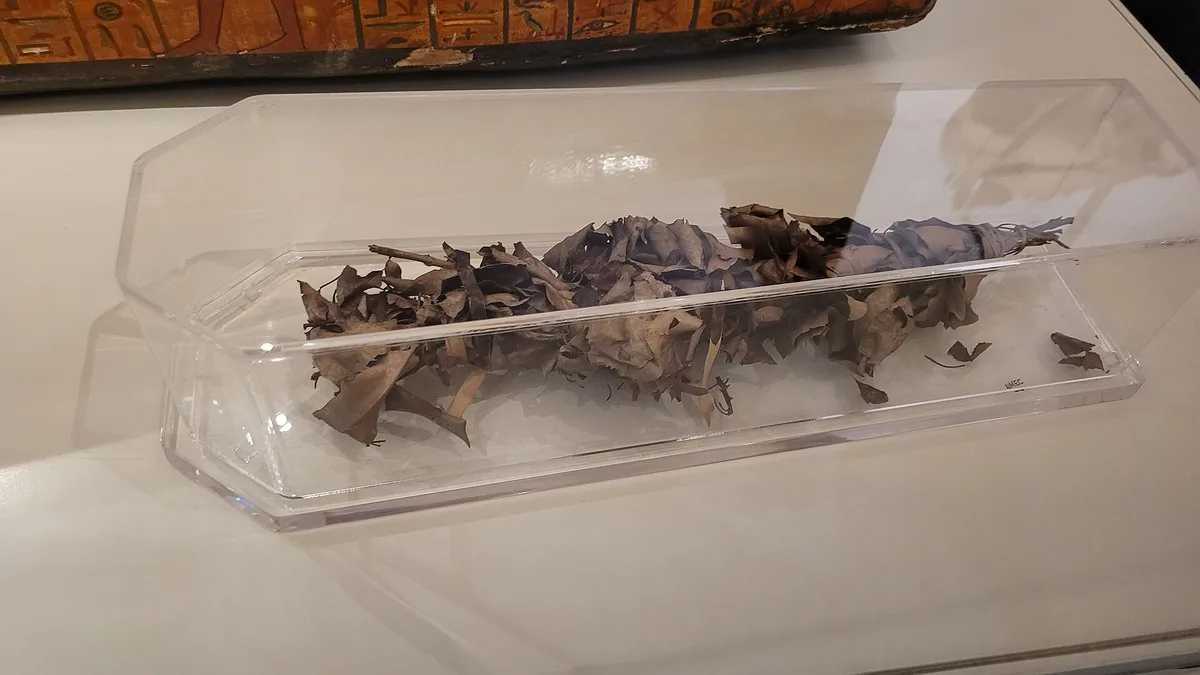
The mummies have their own facility. The Mummies Preservation Unit keeps thirty-six nitrogen nurseries – sealed, oxygen-free environments in which the royal bodies and other mummies are held when not on display – with continuous monitoring of temperature, humidity and light. It was to this unit that the twenty-two parade mummies came in April 2021 for their fortnight of preparation before the hall opened, and it is this unit that underwrites the museum’s ability to display organic remains safely at all. The dried floral garland in this section’s photograph – plant material thousands of years old, of the kind found laid upon Amenhotep I’s mummy – survives to be exhibited only because this kind of science exists, and the museum is frank that its laboratories are a national service: objects arrive from every governorate, and the centre’s work underpins exhibitions far beyond Fustat.
For the visitor, the conservation centre is mostly experienced at second hand – in the quality of the displays, in temporary exhibitions drawn from newly treated finds, and in the museum’s calendar of workshops, lectures and children’s activities, which draw on the laboratories’ work. It is still worth knowing it is there. The national museum of egyptian civilization was not built only to show Egypt’s past but to physically look after it, and that double function – national gallery and national hospital for antiquities – is the deepest difference between this institution and a conventional museum.
NMEC, Tahrir or the GEM – How Cairo’s Three Museums Divide the Story
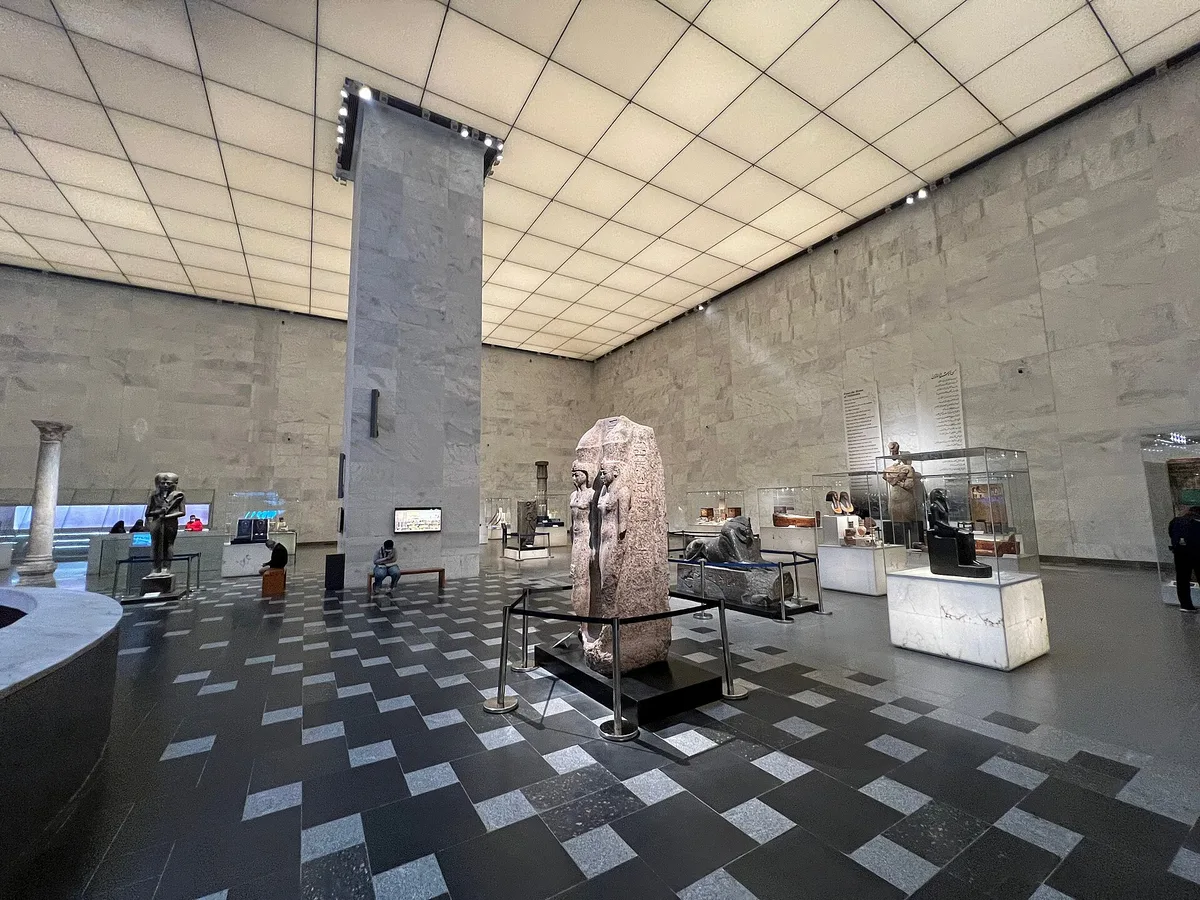
Cairo’s three great museums are no longer rivals so much as a division of labour, and choosing between them – or sequencing them – is the main planning decision of a Cairo stay. The Egyptian Museum in Tahrir remains the world’s greatest storehouse of pharaonic antiquities, dense, venerable and still mid-reinvention, the place for the Narmer Palette, the Tanis gold and the sheer overwhelming depth of the collection. The Grand Egyptian Museum at Giza is the blockbuster: Tutankhamun complete for the first time, colossal statuary, and a building on a pharaonic scale – our grand egyptian museum guide walks it in detail. The national museum of egyptian civilization takes the third role, and it is the storyteller’s: the only one of the three whose subject is Egypt entire, all eras, arranged as one narrative, and the only one that holds human remains of the kings themselves rather than their possessions.
That division produces a practical rule of thumb. If you have one museum day and want spectacle, go to the GEM. If you have one day and want understanding – the framework that makes every temple and tomb on the rest of your trip make sense – come here first, because two hours in the main hall is the best orientation to Egyptian history that exists anywhere, and the mummies supply the emotional peak that pure information lacks. If you have two or three days, the order this guide recommends is NMEC first for the story, the GEM second for the splendour, and Tahrir third, with the framework in place, for the deep collection. Travellers consistently report that the Tahrir museum, bewildering as a first museum, becomes a pleasure as a third.
What NMEC does not do should be stated with the same clarity. It does not hold Tutankhamun, whose entire collection moved to Giza; it does not attempt the GEM’s monumentality; and its collection, at some 50,000 objects against Tahrir’s far larger holdings, is a selection rather than an archive. Its labels and interpretation, while generally good, are less lavish than the GEM’s, and its pharaonic displays, fine as they are, are a survey rather than a treasury. The national museum of egyptian civilization wins on narrative, on the mummies, and on being the one museum in Cairo where a first-time visitor can walk out actually understanding the shape of the country’s past – and for most travellers, on most trips, that is the win that matters.
Getting There and How a Visit Flows
The museum stands on El-Fustat Road in the Ein Elsira district of Old Cairo, and the museum’s own visitor information names the closest metro station: Mar Girgis, on Line 1, a short walk or a very short taxi ride from the entrance. Mar Girgis is itself the heart of Coptic Cairo – the Hanging Church and the Coptic Museum are at the station – which makes the natural pairing of a museum morning with an Old Cairo afternoon almost effortless. From downtown hotels, a taxi or ride-hailing car across the city is the usual choice; Fustat lies south of the centre, beyond the Citadel side of the old city, and the drive is a cross-town one by Cairo standards, so build the traffic into your planning rather than trusting a map’s optimism. The complex has its own parking, a cafe and restaurants, and a gift shop, so the visit is self-contained once you arrive.
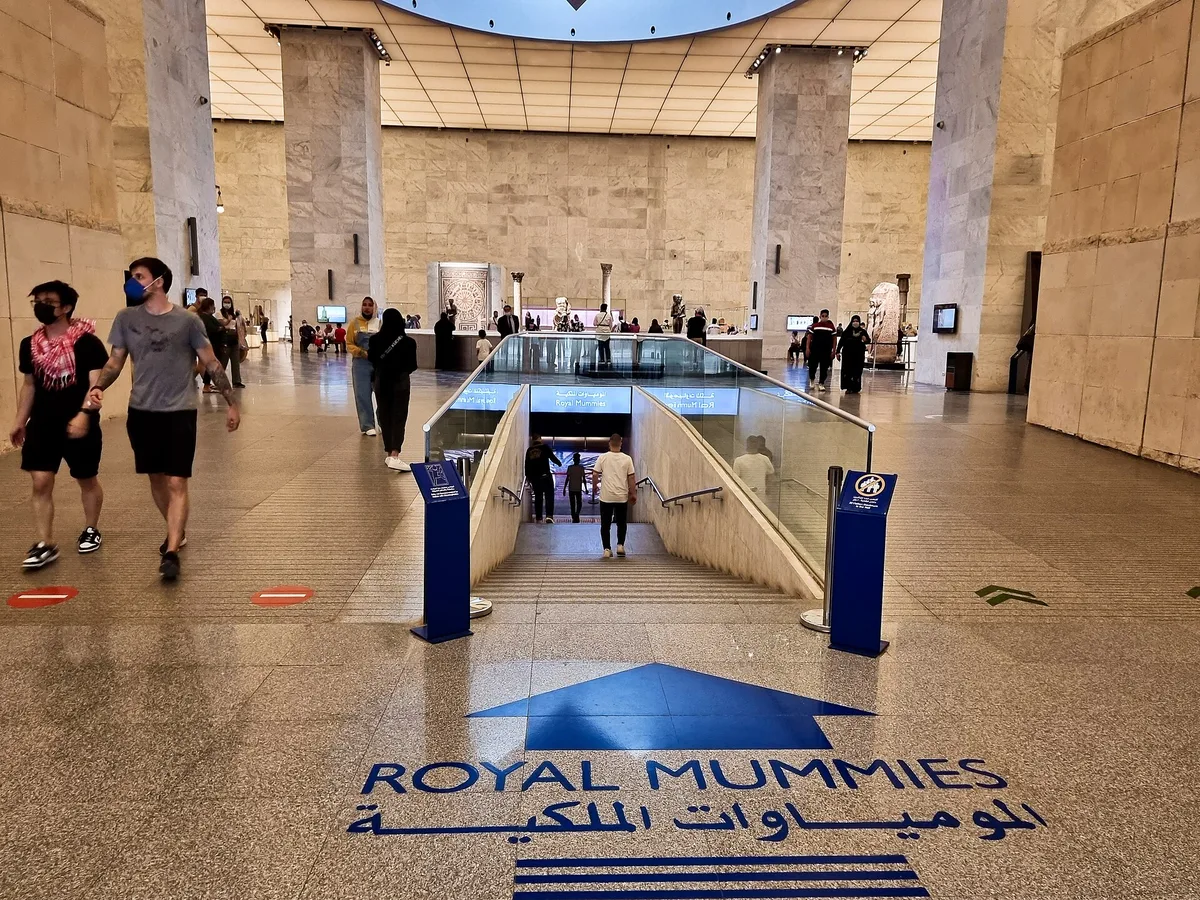
The visit itself flows in one natural direction, and the building’s layout does most of your planning for you. Enter, and do the Main Exhibition Hall first, walking the chronology from the prehistoric gallery forward – this is the order the curators intend, and the later eras assume the earlier ones. Allow the pharaonic centuries the largest share, but resist spending everything there; the Coptic, Islamic and modern galleries are this museum’s distinction. Then descend to the Royal Mummies Hall – the floor signage, shown in this section’s photograph, routes you down – and give the kings their own unhurried half hour in the quiet. Finish with the Textile Hall and the dye house, which most visitors reach last and enjoy precisely because the crowds have thinned, and end on the lakeside terrace if the weather is kind.
Timing guidance, honestly hedged: a thorough visit runs two to three hours; a highlights visit – main hall highlights, mummies, a textile glance – can be done in ninety minutes without disgracing yourself. School groups are a fact of life here, as at every Egyptian national museum, and the mummy hall in particular is calmer in the first hour after opening and the last hour before closing. Fridays add an evening session (see the tickets section below), when the national museum of egyptian civilization takes on a different, more local atmosphere – families, the lake at dusk, and the galleries lit for the night.
Tickets, Hours and the Practical Details
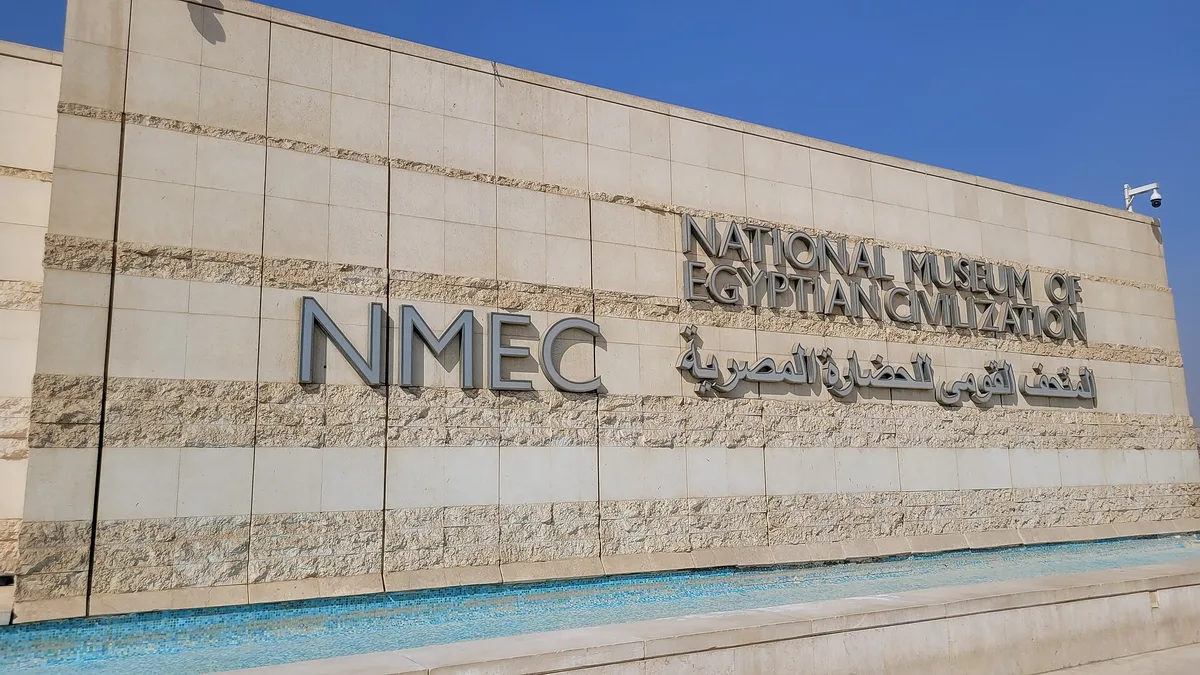
The machinery is straightforward and, unusually for this guide, the figures can be stated, because they come from the official booking platform the museum itself links to. The national museum of egyptian civilization is open daily from 9:00 AM to 5:00 PM, with last ticket admission at 4:00 PM; on Fridays there is an additional evening opening from 6:00 PM to 9:00 PM, with last admission at 8:00 PM (museum’s published opening hours, checked November 2026). Tickets are sold at the museum’s ticket office and online through egymonuments, the Ministry’s official ticketing platform, which the museum’s website links to directly as its Buy Ticket route.
On that platform, checked in November 2026, admission is priced by visitor category: 550 Egyptian pounds for an adult visitor of Arab or other nationality, 300 pounds for students in those categories, and 90 pounds for Egyptian adults with 45 pounds for Egyptian students – always check the platform at booking time, since Egyptian ticket prices are revised periodically and the figure at the gate is the one that counts. The booking page lists a single admission ticket covering the museum; it does not list a separate ticket for the Royal Mummies Hall. The same page notes that free-entry passes are available at the museum’s ticket office for eligible guests, and – a detail that catches pass-holders out – that NMEC is not yet part of the Cairo Pass programme, though it is in the process of joining. The museum itself can be contacted through its official site, NMEC, which carries its news, events and exhibition announcements.
Three small practicalities round out the picture. Bring identification, since ticket categories are nationality-based and spot checks at entry are normal across Egyptian sites. Expect airport-style security screening at the gate, which at busy times adds minutes rather than moments. And plan the mummies around the photography rule stated earlier in this guide: cameras are welcome in much of the museum, subject to the rules posted on the day, but inside the Royal Mummies Hall there is no photography of any kind – so take your pictures of the lake, the plaza and the main hall, and give the kings your undivided, unphotographed attention.
The Honest Catches – What This Museum Is Not
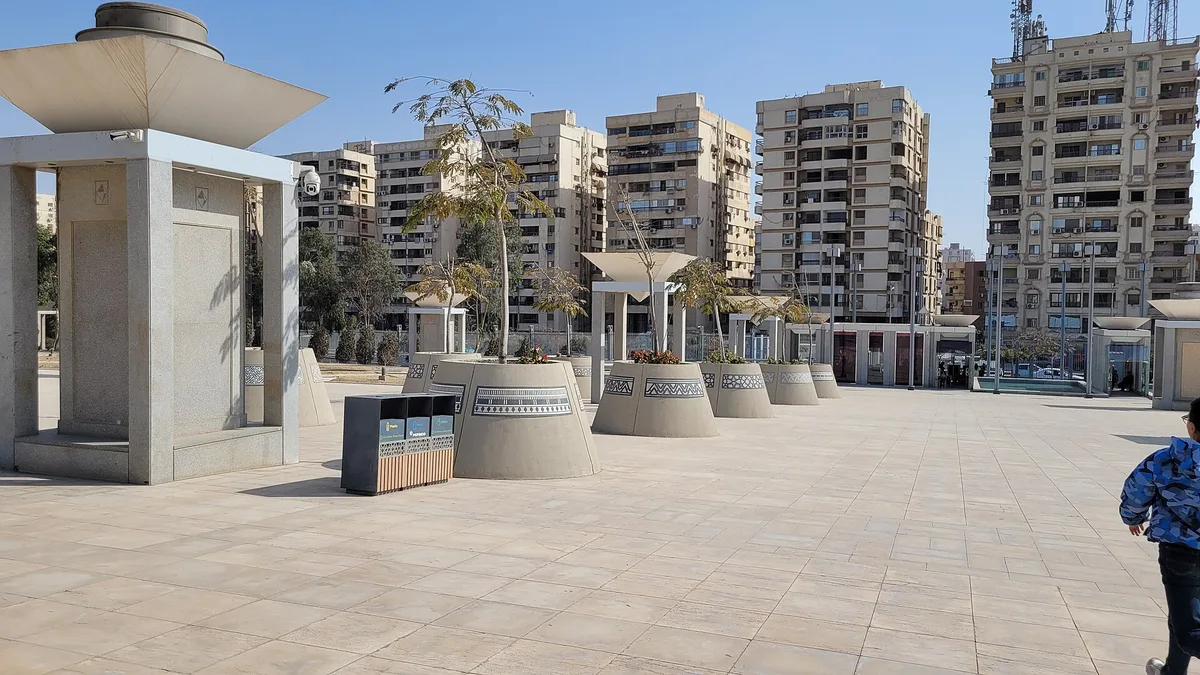
Every museum guide owes its reader the friction as well as the gloss, and the national museum of egyptian civilization has its share. First and largest: the photography ban in the Royal Mummies Hall is absolute and surprises many visitors at the door, phones included, with no photography ticket or permit that buys your way around it for ordinary visitors. Second, the museum is still growing into its building – it opened in stages from 2017, halls and programmes have been added progressively, and parts of the complex, from temporary exhibitions to some lakeside facilities, rotate or develop over time; what is open on your visit may not exactly match any guide, including this one. Third, interpretation is uneven: the thematic wall texts can be excellent, but individual object labels are often brief, and travellers spoiled by the GEM’s multimedia richness will find this a quieter, more traditional presentation.
The location cuts both ways. Fustat is one of the most historically layered districts in Cairo and the Old Cairo pairing is a real pleasure, but it is not where most visitors sleep; the museum is a deliberate cross-town trip from the downtown and Giza hotel districts, in a working neighbourhood – the apartment blocks behind the plaza in this section’s photograph are the real Fustat – rather than a polished tourist enclave, and the approach roads are ordinary Cairo streets with ordinary Cairo traffic. Visitors expecting a resort-grade bubble should recalibrate; visitors who like their museums embedded in a living city will count the setting a virtue.
Finally, scale. This is a half-day museum, and its pharaonic galleries, for all their intelligence, cannot match Tahrir’s depth or the GEM’s star power; a traveller with exactly one free morning and a lifelong Tutankhamun ambition should go to Giza and not feel guilty. The honest summary is that the national museum of egyptian civilization is the best-told museum in Egypt rather than the biggest or the richest – and that a minority of visitors, the ones who came only for the mummies, walk its main hall too fast and leave having seen the least interesting version of it. Do not be that visitor; the kings are the climax, not the whole book.
National Museum of Egyptian Civilization – Questions Travellers Ask
Where is the National Museum of Egyptian Civilization, and how do I get there? The museum stands on El-Fustat Road in Ein Elsira, Old Cairo, overlooking Lake Ain El-Sira. The museum’s own visitor information names Mar Girgis, on Metro Line 1, as the closest station – a short walk or brief taxi ride from the entrance – and Mar Girgis also serves the churches of Coptic Cairo, so the two pair naturally in one trip. From downtown or Giza hotels, most visitors use a taxi or ride-hailing car and allow for cross-town traffic.
How much are tickets? On the official egymonuments booking platform, checked in November 2026, an adult ticket costs 550 Egyptian pounds for visitors of Arab or other nationalities and 90 pounds for Egyptian visitors, with student tickets at 300 and 45 pounds respectively. Prices are revised periodically, so treat those figures as the museum’s published rates at the time of checking and confirm on the platform or at the ticket office on the day. The booking page lists a single admission ticket; free-entry passes for eligible guests are available at the ticket office.
What are the opening hours? The museum’s published hours, checked November 2026, are 9:00 AM to 5:00 PM daily, with last ticket admission at 4:00 PM. Fridays add an evening session from 6:00 PM to 9:00 PM, last admission 8:00 PM, which is a pleasant way to see the galleries with a largely local crowd and the lake at dusk.
Are the royal mummies really here, and how many? Yes – the Royal Mummies Hall holds the twenty-two royal mummies, eighteen kings and four queens of the 17th to 20th dynasties, transferred from the Egyptian Museum in Tahrir in the Pharaohs’ Golden Parade of April 2021. They include Ramesses II, Seti I, Thutmose III, Queen Hatshepsut and Amenhotep I, whose mummy survives intact, still wearing its flower garlands. Each rests in its own bay in a hall designed to evoke the Valley of the Kings.
Can I take photographs inside the museum? In most of the museum, yes, subject to the rules posted on the day – but not in the Royal Mummies Hall, where photography of any kind, phones included, is prohibited and enforced. There is no ordinary visitor permit that overrides the ban; take your photographs in the main hall, the textile hall and on the lakeside terrace instead.
Is Tutankhamun at the National Museum of Egyptian Civilization? No. Tutankhamun’s entire collection – all of it, displayed complete for the first time – is at the Grand Egyptian Museum in Giza, and the famous gold mask went there with it. What Fustat holds instead is the royal mummies themselves, and the broadest single-narrative collection in the country. If the boy king is your priority, go to the GEM; if the kings in person are, come here.
How long does a visit take, and what should I combine it with? Allow two to three hours for the full museum – main hall, mummies, textile hall and dye house – or ninety minutes for the highlights. The natural companions are all nearby in Old Cairo: the Hanging Church and Coptic Museum at Mar Girgis, the Ben Ezra Synagogue, and the Mosque of Amr ibn al-As, the oldest in Egypt, in the surrounding Fustat streets. Many visitors give the cluster a full day and finish on the museum’s lakeside terrace.
The Short Version of the National Museum of Egyptian Civilization
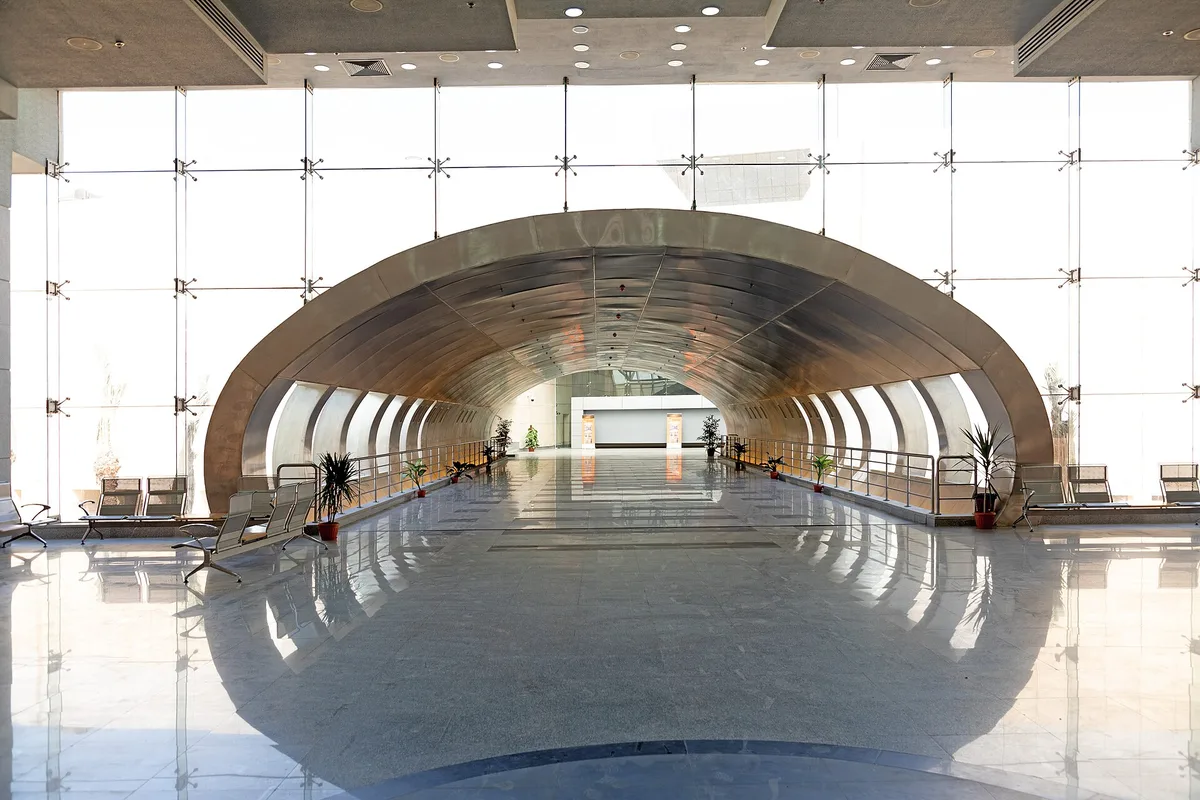
If you read nothing else, read this. The national museum of egyptian civilization is Cairo’s storyteller museum: a modern building on a lake in ancient Fustat where the entire Egyptian story – prehistoric hunter, pharaoh, Roman, Copt, caliph and modern citizen – is told in one chronological walk, and where, below the bright main hall, twenty-two of the greatest kings and queens of the ancient world lie in a hall built to feel like their tombs. Come for the narrative, stay for the mummies, and do not skip the textile hall, the Fatimid dye house, or the small perfect objects – a 35,000-year-old burial, a craftsman’s painted coffin, a wooden toe that worked – that carry the argument better than gold could.
Practically: go early or on a Friday evening, ride Metro Line 1 to Mar Girgis or take a car across town, buy the single admission ticket at the office or on egymonuments, walk the main hall in order, descend to the kings with your camera put away, and give the whole visit two to three hours before pairing it with Old Cairo’s churches and mosques. NMEC will not overwhelm you like the GEM or bury you in riches like Tahrir. It will do something rarer – it will make the rest of your Egypt trip make sense.