Cairo Travel Guide – Pyramids, Museums, Medieval Streets and How the City Actually Works
Cairo is not one city, and treating it as one is the mistake almost every first visit makes. It is a pharaonic necropolis on a desert plateau, a medieval Islamic city of minarets and bazaars, a Coptic quarter older than Islam, a nineteenth-century downtown of Parisian boulevards, and a modern megacity of well over twenty million people — all stacked within a few kilometres of each other along the Nile, and all connected by some of the most demanding traffic on Earth. A cairo travel guide that simply lists the sights in order of fame sets you up to spend your trip in the back of a car. This one is built the other way round: around bases, districts and day-shapes, so that each day groups what actually sits together and the city gets a chance to be walked, not just driven through.
The logic is simple once you see the map. The pyramids and the Grand Egyptian Museum stand together on the west bank at Giza, and they want a full day and an early start. Islamic Cairo — the walled Fatimid city, its mosques, gates and the Khan el-Khalili bazaar — is a second day, on foot, in the east. Coptic Cairo, the Citadel and the Egyptian Museum in Tahrir pair into a third. Zamalek and the Nile are where those days end, with a felucca at sunset and a slow dinner. Everything in the sections below follows that shape: what each district actually is, how much time it honestly takes, where to sleep so the shape works, how to move without losing hours, and the judgements — about hassle, heat, and which famous things can be dropped — that the tour sellers leave out. For the country beyond the capital, our egypt travel guide carries the full routes down the Nile.
At a Glance
Short on time? Here is Cairo on one screen — the districts that matter, what each one gives you, and the time it honestly asks for. Nothing in this guide prints a ticket price or an opening hour, deliberately: prices at Egypt’s sites change by decree and have changed repeatedly in recent seasons, so any figure you find in print — here or anywhere — should be re-checked on the official site before you budget on it.
| District or sight | What it gives you | Time it honestly takes |
|---|---|---|
| Giza plateau – pyramids and Sphinx | The last surviving wonder of the ancient world, at the city’s edge | Half a day minimum, early start |
| Grand Egyptian Museum | The complete Tutankhamun collection and the pharaonic story in one building | Half a day, pairs with Giza |
| Islamic Cairo and Al-Muizz Street | A medieval walled city of mosques, gates and madrasas | Half a day on foot |
| Khan el-Khalili | The famous bazaar – lanes of metalwork, spice and glass | Two hours, best late afternoon |
| The Citadel and Muhammad Ali Mosque | Cairo’s great viewpoint and its Ottoman landmark | Two to three hours |
| Coptic Cairo | The Hanging Church, synagogue and the oldest Christian layers | Two to three hours |
| Egyptian Museum, Tahrir | The classic old museum – dense, dusty, still essential | Two to three hours |
| Zamalek and a Nile felucca | The city’s calm evening – island streets and an hour on the water | An evening |
| Saqqara and Memphis | The Step Pyramid and the first capital, south of the city | A half-day to full-day trip |
Two judgements sit behind that table. First, Cairo rewards grouping by bank and district far more than it rewards ranking by fame — the Sphinx and the bazaar are both unmissable and they are a difficult hour apart on a bad traffic day. Second, the museums are now three, not one, and confusing them is the commonest planning error in the city: the Grand Egyptian Museum at Giza holds the Tutankhamun collection complete, the old Egyptian Museum in Tahrir still holds a vast classic collection, and the royal mummies rest in a third building, the National Museum of Egyptian Civilization in Fustat. Each gets its honest place below. For the ranked list version of the city’s sights, our guide to the places to visit in cairo covers the top ten in order.
Giza – the Pyramids, the Sphinx and the Plateau
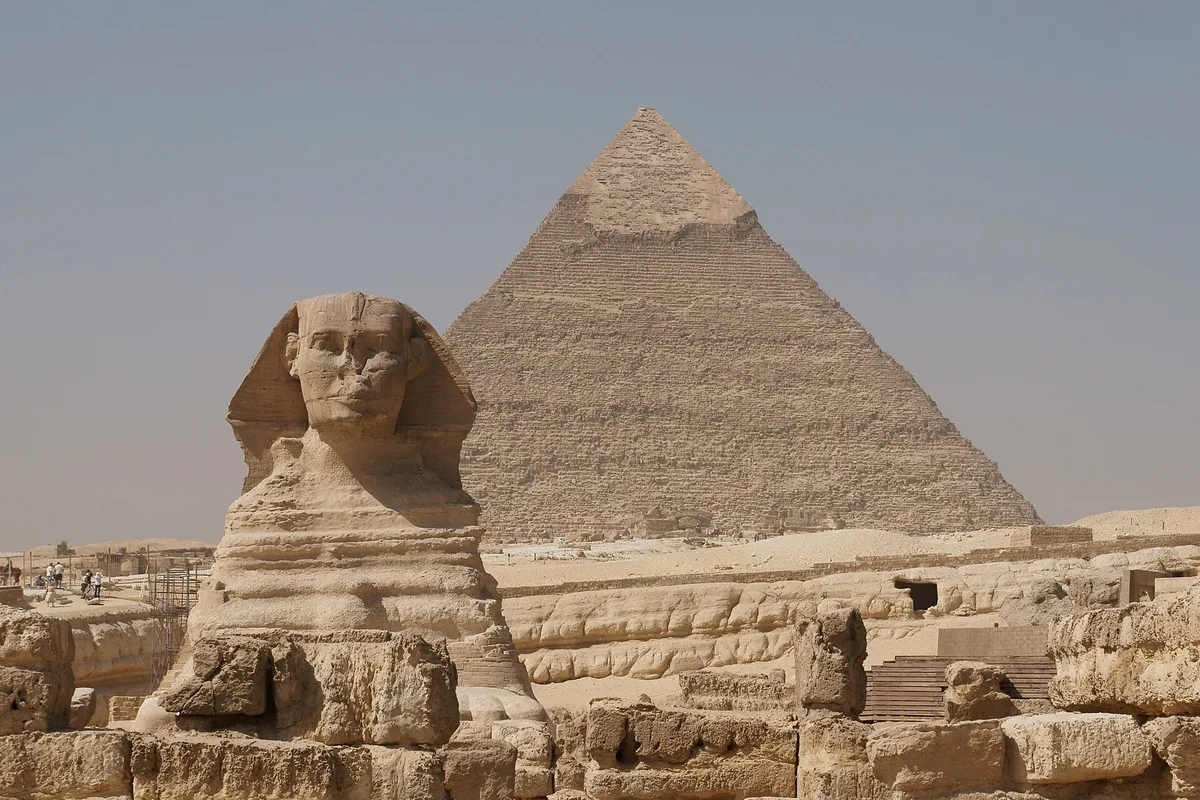
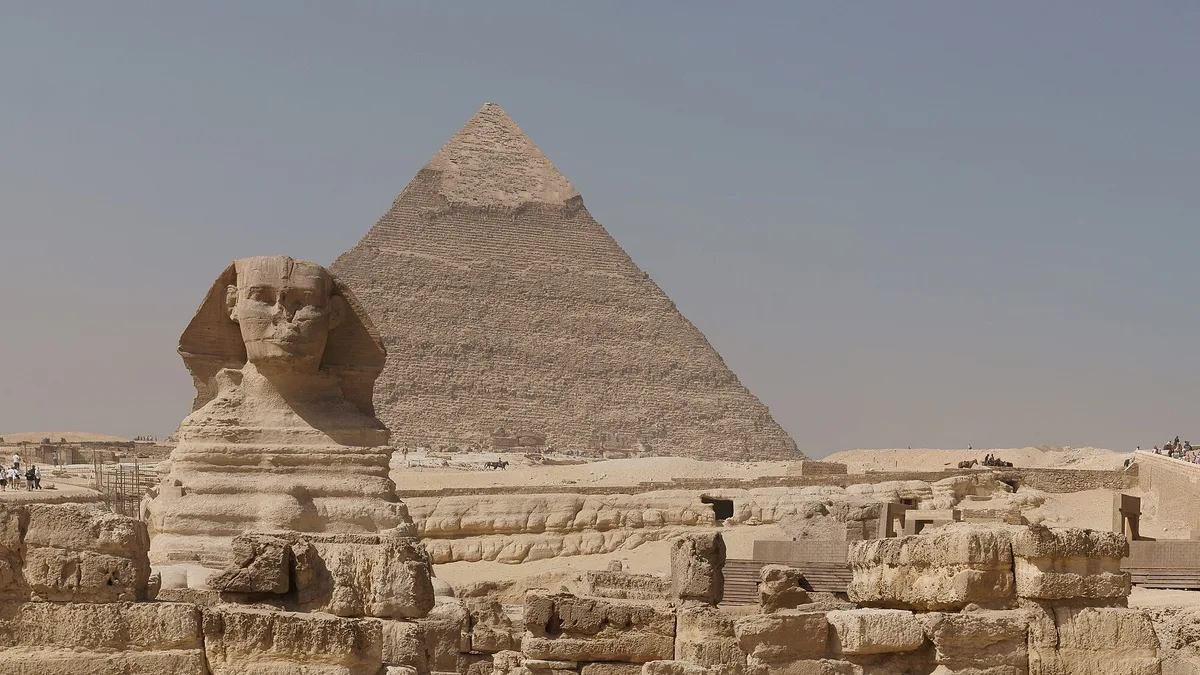
The pyramids stand where they have always stood — on a desert plateau at the western edge of the city, in the necropolis of ancient Memphis, a landscape UNESCO inscribed in 1979 as “Memphis and its Necropolis – the Pyramid Fields from Giza to Dahshur” (whc.unesco.org). What has changed is the city, which has grown out to meet them: the Great Pyramid of Khufu, built roughly four and a half thousand years ago and the last of the Seven Wonders of the ancient world still standing, now rises behind apartment blocks and hotel signs. That collision is not a disappointment to be managed. It is the defining fact of Giza — the oldest monumental landscape on Earth sharing a skyline with one of the largest cities on Earth — and travellers who accept it on the way in enjoy the plateau far more than those who arrive expecting empty desert.
The plateau itself holds three royal pyramids — Khufu’s, Khafre’s, which keeps a cap of its original limestone casing at the summit, and the smaller Menkaure’s — along with queens’ pyramids, mastaba cemeteries, and the Great Sphinx, the lion-bodied guardian carved from a single ridge of bedrock in front of Khafre’s causeway. A proper visit walks it rather than touring it by car between photo stops: in through the entrance, up to the panoramic viewpoint where the three pyramids align, down to the Sphinx and its valley temple, and into the interior of one pyramid if narrow sloping passages hold no fear for you — the passages are hot, low and steep, an experience as much athletic as historical. Give the plateau a full morning at minimum, start as early as your resolve allows, and read our dedicated pyramids of giza guide for the builders, the history and the route in depth.
The practical judgements are three, and they matter more than any viewpoint. First, the light and the crowds both argue for the earliest hours — the plateau in the first part of the morning is a different place from the plateau at noon, in temperature above all. Second, the fringe of the site draws persistent offers — horses, camels, carriages, unofficial “guides” materialising at your elbow — and a calm, unbothered no, repeated without heat, is the whole technique required; agree any price for anything, in full, before you get on or in it. Third, Giza pairs with the Grand Egyptian Museum, a few minutes away, as one full western day — plateau in the cool of the morning, museum through the heat of the afternoon — which is the single most efficient day-shape in the city.
The Grand Egyptian Museum – the New Centre of Gravity
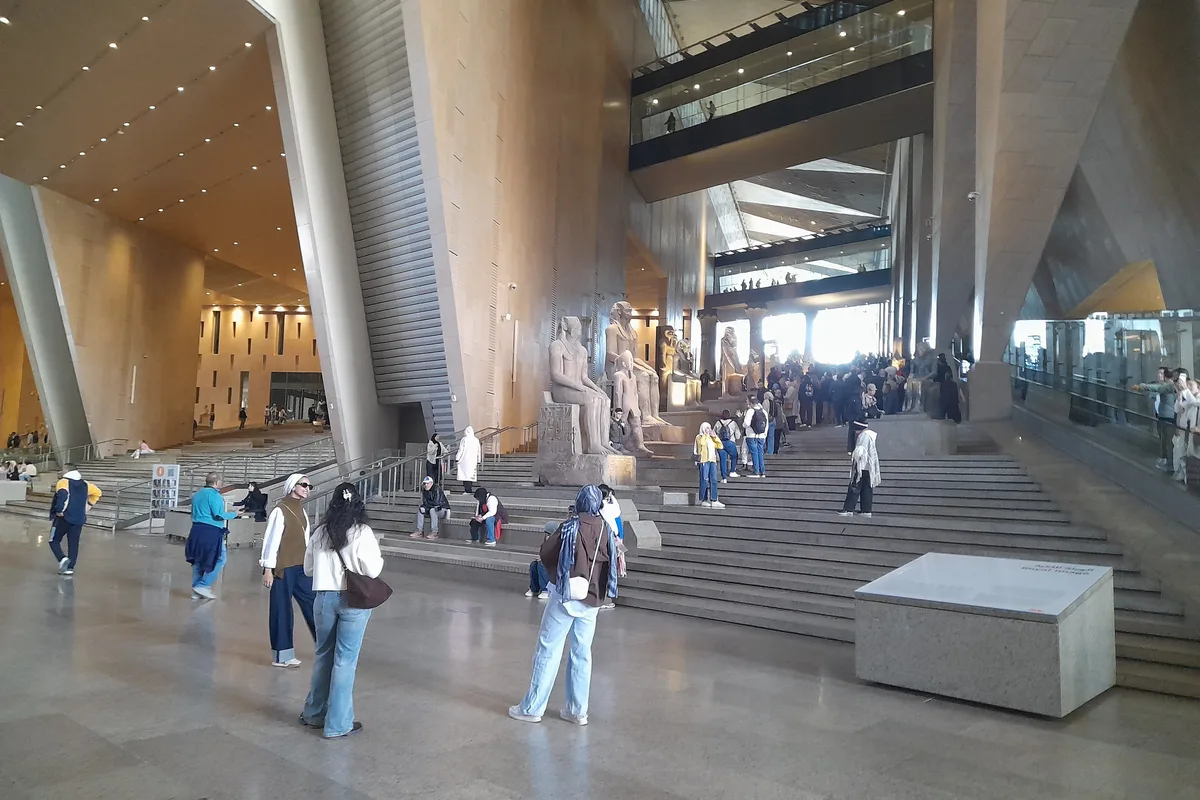
For a century, Cairo’s pharaonic story lived in one overstuffed palace of a museum in Tahrir Square. Since November 2025 it has a new centre of gravity: the Grand Egyptian Museum, standing on the plateau edge at Giza within sight of the pyramids, fully open at last after a phased build that ran for years. The scale is the first fact — the largest archaeological museum complex dedicated to a single civilisation — and the collection’s anchor is the second: the complete treasure of Tutankhamun, more than five thousand objects recovered from the boy king’s tomb, displayed together in one place for the first time since the tomb was opened in 1922. The golden mask that travelled the world as Egypt’s emblem now sits in galleries built for the whole burial, not as a lone icon in a crowded room.
The building works as a narrative, and it is worth letting it. The Grand Hall is dominated by the colossal statue of Ramesses II, an eleven-metre king who stood for decades in the railway square that took his name before his slow procession across the city to this hall. A Grand Staircase climbs past a parade of royal and divine statues towards galleries that run chronologically through three thousand years of pharaonic history, and a separate museum holds Khufu’s solar boat, the great cedar vessel buried beside the Great Pyramid for the king’s journey in the afterlife. Timed, booked-ahead entry is the museum’s way of handling its crowds, and the honest advice is to treat it as a half-day commitment, not a stop: the Tutankhamun galleries alone repay hours.
Two pieces of orientation prevent the commonest Cairo confusion. The GEM is where Tutankhamun is — all of him. The old museum in Tahrir, covered below, still holds an enormous and glorious collection and is not emptied or obsolete, whatever the headlines implied. And the royal mummies — the kings and queens themselves — are in neither building: they rest in the National Museum of Egyptian Civilization in Fustat, south of the centre, where they were carried in the famous golden parade through the city in 2021. Our dedicated grand egyptian museum guide walks the building gallery by gallery, with the timed-ticket mechanics and a one-day Giza plan; here it is enough to say the museum is no longer a promise. It is the first thing a Cairo trip should now be built around, level with the pyramids themselves.
Islamic Cairo – a Thousand Years Inside the Walls
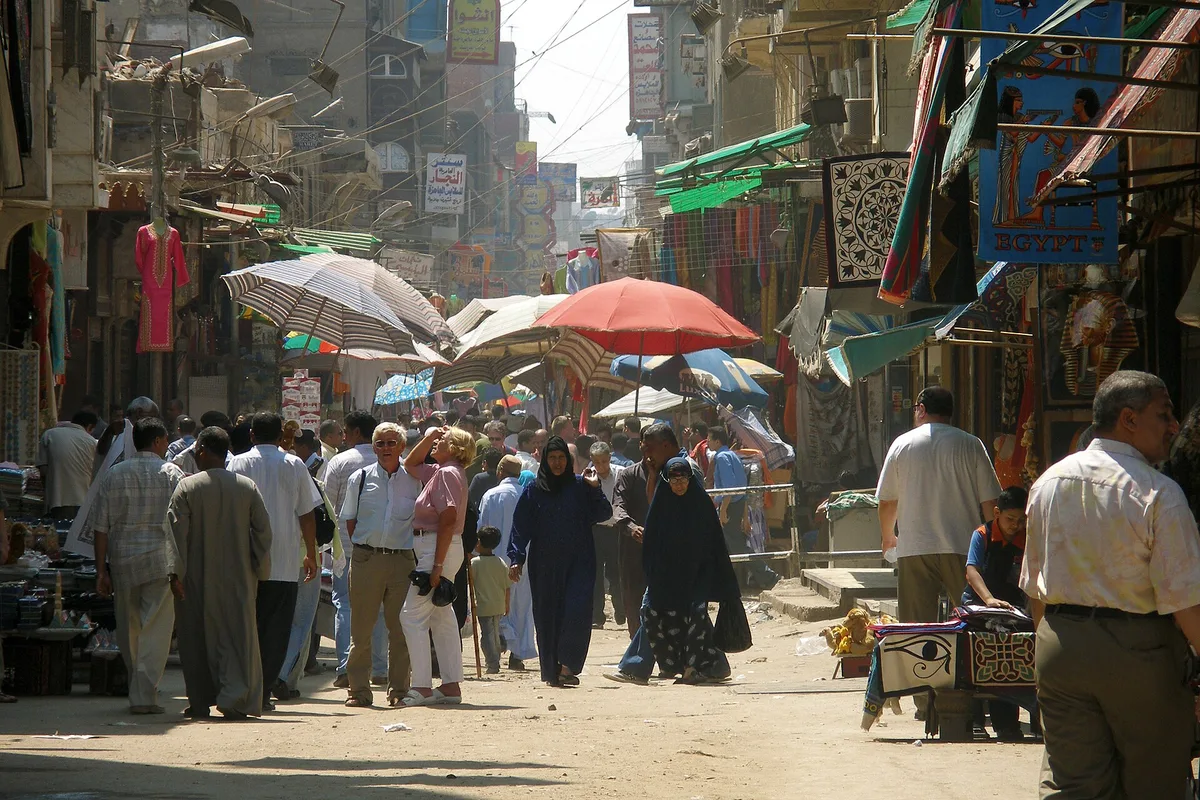
East of downtown, behind gates that still close the old streets at night, stands the Cairo most visitors picture: the walled city founded in 969 AD as the capital of the Fatimid caliphs, grown over a thousand years into one of the world’s oldest Islamic cities — inscribed as Historic Cairo in 1979, and described in UNESCO’s own account at whc.unesco.org as preserving an extraordinary concentration of medieval mosques, madrasas, palaces, fountains and tombs. This is not a district of ruins. It is a working, densely lived quarter where the monuments are also neighbourhood mosques and schools, the streets are still organised by the trades that named them — coppersmiths, tentmakers, goldsmiths — and the correct way to see it is the way it was built: on foot, slowly, down its great spine.
That spine is Al-Muizz Street, running from the northern gates of Bab al-Futuh and Bab al-Nasr south to Bab Zuweila, and it amounts to an open-air museum that never closes its argument. Al-Azhar Mosque, founded in 970 AD and grown into one of the Islamic world’s great centres of learning, anchors the southern stretch. Around it stand the Mamluk complexes — the mosque-madrasa of Sultan Hassan’s era rivals, the turquoise-domed funerary complexes of sultans Barquq and Qalawun, carved stone facades rising straight off the street. Traffic is restricted along much of the street, which makes it the one place in central Cairo where walking is a pleasure rather than a negotiation. A half day covers the spine well; a full day lets you branch into the lanes, the historic houses and the hammams without watching the clock.
The honest judgements for Islamic Cairo are about dress, timing and expectation. Dress modestly and carry a scarf if you intend to enter mosques — these are active places of worship, not exhibits, and visits pause around prayer times. Late afternoon is the district’s golden hour, when the stone warms, the shops open fully after the midday lull and the bazaar comes properly alive. And set the expectation correctly: this is not a sanitised heritage park. It is crowded, commercial, occasionally insistent and entirely real, and its density is the experience. Travellers who want the district’s highlights ranked can pair this section with our run through the things to do in cairo — but walk Al-Muizz first, and let the ranking happen at street level.
Khan el-Khalili – the Bazaar at the Centre of It
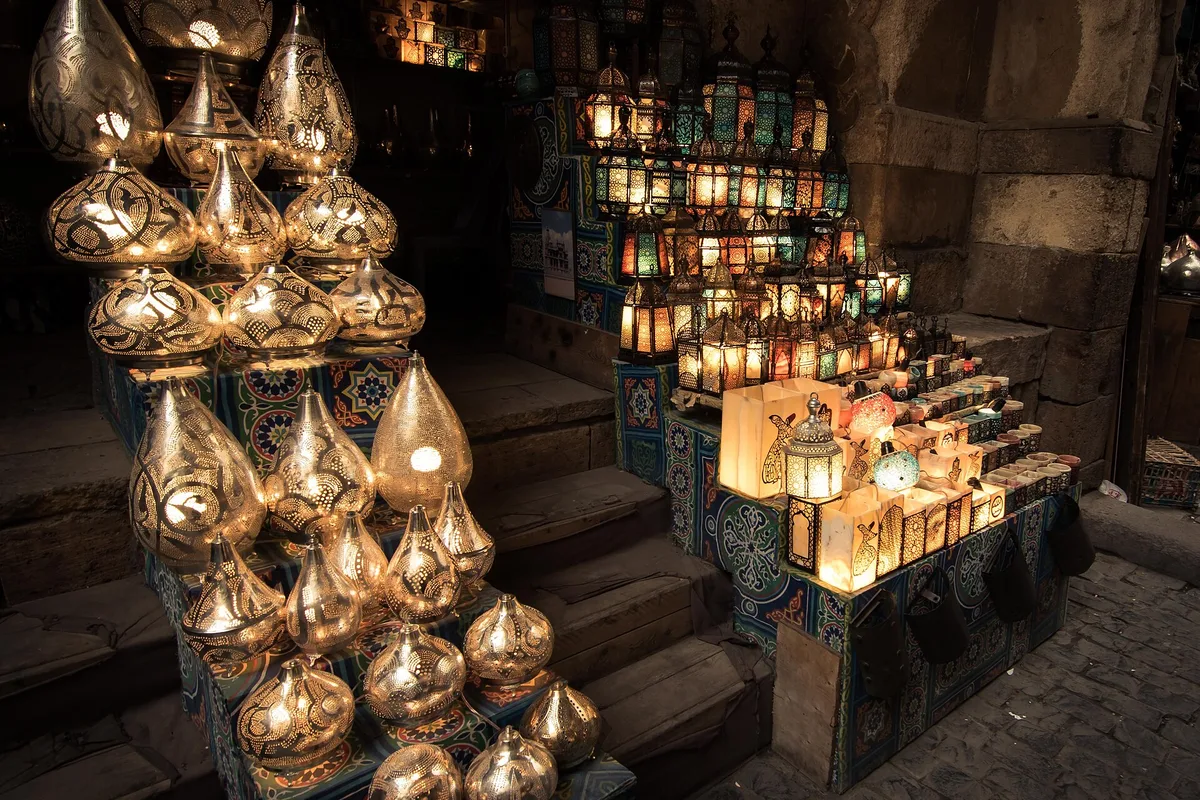
At the southern end of the Al-Muizz walk, the medieval city condenses into its most famous few lanes. Khan el-Khalili began as a caravanserai — a merchant’s inn and warehouse — founded in 1382 by an emir of the Mamluk sultan Barquq, and it has been a market ever since: six centuries of continuous trading in gold, brass, lanterns, glass, spice, perfume and carved wood, in a warren that runs from grand vaulted passages to alleys barely a shoulder wide. The famous coffeehouse in its heart has poured mint tea and coffee for generations of Cairenes and visitors alike, and the bazaar’s role has never really changed — it is where the city shops ceremonially, and where visitors are invited, enthusiastically, to join in.
Enjoy it for what it is, which requires understanding its two levels. The main lanes nearest the square run on visitor trade — expect performance selling, opening prices that are a first bid in a game both sides know, and quality that rewards inspection. The lanes deeper in, and the specialist streets running off them — the metalworkers hammering in their workshops, the tentmakers with their appliqué, the spice merchants in their sacks and pyramids of colour — are the working bazaar, where prices behave differently and watching is half the value. Haggling, where it applies, is a social ritual rather than a fight: keep it light, keep it smiling, walk away as a legitimate move, and never begin it for something you do not actually want. Buy little, look at everything, end with tea — that is the bazaar used properly, and it is one of the great free evenings in Cairo even if you leave empty-handed.
The Citadel and Sultan Hassan – Cairo from Above
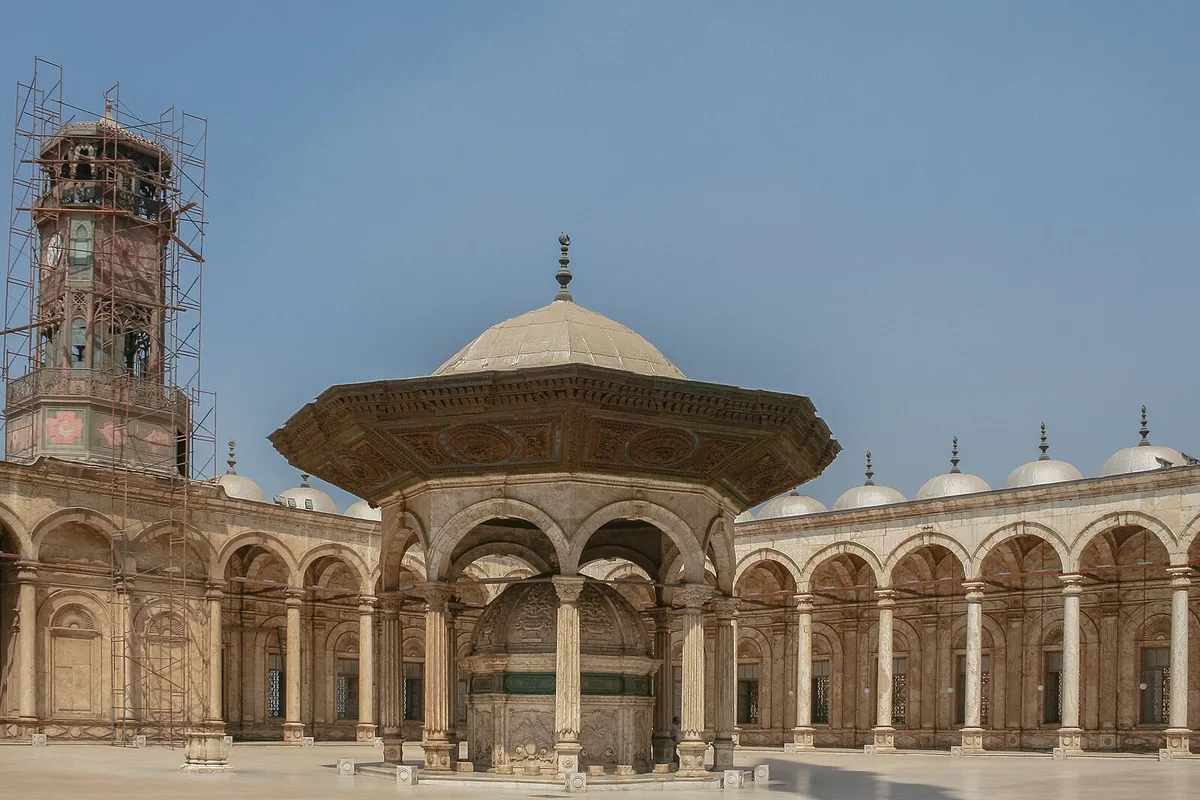
Above Islamic Cairo, on a spur of the Mokattam hills, Saladin built his fortress in 1176 — the Citadel that housed Egypt’s rulers for nearly seven centuries and still gives the city its defining view. Inside its walls stands the mosque that dominates every skyline photograph of Cairo: the Muhammad Ali Mosque, built in the Ottoman style between 1830 and 1848, clad inside and out in pale alabaster, its twin pencil minarets and cascade of domes visible from half the city. The mosque is grand rather than ancient, and it knows it — but the terrace beside it earns the visit on its own, with the whole of Cairo spread below: the medieval city in the foreground, downtown and the Nile beyond, and on a clear winter morning the pyramids standing on the horizon like a rumour.
Pair the Citadel with the two giants at its foot, because together they make the finest half-day of architecture in the city. The Mosque-Madrasa of Sultan Hassan, built in the mid-fourteenth century, is routinely called the finest monument of Mamluk Cairo — a colossal, fortress-like complex whose scale still startles, its courtyard open to the sky and its mausoleum chamber behind the prayer wall. Facing it, the Al-Rifa’i Mosque took the opposite path, built in the late nineteenth and early twentieth centuries as a deliberate neo-Mamluk answer, and now holding the tombs of Egypt’s modern royal family. Standing between them, you read six hundred years of Cairo arguing with itself in stone.
The practical shape is simple: Citadel first, in the clearest part of the day, for the view; then descend to Sultan Hassan and Al-Rifa’i below. The site is exposed, so in the warm months this is a morning or late-afternoon piece, not a midday one. And a word for the view-watchers: Cairo’s haze is real for much of the year, and the pyramids-on-the-horizon photograph is a winter privilege — plan the Citadel on your clearest morning if the panorama matters to you, and treat the mosque interiors as the reliable reward whatever the weather does.
Coptic Cairo – the Older Layers
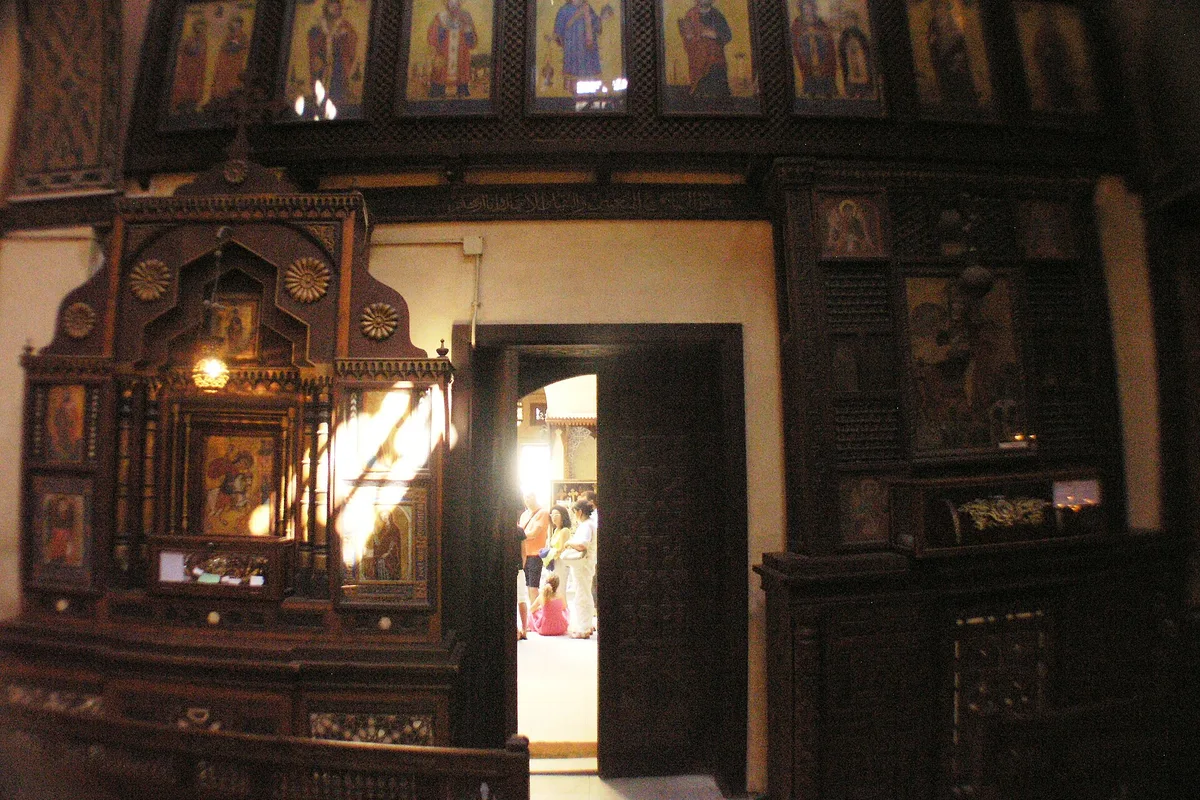
South of the centre, in the quarter Egyptians call Old Cairo, the city’s story runs deeper than Islam. Here stood the Roman fortress of Babylon, and within and around its walls grew one of the oldest Christian communities on Earth — the Copts, whose churches in this small, walkable quarter preserve layers of faith that predate the Fatimid city by centuries. The centrepiece is the Hanging Church, dedicated to the Virgin Mary and so named because it was built suspended above the passageway of the Roman fortress gatehouse; reached by a flight of steps and a courtyard of modern mosaics, its interior is a world of carved wooden screens, inlaid icon stands and painted icons, still in daily use by a living congregation.
Around it, the quarter compresses an extraordinary amount into a few lanes. The Church of St Sergius and Bacchus is traditionally held to shelter a crypt where the Holy Family rested during their flight into Egypt — a tradition presented as such, and central to the quarter’s meaning for pilgrims. The Ben Ezra Synagogue marks the site’s Jewish layer, famous above all for the geniza — the store of medieval documents discovered here that rewrote the history of the medieval Mediterranean. The Coptic Museum gathers the art of Christian Egypt, stone carving, textiles and manuscripts, into one calm building that sets everything you have just seen in context.
Coptic Cairo is the easiest district in the city to do well: compact, largely pedestrian, reached directly by metro, and combinable with a trip south to the National Museum of Egyptian Civilization nearby, where the royal mummies rest. Two to three hours covers the churches and synagogue without rushing; add the museum and it becomes a full, satisfying half day. It is also the quarter where the city’s reputation for intensity falls away — the lanes are quiet, the welcomes unhurried, and the depth of what stands here per square metre is matched nowhere else in Cairo.
Downtown and Tahrir – the Old Museum and Khedivial Cairo
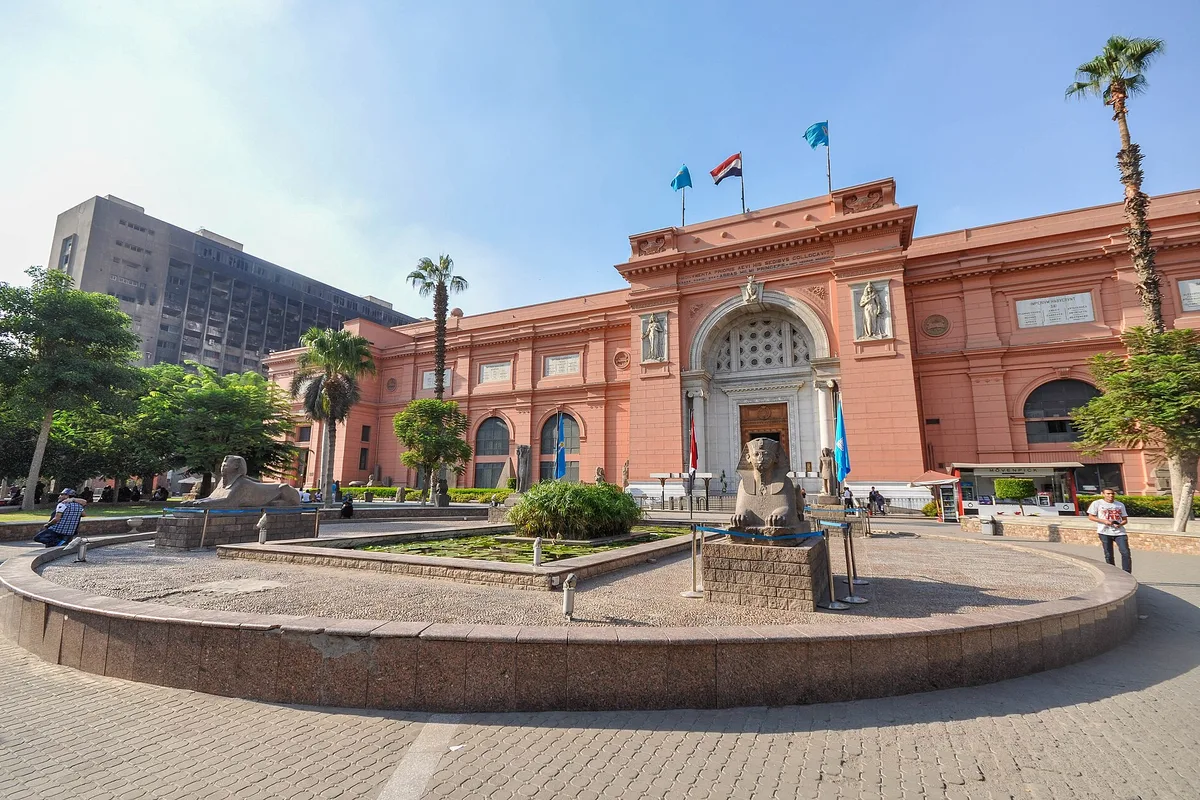
Downtown Cairo is the city’s nineteenth-century layer — the quarter Khedive Ismail rebuilt in the image of Paris for the opening of the Suez Canal, all radial boulevards, round squares and limestone facades softened by a century and a half of dust and life. Tahrir Square is its hinge, a space that has repeatedly been the stage of modern Egyptian history, and on its northern edge stands the salmon-pink building that defined Egyptology for generations: the Egyptian Museum, opened in 1902. Its role has changed — Tutankhamun’s treasure has gone to Giza, the mummies to Fustat — but reports of its emptiness are wrong. What remains is still one of the great collections: thousands of statues, stelae, sarcophagi and everyday objects, displayed in the gloriously old-fashioned density of a museum that predates the interactive era.
That old-fashionedness is now the visit’s character, and it divides people honestly. The Tahrir museum rewards the visitor who already knows what they are looking at, or who takes a guide — labels are sparse, galleries run to labyrinth, and the joy is in the sheer unrepeatable density of original things. As a second museum on a trip that has done the GEM, it is the connoisseur’s choice; as a first and only museum, the GEM now serves most travellers better, and this guide says so plainly rather than pretending otherwise. Give Tahrir two to three unhurried hours, and know that some galleries rotate or close as the long transfer of objects to Giza continues — what is on show is best treated as a rich sample, not a checklist.
Downtown itself deserves an hour of walking beyond the museum: the boulevards around Tahrir and Talaat Harb, the old coffeehouses and bookshops, the belle-époque apartment blocks with their ornamented facades. It is also many visitors’ first experience of Cairo street life at full volume — traffic, vendors, wedding motorcades, everything at once — and it makes a fine base, covered in the where-to-stay section below. Seen together, downtown and the museum make the hinge day of a Cairo trip: the modern city in the morning’s streets, the ancient one in the galleries, and Zamalek’s calm a short hop across the river in the evening.
Zamalek, the Corniche and the Nile
Every Cairo day needs an exhale, and the city builds it around the river. Zamalek, the leafy district on Gezira Island in the middle of the Nile, is where Cairo slows down: tree-lined streets of old apartment blocks and embassy villas, small galleries and bookshops, cafes that linger, and a Corniche where the city comes out in the evening to walk beside the water. It is the Cairo of residents rather than monuments, and after days of stone and traffic it feels like a different country — which is exactly its function in a trip. The Cairo Tower, the latticed concrete landmark that has marked the island’s southern end since 1961, gives the city’s other great panorama, up close and modern where the Citadel’s is medieval and wide.
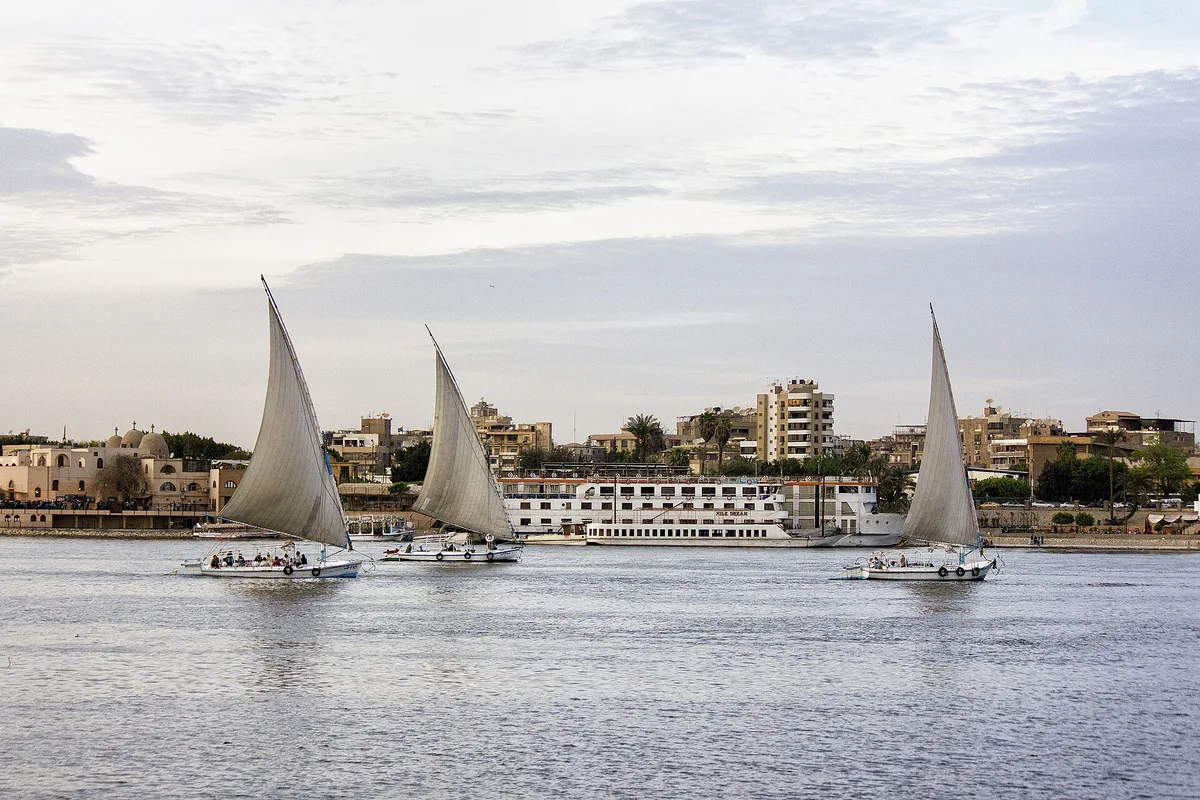
The essential Nile experience is an hour on a felucca, the traditional lateen-sailed boat that has worked this river for centuries and still slips out from the docks near Garden City and Zamalek at sunset. No engine, no itinerary, no commentary — just the sail filling, the skyline sliding past, the bridges lighting up and the city’s noise dropping to a murmur across the water. It is the cheapest transcendence in Cairo and the single best way to end a museum day. Agree the duration and the price, in full, before the boat leaves the dock; then there is nothing to do but sit in the bow and watch the light go.
Zamalek also anchors the city’s eating. Cairo feeds visitors well at every level — fuul and taameya stands, kebab and grilled-chicken houses, Levantine and seafood restaurants, and the great Egyptian sweets shops — and the island, with downtown across the bridge, holds the densest choice of places where travellers and Cairenes actually eat side by side. One honest note: Cairo’s restaurant scene runs late, with dinner hours that would startle northern Europe, and the city at ten in the evening is just warming up. Adjust to it rather than fighting it — a late dinner after a felucca hour is the Cairo evening done properly.
Saqqara and Memphis – the Essential Day Trip
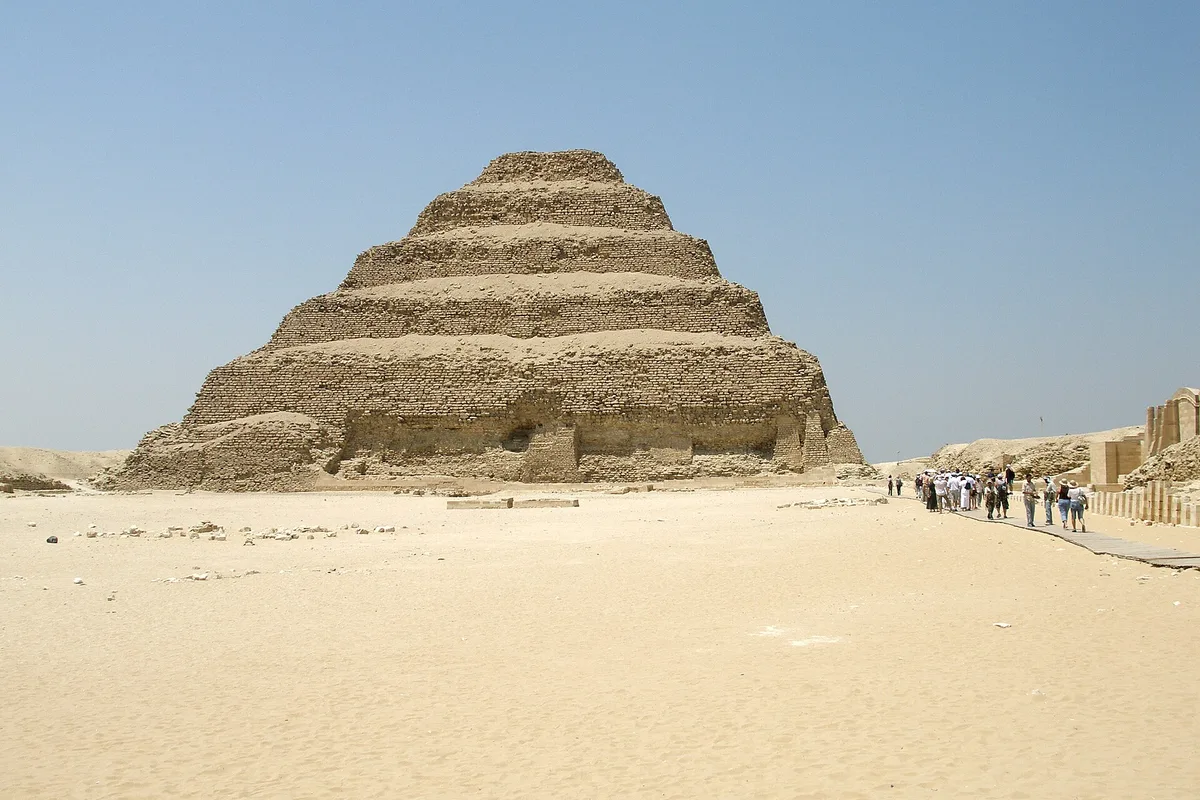
Thirty kilometres south of the centre, the story that Giza completes has its first chapter. Saqqara was the necropolis of Memphis, Egypt’s first capital, and it holds the Step Pyramid of Djoser — built around four thousand seven hundred years ago for a king of the Third Dynasty, designed by his architect Imhotep, and recognised as the first large stone building in Egypt and the direct ancestor of every true pyramid that followed. Where Giza is monumental, Saqqara is archaeological: a whole desert field of pyramids, mastaba tombs carved and painted inside with scenes of daily life, and the great underground galleries of the Serapeum, where the sacred Apis bulls were buried in granite sarcophagi of staggering size. It is the same UNESCO property as Giza — the pyramid fields inscribed in 1979 run from Giza to Dahshur (whc.unesco.org) — but the experience is quieter, stranger and, for many travellers, the more memorable of the two.
Memphis itself survives mostly as a landscape and an open-air museum of fallen colossi, including a great alabaster sphinx and a fallen statue of Ramesses II — the companion piece to the king now standing in the Grand Egyptian Museum’s hall. Further south along the same desert edge, the pyramids of Dahshur — the Bent Pyramid, keeping its famous accidental change of angle, and the Red Pyramid, the first successful smooth-sided attempt — stand in a near-solitude Giza never offers. A combined Saqqara, Memphis and Dahshur day is the connoisseur’s version of the pyramid story, told in order.
The practical judgement is about shape, not content: Saqqara is a trip, not a stop. It needs its own half day at minimum and a full day done properly with Dahshur, a driver for the day rather than a string of taxis, and a place in the itinerary after Giza rather than before — Giza first for the icons, Saqqara second for the understanding. On a three-day Cairo trip it competes with Coptic Cairo and the Citadel day, and it is the one that can move to a return visit without breaking the trip. On four days or more, it is close to essential. For the wider run of the country that Cairo opens onto, the itinerary planning in our Egypt guide shows how a Cairo stay joins the journey south to Luxor and Aswan.
Where to Stay – Choosing Your Base
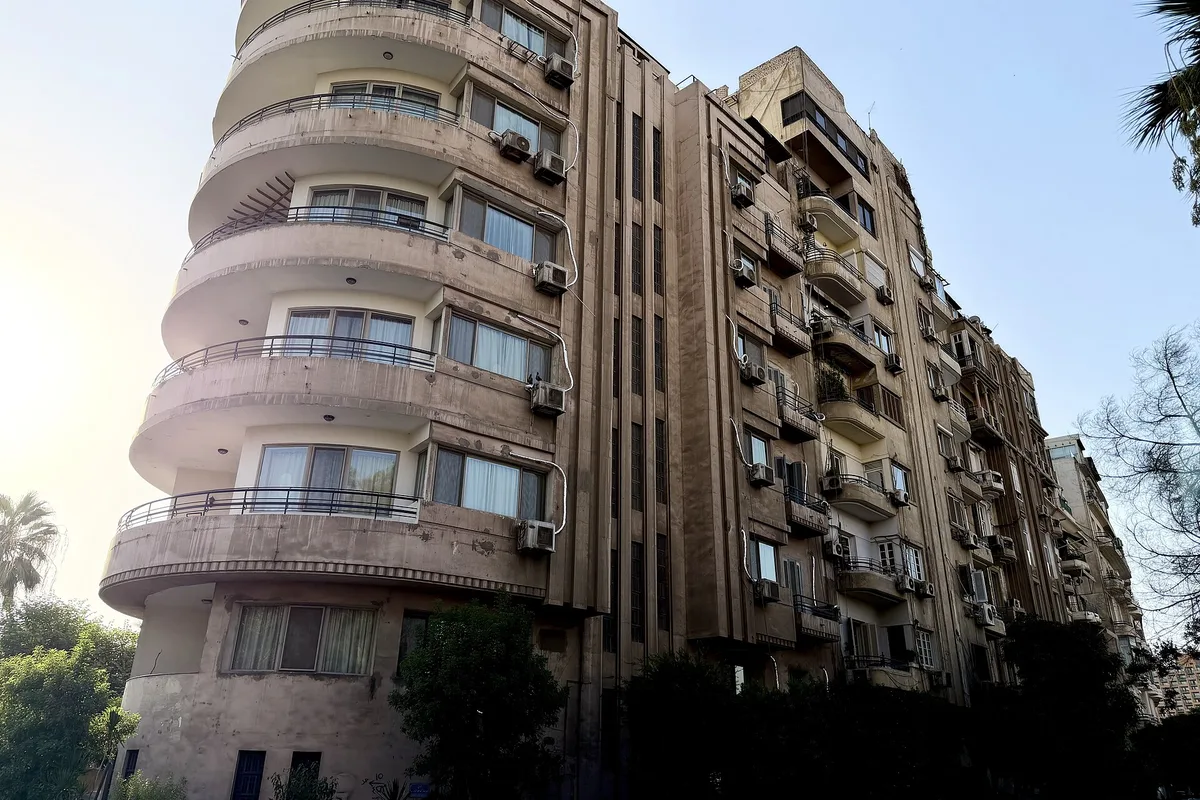
Cairo accommodation is not really a question of hotels; it is a question of geography, because the base you choose decides how much of your trip is spent in traffic. The city offers every level of stay, from hostel bunks to palace hotels on the Nile, and this guide names districts and their trade-offs rather than properties, because the district outlasts any individual recommendation and shapes every day you spend here. Match the base to the trip you are actually taking.
Giza, by the plateau, is the pyramid-first base: hotels cluster along the roads facing the necropolis, some with the pyramids filling the window, and your Giza and GEM days start with a short hop instead of a cross-city drive. The trade is the evenings — the area is suburban in feel, thinner for restaurants and street life, and downtown is a real journey away. Downtown and Garden City, on the east bank by Tahrir, are the classic traveller’s base: the Egyptian Museum at your door, the metro to hand, Islamic and Coptic Cairo within reach, the widest spread of places to eat, and Nile-front hotels along Garden City’s Corniche for those who want the river view with the central position. This base serves the full three-day shape best, at the price of the city’s full noise. Zamalek is the calm upgrade — leafy, residential, cafe-rich, the best district for travellers who value the evenings, with the trade-off of a bridge crossing to everything except itself. Near the airport and in the eastern new districts serve stopovers and business, not sightseeing; a first Cairo trip based out there spends its savings on the road.
The one-line version: pyramid trip, sleep in Giza; full city trip, sleep downtown or in Garden City; gentle trip, sleep in Zamalek. Whichever you choose, confirm the address against the map rather than the listing’s optimism — “Cairo” in a property name can mean anywhere in a city this size, and five kilometres of Cairo traffic is a different proposition from five kilometres anywhere else.
Getting Around – Metro, Ride Apps and Honest Traffic
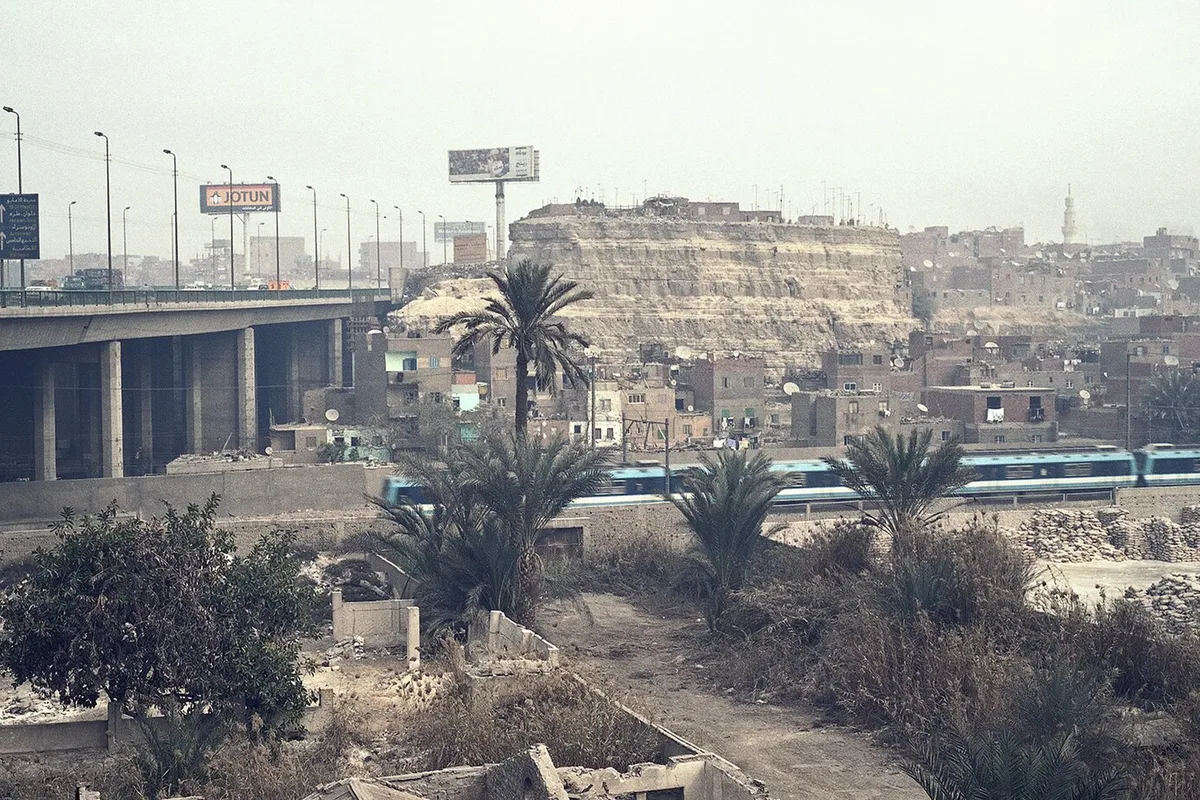
Start with the sentence every other guide buries: Cairo traffic is not a colourful detail, it is the central logistical fact of the city, and trips are planned around it the way desert journeys are planned around water. Journeys across the city that look short on a map routinely take an hour and more at the wrong time; the west-bank and east-bank halves of your itinerary are separated by river bridges that bunch at predictable hours; and the day-shapes in this guide — Giza and the GEM together, the old city on foot, Coptic Cairo by metro — exist precisely to keep you out of cars except when cars are the right tool. Build slack into any day that crosses the river, and never schedule a hard deadline, a train or a flight, tight against a cross-city drive.
The good news is that the tools are better than the reputation. The Cairo Metro — the oldest in Africa and the Middle East — runs three lines underneath the worst of it, connecting downtown with Coptic Cairo at Mar Girgis station, with Giza on the west bank and with the airport corridor in the east, and it is the fastest way across the centre at rush hour by a wide margin. Ride-hailing apps are the second tool and the honest traveller’s default for door-to-door trips: the price is set before you ride, the route is on the map, and the negotiation that makes street taxis an ordeal simply does not happen. White street taxis remain everywhere for short hops — agree the fare in full before moving, or insist on the meter. And walking, in the districts built for it — Zamalek, downtown, Al-Muizz Street, the Coptic quarter — is the best way to see those places; Cairo is only unwalkable between its districts, never inside them.
Two final transport judgements. For Giza plus Saqqara days, a hired car and driver for the day — arranged through your hotel or a reputable agency, price agreed in advance — is the standard, sane solution, and sharing the day across the sites makes it the efficient one too. And for arrival: the city has two airports, the main international hub in the east and Sphinx International out west near Giza, which suits pyramid-side stays — check which one your flight uses before planning the transfer, because they are on opposite ends of a very large city.
Best Time to Visit – Seasons, Heat and the Honest Months
Cairo is a desert city with a long, fierce summer and a short, gentle winter, and the season decision shapes a trip here more than any hotel choice. The comfortable core runs from roughly October to April: typical winter daytime highs sit around the high teens to low twenties Celsius, the air clears, the Citadel view can reach the pyramids, and full days on foot in Islamic Cairo or on the Giza plateau are pleasures rather than endurance tests. This is also, inevitably, the busy season — the famous sites are at their most visited, the best-located stays fill first, and the weeks around the New Year run at the city’s fullest. None of that overturns the advice: a first Cairo trip belongs in these months, booked ahead.
Summer, from May into September, inverts the bargain. Typical daytime highs climb into the mid-thirties Celsius and beyond, the plateau at noon is a furnace with a view, and the city’s life shifts decisively into the evening. Against that stand empty sites, easy bookings and a Cairo that belongs to its residents — and travellers who structure days at desert-people hours, early starts and long shaded middays, can make a summer trip work. What cannot work is a summer itinerary written for winter: four walking districts at midday in August is not an ambitious plan, it is a medical one. Spring also brings the khamsin, the hot desert wind that can fill the air with dust for days at a time — another argument for slack in the schedule. During Ramadan, which moves through the calendar year by year, the city’s days quieten and its nights come alive after the fast breaks; museums and sites adjust their hours, so treat that month as a different, vivid Cairo and check timings for your exact dates.
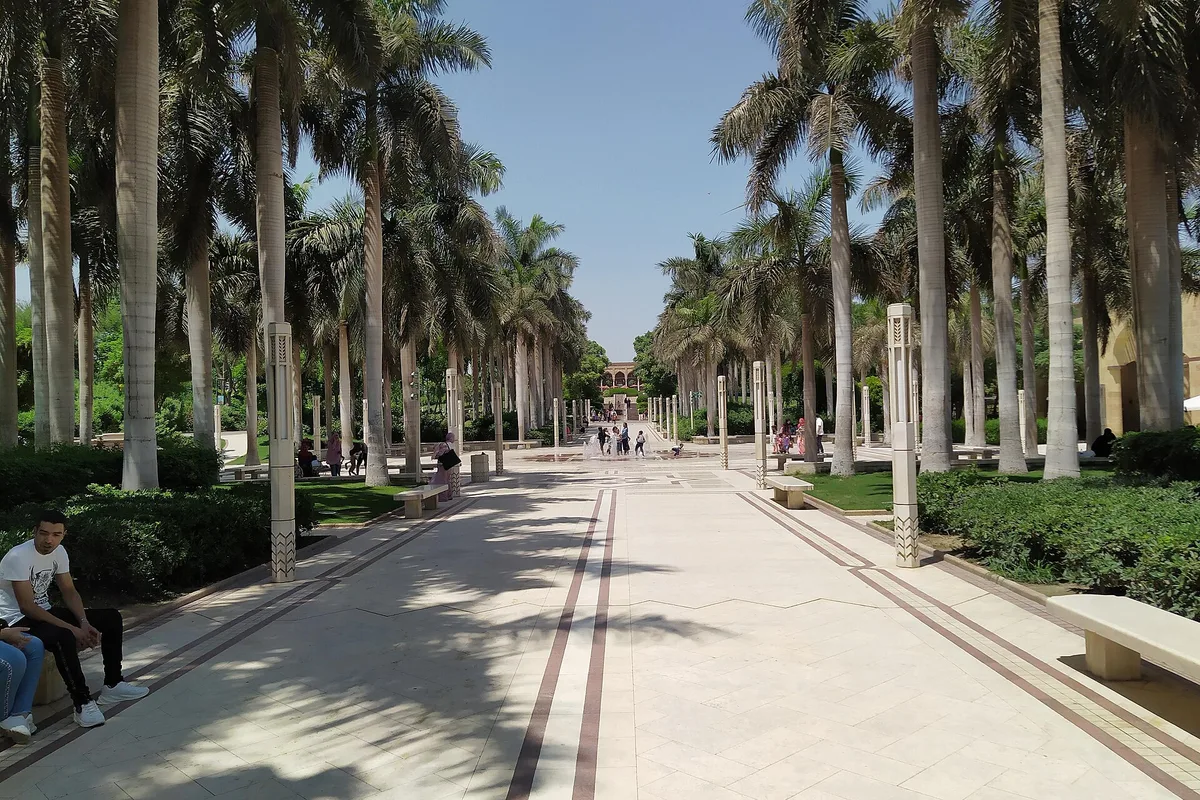
One place earns a mention inside this section because it belongs to the fine months: Al-Azhar Park, built on a restored hill of old rubble above the medieval city, with lawns, fountains and the excavated Ayyubid wall along its edge and the Citadel on the skyline. On a clear late afternoon in the cool season, with the call to prayer rolling over the old city below, it is the finest free viewpoint in Cairo — and the natural last hour of an Islamic Cairo day.
Cairo, Honestly – Hassle, Safety and How to Handle Both
No honest guide to this city skips the subject the sellers avoid, so here it is plainly. Cairo’s tourist economy runs on commission and persistence, and at the famous sites — above all around the Giza plateau entrances, the bazaar and the museum doors — you will be offered guides, horses, camels, carriages, photographs and souvenirs with an energy that first-time visitors can find overwhelming. Almost none of it is dangerous. It is a sales culture with a script, and the script ends when you stop being an audience: a friendly but final no, no eye-contact negotiation, no accepting anything “free” or “as a gift”, and no getting onto or into anything before the full price is agreed out loud. Visitors who learn those four moves in their first hour usually report that the hassle falls away to background noise; visitors who try to be liked through it spend the trip in negotiations they never chose.
The practical safety picture is calmer than the reputation. Cairo is a big, poor, crowded city and it asks for big-city sense — valuables kept unobvious, awareness in crowds, care crossing streets where the traffic follows rules of its own — but violent crime against visitors is rare, and the difficulties travellers actually report are the ones above: overcharging, unwanted sales attention and traffic, in that order. Solo women travellers should expect attention and dress conservatively by local standards, particularly away from the resort districts and inside religious sites, where modest dress is simply the entry rule for everyone. None of this is a reason to skip Cairo. It is the reason to arrive briefed — the city rewards the prepared visitor with some of the greatest sights on Earth and a warmth that the sales fringe does not represent.
Frequently Asked Questions
How many days do you need in Cairo?
Three full days is the honest minimum — one for Giza and the Grand Egyptian Museum, one for Islamic Cairo and the bazaar, one split between the Citadel, Coptic Cairo and the old museum in Tahrir — and four days is the comfortable version that adds Saqqara without cutting anything. Two days can hold the pyramids, the GEM and a walk down Al-Muizz, but it is a highlights pass, not a visit, and anything shorter should choose the west bank or the old city rather than shaving time off both.
Should you visit the Grand Egyptian Museum or the old Egyptian Museum?
Both, if the days allow — they are different experiences, not duplicates. The GEM at Giza is the essential one: the complete Tutankhamun collection, the Ramesses colossus and the pharaonic story told whole, and the first museum most trips should now be built around. The Tahrir museum is the classicist’s second act — a vast, old-fashioned treasure house that rewards those who know what they are looking for. And remember the third address: the royal mummies are in neither, but in the National Museum of Egyptian Civilization in Fustat.
Is Cairo safe for tourists?
By the standards of any very large city, and with ordinary big-city awareness, yes — the difficulties visitors actually meet are persistent selling, overcharging and traffic rather than crime. Dress modestly at religious sites, agree every price in full before a ride or a purchase, keep valuables unobvious in crowds, and take the hassle for what it is: a sales script that stops the moment you stop engaging with it.
What is the best month to visit Cairo?
The cool, clear months between October and April hold the city’s best conditions, with late autumn and late winter the sweet spots either side of the busiest holiday weeks. Summer brings real heat and empty sites in exchange; it can work for travellers who plan around the middle of the day, but a first visit belongs in the cool season if the choice is free.
Can you see the pyramids and the GEM in one day?
Yes — and you should, because it is the most efficient day-shape in the city. The two stand minutes apart on the west bank: the plateau early, while the light is good and the heat is down, and the museum through the middle of the day and afternoon. It is a full day, not a rushed one, and trying to add the old city to it is how a good day becomes a traffic memory.
How do you get from the airport into Cairo?
By car, realistically — a pre-arranged transfer, a hotel pickup or a ride-hailing app, with the journey planned around the city’s traffic rather than the distance on the map. Check which airport your flight uses: most international arrivals land at the main hub east of the city, while some routes use Sphinx International in the west, close to Giza, and the right base choice depends on the answer.
The Short Version
Cairo is several great cities sharing one name, and it yields to the traveller who plans it that way. Build the trip on districts, not lists: a west-bank day for the pyramids and the Grand Egyptian Museum, an old-city day on foot down Al-Muizz to the bazaar, a third day between the Citadel’s view, Coptic Cairo’s quiet lanes and the old museum’s treasure rooms. Sleep where your days are — Giza for a pyramid trip, downtown for the full city, Zamalek for the calm evenings — ride the metro and the apps instead of arguing with traffic, and take the river at sunset from a felucca at least once. Come in the cool months if you can, start the ancient days early, agree every price before anything moves, and let the hassle wash past: behind it stands a city that has been a capital for a thousand years and a necropolis for five thousand, and nowhere else on Earth do those two facts share a skyline. For ranking the sights themselves, our list of the things to do in cairo is the companion piece.