Most canyons you walk through. Wadi Mujib you walk up, through the river itself, in a gorge so deep and so narrow that for long stretches the sky is a bright ribbon far above your head and the only way forward is the water. This wadi mujib guide covers Jordan’s great river canyon in full: the self-guided Siq Trail that almost every visitor comes for, the guided Canyon, Malaqi, Ibex and Al-Hidan trails that most visitors never hear about until they are standing at the gate, the biosphere reserve that wraps around all of it, and the single fact that governs every plan made for this place – the season. The water trails at Wadi Mujib open in spring and close in autumn, they shut without argument when rain threatens anywhere in the catchment, and no honest wadi mujib guide can promise you the canyon on any given date. What it can do is explain exactly how the system works, so that when the gate is open, you are ready, and when it is not, you understand why.
Start with the shape of the place. Wadi Mujib is a river gorge cut through the Moab highlands of west-central Jordan, running west until it empties into the Dead Sea at the lowest shoreline on Earth. Around its lower course sits the Mujib Biosphere Reserve, 212 square kilometres of mountain, wadi and cliff managed by the Royal Society for the Conservation of Nature (RSCN) and recognised by UNESCO as a biosphere reserve since 2011. Every visitor trail in the reserve starts from one small building, the Mujib Adventure Centre, which stands beside the Dead Sea Highway at the mouth of the gorge. There is one gate, one ticket desk and one set of rules, and they are the RSCN’s rules – this is a protected reserve that happens to contain a world-class canyon walk, not a water park that happens to have cliffs.
What follows runs the way a visit runs. First the reserve and the rock, then the river’s long human history as the biblical Arnon, then the Adventure Centre and each of the five trails in turn, then the wildlife you are sharing the canyon with, the seasons and the flash-flood logic that closes the trails, the fees and booking mechanics exactly as the RSCN publishes them, and finally the two highways that bring you here. Read the Short Version and you have the essentials; read the rest and you will arrive at the gorge mouth knowing what the water is about to ask of you. The wider country context sits in our Jordan travel guide; this page is the canyon itself.
Wadi Mujib Guide – The Short Version
| Trail | Guided or self-guided | Water? | Season as RSCN states |
|---|---|---|---|
| Siq Trail | Self-guided (no advance booking) | Yes – wading and swimming pools | Typically 1 April to 31 October, weather permitting |
| Canyon Trail | Guided – trained guide required | Yes – includes a 20-metre waterfall descent | Summer season, weather-dependent |
| Malaqi Trail | Guided – trained guide required | Yes – river walking and natural pools | Summer season, weather-dependent |
| Ibex Trail | Guided – guiding fee included | No – dry wadis and plateau | Typically November to March, weather permitting |
| Al-Hidan Trail | Guided – booked ahead | Yes – swimming pool to pool | Summer season, weather-dependent |
Read the table and you have the reserve’s whole offer in five lines – the whole system this wadi mujib guide unpacks below. One self-guided water trail that runs through the warm months. Three guided water trails that build on it in length and difficulty. One dry guided trail that carries the winter, when the water trails are closed. Every one of them starts and ends at the same Adventure Centre, every one of them is run by the RSCN, and every one of them can be cancelled by the weather – the table’s last column is not boilerplate, it is the operating reality of a canyon that floods. A good wadi mujib guide keeps repeating that because visitors keep forgetting it: the reserve’s calendar is written by the rain, not by the brochure.
The second short-version truth is about who the canyon is for. On the wet trails, the RSCN’s rule is absolute – all participants must be at least 18 years old – and the water itself makes its own demands: you will wade against a current, haul yourself up ropes and ladders at small cascades, and cross pools deep enough to swim. The Siq Trail is genuinely achievable for any reasonably fit adult, and it is the single most fun half-day in Jordan. But it is a river walk with consequences, not a stroll with wet feet, and the sections of this wadi mujib guide below treat it that way.
The Lowest Reserve on Earth – Inside the Mujib Biosphere Reserve
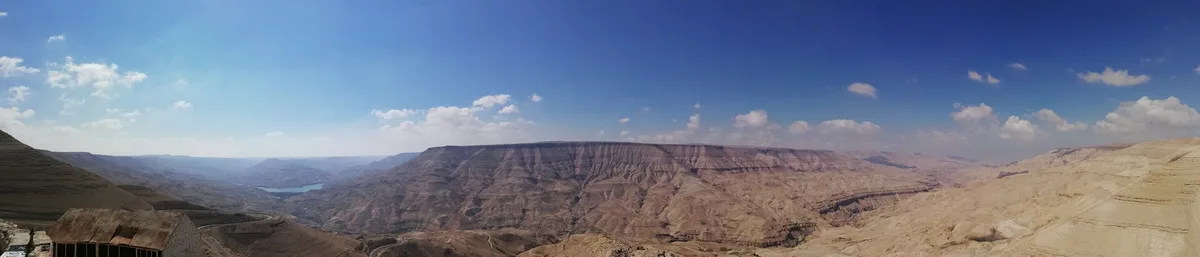
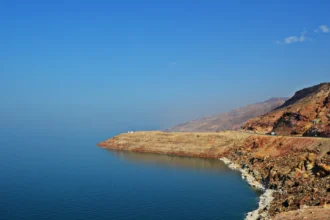
The Mujib Biosphere Reserve occupies the mountainous country east of the Dead Sea’s north-eastern shore, in the governorates of Madaba and Kerak. Its western edge is the Dead Sea Road, running along the lowest depression on Earth; its eastern edge climbs to the basalt-capped plateau of ancient Moab, where rain-fed wheat fields still mark the highland farms. Between those two edges the land falls more than a thousand vertical metres, and UNESCO’s profile of the reserve – it joined the World Network of Biosphere Reserves in 2011, as UNESCO’s Man and the Biosphere listing records – puts its shore at 416 metres below sea level. No other biosphere reserve on the planet wraps around land this low, and the trails you walk here begin, uniquely, at the bottom of the world and climb.
The reserve exists because of a decree and a society. UNESCO records that the reserve, including all its zones, was established by prime ministerial decree on 9 November 1985 and allocated to the Royal Society for the Conservation of Nature for management – the same RSCN that runs Jordan’s whole protected-areas network and sells its reserves’ tourism through its Wild Jordan arm. That dual identity matters to a visitor. The canyon trails are a commercial product, with tickets, capacities and kit stores; they are also the funding engine and the public face of a serious conservation operation, with rangers patrolling a core zone you will never enter and breeding enclosures in the hills you might glimpse from the Ibex Trail. The money you hand over at the Adventure Centre is, quite literally, conservation income.
What the reserve protects, beyond the famous gorge, is a whole staircase of habitats. Altitude and rainfall both decrease as you travel west and downward, so the reserve stacks Mediterranean highland scrub at the top, broken rocky slopes in the middle, and at the bottom a chain of perennial, spring-fed streams running through the wadis to the Dead Sea – water that flows all year, in a landscape that gets almost no rain at its lower levels. The Mujib itself is the largest of these streams, fed by tributaries including Wadi Hidan, and it is that permanent water in an arid rift valley that makes the reserve, in UNESCO’s words, home to rich biodiversity far out of proportion to its size. The canyon is the celebrity; the reserve is the system that keeps the canyon’s river alive – and it is why this wadi mujib guide treats your ticket as conservation income rather than an entry fee.
How the Gorge Was Cut – Sandstone, Basalt and a River That Never Stops
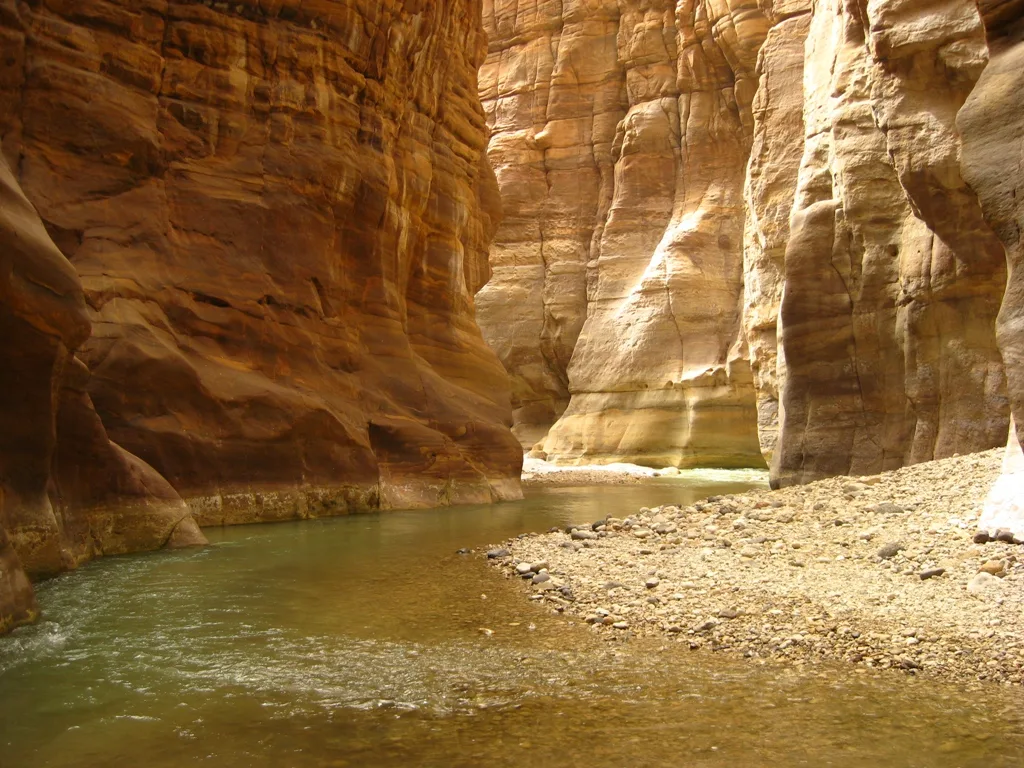
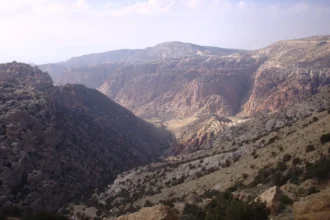
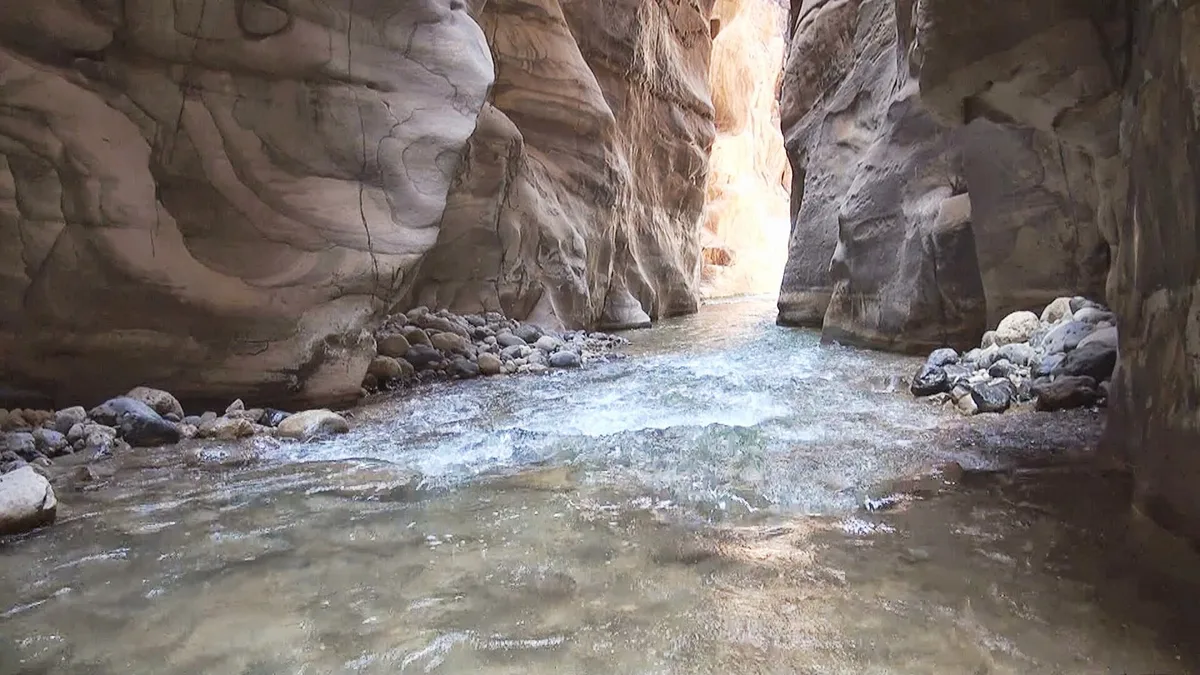
Stand at the bottom of the Siq and look up, and you are looking at two stories told at once. The first is written in the walls: banded sandstone in reds, purples, ochres and creams, laid down layer upon layer in ancient riverbeds, dunes and shallow seas, then lifted and tilted as the rift valley tore open beside it. The second story is the cut itself. The Dead Sea basin has dropped hundreds of metres along the Dead Sea Transform fault system, and the Mujib river, flowing west off the Moab plateau, has had to saw its way down through the rising rock to keep reaching the sea. The result is a gorge that is still, geologically, a work in progress – a canyon being deepened by every winter flood that rips through it.
The character of the rock changes as you descend, and UNESCO’s ecological profile of the reserve describes the transition plainly: at higher altitudes the escarpment is rounded and smooth-spurred, cut by steep but smooth-sided valleys, while at lower altitudes the terrain becomes broken and uneven, with cliffs at every level that are “largest and most impressive at the lowest altitudes, especially at the terminal gorge of Wadi Mujib just before it reaches the Dead Sea”. That terminal gorge is the Siq – the narrow, sheer-walled slot where the river has found the fastest way down – and the black basalt that caps parts of the highland and shows where Wadi Hidan cuts through it is the signature of younger volcanic rock laid over the old sandstone.
For the walker, the geology is not background, it is the trail. The same soft, layered sandstone that carves so beautifully also polishes to glass under running water, which is why the Siq’s cascades need ropes and ladders. The narrowness that makes the gorge so photogenic – walls a few metres apart, hundreds of metres high – is exactly what makes it lethal in a flood, because a modest volume of rain falling on the plateau has nowhere to go but through that slot. Every safety rule in this wadi mujib guide descends from that one geological fact: a soft-rock slot canyon, a dropped base level, and a river that never entirely stops.
The River Arnon – Wadi Mujib in Scripture and History
Long before it was a reserve, the Mujib was a border. In the Hebrew Bible this river is the Arnon, the great wadi that marked the northern frontier of Moab – the line Israel’s tribes were told they could cross and the Amorite kingdom beyond it could not hold. “Arnon” is simply the older name for the same water: the gorge you wade today is the gorge that ancient armies, caravans and kings treated as one of the natural frontiers of the Levant, because a canyon this deep, running from plateau to rift, divides the world into a north side and a south side with only a handful of crossable points. The King’s Highway, the ancient north-south road of the plateau, had to execute a famous switchbacking descent and climb to get across it – and the modern highway still does, on the same alignment of necessity.
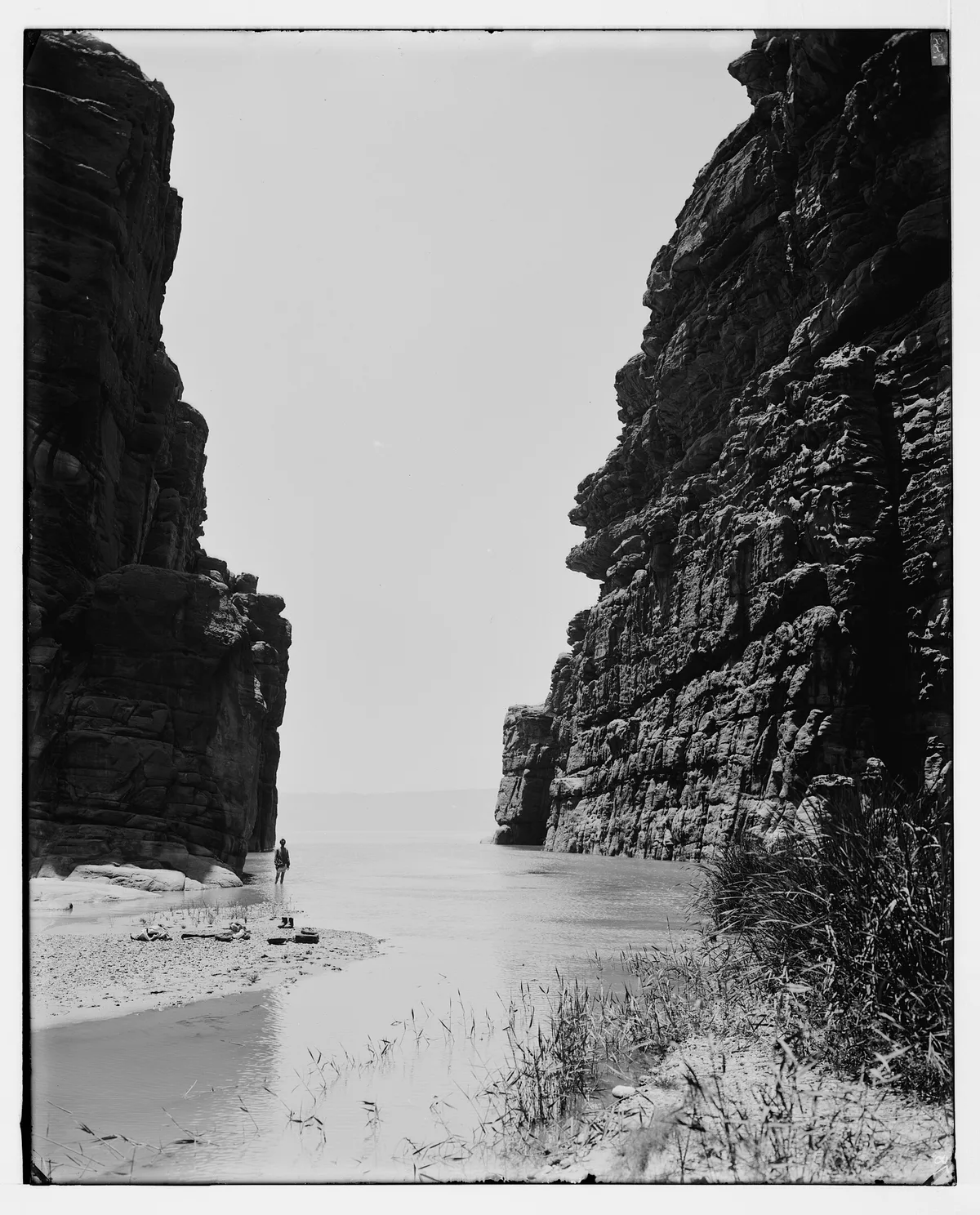
That depth of history is part of what the early photographers came for. The black-and-white photograph above, from the Matson Collection’s documentation of the region in the early twentieth century, shows the Arnon’s mouth looking west towards the Dead Sea: the same walls, the same river, a lone figure giving scale, and a Dead Sea that then reached much closer to the gorge than today’s retreated shore does. The canyon has been a landmark for as long as there have been people to name landmarks. Roman and Byzantine farms worked its upper valley, medieval travellers feared its floods, and the local Bedouin – UNESCO notes the Azazmeh Bedouin who live permanently in and around the reserve – knew its side wadis and springs long before there was a ticket desk at its mouth.
The modern chapter is short and creditable. The gorge’s lower course was protected in the 1980s as the core of the new reserve, the RSCN built the Adventure Centre and the trail system that made the Siq walkable by ordinary visitors, and UNESCO’s biosphere designation in 2011 put the whole catchment on the world list. None of that changed the river. What it changed was the frame around it: the Arnon is now a border of a different kind, between the managed trail corridor where you walk and the closed core zones where the reserve’s animals live undisturbed – a frontier, once again, with rules about who crosses, and when.
The Mujib Adventure Centre – Where Every Trail Begins
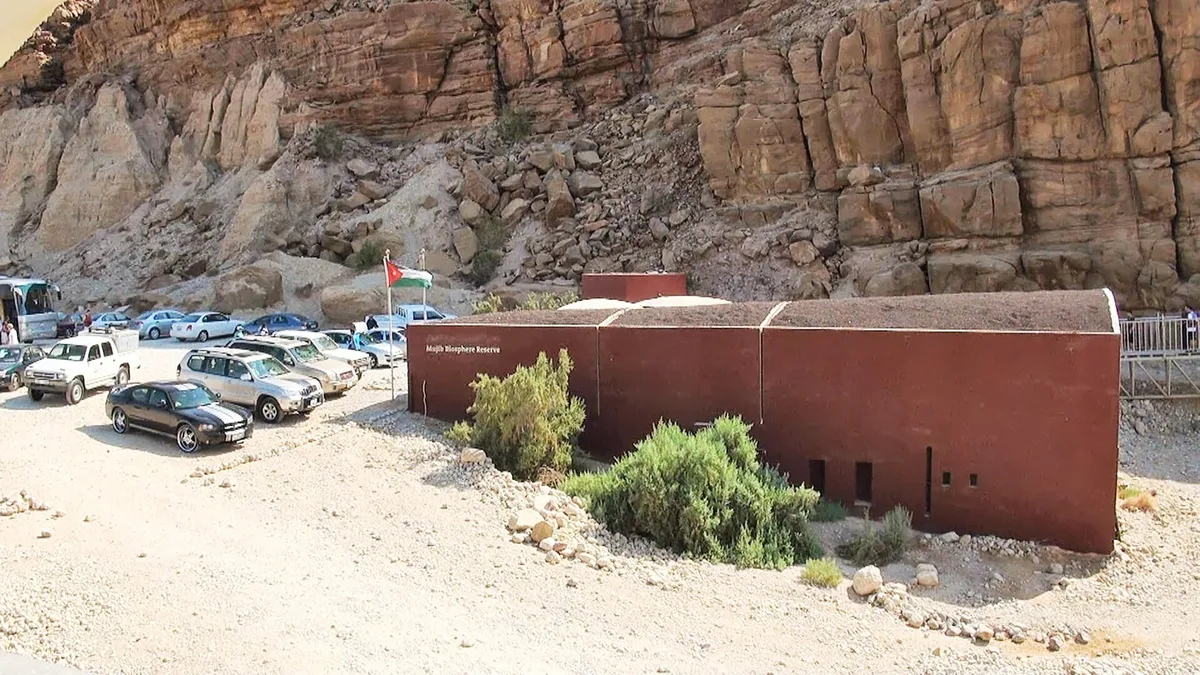
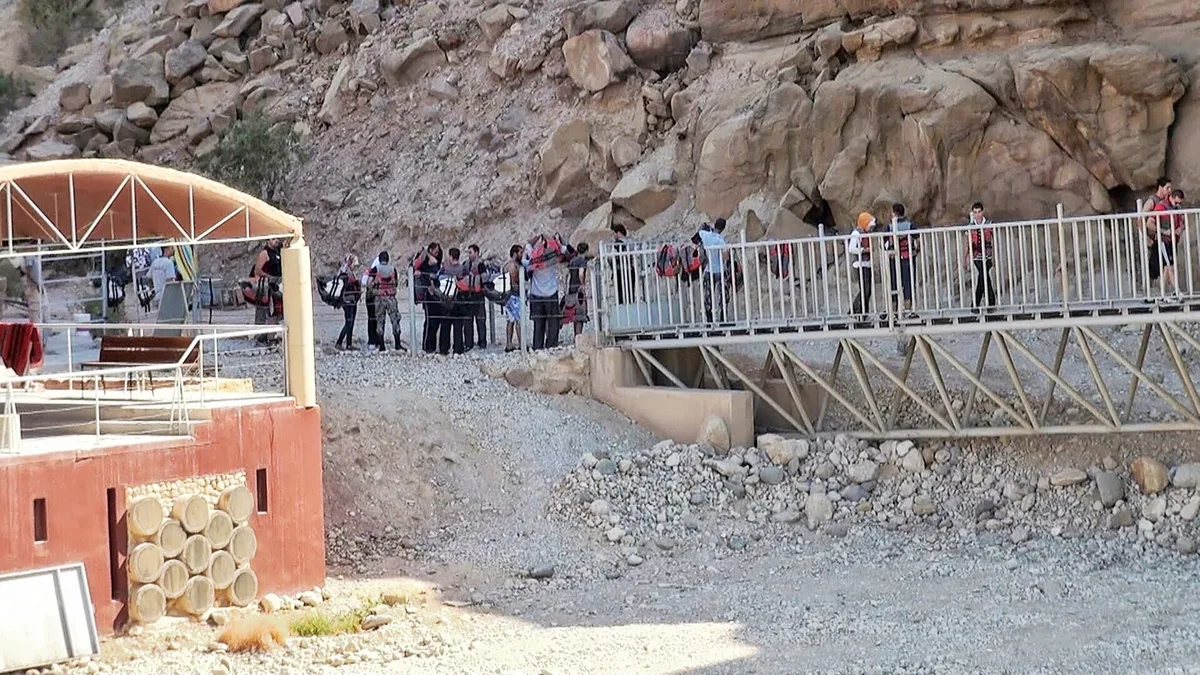
Every trail in this wadi mujib guide begins at the same low, red-walled building, and it is worth picturing it clearly because so many plans go wrong here. The Mujib Adventure Centre stands on the Dead Sea Highway at the mouth of the gorge, beside the Mujib Bridge, at roughly 400 metres below sea level. Inside and around it are the ticket desk, the kit store where life jackets and rental gear are issued, the guides’ muster point, toilets and changing space, and the start of the cantilevered walkway that carries you over the river’s exit channel and into the canyon. The centre is the reserve’s only public door. There is no other entrance, no back way in, and no walking the gorge independently of the centre’s system – if the centre is closed, the canyon is closed, whatever the weather looks like where you are standing.
The building’s modesty is deliberate and, once you understand the reserve, reassuring. This is a working ranger-and-trails station that handles visitors, not a visitor attraction that handles rangers. Capacities are managed from here: the RSCN’s published rates cap the Siq Trail at a maximum of 100 persons on the route, and the guided trails run in small groups with set minimums, so the centre is where the day’s arithmetic – how many, on which trail, with which guide – gets settled. It is also where the weather decision is made. The staff who close the trails are watching a catchment that extends far inland from the gorge; rain you cannot see, falling on the plateau an hour’s drive away, is their concern, and their call at this desk is final.
Practicalities at the centre are simple and are covered in detail in the fees and rules section of this wadi mujib guide below: bring your passport or ID (the RSCN’s own notes require every visitor to have one on site), bring a card or cash for tickets, and expect to leave everything that cannot get soaked either in your vehicle or in the centre’s care. There is also, for those who want to stay at the canyon’s mouth, a small set of RSCN chalets here – 15 of them, sleeping a maximum of 32 people a night according to the RSCN’s rate sheet – which the fees and booking section below prices from the RSCN’s own rate sheet. But for almost everyone, the centre is a morning’s beginning: arrive, ticket, kit, walkway, river.
The Siq Trail – Walking Up a Living River
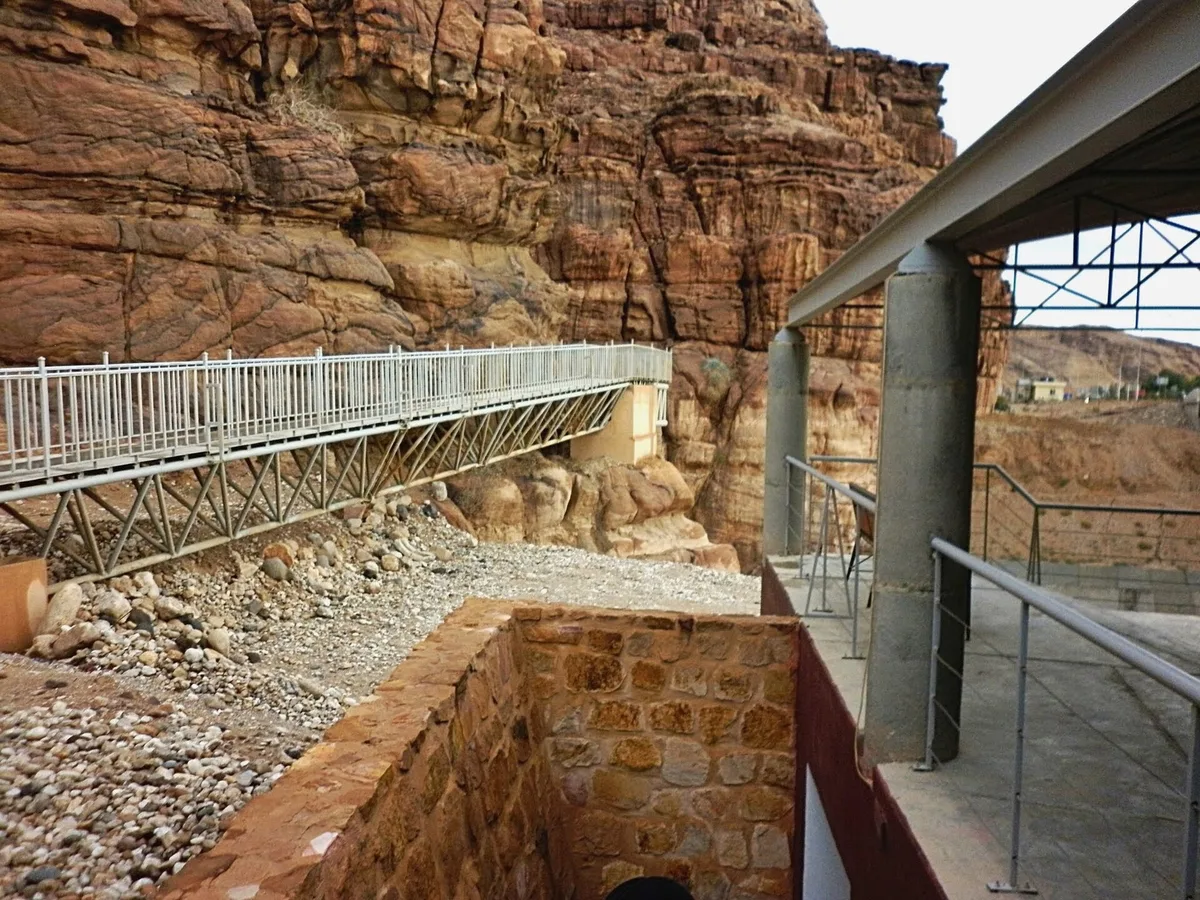
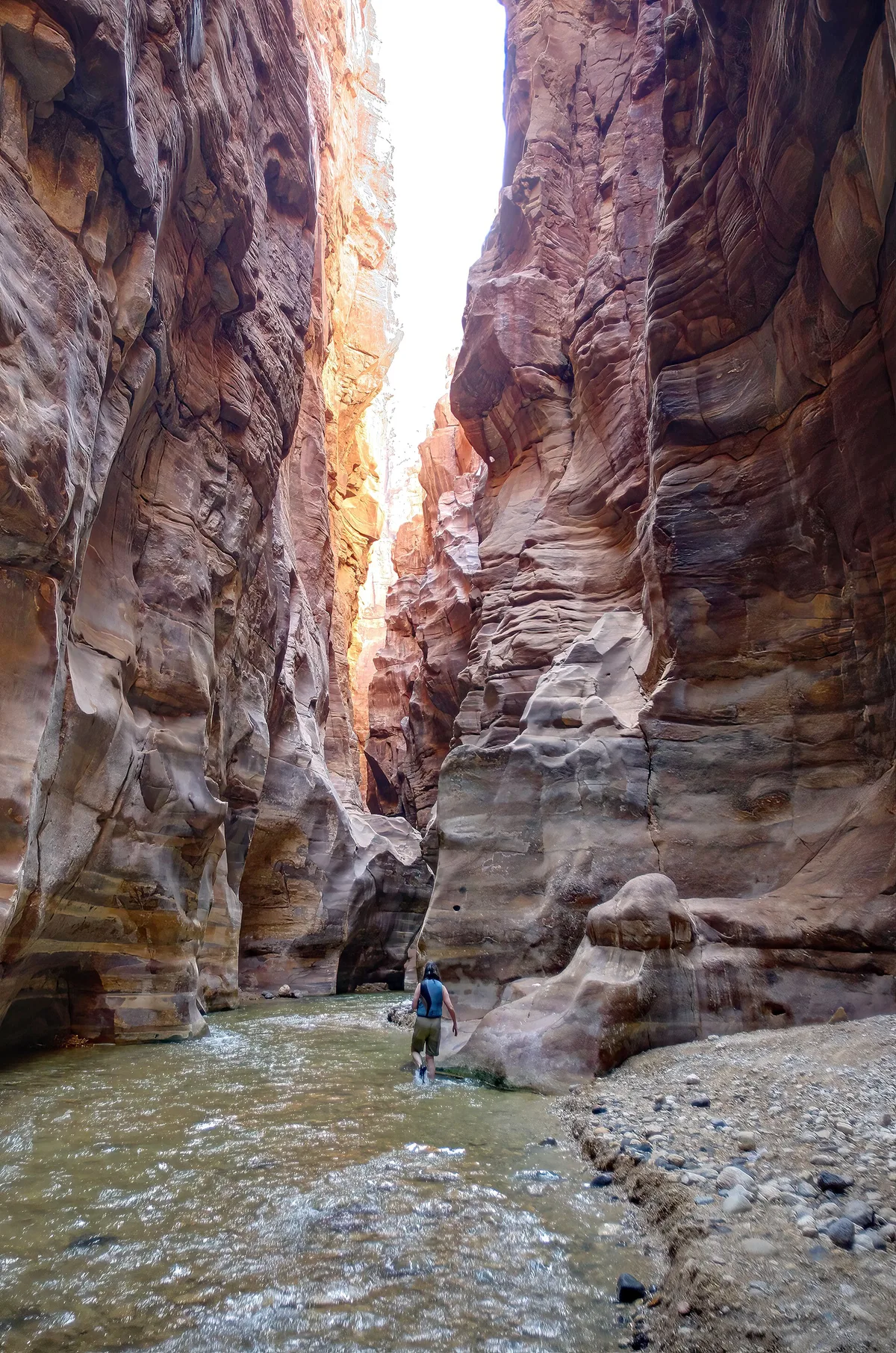
The Siq Trail is the reason Wadi Mujib is famous, and it is the only trail in the reserve you walk without a guide. The Jordan Tourism Board’s official description of it is accurate and pleasingly plain: the trail starts at the Mujib Adventure Centre, where you take the cantilevered walkway and follow the course of the river between the towering sandstone cliffs to the base of a large waterfall. That is exactly what happens – and it undersells the experience the way a menu undersells a meal. What the description cannot carry is the texture: the cold shock of the first pool after the furnace heat of the highway, the sound the river makes in a corridor of stone, the way the light turns the water green-gold at midday and the walls close to a few metres wide around you.
The mechanics are simple. You enter the water almost immediately below the walkway and walk upstream, into the current, for the whole outward half of the route. The going varies by the metre: gravel shallows where you stride, boulder gardens where you pick a line, cascades where fixed ropes and ladders are installed to haul you up against the flow, and pools – depending on the season’s water levels, as the official description notes – deep enough that you swim them. The trail is an out-and-back: the waterfall is the turning point, and the return downstream, sliding and floating with the current doing half the work, is the ride home. The RSCN’s published duration for the trail is 2 to 3 hours, which is the honest span between a fast party on a quiet morning and a slow one queueing politely at the ladders.
Two features of the Siq surprise first-timers and belong in any wadi mujib guide. The first is that “self-guided” does not mean “unmanaged”: the route is staffed, the fixed aids are maintained, the numbers on the trail are capped, and the life jacket you are issued at the centre is compulsory equipment, not a suggestion. The second is that the trail has moods. In the weeks after opening, the water runs higher and colder and the current argues with you. In high summer the flow is gentler, the river is warm as bathwater in the shallows, and the canyon is at its most benign and most crowded. Neither mood is the “wrong” one – but they are different walks, and the season section below deals with the choice honestly.
The Last Waterfall – What the Siq Trail Actually Demands
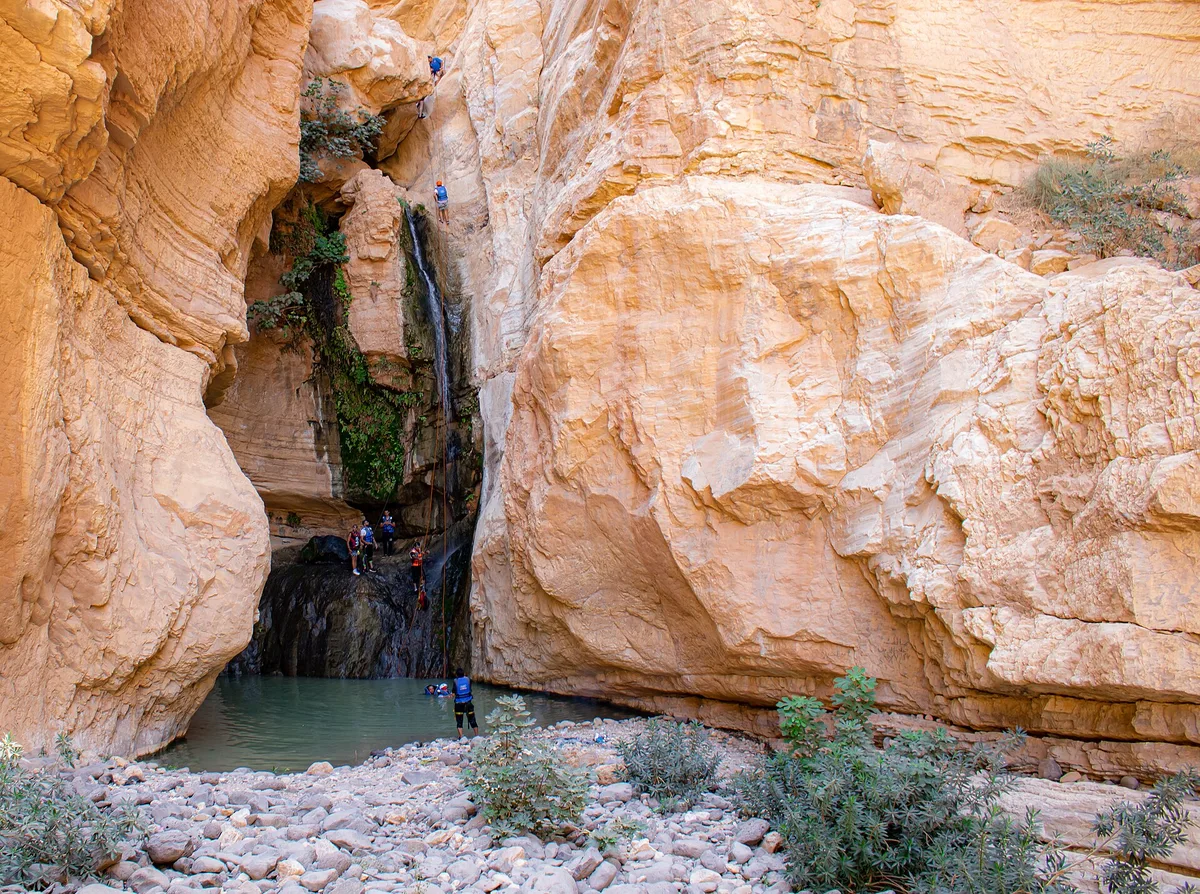
The Siq Trail ends at a large waterfall – a proper curtain of water dropping into a plunge pool in a chamber of the gorge – and whether you reach it depends less on courage than on a small set of physical facts about yourself. So let this wadi mujib guide be specific about the demands, because the canyon is a poor place to discover them. You must be at least 18: the RSCN’s rule for all the wet trails admits no exceptions and the centre enforces it. You must be able to swim: the pools on the route can be deep enough to take you off your feet, and the life jacket supplements swimming rather than replacing it. You need reasonable upper-body strength for the ropes at the cascades, soft knees for the boulder sections, and feet you trust on polished, submerged rock.
None of that makes the Siq an athlete’s trail. The fixed infrastructure – ropes, ladders, handlines, staff at the awkward points – exists precisely to convert a serious canyon into a manageable one, and thousands of ordinary travellers complete it every season. What tips the balance is usually not fitness but judgement: going slowly at the cascades rather than lunging, keeping three points of contact, wearing shoes that grip wet rock rather than fashion sandals, and turning back without embarrassment if the water is running beyond your comfort. The route is an out-and-back; there is no shame gradient on it, and the river will still be there next season.
The waterfall itself deserves a sentence of respect. It is the upstream limit of the self-guided trail, the point where the gorge continues into territory reserved for the roped, guided routes, and it is one of the great natural rooms of Jordan – a high chamber of falling water and echoing stone at the bottom of the world. Swim in its pool, sit on its rocks, and then give yourself the downstream run: with the current behind you, the cascades you hauled up become slides and glides, and the walk out is the playful mirror of the walk in. Most people surface at the walkway grinning and wringing out their clothes. Plan nothing tight-scheduled for immediately afterwards; the canyon runs on river time.
The Canyon Trail – Over the Top of the Big Fall
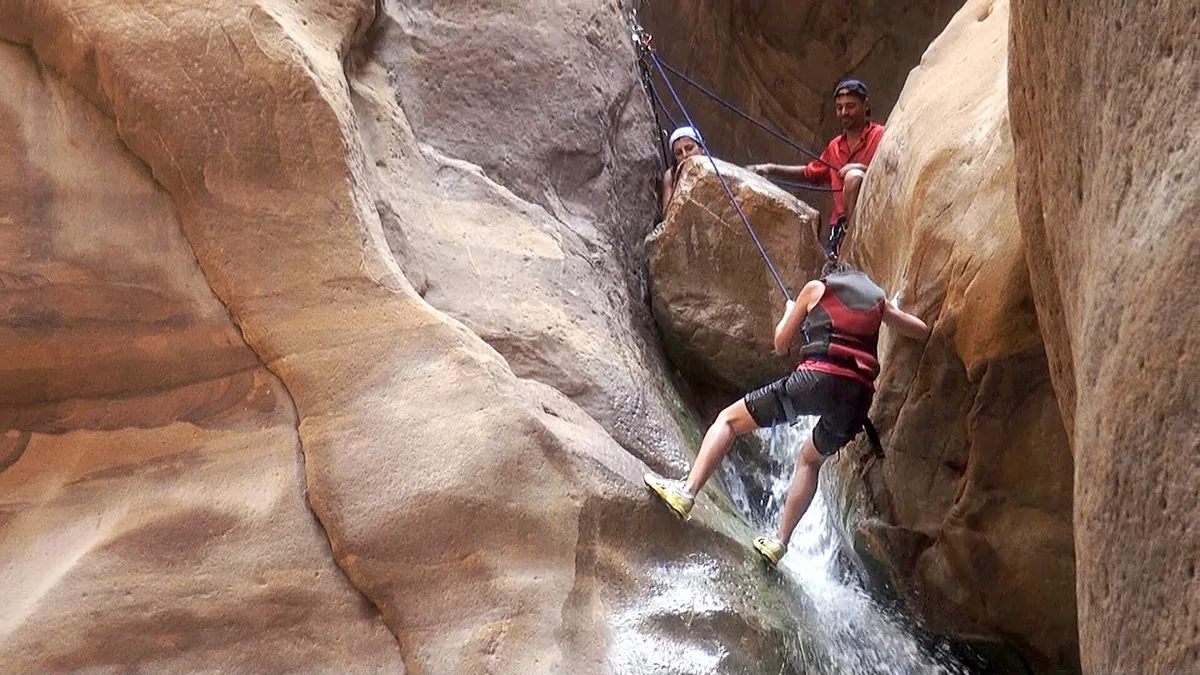
If the Siq Trail is the canyon at walking pace, the Canyon Trail is the canyon with the gloves off. As the Jordan Tourism Board’s official trail description sets out, the Canyon Trail begins at the Mujib Adventure Centre but follows the Dead Sea Highway south to its starting point, enters the gorge upstream, and shortly afterwards reaches the top of a spectacular waterfall about 20 metres high – which you descend, on ropes, under the watchful eye of a trained guide. Below the fall, the route joins the familiar ground of the Siq Trail and follows it back to the Adventure Centre. In one sentence: you abseil into the Siq’s end-point waterfall from above, then walk out down the river you have just dropped into.
A trained guide is not optional on this trail; the official description states the requirement outright, and the reason stands 20 metres tall and pours. The descent is a genuine roped abseil in moving water, done with the guide managing the system, and it converts the waterfall from a backdrop into an event. For travellers who found the Siq fun but tame – or who simply want the full vertical story of the gorge, top to bottom – this is the upgrade the reserve offers, and it is deliberately kept small, guided and booked ahead under the RSCN’s general rule that bookings are made a minimum of 24 hours in advance.
Honesty about availability matters more in a wadi mujib guide than enthusiasm. The guided trails run on guides’ availability and suitable weather, in the RSCN’s own words, and the Canyon Trail is a summer-season, weather-dependent activity: it does not run in winter, it does not run when the river is up, and it does not run merely because you have arrived at the desk with money. Treat it as a prize to be arranged through Wild Jordan before you travel – contact details are in the fees and booking section – rather than an impulse purchase on the morning. The same applies, with longer distances and bigger commitments, to the Malaqi Trail next.
The Malaqi Trail – Two Rivers, One Long Day
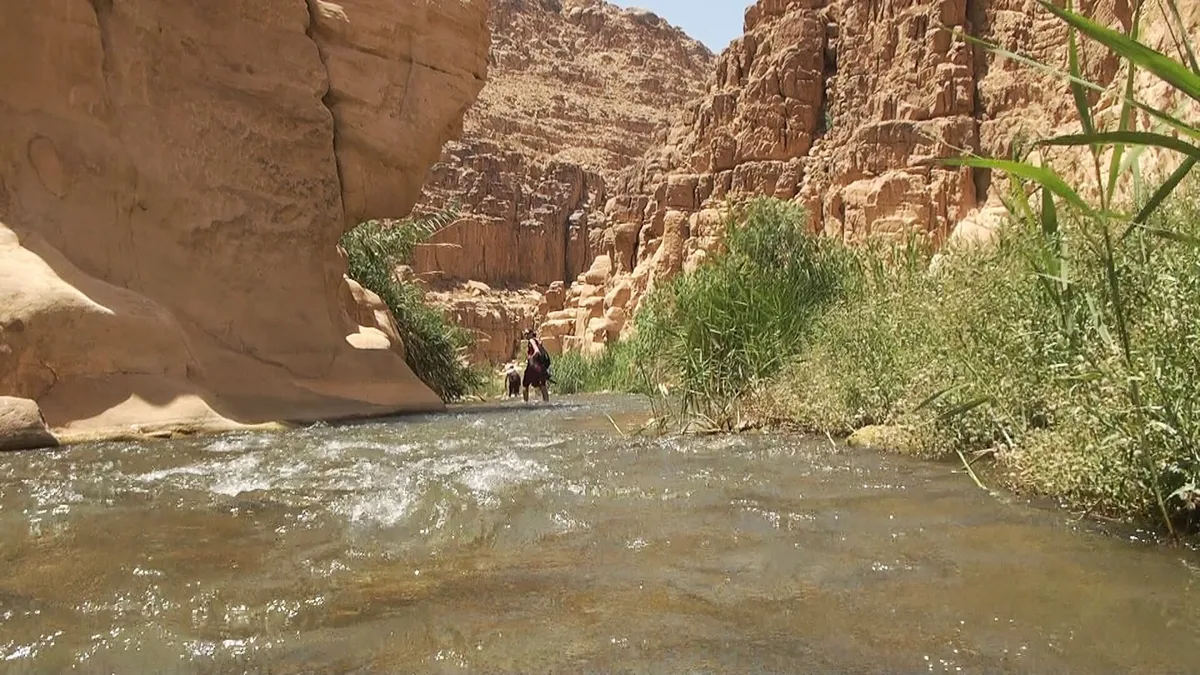
The Malaqi Trail is the reserve’s connoisseur route: the Siq’s bigger, longer, wilder sibling, and the trail that shows you the Mujib is not one river but a system. The official description lays out its shape – from the Adventure Centre you follow the Dead Sea Highway south to the starting point, then hike upstream to the confluence with the Hidan River, where you swim in natural pools, before descending a waterfall of about 20 metres under a trained guide’s supervision and returning to the centre along the Siq Trail. In practice that means a substantial day: the enclosed drama of the lower gorge exchanged, for long stretches, for a wider, greener, reed-fringed river where herons lift off ahead of you and the canyon breathes.
The Hidan confluence is the trail’s quiet glory. Wadi Hidan is the Mujib’s great tributary – the second river of the reserve, cutting through the basalt country to the south – and the pools at the junction of the two streams are among the loveliest swimming water in Jordan’s wild places. Coming down the 20-metre fall afterwards, and then running the whole Siq as your exit, means the Malaqi effectively contains every other water experience the reserve offers, in sequence, in one guided day. It is the trail to book if you have one day for Mujib and a high opinion of your own stamina.
The qualifiers are the same as the Canyon Trail’s, only more so. A trained guide is required. The season is summer and weather-dependent. Group minimums and the 24-hour advance booking rule apply. And the effort is real: this is the longest of the standard guided water routes, with river walking, swimming and a major descent stacked end to end. A wadi mujib guide should also say plainly that the Malaqi does not run every day of the season – guides, group numbers and river state all have to align – so the traveller who builds a whole Jordan trip around it should hold a Siq Trail morning as the honourable fallback. You will not feel short-changed. Nobody does, once the water closes over their boots.
The Ibex Trail – Wadi Mujib in Winter, on Dry Ground
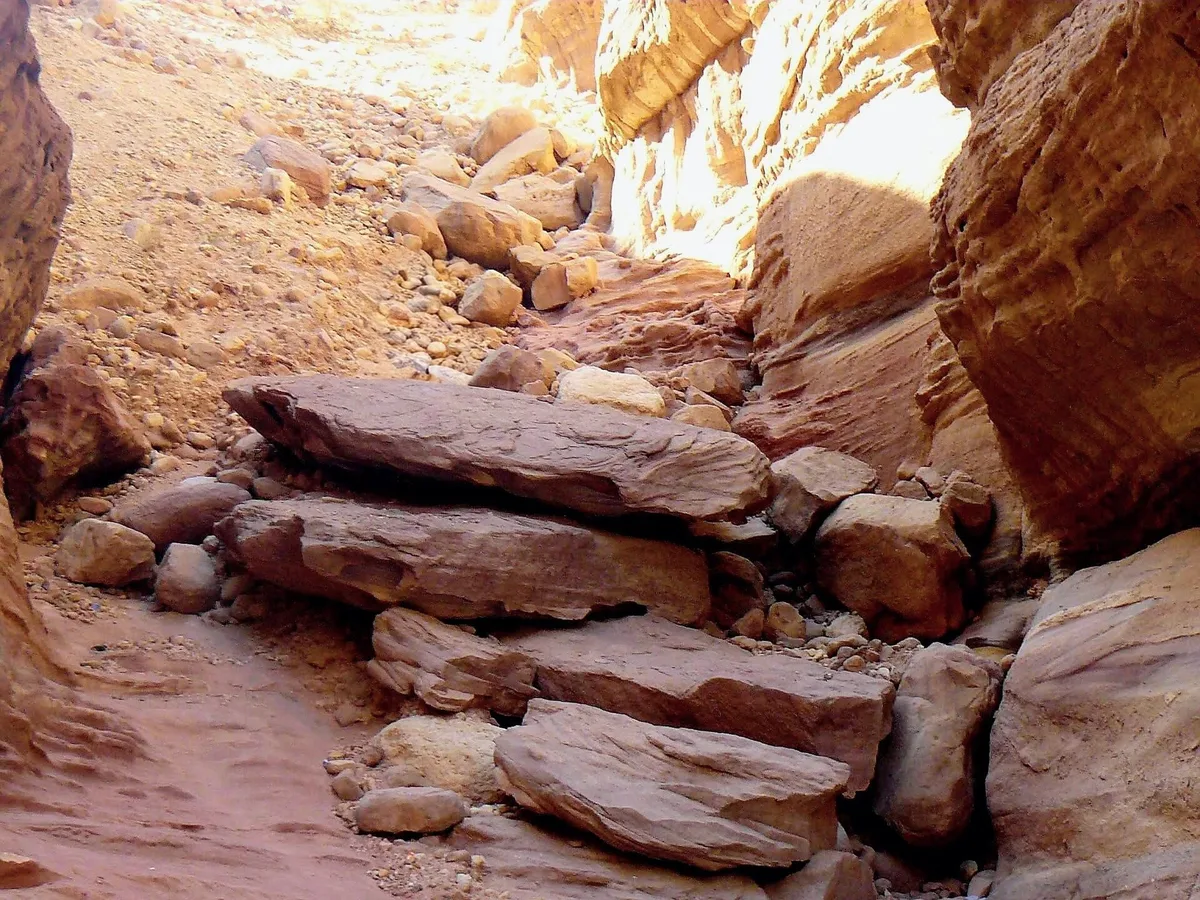
When the water trails close for winter, the reserve does not shut; it changes its mind. The Ibex Trail is Mujib’s dry season offer, and the RSCN’s rates document gives it the same price as the Siq Trail with the guiding fee included – because on this trail the guide is the product. The official route description runs like this: from the Mujib Adventure Centre the trail follows the Dead Sea Highway before ascending into the reserve, diverges south, and runs parallel to the Dead Sea, which provides – in the Tourism Board’s happy phrase – a startlingly blue backdrop for the entire hike. It continues along a number of dry wadis to the Raddas Ranger Station, where you may see the Nubian ibex the station’s work protects, and where the famous rock “statue” of Lot’s Wife can be seen, before the return along a road for about an hour.
The RSCN’s published facts for the trail are precise: 3 to 4 hours, guided, in groups of a minimum of 6 and a maximum of 25 persons, starting at 8:00 in the morning, and typically open from November until March depending on suitable weather conditions. Those numbers define a different kind of Mujib day from the canyon’s: cooler, drier, wider — a walk of views and stories rather than water and ropes, along the rim country above the gorge with the Dead Sea glittering below and the reserve’s real work, the ranger station and the ibex project, at its centre. It is also, not incidentally, the only trail on which the 18-plus wet-trail rule does not bite in the same way, making it the reserve’s realistic offer to parties the water trails exclude – although group minimums mean it must still be arranged, not improvised.
Do not undersell it to yourself as the consolation prize. Winter is when the reserve’s high country is at its kindest, when the light on the Moab plateau is long and golden, when migrating birds are moving through the rift and when the canyon below you – closed, brown and dangerous with floodwater – explains from above why the summer rules are what they are. A traveller whose Jordan trip falls between November and March has not missed Wadi Mujib. They have been given its other face, and this wadi mujib guide rates the Ibex Trail as a serious walk in its own right, not a substitute.
Al-Hidan and the Zipline – The Reserve Beyond the Siq
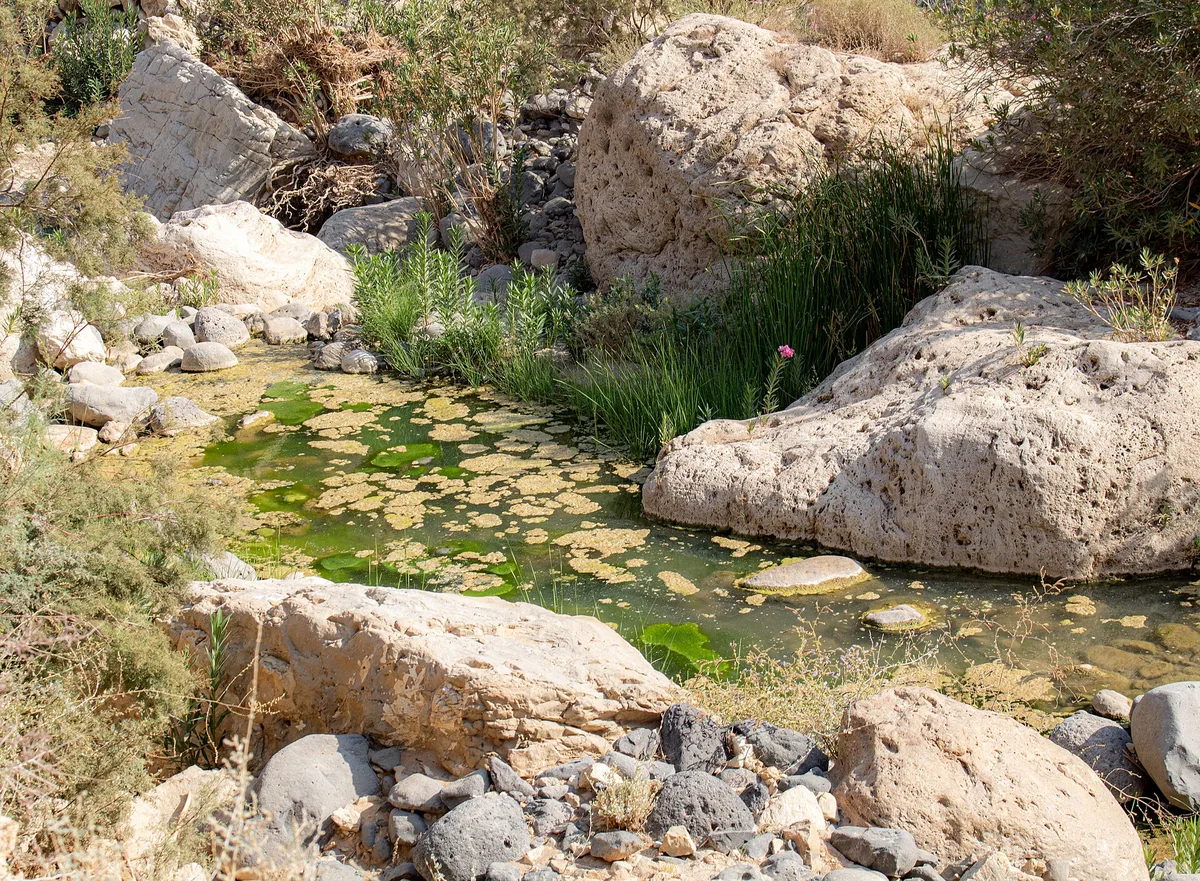
Two further offers complete the reserve’s public face, and both suffer from being footnotes to the Siq. The Al-Hidan Trail takes its name from the tributary it explores: as the official description puts it, the trail starts from the visitor centre and moves from the southwest to the northeast, and you swim from pool to another until you reach the end point, where you find an ancient wheat mill. Read that again – an ancient wheat mill, in a canyon, at the end of a swimming trail. The Hidan’s gentler gradient made it the working river of the local past, dammed and milled by the communities of the valley, and its trail is the most purely aquatic of the set: less hauling and climbing, more long swims through connected pools in a greener, softer canyon.
The zipline is the reserve’s one piece of pure theatre. The official description gives its vital statistics: two parallel cables, so two people can ride together, about 100 metres long with a slope of about 9 metres, extending alongside the Mujib Bridge from its starting point at the visitor centre on the other side of the valley. It is over in seconds and it is not the reason anyone crosses the world to reach Mujib – but as an exclamation mark at the end of a trail morning, a flight across the gorge mouth with the river below and the Dead Sea beyond, it earns its place in the day.
A wadi mujib guide should be honest about the status of both: they are real, official, listed offers of the reserve, and they are also the most variable part of its programme – the pieces most likely to be running reduced schedules, awaiting maintenance, or folded into guided arrangements rather than sold at the desk. Ask Wild Jordan about them when you book anything else, by all means. But build your plan on the five trails of the table at the top of this guide, and treat a running zipline or an open Al-Hidan as the reserve’s bonus, not its promise.
Ibex, Caracal and the Raptor Sky – Wildlife of the Reserve
It is easy, soaked and grinning in the Siq, to forget that you are walking through one of the Middle East’s serious wildlife reserves. The reserve’s own biodiversity profile, published through Jordan’s national biodiversity reporting, records surveys finding over 550 species of plants, eight species of carnivores, and numerous resident and migratory birds across its zones – figures UNESCO’s listing complements with its note on the reserve’s rich birdlife. The canyon walls that funnel you so entertainingly are also a cliff refuge: the steep slopes are the stronghold of animals that need height, rock and very little human company, and the permanent streams threading the side wadis are the water supply that keeps them here through the furnace of summer.
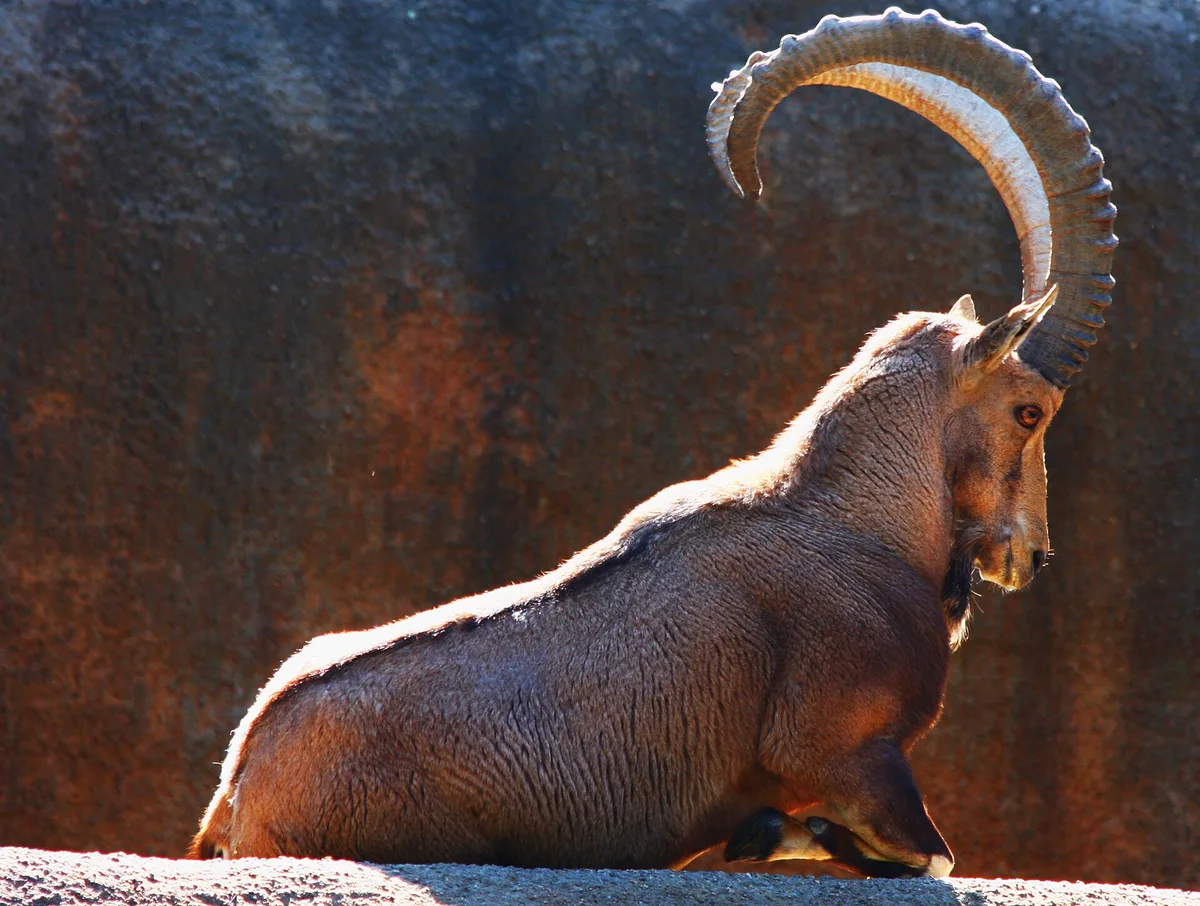
The defining animal is the Nubian ibex, the great scimitar-horned mountain goat of the sandstone cliffs. Ibex were once shot to the edge of disappearance in these hills – the reserve’s profile is blunt that only a small number remained in the wild because of widespread illegal hunting – and Mujib became the RSCN’s answer: a captive-breeding programme run inside the reserve itself. Research published by RSCN scientists records what that took: over a decade of captive breeding, culminating in the phased release of 85 ibex into the wild between 1997 and 2000, followed by hard years of adaptive management, including vaccination programmes when disease threatened the released herd. When you see ibex from the Ibex Trail – and the Raddas Ranger Station exists on that route precisely because this is their country – you are looking at a population that was, quite literally, rebuilt here animal by animal.
Around the ibex, the reserve’s quieter cast fills the zones you do not enter. The caracal, a powerful tawny cat with black-and-white ear tufts, hunts the rocky wadis and is famed – in the reserve profile’s words – for catching flying birds in its paws. Rock hyrax sun themselves on the boulders, Eurasian badgers work the slopes, and overhead the rift valley flyway does its seasonal work: at least nine species of birds of prey are known to breed in the reserve, among them Bonelli’s eagle, short-toed eagle, long-legged buzzard and Barbary falcon, while the globally threatened lesser kestrel breeds here every spring. You will likely see little of this from the water – the trails are the noisy edge of a shy reserve – but knowing it changes the walk. The canyon is not a ride threaded through scenery. It is a working refuge that tolerates you, briefly, on its river – and no wadi mujib guide should let you leave thinking otherwise.
The Season Rules Everything – Rain, Floods and the April-to-October Window
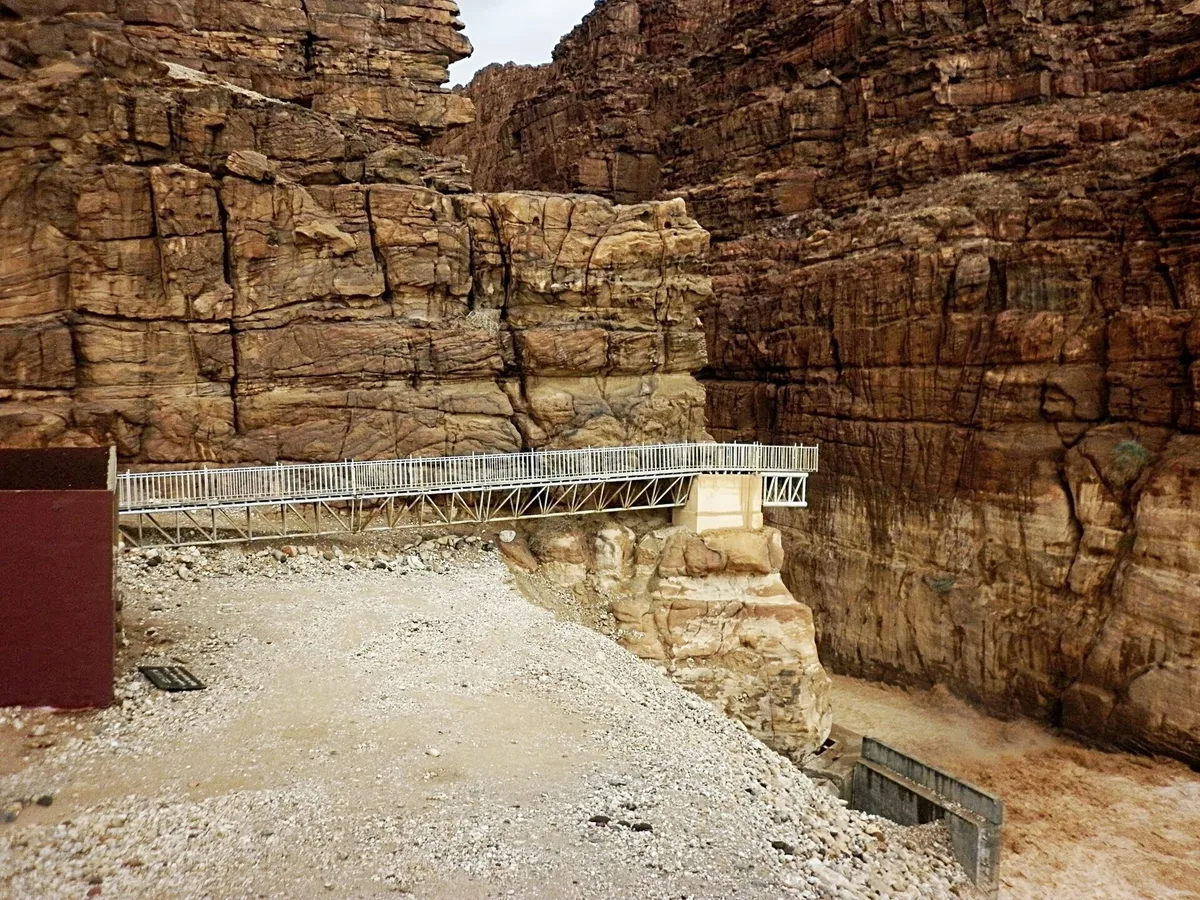
Here is the section this whole wadi mujib guide exists to get right, because it is the one that decides whether your visit happens at all. The RSCN’s published wording for the Siq Trail is that it is “typically open from 1st of April until 31st of October depending on suitable weather conditions” – and every word of that sentence is load-bearing. Typically, not always. Depending on suitable weather conditions, not on the calendar alone. The trail has opened late in wet springs and closed early in stormy autumns; it shuts for individual days inside the season when rain falls or threatens anywhere in the catchment; and once the season ends, the water trails end with it, whatever the sunshine at the Dead Sea is doing. The Ibex Trail mirrors the pattern in reverse, typically running November to March. Between them, the reserve offers something in every month – but never everything in any month.
The reason is the flood, and it deserves plain language rather than drama. The Mujib drains a large highland catchment through a slot a few metres wide. Rain that falls as a pleasant shower on the plateau around Kerak arrives at the gorge as a wall of brown water carrying boulders, trees and everything else the wadi bed held, and it arrives fast – the photographs that circulate of the Siq in flood, walkway above a churning torrent, are not curiosities but the canyon’s normal winter behaviour. This is why the trails close on forecast as well as on fact, why staff will turn away a car park full of disappointed visitors on a blue-sky morning, and why “the weather looked fine” is not an argument anyone at the Adventure Centre is obliged to accept. The catchment’s weather, not the gorge’s, is the one that counts.
So the practical doctrine of this wadi mujib guide is threefold. First, target the heart of the season – late spring through early autumn – if the Siq is the point of your trip, and treat the shoulder weeks of April and October as the gamble they are. Second, check before you travel, on the day if you can: Wild Jordan’s channels are where closures and reopenings are announced, and the contact details in the next section are there to be used. Third, hold a plan B with good grace – the Dead Sea shore, Mount Nebo and Madaba are all within easy reach of the gorge (our Jordan itinerary for 7 days builds them into exactly such a day), so a closed canyon costs you a rearrangement, not a ruined trip. The travellers who suffer at Mujib are the ones who drove two hours on a rumour. The ones who thrive checked, and came when the river said yes.
Fees, Booking and the Rules That Are Not Negotiable
The RSCN publishes Mujib’s rates openly, and this wadi mujib guide prints them as published – attributed and dated, because they are the reserve’s to change. On the RSCN’s Mujib rate sheet (the 2024 rates, checked for this guide on 1 November 2026, all prices tax-inclusive), the Siq Trail costs JOD 23 per non-Jordanian visitor, JOD 20 per resident and JOD 17 per Jordanian, for a self-guided route of 2 to 3 hours with a maximum of 100 persons on the trail. The Ibex Trail carries the same three prices – JOD 23, 20 and 17 – with the guiding fee included, for a guided 3 to 4 hours in groups of a minimum of 6 and a maximum of 25. Guided water trails such as the Canyon and Malaqi are arranged through the booking system rather than priced as a walk-up ticket on that sheet, which is itself a piece of information: if a trail needs a guide, it needs arranging.
The booking mechanics follow from that split. The Siq Trail, in the RSCN’s own words, is self-guided and there is no need to book in advance – you arrive at the Adventure Centre, take a ticket while capacity lasts, and walk. Everything else runs on the RSCN’s general rule, printed on the same rate sheet: all bookings must be made a minimum of 24 hours prior to the booking date and are subject to availability, with trail availability itself based on guides’ availability and suitable weather conditions. Bookings are handled by Wild Jordan Adventures, the RSCN’s tourism arm – by phone and at tourism@rscn.org.jo – and the rates sheet adds two more rules worth knowing before you set off: every visitor must have a valid passport or ID card on site, and the reserve is a smoke-free and pet-free area where alcohol is discouraged for cultural reasons.
Staying over is the reserve’s own small offer rather than a hotel market. The RSCN’s rate sheet lists 15 Mujib Chalets at the reserve, with a maximum capacity of 32 persons per night: JOD 80 for a single, JOD 90 for a double and JOD 105 for a triple, per night, including breakfast, beach usage and the conservation fee, with check-in at 3:00 pm and check-out at 12:00 noon. The chalets sit at the gorge mouth on the Dead Sea shore, which makes them the one way to be standing at the Adventure Centre, coffee in hand, at the moment the gates open – a genuine advantage in high season, when the Siq’s hundred places are the day’s contested resource. Treat every figure in this section the way the reserve treats its own river: current as published, and to be reconfirmed with Wild Jordan before you build a budget or a day around it.
Getting to Wadi Mujib – The Dead Sea Highway and the King’s Highway
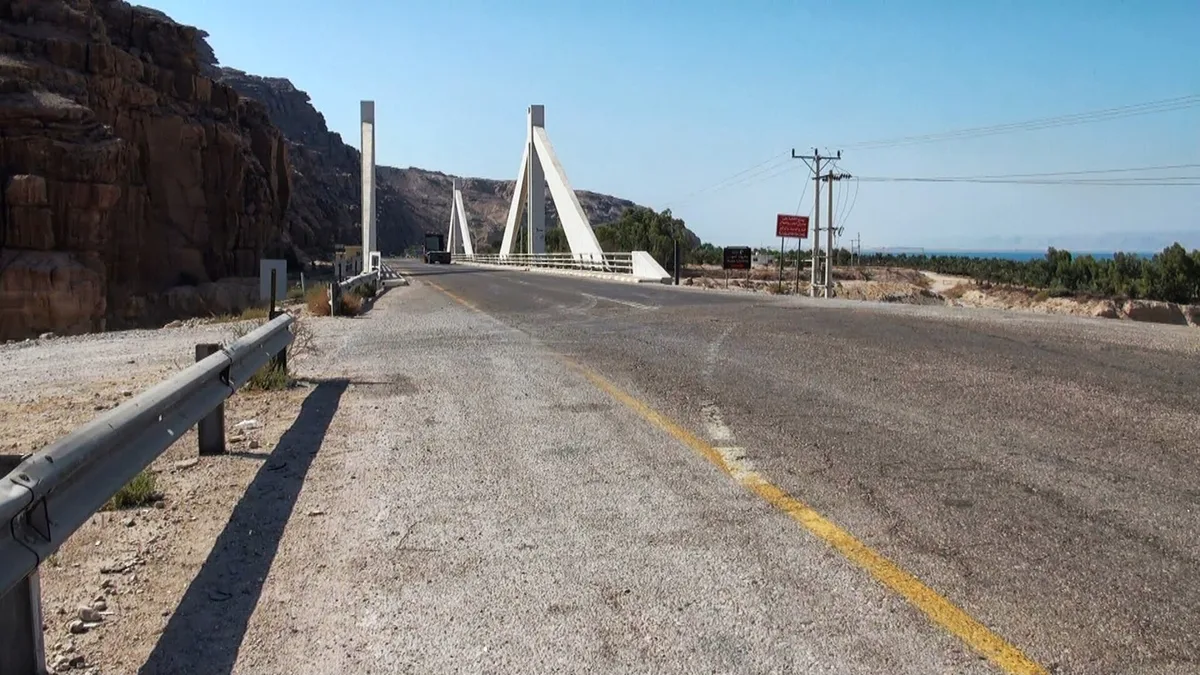
The Adventure Centre is not hard to reach, but it helps to understand that you are driving to a gorge mouth on a shore road, not to a town. The standard approach is the Dead Sea Highway: south from Amman – roughly 90 kilometres from the capital to the Mujib Bridge – down through the rift to the lowest road on Earth, past the Sweimeh resort strip and the Baptism Site turn, until the highway crosses the Mujib on its bridge with the Adventure Centre beside it. From the Dead Sea resorts the run is short, a matter of minutes down the shore, which is why so many visitors float in the Dead Sea in the afternoon after a canyon morning. There is no meaningful public transport to the gate; the realistic options are a hire car, a taxi or private driver for the day, or an organised tour, and the driver-for-the-day pattern that serves the whole valley works here too.
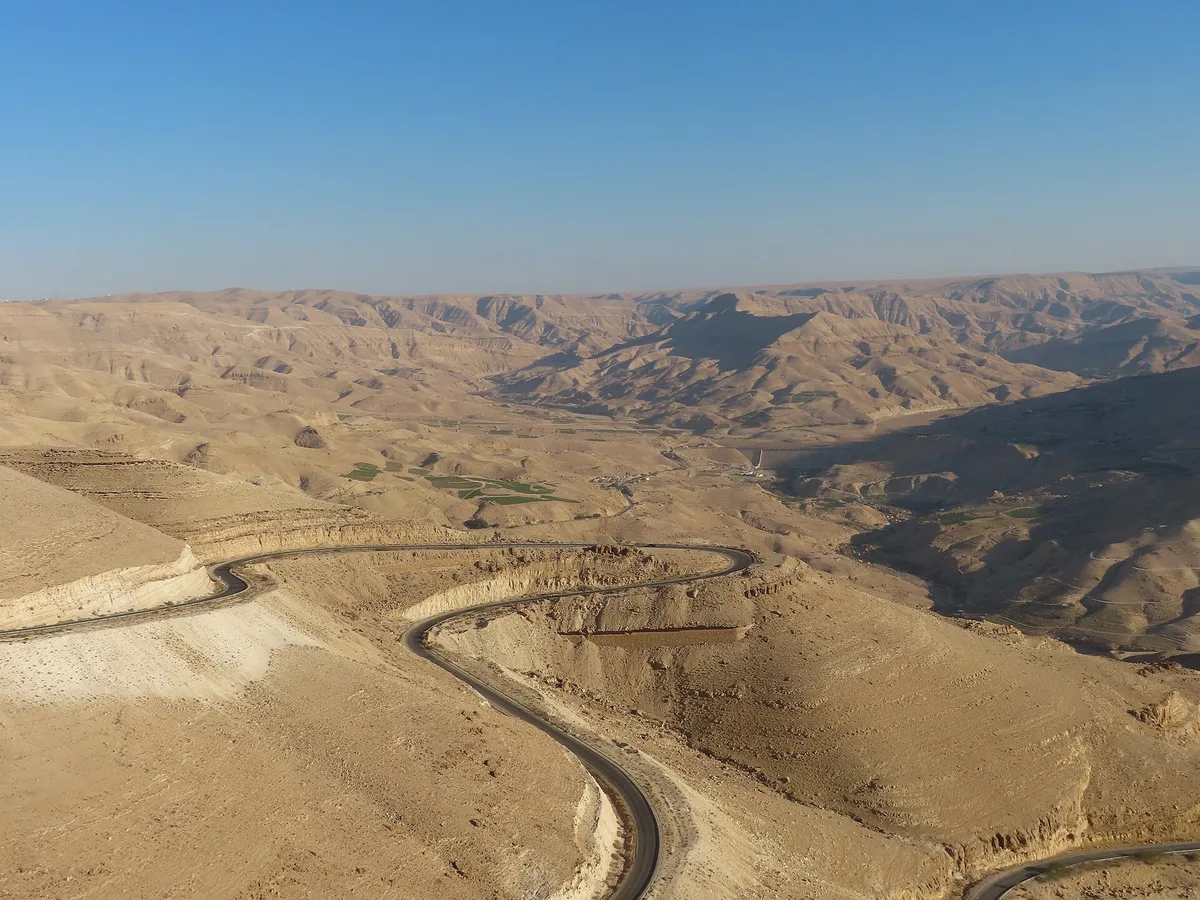
The second approach is the scenic one, and it explains the gorge better than any map in this wadi mujib guide. The King’s Highway, the plateau road from Madaba and Kerak towards Petra, must cross Wadi Mujib where it is a canyon in the highlands rather than a mouth at the sea – and it does so in a famous sequence of switchbacks, descending hundreds of metres into the wadi and climbing out the other side, with a viewpoint stop where travellers have photographed the gorge for generations. If you are driving the King’s Highway between Madaba and Kerak you cross the Mujib whether you plan to or not; what the cross gives you is the reserve from above – the plateau, the dammed upper river, the canyon’s upper reaches – while the Adventure Centre, far below and west, gives you the same river from inside. The two crossings are the same wadi at different altitudes, and doing both in one trip is the complete portrait.
Combining Mujib into the classic Jordan circuit is straightforward once the season is respected. Southbound, the Dead Sea and Mujib pair naturally with Mount Nebo and Madaba on the plateau above, and the road then continues to Petra – the route our Petra travel guide picks up at the other end. The one combination that fails is the hopeful winter double: travellers who schedule the Siq Trail into a January itinerary alongside Petra’s Treasury are planning around a trail that is closed, and no itinerary surgery at the gate will save the day. Build the canyon into the warm months, or build the Ibex Trail into the cold ones, and Wadi Mujib slots into a Jordan trip as neatly as it has slotted into the landscape of Moab for three thousand years.
Wadi Mujib Guide – Practical Questions, Answered
Is Wadi Mujib open all year? The reserve is, but the water trails are not. On the RSCN’s published wording, the Siq Trail is typically open from 1 April to 31 October depending on suitable weather conditions, and the guided water trails run in the same summer season; the dry Ibex Trail typically runs November to March. Inside those windows, any trail can close on any day for weather. Always confirm with Wild Jordan before travelling – that, more than any tip in it, is the doctrine of this wadi mujib guide.
How much does the Siq Trail cost? On the RSCN’s published Mujib rate sheet (2024 rates, checked 1 November 2026), JOD 23 for non-Jordanians, JOD 20 for residents and JOD 17 for Jordanians, tax included. The Ibex Trail is priced the same with guiding included. Rates are the RSCN’s to revise – reconfirm when you book or before you set out.
Do I need to book in advance? For the Siq Trail, no – the RSCN states there is no need to book in advance, though the trail is capped at 100 persons and high-season mornings fill. For everything guided – Canyon, Malaqi, Al-Hidan and the Ibex Trail – yes: RSCN bookings are made a minimum of 24 hours ahead, through Wild Jordan Adventures, and depend on guides and weather.
Can children do the Siq Trail? No. The RSCN’s rule is that all participants in the wet trails must be at least 18 years old, and the centre enforces it. Families travelling with teenagers should look at the dry Ibex Trail in its season instead, arranged in advance as a guided group.
Do I need to be able to swim? Yes, honestly. Depending on seasonal water levels, the gorge holds pools deep enough for swimming, as the official trail description notes, and the route also involves wading against a current and climbing fixed ropes and ladders at cascades. A life jacket is issued at the centre and is compulsory – it supplements swimming ability rather than replacing it.
What should I wear and bring? Shoes that grip wet rock and will survive total immersion, clothes you are happy to swim in, a dry change waiting at the centre, and your passport or ID, which the RSCN requires every visitor to carry on site. Anything you take into the canyon will get thoroughly wet – phones and cameras only in a proper dry bag, or not at all.
When is the best time to come? In the heart of the water season – late spring to early autumn – when the trail is reliably open and the current is at its most manageable, arriving at opening time for the coolest, quietest run. Shoulder weeks in April and October carry real closure risk; winter means the Ibex Trail instead. And in any month, the morning after rain anywhere inland is a morning to check before you drive.
How does Wadi Mujib combine with the Dead Sea? Perfectly – they share a shoreline. The Adventure Centre sits on the Dead Sea Highway a short drive south of the Sweimeh resort strip, so the classic pattern is the canyon in the morning and a Dead Sea float in the afternoon, with Mount Nebo and Madaba on the plateau above for the day’s third act. Just remember which half of the pairing is seasonal: the lake is always open; the river decides for itself.