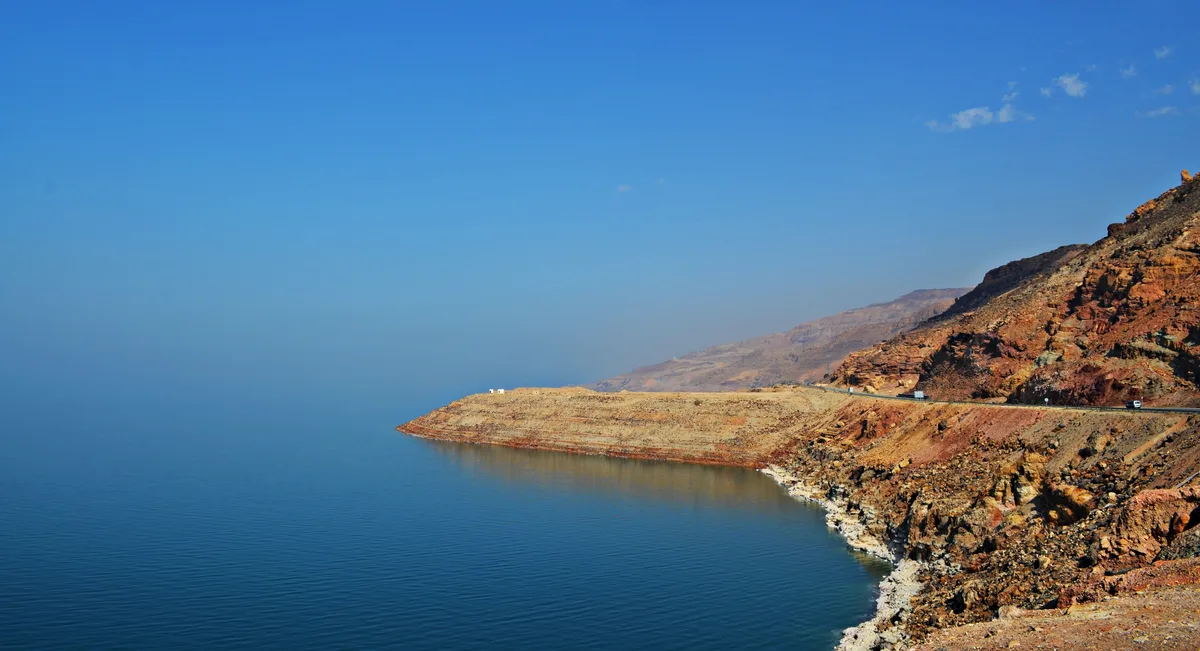
There is a moment, about ten seconds after you lie back, when your body understands the Dead Sea before your brain does. The water takes your weight the way a mattress takes it, all at once and without argument, and pushes your feet up whether you want them up or not. You are not swimming. You are being held, at the lowest point of dry land on the planet, in water so dense with salt that sinking is the one thing it will not let you do. This dead sea jordan guide exists because that ten-second miracle is only a small part of the shore. The rest is a falling lake, a working safety discipline, a strip of resorts at Sweimeh, a public beach with a complicated recent history, black mud with an honest story, salt sculptures the retreating water leaves behind, and three of Jordan’s greatest sights – the Baptism Site, Mount Nebo and Madaba – sitting within a short drive uphill.
Start with the scale of the place, because the scale explains everything else on this shore. The Dead Sea is not a sea at all but a landlocked salt lake in the Jordan Rift Valley, bordered by Jordan to the east – this shore, the one this guide covers – and by the West Bank and Israel to the west. Its surface, in the most recent published measurement, sits about 440 metres below sea level, which makes its shoreline the lowest land-based elevation on Earth. It is also falling by roughly a metre a year, so every figure printed about it, including this one, is a snapshot of a moving target. A good dead sea jordan guide should tell you that honestly at the start rather than pretend the numbers are fixed.
What follows is organised the way a visit is actually organised: the lake itself, then the float done properly and safely, then the mud, the salt, and the practical question every visitor actually faces – not how to float but where, through which gate, on which kind of ticket. Then the resort strip, the roads, the seasons, and the neighbouring sights that turn a two-hour float into one of the best days in Jordan. The water is the same for everyone; what separates a good Dead Sea day from a wasted one is everything around it.
Dead Sea Jordan Guide – The Short Version
| Question | Short answer |
|---|---|
| What is it? | A hypersaline lake in the Jordan Rift Valley – about 440 metres below sea level, the lowest land on Earth, and falling about a metre a year |
| How salty? | About 34% salt – roughly 9.6 times as salty as the ocean; you float because the water is denser than you are |
| The float | Lie back, stay on your back, 10-15 minutes at a time, then rinse in fresh water; never dive, never splash, keep it out of your eyes and mouth |
| Where do you get in? | Through a managed beach – a resort day pass or the public beach; wild-shore entry is unsafe and often impossible |
| Base | The Sweimeh resort strip on the northern shore, or Amman, roughly an hour’s drive away |
| Best months | Spring and autumn for comfort; winter is mild and swimmable; high summer is fierce – float early or late |
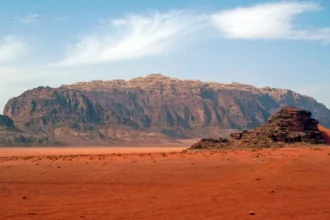
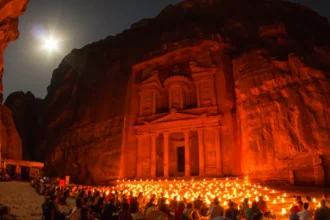
| Combine with | Bethany Beyond the Jordan, Mount Nebo and Madaba, all uphill within easy reach; Petra and Wadi Rum run south from here |
| The one warning | The shore is retreating and the ground away from managed beaches can be unstable – sinkholes are real; stay on managed ground |
Read that table and you have the shape of the day. The Dead Sea rewards a short, deliberate visit far more than a long, vague one. Most travellers float for perhaps half an hour in total, in two or three spells, and spend the rest of their shore time on the mud, the shade, the pool and the view. That is not a failure of ambition: the lake is intense, and the correct dead sea jordan guide advice is to treat it like strong coffee rather than a swimming pool – small doses, taken properly, are the whole pleasure.
One more short-version truth, because it shapes every choice below: there is effectively no casual, walk-in public access to this water. The shoreline is cliffs, salt flats, farmland and private resort frontage, and the unmanaged stretches are exactly where the ground is least trustworthy. Every realistic visit goes through a gate – a resort beach, a public beach facility, or a tour that has arranged one. Accept that, and planning becomes simple: choose your gate, and build the day around the sights uphill.
The Lowest Land on Earth – How This Lake Got Here
The Dead Sea sits in a crack in the planet. The Jordan Rift Valley is part of the Dead Sea Transform, the great fault system where the Arabian Plate grinds slowly past the African Plate, and the basin between them has dropped so far that its floor collects water with nowhere to go. Rain and rivers run in – above all the Jordan River, flowing south from the Sea of Galilee – and nothing runs out. Water leaves only by evaporation under a desert sun, and everything it carried in stays behind. Do that for long enough and you get a lake that is less a body of water than a body of brine, sitting lower than any other land surface on Earth.
The lake you float in is the shrunken remainder of a much bigger one. During the last ice age, a predecessor called Lake Lisan filled this valley hundreds of metres higher than today’s surface; the pale terraces on the Jordanian escarpment are its abandoned beaches, lifted into view as the water fell. The modern Dead Sea is what is left at the bottom of that diary – the deepest hypersaline lake in the world, around 300 metres deep in its northern basin.
Two basins, two characters. The northern basin is the deep, natural lake, the one in every photograph and the one this dead sea jordan guide is about: open water, the Sweimeh resorts, the Baptism Site near its top end. South of the Lisan Peninsula, the shallow southern basin has largely been converted into a grid of evaporation ponds, where Jordanian and Israeli mineral industries harvest potash and other salts from the brine. You can see the ponds’ geometric glint from high viewpoints on the Jordanian side. They are part of why the level falls – industrial extraction, alongside the diversion of the Jordan River upstream, is one of the two great causes – and they are a reminder that this strange lake is also a working industrial landscape, not only a wonder.
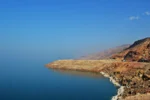
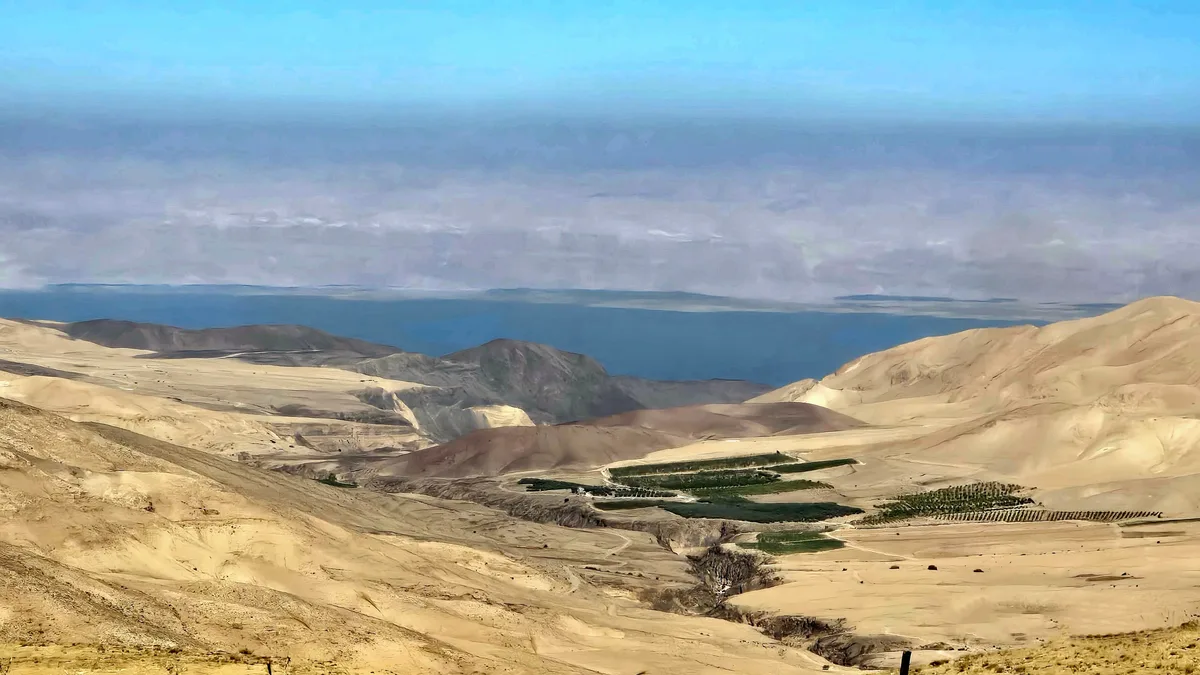
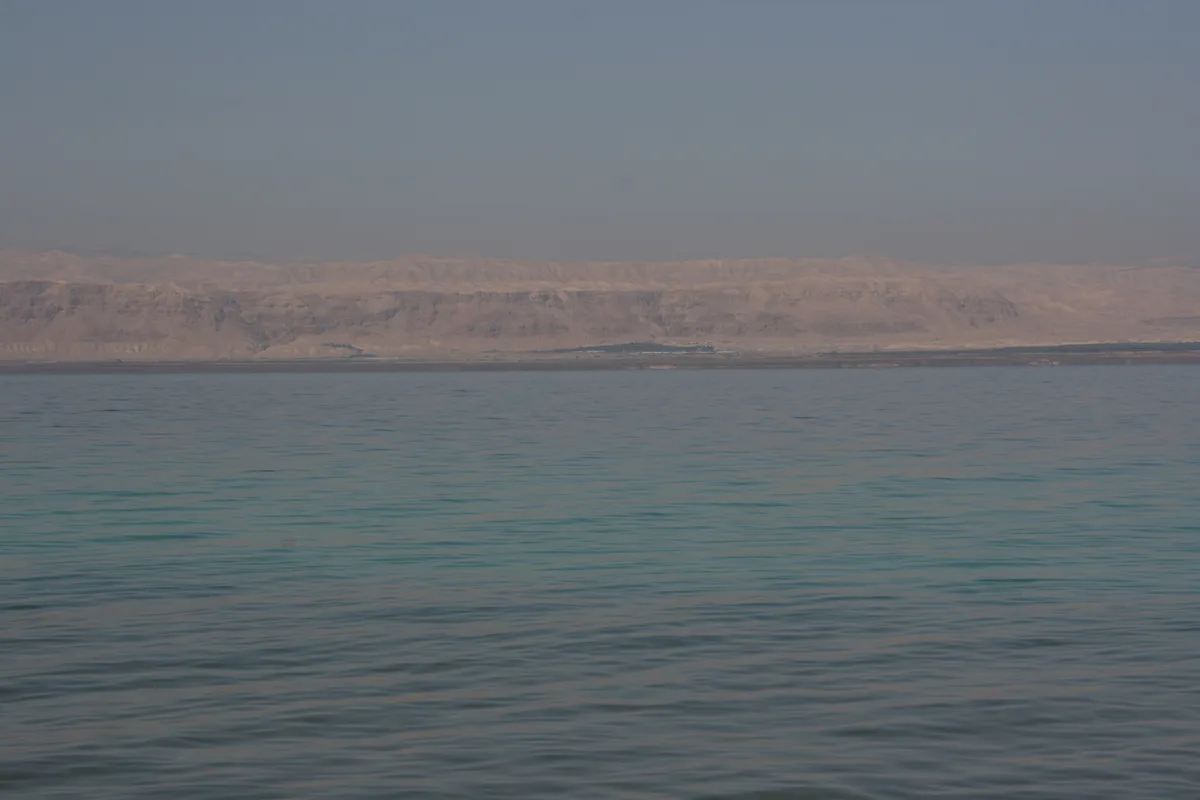
Stand on the shore and the geography becomes physical. Behind you, the Moab plateau climbs steeply eastward towards Madaba and Amman, roughly 1,200 metres above where you stand; in front of you the water lies flat and opaque, with the hills of the West Bank softened by haze across it. The air is measurably denser down here, and the light has a filtered, golden quality photographers chase. None of it is decoration. The rift made the depth, the depth made the brine, and the brine is why you are here.
A Lake That Is Falling – Retreat, Salt Flats and Sinkholes
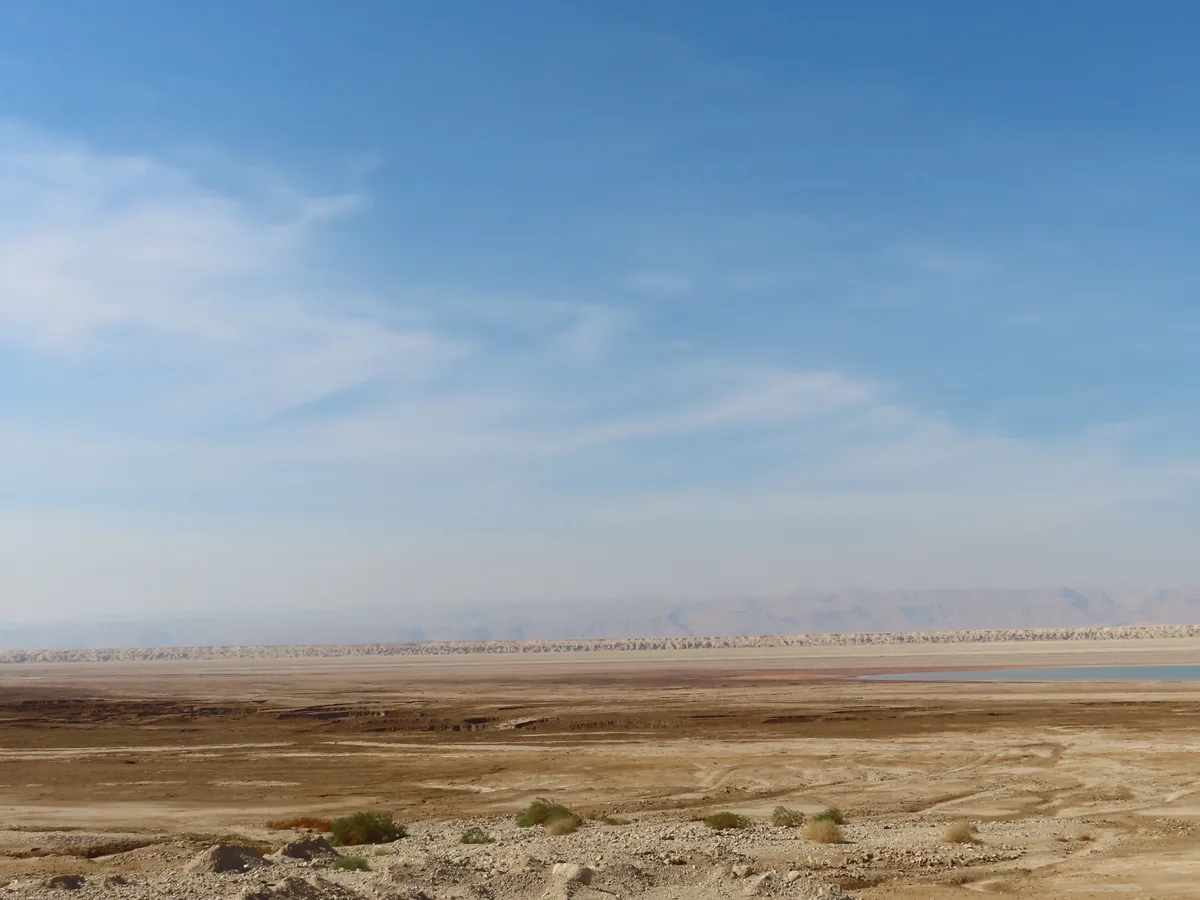
The Dead Sea is disappearing at a pace you can measure within a single human lifetime. In the middle of the twentieth century its surface stood at roughly 395 to 400 metres below sea level. By the mid-2010s it had fallen past 430 metres below, and the most recent published measurement, dated 2025, puts it at about 440 metres below – a drop of some 30 metres in a few decades, continuing at around a metre a year. Its surface area has shrunk from about 1,050 square kilometres in 1930 to roughly 605 square kilometres in recent measurements. Old photographs of shore facilities standing at the water’s edge, now stranded far from it, are not curiosities here. They are the local condition.
The causes are plain, and no serious dead sea jordan guide should hide them. The Jordan River, the lake’s main feeder, is heavily diverted upstream by Jordan, Israel and Syria for cities and farmland, so only a fraction of its historic flow now reaches the lake. At the south end, the mineral industries pump brine into evaporation ponds, and evaporation under the desert sun does the rest. Grand proposals to replenish the lake from the Red Sea have been studied for decades and shelved; nothing operating reverses the fall. The shore you visit is a landscape in motion, not a monument in stasis.
The retreat has a dangerous side effect, and it is the single most important safety fact in this guide after the floating rules themselves: sinkholes. As the level drops, fresher groundwater replaces the brine beneath the shore and dissolves a buried salt layer, leaving cavities that collapse without warning. Thousands have opened around the Dead Sea in recent decades – more than 6,000 by widely cited counts – and on Jordan’s eastern shore they cluster in farming country such as Ghor Al-Haditha, where researchers mapping from the air counted over 1,200 between the 1980s and 2017, with hundreds more since. Roads, fields and buildings have all been damaged.
For a visitor, the lesson is simple and absolute. The managed beaches are monitored, fenced and built on checked ground; the wild shore is not. Never climb a fence for a private float, never walk out onto inviting empty salt flats away from a facility, and treat warning signs – you will see them, in Arabic and English, along stretches of the shore road – as the literal truth. The empty, beautiful, unmanaged shoreline is the one part of the Dead Sea that can genuinely hurt you before the water ever gets the chance. Your float belongs inside a gate, and the sections below exist to help you choose the right one.
Why You Float – Salt, Density and the Strangest Swim on Earth
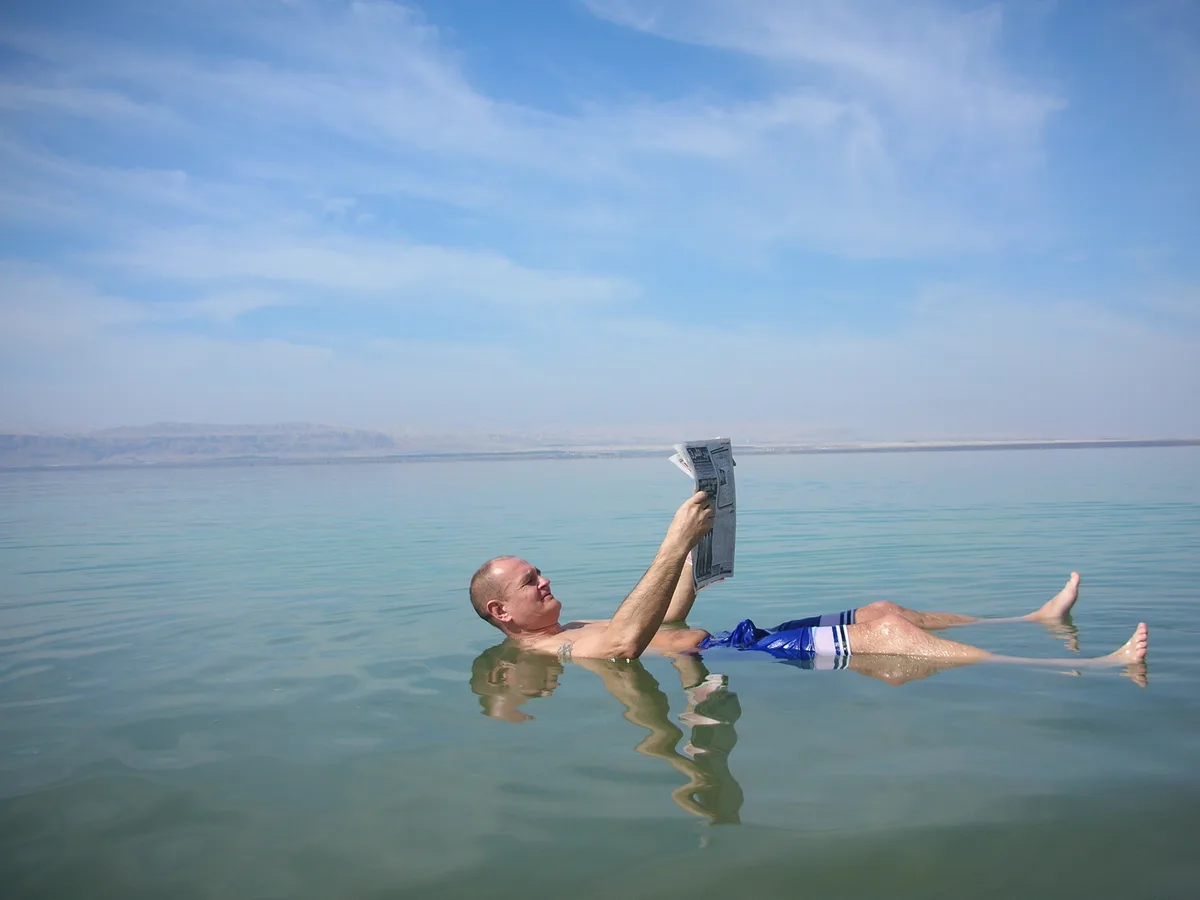
The physics is worth understanding, because understanding it makes you safer. Ordinary seawater holds about 3.5% dissolved salt. The Dead Sea holds about 34% – 342 grams of salt in every kilogram of water, a figure measured at 34.2% – which makes it roughly 9.6 times as salty as the ocean and gives the water a density of about 1.24 kilograms per litre. You, like most fresh water, are close to 1.0. Put a less dense object in a denser liquid and it rides high: that is the whole trick. Your body sits in this water the way a cork sits in a glass, most of you above the surface, which is why the classic photograph – floating on your back, reading a newspaper, feet in the air – is not a stunt. It is simply what the water does to everyone.
The salt itself is not table salt, or not mostly. Alongside sodium chloride, the brine is rich in magnesium, potassium, calcium and bromine salts – which is why it feels slick, almost oily on the skin, bitter beyond description on the tongue, and vicious in any cut or freshly shaved patch of skin. It is also why almost nothing lives here: fish carried down the Jordan River die quickly, and only specialised microbes and algae persist. The “dead” in the name is earned.
Here is what the density means in practice, and every dead sea jordan guide should spell it out. You cannot really swim. Front crawl is nearly impossible, because the water lifts your legs until your feet kick air and pushes your face towards the surface it wants kept out. You cannot stand in deep water either – your feet will not reach down the way instinct expects – and you should never try to put your head under. The correct technique is no technique: wade in until the water takes you, lean back, spread out, and let it hold you. Most people find the first minute faintly alarming and the second minute hilarious. By the third, they are posing for the photograph.
A last piece of physics with a practical edge: because you float so high, wind matters. A breeze pushes a high-riding body like a raft, and bathers can drift further than they intended. Stay close to shore, where the attendants can see you.
Floating Safely – the Rules That Actually Matter
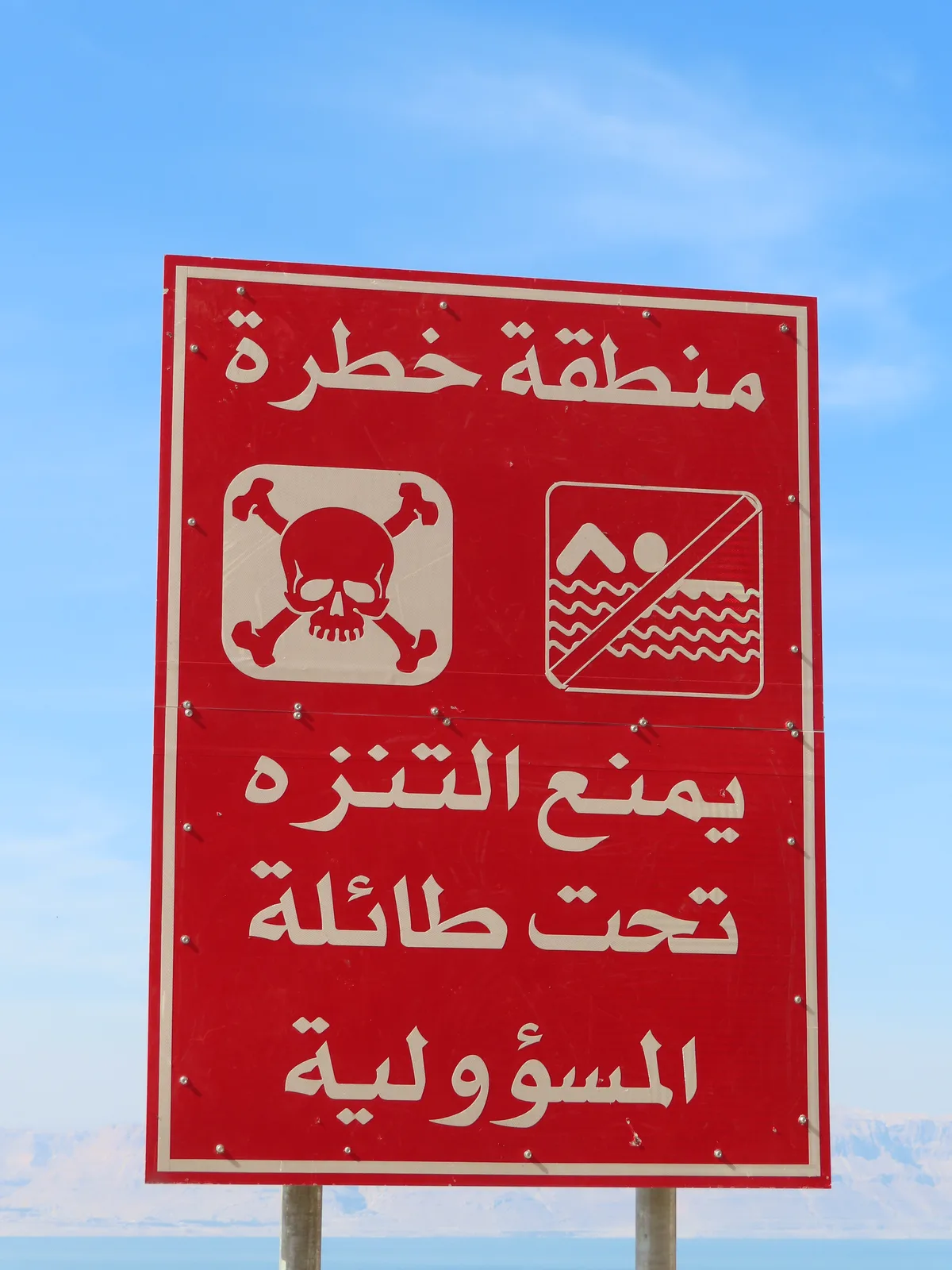
The Dead Sea’s safety rules are standard guidance at every beach on both shores, repeated by lifeguards, resorts and the official Visit Jordan guidance, and they exist because the same density that makes floating effortless makes mistakes unusually punishing. Learn them before you get in, not after. None of them is difficult. All of them are ignored daily by someone, to their cost.
Float on your back, and only on your back. Do not dive, do not jump in, and do not splash – a face full of this brine is a medical problem, not a joke, because the salt load can badly damage eyes. Keep the water out of your eyes and mouth, and never swallow it: even a small amount swallowed is dangerous, and anyone who swallows Dead Sea water, or gets it in their eyes and cannot clear it by rinsing with fresh water, should go straight to the beach attendants and seek medical help. If brine does reach your eyes, get out and rinse with clean fresh water – every managed beach has showers and taps at the water’s edge for exactly this. Do not rub. Rinse, blink, rinse again.
Limit your time. Ten to fifteen minutes in the water is the standard advice, and it is enough; come out, rinse, rest in the shade, and go back in later if you want more. Prolonged soaking dries and irritates the skin and quietly dehydrates you in the desert heat. Protect your skin’s weak points: the brine finds every cut, razor nick and insect bite, so avoid shaving immediately before a float, cover small wounds, and expect a sting that tells you exactly where they are. Wear water shoes or sandals you can swim in – the beach is crusted with sharp salt and hot stone, and bare feet get cut, which the brine then finds. Drink fresh water through the day, wear serious sunscreen and a hat, and remember that the sun down here is desert-strong even though the extra atmosphere filters it slightly.
Some visitors should take extra advice before floating at all. Anyone with open wounds, certain skin conditions, heart or blood-pressure concerns, and anyone who is pregnant, should check with a doctor rather than a travel guide – this dead sea jordan guide gives the standard beach rules, not medical clearance. Children float within arm’s reach of an adult, for shorter spells: a child’s instinct to splash and duck is precisely what this water punishes. Finally, never float alone, never float after drinking alcohol, and never treat the lake’s calm as a promise.
The Black Mud – What It Is, and What It Is Not
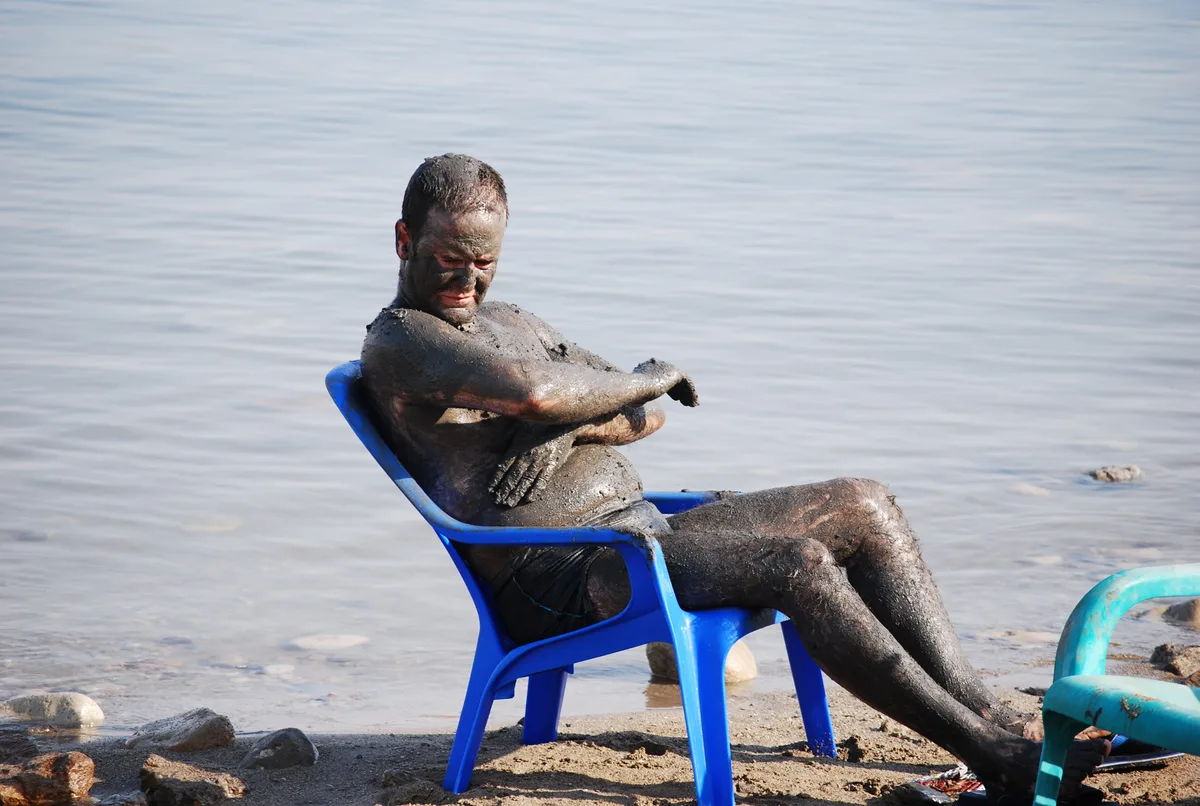
At the waterline of the northern shore, in the shallows and in tubs and buckets set out on resort beaches, sits the Dead Sea’s second famous substance: a fine, dark, mineral-rich mud, grey-black and smooth as wet clay. The ritual is simple and centuries old. You smear it over your skin – attendants will help, neighbours will offer, strangers will photograph – let it dry in the sun until it tightens and lightens, then rinse it off, in the sea first if you like and then properly in the freshwater showers. Your skin afterwards feels noticeably smooth and polished, the way skin feels after any good clay mask and a thorough exfoliation. People have been doing this since antiquity; tradition links the shore’s mud and salts to Herod the Great’s bathing and to Cleopatra’s cosmetics, and the official tourism literature repeats those stories proudly.
Now the honesty, because this is where most writing about the Dead Sea leaves the truth behind. The mud is genuinely rich in the same minerals as the brine – magnesium, potassium, calcium, bromine salts – and Dead Sea preparations are widely used in skincare, and studied in dermatology, particularly around conditions like psoriasis, where the combination of mineral bathing and the shore’s filtered sunlight is a long-standing treatment tradition at clinics on both shores. That is a real and interesting heritage. What it does not mean is that one holiday mud pack cures anything. This dead sea jordan guide will not promise you healing, detoxification or younger skin, because no honest guide can. What a mud session reliably gives you is the ritual itself: slow, silly, photogenic and genuinely pleasant, ending with skin that feels very clean.
Practical notes. The mud is provided at resort beaches, usually at the waterline or a mud station; at the public beach it has traditionally been available too, sometimes for a small separate charge – arrangements change, so check what your ticket includes before you assume. Apply it away from your eyes and any broken skin, keep it off swimwear you love (it can stain pale fabric), and rinse thoroughly before using pools or towels, exactly as the beach staff ask. If you want to take the shore home, the mud and salts are sold everywhere in Jordan in sealed cosmetic packs; the raw shoreline is not a souvenir quarry, and digging or carrying out loose shore material is both unwelcome and, given the ground, unwise.
A word on the spa culture built on all this. The Sweimeh resorts run full spas – salt scrubs, mud wraps, mineral pools – and for many visitors the spa, not the lake, is the main event, especially in winter. That is legitimate: the lake supplies the ingredients and the story, the spa supplies the comfort. You are buying skilled pampering with remarkable raw materials at the lowest place on Earth, and that is quite enough without miracles.
Salt Formations and the Sculpted Shore
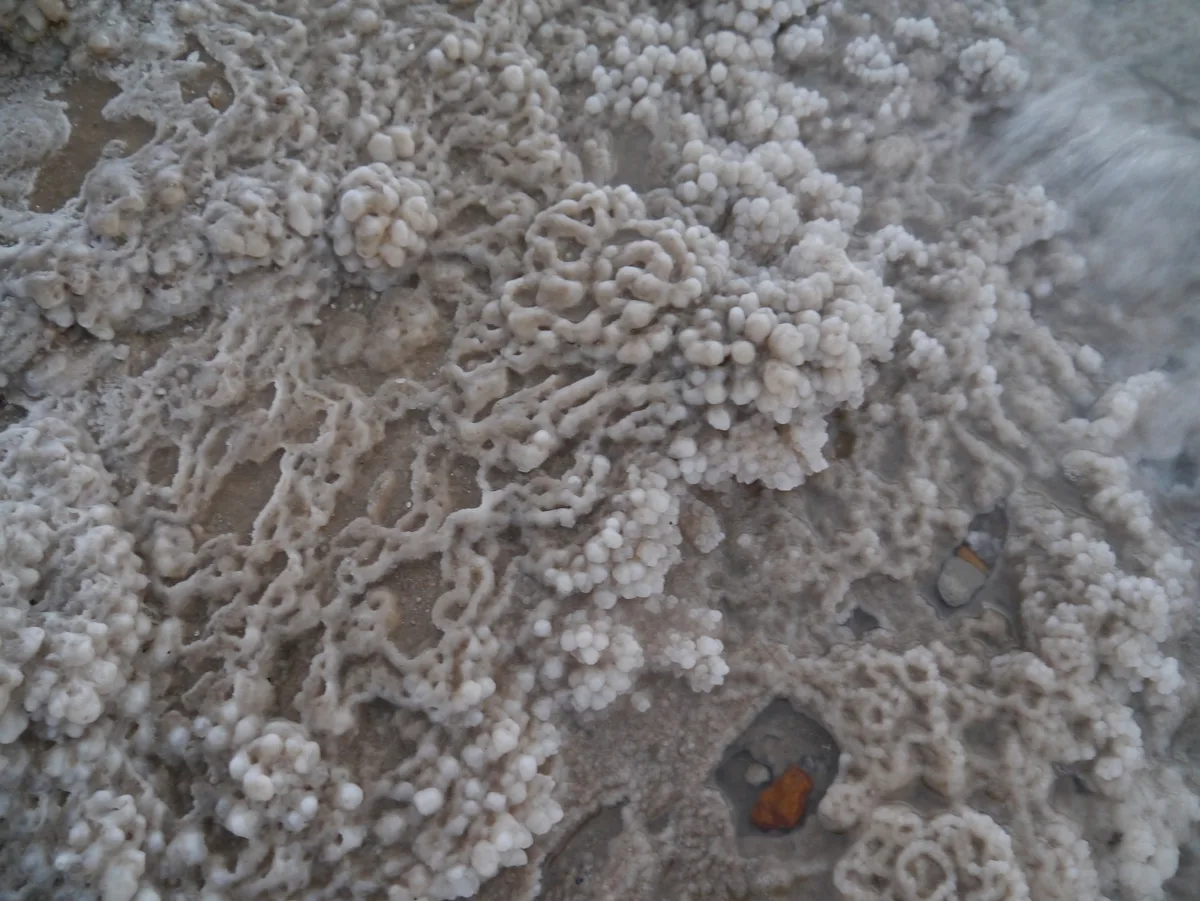
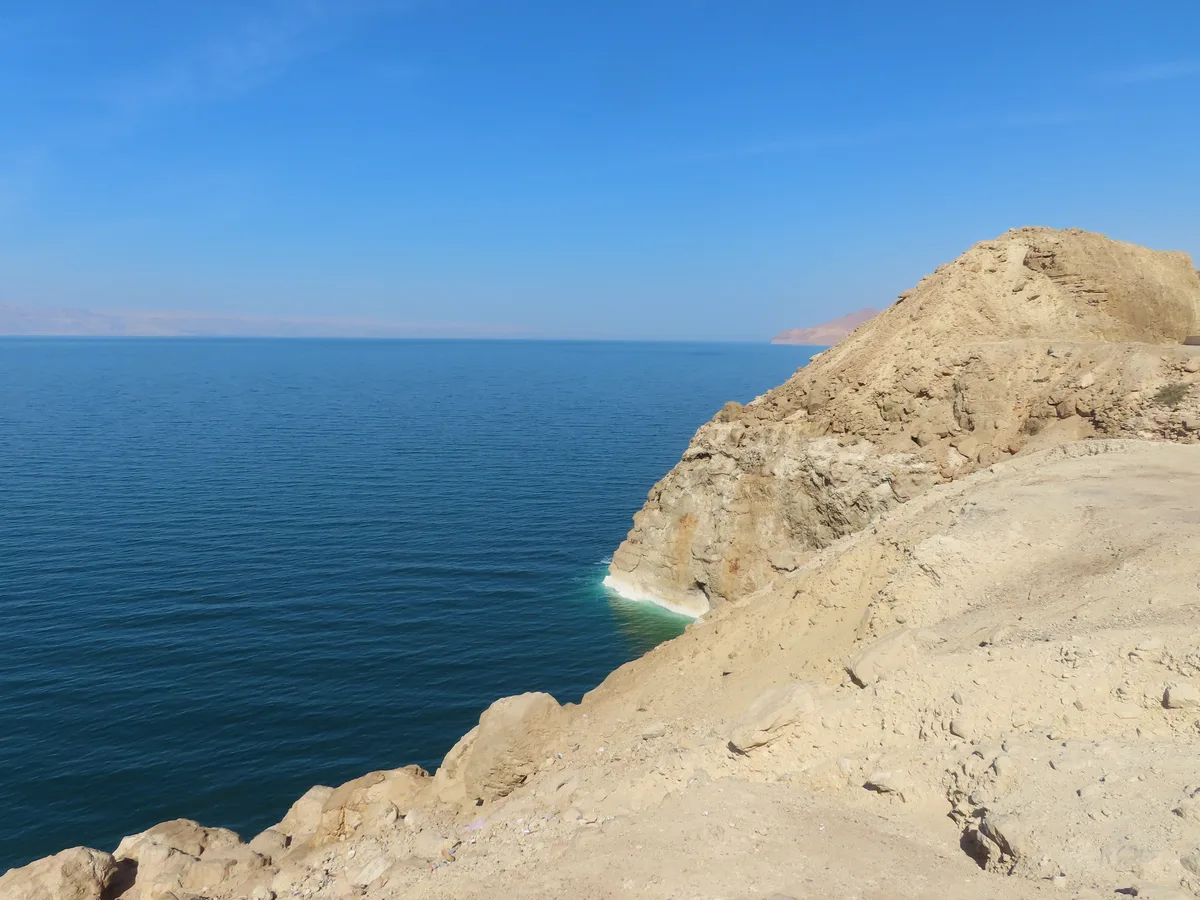
Walk any managed beach to its edge and look down. The Dead Sea decorates its own shoreline. Where brine laps and evaporates it precipitates salt in crusts and rinds – around rocks, along the waterline, over abandoned objects – building white collars and lacy crystal gardens that grow, dissolve in winter floods and grow again. In the shallows, rounded salt formations mushroom from the lakebed, and the beaches themselves are armoured with salt-cemented pebbles. Since the 1980s the deep water has been so saturated that excess salt rains slowly onto the lake floor as crystals, a phenomenon scientists describe as salt snow. The shore is quite literally being salted into sculpture by the lake’s chemistry, and the crusts under your water shoes – sharp, beautiful and the reason for those shoes – are the exhibit at ground level.
The formations make the retreat visible in a way statistics cannot. Old waterlines stripe the shore rocks well above today’s water. Jetties, steps and beach structures built for an earlier level now stand high and dry, with new access built below them – at several beaches the walk from the changing rooms to the water has lengthened noticeably over the years, and staff will tell you so. A photograph of your float, taken at a resort beach, may show yesterday’s shoreline behind you like a tideline on a bath. Take the picture anyway; then look at what it is showing you. Few famous landscapes let you see planetary change at this speed without a graph.
Where should you look for the best of it? The most photographed salt formations on the Jordanian side lie along the wilder southern stretches of the northern basin and around the Lisan, but remember the sinkhole rule: admire formations from managed beaches, viewpoints and the shore road, not by striking out across empty flats. Resort beaches maintain their own salt-encrusted rocks and waterline crusts precisely because guests love them, and the Panorama viewpoint, covered below, frames the whole sculpted edge from above. The formations are fragile as well as sharp – another reason to look, photograph and leave them standing for the next fall in level to redraw.
There is also a working salt landscape. Jordan’s potash industry, based at the southern ponds, harvests the lake’s potassium salts for fertiliser shipped worldwide – the same chemistry that crusts your beach feeds crops on other continents. The Dead Sea is simultaneously a wonder, a clinic of long tradition, a hazard zone and a mine, and holding all four truths at once is the beginning of understanding it.
Where You Can Actually Get In – Resort Beaches and Day Passes
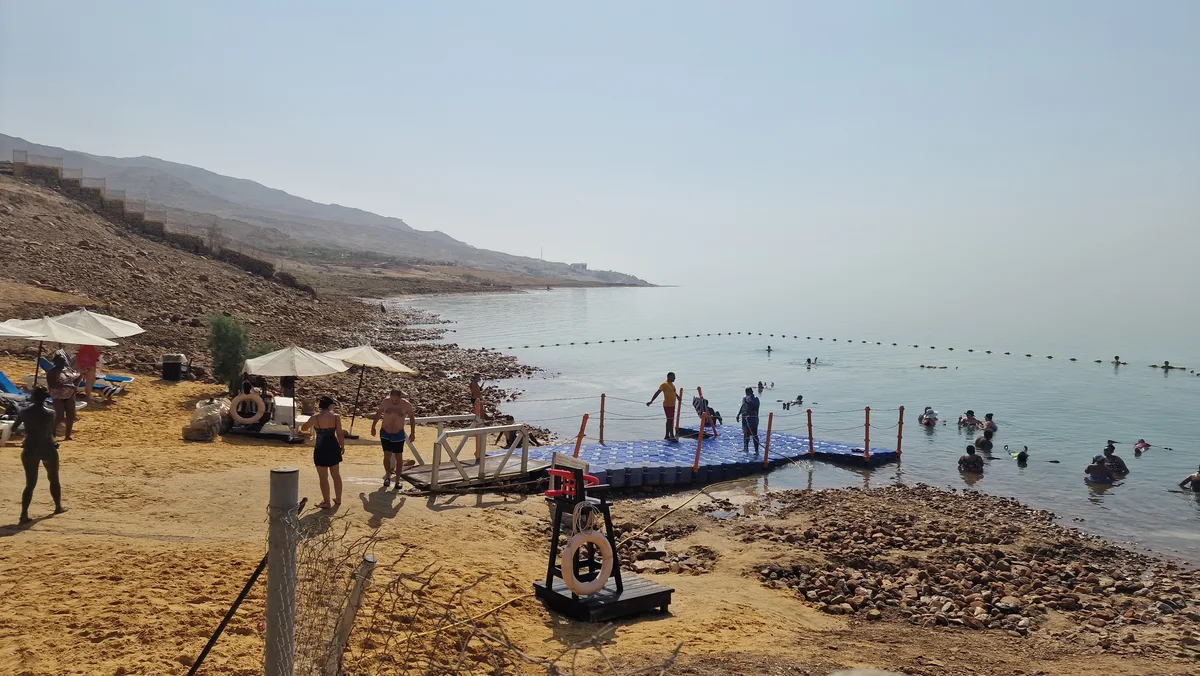
Here is the practical heart of any dead sea jordan guide. You do not need to sleep at the Dead Sea to float in it. The northern-shore resorts sell day passes to outside guests, and for most visitors – anyone based in Amman, Madaba or on a touring itinerary – the day pass is the standard, sensible way in. What a pass buys you is not really the water, which is the same water everywhere. It buys the infrastructure the float requires: a maintained beach on checked ground, a marked swimming area with attendants, freshwater showers at the waterline (non-negotiable – the salt has to come off), changing rooms, shade, towels, usually the mud station, and usually access to the resort’s freshwater pools for the long, lazy part of the day. Lunch is often bundled or available. Prices and inclusions vary by property and season and change without asking travel writers, so this guide deliberately prints none: check the property’s own current day-visit terms when you plan, and compare what is included, not just the headline figure.
Choosing between resorts is about the shape of your day. A large resort gives you pools, gardens and a beach that runs like a small town; a smaller property gives you a shorter walk and a quieter beach. All sit on the same northern shore, look across the same water, and the float itself is identical at every one – anyone who tells you one resort’s Dead Sea is better than another’s is selling you something. Choose on facilities and fit.
How the visit runs, whichever gate you choose: go down to the water first, while you are fresh; float in short spells; do the mud between floats; shower the salt off properly before pools or lunch, because dried brine itches and ruins towels; give the pool and the shade the middle of the day; and be on the beach for the sunset, which is the shore’s daily show. Build the day backwards from that sunset.
Two honest catches. First, day passes are not guaranteed: on Jordanian weekends and holidays the resorts fill with local families, and passes can sell out – if the Dead Sea is a fixed point in a tight itinerary, book ahead rather than arriving hopefully. Second, stay inside the buoys and pontoons of the managed strip, where the bottom is known and attendants can see you. The lake’s dangers are all outside the ropes.
The Public Beach Question – Amman Tourist Beach and the Free Shore
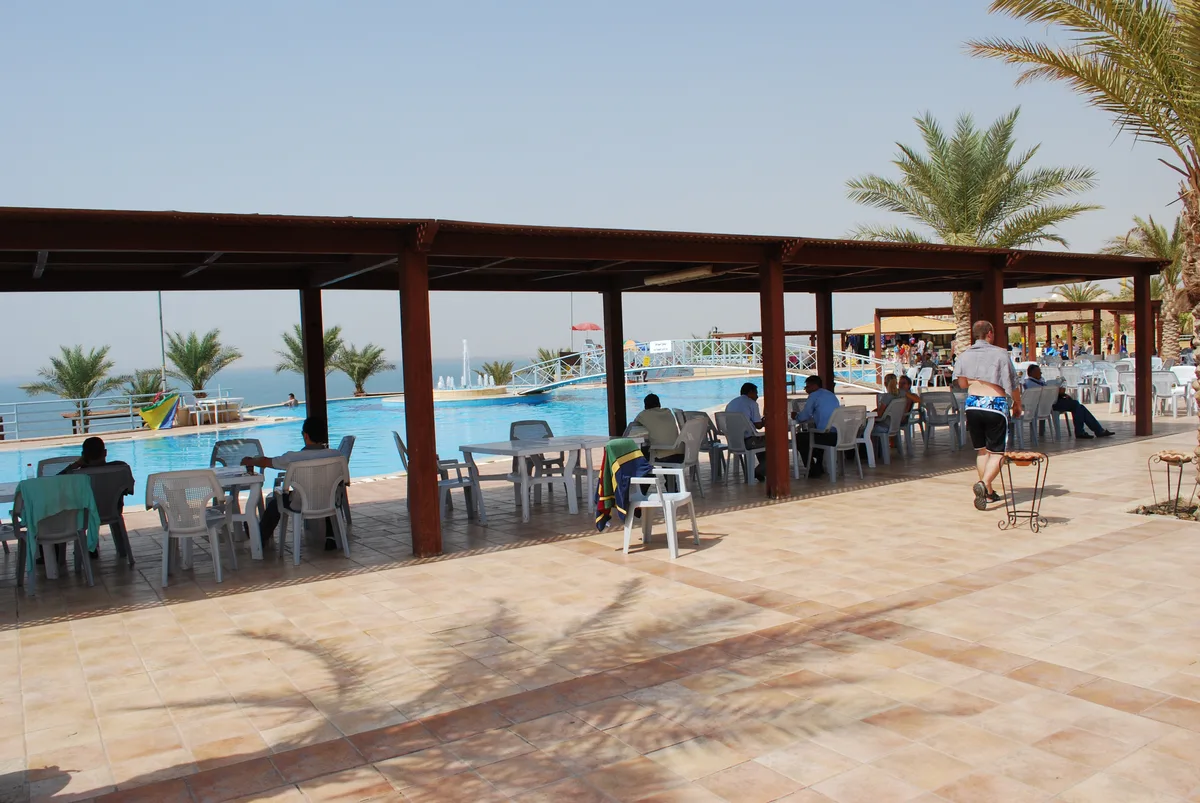
Not everyone wants a resort, and Jordan has long maintained a public alternative. For years the name to know was Amman Tourist Beach – also called Amman Beach – the municipal-style facility a short drive south of the resort strip, offering the same float at a plain, local price: a managed beach, showers, changing facilities and shade, without the pools-and-gardens world of the hotels. The official Visit Jordan site still presents Amman Tourist Beach as the day-tripper’s option, and has recently also promoted a renewed Dead Sea Public Beach, a Corniche waterfront and a promenade along this shore, as the public realm here is redeveloped. Names, operators and entry arrangements on the public shore have changed more than once in recent seasons and were changing again as this guide was researched.
So here is the durable advice, written to survive the next rebranding. There is a public, lower-cost way into this water, on the same northern shore, a few minutes from the resorts. Before a trip, verify its current name, opening arrangements and what entry includes – specifically whether swimming, showers and mud are in the ticket or charged separately, as public-beach tickets here have historically been tiered. Expect a simpler facility than a resort: a more local crowd, especially on Fridays and holidays, more modest shade and catering, and the same magnificent water. For a traveller whose priority is the float itself and whose budget is real, it is a perfectly good gate, and for many Jordanians it is the Dead Sea they grew up with.
And the free shore? Travellers regularly ask whether they can simply park on the shore road and walk into the water at no cost. The honest answer in this dead sea jordan guide is no – or rather, that the question misunderstands the shore. Between the road and the water lie private land, farmland, unstable salt flats and fenced hazard zones; the apparently empty stretches are empty for reasons, including the sinkholes described above. There is no maintained free beach, no lifeguard, no shower – and the shower is not a luxury, it is how the salt comes off. Pay one of the gates, public or resort. It is the cheapest safety equipment in Jordan.
What the public option changes is who the Dead Sea belongs to. The resort strip can make the shore feel like a private club sitting on a wonder of the world; the public beach is the reminder that it is also a Jordanian place – school trips, extended families, picnics. That local texture is worth as much as any spa. Go informed, go early on busy days, and confirm the current arrangements first.
The Resort Strip at Sweimeh – Staying on the Shore
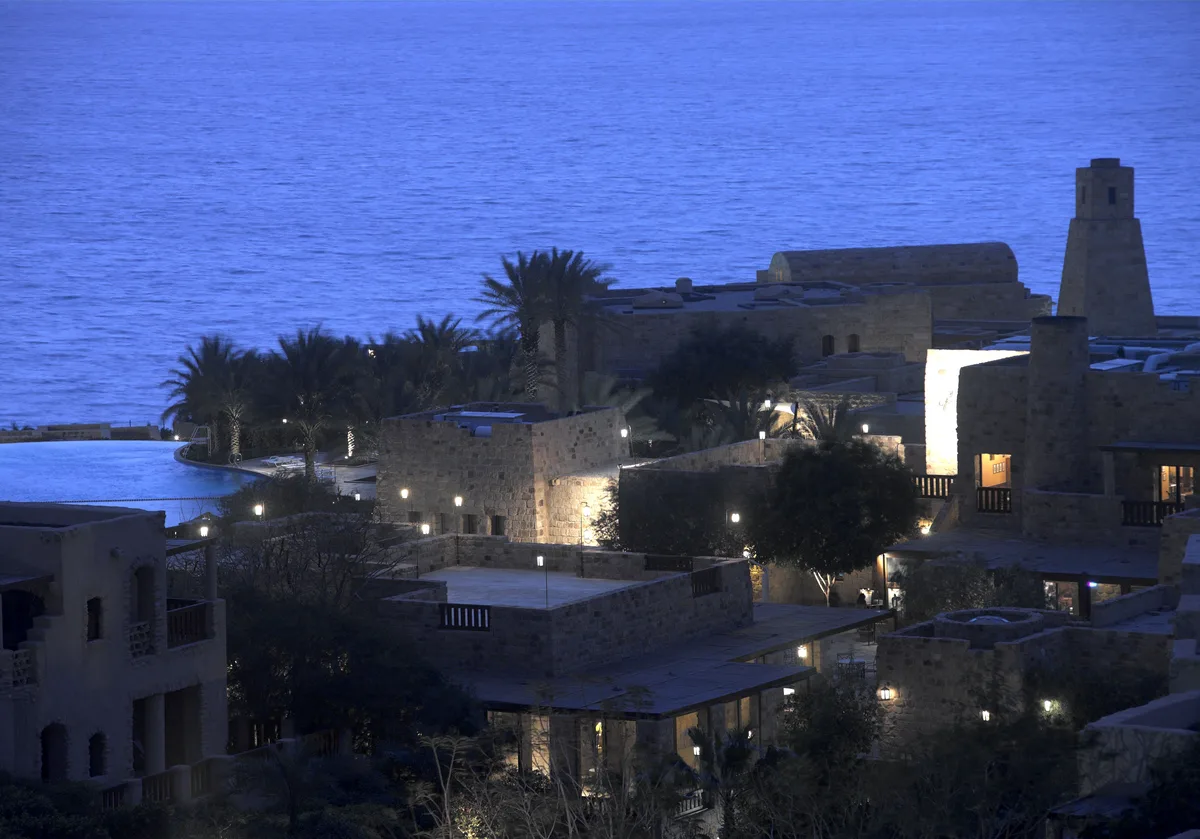
Sleep on the shore and the Dead Sea changes character. The day visitor gets the float; the overnight guest gets the shore’s two great performances – the sunset, when the far hills turn rose and the water goes metallic, and the early morning, when the lake is glass, the beaches are empty and the light comes over the Moab escarpment behind the hotels. The strip that makes this possible is Sweimeh, the village area at the northern end of the Jordanian shore where, along a few kilometres of the Dead Sea Road, Jordan has built its cluster of shore resorts: large international-name properties and Jordanian resorts side by side, each a self-contained world of gardens, pools, spa and private beach, with the King Hussein Bin Talal Convention Centre anchoring the strip’s events business and a small mall serving the hotels.
Describing Sweimeh honestly means resisting the brochure in both directions. It is not a town you stroll – no medina, no cafe row; your resort is your destination. In exchange, the strip delivers what no day trip can: total ease. Float before breakfast, take the spa at noon, float again at golden hour, and watch the far shore’s lights come on across the lowest water on Earth. Couples on a Jordan tour commonly give it one night between Madaba and Petra and call it the rest day the itinerary needed.
Choosing a property, without fake reviews: this guide names no favourite and prints no ratings. The properties differ in scale, age, garden design, spa ambition and price band, and every one fronts the same sea. Decide on checkable things – a room facing the water, what the beach access involves (a garden stroll at some, a shuttle or long stair at others), spa and pools if they matter, terms for children if you are bringing them. The float will not disappoint you at any of them; the lake does the work.
One more Sweimeh truth for planners. The strip is a base, not a trap: Bethany is minutes north, Mount Nebo and Madaba are half an hour uphill, Amman is about an hour, and the King’s Highway south to Petra starts at your door. Plenty of travellers sleep two or three nights here and tour from the shore, returning each evening to the water. In winter, when the plateau cities are cold, the shore – hundreds of metres lower and markedly warmer – earns that loyalty honestly.
Getting to the Dead Sea From Amman and the Airport
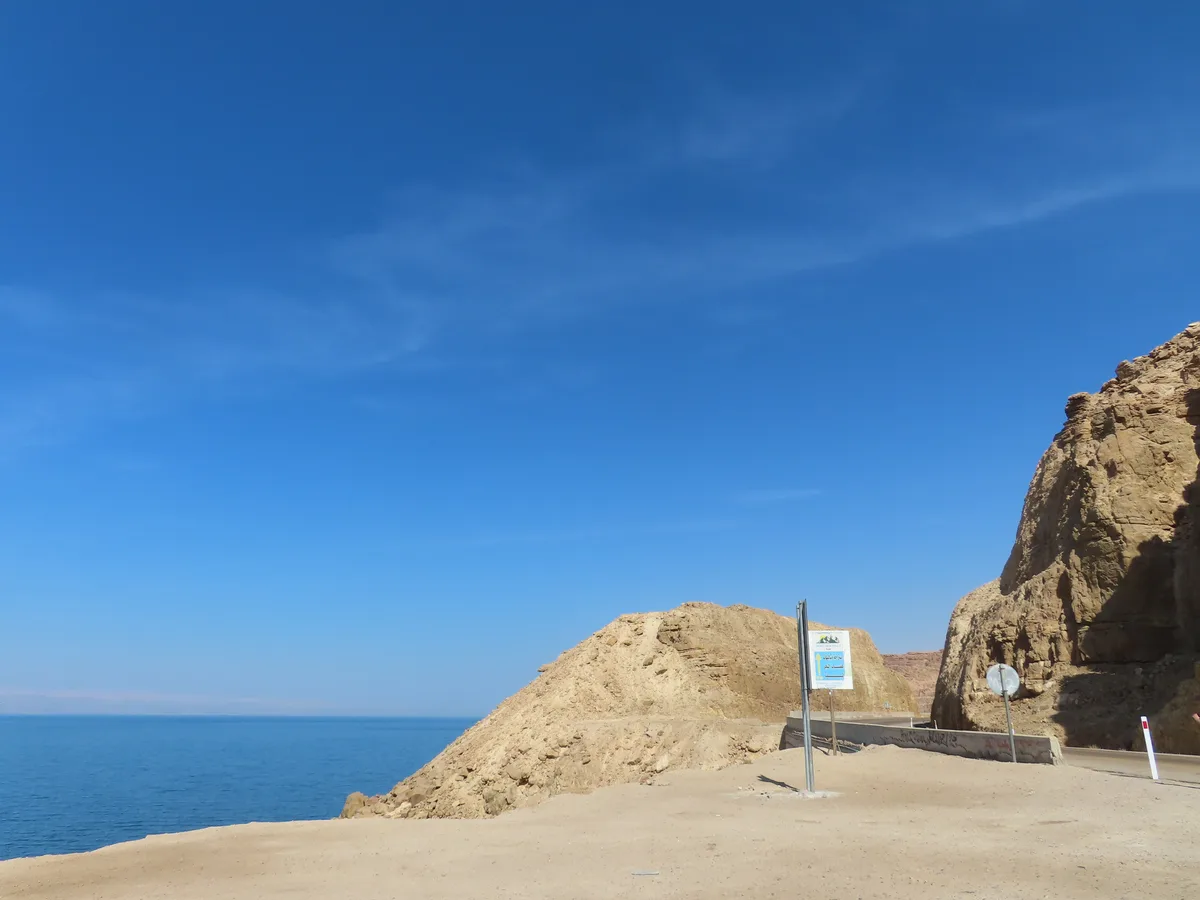
The Dead Sea is the easiest major sight in Jordan to reach, which is why it slots into so many itineraries. From Amman, the shore lies roughly 50 to 55 kilometres away – call it an hour’s drive in normal conditions, descending from the capital’s hills, at 750 metres above sea level and more, down through the plateau edge to 440 metres below it. Your ears will register the trip even if you sleep through it. The main approaches are the direct descent road from Amman and the route via Madaba and Mount Nebo, which is longer in minutes and richer in everything else; most first-time visitors should take the Nebo route one way and the direct road the other, and see both. From Queen Alia International Airport, south of Amman, the shore is also about an hour or less by road, which makes a first or last night at the Dead Sea a genuinely practical airport strategy – land, descend, float, sleep; or float at dawn and be at departures by mid-morning.
How you travel matters more than how long it takes. A hire car gives you the shore on your own schedule and pairs naturally with Nebo, Madaba and the King’s Highway; the driving is straightforward highway, the descent is engineered and graded, and the shore road itself – the Jordan Valley highway running south past the resorts towards the Lisan and Aqaba – is a fine piece of road with viewpoints along it. A private driver or taxi for the day is the classic alternative, and drivers in Amman know the Dead Sea day circuit by heart: Nebo, Madaba, a resort beach, home by evening. Agree the full route, the waiting time at the beach and the total price before you set off, in dinars, as you should for every Jordanian taxi day. Organised day tours from Amman bundle transport with a resort pass and often with Bethany or Nebo; they are the zero-effort option and, bought carefully, can cost little more than assembling the parts yourself.
Public transport is the weak leg, and this dead sea jordan guide will not pretend otherwise. Jordan’s JETT coach company has run tourist shuttles between Amman and the Dead Sea, and local buses serve the valley towns and the public beach area, but services change and are not built around resort gates. If budget forces the question, verify the current shuttle situation before travelling and target the public beach, the gate buses most nearly reach. For everyone else, wheels you control are the honest recommendation.
A few road truths to finish. The descent is long and brake-testing; drivers should use gears, not just brakes. The shore road passes fenced, signed hazard stretches, so viewpoint stops belong at marked pull-offs only. And in winter, rare heavy rain can send flash floods down the wadis crossing the road and close it at short notice – never cross flowing water. The lake is going nowhere; arrive an hour later instead.
When to Go – Heat, Season and the Shape of the Day
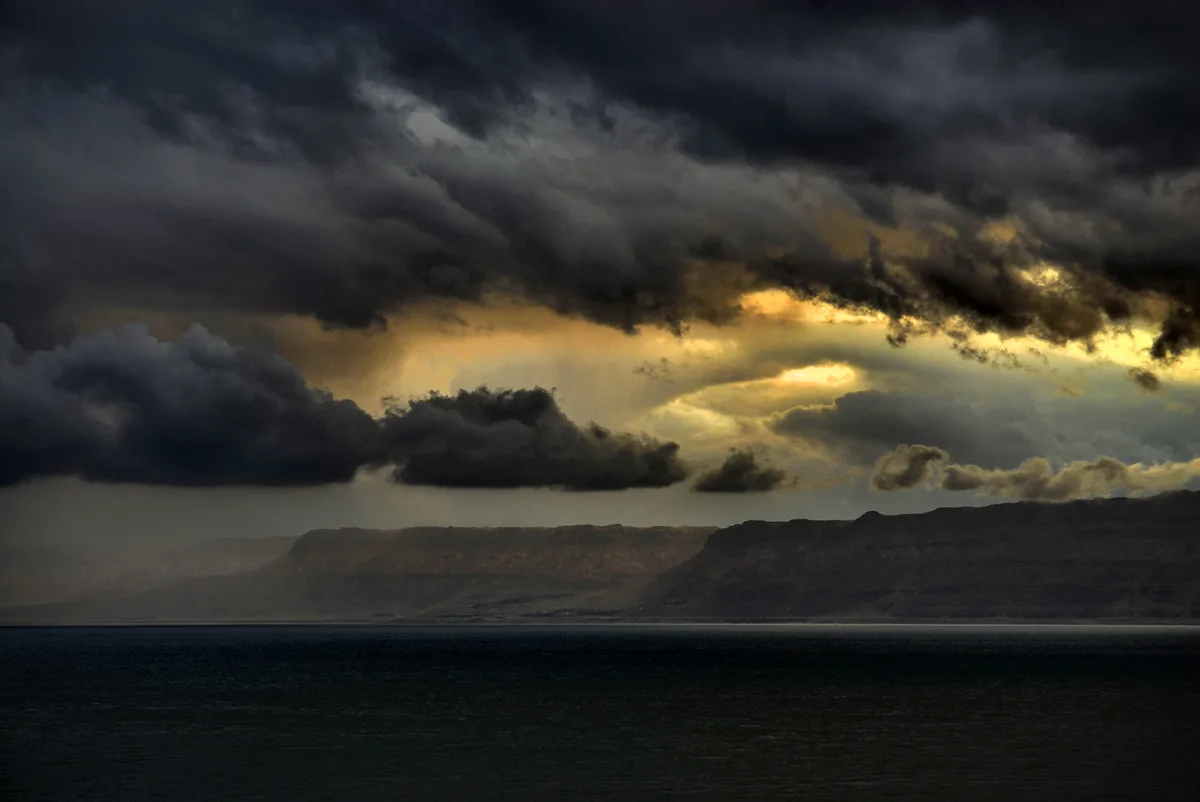
You can float in the Dead Sea in every month of the year, which is not the same as saying every month floats equally well. The shore has a hot desert climate with a twist: sitting hundreds of metres below sea level, it is markedly warmer than the Jordanian plateau in every season – winter days in Amman can be bitter while the shore sits in shirtsleeve warmth. Summer average temperatures run in the thirties Celsius, roughly 32 to 39 degrees, with extreme days well into the forties; winter averages sit around 20 to 23 degrees, and the water, which holds its warmth, stays swimmable through the short winter. Rain is a rumour – well under 100 millimetres a year, less in the south – so your enemy is never weather in the wet sense. It is heat, and sun, and timing.
The consensus seasons are spring and autumn, and the consensus is right: March to May and late September to November give you hot-but-humane days and a lake at its most inviting. Winter is the connoisseur’s alternative – mild air, warm water relative to the rest of Jordan, quiet beaches, and the plateau sights at their clearest; bring layers for Nebo and Madaba, an hour uphill in a colder climate. Summer is survivable if you surrender to its terms: float early and late, give midday to shade and pools, and follow the locals’ clock, not the tour bus’s.
Within any day, the golden hours are literal. Early morning brings the glassiest water and the far hills lit by a sun rising behind you. Late afternoon brings the famous display – the sun dropping towards the West Bank hills, the water turning to hammered metal. Spend one of those hours in the water or at its edge on an overnight stay, and you will understand the poems.
Crowds have a calendar too. Jordanian weekends – Friday and Saturday – and public holidays fill the resorts and the public beach with local families, and high season layers tour groups on top. None of it ruins the float, but it fills day-pass quotas and the Nebo viewpoint. Choose knowingly, and book the fixed points ahead in busy weeks.
Above the Shore – the Panorama Complex and the Lowest Point Museum
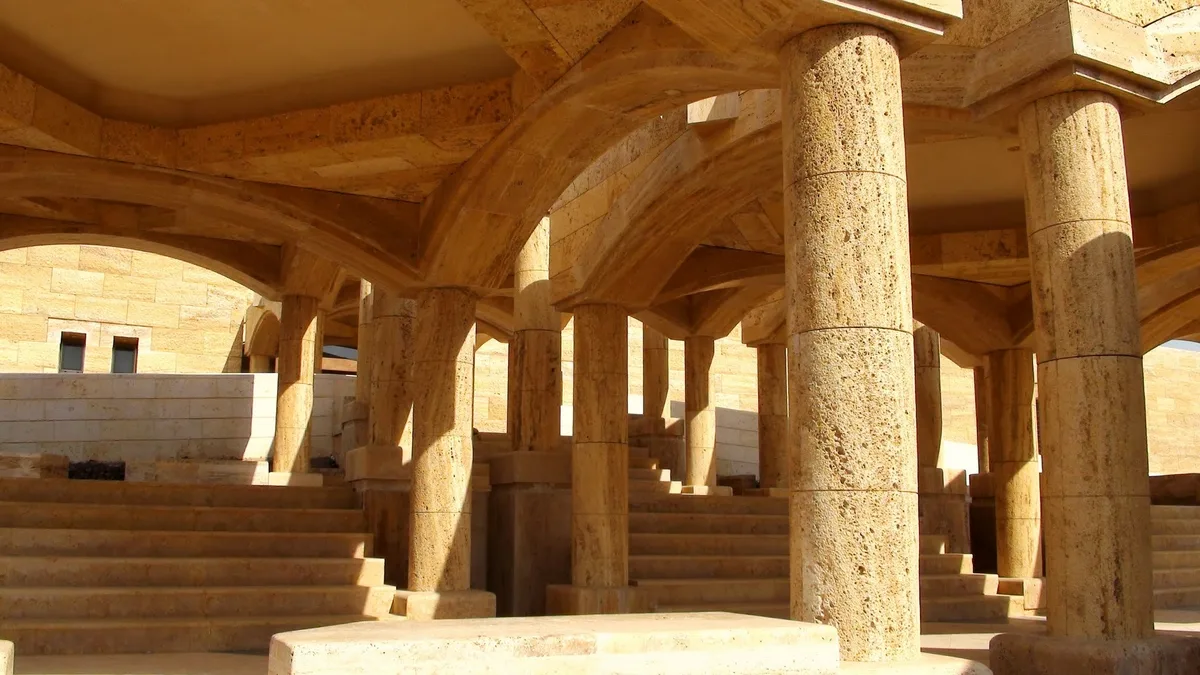
The best single view of the Dead Sea in Jordan is not from a beach. It is from the escarpment above the shore, at the Dead Sea Panorama Complex, perched on the Zara cliffs on the road between Madaba and the shore. The complex does three things: a small museum that explains the lake’s geology, ecology and crisis properly – the right orientation before or after a float; a viewpoint terrace that frames the whole northern basin, the Lisan and the far shore in one sweep; and a restaurant terrace famous locally for sunset. Come on your way down and the museum will make your float more interesting. Come on your way up at the end of the day and the sunset will do it instead. Either way, do not drive past it unknowing, as most tours do.
The Panorama is also the natural hinge of the classic shore day, because the road that passes it connects everything in this part of the guide: Madaba and Mount Nebo above, the resorts and public beach below, the Baptism Site to the north, and the hot springs of Ma’in in their side valley nearby. A dead sea jordan guide can be reduced, on a single day, to this road and its turnings. Everything else is commentary and swimming.
At the lake’s far south end sits the shore’s other small museum, and it is worth knowing even if few itineraries reach it: the Lowest Point on Earth Museum, near Ghor es-Safi by the southern basin, with Lot’s Cave on the hill above – a cave church site where tradition places Lot’s refuge after Sodom. Its collections include finds from the cave and remarkably preserved Graeco-Roman clothing, and its setting – beside the evaporation ponds, the farming villages and the sinkhole country of the southern shore – shows you the Dead Sea’s working, difficult half, far from the resort strip. If your route runs south along the shore road towards Petra or Aqaba, it makes a thoughtful half-hour. If it does not, the Panorama covers the museum duty for the north.
Both museums make the same point: the Dead Sea repays interpretation. From the beach it is a miracle of buoyancy and a spa day; from the escarpment it is a collapsing ecosystem, a pilgrimage landscape and an industrial frontier at once. Give it both readings.
Bethany Beyond the Jordan – the Baptism Site North of the Shore
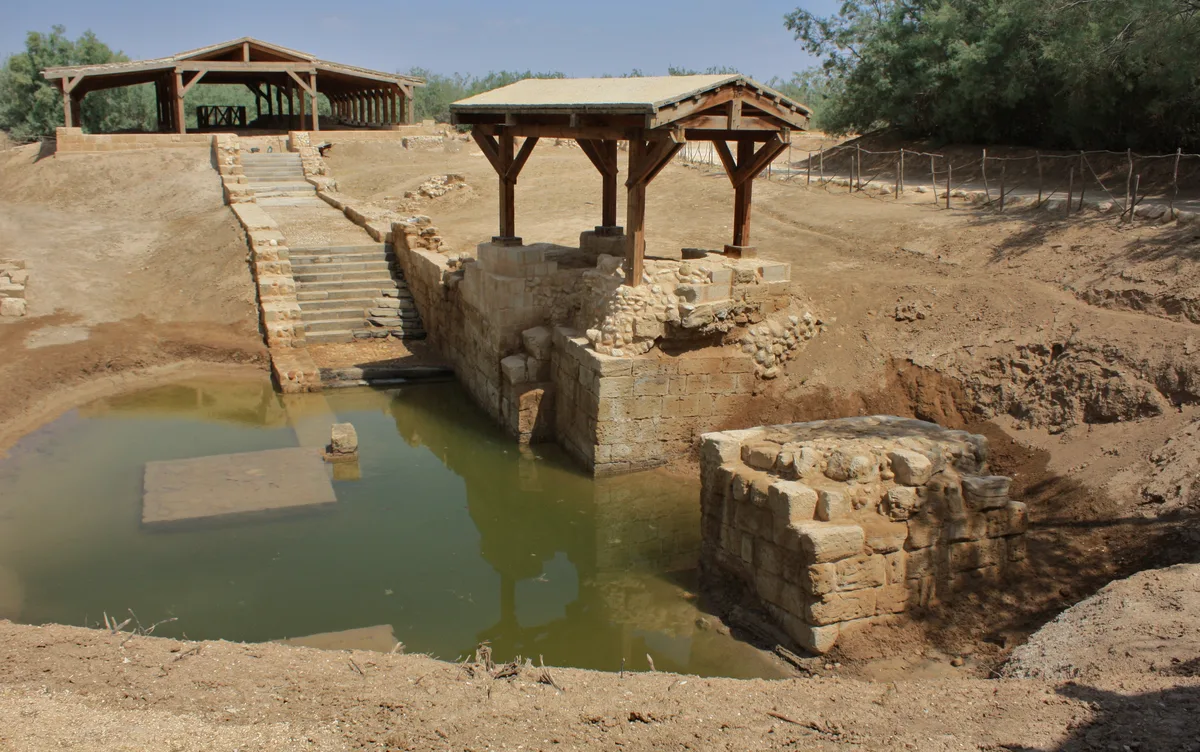
Nine kilometres north of the Dead Sea, where the Jordan River winds through its thickets towards the lake, lies the site Jordan knows as Al-Maghtas – Bethany Beyond the Jordan, venerated since Byzantine times as the place where John the Baptist baptised Jesus. In 2015 UNESCO inscribed it on the World Heritage List, and its position makes it the Dead Sea’s inseparable companion: almost every visitor to the shore is within a short drive of one of Christianity’s most significant sites, whether or not they arrive with faith. The official Visit Jordan Dead Sea page treats the Baptism Site as part of the shore’s own story, and so does this guide.
The visit is managed and unhurried by design. From the visitor centre, a shuttle carries you to the two archaeological areas UNESCO names: Tell al-Kharrar, Elijah’s Hill, with its monasteries and caves, and the river area of the churches of St John the Baptist – excavated churches, chapels, baptismal pools and pilgrim dwellings from the Roman and Byzantine periods onwards, in a quiet, tamarisk-shaded landscape. A walkway leads down to the Jordan itself, narrow and green here, where pilgrims enter the water. Whatever your beliefs, the atmosphere is real: a working pilgrimage site, not a museum, which asks for modest dress and a lowered voice.
Practical shape: allow the Baptism Site one to two hours, ticketed at its own visitor centre. It pairs with the Dead Sea in either order – many travellers do Bethany in the cool of the morning and float in the afternoon, the rhythm this dead sea jordan guide recommends. Check current opening arrangements when you plan, and note the site is at its most crowded around Epiphany in January, when thousands of pilgrims gather – spectacular to witness, difficult to simply visit.
Notice what the pairing gives you: in a single small compass, at the bottom of the world, the lake where almost nothing can live and the river where a world religion began. Give Bethany its own unhurried hours rather than a photo stop on the way to the beach, and the whole shore day deepens around it.
Mount Nebo and Madaba – the Viewpoint and the Map
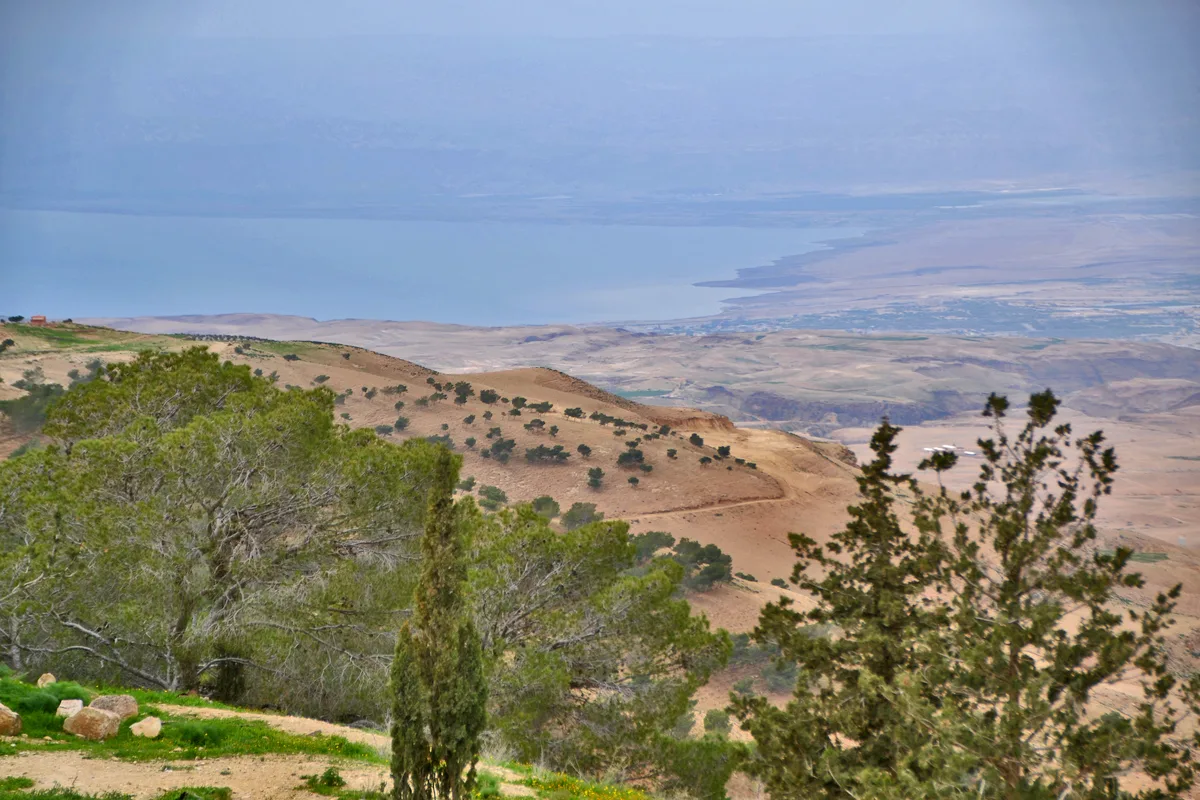
Every Dead Sea day should include the view from above it, and providence has placed the viewpoint inside a story. Mount Nebo, rising from the plateau edge roughly half an hour from the shore, is where tradition holds that Moses stood and looked over the Promised Land he would not enter – and the first thing in that view, spread below in the haze, is the northern Dead Sea and the Jordan Valley, with Jericho and, on the clearest days, the hills of Jerusalem beyond. The memorial church on the summit, built over Byzantine remains, protects superb mosaics, and the serpentine cross sculpture outside frames the valley in a thousand photographs. Come early, before the groups and before the heat haze thickens; by late morning on a poor day the view can close to white glare, which is the honest risk of every famous viewpoint and the reason this guide keeps telling you to start uphill early.
Ten minutes away lies Madaba, the shore’s other essential pairing: a living Jordanian market town built over Byzantine mosaics, most famously the Madaba Map – a sixth-century mosaic floor in St George’s Church that is the oldest surviving map of the Holy Land, drawn by craftsmen who had walked the land it shows. Find the Dead Sea on it, drawn as a boat-bearing lake with fish turning back from its bitter water – the map’s makers knew their lake. Madaba’s archaeological parks hold more mosaic floors, its streets hold mosaic workshops where the craft continues, and its restaurants make it the natural lunch stop of the whole circuit. Allow the town an unhurried hour; allow its map five full minutes of staring. It has earned them across fourteen centuries.
The circuit writes itself, and it is the day this dead sea jordan guide would hand any first-time visitor: Madaba in the morning, Nebo before the haze, down the escarpment past the Panorama for the float, and home or onwards by evening light. Our Jordan itinerary for 7 days builds exactly this pairing into its King’s Highway day, sleeping on the shore or in Madaba to start it right – because the Dead Sea, seen only from its beach, is half a sight. Seen from Nebo first, it is a destination you have already read like a map before you ever touch the water.
Already done Madaba and Nebo on a King’s Highway day? The shore’s other combinations – Bethany, the Panorama, Ma’in, Mujib – are waiting instead. The Dead Sea is not a detour from Jordan’s main routes; it is the low point, in every sense, around which the northern half of the country revolves.
The Shore’s Wild Side – Wadi Mujib and Ma’in Hot Springs
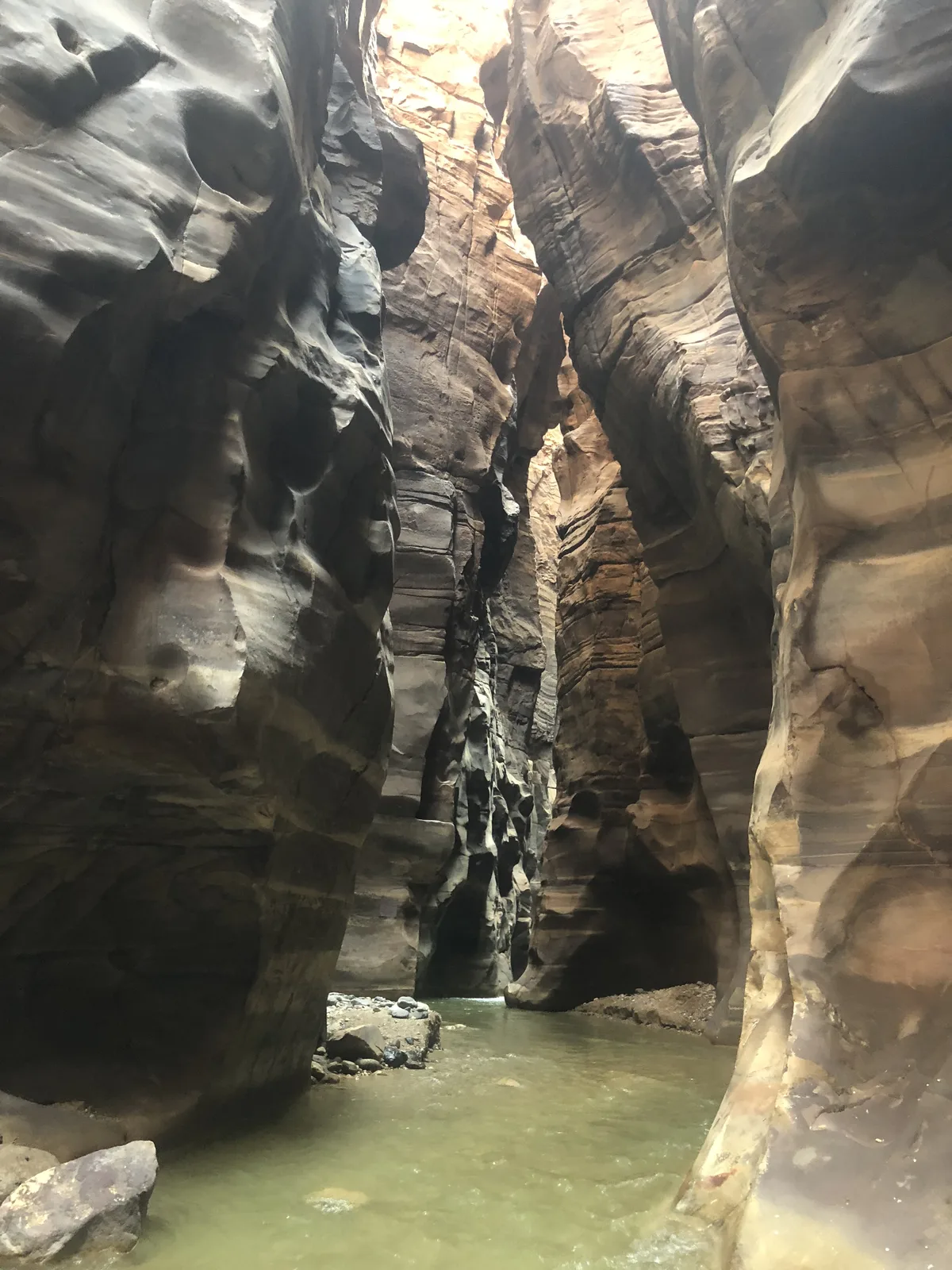
The eastern shore is not all beaches. Where the wadis cut through the escarpment, fresh water still reaches the lake, and the greatest of them is Wadi Mujib – the biblical Arnon – whose river has carved a canyon of Grand Canyon ambition straight through the plateau to the Dead Sea. The Mujib Biosphere Reserve, managed by Jordan’s Royal Society for the Conservation of Nature, protects the canyon country, and its famous Siq Trail leads you up the river itself, wading and scrambling between towering walls to a waterfall – one of the great half-days in Jordan, and the natural adventure pairing for a shore stay. The trails are seasonal and water-dependent, closing in the wet months and after floods, with entry managed at the visitor centre on the shore road by the Mujib bridge; verify the trail’s current opening before building a day on it, and expect to get thoroughly, joyfully wet.
Other wadis along the shore run quieter versions of the same drama – freshwater pools, reed beds and birdlife where springs meet the salt, a living fringe that proves the “dead” sea’s shoreline is anything but. As the lake falls and its fringe dries, these freshwater pockets are the eastern shore’s ecological treasury. Visit them gently, on the marked trails.
For the gentler version of wild water, turn inland to Hammamat Ma’in, the Ma’in Hot Springs, in their steep side valley near Madaba. Thermal waterfalls – the official tourism literature puts the springs at 264 metres below sea level, with water heated to as much as 63 degrees Celsius underground – pour over travertine into bathing pools; check the current bathing arrangements when you plan, as they change. In one small region you can float in brine at -440 metres, stand under a hot waterfall, and wade a cold canyon river. No other shore on Earth deals that hand.
A planning note to bind the section: Mujib and Ma’in pull in opposite directions from the float. Mujib is exertion – schedule it as its own morning, with the float as the afternoon’s reward and the salt rinsed off before the canyon, not during it. Ma’in is restoration – it belongs at a day’s end, or on a winter afternoon when the shore’s own water feels cool. Either way, the wild side is what turns a Dead Sea excursion into a Dead Sea stay, and travellers who skip it have seen the lake but not its landscape.
Building the Dead Sea Into a Jordan Trip
Position is destiny, and the Dead Sea’s position is perfect. It sits at the junction of Jordan’s two great touring axes: the King’s Highway running south past Madaba, Karak and on to Petra, and the shore road running south along the water towards the Lisan, the potash country and eventually Aqaba. Almost every sensible Jordan itinerary passes within an hour of the float, which is why the lake appears, in one form or another, in nearly all of them. The planning question is never whether to include it. It is where to place it, and the answer depends on what your trip needs at that point: a wonder, a rest, or a hinge between the north and the south.
Three placements work, and this dead sea jordan guide rates them in order. Best is the shore as a hinge day: Amman and Jerash done, the King’s Highway day begun at Madaba and Nebo, the float in the afternoon, then south to Karak and Petra with rested legs and the valley’s geography clear in your mind. Second is the shore as a finale – one soft day of floating and spa before the flight home. Third, acceptable but weakest, is the day trip from Amman, which gives the lake an afternoon when it deserved a day.
Sleeping choices follow from the placement. Sleep on the shore for the sunset, the dawn float and winter warmth. Sleep in Madaba for the town, the restaurants and an easy King’s Highway start. Sleep in Amman for the capital’s life, and drive. There are no wrong answers, only mismatched ones – three shore nights will restless a traveller expecting a town to wander, and an August day trip will cook anyone who floats at noon. Match the base to the plan.
Finally, a word about what the Dead Sea does for a Jordan trip beyond its own hours. It is the country’s great decompression chamber – the day with no steps to climb, no guide required, no ticket queue at dawn – and itineraries that place it after Petra’s staircases or before a flight use it wisely. The lake where the only task is to lie back and be held up by the water is the pause that makes the rest of the music audible. Programme the pause.
Dead Sea Jordan Guide – Practical Questions, Answered
Can you actually swim in the Dead Sea?
Not in any normal sense, and this is the first thing a dead sea jordan guide should correct. The brine is so dense – about 34% salt, roughly 9.6 times the ocean’s – that your body rides high and swimming strokes fail: your legs float up behind you and your face is pushed towards water it must never enter. What you do is float, on your back, in short spells. It is wonderful. It is not swimming.
How long should you stay in the water?
Ten to fifteen minutes at a time is the standard beach guidance, then out, rinse in fresh water, rest, and repeat if you like. Long soaking irritates skin, finds every cut you own and dehydrates you in the heat. Most visitors total around half an hour in the water across a visit and leave perfectly satisfied.
Is the Dead Sea safe?
The float itself, done by the rules – on your back, no diving or splashing, water out of eyes and mouth, nothing swallowed – is safe for most healthy adults, and managed beaches have attendants and freshwater at the waterline. The real hazards sit elsewhere: swallowing brine or getting it in your eyes, floating with open wounds or after shaving, and wandering the unmanaged shore, where sinkholes can open in ground that looks solid. Stay in the managed swimming areas, obey the signs, and seek medical help at once for swallowed water or brine in the eyes that rinsing cannot clear.
What is the black mud actually good for?
For a pleasant, photogenic ritual and very smooth-feeling skin afterwards. The mud is genuinely mineral-rich, and Dead Sea bathing has a long tradition in skincare, including clinical use around psoriasis care on both shores. But a holiday mud pack is not a treatment, and any guide promising cures or detox is selling you something. Enjoy it as the shore’s ancient spa ritual – that is exactly what it is.
Do I need a resort, or is there a public beach?
Both gates exist. The Sweimeh resorts sell day passes that bundle beach, showers, mud, pools and shade; the public beach – long known as Amman Tourist Beach, within a public waterfront that has been redeveloped and rebranded in recent seasons – offers the same float in simpler surroundings for less. Verify the public beach’s current name, prices and what entry includes before you go, as its arrangements change. There is no safe, maintained free access: the unwatched shore is private, farmed or unstable, and the freshwater shower afterwards is not optional.
How far is the Dead Sea from Amman and the airport?
Roughly an hour by road from Amman – about 50 to 55 kilometres – and about an hour or less from Queen Alia International Airport, which makes a shore night a practical first or last night of a trip. The classic circuit runs Amman or the airport, Madaba, Mount Nebo, down past the Panorama viewpoint to the float, and back up – or onwards south.
When is the best time to visit?
Spring (March to May) and autumn (late September to November) for the kindest heat; winter for mild days, warm water and quiet beaches; summer only on the locals’ schedule – float early and late, surrender the midday to shade and pools. Within any day, early morning and the hour before sunset are the lake at its best.
Is the Dead Sea really disappearing?
Yes, measurably. Its surface has fallen from around 400 metres below sea level in the mid-twentieth century to about 440 metres below in the most recent published measurement (2025), dropping at roughly a metre a year as the Jordan River is diverted upstream and brine is pumped to the southern ponds. The retreat strands old shorelines and opens sinkholes around the shore – which is why this guide insists on managed beaches.
Can I combine the Dead Sea with Petra in one trip?
Easily – they are natural partners. The classic route floats at the Dead Sea on the King’s Highway way south, pairing it with Madaba and Mount Nebo, then continues via Karak to Petra; our 7-day Jordan itinerary linked in this guide runs exactly that line, and Petra itself deserves two days once you arrive. The shore also works as a recovery day after Petra, on the drive back towards Amman and the airport.
What should I bring to the beach?
Water shoes or sandals you can enter the water in – the shore is sharp with salt crust. Serious sunscreen and a hat. A change of clothes, and swimwear you do not mind staining if you plan the mud. Drinking water, though facilities sell it. And a waterproof case if your phone is coming to the waterline for the floating photograph – the brine that preserves ancient scrolls is merciless to electronics and to eyes alike.