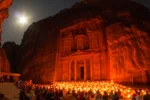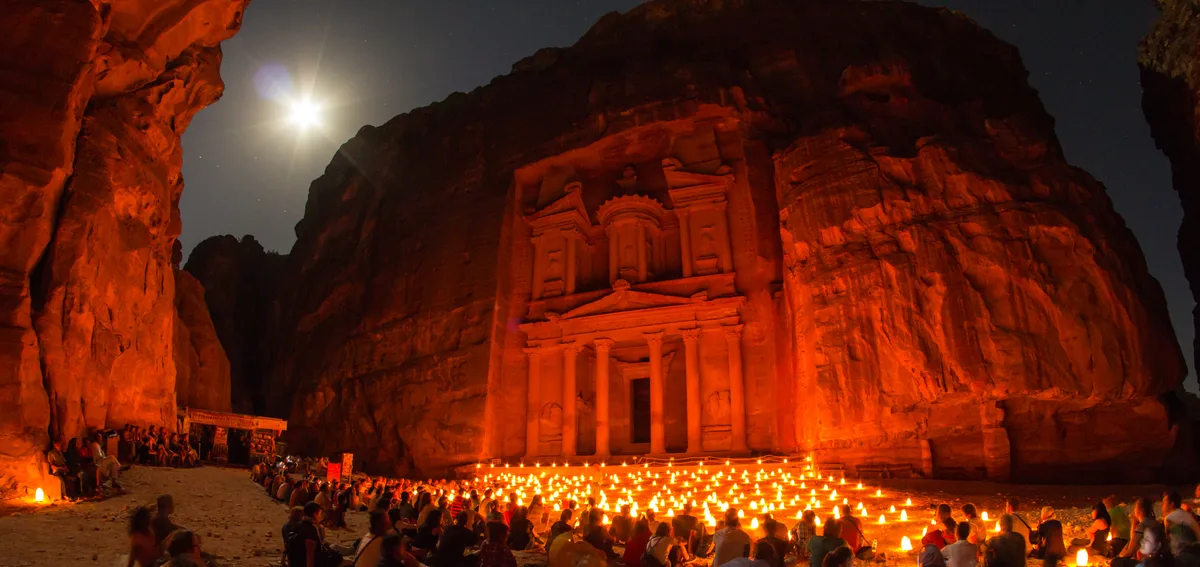
Petra by night is the easiest yes in Jordan and the hardest to describe honestly. On five evenings a week, the Siq – the narrow gorge that is Petra’s only real entrance – is lined with more than two thousand candles in paper bags, and several hundred people walk its length in the dark to sit in front of the Treasury while music plays and, since a relaunch in May 2025, a projection show washes light and narration across the most famous facade in the Middle East. That is the whole event. There is no access to the rest of the city, no monument tour, no dinner, no wandering. One gorge, one plaza, one facade, about two hours. Whether that is worth a separate ticket and a late night depends entirely on what you expect those two hours to be – and most of the disappointment written about this event online comes from people who expected something else.
So this guide does the unglamorous work. It walks the evening in the order you will live it, from the ticket desk in the afternoon to the dark walk back at half past ten. It separates what the official sources – the Petra authority and the event’s own operator – actually promise from what the brochure photographs imply. It is blunt about the crowds, because the plaza holds everyone who walked down behind you. It is blunt about photography, because candlelight is the weakest light there is and your phone knows it. And it gives the verdict in both directions: the travellers who should treat petra by night as unmissable, and the travellers who should keep their money, eat a slow dinner in Wadi Musa and be asleep by ten – because for some itineraries, that is genuinely the better evening.
One thing before the detail, because it shapes everything else. The event was relaunched in May 2025 with projection mapping and narration added to the candles. Reviews written before that date – which is most of what you will find – describe a quieter, simpler and cheaper evening that no longer exists in that form. Read old reviews for the walk and the atmosphere, which have not changed, and ignore their prices, their schedules and their complaints about there being “nothing but candles,” because the show they were reviewing has been rebuilt. Everything current in this guide – nights, times, the ticket arrangement – is taken from the official pages as they stood when this was written, and the facts block at the end shows exactly what those pages do and do not say.
Petra by Night at a Glance
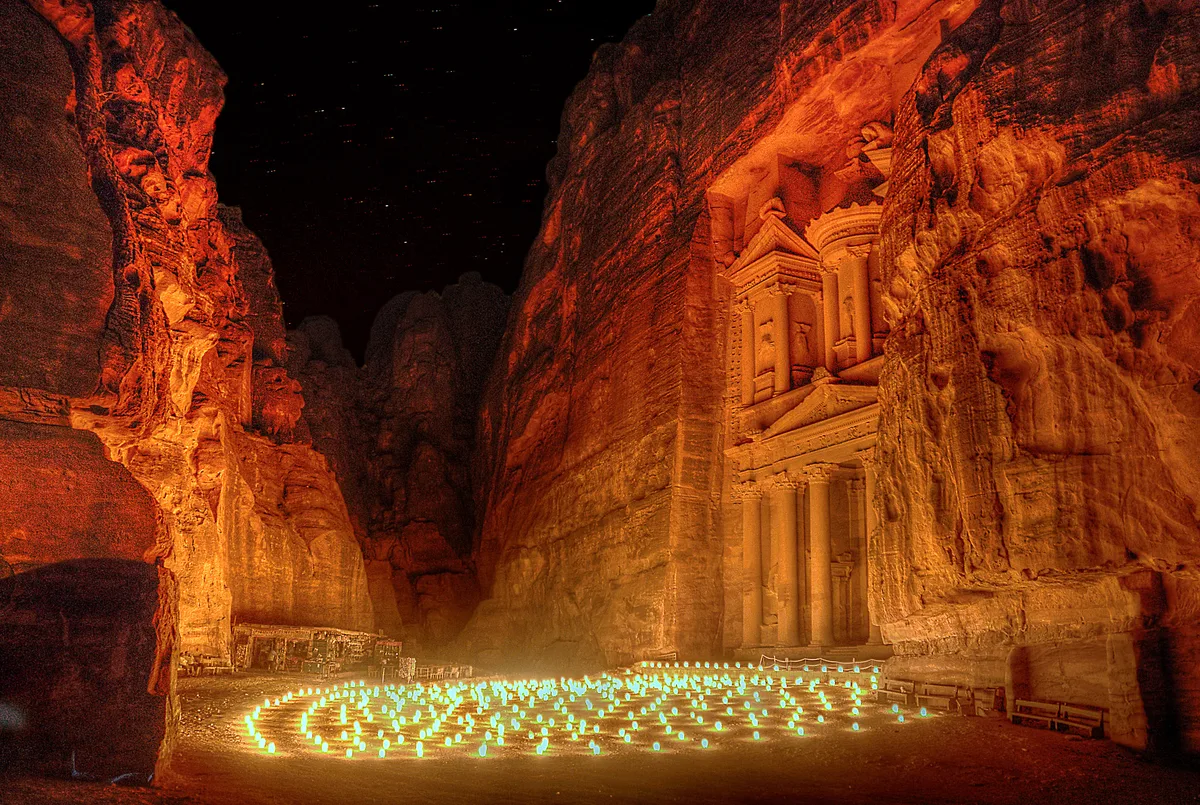
The short version, before the long one. Petra by night runs on five evenings a week, Sunday to Thursday, and it is a single, fixed performance rather than an open site: gates and check-in in the early evening, a candlelit walk of a little over a kilometre through the gorge, a seated show in front of the Treasury, and the walk back. You finish where you started, at the Visitor Centre in Wadi Musa, at around half past ten at night.
| Question | Short answer |
|---|---|
| What is it? | A candlelit evening walk through the Siq to the Treasury, ending in a seated music, storytelling and projection show on the plaza |
| Which nights? | Sunday to Thursday, five nights a week, year-round per the operator |
| What time? | Starts 8:30 PM, ends around 10:30 PM; check-in opens 8:15 PM and the projection show begins at 9:10 PM |
| How long? | About two hours, including the walk down and the walk back |
| The ticket | Separate from daytime entry and NOT included in the Jordan Pass; officially listed at 30 JOD per person, children under 10 free |
| Where do you buy? | In person, on the day, at the event operator’s office at the Petra Visitor Centre – no online booking at present |
| What else do you need? | A valid daytime Petra ticket or Jordan Pass – the authority requires one to attend |
| How far is the walk? | Bab as-Siq and the Siq together are roughly two kilometres each way, on the ancient path, in the dark |
| What do you see? | The Siq and the Treasury plaza only – the rest of Petra stays closed and dark |
| Who runs it? | The event operator, Petra by Night, under the Petra Development and Tourism Region Authority (PDTRA) |
Two rows of that table deserve emphasis because they cause most of the confusion. The first is that the ticket is genuinely separate: it is not a perk of the Jordan Pass, not an add-on printed on your day ticket, and not included in the price of either. The second is that a daytime ticket is a precondition, not an alternative – the authority requires attendees to hold a valid daytime Petra ticket or a Jordan Pass, so the night event sits on top of a day visit rather than replacing one. Everything in the tickets section below follows from those two facts.
How the Evening Unfolds, Step by Step
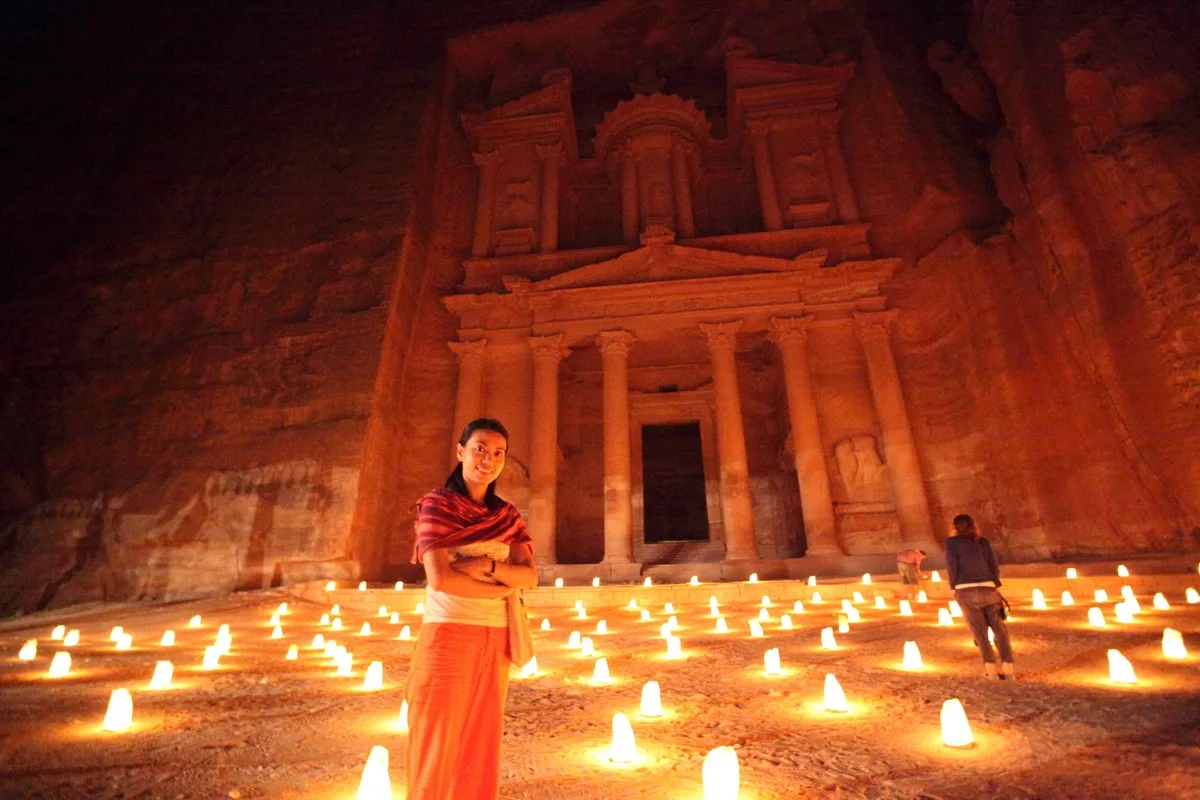
The evening has a fixed choreography, and knowing it in advance is the difference between drifting with the crowd and quietly getting the best of each stage. It begins in daylight, at the ticket desk. Tickets are sold in person, on the day of the event, from the operator’s office at the Petra Visitor Centre; there is currently no online booking, so the purchase is something you fold into your afternoon – ideally while you are already at the Visitor Centre, not in a special trip across town at dusk. The operator’s office keeps daytime hours and closes before the event begins, which is another reason not to leave it late.
Check-in opens at 8:15 PM, and the official guidance is to arrive ten minutes before the 8:30 PM start for ticket verification. From the Visitor Centre you walk the open stretch of Bab as-Siq – the valley of early tombs you will know from the daytime – and then enter the Siq itself, where the candle line begins. The walk down takes most people somewhere between thirty and forty-five minutes at the pace the event sets: unhurried, single-file in the narrow places, with the whole procession moving at the speed of its slowest walkers. The projection show at the Treasury is timed to begin at 9:10 PM, which tells you the organisers expect the tail of the crowd to need those forty minutes to arrive.
At the plaza, the pattern is: a short period of standing and looking while the last walkers arrive, then everyone settles onto the ground in front of the facade – on mats and on the stone – for the show itself. The official description of what is included lists storytelling, traditional Nabataean music performances, projection shows and a sound-and-light presentation at the Treasury; the relaunched format wraps the facade in projected imagery and narration rather than leaving it in candlelight alone. When the show ends, there is no lingering – the operator’s guidelines are explicit that visitors may not stay after the event – and the whole audience walks back up the Siq together, reaching the Visitor Centre at around 10:30 PM. The entire thing, door to door, is roughly two hours, and the operator says exactly that: the two hours include the round walk to the Treasury and back.
Notice what this structure means. You do not choose your pace, your seat-mates or your silence. The event is a procession and an audience, not a private viewing, and the people who enjoy it most are the ones who accept that shape early – who treat the walk down as a slow communal ritual rather than a queue, and the plaza as a shared auditorium rather than a photo studio. The sections that follow take each stage in turn.
The Walk Down – the Siq by Candlelight
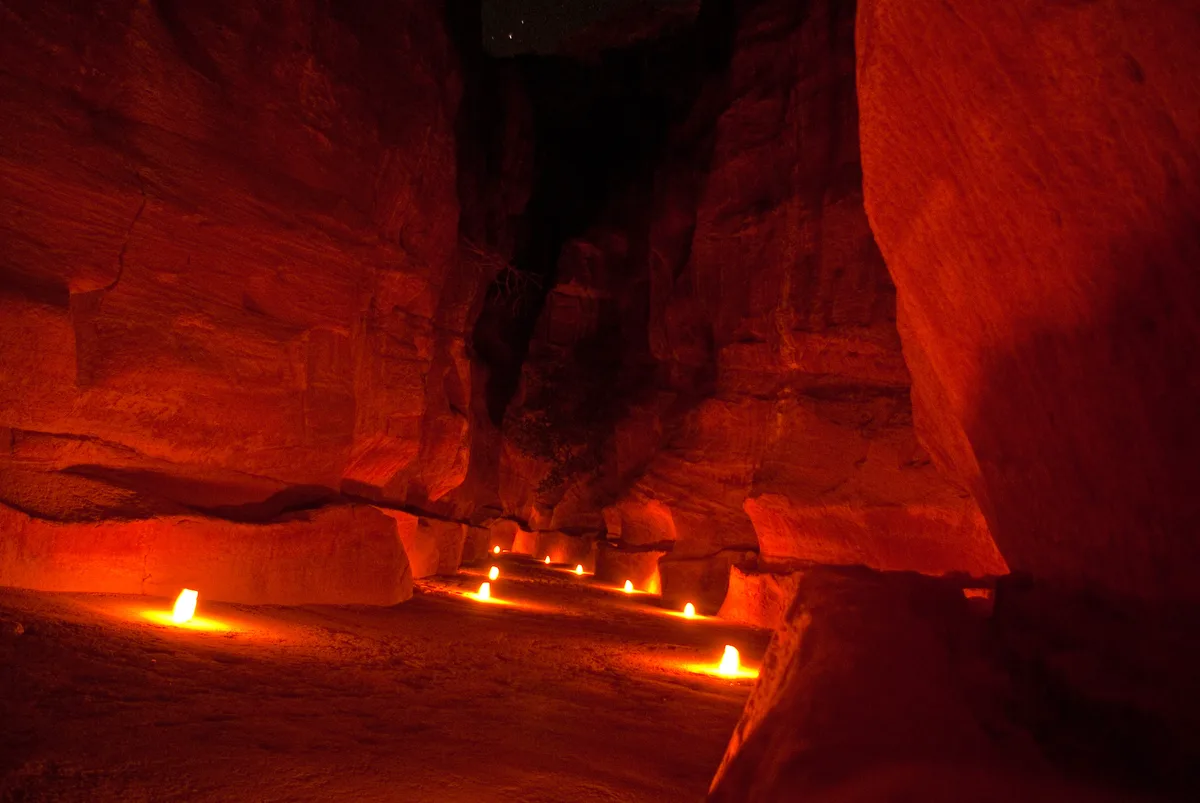
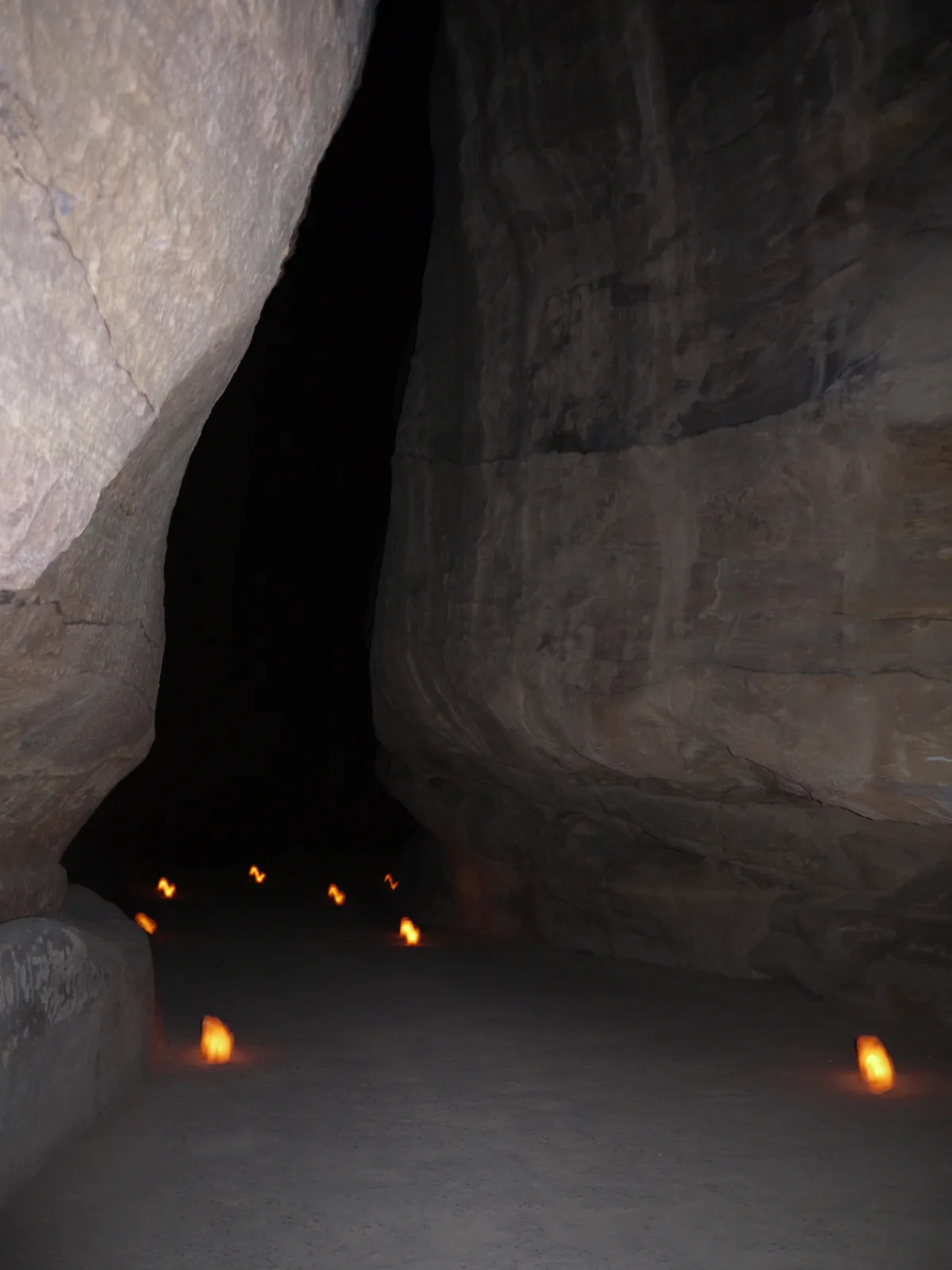
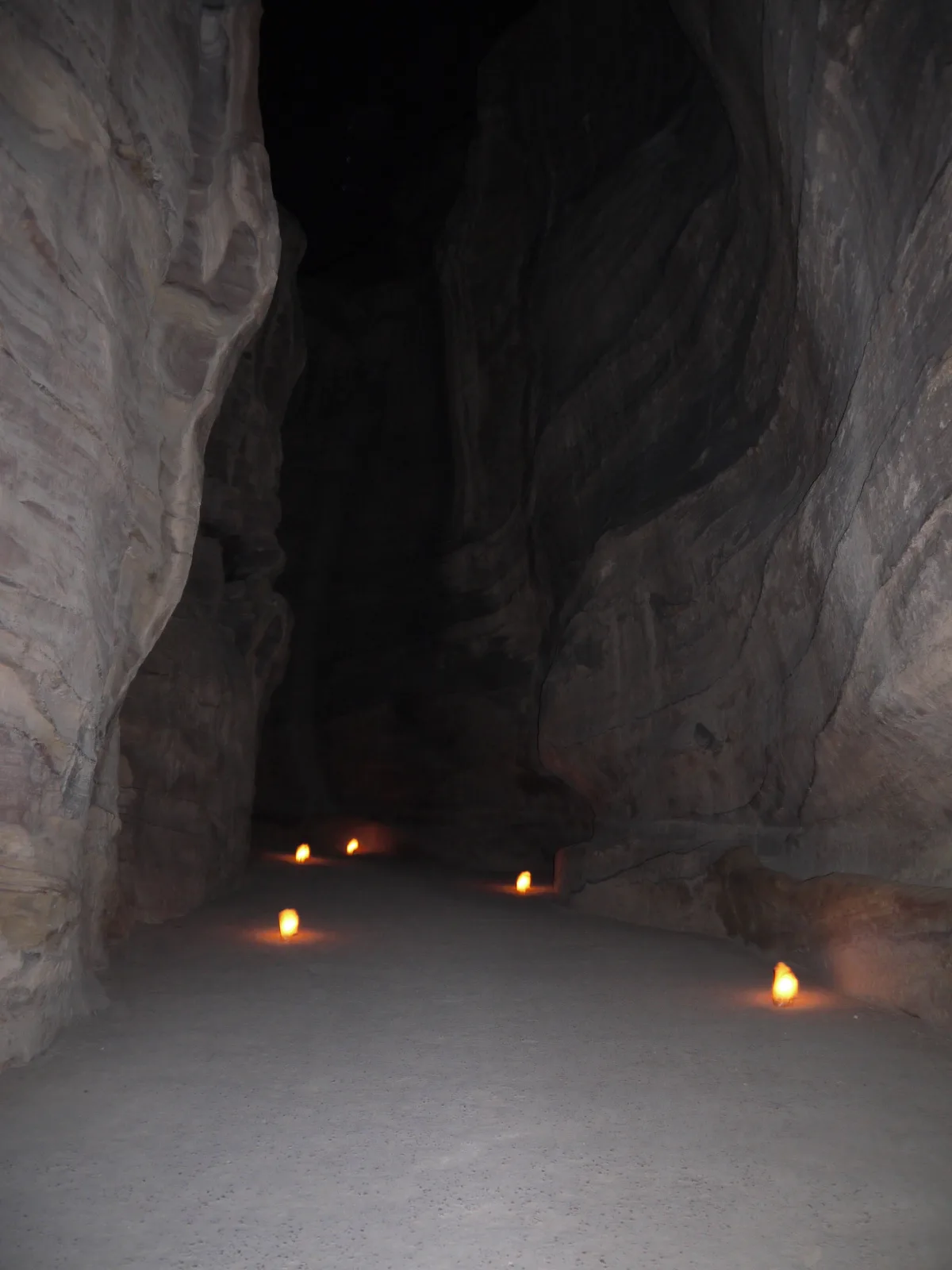
By day, the Siq is a geology lesson and a crowd-management exercise: a crack in the sandstone a little over a kilometre long, walls rising a hundred metres and more, water channels carved along the rock, tour groups bunching at every niche. By night it becomes something simpler and stranger. The candles – small flames sheltered in paper bags, set along both edges of the path – do two things at once. They light the route just enough to walk it, and they shrink the world to the few metres around your feet. The walls you studied all day disappear above the candlelight. What remains is the sound of gravel under several hundred pairs of shoes, the smell of warm paper and wax, and the ceiling of stars in the slot of sky overhead.
This is the part of the evening that survives every change of format. The projection show may be new, the narration may divide opinion, but the walk down is the same walk that has been run since the event began in 1998, and it is the part nobody sensible calls a disappointment. Walking a famous gorge in near-darkness, in a silence the organisers actively protect – phones must be on silent, and visitors are asked not to use flashlights during the candlelit portion – rearranges the place in your head. Details you missed at noon announce themselves: the cool air draining down the gorge, the sheer narrowness of the final stretch, the moment the walls ahead of you begin to glow faintly with reflected candlelight from a plaza you cannot yet see.
Then the reveal, which works differently at night. By day, the Treasury appears in bright slices through the last cleft of rock. By candlelight the approach is reversed: the glow arrives first, a warm brightening on the stone ahead, then the candle field of the plaza, and then the facade itself, dim and enormous above it. It is less a postcard moment than a stage set opening, and it is deliberately paced – the show does not begin until the whole procession has arrived, so your first minutes on the plaza are spent standing in that glow while the tail of the crowd files in behind you. Take those minutes. Most people spend them filming; the facade is going nowhere, and it looks better with your eyes than through a screen hunting for focus in the dark.
A word of respect for the practicalities inside the poetry. The path is the ancient path: uneven, gravelled, sloping, with the old paving slabs polished by two thousand years of feet. The official visitor guidelines say plainly to watch your step on uneven terrain and to wear suitable footwear, and they are not being decorative. You will be walking roughly two kilometres each way in light designed for atmosphere rather than safety. Closed shoes with a real sole, not sandals; a phone torch kept in your pocket for the genuinely awkward patch rather than waved about as a headlamp; and a place in the procession that matches your natural pace, neither trapped behind a slow group in the narrows nor hurrying in the dark. The walk down is the event at its best – give it your full attention and it will earn it.
The Treasury Plaza – Candles, Music and the Projection Show
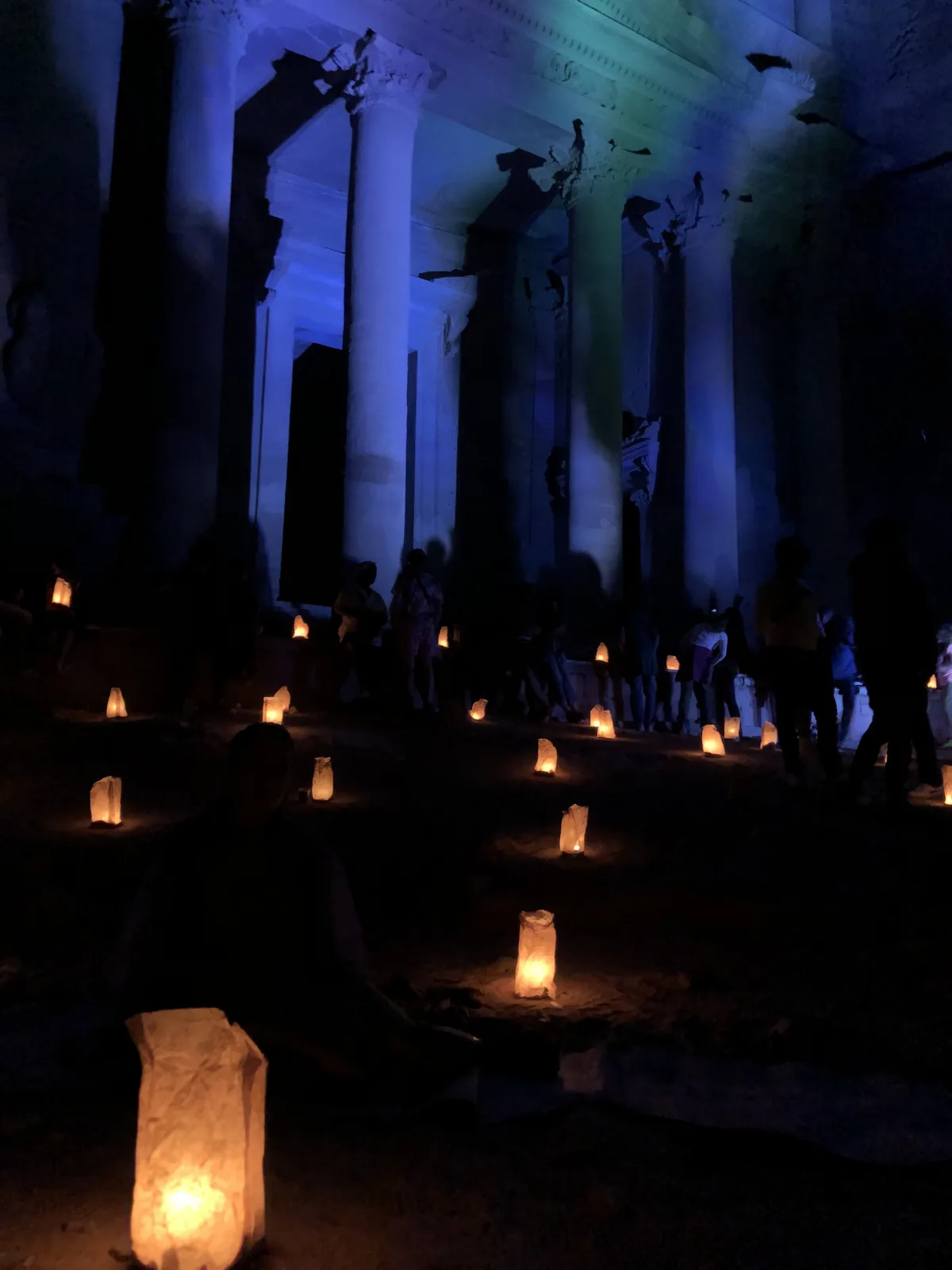
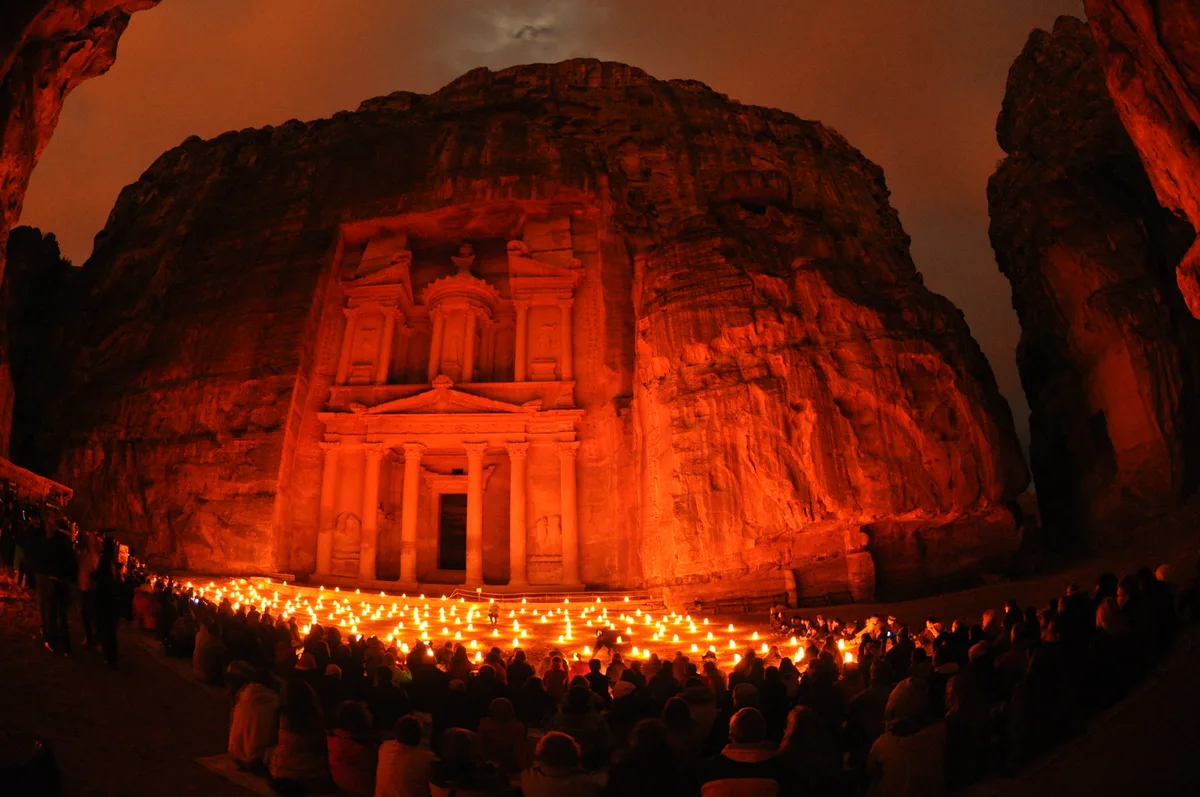
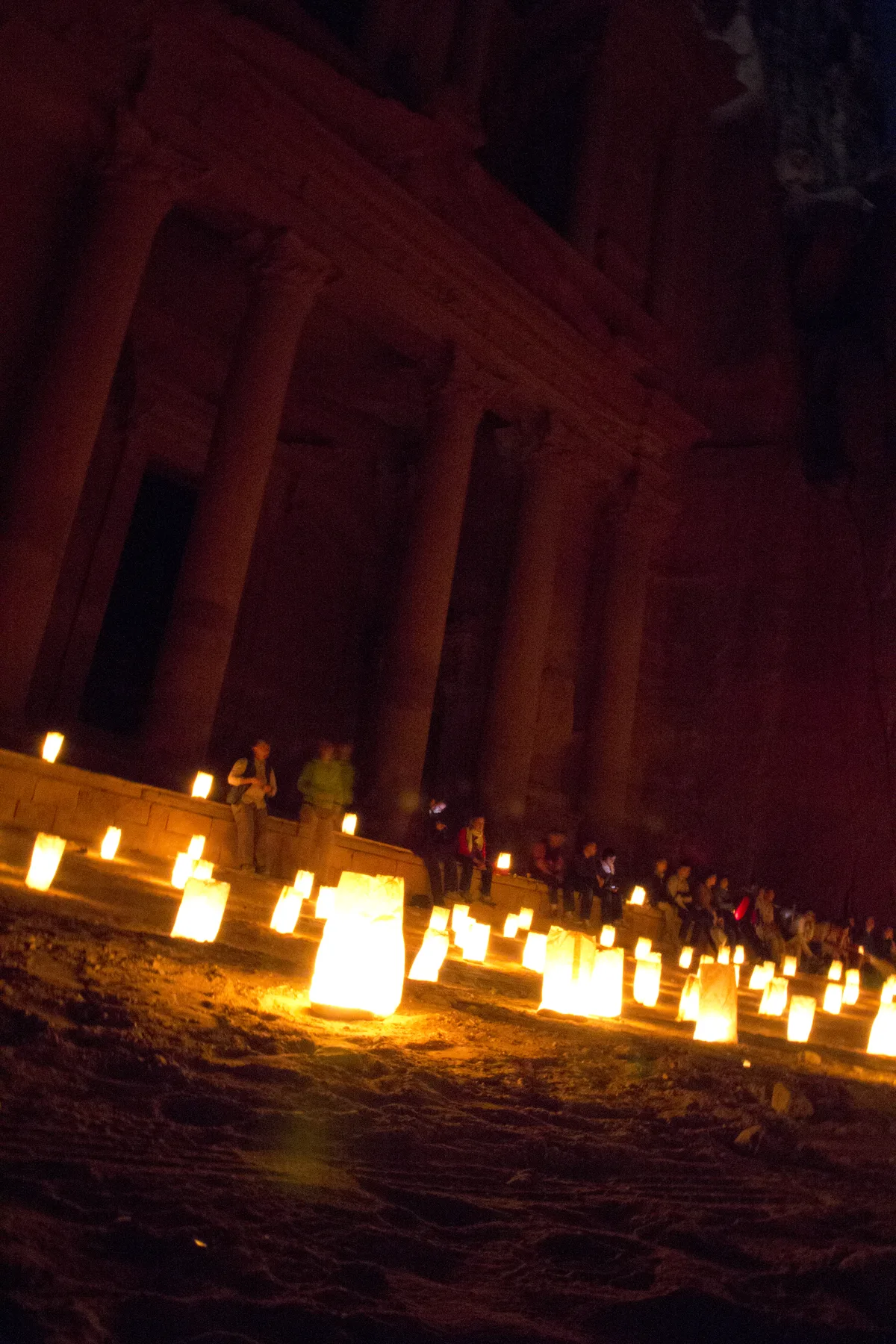
The plaza at night is a shallow bowl of stone, and for the show it becomes an auditorium with the strangest ceiling in Jordan. Across the open ground in front of the Treasury, the candles are laid in their hundreds – the authority puts the evening’s total at more than two thousand, along the Siq and across this space – and the audience sits among and behind them, on mats and on the ground itself, facing the facade. There is no seating plan and no reserved anything. Where you sit is where you arrived: the early walkers take the centre and the front, and the tail of the procession fills the edges and the back, near the mouth of the Siq.
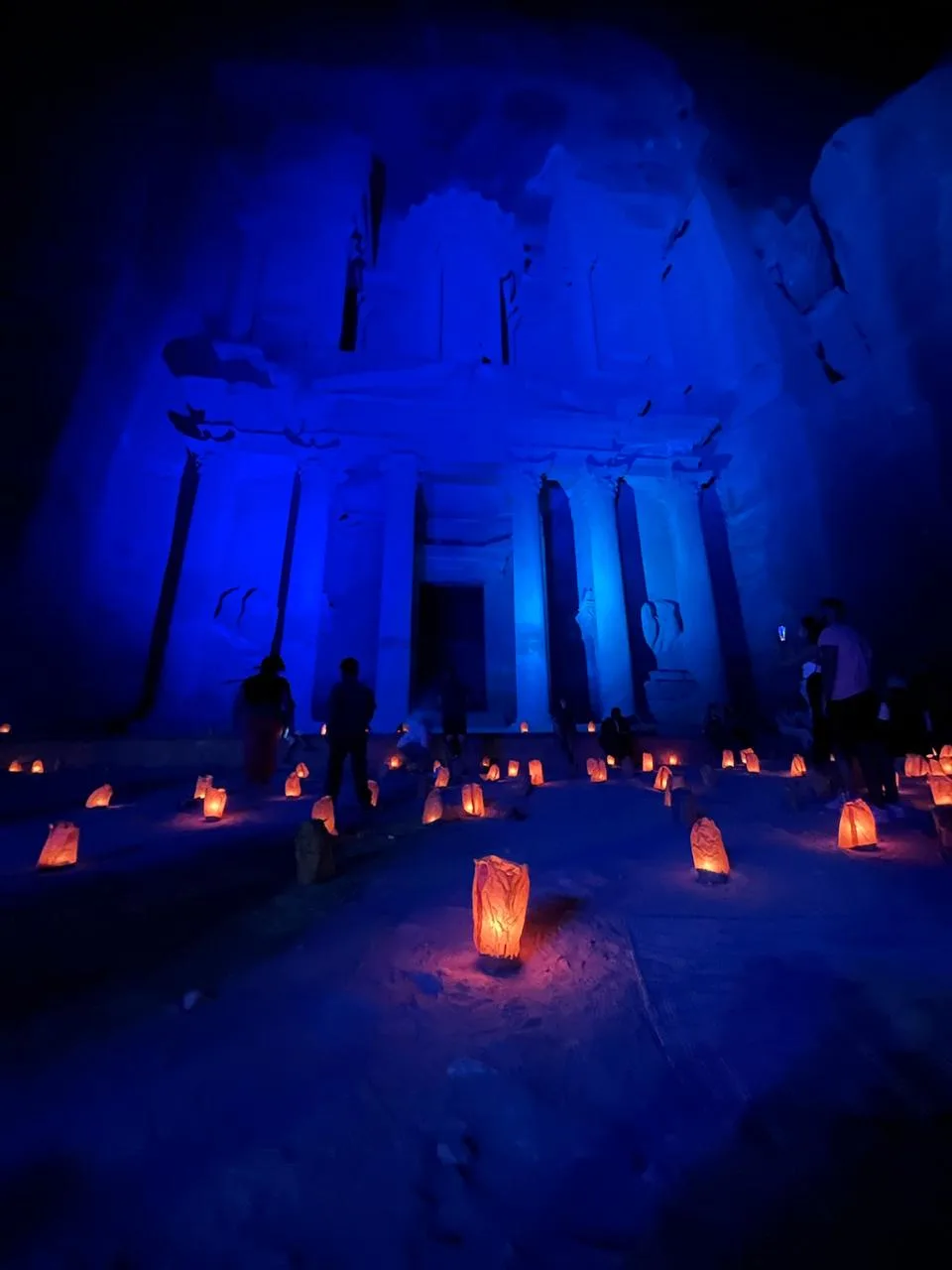
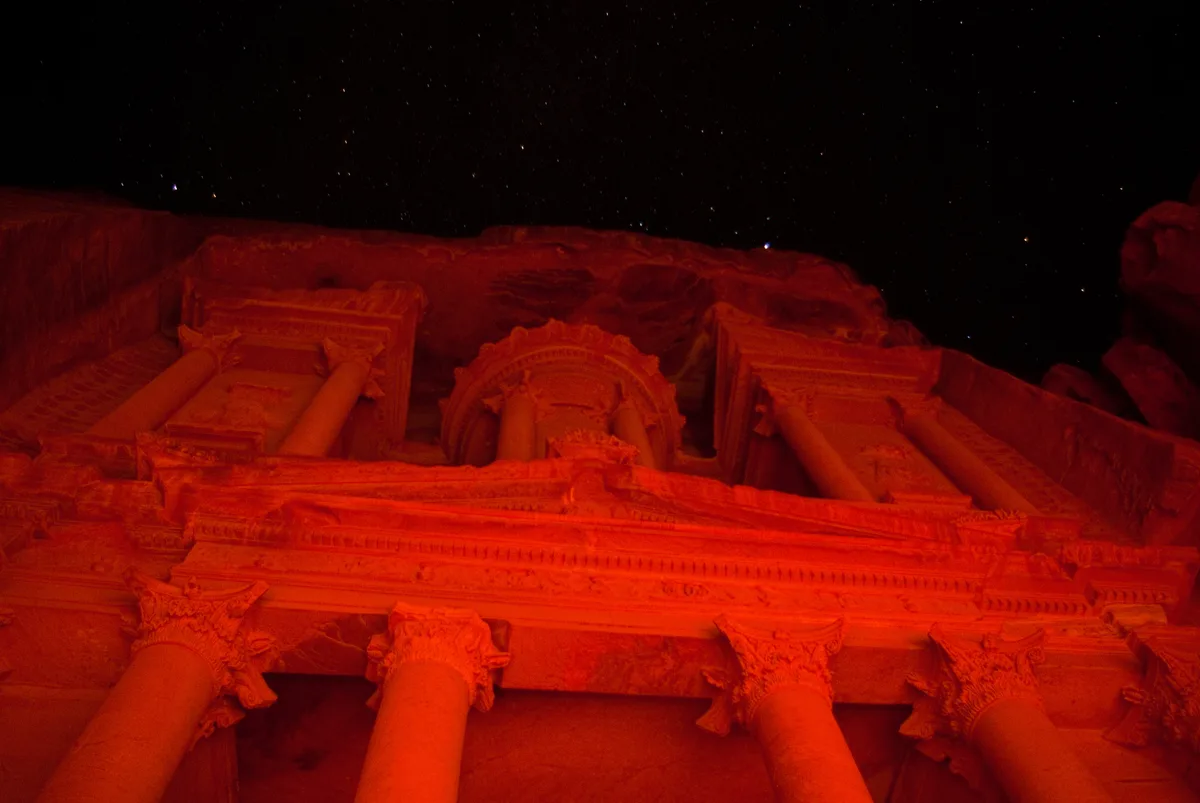
What happens next has two layers, one old and one new, and it helps to know which is which. The old layer is music and voice in the dark: traditional performance in the Nabataean frame the operator describes – the sort of spare, echoing sound, flute and string, that a stone bowl was built to carry – and storytelling about the city and the people who carved it. In the event’s earlier form, that was essentially the whole show, rounded out with the famous held silence, when the music stopped and several hundred people sat in candlelight saying nothing. The new layer, added in the May 2025 relaunch, is projection mapping and immersive narration: the facade becomes a screen, washed in colour and imagery, with a recorded narrative carrying the history. The operator lists all of it together – candlelit walk, immersive storytelling, Nabataean music performances, projection shows, and a sound-and-light presentation at the Treasury – and the Petra authority’s own page describes the same combination.
Opinions divide on the relaunch, and this guide will not pretend otherwise. Visitors who loved the old event sometimes find the projections a bright interruption of something that was perfect in its simplicity; visitors who found the old event thin – a long walk, some candles, a short performance – tend to prefer a show with more in it. What neither camp disputes is the setting. A forty-metre facade, carved in the first century BC, lit by flame and coloured light in a closed bowl of cliffs, under a desert sky: the venue is doing heavy work whatever is projected onto it, and the strongest moments of the evening remain the simplest – the facade in candlelight alone, before the colours start, and the music carrying in the dark.
Manage the plaza practically as well as emotionally. Sit where you can lean: you will be on the ground for the length of the show, and the stone is unforgiving, so the mats provided are worth having under you and a jacket worth having behind you. Keep your belongings in your lap or under your legs – the operator reminds visitors to keep items secure and to check for everything before leaving, and a dark plaza of several hundred people standing up at once is a fine place to lose a phone. And when the facade is lit only by candles, resist the urge to narrate it to your neighbour. The silence rule is not bureaucracy; it is the exhibit.
The Walk Back – the Half Nobody Photographs
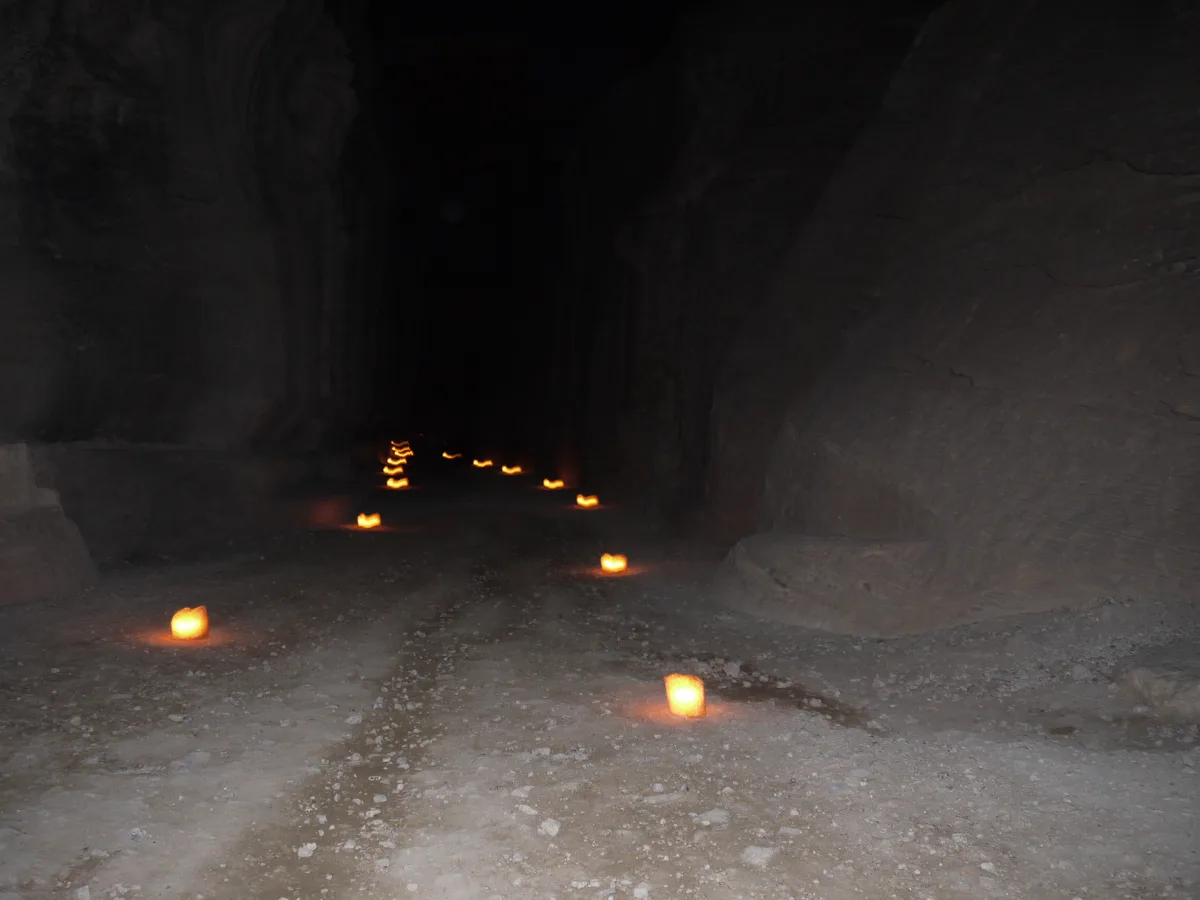
Every account of petra by night is written about the walk down and the show. The walk back – the same two kilometres, uphill in spirit if barely in gradient, in a crowd that has had its evening and now wants its bed – gets a sentence if it gets anything. It deserves a section, because it is the half of the event that decides how the night feels in memory, and because it is where the small discomforts of the evening concentrate.
The mood changes completely. Downhill of the experience, everyone walks faster; the procession stretches out, conversations restart, torches and phone lights appear despite the guidance, and the Siq becomes a thoroughfare rather than a meditation. The candles are still burning – the line is lit for the return as well – but the spell of one-way, slow, silent movement is broken, and the gorge shrinks back to being a path with walls. None of this is a failure of the event; it is what the end of every good performance feels like. But set your expectations: if the walk down was the magic, the walk back is the commute, and it takes the same thirty to forty-five minutes.
There is one reliable way to recover some of the quiet, and it costs nothing. Let the first surge go. The plaza empties in a wave the moment the show ends; if you wait even a few minutes – checking your belongings by feel, letting the crowd thin at the Siq entrance – you can walk in the tail rather than the body of the procession, where the candles outnumber the people and the gorge sounds like itself again. You cannot stay behind in the site – the guidelines are explicit that nobody stays after the event, and staff close the evening down – but there is a difference between the front of the exodus and its quiet end, and the quiet end is better.
You surface at the Visitor Centre at around 10:30 PM into a Wadi Musa that has mostly gone to bed. This is the moment the evening’s one non-negotiable reveals itself: you need to be sleeping within walking distance, or a very short ride, of where you are standing. Hotels line the streets above the Visitor Centre; the town’s restaurants have largely finished service; there is no onward transport to anywhere, because there is nowhere open at the other end of it. The walk back does not end at the gate. It ends at your hotel door, five minutes uphill, with the facade still printed on the inside of your eyelids. Which is exactly as it should be – and exactly why the travellers in the next sections matter.
Petra by Night vs Petra by Day – Same Stones, Different Event
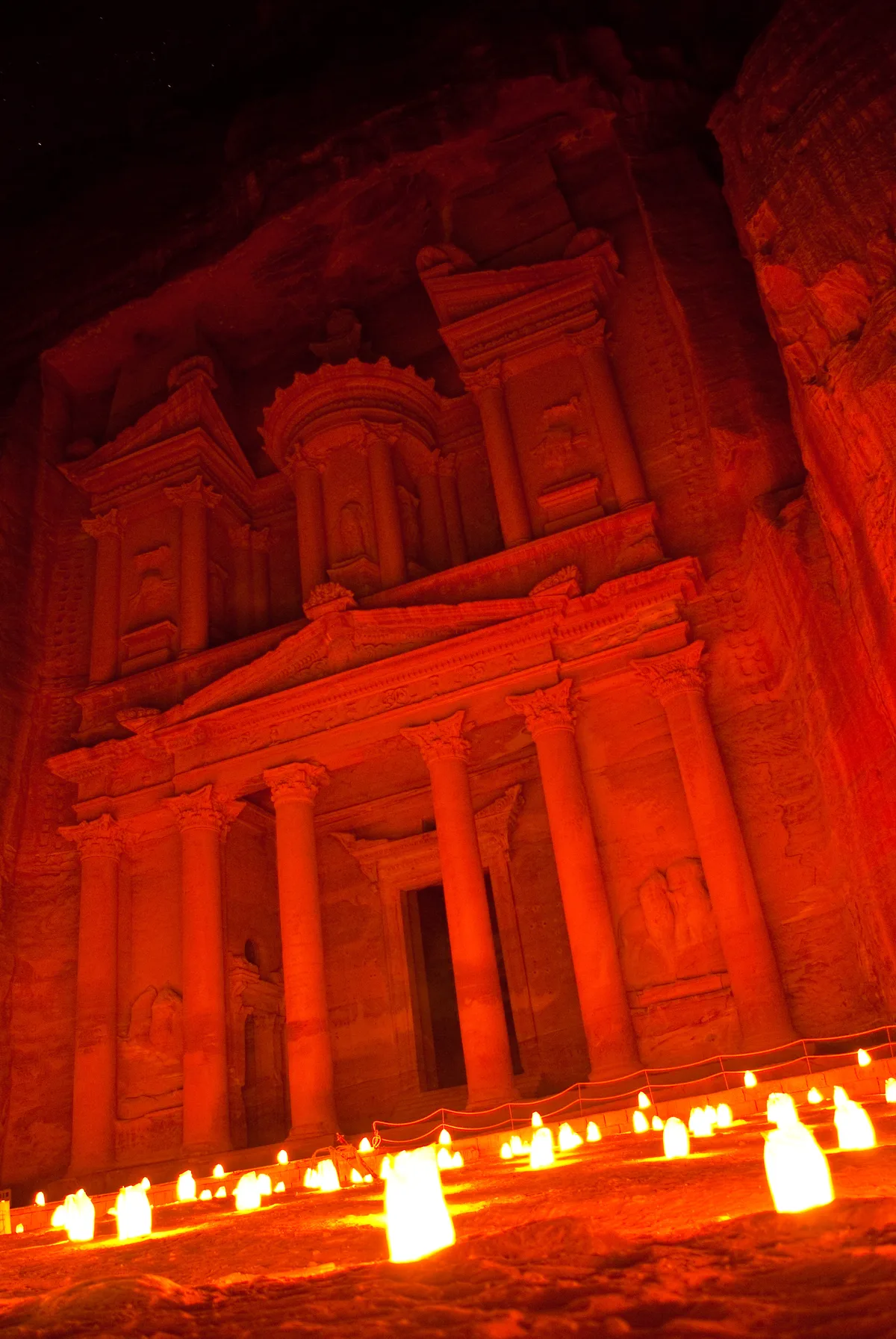
The comparison matters because the most common mistake is to treat the night event as a bonus level of the day visit – the same Petra, prettier. It is not. It is a different product sharing one corridor and one facade with the daytime site, and setting the two side by side honestly is the fastest way to decide whether you want it.
By day, Petra is a city. You walk the Siq as an entrance, not a destination, and keep going – Street of Facades, Royal Tombs, Theatre, Colonnaded Street, temples, and the long climb to the Monastery – across a site of some two thousand acres that UNESCO inscribed in 1985 for the whole astonishing ensemble, tombs, temples, water engineering and all. The day visit is archaeology at landscape scale: hours of walking, layers of civilisation, and more than anyone finishes. Our Petra travel guide walks that city monument by monument, and its honest headline is that Petra needs days, not hours.
By night, you see perhaps two per cent of that, and you see it as theatre. The event route ends at the Treasury. Nothing beyond the plaza is open, lit or accessible; the Royal Tombs and the Theatre sit in darkness you are not permitted to walk into, and the Monastery might as well be in another country. What you get instead of breadth is focus: one gorge walked slowly in candlelight, one facade given a full evening of attention, music and story in place of interpretation panels. The day tells you what Petra was. The night tells you how it feels to stand in front of it. Travellers who understand that trade are almost never disappointed; travellers who arrive expecting a night-time version of the full site almost always are.
The two visits also divide the senses. Daytime Petra is visual and physical – colour, distance, heat, effort. Night Petra is auditory and atmospheric – footsteps, music, silence, the temperature dropping off the stone. They complement each other genuinely, which is why the classic pattern works so well: a full day in the site to learn it, then the night event as the emotional full stop, ideally on a later evening when the facade is already an old friend. Seeing the Treasury by candlelight first and by day second is not wrong, but it spends the reveal twice in the weaker order – the night works better as the echo than as the introduction.
The Photography Reality – Phones, Tripods and Low Light
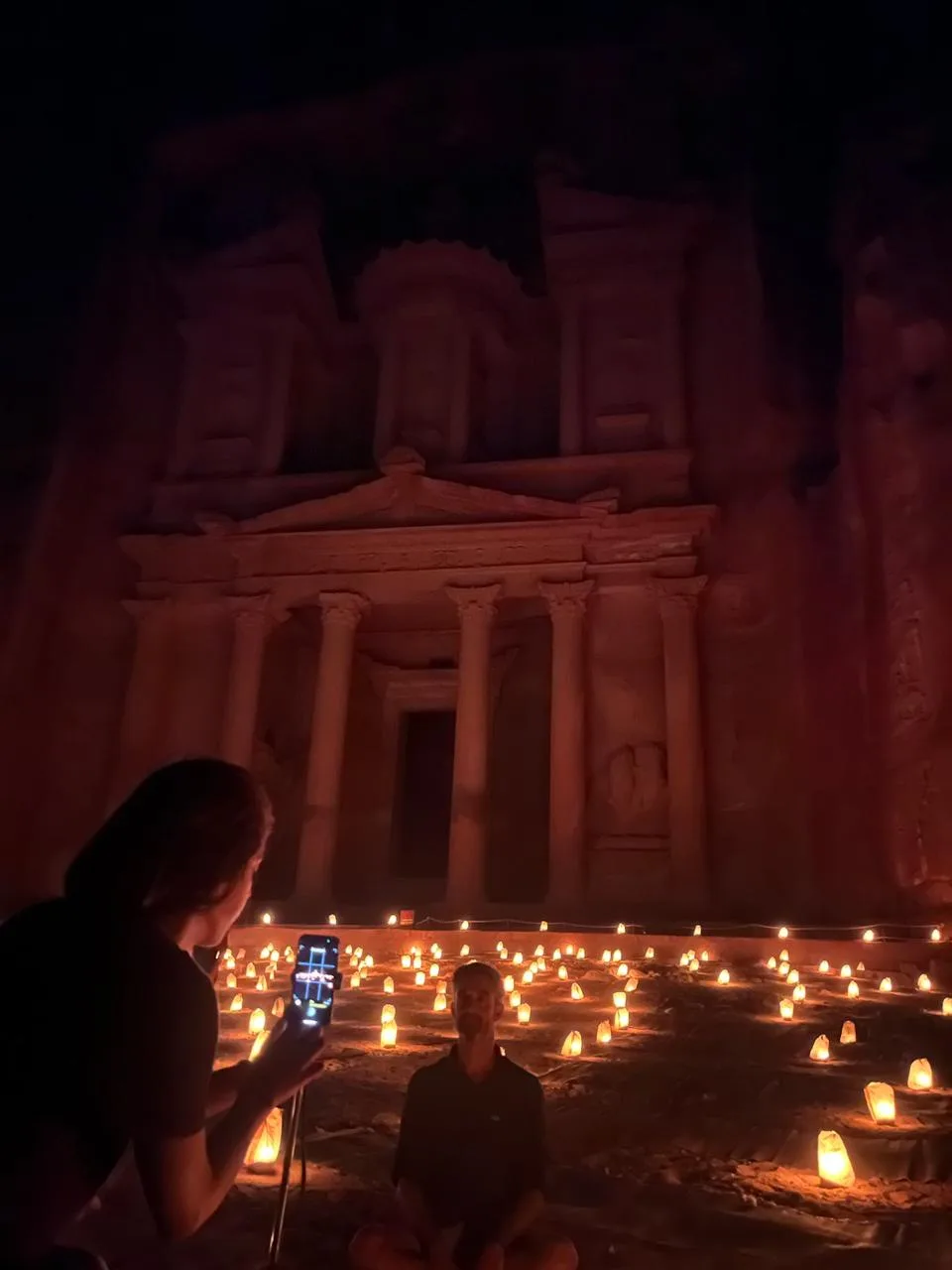
Let us be straight about the photographs, because the gap between the brochure image and the visitor image is the widest in Jordanian tourism. The famous shots of petra by night – the plaza a perfect carpet of flames, the facade glowing like amber – are long exposures, taken on tripods, by photographers who held a position through the whole show and processed the result afterwards. Candlelight is a whisper of light. Your phone, handheld, in a crowd, is going to give you a version of the scene that is softer, grainier and darker than the one in the brochure, and no setting on the phone changes the physics.
The official rules first, because they are simple: photography is welcome, preferably without flash – the authority’s page says no flash and no drones, and the operator asks the same – and flash is not merely banned but useless, since a phone flash lights the three metres in front of you and murders the candlelight for everyone around you. Drones are out entirely. There is no official statement either way about tripods in the guidance published by the authority or the operator, so treat the tripod question as a practical one rather than a legal one: you are in a seated crowd on a dark plaza at the end of a narrow procession route, and a tripod’s three legs among several hundred people’s feet, bags and mats is a hazard and a nuisance. If photography is your serious purpose, the honest advice is a fast lens, a steady brace against a rock or a companion’s shoulder, and exposures made during the projection sequences, when the facade is at its brightest – not a forest of equipment in the dark.
What actually works, in rough order of return. Use your phone’s night mode and give it the stillness it demands – elbows on knees, breath held; the facade is floodlit often enough during the show to give the sensor something to work with. Shoot the Siq on the walk down only where the procession pauses, and accept silhouettes and candle rows rather than detail. Photograph people sparingly and never with flash in a stranger’s face. And ration the attempts: the show is short, the lightshow shorter, and the traveller who watches the whole evening through a viewfinder has paid thirty dinars for footage they will watch once. The photograph that matters from this event is usually a single frame – facade, candles, darkness at the edges – and it is better taken deliberately, twice, than hopefully, forty times.
One more truth for the portfolio-minded: the plaza photographs best from its edges in the minutes before the show, when the candle field is complete and the crowd still standing thin. After the show, the audience stands as one and the frame fills with heads and raised phones. Arrive in the earlier part of the procession, use the standing minutes well, then put the phone away and be an audience. It is the rare event where the memory reliably outperforms the media, and knowing that in advance is worth more than any camera setting.
The Crowds – the Honest Part of the Plaza
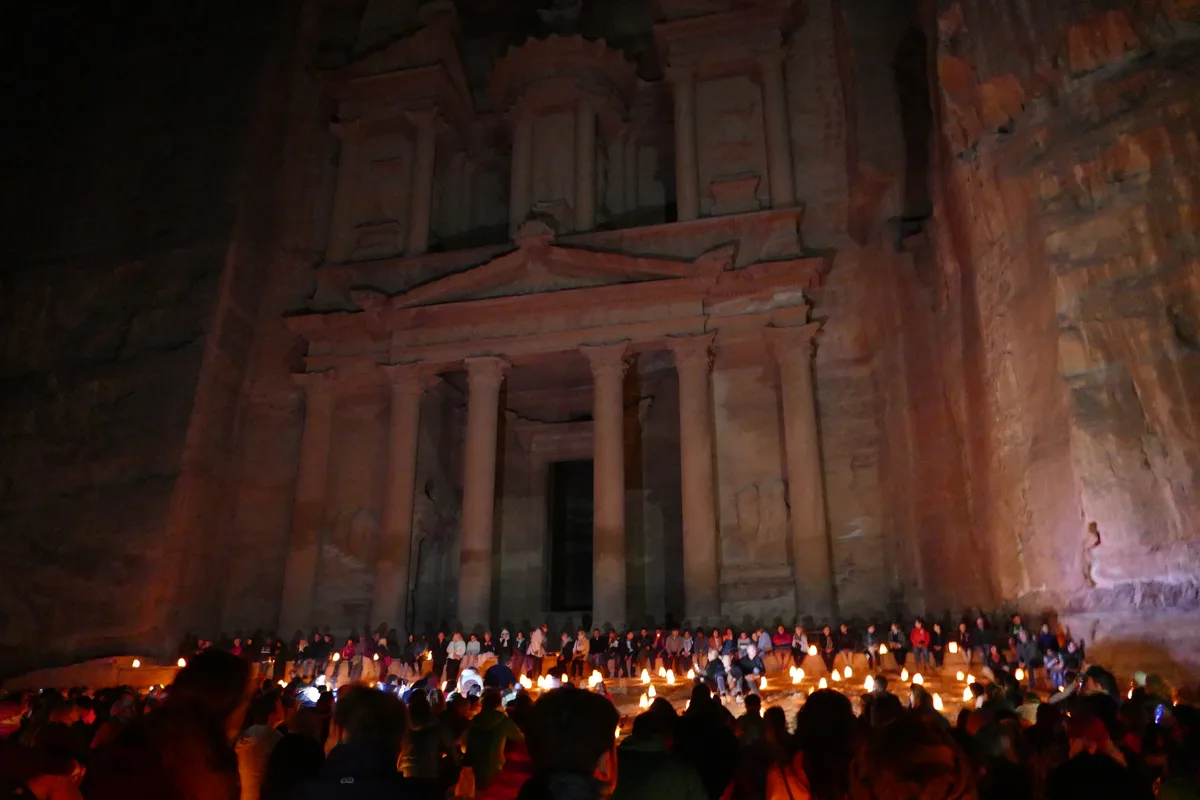
Here is the sentence the marketing leaves out: you will share petra by night with everyone. The event sells in person, on the day, with no advance booking and no published cap that the official pages state, and on a good evening in season the audience numbers in the hundreds – the same hundreds who checked in with you, walked the Siq at your shoulder and will sit on the plaza around you. The photographs that show an empty candle field were taken before the audience sat down or after it left. During the show itself, the plaza is a crowd, seated close, in the dark.
That is not automatically a flaw. A crowd is the price of the event’s existence – the candles are lit, the musicians paid and the projections run because hundreds of tickets say so – and a seated crowd in a stone bowl has its own atmosphere, a shared hush that a dozen people could not produce. The music lands differently in a full plaza. The silence, when it comes, is more remarkable for being held by hundreds. If you go in imagining a festival audience rather than a private viewing, the crowd reads as part of the production.
But go in with your eyes open about the friction points, because they are real. The walk down compresses at every narrow bend, and slow walkers set the pace for everyone behind them – there is no overtaking lane in a two-metre gorge. Latecomers arriving after the show has settled will pick their way across a dark, seated plaza, over legs and bags, and the operator’s guidance that arrivals after 9:15 PM may not be able to join exists because that manoeuvre stops being possible. Noise carries: one loud conversation at the back of the plaza is audible at the facade, which is why the phones-on-silent rule is enforced as atmosphere, not etiquette. And the whole audience leaves at once, up one gorge, in the dark.
The mitigations are the ones already scattered through this guide, collected here. Choose your night with intent: the event runs Sunday to Thursday, and the evenings in the middle of a run, away from the weekend-adjacent nights when Wadi Musa is fullest, are the professional’s guess for the thinner crowd – a guess, clearly labelled, since no official source publishes nightly numbers. Walk in the earlier part of the procession if you want a central seat, or deliberately in its tail if you would rather have space around you on the plaza’s edge. Sit near an edge rather than the centre if a fast, quiet exit matters to you. And temper the fantasy photograph: the empty plaza exists for about four minutes, before the show, and you are allowed to enjoy those minutes without needing to own them.
Tickets – Separate, Sold on the Day and Not in the Jordan Pass
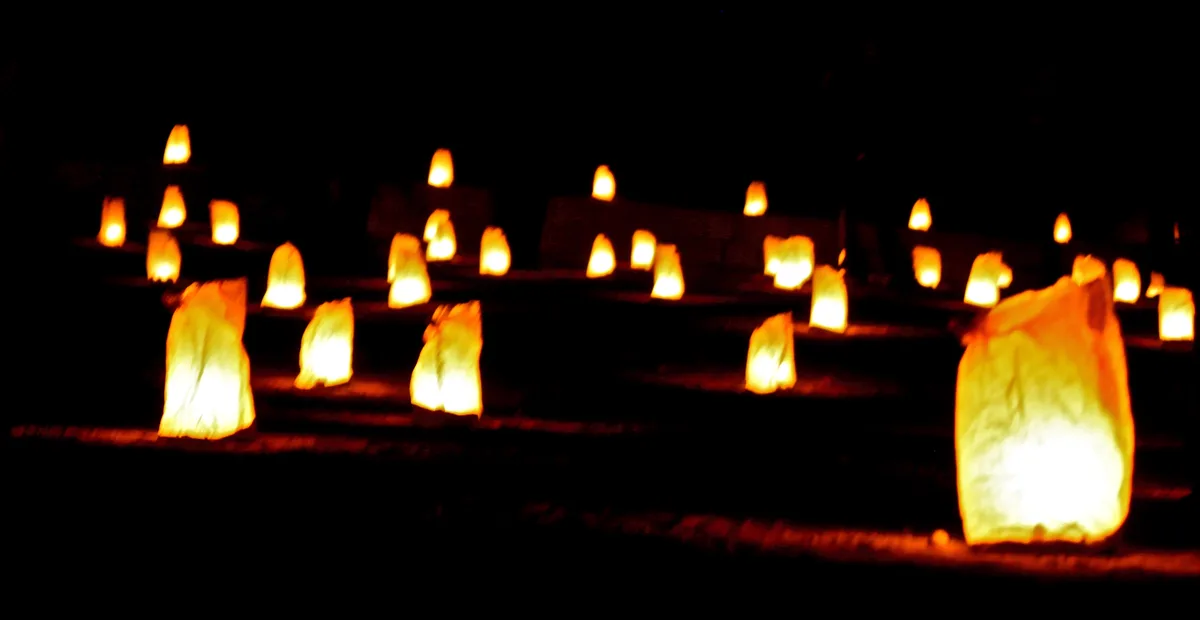
The ticket system for petra by night is simple, old-fashioned and the source of more failed evenings than everything else in this guide combined, so take it slowly. There are three separate facts, and you need all three.
First, the night ticket is its own ticket. The Petra authority’s event page lists the price plainly – 30 Jordanian dinars per person, with no charge for children under ten – and the Jordan Tourism Board publishes the identical figure, as does the operator. Be aware that older guides, and a great many hotel desks working from old information, still quote the pre-relaunch price of 17 dinars and the old Monday-Wednesday-Thursday schedule; both were superseded when the event was relaunched and its schedule widened in 2025, and the current official pages are unanimous. Treat 30 dinars as the price, keep the authority’s own Petra by Night page as your reference, and confirm on the day like any careful traveller – prices on official pages are the plan, not a contract.
Second, the night ticket is not inside anything else you own. It is not included in the Jordan Pass – the operator states this in so many words – and it does not include daytime entrance either; the authority lists that exclusion in its own ticket details. What is more, the arrangement runs the other way as well: the authority requires everyone attending to hold a valid daytime Petra ticket, and Jordan Pass holders satisfy that requirement with the pass’s daytime entry. In practice this means the night is always an addition to a day, priced on top of one – which is precisely why it rewards people already spending two days at Petra and punishes anyone trying to make it their only Petra experience.
Third, you buy it in person, on the day, at the Visitor Centre. There is no online booking at present – the operator says it is coming, which means it is not here – and third-party sellers offering advance “tickets” are selling you a service, not a product the operator issues. The ticket is valid only for its date of issue and resale is not permitted. The operator’s office at the Visitor Centre keeps daytime hours and is closed on Fridays and Saturdays, the two nights the event does not run; on event days, buy in the afternoon, in person, and keep the ticket somewhere you can find it in the dark. Same-day cancellations are accepted in person in the early evening, and if the operator cancels for weather or safety, refunds are made from the place of purchase – worth knowing in a gorge that the authorities close when flash-flood risk rises.
Two edge cases, handled honestly. Children under ten attend free, and children under twelve must be accompanied by an adult – bring the small ones only if they can walk two dark kilometres each way and sit through a show, because there is no early exit once the procession is in the gorge. And accessibility: the route is the ancient path, uneven and unlit by design, and the operator notes that a very small number of club cars may be available on the night for visitors who cannot walk, allocated on the spot and strictly limited – ask at the office when you buy, and do not build a plan that depends on one being there.
You Must Sleep in Wadi Musa – Why Day Trippers Cannot Do This
This is the section that saves the most holidays, so it will be said without decoration: petra by night is an event for people sleeping in Wadi Musa, and if your plan has you anywhere else that night, you do not have a plan that includes it.
Start with the clock. The event ends at around 10:30 PM at the Visitor Centre. Amman is a journey of roughly three hours by road; Aqaba roughly two. No bus, shared taxi or tour vehicle leaves Wadi Musa for either city at half past ten at night, because no transport system runs empty desert highways for a handful of late passengers. Organised day trips – the kind sold from Amman and Aqaba hotels – are built the other way round: they leave Petra in the late afternoon precisely so their passengers are back for dinner. A day-tripper who bought a night ticket in the afternoon would finish the evening stranded at a closed visitor centre in a quiet town, negotiating with whichever taxi driver could be woken, for a night drive at whatever price a monopoly commands. That is not an adventure; it is a failure of planning with a meter running.
Then the ticket logic, which seals it. Attendance requires a valid daytime ticket or Jordan Pass, and the day-ticket pricing itself is built to reward the overnight visitor – the standard daytime rates apply to visitors staying at least one night in Jordan, while those who do not sleep in the country pay a far higher same-day rate. The whole system assumes you are based at the site. Petra’s base town is Wadi Musa, which exists, hill upon hotel-lined hill, for exactly this purpose: our Jordan itinerary for 7 days builds three nights there into a one-week route, and that is the shape this event fits. Sleep in Wadi Musa, walk down from your hotel in the evening, walk back up to it at half past ten. Any other arrangement is fighting the design of the thing.
The practical corollary for route planning: give Petra at least one night in Wadi Musa that falls on an event evening – Sunday to Thursday – and be aware that a Friday or Saturday night in town, however it suits the rest of your route, is a night this event does not run. Trips built backwards from flights have a way of landing their single Petra night on a Friday. Check the calendar before you fall in love with the candlelight.
Who Will Love Petra by Night
The event has a clear constituency, and if you recognise yourself in this section, book the afternoon ticket without a second thought.
It is for the atmosphere-first traveller – the one who remembers the hush of the Blue City at dawn and the call to prayer over a valley, and ranks those above another monument. The candlelit Siq is a genuinely rare piece of theatre: a world-famous gorge, walked slowly, in protected silence, by flame light. If that sentence alone sells you, the event will too, because that walk is guaranteed – it does not depend on the show, the crowd’s behaviour or the projections landing. It is for romantics and celebrants, for whom a famous facade under a desert sky needs no further justification. It is for return visitors and slow travellers on their second or third day at Petra, for whom the night is a coda to knowledge already earned – the facade means more when you know what lies behind it, and the storytelling lands on prepared ground.
It is also, perhaps surprisingly, for families with the right children: older children who can walk the distance get an evening that feels like an expedition – candles, darkness, a treasure-house facade – and children under ten attend free, which changes the family arithmetic in the event’s favour. And it is for anyone whose Petra day was stolen by weather, crowds or a late start: the night cannot give you the Monastery, but it can give you back a Treasury moment that the midday scrum denied you, in a form the scrum cannot touch.
Finally, it is for the traveller who collects evenings rather than sights – the one whose trip highlights are a night train, a desert camp’s silence, a harbour at midnight. That traveller already knows the arithmetic this section runs on: the event’s value is not measured in monuments per dinar but in the quality of two hours, and by that measure a candlelit gorge in a hushed crowd is one of the richest evenings Jordan sells. If your trip diary is written in hours like that, this is your event, and the rest of this guide is just logistics.
Who Should Skip It – and What to Do With the Evening Instead
The honest guide owes you the other list. Skip petra by night, without regret, if you are a one-day visitor on a tight route: your single evening in Wadi Musa is worth more as rest before a dawn start, or recovery after a full day, than as a second helping of the one facade you have already seen – and at 30 dinars a head, a couple’s night tickets are real money in a trip budget. Skip it if your priority is the archaeology itself: the event adds no monument, no access and no interpretation beyond its narration, and the daytime site will still be there tomorrow asking for your energy. Skip it if uneven ground in darkness worries you, if a late night costs you the next morning, or if crowds in confined spaces are your idea of a bad evening in any lighting.
Skip it, too, if what you actually want is the photograph. As the photography section explained, the brochure shot is a tripod long-exposure; the seated, flash-free, phone-in-hand reality will not match it, and buying a ticket as a photo permit ends in a familiar disappointment. The facade at dawn, from an early entry, is the better photographic investment by a distance.
Wadi Musa offers perfectly good alternative evenings, and naming them makes the skip a choice rather than a loss. The town’s best-known evening institution is a cooking class where you prepare a Jordanian dinner and eat what you made – an experience the Jordan Tourism Board lists among Petra’s own activities, and a warmer, tastier use of three evening hours than the gorge if food is your thing. A slow dinner on the town’s main street, a hammam or simply an early night before the Monastery climb are all legitimate, and the last of them is the one guides recommend most and travellers take least. Petra rewards the rested. If skipping the show buys you a 6 AM entry and an empty Siq at dawn, you have not missed the magic – you have chosen the other showing of it.
Fitting Petra by Night Into Your Petra Days
Given two days at Petra – the honest recommendation for the site itself – the night event has a natural home: the evening of the first day. You will have walked the main trail, learned the Siq’s shape in daylight and stood on the plaza at noon. Going back down the same gorge at night, knowing exactly where you are while seeing almost none of it, is a small revelation in how well you have learned a place in a day. Then sleep, and take the second day for the Monastery, the back door or the high places with the night already banked – because if weather cancels an event (the Siq closes when flash-flood risk demands it, and cancellations do happen), an event placed on your first evening leaves you a second chance on the next.
With only one day, the calculus tightens. A full main-trail day is fifteen or more kilometres; adding four more in the dark, on the same legs, is possible and commonly done, but the honest traveller asks what tomorrow holds. If tomorrow is a Wadi Rum jeep seat or an Aqaba beach, spend the evening. If tomorrow is another walking day – a second Petra day you have not admitted to yet, or the King’s Highway – let the night go and protect the morning. And if your single Petra night falls on a Friday or Saturday, the decision is made for you, which is worth knowing before you build the route rather than after.
Two final fittings. Do not schedule the night event for the evening you arrive in Wadi Musa from a long transfer day if you can avoid it: tickets are sold in person during office hours, check-in is at 8:15 PM sharp, and a delayed arrival on the King’s Highway turns the evening into a scramble for the ticket desk. Arrive the night before, or accept the second evening as the target. And keep one ear on the sky: desert rain is rare and precious and it closes this event, so a traveller with two Wadi Musa nights has insurance that a one-night traveller simply does not hold.
Practicalities – Footing, Layers, Children and Weather
The official visitor guidelines, published by both the authority and the operator, read like a list of small things that matter, because they are. Collected and expanded, they amount to this.
Feet first. The route is the ancient path – gravel, worn paving, gentle but real slopes – walked in light kept deliberately low. Wear closed shoes with grip, the same you walked the site in by day. Arrive ten minutes before the start for check-in, and understand the hard edge at the other end: the show begins on the plaza at 9:10 PM and arrivals after 9:15 PM may not be able to join, so a delayed start is not recoverable. Phones on silent from the gate. No flash photography, no drones. Flashlights are asked down during the candlelit walk – keep a phone torch for a genuine need, not as a lamp. Carry little: whatever you take down the gorge comes back up it, in your hands, in the dark, and belongings left on the plaza during the show are a known loss point – check your patch of ground before you stand up at the end.
Dress for a desert night, not a summer one. Wadi Musa sits high, and the gorge channels cool air after dark; even in warm months the walk back is a jacket’s worth colder than the walk down, and in the cooler half of the year – including mid-November, when this guide is published – you will want a proper warm layer for sitting still on stone for the length of a show. Sitting still is the cold part. Walkers generate heat; audiences lose it.
Children are welcome, free under ten and required to be accompanied under twelve, but apply the parent test honestly: two kilometres each way in the dark, an hour seated on the ground, no early exit. For a child who passes that test it is a magnificent night. For one who does not, it is a very long carry. Weather is the last variable and the only uncontrollable one: rain raises the flash-flood risk in the Siq – the same risk UNESCO’s own assessment of the property flags – and the operator cancels or reschedules for weather or safety with refunds from the place of purchase. Build the possibility in, keep a second evening if you can, and never let a cancelled night ruin a trip that still has Petra in daylight in it.
Frequently Asked Questions
What nights does petra by night run? Five nights a week, Sunday to Thursday, per both the Petra authority and the operator. It does not run on Friday or Saturday nights, and it runs year-round according to the operator – always confirm your specific date, since weather can cancel an individual evening.
What time does it start and finish? The event starts at 8:30 PM and ends around 10:30 PM, about two hours including the walk both ways. Check-in opens at 8:15 PM, the projection show on the plaza begins at 9:10 PM, and arrivals after 9:15 PM may not be able to join.
How much is the ticket, and is it in the Jordan Pass? The official price, listed identically by the Petra authority, the Jordan Tourism Board and the operator, is 30 JOD per person, with children under ten free. It is a separate ticket: not included in the Jordan Pass and not including daytime entrance. Older sources quoting 17 JOD describe the pre-2025 event.
Do I need a daytime ticket as well? Yes. The authority requires attendees to hold a valid daytime Petra ticket, and a Jordan Pass covering that day satisfies the requirement. The night event cannot be your only Petra ticket.
Where do I buy the ticket? In person, on the day of the event, at the operator’s office at the Petra Visitor Centre. Online booking is not currently available, the ticket is valid only for its date of issue, and resale is not permitted.
How far is the walk, and is it hard? Roughly two kilometres each way – the open Bab as-Siq stretch and then the Siq itself – on the ancient, uneven path, in candlelight. The walking is gentle in gradient but demands care and proper shoes; allow thirty to forty-five minutes each way at the procession’s pace.
What does the show actually consist of? A candlelit walk down the Siq, then a seated presentation on the Treasury plaza combining storytelling, traditional Nabataean music performances, projection mapping and narration on the facade – the format introduced in the May 2025 relaunch – then the walk back. Nothing beyond the Treasury is open.
Can I take photographs? Yes, without flash; drones are not allowed. Expect phone photographs to be grainy in the Siq and best during the brighter projection sequences on the plaza. The famous empty-plaza shots are long exposures taken before the audience sits down.
Is petra by night worth it? If you are sleeping in Wadi Musa, love atmosphere and already know Petra by day, yes – the candlelit walk alone justifies it for most people. If you have one day, tired legs, an early start tomorrow or a photograph in mind that needs an empty plaza, your evening and your 30 dinars are better spent elsewhere, and this guide has said so throughout.
The Short Version
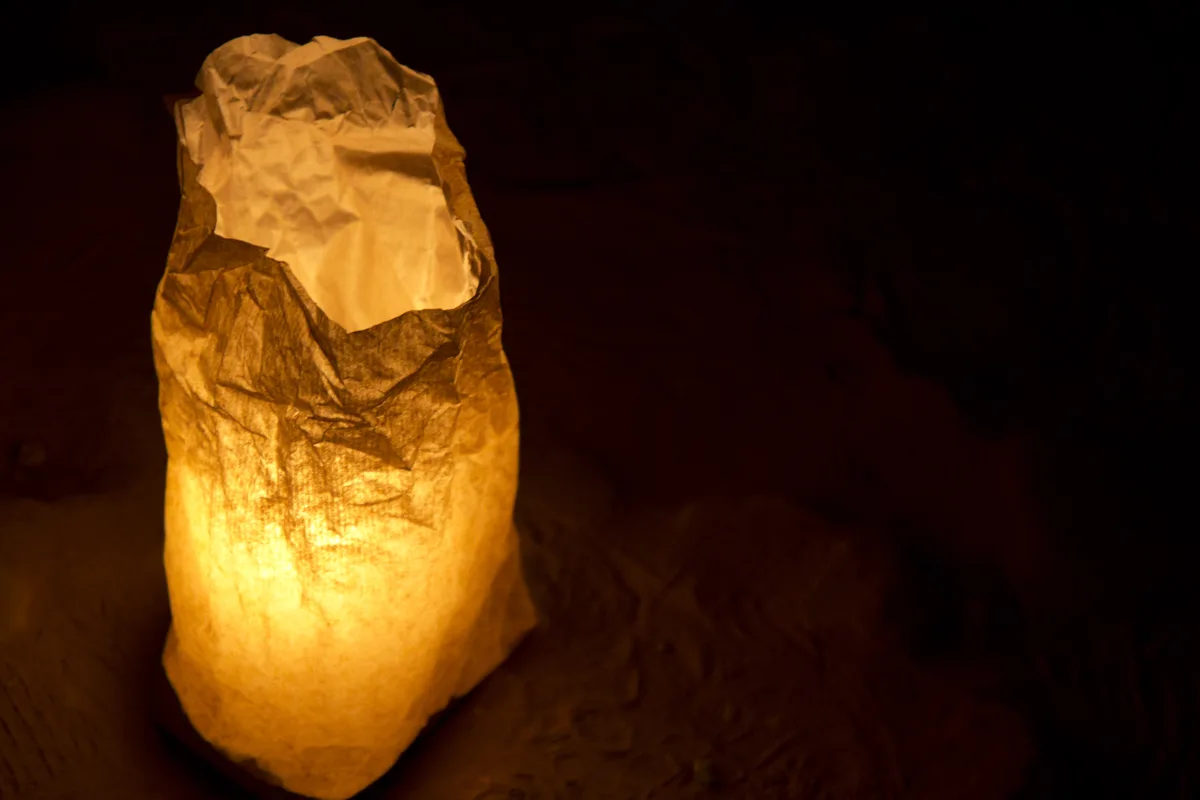
Petra by night is two thousand paper-bag candles, a kilometre of dark gorge, a facade you already love, some music, some projected light, several hundred companions and a walk back in the cold. It is not the site by night, not a secret entrance and not a photograph waiting to happen. It is a piece of theatre staged in the greatest foyer in archaeology, and judged as theatre – which is the only honest way to judge it – it is very good: the walk down alone earns the ticket for anyone who has ever wished the Siq would be quiet.
Go if you are sleeping in Wadi Musa on a Sunday-to-Thursday night, if your daytime Petra is already secured, and if atmosphere outranks access in your travelling heart. Skip it if any of those three fail. Either way, decide with the facts in this guide rather than the brochure – the candles deserve an audience that knew what it was coming to.