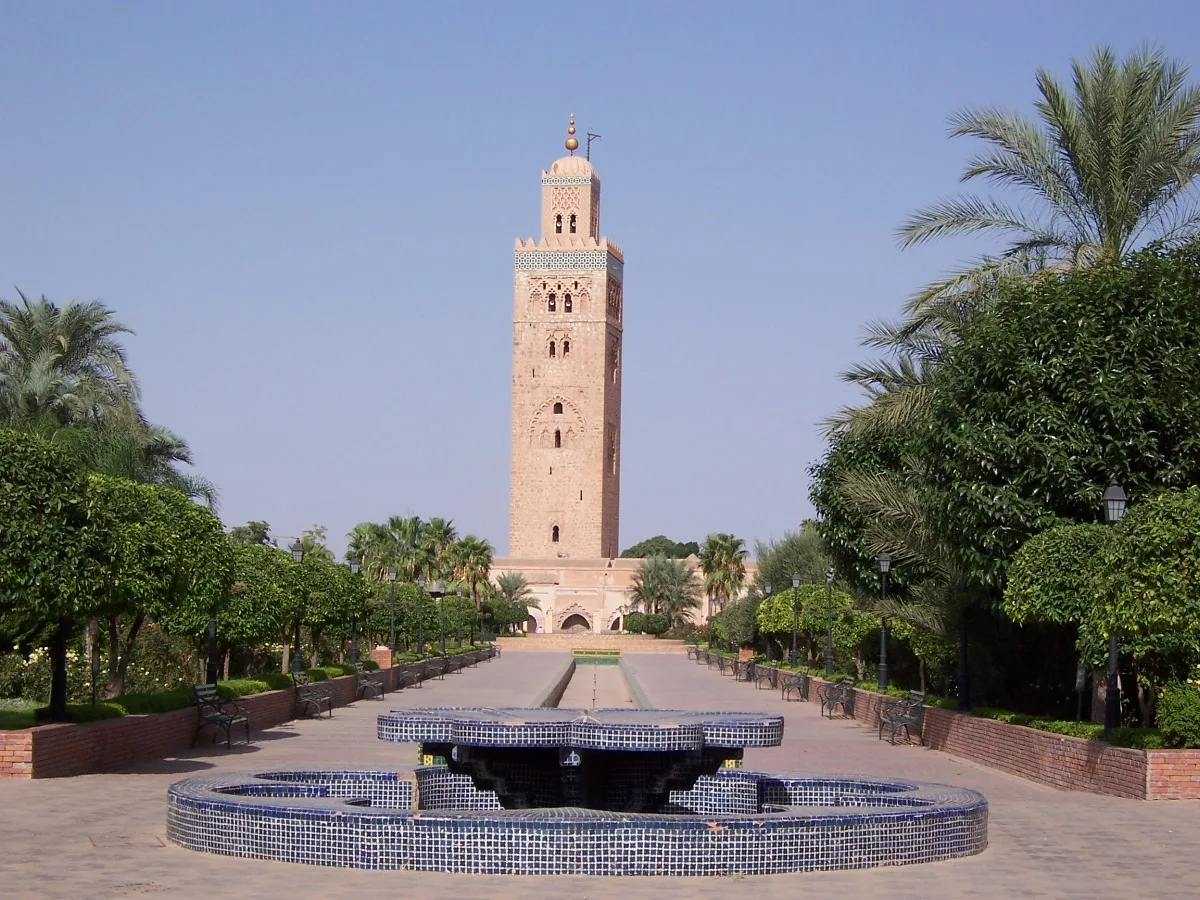
Ask ten returning visitors where to stay in Marrakech and you will get ten answers that contradict each other — until you ask the second question, which is where exactly. One traveller’s “medina” was a courtyard house two lanes from Jemaa el-Fnaa; another’s was a twenty-minute walk from the nearest street a taxi could reach, a difference no booking map bothered to mention. Marrakech is not one city for sleeping purposes. It is a walled medieval medina of some 700 hectares, a royal quarter, a former Jewish quarter, a French-planned new town, a garden suburb built for winter sun, a palm grove and a pair of historic royal gardens — each with its own texture, its own way of receiving you, and its own catch.
So this guide works at the level of areas, not addresses. It names no properties and quotes no prices, because a property can change hands and a price can change overnight, while the character of a quarter changes over decades. What follows is what staying in each part of Marrakech actually feels like, what the riad-versus-hotel question really means in that area, who each area suits, and the honest friction you are accepting when you choose it. Our wider Morocco travel guide covers the routes that begin and end in this city; this page covers the bed you start from each morning.
The single most useful idea in the whole article is also the simplest. In Marrakech, your area decides your evenings more than your days. By day, everyone converges on the same palaces, souks and gardens, and a taxi flattens most distances. By evening, you belong to your quarter: you eat near it, you walk its streets after dark, you learn its sounds. Choose the area whose evenings you want, and the days will take care of themselves.
Where to Stay in Marrakech at a Glance
| Area | The feel in one line | Typical stay | The honest catch |
|---|---|---|---|
| North medina (Ben Youssef side) | The working, sightseeing heart of the old city | Riad in the lanes | Deep-derb addresses mean a real walk with your bags |
| Bab Doukkala (north-west medina) | Local, lived-in, less performed for visitors | Riad, small guesthouse | Fewer famous sights on the doorstep |
| Mouassine (west medina) | The medina’s polished salon quarter | Boutique riad | Premium positioning; lanes still apply |
| Jemaa el-Fnaa edge | The square as your front garden, day and night | Riad or hotel on the square’s rim | Noise, crowds and performance until late |
| Mellah and the south medina | Palaces, spice markets, a different medina rhythm | Riad, guesthouse | A longer walk to the souks and the square |
| The Kasbah | The royal quarter – calm, monumental, self-contained | Riad, some larger houses | Feels separate; evenings are quiet by design |
| Gueliz | The new town – avenues, cafés, city hours | Hotel, apartment | You sleep outside the Marrakech of the postcards |
| Hivernage | Garden suburb of big hotels and winter sun | Large hotel with grounds | Resort rhythm; the medina is an excursion |
| The Palmeraie | Palms, pools and space on the city’s edge | Villa, resort hotel | Total dependence on cars and drivers |
| Agdal and Menara side | Royal gardens and olive groves, mostly local | Scattered stays, hotels towards the airport road | A base for calm, not for wandering |
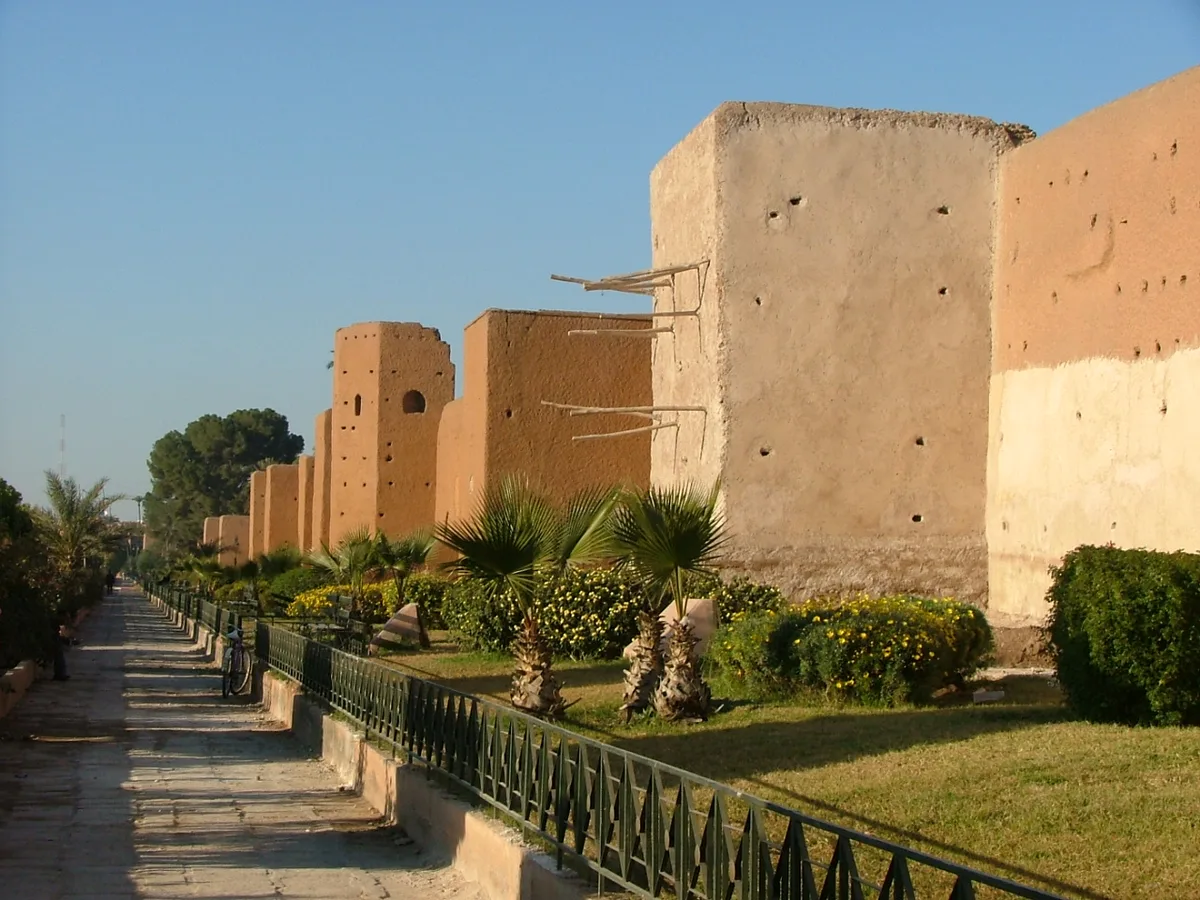
Read the medina rows of that table as five separate decisions, because they are. “The medina” covers everything inside the ramparts — a walled city UNESCO inscribed in 1985, founded by the Almoravids in 1070–1072, whose Medina of Marrakesh listing describes some 700 hectares of living historic town. Inside those walls, your position relative to Jemaa el-Fnaa matters more than any other fact about your stay. North of the square is the souk-and-sightseeing medina. South of it, beyond the palace quarter, the city changes register — royal, residential, slower. East and west edges behave differently again. The sections below take the areas in the order a first visit usually weighs them.
One structural fact shapes everything that follows, so it is worth stating before the detail. The medina’s interior is closed to cars. Streets narrow into lanes, lanes narrow into derbs — the small, often dead-end residential alleys off the main lanes — and the last stretch to almost every medina address is walked, with your luggage carried, pushed on a handcart, or balanced by a porter your riad sends. This is not a defect of particular properties; it is the physics of an 11th-century street plan. Areas outside the walls trade that friction away, and pay for the trade in atmosphere. Every verdict in this guide is really a judgement about which side of that exchange suits you.
The North Medina – Ben Youssef, the Souks and the Sightseeing Heart
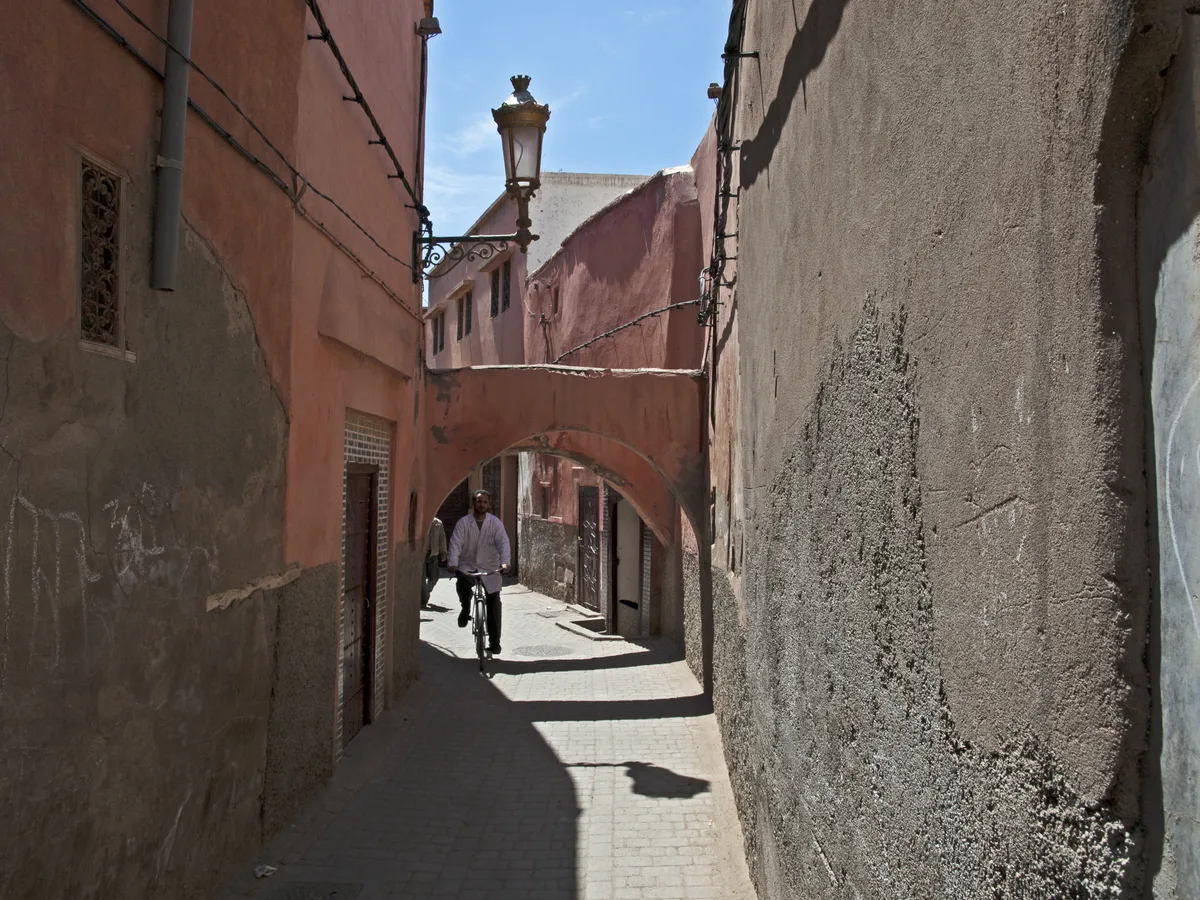
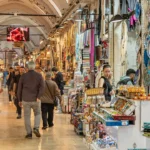
If Marrakech has a centre of gravity for first-time visitors, it is the quarter of lanes around the Ben Youssef Madrasa, north and north-east of Jemaa el-Fnaa. This is the sightseeing heart: the madrasa itself, the Koubba, the museum quarter, the souks unrolling northwards in their specialised districts — dyers, metalworkers, leather, carpets — and the tanneries towards the north-eastern walls. Stay here and the city’s greatest hits are not excursions; they are the walk to breakfast. The mornings begin with the sounds of a working medina rather than a resort — shutters, scooters threading the wider lanes, bread moving through the streets — and that working quality is precisely the appeal. This part of the medina was never a stage set; the tourism layer sits on top of a dense residential city that gets on with its own day around you.
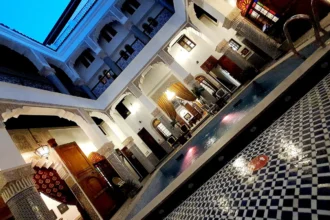
The accommodation here is overwhelmingly the classic medina form: riads and dars converted from family houses, rooms around a courtyard, a roof terrace above the lane. At street level you will see almost nothing of them — a door, perhaps a lantern — which is the medina’s founding privacy principle still at work. Inside, the range runs from simple family guesthouses to some of the most decorated small hotels in Morocco, and the courtyard does the same job in all of them: it cuts the lane’s noise to a murmur and gives the house its own sky. What the north medina does not offer is the conventional hotel format. Buildings with lifts, coach access and a lobby on a car street barely exist inside these walls; if that format is what you sleep best in, read the Gueliz and Hivernage sections twice.
The catch is depth. The north medina contains the longest derb walks in the tourist city, and two riads that look equidistant from the square on a map can differ by ten minutes of lane-walking in reality, because lanes wind and derbs dead-end. First arrivals here should be met — by the riad’s arrangement, at a named gate or square — rather than attempted solo with a phone map, which will lie to you cheerfully among the covered lanes. Once you have walked your route twice, it becomes yours, and most guests end up fond of the walk: it is the decompression chamber between the souks’ intensity and the courtyard’s calm. But it never becomes a route a taxi can finish for you, and on departure day that walk happens again, with the bags you arrived with plus whatever the souks added.
Suits: first-time visitors who want the sights woven into the day, souk shoppers, photographers, anyone whose Marrakech is the old city itself. Think twice if: you have mobility constraints, arrive and depart at unsocial hours repeatedly, or know that an unfindable address on night one would sour the trip rather than start it.
Bab Doukkala and the North-West Medina – The Local Side of the Walls
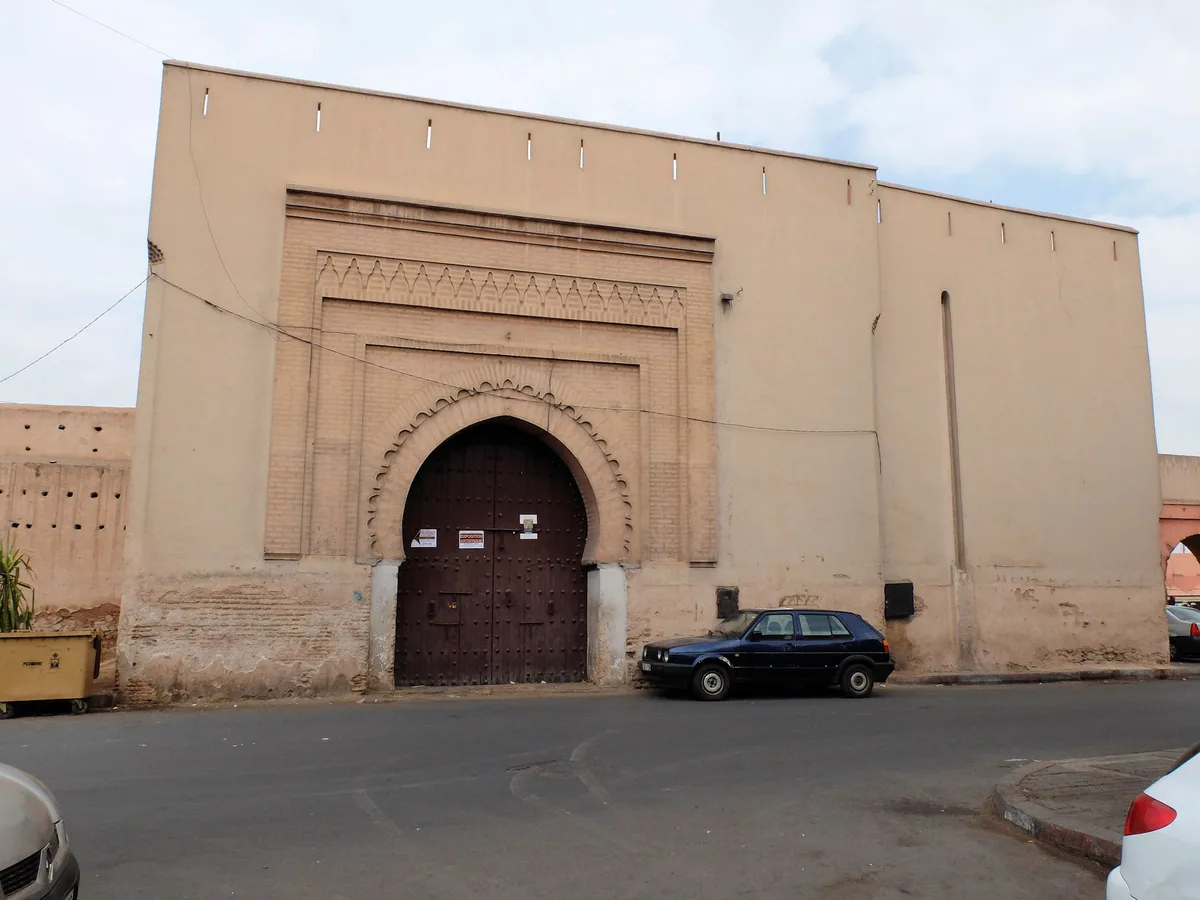
West of the souks, towards the great gate and mosque of Bab Doukkala, the medina changes mood. This is its north-western quarter — more residential, more local in its commerce, and noticeably less arranged for visitors than the Ben Youssef side. The famous sights thin out; what replaces them is ordinary Marrakech life at full strength: neighbourhood bakeries and hammams, small markets serving the quarter rather than the tourist route, lanes where a guesthouse door is the exception instead of the street’s whole economy. The Bab Doukkala mosque, a Saadian-era foundation, anchors the quarter, and the gate itself is one of the medina’s practical doors — a place taxis can reach, which matters more to a stay than any postcard quality.
Accommodation here follows the same riad pattern as the rest of the medina, but the houses often feel like what they originally were — homes in a living quarter — and the guesthouses skew smaller and more personal. You are likelier to eat breakfast with the household’s rhythm around you and to be known at the corner shop by day three. For repeat visitors especially, this quarter is the answer to a common second-trip feeling: the wish to stay in the medina without staying in its showroom. Prices are not this guide’s business, but the quarter’s positioning away from the headline sights is exactly why travellers who value calm-over-convenience look here.
The catch is the mirror of the appeal. Your sightseeing starts with a walk — across or around the souks towards Ben Youssef, or down towards Jemaa el-Fnaa — rather than beginning at your door, and in the heat of the middle of the day that walk is a real cost to schedule around. The quarter also asks a little more of your navigation: fewer visitors walk these lanes, signposting is thinner, and your derb route home needs learning properly the first time. None of this is hardship; it is the honest exchange for a medina stay that still belongs to its residents. Travellers who want the old city as a neighbourhood rather than an attraction tend to rate this trade the best in Marrakech.
Suits: repeat visitors, longer stays, travellers who cook, wander and settle rather than sightsee on a schedule. Think twice if: your days are a tight checklist of the famous sights, or you want other travellers’ company and infrastructure around you.
Mouassine and the West Medina – The Polished Quarter
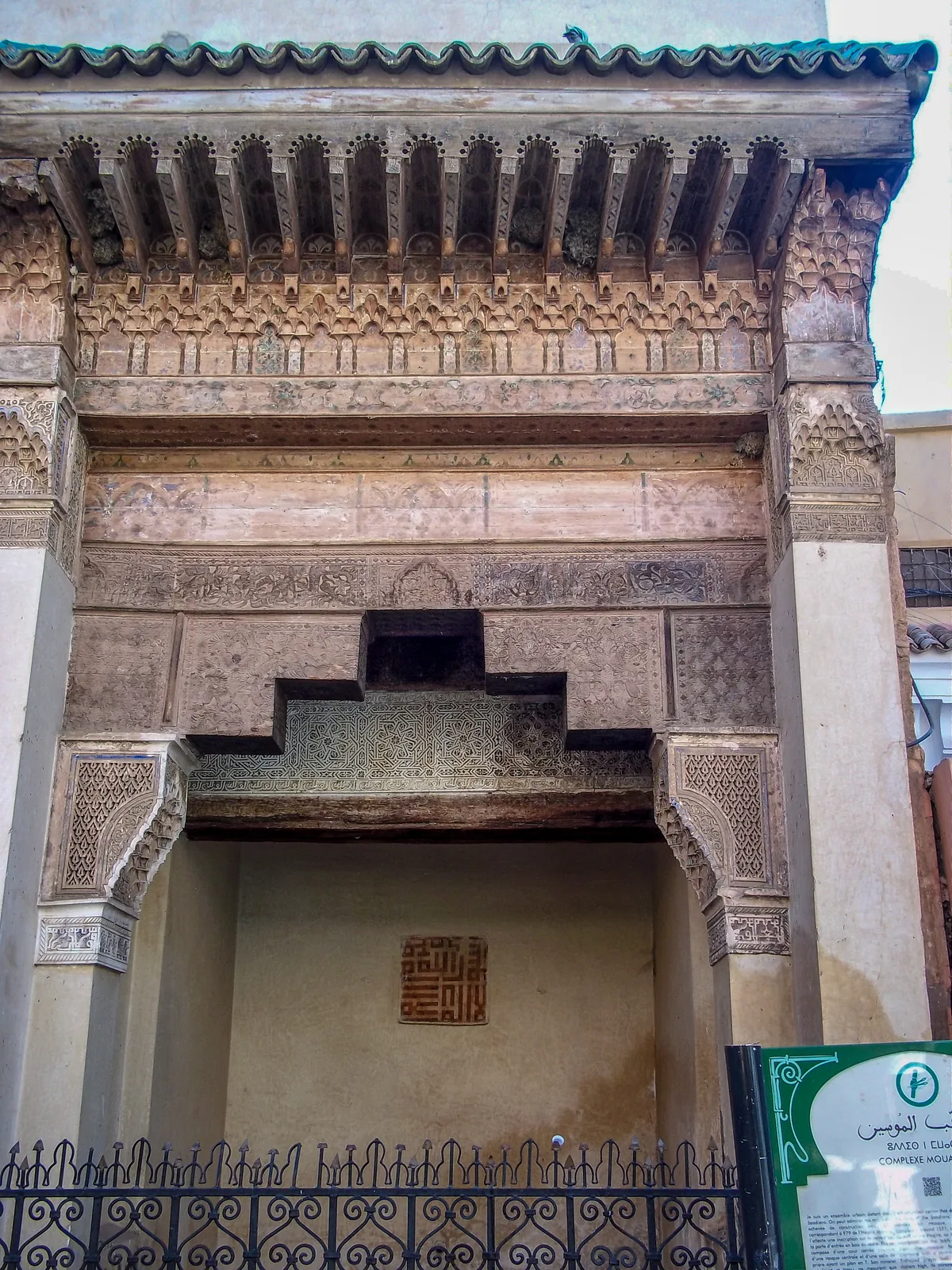
Between the souks and the Koutoubia side of the medina lies Mouassine, and if the medina has a salon quarter, this is it. The quarter grew around its Saadian-era mosque complex — mosque, fountain and hammam built under the same 16th-century patronage that raised much of monumental Marrakech — and its modern character keeps something of that composed quality. The lanes here hold the medina’s most polished small shops, galleries and concept stores among the ordinary commerce, its best-known hammams, and a concentration of elegant boutique riads. It is the old city with its hair brushed: still unmistakably the medina — derbs, covered lanes, courtyard doors — but curated at a level the north medina’s happy chaos never attempts.
For the visitor deciding where to stay in Marrakech with a preference for beauty over bargains, Mouassine is usually the medina answer. Its position is the practical half of the argument: the quarter sits a short walk west of Jemaa el-Fnaa, close to the square without being on it, and near the medina’s western gates, which shortens the taxi last mile compared with the deep north. Riads here compete on design and service — roof terraces arranged for the sunset, courtyards planted and lit like stage sets, staff who run the house as a small hotel in all but name. The traditional architecture carries it: a Mouassine riad at its best is the single most seductive sleeping format in the city.
The catch is partly the same as everywhere in the medina — the last stretch is still walked, the lanes still wind — and partly the quarter’s own success. Mouassine’s polish is priced and positioned accordingly (this guide quotes no figures; the quarter’s reputation does the talking), and its streets carry a steady flow of visitors heading for its famous shops and baths, so the residential quiet of Bab Doukkala is not on offer here. Travellers who want the medina raw will find Mouassine a little arranged; travellers who want the medina beautiful will find the arrangement is the point. Neither reaction is wrong, but it is worth knowing which traveller you are before the quarter chooses for you.
Suits: design-minded travellers, couples, anyone wanting the medina experience at its most refined, and first-timers who want lanes without the deep-medina walk. Think twice if: your budget is the trip’s organising principle, or you prefer your old cities uncurated.
Sleeping Beside Jemaa el-Fnaa – The Square as Your Front Garden
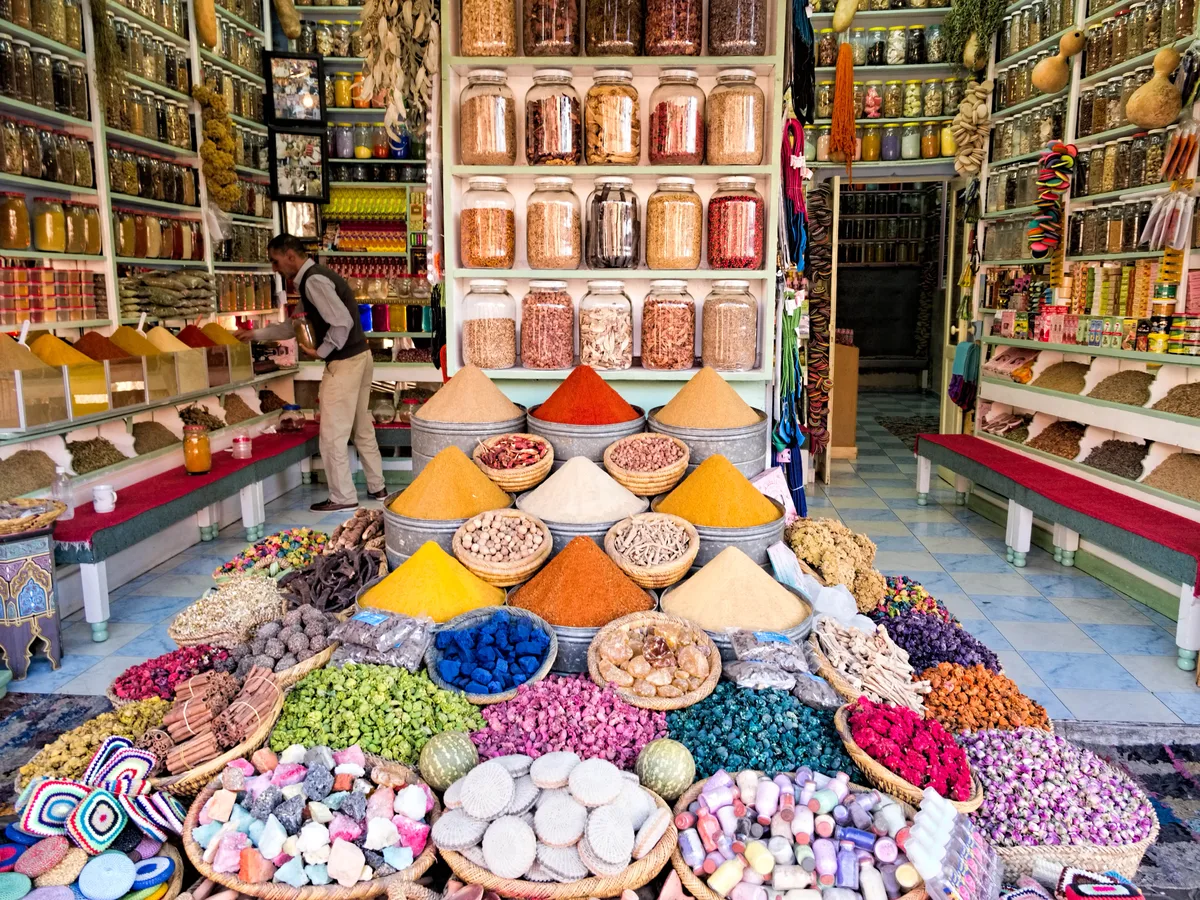
Every account of Marrakech bends towards one piece of ground: Jemaa el-Fnaa, the great open square at the medina’s heart, whose cultural space UNESCO has named to its Intangible Cultural Heritage list and which has been the city’s stage for centuries. Sleeping beside it — in the riads of the lanes just off the square, or in the hotels on its rim — makes the square your front garden. You fall into its rhythm without travelling to it: the daytime expanse of juice stalls and performers, the late-afternoon reorganisation, and then the nightly transformation as the food stalls fire their grills and the drum circles form. From a roof terrace above the rim, that transformation is the best free show in Morocco, and it happens every single evening of your stay.
The practical case is as strong as the romantic one. The square is the medina’s transport hinge — taxis and carriages work its edges, the Koutoubia stands a short walk west, the souks begin at its northern side, and almost every medina address is measured by its distance from this point. A base here minimises the medina’s great friction, the last mile: your walk from taxi to door is the shortest the old city offers, and finding your way home is rarely in doubt, because every lane you are likely to use leads back to the square’s light and noise. For a short first stay — two or three nights with the sights packed tight — that simplicity is worth more than almost any facility a hotel could add.
The catch is written in the same ink: you are sleeping beside a stage that performs until late. The square’s sound — drums, music, crowds, the food stalls’ generators and gas hiss — carries into the lanes around it, and the streets off the rim carry the crowds with it, at their densest and most tout-dense in the early evening. Courtyard architecture muffles more than you would expect, and rooms facing inward are far quieter than the street suggests; but light sleepers should treat “steps from Jemaa el-Fnaa” as a warning label as much as a boast. This is the medina at maximum intensity, permanently. Stay here if intensity is what you came for; stay one quarter away — Mouassine, the Kasbah side — if you want the square as a nightly visit rather than a nightly presence.
Suits: short first stays, night people, travellers who want the city’s theatre on tap and the simplest possible navigation. Think twice if: you sleep lightly, keep early hours, or find crowd-pressure tiring rather than thrilling.
The Derb Problem – What a Medina Address Really Means
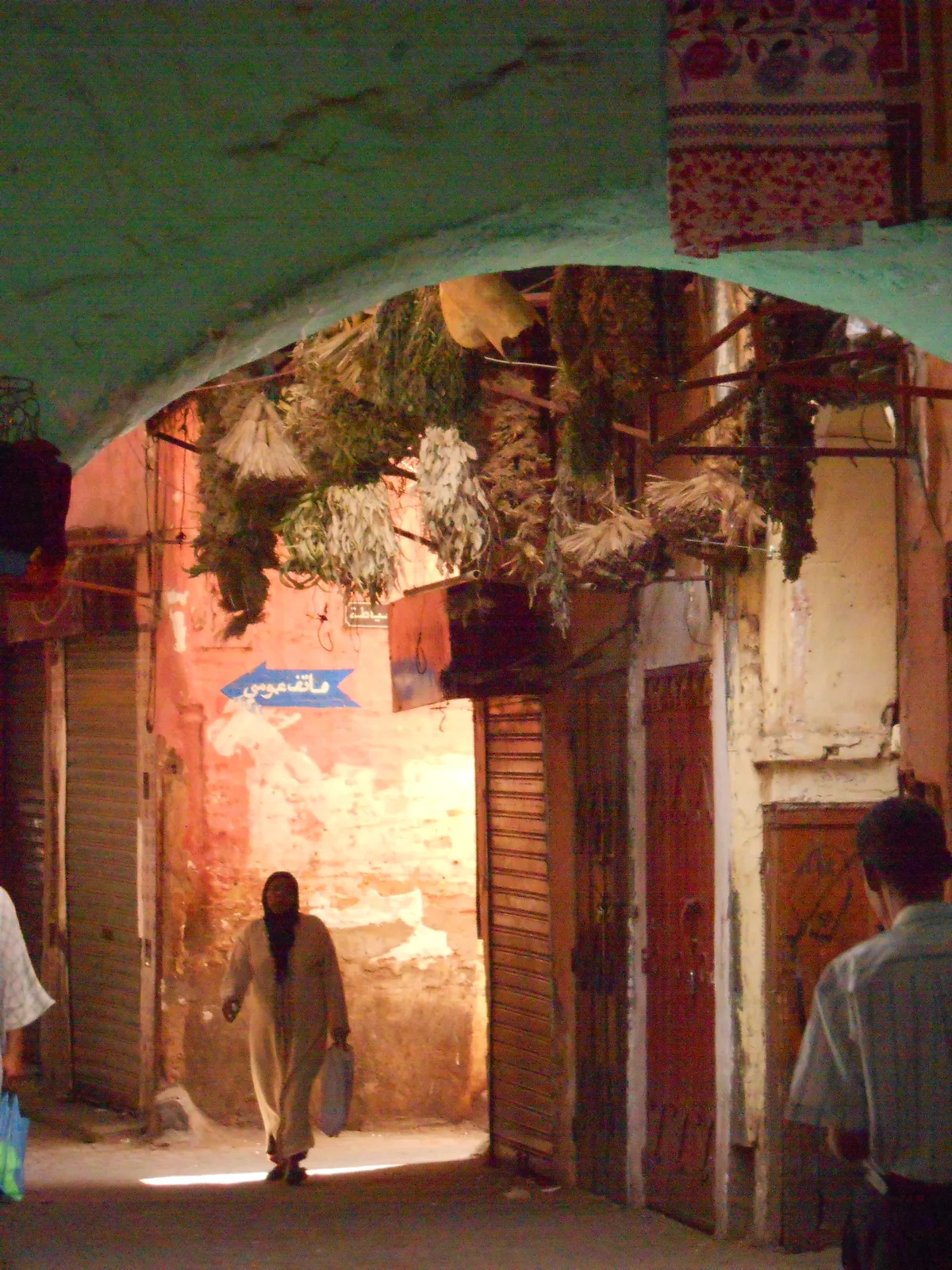
Every medina section above has circled the same subject, so it deserves its own: the derb. A derb is the medina’s smallest street unit — a residential alley, frequently a dead end, serving a cluster of houses whose doors open onto it. Derbs are where medina life actually lives: neighbours, children, cats, bread trays heading for the communal oven. They are also where the visitor’s logistics end. No car enters a derb. Most are too narrow and too angled even for the luggage carts to be quick. Your riad’s address, whatever the booking page implies, resolves in practice to a gate or a square where wheels stop, plus a walk — sometimes three minutes, sometimes fifteen — that no map renders honestly, because the lanes that matter most are covered, kinked and invisible to satellites.
Handled well, the derb is a ritual rather than a problem. The standard medina choreography exists precisely because of it: the riad asks your arrival time, sends someone to a named meeting point — a gate, a mosque, a known square — and walks you in, with your bags carried or carted. On departure the process reverses. Your job is to play your part: share your arrival details, keep the riad’s phone number reachable, travel with bags you can imagine on a handcart, and walk the route attentively the first time, counting landmarks rather than street names. Within a day the derb becomes yours — medina regulars speak of their lanes with real affection — and the walk in and out becomes the hinge of the day rather than an obstacle in it.
The derb problem only bites where it is ignored. Arriving unannounced at night in the deep medina, following a phone’s blue dot into covered lanes, is the one reliably miserable arrival Marrakech offers, and it is entirely avoidable. It also shapes who should stay outside the walls altogether: anyone for whom a walked last stretch, possibly with steps and uneven paving, is a genuine difficulty rather than a mild adventure should take the medina as a daily excursion and sleep where the taxi reaches the door. That is not a lesser trip. It is the same city, honestly matched to its visitor — which is the whole purpose of asking where to stay in Marrakech as an area question instead of a property question.
Suits: every medina guest who arranges the meeting point and packs with the walk in mind. Think twice if: you are arriving very late, travelling with heavy or awkward luggage, or have any doubt about walking uneven lanes — solve it with an outside-the-walls base, not with optimism.
The Mellah and the South Medina – A Different Old City
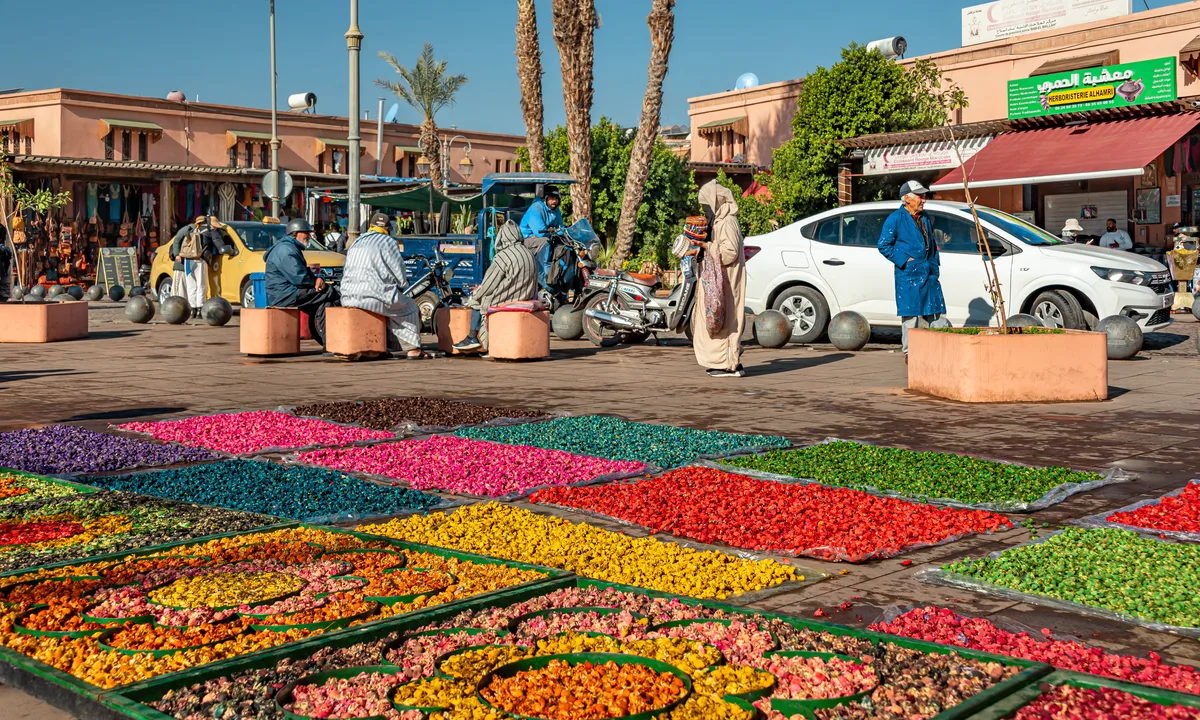
South of Jemaa el-Fnaa, past the palace quarter, the medina changes character a second time. Here stands the Mellah, the historic Jewish quarter, created in 1558 by decree of the Saadian sultan Abdallah al-Ghalib beside the royal palace — a walled district within the walled city, built for a community whose merchants and craftsmen were central to Marrakech’s economy for centuries. Its street plan announces the difference before any guidebook does: the Mellah’s lanes run straighter and more regular than the old medina’s tangle, its houses historically taller, with windows and balconies facing the street in a way the inward-looking medina house usually refuses. A large community lived here at its height; most families emigrated in the decades after 1948, and today the quarter is a working, mostly Muslim neighbourhood that keeps its Jewish heritage visibly — in its two surviving synagogues, among them Slat al-Azama, and in the great Miara cemetery outside its walls, described as the largest Jewish cemetery in Morocco.
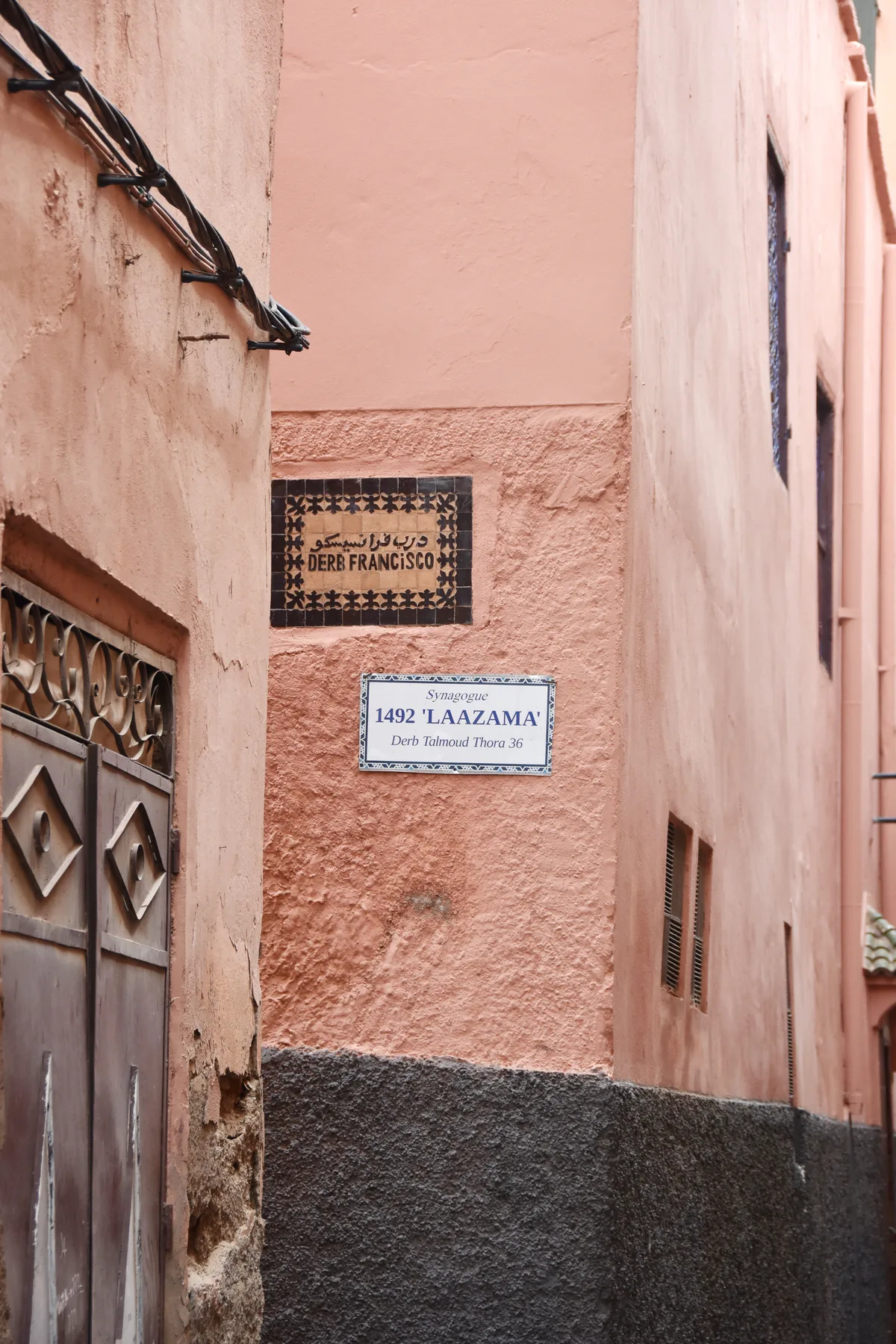
Staying in or beside the Mellah means sleeping in the monumental south: the Bahia Palace at the quarter’s northern edge, El Badi’s ruins a short walk west, the spice market and the tinsmiths’ square — Place des Ferblantiers — at its gate. The souk here is the spice and everyday-goods souk, provisioned for the city as much as for visitors, and the quarter’s lanes carry a calmer, more residential air than the north, with the royal palace walls closing the southern side. Guesthouses and riads here tend to be spacious by medina standards, and the quarter rewards travellers who like their old city with the volume turned down one notch from the souks’ full blast.
The catch is distance measured in medina terms. From the Mellah, Jemaa el-Fnaa is a proper walk — through or past the palace quarter — and the main souks lie beyond the square, so a Mellah base turns the north medina into a deliberate expedition rather than a drift. Evenings in the quarter are early and local; the square’s nightlife is a walk away, not a presence. Some travellers experience this as the best of both structures — sights by day, a real neighbourhood by night — and others as being based at the far end of the city they came to see. Both readings are accurate. The Mellah suits a visitor whose Marrakech is the palaces and the south; it asks a small daily toll from a visitor whose Marrakech is the square and the souks.
Suits: palace-focused itineraries, travellers interested in Morocco’s Jewish heritage, repeat visitors exploring beyond the standard circuit, quiet sleepers who still want the medina. Think twice if: your evenings belong to Jemaa el-Fnaa or your days to the northern souks — you will spend them walking to your own holiday.
The Palace Quarter – Bahia, El Badi and the Grandeur Belt
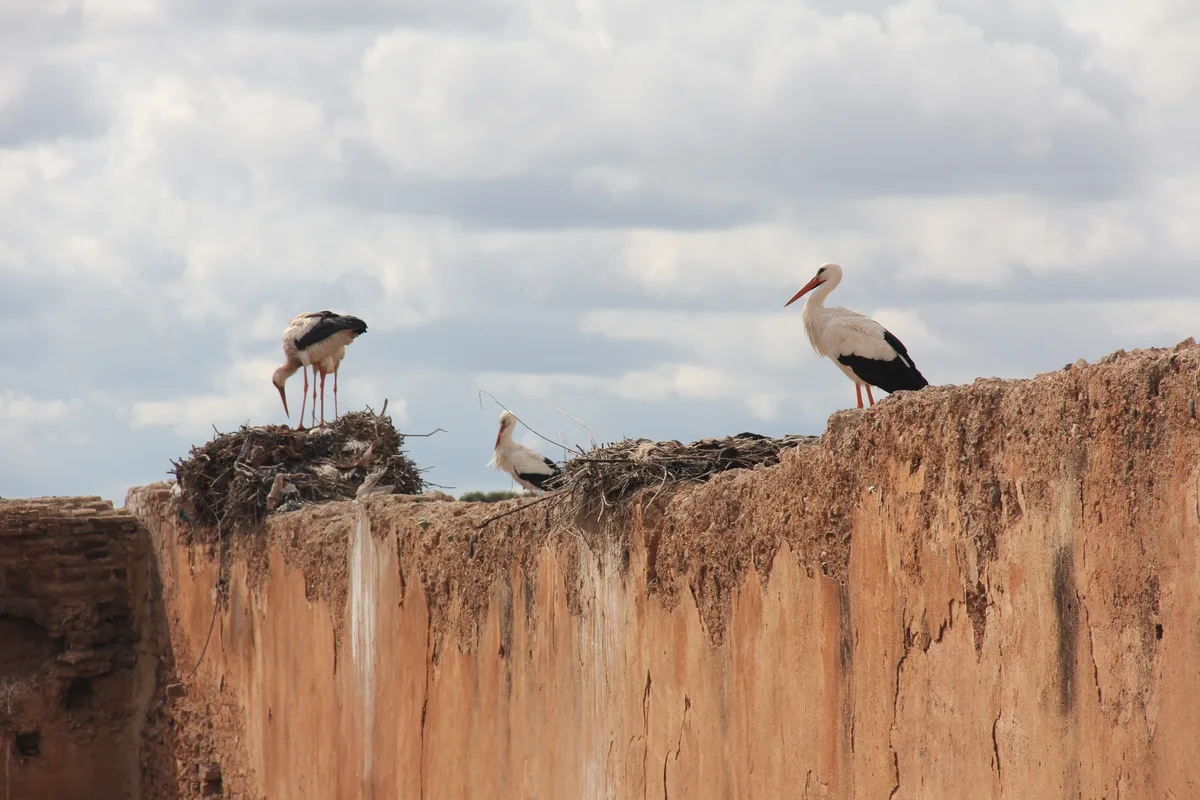
Between the Mellah and the Kasbah runs the belt of ground that made southern Marrakech monumental: the palace quarter. Its two great survivals face each other across a few lanes. The Bahia Palace, built in the later 19th century for the grand vizier Si Moussa and enlarged by his son Ba Ahmed, is the medina’s masterpiece of the decorated interior — a sprawling single-storey palace of courtyards and reception rooms, said to run to around 150 rooms, where the finest zellige, carved plaster and painted cedar in the city cover almost every surface. El Badi, a few minutes west, is its opposite: the Saadian palace of Ahmad al-Mansur, raised in the decades after 1578 and stripped within a century, now a vast romantic ruin of sunken gardens and enormous walls — on which storks nest, as they have nested on Marrakech’s high walls for generations.
Staying in this belt puts the two palaces in your morning rather than your itinerary, and the quarter around them — the lanes of Berrima and the streets running down towards the Mellah and the Kasbah — has the spacious, sunlit feel of the monumental south. The houses here were built for officials and merchants of the palace world, and converted riads in the quarter often show it in their proportions: bigger courtyards, taller reception rooms, roof terraces with the Atlas or the Koutoubia for a backdrop. It is also one of the medina’s more legible quarters for a newcomer — the landmarks are enormous, the main streets comparatively straight, and the square is walkable without heroics.
The catch is a mild version of the Mellah’s: this is the medina’s ceremonial zone, and between the palace walls and the royal quarter the residential fabric is thinner than in the north. Your everyday medina — the corner shops, the lane life, the souks’ commercial roar — is present but diluted, and the walk to the square and the souks is a daily constant rather than an occasional choice. Travellers who fall for the south usually fall completely; the light, the space and the storks see to that. Travellers who wanted the medina’s density sometimes feel based in its museum wing. Know which palace you would rather wake beside — the decorated one or the ruined one — and you will know the quarter.
Suits: architecture lovers, palace-first itineraries, travellers who like the monumental south’s space and light. Think twice if: you want the dense commercial medina at your door, or Jemaa el-Fnaa as a nightly habit.
The Kasbah – The Royal Quarter Behind Bab Agnaou
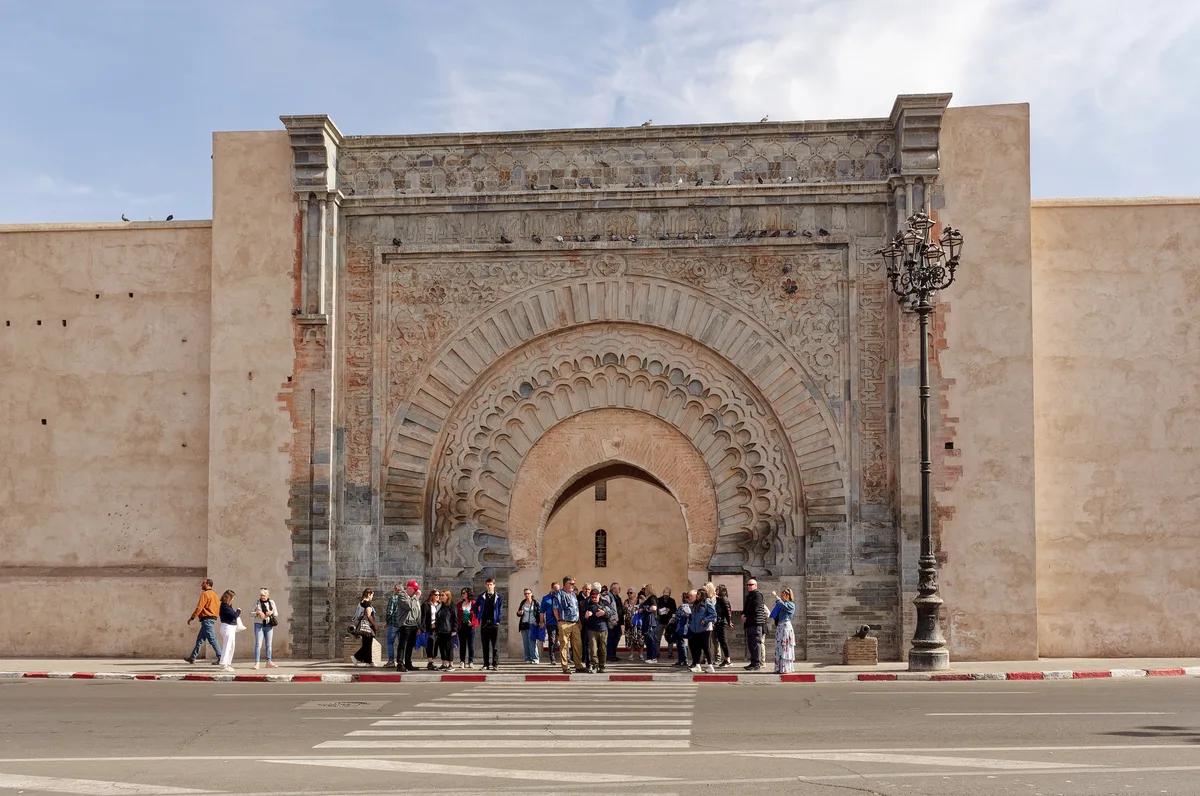
In the medina’s south-western corner, entered through the carved stone of Bab Agnaou — the Almohad gate built for ceremony rather than defence — lies the Kasbah, and it is the old city’s most distinct sleeping quarter. This was the citadel district: founded as the Almohad royal quarter in the 12th century, organised around the Kasbah Mosque and the royal palace, and still bounded by palace walls and the Agdal gardens to its south. The Saadian Tombs, the dynasty’s necropolis rediscovered behind a sealed wall in 1917, stand beside the mosque. The quarter keeps the stamp of its purpose — broader streets than the commercial medina, an air of administration and residence rather than trade, and an evening calm that arrives early and stays.
A Kasbah base suits a particular and common Marrakech plan extremely well: the traveller who wants to sleep in the medina — courtyard house, lanes, local mornings — without sleeping in its intensity. The quarter’s riads share the medina format but sit in its quietest walled streets, and the position has a logistical grace the north cannot match: Bab Agnaou and the Kasbah’s gates are reachable by taxi, so the last mile shrinks to a short walk even by medina standards. The square is a straight, walkable line north through the palace belt. Many experienced Marrakech hands, asked where to stay in Marrakech for a balanced trip, name this quarter first: old-city soul, royal-quarter calm, manageable logistics.
The catches are the calm itself and the quarter’s separateness. The Kasbah’s evenings are residential — family streets, early shutters, few of the cafés and none of the theatre of the square — and after dark the walk back from Jemaa el-Fnaa, while straightforward, is a walk you will feel you are making away from the city rather than within it. The sights at your door are heavyweights but few: tombs, mosque exterior, palace walls; the souks and the northern sights are the far end of the medina from here. The Kasbah is a base for a traveller whose days range widely and whose evenings wind down — a pattern that describes a great many good trips, and bores a great many night owls.
Suits: travellers wanting medina atmosphere with the volume low, families, anyone mixing medina days with early nights, and repeat visitors with a favourite quarter already. Think twice if: nightlife and the square’s energy are the trip’s centre, or you want the souks as your local shops.
Riad or Hotel – The Honest Marrakech Version
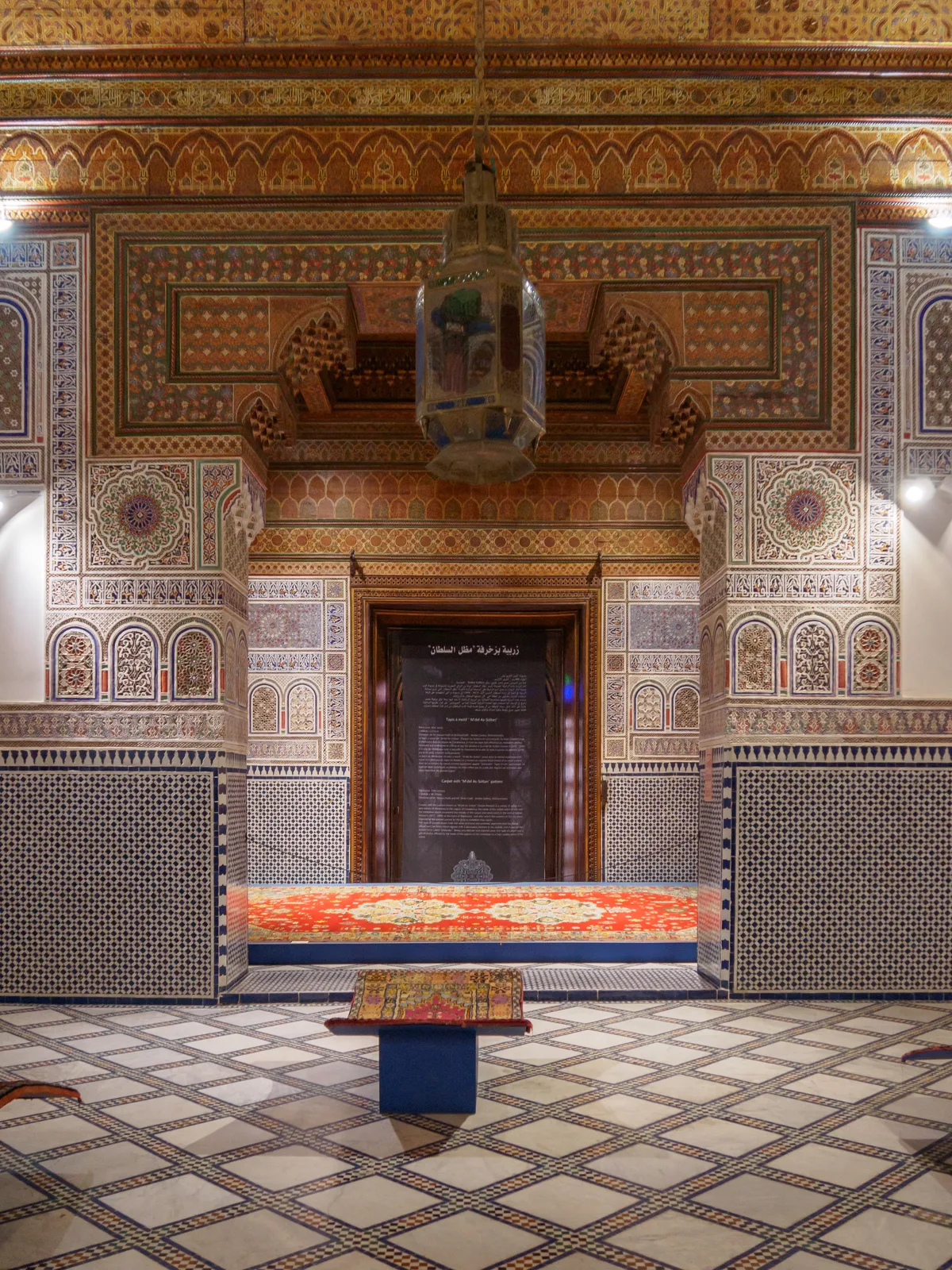
Area decided, one question remains, and it is the one the booking sites ask first and worst: riad or hotel? In Marrakech the honest version of the question is not about thread counts. A riad is a house: inward-facing, courtyard-centred, staffed like a household, with breakfast when the house serves it and a roof terrace instead of a facilities floor. The type has real consequences — rooms vary because houses vary, sound travels in courtyards in the sociable hours, and the building’s wonders (the carved reception rooms of the great houses, of which Dar Si Said, the palace built for the Bahia vizier’s brother, is the museum example) come with the house’s original stairs, thresholds and quirks.
The hotel format in Marrakech lives outside the walls, and its virtues are the medina’s frictions, removed: a door a taxi can reach, a lift, a desk at 3 a.m., a pool that is a pool rather than a courtyard plunge, rooms as predictable as the brand’s other cities. Neither format is the authentic one, despite what the marketing of both claims. The riad is authentic to how wealthy Marrakchi families housed themselves; the grand hotel is authentic to a century of visitors wintering here — Hivernage exists because the hotel tradition is genuinely old in this city. The choice is temperamental, not moral. (The country-wide version of this question — riads, dars, kasbah stays and desert camps compared as types — is the subject of our Where to Stay in Morocco guide, linked from this page as soon as it is live.)
So decide by logistics and by evenings. If your trip is short, your luggage heavy, your hours irregular or your mobility limited, the hotel areas protect the trip. If your trip is the medina — its lanes, its mornings, its courtyard silence — the riad is not an accommodation choice but the substance of the visit, and its frictions are the entry fee, already itemised in the derb section above. Hybrid trips are common and sensible: medina nights first while energy is high, then a garden hotel to recover in, a pattern the city’s own geography — old town against Hivernage — seems designed to encourage. Travellers building that split into a longer route will find Marrakech’s sleeping choices set out night by night in our Morocco itinerary.
Suits: everyone, asked properly — the format follows the trip, not the brochure. Think twice if: you are choosing a format to prove something about your travelling rather than to sleep well in it.
Gueliz – The New Town That Keeps City Hours
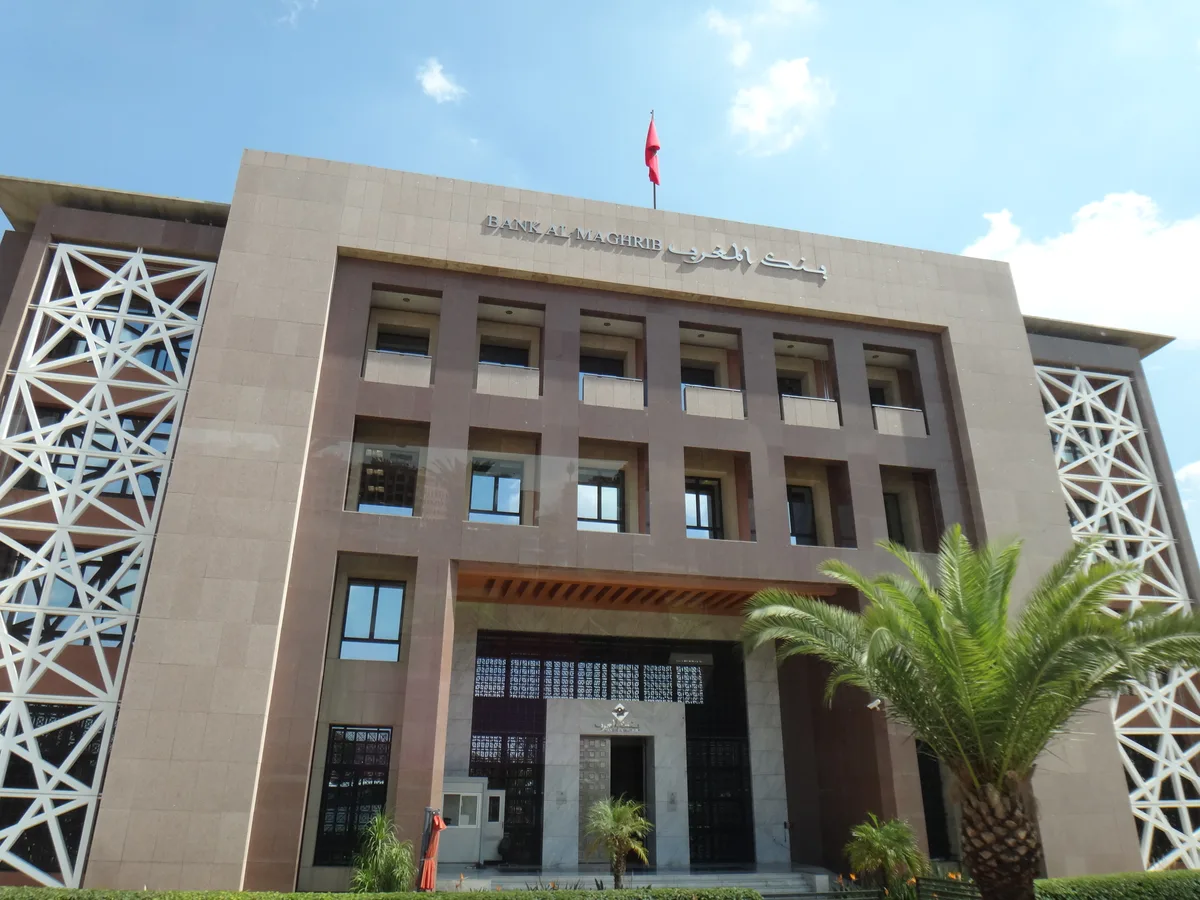
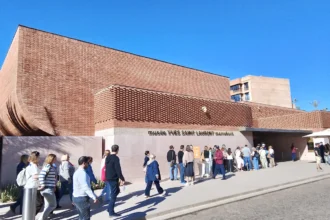
North-west of the ramparts, the French protectorate built Marrakech a second city, and Gueliz is still recognisably that city: a planned ville nouvelle of straight avenues and regular blocks, laid out from the protectorate’s early decades, centred on the long axis of Avenue Mohammed V running from the medina’s edge out towards the hills. Everything the medina refuses, Gueliz supplies as a matter of course. Streets take cars and addresses take taxis to the door. Buildings have lifts. Cafés have terraces on pavements wide enough for them, restaurants keep city hours and city variety, and the population of the pavement at 9 p.m. includes half of young Marrakech. The Jardin Majorelle and the Yves Saint Laurent Museum stand at Gueliz’s northern edge — technically the new town’s quarter, emotionally every visitor’s — which gives the district one genuine sightseeing anchor of its own.
Staying in Gueliz means choosing the modern Moroccan city as your base and visiting the historic one, and for many travellers that is the correct order. The hotels here run from business-format blocks to smart boutiques; apartments suit longer stays; and the whole apparatus of arrival — station, airport road, car hire, supermarket, pharmacy, a café where you can simply sit — works without translation or negotiation. After a day in the medina’s full sensory weather, Gueliz evenings can feel like a decompression chamber with better coffee. Repeat visitors, business travellers, and anyone travelling with a car often conclude that Gueliz is where to stay in Marrakech when the medina has stopped being the point of the trip and become its favourite excursion.
The catch is stated by every Gueliz loyalist with a shrug: you sleep outside the Marrakech you came to see. The ochre, the lanes, the courtyard mornings — all of it is a taxi ride away, and a base you must travel from each morning produces a different trip from a base you wake in. Avenue Mohammed V also carries the new town’s traffic honestly: this is a working city’s main axis, with the noise and hurry of one, and a room over it trades medina sounds for motor sounds. Choose Gueliz for function and you will be well served; choose it expecting atmosphere and you will spend the trip commuting to find it.
Suits: repeat visitors, business and mixed-purpose trips, drivers, longer stays, anyone prioritising easy logistics and city restaurants. Think twice if: this is a first, short, medina-focused visit — the old city deserves to be slept in at least once, and Gueliz will keep for next time.
Hivernage – Wintering, Gardens and the Big-Hotel Belt
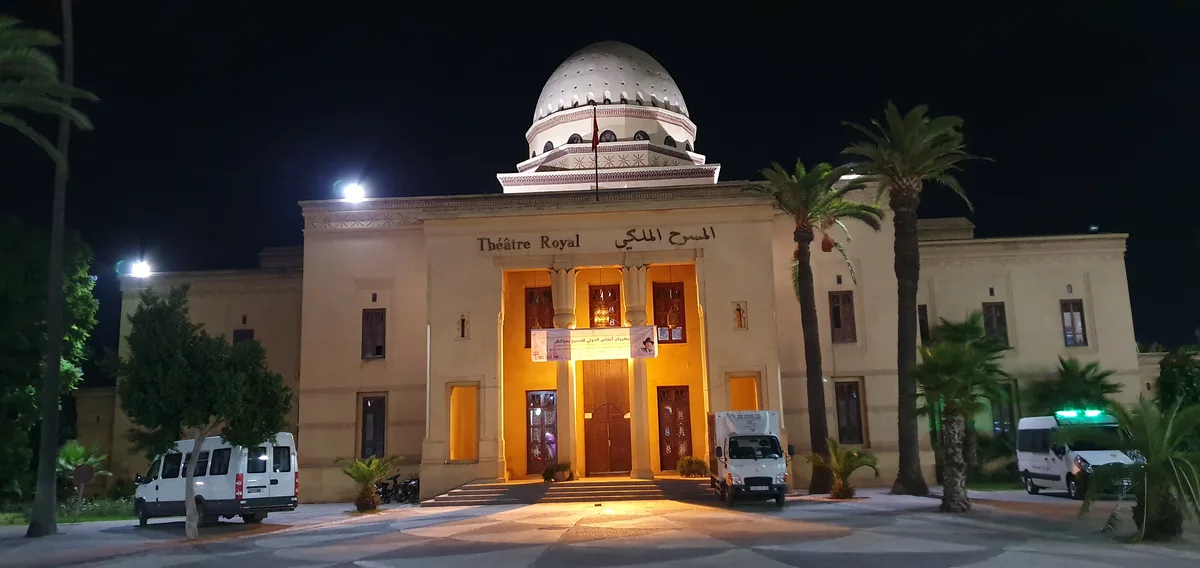
South-west of the medina, between the ramparts and the Menara gardens, lies the quarter whose name is its biography: Hivernage, wintering. Laid out in the protectorate era as a garden suburb for Europeans chasing winter sun, it was designed around the opposite of the medina’s principles — wide streets, plots with gardens, villas set back behind palms, and hotels with grounds rather than courtyards. Its main axis, Avenue Mohammed VI, carries the Royal Theatre, the congress palace and the quarter’s grand hotels down towards the station side of the city, and the whole district keeps a composed, leafy calm that can feel, after the medina, almost startlingly quiet.
This is Marrakech’s big-hotel belt, and its product is a known quantity delivered at scale: landscaped pools, spa floors, rooms with medina-or-Atlas views, staff in the hundreds, breakfast as an event. For a certain trip — winter sun with sightseeing in doses, a conference, a family holiday where the hotel is half the destination — Hivernage is simply the right answer, and its proximity sweetens it: the medina’s Bab Jdid gate is at the quarter’s eastern edge, so the old city is minutes away rather than a suburb’s drive. The quarter also holds the city’s nightlife institutions — the casino and the big hotel bars and clubs — for travellers whose evenings run later than the medina’s.
The catch is the resort rhythm that comes with the format. A Hivernage hotel is designed to be sufficient — pool, gardens, restaurants, entertainment — and sufficiency has a gravitational pull: days soften into the grounds, the medina becomes a half-day excursion between breakfast and the pool, and Marrakech risks becoming the view from the terrace rather than the place you are in. The quarter itself, between the hotels, is handsome but thin — avenues and walls and gardens, not a neighbourhood to wander for its own sake. Stay in Hivernage for the hotel, consciously, and it delivers completely. Stay in it by default, and you may leave having had an excellent holiday that happened to be near Marrakech.
Suits: winter-sun and pool-centred trips, families wanting resort facilities with a medina on tap, conference travellers, nightlife-oriented stays. Think twice if: the medina is the trip — sleep in it, and let Hivernage be the excursion instead.
The Palmeraie – Palms, Pools and Total Car Dependence
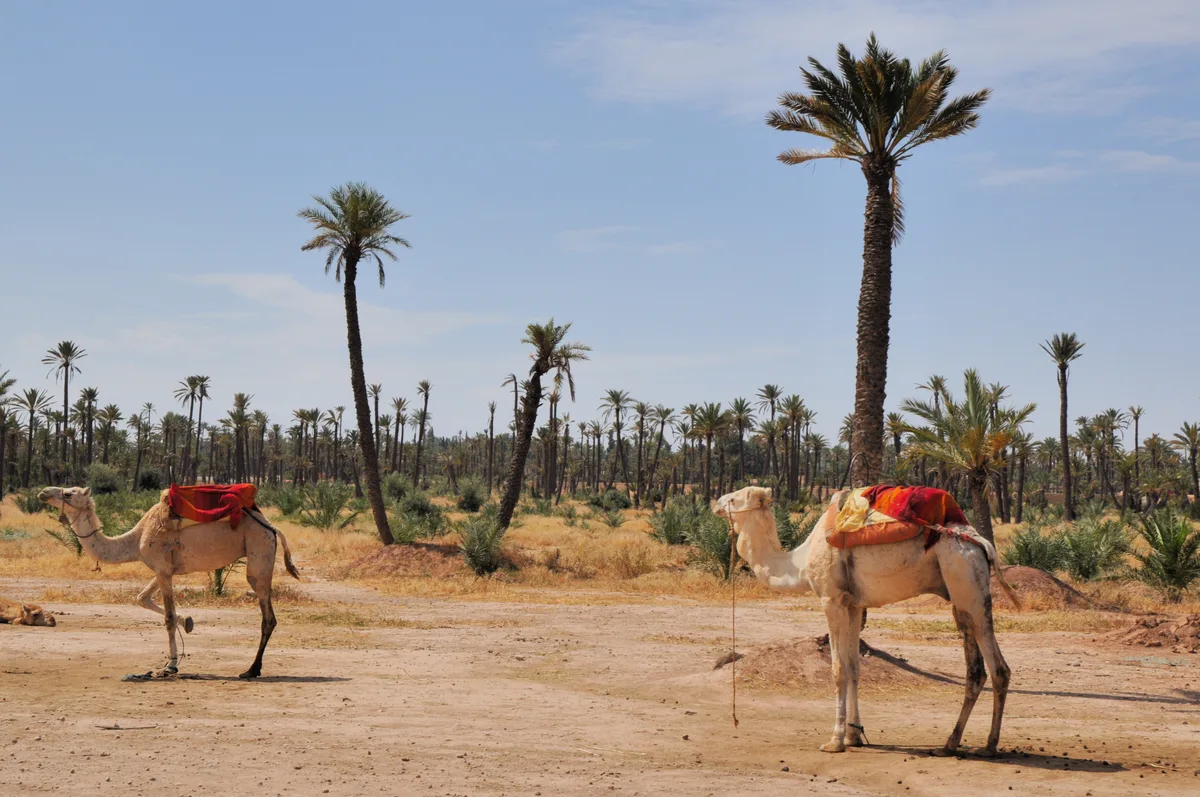
North-east of the city, the Palmeraie is Marrakech’s green mythology made landscape: a vast date-palm grove whose plantation UNESCO’s medina listing attributes to the Almoravids themselves, watered for centuries by khettaras — underground channels tapping the water table — and still, in its surviving stretches, a working agricultural world of palms, smallholdings and dusty tracks. The counts quoted for it vary widely by source; figures well into six digits of palms are commonly cited, and everyone agrees on the direction of travel, since UNESCO’s own integrity notes flag the palm groves’ exploitation and development pressure. Into this grove the modern city has inserted its most spacious sleeping format: villa hotels behind walls, resort complexes with golf and pools, private houses with gardens — a district of compounds rather than streets.
What staying here feels like follows from that structure. Days are quiet, green and horizontal: breakfast under palms, the pool, the garden, the Atlas on the horizon when the air is clear. Space is the luxury — rooms and grounds at a scale no medina or new-town plot allows — and for groups, celebrations and families who holiday at their hotel, the Palmeraie offers a Marrakech that is mostly resort, lightly seasoned with the city. The grove itself is best experienced moving through it slowly, on the tracks between the palms, in the late afternoon when the light does its famous work.
The catch is total, and it is in this section’s heading: car dependence. The Palmeraie has no walkable centre, no corner café, no medina at the end of the lane; every sight, meal outside the compound and evening in town begins with a car — the hotel’s shuttle where one runs, a driver, or a taxi ordered and waited for. Distances that look modest on the map are drives, and the drive back after dinner is part of every evening’s arithmetic. Travellers who choose the Palmeraie knowingly, as a resort base with city excursions, rate it highly. Travellers who choose it imagining a leafy neighbourhood discover it is a landscape instead — beautiful, silent, and entirely without a street life to join. Decide which of those you are booking.
Suits: resort-first holidays, groups and celebrations, golfers, families who spend days at the hotel, travellers who have done the medina and now want its antidote. Think twice if: you travel on foot and on impulse, eat somewhere different every night, or are visiting Marrakech principally to be in Marrakech.
Agdal and Menara – The Gardens Side of the South
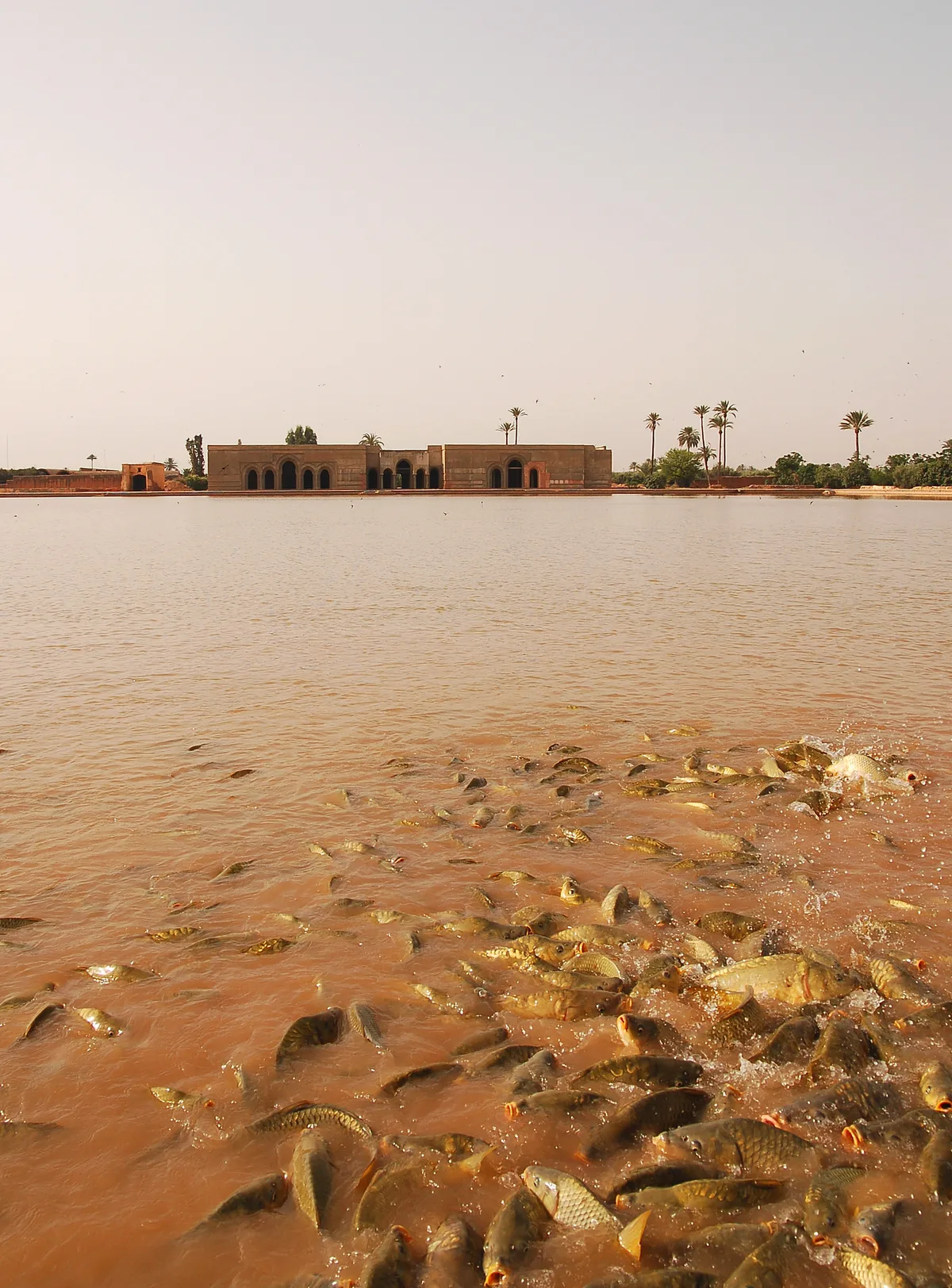
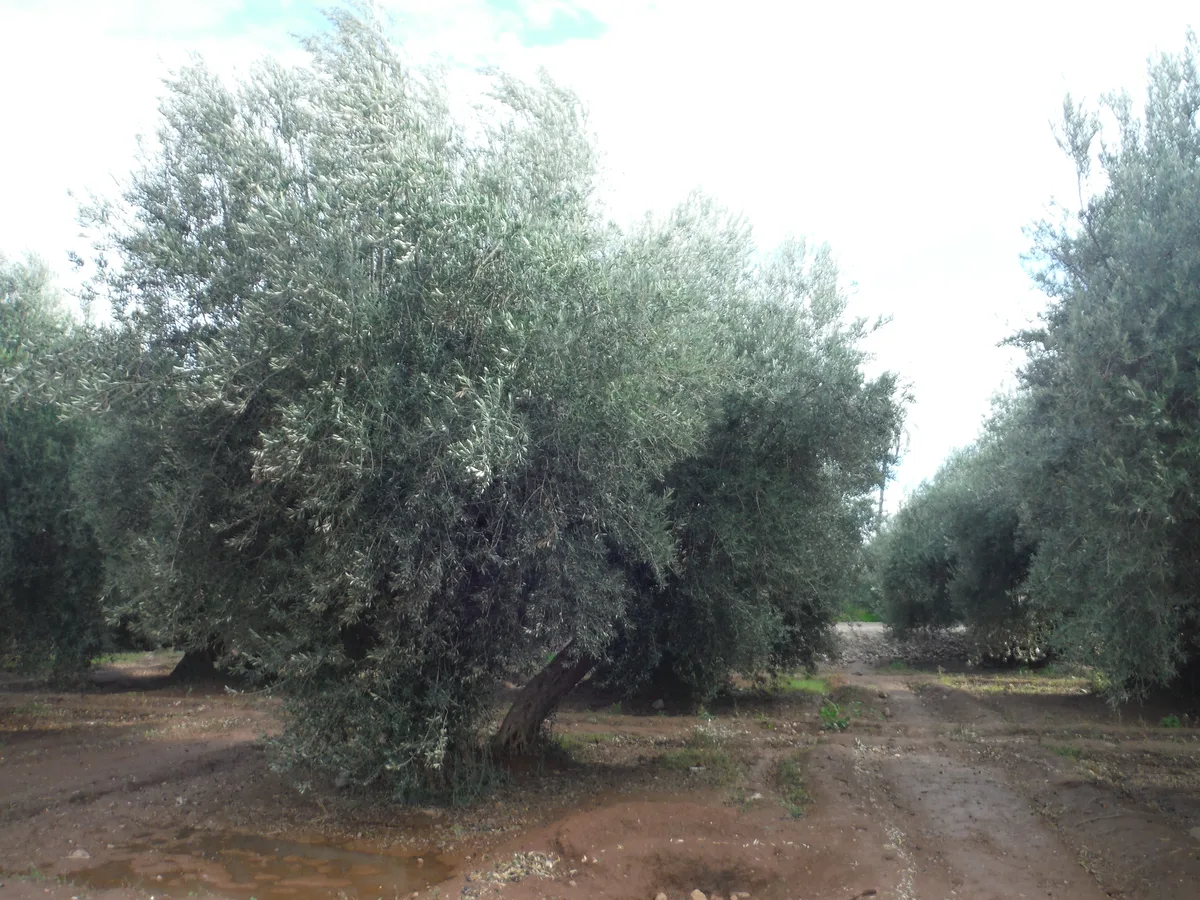
Two royal landscapes close the city’s southern and western sides, and together they form Marrakech’s least hotel-defined sleeping zone — less an area to book than a side of the city to understand. The Agdal, walled against the Kasbah’s south, is an Almohad foundation: hundreds of hectares of orchard gardens — olive, citrus, pomegranate, vine — organised around great reservoirs, of which Dar el-Hana, with its pavilion, is the famous view. UNESCO counts the Agdal among the medina property’s components. The Menara, west of Hivernage, answers it: an Almohad basin in an olive grove, its small pavilion a later rebuilding, and the single most reproduced view in Marrakech — water, palms, Atlas — when the mountains show themselves after rain or in the clear winter air.
Accommodation on this side of the city is scattered rather than gathered: hotels along the roads south and west, including the airport side; riads inside the Kasbah’s southern lanes that face the Agdal walls; villas towards the Menara. What unites them is the outlook — gardens, groves and green edges instead of lanes or avenues — and a local, residential calm. For travellers, this side functions best as context: the Agdal explains the Kasbah, the Menara explains Hivernage, and a stay near either suits a visitor whose Marrakech includes its gardens as seriously as its souks, or whose trip is built around departures — the airport road runs this way.
The catches are practical. Neither garden is an everyday public park in the simple sense: the Agdal’s public opening has historically been limited to certain days, and arrangements change, so treat any visit as something to verify locally rather than assume. As a base, the gardens side offers few of the walk-to pleasures of the quarters above — distances are real, pavements come and go, and evenings belong to your hotel or to a taxi ride into the medina or Gueliz. It is the right side of the city for a garden-minded, car-comfortable stay, and a compromise for everyone else — which is exactly why it closes the tour: every Marrakech since the Almoravids has had a green edge, and knowing where it lies completes the map the other sections drew.
Suits: garden lovers, airport-side logistics, Kasbah stays that want the Agdal at their back, calm-seekers with cars. Think twice if: you want a quarter to wander from your door — this side of the city is visited, not wandered.
The First-Timer Verdict – Where to Stay in Marrakech With No Second Chances
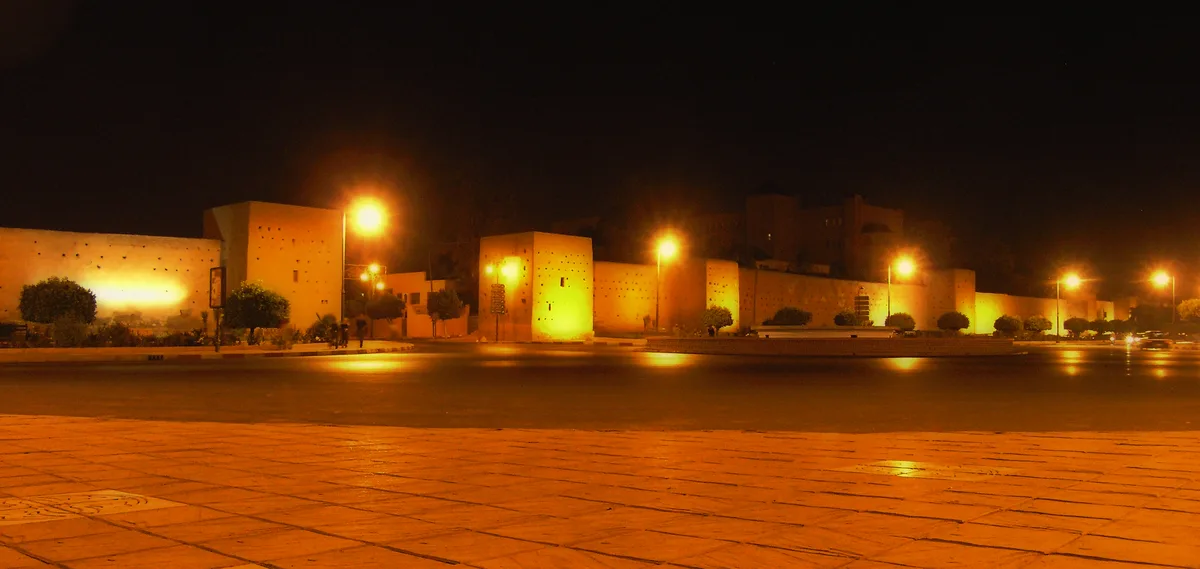
Guides are obliged to be even-handed, and this one has been; but a first trip to Marrakech is usually short, unrepeated for years, and remembered whole — so here is the verdict plainly. For a first stay of two to four nights, sleep in the medina, in its western or southern half. Mouassine if the budget stretches, for the medina at its most beautiful and findable. The Kasbah if it does not, or if quiet matters, for the medina at its calmest with the kindest taxi access. Beside Jemaa el-Fnaa if the stay is very short and the square is the point. Choose the Ben Youssef side when the sights are the point and you accept the derb walk as the price — it is the medina’s heart, and hearts are not always convenient. This entire recommendation rests on one observation: everything that makes Marrakech unlike anywhere else you have slept is inside the walls, and a first trip is precisely when unlike-anywhere-else is the thing being bought.
The exceptions are real, and the verdict names them so they can be taken cleanly rather than fallen into. Mobility, luggage, late arrivals and early departures argue for Gueliz or Hivernage without any loss of honour — the medina will still fill your days. A winter-sun trip of a week, with sightseeing as seasoning, argues for Hivernage or the Palmeraie as a resort base. A second trip argues for whatever you did not do first: the medina veteran to Bab Doukkala’s local lanes or a Gueliz apartment, the hotel veteran to a courtyard and a derb. And the official Visit Morocco portal is worth an evening of anyone’s planning time for the festivals and seasons that might bend these choices — a city taken by a festival is a different city to sleep in.
One last first-timer rule, worth more than any area recommendation: whatever you choose, arrange the arrival. A met arrival in the medina, a hotel transfer outside it, a driver who knows the Palmeraie compound — the first hour sets the emotional temperature of a Marrakech stay more than any other hour of the trip, because the city is intense and its logistics are personal. Get the arrival handled, and where to stay in Marrakech becomes what it should be: not a risk to manage, but the first pleasure of the place.
Suits: first stays of two to four nights, medina-first. Think twice if: any of the named exceptions is yours — take the exception proudly and the medina by day.
Questions Before You Book an Area
Is the medina really closed to cars? Its interior, yes — that is the fact under everything in this guide. Cars and taxis work the gates, the square’s rim and the wider streets; lanes and derbs are walked. Every medina riad stay includes a walked last stretch, short in the Kasbah and Mouassine, longer in the deep north medina.
Which area is quietest at night? Inside the walls, the Kasbah; outside them, the Palmeraie compounds and the gardens side. The noisiest choice, by design, is the rim of Jemaa el-Fnaa, and Mouassine and the north medina sit between — courtyard houses muffle their lanes better than the street outside suggests.
Where should a family stay? It depends on the children’s ages and the trip’s shape. Hotel-format space, pools and door-to-door taxis argue for Hivernage or Gueliz; older children who will remember the medina forever argue for a Kasbah or Mouassine riad with the arrival properly met. The Palmeraie suits families who holiday at the hotel and excursion into the city.
Is Gueliz a failure of nerve for a first trip? No — it is a different trip, run from the modern city. It fails only as a substitute: if what you wanted was the medina and you booked Gueliz expecting its atmosphere, the commute will disappoint you daily. Booked honestly, for logistics and city life, it satisfies completely.
How many nights does the medina deserve? At least two, so that one full day begins and ends inside the walls and the lanes have time to become familiar. On a two-night total stay, that argues for the medina outright; on a week, it argues for the split — medina first, garden hotel or Palmeraie after — that the city seems built to invite.
Can I change areas mid-stay easily? Yes, and many travellers do. The move itself is a taxi ride; the only friction is the medina leg at one end of it, which your riad’s porter arrangement handles exactly as it handled your arrival. Splitting a stay is the standard Marrakech solution to wanting both cities, and this guide’s area-by-area catches are written to make the split easy to plan.
The Short Version
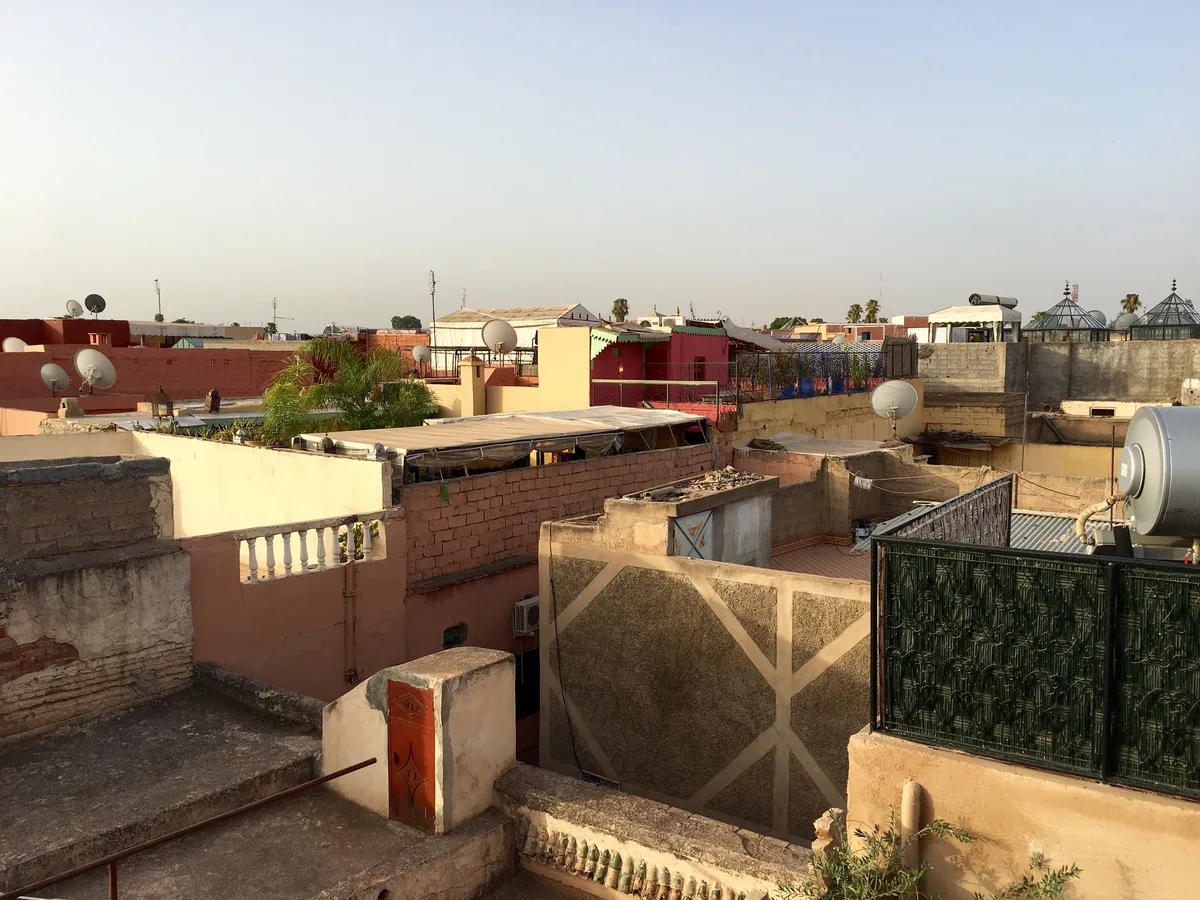
Marrakech is several sleeping cities sharing one name, and where to stay in Marrakech is the choice between them. Inside the walls: the Ben Youssef north for the sights and the souks, Bab Doukkala for the local medina, Mouassine for the medina polished, the Jemaa el-Fnaa rim for the square itself, the Mellah and the palace quarter for the monumental south, and the Kasbah for royal calm with the easiest lanes. Outside the walls: Gueliz for city function, Hivernage for the grand-hotel garden belt, the Palmeraie for resort space at the price of a car for every movement, and the Agdal–Menara side for gardens and green edges. First time, short stay: medina, west or south. Everything else is an exception, and the exceptions are listed, honestly, above.