Morocco is one of the few countries on earth where a beach holiday means choosing between two different seas, and the choice matters more than most visitors realise. The best beaches in morocco split cleanly in two. Down the west edge runs the Atlantic – long, loud and wind-combed, fed by a cold ocean current, home to surf towns, fishing villages and a lagoon or two where the water finally calms down. Along the north edge runs the Mediterranean – shorter, sheltered, gentler, and in July and August the most crowded shoreline in the country, because that is where Morocco itself goes on holiday. Pick the wrong sea for the trip you want and the beach will disappoint you through no fault of its own.
This roundup works through 12 named beaches, nine on the Atlantic and three on the Mediterranean, in the order you would meet them travelling the coast. Every beach gets the same honest treatment – what the sand and water are actually like, whether it is a swimming beach, a surfing beach or a beach you mostly look at, who it suits, and what will annoy you about it. The Atlantic gets more entries because it is the longer and more varied coast, and because it is where the honest warnings matter most. The cold water is real. The wind at Essaouira is real. The surf that makes Taghazout famous makes it a poor choice for a toddler’s paddling holiday, and this guide will say so at each beach rather than in a footnote.
A word on how the twelve were chosen, because Morocco’s coast is over a thousand kilometres long and an honest list has to leave good beaches out. Each entry below earned its place by being the best example of something – the best surf village, the calmest lagoon, the wildest arch, the fullest resort, the clearest cove – rather than by being merely pleasant. That is why there is no Casablanca beach entry despite the country’s biggest city sitting on the ocean: its shore is a workplace and a corniche, and its great sight, the Hassan II Mosque, stands over rocks, not sand. It is also why the best beaches in morocco lists coming out of the resort brochures, which read as if the Mediterranean did not exist, miss a third of the country’s beach life entirely. The twelve here are the ones a traveller should actually plan around.
There are no prices in this article, and no water temperatures in degrees, deliberately. What a parasol costs changes by the month, and a temperature figure copied from a weather site tells you less than the truth that matters – the Atlantic stays cool all year because of the current that runs down it, while the Mediterranean in late summer is the warmest water in the country. Costs are described as mechanisms instead: what you will end up paying for, and when. If the beach is one stop on a bigger first trip, this site’s Morocco travel guide covers how the coast fits against the medinas, the Atlas and the desert – the beach usually works best as the exhale at the end of that route, not as the whole trip.
One last framing note before the sand. Moroccan beaches run on a Moroccan calendar. July and August are the national summer holiday, and the Mediterranean resorts and Agadir fill with families from Casablanca, Rabat and the interior in a way that changes their character completely. The surf coast runs the opposite rhythm – its high season is the northern winter, when the big Atlantic swells arrive and the water, by local standards, is at its most inviting. The same beach can be two different places in February and in August, and where that is true, each entry below says which version you are getting.
Best Beaches in Morocco at a Glance
| Beach | Coast | Go for | The honest catch |
|---|---|---|---|
| Achakar, Tangier | Atlantic | Dunes, space, sunsets near the city | Strong currents – a looking-and-paddling beach for most |
| Asilah | Atlantic | A calm town beach beside an art-town medina | The best sand is a ride south of town; August is packed |
| Oualidia | Atlantic lagoon | The calmest water on the Atlantic coast, oysters | A lagoon, not an ocean beach – the sea side is rough |
| Essaouira | Atlantic | Wind sports, a huge beach, the medina behind it | The wind is relentless and the water is cold |
| Taghazout | Atlantic | Surf at every level, village life | A surf beach first; swimmers share water with boards |
| Agadir | Atlantic | The full resort package, a sheltered bay | Resort-strip character; the bay is the point, not the town |
| Mirleft | Atlantic | Slow days, empty sand, honest surf | Few facilities, summer sea mist, long gaps between everything |
| Legzira, Sidi Ifni | Atlantic | The red arches and the sunset | A scenery beach – rough water, tide-timed visits |
| Dakhla | Atlantic lagoon | Flat-water kitesurfing, desert-meets-sea emptiness | Very far away, and the wind rarely takes a day off |
| Martil, Tetouan coast | Mediterranean | Calm family water on a smart corniche | Wall-to-wall domestic crowds in high summer |
| Al Hoceima | Mediterranean | Clear water, a town cove and wild neighbours | One main beach; the best coves need a car and a walk |
| Saidia | Mediterranean | Kilometres of soft sand, resort comfort | Seasonal to its bones – sleepy outside summer |
Read the table as a sorting tool rather than a ranking, because Moroccan beaches refuse to be ranked on one scale. The best beach in this list for a learner surfer in January (Taghazout) is close to the worst for a family that wants warm, flat water in the same month (the Mediterranean, out of season and shut down, or the Oualidia lagoon in a wetsuit-freeze). The entries below give each beach its evidence; the choosing section near the end turns the evidence into decisions by trip type.
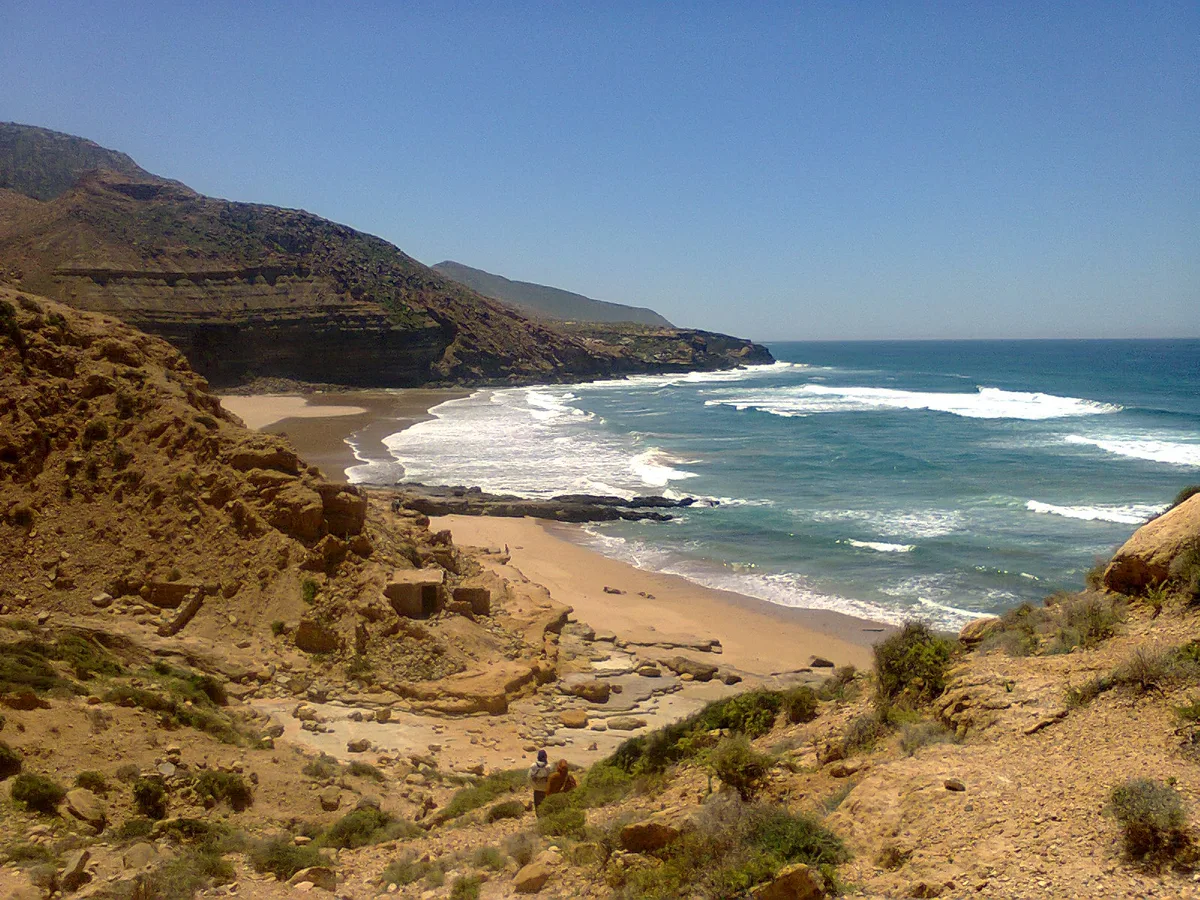
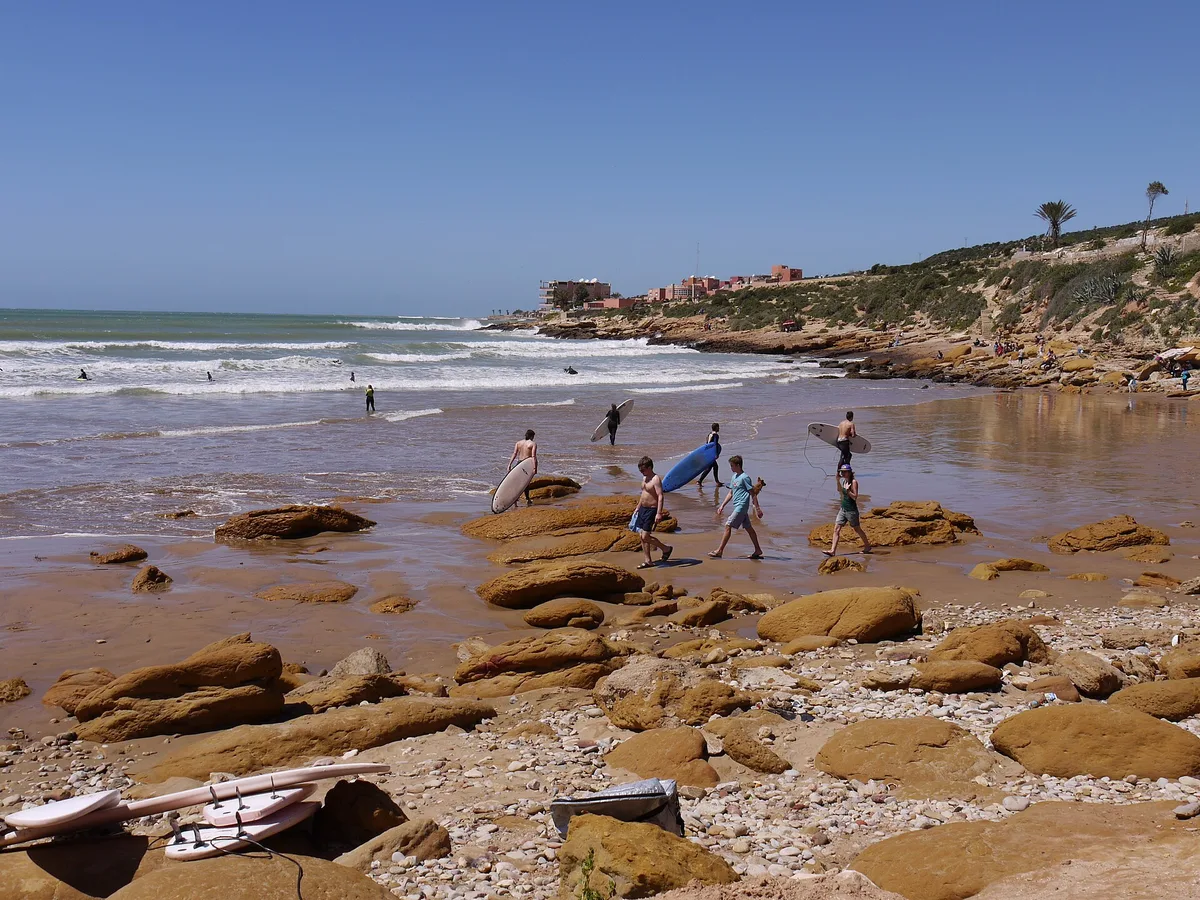
The photograph above is Imsouane, which does not get its own entry – deliberately. The bay between Essaouira and Agadir holds one of the longest, kindest right-hand waves in Morocco and a small village growing around it, and it belongs in any honest account of this coast – few discussions of the best beaches in morocco among surfers omit it, and its wave, a slow right-hander that can run the length of the bay on a good swell, is the one learners dream about and longboarders cross oceans for. It is folded into the surf-coast story around Taghazout rather than listed separately, because a visitor experiences it as part of that same strip – and because a list that padded itself with every good bay between the famous ones would stop being a guide and start being a gazetteer.
Two Coasts, Two Different Seas
Everything about the Atlantic side starts with the Canary Current, the cold flow of ocean water that runs southward down Morocco’s western edge. It is the reason the Atlantic at Agadir in August feels closer to the sea off Brittany than to the sea off Spain, the reason wetsuits are standard issue for surfers in every month, and the reason the coast’s beach towns sell their sunshine honestly but their swimming with an asterisk. Layered over the current is the swell – genuine ocean energy that has travelled thousands of kilometres, which builds the point breaks and beach breaks the surf world flies in for, and which turns an unprotected Atlantic beach into a poor place for a relaxed float. Add the afternoon wind, which picks up along much of this coast as the land heats, and the Atlantic formula is complete: spectacular, bracing, and happiest when you are doing something in it rather than lying beside it.
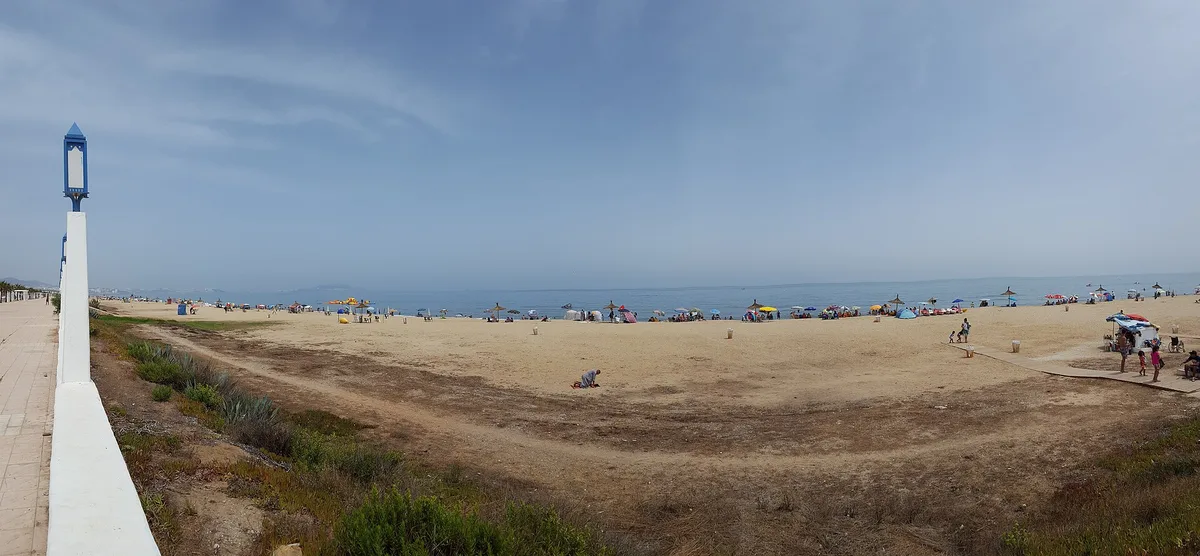
The Mediterranean plays by opposite rules. Sheltered from the ocean swell, Morocco’s northern shore is a chain of bays and long sandy strands where the water stays calmer, the bottom shelves gently on the resort beaches, and by late summer the sea is as warm as Morocco offers anywhere. The price of all that kindness is company. The Med coast is the domestic holiday coast – Tetouan, Tangier and the eastern towns empty onto it in summer, the corniches light up at night, and a beach that is a local secret in May can be a wall of parasols in August. Its season is also shorter in spirit: outside roughly June to September, the resort towns quieten right down, whatever the weather is doing.
Between the two sits the Strait corner, where Tangier’s beaches face both ways – Atlantic surf and dunes to the west of Cap Spartel, calmer Mediterranean strands to the east. The entries begin there in spirit, with Achakar on the Atlantic side of the point, because that corner is where most visitors first meet Moroccan sand, and because it teaches the whole lesson in one afternoon: drive twenty minutes around a headland and the sea changes its personality completely.
There is a third character worth naming before the entries start, because it explains several of them: the lagoon. Twice on the Atlantic coast – at Oualidia in the north and at Dakhla in the far south – the ocean is held behind a sandbar or a peninsula and forced to behave, and those two sheltered waters produce Morocco’s calmest Atlantic swimming and its flattest kitesurfing respectively. The lagoons are the exceptions that organise the whole coast: everywhere else, the Atlantic does what it wants, and the beach’s job is to make something wonderful out of that rather than despite it.
Achakar Beach, Tangier – Dunes, Caves and the Atlantic Corner
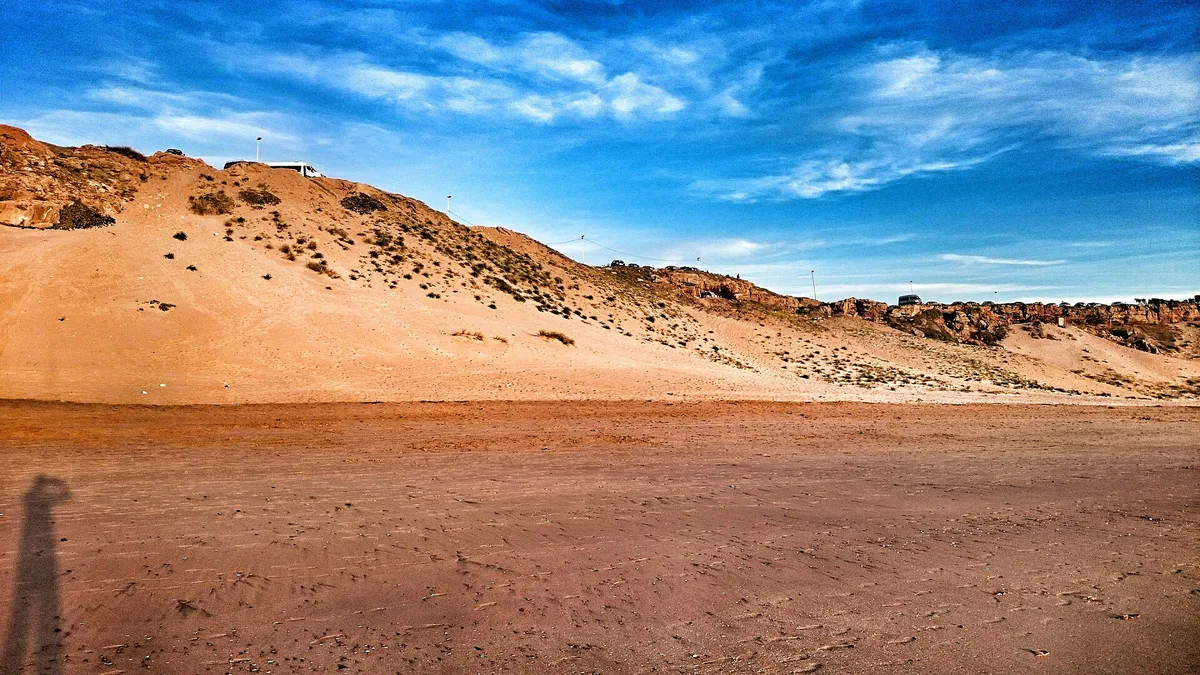
Tangier’s own city beach, along the bay, is the one most visitors see and the one locals will quietly tell you to skip for a real swim. The Tangier beach that earns its place in this list is Achakar, the long sweep of sand that runs south-west of the city beyond Cap Spartel, where the headland with its lighthouse marks the corner of Africa and the coast turns to face the open Atlantic. The setting is the first pleasure: big soft dunes behind the sand, the green of the Perdicaris parkland and the Rmilat woods inland, and a horizon with nothing on it. After the density of the city, Achakar feels like the country exhaling.
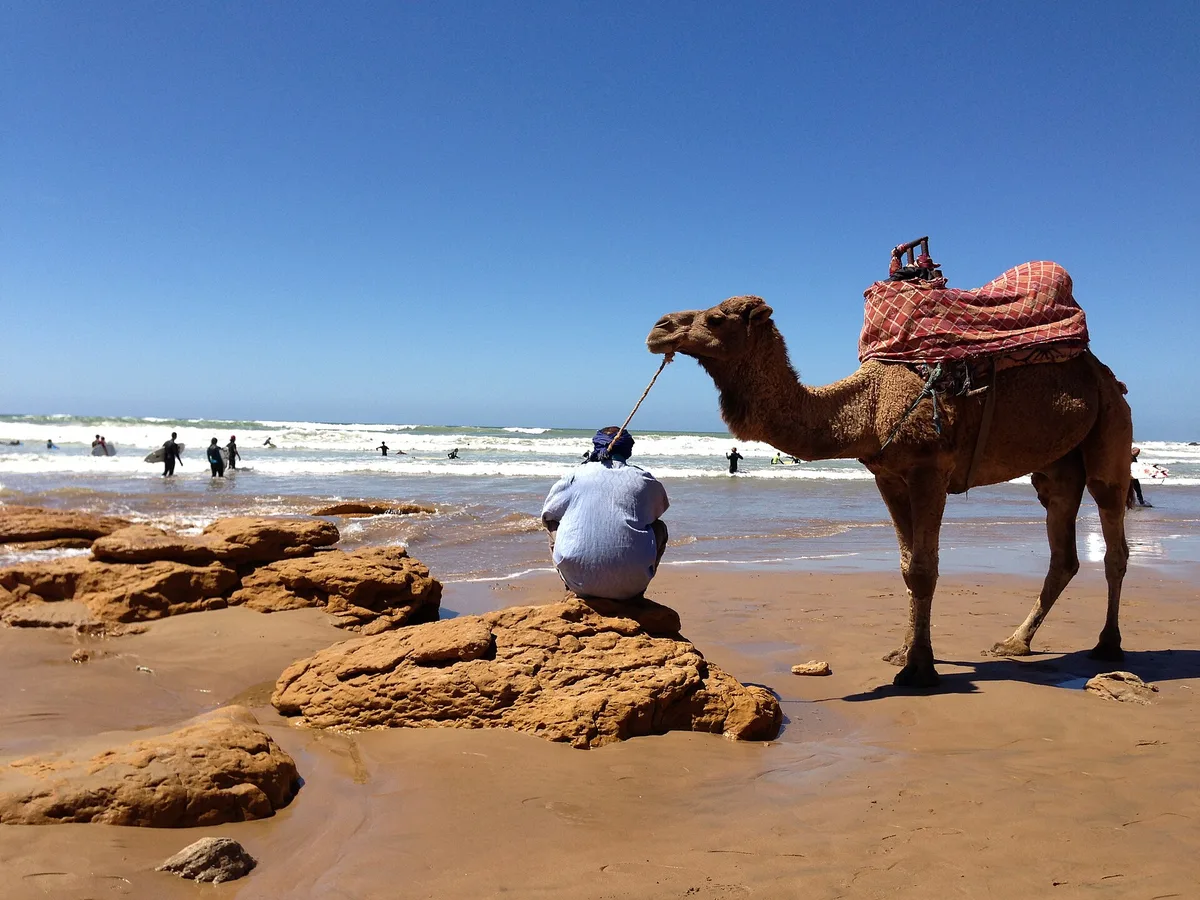
The neighbours add to a day of it. The Caves of Hercules sit at the northern end of this shore – a cavern system with an opening to the sea famously shaped, if you squint with goodwill, like the map of Africa – and the whole stretch is stitched into the classic Tangier half-day circuit of Cap Spartel, the caves and a mint tea above the meeting of the seas. Camel and horse handlers work the sand near the access points, the cafés cluster at the same places, and the further you walk from the parking, the emptier and better it gets. Sunset is the beach’s best hour and the reason half of Tangier seems to drive out on fine evenings.
Now the honest part. Achakar faces the open Atlantic with no shelter at all, and the currents along this corner are strong and taken seriously by everyone who knows the coast. This is a paddling, walking, riding and watching beach for most people, most of the year – competent swimmers pick their moments and their spots, nobody sensible treats it as a pool, and children belong at the water’s edge, not in it. Judge it as Tangier’s wild shore rather than its swimming pool and it is superb: the city is twenty minutes away, and you would never know it.
Asilah – An Art Town With a Beach Attached

Asilah is the gentlest introduction to the Atlantic coast: a small, white, art-covered town a short hop south of Tangier, whose ramparts were built by the Portuguese and whose medina walls have been repainted by artists every summer since its cultural festival began in the late 1970s. The town beach runs along the northern side of the town – a long, honest strand of sand with the Atlantic coming in at a slope gentle enough, on calm days, for family swimming with the usual Atlantic care. In summer it fills with Moroccan families in the best way, all pickles-and-parasols domestic holiday energy; out of season it empties back to the dog-walkers and the fishermen.
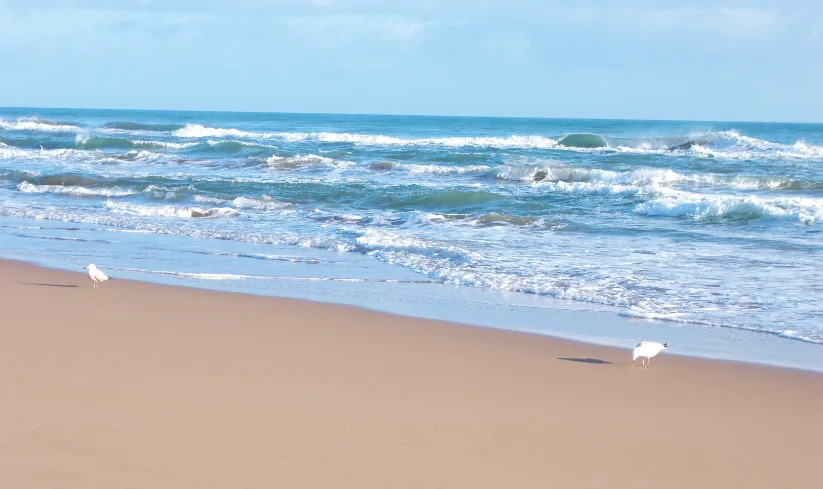
The beach people cross the country for, though, is the one a ride south of town: the strand the Spanish-era name calls Playa de las Cuevas and everyone else calls Paradise Beach, under the cliffs below the Rmilat headland. It is reached by taxi or horse-drawn calèche down a track, and what you get for the effort is the photograph above – a wilder, cleaner sweep of sand, proper surf rolling in, a handful of seasonal cafés serving grilled fish, and space. The same Atlantic warning applies in stronger form: the swimming here is for the confident, in the calmer pockets, and the surf is the main event. Many visitors do exactly what the beach seems designed for – walk it, eat on it, swim briefly and carefully, and watch the light go.
Asilah’s catch is mostly calendar and scale. In August the town is full, the town beach is fuller, and the calèche ride to Paradise Beach becomes a negotiation; in winter the town can feel half-asleep, though the beach keeps its moods in every month. As a base it suits travellers who want the coast woven into a town worth wandering, rather than a resort. As a swim, it is a good Atlantic compromise – softer than Achakar, wilder than the Mediterranean, and honest about being both.
Oualidia – The Lagoon Where the Atlantic Calms Down
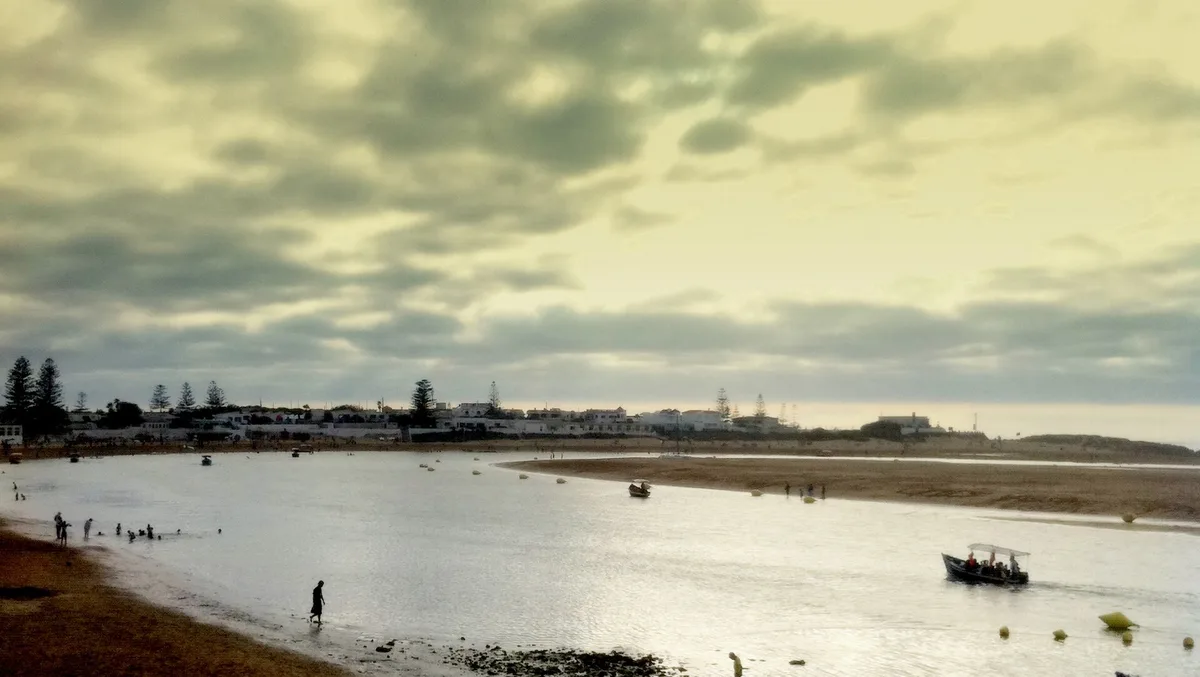
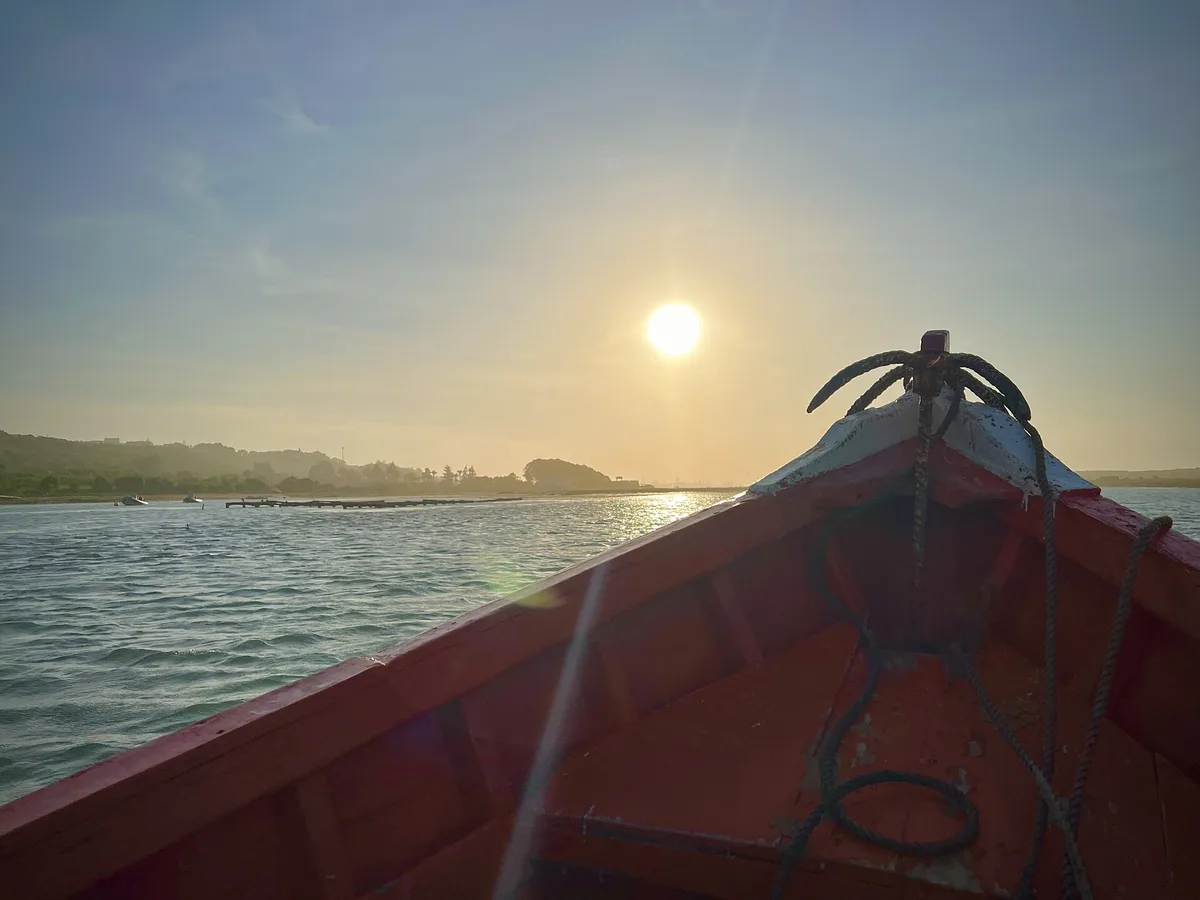
Every coast has one place where its rules are suspended, and on Morocco’s Atlantic that place is Oualidia. The town sits on a lagoon – a long, sheltered body of water cut off from the ocean by a sandbar and fed through narrow passes – and inside that bar, the Atlantic’s swell simply stops. What replaces it is shallow, calm, tide-filled water over sand and mud flats, warm by Atlantic standards in summer, dotted with small boats and fringed with salt marsh. For families, for nervous swimmers, and for anyone who has read the warnings in this article and despaired slightly, Oualidia is the Atlantic coast’s answer: real sea water, no surf, no drama.
The town’s second identity is on the plate. Oualidia is famous across Morocco for its oysters, farmed in parks in the lagoon since the 1950s, and the eating here runs through a line of simple restaurants and stalls where oysters, crab, spider crab in season and grilled fish are the entire point. Add the birdlife – the lagoon and its marshes are a recognised stopover for migrating birds, with flamingos among the visitors in the right seasons – and the place composes itself into the coast’s slow weekend: a boat across the lagoon to the sandbar, a swim in water you can stand up in, a long lunch, another swim.
The honesty clause is simple geometry. The lagoon is not the ocean. The ocean beach, on the seaward side of the bar and around the passes, is as rough and current-torn as anywhere on this coast, and the passes themselves, where the tide rips in and out, are genuinely dangerous water that locals treat with respect. Swim in the lagoon, walk the ocean side, and keep the two decisions separate. Oualidia is also a small place that fills hard on summer weekends with visitors from Casablanca and El Jadida; come midweek, or in the shoulder months, and it returns to the drowsy fishing town the lagoon deserves.
Essaouira – The Beach the Wind Owns

Essaouira’s beach is enormous, beautiful, and – for a large part of the year – barely swimmable in comfort, and all three of those facts come from the same source: the wind. The alizé trade winds funnel down this stretch of coast with a consistency that has earned the town its nickname, the Wind City of Africa. They flatten the sea into white horses even on fine days, they pick the sand up and move it around, and they are the reason the bay in front of the ramparts belongs to kitesurfers and windsurfers drawing lines across the water while the sunbathers huddle behind windbreaks. Any list of the best beaches in morocco that presents Essaouira as a lazy swimming beach is selling you a different town.
What the beach actually is, judged on its own terms, is one of the great urban shores in Africa. It runs south from the medina ramparts in a long, hard, flat apron of sand that at low tide becomes a small landscape – football games, horse and camel rides, quad bikes at the far end, walkers striding out towards the ruined fort of Bordj El Berod in the dunes. Behind it stands a medina that is a UNESCO-listed fortified port town, all white walls, blue boats and grilled sardines at the harbour stalls. The swimming that does happen is real but conditional: in the sheltered northern corner near the port on calm mornings, in the shallows at low tide, always brisk, because this is the Atlantic at its most Atlantic. The island of Mogador sits offshore, a protected reserve you look at rather than land on, completing a view that painters have been stealing for two centuries.
So come to Essaouira for the wind sports, for the walks, for the medina-beach double act that no other Moroccan town matches, and for summer days when Marrakech is cooking and Essaouira’s breeze is the best air-conditioning in the country. Come with a layer for the evening even in August. But if the trip’s centre of gravity is floating in warm, still water, this is the wrong beach, and Essaouira would be the first to tell you so – it says it, loudly, in weather, every afternoon.
Taghazout – Morocco’s Surf Village
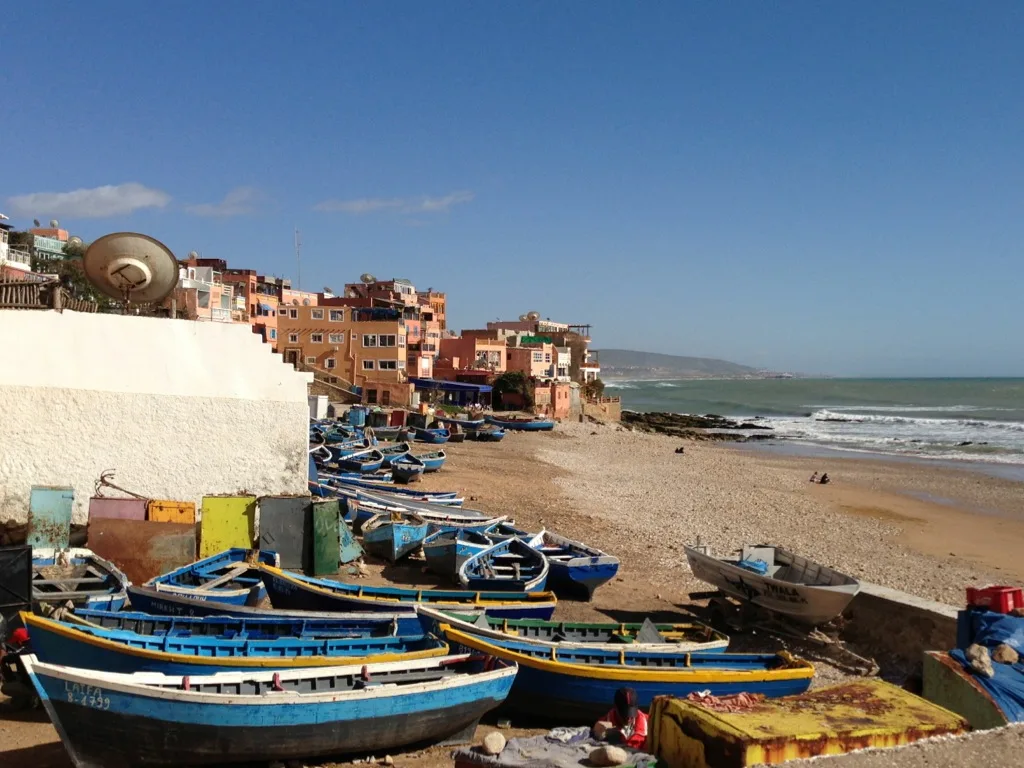
Nineteen kilometres or so north of Agadir, the coast road drops past a headland and Taghazout appears – a small fishing village that the surf world adopted in the 1970s and never gave back. The village beach itself, in front of the blue boats and the cafés, is a friendly, sloping strand where beginners wobble on soft-top boards in the whitewater and the whole town seems to be either carrying a board, repairing one or renting one out. North and south of it runs a chain of named breaks that reads like a liturgy to surfers – Panorama, Hash Point, Anchor Point at the village’s northern edge, and more reefs and points strung towards Tamri – which between them offer something rideable on most days of the surf season and world-class waves on the good ones.
The season is the first thing to get right. The Atlantic swells that power all of this arrive with the northern winter, roughly from September to April, and the village fills in those months with surf camps, seasonal workers and a travelling population that lives by the forecast. In summer the swell shrinks, the wind often gets in the way, and Taghazout becomes a quieter, cheaper, more Moroccan beach village that happens to have surf shops. Neither version is the fake one; they are two honest seasons, and the mistake is booking the wrong one for what you want. Learners are well served in both – the beach breaks are forgiving and the schools are numerous and competitive – while experienced surfers should time for the winter swells and the point breaks, and should expect company on the famous ones.
The swimmer’s verdict needs the same honesty as Essaouira’s, in a milder key. Taghazout’s water is surf water: there are boards in it, a shorebreak on bigger days, and rips around the points that locals read like road signs and visitors should not have to. Families swim here happily on small days in the village bay, with eyes open; anyone who wants guaranteed flat water should look at Agadir’s sheltered bay to the south or build their swimming around it. Taghazout’s other catch is growth: the village grew faster than its plumbing for years, development is climbing the hillsides at Taghazout Bay to the north, and the scruffy charm is now shared with construction. Go soon, go in season, and go for the surf – on those terms it is one of the great beach villages of Africa.
Agadir – The Big Resort Bay
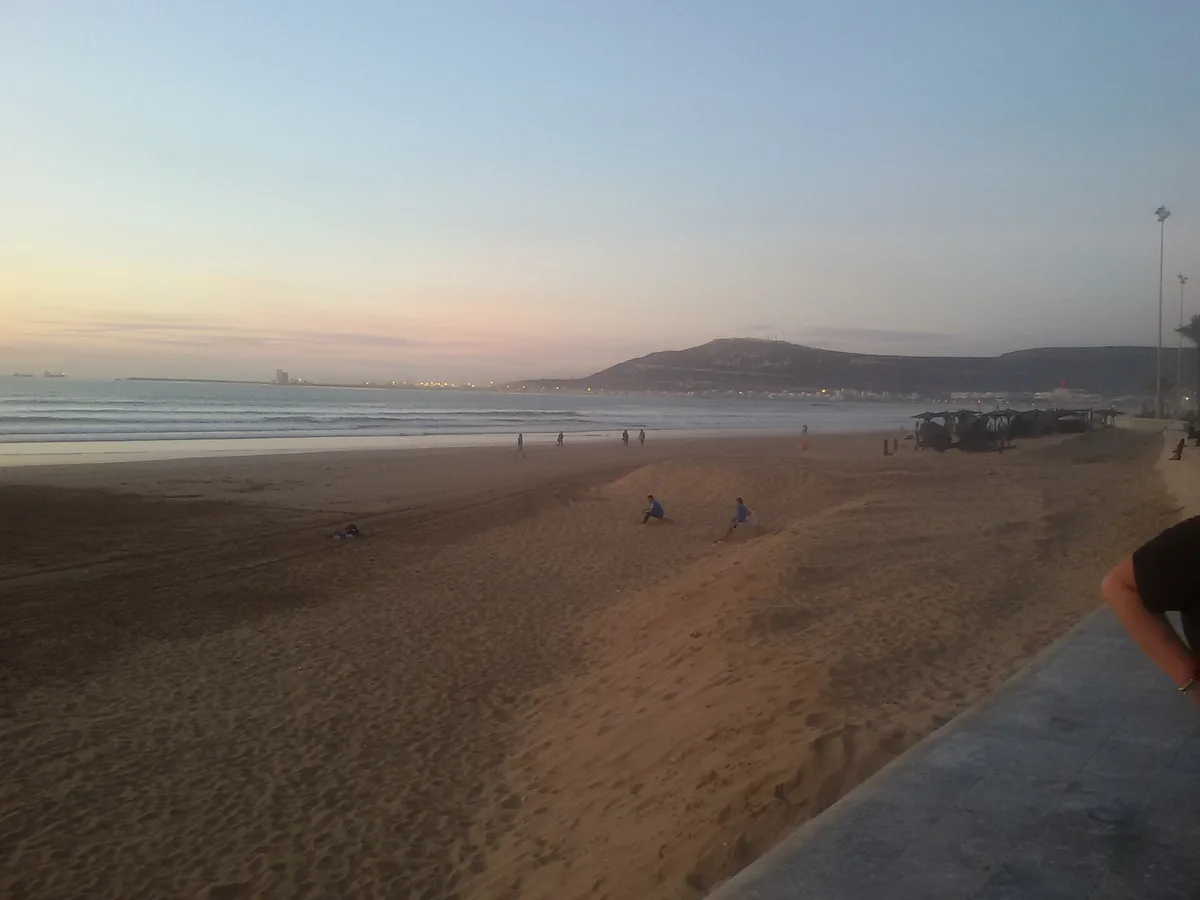
Agadir is the beach Morocco built on purpose. After the 1960 earthquake destroyed the old city, the new Agadir grew up along one of the finest natural bays on the Atlantic coast – a long, gentle curve of pale sand, backed by a promenade and a wall of resort hotels, with the rebuilt kasbah on its hill watching from the northern end. The bay’s shape is the whole story: tucked into the curve, the surf that pounds Taghazout arrives here weakened and orderly, and the result is the Atlantic’s most swimmable resort water – still cool, still the ocean, but a place where a normal holiday swim is a reasonable plan rather than a negotiation with the elements.
Everything else about Agadir follows from the resort formula, executed at scale and at Moroccan prices rather than European ones. Beach clubs and hotel concessions stake out their stretches of sand with loungers and umbrellas, cafés and restaurants line the promenade behind, the marina adds its cluster at the northern end, and the whole machine runs on winter sun as much as summer heat – Agadir’s mildest, most pleasant months are precisely when northern Europe is darkest, which is why the flights fill in January. Families get the full kit here that the surf coast lacks: lifeguarded sections in season, shallow entry on the sheltered sand, watersports for hire, and hotels that open more or less onto the beach.
The downsides are the formula’s own. Agadir the town, rebuilt in concrete in the 1960s, has little of the medina charm that sells the rest of Morocco – the beach is the destination, and the sightseeing runs thin after the kasbah view and the marina. The promenade machine can also feel impersonal beside the fishing-village coast to the north. Judge Agadir as what it is – the country’s safest pair of hands for a straightforward beach holiday, with winter warmth as its trump card – and it earns its place on this list on merit. Judge it as a cultural stop and you have brought the wrong ruler. The wise trip often does both: Agadir’s bay for the swimming, Taghazout’s points for the surf and the soul, twenty minutes apart.
Mirleft – The Slow End of the Surf Coast
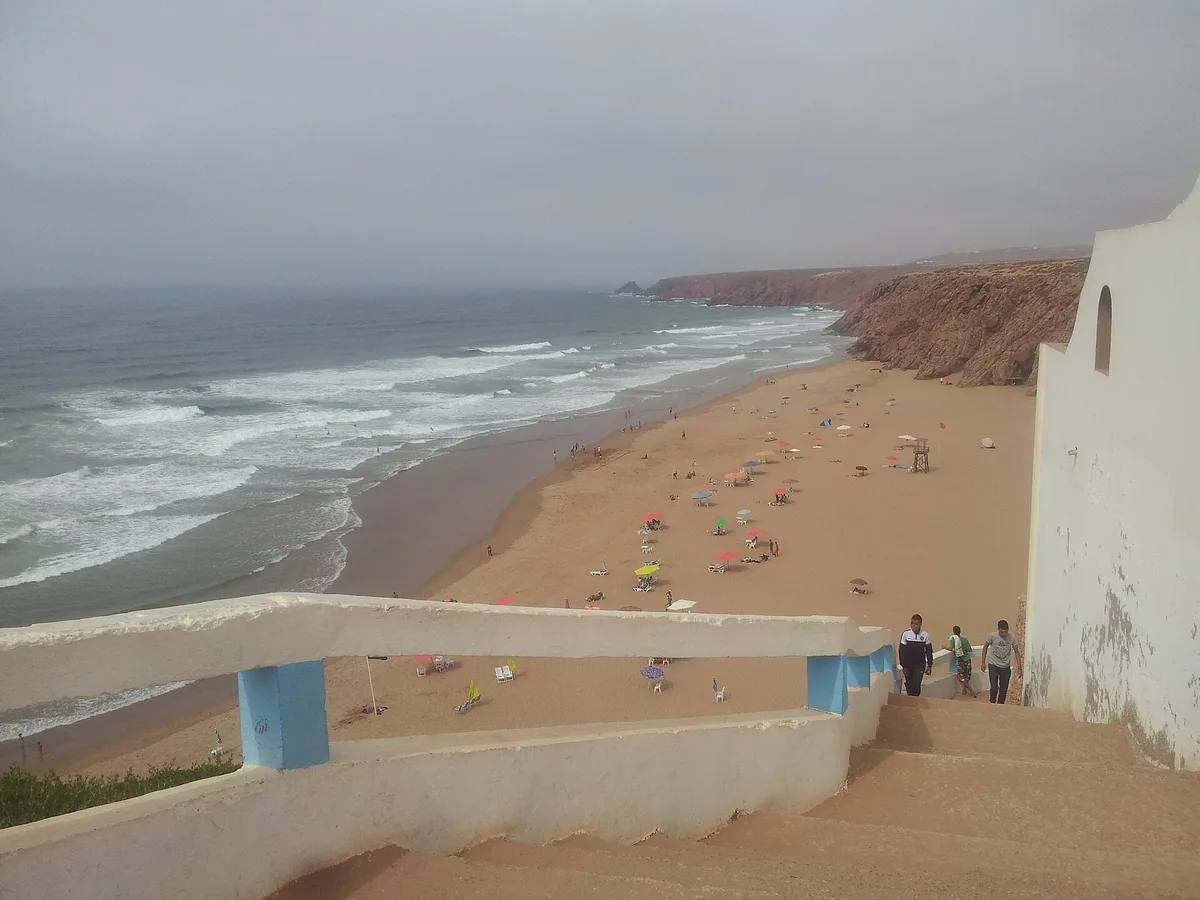
South of Agadir the coast empties. The road runs through argan country and small towns, the resorts stop, and what remains is a string of fishing villages and half-forgotten beaches that travellers pass on the way to the desert. Mirleft is the pick of them – a small town between Tiznit and Sidi Ifni that has gathered a quiet reputation among surfers, artists and long-stay travellers who want the Atlantic without the audience. There is no single Mirleft beach but a small portfolio: the main town beach under the terraces, the cove at Aftas, the strand below the old marabout’s tomb at Sidi Mohammed Ben Abdallah, and wilder sand running south, each a short drive or a good walk from the next.
The character is the selling point, and it is deliberately low-key. Guesthouses and small surf lodges instead of resort hotels; cafés where the morning’s plan is the day’s only appointment; surf that works for learners and improvers on the beach breaks and small days, with the same cold-water, wetsuit-all-year Atlantic terms as everywhere on this coast. Swimming follows the coast’s standard rule – fine in the sheltered water on calm days, treated with respect when the swell is up – and the pleasure of the place is precisely that whole days can be assembled out of one beach, one fish lunch and one sunset without a single queue, ticket or timetable.
The costs of slow are real and should be priced in. Facilities are thin: outside the town beach in season, expect to bring your own shade, water and lunch rather than find them waiting. Summer mornings on this stretch of coast often begin under sea mist that burns off towards midday – atmospheric, but not the dawn-to-dusk sunshine of the brochures. And Mirleft asks for time: it is a long way from anywhere, public transport is a matter of buses and grand taxis rather than trains, and a two-night dash will feel like travelling to see a pause button. Give it four or five days and it may be the beach you remember longest.
Legzira, Sidi Ifni – The Beach You Photograph, Not Swim
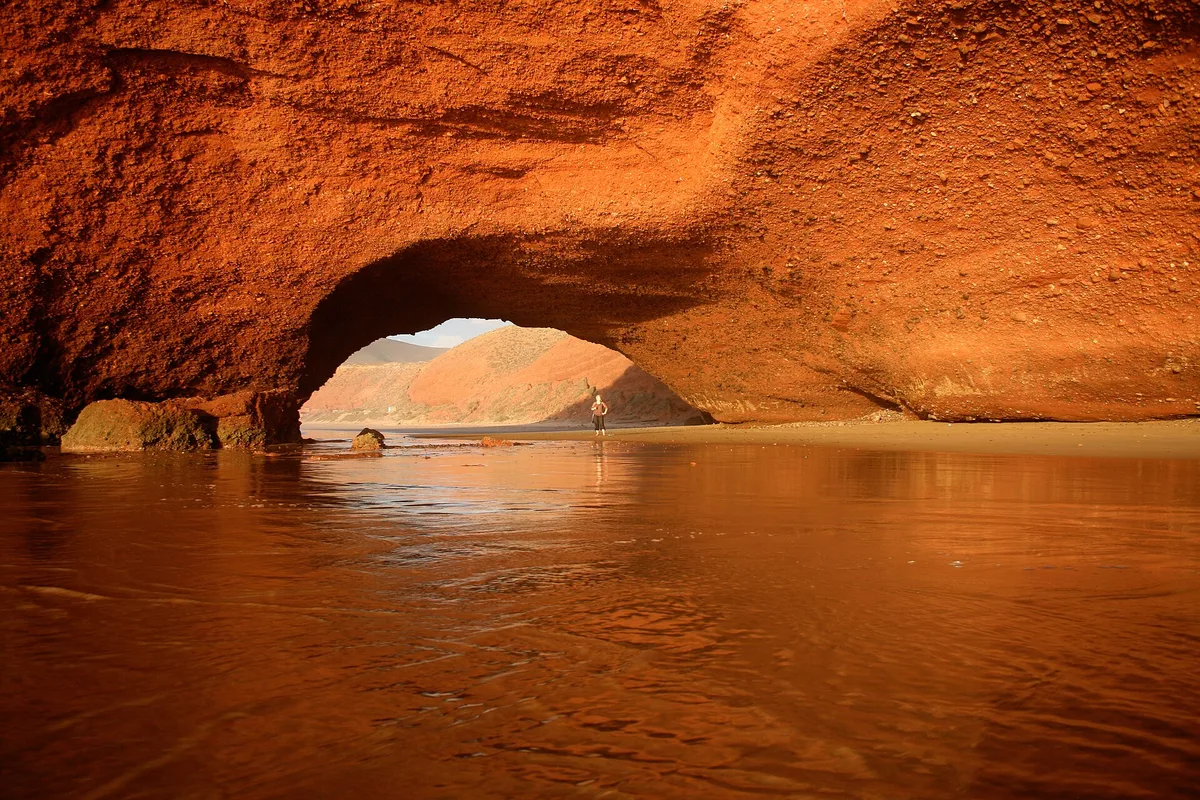
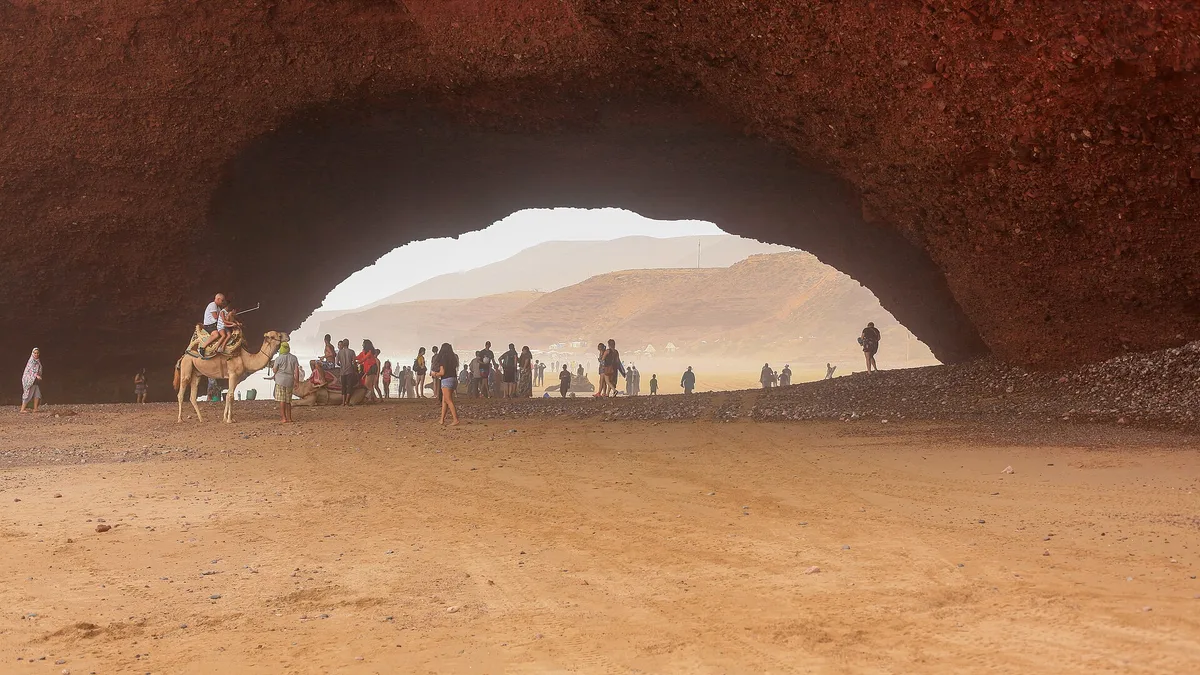
A short drive north of the old Spanish-flavoured town of Sidi Ifni, the cliffs turn the colour of rust and the sea has carved them into sculpture. Legzira’s fame rests on its natural arches – great red rock spans under which the beach runs at low tide, glowing in the late light until the whole shore looks lit from inside. It is the most photographed beach in southern Morocco, the one on the postcards and the phone wallpapers, and standing under the surviving arch at sunset, with the surf sighing through it, the fame makes complete sense.
The word “surviving” is doing work in that sentence, because the honest version of Legzira includes a loss. There were two famous arches; the smaller, more delicate one collapsed into the sea in September 2016, in front of witnesses, and its rubble now sits in the surf as a reminder that this coastline is a work in progress. The great arch stands, and one is plenty – but write-ups that still promise you a pair of arches are copying each other rather than visiting. Time your own visit by the tide tables rather than the clock: the beach under the arch is a low-tide place, the walk from the small settlement above is down a rough track, and the golden hour before sunset is when the rock earns its colour.
What Legzira is not is a swimming beach. The water here is open Atlantic at full strength, the shore is rock and cliff as much as sand, and the sensible pleasures are walking, photographing, eating grilled fish in the simple restaurants above the beach and watching the light change. Treat it as the coast’s cathedral rather than its pool – a place you visit, stand inside, and leave slightly quieter than you came – and combine it with Sidi Ifni itself, whose faded Spanish-era streets and easy pace make a good base for this whole southern stretch.
Staying the night changes Legzira for the better, and it is worth saying because nearly everyone day-trips it. The handful of small guesthouses and cafés on the plateau above the beach empty out at dusk along with the tour minibuses, and the arch at first light – the rock pale rose, the sand unmarked, the fishermen the only other people on the shore – is a different and finer thing than the sunset show. If the southern loop allows one unhurried morning, spend it here.
Dakhla – Where the Desert Falls Into a Lagoon
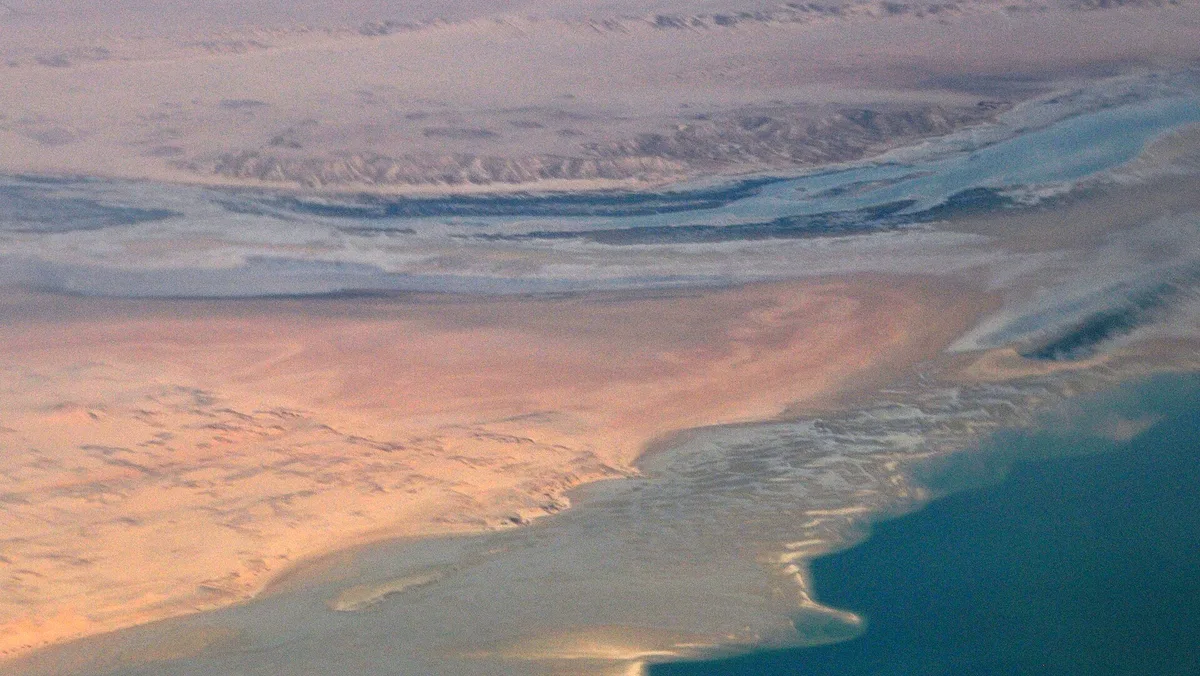
The last beach on this list is barely on the map most visitors carry. Far down the southern coast, a long thin peninsula reaches into the Atlantic and shelters a lagoon some forty kilometres long – shallow, warm-feeling by Moroccan standards, and rinsed twice a day by the tide. On the lagoon side of Dakhla the water stays flat while the wind blows steadily across it, which is the precise formula kitesurfers dream about, and over the past two decades Dakhla has grown from a remote garrison-and-fishing town into one of the world’s famous flat-water kite destinations. Camps and small hotels string along the lagoon shore at the spots the kiters name like saints – the speed spot, the secret spot, the flat water off the White Dune, where a great pale dune slides straight into the lagoon and you can swim off sand into water the colour of glass.
The peninsula gives Dakhla a double life. On its ocean side, the same Atlantic as everywhere else on this list arrives unfiltered: surf at Foum Labouir, empty beaches running north, oysters farmed and eaten at shacks by the shore, and a sense of standing at the edge of the world with the Sahara at your back. The town itself is small, functional and growing; the lagoon is the destination, the camps are the society, and days organise themselves around wind, tide and fish. Birdlife gathers on the flats, the light is desert light – hard, clean, enormous – and the stars at night finish arguments the brochure started.
The camps deserve a paragraph of their own, because in Dakhla the accommodation is the society. They range from simple bungalow rows to polished eco-lodges, but the rhythm is shared: breakfast judged against the wind forecast, a morning session on the flat water, grilled fish and oysters at lunch, a second session until the light goes, and dinner with the same fifty people you will see all week. Non-kiters are absorbed into it more happily than they expect – the lagoon shore is a fine place to read, walk and watch a sport that is genuinely beautiful at close range – but there is no alternative programme of sights to defect to, and that is the point and the risk of the place in a single sentence.
Now the distance, stated plainly, because it is the whole decision. Dakhla is a very long way from the rest of Morocco: a flight from Casablanca or Agadir, or a road journey measured in days rather than hours from the northern cities. The wind that makes it also rules it – non-kiters who hate wind will be ground down by its constancy, and the lagoon’s flat calm is a sports surface, not a resort beach with a promenade. Go for the kite, the emptiness, the oysters and the dune; go for a week, not a weekend; and accept the journey as the admission price. For the traveller it suits, there is nowhere in Morocco remotely like it.
Martil and the Tetouan Coast – The Family Mediterranean
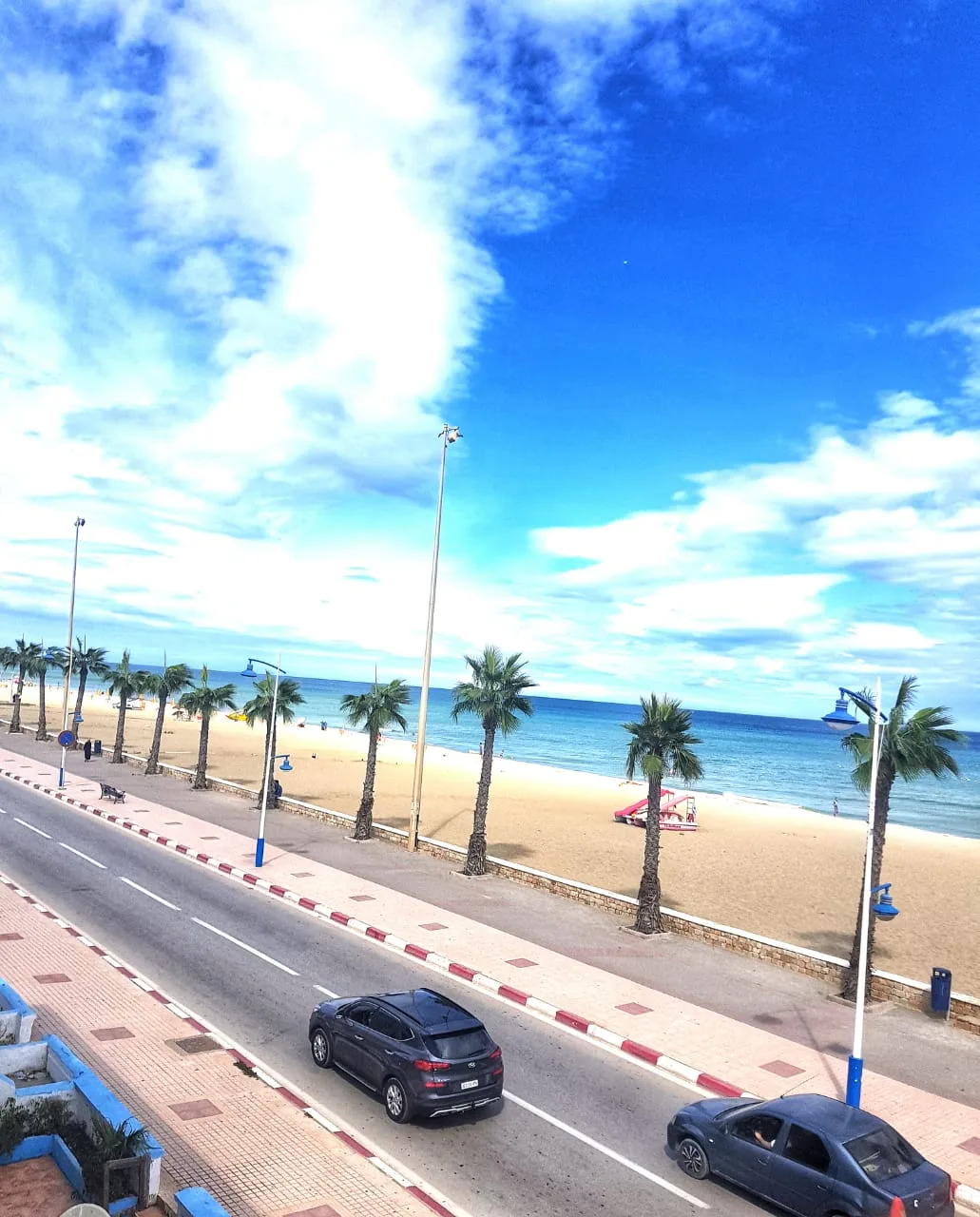
Cross to the northern shore and the sea changes its manners. Martil is Tetouan’s beach, a short drive from the white medina city, and it runs the full Mediterranean formula: a broad palm-lined corniche, a long strand of soft sand, water that stays calm and shelves gently, and a summer population of Moroccan families who have been coming here for generations. The Tetouan coast strings its beaches along a few kilometres – Martil itself, then Cabo Negro’s headland and coves, then M’diq with its marina and the wide sand at Restinga – so a stay here is a small coast, not a single beach, and locals move along it by mood: Martil for the promenade life, the coves for quiet, M’diq for boats and fish restaurants.
This is the Mediterranean doing what it does best in Morocco: water a child can be trusted in further than ankle-deep, sand castles rather than surfboards, evening paseo on the corniche, and the Rif mountains standing behind the town as a green wall. The swimming season is the northern summer, and within it the water warms up properly by late summer in a way the Atlantic never manages. If your mental image of a Moroccan beach holiday is the one Moroccan families themselves hold – this is it, and there is something cheering about joining a country’s own holiday rather than a version packaged for export.
The evenings are half the reason to be here, and they are a Mediterranean ritual the Atlantic resorts never quite reproduce. As the heat drops, the corniche fills for the paseo – families in their good clothes, children on hired trikes, cafés setting out their chairs, the smell of grilled corn and mint tea over the sand. Tetouan’s medina, one of the most intact in Morocco, is a short ride inland for the day the beach palls, and the Rif foothills behind the coast give the whole shore a green backdrop that surprises travellers who arrived expecting the dry Morocco of the south.
The catch is the calendar, sharpened to a point. In July and especially August, Martil and its neighbours are not crowded the way European resorts are crowded; they are crowded the way a festival is crowded, with accommodation to match and a beach you reach early to claim. Some late summers also bring jellyfish blooms somewhere along this coast, as anywhere in the Mediterranean – a question to ask locally on the week, not a reason to stay away. Outside high summer the coast quietens fast, prices soften, and June and September may be the best of it: warm sea, working town, room to breathe.
Al Hoceima – Quemado and the Coves of the Rif
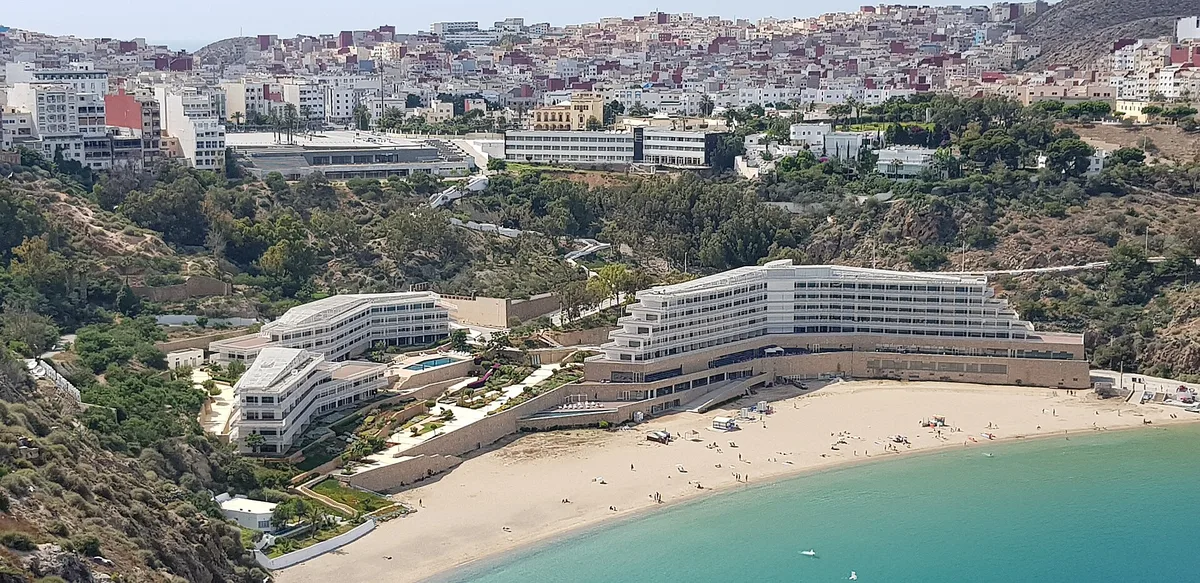
Al Hoceima does not sit on most itineraries, which is precisely its charm. The town – rebuilt after the 2004 earthquake, Amazigh in character, set on a bay in the middle of the Rif coast – keeps one fine town beach, Quemado, curving under the cliffs below the centre with the big hotels on its point. The water here is the Mediterranean at its most generous: clear, calm on most summer days, and blue in the way that makes snorkellers of people who arrived as sunbathers. Quemado is a town beach in the full sense – supervised in season, busy with local families, a short walk from cafés and the port – and it does that job completely.
The wider prize is the coast around it. West of town, the Al Hoceima National Park protects a stretch of cliff and cove that is the wildest shoreline on Morocco’s Mediterranean: Cala Iris with its islet, the coves around Bades, tracks down to water so clear the boats seem to float on air. These are drive-and-walk beaches – no promenade, little shade, bring everything – and they are the reason a beach traveller should bother with the long road or the flight to Al Hoceima at all. Between Quemado’s convenience and the park’s wild coves, this corner offers the two Mediterranean experiences side by side, and almost nobody from outside Morocco seems to know.
The town itself rewards the evenings. The port lands real fish and the restaurants around it cook it without ceremony; the corniche above Quemado fills at sunset; and the whole place runs at a Rif pace that feels a decade removed from the Agadir machine. It is also one of the easiest Moroccan resort towns in which to be a foreigner without being a market – the welcome is genuine, the hassle factor is close to zero, and by day three the café owners know your order. For travellers who measure a beach town by how quickly it stops feeling like a product, Al Hoceima scores very highly indeed.
What holds it back is access and scale. Al Hoceima is far from the classic circuit – a flight, or a mountain drive from Tetouan or Fes that deserves a day of its own – and the town’s tourist machinery is modest: this is a Moroccan resort for Moroccans, with everything that implies for language, menus and charm. Come in the June-to-September swimming season, rent a car for the coves, and Al Hoceima reads as a discovery. Come expecting Agadir-by-the-Med and the comparison will confuse you both.
Saidia – The Long Sand at the Border
At the far eastern end of the Mediterranean shore, a few kilometres from the closed Algerian border, Saidia runs its sand almost out of sight. This is Morocco’s longest Mediterranean beach – a broad, pale strand, often measured at around fourteen kilometres, backed by a purpose-built resort zone with a marina, big hotels and a promenade, and nicknamed the Blue Pearl by the brochures. The sea here is the kind one: gentle surf lines rather than the Atlantic’s standing waves, a slow shelving bottom, and late-summer water that is the warmest in this entire list. For a resort holiday of the classic pattern – hotel, beach, promenade, repeat – Saidia is the Mediterranean’s fullest answer.
The town’s story is a seasonal one. Saidia was a small place that the resort boom enlarged, and its year has two unequal halves: a summer of real life, when families from Oujda and the east fill the corniche and the beach clubs open their rows of umbrellas, and a long quiet season when the resort zone idles and the beach returns to the gulls and the dog-walkers. Neither is a deception; you simply have to book the one you want. The Moulouya river reaches the sea just west of town, its estuary a protected wetland that birdwatchers add to a stay, and the border itself, closed for three decades, gives the eastern end of the beach a strange, peaceful finality – the sand just stops being a resort and becomes geography.
The beach itself has a virtue the resorts further west cannot copy: sheer room. Fourteen kilometres of sand absorbs even the August peak in a way that Martil’s corniche strip cannot, and a ten-minute walk east or west from the marina finds you a stretch of shore with the parasols thinned to dots. The water quality conversation that follows many big resorts applies here in the usual seasonal way – the busy central stretch in peak season is not the water at the quiet ends – and the local pattern is simply to walk a little further than the crowd did. Room, on a Mediterranean beach in August, is a luxury worth travelling for.
Saidia’s honest downsides are distance and that seasonality. It sits about an hour from Oujda, which is itself the far east of most itineraries; nobody passes Saidia on the way to anywhere else in Morocco. The resort architecture is generous rather than beautiful, and outside summer the choice of open restaurants thins fast. But as a final entry it makes the list’s whole argument: Morocco’s Mediterranean is a real beach coast in its own right, warmer and calmer than the famous Atlantic – and Saidia, at its far end, is where that coast is at its most expansive.
Swim Beach or Surf Beach – How to Choose
Everything in this article reduces to one decision, so here it is made explicitly. Rank the best beaches in morocco by the water you will actually meet, not by the photographs. If the holiday is built around swimming – floating, paddling children, a first dip before breakfast – choose from the sheltered set: Agadir’s bay for the full resort machinery, Oualidia’s lagoon for calm water with character, and the Mediterranean trio of Martil, Al Hoceima and Saidia in their summer season for the warmest, gentlest sea in the country. Every other Atlantic beach in this list should be booked as a surf, wind or scenery beach that you may also swim at on the right day, and the trip will go better for having been labelled honestly at the start.
If the holiday is built around surf, the coast orders itself by level. Learners belong in the surf-school bays: Taghazout’s village beach, the beach breaks around Mirleft, the forgiving sandbanks inside Agadir’s bay on small days. Improvers and intermediates get the most from Taghazout’s points in a winter swell window and from Imsouane’s long right-hander when it is working. Advanced surfers already know the names – Anchor Point and its neighbours in a proper swell are the reason this coast is on the world map – and need only the reminder that the water is cold, the famous breaks are crowded on the best days, and the local lineup has a hierarchy that rewards patience and manners.
Wind sports have their own map. Essaouira is the established centre for kitesurf and windsurf with schools, rental and a bay that works as a giant training ground; Dakhla is the pilgrimage – flatter water, stronger and steadier wind, and a journey to match the ambition. Scenery-first travellers should build around Legzira at low tide and sunset, Achakar’s dunes, and the Al Hoceima park coves. And the escape artists, the ones who want a beach the way it was before beaches were an industry, should point at Mirleft and the strands south of Asilah, accept the thin facilities as the price, and bring a book.
Sequencing the coast into a wider trip is covered properly in this site’s Morocco itinerary 7 days, but the beach logic is simple enough to state here: the coast rewards being last. Two or three nights at Essaouira or on the Agadir-Taghazout strip after the medinas and the desert gives a first trip its exhale; the Mediterranean belongs to a northern loop with Tangier, Tetouan and Chefchaouen, or to a dedicated summer beach holiday of its own. What does not work is the day-trip mentality – a Moroccan beach, like a Moroccan medina, pays out in proportion to the time you give it.
Frequently Asked Questions
What is the best beach in Morocco for swimming? For a year-round resort answer, Agadir’s sheltered bay. For the calmest water on the Atlantic coast, Oualidia’s lagoon. For the warmest sea, the Mediterranean beaches – Martil, Al Hoceima, Saidia – in late summer. The famous surf beaches are swimming beaches only conditionally, on calm days, with local advice.
Is the sea warm enough to swim in Morocco? It depends which sea, and when. The Mediterranean in August and September is genuinely warm by European standards. The Atlantic is cooled all year by the Canary Current – refreshing in summer, brisk in winter, and never bath-like; surfers wear wetsuits in every month. This guide prints no degrees on purpose: the current and the calendar tell you more than a copied figure would.
When is the surf season in Morocco? The big Atlantic swells arrive with the northern winter, roughly September to April, and that is when Taghazout, Imsouane and the point breaks earn their reputations. Summer surf is smaller and often wind-affected – good for learning, disappointing for a dedicated surf trip. Kitesurfing at Dakhla works most of the year, with the windiest months in summer; Essaouira’s wind peaks in summer too.
Can you swim at Essaouira? Yes, carefully and conditionally – in the sheltered corner near the port, in the shallows, on calm mornings. But Essaouira is a wind and walking beach first, famous for kitesurfing precisely because the wind rarely rests, and its water is cold Atlantic. If swimming is the point of the day, the lagoon at Oualidia, a few hours north, is the better plan.
Which Moroccan beach is best for families? With small children, the calm water wins: Oualidia’s lagoon for atmosphere, Agadir for facilities, Martil and the Tetouan coast in summer for the gentle Mediterranean and the full family-holiday town around it. With teenagers, Taghazout’s surf schools turn the Atlantic’s energy from a warning into the holiday itself.
Is Legzira worth the long trip south? For the arch, the red cliffs and the sunset – yes, as a visit combined with Sidi Ifni and Mirleft on a southern loop. As a swimming destination, no; it is a scenery beach, best at low tide, and one of its two famous arches collapsed in 2016, so expect one great arch, not two.
How many beach days does a first Morocco trip need? Two or three nights in one coastal base is the sweet spot – enough for the beach to become a place rather than a photo stop, short enough to leave the medinas, mountains and desert their share of the trip. One night is a taster; a full beach week is a different, also honourable, kind of holiday – in which case base in Agadir, Taghazout or, in summer, on the Tetouan coast. And plan the beach days last where you can: even the best beaches in morocco are better met rested, at the end of the road, than rushed at the start of it.
The Short Version
If this guide to the best beaches in morocco has to shrink to a paragraph, it is this. Morocco has two beach countries sharing one flag. The Atlantic is cold, windy, magnificent and surf-ruled: Achakar’s dunes, Asilah’s charm, Oualidia’s calm lagoon, Essaouira’s gale, Taghazout’s waves, Agadir’s sheltered resort bay, Mirleft’s quiet, Legzira’s red arch and Dakhla’s desert lagoon, in that order down the map. The Mediterranean is the kind sea: Martil’s family corniche, Al Hoceima’s clear coves and Saidia’s endless sand, all at their best in high summer. Choose by what you will actually do in the water, not by the photographs – the photographs are all beautiful, and the water is not the same twice.
Do that, and the Moroccan coast stops being a lottery. The swimmer stops shivering at a surf break, the surfer stops apologising to a lagoon, and every beach in this list gets to be judged on what it is genuinely good at. Which is, in the end, all any of them ever asked.