Most visitors meet this district in fragments – a bazaar squeezed between two other sights, one famous mosque photographed from a bus window, a Citadel view at the end of a long day. That is a waste of the densest historic cityscape in Egypt. This guide to islamic cairo treats the old walled city as what it is, a single walkable district with its own logic, its own main street and its own rhythm, where the monuments are not isolated attractions but the load-bearing walls of a living neighbourhood. Everything here sits inside or beside the area UNESCO inscribed as Historic Cairo in 1979, and almost everything can be reached on foot from one street.
That street is Al-Muizz, the old ceremonial spine of the Fatimid city, running roughly a kilometre from the northern gates to Bab Zuweila in the south. Walk it slowly and the district explains itself in order – Fatimid mosques near the gates, the great Mamluk complexes stacked around the old palace ground in the middle, the bazaar growing out of the street’s eastern side, and the later Ottoman-era fountains and schools filling the gaps. The Citadel, Sultan Hassan and Ibn Tulun stand outside the Fatimid walls but belong to the same story, and the Museum of Islamic Art at Bab al-Khalq holds the portable pieces of all of it under one roof.
This is deliberately not a general Cairo guide. The pyramids, the Grand Egyptian Museum and the churches of Coptic Cairo belong to other days and other guides on this site, including the Egypt travel guide and the roundup of the best places to visit in Cairo, which plans the whole city district by district. Here the boundary is strict. One historic district, walked properly, with its history in the right order, its buildings explained rather than merely named, and its real downsides stated plainly at the end.
Islamic Cairo at a Glance
| Question | Short answer |
|---|---|
| What is it | The historic walled city of Cairo and its southern monuments, UNESCO-listed as Historic Cairo since 1979 |
| Main street | Al-Muizz Street, running from Bab al-Futuh in the north to Bab Zuweila in the south |
| Oldest mosque here | Ibn Tulun, built 876-879 in the earlier city of al-Qata’i, south-west of the walls |
| Biggest single building | The mosque-madrasa of Sultan Hassan, below the Citadel |
| Best walk | The full Al-Muizz line, gate to gate, with Khan el-Khalili as the evening finish |
| How long | One long day for the spine; two days to include Ibn Tulun, the Citadel and the museum |
| Do not confuse it with | Coptic Cairo and the Giza plateau, which are separate districts and separate days |
The first thing to grasp is that islamic cairo is not a museum quarter that happens to have residents. It is a working city district – metalworkers, coppersmiths, textile sellers, schoolchildren, wedding parties, funeral processions – that happens to contain an unmatched concentration of medieval buildings. Shops open onto Mamluk facades, scooters thread between tour groups, and a fourteenth-century madrasa may share a wall with a modern apartment block. Visitors who arrive expecting a hushed heritage park are disoriented for the first hour; visitors who accept the district on its own terms usually rate it the most memorable part of a Cairo trip.
The second thing to grasp is scale. The walled Fatimid core is compact enough to cross on foot in well under an hour, yet it holds layer upon layer of building from the tenth century onwards, because every dynasty that ruled Egypt governed from here or beside here and built accordingly. A single street corner can carry a Fatimid mosque facade, a Mamluk minaret, an Ottoman fountain and a nineteenth-century house in one glance. The sections that follow take the district apart piece by piece – gates, mosques, complexes, bazaar, fortress, museum – so that when you stand on Al-Muizz Street the pieces reassemble into one city rather than a checklist.
Four Capitals in One District – How the Old City Grew
Cairo was not founded once; it was founded repeatedly, each new capital planted beside the last. The sequence matters because the district’s geography still follows it. First came Fustat in 642, the original Arab garrison city down by the river. Then al-Askar in 750, then al-Qata’i in 879, the short-lived Tulunid capital whose great mosque of Ibn Tulun still stands. Only in 969 did the Fatimids found al-Qahira – Cairo proper – as a walled royal city north of its predecessors, and it is that walled city, with its gates and its great street, that forms the heart of the district today. UNESCO’s own summary of the listing traces exactly this layering, and standing in the district with the sequence in mind turns a confusing warren into a readable stack of capitals.
The Fatimid city was a planned royal enclosure, and its plan still governs the walk. The caliph’s palaces stood around the open space later called Bayn al-Qasrayn, “between the two palaces”, and the city’s greatest street, the Qasaba, ran north to south through it – the street now named for the Fatimid caliph al-Muizz. The stone walls that visitors see are mostly the work of the vizier Badr al-Gamali in the late eleventh century, replacing earlier brick defences, and three of their gates survive – Bab al-Futuh and Bab al-Nasr in the north, Bab Zuweila in the south. Inside them the Fatimids raised the mosques that still anchor the street – Al-Azhar, Al-Hakim, Al-Aqmar and Salih Tala’i among them.
Later dynasties enlarged rather than replaced this skeleton. Saladin, founder of the Ayyubid state, added the Citadel on the spur of the Muqattam hills in 1176 and began joining the whole chain of cities inside one defensive system. The Mamluks, ruling from 1250 to 1517, then filled the Fatimid street with their great charitable complexes – Qalawun, Barquq, al-Ghuri and the rest – and pushed monumental building south towards the Citadel, where Sultan Hassan rose below its walls. The Ottomans after 1517 mostly maintained the fabric and inserted their own smaller landmarks, fountains and houses, which is why the district reads as one continuous medieval city rather than a set of period rooms. That continuity – whole neighbourhoods, craft streets and markets surviving together – is precisely what the UNESCO listing protects.
Al-Muizz Street – One Street, a Thousand Years
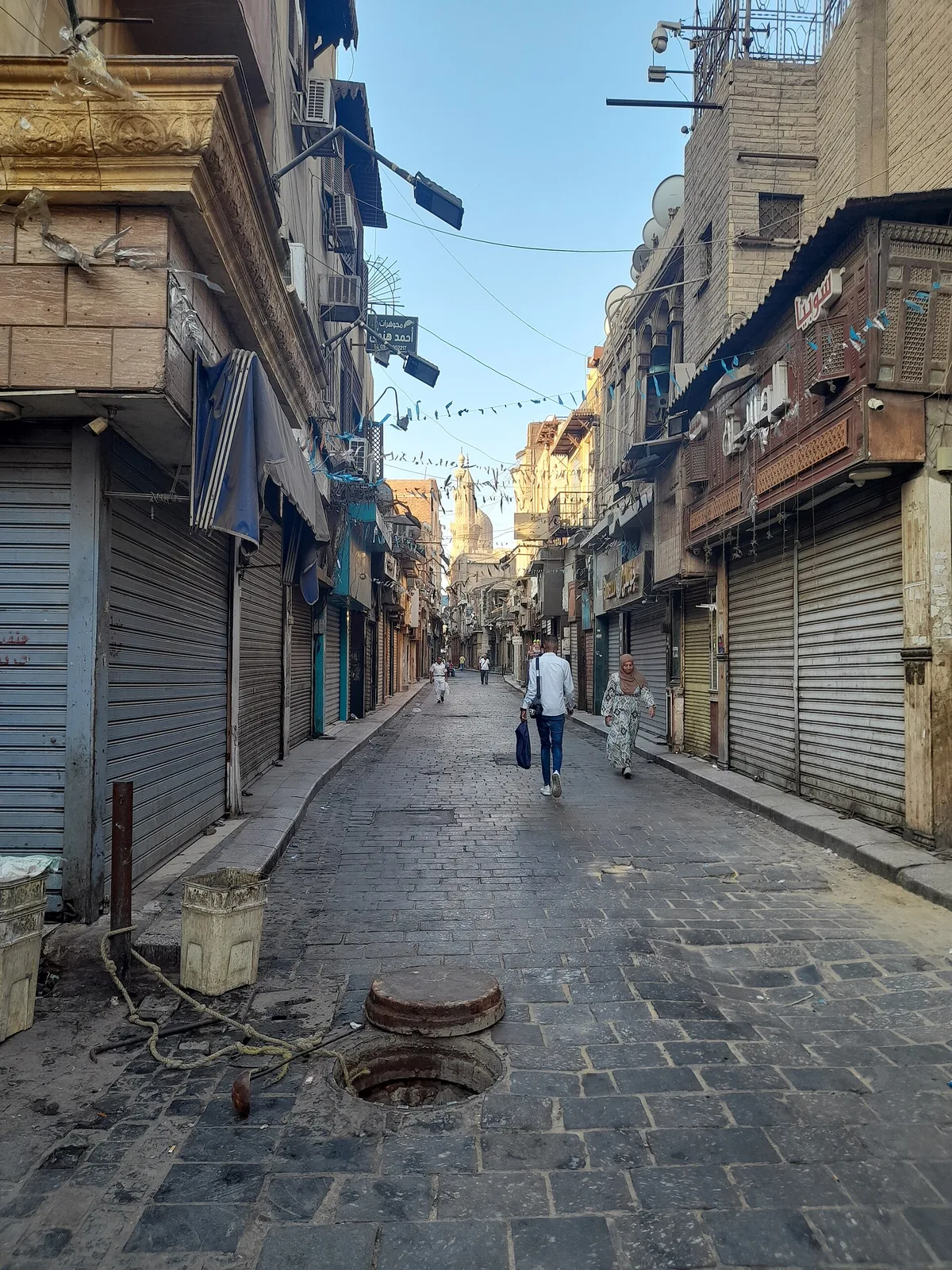
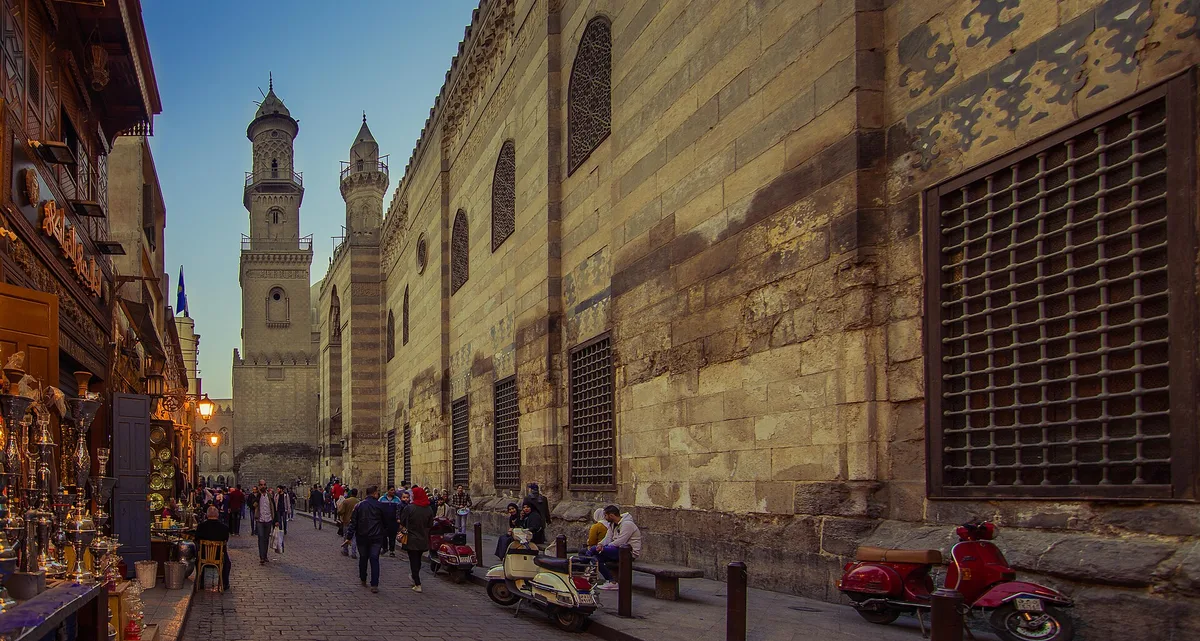
Everything in this guide hangs on one street, so it deserves a section of its own. Al-Muizz Street – its full name honours the Fatimid caliph al-Muizz li-Din Allah – follows the line of the old Qasaba, the ceremonial avenue of Fatimid Cairo, from Bab al-Futuh at the northern wall to Bab Zuweila at the southern. Along roughly a kilometre it passes or touches the Al-Hakim Mosque, the Al-Aqmar Mosque, the complexes of Qalawun, al-Nasir Muhammad and Barquq, the Sabil-Kuttab of Abd al-Rahman Katkhuda, the al-Ghuri buildings and dozens of smaller monuments, houses and fountains. No other single street in the Islamic world concentrates this much surviving medieval architecture, and the claim does not need exaggeration – it only needs the walk.
The street’s character changes along its length, which is part of its pleasure. The northern stretch below Bab al-Futuh is a working market street, narrower and louder, where the monuments rise between shops. The middle stretch, around Bayn al-Qasrayn, opens into the district’s monumental showpiece, where the great Mamluk facades face each other across the old palace ground. South of the al-Ghuri crossing the street dives into the tentmakers’ and textile quarters and narrows towards Bab Zuweila. Much of the central street has been restored and is largely given over to pedestrians, which makes the walk itself easy; the difficulty, such as it is, lies in deciding what to enter and what to save for a second pass.
Timing shapes the experience more than any other choice. Early in the morning the shutters are down, the stone is clean in low light and the street belongs to residents and delivery carts – the best hour for photography and for reading facades. By late morning the tour groups arrive at Bayn al-Qasrayn and the interiors fill. In the evening the restored stretch lights up, families come out, the bazaar beside it catches fire with lamps and brasswork, and the same street becomes a promenade. A strong plan walks it twice – once early for the buildings, once after dark for the life – and treats the two passes as different sights, because they are.
The Northern Gates – Bab al-Futuh, Bab al-Nasr and Al-Hakim
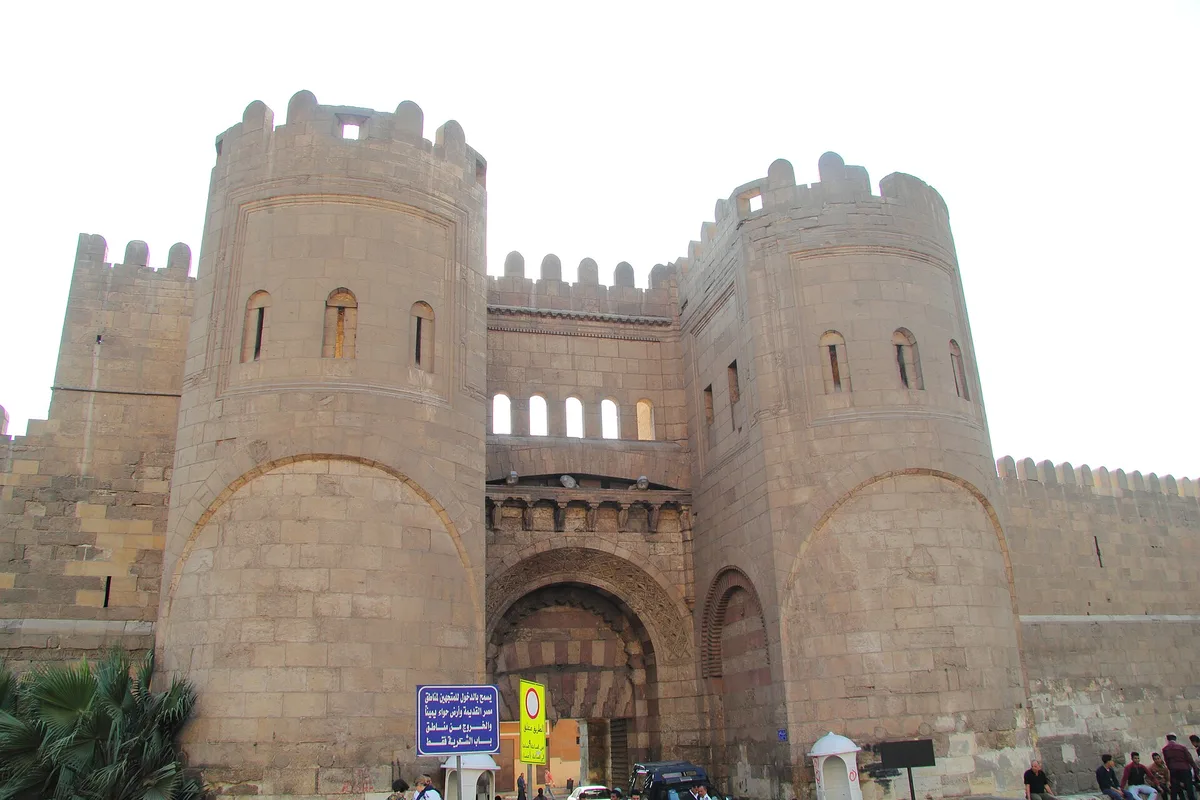
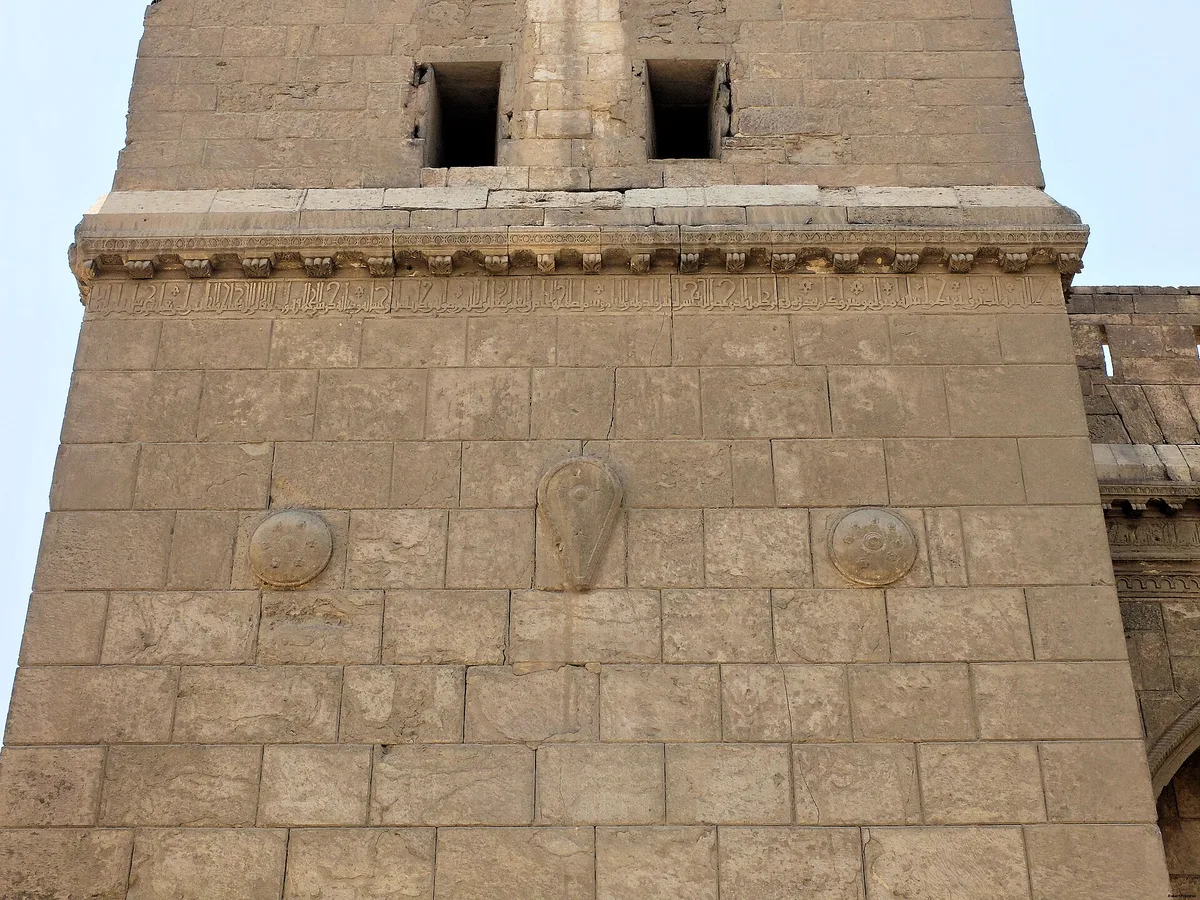
The natural place to begin is the northern wall, where the street starts. Bab al-Futuh, the Gate of Conquests, is one of the three surviving gates of Badr al-Gamali’s late-eleventh-century walls, a massive stone gateway flanked by two rounded towers and crowned by a vaulted passage and a parapet walk. It is military architecture of a very high order – carved, precise and still faintly menacing – and it frames the start of Al-Muizz Street exactly as it framed the Fatimid caliph’s processions out of the city. A short walk east along the surviving wall brings you to Bab al-Nasr, the Gate of Victory, whose square towers carry carved stone shields and some of the earliest monumental Arabic inscription bands in Cairo.
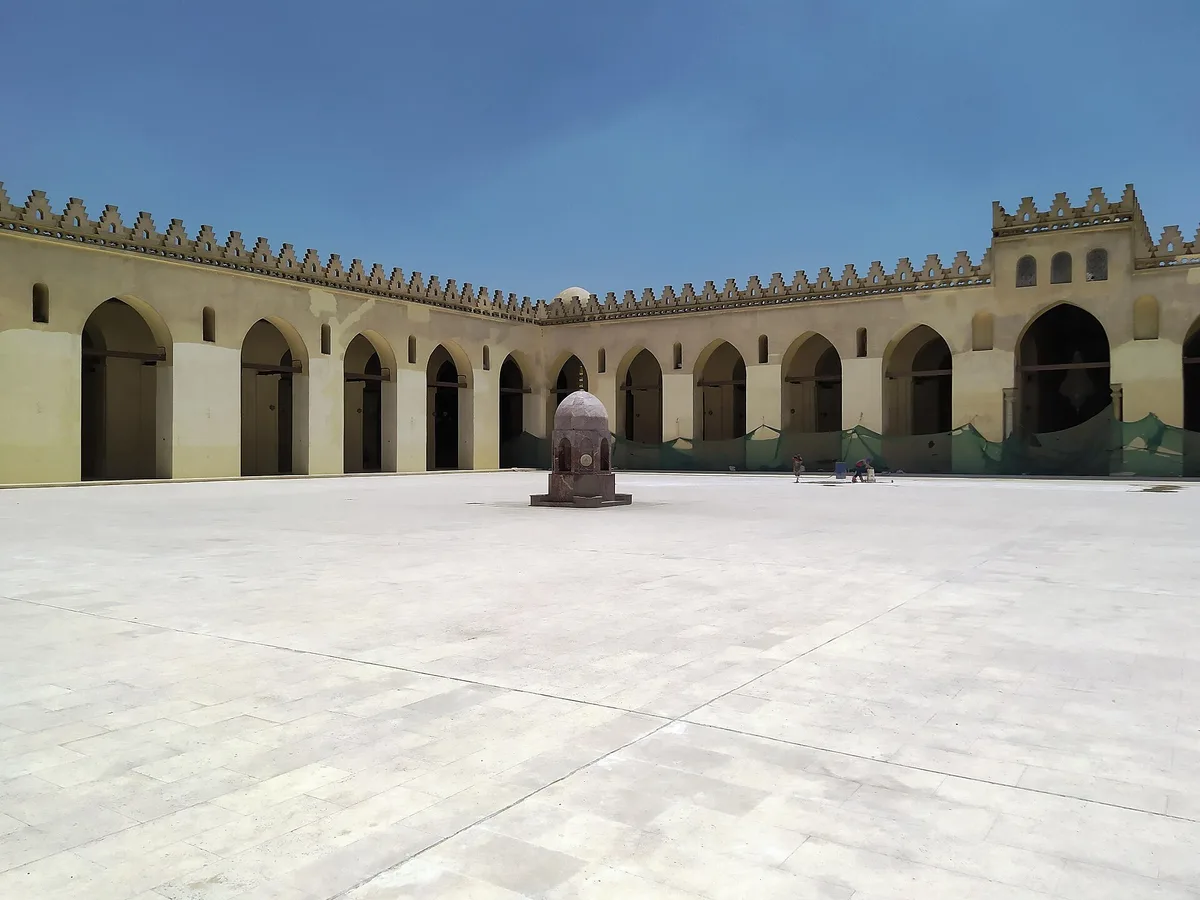
Immediately inside Bab al-Futuh stands the mosque of the caliph al-Hakim, begun in 990 and completed in 1013, its two minarets planted on corner bastions of the wall itself. The mosque had a chequered afterlife – used over the centuries as fortress, storehouse and school, and heavily restored in the late twentieth century – which is why its vast courtyard reads so clean and pale today. That restoration is honestly a double-edged thing, and it makes Al-Hakim the most debated interior in islamic cairo. The space, the arcades and the sheer Fatimid scale are all legible again, but some visitors find the renewed stone less atmospheric than the weathered fabric elsewhere on the street. It remains the right first interior of the walk, because its size announces what Fatimid Cairo could build.
The northern gates also teach the district’s basic orientation lesson. Stand at Bab al-Futuh and you are at the top of the story – everything else in the Fatimid city lies south of you along one street, in rough chronological disorder but perfect geographical order. Visitors who start here and walk south rarely get lost, because the street itself is the map. Visitors dropped by taxi at the bazaar end, by contrast, often experience the district as a maze. If you take one piece of logistical advice from this entire guide, take that one – begin at the northern gate and walk down.
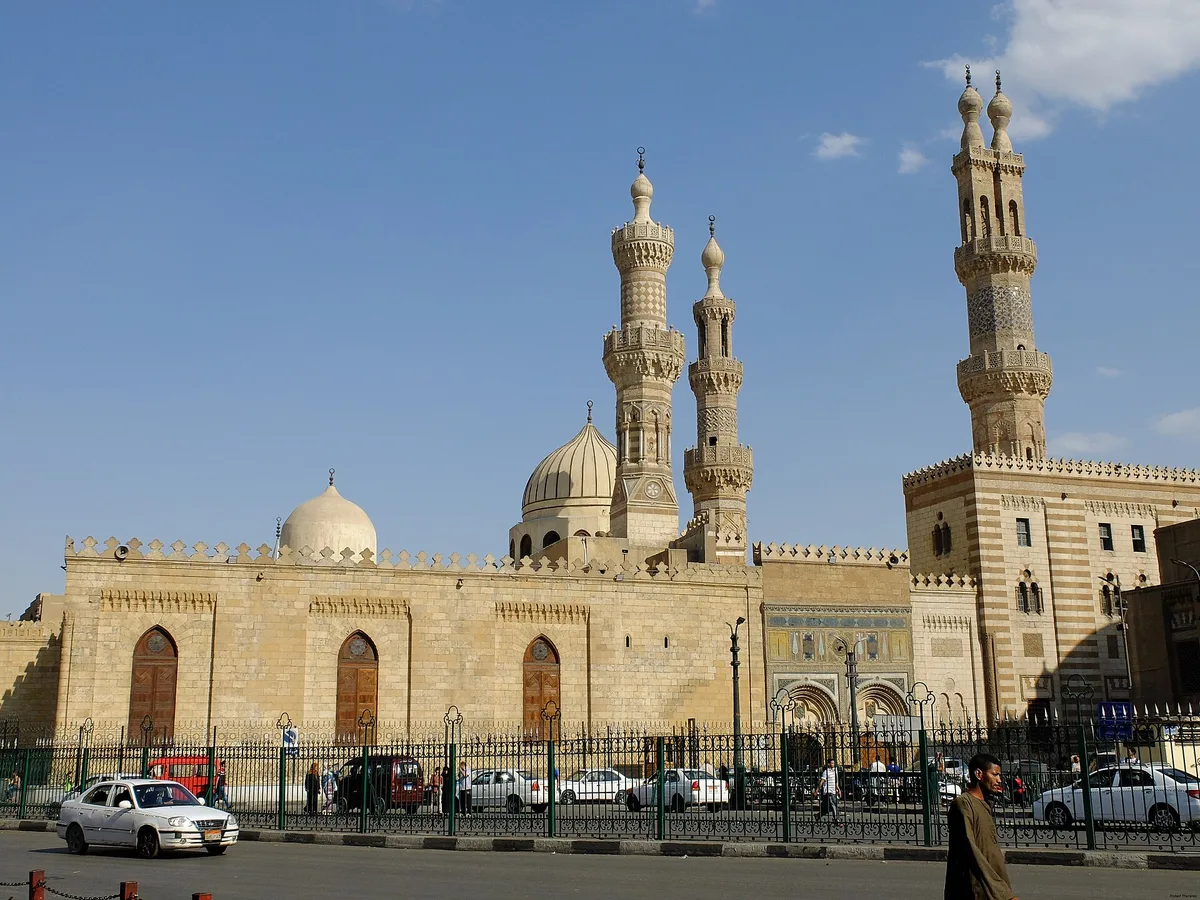
Al-Azhar – the Mosque That Became a University
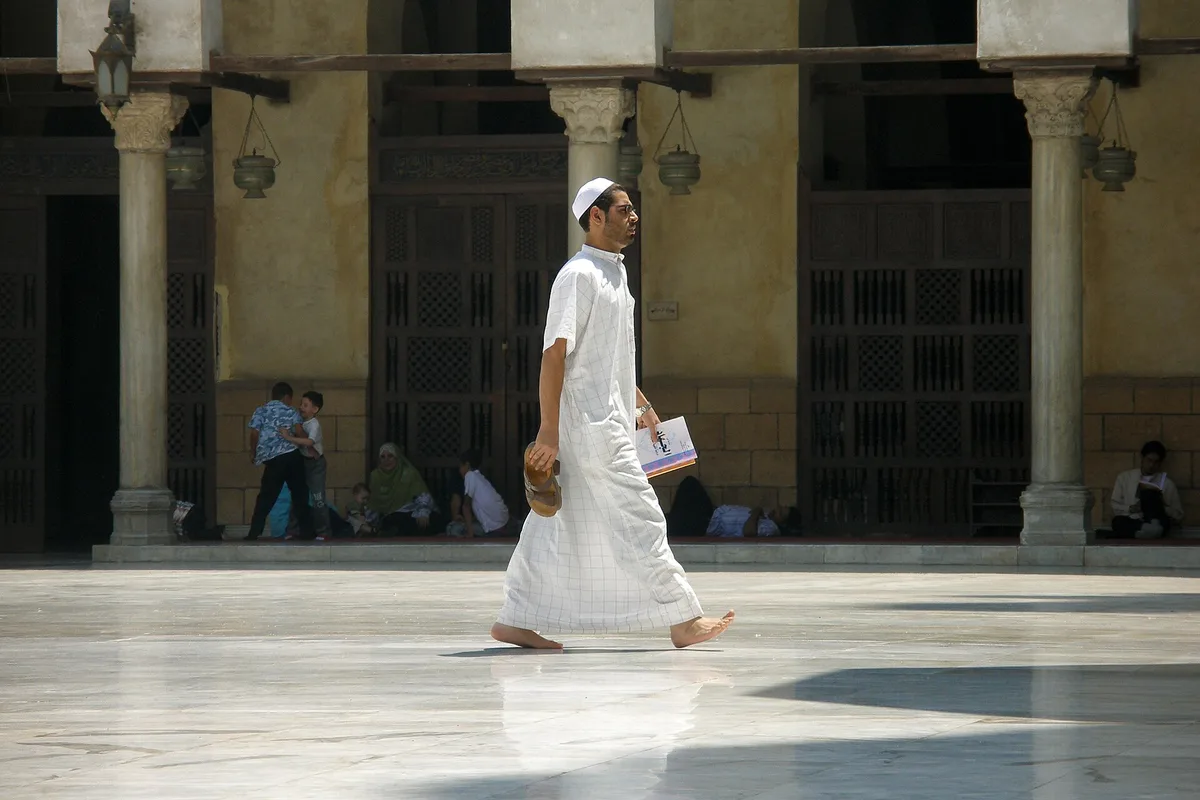
A short walk east of the street’s southern half stands the building that gives the whole district its intellectual weight. Al-Azhar was founded in 970 as the mosque of the new Fatimid city, and it grew over the following thousand years into the most influential centre of Sunni Islamic learning in the world – a role UNESCO’s listing singles out, noting that Al-Azhar has been a leading theological and academic centre for the entire Islamic world since its foundation in 970 and continues to be one. The modern university is a vast institution spread across the city, but the old mosque at its heart remains a working place of worship and study, and its courtyard is one of the calmest spaces in the district.
Architecturally the mosque is a layered archive rather than a single-period monument. The Fatimid prayer hall survives at its core, but Mamluk sultans added minarets and madrasas, Ottoman patrons added more, and the skyline of domes and minarets above the courtyard is a summary of Cairene styles in one view. That layering is exactly why Al-Azhar rewards slow looking. A carved stucco window may be Fatimid, the minaret beside it Mamluk, the gate you entered by Ottoman, and the students crossing the marble in white robes entirely of the present day. Few buildings anywhere demonstrate so clearly that this district was never frozen – it was continuously rebuilt by the people who used it.
Practically, Al-Azhar sits at a useful junction. The Khan el-Khalili bazaar begins just across the road junction to its north-west, the al-Ghuri complex stands a few minutes west on Al-Muizz, and Al-Azhar Park rises on the hill to the east, so the mosque pairs naturally with any of the three. Non-Muslim visitors are generally welcome outside prayer times, with the usual expectations – shoes removed, modest dress, quiet behaviour, and no walking in front of anyone praying. Treat it as a university and a mosque first and a sight second, and it becomes one of the most rewarding interiors in islamic cairo rather than merely one of the most famous.
Bayn al-Qasrayn – Qalawun’s Hospital, Madrasa and Tomb
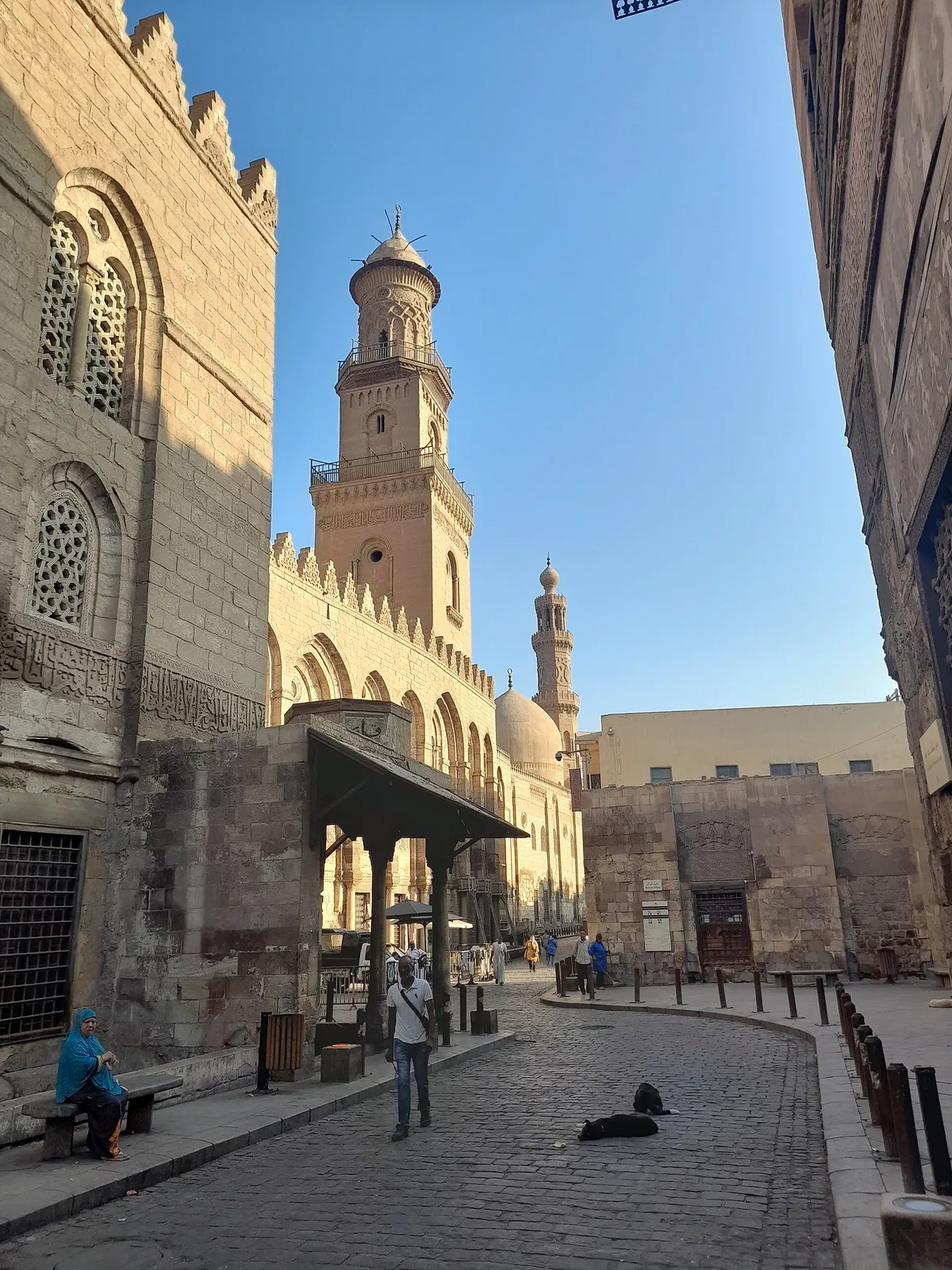
Halfway down the street the city opens into its ceremonial centre. Bayn al-Qasrayn, “between the two palaces”, was the plaza between the Fatimid caliphs’ eastern and western palaces, and after the palaces vanished the Mamluk sultans competed to fill their ground with monuments. The result is the finest single concentration of Mamluk architecture in existence, and the first complex to enter is the one that set the pattern – the foundation of Sultan Qalawun, raised in 1284-85 with a speed that contemporary writers already marvelled at. In one street facade Qalawun combined a mausoleum for himself, a madrasa, and a hospital, the bimaristan, which treated patients free of charge as an act of endowed charity.
That combination is the key to understanding the whole district, because it repeats everywhere. A Mamluk complex was not a mosque with decorations; it was a machine for public good and dynastic memory at once – prayer, teaching, healing and the founder’s tomb bundled into a single endowed institution whose rents paid its staff in perpetuity. Qalawun’s mausoleum chamber, with its carved stucco, marble panelling and soaring dome, is the emotional centre of his complex and one of the great interiors of the medieval Islamic world. His hospital, remarkably, continued treating patients on the same site into the modern era, which makes this not just an early example of the type but an exceptionally long-lived one.
Give this block of the street real time. The Qalawun complex alone justifies slow entry, and it faces the madrasa-mausoleum of Qalawun’s son al-Nasir Muhammad directly across the street, with Barquq’s complex immediately north – three royal foundations within a few dozen paces. Visitors in a hurry photograph the facades and move on; visitors with an hour go inside at least one, and Qalawun’s is the one to choose if only one interior fits the day. This is the point on the walk where islamic cairo stops being a street of mosques and becomes a lesson in how a medieval Islamic city actually organised welfare, education and power.
Barquq and the Mamluk Showpiece Block
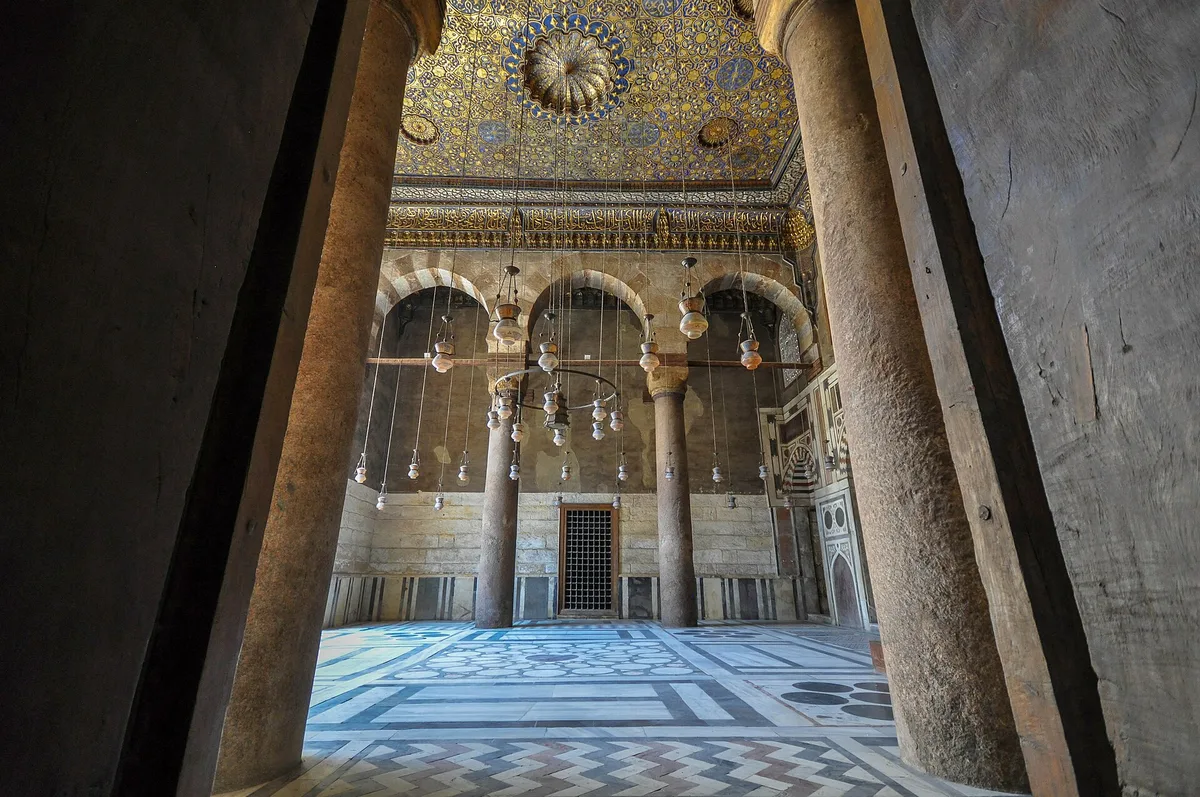
Immediately north of Qalawun’s foundation, the street’s showpiece continues with the complex of Sultan al-Zahir Barquq, built in 1384-86, a century after Qalawun and visibly determined to outdo it. Barquq was the first sultan of the Burji, or Circassian, Mamluk line, and his mosque-madrasa-khanqah announces a new reign the way Qalawun’s had – on the most prestigious ground in the city, in the most expensive materials available. The facade steps and recesses to follow the street, the minaret is a carved stone tower of exceptional refinement, and the interior courtyard opens into a prayer hall whose marble floor, gilded wooden ceiling and hanging lamps deliver the full Mamluk effect in one room.
Between and around these giants stand the supporting acts that make the block read as a whole – al-Nasir Muhammad’s madrasa with its carved minaret, the later Ottoman sabil-kuttab rising at the street junction, domes and facades layering behind one another until the eye gives up separating them. This is the stretch of Al-Muizz that appears on the posters, and it earns the attention honestly. It is also the stretch where the district’s central bargain is clearest. The buildings were raised by military slave-sultans advertising legitimacy they had seized, yet what they built with the advertisement was schools, hospitals, fountains and tombs that served the city for centuries – propaganda and public service in the same stone.
A practical note belongs here, because this block tempts visitors to over-enter. The complexes share a family resemblance – courtyard, iwans, tomb chamber, minaret – and after the third interior the details begin to blur. The better strategy is depth over coverage. Choose Qalawun or Barquq for the full slow visit, read the other’s facade properly from the street, and save your attention for the different building types further south – the bazaar structures, the wikala, the gates – which show other sides of the same civilisation. The street will still be here, and so will the interiors, on a second visit.
Al-Aqmar and the Small Fatimid Mosques
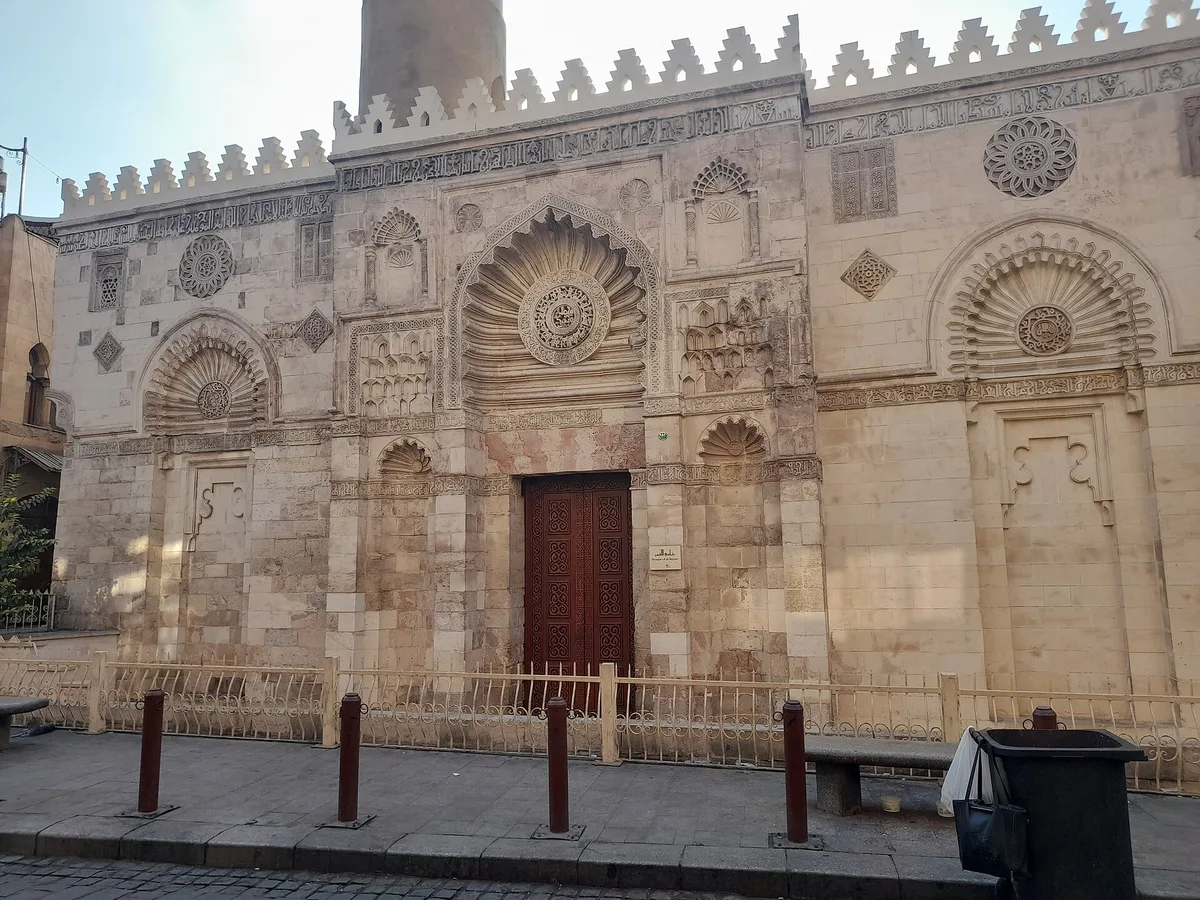
Against the Mamluk giants, the little mosque of Al-Aqmar makes the opposite case – that in this district, small can be perfect. Built in 1125 for the Fatimid caliphate, it is the earliest surviving mosque in Cairo with a fully decorated stone facade, and that facade is the point. The front wall is angled to follow the street while the prayer hall behind turns to face Mecca, an elegant solution to a crooked plot, and its surface carries a carved programme of radiating hoods, medallions, inscriptions and mock windows that turns the whole elevation into a piece of stone embroidery. In the evening light the carving glows, and the mosque becomes the street’s most photographed small building.
Al-Aqmar also corrects a misunderstanding visitors often bring to the district. The Fatimid monuments are not a rough draft for the Mamluk ones; they are a different and in some ways more inventive architecture, produced when Cairo was the capital of a rival caliphate competing with Baghdad. Al-Hakim’s scale at the north gate, Al-Aqmar’s carved skin here, the mosque of Salih Tala’i near Bab Zuweila at the street’s far end – together they show a dynasty experimenting with stone facade decoration that later centuries inherited. Reading the street chronologically, Fatimid first and Mamluk second, is the difference between seeing decoration and understanding it.
The small mosques matter for another reason too – they pace the walk. The great complexes demand time, tickets, shoe covers and concentration; the little Fatimid mosques ask for five minutes of looking from the pavement, and repay it. A good Al-Muizz itinerary alternates the two scales deliberately, big interior then small facade, rather than grinding through every doorway in sequence. That alternation keeps the day pleasurable, and it is how the street was always meant to be read – as a rhythm of monuments and markets, not a queue of identical sights.
Sabils, Kuttabs and the Street’s Giving Water
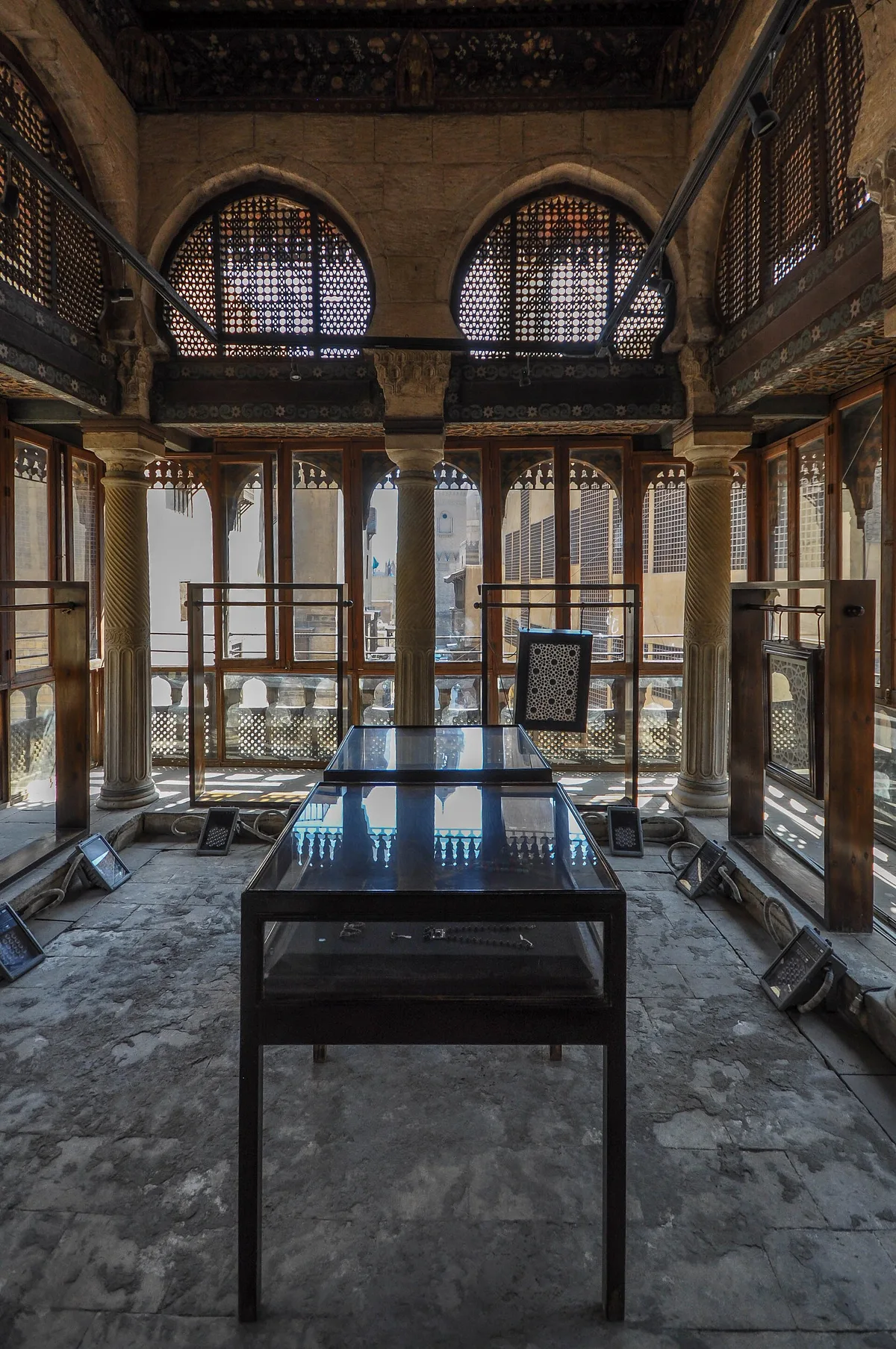
Midway along the street, at the junction by Bayn al-Qasrayn, stands the building type that explains the district’s charity better than any palace – the sabil-kuttab of Abd al-Rahman Katkhuda, built in 1744 on a tight triangular plot. A sabil is a public drinking-water fountain, staffed and endowed to give water free to any passer-by; a kuttab is the elementary school for boys that so often sat above it. Stacked together on a street corner, water below and teaching above, the sabil-kuttab is the Mamluk and Ottoman welfare idea in miniature, and Katkhuda’s is the most famous example in Cairo – a curved, grilled, richly carved little building that turns a traffic corner into a monument.
The engineering behind the charm deserves a sentence. Beneath the sabil lay a great cistern, filled from the Nile flood through the city’s aqueduct system, and attendants drew the cool water up to serve it through the bronze grills to the street. UNESCO’s account of the listing dwells on exactly this infrastructure – the aqueduct, the canals, the cisterns, the hammams and the sabils – because a desert-edge city of this size only worked if water was organised as carefully as prayer. Katkhuda’s cistern is dry and its grills serve no one now, but as an object lesson it still works; stand at its corner and the whole hydraulic civilisation is visible in one small building.
Keep an eye out for the type as you walk, because once recognised, sabils appear everywhere – under madrasas, attached to mosques, standing alone on corners, each with its grilled windows and inscription panel. They are the district’s most democratic monuments, built for strangers, and they balance the sultans’ tombs on the same street with a different kind of immortality. The sultan is remembered for his dome; the water-giver is remembered every time someone drank. Historic Cairo’s streetscape holds both kinds of fame within a few hundred metres, which is part of what makes it unlike any archaeological park.
Khan el-Khalili – the Bazaar Beside the Street
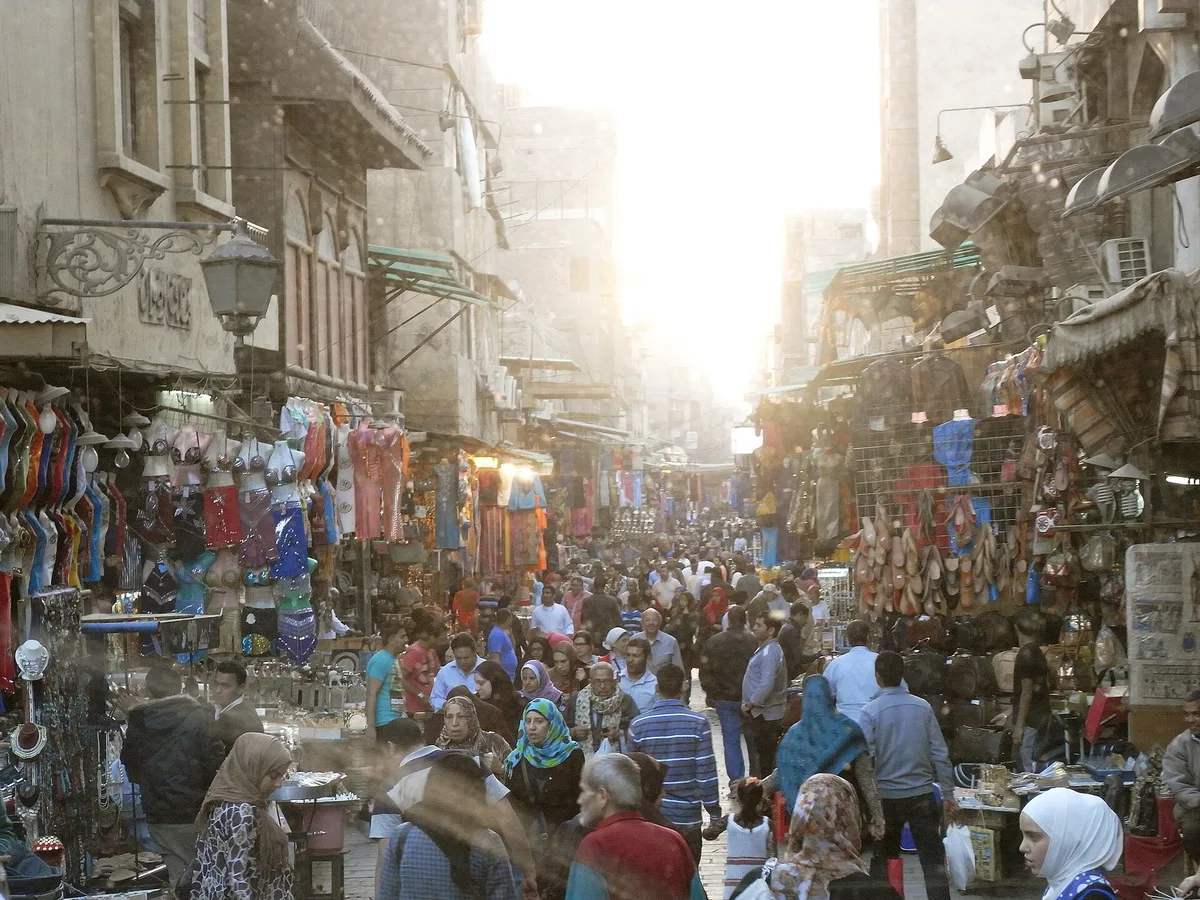
At the street’s southern-middle stretch, the monumental avenue grows a bazaar. Khan el-Khalili began in the late fourteenth century as a caravanserai – a khan – raised by the amir Jaharkas al-Khalili on ground that had been a Fatimid cemetery, and it grew over six centuries into Cairo’s most famous market quarter, a dense warren of lanes running east from Al-Muizz towards Al-Azhar. The name now covers the whole bazaar district rather than one building, and its lanes are sorted the way old markets always are, trade by trade – goldsmiths in one run, coppersmiths in another, lamps, textiles, spices, perfume and souvenirs layered between.
The honest description of the bazaar has two halves. The main lanes are heavily touristed, the souvenir stock is much the same from stall to stall, and the salesmanship is persistent and practised. And yet the quarter underneath the tourism is genuinely old and genuinely working – real workshops behind real shopfronts, wholesalers supplying half of Egypt, teahouses that have served the same corner for generations, and carved Mamluk gateways surviving between the stalls. Both halves are true at once, and the visitor’s job is to shop in the first while looking at the second. Prices are a negotiation, not a label, and the negotiation is expected to be conducted with humour; a flat refusal delivered with a smile ends any pitch.
The Old Stones Inside the Market
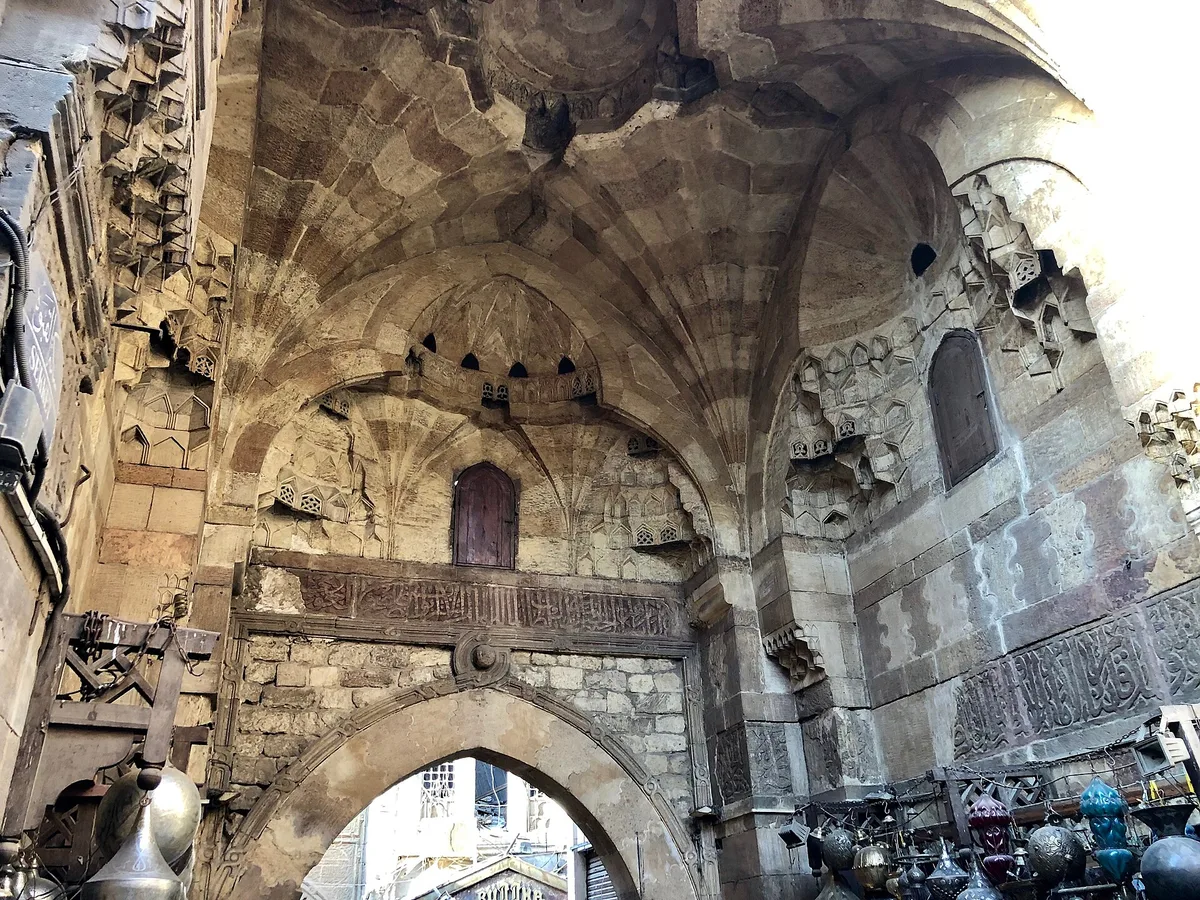
What lifts Khan el-Khalili above a souvenir market is how much medieval fabric survives inside it. The quarter grew by accretion around its original khan and the later commercial buildings that copied it – the wikala, the rab’, the covered market halls – and fragments of that world are everywhere once you look up from the goods. Stone gateways carry carved inscription bands and muqarnas hoods; upper floors project on carved brackets; a lane you entered for cushion covers turns out to pass under a fourteenth-century arch. The bazaar is not a themed imitation of the old city. It is the old city’s commercial quarter, still trading on its medieval ground plan.
The practical way to enjoy it is to give the quarter its own hour, ideally in the evening when the lamps are lit and the heat has gone, and to treat buying as a secondary activity. Sit down for tea, watch the lanes work, duck into the gold and copper streets where the making still happens in view, and let one or two purchases happen naturally rather than hunting a list. Travellers who enter the bazaar with a shopping agenda usually leave tired and overcharged; travellers who enter it as a district leave with the best evening of their Cairo trip – and usually a lamp anyway.
Sultan al-Ghuri – the Last Great Mamluk Building
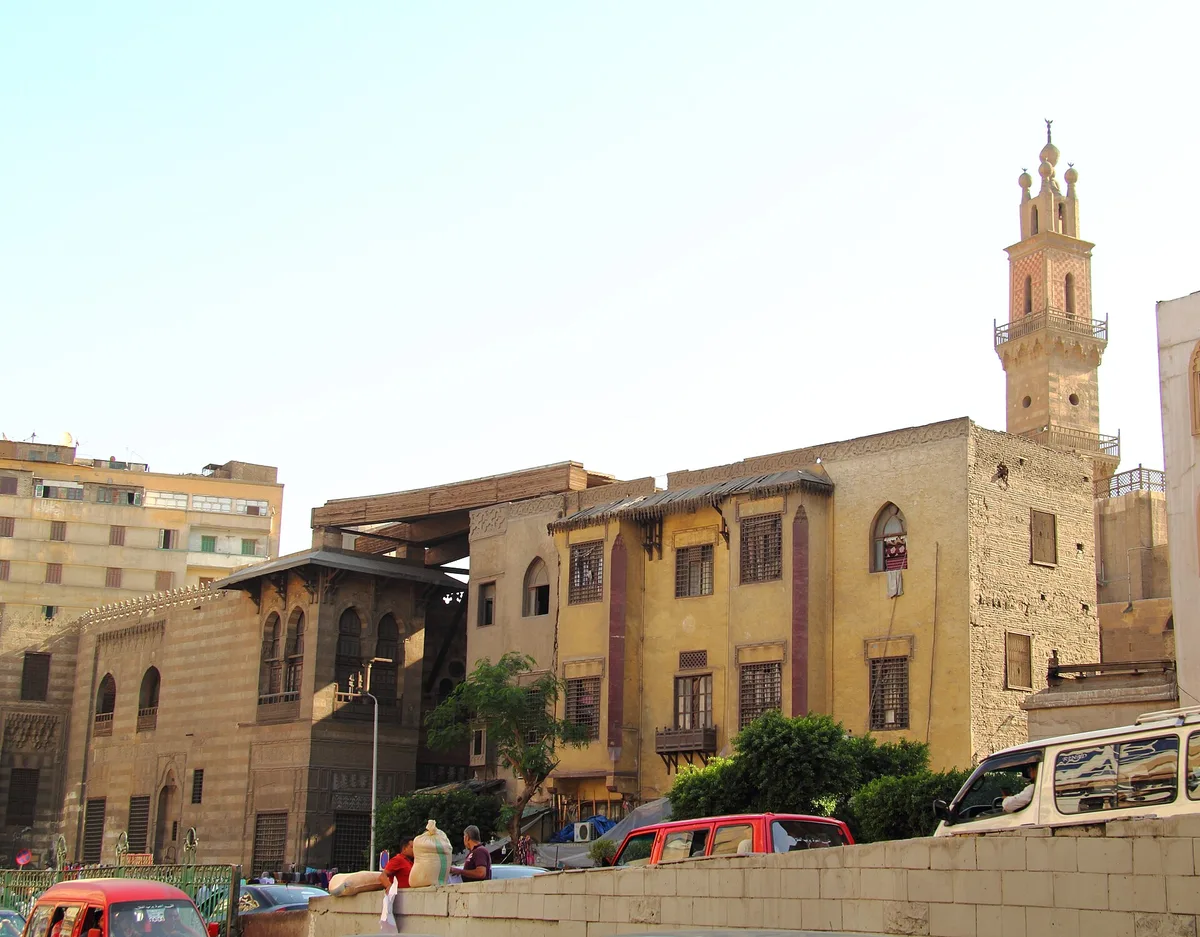
Where Al-Muizz crosses the modern al-Azhar road, the street passes through the final flourish of the Mamluk age. Sultan Qansuh al-Ghuri, the last effective Mamluk sultan, built on both sides of the street in the first years of the 1500s – a mosque-madrasa on the west side, his mausoleum and a khanqah on the east, the two halves once joined over the road by a wooden roof that made the crossing itself a covered ceremonial space. His minaret is the district’s easiest landmark, a tall square tower topped by four finials where the type usually carries one, visible up and down the street and the surest way to orient yourself in the southern half.
Al-Ghuri’s complex carries a poignancy the earlier sultans’ buildings do not. Within a little over a decade of its completion the Mamluk sultanate itself was gone, conquered by the Ottomans in 1517, and al-Ghuri died on a Syrian battlefield fighting them – his body was never recovered, so the grand mausoleum he built for himself here never received him. The dome that crowned it, once tiled in green, is itself a later replacement. None of that diminishes the architecture, which is late Mamluk at its most refined, but it changes the reading; this is a dynasty’s last word, delivered at full volume, on the city’s main street.
The al-Ghuri crossing is also the district’s modern pressure point, where the old street meets a major traffic artery and the spell of the pedestrian quarter briefly breaks. Treat it as a hinge rather than an interruption. North of it lies the monumental Fatimid and early Mamluk street you have walked; south and east of it lie the wikala, the tentmakers’ street and Bab Zuweila – the commercial, workaday half of the old city. The sultan who built at the hinge, straddling the road with his foundation, understood the geography perfectly. His complex is the door between the two halves of islamic cairo.
Wikala al-Ghuri – Sleeping Above the Warehouse
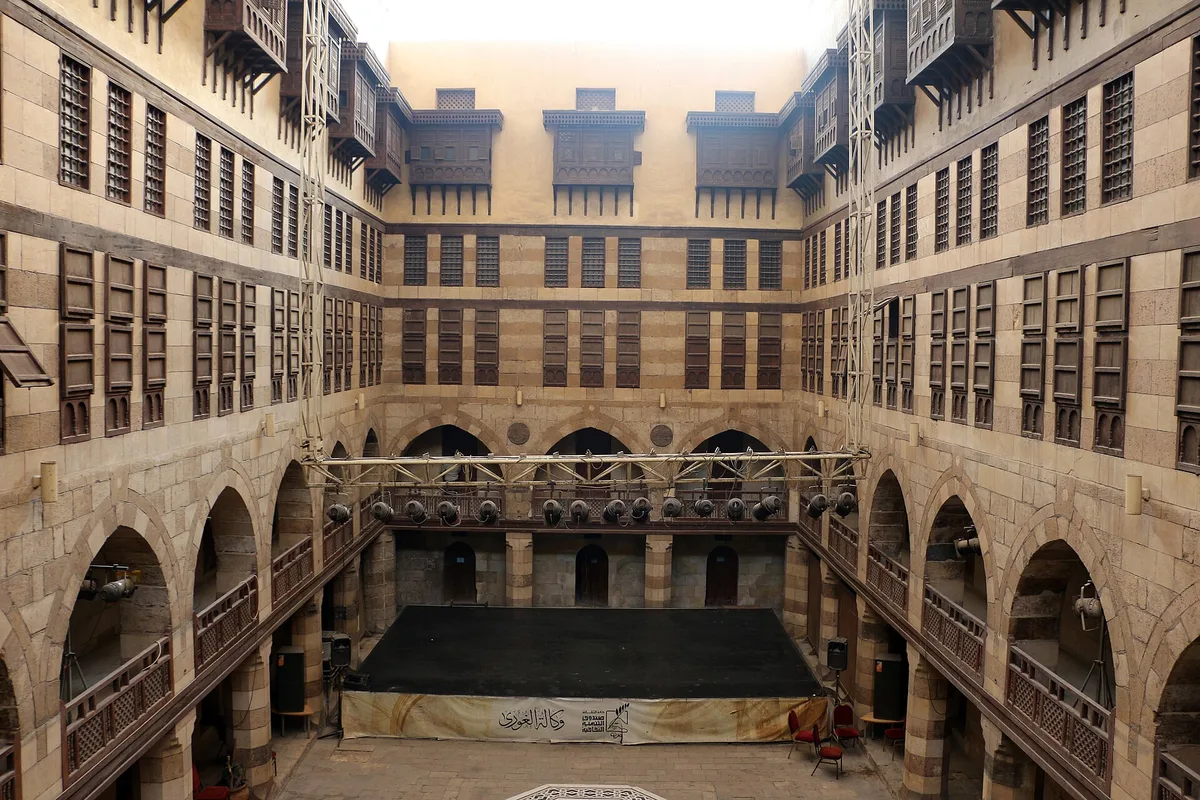
A few minutes east of the al-Ghuri crossing stands the building that completes the district’s story – the Wikala al-Ghuri, the caravanserai the same sultan built in the same years as his mosque. A wikala was the wholesale end of the market system; merchants arrived with goods from Syria, Arabia or the Red Sea trade, stabled their animals and stored their bales in the vaulted rooms around the ground-floor courtyard, and slept in the lodgings stacked above, their windows screened with mashrabiyya lattice. Trade, storage, housing and security in one stone rectangle – the wikala is the bazaar’s engine room, preserved.
This example survived better than almost any other in Cairo, and its courtyard is the finest place in the district to understand how the old city’s commerce physically worked. Stand in the middle and read the section – arches and store rooms at ground level for goods and animals, tier upon tier of screened apartments above for the men who owned them, everything turned inward to one guarded court with one gate. The same building type, repeated across the quarter, is what made Khan el-Khalili possible; the famous bazaar lanes are simply where the retail end of this wholesale machine met the street.
Today the courtyard serves as an arts venue, which suits it oddly well – a space built for gathering travellers now gathers audiences. Even empty, though, it earns its place on the walk, because after a morning of mosques and tombs it restores the balance of the district. Historic Cairo was not only a city of prayer and power; it was one of the great trading cities of its world, sitting at the crossroads of routes from Europe, Asia and Africa as UNESCO’s summary puts it, and the wikala is where that trade slept at night. Skip the monuments of commerce and you have understood only half the city.
Bab Zuweila and the Southern End of the Street
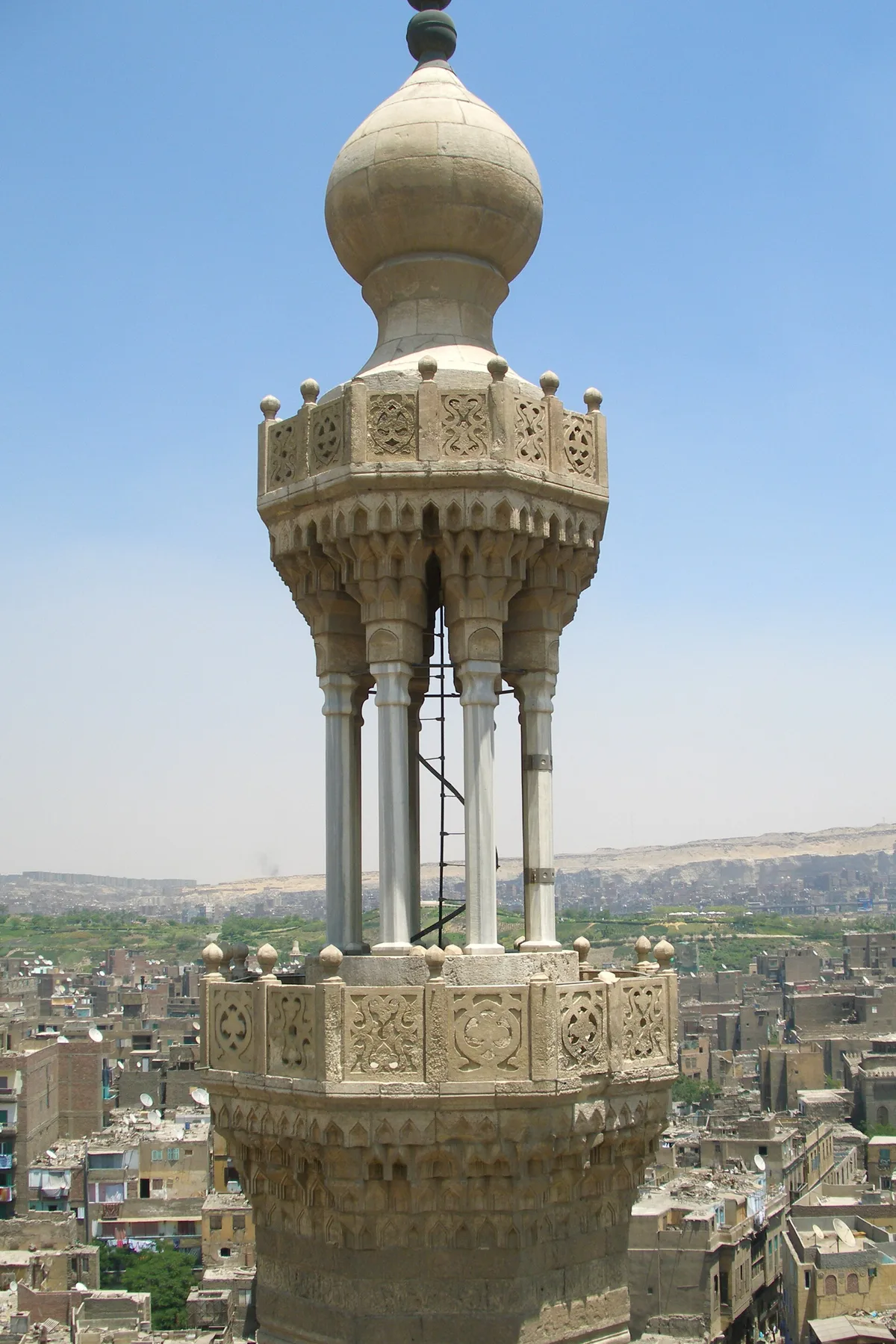
The street ends as it began, at a gate. Bab Zuweila, the southern gate of Badr al-Gamali’s walls, is the only one of the three survivors that still functions as the city’s threshold in the old way – a massive twin-towered gateway with the street’s traffic and markets pressing through and around it, and the tentmakers’ covered street running south from its arch. It carries the district’s darkest history too; this was a place of public execution in Mamluk and Ottoman times, and the gate’s associations in popular memory are a reminder that the old city was a seat of power in every sense, not a stage set.
What makes Bab Zuweila unmistakable is what stands on top of it. In the early fifteenth century Sultan al-Mu’ayyad built his great mosque tight against the gate’s inner side and planted the mosque’s two minarets directly on the gate’s two towers – an act of architectural opportunism so successful that the minarets have become the gate’s own silhouette, among the most recognised profiles in Cairo. The mosque inside is vast and calm, much restored, and the pairing of fortress gate and royal mosque in one structure sums up the whole district’s habit of building new meanings onto old stones rather than clearing them away.
Beyond the gate, the historic city continues – the mosque of Salih Tala’i just outside the walls, the tentmakers’ bazaar in its covered street, the long tail of al-Darb al-Ahmar running towards the Citadel. For most visitors Bab Zuweila is the right place to end the Al-Muizz walk itself, with a look back north down the street you have covered. You end, as the Fatimid processions began, at a city gate – except that you have arrived with the whole intervening thousand years now legible, which is the entire point of walking it in order.
Sultan Hassan – the Giant Below the Citadel
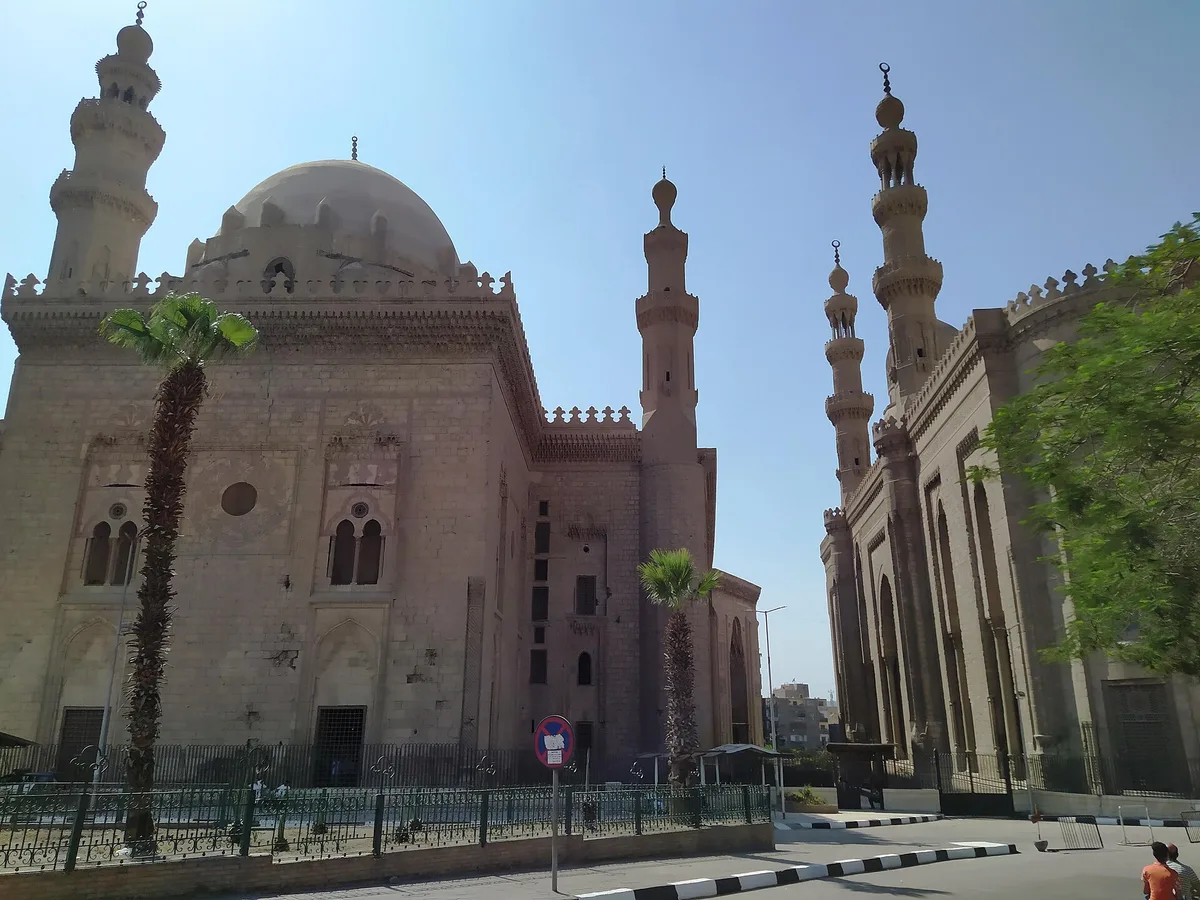
South of the walls, in the open square below the Citadel, stands the single greatest Mamluk building – by many reckonings the greatest medieval building in Cairo of any period. The mosque-madrasa of Sultan Hassan was commissioned by the sultan between 1356 and 1362, as Egypt’s Ministry of Tourism and Antiquities records, and everything about it is scaled up – the portal, the courtyard, the four great iwans around it, the mausoleum dome behind the prayer hall. The ministry’s own description calls it one of the largest and most architecturally exquisite mosques in all of Egypt, and for once the official superlative understates the experience; the building’s power is in its proportions and its stone, not in ornament, and it has to be stood inside to be believed.
The plan encodes the sultan’s ambition precisely. Around the central courtyard, four monumental iwans served as the teaching halls of four madrasas, one for each of the four Sunni schools of law, each madrasa with its own courtyard and student rooms behind – a complete university folded into a single mosque, as the ministry’s account details. Sultan Hassan, who came to the throne as a boy and was murdered before his building was finished, never occupied the mausoleum built for him behind the qibla wall; like al-Ghuri later, he is a founder absent from his own tomb. The building outlasted the dynasty’s politics entirely and became the benchmark against which every later Cairene monument is measured.
Facing it across the square stands the al-Rifa’i Mosque, built in the late nineteenth and early twentieth centuries in a deliberate neo-Mamluk style to answer Sultan Hassan across the street, and now the burial place of modern Egyptian royalty and, famously, of the last Shah of Iran. The pairing is the district’s neatest lesson in continuity – a fourteenth-century sultan and a modern royal mosque in matching stone, still in dialogue across a traffic square. Most Citadel itineraries pass both buildings; do not pass them at a trot. Sultan Hassan’s interior is the one monumental interior in Cairo that rivals the complexes of Al-Muizz, and it belongs on the same day-list as the street, not in a footnote to the fortress above.
Ibn Tulun – the Oldest Mosque, Standing Apart
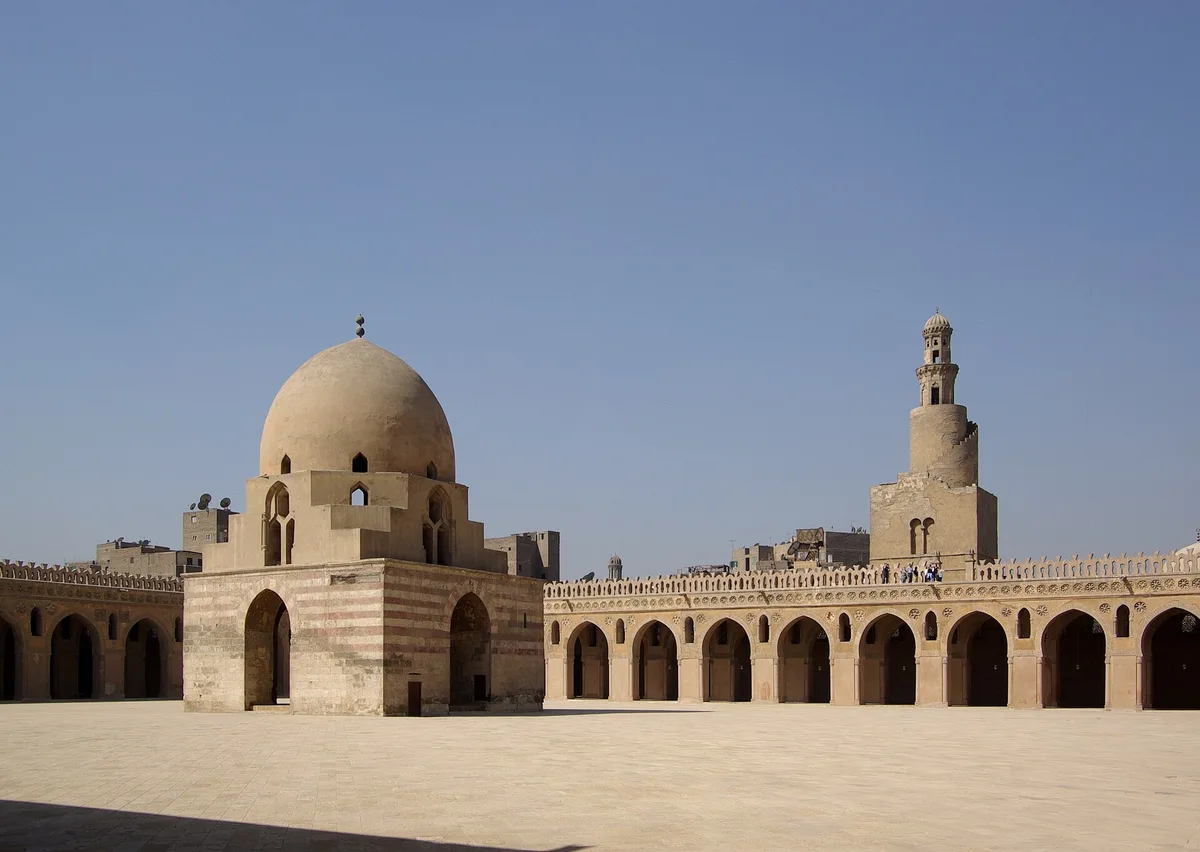
The district’s oldest great building stands apart from the street, south-west of the walls in the quarter that was once al-Qata’i, the capital city of Ahmad ibn Tulun. His mosque, built in 876-879, predates Fatimid Cairo by nearly a century, and UNESCO’s listing reaches outside the walls to include it, describing its spiral minaret and the symmetrical arches opening onto its vast square court as an outstanding example of early Islamic architecture. Everything about it feels earlier and sparer than the Mamluk city – brick and stucco rather than carved stone, repetition rather than display, a courtyard so large and empty that the sky becomes the decoration.
The minaret is the signature. Its external spiral staircase winds around the tower in a way found nowhere else in Egypt, modelled on the great mosques of Iraq, the land of Ibn Tulun’s Abbasid masters. The present minaret’s stone top is a Mamluk-era rebuilding, which is itself a district lesson – even the oldest monument here is a palimpsest. Around the courtyard run the famous arcades, their piers carrying carved stucco ornament and a carved wooden frieze of Quranic inscription that once ran, panel by panel, around the whole mosque. Stand in the centre by the later domed ablution building and the building’s calm geometry organises itself around you; this is the most peaceful large space in islamic cairo.
Ibn Tulun requires a small deliberate detour – it sits apart from the Al-Muizz line, in a quiet residential quarter, and pairs naturally with the Citadel and Sultan Hassan in the district’s southern half rather than with the street walk. That separation is also its gift. The crowds of Bayn al-Qasrayn rarely reach it, the courtyard is often near-empty, and the mosque offers the one thing the rest of the district cannot – silence at monumental scale. End a southern day here, after the Citadel’s views and Sultan Hassan’s mass, and the thousand-year story closes at its beginning.
The Citadel – Saladin’s Fortress Above It All
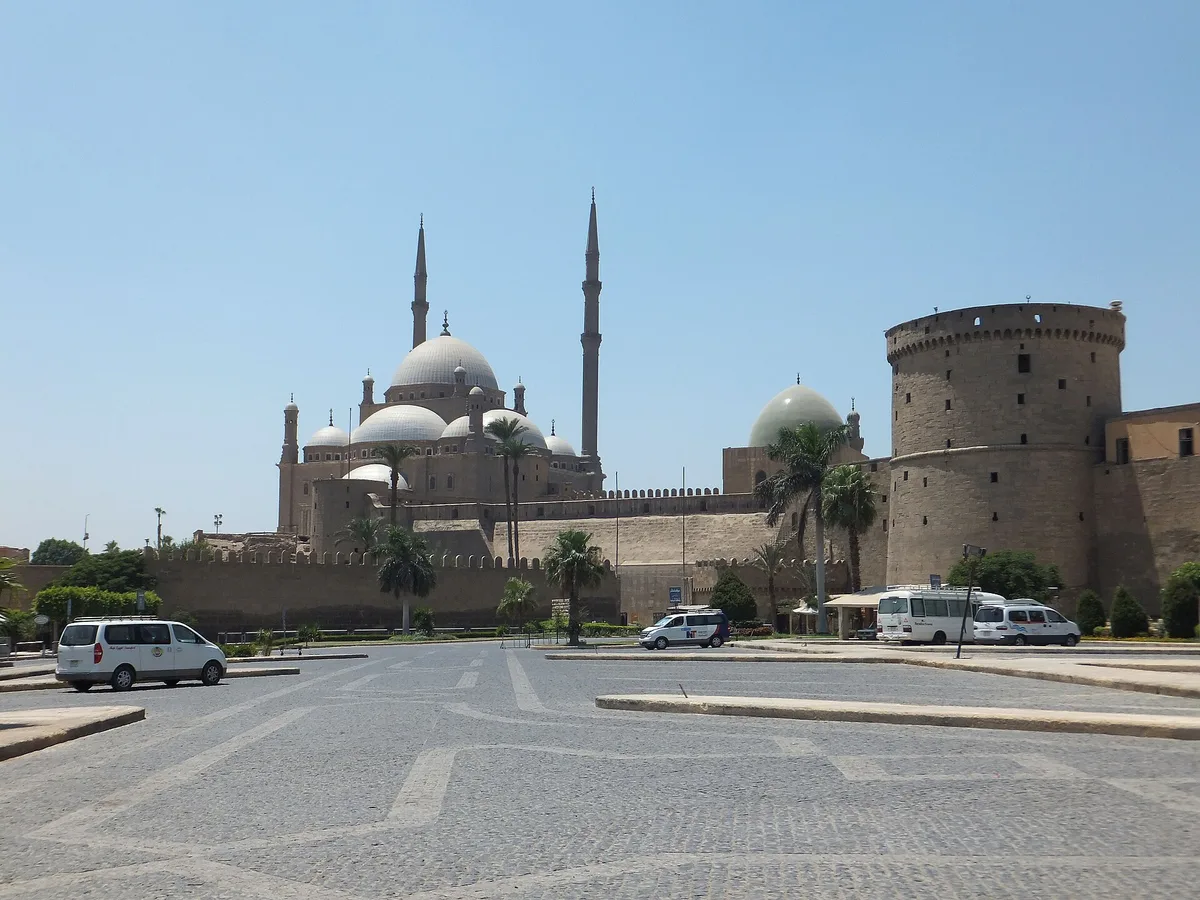
Every walk in the old city happens in sight of the Citadel, and the district’s story is incomplete without climbing to it. Saladin began the fortress in 1176 on a spur of the Muqattam hills, and it served as the seat of Egypt’s government for nearly seven centuries, through Ayyubid, Mamluk and Ottoman rule and into the age of Muhammad Ali. UNESCO’s synthesis treats its establishment as the hinge of the city’s history, the moment the seat of power moved up the hill and the city below reorganised itself around the fortress’s needs. From its walls the whole subject of this guide is laid out below – the minarets of Al-Muizz, the dome of Sultan Hassan at the fortress’s foot, the old city spreading north.
What stands on top today is mostly later work, and honestly labelled as such in this guide because visitors are often surprised. The great domed mosque with the twin pencil minarets – the Muhammad Ali Mosque, the city’s most recognisable silhouette – is a nineteenth-century Ottoman-style building in alabaster-faced stone, not a Mamluk survival. Saladin’s own palace halls are largely gone; the surviving medieval fabric is in the walls, towers and a few structures such as the Mamluk-era mosque of al-Nasir Muhammad, with its tiled minarets, which rewards the visitors who seek it out among the Citadel’s museums and terraces. The fortress is thus two sights in one – a medieval stronghold’s bones and a nineteenth-century ruler’s statement – and it is better enjoyed when the two are not confused.
For the purposes of this district guide, the Citadel’s greatest gift is the view back down. From its terraces the geography of islamic cairo finally becomes a map – the walled rectangle, the street running through it, the gates at each end, the bazaar quarter, the park on its hill, Ibn Tulun’s minaret standing south-west in its own open ground. Come here at the end of a day of walking, rather than the start, and the panorama reads like a recap of everything your feet have learned. That is the right order. The Citadel explains the district best to visitors who have already walked it.
The Museum of Islamic Art – the District Under One Roof
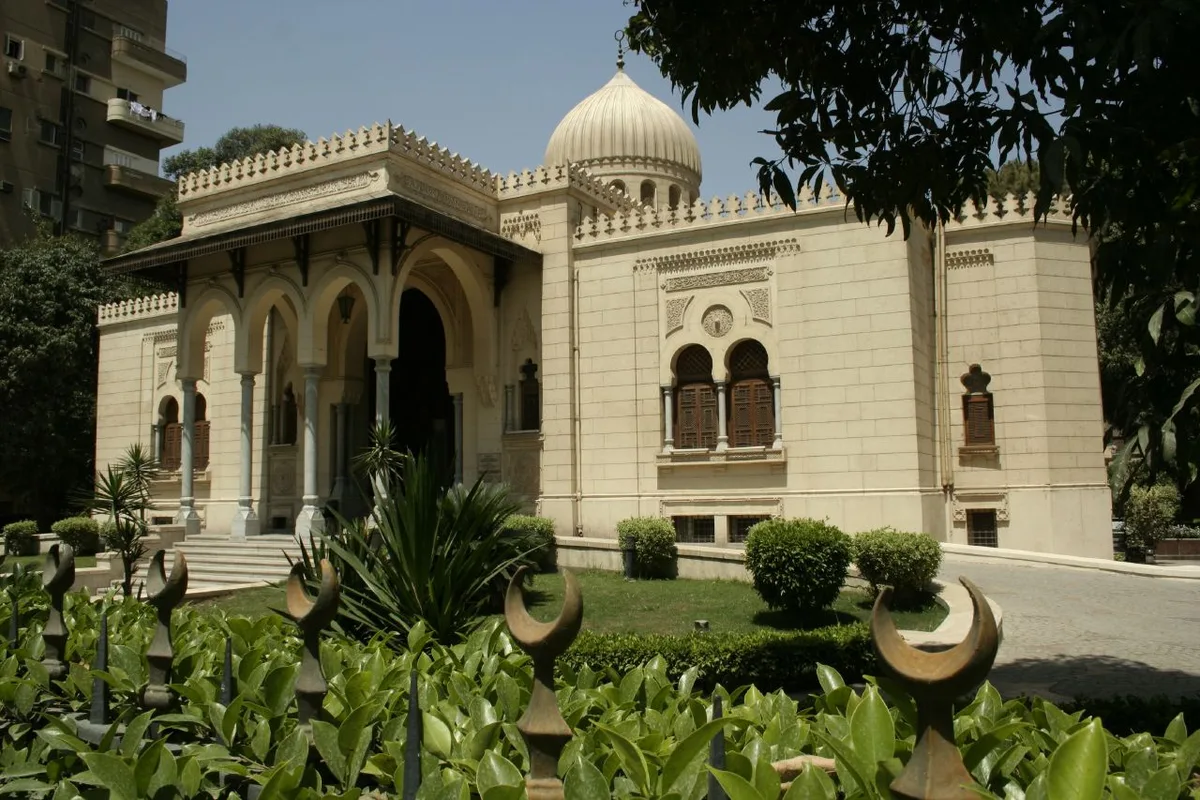
At Bab al-Khalq, a short walk south-west of Bab Zuweila, the district keeps its own museum – and not a minor one. The Museum of Islamic Art holds one of the largest collections of its kind anywhere, more than a hundred thousand objects by the count of Egypt’s State Information Service, gathered from across the Islamic world – woodwork, metalwork, ceramics, glass, textiles, manuscripts and carved stone from the seventh century to the nineteenth. Its history mirrors the district’s own preservation story; the collection was first assembled in 1880 and displayed in the arcades of the Al-Hakim Mosque on Al-Muizz Street itself, before moving in 1903 to the purpose-built neo-Mamluk building it still occupies at Bab al-Khalq.
The museum’s real function for a visitor to the district is translation. On the street, the monuments show you architecture in place; here, the portable world that filled those buildings is laid out in cases – the mosque lamps that hung in Barquq’s prayer hall, the carved wooden screens from houses like the ones that lined the street, the inlaid metalwork of the kind the coppersmiths’ quarter still produces, the textiles the tentmakers’ street still sells. A morning on Al-Muizz followed by an hour here produces a noticeably sharper eye for the second walk; objects you would have passed become recognisable, and details on the buildings themselves suddenly have names.
It also works as the district’s insurance policy. Conservation closes interiors without much warning, prayer times empty mosques of visitors, and one visit never fits everything; the museum is the one major sight here that is reliably a museum, with labelled objects, a chronological layout and no dress-code negotiation at the door. Put it where it fits – the same southern arc as Ibn Tulun and the Citadel makes a natural grouping – but do not leave it off the list on the assumption that the street shows everything. The street shows the bones. This museum shows the furnishings, and the district needs both to make sense.
Walking the District – Routes, Timing and Where to Rest
The district divides cleanly into two walks, and trying to fuse them into one heroic day is the commonest planning error. The northern walk is the Al-Muizz line itself – Bab al-Futuh to Bab Zuweila with Al-Azhar, the bazaar and the wikala as its side branches – and it fills a long, satisfying day on its own. The southern walk is the monumental arc outside the walls – Sultan Hassan and al-Rifa’i in their square, the Citadel above them, Ibn Tulun to the west and the Museum of Islamic Art at Bab al-Khalq – and it fills a second. Two days, two walks, no rushing; that is the honest shape of islamic cairo, and the table below lays the first of them out.
| Stretch | What you see | Walking character |
|---|---|---|
| Bab al-Futuh to Al-Aqmar | The northern gates, Al-Hakim, the carved Fatimid facade | Market street, monuments between shops |
| Bayn al-Qasrayn block | Qalawun, al-Nasir Muhammad, Barquq, the sabil-kuttab | The monumental showpiece, largely pedestrian |
| Khan el-Khalili and Al-Azhar | The bazaar lanes, the great mosque-university | Crowded, commercial, best late in the day |
| Al-Ghuri to Bab Zuweila | The sultan’s twin complex, the wikala, the southern gate | The hinge into the workaday southern street |
| The southern arc | Sultan Hassan, the Citadel, Ibn Tulun, the museum | Bigger distances, a separate day |
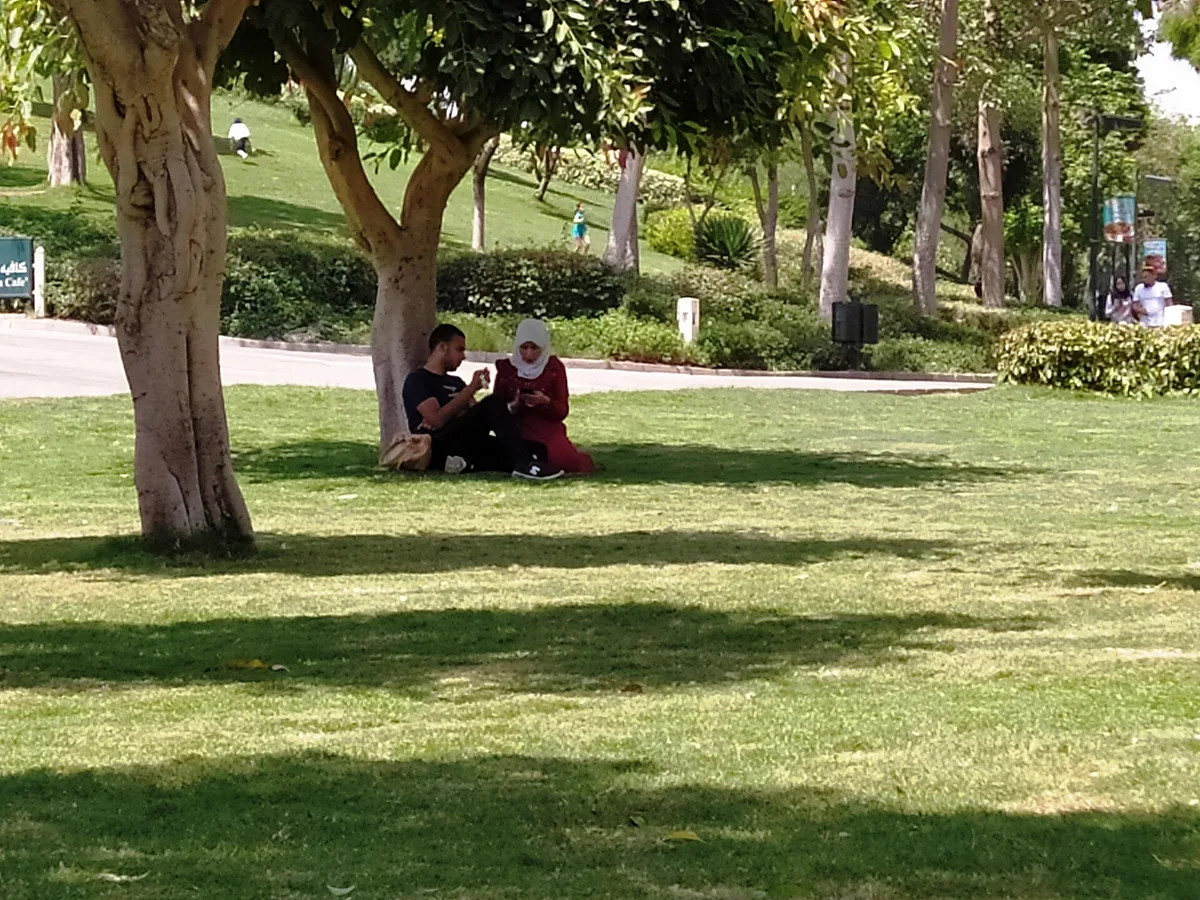
Within each walk, the rhythm that works is enter, look, sit. The district is dense with stone and short on benches, and attention is a finite resource; the visitors who enjoy it most are the ones who alternate a major interior with a tea, a facade, a park bench or a bazaar wander. Al-Azhar Park, the landscaped hilltop built over the district’s eastern edge and opened in 2005, is the district’s official rest stop – lawns, shade, and the single best elevated view back over the minarets you have been walking between. Build it into the afternoon of the northern walk rather than treating it as an extra, and the day ends with the whole city laid out below you instead of with tired feet in a taxi queue.
Getting in and out deserves one honest paragraph. The old city is not a pedestrian island; taxis and ride-hailing cars penetrate it at a crawl, the roads at its edges – especially around Al-Azhar and the al-Ghuri crossing – are among Cairo’s most congested, and crossing them on foot requires patience and local-style confidence. The practical pattern is to be dropped at Bab al-Futuh in the morning, walk the district under your own power, and be collected near Bab Zuweila, Al-Azhar Park or your next district in the evening. Distances inside the walls are short; it is the city’s traffic outside them that eats the time, so schedule the district as whole days, not as halves bolted onto Giza.
The Honest Downsides
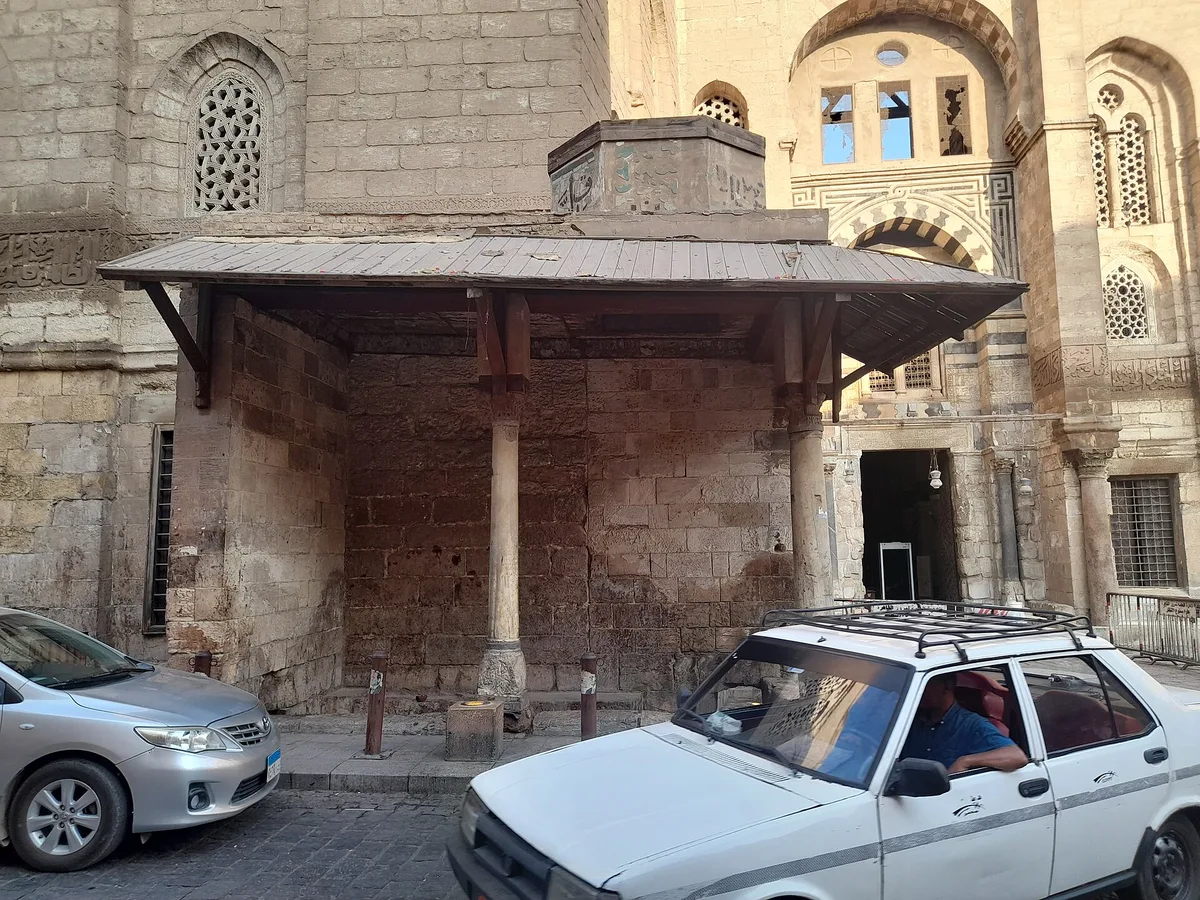
This district is magnificent, and it is not easy, and a guide that hides the second half of that sentence sets you up to dislike the first. Start with the fabric itself. Conservation here is a permanent emergency conducted on a heroic scale; at any given moment some facades are scaffolded, some interiors are closed, some streets are dug up, and the rising groundwater that UNESCO’s listing flags as a threat is a real and continuing enemy of the lower stone courses. You will not see everything on any single visit, and one beloved interior may be shut for the season. The district rewards travellers who treat closures as weather – unavoidable, nobody’s fault, planned around – and punishes perfectionists.
Second, the living city is not arranged for visitors. The lanes are crowded, the pavements are intermittent, motorcycles thread the pedestrian stretches, and the air carries the full perfume of a working market city – spices, exhaust, animals, frying oil, dust. Sales pressure in and around the bazaar is persistent, unofficial guides attach themselves at gates and mosque doors, and the line between a friendly conversation and a commercial funnel is one you will learn to read within the hour. None of this is dangerous in the ordinary way, and all of it is tiring in combination with heat and monument density. Pace, water, shade and a firm polite smile are equipment here, not extras.
Third, manage expectations about the interiors. These are working religious buildings, not galleries; access pauses around prayers, photography rules vary by monument and by custodian, dress codes are enforced unevenly but genuinely, and some complexes open only in part. Opening arrangements across the district have changed repeatedly over the years and will change again, which is why this guide prints no hours and no ticket figures – anything it printed would be a small lie by the time you travel. Check each major sight’s current arrangements close to your visit, keep the day’s plan loose enough to swap two stops, and the district’s unpredictability becomes texture rather than frustration.
Frequently Asked Questions
How long do you need for Islamic Cairo?
One long day covers the Al-Muizz Street walk – the spine of islamic cairo – with the bazaar and Al-Azhar. Two days is the honest answer for the whole district – the street on day one, then Sultan Hassan, the Citadel, Ibn Tulun and the Museum of Islamic Art on day two. A half-day visit is possible but reduces the district to its facades.
Is Al-Muizz Street walkable from end to end?
Yes. The street runs roughly a kilometre from Bab al-Futuh to Bab Zuweila, its central stretch is largely pedestrianised and restored, and the walking itself is flat and easy. The effort is not in the distance but in the density – there is a major monument every few dozen paces, and choosing what to enter matters more than stamina.
Can non-Muslims enter the mosques?
In general, yes, outside prayer times, in the district’s historic mosques – with shoes removed or covered, modest dress, and quiet, respectful behaviour. Individual monuments vary their arrangements, and custodians have the final word on the day, so treat entry as a privilege extended by a working religious community rather than a right bought with a ticket.
What should you wear in the district?
Modest clothing that covers shoulders, arms and legs is the practical standard, and women will want a scarf available for mosque interiors. Comfortable closed shoes earn their keep on the stone streets. Dressing this way is not a bureaucratic hurdle; it is how visitors signal that they understand these are places of worship in a conservative, devout neighbourhood.
When is the best time of day to walk the street?
Early morning for the buildings – clean light, shuttered shops, empty interiors – and evening for the atmosphere, when the restored street lights up and the bazaar is at its liveliest. Midday in summer is the honest worst of both – the hardest heat and the fullest crowds – and is best spent in the museum, the park’s shade or a long lunch.
Is Khan el-Khalili worth it, or just a tourist trap?
Both descriptions contain some truth, which is why it confuses people. The main lanes are touristed and the selling is persistent, but the quarter’s fabric is genuinely medieval, its workshops are real, and its evening atmosphere is the district’s best. Go in the evening, go for the place rather than a shopping list, bargain with humour, and it earns its fame.
How does this district fit a wider Egypt trip?
As Cairo’s medieval day, or two. The city splits naturally into district days – Giza and the museums, this old city, Coptic Cairo and Downtown – and the Egypt travel guide on this site builds the full itinerary around that split, while the best places to visit in Cairo roundup ranks the city’s sights if you are choosing between days.
The Short Version
If this guide leaves you with one image, make it the street. A Fatimid caliph’s ceremonial avenue, walled at both ends by eleventh-century gates, filled by Mamluk sultans with hospitals, schools, fountains and tombs, flanked by the bazaar that served it and the university that out-thought it, and still – underneath the scaffolding and the scooters – doing its original job as the main street of a living city. That is what was inscribed at UNESCO in 1979, and it is why this district, rather than any single monument in it, is the sight.
Walk it in order. Begin at Bab al-Futuh in the morning light, let Al-Muizz Street carry you south past Al-Hakim and Al-Aqmar to the great block of Qalawun and Barquq, break for the bazaar and Al-Azhar as the day warms, pass al-Ghuri’s minaret to Bab Zuweila by evening, and give the southern giants – Sultan Hassan, the Citadel, Ibn Tulun and the museum – a second day of their own. Do that, and islamic cairo stops being a list of mosques and becomes what it actually is – the best-preserved medieval city centre in the Islamic world, understood on foot, one honest street at a time.