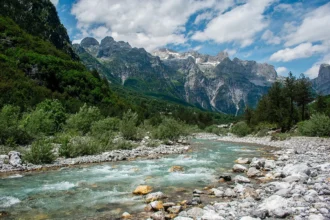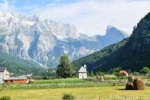
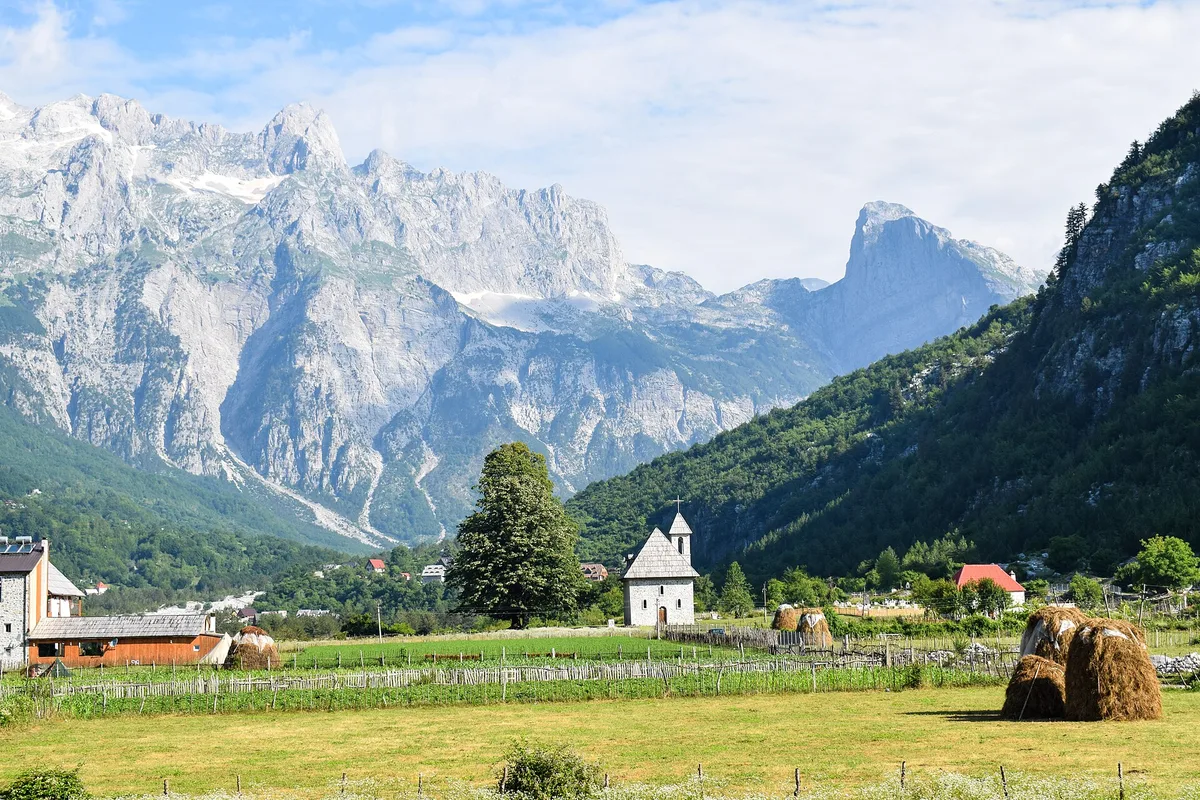
The last stretch of road into Theth does something no photograph quite prepares you for. The hairpins end, the valley opens, and instead of a village centre you get a whole green floor spread out below a wall of grey limestone – scattered stone houses, haystacks, a white church in its meadow, and no two buildings close enough together to make a street. This theth travel guide is written for the traveller who is staying, not passing through. Theth is the most famous village in the Albanian Alps, and it rewards being treated as a place to live in for a few days rather than as the start line of somebody else’s hike.
That distinction matters, because Theth is usually sold as a trailhead. The walk over Valbona Pass begins here, and for many visitors the village is one night, a dawn start and gone. But Theth has its own complete set of sights, and they are all walkable from your guesthouse door – a stone church that doubled as the valley’s first Albanian school, a fortified tower where men once waited out blood feuds while the elders negotiated, a waterfall and a canyon on the village’s own river, and, a valley away, a blue pool in a rock gorge that makes one of the great day walks in Albania. Add the guesthouse table, which is half the experience, and Theth easily fills three or four days without the pass walk ever entering the plan.
The honest framing comes first, as it should in any theth travel guide worth trusting. Theth is seasonal in a way that brochures underplay. The road over the pass from Shkodra is a serious mountain road that snow can close for months, most guesthouses shut outside the warm season, and the village that hums in August is a handful of households by January. Everything in this guide – when to come, how long to stay, what to pack, what can go wrong – is written around that reality. For the wider country first, start with our Albania travel guide; this page is the village itself, street by street and walk by walk.
Theth at a Glance
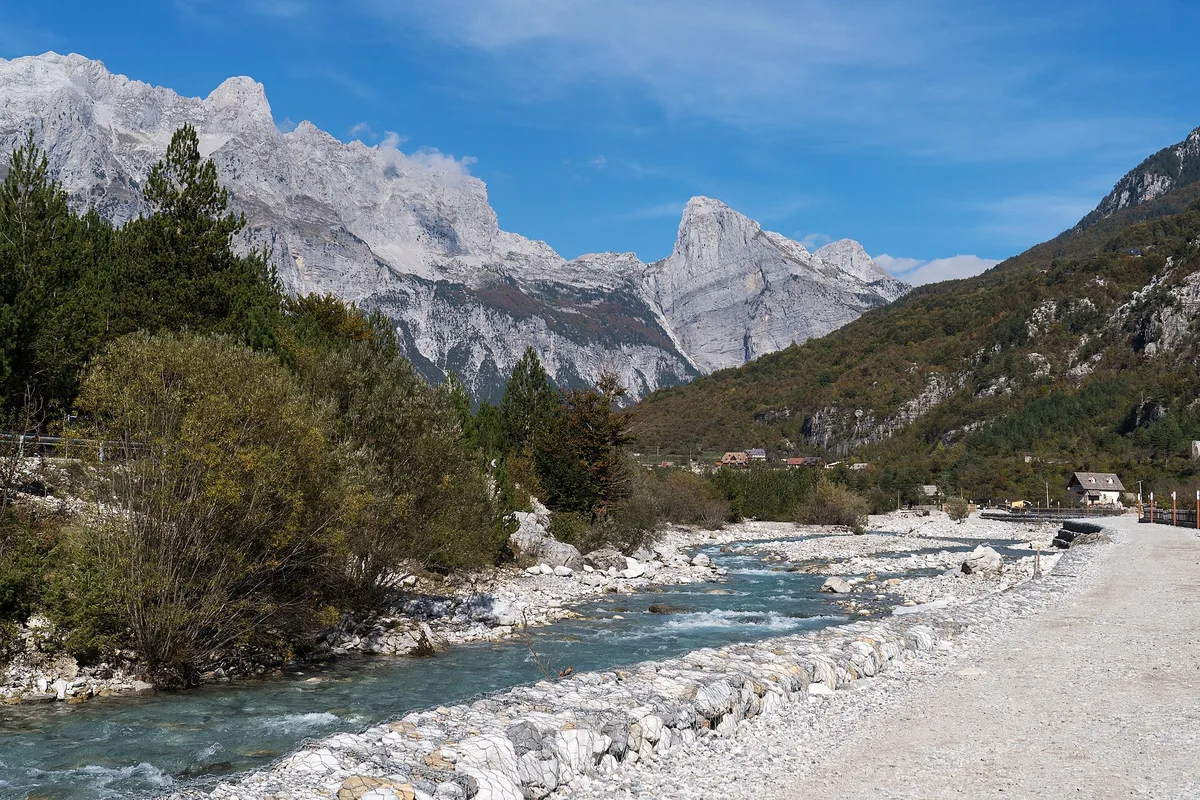
The essentials, briefly. Theth is a village of scattered hamlets in the upper Shala valley in Albania’s far north, inside the Alps of Albania National Park, at roughly 750 to 800 metres above sea level. It is reached by one road, the SH21 from Shkodra over the Qafa e Thorës pass. Its sights divide into three groups – the historic core around the church and the Lock-in Tower, the river walks to the Grunas waterfall and canyon, and the long day walk down the valley to Ndërlysaj and the Blue Eye at Kaprre. Its beds are almost all family guesthouses, and its season runs, roughly, from late spring to mid-autumn.
| Need to know | The short answer |
|---|---|
| Where | Upper Shala valley, far northern Albania, inside the Alps of Albania National Park |
| How you get there | One road – the SH21 from Shkodra via Koplik and Boga, over Qafa e Thorës (paved throughout since 2021) |
| The village sights | The 1892 stone church, the Kulla e Ngujimit lock-in tower, the Ethnographic Museum house |
| The village walks | Grunas waterfall (about 45 minutes) and the Grunas canyon below it |
| The big day walk | The Blue Eye at Kaprre, above Ndërlysaj – a long half or full day, trimmable by vehicle |
| Sleeping | Family guesthouses, almost always half board – your guesthouse is also your restaurant |
| Season | Roughly late May to mid-October for the full village; the road’s high section can close in winter snow |
| Money | Cash in lek (euros widely accepted in practice) – take it out in Shkodra, do not rely on a village ATM |
| Best base rhythm | Slow mornings, one walk a day, long guesthouse dinners – Theth punishes itineraries, not people |
Two planning consequences follow from that table, and they shape everything else in this theth travel guide. The first is that Theth has no centre to stay “in” – the hamlets string out along several kilometres of valley floor, so where your guesthouse sits decides what is a stroll and what is a hike, and the sections below keep returning to that geography. The second is that almost everything here is weather- and season-dependent in a way a beach town never is. The road, the river walks, the swimming pools and the guesthouse season all answer to the same mountain climate, which is why the when-to-come section of this guide is not filler – it is the decision the whole trip hangs on.
A Village of Hamlets – How Theth Is Laid Out
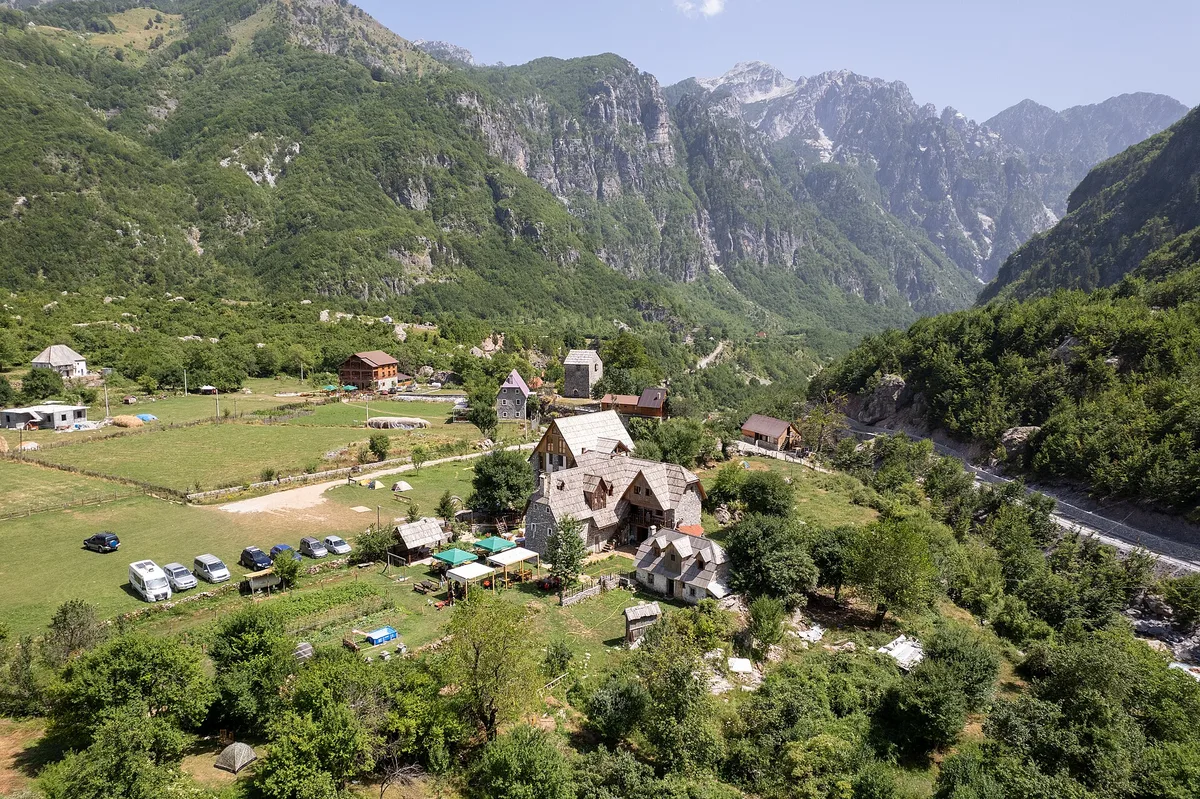
Theth is not a village in the streets-and-a-square sense, and the sooner a visitor absorbs that, the better the stay goes. It is a string of neighbourhoods – Okol, Gjelaj, Nënkolaj, Grunas and others – spread along the floor of the Shala valley where the river runs clear over white gravel. Each neighbourhood is a loose cluster of stone farmsteads in its own meadows, separated from the next by fields, beech trees and stretches of lane. Local tradition says the settlement was founded some three to three and a half centuries ago by Catholic families who moved up into this defensible valley to keep their faith and their independence, under a common ancestor whose name the village still remembers. For most of the centuries since, Theth lived about as far from the state as it is possible to live in Europe – governed by its own elders, married and feuded by its own code, snowed in for months each year, and reached by mule path.
The landmarks that organise a visit sit mostly in the central stretch. The church stands in its open meadow near the middle of the settlement, with the village cemetery and the school beside the same lane. The Lock-in Tower rises on its slab of rock a short walk away. The Ethnographic Museum, in the traditional house of Lulash Keçi, shows how the valley’s great stone houses were actually lived in, room by room – it is listed among the first-category cultural monuments of the protected historic centre and is the natural third stop of a village-core walk. A newer layer has joined these – a park information centre near the bridge, run for the protected areas agency, where visitors can ask about trails and conditions. Ask there, and at your guesthouse, before trusting any walking time you have read online, including in this guide.
The village was declared a Protected Historic Centre in 2017, which is the state’s way of saying its stone-built fabric is heritage, not just housing stock – and since 2022 the whole valley has sat inside the Alps of Albania National Park, created on 26 January 2022 by merging the old Theth National Park of 1966 with the Valbona Valley park and the Gashi reserve, and administered by the National Agency of Protected Areas, AKZM. Neither status is abstract. The first is why new building in the historic core is supposed to follow a traditional design code; the second is why the beech forests, the river and the wildlife around the village – brown bears and wolves in the high country, golden eagles over the ridges, and one of Albania’s most important Balkan lynx populations, though almost no visitor ever sees one – are protected as a system. Theth also carries a quieter distinction. The Albanian studies scholar Robert Elsie, who called the valley an Albanian Shangri-La, chose to be buried in the village cemetery in 2017 – a measure of what this place means to the people who have studied it longest.
Getting to Theth – The Road Over Qafa e Thorës
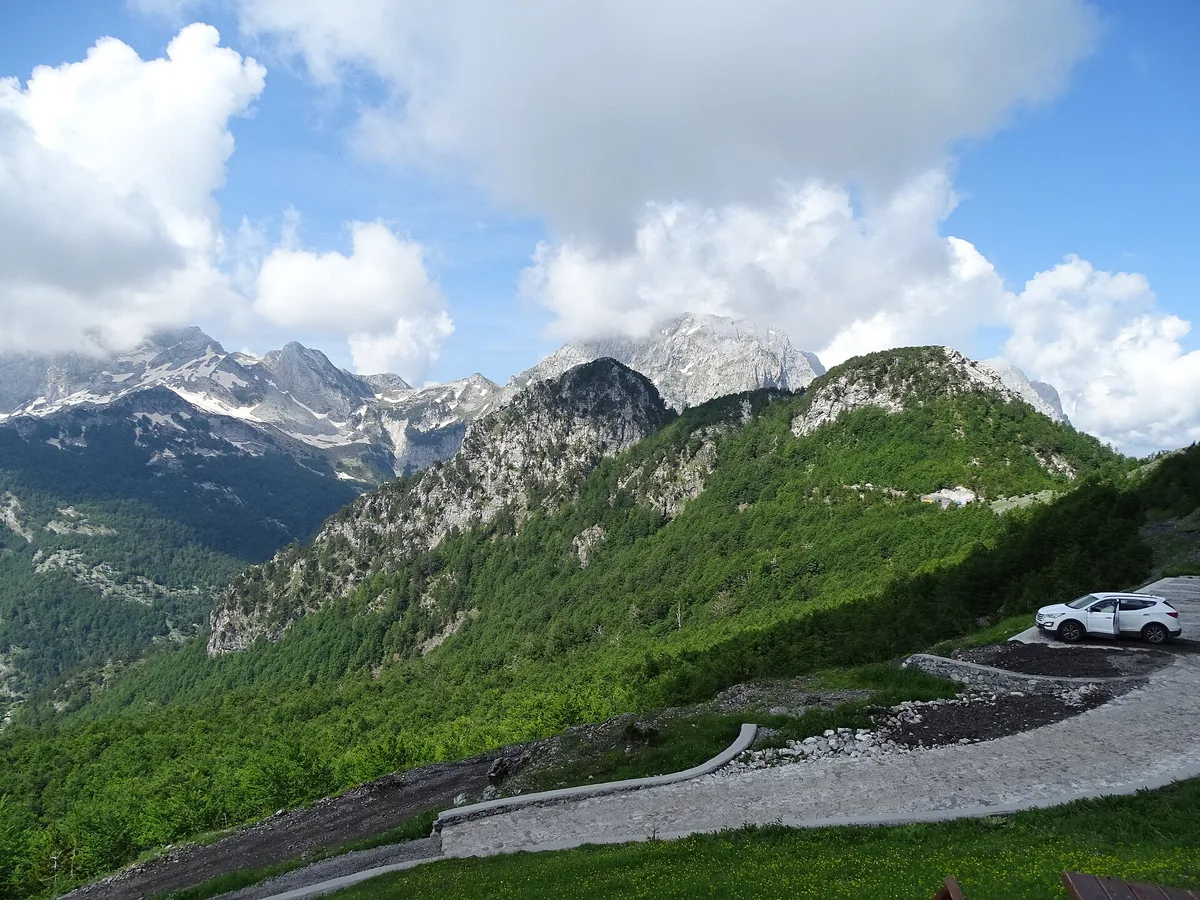
Every route to Theth runs through Shkodra, the city on the lake plain at the foot of the mountains, and from Shkodra there is exactly one way in – the SH21, north-east to Koplik, then up through the village of Boga and over the high col of Qafa e Thorës before the long descent into the valley. For generations this was a mule track and then a rough 4×4 road that shaped everything about the village, including how few people came. The final unsurfaced section, from Boga over the pass, was paved in 2021, and the road is now asphalt from end to end. Ordinary cars and buses complete the journey in roughly two to three hours from Shkodra – which has changed Theth’s life more than any other single event in its modern history.
The drive breaks into three clear characters. The first hour, Shkodra to Koplik and on towards Boga, is foothill driving through farmed valleys. Boga itself is the last real village before the climb, a mountain settlement with its own guesthouses, sitting in a wildflower meadow under the first big walls – many travellers stop here for coffee, and in heavy seasons some stay here instead. Above Boga the road becomes the thing it is famous for: a paved staircase of hairpins climbing to the pass, with the Shala valley falling away on one side and the limestone towers of the Accursed Mountains stacking up ahead. It is beautiful and it is demanding – narrow in places, steep, and exposed to weather. The descent on the Theth side is the mirror image, switchbacking down through forest until the road flattens onto the valley floor and the first Theth hamlets appear.
Most visitors do not drive it themselves. The standard mechanisms are three, and this guide deliberately prints no fares or timetables for any of them, because they change season to season and are best confirmed in Shkodra or through your guesthouse a day or two ahead. Morning minibuses and buses run from Shkodra to Theth in season, leaving early. Guesthouses throughout the valley arrange transfers and pickups, which is the option most stay-put visitors end up happiest with – the driver knows the road, the arrival time can be matched to your day, and the same family often handles your return. And organised 4×4 and jeep transfers run the route for travellers who want the pass crossed privately. Whichever you choose, hold to one rule: cross Qafa e Thorës in daylight. The road in the dark, in rain or in fog is a different proposition entirely, and no dinner is worth it.
If You Are Driving Yourself
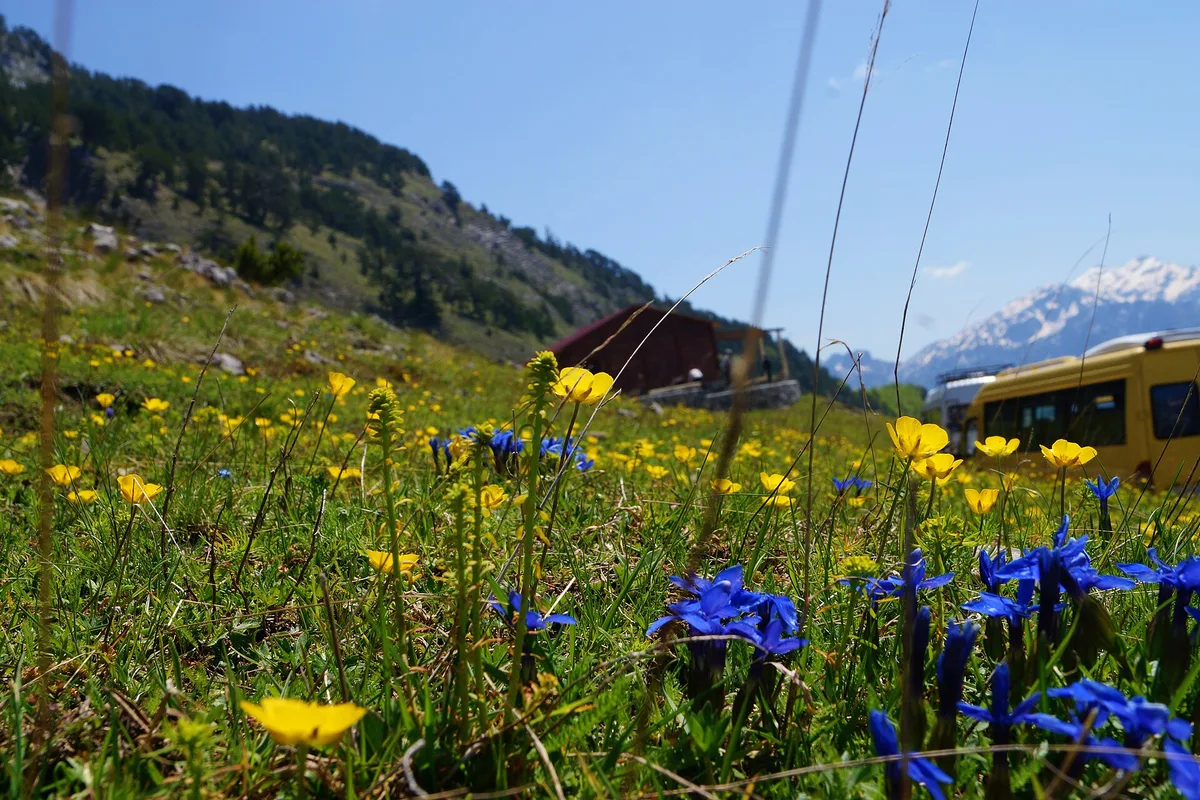
Self-driving to Theth is entirely reasonable in the warm season, now that the surface is asphalt throughout – but it deserves respect rather than confidence. The pass section is a sequence of tight hairpins on a road that is genuinely narrow, with stretches where the drop is immediate and the margin for a misjudged corner is not generous. Take it slowly, use the engine to brake on descents, expect the occasional oncoming minibus exactly where the road pinches, and expect livestock, hikers and parked cars near viewpoints. A standard hire car copes in summer conditions; what the road does not forgive is hurry, darkness and weather. If cloud is sitting on the pass, wait it out in Boga rather than climbing into it.
Two seasonal warnings belong in every theth travel guide, and this one puts them plainly. The high section of the road is liable to close under winter snow – some guides print fixed closed months, but the honest version is that snow decides, year by year, and for much of the winter the village is effectively cut off from wheeled traffic, which is precisely how Theth lived for centuries. In the shoulder months, check the road’s state locally before setting out, and never build an itinerary that needs the pass crossed on a fixed day in November or March. The second warning is about fuel and supplies: fill up and do your serious shopping in Shkodra. Theth’s small shops cover basics, but the valley is the end of the road in every sense, and prices and choice both reflect that.
The Stone Church of 1892
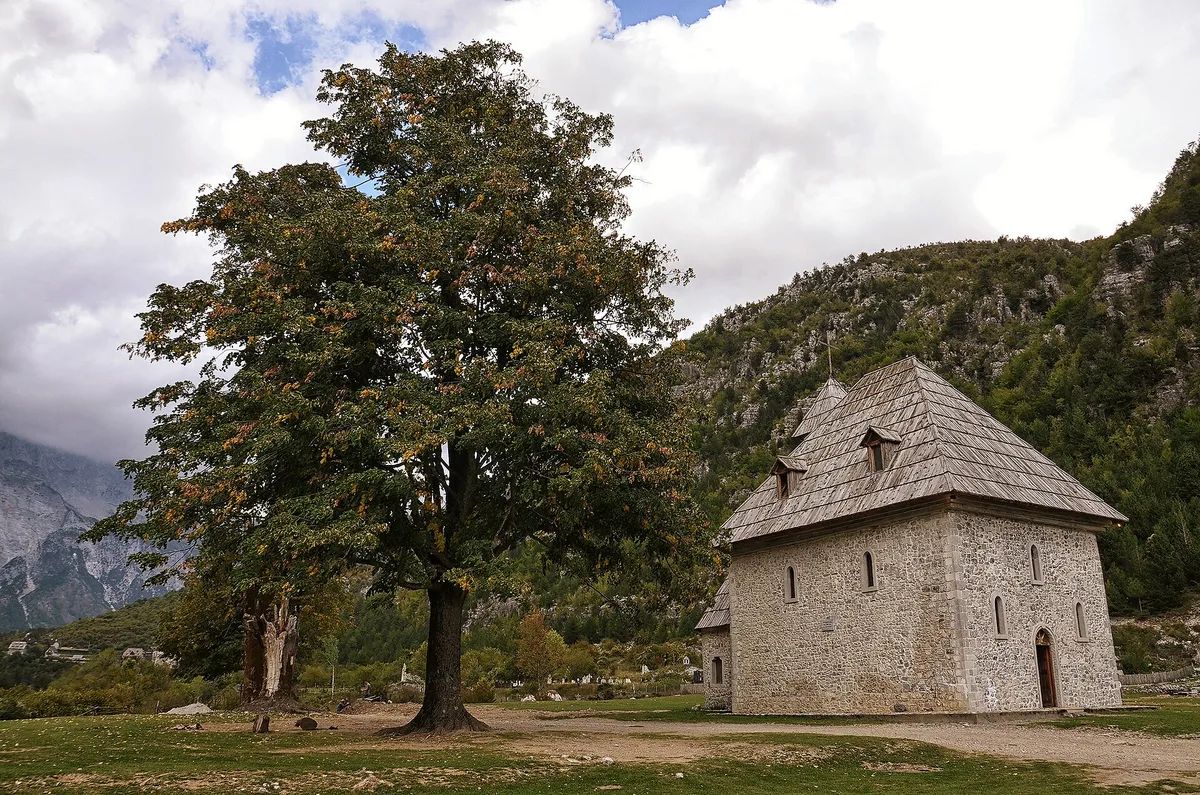
Stand in the meadow at the centre of the village and the building that anchors Theth comes into focus. The church is a plain, handsome stone structure under a steep shingled roof, with a small white tower – and it matters far beyond its architecture. It was built in 1892, when Theth was still a young village by its own telling, raised by the djemtë e Thethit, the sons of Theth, and it was among the very first buildings the valley put up. In a settlement of fortified farmsteads built to withstand feuds and winters, the community’s first collective project was a church. That says a great deal about what held this isolated Catholic enclave together when nothing else did – no state, no road, no market – and the church has been the village’s fixed point ever since, through empire, kingdom, dictatorship and the tourism boom.
Its biography tracks Albania’s own. Under communism, when religion was abolished in the world’s first officially atheist state, the church was taken from worship and put to state use as a health facility for the valley – the building survived, which many Albanian churches did not. After communism fell, it was restored with help from Theth’s own emigrants in the United States, a detail worth pausing on: the diaspora that the mountains’ poverty created reached back and rebuilt the village’s symbol. Today it is again a working Catholic church serving the hamlets, the visual anchor of every photograph of the valley, and the natural starting point of a village walk. The meadow around it, the big tree, the cemetery nearby and the limestone wall behind compose the single most recognisable view in the Albanian Alps.
Visit it unhurriedly. The church repays a slow circuit – the stonework, the roof, the plaque on its wall, the graves of the village families around it – and the walk there from most guesthouses along the lane is part of the experience. Dress and behave as you would in any small working church that is also a village’s living room. The building’s second life, as a schoolhouse, is important enough to deserve its own section below, because the man who taught in it connects the church, the Lock-in Tower and the written law of the mountains into a single story.
The School in the Church – Gjeçovi and 1917
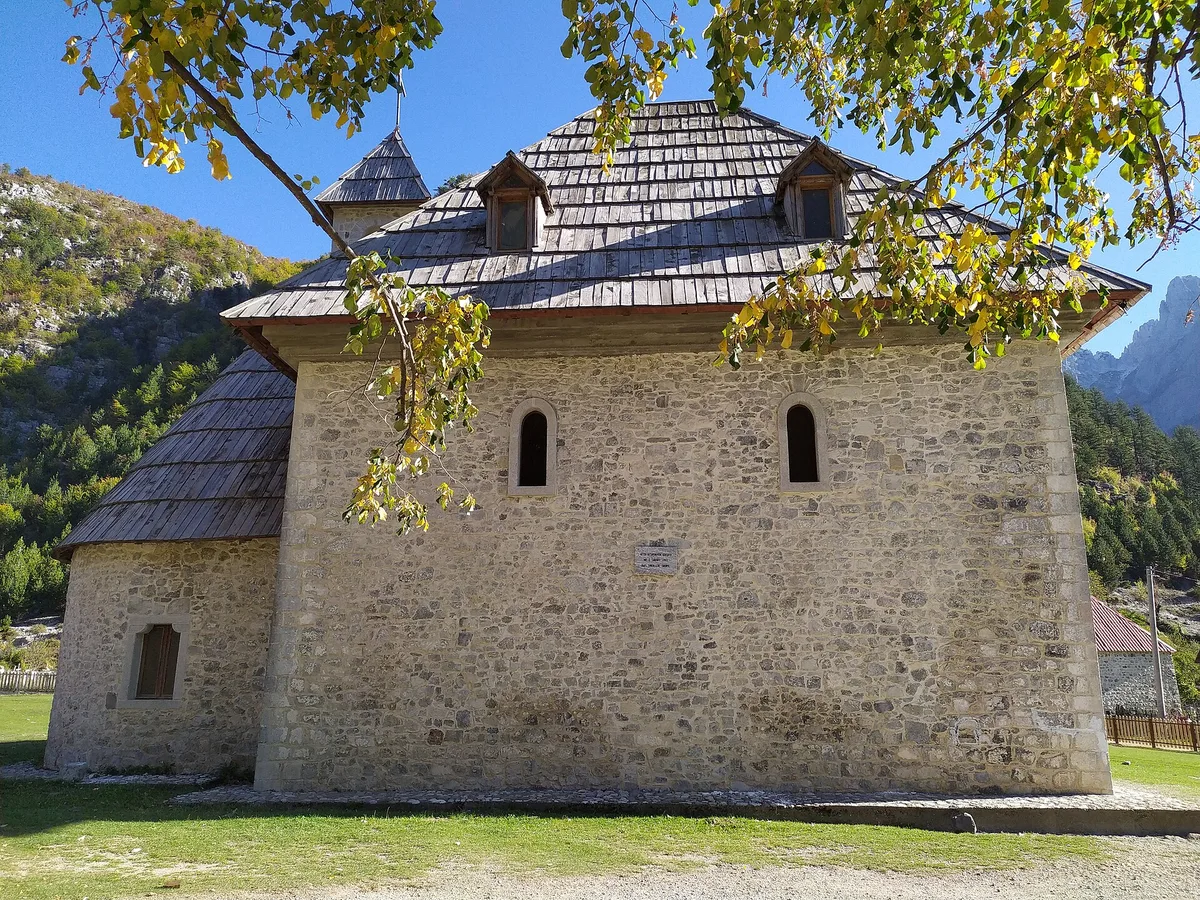
On 2 February 1917, in the middle of the First World War, the Franciscan priest and scholar Father Shtjefën Gjeçovi opened a school in this church – the first Albanian-language school in Theth, a fact commemorated by a plaque on the church wall to this day. Consider what that meant in a valley with no road, under wartime occupation, where literacy had barely arrived and the state’s schools, such as they were, taught in other languages. Gjeçovi taught the village’s children to read and write their own tongue, in a church, in the mountains, in 1917. In 1921 the young Albanian government formally recognised the school, with Father Marjan Prela in charge, and the classroom in the church is counted among the founding acts of education in the highlands.
Gjeçovi matters to Theth twice over, and the second connection leads straight to the tower across the meadow. The same priest-scholar spent years collecting the Kanun – the oral customary law of the northern highlands, attributed to the fifteenth-century prince Lekë Dukagjini – from the mouths of the elders who still lived by it, and wrote it down. His codification was published in 1933, after his death, and it is the reason the Kanun survives as a text rather than only as a memory. So the small church in the meadow and the grim stone tower on its rock are, in a sense, two halves of one man’s work: in the first he gave the valley letters, and through the second’s world he preserved the law the valley had lived by for centuries before letters came. Any theth travel guide that treats the church as merely a photo stop misses the best story in the village.
The Lock-in Tower – Kulla e Ngujimit
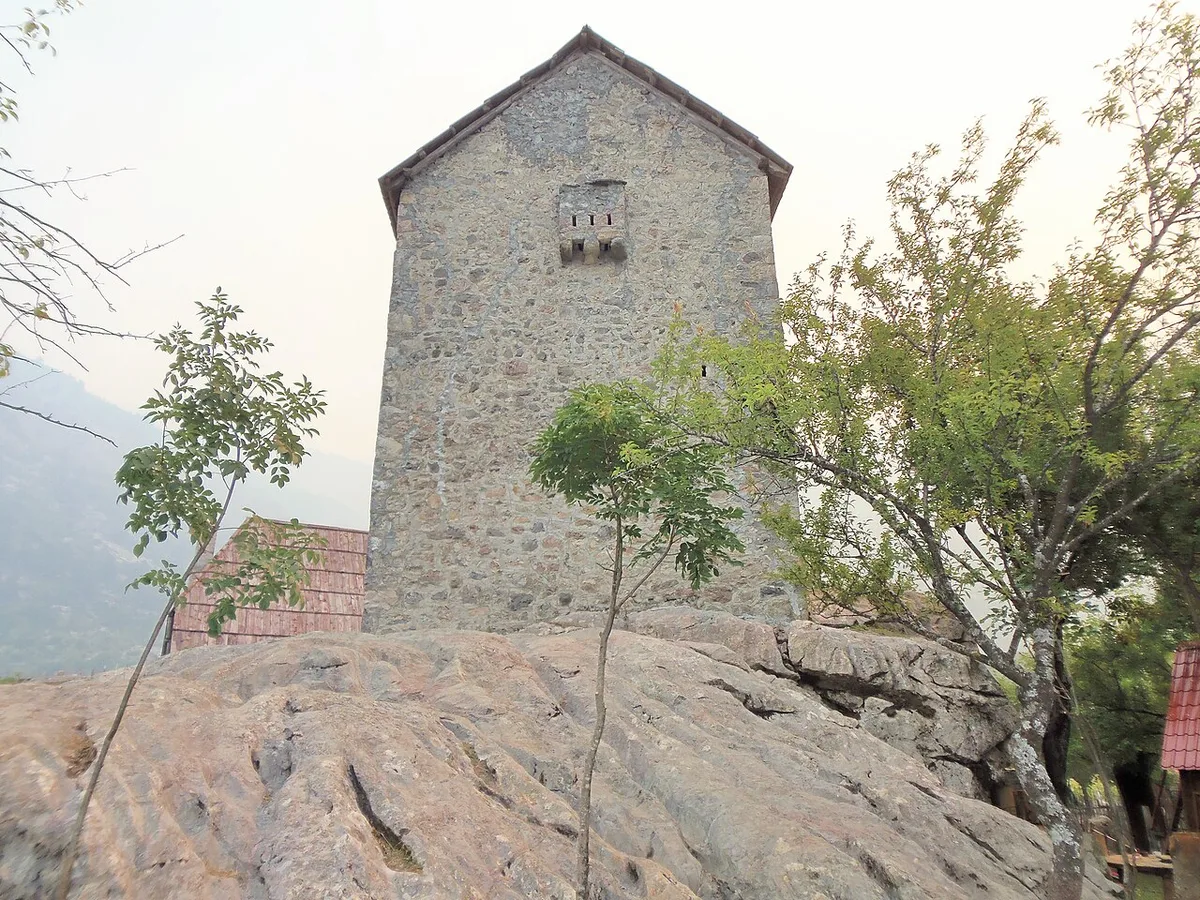
A short walk from the church, a stone tower rises straight out of a smooth slab of bedrock, and everything about it is deliberate. The Kulla e Ngujimit – the Lock-in Tower – is about four centuries old, as most accounts tell it, built in rough stone over three storeys, its few windows mere slits, the so-called frëngji, angled so a man could shoot out without being shot. It stands on rock so smooth and steep that the approach itself is part of the defence, and it has no entrance an enemy could rush. It belongs to the family of Nikoll Koçeku, and it still does – today a descendant of the family, Sokol Koçeku, opens it to visitors and tells its story, which is the only way the tower should be experienced: through the family that has kept it for centuries.
The tower was the valley’s courthouse, prison and sanctuary in one building, built for the darkest machinery of mountain law – the blood feud. Under the Kanun, a killing created a debt of blood, and the killer and the men of his family became targets for vengeance. The tower was where such a man went: he locked himself inside – ngujim, confinement, is the word – with food passed to him, safe under the rules, while outside the elders of the valley negotiated. Days, weeks, sometimes much longer, the confined man waited in the tower while the machinery of mediation ground through evidence, honour, compensation and oath. Family tradition credits this tower with a role in more than three hundred reconciled conflicts – three hundred feuds ended by talk instead of blood, in one small building, in one small valley.
Walk through it with that story in mind and the architecture reads like a document. The thickness of the walls, the slit windows positioned for defence, the single defensible entry, the bare rooms arranged for waiting rather than living – it is a building designed around a legal process, as much a piece of constitutional machinery as any parliament. The tower is also a protected monument of the first category within Theth’s historic centre. It has not served its original purpose for roughly a century, and the family presents it now as what it has become – a museum of the Kanun age, and the second essential stop of any visit to Theth. Allow real time for the telling; a rushed ten minutes wastes it.
The Kanun – The Law of Lekë Dukagjini
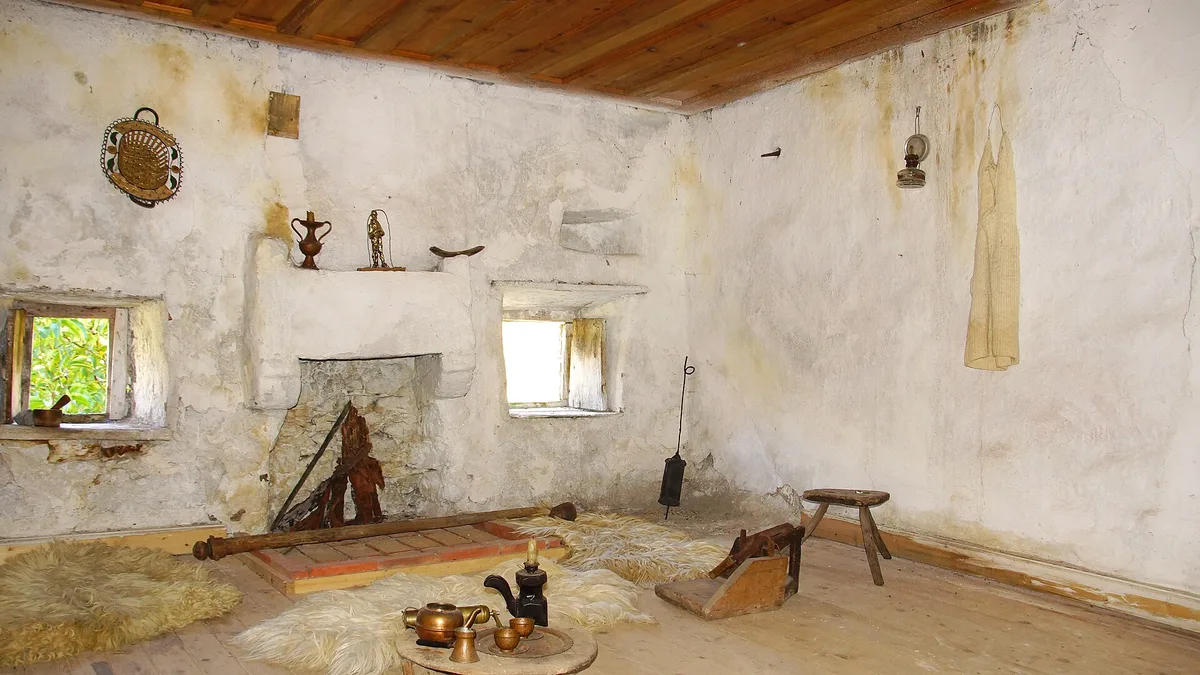
The tower only makes sense inside the legal world that built it, and that world had a name – the Kanun of Lekë Dukagjini. Attributed to the fifteenth-century prince who fought beside and after Skanderbeg, the Kanun was an unwritten constitution carried in memory for centuries, regulating everything in highland life: property and water, marriage and inheritance, hospitality, oaths, honour, crime and punishment. Its two most famous principles pull in opposite directions, and Theth’s history is the tension between them. The first is besa, the pledged word – the sacred duty of hospitality and of keeping an oath absolutely, which made this valley famous for the safety of guests and which its guesthouses still trade on today, consciously or not.
The second is gjakmarrja, blood vengeance, the duty to answer a killing with a killing. But even here the Kanun was a system of limits rather than a licence: women and children were exempt from the feud, the house was sanctuary, truces could be sworn, and the whole elaborate machinery of elders, mediation and reconciliation existed to end feuds, not merely to conduct them. The Lock-in Tower was that machinery made stone – confinement protected the target, removed him from circulation, and bought the negotiators their time. Gjeçovi’s written codification, published in 1933, froze this oral world into a text at almost the last moment it could have been collected whole. Communism then suppressed the Kanun outright between 1944 and 1991 as a feudal relic; after 1991, in the chaos of the transition, feuding tragically revived in parts of the north, though its modern practice is a distortion of the old code’s safeguards rather than its continuation.
For the visitor, the practical point is simpler. The Kanun is not folklore decoration in Theth – it is the valley’s operating system for five hundred years, and it explains the fortified houses, the tower, the fierce hospitality, even the layout of the settlement. Reading the tower without it leaves you looking at a picturesque stone building; reading it with the Kanun in mind leaves you looking at one of the most complete surviving artefacts of a legal civilisation that ran on honour and oath instead of police and courts. The guesthouse conversations, the family at the Lock-in Tower, the museum house – all of them make more sense once this section has done its work.
The Grunas Waterfall – The Village’s Own Walk
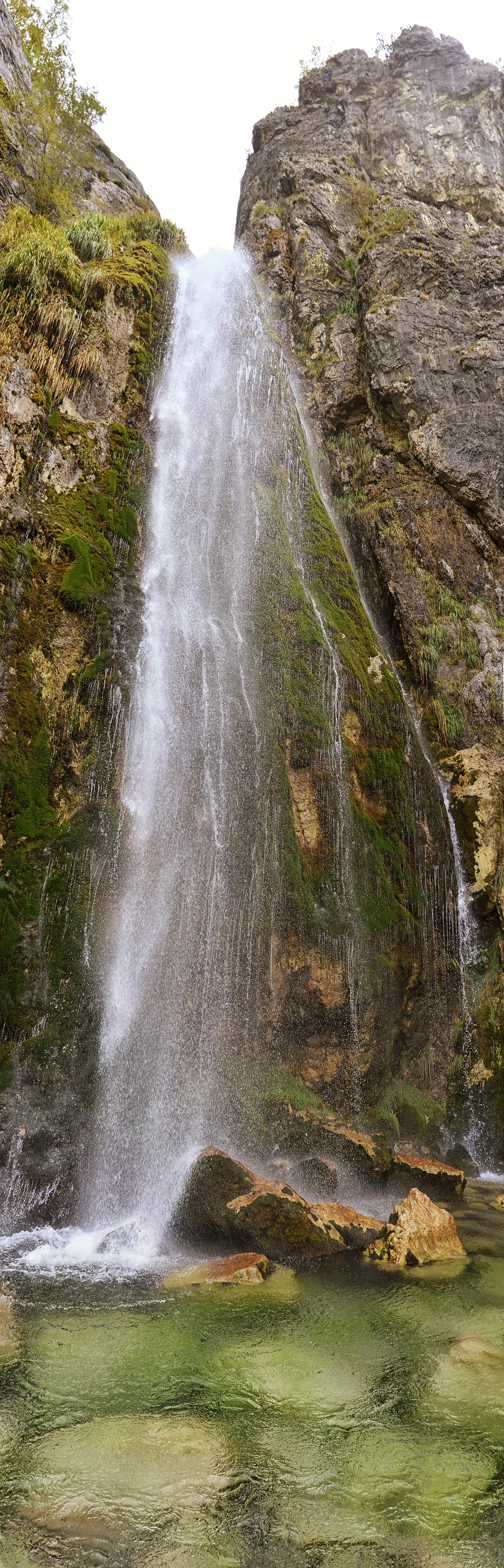
Every staying visitor makes one walk before all others, and it is this one. The Grunas waterfall is Theth’s own sight, close enough to be an evening’s entertainment and impressive enough to justify the village on its own. The path leaves the settlement through the Grunas neighbourhood, crosses meadows and threads into the narrowing valley of the village’s stream, and reaches the fall in roughly forty-five minutes of walking from the centre – allow longer, because the lane, the meadows and the river all slow people down in the best way. What waits is a single clean drop of about thirty metres, falling from a notch in the rock into a green plunge pool, framed by the dark walls of the little gorge.
The fall is at its best in late spring and early summer, when snowmelt from the high cirques feeds the stream and the plunge pool runs full and loud. By late summer in a dry year the flow thins – still pretty, still worth the walk, but a different sight, and travellers who arrive in September expecting the spring torrent should adjust their expectations accordingly. This is the first place this theth travel guide’s season honesty bites: the waterfall is a snowmelt feature, and its calendar is the mountain’s, not the visitor’s.
Practically, the walk needs no guide and no technique – it is a path, not a climb – but it does need real shoes, because the last stretch over wet rock near the fall is slippery, and it deserves a warning about the water. The plunge pool looks made for swimming and is, in fact, bitterly cold in every month of the year, being snowmelt that fell out of the mountain minutes earlier. People do plunge in, briefly and loudly. Treat it as a dare rather than a swim, watch your footing on the polished rock, and keep the longer bathing ambitions for the river pools on the Blue Eye walk, where the water has had sun and distance in which to lose a degree or two of its cruelty.
The Grunas Canyon – The River Below the Fall
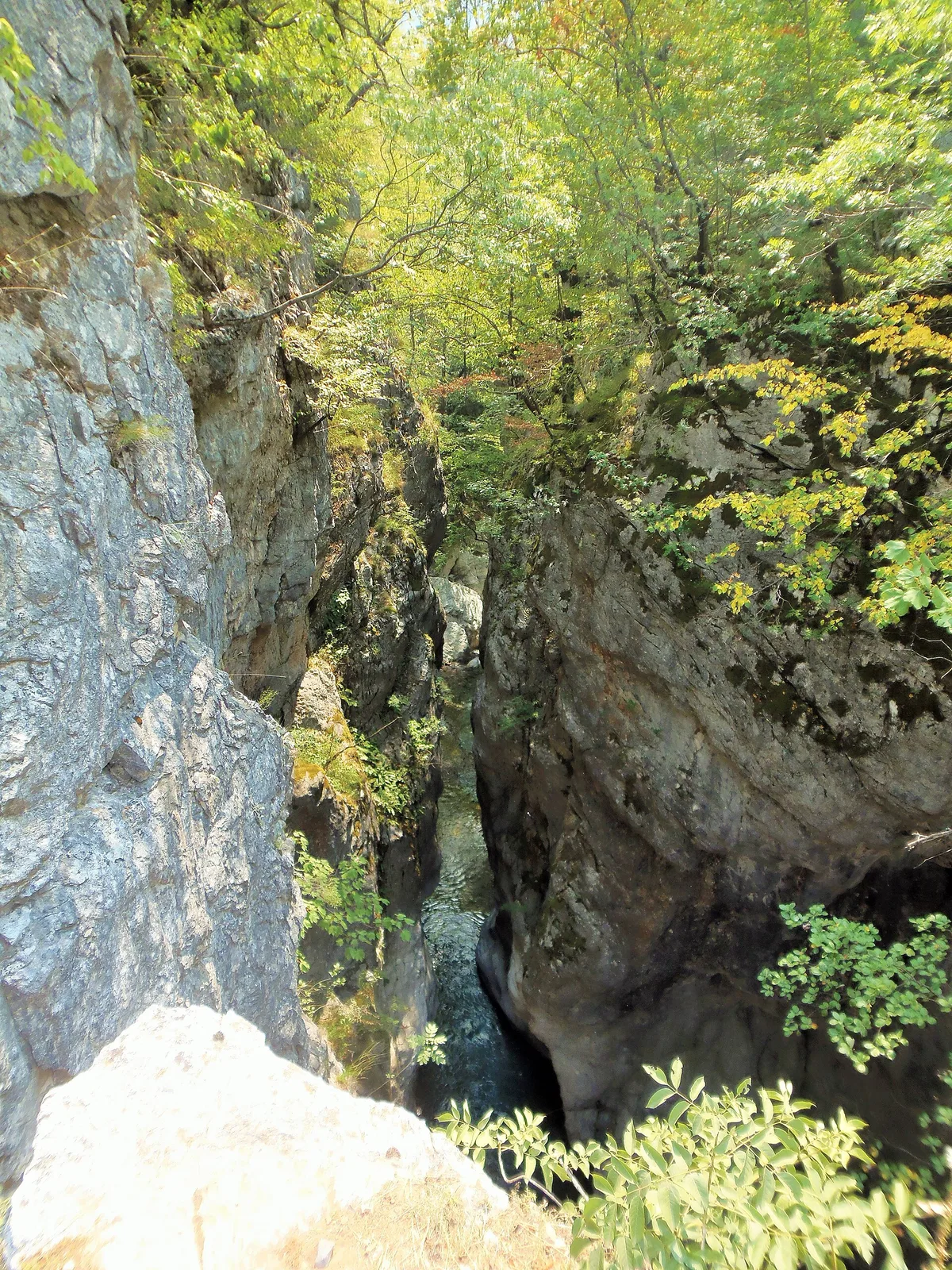
Below the waterfall, the same stream does something quieter and stranger. The Grunas canyon is a slot the river has sawn into the rock – deep, narrow and shadowed, its walls closing to little more than a corridor in places, with the water running green and black far below the rim. Most visitors see the fall, turn around and leave the canyon unvisited, which is a mistake twice over: the canyon is the more unusual sight, and it costs almost nothing extra, being the country immediately around and below the waterfall itself.
See it from the rim and the bridges of the path rather than by scrambling into it. The slot is not a place for improvisation – polished rock, cold deep water and no easy exits – and the viewpoints from above give the essential experience anyway: the drop from sunlit meadow to the dark corridor, the sound of the river arriving before the sight of it, the swifts and the ferns in the shade. The canyon also explains the village’s water in miniature. Everything in Theth runs off the limestone – springs, streams, the great river itself – and the canyon is where you see the mountain’s plumbing exposed, the same karst system that, one valley over, bursts out of the rock at the Blue Eye. Take the fall and the canyon together, in one unhurried outing, and the village’s river stops being scenery and becomes a system you understand.
The Blue Eye at Kaprre – The Big Day Walk
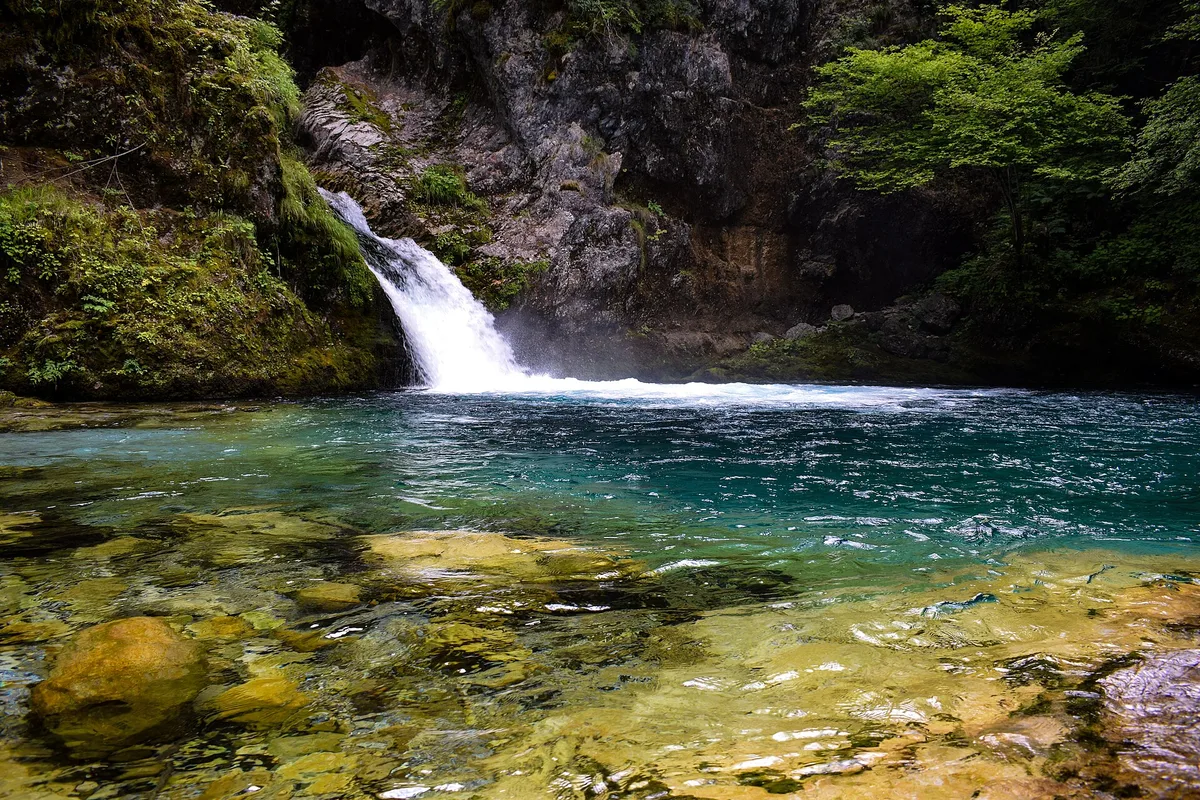
First, a necessary act of disambiguation, because Albania has two famous Blue Eyes and they are nowhere near each other. The Blue Eye near Saranda, in the far south, is a great spring bubbling up in a forest clearing, visited from the coast. The Blue Eye of Theth – Syri i Kaltër – is something else entirely: a deep blue-green pool in a rock gorge in the valley of Kaprre, above the hamlet of Ndërlysaj, at the end of a long walk down the Shala valley from Theth. It is a pool you reach on foot and swim in, fed by a small waterfall pouring over the rocks into water so clear and so cold that the blue reads almost artificial in photographs. Confuse the two in your planning and you will have a very strange day; this is the northern one, the walker’s one.
The commitment is real and should be planned as the day’s main event. The trail board at the start of the walk times the Blue Eye at three hours fifteen minutes one way from Theth, and the full outing on foot – down the valley, the pool, the gorge, and the walk back – runs to a long half day or a full day depending on how long the water keeps you. The route follows the river down through the valley, passes Ndërlysaj, and climbs into the Kaprre side valley to the pool. It is a valley walk with a gorge finish rather than a mountain climb, but the distance is the demand: this is a day to start early, carry food and water, and give the pool the unhurried hour it deserves at the middle of the day, when the sun is in the gorge and the water is at its least punishing – which is to say, still very cold.
The walk trims well for those who want the pool without the full mileage. Vehicles can take you down the valley as far as Ndërlysaj, leaving roughly the last hour on foot – the gorge section, which is the best hour anyway. Many guesthouses arrange exactly this drop-off and collection, and there is no shame in it: the point of the day is the pool and the Kaprre valley, not the odometer. What is not trimmable is the last section itself, which is on foot over rocky ground, sometimes slippery near the water. Wear shoes that can get wet, expect the rocks at the pool to demand care, and know that a small café operates beside the eye in season. Swim, by all means – everyone does – but enter like a mountaineer rather than a beachgoer: slowly, holding on, and without diving into a pool whose submerged boulders you cannot judge from above.
Ndërlysaj – The Hamlet on the Way
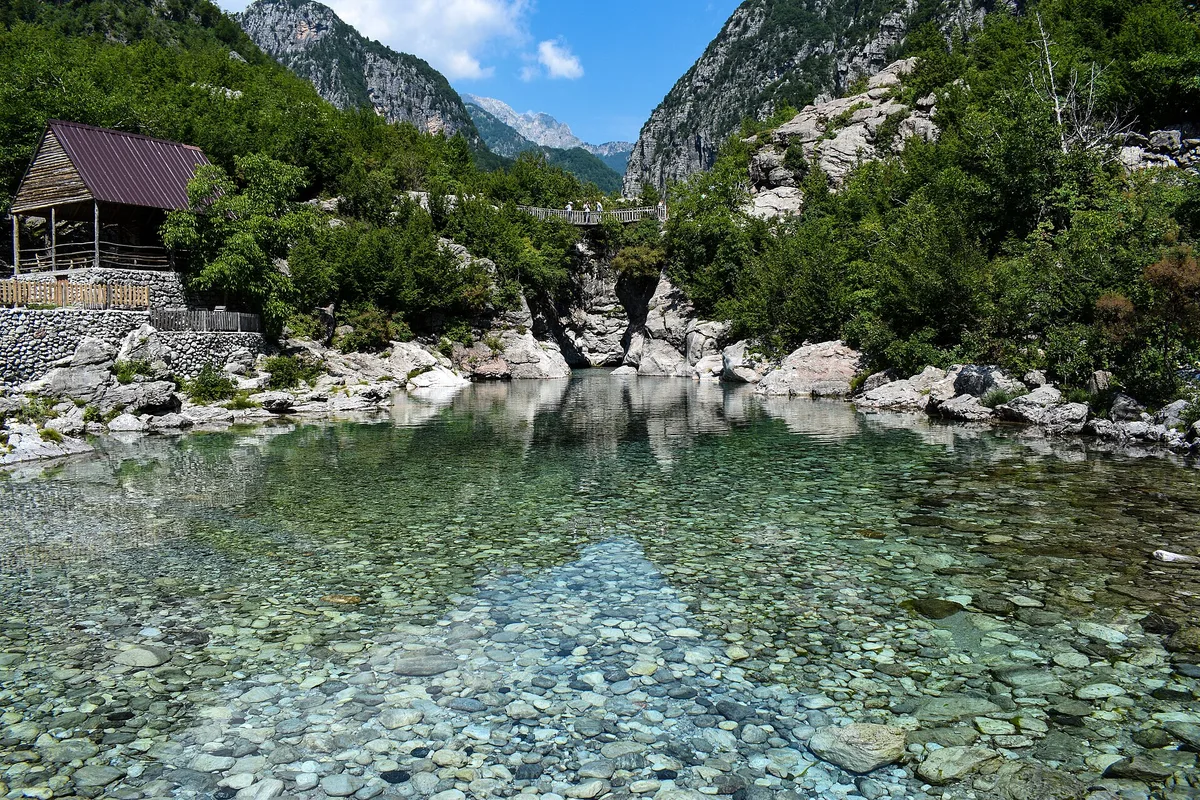
The walk to the Blue Eye passes through, and is quietly upstaged by, the hamlet of Ndërlysaj. This is Theth’s downstream neighbourhood, a scattering of houses where the valley pinches towards the Kaprre turn-off, and its gift to the walker is the river itself: a series of glass-clear pools where the Shala slows among white boulders, deep enough to swim, sunlit for much of the day, and – by the standards of this valley – almost welcoming. Many walkers judge the Ndërlysaj pools the best actual swimming of the whole Blue Eye day, precisely because they ask less courage than the eye itself.
Build Ndërlysaj into the day rather than passing through it twice without stopping. The natural rhythm of the walk is: down the valley in the morning cool, a first swim or at least a long pause at the Ndërlysaj pools, on up the Kaprre valley to the Blue Eye for the middle of the day, and back through Ndërlysaj in the afternoon when the light is on the water and the heat has gone out of the lane. There is food and drink to be had in the hamlet in season, and vehicles reach it, which is what makes the trimmed version of the walk work. Ndërlysaj is also a small lesson in Theth’s geography – this scattered, lane-linked chain of neighbourhoods, each with its own stretch of river, is what “the village” actually means here, and by the end of the Blue Eye day you will have walked its full length and understood it better than any map could teach you.
The Valbona Pass Walk – One Short Section, Deliberately
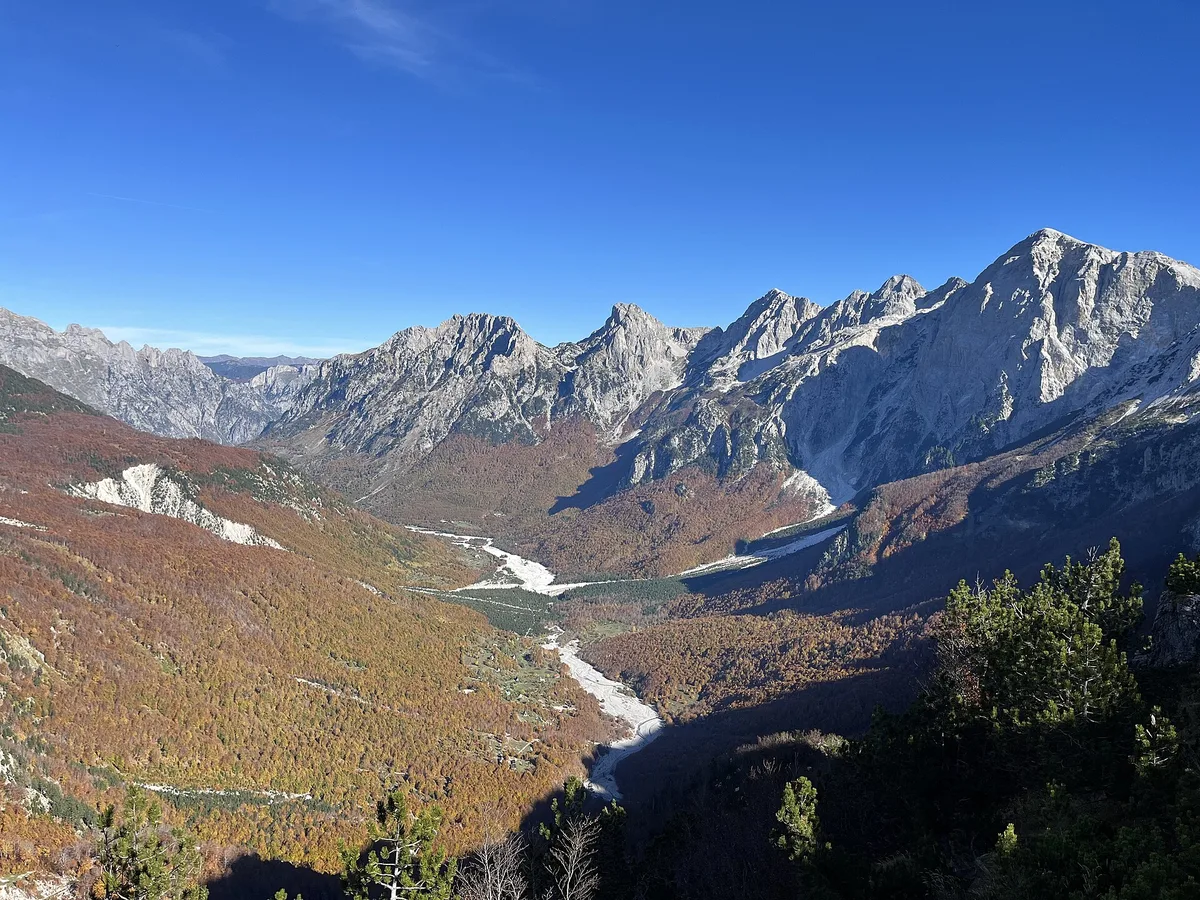
Yes, the famous walk exists, and yes, it starts here: the crossing of Valbona Pass to the Valbona valley, the best-known day hike in Albania and the spine of the long-distance Peaks of the Balkans trail that loops through Albania, Kosovo and Montenegro. From Theth the route climbs out of the valley to the col at about 1,800 metres and descends the far side – a serious mountain day of six to eight hours that most people walk with a guesthouse at each end and their luggage following by horse or vehicle. This guide will not walk you over it, and the omission is deliberate. The crossing has its own dedicated step-by-step guide on this site, and a village guide that tried to do both jobs would do the pass the worse of the two.
What belongs here is only the Theth-side planning. If the pass is in your trip, it reorganises your stay: you want the night before in a guesthouse on the Theth side with an early breakfast arranged, your onward bed booked in Valbona, the luggage transfer settled with your host the day before rather than at dawn, and a weather eye kept on the col, because the crossing is a fair-weather undertaking in a way the village walks are not. Walkers coming the other way, down into Theth off the pass, should know the village receives them well – beds, dinners and rest days all exist precisely because so many arrive on foot. For the route itself – the path, the timings, the water, the descent – use the dedicated Theth to Valbona hike guide, listed with this article’s companion links below. The village will still be here when you get back, and it is better met rested than as a footnote to a hard day.
Where to Stay – Guesthouse Culture in Theth
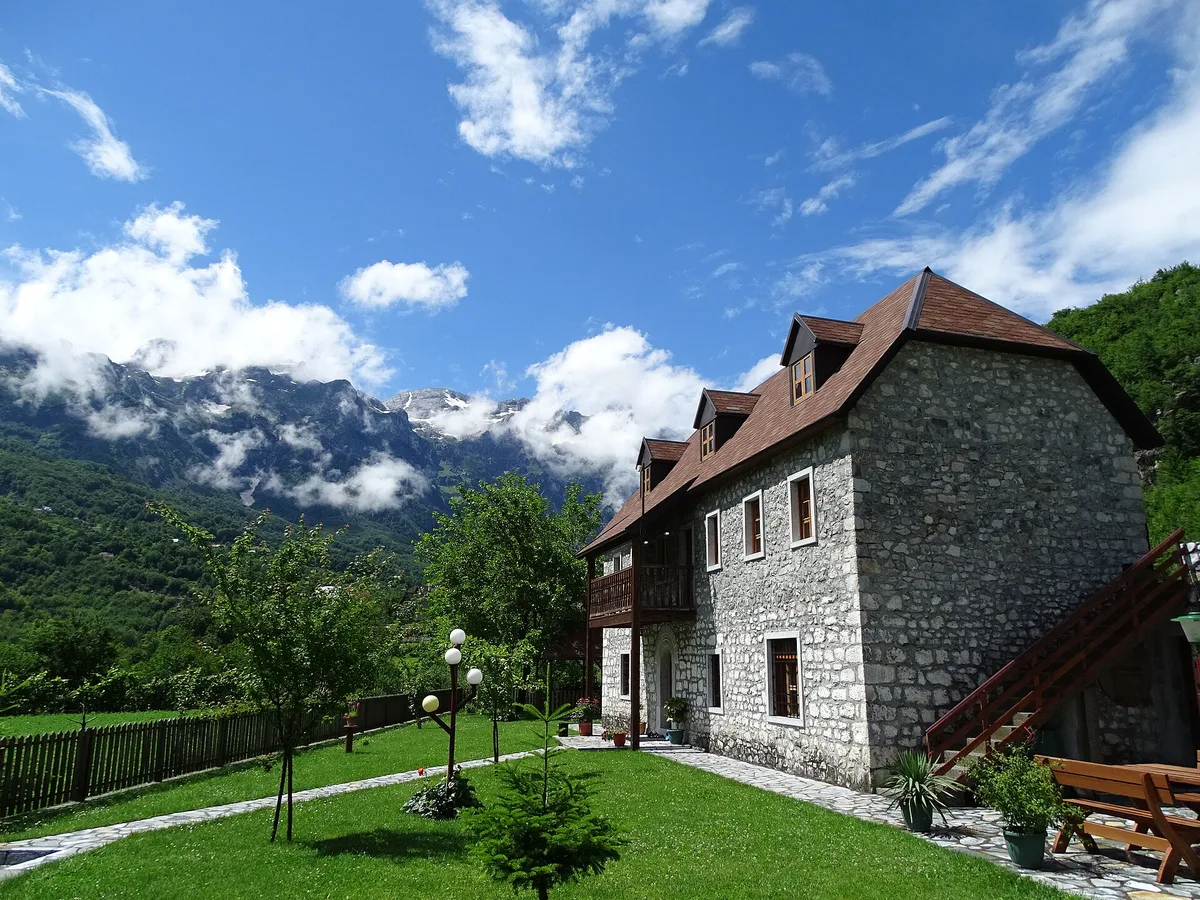
Theth does not really have hotels; it has households. The valley’s beds are overwhelmingly family guesthouses – bujtina – most of them built of stone in the local manner on family land, enlarged wing by wing and room by room as tourism grew, and run by the family whose name is on the gate. You sleep in their building, eat their cooking at something close to their table, are driven by their cousin, and have your walks planned by whoever in the family has the best English and the best knowledge of the paths. This is not a deficiency of the place. It is the place. The guesthouse is where Theth’s famed hospitality – besa, the pledged word, expressed as feeding and sheltering the traveller – survives as a living practice rather than a museum piece, and most visitors count their host family among the best memories of the valley.
The practical consequences shape how you book. Almost every guesthouse works on a half-board basis, dinner and breakfast included, because there is effectively nowhere else to eat – which this guide counts as a feature, since the cooking is the best food for miles in any direction. Rooms are simpler than a town hotel’s – expect solid beds, hot water that usually cooperates, mountain views that outperform any amenity list, and Wi-Fi and phone signal that vary by house and by weather; ask about connectivity honestly if you need to work. Location within the valley is the real choice to make. Houses near the church and the central meadows put the historic core on your doorstep; houses up-valley shorten the Grunas walk; houses down towards Ndërlysaj shorten the Blue Eye day. There is no wrong answer, but there is an uninformed one, and it is booking by photograph alone without asking where in the valley the house sits.
Book ahead in the high season – July and August fill the valley’s beds, and the pass-walk traffic takes a large share of them – and book direct with the family where you can, since the conversation itself is useful: arrival times, transfers, dinners, luggage, walk plans all get settled in it. Outside the season, the picture inverts: many houses close entirely, and booking becomes a matter of finding who is open at all rather than choosing among many. That is not a warning against the shoulder months, which this theth travel guide rates highly – it is simply the planning fact that in Theth, more than in most destinations, the guesthouse is not a commodity to be searched but a household to be arranged with.
Eating at the Guesthouse Table
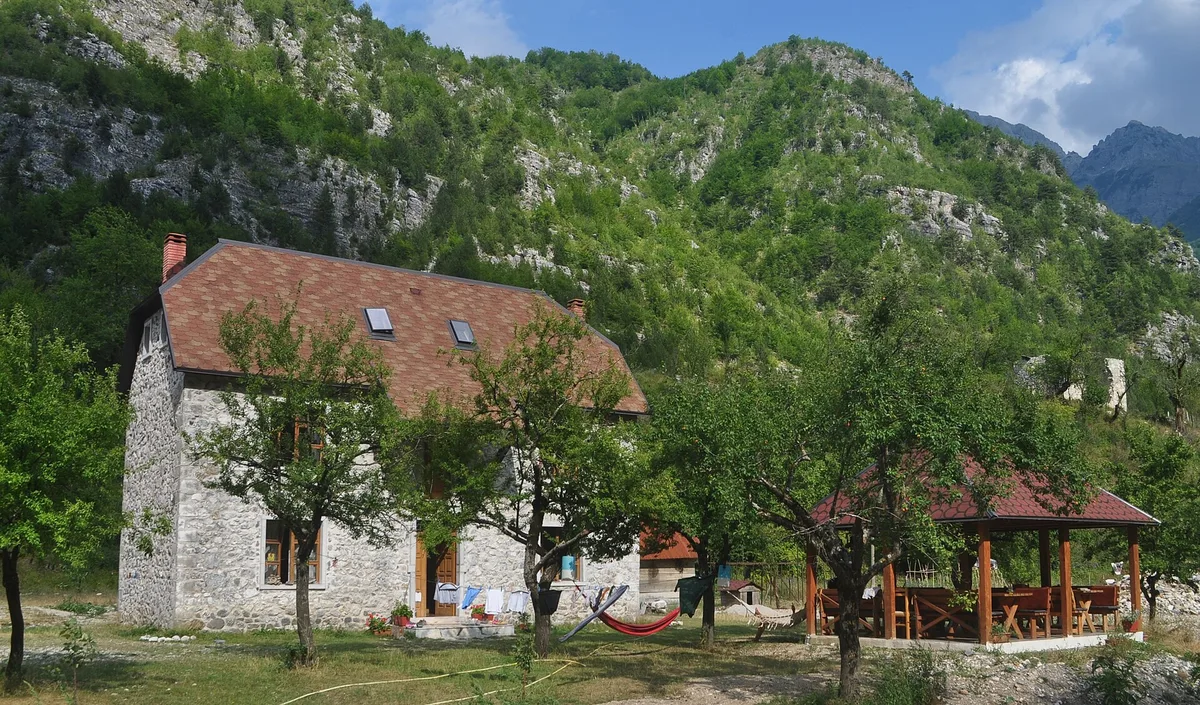
Dinner is the institution. Because the guesthouse is the restaurant, the evening meal takes a fixed and pleasurable form: a long table, often outdoors on a terrace or under a pergola, and a procession of whatever the household cooks – which in Theth means the highland kitchen at its most unselfconscious. Expect byrek and fërgesë, grilled and stewed lamb and kid when the family has slaughtered, trout from mountain water, kaçkavall cheese, thick yoghurt, village butter, corn bread, salads from the garden, and preserves and honey from the household’s own stores. Expect, too, raki – offered with the confidence of a family that regards refusal as a minor diplomatic incident, home-distilled, and stronger than it tastes. Breakfasts run to eggs, cheese, butter, jam, honey and coffee, engineered for people about to walk for six hours.
None of this should be read as a fixed menu, and that is the honest point to make in a theth travel guide: you eat what the house serves, at the hour the house serves it, and dietary requirements are handled by conversation in advance rather than by choice on the night. Vegetarians are generally fed well by accident, since half the table is dairy, eggs, beans, bread and garden produce anyway; stricter requirements should be raised when booking, plainly and early, because the nearest alternative kitchen is measured in valleys. The valley has a handful of small cafés and eateries in season, and Ndërlysaj and the Blue Eye have their small stops, but no evening plan in Theth should be built on them. The table is at your guesthouse, the company is whoever else is staying, and the mountain dark comes down over all of it. Travellers who surrender to that rhythm tend to remember the dinners as long as the walks.
When to Come – Season and Weather, Honestly
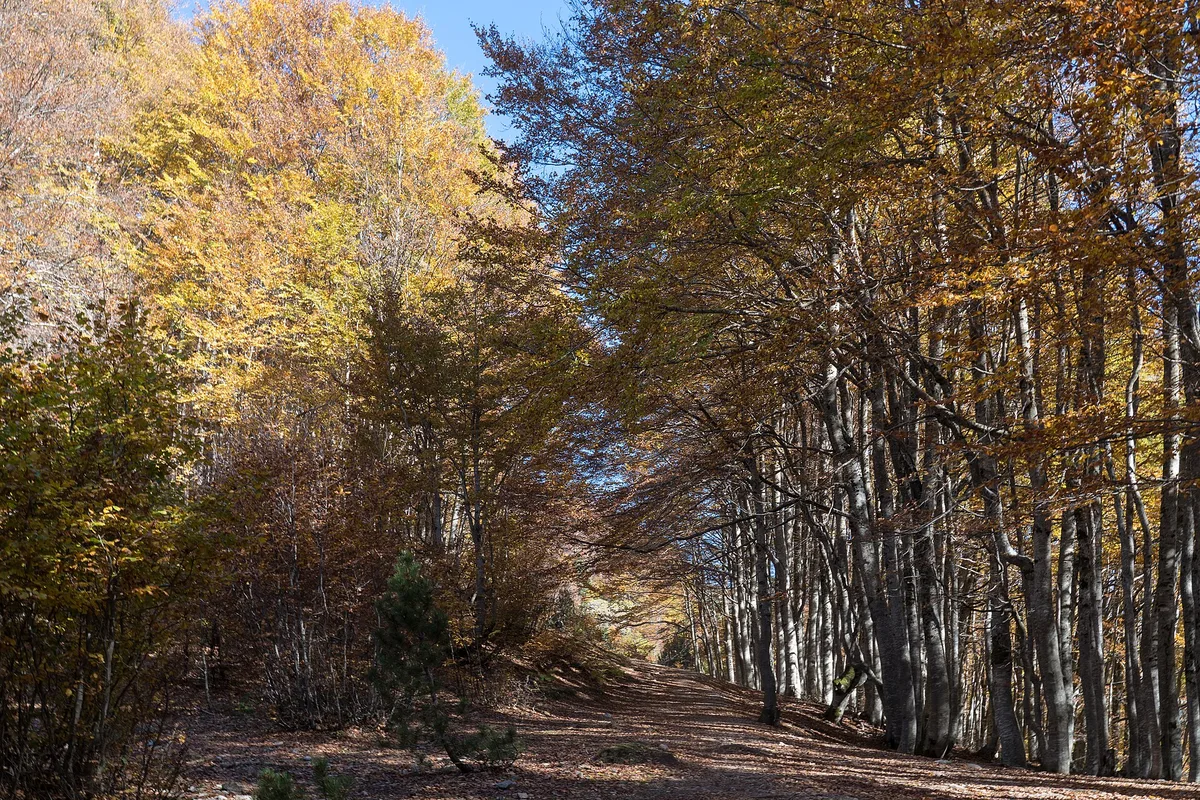
Theth has a short, glorious season and a long, serious winter, and the honest version of the calendar is narrower than the brochures suggest. The full village – guesthouses open, minibuses running, the pool swimmable, the pass walkable, the road reliably open – operates roughly from late May or June into October. Within that, each month has a character. June is the connoisseur’s month: the waterfall at full snowmelt power, the meadows in flower, the days at their longest, the crowds not yet arrived and the high passes clearing. July and August are the peak – the warmest water the valley ever offers, every house open, every trail busy, and the Blue Eye at its most sociable; book everything and expect company. September is the second connoisseur’s month: warm light, thinning crowds, harvest food, the first beech colour late on, and a river running lower and clearer.
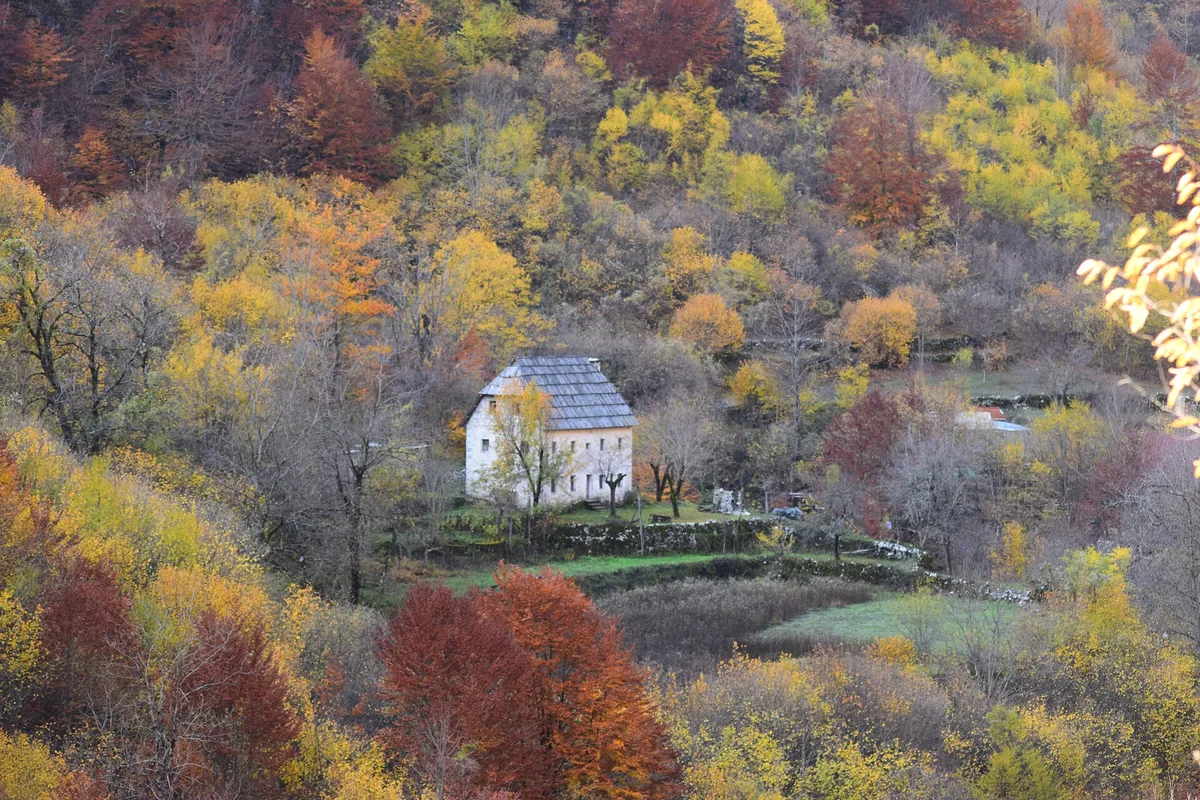
October is the gamble. The beech forests turn gold and red and the valley is at its most beautiful and least peopled, but the days shorten, the nights bite, guesthouses begin to close, and the season’s first snow can visit the pass while the valley is still in autumn. From November into spring the honest advice sharpens into something close to a warning: most of the village shuts, the high road is liable to close under snow for extended periods, and Theth reverts to what it was for centuries – a winter-bound settlement of a few households. Winter visits belong to the properly equipped and the locally advised, arranged through a household that is open and knows you are coming, not to general tourism.
Weather inside the season deserves the same candour. These are high limestone mountains: summer days are warm and often hot in the valley sun, but thunderstorms build fast over the ridges, rain can be heavy when it comes, and evenings at 750 metres are cool in every month – a fleece in August is equipment, not pessimism. The limestone also means the landscape changes its face with water: after rain the paths run muddy, the river rises and clouds, and the pools that were glass yesterday are opaque today. Build slack into any Theth itinerary – a spare half day that can absorb a wet morning is the difference between a trip that bends and a trip that breaks.
How Many Days in Theth
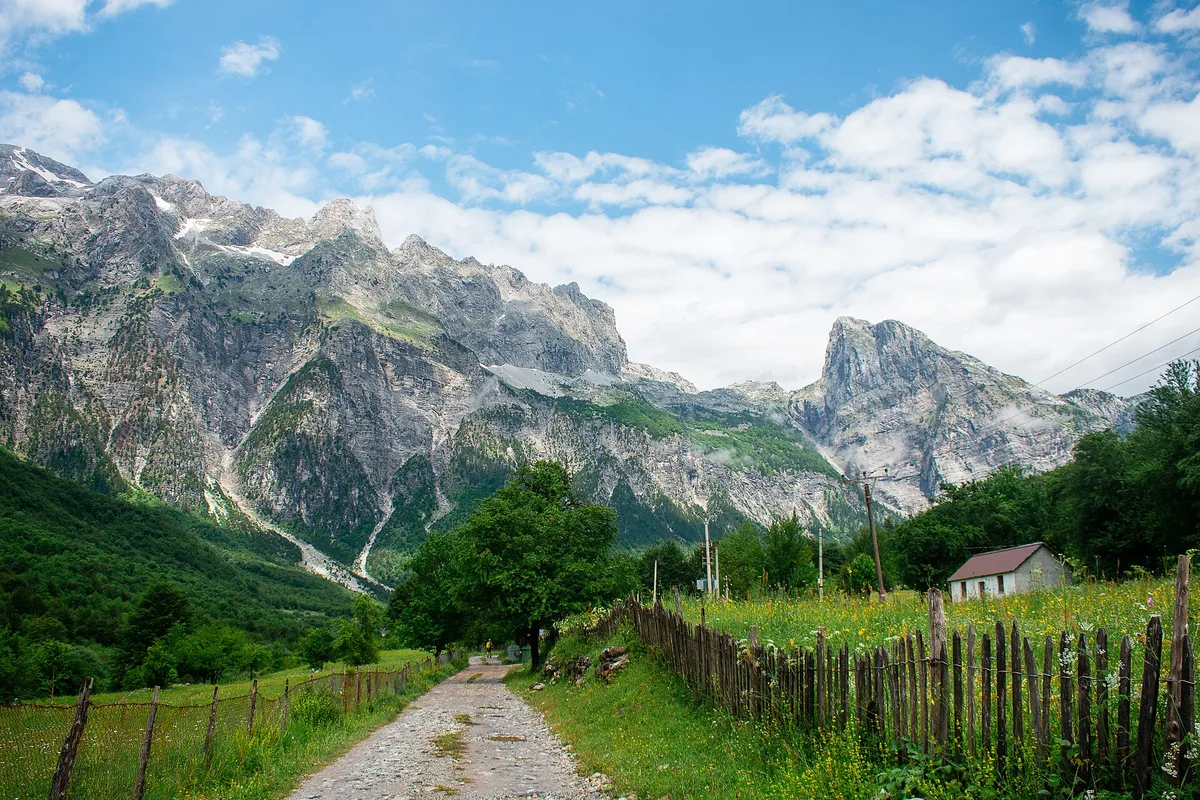
The arithmetic of the village is simple once the sights are grouped, and it argues for more time than most itineraries give. One full day covers the historic core properly – the church, the school story, the Lock-in Tower with the family’s telling, the museum house – together with the Grunas waterfall and canyon as the afternoon’s walk. A second full day belongs to the Blue Eye and Ndërlysaj, which cannot be hurried without being ruined. A third day is the valley’s gift to itself: the lanes and neighbourhoods, a second swim, a slow morning, the pass walk if it is in your plan — or, if it is not, the unhurried repetition of whichever of the first two days pleased you more. Two nights is the minimum that makes the road worthwhile; three to four nights is the stay this guide recommends, and it is the range in which Theth stops being a destination and becomes a place you are briefly living.
The most common planning error is the day trip, and it deserves naming. Theth is three hours of mountain road from Shkodra in each direction on a good day; a day trip buys a photograph of the church and a sandwich, at the cost of six hours of hairpins, and it misses the valley’s entire point – the mornings, the evenings, the table, the dark. Almost as common, and almost as wasteful, is the single night wrapped around the pass walk, which reduces one of Europe’s most storied villages to a dormitory. If the wider Albania trip is tight, protect Theth by cutting somewhere else – our best places to visit in Albania plans a first trip’s route, and it gives Theth the same advice this guide does: days, not hours.
Shape the days loosely and locally. Ask at the guesthouse each evening what the weather and the river are doing, and let the answers order the walks – the Blue Eye on the sunniest day, the tower and museum on the grey one, the waterfall after rain has fed it rather than before. Keep one half day deliberately empty: in Theth that is not wasted time but the raw material of the stay, because the valley’s pleasures – a lane, a meadow, a river pool, a second coffee – are mostly unscheduled ones.
What to Pack for Theth
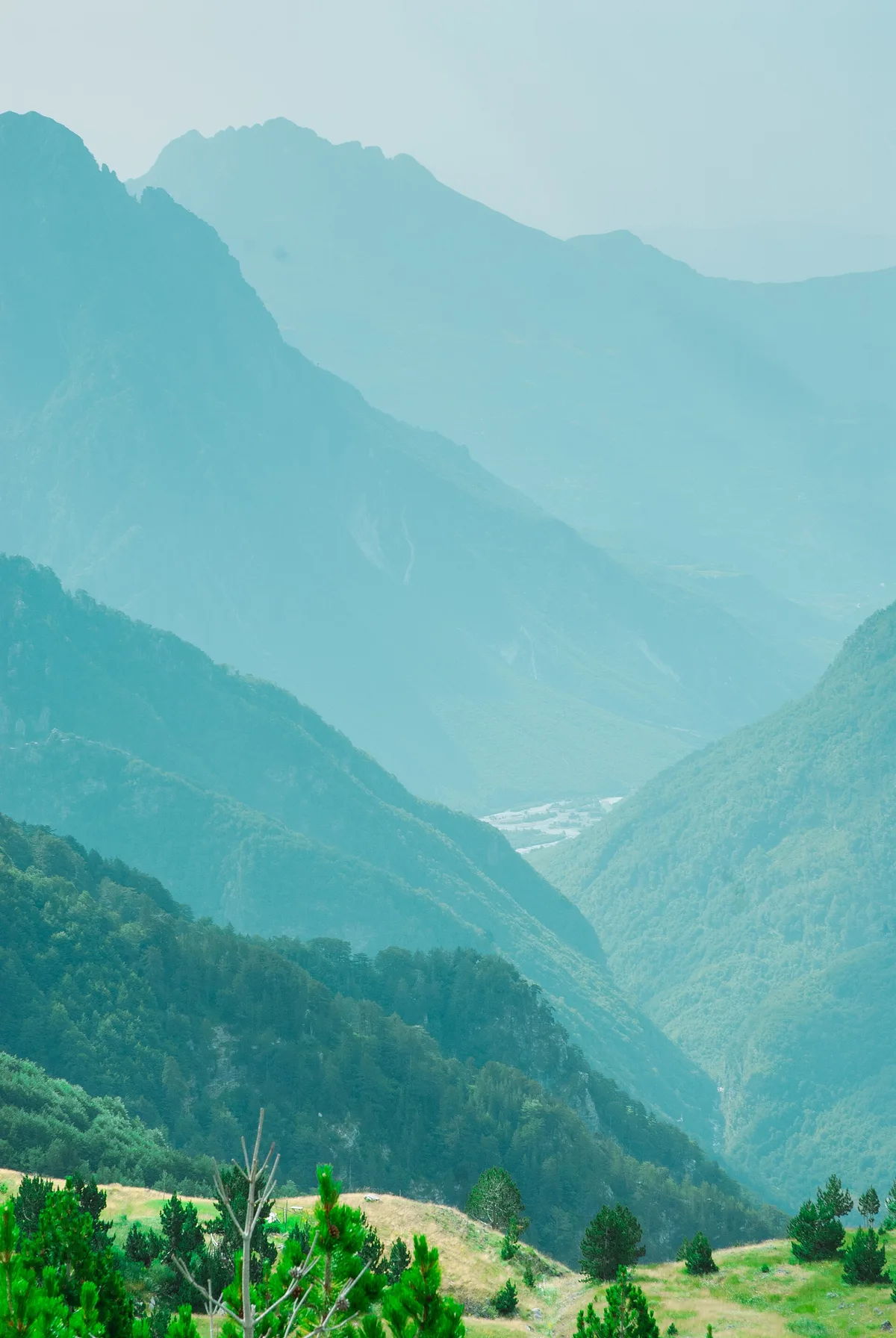
Pack for a mountain village at the end of a mountain road, because that is what is at the end of this theth travel guide. Footwear comes first: the walks in this guide are paths rather than climbs, but they are rough, stony and slippery when wet – the Blue Eye’s gorge section and the rocks around every pool in particular – so bring boots or sturdy walking shoes with grip, plus sandals or water shoes you are willing to get wet for the pools. A day pack, a water bottle you refill at the house, sun protection for treeless hours on white limestone, and a swimsuit for water that will test your resolve whatever the month.
Clothing should be layered against the valley’s daily swing: hot sun at noon, cool shade in the gorges, a genuinely chilly evening at altitude in every month of the season. A waterproof jacket is not optional equipment anywhere in these mountains – storms build over the ridges faster than a walker can descend from them – and a warm layer earns its place on the pass day and at every outdoor dinner alike. Add a head torch for lanes that have no street lighting, a small stock of any medicines you rely on, and patience with connectivity: signal and Wi-Fi exist but neither should be load-bearing in your plans.
Money and documents are the least romantic and most trip-saving items on the list. Take cash out in Shkodra – lek first, with euros widely accepted in practice as the valley’s second currency – in amounts that cover the guesthouse, transfers, coffees and contingencies, and do not build any part of the plan on a village ATM existing, being stocked or accepting your card. Carry your documents on the pass day and keep photographs of them on your phone. And pack the soft items that suit the place: a book for the garden, an appetite, and an evening’s worth of conversation. Theth’s infrastructure for boredom is nonexistent and its infrastructure for contentment is excellent, which is the whole of the packing philosophy.
The Honest Downsides of Theth
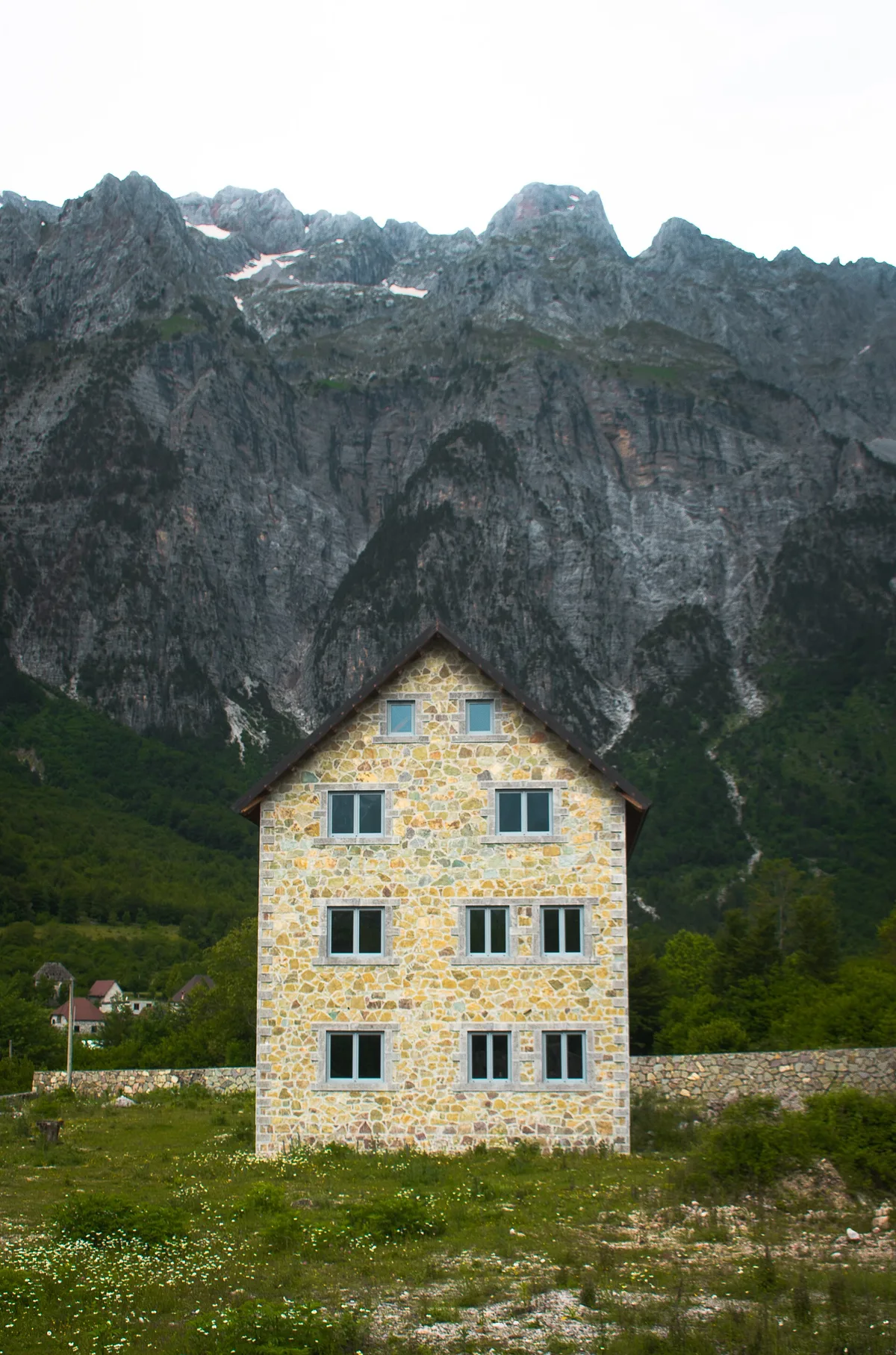
A guide that only praises Theth would be lying by omission, so here is the other ledger. The road changed everything, including for the worse: the valley is building at a pace its lanes and river were never designed for, with new guesthouses and second houses rising each season, some in the traditional stone idiom and some decidedly not, whatever the protected-centre design code says. In July and August the famous sights are busy – the Blue Eye at midday is a social event, the tower telling may be shared with two other groups, and the remoteness that the photographs promise is, in high season, partly a memory. Travellers seeking the empty Theth of the travel writing should come in June or September, or accept the crowd as the price of the warmest water.
The infrastructure of a poor mountain village underlies the charm, and occasionally shows through it: water and power interruptions happen, the road in and out is one weather event away from difficulty, medical care is hours away over that same road, and the standard of any given guesthouse varies by family rather than by any brand’s promise. The season’s brevity concentrates everything – prices, crowds, the working year of every household – into a few months, and by October the place can feel half-shut even when your own house is open and welcoming. None of this is hidden by the people of Theth, who are generally frank about it; it is hidden only by the brochures.
And there is a cost travellers should count on the village’s side of the ledger. Theth was a closed world within living memory – snowbound, self-governing, wary – and it has become a famous destination inside a single generation, faster than any community absorbs gracefully. The folklore is real, but it is also now partly a performance the valley gives for its living, and the thoughtful visitor behaves accordingly: as a guest in a household and a working village, not as an audience at a heritage park. Go with that understanding and Theth gives back tenfold. Go expecting a film set and you will find the film set slightly disappointing and miss the village entirely.
Frequently Asked Questions
How do I get to Theth?
Through Shkodra, and only through Shkodra. From there the SH21 runs via Koplik and Boga over the Qafa e Thorës pass – paved throughout since 2021 – in roughly two to three hours. In season, morning minibuses run from Shkodra; guesthouses arrange transfers and pickups; private 4×4 transfers are the third standard option. Confirm times and prices locally or through your guesthouse shortly before travel – they change by season, and this guide prints none deliberately.
Is the road to Theth safe?
It is a real mountain road – narrow, steep, hairpinned, with serious drops – and it commands respect rather than fear. In summer conditions, driven slowly and in daylight, ordinary cars and buses manage it daily. In snow, fog or darkness it is a different road: the high section is liable to close under winter snow, and no itinerary should depend on crossing it on a fixed winter day. If in doubt, take a local driver; they have done it a thousand times.
When is the best time to visit Theth?
Late May or June for the fullest waterfall, the flowering meadows and the longest days; September for warm light, thinner crowds and harvest food. July and August are the warmest and busiest – book ahead. October is beautiful and chancy. From November to spring most guesthouses close and the road can be snowbound; that is expedition territory, not a holiday window.
How many days do I need in Theth?
Two nights is the minimum that repays the road; three to four nights is right. One full day for the church, the Lock-in Tower and the museum house plus the Grunas waterfall and canyon; one full day for the Blue Eye and Ndërlysaj; a third day for the valley itself, or for the Valbona Pass crossing if that is in your plan. A day trip from Shkodra is the one format this guide advises against outright.
Can I swim at the Blue Eye and the waterfall?
Yes – at the Blue Eye and in the river pools at Ndërlysaj, and in the Grunas plunge pool if you are brave. All of it is snowmelt water and bitterly cold in every month; Ndërlysaj’s pools are the most forgiving. Enter slowly, never dive, mind the polished rock, and treat the swimming as exhilaration rather than bathing.
Is the Theth Blue Eye the same as the one near Saranda?
No – they are two different sights at opposite ends of Albania. The Saranda Blue Eye is a great spring in a forest near the southern coast. The Blue Eye of Theth is a waterfall-fed pool in the Kaprre gorge above Ndërlysaj, reached on foot from Theth. Check which one your plan means before you set out; confusing them is a day-destroying mistake.
Do I need cash in Theth?
Yes. Take lek out in Shkodra, with euros as a widely accepted backup, enough for the guesthouse, transfers, food extras and a contingency margin. Do not rely on a village ATM or on card payment. The valley is the end of the road, and its economy runs accordingly.
Is Theth suitable for children?
For children who walk, yes – the village walks are paths, the pools are magic, and guesthouse families absorb visiting children into the household with enthusiasm. The cautions are the obvious mountain ones: the road journey, unguarded drops at the canyon rim and the pass, and water that is cold and rocky rather than lifeguarded. Very small children make the Blue Eye day long; the trimmed version, by vehicle to Ndërlysaj, exists for exactly this reason.
The Short Version of This Theth Travel Guide
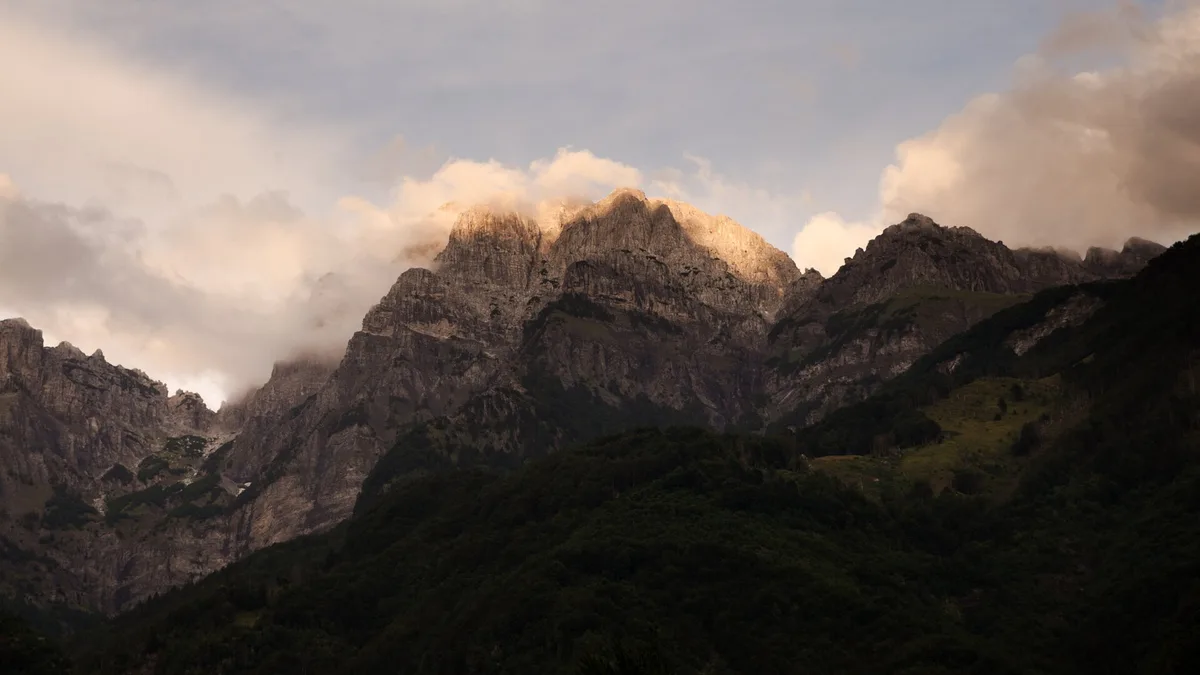
Come to Theth to stay, not to pass. Base yourself in a family guesthouse for three or four nights, eat at its table, and let the days organise themselves: the church of 1892 and Gjeçovi’s schoolroom in the morning light, the Lock-in Tower and the hard, humane logic of the Kanun in the afternoon, the Grunas waterfall and its dark canyon on the day the river is running clear, and one long golden day down the valley to Ndërlysaj and the Blue Eye at Kaprre. Nothing in that programme needs a car, a guide or a timetable – it needs only boots, cash, a fleece for the evenings and the willingness to let a mountain village set the pace.
Come between late spring and mid-autumn, cross the pass road in daylight, and leave slack in the plan for weather and for the valley’s slower pleasures – the lane you have not walked yet, the pool at the hour the sun reaches it, the second coffee on the terrace. The pass walk to Valbona, if it is yours, has its own guide; the region around Theth, its own page. This village, met on its own terms and at its own pace, is enough – and for most travellers who give it the days rather than the hours, it becomes the chapter of the Albania trip they tell first, and the one they measure the rest of the mountains against.