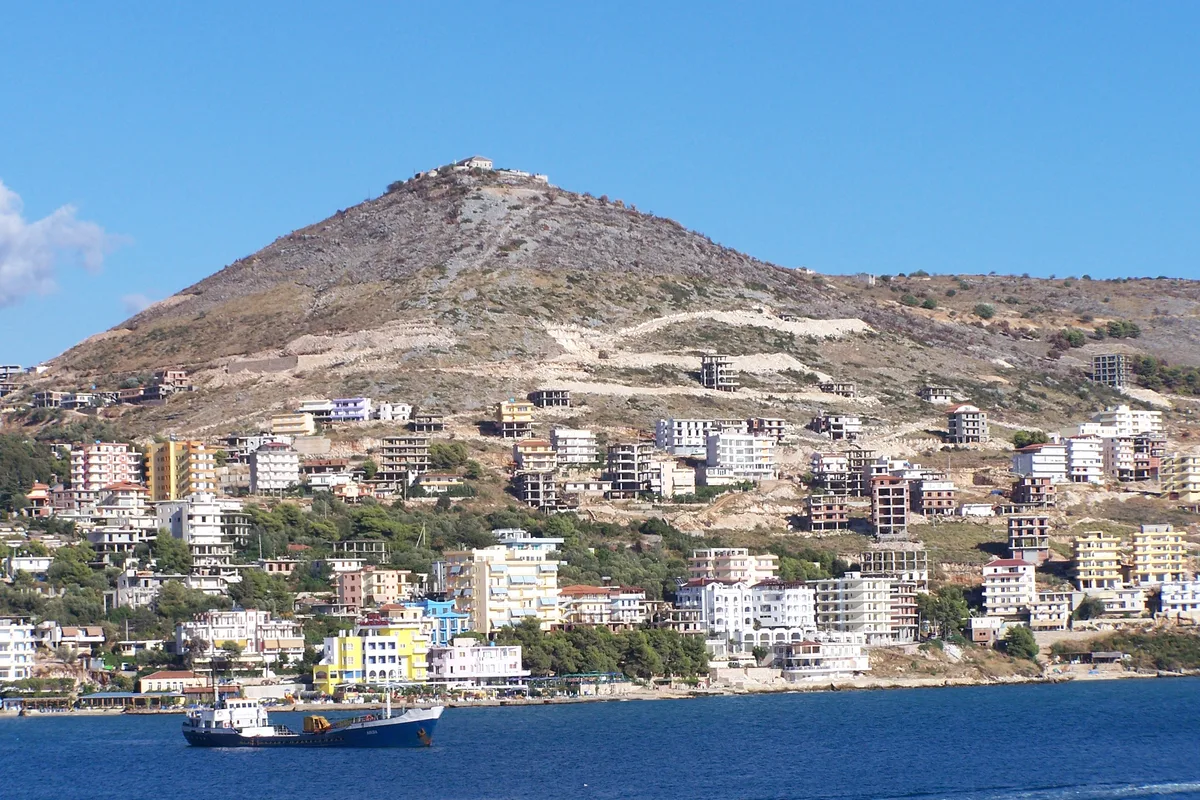
Sarande confuses people who arrive expecting a resort. It is not a resort, and judged as one it will disappoint you — the town beach is a strip of pebbles under apartment blocks, the skyline is cranes and concrete, and in August the single coast road locks solid. Judge it as what it actually is, though, and Sarande becomes the smartest address on the Albanian Riviera: a real, working harbour town with its own promenade, castle and two thousand years of history, sitting within easy reach of a UNESCO-listed ancient city, the country’s most famous beaches, a spring nobody has found the bottom of, and a Greek island close enough to see. This sarande travel guide is written for the traveller who uses a town rather than merely sleeping in it.
That is the deal Sarande offers, and it is a good one. Sleep here and the Riviera’s big three sights — Butrint, Ksamil and the Blue Eye — become day trips instead of hotel moves, with your evenings spent on a seafront that belongs to the town’s own residents as much as to its visitors. The ferries from Corfu dock in the middle of town, the buses leave from streets you can walk to, and when the day-trippers have gone back to their villages and cruise ships, Sarande is still awake, eating late and strolling its promenade. Almost twenty thousand people live here year-round on the 2023 census count, which makes it a town with a winter, a market, a fishing harbour and a life that continues when the season ends — none of which can be said for the beach villages down the road.
So this sarande travel guide treats Sarande the way you will actually use it. First the town itself, taken honestly: what the promenade is for, what the beaches are really like, the castle on the hill and the ruined monastery that gave the town its name. Then the machinery — the Corfu ferry, the buses, the day trips planned as logistics from a Sarande bed. Then the seasons, the neighbourhoods to sleep in, the food, and a downsides section that does not flinch, because Sarande has real ones and you should hear them from us rather than discover them in August traffic. If you are planning the country as a whole, our Albania travel guide sets the national picture; this page is the deep dive into its southern base town.
Sarande at a Glance
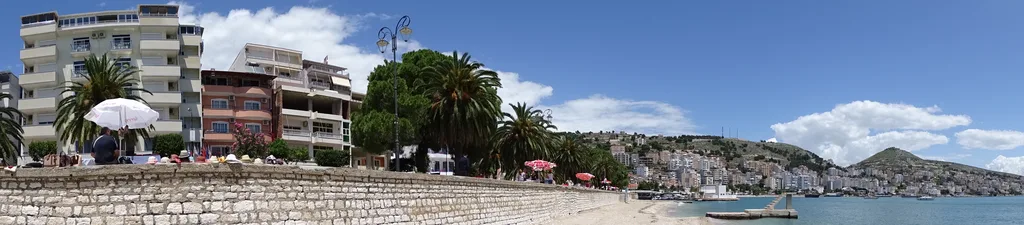
Here is the whole town on one screen. The sections after this table take each row in turn, and the day trips get their own full treatment further down — on Sarande, the geography is the strategy, so read the shape of the place before the sights.
| Question | Short answer |
|---|---|
| What is it | The Albanian Riviera’s main working town – harbour, promenade and bus hub under a castle hill, facing Corfu |
| Resident population | Just under 20,000 on the 2023 census, swelling far beyond that in summer |
| Why base here | Butrint, Ksamil and the Blue Eye are all day trips; the Corfu ferry docks in the centre; real restaurants, markets and buses |
| In town | The promenade and the evening xhiro, Lekuresi Castle, the Forty Saints monastery ruins, the ancient synagogue remains, the town beach |
| The water | Town beach is pebbles and convenience; the famous sand and island water are at Ksamil, a short bus ride south |
| Day trips | Butrint (under 20 km by road), Ksamil (about 14 km), the Blue Eye spring (about 22 km inland), Corfu by ferry |
| Best months | May, June and September – warm sea, working town, manageable crowds |
| The honest catch | A construction-boom skyline, an August traffic problem, and a town beach that loses to Ksamil every time |
Two consequences follow from the table. First, Sarande rewards travellers who plan by radius rather than by checklist — everything that matters sits within about an hour of your bed, and the art is sequencing it, not chasing it. Second, the town itself is a half-day sight, not a three-day one: castle, monastery hill, promenade, harbour. Visitors who understand that have a wonderful time here. Visitors who arrive expecting Sarande to be the attraction, rather than the base, are the ones who leave puzzled reviews.
A Working Town First, a Resort Second
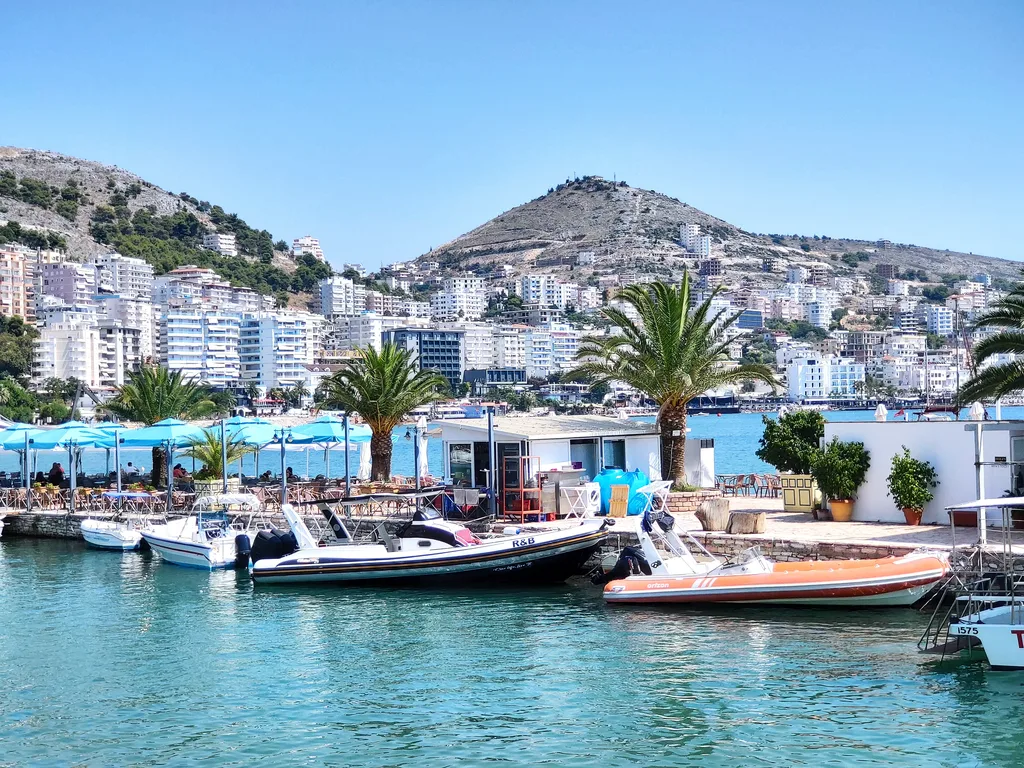
Start at the harbour, because the harbour explains the town. Sarande’s port is not a marina bolted onto a resort; it is a working harbour that the resort grew around. Fishing boats unload here, the Corfu ferries dock here, excursion boats tout for the day’s trips along the quay, and the town’s main streets climb directly up from the water into a grid of shops, bakeries, banks and cafes that serve residents first and visitors second. That ordering — town first, tourism second — is Sarande’s defining quality, and once you see it, everything else about the place makes sense.
It means the infrastructure is real. There are supermarkets rather than souvenir markups, a market selling fruit, olives, honey and mountain tea to people who cook, pharmacies, bus stations and cash machines that work in February. It means the restaurant scene has a local floor below the tourist one — the promenade tavernas fill with Sarande families on Sunday evenings, and the streets one block inland run on Albanian prices and Albanian hours, with lunch a serious event and dinner rarely before nine. And it means the town has edges a pure resort would sand off: a bus station’s chaos, mopeds on the promenade’s margins, building work that starts early. A working town is not always a quiet one.
It also means Sarande has a year. Come in November or March and the town is itself — ferries still crossing, castle still standing over the bay, promenade strolled by locals in coats — while the beach villages to the south are shuttered shells waiting for May. Travellers touring Albania out of season, or stringing the south together with Gjirokaster and the inland sights, will find Sarande the only coastal base that never fully closes. That, as much as the day trips, is why this sarande travel guide keeps recommending it: it is the Riviera’s all-weather address, and in a region that sells a three-month summer, an all-weather address is worth more than one perfect beach.
From Onchesmos to the Forty Saints – A Short History of Sarande
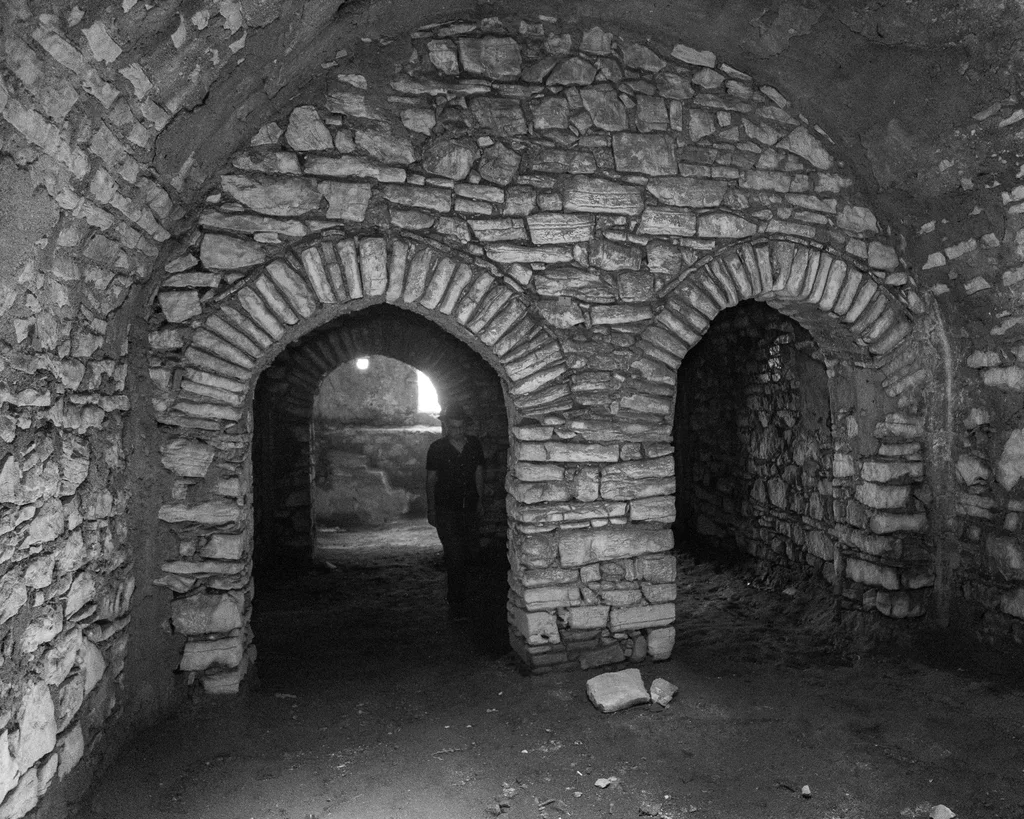
Sarande is older than it looks, and its biography explains both its name and its ruins. In antiquity this was Onchesmos, the port town of the Chaonians, serving their capital at Phoenice — modern Finiq, a few kilometres inland. It mattered enough for Cicero to name a favourable sailing wind after it, the Onchesmites, and tradition held it to be the Port of Anchises, father of Aeneas. In the fourth or fifth century its Jewish community built what is held to be Albania’s first synagogue; in the sixth, a church replaced it, and the complex’s remains — mosaic floors and all — still sit in the town centre, the oldest layer of Sarande hiding in plain sight between the modern streets.
The town’s modern name arrived from the hill above it. There, in the sixth century, stood the great basilica of the Forty Saints — the Forty Martyrs of Sebaste — a pilgrimage church of metropolitan scale whose Greek name, Agioi Saranta, slid over the centuries into Saranda and Sarande. The church’s full story is told in its own section below, but the headline belongs here: the town is named after a monastery, kept the name through its Ottoman centuries as Aya Sarandi, appeared on Western maps under the Italian Santi Quaranta, and was renamed Porto Edda by Mussolini after his daughter before reverting to Sarande after the war. Few small towns carry their whole history in their name; this one does.
The strangest chapter is how recent the town itself is. Into the early twentieth century Sarande was barely a place at all — a harbour with almost no permanent residents, a commercial station rather than a town. The 1912 count found 110 inhabitants. The port works of the Italian period, the first public buildings and roads of the 1930s, and then the slow growth of the communist decades built the settlement; the 2023 census counted just under twenty thousand. Which is why Sarande has no real old town, and why looking for one wastes an afternoon: this is a twentieth-century port wearing two ancient monuments — a synagogue under its streets and a basilica on its hill — and the honesty of that is part of its charm.
The Promenade and the Evening Xhiro
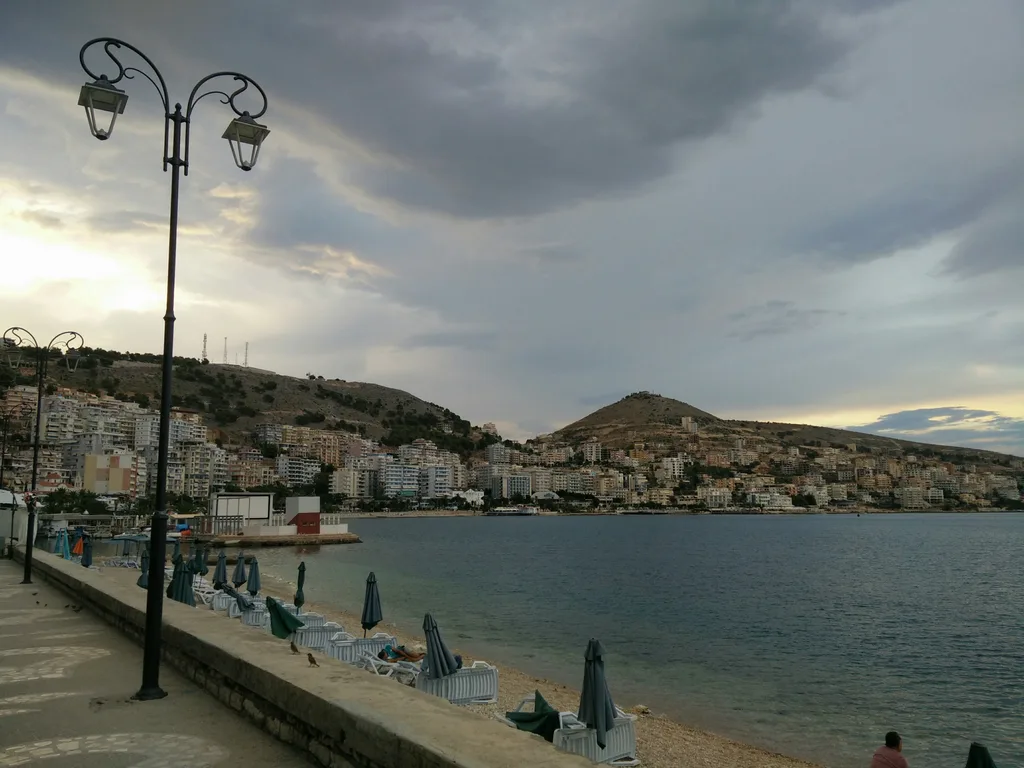
Every Albanian town has a promenade; Sarande’s is its living room. The seafront walk — rebuilt and widened in the early 2020s — runs along the curve of the bay past the town beach, the harbour and rows of cafes, and it operates on the great Albanian institution of the xhiro, the evening stroll. From about seven until late, the whole town comes down to walk slowly up and down the same few hundred metres: grandparents, teenagers, families with babies in prams, couples, dogs, everyone dressed a notch better than the day required. Nobody is going anywhere. That is the point.
Join it properly and the promenade becomes the best free evening in the south. Walk the full curve at sunset, when Corfu turns violet across the strait and the castle hill catches the last light; stop for a coffee or an ice cream; do a second lap as the restaurant terraces fill and the trip-boat men start touting tomorrow’s excursions. The xhiro is also the town’s information exchange — it is where you will see which restaurants are full of locals, which boat is being pushed hardest, and what the weather is doing to the sea for tomorrow’s plans. Travellers in a hurry treat the promenade as a route to dinner. Travellers who understand Sarande treat it as the dinner’s first course.
Two practical notes. The promenade’s mornings are a different and lovely country — fishermen along the harbour wall, old men taking the sun, the bay glassy and empty — and worth one early walk before the heat. And the seafront is where Sarande’s prices peak: the cafes and restaurants on the water charge for the view, fairly enough, while the same coffee a street inland costs the local rate. Neither is a rip-off; they are two different products, and knowing which one you are buying on a given evening is the whole skill of eating in this town, a theme the food section below develops properly.
The Town Beaches, Honestly
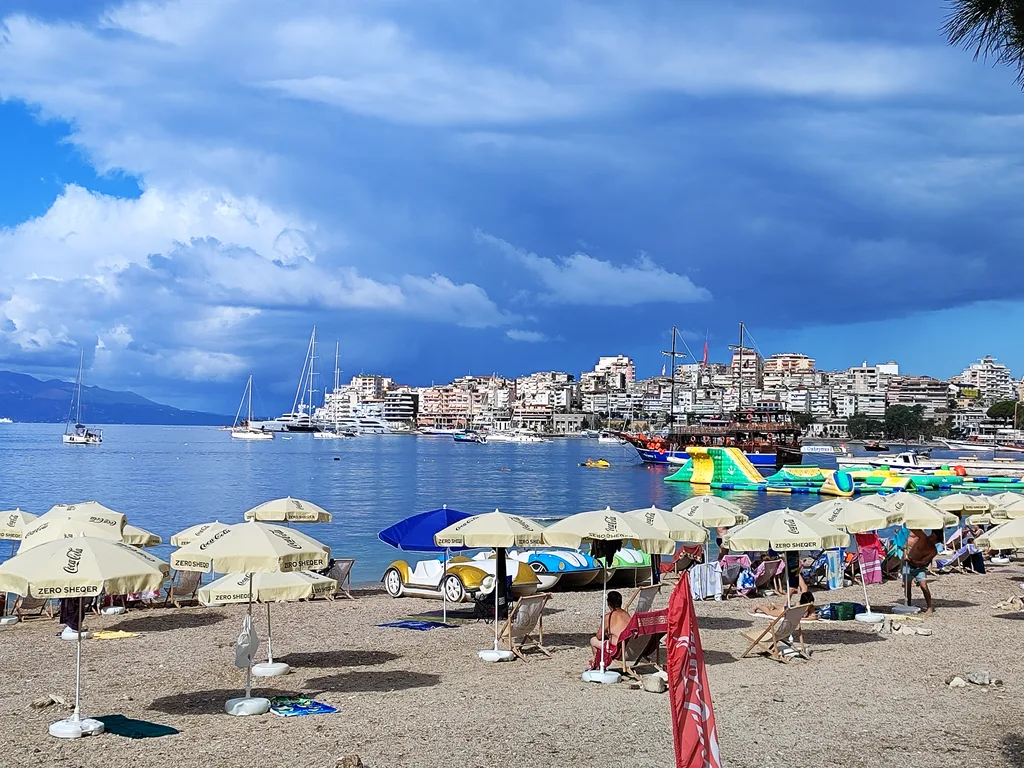
Here is the paragraph most Sarande guides will not write. The town beach is fine — and “fine” is the exact word. It is a strip of pebble and coarse sand along the bay, free and public in its central stretch, lined elsewhere with the umbrellas and loungers of beach bars, and it does everything a town beach needs to do: you can swim before breakfast, cool off after sightseeing, and watch the ferries cross while you dry. The water is clear, the bottom shelves gently enough for children, and the backdrop — the whole amphitheatre of the town climbing its hill — is genuinely handsome.
What it is not is the water in the brochures. Those photographs of white sand and impossible turquoise were taken at Ksamil, fourteen kilometres south, and no amount of goodwill makes Sarande’s town shore their equal. The town beach sits beside a working harbour, the pebbles are hard on bare feet, in August the strip fills to a density that turns swimming into negotiation, and the seabed near the port end is nobody’s idea of pristine. Travellers who base in Sarande for its town beach alone have misunderstood the town’s offer. The beach is a convenience, like the promenade’s cafes — excellent at being there, not worth a special journey.
The correct strategy is the one the town itself uses. Swim in Sarande early, when the water is empty and the light is kind, and treat it as the day’s refreshment rather than its purpose. Save your beach days for the bus south — Ksamil’s sand and islands, or the quieter coves strung along the coast road, covered next. Residents do exactly this: the town beach on weekday mornings, the famous beaches on days off. Follow the local pattern and you will rate Sarande’s shore exactly right — a good town beach attached to a great base, which is all this sarande travel guide has ever claimed for it.
The Quieter Beaches South of Town
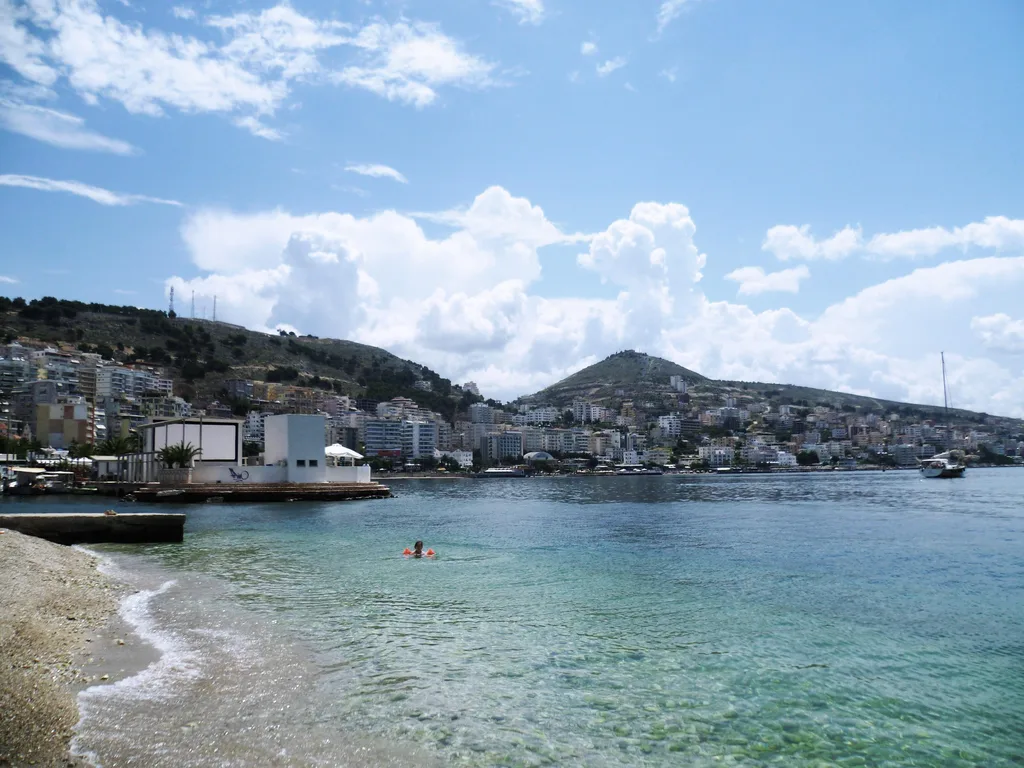
Between Sarande and Ksamil the coast road runs a string of smaller beaches that split the difference between the town shore and the famous sand, and on a Sarande stay they earn their own section. These are cove beaches rather than town beaches — pebble bays tucked below the road, most of them worked in season by a beach bar with loungers and umbrellas for hire, a grill at lunchtime and music at a volume that varies by owner. The water is the point: out of the harbour’s shadow, the sea turns the clear green-blue of the postcards, and the swimming is a class above the town beach in every way that matters.
Two names anchor the stretch. Mirror Beach — Plazhi i Pasqyrave — takes its name from the story that its still morning water reflects like glass, and it is the connoisseur’s pick of the near beaches: a white-pebble cove of startling clarity that fills fast in season precisely because everyone has heard of it. Pulebardha Beach, named for the seagulls, is its moodier neighbour, a wilder-feeling bay below the cliffs. Neither is a secret, and in August both run the same crowd mathematics as everywhere else on this coast; go early, or go in June and September, when the coves remember what quiet sounds like.
Reaching them is the one piece of machinery to understand. The coast-road bus that runs south to Ksamil and Butrint passes the turnings for the coves, and drivers will drop you at the top of the access tracks on request — ask when you board, and confirm where to flag the return bus, because the walk back up to the road in afternoon heat is the price every cove charges. Taxis cover the same ground for those who would rather pay than climb. Either way, these beaches are the correct answer to the Sarande beach question for travellers who want real swimming without surrendering a whole day to Ksamil: half an hour from your hotel, an hour in water that silences complaints, and back in town for the xhiro.
Lekuresi Castle – The Town’s Balcony
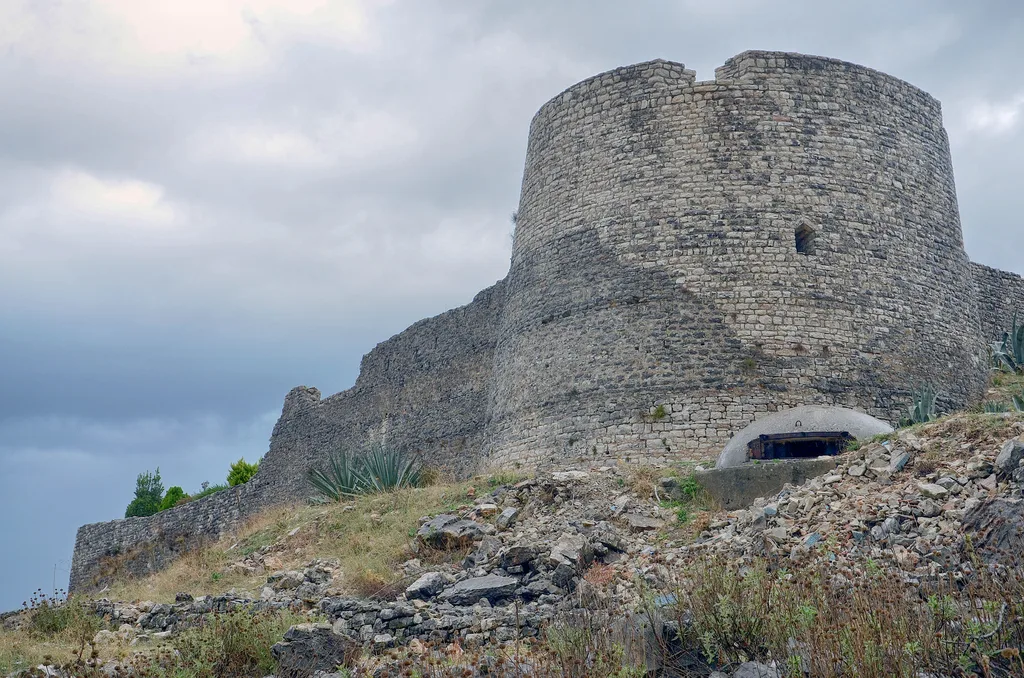
Above the town, on the hill every Sarande photograph includes, stand the walls of Lekuresi Castle. It was built in 1537 by Sultan Suleiman the Magnificent, in the year of his Corfu campaign, to hold the harbour and the Sarande–Butrint road against the Venetians who then held Butrint. The design is a soldier’s, not a showman’s: an almost-square fortress, walls thick enough to walk in places, two round towers at opposite corners, and a garrison that once numbered some 220 men. A village of the same name grew beside it and lasted into the late nineteenth century; Ali Pasha of Ioannina attacked the castle in his turn, as every strongman of the region eventually did. What the centuries have left is a handsome ruin in a position that has not lost a degree of its point.
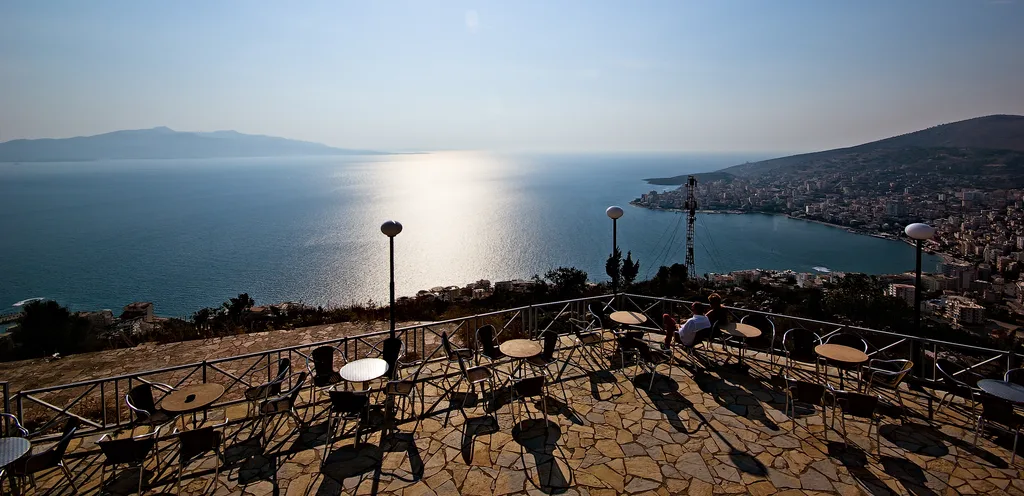
Because the position is the visit. From Lekuresi’s hill the whole geography of this guide lies open in one turning of the head: Sarande and its bay directly below, the straits and Corfu’s green hills to the west, the Ksamil islands to the south, and inland the flat lagoon of Lake Butrint shining beyond the coast road. Generals chose this hill for exactly the view tourists now climb for, and on a clear evening it is simply the finest panorama in the south of Albania — the sunset seat of the region, with a restaurant terrace in the castle grounds that lets you take the whole performance with a drink in hand.
Go up in the late afternoon, whatever the season. The climb on foot is a steep half-hour or so from the centre — do it in the cool, or take a taxi up and walk down — and the light does the rest: the town warming below, the sea going silver, Corfu darkening into silhouette. In summer the terrace fills and the atmosphere is closer to a festival than a fortress; out of season you may have the walls and the wind to yourself, which is arguably better. Either way, Lekuresi is the one sight in Sarande itself that this sarande travel guide calls unmissable without embarrassment — every base town needs a balcony, and this one has been on duty since 1537.
The Monastery of the Forty Saints – Where the Name Comes From
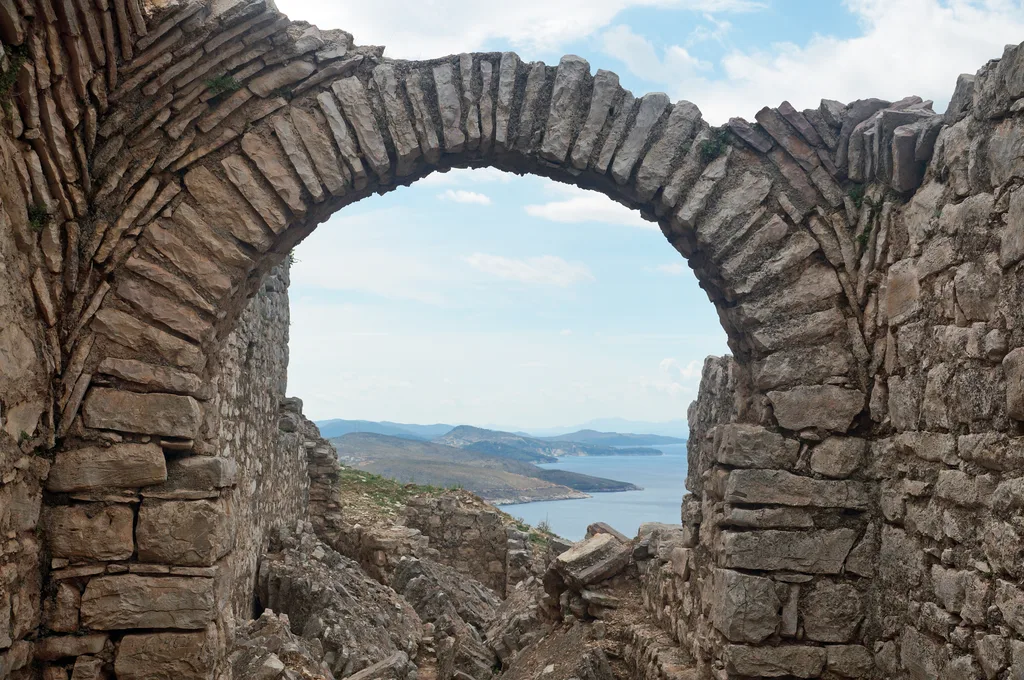
On the sixth hill east of the town, about a kilometre from the centre, a ruined basilica stands in the open grass — and it is the most important building in Sarande’s story, because it is the building Sarande is named after. The church of the Forty Saints was raised in late antiquity, probably in the age of Justinian, as a pilgrimage basilica honouring the Forty Martyrs of Sebaste. By the standards of its century it was enormous: some forty-three metres long and twenty-three wide, built on a rare seven-conched plan, with a great eastern apse, a narthex added to face the sea road, and below it a warren of vaulted crypts and oratories decorated with painted frescoes. Pilgrims crossed the Adriatic to be here; the church was a seamark for sailors and one of the great shrines of the Ionian world.
The details that survive are the touching ones. The founders’ names were set into the outer walls as votive inscriptions made of red tile, still legible in the masonry. A baptistery complex with individual fonts served the pilgrim crowds. A small monastic community kept the shrine into the middle of the nineteenth century, long after the pilgrimage age had faded, and when the Italian archaeologist Luigi Ugolini surveyed the church in the 1920s he judged it among the finest he had seen in Albania — its walls then still standing to a great height.
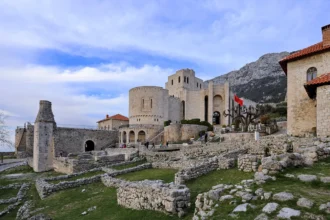
What happened next is the melancholy part. The basilica was largely flattened by bombing in the Second World War, and the communist state later planted a military base on the hill, which stayed until 1997 and did its own damage. What you visit now is a rescued fragment — consolidated walls, the great arches, the crypt chambers whose frescoes Albanian conservators restored in the 2000s — inside a landscape of grass and wind and one of the great views of the straits. Go in the morning, when the light is on the stonework; take the ruin slowly; and consider that the town below, with its ferries and cranes and twenty thousand lives, is carrying the name of this broken church into its sixth century of doing so. No sight in Sarande repays an hour better.
The Corfu Ferry – Sarande’s Second Front Door
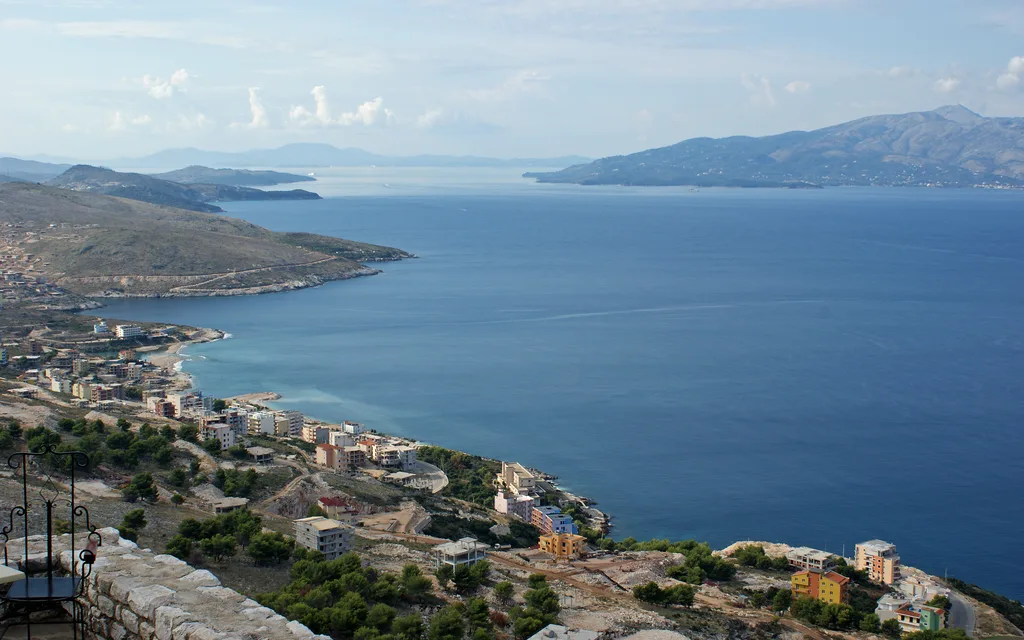
Look west from the promenade and Greece fills the horizon. Corfu lies across a strait narrow enough that the island’s hills read as part of Sarande’s own landscape, and the ferry that crosses it is the town’s second front door — for many visitors, the first one. Flying into Corfu and sailing across is the fastest route into southern Albania from most of Europe, and the day-trip traffic runs both ways all summer: Greeks and Corfu holidaymakers coming over for Butrint and cheap lunches, Sarande-based travellers going across for a day in Corfu Town. Understanding the ferry as a mechanism, rather than a timetable, is what makes it useful — because the timetable changes constantly and the mechanism never does.
The mechanism runs like this. Two operators — Finikas Lines and Ionian Seaways — work the route all year, joined by extra boats in high season. Their fast passenger boats make the crossing in roughly half an hour; the conventional car ferries take about twice as long and are the ones that carry vehicles. Frequency is a season in miniature: in summer the boats run many times a day from morning to late evening, in the shoulder months the service thins, and in deep winter it can shrink to a single daily sailing, weather permitting. Tickets are sold at the port offices and online; in July and August, book ahead or arrive early, because the popular crossings fill. What we deliberately do not print here is prices and sailing times — both move too fast to trust in a guide, and the operators publish the current ones.
The border is the other half of the mechanism, and it catches people out. Albania is outside the European Union and outside Schengen, so this short hop is a full international crossing: passport control at both ports, and for non-EU travellers the Greek side is a Schengen entry, with everything that implies for your 90-day allowance. Carry your passport even on a day trip, and allow a margin before the last boat back. One classic trap deserves its own sentence: Greece keeps its clocks one hour ahead of Albania, and ferry timetables are printed in the local time of the port they leave from — a departure that looks leisurely on paper can be an hour closer than you think. Get the mechanism right and the ferry stops being a risk and becomes what it is for the town: a half-hour bridge between two countries, and the most enjoyable arrival in Albania.
Day Trip to Butrint – The Ancient City in the Woods
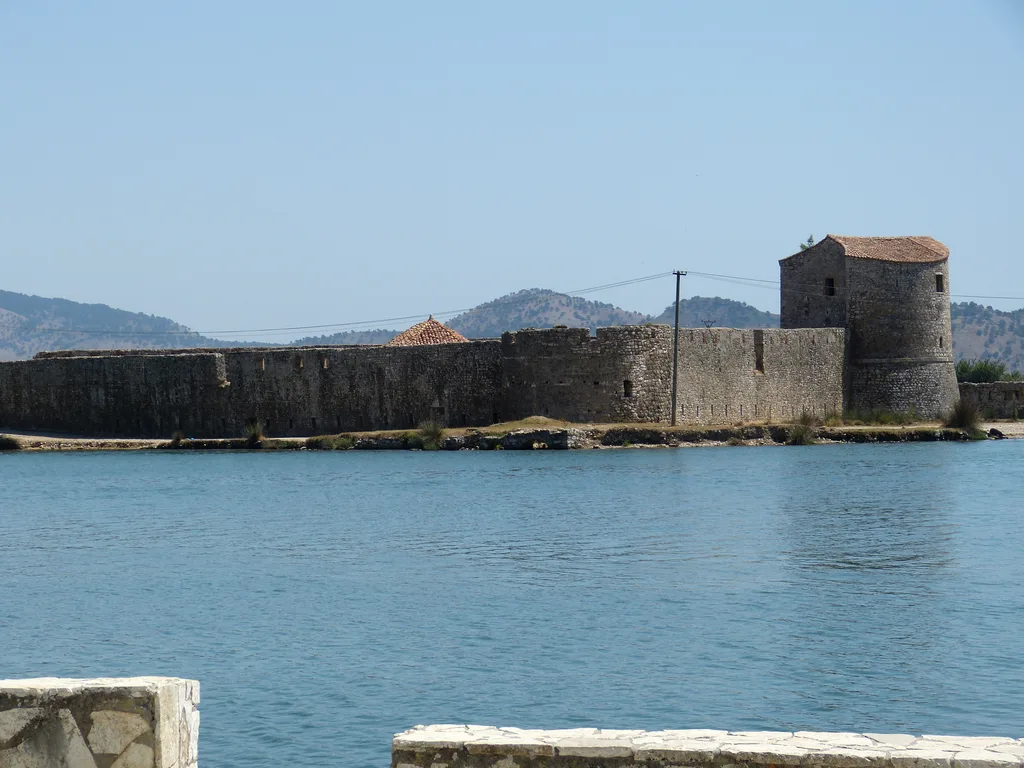
South of Sarande, under twenty kilometres down the coast road, a wooded peninsula holds the greatest archaeological site in Albania. Butrint was a Greek colony, a Roman city, a Byzantine bishopric and a Venetian outpost in turn, and it is now a UNESCO World Heritage Site — inscribed in 1992 — whose official listing you can read on UNESCO’s Butrint page. The theatre, the baptistery, the basilicas and the Lion Gate all deserve the deep treatment our dedicated Butrint guide gives them. This sarande travel guide’s job is narrower and, for a Sarande stay, more useful: how the day trip works from your bed in town, and how to time it so the site feels like a forest with a city in it rather than a crowd with ruins attached.
The logistics are mercifully simple. A local bus runs the coast road from Sarande through Ksamil to the site entrance, which stands beside the Vivari Channel — the narrow waterway the little cable ferry crosses to the Triangular Fortress on the far bank, the fortress in the photograph above. The same road serves Ksamil, which is why Butrint pairs so naturally with a beach afternoon, as the next section explains. Taxis do the run for groups who value certainty over price, and in season the town’s excursion desks sell the trip bundled with everything else. However you go, go early: the site is at its best in the morning, when the woods are cool, the theatre stands empty in green shade, and the coach groups from the cruise ships are still eating breakfast.
Pacing the visit itself matters more than transport. Butrint is not a stadium ruin to be photographed and left; it is a shaded, half-drowned city that unfolds along a woodland circuit, and it rewards three unhurried hours far more than a rushed ninety minutes. Walk the whole loop — theatre, baptistery, basilica, walls, and up to the little castle on the acropolis where the museum sits — rather than cherry-picking the famous stones, because the site’s magic is cumulative: layer upon layer of cities in one small wood. Back in Sarande by mid-afternoon, you will have spent the day at a world-class site and slept not one metre from your own bed. That is the base-town dividend, paid in full.
Day Trip to Ksamil – The Famous Beaches, Without Moving Hotels
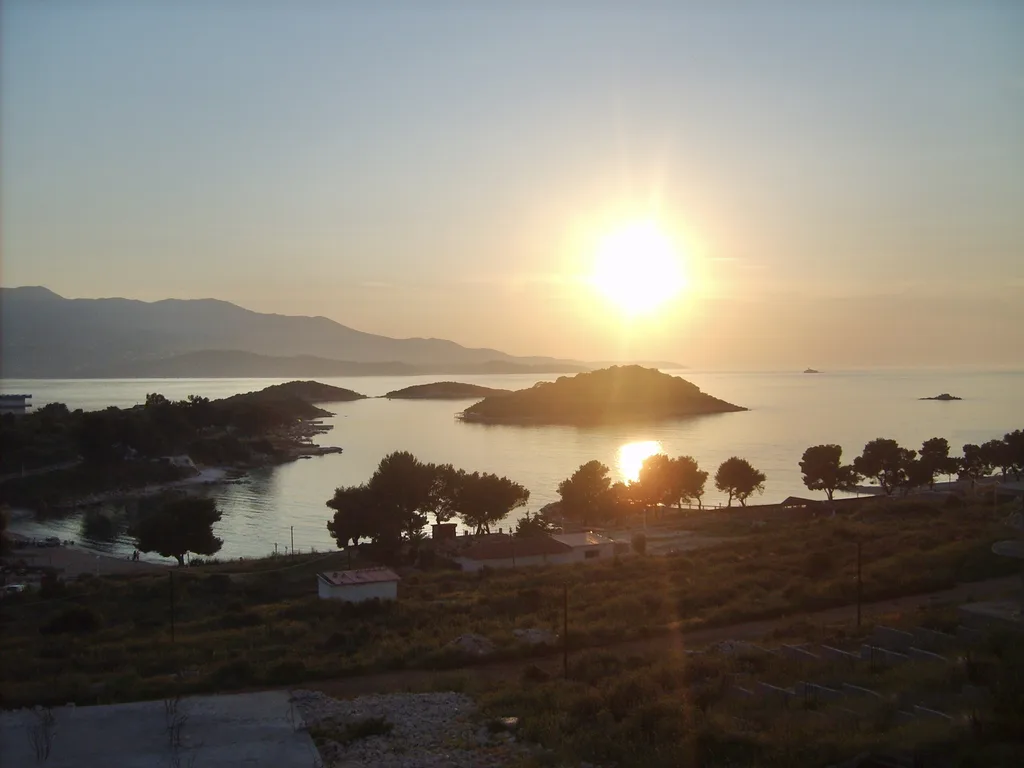
Fourteen kilometres south of Sarande, the coast produces the photographs that sell Albania. Ksamil is a village built around a scalloped bay of white sand and four small wooded islands, in water so clear and so improbably turquoise that the “Albanian Maldives” nickname, however lazy, is at least understandable. This is the beach the town beach is not — real sand, island views, swimming off the shore and out to the islets — and from a Sarande base it costs you a bus ride rather than a hotel change. Our dedicated Ksamil guide covers the village beach by beach; here, as with Butrint, the job is the day-trip logic.
The logic starts with the same coast-road bus that serves Butrint — Ksamil sits on the way, which is why the classic Sarande day out runs Butrint in the cool of the morning and Ksamil’s water in the heat of the afternoon, home for the xhiro. Ksamil’s beaches are mostly managed: rows of loungers and umbrellas run by beach bars and restaurants, with the sand between them parcelled out accordingly, so a beach day here is a small commercial arrangement rather than a towel on open sand. That suits most people perfectly well — lunch arrives at your lounger, the water is three steps away — but travellers dreaming of empty shores should adjust the dream before arrival, especially in August, when Ksamil absorbs the overflow of the entire region and its small bays fill to the waterline.
Timing is the whole game, and it is the same game as everywhere on this coast. In June and September Ksamil is close to perfect: warm sea, working beach bars, space to breathe. In high summer, arrive on an early bus, claim your spot, and leave before the afternoon crush peaks — or accept the crush as the price of the famous water in its famous month. And one detail the day trip teaches you on the drive down: the road passes the shore of Lake Butrint, where the rafts of the mussel farms stripe the lagoon — the same mussels that will be on your plate back in Sarande that evening, which is as neat a summary of how this coast fits together as any guide can offer.
Day Trip to the Blue Eye – The Spring With No Bottom
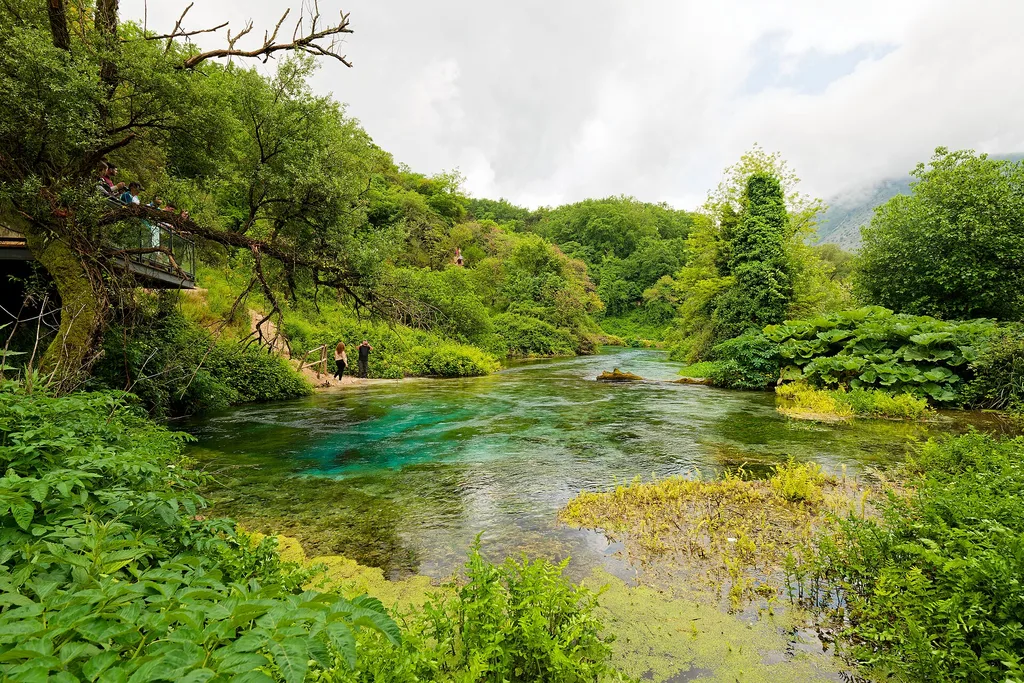
The third day trip turns its back on the sea. About twenty-two kilometres inland from Sarande, on the road towards Gjirokaster near the village of Muzine, a karst spring called Syri i Kalter — the Blue Eye — pushes cold water up out of the limestone in a wood of oak and plane trees. The spring is the source of the Bistrice river, which runs some twenty-five kilometres from here to the Ionian just south of Sarande, and it looks like its name: a pool of pale turquoise ringed around a centre of deep, dark blue, an iris around a pupil, where the water rises from a vertical shaft in the rock.
The numbers attached to the Blue Eye have a pleasingly unresolved quality. The flow is enormous — measured in thousands of litres a second, with published figures varying by season and source — and the water holds around ten degrees all year, cold enough to make the point without a swim. Divers have descended beyond fifty metres into the shaft and been turned back by the force of the rising water; the true depth is simply unknown, and the spring keeps its secret with some style. It is protected as a natural monument, and swimming in the pool itself is prohibited — the viewing platform exists so you can stand over the pupil and watch the water boil up out of the dark, which is spectacle enough.
As a day trip it is the gentlest of the three. The spring pairs with the Gjirokaster road: buses and furgons heading inland pass the turn-off, taxis make a simple run of it, and many travellers fold the Blue Eye into a Gjirokaster day or a transfer day rather than giving it a day of its own. In summer, come early — the site is small, the tour buses find it by late morning, and the woodland shade that makes it magical also concentrates every visitor into the same cool acres. Half an hour at the pool, a coffee by the cold river, and the road back to the sea: this sarande travel guide rates it the best short excursion in the south, and the one that proves Sarande’s radius reaches further than the coast.
Getting to Sarande and Getting Around
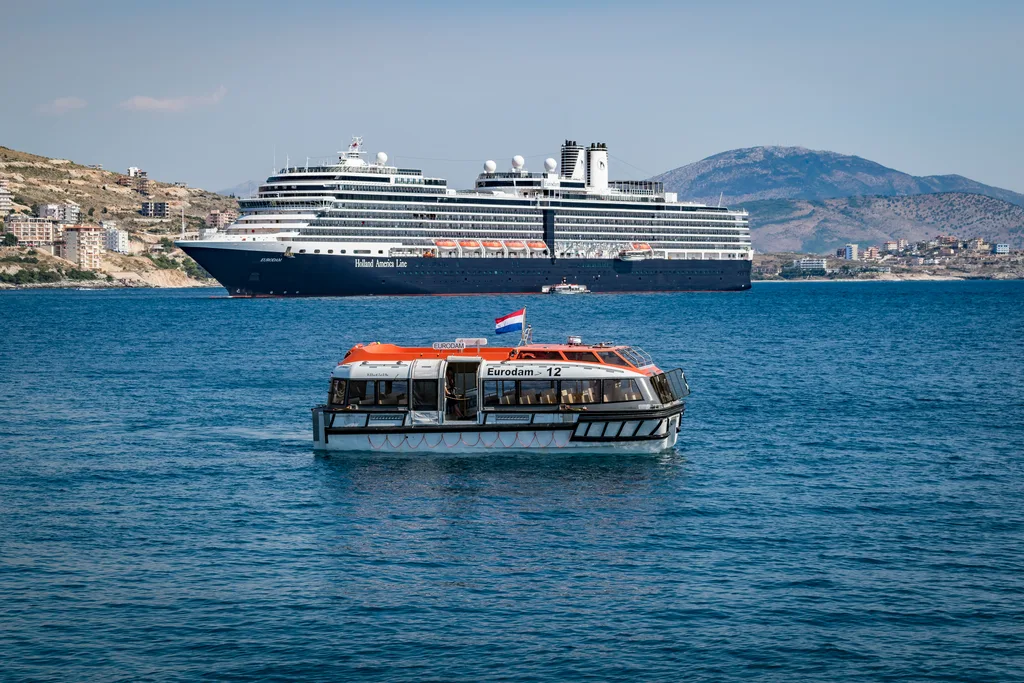
Sarande has more ways in than any town of twenty thousand people has a right to, and choosing between them is the first real decision of a trip. The Corfu ferry, covered in its own section above, is the international shortcut: fly to Corfu, cross in half an hour, arrive in the town centre. From inside Albania, the bus network does the work — coaches and furgons run from Tirana by two different roads, the inland route through Gjirokaster and the coastal SH8 over the Llogara Pass, and both take the better part of half a day; the coastal road is one of Europe’s great drives and the inland road is the practical one in bad weather. Gjirokaster itself is about an hour away by road, which is why the two towns are so often and so sensibly paired in one trip — our Albania itinerary builds exactly that southern loop day by day. Drivers arriving from Greece have a second door at the Qafe Bote crossing near Konispol, up from Igoumenitsa. And in summer the bay itself fills with cruise ships, whose passengers tender ashore for Butrint and are gone by evening — a fact worth knowing when you time the site.
Inside town, your feet do most of the work. The bay’s curve is flat and walkable end to end, the centre’s grid climbs but never defeats, and the only journeys that genuinely need wheels are the ones this sarande travel guide has already flagged: up to Lekuresi Castle, out to the Forty Saints hill, and down the coast. For those, the town runs on three systems. The coast-road bus covers Ksamil and Butrint and drops at the cove beaches on request. Taxis gather at the port and the main streets — agree the fare before you set off, as everywhere in Albania. And furgons, the shared minibuses that leave when full, stitch Sarande to the inland towns from the bus station’s cheerful disorder.
One warning belongs in this section rather than the downsides, because it is about roads rather than the town. The SH8 coast road south of Sarande is a single carriageway carrying every car, bus, tour coach and delivery van the region owns, and in July and August it slows to a crawl for hours at a time. Every day trip in this sarande travel guide runs on that road. Build slack into August plans, take early buses, and never schedule a tight ferry connection on the far side of a Saturday drive to Ksamil. The town cannot fix its one road; the traveller can at least refuse to be surprised by it.
When to Come – Sarande Season by Season
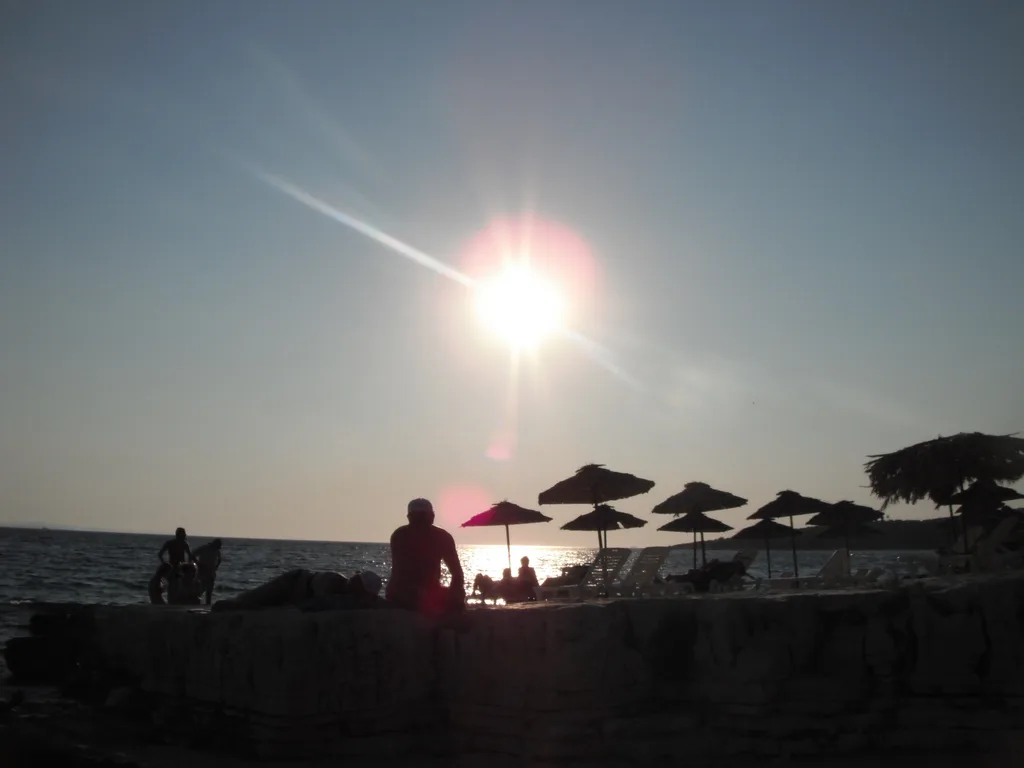
Sarande sells a climate, and for once the sales pitch is roughly accurate: a hot-summer Mediterranean regime, credited locally with around three hundred days of sun a year, with July and August afternoons averaging in the low-to-mid thirties and even January’s daily highs sitting in the low teens. The sea follows the air with a lag — coldest in late winter, bath-warm by August — and the town’s whole calendar is the negotiation between that warmth and the crowds it attracts. Choosing when to come is choosing which Sarande you want, because there are at least three of them.
The first is the connoisseur’s Sarande: May, June and September. The sea is swimmable and by September genuinely warm, every restaurant and boat is running, Butrint stands empty in the mornings, and the town has its working rhythm with a holiday gloss rather than a holiday siege. June is arguably the single best month — longest days, freshest water, thinnest crowds of the warm season. The second Sarande is high summer itself, July and above all August, when the town and the whole coast fill with the Albanian diaspora home from Italy, Greece and beyond: the atmosphere is a genuine festival, the xhiro runs to midnight, and everything — beaches, road, restaurants, ferries — operates at or beyond capacity. Some travellers love it. Nobody should meet it unbriefed.
The third Sarande is the quiet one, October to April, and it is more appealing than the Riviera’s reputation suggests. The sea gives up swimming by late autumn, the beach bars close, and the day-trip machinery slows — but the town itself carries on, the castle and the monastery stand in empty light, the ferry keeps crossing, and the coast road empties to a pleasure. Winter rain arrives in earnest spells rather than drizzle, and a sunny February week here, all promenade and empty ruins, is one of southern Albania’s underpriced pleasures — with the standing caveat that out-of-season timetables for boats and buses shrink, and every plan needs a margin. For the month-by-month picture across the whole country, our Best Time to Visit Albania guide does the national version of this section; what matters locally is simpler: Sarande has no bad season, only three different towns wearing one name.
Where to Stay in Sarande – Choosing Your Stretch of the Bay
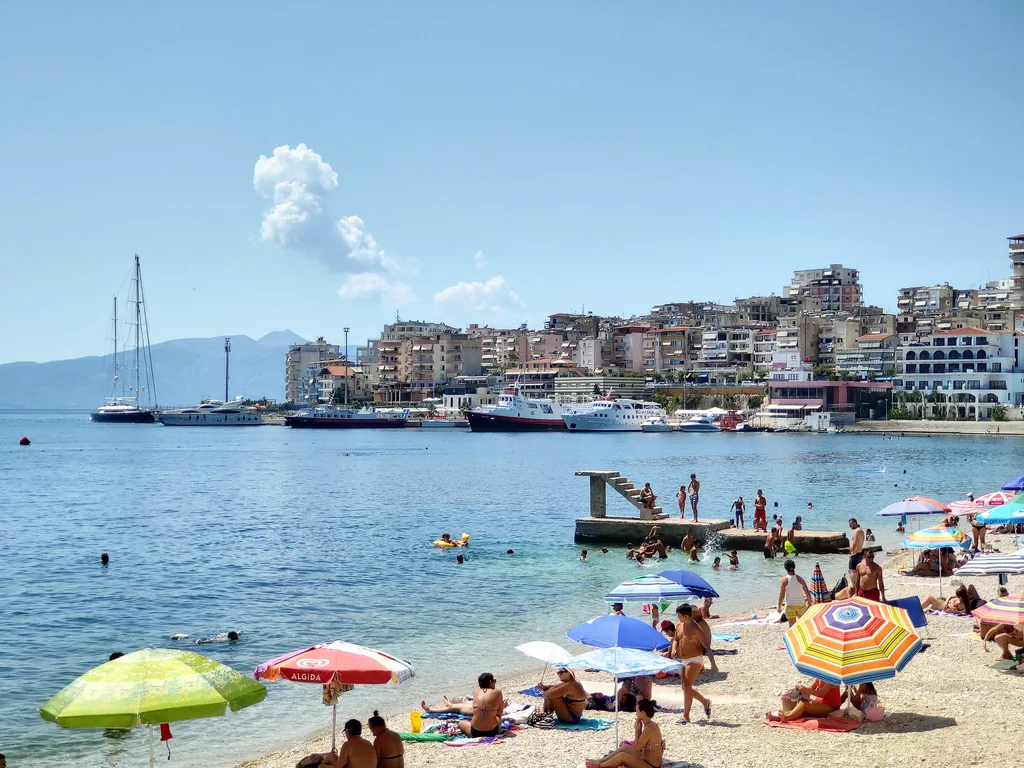
Sarande’s accommodation is one long argument about geography, because the town is one long curve. Almost everything stands along the bay or stacked up the hill behind it, and the right choice depends on a single question: do you want to walk to dinner in your evening clothes, or wake to the biggest possible view? The centre answers the first. The streets around the port and the town beach hold the town’s densest stock of hotels and apartments, from old-school seafront hotels to small family places a block back, and from them the promenade, the ferry, the bus station and the restaurant rows are all level walks. For a base-town stay built on machinery — ferries, buses, early starts — the centre is the answer, and its premium is noise: this is the town’s living room, and it stays up late.
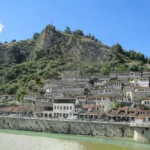
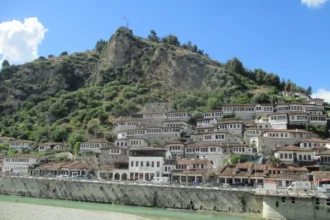
Climb one street and the equation changes. The hillside districts behind the seafront are where the apartment blocks stack up in terraces, and their upper floors buy the panorama in the featured photograph — the whole bay, the castle hill, Corfu — at the price of a steep walk home from every dinner. In summer heat that climb is a real cost, paid twice a day; travellers with cars, or with a view-first temperament, pay it gladly. Families and longer stays often land here almost by accident, because the hillside is apartment country, with kitchens and washing machines that the hotel strip does not offer.
The third option is to edge out of town along the coast road south, where a scatter of resort hotels and beach properties trade walkability for water — their own stretch of shore, quieter nights, a taxi or bus between you and the xhiro. For travellers whose Sarande is a beach holiday with day trips attached, that trade works; for travellers using the town as the working base this sarande travel guide assumes, it adds friction to every plan. Sleep in the centre for machinery, on the hill for the view, south for the shore — and if you are choosing among the country’s bases as a whole, our list of the best places to visit in Albania puts Sarande in its national context.
Eating in Sarande – Mussels, Fish and the Long Lunch
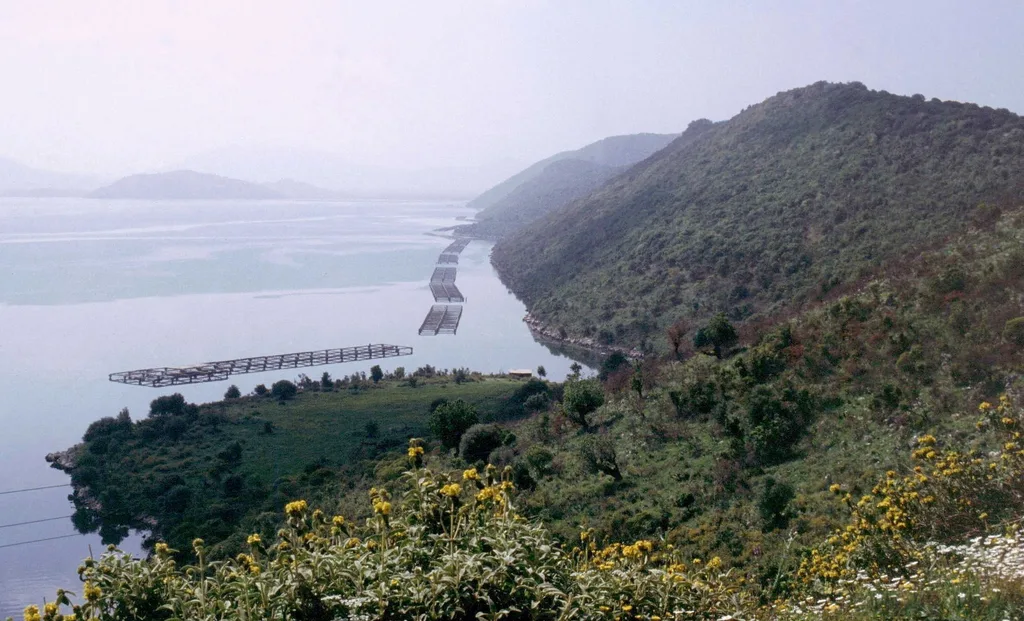
Sarande eats from two waters. From the sea come the grilled fish, squid and prawns that fill the promenade tavernas; from the lagoon behind the coast road comes the town’s signature — midhje, the mussels farmed on the rafts and ropes of Lake Butrint, served steamed, in pilaf, or baked with crumbs and lemon in every serious kitchen in town. A Sarande table that skips the mussels has skipped the point, and the neatness of the supply chain — farmed in the lake you drove past that morning, eaten above the harbour that evening — is the coast’s whole economy on one plate. Add the Albanian standards done properly in the inland streets — byrek still warm from the bakery, tavë from the oven, salads built on the region’s olives and tomatoes, raki that arrives with the confidence of a host rather than a menu — and the town eats far better than its resort reputation suggests.
The where of it follows the promenade rule from earlier. The seafront restaurants sell the view with the fish, and the best of them earn it: a sunset table, the strait turning gold, a plate of mussels and a cold white wine is one of the south’s reliable pleasures, charged at seafront rates and worth it on the evenings you choose it for. One street inland, the same kitchen culture runs at local prices in rooms full of Sarande families, where the menu is Albanian first and the portions assume you have been working. The town’s market, in the streets behind the harbour, supplies the self-caterers: fruit and vegetables from the villages, olives and oil, honey, mountain tea, cheese — the makings of the balcony breakfast that hillside apartments were invented for.
Two habits will serve you better than any recommendation list. Eat lunch like a local — late, long and serious — on days when the evening is for the xhiro, and let the promenade’s rhythm set dinner at nine or after, when the town itself sits down. And order the fish by asking what came in that morning rather than by studying the printed menu: a working harbour town’s menu is a formality, the catch is the reality, and a waiter who steers you to the day’s fish with pride is telling you the kitchen is honest. Sarande rewards that trust. It is a town that feeds its own people first, and the visitor who eats where and when they do is fed as one of them.
The Honest Downsides – Construction, Crowds and the August Problem
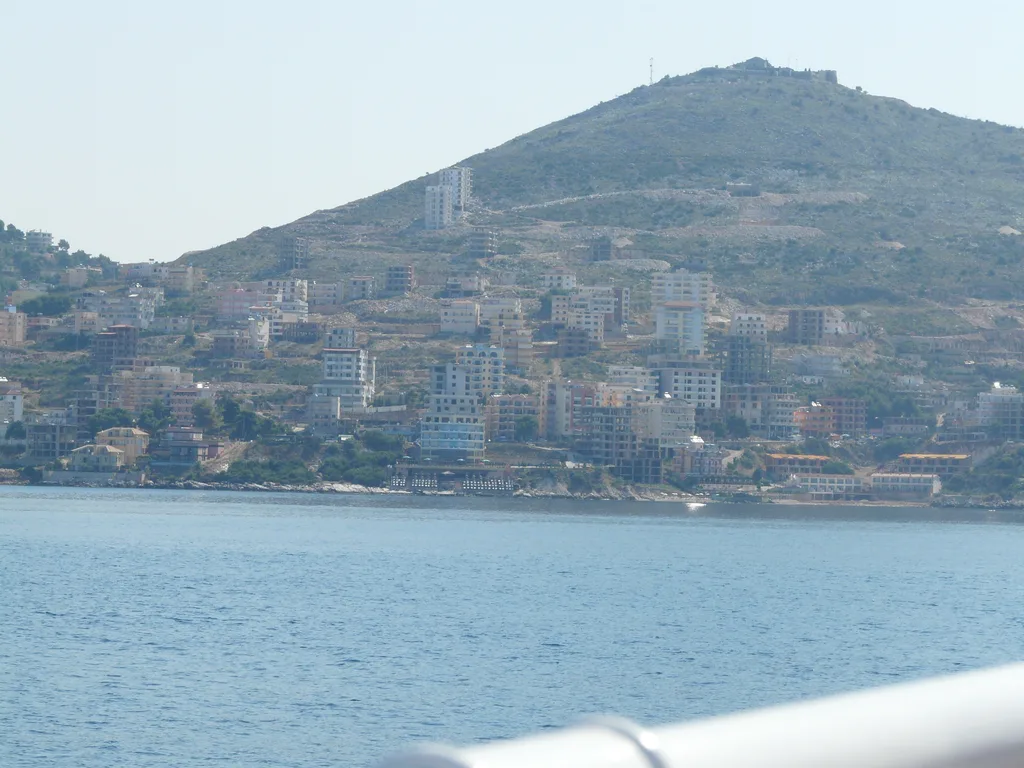
A guide that only sells this town is a brochure, so here is the other ledger, plainly. The first entry is the skyline. Sarande has been through a construction boom that even sympathetic accounts call uncontrolled — a wall of apartment blocks climbing every hill, cranes a permanent feature of the view, and a density of building that the town’s single coast road and small centre were never designed to carry. The boom has slowed and the newest building is tidier than the worst of the old, but nobody should arrive expecting a preserved Mediterranean town: Sarande’s charm is its life, not its architecture, and the photograph in this section is as much the town’s portrait as the sunset one.
The second entry is August. In the peak weeks the resident population is swamped several times over, the SH8 locks solid, Ksamil and the coves fill beyond comfort, the ferries and buses run full, and the town beach reaches standing-room density. Every mechanism in this sarande travel guide still works in August — but at half speed and double friction, and prices across the board harden at exactly the moment choice narrows. Travellers who can choose their month and choose August anyway should do so with open eyes: the festival atmosphere is real, and so is the cost of admission. The third entry is quieter but constant — seasonality’s hangover. Outside the summer the machinery shrinks: fewer boats, fewer buses, shuttered beach bars, restaurants on winter hours. It is all flagged in the seasons section, and it ambushes only those who planned a July trip in a February town.
And a last, honest word about the water, since beaches are why most people come. Sarande’s own shore, as the beach sections said, is a town beach beside a harbour — the famous swimming is down the road, and a traveller whose holiday is ninety percent beach should weigh Ksamil or the Riviera villages as a base instead, and read this sarande travel guide as a day-trip manual in reverse. None of these downsides cancels the town. They are the terms on which a real place, rather than a resort set, offers itself — and Sarande on honest terms is worth more than a dozen prettier, emptier promenades, because everything in this guide still stands at the end of the ledger.
Sarande Travel Guide – Frequently Asked Questions
Is Sarande worth visiting, or just a place to sleep? Both, in the right order. As a base it is the best address in the south — Butrint, Ksamil, the Blue Eye and Corfu all within day-trip reach — and as a place it has a castle, a famous ruined monastery, a working harbour and the region’s best evening promenade. What it is not is a beach resort; travellers who arrive expecting Ksamil’s water in Sarande’s bay are the ones who leave disappointed.
How many days do I need in Sarande? Three full days is the honest minimum this sarande travel guide works to: one for the town and the castle, one for Butrint and Ksamil together, one for the Blue Eye or a Corfu crossing. Four or five days lets the coast breathe — a cove beach day, a Gjirokaster excursion, an evening that is only a xhiro — and a week turns Sarande into a slow base rather than a checklist.
Can I visit Sarande as a day trip from Corfu? Yes — it is one of the classic short crossings of the Mediterranean, and the ferry mechanism section above explains how it works. Remember the two traps: it is a full international border with passport control on both sides, and Greece keeps its clocks an hour ahead of Albania, so read every timetable in the local time of the port it leaves from, and guard your margin for the last boat back.
Sarande or Ksamil – where should I stay? Stay in Sarande for machinery and life: ferries, buses, restaurants, a town that works all year. Stay in Ksamil for the sand itself, outside August, if the beach is the holiday and the day trips are the extras. Many travellers do both across one trip; many more base in Sarande and simply visit Ksamil, which is the arrangement this sarande travel guide recommends for a first trip.
Is the tap water and swimming safe in Sarande? The swimming off the town beach is the town’s daily summer habit, with the honest caveat from the beach sections: it is a harbour town’s shore, so swim at the central and southern stretches rather than beside the port, and take your serious swimming at the coves and Ksamil. For drinking, most visitors stick to bottled water out of caution rather than necessity.
How do I get from Sarande to Butrint and Ksamil? One coast-road bus serves both, in that order — Sarande, the cove turnings, Ksamil, and the Butrint entrance beside the Vivari Channel. Taxis do the same run for groups. The sections above give the day-trip sequencing: Butrint in the cool morning, Ksamil’s water in the afternoon, home for the evening stroll.
When is Sarande at its best? June and September, with May close behind — warm sea, full machinery, breathable crowds. August is the town at festival pitch and maximum friction at once; the winter town is quiet, cheaper and more local than most visitors expect. There is no wrong month, only a wrong expectation of which Sarande you are meeting.
Do people speak English in Sarande? In the tourism-facing town — hotels, tavernas, boat desks, ferry offices — yes, widely, with Italian and Greek often closer to hand than English among older residents. One street inland, Albanian and a smile do the work. The town has lived facing Greece for centuries and is entirely used to being understood across languages.
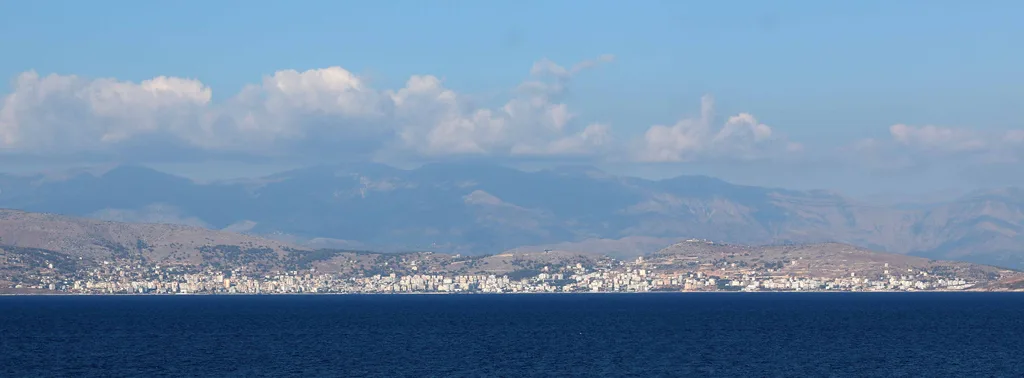
The Short Version of This Sarande Travel Guide
Sarande is the Albanian Riviera’s working capital and its smartest base: a harbour town of just under twenty thousand people, facing Corfu across a half-hour ferry ride, with a promenade that fills every evening for the xhiro and a castle on the hill that has watched the straits since 1537. Use it as the town asks to be used. Walk the seafront, climb to Lekuresi Castle for sunset, stand in the ruined basilica of the Forty Saints that gave the town its name, and swim off the town beach without pretending it is Ksamil. Then spend your days outward: Butrint’s wooded ancient city in the morning cool, Ksamil’s island water in the afternoon, the Blue Eye’s bottomless spring on the Gjirokaster road, and Corfu itself whenever the fancy takes you. Eat the mussels from Lake Butrint, eat late, and eat one street inland when the seafront premium palls. Come in June or September if you can, respect the August crush if you cannot, and let a real town — noisy, building, alive in every month of the year — show you how much better a base it makes than any resort strip. That is the whole of this sarande travel guide in one paragraph: Sarande is not the sight. Sarande is how you see everything else, and it is very good at its job.