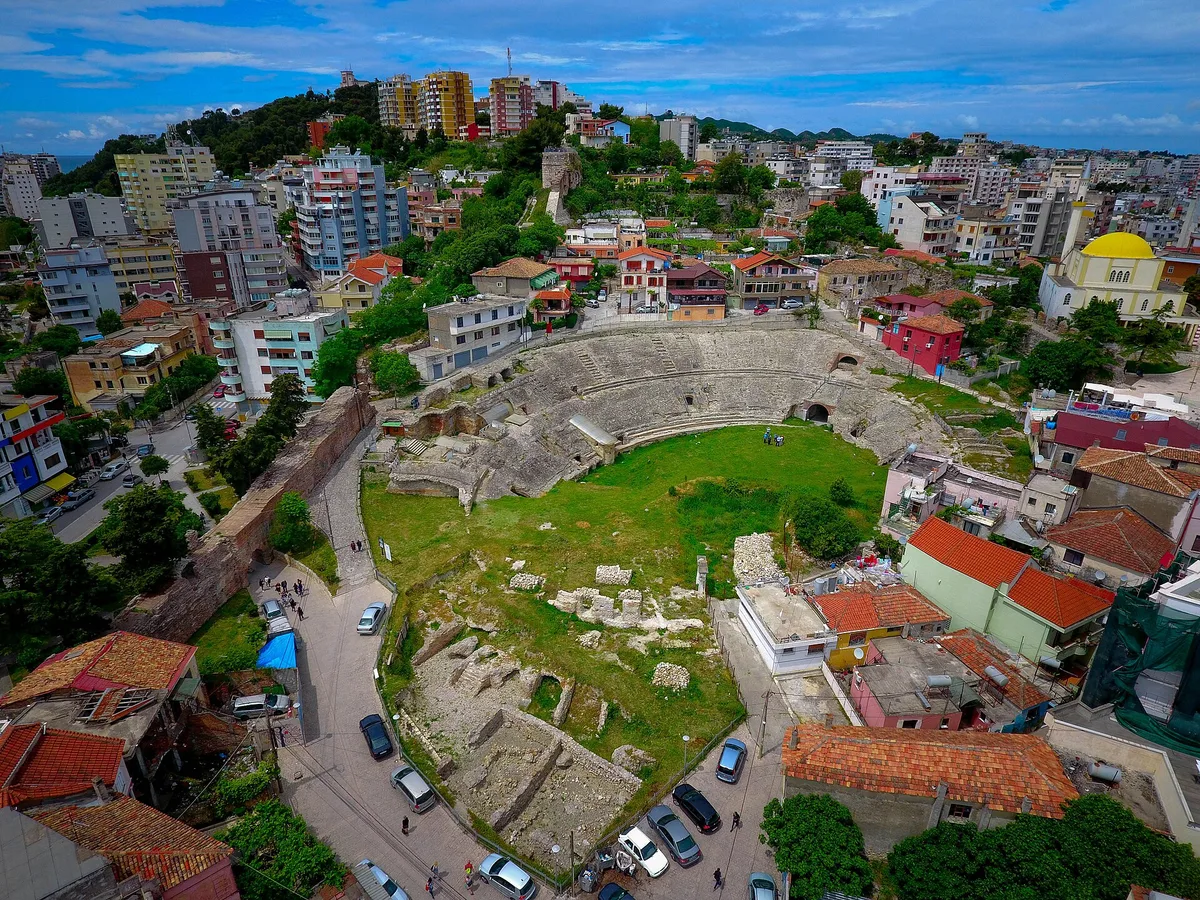
Most visitors meet Durrës through a windscreen. They land at Tirana airport, ride the motorway west, and see a long wall of beach hotels slide past before the road carries them on — south to the Riviera, or into the capital. What they have driven through, usually without stopping, is the oldest city in Albania: a Greek colony founded in the 7th century BC, the western end of the Via Egnatia, and a port that has been loading and unloading ships for roughly two and a half thousand years. This durres travel guide exists because the windscreen version of Durrës is the wrong one. Underneath the resort strip is a Roman amphitheatre big enough to seat a town, a Byzantine chapel painted with mosaics, and a working harbour city that Albanians themselves use, argue about and holiday in — which makes it more real, and in the end more interesting, than any postcard old town.
Set the expectation honestly before anything else. Durrës is not Berat or Gjirokastër. There is no preserved Ottoman quarter of cobbled lanes waiting for your camera, because Durrës spent the 20th century being what it still is: Albania’s main port, its second city, and the beach its own capital escapes to. The historic core is a scatter of heavyweight monuments — the amphitheatre, the Venetian Tower, stretches of Byzantine wall — standing among apartment blocks, cafes and traffic, not inside a museum fence. The beach, meanwhile, is a full-scale mainstream resort: kilometres of sand, umbrellas in military rows, and in August what feels like the entire country on one shoreline. A durres travel guide that pretends otherwise would send you to the wrong city. Come for the layering instead — Rome under the apartment blocks, a king’s villa on the hill, fish landed at dawn a short walk from a 5th-century wall — and Durrës rewards you properly.
So this guide is organised the way the city is organised. It starts with the shape of the place, then walks the monuments in the order most visitors meet them: the amphitheatre and the little mosaic chapel hidden inside it, the tower and walls, the archaeological museum that explains what the bulldozers keep finding, and the royal villa looking down on all of it. Then it does the job resort brochures will not do, and sorts the swimming honestly — the city beach, the locals’ shore at Currila, and the Golem sprawl to the south — before finishing with day trips, beds, food, ferries and the catches. For how Durrës fits into a first trip around the whole country, see our Albania travel guide; this page stays in the city.
Durres at a Glance – a Working Port with Rome Underneath
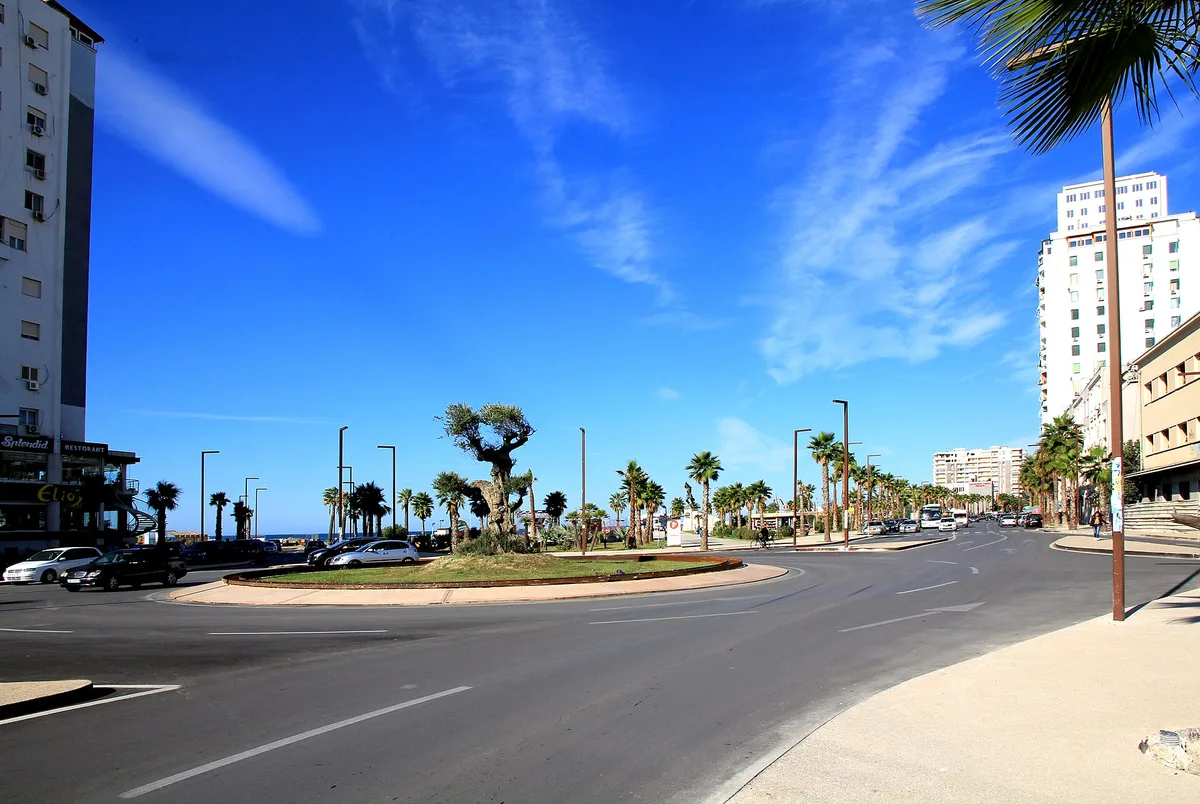
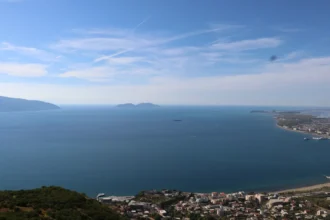
Durrës lies on a flat coastal plain at the south-eastern corner of the Adriatic, close enough to Tirana that the two cities nearly function as one urban system: the capital provides the airport, the government and the museums of state, while Durrës provides the sea, the port and the beach. Everything in the city runs off that relationship. The historic centre sits at the southern end of the bay, wrapped around the harbour — the amphitheatre a few streets inland, the tower and walls at the port’s edge, the museum and the Vollga promenade along the waterfront. From there the city unrolls north and then south in two different directions: north toward the headland at Currila, and south-east along the great curve of the bay into the beach district everyone simply calls Plazh, and beyond it Golem.
The names tell the story if you read them in order. Greek colonists from Corinth and Corcyra founded the city around 627 BC as Epidamnos, in cooperation with the local Illyrian Taulantii. Rome renamed it Dyrrachium, made it a major naval and military base, and started the Via Egnatia here — the great road east across the Balkans to Thessalonica and Constantinople, which made Durrës the door between the Adriatic and the empire’s east. The Byzantine emperor Anastasius I, born in this city, rebuilt its walls so massively that the historian Anna Komnene later wrote that four horsemen could ride abreast along the top. Venetians, Ottomans, a brief spell as Albania’s capital after independence, Italian occupation, communist industrialisation: each layer is still physically present somewhere in the street plan, which is why a durres travel guide has to be part history book whether it wants to be or not.
Who is Durrës for? Travellers who like their antiquity embedded in a living city rather than roped off from it; beach holidaymakers who want a real town behind the sand; and anyone using the city as what it has always been — a transport hub, with ferries to Italy and the whole country radiating out by road. Who is it not for? Travellers whose Albania is the Riviera’s clear southern water or the Alps’ empty trails, and who will read Durrës’s crowds and concrete as failure rather than character. They should pass through, by all means — but they should at least stop for the amphitheatre on the way.
The Amphitheatre – the Largest Roman Arena in the Balkans
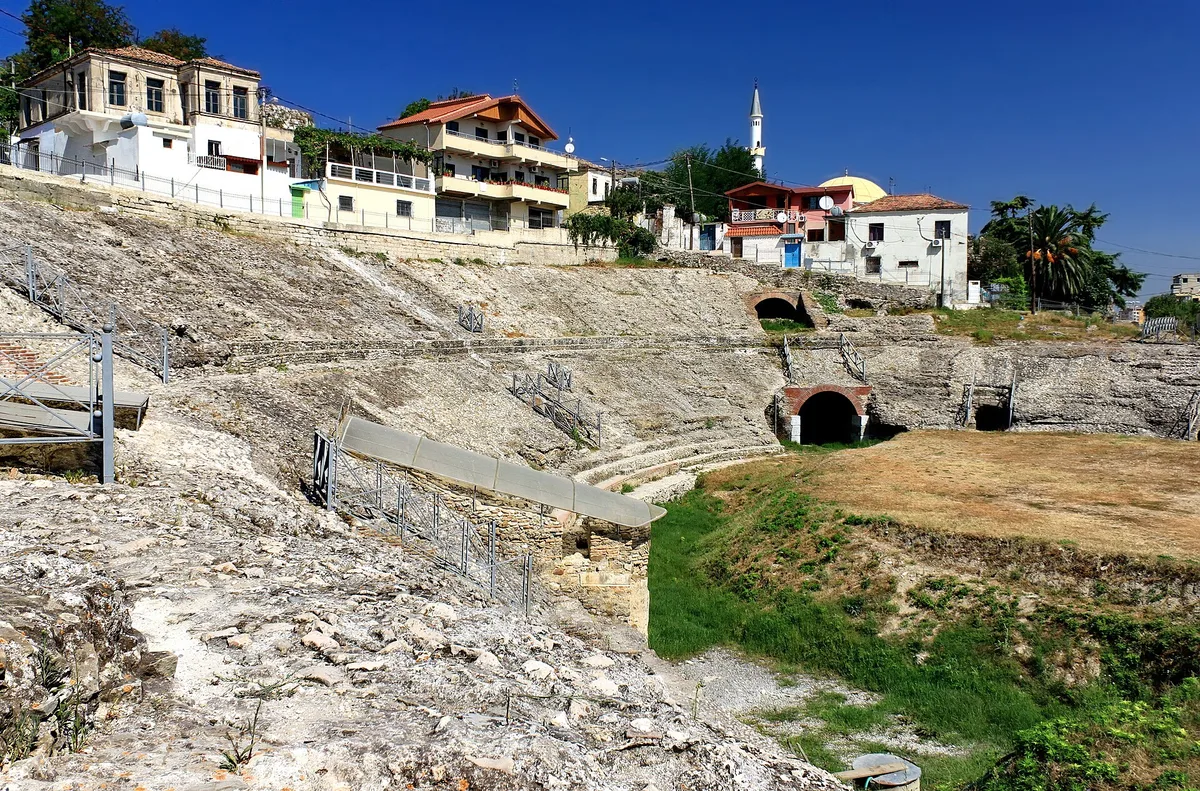
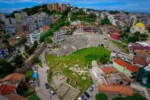
The amphitheatre announces itself the way it survived: accidentally. You walk down an ordinary residential street in the centre of Durrës, between apartment blocks and parked cars, and the ground simply opens into an enormous elliptical bowl of weathered stone — the largest Roman amphitheatre ever built in the Balkan Peninsula, raised under the emperor Trajan in the early 2nd century AD and capable, in its prime, of holding some 20,000 spectators. The figures, from the site’s own scholarship, are worth pausing on: axes of about 132 by 113 metres, an arena floor of roughly 61 by 42 metres, walls that once rose some 20 metres. Rome built bigger amphitheatres in Italy. It built nothing on this scale anywhere else in the Balkans, and it built it here because Dyrrachium mattered — the fleet, the road to the east, and a city rich enough to fill twenty thousand seats.
What you see today is a excavation in progress wearing the clothes of a ruin. The amphitheatre was used for performances until the 4th century, damaged by earthquakes in the 6th and 10th centuries, and gradually buried; houses were built over and into it across the following centuries, so thoroughly that its existence became local rumour. It was rediscovered only in late 1966, when a resident digging in his garden broke into a vaulted gallery, and the archaeologist Vangjel Toçi led the excavations that freed roughly a third of the structure across the 1960s and 1980s, with further work since. The rest still lies under the surrounding streets and homes — which is both the site’s frustration and its strange power. You are not looking at a cleaned-up monument. You are looking at a Roman arena in the act of being taken back from a modern city, one house at a time, and the houses still standing on the arena’s edge are part of the exhibit whether anyone planned it that way or not.
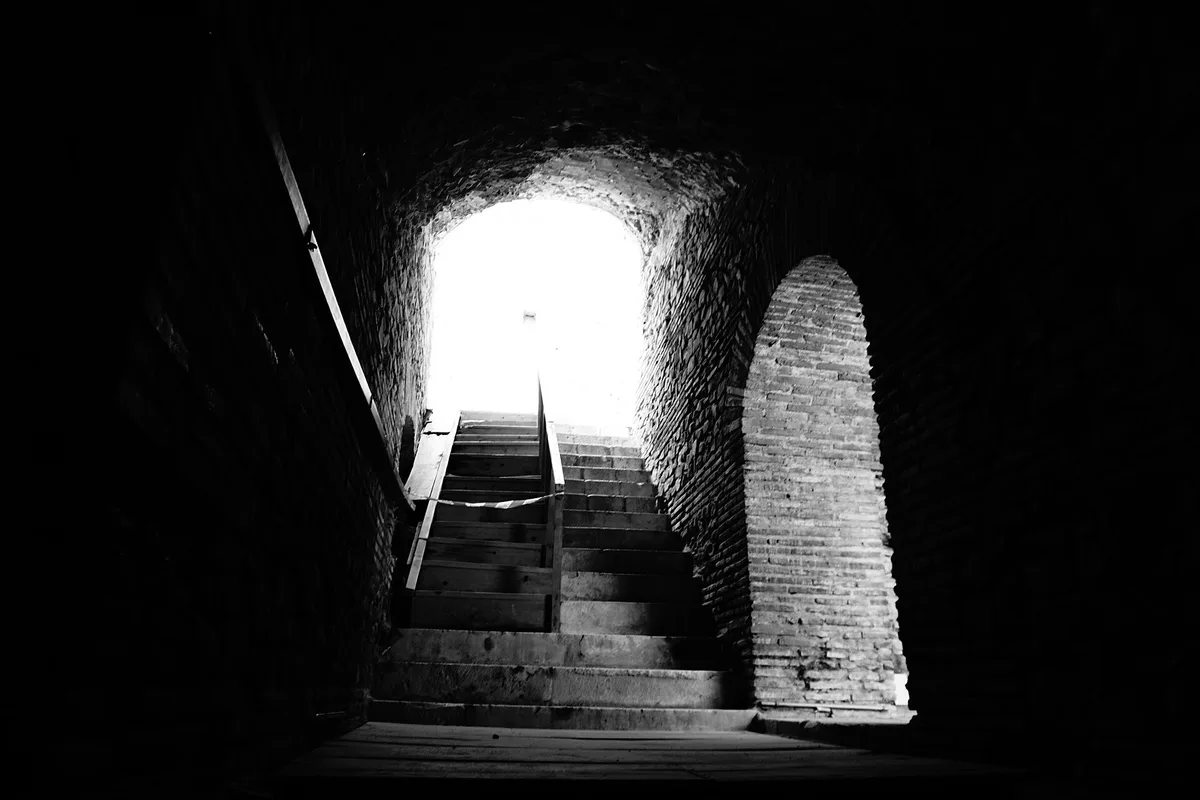
Practically, the visit works like this. You enter from the street side and descend into the bowl: the arena floor, the tiered seating banks surviving on the hillside side, and — the part visitors remember — the vaulted galleries and staircases inside the structure, cool stone corridors that carried crowds to their seats. The site functions as an open-air museum and occasional performance stage, and it is on Albania’s tentative list for UNESCO World Heritage status; Europa Nostra shortlisted it in 2013 among Europe’s most endangered heritage sites, which tells you the conservation story is unfinished. Give it the better part of an hour, go down into the galleries rather than only photographing from the rim, and read the amphitheatre together with the little chapel described next — in any honest durres travel guide, the two are one visit, and the chapel is the surprise inside the spectacle.
The Chapel in the Arena – Mosaics from the Amphitheatre’s Second Life
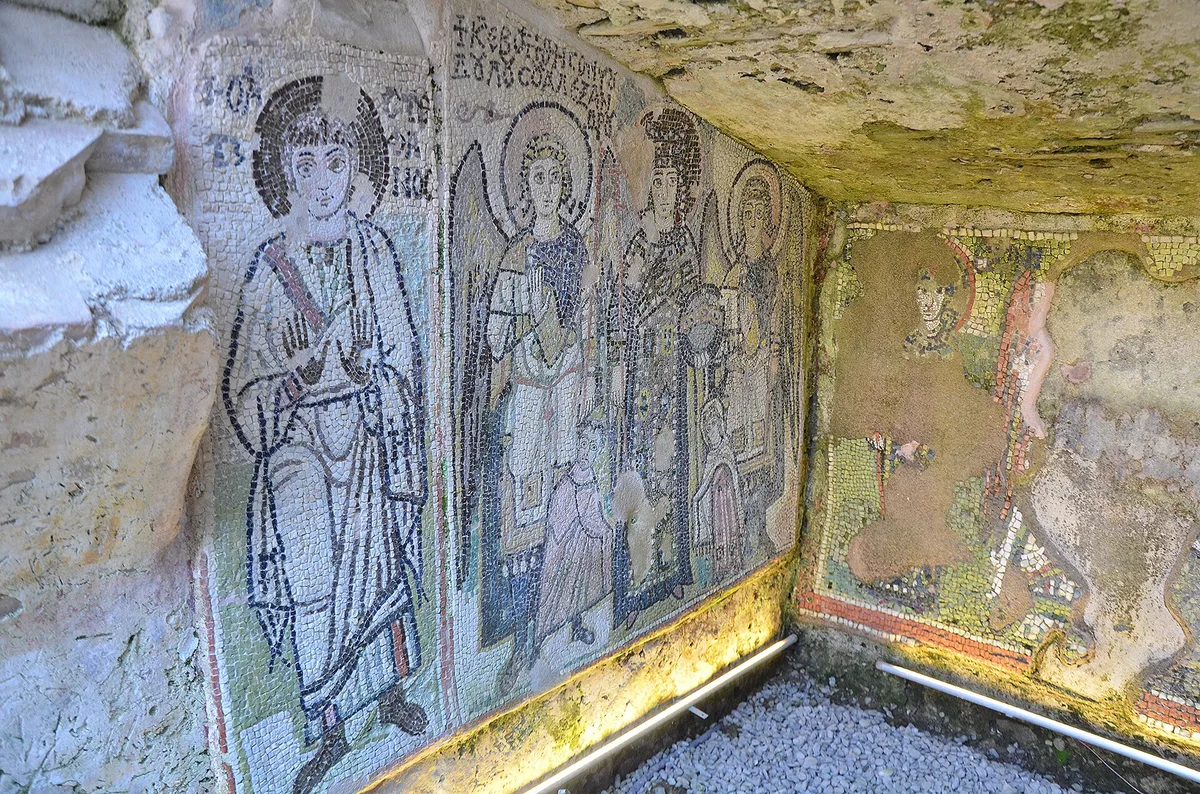
When the games ended, the amphitheatre did not simply empty. In the second half of the 4th century, after an earthquake had damaged the structure and the gladiatorial shows were closed down, an early Christian chapel was built into the fabric of the arena itself — a small apsidal mortuary chapel tucked into the galleries where spectators had once streamed to their seats. Its walls were first decorated with frescoes, and in the 6th century they were covered with mosaics: saints and religious scenes rendered in stone and glass tesserae, glowing dimly in a space that had been built for an entirely different kind of spectacle. A second, medieval chapel followed in the 13th century, also frescoed. Few ancient sites compress the turn from pagan Rome to Christian Byzantium into so small a space, and it happens here underground, in the gloom, at the scale of a single room.
The mosaics are the reason this durres travel guide gives the chapel its own section rather than a paragraph. They are among the most precious survivals of early Christian art in Albania, and also among the most fragile: the site’s own assessments note that the mosaics and paintings are slowly decaying, exposed to the same damp and development pressure that threaten the amphitheatre as a whole. What you see on a visit is therefore not a restored gallery piece but a working conservation problem — patches of vivid figure-work surviving on walls that have lost the rest, seen at close quarters in the chapel’s low light. It rewards slow looking. The figures emerge gradually: faces, robes, the formal frontal stare of Byzantine sacred art, executed for a congregation that worshipped inside the skeleton of the building where their grandparents’ generation had watched men fight.
Combine the chapel with the museum later in the day and the story completes itself: the museum holds the portable Durrës — the sarcophagi, steles and sculpture — while the chapel holds the part that could not be moved. Practical notes are simple. The chapel is inside the amphitheatre visit, reached through the galleries, and its surfaces are exactly the kind that suffer from touching and flash photography, so look with your eyes and leave the walls alone. If you only have time for one paid sight in Durrës, it is this combined one: the arena for scale, the chapel for soul.
The Venetian Tower and the City Walls – Reading the Fortifications
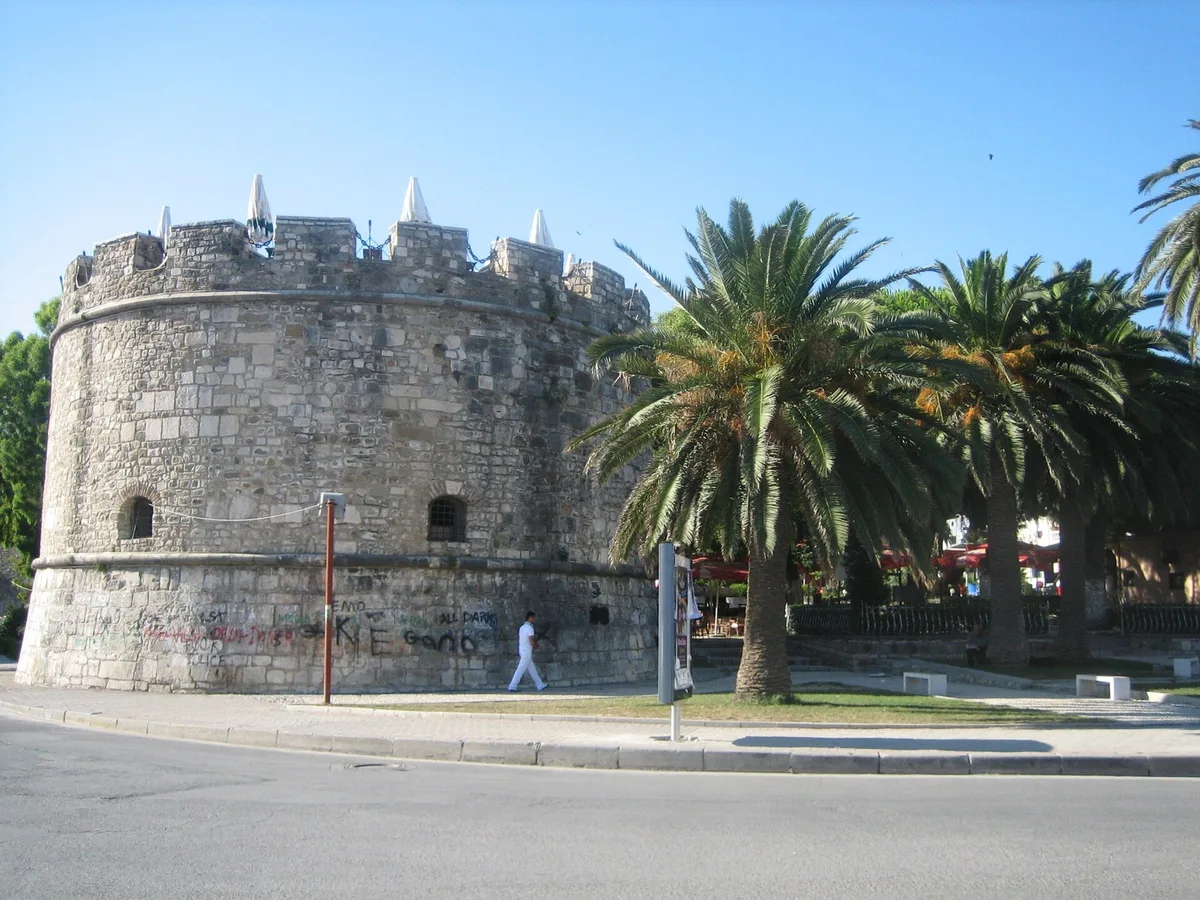
At the edge of the harbour, where the old town meets the port, stands the round stone stump of the Venetian Tower — the most recognisable survivor of the fortifications that once made Durrës, in Anna Komnene’s phrase, a city whose walls could carry four horsemen abreast. The walls themselves are older than the tower by a thousand years. The fortified circuit took its final ancient form in the late 5th century under Anastasius I, the locally born Byzantine emperor who made his home city one of the most strongly defended ports on the Adriatic. The medieval walls were shattered by an earthquake in 1273 and rebuilt; when the Venetians seized Durrës in 1392 they reinforced the circuit with guard towers, of which this harbour tower is the famous remnant. The city fell to the Ottomans in 1501, the walls were strengthened again under Ottoman rule, and today about a third of the circuit’s length survives in fragments — stretches of massive wall, a few entrances and tower bases — threaded through the modern streets near the port.
The tower’s most recent chapter is a restoration. In February 2022 a UNOPS project under the EU4Culture programme began work on the tower, with the stated aim of conserving it and turning it into Albania’s first heritage interpretation centre, with digital and classic displays explaining the city’s history. That is the right idea for Durrës, a city whose problem has never been a shortage of history but a shortage of explanation: the monuments stand in the open, largely unsigned, and the visitor is left to assemble them. Whether you find the tower open, mid-works or simply standing photogenically over the harbour traffic, treat it as the anchor of a short walls walk — from the tower, follow the surviving wall fragments through the old town’s edge, and you will pass, within a few hundred metres, the layers this durres travel guide keeps returning to: Byzantine engineering, Venetian repair, Ottoman reinforcement, and a modern city flowing around all three.
One honest caution about expectations. This is not Kruja’s intact citadel or Berat’s inhabited castle quarter. The Durrës fortifications are a ruin distributed through a working port district — a wall ending at a road, a tower between a cafe terrace and the harbour fence. Visitors who arrive expecting a preserved old town will be disappointed, and visitors who read the fragments as what they are — the bones of one of the Adriatic’s great medieval strongpoints, still standing in the city that grew over them — will find the walk quietly absorbing. It costs nothing but attention, and it pairs naturally with the museum, whose northern side actually incorporates a stretch of the 6th-century Byzantine wall.
The Archaeological Museum – the City, Dug Up and Labelled
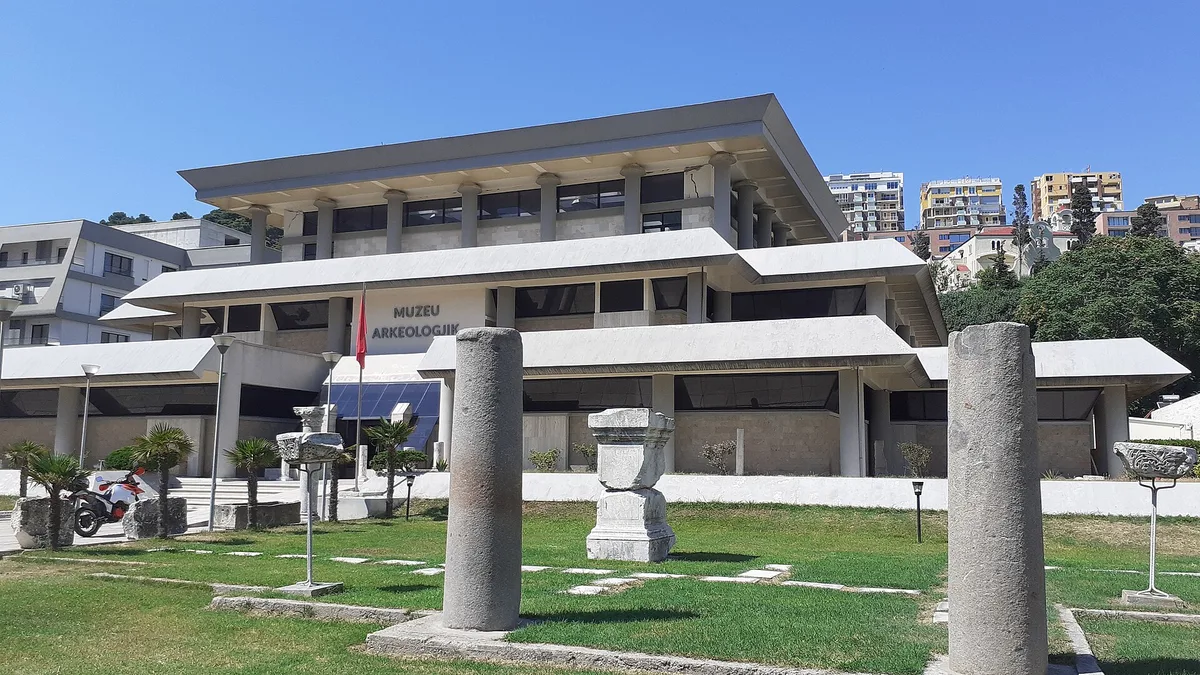
If the amphitheatre is Durrës experienced, the Archaeological Museum is Durrës explained — and in a city where the monuments arrive without labels, the explanation is half the visit, and this durres travel guide leans on it accordingly. The museum stands on the Taulantia street along the waterfront, a short walk from the tower, and it is the largest archaeological museum in Albania: established in 1951 on the initiative of Vangjel Toçi, the same archaeologist who would later excavate the amphitheatre, and reopened on 20 March 2015 after four years of closure and rebuilding. Its collection runs to some 3,200 artefacts, almost all of them found in and around ancient Dyrrhachium, and the displays work chronologically — prehistory and the city’s Greek foundation, the Hellenistic centuries, and then the full weight of Roman Dyrrachium, when this was one of the great ports of the empire’s eastern roads.
The exhibits most visitors carry away are the heavy ones: Roman funerary steles and massive stone sarcophagi, carved with the confidence of a rich port city; amphorae and anchors raised from the seabed, evidence of the harbour trade that paid for everything else; and a much-photographed collection of miniature busts of Venus, testimony that ancient Durrës was a centre of the goddess’s worship. The city’s single most famous ancient artwork, the 4th-century BC pebble mosaic known as the Beauty of Durrës, was found here too — a reminder that the Greek colony was wealthy and artistically serious centuries before Rome arrived. The museum’s own building makes the city’s point one more time: a stretch of 6th-century Byzantine wall is built into its northern side, so the container is also an exhibit.
Plan the museum as the middle of a history day, not an afterthought: amphitheatre and chapel in the morning, museum after, tower and walls in the evening light. It is the one place in the city where the full 2,500-year sequence is laid out in order, with the portable objects that the open-air sites cannot show you, and an hour inside will reorganise everything you have seen outside — you will walk back past the wall fragments recognising them. This durres travel guide’s verdict is plain: of all Albania’s regional museums, this is the one that justifies its superlative, and skipping it while touring the ruins is like reading a novel’s chapters out of order.
The Royal Villa – King Zog’s Palace Above the Port
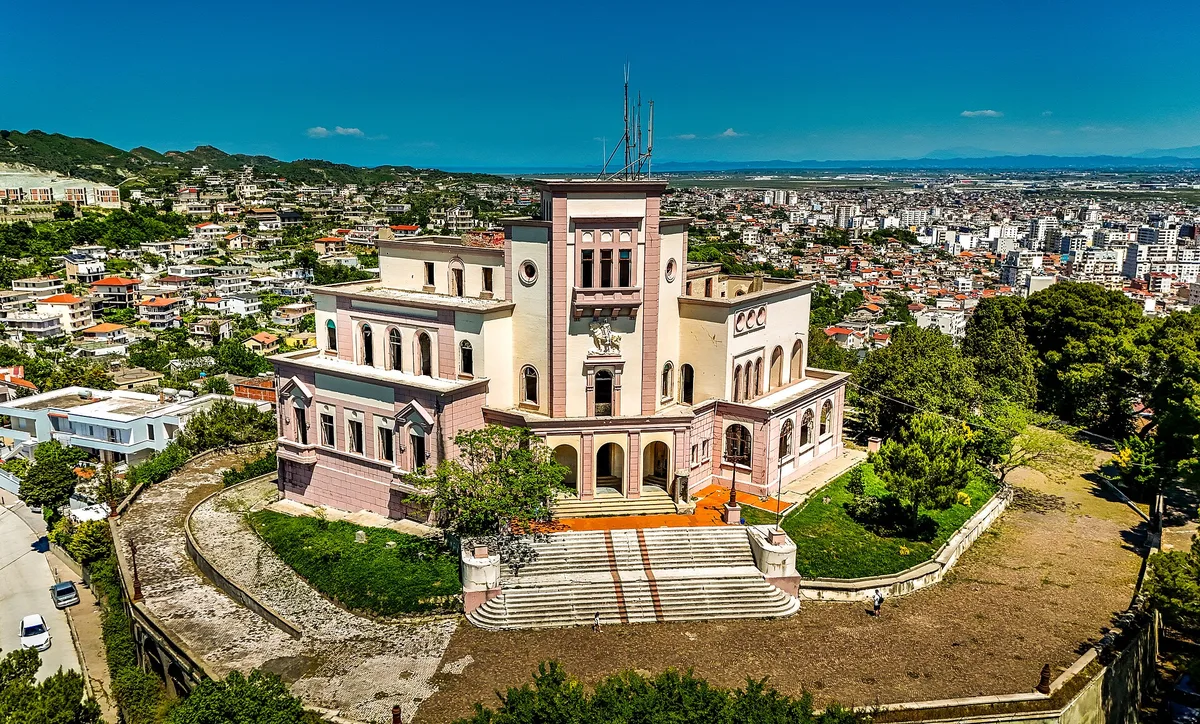
Every Durrës photograph taken from the water has the same pale shape on the hill behind the port: the Royal Villa, known to everyone as Vila e Zogut, the summer residence of King Zog I. It stands on Kodër Vilë, a hill rising about 98 metres above the bay, and it was the most ambitious building project of Albania’s short monarchy. Construction began in June 1927, shortly after Zog took power — an earlier palace on the site, designed by the Albanian architect Kristo Sotiri, was wrecked by the 1927 earthquake — and the definitive villa, by the Italian planner Florestano Di Fausto in a monumental Rationalist style, was completed in 1937, months before Zog’s marriage to Queen Geraldine. Its stepped, pyramidal massing climbs to a central belvedere tower, its ceremonial hall had a marble floor inlaid with the double-headed eagle, and commentators have long noted that the ground plan itself was said to echo the eagle’s shape.
The villa’s afterlife is the melancholy part of the story, and this durres travel guide will not tidy it up. Zog fled the Italian invasion of April 1939; the villa housed Italian and then German occupation officials, and under communism it became a closed state guesthouse that received, among others, Nikita Khrushchev. In the civil unrest of 1997 it was looted and stripped — marble, parquet and fixtures torn out — and although the property was later returned to the royal family, it has remained largely closed since the 2000s, its interiors heavily degraded though the structure is sound. In 2025 a private initiative, agreed with the royal family, announced a full restoration to its 1939 appearance and an eventual opening to visitors. Until that happens — if it happens — the villa is a sight, not a visit: you admire it from the city and the bay, and walk the hill roads below it for the panorama it was built to command.
That limitation is worth stating plainly because listings sometimes blur it. There is no ticket, no tour and no promised access; the hill is a viewpoint and the villa is its crown, best appreciated at the golden hour when the pale façades catch the light over the harbour. Pair it with an evening on the Vollga below and you have the two poles of Durrës in one frame: the king’s abandoned palace above, and the people’s promenade at the waterline, full every night of the year.
Vollga and the Port – the Waterfront the City Actually Uses
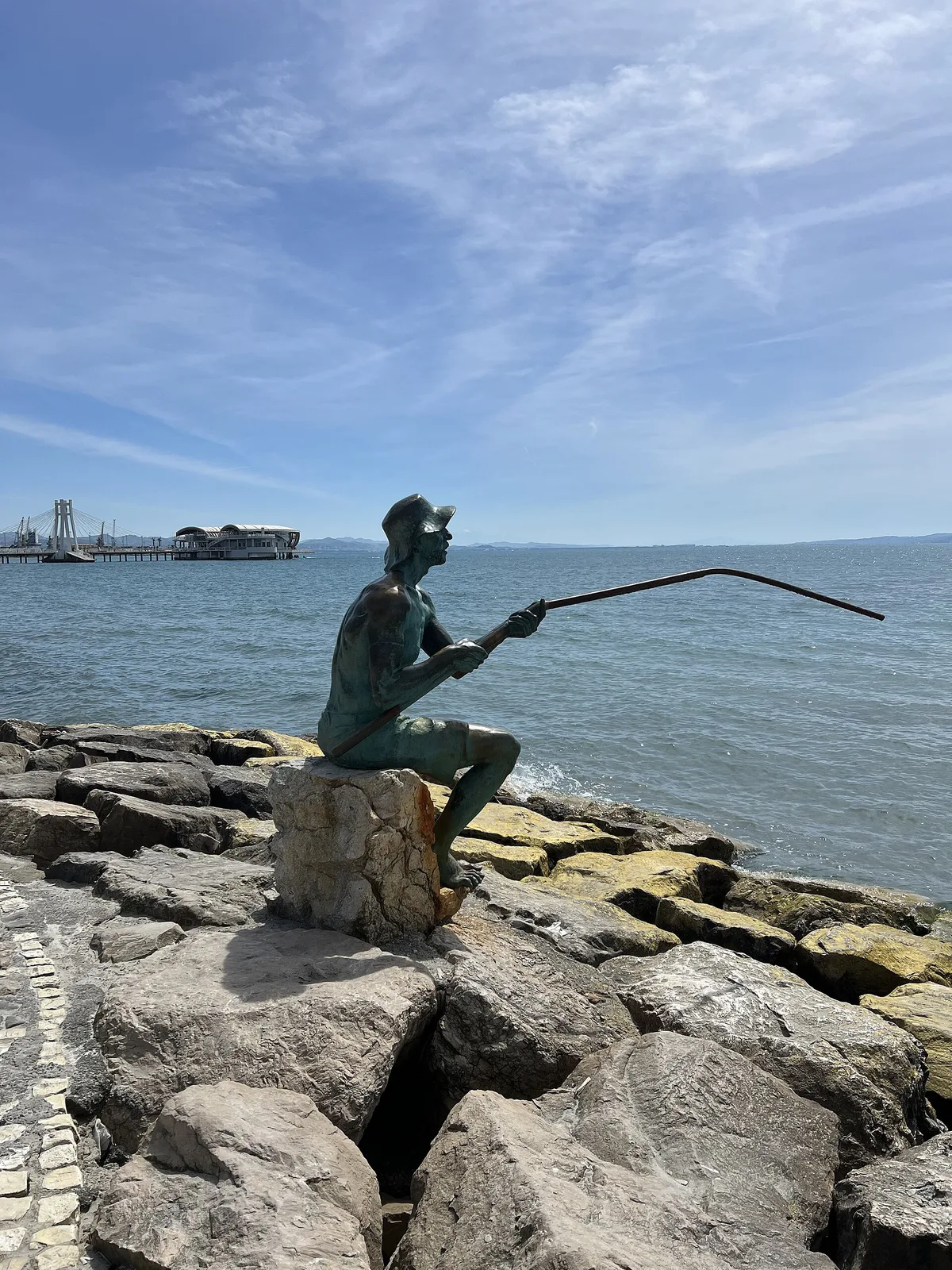
Ask a Durrës resident where the city meets the sea and they will not point you to the beach resort. They will point you to Vollga — the seafront promenade district along the harbour’s edge, named, in the Albanian spelling of the Russian river, during the years of the Soviet alliance, and rebuilt since into the city’s front room: a broad paved waterfront of cafes, benches, monuments and evening crowds, with the working port at one shoulder and the beach curve opening at the other. This is where Durrës performs the Mediterranean ritual of the xhiro, the evening stroll, in full strength — families, teenagers, fishermen with rods over the harbour wall, and the ferries sliding in and out of the port behind the fence.
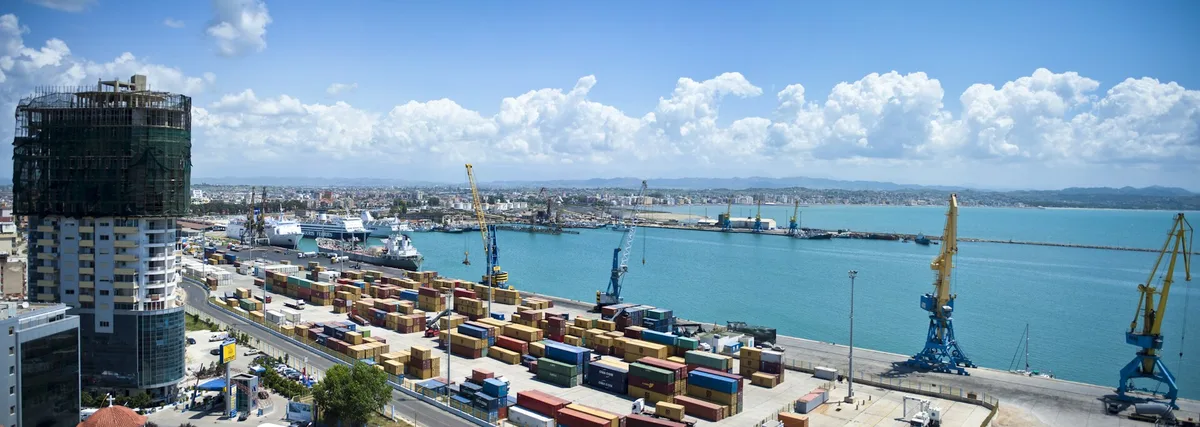
The port itself deserves a clear-eyed paragraph, because it is the reason the city exists. The Port of Durrës is Albania’s principal harbour and one of the largest on the Adriatic — a working world of cranes, container stacks, fishing boats and the big Italy ferries, which connect Durrës with Bari, Ancona and other Italian ports across the narrow sea. It is not a marina and it is not picturesque in the yacht-harbour sense; it is infrastructure, fenced and busy, and its charm is the charm of a place where real cargo still moves. For the traveller, the port matters three ways: as the ferry gateway covered later in this durres travel guide, as the source of the fish on every menu in town, and as the honest backdrop that keeps Durrës from ever feeling like a resort that was built for you.
Spend your Vollga time the way the city does. Come at the end of the afternoon, when the light comes off the water and the amphitheatre crowds have gone; walk the promenade’s length, watch the ferry operations if a sailing is moving, and settle at a cafe for the hour when the whole population seems to be out at once. The monuments cluster nearby — museum a few streets away, tower at the promenade’s end — so Vollga also works as the hinge of the history day, the place to decompress between the museum and dinner. It is, in the best sense, ordinary: the sight here is the city itself, off duty.
The City Beach – Plazh, the Great Curve of Sand
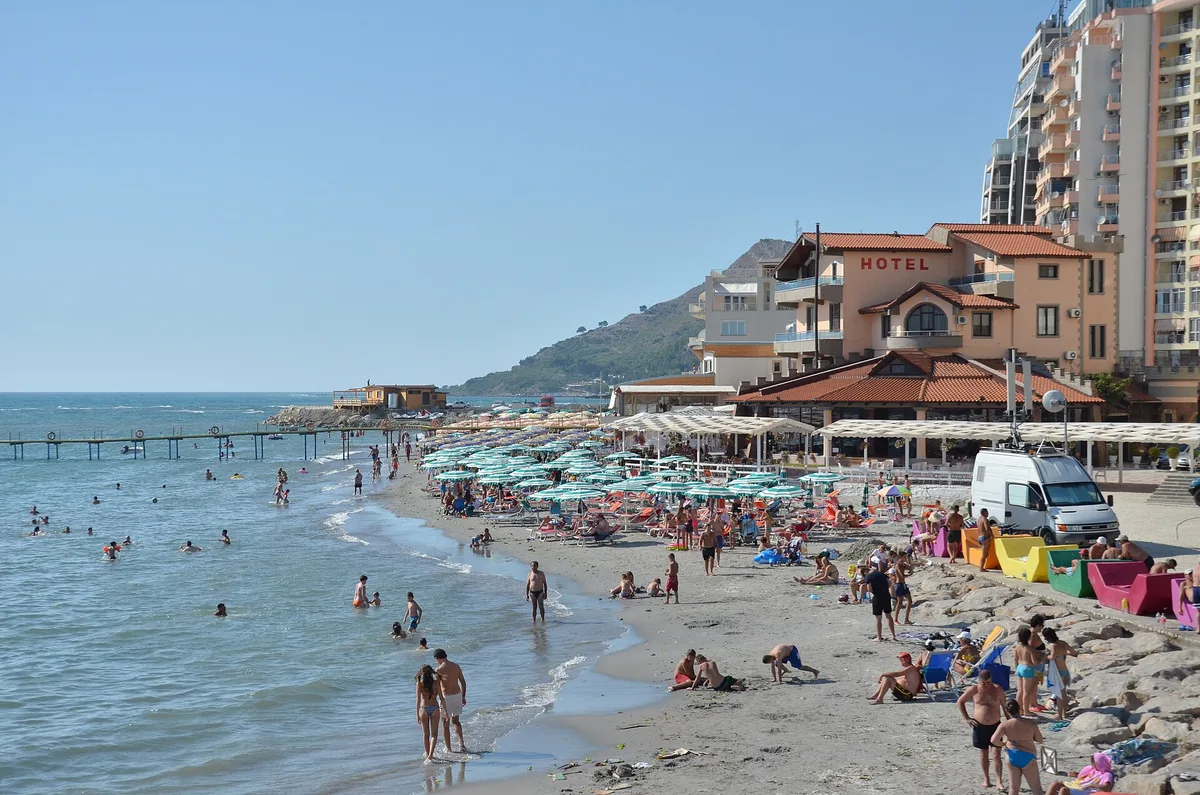
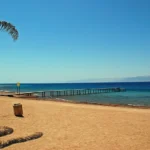
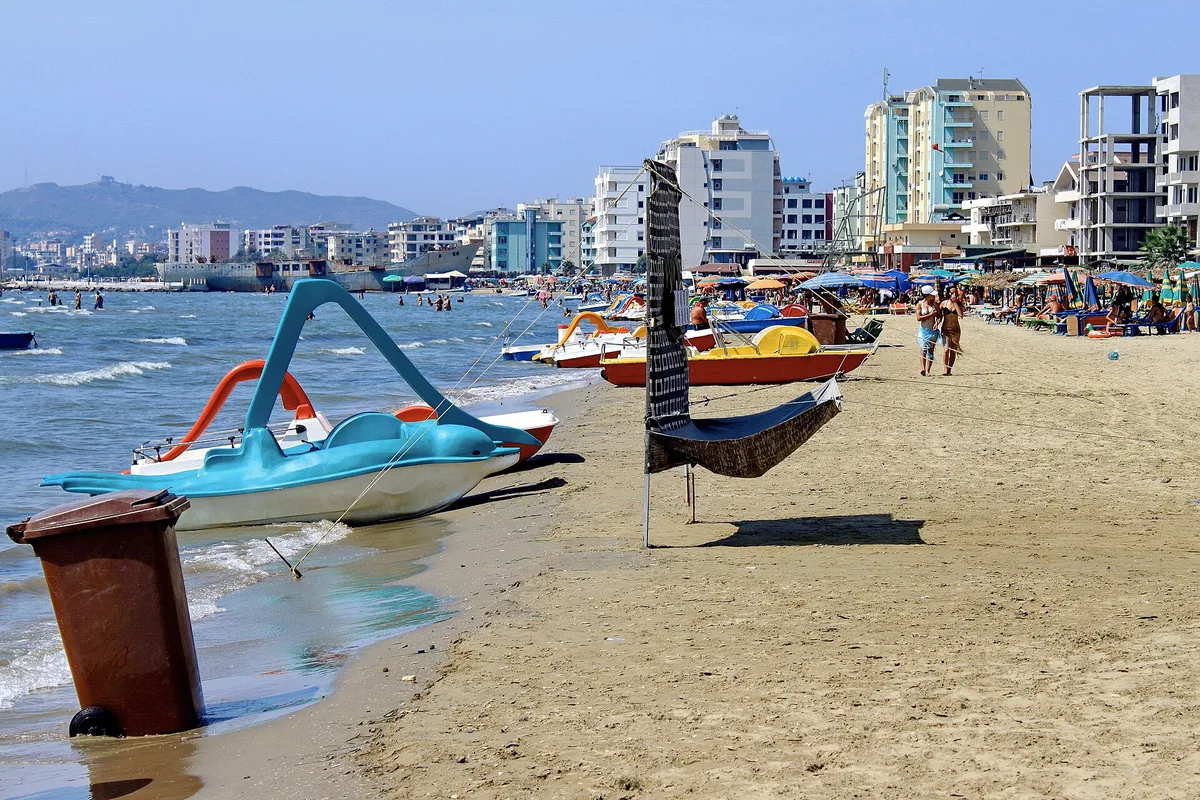
South-east of the harbour, the bay opens into the beach that made Durrës famous at home: Plazh, the city’s own resort strip, a long, gentle curve of sand running for kilometres from the edge of the centre toward Golem. Understand what this beach is and you will enjoy it on its own terms. It is a classic urban Adriatic beach — wide, sandy, extremely shallow for a long way out, backed by a dense front line of hotels, apartment blocks, cafes and beach clubs, and serviced in season by row upon row of rented umbrellas and loungers. The shallowness is the point for its core clientele: families with small children, who can wade far out in warm, calm water, and the generations of Kosovars and Macedonians as well as Albanians who have made a Durrës fortnight the standard summer holiday of the region.
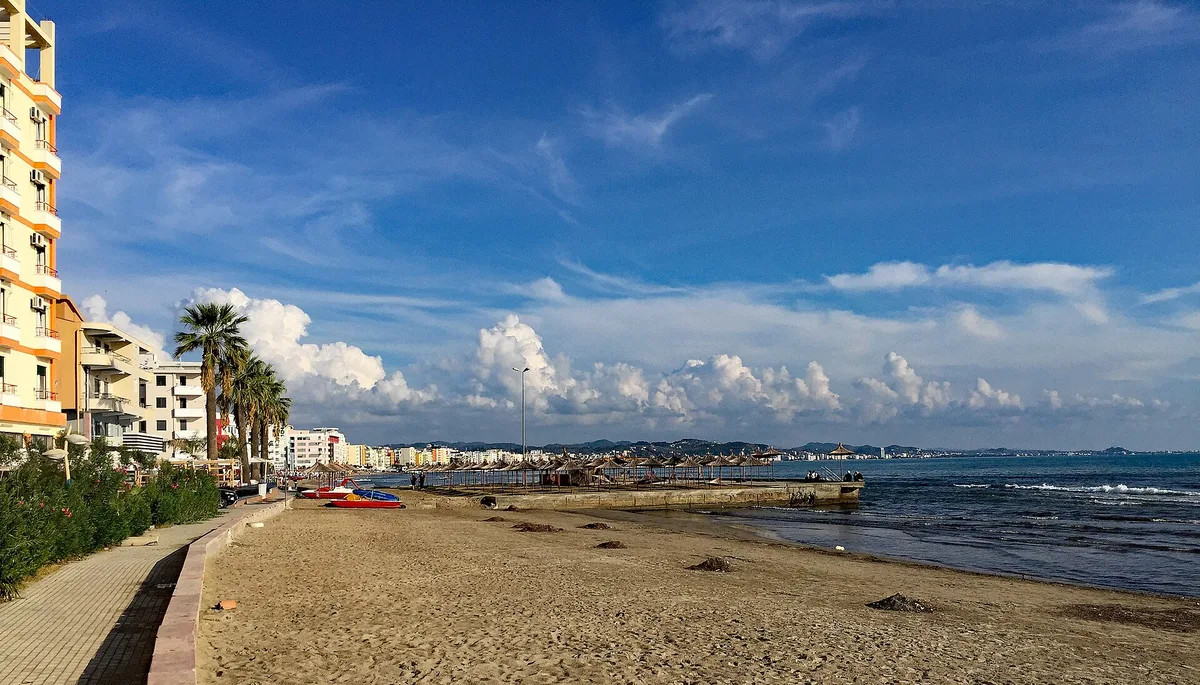
The honest sorting this durres travel guide owes you runs as follows. The water here is the sheltered bay’s water: warm, gentle and made for paddling rather than for the crystalline swimming of Albania’s Ionian south — anyone arriving from Ksamil or the Riviera will notice the difference, and anyone with toddlers will call it a fair trade. The sand is real sand, the infrastructure is total — food, drink, showers, entertainment and the promenade economy all within metres of your umbrella — and the price of all of it is company. In high season the strip is as crowded as any major Mediterranean resort beach, the umbrella rows run to the waterline, and the soundtrack is music, vendors and several thousand holidays happening at once. Out of season the same shore empties dramatically and becomes a fine, melancholy walking beach.
Practical logic follows from the character. Stay on the strip if the beach is the holiday and you want everything at the door; come early in the day for choice of spot and the calmest water; expect to rent the umbrella-and-lounger set from the operator working your stretch, at the season’s going rate checked on the day; and do not judge Albania’s swimming by this bay alone — judge this bay as what it is, the capital region’s beloved, boisterous front beach, and take the clearer-water excursions described below when you want them.
Currila – the Locals’ End of the Bay
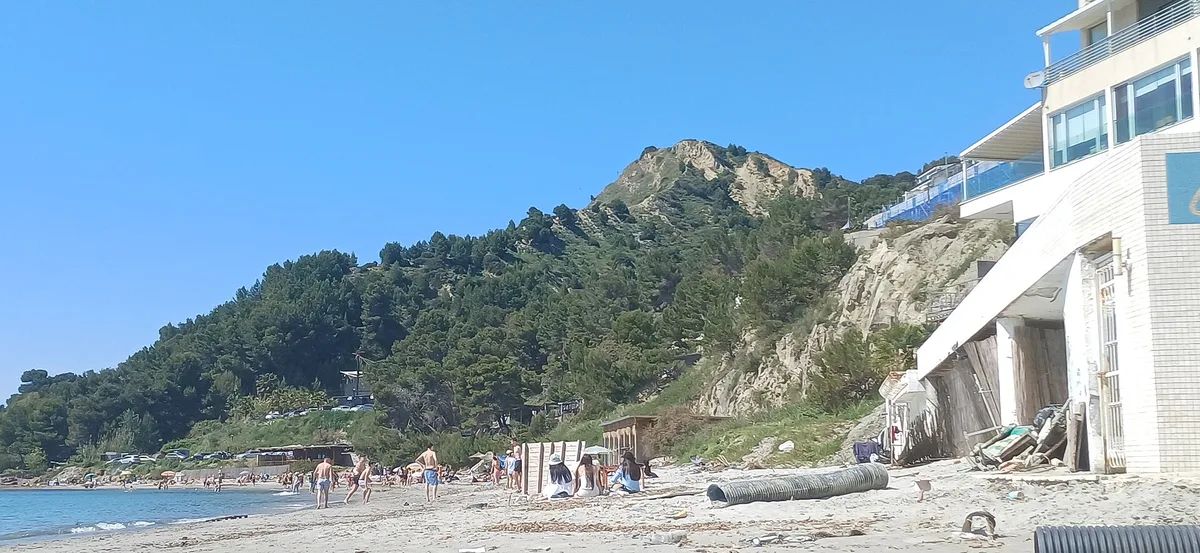
At the northern end of the city, where the bay starts to close around the headland, lies Currila — the shore Durrës keeps for itself. The character changes completely from Plazh. The beach here is smaller and greener, backed by pine-covered slopes rather than hotel towers, and the water deepens faster than the southern shallows, which is precisely why locals who actually swim prefer it: this is the end of the bay where a proper swim, rather than a paddle, is the point of the day. Beach clubs and cafes work the shore in season, the road climbs around the headland with views back over the city and the port, and the whole strip feels like the town’s own seaside rather than an industry.
Currila is the section of this durres travel guide written for the traveller staying in the centre. You are based in the city for the archaeology and the evenings; you want a swim without moving hotels or driving the Golem road; Currila is your answer, a short hop from the centre to a shore with a different register — deeper water, pine shade, a younger and more local crowd. It is not a secret and it is not empty in August, when the whole region is at the sea; but it is measurably calmer than the Plazh strip, and the headland setting gives it the best sunset geometry in the city, the sun going down over open water with the port lights coming on behind you.
Go in the late afternoon if you can only go once: swim while the water is still warm, then stay for the evening, when the clubs turn from beach mode to drinks mode and the city spreads its lights along the bay. If your holiday is a beach holiday pure and simple, base yourself on the strip instead and treat Currila as an excursion; if your holiday is Durrës itself, Currila is likely to become your default shore. Either way it is the clearest demonstration of the city’s two-coast personality — resort to the south, home water to the north.
Golem – the Southern Sprawl, Honestly Described
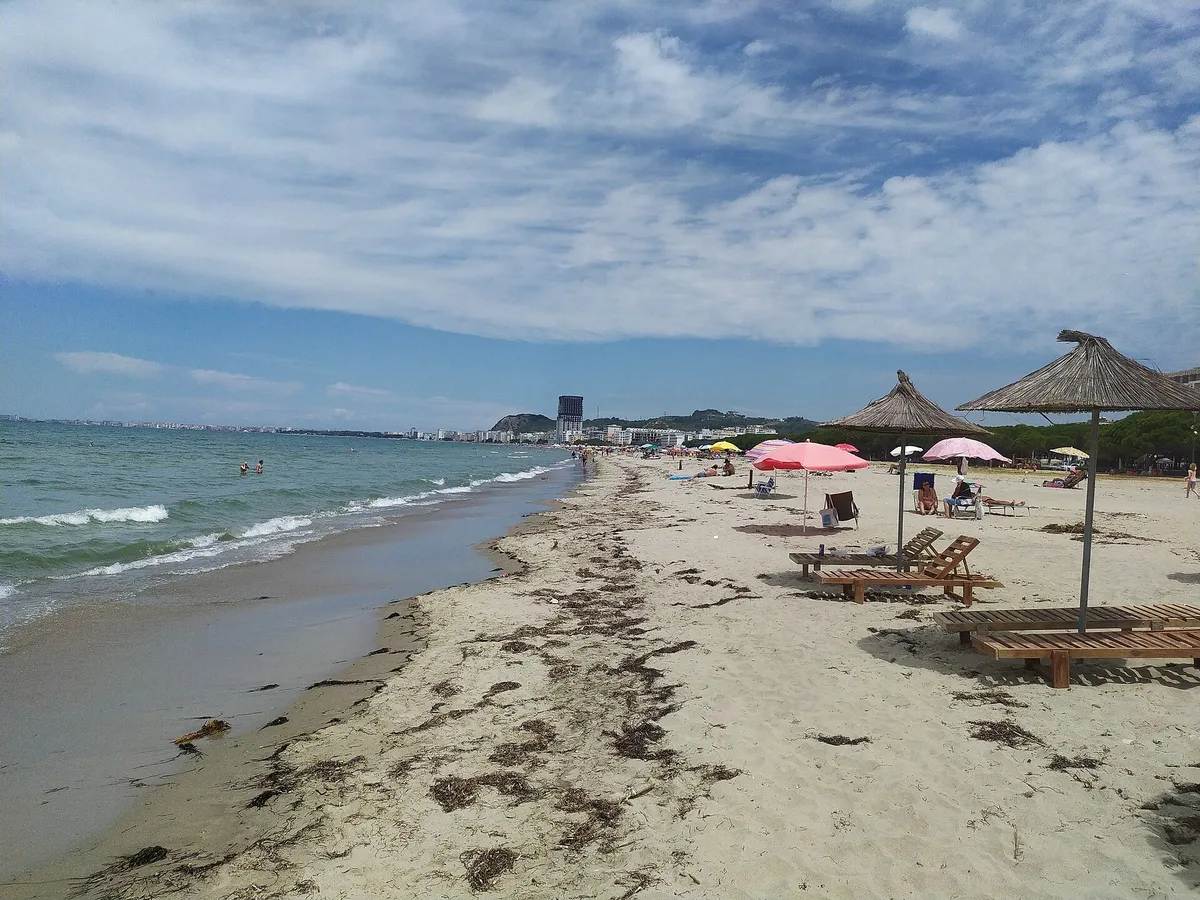
Continue south from Plazh and the curve of the bay delivers you to Golem — technically across the line in Kavajë’s municipality, functionally the southern extension of the Durrës resort: a long, dense band of hotels, apartment blocks and beach clubs strung along the sand behind a fringe of pines. Golem is where the region’s package-holiday capacity lives. The big resort hotels with their pools, animation programmes and private beach sections stand here, shoulder to shoulder with family-run blocks and rented apartments, and in high summer the whole apparatus runs at full volume for the same clientele as Plazh — Albanian, Kosovar and regional families taking the classic fortnight by the sea.
The beach itself repeats the bay’s formula with local variations: wide sand, very gradual shelving, warm sheltered water, umbrella grids in season, and a promenade of cafes and shops behind. What Golem adds is scale and greenery — the pine belt behind the shore is real, the biggest hotels run genuine resort grounds, and the strip’s sheer length means the crowd thins as you walk away from the main access points. What it does not add is escape: this is a built resort coast, developed at speed over three decades, and its architecture is the architecture of that boom. Travellers allergic to resort development should not base here and complain; travellers who want a full-service beach base within easy reach of Durrës’s archaeology get exactly what the brochures promise, no more and no less.
This durres travel guide’s advice is therefore about matching, not ranking. Golem for the resort holiday with a history day in Durrës bolted on. The city itself for the archaeology, the food and the evenings, with the beach as a daily excursion. And if you are driving the coast, Golem is also a milestone: south of it the urban shore finally ends, the road turns inland toward Kavajë and Rrogozhinë, and the traveller bound for Vlorë and the Riviera leaves the bay behind. Sleep in Golem knowing what it is — the engine room of Albanian domestic tourism, and this durres travel guide’s recurring advice in every resort town — and it will not disappoint you.
Day Trips from Durres – Kruja, the Cape of Rodon and the Capital
Durrës sits in the middle of Albania’s densest day-trip geometry, and three excursions cover most tastes. The classic is Kruja, the mountain town north-east of the city: Skanderbeg’s stronghold, its castle and museum, and the cobbled Ottoman-era bazaar below — and it earns its place in our best places to visit in Albania roundup. From Durrës it works as a half or full day by bus or car, up into genuinely different country: a cliff-edge fortress town at altitude, looking down over the plain to the sea you swam in that morning. The mechanism is simple — buses run between the cities, organised tours are sold everywhere on the strip, and drivers will find a straightforward mountain road — and the contrast is the reward: port city below, eagle’s-nest above.
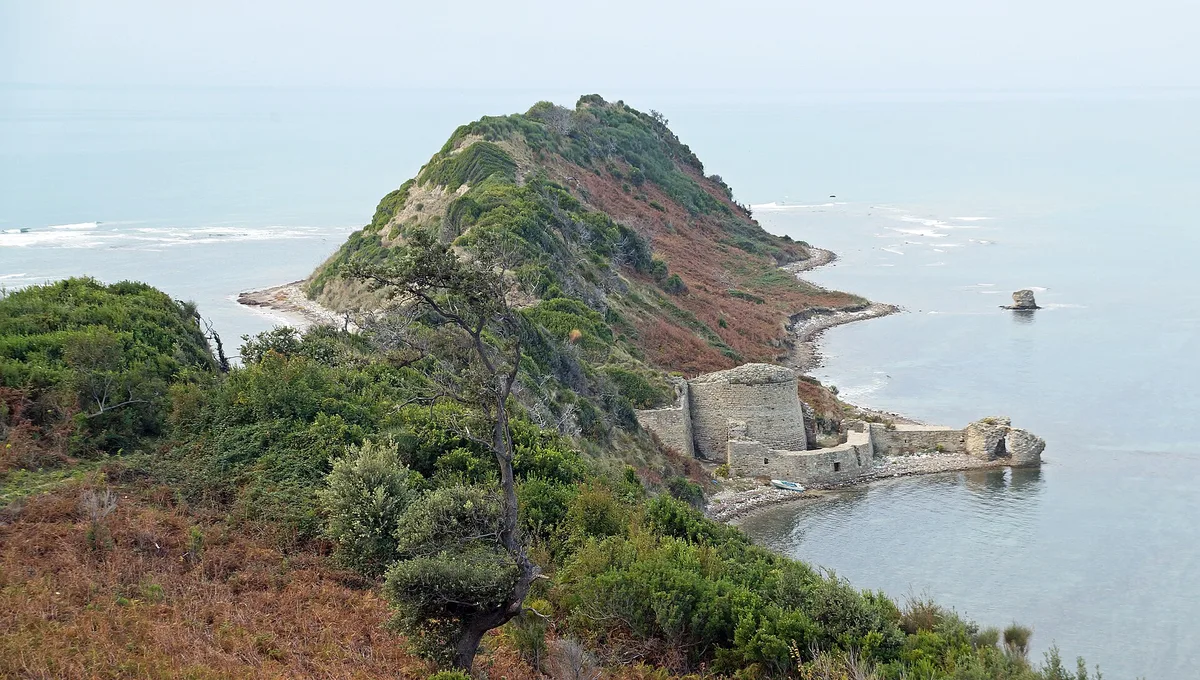
The second excursion is the connoisseur’s: the Cape of Rodon, the long rocky headland reaching into the Adriatic north of Durrës. At its end stand the ruins of Rodoni Castle, built by Skanderbeg in 1450–1452 to hold his outlet to the sea, destroyed by the Ottomans in 1467 and partly rebuilt by the Venetians after 1500, its walls now slipping picturesquely toward the water; nearby is the small church of St Anthony, frescoed and still a place of pilgrimage. The cape is the anti-Golem — undeveloped headland, pine and scrub, quiet coves — and the mechanism matches: it is a drive on a road that deteriorates toward the end, plus a walk out to the ruins, with facilities minimal to nonexistent. Go with water, shoes and a picnic, as a deliberate expedition, and it becomes the day Durrës-based travellers talk about most.
And the third excursion is the capital. Tirana is close enough that many visitors sleep in one city and sightsee in the other; our Tirana travel guide covers the capital properly. From a Durrës base, Tirana gives you the national museums, the Bunk’Art galleries and the Blloku cafe district as a day or evening trip, returning to sleep by the sea — the reverse of the arrangement most travellers use, and arguably the better one in summer. Between the three, this durres travel guide’s planning rule is simple: one excursion per two beach days is the rhythm that keeps a Durrës holiday from dissolving into the umbrella grid.
Where to Stay – City Pavements or the Beach Strip
The Durrës bed decision is the city’s geography restated: sleep in the city, or sleep on the strip. In the centre and around Vollga you get the real town — the archaeology at walking distance, the promenade evenings, the restaurants residents use, small and mid-size hotels and a growing stock of apartments — with the beach a walk or short ride away and Currila the nearest proper swimming. On the Plazh strip and in Golem you get the resort machine: sea-front hotels from family blocks to big full-service resorts, the sand at the door, the umbrella economy as your ground floor, and the centre a bus or taxi ride away when you want it.
Choose by the holiday you are actually taking. Culture-first travellers — the amphitheatre, museum, day trips — belong in the city, where nothing in this durres travel guide requires a car and the evenings are Albania’s rather than the resort’s. Beach-first families belong on the strip, where the total infrastructure is the product and the shallow water justifies everything. Mixed parties can split the difference with a strip base near the city end of Plazh, walkable to town along the shore. In high season everything fills and prices peak with the regional school holidays; the shoulder months are correspondingly easier in every respect — availability, rates, and the odds of a sea-view room. Book by the map, not the listing’s adjectives: in Durrës the same hotel name can promise “beachfront” on the strip and mean it, while a city hotel’s “sea view” may be a harbour-and-cranes panorama — which, for the record, many travellers end up loving.
One category deserves a sentence of its own: the apartment stock. Durrës has a deep bench of private apartments in both zones, the natural habitat of the regional families who come for a fortnight with a kitchen and a washing machine, and for longer stays or groups they are usually the rational choice — more space, a local building, a landlord who will tell you which fish restaurant is honest this year. Whichever you choose, decide the zone first and the property second; in Durrës, location is the amenity everything else decorates.
Eating in Durres – a Port City’s Table
Durrës eats from its harbour. The fishing fleet works out of the port you can see from Vollga, and the city’s defining restaurants are its fish restaurants — along the waterfront, on the Currila shore and scattered through the centre — where the mechanism is the Adriatic mechanism at its best: the day’s catch displayed or recited, fish sold and cooked simply — grilled, with olive oil, lemon and herbs — alongside the standard Albanian-Italian repertoire of a port city that has been feeding sailors, merchants and holidaymakers for centuries. Sea bass, sea bream, mullet, squid and mussels are the recurring characters; the honest way to order is to ask what came in, and let the answer choose the dish.
Around the fish core sits the rest of a working city’s table. There are proper Italian restaurants — the Italy connection is not only ferries; generations of Albanians have lived and worked across the water and brought the cooking home — bakeries doing byrek for breakfast, grill houses, and the cafe culture that occupies Vollga every evening. The beach strip runs its own economy of pizzerias, fast food and hotel buffets aimed at the holiday crowd; it feeds you perfectly adequately and is rarely the meal you will remember. This durres travel guide’s rule is the rule everywhere in Albania, sharpened by the port: eat where the boats supply and the residents argue about quality — in the centre and at Currila — and treat the strip’s front line as convenience rather than destination.
Two practical notes. First, fish in Albania is often priced by weight where it is sold by weight; if that troubles you, agree the whole transaction — fish, weight, cooking — before the kitchen starts, the normal courtesy in every Adriatic port and no reflection on Durrës in particular. Second, leave room for the unglamorous glories: the morning byrek run, the espresso taken standing, and ice cream on the promenade during the xhiro. A port city’s food culture lives as much in those rituals as in its restaurants, and Durrës, which has been feeding travellers since the Via Egnatia was new, performs them very well.
Getting to Durres – Airport, Buses and the Italy Ferries
Almost every international arrival reaches Durrës through Tirana International Airport, which serves the capital region from the plain between the two cities. The mechanism is standard and well worn: airport buses run to Tirana, from where intercity buses continue to Durrës; direct airport-to-Durrës services and private transfers cover the route as well; and taxis and hire cars take the motorway west, the airport sitting close to the Durrës road. However you land, the last stretch is the corridor through the coastal plain, with the beach hotels announcing the city long before the centre appears. There is no need to over-plan this leg — it is the most travelled route in the country, and every part of it runs frequently in season — but do confirm on the day which station or stop your bus uses, as Albanian intercity departures concentrate in bus terminals that have moved before and may move again.
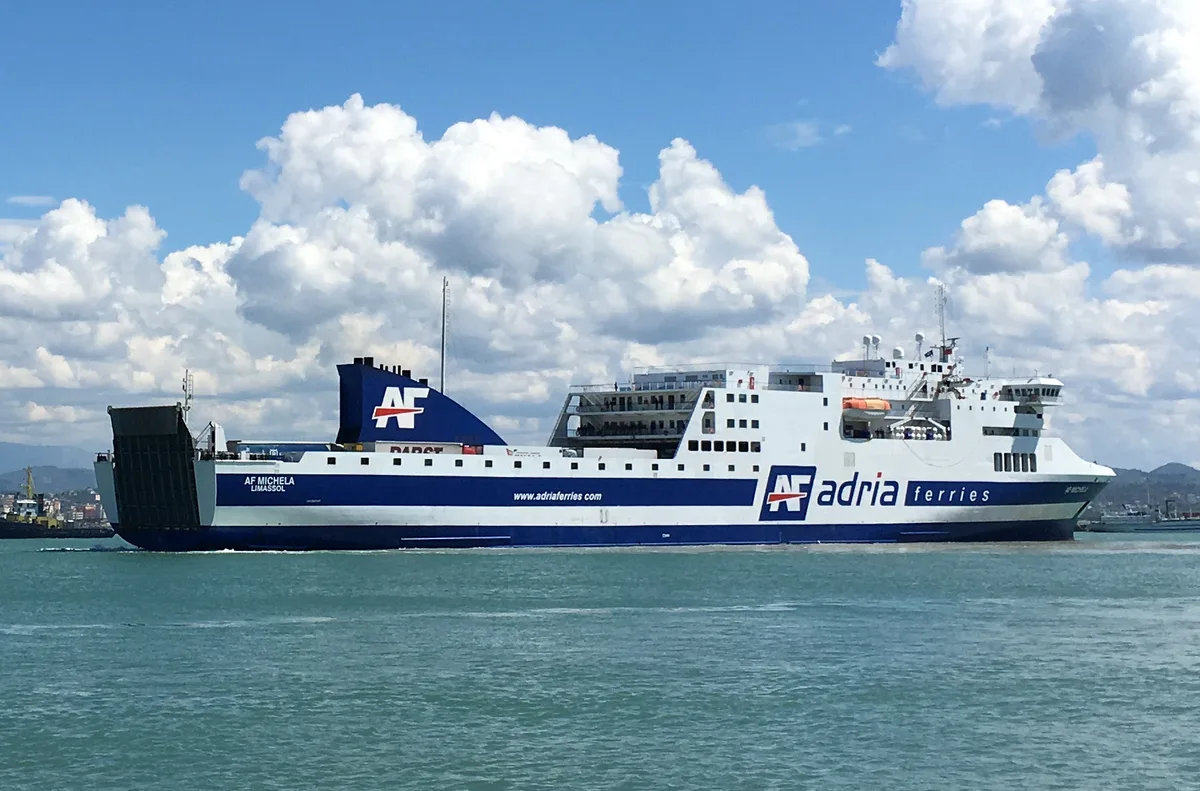
By sea, Durrës resumes its ancient role. The port’s passenger ferries connect the city with Italy — Bari and Ancona are the standard crossings, with seasonal services on other Italian routes — operated by the big Adriatic ferry companies, arriving and departing at the ferry terminal in the port. For travellers touring with a car, or walking off a ship with the amphitheatre twenty minutes away, it remains the most romantic arrival in Albania: the crossing made at night, the city in the morning. Check the sailing, the operator and the terminal procedure on the day through the operator, as Adriatic ferry schedules are seasonal and weather-aware; this durres travel guide prints no timetable because any it printed would quietly become wrong.
By road, Durrës is the hub of the coastal plain: the motorway to Tirana, the coastal road south toward Vlorë and the Riviera, and roads north to Shkodër and the Montenegrin border all radiate from here, served by the intercity bus network that is Albania’s public transport backbone — buses and minibuses departing from the city’s terminal and stops for every significant destination, bought on the day, paid to the conductor, and timed by the departures board rather than by any printed schedule this guide could responsibly reproduce. The historic railway is, at the time of writing, a shadow of itself; travellers should plan on road and sea, which is what the city itself does.
When to Go – Season, Crowds and the Shoulder Months
Durrës has a beach season and a city season, and they overlap only partly — which is the key to timing it. The full resort machine runs from June to September: the umbrella grids out, the beach clubs open, the ferries and flights at their most frequent, and the sea warm and swimmable throughout. July and August are the summit — the hottest weather, the warmest water, and the crowds of the whole region’s school holidays, when Plazh and Golem fill to their famous density and the roads in and out slow to match. If your dates are fixed there, the tactics of this durres travel guide apply: swim early or at Currila, book the ferry and the bed ahead, and take the archaeology in the morning before the heat builds on the stone.
The shoulder months are the connoisseur’s Durrës. May and early June bring a green plain, a city awake but not yet full, and a sea that warms week by week — cool for some, perfect for others. September is the local favourite: the water at its warmest after the summer’s heating, the crowds draining away, the light going golden over the bay, and the restaurants still in full season. October keeps the city entirely alive — Durrës is a real city, not a resort that closes — with swimming a gamble that often pays in the month’s first half. Even winter has its case: the monuments empty, the museum quiet, the Vollga xhiro proceeding in coats, and the amphitheatre’s galleries offering the strange pleasure of a world-class ruin almost to yourself.
Match the month to the mission. Beach holiday pure and simple: the core summer, with your eyes open about the crowds. History and city life with swimming as a bonus: May, June or September. The deepest-value Durrës, and the one regulars increasingly choose: a September week, when the sea is warm, the strip has exhaled, and the city underneath the resort is easiest to see whole.
The Honest Catches – Crowds, Concrete and the Harbour-Water Debate
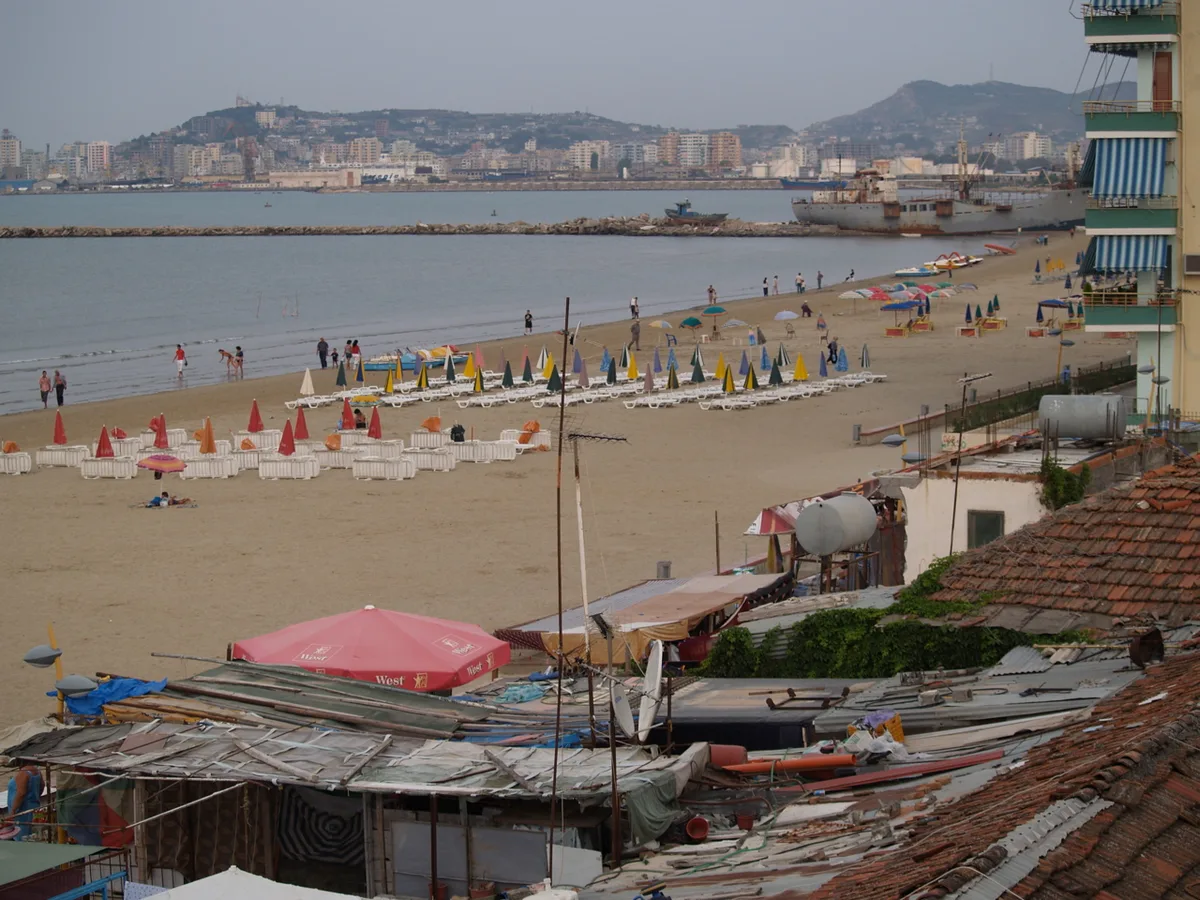
A durres travel guide earns its credibility here, so here it is without varnish. First, the development. Durrës’s shore was built at extraordinary speed and with uneven discipline across the post-communist decades, and it shows: towers where the brief demanded a beach town, infrastructure that strains in the August peak, and a skyline that no planner would draw twice. The city is also still living with the November 2019 earthquake, which struck this region hardest and whose reconstruction reshaped whole blocks — the Durrës you visit is partly a city rebuilt, and some of its rawness is that story, told in scaffolding. None of this is hidden and none of it is the whole truth either; but a traveller picturing a preserved historic port should recalibrate now.
Second, the water question, stated as carefully as it deserves. Swimming near a major working port carries an obvious question, and Durrës hears it constantly. The honest position is this: the bay is a big, open, tide-and-current-washed curve, the designated swimming beaches run along it at a distance from the harbour’s working basins, and Albanians swim here in their millions every summer, as their families have for generations. At the same time, this is an urban shore: after heavy rain, near outflows and drains, and in the stillest corners of the harbour end, the water is not the water of the open coast — and official bathing-water monitoring, not a travel guide, is the source to consult for the current season’s assessments at specific beaches. This durres travel guide prints no statistics because it has none it can stand behind; it simply advises what it would advise on any city shore in Europe: swim at the established beaches, give the harbour basins and storm drains a wide berth, and head to Currila or south of Golem when you want the bay at its cleanest. The Ionian south is clearer water — it is also a different holiday, four hours away.
Third, the small print of a big resort: August traffic on the Tirana road, taxi pricing that should be agreed before departure, beach-club music that is part of the furniture on the strip, and monuments whose signage still lags their importance. Set against that: a real, ancient, unpretentious city that feeds you well, swims its own children in its own bay, and holds more Roman stone in one street corner than most capitals manage in a museum quarter. Durrës does not need your indulgence. It needs to be read correctly — as Albania’s working front door, not its showroom.
Durres Travel Guide – Questions Travellers Actually Ask
Is Durrës worth visiting, or should I go straight to the Riviera? Both, ideally — but if the choice is forced, it depends on what you travel for. The Riviera wins on clear water and scenery; Durrës wins on history, food, transport and real-city life, and holds one of the Balkans’ great Roman monuments. This durres travel guide’s verdict: at minimum, stop for the amphitheatre and the museum on the way south; better, give the city a night or two in its own right.
How many days does Durrës need? One full day covers the history circuit — amphitheatre and chapel, museum, tower and walls, the villa hill, Vollga in the evening. Two to three days add Currila, a day trip to Kruja or the Cape of Rodon, and a slower pass at the restaurants. As a beach base, take as long as the beach holiday itself lasts; the city will fill the edges of it indefinitely.
Is the water at Durrës clean enough to swim in? Albanians swim here in their millions each summer, at established beaches along a large open bay, away from the port’s working basins. It is an urban shore, so apply city-shore sense — swim at the recognised beaches, avoid the harbour corners and anywhere near drains after heavy rain, and check the season’s official bathing-water assessments for the specific beach. For guaranteed crystalline water, the Ionian coast in the far south is Albania’s famous answer; Durrës is the convenient, family-proven one.
Can I visit Durrës as a day trip from Tirana? Easily — it is one of the standard day trips in the country, with frequent buses and a motorway between the cities, and the whole history circuit fits inside a day with an evening return. Sleeping in Durrës and day-tripping to Tirana works equally well and puts you by the sea at night; this durres travel guide slightly prefers that direction in summer.
How do I get to Durrës from the airport? Tirana’s airport stands between the two cities, closer to Durrës than its name suggests. Airport buses serve Tirana with onward connections, direct transfer services and taxis cover the airport-to-Durrës run, and hire cars take the motorway west. Confirm the current departure point and times on the day — the route is heavily served, but Albanian bus arrangements are confirmed locally, not from a guidebook page.
Is the Royal Villa open to visitors? Not at the time of writing. The villa has stood largely closed since the 2000s, its interiors damaged since the looting of 1997, though a private restoration to its 1939 appearance was announced in 2025. Treat it as an exterior sight and a viewpoint hill: admire the palace from the city and the bay, and do not plan your day around an interior that no ticket currently opens.
Durrës or Vlorë — which port city should I choose? They are the two ends of the Albanian coast’s personality. Durrës is the bigger, older, busier city — more history per street, the main port, the classic big-resort beach, and the capital on its doorstep. Vlorë is the calmer threshold to the south, with the bay, the islands and the Riviera beyond it. First trip with limited days: this durres travel guide says Durrës for the archaeology and the hub, Vlorë on the way south — and both if the itinerary breathes.
The Short Version of This Durres Travel Guide
Durrës is Albania’s front door and has been for two and a half thousand years: Epidamnos to the Greeks, Dyrrachium to the Romans, the start of the Via Egnatia, the country’s main port and its second city — and, layered through the apartment blocks, one of the great ancient sites of the Balkans in an amphitheatre that seated 20,000 and hides a mosaic chapel in its walls. Do the history day properly: the arena in the morning, the museum to explain it, the tower and walls at the harbour, the king’s sad palace on the hill, and Vollga at dusk with the whole city out walking. Then take the beach on the city’s own terms — the shallow family curve of Plazh, the locals’ water at Currila, the full resort machine at Golem — with Kruja, the Cape of Rodon and Tirana itself as day trips when the umbrella grid palls.