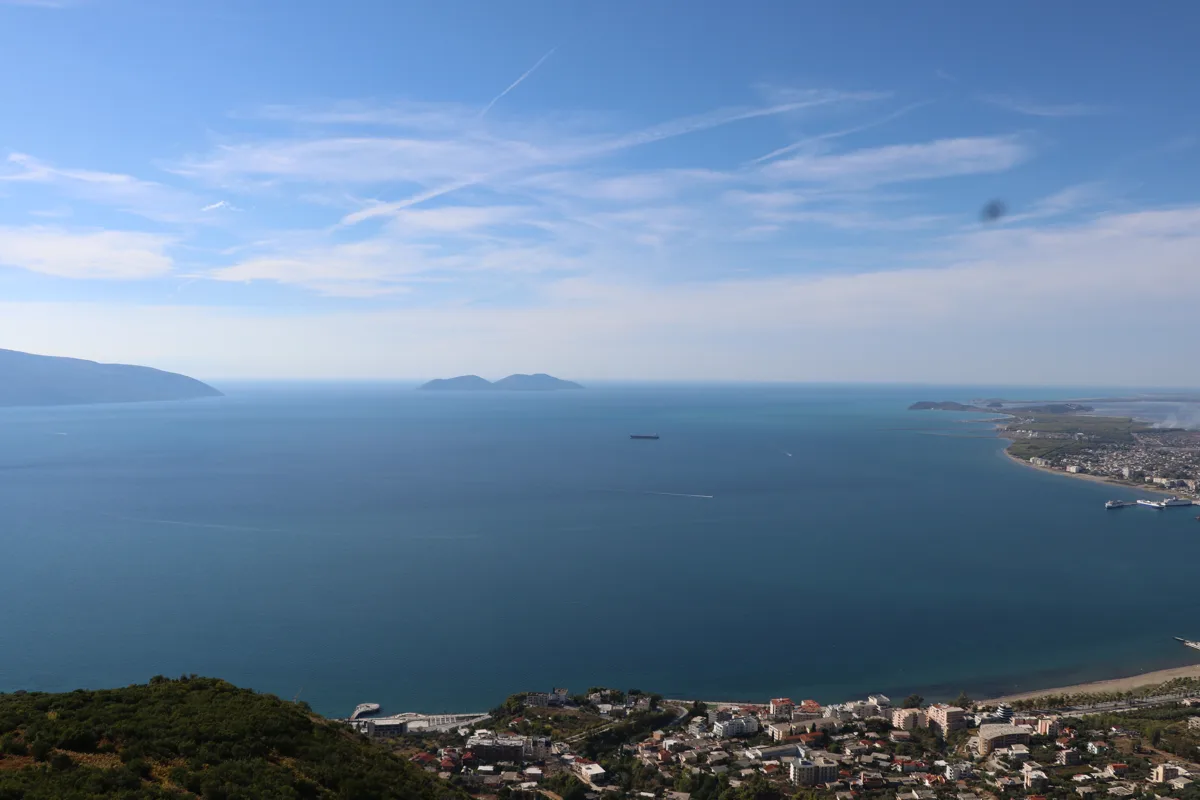
Most travellers meet Vlorë the way they meet a railway junction: briefly, and on the way to somewhere else. The bus from Tirana drops them at the edge of the bay, they look at the water for ten minutes, and then they are gone again, south over the Llogara Pass toward the Riviera beaches they actually came for. That is a waste of a city, and it is the first mistake this vlore travel guide wants to correct. Vlorë is not a stop on the way to Albania. In the sense that matters most to Albanians, Vlorë is where Albania starts: the city where independence was declared in 1912, where the first government sat, and where the flag that now flies over every public building in the country was raised for the first time. A traveller who gives the city only a fuel stop has driven through the country’s founding chapter without opening it.
The second thing a passing traveller misses is that Vlorë is two holidays wearing one name. Behind the city lies the whole apparatus of a working port town: ferries to Italy, a fishing fleet, a rebuilt seafront promenade, apartment blocks, traffic, and beaches that are honest city beaches rather than postcard ones. In front of it, across a wide and sheltered bay, lies one of the least-built coastlines in the Mediterranean: the Karaburun peninsula, a protected marine park reachable only by boat, with Sazan island standing at the bay’s mouth like a full stop. Add a medieval island monastery in a lagoon to the north, a ruined Illyrian-Byzantine castle on the hill behind the town, and the mountain pass that drops to the Ionian in the south, and Vlorë stops looking like a junction. It looks like what it is: the hinge of the whole Albanian coast, the place where the Adriatic north and the Ionian south are joined, and where a trip changes direction.
So this vlore travel guide is organised the way the city itself is organised. It starts with the bay, because the bay explains everything else. It walks the Lungomare promenade and the independence sites, climbs to Kaninë Castle, crosses the lagoon bridge to Zvërnec, and then does the job most guides to Vlorë refuse to do: it sorts the swimming honestly, separating the city beaches from the better water at Radhimë and Orikum, and both of those from the boat-only coast of Karaburun. It ends with the Llogara road south, with food, and with the practical question this vlore travel guide ends by answering – how long this city actually deserves. The answer, argued properly below, is more than a night. For how Vlorë fits into a first trip around the whole country, see our Albania travel guide; this page stays with the city, its bay and its two very different coastlines.
The Bay First – How Vlorë Is Shaped
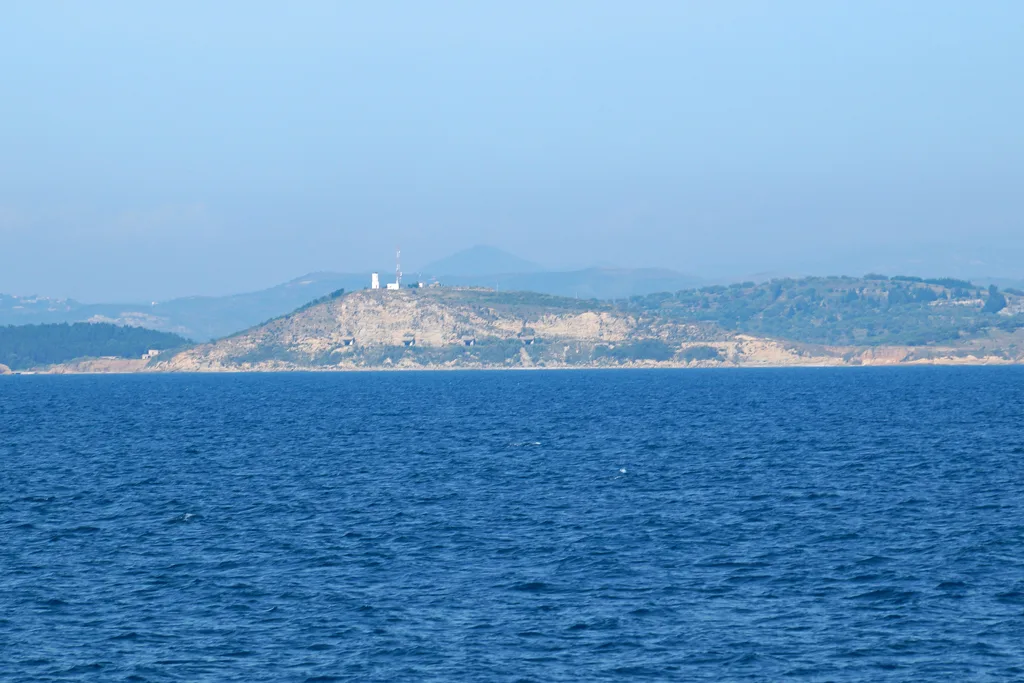
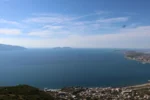
Everything in Vlorë begins with the shape of its bay, and a few minutes spent reading that shape from any high point in the city will organise your whole visit. The Bay of Vlorë is a broad, deep inlet of the Adriatic, curving from the Treport headland in the north-west, where a small lighthouse marks the entrance, around past the port and the city shore, and down to Orikum at its southern end. Across the mouth of the bay stands Sazan, a low, elongated island that shelters the water inside it, and running south from the bay’s western side is the long arm of the Karaburun peninsula, the mountainous, almost uninhabited ridge that separates the bay from the open sea. Albanians like to say that this is where the Adriatic meets the Ionian, and geographically the claim is made for the waters around Karaburun and Sazan. Stand on the promenade in the evening and the geography feels true: this is a threshold city, facing two seas at once.
The shelter matters more than the scenery. A bay closed by an island and a peninsula is calm water, and calm water is why a port has existed here for a very long time. The ancient predecessor of Vlorë was Aulon, also written Aulona, founded as a Greek colony in the 6th century BC and later an important Roman-era port on the crossing to Italy. The names have changed with every empire since — Valona to the Venetians and Ottomans, Vlorë today — but the logic of the place has never changed at all: the closest Albanian harbour to the Italian coast, protected water, and a fertile plain behind it running up to fortress hills. When you understand that Vlorë has been a working harbour for roughly two and a half thousand years, the modern city makes more sense. The ferries, the fishing boats, the naval presence and the apartment blocks along the shore are not an interruption of the city’s history. They are its continuation.
The bay also explains the city’s split personality, which every visitor notices within an hour. The water inside the bay, in front of the city, is harbour water: pleasant to look at, lined with beaches, but influenced by the port and the town, and not the clearest swimming in Albania. The water outside the bay, beyond Sazan and along Karaburun’s western shore, is open-sea water of a completely different clarity, and it belongs to a protected marine park. A vlore travel guide that does not separate those two waters will send you to the wrong beach with the wrong expectations, which is why this one returns to the distinction in the beach sections below. For now, hold the map in your head: city and harbour inside the bay, wild coast outside it, lagoon to the north, mountains to the south. Every good day in Vlorë is built out of those four pieces. It is the map every vlore travel guide should start with, and this one does.
The Lungomare – Vlorë’s New Front Room
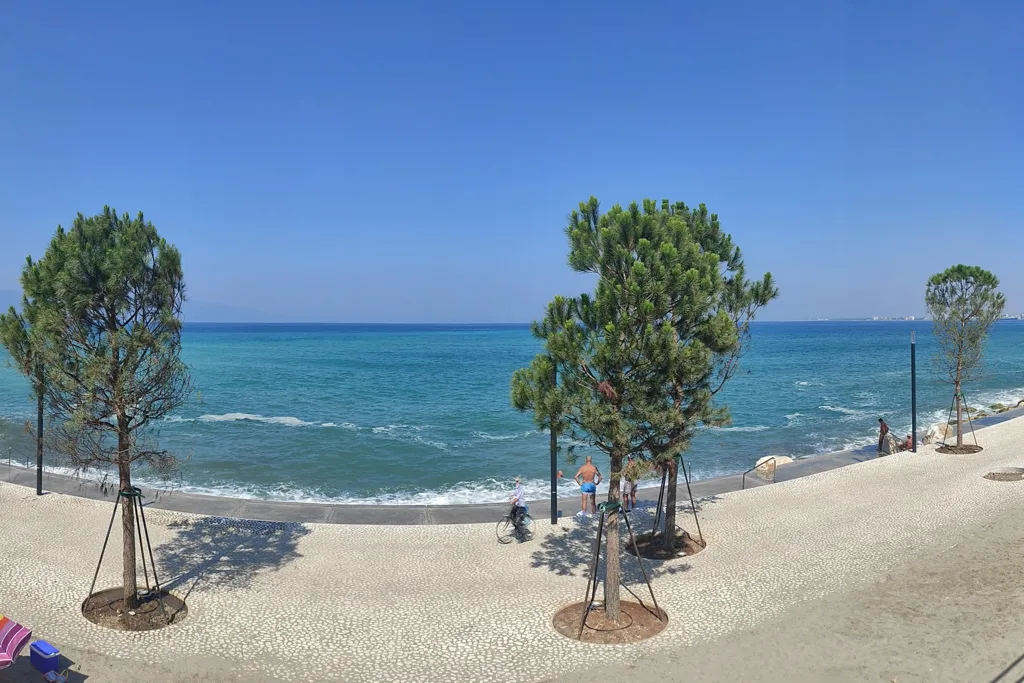
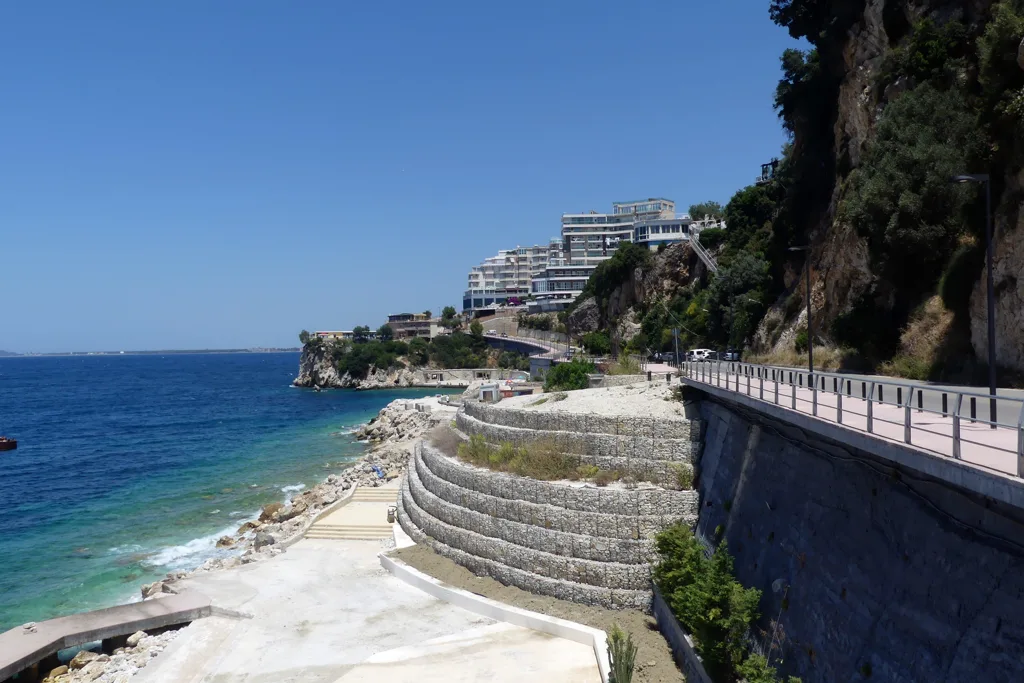
The Lungomare is the long seafront promenade that runs along the city shore south of the port, and it is the single biggest change to Vlorë in a generation. What was once a scruffy, potholed coast road with a thin strip of beach has been rebuilt as a wide, landscaped waterfront: a proper pedestrian promenade with cycle lanes, palms and pine planting, lawns, benches, beach clubs and cafés, running along the bay toward the Uji i Ftohtë area, where the coast road bends toward the tunnel and Orikum. It is, in the best sense, a piece of Italian-style seafront engineering — the name itself is Italian — and it has given Vlorë something the city never really had: a front room, a place whose entire purpose is the evening walk, the coffee, the ice cream and the sunset over Sazan.
Walk it properly and you walk the city’s daily rhythm. In the morning the Lungomare belongs to joggers, dog walkers, fishermen on the breakwaters and the first swimmers on the beach below the promenade. At midday in summer it empties into shade and beach clubs. In the evening it fills completely, for the xhiro, the slow communal stroll that Albanian towns treat as a civic institution: families, couples, teenagers, grandparents, everyone dressed a little better than the day required, walking the length of the front and back again, stopping for coffee, for byrek, for conversation. A visitor who spends one evening on the Lungomare has learned more about how Vlorë actually lives than a day of monuments teaches, and this vlore travel guide means that literally. The promenade is also the easiest orientation device in the city: hotels and apartments line its inland side, the beach runs along its seaward side, and the old town and Flag Square sit a short walk inland from its northern end.
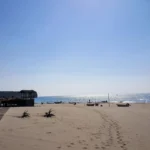
The honest catches belong here too. The Lungomare is a city promenade, not a nature reserve: behind it runs a busy road, the building line is a wall of holiday apartments of very mixed architectural quality, and in high summer the beach clubs compete with music. The sand along the promenade is the city’s own beach, with everything that means, good and bad, and it gets a section of its own below. And the promenade’s polish fades at its edges — walk far enough in either direction and you are back in the ordinary, untidy, working Vlorë of boatyards and side streets. None of that is a reason to skip it. It is a reason to understand what the Lungomare is: not the city’s escape from itself, but the city presenting itself, on the shore of its bay, at the hour when the light over Sazan turns the whole front gold.
Flag Square – Where Albania Raised Its Flag
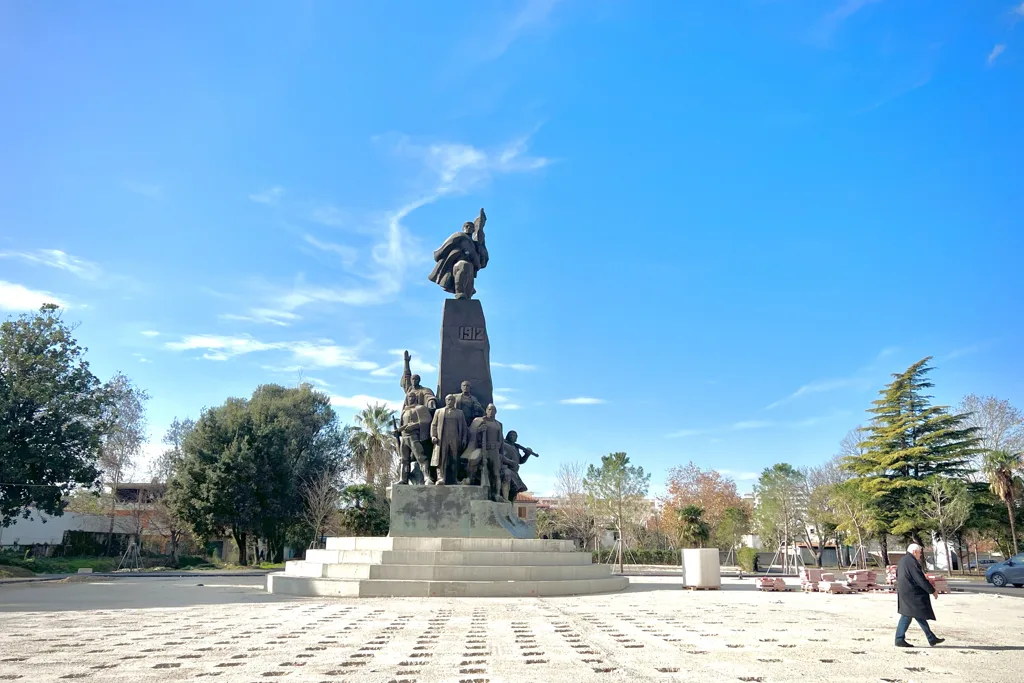
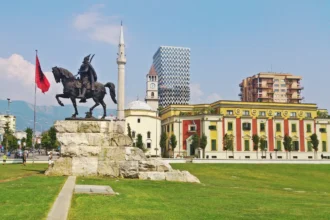
Flag Square — Sheshi i Flamurit — is a large, open, paved square a short walk inland from the port end of the seafront, and it is the most important patch of ground in modern Albania. On 28 November 1912, in the middle of the First Balkan War, with Ottoman rule collapsing and Albania’s neighbours preparing to divide its territory between them, Ismail Qemali and the delegates of the National Assembly proclaimed Albania’s independence here in Vlorë and raised the red flag with Skanderbeg’s black double-headed eagle. The date was chosen deliberately: 28 November was already the day Albanians associated with Skanderbeg’s raising of the same flag in the 15th century. The flag raised in 1912 had been embroidered, so the story is consistently told, by Marigo Posio, a patriotic woman of the city. Vlorë became the first capital of the new state, and Qemali headed its first government. Every Albanian schoolchild knows this square the way other nations’ children know a founding battlefield or a signing room, and arriving here with that in mind changes the square from a traffic island with a monument into what it actually is: the country’s birthplace, kept deliberately as open ground.
The building where the flag was raised no longer stands, and a good vlore travel guide should say so plainly, because many visitors assume the museum nearby is that building. The house stood by the square; it was damaged in the fighting that followed the declaration and was demolished in 1932, and the cleared ground has been kept open ever since as Flag Square. What dominates the square today is the Independence Monument, unveiled in 1972 for the sixtieth anniversary of the declaration: a big socialist-realist bronze in which a flag-bearer climbs a rock to raise the eagle flag, with the figures of the independence movement, Qemali among them, gathered at its base. It is very much a monument of its era — heroic, muscular, unambiguous — and it is all the more interesting for that, because it shows how the communist state chose to remember 1912. Beside the square, a flag flies from a column near where the original house stood, and in the park ground by the monument is the tomb of Ismail Qemali, who died in exile in Italy in 1919 and whose remains were later brought home to the city he made a capital.
Practically, Flag Square is a place to stand and take stock rather than a place that takes long to see, and it rewards being combined with the two sites that complete the story: the Independence Museum down toward the port, and the Muradie Mosque and old town lanes, which sit in the same central district. Come in the morning if you want the square quiet and the monument’s bronze readable in angled light, or on a national holiday if you want to see what the square is for. And notice the football connection, because Albanians will: Vlorë’s team is Flamurtari, “the Flag-Bearers”, named for the anonymous patriot who first raised the flag here. Few cities wear their founding moment in so many places at once — square, monument, museum, tomb, football club — and walking between them is the simplest history lesson Albania offers.
The Independence Museum – the First Government’s House
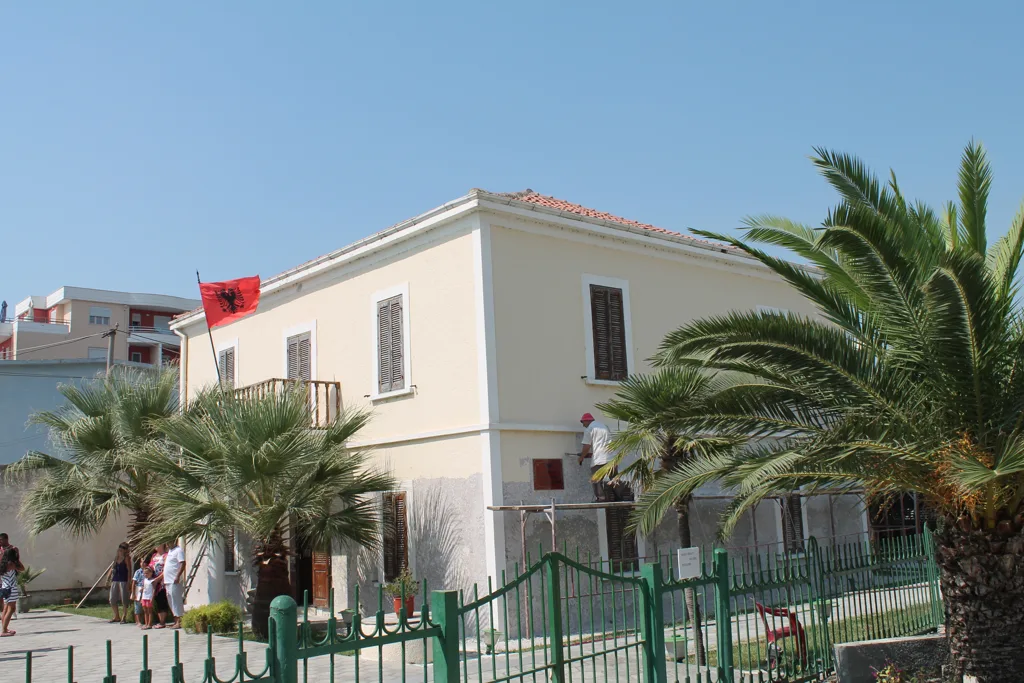
The National Museum of Independence stands in the Skela district, down near the port, in a modest two-storey villa with palm trees in front of it, and its modesty is the point. This building — a former quarantine station by the harbour, by the usual account — was the seat of Ismail Qemali’s provisional government, the headquarters from which the first Albanian state was actually run in the months after the declaration. Qemali’s office was here. The government of a country that existed, at first, mostly on paper and in this city’s streets, worked out of these rooms. The museum founded in the building in 1936 is generally described as the first museum established in Albania, and its collection is exactly what the building calls for: documents and photographs of the independence movement, portraits and personal belongings of Qemali and the other founding figures, and the furniture and atmosphere of the government rooms themselves. It is a museum about a specific few months in a specific few rooms, and it is better for that focus.
Visiting it well means understanding what it is not, and this is the second place where this vlore travel guide insists on the distinction, because the conflation is everywhere in lesser guides. The museum is not the house where independence was proclaimed and the flag raised; that house stood by Flag Square and is gone. The museum is the government’s house, the working sequel to the proclamation, and the two sites together — square for the gesture, villa for the government — tell the story more truthfully than either does alone. Do them in that order: square first, then the ten-minute walk toward the port to the museum, reading the city as you go, because the walk itself passes from ceremonial Vlorë into the working harbour district the government actually operated in.
The honest assessment is that this is a small, old-fashioned museum, not an interactive one, and a visitor expecting multimedia will find glass cases, documents and portraits instead. What it offers in return is authenticity of place, which no display technology can manufacture: you are standing in the rooms. An hour is enough for most visitors, and the museum pairs naturally with the harbour area around it — the port, the fish restaurants and the start of the Lungomare are all close. Travellers with a serious interest in the period should also know that Vlorë has a separate Historical Museum for the wider story of the region, from antiquity onward; the independence museum deliberately does only its one chapter, and does it in the right building.
The Old Town and the Muradie Mosque
Behind Flag Square, a little inland from the ceremonial centre, the street plan changes and Vlorë gets older and smaller in scale. This is the historic core: a knot of lanes around the Muradie Mosque, the Justin Godart street area, with low houses, small shops, bakeries and workshops, parts of it restored in recent years with painted facades in the pastel manner that Albanian old towns have adopted. It is not a grand old town on the scale of Berat or Gjirokaster, and a vlore travel guide does its readers no favours by pretending otherwise. Vlorë was a port, bombarded, rebuilt and expanded too many times to keep an intact Ottoman quarter, and what survives is a fragment: a few streets with the older city’s texture still in them, best treated as the connective tissue between the square and the mosque rather than as a destination that fills a day. Walk it slowly anyway. The fragment is genuine, the coffee is good, and the contrast with the Lungomare’s new polish is the whole story of Vlorë told in two streetscapes.
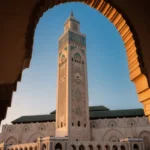
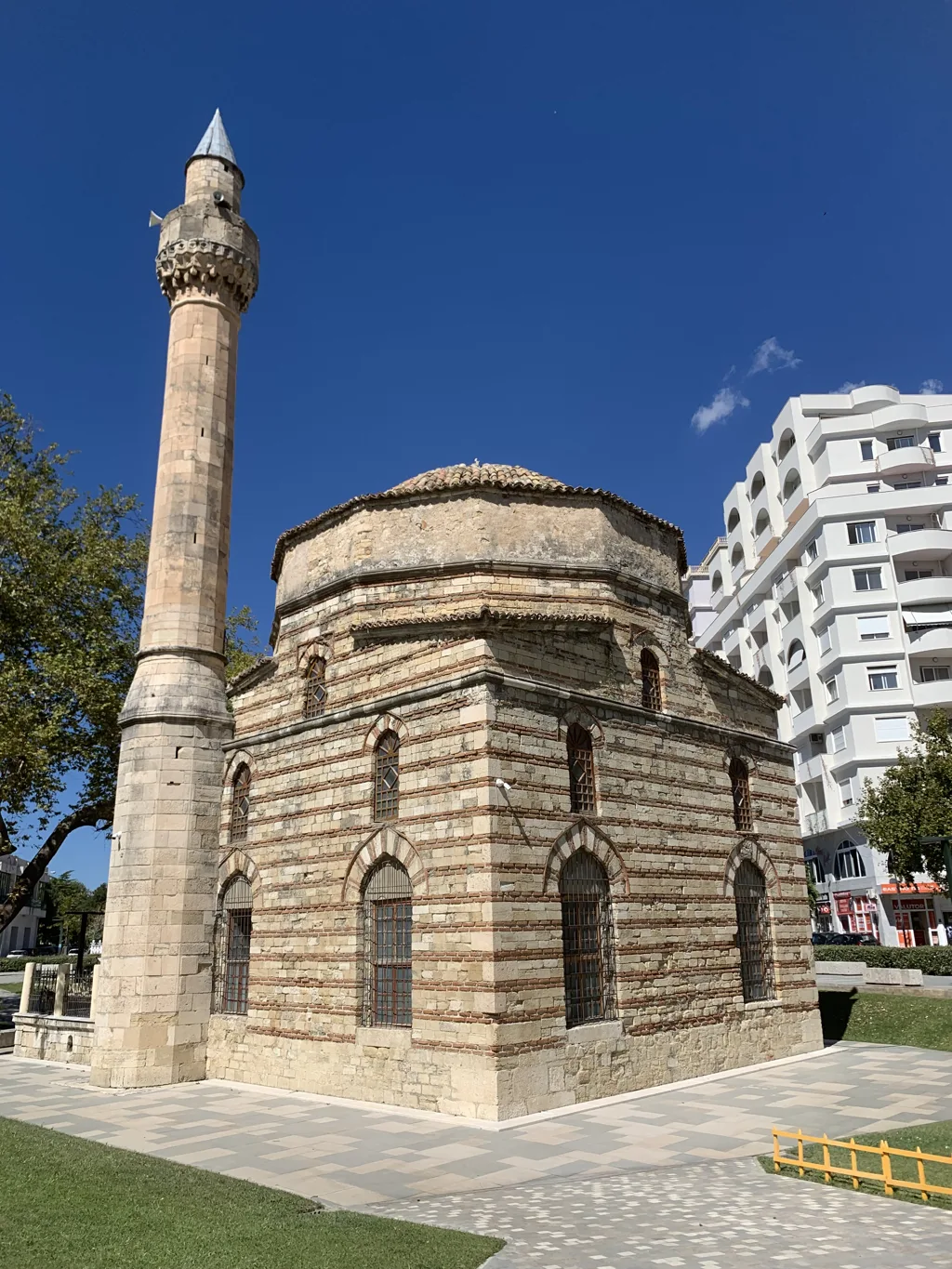
The fragment’s centrepiece is the Muradie Mosque, and it deserves its prominence. An inscription at its entrance dates the mosque to 1542, and Albania’s heritage authorities attribute its design to Mimar Sinan, the great chief architect of the Ottoman Empire, working on the order of Sultan Suleiman the Magnificent — the same sultan-architect pairing that briefly made Vlorë an imperial project in those years, when a great fortress (since demolished) also rose by the port. The building that survives is compact and beautiful: a cubic prayer hall in striped stone-and-brick masonry, a dome carried on a twelve-sided drum, and one slender stone minaret. It stands open to view on all sides, kept clear of the building line, which is why it photographs so well and why it reads so clearly as the old city’s survivor: everything around it has been rebuilt at least once, and the mosque has simply continued.
Two practical notes complete the visit. The Muradie is a working mosque, not a museum, so the etiquette is that of a place of worship: dress modestly, keep quiet, and do not count on interior access outside the welcome a functioning mosque extends — some visitors find it open and welcoming, others find it closed between prayers, and both experiences are normal. And place the mosque in its walk: square, lanes, mosque, then down toward the museum and the port makes a natural central loop of an hour or two that covers the whole of historic Vlorë without a vehicle. If the old town disappoints you by its size, remember what it survived. The wonder is not that so little of Ottoman Vlorë remains. The wonder, in a port city with this history, is that its finest small building is still standing, still used, and still exactly where Sinan’s builders left it.
Kaninë Castle – the Fortress That Watched the Bay
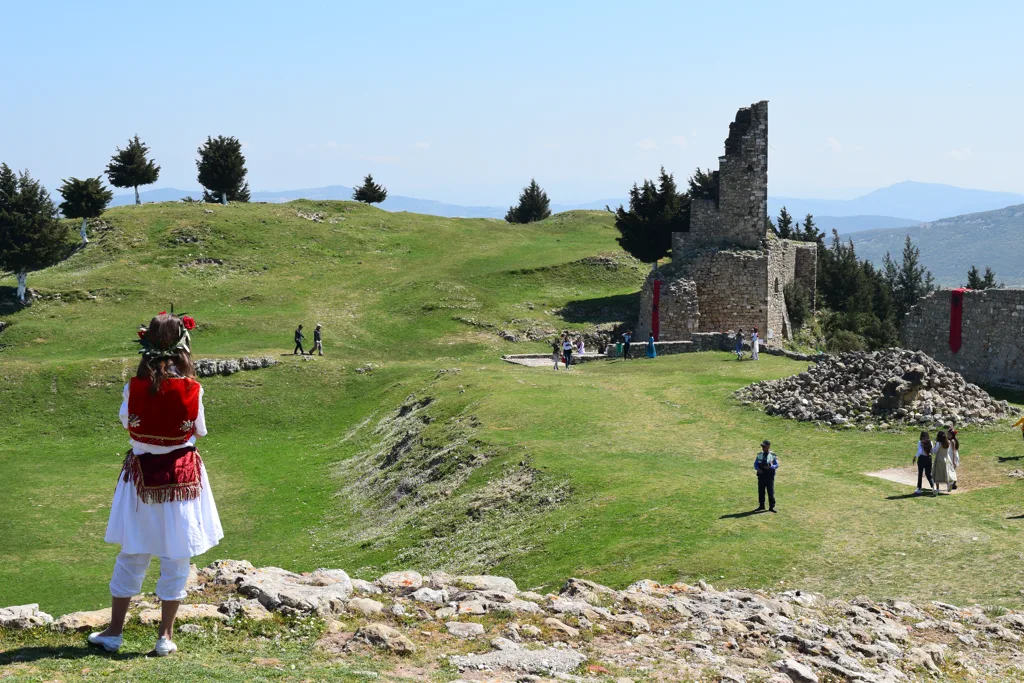
Six kilometres south-east of the city, on a three-pronged hill of the Shushicë mountain about 380 metres above the sea, stand the ruins of Kaninë Castle, and the first thing to understand about it is that for most of history it mattered more than Vlorë itself. The fortified site begins in the 3rd century BC as a settlement of the Amantes, the Illyrian people of this coast, guarding their route to the sea. In the 4th century AD it had become a fortress town; in the 6th century the Emperor Justinian I rebuilt it, one of the many Balkan strongholds of his great refortification programme, and Byzantine Kanina went on to administer this coast as part of a province that joined it with Aulon and Oricum. In the 13th century it was an Angevin stronghold, in the 14th the centre of the Principality of Valona, and only in 1417 did it pass to the Ottomans with the rest of the region. Every power that wanted this bay first had to reckon with the hill, and standing on its walls you can see why: the entire Bay of Vlorë, Sazan, Karaburun, the city and the plain are laid out below like a chart.
What survives is a ruin in the honest sense, and this vlore travel guide will not dress it up. The circuit of walls — roughly a kilometre of them enclosing a grassy hilltop — towers in places and foundations in others, with the remains of the citadel, cisterns and a small mosque from the Ottoman centuries among the grass and scrub inside. There is little in the way of interpretation, shade or facilities, and the site rewards visitors who bring their own context: read the history before you climb, then let the panorama do the explaining. The castle has had conservation and visitor-infrastructure work in recent years, which is gradually improving access and paths, but it remains a place of walls and views rather than exhibits. Come in the morning or late afternoon for the light and to avoid the heat on an exposed hill, wear shoes for uneven ground and loose stone, and carry water, because the hill offers none of the services the city below takes for granted.
Kaninë pairs naturally with Vlorë’s other great viewpoint logic: the castle is where you go to understand the bay as strategy, just as the Lungomare is where you go to understand it as leisure. It is also a useful corrective to the independence story told in the city, because it proves how much older Vlorë’s importance is than 1912 — the delegates who gathered in the city were meeting in a place that had been fought over for two thousand years precisely because of the geography this hilltop displays. Give it half a day combined with a slow lunch back in the city, or fold it into a day that continues south toward Orikum and the Llogara road, since the castle road branches from the same southern exit. Either way, do not leave it out in favour of an extra beach hour. The beaches have their own section below; the hill is where the whole region, beaches included, finally makes sense.
Zvërnec Island and St Mary’s Monastery
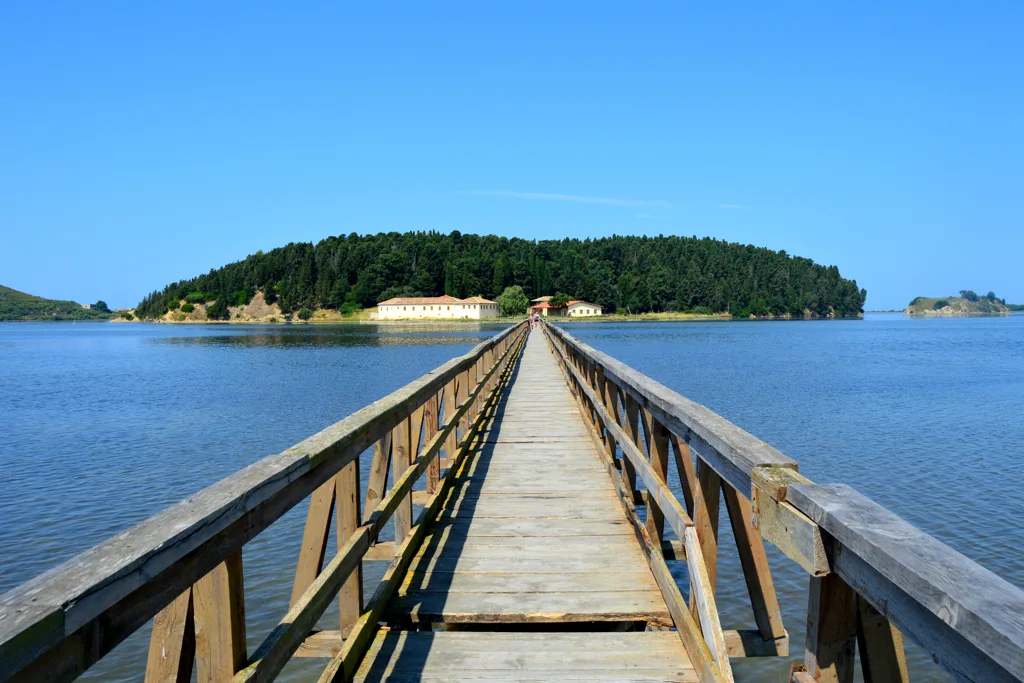
North-west of the city, where the apartment blocks end and the plain flattens into reed beds and shallow water, the Narta Lagoon begins — and on a small pine-covered island inside it stands the place many visitors remember longest from Vlorë. The Monastery of St Mary, the Dormition of the Theotokos, is reached the way a monastery should be: on foot, across a long wooden footbridge of some 270 metres that leaves the lagoon shore at the village of Zvërnec and walks you out over the water, with reeds, birds and the island’s pines gradually replacing the city behind you. The approach is half the visit. By the time you reach the island you have slowed to its pace, and the monastery — a small Byzantine church among the trees, the only building of consequence on the island — is met on its own terms: quietly.
The church is genuinely old, though its exact age is a scholarly argument this vlore travel guide will report rather than settle. The fabric is generally placed in the 13th to 14th centuries, some researchers argue for an earlier foundation, and parts of the wider complex are later still; what is not argued is its quality. It is a domed Byzantine church of the free-cross type, protected as a cultural monument of Albania since 1963, and it holds an icon of St Mary painted by Tërpo Zografi, the 18th-century Albanian iconographer. There is also a connection here that ties the island back to Flag Square: Marigo Posio, the woman who embroidered the flag raised at the declaration of independence in 1912, is buried in the monastery’s cemetery. The founding of the nation and the long Orthodox centuries of this coast rest, in the end, within a few kilometres of each other, and a traveller who visits both the square and the island has hold of both threads of Vlorë’s story.
Practicalities are simple but worth stating. Zvërnec is a drive, not a walk, from the city centre — out along the lagoon shore to the village, where the road ends and the bridge begins; vehicles go no further, and the island is pedestrian. The monastery is a religious site before it is a sight: dress modestly, keep voices down, respect any request about photography inside the church, and do not expect a visitor centre, a café or set-piece interpretation, because there is essentially none. That absence is the atmosphere. An hour on the island is enough for the church and a circuit of the pines for most people, but the place repays lingering — the light on the lagoon in the late afternoon, with the bridge behind you and the city a distant line, is one of the calmest experiences on this whole coast. Combine it with the lagoon section that follows, because the island and the lagoon are really one visit: the monastery gives the water a meaning, and the water gives the monastery its silence.
The Narta Lagoon – Salt, Reeds and Slow Water
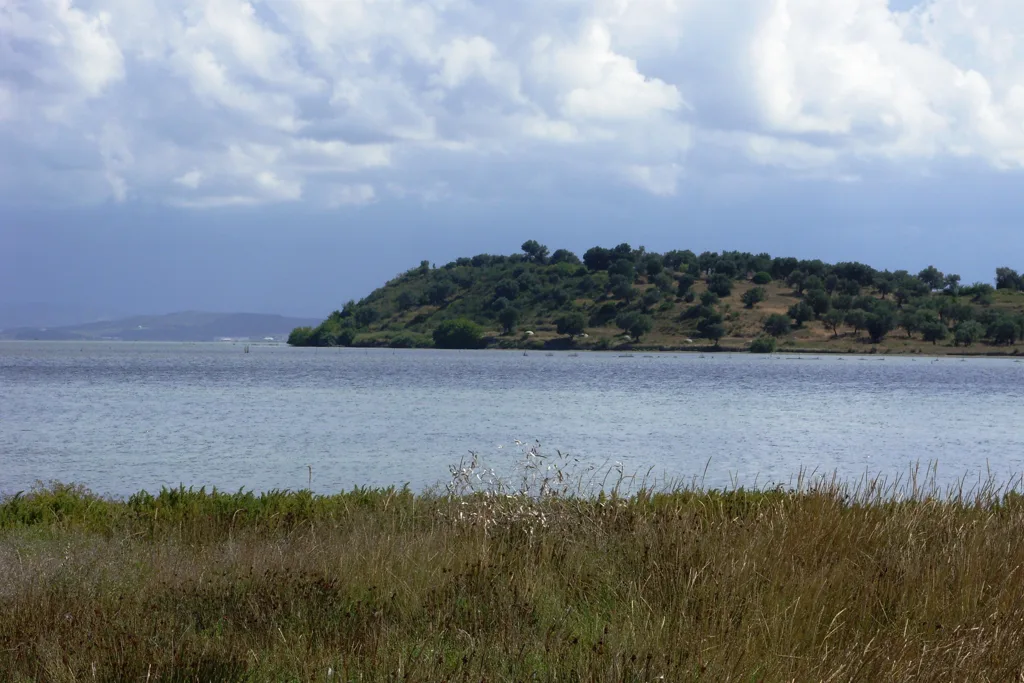
The Narta Lagoon is the largest piece of near-wilderness inside Vlorë’s orbit, and it is the side of the city that the Riviera-bound traffic never sees at all. It is a broad, shallow coastal lagoon separated from the sea by a narrow shore, fed by channels, fringed with reeds and pine woods, and worked for centuries in the way lagoons here are worked: fishing in the channels, and salt — the salt pans on the lagoon’s shores are part of one of Albania’s historic salt-producing landscapes, and the white geometry of the pans is visible from the roads that skirt the water. At the lagoon’s seaward edge stands the Treport point with its lighthouse, closing the Bay of Vlorë to the north, and at its heart sits Zvërnec island, covered in the previous section. The whole system is the city’s quiet northern lung, and it runs on a completely different clock from the Lungomare a few kilometres south.
What the lagoon offers a traveller is atmosphere rather than attractions, and it should be sold honestly as that. This is a place for a slow drive or cycle along the shore roads, for watching the water change colour through the day, and for birds: the lagoon is an important wetland on the Adriatic flyway, and its shallows and reed beds hold herons, egrets and other waterbirds through the year, with flamingos among the species the lagoon is known for in season. Nobody should promise you a flamingo on a given day, and this guide does not; what can be promised is the character of the place — flat light, big sky, working fishing boats in the channels, villages like Nartë and Zvërnec living at a lagoon pace that the resort coast has forgotten. Photographers and birdwatchers will need no persuading. Travellers whose holiday requires a programme of sights may find the lagoon simply quiet, and for them the honest advice is to fold it into the Zvërnec trip rather than make it a day of its own.
Two cautions keep a lagoon visit good. The first is exposure: the shore is flat, open and short on shade and services, so sun, wind and insects all arrive unfiltered, and a summer midday on the lagoon edge is genuinely hard work — mornings and evenings are its hours. The second is expectation about swimming, because the lagoon is not a beach: its water is shallow, silty lagoon water, valued for fish and birds rather than bathing, and the shore by Zvërnec village, where locals do use the sea side, is a separate, modest affair from the lagoon itself. Keep those two things straight and the Narta Lagoon becomes what it should be in a vlore travel guide: the peaceful counterweight to everything else in this article, the place you go when the city, the history and the beaches have filled the day and what you want is water, birds and nobody selling you anything at all.
City Beaches – the Honest Version
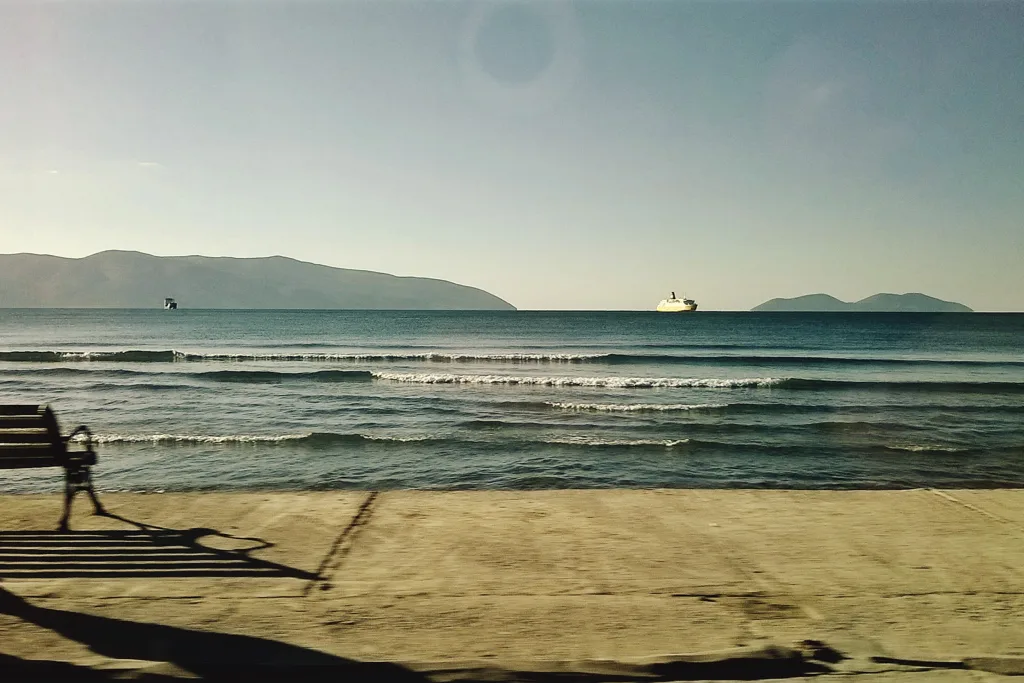
Now the section this vlore travel guide exists to write, because it is the one most coverage of Vlorë fudges. The city’s own beaches are the shore inside the bay: principally the long beach along the Lungomare, known as Plazhi i Ri, the New Beach, and the older Plazhi i Vjetër, the Old Beach, nearer the port. They are real beaches with real virtues. The water is sheltered and generally calm, the shore is long and mostly sandy with shingle mixed in, entry is easy, and everything a family day needs — shade, food, showers, transport, a promenade full of alternatives when children get bored — is within a few steps. A resident of Vlorë swimming before work, a family with toddlers, a traveller with one spare hour and a towel: for all of them, the city beach is not a compromise. It is the right answer, and it is free of the logistics that every better beach in this article demands.
But a city beach is a city beach, and the honesty has to run both ways. The sand here is the bay’s own grey-brown sand, not the white shingle of the Ionian coves; the water, inside a harbour bay with a port at one end and a city behind it, does not have the glass clarity of the open coast, and on still, hot days in high season it can feel like exactly what it is — an urban shore in August. The Lungomare stretch is also a serviced beach in the Albanian manner, which means rows of umbrellas and loungers run by the beach clubs in season, music from the cafés, and a sociable, sometimes noisy atmosphere. Travellers who arrive in Vlorë having absorbed photographs of Karaburun and the Riviera — turquoise water, empty coves, cliffs — and then walk down to the city beach expecting that, will feel cheated. They were not cheated by the beach. They were cheated by the photographs being of somewhere else, somewhere this guide covers in the sections that follow.
So the sorting rule is simple, and it governs the rest of this article. Swim in the city if your priority is ease: a morning dip before the monuments, an evening swim after the xhiro, a family day with everything at hand. Do not judge Vlorë’s coast by the city beach alone, and do not spend your only swimming day on it if what you actually want is the famous Albanian water — because the famous water here is real, it is close, and it comes in two grades. The first grade is the southern shore of the bay itself, at Radhimë and Orikum, a short hop from the city. The second is the Karaburun peninsula, reached only by boat, which is a different order of place entirely. A vlore travel guide that merges those three shores into one word, “beaches”, has failed its only important job. The next two sections keep them separate.
Radhimë and Orikum – Where the Water Improves
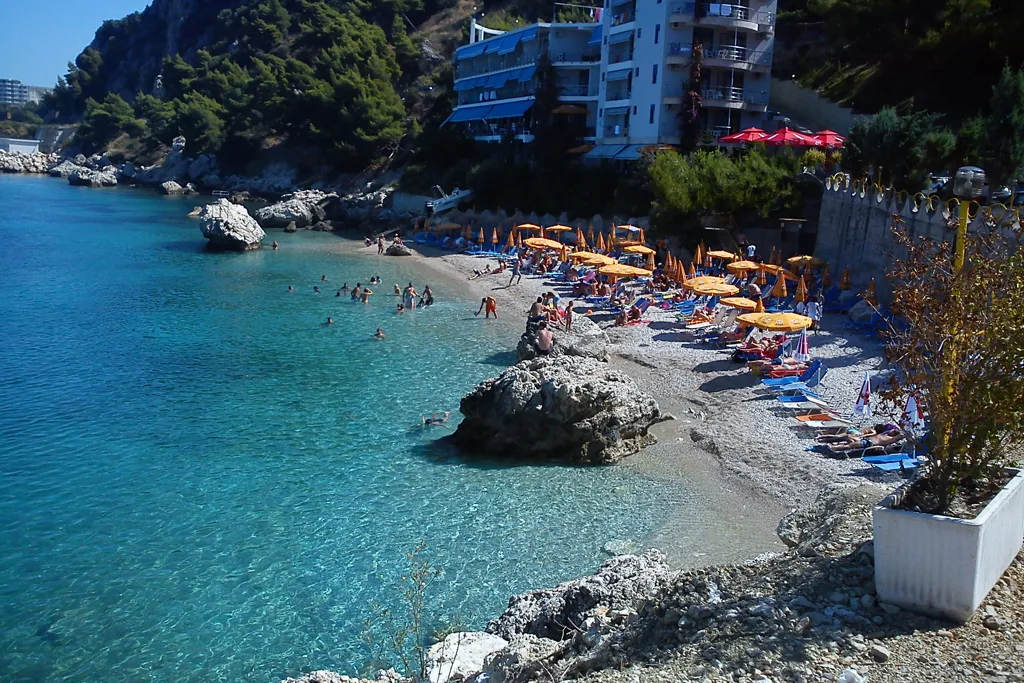
Follow the coast road south from the Lungomare, past the Uji i Ftohtë springs area where the road is tunnelled through the headland, and the bay shore changes character. The apartment wall thins, the hills come down greener to the water, and the road runs through Radhimë, a village strip of hotels, restaurants and small beaches spread along a series of coves. This is the first grade of better water, and the improvement is not subtle: out here, near the bay’s southern shore and away from the port, the sea is clearer, the colour turns the turquoise that the city beach only hints at, and the shore is a mix of sand, fine shingle and rocky points with proper swimming off them. Radhimë is where Vlorë’s own residents go when they want a real beach day without leaving the bay, and that local vote is the most reliable review the place has.
Radhimë’s honest catches are about development rather than water. The strip is built up in the competitive Albanian manner — hotels and beach restaurants crowd the shore in season, much of the best frontage is serviced with loungers, and the village itself is a holiday strip rather than a picturesque settlement. It is a place to swim, eat grilled fish above the water and watch the sun go down over Karaburun, not a place to sightsee. Beyond Radhimë the road reaches Orikum, at the very end of the bay, and Orikum is a different proposition again: a small, spread-out town on flat ground where the bay closes, with a marina, a long town beach of its own, and an ancient name — this is the site of Oricum, a port of the ancient world that mattered enough to appear in the same Byzantine provincial lists as Kanina and Aulon. The modern town is quiet, slightly scruffy and entirely unhurried, and its beach shares the southern bay’s clearer water while facing back up the bay toward Vlorë.
Choose between the three southern options by the day you want, as this vlore travel guide keeps advising. Radhimë for the swim itself: the best bay water within easy reach of the city, with lunch above it. Orikum for space and quiet: a marina town where the day moves slowly and the mountains of Karaburun fill the view across the water. And know what comes next geographically, because from Orikum the road leaves the bay, climbs into the hills and begins the ascent of Llogara — the subject of a section below — while the coast you can see across the water, Karaburun, has no road on it at all. Radhimë and Orikum are the hinge within the hinge: the last swimming of the bay, and the doorstep of everything wilder. If you have only one beach day in Vlorë and no boat, spend it on this southern shore. If you have a boat day as well, spend that on what follows.
Karaburun and Sazan – the Coast You Reach by Boat
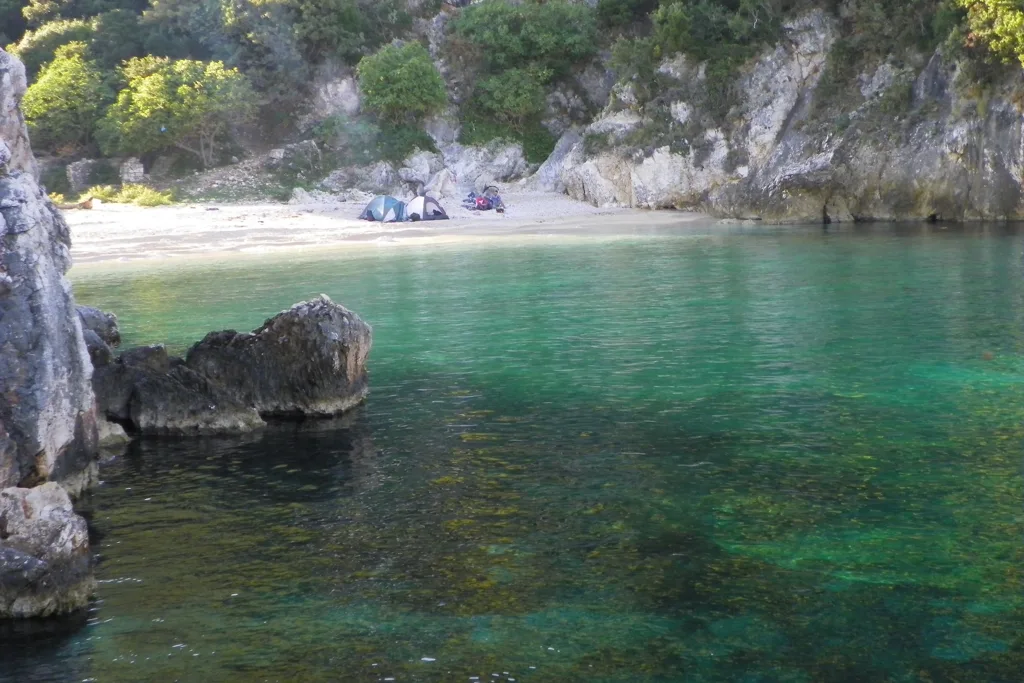
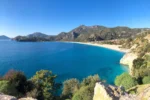
Look west from anywhere on Vlorë’s shore and you are looking at the best swimming in the region, close enough to dominate every sunset and completely unreachable by road. The Karaburun peninsula is a long, dry, mountainous arm of limestone running south from the bay’s mouth, and its western shore — the shore that faces the open sea — has no road along it at all. What it has instead is a chain of coves and small pebble bays cut into the cliffs: Brisan, of the Bear, shown above, is one; others run down the coast toward the cape at the peninsula’s tip, where the Adriatic and Ionian are said to divide. Together with Sazan island, this coast is protected as the Karaburun-Sazan Marine Park, Albania’s only marine national park, proclaimed by Council of Ministers Decision No. 289 of 28 April 2010 and covering some 12,570 hectares of sea and shore — about 9,850 of them around Karaburun and 2,720 around Sazan. The protection is the reason the water is what it is: no coastal building, no road, no resort strip, just limestone, maquis scrub and sea of a clarity the bay cannot match.
Visiting works as a mechanism, not an itinerary, and this vlore travel guide describes it that way deliberately, because the details belong to the season and the harbour rather than to a page that must stay true all year. In the summer season, boats work out of Vlorë’s harbour on day trips along the peninsula: the pattern is a run down the western shore, swimming stops in the coves, time on one of the pebble bays, and often a call at Sazan or at the sea caves of the peninsula on the way. Out of season the coast largely returns to the fishermen, the rangers and the weather, and no guide should promise you a boat that the harbour cannot. What can be said in any season is what the trip is for: this is a swimming and snorkelling day in protected water, with diving for those who arrange it, on a coast whose emptiness is guaranteed by geography and law together. Take everything with you that the day needs — shade, water, food beyond what your boat provides — because a roadless shore has no fallback, and respect the park rules your crew gives you, because the emptiness you came for is exactly what those rules protect.
Sazan deserves its own honest paragraph. The island at the bay’s mouth was for decades a closed military island, with the bunkers, tunnels and abandoned buildings of a garrison to prove it, and it has only in recent years opened to organised visits, with parts of it still military. A call at Sazan on a boat day is therefore a strange and interesting hybrid: a swim in clear water off an island of ruins, Cold War concrete and returning wilderness, with Vlorë spread out across the bay it once guarded. It is not a polished attraction and should not be sold as one. Taken together, though, Karaburun and Sazan are the reason Vlorë’s beach reputation survives its city beach: the city is the harbour for one of the Mediterranean’s last genuinely empty coasts, and a vlore travel guide would be lying by omission if it treated the boat day as an optional extra. If you have one full day to give the sea here, this is where it goes.
Llogara – the Pass and the Road South
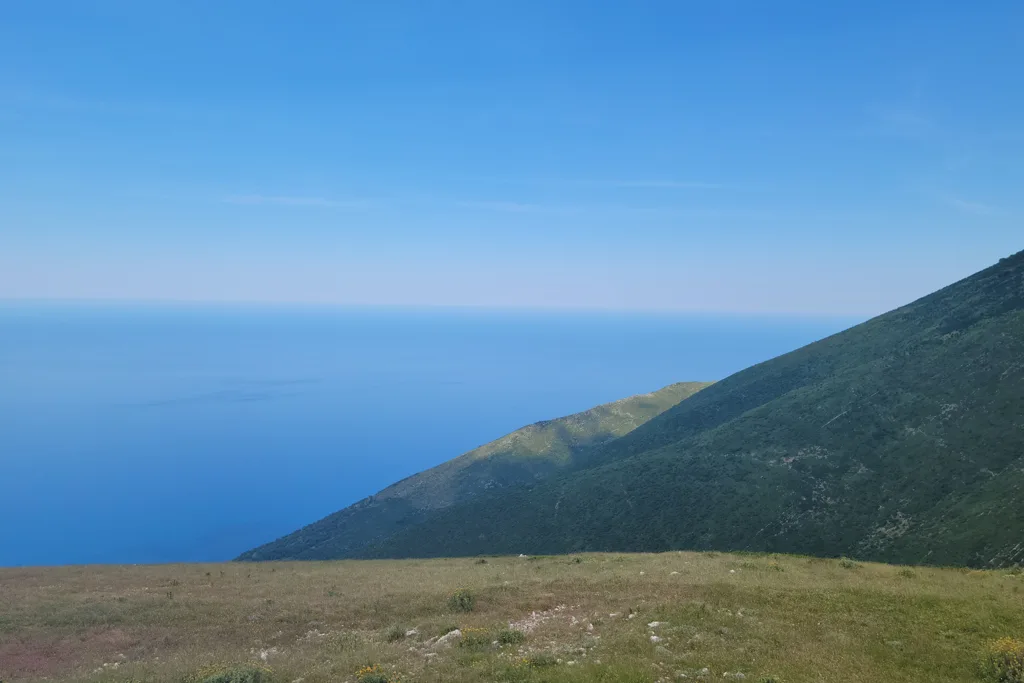
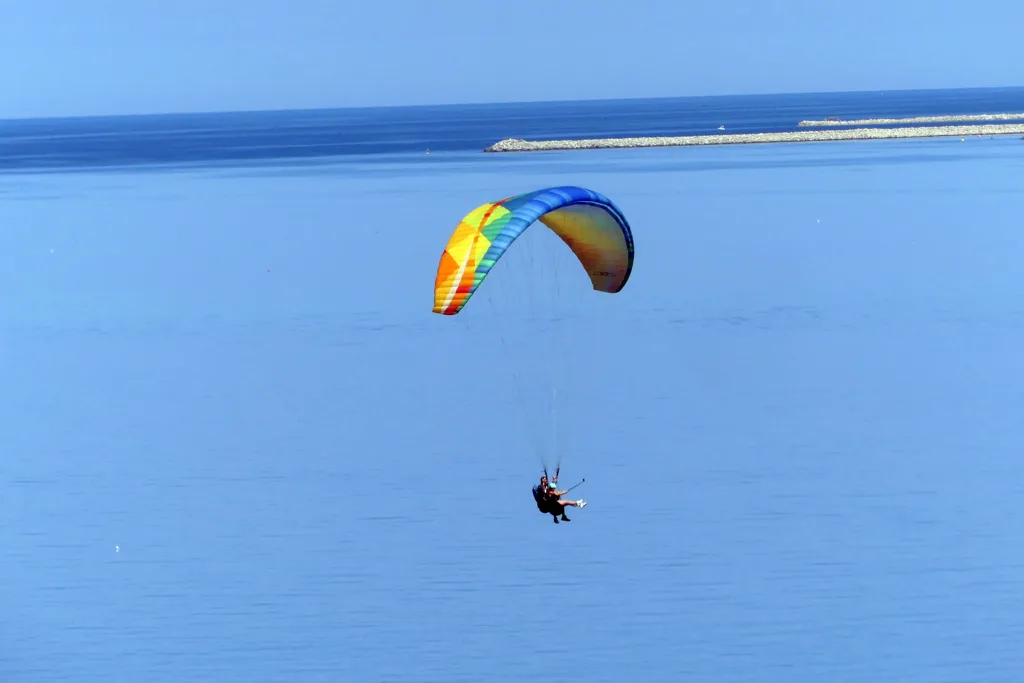
Every journey south from Vlorë ends, sooner or later, at a wall of mountain, and the road over it is one of the great drives of the Mediterranean. The SH8 leaves Orikum, climbs through pine forest into the Llogara National Park — a protected mountainside of black pines, some of them bent into strange flag shapes by the wind that funnels over the ridge — and crosses the Llogara Pass at the top of the Ceraunian mountains. The pass is a place as much as a road: a high, grassy saddle with restaurants and honey and yoghurt sellers in season, paragliders launching from the slopes above it in summer, and then, on the southern side, the moment the whole drive exists for. The road tips over the ridge and the Ionian is suddenly below you, the coast unrolling south in a long blue curve — Palasa and Dhërmi first, then the whole Riviera beyond. Drivers who have done the pass in both directions will tell you the descent south is the famous one, and they are right; it is the reveal on which the Albanian Riviera’s reputation is built.
Context keeps the pass in proportion. For most of history this mountain wall is why Vlorë looked north and seaward: the coast south of Llogara was another world, reached by boat or by mule track, and the modern road is the only reason the Riviera functions as a continuation of a Vlorë trip at all. That is the hinge working again. A traveller based in Vlorë can be over the pass and on an Ionian beach as a day trip, and a traveller touring the coast uses Vlorë as the natural pause before the climb — fuel, food, a night’s sleep, a morning at the independence sites, and then the pass taken fresh rather than at the end of a long day from Tirana. The pass also has its own weather and its own moods: cloud and fog sit on the ridge when the coast below is clear, the wind at the top is a physical presence, and in winter the high road is a serious drive. Treat it as a mountain crossing, not a motorway segment, and it will reward you; the stops at the top, for the view back over the bay of Vlorë on one side and the Ionian on the other, are not optional extras but the point of the road.
One honest note on what lies beyond, because this vlore travel guide’s job is Vlorë and not the coast south of the pass. The Riviera — Dhërmi, Himarë, Borsh, Sarandë and the rest — is a separate country of beaches and villages that deserves, and on this site gets, its own treatment; it is listed with the planned links at the end of this article. From Vlorë, the practical point for any vlore travel guide is only this: the Llogara road is the single thread connecting the two coasts, it is beautiful and demanding in equal measure, and the traveller who understands Vlorë first — its bay, its history, its own two grades of swimming — crosses the pass with the whole geography of the Albanian coast already clear in their head. That understanding is worth the night in the city on its own.
Eating and Drinking in Vlorë
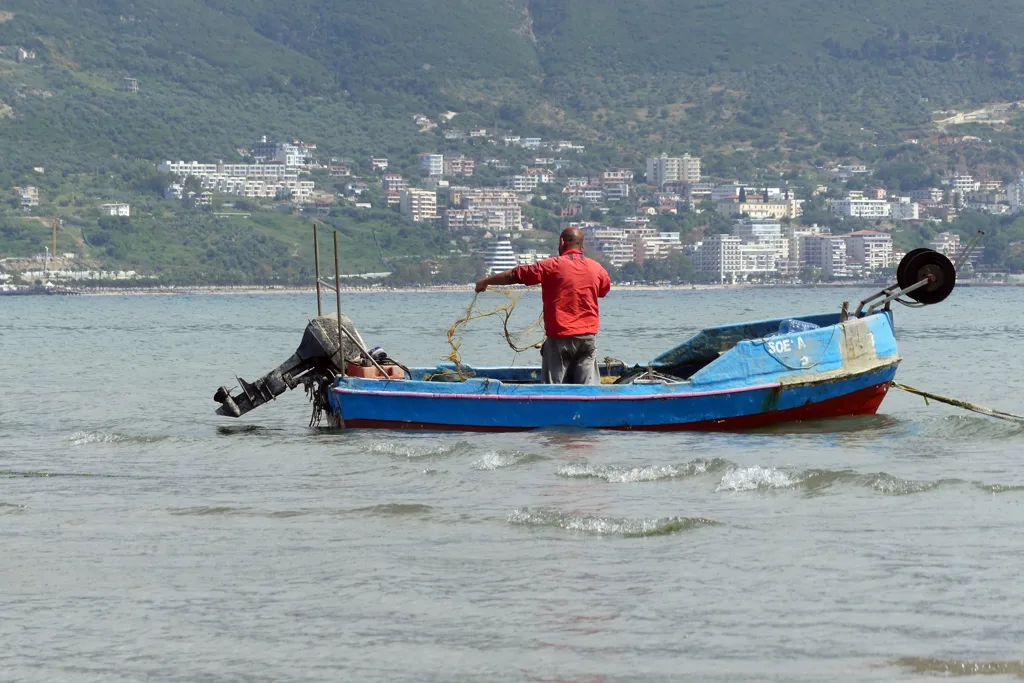
Vlorë eats from two larders, and a good meal in the city uses both. The first is the sea in front of it: this is a working fishing port, with a fleet you can watch from the harbour and the promenade, and the fish restaurants of the city — along the Lungomare, around the port and down the southern shore toward Radhimë — are built on the day’s catch in the proper Mediterranean way. The honest way to order is the way the waiter will suggest if you let him: ask what came in, have it grilled simply, and let the fish be the point. Mussels and other shellfish from the bay’s waters, and the mixed fried fish of the coast, are the other standing orders. The second larder is the plain and the hills behind: Vlorë’s countryside is old olive country — the ancient fame of Aulon was built partly on its olive groves — and the local olive oil, the cheeses, the lamb and the produce of the villages inland give the city’s kitchens their second register, heartier and cheaper than the seafront.
The everyday food culture is as much a part of this vlore travel guide as the fish. Byrek from the bakeries in the morning, coffee taken slowly and seriously at all hours in the cafés of the old town and the centre, ice cream on the Lungomare in the evening, and the full Albanian repertoire of taverns serving grilled meats, salads, bean and pepper dishes and raki for those who want the inland table rather than the maritime one. The pattern to copy is the local one: a light, late breakfast, the main meal taken long at midday or in the evening after the heat, and the promenade as the digestive. Prices belong to a working Albanian city rather than a resort, and meals here are mechanisms rather than events — walk the front, look at what is full of locals, look at what the next table is eating, and order that. A restaurant list would age in a season; that method will not.
Two honest notes finish the subject. The seafront’s convenience is also its trap: the Lungomare’s restaurants trade partly on the view, quality varies within a single row of terraces, and the places a street or two inland, around the old town and the market streets, often cook better for the city’s own people. And the fish, for all the fleet in the harbour, follows the sea’s rules: weather keeps boats in, seasons change what is caught, and a menu that promises everything on a rough day is a menu to be politely doubted. Eat what the day actually caught, in the places the city itself uses, and Vlorë’s table — part port, part olive plain, entirely unpretentious — becomes one of the better arguments for staying here rather than passing through.
Planning Your Days in Vlorë
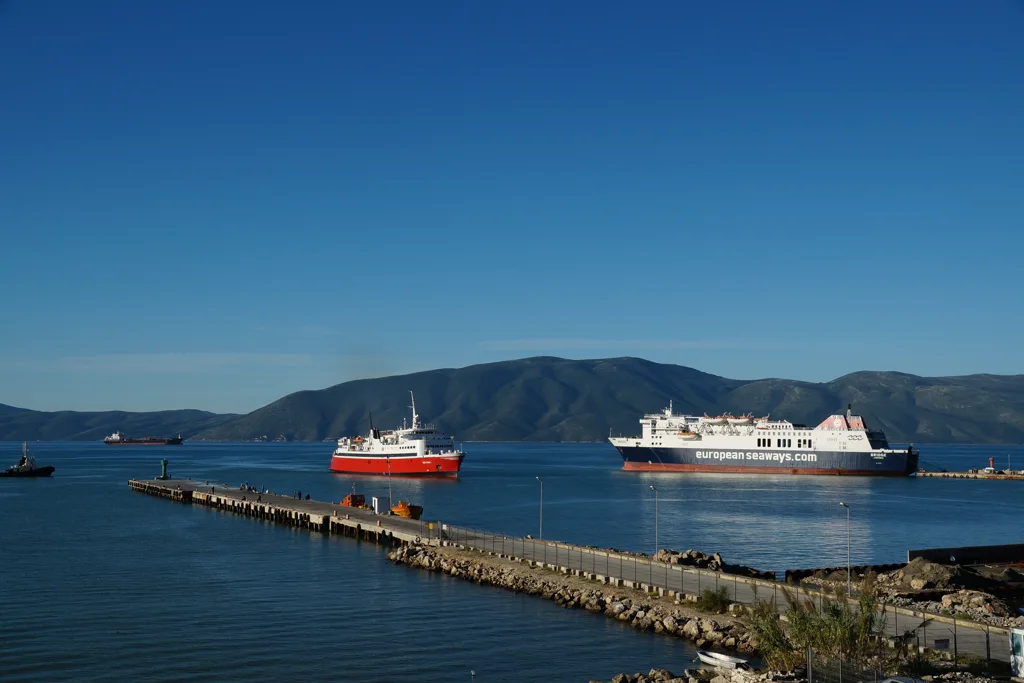
Getting to Vlorë is straightforward in every direction, which is exactly what a hinge city should be. By road it is the end of the motorway-and-highway run south from Tirana and Durrës, and the start of the SH8 over Llogara; buses connect it with the capital and the northern cities, and with Sarandë and the south by the inland and coastal routes. By sea it is Albania’s second port, with ferries crossing to Italy — Bari and Brindisi are the usual Italian ports — which makes Vlorë a genuine entry point to the country, not just a stop inside it: a traveller can step off a ferry in the morning and be at Flag Square in minutes. There is no airport in the city; the capital’s airport does that work, and the road transfer is part of the arrival. Within the city, the centre, the square, the museum, the old town and the Lungomare all walk into one another; Kaninë, Radhimë, Orikum and Zvërnec are short drives or arranged rides beyond it.
How long the city deserves depends on what you came for, and this vlore travel guide gives the honest ladder rather than a single number. One full day covers the core: Flag Square and the Independence Museum in the morning, the Muradie Mosque and the old town lanes, a swim wherever the day is hottest, and the Lungomare for the evening — a satisfying day, but one that treats Vlorë as a city break only. Two days is the recommendation this guide actually makes: the second day takes the boat to Karaburun in season, or Zvërnec and the lagoon out of it, and turns the trip from a history stop into a coast holiday with a city attached. Three days adds Kaninë Castle at leisure, a Radhimë beach day and a slower pass over the whole list, and makes Vlorë a base rather than a stop — from which the Llogara day trip south also becomes possible without turning it into a dash. Where Vlorë sits among the country’s other stops is set out in our best places to visit in Albania, which runs it in route order with the rest of a first trip.
Season shapes the choice more here than in most Albanian cities. Summer is the full version of Vlorë: boats running to Karaburun, the Lungomare at its most alive, swimming everywhere — and the city at its hottest, busiest and most expensive, with the pass road carrying the whole Riviera’s traffic. Spring and autumn trade the boat season’s guarantee for comfort: the monuments, the castle, the lagoon and the old town are all better in mild weather, the promenade keeps its evening life, and swimming continues at the edges of the season for the hardy. Winter is the city talking to itself — ferries, fishermen, the xhiro in coats — and a traveller who comes then is coming for Albania rather than for a beach, which is a legitimate trip but a different one. Build the days around that choice, book the boat day flexibly against the weather in season, and Vlorë will do the rest.
Vlore Travel Guide – Questions Travellers Actually Ask
Is Vlorë worth staying in, or just passing through? Stay, at least one night and preferably two, and this vlore travel guide has tried to show why: the independence sites are Albania’s founding story, the Lungomare is one of the country’s great evening promenades, and the boat coast of Karaburun is reachable only from here. Travellers pass through because the Riviera pulls them south, but the ones who stop consistently report the same surprise — the junction turned out to be a destination. Passing through is only rational if your trip is very short and entirely about Ionian beaches.
How many days do I need in Vlorë? Two days is the honest answer for most travellers: one for the city — Flag Square, the Independence Museum, the Muradie Mosque, Kaninë Castle if you move briskly, the Lungomare in the evening — and one for the sea, meaning the Karaburun boat day in season or the Radhimë and Orikum shore out of it. One day is a workable city stop. Three days makes Vlorë a base for a Llogara day trip as well, and suits travellers who like their trips unhurried.
Can I swim in Vlorë itself? Yes, and easily — the city beach along the Lungomare is long, sheltered and fully serviced, and fine for a morning dip, an evening swim or a family day. What it is not is the clearest water in Albania, because it lies inside a harbour bay. For clearer water without a boat, go south to Radhimë and Orikum. For the famous water, take the boat to Karaburun. The three shores are all “Vlorë beaches” in the brochures, and they are three different experiences.
How do the Karaburun boat trips work? As a season and a harbour mechanism rather than a fixed timetable: in summer, boats run day trips from Vlorë’s harbour along the roadless western shore of the peninsula, with swimming stops in the coves and often a call at Sazan island, returning the same day. You arrange them at the harbour or through your lodging, you take shade, water and everything the day needs because the shore has no services, and you accept that weather and season decide what actually runs. Out of season, expect little or nothing to sail.
Is Zvërnec monastery a half-day trip? Yes, a comfortable half day with the lagoon around it, and most of the pleasure is in the approach — the drive out along the lagoon shore and the long wooden footbridge over the water to the pine-covered island. The church itself is small and the island has no facilities, so the trip is about quiet, birds and one beautiful Byzantine building rather than a programme of sights. Combine it with a slow circuit of the Narta lagoon shore and it fills a morning or a long afternoon perfectly.
When is the best time to visit Vlorë? For the full city — boats, swimming, promenade life — the summer season, accepting the heat and the crowds that come with it. For the history, the castle, the lagoon and comfortable walking, late spring and early autumn are the sweet spot, with the caveat that the Karaburun boats thin out and stop as the season ends. Winter belongs to travellers who want the working city and the founding story without the beach holiday attached.
Should I base in Vlorë or Sarandë for the Riviera? In Vlorë if your trip mixes history, city life and coast, if you are arriving by ferry from Italy, or if you want Karaburun, which sails from here and nowhere else. In Sarandë if the trip is purely the Ionian beaches and Butrint at the far south. Many good trips do both — Vlorë first for the hinge and the history, then over Llogara and down the Riviera — and that order, north to south, is the one this vlore travel guide recommends.
Leaving Vlorë – the Hinge of the Albanian Coast
The right way to leave Vlorë is slowly, and in either of the two directions the city offers, because both of them have been earned by the geography this guide started with. North, the road runs back along the plain toward Fier, Durrës and Tirana — the Adriatic Albania of lagoons, Roman ports and the capital. South, it climbs out of Orikum into the pines, crosses Llogara at the top of the Ceraunians and drops, in one long reveal, to the Ionian and the Riviera. Vlorë stands exactly at the joint between those two Albanias, and it has stood at joints all its life: between the bay and the open sea, between Aulon and Valona and Vlorë, between five centuries of Ottoman rule and a November morning in 1912 when a small city by the harbour declared itself a country. The hinge is not a metaphor imposed on the place. It is the place’s whole history, and it is why the city rewards the traveller who stops.
So plan Vlorë the way this vlore travel guide has argued throughout: not as a fuel stop on the way to the beaches, and not as a beach resort that happens to have monuments, but as a city with two coasts and one founding story, each of which needs its own day and its own expectations. Give it the square and the museum in the morning light. Give it the mosque and the castle hill, the lagoon bridge and the quiet island. Swim in the city when ease is what you want, at Radhimë when clarity is, and from a boat along Karaburun when you want to remember what an empty Mediterranean coast looked like. Eat the fish the day caught, walk the Lungomare when the city does, and cross the pass the next morning with the whole map clear in your head.
Most travellers will still meet Vlorë the way this article began: briefly, through a bus window, on the way somewhere else. Let them. The city has been the hinge of this coast for two and a half thousand years, under half a dozen names, and it is in no hurry for them to notice. It was here before the road over Llogara, before the flag, before the ferries, and it will be here — bay, promenade, castle hill and all — when they come back and do it properly. That permanence, in a country changing as fast as Albania, is Vlorë’s real attraction, and it is what this vlore travel guide hopes to have shown.