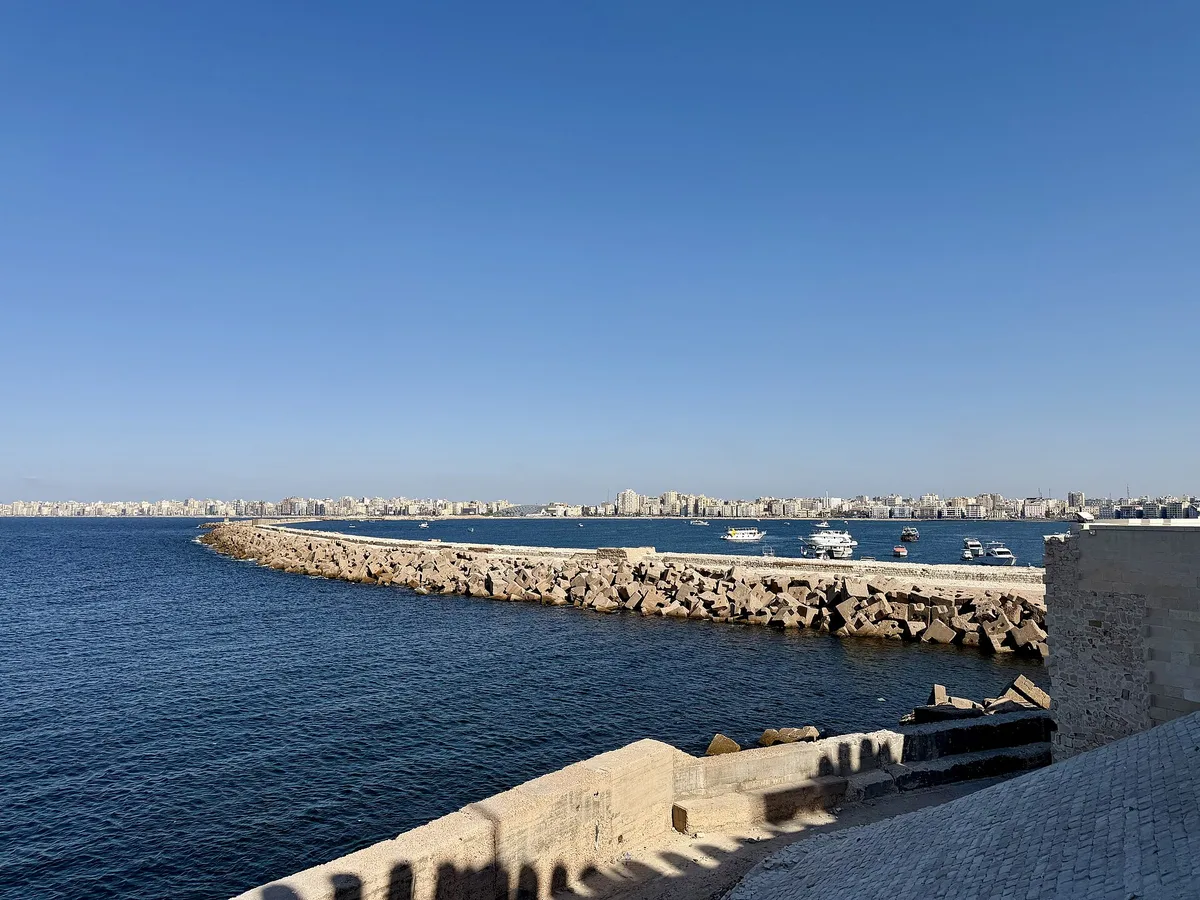
Alexandria is the Egypt that faces the sea. Everything most visitors fly in for — the pyramids, the great temples, the tombs of pharaohs — belongs to the Nile Valley and the desert edge; Alexandria belongs to the Mediterranean. Alexander the Great founded it in 331 BC as a Greek port on a strip of coast at the Delta’s western edge, and for close to a thousand years it was one of the largest and most learned cities on earth, home to the Pharos lighthouse and the Great Library. What survives of that city is not standing in a row waiting to be photographed. It is underground, underwater, built over and reused — a Roman theatre found in the middle of the modern streets, a column standing over a ruined temple, tombs cut into the rock beneath an ordinary neighbourhood, and a Mamluk fortress guarding the exact spot where the lighthouse fell into the sea.
The modern city this alexandria travel guide walks through is Egypt’s second city and its principal port, a long, thin metropolis of more than five million people stretched some forty kilometres along the coast, all of it arranged along one great waterfront curve, the Corniche. Alexandrians — who call their city the Bride of the Mediterranean — treat that seafront as their front room: fishing from the parapet, promenading at sunset, eating fish in the harbour-side restaurants of Bahary and Anfushi. A visitor who understands the Corniche understands the city’s geography, because almost everything in this guide hangs off that one coastal axis, from the Qaitbay Citadel at its western end to the royal gardens of Montaza at its eastern one.
This guide is organised the way the city itself is organised. It starts with the deep story — the founding, the lighthouse, the library — because in Alexandria the history is not background, it is the sightseeing. Then it walks the sights in the order they group on the ground: the citadel on the harbour point, the catacombs and Pompey’s Pillar together in the south-west, the Roman theatre and the museums in the centre, the new library on the bay, and the Corniche, the old harbour quarter and Montaza to finish. Practical sections on getting here from Cairo, structuring one day or two, and the famous day trip close the page. If you are planning the country as a whole, our Egypt travel guide puts Alexandria in the context of Cairo, Luxor and the Nile; this page is for the city itself.
One honest note before the sights. This article prints no ticket prices and no opening hours, for any attraction. Those figures are set site by site, they change, and the Alexandria guides that do print them disagree with each other — sometimes, as the competitor notes at the end of this package record, suspiciously uniformly. The practical sections tell you instead how the arrangements work at each place and where the official information lives, so the numbers you travel on are the current ones rather than a copied table.
At a Glance
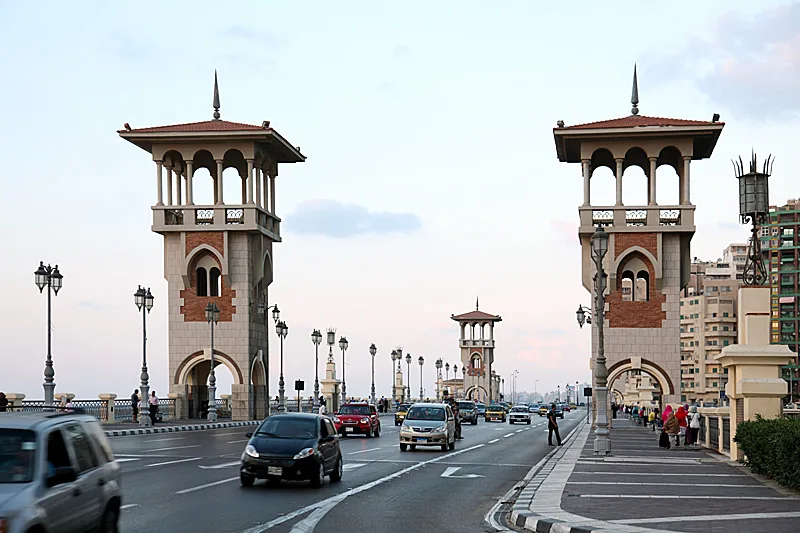
Stanley Bridge and its four towers, the Corniche’s modern landmark where the road crosses Stanley Bay. Photo: Roland Unger, CC BY-SA 3.0, via Wikimedia Commons
Here is the whole city on one screen before the detail begins. Alexandria is a linear city: one coast road, the Corniche, runs from the old harbour in the west to Montaza in the east, and every major sight sits either on that road or a short hop inland from it. The ancient sights cluster at the western and central end; the pleasure sights — beaches, gardens, fish restaurants — spread east. Almost no visitor sights sit far from the sea.
| Era | Rough dates | Where you meet it |
|---|---|---|
| Foundation and Ptolemaic capital | 331–30 BC | The harbour plan itself, the Pharos story, the Graeco-Roman Museum’s earliest galleries |
| Roman and late-antique city | 30 BC – AD 641 | Kom el-Dikka theatre, Pompey’s Pillar, the Kom el-Shoqafa catacombs |
| Medieval Islamic port | 641 onwards | The Anfushi quarter, the Abu al-Abbas al-Mursi Mosque, the Qaitbay Citadel (1477–79) |
| Khedival and cosmopolitan city | 1805–1952 | The Corniche facades, Montaza’s palaces, the Royal Jewelry Museum |
| Modern revival | 2002 onwards | The Bibliotheca Alexandrina, the reopened Graeco-Roman Museum |
Two judgements belong up front rather than buried. First, Alexandria rewards readers: its sights are fragments, and fragments need their stories told, which is why this guide gives the history real space before the practicalities. A traveller who arrives knowing what the Pharos was will get ten times more from standing in the Qaitbay Citadel than one who arrives cold. Second, Alexandria is not a suburb of Cairo with a beach. It sits some 220 kilometres north-west of the capital, it has its own weather, its own food and its own pace, and the many visitors who squeeze it into a rushed day trip leave having seen the checklist rather than the city. The structuring section near the end of this page is honest about what a day trip can and cannot hold.
The City Alexander Founded – and the Lighthouse That Made It Famous
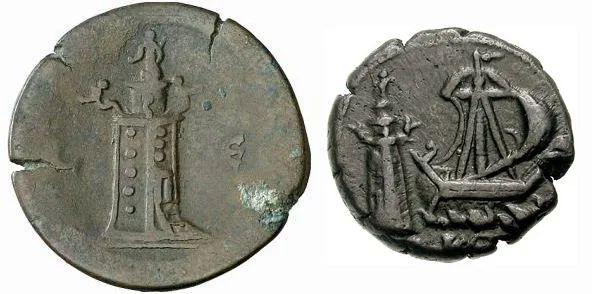
The Pharos as its users saw it – Roman-era Alexandrian coins showing the lighthouse and a ship approaching it. Photo: Unknown author, CC BY-SA 3.0, via Wikimedia Commons
There was an Egyptian fishing village here first — Rhakotis, a modest settlement on the shore opposite a low offshore island called Pharos. In April 331 BC Alexander the Great, fresh from taking Egypt from the Persians, chose the site for the Greek city that would bear his name. The choice was a sailor’s, not a farmer’s: the island of Pharos sheltered the coast behind it, and a causeway built out to the island — the Heptastadion, named for its length of seven stadia — would split the sheltered water into two deep harbours, one on each side of the causeway. Those twin harbours, the Eastern or Great Harbour and the Western Harbour, are still the city’s defining shape today; the causeway has widened over the centuries into the land the Anfushi quarter stands on. The architect Dinocrates of Rhodes laid the city out on a grid of straight streets behind the harbours, and after Alexander’s death his general Ptolemy made it the capital of his new Egyptian kingdom, which it remained, through Cleopatra, for nearly three centuries.
On the island’s eastern tip the Ptolemies built the city’s signature: the Pharos, a lighthouse begun under Ptolemy I and completed around 280 BC under his son. By most ancient and modern estimates it rose well over a hundred metres in three stacked tiers — square, then octagonal, then round — carrying a fire whose light, concentrated by reflectors, guided ships into the Great Harbour. It was so successful an idea that it became the type specimen of all lighthouses: pharos passed into French as phare, and into Italian and Spanish as faro, and it held its place among the Seven Wonders of the Ancient World for the simple reason that, alone among them, it was useful. Alongside it the Ptolemies built the Mouseion, a state-funded community of scholars, and within or beside it the Great Library, the largest collection of books in the ancient world — the institution that made Alexandria a byword for learning, home at various times to Euclid, the astronomer-geographer Eratosthenes and generations of physicians, mathematicians and editors.
The glory was long but not eternal, and the honest version of the decline is a slow fade, not a single fire. The library was damaged during Julius Caesar’s Alexandrian War in 48–47 BC and dwindled over centuries as patronage shrank; the city’s fortunes swung with its politics, from late-antique intellectual brilliance — the mathematician Hypatia was murdered by a mob in AD 415 as Alexandria’s religious tensions boiled over — to the Arab conquest of 641, after which the capital moved inland to Fustat, the seed of Cairo, and Alexandria settled into life as a provincial port. Earthquakes did for the Pharos in stages: battered over the centuries, it was finally ruined by great quakes in 1303 and 1323, and its stones went into the sea and into later building. Some of them are still down there. Modern underwater archaeology in the Eastern Harbour, led since the 1990s by Franck Goddio’s institute, has mapped thousands of ancient blocks, sphinxes and statues on the harbour floor — the drowned royal quarter of the Ptolemies lying just offshore from the modern Corniche.
The city’s second life began in the early nineteenth century under Muhammad Ali, who rebuilt it as Egypt’s window on Europe: new port works, canals, and a cotton trade that drew Greek, Italian, Jewish, Levantine and Egyptian merchants into a famously cosmopolitan society. The grand Corniche facades, the tram network and the beach suburbs all date from that boom, and its afterglow still sets the city’s character. Keep the layers straight in your mind — Greek foundation, Roman city, Arab port, Khedival resort, modern metropolis — and every sight that follows has a hook to hang on.
Qaitbay Citadel – the Fort on the Lighthouse’s Foundations
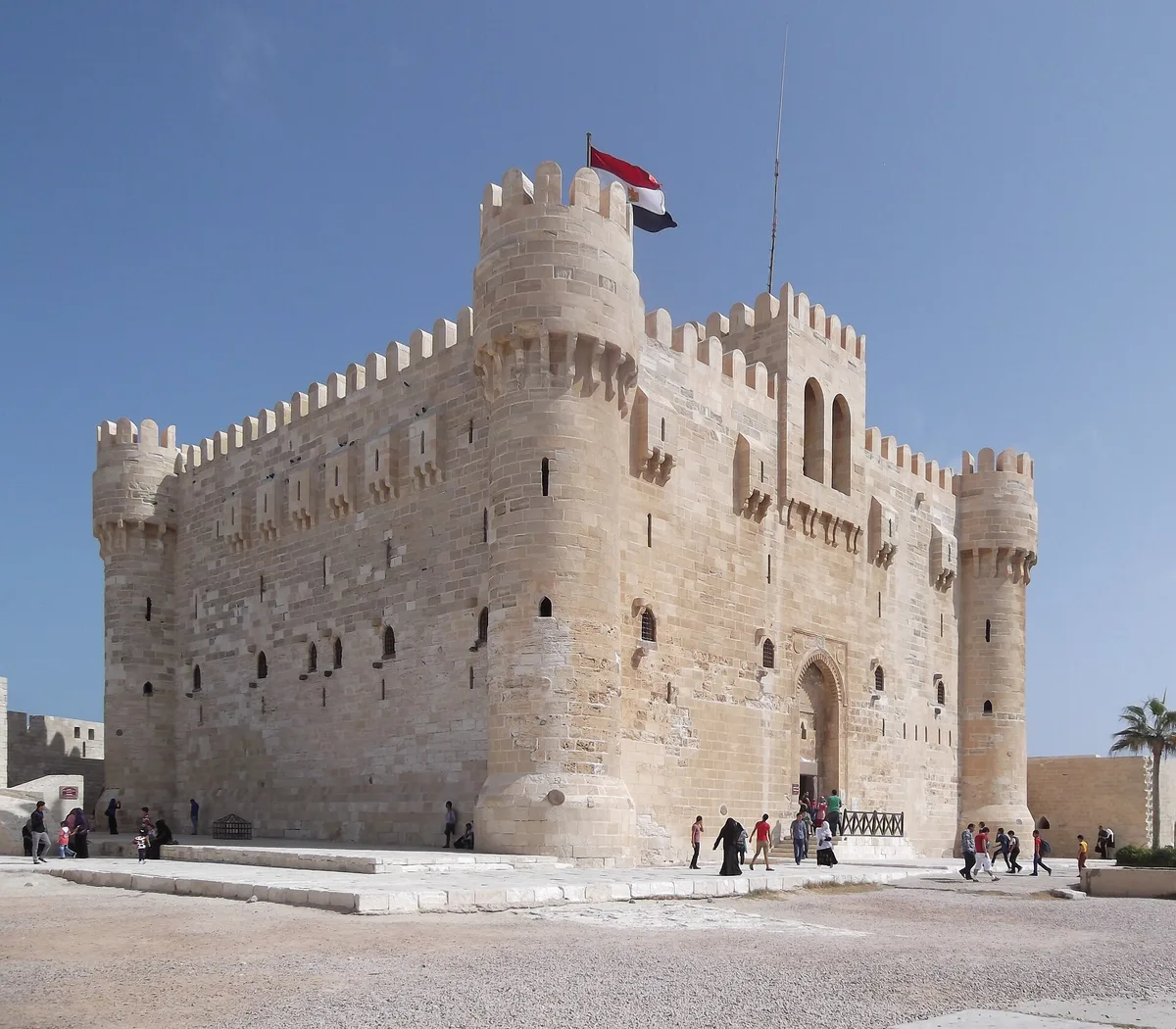
The main keep of the Qaitbay Citadel, raised in 1477-79 on the foundations of the Pharos. Photo: La Rosa, CC BY-SA 3.0, via Wikimedia Commons
Stand on the northern tip of Pharos island and you are standing on the most storied building plot in Alexandria. This is where the Pharos rose for some sixteen centuries, where its ruins served as a watchtower and a landmark long after the light went out, and where, in 1477, the Mamluk sultan al-Ashraf Qaitbay came in person to order a fortress built on the ancient foundations against the Ottoman threat from across the sea. The fort that rose over the following two years — the Citadel of Qaitbay — is what you visit today: a compact, handsome stronghold of pale stone, with a three-storey keep, corner towers, a mosque inside its walls as its builder intended, and the sea on three sides.
The citadel stayed a working fortress for an extraordinarily long time, maintained through Mamluk, Ottoman and Muhammad Ali eras, and its scars are part of the visit: the British fleet’s bombardment of Alexandria in 1882, during the Urabi revolt, smashed its sea-facing walls, and the repairs are part of what you see. After long neglect it was restored in the twentieth century and the building now houses a small maritime museum, but the truth is that the exhibits are the supporting act. The citadel itself — its vaulted halls, its garrison mosque, the gun positions and the climb to its upper walls — is the exhibit, and the panorama from those walls is the finest free-standing view in the city: the whole Eastern Harbour curving away eastward, the Corniche’s white skyline, fishing boats working below, and the open Mediterranean behind you.
Practically, the citadel is the natural first or last stop of an Alexandria day because of where it sits: at the far western end of the Corniche, at the end of its own causeway through the harbour quarter of Bahary. It is an exposed site, and the visit is mostly outdoors and on stone, so it suits the cooler ends of the day — which conveniently are also when the light on the harbour is best and when the local families who picnic on the surrounding rocks and the fishermen casting from them are out in force. The ground inside is uneven in places and the stairs are worn; none of it is difficult, but it is a fortress, not a polished museum, and it is better for it.
The Catacombs of Kom el-Shoqafa – Three Cultures in One Tomb
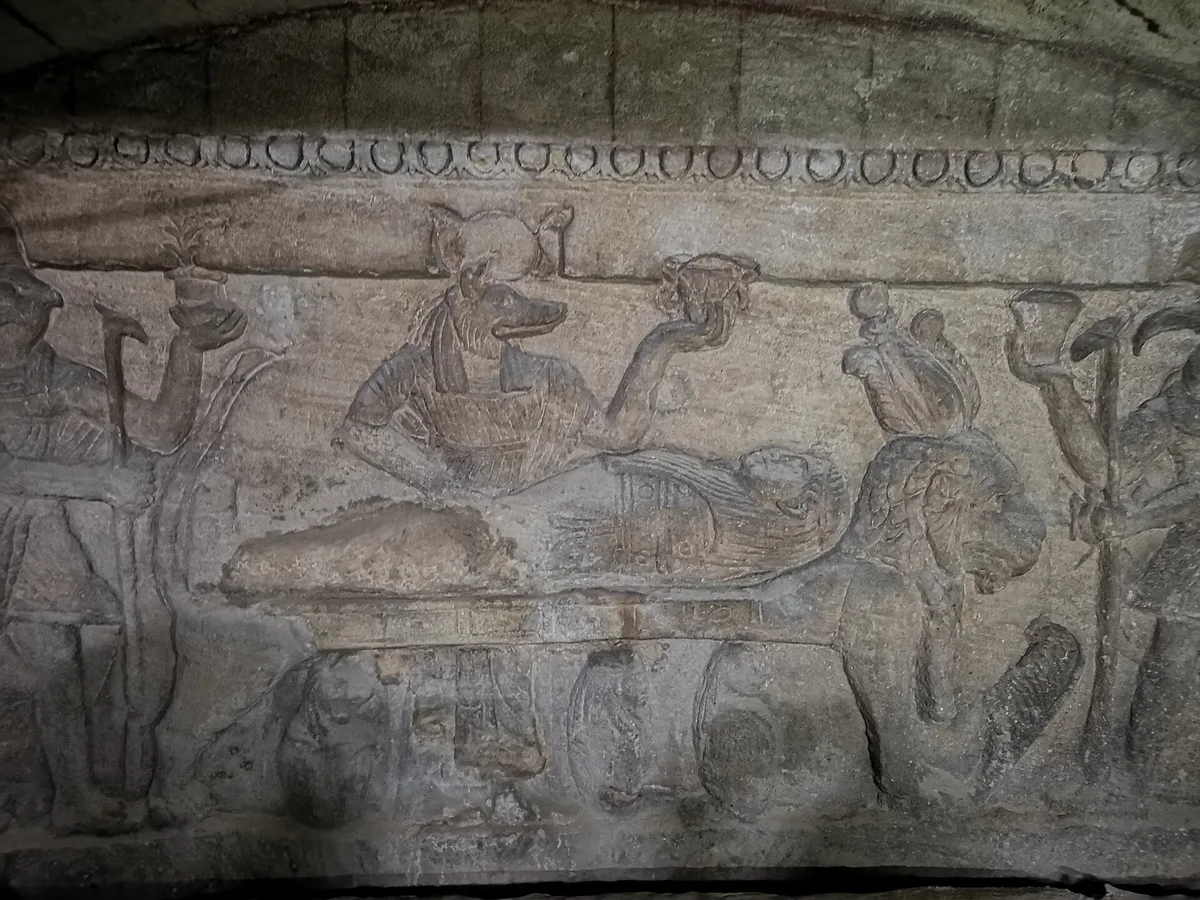
Inside the Catacombs of Kom el-Shoqafa – the jackal-headed Anubis, dressed as a Roman soldier, tending the dead on a lion-shaped bier. Photo: Following Hadrian, CC BY-SA 2.0, via Wikimedia Commons
From a small, easily missed entrance in the Karmouz district, a spiral staircase winds down around a deep circular shaft into the largest known Roman burial complex in Egypt — and one of the strangest, most absorbing sights in the country. The Catacombs of Kom el-Shoqafa were cut into the rock mainly in the second century AD, in Alexandria’s Roman period, and then effectively lost until 1900, when they were brought back to light by chance. The shaft around which the stair curls was practical engineering: it let daylight into the descent, and it is down this well that the dead were lowered by rope to the chambers below.
What makes Kom el-Shoqafa unique is not its size but its mixture. This was a tomb built for Alexandrians, and Alexandrians of the Roman period were Egyptians, Greeks and Romans at once — so their tomb is all three cultures carved into the same walls. The descent passes a circular banqueting hall, the triclinium, where mourners held funeral feasts for the dead, and sarcophagi and burial niches, called loculi, line the chambers. In the principal chamber the reliefs make the fusion explicit: the jackal-headed god Anubis, attendant of Egyptian mummies, wears the kit of a Roman soldier; the mummy he tends lies on a lion-shaped bier; and nearby a great serpent, the Agathodaimon, wears the crowns and carries the emblems of Greek and Egyptian gods simultaneously. No other site in Egypt shows the city’s famous cosmopolitanism so literally — not three religions side by side, but three religions inside the same carvings.
Visiting needs a little honesty about conditions. The complex descends through several levels, and the lowest reaches lie below the water table and are flooded, so what you tour is the upper world of stairs, halls and chambers, reached by steps that can be damp and are unevenly lit. It is cool underground after the street, close in the narrowest passages, and entirely manageable at a normal walking pace — but it is a tomb, and it asks for the same unhurried respect as any burial place. Pair it with Pompey’s Pillar, described next: the two sites sit in the same south-western quarter of the city, and together they make the natural first half of a sightseeing day, before the heat and the crowds build at the harbour end of town.
Pompey’s Pillar and the Serapeum – the Column With the Wrong Name
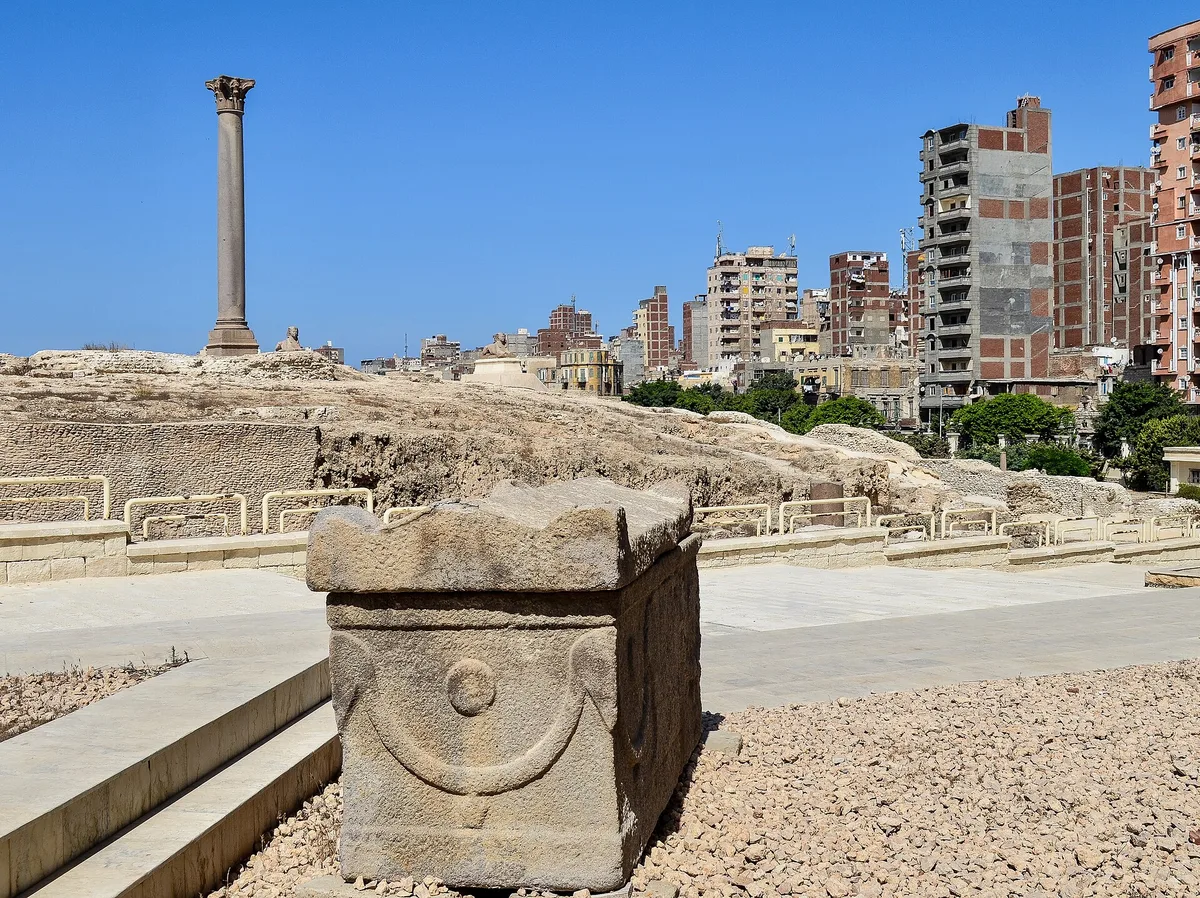
Pompey’s Pillar on its hill at the Serapeum, sphinxes at its base and the rooftops of Karmouz beyond. Photo: Hatem Moushir, CC BY-SA 4.0, via Wikimedia Commons
A short distance from the catacombs, on a low rocky hill above the streets of Karmouz, a single column of red granite rises over a field of ruins. It is nearly 27 metres tall from base to capital, its shaft cut from a single piece of Aswan granite, and it is one of the largest monolithic columns of the Roman world — and it has nothing whatsoever to do with Pompey. The column was raised around AD 297 in honour of the emperor Diocletian, most likely in thanks for his handling of a siege and famine in the city; the name it carries came from a medieval traveller’s tale, repeated for centuries, that the ball on its capital held the ashes of Pompey the Great, Caesar’s rival. The wrong name stuck so completely that no one now calls it anything else.
The hill it stands on matters as much as the column. This was the Serapeum, Alexandria’s great temple of Serapis — the Greco-Egyptian god the Ptolemies promoted as a bridge between their two peoples — and for centuries one of the most famous sanctuaries in the Mediterranean. The temple complex also housed a “daughter library”, an overflow collection of the Great Library, which is why the Serapeum’s destruction in the religious violence of AD 391 is remembered as one of the ancient world’s cultural catastrophes. Almost nothing of the temple stands now: the site is an open archaeological ground of fallen granite columns, inscribed blocks, sphinxes that once guarded the sanctuary, and underground passages, with the great wrong-named column presiding over all of it.
As a visit, then, Pompey’s Pillar is a place of atmosphere rather than intact architecture, and it is best taken slowly and in context — ideally with the catacombs the same morning, since the two together explain Roman Alexandria better than either does alone: its religion, its dead, its imperial politics and its sheer engineering confidence, all within a short walk of each other. The hilltop also earns its keep as a viewpoint, looking out over the dense modern city that has grown around the ancient acropolis hill, rooftops where the temples of a world capital once stood.
Kom el-Dikka – a Roman Neighbourhood in the Middle of the Modern City
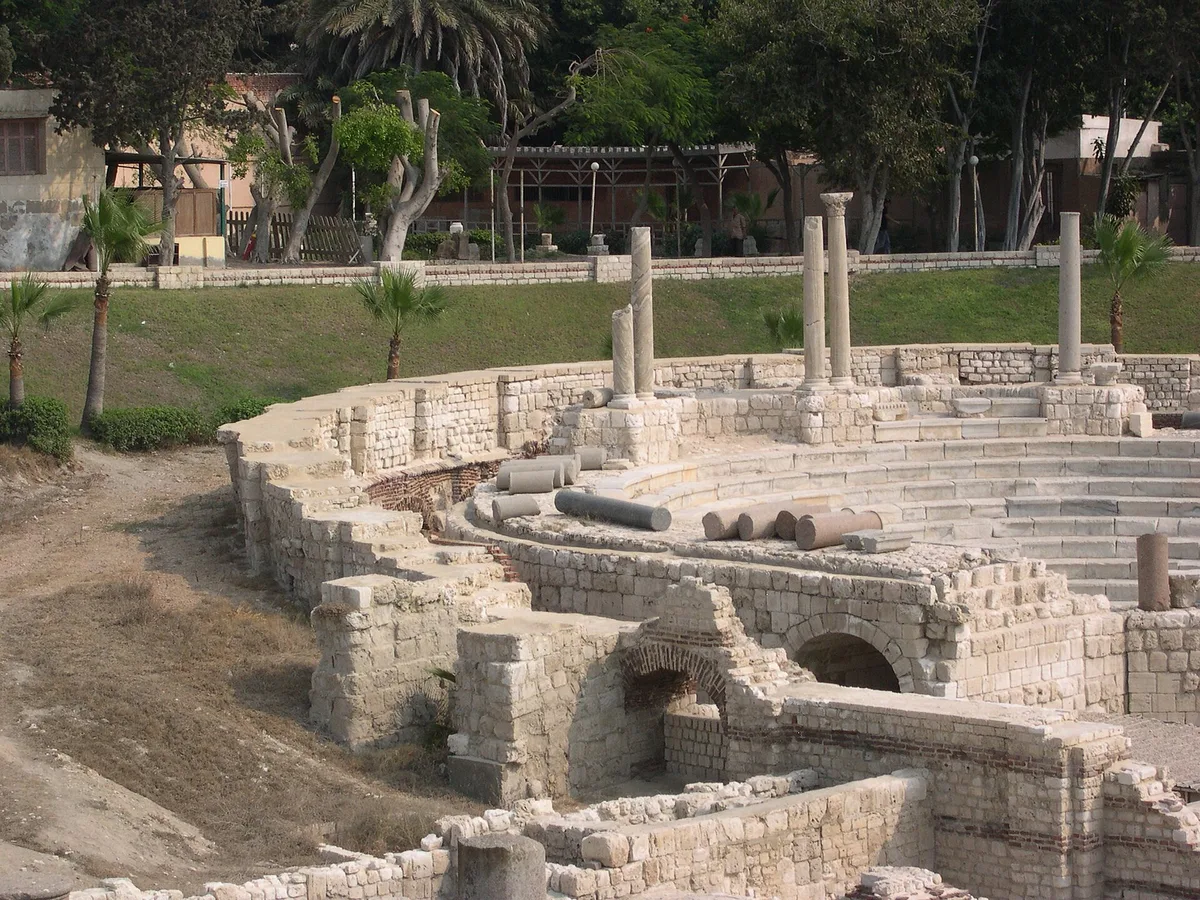
The Roman theatre at Kom el-Dikka, its marble seats uncovered in the middle of the modern city. Photo: Cmroueche, CC BY-SA 4.0, via Wikimedia Commons
Kom el-Dikka is Alexandria’s most surprising sight, precisely because of where it is: a sunken archaeological park of Roman ruins in the middle of the modern city centre, a few streets from the main railway station, with apartment blocks and traffic flowing around its fences. Its centrepiece is a small, elegant theatre of white marble seats — the only Roman theatre yet found in Egypt — first built in the Roman period and remodelled over the centuries that followed. It was not discovered by design. The site came to light in the 1960s, when the ground was cleared for new building and the past turned out to be underneath; Polish archaeologists from Warsaw University have led the excavations ever since, in what became one of the longest-running digs in the city.
The theatre turned out to be only the most photogenic part of a whole late-antique quarter. Around it the excavations have uncovered Roman baths, cisterns and houses — including the so-called Villa of the Birds, named for its fine floor mosaics of birds — and, most remarkably, a row of lecture halls. These auditoria belonged to an academic institution of the fifth and sixth centuries AD: in effect, a university campus, and the physical proof that Alexandria was still a working city of teachers and students a thousand years after its foundation, long after the Great Library’s heyday. Few sites anywhere let you stand in a seminar room of the late Roman world; Kom el-Dikka does.
Because it sits in the city centre, Kom el-Dikka is the easiest of the ancient sights to fold into any plan: it pairs naturally with the Graeco-Roman Museum nearby, with arrival or departure at Misr station, or with a half hour between other stops. The site is open and mostly unshaded, and the theatre seats give it an obvious place to sit and take the whole complex in. Treat it as the connective tissue of an Alexandria day — the place where the ancient city and the modern one are most visibly the same ground.
The Bibliotheca Alexandrina – the Great Library’s Deliberate Heir
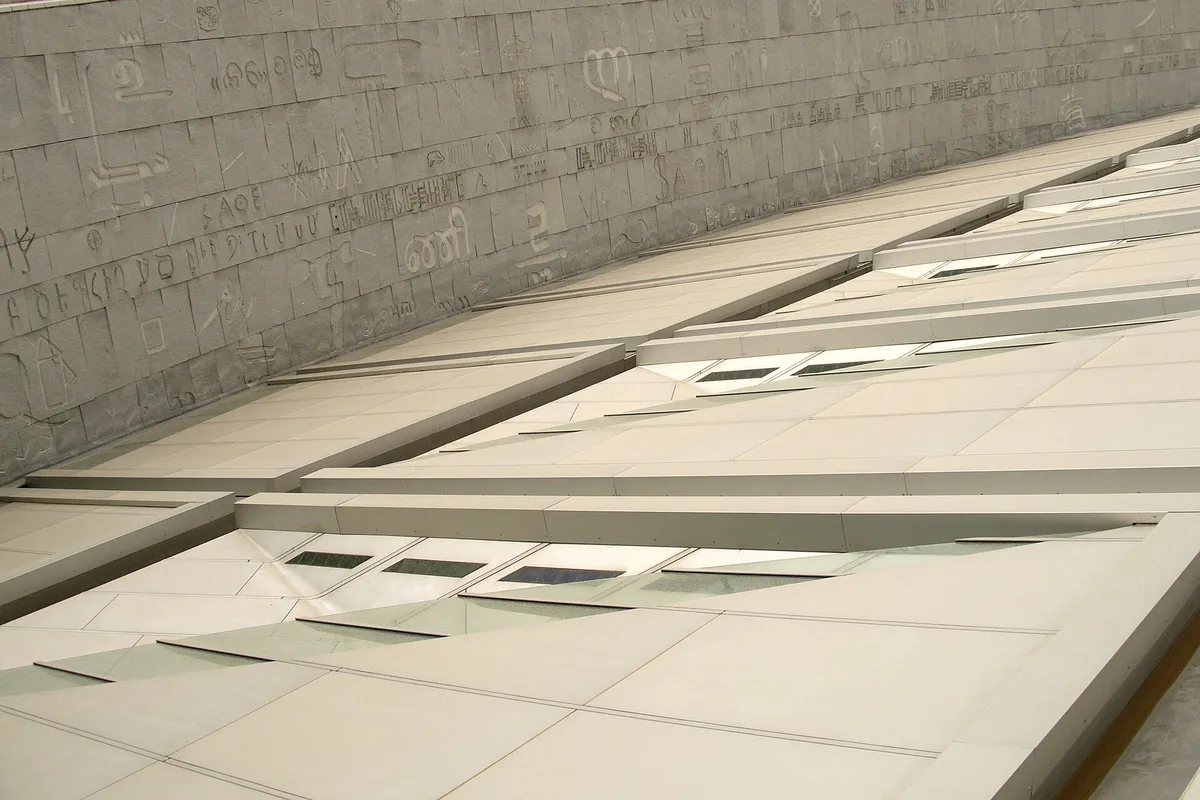
The Bibliotheca Alexandrina’s granite wall, carved with characters from the world’s writing systems, above the tilted roof of the reading room. Photo: Vyacheslav Argenberg, CC BY 4.0, via Wikimedia Commons
On the curve of the Eastern Harbour in the Shatby district, near where the Ptolemaic royal quarter stood, Alexandria has built its boldest modern statement: the Bibliotheca Alexandrina, a vast new library and cultural complex opened on 16 October 2002 as a conscious revival of the ancient Great Library. The project began with an international architectural competition run with UNESCO in the late 1980s, won by the Norwegian firm Snøhetta, and the building they produced is unlike anything else in Egypt: a huge circular disc, some 160 metres across, tilted down toward the sea like a second sun rising out of the ground — or a sundial laid against the shore, depending on who is describing it.
The details reward a slow look. The building’s great curved wall is clad in Aswan granite hand-carved with more than four thousand characters — letters, hieroglyphs, runes, and signs from some 120 of the world’s writing systems, an entire history of writing wrapped around a library. Inside, the main reading room cascades down in terraces beneath the tilted roof, a single enormous hall designed for thousands of readers at once, with shelving planned to hold up to eight million volumes as the collection grows. Around it the complex gathers several museums — of antiquities, of manuscripts, and of the city’s modern history among them — exhibition galleries, specialist libraries, a conference centre and the planetarium whose dark sphere sits on the plaza outside like a moon that has landed.
Be clear-eyed about what a visit here is. The Bibliotheca is a working national-scale library and cultural centre, not a museum of the ancient one: nothing of the Great Library survives to display, and the building’s claim is symbolic and forward-looking rather than archaeological. Visitors enter under arrangements that change from year to year — guided-tour systems, ticketed exhibitions and security screening have all featured in recent arrangements — so check the library’s own official website shortly before you go rather than trusting any guide’s description, this one included. Even a visitor who only walks the plaza, reads the carved wall and looks into the reading room from the visitor vantage points will leave understanding the essential Alexandrian fact: this city has twice decided that its monument should be a library.
The Museums – the City’s Memory, Indoors
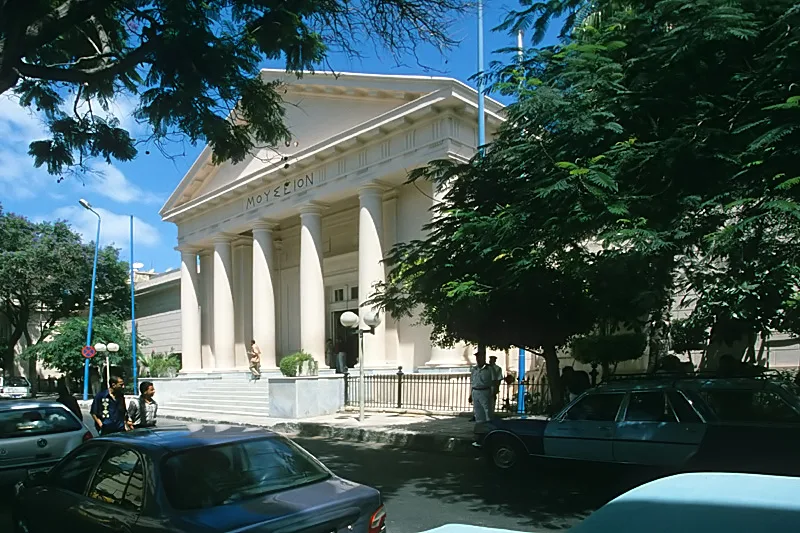
The Graeco-Roman Museum’s temple-front facade, its pediment inscribed Mouseion – museum – in Greek. Photo: Roland Unger, CC BY-SA 3.0, via Wikimedia Commons
Alexandria’s museums do the work its ruined streets cannot: they hold the objects. First among them is the Graeco-Roman Museum, in its neoclassical, temple-fronted building in the city centre — a museum founded in 1892, in the first age of Egyptian archaeology, and devoted entirely to the city’s Greek and Roman millennium. Its collection runs to tens of thousands of objects: sculpture, coins, mosaics, pottery and funerary art from the Ptolemaic and Roman centuries, including pieces recovered in the modern era from the harbour floor and from the drowned cities of the coast east of Alexandria, among them a famous inscribed stele raised from the sunken city of Thonis-Heracleion. The museum was closed in 2005 for a renovation that stretched, through funding stops and a revolution, to eighteen years; it finally reopened in October 2023, and the reopened galleries are now one of the strongest single stops in the city.
Two smaller museums complete the picture from different ends of the story. The Alexandria National Museum, installed in a fine old palace on the city’s Tariq al-Hurriya avenue, takes the whole sweep in one house — pharaonic pieces (the city region has them, even if the city itself was Greek), the Graeco-Roman core, then Coptic, Islamic and modern Alexandria, room by room as you climb. In the leafy eastern suburb of Zizenia, the Royal Jewelry Museum occupies another palace — once the home of Fatma al-Zahra of the Muhammad Ali family — and displays the dynasty’s jewels and precious objects in the family’s own gilded interiors, a glimpse of the royal Egypt that ended in 1952.
Practical advice for all three is the same. Museum arrangements in Alexandria — opening patterns, ticket systems, which galleries are lit or closed — change more often than any printed guide can track, so confirm the current position on official channels in the days before you visit, and build your day so that no single museum closure can break it. Of the three, the Graeco-Roman is the one to protect in your schedule: it is the collection that turns the fragments you see outdoors — at Kom el-Dikka, at the Serapeum, in the catacombs — into a civilisation with faces, names and handwriting.
The Corniche – the City’s Front Room
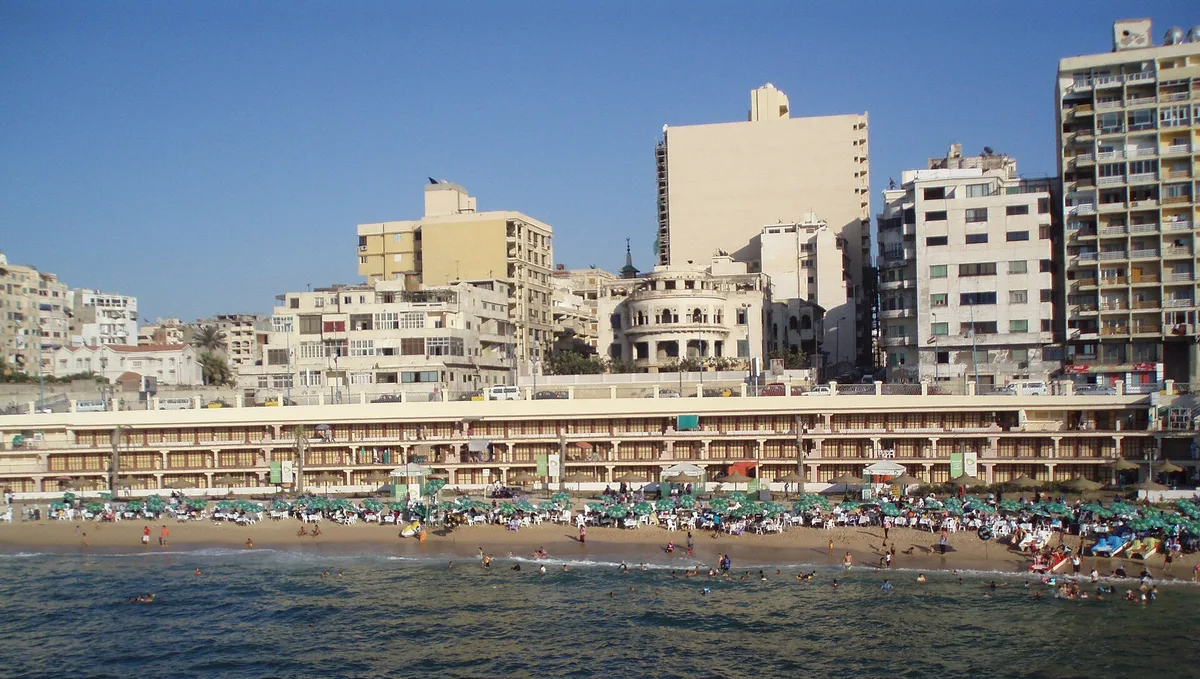
Stanley Beach and its famous rows of cabins, the working beach of the eastern Corniche. Photo: Leonard J. DeFrancisci, CC BY-SA 3.0, via Wikimedia Commons
Every Alexandria day eventually becomes a Corniche day, because the Corniche is not one sight among others — it is the city’s organising idea. The seafront road runs the whole inhabited length of Alexandria, from the Qaitbay Citadel and the old harbour in the west, around the curve of the Eastern Harbour, and east through district after district — Shatby and the library, Ibrahimia, Sporting, Glym, Zizenia, San Stefano — all the way to Montaza at the far end. On one side, the Mediterranean; on the other, the great nineteenth- and early-twentieth-century facades of the cosmopolitan city, apartment palaces and old hotels running in a near-continuous wall. Walking even a stretch of it is the single best way to feel how Alexandrians actually use their city.
The life of the Corniche is its own attraction. Fishermen line the harbour parapets with rods and hand lines at all hours. Cafés set their tables facing the water. In the evening the whole city seems to take the same walk — families, couples, groups of friends, vendors of grilled corn and lupin beans — in a promenade so established it functions as the city’s main public living room. Its modern landmark is Stanley Bridge, the elegant four-towered bridge that carries the road over Stanley Bay, and beneath and beside it sits Stanley Beach, known for its long terraced rows of beach cabins — a very Alexandrian institution, where the city’s families have kept summer cabins for generations.
The beaches need an honest word. Alexandria’s city beaches are working urban beaches, arranged bay by bay with their own entry and cabin systems rather than open resort sand, and they are at their best as part of the city’s life rather than as a substitute for the quieter resort coast further west. The sea itself changes character by season: summer brings the crowds and the swimming, while winter can bring real Mediterranean storms that throw spray clean over the Corniche road — a spectacle Alexandrians turn out to watch. Whenever you come, give the Corniche an hour on foot at the end of the day. It is the cheapest, truest experience the city offers.
Anfushi and the Mosque of al-Mursi – the Old Harbour Quarter
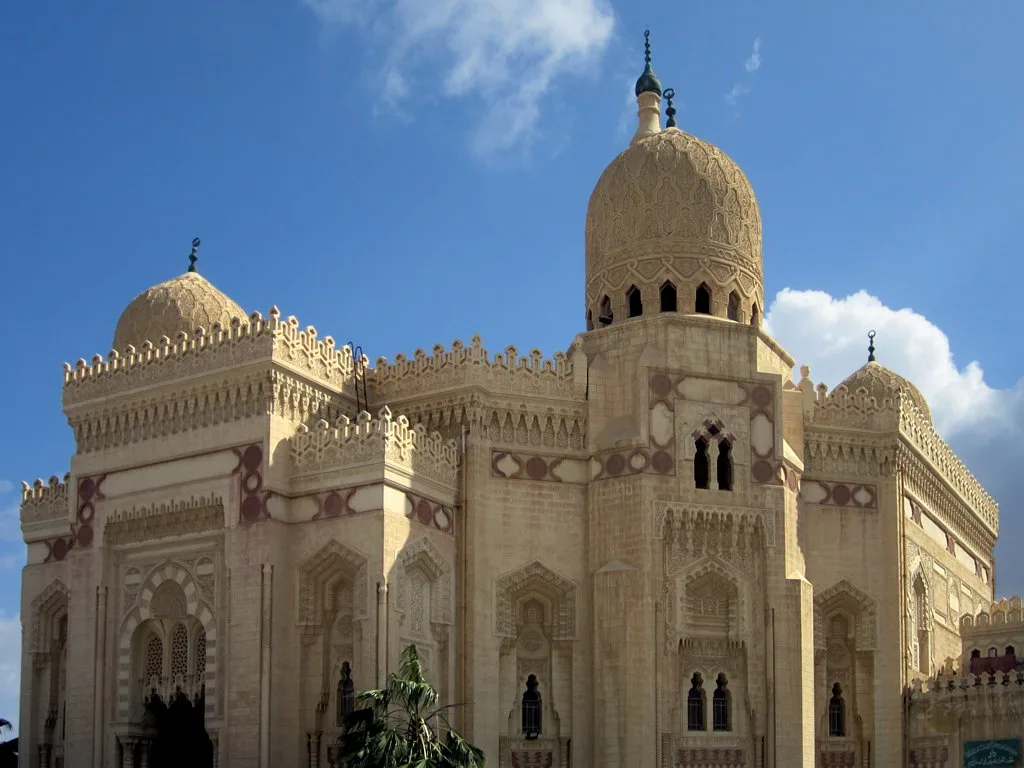
The Abu al-Abbas al-Mursi Mosque in Anfushi, Alexandria’s most beautiful mosque, above the harbour streets. Photo: D-Stanley, CC BY 2.0, via Wikimedia Commons
Between the citadel and the modern centre, on the land that grew from the ancient causeway to Pharos island, lies Anfushi — the old harbour quarter, and the most working-class, sea-smelling, unpolished part of the city a visitor will meet. This is where Alexandria’s fishing fleet is based, where wooden boats still sit in the yards of traditional boatbuilders along the shore, where the wholesale fish market does its dawn business, and where the streets smell of salt, diesel, timber and frying fish in about equal measure. It has none of the Corniche’s polish, and it is all the better for it: Anfushi is where the city’s maritime life is real rather than performed.
Its crown is the Mosque of Abu al-Abbas al-Mursi, the most beautiful mosque in Alexandria and the city’s great religious landmark. It honours a thirteenth-century Sufi saint from Murcia in Spain — al-Mursi means “the Murcian” — who settled in Alexandria, taught here, and was buried here in 1286. A mosque first rose over his tomb in the eighteenth century; the present building, largely a twentieth-century rebuilding, wraps the shrine in an ornate Andalusi-flavoured architecture of carved stone, patterned domes and a soaring minaret that serves as the harbour quarter’s exclamation mark. It remains a living mosque and a place of pilgrimage — the saint’s annual moulid festival fills the surrounding streets — and visitors should treat it accordingly: dress modestly, visit outside prayer times unless invited, and ask before photographing people at worship.
Anfushi rewards wandering rather than a checklist. Walk it between the citadel and the centre and you pass the fish market quarter, the boatyards, coffee houses full of fishermen, and the little square of mosques around al-Mursi — his mosque stands among a small cluster of shrines of his circle. It is the natural connective tissue of an Alexandria day: the citadel in the morning, then a slow walk back through Anfushi as the lunch tables begin to fill, which brings us to the serious business of eating.
Eating in Alexandria – Fish First, Then Everything Else
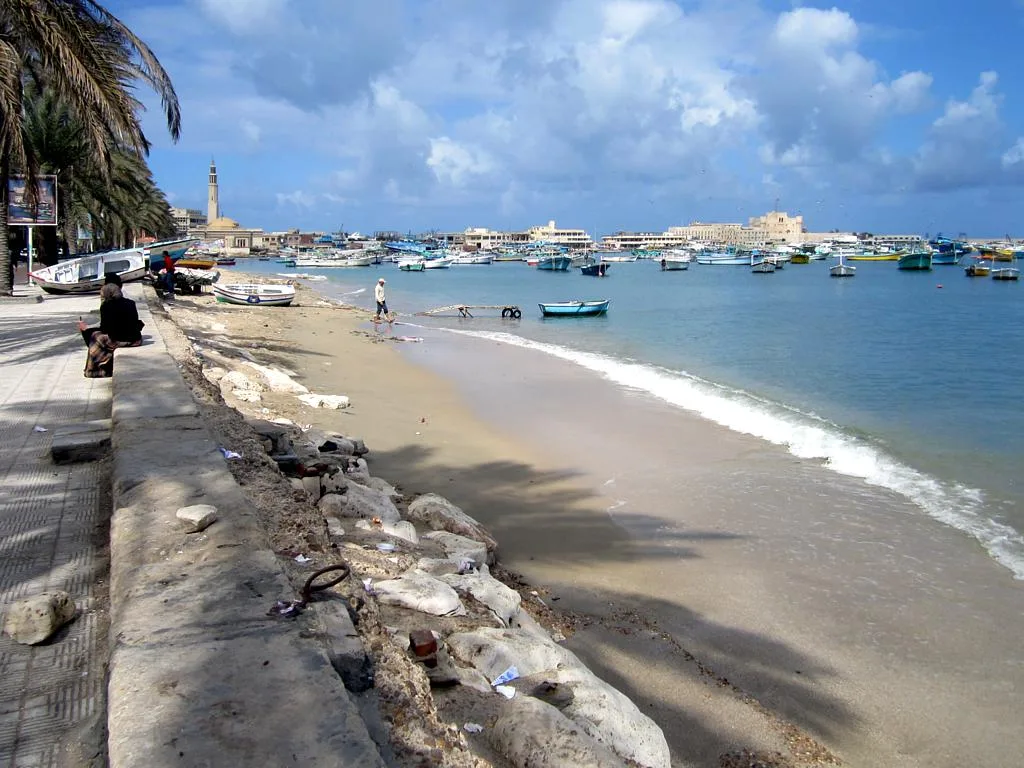
Fishing boats at anchor in the Eastern Harbour at Bahary, with the Qaitbay Citadel across the water. Photo: D-Stanley, CC BY 2.0, via Wikimedia Commons
Alexandrians will tell you, accurately, that the rest of Egypt comes to their city to eat fish. The seafood restaurants of Bahary and Anfushi, facing the fishing anchorage at the harbour’s western end, run on a system that first-time visitors should learn before they sit down. In the classic places there is no meaningful menu: you go to the display or the counter, choose your fish and shellfish from the day’s catch — sea bass, sea bream, mullet, shrimp, calamari, crabs in season — have it weighed, and choose the cooking: grilled, fried, baked in oil and lemon, or cooked the Alexandrian way with tomatoes and spices. It arrives with rice — often sayadiya, the spiced fisherman’s rice — salads, tahini and bread. The one discipline that matters is to settle the weight and the price per kilo, and what is included, before the fish goes to the grill; agree it cheerfully and explicitly, and the meal that follows is one of Egypt’s great pleasures.
Beyond the fish tables, the city has a street-food culture of its own. Alexandria claims a particular style of fried liver sandwich — kebda iskandarani, liver chopped small and cooked hot with peppers, garlic and cumin, stuffed into soft rolls — sold from carts and tiny shops and eaten standing up; it is as much a city emblem as the lighthouse. Add the usual Egyptian pleasures done to a local standard — feteer pastries, seafood soups, ice cream on the Corniche — and a tradition of old cafés and patisseries left by the cosmopolitan years, and you eat well in Alexandria without a single formal restaurant.
The pattern to copy is the local one. Lunch is the main event on a sightseeing day, and it belongs in Bahary after the citadel and Anfushi, when the morning’s catch is on the displays and the quarter is awake. Evenings belong to the Corniche: a lighter meal, tea or coffee above the water, and the promenade. What this guide will not do is print prices for any of it — fish is sold by weight and season, and a figure copied from another guide’s table would be fiction by the time you read it. Judge a place the Alexandrian way instead: by the queue of locals at the counter and the look of the display.
Montaza – the Royal Park at the City’s Eastern End
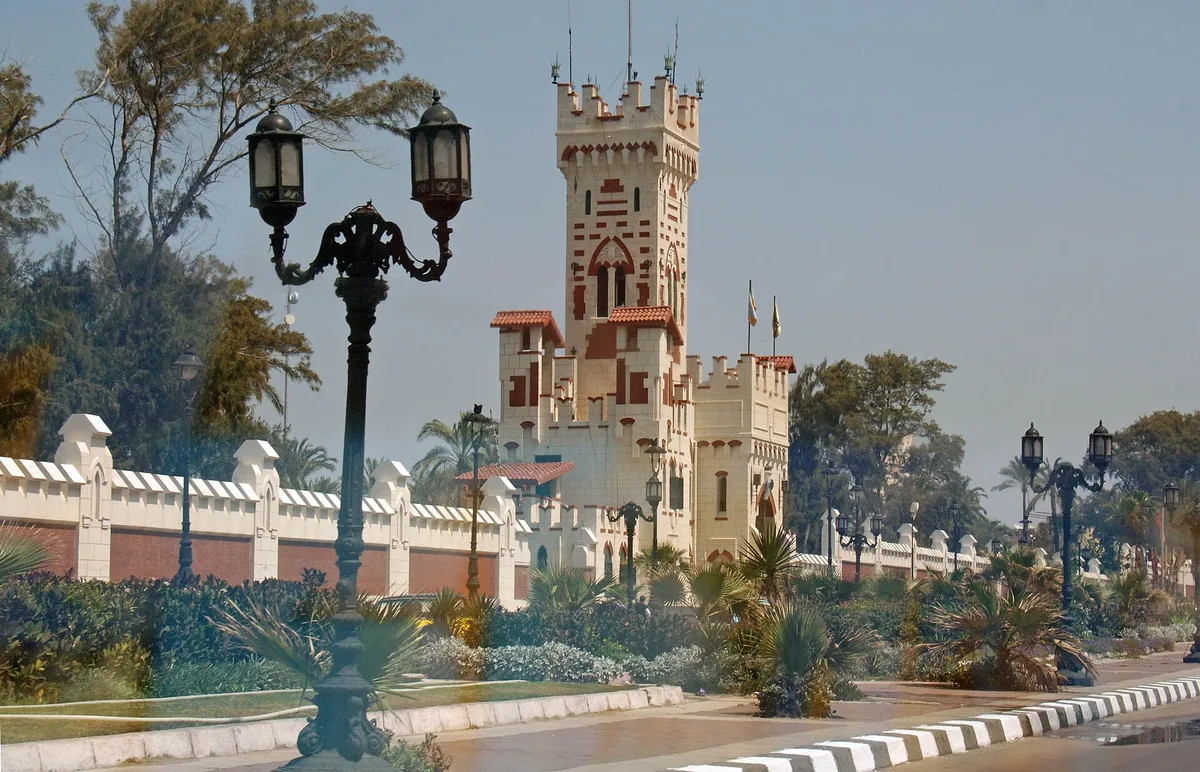
The Salamlek Palace at Montaza, the 1892 lodge of Khedive Abbas II set in the palace park at the eastern end of the city. Photo: Jerrye & Roy Klotz, MD, CC BY-SA 3.0, via Wikimedia Commons
At the far eastern end of the Corniche, the dense city finally loosens into gardens. Montaza is a royal estate turned public park: a walled world of lawns, palms, pine groves and flower beds sloping to a sheltered bay, created as the summer seat of Egypt’s rulers and still the place Alexandrian families come for picnics, wedding photographs and Friday afternoons. It is the green opposite of everything else in this guide — no ruins, no relics, just shade, sea air and space — and a half day here balances a trip heavy with archaeology.
Two palaces anchor the grounds. The Salamlek, built in 1892 as a hunting lodge for Khedive Abbas II, is the picturesque one — a castle-like confection of towers and red-tiled turrets in a deliberately romantic style, now adapted as a hotel. Its larger neighbour, the Al-Haramlik Palace, was added under King Fuad I in the years that followed, in an exuberant mix of styles with a tall Florentine-flavoured tower; it remains an official presidential residence, so it is admired from the gardens rather than toured. Around them the park does the real work: avenues of royal palms, gardens running down to the water, a small harbour and lighthouse, and beaches along the bay that are among the calmest in the city.
Montaza sits at the end of every eastbound Corniche journey, and that is the right way to plan it: not as a detour but as a destination, ideally on a second day or a long afternoon, combined with the leafy eastern districts on the way out — San Stefano, Glym and Zizenia, where the Royal Jewelry Museum waits. Come with the Alexandrians, in the later afternoon, when the heat is off the gardens and the light comes through the pines; bring a picnic mentality rather than a sightseeing one. After two days of tombs, columns and museums, Montaza is where the city exhales.
Getting to Alexandria and Getting Around
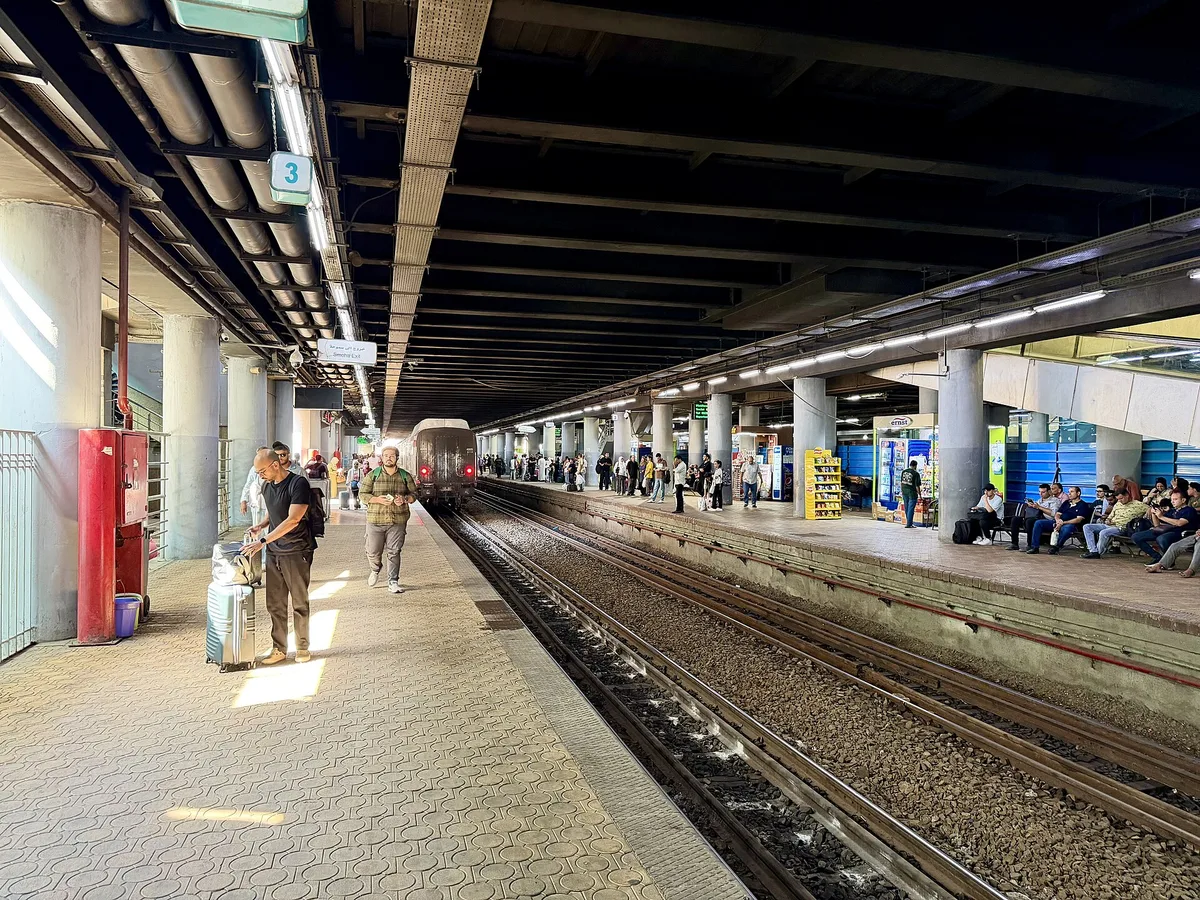
A platform at Sidi Gaber station, where most Cairo trains arrive in Alexandria. Photo: Slyronit, CC BY-SA 4.0, via Wikimedia Commons
Most visitors arrive from Cairo, some 220 kilometres to the south-east, and the default way to make the journey is the train. Trains leave Cairo’s Ramses station for Alexandria throughout the day and arrive at one of two city stations: Misr Station, the older terminus close to the city centre and Kom el-Dikka, and Sidi Gaber, the larger modern station in the eastern districts, where many services call before or after Misr. The fastest limited-stop services take a little over two hours; slower trains that stop along the Delta take nearer three, and which you get matters more than the timetable’s fine print — so check the current schedules and train types on Egyptian National Railways’ official channels when you book, and do not build a tight day around a figure copied from any guide, including this one. The Delta line is part of the pleasure: after Cairo’s sprawl, the train crosses a green, watery, densely farmed landscape of canals and villages utterly unlike the desert Egypt of the south.
The alternatives fill in around the railway. The desert highway between Cairo and Alexandria carries intercity coaches and private cars, and the drive is straightforward but longer and far more variable with traffic than the train — fine for a tour with a driver, which is how many day-trip packages run it, but rarely faster door to door. Alexandria’s own airport is Borg El Arab, well to the west of the city; it serves the city and the north coast, and if you arrive there, the transfer into town is a journey in itself, so confirm your onward transport before you land rather than improvising at the kerb.
Inside the city, think in one dimension. Alexandria is so linear that navigation reduces to knowing where you are on the west–east axis and how far the sea is — which is always visible or one street away. Taxis are plentiful along the Corniche and the main streets; agree the fare before you set off, or use one of the ride-hailing apps that operate in the city, which most visitors find simpler. The tram network is the characterful option: Alexandria’s trams have run since the 1860s, making the system one of Africa’s oldest, and the eastern Raml line is famous for its blue double-decker cars rolling along the boulevard parallel to the sea. It is slow, crowded at peak times and exactly as enjoyable as that sounds — a sightseeing ride in its own right for a small fare, best used off-peak for a stretch rather than as your day’s backbone. For the sightseeing clusters, honest walking does much of the work: the Corniche itself is the city’s great walk, and the citadel–Anfushi–centre and catacombs–pillar pairings are designed to be walked.
Structuring Your Alexandria Travel Guide Visit – One Day, Two Days, and the Cairo Day Trip
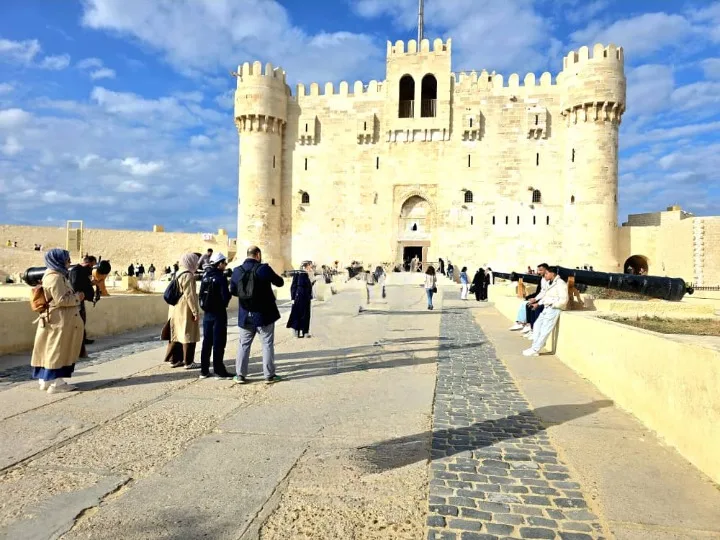
The approach to the Qaitbay Citadel along its causeway, old cannon lining the harbour side. Photo: Rebeccananonof, CC0, via Wikimedia Commons
Alexandria’s sights fall into three natural clusters, and a good visit is simply those clusters taken in a sensible order. The south-western cluster is the underground and imperial city: the Catacombs of Kom el-Shoqafa and Pompey’s Pillar with the Serapeum, close together in Karmouz. The central cluster is the city-centre group: Kom el-Dikka, the Graeco-Roman Museum and the Alexandria National Museum, all within the middle of town. The harbour cluster runs along the water: the Bibliotheca Alexandrina on the Eastern Harbour’s curve, then west through Anfushi and the al-Mursi Mosque to the Qaitbay Citadel at the point — with Montaza as a separate, half-day excursion east whenever you choose to take it.
With one day in the city, take the clusters in that order and let the day build toward the water. Start in the south-west while you are fresh and the catacombs are quiet, move to the centre for Kom el-Dikka and the museum over the middle of the day, and finish along the harbour: the library if its arrangements fit, then the walk through Anfushi and a late-afternoon citadel, when the light turns on the Eastern Harbour and the fishermen come out. End with a fish dinner in Bahary. That is a full day — Alexandria’s honest minimum — and it works because each move is short and in the same direction: the city visited as a slow westward-then-seaward funnel rather than a zigzag.
With two days, everything breathes. Keep day one as above but end it on the Corniche promenade; give day two to Montaza and the eastern districts, the Royal Jewelry Museum, the museums you skipped, and the long Corniche walk from the centre out toward Stanley Bridge. Alexandria also makes a gentle first or last chapter for a whole Egypt trip: travellers flying into Cairo often pair it with the capital’s own heavyweights — our guide to the Grand Egyptian Museum covers the natural partner visit — and do each city justice separately rather than raiding both.
And the famous question: can Alexandria be a day trip from Cairo? Yes — thousands do it, and the trains make it mechanically easy. But be honest about the arithmetic. The round trip takes four to six hours of your day before you have seen anything, which leaves you the south-western cluster, one central sight, the citadel and a fish lunch if the citadel is not to be a sprint. Cut the list, do not compress it: the catacombs, Kom el-Dikka, the citadel and lunch in Bahary make a fine day trip; the catacombs, the pillar, both museums, the library, the citadel, Montaza and a seafood feast do not. If Alexandria matters to your trip rather than merely appearing on it, sleep here one night. The city at promenade hour in the evening, with the harbour lit and the Corniche full, is half the point — and the day trip never sees it.
Frequently Asked Questions
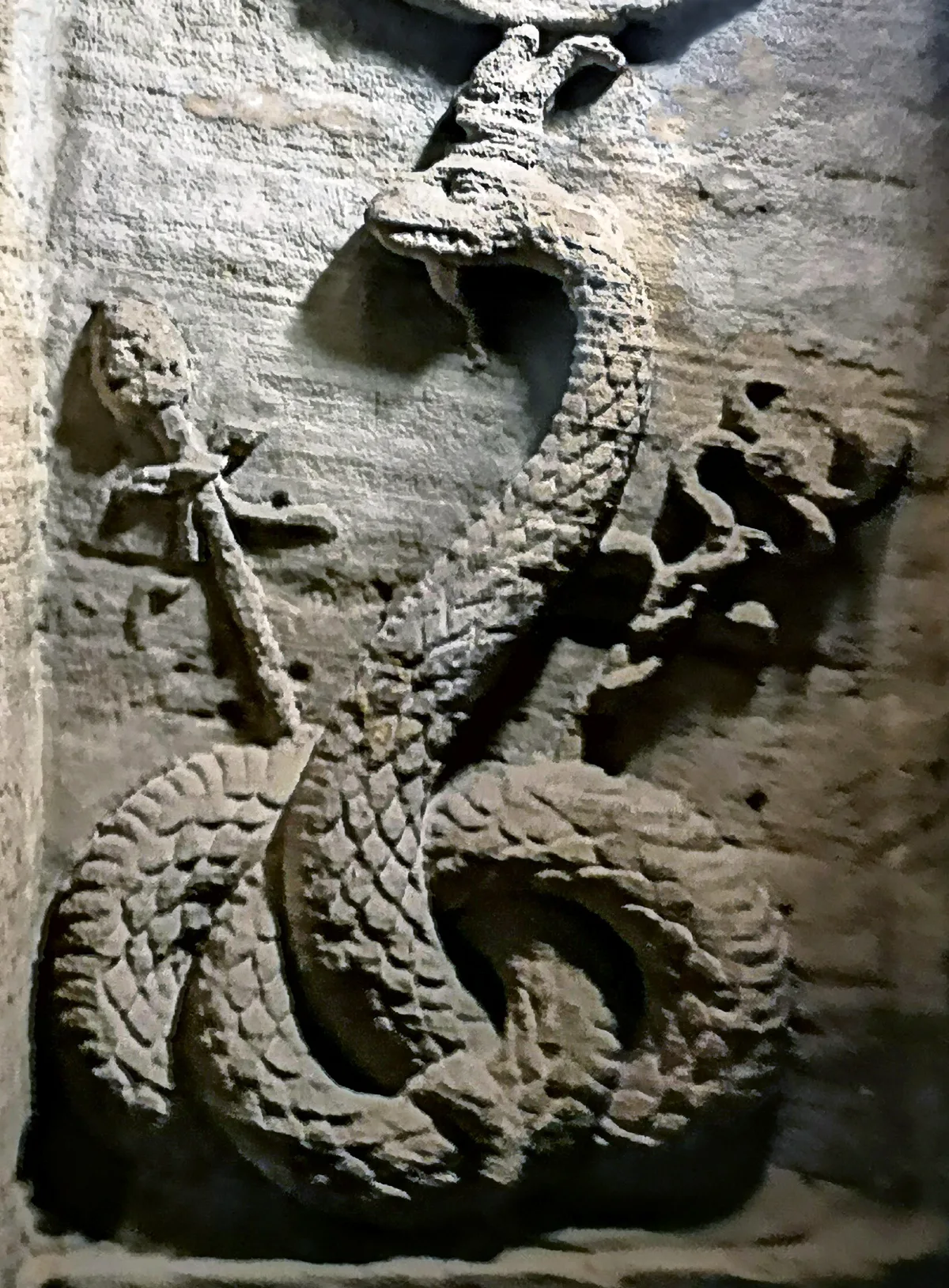
The Agathodaimon serpent relief in the Catacombs of Kom el-Shoqafa – Egyptian, Greek and Roman religion carved into one creature. Photo: Carole Raddato, CC BY-SA 2.0, via Wikimedia Commons
Is Alexandria worth visiting, or should I spend all my time in Cairo and the south? It is worth it, and for a specific reason: it is the one great Egyptian city that is not pharaonic. Cairo gives you the pyramids and a thousand years of Islamic architecture; Luxor and Aswan give you the temples. Alexandria gives you the Mediterranean, the Greek and Roman centuries, and the living seaport — a genuinely different Egypt, and the variety improves a trip rather than diluting it.
How many days do I need in Alexandria? One full day covers the essentials at a brisk pace — catacombs, Pompey’s Pillar, Kom el-Dikka, a museum, the citadel and a fish lunch. Two days is the comfortable answer: it adds Montaza, the remaining museums and the Corniche taken slowly. A day trip from Cairo is possible but is a highlights raid, not a visit; the structuring section of this guide shows the honest maths.
How much do the sights cost, and when are they open? This guide deliberately prints neither figure, because both change and the guides that publish them contradict each other. Entry arrangements in Egypt are set site by site and are periodically revised; check each attraction’s official listing or the Egyptian Ministry of Tourism and Antiquities shortly before you travel, and treat any price table in any article — however confident — as out of date until the ticket office confirms it.
What is the best time of year to visit Alexandria? Alexandria has a true Mediterranean climate, which the Nile Valley does not. Winters are mild but can be wet and stormy — the season of dramatic seas on the Corniche rather than sightseeing in shirtsleeves. Summers are hot and humid at the coast and extremely busy with Egyptian holidaymakers. Spring and autumn are the balanced seasons for sightseeing: warm, mostly dry, and ahead of or behind the summer crowds. Whichever season you choose, the sea breeze is real; evenings on the Corniche can want a layer even when the day did not.
Can I see the ancient Great Library or the lighthouse? Not as standing buildings — nothing of either survives above ground, and anyone who promises otherwise is selling something. What you can see is better than a reconstruction: the lighthouse’s site and some of its fabric inside the Qaitbay Citadel, its fallen blocks mapped on the harbour floor, and the library’s deliberate modern heir, the Bibliotheca Alexandrina, working on the same bay. Alexandria is a city you read as much as you look at, and these two absences are its most eloquent sights.
Are the catacombs suitable for everyone? The Catacombs of Kom el-Shoqafa involve a winding stair descent, uneven and sometimes damp steps, enclosed chambers and a lowest level that is flooded and not entered. Most visitors manage comfortably at a slow pace, but the site is not step-free, and anyone uneasy underground or on stairs should weigh that honestly before descending.
Can I swim in Alexandria? Yes, in season, on the city’s arranged beaches — the bays along the Corniche have their own entry and cabin systems, and standards of dress and behaviour are those of a conservative city beach rather than a resort enclave. For resort-style swimming, most travellers prefer the developed coast west of the city; in Alexandria itself, treat the sea as the locals do — a backdrop, a breeze and, in summer, a supervised dip between the sights.
The Short Version
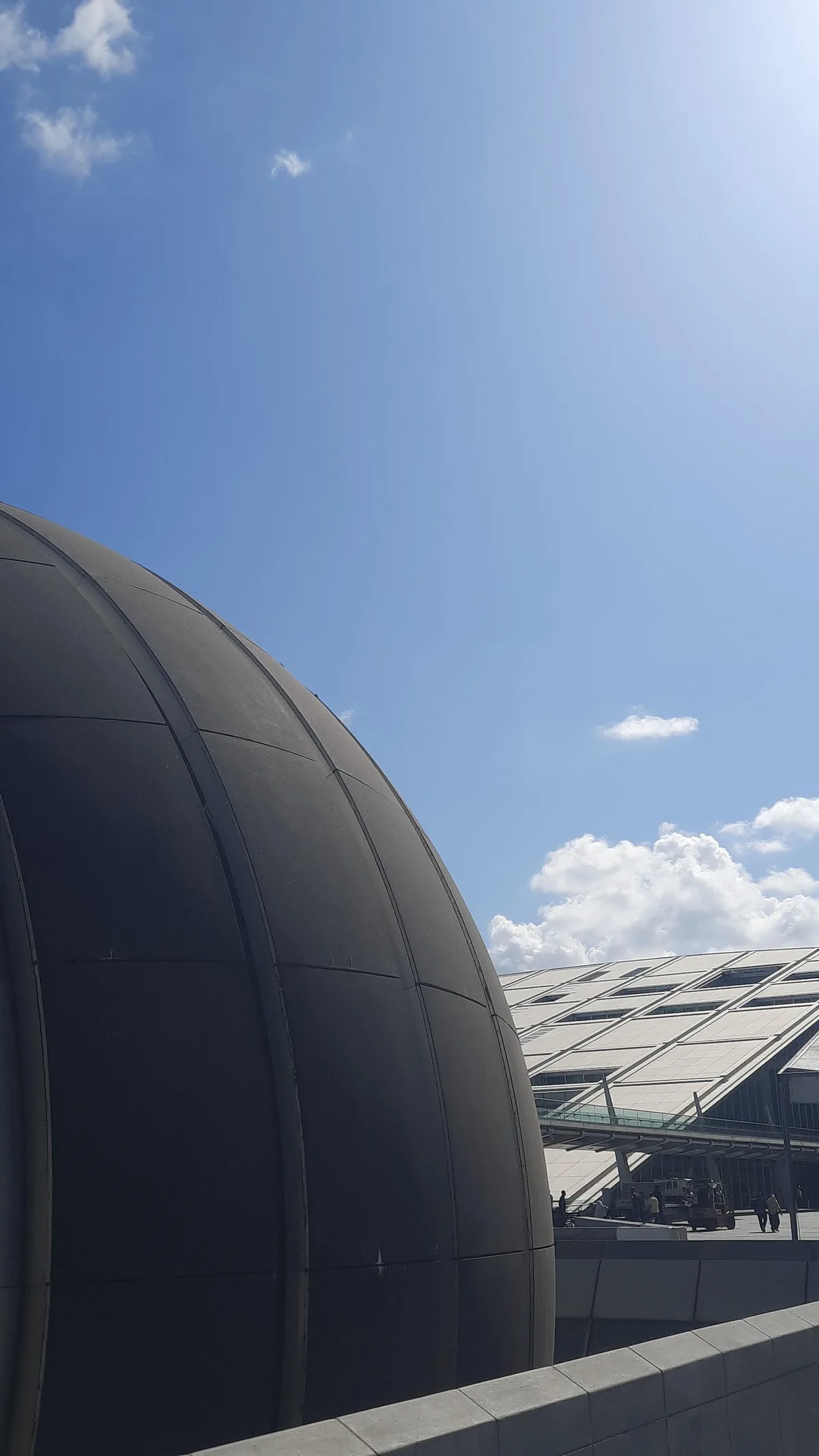
The planetarium sphere on the Bibliotheca Alexandrina’s plaza, the modern library’s second landmark. Photo: Hassan Hamdy wahidy, Public domain, via Wikimedia Commons
Alexandria is Egypt’s Mediterranean city: founded by Alexander the Great in 331 BC on a causeway-split double harbour, capital of the Ptolemies, home of the Pharos lighthouse and the Great Library, and today a working port metropolis of more than five million arranged along one long Corniche. Its sights are fragments with great stories — the Qaitbay Citadel standing on the lighthouse’s foundations, the three-culture catacombs of Kom el-Shoqafa, Pompey’s Pillar over the ruined Serapeum, the Roman theatre and lecture halls of Kom el-Dikka, the museums that hold what the streets have lost, and the Bibliotheca Alexandrina, the ancient library’s working modern heir. Around the archaeology runs the living city: the harbour quarter of Anfushi, the al-Mursi Mosque, the fish tables of Bahary, and Montaza’s royal gardens at the Corniche’s eastern end.
Do it in this order and it works: catacombs and pillar in the morning, the centre and its museums over midday, the harbour and the citadel in the afternoon light, fish for dinner, and the Corniche promenade after. One day is the minimum, two is the pleasure, and a night in the city beats a day trip from Cairo every time. From Alexandria the natural onward steps are the capital’s museums and the Nile south — our Luxor Temple guide is the place to start reading about the Egypt of the pharaohs, which Alexandria so pointedly is not. The Bride of the Mediterranean is the counterweight to all of it: greyer, saltier, breezier — and, for many travellers, the city they end up remembering most warmly. Come for the lighthouse that is not there and the library that burned by inches, stay for the tombs under the streets, the fish at Bahary and the whole city out walking by the sea at dusk, and Alexandria will do what it has done for twenty-three centuries: it will make you want to come back by water.