Luxor Temple Guide: History, Highlights & Evening Visit
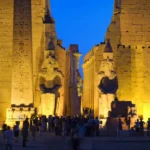
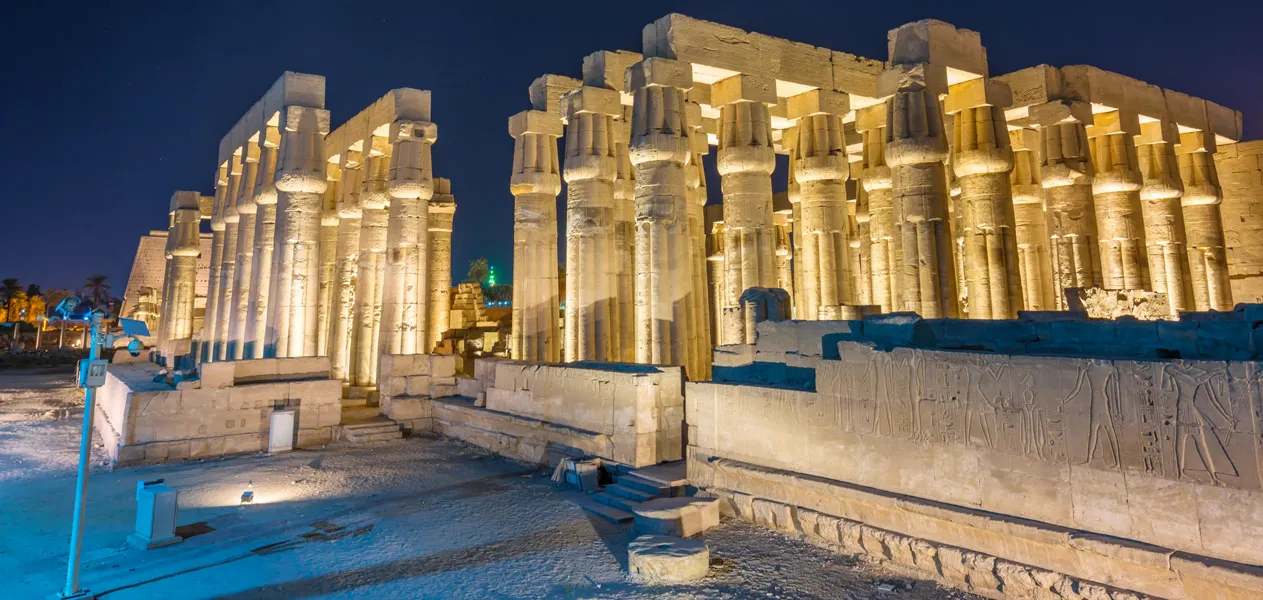
Luxor Temple is not a sprawling complex like Karnak, and that is its advantage: in one compact, riverside site on the East Bank of the Nile you can walk through more than 3,000 years of Egyptian history, from New Kingdom kingship rituals to Roman, Christian and Islamic reuse, all in a couple of unhurried hours. Built mainly around 1400 BCE under Amenhotep III and expanded by Ramesses II, it was known in ancient Egyptian as Ipet-resyt, the Southern Sanctuary, and its purpose was distinctive — less a home for a single god alone than a stage for the renewal of kingship, above all during the annual Opet Festival, when statues of Amun, Mut and Khonsu were carried from Karnak along the Avenue of Sphinxes to Luxor Temple. That festival purpose explains the temple’s layout, because you are not simply touring a series of rooms but walking a processional route that was designed to be experienced in sequence, from the great pylon at the northern entrance through courts and a towering colonnade into an older, quieter sanctuary at the southern end. Come in daylight for the carving, when the reliefs of campaigns, offerings and divine birth can be read in raking light, and return after dark if you can, because floodlit sandstone is the experience most visitors remember best, when crowds thin, the stone glows, and the temple feels less like a museum and more like a living place. A visit here also anchors the whole East Bank, since the temple sits on the Corniche in central Luxor, about three kilometres south of Karnak, within easy walking distance of East Bank hotels and a short journey from the West Bank by ferry and taxi. Its Corniche setting also makes it easy to combine the visit with a Nile-side walk before or after entering the temple.
The compact scale of Luxor Temple is precisely what makes it such a rewarding first or last stop in Luxor, because it can be understood in a single visit in a way that a vast, multi-period complex cannot, yet it still rewards a second, slower look at its details. Where Karnak overwhelms by size and by two millennia of additions, Luxor Temple was largely built in two main phases — the core under Amenhotep III and the entrance under Ramesses II — so its plan remains coherent, its processional axis remains legible, and a visitor can hold the whole building in mind while standing inside it. That coherence does not mean simplicity, because later rulers kept adding layers rather than erasing them: Alexander the Great rebuilt the sanctuary with a granite shrine, Romans decorated a vestibule for the imperial cult, Christians adapted spaces for worship, and the still-active Mosque of Abu al-Haggag rose within the temple precinct, so the site is a biography of a sacred place rather than a single-period ruin. This guide therefore treats Luxor Temple in its own right — its history and builders, each court and chamber in walking order, the Avenue of Sphinxes that links it to Karnak, and the practical choices that make an evening visit work — while linking naturally to the wider guides for context you may need. For the broader city, see our places to visit in Egypt guide and our Egypt travel guide, and for where to base yourself nearby, see our where to stay in Luxor guide; the detail of hotels, transport and the wider city belongs in those guides, not repeated here. This guide therefore keeps its focus deliberately narrow, so the temple’s own story is not lost inside a general city tour or a list of nearby attractions.
At a Glance
| Detail | What to know |
|---|---|
| Location | East Bank of the Nile, on the Corniche in central Luxor, about 3 km south of Karnak |
| Main building phases | Amenhotep III, c. 1400 BCE; Tutankhamun completed the colonnade decoration; Ramesses II, c. 1279–1213 BCE, added the pylon and first court |
| Dedicated to | The Theban Triad — Amun, Mut and Khonsu — and the renewal of kingship |
| Key festival | Opet Festival, linking Karnak and Luxor Temple along the Avenue of Sphinxes |
| Time needed | About 1.5 to 2 hours for a first visit, longer if you study the reliefs |
| Best visit | Late afternoon into evening, when light is softer and the temple is floodlit; check the official site before visiting for current opening hours and ticket details |
History and Construction Phases
The earliest remains at the site go back to Hatshepsut, who built way-stations for the bark of Amun along the processional route to Karnak, but the stone temple visitors see today begins with Amenhotep III, who reigned from about 1390 to 1352 BCE and who built the core sanctuary, a court and the foundations of a great colonnade on a platform. That choice of builder matters, because Amenhotep III was a king who understood architecture as theology: his temple was not simply a large building but a setting in which the king could be presented as the son of Amun, renewed in office through ritual, and the Divine Birth reliefs in the inner chambers still carry that argument in carved form. Tutankhamun, who reigned from about 1332 to 1323 BCE, completed and largely decorated that colonnade, finishing the processional spine that links the entrance to the older core, and his work shows how a short reign could still complete a major architectural idea rather than merely maintain it. A century later Ramesses II, who reigned from about 1279 to 1213 BCE, added the imposing first pylon and the court in front of it, stamping the entrance with his own colossal statues and a pair of obelisks, one of which now stands in Paris, so that every visitor arriving from the north met Ramesses before meeting Amenhotep. The sequence is therefore legible in the building itself: walk from north to south and you walk backwards in time, from Ramesses through Tutankhamun to Amenhotep, and that reverse chronology is one of the pleasures of a careful visit. Visitors who notice that reverse chronology will also notice how each king’s additions respected the earlier core rather than demolishing it, preserving Amenhotep’s sanctuary while giving the entrance a new and more monumental face for festival processions.
Later rulers kept adding layers rather than erasing them, and that layering is the point of Luxor Temple, because it makes the site a biography of a sacred place rather than a single-period ruin. Alexander the Great, who reigned over Egypt from 332 to 323 BCE, rebuilt the sanctuary area with a granite shrine and had himself shown in pharaonic guise offering to Amun, a striking claim by a foreign conqueror to Egyptian legitimacy that still reads clearly in the reliefs. Romans used parts of the temple and decorated a vestibule for the imperial cult, Christians adapted spaces for worship and added an apse, and the still-active Mosque of Abu al-Haggag, associated with the thirteenth-century saint, rose within the temple precinct on ancient columns. None of these later phases was a mere accident of survival; each shows a new community finding a reason to use, adapt and honour the same sacred ground, and together they explain why Luxor Temple feels alive in a way a purely archaeological ruin rarely does. For where to base yourself nearby, see our where to stay in Luxor guide; for the wider city, see our Luxor city guide. Those guides carry the detail of hotels and city sights, while this guide stays with the temple itself, its builders and the order in which to see them, so that a visitor can follow the building’s own story from pylon to sanctuary without being pulled into a general city tour. The result is a building that can be read like a timeline, with each period leaving a distinct layer for visitors to identify in stone, carving and reuse. That readability is rare among Egyptian temples, and it is why guides so often use Luxor Temple to explain how sacred sites evolved over centuries.
The Pylon and Court of Ramesses II
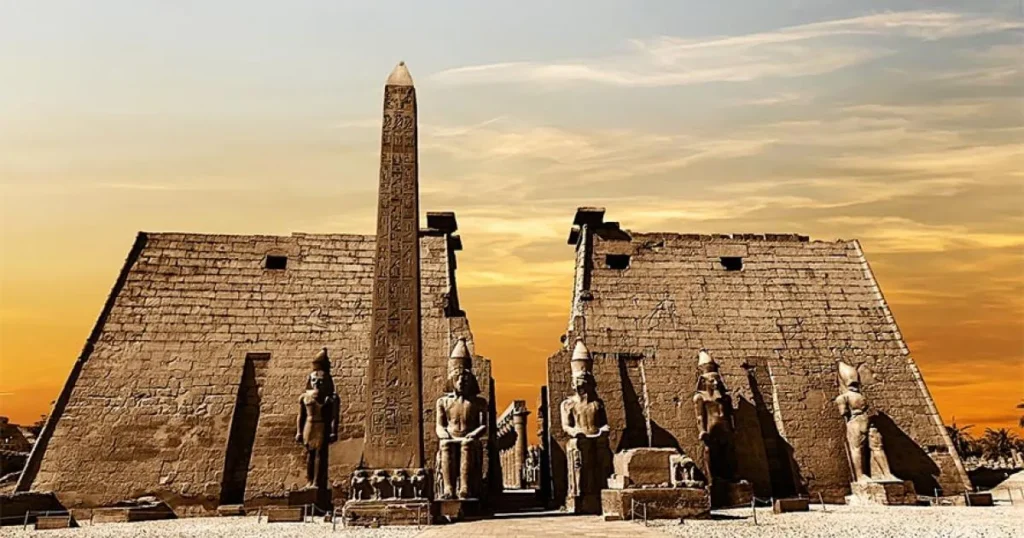
Enter from the north, as festival processions once did, and the scale announces itself immediately, because the First Pylon of Ramesses II is a massive gateway flanked by seated colossal statues of the king, and this is the classic Luxor Temple photograph, still startling at close range when you stand at the feet of a statue and realise how deliberately the entrance was designed to diminish the visitor. The pylon itself is a statement of royal power: its broad, sloping walls once carried reliefs of Ramesses II’s campaigns, above all the Battle of Kadesh, presented as a triumph of the king under the protection of Amun, and the sheer size of the gateway tells you, before you read a single carving, that the king who built it intended his entrance to be remembered. One of the pair of obelisks that once stood before the pylon now stands in Paris, which is worth knowing because the surviving obelisk, the seated colossi and the empty socket together tell a story of removal as well as of building, and a good visit notices what is missing as well as what remains. Inside, the Court of Ramesses II is ringed by papyrus-bundle columns and more colossi, some standing between the columns in a way that makes the courtyard feel like a forest of kings, and the effect is intentional: you are meant to feel surrounded by royal images before you reach the older, quieter parts of the temple. Do not rush this court, because its reliefs reward slow looking, its columns reward standing still, and its scale rewards a pause before the narrower colonnade ahead. Standing between the colossi also gives a sense of the court’s original colour, because traces of paint and the sheer polish of the stone still hint at how vivid this entrance once appeared to festival crowds.
Within the court, two details deserve particular attention, because they show how Luxor Temple layers history rather than presenting a single period. The first is the triple bark shrine, which reuses stone blocks from Hatshepsut’s southernmost way-station for the bark of Amun, so that a visitor who looks closely can see an earlier queen’s building material incorporated into a later king’s court, a quiet act of architectural recycling that links the temple’s earliest processional history to its Ramesside entrance. The second is the Mosque of Abu al-Haggag, rising above the court on one side, built into the temple fabric and still in use, which is a reminder that this site never fully stopped being sacred and that worshippers, not just tourists, use it today. Respect that living layer by dressing modestly, keeping voices low near the mosque, and remembering that a visit here is a visit to a place that is still in use, not only to a ruin. For photography, the court is best in morning or late afternoon light, when the colossi throw long shadows and the reliefs gain depth, while midday light tends to flatten the carving on the pylon walls. Allow time here for both the grand view — the pylon, the colossi and the court as a whole — and the close view, because the campaign reliefs, the column capitals and the reused blocks each tell a different part of the same story, and a court that is hurried through in five minutes will feel merely large, whereas a court that is walked slowly will feel like an introduction to everything that follows. A final tip for this court is to look for the smaller, less photographed colossi between the columns, because their varied poses and states of preservation show how the court was furnished over time rather than completed in a single campaign.
The Great Colonnade

Beyond the court, the Great Colonnade is the architectural hinge of the temple: fourteen towering papyrus-bundle columns, begun under Amenhotep III and decorated under Tutankhamun, link the Ramesside entrance to the older, more intimate core, and walking slowly down the central axis is the single most memorable architectural experience in the temple. The columns are tall enough that their capitals, opening like papyrus buds overhead, create a stone canopy, and the space between them is narrow enough that light falls in shafts rather than flooding the passage, so that the walk feels processional even for a modern visitor who is not following a festival. Notice how the wall reliefs shift as you move south, from royal ritual towards festival procession, because the colonnade walls carry scenes of the Opet Festival itself, with the barks of Amun, Mut and Khonsu being carried, accompanied by priests, musicians and offerings, and those scenes turn the architecture into a narrative: you are walking the route the god’s bark once travelled, not just touring rooms. The colonnade is therefore the best place in the temple to understand its processional logic, and it repays a slow walk with pauses to look up at the capitals, to look sideways at the reliefs, and to look ahead down the axis towards the court beyond, where the mood changes from display to ceremony. Photographers should linger here in late afternoon, when raking light deepens the carving and the columns cast long, rhythmic shadows across the passage. The rhythm of the columns also changes the sound and temperature of the visit, because footsteps and voices soften between the stone shafts and the shaded passage stays cooler than the open courts, creating a quieter walk that suits the shift from public display to sacred core.
The colonnade also rewards attention to construction and condition, because its history is visible in its fabric as well as in its decoration. The columns were begun under Amenhotep III, whose building programme set the temple’s core, and decorated under Tutankhamun, whose reign completed the work, so the colonnade bridges two reigns and two phases of the temple in a single space, and a visitor who knows that can read the passage as a joint project rather than as the work of one king. The papyrus-bundle form is not mere decoration: the clustered shafts and bud capitals evoke the marshes of creation in Egyptian thought, turning a structural passage into a symbolic landscape, and that symbolism matters because Luxor Temple as a whole is a temple of renewal, where kingship, creation and festival were linked in ritual. In practical terms, the colonnade is also a sheltered, shaded passage, which makes it a welcome stretch on a hot day, and it is narrow enough that crowds move through it in a single flow, so patience here is rewarded more than pushing ahead. Stand at the southern end and look back north, because the view back through the columns towards the Court of Ramesses II gives the clearest sense of the temple’s axis, and stand at the northern end and look south, because the view ahead towards the Court of Amenhotep III shows how the temple narrows and quiets as it approaches the sanctuary. That change of mood, from the thunderous entrance to the intimate core, is the temple’s architectural argument, and the colonnade is where it is made. Modern restoration has also stabilised the colonnade without hiding its age, so visitors can still see joins, repairs and weathered surfaces that show how the passage has been maintained across centuries of use and excavation.
The Court and Hypostyle Hall of Amenhotep III
Past the colonnade, the mood changes, and that change is deliberate: the Court of Amenhotep III is quieter and more graceful than the Court of Ramesses II, its double rows of papyrus columns framing an open space that feels designed for ceremony rather than display, and a visitor who has come through the towering colonnade will feel the release into a calmer, more spacious court. The columns here are elegant rather than overwhelming, their proportions giving the court a sense of balance that suits the older core of the temple, and the open sky above the court, after the shaded passage of the colonnade, makes the space feel like a breathing point in the processional route. Beyond the court, the hypostyle hall and the inner chambers lead towards the sanctuary, and here the temple’s kingship theme becomes explicit, because the famous Divine Birth reliefs present Amenhotep III as the son of Amun, conceived through divine intervention and recognised as king by the gods. Those reliefs are propaganda, theology and art in a single carved story, and they are the clearest evidence for what Luxor Temple was for: not simply a house for a god, but a place where a king’s divine birth and renewal were enacted and displayed. If Karnak overwhelms by size, this part of Luxor Temple persuades by intimacy, because a single column, a single relief and a single chamber can carry the whole argument without needing a forest of stone to make it. The court’s open sky also matters for photography, because morning light rakes across the columns while late afternoon light warms the sandstone, giving two very different moods to the same space within a single day.
Take time in this court and in the hypostyle hall to stand still, look up, and let the scale of a single column do the work, because the temptation in a temple visit is to keep moving towards the sanctuary and to treat the middle spaces as corridors, whereas here the middle spaces are the point. The double rows of columns frame views across the court that change with every step, so that walking slowly around the perimeter gives a series of framed views rather than a single panorama, and that quality rewards a visitor who walks the court rather than crossing it diagonally. In the hypostyle hall, the columns are closer together and the roofed space is darker, which prepares the visitor for the sanctuary beyond, and the shift from open court to roofed hall to inner chamber is a deliberate sequence of increasing enclosure and intimacy, matching the increasing sacredness of the spaces. The Divine Birth reliefs deserve a close look, not because they are large but because they are detailed, with scenes of the god Amun approaching the queen mother, the birth itself, and the recognition of the child as king, and those scenes explain why Amenhotep III built this temple in the first place. For visitors interested in how Egyptian temples worked as theology, this court and hall are the most instructive part of Luxor Temple, and they pair naturally with the wider story of Theban kingship covered in our tourist attractions in Egypt guide, without duplicating the detail of that broader guide here. Guides often point out the difference between the court’s graceful proportions and the heavier Ramesside court, because that contrast is the clearest architectural evidence that the temple grew in distinct phases rather than as one unified design.
The Sanctuary and Alexander the Great’s Chapel
At the temple’s southern end, the sanctuary — where the bark of Amun was placed during festivals — was rebuilt by Alexander the Great, who reigned over Egypt from 332 to 323 BCE and who inserted a granite shrine into the older structure, and that insertion is one of the most historically telling acts in the whole temple. The reliefs here, in early Ptolemaic style, show Alexander himself in pharaonic guise offering to Amun, a striking claim by a foreign conqueror to Egyptian legitimacy, because Alexander is not shown as a Greek king imposing a new order but as a pharaoh performing the traditional offerings that a legitimate Egyptian king was expected to perform. That choice matters for understanding how Egypt absorbed its conquerors: rather than erasing the temple’s theology, Alexander adopted it, placed himself inside it, and used the sanctuary — the most sacred part of the building — to make his claim. It is a small space, easy to hurry past after the grandeur of the courts and colonnade, but it completes the temple’s argument, because every ruler who mattered in Egypt wanted to be seen here, renewed by Amun, and Alexander’s chapel is the clearest proof that the argument outlived the New Kingdom kings who founded the temple. Pair it with the side chapels for Mut and Khonsu to complete the Theban Triad story, because the sanctuary was never about Amun alone but about the triad whose statues travelled together in the Opet Festival. The granite shrine itself deserves a close look, because its harder stone and different colour mark it out from the surrounding sandstone and signal the importance Alexander placed on this innermost and most sacred space.
The sanctuary’s small scale is itself instructive, because it shows how Egyptian sacred space worked: the most important room was not the largest, but the most enclosed, the most restricted, and the most carefully decorated, and a modern visitor who expects a grand finale will miss the point if they judge the sanctuary by size alone. In ancient practice, only the king and a small number of priests would have entered the innermost chambers, while most worshippers and festival crowds remained in the courts and colonnade, so the sanctuary’s intimacy reflects its exclusivity, and its granite shrine reflects the value placed on the god’s resting place. The early Ptolemaic style of the reliefs, with its blend of Egyptian convention and Hellenistic influence, also marks a transition, because the sanctuary was rebuilt at a moment when Egypt was passing from pharaonic rule to Macedonian and then Ptolemaic rule, yet the temple’s ritual language remained Egyptian. For a visitor, the practical lesson is to slow down here rather than speeding up: read the offering scenes, notice the granite of the shrine against the sandstone of the older walls, and look for the side chapels of Mut and Khonsu, which complete the triad and remind you that the Opet Festival brought three gods, not one, to this southern sanctuary. Check the official site before visiting for current access arrangements, because inner chambers can have restricted access at times, and confirm prices before booking any guided visit that promises special access, since standard entry and guided commentary are different things. Visitors should also note the chapels’ positions relative to the main sanctuary, because their arrangement shows how the triad was worshipped together rather than as three separate cults in three separate buildings.
Roman, Christian and Islamic Layers
Many temples end with the pharaohs, but Luxor Temple does not, and that continuation is what makes it feel alive in a way a purely archaeological ruin rarely does. From the fourth to the sixth centuries CE, a decorated vestibule celebrated the cult of the Roman emperors, later given an apse, and fragments of Roman painting survive there, though now severely damaged, showing how the temple was adapted to honour a new, imperial power in the same spaces that had once honoured pharaohs. Christians then adapted parts of the precinct as a church, reusing columns, walls and chambers for Christian worship, and that reuse was not vandalism but continuity, because the site’s sacred character was recognised and carried forward by a new faith rather than abandoned. Finally, the Mosque of Abu al-Haggag — associated with the thirteenth-century saint Abu al-Haggag, whose annual festival is still celebrated in Luxor — was built on the temple’s ancient columns and remains active today, with worshippers using the mosque as part of their daily and festival life. The mosque’s position, rising above the Court of Ramesses II and built into the temple fabric, makes the layering visible from a single viewpoint: pharaonic columns below, a mosque above, and a modern town around both, all sharing the same ground. That visibility is the point, because Luxor Temple is not a site that was frozen at one moment but a place that was used, adapted and honoured for more than three thousand years. The mosque’s annual festival, still celebrated in Luxor, further underlines that continuity, because it brings processions and crowds back to the temple precinct in a form that echoes, without copying, the ancient Opet processions.
Respect for this living layer should shape how you visit, because the temple is not only a monument but a place of worship in the present, and a visitor who treats it solely as a ruin will miss both its history and its present. Dress modestly throughout the temple, and particularly near the mosque, keep voices low in and around the mosque and any area where worship is taking place, ask before photographing worshippers or religious activity, and follow any guidance given by mosque staff or temple staff about access and photography. The continuity from Roman vestibule to Christian church to active mosque also helps explain why Luxor Temple survived as well as it did: a site that remained in use was maintained, adapted and protected in ways that an abandoned site was not, even if that use also changed its fabric. For the wider East Bank story, the Roman and later layers pair naturally with the broader history in our Egypt travel guide, which covers how Egyptian sites were reused across periods, while this guide keeps the focus on what you can actually see here: the vestibule with its Roman painting fragments, the apse that marks Christian adaptation, and the mosque that marks Islamic continuity. Together they make a single argument that a visitor can carry out of the temple: sacred places in Egypt were rarely abandoned, they were remade, and Luxor Temple is one of the clearest places to see that remaking in stone. That long continuity also explains why the temple’s later layers are worth the same careful attention as its pharaonic core, rather than being treated as damage or as an interruption to the original building.
The Avenue of Sphinxes
Step outside the temple and follow the Avenue of Sphinxes north toward Karnak, because this roughly 2.7 kilometre processional road was the Opet Festival route itself, and walking even a short stretch of it reframes the temple in a way that no interior view can. The avenue is lined with human-headed sphinxes in the Luxor section and ram-headed forms nearer Karnak, a difference that marks the two ends of the route and the two temples it connected, and the sphinxes themselves, restored and re-erected along the excavated road, give a sense of the ceremonial scale of the festival procession. For centuries much of the avenue lay buried under later settlement, with houses, roads and modern Luxor built over the ancient road, so that the festival route survived more as an idea than as a walkable street. Its restoration and official reopening in 2021 changed how visitors experience the East Bank, because you can now walk a stretch of the ancient festival road rather than merely imagining it, and that walk makes the relationship between Karnak and Luxor Temple physical: the two temples were not isolated monuments but the northern and southern ends of a single sacred city axis. Even a short walk here reframes Luxor Temple, because the temple was never an isolated monument but the southern end of that axis, and the avenue explains why the temple’s entrance faces north, towards Karnak, rather than towards the Nile alone. Excavation along the avenue also revealed the foundations of later buildings that had covered it, showing how the modern city grew over the ancient road before archaeologists cleared and restored the processional route for visitors, and that excavation history is visible in the sections where modern streets still cross the ancient line.
A practical walk along the avenue should be planned as an extension of the temple visit, not as a separate expedition, because the full 2.7 kilometres to Karnak is a long walk in Luxor heat, and most visitors will enjoy a shorter stretch more than a forced march. Walk north from Luxor Temple for as far as feels comfortable, noting the sphinxes, the excavated road surface and the way the avenue cuts through modern Luxor, then return to the temple or continue by taxi if you intend to visit Karnak the same day, which is the classic East Bank pairing of Karnak in the morning and Luxor Temple in the evening. In summer, favour early morning or evening for the avenue walk, carry water, wear sun protection and comfortable shoes, and check the official site before visiting for current access and any closures along the route, since sections can be closed for maintenance or events. The avenue also rewards an evening view, when the sphinxes are lit and the road feels ceremonial again, though the temple’s own floodlit evening is the priority if you have only one evening in Luxor. For the wider route and for Karnak itself, see our places to visit in Egypt guide, which covers the East Bank route in geographic order, while this guide keeps the avenue in its proper place here: as the festival road that gives Luxor Temple its meaning, and as a short, memorable walk that completes a temple visit rather than replacing it. An avenue walk in the evening, when the sphinxes are lit and the heat has eased, can therefore be a fitting end to a temple day, even if you walk only a short distance north before returning to the Corniche.
An Evening Visit and Practical Itinerary
| Question | Practical answer |
|---|---|
| How to visit | Morning for quiet carving and photography; late afternoon and evening for light, atmosphere and the floodlit temple |
| Suggested order | Pylon and Court of Ramesses II, Great Colonnade, Court of Amenhotep III, sanctuary and Alexander chapel, Roman and mosque layers, then a short Avenue of Sphinxes walk |
| How to reach | On foot from East Bank Corniche hotels; by taxi or ferry plus taxi from the West Bank — check the official site before visiting for current hours and tickets |
| Best time of year | October to April for comfortable heat; in summer, favour early morning or evening visits |
| Combine with | Karnak Temple in the morning and Luxor Temple in the evening on the same East Bank day |
A single-site plan works well: arrive in the late afternoon, walk the temple in daylight, stay as floodlights come on, then dinner on the Corniche. If you have only one evening in Luxor, spend it here rather than adding another rushed site.
Conclusion
Luxor Temple rewards visitors who read it as a story, not a checklist, because its building phases, its processional layout and its later layers all tell the same story in different forms: a temple founded for kingship, expanded for display, claimed by conquerors, and reused by successive faiths, all on a single riverside site. Amenhotep III founded it as a sanctuary for the renewal of kingship, Tutankhamun finished its colonnade and gave it a processional spine, Ramesses II gave it its thunderous entrance and its forest of colossi, Alexander claimed it in pharaonic guise, Romans, Christians and Muslims reused it in turn, and the Opet Festival bound it to Karnak and to kingship itself along the Avenue of Sphinxes. That story is legible in a single walk from pylon to sanctuary, which is why the temple can be grasped in one visit in a way that a larger complex cannot, and why a second visit, in different light, still reveals new details in the reliefs, the columns and the reused blocks. The temple’s compact scale is therefore not a limitation but a virtue: it allows a visitor to hold the whole argument in mind, from divine birth to imperial cult to active mosque, and to leave with a sense of how Egyptian sacred places worked, changed and survived. For the wider Luxor stay, our where to stay in Luxor guide and our Luxor city guide carry the hotel and city detail, while this guide’s story ends here, at the temple itself. That coherence is also why Luxor Temple is often recommended as a first temple for visitors new to Egypt, because it teaches the vocabulary of courts, colonnades and sanctuaries that larger sites then use on a grander scale.
Visit once in daylight for detail and once, if you can, at night for atmosphere, and you will understand why this compact temple anchors the whole East Bank, because daylight shows the carving, the campaign reliefs, the Divine Birth scenes and the Alexander offering scenes in a clarity that floodlight cannot match, while night shows the temple as a place of light and shadow, with sandstone glowing, columns casting long shadows, and crowds thinning to a quieter, more reflective visit. The practical choices that make that double visit work are simple: arrive in the late afternoon, walk the temple in daylight in the order given in this guide, stay as the floodlights come on, take a short walk along the Avenue of Sphinxes if time and heat allow, and finish with dinner on the Corniche, checking the official site before visiting for current opening hours and ticket details and confirming prices before booking any guide, transport or hotel. October to April gives the most comfortable heat for a full East Bank day, while summer visits should favour early morning or evening, with water, sun protection and a slower pace. Done that way, Luxor Temple is not a rushed stop between larger sites but the centre of an East Bank day, a compact, coherent and living temple that tells more than three thousand years of history in a single, walkable building, and a place that rewards the visitor who reads it as a story rather than ticking it off a list. In the end, the temple’s greatest strength is that it can be visited slowly without feeling overwhelming, allowing time for carving, for light, and for the quiet spaces between the great courts.
FAQs
When was Luxor Temple built?
Construction began around 1400 BCE under Amenhotep III, with the colonnade completed under Tutankhamun and major additions by Ramesses II in the 13th century BCE.
What was Luxor Temple used for?
It was the Southern Sanctuary (Ipet-resyt), dedicated to Amun, Mut and Khonsu and, distinctively, to the renewal of kingship during the Opet Festival.
Is Luxor Temple worth visiting at night?
Yes — most guides single out the floodlit evening visit as one of Egypt’s finest experiences, when crowds thin and the sandstone glows. Check the official site before visiting for current evening hours.
What is the Abu al-Haggag Mosque inside the temple?
It is a still-active mosque built within the temple precinct on ancient columns, following earlier Roman and Christian reuse of the site.
How long does a Luxor Temple visit take?
Allow about 1.5 to 2 hours for the temple alone, plus time for a short Avenue of Sphinxes walk if you wish.
How is Luxor Temple different from Karnak?
Karnak is a vast complex built over two millennia; Luxor Temple is compact, largely built in two main phases, and more coherent in layout — which makes it easier to grasp in a single visit.
External reading: Travel2Egypt — Luxor Temple, Your Egypt Tours — Luxor Temple highlights, and University of Notre Dame Marble — Luxor Temple Court of Amenhotep.