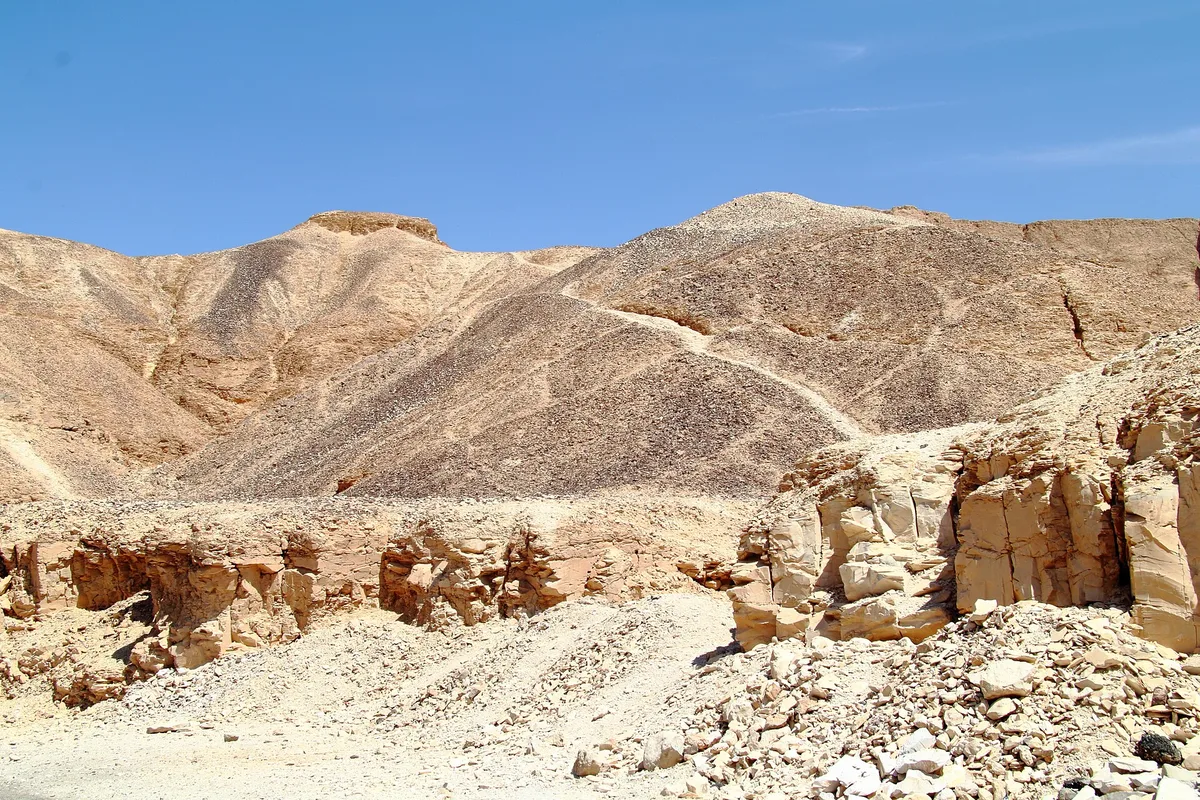
Every coach that crosses to Luxor’s west bank in the morning is going to the same valley, and it is not this one. The Valley of the Kings takes the crowds, the queues and the fame; a mile or so south, at the far end of the Theban necropolis, its sister valley holds the wives, mothers and children of those same kings in more than ninety tombs – and on most days you can walk its length meeting more guardians than visitors. This valley of the queens guide exists because that imbalance is now the valley’s whole character. The Queens’ valley is where the west bank slows down: three painted tombs open under the current rotation, a gravel path, a wall of golden cliff, and behind one numbered doorway the most beautiful tomb in Egypt, which you very probably cannot enter.
That doorway belongs to Nefertari, great royal wife of Ramesses II, and any honest valley of the queens guide has to start by managing the expectation her name creates. QV66 is routinely called the Sistine Chapel of ancient Egypt, and the comparison undersells the colour. But the tomb has spent long stretches of the last four decades closed for conservation, it was closed again in 2024, and as this guide was prepared in November 2026 it remained closed with no announced reopening date. What follows therefore does two jobs at once. It walks you through the valley you can actually visit today – QV55, QV44 and QV52, three Ramesside tombs whose paint survives to a standard that would headline any other site in Egypt – and it gives Nefertari’s tomb the full treatment anyway, because the valley makes no sense without her, because her closure is itself the most instructive fact in Egyptian heritage management, and because if the door is open on the day you come, everything else in your Luxor plan should rearrange itself around it.
The valley also repays a different kind of attention from the Kings’ valley. There, the drama is scale – corridors driven deep into the rock for a god-king’s eternity. Here the tombs are smaller, more intimate and often more personal: a father king leading his teenage son by the hand past the gods, a queen’s burial chamber painted like a star chart, a prince’s unfinished sarcophagus still waiting where the workmen left it. This valley of the queens guide takes the tombs one by one, explains how the ticket, the path and the morning actually work using the official figures, and shows how the valley locks together with Deir el-Medina, Medinet Habu and the Kings’ valley into the best half-day on the west bank. For the wider shape of a first Egypt trip, start with our Egypt travel guide; this page is the deep guide to its quietest royal address.
Valley of the Queens Guide at a Glance – the Tombs on One Table
Read the table as the valley’s shape in miniature. One masterpiece, currently shut; three open tombs that carry the visit between them; and a valley floor of closed doorways that is itself half the experience, because walking past ninety sealed entrances teaches you the scale of the necropolis faster than any single interior.
| Tomb | Who lies here | Period | Go for | The honest catch |
|---|---|---|---|---|
| QV66 | Nefertari, great royal wife of Ramesses II | 19th Dynasty | The finest painted tomb in Egypt – goddesses, star ceilings, the queen at senet | Closed since 2024 with no announced reopening; when open, a separate premium ticket and minutes-long timed entry |
| QV55 | Prince Amunherkhepshef, eldest son of Ramesses III | 20th Dynasty | The king leading his young son before the gods; a granite sarcophagus still in place | The prince died a teenager – the tomb’s tenderness is also its sadness |
| QV44 | Prince Khaemwaset, son of Ramesses III | 20th Dynasty | The crispest surviving colour of the open three; the prince before Anubis | Smaller than QV55 and usually walked second, though many prefer it |
| QV52 | Queen Tyti, probably a wife of Ramesses III | 20th Dynasty | A queen’s own tomb among the princes; winged goddesses and the Four Sons of Horus | Flood and time have thinned the paint – this is the valley’s honest ruin |
| The valley floor | More than 90 numbered tombs, QV1 to QV95 | 18th-20th Dynasties, with later reuse | The necropolis whole – entrances, ramps and spoil heaps under the cliffs | Nearly all of it is closed; you read it from the path, not from inside |
One pattern should be clear before the detail. The open list is short, and it is not a deficiency to apologise for – it is conservation policy you can see. Tomb paintings die of exactly what visitors bring: breath, humidity, dust and touch. The valley of the queens guide that follows treats the short list as the point. Three tombs, seen slowly and understood properly, with the closed ninety as their context, is a better visit than a rushed ten would be – and it leaves you the rest of the morning for the two neighbours, Deir el-Medina and Medinet Habu, that complete the story of who built these tombs and who guarded them.
Notice, too, what the names in the table are not. There is no king here. The Valley of the Queens was the necropolis of the royal family around the king – his wives, his mother, his sons and daughters – and that is precisely why its art feels different from the Kings’ valley a mile or so north. The programme in the paint is not a solitary god-king forcing his way through the underworld; it is a family being presented, led and received by the gods, and the emotional register – fathers and sons, queens and goddesses – is warmer, stranger and more human than anything in the royal valley.
Where the Valley Sits – the Quiet End of the Necropolis
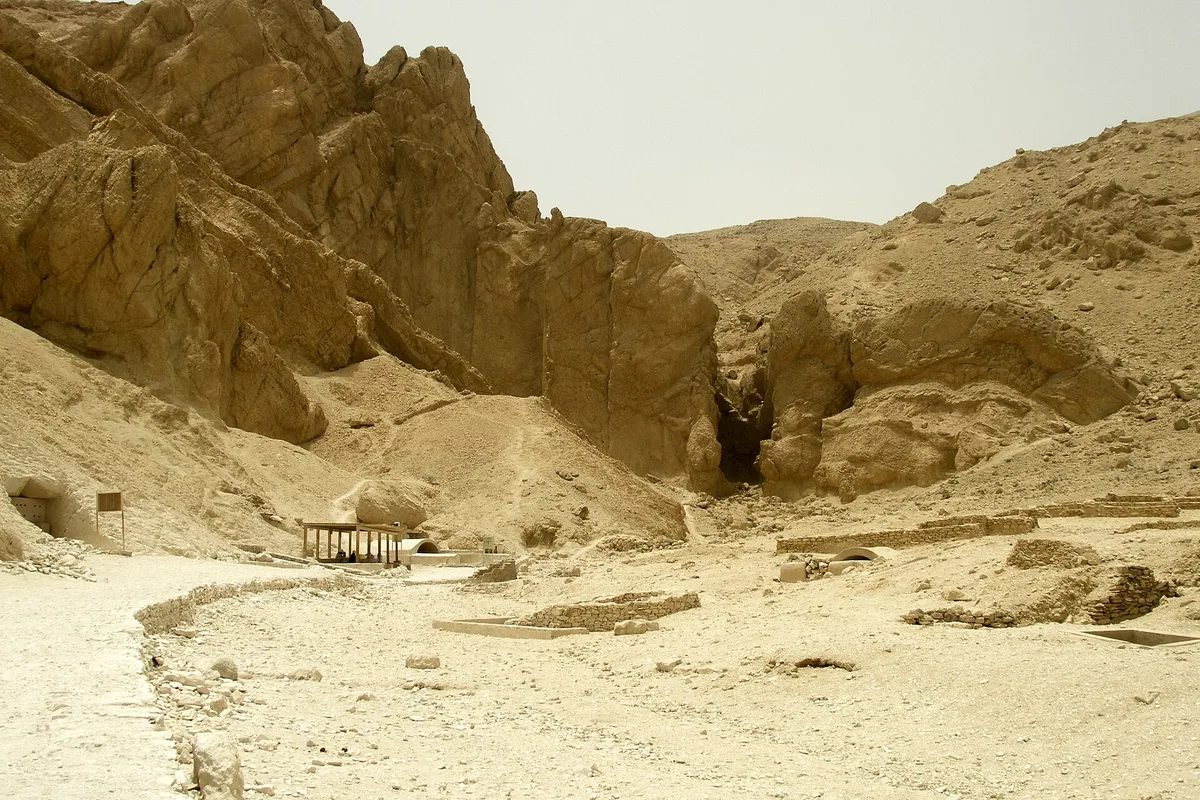
The Theban necropolis – protected as a single UNESCO World Heritage property, Ancient Thebes with its Necropolis – is a long crescent of desert hillside on the west bank of the Nile at Luxor, and the Valley of the Queens is its southern bookend. Drive west from the river and the sights unroll in a loose southward line – the Colossi of Memnon on the plain, the Ramesseum, Medinet Habu against the hills – while the tomb valleys hide in the folds behind. The Kings’ valley sits in the middle of the crescent. The Queens’ valley is the last fold of all, a natural amphitheatre of limestone at the southwestern end of the hills, where the main wadi runs in under the cliffs and dies against the rock. Beyond it there is nothing but desert plateau and the long drop toward the Western Desert – in pharaonic terms, the edge of the ordered world, facing the sunset and the realm of the dead.
That position was chosen, not inherited by accident. The ancient Egyptians buried their dead in the west because the sun died in the west, and within the west bank they prized valleys that the winter rains had carved into defensible, hidden folds – though hidden is a relative term for a necropolis that employed its own guards, scribes and workmen for five centuries. The Queens’ valley added one more quality the Kings’ valley lacks: it sits directly below a sacred cleft in the cliffs associated with Hathor, goddess of the west and of the necropolis, and a grotto shrine in the rock above the valley – reached by a path from the valley floor – was a place of pilgrimage in its own right. When the rains came, water pouring down that cleft read to ancient eyes as the goddess’s blessing on the valley beneath her. A valley of the queens guide should be plain that this is not scenery. The geography is the theology: queens and princes were laid in the lap of Hathor, at the point where the cultivated valley, the necropolis and the desert meet.
The modern geography matters just as much for your morning. The valley is compact – the walk from the entrance to the far end of the main wadi takes minutes, not the long shuttle-and-climb logistics of the Kings’ valley – and it stands within a short drive of both Deir el-Medina, the workmen’s village tucked in the next fold north, and Medinet Habu, the great mortuary temple of Ramesses III on the plain below. Everything in this cluster is close; everything in the Kings’ valley cluster is close; the two clusters are separated by a drive of roughly ten minutes around the hills. Planning a west bank day is mostly the art of not crossing that gap more often than you must, and the pairing section of this valley of the queens guide returns to the question with concrete shapes for the day.
Stand on the valley floor at eight in the morning and the other fact of the place announces itself: silence. The cliffs take the wind, the tour buses mostly go elsewhere, and the loudest regular sound is the guardians’ greetings echoing off the rock. Egypt has grander afternoons to sell you, but it has very few royal places where the past still sounds like this.
Ta-Set-Neferu – How the Place of Beauty Began
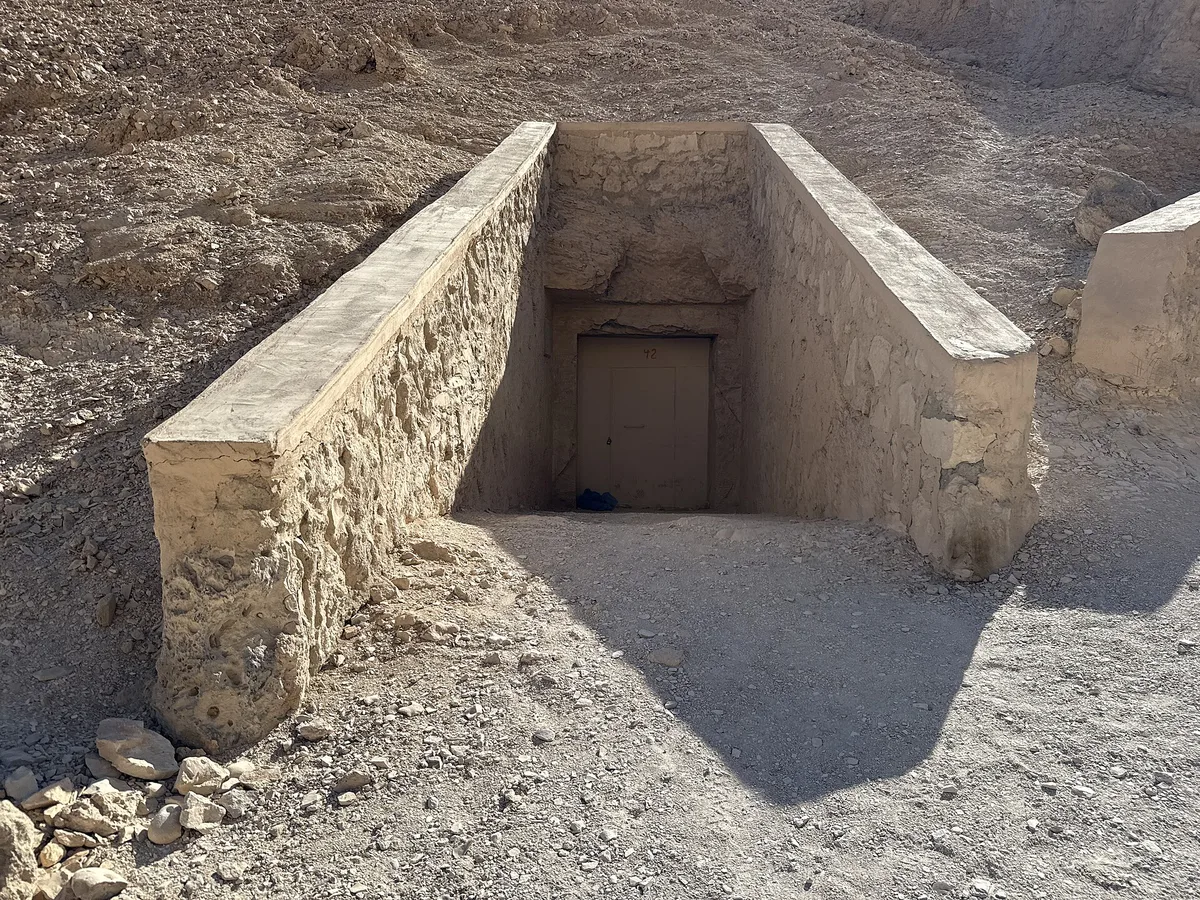
The Egyptians called this valley Ta-Set-Neferu, usually translated as “the Place of Beauty” – though the word neferu can also carry the sense of the royal children, and some Egyptologists read the name as a nod to them from the start. Either way, the name fits what the valley became. Its first tombs were cut early in the 18th Dynasty, in the decades after the wars of liberation that founded the New Kingdom, when Thebes was the capital of an empire and its royal family needed burial ground beyond the cramped earlier necropolises. Among the earliest occupants was a princess named Ahmose, daughter of the liberator-king Seqenenre Tao, whose modest tomb – QV47 in the modern numbering – opened the valley’s long account sometime in the first half of the sixteenth century BC.
For its first two centuries the valley was used more loosely than its later fame suggests. Early tombs here are simple – a sloping corridor, a burial chamber, sometimes a shaft – and the cemetery’s population was the wider royal household rather than a strict roll of queens: royal daughters and sons, and burials connected to the court, laid in the same wadi. Only gradually, and decisively under the Ramesside kings of the 19th Dynasty, did Ta-Set-Neferu sharpen into the purely royal family cemetery that the name Valley of the Queens now promises – a reminder that the valley began as Theban burial ground before it became a royal address, and that its character was made, not given.
The sharpening came with the 19th Dynasty. When the Ramesside kings moved the royal burial programme into high gear – new royal tombs in the Kings’ valley, new family tombs here – the Queens’ valley took the form this guide walks you through: a main wadi of rock-cut family tombs, with smaller side valleys running off it, each with its own modern nickname – the Valley of Prince Ahmose, the Valley of the Rope, the Valley of the Three Pits, the Valley of the Dolmen Rock. The QV numbers themselves are a modern filing system, assigned in the order the tombs were catalogued, running from QV1 to QV95 with gaps where numbers were given to pits and unfinished cuts. Nothing about the numbering reflects rank or date, a point worth holding onto, because the valley’s masterpiece sits not at QV1 but at QV66, two-thirds of the way down the list.
Above the valley’s southern rim, half-hidden in the cliffs, sit the ruins of a small Coptic monastery, Deir er-Rumi, a witness to the valley’s long afterlife. The tombs were robbed in the chaos at the end of the New Kingdom, some were reused for mass burials in the Third Intermediate Period and again in Roman times, and Christian hermits later sheltered in the valley their ancestors had feared. When Ernesto Schiaparelli’s Italian mission began systematic excavation here in 1903, the valley had been a quarry of legend and looted antiquities for three thousand years – and it still produced, in the 1904 season, the discovery of Nefertari’s tomb – eighteen years before Tutankhamun’s tomb made tomb-finding famous, and arguably not bettered since. That discovery gets its own sections below, because it deserves them.
A Family Cemetery – Queens, Princes and the Ramesside Court
The kings who made this valley were the Ramessides, and the family politics of their court is written across its walls. Ramesses II, ruling for two-thirds of a century in the 13th century BC, buried a constellation of his household here: his great royal wife Nefertari in QV66; his daughter-wives Bintanath in QV71 and Merytamun in QV68; his wife Nebettawy in QV60; and other royal women of the court in tombs up and down the wadi. A generation that long produces a great many royal children, and the valley absorbed them – though it was Ramesses III, a century later, who filled it most densely, preparing tombs in the main wadi for a procession of his sons, several of whom predeceased him and were buried here by a father who outlived too many of his heirs.
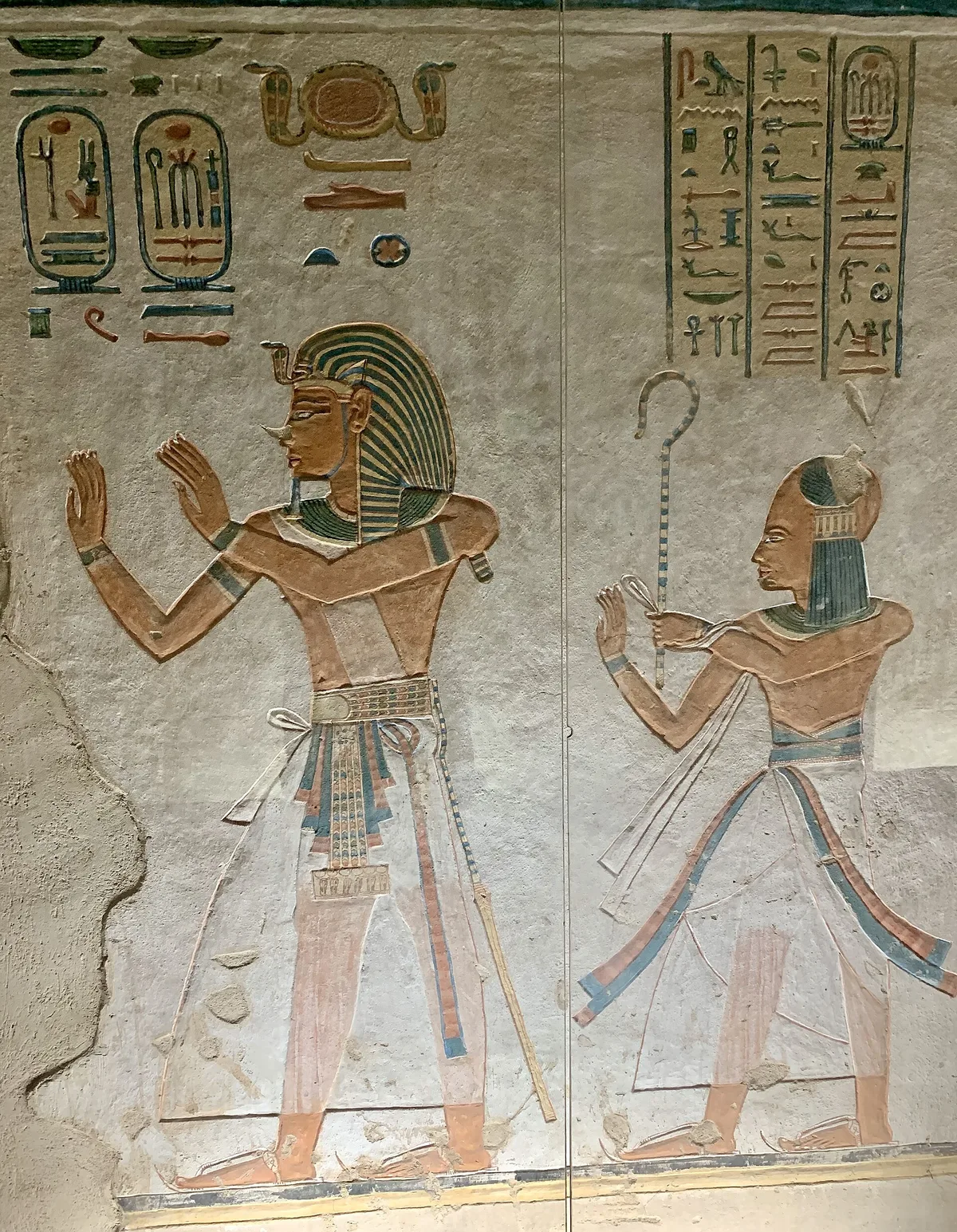
The princes’ tombs share a family resemblance so strong that walking two of them teaches you the pattern for all. A ramped or stepped entrance drops to a corridor; the corridor’s walls carry the tomb’s whole theology in one repeated, tender composition – the king himself, Ramesses III, holding his son by the hand or walking before him, presenting the boy to god after god: Ptah, Thoth, Isis, the jackal Anubis, the Four Sons of Horus who guard the viscera of the dead. Then a pillared hall, side chambers, and the burial room, where in two of the open tombs the prince’s granite sarcophagus still stands. Egyptologists call these the “princely tombs” and they are, quietly, among the most moving rooms in the Theban necropolis – not triumphs of empire but acts of parental grief dressed in the full machinery of the state religion.
The queens’ tombs work to a different programme. Where a prince is led by his father, a queen travels the underworld in her own right: she plays senet against an unseen opponent, offers to the gods in her own voice, and is received at the end by Isis and Nephthys as an equal of the divine world. The difference matters for how you read the valley. The Kings’ valley, a mile or so north, is about one man’s lonely transformation into a god. This valley of the queens guide keeps returning to because its subject is a family – wives with their own theological journeys, sons introduced to heaven by their father’s hand – and that is a story the royal valley simply does not tell.
It is also worth understanding who dug and painted all this. The tombs of both valleys were cut by the royal workmen of Deir el-Medina, the village in the next fold of the hills, who walked over the ridge to work in gangs organised in left and right shifts, under foremen whose names and family feuds we know from their own ostraca. The same hands that cut a king’s corridor in the morning could be decorating a prince’s chamber by the season’s turn. When you reach the pairing section of this guide and stand in those workmen’s own painted chapel-tombs at Deir el-Medina, remember that you are looking at the signature of the artists who made everything in this valley – a workforce that buried Egypt’s royal families for five centuries and then, in its own small tombs, quietly out-painted half of them.
QV66 Nefertari – the Masterpiece of the Valley
Nefertari Merytmut – “the most beautiful of them, beloved of Mut” – was the first and favourite great royal wife of Ramesses II, and the wife whose image the king carved at his own scale on a temple facade, at Abu Simbel in Nubia, where her temple stands beside his and the dedication calls her the one “for whose sake the sun rises”. She died around the middle of his reign, roughly 1255 BC, and the tomb her husband’s workmen cut for her in this valley is the masterpiece of Egyptian tomb painting: some 520 square metres of wall and ceiling, decorated floor to ceiling in a style of such freshness and confidence that modern painters study it the way musicians study a score. If the valley of the queens guide you are reading has a headline, it is this tomb – and its headline status is the root of both its glory and its troubles.
The tomb was already ancient, and already robbed, when it was new. Thieves took Nefertari’s burial goods in antiquity – what Schiaparelli’s excavators found in 1904 was a plundered shell: fragments of her great pink granite sarcophagus, a pair of woven sandals, a group of shabti figures meant to work for her in the afterlife, and a pair of mummified knees that were probably the queen’s own, preserved today in Turin’s Museo Egizio with the rest of the expedition’s finds. The thieves, in the valley’s great irony, did the paintings a favour: a tomb worth emptying was a tomb left alone afterwards, and the sealed, forgotten doorway under the rubble kept the colour safe from three thousand years of sunlight, Coptic hermits and souvenir hunters. What survives in QV66 is not a burial. It is the wrapping the burial came in – and the wrapping turned out to be worth more than the contents.
The modern history of the tomb is a parable of heritage in three acts. Act one: discovery and display – the tomb opened to the public and its paintings, painted on thin plaster over flawed rock, began to suffer almost at once from the humidity in visitors’ breath and the salts migrating through the stone, flaking the queen’s face away in scales. Act two: rescue – from 1986 to 1992 the Getty Conservation Institute, working with Egypt’s antiquities service, ran one of the most meticulous conservation projects ever attempted in a painted tomb, consolidating plaster, cleaning surfaces and stabilising the paint layer flake by flake; the project remains the discipline’s reference point for how such work should be done. Act three: rationing – when the tomb reopened in the mid-1990s, it did so under the strictest access regime in Egypt, a separate premium ticket, tiny daily numbers and visits measured in minutes, and it has closed and reopened in cycles ever since as conservators judge the balance between the world’s right to see it and the painting’s need to survive.
As this guide was prepared in November 2026, the tomb was closed – it shut again in 2024, and the official booking portal lists no Nefertari ticket at all, a point the next sections take up in practical detail. Treat the closure neither as a rumour nor as necessarily permanent: QV66 has returned from every previous closure, each time under tighter rules. What the closure should change is not whether you come to the valley, but how you weight the rest of it – and the three open tombs, which this valley of the queens guide covers next in their own rights, are emphatically not a consolation prize.
Inside Nefertari’s Tomb – What the Paintings Actually Show
Because access to QV66 is so often impossible, descriptions of it tend to dissolve into superlatives. Resist them. The tomb’s glory is specific, and a reader who knows what the rooms contain can hold the whole programme in mind standing outside its closed door – or walk straight to the right walls on the precious day it opens. The plan is a bent axis, unusual in this valley: a staircase descends to a first great chamber, from which a second stair drops at an angle to the burial hall, with small side rooms off each level. Every surface is worked. There is almost no plain plaster in the tomb.
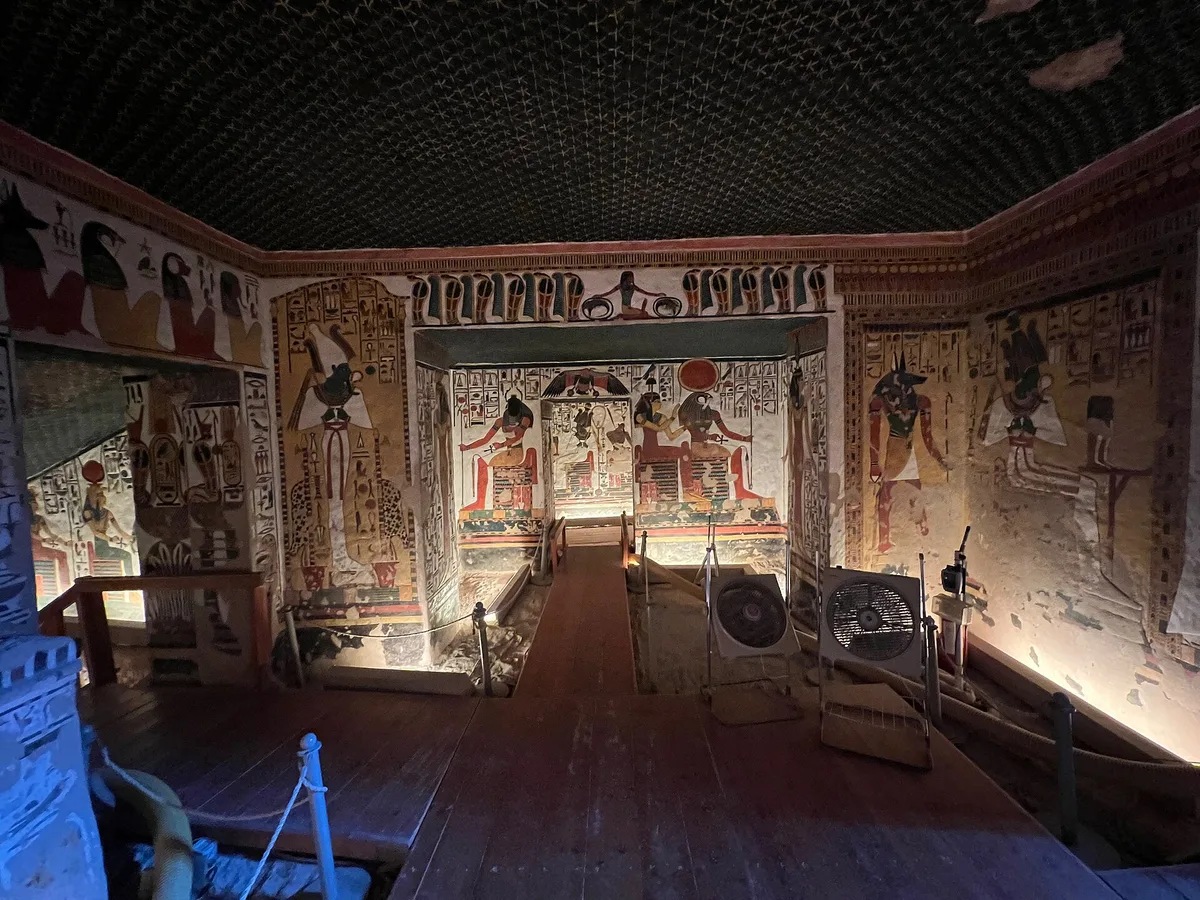
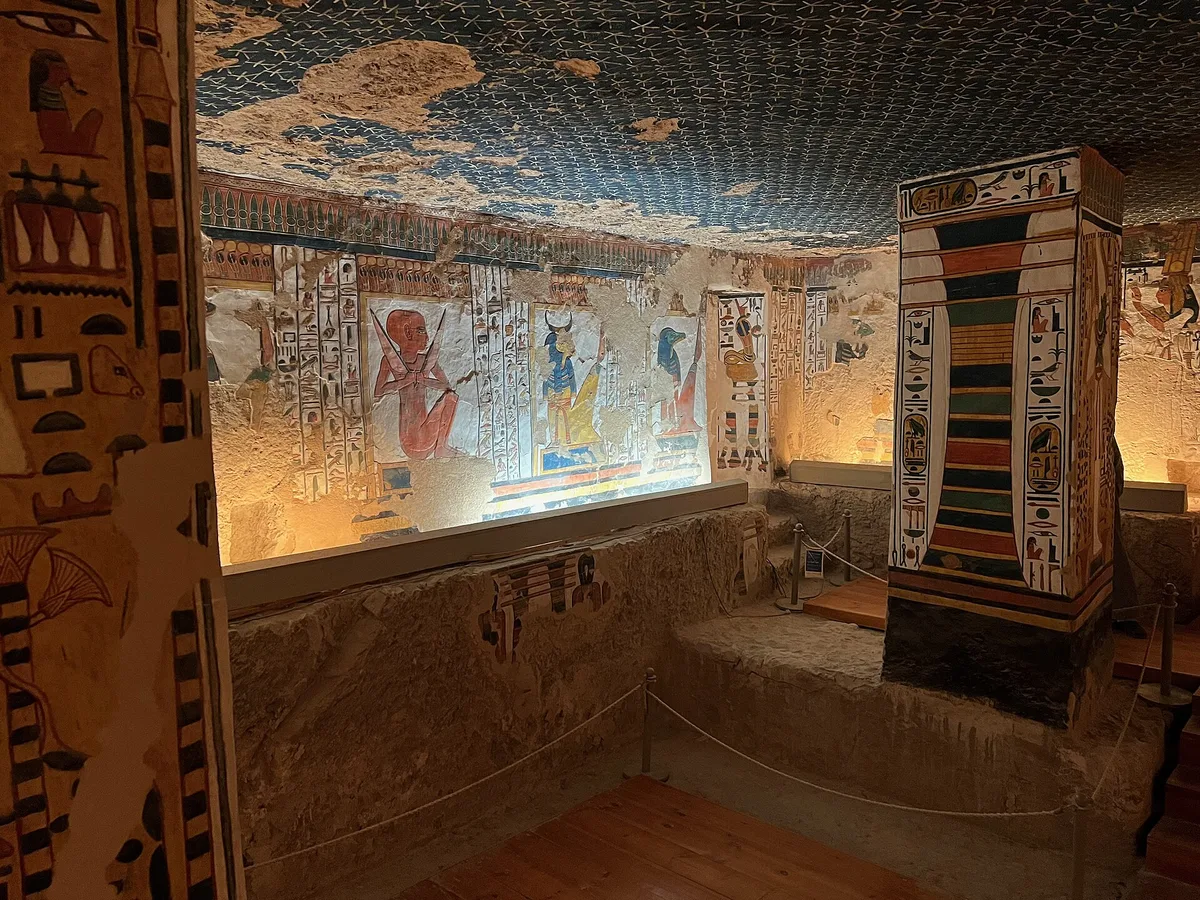
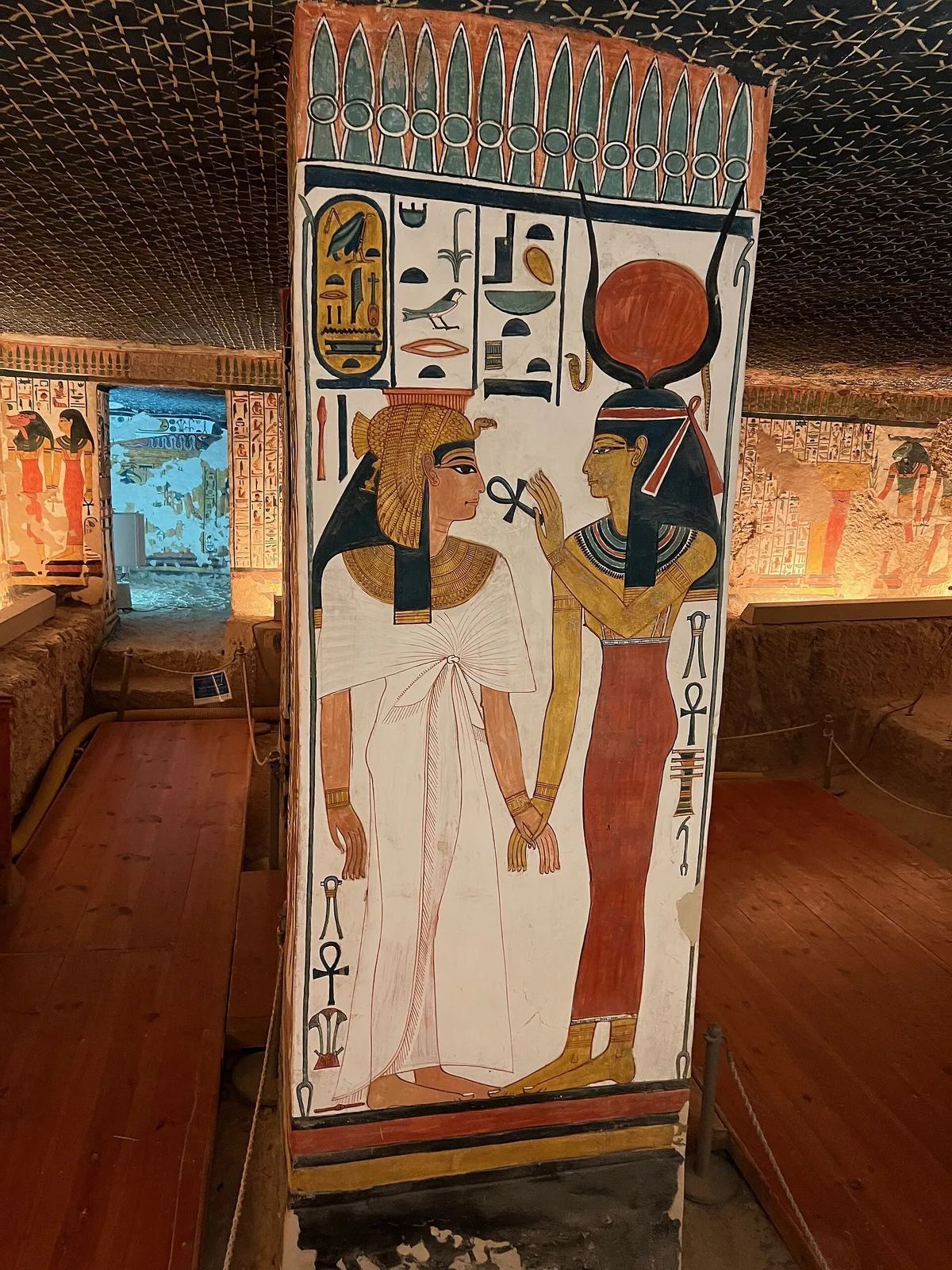
The first chamber tells the queen’s journey through the world of the dead in scenes drawn largely from the Book of the Dead. Nefertari appears again and again, alone and unmistakable in her white pleated dress, tall double-plumed crown and broad collar: playing senet against an invisible opponent – the game as a metaphor for the passage through the afterlife, which she must win; kneeling before the gods of the necropolis; standing before Ptah, Thoth with his scribe’s palette, and the falcon-headed Ra-Horakhty; receiving the breath of life from Isis. The drawing is the wonder of it – outlines of a suppleness that Egyptian art rarely matches, colour laid in flat luminous fields, and a face for the queen that is idealised yet individual, repeated with the consistency of a portrait. On the ceiling and in the side chamber, the imagery turns cosmic: the goddess Nut, the four winds, and the strange, beautiful vignette of the queen’s ba-soul as a human-headed bird.
The burial chamber below is the tomb’s cathedral. Four pillars, painted on every face with the queen before deities, carry a ceiling sown solid with golden stars – the imperishable stars of the northern sky, among whom the justified dead were believed to sail forever. On the walls the tone darkens to the great underworld books: gates and guardians, the goddess Maat with her feather of truth, Nefertari led by Horus into the presence of the enthroned gods, and the transfigured queen standing at the threshold of the divine assembly as one of its members. The sarcophagus stood at the centre under that star field, in a room whose every image argues the same proposition – that this woman has passed the judgement and taken her seat among the gods permanently. Standing in it, visitors consistently report the same peculiar effect: the tomb does not feel decorated. It feels inhabited.
Two honest footnotes belong in any valley of the queens guide that describes QV66 this warmly. The first is that the tomb you would see is a conserved surface, not a untouched one – some areas of paint were already lost when Schiaparelli entered, losses were left honestly visible rather than repainted, and whole passages (a famous ceiling of vultures in the stairway among them) survive damaged. The second is that the queen’s mummy and treasure are not here and never again will be: for the gold of Ramesses II’s court you go to the museums, and this guide’s Cairo coverage takes up that story. QV66 offers something rarer than gold. It offers the most complete painted argument for eternal life that ancient Egypt ever made – in a valley that has now spent a century deciding how, and whether, to let us look at it.
The Nefertari Problem – Closure, Conservation and the Ticket That Isn’t on the List
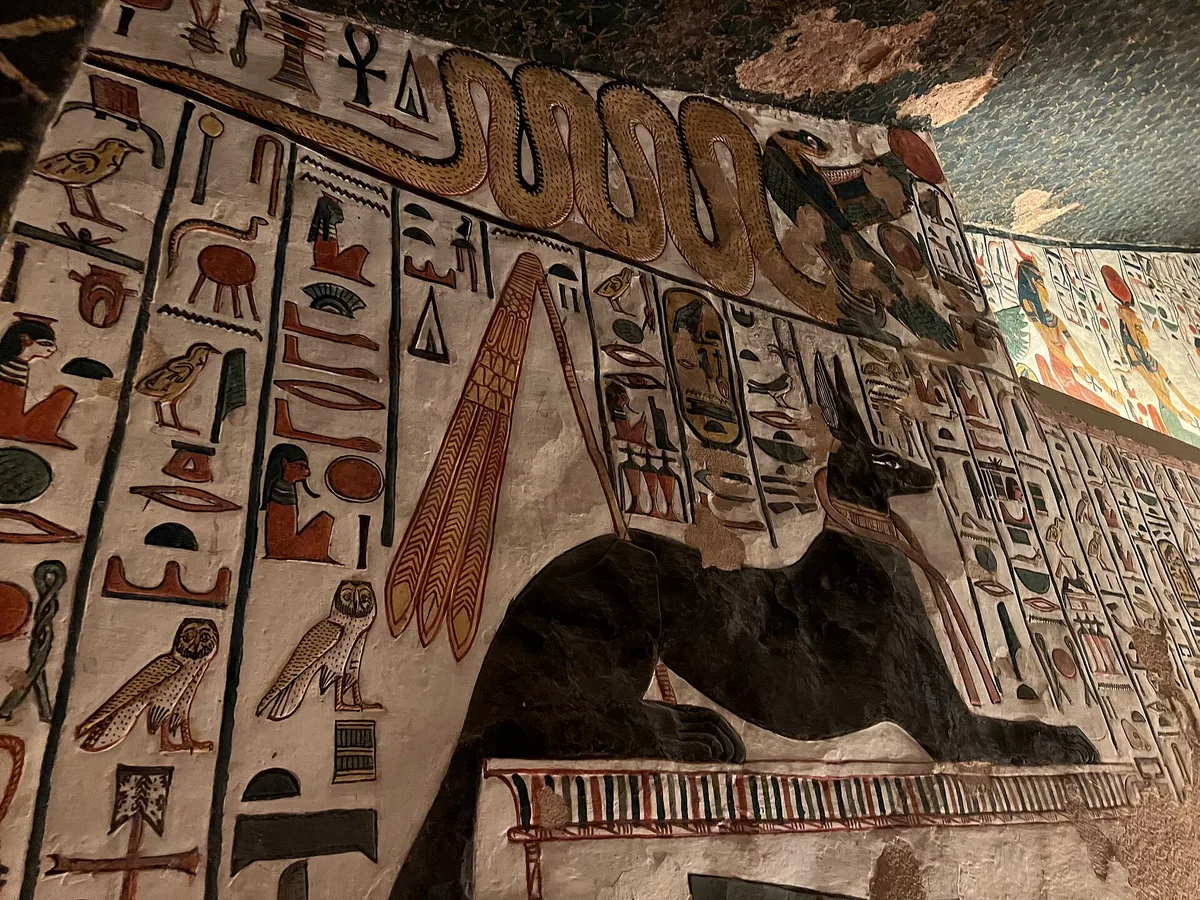
Every valley of the queens guide owes its readers a straight answer to one question – can I see Nefertari’s tomb? – and the straight answer, as of November 2026, is no. The tomb closed to visitors in 2024, official statements frame the closure as conservation-driven, and no reopening date has been announced. The most reliable single check agrees: the Egyptian Ministry of Tourism and Antiquities’ own booking portal, egymonuments.com, which sells the Valley of the Queens ticket, offers no Nefertari ticket of any kind at the time of writing – the tomb simply does not exist as a purchasable product right now. Any website quoting you a current Nefertari price is quoting history, and the figures they quote – this guide found everything from 1,200 to 2,500 Egyptian pounds in third-party pages while preparing it – contradict each other precisely because they are fossils from different seasons. That is why this article prints no Nefertari price: there is no official one to print.
Understand the mechanism anyway, because it will return when the tomb does. In its open seasons, QV66 has always been sold separately from the valley ticket: a premium add-on, priced deliberately at the level of a deterrent, with numbers capped per day and entry in small groups for a strictly limited time – ten minutes is the figure guards have enforced in recent open seasons. The logic is conservation arithmetic, not profiteering: every visitor exhales moisture into a sealed plaster envelope, the salts in the rock answer that moisture by crystallising under the paint film, and the Getty team’s work in the early 1990s bought the paintings time, not immunity. The premium ticket is the valve on that system. If your visit falls in an open season, buy the valley ticket and the Nefertari ticket as separate decisions, expect the Nefertari one to be the single most expensive tomb ticket of your Egypt trip, and build the whole morning around your slot rather than treating it as a stop among others.
What should you do with a closed QV66? First, verify rather than trust – closures and reopenings in this valley are announced late and reported worse, so check the official portal in the week of your visit and ask again at the ticket office on the day; surprise soft-openings for limited periods have happened before. Second, look at the tomb’s exterior context properly when you come: the doorway stands in the main wadi among the other royal entrances, and the valley floor section of this guide will help you read the row of numbered doors for what it is – a royal street, most of it resting. Third, resist the consolations industry. No replica, photograph or virtual tour is the tomb, but two honest substitutes exist for the paintings themselves: the Turin museum holds Schiaparelli’s finds, including fragments of the queen’s sarcophagus and her shabtis, and the Getty’s published documentation of the conservation project reproduces the tomb wall by wall at a fidelity no ten-minute visit could match.
And then – go and see the valley anyway. The mistake would be to read this section as a reason to skip the Queens’ valley until Nefertari returns. The open tombs are not understudies; QV55 and QV44 hold painting of a quality that only QV66 in this valley, and a handful of rooms in the Kings’ valley, surpass. The closure changes the summit of the visit, not its substance, and a traveller who walks the quiet wadi, reads the closed doors and spends real time in the princes’ tombs has had the Valley of the Queens whole – one masterpiece short, and honest about the arithmetic.
QV55 – Prince Amunherkhepshef, the Heir Who Never Ruled
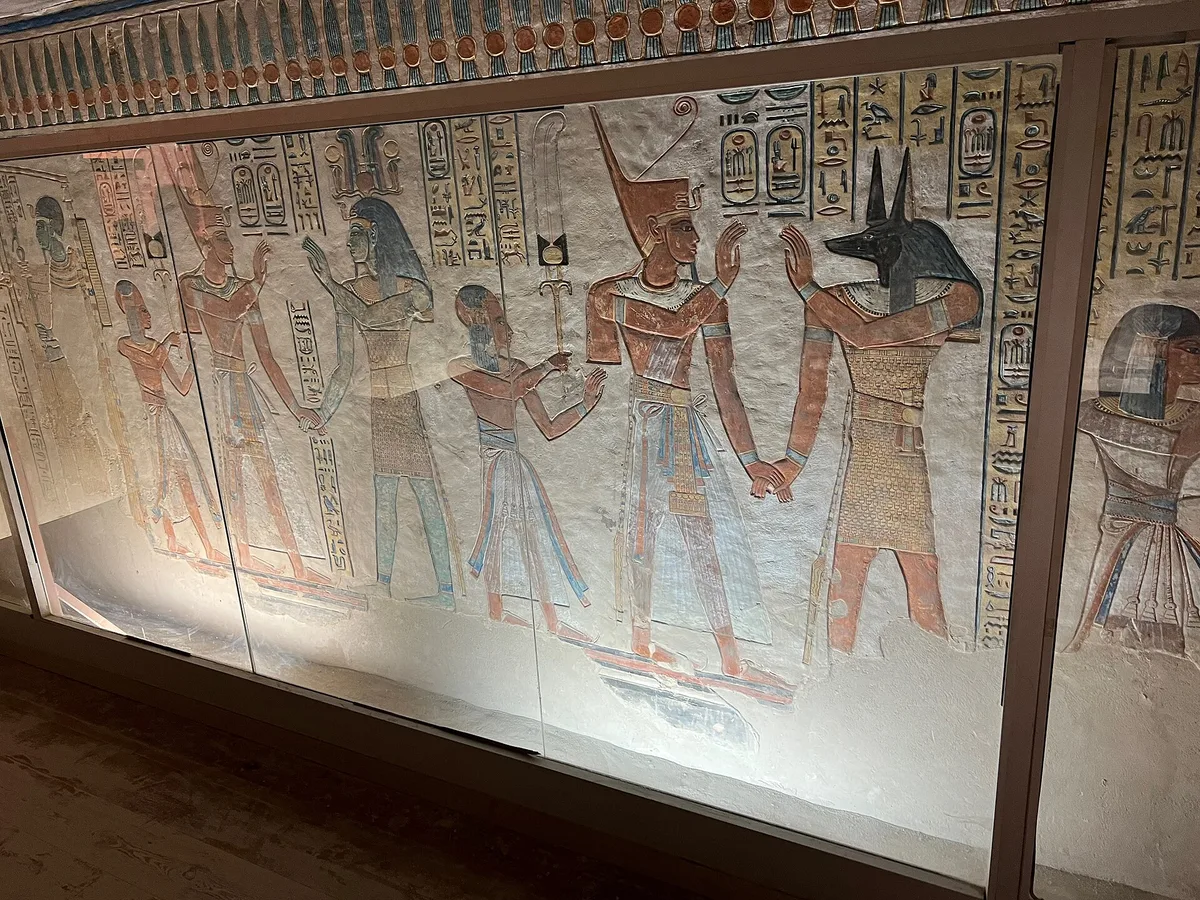
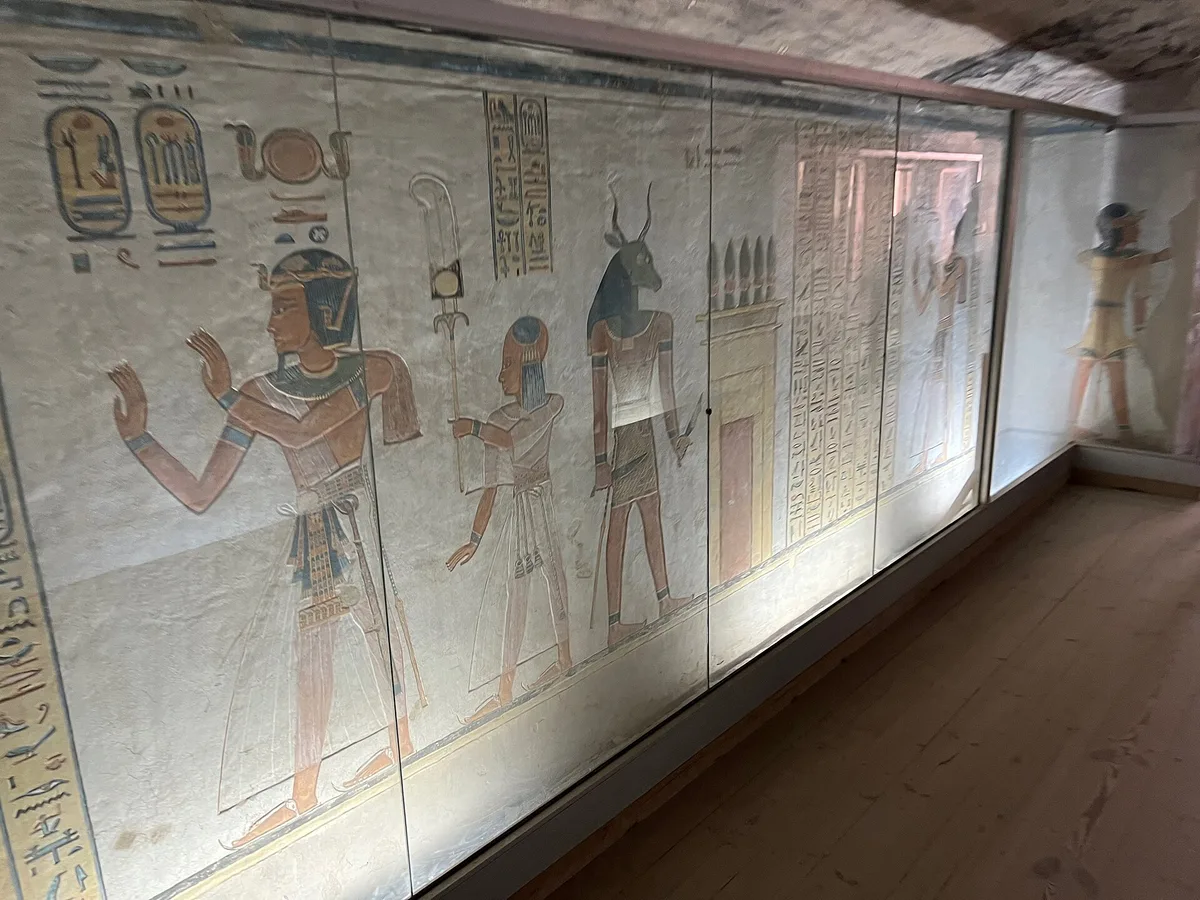
The first tomb most visitors enter is the valley’s most affecting. Amunherkhepshef was the eldest son of Ramesses III and his designated heir, commander of the army while still a boy by modern reckoning – and he died in his mid-teens, around 1165 BC, predeceasing the father who had this tomb cut for him. Everything in QV55 flows from that fact. The tomb was finished in haste by the standards of royal work, but the painting programme its decorators chose is the most intimate in the valley: scene after scene of Ramesses III, in full pharaonic regalia, leading his small son by the hand into the presence of the gods, presenting him – as a father presents a child to honoured guests – to Ptah, to Thoth, to Isis, to the guardians of the necropolis. The prince wears the sidelock of youth and carries a fan; the king’s grip on his wrist does the emotional work of the entire tomb.
The plan is the princely pattern at its clearest. A straight ramped entrance brings you to a long corridor where the presentation scenes run in file along both walls, the colours – Egyptian blue, ochre red, gold-yellow – protected in recent years behind glass panels that add a slight remove but have plainly saved the paint. Beyond lies the burial chamber, and here QV55 keeps its second surprise: the prince’s sarcophagus, a great box of red granite, still stands in the room it was lowered into three thousand years ago. It was never finally used as intended – like the tomb’s unfinished side chamber, whose walls were sketched and abandoned mid-decoration, it speaks of a funeral reorganised around a death that came at the wrong time. In that unfinished room, excavators found a small mummified foetus in a miniature coffin, one of the valley’s most discussed finds – often described as a stillborn child of the prince’s own young household, though the truth of it is unresolved and this guide will not pretend otherwise.
What makes QV55 essential in this valley of the queens guide is not only its story but its condition. Of the open tombs it is the largest and the most completely preserved, the one where the princely formula can be read whole from doorway to sarcophagus in a single visit. Read the corridor slowly. The gods receive the boy with gestures of welcome – a hand raised, an ankh offered – and the texts name him again and again as the king’s beloved son, as if repetition could hold him. Then look at the unfinished chamber before you leave: the grid lines and first sketches of figures never painted are the workmen’s own handwriting, and no finished wall in Egypt tells you more about how these rooms were made.
The honest catch is the glass. Conservation has put panels between you and much of QV55’s painting, and photography through it takes the edge off both the looking and the pictures. Accept the bargain for what it is – the same breath-versus-paint arithmetic that closed Nefertari, answered here with a screen instead of a locked door. QV55 is the proof that the valley can share its treasures and keep them, provided visitors are willing to look through the evidence of their own impact.
QV44 – Prince Khaemwaset and the Best Colour in the Valley
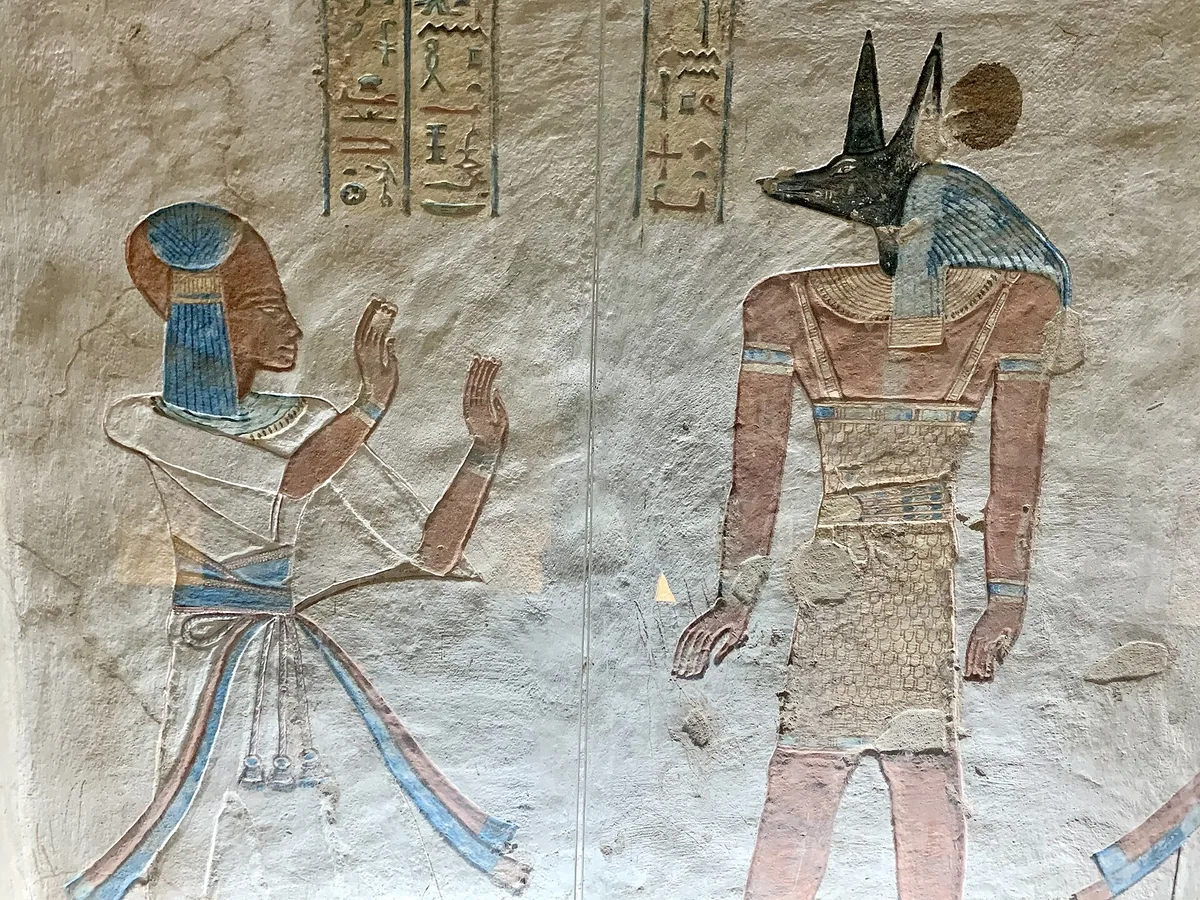
If QV55 is the valley’s heart, QV44 is its jewel case. Khaemwaset was another son of Ramesses III – not the famous Khaemwaset, high priest of Ptah and antiquarian prince of the previous century, but a younger namesake who served as a sem-priest and died, probably in his father’s reign, with his tomb prepared in the family wadi. The tomb is smaller than his brother’s and its plan simpler: a corridor, an antechamber, a burial room. But the painting in QV44 has kept a freshness of colour and a fineness of line that many visitors, walking in straight from QV55, judge the best in the valley outside Nefertari. The blues still read as blue rather than grey; the prince’s pleated linen is modelled in washes; the hieroglyphs keep their little painted details of bird feather and water ripple.
The programme repeats the family formula with its own emphases. Ramesses III again leads the boy before the gods – Thoth, Ptah-Sokar in his shrine, the four sons of Horus on their lotus, and in the tomb’s most photographed encounter, Khaemwaset himself, hands raised in adoration before the jackal-headed Anubis, lord of the necropolis, who leans toward him with the intimacy of a family friend. There is a psychological realism in these scenes that hardens the longer you look: the prince is always slightly smaller than the gods, always beautifully dressed, always being introduced. He never acts alone. The tomb is less a map of his afterlife than a letter of recommendation his father wrote to heaven, and its art serves that letter with everything the Deir el-Medina workshops had.
In the burial chamber stands the prince’s sarcophagus of red granite, massive and comparatively plain beside the painted walls – the standard Ramesside contrast between stone meant to last and plaster meant to glow. The tomb was found, like almost all in the valley, already robbed; what the robbers left were the walls, which turned out to be the treasure. Schiaparelli’s mission cleared and recorded QV44 in the first seasons of the Italian work here, and the tomb has been a fixture of the open list ever since, usually walked second of the three.
This valley of the queens guide’s advice for QV44 is about order and attention. If the day’s open list gives you both princes, walk QV55 first for the full plan and the story, then come here and slow down: the tomb rewards a second pass along walls you have already read once. And give the Anubis wall its minute. Of all the images in the open valley, it is the one that stays with people – a dead boy, perfectly painted, being welcomed by the god of the dead as if he had been expected.
QV52 – Queen Tyti, the Honest Ruin
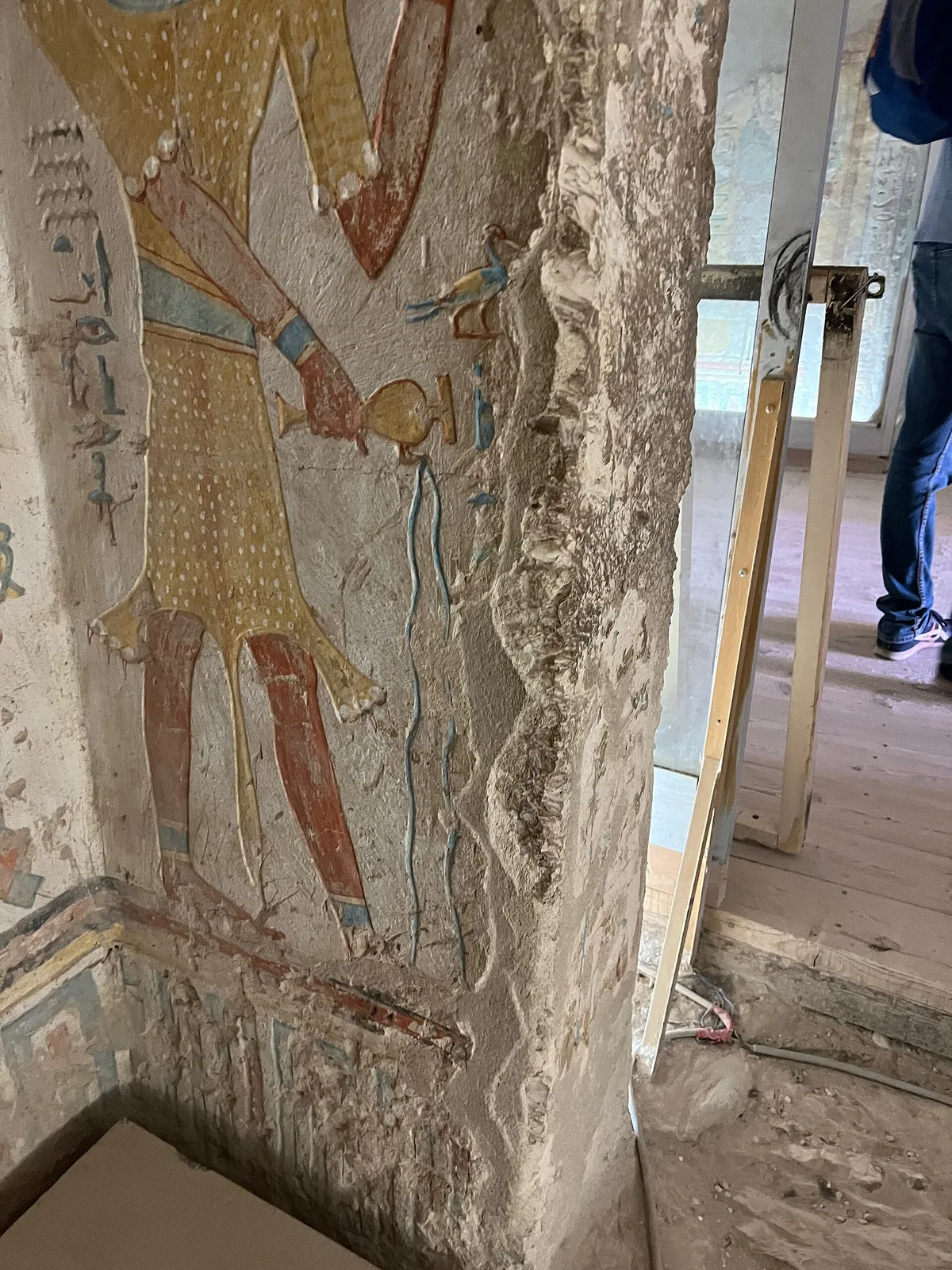
Every necropolis needs one tomb that tells the truth about time, and in this valley it is QV52. Its owner was a queen named Tyti – in all likelihood a wife of Ramesses III and mother of a later Ramesside king, though her exact place in the family is still argued from the tomb’s own inscriptions, which is itself a sign of how much the centuries have taken from her. Her tomb follows a queen’s plan rather than a prince’s: a corridor opening into a hall with side chambers and a square burial room beyond, arranged to the bent, intimate scale of Nefertari’s generation rather than the file-past-the-gods corridor of her stepsons’ tombs a few doors away.
The paintings were once fine. Tyti appears before the gods in the queenly programme – offering, adored, received – and the burial chamber keeps its loveliest survivor in the winged goddesses and the Four Sons of Horus who stood guard over her burial. But QV52 suffered what the low-lying tombs of this wadi always risked: water. The valley is a drainage channel in the rare desert cloudburst, and flood-borne silt and humidity have thinned Tyti’s paint to a ghost of the princes’ rooms – figures traced in faded red and blue, plaster patched and stained, whole passages gone to the colour of the rock. Photographs undersell what remains; in person, with your eyes adjusted to the tomb’s dimness, the elegance of the drawing still reads clearly through the damage.
Why does this valley of the queens guide insist on QV52 rather than treating it as the optional third? Because it completes the valley’s argument. QV66 shows what conservation can save at unlimited cost; QV55 shows the glass-screen compromise; QV52 shows the default fate – what happens to painted plaster across three thousand years of flood, salt and air when no rescue comes. Travellers who have walked all three understand Egyptian heritage as a spectrum of luck and money rather than a gallery of masterpieces, and that understanding is worth the ten minutes the tomb asks. There is also a quieter pleasure here: Tyti’s is often the emptiest of the open tombs, and a burial chamber you have to yourself, however faded, is a room you can actually hear yourself think in.
One practical note. The open list rotates and is set by the antiquities service, not by this guide or any other; Tyti has been a regular on it in recent seasons alongside the two princes, but if your morning offers a different third tomb, take it in the same spirit – the valley’s B-list is uniformly interesting, and the section below explains how to read whichever doors stand open. What you should not do is skip the third tomb because it is “the damaged one”. In this valley, damage is documentation.
The Other Ninety Doors – Reading the Valley Floor
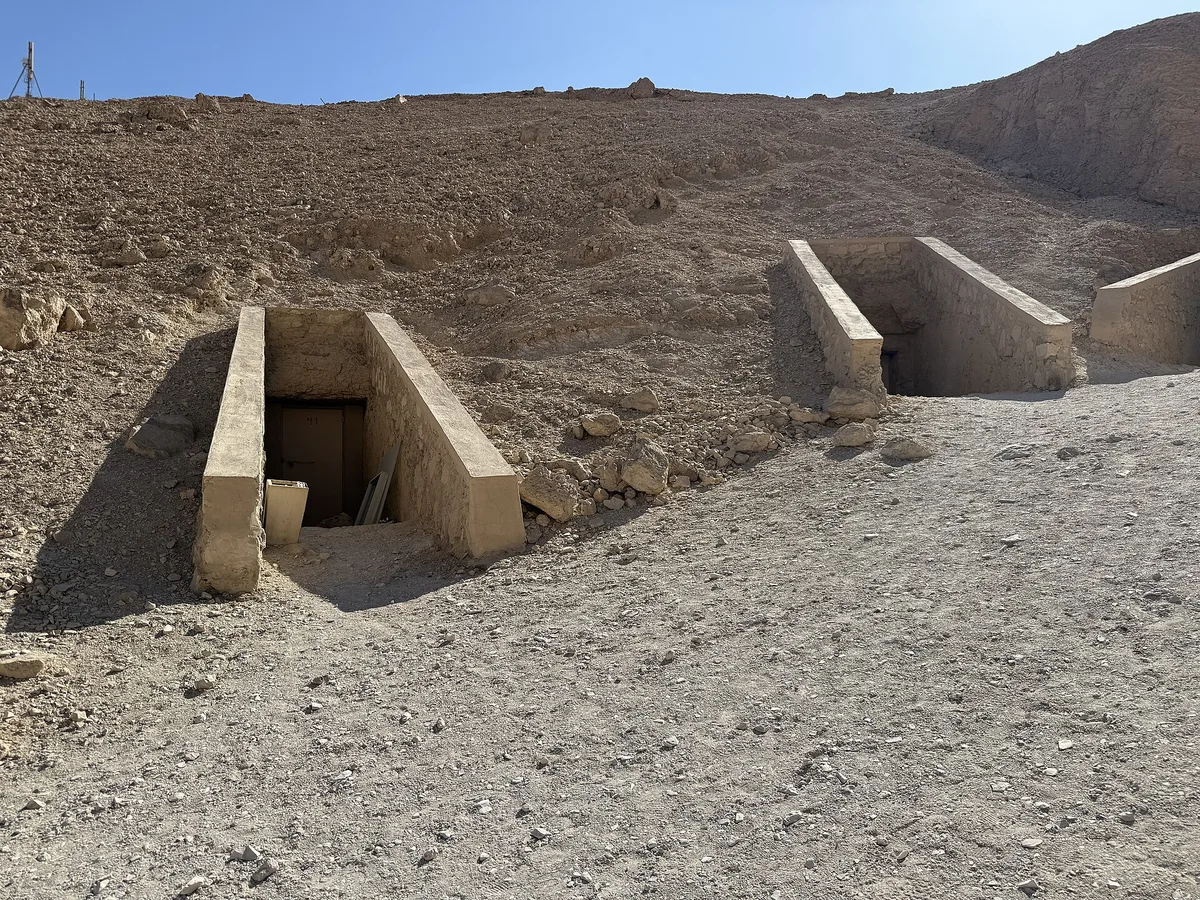
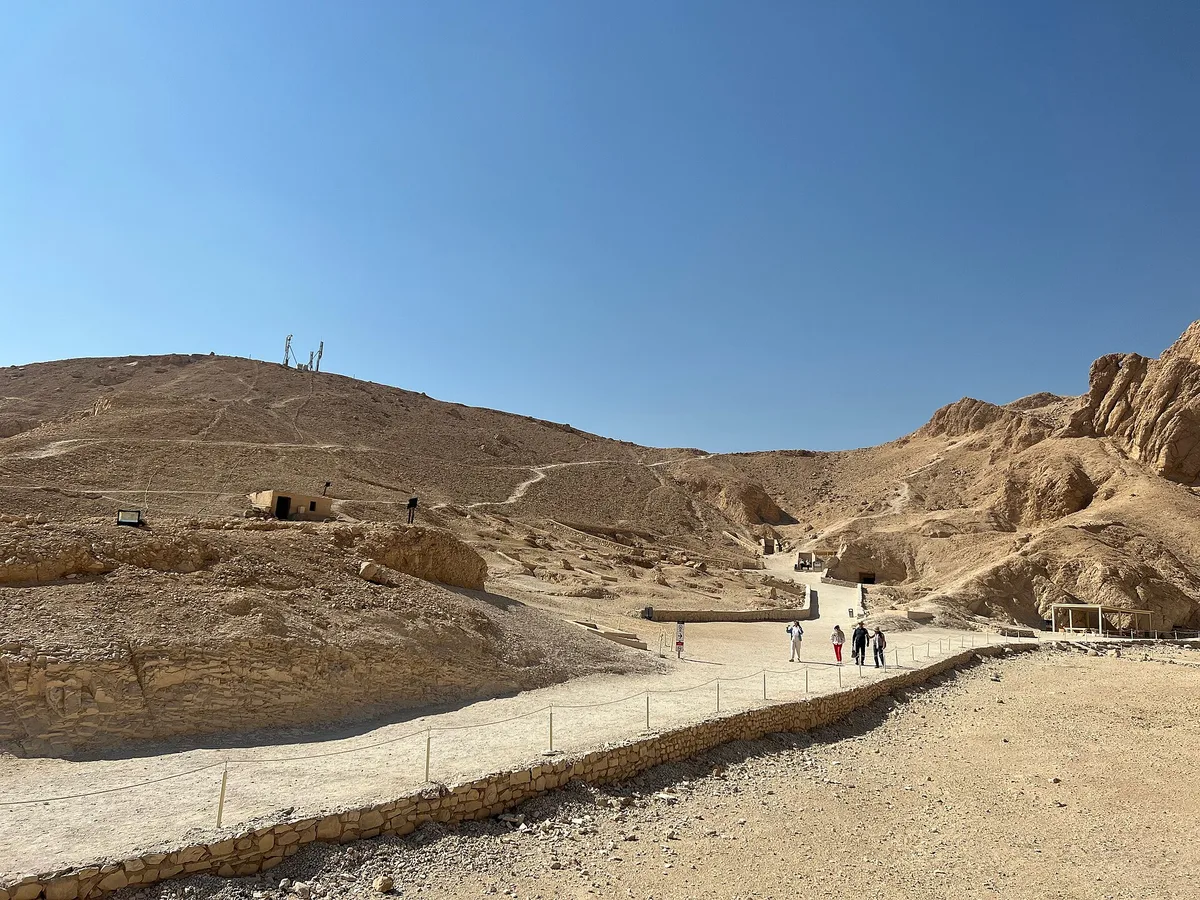
Between the open tombs, the valley floor itself is an exhibit, and this valley of the queens guide urges you not to walk it as a corridor between attractions. More than ninety tombs are cut into this wadi and its side branches. From the path you see their furniture: sloping entrance ramps walled in rough stone, concrete lintels from the modern era of guardianship, spoil heaps terraced against the slopes, and everywhere the small black QV numbers that turn a hillside into an archive. Most of these doors open rarely or never. Their interiors rest in darkness, which is precisely what their paint needs – a closed tomb is a conserved tomb, and the valley’s closed majority is the bank from which future open lists will be drawn as conservators judge each room’s turn to come.
The roll behind the numbers rewards a minute’s study. QV60 holds Nebettawy, another great wife of Ramesses II. QV68 and QV71 hold his daughter-wives Merytamun and Bintanath – the Ramesside court folding back on itself in the way its marriage politics demanded. QV74 holds Duatentopet, wife of Ramesses IV; QV42, a few steps from the open princes, was prepared for Pareherwenemef, yet another son of Ramesses III, whose burial seems to have been displaced in the family’s reshuffles. Earlier and stranger rooms punctuate the wadi: shaft tombs of the 18th Dynasty from before the royal programme, unfinished cuts abandoned when the rock proved bad or the patron died first, and chambers reused in the Third Intermediate Period and Roman times for burials by the dozen – whole later communities shelved in a queen’s abandoned rooms. The valley was never a single project. It is five centuries of projects, layered in one wadi, and the path is the only place all of them can be seen at once.
Read the doors with the geology, too. The workmen chose their walls the way miners do, following the sound rock and abandoning the fractured seams, which is why the tombs cluster where they do and why some grand entrances lead to embarrassingly short corridors – the gang hit bad stone and stopped, and the QV number dignifies a failure. The flint beds and shale seams that frustrated them are visible in the cliff faces above the path. Modern conservation has added its own layer to read: drainage channels and low walls meant to turn the next flash flood away from the doorways, the unglamorous engineering on which everything painted in this valley now depends.
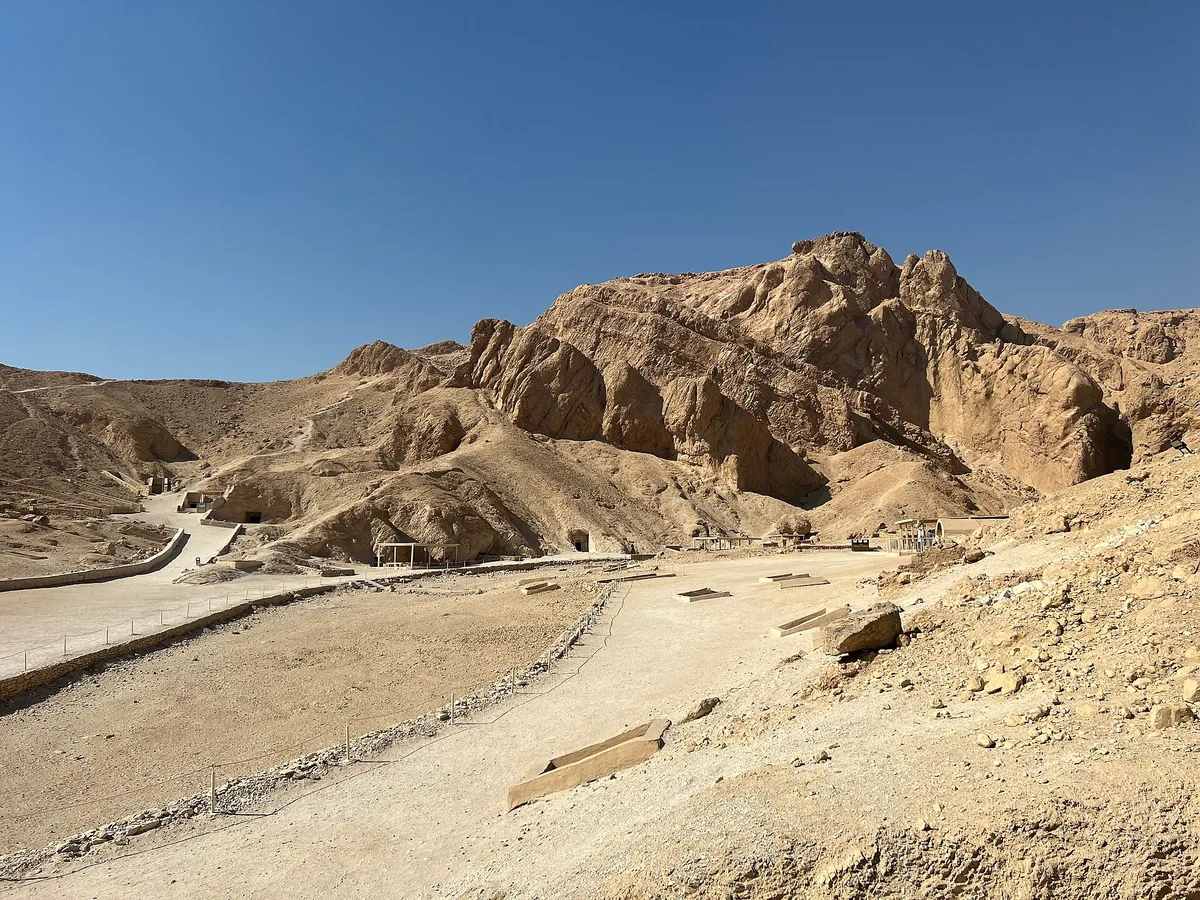
Give the floor fifteen unhurried minutes. Walk to the end of the main wadi where the cliffs close in beneath Hathor’s cleft, look back at the whole amphitheatre of doors, and register the scale of what a royal family’s afterlife industry looked like at full stretch. Then the open tombs, walked after, make a different kind of sense – not as the valley’s highlights reel, but as three lit rooms in a mostly darkened house.
How a Visit Works – Tickets, Timing and the Walk Itself
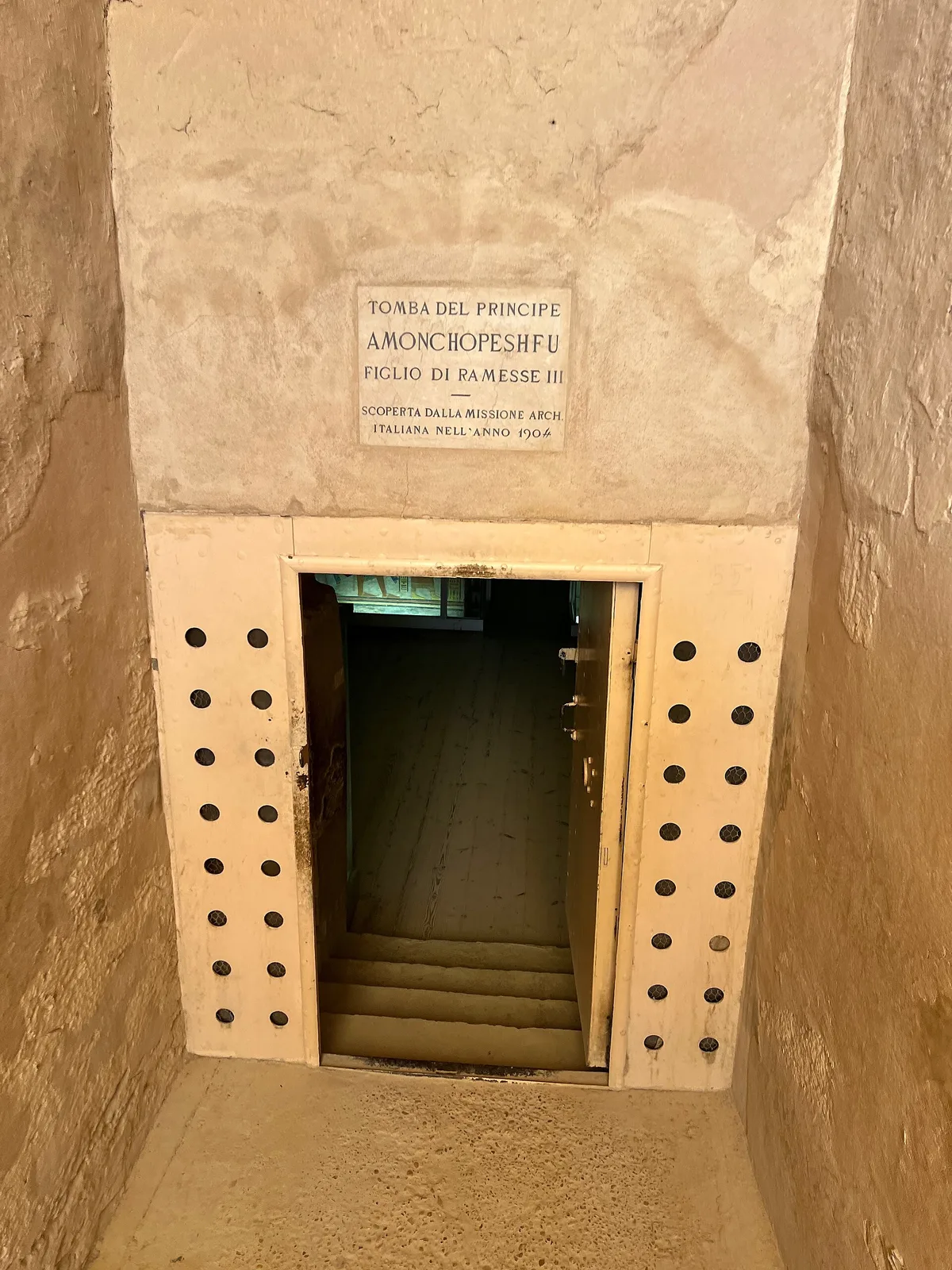
The visit mechanism here is the simplest on the west bank, and this valley of the queens guide can describe it whole. One ticket covers the valley and the tombs open on the day – there is no per-tomb pricing among the regular open three, and no choice to agonise over at the window. The figures in this paragraph are the official ones, from the Egyptian Ministry of Tourism and Antiquities’ booking portal egymonuments.com, checked on 1 November 2026: the Valley of the Queens ticket is EGP 220 for an adult visitor of other nationalities and EGP 110 for a student, with Egyptian tickets at EGP 30 and EGP 10, all prices in Egyptian pounds. The same portal lists the site as open every day from 06:00, with last entry at 17:00 in the summer schedule and 16:00 in winter and during Ramadan, and notes that photography with a mobile phone is free of charge. Treat every one of those figures as the current official position rather than a promise – Egypt revises prices and hours, the portal is the authority, and if it disagrees with this page when you check, the portal is right.
What a ticket buys, in practice, is the run of the wadi path and entry to the day’s open tombs, each watched by a guardian who will unlock, accompany and – in the universal west bank custom – hope for a small consideration for extras like pointing out the best-preserved wall. The open list in recent seasons has stood at the three tombs this guide leads with: QV55, QV44 and QV52. But rotation is the antiquities service’s instrument, not a fixed roster, and a tomb can close for a season’s conservation or open after years of rest without any announcement a guide can rely on. Ask at the window which doors are open before you pay; if Nefertari is somehow among them, drop everything this guide says about pacing and go there first, because her separate premium ticket and timed entry – described in the Nefertari section above – will organise the rest of your morning for you.
The walk itself is short and exposed. From the ticket point a path runs the length of the main wadi, the open tombs stand just off it, and the whole visit, taken at the slow pace this valley of the queens guide recommends, runs to about an hour and a half – two if you read the valley floor properly and linger in the princes’ tombs. There is no shade worth the name between the entrance and the tomb ramps, and the cliffs store the heat as the morning builds; the site’s early opening exists to be used. Come at or near opening and you will likely share the valley with the guardians alone; come at eleven and you will share it with the heat and with the small-group tours that add the Queens to a Kings morning. Water, a hat and shoes that grip gravel are the whole of the equipment question.
One more mechanism deserves stating plainly, because no sign states it: the tombs’ microclimate is the reason for every rule you will meet. Speak to the guardians, accept the glass in QV55 and any no-photography instruction in force on the day without argument, and keep hands off plaster that has survived three millennia. The valley runs on a trust economy between visitors and conservation, and the closed door of QV66 is what the alternative looks like.
Pairing the Valley – Kings, Deir el-Medina and Medinet Habu
The Queens’ valley is a half-day’s anchor, not a full day’s, and the craft of a west bank itinerary is choosing its partners. It has three natural ones, and this valley of the queens guide ranks them by how completely they finish the valley’s sentences. First and closest is Deir el-Medina, the village of the royal tomb-builders, in the next fold of the hills: the stone foundations of their houses, their small, intensely painted chapel-tombs – Sennutem’s and Inherkhau’s among them – and the little Ptolemaic temple of Hathor inside its enclosure wall. A Queens morning followed by Deir el-Medina is a single story told from both ends, the royal family’s painted rooms and then the homes and tombs of the men who painted them, and the two sites together take a full, unhurried morning without a wasted minute.
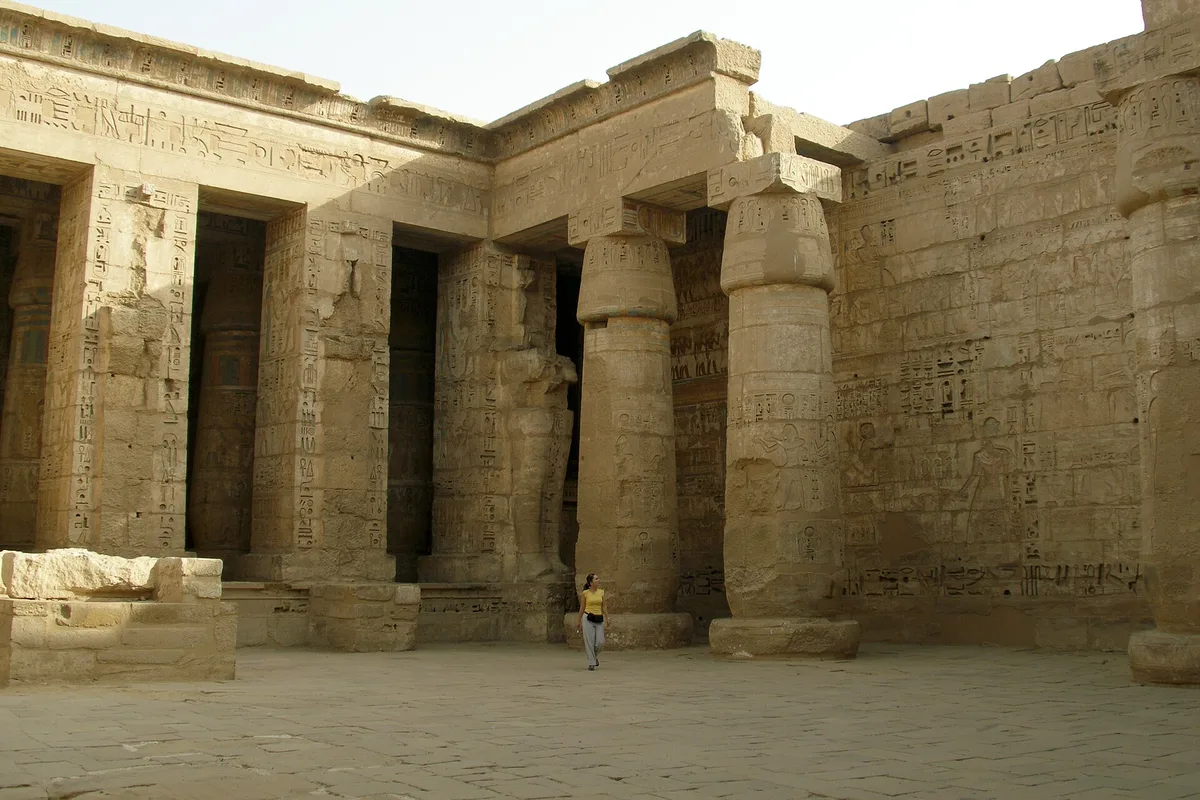
Second is Medinet Habu, minutes away on the plain, the mortuary temple of Ramesses III – which makes it, in the most literal sense, the open tombs’ other half: the father who leads his sons by the hand through QV55 and QV44 built this vast temple as the public monument of the same reign, its walls carved with his wars, his festivals and his court. Walk Habu after the princes’ tombs and the reliefs read as family documents; the temple’s scale also answers the tombs’ intimacy, stone rhetoric after plaster tenderness. Habu is routinely the most under-visited great temple on the west bank, which your morning will be the quieter for.
Third is the Valley of the Kings, and the question is only one of order. The two royal valleys together make the west bank’s essential comparison – the king alone with the gods against the family presented to them – and our Valley of the Kings guide gives that valley the same tomb-by-tomb treatment this one gives the Queens. The practical wisdom runs like this: the Kings’ valley rewards the earliest start, for its queues and its heat, and it tires the legs; the Queens rewards whatever alertness remains after, being smaller, quieter and mostly level. Most travellers should therefore do Kings first, then cross to the Queens and Deir el-Medina as the late-morning movement, with Medinet Habu or lunch to close. Reverse the order only if your Kings plan is already fixed for the afternoon light – or if a rumoured Nefertari opening sends you here at dawn. For the full menu of the city’s two banks, our guide to things to do in Luxor places this valley among its sixteen.
Nile cruise passengers meet a compressed version of this choice: the standard west bank excursion is Kings, Hatshepsut’s temple and the Colossi, and the Queens appears, if at all, as an optional extra. If your boat offers it, take it – the marginal hour buys the necropolis’s most peaceful site. If it does not, a private car for a Queens-plus-Deir el-Medina morning on a free day is among the best-value upgrades in Luxor, and this valley of the queens guide is written to be walked with on exactly that morning.
Who Should Come Here – and Who Can Skip It
Come to the Valley of the Queens if your Luxor appetite survived the Kings’ valley and asked for more; if painting, rather than architecture, is what moves you in Egyptian art; if you travel with children, for whom the small scale, short walks and father-and-son stories of the princes’ tombs land better than any corridor in the royal valley; or if crowds are the tax you least like paying, because this is the royal site where the tax is lowest. Come, too, if Deir el-Medina is already in your plan – the two sites explain each other so completely that visiting one without the other is reading half a letter.
Come with adjusted expectations if Nefertari is your reason. This guide has been blunt about her door: closed since 2024, unpriced on the official portal, reopening unannounced. A traveller who comes only for QV66 in its closed season has bought a valley whose three open tombs they may then undervalue, and that would be a waste of three very good tombs. The right frame is the one this valley of the queens guide has used throughout – the open valley is the visit; Nefertari, if open, is the visit’s transformation. Check the portal before you fix the day, ask at the window on the morning, and let the answer rearrange you only if it is yes.
Skip the valley, honestly, in three situations. If you have a single west bank morning and must choose, the Kings’ valley wins – it is the greater site, and this guide will not pretend otherwise for the sake of the underdog. If painted tombs as a category leave you cold after the Kings and the Nobles, a fourth and fifth painted room will not convert you, and Medinet Habu’s carved stone may serve you better. And if heat or mobility rules out exposed gravel walking entirely, know that the open tombs involve ramps, uneven floors and no shade between them; the valley is gentler than most west bank sites but it is not an accessible one, and a morning is better spent in Luxor’s museums than in a wadi you cannot enjoy.
Everyone else – second-day Luxor travellers, west bank completists, painters, photographers, the crowd-weary and the curious – should simply come early, walk slowly, and let the quietest royal valley in Egypt make its case. It rarely loses.
Valley of the Queens Guide – Questions Travellers Ask
Is Nefertari’s tomb open? Not at the time this valley of the queens guide was prepared in November 2026. QV66 closed to visitors in 2024, no reopening date has been announced, and the official egymonuments.com portal lists no Nefertari ticket. The position changes without much warning in either direction, so check the portal in the week of your visit and ask again at the valley ticket office on the day.
How much does the Valley of the Queens cost? One ticket covers the valley and the day’s open tombs. On the official egymonuments.com portal, checked 1 November 2026, it is EGP 220 for an adult visitor of other nationalities and EGP 110 for a student, with Egyptian tickets at EGP 30 and EGP 10. When Nefertari’s tomb is open it is always a separate, premium ticket on top – historically the most expensive tomb ticket in Egypt – and because the portal currently lists no price for it, this guide prints none.
Which tombs are open in the Valley of the Queens? In recent seasons the open list has stood at three: QV55 (Prince Amunherkhepshef), QV44 (Prince Khaemwaset) and QV52 (Queen Tyti). The list is set by the antiquities service and rotates for conservation, so treat those three as the expectation, not a guarantee, and confirm at the ticket window before you pay.
How long does a visit take? About an hour and a half covers the three open tombs and the valley floor at a sensible pace; two hours if you read the closed doors properly and linger. The valley pairs with Deir el-Medina or Medinet Habu into a full morning, or with the Valley of the Kings into a long west bank day.
Is the Valley of the Queens worth it if Nefertari is closed? Yes – with the right expectations. QV55 and QV44 hold painting surpassed in this necropolis only by QV66 and a few rooms in the Kings’ valley, the valley itself is the quietest royal site on the west bank, and the closed doors are part of the story. What it is not, in a closed season, is a substitute sighting of Nefertari herself.
What are the opening hours? The official portal lists the site as open daily from 06:00, with last entry at 17:00 in the summer schedule and 16:00 in winter and during Ramadan – checked on egymonuments.com on 1 November 2026. Go early regardless: the valley has almost no shade, and its tombs are at their emptiest in the first hours.
Can I take photographs in the tombs? The official portal states that photography with a mobile phone is free of charge at the site, and dedicated camera arrangements are a separate matter handled at the ticket office. Rules inside individual tombs are set by the guardians on the day – especially where glass protects the paint, as in QV55 – so follow the instruction you are given in the room, not the one you read here.
The Short Version
The Valley of the Queens is the Theban necropolis at its most human: more than ninety tombs of wives, mothers and children of kings, cut into a golden wadi at the quiet southern end of Luxor’s west bank, under the cliffs of Hathor. Its masterpiece, Nefertari’s QV66, is the most beautiful painted tomb in Egypt and, as of November 2026, closed – so the visit belongs to the three open tombs, and they carry it easily: QV55, where Ramesses III leads his teenage heir past the gods to a sarcophagus that still waits; QV44, where his brother Khaemwaset keeps the valley’s crispest colour; and QV52, Queen Tyti’s flood-thinned rooms, telling the truth about what time does to paint. One official ticket covers them, the path is short, the crowds go elsewhere, and Deir el-Medina and Medinet Habu wait minutes away to complete the story. Go early, walk the closed doors as well as the open ones, and check Nefertari’s status one last time at the window – because on the morning her door opens, this valley of the queens guide becomes the story of a single room, and everything else is the walk to it.