Luxor’s problem is not a shortage of things to do. It is that the things to do in Luxor are so dense, so large and so unevenly famous that visitors routinely spend their best hours on the wrong bank, in the wrong order, standing in the midday sun in front of a temple they will barely remember while the quiet masterpiece across the river sits nearly empty. The fix is not a longer list. It is understanding that the Nile splits this city into two different worlds, and that almost every good decision in Luxor – where to be at dawn, where to be at noon, where to be when the floodlights come on – follows from which side of the water you are standing on.
The east bank was the city of the living. Here the sun rises, the modern town bustles, and the great temples of the gods stand in a line along the river – Karnak at the northern end, Luxor Temple at the southern, the two museums and the souk between them. The west bank was the city of the dead. Here the sun sets behind a wall of limestone hills, and cut into those hills and spread across the plain at their feet is the Theban Necropolis – royal tombs, mortuary temples, the tombs of nobles and the village of the men who built them all. Ancient Thebes with its Necropolis is a single UNESCO World Heritage listing, and treating it as a single place with two halves, rather than as a pin-map of unrelated sights, is what turns a hectic checklist into a trip that makes sense.
This guide lists sixteen things worth doing, bank by bank – seven on the east, seven on the west, and two experiences that belong to the hours at either end of the day. Two of the sixteen, Karnak and the Valley of the Kings, are flagships with full guides of their own on this site, so they get compact entries here that tell you how to fit them into your days rather than repeating their detail. Everything else gets the full treatment – what it is, why it earns your time, how it works in practice, and the catch that the brochures leave out. For the route that strings Luxor into a wider Egypt trip, start with our Egypt travel guide; this page is the deep menu for the city itself.
One promise before the list. You will find no ticket prices, no opening hours and no timetables below, because in Egypt those figures change faster than any article can be corrected, and a confident number printed last season is worse than no number at all. What you get instead is the mechanism – where tickets are sold, what a ticket actually covers, what to agree before money changes hands – which is the part that does not rot. Check the official channels for the figures on the day, and use this guide for the decisions.
Things to Do in Luxor at a Glance
Everything on this list sits inside one protected landscape. UNESCO inscribed Ancient Thebes with its Necropolis in 1979, and the listing is deliberately two-sided – the temples of Karnak and Luxor on the east bank, and the necropolis across the water, its temples, thousands of tombs and even its artisans’ village counted as parts of one ensemble. That is not paperwork. It is the reason a balloon at dawn can show you temples, tombs, fields and river in a single turning view, and it is why the Egyptians’ own logic – living east, dead west – still organises a modern visit better than any app.
| # | Thing to do | Bank | Give it | Best light |
|---|---|---|---|---|
| 1 | Karnak Temple | East | Half a day | Opening |
| 2 | Luxor Temple | East | 1.5-2 hours | Late afternoon |
| 3 | Luxor Museum | East | 1.5-2 hours | Midday |
| 4 | Mummification Museum | East | About an hour | Midday |
| 5 | Avenue of Sphinxes and the Corniche | East | 1-2 hours | Early or late |
| 6 | The souk | East | An evening hour | After dark |
| 7 | Felucca at sunset | The river | 1-2 hours | Sunset |
| 8 | Valley of the Kings | West | Half a day | Opening |
| 9 | Hatshepsut’s Temple, Deir el-Bahari | West | 1.5-2 hours | Morning |
| 10 | Medinet Habu | West | 1.5-2 hours | Morning |
| 11 | The Ramesseum | West | About an hour | Morning |
| 12 | Colossi of Memnon | West | 20 minutes | Any pass-by |
| 13 | Tombs of the Nobles | West | 2 hours | Morning |
| 14 | Deir el-Medina | West | 1.5-2 hours | Morning |
| 15 | Hot-air balloon at dawn | Above the West | A very early morning | Sunrise |
| 16 | Luxor Temple by night | East | An evening hour | After dark |
Read the table as a rhythm rather than a ranking. Temples and tombs belong to the cool of the morning, museums to the heat of midday, the river and the souk to the evening, and the two great set pieces – Karnak and the Valley – to the first hour of separate days, because each will consume a morning’s energy on its own. Two full days cover the headlines without running; three let you add the balloon, the quieter west bank sites and a second, slower look at whichever temple caught you. The sections that follow take the sixteen in the order the table does.
One more thing the table quietly shows – almost nothing on it needs arranging in advance. Fifteen of the sixteen are walk-up experiences, bought at the gate or agreed on the pavement on the day; only the balloon, entry fifteen, must be booked ahead, and even it is best arranged after you arrive, when you can see the week’s weather and your own energy. Luxor rewards the traveller who plans the order of things and improvises the rest.
1. Karnak Temple – Stand in the Biggest Sacred Room on Earth
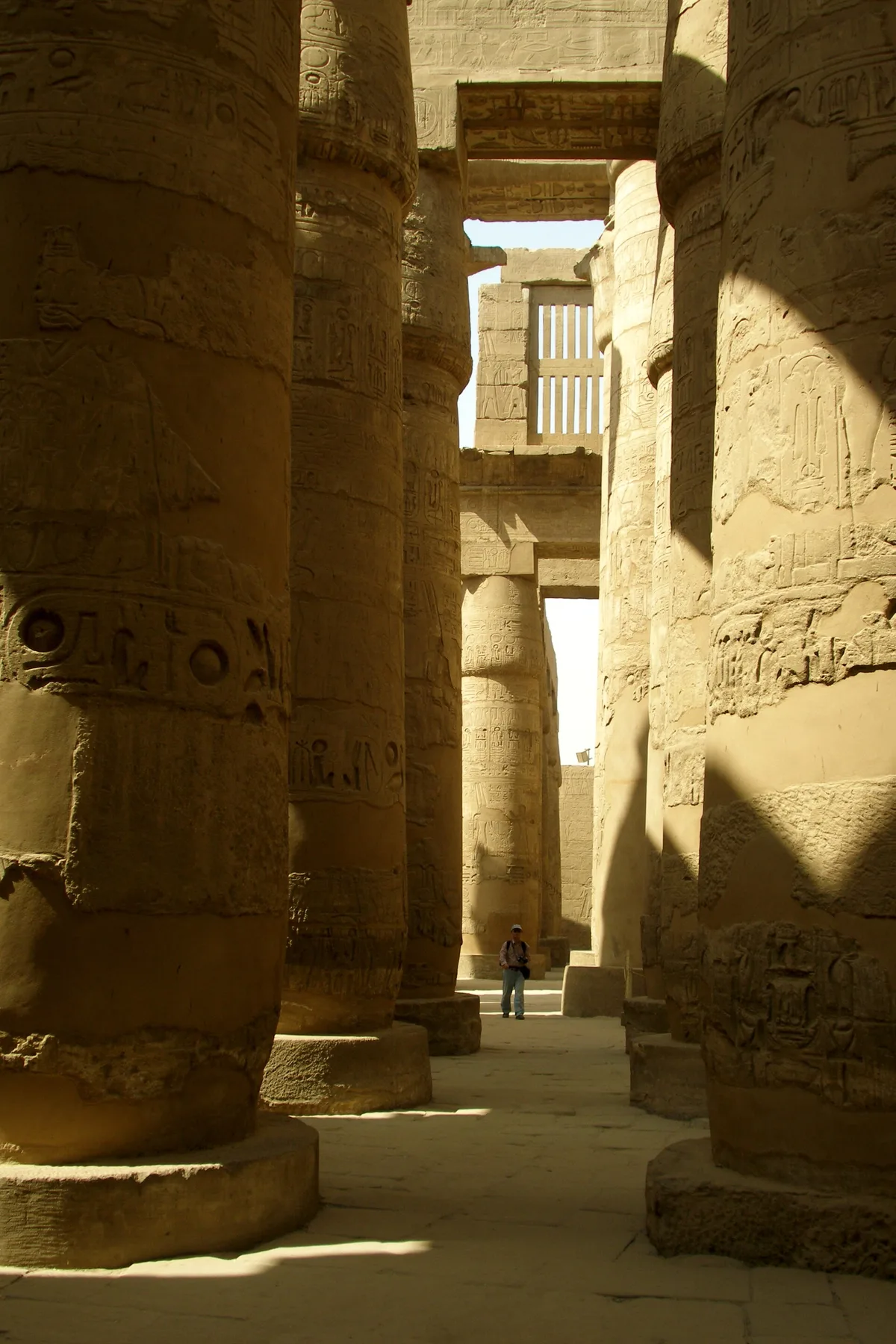
Karnak is not a temple. It is a temple city, built and rebuilt by generation after generation of kings over roughly two thousand years, and it is the largest religious complex to survive from the ancient world. Its heart is the Precinct of Amun-Re, and its centrepiece is the Great Hypostyle Hall – a stone forest of 134 columns, the central ones rearing more than twenty metres overhead, covering some five thousand square metres of carved, once-painted sandstone. Standing in the middle of it, with the light falling in shafts between capitals the size of rooms, is the single most overwhelming interior experience in Egypt, and it is why Karnak opens this list even though a full walking guide to the complex lives elsewhere on this site.
The practical shape of a visit is simple to state and easy to get wrong. Go at opening, before the coach groups and before the heat, and walk the main axis slowly – avenue of ram-headed sphinxes, first pylon, great court, hypostyle hall, then the older sanctuaries, the obelisks of Thutmose I and Hatshepsut, and out to the Sacred Lake where priests once purified themselves. Allow half a day if you can. Karnak punishes hurry more than any site in Luxor, because its scale only assembles itself in your head if you give the courts and halls time to connect.
The honest catch is that Karnak is also the least self-explanatory of the great sites. Two millennia of building means pylons inside pylons and other kings’ names carved over the reliefs in front of you, and without some structure – a guide, a good plan, or the dedicated Karnak guide on this site – a first visit can blur into undifferentiated grandeur. Budget your attention accordingly, and do not pair Karnak with the Valley of the Kings on the same morning. Each deserves to be the day’s headline, and your legs will enforce the point if your itinerary does not.
2. Luxor Temple – One Temple, Read Backwards
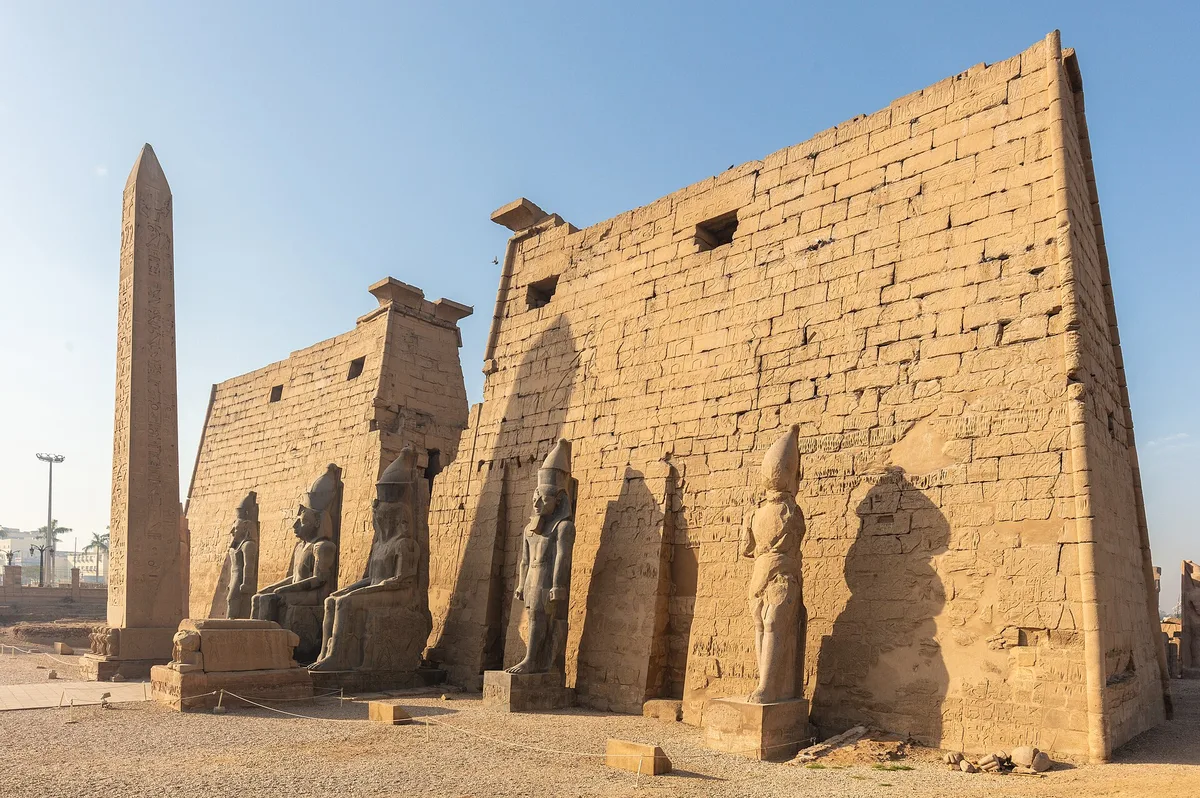
If Karnak is a city, Luxor Temple is a book – compact, coherent and readable in a single sitting. It stands on the Corniche in the middle of the modern town, about three kilometres south of Karnak, and it was built mainly under Amenhotep III around 1400 BCE as the southern sanctuary of Thebes, the destination of the annual Opet Festival, when the statues of Amun, Mut and Khonsu were carried down from Karnak in procession to renew the power of kingship itself. A century and a half later Ramesses II stamped a new front on it – the great pylon, the court of colossal statues and a pair of obelisks, one of which now stands in the Place de la Concorde in Paris.
That sequence gives the temple its peculiar pleasure. Enter from the north, as the festival processions did, and you walk backwards in time – Ramesses’ thunderous entrance first, then Tutankhamun’s completed colonnade with its walls carved with the Opet procession itself, then Amenhotep’s sun court, and finally the older, quieter sanctuary at the southern end, where Alexander the Great later had himself carved in pharaonic dress. Later layers crowd in without apology – a Roman shrine, a Christian apse, and the mosque of Abu al-Haggag still in use above the court, a reminder that this ground never stopped being sacred.
Give it an hour and a half to two hours, and time the visit for late afternoon if you can, when the stone warms, the reliefs sharpen in raking light and the option of staying on into the floodlit evening presents itself – that second act gets its own entry at the end of this list. Our dedicated Luxor Temple guide walks the building court by court; here the point is simpler. Of all the things to do in Luxor, this is the one that asks the least of you and gives back the most per minute – no driver, no dawn alarm, just a great building in the middle of town, understood in one pass.
3. Luxor Museum – the Small Museum That Outclasses Giants
Every Egypt trip teaches the same lesson about museums – that a small collection, chosen with ruthless care and given space to breathe, beats a warehouse of masterpieces stacked in gloom. The Luxor Museum, opened in 1975 in a purpose-built home on the Corniche between the two temples, is the country’s standing proof. Almost everything here comes from Thebes itself, the labels actually explain what you are looking at, and the whole visit takes a humane hour and a half to two hours – which makes it the perfect midday move, in the cool and the quiet, while the temples bake outside.
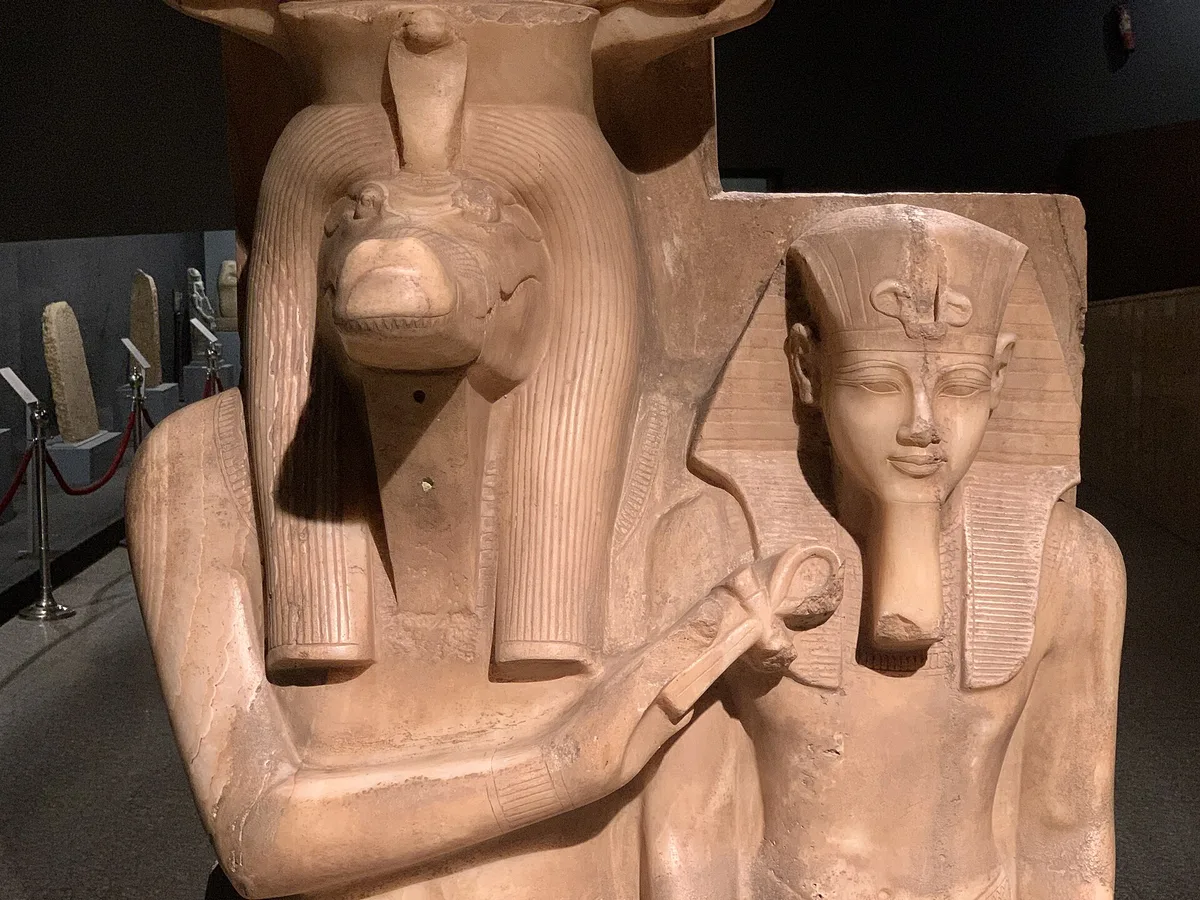
The highlights repay the names you will hear guides repeat. In 1989, workmen dismantling part of Luxor Temple’s colonnade courtyard found a cache of New Kingdom statues buried in the floor – the Luxor Cachette – and the finest of them stand here looking, as more than one visitor has said, as though they left the sculptor’s workshop last week. The calcite double statue of the crocodile god Sobek presenting Amenhotep III is the museum’s emblem, all smooth stone and calm authority. A wall rebuilt from the small decorated blocks of Akhenaten’s dismantled temple at Karnak shows the heretic king’s strange, elongated art reassembled like a jigsaw. And an extension opened in 2004 added the royal mummies of Ahmose I and Ramesses I, displayed with a restraint that makes them moving rather than ghoulish.
Come here after Karnak rather than before it, if the order is yours to choose. The museum is the temples’ footnotes made visible – the statues that once stood in those courts, the faces behind the names on the pylons – and it lands hardest when the buildings are already in your legs. It is also, not incidentally, where a hot, footsore party can recover its enthusiasm for antiquity at exactly the point in the day when that enthusiasm usually fails.
4. Mummification Museum – How a Body Was Made Eternal
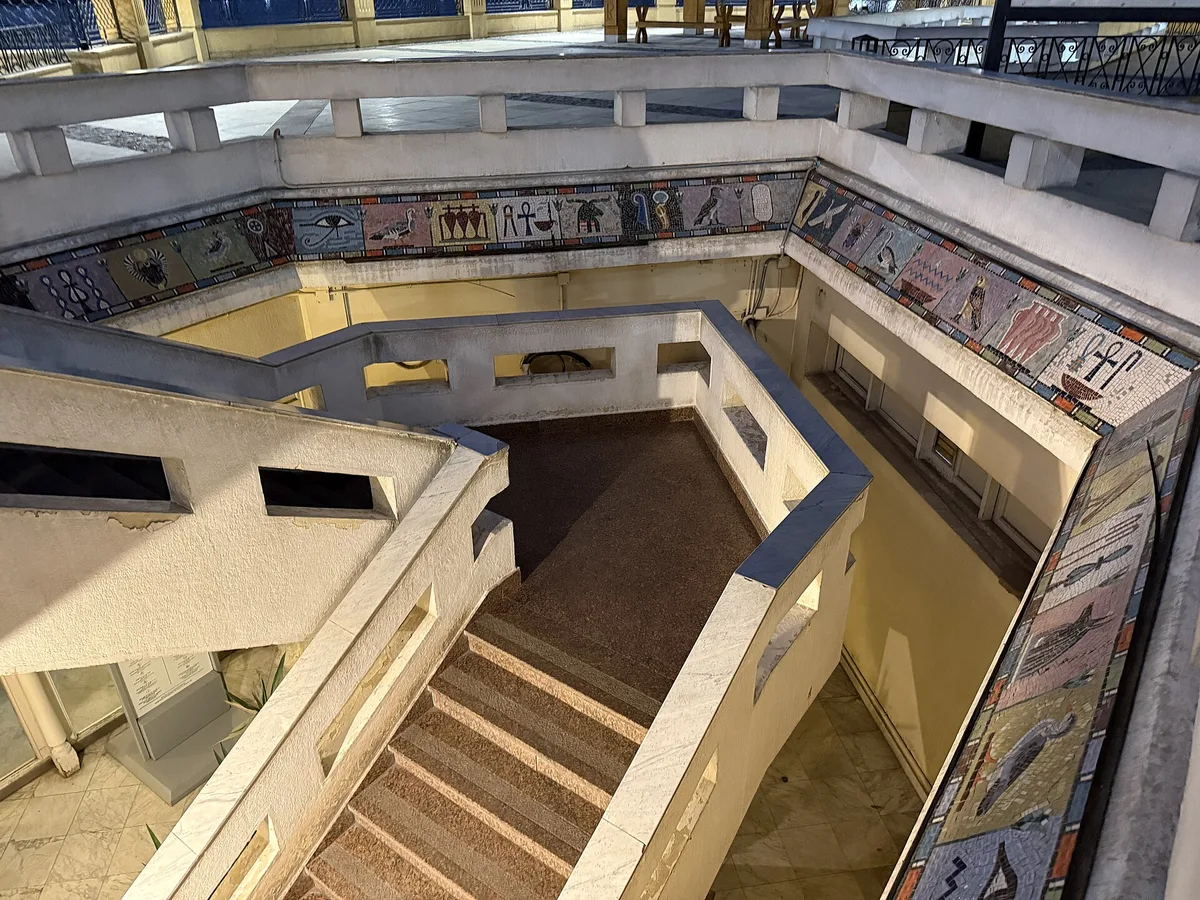
An hour, one hall, one subject – and the subject is the one every visitor to the west bank is secretly thinking about. The Mummification Museum, opened in 1997 in the former visitor centre on the Corniche north of Luxor Temple, describes itself as the first museum in the world devoted entirely to the art of mummification, and it does the job the way a good lecture does – in order, with the evidence on the table. Before you cross the river to walk through painted tombs, spend an hour here learning what those tombs were for.
The displays walk the process step by step. The removal of the organs and the jars that received them, the natron salt that dried the body, the resins, oils, amulets and layers of linen that rebuilt it, the coffins and cases that armoured it for the journey west – each stage is shown with the actual tools and materials, alongside illustrated tablets from the Papyrus of Ani and the Papyrus of Hunefer that depict the judgement of the dead. The centrepiece is the mummy of Masaharta, a high priest of Amun, and around him are the mummified animals the Egyptians prepared with the same care – cats, a baboon, fish, a crocodile – because in this belief system everything living had somewhere to go.
Small museums live or die on focus, and this one never wanders. You will leave understanding why the west bank hills are full of holes, why those holes were decorated like palaces, and why the preservation of a body mattered enough to employ a whole village of specialists – which is, not coincidentally, the subject of entry fourteen on this list. Pair the two Corniche museums on the same midday if your day allows; they are a short walk apart and they divide the story neatly between them, statues in one, bodies in the other.
5. Walk the Avenue of Sphinxes and the Corniche
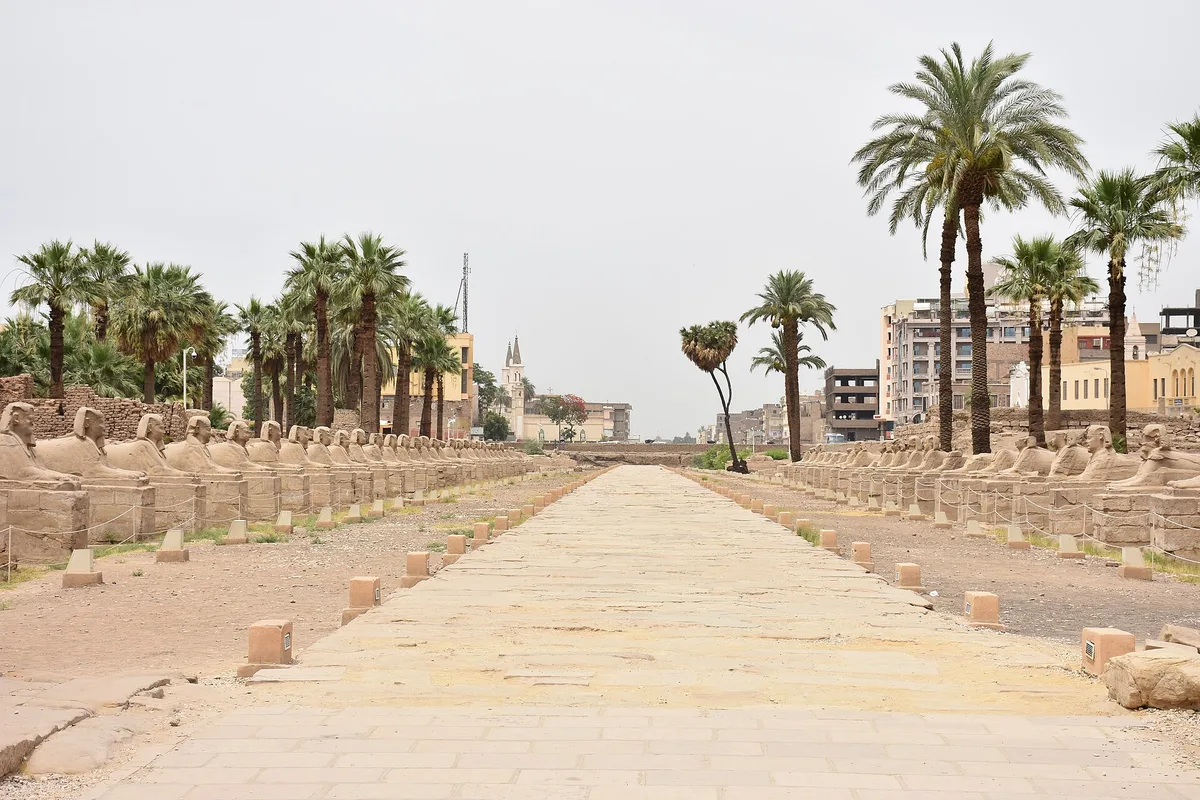
For most of the last three thousand years, Karnak and Luxor Temple were joined by a ceremonial road – two point seven kilometres of processional avenue lined with more than a thousand sphinx statues, along which the gods travelled in splendour during the Opet Festival. Then the city grew over it. Houses, mosques and churches sat on top of the buried statues for centuries, and the avenue survived only in stretches and in the memory of the Karnak entrance, where its ram-headed guardians still stand. After years of excavation and clearance, the full route was restored and reopened in November 2021 with a ceremony that re-enacted the Opet procession itself – one thousand and fifty-seven statues in all, human-headed sphinxes along most of the route and ram-headed ones near Karnak, their line first laid out in its complete form under Nectanebo I in the fourth century BCE.
Walking it, all or in part, is one of the most quietly satisfying things to do in Luxor, and one of the cheapest – the avenue is a public promenade through the living city, past mosques and churches and neighbourhoods that simply carry on around it. Start from either temple and walk towards the other in the cool of the early morning or the last of the light, and you will feel the two buildings click into a single system in a way no taxi ride between their car parks can teach you. This is the walk the processions made; the temples are its two ends, and the gods’ road is the sentence that joins them.
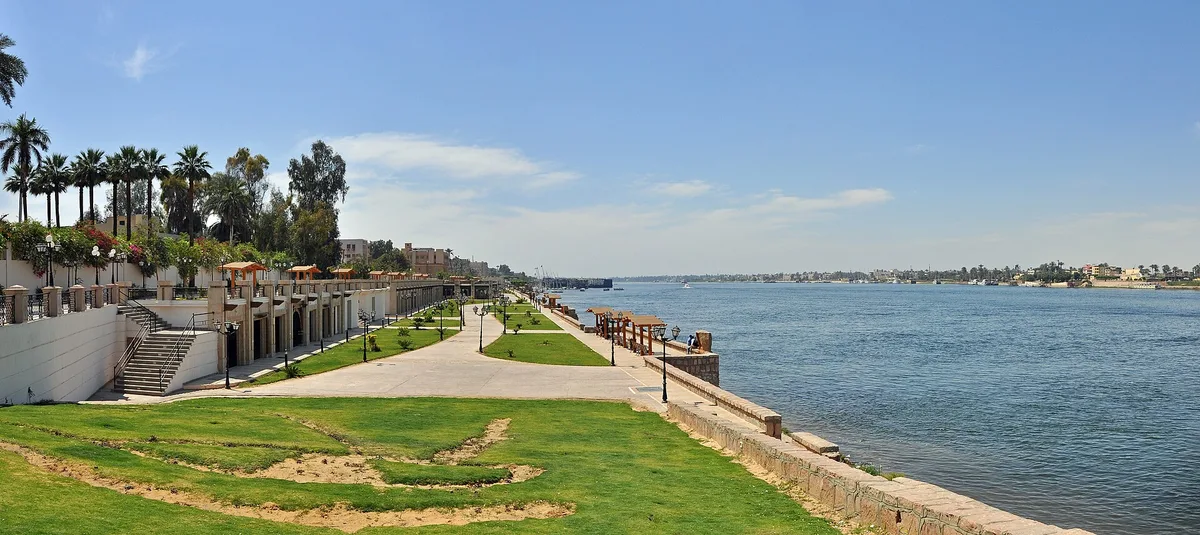
Bundle it with the Corniche, the riverfront promenade that runs along the east bank, and you have Luxor’s free front room – feluccas touting at the railing, ferries crossing to the west bank, caleche horses clopping past, the Theban hills turning gold across the water at evening. The Corniche is frayed in places and the hassle from boatmen and drivers is constant but good-natured enough; a polite, walking-pace refusal is the local dialect, and fluency comes quickly. Give the combined stroll an hour or two, ideally ending near Luxor Temple as the light goes.
6. Get Lost (Politely) in the Souk
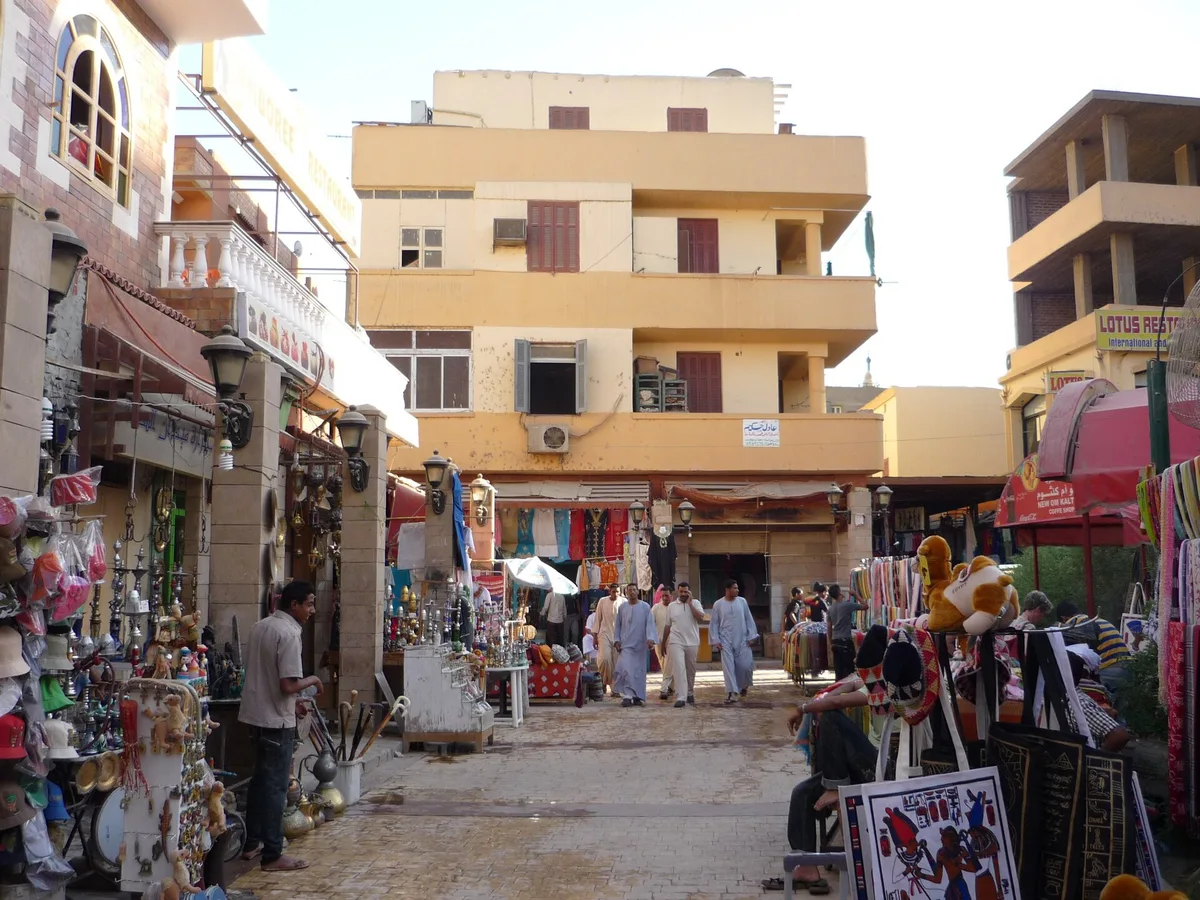
Behind Luxor Temple, around the station end of town, the souk does what Egyptian markets have done for a very long time – it starts as theatre for visitors and shades, a few streets in, into the market the city actually uses. The front rows are the performance – alabaster vases and scarves, brass lamps, spice cones heaped in photogenic pyramids, galabeya robes, replica everything – and the deeper you wander the more the balance shifts to fabrics, household goods, vegetables and the business of Luxor feeding itself. Both halves are worth your evening. The first is the place to buy; the second is the place to understand where you are.
The alabaster is worth a word, because it is the local craft – the workshops are across the river in the west bank village lanes, where translucent stone is still turned and polished by hand, and the souk is where much of it reaches a suitcase. Whatever you buy, the negotiation is part of the purchase and is meant to be enjoyed rather than endured. Treat the opening price as the start of a conversation, counter low but smiling, test your walk-away slowly, and remember that a pound spent arguing past the point of pleasure is a pound wasted. Fixed-price shops exist around town for anyone who wants the object without the sport, and the honest difference between the two prices is smaller than either side will admit.
Go in the evening, when the heat breaks, the lights come on and the whole district is out walking. The honest catch is the attention – every stallholder has a greeting, a joke and a brother with a boat – but it is the lightest hassle in Egypt, easily survived with humour, and the souk at night is also simply where Luxor is most itself. An hour is enough; two disappear without anyone noticing.
7. Sail a Felucca at Sunset

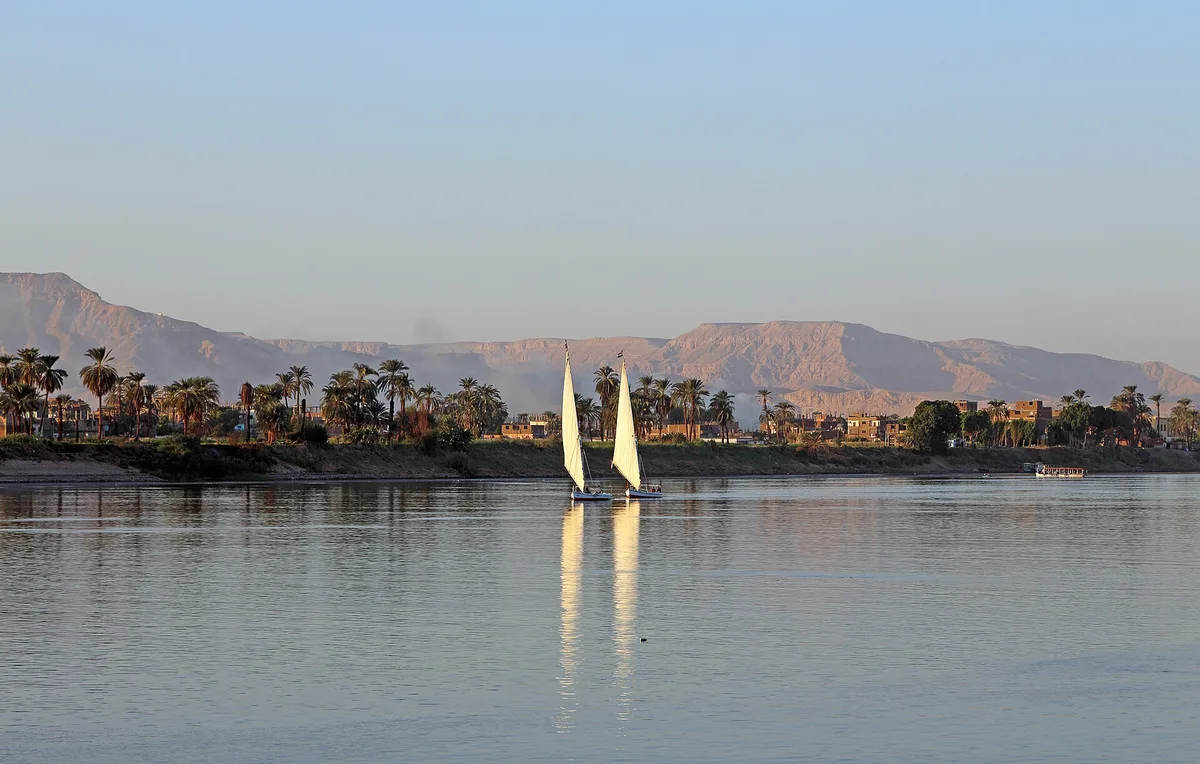
The felucca is the Nile’s own technology – a wooden sailing boat with a great triangular lateen sail, no engine, and a design refined over centuries on this exact water. At Luxor the boats gather along the Corniche all day, but they belong to one hour in particular, when the wind keeps a little of the day’s warmth, the west bank hills turn rose and then violet, and the whole valley becomes a lesson in why the Egyptians built their eternity facing the sunset. If you do one unhurried thing in this city, make it this.
Hiring one is a negotiation, and the craft is in agreeing the whole bargain before you step aboard – the route, the duration, and the price, settled on the pavement with everything said out loud. The classic run sails up towards Banana Island – Gezira el-Moz, a green island of banana groves and farms mid-river – and back as the light fails, though a simple drift along the east bank with the temples sliding past is its own reward. Insist only on clarity, not on squeezing the last pound; a captain who feels fairly dealt with sails like it.
Two honest notes about sailing. First, a felucca answers to the wind and not to you – on a still evening the return leg can be slow, oar-assisted or towed, and that is the river’s terms rather than a scam; build slack into your evening rather than booking a sunset sail against a hard dinner reservation. Second, the spectacle includes the shore – boys swimming, buffalo at the bank, the call to prayer rolling over the water and Luxor Temple’s pylon catching the last light above the palm line. An hour or two is the standard shape, and it is, for many visitors, the hour of the whole trip they describe first when they get home.
8. Valley of the Kings – the Headline Act
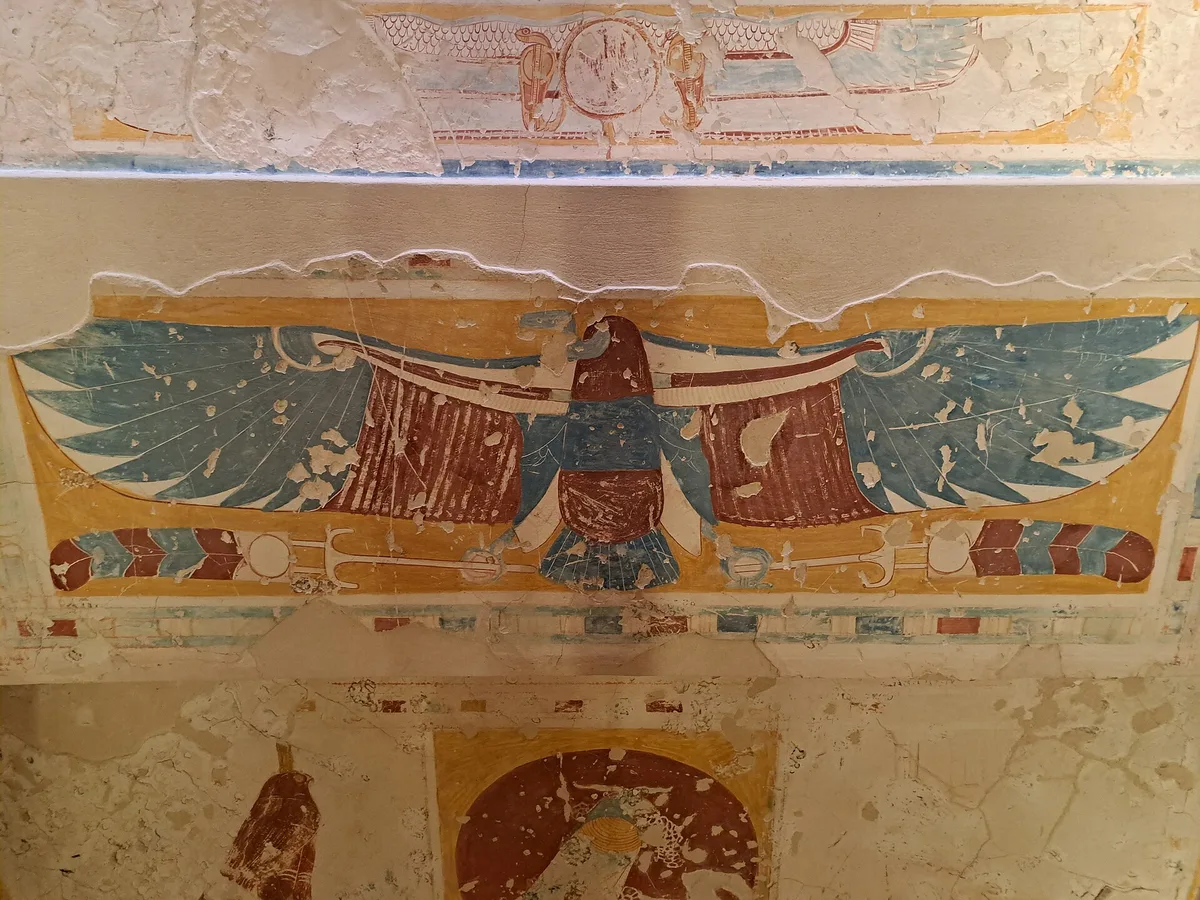
Across the river and deep in a crack in the limestone hills lies the most famous graveyard on earth. For some five hundred years, across the Eighteenth to Twentieth Dynasties, the pharaohs of the New Kingdom abandoned pyramids – too obvious, too robbed – and hid their tombs in this barren wadi instead, cutting corridor after corridor down into the rock and filling them with the books of the underworld painted wall to ceiling. More than sixty tombs have been found here, and one of them, a small and almost accidental one, held Tutankhamun, whose undisturbed discovery in 1922 made the valley’s name known in every language on earth.
Because the valley has its own full guide on this site, the entry here is about fitting it into a day rather than choosing between its tombs. The mechanics matter more than the names. A standard ticket covers entry to a selection of the tombs open on the day – the open list rotates deliberately, resting fragile paintings from the breath and humidity of crowds – and a small number of the most famous tombs are handled separately, so the first job at the ticket office is to read the day’s list and choose your route before you walk up the wadi. Go at opening, in the day’s first cool and calm, and work downwards unhurriedly; the mid-morning valley, full of groups moving at a shuffle between tomb mouths in full sun, is a different and poorer place.
That is the whole argument, really. The Valley of the Kings is unmissable and, handled at the wrong hour, nearly unbearable; handled at the right one, descending a silent corridor into four-thousand-year-old colour is as good as travel gets. Give it half a day, a hat, water and the first slot in a west bank morning – and let the dedicated guide make your tomb-by-tomb choices, which is what it is for.
9. Hatshepsut’s Temple – Terraces Against the Cliff
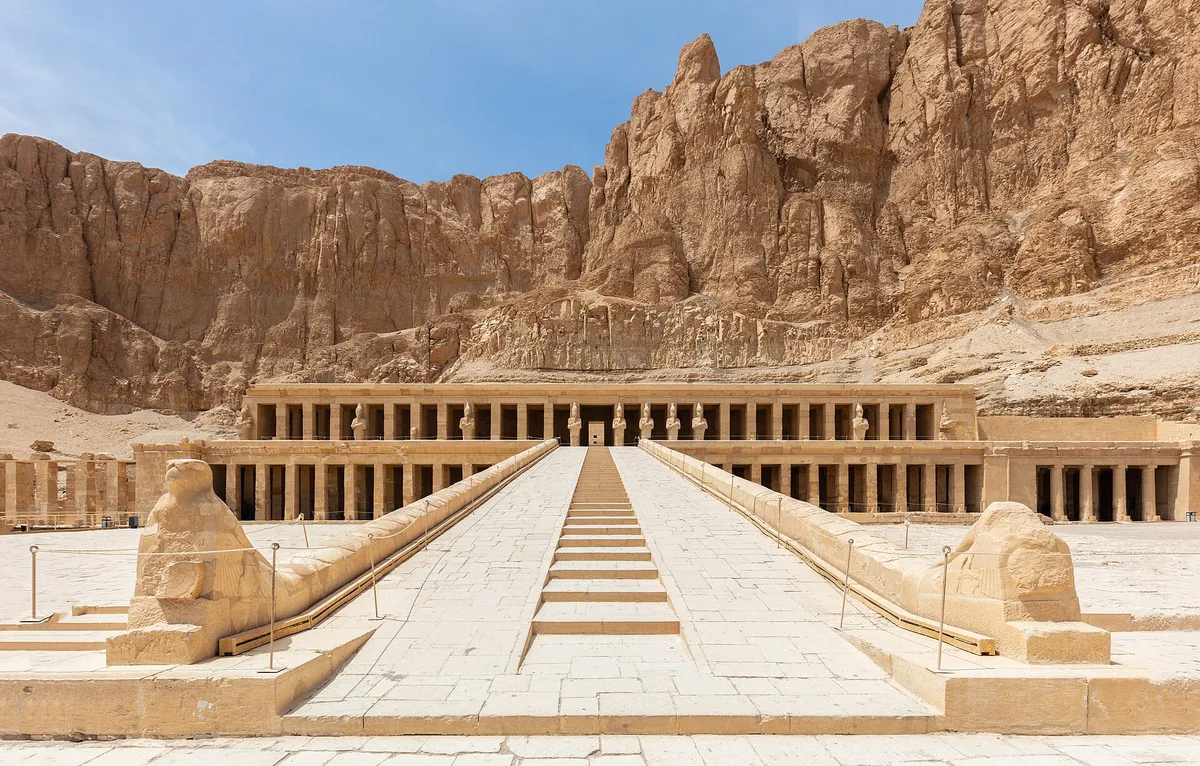
Everyone remembers their first sight of Deir el-Bahari, because it looks impossible – three vast colonnaded terraces rising in ramps out of a natural amphitheatre of cliff, architecture so clean-lined and modern-looking that first-time visitors routinely ask whether it can really be thirty-five centuries old. It can. This is the mortuary temple of Hatshepsut, the woman who ruled Egypt as pharaoh for two decades in the fifteenth century BCE, and its design – traditionally credited to her steward and architect Senenmut – is unlike anything else her civilisation built, set deliberately beside the earlier terraced temple of Mentuhotep II, as if in conversation across five hundred years.
The reliefs tell her authorised life story, and they repay slow looking. On the middle terrace, one colonnade records the divine circumstances she claimed for her birth, and the other – the famous one – depicts the great expedition her reign sent down the Red Sea to the land of Punt, bringing back incense trees, gold, ebony and exotic animals, the ships and the foreign villages carved with a reporter’s eye. UNESCO’s listing singles out exactly these frescoes, among the finest narratives to survive from the era. Higher up sit shrines to Hathor and Anubis; and over the whole building hangs the story of its unmaking, for after her death her successor Thutmose III had her names and images hacked from the walls – the erasures are part of the visit, and many visitors find them the most human thing in the temple.
Go in the morning, both for the light, which rakes across the terraces from the east, and because the cliff bay is a heat trap by midday that will shorten anyone’s visit. Walk the ramps rather than just photographing them from the court; the building is designed as an ascent, and the view back over the green edge of the cultivation widens with every terrace. An hour and a half to two hours, and understand that you are looking at a queen’s argument for her own legitimacy, built to outlast everyone who doubted it. It did.
10. Medinet Habu – the Great Temple Nobody Queues For
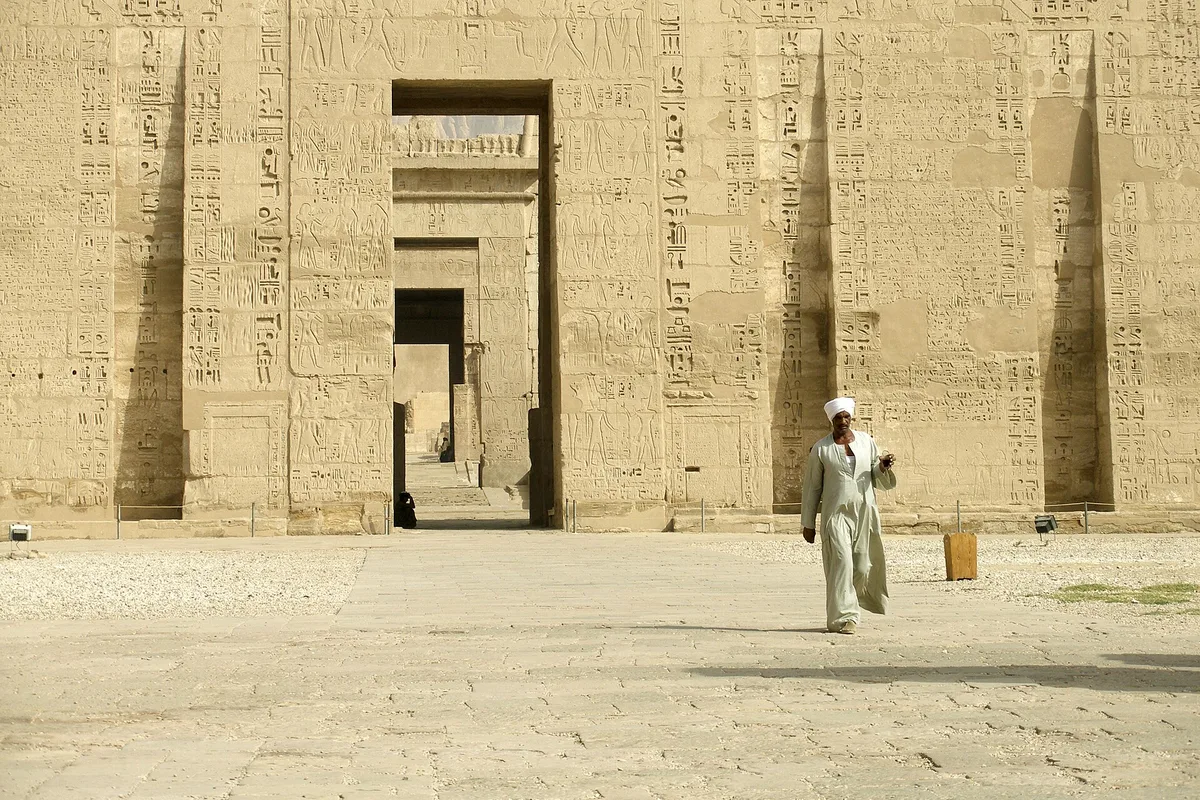
Here is the west bank’s open secret, and the strongest evidence on this list that fame and quality parted company long ago in Luxor. Medinet Habu, the mortuary temple of Ramesses III in the southern part of the necropolis, is the best-preserved great temple on the west bank – and on most mornings you will share it with a handful of people rather than a crowd. If the Ramesseum is a beautiful ruin, Habu is a building – roofed, painted, fortified and legible – and for many returning visitors it quietly becomes the favourite temple of the whole trip.
The approach sets the tone. You enter through a fortified gatehouse modelled on a Syrian migdol tower, a piece of military architecture unique in Egypt, where the king’s private apartments once stood above the passage. Inside, the temple unfolds in courts of colossal, deeply cut relief – and the cutting is the point. Ramesses III carved his inscriptions deeper than any pharaoh before him, precisely so successors could not plaster over and usurp them, and the result is imagery that still carries patches of original colour and can be read like a broadsheet. The great historical panels record his wars against the Sea Peoples, the confederation whose invasions shook the whole Bronze Age world; others lay out the temple’s festival calendar and its vast inventories of wealth, the paperwork of a temple-state preserved in stone.
Habu also teaches you how these complexes actually lived. A royal palace stood against the temple’s southern wall, its window of appearances still visible; administrative buildings, workshops and houses filled the enclosure; and in troubled later centuries the whole walled precinct became a fortified town, so that a Coptic settlement grew inside the pharaoh’s courts. Give it an hour and a half to two hours in a morning, and pair it with the workers’ village and the nobles’ tombs nearby – the southern cluster makes a coherent half-day in which Habu is the heavyweight. The catch, if it can be called one, is only that you will spend the rest of the trip recommending it to people who have never heard of it.
11. The Ramesseum – a Giant, Face Down in His Own Temple
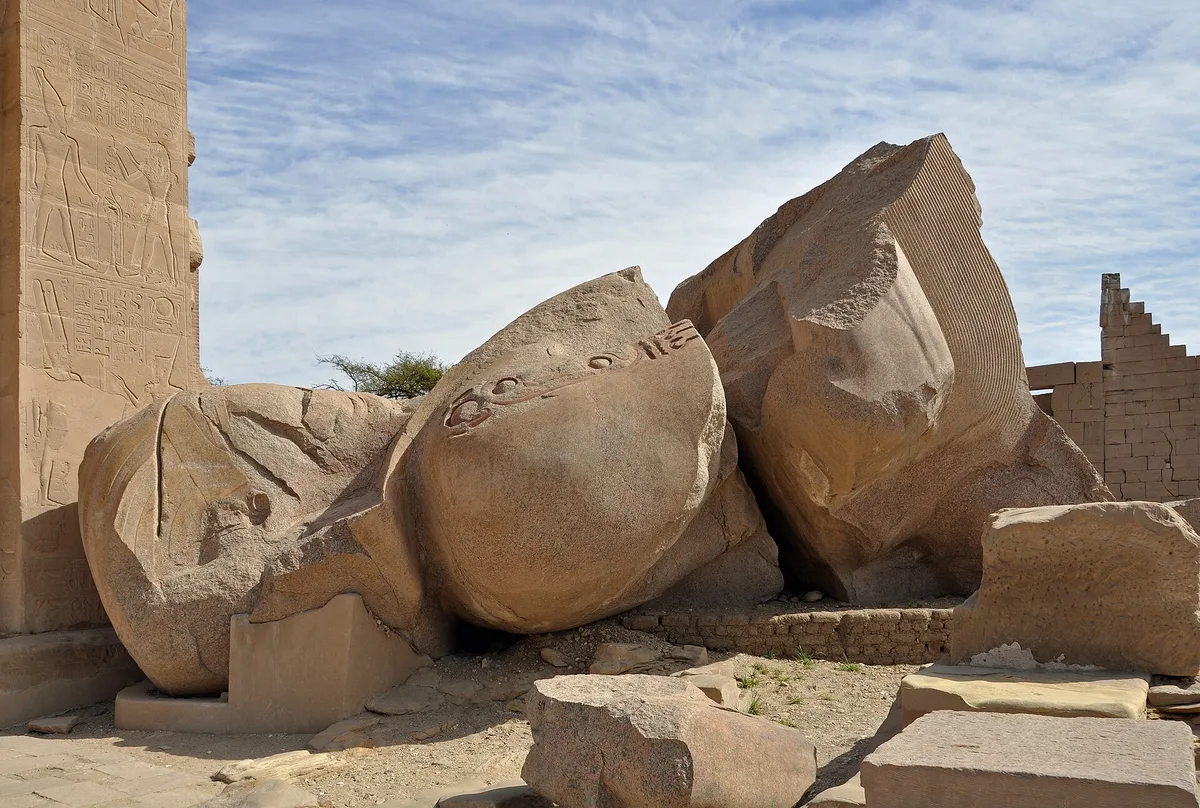
A short distance north of Medinet Habu stand the remains of the mortuary temple of Ramesses II – the Ramesseum, the mansion of millions of years of the most self-celebrating king Egypt ever produced. Where Habu survives, the Ramesseum haunts. Its pylons are broken, its courts are open to the sky, and its atmosphere is of glorious aftermath – which suits its most famous resident perfectly. Lying in pieces in the first court is the shattered colossus of Ramesses himself, a seated granite statue estimated at around a thousand tonnes, among the largest sculptures ever attempted in Egypt, toppled – probably by earthquake – and never raised again.
The fallen giant has had a second life in poetry. The colossus’s great head, the so-called Younger Memnon, was carried off to the British Museum in the early nineteenth century amid enormous publicity, and the fame of that feat helped inspire Shelley to write “Ozymandias” – the sonnet about a shattered visage in the desert that every visitor here ends up quoting, whether they mean to or not. Standing over the fragments in the court where the statue actually sat, the poem stops being a set text and becomes a weather report. Nothing beside remains, indeed.
Do not let the celebrity fragment eat the whole visit. The surviving second court, with its Osiride pillars – the king carved as Osiris against each column – is atmospheric and photogenic; the walls carry an account of the Battle of Kadesh, Ramesses’ famous near-disaster in Syria repackaged as a solo triumph, told in relief with a cartoonist’s energy; and fragments of an astronomical ceiling rank among the earliest star charts anywhere. The Ramesseum asks about an hour, best in the morning on the same circuit as Habu and the Colossi, and it rewards visitors who like their antiquity with the edges knocked off. Between Habu’s completeness and this beautiful wreck, the two temples make a perfect pair of opposites – the same idea, one kept and one lost.
12. The Colossi of Memnon – Two Kings Sitting in a Field
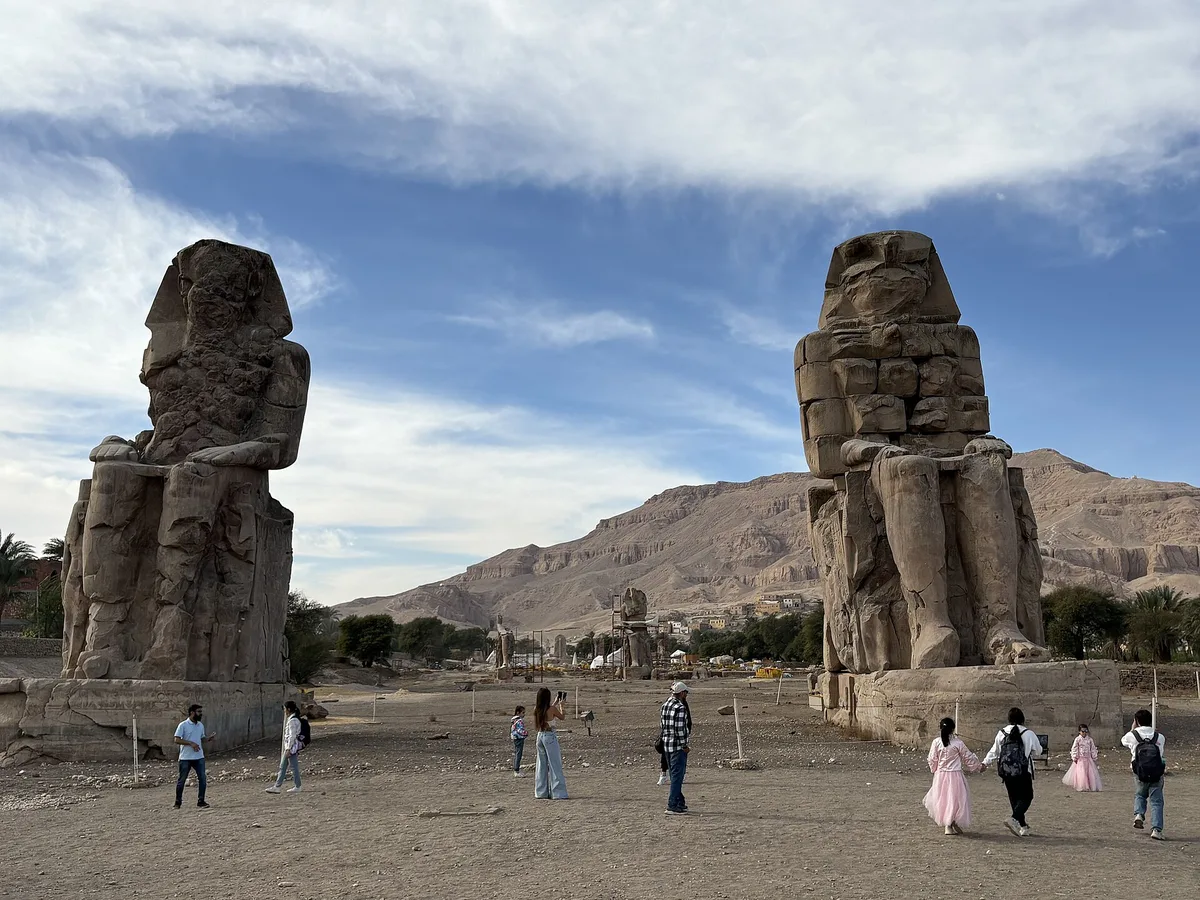
Every west bank day begins the same way – the car crosses the bridge, the road runs through the fields, and suddenly there they are in a layby beside the road, two seated stone giants some eighteen metres tall, staring east across the cultivation towards the river as they have for thirty-four centuries. The Colossi of Memnon are what remains above ground of the mortuary temple of Amenhotep III, which in its day was the largest temple in Thebes, richer even than Karnak. An earthquake in antiquity levelled it, later generations quarried the fallen stone, and the annual flood did the rest. The two statues that flanked its entrance simply outlasted everything else.
They then acquired a second fame stranger than the first. After another earthquake in 27 BCE cracked the northern statue, it began, at dawn, to sing – a faint ringing sound, probably the stone expanding as night dew evaporated in the morning sun. Greek and Roman tourists crossed the empire to hear it, convinced the voice was Memnon, the mythic hero, greeting his mother the dawn; the Greek historian Strabo recorded his own visit, and the statue’s legs accumulated the graffiti of Roman notables like reviews on a wall. Repairs under the emperor Septimius Severus silenced it around the turn of the third century CE – the song stopped, the tourists drifted away, and the name, absurdly, stuck to both statues forever.
Treat the Colossi as what they are – a twenty-minute stop, free and unmissable in the literal sense that the road runs past them – and look behind them as well as at them. The plain stretching west is the lost temple itself, and long-running excavation there has been reassembling fallen walls and raising further statues for years, so the site you see is slowly growing back. It is the gentlest possible start to a west bank morning, and the scale of the two survivors sets up everything else in the necropolis – this was the entrance. The temple was the size of a town.
13. Tombs of the Nobles – Painted Lives, Not Just Painted Gods
The royal tombs show you gods, kings and the geography of the afterlife. The tombs of the officials who actually ran Egypt show you everything else – harvests and wine-making, blind harpists and dancing girls, tax collectors and their scribes, gardens, boats, banquets, and the occasional small domestic joke smuggled past eternity. Spread across the hillside of Sheikh Abd el-Qurna, in the heart of the west bank, several hundred tombs of nobles, priests and administrators of the New Kingdom survive, and the best of them are, inch for inch, the most enjoyable painted interiors in Luxor. If the Valley of the Kings leaves you awed but none the wiser about Egyptian life, this is the antidote.
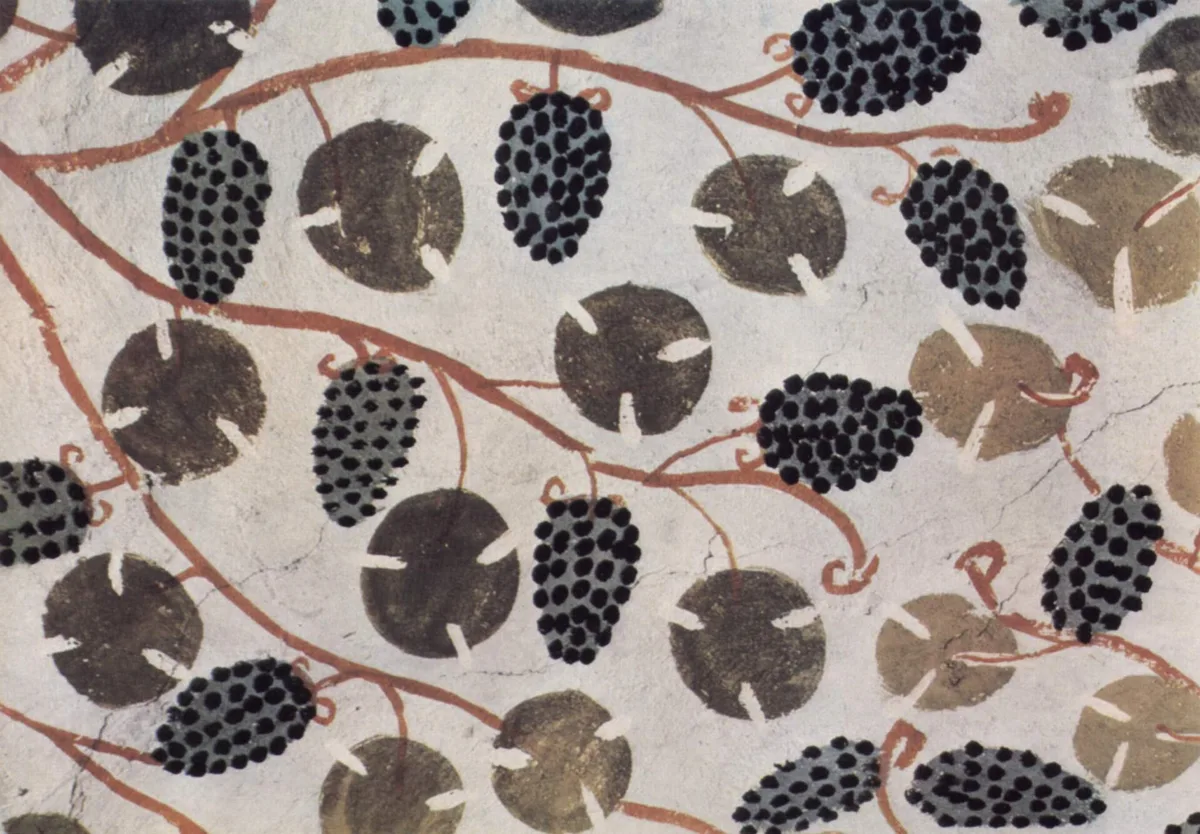
Four names carry most visits, and each earns it differently. Sennefer – mayor of Thebes under Amenhotep II – lies in a small, deep tomb famous for its ceiling, painted as a trellised vineyard with bunches of grapes hanging overhead, the vines rippling over an unevenly cut ceiling the painters simply turned into the design; it is probably the most beloved single room on the west bank. Ramose, a vizier at the hinge of the Amarna revolution, has a tomb chapel whose carved reliefs – mourning women, a royal audience – are reckoned the finest of the age, finished in two styles as the art of Egypt changed mid-commission. Nakht, an astronomer-priest, hosts the necropolis’s most reproduced party – musicians, a blind harpist, guests at a banquet – while Menna’s walls walk you through the agricultural year field by field, tiny damage and all, including the faces scratched out by someone with a grievance three thousand years old.
The mechanics differ from the valley and are part of the charm. These are small places – a chapel, a passage, a burial chamber – scattered through a living hillside, and tickets are handled in clusters through the necropolis ticket offices rather than as one grand gate; a local guardian unlocks your tombs and the visit proceeds at walking pace, in quiet, often alone with the paintings. Give the nobles two unhurried hours of a morning. Of all the things to do in Luxor, this is the one that most changes what visitors think the tombs were about – not death as spectacle, but life insisted upon, in colour, forever.
14. Deir el-Medina – the Village That Built Eternity
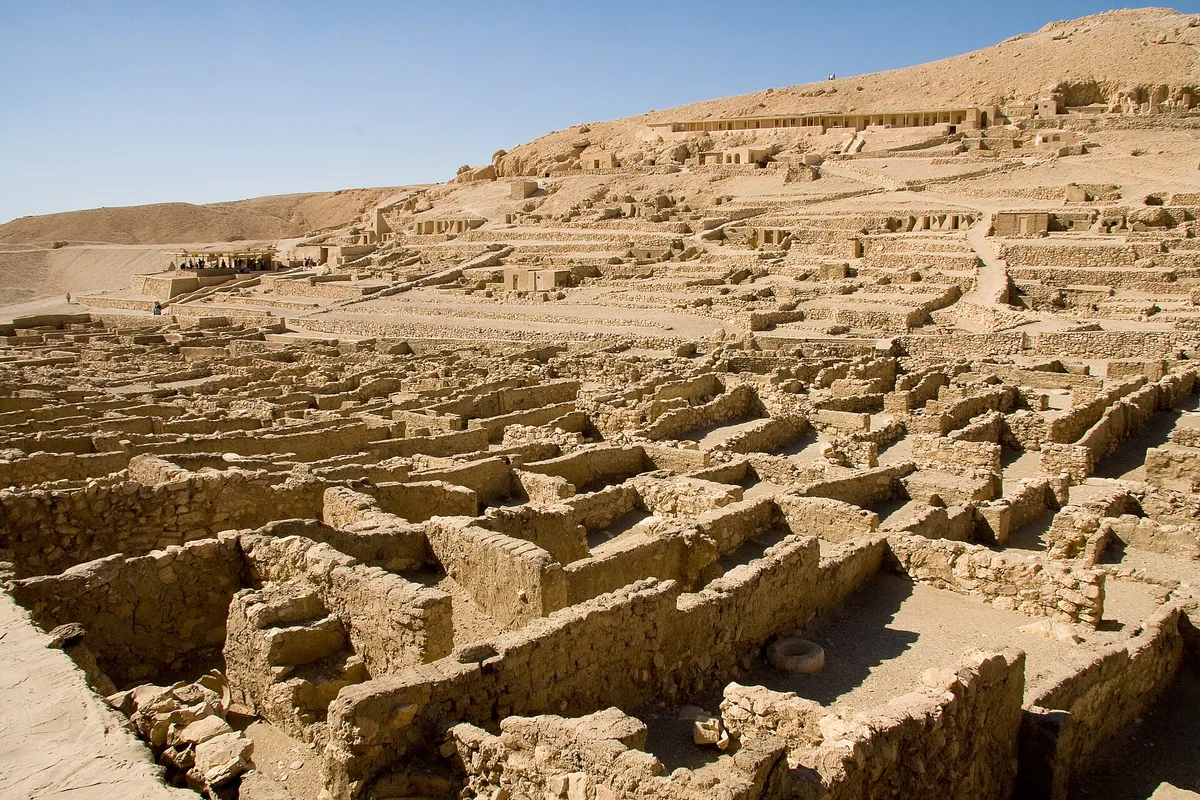
At the end of a side valley in the necropolis stands the most quietly extraordinary site on the west bank – not a tomb or a temple but a workplace village, preserved to its foundations. Deir el-Medina was home, for some four and a half centuries, to the cutters, sculptors, painters and scribes who built the royal tombs in the Valley of the Kings, together with their families. Its main street still runs between the stone footings of terraced houses, and because these men were literate and left their notes on thousands of pottery and limestone flakes – ostraca – we know them as no other ancient community is known: their rotas and rations, their love letters and laundry lists, their lawsuits, dreams and jokes.
They also made history in a way that echoes down the centuries. Around 1152 BCE, in the twenty-ninth year of Ramesses III, the tomb builders of Deir el-Medina downed tools over late rations and marched on the temples to demand their pay – the first recorded labour strike in history, documented by the village’s own scribes on the papyrus now known as the Turin Strike Papyrus. You read about it standing in the street where the strikers lived, which is a different experience from reading about it anywhere else. These were the best-paid, best-organised workers of the Bronze Age, and they knew their worth, because the kings’ eternity quite literally depended on their hands.
And on their days off, they built for themselves. The small tombs the artisans cut in the hill above the village are miniature masterpieces, and Sennedjem’s burial chamber – its owner and his wife harvesting in the Fields of the Afterlife beneath a star-covered ceiling – is the most joyful painted room in Thebes, a craftsman’s own eternity made with a master’s hand; Pashedu’s tomb nearby runs a close second. The little Ptolemaic temple of Hathor at the village’s northern edge, later reused as a Coptic monastery – which gave the place its modern name, the Monastery of the City – completes the walk. Allow an hour and a half to two, come in the morning, and expect this village of workmen to be the site you talk about at dinner.
15. Float Over It All in a Dawn Balloon
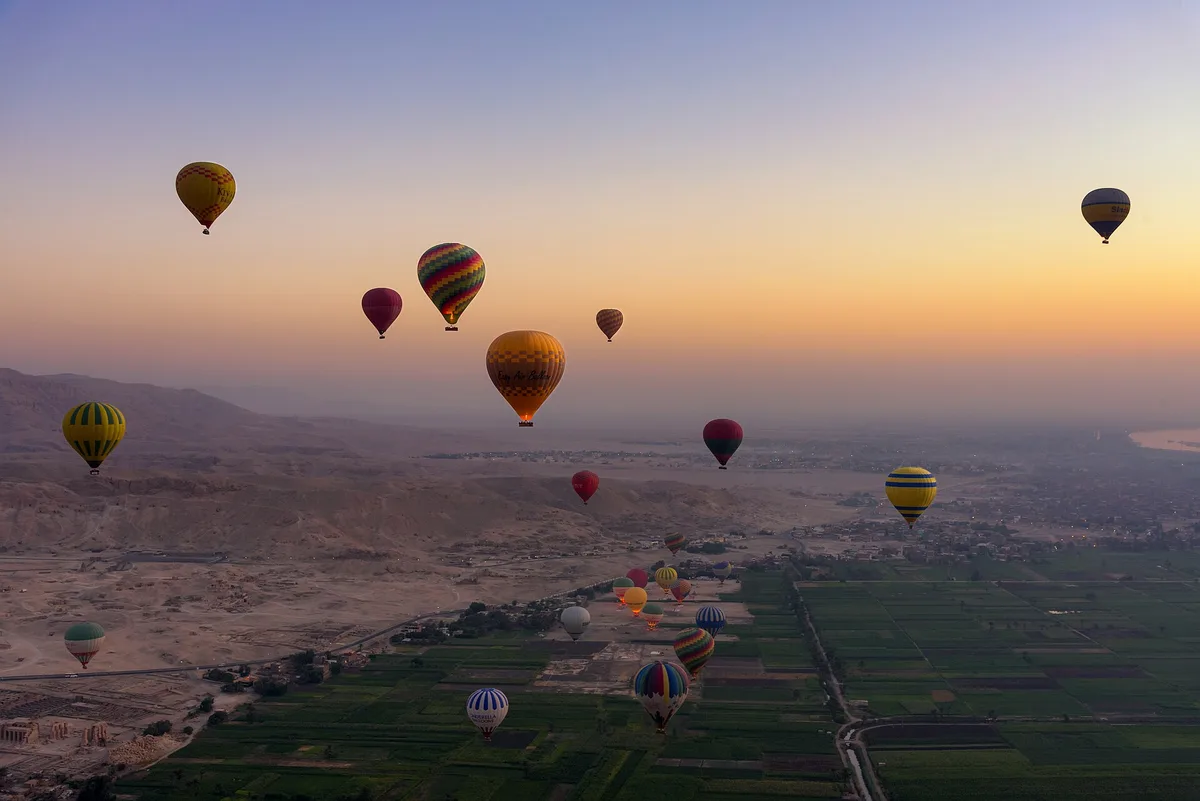
On most clear mornings, before the heat has even thought about arriving, a fleet of hot-air balloons lifts off from the west bank and drifts over the necropolis as the sun comes up over the Nile. From a balloon basket the whole argument of this article resolves into a single view – the green ribbon of the fields stopping dead at the desert’s edge, the temple pylons standing in the farmland, the wadis of the royal valley folding into the hills, the river bending away south. Visitors who have spent two days failing to assemble Luxor in their heads have been known to come down from a forty-minute flight with the map finally drawn. It is the splurge on this list, and it is the one people protect most fiercely when they describe the trip afterwards.
Book it by mechanism, not by brochure. Flights are sold through local operators and through hotels, and the shape of the deal is standard – a pre-dawn pickup from your hotel, transfer to the west bank launch fields, a flight whose length and route the wind chooses, and a return in time for a late breakfast. Two rules govern the booking. First, schedule the balloon for your first morning in Luxor, never your last, because dawn flights are weather-dependent and a windy morning cancels them wholesale; an early booking leaves you later mornings to roll the attempt forward. Second, at booking, confirm in plain words what happens if the flight is cancelled – another morning or a refund, and which – because the answer varies and the dawn of a cancellation is the wrong time to learn it.
Choose an established, licensed operator, read recent reviews rather than headline ratings, and treat any operator casual about weather limits as a warning rather than a bargain. The honest catch list is short but real – the alarm will be brutal, the basket is shared and sociable rather than private, and the whole enterprise stands or falls on the morning’s wind. Set against that, the view is the valley’s one true synopsis, temples and tombs and river in a single turning panorama. Of all the things to do in Luxor, this is the one that explains the rest.
16. Come Back to Luxor Temple After Dark
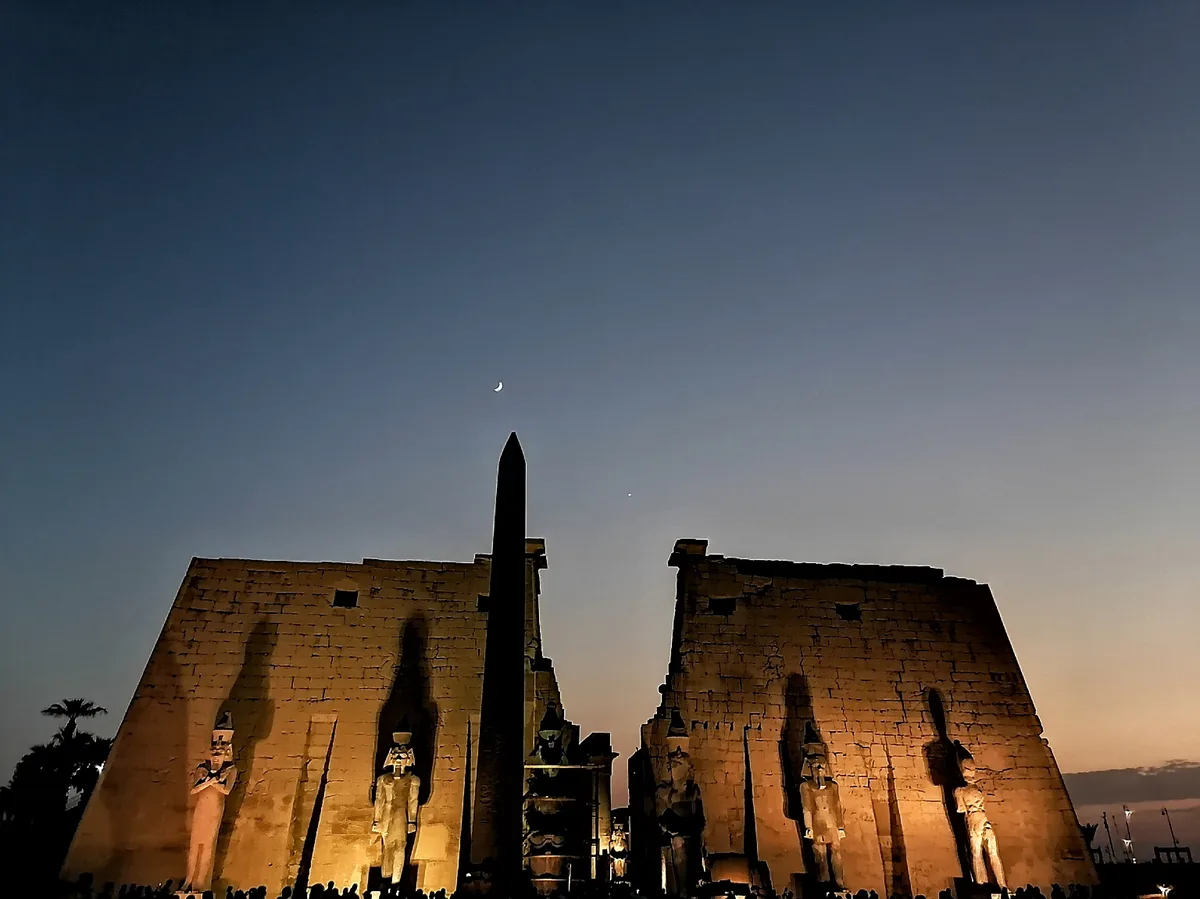
The last thing on this list is the second one repeated, transformed – and the repetition is the point. Luxor Temple admits visitors into the evening, and after dark it becomes a different building. The floodlights rake across the colossi and the colonnade, picking out hieroglyphs that noon flattens into glare; the courts empty of groups; the mosque of Abu al-Haggag glows above the ancient walls; and the avenue of sphinxes outside runs south in a line of lit statues towards the modern city. Sandstone that photographs as pale and bleached at midday holds the evening light like something still warm from the sun.
The practised way to do it is to treat the temple as a two-act play. Arrive in the late afternoon for the first act – the full architectural walk in daylight, court by court, while the reliefs can still be read – and then simply stay as the light fails and the lamps take over. The building assembles itself twice: once as a plan, once as a silhouette, and the interval between the two, when the sky goes blue-black and the stone goes gold, is the finest quarter hour the east bank offers. It costs you nothing but patience and positions you perfectly for dinner on the Corniche and a night walk through the souk afterwards.
Honesty requires one caveat – you will not have it to yourself. The night visit is the worst-kept secret in Luxor, and the entrance court can be lively well into the evening. But the temple is long, the crowds thin with every court you pass, and by the sanctuary at the far southern end the floodlit quiet is usually complete. Sixteen things to do in Luxor, and the list ends where the city’s own day ends – in the temple in the middle of town, lit up, unhurried, three thousand years old and still on duty.
How to Shape Your Days – Banks, Mornings and Boats
Sixteen entries do not need sixteen decisions. They need two bank-shaped days and, if you have it, a third morning for the balloon and the repeats. The classic arrangement runs like this. One day belongs to the west bank, starting at the Valley of the Kings at opening, continuing to Hatshepsut’s temple while the morning still has some cool left, then slowing down through Medinet Habu, the Tombs of the Nobles and Deir el-Medina, with the Ramesseum and the Colossi of Memnon taken as the roadside gifts they are on the way between them. The other day belongs to the east – Karnak at opening and for as long as it holds you, the two museums in the heat of the middle of the day, the avenue and the Corniche as the afternoon cools, the souk and a felucca towards evening, and Luxor Temple at the end of it, seen by daylight and then by floodlight. Each day has one heavyweight, one cool interior at noon and one pleasure at dusk, and neither requires heroics.
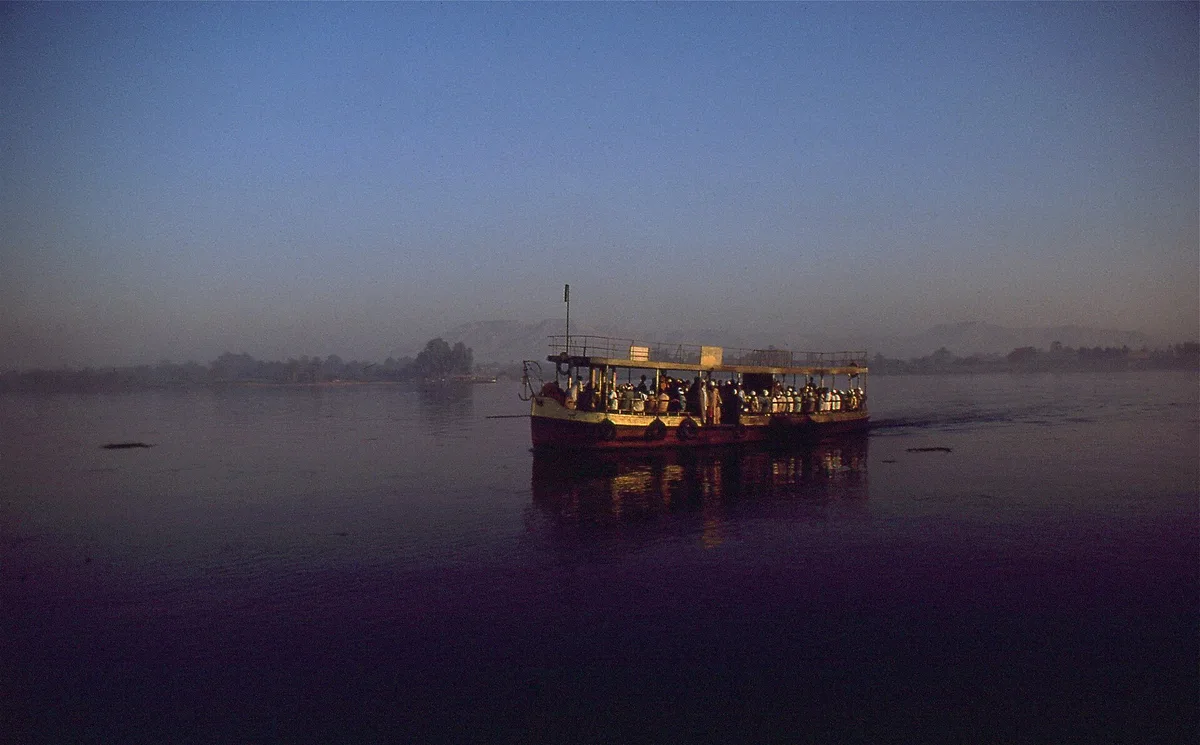
Getting between the banks is part of the texture. The public baladi ferry crosses from the Corniche near Luxor Temple to the west bank landing in a few crowded, good-humoured minutes, and from the landing, taxis and minibuses fan out to the ticket offices and sites; the road bridge, well south of the city, is the route your driver will take on a hired west bank day. For that west bank day, hiring a car and driver is the arrangement most visitors settle on, and the method matters more than the haggling – agree the day’s whole shape in advance, which sites, roughly how long at each, and the total price, before anyone turns a key. A driver who knows the rotation of west bank ticket offices – the necropolis sells its tickets in clusters from separate offices, and your route should be threaded through them in order – is worth more than a cheaper one who does not. Where you sleep shifts the emphasis rather than the plan; our Luxor city guide weighs the two banks as bases, along with the practical grain of the city.
Tickets, in general, are bought at gates and site ticket offices on the day – carry cash as well as cards, keep the stubs until you leave each site, and for the tombs always read the day’s open list before committing to a route, because rotation, not preference, decides what is available. Finally, a word for the third morning, if you have one. Luxor repays slowness like nowhere else in Egypt; the visitors who fly the balloon at dawn on day three, then return to whichever temple caught them and simply walk it again, unhurried, tend to remember the trip better than those who spent the morning racing to a seventh site. Sixteen things to do in Luxor is a menu, not a debt.
Questions Travellers Ask About Doing Luxor

How many days do I need in Luxor?
Two full days is the honest minimum – one for the west bank, one for the east – and three is the number most visitors end up wishing they had. The third day is not for new sights so much as for the balloon, a slower repeat of a favourite temple, and the slack that lets a cancelled dawn flight or a closed tomb ruin nothing. A single day is possible and outlined below, but understand that it is a raid, not a visit.
Can I see Luxor in one day?
Yes, at a price. The survivable version crosses to the west bank at opening for the Valley of the Kings and Hatshepsut’s temple, adds Medinet Habu if the pace holds, returns for the Luxor Museum in the midday heat, and finishes with Luxor Temple by daylight and floodlight in the evening – Karnak being the sacrifice, reluctantly, unless your party has the stamina for it at the day’s other end. You will leave having seen the headlines and missed the argument. Come back for the rest.
Which bank should I stay on?
The east bank holds the station, the airport road, most hotels, the restaurants and the evening life, and puts Luxor Temple, both museums and the ferry at your door – the practical default, especially on a first visit. The west bank offers quiet lanes, garden guesthouses and the necropolis at dawn without a river crossing, at the cost of thinner evening options. Neither is wrong; match it to whether your trip runs on convenience or on calm.
When is the best time of year to visit Luxor?
The comfortable season runs roughly from October to April, when daytime temperatures are warm rather than punishing and the balloon flies most reliably. Summer in Luxor is genuinely fierce – the sites are open and the crowds thin to nothing, but every walk between tomb mouths becomes an exercise in endurance, and visits compress into the first hours of the morning. Whenever you come, the rhythm of this list holds: exteriors at the day’s ends, interiors at its middle.
How do Valley of the Kings tickets actually work?
A standard admission covers a set number of the tombs open on that day, and which tombs those are rotates – the authorities rest the painted interiors in turn, because everything that visits a tomb, breath included, wears it. A few of the most famous tombs sit outside the standard arrangement entirely. So the working method is fixed – check the day’s list at the ticket office or on the Ministry’s official Egymonuments portal before you plan your route, choose your tombs at the office rather than from a guidebook, and confirm what any extra tomb requires while you are standing there, not after the climb.
Is the dawn balloon worth it, and what if it is cancelled?
Worth it, with eyes open – it is the one view that organises the whole valley, and it is bought and planned like a weather event rather than a show. Flights are cancelled on windy mornings with no appeal, which is why the booking belongs on your first morning in the city, with the operator’s rebooking or refund terms confirmed at the time you pay. Choose an established, licensed operator, and regard any outfit willing to promise a flight regardless of conditions as telling you something important about itself.
Where is Tutankhamun’s treasure, if it is not in his tomb?
In Cairo. The tomb in the valley holds the king’s mummy and little else, because the famous gold – the mask, the shrines, the chariots – travelled to the capital’s museums a century ago, and the collection’s home now is the Grand Egyptian Museum at Giza, where the complete Tutankhamun assemblage is displayed together. If the boy king is your thread, pair this valley with our Grand Egyptian Museum guide before you go; the tomb makes sense as the empty stage of the story the museum tells.
Should I add the Valley of the Queens?
If painted tombs have caught you, yes. The queens’ valley, a little further south, is quieter and smaller than its famous neighbour, and it holds in QV66 the tomb of Nefertari, Ramesses II’s great wife – routinely described as the finest painted tomb in Egypt, its entry handled separately and numbers limited precisely because the paintings are that precious. Ask at the ticket office on the day about arrangements; it pairs naturally with a Medinet Habu morning.
The Short Version of Things to Do in Luxor

Luxor is one ancient city cut in two by a river, and the sixteen things to do in Luxor sort themselves the moment you accept it. East of the Nile, where the sun rises, stand the temples of the living gods – Karnak, the biggest sacred room on earth, and Luxor Temple, the compact one you can read in a single walk – with the Luxor Museum’s chosen masterpieces and the Mummification Museum’s one gripping subject between them, the sphinx avenue and the Corniche for the evening air, the souk for the night, and a felucca for the sunset. West of the river, where the sun sets, the Theban hills hold the other half of the story – the royal corridors of the Valley of the Kings, Hatshepsut’s terraces against the cliff, huge Medinet Habu and the fallen Ramesseum, the Colossi standing guard in a field, and, best of all for many, the painted domestic lives of the Nobles and the workers’ village of Deir el-Medina, whose builders struck the first strike in recorded history.
Two mornings anchor the trip – Karnak on one, the Valley on the other, both at opening – and one dawn, if the wind allows, belongs to the balloon. Everything else arranges itself around those anchors by temperature: museums at noon, the river at dusk, the floodlit temple last. No prices are printed here because prices are weather; the mechanisms are climate, and they are all above. Go for two days if you must, three if you can, and let the river do the organising.