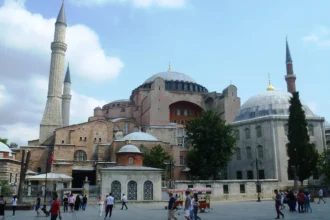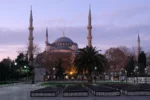
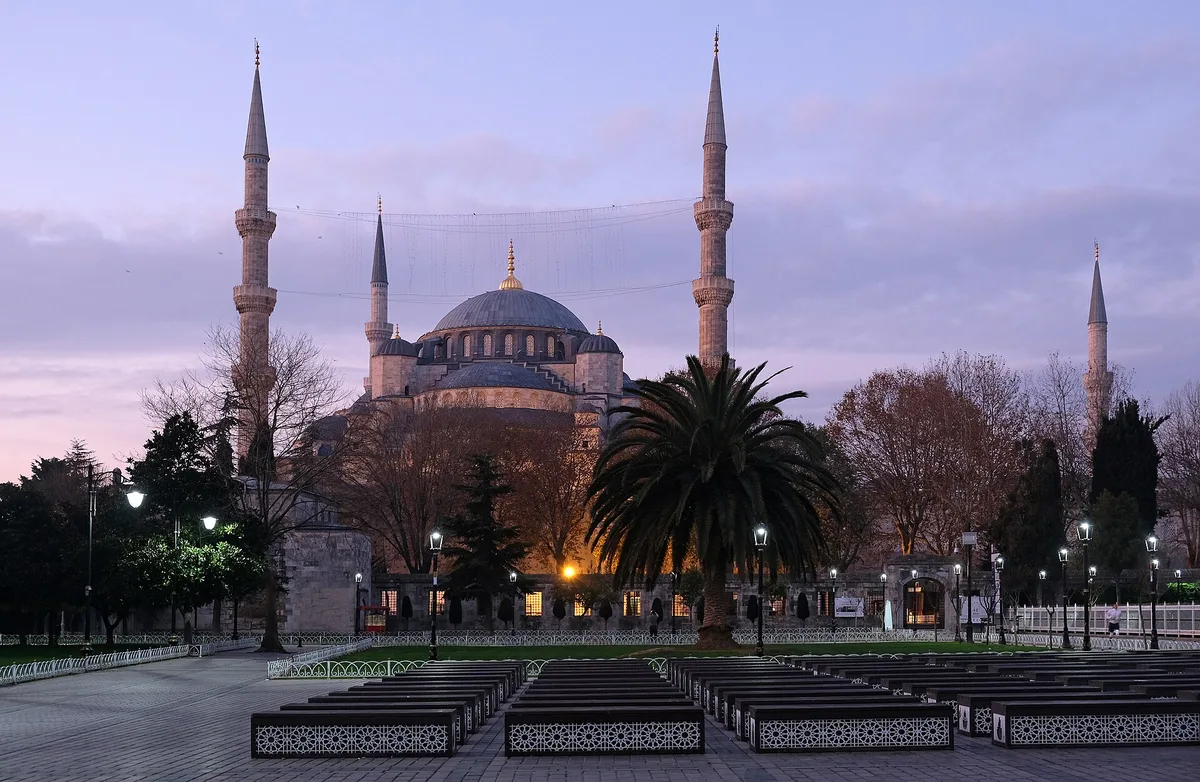
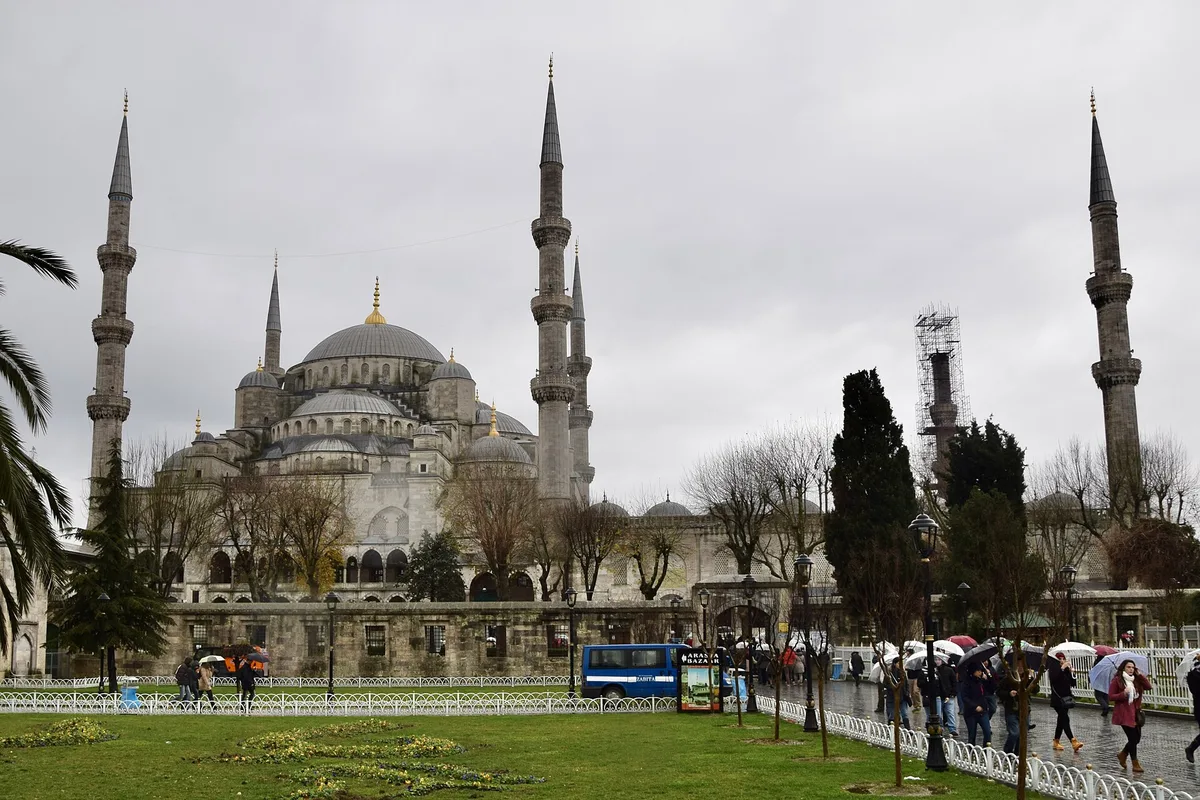
Stand in Sultanahmet Square in the early morning, before the tour groups arrive, and the building across from Hagia Sophia explains itself without a word of commentary. A great dome rises in the middle, half-domes spill down from it on every side like water finding its level, smaller domes cascade again to the courtyard walls, and around the whole composition stand six slender minarets – more than any mosque in Istanbul had ever carried when it was finished. This blue mosque istanbul guide is about that building: the Sultan Ahmed Mosque, Sultanahmet Camii in Turkish, completed in 1616 for a sultan who was still a teenager when he ordered it, and still – four centuries later – a working mosque first and a famous monument second.
That order of priorities is the thing most visitors get wrong, and getting it right changes the whole visit. The Blue Mosque is not a museum that holds prayers. It is a mosque that receives guests. There is no ticket, no turnstile and no collection in a glass case; there is a congregation, five times a day, every day, and between those prayers the doors open to anyone who dresses appropriately and behaves like a guest in someone else’s house of worship. Everything practical in this guide – the separate visitor entrance, the closures that move with the sun, the borrowed headscarves, the shoes carried in a bag – follows from that single fact.
The building also carries a puzzle in its name. Nobody in Istanbul calls it the Blue Mosque; locally it is Sultanahmet Camii, the Sultan Ahmed Mosque, named for its founder. The “blue” is a visitor’s name, earned inside, where more than 20,000 hand-painted tiles from İznik line the walls in blues, turquoises and greens – a skin of coloured ceramic unlike anything in the older mosque across the square. From outside, the building is the grey-blue of weathered stone and lead roofs; the colour the world named it for only appears once you are standing in the prayer hall, looking up.
So this guide works in the order a good visit does. First the name and the tiles, then the young sultan and his architect, then the famous story of the six minarets – told honestly, as the traditional account it is. Then the building itself, read from the square, through the courtyard and into the domed interior, pier by pier and tile by tile. Then the tomb of the founder outside the north wall, the working rules of a visit in the prayer-time era, the honest downsides, and the short version. For the wider city around it – where Sultanahmet fits in a three or four day trip, and how its sights sequence – our Istanbul travel guide covers the ground this article deliberately does not repeat.
Blue Mosque Istanbul at a Glance
| Question | Short answer |
|---|---|
| What is it | The Sultan Ahmed Mosque (Sultanahmet Camii), an Ottoman imperial mosque of 1609–1616, still in daily use for prayer |
| Where | Sultanahmet Square, on the old Hippodrome’s edge, facing Hagia Sophia across the square in Istanbul’s Historic Peninsula |
| Who built it | Commissioned by Sultan Ahmed I; designed by Sedefkâr Mehmed Ağa, a pupil of Sinan |
| Why “Blue” | A visitor’s nickname for the 20,000-plus İznik tiles lining the interior; its real name honours its founder |
| The famous feature | Six minarets – the first Ottoman imperial mosque in the capital to carry six, and the subject of the Mecca story told below |
| Entry | Free. It is a working mosque, not a museum – no ticket exists, whatever anyone outside tries to sell you |
| The catch | Sightseeing pauses around all five daily prayers, and on Fridays visiting begins only after the midday congregational prayer |
| Dress | Shoulders and knees covered for everyone; women cover their hair inside. Coverings can be borrowed at the entrance |
| How long | About an hour inside and in the courtyard, plus the sultan’s tomb next door and the square around it |
| Part of | The Historic Areas of Istanbul, inscribed by UNESCO in 1985 |
The row of that table worth reading twice is the one about entry, because it inverts everything the building across the square taught you. Hagia Sophia, a few hundred metres away, now runs a ticketed visitor route. The Blue Mosque runs on the older and simpler logic of a mosque: the doors are open, the welcome is real, and the price of admission is not money but timing and behaviour. Visitors who arrive understanding that have an easy, even moving, hour. Visitors who arrive expecting a museum with set hours have a confusing one, because the building’s timetable is written by the sun and the prayer calendar, not by a ticket office.
The second thing to take from the table is scale. This was the last great imperial mosque of Istanbul’s classical age, built when the empire was still rich enough to line a prayer hall with the finest ceramics its workshops could produce, on the most charged site in the city – facing the great church-turned-mosque of the conquered capital, on ground once covered by the palaces of Byzantine emperors. A teenage sultan put it there deliberately. Understanding what he was answering, and what his architect did with the answer, is the history section next but one. First, the colour.
Why Blue – The İznik Tiles That Named a Mosque
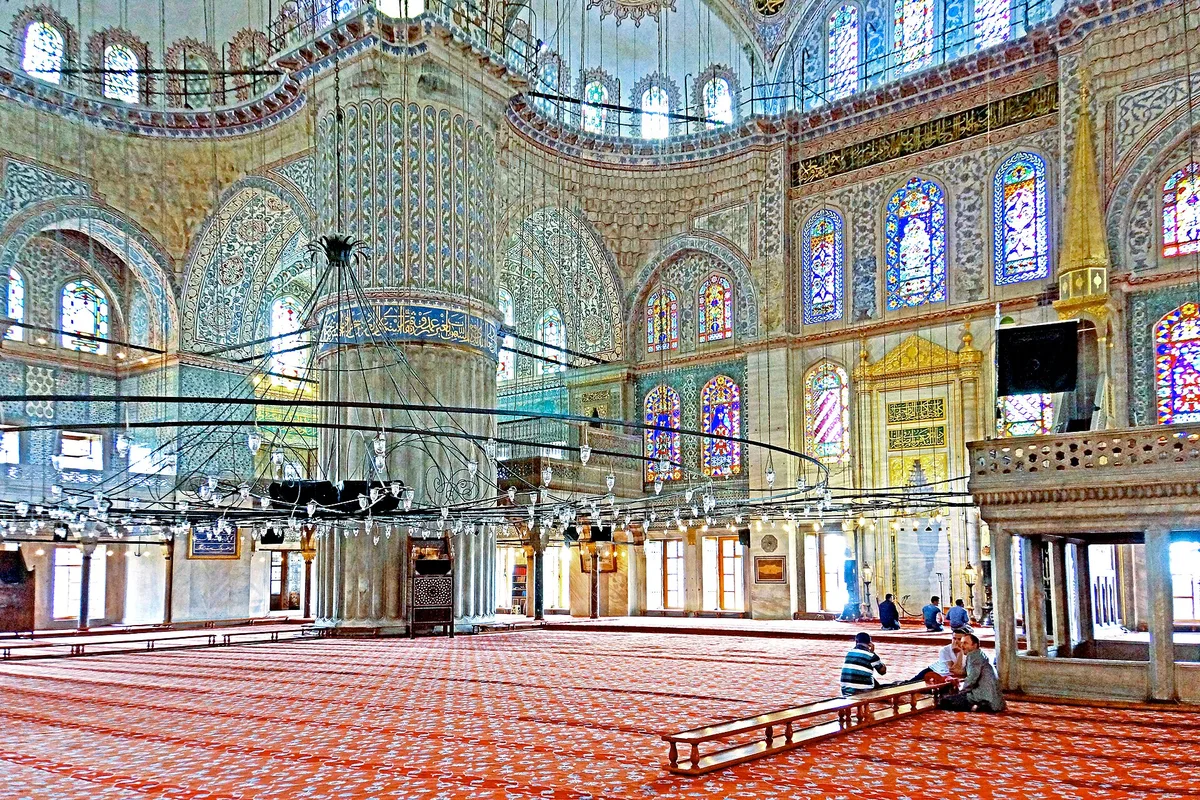
Walk into the prayer hall and look at the walls rather than the dome, and the nickname stops being a mystery. The lower walls are lined, panel after panel, with ceramic tiles – tulips, hyacinths, roses, carnations, cypresses and scrolling vines, painted by hand in cobalt blue, turquoise, sage green and touches of raised red on a white ground. The count most often published is more than 20,000 tiles, and while published totals vary a little from source to source, the order of magnitude is not in doubt. No other interior in Istanbul wraps its congregation in this much coloured ceramic, and in the soft light through the lower windows the accumulated effect is a cool, blue-green shimmer that visitors have been describing with the same single word for generations.
The tiles came from İznik, the town south-east of Istanbul whose workshops were the Ottoman world’s supreme ceramic studios. By 1609 İznik’s greatest century was already behind it – the kilns’ finest period ran through the middle decades of the 1500s – and the mosque’s commission for tens of thousands of tiles is generally read as both a last great order and a strain on a declining industry; some of the later tiles in the building came from Kütahya, İznik’s eventual successor as a ceramic centre, and connoisseurs can argue panel by panel about which workshop made what. For the visitor, the argument matters less than the fact itself: the sultan spent the empire’s money on pottery for a prayer hall, at a scale nobody had attempted, and the result is the building’s identity.
Notice, as you look, that the blue is not one blue. The palette shifts as the walls rise: intense cobalt and turquoise at eye level, where the tile panels are densest, giving way higher up to painted decoration on plaster – floral and calligraphic work executed in pigment rather than ceramic, in the same family of colours. The building is honest about the transition if you look for it; the tiles were always the precious material, concentrated where the congregation’s eyes actually rest, while the upper zones carry the design onward in a cheaper medium. It is the interior decoration equivalent of a tailored suit’s lining – expense where it shows, economy where it does not, and no shame about either.
The nickname itself deserves a sentence of honesty. “Blue Mosque” is the name the visiting world gave the building, and under that name it is famous on every continent. In Turkish it has never been called anything but Sultanahmet Camii, after Ahmed I, and the square, the district and the tram stop all take their name from the mosque rather than the other way round. This guide uses both names as Istanbul itself now does when speaking to guests – the founder’s name for the building, the colour for the experience of standing inside it. Neither is wrong. But knowing which is which is the first sign that you have come to see the mosque, and not only its photograph.
A Teenage Sultan and His Architect – Building Opposite Hagia Sophia
The sultan who ordered this mosque came to the throne in 1603 at the age of thirteen, and he was nineteen when the foundation was laid in 1609. Ahmed I inherited an empire fighting on two fronts – Persia in the east, the Habsburgs in the west – and a treasury under strain, and his decision to spend imperial money on a vast mosque complex in the capital was criticised in its own day, not least because tradition held that a sultan built a great mosque from the spoils of victory, and Ahmed’s wars had produced no triumph to spend. He built anyway, funding the work from the treasury, and placed it with a precision that was itself a statement: on the south-eastern side of the Hippodrome, facing Hagia Sophia across the square, on land cleared of the palaces that had stood there since Byzantine times.
The architect he chose was Sedefkâr Mehmed Ağa, whose byname – Sedefkâr, the mother-of-pearl worker – records the craft he was trained in before architecture claimed him. Mehmed Ağa was the last great pupil of Sinan, the chief architect whose mosques had defined Ottoman building for most of the previous century, and the Sultan Ahmed Mosque is best read as the brilliant student’s answer to two masters at once: Sinan behind him, and Justinian’s Hagia Sophia in front of him. Where Sinan’s mosques pursue structural clarity – the dome’s weight resolved into ever calmer geometry – Mehmed Ağa pursued richness and effect: a more cascading exterior, a more decorated interior, a building designed to overwhelm gently rather than to reason quietly.
The complex, the külliye, was always more than the prayer hall. Around the mosque stood the sultan’s tomb, a madrasa for religious students, a primary school, a hospital, a soup kitchen for the poor, a public fountain, and the vaulted rows of the Arasta bazaar behind the building, whose rents helped endow the whole foundation – the standard Ottoman formula for planting a self-funding piece of city in a single act of patronage. Parts of that complex still stand and still work around the mosque today, and the tomb and the Arasta get their own sections below. The mosque itself was finished in 1616, and opened for worship the following year. Ahmed did not enjoy it long. He died in November 1617, aged twenty-seven, and was buried in the tomb he had built beside his mosque – the founder joining his foundation within about a year of its completion, which is why the building has always felt as much memorial as mosque.
One honest caution belongs in this section, because the building invites a sentimental error. It is tempting to read the Sultan Ahmed Mosque as the empire’s last word in classical architecture – and in the usual telling it is exactly that, the final great imperial mosque of the classical Ottoman age, after which tastes turned toward the baroque elaboration of later centuries. But it was not built by a civilisation in gentle decline contemplating its past. It was built by a very young ruler asserting, in tile and stone and six unprecedented minarets, that his empire was still the centre of the Islamic world. Read the confidence first. The nostalgia is a layer visitors add later.
Six Minarets and the Mecca Story
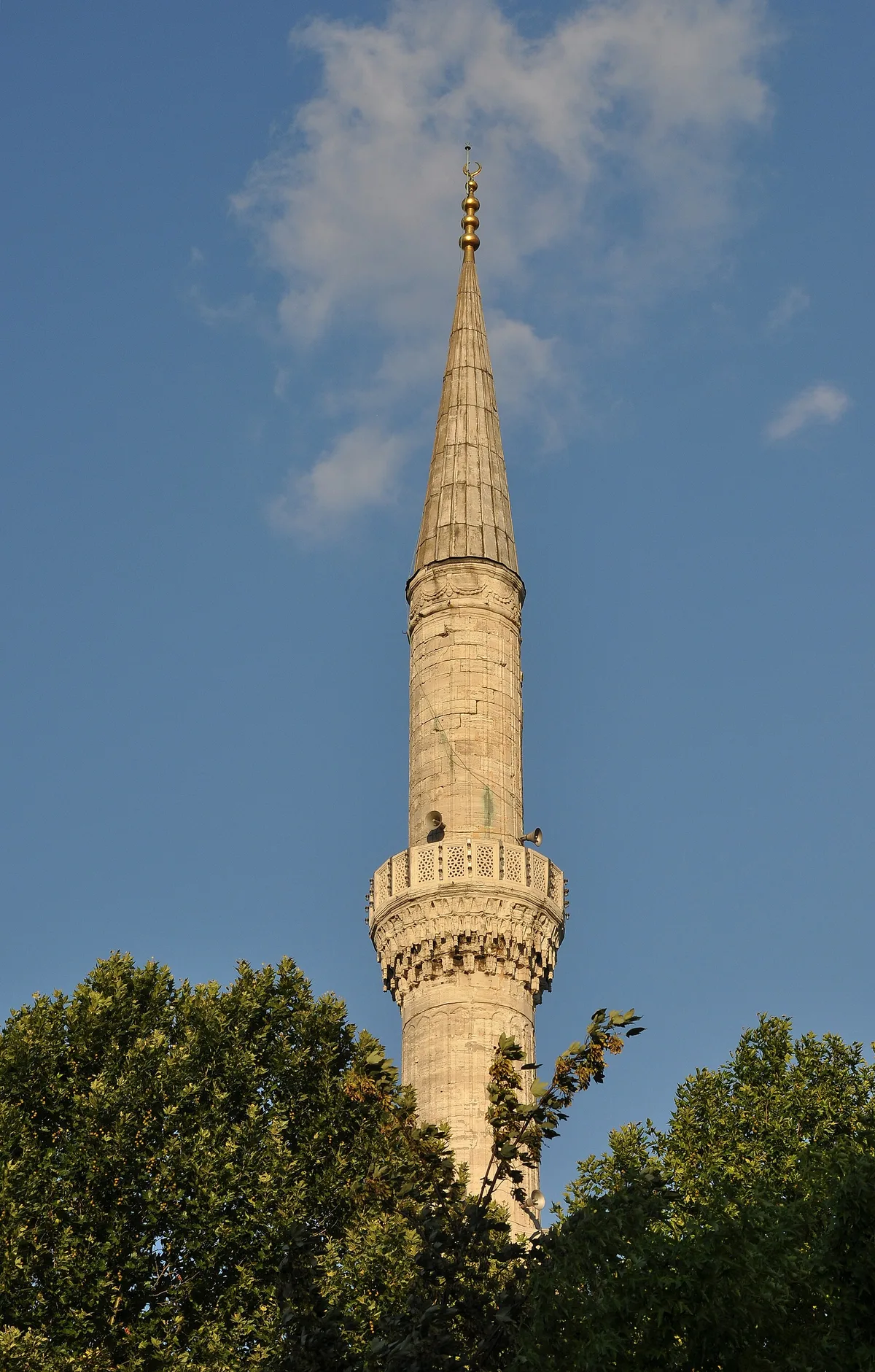
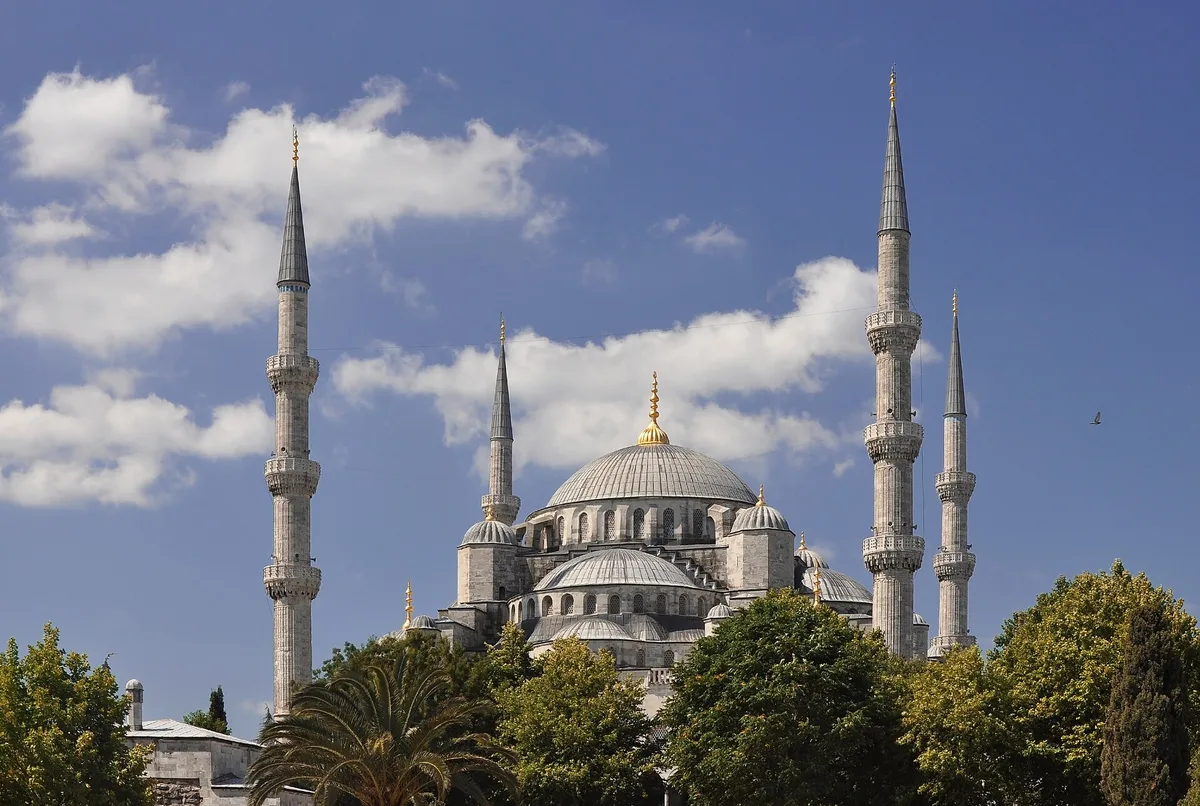
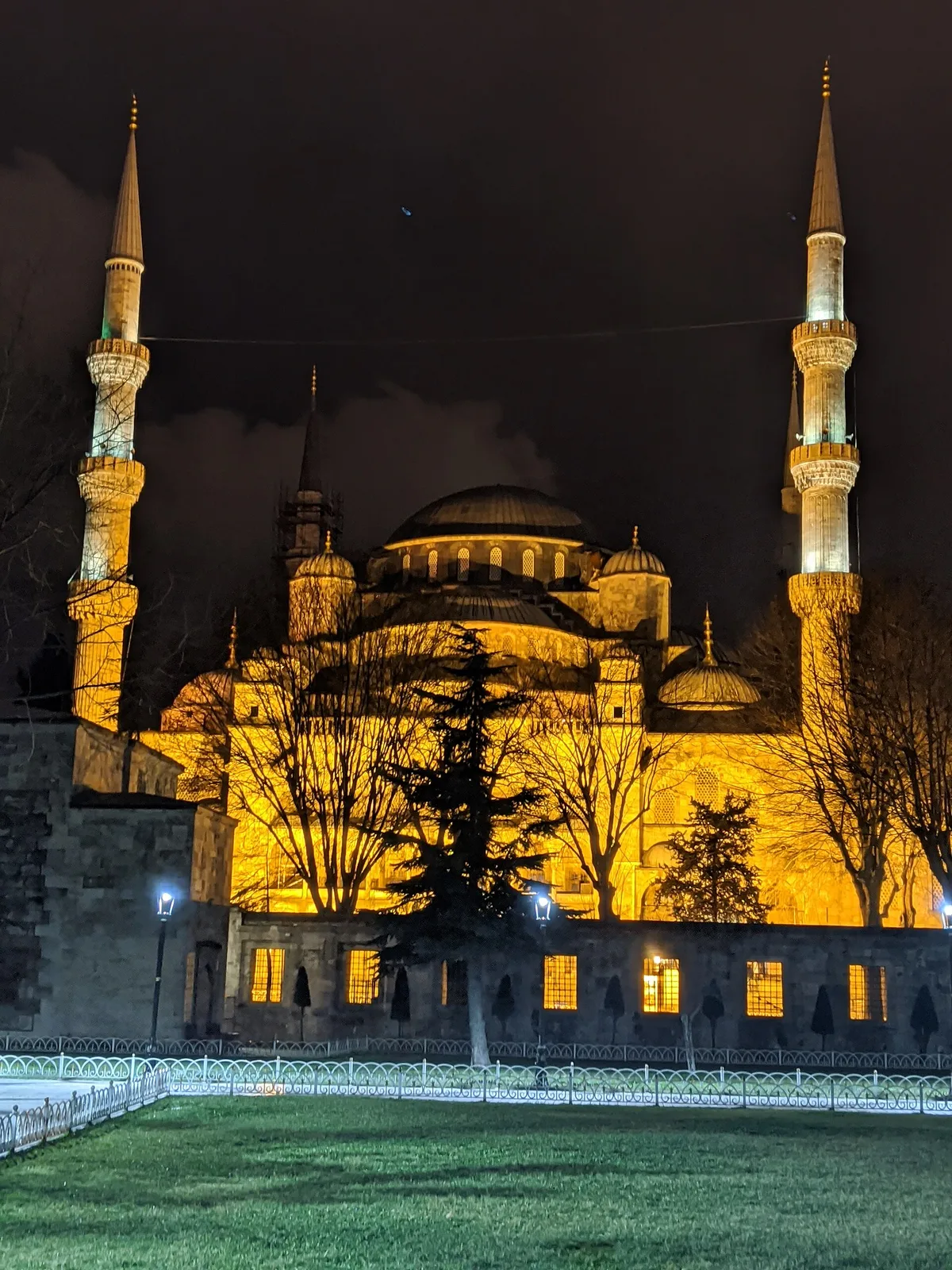
Count the minarets in any photograph. Four stand at the corners of the prayer hall, each with three balconies; two more, with two balconies each, rise at the far corners of the courtyard. Six in total. No imperial mosque in the Ottoman capital had ever carried six – four was the established number for a sultan’s foundation, with two for lesser patrons and one for ordinary mosques – and the Sultan Ahmed Mosque’s six were noticed immediately, argued about at the time, and have been explained by a story ever since. The story is good enough, and repeated widely enough, that this guide tells it in full. But it tells it as what it is: the traditional account, not a documented fact.
The traditional account runs like this. Six minarets was the number carried by the sanctuary mosque in Mecca, the Haram, the holiest ground in Islam. For a sultan’s new mosque in Istanbul to match Mecca minaret for minaret struck many contemporaries – the ulema, the religious scholars, among them – as presumption verging on impiety: the sultan’s house of prayer had set itself level with God’s. Ahmed’s resolution, in the story, was both graceful and expensive. He paid for a seventh minaret to be added to the mosque in Mecca at his own expense, restoring the holy city’s precedence – six for Istanbul, seven for Mecca – and the scandal closed with the hierarchy intact and the sultan’s piety advertised rather than doubted. A companion version of the tale supplies the original blunder: the sultan had asked for altın, gold, minarets, the storyteller says, and his architect heard altı – six. The pun works only in Turkish, which has never stopped it travelling.
What can be said without legend is narrower and still impressive. The six minarets were a deliberate, expensive novelty; the mosque of the Haram in Mecca is the comparison contemporaries reached for; and the sultan’s mosque did in fact end the matter as the only six-minaret imperial mosque of its era in the capital, a distinction it kept for centuries. Whether the seventh minaret in Mecca was Ahmed’s gift, and whether any architect ever misheard a sultan, are questions the documents do not settle – and the story’s survival for four hundred years is itself evidence of something real, which is how startling the silhouette looked in 1616. Istanbul had watched minarets multiply for a century and a half. It had never seen six on one building, arranged as a crown around a courtyard and a dome.
The practical upshot for a visitor is simpler than the theology. The six minarets are why you can recognise this building from almost anywhere in the old city, and why the view of it is best taken whole – from the square, from the Hippodrome gardens, or from the water – before you go inside. Up close, in the courtyard, the minarets largely disappear above the arcades. The building keeps its crown for the city, and shows its congregation the dome.
Reading the Outside – Domes, Stone and the View From the Square
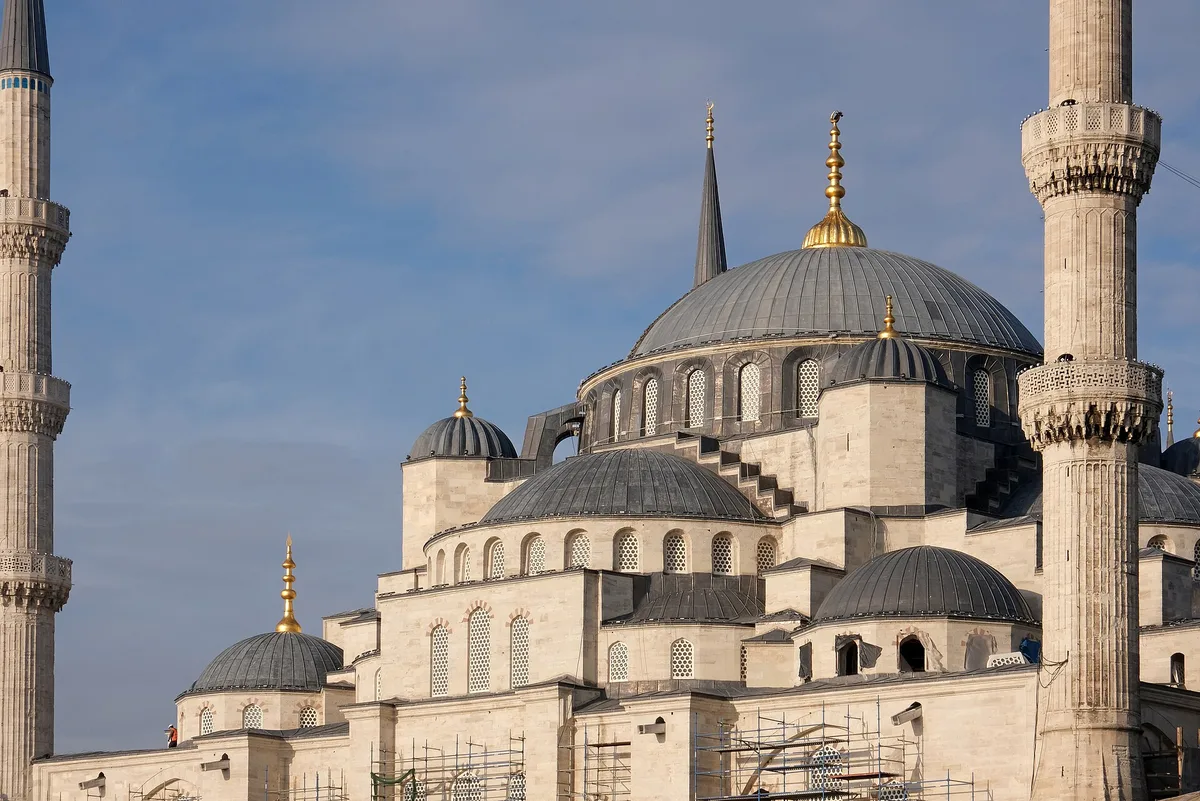
Ottoman mosques are usually read from the dome down, and this one rewards the method. The main dome, a little over 23 metres across, sits at the top of a cascade: four half-domes fall away from it to north, south, east and west, smaller half-domes and cupolas step down again from those, and the whole descending system lands finally on the courtyard’s ring of small domes at the building’s outer edge. The effect, from the square, is of a single stone organism rather than an assembled building – weight flowing outward and downward in stages, exactly as the structure inside is doing the same thing in reverse. Mehmed Ağa learned the system from Sinan’s mosques, above all the Şehzade and Süleymaniye, and loosened it into something softer and more picturesque than either.
The materials do quieter work. The walls are cut stone, pale and fine-jointed, weathered over four centuries toward the warm grey that Istanbul light turns almost silver in the morning and gold in the evening. The roofs are lead, that soft blue-grey that visitors sometimes mistake, in photographs, for the source of the mosque’s name. It is worth repeating that they are not: the name lives indoors, in the tiles. What the exterior offers instead of colour is rhythm – dome behind dome, window behind window, and the pencil lines of the minarets cutting the composition into verticals.
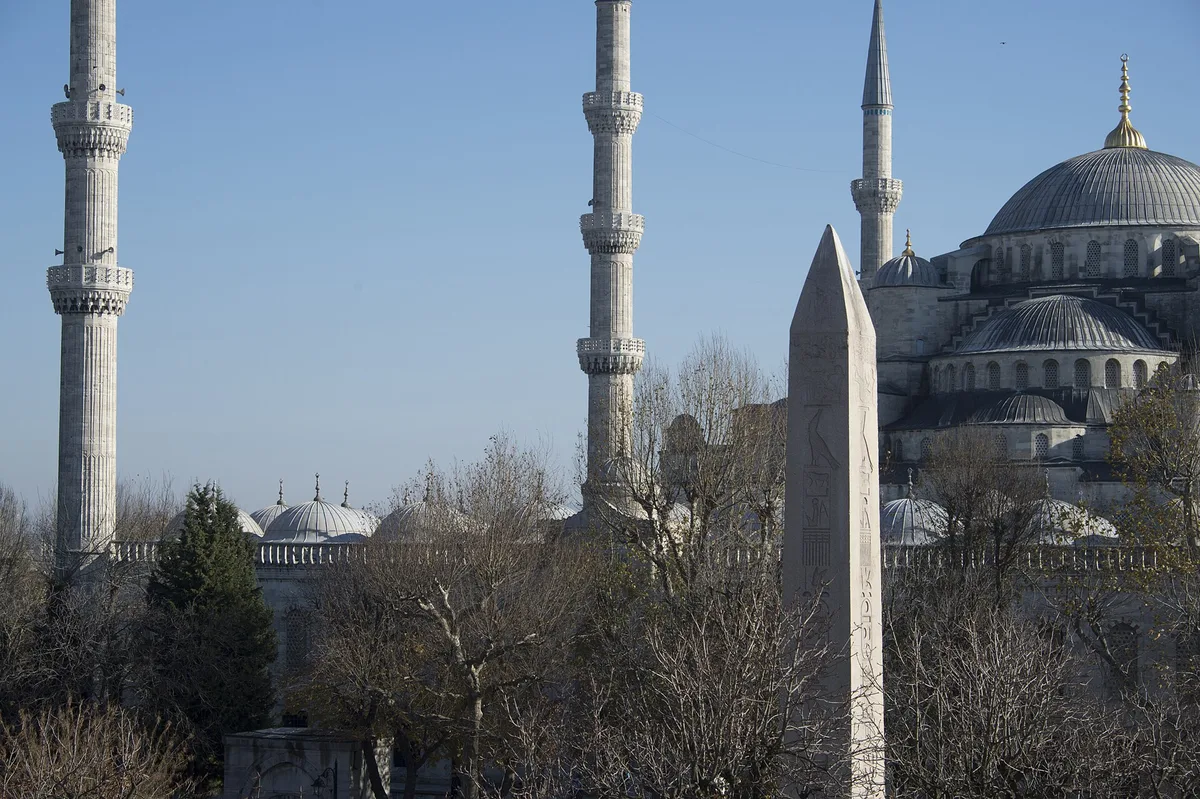
Where you stand matters, and the square gives you three classic readings. From Sultanahmet Square itself, between the mosque and Hagia Sophia, you see the mosque’s ceremonial face with the courtyard front and the minarets arranged symmetrically – the postcard, and none the worse for that. From the Hippodrome side, along the old Byzantine racetrack with its obelisks, you get the profile: the cascade in section, dome stepping down to the courtyard wall, the view the building presents to the city’s oldest public ground. And from the gardens below the square or from a Bosphorus ferry, the mosque takes its place in the full skyline, six minarets answering Hagia Sophia’s four across the rooftops of the palace – the composition of two empires that UNESCO’s listing of the Historic Areas of Istanbul exists to protect, and the one most visitors photograph without realising they are looking at an argument between centuries.
Take the photographs out here, in other words, and take them slowly. Both because the exterior is genuinely the building’s public masterpiece, and because inside – as the visiting sections below explain – you are a guest in a prayer hall, where the camera’s role shrinks to something quieter and more careful.
The Courtyard – A Prayer Hall Turned Inside Out
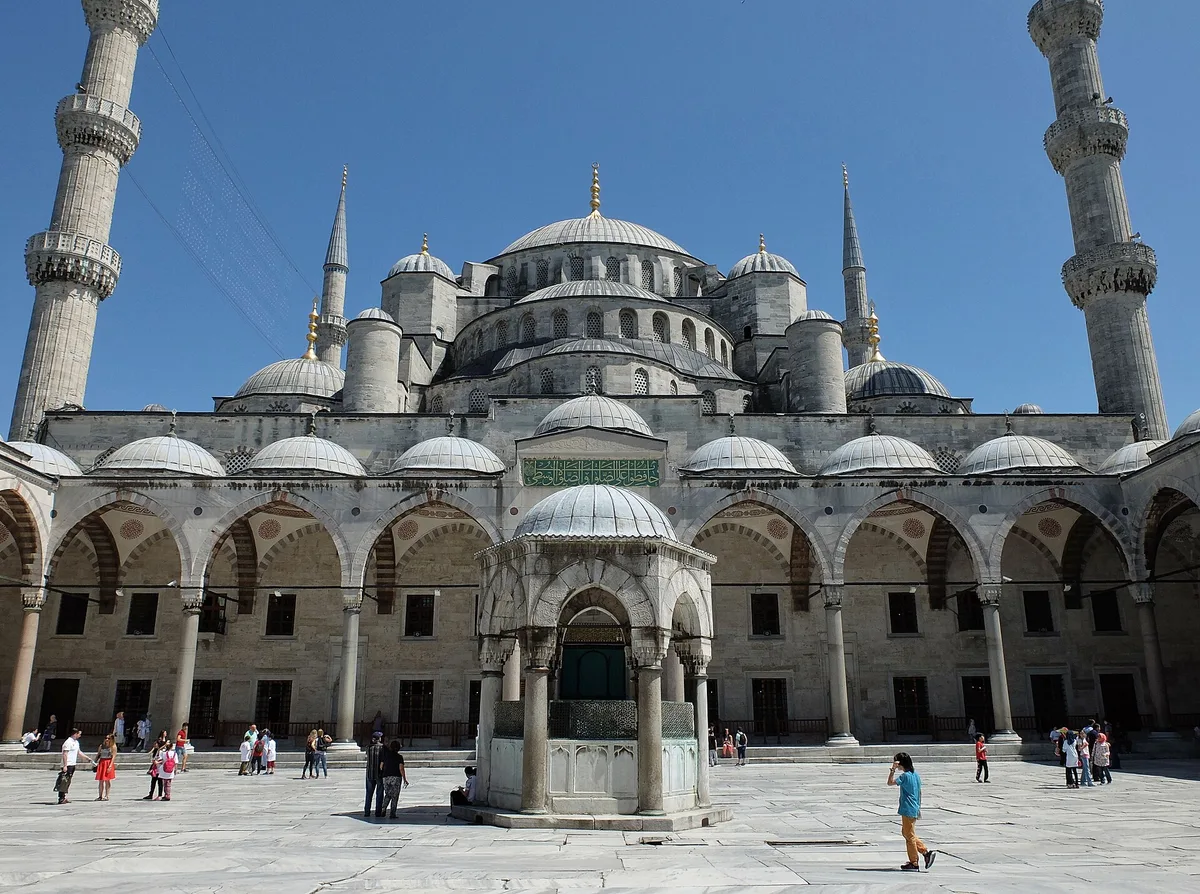
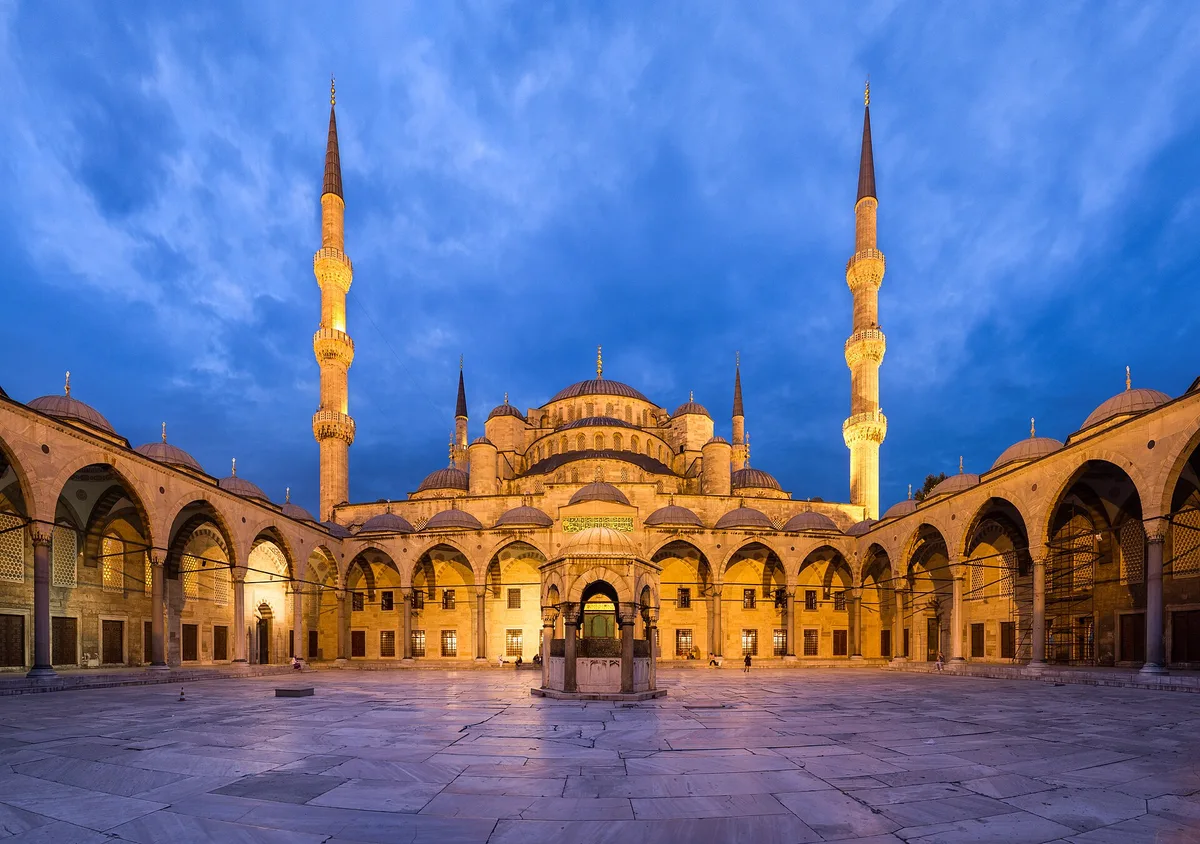
Every great Ottoman mosque gives you a courtyard before it gives you the prayer hall, but this courtyard is the famous exception to the usual proportions: it is, near enough, as large as the prayer hall itself, the largest courtyard of any Ottoman mosque in the city, and walking its arcades is not a prelude to the building – it is half the building. A continuous portico of small domes on marble columns runs around all four sides. The prayer hall fills the southern half of the composition; the courtyard mirrors it to the north, open to the sky, so that the whole complex reads as one domed room with its ceiling removed and one with its ceiling raised to heaven.
At the centre stands the şadırvan, the hexagonal ablution fountain, under its own broad canopy. Its presence states the courtyard’s first purpose plainly: this is where the congregation washes – hands, face and feet, in the ritual order – before prayer, and around prayer times the fountain and the taps of the complex are in unhurried, sociable use. A note of precision, because guides blur it: in its present life the courtyard fountain is as much the courtyard’s ceremonial centrepiece as its working water supply, and the washing you will see before prayers happens at the şadırvan and at the ablution facilities provided around the complex. Watch it by all means – it is part of the life of the place – and watch it the way you would watch anything done in earnest: briefly, and without a camera raised.
The courtyard also preserves the building’s most charming piece of theatre. At the western gate, the entrance from the Hippodrome side, a heavy iron chain hangs across the top of the archway, low enough that anyone entering on horseback had to duck beneath it. Tradition explains who the chain was for: the sultan himself, the only man entitled to ride into his mosque’s courtyard, who would be obliged – by iron, not by courtesy – to bow his head every time he entered his own foundation. Whether or not the chain was hung with Ahmed personally in mind, it states the building’s theology in a single gesture, and guides have pointed at it for generations because visitors understand it instantly. Even the founder enters bowed.
Practically, the courtyard is also where a visit breathes. It is the place to arrive early and wait out a prayer closure without frustration, to let the scale of the building settle before going in, and to look up – the one place where the minarets’ balconies and the dome’s cascade can be taken in from directly beneath. Benches and shade are limited and the stone holds the summer heat, but as an antechamber to one of the world’s great interiors, a marble courtyard open to the Istanbul sky takes some beating.
Inside – Four Piers, a Floating Dome and 260 Windows
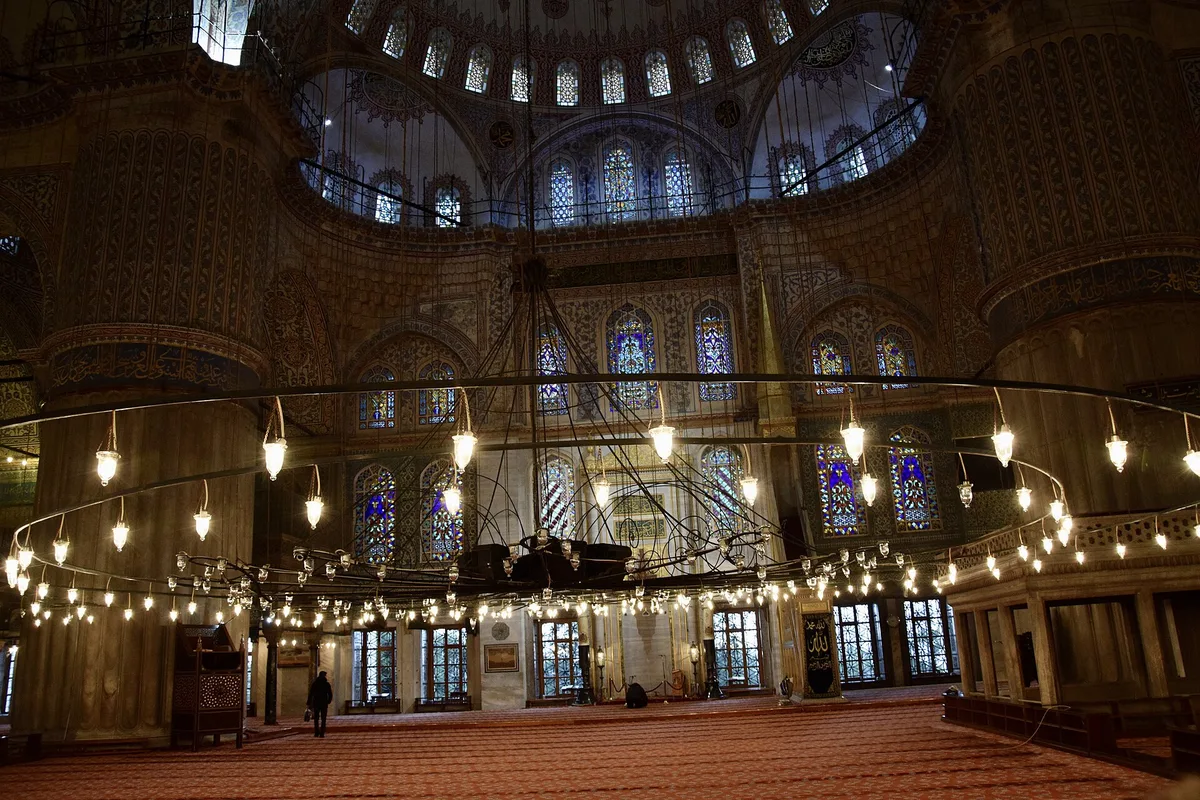
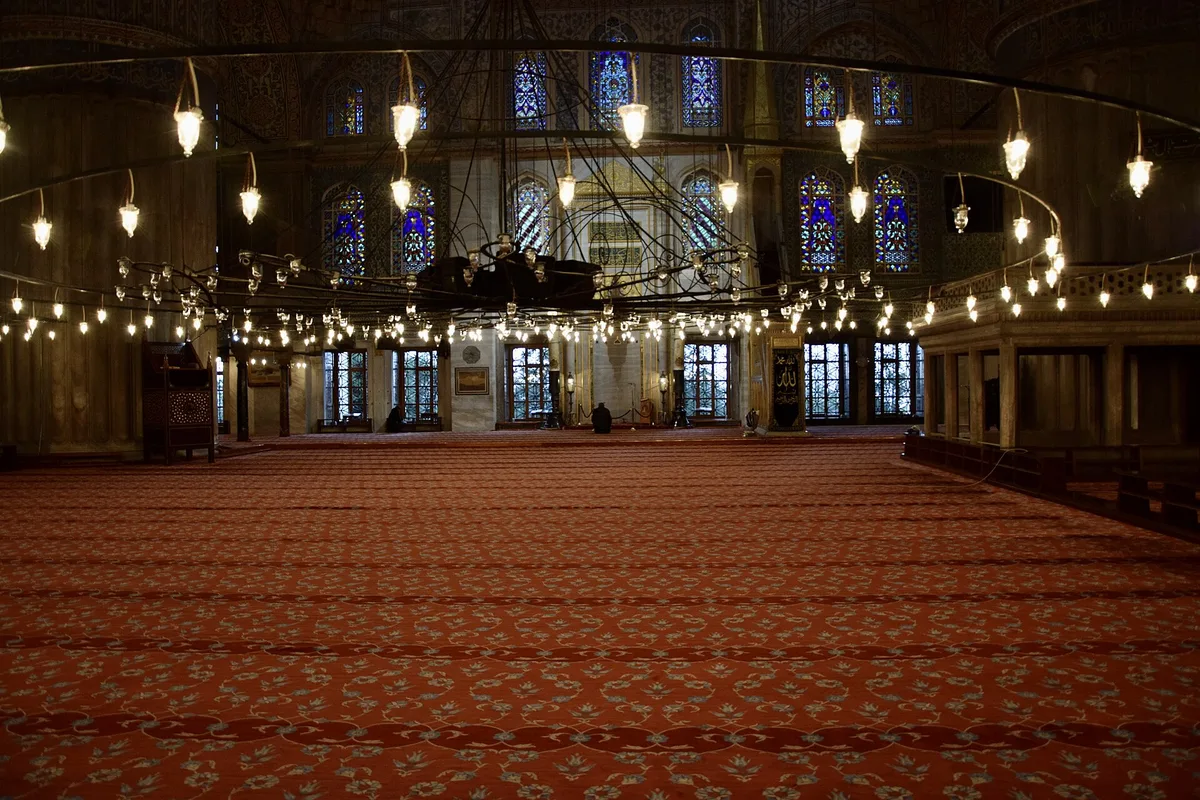
The prayer hall is a single vast room, and its structure can be read in one upward look. The main dome – just over 23 metres in diameter, rising some 43 metres above the floor – is carried on four enormous piers, the massive fluted columns Istanbul tradition calls elephant’s feet, standing at the corners of the central square. From the piers, great arches open to the four half-domes, and the half-domes to the smaller exedrae beyond, so that the ceiling behaves like a stone canopy in the act of settling – every load passed outward in stages, every stage visible. Stand in the middle and turn slowly: there is no hidden engineering anywhere. The building shows you exactly how it stands up, and finds its beauty in the showing.
Light is the second structure. The walls are pierced by window upon window – the published count is 260, arranged in tiers that climb from the gallery level to the dome’s own ring – and the interior’s famous glow is simply daylight, admitted in quantity and softened by the coloured glass and the tile surfaces it lands on. The windows were once filled with stained glass of a quality travellers praised for centuries; much of what you see today is later replacement, and the honest guidebooks say so, but the architecture of the light survives intact even where the glass is newer. Come in the morning for the clearest, coolest version of it, when the sun is on the eastern windows and the hall is at its emptiest.
What strikes most visitors third is the red. The floor, wall to wall, is a deep red carpet, laid in the long rows that organise the congregation’s prayers – a single warm field against which the blue of the tiles and the pale stone of the piers register all the more strongly. The carpet is not decoration and should not be treated as a floor covering in the museum sense: it is the working surface of a prayer hall, kept clean with a rigour that explains the rule you met at the door, where shoes come off and are carried. Low chandeliers hang on long chains across the space at head height and below – the modern fittings echo the old oil-lamp rings that once lit the hall – and between them the air is full of the building’s true scale cue: the human voices of a functioning mosque, low and ordinary, in a room built for an emperor.
Do the visitor’s version of looking properly. The designated visitor area keeps guests behind a barrier in the hall’s outer zone, from where the whole composition – piers, dome, mihrab axis, tile revetment – reads as one picture. You will not wander between the piers, and you do not need to. This is a panorama interior, built to be taken in from a respectful distance, and the barrier line happens to stand roughly where the composition resolves best.
The Tiles Up Close, and the Writing on the Walls
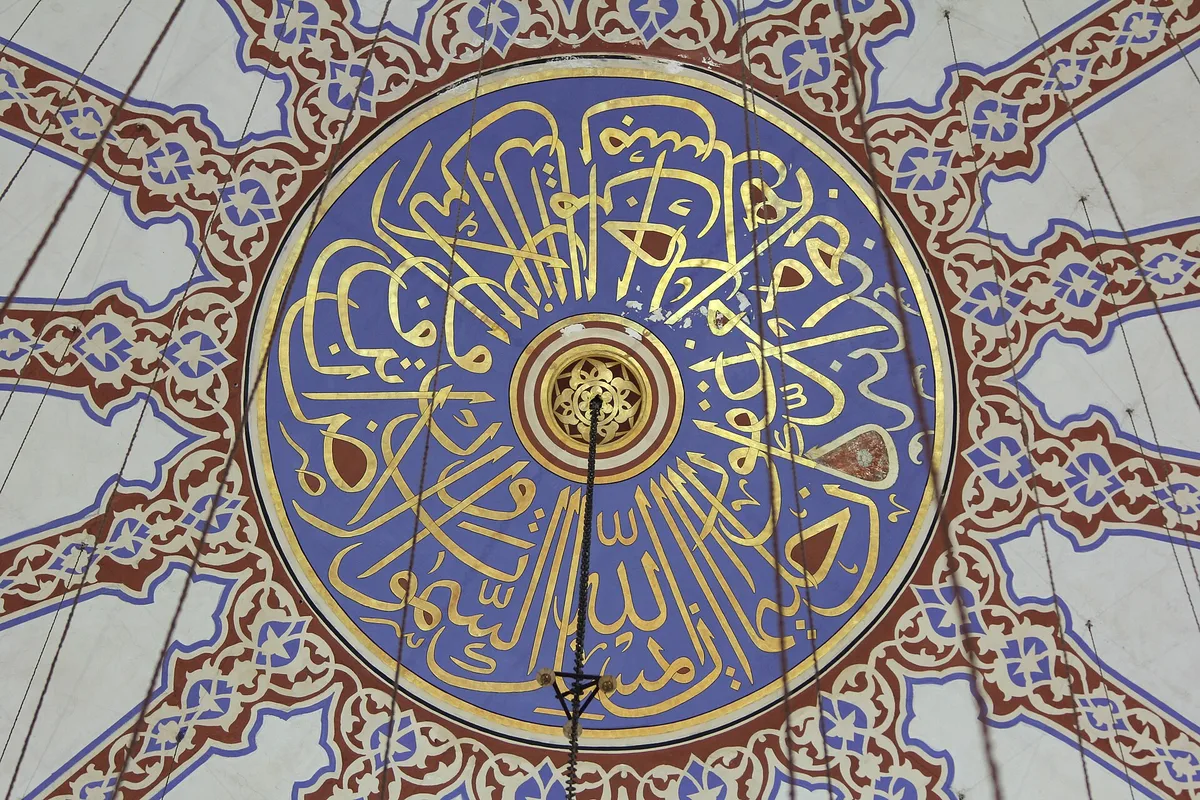
From the visitor line, go looking for detail, because the decoration repays it at every range. The tile panels run in repeating floral systems – tulips most famously, the flower the Ottomans loved above all others, with roses, carnations, hyacinths and pomegranates worked into scrolling stems – and the designs change subtly from panel to panel, because these were not printed surfaces but the output of workshops painting variation inside a discipline. Above the tiles, the calligraphy takes over: great bands and roundels of Quranic inscription in a confident, monumental hand, the work principally of Seyyid Kasım Gubari, the most celebrated calligrapher of Ahmed’s court, whose pen put the building’s sacred text onto its walls and dome.
The colour story has a coda that most visits miss. Follow the decoration upward past the tile line and you are looking at painted work, refreshed and renewed across the centuries as paintings in a working building must be; follow it into the galleries and the upper zones and the palette deepens – the blues of the upper walls, laid in paint rather than glaze, are part of where the interior’s total blue impression comes from. The “blue” of the Blue Mosque, in other words, is a chord rather than a single note: İznik cobalt and turquoise below, painted blues above, coloured light between, and the eye sums them all before it can name any one of them.
There is also a necessary honesty to practise in this section, and it concerns restoration. The mosque you enter today reopened in April 2023 after the most comprehensive restoration of its modern history – years of work on the structure, the tiles, the calligraphy and the painted decoration, much of it done under scaffolding that hid whole faces of the building from a generation of visitors. What that means for your visit is double. The interior is cleaner, brighter and closer to its intended colours than at any time in living memory; and it is, in the conservator’s sense, newly finished – a seventeenth-century interior presented with a twenty-first-century freshness that purists occasionally find startling. Both things are true. The right response is gratitude plus attention: this is the best-lit, best-read version of this room anyone now living has been offered.
The Mihrab, the Minbar and the Sultan’s Lodge

Every mosque interior is organised around a direction – the qibla, the bearing of Mecca – and at the Sultan Ahmed Mosque the qibla wall carries the building’s three most worked pieces of marble and tile. The mihrab, the niche that marks the direction of prayer and stands before the imam, is carved from white marble in a stalactite-hooded arch, flanked by tile panels and inscription. Guides have long drawn visitors’ attention to a small dark fragment set into the mihrab’s fabric, pointed out as a piece of the Black Stone of the Kaaba; this guide repeats the tradition as exactly that – a tradition attached to the building, told to its guests – rather than a verified provenance, and invites you to look, as guests have always looked, with interest and without demanding paperwork of a prayer niche.
Beside the mihrab stands the minbar, the tall canopied pulpit from which the Friday sermon is delivered: white marble again, carved and pierced, its steep stair and conical cap making it the most architectural piece of furniture in the hall. Between mihrab and minbar, the mosque’s ritual week turns – the daily prayers in rows behind the imam at the niche, the congregational Friday prayer gathered around the sermon from the pulpit. If you visit on a Friday after the midday closure lifts, you are entering a hall that has just performed the function both objects exist for, and the lingering orderliness of the congregation dispersing is part of the building to witness respectfully.
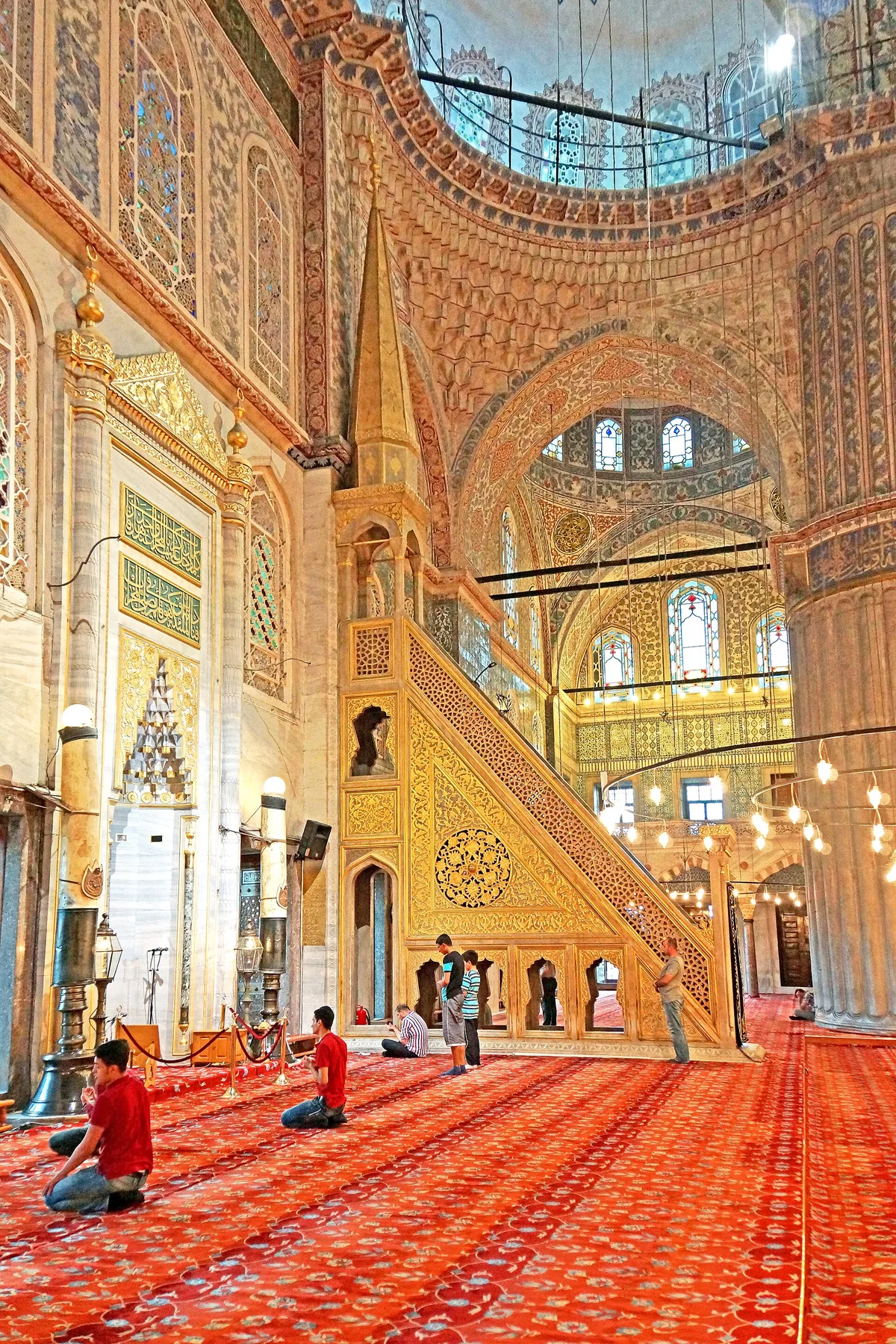
The third element is the one visitors most often fail to identify: the sultan’s lodge, the hünkâr mahfili, a screened, railed gallery at the south-eastern corner of the hall, raised and set apart, from which the sultan and his court attended prayer in privacy and in safety. It is richly finished – fine tiles, carved screens, its own little architecture of separation – and it has its own entrance arrangements from outside, so that the sovereign could arrive and depart without crossing his congregation. Look for it as you face the mihrab, on the left-hand side of the qibla wall’s zone: a mosque within the mosque, and the clearest surviving sign inside the hall that this was not merely a neighbourhood place of prayer but the ceremonial chapel of a court.
None of these three elements is roped off as an exhibit, because none of them is one. They are furnishings in current use, four hundred years into their working lives. The visitor’s privilege is to see them across the barrier, in their real setting, on an ordinary day – which is more than any museum could offer with the same objects in a case.
The Tomb of Sultan Ahmed I
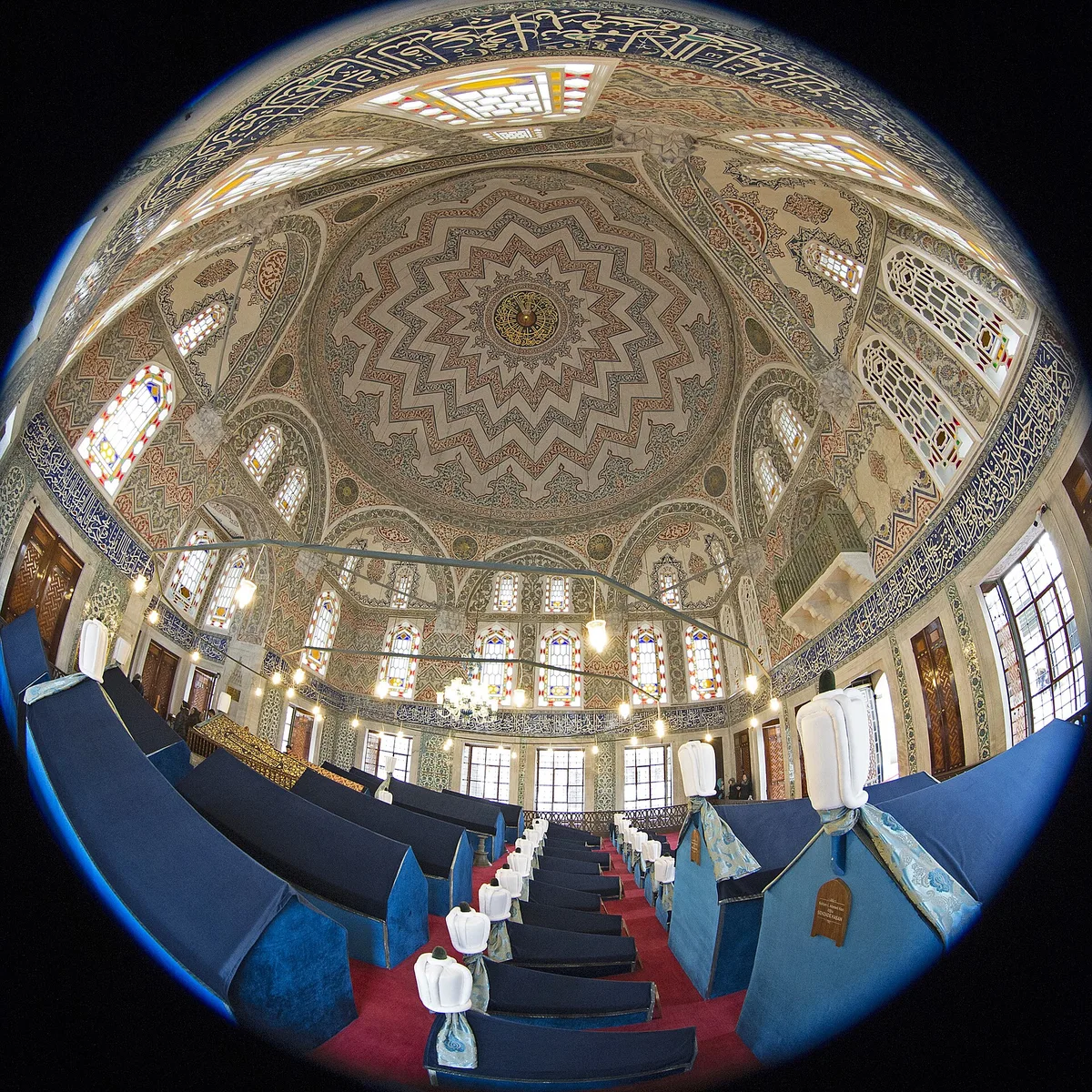
North of the mosque, toward the square and Hagia Sophia, stands the building that completes the founder’s story: the türbe, the domed mausoleum Ahmed built for himself as part of his foundation, into which his body was carried in 1617 when he died at twenty-seven, within about a year of his mosque’s first prayers. Türbes were the Ottoman dynasty’s family vaults and acts of piety at once – domed, tiled, and kept as places of visitation – and Ahmed’s is among the grandest in Istanbul, a substantial domed chamber on the mosque’s own ground, sharing its decoration and its seriousness.
Inside, beneath the dome, stand the great cenotaphs – sandukas – of the tomb’s occupants, draped and turbaned in the Ottoman manner, arranged in the hierarchy of a court that death did not dissolve. Ahmed lies here with his consort Kösem Sultan, herself one of the most powerful figures of the coming century, and with princes and sons of his line, among them two who themselves became sultans, Osman II and Murad IV. The interior repeats the mosque’s language at intimate scale: İznik tiles on the walls, carved and painted woodwork, mother-of-pearl and tortoiseshell inlay in the shutters and doors – the founder-architect’s own first craft, mother-of-pearl working, remembered in his patron’s tomb – and above all the particular quiet of a room that has been a place of prayer for the dead for four centuries.

The tomb keeps its own visiting rhythm, separate from the mosque’s prayer closures, and it is administered as a tomb-museum rather than as part of the prayer hall; arrangements and opening patterns change, and the practical advice is simply to go when you find it open and not to build the day around a promised hour. It is, for many visitors, the surprise of the visit: the mosque declares Ahmed’s ambition, but the türbe is where the ambition’s cost stands in a row of green-draped coffins, the chief of them a young man’s. Spend ten unhurried minutes here. The square outside will reassert itself soon enough.
Visiting a Working Mosque – How Entry Works Now
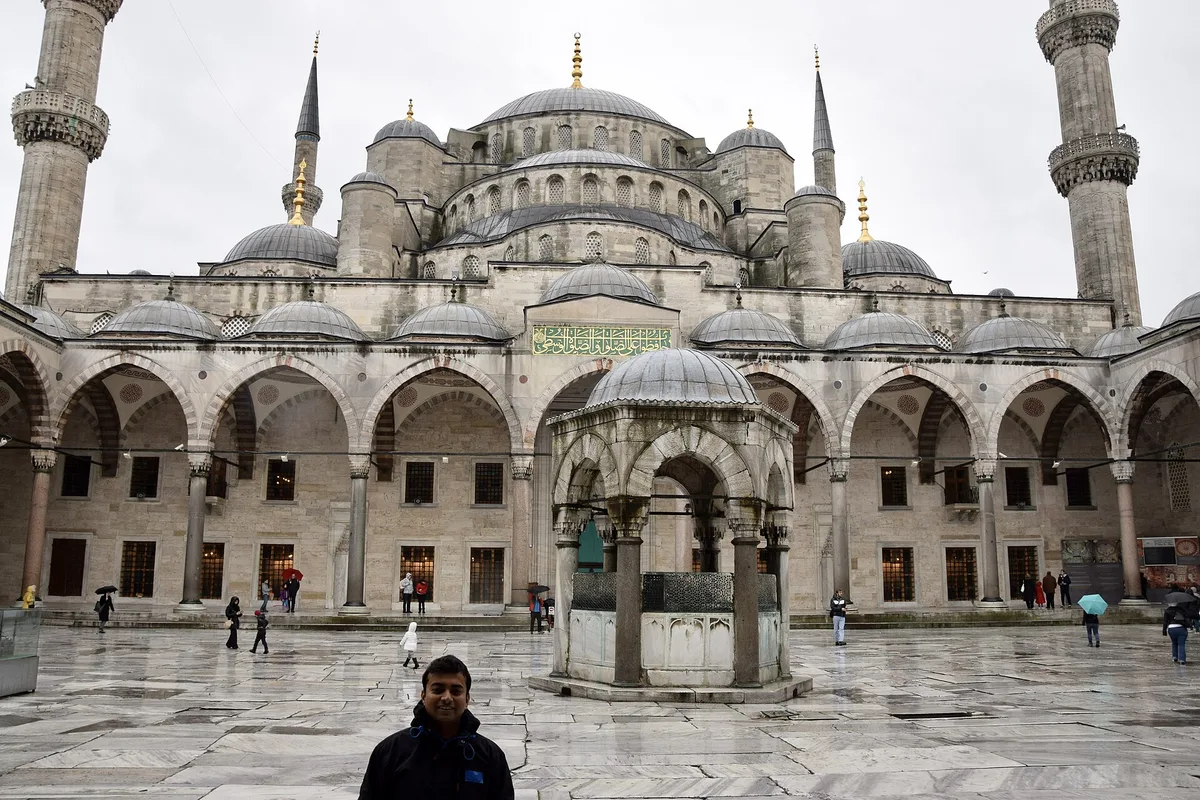
Begin with the principle, because every detail hangs on it: worshippers and sightseers are separated, gently and completely. The mosque’s doors for prayer are not the visitor’s door. Sightseeing visitors follow the signs to the designated visitor entrance on the mosque’s southern side, where staff manage the flow, the dress check happens, and a notice board posts the day’s pattern of closures. The association that cares for the mosque – the Sultanahmet Camii Koruma ve İhya Derneği, the mosque’s own preservation association – publishes the visitor information and runs an information line for it, and its site, sultanahmetcami.org, is the address this guide names as the authority for current arrangements, alongside the board at the door itself. What follows describes the mechanism as it currently works; treat the day’s board, not any article including this one, as the final word.
The day is divided by prayer. Islam’s five daily prayers in Türkiye follow the times published by the Diyanet, the Presidency of Religious Affairs, computed for Istanbul and shifting by minutes as the seasons turn. Sightseeing at the Blue Mosque happens in the windows between them. Around each prayer the visitor flow pauses – entry stops ahead of the call to prayer and resumes once the congregation has prayed and begun to disperse – and the mosque’s interior belongs, entirely and without apology, to the people who came to pray. In practice this means the day’s most reliable sightseeing windows are the longer stretches between the morning, midday and afternoon prayers, and the least reliable moments are the half-hours in which a prayer is imminent. Arrive in a closure and the correct move is not to hover at the barrier: the courtyard, the tomb and the square are all within a hundred metres, and the mosque will reopen on a schedule older than the building.
Friday is the week’s special case. The midday prayer on Friday is congregational – the week’s great gathering, with the sermon from the minbar – and the mosque is closed to sightseeing for a long stretch around it; visitor entry on Fridays begins only in the afternoon, once the congregation has dispersed. Build a Friday around the Blue Mosque and you will spend its middle in a queue or a café. Build it the other way – Hagia Sophia’s visitor route and the museums in the morning, the Blue Mosque in the later afternoon as the light turns on the tiles – and Friday becomes the best-sequenced day of the trip rather than the worst.
Two smaller mechanics complete the picture. First, there is no ticket: entry is free, no pass is involved, and anyone outside the mosque selling quick entry or a compulsory ticket is selling something that does not exist – guided tours are a legitimate purchase if you want one, but they buy commentary, not admission, and no tour changes the prayer closures or the dress rules. Second, expect a security check at the entrance, and expect the queue it creates at busy times to be the real rationing system of the visit: in high season the difference between a good visit and a frustrating one is usually the thirty minutes before you reach the door, not anything inside it.
Dress, Shoes and Behaviour – The Guest’s Part of the Bargain
The dress code is simple, enforced, and worth stating exactly. Inside the mosque, everyone’s shoulders and knees are covered – loose trousers or a long skirt below the knee, nothing sleeveless – and women additionally cover their hair with a headscarf for the duration of the visit. This is not a formality waived for tourists in summer; it is the condition of entry, applied at the visitor door. The good news is that the mosque plans for the unprepared: coverings are available to borrow at the entrance – headscarves for women, wrap coverings for visitors whose clothes fall short – to be returned on the way out. Borrow with thanks, and still, if you can, come dressed for the place from the start; your own scarf is more comfortable, photographs better, and marks you as a guest who read the invitation.
Shoes come off at the prayer hall’s threshold, as they do in every mosque, and the local system is civilised: bags are provided, your shoes travel with you, and clean socks – which the house rules of every mosque visit quietly reward – spare you the marble’s chill and the carpet’s intimacy with ten thousand strangers’ feet. The published visitor rules add a detail families should know before the queue rather than in it: pushchairs are not taken inside the prayer hall, so infants travel in arms or a carrier, and the visit’s choreography should be planned around that.
Behaviour inside resolves to three quiet disciplines. Keep your voice low – the hall is a place of prayer even between prayers, and individuals are often at prayer in its corners at any hour. Keep the camera in its place: photography in the visitor area is tolerated; flash is not welcome, and photographing worshippers – people at prayer, at ablution, at their devotions – is the line a guest does not cross. And keep to the visitor area, behind the barrier that separates guests from the prayer rows: the mihrab, the minbar and the carpet’s open field are the congregation’s, and the barrier is not a challenge to your itinerary but the visible shape of the welcome itself.
None of this is onerous, and most visitors find the disciplines improve the visit – a quieter, slower, more deliberate hour than the ticketed attractions around the square provide. The Blue Mosque asks for a small performance of respect, and in exchange performs, daily and for free, the thing it has performed since 1617. Guests who understand the exchange tend to rate it the most memorable hour in Sultanahmet.
The Mosque Was a Small City – The Complex and the Arasta
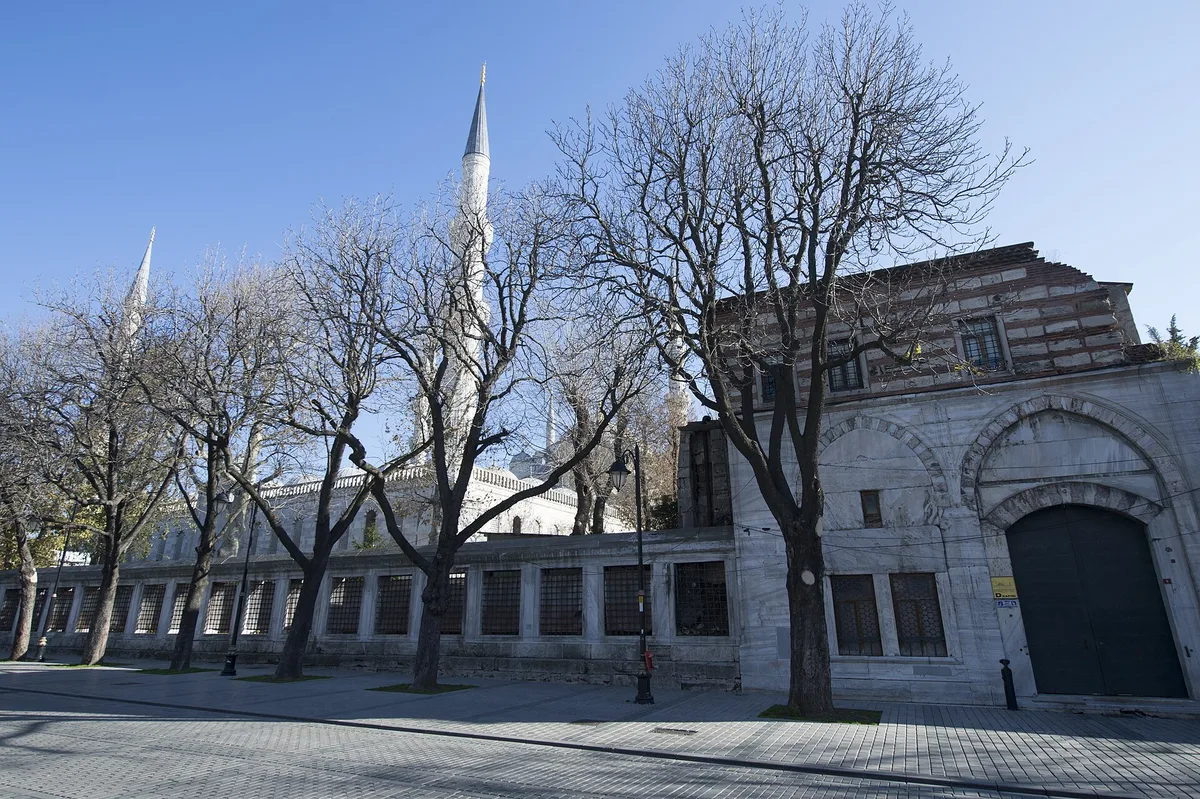
The prayer hall and courtyard were the heart of the foundation, not its whole body, and the surviving pieces around the mosque repay a circuit before or after the interior visit. The tomb has its section above. The madrasa – the religious college where students lived and studied the classical curriculum – stands in the complex’s eastern range, part of the same campaign of building, its courtyard and cells still legible as an institution folded around the mosque’s life. The foundation’s charitable works were equally deliberate: an imaret distributing food, a hospital, a primary school and a great sebil, a public fountain dispensing water to the quarter – the social machinery by which an imperial mosque served the city that paid for it, some of it surviving in fabric, all of it surviving in the district’s layout.
Immediately behind the mosque, on its south-eastern side, run the vaulted shops of the Arasta – the bazaar built as part of Ahmed’s endowment, whose rents were assigned to the mosque’s upkeep in the foundation’s own accounts. It survives as a quiet, single-street bazaar, a calmer and more curated row than the Grand Bazaar’s labyrinth uphill, known for textiles, ceramics and the mosaic museum installed in its vaults. Its presence closes the economic circle the visitor rarely sees: the tiles inside the prayer hall were paid for, in part, by shopkeepers’ rent – piety funded by commerce, in a single deed of endowment, on a single street.
Walk the circuit and one more neighbour demands a glance: the ground itself. The mosque stands over and beside the remains of the Great Palace of the Byzantine emperors, and the Hippodrome’s long spine – its obelisks, its Serpent Column, the ghost of its racing track in the square’s shape – runs along the mosque’s western side. The finest surviving floor mosaics of that palace lie in a museum a few minutes away behind the Arasta. Constantinople’s palace, the Ottomans’ mosque, the republic’s square: three civilisations stacked in one short walk, with the building you came for sitting precisely on the seam.
Across the Square – Hagia Sophia, the Building It Answers
One section, by design, belongs to the neighbour, because you cannot understand the Sultan Ahmed Mosque without the building it faces. Hagia Sophia stands a few hundred metres north across the square: Justinian’s cathedral of 537, the largest church in the world for nearly a thousand years, a mosque from 1453, a museum from 1935, and a working mosque again since 2020 – administered today on a different pattern from its younger neighbour, with a separate ticketed visitor route through its upper gallery while prayer continues below. The Blue Mosque was built in conscious dialogue with it: a sultan of the 1600s setting his own great domed mosque in the older building’s sightline, matching dome with dome across the square of the Hippodrome, and claiming – in the politest architectural terms available – succession.
Visit them as a pair, because each explains the other. Hagia Sophia shows you the invention: the dome on pendentives, the vast unified space, eleven centuries older than its rival and still the greater structural audacity. The Blue Mosque shows you the inheritance perfected and decorated: the dome system absorbed into a calm cascade, the interior unified not by structure alone but by tile, calligraphy and light. The practical pairing matters too – the two buildings run different systems, one ticketed and one free, and their closures and queues interlock through the day; the sequencing advice in our Istanbul coverage, and the detailed account in this site’s dedicated Hagia Sophia guide, will help you order a morning around both. Here, one sentence suffices: see the old building for its genius, and this one for its grace, and let the square between them – obelisks, gardens, four empires deep – be the corridor of the visit.
The Honest Downsides
The first downside is arithmetic. This is among the most visited religious buildings on earth, inside one of the most visited historic districts, and the visitor entrance can carry queues that turn a one-hour building into a two-hour commitment in high season – with the added uncertainty that a prayer closure can land in the middle of your wait and extend it. Early morning on a weekday, outside the great holiday periods, is the experienced visitor’s answer; Friday morning is nobody’s. Go expecting a queue and you will merely be right; go expecting museum-style admission control and the day will feel broken.
Second, the visit itself is shorter and more bounded than the building’s fame suggests. The barrier keeps you in the visitor zone; the prayer hall’s centre, the piers’ bases, the lodge and the qibla wall are all seen from across a rail; and the whole interior, taken at the deliberate pace it deserves, is an hour’s looking, not a morning’s. Visitors who arrive imagining the free wander of a cathedral close will need to recalibrate: this is an audience with a building, granted on its terms, and its brevity is the price of its authenticity. The courtyard, the tomb and the square extend the visit, and should.
Third, the living-building caveats apply in full. Restoration is a permanent condition of a four-hundred-year-old mosque: some part of the complex may be scaffolded or closed in any given season – the great restoration completed in 2023 has made this less true than it was, not untrue – and religious observance overrides tourism at any moment, from an unscheduled funeral to the full Ramadan re-ordering of the day. Add the square’s ordinary frictions – persistent tour sellers, the occasional unofficial “guide” materialising at your elbow – and the visit rewards travellers who hold their plans loosely and their courtesy tightly.
None of it cancels the place. A free, functioning, four-century-old masterpiece that still does its original job five times a day is a rarer thing than a perfect queue. The downsides are the ordinary price of being a guest rather than a customer, and the mosque pays it back, in tiles and light and quiet, with interest.
Frequently Asked Questions
Is the Blue Mosque the same building as the Sultan Ahmed Mosque? Yes – one building, two names. Sultan Ahmed Mosque, Sultanahmet Camii in Turkish, is its proper name, after Sultan Ahmed I who commissioned it. “Blue Mosque” is the nickname the visiting world gave it for the İznik tiles inside, and it is the name this blue mosque istanbul guide uses most, because it is the name most visitors search for.
Do I need a ticket or a Museum Pass? No. Entry for sightseeing is free, and no pass exists for it or is needed. What is sold online and around the square as a “Blue Mosque ticket” is a guided tour or a package, never admission itself – a tour may be worth buying for the commentary, but no purchase changes the prayer closures, the queue or the dress code.
When is the mosque closed to visitors? Around every one of the five daily prayers, whose times are the Diyanet’s published times for Istanbul and shift with the seasons: entry pauses before each prayer and resumes after the congregation disperses. On Fridays the closure around the midday congregational prayer is long, and sightseeing begins only in the afternoon. The mosque’s preservation association publishes the visitor pattern, and a board at the visitor entrance posts the day itself – check both rather than trusting any printed hour, including ours.
What should I wear? Shoulders and knees covered for everyone, in loose clothing; women also cover their hair inside with a headscarf. If you arrive short of the standard, scarves and coverings can be borrowed at the visitor entrance and returned on exit. Shoes are removed at the prayer hall door and carried in a provided bag; clean socks are a quiet kindness to yourself.
Can non-Muslims go inside? Yes – visitors of any faith, and none, are welcomed in the sightseeing windows, through the designated visitor entrance and into the visitor area of the prayer hall. The welcome is real and routine; it simply runs on the mosque’s terms, which this guide’s visiting sections set out in full.
Is the six-minarets story true? It is the traditional account, repeated for centuries: that six minarets matched the sanctuary at Mecca and caused offence, and that Ahmed settled the matter by funding a seventh minaret for Mecca – with a companion tale that the architect misheard a request for gold minarets as six. The documented part is simpler: six minarets were unprecedented for an imperial mosque in the capital, and the comparison with Mecca was made at the time. This guide tells the story as legend and labels it as such.
How long does a visit take, and what should I combine it with? Allow about an hour for the courtyard and prayer hall, more with the tomb of Ahmed I next door – and build the visit into a Sultanahmet morning: Hagia Sophia across the square on its separate ticketed route, the Hippodrome’s obelisks between the two, and the Arasta bazaar behind the mosque. The prayer timetable, not the walking distance, is what needs planning.
Can I take photographs? In the visitor area, yes, quietly and without flash. The boundary is people: do not photograph worshippers at prayer or at ablution, and if staff indicate that photography should pause, it pauses. The building will not be offended by your camera. Its congregation might be, and they are the hosts.
The Short Version
If this blue mosque istanbul guide has to shrink to its essentials, they are these. The Sultan Ahmed Mosque – the Blue Mosque – is an imperial mosque of 1609–1616, built for a teenage sultan by Sinan’s pupil Sedefkâr Mehmed Ağa on the Hippodrome’s edge, facing Hagia Sophia across the square. It is named for its founder and nicknamed for the 20,000-plus İznik tiles that line its prayer hall in blue. It carries six minarets, about which a famous story is told that this guide repeats only as legend. Its courtyard is as big as its prayer hall, its dome rides on four great piers in a room lit by some 260 windows, and its founder lies in the tiled tomb beside it, dead at twenty-seven within a year of its completion.
As a visit, it runs on worship’s clock, not tourism’s. Entry is free and ticketless, through a designated visitor entrance, in the windows between the five daily prayers; Fridays open to visitors only after the midday congregation. Dress covered, borrow a scarf if you need one, carry your shoes, keep your voice and your camera down, and stand a while in the visitor area while the dome does its work. Do that, and you have not merely seen Istanbul’s signature mosque. You have been, briefly and on its own terms, its guest – which is what the building, beneath all the tile and fame, has been offering travellers for four hundred years.