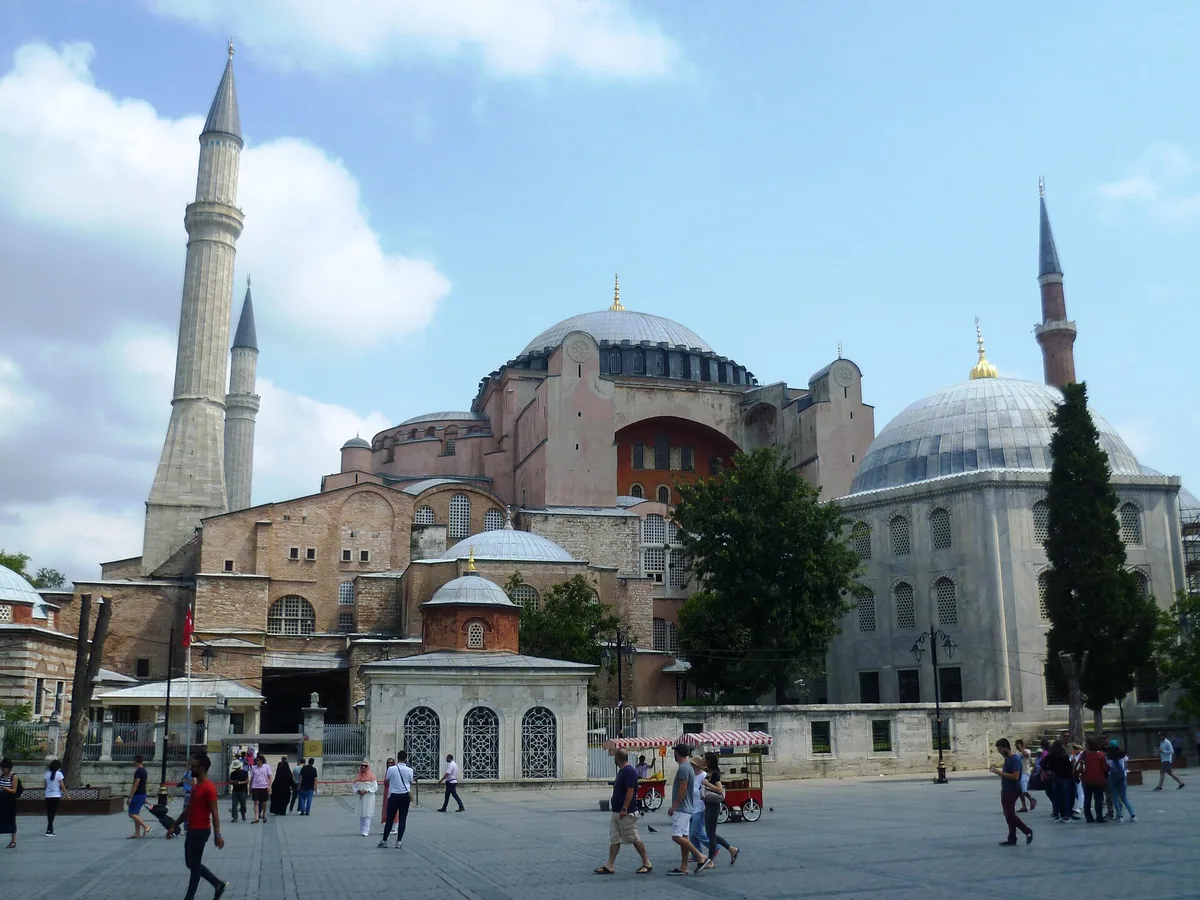
There is no other building on earth quite like the one at the top of Sultanahmet Square, and this hagia sophia guide exists because almost everything written about visiting it before 2020 is now out of date. Hagia Sophia – Ayasofya in Turkish, the Church of the Holy Wisdom – was raised in just five years under the emperor Justinian and dedicated in 537. It was the largest cathedral in the world for nearly a thousand years. In 1453 it became a mosque, and stayed one for almost five centuries. In 1935 it opened as a museum, and for eighty-five years visitors wandered its ground floor freely with a ticket. Then, in July 2020, it became a working mosque again – and since January 2024, sightseeing visitors no longer walk the famous floor at all. They climb a ramp to the upper gallery and see the building from above, while prayer continues beneath them.
That change is the single most important fact in this article, and it shapes everything that follows. The gallery route is not a lesser version of the old visit. The gallery is where the building keeps its greatest surviving mosaics – the Deësis, the imperial portraits – and the view down into the vast domed space from the gallery rail is, if anything, the more architectural of the two experiences. But it is a different visit from the one in older guidebooks, with a different entrance, a separate ticket that museum passes do not cover, a dress code, and a timetable ruled by the five daily prayers. A good hagia sophia guide has to explain the building twice over – once as the masterpiece it is, and once as the living mosque it now is – because in 2026 you cannot understand either without the other.
So that is the shape of what follows. First the building itself – how Justinian’s architects floated a dome some 31 metres across on a square of stone, why it kept falling and being repaired, and what the Ottomans added when they turned a church into a mosque without flattening its form. Then the practical machinery of a modern visit, set out as mechanisms rather than figures, because fees and hours at this building change and the official sources named here are the ones worth trusting. Then the gallery, mosaic by mosaic, including the honest list of famous things the visitor route does not reach. And finally the downsides, the questions travellers actually ask, and the short version – because Hagia Sophia rewards the visitor who arrives knowing what kind of place it now is.
Hagia Sophia at a Glance
| Question | Short answer |
|---|---|
| What is it | A 6th-century imperial church turned mosque in 1453, a museum from 1935 to 2020, and a working mosque again since July 2020 |
| Where | Sultanahmet, at the top of the historic peninsula in Istanbul, Türkiye – facing the Blue Mosque across the square |
| Built | 532-537 under the emperor Justinian I, to designs by Anthemius of Tralles and Isidore of Miletus |
| The one essential sight | The dome from the upper gallery, and the Deësis mosaic a few steps away from it |
| How visitors see it now | A ticketed one-way route through the upper gallery, entered separately from the prayer hall since January 2024 |
| The ground floor | Reserved for worship – sightseeing visitors do not tour the prayer hall |
| How long it takes | Allow an hour to ninety minutes for the gallery route, plus the queue |
| What governs the day | The five daily prayer times, and a longer closure around the Friday midday prayer |
| Dress | Modest dress for everyone; women cover their hair – bring your own scarf and coverings |
| Status | Part of the Historic Areas of Istanbul, inscribed by UNESCO in 1985 |
Two consequences flow from that table, and both are worth fixing in your mind before the history. The first is that Hagia Sophia today is two visits sharing one building – worship below, sightseeing above – and the two never mix. Arrive expecting the pre-2020 museum, in which everyone wandered everywhere, and you will spend your visit confused at barriers. Arrive expecting a gallery, a rail, a downward view and a sequence of mosaics, and the visit makes complete sense. The second is that the building’s religious life is not a performance laid on around the sightseeing. Prayer is the building’s primary business now, five times a day, and the visitor route is designed – ramps, screens, timed closures – to let that business continue undisturbed beneath and beside you.
The rest of Istanbul arranges itself around this building, and our Istanbul travel guide covers the wider city – where to stay, how to sequence the palace, the cistern and the bazaars around a Hagia Sophia visit. This article does the opposite job. It stays with one building and its square, and it goes deep rather than wide, because a structure that has been the greatest church of one empire and a great mosque of another, without ever ceasing to be itself, deserves the longer look.
Three Lives in One Building
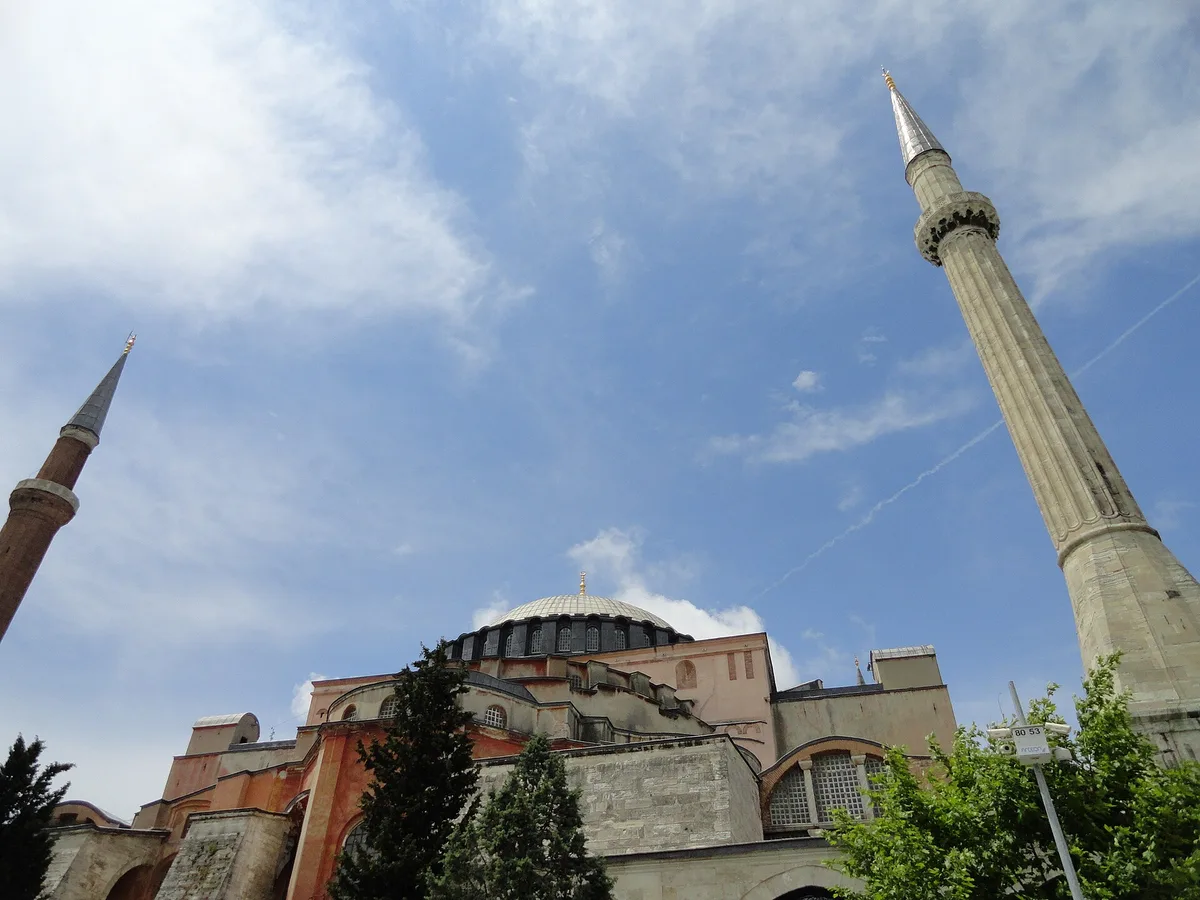
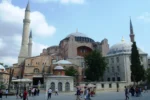
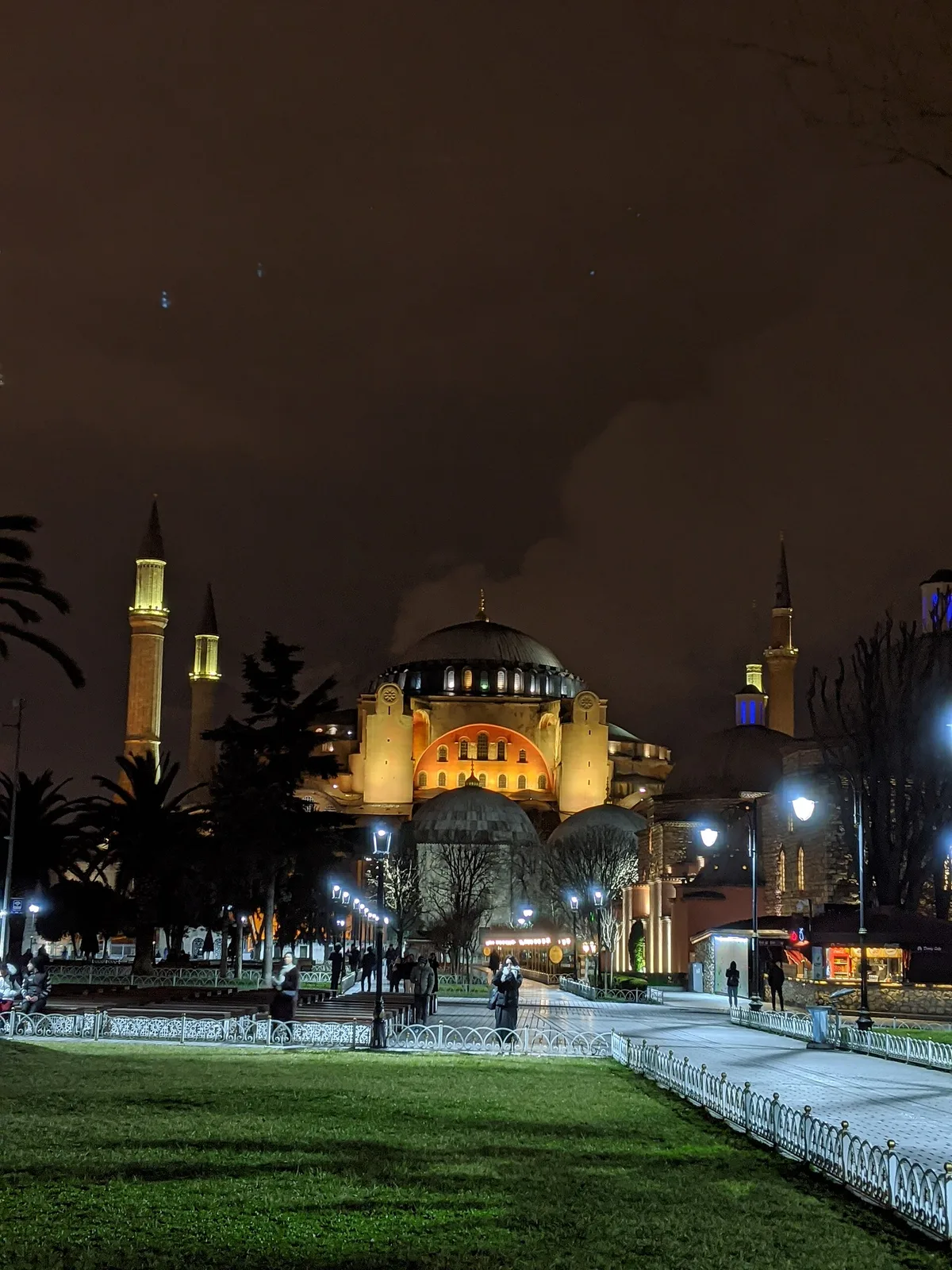
Most famous buildings have one story. Hagia Sophia has three, and the remarkable thing is that all three are still visible at once. Stand in the square and read the exterior like a timeline. The vast dome and the half-domes cascading from it are Byzantine, raised in the 530s. The four minarets at the corners are Ottoman, added across the fifteenth and sixteenth centuries as the building’s function changed around its unchanging form. The great flying buttresses propping the walls are a conversation between the two civilisations – some Byzantine repairs, some the work of Sinan, the great Ottoman architect who strengthened the church his sultans prayed in. Even the plaster tells the story. For centuries it covered the Christian mosaics, accidentally preserving them, until the museum era uncovered them again.
The first life began in fire. An earlier church on this site burned in the Nika riots of January 532, the revolt that nearly ended Justinian’s reign in its fifth year, and the emperor responded the way he responded to most things – on a scale intended to end argument. He commissioned a church larger, faster and more daring than anything built before it, on the empire’s most symbolic ground, between his palace and his cathedral square. It was dedicated on 27 December 537, less than six years after construction began, a speed of building that still startles engineers. For the Orthodox world it became the Great Church, the seat of the Patriarch of Constantinople, the stage for imperial coronations, and the model – as UNESCO’s listing for the Historic Areas of Istanbul puts it – for an entire family of later churches and mosques.
The second life began on 29 May 1453, the day Constantinople fell to Mehmed II. The sultan entered the city, came to the great church, and claimed it for Islam; tradition holds that the first Friday prayer was held within days. Hagia Sophia became Ayasofya, the imperial mosque of the conquering dynasty, endowed with revenues, surrounded in time by the tombs of sultans, a madrasa, a fountain for ablutions and the rest of a working mosque complex. Crucially, the Ottomans did not demolish or disguise the building’s Christian structure. They plastered over figurative mosaics, added a mihrab turned toward Mecca – slightly off the axis of the old apse, which is why the prayer rows sit at a subtle angle to the building – raised the minarets, and prayed under Justinian’s dome for 481 years.
The third life was the briefest and, in its way, the strangest. In 1934 a cabinet decree of the young Turkish Republic secularised the building, and in February 1935 it opened as a museum – neither church nor mosque, a monument administered for its art. Under the museum, the plaster came off. The apse Virgin, the Deësis and the imperial portraits re-emerged panel by panel, restored by teams whose work, begun under the Byzantine Institute of Thomas Whittemore in the 1930s, continued for decades. Generations of visitors knew this version – ticketed, neutral, wanderable – and most of the world’s mental image of Hagia Sophia’s interior is still the museum’s. That life ended in 2020, when a court annulled the 1934 decree and a presidential decision reopened the building for Muslim worship on 24 July 2020. The mosaics were not re-plastered; the building simply changed jobs again, for the third time in fifteen centuries – which is, when you think about it, the most Hagia Sophia outcome imaginable.
Building Justinian’s Church – 532 to 537
Justinian did not hire an architect in the modern sense. He hired two mathematicians – Anthemius of Tralles and Isidore of Miletus, scholars of geometry and physics – and the building they produced is best understood as a solved problem in stone. The problem was this. A traditional basilica is a long rectangle. A traditional domed shrine is a circle or a square. The emperor wanted both at once – a processional length fit for imperial liturgy, crowned by a dome of unprecedented size – and he wanted it built in years, not decades. The solution Anthemius and Isidore devised, a dome carried on four great arches over a square bay, with the thrust channelled outward into half-domes east and west, effectively invented a new kind of interior: one enormous unified space under a single canopy, rather than a sequence of rooms.
The court historian Procopius, who watched it rise, struggled for language adequate to the result and settled on describing the dome as if suspended from heaven by a golden chain. The phrase has been quoted ever since because every visitor understands it instantly. The dome is ringed at its base by forty closely spaced windows, and in the raking light of morning or late afternoon the ring of light visually detaches the cupola from the structure below it. The dome appears to float. That effect is not decoration; it is the building’s central idea, executed in light – the emperor’s church as an image of heaven resting weightlessly on the world. The present dome is not quite the one Justinian dedicated, for reasons the next section tells, but the effect Procopius described is the one you see from the gallery today.
Speed left marks, and honesty requires noting them. A church built this fast, this experimentally, carries its haste in its body. The piers were laid with such urgency that their mortar, by some accounts, had not cured before the loads came on, and the great arches spread slightly under the dome’s thrust even as the building rose. The plan’s daring exceeded the period’s structural science, which is a polite way of saying the building has been negotiating with gravity ever since – through earthquakes, partial collapses and a 1,500-year programme of repair that is itself part of the monument. What you visit is not a frozen object from 537. It is a structure that has been continuously argued with, propped, patched and loved by two empires and a republic, and the argument is written on its walls for anyone who looks.
Give the scale its numbers once, because they orient everything else. The main space is roughly 55 metres high at the crown of the dome – the height of an eighteen-storey building – and the dome itself spans a little over 31 metres, figures UNESCO and every serious source agree on closely enough to print. Eight vast porphyry and marble columns, spolia and specially quarried stone from across the empire, carry the galleries. The marbles came from Thessaly, Egypt, Syria and the islands – green, red, white and purple – so that the interior reads as a map of Justinian’s world rendered in stone. Standing at the gallery rail, you are looking across a volume of air that no builder matched for a thousand years: St Peter’s in Rome, the obvious comparison, was completed almost exactly a millennium later.
The Dome – A Bowl of Heaven on Pendentives
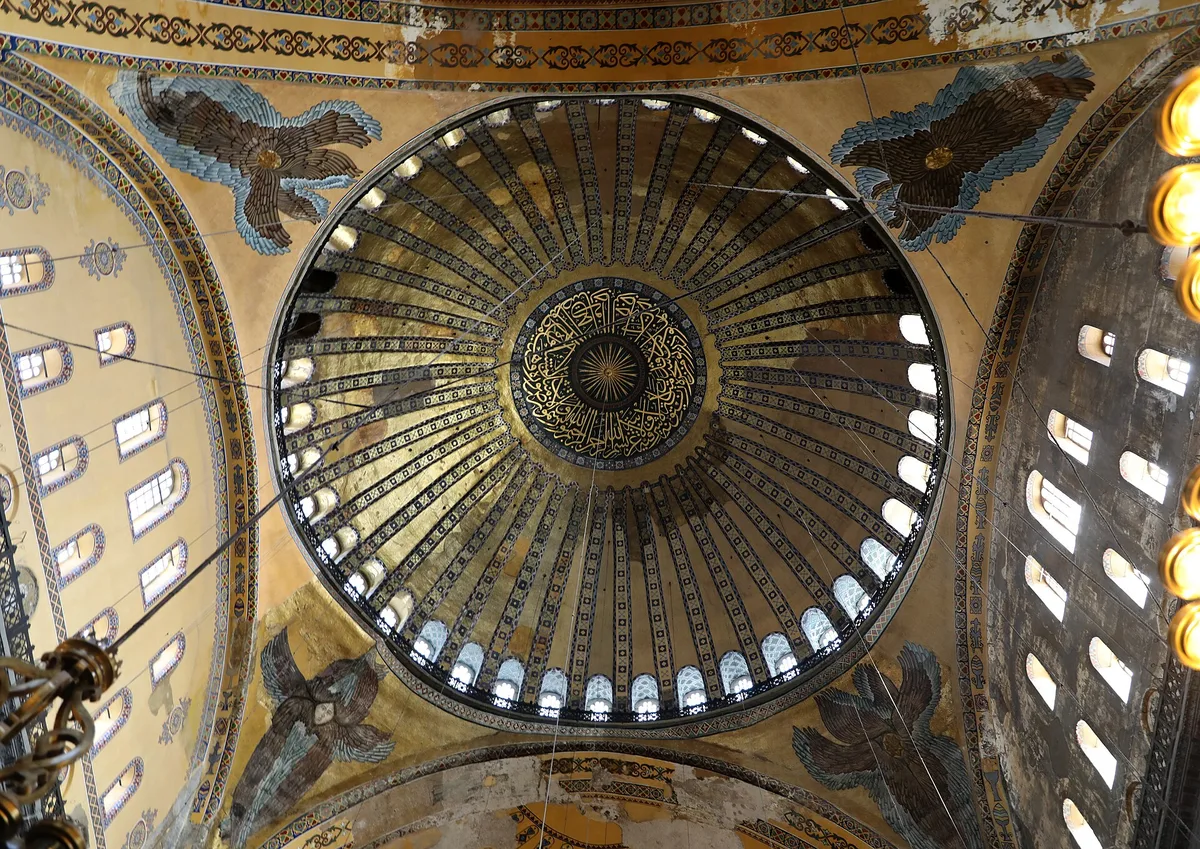
The dome is the reason this hagia sophia guide, and indeed most architecture since, exists. Technically, the trick is the pendentive – the spherical triangle of masonry that fills each corner of a square bay and translates its straight edges into the continuous circular ring a dome needs. Earlier builders had placed domes on round walls, as in Rome’s Pantheon. Hagia Sophia’s architects placed one on a square, high in the air, and by doing so opened the four sides of the square beneath it – east and west to the great half-domes that extend the space into a nave, north and south to the arched walls that rise over the galleries. The result is a centralised space that still reads as a processional one, an engineering compromise so elegant that Ottoman architects, Sinan above all, spent the sixteenth century refining it in mosques across Istanbul.
Look up from the gallery and read the dome as a structure rather than a symbol and it becomes more impressive, not less. Forty ribs radiate from the crown, and between their feet, at the dome’s base, stand the forty windows of Procopius’s floating effect. The dome is shallow – more a saucer than a hemisphere – which spreads its thrust outward as much as downward, into the arches, the half-domes and ultimately the great piers and buttresses. Every part of the building you can see is in that chain of forces. The half-domes are not decoration; they are the dome’s shoulders. The massive piers at the corners, partly hidden behind later additions, are its legs. Even the galleries play a role, their mass stiffening the north and south walls against the outward push.
Falls, Repairs and the Seraph in the Corner
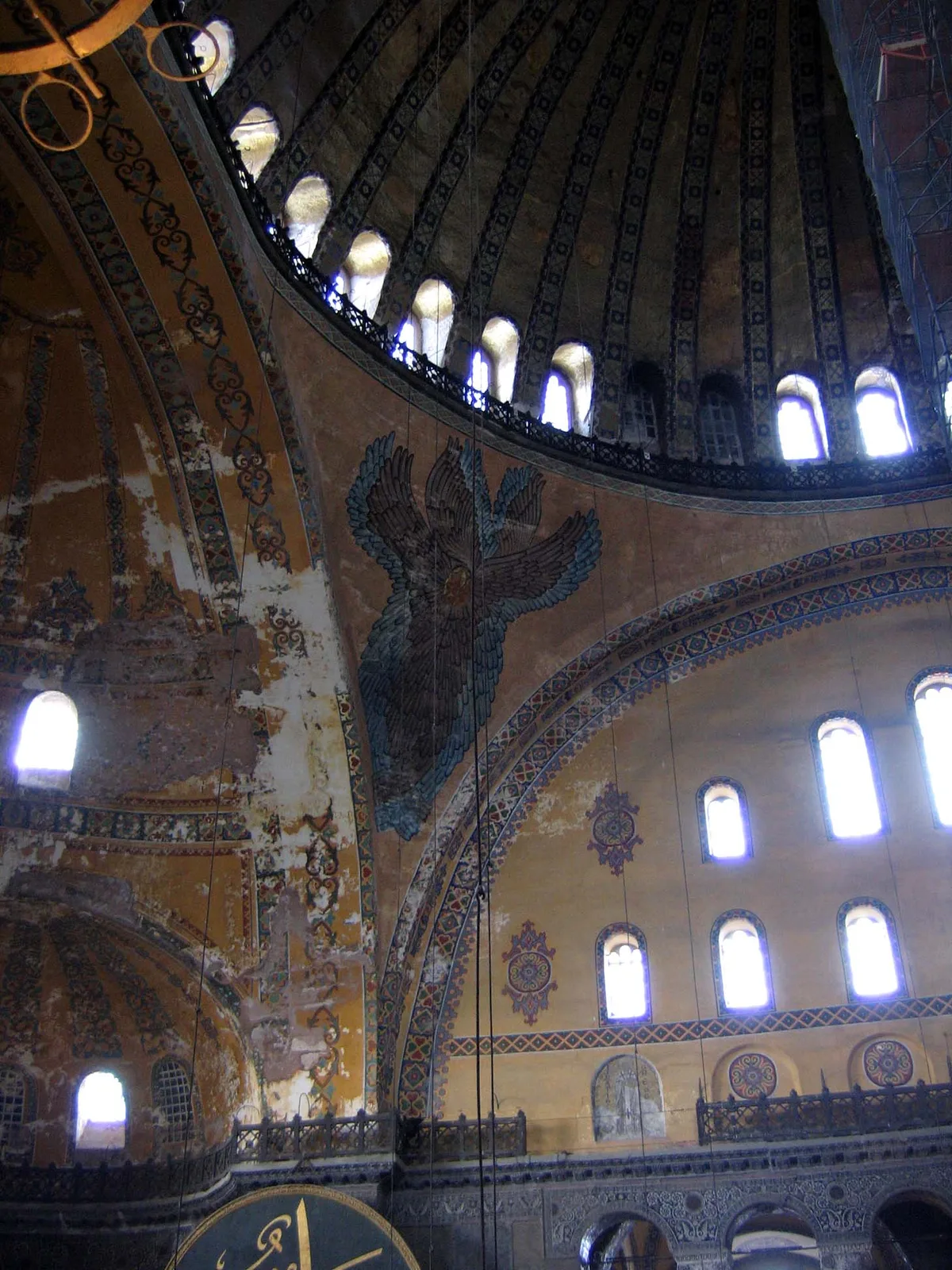
The dome you see is the second one, and parts of it are younger still. The original, flatter cupola cracked in the earthquakes of the 550s and a section of it fell in 558, crushing the altar furnishings below. Isidore the Younger, nephew of one of the first architects, rebuilt it steeper – some six metres higher, in the usual telling – trading some of Procopius’s floating delicacy for a geometry that pushed more of its weight downward and less outward. Later centuries kept editing it. Earthquakes in the 10th and 14th centuries brought down arches and sections of half-dome, each rebuilt in turn, and in the Ottoman period Sinan wrapped the building in the great buttresses that now define its exterior, a structural exoskeleton that has carried it through every quake since. Hagia Sophia’s survival is not luck. It is maintenance, sustained across three civilisations.
In the corners beneath the dome, on the pendentives themselves, the Byzantines set four enormous seraphim – six-winged angels, each some ten metres across, mosaic faces at the centre of a whirl of wings. Under the mosque their faces were covered, in time by great star-shaped metal masks, and for centuries the seraphim were bodies without faces. In 2009, during museum-era restoration, one face was uncovered in full – a calm, Byzantine face that had spent centuries behind its mask – and it is among the things to hunt for from the gallery rail, high in the north-eastern pendentive. It is a small, perfect emblem of the building’s layered life: made by one empire, veiled by another, revealed by a republic, and still there now that the building prays again.
Becoming a Mosque – 1453 and the Ottoman Centuries
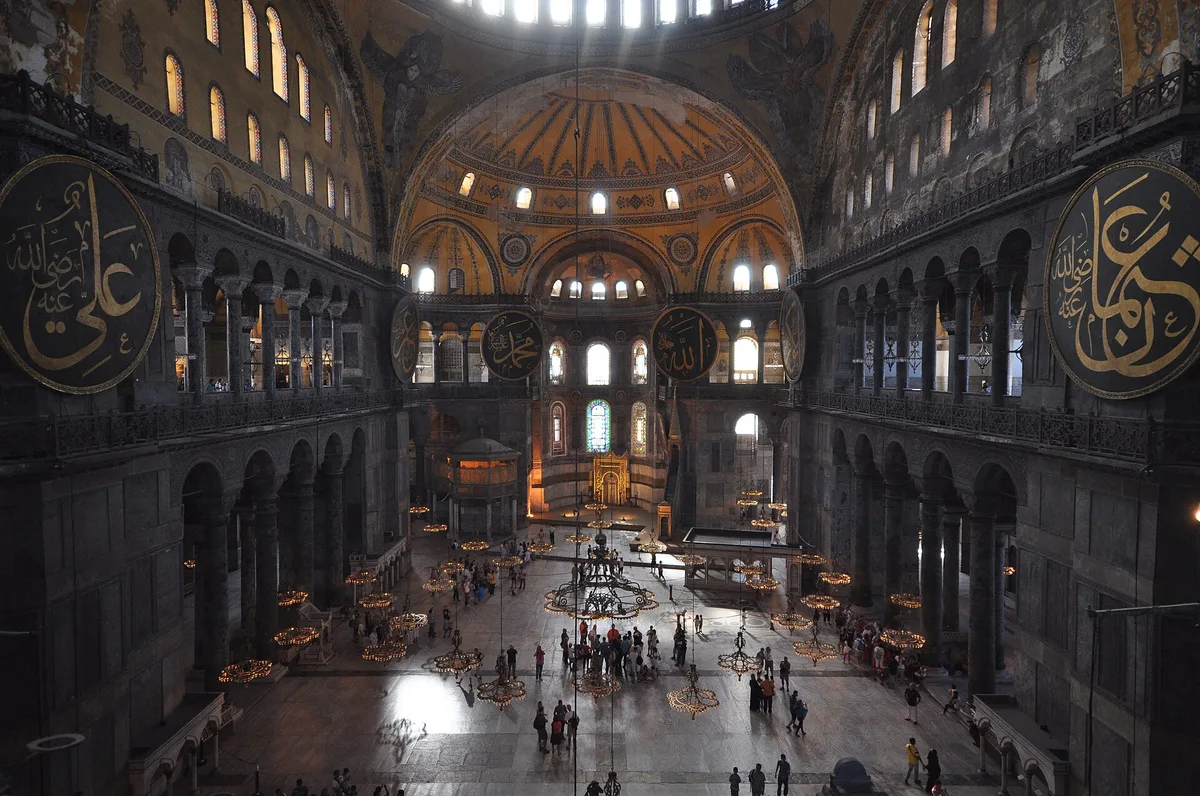
The conversion of 1453 was, by the standards of conquest, an act of preservation as much as possession. Mehmed II endowed Hagia Sophia as a mosque – the Ayasofya – and its Christian fabric was adapted rather than erased. The cross came down and the altar went, a mihrab was built into the south-eastern side to orient prayer toward Mecca, and a minbar, the pulpit from which the Friday sermon is given, rose beside it. Because Mecca from Istanbul lies a few degrees off the church’s eastward axis, the mihrab and the prayer rows aligned to it sit visibly askew inside the older geometry – one of the most eloquent details in the building, two sacred geographies drawn on the same floor. The first minaret, of wood, went up almost immediately; the four stone minarets that now frame the dome were added across the following century and a half, the elegant pair at the north-east and south-east associated with Sinan’s great strengthening campaign under Selim II and Murad III.
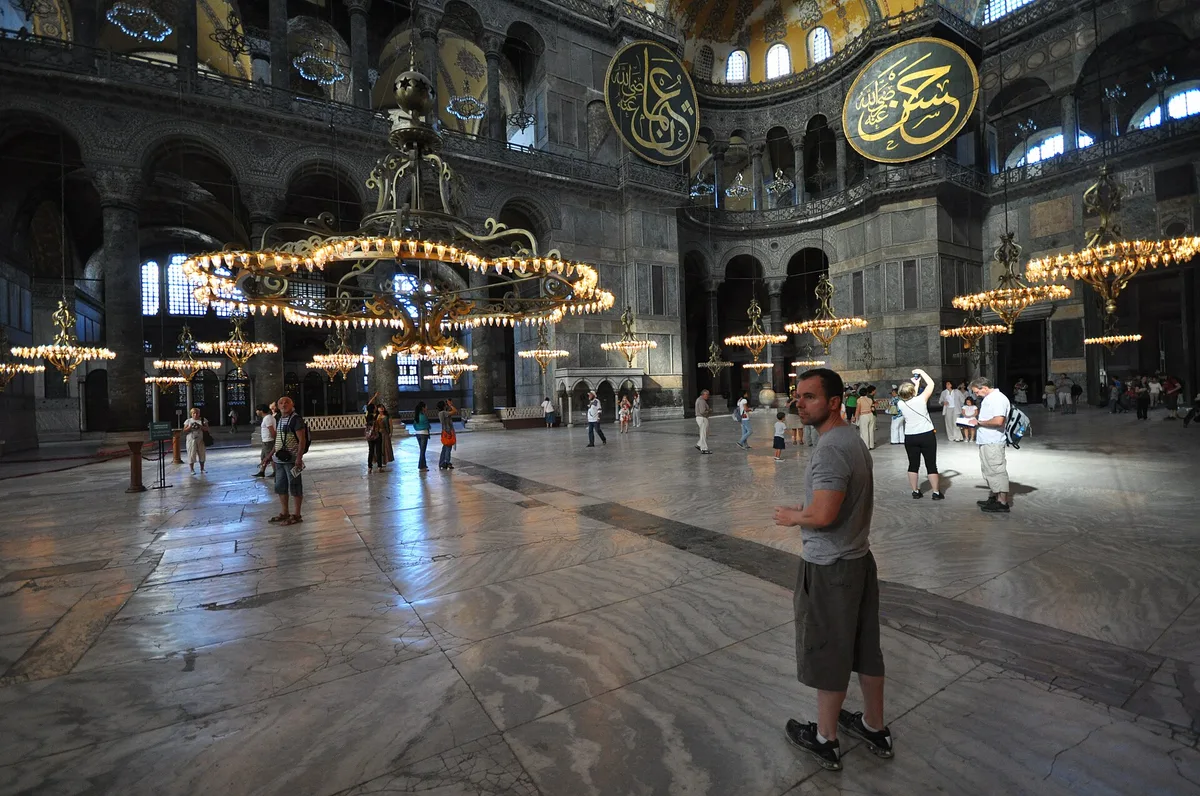
Inside, the mosque centuries layered their own art over and beside the Byzantine work. Eight enormous calligraphic roundels, nearly seven and a half metres across, hang from the piers – among the largest pieces of Islamic calligraphy in the world – bearing the names of Allah, the Prophet Muhammad, the first caliphs and the Prophet’s grandsons, in gilt script on dark grounds, executed in their present form in the 19th century by the calligrapher Kazasker Mustafa İzzet Efendi. The sultan gained a screened lodge, the hünkâr mahfili, from which he could pray unseen; the muezzin’s platform rose in the nave; great candelabra flanked the mihrab. The figurative mosaics, meanwhile, were progressively covered – some plastered, some whitewashed – as the building settled into mosque use. It is one of history’s preservative ironies that the covering protected them. Gold cubes that would have been picked away or weathered in an open ruin survived intact under lime and plaster, waiting for the museum.
The complex grew around the building the way mosque complexes do. On the south-eastern side rose the imperial tombs – the türbes of Murad III, Mehmed III and others of the dynasty, domed mausoleums that are themselves small museums of İznik tilework – and around the building accumulated a madrasa, a primary school, a soup kitchen, a library and the ornate ablution fountain that still stands on the south side. Hagia Sophia in its second life was not a converted church standing alone. It was the centre of an endowed Ottoman institution, maintained by its own revenues, staffed by its own imams and muezzins, and woven into the daily religious life of the capital for nearly five centuries – a fact worth remembering when the museum years tempt you to treat 1453 to 1935 as an intermission. For the people who prayed here, it was the main event.
The Museum Years – 1935 to 2020
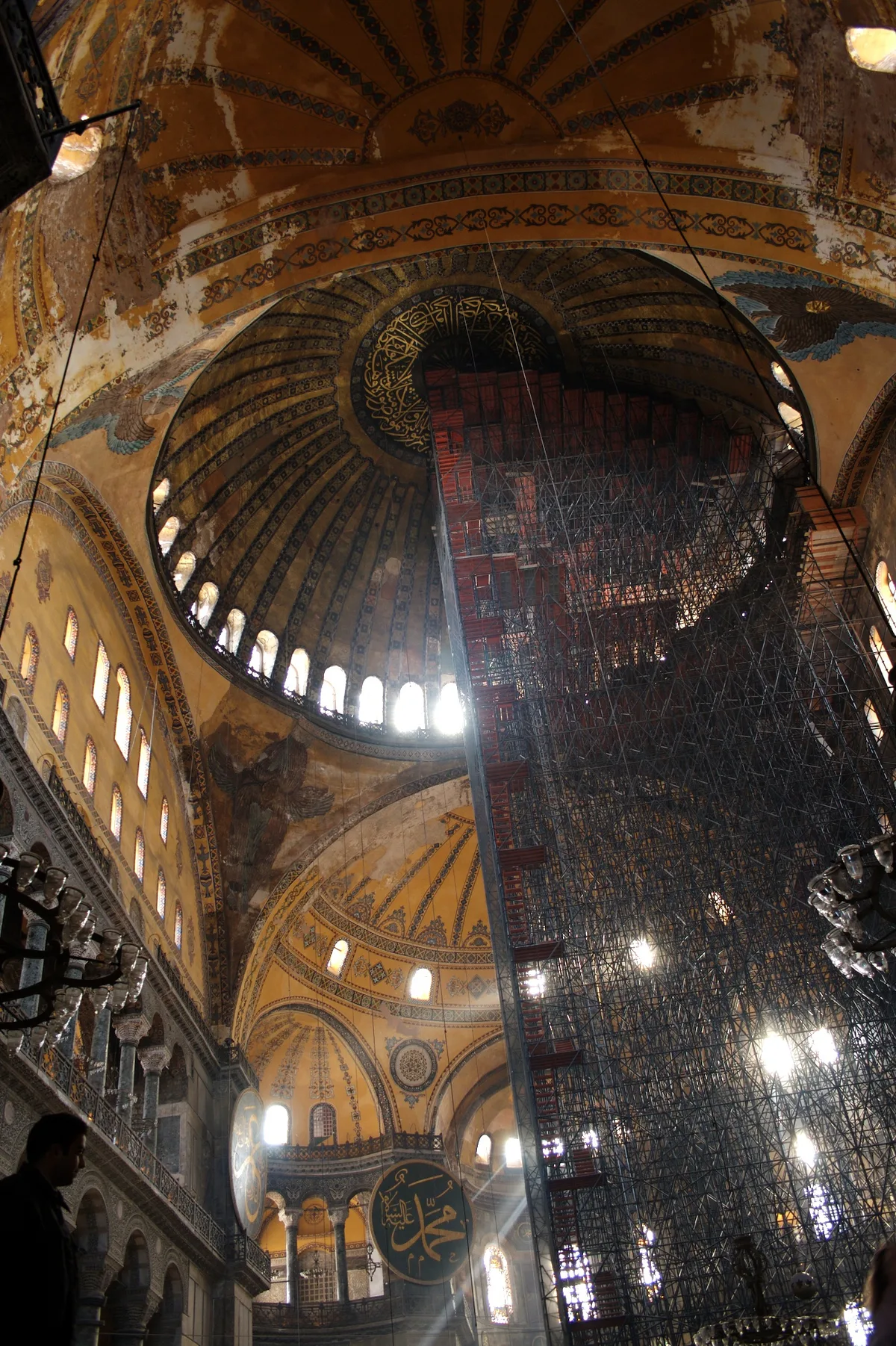
The museum that opened in February 1935 was a product of the Turkish Republic’s founding idea – that the new, secular state would hold the monuments of both its Byzantine and Ottoman pasts as national heritage, open to scholarship and the public alike. Hagia Sophia, the most charged building in the country, was the boldest application of that idea. As a museum it belonged to neither faith, and both could visit it as citizens and tourists. Under its administration the building became one of the great archaeological projects of the century. The American-funded Byzantine Institute, under Thomas Whittemore, had already begun uncovering mosaics in 1931, before the museum formally opened, and the work continued panel by panel for decades – the apse Virgin in the 1930s, the Deësis in 1933-34, the imperial portraits, the seraph’s face much later. Restoration at Hagia Sophia was not an episode of the museum years. It was their permanent condition, and the scaffolding in so many photographs of the period is not an interruption of the museum. It is a portrait of it.
For the visitor, the museum era set the pattern that older travellers still remember and that search results still describe: buy a ticket, pass the narthex, and wander – the nave floor, the omphalion where emperors were crowned, the galleries, the mosaics, the tombs, in your own order and your own time. It was a magnificent way to meet the building, and it is gone, which this hagia sophia guide states plainly because so much of the internet has not caught up. Museum Pass Istanbul covered it; from 2020 it could not, because the building was no longer a museum. Anyone whose itinerary research rests on pre-2020 sources – which includes a large share of the books and blogs in circulation – is planning a visit that no longer exists, to an entrance that is no longer theirs, in a dress code they may not have packed for. The sections that follow describe the visit that does exist.
It is also worth saying, without nostalgia doing the talking, what the museum years achieved that nothing else could have. The mosaics you will see from the gallery survive in their present state because museum conservators stabilised them; the building’s structure was surveyed, shored and understood to a degree no earlier age attempted; and the idea that Hagia Sophia belongs in some sense to everyone – an idea UNESCO’s 1985 inscription of the Historic Areas of Istanbul formalised – was the museum’s gift to the arguments that followed. The mosque era now manages the same building under a different idea, that it belongs first to worship. The tension between those two ideas is the honest background to every visit made today, and the visitor system described next is, in effect, the negotiated settlement between them.
A Working Mosque Again – 2020 to Today
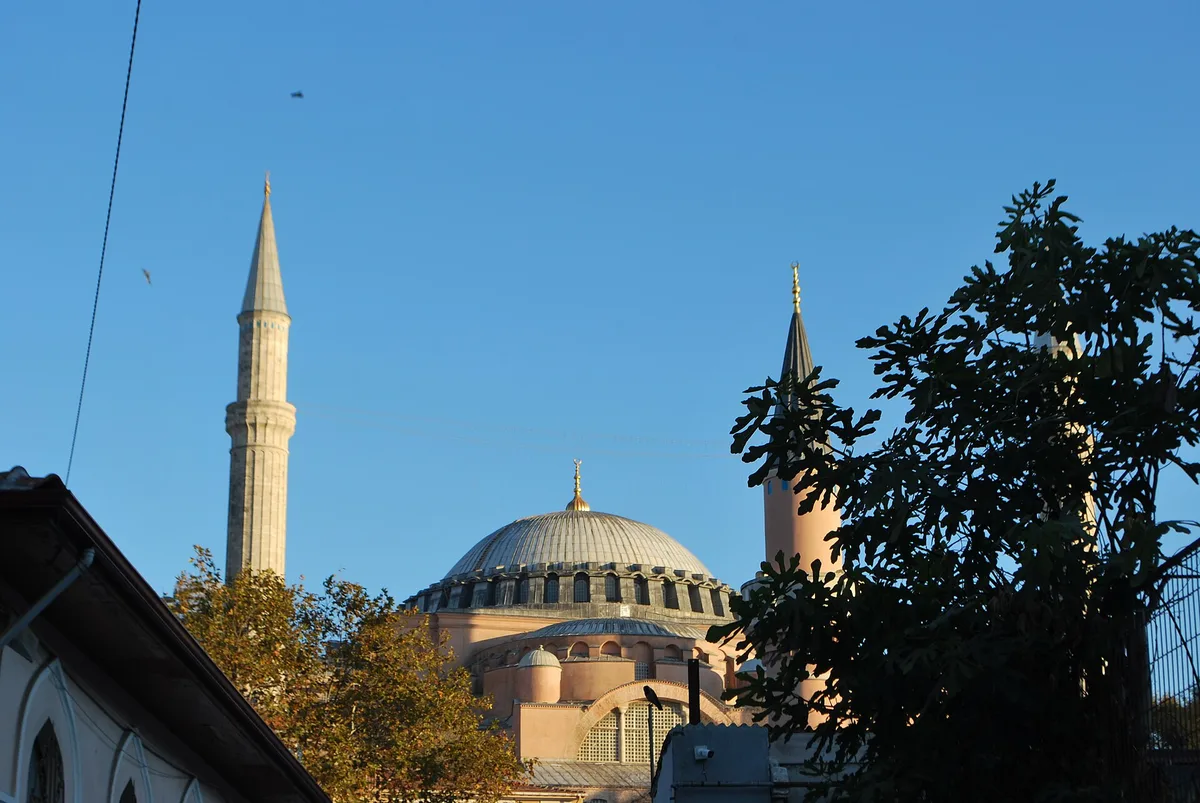
On 10 July 2020 Turkey’s Council of State annulled the 1934 decree that had made Hagia Sophia a museum, and a presidential decree the same day transferred the building to the Directorate of Religious Affairs and reopened it for worship. The first Friday prayer in eighty-six years was held on 24 July 2020, attended by thousands in and around the square. The building’s official name became the Hagia Sophia Grand Mosque – Ayasofya-i Kebir Cami-i Şerifi. Green carpet went down over the marble floor of the nave, where it remains for prayer; the mosaics of the apse are veiled by fabric screens in the prayer area’s sightlines, a solution worked out so that worship could proceed beneath images it would not itself have made; and the great building resumed the working life it had known for most of its existence. Nothing was demolished, and the mosaics were not re-plastered – but the building’s centre of gravity moved, decisively, back to prayer.
The first years of the new arrangement let visitors and worshippers share the ground floor, and the friction of that experiment – sightseeing crowds moving through a prayer hall, photography at the edges of worship – is what produced the system in force since 15 January 2024. Under a visitor management plan introduced by the Ministry of Culture and Tourism, following, as the ministry noted, UNESCO’s recommendations for managing the site, the two publics were separated by level. Worshippers use the ground floor, entering through the mosque’s own doors, free as worship is. Sightseeing visitors – in practice, foreign visitors coming to see the monument – buy a separate ticket and follow the gallery route described in the next sections, entering by a ramp on the building’s southern side, beneath the minaret of Bayezid II, and leaving by a second ramp on the north-east. Turkish citizens who come as worshippers pray below; the gallery ticket is the sightseeing product, and museum passes do not cover it.
For the visitor, the practical meaning of all this is simple and worth stating without complaint. You are a guest in a mosque that has kindly built you a gallery. The building you see is not staged for you; the prayer beneath you is real, the call to prayer that rolls across Sultanahmet five times a day governs your timetable, and the parts of the building that matter most to its daily life – the mihrab, the minbar, the carpeted floor – you will see from above and at a distance, which is where a guest in someone else’s place of worship ordinarily stands. Travellers who arrive in that spirit consistently report the visit as powerful rather than diminished. The ones who arrive expecting the museum of 2019 are the ones who leave frustrated, and the difference is expectation, not access.
How a Visit Works Today – Entrances, Tickets and Prayer Times
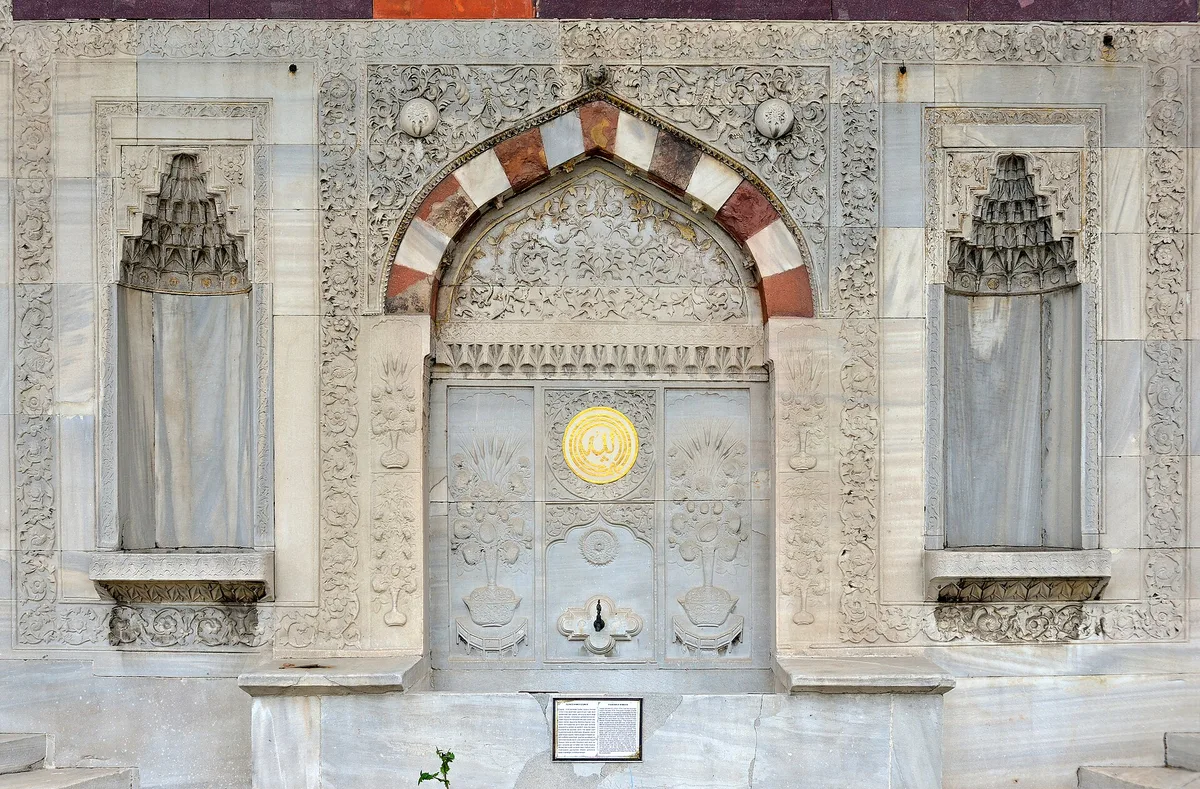
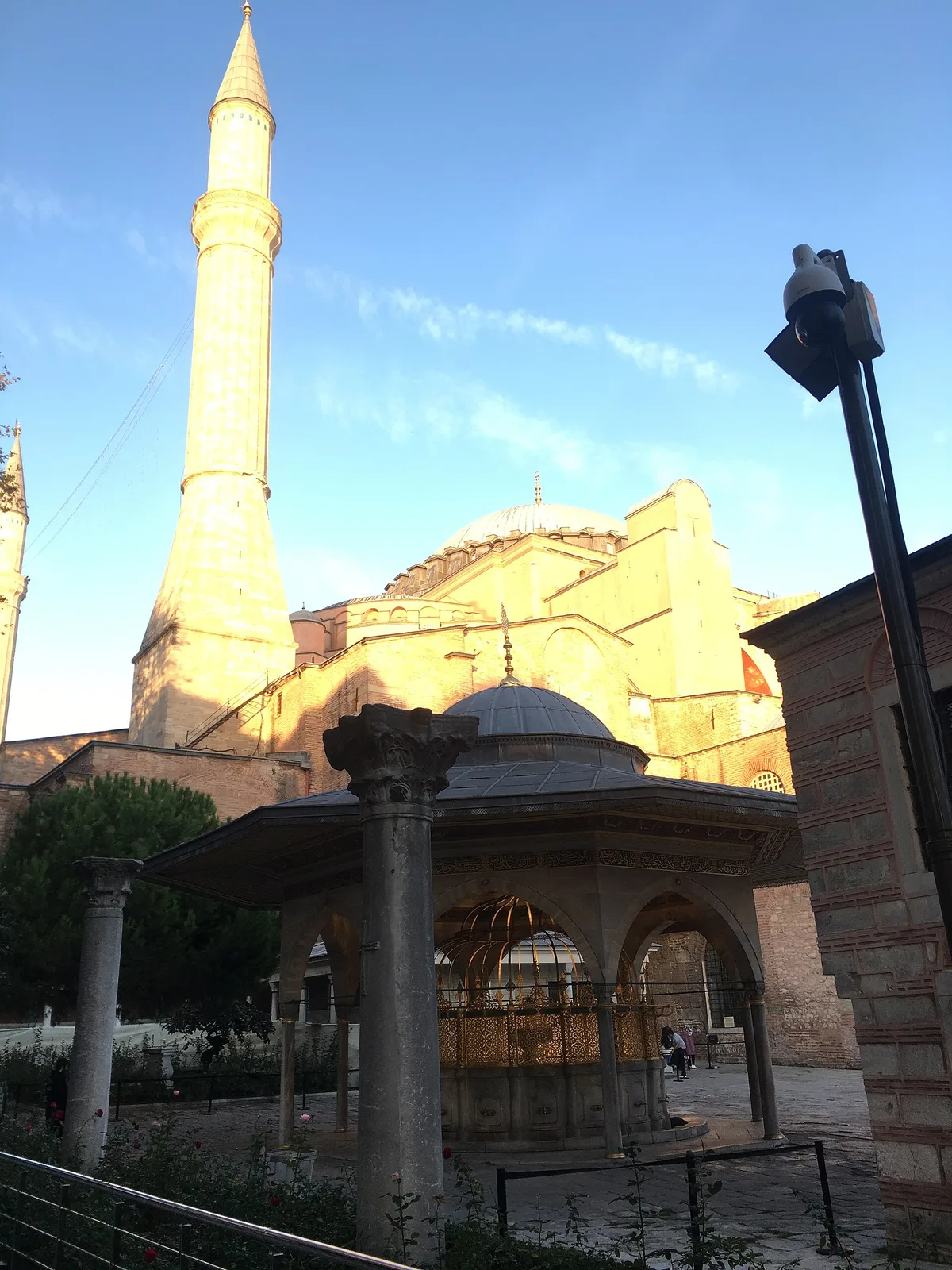
Begin at the doors, because Hagia Sophia now has two systems of them and using the wrong one is the standard first mistake. The doors on the square side, under the great west facade, are for worship. The sightseeing entrance is separate – on the Topkapı side of the building, in the area of the Fountain of Ahmed III, where the ticket point stands and a ramp climbs to the gallery level on the building’s southern flank, passing beneath the minaret of Bayezid II. A second ramp on the north-east side brings you down at the end; the route is one-way, and there is no re-entry once you leave. Anyone outside the entrance offering you a faster way in is not the official channel – the ticket is sold at the official desk and through the ministry’s own sales system, and the current price, hours and closure pattern are the ones published on the official museum portal, muze.gov.tr, which this hagia sophia guide points you to deliberately rather than printing figures that this building has a habit of changing.
Allow for the visit’s full shape when you plan the day. The gallery itself takes most visitors an hour to ninety minutes; the queue at the ticket point and security can take as long again in the high season, so two to two and a half hours around the building is the honest budget. The ramps, it should be said clearly, are steep and are not a step-free route in the way wheelchair users need; visitors with limited mobility should check the current assisted arrangement at the official desk before relying on the gallery route, because the building’s official guidance directs visitors who cannot manage the ramps to a separate entrance arrangement. Families should know the route involves sustained standing and looking over rails – magnificent for older children, hard work with a toddler who wants the floor.
Dress, Prayer Times and Behaviour
The rules are those of any working mosque, applied to a building that also receives the world. Shoulders and knees are covered for everyone; women cover their hair inside; shoes come off where the route crosses carpeted areas, with bags provided to carry them, exactly as at the Blue Mosque across the square. Bring your own scarf and coverings rather than counting on being lent any – arrangements for lending vary and the queue is not the place to discover the day’s policy. Dressing right the first time is the simplest respect a guest can show, and it costs nothing but a moment’s thought at the hotel.
The timetable is the second rule, and it is not negotiable. The visitor route closes around each of the five daily prayers and for a longer stretch around the Friday midday prayer, when the mosque fills for the week’s main congregation. The day’s prayer times are posted and shift gently with the seasons and the sun, which is why this guide prints no clock hours: check the day’s pattern before you set out, aim for the long windows mid-morning after the early prayer or in the later afternoon, and treat Friday morning as the slot to avoid entirely. If the call to prayer sounds while you are in the gallery, the correct behaviour is the easy one – lower your voice, keep still-ish and unobtrusive, and let the building do the thing it exists to do. It lasts minutes, and for many visitors it becomes the memory of the visit: the dome doing, live, the acoustic job it was tuned for in 537.
Photography follows the same guest logic. The gallery route is a sightseeing route and cameras are part of it, but flash, tripods and photographing worshippers at prayer are the lines – the people below you are not exhibits, and the building’s staff will intervene if a lens treats them as such. Restoration, finally, is a standing condition of this monument: parts of the interior are routinely screened or scaffolded for conservation, and which parts changes year to year. Treat whatever is screened as the price of the building surviving another fifteen centuries, because that is literally what it is.
The Upper Gallery Route – What You Actually See
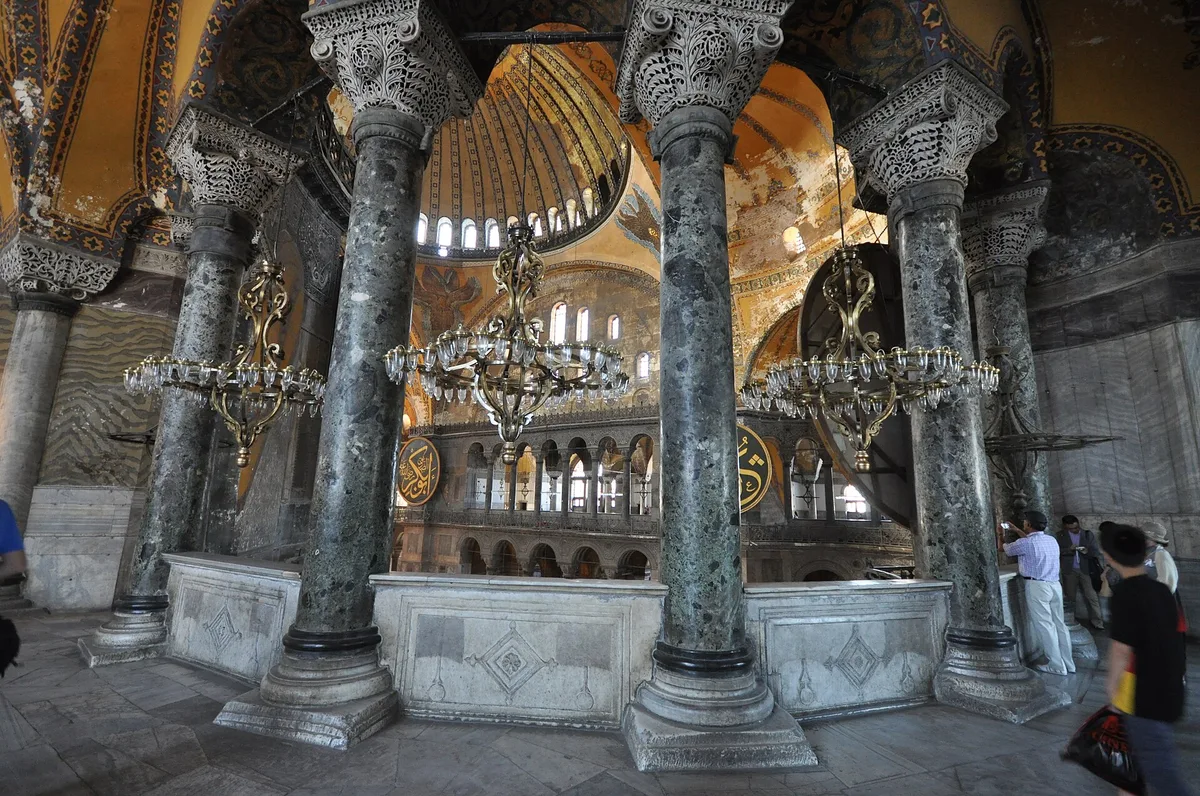
The ramp delivers you to the gallery level at the building’s southern side, and the first thing to understand about the gallery is that it was never a viewing platform. In the Byzantine church this was real liturgical and imperial space – the women’s gallery in later tradition, the level from which the empress and her court attended, connected to the palace side of the building, floored in marble and colonnaded toward the nave. Walking it today, you are standing where the court stood, looking down at the space the congregation filled, and the route’s sequence – south gallery first, with its mosaics, then the great open views across the nave – follows the building’s own geography rather than a museum designer’s.
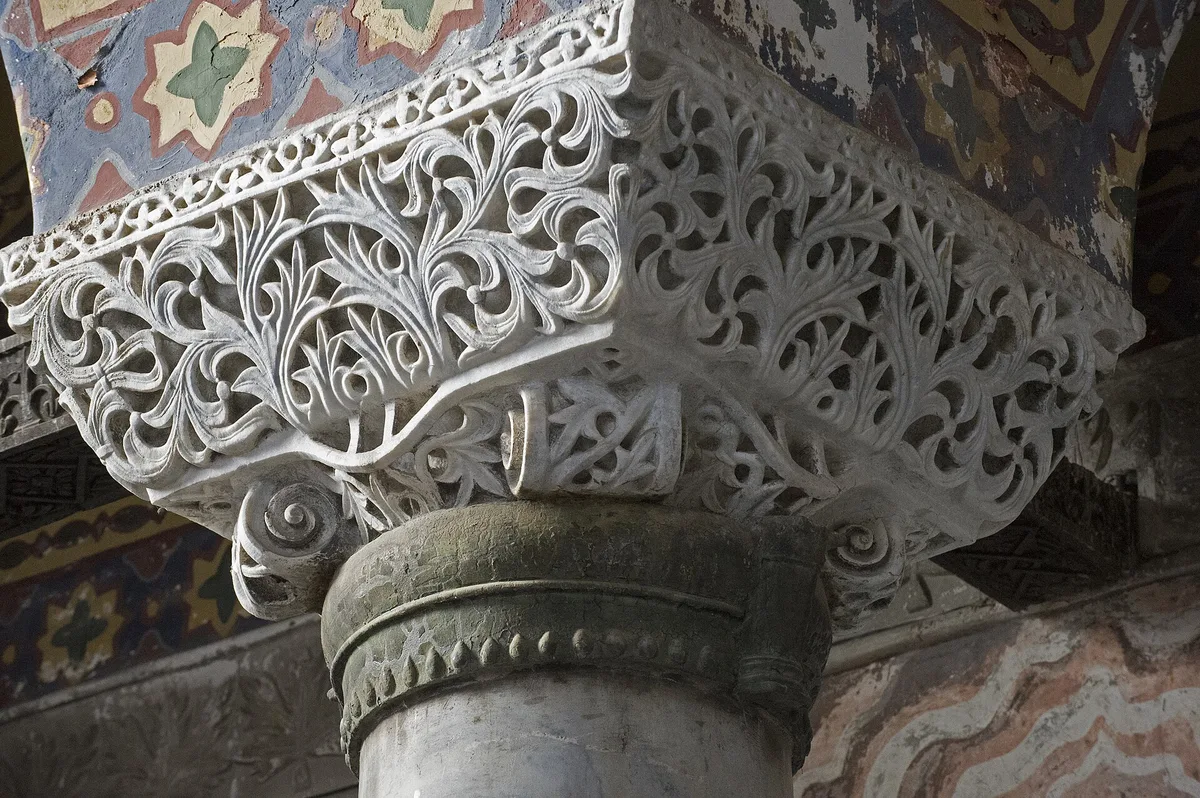
The gallery rewards a slow circuit rather than a march to the famous panels. Its marble floors are worn into gentle hollows by fifteen centuries of feet. Its columns carry capitals carved with the monograms of Justinian and Theodora, woven into acanthus so fine it reads as lace in stone. Openings screened toward the nave frame the views down in deliberate compositions – dome, chandeliers, carpet, roundels – so that the building reveals itself in chapters. And because the route is one-way and single, the crowd’s pace sets yours unless you deliberately let a group pass and take the next stretch slowly. The mosaics that follow in this guide are arranged in the order a visitor meets the great sights: the view first, then the apse at the building’s east end, then the south gallery’s panels – the Deësis and the emperors – which are the gallery’s treasures and the visit’s climax.
One honest note belongs here, before the sights themselves. The gallery is not the whole building, and pretending otherwise would make this hagia sophia guide a sales pitch rather than a guide. You will not stand on the nave floor among the columns, cross the omphalion, pass through the Imperial Gate beneath its great mosaic, or see the ground-floor details – the weeping column, the sultan’s lodge at close range – except from above. Those belonged to the museum visit, and they are described later in this article for completeness, clearly labelled as not on the route. What the gallery gives in exchange is coherence: the architecture reads better from up here, the mosaics are at your level rather than twenty metres over your head, and the prayer life of the mosque proceeds below you undisturbed, which is, in the end, the arrangement’s whole point.
The View Down – Reading the Great Space From Above
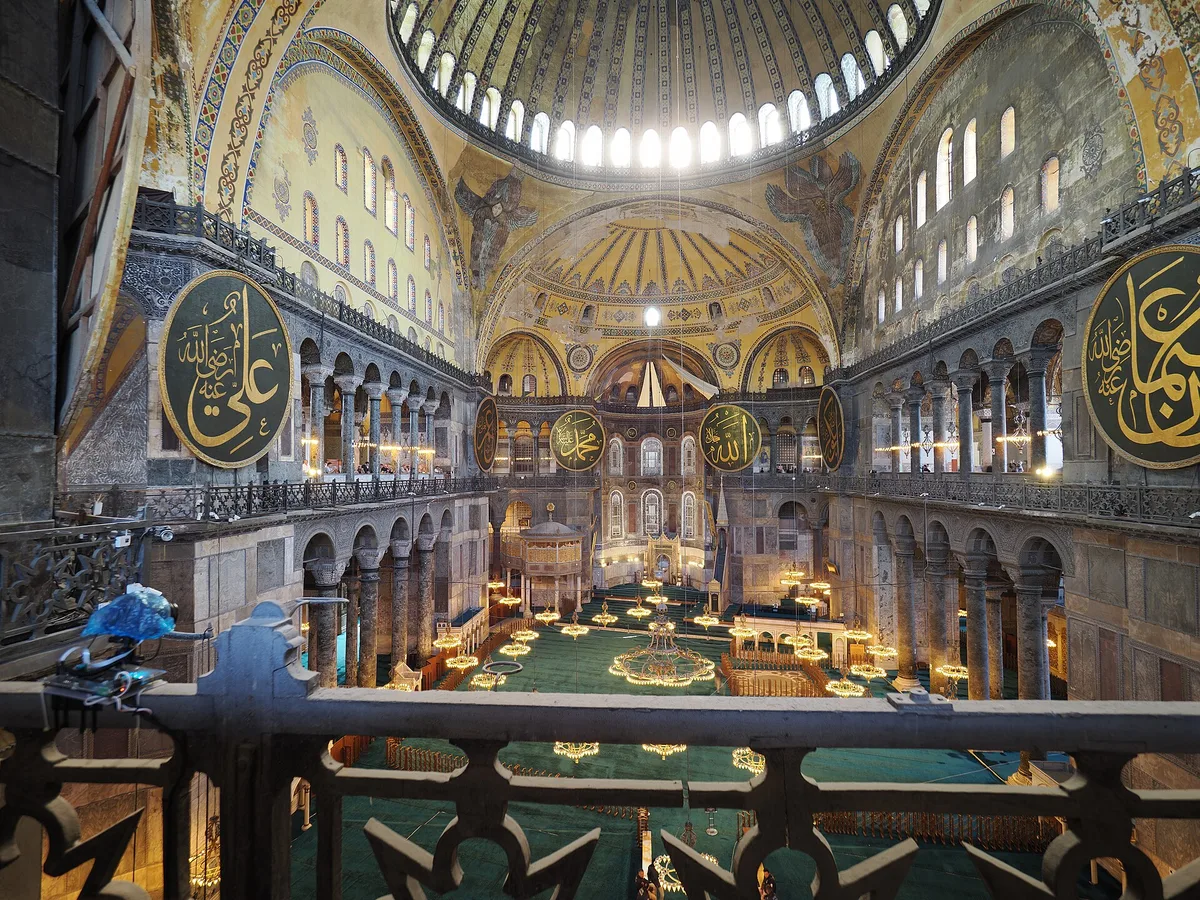
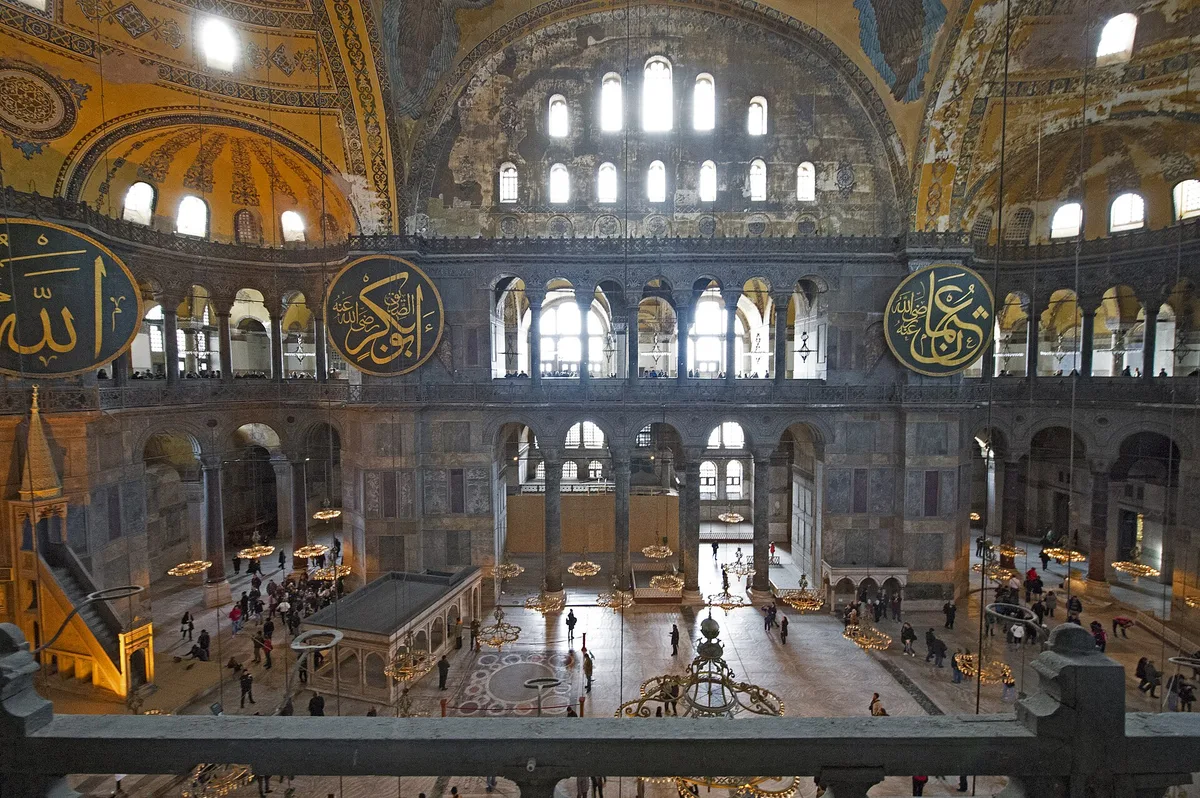
Take the view in layers, the way the building presents it. At the top, the dome and its ring of windows, closer to you here than the old ground-floor visit ever brought anyone – near enough to read the ribs, the patchwork of repairs, and the calligraphic band at the crown. Below it, the half-domes step the space down east and west, and the tympanum walls, pierced with windows, pour their light across the marbles. At your own level and below, the chandeliers hang in their great constellation – modern fittings on an ancient pattern, since the polycandelon rings of the Byzantine church established the look a millennium and a half ago. And at the bottom, the floor: green carpet now, laid for prayer, with the mihrab’s angle drawn across it and, beneath the carpet at the building’s heart, the omphalion’s coloured marbles sleeping out of sight.
This is the vantage from which the building’s engineering story, told earlier in this guide, stops being abstract. The pendentives curve beneath the dome at the four corners exactly where the drawings said they would. The great piers read as the massive verticals they are. You can see why the north and south walls bowed and needed their buttresses, and why the galleries themselves – the floor under your feet – act as the building’s stiffening belt. Visitors who know the type from Sinan’s mosques will recognise the grammar instantly, because Sinan learned it here: this is the prototype, the first and still the boldest statement of the domed square that Ottoman architecture would spend three centuries perfecting across the square and up the hill at the Süleymaniye.
The view also teaches the visit’s central courtesy better than any sign. From the rail you look down on people praying, studying, sitting with their children on the carpet of their mosque – the same floor where, in another life of the building, you might have wandered with a museum ticket. The distance is the design. You see everything and intrude on nothing, and if the arrangement at first seems a compromise, five quiet minutes at the rail usually revise the opinion. The gallery was where this church always put its honoured observers. It has simply resumed the job.
The Apse Mosaic – The Virgin and Child Above the Mihrab
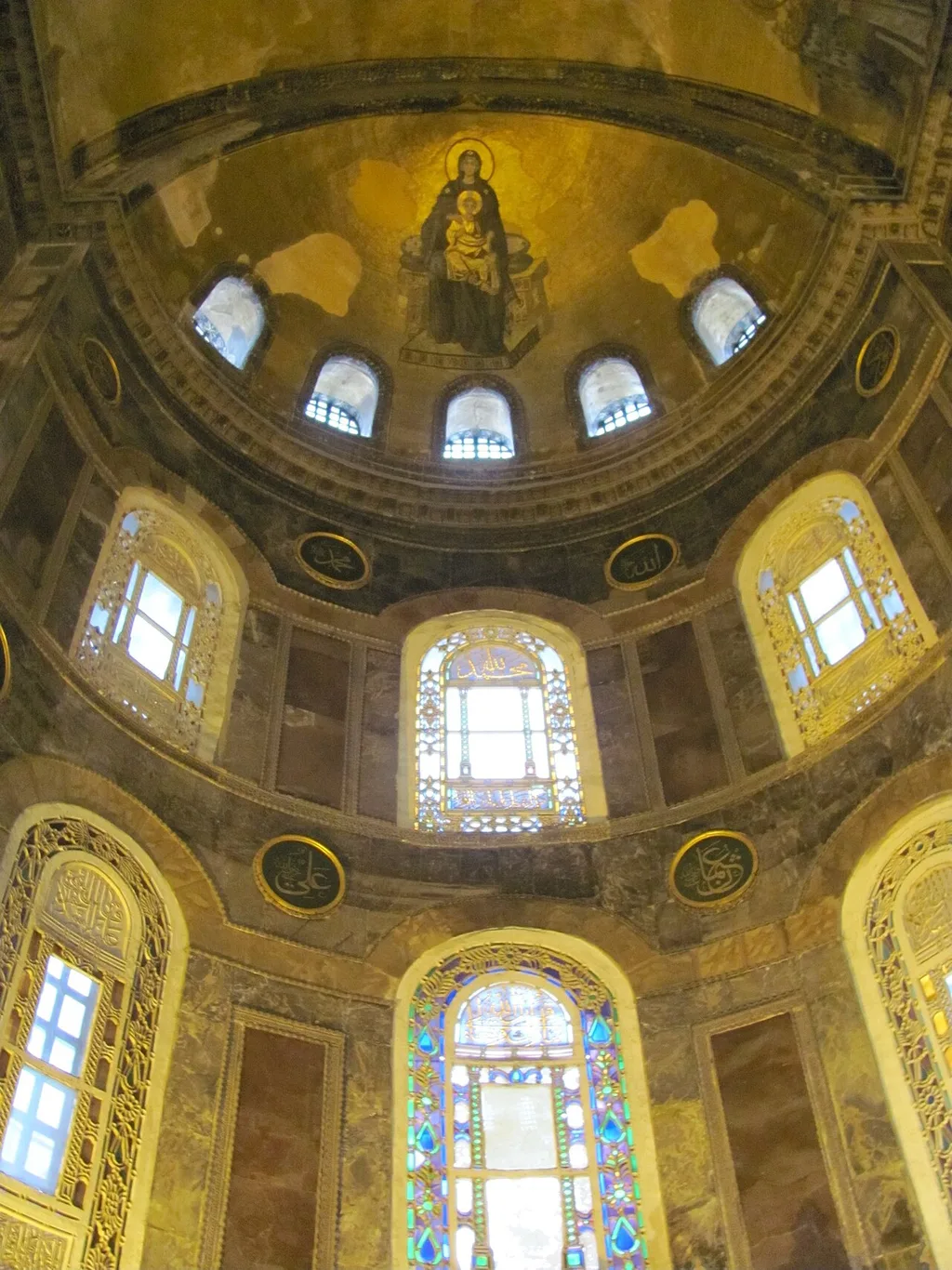
High in the semi-dome of the apse, at the building’s eastern end, sits the oldest and most solemn of Hagia Sophia’s surviving mosaics: the Virgin enthroned, holding the Christ Child on her lap, against a field of gold. It was dedicated on 29 March 867, in a sermon by the Patriarch Photius that survives – he presented the image as the visible end of Iconoclasm, the century-long imperial ban on religious figures that had left this apse decorated with a plain cross. The mosaic you see is therefore not just an artwork but a manifesto: the first great figurative image restored to the empire’s greatest church, announcing that the age of the image-breakers was over. At roughly five metres high, the Virgin was designed to be read from the floor far below, her scale and gold ground calibrated to the vastness of the space.
Her afterlife mirrors the building’s. In the mosque centuries the apse mosaic was covered – exactly when and how completely the sources argue about – and she spent the Ottoman period behind plaster and whitewash, which preserved her gold and her lapis blues from light and hands. The museum era uncovered and cleaned her in the 1930s, and for the rest of the twentieth century she presided over the museum’s nave as its presiding image, reproduced on a million tickets and postcards. Since 2020 she presides over a mosque again, and the building has handled the theological delicacy the practical way: fabric screens veil the apse image from the prayer floor’s sightlines during worship, so that the congregation prays beneath a covered image rather than a destroyed one. What a gallery visitor can see of her varies with those arrangements – she is high, far, and at the far end of the building from the south gallery’s best positions – so go expecting a distant, dignified presence rather than a close study, and let the Deësis, a few steps away and at eye level, be the mosaic you examine.
That distance is worth one more honest sentence, because expectations here are often set by museum-era photographs taken from scaffolding. The apse Virgin in person is an apparition more than a picture – gold, height and fourteen centuries of meaning, glimpsed down the length of the greatest interior of the ancient world. Travellers who understand that in advance tend to be moved by her. Travellers who arrive expecting to stand beneath her with a camera, as a 2015 blog post promised, are the ones who feel cheated – and the fault is the blog post’s, not the building’s.
The Deësis – The Gallery’s Masterpiece
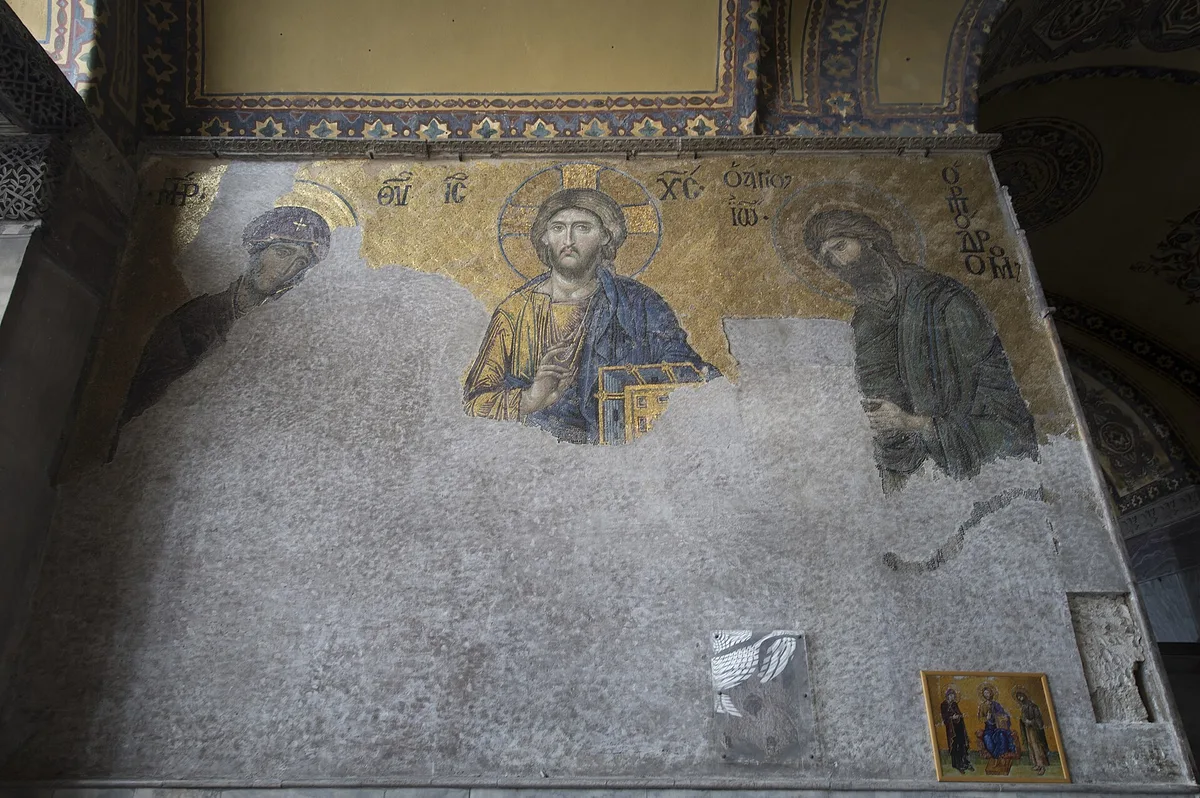
If the gallery route has a single destination, it is this panel, set into the south gallery’s wall: the Deësis, the Intercession, made in 1261, the year Constantinople was retaken from the Latin crusaders and the Byzantine empire restored. Christ sits enthroned at the centre, blessing with one hand and holding a jewelled Gospel book in the other, flanked by the Virgin on his right and John the Baptist on his left, both turned toward him in pleading postures – interceding, in the image’s theology, for humanity on the Day of Judgement. It is the last great mosaic made for this building and, by near-universal agreement among those who study Byzantine art, one of the supreme achievements of the medium anywhere – the point at which mosaic, a technique of stones, achieved the softness and psychological depth of painting.
Stand close, as the gallery lets you, and look at how it is done. The faces are built from tesserae far smaller than those of the building’s earlier mosaics, set at subtly varied angles so the surface shimmers as you move – the gold ground does not sit flat but breathes. Christ’s face carries an expression art historians have been describing for a century without exhausting: judge and merciful in the same features, authority in the brow, compassion around the mouth. The Virgin’s and the Baptist’s robes fall in cascades of blue and green-gold that took the restorers of 1933-34, who uncovered the panel from under the plaster that had hidden it since some point in the Ottoman centuries, by surprise as much as anyone. They found not a competent late panel but a masterpiece that had been waiting five hundred years in the dark.
The practical notes are brief because the panel asks little of you. It sits at eye level behind its protective glazing, in a stretch of gallery that can bottleneck when a group arrives – wait them out rather than photographing over shoulders, because the panel rewards the unhurried minute more than any other sight on the route. Note, too, its state: the lower portions and the edges are damaged, whole passages of the court of heaven that once surrounded the three figures are lost, and what survives is perhaps the centre of a larger composition. Even so. Visitors who see one mosaic in Istanbul should see this one, and the gallery route – whatever its restrictions – puts you closer to it than the museum’s floor plan ever did.
Emperors in Mosaic – The Imperial Portraits of the South Gallery
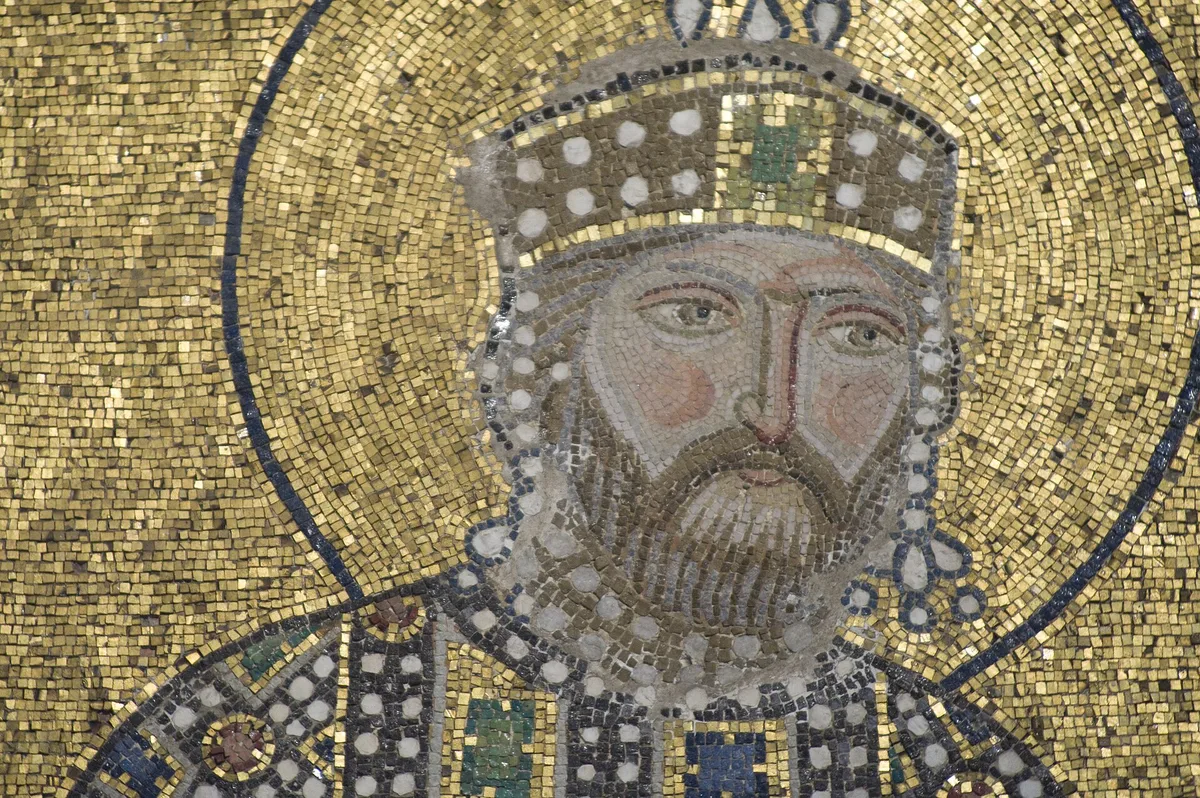
A short walk from the Deësis, the south gallery holds the building’s most human documents: the imperial donation panels, in which emperors and empresses present their gifts to Christ and the Virgin, and are presented in return to posterity. The most famous is the Zoe panel, made around 1042-1050. Christ sits enthroned at the centre. On one side stands the Emperor Constantine IX Monomachos, offering a bag of gold; on the other, the Empress Zoe, holding the scroll that records the donation. The panel’s drama is in its alterations. Zoe outlived husbands, and the mosaic was altered with her life: the emperor’s face and name were reworked from an earlier husband into Constantine’s, and Zoe’s own face was recut in middle age – scholars have traced the seams of all of it in the tesserae. It is an imperial portrait, a legal record and a piece of marital history, all in one gold panel.
Beside it, the Komnenos panel of 1122 shows the next century’s dynasty at the same business: the Virgin and Child at the centre, the Emperor John II Komnenos presenting his purse of gold on one side, the Empress Irene – a Hungarian princess, shown red-haired and pale in a deliberate note of foreignness – holding her scroll on the other, with their son Alexios, co-emperor and dead young, added in a side panel on a pier. Together the two panels do something the architecture cannot. They put faces, names and family politics into the vast impersonal space, and they record the building’s central role in the empire’s life: this was where emperors came to be seen giving, in gold, in mosaic, in perpetuity, in the gallery their own court used.
Both panels survived the mosque centuries under plaster, like the Deësis, and were uncovered in the museum era – the Zoe panel fully in the 1930s. From the gallery route you stand directly before them, at the distance of a conversation, which is the distance they were made for: these were not distant apse apparitions but court images at eye level, in the court’s own part of the church. Read the inscriptions if your Greek stretches, look for the re-cut face in the Zoe panel, and notice the money – the apokombion, the knotted purse of gold coins, rendered with a bookkeeper’s care. Empires ran on donations like these, and Hagia Sophia’s endowment was among the largest in the Christian world. The panels are its receipts, framed in gold.
The Imperial Gate Mosaic – The Great Image the Route Does Not Reach
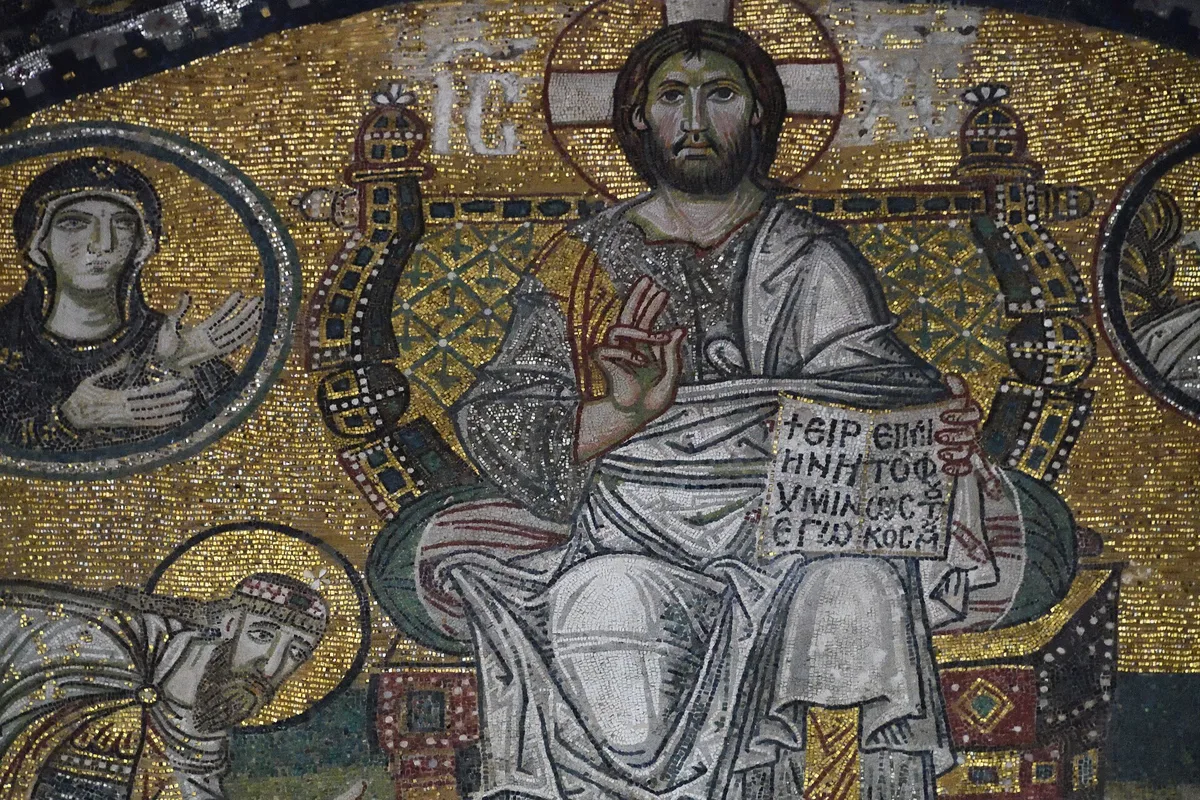
Honesty about what the gallery route misses begins with its greatest treasure. Above the Imperial Gate – the vast central door from the inner narthex into the nave, reserved in Byzantine times for the emperor’s entrances – sits a mosaic of the late ninth or early tenth century: Christ enthroned, blessing, an open book on his knee displaying the words Peace be with you; I am the Light of the World, medallions of the Virgin and the Archangel Gabriel at his sides, and at his feet, prostrate in full submission, an emperor, usually identified as Leo VI, begging forgiveness – tradition connects the image to Leo’s penance after his disputed fourth marriage, when the patriarch barred him from this very door. It is one of the most politically charged images in Byzantine art: the emperor of the Romans on his face before the true ruler, at the threshold of the empire’s church.
The gallery visitor does not pass it. The Imperial Gate stands at ground level in the narthex, in the worship side of the building’s modern division, and the ramp route neither starts nor ends there. You may catch a distant, angled awareness of the narthex from the gallery’s west end, but the mosaic itself – its inscription, the emperor’s bowed figure, the book’s open page – belongs to the parts of the building this hagia sophia guide must describe rather than promise. It is included here, with its photograph, because leaving it out would falsify the building; but it is labelled plainly so that no reader mistakes the description for an itinerary. If seeing it at close range matters to you, that is a fact about the current arrangement to absorb before you travel, not a disappointment to collect on the day.
The same label applies to a handful of other ground-floor sights the museum generation knew well: the omphalion, the great inlaid marble circle in the nave floor where emperors were crowned, now beneath the prayer carpet; the weeping column in the north-west of the nave, its worn bronze sheathing and thumb-hole wrapped in legend; the sultan’s lodge and the mihrab at close quarters. All remain in the building; all are part of its story; none is on the sightseeing route. A guide that tells you this in advance has done its job. The gallery holds enough – the dome, the view, the Deësis, the emperors – to justify the journey on its own terms.
Small Things in the Gallery – A Doge, Some Runes and a Marble Door
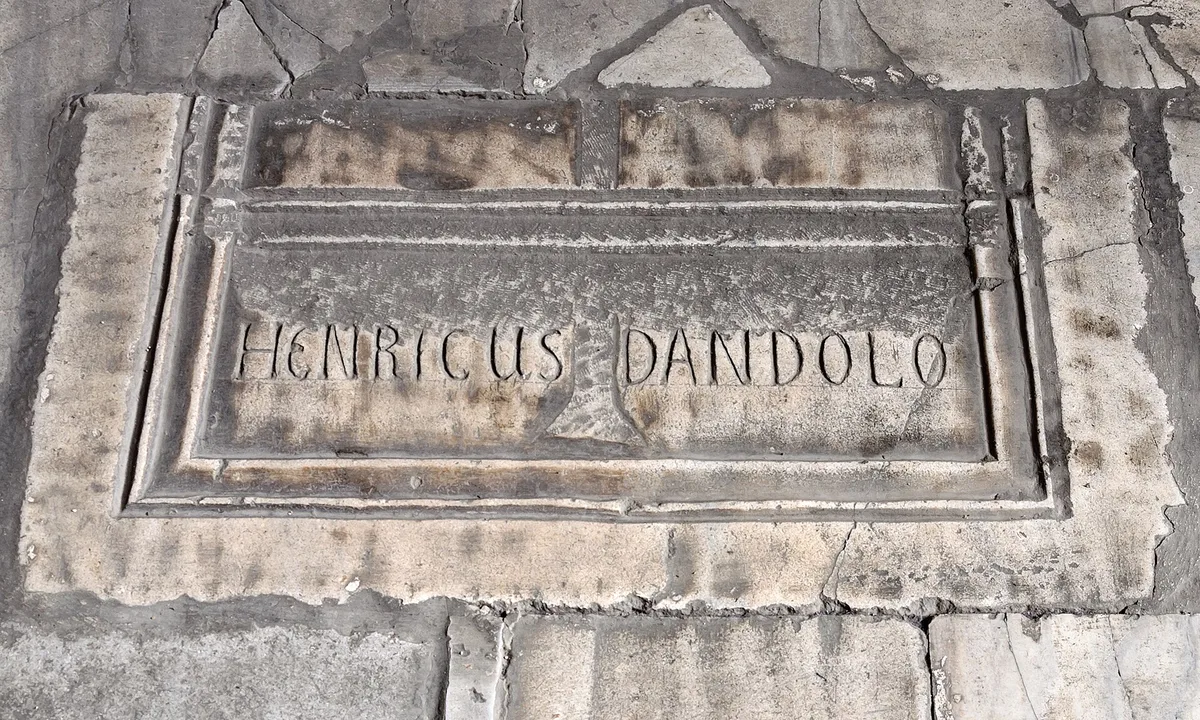
The gallery’s minor sights reward the visitor who has slowed down. Set into the south gallery floor is a modest marble marker bearing the name HENRICUS DANDOLO – Enrico Dandolo, the blind, elderly Doge of Venice who diverted the Fourth Crusade to Constantinople in 1204 and died in this city the following year, to be buried in Hagia Sophia itself. The slab is a 19th-century marker of the believed spot rather than the doge’s medieval tombstone – the original grave was lost in the building’s later lives – but the fact it commemorates is real, and stranger than fiction: the man who broke the Byzantine empire lies in its greatest church, in the gallery the crusaders’ descendants now tour. Few floor slabs anywhere carry more history per square metre.
Elsewhere in the gallery, the details are smaller still. On a marble parapet of the south gallery, a visitor from a very different world scratched his name in runes – Halfdan, a Varangian guardsman, one of the Scandinavian mercenaries who served the emperors, leaving the Viking equivalent of graffiti in the empire’s holiest building, probably in the 9th or 10th century. The inscription is faint, protected, and easy to walk past; ask the gallery staff to point you toward it if it is on show, and take the faintness as part of the point – this is not a monument but a signature, left by a young soldier a thousand years before the word tourist existed. The crusaders left their marks too, in scratched crosses and names across the gallery’s stones, and the building wears all of it without ceremony.
And then there is the Marble Door, in the south gallery’s western stretch – a great door of white marble carved in imitation of wood panelling, traditionally said to have separated the rooms where the patriarch and the emperor met, and wrapped in the folklore that attaches to every beautiful door in an old building. None of these small things would justify the trip alone. Together they do what the great sights cannot: they shrink the building to human scale, to a doge’s vanity, a guardsman’s boredom, a craftsman’s joke in marble pretending to be wood. A building that has been used this hard, by this many kinds of people, for this long, accretes exactly this kind of detail – and the gallery, because it moves you slowly along one level at one pace, is the best place in Hagia Sophia to notice it.
Outside the Walls – Buttresses, Minarets and the Tombs of Sultans
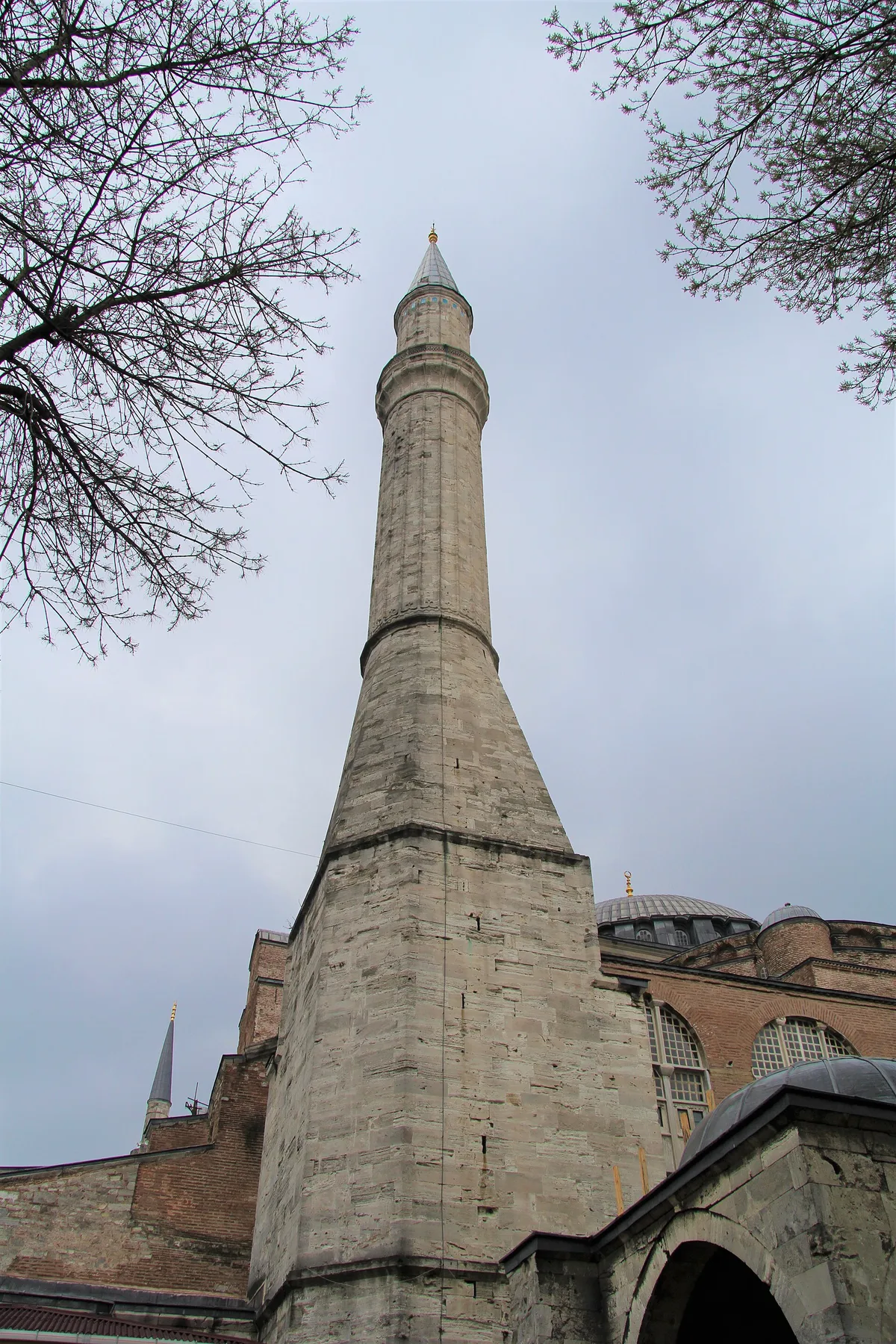
Step back outside and walk the building’s perimeter before you leave the square, because the exterior explains the interior’s survival. The mass you see is a palimpsest of structural first aid: the original sixth-century walls, the great western flying buttresses added in the Byzantine middle ages, and Sinan’s massive Ottoman buttress towers on the north and south, built in the 1570s when the ageing church-mosque was found to be leaning. Sinan, who regarded Hagia Sophia as the standard his own mosques had to answer, effectively became its third architect; the minarets he added or rebuilt – the matched pair in brick-red stone at the building’s eastern corners among them – are part of the same campaign that saved the dome. The silhouette the world knows, dome plus four minarets plus a skirt of buttresses, is thus a collaboration across a thousand years between two empires that agreed about nothing except that this building must stand.
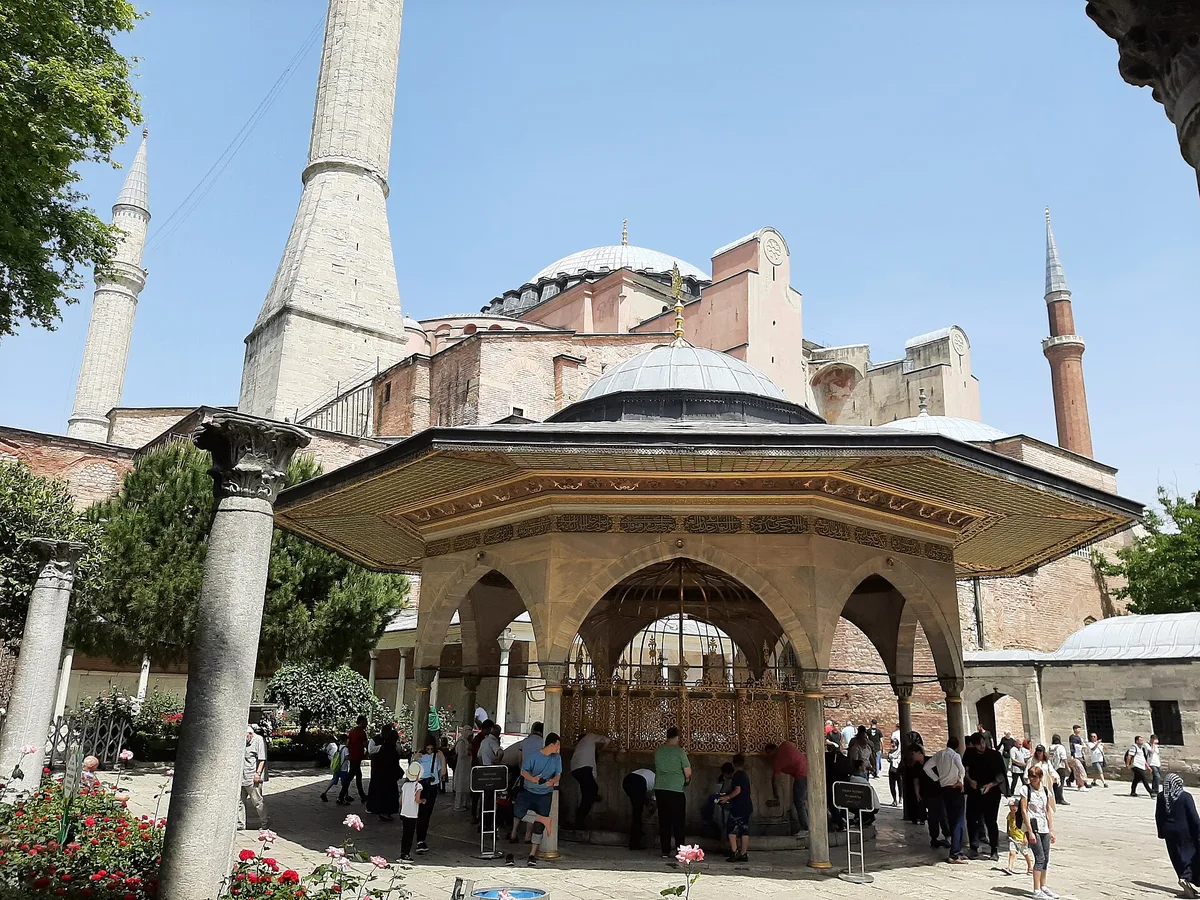
Against the building’s south-eastern flank, behind a garden wall, stand the imperial tombs – the türbes in which the mosque centuries buried their sultans: Murad III, Mehmed III, Selim II and their families, in domed chambers lined with some of the finest İznik tiles ever fired. The tombs were part of the old museum visit and their visiting arrangement has changed with the building’s status, so treat them as a separate check on the day rather than an assumed extra; when open, they are among the quietest and most beautiful interiors in Sultanahmet, and they complete the Ottoman story the minarets begin. The ablution fountain nearby, an ornate canopy of 1740 under which generations of worshippers have washed before prayer, still does its daily job – the surest sign, if one were needed, that the complex outside the walls is as much a working institution as the prayer hall within them.
The square itself is the final exhibit. Sultanahmet Square follows the line of the Byzantine Hippodrome, and Hagia Sophia closes its north-eastern end as it has closed the city’s ceremonial heart since 537 – facing the Blue Mosque across the gardens, with Topkapı’s gate behind it and the Basilica Cistern beneath the streets a few minutes away. No building in Istanbul asks to be read alone, and our Istanbul travel guide sequences this whole district; but Hagia Sophia is the piece the rest of the district orbits. Give the exterior its ten unhurried minutes. The dome that floats so delicately inside sits up close like what it is – a mountain of masonry that two empires conspired to keep in the air.
The Honest Downsides
Every place this hagia sophia guide sends you to has its limits, and this one’s are specific. The first is partial access, and it is not a detail: the sightseeing visit no longer includes the ground floor, full stop. If the Hagia Sophia in your imagination is the one where you stood in the middle of the nave and turned slowly under the dome, that visit ended in 2020, and no ticket, tour or tip restores it. What replaced it is a fine visit of a different kind – but travellers who arrive not knowing the difference reliably experience the gallery as a loss, and the fix is only ever expectation, set in advance by honest information. That is the primary purpose of this article, and it is worth the repetition.
The second limit is variability. The visitor system at this building is young and still being adjusted: closure patterns around prayers, the on-the-day arrangements for tickets, coverings and assisted entry, the screening of the apse image, and the rolling programme of restoration that puts scaffolding across one famous view or another – all of it can differ between the month you research and the week you travel. Any source that gives you this building’s practicalities with total confidence, including its fee to the cent and its hours to the minute, is telling you more than anyone honestly knows; use the official portal for the final check and hold your Sultanahmet morning loosely enough to swap the order of sights if the building’s day demands it.
The third limit is the crowd, which at Hagia Sophia is not a risk but a certainty in season. The gallery is a single one-way route of finite width; when it fills, you move at the pace of the slowest group and stand in line for the Deësis and the best rail positions. The mitigations are the classic ones and they work: come at the day’s first entry or in its last stretch, avoid Friday, and prefer the quieter months if your calendar allows. And the last honesty is about what the visit feels like at its edges – security queues in the sun, touts around the square selling unofficial shortcuts to a system that has none, and the separate, heavily marketed Hagia Sophia History and Experience Museum nearby, a digital exhibition with its own ticket that is not inside the building and not part of this visit. None of it cancels the dome. All of it is better known beforehand.
Frequently Asked Questions
Is Hagia Sophia a mosque or a museum now?
A mosque. It reopened for Muslim worship on 24 July 2020 and functions as the Hagia Sophia Grand Mosque, administered for worship by the Directorate of Religious Affairs. The museum era ran from 1935 to 2020. Sightseeing is provided for separately, through the gallery route, under the Ministry of Culture and Tourism’s visitor arrangements.
Can visitors still go inside?
Yes – but through the visitor system, not the old museum entrance. Since 15 January 2024, sightseeing visitors use a separate entrance on the Topkapı side of the building, buy a ticket there or through the official channel, and follow a one-way route through the upper gallery. The ground-floor prayer hall is for worshippers.
How much is the ticket, and is the Museum Pass valid?
The gallery ticket is a separate, euro-priced ticket whose current figure is published on the official portal, muze.gov.tr – check it there in the week you travel, because it has changed before and this guide deliberately prints no figure that could mislead. Museum Pass Istanbul and MüzeKart do not cover the gallery ticket. Worship, as everywhere, is free.
What are the opening hours?
The mosque itself keeps a mosque’s rhythm – open for worship across the day and night – while the ticketed visitor route keeps set visiting hours that close around each of the five daily prayers and for longer around the Friday midday prayer. The current pattern is published on the official portal and posted at the entrance; plan around the prayer timetable rather than a fixed clock, and avoid Friday morning for sightseeing.
What should I wear?
Modest dress: shoulders and knees covered for everyone, a headscarf for women, and shoes that slip off easily where the route asks it. Bring your own coverings – do not rely on being lent them, as arrangements vary. This hagia sophia guide’s rule for any working mosque applies here unchanged: dress right the first time.
Can I see the mosaics?
The greatest gallery mosaics, yes – the Deësis and the imperial portrait panels are on the visitor route, at eye level, and are the visit’s climax. The apse Virgin and Child is visible from a distance, subject to the screens used in the prayer area. The Imperial Gate mosaic, the omphalion and the other ground-floor sights are not on the sightseeing route.
How long does a visit take, and when is it quietest?
Allow an hour to ninety minutes in the gallery and up to the same again for ticketing and security in season – two to two and a half hours in total. The quietest windows are the first entry of the day and the later afternoon, outside Friday, and outside the peak summer weeks.
Is the Hagia Sophia History and Experience Museum the same thing?
No. It is a separate digital exhibition in a former government building on the square, opened in 2023, with its own ticket. It can complement a visit but it is not inside Hagia Sophia and no ticket for it admits you to the building. Decide which you want before you reach a ticket desk, because combined offers are sold energetically.
The Short Version of This Hagia Sophia Guide
If this hagia sophia guide has to shrink to the essentials, they are these. The building is Justinian’s church of 537, the greatest interior of the ancient world, turned mosque in 1453, museum in 1935 and mosque again in 2020, and every one of those lives is still legible in its fabric – dome and mosaics from the first, minarets, mihrab and roundels from the second, scholarship and uncovered gold from the third. Since January 2024 the sightseeing visit and the worship it shares the building with have been separated by level: the prayer hall below belongs to worshippers, and visitors climb a separate entrance ramp to the upper gallery, where the Deësis and the imperial mosaics wait at eye level and the whole great space opens beneath the rail.
Go dressed for a mosque, timed around the prayers, ticketed through the official channel and checked against the official portal in the week you travel. Give the gallery its unhurried hour, stand at the rail until the dome stops being a fact and becomes a feeling, and save your close looking for the south gallery, where an empress had her husband’s face recut in gold and the Deësis has been interceding, in stones smaller than fingernails, since 1261. Then walk out into the square and look back at the silhouette – the view every age since Justinian has looked at – and let the rest of Sultanahmet, sequenced in our Istanbul travel guide, arrange itself around the building that arranged it first.