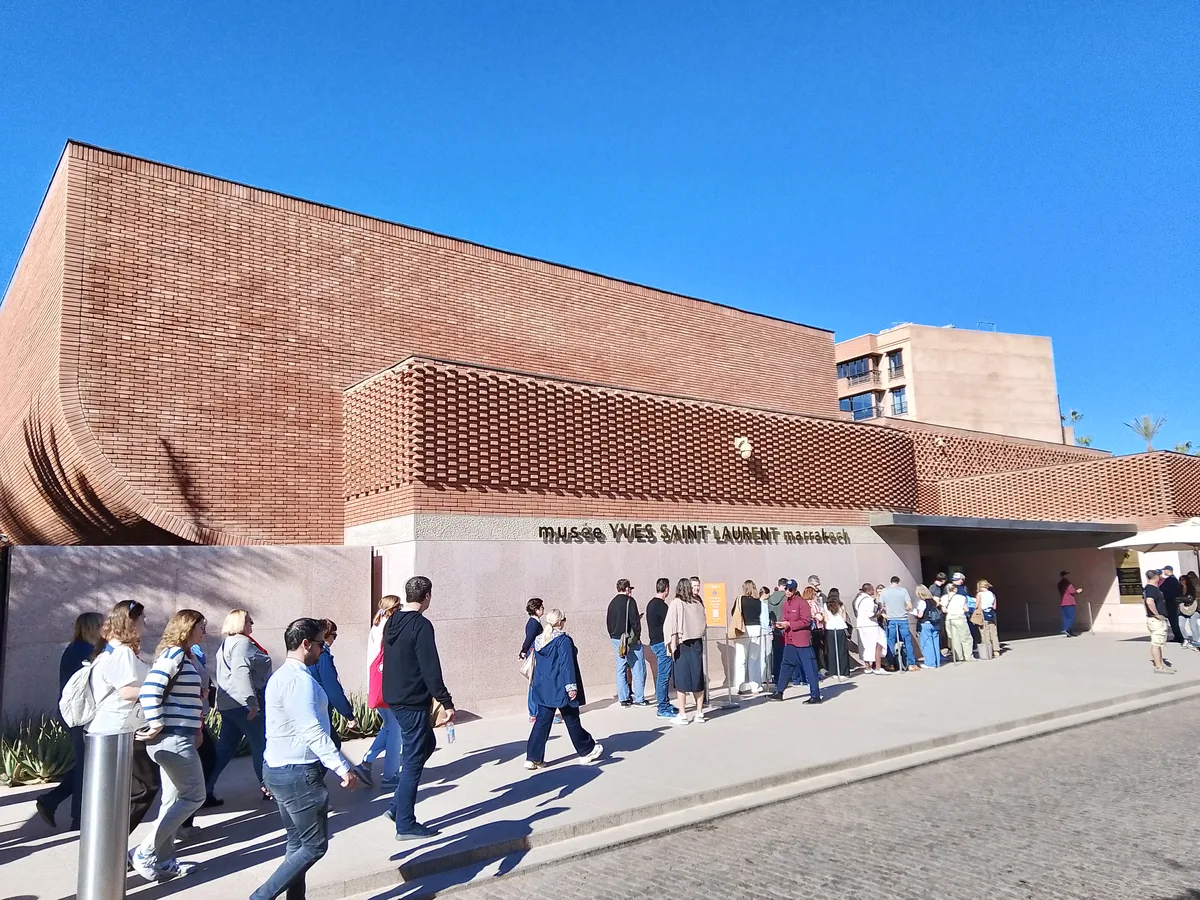
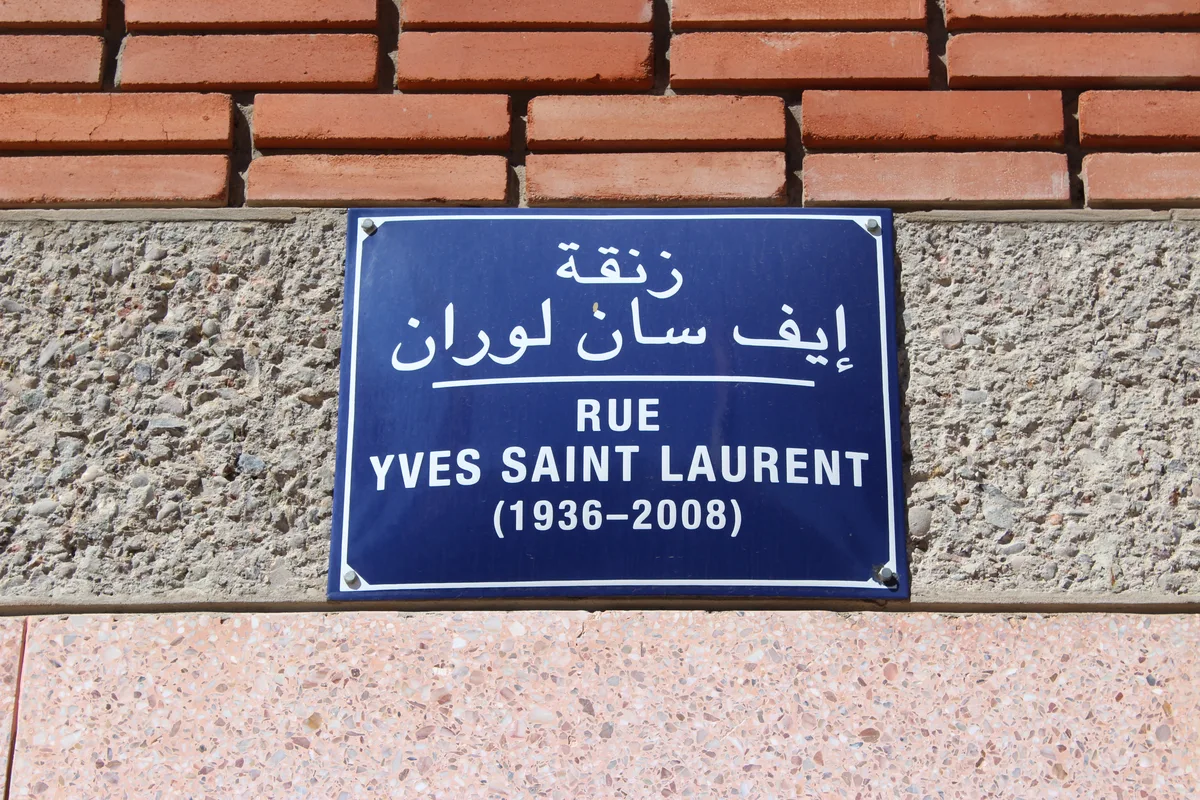
Stand on Rue Yves Saint Laurent in the Guéliz district, a few steps from the most famous garden wall in Morocco, and the first thing to understand about the yves saint laurent museum marrakech is that it does not shout. There is no glass tower, no neon, no billboard couture photograph. There is a long, low wall of terracotta brick, laid in patterns that shift as the sun moves, a discreet stone entrance panel carrying the designer’s name, and a queue that forms with a patience Marrakech rarely shows anywhere else. Behind that wall, in a building of some 4,000 square metres opened in October 2017, sits the only major museum in Africa devoted to a single fashion designer – and one of the most considered pieces of modern architecture in Morocco.
This guide treats the museum as a destination in its own right, which is how it deserves to be treated and how it is too often not. Most visitors meet the musée Yves Saint Laurent Marrakech as an afterthought, an hour bolted onto a Jardin Majorelle ticket because the two stand side by side. The pairing is real, and this guide covers it properly further down, including the Berber Museum that sits inside the garden grounds. But the museum itself is the headline. Inside the brick walls is a permanent exhibition of Yves Saint Laurent’s work staged like a piece of theatre, a programme of temporary exhibitions that changes through the year, an auditorium, a research library, a bookshop and a café – a small cultural city built around one man’s forty years of work and his love affair with the city outside.
That love affair is the second thing to understand, because without it the museum makes no sense in Marrakech at all. Saint Laurent first came to this city in 1966, fleeing a grey Paris winter, and later said that Marrakech taught him colour. He and his partner Pierre Bergé bought a house here, then the Villa Oasis, then – in 1980, to save it from a hotel development – the Jardin Majorelle itself. When he died in 2008, his ashes were scattered in that garden. The museum that opened nine years later, on a street renamed for him, is therefore not an imported brand outpost. It is the closing chapter of a fifty-year relationship between a designer and a city, built in brick a few metres from the garden gate.
What follows is the full visit, in the order a thoughtful visitor needs it. First the practical shape of the place, then the building itself, then the story – 1966, the Villa Oasis, the garden rescue, the two foundations. Then the exhibitions, permanent and temporary, the auditorium and the café, and the mechanics of tickets and timing, stated from the official sources and nowhere else. The garden next door gets one pairing section, as it should – it has a dedicated guide of its own elsewhere on this site, and this site’s wider Morocco travel guide sets the whole quarter in the country’s context. Here, the museum comes first.
Yves Saint Laurent Museum Marrakech at a Glance
| Question | Short answer |
|---|---|
| What is it | The musée Yves Saint Laurent Marrakech (mYSLm), a museum devoted to the work of couturier Yves Saint Laurent |
| Where | Rue Yves Saint Laurent, Guéliz, Marrakech – immediately beside the Jardin Majorelle |
| Opened | 19 October 2017, days after its sister museum opened in Paris |
| The building | Around 4,000 m² by Studio KO (Olivier Marty and Karl Fournier) – terracotta brick outside, smooth couture-inspired curves inside |
| The core display | A 400 m² permanent exhibition of around fifty garments, staged by scenographer Christophe Martin around Saint Laurent’s great themes |
| Also inside | A temporary exhibition hall, the 150-seat Pierre Bergé auditorium (some sources say 130-140 – see the facts note), a research library of some 5,000 volumes, a bookshop and the Le Studio café |
| Tickets | Sold ONLY through the official Jardin Majorelle ticketing site – the garden, the Berber Museum and this museum are three separate tickets, sometimes bundled |
| Closed | Wednesdays, per the museum’s official site – always confirm before you go |
| How long | One unhurried hour for the museum alone; half a day for museum, garden and Berber Museum together |
The table already contains the fact that catches more visitors out than any other, and it is worth stating plainly at the start. The museum, the garden and the Berber Museum are neighbours, run within the same foundation family, and sold through the same official ticketing site – but they are three distinct visits with three distinct entrances and, in the normal run of things, three tickets to think about. Travellers regularly arrive at the museum door holding garden tickets, or arrive at the garden gate expecting the museum to be included, and the queue behind them learns the distinction in real time. This guide returns to the mechanics in the tickets section below, because getting them right is the difference between a calm morning and a frustrating one.
The second thing the table tells you is scale. Four thousand square metres sounds large, and the building is, but the permanent exhibition at its heart is a single 400 m² hall. This is not a warehouse retrospective where a life’s work is lined up in chronological rows. It is a concentrated, deliberately theatrical presentation of around fifty pieces at a time, drawn from a foundation collection in Paris that holds some 5,000 garments and 15,000 accessories. Pieces rotate, themes organise the room, and the effect – as the permanent exhibition section below explains – is closer to a staged performance than to a conventional museum hang. Knowing that in advance stops the one unfair disappointment visitors sometimes voice, which is expecting the V&A and finding a jewel box instead.
The third thing is audience, because this museum serves two of them at once and does it without splitting in half. For the fashion pilgrim, it is a shrine with relics – the actual garments, the actual sketches, the house’s own archive, in the city that changed the designer’s eye. For the traveller who could not name three Saint Laurent pieces before landing in Marrakech, it is something arguably better – a beautifully made, self-contained introduction that assumes no knowledge, explains itself through theme and film, and sends the uninitiated out an hour later understanding why this designer, of all designers, has a museum at all. Neither audience is patronised. That is a harder trick than the brickwork, and the museum pulls it off.
The Building – Studio KO’s Brick Couture
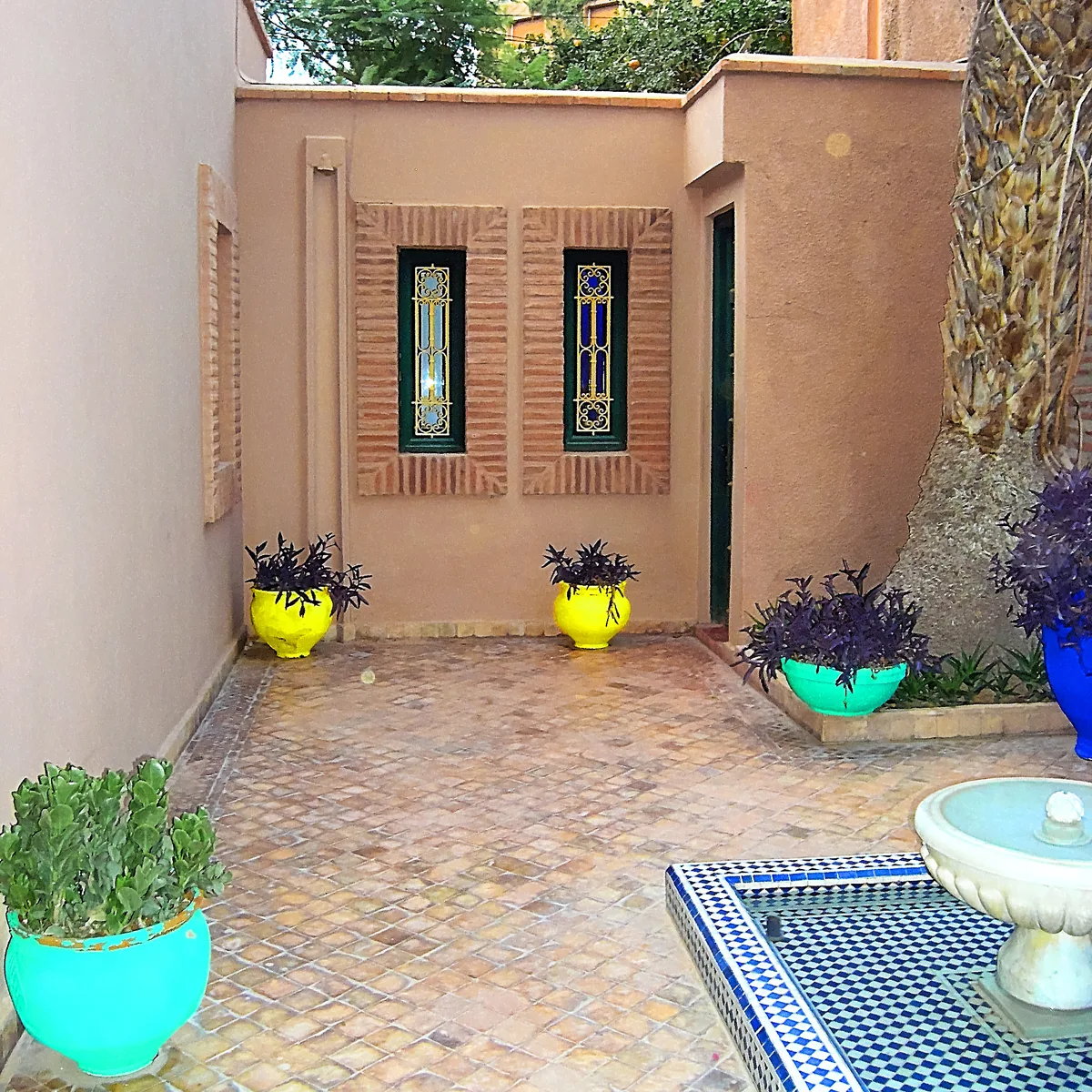
A museum to a couturier could easily have been a logo with a roof on it. Studio KO, the Paris-and-Marrakech practice of Olivier Marty and Karl Fournier, did almost the opposite, and the building they produced is the first exhibit – the one you experience before any ticket is scanned. The exterior is a composition of cubes and curves wrapped in terracotta brickwork, the bricks laid in varying bonds and relief patterns so that the long street facade reads, from a distance, like woven fabric. That is not a critic’s fancy imposed afterwards. The architects have described the building’s surfaces in the language of textiles – warp and weft, the texture of cloth – and the analogy holds up in person, because the brickwork genuinely behaves like a heavy fabric hung against the light, its pattern tightening and loosening as you walk its length.
The material palette is a short course in Moroccan building. Terracotta brick from Moroccan earth. Local stone and granite tones at the base. Glazed brick and zellige – the cut-tile mosaic of Moroccan craft tradition – worked into the surfaces. And then, at the entrance, the discipline breaks for exactly one gesture – a smooth stone panel carrying the interlaced Cassandre monogram, the famous YSL logo, rendered at architectural scale. It is the building’s only piece of branding and it works precisely because the rest of the facade refuses to compete with it. Photographers should note that the facade rewards time. In flat midday light it can look almost plain. In the raking light of morning or late afternoon, the relief brickwork casts thousands of small shadows and the whole wall comes alive.
Inside, the building changes key. Where the exterior is earthen, textured and public, the interior is smooth, curved and hushed – the architects have spoken of the lining of a jacket as the model, the hidden, perfect finish inside a garment whose outside is all structure. Walls curve rather than meet at corners. Light is controlled to conservation levels, because what hangs in these rooms is cloth, and cloth fades. Below ground, roughly 700 m² of the building is given to the unglamorous work that makes the glamorous part possible – conservation and storage space engineered to protect garments, accessories and works on paper belonging to the Fondation Pierre Bergé – Yves Saint Laurent in Paris. A fashion museum, it turns out, is a climate problem with an exhibition attached, and Studio KO solved it by burying the problem and displaying the solution.
The building also had a patron with a deadline, and the human detail matters to its story. Pierre Bergé – Saint Laurent’s partner in life and in business, the man who co-founded the house and ran it – drove the Marrakech museum project personally, as he drove the Paris museum that opened the same month. He died on 8 September 2017, a few weeks before either museum opened. The Marrakech building therefore stands as his last major work as much as Saint Laurent’s memorial, which is why the auditorium inside carries his name. Visitors who know this walk through the entrance hall differently. The museum is a double portrait – of the designer whose clothes fill it, and of the man who spent half a century making sure the world kept looking at them.
Saint Laurent and Marrakech – The Story That Built the Museum
Every account of this museum has to begin in the winter of 1966, because the designer himself did. Yves Saint Laurent arrived in Marrakech in his late twenties, already famous, already fragile, at the head of a Paris house that had made him the most celebrated young couturier in the world – and the city rearranged his sense of colour in a matter of days. Paris in that era dressed in a disciplined palette of black, navy, grey and beige. Marrakech offered bougainvillea against cobalt, saffron and madder in the souks, the green of zellige, the pink-ochre of the city walls themselves. His famous judgement on the city – that before Marrakech everything was black, and that the city forced colour on him – is quoted so often because his collections after 1966 prove it. The saturated colour-blocking, the homage to Africa and Morocco in his textiles and embroideries, begin here.
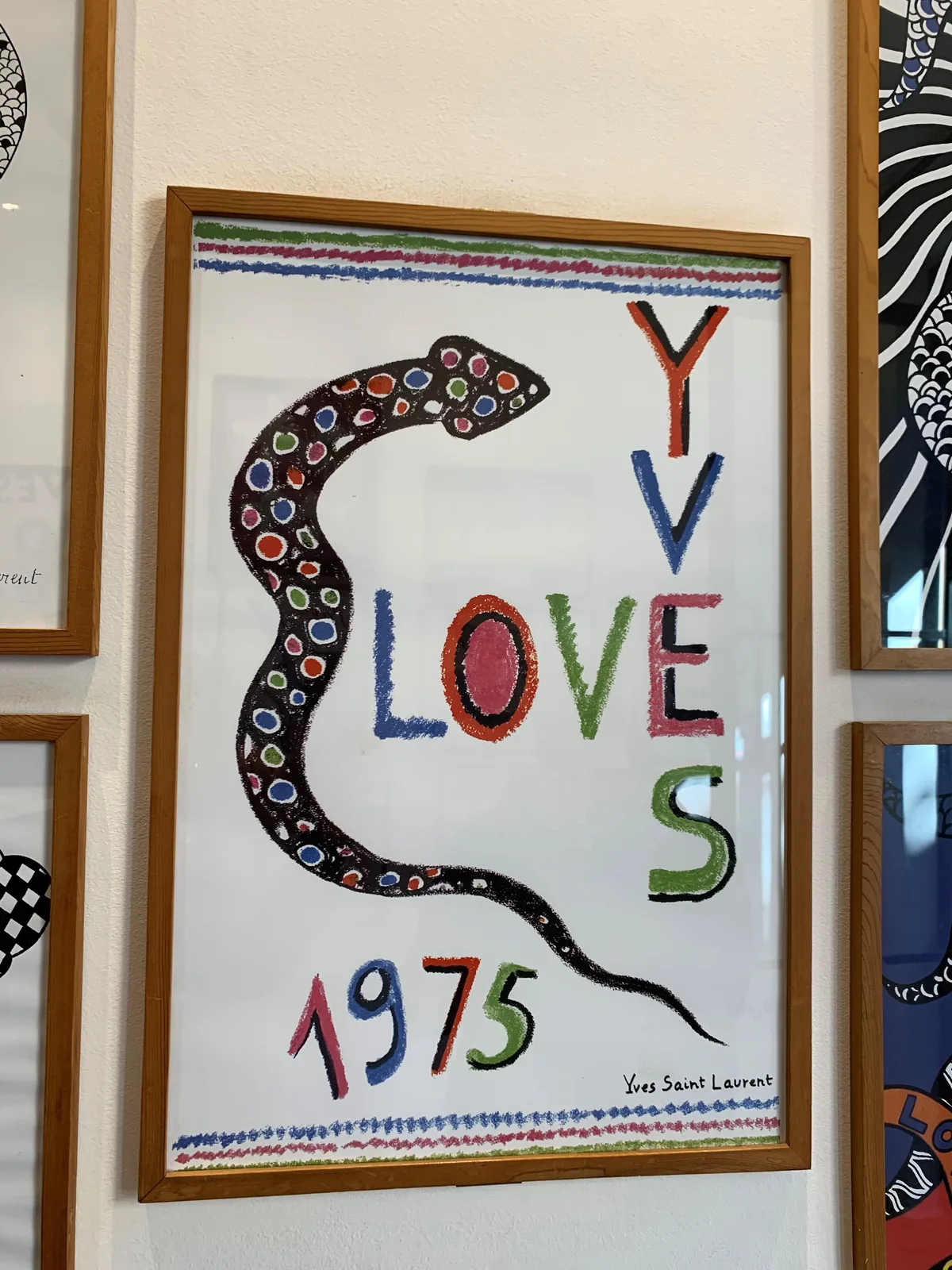
The relationship deepened from influence into address. Saint Laurent and Bergé bought a first Marrakech house, Dar el-Hanch, the House of the Serpent, and then, in 1974, the property that became the centre of their Moroccan life – the Villa Oasis, beside the Jardin Majorelle. For the rest of his life the pattern held. Collections were designed in Paris, but the recovery, the reading, the sketching for pleasure and the long convalescences happened in Marrakech, in the villa’s rooms and the garden’s shade. He designed some of his work here. He drew his LOVE cards here – the small illustrated greetings he sent every year from 1970 onwards, one of which hangs framed in the museum today, a reminder that the most reproducible artwork Saint Laurent ever made was a New Year card.
Marrakech also gave him a working rhythm that Paris never could. The pattern of his later years settled into long Moroccan stays between the pressure of the Paris collections – the haute couture presentations in January and July, the ready-to-wear seasons around them – and the contrast was functional, not just pleasurable. In Marrakech the telephone rang less, the light was better, and the sketchbook filled. Friends and collaborators who visited the Villa Oasis describe a household run like a small, serene court – gardeners, cooks, house guests from the worlds of art and fashion, and at the centre of it a designer who worked in the mornings and held court in the garden in the afternoons. The museum’s displays of photographs and personal material gesture at that world; the villa itself, closed to visitors, keeps it.
Then came the act that turned affection into guardianship, and without which neither the garden nor this museum would exist. In 1980, Saint Laurent and Bergé learned that the Jardin Majorelle – created over some forty years by the French painter Jacques Majorelle, and by then neglected after his death – was threatened by a property development. They bought it. Not the villa as a trophy; the garden, to save it. Over the following decades they restored it, replanted it, opened it to the public and built the visitor numbers that made it, eventually, the most visited site in Marrakech. Every traveller who has ever walked its blue alleys since 1980 has done so because two men who made dresses decided a garden was worth more than a hotel plot.
The museum, opened on 19 October 2017, is where that story is institutionalised. Saint Laurent died in Paris on 1 June 2008; his ashes were scattered in the garden’s rose garden, where a simple memorial – a Roman column on a plinth – stands among the palms. Bergé, who outlived him by nine years, spent much of that decade converting a private rescue into a permanent public structure – the Fondation Jardin Majorelle in Morocco and the Fondation Pierre Bergé – Yves Saint Laurent in Paris, between them holding the garden, the Berber Museum, the villa and, finally, the two museums in Paris and Marrakech. To visit the yves saint laurent museum marrakech is to visit the archive of that conversion. The clothes are the exhibits, but the building is the argument – that Marrakech was not Saint Laurent’s holiday. It was his second studio, and eventually, his second home in every sense that counts.
The Villa Oasis – The House Behind the Garden
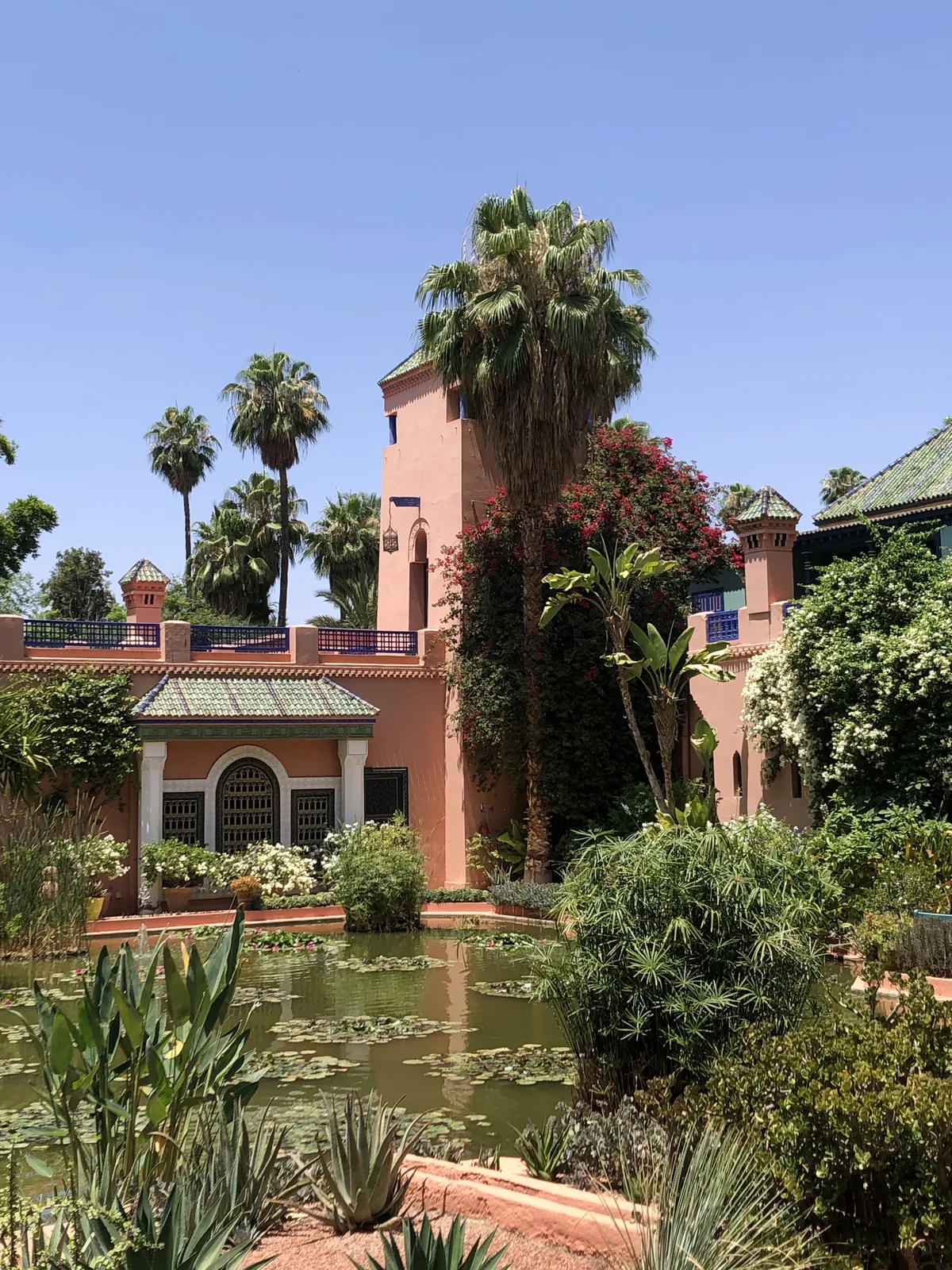
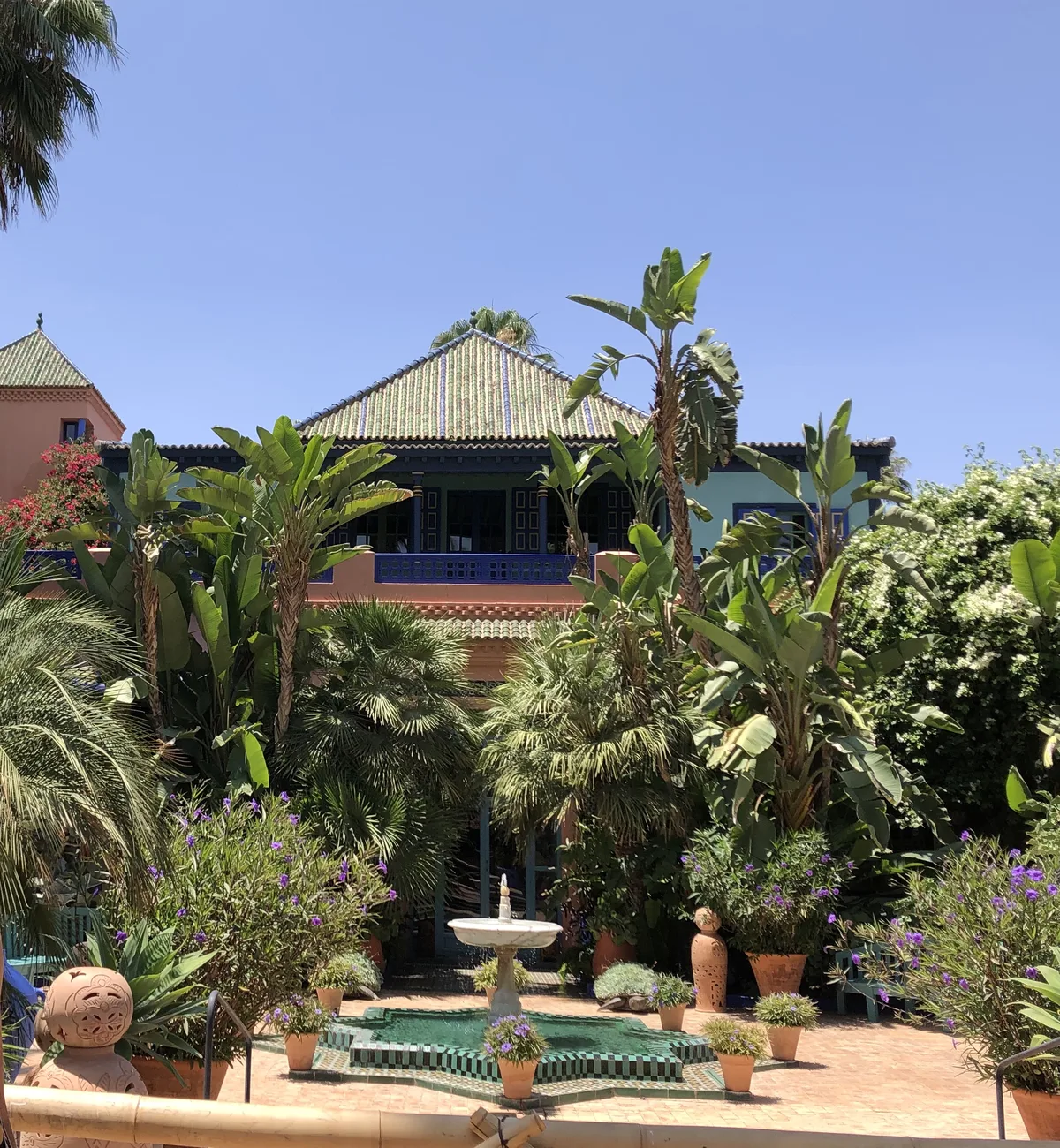
Stand in the Jardin Majorelle and look beyond the pond and the planting, and a salmon-pink house with green-tiled roofs resolves out of the palms. That is the Villa Oasis, and it is the one building in this whole complex that visitors cannot enter – a fact this guide states early because so many arrive hoping otherwise. The villa began life as part of the Majorelle property’s orbit and was acquired by Saint Laurent and Bergé in 1974 as their Marrakech home. Its interiors, created with the decorator Bill Willis, became almost as celebrated in design circles as the garden – rooms layered with Moroccan craft, carved cedar, painted ceilings, tiles, textiles and objects collected across Morocco and beyond, a maximalism that makes the museum’s restraint next door legible as a deliberate opposite.
The villa’s role in the museum story is that it explains the geography. The house stands inside the garden’s world; the garden wraps the house; and when the museum came to be built, it rose on Rue Yves Saint Laurent immediately beside both. Read on the ground, the whole quarter is a single composition – painter’s garden, designer’s house, designer’s museum, in a row, each explaining the next. The villa is the private term in that sequence. The garden is the semi-public one, a rescued artwork opened to everyone. The museum is the fully public one, where the private obsession with Morocco is converted into exhibitions anyone can buy a ticket to see. Visitors who grasp that sequence get more from all three.
Practically, the villa is experienced from outside, and that is not the deprivation it sounds. Its walls, roofs and garden rooms form part of the garden’s own views – the house is the backdrop in half the photographs taken at the pond. The museum’s displays close the loop from the other side, because photographs, objects and the story of the Marrakech years run through its rooms, and the LOVE cards and personal material on show come from precisely the domestic world the villa represents. Treat the villa as the story’s locked room. The museum next door is where its contents, in every sense, were eventually put on display.
The Permanent Exhibition – Fifty Pieces, Staged Like Theatre
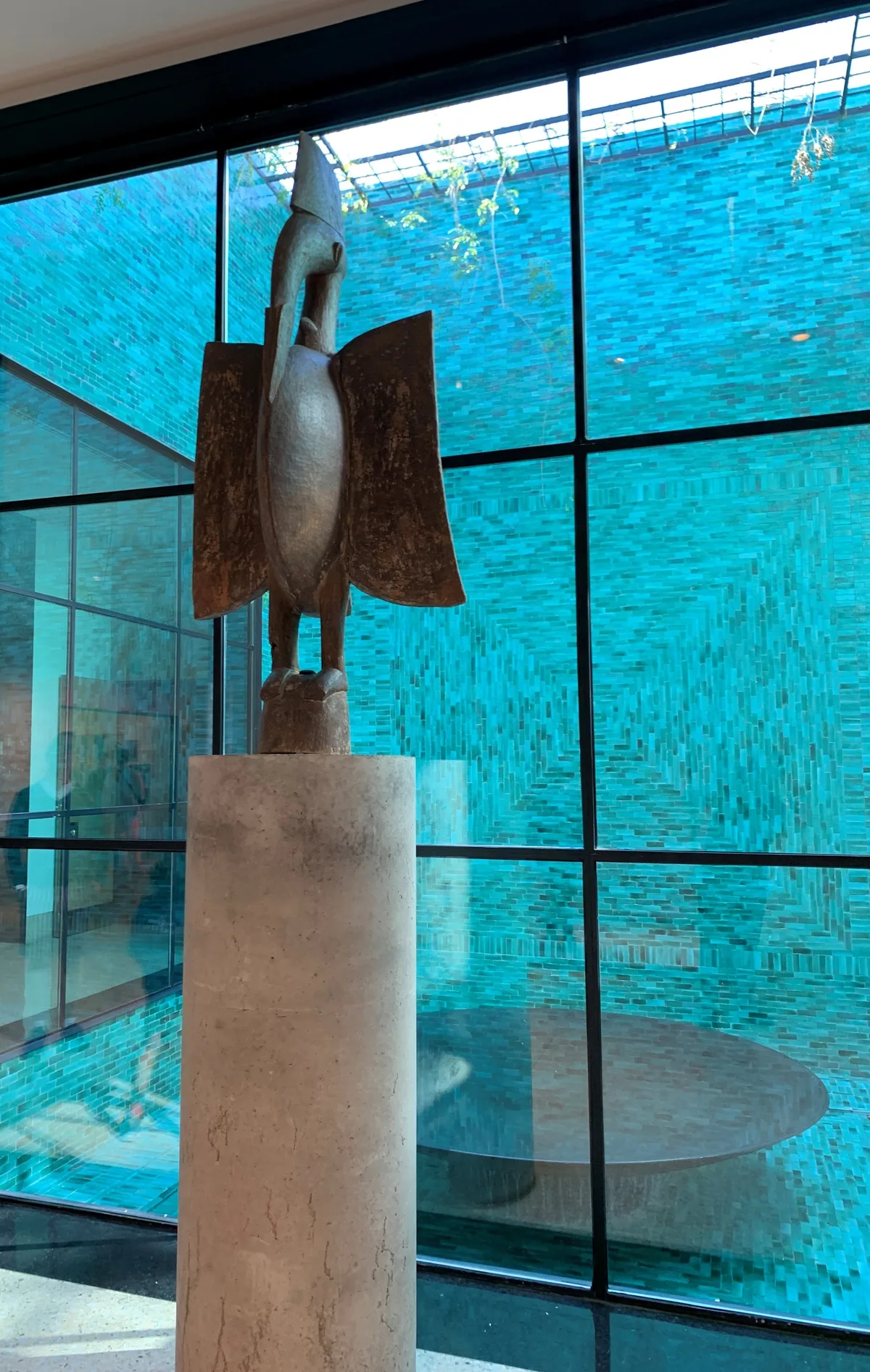
The permanent exhibition occupies a single hall of about 400 m² off the museum’s entrance sequence, and the first thing to say about it is what the scenographer Christophe Martin said about it himself – it is not a retrospective. There is no timeline on the wall, no march from 1962 to 2002 through glass cases in date order. Instead, around fifty garments stand in a darkened room arranged by theme, lit like actors, with film, photography, sketches and music woven around them. The room is kept dim for the textiles’ sake, and the darkness is used rather than apologised for. Pieces emerge from blackness under individual light, so that a walk through the hall feels less like reading a catalogue and more like attending a series of entrances.
The themes are the designer’s own obsessions, and learning them in advance turns a beautiful room into a legible one. Masculine-Feminine is the argument that made him famous – the borrowing of men’s tailoring for women, above all Le Smoking, the tuxedo suit for women first shown in 1966, which took the most codified garment of male evening dress and rebuilt it for a woman’s body without softening its authority. Black is the second theme, the colour Saint Laurent called a link between art and fashion, the ground against which his silhouettes were drawn. Then the room turns to the sources – Africa and Morocco, the imaginary voyages to Russia, China, India and Spain that he took in fabric rather than in person, the gardens that fed his prints and palettes, and art itself, where the garments quote the painters directly.
The icons are here, and the exhibition knows they are what many visitors have come for. The Mondrian dress of 1965, its wool jersey divided into blocks of primary colour and black line, is the single most reproduced garment Saint Laurent ever made. The safari jacket, the pea coat, the trench, the trouser suit – the permanent grammar of his ready-to-wear revolution – stand among the one-off couture pieces, and the juxtaposition is the point. Saint Laurent’s historical claim is double. He dressed the century’s most photographed women in unique couture, and he simultaneously invented the modern luxury ready-to-wear boutique with Rive Gauche, launched in 1966, the same year he first saw Marrakech. The hall holds both halves of that claim in one eyeline.
Around the garments, the archive does the explaining. Sketches and collection boards show the work before it was cloth. Photographs and film place the finished pieces on the bodies and in the decades that made them famous. And because the Fondation’s holdings are so deep – thousands of garments, tens of thousands of drawings and objects in Paris – the Marrakech selection rotates. Pieces rest, travel and are substituted, so the fifty on the floor are a current edit of the collection rather than a fixed canon, and repeat visitors genuinely see different clothes. For anyone whose interest runs deeper than looking, the research library elsewhere in the building, with its thousands of volumes on fashion, Morocco and Berber culture, is the archive’s public face, though it serves researchers rather than casual browsing.
Sketches, Boards and Film – The Working Archive Around the Clothes
A couture garment on a stand is a finished sentence, and the permanent exhibition is careful to show the drafts. Saint Laurent worked on paper first – fast, fluid sketches that fixed a silhouette in a few lines – and the foundation preserved them in their tens of thousands, along with the collection boards on which each season’s looks were assembled, specified and sequenced before a seam was sewn. The Marrakech displays draw on that paper archive deliberately. Seeing a sketch beside its finished garment does something no label can. It collapses the distance between the designer’s hand and the object, and it reminds the visitor that couture, for all its aura, is a manufacturing process with paperwork – toiles, fittings, ateliers, deadlines – of which the dress is only the final, visible tenth.
Film and photography complete the triangle. Runway footage returns the clothes to moving bodies and period music; portraits place them on the women who made them famous; and the designer’s own voice and image recur through the displays, so that by the end of the hall the visitor has met the man as well as the work. This is the scenography’s quiet argument against the idea of fashion as froth. Saint Laurent’s career is presented as a body of work with sources, methods and revisions – closer to how a museum treats a painter’s sketchbooks than to how a department store treats a heritage corner – and it is why the exhibition satisfies visitors who arrive knowing nothing. The clothes astonish. The archive explains. Together they make the case the building exists to make.
A word on photography, because it shapes the visit. Fashion exhibition interiors are usually strict environments, and fragile textiles, low light and lenders’ conditions make photography rules in couture galleries restrictive by default. Work on the assumption that the permanent hall is for looking, not shooting, confirm the current rule at the entrance, and let the building’s exteriors, courtyards and the garden next door carry your camera instead. The museum rewards that discipline. Fifty pieces, properly looked at, take longer than two hundred skimmed through a phone screen – which is, in the end, the scenography’s whole intention.
Temporary Exhibitions – The Room That Changes
Beside the permanent hall sits the museum’s second gallery, a temporary exhibition space of around 150 m², and it is the reason the museum can never quite be done in a single visit. The programme rotates through the year, and its remit is deliberately wider than fashion alone – fashion, yes, but also art, design, photography, anthropology and botany, the whole web of subjects that connects Saint Laurent’s world to Morocco’s. Exhibitions are mounted by the foundation’s own curators and in dialogue with the Paris museum, and they are the main reason Marrakech residents, rather than only tourists, have a reason to return to Rue Yves Saint Laurent.
The inaugural exhibition set the template, and it was a piece of curatorial wit. When the museum opened in October 2017, the temporary gallery showed not Saint Laurent but Jacques Majorelle – the painter whose garden stands next door – and his Morocco, the medinas, kasbahs and rural scenes he painted across a lifetime in the country. The gesture explained the whole site in one move. The museum was not a Parisian brand planting a flag; it was a Marrakech institution acknowledging its neighbour, its predecessor and its source. Later programmes have continued that double allegiance, alternating Saint Laurent subjects with Moroccan and international ones, so that checking what is on is not a refinement of a visit. It is part of planning one.
The gallery’s modest size is a feature of the programme rather than a limit on it. At around 150 m², a temporary exhibition here is a single, focused statement – one artist, one theme, one body of material – rather than a sprawling survey, and the foundation programmes it the way a good small gallery anywhere does, with several changes a year and a bias towards subjects that could not be shown this way in Paris. Photography exhibitions have a natural home here, design and craft subjects speak directly to the building’s own making, and botanical and anthropological subjects borrow the garden next door as their second room. The effect for the visitor is that the temporary gallery is the museum’s variable – the part of the visit that cannot be reviewed in advance, and the part most likely to be the thing talked about afterwards.
Practically, the temporary gallery changes how long the museum takes and how it should be sequenced. A strong temporary exhibition can equal the permanent hall in interest and exceed it in novelty, and it is included in the rhythm of the same visit rather than requiring any separate arrangement at the door. The museum’s official site and its ticketing pages carry the current programme – this guide deliberately prints no exhibition dates, because a printed date for a temporary show is a small lie waiting for its deadline. Look before you travel, and if the temporary show is a strong one, give the museum its full hour and more rather than treating it as the garden’s warm-up act.
The Auditorium, Bookshop, Café and Library – A Cultural Centre, Not Just a Gallery
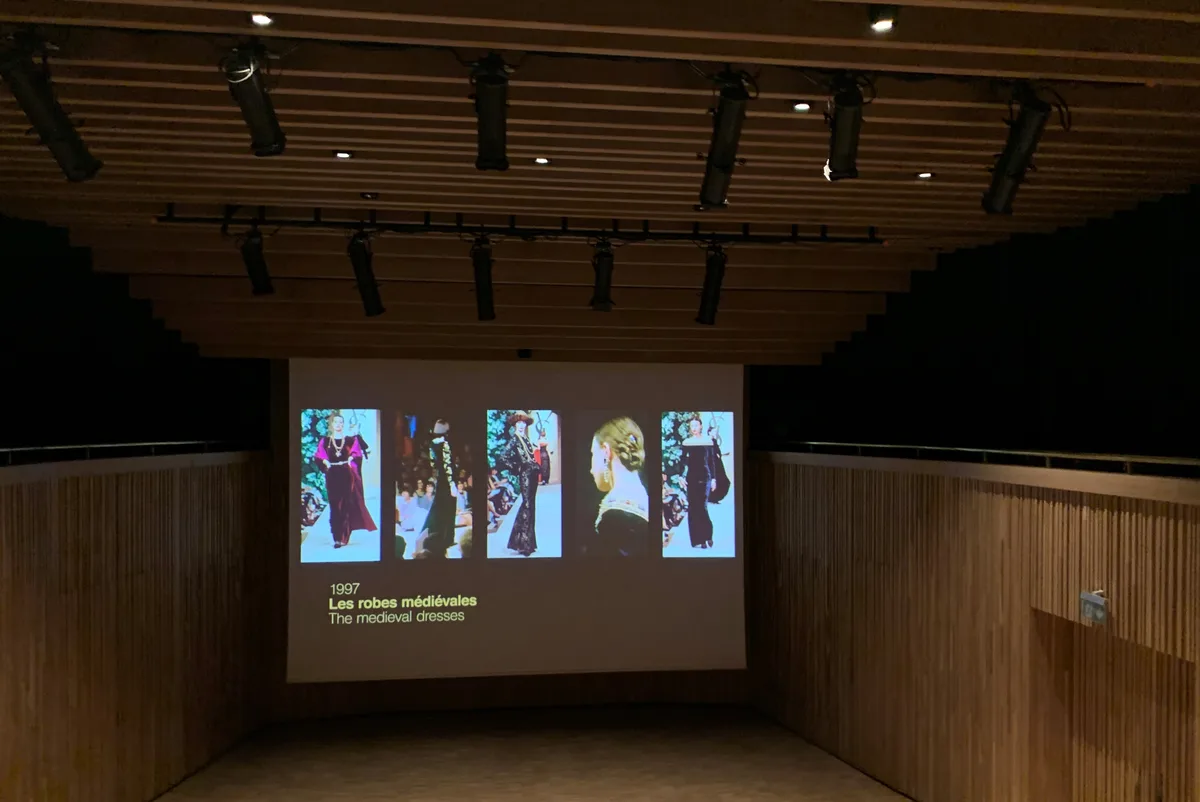
It is in the spaces around the galleries that the museum’s real ambition shows. The Pierre Bergé auditorium – a raked, wood-lined hall of around 130 to 150 seats, depending on which of the foundation’s publications you read – hosts film screenings, concerts, lectures and conferences through the year, much of it connected to the exhibition programme and much of it aimed at a Moroccan cultural audience rather than at visitors passing through. Its acoustics were designed with specialist theatre consultants, and it is soundproofed from the galleries, which means the museum can be two places at once – a silent room of dresses upstairs in spirit, and a concert hall in fact. For the traveller, the auditorium mostly matters as a possibility. An evening event, if one falls during a stay, is the single easiest way to experience the museum as Marrakech experiences it.
The bookshop is the other space that outlasts the visit. It stocks the foundation’s own publications, exhibition catalogues, books on Saint Laurent, Majorelle, Morocco and fashion, and the kind of design objects – prints, stationery, small editions – that survive a Ryanair baggage allowance better than a carpet does. Museum bookshops are a genre unto themselves, and this one is well inside the genre’s upper half, because the foundation is a serious publisher of its own material. Bibliophiles should also know the building holds a research library of some 5,000 volumes covering fashion and design alongside Moroccan history, geography, literature and Berber culture. It is a working research collection rather than a reading room for drop-in visitors, but its presence underlines what the building is – a study centre that exhibits, not merely an exhibition that sells books.
Then there is the café, Le Studio, the museum’s terrace café-restaurant, named for the working heart of a couture house. Its practical value is sequencing. The museum and garden together make a natural half-day, and the café gives that half-day a hinge – coffee or lunch between the dark of the galleries and the glare of the garden, in the museum’s own calm rather than in the scrum of the street outside. Travellers building the classic pairing should treat it as the pivot of the morning. Museum first in its cool and quiet, café second, garden third, is a better-shaped visit than any order that begins with the garden’s midday crowds.
Tickets and How a Visit Works – The Mechanics, Stated Once
Everything practical about this museum runs through one door online, and the museum’s own homepage says it in capital letters, so this guide will too. Tickets for the Jardin Majorelle, the Pierre Bergé Museum of Berber Arts and the musée Yves Saint Laurent Marrakech are sold ONLY through the official ticketing site, tickets.jardinmajorelle.com, which issues the QR code that admits you. The museum warns explicitly that it accepts no responsibility for tickets bought elsewhere and that tickets from unauthorised sites will not get you in. That warning exists because the Majorelle complex is one of the most scalped and resold attractions in Morocco. Buy at the official address, from the official site, and treat every other seller – however professional the website looks – as a risk the foundation has already told you about.
The tickets themselves are separate. The garden is one ticket. The Berber Museum, inside the garden, is another. The yves saint laurent museum marrakech is a third – with combined options appearing on the official site at times, which is exactly why this guide prints no prices and no bundle claims. What is offered, and what it costs, changes, and the only version worth trusting is the official ticketing page on the day you book. What does not change is the structure. Three venues, one street, one official seller, QR code at the door. Any source that describes a single gate where one payment admits you to everything, stroll in, is describing a Marrakech that does not exist.
Timing follows from the museum’s official site, checked for this guide – it lists the museum as open every day except Wednesdays, from 10 a.m. to 6 p.m., with last entry at 5.30 p.m. Treat those hours as the museum’s current published pattern rather than a promise, because hours at Moroccan attractions shift with seasons, holidays and exhibition changeovers, and the official site is the only authority. The Wednesday closure is the detail to build around. It is the single most common way the museum defeats a Marrakech itinerary, because the garden next door keeps its own rhythm and travellers assume the two match. If your only Majorelle morning is a Wednesday, the garden and the Berber Museum are your visit, and the museum needs another day.
Getting there is the last piece of mechanics. The museum stands in Guéliz, the modern city, on the street that bears the designer’s name, a short taxi ride from the medina and from Jemaa el-Fna – near enough that the Majorelle quarter combines easily with a medina day, far enough that it should be treated as its own expedition rather than a detour. Petit taxis are the default transport, the address is famous enough that most drivers know it by the garden’s name alone, and the standard Marrakech rule applies – agree the fare or insist on the meter before the wheels move. Arrive with your QR code ready on a charged phone; the quarter’s whole system assumes it, and the person at the door cannot conjure a booking that an unofficial website failed to make.
Within the day, the museum rewards the early hours for the opposite reason the garden does. The garden’s crowds build from mid-morning; the museum, entered on a timed QR ticket, is at its most contemplative before the combined-ticket crowds find it. And for the wider shape of a Marrakech stay – how this half-day in Guéliz fits against the medina, the palaces and the square – the Morocco itinerary 7 days on this site places the Majorelle quarter where it belongs, as the calm, green counterweight day in a week otherwise spent in the old city’s beautiful noise. The museum’s own official site, museeyslmarrakech.com, is the place to confirm the current exhibition, the current hours and the route to the one official ticket door before any of it.
Next Door – Pairing the Museum With the Jardin Majorelle and the Berber Museum
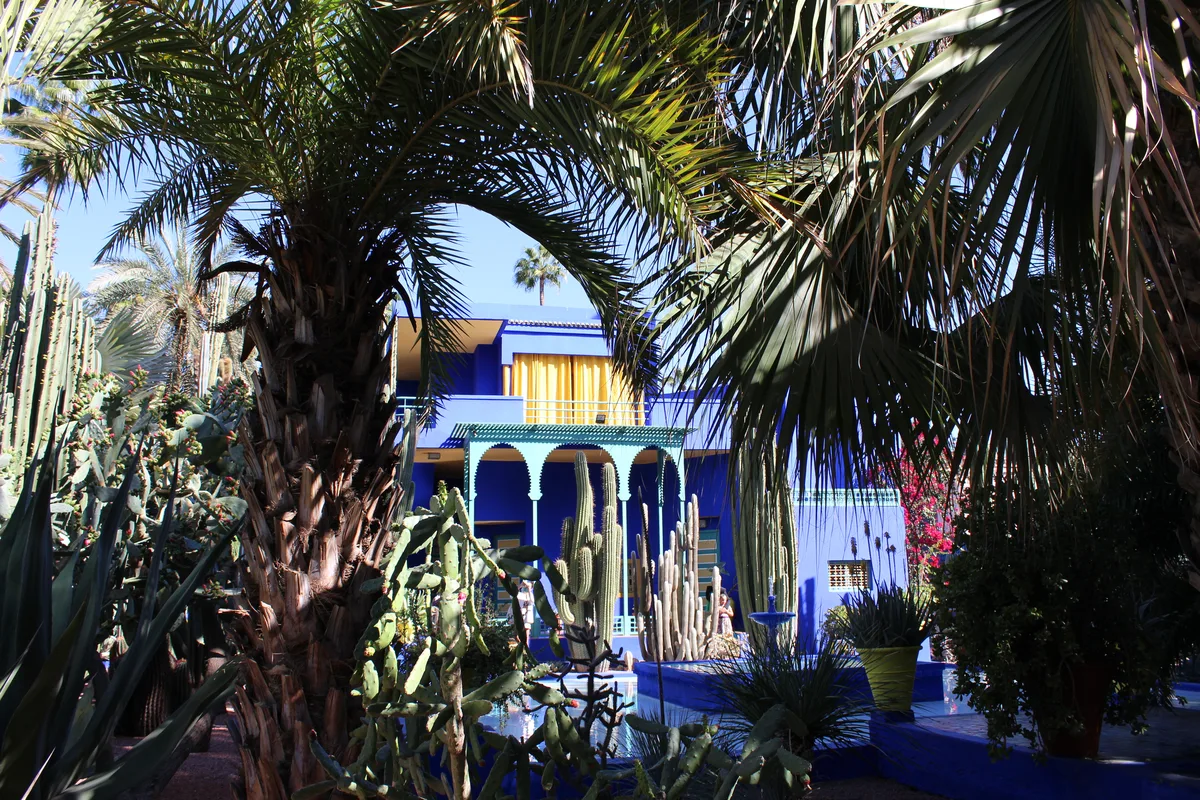
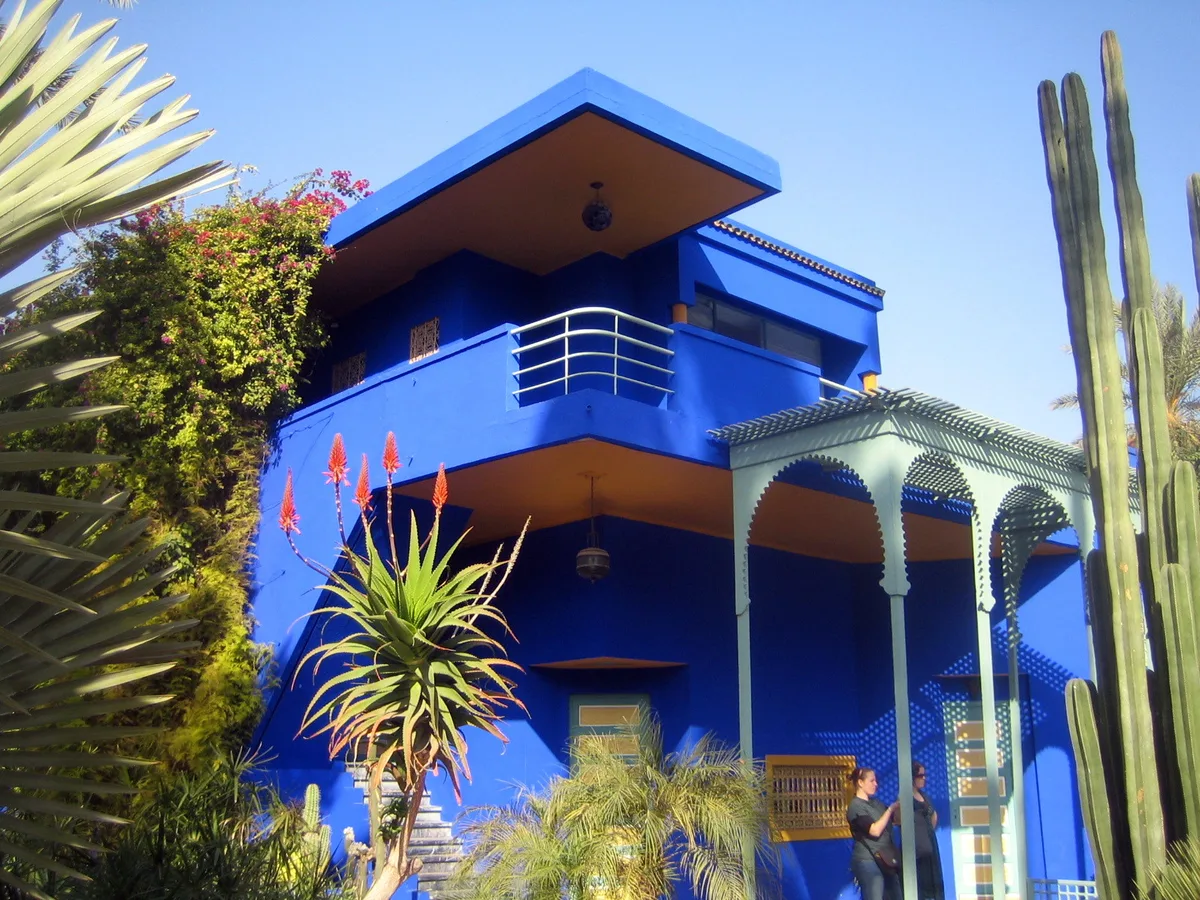
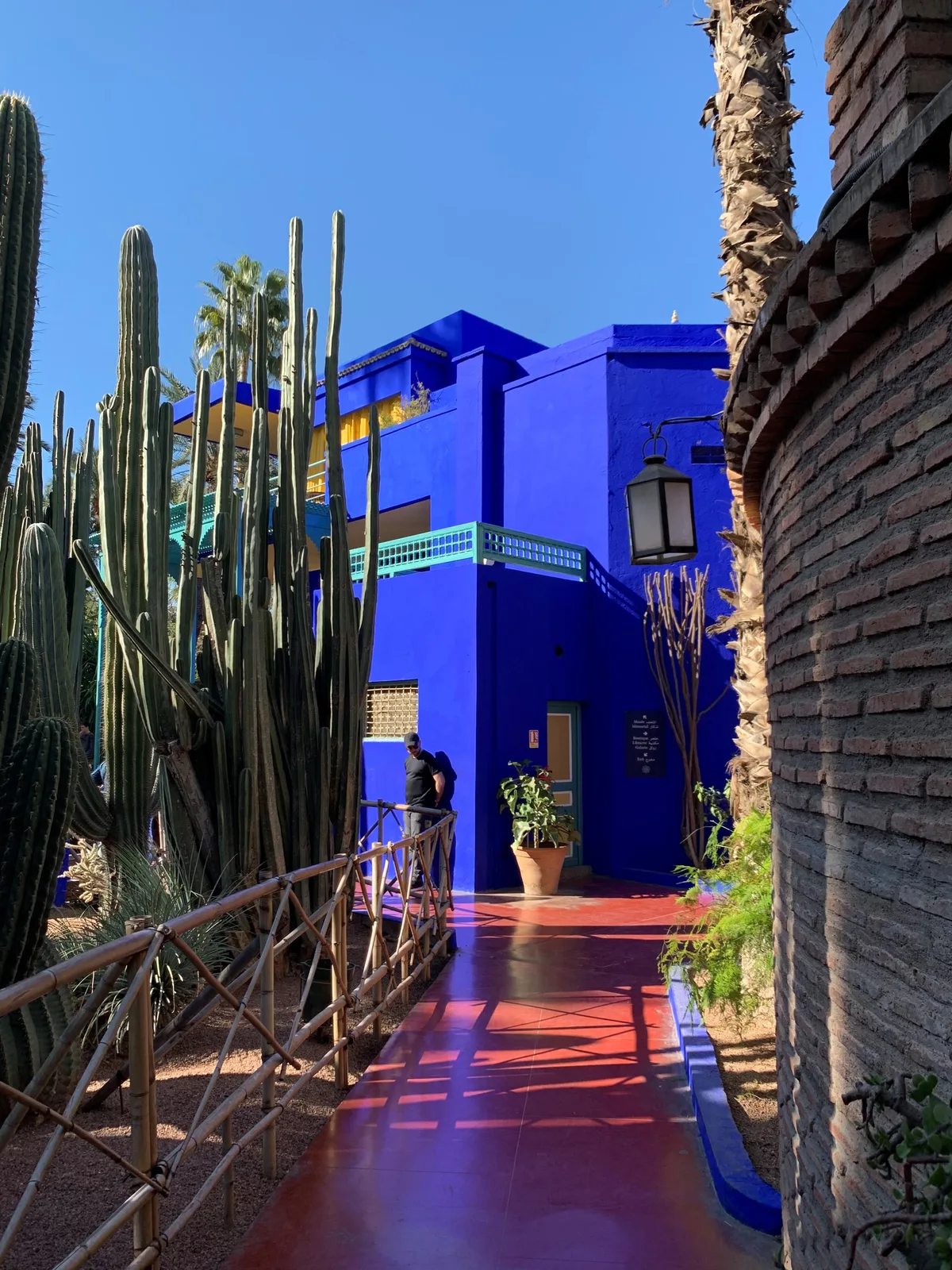
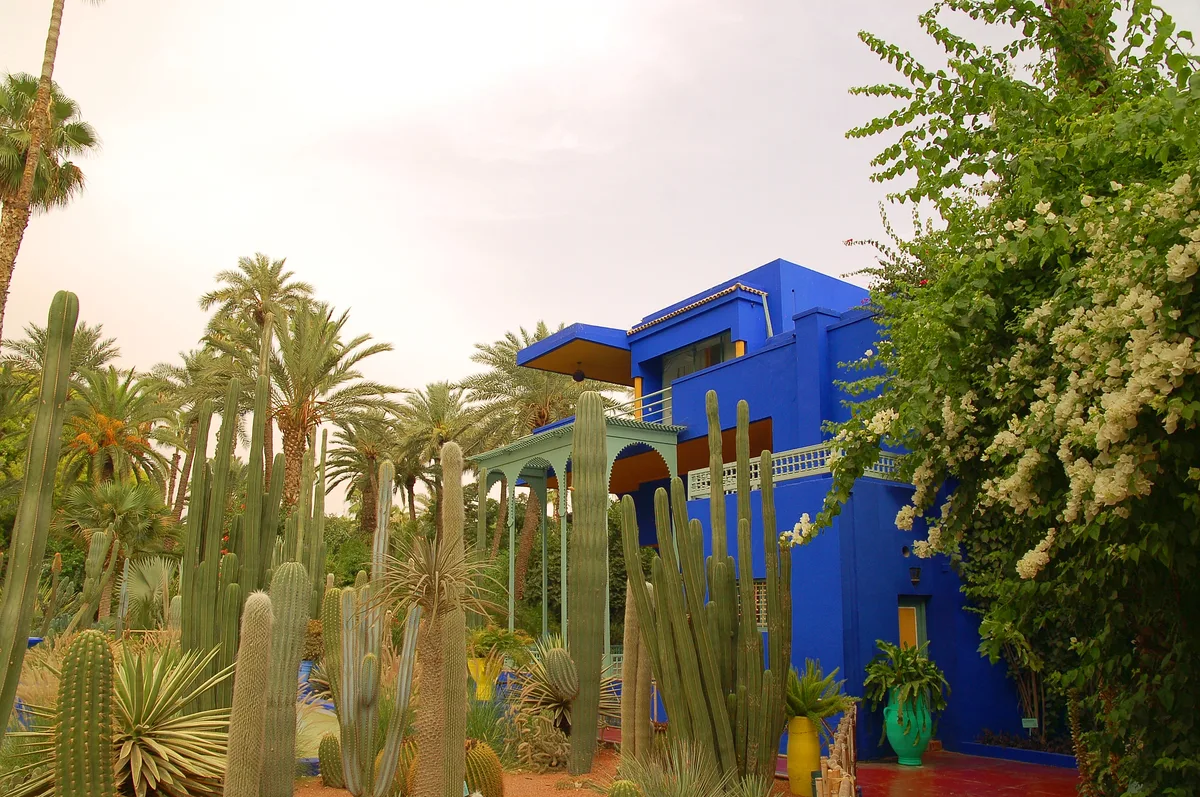
The pairing section of this guide is deliberately one section, because the garden has a full guide of its own on this site and because the museum, not the garden, is this article’s subject. But no honest account of the museum can skip its neighbour, because the two were conceived, in the end, by the same hands. The Jardin Majorelle is the garden the painter Jacques Majorelle assembled over some forty years from the 1920s – a botanical composition of cacti, palms, bamboo and water painted around a Cubist villa in the blue that now bears his name. Saint Laurent and Bergé bought it in 1980 to save it, restored it, and opened it to the public. It is, by a wide margin, the most visited attraction in Marrakech, and its blue alleys and the museum’s brick facade stand close enough together that a visitor passes from one to the other in a couple of minutes’ walk.
Sequence is the whole craft of the paired visit. The strongest order, for most people, runs museum first and garden second – the museum in the morning’s relative calm, on its timed ticket, while the garden is still bearable, then the garden as the light and the planting do their work, with the café as the hinge between them if the day is hot. The reverse order suits only those who reach the garden at its opening, before its own crowds; by late morning the garden is the busiest place in the quarter and the museum becomes the refuge from it. Either way, do not attempt both at midday in high summer and call the result a judgement on either. They are two halves of one of travel’s great double acts, and they deserve a morning of their own rather than an hour stolen from the medina.
Inside the garden grounds stands the third member of the family, and the one most often confused with the museum itself – the Pierre Bergé Museum of Berber Arts, universally called the Berber Museum. It is not part of the yves saint laurent museum marrakech, and it is not in the museum building. It occupies Jacques Majorelle’s former painting studio, the blue villa at the garden’s heart, and it holds a collection of more than 600 Berber objects assembled by Pierre Bergé – jewellery, costume, textiles, weapons, doors and everyday artefacts drawn from Morocco’s Amazigh regions, from the Rif to the Sahara. Its rooms make the argument that the museum next door makes in cloth of a different kind – that Moroccan craft traditions are not decoration but a complete material civilisation, and that Saint Laurent’s famous debts to Morocco were debts to real, named makers and traditions.
Reading the Berber Museum as the Museum’s Other Half
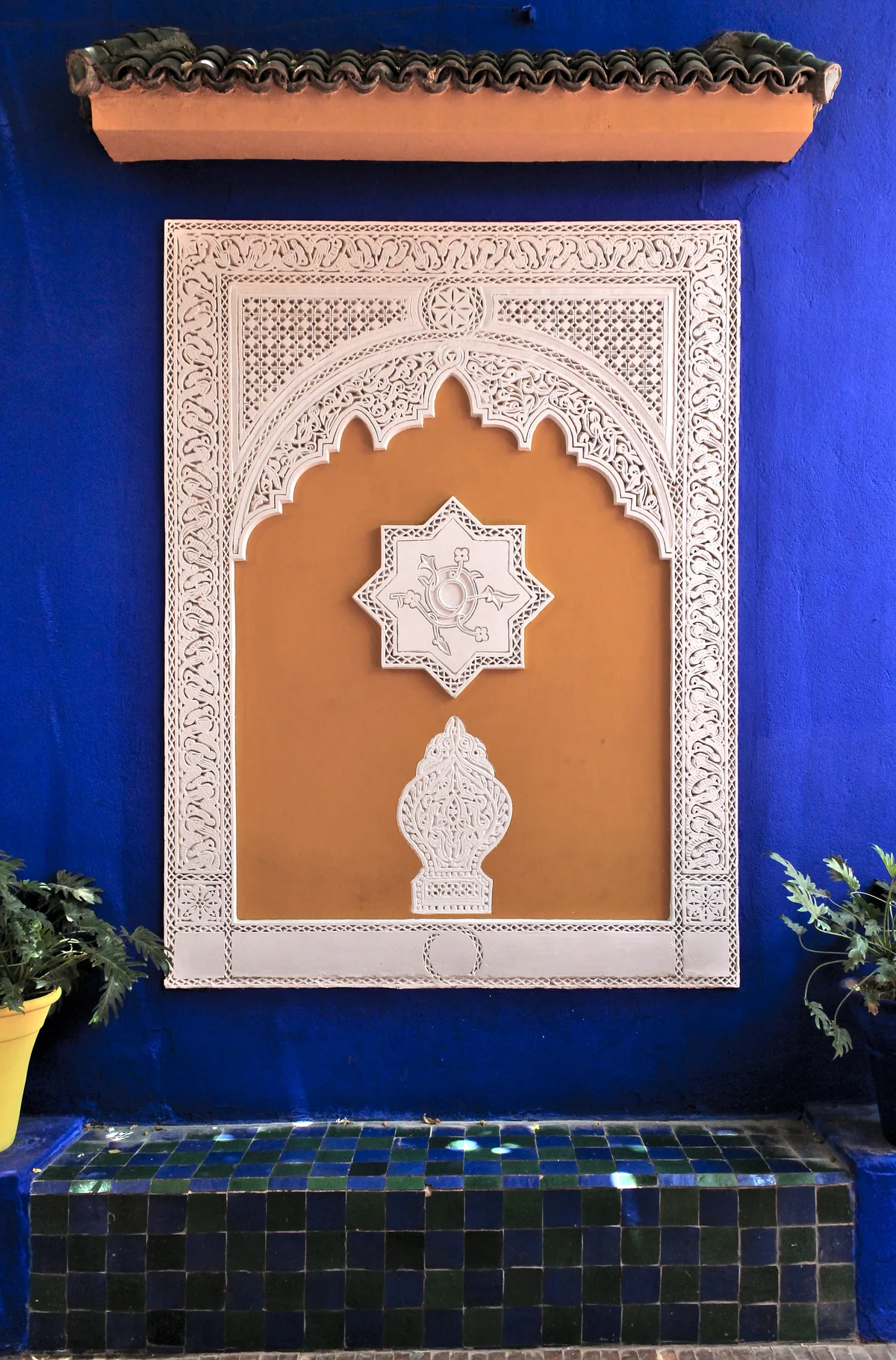
The Berber Museum rewards being read as the YSL museum’s other half rather than as a footnote to the garden. Consider what the two collections do together. On one side of the street wall, the permanent exhibition shows what a Paris couturier made of Moroccan colour, North African dress and the idea of Africa. Inside the garden, the Berber Museum shows the source material on its own terms – the silver jewellery, the woven and embroidered textiles, the ceremonial costume of the Amazigh peoples whose visual world Saint Laurent spent forty years quoting. A visitor who sees both has, in effect, read a text and its footnotes in the same morning, and each collection is sharper for the other.
The Berber Museum is also the smaller, quieter experience of the three, and many visitors rate it the most affecting. The studio’s rooms are intimate, the objects are displayed with a jeweller’s economy, and the collection’s highlights – the great silver fibulae and necklaces, the wedding costume, the painted and carved doors – concentrate centuries of regional craft into a space you can hold in your head. It has its own ticket, bought through the same official site as everything else on this street, and it is entered from inside the garden. Give it half an hour at minimum. It is the cheapest education in Morocco on offer anywhere in Marrakech, and it completes the museum visit in a way the café, good as it is, cannot.
The Honest Downsides
Begin with scale, because it is the source of most mismatched expectations. The permanent exhibition is one hall and around fifty garments. Visitors raised on the great costume collections of London or New York sometimes walk its length in fifteen minutes and emerge feeling the museum is small – and by the square metre of gallery, it is. The defence is the one this guide has made throughout – the room is a staged edit, not an archive, and it rewards slowness disproportionately. But the honest version includes the limit. If fashion is a passing interest rather than a real one, this museum is a good hour. It is not, and does not try to be, a whole day, and travellers who build a day around it alone will run out of museum by lunch.
Then the crowds and the system that manages them. The Majorelle quarter is the most visited corner of Marrakech, and its infrastructure – online-only tickets, timed entry, QR codes, queues at three separate doors within a hundred metres – can make a cultural morning feel administratively heavy. The museum is the calmest of the three venues, but it shares the street, the ticketing platform and the peak hours with the other two, and in high season the whole apparatus books out. Travellers who arrive in Marrakech assuming they will simply turn up at the yves saint laurent museum marrakech, as at a European city museum, are the ones the system defeats. Book ahead, on the official site, before the trip if the dates matter.
There are smaller honesties. The museum’s restraint, architecturally admirable, means the building photographs less dramatically than the garden’s blue – fashion travellers expecting a social-media set may find brick subtle by comparison, though the facade in raking light answers that. Photography inside the galleries is restricted, as couture exhibitions generally are, which disappoints visitors who experience museums through a camera. The Wednesday closure has already had its warning. And the Guéliz location, while easy by taxi, is a separate expedition from the medina rather than a stroll – the Majorelle half-day is a commitment of a morning, across town, and should be planned as one rather than squeezed into a gap between the souks and lunch.
None of this cancels the place. The museum is, by any serious standard, one of the finest single-designer museums in the world, in a building that would justify the trip to the street on its own, beside a garden that justifies the trip to the city. The downsides are the ordinary price of a small, popular, carefully run institution in a very visited city. Pay the price knowingly – book early, go early, slow down in the dark hall – and the museum pays it back with interest.
Frequently Asked Questions
Is the Yves Saint Laurent Museum inside the Jardin Majorelle?
No. The museum stands on Rue Yves Saint Laurent immediately beside the garden, in its own purpose-built home opened in 2017. The garden, the museum and the Berber Museum – which is inside the garden, in the painter’s old studio – are three separate venues, each with its own entrance and ticket.
How long does the museum take?
About an hour at a thoughtful pace for the permanent and temporary exhibitions together, longer if the bookshop and café do their work. Combined with the garden and the Berber Museum, the three make a natural half-day, and that half-day is the right unit to plan.
Do I need to book in advance?
Yes, in any season when Marrakech is busy. Tickets are sold only through the official Jardin Majorelle ticketing site, which the museum’s own homepage names as the sole official seller, and peak dates sell out. Tickets bought from unofficial sites may not be honoured – the museum says so itself.
When is the museum closed?
Wednesdays, according to the museum’s official site, which lists opening as every other day from 10 a.m. to 6 p.m. with last entry at 5.30 p.m. at the time this guide was researched. Hours change; confirm on the official site before building a day around them.
What is the one thing not to miss?
In the permanent hall, the themed confrontation of the icons – Le Smoking, the Mondrian dress, the safari jacket – with the sketches and film that explain them. In the building, the brick facade in low sun. Across the whole quarter, the Berber Museum’s jewellery rooms, which complete the story the couture tells.
Can I visit the Villa Oasis?
No – the villa remains private and is not open to visitors. It is part of the garden’s views, and its story is told in the museum’s displays. The museum, garden and Berber Museum are the public visit; the villa is the private house at its centre.
Is the museum suitable for children?
For children with an interest in clothes, colour or drawing, yes – the dark, theatrical hall and the LOVE imagery hold attention well, and the garden next door provides the run-around half of the outing. For very young children it is a short attention span in a quiet room, and the garden will do the heavier lifting.
Which should I do first, the museum or the garden?
The museum first, for most visitors – it is at its calmest early, its ticket is timed, and the garden follows naturally, with the museum’s café as the hinge between them. The exception is the garden at its own opening time, which the earliest risers can take first and empty.
The Short Version
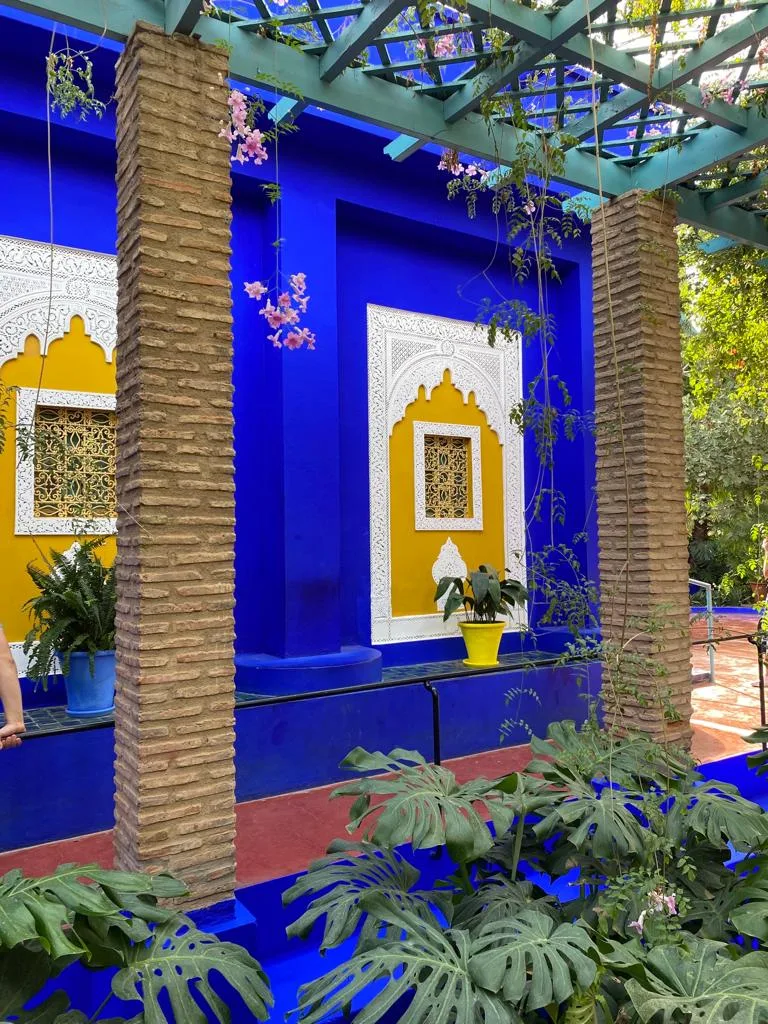
If this guide to the yves saint laurent museum marrakech has to shrink to one paragraph, it is this. On a street in Guéliz renamed for him, beside the garden he saved, stands the museum Pierre Bergé built to the designer Marrakech taught colour – a terracotta-brick building by Studio KO holding a dark, theatrical hall of some fifty garments at a time, a changing temporary gallery, an auditorium, a library, a bookshop and a café. Book through the one official ticketing site, never on a Wednesday, go in the morning, and take the museum slowly before the garden and the Berber Museum complete the morning next door.
Do that, and the quarter resolves into what it really is – not three attractions sharing a taxi rank, but one story told in three buildings. A painter made a garden. A couturier saved it, lived beside it and let it remake his work. And a museum now stands at its gate, in brick the colour of the city, making sure the story is told in the designer’s own clothes. For the wider country that produced the colours, the textiles and the craft behind all of it, this site’s Morocco travel guide is where the story continues.
One last practical word. Of the three visits on this street, the museum is the one travellers most often leave unbooked, because the garden’s fame swallows the planning. Reverse that instinct. The garden will still be blue next year; a sold-out museum slot on the one morning a trip allows is gone for good. Book the museum first, build the garden and the Berber Museum around it, and let the brick building – the quietest, newest and, for anyone who cares about clothes or architecture, the richest of the three – set the pace of the whole morning.