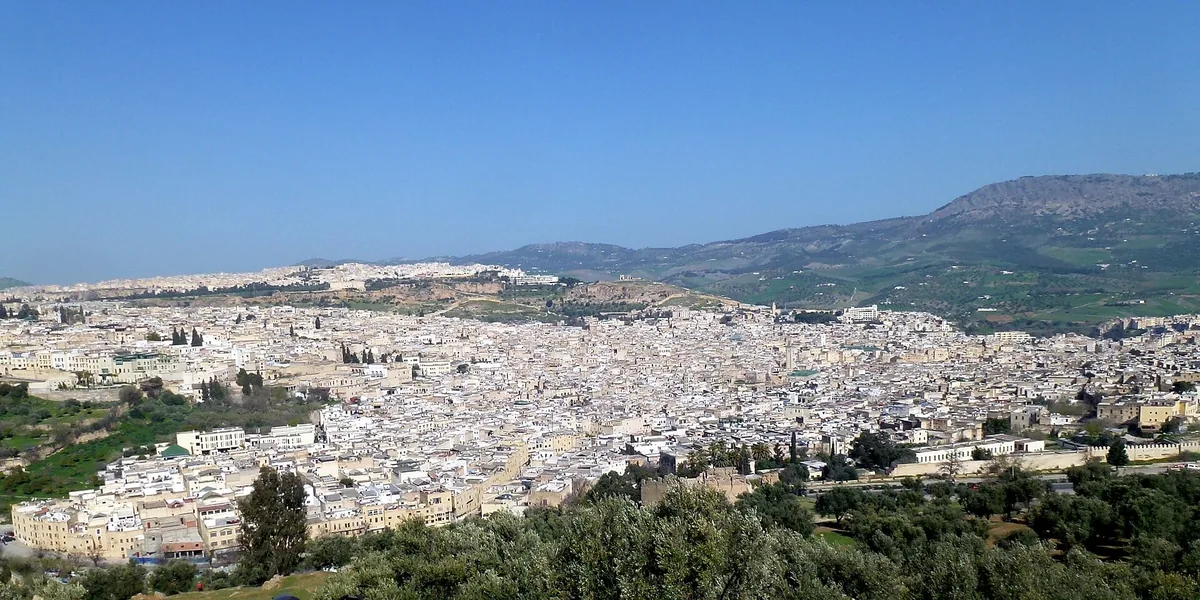
Most medinas in Morocco feel like districts. Fes el Bali feels like a country. You come through the blue gate at Bab Bou Jeloud at nine in the morning and the city simply starts, lane after lane of it, and it does not really stop until it runs out of valley several hours of walking later. There are two long commercial arteries, a river buried under the middle of it, something in the region of nine thousand lanes by the count everyone repeats, and a working population that has been doing its business for the better part of twelve centuries.
That is the first thing to get right about fes el bali. It is not a museum with a city wrapped around it, and it is not a theme park with better food. The tannery tans. The madrasas are monuments, but the mosques around them are mosques, used five times a day by the people whose grandparents used them. Visitors are welcome here, genuinely, but they are guests in a working city, and the whole place makes more sense the moment you treat it that way.
The second thing to get right is that you will get lost. Not might. Will. The medina is laid out on a logic, just not a cartographic one. It follows water, slope and trade.
This guide is built around that spine. It starts with what the place actually is and how it came to be, then walks the route most visitors walk, from Bab Bou Jeloud down Talaa Kebira to the Bou Inania Madrasa, the Qarawiyyin and the souks of the centre, across to the Chouara Tannery, and back out through the workshops and fondouks. Along the way it covers the things the short guides skip. How the tannery actually works and why you watch it from a shop terrace. Why the most famous university building in the city is one you can only see from the street. And how the guiding system works, so that the man offering to show you the way is a transaction you understand rather than a small drama you stumble into.
If you are planning the wider trip around this day in the medina, our Morocco travel guide covers the country-level planning, and this medina day sits naturally at the Fes end of the classic route in our 7-day Morocco itinerary. This page does one job only.
Fes el Bali at a Glance
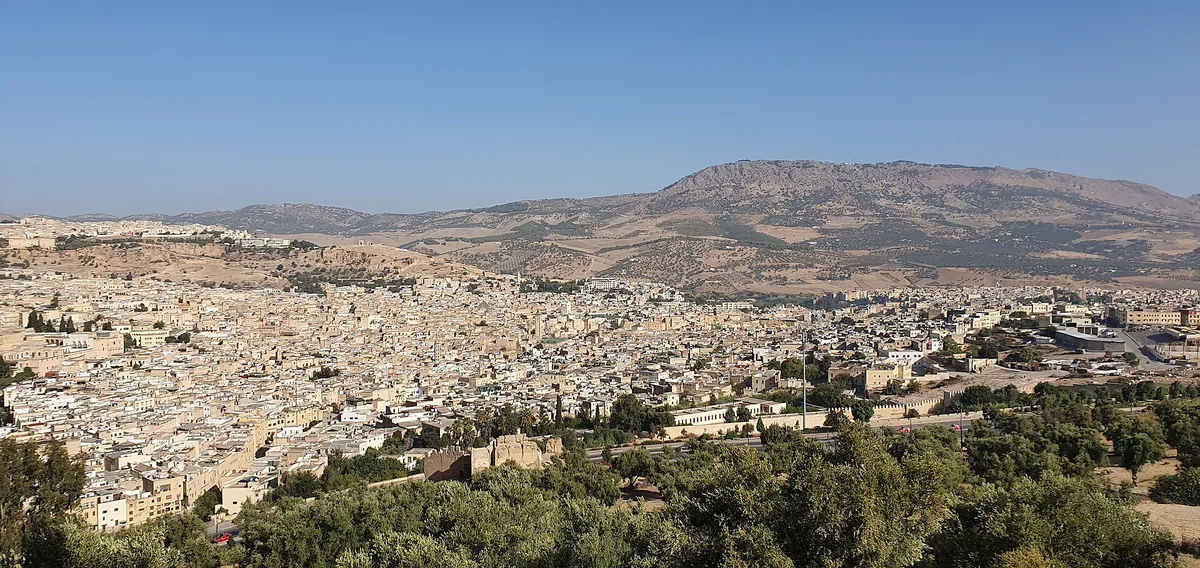
Fes el Bali is the oldest of the three historic parts of Fes, the other two being Fes el Jdid, the thirteenth-century royal city next door, and the Ville Nouvelle, the modern city the French built on the plateau above. The old medina sits in the bowl of the Fez River valley, which is why it photographs so well from the hills and why almost every street inside it is either going up or coming down. UNESCO inscribed the Medina of Fez on the World Heritage List in 1981, and the listing covers both el Bali and el Jdid, though it is el Bali that holds the density, the monuments and the ninth-century origin.
| Question | The short answer |
|---|---|
| What is it | The ninth-century medina of Fes, a UNESCO World Heritage site since 1981 and a fully working city quarter |
| Founded | Between 789 and 808 AD, by Idris I and then Idris II, as two towns on opposite banks of the Fez River |
| Size | Roughly 300 hectares of car-free streets, with around 9,000 lanes by the commonly repeated estimate |
| Main entrance | Bab Bou Jeloud, the blue gate at the western edge, built 1913 beside the older original gate |
| The spine | Talaa Kebira and Talaa Seghira, the two main arteries running east from the gate |
| Do not miss | Bou Inania Madrasa, the Chouara Tannery terraces, Place Seffarine, the Qarawiyyin rooftops and minaret |
| You cannot enter | The Qarawiyyin and other mosques if you are not Muslim. Their doors, rooftops and minarets are the view |
| Time needed | One full day minimum with a guide, two days to do it at any kind of humane pace |
| Best months | Spring and autumn. Summer heat inside the lanes is a serious consideration, not a footnote |
| Getting lost | Guaranteed, survivable and part of the point. Official licensed guides are the structured alternative |
Fes el bali punishes the half-day visit more than almost anywhere else in Morocco, because the distances are short but the friction is high. Every lane looks like another lane, every sight involves a negotiation with geography, and the famous places are spread from the western gate to the eastern tannery across the full width of the valley.
Two Towns, One River – How Fes el Bali Began
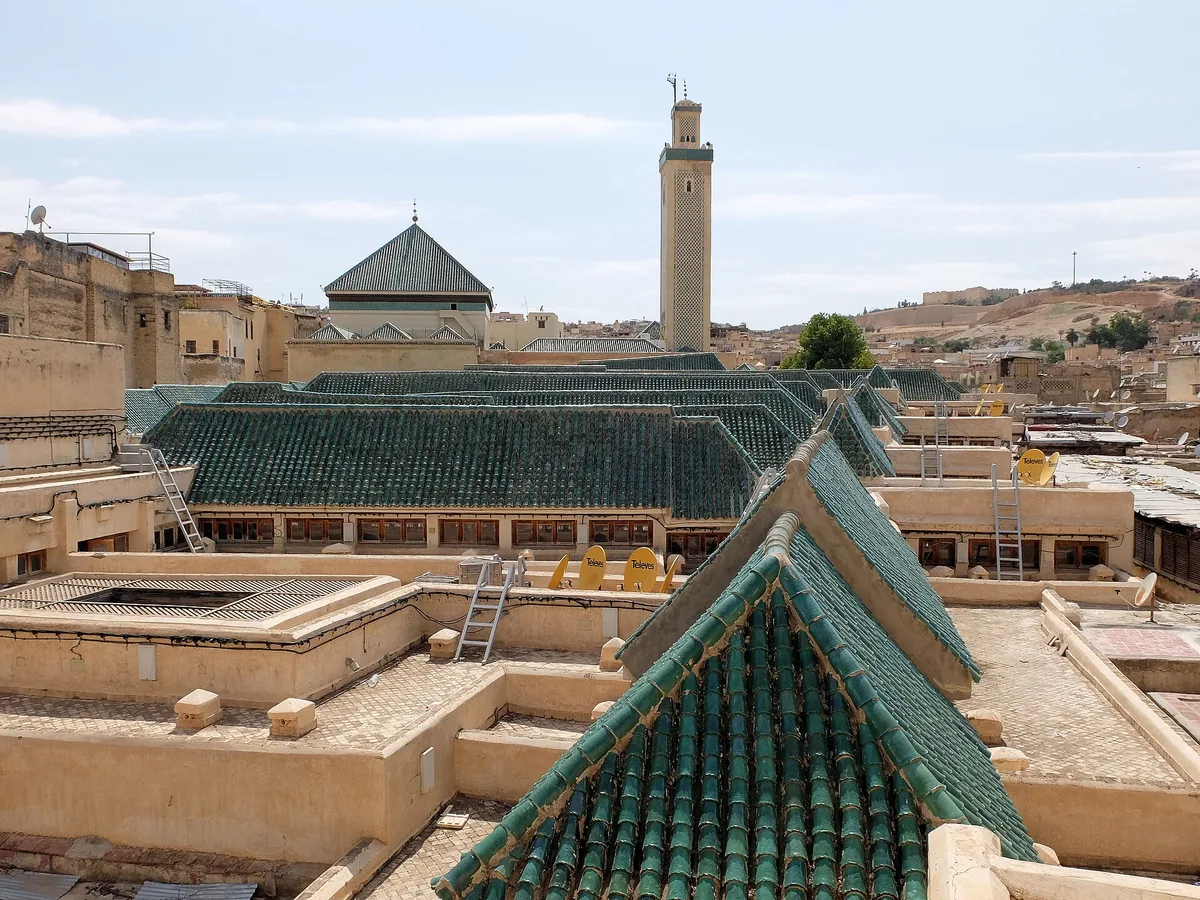
The founding story of fes el bali is a story of two towns that became one city, and knowing it explains the ground you walk on. In 789 AD Idris I, founder of the Idrisid dynasty, established a settlement on the eastern bank of the Fez River, and twenty years later his son Idris II founded his own capital on the opposite, western bank. The settlers on one side included families who had fled an uprising in Cordoba, in Islamic Spain. The other side drew refugees from Kairouan, in present-day Tunisia.
The two banks became the two historic quarters of the medina, the Qarawiyyin Quarter on the west bank and the Andalusian Quarter on the east, named for where their people had come from. The great mosque of the western quarter, the Qarawiyyin, was founded in 859, by tradition with the fortune of Fatima al-Fihri, a woman of the Kairouan refugee community. Her sister is credited with the Mosque of the Andalusians across the river in the same period.
For two centuries the twin towns grew side by side, sometimes cooperating and sometimes competing, until the Almoravids united them in the eleventh and twelfth centuries and made one walled city of the pair. That seam still runs through the middle of fes el bali today, largely covered over now, and the medina’s geography still makes most sense read as two slopes running down to a hidden watercourse. When you cross from the Qarawiyyin side to the Andalusian side on a modern visit, down past the covered river and up the other bank towards the tannery, you are walking the oldest political geography in the city.
The golden age, in architectural terms, came later. In 1276 the Marinid dynasty moved the capital back to Fez and built a new royal city, Fes el Jdid, on the plateau to the west. From that moment the old city was el Bali, the old one, and the name has stuck for seven and a half centuries. But the Marinids did not neglect their old capital. Through the thirteenth and fourteenth centuries, the period UNESCO singles out as the city’s height, they filled fes el bali with the monuments that still define it. Madrasas, fondouks, mosques, palaces and fountains in carved stucco, cedar and tile. Bou Inania and Al-Attarine, the two madrasas every visitor sees, are both Marinid work.
One more turn of the story matters for what you see. In 1912, under the French Protectorate, the political capital of Morocco moved to Rabat, and Fez lost the status it had held, on and off, for a millennium. UNESCO’s own summary makes the point that the city kept its role as the country’s cultural and spiritual centre even so. The French, under Resident-General Lyautey, took a deliberate decision to preserve the medina and build their new city outside it entirely. The result is the thing the superlatives are all trying to describe. Not a preserved quarter, but a preserved city.
The Car-Free City and the 9,000 Alleys Claim
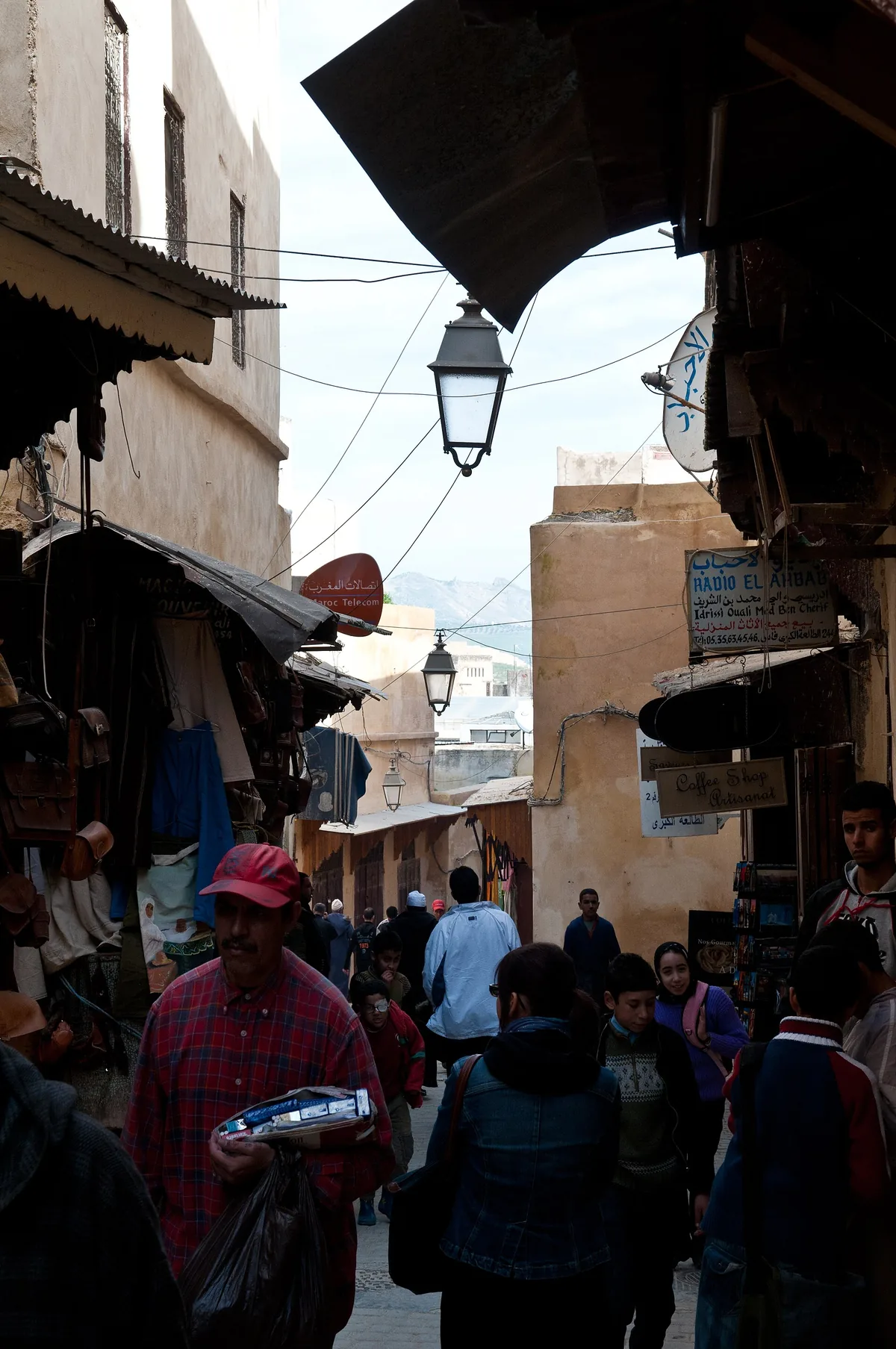
You will read, in guidebooks and on plaques and in the first paragraph of almost everything written about this place, that the medina is the world’s largest car-free urban area. The medina covers about 300 hectares. Within that area there are essentially no streets a car can use, just the network as it has been for a thousand years. Lanes engineered for people, pack animals and handcarts, many of them too narrow, too stepped or too sharply bent for anything with an engine and four wheels.
The figure of nine thousand alleys comes with the same territory, and it deserves the same care. You will see 9,000, you will see 9,400, and you will see the number stated as flat fact in places that ought to know better. Treat it as what it is, a long-repeated estimate that nobody has ever verified lane by lane, because a serious share of the lanes in question are private residential passages that no surveyor has any business counting.
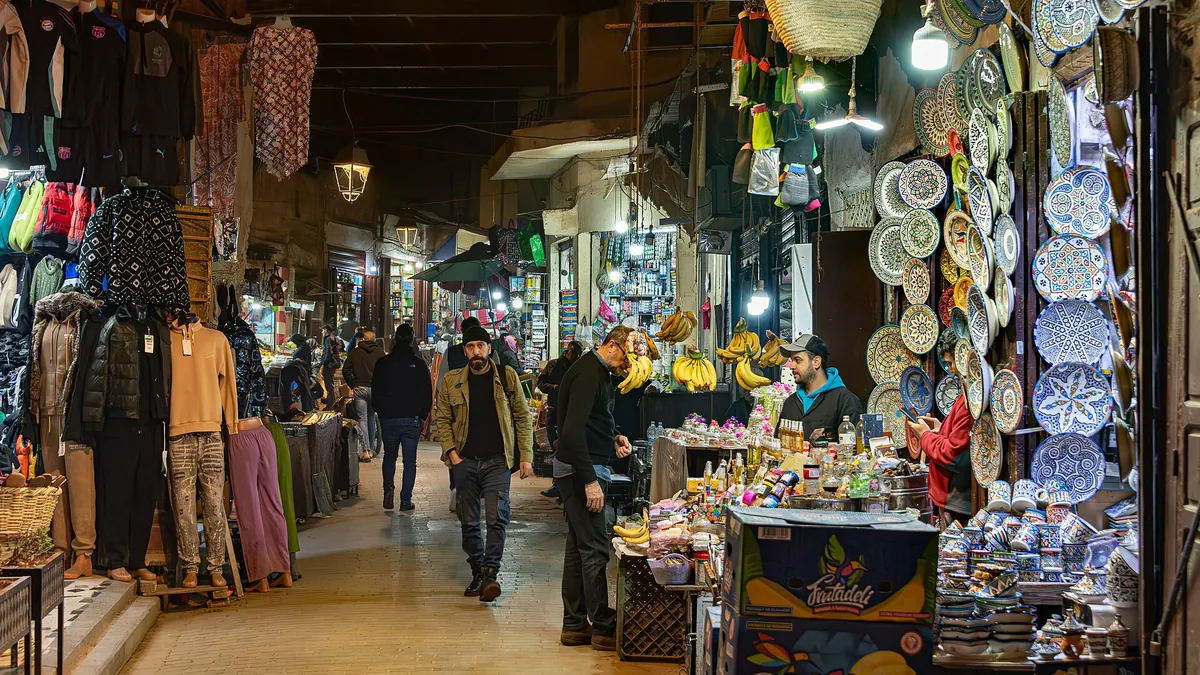
The lanes are not a failed attempt at a street grid. They are a different system, working exactly as designed. At the top of the hierarchy sit the two great arteries, the Talaas, commercial and public, lined with shops and made for through movement. Branching from them are the souk streets, each given to a trade. Branching from those are neighbourhood lanes, and branching from those are the derbs, the short residential spurs that typically end in a cluster of front doors and go nowhere at all.
This is why the car-free claim and the getting-lost problem are the same fact viewed from two directions. A city planned for privacy at the small scale and commerce at the large scale has no use for a legible public grid, so it never built one. Goods move the way they moved in 1200, on donkeys, mules, handcarts and men’s shoulders, and you will hear the warning cry of a porter coming through a crowd long before you see him. Nothing about this is staged for visitors. The donkey with the gas canisters is not heritage colour. He is the delivery system, because he is the only delivery system the streets allow, and fes el bali would stop functioning within a week without him.
The Two Talaas – Walking the Spine of Fes el Bali
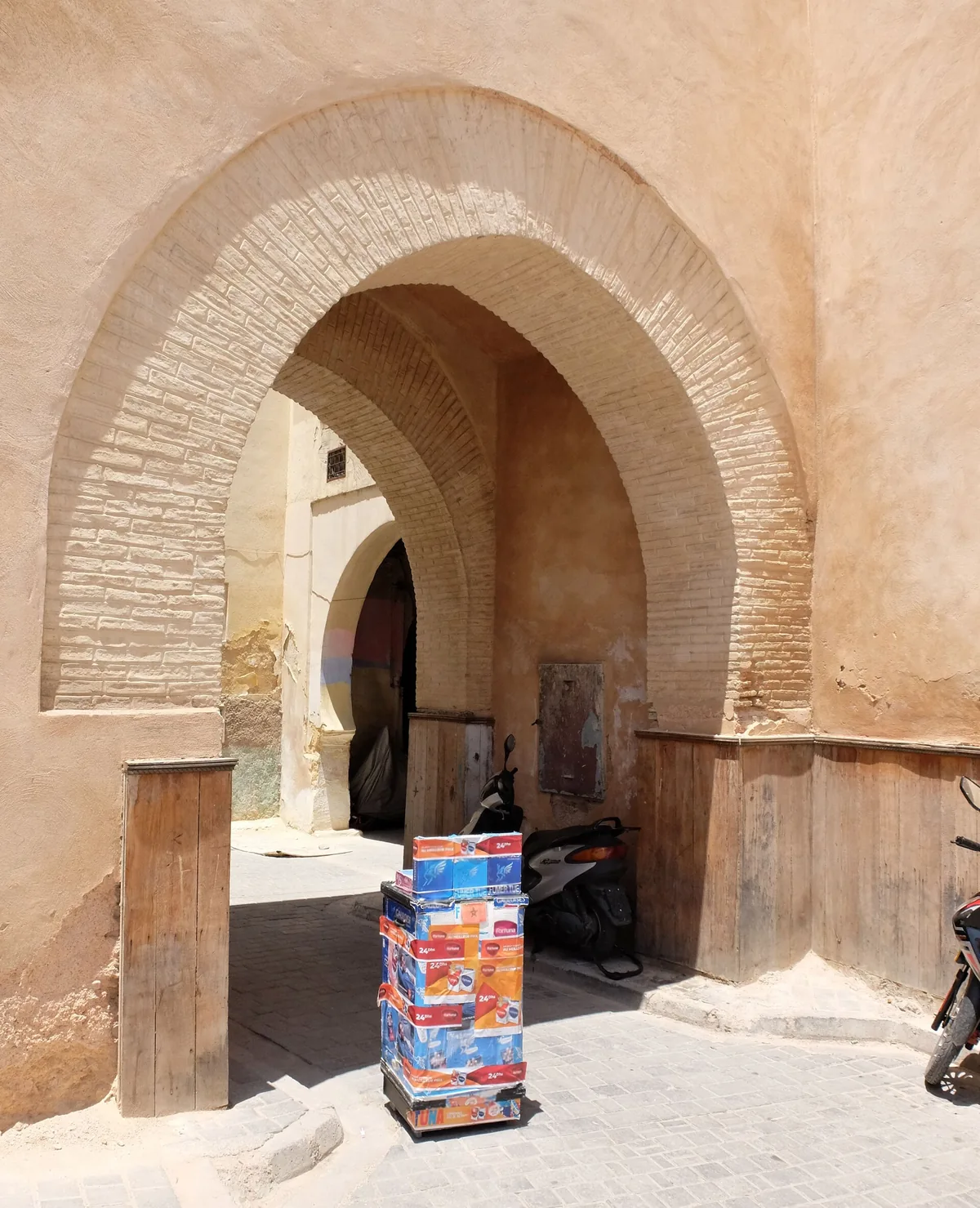
Stand inside Bab Bou Jeloud with the old city in front of you and you have exactly two real choices, because the street forks. To the left, running away east and slightly downhill, is Talaa Kebira, the Big Slope. To the right, roughly parallel and a couple of streets south, is Talaa Seghira, the Small Slope. Together they are the spine of the medina, and the single most useful thing you can learn before walking anywhere is what they do. Both run west to east. Both carry you from the gate, past the Bou Inania Madrasa, down into the commercial heart around the Qarawiyyin. Kebira keeps going beyond the centre, down towards the river and the eastern quarters.
Talaa Kebira is the grander of the two and the one almost every first visit follows. For much of its length it is a true souk street, roofed in places with slatted reed matting that breaks the sun into stripes, lined with shops selling everything from wedding caftans to copper trays to sacks of cumin. Further down, the street passes the spice sellers of the Attarine quarter and delivers you to the lanes around the Qarawiyyin and the Zawiya of Moulay Idris II.
Talaa Seghira is its quieter sibling, and on a second day in the medina it may become your favourite. It starts a few metres south of its sister, near the same gate, and runs a parallel course with less ceremony. The shops here lean more everyday, clothes, household goods, food, with fewer of the big display pieces aimed at visitors, and the street keeps a slightly more local temperature because of it. Two things make Seghira strategically precious. The first is that it gives you a second line on the map, so that a route down one Talaa and back up the other makes a loop instead of a retracing.
Between and beyond the two arteries, the rule of navigation here is gradient. The medina is a bowl. The gates sit high, the river sits low, and the centre of religious and commercial gravity, the Qarawiyyin, sits towards the bottom of the western slope. Walk downhill and you are heading into the centre. Walk uphill and you are heading out towards a gate. Combine slope with the Talaas and you have a complete emergency navigation system that needs no phone signal, which is just as well, because the lanes eat phone signal for breakfast and GPS position in the medina is a work of fiction at the best of times.
Give the spine the respect of learning it properly on day one, ideally with a guide walking it beside you once, and the medina changes character. The lanes stop being threats and start being what they are, shortcuts and neighbourhoods hanging off two streets you can always find again. Every section that follows assumes this map. The gate, then the madrasa, then the centre, then the tannery, in the order the spine delivers them.
Bab Bou Jeloud – The Blue Gate
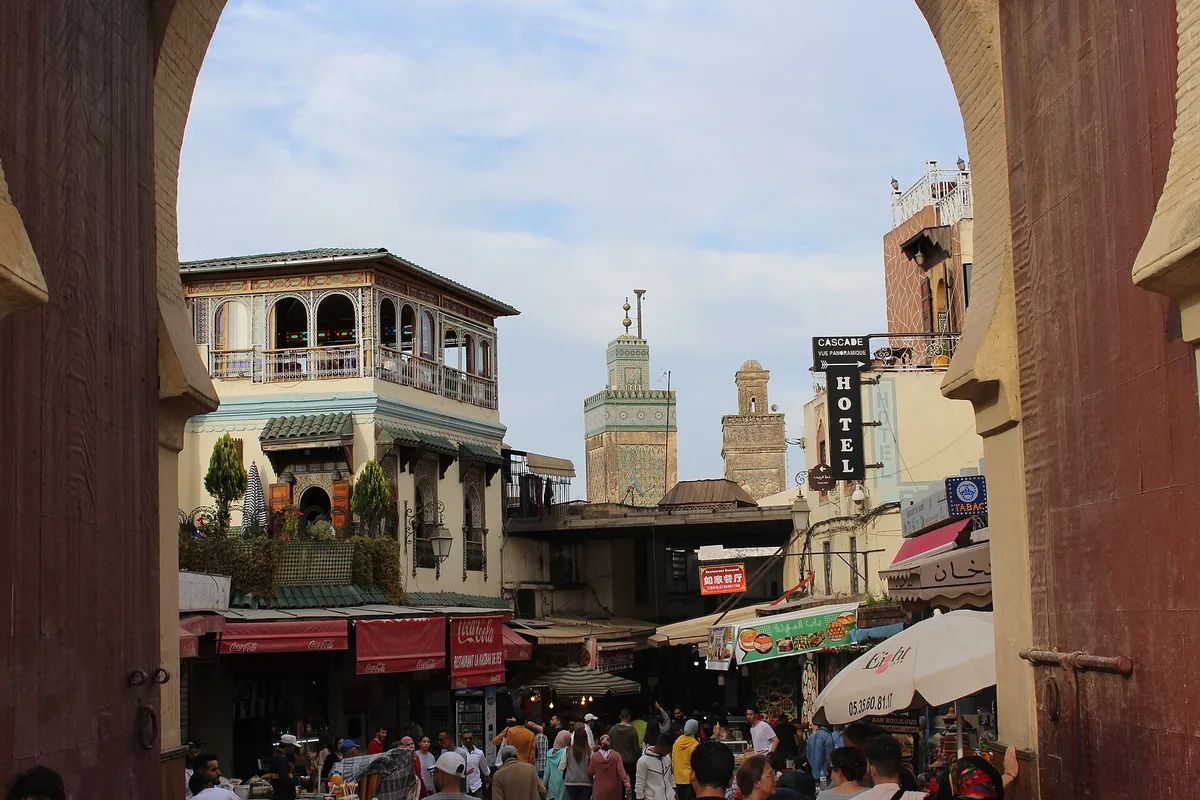
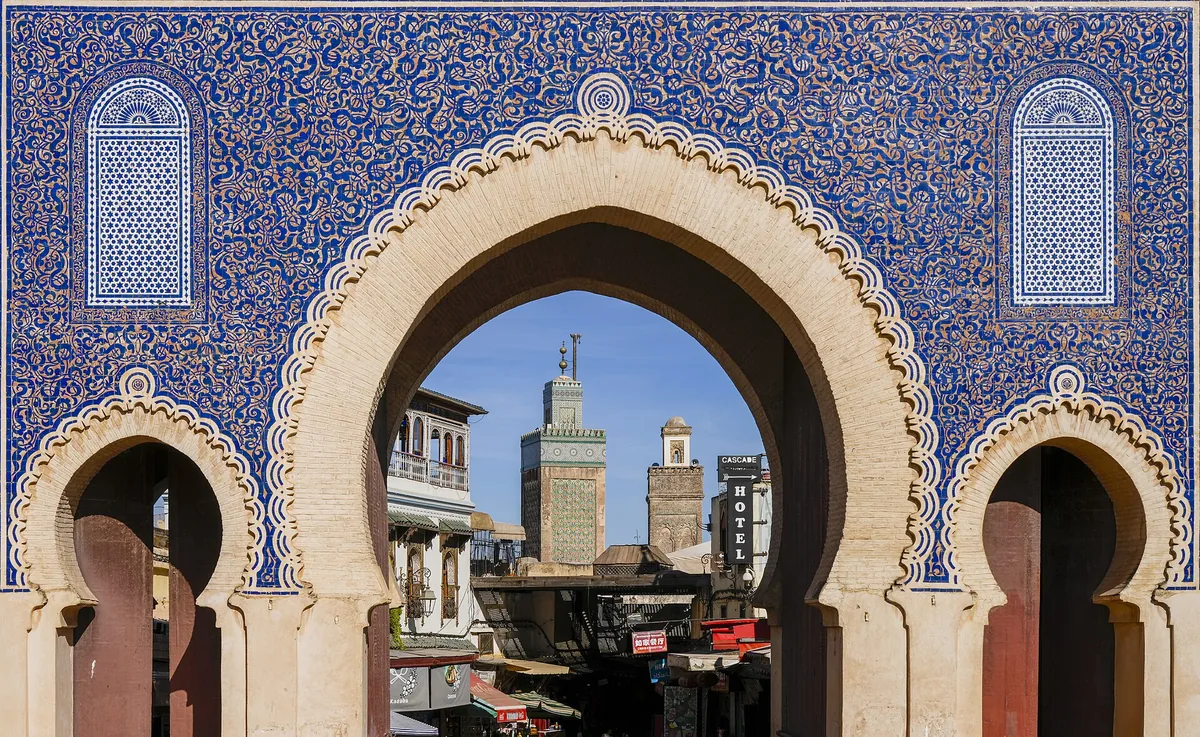
Every medina needs a front door, and this one has the most famous in Morocco. Bab Bou Jeloud stands at the western edge of the old city where the modern taxi ranks and the cafes of the newer town give out, and it announces itself in tile. Three horseshoe arches, a crenellated crown, and a facade covered in faience that changes colour depending on which side of it you are standing. From outside the medina the tiles are blue, the colour of Fes. Walk through and look back, and the inner face is green, the colour of Islam. Stand in the right spot outside and the minaret of the Bou Inania Madrasa rises exactly in the centre of the great arch, with the smaller minaret of Sidi Lazzaz beside it, a postcard the architects composed on purpose.
What surprises most visitors is the date. The medieval-looking gate was built in 1913, by the French colonial administration, as a grand ceremonial entrance to the old city. It is a twentieth-century building in Marinid dress, and there is no scandal in that once you know the rest of the story. Step a few paces to the side and you will find the original Bab Bou Jeloud, a plain, older opening in the wall, possibly twelfth-century in origin, with the bent passage that defensive gate design demanded. An attacker charging through it would have to turn sharply inside the gatehouse, exposed, which was rather the point. The old gate is closed now and easy to walk past without noticing, most people do, but it is the genuine article and the 1913 showpiece is its portrait.
The name carries its own small mystery. Bou Jeloud is often explained as a corruption of Abu al-Junud, something like the place of the troops or the parade ground, which fits the open ground that once lay here. The cafes on and inside the gate are still the medina’s meeting point. If you agree to meet anyone anywhere in fes el bali, this is the one address in the entire medina that both of you are guaranteed to find again, and experienced Fes hands use it exactly that way.
Use the gate as the French intended, as the start of the itinerary. From its arches the two Talaas run east, the Bou Inania Madrasa stands five minutes down Talaa Kebira, and the whole west-to-east walk across the old city unfolds in sequence.
Bou Inania Madrasa – The One Great Interior You Can Enter
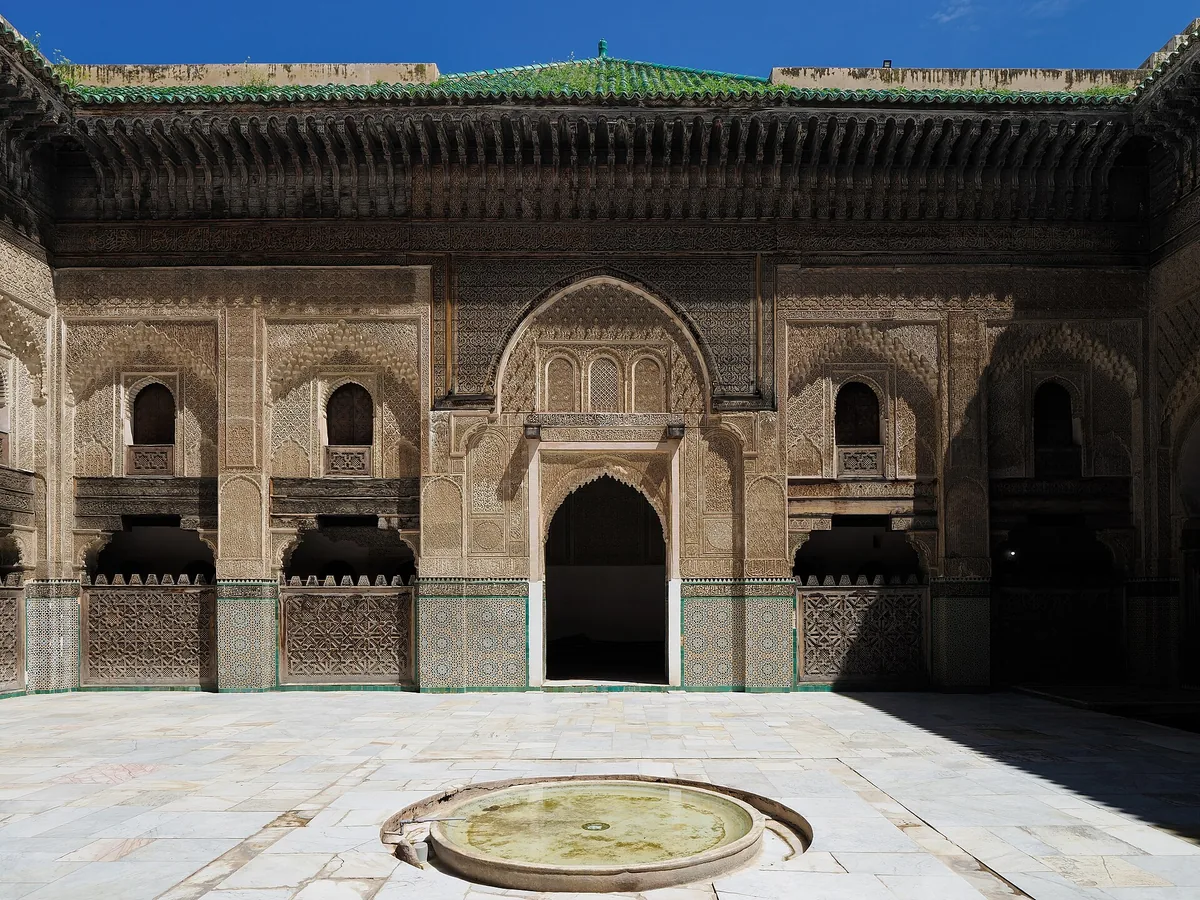
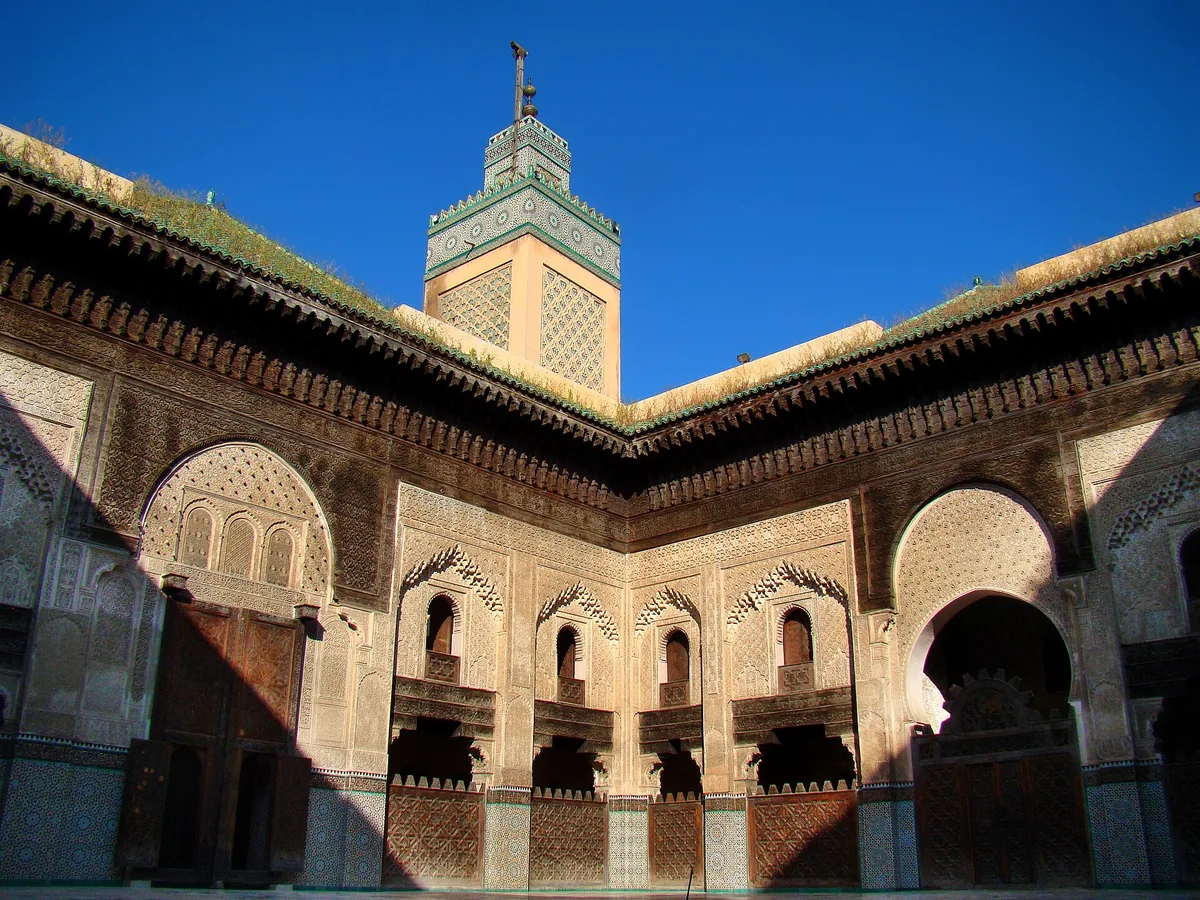
Five minutes down Talaa Kebira from the gate, on the left as you descend, stands the building that justifies every superlative ever thrown at Marinid architecture. The Bou Inania Madrasa was built between 1351 and 1356 under the sultan Abu Inan Faris, and it was the last and greatest of the madrasas the Marinids raised in Fez. It was built as a college, but it was also more, and the more is what makes it unique in the city. It was endowed as a congregational mosque in its own right, with a full prayer hall and a minaret, the only madrasa in Fes to have one. When the great mosque of the Qarawiyyin was not the venue, this was where the sultan’s city prayed at its most official.
For the visitor, though, Bou Inania matters for a blunter reason. It is one of the very few historic religious buildings in Morocco that non-Muslims may enter. What you walk into is a courtyard that functions as a complete catalogue of the Marinid decorative arts, arranged in bands around all four walls. Carved stucco above it, plaster worked into arabesques and calligraphy so fine it reads as lace until you get close enough to see it is stone-hard gypsum cut by hand. Carved cedar wood above that, under the eaves. And a marble floor with a shallow ablutions basin at its centre, worn smooth by six and a half centuries of feet.
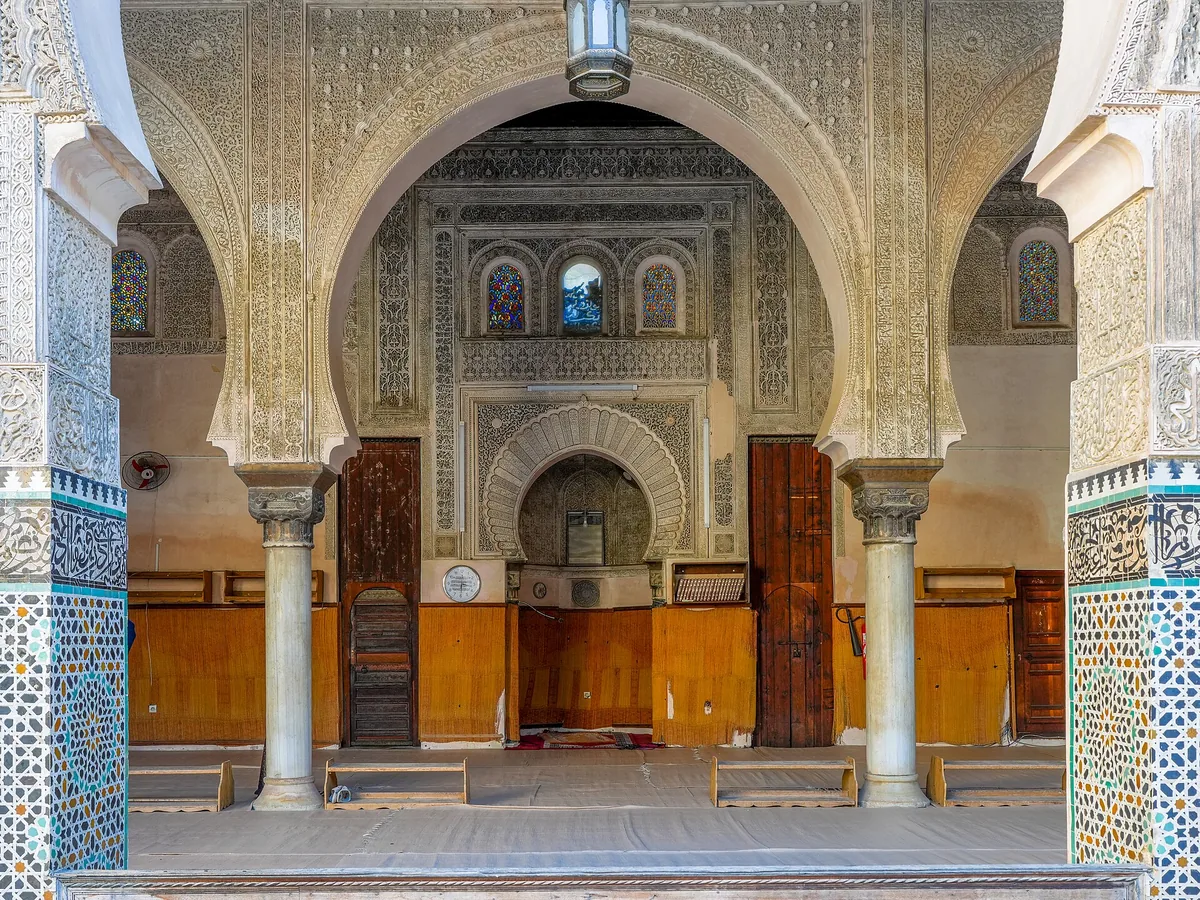
The prayer hall opens off the courtyard’s far side, and it is here that the building’s double life shows. Visitors may look and, within the limits the attendants set, step to its edge, but the carpeted floor is a working prayer space and treated as one, and the madrasa closes to visitors around prayer times as a matter of routine. Go in the morning, not because any website says so, but because the light in the courtyard is at its best and the odds of finding it open and quiet are at their highest.
Give Bou Inania the time it asks for, which is more than the twenty minutes most itineraries allot. The details repay slow looking. And the building still teaches, in a literal sense, what the city was built to be. A city where learning was architecture, where the college and the mosque and the sultan’s prestige were one project, poured into a courtyard you can still stand in. Of everything in this guide, if your time collapses to a single interior, this is the one.
Look up from the courtyard and the building’s claim to uniqueness is standing right there in green tile. Bou Inania’s minaret rises from the corner of the complex, faced in the same green and white geometry as the courtyard below, and it is the only minaret any madrasa in Fes was ever given. The reason is constitutional rather than decorative. A congregational mosque, a grand mosque where the Friday sermon is delivered in the ruler’s name, does. Abu Inan endowed his madrasa with that status, complete with the sermon, the minaret and, across the street, an ablutions house for the worshippers, the dar al-wudu, which still stands opposite the main door with its own modest entrance. The madrasa was a state institution wearing academic dress, and the minaret is the signature on the claim.
The prayer hall itself sits along the courtyard’s southern side, a broad, lower, carpeted space divided by arches, with the mihrab, the niche marking the direction of Mecca, set into its far wall. From the courtyard you see it as a wall of carved stucco and shadow. Visitors are admitted to the threshold and the un-carpeted edges, and the arrangement suits everyone. Worshippers get their hall undisturbed, and you get the one thing no photograph prepares you for, which is the temperature and the quiet of it. After an hour in the commercial roar of Talaa Kebira, the hall’s cool dimness five steps away lands like a change of country. The attendants are used to visitors and firm about the boundaries, usually with good humour.
There is a second reason to linger over the minaret, and it is visible before you ever enter. Because Bou Inania stands alone at the top of Talaa Kebira, just inside the gate, its minaret is the medina’s western landmark, the tower in the postcard view through Bab Bou Jeloud’s arch and the first tall thing you learn to navigate by. Inside the walls, where the lanes deny you any view longer than fifty metres, minarets are the compass points. Bou Inania’s green tower means west and uphill and the gate. The older, plainer tower of the Qarawiyyin means centre and downhill. Fix those two in your head on the first morning and you own a rough bearing anywhere on the western slope.
Directly across Talaa Kebira from the madrasa’s door, at head height and above, sits one of the strangest and most easily missed sights in the medina. A row of small windows and wooden consoles projects from the facade, with bronze bowls set beneath them. This is the Dar al-Magana, the house of the clock, a hydraulic timepiece built in the 1350s as part of the same Bou Inania project. Its job was to mark the hours of prayer for the madrasa and the quarter, at a time when the day was organised by those hours and getting them right was a religious obligation, not a convenience.
The mechanism, as the historians reconstruct it, ran on a regulated flow of water driving a system of weights and releases, and on the hour a ball or weight would drop into one of the bronze bowls with a clang the street could hear, while the little doors above opened in sequence. The Magana no longer works. The bowls and beams you see are the surviving skeleton of the machine, restored in part over the years, and the honest pleasure of it is archaeological. You are looking at the casing of a fourteenth-century computer, mounted on a shopping street, ignored by ninety percent of the people who pass under it twice a day.
Which is exactly why it earns its place in this guide. The medina rewards the visitor who looks at facades above shop level, because the medina was built vertically literate. Inscriptions, clocks, carved eaves, the little grilled windows of houses, the green-tiled hats of minarets and shrines, all of the city’s information is carried above the crowd. Down at eye level is commerce, deliberately so. The Dar al-Magana is the emblem of the rule. Miss it and you have walked past the cleverest object on Talaa Kebira. Spot it, and you will spend the rest of the day glancing up, which is where half of this city has been hiding all along.
Al-Qarawiyyin – The University You See From the Street
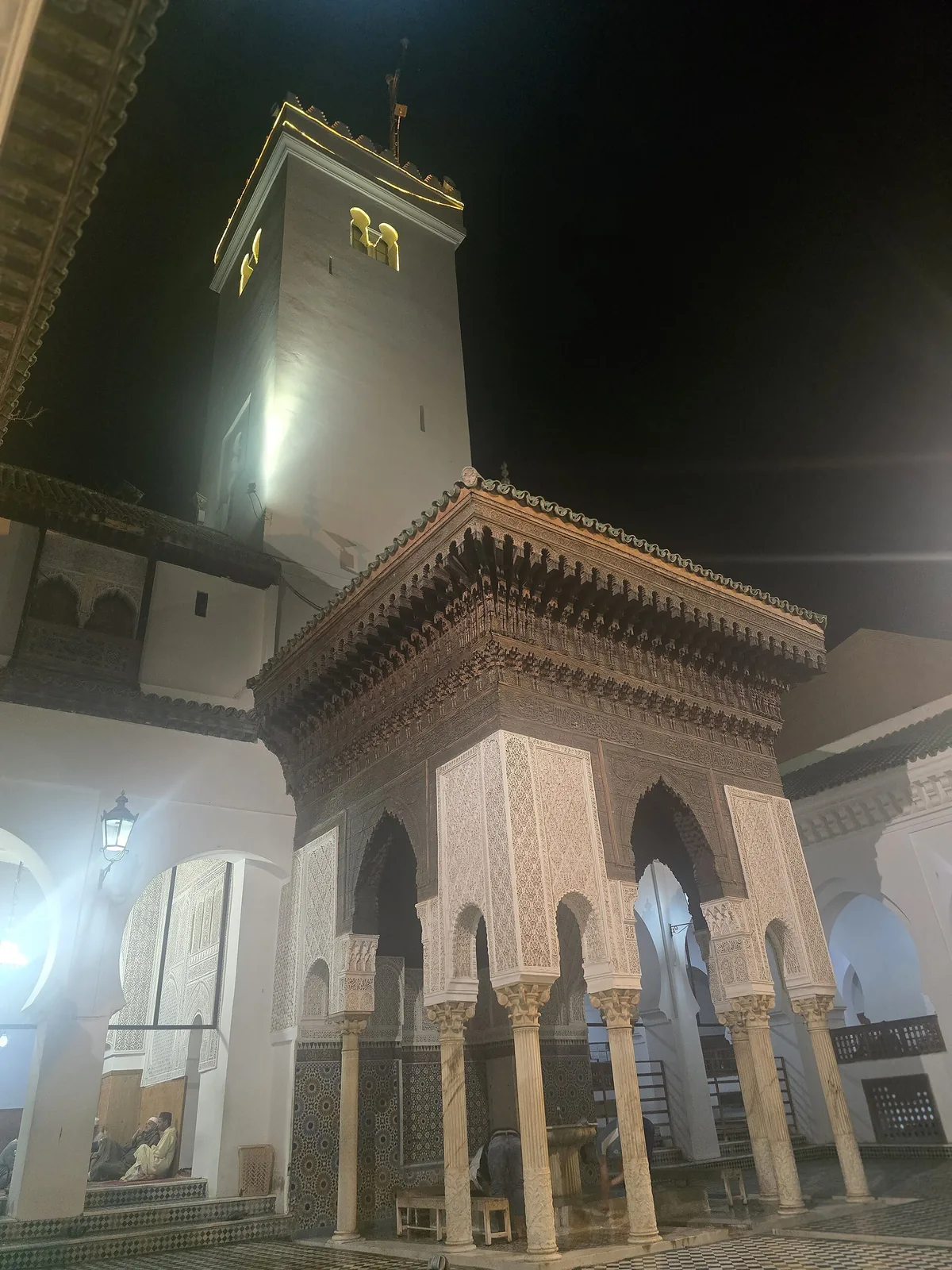
Descend Talaa Kebira into the bowl of the medina and you arrive, mostly without noticing the moment it happens, at the institution the city exists because of. The Qarawiyyin began in 859 as a mosque founded, by the tradition every source repeats, by Fatima al-Fihri, a woman of a wealthy refugee family from Kairouan who spent her inheritance on a place of worship for her community. Around that mosque grew a teaching institution that became one of the great universities of the Islamic world. Teaching has been going on around this courtyard, under one dispensation or another, for well over eleven hundred years.
The mosque itself grew with the institution until it became one of the largest in Morocco, a whole district of green-tiled roofs in the centre of fes el bali. And that, for the non-Muslim visitor, is the experience in full. The Qarawiyyin is a working mosque, and Moroccan mosques do not admit non-Muslim visitors. You will not see its courtyard, its famous library or its prayer hall from the inside, and any article that implies a casual stroll through them is misleading you. What you get instead is the mosque as the medina itself experiences it from outside. Doorways, some of them magnificent, with carved and tiled surrounds. Glimpses, through a door left open at prayer time, of a courtyard corner and a fountain. Rooftops with green ridges running in every direction when you find a high terrace. And the minaret, the plain white square tower of the tenth century, among the oldest in Morocco, watching over the centre like a chess piece.
It is worth saying plainly that this is not a consolation prize. The Qarawiyyin was never designed to be looked at by outsiders at all, and encountering it as a presence woven into streets, announced by doorways and rooftops and the flow of worshippers at prayer times, is encountering it the way the city has always done. Fes el bali keeps its greatest treasure the way it keeps its houses, turned inward, and the visitor’s job is to find that dignified rather than disappointing.
The Zawiya of Moulay Idris II, the tomb shrine of the city’s founder, stands a few lanes from the Qarawiyyin and is the spiritual twin of this quarter, its green pyramidal roof visible from every high terrace in the centre. It is likewise closed to non-Muslim entry, and its surrounding lanes are among the most sacred in the city, where photography deserves particular restraint. Between the mosque, the shrine and the libraries, this small area is the still centre of Fez, and it asks to be walked through at the medina’s pace rather than the tourist’s.
Al-Attarine Madrasa and the Perfumers’ Market
Just before Talaa Kebira reaches the Qarawiyyin, it passes through the most fragrant hundred metres of fes el bali. This is the Attarine quarter, named for the attarine, the sellers of spices, perfumes, oils and herbal medicines, whose shops have perfumed this stretch of street for centuries and still do. The street narrows, the scents stack up in layers, and at the heart of it, up a short lane, stands the second madrasa a visitor can enter, the Al-Attarine Madrasa, built by the Marinid sultan Abu Sa’id Uthman II in 1323 to 1325 and named, simply, for the market outside its door.
Where Bou Inania is grand, Al-Attarine is jewel-like. The same Marinid trio of materials is at work, zellige below, carved stucco above, cedar under the roof, but here the proportions are intimate enough that you can take in a whole wall of carving at a glance and then spend ten minutes discovering that the glance showed you a tenth of it. But the whole composition feels less like a state statement and more like a master craftsman’s signature piece.
The madrasa’s setting is half its meaning. It does not stand in a monumental plaza. It stands in a market, doorway to doorway with the spice sellers, because that was the urban deal the Marinids made. Learning and commerce funded each other, cheek by jowl, in the same street. So when you step from the smell of cumin straight into one of the most refined interiors in Morocco, you are not moving between two worlds. You are moving between two rooms of the same one, and the attarine going about their business outside are, in the oldest sense, part of the institution.
Do Bou Inania first, in the morning light near the gate, then let the descent of Talaa Kebira deliver you here an hour later, and compare the two Marinid masterpieces while both are fresh.
Chouara Tannery – A Working Tannery, Not a Show
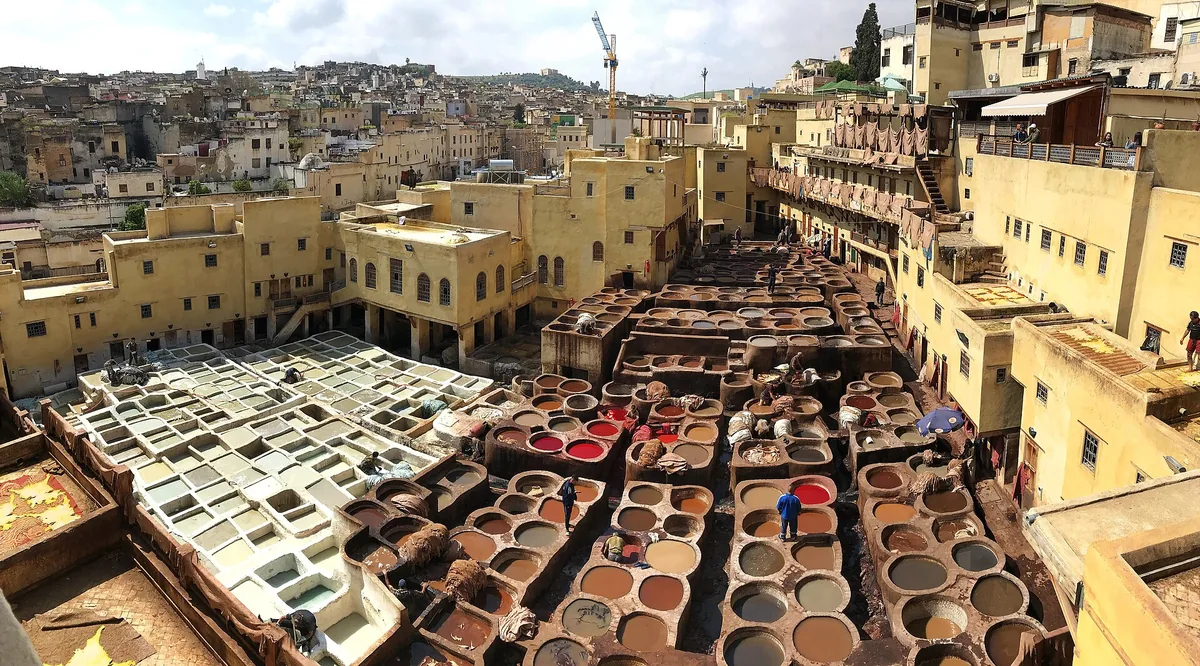
Cross the buried river, climb the Andalusian bank, and the smell reaches you before the sight does. The Chouara Tannery is the largest of the three tanneries still working in fes el bali, and it has been working on this site, by most accounts, since around the eleventh century, which makes it older than most European cathedrals and roughly as permanent.
It is important, for your own enjoyment, to be clear about what Chouara is before the sales pitches start. It is not a heritage demonstration and nobody is performing. The men in the vats are piece-workers in a functioning industry at one of the hardest and worst-paid ends of it, standing in liquids you would not put a hand into,.
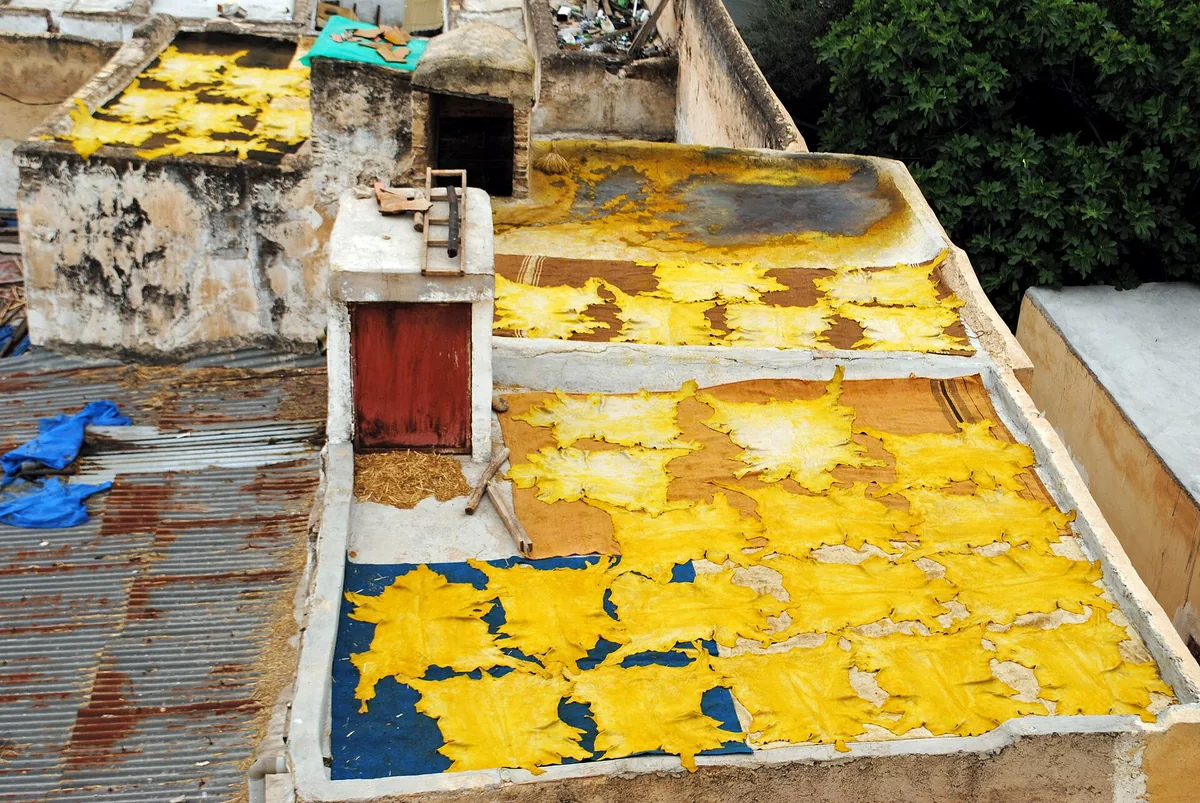
From the terraces, and the terraces are the only viewpoint there is, the courtyard reads like a painter’s palette photographed from a drone. On one side, ranks of paler vats, the softening and cleaning stage. On the other, the dye vats, their colours changing with the season and the orders, saffron yellows, poppy reds, deep indigo blues, browns and blacks. Hides hang from the walls and rails between stages, and finished skins dry on the rooftops all around, so the whole quarter is upholstered in leather.
Allow the tannery its full weight in your day. It sits at the far, eastern end of the medina from Bou Jeloud, a full traverse of the old city to reach on foot, and that traverse is the medina showing you everything it has en route. What the vats actually contain, and how a raw hide becomes a babouche, is the subject of the next section. How you, the visitor, get your look at it is a small social mechanism of its own, and it is covered two sections on. Both are worth understanding before you arrive at the terrace rail.
From Hide to Babouche – How the Vats Work
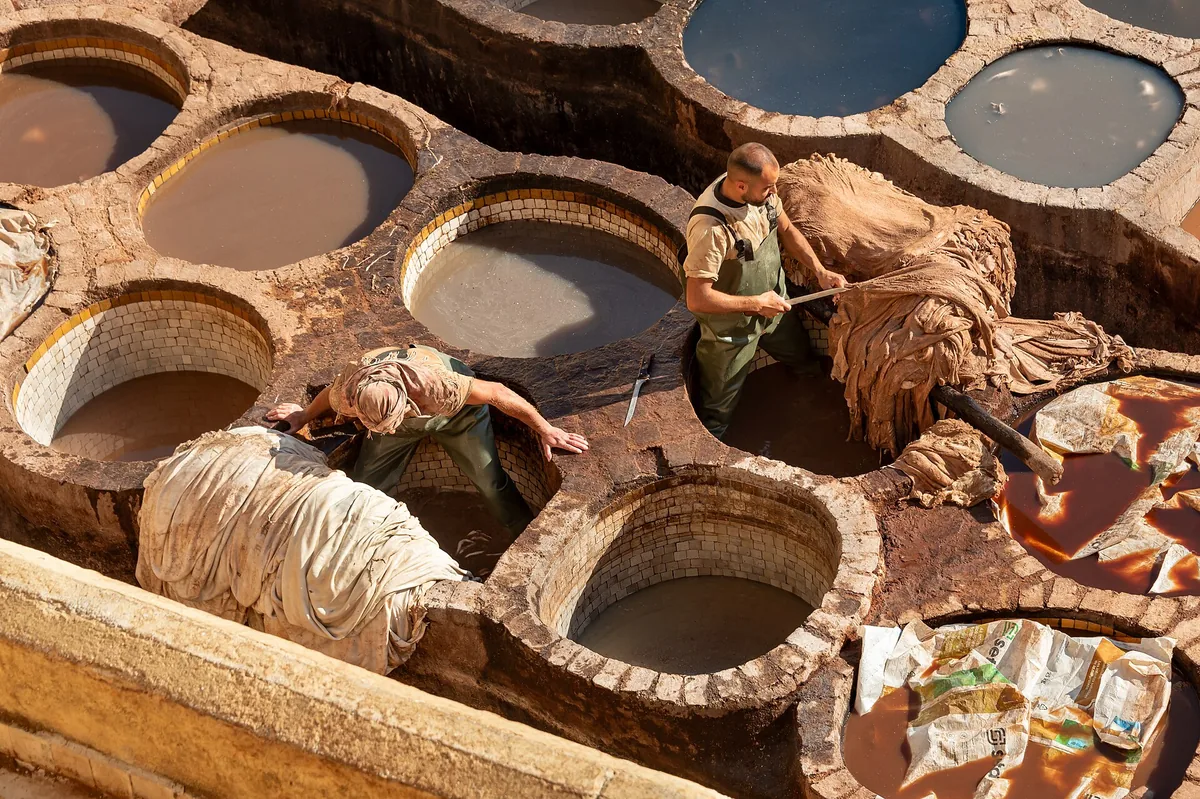
The process at Chouara has two great stages, and the courtyard is laid out as their diagram. A hide arrives raw, from sheep, goat, cow or camel, stiff with fat, flesh and hair, and useless. The first stage, in the pale rectangular vats, is a controlled rotting and scouring. The hides soak for days in water charged with quicklime and with pigeon droppings, whose ammonia is the active ingredient, while the tanners work them with their feet and scrape them by hand. The lime and ammonia loosen the hair, strip the remaining flesh and open the fibres of the skin, so that what comes out is a clean, grey, floppy pelt, soft enough to take dye and tough enough to last centuries if it is cared for.
The second stage is the beautiful one. In the round dye vats, the cleaned hides are worked through baths of natural pigment, and the traditional palette is a garden and a spice rack translated into colour. Yellow from saffron, or from turmeric in the everyday run of work. Red from poppy. Blue from indigo. Green from mint. Orange from henna. Brown from cedar wood. The tanners fold and press and turn the skins in the dye by hand and foot until the colour is even, then haul them out to dry in the sun on the walls and rooftops around the courtyard, where they stiffen into bright boards of leather before being softened, finished and sold on to the workshops.
From there the geography of the medina takes over again, because the tannery is not an island. The finished leather moves a few lanes uphill into the leather souks, where it is cut and stitched into the products Fez exports to the world, babouches first among them, the soft pointed slippers in tannery yellow that are the city’s signature, and bags, belts, jackets and poufs after them. If you buy leather here, the chain from vat to shop is a few hundred metres long and every link of it is visible.
Nothing in the courtyard is hidden, and nothing needs a guide’s narration to be legible once the two stages are clear. White vats first, colour vats second, drying everywhere, workshops uphill.
Terraces, Leather Shops and the Sprig of Mint
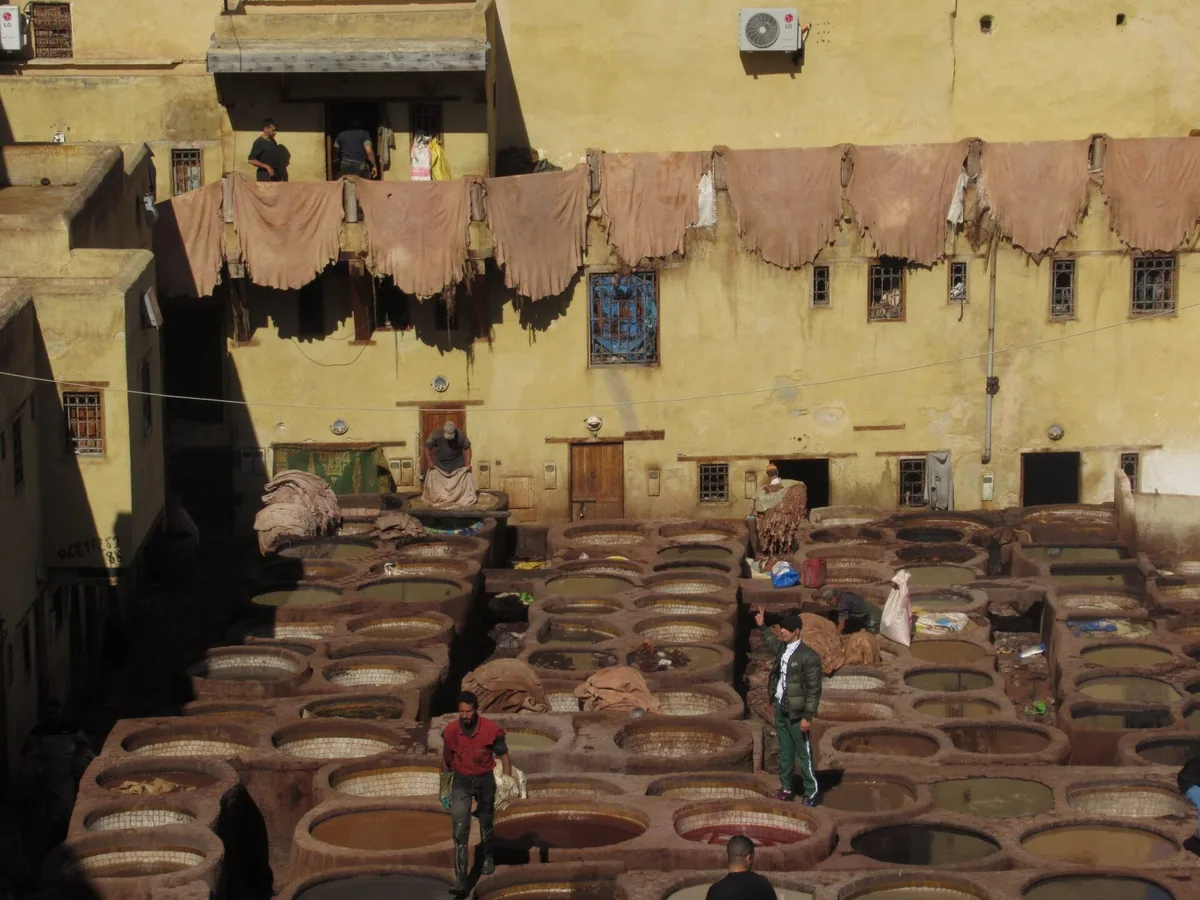
Here is the mechanism every visitor needs, stated plainly because the tannery has no other door. There is no public entrance to the Chouara courtyard and no official viewing platform. You cannot walk down among the vats, and you should not try. Every view of the tannery is from above, from the rooftop terraces of the leather shops that ring the courtyard, and those terraces are reached through the shops themselves. So the ritual runs as follows, as it has run for decades. You enter a leather shop on the tannery’s edge, often guided there by your guide or by the shop’s own runner. Someone hands you a sprig of fresh mint. You climb the stairs past floors of bags and jackets to the roof. And there is the view, the whole honeycomb of vats spread below you, while the mint, held to your nose when the wind turns, takes the edge off the ammonia rising from the cleaning vats.
The mint is not a gimmick, whatever it looks like in photographs. On a warm day the smell from the softening vats is a physical presence, and a crushed mint leaf under the nose genuinely works the way a handkerchief of lavender worked in a Victorian street. Accept it with thanks. Then take your photographs, ask your questions, and understand the second half of the mechanism, which is that the terrace is the top floor of a shop and the shop would like to sell you leather. The understood settlement is that you browse on the way down, you listen to the pitch with the same courtesy you would want for your own, and you buy something if the goods and the haggling suit you, or you decline with a smile and leave a small tip for the terrace and the mint if you buy nothing at all.
The leather itself deserves a fair hearing while you are there. Chouara’s output is the real article, vegetable-processed and naturally dyed in the courtyard below you, and the shops around the tannery are as close to the source as retail gets. Babouches, bags and poufs here come with their provenance visible through the window.
Time your visit for the morning if you can. The light falls into the courtyard at its best before midday, the colours of the dye vats are at their brightest in new sun, and the work is in full swing with hides moving between stages.
The Souks by Trade – Reading the Medina by Smell and Sound
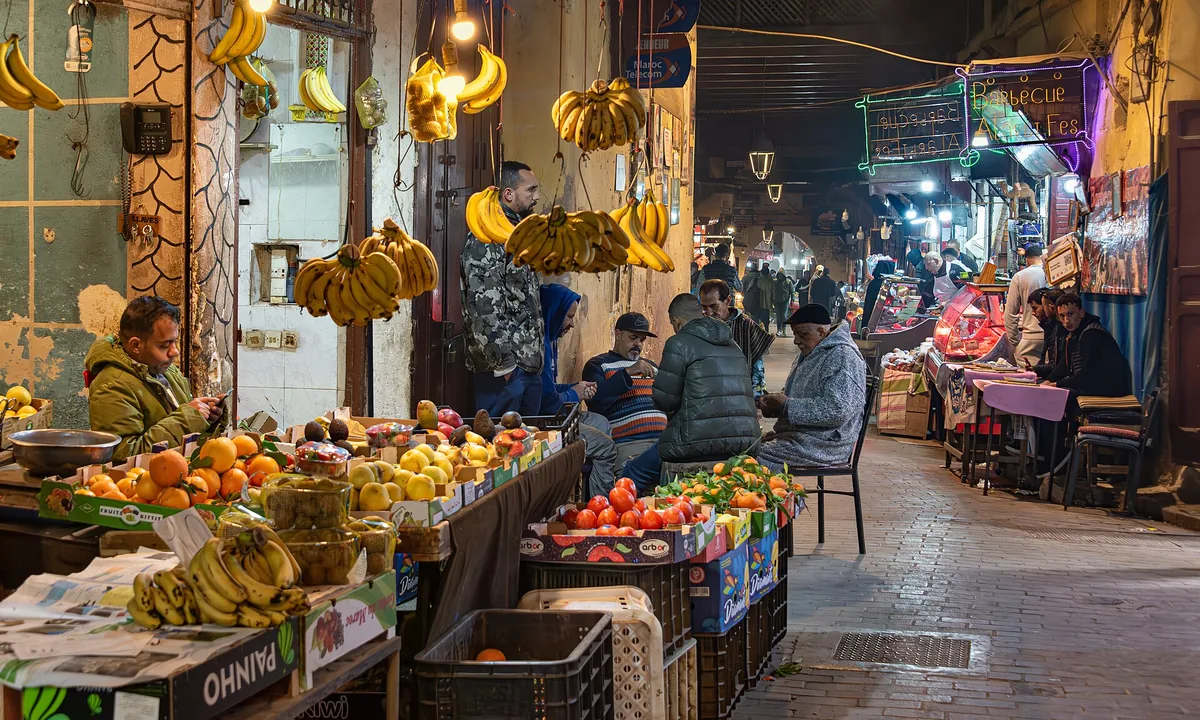
A market street in the medina is not a miscellaneous row of shops. It is a trade address. For a thousand years the medina has organised its commerce the way a guildhall would, one street or lane given to one craft, so that the buyer could compare masters side by side and the masters could keep an eye on each other.
Start with the ground you have already covered. The Attarine quarter by the madrasa of the same name is the spice and perfume trade, saffron and soap and henna in sacks and pyramids. The Kissariat al-Kifah, the covered market near the Zawiya of Moulay Idris II, is the medina’s department store of finished goods, textiles and clothing in a grid of small shops under one roof. Around the Qarawiyyin spread the trades that served scholars and worshippers, booksellers and binders in their day, religious goods and candles now in larger share.
The genius of the arrangement, for a visitor, is that quality clusters where competition does. A street of brassworkers produces better brass than a lone brass shop ever would, because every master works in sight of his rivals and every customer can walk the row. The same applies to carpets, to ceramics, to carved wood. Shopping here is at its best when it follows the map the medina itself drew, trade by trade, with the senses doing the signposting. Cumin means you are near the Attarine. Ammonia means the tannery is below you. Cedar shavings mean the carpenters are close. And one sound, above all, means you have found the square in the next section.
Place Seffarine – The Sound of Copper
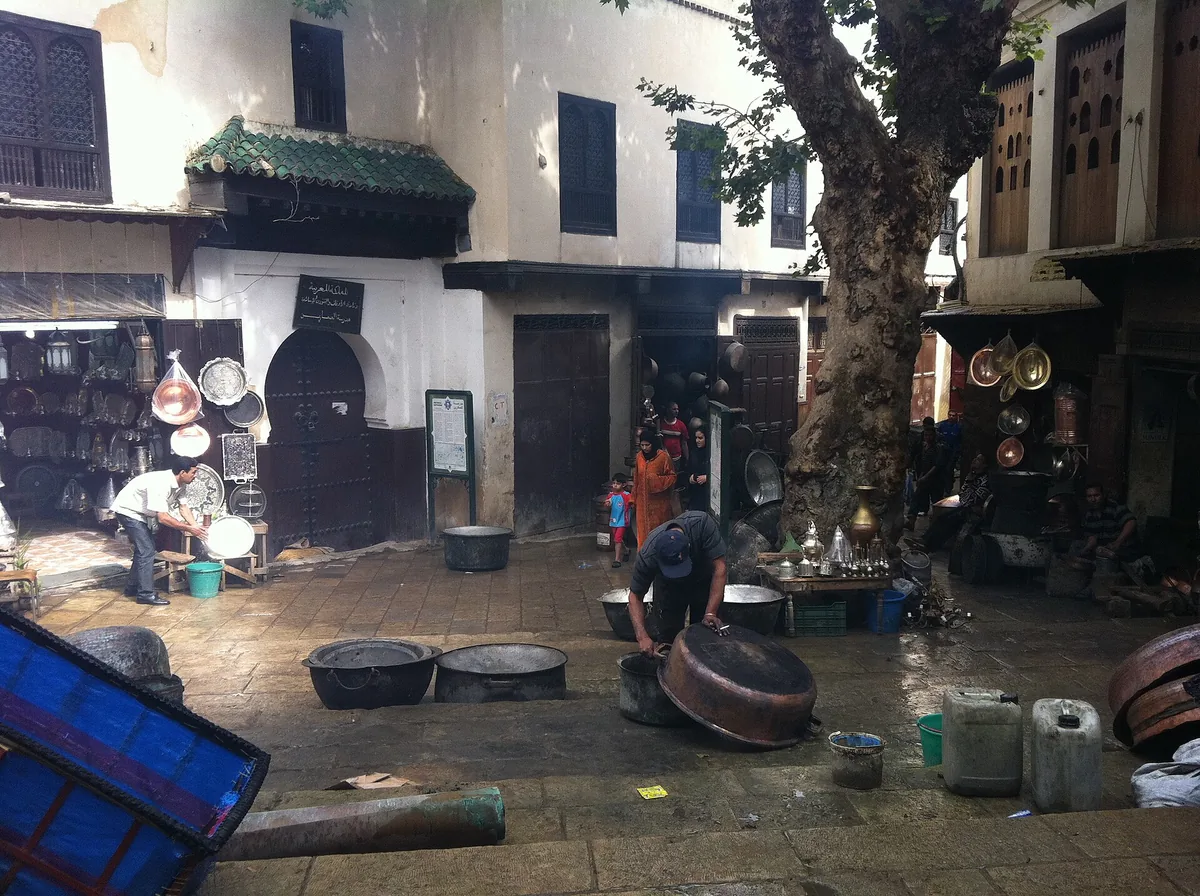
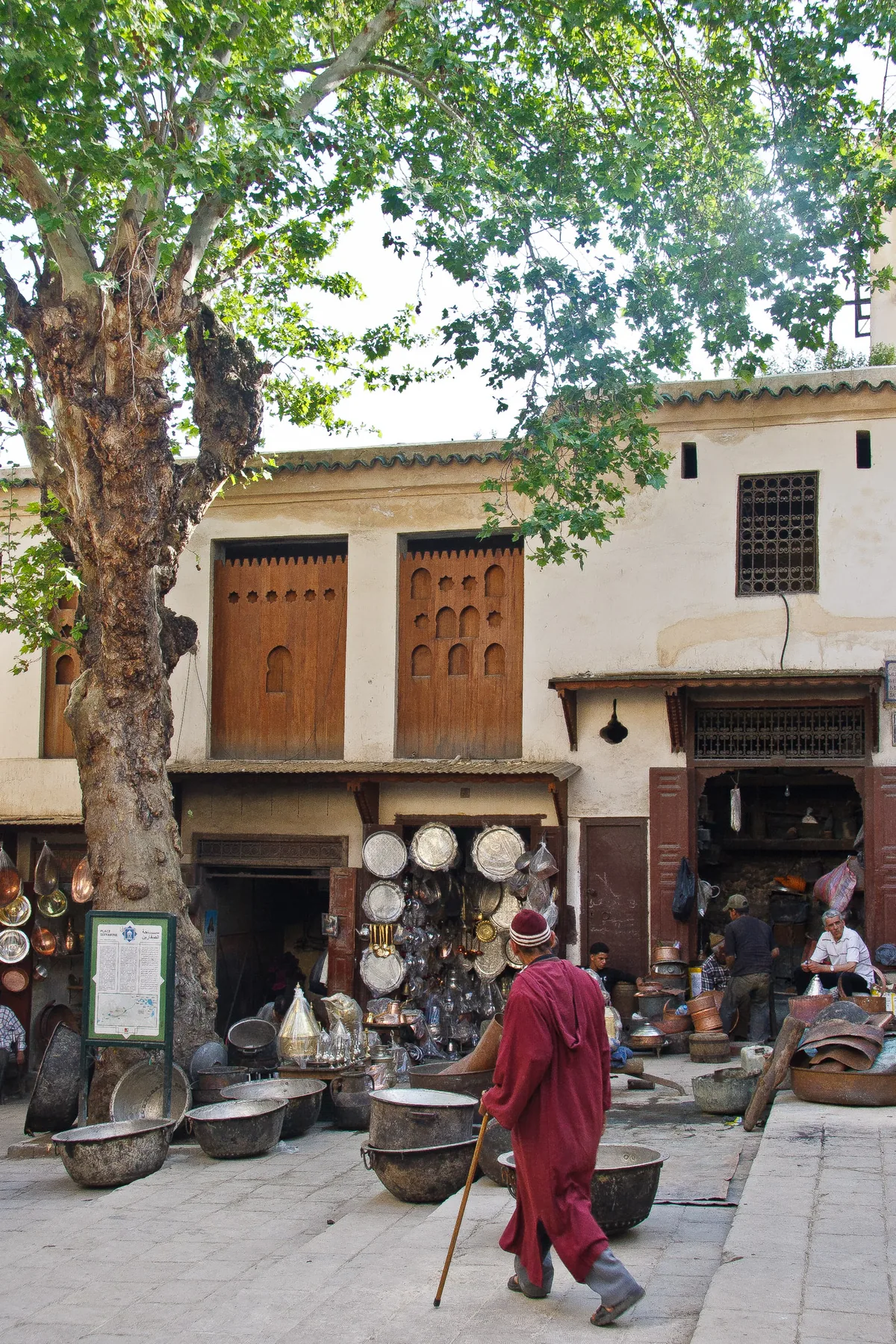
You hear Place Seffarine a full minute before you reach it. The square is the workshop of the medina’s coppersmiths and brassworkers, and its sound is a bright, irregular ringing, hammer on sheet metal, that bounces off the walls of the lanes feeding into it like a bell announcing a district.
Seffarine repays a pause because it concentrates several of the medina’s stories in one small square. The craft itself is the headline, wedding trays and banqueting pans of a size modern kitchens have forgotten, still ordered, still made, still repaired, because Moroccan celebration cooking never stopped needing them. The smiths work at the threshold of their shops in full view, and watching a tray take shape, the hammering passing from heavy raising blows to the fine, fast planishing that leaves the surface ringing smooth, is one of the great free shows of the medina.
The square also functions as one of the medina’s hinges. It sits at the meeting of the Qarawiyyin quarter, the library and the lanes that run east and downhill towards the river crossing and the tannery beyond. If you are walking unguided from the centre to Chouara, Seffarine is your last unmistakable landmark before the lanes take over, and the coppersmiths’ ringing is the last navigation aid the city gives you. Mark it on the way down. On the way back, tired and turned around in the eastern lanes, that ringing through the walls will tell you where you are before any sign does. Fes el bali is full of these small mercies for the walker who pays attention with more than one sense.
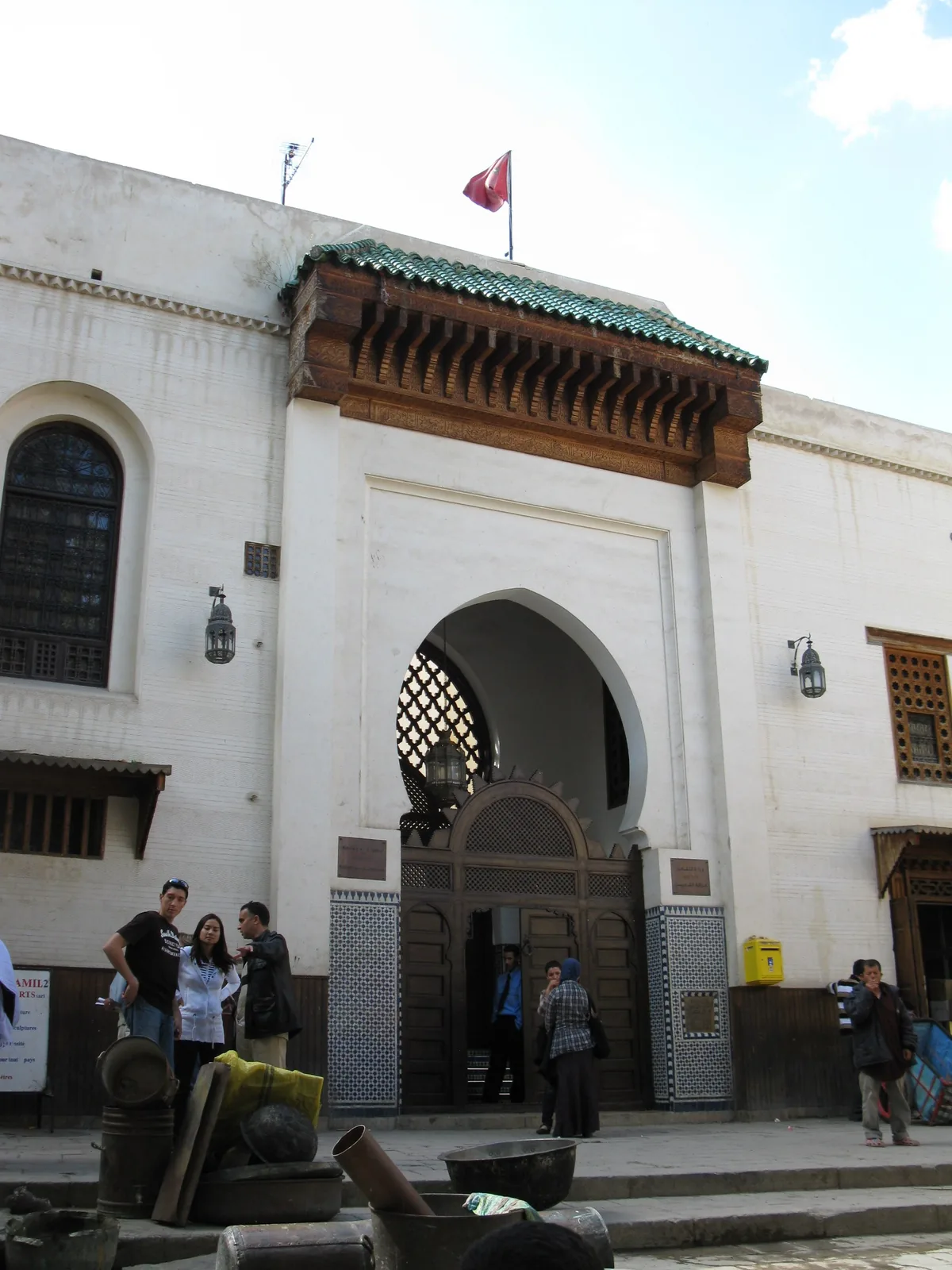
Fondouks and the Nejjarine – Hotels for Caravans, Museums Now
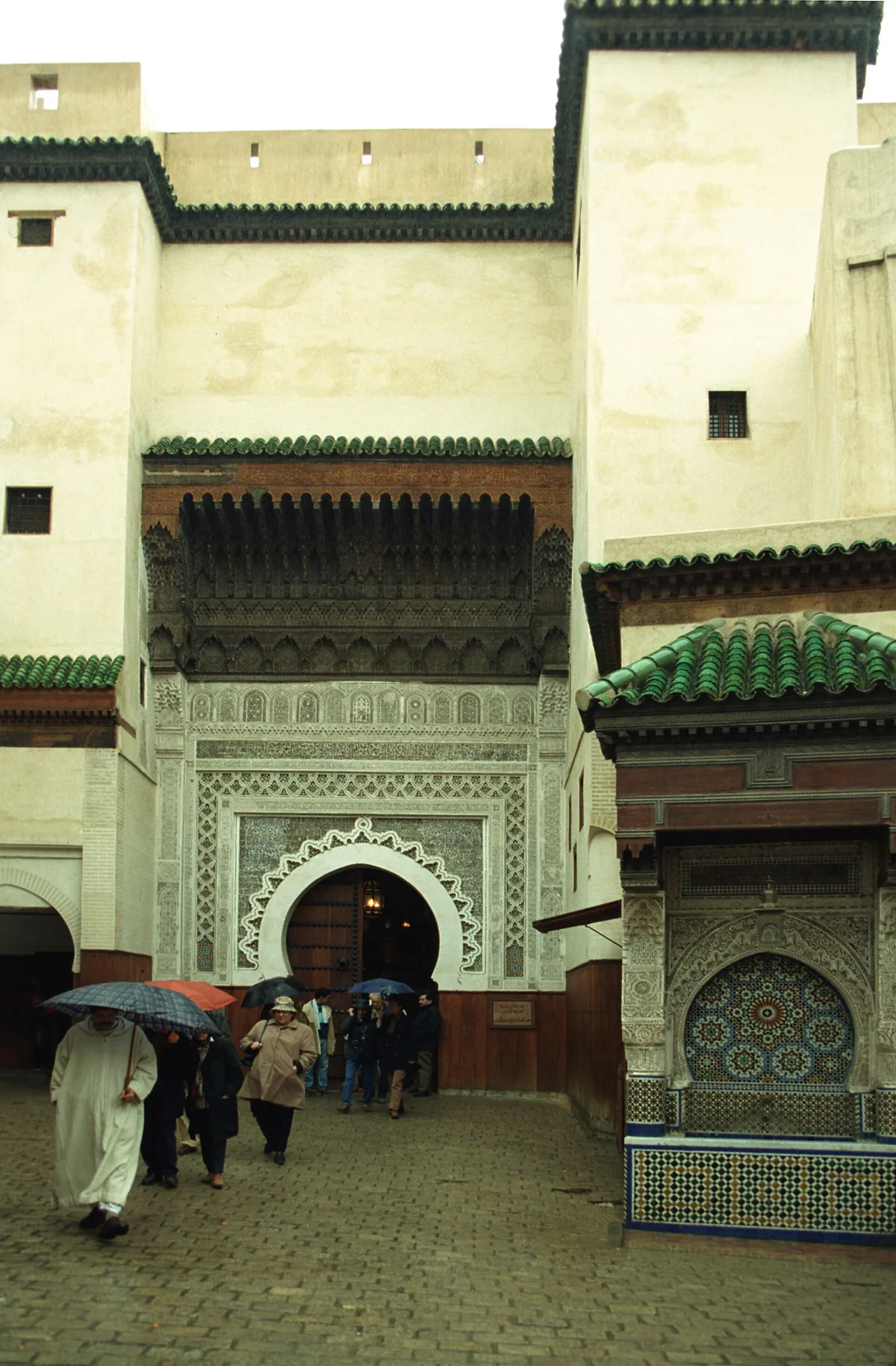
Every caravan city needs its truck stops, and here they are called fondouks. A fondouk is a courtyard building built for travelling merchants, warehousing and animals on the ground floor, plain lodging rooms on the floors above, one great lockable gate to the street. Dozens survive across the medina, many still working as stores and craft workshops, their courtyards stacked with the goods of the trades around them.
The showpiece stands on its own small square in the western centre. The Nejjarine fondouk, named for the carpenters whose souk surrounds it, was built in the early eighteenth century, and its street face is the most decorated facade any commercial building in the old city bothers to wear. A grand portal of carved stucco and cedar, and beside it, added about a century later, the Nejjarine fountain, a wall of zellige tile under a carved canopy, still giving water to the square.
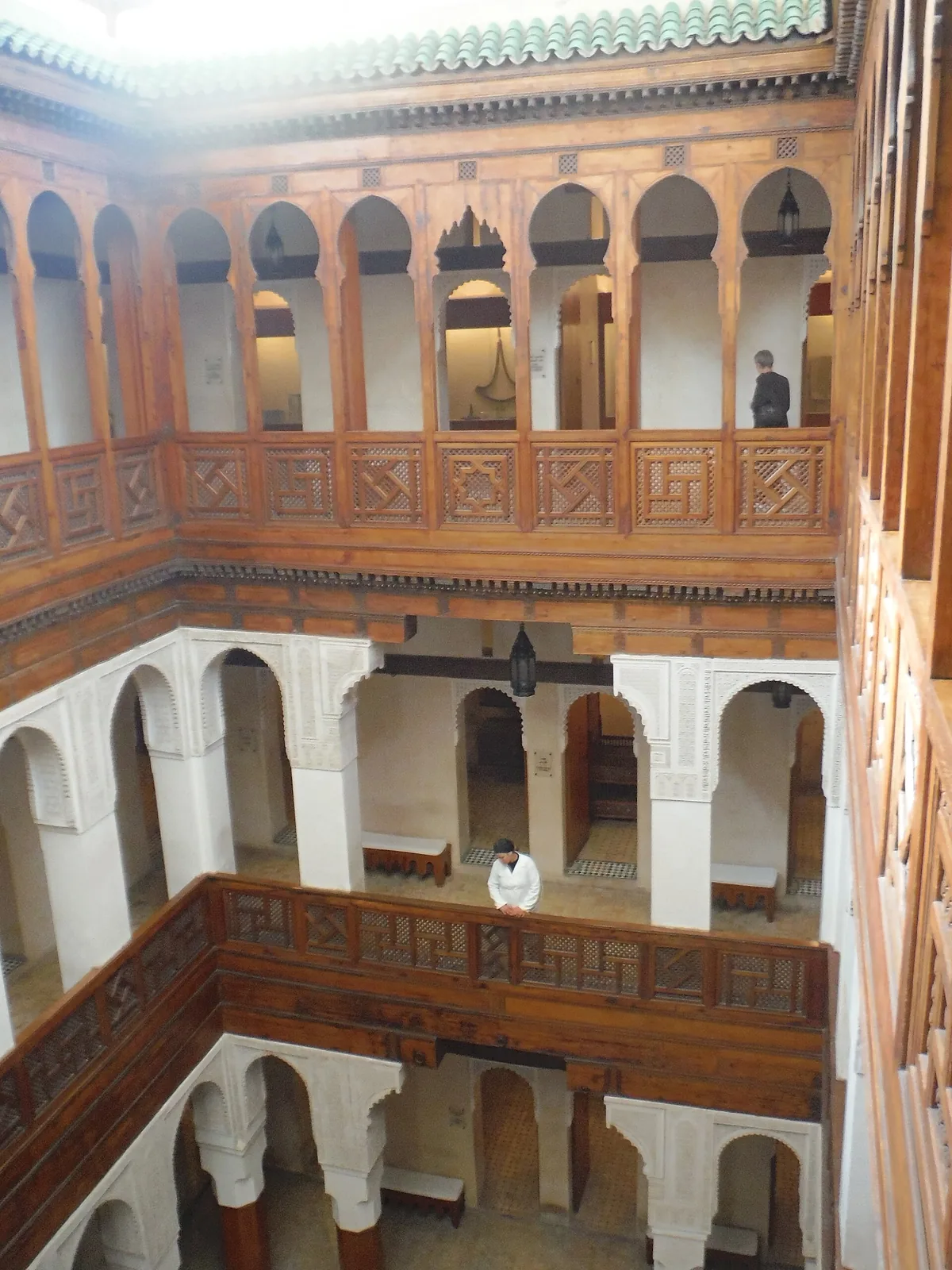
Inside, the fondouk has had the happiest of second lives. Restored in the late 1990s, it opened as the Nejjarine Museum of Wood Arts and Crafts, which keeps the building’s own trade as its subject. Three floors of galleries climb around the courtyard on wooden balustrades, displaying the carved, joined, turned and painted wood of Morocco, from dowry chests and bridal litters to doors, tools, musical instruments and the great carved beams of mosques. The building is its own best exhibit, every gallery railing and window a piece of the craft on show.
Reading the Craft – Zellige, Stucco and Cedar
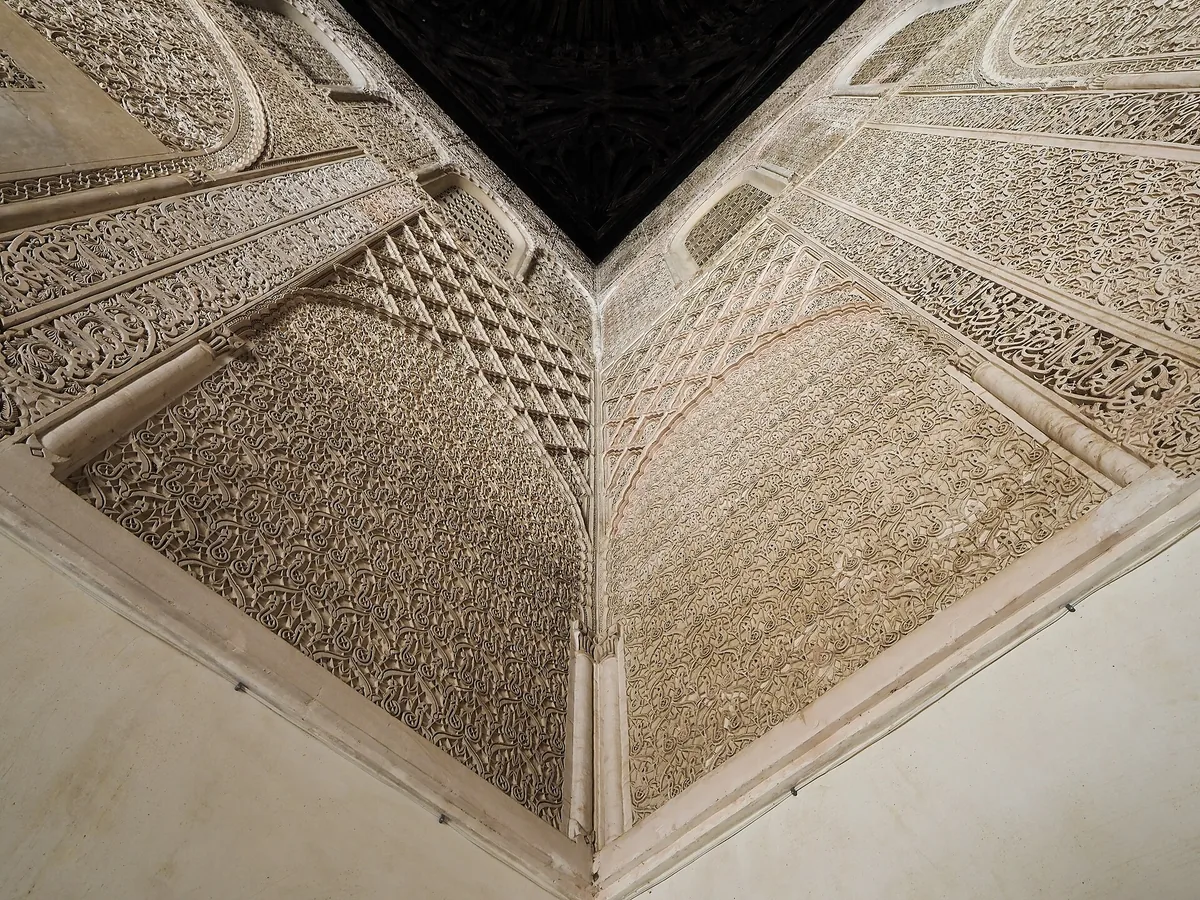
By your second day in fes el bali you will have absorbed, whether you meant to or not, a working knowledge of the three materials that decorate everything in it. They are worth naming and understanding, because once you can read them, every wall in the medina becomes a text and half the shops in the souks become legible too. The first is zellige, the mosaic tilework of Morocco, made not by painting patterns onto tiles but by cutting thousands of small pieces from glazed tiles in single colours and assembling them face-down into geometric designs of formidable complexity.
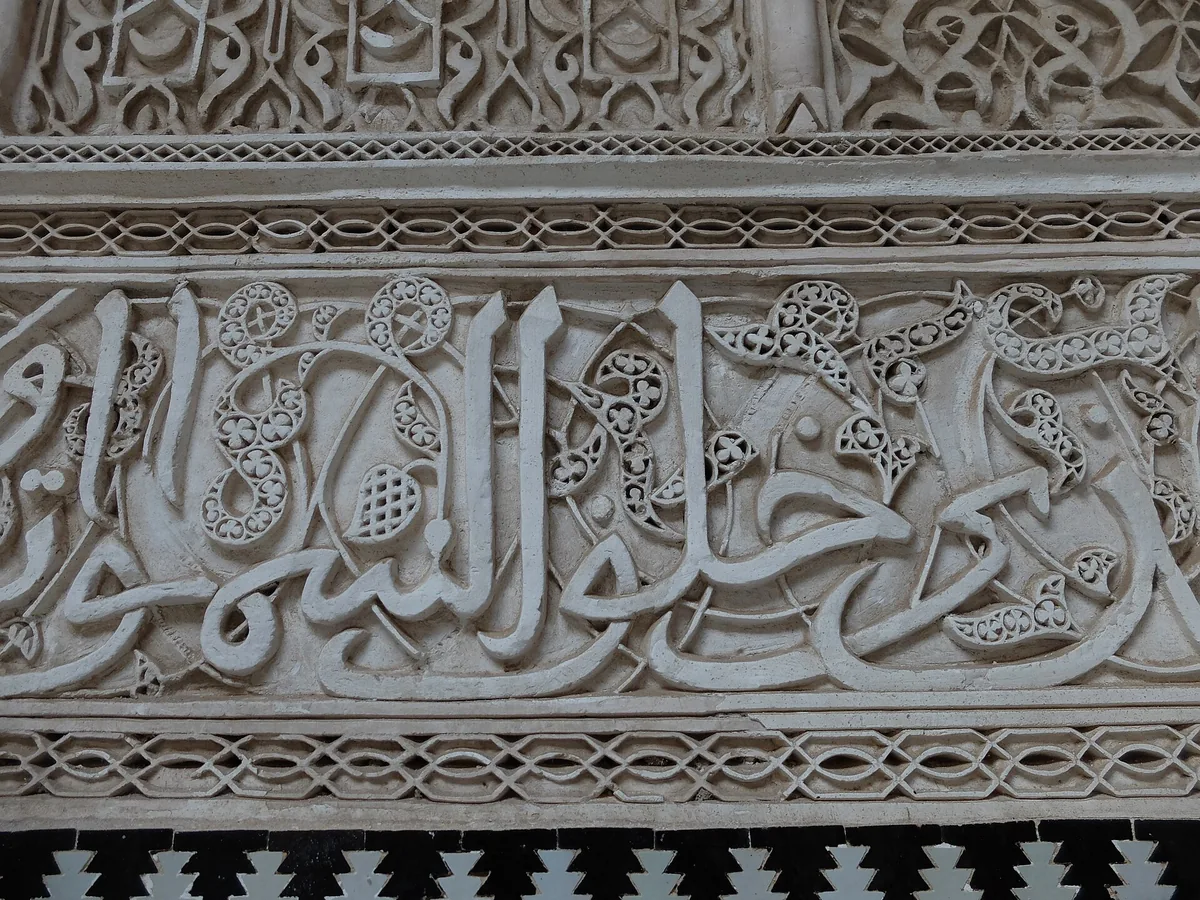
The second material is carved stucco, a fine gypsum plaster that sets hard enough to hold an edge and soft enough, while wet, to be cut almost like wood. The Marinid craftsmen covered whole interiors with it, arabesques of split leaves and pine cones, bands of calligraphy carrying foundation inscriptions and verses, muqarnas vaulting that dissolves corners into stalactites. Stand close in the Bou Inania or Al-Attarine and you can still read the speed of the knife in it. The third material is cedar, from the Middle Atlas forests that rise east of the city, carved into doors, eaves, screens, ceilings and the great lintels over fondouk gates, darkening with age to the colour of strong tea and smelling, when a workshop door opens on the carpenters’ street, like the inside of a forest.
The medina’s workshops are these three arts still at work, which is the deeper point. The tile cutters, plasterers and wood carvers of the medina are not reviving dead crafts for tourists. They are the current shift of an unbroken line, and the restoration of the medina’s monuments, an enormous programme of work over recent decades, employs them by the hundred.
A Necessary Correction – The Mellah Is Not in Fes el Bali
Open ten articles about Fes and a fair share will send you into the old medina to find the Jewish quarter, the mellah, as if it were one more district of the old medina. It is not, and since this guide exists to get the geography right, the correction belongs here in plain terms. The Mellah of Fez stands in Fes el Jdid, the royal city the Marinids built on the plateau west of the medina in the thirteenth century, beside the Royal Palace. That is where Fez’s Jewish community was gathered in the Marinid period, moved from its earlier quarter inside el Bali, near Bab Guissa, where a fondouk by the gate still carries a name remembering it. The walled mellah by the palace, with its cemetery at its southwestern edge and the seventeenth-century Ibn Danan Synagogue among its lanes, is a separate visit in a separate part of the old city, reached from outside the medina walls, not from within them.
The confusion is understandable and still worth avoiding, because it scrambles the whole mental map this guide has been building. Fes el Bali is the ninth-century city of the two banks. Fes el Jdid is the thirteenth-century city of the court. The mellah belongs to the court’s city, placed there under royal protection in the way of such arrangements across Morocco, beside the palace whose authority guaranteed it.
Why does a medina guide spend a section on a place that is not in the medina? Because the error propagates. Travellers lose hours hunting el Bali for a quarter that was never there in its surviving form, and some leave convinced they found it in whichever lanes a helpful stranger chose to show them. The medina has wonders enough without borrowing its neighbour’s. Keep the map clean. El Bali for the madrasas, the tannery and the souks. El Jdid for the palace gates, the mellah and the synagogue. Two cities, two visits, and Fes makes sense as the sum of them.
Getting Lost, Honestly – And the Official Guide System
Let us have the honest conversation this guide promised. You will get lost in fes el bali, and the industry that has grown up around that fact deserves a clear-eyed description rather than either panic or romance. The romance first, because it contains truth. Wandering this medina without a destination, following a smell or a shaft of light or the sound of a workshop, surfacing at a fountain you will never find again, is one of the great pleasures of travel in Morocco.
The practicalities, though, are these. Being lost has a cost in time and temper, and the medina monetises the gap. The unofficial guide, the self-appointed helper who attaches himself at a corner, is a fixture of the place, and his service ranges from genuinely useful to a slow walk to his brother’s carpet shop, with the fee negotiated at the end, at his valuation, in an argument you did not plan to have. The structured alternative exists and is the one this guide recommends without hesitation. Morocco has an official system of licensed local guides, trained, badged and bookable through hotels, riads and official channels, and a licensed medina guide transforms a first day here.
The working compromise most experienced visitors settle on is a licensed guide for the first day and your own feet for the second. Day one lays down the spine, the sights and the story. Day two is for the deliberate, delicious getting lost, with the map from day one folded inside your head as insurance. If you only have one day, give it to the guide and accept the structure. If you refuse all guides on principle, then navigate by the rules this guide has repeated. Keep to the Talaas until you choose to leave them. Note your turns. Downhill is centre, uphill is gates. And agree any help offered, its destination and its price, before you take a single step in anyone’s company. That one habit, agreed in advance, defuses ninety percent of the medina’s famous friction.
The Honest Downsides – Touts, Smells and Summer
No guide earns trust by listing only wonders, so here is the debit column for the old city, in the same plain style as the rest. First, the hassle. The medina’s fame and its poverty meet in its lanes, and a visible visitor is a walking economic opportunity. You will be offered directions, tours, shops and friendship at a rate that wears some travellers down by lunchtime. And remember that the majority of Fassis are getting on with lives that have nothing to do with you. It is a small, loud minority that works the corners, and it should not be allowed to stand for the city.
The classic manoeuvres are mild but persistent. Your destination is closed today, it is prayer time, there is a festival, the tannery can only be seen from his uncle’s terrace, that street is forbidden, this one leads to a market that exists one day only. The correct response is not anger. It is a smile, a no thank you, and unchanged feet, because the closed sight is almost never closed. Check at the door, not in the street.
Summer deserves its own sentence. In July and August the heat inside fes el bali, in stone lanes with no vehicle movement to stir the air, is a genuine physical challenge, and the medina’s own people organise their day around avoiding its worst hours. Follow them. Sightsee early, retire to a courtyard at midday, resume towards evening. Third, the hills and the crowds. This is a city of slopes and steps wearing the name of level streets in your itinerary, and at the pinch points, the top of Talaa Kebira at eleven, the lanes by the shrine at prayer time, it moves at the pace of its slowest donkey. Build the friction into your plans and it becomes texture. Ignore it and it becomes grievance.
None of this is a reason to stay away, and the proof is that the travellers who complain loudest about fes el bali are usually the ones who gave it three hours and a bad attitude. The medina is demanding because it is real, and it repays exactly the currencies it demands, time, patience and good humour, at a rate no purpose-built attraction can match.
When to Go – Seasons, Days and Hours
The medina itself never closes, but the year inside the medina has a definite shape. Spring and autumn are the classic seasons and deserve to be.
Summer is the season to plan around rather than through. June to August brings serious heat to the valley, and the stone lanes of the medina, sheltered from every breeze, hold it. The Fassis adapt by shifting the day, working early, resting through the worst of the afternoon, and the visitor who copies them has a fine time. Be on the spine by eight, do the tannery in the morning light, take the long courtyard lunch the medina’s riads exist for, and come back out as the shadows return. Winter, in return, is underrated. December to February is cool, sometimes properly wet, the lanes can run slick after rain and the riads are cold at night, but the crowds thin to almost nothing, the madrasas stand empty, and the medina belongs to its residents in a way the peak seasons never allow.
Within the week and the day, a few rhythms matter. Friday is the holy day, and around the noon prayer the commercial medina slows and many shops close for a stretch, which makes Friday morning a poor choice for the souks and a fine one for quiet streets. The working day in the lanes starts early, with deliveries, ovens and workshops well underway by eight, and the tannery is a morning sight for its light. Evenings belong to the gate end of the Talaas, where the cafes fill and the food stalls fire up. Ramadan shifts everything again, slower days, electric nights after the fast breaks, and extra courtesy asked of visitors around eating and drinking in public.
Frequently Asked Questions About Fes el Bali
How long do I need in fes el bali?
One full day is the honest minimum, and two is better. A guided day covers the spine, Bou Inania, the centre, Seffarine and the tannery with room to breathe. A second day lets you return unguided, revisit Al-Attarine and the Nejjarine at leisure, and get properly, enjoyably lost. A half-day visit catches the tannery and one madrasa and leaves the medina’s character unproven.
Is fes el bali really the world’s largest car-free city area?
It is the standard claim and it is broadly fair. The medina covers roughly 300 hectares with essentially no car-usable streets inside the walls, a scale no other surviving medieval city matches. The superlative is usually stated without its paperwork, but the substance, a complete working city of this size with no cars, is not in dispute.
Do I need a guide for fes el bali?
Need is too strong, but a licensed official guide for the first day is the single best purchase most visitors make here. The guide lays down the two Talaas, the order of the sights and the stories behind the doors, and converts the second day’s wandering from floundering into exploring. Book through your riad or hotel or official channels, agree the route and the fee in advance, and the arrangement stays clean.
I am not Muslim. What can I actually go inside?
More than you might fear, less than a mosque city might suggest. The Bou Inania and Al-Attarine madrasas welcome visitors, as does the Nejjarine Museum. The mosques, including the Qarawiyyin, and the Zawiya of Moulay Idris II do not admit non-Muslim visitors, so your experience of them is their doors, rooftops, minarets and street presence, which this guide has argued is a dignified way to meet them rather than a failed one.
How do I see the Chouara Tannery?
From the rooftop terrace of a leather shop on its edge, because there is no public entrance to the courtyard floor. You will be handed mint for the smell, shown the view, and invited to browse the shop afterwards. Browse courteously, buy if the leather suits you, or leave a small tip for the terrace if it does not. Morning gives the best light and the fullest working scene.
Someone told me my destination is closed, or offered to show me the way. What is happening?
Almost certainly the medina’s oldest small business, the redirection. Sights in fes el bali are rarely closed when a stranger says so. Thank him, keep your own counsel, and check at the actual door. If you accept anyone’s guiding, agree where you are going and what it costs before you move. Those two habits remove nearly all the friction first-time visitors report.
What should I buy in fes el bali, and where?
Buy on the trade streets, where makers compete in the open. Leather from the shops around the tannery, where you can see the vats it came from. Brass and copper on and around Place Seffarine. Ceramics, textiles and spices on their own streets along and off the Talaas. Hand-cut, slightly irregular work is the genuine article. Bargain in good humour, expect to pay more than the first smile suggests and less than the first price demands.
Is fes el bali safe?
By the standards of great historic cities, yes, with the ordinary precautions of any crowded place. The medina is densely peopled in working hours, its risks are overwhelmingly of the petty kind, pickpocketing at pinch points and overcharging rather than anything darker. Walk with awareness, keep valuables unflashy, respect the residential lanes and the prayer-day rhythms, and the city looks after its guests the way it has for a thousand years.
The Short Version of This Fes el Bali Guide
Start at the blue gate, Bab Bou Jeloud, in the morning, with the minaret of Bou Inania framed in its arch and a licensed guide beside you if it is your first day. Walk Talaa Kebira downhill, into the city’s bloodstream. Give Bou Inania an unhurried hour, glance up across the street at the silent bowls of the Dar al-Magana water clock, and continue down past the spice sellers to Al-Attarine, the jewel of the Marinid madrasas. Stand in the streets around the Qarawiyyin with respect for what you cannot enter, eleven centuries of learning behind green roofs and a tenth-century minaret. Cross the buried river, climb the far bank, and take the tannery from a leather-shop terrace with mint at your nose, the white vats and the rainbow vats and a thousand years of unbroken work spread out below you. That is fes el bali. The oldest living city in Morocco, still working, and waiting at the top of the Big Slope.