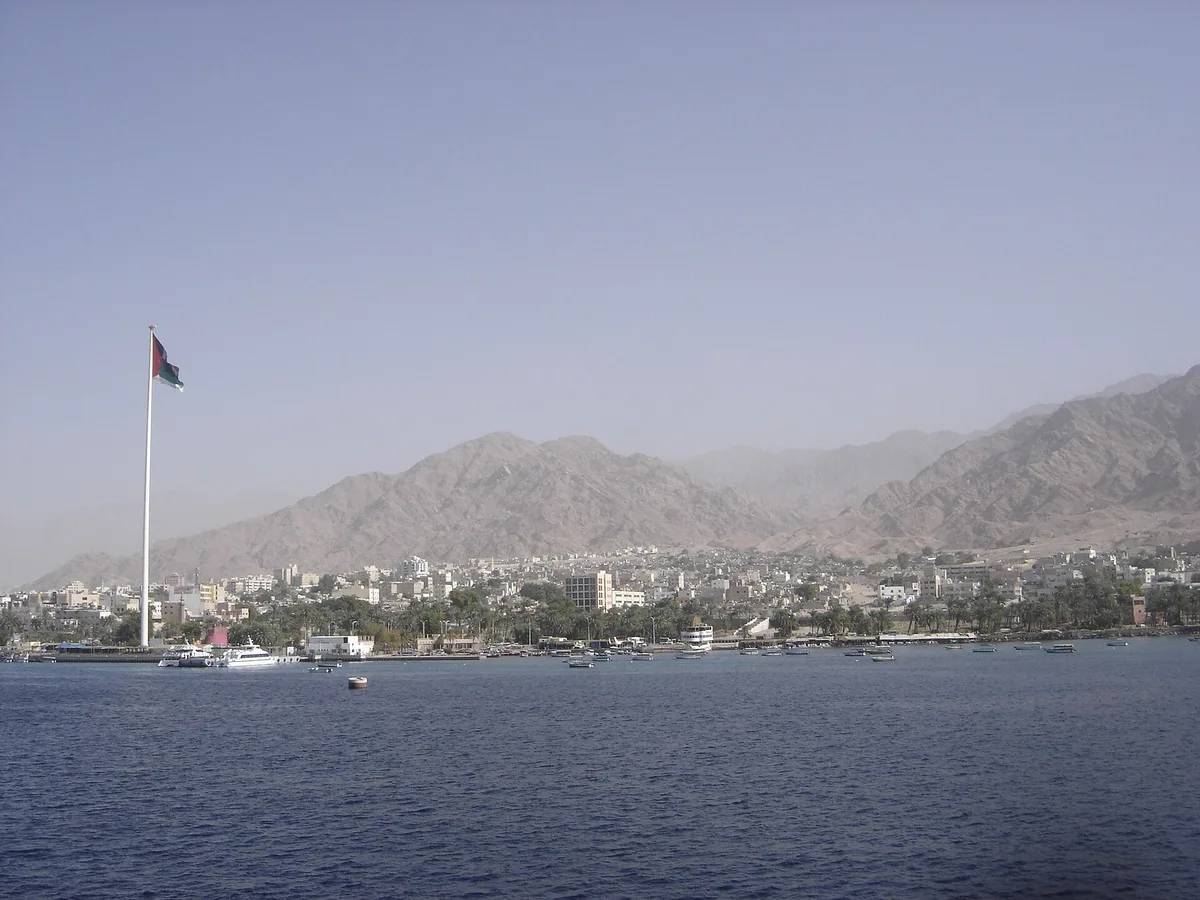
Most travellers meet Aqaba at the end of something – the last stop on a Jordan itinerary, a decompression day after Petra, a warm footnote to a desert trip. This aqaba travel guide starts from the opposite assumption. Aqaba is Jordan’s only coastal city and its only seaport, the single place where this largely landlocked kingdom touches the sea, and it deserves to be read as a destination in its own right rather than as a resort annex to somewhere more famous. What it offers is unlike anything else in the country: a living coral reef you can walk into from the beach, a string of wrecks sunk on purpose for divers, a working old town of souks and fish restaurants, a Mamluk fort beside one of the tallest flagpoles on earth, and winter afternoons warm enough to swim through while Amman is wearing coats.
The geography is the first thing to grasp, because everything else hangs off it. Jordan holds barely 27 kilometres of coastline, tucked into the north-eastern corner of the Gulf of Aqaba where the Red Sea narrows between four countries – Jordan at the head of the gulf, Israel and the Palestinian territories across the water to the west, Egypt’s Sinai beyond them, and Saudi Arabia down the eastern shore. Inside that short strip, Aqaba manages to be three places at once: a port and border city, a modest old town with its own rhythms, and a reef resort spread thin along the southern shore road. Visitors who arrive expecting a single, coherent beach town tend to misread it for a day. Visitors who understand the three Aqabas usually end up liking all of them.
The reef is the headline, and it is genuinely unusual. The Gulf of Aqaba’s corals grow at the northern edge of where reef-building corals can survive at all, in water cooled and stirred by the gulf’s deep circulation, and they have drawn scientists for decades because of how well they tolerate heat that bleaches reefs elsewhere. Since 2020 the best of that shoreline has been the Aqaba Marine Reserve, Jordan’s first marine reserve, managed by the same authority that runs the whole zone. Diving here is mostly shore diving – you gear up on the beach and wade out over the reef flat – and the site list mixes coral gardens with an eccentric fleet of deliberate wrecks: a freighter sunk in 1985, an army tank in snorkelling depth, two aircraft, and an entire underwater military museum parked in battle formation on the sand.
Aqaba also works as the sea gate of southern Jordan’s golden triangle. Wadi Rum’s desert begins about an hour inland, and Petra is roughly two hours by road, which makes the city a natural first or last chapter of a southern circuit – fly in, swim, then desert, then the rose-red city, or run the same film backwards and end with your feet in the Red Sea. Our 7-day Jordan itinerary draws that route day by day. This aqaba travel guide stays in Aqaba itself: how its coast is organised, where its reef and beaches actually are, what its old town and fort are for, how its unusual free-visa arrival mechanism works, and the honest limits of a port city that also asks to be a resort.
Here is the whole aqaba travel guide on one screen; the sections after the table take each row in turn.
| Question | Short answer |
|---|---|
| What is Aqaba | Jordan’s only coastal city and only seaport, at the head of the Gulf of Aqaba on the Red Sea |
| The coast | Barely 27 kilometres of Jordanian shoreline, most of the swimming and diving strung along the southern shore road |
| The reef | The Aqaba Marine Reserve, Jordan’s first marine reserve, declared in 2020 over a shoreline protected as a marine park since 1997 |
| Signature dives | The Cedar Pride freighter, an army tank in the shallows, a C-130 and a TriStar aircraft, and the Underwater Military Museum |
| Best months | March to May and October to November for warmth without extremes; December to February for mild winter sun |
| The visa quirk | Arrive through Aqaba itself and the ASEZA scheme grants a free visa, with conditions explained in the arrivals section below |
| The triangle | Wadi Rum about an hour inland, Petra about two hours – Aqaba is the natural sea gate to both |
| One honest warning | It is a working port and border city first and a resort second, and the article’s downsides section says what that means |
The Shape of Aqaba – One Short Coast, Three Different Towns
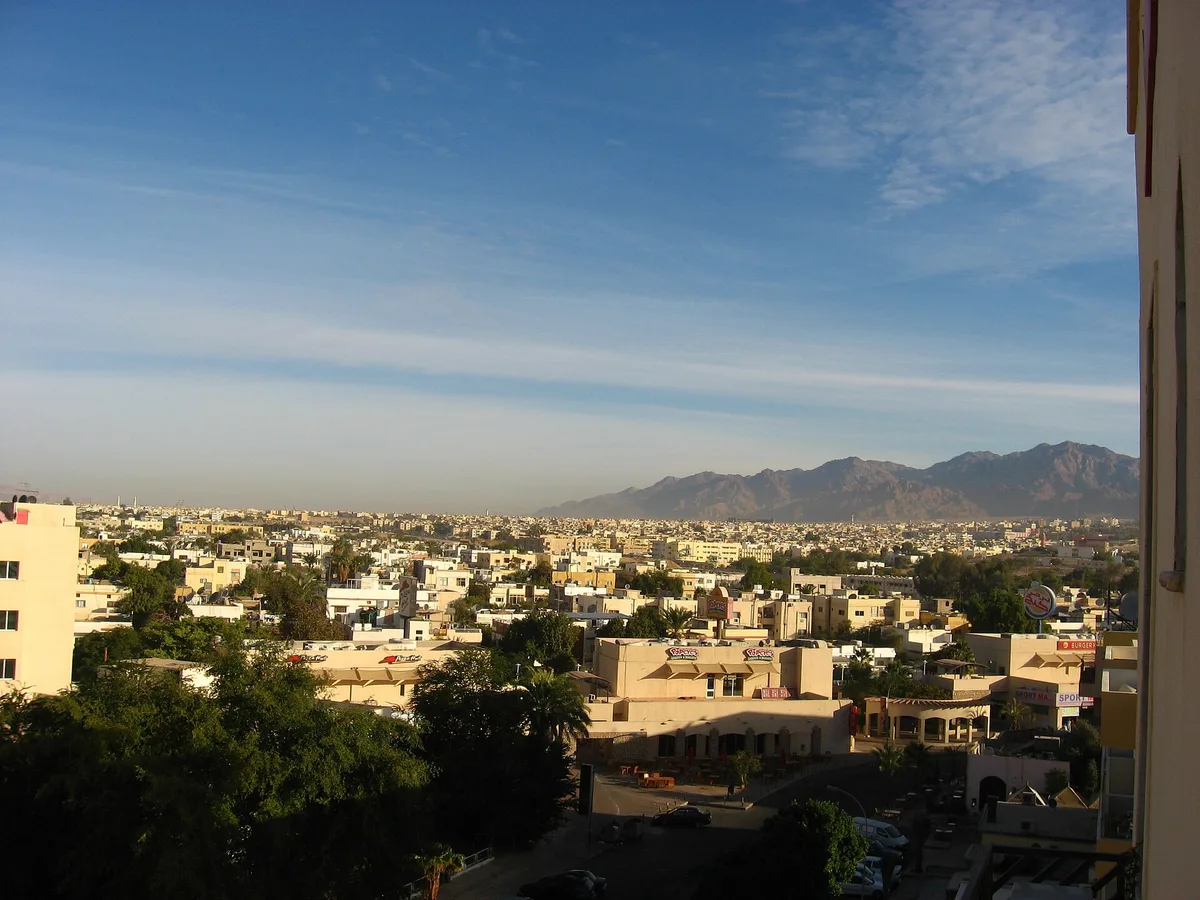
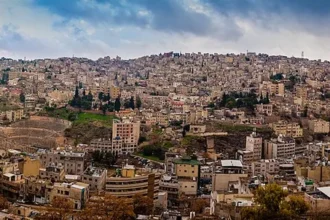
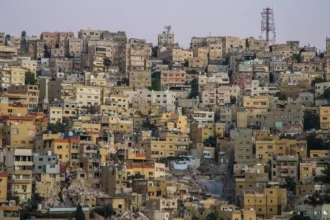
Stand on Aqaba’s waterfront and the city’s structure explains itself in one look. In front of you is the gulf, narrow enough that the mountains of Sinai fill the far shore. Behind you, the town climbs a gentle slope in a grid of limestone-coloured apartment blocks, hotels and minarets, and behind that the bare granite mountains of the Araba edge close the view. Everything in Aqaba is arranged along the water, because there is so little water to arrange along: the whole urban coastline runs from the Israeli border in the north, past the old town and the port installations, and then gives way to the southern shore road that carries the beaches, the dive centres and, at the far end, the resort enclave of Tala Bay near the Saudi border.
The first of the three Aqabas is the working city at the northern end: the old town grid around the fort and the corniche, the souks, the fish market, the main mosques, the bus stations and the neighbourhoods where most of Aqaba’s residents actually live. This is a real Jordanian provincial city that happens to have a beach – expect school runs, wedding convoys, Friday crowds and shop shutters down at prayer times, not a sanitised resort strip. The second Aqaba is the southern shore corridor, a loose ribbon of public beach, beach clubs, dive centres and mid-sized resorts running south from the port toward Tala Bay, where the reef sits closest to the sand and the city’s noise fades into something quieter and more spread out.
The third Aqaba is the pair of master-planned enclaves that bookend the town. At the southern end, Tala Bay is a self-contained resort village of big hotels, a marina and apartment blocks around fifteen kilometres from the centre – comfortable, landscaped and deliberately separate. At the northern end, the Ayla Oasis development has built a marina, lagoons, residences and a golf course into what was previously open shore beside the border. Both are pleasant places to stay, and both are, in different ways, not quite Aqaba: the city this aqaba travel guide is about lives between them, in the grid, the souks and the shore road. Knowing which of the three you have booked – or wandered into – resolves most of the confusion first-time visitors feel.
One more piece of shape matters practically. Because the coastline is so short and the port takes a serious bite out of its middle, Aqaba’s swimmable shore is not continuous. The town beaches sit at the northern end, the port and its industry occupy the centre-south, and the reef shore runs from the marine reserve’s northern edge down toward Tala Bay. Distances are small – the whole coast is a short taxi ride end to end – but they are not walkable in the heat, and the where-to-stay and beaches sections below treat the choice of base as the decision that quietly organises an entire Aqaba stay.
The Reef – Inside the Aqaba Marine Reserve
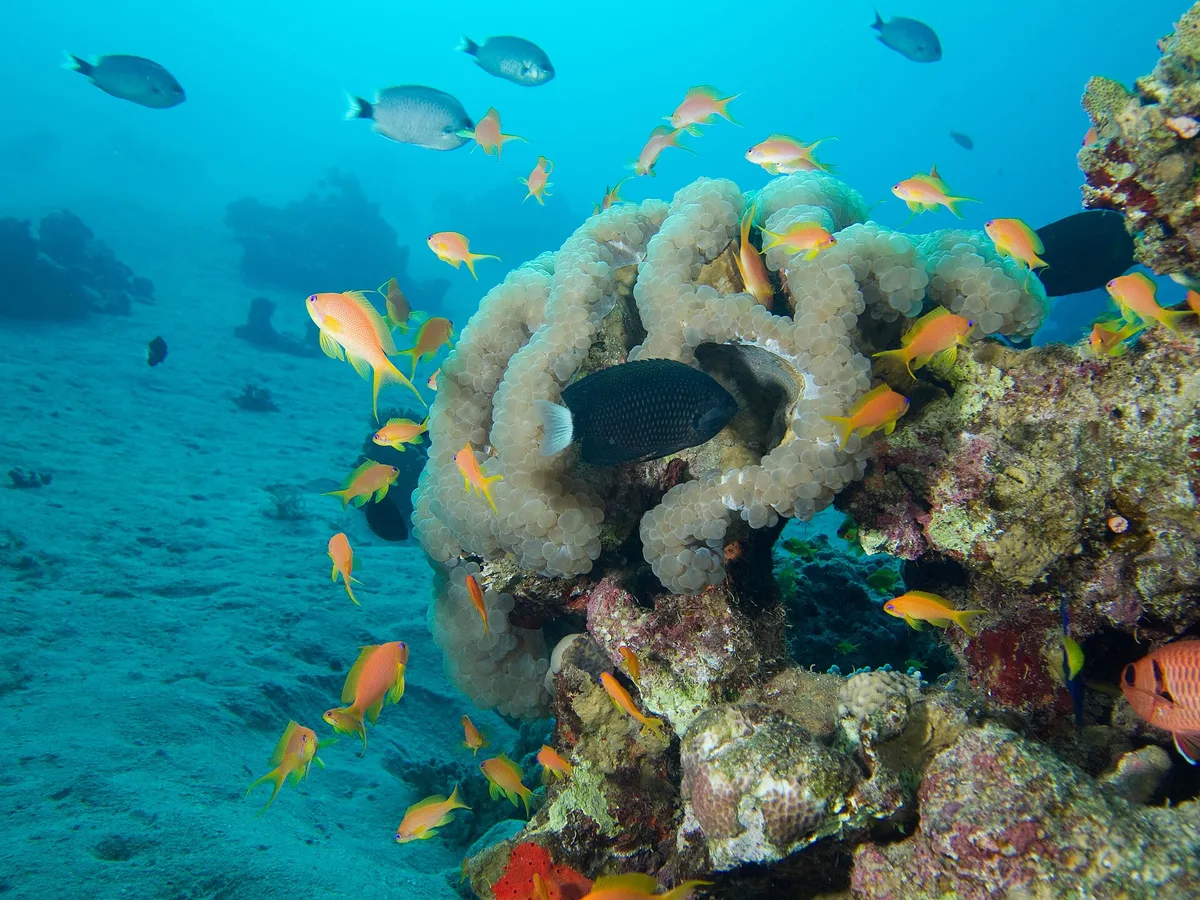
Aqaba’s reef is a fringing reef, which is the arrangement that makes this coast so easy to enjoy: the coral begins almost where the sand ends. Along the southern shore, a shallow reef flat runs out from the beach – rock, seagrass and coral heads in water you can stand in – and then the reef drops away down a slope into the deep, dark blue of the gulf. Snorkellers work the flat and the drop-off’s sunlit rim; divers follow the slope down. There are no long boat rides to reach the good water here, no channels or tides to plan around in the Egyptian style. You walk in, and the Red Sea starts.
The protection story has two chapters, and keeping them straight clears up a confusion in many older guides. The shoreline south of the port was first protected as the Aqaba Marine Park, a managed zone established in 1997 with marked sites, mooring buoys and rangers. In December 2020, by royal directive, the core of that coast was upgraded and declared the Aqaba Marine Reserve – Jordan’s first marine reserve – covering about seven kilometres of shoreline, roughly a third of the country’s entire coast, and managed by the Aqaba Special Economic Zone Authority, ASEZA. Divers and older articles still say “marine park” out of habit, and the name survives on signs and in dive-shop speech, but the reserve is the current legal reality, and it is the stronger protection of the two.
The reserve’s credentials have been stacking up since. It is classed in IUCN’s Category VI, the sustainable-use category, and in 2025 it was added to the IUCN Green List of protected areas that meet the organisation’s standard for effective, well-governed management – a certification very few marine sites in the region hold. ASEZA is also pursuing UNESCO World Heritage status for the reserve, a bid built on the reef’s scientific fame – its nomination file passed the first technical stage in 2025. These are among the northernmost coral reefs on earth, and their corals show a tolerance for warm water that researchers study as a possible refuge for Red Sea species as the climate warms. ASEZA’s own count for the reserve runs to more than 157 species of hard coral and 512 species of fish, with seagrass beds in the shallows and green and hawksbill turtles among the larger residents.
What the reserve means for a visitor is mostly a set of simple, enforced courtesies. You enter the water at marked points rather than walking across the reef flat, you do not touch, stand on or collect coral and shells, fishing is off the table inside the reserve, and dive boats tie to mooring buoys instead of anchoring on the reef. Aqaba’s dive centres have leaned into the regime rather than merely obeying it – a Green Fins programme run with ASEZA has certified a growing list of local operators against international standards for low-impact diving. The practical effect, felt within minutes of your first snorkel, is a reef that behaves like a protected one: fish that do not scatter at a shadow, coral in the shallows that is alive rather than trampled, and turtles that treat swimmers as weather. Any aqaba travel guide should be plain about the exchange – the reserve’s rules are the price of the reef’s condition, and they are a bargain.
Diving in Aqaba – Coral Gardens and Deliberate Wrecks
Aqaba diving has a character all its own, and it starts with how little machinery it needs. This is overwhelmingly shore diving: the centres line the southern shore road, you kit up in the shade, walk down the beach in your gear and wade out over the sand and seagrass until the reef slope takes you down. Boat diving exists, mainly for the one site that needs it, but the classic Aqaba dive begins on foot. For learners that means gentle entries and an instructor within arm’s reach; for experienced divers it means no crowded boat rosters, no long transits, and sites strung along about fifteen kilometres of shore road so that the week’s longest transfer is measured in minutes. Visibility is a large part of the pleasure – the gulf’s clear, low-nutrient water regularly gives divers twenty metres or more, and the reef obliges by starting shallow and staying interesting deep.
The natural sites carry names that regulars recite like a football team. The Japanese Garden, off the southern shore, is a lush slope of coral pinnacles and anthias that works as both a dive and a snorkel. Seven Sisters is a chain of coral pinnacles rising from the sand, and around it sit the sites most divers build a week from: Rainbow Reef, First Bay, Black Rock, the Gorgonian fan gardens and King Abdullah Reef. Slopes here are gardens rather than walls – hard-coral heads, soft-coral trees, turtles grazing the seagrass, morays in the cracks, and in season the chance of something large and unbothered cruising through the blue. It is not the Red Sea’s most dramatic topography, and it does not need to be; it is healthy, calm and close.
Then there are the wrecks, and Aqaba’s wrecks are a story in themselves, because almost none of them are accidents. The elder statesman is the Cedar Pride, a 74-metre Lebanese freighter that caught fire at anchor in Aqaba in 1982 and lay abandoned until 1985, when the then Prince Abdullah – now King Abdullah II, a diver himself – had her cleaned and scuttled across two reefs as Jordan’s first great artificial reef. Four decades on she is furred with coral and sponge, her masts lying sideways in the blue, her holds open and lit, the whole ship readable in a single dive between roughly ten and twenty-eight metres. She set the pattern. An M42 Duster anti-aircraft tank followed in 1999 and sits upright in snorkelling depth near the shore, so familiar now that divers simply call the site The Tank. A Royal Jordanian Air Force C-130 Hercules transport went down in 2017, shallow enough for new divers, and a winter storm later broke her into a more dramatic ruin. In 2019 Aqaba added its biggest toy, a Lockheed TriStar airliner – a wide-body jet resting upright on the sand in fifteen to twenty-eight metres, close enough to swim through, and reached by boat.
The strangest of the set arrived the same year: the Underwater Military Museum, where the Jordanian military parked nineteen decommissioned vehicles on a bare patch of seabed in battle formation – tanks and armoured carriers in a line, artillery, an ambulance, helicopter airframes at the deep end – in an area chosen precisely because there was no reef to harm. Juvenile fish moved in immediately, photographers followed, and the site has become the signature dive of the coast, surreal and faintly comic and now genuinely alive. Taken together, the wrecks explain Aqaba’s diving identity better than any brochure line: a small coast that could not compete with Egypt on scale decided to compete on imagination instead. Choosing a centre is the main practical decision – look for one of the reserve-registered, Green Fins-certified operators along the South Beach road, and let the aqaba travel guide rule of thumb do the rest: the best centre is the one that talks about the reef’s rules before it talks about its prices.
Snorkelling and Swimming – The Reef Without the Tank
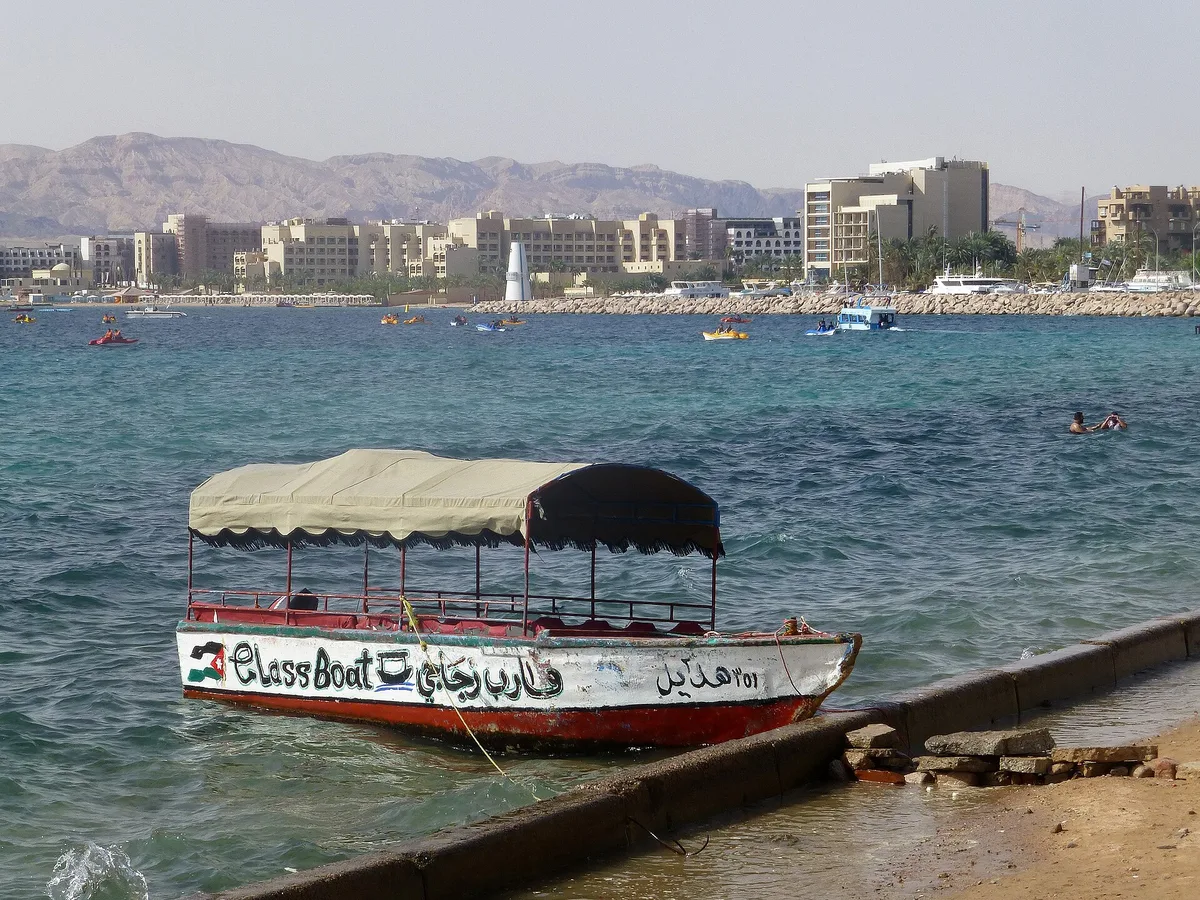
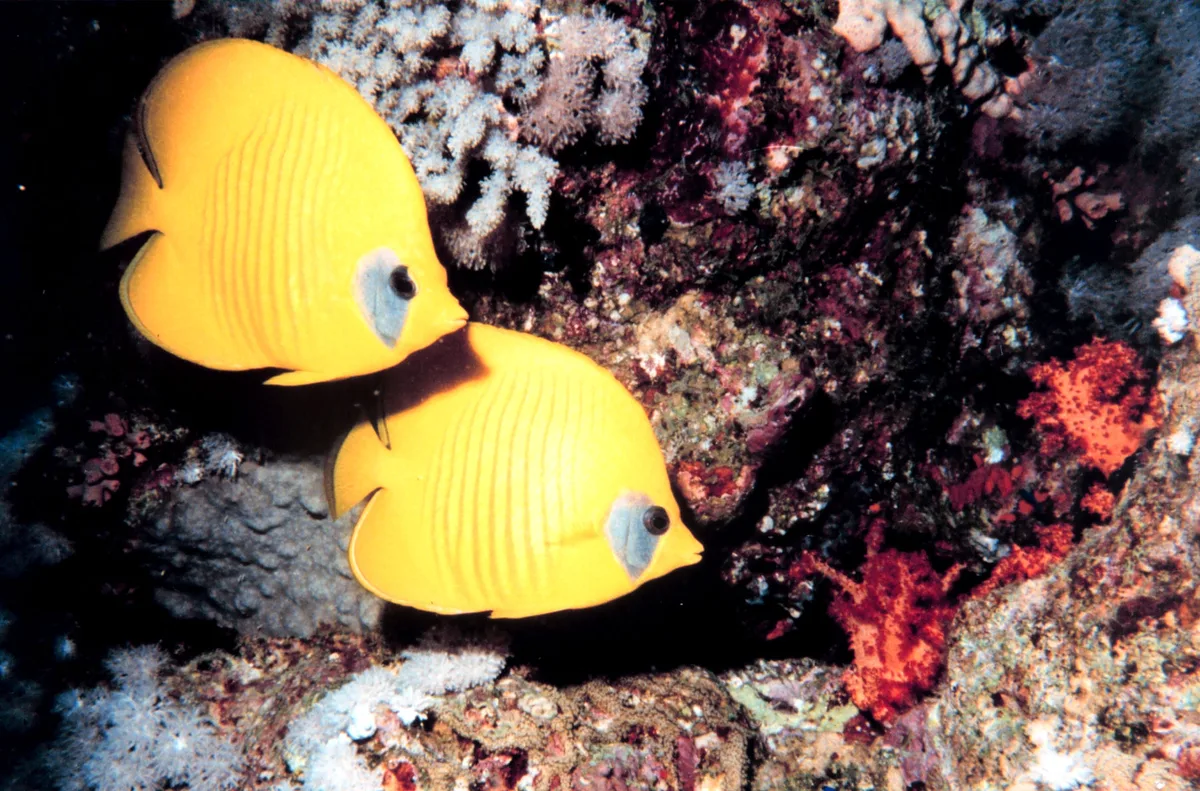
You do not need a scuba certificate, or even much confidence, to meet Aqaba’s reef properly. The same geography that makes the diving easy makes the snorkelling easier: the reef flat and the top of the slope lie in a few metres of sunlit water, and at the southern shore sites the coral gardens begin within a short swim of the beach. The Japanese Garden and the Seven Sisters pinnacles are the classic snorkel targets, shallow enough to read from the surface – coral heads, clouds of anthias, butterflyfish in pairs, the occasional turtle working the seagrass – and the army tank sits in such shallow water that snorkellers hover above it looking down at a piece of military hardware being slowly repossessed by the sea.
The mechanics are simple and worth stating plainly, because most bad snorkelling here is a logistics failure rather than a swimming one – so this aqaba travel guide states them plainly. Enter at the marked points and swim out over sand or seagrass, never across the living reef flat, which is both fragile and, in places, sharp and urchin-spined. Fins are worth having – the distances are short but the afternoon breeze can push a tired swimmer along the shore – and a rash vest does the double work of sun protection and a layer of modesty that sits comfortably on Jordanian beaches. Centres along the South Beach road rent masks and fins by the day and run guided snorkel sessions for the nervous, and the reserve’s own beaches – it names four, Coral, Yamaninya, Blue and Palm – come with the visitor infrastructure of a managed park rather than a wild shore.
For non-swimmers, Aqaba has an honourable old solution: the glass-bottom boat. Boats with glass panels in the hull work out of the town marina and the Al-Hafayer shore, drifting over the reef while passengers watch the coral gardens pass beneath their feet, and the same boats double as the cheapest way to see the coast from the water – the fort, the flagpole and the town front sliding past with Sinai across the gulf. It is a gentle, slightly old-fashioned pleasure, and on a windy day when the reef is churned up it is also the pragmatic one. However you meet it – mask, tank or glass panel – the etiquette is the reserve’s etiquette: look, photograph, and leave every shell and coral head exactly where the gulf put it.
The Beaches – Public Sand, Beach Clubs and Resort Fronts
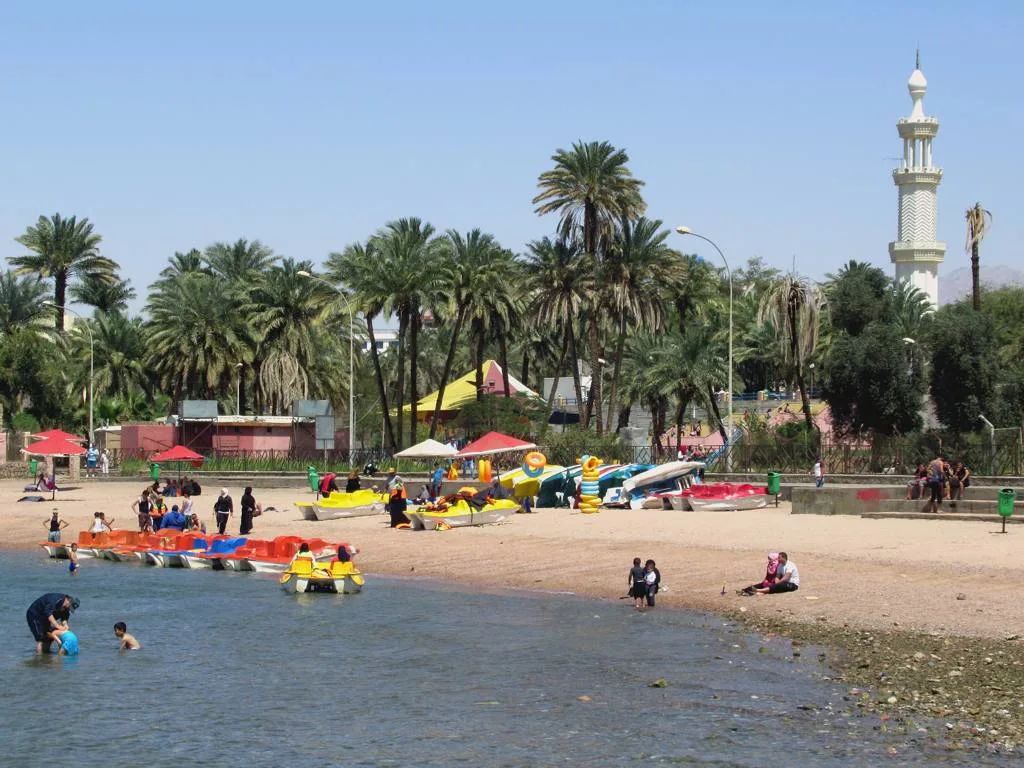
Aqaba’s beach geography confuses newcomers because the word “beach” covers four quite different arrangements, and choosing between them is really choosing which Aqaba you want for the day – this aqaba travel guide takes the four in turn. The first arrangement is the town’s own public shore: Al-Hafayer beach, the strip of sand and promenade along the old town’s waterfront beneath the fort and the flagpole. It is free, central, animated and unmistakably local – families picnicking to the waterline, tea and coffee appearing from coolboxes, children in the shallows, glass boats loading at the edge. What it is not is a resort beach: the sand gives onto a town shore rather than the reserve reef, facilities are basic, and the dress code is Jordanian street norms softened for swimming, not the swimwear free-for-all of a private resort. Visitors who come to watch, paddle and eat an ice cream among Aqabans have a wonderful time; visitors who come expecting a lounger and a cocktail have chosen the wrong hundred metres of Jordan.
The second arrangement is the public shore of the southern corridor – the South Beach stretches along the shore road, where the reef is the attraction and the sand is simply the way in. Parts of this coast fall inside the marine reserve, whose four named beaches ASEZA manages with visitor facilities and lists as free to enter; other stretches are open shore in front of the dive centres, where a day naturally organises itself around a centre’s shade, showers and rental gear. The swimming here is the best in Aqaba, straight onto coral, and the atmosphere is correspondingly purposeful – quieter than Al-Hafayer, more wetsuits than picnics.
The third arrangement is the beach club, the local institution that solves the public-beach compromises for a day-use fee: Berenice, the best known of them, occupies its own stretch of the southern shore with pools, lawns, a jetty over the reef, changing rooms and food, and rivals such as the B12 club sell the same package in a livelier key. Clubs are how many Amman families and visiting couples do Aqaba – resort comfort without a resort booking, full swimwear normality inside the fence, reef access at the end of the jetty. The fourth arrangement is the resort front itself: the big hotels of Tala Bay and the town’s international hotels hold their own groomed sand, where the beach is an extension of the room rate. None of the four is the “real” Aqaba beach. The honest summary is that the free town shore gives you the city, the reserve shore gives you the reef, the clubs give you comfort, and the resorts give you quiet – and a well-built trip usually samples at least two.
The Old Town – Souks, Coffee and a Working City
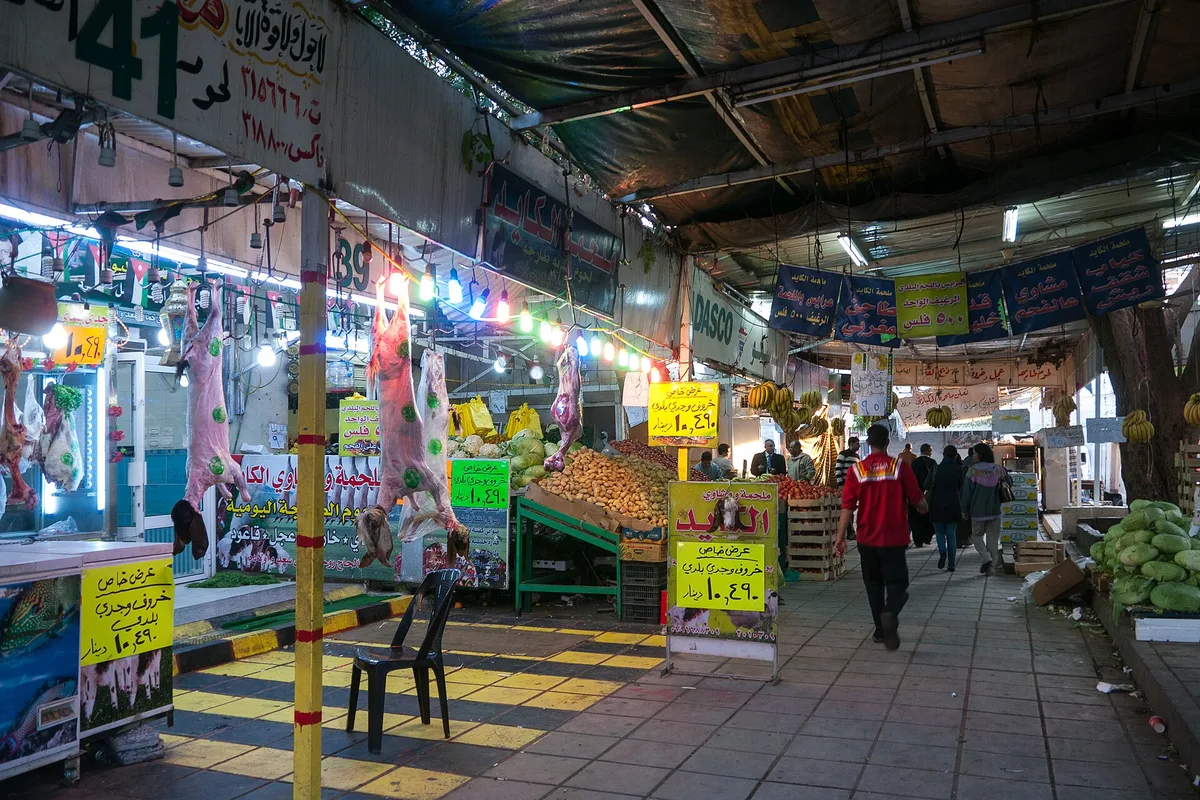
Aqaba’s old town is not old in the postcard sense – there is no medina of carved stone and covered alleys, because the modern city is largely a twentieth-century creation that grew around its port. What it has instead is something increasingly rare on the Red Sea: a resort town whose centre still belongs to its residents. The grid of streets behind the corniche runs on local time and local money. The souk streets sell produce, spices, gold, phone cases and wedding finery to Aqabans; the bakeries turn out bread for neighbourhoods, not hotels; the coffee stalls pour for taxi drivers and shopkeepers; and in the evening the whole town seems to take the air along the waterfront in a promenade that mixes families, fishermen, soldiers on leave and the occasional thoroughly lost tourist.
The quarter’s anchor is the Sharif Hussein bin Ali Mosque, the white domed mosque on the waterfront whose courtyard and minaret give the old town its skyline, a few steps from the fort, the museum and the Great Arab Revolt Plaza at the shore. Around it the Raghadan street market area does the daily business of a market town, and the fish restaurants for which Aqaba is known among Jordanians cluster within a short walk – the town’s signature dish is sayadieh, spiced rice with fish and a rich onion-and-nut sauce, and the restaurants near the port serve the day’s catch to a mostly Jordanian clientele in the gregarious, unhurried style of a port city that has fed sailors for a very long time. Prices in the old town run on the ordinary Jordanian mechanism – menus where they exist, agreement before ordering where they do not – and the portions assume appetites built by sea air.
Give the old town its proper slot in the day – in this aqaba travel guide it is not an optional extra. It is not a morning of sightseeing so much as a texture to be walked through: coffee standing at a stall, the market at full voice, the mosque courtyard quiet at midday, the corniche filling as the heat breaks. Friday changes the register – the morning belongs to prayer and family, the afternoon and evening to the week’s great promenade – and Ramadan re-times everything again, the days hushed and the nights after the fast-breaking meal suddenly festive. Travellers who skip the old town for the reef miss the thing that makes Aqaba cohere: a Jordanian city that was getting on with its life long before the dive boats, and fully intends to continue.
Aqaba Castle – The Fort That Fell in 1917
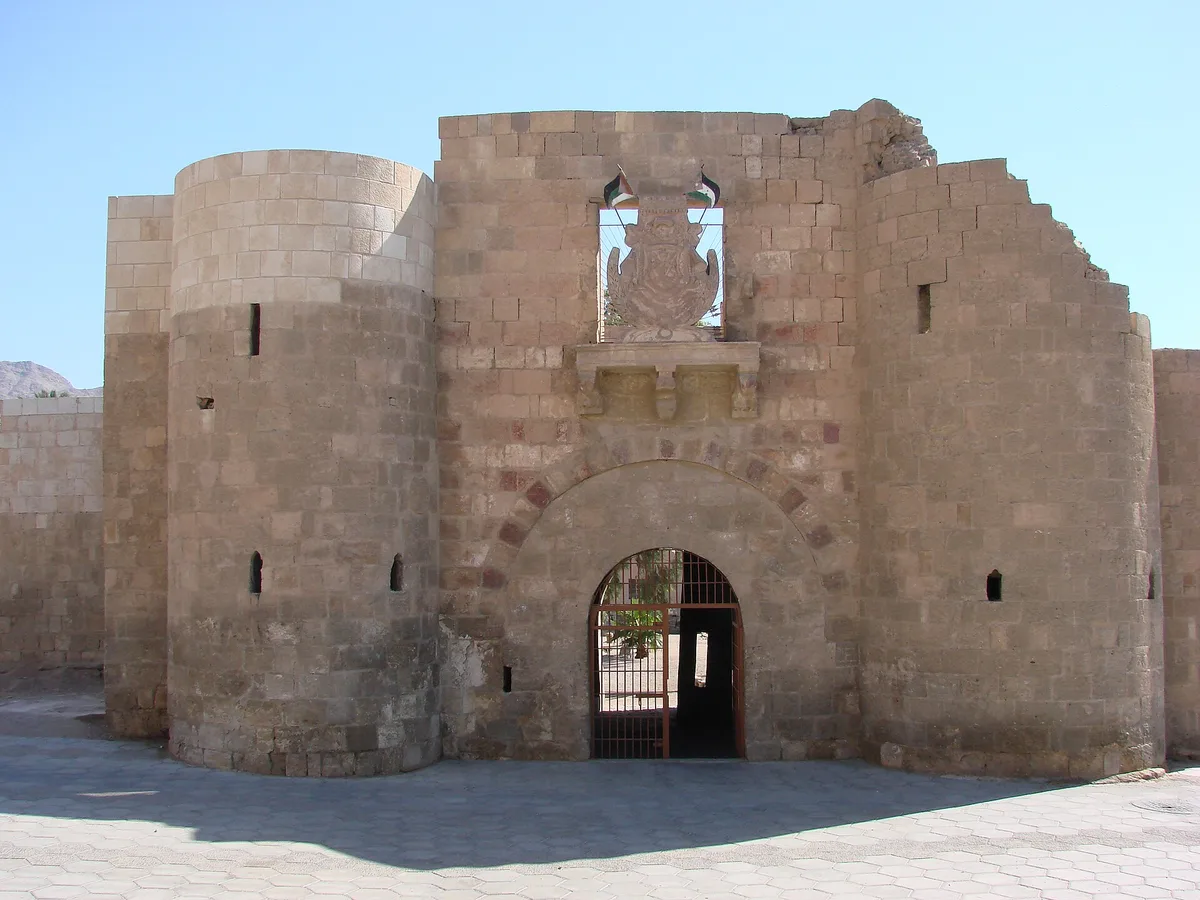
Every Red Sea port of any age has a fort, and Aqaba’s stands where it should: on the shore at the old town’s southern edge, a square of honey-coloured stone walls and corner towers around a courtyard, with the sea it was built to watch still glittering beyond the plaza. The fort you see is principally Mamluk work of the early sixteenth century, raised under Sultan Qansuh al-Ghuri in the last years before the Ottoman conquest, on ground where an earlier fortification – Crusader-era in origin, taken and retaken in the centuries of Salah al-Din’s wars – had stood before it. Its job was never really to fight navies. Aqaba sat on the great pilgrimage road from Egypt and Syria to Mecca, and the fort served that road as garrison, storehouse and hostel for hajj caravans, which is why its plan reads as much like a fortified inn as a castle.
The gate tells the building’s biography in stone. Over the arch sits a carved Mamluk inscription of its builders, and above and around it a later addition: the coat of arms of the Hashemites, placed there after the fort’s most famous hour. In July 1917, in the episode that made Aqaba a household word far beyond Jordan, forces of the Arab Revolt – with Auda Abu Tayi’s horsemen and T. E. Lawrence among them – came down on the town from the desert interior, the direction its guns did not face, and took Aqaba and its fort in the Battle of Aqaba. The victory opened the Revolt’s northern road and gave the Hashemite cause its Red Sea port; the plaza beside the fort is still the Great Arab Revolt Plaza, and the enormous flagpole on it flies the flag of the Revolt over the harbour.
Visiting the castle today is a modest, worthwhile hour. Restoration work in recent years stabilised the walls and towers, and the interior is a circuit of courtyard, vaulted rooms and rooflines rather than a furnished museum – the pleasure is in the fabric itself, the gate inscription, and standing in the courtyard reading the building against the events of 1917. Its neighbours complete the history quarter in a few hundred metres: the revolt plaza and flagpole, Sharif Hussein’s house next door, the excavations of Ayla a short walk north, and the mosque beyond. Treat the fort as the hinge of that walk – every sensible aqaba travel guide route through the old quarter passes through its gate – and check locally for its current visiting arrangements when you arrive, as the quarter’s sites are managed together and their practical details shift with seasons and works.
The Archaeological Museum – A Palace, A Collection and an Honest Caveat
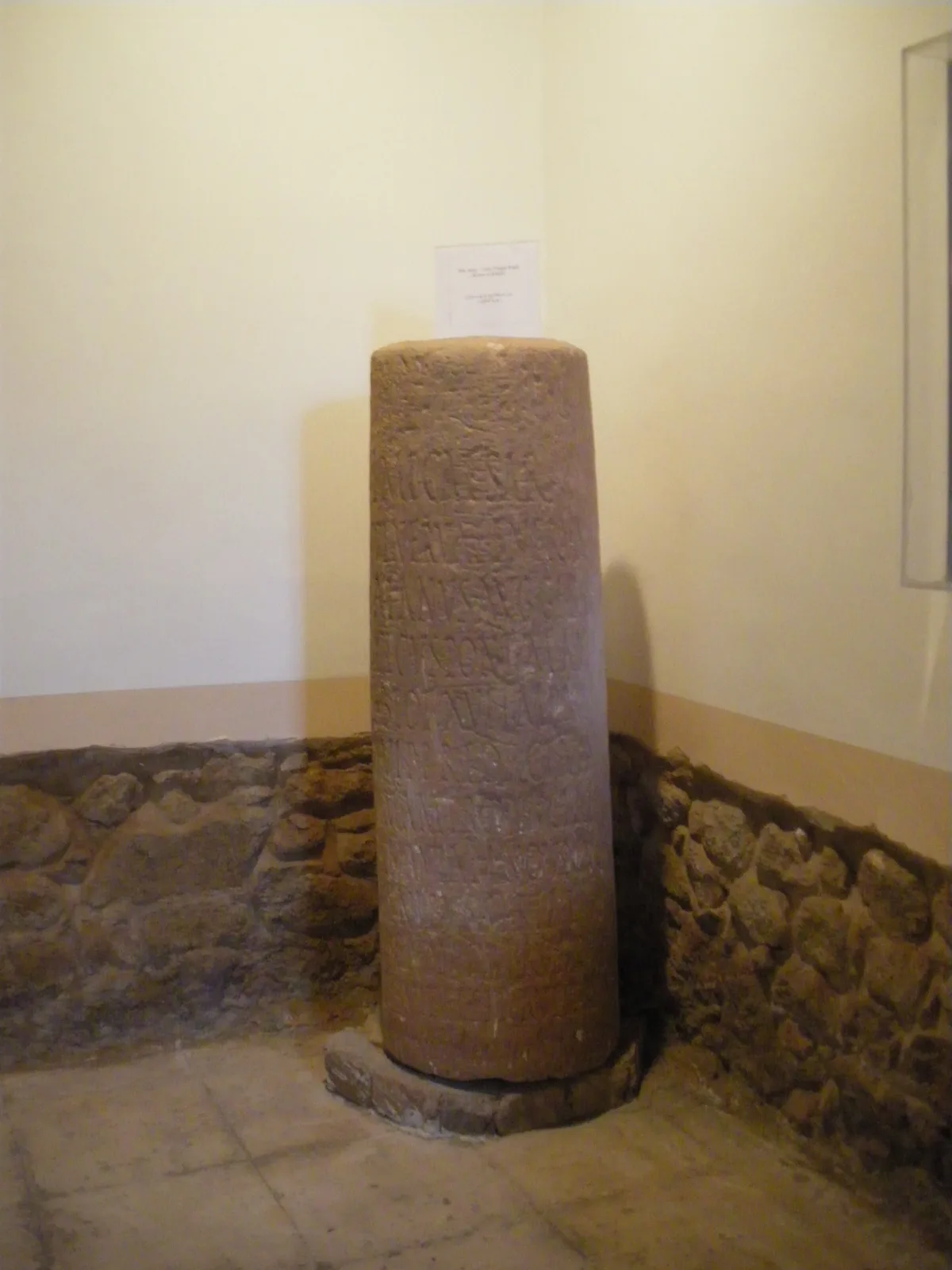
Immediately beside the fort stands the house that Sharif Hussein bin Ali, leader of the Arab Revolt, built for himself shortly after the First World War – a modest seafront palace from which the Hashemite cause was administered in the years when Aqaba was its port. In 1989 the house became the Aqaba Archaeological Museum, opened at the start of 1990 as the city’s official museum, and the logic of the collection it assembled is the logic of the house’s own view: everything here is about the port. The region’s story starts startlingly early, with material from Tall Hujayrat al-Ghuzlan, a settlement near modern Aqaba where copper was being worked around 4000 BCE – evidence that this shore has been inhabited and industrial for six thousand years. The museum’s heart, though, is the early Islamic city of Ayla, whose excavated finds – pottery, coins, glass, tombstones, and a great carved inscription of a Quranic verse that once hung over Ayla’s eastern gate – fill the rooms with the evidence of a busy, literate port town. Fatimid gold coins and pieces that arrived from as far away as Morocco and China make the same point the harbour makes today: Aqaba has always faced outward.
Now the honest caveat, and it matters more than the collection list. The house’s role was rethought in the last decade: a redesign programme recast it as the Sharif Hussein House museum, dedicated to the man and the Arab Revolt story, and the archaeological museum’s public life since then has been intermittent enough that the usual online listings contradict each other about whether and when it opens. No official source this aqaba travel guide checked in October 2026 states a current, regular opening pattern for the archaeological displays, and traveller reports over the years variously describe the museum as open, as closed for renovation, and as absorbed into the house museum. Rather than print hours we cannot verify, we will say exactly that: the building is unmissable and worth the walk for its own sake, the fort next door is the quarter’s reliable anchor, and the practical move is to ask at the fort or the visitor information point on the day – if the rooms are open, give them the unhurried half hour they deserve, because the Ayla material is the missing chapter between the excavated streets outside and the city around you.
That may sound like a disappointment, and handled badly it is one; but it is also simply Aqaba’s museum reality, and it sharpens rather than dulls the visit. The quarter works as an ensemble – fort, palace, plaza, excavations, mosque – in which each piece explains the others, and the museum question is best treated as a bonus to be confirmed on the ground rather than a promise to be planned around.
Ayla and the Ancient Church – Old Aqaba Under the New
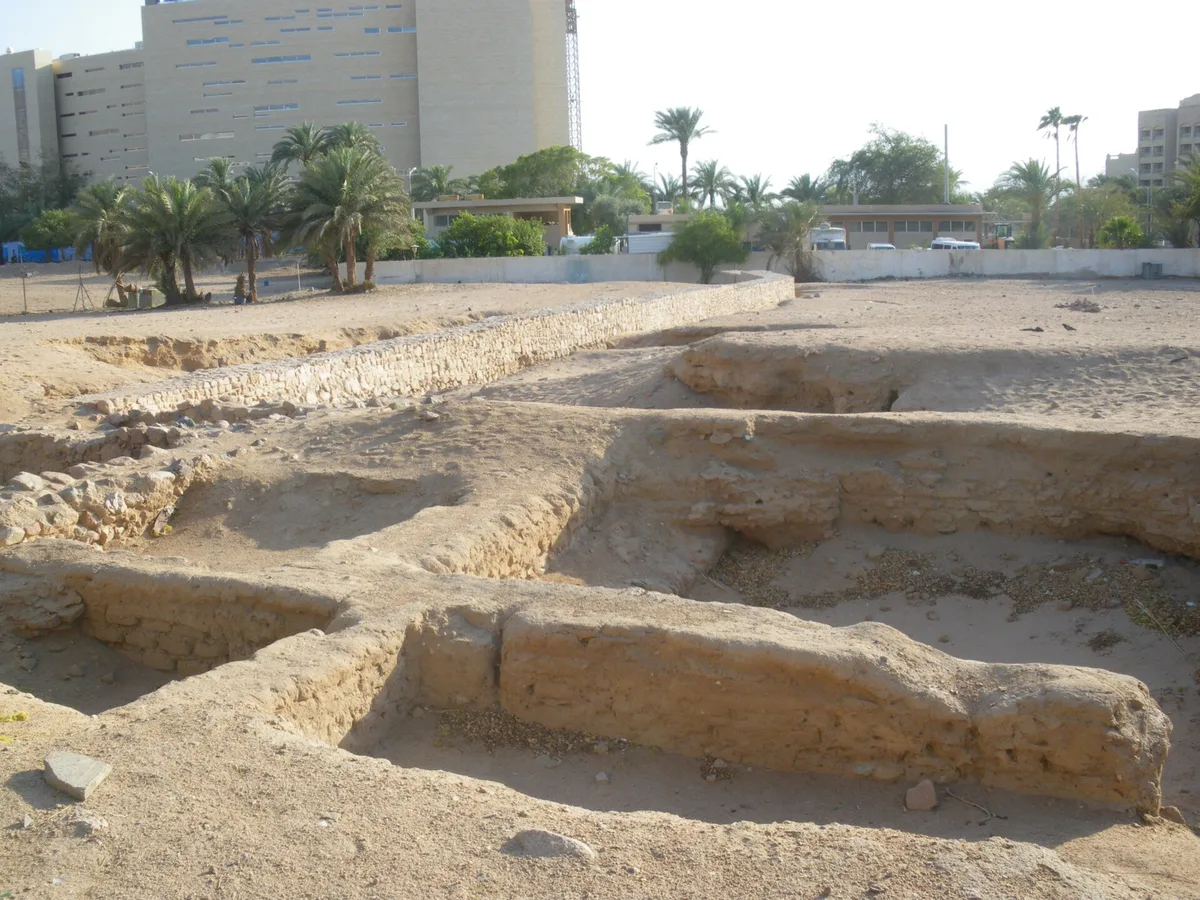
The strangest sight in Aqaba is a fenced patch of low mud-brick walls sitting in the middle of the modern town, a few streets back from the beach, with apartment blocks and a hotel for neighbours. This is Ayla – not the modern marina development that borrowed the name, but the original: the early Islamic port city founded around the middle of the seventh century, among the first planned cities of the Islamic era, laid out as a rectangle of walls and towers with gates, a congregational mosque, markets and streets on a grid. Ayla was Aqaba for its first Islamic centuries, the port where goods for Damascus and the Hijaz changed hands, and its excavated quarter – stretches of wall, gate foundations, street lines – survives in fragments across the town centre, fenced, signed and easy to walk past if nobody tells you what you are looking at. Now you know: it is a seventh-century city showing through a twenty-first-century one like a watermark.
Ayla had a predecessor, and the predecessor left the town’s most quietly astonishing relic. Roman Aila stood here before the Islamic foundation, a garrison and port town of the empire’s Arabian frontier, and in the late 1990s archaeologists excavating in the modern city uncovered a mud-brick church dated to the very end of the third or the opening of the fourth century – which makes it, on present evidence, among the oldest purpose-built Christian churches anywhere in the world, raised within living memory of the faith’s legalisation. What survives is foundations and low walls rather than a standing building, and the site keeps the modest, scholarly atmosphere of a working excavation.
Neither Ayla nor the church will detain you long, and the article will not pretend otherwise. Their power is positional. Stand at the fence and take in the layers in a single glance – Roman garrison town, early Islamic port, Mamluk pilgrim fort, Hashemite palace, and around them all the cranes and corniche of a modern duty-free port city – and Aqaba’s whole biography is visible from one pavement. The history sections of most guides rush to the fort; this aqaba travel guide’s advice is to give the fenced mud-brick its five minutes first, and the fort, the museum and the town itself all make more sense.
Arriving in Aqaba – The ASEZA Visa and the Border-City Mechanics
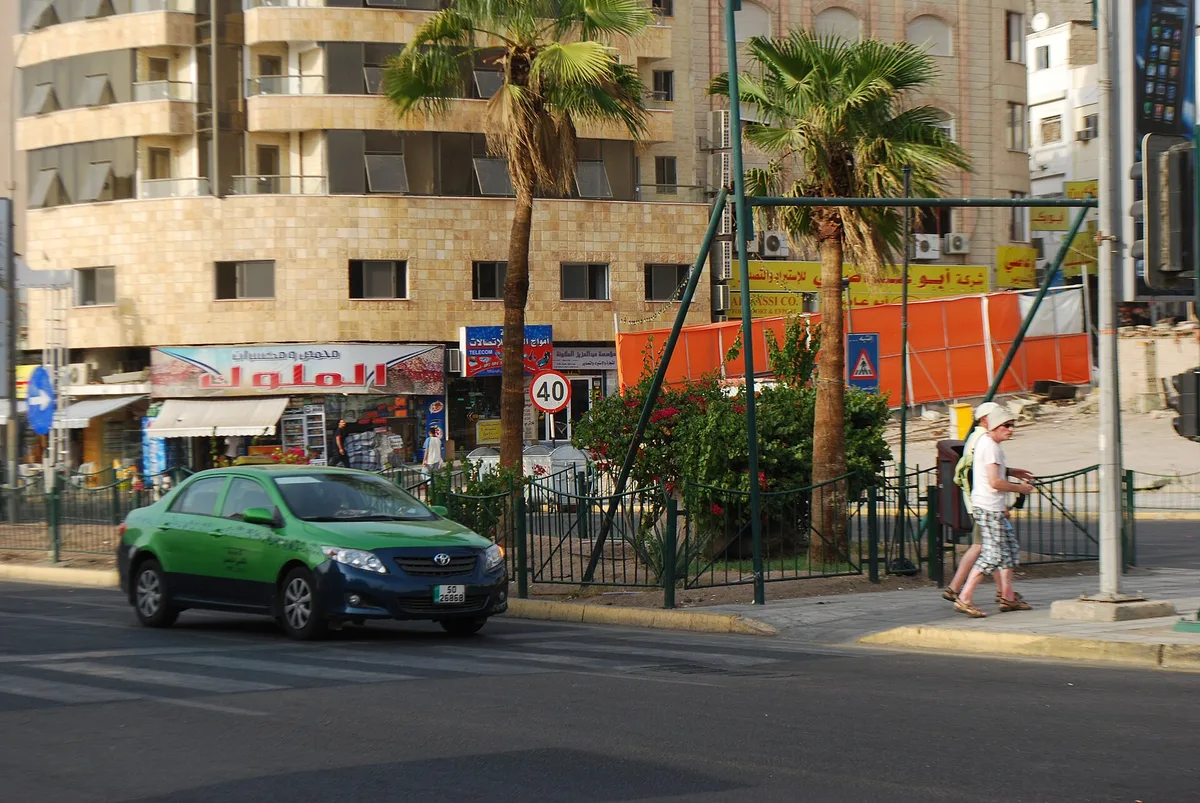
Aqaba is governed differently from the rest of Jordan, and the difference reaches the arriving traveller within minutes of landing. The city and its coast form the Aqaba Special Economic Zone, run by ASEZA with its own customs and investment regime – the reason Aqaba markets itself as a lower-cost, duty-advantaged place to shop – and, most usefully, its own immigration arrangement. Jordan’s official Visit Aqaba portal sets the mechanism out plainly, and because rules of this kind change, what follows is the mechanism as it stands at the time of writing, not a promise: check it against the official page before you travel.
The mechanism, in short, is that Aqaba is Jordan’s free front door. If you arrive in Jordan through Aqaba itself – through King Hussein International Airport, through the port, or through its land borders – you are issued a free ASEZA visa on arrival rather than paying for the standard visa. There are no obligations attached to that visa as long as you leave Jordan within one month and leave through the same Aqaba gateway you entered by; if you want to stay longer, the extension is handled at the ASEZA office in Aqaba rather than at a police station. The door swings the other way too: travellers who arrive elsewhere in Jordan but declare Aqaba as their destination can claim the same free visa, provided they register at the ASEZA visa office in Aqaba within 48 hours of arriving in the country – miss the registration and the standard visa charge catches up with you on departure. Two cautions complete the picture honestly. Some nationalities must arrange a Jordanian visa before travel wherever they arrive, a question only your own nationality’s rules and Jordan’s diplomatic missions can settle. And none of this is the Jordan Pass, which is a separate instrument bought in advance that bundles its own visa treatment with site entries; travellers doing the full triangle should compare the two mechanisms against their route, since entering through Aqaba can make the pass’s visa component redundant while its Petra value remains.
Getting physically to Aqaba offers the usual Jordanian choice of air or road, with a maritime footnote. King Hussein International Airport sits just north of the city and takes Royal Jordanian’s domestic hop from Amman plus seasonal and charter services from abroad; most visitors on a full Jordan circuit, though, arrive overland, on JETT coaches or by car down the Desert Highway from Amman, a run of about four hours that the site’s itinerary treats as the triangle’s closing leg. The borders are the city’s third dimension. The Wadi Araba crossing south of the Dead Sea’s other end – a short drive north of town – links Aqaba with Eilat in Israel for pedestrians and vehicles, and its hours and procedures can change at short notice, so treat any plan involving it as provisional until confirmed close to the day. Ferries have long linked Aqaba with Egypt’s Nuweiba and the Taba coast across the gulf, run as practical transport rather than cruises, and the Durra crossing into Saudi Arabia serves mainly regional traffic. On safety and the current regional picture, this aqaba travel guide deliberately says only what belongs in a transport section: Aqaba’s tourist machinery is functioning, border and flight arrangements anywhere in the region can shift quickly, and the right preparation is to read your own government’s current advice before you go – the site’s dedicated safety coverage reads that advice closely, and this article will not paraphrase it into a second, staler copy.
The Golden Triangle – Aqaba as the Sea Gate to Petra and Wadi Rum
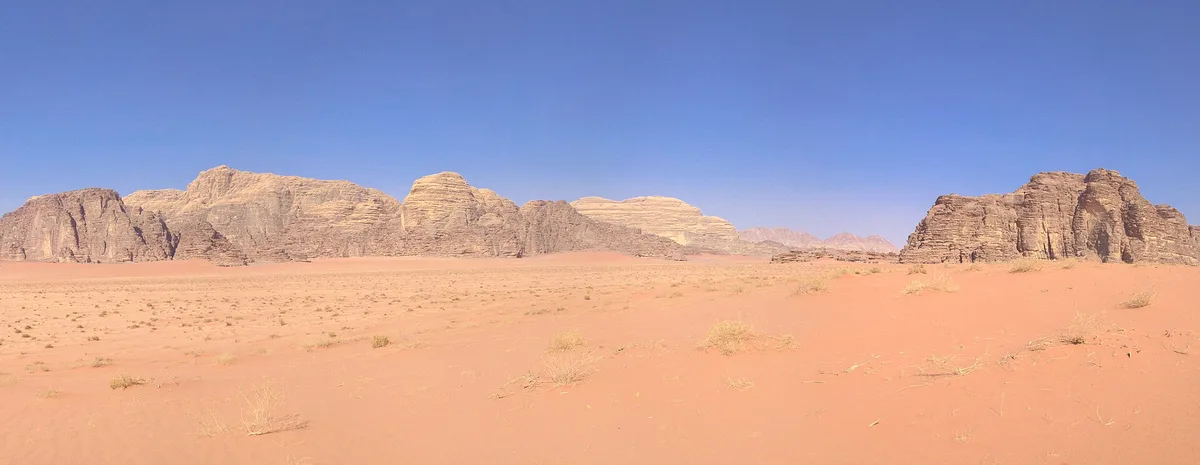
Southern Jordan’s famous triangle – Aqaba, Wadi Rum, Petra – is usually drawn with Petra at the top, and geographically that is a slander on Aqaba. The city is the triangle’s only door to the outside world by sea and its most convenient door by air, which makes it the natural place to begin or end the circuit: the reef day that loosens travellers up after the flight in, or the swim that rinses off a week of desert dust before the flight home. The road geometry is kind. Wadi Rum’s protected area lies about an hour inland – near enough that a Rum overnight or even a long day trip from an Aqaba base is realistic – and Petra is roughly two hours north by road, close enough for the determined to day-trip and far enough that most travellers sleep in Wadi Musa instead. Our Petra travel guide plans that visit properly, and the 7-day Jordan itinerary strings the whole triangle into a week with Aqaba at its end.
Sequencing the triangle is the one piece of genuine craft in a southern Jordan trip, and Aqaba’s place in the order changes its character. Run the circuit Amman-Petra-Rum-Aqaba and the coast is a reward: three days of tombs and desert resolved into warm water and a fish dinner, with the ASEZA arrival logic irrelevant (you entered elsewhere) but the departure logic kind, since Aqaba’s airport and the road back to Amman both work from here. Run it in reverse – fly into Aqaba on the free-visa mechanism, take the reef days first while the jet lag fades, then Rum, then Petra, exiting through Amman – and the trip builds steadily toward its climax, at the price of doing the two longest drives with the most famous site still ahead of you. There is no wrong answer; there is only the honest observation that Aqaba functions best as a full stop, two nights at the very least, rather than the single night that package itineraries tend to grant it. The aqaba travel guide recommendation is the extra day: the reef alone repays it, and the city repays the evening.
When to Go to Aqaba – Winter Warmth, Summer Fire
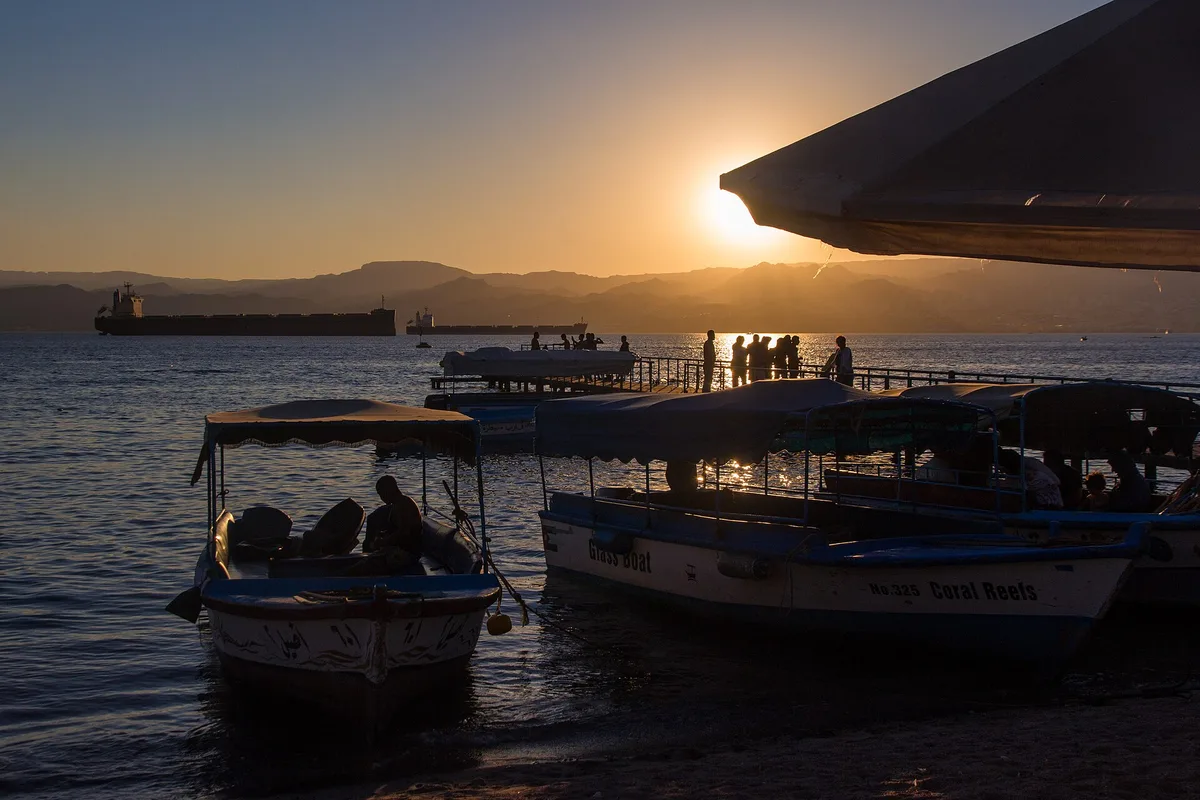
Aqaba’s climate is the city’s second product, and for northern visitors it is the more startling one: this is a place where January behaves like a Mediterranean May. The year’s rhythm divides into a long, kind season and a short, fierce one. Winter, December to February, brings daytime temperatures around the low twenties Celsius, evenings cool enough for a jacket, and a sea that bottoms out around 21 degrees – wetsuit territory for divers, bracing-but-honest swimming for everyone else. It is the season Aqaba exists for in the Jordanian imagination, the country’s own winter escape, and weekends can fill with Amman families doing exactly that. Spring, March to May, is arguably the finest window of all: the air warms through the twenties, the sea climbs back toward comfort, the desert inland is at its most beautiful for the triangle days, and the only unruly guest is the occasional khamaseen, a hot dusty wind that can haze the gulf for a day or two.
Autumn runs spring close. October and November give back the warm sea of summer – the water holds around the mid-twenties – without the furnace above it, and divers rate these weeks among the year’s best, with warm water, settled weather and the summer crowds gone. Then there is summer itself, June to September, when Aqaba’s temperatures push toward and past forty degrees and the city’s life re-times itself around the heat: diving and swimming early and late, the long shaded siesta in the middle of the day, the corniche and the beach clubs coming alive after sunset. Summer is not a reason to avoid Aqaba – the sea is bath-warm, the hotels are at their emptiest, and Jordanians holiday here through it – but it is a reason to plan days the local way and to treat any midday sightseeing at the fort or Ayla as the act of optimism it is.
A last calendar note belongs to Ramadan and the Eid holidays that follow it, when the city’s days quieten, its nights flourish and its hotels and shore fill with regional holidaymakers; and to the simple weekly rhythm that Friday and Saturday form the Jordanian weekend, when public beaches and the road south are at their busiest. The seasons section of any aqaba travel guide can be reduced to one line for most readers: if you can choose, come in spring or autumn; if you are escaping a northern winter, come anyway – Aqaba in January is the argument the whole city is built on.
Where to Stay in Aqaba – Town, South Beach or Tala Bay
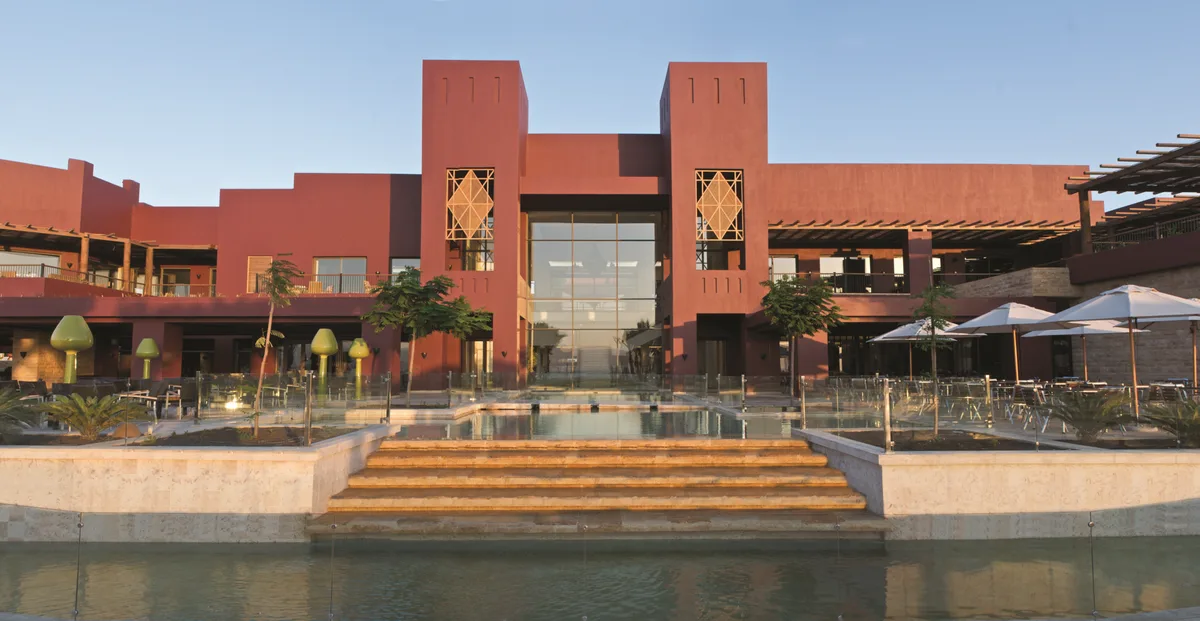
Aqaba’s three bases sell three different holidays, and the choice matters more than the star rating. Stay in the town centre and you sleep inside the working city: small and mid-sized hotels in the grid, the souks and fish restaurants at walking distance, the corniche and Al-Hafayer beach in front of you, and the fort quarter a stroll away. The town base is the cheapest, the tastiest and the most interesting, and its compromises are the honest ones of any city stay – the hotel beaches are small or shared, traffic and town noise come with the address, and the great reef lies a taxi ride south rather than at the bottom of the garden.
Stay along the southern shore corridor and you have chosen the reef as your landlord. The dive centres, beach clubs and mid-range resorts strung along the South Beach road exist for people whose days are organised by the water: breakfast, two dives or a long snorkel, shade, repeat. It is the quietest and most purposeful base, and the one divers who know Aqaba book on return visits. Its costs are distance and dependence – the town’s restaurants and souks are a ride away, evenings are early and sea-focused, and without a car you are eating where you sleep more often than not.
Stay at Tala Bay, fifteen kilometres south, and you have chosen the enclave: big international resorts around a marina, groomed sand, pools, spas and the full apparatus of a self-contained Red Sea holiday, with the reserve’s southern sites on your doorstep. Tala Bay does its job extremely well for families and for travellers who want the reef without the city; the trade is that the city is exactly what you do not get – Aqaba the Jordanian town might as well be in another governorate, and many Tala Bay guests never see it. The northern alternative, the Ayla Oasis district by the border, splits the difference in a newer key: marina apartments and resort hotels in a landscaped development with lagoons and a golf course, five minutes from the town it overlooks. The aqaba travel guide rule is: choose by the trip you actually want. The reef-first diver belongs on the south shore, the city-curious traveller in town, the family on a fly-and-flop week in Tala Bay – and nobody, on any budget, should book one while dreaming of another.
The Honest Downsides – A Port City First, A Resort Second
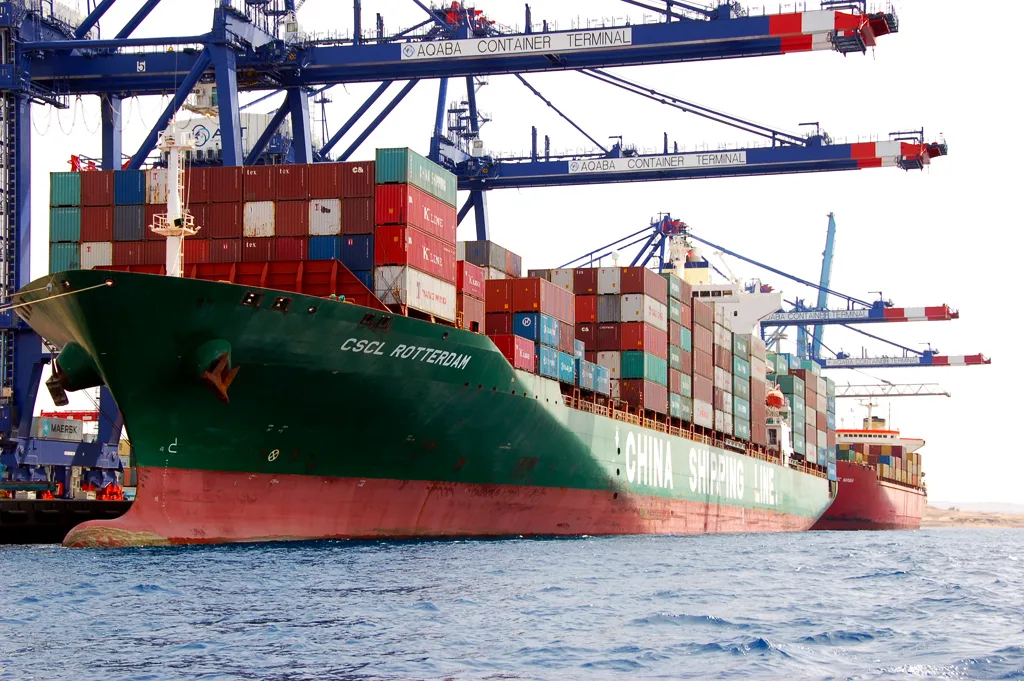
A guide that only sells Aqaba is a brochure, so here is the other ledger, plainly kept. Aqaba is a port city first. The container terminal, the phosphate and industrial berths and the truck traffic that serves them occupy the middle of a very short coast, and although the main port operations have been pushed south of the town over the years, industry is part of the seascape and part of the soundtrack in a way that pure resort towns edit out. Most visitors make their peace with it within a day – the cranes are honest, and the water where you swim is the reserve’s, watched and patrolled – but anyone arriving with a Maldives-shaped fantasy should adjust the picture before the taxi ride, not after.
The coastline’s shortness is the second fact, and it constrains everything. Twenty-seven kilometres is not much shore to divide between a port, a city, an army of beach uses and a marine reserve, and the crowding shows at the seams: public beaches that are glorious on a Tuesday can be shoulder-to-shoulder on a Jordanian holiday weekend, the best reef entries have their busy hours, and there is no long empty beach to walk away along – the coast ends at borders in both directions. Add the summer heat, which at its peak is a physical force rather than a preference, and the modesty norms of the town beaches, which surprise visitors who pack only resort assumptions: on Al-Hafayer, swimwear belongs in the water rather than on parade, and the traveller who reads the beach and matches it will have a warmer welcome than the one who treats the town shore as a private club.
The last items are smaller but real. Tala Bay’s polish comes with enclave isolation; the old town’s museum quarter, as the museum section admits, cannot currently promise its own headline act; the border-city setting means crossings, flights and regional arrangements occasionally change at short notice and itineraries should hold a little slack; and Aqaba’s position at the far end of Jordan makes it a long way from the country’s northern sights, so it pairs awkwardly with Jerash or Umm Qais on a short trip. None of this outweighs the reef, the winter sun and the working city’s charm. It is simply the shape of the place: Aqaba is a real city that learned to host, not a resort that learned to simulate one – and for most of the travellers this aqaba travel guide is written for, that is precisely its value.
Frequently Asked Questions
Is Aqaba worth visiting if I am not a diver? Yes, emphatically – and this aqaba travel guide is written for you as much as for divers. The reef is fully available to snorkellers, the glass-bottom boats serve non-swimmers, and the city adds the fort, the Ayla excavations, the souks and the old town’s fish restaurants. Divers get the deepest version of Aqaba, but the beach, the winter warmth and the triangle position carry a trip on their own.
How many days do I need in Aqaba? Two full days is the honest minimum: one for the reef and the southern shore, one for the old town, the fort quarter and a beach-club or public-beach day. Divers should think in terms of three to five days, and anyone using Aqaba as the triangle’s sea gate should add the days Rum and Petra deserve.
Do I need a visa in advance for Aqaba? For most visitors, no: arriving through Aqaba’s airport, port or land borders brings a free ASEZA visa on arrival, as the arrivals section explains, provided you leave within a month through the same gateway. Some nationalities must arrange visas before travel anywhere in Jordan, so confirm your own position with Jordan’s official sources before booking.
Can I visit Petra as a day trip from Aqaba? You can – it is roughly two hours each way by road – and operators run it daily. Whether you should depends on your appetite for dawn starts: Petra rewards a full day from its opening hours, and most travellers who can spare the night prefer to sleep in Wadi Musa and return to Aqaba afterwards.
What is the best month to visit Aqaba? October and November and the spring weeks of March to May are the sweet spots – warm sea, kind air, settled weather. December to February is the winter-sun season, mild and bright with a cooler sea. June to September is fiercely hot by day and at its best around the water at either end of it.
Is the sea warm enough to swim in winter? The gulf bottoms out around 21 degrees Celsius in late winter – cool on entry, comfortable once in, and warm enough that snorkellers manage happily in a short wetsuit while divers wear thicker neoprene. By late spring it is back to easy swimming temperatures, and in autumn it is at its warmest.
Is the Aqaba Archaeological Museum open? Nobody should answer that with false confidence, including us: the museum’s house was redesigned as the Sharif Hussein House museum, official sources state no regular opening pattern for the archaeological rooms, and listings contradict one another. Ask at the fort on the day – and if the rooms are open, the Ayla collection is well worth the half hour.
Aqaba or the Egyptian Red Sea resorts – which should I choose? They sell different things. Egypt’s big resorts offer scale, sandy entries and lower prices across a long coast; Aqaba offers a short, protected, shore-diving coast, reef you can walk into, and a real Jordanian city with Petra and Wadi Rum behind it. Divers who value calm, health and wrecks often prefer Aqaba; families who value water parks and long sand often prefer Egypt. Many travellers, sensibly, do both on different trips.
The Short Version of This Aqaba Travel Guide
Aqaba is Jordan’s only window on the sea, and it should be travelled as a destination, not a decompression stop. Base yourself by intent – the town for food, souks and the fort quarter; the southern shore for the reef; Tala Bay for a self-contained resort week. Spend your water time inside the Aqaba Marine Reserve, where a fringing reef protected since 1997 and declared Jordan’s first marine reserve in 2020 delivers coral gardens, turtles and an eccentric fleet of deliberate wrecks, from the Cedar Pride to an underwater military museum, most of it reachable by walking in from the beach. Walk the old town for sayadieh and the market streets, stand in the fort’s courtyard where 1917 was decided, look at Ayla’s mud-brick watermark of a seventh-century city, and ask at the fort whether the museum rooms are open that day. Arrive through Aqaba itself and the ASEZA mechanism hands you a free visa; leave the same way within the month and the arrangement stays simple. Come in spring, autumn or the mild winter, give the city at least two full days, and let it do what it has done for six thousand years of copper traders, pilgrims and divers – face outward, to the gulf, with the whole of Jordan at its back.