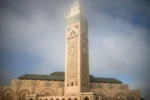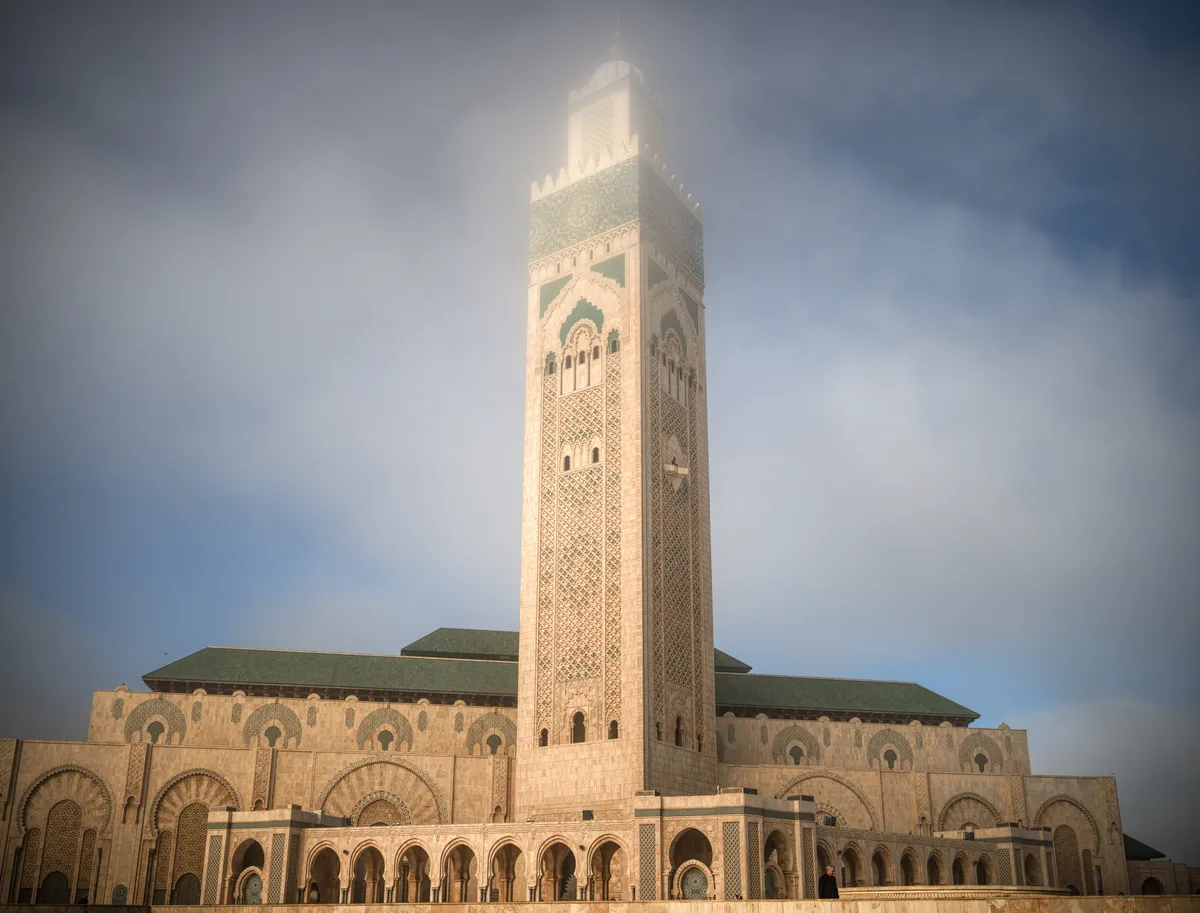
Casablanca is a working city first and a sightseeing city a distant second, which is why most travellers pass through it in a hurry – and why almost all of them stop, in spite of themselves, when they first see the hassan ii mosque. It stands at the city’s northwestern edge on a platform that juts into the Atlantic, a prayer hall the size of a cathedral age built in the 1990s, and above it a single square minaret rising 210 metres into the sea air. On a clear day you can pick it out from half the city. At night a laser at its summit draws a line of light across the sky towards Mecca. Nothing else in Morocco looks like it, and nothing else in Morocco works quite like it either.
The difference that matters for a visitor is this – the hassan ii mosque is one of the very few mosques in Morocco that a non-Muslim may enter at all, and the only one of this size and importance. Moroccan mosques are otherwise closed to non-Muslims, who admire them from the street. Here, by deliberate design, the doors open to everyone, but on the mosque’s own terms. You do not wander in. You join an official guided tour, at a set time, in a group, led by one of the mosque’s own guides – and that single fact shapes everything about how a visit works, from when you arrive to what you wear to where you are allowed to point a camera.
That is what this guide is for. Below, the hassan ii mosque is taken apart piece by piece – the improbable engineering of a building standing in the ocean, the king’s birthday project that paid for it with a national collection, the prayer hall whose roof slides open to the sky, the ablution hall and hammam hidden underneath, and the museum, library and academy that turn a mosque into a small cultural city. The practical machinery gets equal space. How the tours run, where they start, what the dress code actually asks of you, what photography is and is not acceptable, how long to allow, and how to fold the visit into a Casablanca stopover between trains are all covered, because on this one site the machinery is the difference between a smooth morning and a wasted one.
One rule governs the numbers in this guide, and it is worth stating once. This article prints no ticket prices and no fixed timetable of tour departures. The hassan ii mosque is run by its own foundation, its tour schedule shifts with the prayer times, the season, Fridays and Ramadan, and the prices quoted by third-party sellers contradict each other by the month. What does not rot is the mechanism, and the mechanism is what is described here. Where a figure is given – a height, a capacity, a date – it comes from the mosque’s own foundation or from a reference source checked for this guide, and the sources are noted at the end. For the day itself, the foundation’s website and the ticket office on the esplanade are the final word, and this guide will keep sending you back to them.
If you are planning the country rather than the city, our Morocco travel guide sets Casablanca in the shape of a first trip. This page is the deep dive into the one building that justifies the stop.
Hassan II Mosque at a Glance
Here is the whole visit on one screen. The sections after this table take each row in turn.
| Question | Short answer |
|---|---|
| What is it | Morocco’s largest mosque and one of the largest in the world – a working mosque and cultural complex on a nine-hectare platform in the Atlantic at Casablanca |
| Built | 1986 to 1993, to designs by the French architect Michel Pinseau, inaugurated on 30 August 1993 |
| The minaret | 210 metres – the tallest minaret in the world when it was finished, and still the second tallest; a laser at the top points towards Mecca after dark |
| Capacity | 25,000 worshippers in the prayer hall and 80,000 more on the esplanade – 105,000 in all |
| Can non-Muslims enter | Yes – almost uniquely in Morocco – but only on an official guided tour, never independently |
| The tour | Run by the mosque’s own guides in several languages, starting from the museum building on the esplanade; allow about an hour for the tour itself |
| What else is on site | A museum of the mosque’s crafts, a large public library (the médiathèque), a Quranic school, an academy of traditional arts, an ablution hall and a hammam below the esplanade |
| Dress | Modest dress is required – shoulders covered, legs covered below the knee; women are asked to cover their hair; shoes are removed before the prayer hall |
| Photography | Permitted during the guided tour – keep the flash off, and never photograph worshippers at prayer |
| Prices and tour times | Not printed in this guide on purpose – both change; check the foundation’s website or the ticket office on the day |
Two consequences follow from the table, and both are worth absorbing before the detail. First, the visit is scheduled, not spontaneous. A mosque that admits visitors five or six times a day, between prayers, rewards the traveller who plans the morning around a departure and punishes the one who turns up at random and finds the doors shut for prayer. Second, the building is the city’s one unmissable sight, and Casablanca knows it. Everything in the sections on fitting the mosque into a stop – the trains, the pairings, the half-day shapes – starts from that.
Built on the Ocean – Half on Land, Half on Water
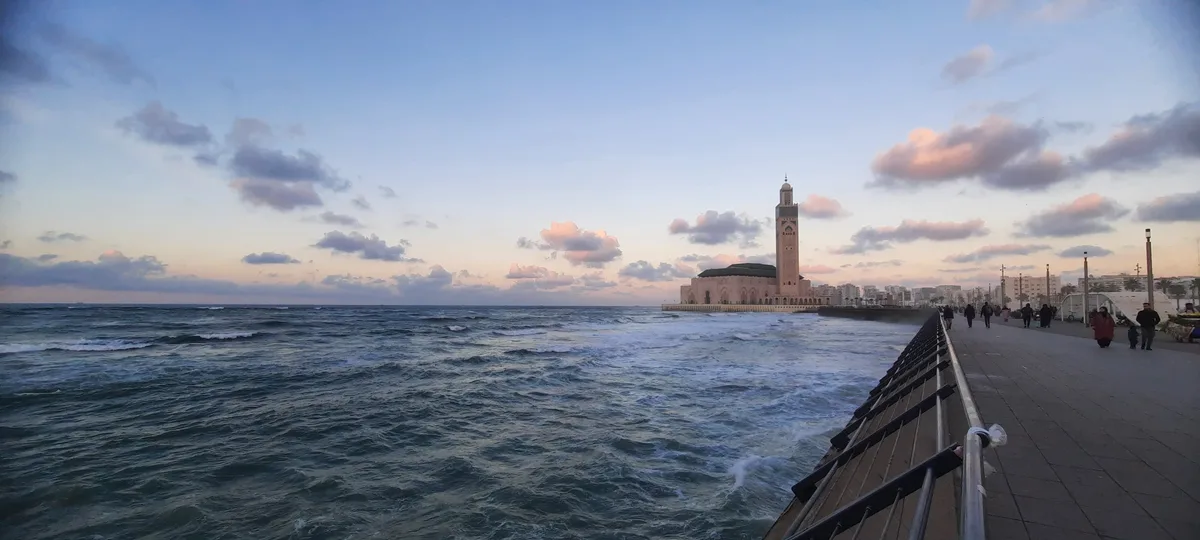
Begin with the site, because the site is the whole idea. The hassan ii mosque does not stand beside the Atlantic; it stands in it. Roughly half of the nine-hectare platform sits on land and half reaches out over the water, built up from a natural rock outcrop at the end of Boulevard Sidi Mohammed Ben Abdallah, between the harbour and the El Hank lighthouse. Before the mosque, the outcrop held the Orthlieb municipal swimming pool – Casablanca once swam where it now prays. King Hassan II chose the water deliberately and said why, in a speech in 1980 that the guides quote because he meant it literally. He wanted to build the mosque on the water, he said, because God’s throne was upon the water – a line drawn from the Qur’an – so that the faithful praying on firm ground could contemplate God’s sky and God’s ocean at the same time.
Holding a building of this weight in the Atlantic took engineering as theatrical as the architecture. The platform had to be reclaimed and armoured before a single column rose – tens of thousands of cubic metres of concrete and rock went into the foundations and the sea defences alone, and two great breakwaters now take the force of the swell, which can throw waves ten metres high against this coast in a storm. A temporary pier hundreds of metres long was built out into the sea just to protect the works while the pillars were founded. Stand on the ocean side of the esplanade on a rough day and the arrangement explains itself – the spray comes over the sea wall in sheets, the combs of concrete pillars below the platform break the waves’ rhythm, and the hall behind you does not tremble at all.
The sea is also the building’s lifelong opponent, and the honest version of the story includes the repair bills. Salt water is patient. Within a decade of the opening, the Atlantic had begun to work into the porous concrete of the sea-facing structures, rusting the reinforcing steel from inside and cracking the surfaces it was meant to protect. A major restoration programme began in 2005, rebuilding the exposed exterior works with high-grade concrete and molybdenum-bearing stainless steel chosen specifically to resist chloride attack – research that took years and was expected to add a century to the building’s life. A mosque on the ocean is a promise you have to keep renewing, and the foundation that runs the hassan ii mosque has treated that as part of the job rather than an embarrassment. When you see scaffolding or fenced-off sections on the sea side, that is what you are looking at – not decay, but maintenance at industrial scale.
For the visitor, the practical gifts of the site are simpler. The platform is one of the few places in Casablanca with genuine open horizon – no traffic, no buildings behind you, just the esplanade, the hall, the minaret and the weather. It is breezy when the rest of the city is airless, which is a mercy in summer and a reason to carry a layer in winter. And it faces west and northwest into the sunset, which matters for the last section of any visit, when the light does to the marble and tile what no architect can.
The Building Story – a King’s Present to Casablanca
Every great mosque has a patron, and this one’s patron was the king himself. Hassan II of Morocco announced the project in 1980, during his birthday celebrations, with a piece of reasoning that was part theology and part city planning. Casablanca was the country’s economic engine and its largest city, but it had no monument to match – nothing a visitor would cross a city to see. The king intended to give it one, on the grandest site available, and to make it, in his own words, a building of which Casablanca could be proud until the end of time. The mosque would carry his name, and if the original timetable had held, it would have opened for his sixtieth birthday in 1989.
The design went to Michel Pinseau, a French architect who had lived in Morocco and knew its building traditions from the inside. Pinseau’s answer was a mosque that is unmistakably Moroccan in its dress – zellige tilework, carved plaster, painted cedar, horseshoe arches – wrapped around a thoroughly modern concrete structure engineered by the French group Bouygues, who also built it. The plan itself broke with regional habit. North African mosques usually spread their naves parallel to the qibla wall; Pinseau’s hall runs basilica-style, its three naves perpendicular to the qibla, which is why the building reads from the air as a great ship – two hundred metres long, a hundred wide – pointed across the water.
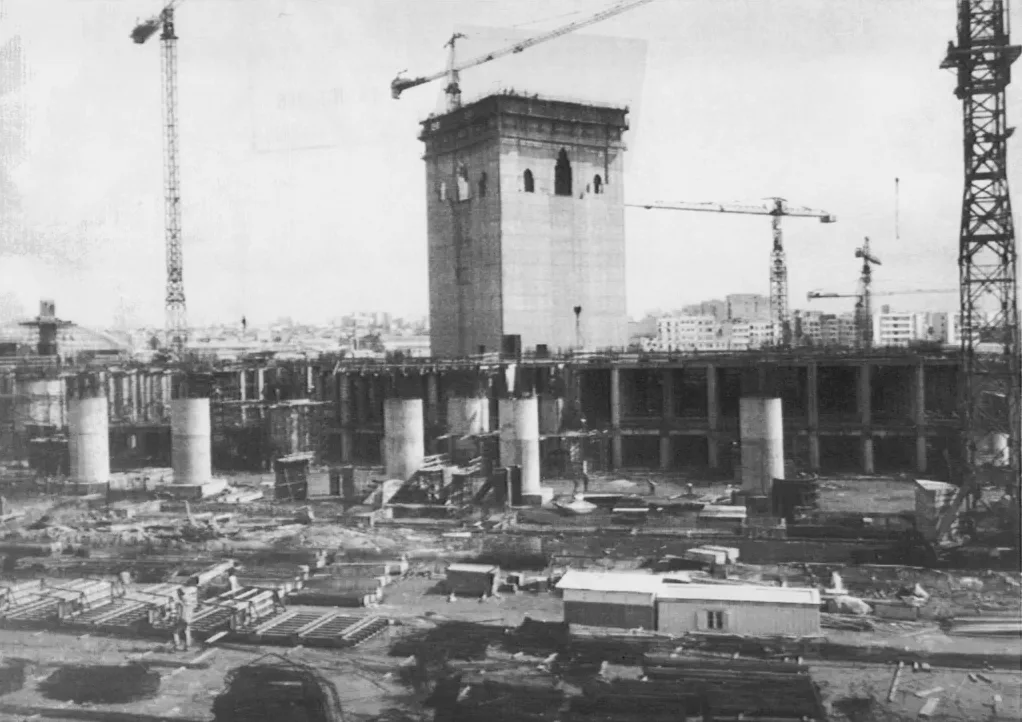
Work began on 12 July 1986 and ran for seven years, around the clock at its peak – some 1,400 men on the day shift and 1,100 more at night in the busiest period, with around 35,000 workers passing through the project in total and more than fifty million hours worked. The money came from the state, from foreign loans, and above all from the Moroccans themselves. A national subscription ran the length of the kingdom and twelve million people contributed, down to donations of five dirhams, every donor receiving a receipt and a certificate. The final cost was debated in Morocco then and is argued about still; what is not in dispute is that the hassan ii mosque was, in a real sense, bought by its congregation.
It also nearly broke its schedule. The 1989 birthday deadline slipped, and the formal inauguration was eventually set for a date with better symbolism – 30 August 1993, the eve of the anniversary of the Prophet Muhammad’s birth. By then the project had become something larger than a royal monument. The sheer demand for master craftsmen – carvers, tilers, plasterers recruited from every city in the kingdom – had revived trades that were fading, trained a new generation in them, and set a standard of Moroccan craft that the country has traded on ever since. The academy of traditional arts that now sits in the complex, teaching ten specialities from zellige to Arabic calligraphy, exists precisely so that the skills the mosque consumed are never allowed to thin out again.
The Minaret – 210 Metres and a Laser Pointing to Mecca
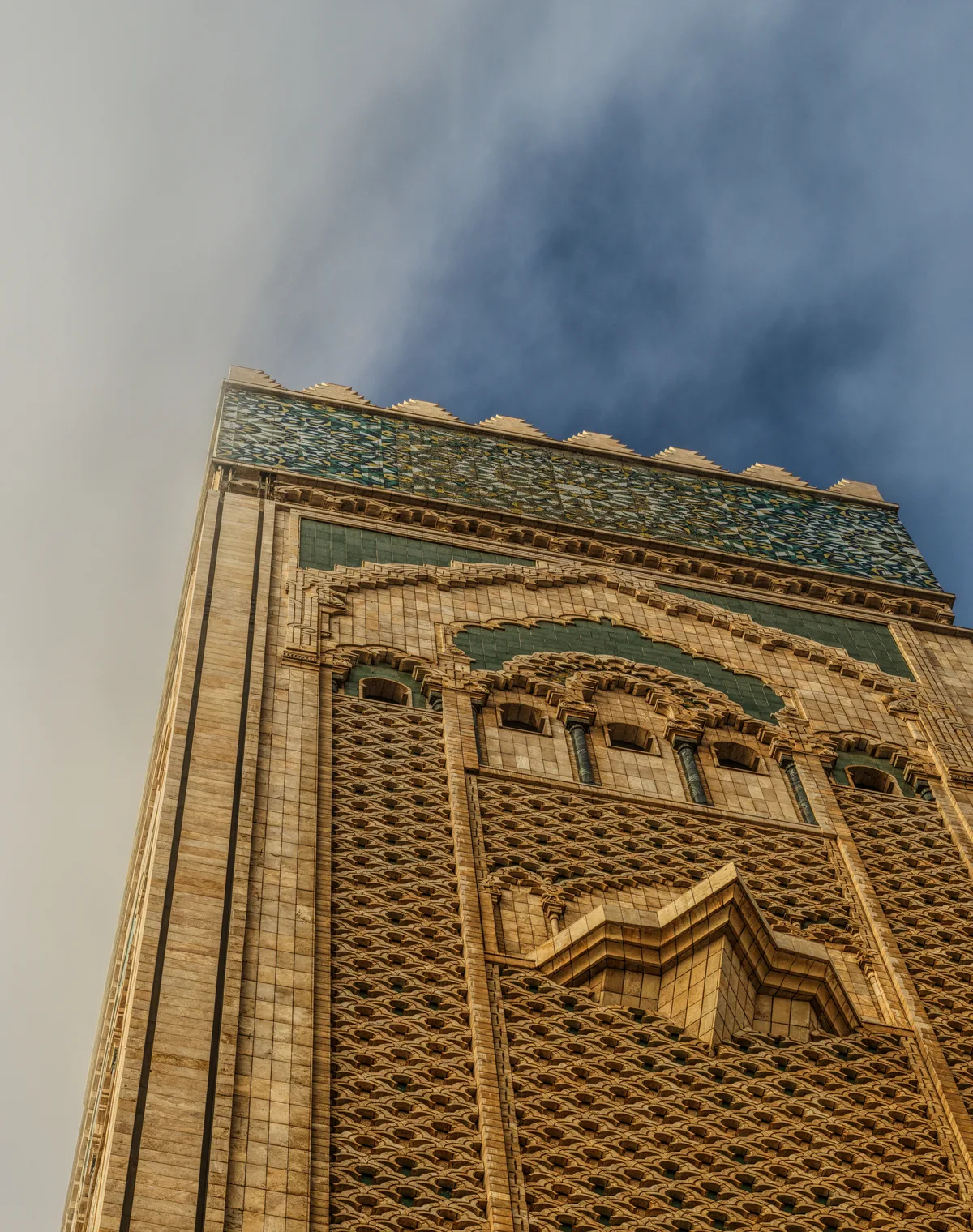
One tower, and the whole city organises itself around it. The minaret of the hassan ii mosque rises 210 metres – sixty storeys – from the southern side of the platform, square in section in the Maghrebi tradition, and it was the tallest minaret in the world when the mosque was completed in 1993. It held that record for a generation; only the Great Mosque of Algiers, opened a quarter-century later, now rises higher, which makes Casablanca’s tower the second tallest minaret on earth and still the defining vertical of the Moroccan coast. The height was not the first draft. Pinseau’s early design stopped at 175 metres, and raising it to its final figure required Bouygues to develop a high-performance concrete far stronger than ordinary mixes – the extra strength is what carries the tower’s height against Atlantic wind and seismic risk.
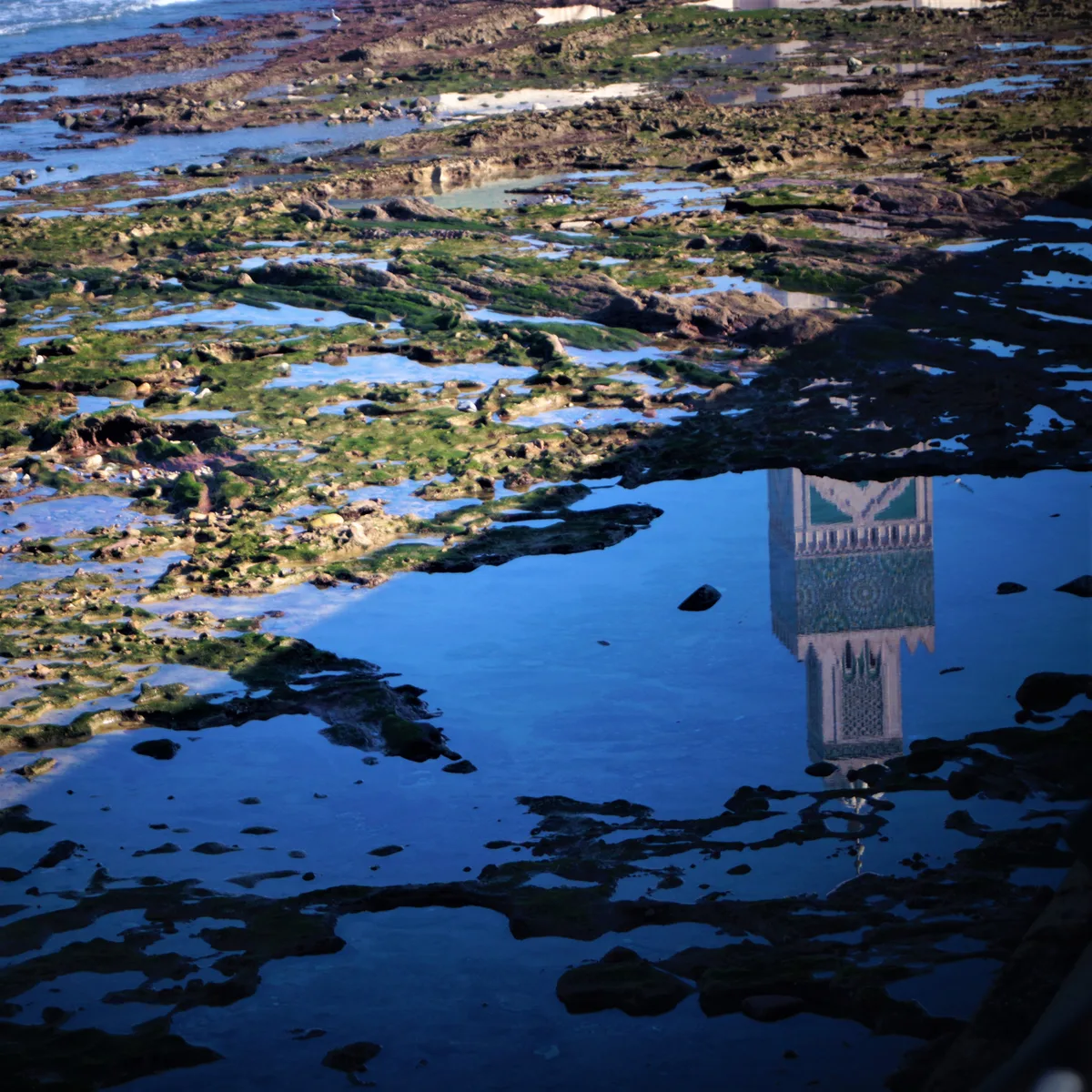
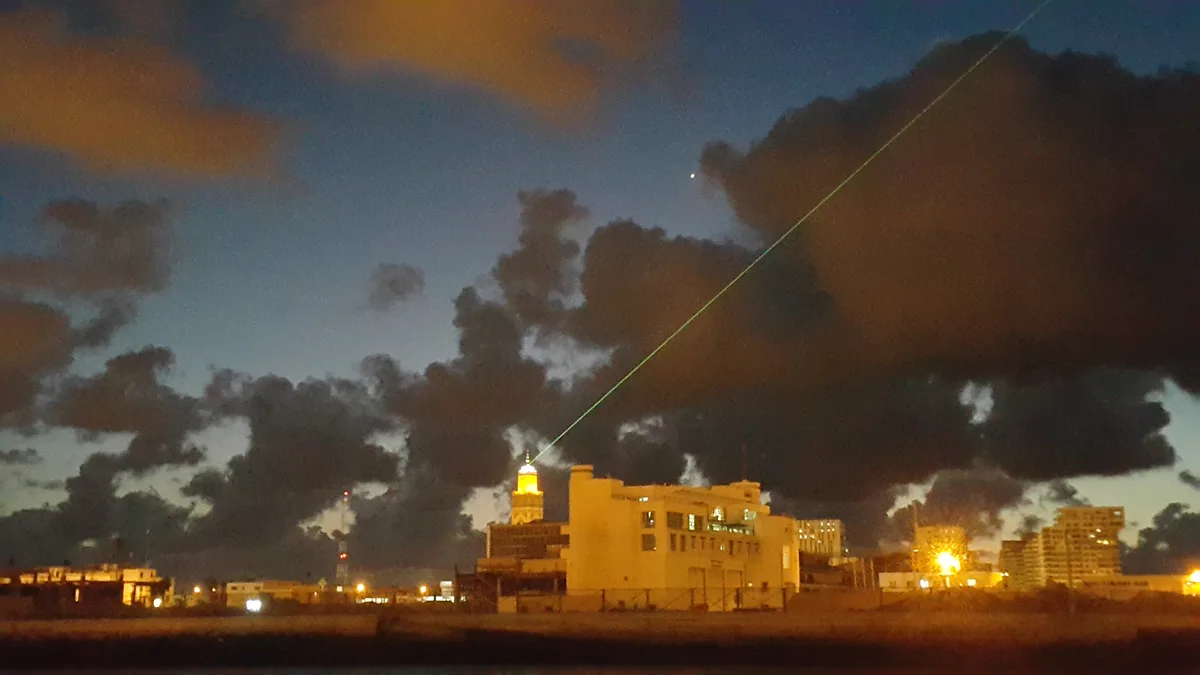
The decoration changes as it climbs. The shaft is faced in pale marble with carved ornament kept deliberately austere, then, for the top third, it turns the colour of its setting – deep green and turquoise tile, sea-foam colours chosen, the designer’s circle has said, to celebrate the life of a king by the sea. At the summit sits a lantern and the traditional jamour, the gilded spheres on a spike, and beside them the mosque’s most modern piece of symbolism – a laser, switched on in the evening, that throws a beam some thirty kilometres in the direction of Mecca. On a clear night the green line is visible well beyond the city, a compass needle drawn on the sky, and it is worth timing an evening on the esplanade to see it.
A few facts about the tower are worth having before you stand under it, because the guides on the spot will give you most of them and it helps to know which are true. The minaret is square, not round – the Moroccan and Andalusian tradition, like the Koutoubia in Marrakech whose proportions it consciously echoes at nearly three times the height. It contains a lift, which is how the muezzin’s call is managed in the age of loudspeakers – the height is ceremonial and symbolic rather than a daily climb. And it was built with the help of a crane 210 metres tall, itself a record at the time, installed specially for the works. From the ground, the honest way to take its measure is not to look up – the foreshortening defeats you – but to walk away across the esplanade and watch how slowly it shrinks.
The Prayer Hall – 25,000 People Under a Roof That Opens
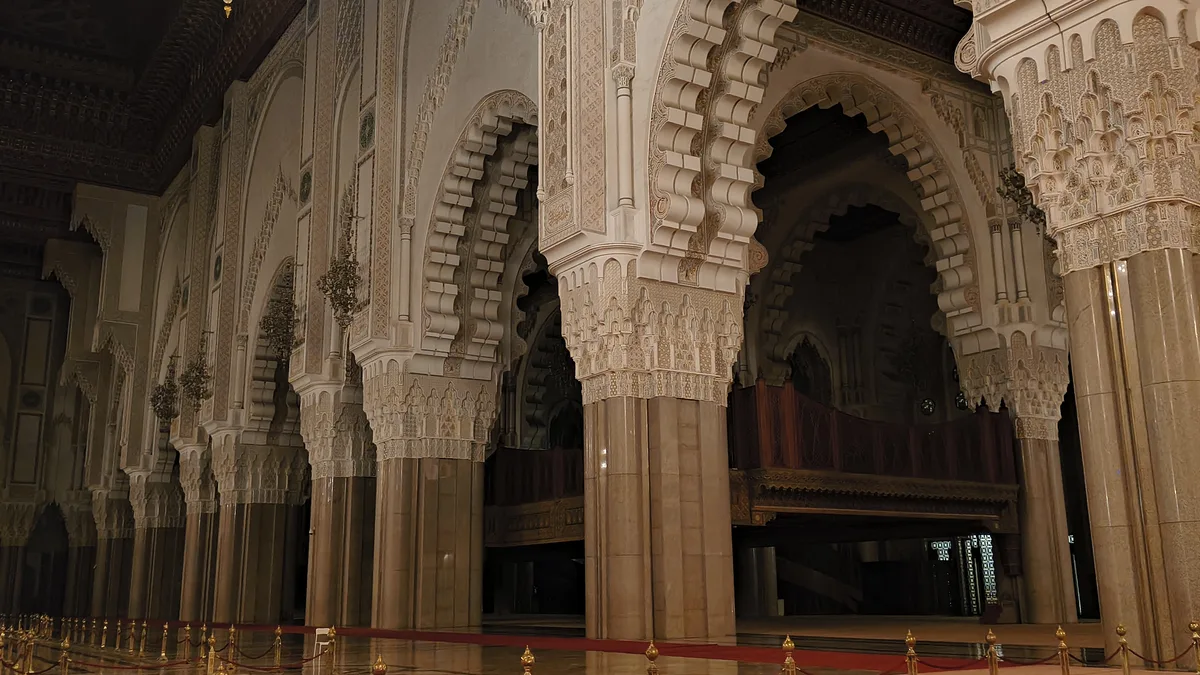
The guided tour earns its ticket in one room. The prayer hall of the hassan ii mosque is two hectares of floor – two hundred metres long and a hundred wide – arranged in three naves, the central one rising forty metres, the side naves twenty-seven, with mezzanine floors along both sides reserved for women. It holds 25,000 worshippers; add the esplanade outside, which serves as overflow prayer space on the great nights of the year, and the complex gathers 105,000. Numbers that round stop meaning anything quickly, so put it in buildings instead – this is a single carpeted room into which you could set down a European cathedral, footprint and all, and still hold a conversation across the remaining space in a normal voice, because the sound system is hidden and very good.
Overhead is the engineering party trick. A section of the roof – 3,400 square metres of it, weighing around 1,100 tonnes, clad in cast-aluminium tiles made to imitate the green ceramic tiles of Fes at a fraction of the weight – slides open in about five minutes. The king wanted the hall connected to the air as one of the elements beneficial to life, alongside the earth it stands on and the water beneath it, and so on fine days and great occasions the congregation prays under open sky, and on clear nights under the stars. When the roof is shut, light comes from fifty Venetian chandeliers of Murano glass hung from the succession of domes along the central nave – the largest six metres across, ten metres tall and weighing over a tonne – and from the glass doors of the northern wall.
Everything at eye level is Morocco, itemised. The columns are granite; the mihrab, the niche that marks the direction of prayer, is white Carrara marble dressed with zellige and plaster; the minbar beside it is mahogany inlaid with ivory; two granite columns carry the king’s genealogy in gilded script. At your feet the floor is heated, a modern comfort the guides mention with pride, and set into it are openings onto the ablution hall below, fed by a closed circuit of water – the sea is present in this room even when you cannot see it. The doors of the hall, eighteen of them, are clad in titanium and brass. It is a room built to be read slowly, which is the one thing the tour’s timetable does not quite allow, and why the craft deserves a section of its own.
Zellige, Cedar and Carved Plaster – the Craft Inside the Hassan II Mosque
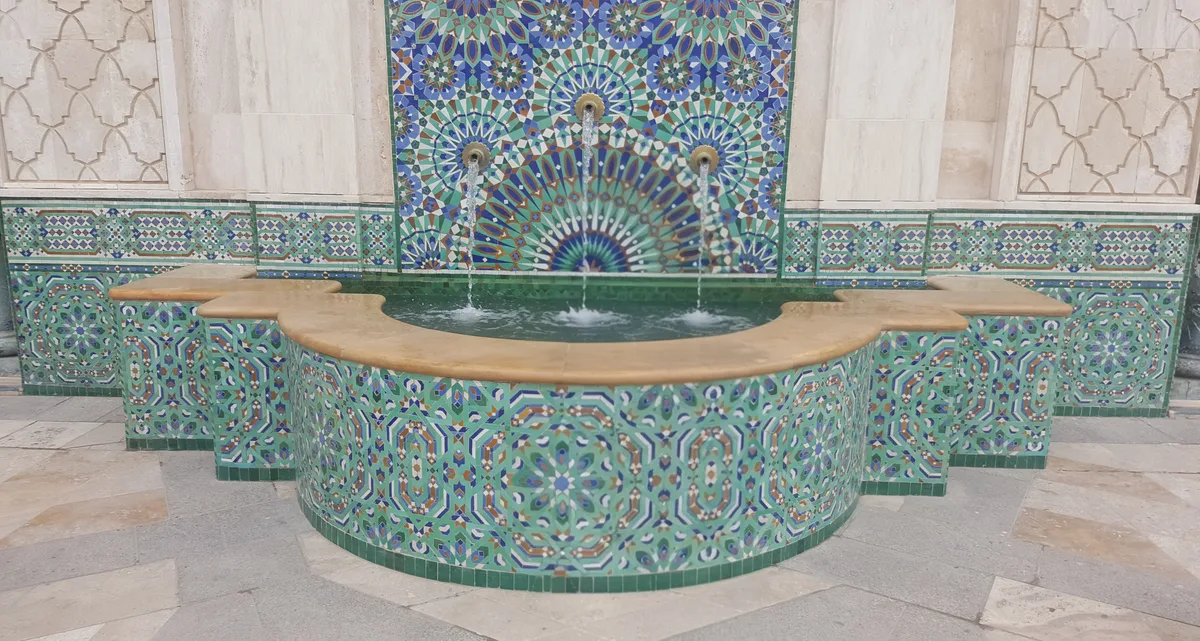
Strip away the concrete and the records and what remains is a craft exhibition that happens to be a mosque. Nearly every material in the hassan ii mosque is Moroccan and was worked by Moroccan hands – cedar from the Middle Atlas, marble from Agadir, granite from Tafraoute – with the Italian granite columns and the Murano chandeliers the honourable exceptions. The foundation that runs the mosque keeps the figures that matter, and they are better than the round numbers on the tour buses. The foundation’s own count is 3,300 Moroccan craftsmen of national and international renown, among them 854 master carpenters, 80 master plasterers drawn from 1,600 assigned to the plasterwork, and 100 master zellige cutters from 170 specialists in the tile. In all, some ten thousand artists and craftsmen took part.
The three crafts to learn to see are the ones the tour passes fastest. Zellige first – the mosaic of hand-cut glazed tiles, each piece chipped to shape with a hammer and set face-down in patterns of real mathematical complexity. The mosque carries more than 10,000 square metres of it in some eighty original motifs, and the fountains and dados of the prayer hall and ablution rooms are where to look closely – the smaller the pieces and the tighter the geometry, the higher the master’s hand. Second, the wood. More than 53,000 square metres of cedar were carved and painted for the ceilings, doors and screens, the painted ceilings of the hall being the summit of the art – muqarnas vaulting and floral interlace in pigments that have to survive salt air. Third, the plaster – over 67,000 square metres of it, carved in place by an army of 1,500 maâlems, the carved stucco that softens every capital and arch into lace.
There is a point to learning the grammar before the tour rather than after. The guides move at a pace set by the group behind you, and the hall is too big for lingering. A visitor who can already tell zellige from painted tile, and carved plaster from cast, spends the tour recognising rather than squinting – and notices the quietest fact in the building, which is that almost none of this decoration is applied. It is the structure’s skin, made by hand at industrial scale, in a country that discovered, in the building of the hassan ii mosque, that its old trades could still out-work its new industries when given a big enough wall.
Below the Esplanade – the Ablution Hall and the Hammam
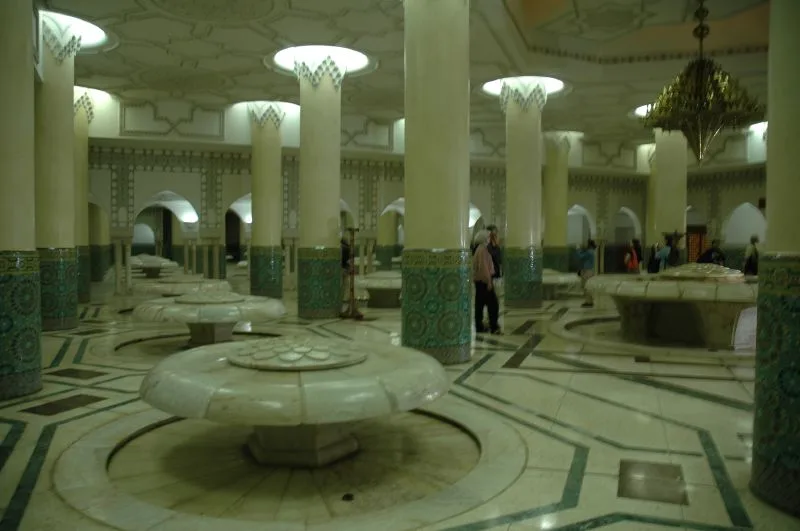
The tour’s second great space is one most visitors never knew existed until the guide leads them downstairs. Beneath the prayer hall, in the basement of the hassan ii mosque, lies the ablution hall – 4,800 square metres of zellige and tadelakt, the polished lime plaster of Moroccan bathhouses, arranged around forty-one marble fountains carved in the shape of lotus flowers. Three of the fountains are monumental; the rest are smaller, ringed with around a hundred taps between them, and the room can serve some 1,400 worshippers at once. Copper chandeliers made in Fes hang over the water. This is where the congregation performs wudu, the ritual washing that precedes prayer, and it is built with the same seriousness as the hall above it – purification, in this architecture, is not a corridor with sinks but a ceremony with its own cathedral.
The same basement level, with its own entrance, holds the complex’s other water institution – a full traditional hammam. The mosque’s baths are Moorish in the classic pattern, a sequence of rooms of rising heat, from a cool first chamber through a moderate one to a hot room, with a heated pool a metre and a half deep set beneath a great tadelakt vault. The tadelakt here is made the traditional way, the plaster mixed with egg yolks and black soap. The hammam belongs to the mosque’s own logic – cleanliness is woven into the practice of the faith, and a bathhouse attached to a mosque is an old Moroccan pairing – but it is also a public bath, run as part of the complex and open beyond the congregation. The foundation writes about it in its own publications with obvious pride, as a piece of living heritage rather than a museum of one.
For the visitor on the standard tour, the ablutions hall is the part you see and the hammam is mainly the part you hear about – tour routes cover the prayer hall and the ablution rooms, and the baths are a separate visit with their own arrangements and their own ticket, bought on site. Treat the foundation’s website or the staff at the complex as the source for how the hammam is running on any given week, and do not let a third-party seller bundle it into promises the mosque has not made. What you can count on is the architecture. Between the hall above and the water below, the hassan ii mosque is a building organised around the sea at every level – contemplated from the prayer hall, channelled through the fountains, and soaked in, quite literally, in the baths.
Visiting the Hassan II Mosque – How the Guided Tour Works
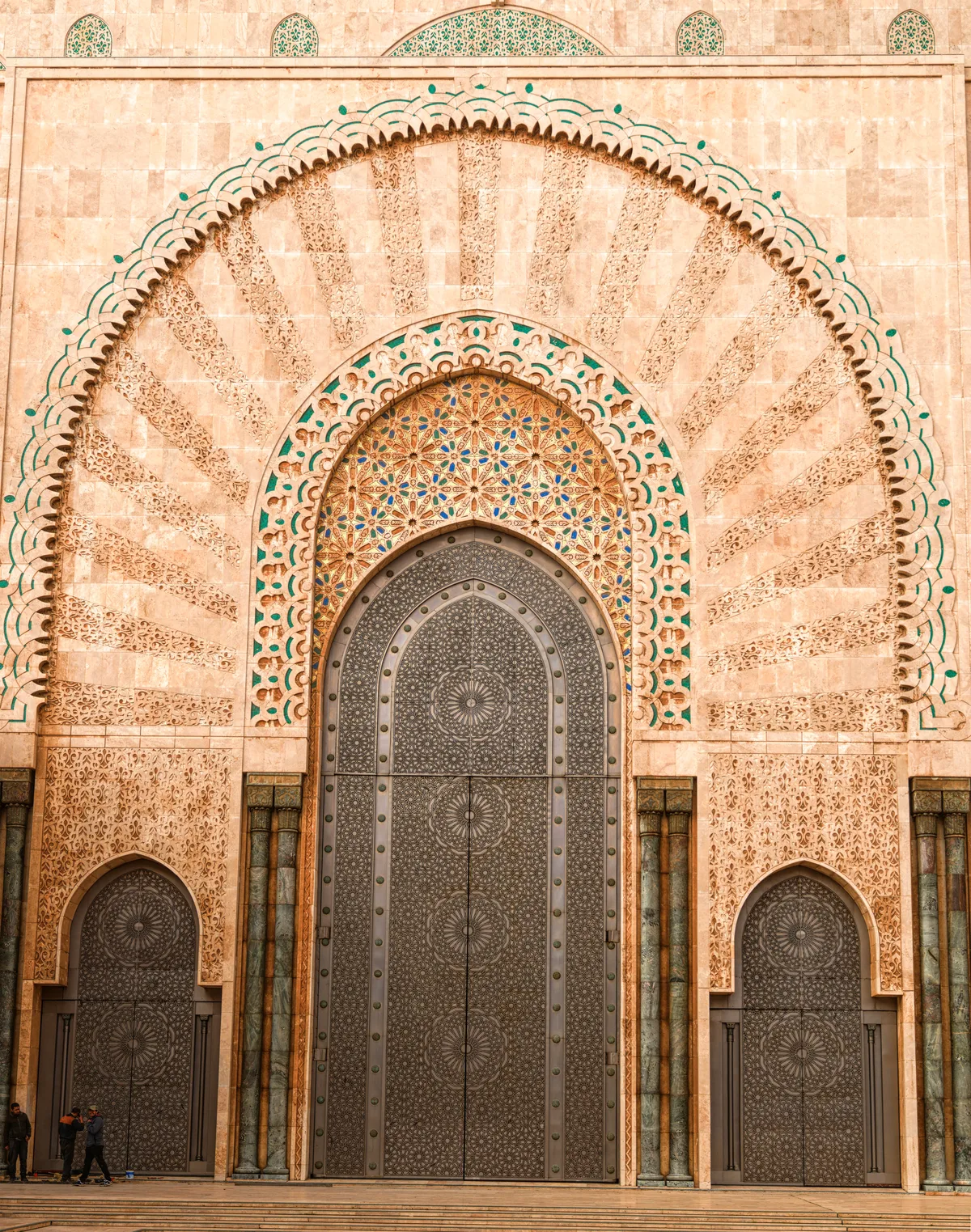
Here is the mechanism, step by step, because it is the single most useful thing in this guide. The hassan ii mosque admits non-Muslim visitors only as members of an official guided tour. There is no self-guided ticket, no wandering in off the esplanade, and no arrangement – whatever a stranger outside may tell you – by which a private arrangement with an unofficial guide gets you further than the official one. The tours are the mosque’s own, led by the mosque’s own guides, and they are the way in for everyone, from heads of state to backpackers.
The day runs like this. You come to the esplanade – the great open court is public space and reaching it costs nothing – and you buy your ticket at the mosque’s ticket office, which sits in the museum building on the complex. Ticket sales are on site; the mosque does not run a general online booking system for individual visitors, which is why the honest advice is to arrive with time in hand rather than with a printout. Tours are then called in language groups. The mosque’s guides lead tours in Arabic and French as a matter of course and in English, Spanish, Italian and German as groups form – the foundation’s own blog describes the guided visits as the mosque’s cultural front door, and the language you need is the one thing worth confirming at the ticket desk before you pay, since a tour you cannot understand is just a walk through beautiful rooms.
Departures are scheduled through the day, in a run of morning tours and an afternoon tour, fitted around the five daily prayers, during which the building belongs to the worshippers alone. The pattern thins on Fridays, when the midday prayer is the week’s great gathering, and it contracts further in Ramadan. For exactly that reason this guide prints no clock times – the schedule is the foundation’s to set and it moves. Check the departure board or the website of the Fondation de la Mosquée Hassan II before you set out, build your morning around a named departure, and be on the esplanade early enough to buy the ticket, find your language group and use the museum while you wait. The tour itself lasts roughly an hour. Its route takes in the prayer hall and the ablution hall beneath it, with the guide explaining the building’s story, its crafts and its symbolism as you go, and it ends back on the esplanade, where you are free to stay.
Two habits separate a good visit from a fumbled one. The first is the buffer – groups are formed by language and a missed departure can mean a wait for the next one in yours, so the traveller who arrives forty minutes early with a coffee in hand beats the one sprinting across the esplanade. The second is to let the mosque’s system be the system. Resellers across the internet will sell you the same official tour wrapped in a transfer and a markup, and men outside the gates may tell you the mosque is closed today and only they can help. Neither is true in the way they mean it. Our wider Morocco itinerary builds the mosque into a first week in the country on exactly this basis – walk up, buy the ticket, join the tour.
Dress Code, Behaviour and Photography – Visiting with Respect
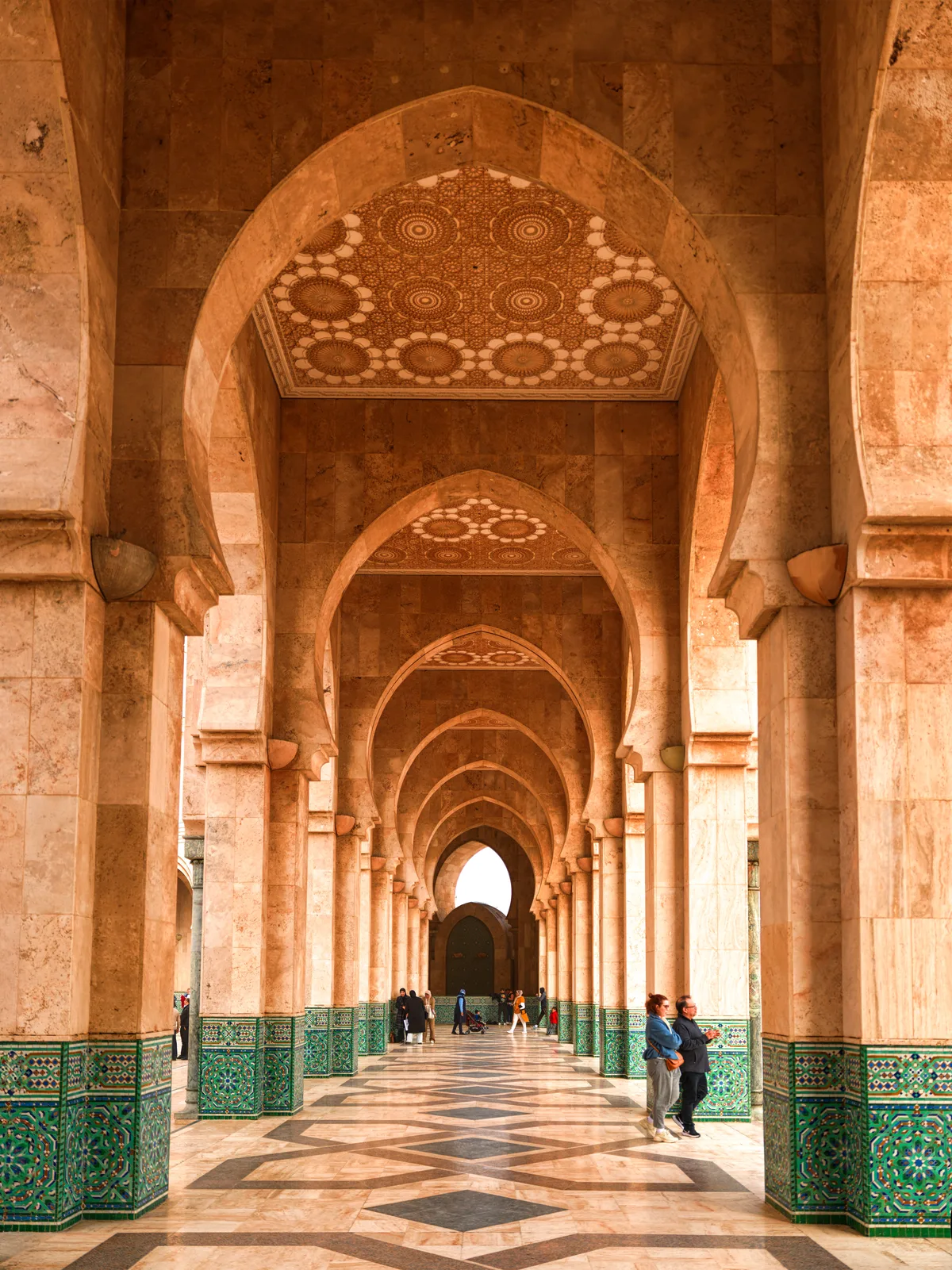
The hassan ii mosque is a functioning place of worship that has chosen to open its doors, and the etiquette asked of visitors is the price of that openness – modest, sensible and consistently enforced by the guides. Dress as you would for being a guest in someone’s house of prayer. Shoulders covered, arms covered at least to the elbow is the safe reading, legs covered below the knee – trousers or a long skirt rather than shorts – and nothing tight, sheer or beach-bound. Women are asked to cover their hair inside the mosque; carry a scarf of your own and the question never arises. At the entrance to the prayer hall everyone removes their shoes, and the mosque provides bags to carry them in as you tour – wear shoes that slip on and off easily and socks you are content to be seen in, because the hall’s floors are marble and carpet and you will cross both.
Behaviour inside follows from the same principle. Follow the guide, stay with the group, keep voices low, and let the building set the volume. If your tour crosses a prayer time boundary or passes worshippers, give them the room and the privacy that are the whole point of the place. Children are welcome on the tours but the hall is not a playground, and the guides will say so. None of this is onerous, and all of it is noticed – the mosque’s staff run these tours every day and can tell at the door which visitors have understood that they are guests.
Photography is the question every visitor asks, and the answer is a genuine yes with manners attached. Cameras and phones are permitted during the guided tour, and the prayer hall, the ablution fountains and the esplanade are all fair subjects – the mosque knows perfectly well that its visitors come partly for the photographs. The conditions are the obvious ones, and they are conditions of respect rather than bureaucracy. Keep the flash off in the prayer hall. Do not photograph worshippers at prayer, and do not make a portrait of anyone – worshipper, guide or fellow visitor – without asking. Leave tripods and drones out of it entirely; the esplanade is not a film set. And take the photographs the tour allows time for rather than drifting from the group in search of an angle, because the group will not wait and the building is large enough to lose a tour in. Do that, and the hassan ii mosque is one of the most rewarding interiors in Africa to photograph – a place where the light through the northern glass and the green of the zellige do the work for you.
The Museum, the Library and the Academy – the Mosque Is a Small City
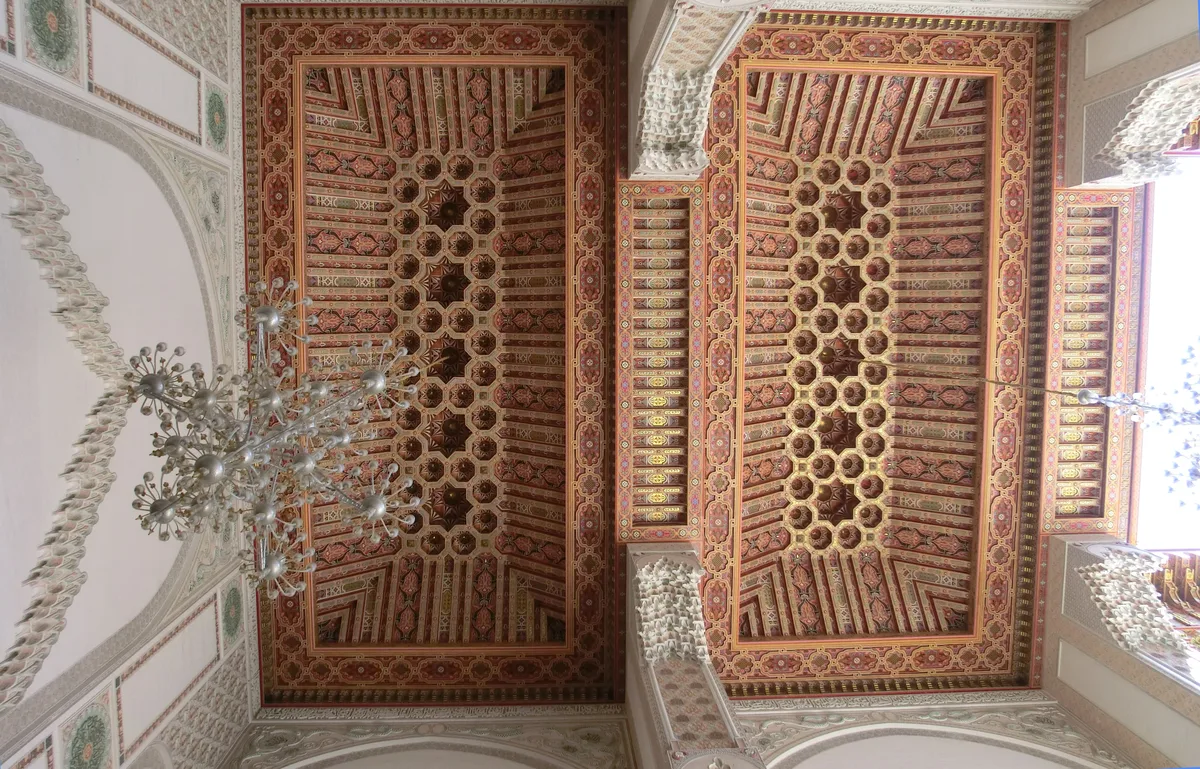
Most visitors leave after the tour and miss the fact that the mosque is only the largest room in a small cultural city. The nine hectares of the complex hold a madrasa – a Quranic school built as a semicircular building of classrooms and meeting rooms around its own courtyard – a museum, a public library of real scale, an academy of traditional arts, conference facilities and parking for a thousand cars beneath the esplanade. The hassan ii mosque was conceived as a complex, religious and cultural together, and the foundation that runs it programmes it that way.
The museum is the piece to fold into a visit, not least because its building is where your tour begins. It tells the story of the mosque’s own making through the crafts that made it – sample panels of zellij, pieces of carved and painted wood, sections of carved stucco wall, specimens of Arabic calligraphy – the prototypes and offcuts of the building, kept and displayed as a collection in their own right. The foundation describes the museum as a discovery of the mosque behind the mosque, and that is fair. Twenty minutes in it before your tour departs will teach your eye the difference between the three great crafts, and the prayer hall becomes a far richer room when you can read it. There is a book and souvenir shop attached, and the museum has its own ticket arrangements, separate from the tour – confirm the combination that suits you at the desk.
The library – the médiathèque of the Hassan II Mosque Foundation – opened in 2010 and is a working public library across four floors, with reading rooms, multimedia collections, an exhibition space at ground level that shows local and African art and calligraphy, and a floor given over to children, with storytellers and workshops through the week. Beside it, the Academy of Traditional Arts, founded in 2012, trains students in ten specialities – painted wood, carved wood, stone cutting, stucco, zellige, Arabic calligraphy, jewellery, ironwork, weaving and leatherwork – the exact trades the mosque consumed by the thousand. For a visitor these are context rather than itinerary, but they change what the building means. The hassan ii mosque is not a monument to a finished tradition. It is the headquarters of a living one, and it employs, teaches and exhibits the crafts on the same ground where it prays with them.
The Esplanade at Sunset – the Free Half of the Visit
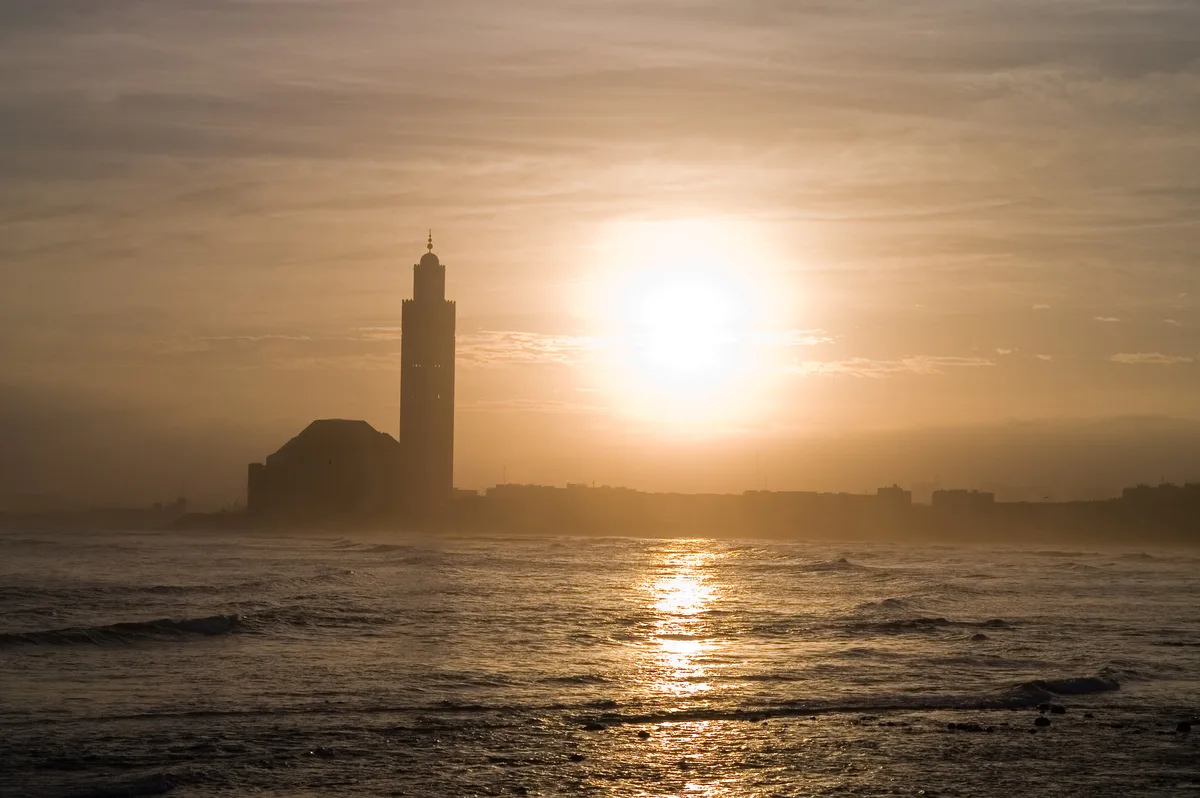
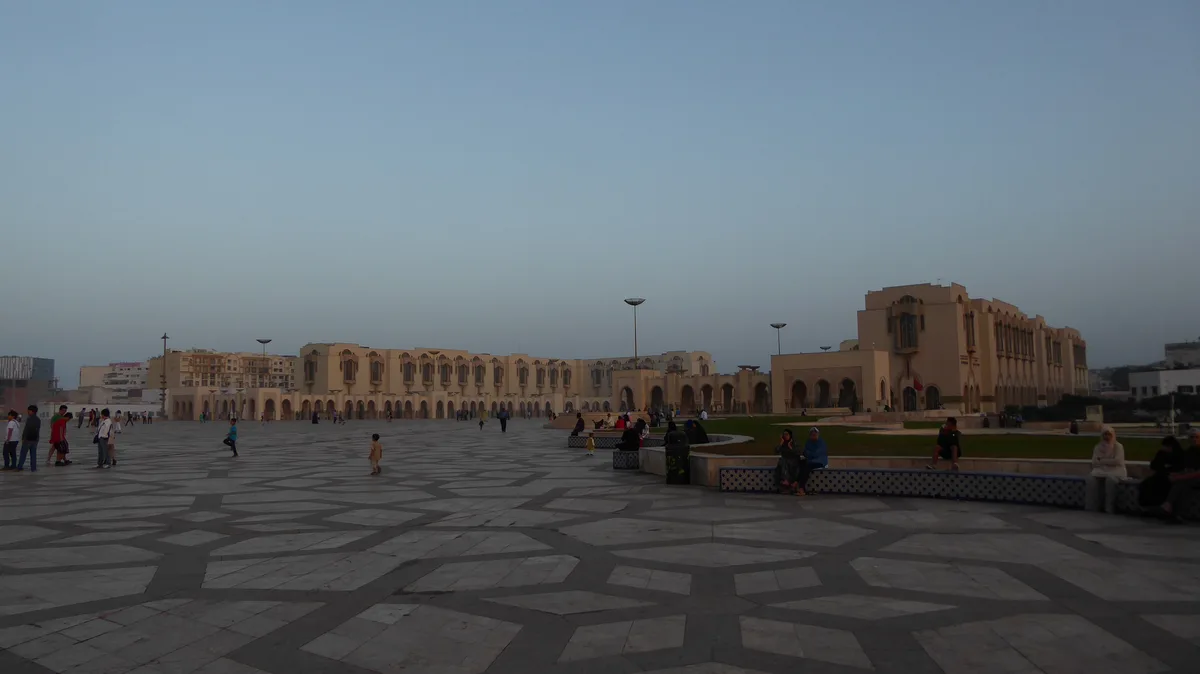
Here is the part of the hassan ii mosque that no ticket governs. The esplanade – the vast court of patterned paving between the city and the sea – is open public ground, and in the late afternoon it becomes what it was surely designed to be, Casablanca’s front porch. Families come out to walk it. Children cross it on bicycles. Couples take the sea wall, fishermen work the rocks beyond the breakwaters, and the whole population of the surrounding streets seems to agree, without any of them saying so, that the day ends here. If the guided tour is the mosque as monument, the esplanade at golden hour is the mosque as neighbourhood, and a visit that includes only the first has missed the building’s social half.
The light is the practical reason to time it. The complex faces west and northwest, the prayer hall’s pale marble and the minaret’s sea-green crown catch the low sun full-on, and the Atlantic does the rest. Photographers should simply reverse the tour logic – the interior wants the morning, when the groups are smaller and the light through the glass is soft, while the exterior wants the last hour of the day. Stay after the sun drops and two more things happen. The mosque is floodlit, the marble going amber against a darkening sky, and the minaret’s laser switches on and draws its green line towards Mecca – on a clear evening visible for kilometres, and from the esplanade, unforgettable in the plainest sense. The promenade that runs along the sea wall from the mosque is the way to walk it off, with the surf on one side and the lit tower behind you.
Build the day around that pairing if you possibly can. A morning tour, the museum while the light is high, the rest of Casablanca in the middle of the day, and then back to the esplanade for the last hour costs nothing extra and turns a ninety-minute attraction into the day’s frame. The hassan ii mosque is one of the few great buildings in the world whose best free view is of itself, from its own courtyard, at the hour its city comes out to enjoy it.
Fitting the Mosque into a Casablanca Stop
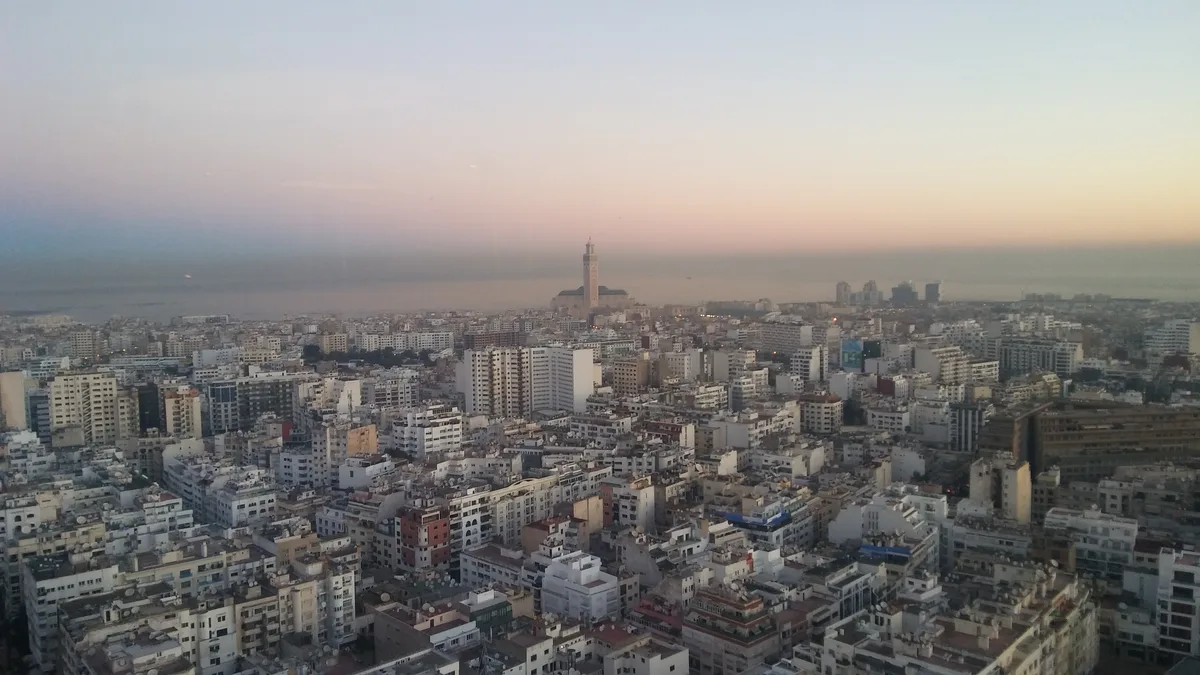
Casablanca defeats travellers who arrive expecting Marrakech. It is Morocco’s largest city, its port and its business capital – a place of boulevards, banks and traffic, short on medina romance and long on the evidence of real life. The hassan ii mosque is the exception that organises a visit, and the trick is to give it the morning and let the city’s other, quieter pleasures fill the hours around it rather than compete with it.
Getting there is simple. The mosque stands at the end of Boulevard Sidi Mohammed Ben Abdallah, on the corniche at the city’s northwestern tip, beside the El Hank lighthouse. From Casa-Port station – the terminus most visitors arrive at, on trains from the airport, from Rabat and from Marrakech – it is about twenty minutes on foot, or a short taxi ride; agree the fare before the door closes, as everywhere in Morocco. The city’s tramway and the petit taxis cover the rest of the centre, and drivers need no more address than the mosque’s name. If you are overnighting, the centre and the Gauthier quarter put you within easy reach; if you are passing through between trains, the mosque is one of the few sights in Morocco genuinely engineered for a half-day – the tour is an hour, the site is compact, and the station is close.
Pair it by appetite. The old medina, a short walk southeast of the mosque, is the modest, workaday original of the genre – worth an hour’s wander precisely because it is not performed for tourists. The Habous quarter, the “new medina” built under the French in the last century, does the picturesque version – arcades, bookshops, olive and pastry stalls – and takes an afternoon happily. Rick’s Café, the loving recreation of the film set near the old medina, sells lunch and dinner inside a movie Morocco never actually had; go with your eyes open and it is fun. The Corniche at Ain Diab, running west from the mosque, is the city’s seaside strip of beach clubs and cafes, and the Morocco Mall anchors its far end. And if Casablanca is a corridor rather than a destination – a night between the airport and the imperial cities – the mosque still earns the detour. No other building on a standard Morocco route says as much about the country that built it, or as quickly. When you are ready to place it in the whole journey, our Morocco travel guide is the map this page hangs from.
The Honest Downsides – What a Hassan II Mosque Visit Asks of You
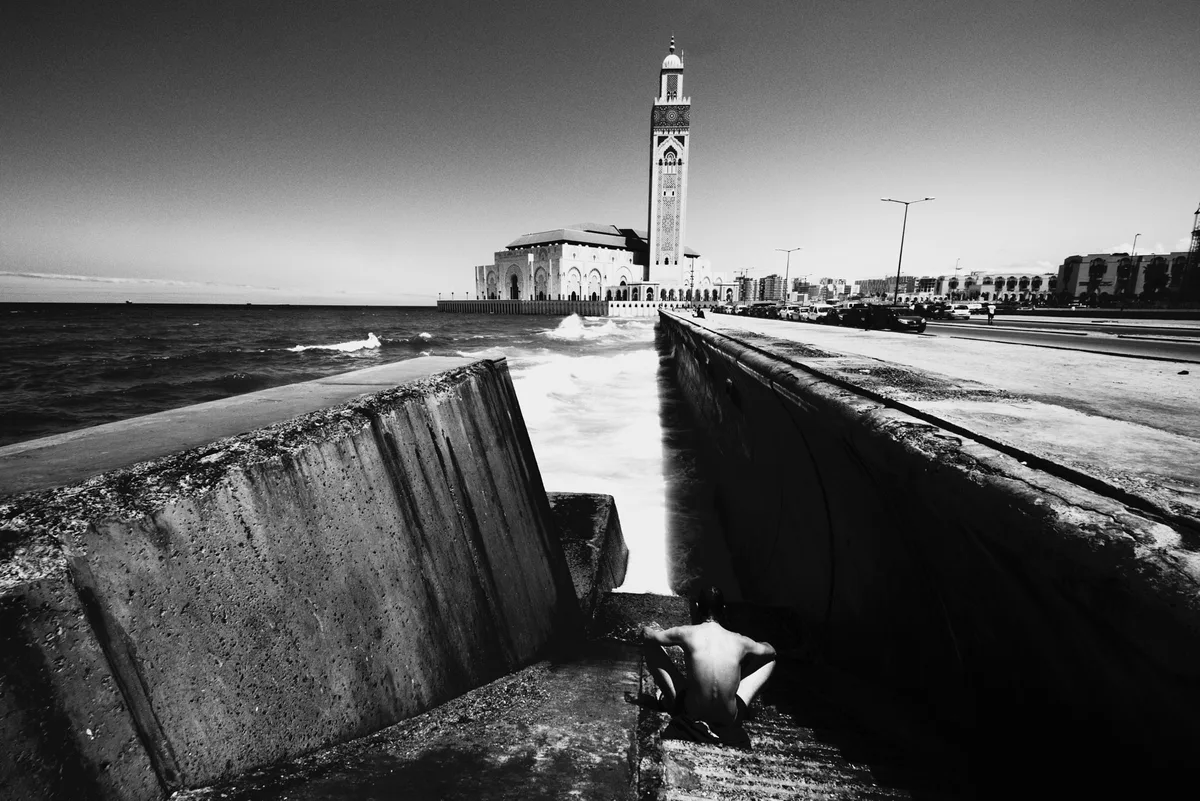
A guide that only sells this building is a brochure, so here is the other ledger. The first item is the schedule’s sovereignty. The hassan ii mosque is a mosque before it is an attraction, and its visiting arrangements bend around prayer, Fridays and Ramadan without apology. Turn up at the wrong hour – above all on a Friday, or in the holy month – and the doors may be shut to visitors for hours, with your Casablanca stop too short to absorb the delay. The building does not owe anyone a timetable, which is its right; the traveller’s defence is the boring one of checking before setting out and putting the mosque first in the day, not last.
The second is the crowd geometry. This is the most visited monument in Morocco’s most populous city, and the language groups on popular departures can be large – dozens of people following one guide through rooms whose acoustics were tuned for prayer, not commentary. The visit is a guided walk, not a contemplative hour, and travellers who arrive dreaming of silent scale should take the early departure, stand near the guide, and make their peace with the format. The esplanade afterwards, which is free and vast, is where the silence is recovered.
Third, the edges of the experience are as commercial as anywhere in Moroccan tourism. Unofficial helpers gather near the approaches with the usual scripts – the mosque is closed, the tickets are elsewhere, a special guide is required – every one of them a toll booth on a road that is actually free to walk. The ticket office is in the museum building on the complex, the tours are the mosque’s own, and nothing a stranger at the kerb tells you improves on walking past him politely. And finally, the weather is a real variable here in a way it is not in the medina cities – the platform takes the Atlantic full in the face, winter spray crosses the sea wall, the wind off the water can make a summer evening genuinely cool, and the same exposure that gives the building its drama will soak the unprepared. None of these are reasons to stay away. They are the terms of the visit, and the hassan ii mosque on honest terms is worth more than most monuments on flattering ones.
Hassan II Mosque – Frequently Asked Questions
Can non-Muslims go inside the Hassan II Mosque? Yes – it is one of the very few mosques in Morocco open to non-Muslim visitors, and the only one of this rank. Entry is by official guided tour only; there is no independent access to the prayer hall.
How do the tours work? You buy a ticket on site at the ticket office in the museum building on the esplanade, then join a tour in your language led by one of the mosque’s own guides. Tours run in Arabic, French, English and other languages as groups form, last roughly an hour, and cover the prayer hall and the ablution hall.
When do tours run? Departures are scheduled through the day around the five daily prayers – a run of morning tours and an afternoon tour is the usual pattern, with fewer on Fridays and a reduced schedule in Ramadan. The foundation sets and adjusts the times, so check its website or the board at the ticket office on the day rather than trusting any printed timetable, this one included.
How much does it cost? This guide does not print the price, deliberately – the foundation sets it, sellers quote it inconsistently, and any figure here would age. The ticket is bought at the mosque’s own office on the esplanade, and the tour is included in it.
What should I wear? Modest dress – shoulders and legs below the knee covered, nothing tight or sheer. Women are asked to cover their hair inside; bring a scarf. Everyone removes their shoes before the prayer hall, and bags are provided to carry them.
Is photography allowed? Yes, during the guided tour – it is one of the great photographic interiors of Africa. Keep the flash off, do not photograph worshippers at prayer or anyone’s portrait without asking, and leave tripods and drones at home.
How tall is the minaret? 210 metres – sixty storeys – which made it the tallest minaret in the world when the mosque was completed in 1993. Only Algiers’ Great Mosque now stands taller.
Can you see the sea from inside? The prayer hall stands over the water and its northern glass opens the Atlantic to view. The often-repeated glass-floor story belongs to the royal prayer space, which is not part of the public tour – what the tour gives you is the sea through the glass and beneath the building’s edge, which needs no embellishment.
What else is there besides the prayer hall? A museum of the mosque’s crafts (in the building where you buy your ticket), a hammam and the ablution hall below the esplanade, a Quranic school, a large public library and an academy of traditional arts – the complex is a cultural quarter, not a single room.
How long should I allow? About an hour for the tour, half an hour for the museum, and as long as you can spare on the esplanade. Arrive well before your intended departure to buy the ticket and join your language group – two hours on site is a comfortable visit, and returning at sunset is free.
Is the Hassan II Mosque worth a detour to Casablanca? Yes – it is the one sight in Morocco’s largest city that fully justifies the stop on its own, and it is engineered for the passing traveller: an hour from platform to prayer hall, twenty minutes from the station, and unlike anything else on the standard route.
The Short Version of the Hassan II Mosque
The hassan ii mosque is Morocco’s largest mosque and its most generous – the one great mosque in the country a non-Muslim may enter, standing half in the Atlantic at the edge of Casablanca under a 210-metre minaret. It was built between 1986 and 1993 to Michel Pinseau’s designs, paid for substantially by a subscription of twelve million Moroccans, and finished by thousands of the kingdom’s master craftsmen in zellige, cedar and carved plaster.
Go in the morning, on an official guided tour bought at the museum building on the esplanade – the only way in – dressed modestly, shoes ready to come off, camera welcome with the flash off. Give the prayer hall and the ablution fountains their hour, the museum its twenty minutes, and then come back at sunset, when the esplanade fills with Casablanca and the laser draws its green line to Mecca. Everything else in the city is optional. This is not.