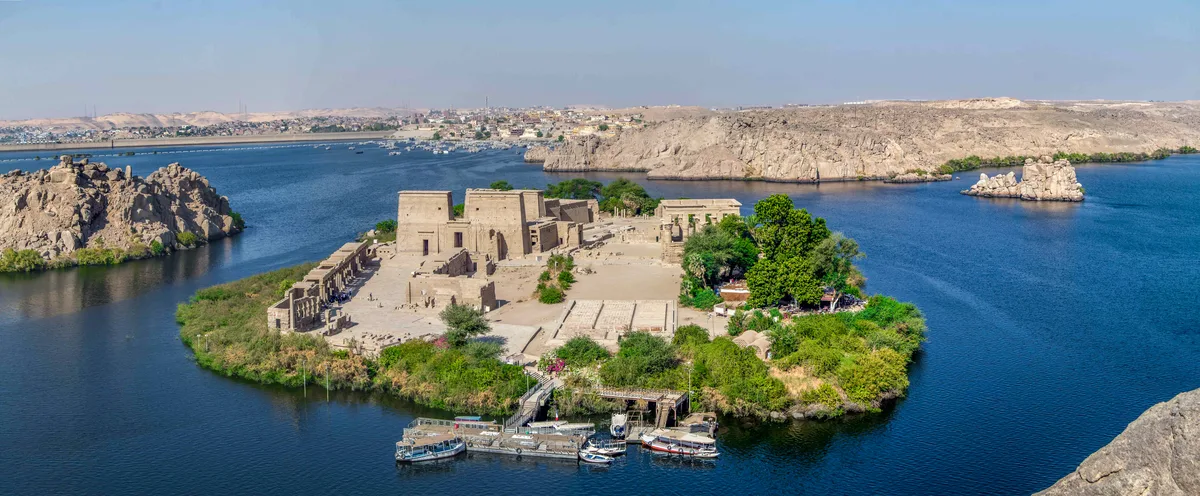
Most temples in Egypt stand where their builders put them. The philae temple does not. The sanctuary of Isis that rises from the water south of Aswan today is a reconstruction in the most literal sense – a Ptolemaic temple taken apart into some 40,000 numbered blocks, ferried across the reservoir, and rebuilt stone by stone on a different island, because its own island now lies drowned beneath the Nile. That double identity is what makes a visit here unlike any other in the country. You are looking at one of the most beautiful and best-preserved temples of ancient Egypt, and at the same time at one of the great rescue operations of the twentieth century, and the two stories are impossible to separate once you know them.
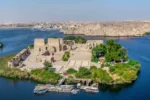
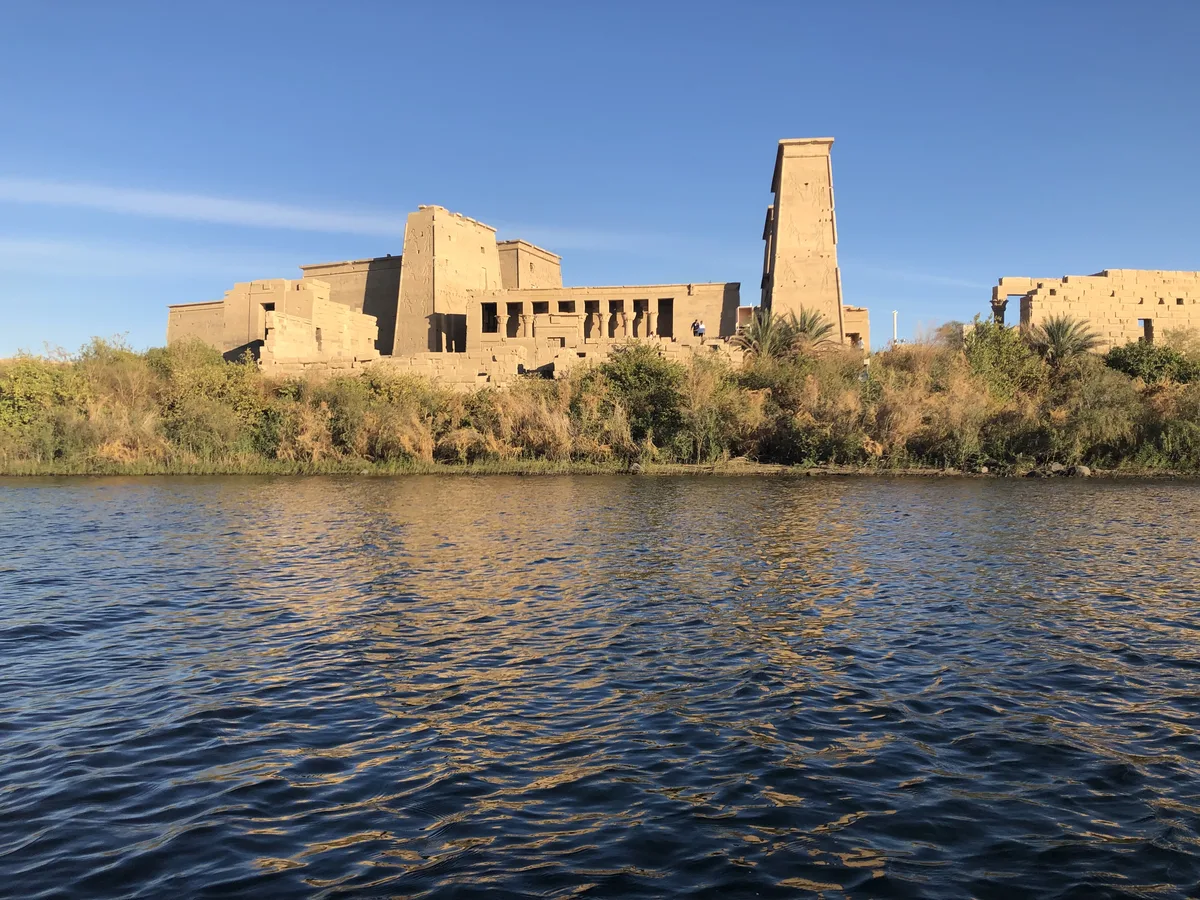
The island you land on is called Agilkia. It sits in the reservoir between the old Aswan Low Dam and the Aswan High Dam, in the granite-strewn reach of the Nile where the river squeezes through the rocks of the First Cataract. Before the move, the temples stood about 500 metres away on the smaller island of Philae itself, just above the cataract rapids, where priests of Isis had served the goddess for the better part of a thousand years. The granite boulders, the dark water and the palm-fringed banks around Agilkia were deliberately shaped to echo that lost setting, and on a still morning, with the pylons reflected in the reservoir, the illusion is close to complete.
What survives here is the last great flowering of pharaonic religion. The Temple of Isis at Philae was built mainly under the Ptolemies, the Greek-descended kings who ruled Egypt after Alexander, and decorated under Roman emperors who presented themselves in full pharaonic dress on its walls. It was a pilgrimage sanctuary of international fame, drawing worshippers from Nubia, Greece and Rome, and it outlived every other temple in Egypt. When the rest of the country’s shrines had been closed or converted, the priests of Philae were still carving hieroglyphs – the very last dated hieroglyphic inscription anywhere was cut here in 394 CE – and the cult of Isis held on into the sixth century, protected by its frontier position and by the Nubian peoples for whom the goddess remained their own.
That is the substance of this guide. Below, the philae temple is taken in the order you will meet it – the boat landing and the oldest building on the island, the great court and the first pylon, the colonnades, the birth house, the darkening sequence of halls that ends at the sanctuary, and then the satellite buildings that most visitors hurry past – the Kiosk of Trajan at the water’s edge, the little Temple of Hathor, and the Gate of Hadrian, where the last chapter of hieroglyphic writing was carved. The rescue story gets its own section, because without it you cannot understand what you are standing on, and so does the machinery of a modern visit – the marina, the boats, the tickets and the evening sound-and-light show – because at Philae the logistics are half the experience, in good ways and in a few honestly frustrating ones.
If you are planning the wider trip, our Egypt travel guide sets Aswan and its temples in the shape of a first journey through the country. This page is the deep dive into the one site that justifies the journey south on its own.
Philae Temple at a Glance
Here is the whole visit on one screen. The sections after this table take each row in turn.
| Question | Short answer |
|---|---|
| What is it | The Temple of Isis and its satellite buildings – Egypt’s great island sanctuary of the goddess Isis, built mainly in the Ptolemaic period |
| Where is it now | Agilkia Island, in the reservoir south of Aswan between the Low Dam and the High Dam – reached only by boat |
| Where was it | The island of Philae, about 500 metres away, now submerged beneath the reservoir |
| Why did it move | To save it from permanent flooding – dismantled and rebuilt during the UNESCO Nubia Campaign, in a project that ran from 1972 to 1980 |
| World Heritage | Part of “Nubian Monuments from Abu Simbel to Philae”, inscribed by UNESCO in 1979 |
| The main buildings | Temple of Isis with its two pylons, colonnades and mammisi, plus the Kiosk of Trajan, the Temple of Hathor and the Gate of Hadrian |
| Its claim on history | The last dated hieroglyphic inscription in the world was carved here in 394 CE, and the cult of Isis survived here into the 6th century |
| The visit | A short motorboat crossing from the Philae marina at Shellal, south of Aswan; ticket and boat are arranged separately |
| How long | Most visitors spend one and a half to two and a half hours on the island |
| After dark | A sound-and-light show retells the story of Isis on the island in the evening, on a separate ticket |
Two consequences follow from the table, and both shape the sections below. First, nothing about this visit is walk-in – the island setting means a taxi or bus to the marina, a ticket, and a negotiated boat ride stand between you and the temple, and the order in which you arrange them matters. Second, the philae temple repays slowness. The complex is compact enough to cross in ten minutes, but its reliefs, its layered Christian-era alterations and its satellite buildings are the real content, and they belong to visitors who budget the full two hours rather than the cruise-group forty minutes.
The Island That Moved – the UNESCO Rescue of Philae
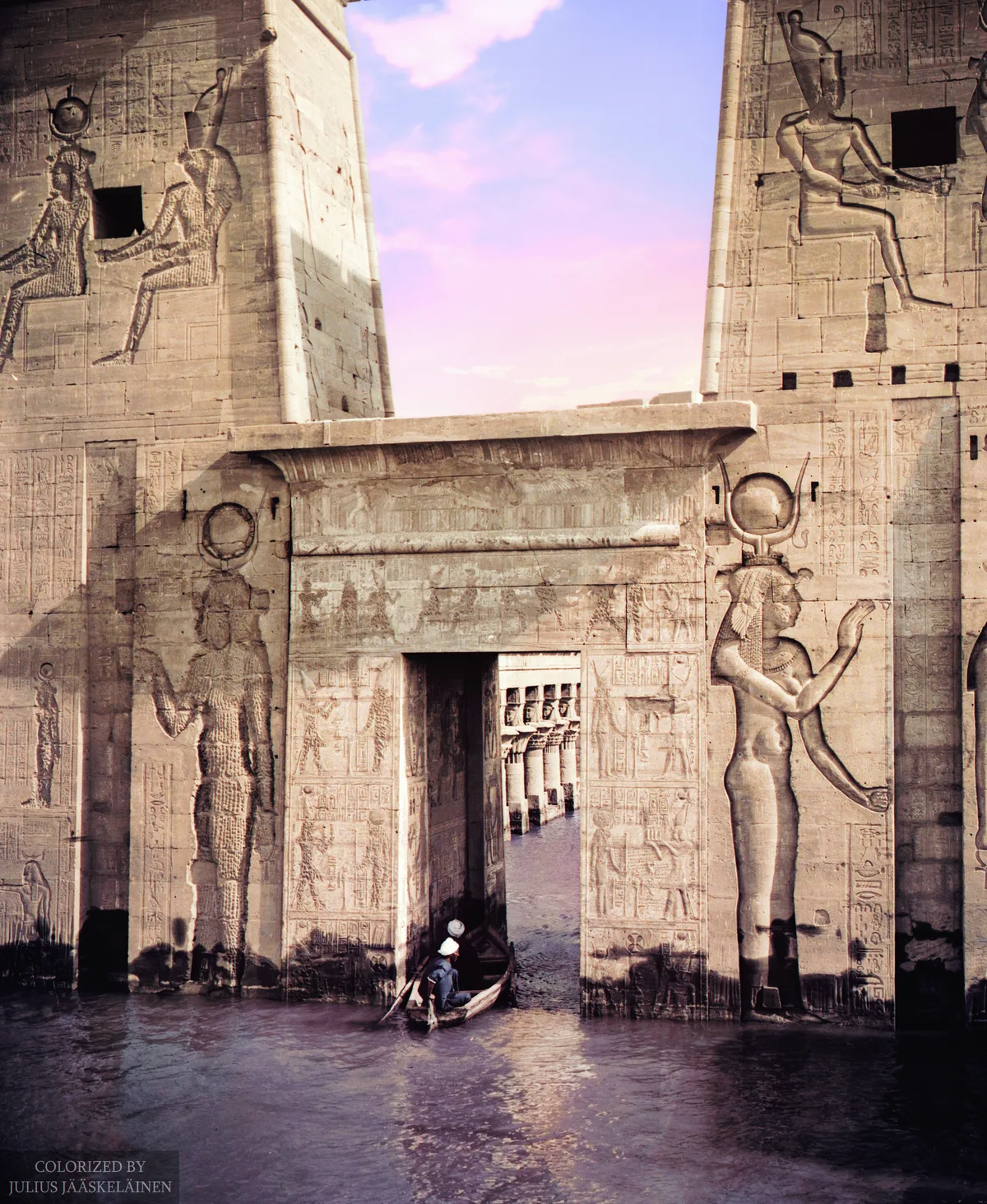
To understand what you are visiting, start with the water. For most of its life the original island of Philae stood dry above the First Cataract, flooded only at the margins by the annual inundation. That changed in 1902, when the British completed the first Aswan dam, the Low Dam, downstream of the island. The reservoir it created drowned Philae for most of the year. The dam’s height was raised twice, in 1907-1912 and again in 1929-1934, and each raising deepened the submersion, until the temples stood in the river for all but the summer weeks when the sluices were opened. Photographs from those decades show the pylons rising straight out of the Nile, boatmen paddling through the colonnades, and they are beautiful images that record a slow disaster – the painted colour of the reliefs washed away, the stonework encrusted with silt, the island’s gardens and palms killed outright.
The building of the Aswan High Dam in the 1960s turned a seasonal drowning into a sentence of permanent submersion. Egypt’s appeal for help produced the UNESCO International Campaign to Save the Monuments of Nubia, the largest heritage rescue ever attempted, which between 1960 and 1980 saved temples the length of the threatened valley – Abu Simbel most famously. Philae, astonishingly, was left out of the campaign at first, and it took a further international effort, and a competition for the best engineering solution, to bring it in. An early scheme would have ringed the island with dams and pumped its own lake dry around it; the winning proposal, from an Egyptian consortium, was bolder and simpler to state than to do. Take the temple down, move it to higher ground, and build it again.
The ground chosen was Agilkia, a rocky islet about 500 metres northwest of Philae. Before a single ancient block arrived, Agilkia was remade – its top was levelled and its slopes sculpted with explosives and concrete until its contours matched the lost island’s shape, and its surface stood some twelve metres higher than the flooded original. Meanwhile, around Philae itself, engineers built a cofferdam of two parallel steel sheet-pile walls packed with a million cubic metres of sand, and pumped the enclosure dry. Inside that artificial island, archaeologists cleaned, measured and photographed every structure – the complex held some ninety-five separate monuments and structures – using photogrammetry to record each block’s exact place. Then the dismantling began. The temples came down into roughly 40,000 individual blocks, weighing anything from two to twenty-five tons, each numbered, catalogued and ferried across to Agilkia, where the whole jigsaw was reassembled in its original arrangement through the later 1970s. The complex was formally reopened in 1980, and a year earlier, in 1979, the Nubian Monuments from Abu Simbel to Philae had been inscribed on UNESCO’s World Heritage List – Philae entered the list, in effect, while it was still being rebuilt.
Stand in the forecourt today and the joins are there if you look for them – fine saw-lines in the stone, an occasional modern pin or patch – but the miracle of the place is how little they register. The orientation, the spacing, the fall of light down the colonnades were all reproduced, and the setting does the rest. The honest way to describe the modern philae temple is that it is an original in its second location – every carved block ancient, the island beneath it a considered piece of 1970s landscape engineering – and that this doubleness, far from diminishing it, makes it the most instructive temple visit in Egypt.
A Frontier Sanctuary – Isis at the Edge of Egypt
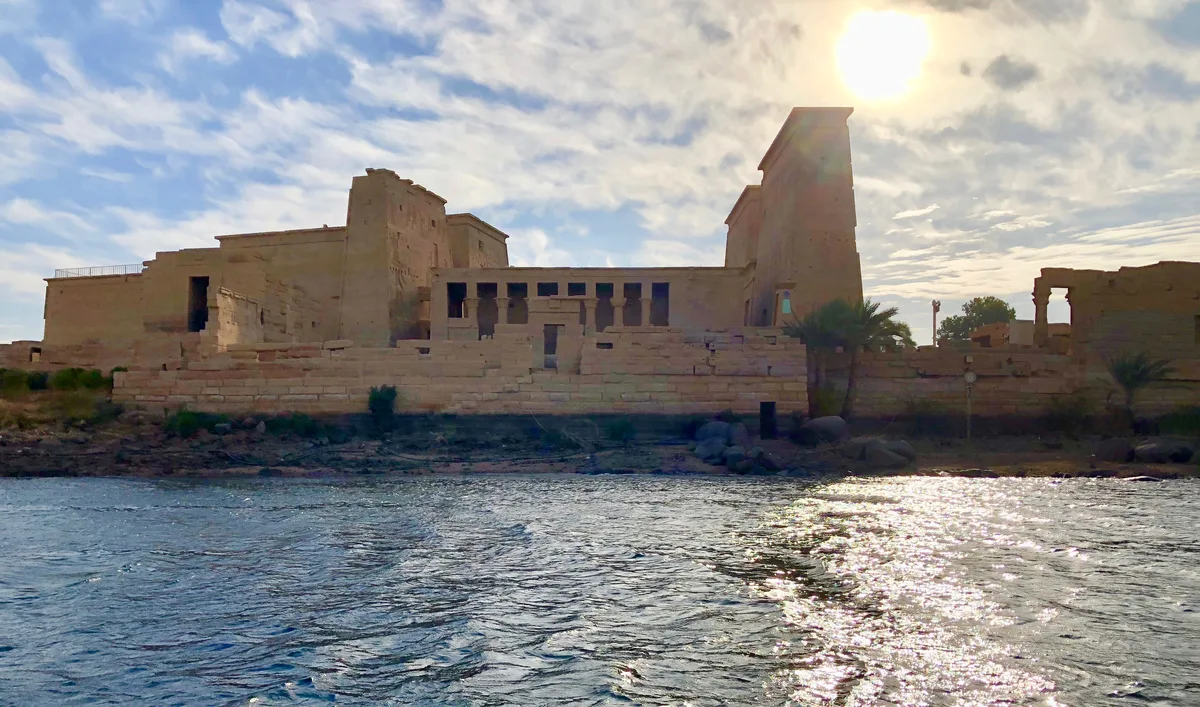
Philae’s Egyptian name meant something like “the boundary”, and the geography explains the theology. The island lay just above the First Cataract, the granite rapids that marked the traditional southern limit of Egypt, opposite the trading city of Syene – modern Aswan – where goods from Nubia and inner Africa were unloaded, taxed and re-embarked. A frontier post needed a frontier god, and the god of Philae was Isis, who in Egyptian myth was bound to this exact landscape. Her husband Osiris, murdered and dismembered by his brother Seth, was believed to lie buried on the neighbouring island of Bigeh, out of bounds to all but the priests; from Philae, the sacred barque of Isis crossed regularly to pour libations at his tomb. The myth was mapped onto the river itself – below Bigeh, in a grotto beneath the rocks, the Nile’s flood was believed to well up from the caverns of the god Hapy, and the island’s temples sat at the meeting point of Egypt, Nubia and the sources of the inundation.
There was sacred building here early – blocks of a shrine of the Nubian pharaoh Taharqa, of the 25th Dynasty, were reused in later work, and a small kiosk of Psamtik II is the first firm evidence of Isis worship on the island – but the sanctuary that survives is overwhelmingly the creation of the Ptolemaic kings. From Ptolemy II, who began the great Temple of Isis in the third century BC, reign after reign added pylons, courts and chapels, and the Nubian king Arqamani built here too, in a striking piece of cross-border collaboration. Pilgrims came from across the Mediterranean world and left their names and prayers scratched and carved on the walls; among the inscriptions on the first pylon are Latin texts of 116 BC, the oldest known Latin inscriptions in Egypt. The emperors of Rome continued the patronage – Augustus, Tiberius and Trajan all built at Philae, and Hadrian left the gate that still carries his name – because the island’s priests were worth courting and its goddess was worshipped far beyond Egypt.
The frontier position that made Philae rich also made it stubborn. In 298 CE the emperor Diocletian withdrew Rome’s border to the cataract and handed the territory south of it to the Nobades, and Philae became a condominium of faiths and peoples – an Egyptian temple on the edge of the empire, guaranteed by treaty to its Nubian devotees. When Christian emperors closed the temples of the Roman world in the late fourth century, Philae lay effectively beyond the reach of the order, and its priests went on serving Isis under the protection of the Blemmyes and Nobades, whose treaty with Rome in 452 still guaranteed them access to the goddess’s cult image. The end came only in about 537, when the commander Narses, acting for the emperor Justinian, closed the temple, imprisoned its priests and shipped its statues to Constantinople – an event historians conventionally take as the death of the ancient Egyptian religion, here at the last place it was still alive.
The Landing and the Kiosk of Nectanebo
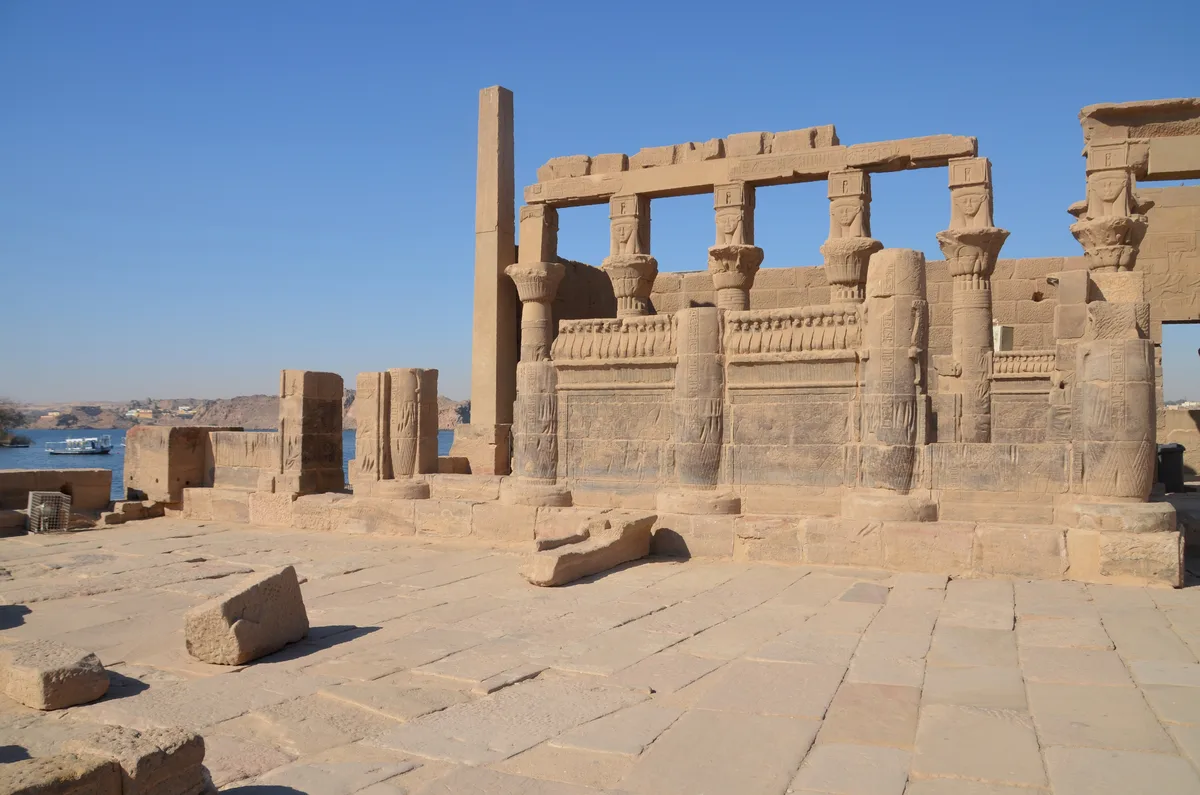
Your boat puts you at the island’s modern quay, on the southern shore of Agilkia, and the first building you meet is also the oldest – a good order in which to start. The Kiosk of Nectanebo I stands a few steps from the landing, an open hall of columns crowned with capitals in the form of the head of Hathor, cow-eared and serene. Nectanebo, who reigned from 380 to 362 BC, was the last native Egyptian pharaoh of any consequence, founder of the 30th Dynasty, and his kiosk was built as the vestibule of an earlier Temple of Isis that stood on this axis – a ceremonial porch where the sacred barque of the goddess would pause on its processional journeys. Almost everything else of his temple was swept away by his Ptolemaic successors’ rebuilding, but the kiosk was kept and incorporated, which is why the philae temple still opens with a building older than the rest of the complex by more than a century.
Take a moment here rather than hurrying through, because the kiosk teaches you how to read the whole site. The columns are not plain supports – each floral capital is different, an Egyptian convention that turned a colonnade into a stone marsh of papyrus and lotus, the plants of creation. The Hathor heads are later visitors’ favourite detail, worn smooth in places by two thousand years of weather and, for seventy of those years, by river water. From the kiosk’s platform you also get the orientation that organises the visit – the temple’s axis runs north from here, up the long open court called the dromos, and the twin towers you can see at its far end are the first pylon of the Temple of Isis.
Behind and beside you, the southern end of the island holds the fragments of the ancient harbour arrangements and the lower courses of buildings that the relocation recorded but could not always raise again. What the rescue saved was the monumental core, and the edges of Agilkia still show its working margins – loose blocks, foundation lines, the odd column drum in the grass. None of it is labelled in any detail, and that is a fair criticism of the site’s presentation; the walk north is where interpretation improves.
The Dromos and the First Pylon
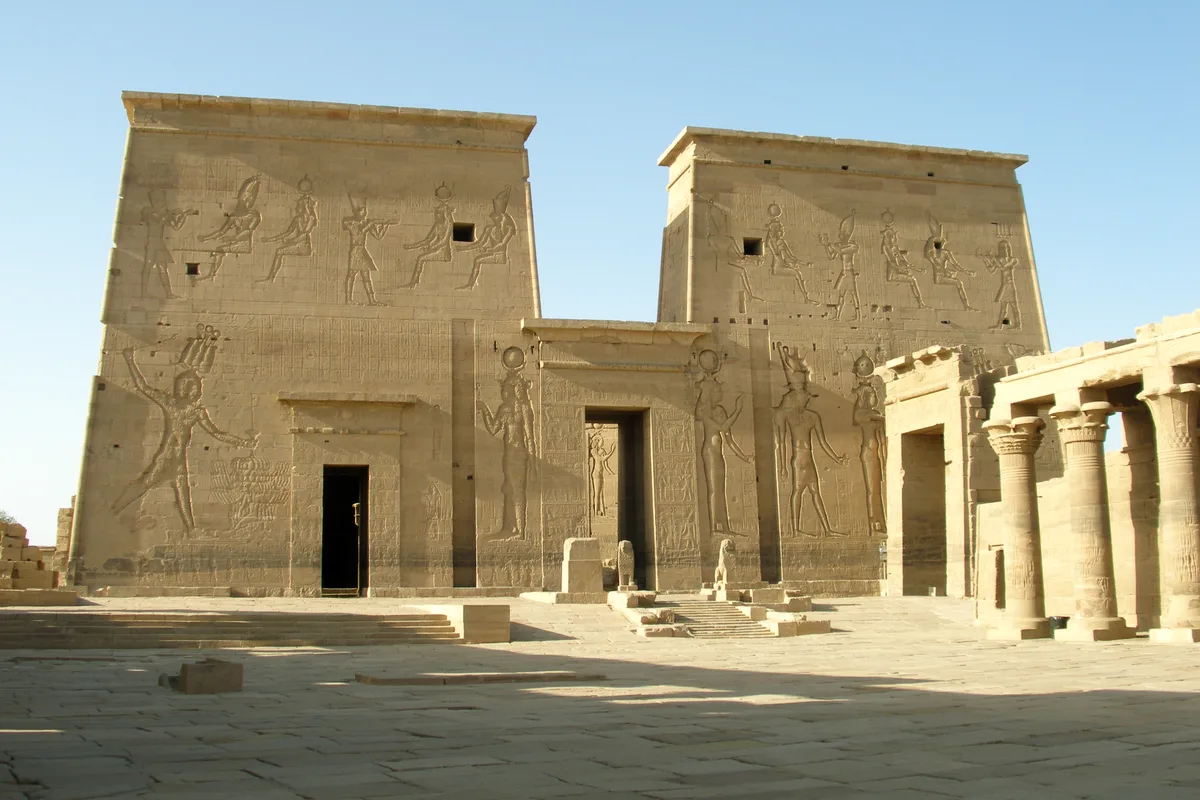
From the kiosk, the dromos runs north – a long, open processional court, the marshalling ground of the ancient festivals, when the barque of Isis was carried out of the sanctuary to visit the tomb of Osiris and the whole population of the frontier gathered to watch. Two colonnades frame it, taken in the next section; the eye, though, goes straight to the far end, where the first pylon of the Temple of Isis closes the view. A pylon is the philae temple’s public face – two massive tapering towers joined over a central gateway, its sloping walls a stylised echo of the horizon from which the sun rises – and Philae’s first pylon, built under Ptolemy XII in the first century BC, is among the most completely preserved in Egypt.
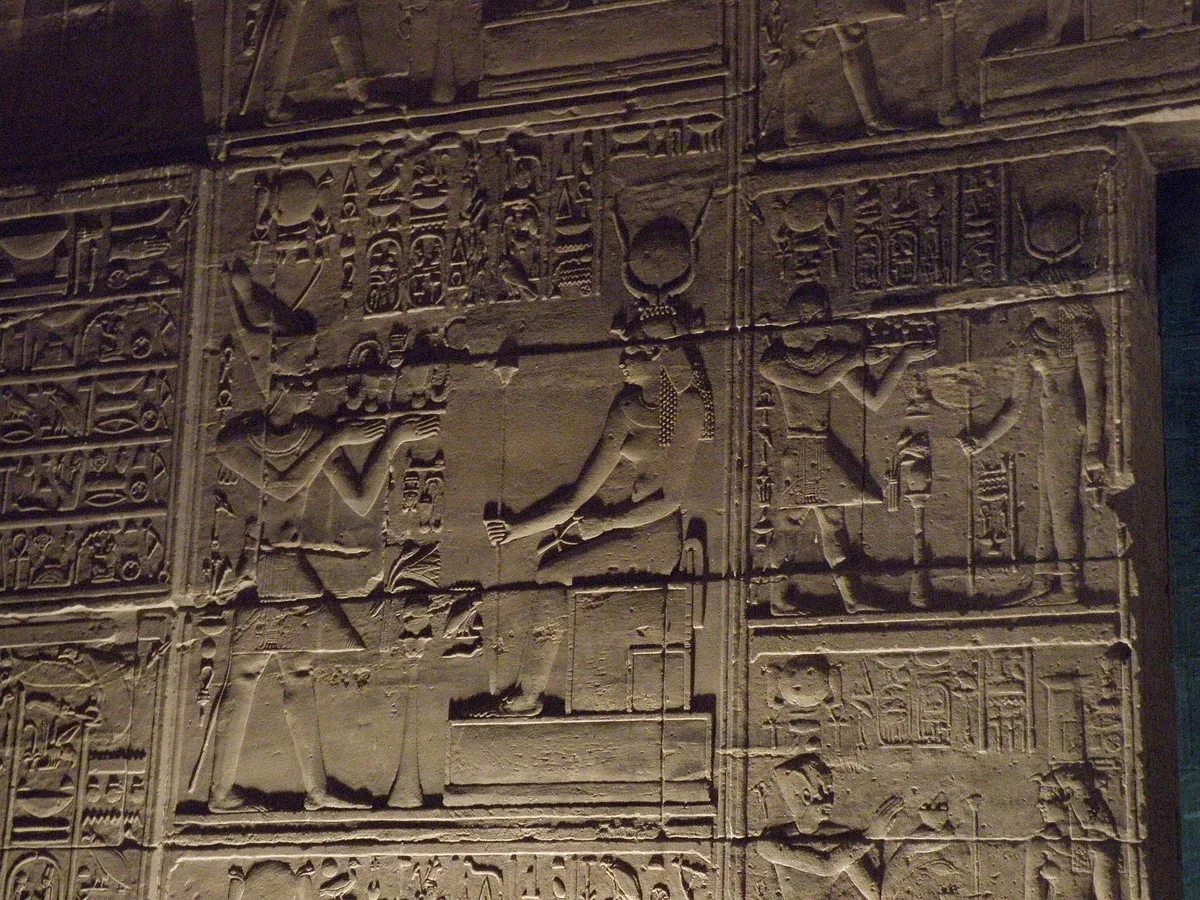
The carving on the towers is the standard grammar of pharaonic kingship, executed at monumental scale. The king is shown in the ancient pose, grasping a bundle of foreign captives by the hair and raising his mace to smite them, while Isis, Horus and Hathor look on and approve. Read it as a political poster rather than a battle record – Ptolemy XII was a weak king dependent on Rome, and the confidence of the relief is compensation in stone. In front of the pylon once stood a pair of obelisks and granite lions; one obelisk was carried off to England in the nineteenth century by the collector William John Bankes, and there, compared against the Rosetta Stone, its bilingual inscription helped scholars confirm the decipherment of hieroglyphs – a piece of Philae that changed Egyptology before the temple itself was saved. A gateway of Nectanebo I, older than the pylon by three centuries, is built into the pylon’s fabric, one of several places where the complex preserves its own earlier drafts.
Pass through the pylon’s doorway and look at its walls as you go. The gate passage and the towers are dense with the graffiti of the sanctuary’s long afterlife – formal inscriptions of pilgrims, the signatures of Meroitic envoys who came down from Nubia on state business, and, in later centuries, the names of European travellers who reached the island when it was still a romantic ruin at the empire’s edge. The pylon is a threshold in time as much as in space; the court beyond it belongs to the goddess alone.
The Colonnades and the Forecourt
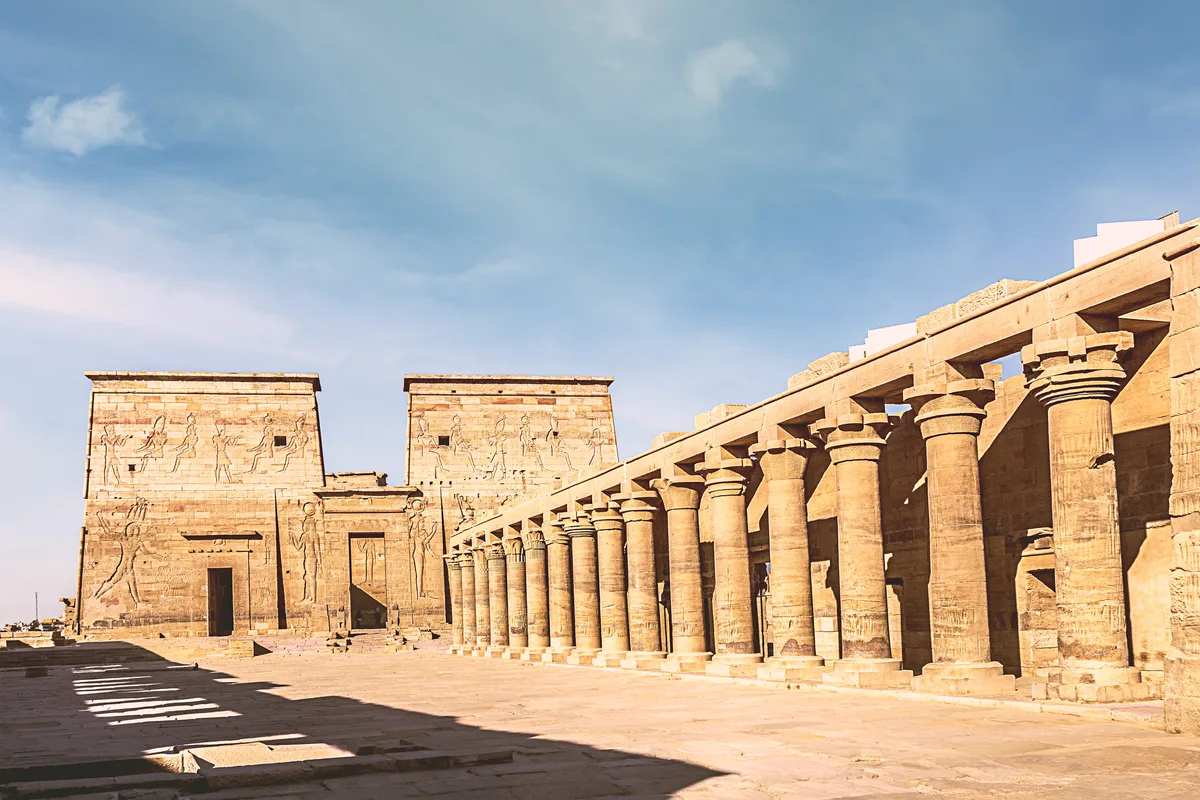
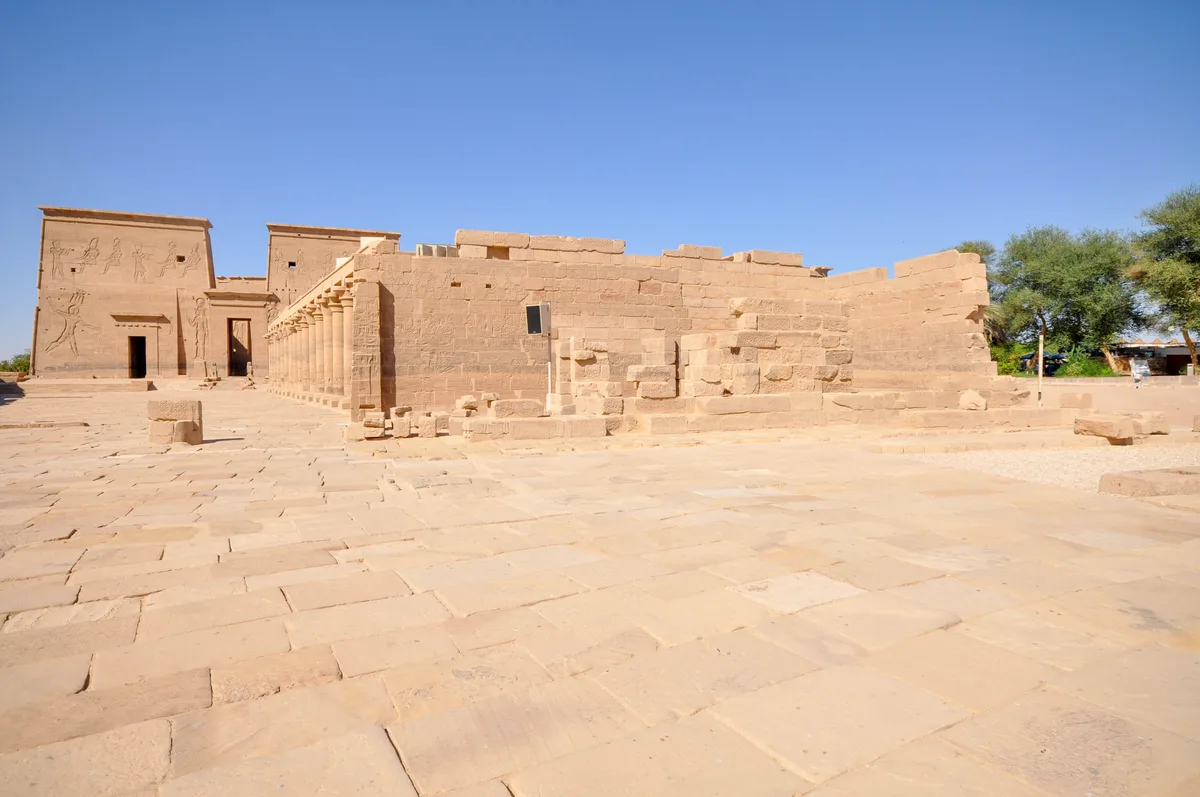
Walk the dromos slowly, because its colonnades are the most quietly enjoyable architecture of the philae temple. The western colonnade, running along the left of the court as you face the pylon, is a screen of columns whose capitals are the site’s horticultural showpiece – each one carved as a different arrangement of lotus, papyrus, palm fronds and lilies, so that the processional way ran between a stone garden that never wilted. The colonnade was never quite finished, and the unfinished state is itself instructive; on some columns you can still trace the stages of work, from the rough-blocked capital to the fully undercut flower. Behind the colonnade, a wall carries windows that once lit a row of chambers for the temple’s priests and its stores, and through its openings you catch the glint of the reservoir – in the flooded decades, the Nile ran down this court, and the waterline of those years is still legible in the staining of the lower stone.
The eastern side of the dromos is a different arrangement, a colonnade fronting a scatter of smaller sacred buildings that served the sanctuary’s wider family of gods. Here stands the little Temple of Arensnuphis, a Nubian lion-god worshipped as the companion of Isis, built with the involvement of the Nubian king Arqamani and the Ptolemy IV – a frontier church for a frontier congregation, in effect. Near it are a chapel of Imhotep, the deified architect of the Step Pyramid, honoured at Philae as a god of wisdom and healing, and a scatter of lesser shrines raised to the gods who met at this frontier. These side buildings are easy to skip and worth the ten minutes they take; they show the sanctuary as it actually worked, not a single-god temple but a small sacred town, staffed, provisioned and visited by people whose devotions were layered.
Through the first pylon, the forecourt repeats the pattern at a more intimate scale – colonnades east and west, the eastern one fronted by rooms where the temple’s daily business was done, and on the west the building that dominates this court and deserves its own section – the mammisi, or birth house, standing at right angles to the temple’s axis in the Egyptian manner. Ahead, the second pylon rises at a slight angle to the first, a kink in the axis that betrays the temple’s growth by accretion over centuries; the great granite stela wedged against it records, in 157 BC, Ptolemy VI’s grant of the revenues of the Dodekaschoinos – the “Land of the Twelve Schoinoi”, the frontier district south of the cataract – to the temple of Isis, the endowment that kept Philae rich.
The Mammisi – the Birth House of Horus
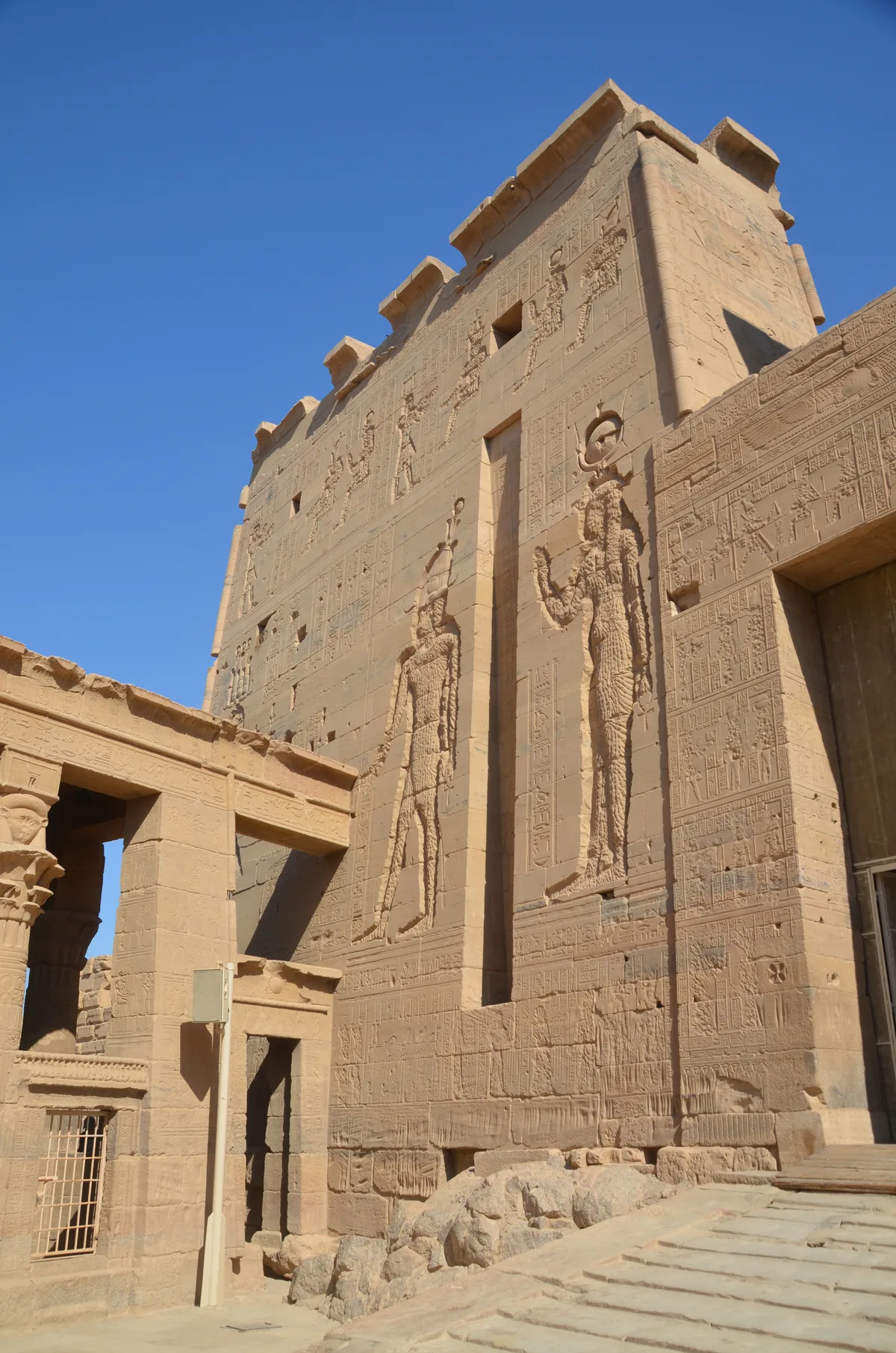
Every great Egyptian temple of the late period kept a mammisi, a birth house, and the philae temple’s stands in the forecourt, a small temple in its own right wrapped in a colonnade of columns with Hathor-headed capitals. Its subject is the central story of the sanctuary – the birth and childhood of Horus, the son of Isis and Osiris, who was conceived after his father’s murder, born in secret and hidden by his mother in the marshes of the Delta until he grew strong enough to avenge Osiris and take his throne. The theology was never only mythology. Each reigning king was Horus in life, so the birth house was a machine for legitimising power, and at Philae it had a further, local charge – Isis was not a distant goddess here but the island’s resident, and her motherhood was the sanctuary’s founding fact.
The reliefs inside carry the story in sequence, and one scene above all is the building’s treasure – Isis suckling the infant Horus among the reeds of the marsh, the image the Egyptian Ministry of Tourism and Antiquities itself picks out when it introduces the site. Around it the walls show the divine family assembling, the gods rejoicing at the birth, and the presentation of the child who guarantees the order of the world. The carving is intimate in a way the pylon’s propaganda is not, and the small rooms hold their coolness late into the morning, which makes the mammisi the natural pause in the middle of a visit – shade, story and the best small-scale sculpture on the island in one stop.
The building also carries the fingerprints of the frontier politics you met in the dromos. The Nubian king Arqamani, whose kingdom of Meroe lay far to the south, contributed to the mammisi’s decoration in the late third century BC, and his cartouches were later chiselled out and replaced by those of Ptolemy V – tolerance and erasure on the same wall, a few centimetres apart. Look for that double layer as you walk the island, because it recurs – in the mammisi, in the churches cut into the halls, in a carved cross over a cartouche. Philae is a palimpsest, and the mammisi is where the layering is easiest to read at close range.
Through the Second Pylon – the Hypostyle Hall and the Sanctuary
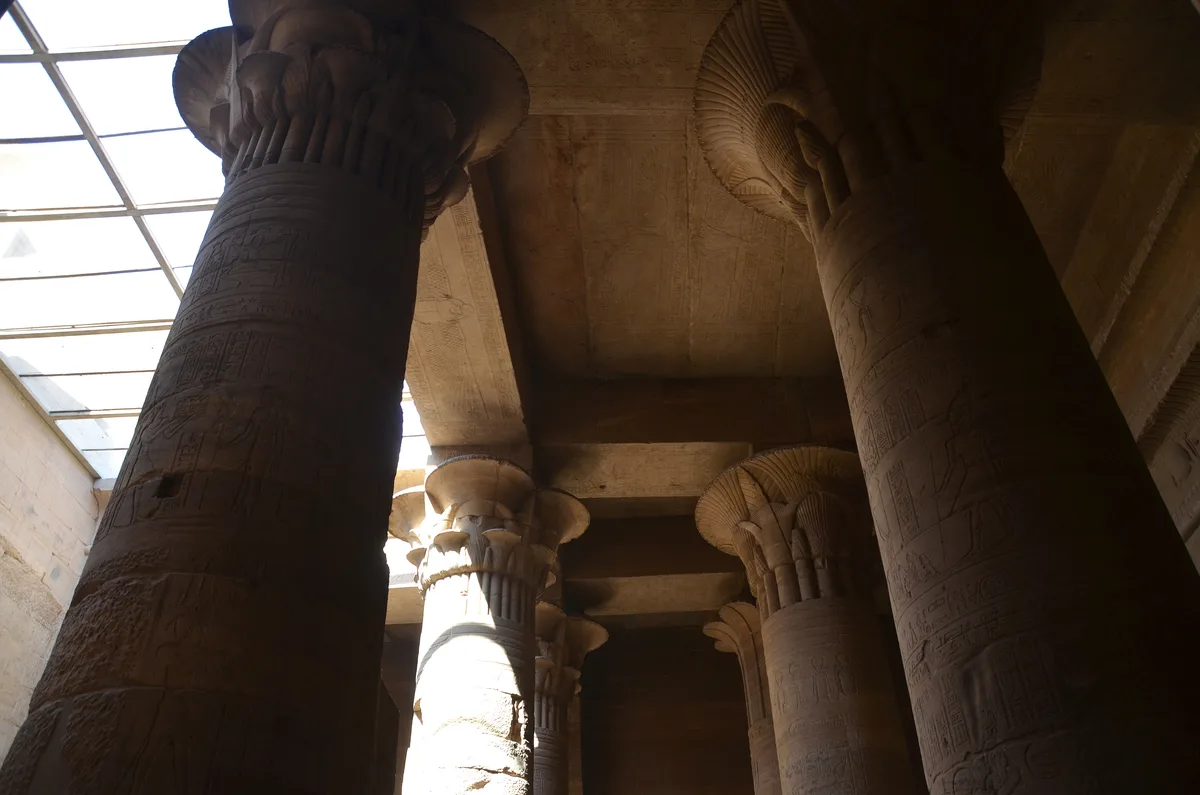
The second pylon, built under Ptolemy VI, is smaller than the first and set at that characteristic slight angle; passing it, the philae temple changes key. Everything before it – dromos, courts, colonnades – was semi-public space, where processions formed and pilgrims thronged. Everything beyond it was the house of the goddess, entered in antiquity by priests alone, and the architecture enforces the transition. The pronaos, or hypostyle hall, is a forest of massive columns with floral capitals, its roof slabs dropping the light to a greenish gloom even at midday. It is one of the most atmospheric interiors in Egypt, and also one of the most altered, because this hall had a second career – of which more in the Coptic section below. A Christian altar stood here, crosses were cut into the columns, and one famous relief was replastered and painted over with a saint, whose outline ghosted through as the plaster failed.
Beyond the hypostyle, the temple contracts and darkens through a sequence of ever smaller, ever holier rooms – a hall of offerings, where the daily meals of the goddess were assembled; side chambers for the temple’s treasures, its oils, linens and ritual books; and a staircase climbing to the roof, where a suite of rooms was given to Osiris, and where reliefs of Isis weeping over, and reviving, her husband’s body form one of the most moving cycles in Egyptian art. The priests climbed to the roof each year for the mysteries of Osiris, performed in the month of Khoiak, when the god’s death and resurrection were enacted as the Nile fell and the sowing began. Those roof rooms are not always accessible to visitors today, and the honest advice is to ask at the landing – access arrangements on the island change, and the staircase is sometimes open and sometimes not.
At the axis’s end lies the sanctuary itself, a small dark chamber where the goddess lived. On its pedestal stood the sacred barque of Isis, the gilded boat in which her statue travelled in procession, and behind the chamber a granite naos – a monolithic shrine – held her image. The walls are carved with the king making offerings to Isis and her family, columns of inscription so fine they were still being added when the temple was already half a millennium old. Stand here a moment. This room was the still point of the frontier world – the reason for the pilgrims, the treaties, the endowments and, in the end, for forty thousand numbered stones and a fleet of barges. Of all the rooms in Egypt, this is among the last that an ancient Egyptian priest ever swept, and it keeps something of that lateness in its air.
The Kiosk of Trajan – the Postcard Building
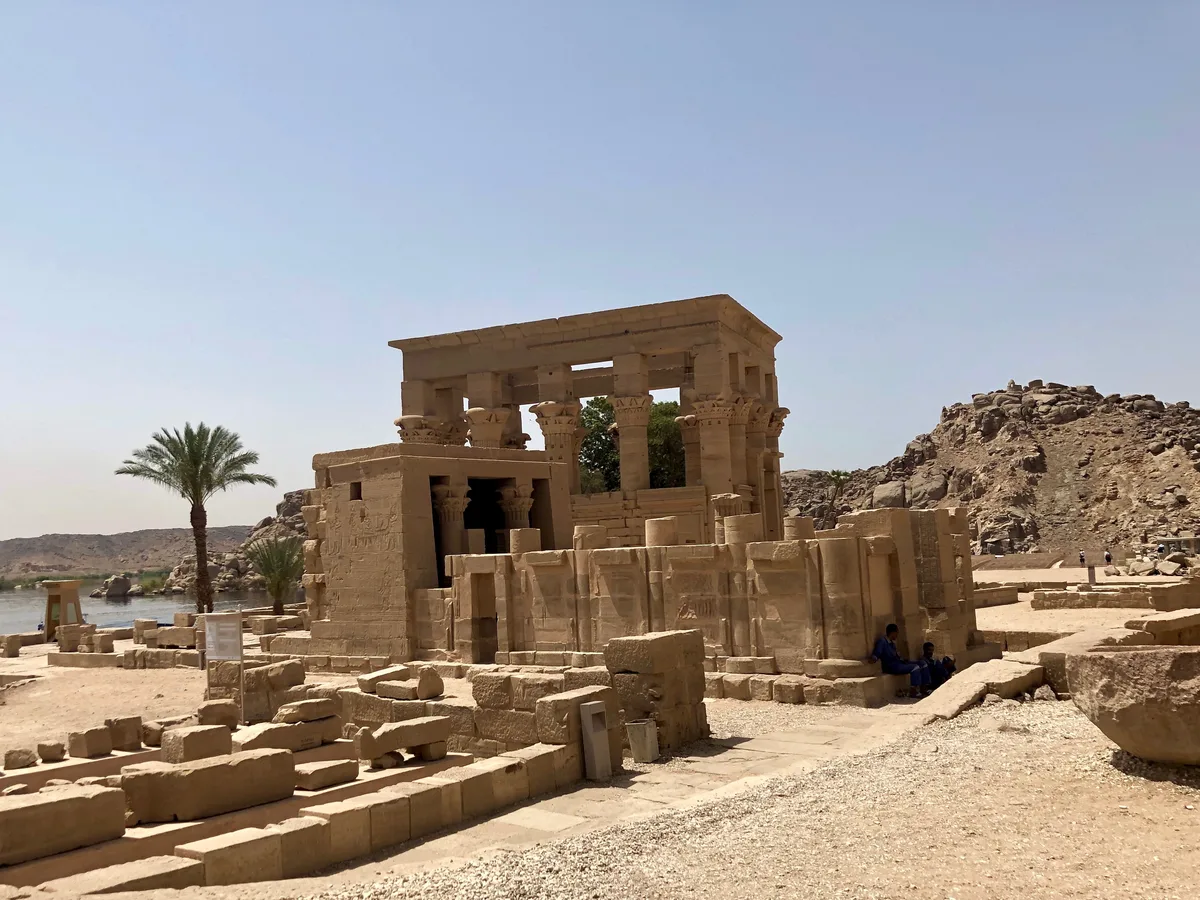
East of the temple, on a terrace above the water, stands the building by which most of the world knows the philae temple – the Kiosk of Trajan, an open pavilion of tall columns linked by screen walls, drawn and photographed since the nineteenth century until it became the site’s visual shorthand. UNESCO’s own account of the property calls it the jewel of the complex, and from the boat, on the approach, it is the kiosk’s elegant silhouette that detaches itself first from the island’s mass. The emperor Trajan, who reigned from 98 to 117 CE, is shown on its walls in carved relief, making offerings to Isis, Osiris and Horus in the full pharaonic style – an emperor in Rome who never saw Egypt, dressed as a pharaoh on a frontier island, because that is what the grammar of Egyptian kingship required.
The kiosk was, in functional terms, a station of the processional route – a resting place where the barque of Isis paused when the goddess travelled by water, and where the landing ceremonies of the great festivals were staged. It was also never finished. Its columns were designed to carry an architrave and a roof that was executed, if at all, in wood; the stone roof was never laid, and the building has stood open to the sky for nineteen centuries, which is precisely why it photographs as it does – a colonnade against the sky and the river, architecture reduced to rhythm. In the flooded decades the kiosk stood in the water on the original island, its columns rising from the Nile in the image that travellers of the early twentieth century carried home as the very emblem of drowned Egypt.
Give the kiosk its due on your way round the island, and walk its terrace. From here the geography of the sanctuary makes sense at a glance – the temple behind you, the water in front, and across the channel the dark rocks of Bigeh, the forbidden island of the tomb of Osiris, close enough to see its inscribed boulders and its small ruined temple. The processions crossed this water in boats decked for festival, and the crossing is part of the site’s meaning; the kiosk is the pier-head of a sacred route, and standing in it at the start or end of a visit, with the reservoir moving below, is as close as the modern temple lets you come to taking part.
The Temple of Hathor and the Gate of Hadrian
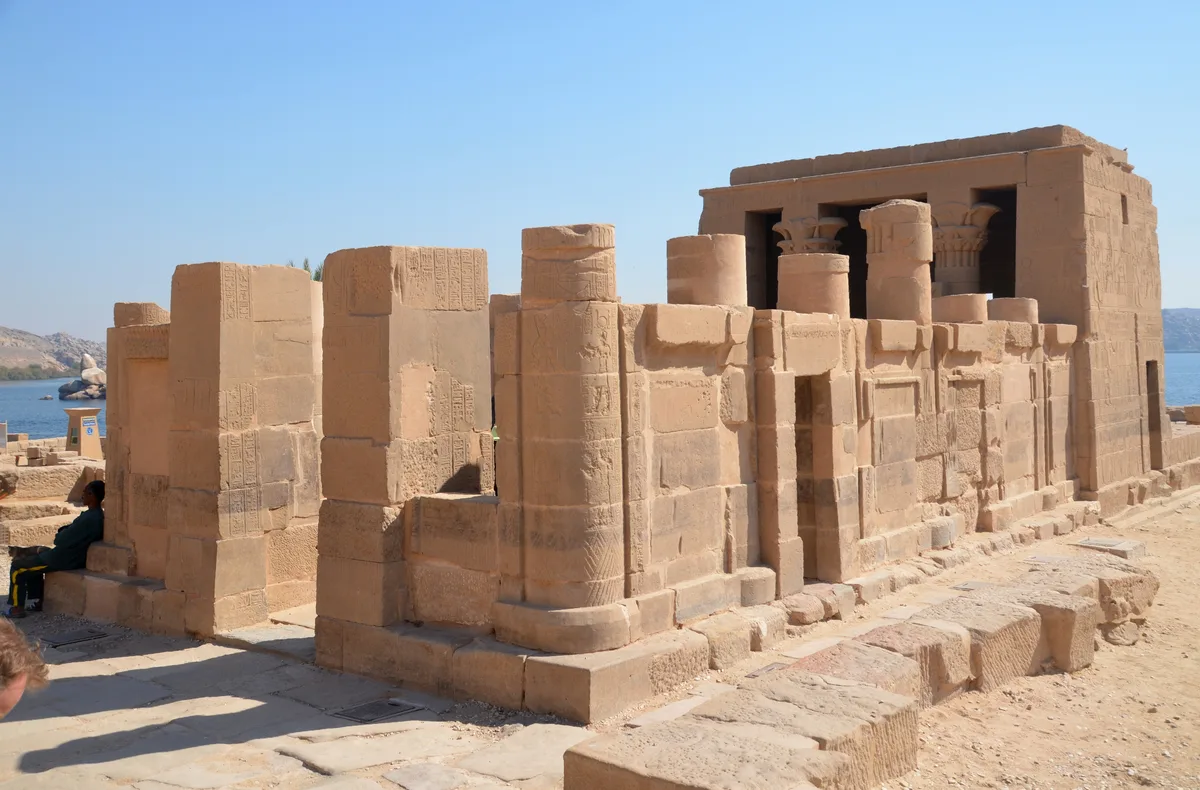
On the eastern side of the complex, past the kiosk’s terrace, stands the island’s second temple, small enough to take in at a glance and charming enough to hold you for twenty minutes. The Temple of Hathor was begun by Ptolemy VI Philometor and completed under Augustus, and it served the goddess who in Egyptian thought was Isis’s close kinswoman – goddess of music, love, drunkenness and the west bank of the dead. Where the Temple of Isis is solemn, the Temple of Hathor is playful. Its reliefs are famous among Egyptologists for their humour – processions of musicians with lutes and harps, dancing figures, monkeys strumming instruments, and the bandy-legged household god Bes beating his tambourine, all carved to celebrate the festival at which Hathor was said to return, pacified and joyful, from Nubia. Pilgrims who had prayed to the great goddess in the dark halls came here for the lighter half of the sacred, and the little temple still feels like the sanctuary’s garden party.
A few minutes west, at the island’s northwestern edge, the Gate of Hadrian tells a darker and more famous story. This gateway, built under the emperor Hadrian in the second century CE, once opened in the enclosure wall toward Bigeh, and its inner room carries the most refined telling of the Osiris myth at Philae – the reliefs UNESCO singles out when it describes the property. One panel shows the source of the Nile itself, the god Hapy kneeling in his cavern beneath Bigeh and pouring out the inundation from two vases, while Isis watches; it is the theology of the whole cataract district carved on one wall. Beside the gate stood a nilometer, the stepped gauge by which the priests measured the rising flood and set the year’s expectations – temple, tax office and weather station in a single stairwell.
But the gate’s immortality rests on a text, and that text gets the next section to itself – because carved on this gateway, beside a figure of the Nubian god Mandulis, is the last dated inscription in Egyptian hieroglyphs in the world.
The Last Hieroglyphs – Esmet-Akhom and the End of a Script
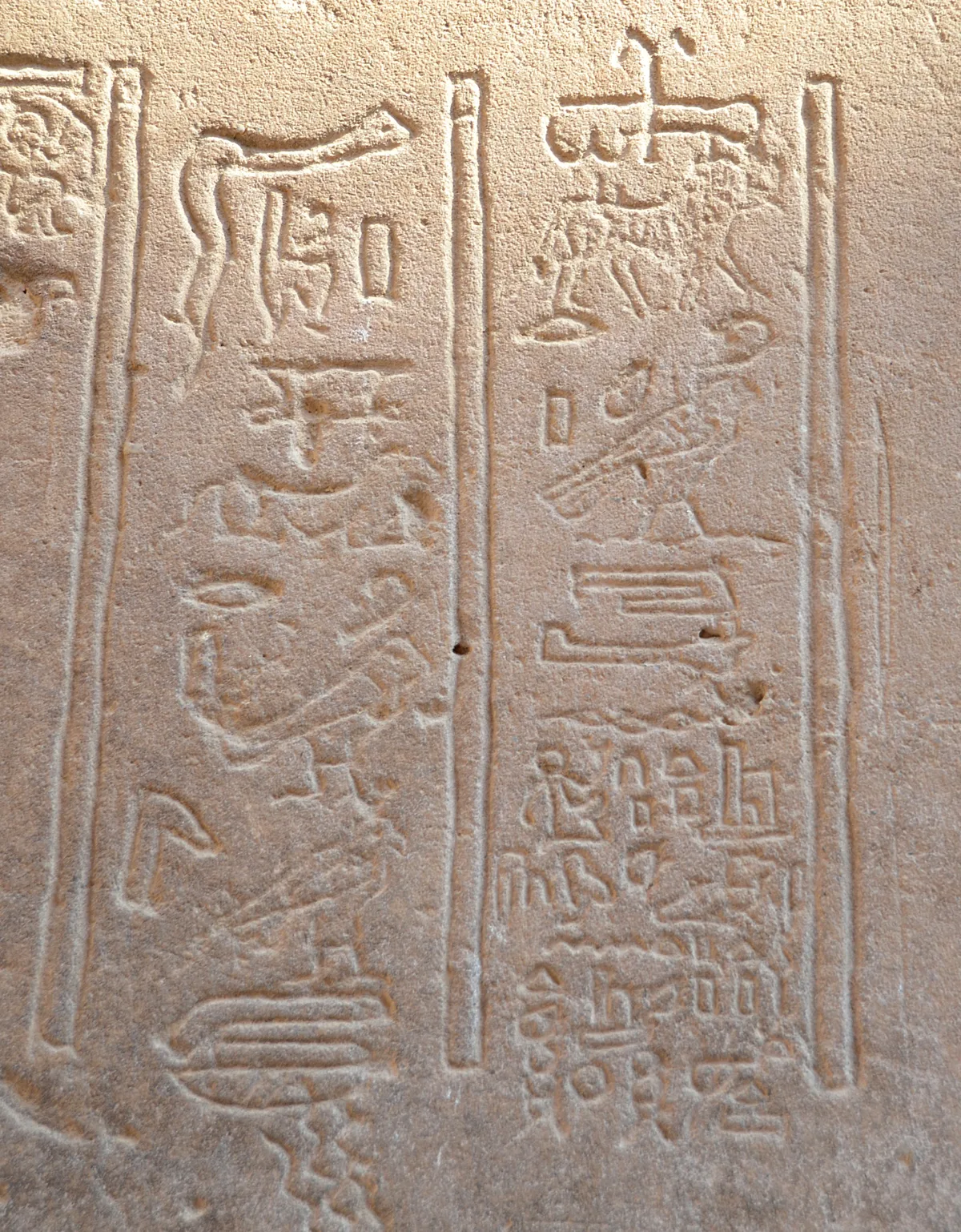
Hieroglyphic writing was already more than three thousand years old when the Roman Empire turned Christian, and it died, as it had lived, in the temples. As the great shrines closed one by one through the fourth century, the circle of men who could still read and carve the sacred script shrank to the priesthoods of a handful of sanctuaries, and finally, in practical terms, to one. The priests of the philae temple were a hereditary, literary caste – the inscriptions they left in these last generations are not crude survivals but accomplished, self-conscious pieces of writing, composed by men who knew they were keeping something alive. A priest of Isis named Esmet-Akhom belonged to such a family; his father had held office before him, and his own inscriptions record the family business of serving the goddess at the edge of a world that had stopped believing in her.
On 24 August 394 CE – the date is given in the text itself, by the Roman emperor’s regnal year, the ancient and the modern calendars meeting in one line – Esmet-Akhom carved his graffito on the Gate of Hadrian, beside an image of Mandulis, the Nubian god his family also served. The inscription, part hieroglyphic and part demotic, records a prayer and an act of devotion; it is competent, formal and entirely ordinary in intent, which is what makes it so poignant. Nobody carved a farewell. The script simply stops here, at this gate, on this island – the last dated hieroglyphic text in existence, written more than a century after the last temple inscriptions of the Roman mainland and within living memory of the faith’s end. The demotic cursive script, the everyday hand of ancient Egypt, lasted a little longer at Philae; its latest known graffito, also on this island, dates to December 452.
There is a symmetry worth pausing on. Five centuries earlier, the sanctuary’s priests had petitioned Ptolemy VIII about the crowds of officials imposing on their hospitality, and the petition, carved on an obelisk that was later carried to England, helped the decipherers of the 1820s crack the hieroglyphic script – Philae contributed to both the last writing of the script and, fourteen centuries later, to its recovery. When you stand at the Gate of Hadrian, you are standing where Egyptian writing ended and, in a real sense, where its modern reading began. The graffito is small, weathered and easy to walk past; ask your guide, or look on the gate’s wall for the figure of Mandulis, a falcon-headed god in a tall crown, with columns of close-cut signs beside him. It is the most consequential square metre of wall in Egypt.
The Coptic Layer – Churches, Crosses and Chiselled Gods
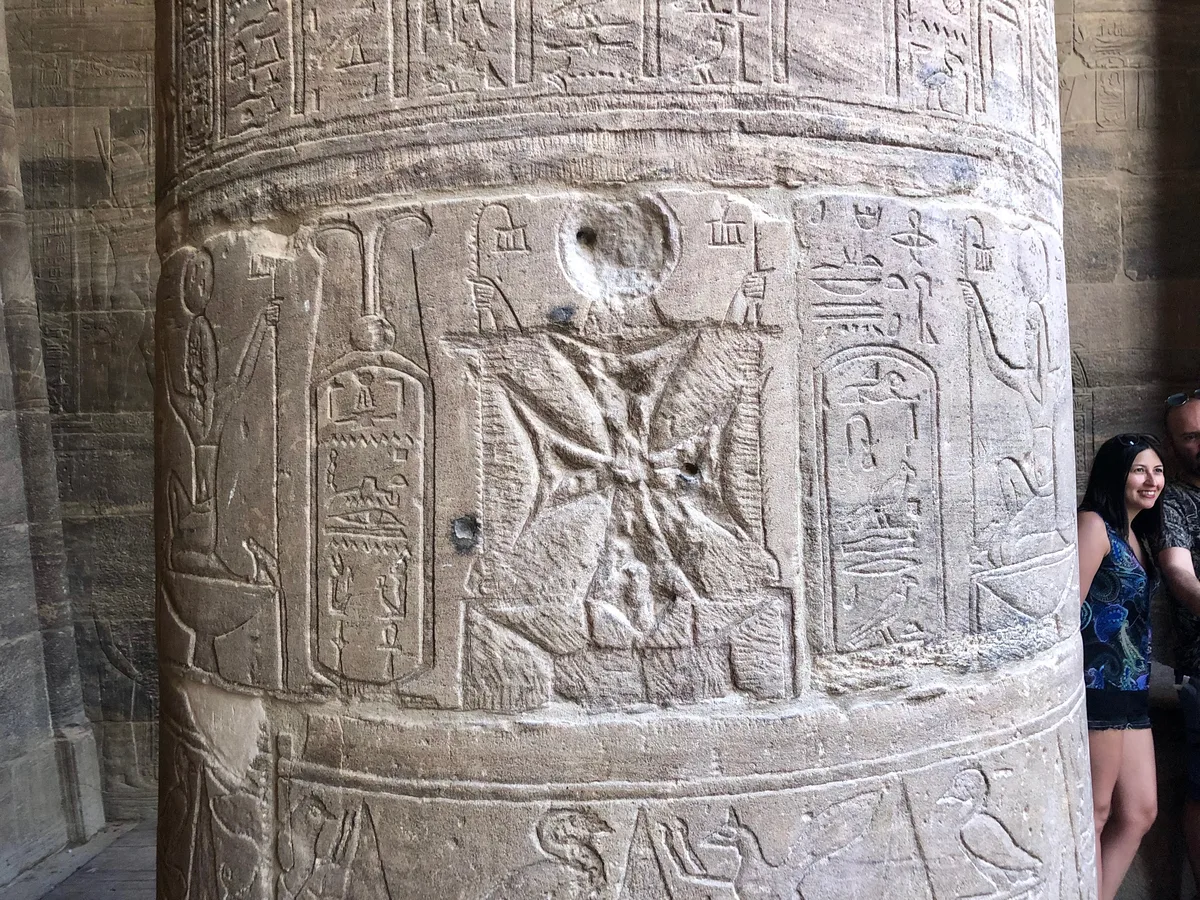
Philae did not stop being sacred when it stopped being pagan, and the evidence is written over the temple in a second hand. Christianity reached the island early – a bishop of Philae is attested in the early fourth century, while the temple was still functioning, and by the fifth century churches and the old cult were operating side by side in an uneasy frontier truce. When Justinian’s order finally closed the sanctuary in about 537, the building was not abandoned; it was converted. The Temple of Isis was rededicated as a church of Saint Stephen, its hypostyle hall fitted with a Christian altar, and across the island five temples were turned into churches, with two more churches purpose-built on the northern ground. The philae temple you walk today is thus two monuments interleaved – a Ptolemaic sanctuary and an early Byzantine church complex – and the seams are visible everywhere once you start looking.
The most eloquent marks are the crosses. Coptic crosses are carved on columns, on door jambs and on the walls of the sanctuary itself, sometimes boldly displayed, sometimes small and almost private. Many pagan figures were defaced – faces chiselled away, bodies hacked – and the ministry’s own summary of the site notes plainly that many inscriptions were deliberately destroyed in the conversion. Yet the defacement at Philae has a strange selectivity that visitors have remarked on for centuries. The figure of Horus was often left untouched when every god around him was attacked, a mercy usually explained by the falcon god’s perceived resemblance to Christian imagery – the mother and child of Isis and Horus, too, echo in ways that eased the transition for converts. And in the hypostyle hall, the Christians plastered over one great relief and painted a saint upon it, an act of overwriting that preserved what it hid; as the plaster decayed, the ancient carving re-emerged beneath the fading saint, two devotions occupying one wall.
Treat this layer as part of the visit rather than damage to it. Almost every Egyptian temple has Christian graffiti; nowhere else was the old religion still alive when the new one arrived, so nowhere else is the negotiation between them so complete in one place. The crosses of Philae are the signature of the sanctuary’s second congregation, and the island remained a Christian centre long after the closure – a bishopric at the gate of Nubia, facing a south that Egypt’s church hoped, with mixed success, to convert. The last word of the ancient world at Philae is not a hieroglyph. It is a cross, cut into a column of Isis’s house by someone who intended to worship in it for the rest of his life.
How a Visit Works – Boats, Tickets and the Evening Show
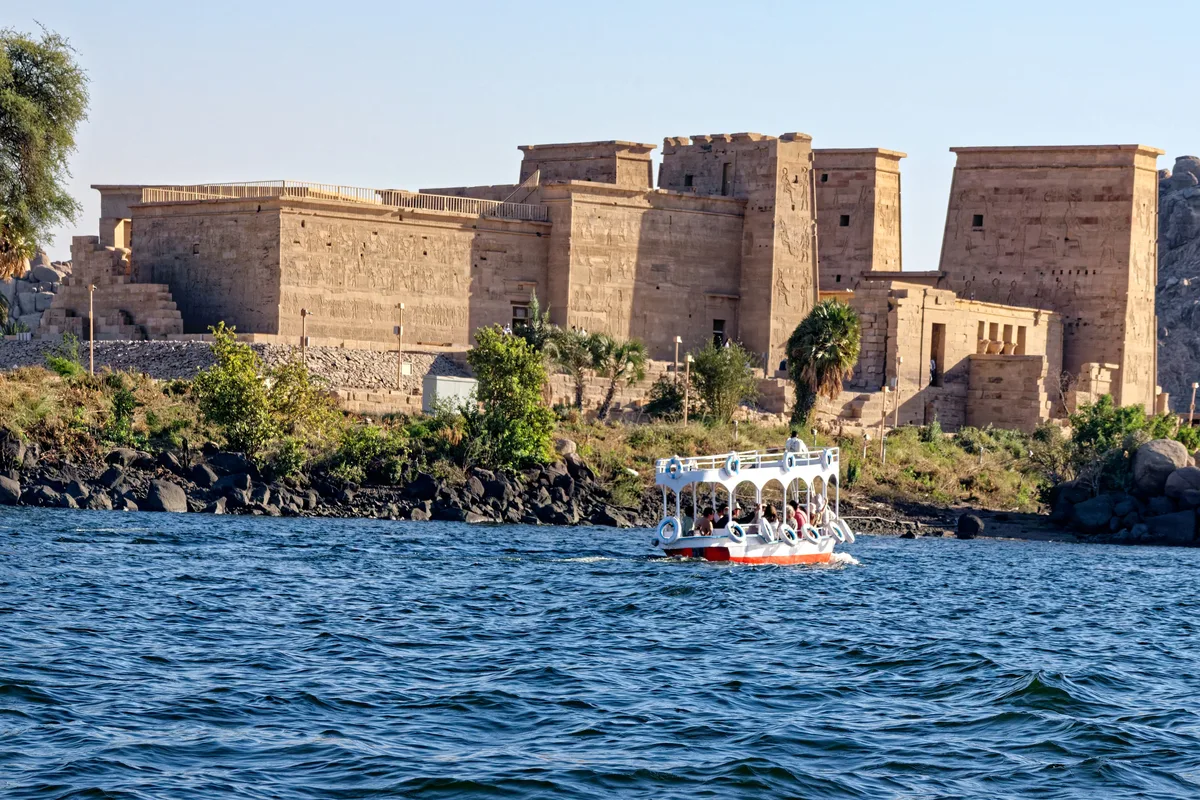
The mechanics come first, because the philae temple has more moving parts than most Egyptian sites. The island lies in the reservoir south of Aswan, and the gateway is the Philae marina at Shellal, on the mainland shore – a drive of roughly twenty minutes from the city centre, out past the Low Dam. Taxis make the run all day, and hotels and cruise boats will arrange cars; agree the fare before you set off, as everywhere in Aswan, and if you are coming independently the practical pattern is to have your driver wait, or to arrange the return pickup for a set time, because the marina is a working harbour rather than a taxi rank. Nile cruise passengers usually arrive as a group excursion with the transfer handled; independent travellers piecing the visit together themselves should simply allow more time than the map suggests.
At the marina you buy the temple ticket from the official ticket office before you board – the entrance ticket and the boat are separate arrangements, and confusing the two is the source of most friction at Philae. The ticket office is the state’s; the boats are run by the local boatmen as their own business, and there is no single posted fare that settles the matter, which is why the crossing is negotiated. Do the negotiation once, calmly, on the quay, and make sure the price you agree covers the return trip and a stated waiting time on the island – two hours is a fair allowance – because the same boatman waits for you at the island landing and brings you back. The crossing itself takes about ten minutes, out between the granite boulders of the cataract reach, and on a good morning it is no chore at all; the temple assembles itself in front of you, pylon by pylon, in the way its builders and its rescuers both intended it to be seen.
On the island, the visit walks the route this philae temple guide has followed – landing, kiosk, dromos, the temple in walking order, then the eastern terrace, the kiosk of Trajan and the Hathor temple, and out to the Gate of Hadrian before your boat time runs down. Facilities are modest; there are toilets and a small café by the landing, but shade is scarce and the stone reflects the heat, so carry water from the marina. The temple opens early in the morning – the current hours are posted at the ticket office and on the Ministry of Tourism and Antiquities’ Philae page, and they shift with the season, so check rather than trust any printed timetable, this one included – and the visit is shaped by two rhythms. The first is the light – early morning gives you the softest sun on the pylons and the best chance of the halls before the groups; late afternoon warms the stone to gold but runs against closing. The second is the crowd rhythm of the cruise schedule, which delivers its groups mid-morning. In summer, when Aswan is among the hottest cities in Egypt, the early start stops being a preference and becomes the whole strategy.
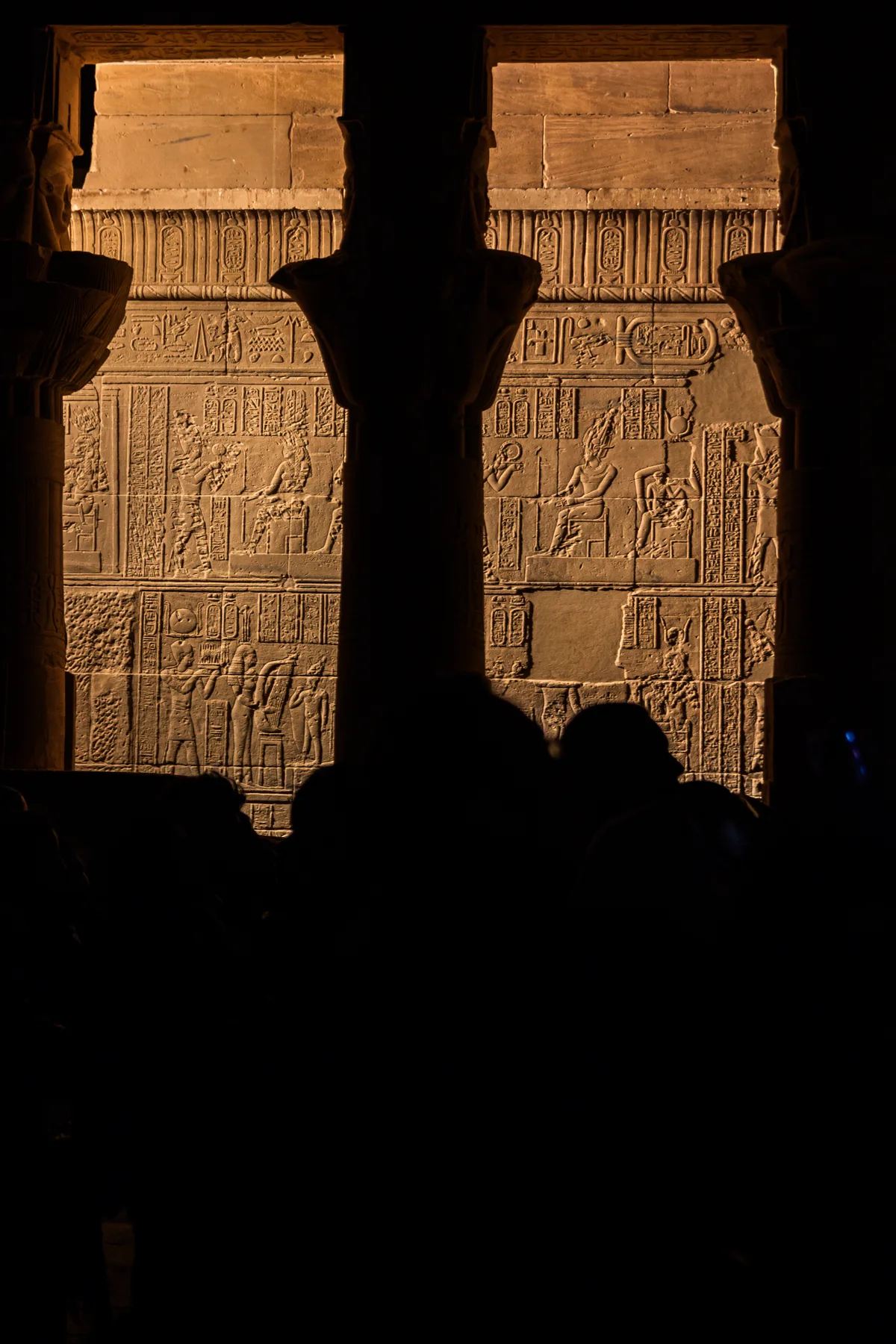
After dark, the island changes register entirely. A sound-and-light show runs at Philae in the evening – a narrated retelling of the myth of Isis and Osiris, with the temples floodlit and the story moving from building to building as the audience walks the route in the dark. It is a separate ticket, bought separately from the day visit, and the performances rotate languages on different evenings, so the practical step is to check the current schedule and language before you commit an evening to it. As theatre it is old-fashioned; as a way of seeing the temple’s silhouettes double themselves in black water, it earns its place, and it is the only way to be on the island at night.
Combining Philae with Aswan and the South
The philae temple is the anchor of a southern day, and Aswan rewards the traveller who builds outward from it rather than treating the temple as a box to tick between trains. The natural pairings run south and north from the marina. On the same southern road sit the Unfinished Obelisk in Aswan’s ancient granite quarries – the largest known obelisk of the ancient world, still lying in its trench where a crack killed it – and the High Dam itself, the engineering work that made the temple’s rescue necessary; a morning that takes in the dam, the obelisk and Philae tells one continuous story of granite, water and power across four thousand years. Back in the city, the Nubian Museum is the temple’s essential companion – its collection covers exactly the frontier culture that worshipped at Philae, including the world of the Blemmyes and the Christian kingdoms that followed, and an hour there after the island makes half the reliefs you saw fall into place.
The water is the other half of an Aswan day. A felucca, the white-sailed lateen boats that work the cataract reach, will take you around Elephantine Island and past the botanical garden on Kitchener’s Island in the last light, with Bigeh and Agilkia on the southern horizon. Most Nile cruises begin or end at Aswan, and the temple is the standard first or last excursion of the sailing – if your ship offers it at dawn, take that sailing and thank yourself at midday. And at the far end of the country’s story, set Philae against the Grand Egyptian Museum at Giza when you pass through Cairo – the temple shows you ancient Egypt where it actually lived out its last centuries, and the museum shows you its treasures gathered under one roof; the two visits illuminate each other across the length of the Nile.
The Honest Downsides – Heat, Haggling and the Mid-Morning Surge
A guide that only sells the philae temple is a brochure, so here is the other ledger, plainly kept. The first item is the boat negotiation, the single most complained-about transaction in Aswan. Because the crossing is not folded into the ticket, every independent visit begins with a haggle on the quay, and the opening prices quoted to foreigners can be several times the going rate; the haggling is expected, good-humoured on the boatmen’s side more often than not, and still a poor start to a sacred island. The defence is boring and effective – agree the full arrangement, return trip and waiting time included, before the boat leaves the quay, and keep the agreed figure in your head rather than your temper. Visitors who arrive on a cruise excursion never see this step, which is the one unambiguous argument for the group format here.
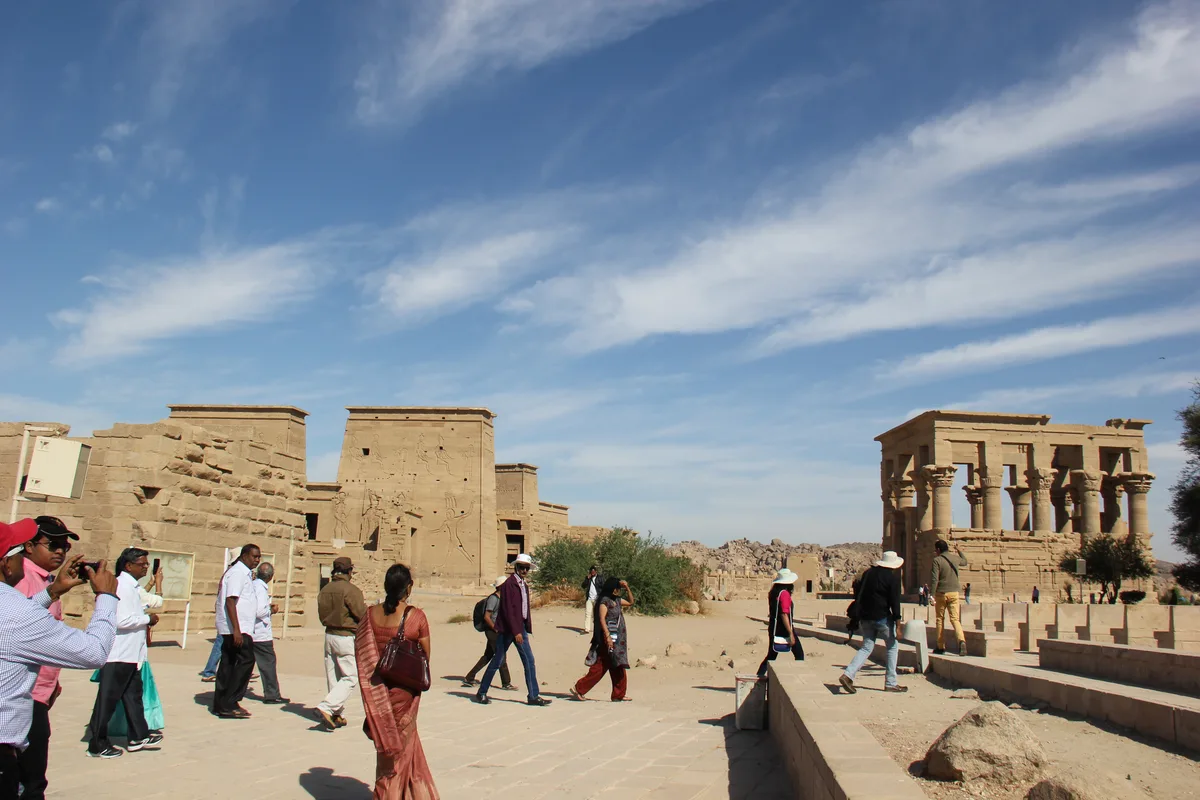
The second item is the sun. Aswan sits at the Tropic of Cancer, and for much of the year the island is a stone platform with almost no shade, the granite radiating heat back at ankle height and the reservoir glare doubling the light. Midday in summer at Philae is not character-building; it is simply punishing, and it flattens the reliefs into glare at exactly the hour the cruise groups are thickest. Which is the third item – the crowd surge. The temple is compact, its finest rooms are small, and when several groups arrive on the same boat cycle, the mammisi and the sanctuary become queues. None of these problems is the temple’s fault, and all of them dissolve with the same remedy – be on the first boats of the morning, when the light is low, the stone is cool and the island briefly belongs to the early risers and the birds.
Two smaller items complete the ledger. The site’s interpretation is thinner than the monument deserves – official signage is sparse, the minor buildings carry almost no explanation, and visitors without a guide or a guidebook will walk past the Gate of Hadrian’s graffito, the island’s single most important square metre, without knowing it was there. And the rescue, for all its triumph, cost the temple its setting’s authenticity in one respect no landscaping could restore – Philae’s original island lies drowned a few hundred metres away, its gardens gone, and the water around Agilkia is a reservoir, managed and still, not the living cataract the priests knew. You are visiting a masterpiece in exile, beautifully housed. It is better to know that, and feel it, than to pretend otherwise.
Philae Temple – Frequently Asked Questions
Is the philae temple on its original island?
No – and this is the first thing to understand before you go. The temples originally stood on the island of Philae, which was flooded after the first Aswan dam was built in 1902 and faced permanent submersion once the High Dam followed. During the UNESCO Nubia Campaign the whole complex was dismantled into about 40,000 blocks and rebuilt on the neighbouring island of Agilkia, reshaped to match the original setting, in a project completed in 1980. The buildings are entirely ancient; the island under them is the replacement.
How do you get to the philae temple?
Only by boat. From Aswan, travel south to the Philae marina at Shellal, buy the entrance ticket at the official ticket office there, then take one of the local motorboats for the crossing of about ten minutes to Agilkia Island. The boat is a separate arrangement from the ticket – agree a price that covers the return crossing and the boatman’s waiting time on the island before you leave the quay.
How long do you need at Philae?
Allow one and a half to two and a half hours on the island for the full circuit – the Temple of Isis in walking order, the mammisi, the Kiosk of Trajan, the Temple of Hathor and the Gate of Hadrian. Visitors on cruise excursions often get considerably less, which is enough for the pylons and the sanctuary but rushes the eastern buildings and the last-hieroglyph gate.
What was the last hieroglyphic inscription?
A graffito carved by a priest of Isis named Esmet-Akhom on the Gate of Hadrian, dated 24 August 394 CE – the last dated text in Egyptian hieroglyphs anywhere in the world. It stands beside a figure of the Nubian god Mandulis. The latest demotic inscription, also at Philae, followed in 452 CE, and the temple itself was not closed until about 537, under the emperor Justinian – later than any other in Egypt.
Can you see the original island of Philae?
Not in any useful sense. The original island lies submerged in the reservoir a few hundred metres from Agilkia; at most, its highest ground and the lines of its setting sit at or below the waterline. What you visit on Agilkia is arranged to reproduce the original layout and contours, which is why the site feels whole rather than transplanted.
Is there a sound-and-light show at Philae?
Yes. An evening sound-and-light performance on the island retells the myth of Isis and Osiris with the temples floodlit, on a ticket separate from the day entrance. Performances are given in different languages on different evenings, so check the current schedule and language before planning an evening around it.
When is the best time of day to visit?
Early morning, for three reasons that compound – the light on the pylons is at its kindest, the heat on an almost shadeless stone island is at its most bearable, and the cruise groups have not yet arrived. Late afternoon flatters the stone but runs against the closing time; midday in the summer months is best avoided outright. Current opening hours are posted at the marina ticket office and on the ministry’s website, and they vary by season.
What else should you combine with Philae in Aswan?
The Nubian Museum for the frontier culture that worshipped here, the Unfinished Obelisk and the High Dam on the same southern circuit, and a felucca sail around Elephantine Island to close the day. Travellers continuing north usually meet the temple again in spirit at the great collections in Cairo.
The Short Version of the Philae Temple Guide
The philae temple is the sanctuary of Isis that refused to die – built by Ptolemaic kings on Egypt’s Nubian frontier, served by priests who were still carving hieroglyphs in 394 CE, converted into a church rather than demolished, drowned by degrees for seventy years, and finally taken apart into 40,000 blocks and rebuilt on the island of Agilkia in the greatest rescue in UNESCO’s history. Go early, by boat from the Shellal marina, with your ticket from the official office and your boat price – return and waiting included – agreed before you leave the quay.
Walk it in order – Nectanebo’s kiosk, the dromos, the first pylon, the mammisi, the darkening halls to the sanctuary – then give the eastern buildings their due, the Kiosk of Trajan at the water’s edge, the laughing reliefs of Hathor’s temple, and the Gate of Hadrian, where Esmet-Akhom carved the last hieroglyphs in the world. Take the full two hours, carry water, and let the place be what it is – the last temple of ancient Egypt, in its second home, still standing over the water it was built to bless.