For a hundred and twenty years, one building held the whole of ancient Egypt. Then, in a single November week in 2025, the most famous fifth of it — every object from Tutankhamun’s tomb, all 5,398 of them — woke up in a new museum at Giza, and the question travellers now ask about the salmon-pink palace on Tahrir Square is a blunt one: is there anything left? This egyptian museum cairo guide exists to answer that question properly, because the honest answer surprises people. What remains in Tahrir is not a leftover. It is still, by the Ministry of Tourism and Antiquities’ own description, the largest collection of Pharaonic antiquities in the world: more than 170,000 artefacts, the Narmer Palette, the seated Khafre, a second royal gold treasure at Tanis that most visitors have never heard of, and the most complete ancient Egyptian burial ever found that is not a king’s. The museum did not empty. It changed jobs.
Understand the change and the visit makes sense. Cairo now has three pharaonic museums, not one, and they divide the story between them. The Grand Egyptian Museum at Giza holds Tutankhamun complete, the colossal Ramesses II and the great chronological galleries. The royal mummies — the actual kings and queens — rest in a third building, the National Museum of Egyptian Civilization in Fustat, where the Pharaohs’ Golden Parade carried them in 2021. And the old museum in Tahrir, the Museum of Egyptian Antiquities, keeps the deep collection: the sculpture, the papyri, the coffins, the jewellery and the everyday objects of five thousand years, in the first purpose-built museum in the Middle East, opened in 1902 and still wearing its history on its walls. Our grand egyptian museum guide covers the new building gallery by gallery; this page is for the old one.
The practical difference matters as much as the poetic one. The Tahrir museum is downtown, on the metro, beside the Nile hotels, and a visit takes two to three unhurried hours rather than the GEM’s half-day expedition out to Giza. Its displays are a deliberate mixture of the freshly redone and the gloriously untouched — some galleries have been redisplayed under a long-running international masterplan, others still present their cabinets exactly as a visitor of 1910 would have found them, labels and all. Travellers who want the story told to them with light, space and screens should start at Giza. Travellers who want to stand in the room where Egyptology grew up, surrounded by more antiquities than any label budget could ever civilise, come here — and this egyptian museum cairo guide walks the building the way it rewards being walked: chronologically, ground floor first, with the famous rooms and the quiet ones in their real order.
One promise before the detail, because it shapes the practical sections. This guide prints no ticket prices. The museum’s official site and the ministry’s museum page list the current figures — they differ for Egyptian and foreign visitors, they change, and the guides that print confident price tables are printing numbers that rot. What this guide gives instead is the mechanism: where the tickets come from, what the ministry’s own page says the hours and the photography rules are (checked 31 October 2026), and how to shape the day so the museum’s crowds and Cairo’s traffic never get a vote. For the country around the capital, our egypt travel guide carries the full picture; this page stays inside one extraordinary building.
Egyptian Museum Cairo at a Glance
Here is the whole visit on one screen, before the sections below take each part properly. Read the “where” column with care — in post-GEM Cairo, knowing which building holds what is half of planning the trip.
| Question | Short answer |
|---|---|
| What is it | The Museum of Egyptian Antiquities – the original national collection, in its 1902 palace on the north side of Tahrir Square |
| The collection | Over 170,000 artefacts, Predynastic to Graeco-Roman (c. 5500 BC – AD 364) – still the largest Pharaonic collection in the world |
| What left | Tutankhamun’s complete tomb group (to the GEM, 2025), the royal mummies (to the NMEC in Fustat, 2021), Khufu’s solar boat (to the GEM) |
| What stayed | Narmer Palette, Djoser, Khufu’s statuette, Khafre Enthroned, the Tanis treasure, Yuya and Thuya complete, papyri, coffins, animal mummies |
| The building | Opened 15 November 1902; designed by Marcel Dourgnon, winner of an 1895 international competition; the Middle East’s oldest archaeological museum |
| Getting there | Sadat metro station (Lines 1 and 2) opens onto Tahrir Square; the museum stands on the square’s northern side |
| Hours | The ministry’s museum page lists daily opening 09:00-17:00, last ticket 16:00 (shorter in Ramadan) – checked 31 Oct 2026, recheck before you go |
| Photography | Mobile-phone photography is free per the ministry’s page; no flash; video and camera use carry their own ticket rules |
| How long | Two to three hours for the full two floors at a reading pace; ninety minutes for a highlights circuit |
| Pairs with | A downtown day – the Nile Corniche, Islamic Cairo and the Citadel; the GEM pairs separately with a Giza day |
Two judgements sit behind that table. The first is that the Tahrir museum is now the connoisseur’s museum: the GEM tells Egypt’s story better, but Tahrir holds more of Egypt itself, including pieces — the Tanis gold, the Yuya and Thuya burial — that have no equivalent anywhere, Giza included. The second is that its famous flaw is real and should be planned around rather than discovered: interpretation is thin, many labels are old, small or Arabic-only, and the building rewards a visitor who arrives with a route and a shortlist. That is what the rest of this page provides.
Two Museums, One City – What the GEM Changed and What It Did Not
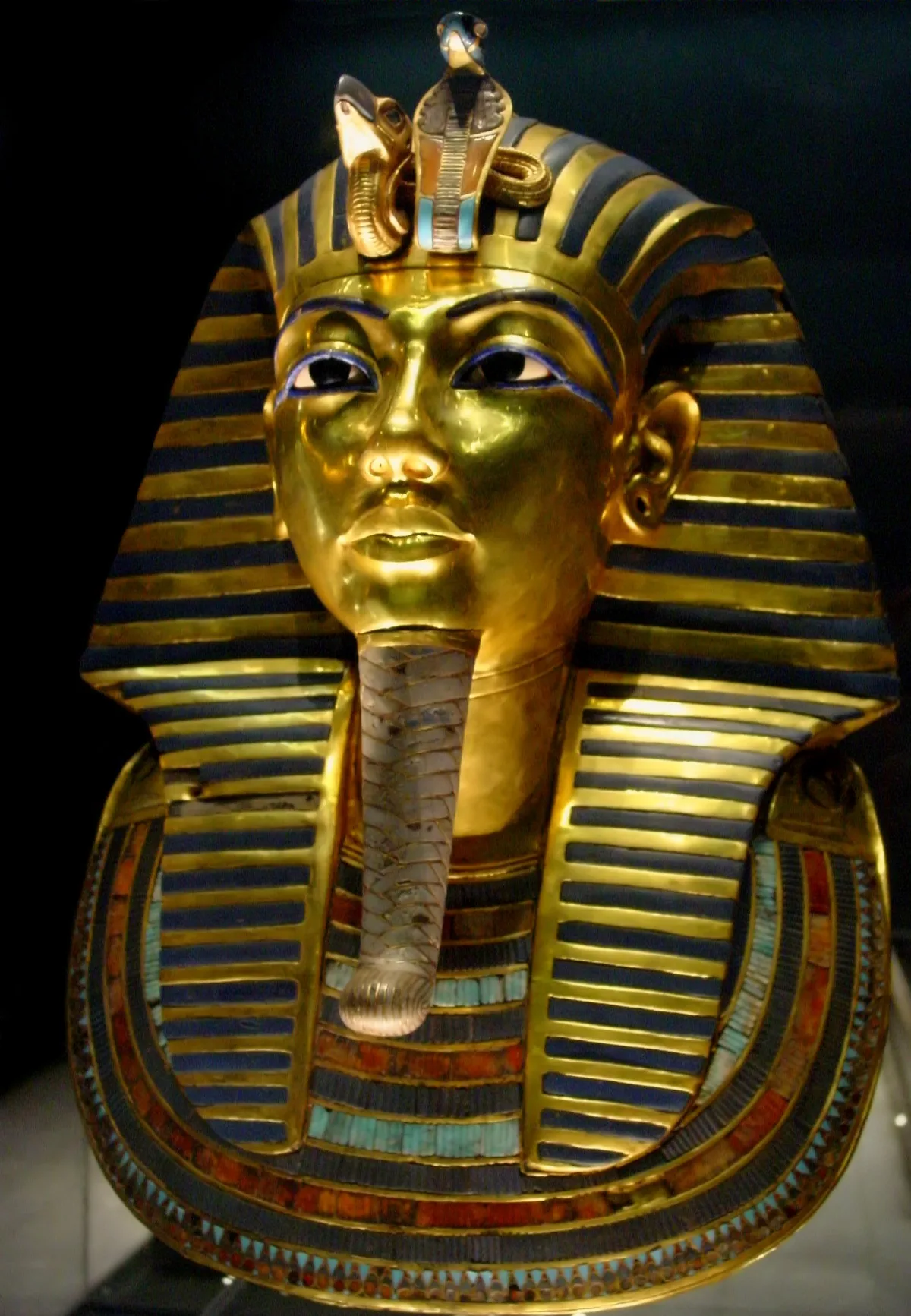
For decades the logic of a Cairo trip was simple: you went to Tahrir for Tutankhamun, and everything else in the museum was the supporting cast. The boy king’s mask sat in a modest first-floor gallery, the gold caught in a cabinet’s spotlights, while the rest of his tomb group — the beds, the chariots, the shrines, the thousands of smaller things — filled the surrounding rooms. When the Grand Egyptian Museum finally opened in full on 1 November 2025, with public entry from 4 November, the 103rd anniversary of the tomb’s discovery, Tutankhamun moved out entire: all 5,398 objects, displayed together in one place for the first time since Howard Carter’s team carried them out of the Valley of the Kings. Our grand egyptian museum guide walks those two great halls and the rest of the new building in detail.
What the move did not do is equally important, because a surprising amount of what is written about this museum still gets it wrong. The GEM did not take “the best of Tahrir” in general. It took Tutankhamun, the Ramesses II colossus that had stood in Ramses Square, Khufu’s boats, and a selection of pieces for its chronological galleries — and the Ministry of Tourism and Antiquities’ own current page for the Egyptian Museum in Cairo still headlines its Tahrir collection with the complete burials of Yuya and Thuya, the treasures of Tanis, the Narmer Palette and the statues of Khufu, Khafre and Menkaure, the pyramid builders themselves. The core of the old museum — the sculpture sequence, the coffins and sarcophagi, the papyrus collection, the jewellery — stayed exactly where it has always been, on the north side of Tahrir Square.
So the two buildings are not rivals so much as a division of labour, and a traveller with two museum days in Cairo should use both without a flicker of guilt about repeating themselves. Giza gives you the single greatest tomb group ever found, presented as one story in two cathedral-sized halls, plus the broad chronological sweep told with modern means. Tahrir gives you depth, density and the particular pleasure of a museum that is itself an artefact — where a case of Predynastic flints sits two rooms from a masterpiece of New Kingdom goldsmithing, and the handwriting on some of the labels predates the aeroplane. The sections below take Tahrir on its own terms: first its strange biography, then the building, then an honest ledger of what left and what stayed, then the rooms in the order to walk them.
From Bulaq to Tahrir – How the Collection Got Its Palace
The museum’s biography begins with an act of rescue. In the middle of the nineteenth century, Egypt’s antiquities were leaving the country in a steady stream — consuls and collectors shipped statues, coffins and whole tomb groups down the Nile and off to Turin, London, Paris and Berlin, quite legally under the rules of the day. The man who stopped the drain was Auguste Mariette, a French Egyptologist who arrived in 1850 hunting manuscripts and stayed to change everything. In 1858 he was appointed head of a new Antiquities Service with a simple, revolutionary brief: excavate for Egypt, and keep what was found in Egypt. The collection he began assembling needed a home, and in 1863 it got one — a converted warehouse at Bulaq, the river port of Cairo, with Mariette himself living on site like a lighthouse keeper guarding the nation’s memory.
Bulaq was always too small and too damp for what it held, and in 1878 the Nile made the point brutally, flooding into the galleries. After Mariette’s death in 1881 — he is buried in the garden of the present museum, in a sarcophagus surrounded by statues of the gods, which tells you what Egypt thought of him — the search for a permanent home resumed. In 1890 the collection moved up the hill to Giza, into a palace of the former Khedive Ismail, where the antiquities spent a decade as houseguests in a pleasure dome: splendid rooms, wrong building. The solution was a competition. In 1895 Egypt ran what the ministry’s museum page calls the first international competition of its kind, for a purpose-built museum in the capital — and the winner, from a field of European architects, was a Frenchman, Marcel Dourgnon.
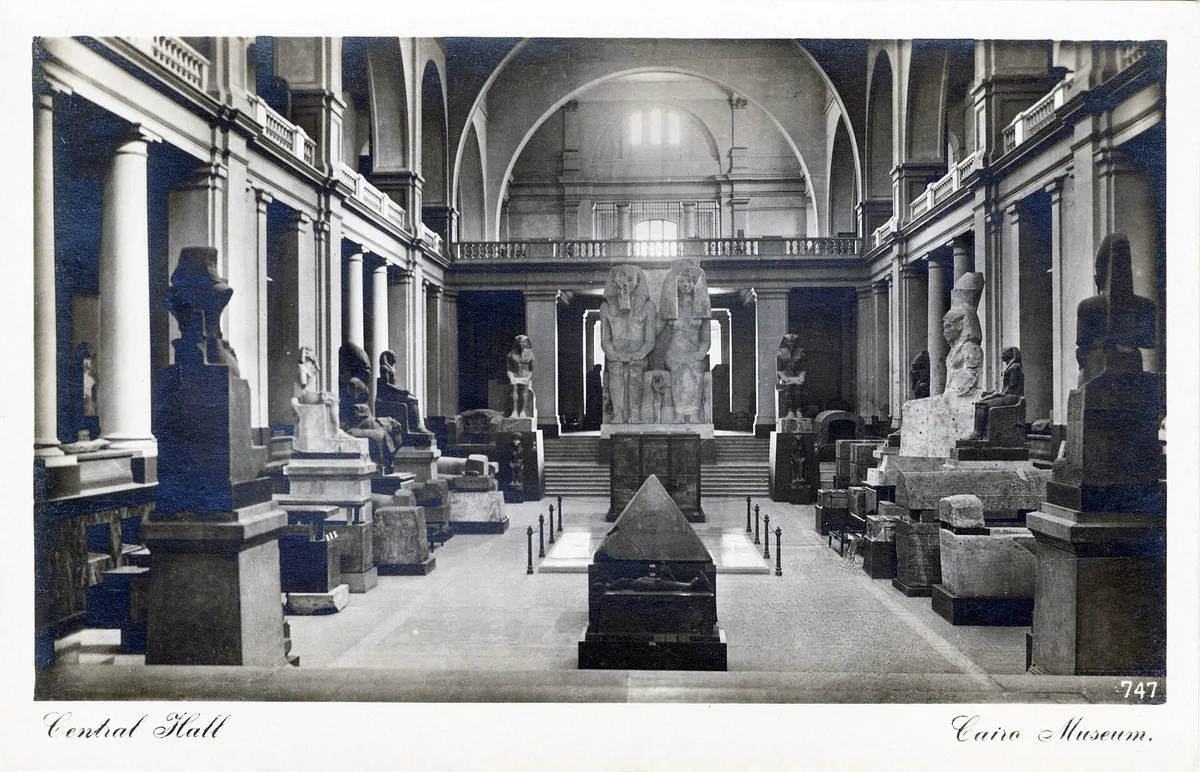
The foundation stone was laid in 1897 by Khedive Abbas Helmy II on the northern edge of what was then Ismailia Square, and on 15 November 1902 the Khedive inaugurated the building the collection still occupies. Think about what that date means. The Egyptian Museum in Cairo opened when Tutankhamun’s tomb still lay twenty years in its future, undiscovered under the Valley of the Kings. The palace was built for the Egypt of the nineteenth-century excavators — for Mariette’s Serapeum bulls, for the Deir el-Bahari cache, for the great statues coming out of Karnak — and then the twentieth century filled it past bursting: the Tanis treasure in 1939, Tutankhamun from 1922 onwards, generation after generation of finds, until the “temporary” overflow became the museum’s defining character. The building a visitor walks today is therefore two things at once: a purpose-built museum of 1902 and the sediment of everything Egypt found next. That double nature explains both its charm and its chaos better than any complaint about dust. Every later chapter of the Egyptian Museum Cairo’s life — the Tutankhamun decades, the overflow years, the slow renovation, the arrival of the GEM — plays out inside that single 1902 decision.
The Building Itself – Dourgnon’s Pink Palace
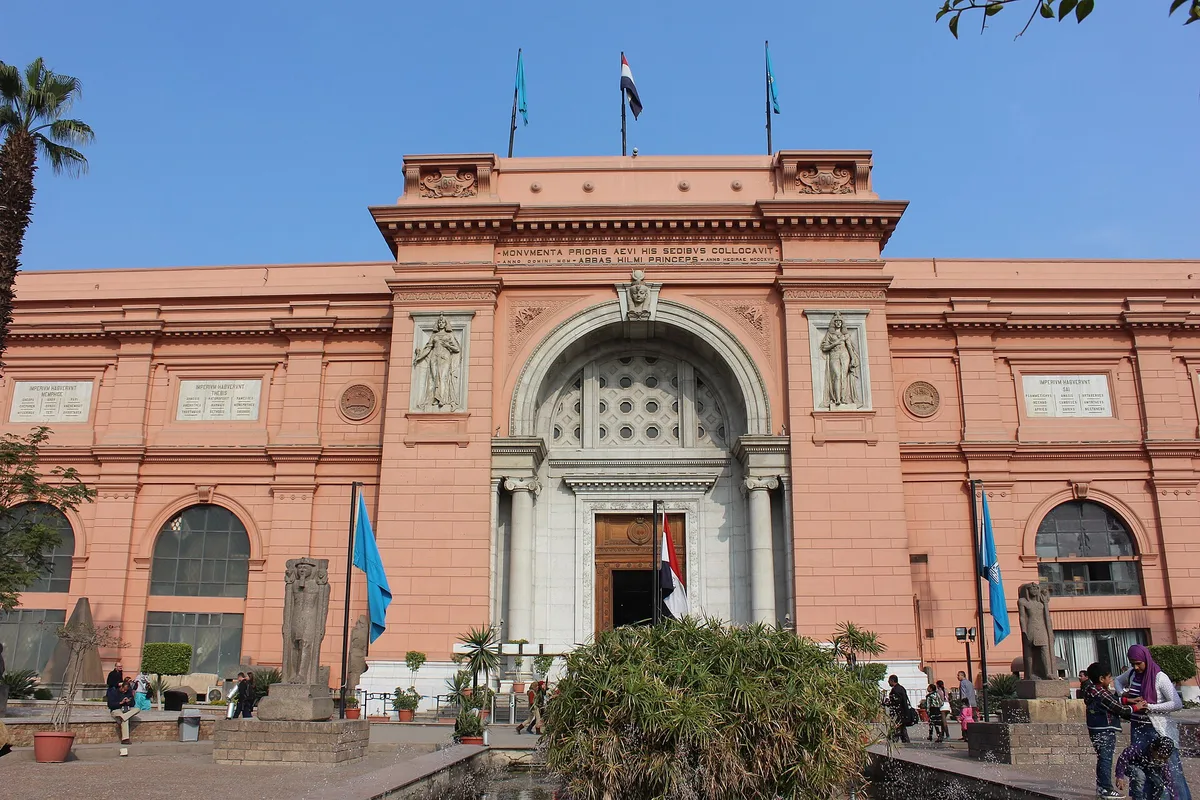
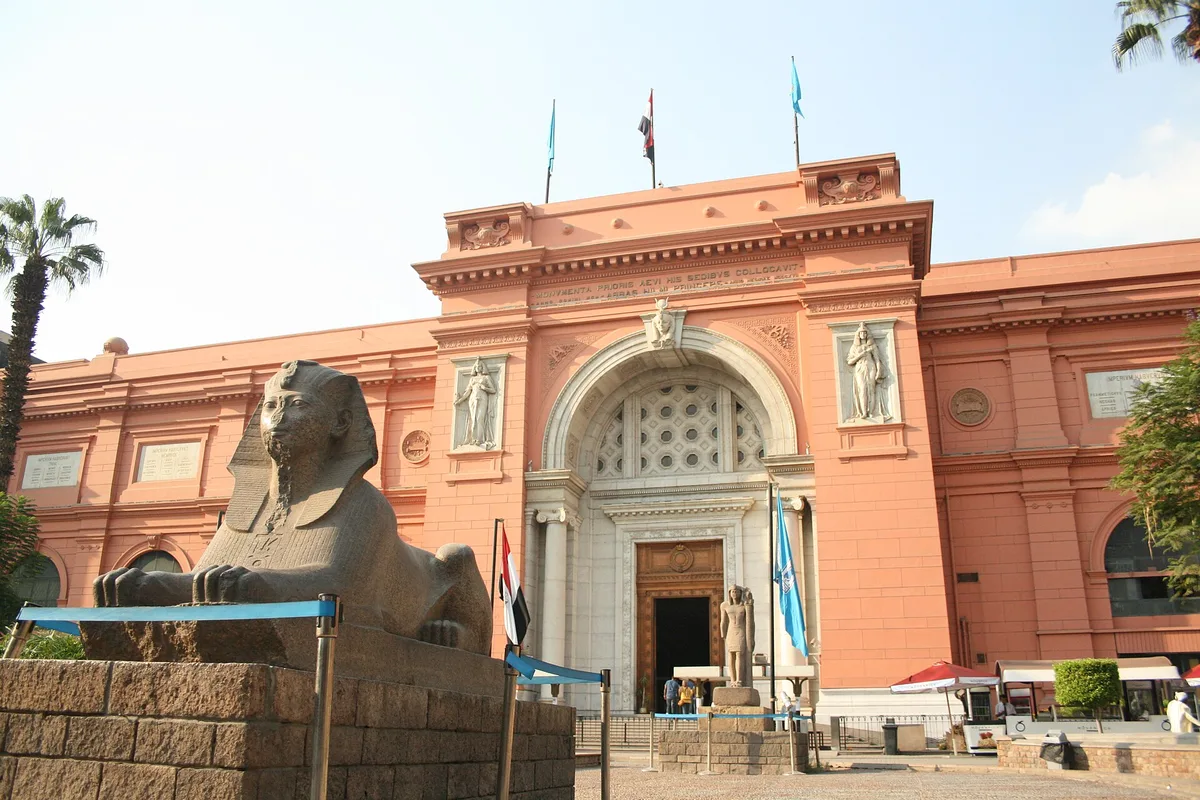
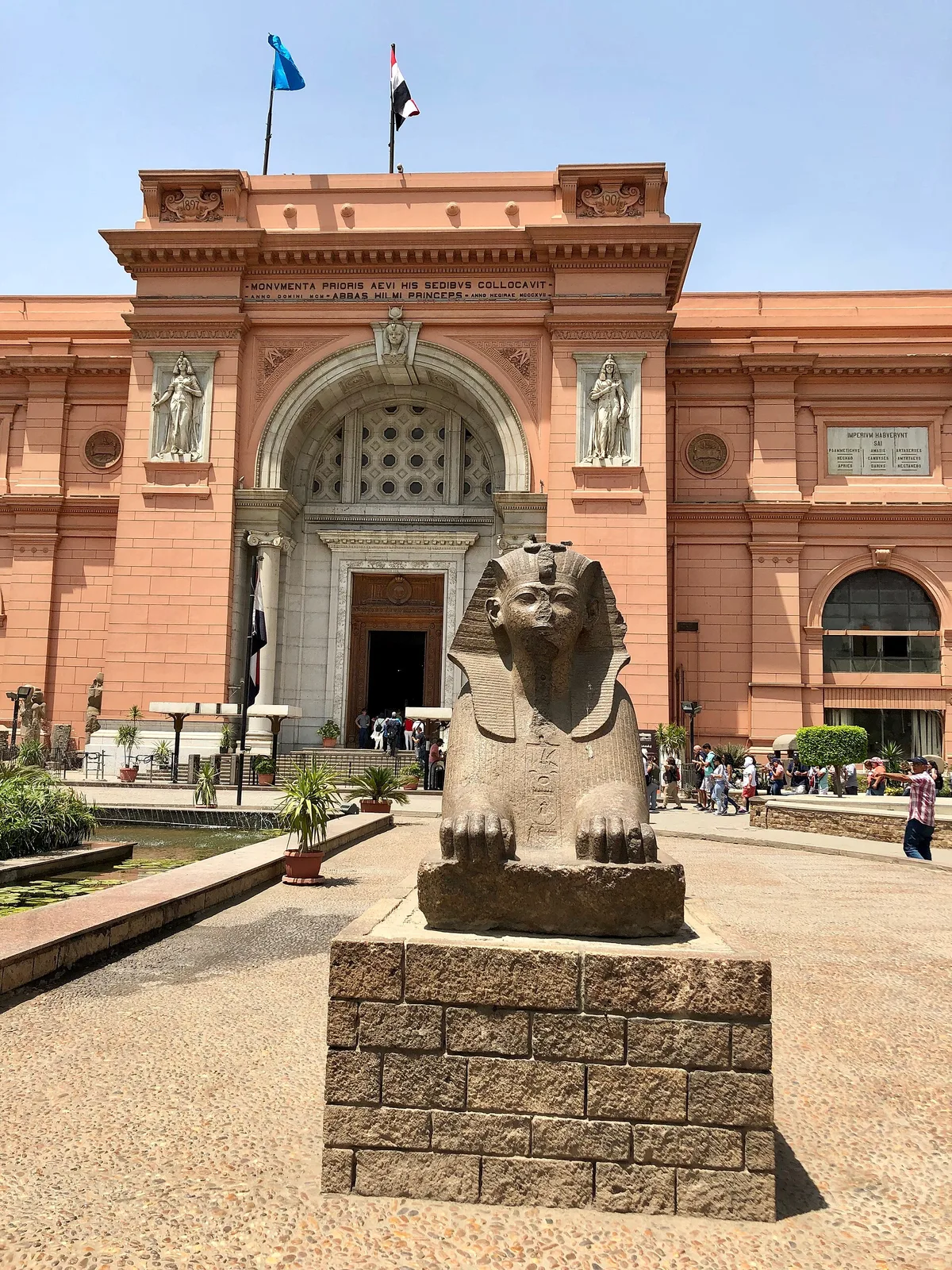
Stand in Tahrir Square and look north, and the first exhibit is the museum itself. Dourgnon’s winning design is a long, low, salmon-pink palace in a neoclassical idiom Egypt had never seen: two storeys of arched windows under a strong cornice, and at the centre a vast arched entrance porch, its coffered semi-dome pierced with roundels, flanked by two classical female figures representing Upper and Lower Egypt. Above the arch runs a Latin inscription recording that Abbas Helmy II gathered the monuments of a former age into this seat — the building announces itself as a temple of national memory in the language of European scholarship, which is precisely the tension that built it. It is generally counted the first purpose-built museum building in the Middle East, and the ministry’s page still calls the institution the oldest archaeological museum in the region.
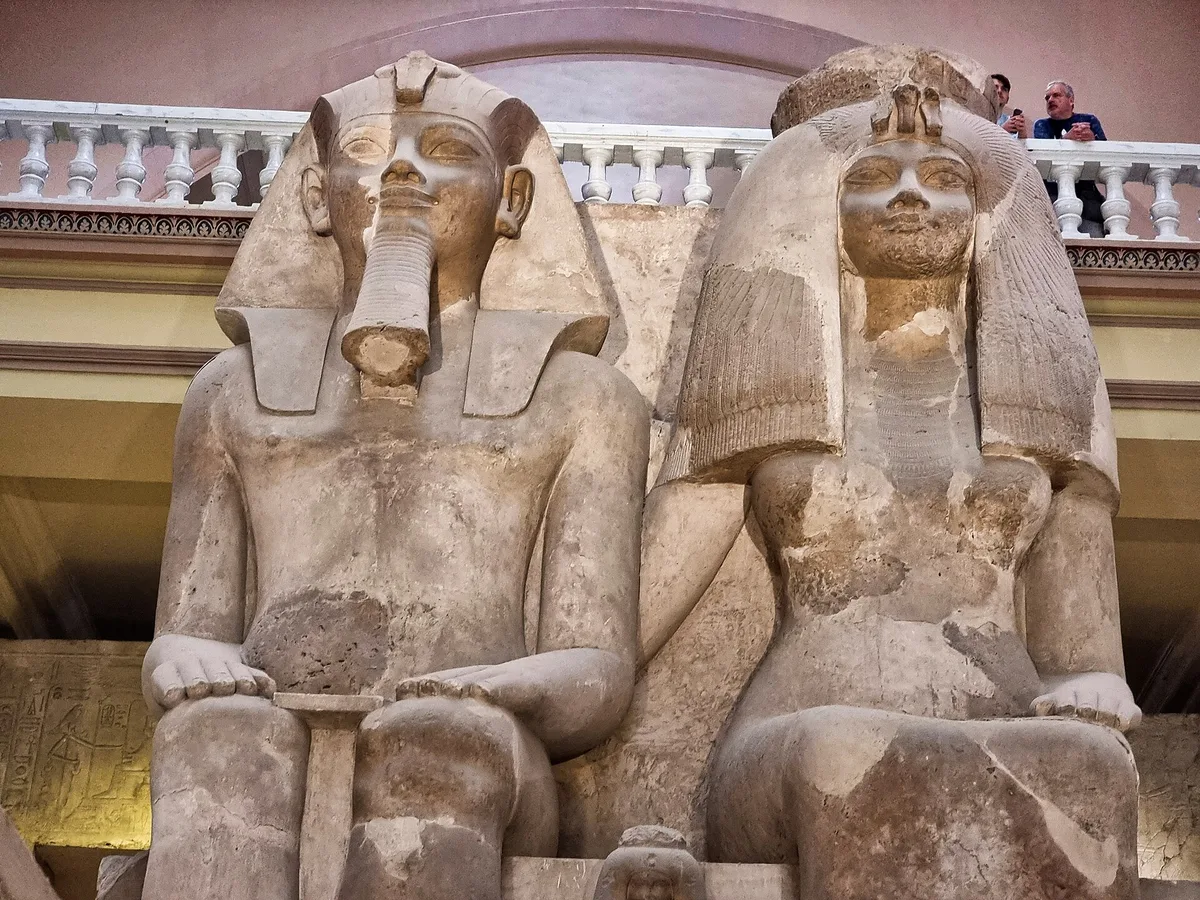
Inside, the plan is a lesson in 1902 museum logic. You enter into a soaring central atrium, open to the first-floor balconies, where the colossal statue of Amenhotep III and Queen Tiye presides over the crossing like a greeter hired three thousand years in advance. The ground floor arranges its galleries around that atrium in chronological order — heavy stone first, as the building’s engineers intended, with the sarcophagi, stelae and statuary of successive kingdoms marching around the rectangle. The first floor, reached by the stairs at the atrium’s corners, holds the lighter and more precious things by theme rather than date: tomb groups, jewellery, coffins, papyri, coins, and the small finds of daily life. The official Egyptian Museum Cairo site puts the holdings at over 170,000 artefacts; even a determined visitor sees a fraction, which is why the route sections below are a route, not a catalogue.
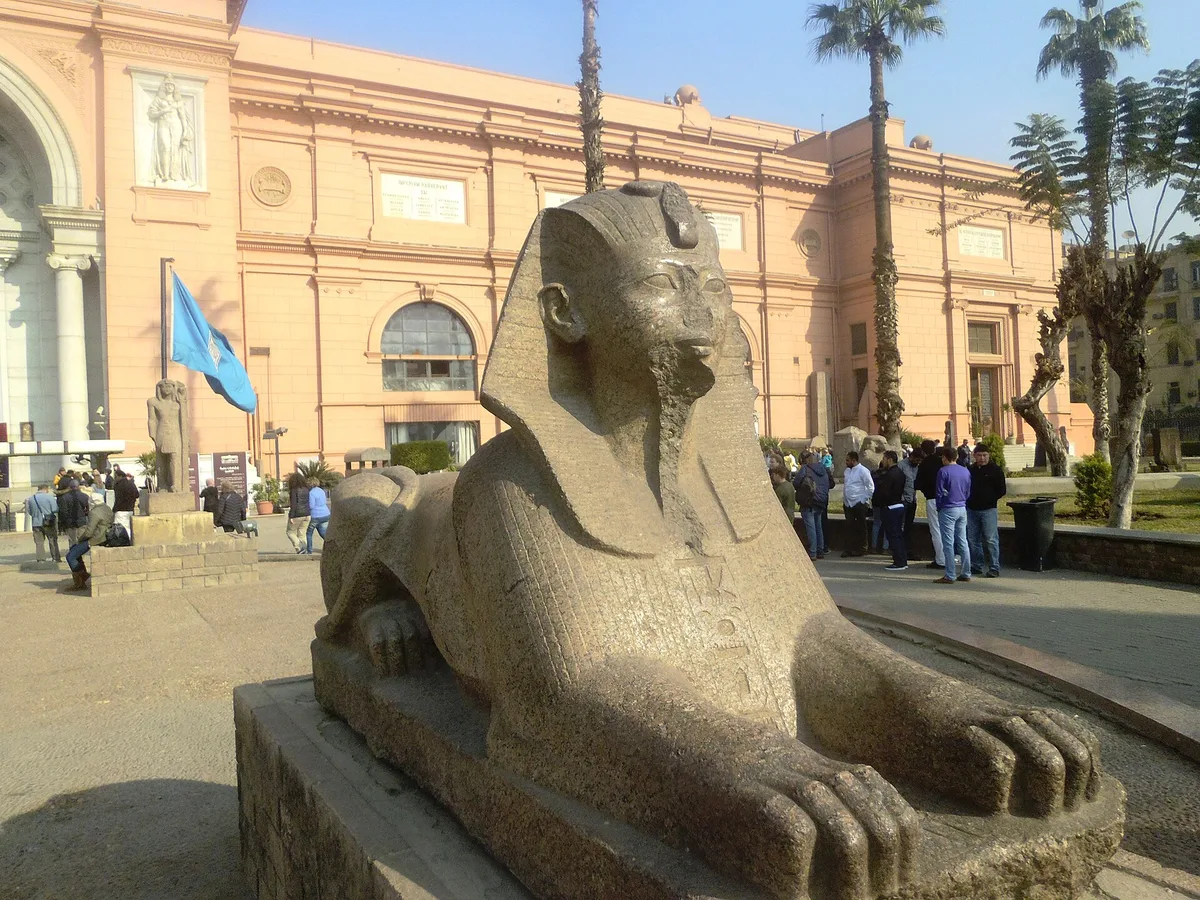
Do not skip the garden. The grounds between the square and the facade are an open-air annexe — sphinxes, statues and stelae stand among the palms, school groups picnic on the grass, and at the garden’s heart sits Mariette’s memorial, the founder’s tomb ringed by busts of the great Egyptologists who followed him. It is the right place to begin an egyptian museum cairo visit, coffee in hand, before the density indoors: the garden sets the scale of the enterprise, one Frenchman’s idea that a nation should keep its own past, grown into a small city of stone.
What Has Moved Away – Tutankhamun, the Royal Mummies and the Solar Boat
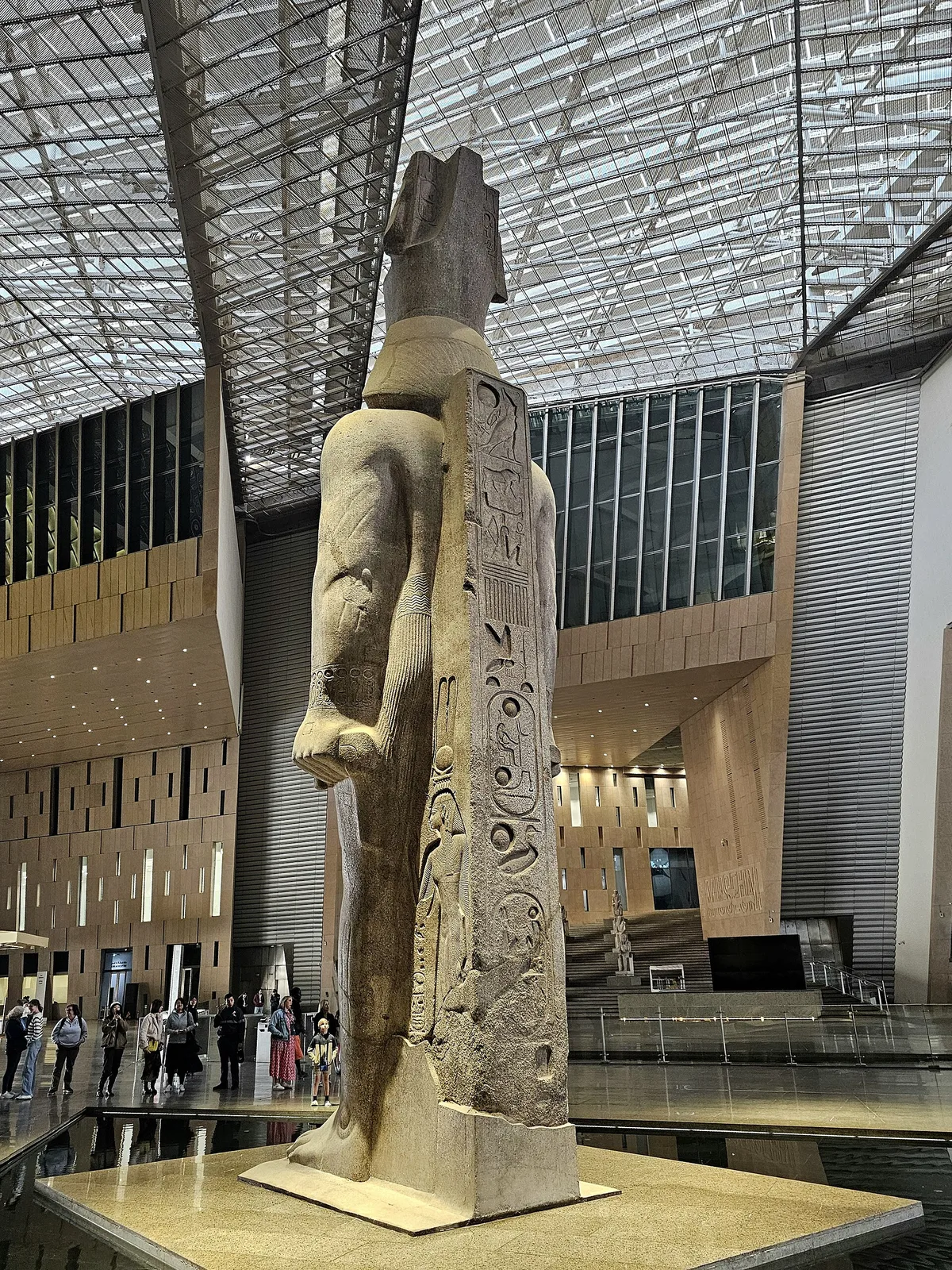
Honesty first: three famous things you may have come to Tahrir expecting are no longer here, and a guide that lets you discover that at the ticket desk has failed you. The greatest departure is Tutankhamun. The complete contents of his tomb — 5,398 objects, from the gold mask and the nested shrines down to sandals, board games and jars of provisions — are now displayed together in the Grand Egyptian Museum, where the GEM’s two Tutankhamun halls opened with the museum’s full inauguration on 1 November 2025. Nothing of the tomb group remains on display in Tahrir. If the boy king is your reason for coming to Cairo, he is your reason for going to Giza; our grand egyptian museum guide is the page for that visit, and this one will not pretend otherwise.
The second departure is older and stranger. The royal mummies — the preserved bodies of Seqenenre, Hatshepsut, Thutmose III, Seti I, Ramesses II and their fellow kings and queens — were for decades the Egyptian Museum Cairo’s most visited room, a hushed gallery on the first floor where the pharaohs themselves lay in glass cases. In April 2021 they left in the Pharaohs’ Golden Parade, carried through the streets of Cairo in specially built vehicles in one of the great state spectacles of modern Egypt, to a new home in the National Museum of Egyptian Civilization at Fustat, south of the centre. Twenty-two royal mummies made the journey. A traveller whose Cairo list says “see Ramesses II” wants the NMEC, not Tahrir — and should know that the NMEC is a third museum, with its own day-shape, not an annexe of either building on this page.
The third departure is quieter: Khufu’s solar boat, the magnificent 4,500-year-old cedar vessel excavated beside the Great Pyramid in 1954 and displayed for decades in its own museum at Giza — and sometimes loosely described in old guidebooks alongside the Tahrir collection — was moved in 2021 to the GEM, where it now sits in a dedicated boat building, joined by its still-being-reconstructed sister ship. Add to these the pieces the GEM drew from Tahrir’s stores and galleries for its chronological halls — Queen Hetepheres’ treasures among them — and the pattern is clear. What left was, mostly, the famous and the singular: the complete tomb, the kings’ bodies, the boat. What stayed is the civilisation around them, in a depth no new museum could absorb. That ledger is the subject of the next section, and it is a longer list than the departures.
What Remains – a Collection the Ministry Still Calls Unrivalled
So what, precisely, is left? Start with the ministry’s own answer, because it is a strong one. The Ministry of Tourism and Antiquities’ current page for the Egyptian Museum Cairo describes a collection it calls unrivalled, and names its headliners: the complete burials of Yuya and Thuya, Psusennes I and the treasures of Tanis, the Narmer Palette, and the splendid statues of Khufu, Khafre and Menkaure — before it even gets to the extensive papyri, sarcophagi and jewellery. In other words, the department that also runs the GEM looked at what remains in Tahrir and chose to boast about it. The boasts are justified. Two of the named highlights are things the GEM does not have and cannot get: the Tanis treasure is a second intact royal burial assemblage of gold and silver, found on the eve of the Second World War, and Yuya and Thuya are the most complete non-royal burial ever excavated — a whole tomb’s furniture, chariot, beds, boxes and gilded masks, kept together as a group the way Tutankhamun’s group is kept together at Giza.
Then there is the sculpture, which is the deepest bench of all. The ground floor’s chronological march runs from the Narmer Palette and the oldest life-size royal statue in stone — Djoser’s — through the only known complete portrait of Khufu, the builder of the Great Pyramid, a palm-sized ivory figure that would be easy to walk past and impossible to forget; through Khafre enthroned in dark diorite with the Horus falcon folding its wings around his head; through the painted limestone faces of Rahotep and Nofret, the wooden Ka-aper so lifelike his excavators’ wives nicknamed him the Sheikh el-Balad, the village headman; past Hatshepsut and Thutmose III, the Amarna strangeness of Akhenaten’s colossi, the seven-metre Amenhotep III and Tiye in the atrium, and on into the Late Period and the Graeco-Roman world. Art historians fly across oceans for single items on that list. At the Egyptian Museum Cairo they queue up around one rectangle of galleries, much of it with the calm of things that have not been moved, relit or reinterpreted in living memory.
And beyond the masterpieces lies the museum’s second identity: the great research storehouse that happens to let the public in. Whole rooms of coffins stacked in chronological herds. Cabinets of shabtis, scarabs, amulets and tools in their hundreds. A papyrus collection of international rank. Coins that run from the first struck money in Egypt to the Islamic era. Animal mummies by the shelf-load. This is the material Egyptology is actually built from, and the GEM — which displays some 20,000-plus objects in its galleries — was never going to absorb a working collection of 170,000. An egyptian museum cairo visit today is therefore not a visit to a husk. It is a visit to the deepest single store of pharaonic material on earth, part of which has been polished for you and part of which has simply been opened. The rooms, in walking order, come next.
The Ground Floor – Walk the Kings in Chronological Order
The ground floor is the museum’s spine, and it has a direction: chronology. The galleries run around the central atrium in the order of the kingdoms, so a visitor who simply keeps the atrium on the same side and walks will read Egyptian sculpture the way it developed, from the first dynasties to the Romans, in about ninety minutes of stone. This is the single most useful structural fact in any egyptian museum cairo guide, because the floor does not advertise it loudly. Begin on the ground floor, walk the rectangle, and let the first floor — thematic, denser, easier to get lost in — be the second act, taken with the energy that remains.
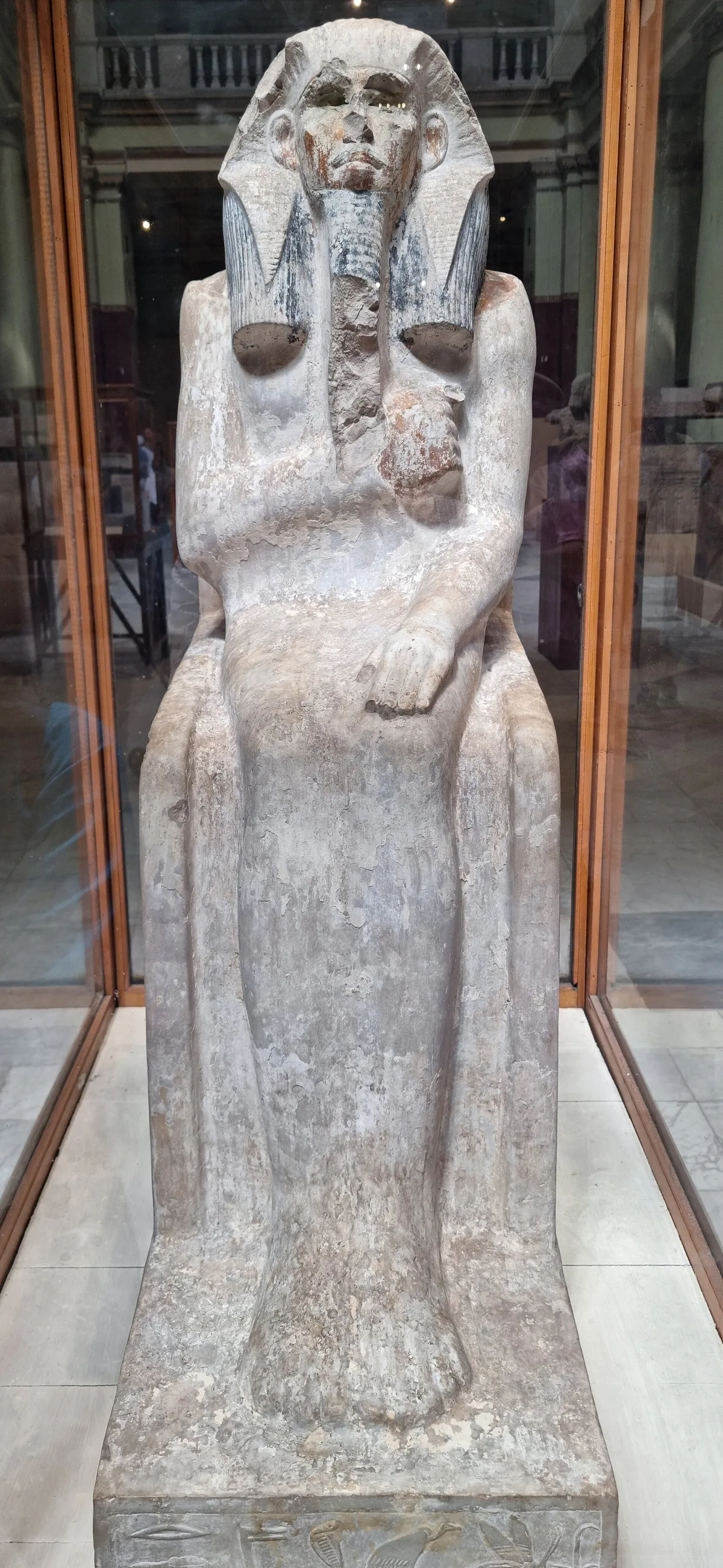
The opening rooms hold the beginning of everything. Here are the objects from Egypt’s formation: slate palettes and stone vessels of the predynastic cultures, the first hieroglyphs pressed into ivory and bone, and then the early dynastic kings, among them the seated statue of Khasekhemwy and the figure that stops every thoughtful visitor — Djoser, builder of the Step Pyramid, shown seated in his Heb-Sed cloak in the painted limestone statue from his serdab at Saqqara. It is the oldest life-size statue of a king carved in stone, made around 2650 BC, and its damaged, weathered face is somehow the most human in the building: this is portraiture being invented in front of you. Nearby stands the museum’s most disproportionate treasure, the ivory statuette of Khufu — all seven and a half centimetres of him, the only complete portrait of the man who built the largest pyramid on earth, found at Abydos with his name carved on the base. The pyramid age’s mightiest king survives as a figure you could close in your fist, and he sits in Tahrir, not Giza.
From there the floor builds. The Old Kingdom galleries give you Khafre and Menkaure (taken slowly in their own section below), the triads and the private statuary; the Middle Kingdom rooms bring the gaunt, care-worn faces of Senusret III and Amenemhat III, kings carved as tired men carrying a state; and the New Kingdom stretch is a parade — Hatshepsut’s statues, Thutmose III, the colossi, the great stelae — before the floor ebbs through the Third Intermediate and Late Periods into the Graeco-Roman rooms, where Egyptian gods acquire Greek faces and the long story the museum tells, from 5500 BC to the fourth century AD, comes gently to its end. Walk it in order once, and the first floor stops being a maze: you will already know which centuries you want more of.
The Narmer Palette – Egypt’s First Page
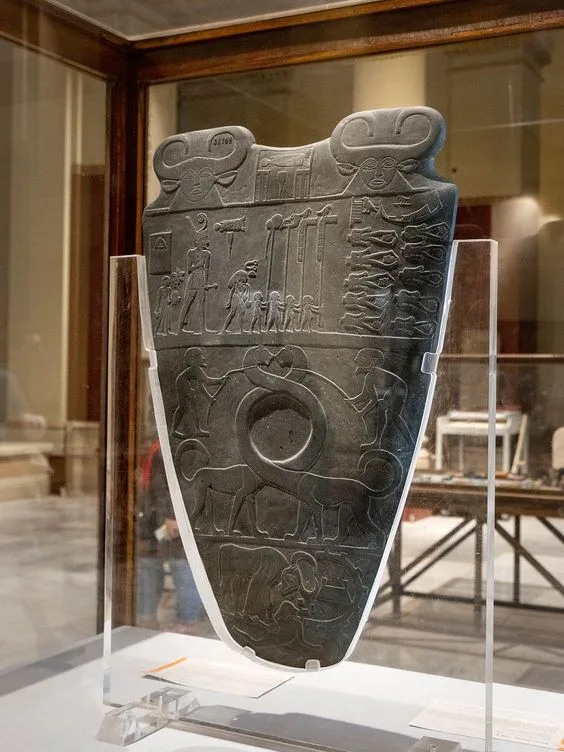
If the museum has a first page, this is it: a shield-shaped slab of dark siltstone, sixty-four centimetres high, carved on both faces a little before 3000 BC and dug out of the temple at Hierakonpolis by James Quibell in the winter of 1897-98. The Narmer Palette was made as a ceremonial version of the little palettes Egyptians used to grind eye paint, and its carving is conventionally read as the founding document of the pharaonic state — the moment Upper and Lower Egypt became one kingdom under one king, the event everything else in this building follows from.
Read it slowly; it repays the minute. On one face Narmer wears the White Crown of Upper Egypt and raises his mace over a kneeling captive, while the falcon of Horus — the god the king embodies — perches on a clump of papyrus that grows from a human head: the god delivering the marshlands of the north to the king. On the other face the king wears the Red Crown of Lower Egypt and processes behind his standard-bearers past rows of beheaded enemies, while below, two long-necked mythical beasts, the serpopards, are held on leashes by attendants, their necks entwining to form the palette’s grinding hollow — two halves bound into one circle, about as clear a piece of political symbolism as the ancient world produced. At the very bottom the king, as a bull, butts down a fortress wall. Egyptologists still argue about how literally to read it — a specific campaign, a ritual claim, a foundation myth — but nobody argues about its position: it is among the earliest historical documents of Egypt, and the ministry’s page lists it among this museum’s invaluable pieces by name.
Practically, the palette also teaches the Tahrir method. It stands in the early galleries of the ground floor, in a case you could stride past at corridor pace and miss entirely; nothing about its presentation announces that textbooks begin here. This happens throughout the Egyptian Museum Cairo — world-famous objects in unassuming cases, their labels modest — and it is why a shortlist matters more than stamina. Put the palette at the top of yours. Stand in front of it before the tour groups arrive, read both faces, and you have the museum’s whole five thousand years in embryo: one king, two lands, and a state learning to write its own story in stone.
Khafre Enthroned – the Pyramid Builders in Stone
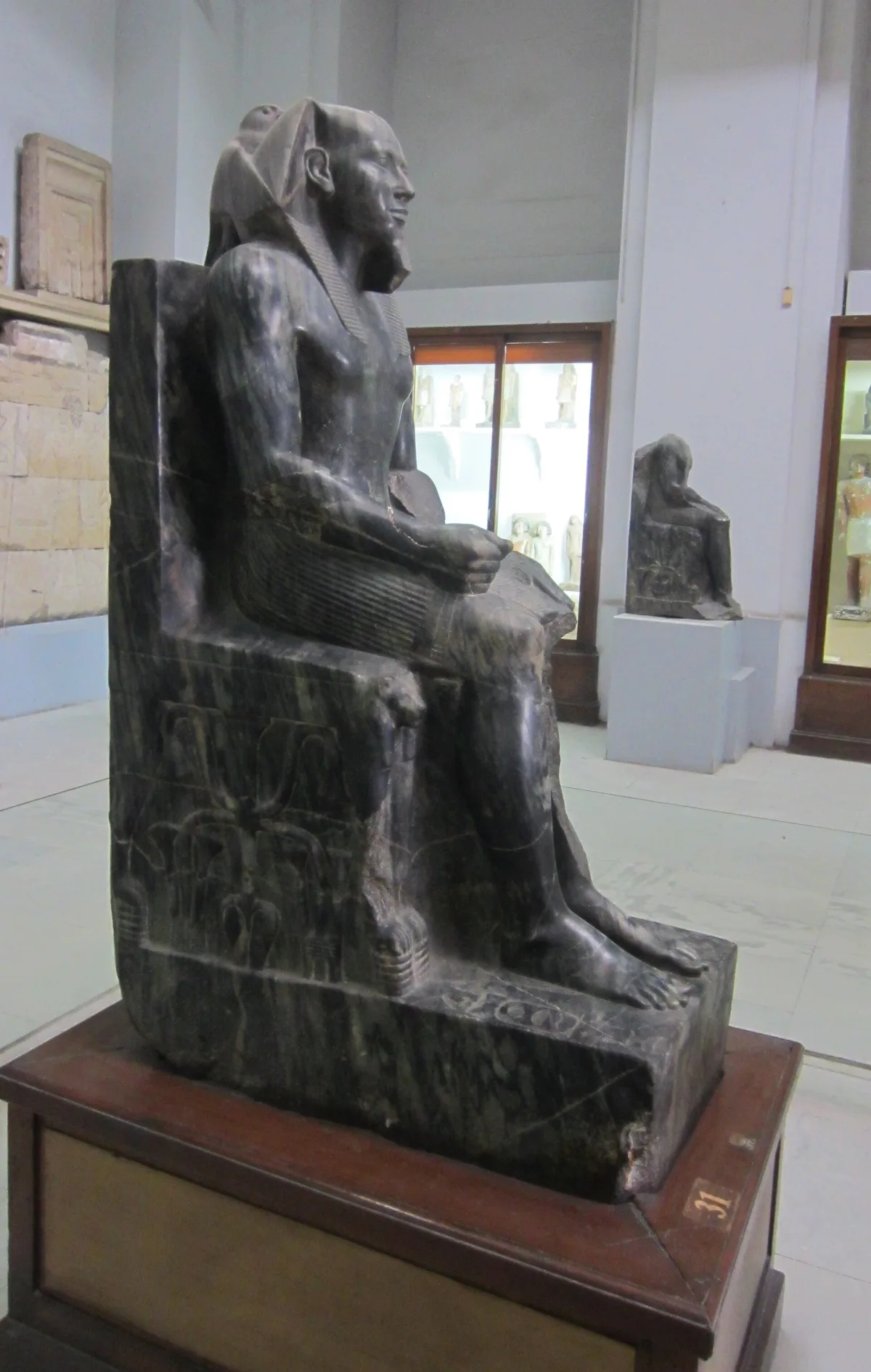
The Old Kingdom galleries of the ground floor hold what many Egyptologists would call the greatest portrait statue of the ancient world, and characteristically, the museum lets it sit in a side gallery in a pool of ordinary light. Khafre — builder of the second pyramid at Giza, the one with the Sphinx before it — sits enthroned in a statue carved from a single block of anorthosite gneiss, the dark, hard, glittering stone brought six hundred miles down the Nile from quarries near Abu Simbel. He stares past you with the calm of a man who expects eternity, his left hand flat, his right fisted around a roll of cloth, the lion throne’s sides carved with the entwined plants of the Two Lands. And behind his head, visible only when you step to the side — step to the side — the Horus falcon perches on the throne’s back, folding its wings forward around the king’s skull in a gesture of divine protection. God and king in one stone embrace: it is the whole theology of the Old Kingdom in a single carving, and it was pulled from a pit in Khafre’s valley temple in 1860, in Mariette’s time.
Khafre does not stand alone. The same galleries hold the three triads of his son Menkaure, each showing the king flanked by the goddess Hathor and a personified province — the middle one, with Hathor’s hand resting on the king’s arm, is sculpture of the very first rank — and the painted limestone pair of Rahotep and Nofret, whose inlaid eyes follow visitors with an alertness that still startles. Then, in the private-sculpture rooms nearby, the tone changes from gods to neighbours: the wooden statue of the priest Ka-aper, pot-bellied and staff in hand, so true to life that the workmen who uncovered it cried out that it was their own village headman — Sheikh el-Balad, the name he is still catalogued under — and the cedar panels of Hesy-Ra, carved with a scribe’s elegant self-possession at the dawn of Egyptian art.
This is the stretch of the museum where the GEM comparison quietly inverts. Giza’s galleries tell the Old Kingdom story with space and light and a selected cast; Tahrir keeps the cast’s understudies, rivals and relations, in numbers that let you see the style itself evolve — the same king carved a dozen ways, the workshop conventions forming and loosening across two centuries. For a traveller who only wants the headline, Khafre alone justifies the ground floor. For one who wants to understand how Egyptian art learned to do what it does, these rooms are the university.
The Meidum Geese and the Art of Ordinary Life
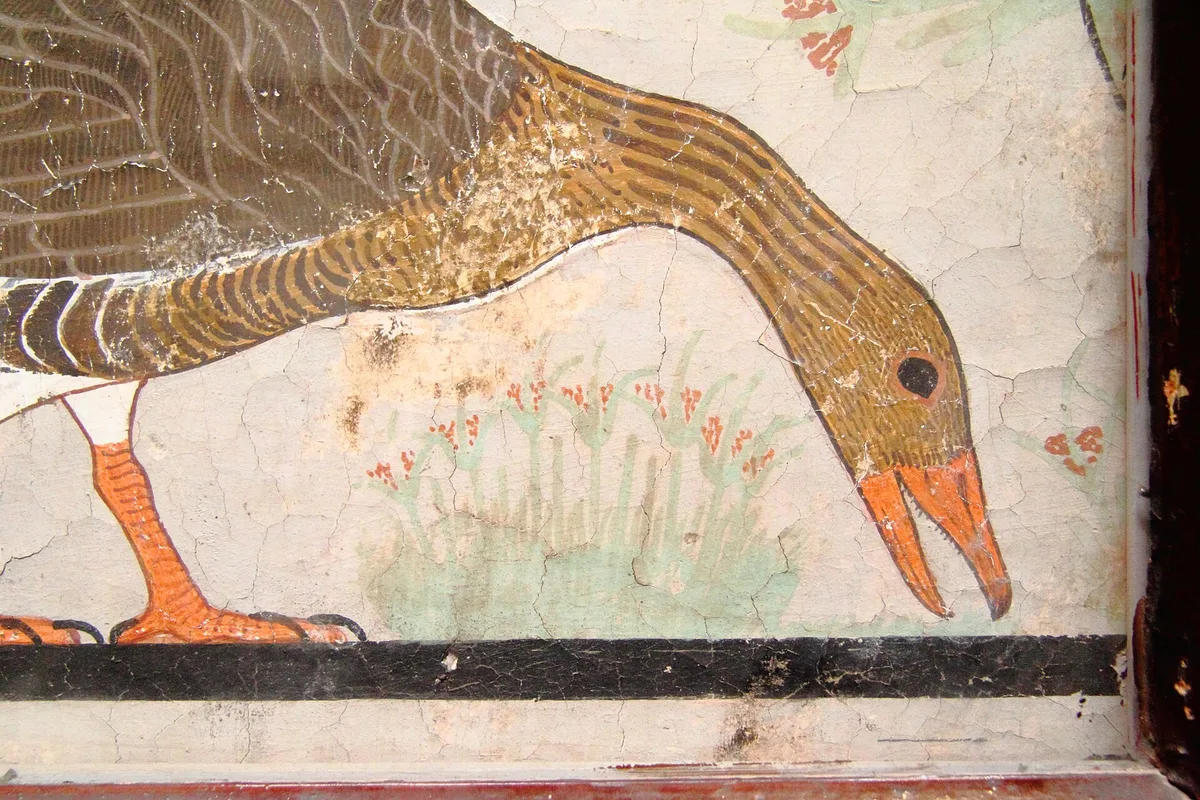
Not everything great in this museum is royal, and the proof hangs in the Old Kingdom rooms: a painted plaster panel of six geese, three facing left and three facing right, grazing their way across a strip of tomb wall from the mastaba of Nefermaat and Itet at Meidum. The Meidum Geese are sometimes called the Mona Lisa of Egyptian art, and for once the cliché undersells nothing. The birds are observed, not symbolised — red-breasted, bean and white-fronted geese, each species distinct, the feathers rendered in layered detail and the colours, after forty-five centuries, still soft and clear. Stand close and you are looking at the moment Egyptian painting discovered the natural world; nothing in the building is gentler, or more quietly astonishing.
Around the geese, the Egyptian Museum Cairo’s private-life material accumulates into a portrait of a civilisation at work. There are the wooden tomb models of the Middle Kingdom — the flotilla of boats, the granary with its scribes counting grain, the little brewery and bakery scenes from the tomb of the chancellor Meketre, a share of whose model world is kept here while its other half sits in New York — each model a doll’s-house of the Nile economy, made to serve its owner forever. There are scribes cross-legged with papyrus unrolled, their bellies honestly folded; the family group of the dwarf Seneb, a high official under the pyramid kings, seated with his wife and children in a statue that turns a courtier’s household into one of the most tender objects of the Old Kingdom; and everywhere the furniture of ordinary eternity — headrests, cosmetic spoons, game boards, sandals, loaves of bread baked for the dead and carbonised into permanence.
This is the material that makes the egyptian museum cairo irreplaceable in a way that has nothing to do with gold. The GEM’s galleries include daily life, of course, but a collection assembled over 160 years holds it at a depth no selection can match: not three cosmetic spoons but thirty, not one scribe but a profession’s worth, so that the patterns — how styles spread, how workshops copied each other, how a fashion in coffins moved down the Nile — become visible in the cases themselves. Travellers in a hurry should still give the geese their five minutes. Travellers with an eye for the small should budget the first floor’s daily-life rooms as seriously as the sculpture, because it is here, more than anywhere, that ancient Egyptians stop being pharaohs and become people.
Tanis – the Treasure That Is Not Tutankhamun
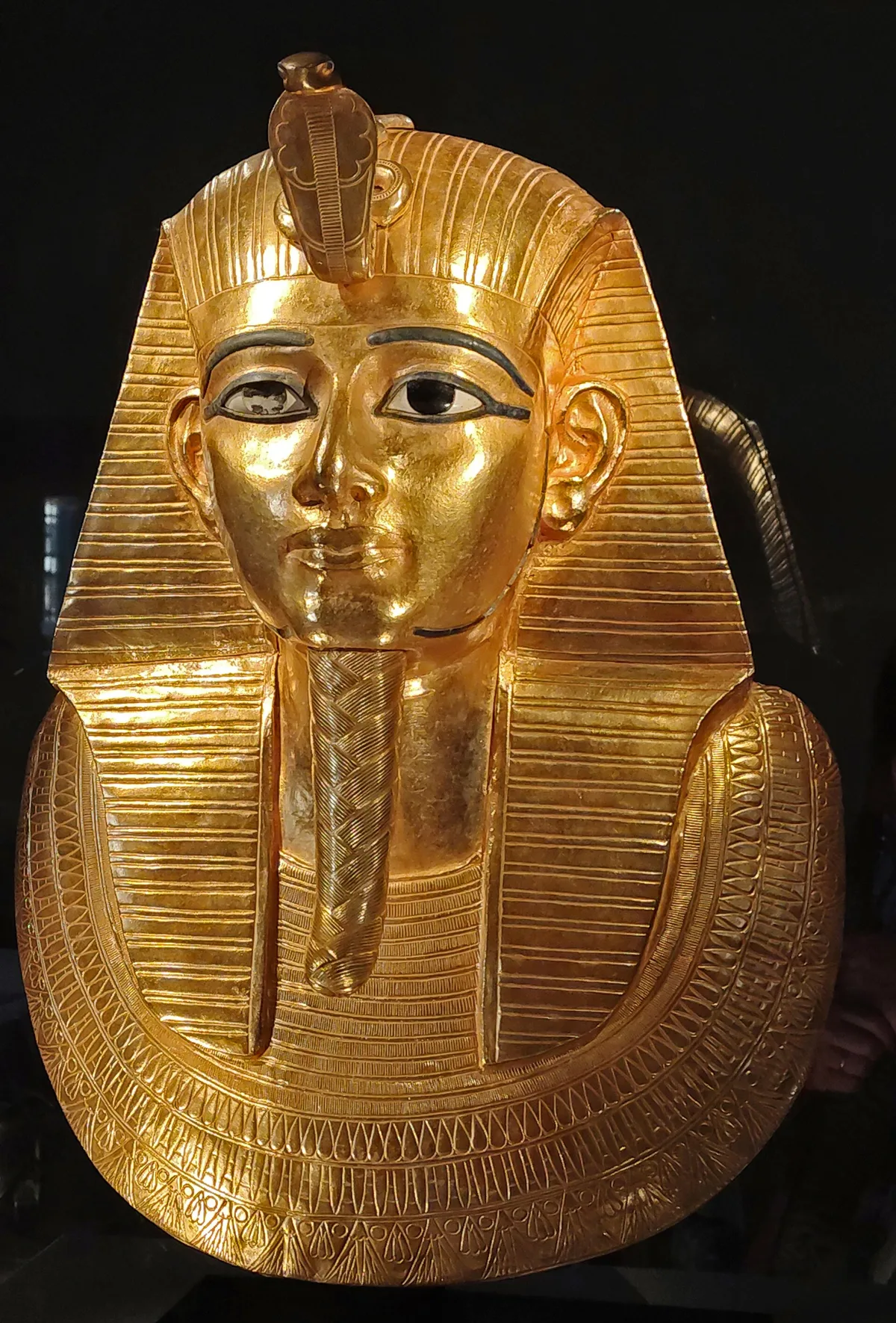
In the winter of 1939-40, with Europe already at war, a French archaeologist named Pierre Montet was digging at Tanis, in the eastern Delta, when his team broke into something no excavator of the century except Carter had found: an intact royal tomb. Inside lay Psusennes I, a king of the Twenty-first Dynasty, buried around him a treasury of gold and silver — a gold funerary mask of grave, calm beauty, vessels and jewellery by the tray-load — and, most astonishing of all, a solid silver coffin, a metal rarer than gold in ancient Egypt, which earned its owner the modern nickname of the Silver Pharaoh. Neighbouring chambers held more kings of the period, among them Amenemope and the general Wendjebauendjed, whose gold was nearly as fine. The Tanis treasure is the second-greatest intact royal burial ever found in Egypt, and because it was found as the world slid into war, it never got Tutankhamun’s fame. It sits today in Tahrir, and the ministry’s page names it, rightly, among this museum’s headline pieces.
The rooms that hold the Tanis gold are among the first floor’s genuine thrills, and they come with a useful lesson in how to read this museum. Psusennes’ mask is not Tutankhamun’s mask — it is plainer, heavier, more austere, beaten gold with inlaid eyes rather than a carnival of coloured glass — and that difference is the pleasure of it: the same craft tradition, a different idea of kingship, eight hundred years further from the pyramid age and all the more touching for its restraint. Around it, the Tanis cases spread out the dynasty’s wealth: the silver coffin’s gleaming anthropoid shell, gold bowls and goblets, broad collars and pectorals, the falcon-headed silver coffin fittings. Stand here a while and a healthy heresy forms — that this, not the boy king’s, might be the most moving gold in Egyptian museums, precisely because nobody is queuing for it.
For the traveller planning between museums, Tanis settles an argument. “But I want to see royal gold” is the commonest reason given for choosing the GEM alone — and it is a good reason, because Tutankhamun’s halls are overwhelming. But it is not a reason to skip Tahrir, where a complete royal treasure of the first rank, plus the jewellery rooms around it, waits in comparatively uncrowded cases. The two treasures are a pair across the city: Carter’s in Giza, Montet’s in Tahrir, discovered seventeen years apart, one world-famous and one still waiting for its due. An egyptian museum cairo itinerary that includes Tanis is not making do. It is completing the set.
Yuya and Thuya – the Complete Burial That Stayed
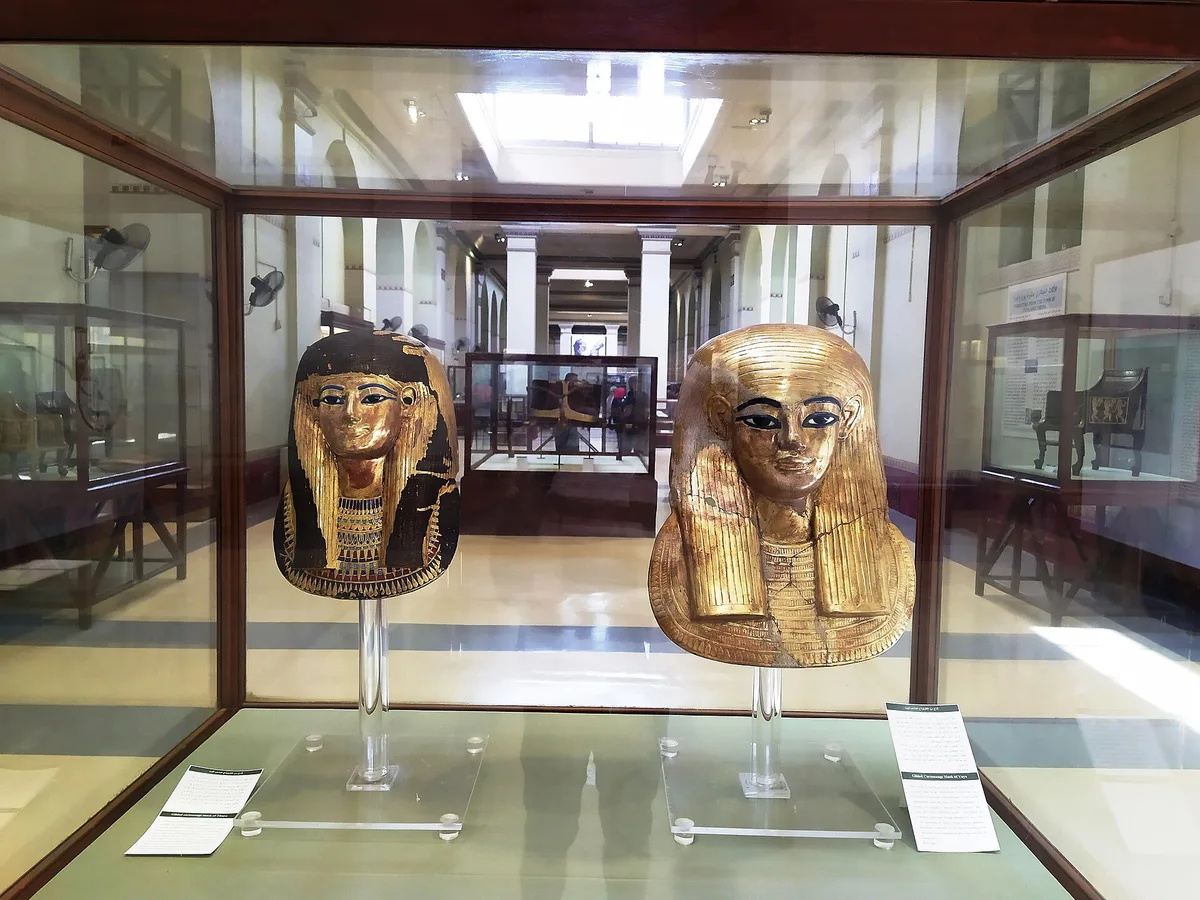
If one display in Tahrir deserves to be walked to first on the upper floor, it is the burial of Yuya and Thuya. They were not royalty — he was a chariotry commander and master of the horse, she a singer in the temple hierarchy — but they were the parents of Queen Tiye, and therefore the grandparents of Akhenaten and great-grandparents of Tutankhamun, and when they died in the fourteenth century BC they were laid in a tomb in the Valley of the Kings, KV46, with a completeness no non-royal burial has ever matched. When Quibell’s team, working for Theodore Davis, opened it in 1905, they found the chamber robbed in antiquity but substantially whole: the couple’s gilded masks on their mummies, their nested coffins and canopic chests, a chariot — the earliest substantially preserved example known — beds, chairs, boxes of clothing and provisions, a whole domestic eternity packed around them.
The display keeps the burial together as a group, and that curatorial decision is what makes it extraordinary. Tutankhamun’s tomb group, now at the GEM, is the royal version of this same idea; the Yuya and Thuya rooms are its non-royal mirror, a generation earlier, at human scale. The masks are the emotional centre — gilded cartonnage faces of great serenity, Thuya’s with its broad inlaid collar, the pair of them gazing out of their case with an intimacy no colossus can approach — and around them the furniture does the quiet work: the chariot’s light frame, the beds with their lion-legged stretchers, the boxes still shaped for the linen and jewellery they carried. The ministry’s page leads its description of the Egyptian Museum Cairo with “the complete burials of Yuya and Thuya”, and for once the official ordering is exactly the visitor’s experience: this is the collection’s heart.
There is a thread to pull here, because it runs through both museums and ties the city’s story together. Yuya and Thuya’s great-grandson lies at Giza in the most visited galleries in Egypt; their daughter Tiye sits in Tahrir’s atrium in the seven-metre colossus beside Amenhotep III; and the couple themselves rest here, in the old museum, in the rooms their family has occupied since 1905. A traveller who visits both buildings walks the whole family tree in stone and gold across two days — the sort of connection no single museum, however grand, can now give you on its own.
The Written Museum – Papyri, Books of the Dead and Coins
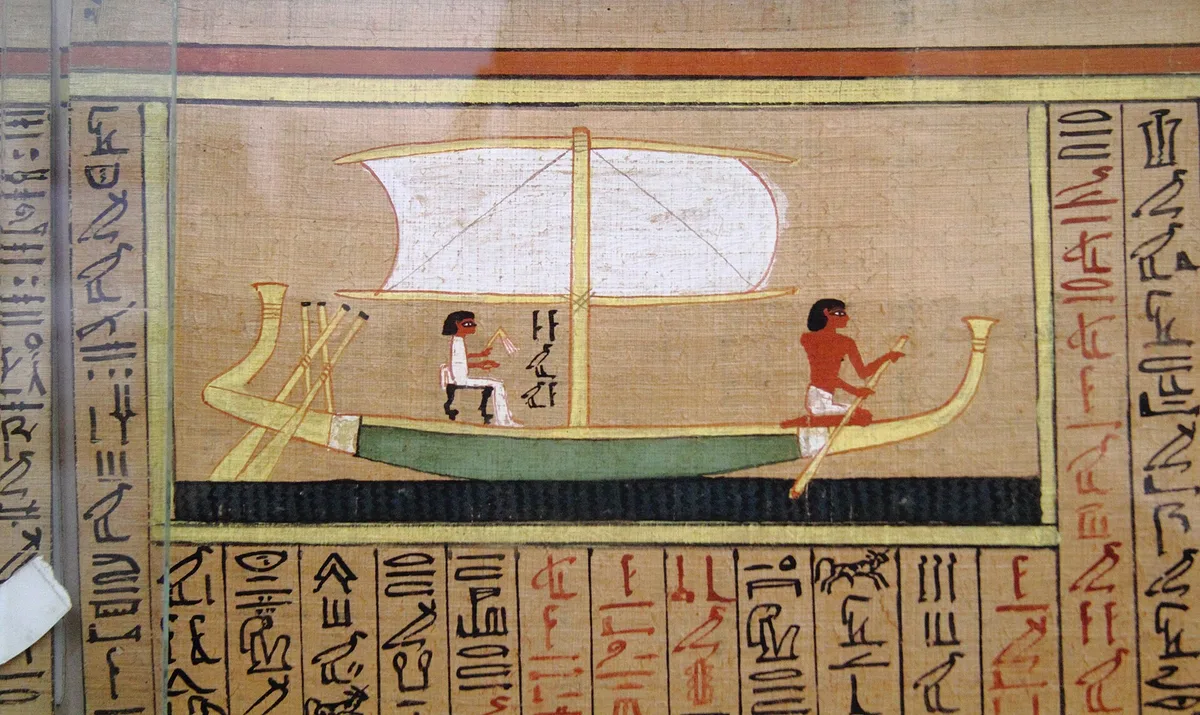
Egypt invented one of the world’s great paper trails, and Tahrir is where it is kept. The museum’s papyrus collection runs to tens of thousands of items in five scripts — hieroglyphic, hieratic, demotic, Greek and Coptic — and while most of it lives in storage as the research asset it is, the displays on the first floor give the general visitor a fair share of the glory: illustrated Books of the Dead unrolled in their cases like film strips, painted vignettes of the judgement, the weighing of the heart, the fields of the blessed dead. Among them is the papyrus buried with Yuya in KV46, a Book of the Dead of exceptional length and beauty, whose vignettes — the deceased in his boat on the waters of the afterlife, the gods in their shrines — are drawn with a miniaturist’s confidence that the dim, protective light of the gallery only heightens.
Writing is everywhere in this building once you start looking for it, and the upper floor rewards the looking. There are royal decrees and private letters, laundry lists and love songs, the mathematical and medical papyri that prove Egyptian learning was an everyday technology, and the ostraca — potsherds and limestone flakes used as the scrap paper of the Nile — on which schoolboys practised their signs and workmen sketched the tombs they were building. Set alongside them, the museum’s coin collection takes the story out of the temple and into the marketplace: Egypt struck no coins of its own for most of the pharaonic age, and the cases trace the arrival of money itself — Greek silver, the gold of the Ptolemies with their queens’ portraits, Roman issues, and on into Byzantine and early Islamic coinage, the whole monetary history of the country in trays.
Give this material its due in your planning, because it changes what the visit is. A morning spent only on sculpture leaves with an Egypt of kings and gods; an hour among the papyri adds the Egypt of accountants, doctors, schoolboys and widows writing to the authorities about a donkey. The cases are quieter, the light lower, the labels occasionally defeated by the fragility of the objects — but this is where the civilisation stops posing and starts talking, in its own handwriting. Scholars treat the collection as one of the glories of the museum; a visitor with even a generalist’s curiosity will find it the surprise of the upper floor.
Animal Mummies, Faiyum Faces and the Late Rooms
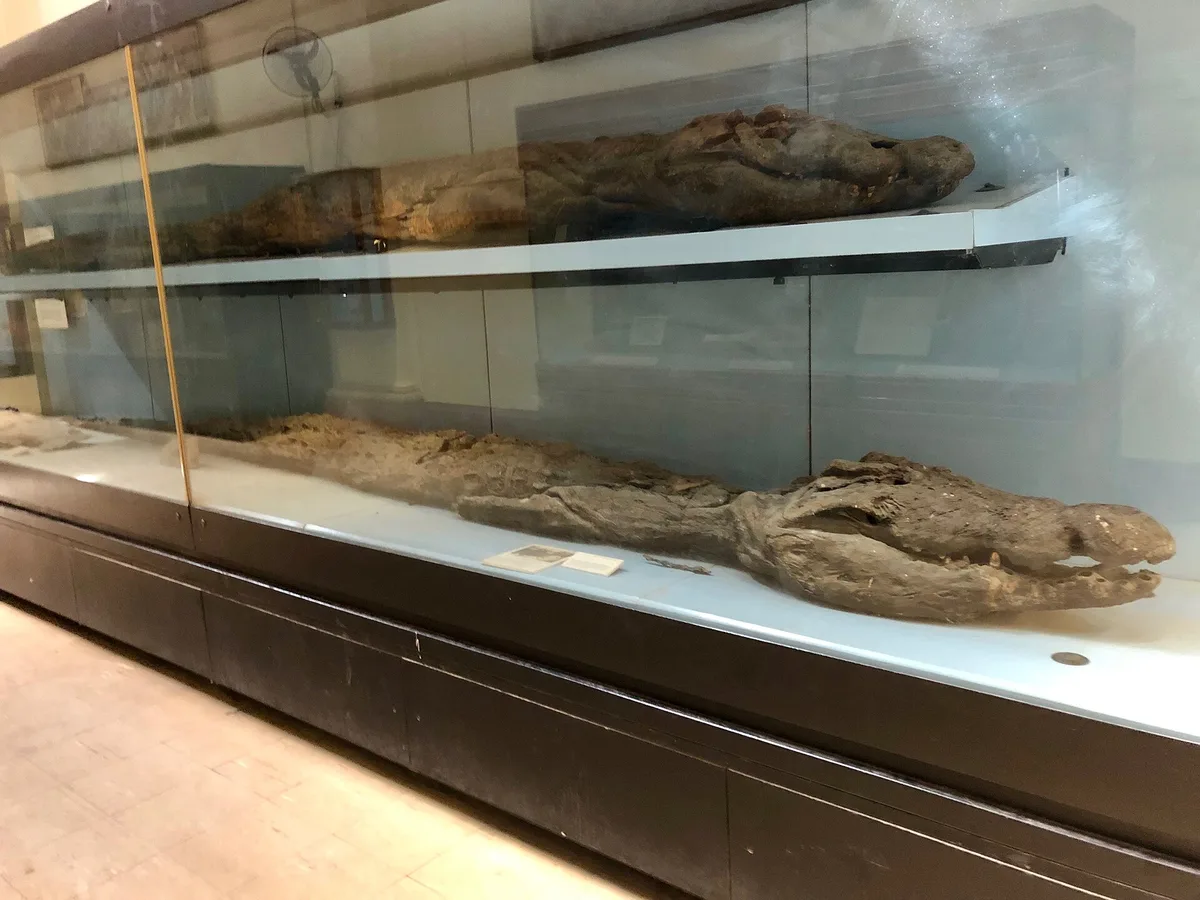
The first floor’s later rooms hold the museum’s strangest and most human material, beginning with the animals. The Egyptians mummified creatures on an industrial scale — not only pets and sacred beasts, but millions of votive offerings, each one a prayer made permanent — and Tahrir’s animal mummy displays gather the evidence in long glass cases: ibises and hawks in their linen wrappings, cats and dogs, baboons, and the great crocodiles of the god Sobek, some of them over four metres long, their armoured backs riding the case like the hulls of boats. It is an eerie, compelling room, and an oddly modern one: DNA and CT-scanning research on exactly this kind of material keeps rewriting what we know about Egyptian breeding, trade and belief, and the creatures in these cases are primary sources in a science that is still moving.
From the animals, the late rooms turn to faces. The Graeco-Roman galleries hold the museum’s famous Faiyum portraits — panel paintings in encaustic wax, made in the first centuries AD to be bound over the faces of mummies, in which Egypt’s ancient funerary customs meet Greek and Roman portraiture head-on. The effect never dulls: these are not types or ideals but people, a young man with a fashionable Roman haircut and a gold wreath, a woman with pearl earrings and her hair in braids, staring out with the directness of passport photographs across nineteen centuries. They belong to the same late world as the museum’s Coptic textiles and its last pagan temples’ reliefs, and they close the chronological arc the building opened with the Narmer Palette — from the first king unifying Egypt to ordinary Egyptians under Roman rule, still burying their dead in the old way, with new faces.
Plan a little extra time for these rooms, because they sit at the far end of the first floor’s logic and are the first thing a tired visitor skips — which would be a mistake, and also a quiet opportunity. While the sculpture galleries carry the tour-group current, the late rooms run calm, and the portraits reward unhurried looking more than anything else upstairs. A good egyptian museum cairo route saves them for the final half-hour of the visit, when the eye is trained and the crowds have thinned: five thousand years end, fittingly, not with a king but with a row of faces looking back.
How a Visit Works – Tahrir, Tickets and the Shape of the Day
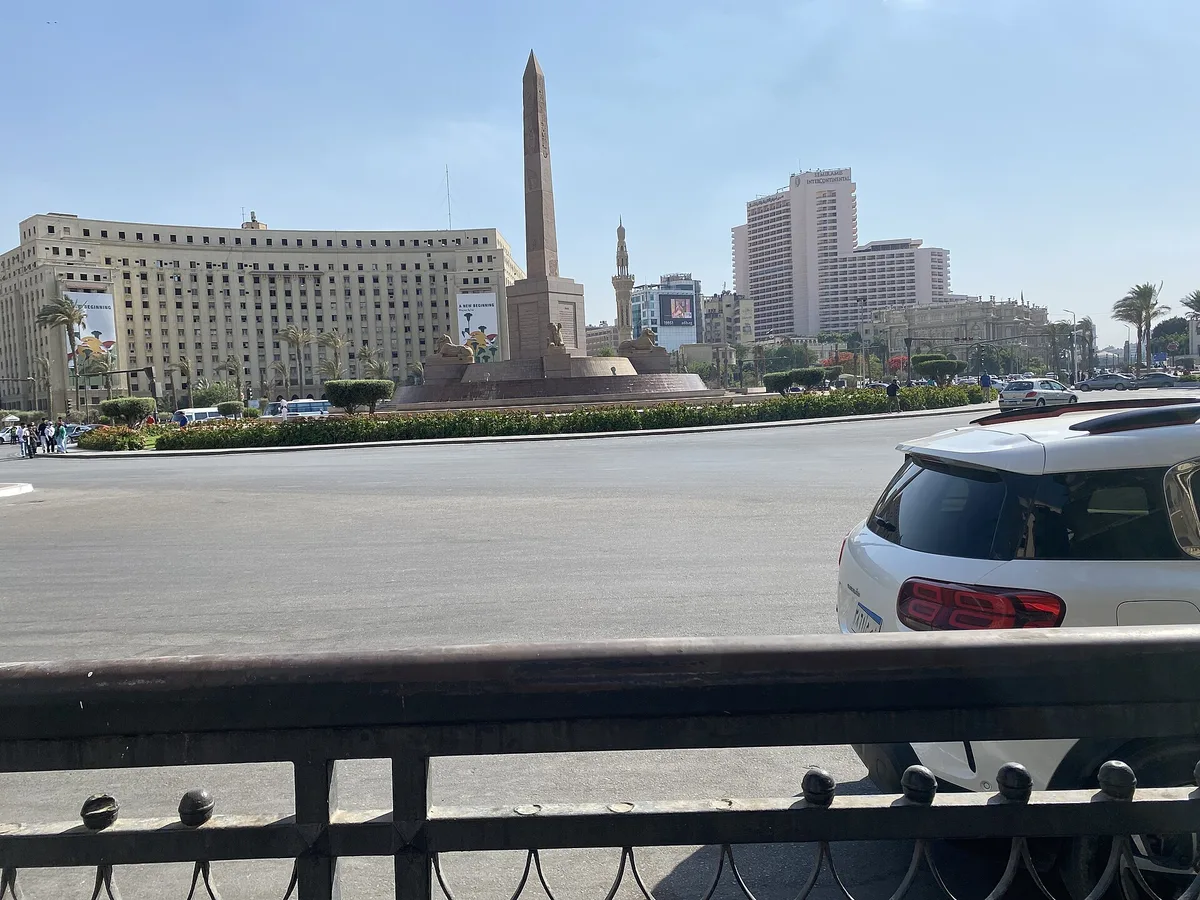
The Egyptian Museum Cairo stands on the northern side of Tahrir Square in Downtown Cairo, and the cleanest way to reach it is underneath the traffic: Sadat station, the interchange of metro Lines 1 and 2, opens directly onto the square, a two-minute walk from the museum’s garden gate. Taxis and ride-hailing cars can drop you at the same gate, but downtown traffic makes the metro the only arrival whose timing you control. However you come, expect airport-style screening at the entrance — it is routine, quick, and universal — and know the house rules before the door, because they are plainly stated on the Ministry of Tourism and Antiquities’ museum page: bags larger than 40 by 40 centimetres go to the cloakroom, nothing may be touched, food stays outside, and mobile-phone photography is free of charge while flash is forbidden and video or separate camera use carries its own ticket arrangements. Read the same page for the current ticket prices in the week you travel: the figures differ for Egyptian and foreign visitors, students pay less with ID, and prices are a moving target this guide deliberately does not print.
The ministry’s page, checked for this guide on 31 October 2026, lists the museum as open every day from 09:00 to 17:00, with the ticket window closing at 16:00 and shorter hours during Ramadan — recheck it before you go, because hours, like prices, are the museum’s to change. Within those hours, the shape of the day is a real decision. The tour-group current runs strongest from mid-morning, so the two civilised windows are the first hour after opening, when the ground floor’s great statues stand in near-silence, and the last ninety minutes of the afternoon, when the groups have gone and the upper floor’s quiet rooms come into their own. A full visit at a reading pace takes two to three hours; a highlights circuit — atrium, Khafre, Narmer, Tanis, Yuya and Thuya, out — can be done honestly in ninety minutes, and is a far better plan than a rushed attempt at everything.
Practical comforts are spartan and worth knowing in advance. The building is a 1902 museum, not a modern visitor centre: signage to facilities is minimal, the garden is the natural rest stop, and downtown Cairo is wrapped around the gate for everything else — the cafes and bookshops of the square’s edges, the Nile Corniche a few minutes west. Guiding is the one upgrade genuinely worth weighing. The museum’s labels, as the downsides section below admits, will not carry a first-time visitor through five thousand years unaided, and a good licensed guide — hired through your hotel, a reputable agency or at the museum itself, with the price agreed in full before you start — turns the density from a problem into the pleasure it should be. The officially listed audio tour exists too; ask at the ticket desk. What you do not need is a guide to find the famous things: with the route in this page, the building gives up its masterpieces in order.
Egyptian Museum Cairo or the Grand Egyptian Museum – How to Choose
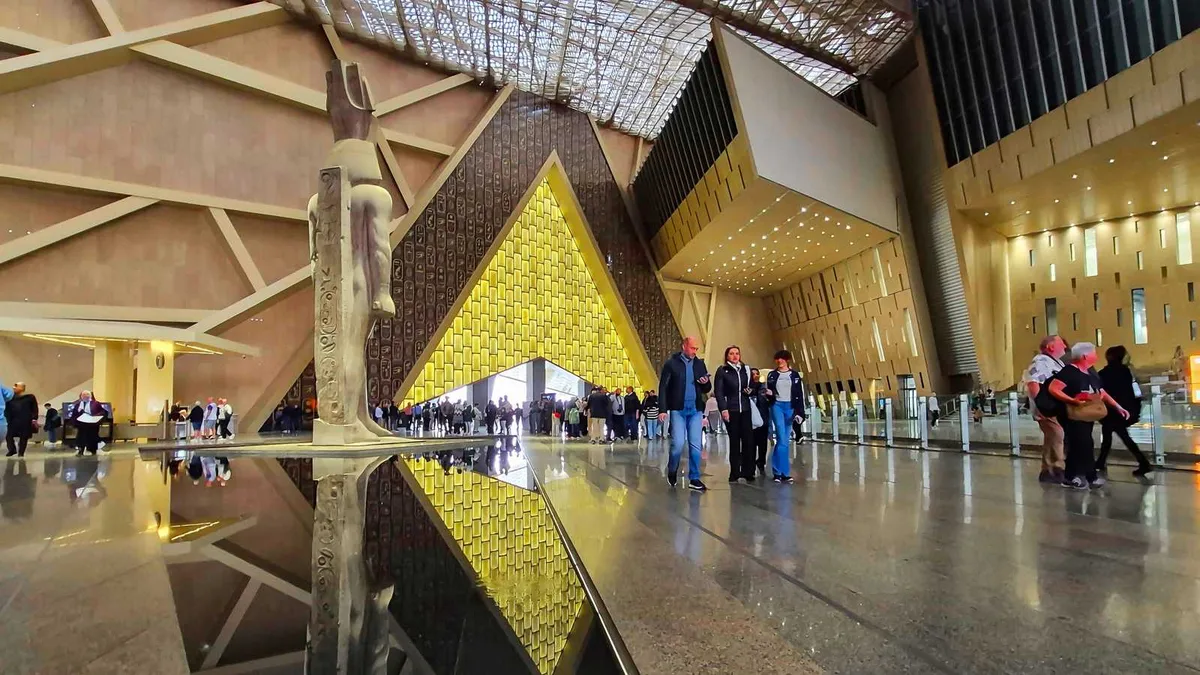
If Cairo gives you one museum day, the choice deserves a straight answer rather than a shrug, so here it is, case by case. Choose the GEM if Tutankhamun is on your list — he is only there, complete, in halls built for him — or if this is a first trip with children, for whom the GEM’s space, light and dedicated children’s museum are simply easier, or if you are pairing the museum with the pyramids, since the GEM stands at Giza and the two make one natural west-bank day. Choose the Egyptian Museum in Cairo if you have already done the GEM on an earlier trip, or if your interests run to sculpture, to the Old Kingdom, to the texture of archaeology itself — or if your base is downtown and your day is short, because Tahrir asks two to three hours and no cross-city expedition. Choose the NMEC instead — the third building, at Fustat — if the royal mummies are the point; they are in neither of the other two.
And if Cairo gives you two museum days, the answer is not a choice at all: do both, in the order that suits your bases, and let them argue with each other. Do the GEM for the story — the narrative sweep, the tomb group whole, the modern museum as a piece of theatre in its own right — and Tahrir for the substance, the depth of the store, the Tanis gold and Yuya and Thuya and the five thousand years of supporting cast that no selection could carry. Travellers routinely report that the second museum reorders their judgement of the first, and the pairing is now, frankly, the essential Cairo experience: two buildings, one civilisation, divided by a century of museology. Our grand egyptian museum guide plans the Giza half of that pairing in the same spirit — including how its tickets and timed entry work — and our egypt travel guide shows where both fit inside a wider itinerary down the Nile.
The Honest Downsides – Dust, Labels and Lovely Chaos
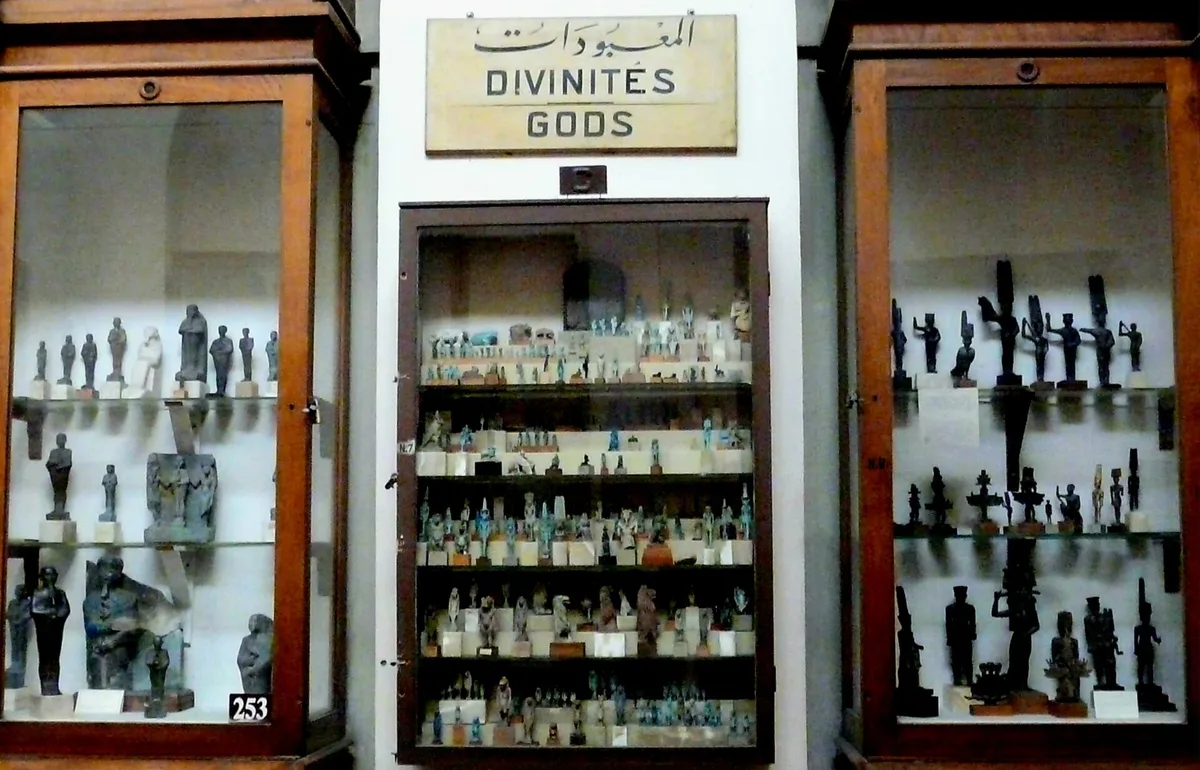
A guide that only sells this museum is a brochure, so here is the other ledger, plainly. The interpretation is thin. Many objects carry labels that are old, brief, high on their cases or Arabic-only; whole cabinets stand under hand-painted signs — DIVINITÉS, GODS — that would not disgrace a museum of 1910, because in spirit they are a museum of 1910. The building is mid-renovation in the honourable sense — galleries redisplayed under an international masterplan stand a corridor away from rooms the masterplan has not reached — and the join shows: lighting varies, some cases are dusty, some famous objects are occasionally away for conservation or loan, and nothing on the door will warn you which. Set against the GEM’s polish, a first hour in Tahrir can feel less like a museum than a beautiful, overwhelming warehouse that has admitted the public.
The crowds are the second honest item, and they are uneven rather than constant. The museum sits on every Cairo tour circuit ever sold, and between roughly ten and one the atrium and the famous cases carry a river of groups, each with a guide talking at full project. The Egyptian Museum Cairo absorbs it better than the GEM absorbs its own crowds — there is simply more museum here, and the far rooms stay calm — but a visitor who wants the Narmer Palette in silence should take the advice in the visit section and come at opening. Add the small frictions of any great downtown institution — persistent unofficial guiding offers at the gate, the scrum at the ticket windows on a holiday morning — and the picture is complete: none of it is dangerous, all of it is manageable, and most of it evaporates for the visitor who arrives early with a route.
And yet. The downsides and the glory are the same fact viewed from two sides. A museum that had been fully modernised on Tahrir’s budget and timetable would have had to choose — twenty thousand objects, beautifully told, and the rest to storage, which is exactly the choice the GEM exists to make. Tahrir is the other choice, the one where almost everything stays out, labelled or not, dusty or not, and the visitor is trusted to explore. Egypt is lucky, and so are its travellers, that the city ended up with one of each. Go to the old museum briefed, early and unhurried, and its chaos resolves into what it has been since 1902: the loveliest problem in Egyptology, still open daily.
Frequently Asked Questions
Is the Egyptian Museum in Cairo still open? Yes. The old museum on Tahrir Square never closed; it lost Tutankhamun to the GEM and the royal mummies to the NMEC, but its own collection — over 170,000 artefacts — remains on display in the 1902 building. The ministry’s museum page lists daily opening, checked for this guide on 31 October 2026.
Is Tutankhamun still at the Egyptian Museum Cairo? No. The complete Tutankhamun collection — all 5,398 objects, including the gold mask — moved to the Grand Egyptian Museum at Giza, where it is displayed together in dedicated halls that opened in November 2025. If the boy king is your priority, go to the GEM; Tahrir’s rival gold is the Tanis treasure and the Yuya and Thuya burial.
Where are the royal mummies? In the National Museum of Egyptian Civilization (NMEC) at Fustat, south of central Cairo. Twenty-two royal mummies were carried there from Tahrir in the Pharaohs’ Golden Parade of April 2021. They are in neither Tahrir nor the GEM.
How long do I need at the Egyptian Museum in Cairo? Two to three hours covers both floors at a reading pace. A focused highlights circuit — the atrium colossus, Khafre, the Narmer Palette, Tanis, Yuya and Thuya — takes about ninety minutes. Do not plan it as a one-hour add-on; the building is too dense to skim honestly.
Can I take photographs inside? Mobile-phone photography is free of charge under the rules on the ministry’s museum page; flash is forbidden, and video recording and separate camera use carry their own ticket arrangements. Rules can change — the same official page is the place to confirm in the week you travel.
Which is better, the Egyptian Museum in Cairo or the GEM? They do different jobs. The GEM tells the story better and holds Tutankhamun; Tahrir holds the deeper collection — the sculpture sequence, Tanis, Yuya and Thuya, the papyri — in a historic building downtown. With one day, choose by your list (Tut means GEM, mummies mean the NMEC); with two days, visit both.
What are the must-see objects at Tahrir? The Narmer Palette, the seated Djoser, the ivory statuette of Khufu, Khafre Enthroned, the Menkaure triads, the Meidum Geese, the Amenhotep III and Tiye colossus in the atrium, the Tanis treasure of Psusennes I, the burial of Yuya and Thuya, and a Book of the Dead or two on the first floor. The ministry’s own museum page headlines the same heart of the list.
Is the museum being renovated? Yes, gradually. A long-running international masterplan has been redisplaying the museum gallery by gallery, so freshly renewed rooms and gloriously untouched ones stand side by side. Nothing about the renovation closes the museum to visitors, but individual objects can be away for conservation — treat any single piece as a hope, not a promise.
The Short Version
The Egyptian Museum Cairo is not the GEM’s leftover; it is the original — the oldest archaeological museum in the Middle East, opened in 1902 on Tahrir Square, still holding over 170,000 artefacts and the largest Pharaonic collection in the world. Tutankhamun has gone to Giza and the royal mummies to Fustat, but what stayed is formidable: the Narmer Palette, Djoser, Khufu’s tiny ivory portrait, Khafre Enthroned, the Meidum Geese, a second royal treasure at Tanis, the complete burial of Yuya and Thuya, and rooms of papyri, coffins and animal mummies no other museum can match for depth. Come by metro to Sadat station, come early, walk the ground floor chronologically and the first floor by theme, take the labels’ weakness in your stride or hire a guide, and give it two to three hours. If Cairo allows two museum days, pair it with the GEM and you will have seen ancient Egypt told both ways — as a story, and as a storehouse. Either way, do not let anyone tell you the old pink palace is empty. It is fuller than ever; it is simply sharing the stage at last.