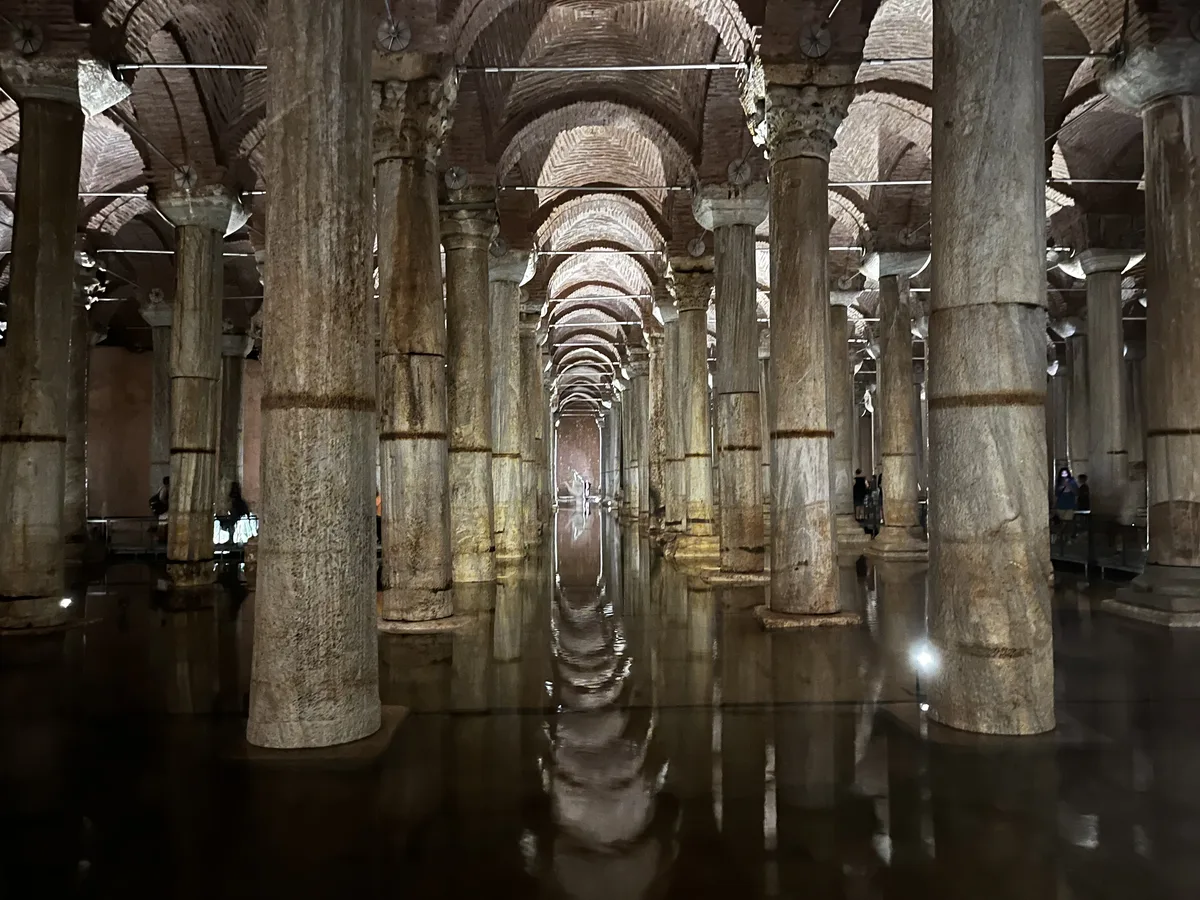
There is a moment, about twenty steps down the entrance stair of the Basilica Cistern, when the Istanbul street simply stops. The tram noise, the touts, the heat bouncing off the Sultanahmet stone – all of it cuts out, and what replaces it is cool air, the sound of dripping water, and a forest of marble columns standing in black water as far as the light reaches. This basilica cistern guide exists to make sure that moment is not the only thing you take away from the place. The cistern is usually sold as a quick atmospheric stop, half an hour between Hagia Sophia and lunch, and it deserves better than that. It is one of the great engineering works of the sixth century, a reservoir the size of a cathedral built to keep an imperial capital alive through a siege, and its stones carry some of the strangest stories in the city – Medusa heads turned on their sides, a column that appears to weep, and a hall that was lost, fished in, dumped in and finally restored into the most theatrical museum space in Istanbul.
Some orientation before you descend. The Basilica Cistern – Yerebatan Sarnıcı in Turkish, the Sunken Palace – lies about 150 metres southwest of Hagia Sophia, beneath an ordinary street of hotels and carpet shops. Built in 532 under Justinian I, it spent the Byzantine centuries quietly storing water for the Great Palace and the buildings around it. Today it is a museum, restored between 2017 and 2022, with a daytime visiting session, evening sessions in recent seasons, and queues that reward anyone who plans. This basilica cistern guide walks the visit in the order you will live it – tickets and stairs first, then the hall, the columns, the Medusas and the weeping column, then the restoration, the night sessions and the crowds.
If the cistern is one stop in a longer stay, build the rest of the old town around it with our Istanbul travel guide – it sits in the middle of Sultanahmet, minutes from Hagia Sophia, the Blue Mosque and Topkapi Palace, and pairs with all of them. Give it the better part of an hour underground, and the sunken palace stops being a photo opportunity and becomes what it actually is – the working basement of a vanished empire, still holding its water after fifteen centuries.
Basilica Cistern at a Glance
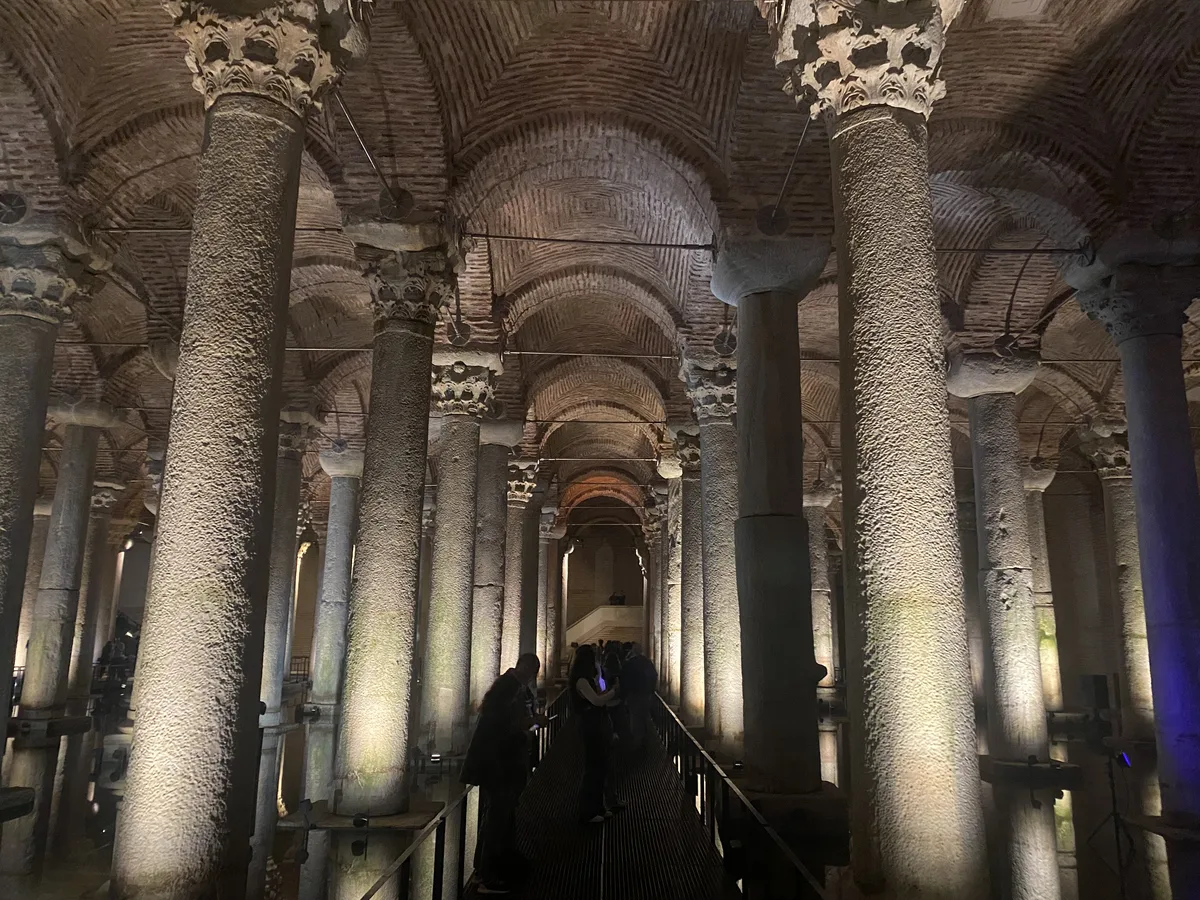
The single most useful thing to understand before you enter is that the cistern is not a ruin that happens to hold water. It is a machine for storing water that happens to be beautiful. Everything about it – the forest of columns, the brick vaults, the waterproof plaster, the darkness itself – follows from one job: keep tens of thousands of tonnes of clean water safe, cool and hidden beneath the most contested city on earth. The Byzantines built dozens of cisterns under Constantinople, open and covered, but this was the largest of the covered ones, and the only one a modern visitor can walk through at full scale. Read it as infrastructure first and atmosphere second, and every detail in this basilica cistern guide, from the recycled columns to the Medusa blocks, falls into place.
The practical shape of the visit is simple: ticket, a long stone stair down, a one-way circuit of walkways above shallow water to the Medusa heads in the far corner, and a separate stair back up. There is no weekly closing day, and the whole circuit takes most people between forty-five minutes and an hour and a half.
| Question | Answer |
|---|---|
| What is it | The largest surviving covered cistern of Byzantine Constantinople, built under Justinian I in 532 |
| Where | Yerebatan Caddesi, Sultanahmet, Istanbul – about 150 metres southwest of Hagia Sophia |
| Run by | A municipal operator for many years; management changed hands in 2026 – confirm the current operator and tariff on the official site, yerebatan.com |
| Opening pattern | Open daily; a daytime session from 09:00, and in recent seasons a separate evening session – the day’s exact sessions are set by the operator |
| Tickets | Sold at the box office and through the operator’s official online channel; the Istanbul Museum Pass is NOT valid here |
| Time needed | 45 to 90 minutes underground, plus whatever the ticket queue adds at peak times |
| Do not miss | The two Medusa heads, the weeping column, the exposed Byzantine brick floor, the view back down the central aisle |
| Conditions | Cool, dark and humid all year; water drips from the vaults; bring a layer even in August |
The table carries the visit in miniature, and the rest of this guide fills in its rows. Note the ticket line in particular. The cistern has never belonged to the ministry museum system that runs most of Istanbul’s big sights, so the passes visitors buy for the rest of the old town do not open its turnstiles – a fact that catches people out at the door every day, and the reason the ticketing section below is worth reading before you join the queue.
Why Justinian Built a Sea Beneath the City
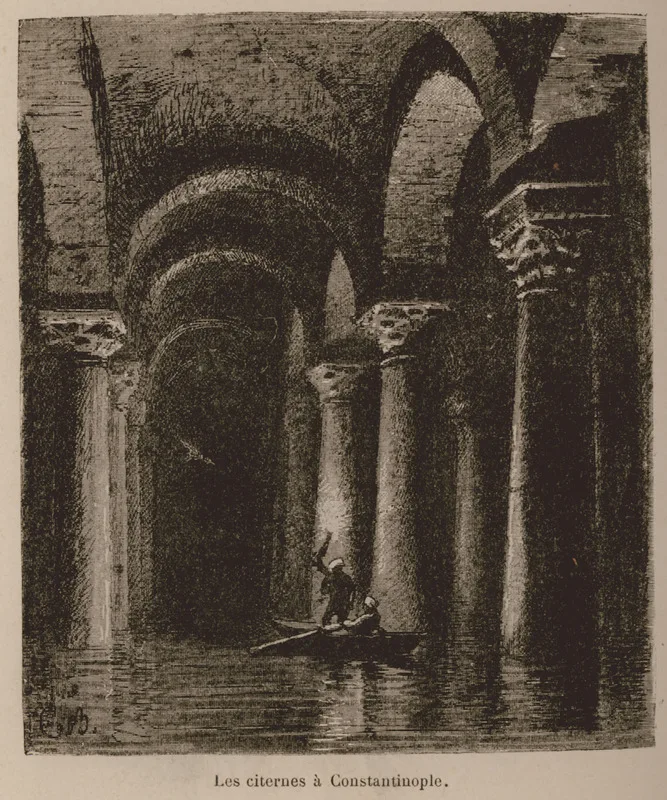
Constantinople had a water problem built into its geography: a rocky peninsula with no river worth the name, ringed by enemies, where a siege was never a hypothetical but a recurring event emperors planned around. The answer, built up over centuries, was a two-part system – aqueducts, above all the great line associated with Valens, carrying water from springs far to the west, and a distributed reserve of cisterns under the city, so that if the aqueducts were cut the capital could drink from its own basements for months. The Basilica Cistern was the grandest element of that reserve, positioned directly beside the Great Palace, the Hippodrome and Hagia Sophia, at the ceremonial heart of the empire it existed to protect.
Its name is a clue to what stood here before it. An earlier, smaller cistern occupied this ground beneath a great colonnaded public building, the Stoa Basilica, and when fire destroyed that complex during the Nika revolt of 532 – the riot that nearly ended Justinian’s reign – the emperor rebuilt vastly larger, keeping the old name: the Basilica. The chroniclers’ workforce figures run into the thousands, and the builders were working to a deadline set by fear – a capital that had just watched its centre burn was not going to be caught without water again. The hall they produced measures roughly 140 metres by 70 – sources differ by a few metres – and at full capacity held on the order of 80,000 tonnes of water, the figure quoted by the operator and the standard references alike.
That capacity was strategic, not decorative: a store filled quietly from the aqueduct system in peacetime and drawn on when the city was cut off, feeding the palace complex and the grand buildings of the first hill. The darkness was functional too – covered water stays cool, clean and algae-free – and a roof of brick vaults on 336 columns was simply the strongest, most fireproof lid sixth-century engineering could put over a small inland sea. The beauty visitors photograph today is a by-product, the beauty of a structure where every part had a job.
The cistern belongs to the same astonishing decade as Hagia Sophia, raised in the same rebuilding programme by the same emperor a few hundred metres apart, and the two are really one statement in two materials – the church proclaiming the empire’s faith upward into a dome of light, the cistern guaranteeing its survival downward in a vault of water. Treat them as a pair: the empire’s soul in the morning, its insurance policy after lunch.
Forgotten, Flooded and Found Again
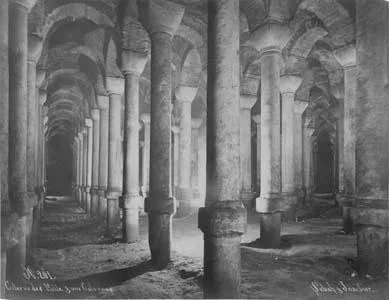
The strangest chapter of the cistern’s life is that for centuries almost nobody knew it was there. After the Ottoman conquest of 1453 the palace it served was abandoned stone by stone, and Ottoman water engineering favoured running water – fountains, aqueducts and great open reservoirs – over a stagnant underground store. The cistern slipped out of the city’s official memory. Houses rose over its vaults. And yet the water was still down there, and the people living above it knew. The French scholar Petrus Gyllius, working in Constantinople in the 1540s, recorded the local relationship with the invisible lake beneath their floors: residents lowered buckets through holes in their basements, drew drinking water from the dark, and – his detail is the one every account since has repeated – sometimes caught fish through the same holes.
Gyllius measured, descended, counted columns by torchlight and wrote the place back into the record. But rediscovery on paper did not mean rescue: through the Ottoman centuries the cistern served as an overflow, a convenient void, at times reportedly as a dump for building rubble. Its vaults held – a structure designed to be forgotten under a living city survived four hundred years as a cellar – and its modern career began only in the twentieth century, when the young Turkish Republic’s city authorities cleared and studied it in earnest.
The decisive cleaning came in the mid-1980s, when municipal works drained the accumulated mud of centuries – accounts describe the silt being removed in industrial quantities – and the Medusa blocks, which had spent the modern era half-buried and half-seen, emerged fully into view. The cistern opened as a museum in 1987, with wooden and later concrete walkways carrying visitors over the water. For thirty years that was the visit: atmospheric, murky, a little ramshackle, the water opaque and the floor invisible beneath it. What changed it from a curiosity into the experience described later in this basilica cistern guide was the great restoration of 2017 to 2022, which rethought everything from the walkways to the water itself. The forgotten reservoir had become, fifteen centuries after Justinian, one of the most visited rooms in Istanbul.
The film industry added a footnote: in 1963 James Bond rowed across the cistern in From Russia with Love, in a boat the real cistern has never offered visitors, and in 2016 the climax of Inferno played out around the Medusa heads. Nonsense as logistics, perfect as atmosphere – this is the one room in Istanbul that needs no set design. You are standing in a place that has been a water store, a secret, a fishing hole, a dump, a film set and a museum, sometimes within the same century.
Finding the Entrance and the Way Down
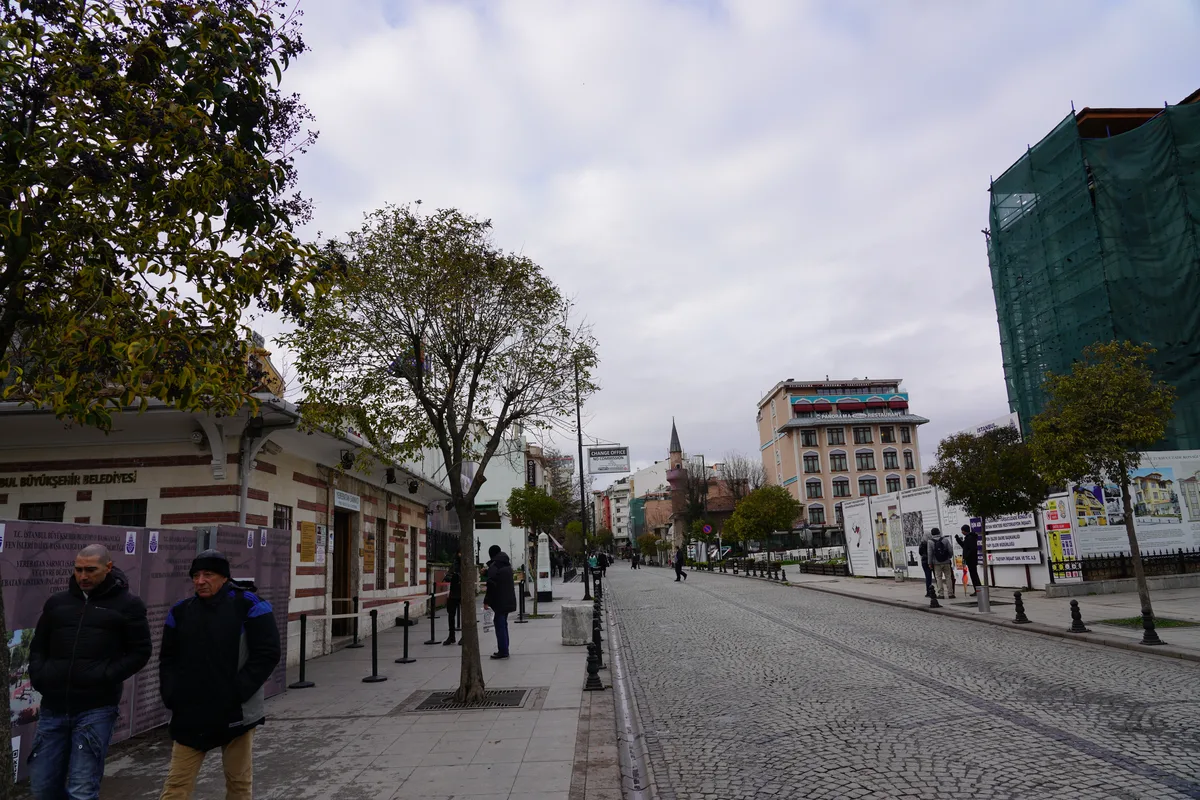
For a monument of its fame, the cistern hides remarkably well. There is no facade and no dome – just a modest entrance building on Yerebatan Caddesi, the short street running southwest from the Hagia Sophia square, easily missed if the morning queue is not there to mark it. The nearest tram stop is Sultanahmet on the T1 line; from the square, follow Yerebatan Caddesi downhill and the entrance is on your left. The discretion fits the building’s history: the cistern was never meant to be looked at from outside, and its only real architecture begins below the pavement.
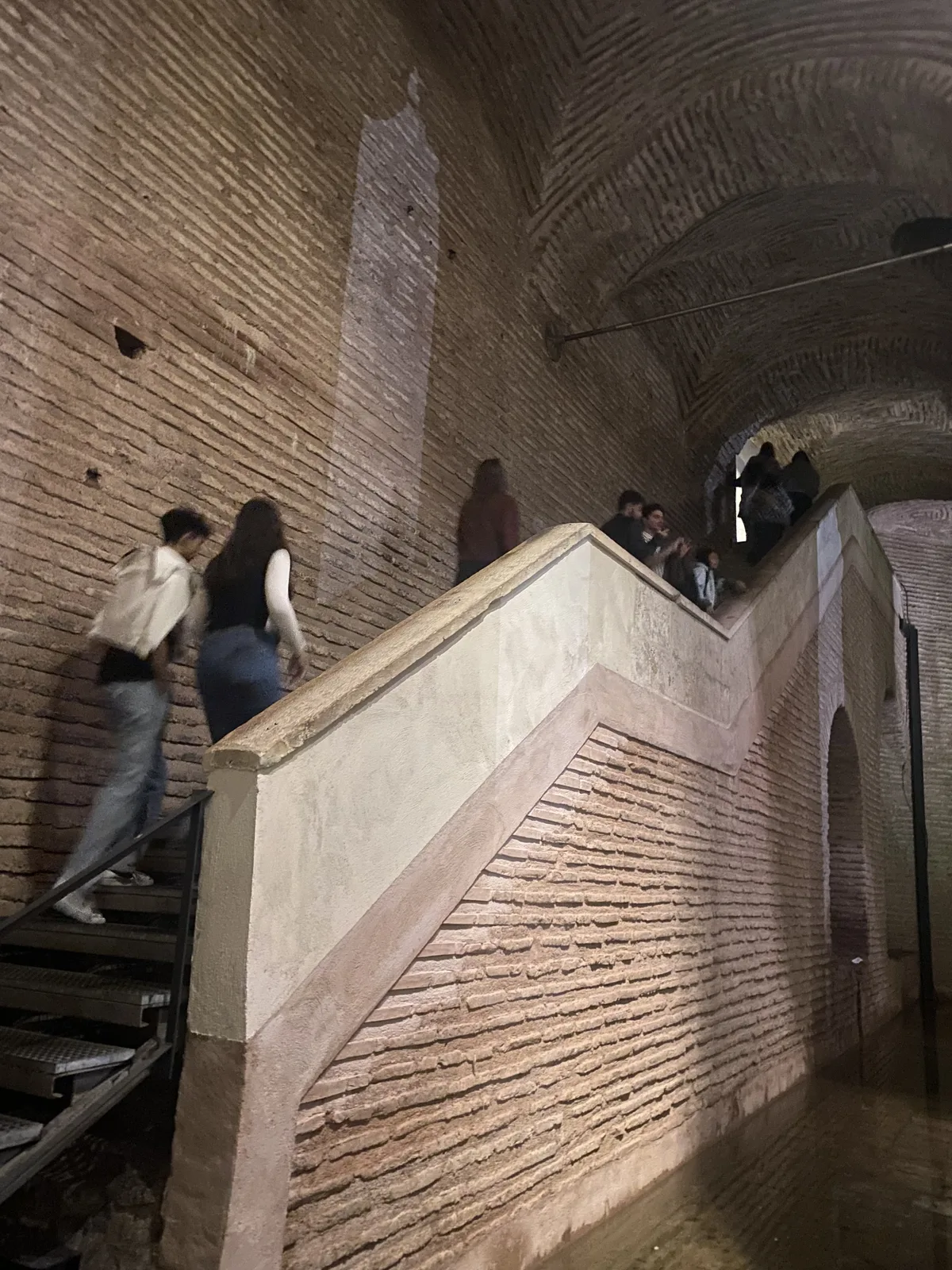
The way in is a long stone stair – 52 steps by the usual count – and it is worth treating the descent as part of the exhibit rather than a corridor to it. The air changes on the way down, degree by degree: cooler, damper, smelling faintly of wet stone. The light changes too, from daylight to the amber gloom the restorers have made the cistern’s signature. City noise dies somewhere around the thirtieth step. By the time you reach the entry platform at the bottom, your eyes have adjusted and the first view opens in front of you – columns in rows, water holding their reflections, and the vaulted dark running away in every direction. First impressions matter here, and the building knows it: few museum entrances anywhere stage their reveal this well.
Practical notes belong with the poetry. Both the way down and the separate way up are stairs, and while the operator has made arrangements in recent seasons to assist visitors with limited mobility, step-free access to a sixth-century reservoir is inherently limited – anyone who cannot manage long stairs should check the current arrangement before buying a ticket. Inside, the walkway route is level and railed, and the stair and walkways can be damp; this building rains gently on itself, so shoes with grip beat leather soles. The one-way system means there is no going back for a second look at the Medusas once you have passed them. Look properly the first time.
Tickets, Sessions and How Entry Works in This Basilica Cistern Guide
Ticketing is where the cistern most often trips up the unprepared, so this section of the basilica cistern guide takes it slowly. The first fact is administrative and it explains everything else: the cistern is not a ministry museum. For many years it was run by Kültür AŞ, the Istanbul Metropolitan Municipality’s culture company, and in 2026 management changed hands again – current reporting has it with the General Directorate of Foundations – with the handover reported in June 2026. The practical consequences matter more than the letterhead. The Istanbul Museum Pass, the Museum Pass Türkiye and the ministry’s other products are not valid here, whoever is running the building, and never have been: the cistern has always required its own ticket. Travellers who arrive waving a museum pass are turned to the box office every day. Buy the cistern’s own ticket and treat any pass inclusion claim from a third-party seller with suspicion.
The second fact is that this guide deliberately prints no price. The cistern’s tariff changes so often that printed figures across the internet are a nonsense – sources checked for this basilica cistern guide in October 2026 quoted daytime prices from recent seasons ranging across several hundred lira, evening tickets higher still, and the 2026 operator change reset the arrangements mid-stream. Any number printed here would be a rumour by the time you read it. The honest mechanism: the tariff for your category is set by the operator, displayed at the box office and published on the official site, yerebatan.com – the only figure worth trusting. Check it the day before you go, and be wary of unofficial sellers near the entrance offering “skip-the-line” tickets at a markup; an unofficial ticket is an expensive way to join the same security line as everyone else.
The visiting day is built around sessions. Under the arrangement published in recent seasons, the cistern opens daily at 09:00 for a daytime session running into the early evening, closes briefly while the hall is reset, and reopens for a separate evening session – the Night Shift – running to around 22:00 on its own, more expensive ticket. The brief closure between sessions surprises visitors who arrive in the gap, so check the day’s session times on the official site before planning around them; special events occasionally take the hall over entirely. There is no weekly closing day, which makes the cistern the old town’s most reliable plan B. Payment in recent seasons has been by card or Istanbulkart, cash not accepted – carry a card. Tickets are single-entry, bought for the day and session you use them; a daytime ticket does not admit you to the evening, and there is no re-entry.
Buying online through the operator’s official channel, where offered, buys you one specific thing: escape from the ticket-office queue, which is the long one. It does not buy escape from the security check at the stair, which everyone passes. Whether the trade is worth it depends on the day – two minutes at the box office on a quiet winter morning, against a street queue past an hour on a cruise-ship day in August. It never requires a third-party reseller: when another site charges notably more than the official tariff, the difference is their margin, not a faster door.
First Impressions – a Forest Standing in Water
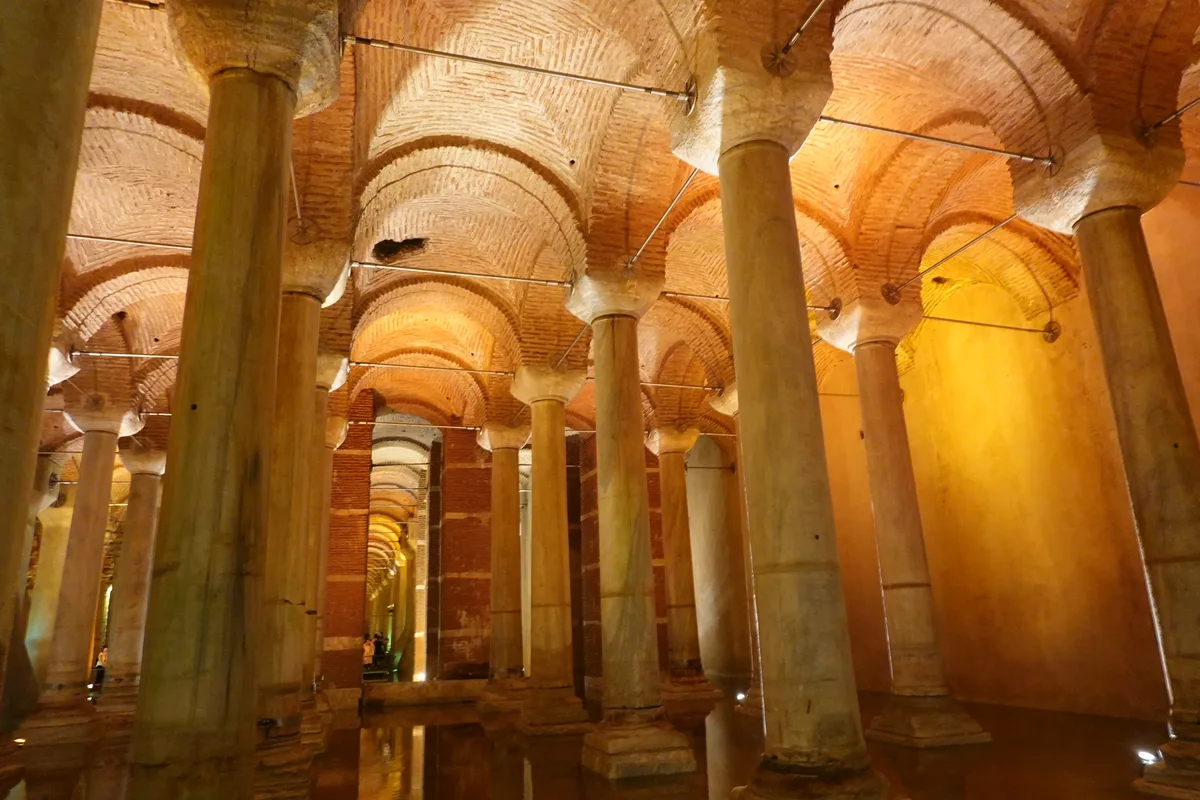
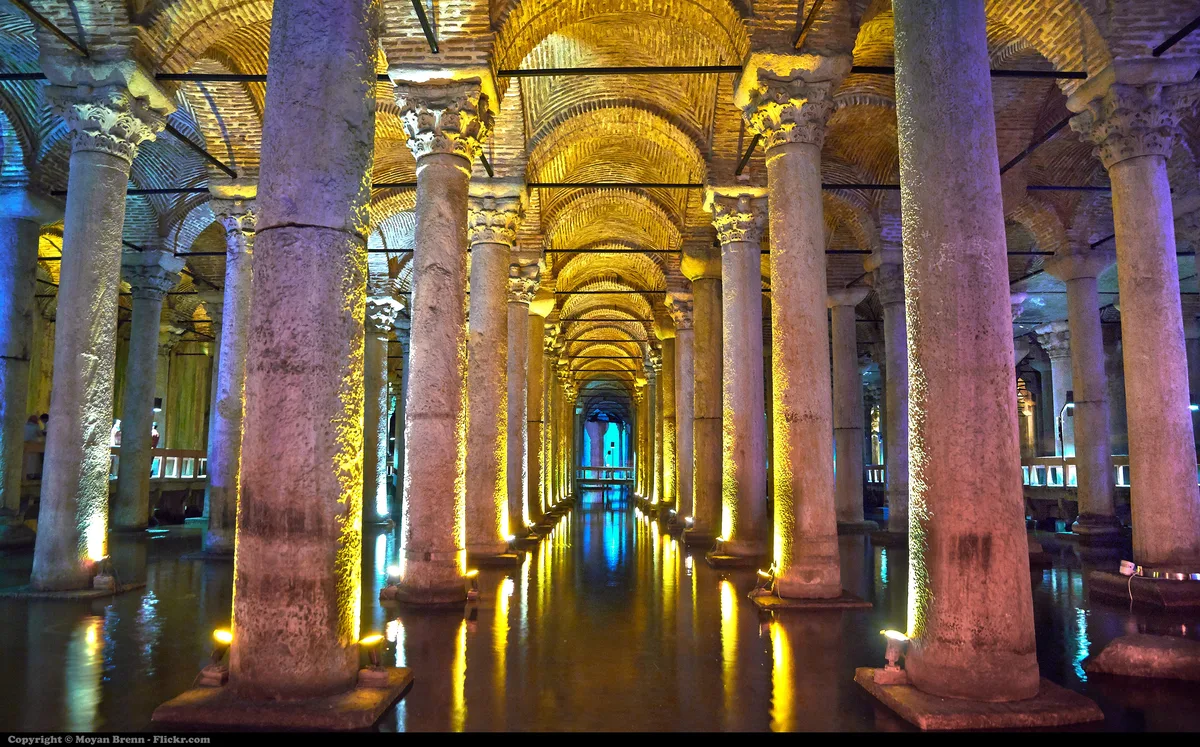
Stand still for a moment at the bottom of the stair. The instinct is to start photographing, and there will be time, but the cistern repays sixty seconds of just looking. The hall is a rectangle of columns in twelve long rows, running away into a darkness that the lighting deliberately never quite fills. Each column rises from the water – or, since the restoration, from the shallow sheet of water over the original floor – to a capital, and each capital carries the brick vaults that carry the street above. The sound is part of the architecture: drips falling from the vaults strike the water at irregular intervals, so the whole hall ticks and echoes like a slow clock, and voices drop without anyone instructing them to. Almost every visitor whispers in the Basilica Cistern, and none of them was asked to.
The scale takes a moment to register because the proportions are inverted. A cathedral lifts your eyes; the cistern spreads them sideways. At roughly 140 by 70 metres, the floor plan is larger than Hagia Sophia’s, yet the ceiling is barely ten metres above the water, so the space reads not as a hall but as a landscape – a flooded forest of stone trees under a low brick sky. Walk a few steps along the first platform and the geometry starts to move: rows align and dissolve, reflections double every column, and the far end stays stubbornly out of focus in the gloom. It is the most purely atmospheric interior in Istanbul, and it achieves the effect with almost no decoration at all – just repetition, water, brick and controlled light.
A word about that light, because it is new. The restored lighting treats the hall as a stage – warm uplighting on the columns, cooler tones pooling on the water, passages of near-darkness between – where the old cistern sat in a flat, murky gloom. Purists grumble that Justinian’s plumbers did not work under mood lighting, and they are right; but the cistern was always experienced by lamplight, in moving pools of brightness, and the modern design is arguably closer to that ancient way of seeing it. The lighting gets its own discussion later in this guide.
The 336 Columns
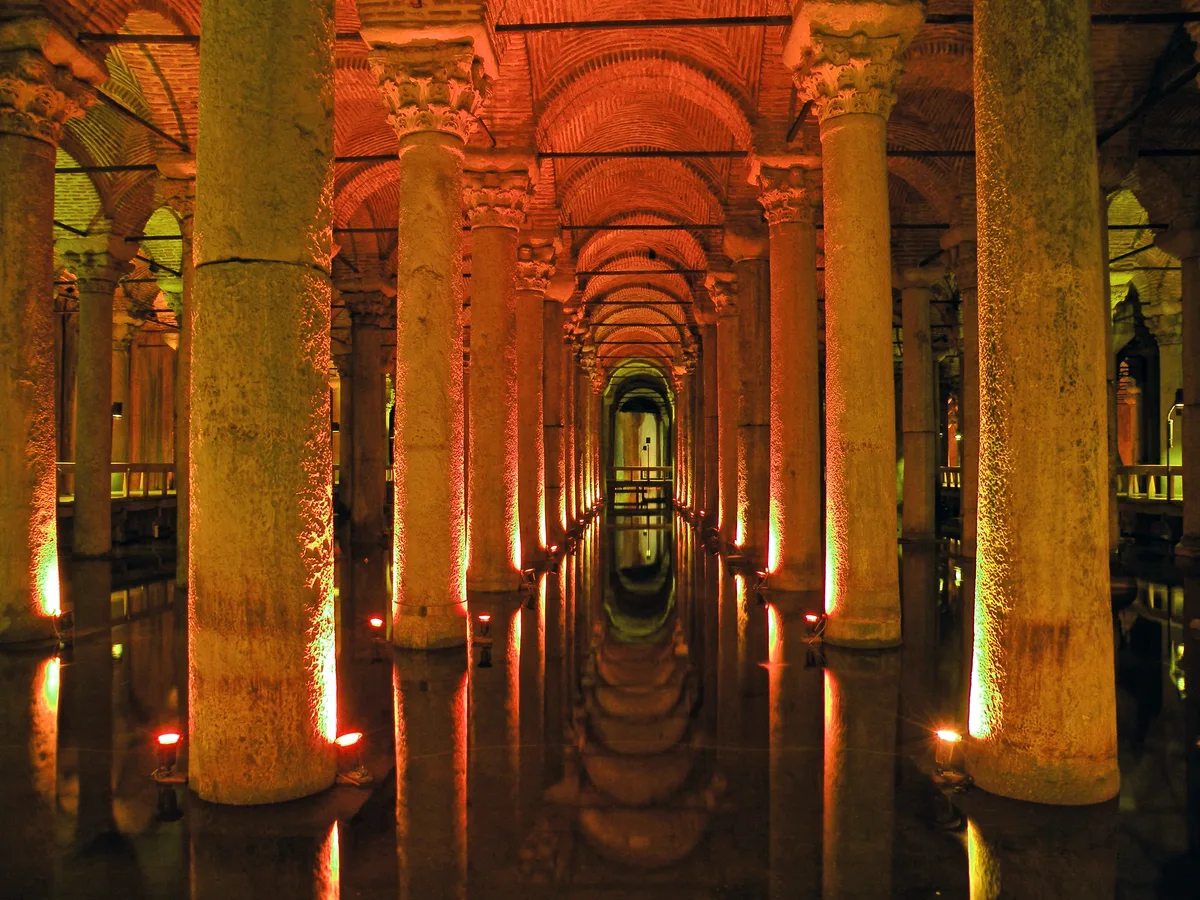
Count them if you like – everyone tries, and the building defeats everyone, which is part of the fun. The cistern’s roof is carried on 336 marble columns, arranged in 12 rows of 28, each column about 9 metres tall. The number is one of the solid facts of the place, repeated by the operator and the standard references, and standing in the hall it feels simultaneously exact and unverifiable: rows vanish into darkness, reflections counterfeit extra columns in the water, and the eye gives up around the second hundred. Take the figure on trust and spend your attention instead on what the columns actually are, because individually they are the most eloquent objects in the building.
They are, for the most part, not new. A programme working at Justinian’s pace did not quarry and carve 336 matching columns when the empire was full of dismantled temples and stockpiled marble. The columns are spolia – reused members, gathered from across the Roman and early Byzantine world and re-erected where matching sets could be made up. Look at the capitals as you walk: carved Corinthian acanthus stands beside plainer Doric and Ionic types; shafts vary in diameter, marble and finish; some are single monoliths, others stacked from two shorter drums to make the height. The hall is a census of the empire’s leftover stone, filed in rows.
This was normal Roman and Byzantine practice, and it is worth resisting the modern instinct to read it as carelessness. Reuse was economics and ideology at once: marble was expensive, transport was slow, and old stone carried authority. What the cistern shows, better than any grander building, is reuse at industrial scale and without cosmetic anxiety – the columns had to hold up a roof and stand in water for centuries, and nobody who mattered would ever see them. That they were arranged with care anyway, in exact rows on an exact grid, tells you something real about the building culture that produced them: even its hidden infrastructure was built to a standard. Keep that thought for the Medusa corner, where the reuse stops being tidy and becomes genuinely strange.
Structurally, the columns divide the hall into square bays, each roofed with a brick cross vault – a stone honeycomb that spreads loads evenly and absorbs individual failures. It has carried the streets of Sultanahmet for fifteen centuries, through earthquakes that felled prouder buildings. Everything else in this basilica cistern guide – the Medusas, the weeping column, the light shows – is commentary on this grid of 336.
Where the Columns Came From
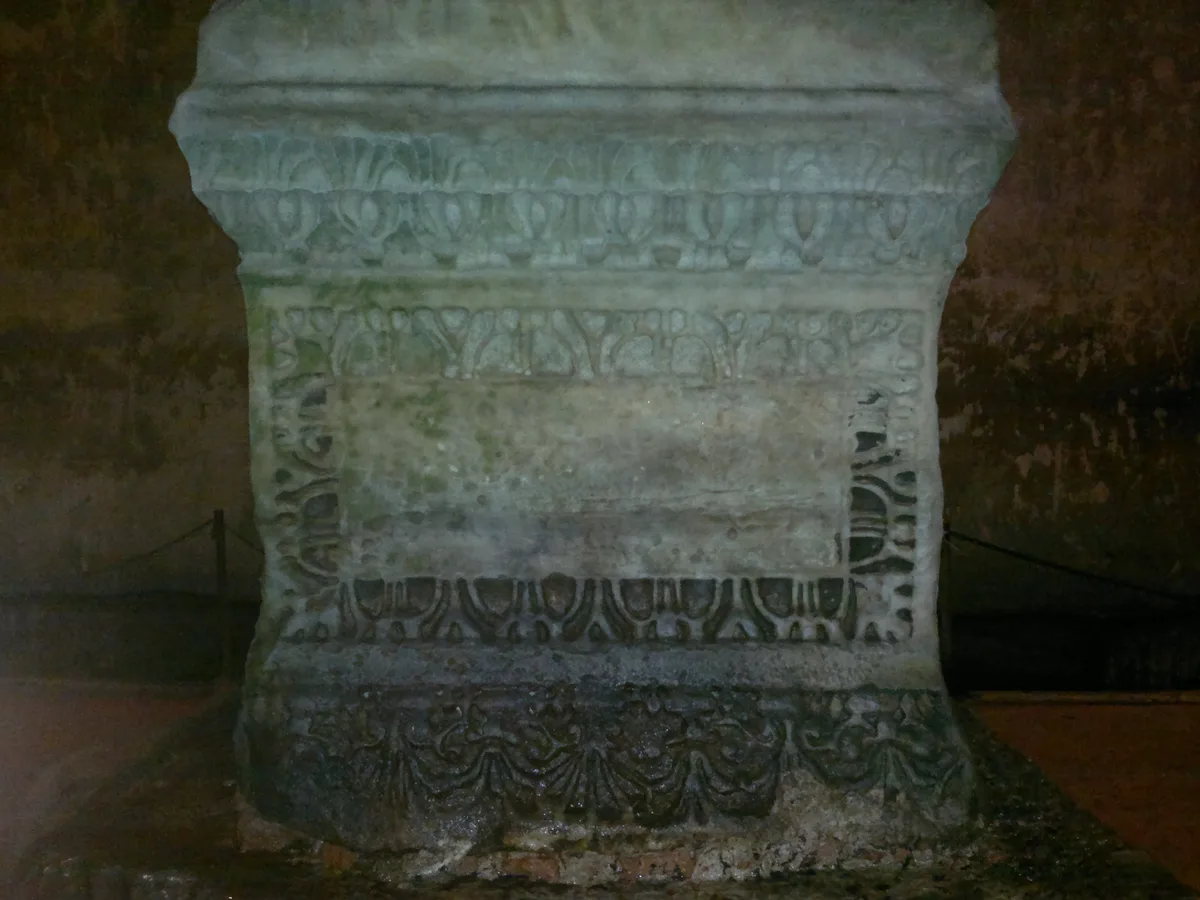
Follow the spolia idea one step further, because it explains the two most famous objects in the building. When the cistern’s builders needed material, they drew on the empire’s vast inheritance of carved stone: columns and capitals from temples and public buildings, blocks from monuments whose meanings had expired, marble of every province and period. Most of it went in anonymously, shaft and capital and base, indistinguishable once installed. But stone is not always anonymous. Some blocks carried carving too distinctive to disappear – carved plinths with patterned borders and inscription panels, of the kind in the photograph above, doing humble work as column bases while still wearing the decoration of whatever monument they were cut for. Look down as much as up in the cistern: the bases and plinths are a museum of displaced carving, working incognito.
The practice had a particular edge in a Christian empire building over a pagan past. Temples were being closed, converted or quarried throughout the fifth and sixth centuries, and their fabric flowed into churches, walls and infrastructure. A column that had stood in a temple colonnade might end its journey holding up a cistern roof, its history invisible under water. Scholars read this variously – as thrift, as triumph, as simple indifference to old meanings – and the honest position is that it was usually all three at once, in proportions no one recorded. The cistern’s builders left no manifesto. They left a parts list you can walk through.
Two blocks in the far corner carried carving too famous to stay anonymous, and they get their own sections next. But before you go to them, take in the quieter lesson of this part of the hall: the Basilica Cistern is not only a Byzantine building. It is a condensed archive of the classical world the Byzantines inherited, reassembled underground – Roman marble, Greek carving, pagan iconography and Christian engineering all holding up the same roof. The reuse was never hidden; the grid displays it. That the two most sculptural blocks were placed where they were, in the orientations they were, has generated five centuries of theorising – which brings this basilica cistern guide to the corner everyone comes for.
The Medusa Heads
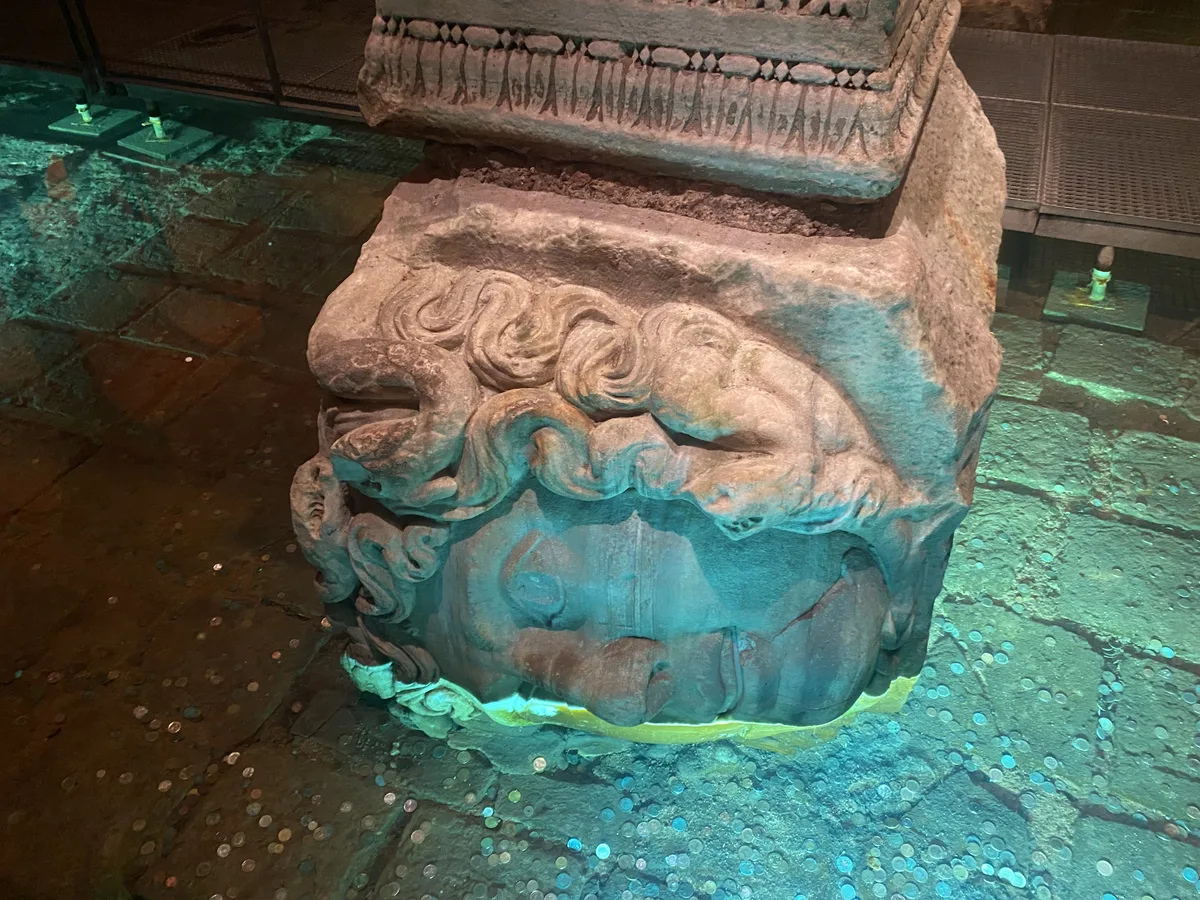
In the far northwestern corner of the hall, at the end of the walkway circuit, two columns stand on blocks unlike anything else in the building: great carved heads of Medusa, the snake-haired Gorgon of Greek myth, pressed into service as column bases. One head lies on its side, turned ninety degrees, so that the face looks along the water. The other is completely upside down, chin to the vaults and hair in the waterline, her carved features eerily legible in the gloom even inverted. They are large, Roman-period carvings of real quality, and they have been photographed so often that they have become the cistern’s signature – the image on the posters, the moment the whole visit builds toward. Arrive at the corner and you will find the walkway’s one reliable crowd, everyone waiting for the same gap in front of the barrier.
Slow down anyway, because the heads reward looking rather than glancing. The carving is fine work – deep-drilled hair resolving into snakes, heavy-lidded eyes, a mouth with the composed expression of classical sculpture rather than the screaming monster of later imagination. These were made to be seen, at scale, on some public building of the Roman city – a temple frieze, a monumental fountain and a forum portico are the usual candidates, and the honest answer is that nobody knows which. What is certain is that they are older than the cistern, carved for daylight, and have spent fifteen centuries in the dark at the wrong angles, holding up a roof in a flooded basement. The incongruity is the entire effect.
They stand, remember, on the far side of the hall from the entrance, at the deepest point of the visitor route, and whether that placement means anything is the question that has kept guides employed for centuries. In the cistern’s working life this corner was simply the last bay of the grid, dark and unwatched; the heads were discovered by the modern world, not presented by the ancient one – they came fully to light only when the mud was cleared in the 1980s. Everything visitors feel at this corner, the sense of finding something hidden and slightly forbidden, is a modern experience built on an ancient accident. Or on an ancient joke. Or on an ancient ritual. The next section of this basilica cistern guide gives the theories the honest treatment they deserve: as theories.
Practical notes for the corner: the viewing area is small, the barrier keeps you a few metres back, and the heads sit low, at water level, so the view over a crowd is limited – patience beats elbowing, and the crowd pulses as groups arrive and leave. The lighting here runs deliberately cold, which flatters the stone and defeats phone cameras in equal measure; brace the phone, skip the flash, and let the exposure settle.
Sideways and Upside Down – the Theories Behind the Medusa Heads
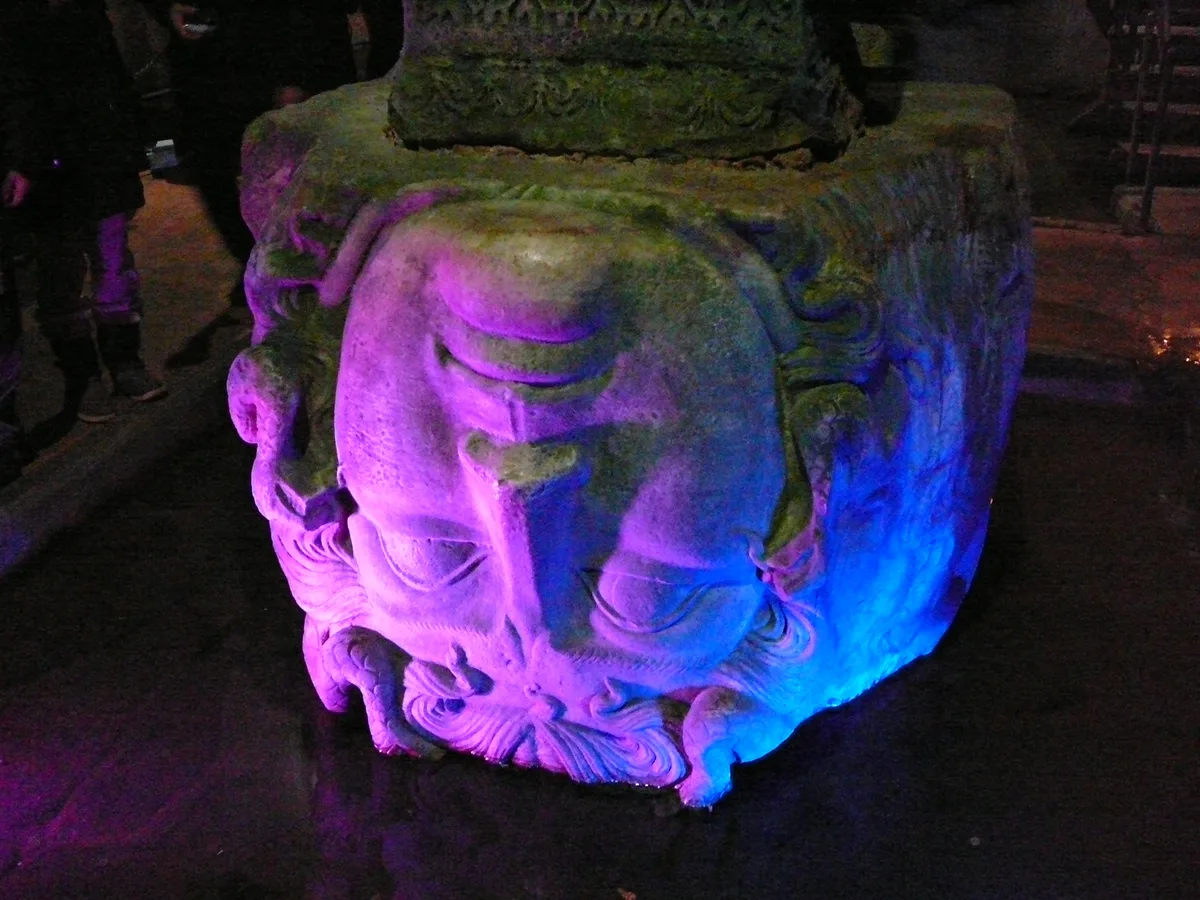
Why are they like that? It is the question every visitor asks, and the first duty of a basilica cistern guide is honesty: no ancient source says, no inscription explains, and anyone who gives you a single certain answer is selling you a story. What scholarship and tradition offer is a set of theories, and they are worth laying out in order of excitement, which is roughly the reverse of their order of probability.
The most likely explanation is the least poetic. The heads were blocks – large, sound, square-ish pieces of marble of a useful size, in a building project that consumed hundreds of such blocks. Byzantine builders reusing carved material routinely paid no attention to the orientation of imagery on stone destined for foundations and dark interiors; across the cistern and across the city, spolia sit at whatever angle fitted the masonry. On this reading, one head went in sideways and one upside down because that is how they came off the cart, and their placement in the far corner, at the dark end of a flooded working reservoir nobody was meant to enter, is exactly what you would expect of stone that nobody expected to be looked at. The strongest argument for this theory is the building itself: a hundred other carved blocks in the cistern are treated with the same cheerful disregard.
The second theory reaches for meaning. Medusa’s gaze turned men to stone; in late antique and Byzantine folk thinking, Gorgon imagery retained a protective, evil-averting power – Gorgoneia were set over gates and ovens and kilns to turn harm away. Turning the head sideways or upside down, on this account, was a deliberate neutralising or redirecting of that power, or an apotropaic installation in its own right, guarding the city’s water. It is a better story and it is not baseless – the imagery really was used protectively in the period – but no evidence connects that general habit to these two blocks specifically, and the orientation of a base buried in dark water is an odd place to perform it.
The third family of explanations is Christian and triumphalist: the pagan symbol humbled, inverted and put under column by the empire that had closed her temples. It fits the era’s rhetoric, but it is unproven, and it struggles with the same problem – the gesture was made in the dark, underwater, where nobody would ever see it. Folklore added its own layer over the centuries: the heads weep, they guard treasure, they were hidden rather than placed. Enjoy all of it at the barrier; just know which shelf each story sits on, and that the plainest theory remains the one the evidence supports.
The Weeping Column
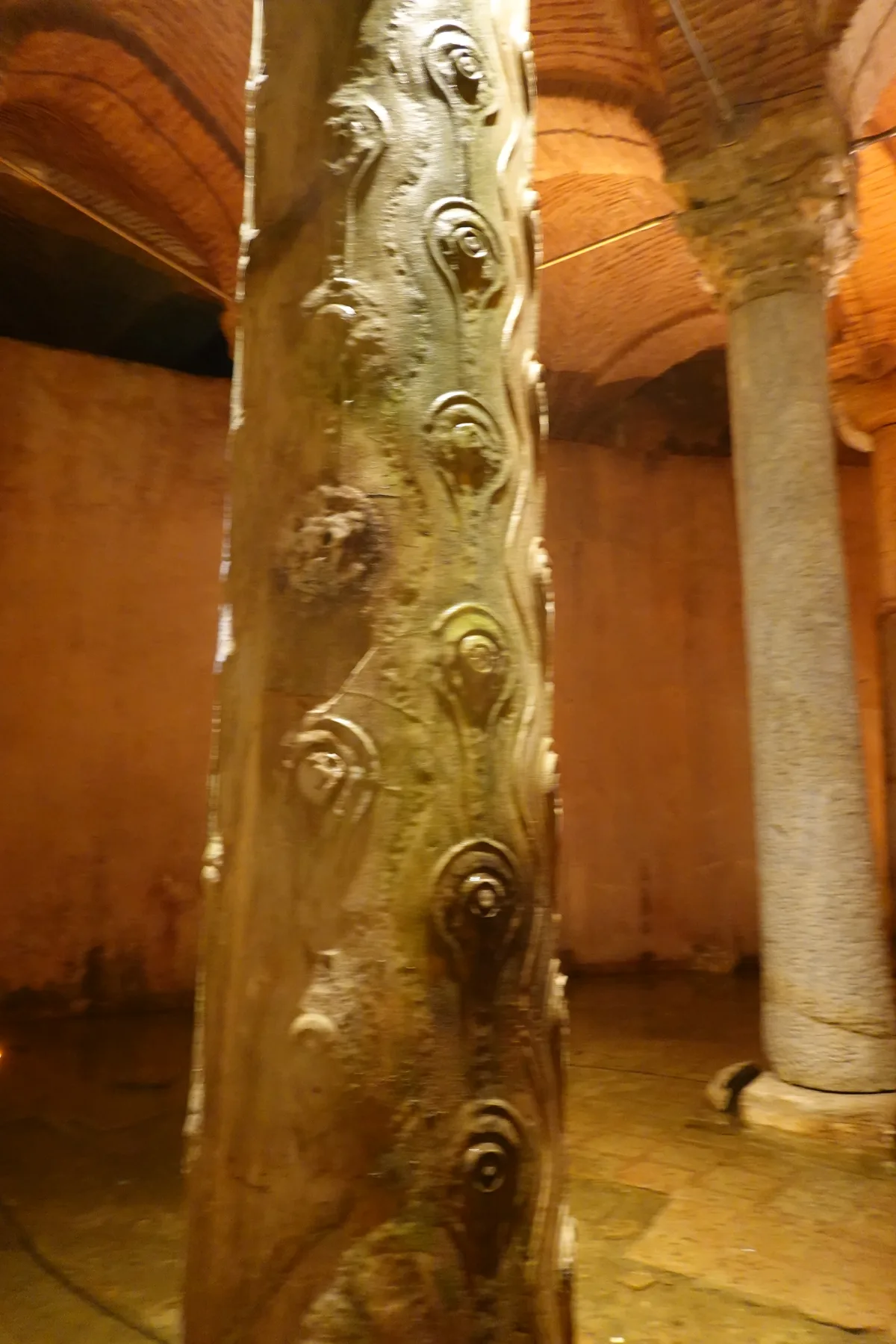
Not far from the entrance end of the hall stands the cistern’s third celebrity, and its quietest: a single column whose shaft is carved from top to bottom with a pattern of raised teardrops and peacock-eye motifs, quite unlike the plain shafts around it. It is known as the Weeping Column, or the Column of Tears – in Turkish, the Gözyaşı Sütunu – and the second half of its name is not only metaphor. The column is perpetually damp. Water seeps and condenses across its carved surface so that the teardrops glisten and occasionally drip, in a hall where most columns stay comparatively dry, and the effect, once noticed, is hard to unsee: the one column carved with tears is the one column that appears to shed them.
The carving itself is spolia with a pedigree. The teardrop-and-eye pattern is generally linked to a late Roman monumental context – the design is most often associated with a triumphal arch of the Theodosian age, the great forum architecture of the fourth or fifth century – and the column, or the carved shaft section at least, was already an antique with a history when Justinian’s builders set it in the cistern. Why this decorated shaft was used here, in a building indifferent to decoration, raises the same question as the Medusas, and admits the same likely answer: it was a sound column of the right height, and its carving was beside the point. The dampness has a plainer explanation too – the column stands where moisture moves through the structure, and carved stone with a network of grooves gathers and displays condensation better than a smooth shaft. The poetry is an accident of plumbing. It remains genuinely moving, which is not a contradiction.
Around the column a body of tradition has gathered. The tears are said to be shed for the slaves and labourers who died building the cistern – the chronicle workforce figures run to thousands, and construction on this scale was done by human muscle in conditions nobody should romanticise. As history, the claim that the carving commemorates them is almost certainly false; as folk interpretation it is better than most, because it directs a moment of the visit toward the anonymous thousands who dug, hauled and carved. There was also, for years, a ritual: a thumb pressed into a worn hole in the column’s base, turned full circle for a wish. Whether the current route takes you within reach depends on the season’s walkway arrangement – if it does not, the view from the barrier is the visit’s portion, and it is enough.
Look Up – the Brick Vaults
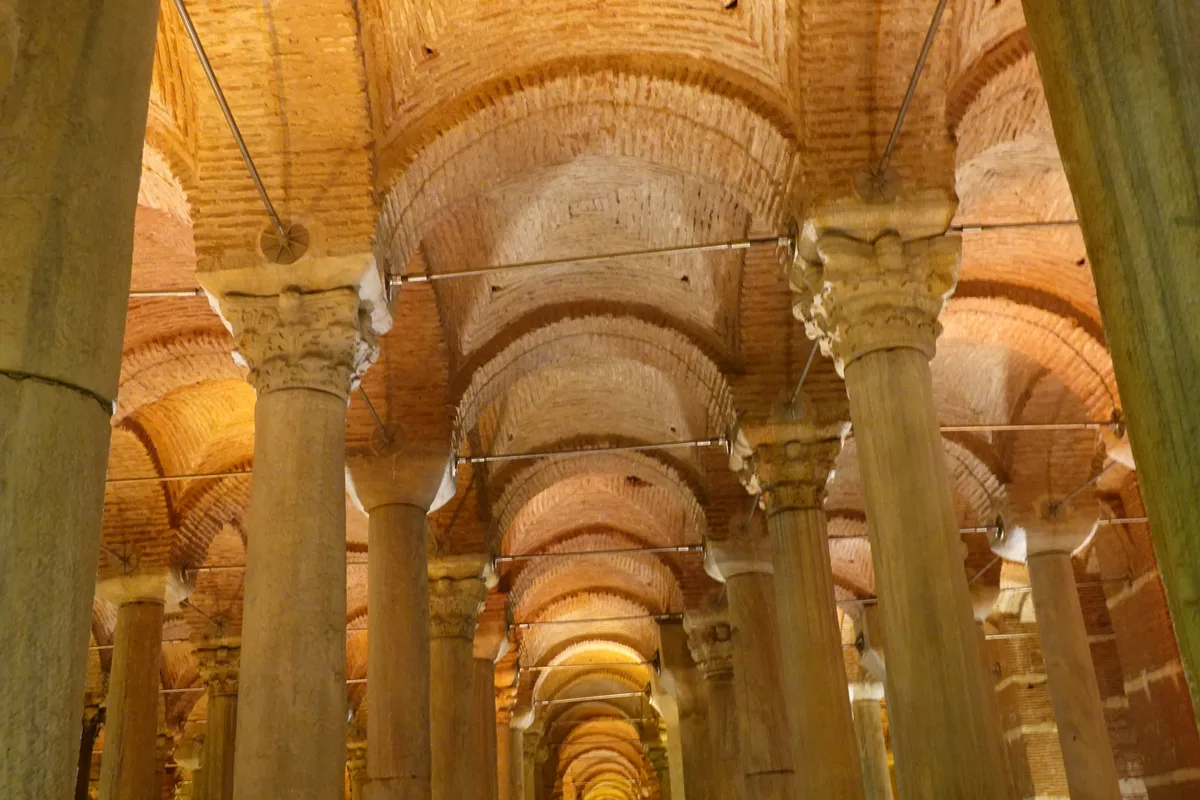
Visitors spend most of the visit looking across and down – at the water, the reflections, the Medusas – and so miss the half of the building that does the hardest work. Look up. Every square bay of the grid is roofed with a brick cross vault, and the vaults repeat in a dim honeycomb to the walls: thin, light, fireproof brickwork of the same school that threw the dome over Hagia Sophia in the same decade. Brick was the correct material in every way – lighter than stone over a span, quick to build on timber centring, tolerant of the small movements of a structure standing in water – and the cistern’s vaults have carried the point of the exercise, literally: above them lies a metreage of earth and then the living street, its hotels and tram-fed pavements, all resting unknowingly on sixth-century brick.
The vaults also explain the cistern’s weather. Warm moist air meets cool brick; water condenses, gathers, and falls as the irregular dripping that provides the building’s soundtrack and keeps its floor wet. The restorers who studied the structure in the recent works treated the vaults with the respect owed to the building’s actual survival mechanism: this roof has endured fires that consumed the city above it, earthquakes across fifteen centuries, and long periods of total neglect, and it is the reason there is a cistern to restore at all. When you read that the cistern was “lost,” understand that it was lost under a roof that never failed. The darkness up there is not an absence of architecture. It is the architecture, working.
One more upward detail rewards the patient: the capitals, whose variety the spolia sections described – acanthus-carved Corinthian work, plain impost blocks, mismatched pairs sharing a bay – picked out in relief by the restorers’ raking light, better than lamplight ever showed them in the cistern’s working centuries. The whole visit, in that sense, is an anachronism: you are seeing Rome’s basement better than Rome ever did.
Water, Fish and the Original Floor
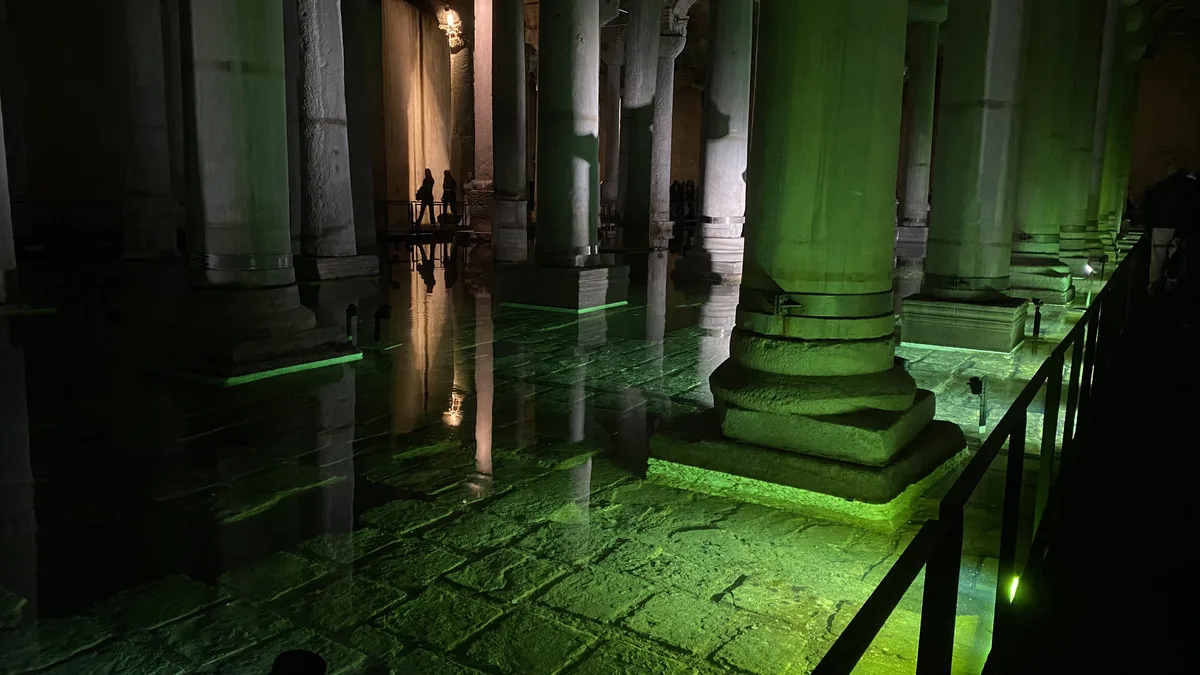
The water is the element the restoration changed most, and the change divides opinion, so it deserves a clear account. The old cistern – the one visitors knew before 2022 – kept its water deep, opaque and tea-brown, mysterious and frankly murky, with large carp moving in it like rumours. Generations of visitors threw coins and watched fish shadows slide under the walkways. The restored cistern keeps a much shallower sheet of water, clearer and actively managed, spread over something the old visit never showed: the cistern’s original Byzantine floor, brick paving of the sixth century, now visible across great areas of the hall where the new walkways run. What was gained is the building’s archaeology – you can finally see what the columns actually stand on, read the floor’s levels and repairs, and understand the hall as a constructed basin rather than a natural cave. What was lost, the romantics say, is a layer of gothic murk. Both are right; this basilica cistern guide sides with the floor, because a reservoir you can read is worth more than a mood you can photograph.
The fish are still there. A population of fish lives in the shallows – modest successors to the famous carp – and spotting them sliding between the column bases is one of the visit’s small pleasures, as it apparently was in Gyllius’ day, when the fishing happened from the houses above. The water level is held low and steady by modern systems, a few hand-spans over the bricks in most areas, deeper in the channels; it no longer serves any supply function, and its job now is conservation and truth-telling: a cistern with no water in it would be a warehouse, and the shallow sheet keeps the stone wet, the reflections alive and the building legible as what it is.
Stand at a railing and look down for a while. The floor tells stories the columns cannot – patched areas, worn lines where water moved, plinths sunk in the brick. Near the Medusa corner it is littered with coins, the universal wishing economy, though operators of every era have asked visitors not to feed the reservoir its small change. The coins glitter, the fish thread between them, and the sixth-century bricks hold the whole improbable scene as they were laid to do.
The Restoration That Changed the Visit
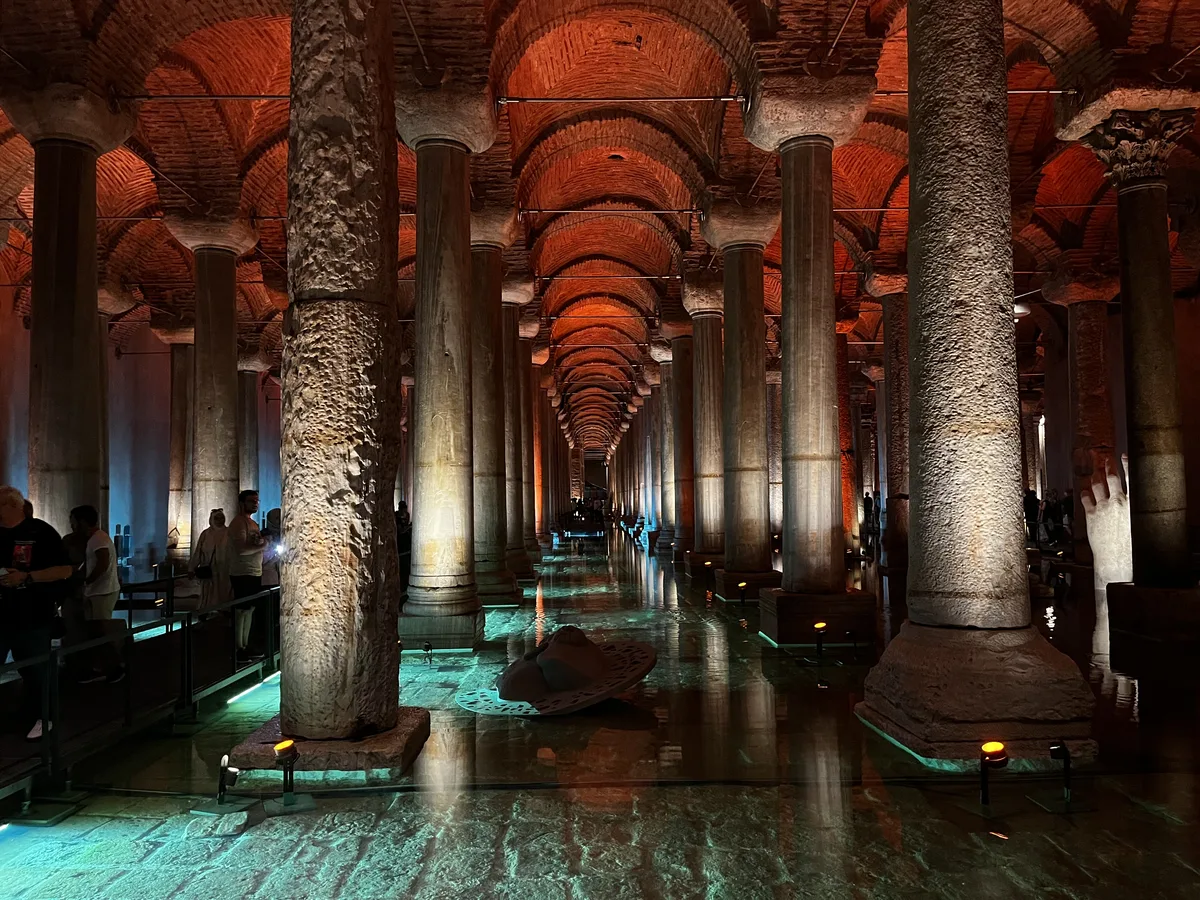
Between 2017 and 2022 the cistern underwent the most thorough intervention of its long life, carried out under the Istanbul Metropolitan Municipality and its culture company, and it reopened in the summer of 2022 as a substantially different museum. The work had several strands, and understanding them explains everything about the visit you are now taking. The structure came first: engineers assessed a 1,500-year-old building that carries a living street, and the conservation addressed the vaults, the columns and the waterproofing with the aim of leaving the old fabric stronger and better monitored than it had been in centuries. This was not cosmetic work, and reports from the period treat the building’s seismic behaviour – in a city that lives with earthquakes – as a central concern of the project.
The visitor route came second. The pre-restoration visit ran on ageing platforms and a concrete walkway that crossed the hall on a fixed, rather limiting path. The new arrangement runs on steel walkways and viewing platforms that spread visitors through more of the hall, bring the route close to the Medusa corner and the weeping column, and – the decisive move – sit lightly over the original floor, which the works exposed and cleaned across large areas. The third strand was the water, covered in the section above: deep and opaque became shallow and clear. And the fourth was the interpretation layer: the theatrical lighting design, the contemporary artworks discussed next, and the recasting of the cistern from a municipal museum into a cultural venue that also hosts concerts and events.
Reactions at reopening split predictably, and a good basilica cistern guide should report them fairly. Purists missed the murk and the shabbiness; the broader verdict, in visitor numbers and press, was that the restoration revealed a greater building than the one it replaced – floor, structure and full length legible for the first time in the modern era. Both reactions describe the same facts. The cistern you visit now is cleaner, clearer, more crowded and more managed than the old one, and the sections that follow deal with the consequences of its success.
Light Shows and Art in the Dark
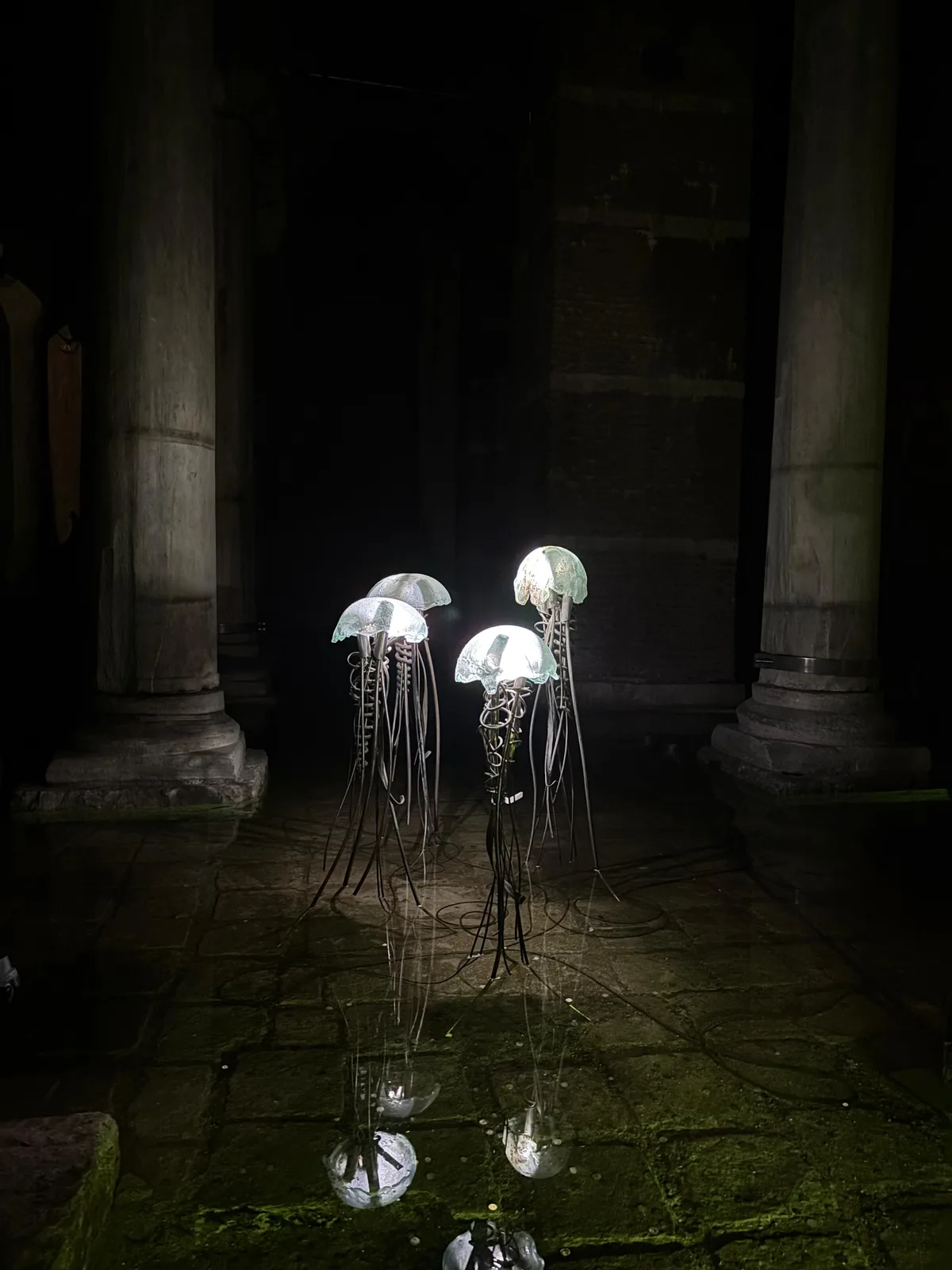
The restored cistern is not only a monument but a gallery, and this is the element no previous era of the building could have predicted. Contemporary sculptures stand in the water and on the platforms among the columns – works in glass, metal and light that use the hall’s reflections as part of their material. Most remarked of all are the drifting, jellyfish-like light forms that hover over the shallows, pulsing gently, so that parts of the hall feel less like a reservoir than an aquarium of slow machines. Other installations come and go with exhibitions and seasons: the hall is programmed, like a venue, and the population of artworks you meet depends on when you visit. Nothing down here is obliged to be permanent except the columns.
This curatorial layer divides visitors as reliably as the clear water did. One camp finds the sculptures an impertinence; the other answers that the cistern was never a sealed relic – it has been a fishpond and a film set, and artists were always going to claim a dark hall of water and columns once allowed. The pragmatic view, and the one this guide recommends, is to let the art be a reason to slow down: the installations make you stop at points of the route you might otherwise stride through, and a hall this size rewards stopping. The columns, indifferent, outlast every exhibition.
The lighting deserves separate mention from the art, because it is effectively the largest artwork in the building and the one you cannot opt out of. The design stages the hall: warm washes up the columns, cold pools on the water, the Medusa corner lit like a shrine, rhythms of brightness that change as you move. Daytime and evening sessions lean on it differently, and the night sessions push it furthest. Photographers should know that the light is dim by design and mixed in colour temperature, which is why phone night modes outperform flash here by an embarrassing margin – the flash flattens the reflections that are half the subject. Give the camera a railing to rest on, let it take its long exposure, and accept the colours the building has chosen.
The Night Shift – the Cistern After Dark
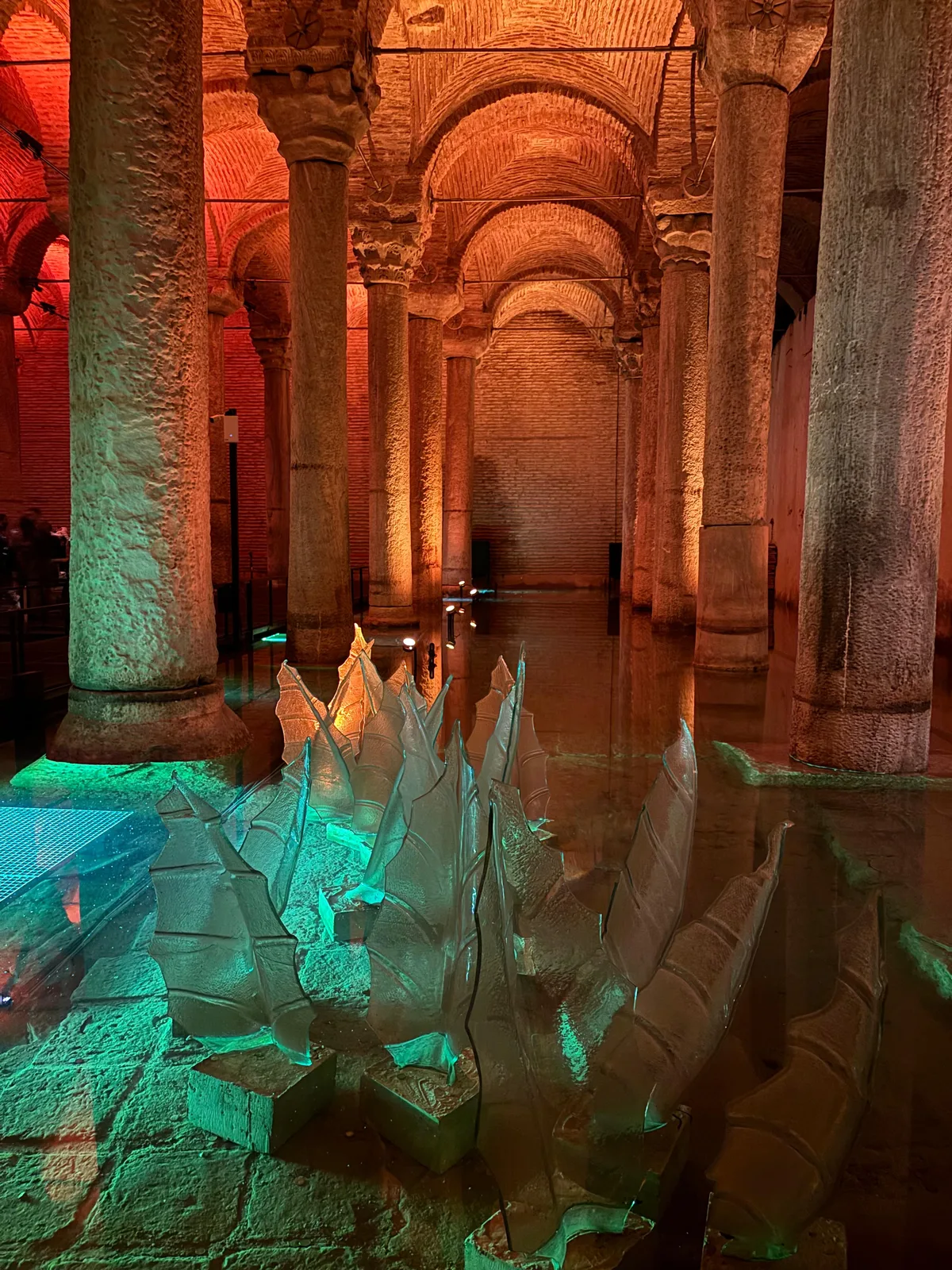
In recent seasons the cistern’s day has had a second act. After the daytime session ends and the hall closes briefly to reset, it has reopened in the evening for a separate session – marketed as the Night Shift – running to around 22:00 on its own ticket, priced above the daytime one. The evening visit is the same hall under a different regime: the lighting leans harder into colour and theatre, installations and at times live performance take the platforms, the water goes blacker, and the crowd runs thinner and more deliberate – nobody stumbles into the Night Shift by accident, which changes the atmosphere as surely as the light does. Of all the ways to see the cistern, it is the most staged and, for many visitors, the most memorable: Justinian’s reservoir as an after-dark art event.
Honesty requires two caveats, and this basilica cistern guide will not bury them. First, the evening session is an operator’s product, not a law of nature: it has run in recent seasons under the previous operator, arrangements were reset when management changed hands in 2026, and whether the session runs on your date, at what hours and at what price is a question only the official site or the box office can answer on the day. Plan the evening visit as a bonus to confirm, not a certainty to build a night around. Second, the separate ticket means the evening cannot be bolted onto a daytime visit – you choose your session, or you pay twice, and for most itineraries the choice is simple: first visit, short on time, daytime; returning visitor, photographer, or anyone whose old town days are full and evenings free, the night session, if it is running.
If you do go at night, arrive near the start of the session, when the reset hall is emptiest, and let the daytime logic of highlights go: the evening rewards a slow full circuit rather than a march to the Medusas. And when you climb the exit stair into the lit streets, with Hagia Sophia floodlit across the square, the cistern completes a trick no daytime sight in the district can match – it is the one monument here that improves, deliberately and professionally, after dark.
Queues, Timing and How to Beat the Crowds
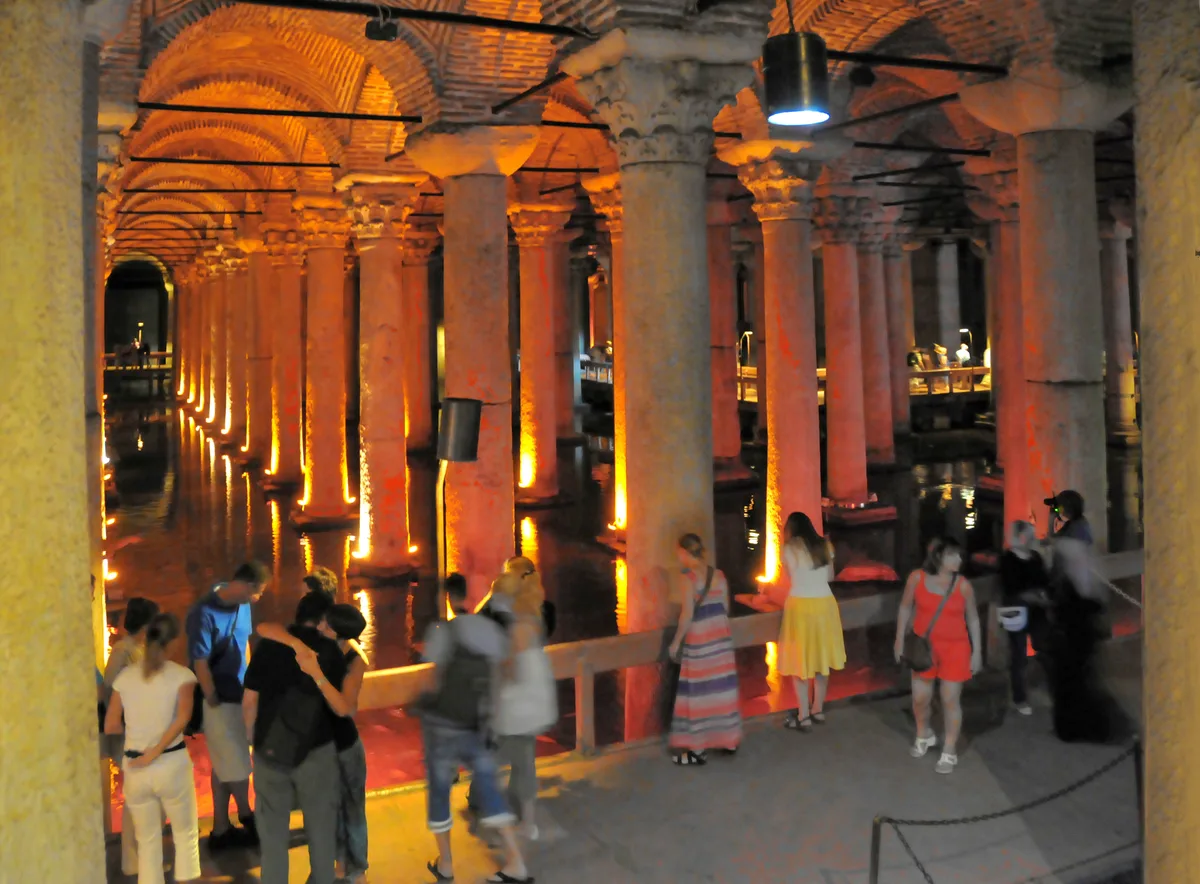
The cistern’s popularity is the one problem its restorers could not engineer away. It is a single underground hall with a controlled entry, in the middle of the most visited square kilometre in Türkiye, and at peak times – late morning to mid-afternoon, weekends, holidays and cruise-ship days from spring to autumn – the ticket queue on Yerebatan Caddesi can run long. Guide sources that track the queue put the worst waits at an hour or more, occasionally well beyond, and there is no shade worth mentioning on the street. None of this should put you off; it should put you early. The strategies below are unglamorous and they work.
Come at opening. The 09:00 start is the single most reliable crowd-avoider in the old town: arrive shortly before opening and you will typically be down the stair within minutes, in a hall that stays civilised for the first hour. Second-best are the last part of the daytime session, when the tour-group tide has ebbed, and low-season weekday mornings, when the cistern can feel almost private. The worst window is 11:00 to 15:00 in high season. If your day forces you into it, the official online ticket – where the current operator offers it – removes the box-office portion of the wait, though not security, and is worth it on exactly those days and no others.
Inside, crowd management is mostly about the Medusa corner, the one true bottleneck of the route. The pulses of visitors move in waves behind the big guided groups; if the corner is three deep when you arrive, let the wave break – look at the neighbouring carved bases, read the hall back toward the entrance, take the photographs of the aisle that everyone skips – and the gap will come within a few minutes. Rushing helps nobody in a building where the walkway is the only floor. With the timing right, allow forty-five minutes to an hour and a half underground; with the timing wrong, budget the same again for the street. Either way, this basilica cistern guide’s firm advice is not to schedule the cistern tightly against a timed entry elsewhere – it is a place that punishes clock-watching and rewards slack.
Practical comfort notes, because they decide more visits than the queue does: it is cool underground in every month, cool enough that a light layer earns its place in a July daypack; the air is humid and the walkways can be slick, so grip matters more than style; the light is genuinely low, though the hall is vast rather than tunnel-like, which most visitors find settles it; and there are no facilities worth planning around underground, so organise the café and the restroom into the street-level parts of the day.
Pairing the Cistern with Hagia Sophia and Topkapi
The cistern exists in the tightest cluster of great buildings in Europe, and planning it as part of that cluster is the difference between a good day and a great one. Hagia Sophia stands about 150 metres northeast, the Blue Mosque five minutes beyond it, Topkapi Palace at the square behind, and the Grand Bazaar a walk or one tram stop west. The cistern is the cluster’s only underground, only non-religious and only quick member – an hour of cool darkness against domes and crowds – and the art of the Sultanahmet day is sequencing it against its neighbours. The wider framework is in our Istanbul travel guide; what follows is the cistern’s own logic within a single day.
The classic sequence runs on the neighbours’ weaknesses. Hagia Sophia rewards the earliest hour you can give it, before its own crowds build. Topkapi is a half-day commitment that closes on Tuesdays and punishes late starts. The cistern, open daily with no weekly closing, is the cluster’s flexible piece: it absorbs the midday heat beautifully, being the coolest room in the district; it fills the Tuesday hole in any itinerary built around the palace’s closing day; and its short visit length lets it sit in the gaps other sights leave. A strong pattern for a first day runs Hagia Sophia at opening, the cistern late in the morning as the square heats up – accepting the queue, or pre-empting it with the online ticket – and Topkapi after lunch with the afternoon for its courts. In summer, an even better pattern saves the cistern for the evening session, when it is running, and spends the brutal midday hours in the palace’s shaded courts instead.
Two warnings complete the pairing advice. Do not stack the cistern against another timed ticket without slack between them, because the cistern’s queue is the variable in the day and it does not care about your schedule. And do not let the cluster’s density fool you into sprinting: the buildings within five hundred metres of the cistern’s stair represent fifteen centuries, and the basement of the city repays the same slowness as its domes. The whole complex sits within the Historic Areas of Istanbul, on UNESCO’s World Heritage List since 1985 – the cistern stands in the Archaeological Park zone, part of the same protected ensemble as the church and palaces above it. Not a sideshow beneath the sights, then, but one of the sights, holding the rest of them up.
Frequently Asked Questions
How much does the Basilica Cistern cost?
This basilica cistern guide deliberately prints no figure, because the tariff changes too often for print to keep up – recent seasons’ prices quoted across current sources disagree with each other, and the operator changed in 2026. The official tariff for your visitor category is displayed at the box office and published on the official site, yerebatan.com. Check it there, and treat any third-party price table – including the ones that rank above this guide – as unverified until it matches the official figure.
Is the Museum Pass valid at the Basilica Cistern?
No. The cistern has never been part of the ministry museum system – it was run for years by the Istanbul municipality’s culture company and changed operator again in 2026 – so the Istanbul Museum Pass, the Museum Pass Türkiye and similar products do not cover it, whoever is operating the building. It always requires its own ticket.
What are the Basilica Cistern opening hours?
The cistern opens daily at 09:00, with no weekly closing day. In recent seasons a daytime session has run into the early evening, the hall has closed briefly to reset, and a separate evening session has run to around 22:00 – but session times were reset in the 2026 handover, so confirm the day’s exact pattern on yerebatan.com or at the entrance.
How long do you need at the Basilica Cistern?
Most visitors spend 45 to 90 minutes underground, including the walkway circuit, the Medusa corner and time standing still, which this hall unusually rewards. Add the ticket queue at busy times – two minutes at opening to an hour or more at a peak-season midday.
Why are the Medusa heads upside down and sideways?
Nobody knows, and this basilica cistern guide declines to pretend otherwise. The most probable explanation is the plainest: the heads were reusable blocks of a convenient size, installed without regard to orientation in a dark, flooded working structure. Theories that the inversion neutralised Medusa’s gaze, installed her as a guardian, or humiliated a pagan symbol under a Christian empire are all older than the evidence for any of them. The theories section above gives each its due.
Can you take photographs inside the Basilica Cistern?
Photography for personal use is part of the modern visit. The practical rules matter more than the formal ones: flash flattens the reflections, so use a night mode, brace the phone on a railing, and expect the mixed coloured light to do what it wants with your colours. Follow any restrictions posted at the door on the day, and keep walkways clear while you shoot.
Is the Basilica Cistern worth visiting?
Yes – with one qualification. If your Istanbul time is measured in hours and domes are your priority, it is the member of the Sultanahmet cluster you can most afford to skip. For everyone else it is close to essential: the largest Byzantine cistern you can walk through, the Medusa heads, the weeping column, and an atmosphere no other sight in the city reproduces.
The Short Version of This Basilica Cistern Guide
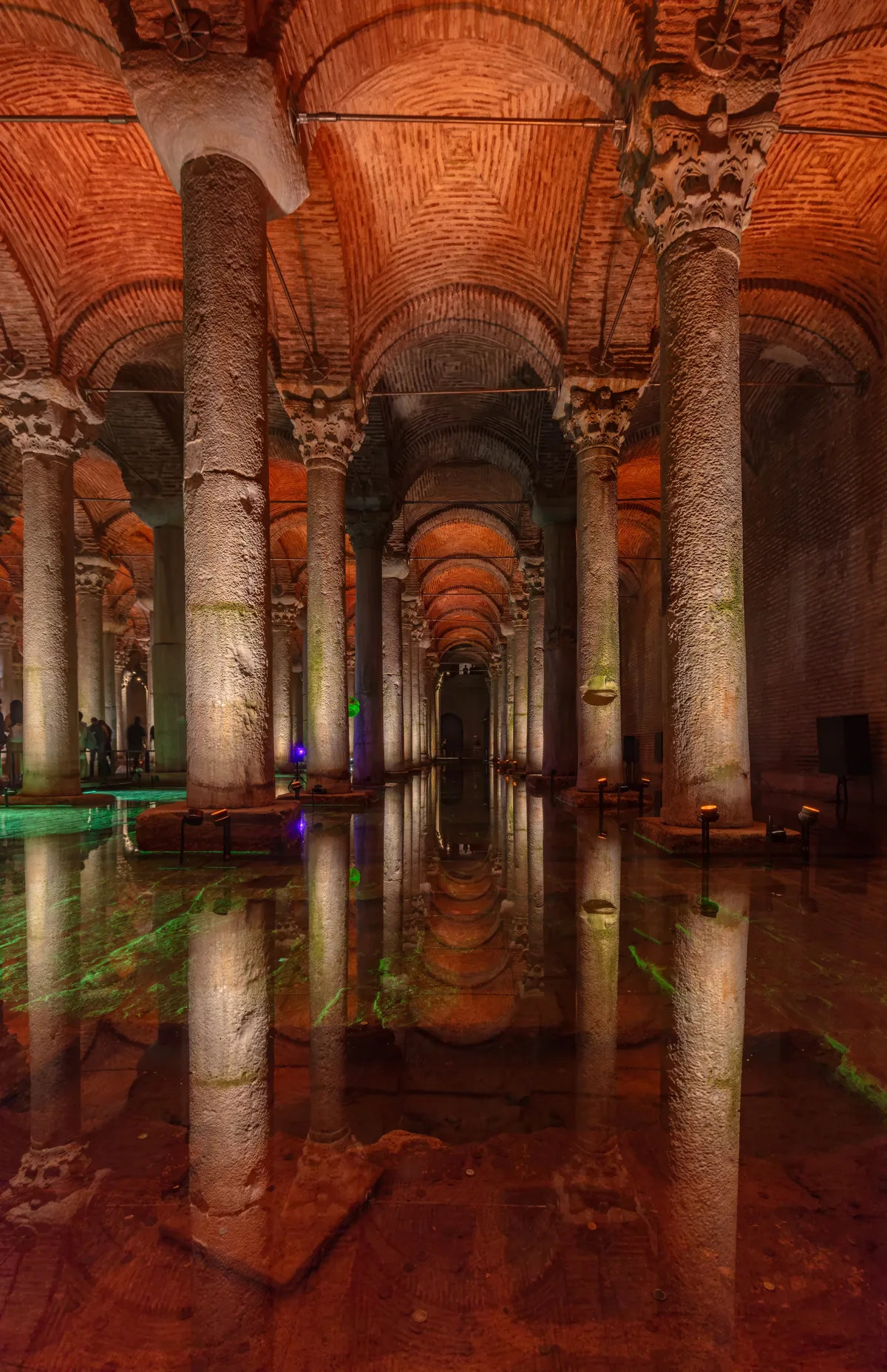
If you keep only five facts from this basilica cistern guide, keep these. The Basilica Cistern is Justinian’s underground reservoir of 532, a hall of 336 reused columns under brick vaults beside Hagia Sophia, and it was a working piece of water infrastructure centuries before it was a sight. It needs its own ticket – no museum pass works here – and its price changes too often to trust any figure but the official one on yerebatan.com, where you should also confirm the day’s sessions, since the operator changed in 2026 and evening sessions are set season by season. Go at the 09:00 opening to beat the queue, give the hall an hour, and spend it properly: the grid of columns, the sideways and upside-down Medusa heads in the far corner, the weeping column, and the original brick floor under the shallow water. Then climb back into the daylight and look at Hagia Sophia again – you have just walked through the other half of its story, the half that held the water.