Ask a Moroccan what defines moroccan food and the answer is unlikely to be a dish. It is more likely to be a table – a low round table with a shared platter in the middle, bread torn by hand, a pot of mint tea poured from a height, and no cutlery anywhere in sight. The dishes matter enormously, and this guide gives them their full due: the tagine, Friday couscous, Fes’s sweet-savoury pastilla, Marrakech’s bachelor-pot tanjia, soups, grills, breads and sweets. But the dishes are only half the subject. The other half is the system around them – how a meal is structured, who eats from where, what your right hand is for, and why refusing a glass of tea is a small diplomatic incident.
That system is what most dish lists leave out, and it is the part a first-time visitor actually needs. Moroccan food is several regional cuisines sharing one country: the refined, Andalusian-layered cooking of Fes; the earthier, meat-forward food of Marrakech; sardines and chermoula on the Atlantic coast; the simple tagines of the Atlas and the south. Layered over the geography are Amazigh, Arab, Andalusian, Jewish and French influences, and a religious calendar that rearranges eating for a month every year. This guide works through all of it – dish by dish, then meal by meal – so that by the time you sit down at a medina stall at nine at night, you know what you are looking at and how to order it.
Two honest ground rules before the food. This guide prints no prices, because stall and restaurant prices in Morocco move with season, city and negotiation – a printed dirham figure copied from guide to guide is how misinformation reproduces. And it recommends no named restaurants as “tested”, because a well-researched guide is not the same thing as a claimed firsthand tour of other people’s kitchens. Instead it tells you how to recognise the good places yourself – the short menu, the full room, the single dish done properly. Routes and regions are covered in our Morocco travel guide; this page is about what happens at the table.
Moroccan Food at a Glance
| Dish or ritual | What it is | Where and when it belongs |
|---|---|---|
| Tagine | A slow braise cooked under a conical clay lid | Everywhere, every day; the default restaurant main |
| Couscous | Hand-rolled semolina, steamed in stages, served communally | Friday lunch above all; homes and traditional restaurants |
| Pastilla | Warqa pastry pie, sweet-savoury, classically pigeon, now usually chicken | Fes first of all; weddings and celebration menus |
| Harira | Tomato, lentil, chickpea and herb soup | Year-round; the soup that breaks the Ramadan fast |
| Tanjia | Beef slow-cooked in a sealed clay urn in hammam ashes | Marrakech only; traditionally made by men, for men |
| Rfissa | Chicken, lentils and fenugreek over shredded msemen or trid | Family occasions; often ordered ahead |
| Brochettes and kefta | Skewers and spiced minced meat over charcoal | Street grills, market stalls, roadside stops |
| Mechoui | Whole lamb roasted until it yields, sold by weight | Mechoui alleys in the old cities; Eid al-Adha at home |
| Babbouche | Snail soup in a spiced, herbal broth | Night stalls; the brave order at Jemaa el-Fnaa |
| Sardines | Grilled, fried or stuffed with chermoula | The Atlantic ports – Essaouira, Safi, Agadir |
| Khobz | The round everyday loaf | Every meal; bought daily, often baked at the communal oven |
| Msemen and baghrir | Griddled layered flatbread; thousand-hole pancakes | Breakfast and tea time |
| Zaalouk and taktouka | Cooked salads of aubergine-tomato and pepper-tomato | The opening spread of small plates |
| Bissara | Fava bean soup with olive oil and cumin | Winter mornings; the working breakfast |
| Chebakia | Sesame pastry flowers soaked in honey | Ramadan above all; sold beside the harira |
| Mint tea | Green tea with fresh spearmint and sugar, poured from a height | All day, everywhere; the country’s handshake |
Read the table as a map of occasions rather than a ranking. A tagine is a Tuesday. Couscous is a Friday. Pastilla is a wedding. Tanjia is a group of men in Marrakech with a free afternoon and a hammam furnace booked. This calendar of occasions explains what will actually be available when: the restaurant that serves a magnificent couscous on Friday may steam a tired one on Wednesday. Eat the dish on its day and you are eating the cuisine at full strength.
The table also shows the cuisine’s grammar. Almost everything is built to be shared, scooped with bread, and followed by something sweet and a glass of tea. Spice is warm rather than fiery, and heat usually arrives as harissa on the side rather than inside the dish. Sweet and savoury are partners, not separate courses: lamb with prunes, a meat pie dusted with icing sugar. First-time tasters sometimes read that sweetness as dessert arriving early. It is one of the oldest signatures of the cuisine.
How a Moroccan Meal Actually Works
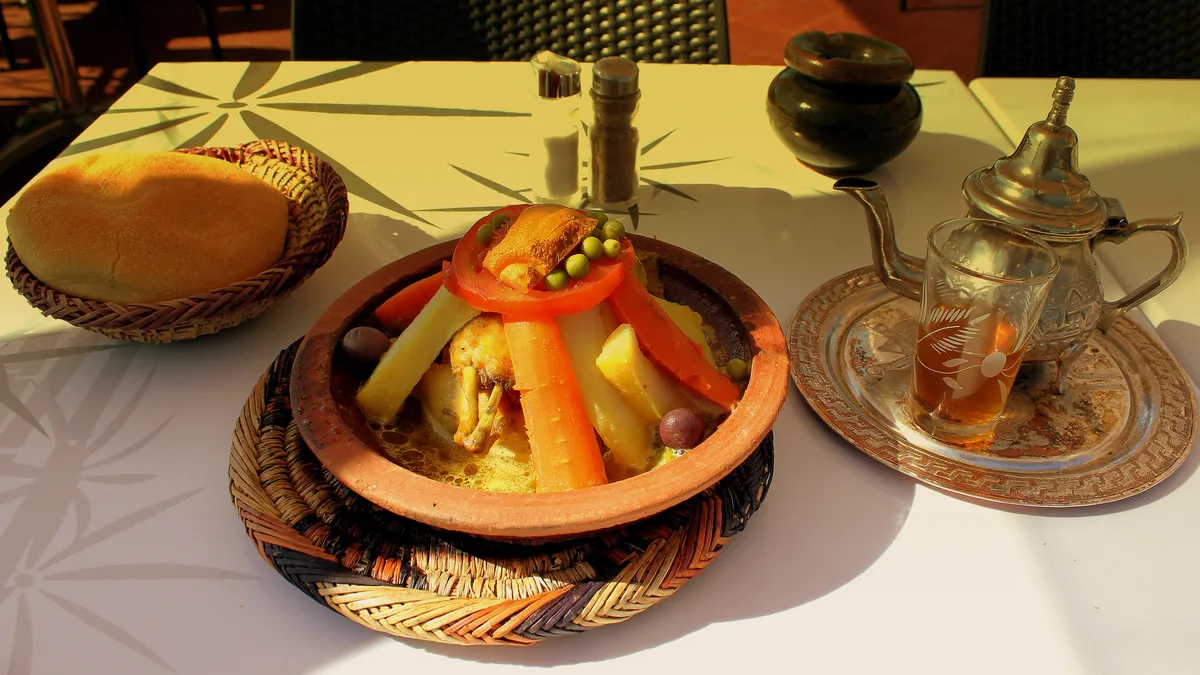
A traditional Moroccan meal begins before any food appears, with water. Hands are washed – at home, often at the table itself with a kettle and basin passed around; in restaurants, at the sink you will be pointed towards without being asked. This is not ceremony for its own sake: you are about to eat with your hand, and the washing is the cutlery drawer of the meal. Then the bread arrives, and it keeps arriving: khobz is not a side dish but the tool the meal is eaten with, torn and used to pinch, scoop and mop. Forks exist and will be produced for visitors without fuss, but the meal is engineered for bread, and dishes are sauced accordingly.
The centre of the table is shared. The main dish lands in the middle and everyone eats from the section of the platter in front of them – your wedge of the circle, eaten neatly, is the etiquette; reaching across to the far side’s chicken piece is the one real table offence, an offence of geography rather than greed. Salads and small plates come first or alongside, olives appear almost by reflex, and the meal builds from those plates to the tagine or couscous, then resolves into fruit or pastries and mint tea. Soup, when it appears at dinner, opens the meal rather than filling it.
The right hand is the eating hand – traditionally the only one used at a shared dish, the left being reserved for other purposes in Islamic practice. Visitors are not policed, but eating with the right hand is a small courtesy that is noticed and appreciated, and it costs nothing to adopt for the length of a trip: tear bread with both hands if you need to, eat with the right. Tea, meanwhile, is not a course but a punctuation mark – it opens negotiations, closes meals, fills pauses and seals purchases – and its own section below gives it its full due.
Tagine, the Slow Heart of Moroccan Food
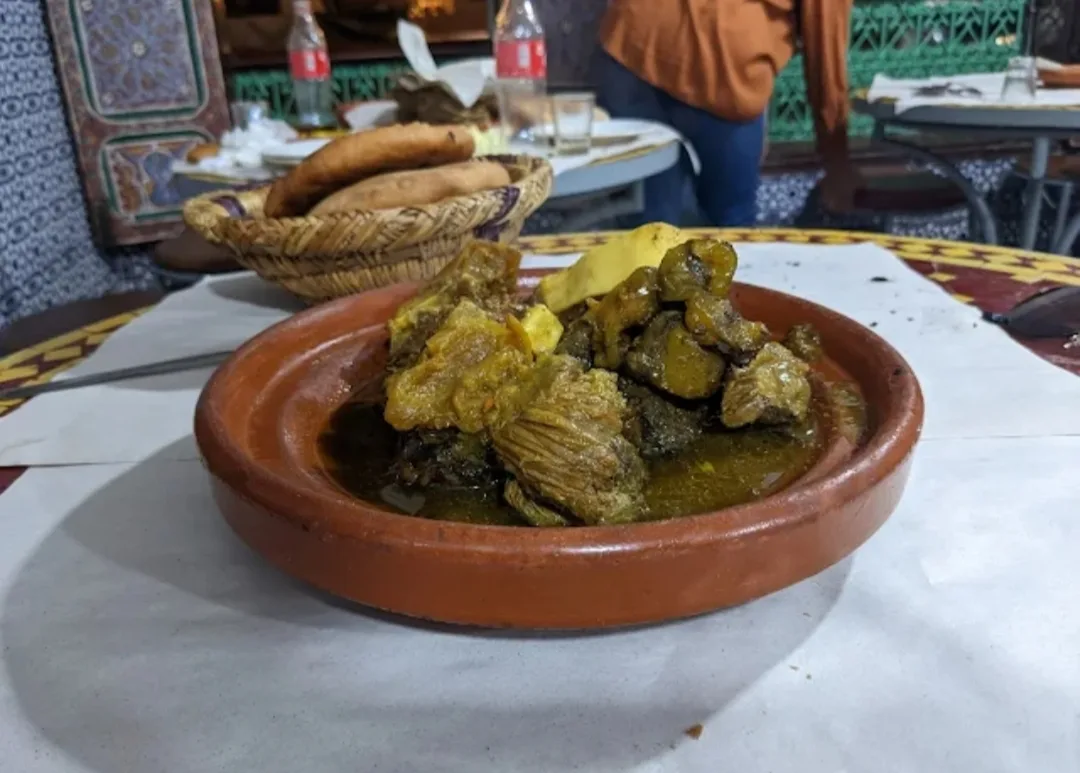
The tagine is both the pot and what cooks in it: a shallow earthenware base with a tall conical lid, designed so that steam rises, condenses on the cool cone and rains back onto the food. The result is a braise that needs very little water and forgives almost any ingredient – which is why the tagine became the country’s universal cooking method rather than a single recipe. When a menu says “tagine”, it has told you the technique and almost nothing else; learning the main varieties turns a wall of menus into a short list of old friends.
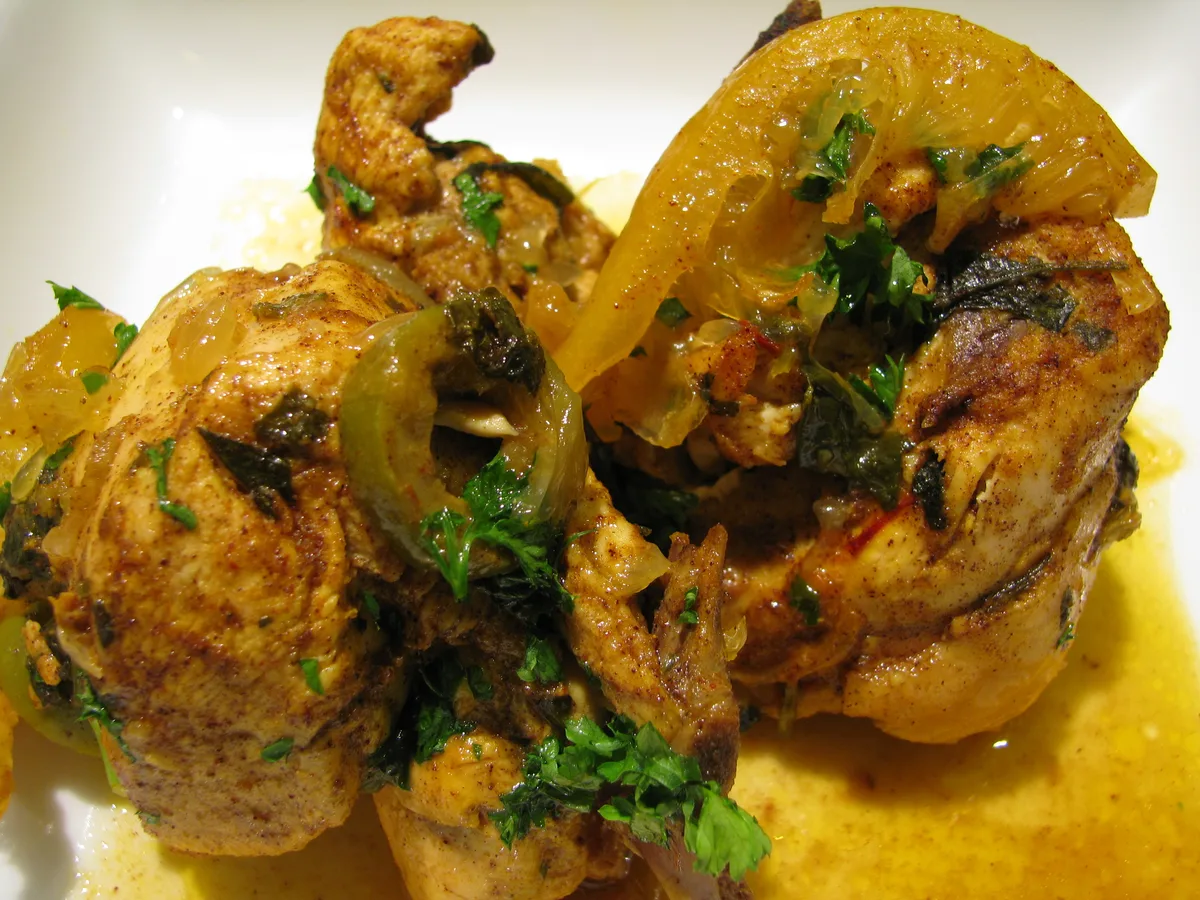
The benchmark is chicken with preserved lemon and green olives – salt-cured lemons cooked into the sauce until they turn silky and intensely citrus, the dish by which home cooks and restaurants alike are quietly judged. Lamb or beef with prunes runs second in fame, the meat dark and tender under caramelised fruit, toasted almonds and a whisper of cinnamon. Kefta tagine brings spiced meatballs in tomato sauce, often with eggs poached in the sauce at the end – the working lunch of half the country. Vegetable tagines arrange the market in concentric order over the base, and fish tagines on the coast come with chermoula, the herb-and-spice marinade that is the coast’s own signature.
How a tagine is served matters as much as how it is cooked. It arrives in its cooking dish, still bubbling at the edges if you are lucky, and is eaten communally with bread, each diner working their own sector; the sauce, reduced and glossy, is the point as much as the meat. Two honest warnings belong here. First, speed: a tagine cooked to order takes time, and places that serve one in ten minutes are reheating – not always a sin, but never the same dish. Second, the tourist-menu trap: in the most visited medina streets, “tagine” can shrink to a few tired vegetables under a lid kept for photographs. The fix is the one that works across this whole guide – short menu, full room, Moroccans eating the thing you are about to order.
A word on the pottery, because the souks will offer you hundreds of tagines as souvenirs. The decorative, painted tagines on display are serving pieces; cooking tagines are plainer, and painted glazes are not necessarily food-safe at heat. Buy the painted one for your table if it delights you, but if you intend to cook, ask for a plainly glazed cooking tagine and season it as the seller describes.
Couscous – the Friday Centrepiece
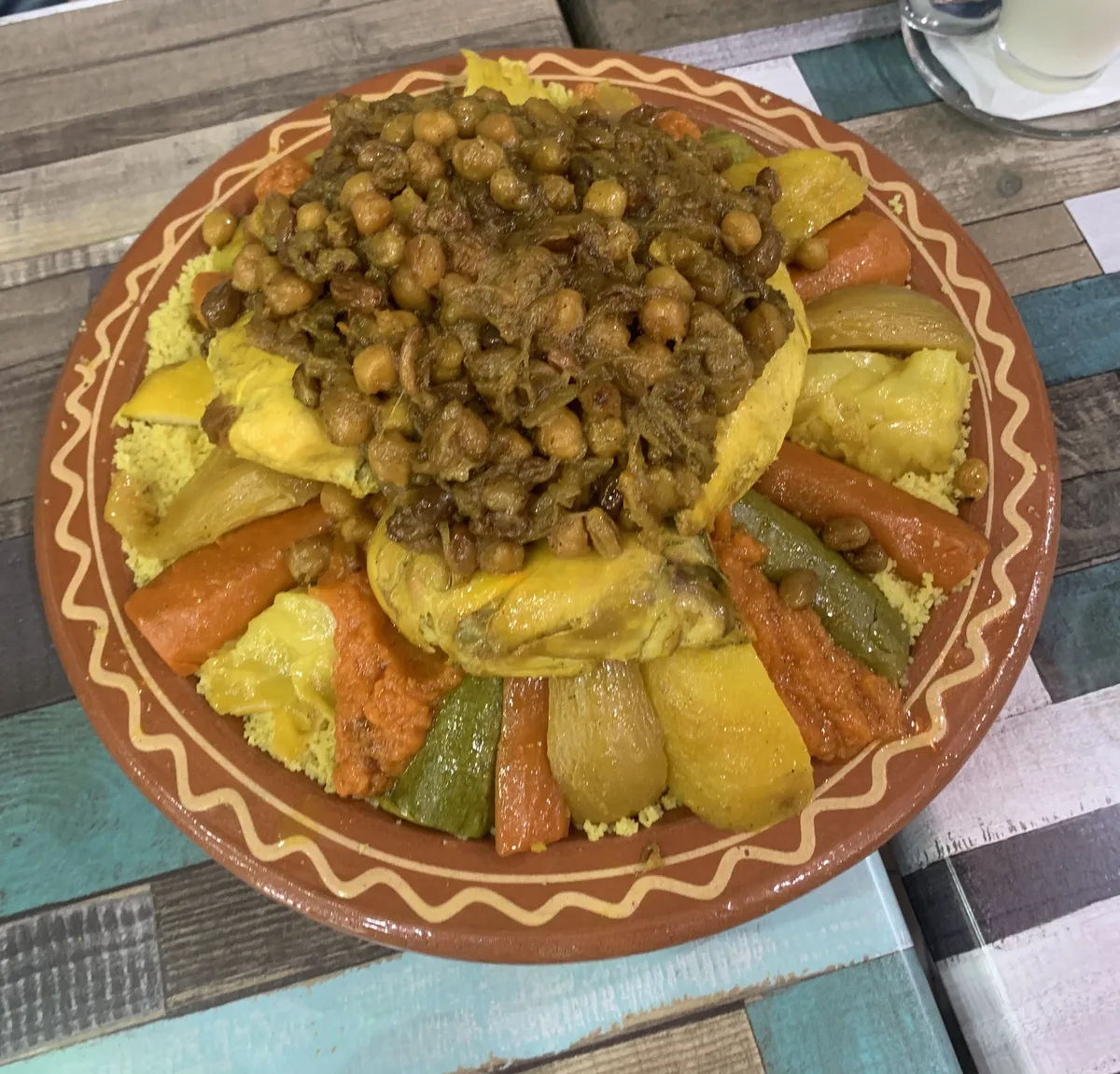
Couscous is the closest thing moroccan food has to a national ceremony. The dish is semolina – durum wheat rolled by hand into tiny granules – and the traditional method is a discipline: the grains are steamed over the broth in a pierced couscoussier, tipped out, worked with water and butter by hand to separate them, then steamed again, classically three times, until they are light, distinct and swollen with flavour. Shortcuts produce something edible, but properly steamed couscous – fluffy rather than pasty, each grain separate – is a different dish from its imitation. The mound is built on a wide platter, vegetables and meat arranged over it, broth served alongside.
Friday is its day. After midday prayers, the Friday couscous is the family meal of the week across Morocco – the one dish whose timing is fixed by custom rather than appetite – and restaurants know it: Friday lunch is when a kitchen’s couscous is at its freshest, and asking for it on a quiet Tuesday can produce a lesser, reheated version. The classic construction is the “seven vegetables” – a traditional count typically involving pumpkin, courgette, carrot, turnip, cabbage, aubergine and chickpeas, the exact seven varying by region and season – with beef, lamb or chicken in the centre. A sweeter variation, tfaya, crowns the dish with caramelised onions, raisins and cinnamon.
The dish’s standing is not only domestic. In 2020, the knowledge and practices around couscous were inscribed on UNESCO’s Representative List of the Intangible Cultural Heritage of Humanity – a joint nomination by Morocco, Algeria, Mauritania and Tunisia, the four countries agreeing, correctly, that the dish belongs to the whole Maghreb rather than to any one flag. UNESCO’s entry, the knowledge, know-how and practices pertaining to the production and consumption of couscous, covers everything from the hand-rolling of the grains to the communal eating of them – exactly the right emphasis, because in Morocco the sharing is part of the recipe.
For the visitor, the rules are simple. Eat couscous on Friday if you possibly can, at lunch, somewhere that fills with families, and expect a slow meal. A desert camp’s midweek couscous can be good – camp cooks cook it constantly – but the Friday family version, steamed in stages, is the one the cuisine is judged by. And if you are invited to a home for Friday lunch, understand that you have been given the week’s best seat: that invitation, in the grammar of moroccan food, is a significant one.
Pastilla – Sweet, Savoury and Proudly Contested
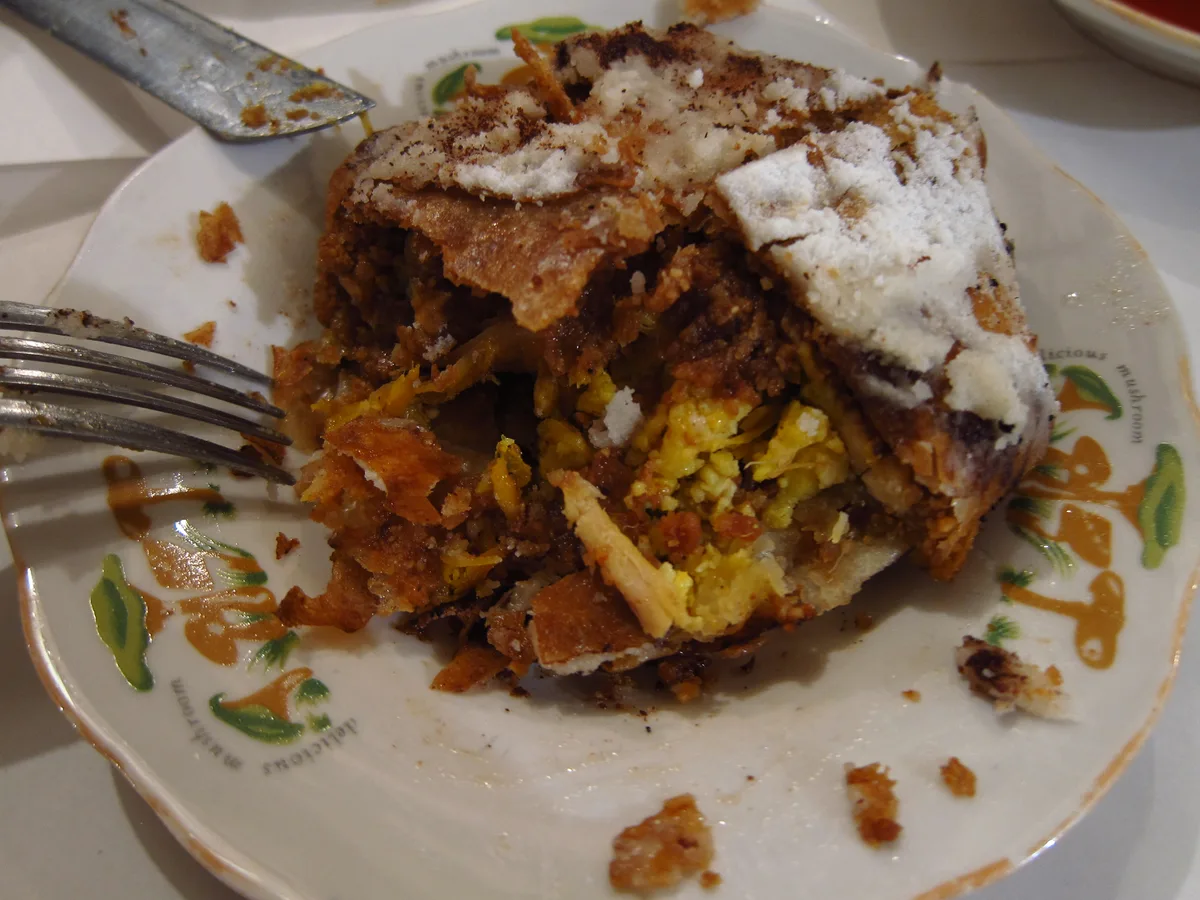
Pastilla is the dish that makes first-time tasters stop mid-bite. It is a pie – built from warqa, the tissue-thin pastry leaves that are Morocco’s answer to filo – filled in its grandest form with pigeon, layered with spiced egg and sweetened almond, then baked and dusted, without apology, with icing sugar and cinnamon. By every northern rule it should not work, and it is one of the great dishes of the world: the crackle of the pastry, the savoury depth of the bird, the sweet almond crunch arriving a second later. These days chicken is the standard filling – pigeon survives in Fes and at celebrations – and a seafood pastilla with chermoula has become a modern coastal classic.
The dish is Fassi above all: Fes claims it, and Fes is where its technique is most refined – the warqa stretched thinnest, the layers most numerous, the sweet-savoury balance most exact. Its deeper origins are where honesty is required. The story most often told brings pastilla from al-Andalus, carried to Morocco by the Muslim and Jewish refugees expelled from Spain, the name usually traced to the Spanish pastel. Food historians treat the details with more caution than menu writers do: the dish as it exists is a Moroccan, specifically Fassi, creation built on Andalusian foundations, and the neat migration story is a tradition rather than a documented fact. This guide reports it as exactly that – the tradition is real and proudly repeated; the paperwork, as with most great dishes, does not survive.
What is not contested is pastilla’s social rank. This is celebration food – weddings, engagements, honoured guests – and making it is labour: warqa alone is a skilled performance, the dough slapped paper-thin onto a hot inverted pan. When a family serves you pastilla, effort has been made visibly, on purpose. For the visitor: order it in Fes if you go, order it where it is a speciality rather than one line among forty, and do not skip it because the sugar sounds wrong. The sugar is the dish; a pastilla without its sweet dusting is a rumour of pastilla.
Its little cousin deserves a mention too, because visitors meet it constantly: the briouate – small triangles or cigars of the same warqa, filled with spiced minced meat, cheese, vegetables or almond paste, fried crisp and served as starters or street snacks. If pastilla is the state occasion, briouates are the daily proof that the same pastry culture runs all the way down to a snack eaten standing up.
Harira – the Soup That Opens the Fast
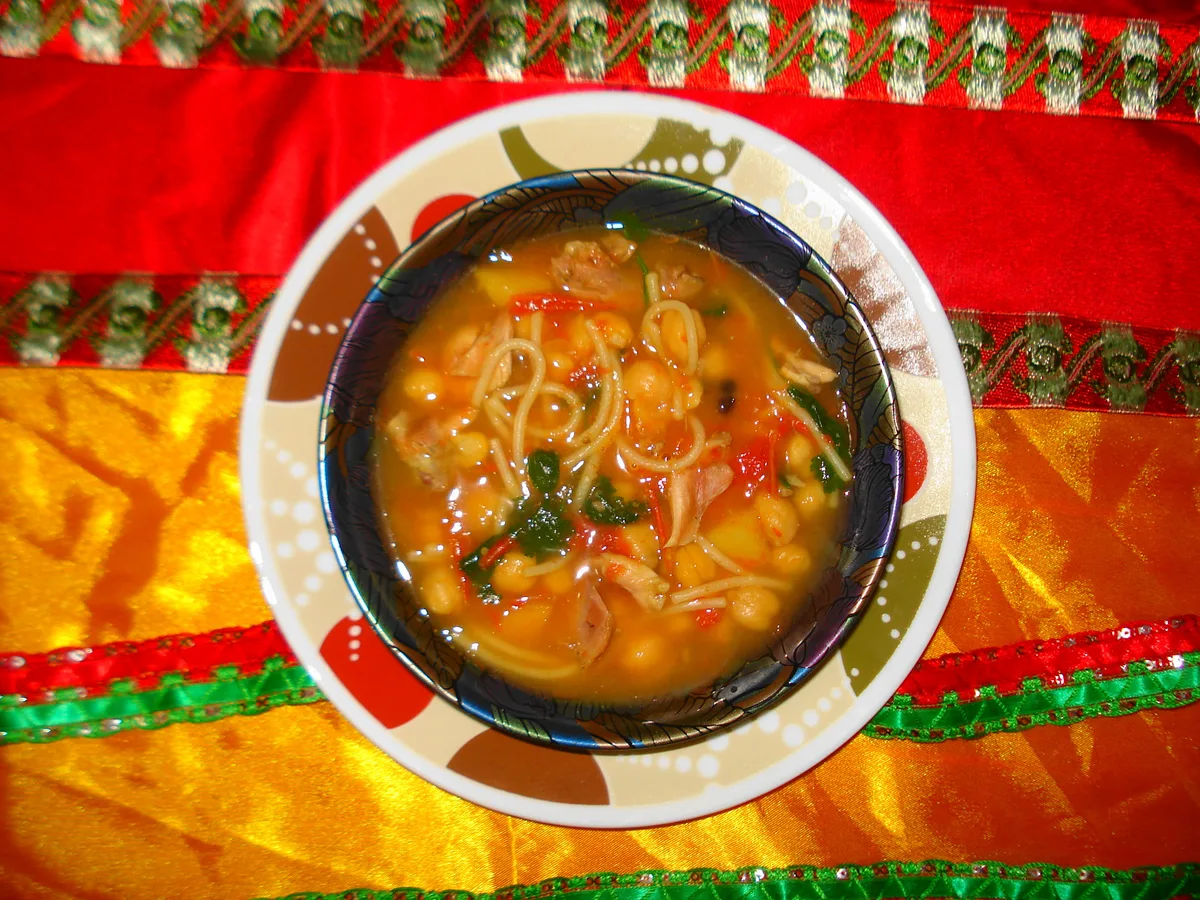
Harira is Morocco’s defining soup: a thick, velvet-textured broth of tomatoes, lentils, chickpeas and celery, enriched with a flour-based thickener stirred in at the end – the tadouira that gives the soup its body – and brightened with fresh coriander and parsley. Many versions carry small pieces of lamb or beef; many family versions carry none. It is flavoured warmly rather than hot, with ginger, cinnamon and black pepper in the background, and it is served with lemon wedges to squeeze in at the table. A bowl of harira is not a starter in the northern sense of a preliminary. It is a meal’s foundation, and in its season it is close to a daily sacrament.
That season is Ramadan. Every evening of the fasting month, the fast is broken at sunset – the meal called iftar or ftour – and across Morocco the first things eaten are dates and harira, often with chebakia beside them, boiled eggs, and glasses of milk or juice. The combination is nutritional logic wearing ritual dress: sugar and liquid first, then the soup’s slow substance after a day of nothing. Visitors during Ramadan will find harira everywhere at sunset and should understand what they are seeing – not a menu item but the hinge of the day. Hotel and restaurant iftars are often open to non-fasting guests, and can be a generous way to witness it.
Outside Ramadan, harira settles into its second life as the country’s everyday soup: winter evenings, café lunches, the first course of weddings and family dinners. Regional versions shift the balance – more or less tomato, chickpeas against lentils, sometimes rice or fine noodles. For the traveller, it is one of the safest and most rewarding first orders in the cuisine, available from the grandest restaurant to the smallest soup stall.
Harira also teaches a useful lesson in reading Moroccan menus. The soup is a category, not a singleton: beside it you will find bissara, the fava bean soup of the morning; chorba, thinner Mediterranean-style broths; and in the south, barley soups that belong to Amazigh kitchens. A visitor who learns to start meals the Moroccan way – something hot, brothy and shared – will find the whole cuisine falls into place more easily.
Tanjia – Marrakech’s Bachelor Pot
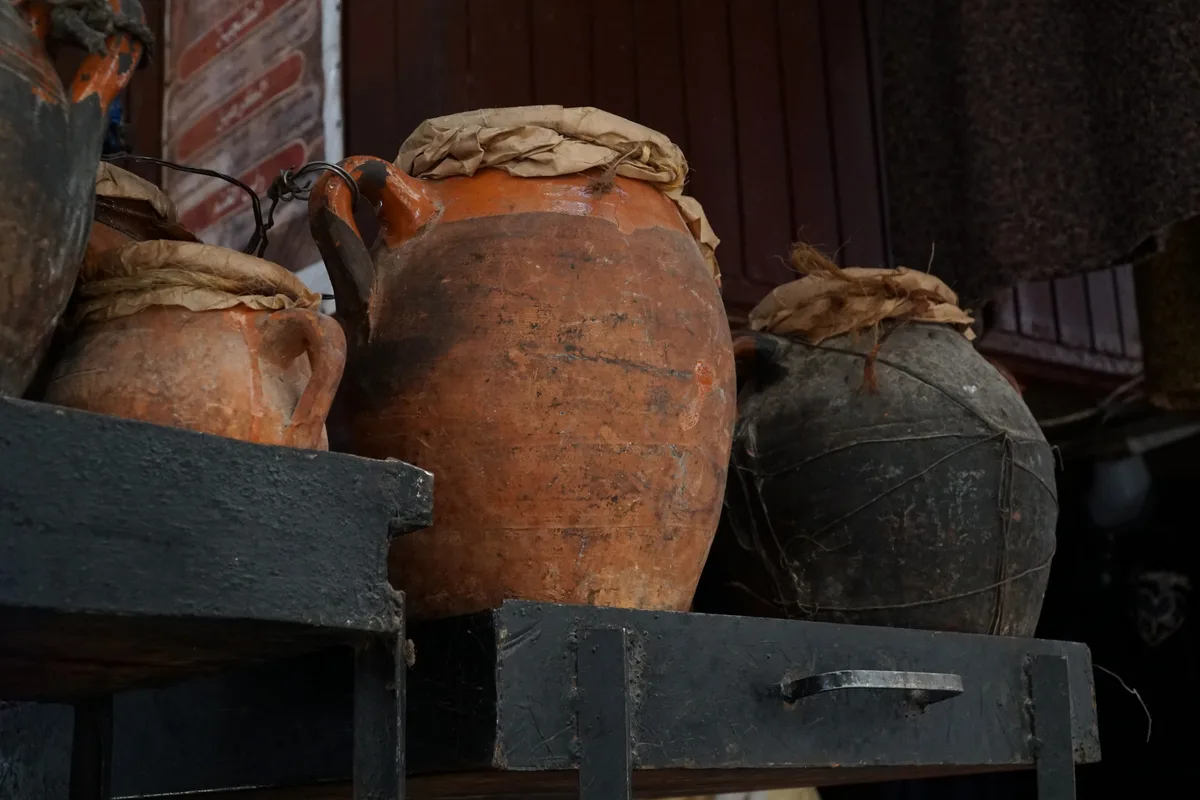
Every great food city has one dish that belongs to it alone, and Marrakech’s is the tanjia. It is not a tagine – the names are cousins, not twins. A tanjia is the tall clay urn the dish cooks in, and the cooking is the strangest in the Moroccan repertoire: beef (sometimes lamb), preserved lemon, garlic, saffron, cumin and a knob of smen – aged, fermented butter – are sealed into the urn, and the urn is carried to the neighbourhood hammam and buried in the hot ashes of the furnace that heats the bathhouse water. There it sits for hours, often most of a day, until the meat can be eaten with a spoon.
The tradition wrapped around it is as specific as the technique. Tanjia is, by custom, men’s food: made by groups of male friends, traditionally bachelors or men on an outing, each group with its own proportions guarded like a football formation. The preparation is a social event – a division of labour, a walk to the hammam, and a long afternoon of anticipation that is itself part of the dish. Women eat tanjia, and restaurants serve it to anyone, but the dish’s folklore is a male guild’s folklore, and Marrakchis will tell you so with pride. It is one of the clearest examples in moroccan food of a dish whose meaning is its method: change the furnace to a gas oven and you have good slow beef, but no longer quite tanjia.
For visitors, tanjia’s shape follows from its cooking time. It is not a dish to order on impulse at eight in the evening; the honest way to eat it is at lunch or early evening in one of the medina’s dedicated tanjia spots, where the urn is opened and tipped out at your table – meat, sauce and all – onto a platter for the bread. Order it to share; it is rich and built for a group. And if you pass a man carrying a sealed urn through the medina in the morning, balanced with the care of a man carrying a sleeping child, you know what you are looking at: somebody’s afternoon, on its way to the ashes.
Rfissa – the Dish You Have to Be Invited Into
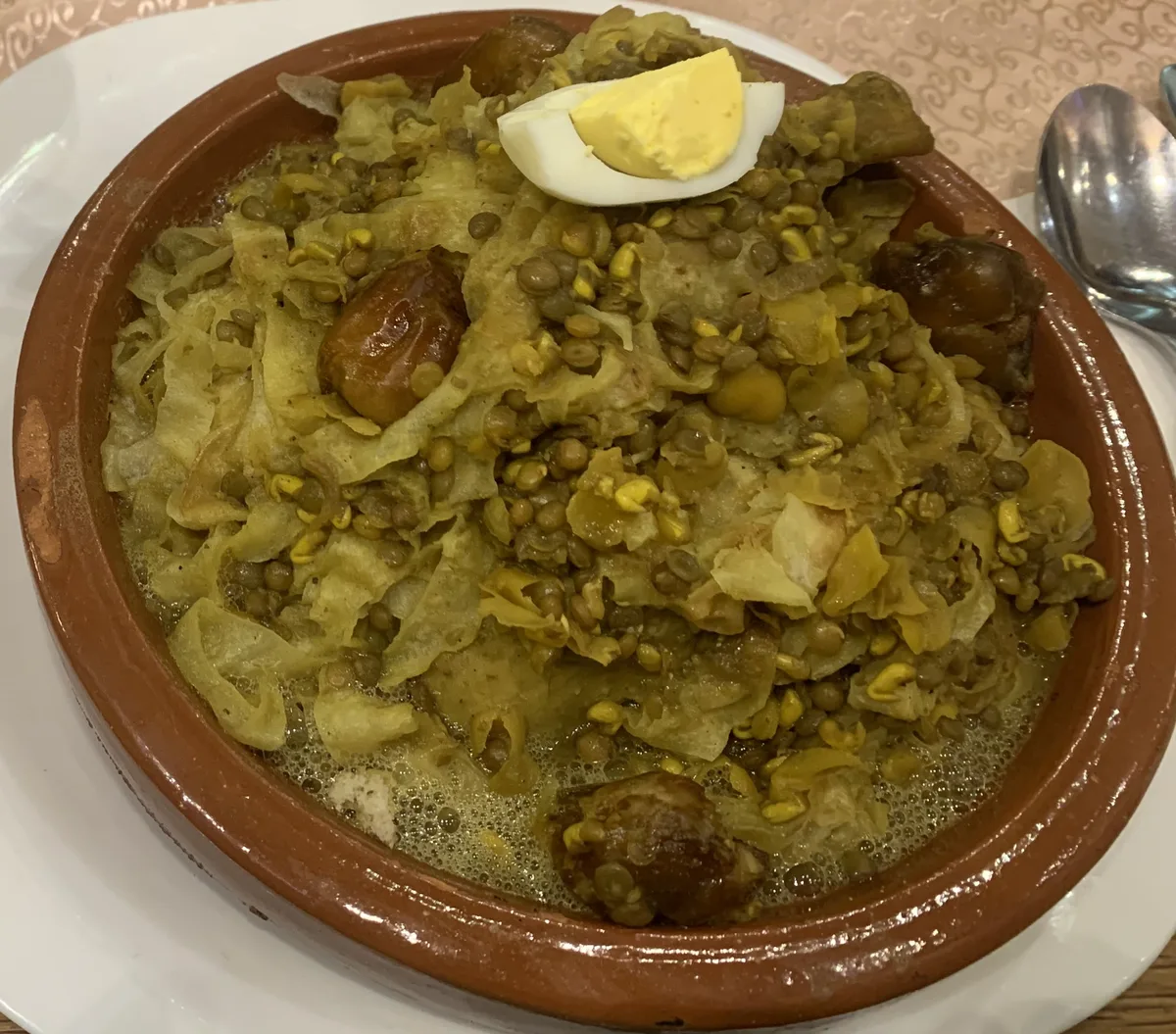
Rfissa is the dish that separates the restaurant traveller from the invited guest. Its construction sounds humble – chicken simmered with lentils, onions and fenugreek, the broth ladled over a mound of shredded msemen flatbread (or its thinner cousin, trid) until the bread drinks the sauce – and its flavour is one of the deepest in the cuisine, the fenugreek giving the broth a distinctive, almost maple-like bitterness no other Moroccan dish has. It is comfort food in the true sense: the dish traditionally served to new mothers, to restore them after childbirth, and a fixture of family celebrations in many households.
That family character is why visitors rarely meet rfissa well. It is labour – the bread made and shredded, the chicken simmered long, the dish assembled at the last moment so the bread is saturated but not drowned – and it does not sit happily on a restaurant line. Some traditional restaurants make it to order or on set days, and a kitchen that asks you to order ahead is signalling that it makes the dish properly. The best rfissa most travellers will ever eat will be in a home, which makes it a dish to accept gratefully when offered rather than one to hunt aggressively.
Within Morocco, rfissa also shows the cuisine’s economy at work: the same msemen that anchors breakfast reappears here doing savoury work, the flatbread grilled at dawn becoming the sauce-carrier of the feast by night. If you eat only one “difficult” dish on a trip – the one requiring an invitation, an advance order or a special trip – make it this one. Tagine you can find anywhere; rfissa is the cuisine with its guard down. Order it to share, at lunch rather than late, and if a Moroccan friend mentions that their mother makes it, understand that you have just heard a serious claim – the correct response is hope, visibly expressed.
From the Grill – Brochettes, Kefta and Mechoui
Against all this slow cooking, the grill is Morocco’s fast lane. Brochettes – skewers of lamb, beef, chicken, turkey or liver, cubed, lightly spiced and grilled over charcoal – are the medina’s quickfire food: ordered by the skewer or by weight, eaten standing, in bread, with cumin and salt on the side and the grill smoke in your clothes for the rest of the evening. Kefta, spiced minced beef or lamb worked with onion, parsley, cumin and paprika, goes to the same coals as flattened fingers on skewers, and also into tagines and the ubiquitous kefta sandwich. The charcoal is not a detail: gas-grilled brochettes exist, and the difference is the whole point – the perfumed smoke of a charcoal fire in a market lane is the smell of a Moroccan evening.
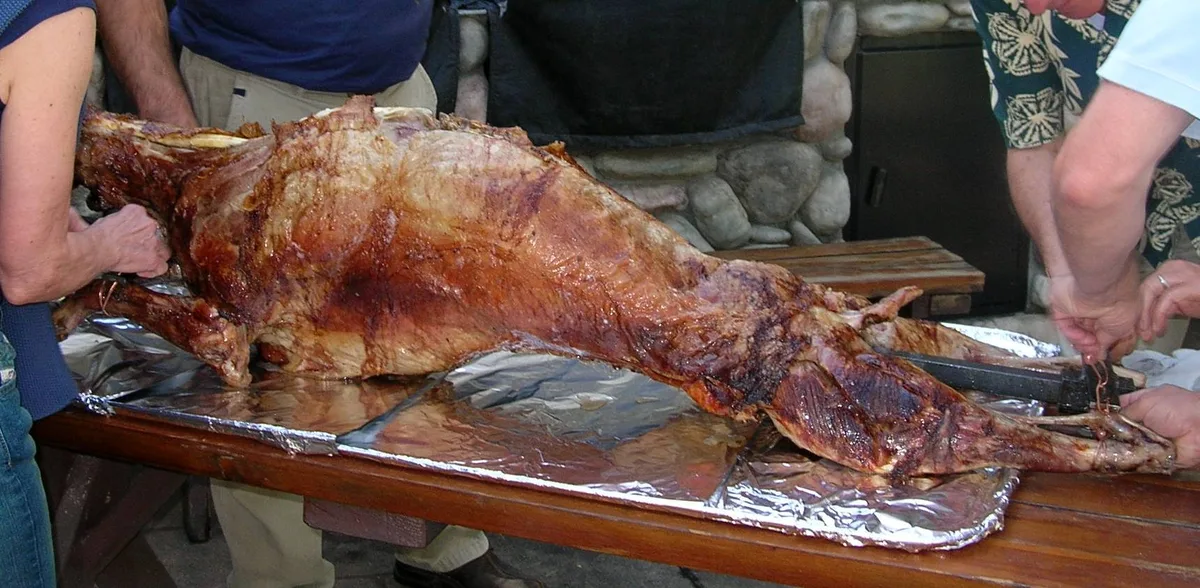
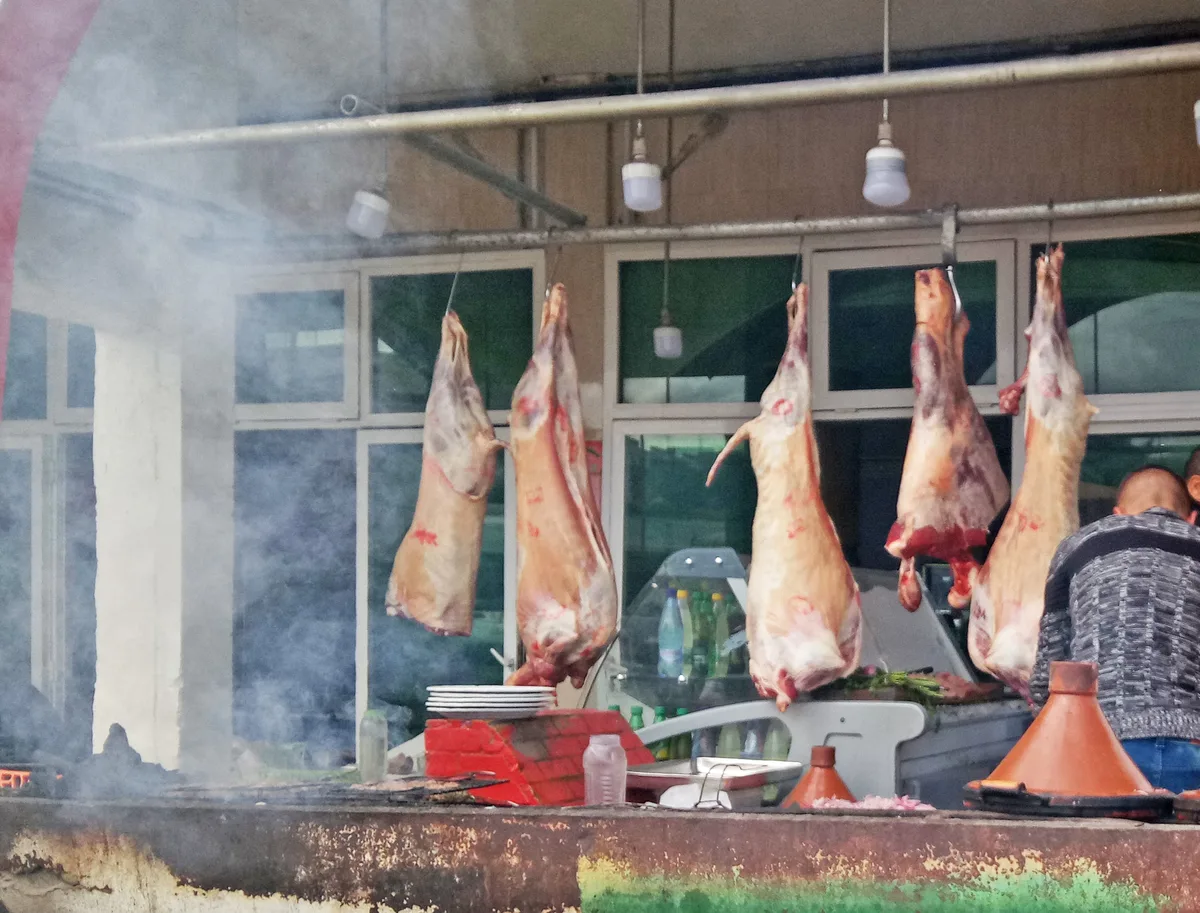
Mechoui is the grill’s ceremonial opposite – the same fire principle slowed to a ceremony. A whole lamb, seasoned simply, is roasted in a pit or clay oven until the skin crackles and the meat yields to the fingers, then served by weight, torn rather than carved, with cumin and salt. The old cities keep dedicated mechoui spots – Marrakech’s mechoui alley near the square is the famous one – where the lamb comes out in waves through the day and is gone when it is gone. At home, mechoui is the centrepiece of Eid al-Adha, when the sacrifice lamb feeds family and neighbourhood and the grilling of its parts, including the liver kebabs called boulfaf, runs for days.
Judging a grill stall uses the same senses as anywhere: coals glowing rather than flaming, meat cut or minced in view, turnover brisk enough that nothing waits. The accompaniments are part of the order – bread, a sharp little salad of onion and tomato, olives, sometimes fries folded into the sandwich in the modern way. Order fewer skewers than your appetite first suggests; the grill works fast, and the second round, ordered when the first lands, is the local rhythm and the cook’s compliment system in one.
The brave and the cautious can both eat well on the same bench here: chicken brochettes cooked through and kefta from the busiest fire for one, liver and the sheep’s head of the next section for the other. The grill feeds everyone, in smoke, at speed, for as long as the coals last.
Street Food and the Night Stalls
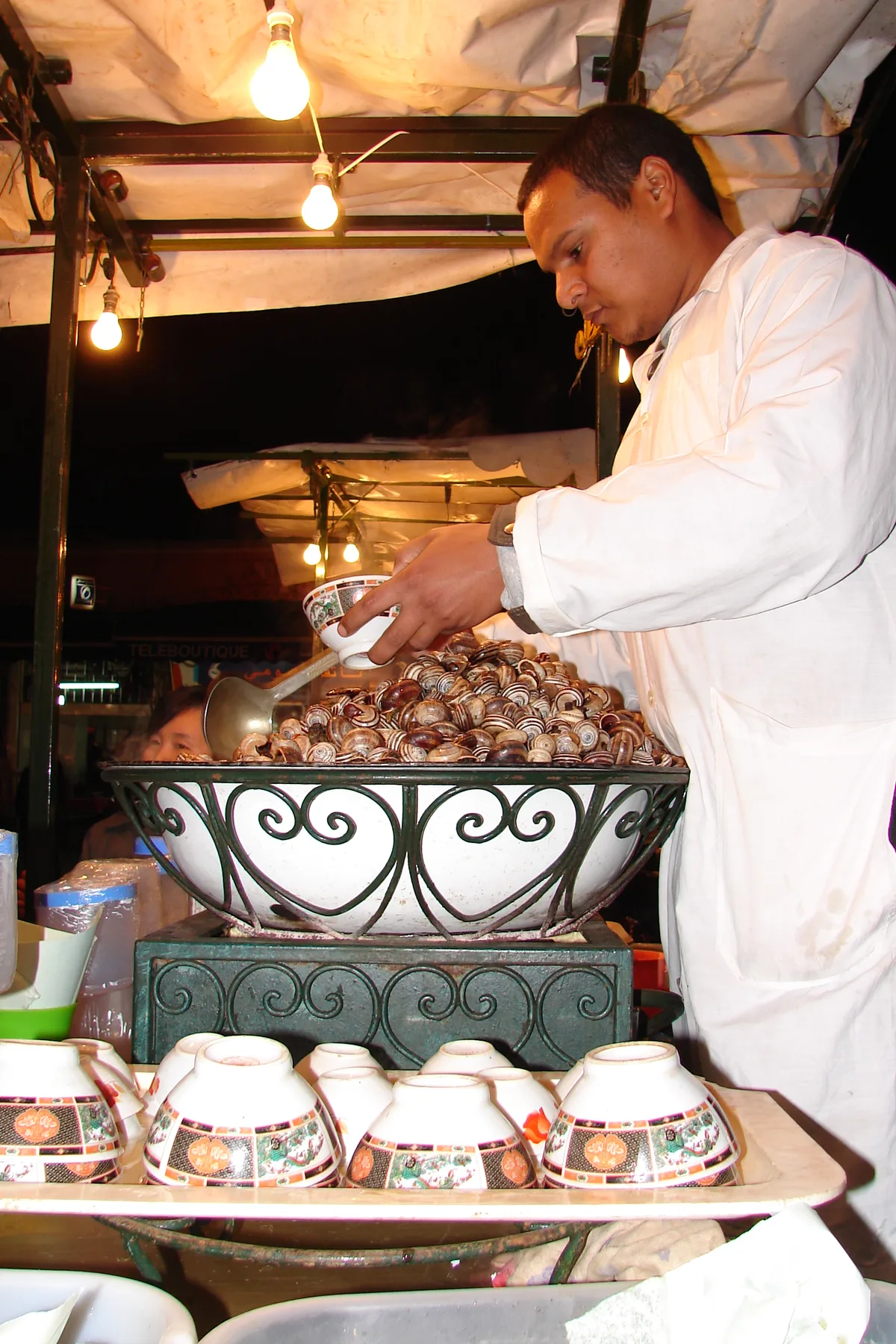
At dusk in Marrakech, the great square of Jemaa el-Fnaa changes state. The juice carts and acrobats of the day give ground to rows of numbered food stalls – grills, soup pots, tagine counters, snail vendors – each with its benches, its cook, its tout and its drifting pillar of smoke. The square’s role as a stage for food and performance is centuries old, recognised by UNESCO as a masterpiece of the world’s intangible heritage long before “street food” was a travel genre. To eat there once is obligatory in the way that has nothing to do with checklists: it is the country’s greatest open-air restaurant, and our Morocco itinerary for 7 days builds its first Marrakech evening around it for a reason. Similar, smaller night-stall scenes run in Fes, Tangier and every market town; the square is simply their cathedral.
Working a night stall is a learnable skill. Walk the rows first – a full lap, no commitments, ignoring the enthusiastic recruitment. Then choose by the evidence: stalls full of Moroccans, families eating, the grill busy and the cook working rather than pitching. Sit, and order in rounds – a soup or a few skewers first, more if the first round earns it. Agree what things cost before they are cooked; at the famous stalls this is a brief, normal conversation, and many stalls have printed menus. The touts are theatre, not threat – a smile, a “shukran”, a hand on the heart, and you can walk past anyone. Keep your stall’s number: it is how you will describe the meal for years afterwards.
The rite of passage is babbouche – snail soup. Small land snails are simmered in a broth dark with herbs and spices – thyme, aniseed, liquorice root, mint and more, recipes running to a dozen aromatics – and served with a pin for extracting the snails. The broth is the point as much as the snails: peppery, herbal, warming, famously prescribed against colds. Around it the stalls grade upward in courage: grilled sheep’s head with cumin, trotters, spleen sandwiches – and at the mild end, harira, brochettes, fried fish and eggs in little pans. Nobody is keeping score but you, and the soup stall is where most travellers discover the score did not matter.
The Coast – Sardines, Chermoula and the Port Grills
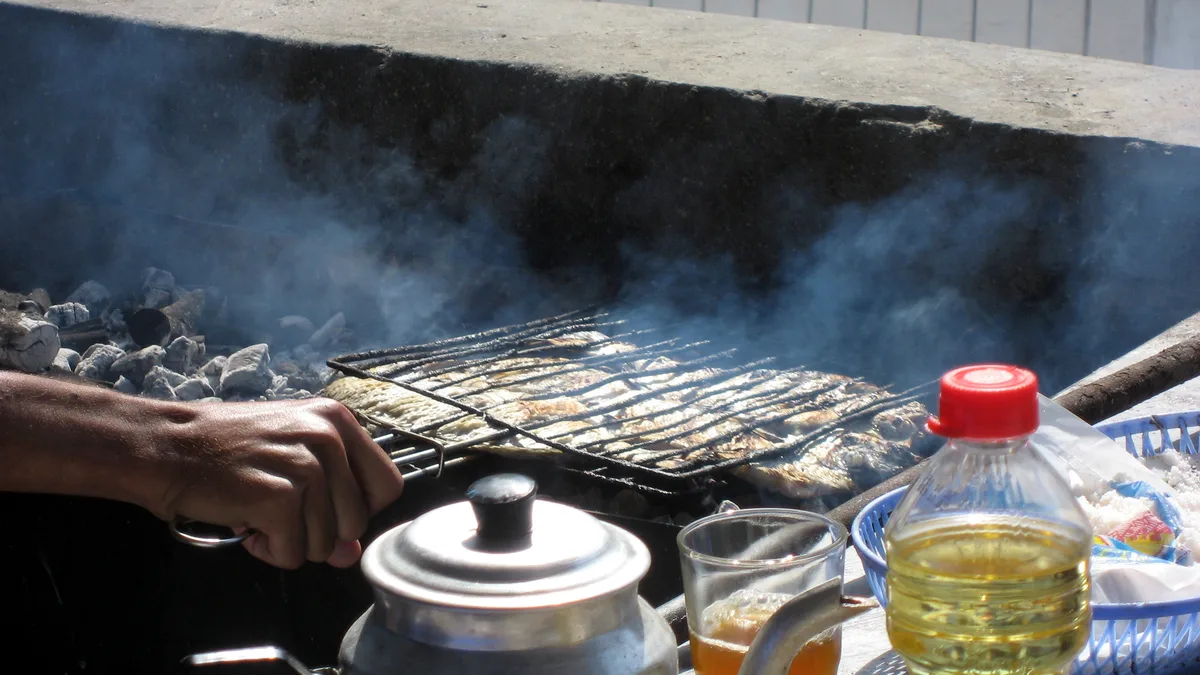
Morocco fishes two seas, and the Atlantic ports – Essaouira and Safi above all – sit on some of the richest sardine waters in the world. The sardine is the coast’s defining fish: grilled whole over charcoal within hours of landing, stuffed with chermoula and fried, baked in tagines, or preserved by the canneries that made the Moroccan sardine a global pantry item. For the traveller, the port grill is the essential coastal meal: choose your fish at the counter, have it grilled and served with bread, salad, olives and harissa, and eat it at a shared table with the harbour working around you.
Chermoula is the flavour that organises coastal cooking: a marinade of fresh coriander and parsley, garlic, cumin, paprika, lemon and olive oil, used on fish before grilling, frying or baking, and as the base of fish tagines. It is bright, herbal and garlicky, and once tasted it becomes the reference point for every Moroccan fish dish afterwards. Alongside sardines, the grills offer whatever the boats brought – sea bream, sole, mackerel, prawns, calamari – the list written by the morning, not the menu board. The honest coastal kitchen is the one that tells you what is not available today.
Inland, the coast’s influence arrives diluted – fish tagines and seafood pastillas in city restaurants – so calibrate accordingly: a seafood pastilla in Fes is a fine thing, but it is not the port. If your route touches Essaouira, eat fish there twice: once at the port grills, loud and basic, and once in a medina restaurant running the same fish through the fuller ceremony. Same sardine, same chermoula, two entirely different meals.
A final coastal note for the cautious: port grills cook to order over open coals – about the most transparent kitchen a traveller can ask for. Fish this fresh, cooked this hard, in this much turnover, is not where travellers get into trouble. It is where they get converted.
Khobz – Bread Is the Cutlery
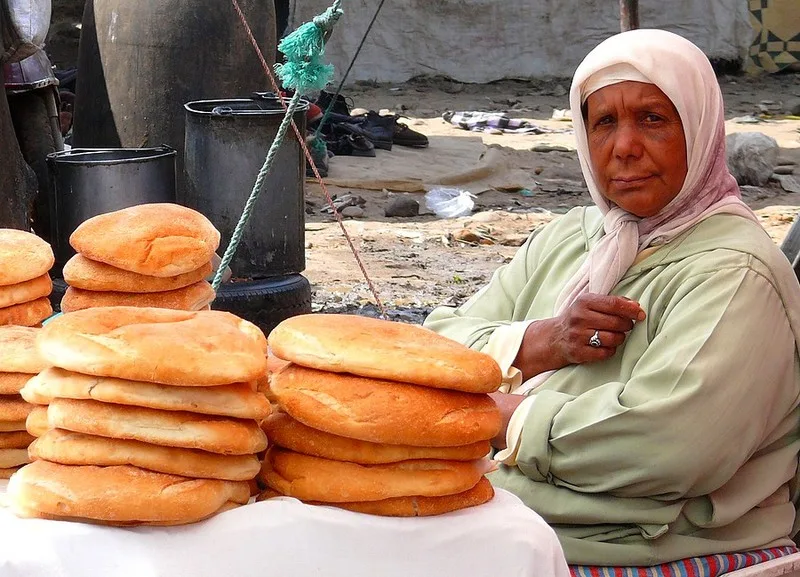
No account of moroccan food survives contact with reality unless it treats bread as a main character. Khobz, the round, slightly domed everyday loaf – wheat or barley, with a firm crumb built for scooping – is bought daily, frequently twice daily, and appears at every meal without exception: torn for the tagine, wrapped around brochettes, dipped in morning olive oil, used to chase the last of the harira. It is also treated with a respect that visitors notice: bread is not wasted, dropped bread is picked up and often kissed or set aside rather than binned, and leftover bread travels home in a bag rather than into the street. In a cuisine where the fork is optional, bread is the technology, the ritual and the manners all at once.
The bread’s journey is one of the medina’s small daily dramas. In households without an oven – historically most of them – the dough is kneaded at home, shaped on a wooden board, marked so the family can identify its own loaves, and carried to the neighbourhood’s communal oven, the ferran, where the baker slides it into the wood fire alongside the street’s other loaves and returns it baked for a small fee. The ferran survives in medinas today – sometimes the same oven slow-cooks a tanjia in its ashes. Watch for the boards passing through the lanes in the morning, balanced on heads and bicycles: that is the bread system at work, unchanged in its essentials for centuries.
Many Moroccans, asked what they missed abroad, name the bread before any dish; after a week, you will understand the order of that answer. Around khobz stands a whole parliament of breads besides – batbout for sandwiches, harcha for tea time, and at the far end of effort the warqa of pastilla and the trid of rfissa, breads that became dishes.
Practically: bread will arrive whether you order it or not, in quantities that assume you eat as Moroccans do. Eat it fresh – khobz is a same-day food, and yesterday’s loaf is visibly demoted. And never be embarrassed to ask for more; asking for more bread is the Moroccan equivalent of applauding.
Breakfast – Msemen, Baghrir and a Thousand Holes
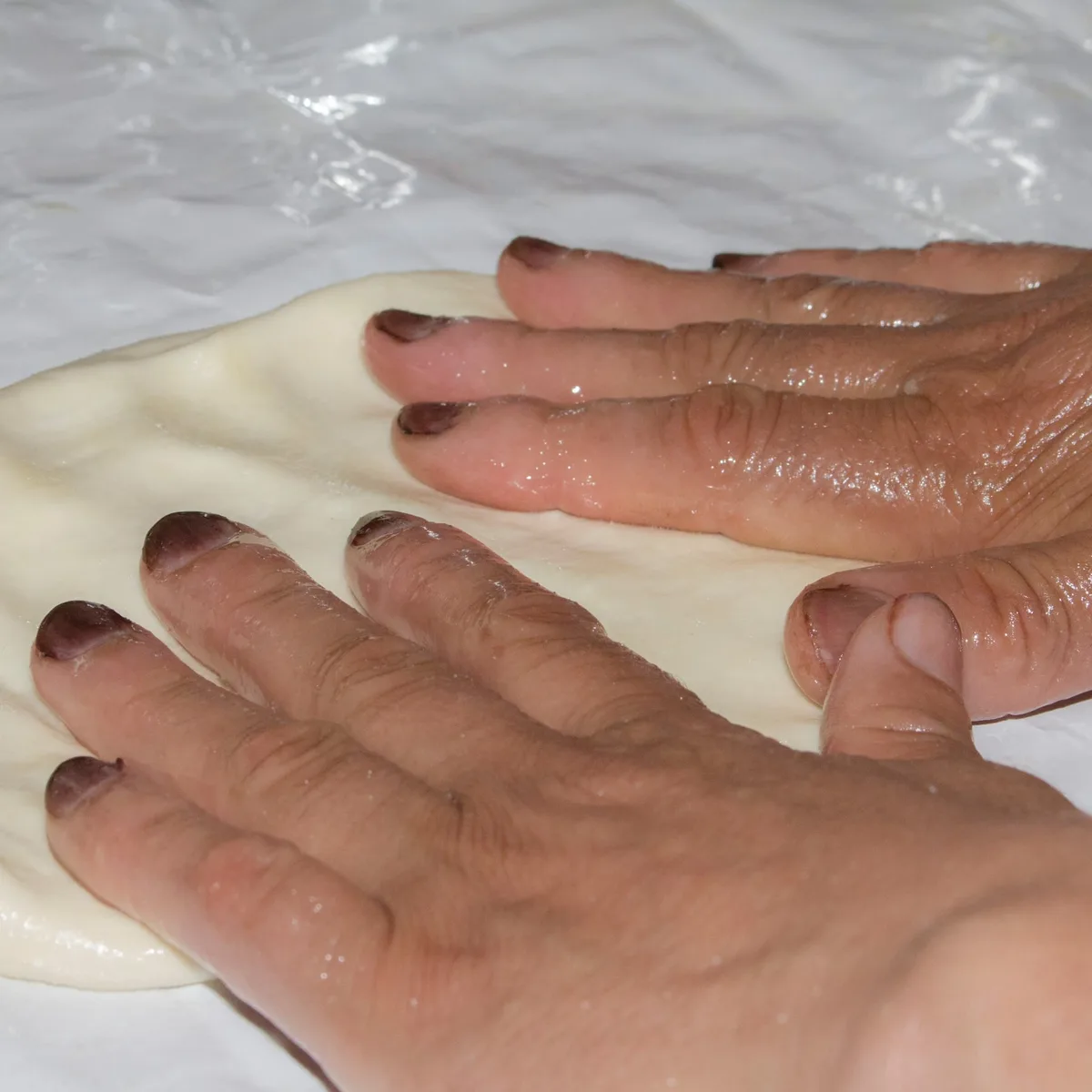
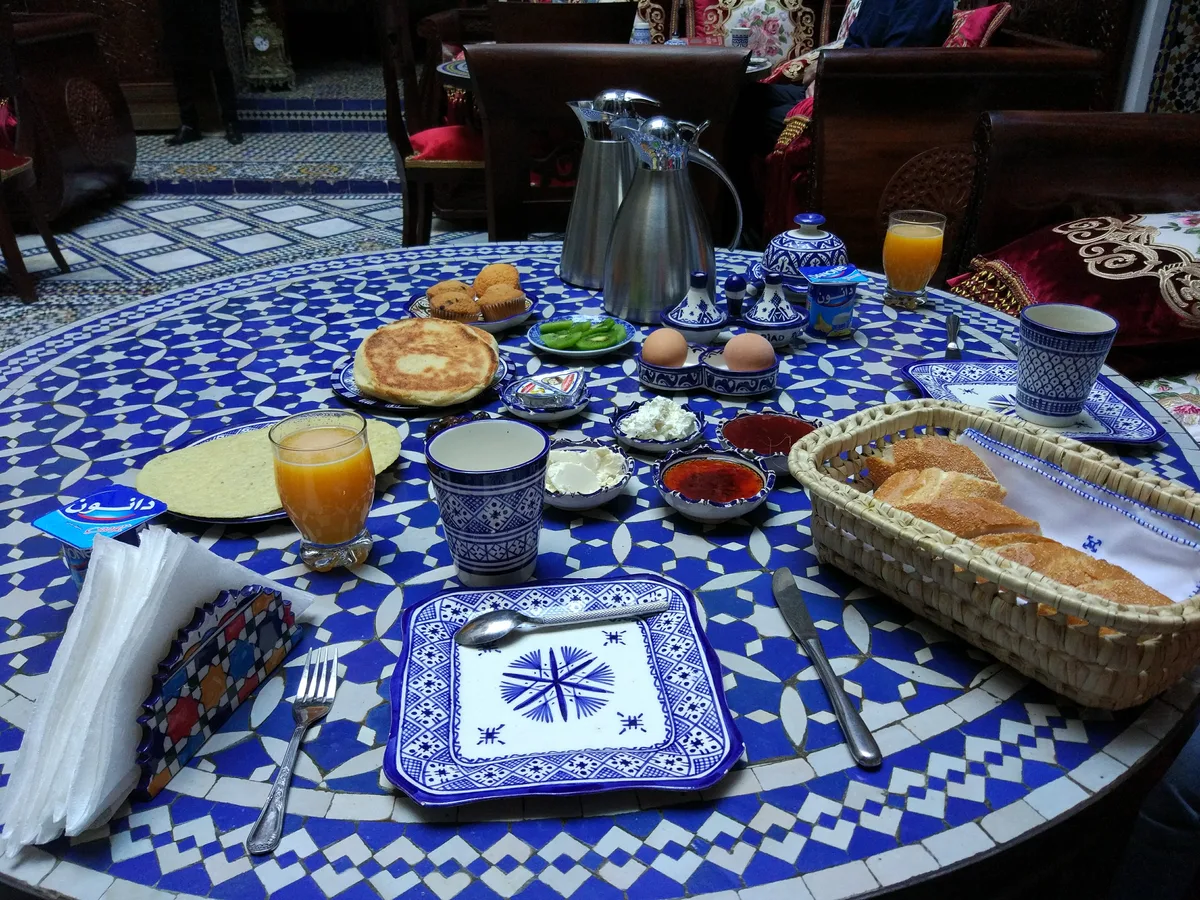
Moroccan breakfast is a spread, not a plate, and it is built from the bread cabinet. At its centre stand two griddled classics. Msemen is a square, layered flatbread: dough stretched paper-thin with oiled hands, folded in on itself with semolina between the layers, then griddled until crisp at the edges and supple inside – eaten with honey, soft cheese, jam or amlou. Baghrir is its opposite in texture: a yeasted semolina pancake cooked on one side only, its surface a sponge of tiny holes – the “thousand holes” pancake – made to drink up melted butter and honey, or amlou. Together they are the twin pillars of the morning table, and an msemen hot off a market griddle with a glass of tea is among the great cheap breakfasts of the world.
Amlou deserves its own sentence, because travellers fall for it hard: roasted almonds ground with argan oil and honey, made in the Souss valley where the argan trees grow – the oil produced by women’s cooperatives in the south-west, its know-how recognised by UNESCO. Around the pillars, the table fills: olives, boiled or fried eggs (sometimes khlii eggs, scrambled with the country’s spiced preserved meat), soft white cheese, olive oil for dipping, honey, jams, and the day’s khobz. Bissara joins in winter and in the working cafés, where it is breakfast for men who started before dawn. Coffee – often taken half-and-half with milk as a “nous-nouss” – shares the table with mint tea without either side conceding the morning.
The riad breakfast, served on a roof terrace or around a courtyard fountain, is this spread in its presentation dress, and it is rightly famous – arrive hungry. But the same components, eaten in a market café among delivery drivers and shopkeepers, taste identical, because they are identical: the griddle does not know the neighbourhood. Use both versions on a trip – the terrace for the pleasure of the thing, the market café for the truth of it – and learn to order msemen with cheese, “msemen b’l-fromage” in the stalls’ French-inflected shorthand, before you leave.
One caution hides inside the pleasure: Moroccan breakfast is sweet by design – honey, jam, amlou, sweetened tea – and a traveller fuelling for a mountain day should add the eggs and cheese deliberately, or the spread will let you eat a dessert’s worth of sugar before nine and call it breakfast.
The Small Plates – Zaalouk, Taktouka, Bissara and Briouates
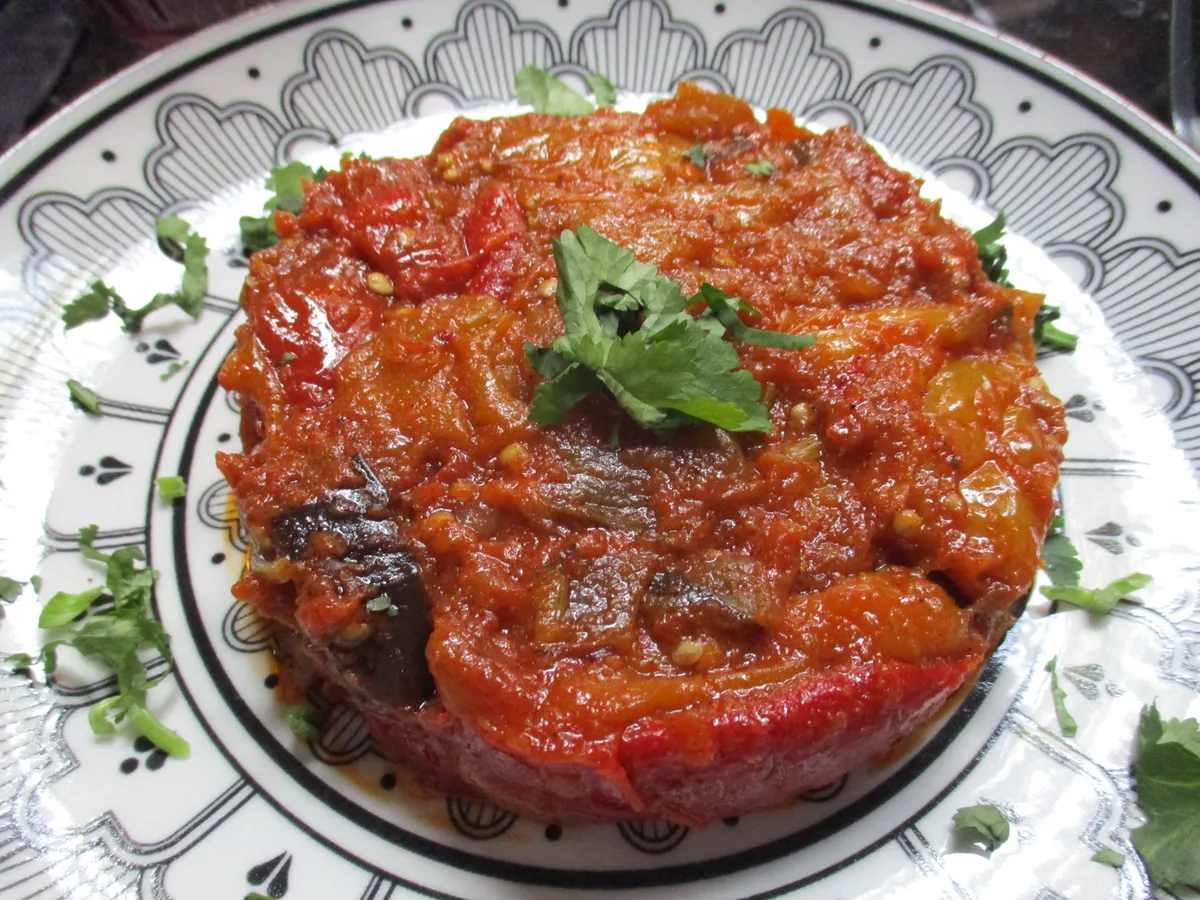
A Moroccan meal rarely opens with a single dish. It opens with a constellation: small plates of cooked and raw salads, olives, and bread, set around the table’s centre before or beside the main dish. Learning this spread is learning the cuisine’s grammar of beginnings, and the two names to know first are zaalouk and taktouka. Zaalouk is aubergine and tomato cooked down with garlic, cumin, paprika and olive oil until it becomes something between a salad, a dip and a relish – smoky if the aubergine was charred first, as it should be. Taktouka is its pepper sibling: roasted green peppers and tomatoes, similarly seasoned, brighter and sharper. Both are eaten at room temperature, scooped with khobz, and both are far better than the word “salad” prepares you for.
Around them rotates a supporting cast that changes with region and season: carrot salad sweet with orange and cinnamon; beetroot with onion; potato salad with cumin; marinated olives in a dozen varieties; preserved lemon and harissa as the table’s salt and fire. A formal meal may add briouates, the warqa triangles and cigars filled with spiced minced meat, cheese or vegetables and fried crisp – pastilla’s pastry family miniaturised into a starter. And bissara joins from the soup family: dried fava beans cooked to a thick purée-soup, served with a spiral of olive oil, cumin and paprika – the working breakfast of the north especially, and one of the most honest bowls in the country.
For the visiting eater, the small plates do three jobs at once. They are the safe first order in any unfamiliar kitchen – a kitchen that seasons its salads properly almost always handles the rest of the menu with the same care. They are the vegetarian’s fortress, the part of the menu where vegetables are the dish rather than the garnish – with one caveat, saved for the vegetarian section, about stocks and smen. And they are your calibration tool: order the spread first, taste how the kitchen handles cumin, acid and oil, and you will know how to order the main.
Resist the urge to fill up: the spread is an overture, and the tagine is coming.
The Sweet Shelf – Chebakia, Gazelle Horns and Pâtisserie Windows
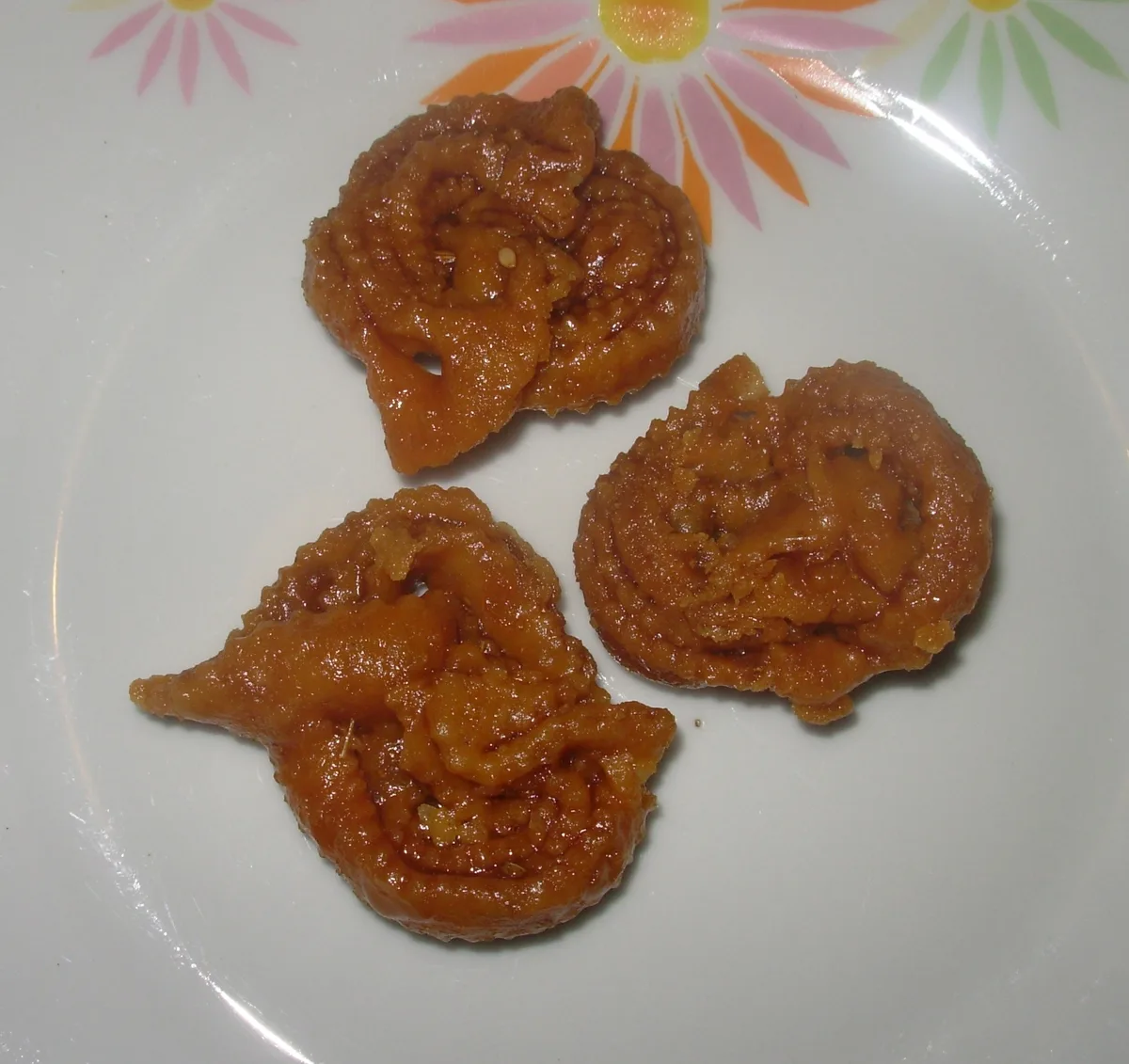
Moroccan sweetness runs on honey, almonds, orange-flower water and sesame, and its emblem is chebakia. The dough – flour, sesame, anise and fennel among its flavourings – is rolled, cut and folded by hand into a flower, fried, and while still hot, plunged into honey and showered with more sesame. The result is dense, sticky, perfumed and intensely sweet: a two-bite pastry with the caloric confidence of a full dessert. Chebakia belongs to Ramadan above all – it is the harira’s appointed partner at iftar, the sugar to the soup’s salt – but pâtisseries sell it all year.
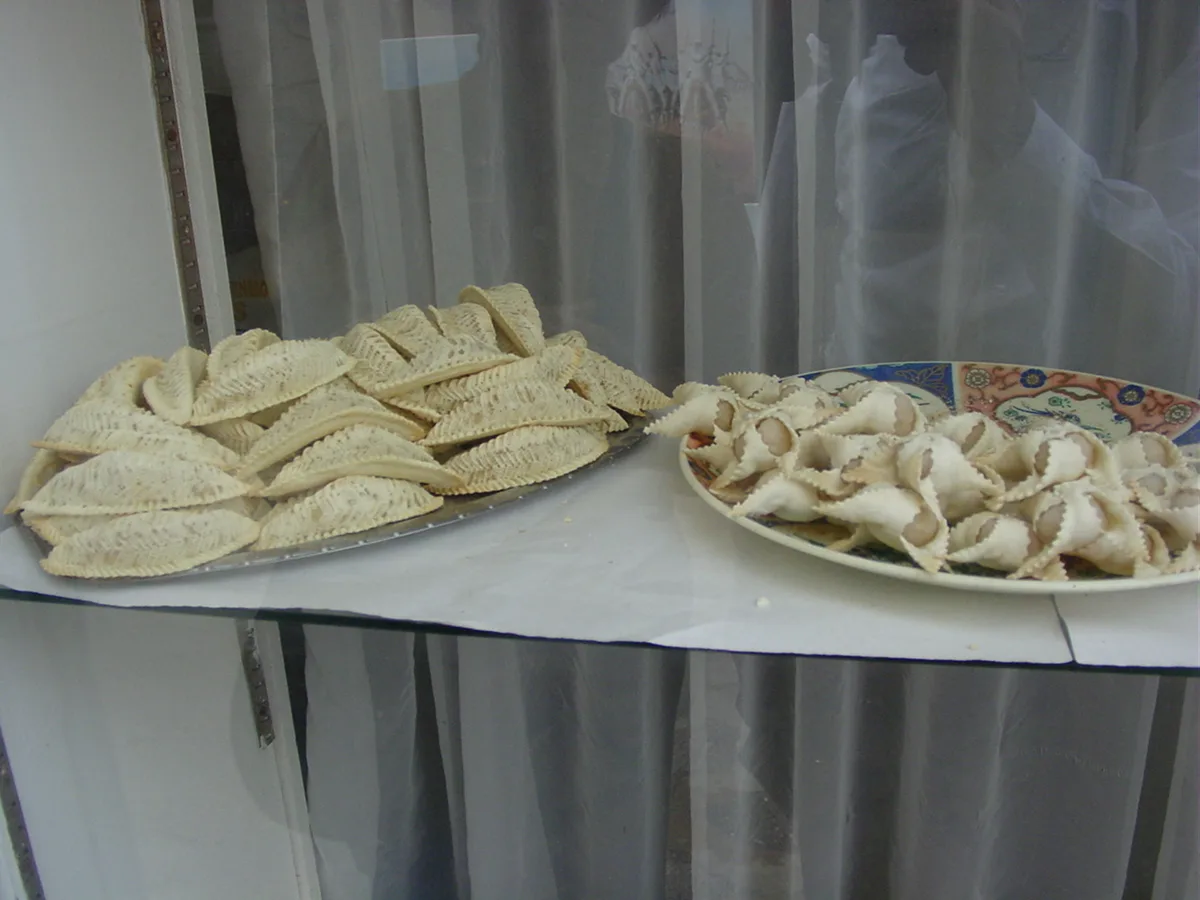
The other name to know is kaab el ghazal, “gazelle’s horns” (also seen as cornes de gazelle): crescents of thin pastry around a heart of almond paste perfumed with orange-flower water and cinnamon, baked pale. Where chebakia is exuberant, the gazelle horn is refined – the pastry of weddings and gifts, and the standard by which almond work is judged. Around these two circulates the rest of the shelf: almond briouates, fried and honeyed; sellou, the roasted flour, almond and honey powder eaten by spoonful at celebrations; fekkas, the twice-baked almond biscotti that exists to be dunked in tea; and the date, in all its grades, the country’s oldest sweet.
The pâtisserie is also where the French century shows: bakeries where croissants and millefeuilles share the counter with gazelle horns and chebakia, the two traditions long past arguing. Locals buy from both sides of the glass without ideology, and the traveller should too – a box of mixed pastries, bought by weight for a train journey or a riad rooftop, is the correct Moroccan souvenir for the people waiting at home, provided it survives the journey, which it will not. Buy two boxes.
Sweetness, finally, is not a course in Morocco but a register the whole cuisine plays in – it is in the prune tagine, on the pastilla, in the tea itself. The sweet shelf is simply where that register concentrates. Travellers who “don’t like sweet food” should not write off the shelf – the gazelle horn’s almond-and-orange-flower restraint converts many – but they should approach chebakia with respect. The pastry has humbled stronger resolutions than yours.
Mint Tea – the Ceremony That Runs the Day
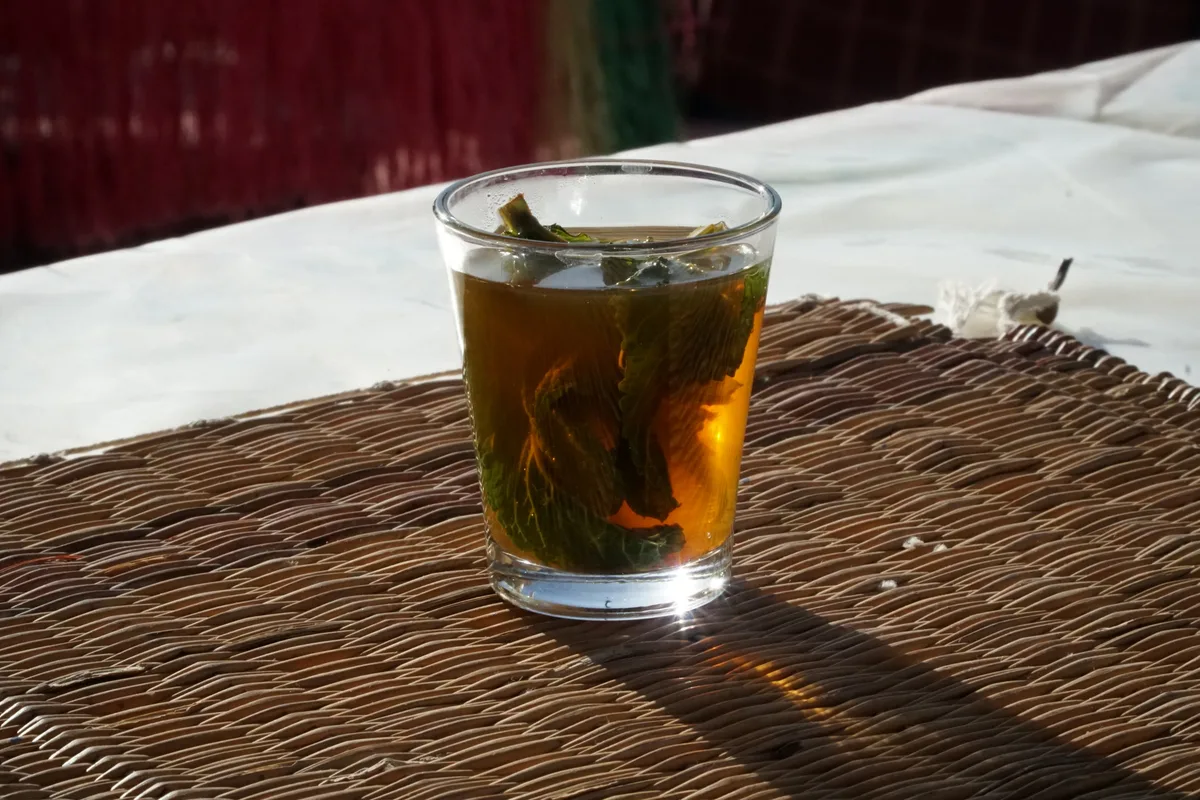
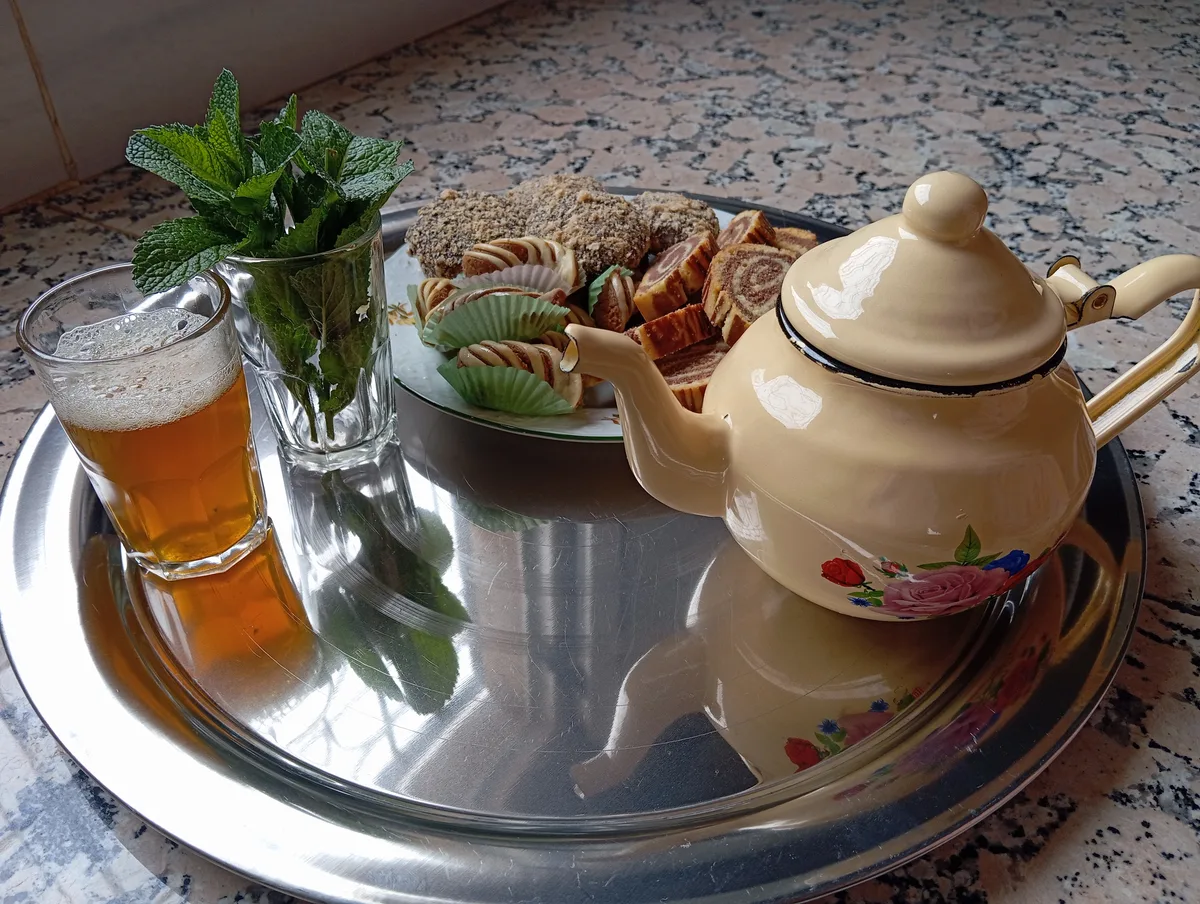
In Morocco, tea is not a drink with a culture attached; it is the culture, in a glass. The base is Chinese gunpowder green tea, rinsed, then brewed strong with handfuls of fresh spearmint (in winter, sometimes wormwood leaves or other herbs instead) and a quantity of sugar that northern palates must simply accept as a fact of geography. It is served in small decorated glasses, poured from a height, the long falling arc aerating the tea and raising the foam – the “turban” on the glass – that marks a pour done properly. A glass without foam is a small apology.
The tea’s occasions are continuous: the welcome at the riad and the rug shop, the pause in the negotiation, the end of every meal, the traveller’s rest on the desert road. In the south it comes with a ceremony of its own – three glasses from one pot, progressively stronger, a progression the Sahara’s hosts explain with the region’s famous proverb comparing the glasses to life, love and death. Refusing tea is possible but costs social effort: it reads as refusing the relationship, not the beverage. The accepted manoeuvres are to take one glass, sip slowly – a glass can be nursed through a long conversation – and, when no more is wanted, to say “la, shukran” warmly, hand on heart. It is a complete sentence everywhere in the country.
Two honesty notes belong to the traveller. First, the sweetness: tea in a shop or a home will arrive sweetened to local taste, and asking for it unsweetened must be done before the pot is brewed, with clarity – “bla skar”, without sugar – and even then, understand you are asking the host to break the recipe. Many visitors find the local sweetness right by the third day. Second, the café: Morocco’s café culture is a largely male, tea-and-coffee theatre of watching the street, and one slow glass on a medina-edge terrace buys the best seat in the city for the price of a drink. Women travellers will find family cafés, terraces and pâtisserie salons more comfortable than the old-school pavement cafés in some towns.
If the whole guide had to be compressed into one instruction, it would be this: never be in too much of a hurry for the tea. Every good thing in Moroccan travel – the honest price, the real directions, the invitation, the story – tends to arrive during it. The tea is not a delay to the day’s business; in this country, it is how the day’s business is done.
Markets and Medina Eating – Where Moroccan Food Really Lives
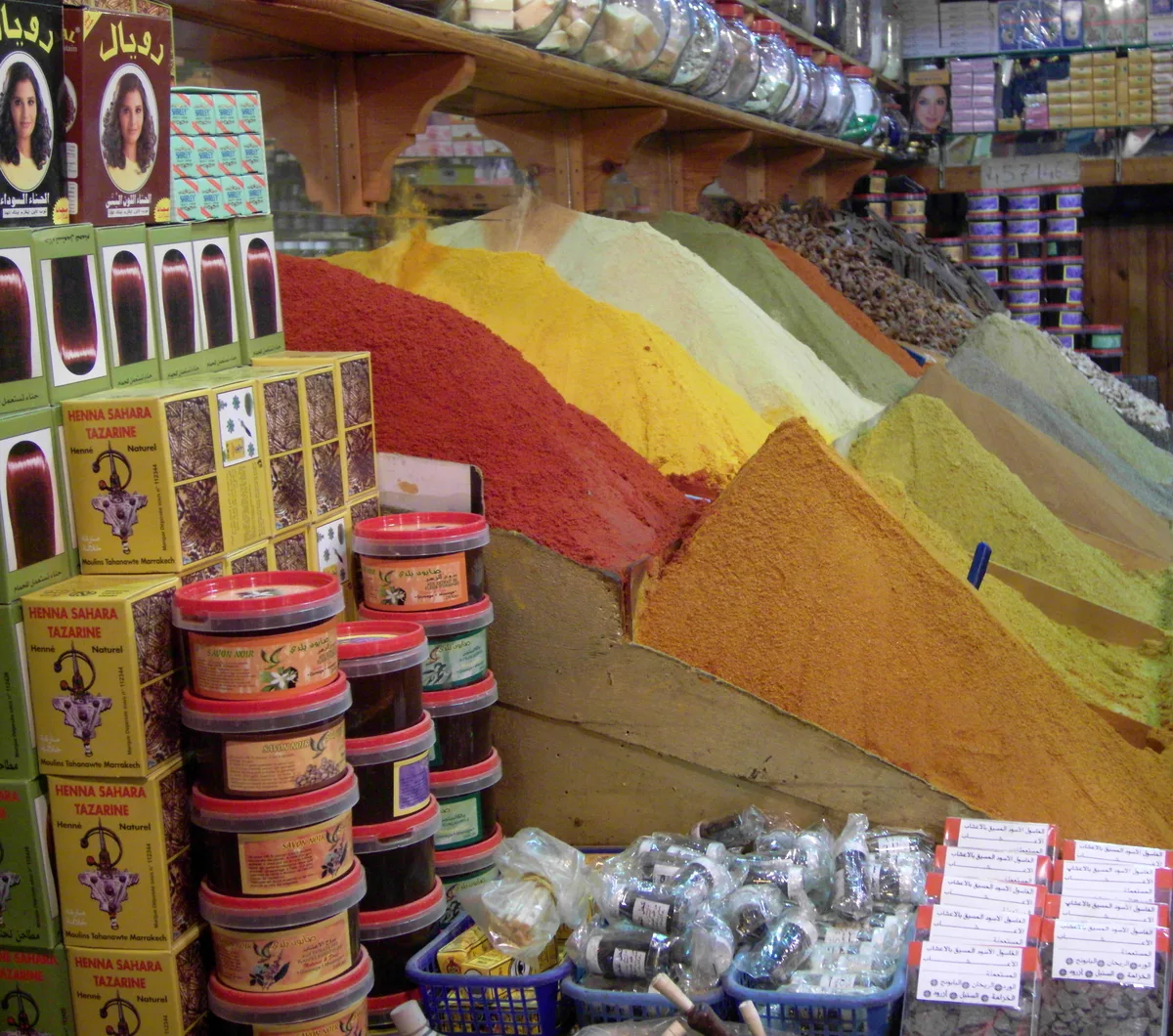
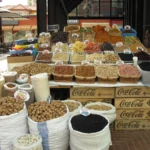
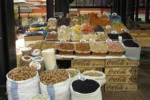
To understand moroccan food, walk the food souks before you sit in the restaurants, because the markets are where the cuisine’s decisions get made. A medina organises its food by trade, as it organises everything: spice merchants with their cones of cumin, paprika, turmeric and ginger in coloured geometry; olive sellers with barrels of every cure and marinade; dried-fruit stalls with pyramids of dates, figs and almonds; herb sellers with armfuls of mint and coriander; preserved-lemon jars glowing yellow in the pickle shops. Shopping is daily, small-scale and social, and the cook who will make your tagine tonight walked this circuit in the morning. The market is not the cuisine’s supply chain. It is the cuisine, in its raw state, with a roof on.
The spice cone deserves a traveller’s footnote: the cones are real – the merchant builds them fresh and sells by the scoop – but the electric blues and greens among the reds and golds are display pigments on inert material, not spices; nobody is putting that blue on a chicken. The spices are the browns, reds and yellows, and the way to buy is the Moroccan way: small quantities, ground fresh where it matters, cumin above all. Ras el hanout, each merchant’s signature blend, is the souvenir with a story. Saffron is the other famous purchase – Morocco’s crop grows around Taliouine in the Anti-Atlas – and the honest warning is that it is widely imitated: buy threads, never powder, from a specialist, and understand that real saffron at a miraculous price is not miraculous.
Where do Moroccans themselves eat out? In the small places the guidebooks photograph least: the soup-and-grill counters inside the markets, the single-dish shops that do harira or bissara or grilled fish and nothing else, the butcher-grills where you choose your meat at the counter and it goes straight onto the coals. The medina restaurant with the long multilingual menu and the empty room is built for visitors; the kitchen with six tables, no printed menu and a queue is built for the neighbourhood, and the neighbourhood is the better critic. Eat where the medina eats, and moroccan food stops being a performance arranged for you and becomes what it actually is – dinner.
What to Order Where – Moroccan Food City by City
Geography is the menu’s secret structure, and a traveller who orders by city will eat better than one who orders by fame. Fes is the cuisine’s aristocrat: order pastilla here above all, in its home city – the Fassi kitchen is where sweet-savoury balance, saffron and slow technique reach their peak – and expect a serious harira besides. Marrakech is the earth’s answer: tanjia in its only true home, mechoui from the alley ovens, the night stalls of Jemaa el-Fnaa, and a street-food culture that treats midnight as a mealtime. If Fes is the palace, Marrakech is the market, and both cities know it.
The Atlantic coast – Essaouira first, then Safi, Agadir and the smaller ports – is fish: sardines at the port grills, chermoula on everything, seafood pastilla in the restaurants. Order what the boats brought. Casablanca is the modern city: the French-Moroccan bakery culture at full stretch, and big-city restaurants running the whole national repertoire – the place to eat the cuisine’s greatest hits performed by professionals, and the pâtisserie shelf at its most polished. Tangier and the north add bissara as a point of pride, Spanish shadows in the cafés and fish again; inland in Chefchaouen, the region’s goat cheese and simple tagines are the honest order.
The Atlas and the south run on the tagine and the road: village tagines cooked over wood or charcoal in the valleys, kalia – the skillet of meat, tomato, onion and egg – in the desert towns, and at the camps the set dinner of soup, tagine and fruit. On the long desert drives, the roadside grill-butcher is the institution: you point at the meat, it is cut, seasoned and grilled while bread and salad materialise, and it is reliably among the best lunches of the trip. Order by place, and the country feeds you its argument for itself, one city at a time.
The pattern beneath the list is the point of the whole guide. Moroccan food is a set of regional answers to regional questions – the Fassi answer to celebration, the Marrakchi answer to the hammam’s spare heat, the port’s answer to the morning’s catch. Ask each place for its own answer and you will eat memorably everywhere.
Cautious Stomachs – How to Eat Boldly and Sleep Well
Every traveller arrives in Morocco with two appetites: the one that wants the snail soup, and the one that wants to be sightseeing tomorrow. This section is the peace treaty between them, and it begins with the good news. The core of moroccan food is structurally kind to visitors: it is a cooked cuisine. Tagines simmer for hours, soups boil, grills run at full heat, bread is baked daily, and the busiest kitchens turn their food over fast. Travellers get into trouble at the cuisine’s raw edges and quiet corners, not at its centre. Eat the centre boldly, manage the edges with a framework, and both appetites win.
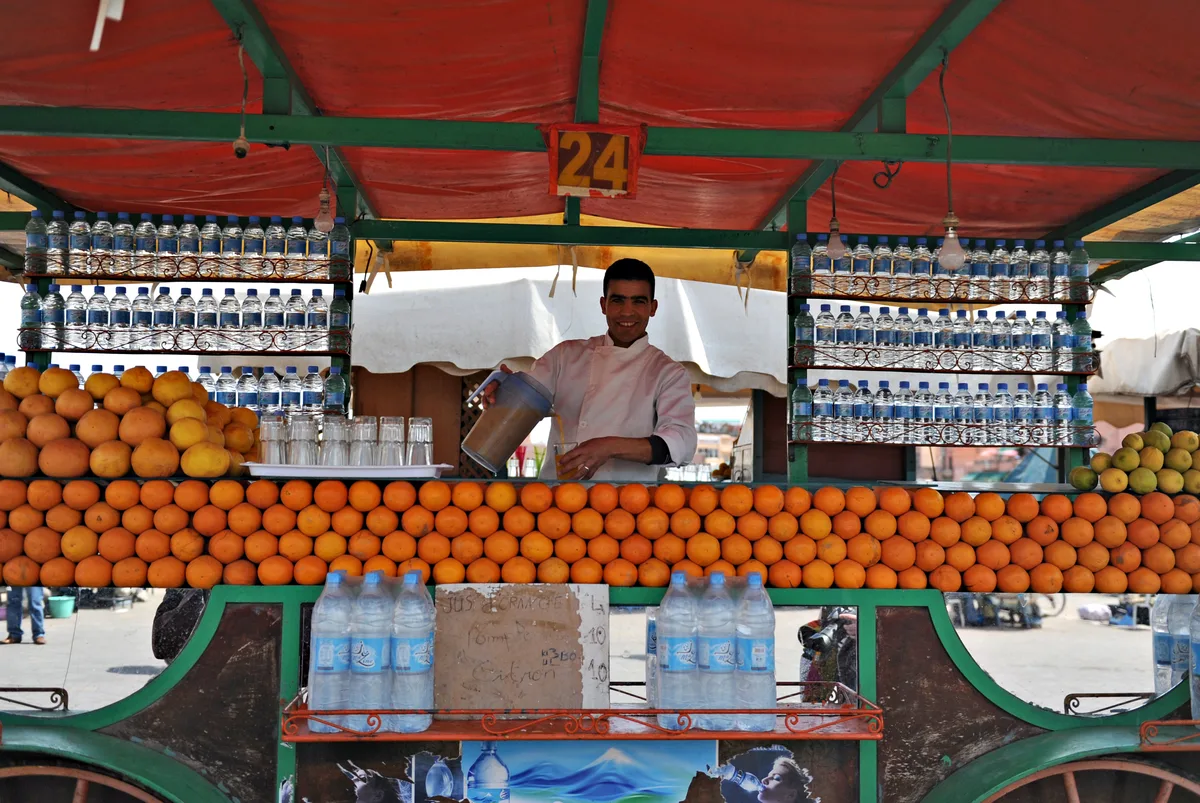
The framework is three questions, applied in seconds. How hot? Food served steaming and cooked to order – tagine bubbling, brochettes off the coals, harira from the rolling pot – is the safest food in the country, stalls included. How busy? Turnover is hygiene you can see; the stall with a queue is safer than the restaurant with a view and no customers, because its ingredients were bought this morning and will not see tomorrow. And how raw? This is where caution earns its keep: locals eat uncooked salads and unpeeled fruit in the busiest places without incident, but the traveller in week one is not a local – peel fruit yourself, go easy on raw garnishes until your stomach has calibrated, and treat the famous juice carts with respect rather than fear: the oranges are squeezed in front of you, but glasses are rinsed in shared water and juices are sometimes stretched with water of unknown biography. Order where glasses are washed in running water, or take the whole fruit instead.
Water itself is simple: city tap water is treated and Moroccans drink it, but the short-stay visitor’s sensible default is sealed bottled or filtered water – a new mineral and microbial load is a variable you do not need in a ten-day trip. Ice follows the same logic: factory ice in city cafés is standard; crushed ice of unknown origin in a rural stall is a pass. Two techniques protect more meals than any medicine: eat the first days’ adventurousness at lunch rather than late, so any disagreement announces itself while the day is young; and wash or sanitise hands before eating – in a cuisine eaten with the hands, your hands are part of the supply chain.
And if the treaty fails – usually via one unexamined raw thing – the Moroccan pharmacy is a national institution, well stocked and used to travellers. Rest, fluids, and a day of bread, soup and tea is the country’s own prescription. Then go back to the stalls: one bad hour is data, not a verdict.
Eating Vegetarian – the Honest Version
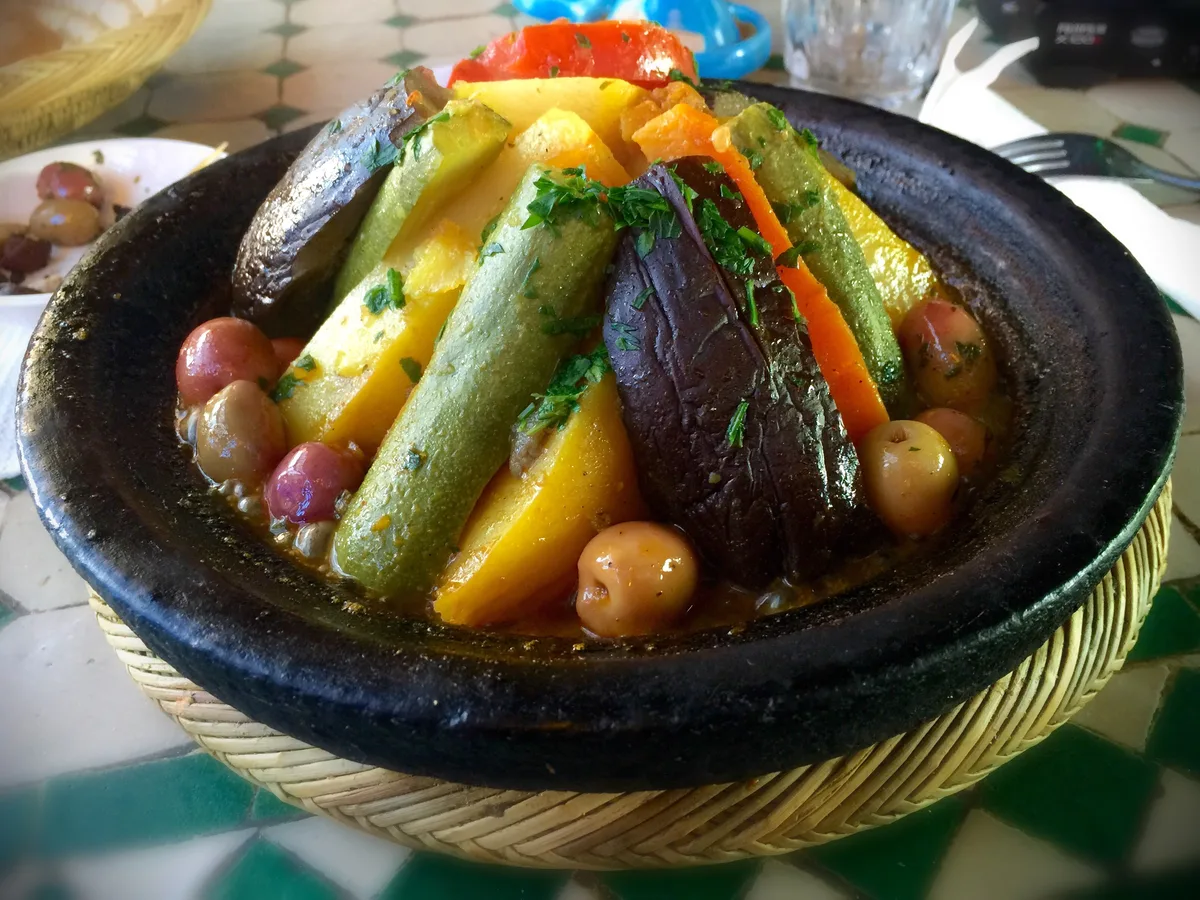
Vegetarians can eat genuinely well in Morocco, and they can also be quietly served lamb stock in a “vegetable” dish by a kitchen that meant no harm. Both facts belong in an honest guide, so here are the feast and the fine print together. The feast first. The small-plates spread is largely vegetarian by nature: zaalouk, taktouka, carrot and beetroot salads, olives in every marinade. Bissara is a vegan bowl before the term existed. Harira is made in meatless versions everywhere, though not in every kitchen on every day. Vegetable tagines and vegetable couscous are real dishes with their own integrity, not meat dishes with the meat removed – the cuisine has always cooked vegetables as mains, meat being the expense rather than the default. Breakfast is a vegetarian festival, and the breads, pastries, nuts, dates and fruits need no negotiation at all.
The fine print is about invisibility. Stocks and meat juices travel: a vegetable tagine may be cooked in the broth of the day’s meat, a couscous may arrive with the meat’s sauce ladled over as a courtesy, and smen can enrich dishes whose menu lists only vegetables. This is not deception; “vegetarian” as a strict category is recent here, and a dish without visible meat reads as a vegetable dish. The traveller for whom this matters should say it plainly and early: “ana nabati/nabatiya” (I am vegetarian) in Arabic, “je suis végétarien/végétarienne” in French, and the crucial clarifier – “bla lham, bla djaj, bla hout” (without meat, without chicken, without fish) – followed, if strict, by asking about the broth. Kitchens respond well to clarity; what defeats them is vagueness.
Vegans face the harder version of the same negotiation – butter and honey across the sweet shelf, cheese woven through breakfast. The winning strategy is the markets and the spread: salads, bissara, vegetable tagines ordered with the broth question asked, breads, olives, nuts and fruit, plus the city restaurants that now mark vegetarian dishes explicitly. Morocco will not starve a vegetarian. It will, politely and with total conviction, attempt to feed them a little lamb, “just for the flavour”, at least once. The refusal, delivered smiling and in the phrases above, is a ritual both sides understand.
One more encouragement: the vegetarian version of this cuisine is not a compromise tour of it. Friday couscous is at heart a vegetable construction with meat as the garnish of honour, and the bread-and-olive-oil axis of the table is complete without anything dying for it. Eat the spread, time the couscous, and the cuisine’s centre holds.
Moroccan Food Questions, Answered
What is the national dish of Morocco? There is no official answer, and Moroccans will argue it happily. Couscous has the strongest claim – the Friday ritual, the family dish, the one UNESCO recognised in 2020 for the whole Maghreb. Tagine is what travellers eat most. Say couscous, then accept the correction that follows; the argument is part of the hospitality.
Is moroccan food spicy? Warmly spiced, rarely hot. Cumin, ginger, turmeric, cinnamon, paprika and ras el hanout build depth rather than fire, and genuine heat usually arrives as harissa on the side, in your control. If a dish is going to be hot, it tends to announce itself – the snail broth’s herbal warmth is the famous creeper.
What do I do about the sweetness of the tea? Accept the first glass as poured. For unsweetened tea, ask before brewing – “bla skar” – and expect to repeat it. Most visitors surrender by day three.
What is the one dish I should not leave without trying? It depends on your city: pastilla in Fes, tanjia in Marrakech, grilled sardines in Essaouira. If only one name is allowed across all of them, make it a properly steamed Friday couscous at lunch.
Is street food safe? From busy stalls – high turnover, food cooked to order over real heat, locals queuing – it is among the safest eating in the country. The quiet stall with yesterday’s tray is a different matter; the queue is the inspection certificate.
What is smen, and will I taste it? Smen is aged, fermented butter, kept for months until it develops a powerful, cheese-adjacent funk, and used in small amounts to deepen couscous, tanjia and rfissa. You will taste it as richness, with a faint blue-cheese whisper at the back of the dish.
The Short Version
Moroccan food is a system before it is a list: a shared platter, bread for cutlery, a warm spice palette that favours depth over fire, sweetness woven through the savoury, and a glass of tea at every joint in the day. Learn the system and the dishes explain themselves – the tagine’s cone, the couscous’s Friday, the pastilla’s sugar, the tanjia’s ashes, the snail soup’s midnight bench in the smoke of the square.
So the short version is a sequence, not a ranking. Start the day on the griddle – msemen, baghrir, amlou. Let lunch be the main event and, if the week gives you a Friday, give Friday lunch to couscous. Eat the small plates first and judge every kitchen by them. Put yourself in front of the coast’s sardines if your road allows, in front of Fes’s pastilla if it allows that, and in Marrakech in front of an opened tanjia urn whatever it takes. Graze the night stalls by their queues, order in rounds, and finish everything with tea taken slowly.
And hold the guide’s two honest rules as you go: no printed price outlives the season it was written in – and no dish list substitutes for watching where Moroccans themselves are eating, and joining the queue behind them. The cuisine has run that quality-control system for a thousand years. It has never once been wrong.