Albania Visa Guide – Who Is Visa-Free, the e-Visa and the 90 in 180 Day Rule
Albania is one of those countries where the visa question sounds simple until you try to answer it for a real person. A British traveller, a Turkish traveller, an Indian traveller holding a used Schengen visa and an Indian traveller without one are all asking the same question — do I need a visa for Albania — and Albania gives them four different answers, all of them correct. The system is generous, but it is generous through categories rather than through one blanket rule, and the categories turn on three things at once: which passport you hold, which other visas or residence permits sit inside that passport, and how long you intend to stay. Get one of those three wrong and you can walk into a refusal at check-in that no amount of explaining at the airport will fix.
This albania visa guide therefore refuses the usual trick, which is to print a long table of countries and call it settled. Albania’s own ministry publishes its visa regime country by country through an interactive checker, and the honest way to use a system like that is to teach the reader how the system works and then send them to the checker for their own case. What follows is built the other way round from most guides: the mechanism first, the official categories quoted from Albania’s Ministry for Europe and Foreign Affairs as read on 31 October 2026, a worked example of the 90 in 180 day rule that trips up more travellers than any other single rule, and a plain account of what could not be verified today. Where a figure comes from a blog, an agency or a search result rather than from Tirana, this guide says so, and where the official page itself is a checker rather than a list, this guide does not pretend to have read a list.
The short version, for the impatient, is that most European, British, American, Canadian, Australian and other Schengen-visa-free passport holders enter Albania without a visa for short stays, that a valid and already-used Schengen, United States or United Kingdom visa or residence permit can itself open Albania’s door to a traveller whose own passport would otherwise need one, and that everyone else applies online before travelling through the official e-visa.al portal. The rest of this guide is about the conditions attached to each of those sentences, because the conditions are where real trips are won and lost. If the trip itself is still taking shape, our Albania travel guide covers routes, seasons and transport; this page is only about the border, and it should be read before anything is booked that cannot be refunded.
At a Glance
Albania’s entry system, as published by its Ministry for Europe and Foreign Affairs, rests on Law No. 79/2021 on Foreigners and on Council of Ministers Decision No. 858 of 29 December 2021, which sets the criteria, procedures and documentation for the entry, stay and treatment of foreigners. That legal footing matters for a practical reason: it means the rules below are not a tour operator’s summary or a travel blog’s best guess, but the framework the border police themselves work from, and when a blog and the ministry disagree, the ministry wins. The ministry’s own visa-regime page organises the system into visa-free entry, short-stay Type C visas and long-stay Type D visas, and every traveller falls into exactly one of those boxes before they travel.
The table below is the whole system on one screen. Notice what it does not contain: no country-by-country list, no fee column and no processing-time column. Those omissions are deliberate and are explained in the sections that follow. A nationality list would be out of date the next time the Council of Ministers amends the regime, a fee printed from a third-party site would be wrong the next time the portal changes its charges, and a processing time quoted from an agency would mislead the one traveller whose file needs extra checks. What the table gives instead is the route and the place where that route is confirmed for a specific passport, which is the only part of the answer that does not expire.
| Route | Who it is for | Where it is confirmed |
|---|---|---|
| Visa-free entry by nationality | Nationals of countries permitted to enter and stay visa-free in Schengen Area countries, and other nationals the ministry’s per-country table lists as visa-free | The ministry’s visa-regime checker for your nationality |
| Visa-free entry by document held | Holders of a valid, previously used multiple-entry Schengen, EU, United States or United Kingdom visa or residence permit; holders of a 10-year UAE residence permit with at least one year left; holders of certain EU-issued travel documents | The ministry’s visa-regime page, read 31 Oct 2026 |
| Seasonal visa-free entry | Nationals of Saudi Arabia and Qatar, tourism only, 15 April to 31 December 2026 | The ministry’s visa-regime page, read 31 Oct 2026 |
| Type C e-Visa | Visa-required travellers applying online before travel for a short stay of up to 90 days in any 180-day period | The official portal e-visa.al |
| Type D long-stay visa | Travellers intending to stay more than 90 days in any 180-day period who need a visa in order to apply for a residence permit | An Albanian diplomatic mission or consular post, or e-visa.al as directed |
Two consequences follow from that table, and both shape the rest of this guide. First, the question to ask is never just “do I need a visa” — it is “which box am I in, and what does that box require of my documents”. A traveller who holds a used Schengen visa may be in a different box from a compatriot who does not, even though their passports are identical. Second, Albania is not a member of the Schengen Area, so the days you spend in Albania are not days on your Schengen clock, and the days you spent in Schengen before flying to Tirana are not days on your Albanian clock. The two 90 in 180 calculations run side by side and never mix, which is exactly why Albania has become a useful pause for long European trips — and exactly why the worked example later in this guide is worth reading slowly.
Step 1 – Check Your Passport on the Official Pages
Begin with the ministry, not with a search result. Albania’s Ministry for Europe and Foreign Affairs publishes its visa regime at punetejashtme.gov.al, and its page headed “Visa regime for foreign citizens” is the single most authoritative summary available in English. When this guide read that page on 31 October 2026, it set out the visa-free categories, the passport validity rules, the two visa types and the documents border officers may ask for, all in one place, and every section of this article that quotes a rule traces back to that page or to the GOV.UK entry requirements page read the same day. If you read nothing else in this guide, read those two pages for your own passport, because they are the pages an airline check-in agent and a border officer are working from.
The second official stop is the ministry’s per-country checker, reached from the same site, which asks you to select your travel country and returns that nationality’s regime. An honest note about this guide’s own research belongs here: when this programme tried to read the checker page on 31 October 2026, the page arrived as a JavaScript country selector whose per-country table could not be extracted in text form, so the full country-by-country list could not be verified line by line today. That limitation is precisely why this article prints no exhaustive nationality table. Your own browser will very likely open the checker without difficulty, and the answer it gives for your passport — visa-free, e-Visa or consulate — outranks every table on the internet, including any table this site could print. Run it before you book anything non-refundable, because the answer decides whether you are applying for something with a lead time attached, and run it again in the week you travel, because the ministry amends this regime by Council of Ministers decision and has done so inside a single year before now.
Make the check a habit with a rhythm, and keep a record of it. Note the date you checked, the answer the checker gave, and the passport and any supporting visa or permit the answer rested on, and keep that note with your travel documents. The reason is practical rather than bureaucratic: the person whose answer matters at the airport is not a search engine, it is the airline agent deciding whether to board you, and the border officer deciding whether to stamp you in, and both of them work from the official position on the day. A screenshot or a note of the ministry’s answer, taken on the day you checked, is worth more in that conversation than a confident paragraph from any guide, this one included. If the checker gives you an answer you did not expect — a visa where you assumed exemption, or a document condition you had not noticed — believe the checker, and work backwards from it through the sections below.
Visa-Free Entry – Who Qualifies Without Applying
For a large share of the world’s tourists, Albania asks for nothing in advance at all. The ministry’s visa-free category is anchored on a phrase worth reading carefully: nationals of countries that are permitted to enter and stay visa-free in Schengen Area countries. In practice that covers the European Union and Schengen states themselves, the United Kingdom, the United States, Canada, Australia, New Zealand, Japan, South Korea, Singapore and the other nationalities on the Schengen visa-free list, and the GOV.UK entry requirements page confirms the British position directly — British citizens can visit Albania without a visa for up to 90 days in a 180-day period, for tourism or business, as stated on the GOV.UK Albania page read on 31 October 2026. The ministry’s page does not itself print a readable country-by-country list in its summary, and this guide will not reconstruct one from secondary sources, but the mechanism is unambiguous: if your nationality is on the Schengen visa-free list, Albania’s own rule, as published, treats you as visa-free for a short stay.
That sentence needs two qualifications, and both are the kind of detail that ruins a trip when missed. The first is that visa-free means visa-free for a short stay, not for as long as you like. The standard allowance in the ministry’s framework is 90 days within any 180-day period, and the Type C visa section of the same page states that calculation explicitly — up to 90 days in any 180-day period, calculated from the date of first entry. The second qualification is that some nationalities carry a different allowance from the standard one, and secondary guides disagree loudly about which ones and by how much. The most repeated example is the United States, where several current guides report a longer visa-free allowance than 90 days, citing a bilateral arrangement. This guide could not verify any longer allowance on the ministry’s summary page read on 31 October 2026, so it does not print one: American readers should run the ministry checker for their own passport and hold its answer rather than this paragraph, and the same advice applies to any nationality whose allowance is reported as exceptional anywhere else. An unverified exception is worse than no exception, because it encourages a traveller to overstay on the strength of a blog.
There is also a quieter point about what visa-free entry does not give you. It does not give you a right to work, to study or to reside in Albania, and it does not give you a right of entry that a border officer cannot refuse. The ministry’s page lists the documents border officers may require at entry, and the visa-free traveller is subject to that list just as the visa holder is — the difference is that the visa-free traveller presents them at the border rather than in an application. Treat the border as a document check that you pass by being prepared, not as a formality that cannot go wrong, and the visa-free route stays as smooth as its reputation promises. The places that reward that preparation are the ones this site covers in depth, from the best places to visit in Albania to the southern coast itself, and none of them is worth a refused boarding for want of a ten-minute official check.
The Visa You Already Hold Can Be the Visa
This is the category that surprises the most travellers, and it is the reason Albania’s system deserves a guide of its own rather than a line in a general Europe article. Under the ministry’s rules as read on 31 October 2026, a foreign national holding a valid multiple-entry Schengen visa that has previously been used in a Schengen Area country, or a valid residence permit issued by a Schengen Area country, may enter Albania visa-free. The same exemption extends to holders of a valid multiple-entry visa or valid residence permit, including documents issued in electronic format, by a Member State of the European Union, the United States of America or the United Kingdom, provided the visa has previously been used in the issuing country. In both cases the traveller must leave Albania no later than three days before the expiry date of the visa or residence permit the exemption rests on. Read that last condition twice, because it is a deadline inside the exemption: the supporting document must still have life in it when you leave, with three days to spare, or the exemption does not cover the trip.
The conditions are exact, and each word in them does work. Multiple-entry matters: a single-entry Schengen visa, or a multiple-entry visa that has never actually been used in the country that issued it, does not qualify, and this is the single most common misunderstanding in this category. Previously used matters just as much: a fresh, unused United States or Schengen visa in a passport does not open Albania’s door, however valid it looks, because the ministry’s rule is written for travellers who have already travelled on that visa, not for travellers who merely hold one. Residence permits are treated the same way as visas in the ministry’s text, which is generous in a useful direction — a person legally resident in the Schengen Area, the European Union, the United States or the United Kingdom, whose own nationality would otherwise need an Albanian visa, can travel to Albania on the strength of that residence, subject to the same three-day-before-expiry condition.
Two further document-based exemptions sit alongside the main one, and both are worth knowing even if neither applies to you, because they show how deliberately Albania has built this system. Holders of a 10-year residence permit issued by the authorities of the United Arab Emirates, with at least one year of validity remaining on the date of entry into Albania, are also visa-free under the ministry’s page. And holders of certain travel documents for foreign nationals issued by European Union Member States — an alien’s travel document, a refugee travel document under the Geneva Convention of 28 July 1951, a stateless person’s travel document under the New York Convention of 28 September 1954, and a travel document for persons enjoying subsidiary protection — are likewise covered. The one stated exception to the document-based exemptions is important and absolute in the ministry’s text: they do not apply to Iranian nationals, who are required to obtain a visa in all cases. If your case touches any of these categories, the ministry checker is again the place to confirm it, because the interaction between your nationality, your supporting document and that exception is exactly the kind of three-way question a general guide should not answer for you.
The 90 in 180 Day Rule – A Worked Example
The 90 in 180 day rule is the rule most travellers get wrong, and it is worth slowing down for, because it is a rolling window rather than a calendar allowance. The ministry’s Type C section states it plainly: a short stay of up to 90 days in any 180-day period, calculated from the date of first entry. What that means in practice is that on any day you are in Albania, you look backwards over the previous 180 days, count every day you have spent in Albania inside that window, and the total must not exceed 90. It does not mean 90 days per trip, it does not mean 90 days per calendar year, and it does not reset because you crossed a border for a weekend. A traveller who spends 90 days in Albania, leaves for a week and returns expecting a fresh 90 days is not starting again — they are returning with a full window behind them, and they have no days left until the oldest days in that window start to fall out of it.
Take a concrete example, because the arithmetic is easier to see than to describe. Suppose you arrive in Albania on 1 November and stay until 30 January, which is 91 days counting both the arrival day and the departure day — already one day over, which is why the counting convention matters and why short trips should be counted inclusively, arrival day and departure day both counted, unless the ministry checker or a consulate tells you otherwise for your case. Now suppose instead you arrive on 1 November, stay 45 days until 15 December, leave, and return on 1 February. On 1 February, your previous 180 days stretch back to early August, and they contain 45 Albanian days, so you have 45 days left in the window. Stay another 45 days and you are at 90, and the next day you must be out, even though your second trip on its own lasted only 45 days. The window keeps rolling forward one day at a time, and each new day in Albania is lawful only if the 180 days behind it contain fewer than 90 Albanian days.
Three practical consequences follow, and they are worth more than any calculator. First, keep your own count, trip by trip, with dates, because no border system will do it for you and the officer at the desk will do it from your passport stamps. Second, never plan a trip that uses all 90 days with no margin: a delayed flight, a missed connection or a single miscounted day turns a legal stay into an overstay, and an overstay is an irregularity you then have to regularise with the Albanian authorities rather than a fine you can pay at the airport and forget. Third, remember that Albania’s window is separate from Schengen’s. A traveller who has used 80 Schengen days and then spends 60 days in Albania has used 80 Schengen days and 60 Albanian days, not 140 of anything, and that separation is the entire reason Albania works as a pause between Schengen stays. It is also the reason the two counts must be kept in two columns, not one, and why a single “days in Europe” tally will mislead you in both directions.
The e-Visa Route – Type C
If neither visa-free nationality nor a qualifying document covers you, the route is the electronic visa, and the ministry’s direction is unambiguous: applications for a visa online are made through e-visa.al, and travellers whose nationality is not included in the visa-regime table must obtain a visa before travelling to Albania, applying to the Albanian diplomatic mission or consular post nearest to their country of origin or residence where the online route does not apply. The portal itself, as read on 31 October 2026, presents the process in three steps — apply by filling out the application, payment by verifying the application information, and result, waiting for the outcome with access to a concierge service — and lists tourism, business, study and transit among the purposes it serves. That is the whole of what the portal’s public face states in plain text, and this guide will not pad it with figures the portal does not publish there.
What the ministry’s own page does state about the visa itself is the Type C definition, and it is worth quoting in substance because it fixes the shape of the stay. A Type C visa is a short-stay visa entitling the holder to enter and stay in Albania for up to 90 days in any 180-day period, calculated from the date of first entry, issued for one, two or multiple entries, with a validity that may not exceed five years. Note the distinction the ministry draws, which many guides blur: validity and stay are different numbers. A Type C visa valid for a year does not authorise a year in Albania; it authorises entries across a year, each stay still bounded by the 90 in 180 rule. A multiple-entry Type C visa is the flexible version of the same rule, not an escape from it, and the worked example in the previous section applies to e-Visa holders exactly as it applies to visa-free travellers.
What this guide deliberately does not print is an e-Visa fee, a processing time, or a document checklist presented as the official list. The reason is not caution for its own sake but a check that came back empty: the ministry’s summary page read on 31 October 2026 does not state a fee or a processing time, the portal’s public face as read the same day does not publish them in readable text, and the figures circulating in search results — a fee in euros, a processing window in working days, a list of uploads — come from agencies, blogs and visa services whose numbers disagree with each other and whose pages are not the portal. An e-Visa applicant should therefore take the fee and the document list from inside their own application on e-visa.al, where the portal displays them for that applicant’s nationality and purpose, and should apply early enough that an unexpected document request does not become a missed flight. The one timing warning that can be given honestly is general rather than numerical: electronic visa systems everywhere take longer when a file is incomplete or a document is unclear, so a file submitted with slack in it is a different proposition from a file submitted against a departure date.
One further boundary deserves emphasis, because it decides real journeys and is stated in the ministry’s own words. A visa, once issued, does not automatically guarantee entry: the final decision on entry is made at the border, where the officer applies the same document and means tests described later in this guide. An e-Visa is permission to travel to the border with your case pre-approved on paper, and travellers who treat it as a guarantee have misunderstood what a border is. Equally, do not plan to obtain a visa on arrival. The ministry’s wording is “obtain a visa before travelling”, and nothing on the official pages read for this guide describes a visa-on-arrival facility for Albania; presenting yourself at the border without a prior visa, if one is required, is planning to be refused. Apply from home, carry the approval in a form you can show without a data connection, and keep the supporting documents that the application rested on within reach at the border.
Longer Stays – Type D and the Residence Permit
A stay longer than 90 days in any 180-day period is not an extension of the tourist rules but a different category altogether, and the ministry draws that line in a single sentence. A Type D visa is a long-stay visa, issued to foreign nationals who intend to stay in Albania for more than 90 days in any 180-day period and who are required to obtain a visa in order to apply for a residence permit. The sequence matters: the Type D visa is the bridge to a residence permit, not a substitute for one, and the residence permit is the document that actually authorises the long stay. Travellers whose plans outgrow the short-stay rules — a semester, a work contract, a family move, a retirement year — need to start in the long-stay category before travelling, not after arriving on a short stay and hoping to convert it.
GOV.UK’s Albania entry requirements page states the same fork in terms a British reader can act on: if you want to stay longer than 90 days, you must apply in advance for a long-stay visa or apply for a residence permit from within Albania. The two halves of that sentence describe two different starting positions — a visa-required traveller applies in advance, while a visa-free traveller who wishes to remain beyond the short-stay allowance applies for a residence permit from within Albania — and which half describes you depends on your nationality and on the route you entered by. This guide does not go further than that fork, deliberately. Residence permit categories, the office that issues them, the documents a particular category requires and the time the process takes are set by Albania’s interior and migration authorities and vary by purpose, and none of that detail was verified on an official page read for this guide. A traveller planning a long stay should take the fork from GOV.UK and the ministry, then put their specific case to the Albanian embassy or consulate responsible for their country of residence, or to the migration authorities in Albania, before committing to a lease, a job start date or a university term.
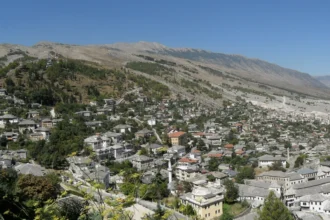
The practical warning in this section is about a manoeuvre that looks like a loophole and is not one. Leaving Albania for a short period and returning does not convert a short stay into a long one, because the 90 in 180 window counts the days you have already spent, as the worked example showed. Nor does a sequence of short visas or visa-free entries accumulate into residence: residence is a status granted through its own process, with its own documents, and time spent as a tourist does not convert into it by repetition. The travellers who make long stays work in Albania are almost always the ones who arranged the right category before the first flight, with the paperwork for the purpose of the stay — employment, study, family, investment or retirement — assembled in advance. The travellers who run into trouble are the ones who arrived as tourists, fell in love with a town — and Albania has several towns that reliably produce that effect, from the stone streets of Gjirokaster to the Riviera bays — and then discovered that affection is not a visa category. Plan the category first, and let the town come second.
Passport Validity and What the Border May Ask For
Passport validity is one of the few points on which Albania’s own rules and other governments’ advice agree, and that agreement makes it a reliable rule to travel on. The ministry’s page states it in two halves. For nationals who do not require a visa, the passport or travel document must be valid for at least three months beyond the intended date of departure from Albania, and must have been issued within the previous ten years. For nationals who require a visa, the passport or travel document must be valid for at least three months beyond the expiry date of the visa requested, and must contain at least two blank pages for affixing the visa sticker, with photocopies of any pages containing information relevant to the journey also submitted. GOV.UK states the same three-month rule for British passports in its own words — your passport must have an expiry date at least three months after the day you plan to leave Albania — and adds that you will be denied entry if you do not have a valid travel document or try to use a passport reported lost or stolen.
The ten-year issuance rule in the ministry’s visa-free half deserves a moment’s attention, because it catches a traveller that the three-month rule misses. A passport issued more than ten years before travel can fail the ministry’s test even if it has months of validity left, a situation that arises with older passports that were issued with extended validity. Check both numbers before you travel — expiry at least three months beyond your planned departure, and issue date within the last ten years — and renew if either fails, because airlines are free to be stricter than the ministry at check-in and a passport that the airline will not board you on is, for practical purposes, an invalid passport. Damaged passports deserve the same treatment: a passport with a damaged chip, a torn page or water damage is a document a border officer may decline, and the cost of renewing it at home is small beside the cost of discovering the problem at a foreign airport.
Beyond the passport itself, the ministry publishes a list of documents border officers may require during checks, and it is worth reading as a packing list rather than as a threat. The list includes an invitation from a guarantor or host in Albania where the traveller has a host; a return ticket or return travel reservation; a document confirming accommodation for the duration of the stay; an electronic visa or visa sticker for nationals subject to visa requirements; financial means in Albanian lek or convertible foreign currency or other accepted forms of payment such as cheques and credit cards; a document demonstrating sufficient financial means for the stay and return, for which the ministry gives an indicative amount of 5,000 lek for each day of stay for adults and 2,500 lek for each day for minors, with bank statements or a savings passbook given as examples of evidence; and an international vaccination certificate where the traveller arrives from a country affected by an epidemic or a disease for which Albanian legislation requires vaccination. The word “may” does most of the work in that list — not every traveller will be asked for every document — but the traveller who can produce each of them without digging through a checked bag is the traveller who passes the check in minutes. Keep the return ticket, the first accommodation confirmation and the means of payment where you can reach them before baggage reclaim, and keep the figures in proportion: the ministry’s amounts are indicative, not a toll, and a credit card and a bank statement answer the question the officer is actually asking, which is whether this trip is funded.
Seasonal and Special Cases to Recheck
The most time-sensitive rule in Albania’s current regime is also the easiest to get wrong by reading last year’s guide, and it is stated on the ministry’s page with dates attached. Nationals of Saudi Arabia and Qatar may travel visa-free, for tourism purposes only, from 15 April 2026 to 31 December 2026, upon presentation of a valid passport. Three conditions hide inside that sentence, and each of them bites. The dates are a window, not a permanent rule: a Saudi or Qatari traveller arriving on 2 January 2027 is not covered by it, and this article, published for a November 2026 slot, sits inside the window while warning its readers that the window closes six weeks later. The purpose is tourism only: the same passport travelling for business, study or any other purpose is not covered by the seasonal exemption and must be assessed under the ordinary rules. And the exemption is for those two nationalities as published: it does not extend by analogy to neighbouring Gulf nationalities, however similar their ordinary travel patterns may be, and guides that list additional Gulf states under this waiver for 2026 are reporting either a different year’s decision or a different source, not the ministry page read for this article.
Seasonal decisions of this kind are made year by year by the Council of Ministers, which is why the ministry’s own framing matters more than any guide’s summary. A waiver granted for one summer season may be renewed, widened, narrowed or dropped for the next, and the only safe way to treat a seasonal exemption is as a dated fact with an expiry date attached, checked again for the year of travel. The same discipline applies to the document-based exemptions and to the per-country table generally: the regime is an instrument that the Albanian state amends, not a permanent feature of the map, and a guide written in November 2026 is a snapshot of a moving system. That is not a counsel of despair. It is the reason this guide keeps pointing back to the ministry checker, which applies the current decision to your passport on the day you ask, rather than freezing an old decision into a table and calling it a rule.
A second special case worth a paragraph is the traveller whose documents do not fit the ordinary categories at all. Holders of refugee and stateless travel documents, alien’s documents and subsidiary protection documents issued by European Union Member States are covered by the ministry’s visa-free text, as described earlier, while Iranian nationals are expressly excluded from the document-based exemptions and must obtain a visa in all cases. Travellers in either position should not rely on a general guide for their case: the interaction between the document, the issuing state and the nationality is specific, and the ministry checker and the nearest Albanian diplomatic mission are the channels built for it. The same advice holds for travellers with a complicated history — a previous refusal, a passport near expiry, a name spelled differently across documents, a child travelling with one parent — where the safe move is always to ask the mission before booking rather than to hope the border will not notice. Consulates deal in explanations; what they cannot work with is a surprise presented at a check-in desk.
Frequently Asked Questions
Do I need a visa for Albania?
It depends on your passport and on any visa or residence permit you already hold, and that is the honest answer rather than a dodge. Nationals of countries permitted to enter and stay visa-free in Schengen Area countries are visa-free for a short stay in Albania under the ministry’s rules, and holders of a valid, previously used multiple-entry Schengen, EU, United States or United Kingdom visa or residence permit, holders of a qualifying 10-year UAE residence permit, and holders of certain EU-issued travel documents are also visa-free under the ministry’s page read on 31 October 2026. Everyone else needs a visa before travelling, applied for online through e-visa.al or through an Albanian diplomatic mission. Run the ministry’s per-country checker for your own nationality before you book, because the checker applies the current regime to your case and no guide’s summary can do that for you.
How long can I stay in Albania without a visa?
The standard short-stay allowance is up to 90 days in any 180-day period, calculated from the date of first entry, and that rolling calculation is explained with a worked example earlier in this guide. The allowance is not 90 days per trip and it does not reset by leaving for a weekend. Some nationalities are reported in secondary guides as carrying a different allowance, most often the United States, but no longer allowance was verified on the ministry’s summary page read on 31 October 2026, so this guide does not print one: check the ministry checker for your nationality and hold its answer. If you need more than 90 days in 180, you need the long-stay route described in this guide, not a longer tourist stay.
What is the Albania e-Visa, and where do I apply?
The e-Visa is Albania’s online visa, applied for before travel through the official portal e-visa.al, which presents the process as apply, payment and result. The short-stay version is the Type C visa: up to 90 days in any 180-day period, for one, two or multiple entries, with a validity of up to five years — remembering that validity is not the same as permitted stay. This guide does not print an e-Visa fee, processing time or document checklist, because none of those was published on the official pages read on 31 October 2026; take the fee and the document list from inside your own application on e-visa.al, and apply with slack before your departure date. Do not plan to obtain a visa on arrival: the ministry’s direction is to obtain a visa before travelling.
How much validity does my passport need for Albania?
For visa-free nationals, the ministry requires a passport or travel document valid for at least three months beyond the intended date of departure from Albania, issued within the previous ten years. For visa-required nationals, the passport must be valid for at least three months beyond the expiry date of the visa requested and must contain at least two blank pages. GOV.UK states the same three-month rule for British passports. Check both the expiry and the issue date before you travel, and renew if either fails the test, because airlines may enforce their own stricter standard at check-in.
Does time in Albania count towards my Schengen 90 days?
No. Albania is not a member of the Schengen Area, so days spent in Albania are not days on your Schengen 90 in 180 calculation, and days spent in Schengen are not days on your Albanian calculation. The two windows run side by side and never mix, which is why Albania is often used as a pause between Schengen stays. Keep the two counts in separate columns, with dates, and do not let a single “days in Europe” tally mislead you in either direction.
Can I work or study in Albania on a visa-free entry or a tourist e-Visa?
No. Visa-free entry and the Type C short-stay visa are for short visits such as tourism and business visits, and a longer or purposeful stay — work, study, family residence or any stay beyond 90 days in 180 — belongs in the long-stay category, through a Type D visa where a visa is required and then a residence permit. Arrange the right category before travelling, through the Albanian embassy or consulate for your country of residence, rather than arriving as a tourist and hoping to convert the stay.
The Short Version
Albania’s entry system is three routes and a checker. If your nationality is on the Schengen visa-free list, you arrive and are checked in without a prior application, for up to 90 days in any 180-day period. If your passport would otherwise need a visa but you hold a valid, previously used multiple-entry Schengen, EU, United States or United Kingdom visa or residence permit, or a qualifying 10-year UAE residence permit, that document itself may be your entry, provided you leave at least three days before it expires. If neither fits, the e-Visa at e-visa.al is the online route before travel, for a Type C short stay under the same 90 in 180 rule, and a stay beyond 90 days is a Type D long-stay matter leading to a residence permit. Threaded through all three routes are a passport valid three months beyond departure and issued within ten years, a border document list that rewards the prepared traveller, and a seasonal waiver for Saudi and Qatari tourists that expires on 31 December 2026 and must not be assumed into 2027.
None of that, however, answers the only question you actually brought to this page — what does my passport need — and that is deliberate, because on 31 October 2026 the honest state of the evidence is this. The ministry’s visa-regime page was read today, in full, and its categories, validity rules, visa types and border document list are quoted from it. The GOV.UK entry requirements for British passports were read today. The e-Visa portal’s public face was read today. The ministry’s per-country checker could not be read in text form today, so no exhaustive nationality table is printed here, and no e-Visa fee, processing time or document checklist is printed from unofficial sources. So — check the ministry’s pages before you book, check again before you fly, and let the Albania travel guide and the best places to visit in Albania worry about the part of the trip that is supposed to be fun. More routes and country planning live across Traveling Advisior — start with the pillar linked here, and treat every visa page on the internet, this one included, as a signpost to the official checker rather than a substitute for it.