South of Shkodër, where the Buna river slips out of the great lake and the Drin and Kir spread across the plain, one rocky hill carries the whole history of northern Albania. Rozafa Castle stands on it, 130 metres above sea level, in a position so obviously commanding that people have been fortifying it since the Bronze Age. The walls a visitor walks today are mostly Venetian, the foundations beneath them are Illyrian, the church at its heart spent four centuries as a mosque, and the name itself belongs to a woman who, the story says, is still inside the walls. No single site in the country layers legend and record so tightly together, and no viewpoint in the north explains the geography — lake, three rivers, plain, Alps — half as well.
The visit itself is a climb through three courtyards. You enter through a layered Venetian gate into a first yard where the oldest stones in the fortress stand, cross a broad garrison terrace built around cisterns and a ruined church-mosque, and finish at the citadel, where the Venetian captain’s house survives as a small museum and the ramparts open onto the finest panorama in the region. Shkodër town lies below with its photography museum, its pedestrian street and its mosques and churches, and the castle makes most sense as the first half of a Shkodër day rather than as a standalone stop. For the wider country first, start with our Albania travel guide; this page is the fortress itself.
One promise before the story starts, because this castle demands it. Rozafa Castle comes with a famous legend — the wife walled in alive so the walls would stand — and this guide tells that legend in full, because it is beautiful and because Albanians have been telling it for at least five hundred years. But it is told here as what it is: a legend, labelled as one at every step, in its own section. The history that follows it is a different thing — kings, sieges and treaties that stand in written records — and the two are never blurred. What this guide also refuses to print is a ticket price or an opening time. Both exist, both change, and both belong to the gate, not to an article; the practical section explains the arrangements honestly instead.
Rozafa Castle at a Glance
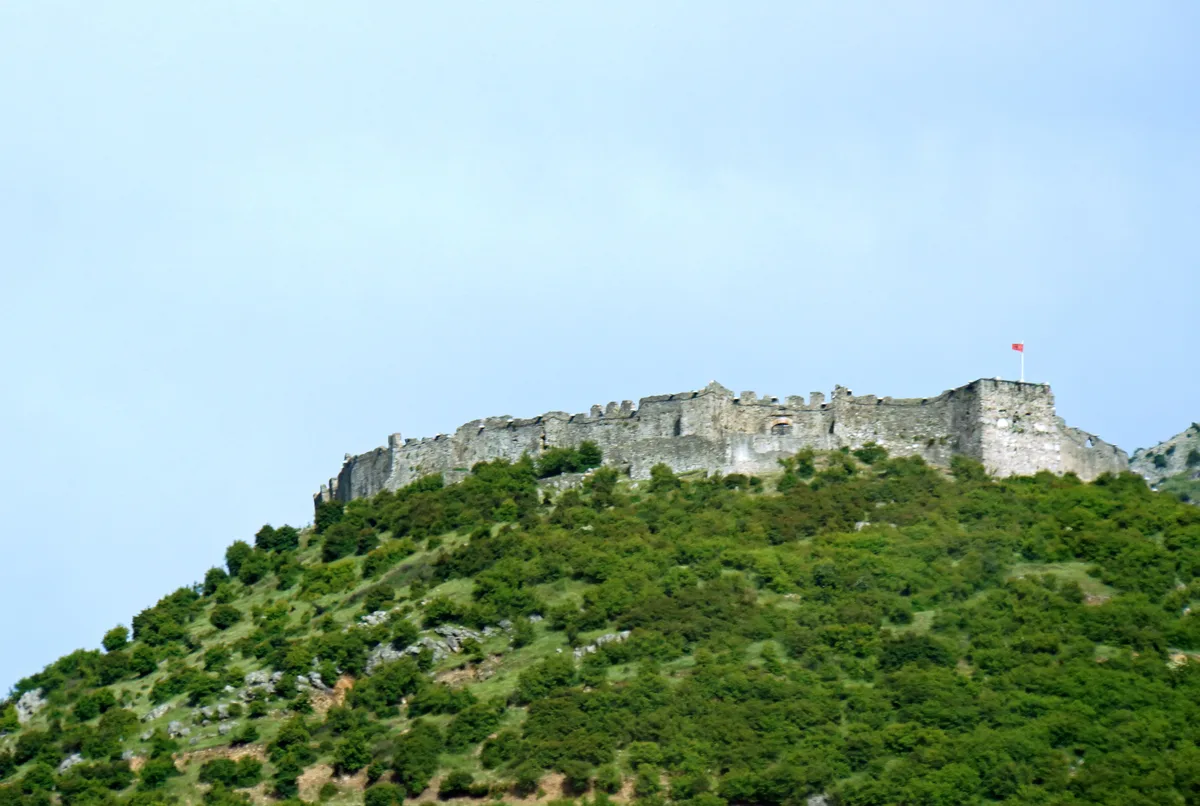
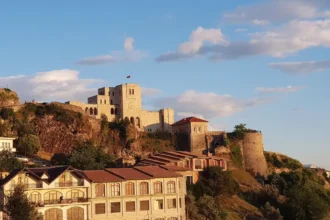
Rozafa Castle from the plain – the fortress on its green hill above Shkodër, the flag at its summit marking the citadel. Photo: Dennis G. Jarvis, CC BY-SA 2.0, via Wikimedia Commons
The castle divides into three courtyards climbing one hill, and everything about the visit follows from that shape. The first courtyard holds the gate complex and the Illyrian wall; the second, the largest, was the garrison’s working terrace, with the cisterns, the stores and the church that became a mosque; the third, at the top, is the citadel proper, where the Venetian governor lived and where the museum now sits. Around all of it runs the view — Lake Shkodër to the west, the city to the north, the braided rivers and the flood plain to the south and east, and on a clear day the Albanian Alps closing the horizon.
| Place or thing | Why it earns its place | Time character |
|---|---|---|
| The legend of Rozafa | The immurement story every Albanian knows – told here as legend, with its sources | Ten minutes of reading, a lifetime of retelling |
| The Illyrian wall | 4th-3rd century BC masonry in the first courtyard – the oldest fabric in the castle | Part of the first courtyard |
| The Venetian gate and barbican | The layered northern entrance the great siege failed to force | The way in – walk it slowly |
| The great siege of 1478-79 | Mehmed II in person, five failed assaults, and a fortress ceded by treaty, not taken | The castle’s defining hour |
| The church-mosque | St Stephen’s church turned Fatih Sultan Mehmet Mosque – two faiths in one ruin | The centrepiece of the second courtyard |
| The cisterns | The rainwater system that let the castle outlast sieges | Scattered through the courtyards |
| The Captain’s House museum | The Venetian governor’s residence – archaeology, coins and the Illyrian kings | About half an hour |
| The views | Lake, three rivers, the plain, the city and the Alps from one rampart | The real reason to climb |
| Shkodër town below | The Lead Mosque, the Marubi Museum and the old centre | The second half of the day |
Two judgements sit behind that table. First, the legend and the siege are the castle’s twin claims on a visitor, and they need each other — the story explains why this hill matters to Albanians, the documented siege explains why it mattered to empires. Second, Rozafa is not a large site, and its pleasure is density rather than extent: four thousand years of occupation stacked onto one walkable hilltop, with a town below that most visitors wrongly treat as a mere staging post on the way to the mountains.
The Legend of Rozafa – the Wife in the Wall
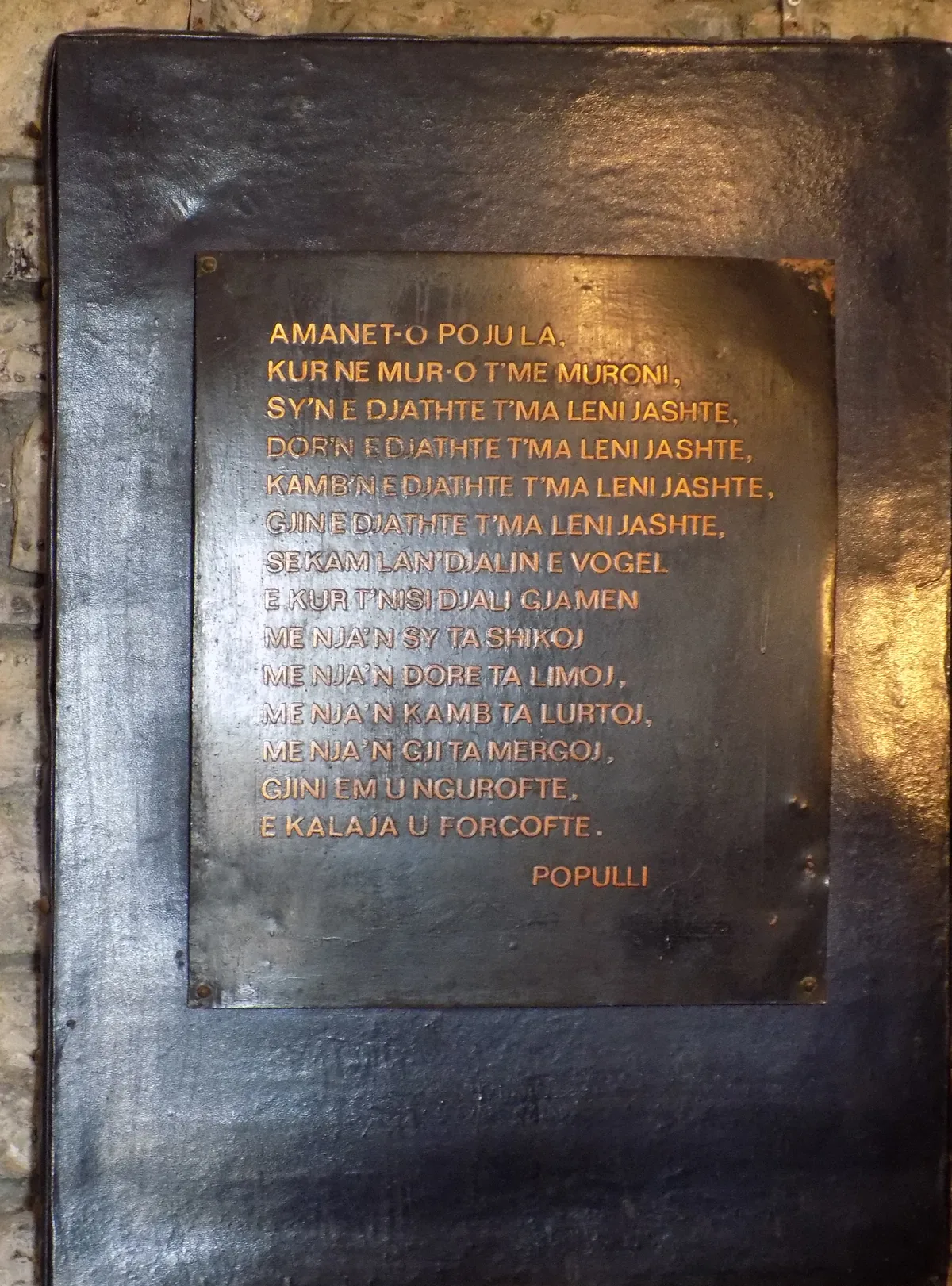
The legend of Rozafa told in verse on a bronze plaque in the castle museum – the story is presented there as the city’s founding myth, which is exactly what it is. Photo: BuhaM, CC BY-SA 4.0, via Wikimedia Commons
Here is the story, told the way it has been told around Shkodër for centuries — as a story. Three brothers set out to build the castle on the hill. All day they laid stone, and every night the walls they had raised fell down. Day after day the work rose and the ruin greeted them at dawn, until a wise old man, passing, told them he knew why the walls would not stand, and asked if they were married. They were. Then hear this, he said, and swear on your besa — the Albanian oath of honour — never to repeat it to your wives. The wife who brings you your food tomorrow must be buried alive in the wall of the castle. Only then will the foundations stay put and last forever.
The brothers swore. But the two eldest broke their oath that night and quietly warned their wives, while the youngest kept his besa and said nothing. The next day the brothers’ mother, knowing nothing of any of this, asked her daughters-in-law to carry lunch up to the workers. The two elder wives found their excuses. It was Rozafa, the wife of the youngest brother, who came up the hill with the basket, leaving her baby son at home. Her husband, sick at heart, told her the whole bargain — that she was to be walled into the castle so that it could be finished. And Rozafa, the story says, did not protest. She made one request. When you wall me in, leave a hole for my right eye, so I can watch my son; for my right hand, so I can caress him; for my right foot, so I can rock his cradle; and for my right breast, so I can feed him. Let my breast turn to stone and the castle flourish. May my son become a great hero. The walls stood.
That is legend, and it deserves to be met on its own terms. It is not a folktale invented for tourists: the story is attested in print as early as 1505, in the siege history written by the Shkodran priest Marin Barleti, and scholars of folklore treat it as one of the great immurement ballads of the Balkans. A Serbian epic version, The Building of Skadar, was recorded from a Herzegovinian singer and published by Vuk Karadžić in 1815, with the three brothers recast as medieval Serbian nobles; the folklorist Alan Dundes devoted a whole casebook, The Walled-Up Wife, to this family of stories, which surfaces across the region wherever a great bridge or fortress needed explaining. Around Shkodër the legend stayed alive in the stones themselves. Local people have long pointed to the pale limestone deposits that weep from the old Illyrian gateway — Rozafa’s milk, they say, still flowing — and women traditionally scraped the deposits, mixed them with water and drank or applied the mixture in the belief that it would increase their own milk and pass Rozafa’s character to their children. The castle museum gives the legend its due, with panels telling the story and a life-sized sculpture by Skender Kraja of Rozafa half-buried in the wall.
Notice, too, what the tale is really about. The walls are almost incidental; the story’s engine is the besa, the sworn word. The brother who kept his oath loses the most, and the story does not flinch from that arithmetic — it insists that the castle stands precisely because one man refused to break his word and one woman accepted the price of it. That is why the ballad has outlived every garrison that ever held the hill: it is less a building story than a charter of honour with a building attached, and Albanians who tell it are usually making the point about the oath, not about the masonry. Folklorists group it with the other great immurement songs of the peninsula — the Greek ballad of the Bridge of Arta is its famous cousin — in which something vast and communal can only be finished by burying something private and beloved in it.
Even the name keeps its own separate mystery. Scholars have linked “Rozafa” not to any walled-in wife but to Resafa, the place in Syria where Saint Sergius was martyred — Sergius, Shirgji in Albanian, has been venerated around Shkodër for as long as records run. That is a scholarly suggestion, not a certainty, and it sits in a different world from the ballad. What can be said plainly is this: no document records a woman immured in these walls, the oldest masonry here is far older than any medieval building campaign the tale might describe, and the castle would be worth the climb if the story had never been told. That the story was told — and is still told, with feeling, by the city underneath — is itself a part of the place. Hear it as Albanians hear it: not as history, but as the meaning they have chosen to give the stones.
The Documented Castle – Illyrian Scodra and the Last Illyrian King
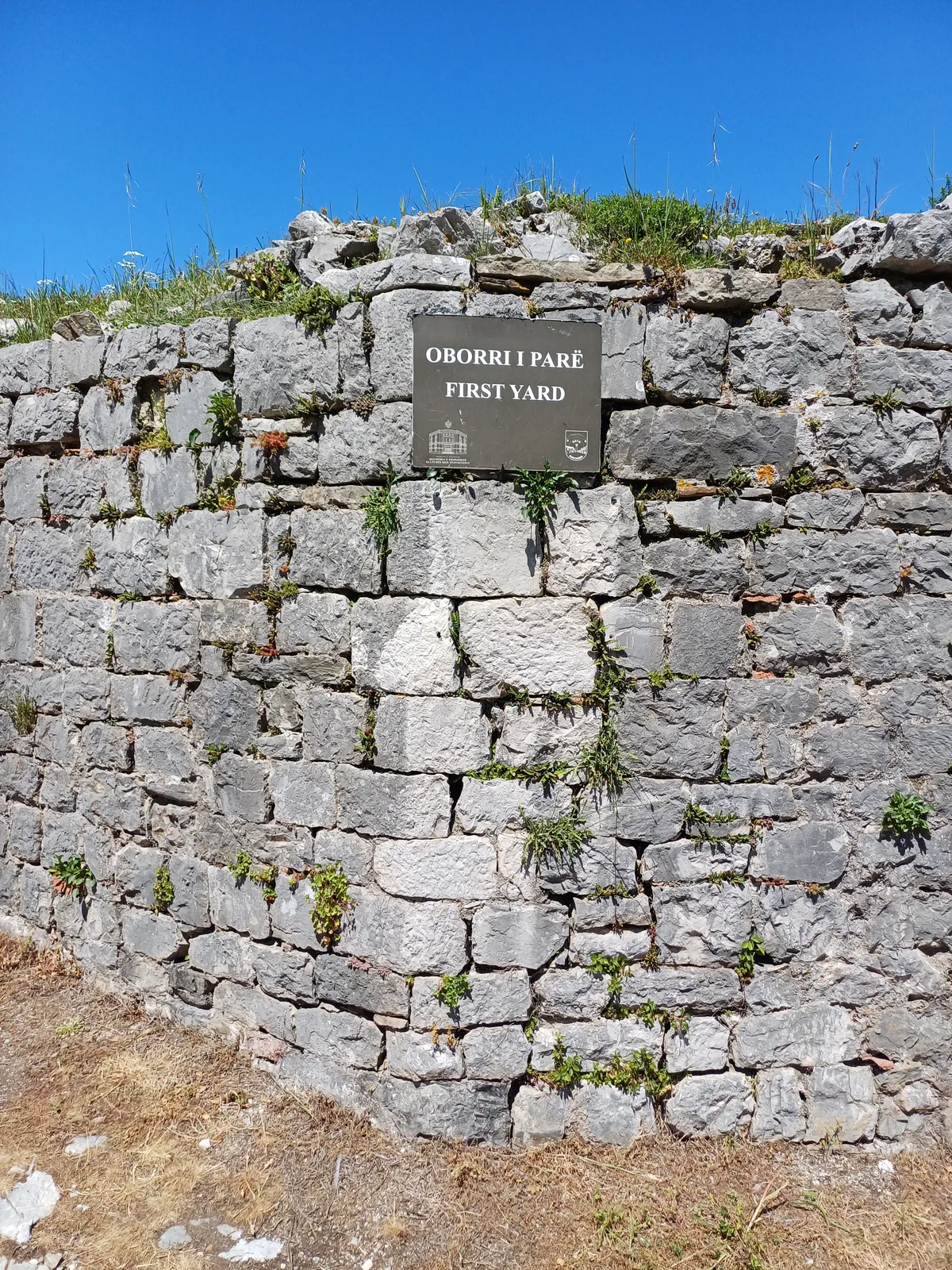
Rozafa Castle – the Illyrian wall in the first courtyard, its huge fitted blocks the oldest masonry standing in the fortress. Photo: Edukatori, CC BY 4.0, via Wikimedia Commons
The record begins with the hill itself. The summit was settled in the Early Bronze Age — the castle museum’s oldest objects, ceramic fragments dated to around 2000 BC, were found here — and by the 4th or early 3rd century BC the Illyrians had crowned it with serious fortifications. A stretch of that original wall, built of great fitted blocks in the manner archaeologists call cyclopean, still stands in the first courtyard, and it is the oldest structure in the castle grounds. The city it guarded was Scodra, seat of the Illyrian tribes of the region — the Labeatae first in most accounts, then the Ardiaei — and a place of consequence early: the castle museum’s own account of the site notes a coin of around 230 BC that already names the city Scodrinon.
Scodra’s moment on the larger stage came at the end. Under King Gentius, who reigned from 181 BC, the city was the capital of the last Illyrian kingdom, and in 168 BC, in the Third Illyrian War, Gentius concentrated his forces here for his final stand against Rome. The Roman commander Lucius Anicius Gallus closed in; Gentius, trapped inside his capital, sent two leading men of his court, Teuticus and Bellus, to negotiate. On the third day of the truce he surrendered, and was carried off to Rome to walk in Anicius’s triumph. North of the lake, at Meteon, the Romans also captured his wife Queen Etuta, his brother and his sons. With that surrender the Illyrian kingdom ended, and Scodra passed into the Roman world — the Roman historian Livy, whose account is the source for the siege, already treats the town as the fallen capital of a kingdom. Encyclopaedia Britannica’s article on Shkodër sums the moment in a line: Livy cited the town as the capital of the Illyrian king Gentius, who surrendered to the Romans in 168 BC.
The archaeology is still catching up with the texts. Excavations at the castle were reopened in 2011 by Albanian and Polish archaeologists, who have mapped the site, surveyed inscriptions in the Venetian cistern, and traced further segments of both the citadel walls and the lower town’s fortifications, turning up Hellenistic pottery and small finds of Gentius’s period inside and outside the fortress. The picture their work supports is of a city much larger than the castle hill — spreading down to the banks of the Drin and Buna — which matches Livy’s treatment of Scodra as a capital rather than a mere fort. Research seasons continue, and parts of what a visitor sees described on the panels are findings of the last decade and a half, not settled old knowledge.
Stand at the Illyrian wall in the first courtyard and that long arc is under your hand. The Venetian gate you entered by is, in part, a rebuilding of this same northern approach — the siege article’s photographs of the entrance show the sequence clearly: a Venetian outer gate, the barbican, and inside it the original Illyrian gate, three thousand years of builders all solving the same problem on the same slope. Empires changed; the hill’s logic never did.
Rome, Byzantium and the Medieval Centuries
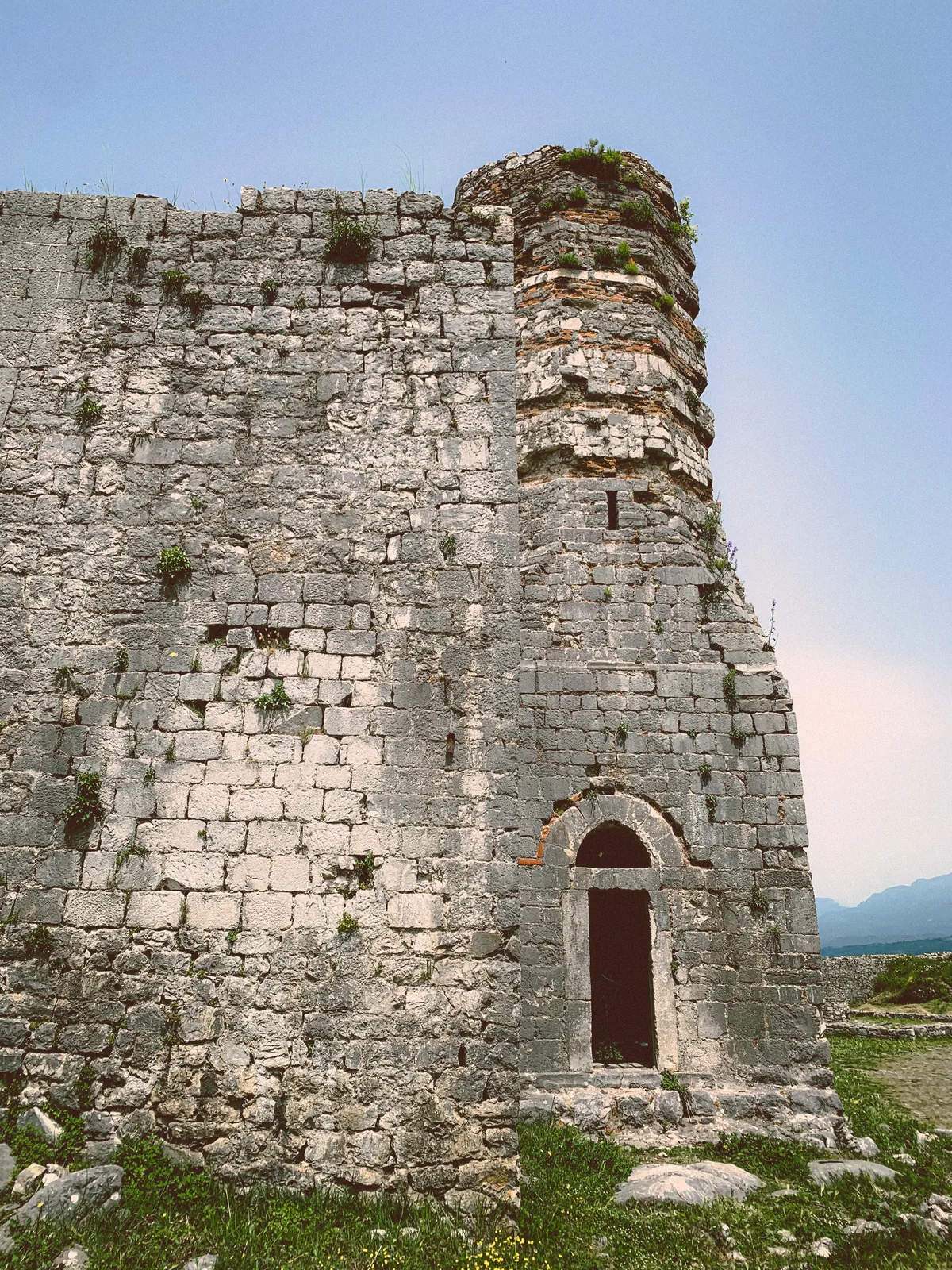
A round tower of the castle, its stonework patched and rebuilt by successive holders across the medieval and Venetian centuries. Photo: Exinvert, CC BY-SA 4.0, via Wikimedia Commons
What followed Gentius was a long rotation of empires, and honesty requires saying that for much of it the castle is better documented as a prize than as a place. Roman Scodra became a trading and military post of the empire’s Balkan provinces. When Rome’s west fell, the town lay within the Byzantine world, and through the early medieval centuries it changed hands among Byzantines, the Slav kingdoms of Duklja, the First Bulgarian Empire and the Serbian states that succeeded them — Grand Principality, Kingdom and, at its 14th-century height, Empire. Each holder repaired the fortress above the town, because each needed exactly what the Illyrians had needed: the lock on the corridor between the lake, the rivers and the Adriatic.
The last medieval holders were the Balšić family, lords of Zeta, who held Shkodra from 1355. Their tenure was brief and beset — the Ottomans took the town in 1393, Đurađ II Balšić recovered it in 1395, and in 1396 the family sold Shkodra to the Republic of Venice. The sale changed the castle’s fate for a century. Venice, building its Albanian littoral into the defensive chain it called Albania Veneta, poured engineers and money into this fortress above all others; by 1466 the Venetians considered Shkodra the heart and capital of their Albanian dominion. The medieval centuries also left the castle its most affecting building — the church of St Stephen, raised in the 13th century in the Romanesque manner — though what visitors see of it belongs to the story told two sections below.
Very little of the medieval town survives above ground, and the castle’s own visible fabric is, as the archaeologists put it, mostly of Venetian construction. That is the honest picture: the medieval centuries are present here as layers, repairs and one great church, not as an intact medieval fortress. The hill kept being refortified because it kept being worth refortifying — and the greatest test of all was now a generation away.
The Venetian Fortress – Gates, Walls and Cisterns
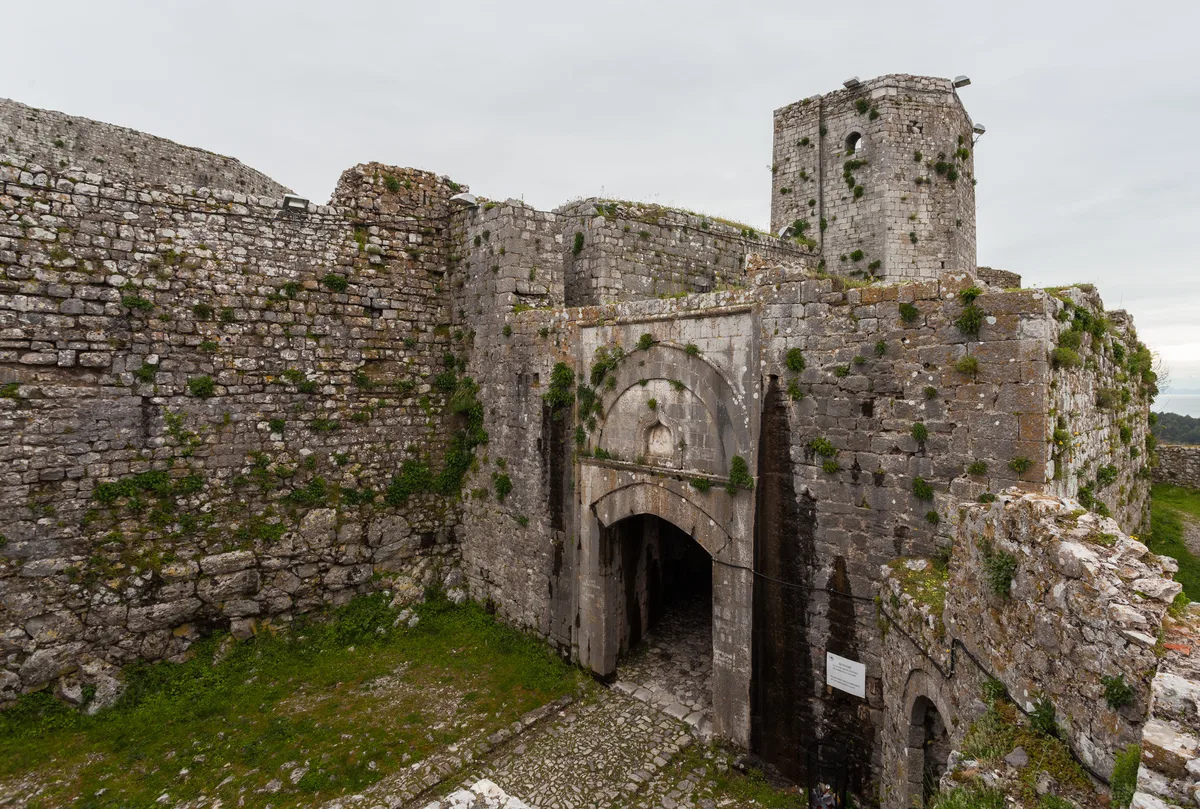
Rozafa Castle – the main gate and barbican on the northern face, Venice’s layered answer to Ottoman artillery. Photo: Diego Delso, CC BY-SA 3.0, via Wikimedia Commons
Venice did not merely hold this castle; it rebuilt it as a system. Expecting exactly the Ottoman assault that eventually came, the republic sent its expert engineers to strengthen the fortifications to the most modern standard of the day. In 1458, the Venetian architects Andrea and Francesco Venier and Malchiore da Imola drew the plans for the citadel’s reinforcement — and, just as importantly, for a system of cisterns designed to gather rainwater inside the walls. On the northern face, the side the ground makes least steep and therefore the side any army must attack, they added a barbican and an extra gate, correctly forecasting the main point of conflict. To enter the castle today is to walk their design: an outer Venetian gate, the barbican’s killing ground, then the older gate within — defence in depth, each layer forcing an attacker to begin again under fire.
The cisterns deserve equal billing with the walls, because they are the reason the walls mattered. A hilltop fortress with no spring lives or dies by stored water, and Shkodra’s defenders would soon need to outlast not a storming but a starvation. The great vaulted cisterns the Venetians cut and lined inside the courtyards turned rainfall into endurance; their stone wellheads still dot the second courtyard, and the ruins scattered around them — warehouses, stores, residential quarters, even prison space in the guidebook listings — are the remains of the self-contained garrison town the system sustained. When the city below was burned in 1467, the citizens moved up into this fortress for safety, and the place the visitor walks today became, in effect, the whole of Shkodra: church, stores, water and walls on one rock.
Walk the circuit of walls with that in mind and the building explains the history. The curtain walls are thickest and most carefully faced where the slope invites attack; towers punctuate the line for flanking fire; the ground falls away so steeply on the other faces that a modest wall suffices. The Venetians maintained a professional garrison here — around 800 mercenaries in the city in the years before the end — and as the Ottoman threat sharpened in late 1477, the Senate at last allowed the Shkodrans themselves to be armed and recruited from the surrounding villages. Engineers, water, walls and men: the fortress that Mehmed II came against in 1478 was the most complete machine Venice could build. It nearly proved enough.
The Great Siege of 1478-79 – the Castle’s Finest and Final Stand
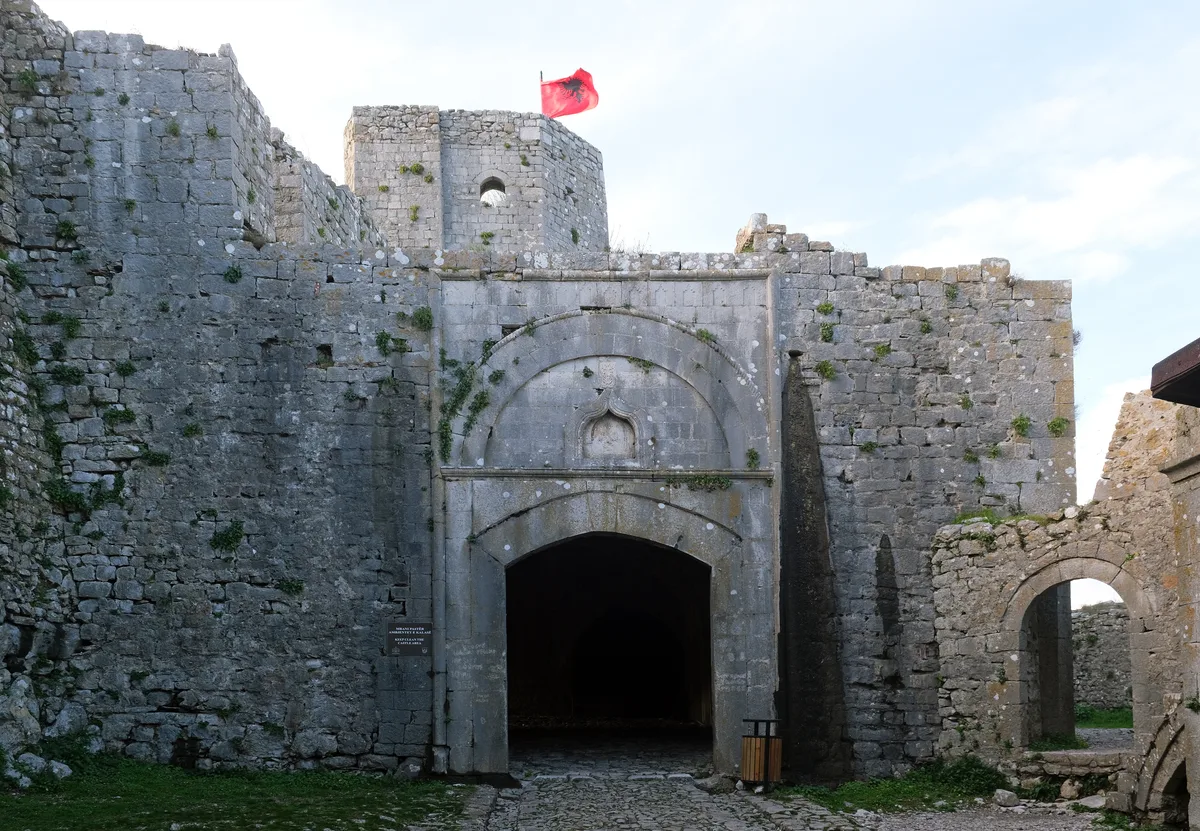
The main gate from the front – the point every Ottoman assault of 1478 had to break, and none did. Photo: kallerna, CC BY-SA 4.0, via Wikimedia Commons
The Ottomans had tried before. In 1474 an army under Süleyman Pasha besieged Shkodra and failed, badly damaging the outer walls on its way out; the citizens rebuilt, and added secondary defences of wood and earth against the stronger attack they knew was coming. It came in the spring of 1478, and it came with the sultan. Mehmed II, the conqueror of Constantinople, judged Shkodra — in the words of an Ottoman chronicler, “the hope of passage to the lands of Italy” — important enough to lead the campaign in person. The beylerbeys of Rumelia and Anatolia marched ahead of him with the empire’s two great armies; cannon were cast on site; the guns opened in June and, after nineteen days of bombardment, the assaults began. Marin Barleti, a Shkodran priest who lived through the siege and wrote its history, kept a daily tally of the incoming fire that runs to more than 3,200 shots.
Against this stood approximately 1,600 Albanian and Italian defenders inside the walls, and a smaller number of women who had refused evacuation and stayed to help. The numbers on the other side were of a different order — the chronicles claim figures into the hundreds of thousands, modern historians estimate a force in the tens of thousands — and the imbalance is the story. Between 11 and 27 July the Ottomans launched five successive general assaults, concentrated on the main gate exactly as the Venetian engineers had forecast, and all five were beaten back. Barleti records that Ottoman arrows fell so thickly the defenders used them for kindling, and needed no other firewood for a month. At the end of July the sultan’s council persuaded him to stop throwing men at the walls. Mehmed instead took the smaller fortresses that fed Shkodra’s resistance — Žabljak, Drisht, Lezhë — left Gedik Ahmed Pasha with a force to starve the citadel into surrender, and went home to Constantinople.
Venice tried to feed the defence from the sea, and the attempt shows the geography at war: relief galleys rowed up the Bojana from the Adriatic were stopped by an Ottoman blockade thrown across the river downstream at Shirgj, and when two Venetian galleys were later captured on the Drin, their crews were executed within sight of the walls. The castle’s garrison watched all of it from the ramparts a visitor stands on now — which is one reason the views section of this guide insists the panorama is not scenery but the siege map itself, still legible.
So Rozafa Castle was never stormed. It was signed away. On 25 January 1479 Venice and the Porte concluded the Treaty of Constantinople, and among its concessions Shkodra was ceded to the Ottoman Empire; the siege formally ended that April, and the defenders who had held the walls emigrated to Venice. The German historian Franz Babinger called the siege “one of the most remarkable episodes in the struggle between the West and the Crescent”, and the judgement stands. After Kruja’s fall the previous summer, Shkodra was the last great fortress of Venetian Albania, and its garrison — locals and Italians together, outnumbered beyond reason — had done the one thing asked of it. It had not been beaten. Barleti’s book, De obsidione Scodrensi, carried the story across Europe, and it is the same book that gives the Rozafa legend its first known life in print: the eyewitness of the castle’s greatest siege was also the first teller of its myth.
The Ottoman Centuries – Garrison, Pashas and the Last Siege
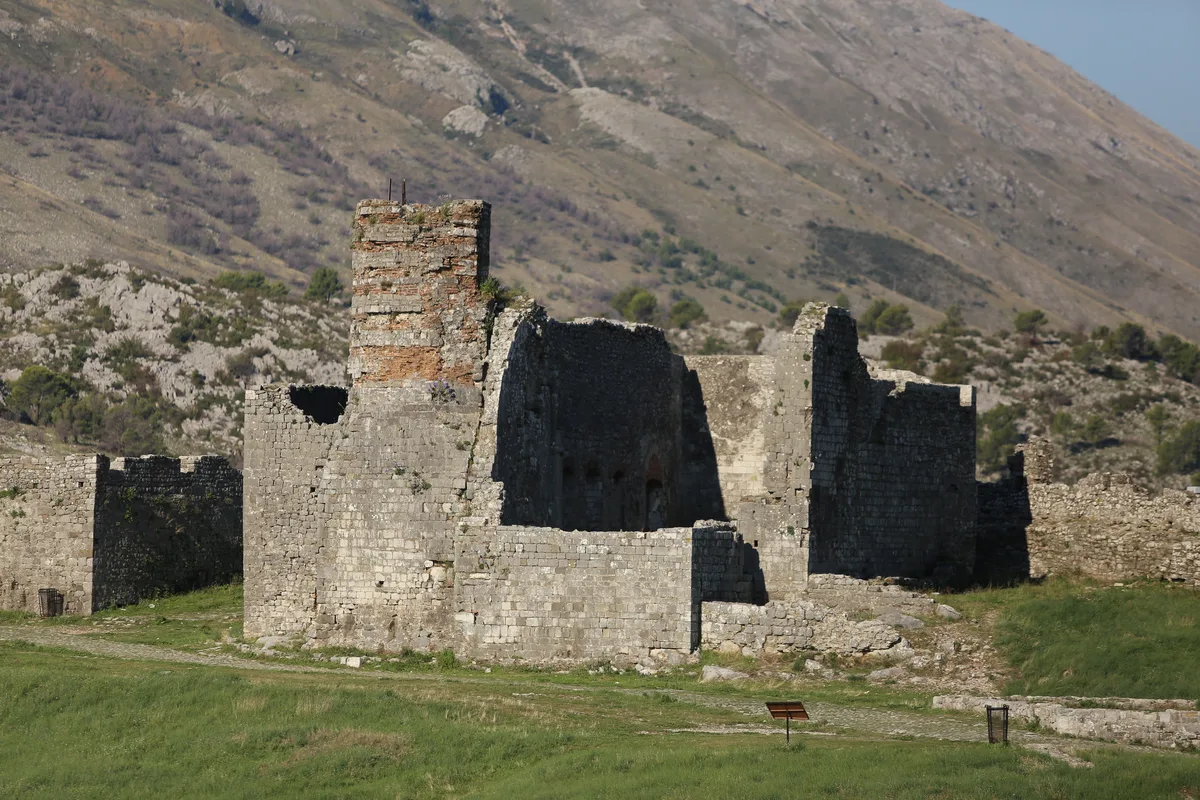
Ruined halls of the upper castle – the fortress served the Ottoman centuries as garrison and seat of power above the town. Photo: Tobias Klenze, CC BY 3.0, via Wikimedia Commons
Under the Ottomans Shkodra became the seat of a sanjak — the Sanjak of Scutari — and the castle settled into the long second life of a garrison citadel above an Ottoman commercial town. The great church inside the walls was converted into the mosque of Sultan Mehmed the Conqueror, the Fatih Mosque, its congregation the garrison and the Muslim town growing below. The fortress was repaired, adapted to firearms and kept manned; the town at its feet, meanwhile, lived the more eventful life, rising on the trade of its bazaar at the meeting of caravan routes from the Danube and the Aegean.
From the middle of the 18th century the city’s story becomes a family story. The Bushati pashas made Shkodra the capital of a pashalik that was, in Britannica’s phrase, virtually independent after 1760, and the castle was again a ruler’s seat: Mehmed Pasha Bushati, founder of the line, resided in Rozafa Castle and came down from it almost daily, the accounts say, to watch his great Lead Mosque rising on the plain below in 1773 — the mosque you can still pick out from the ramparts, restored in our own decade. The Porte reasserted direct authority in 1831, and the castle’s importance ebbed with the town’s; through the 18th and 19th centuries the Drin and Kir repeatedly shifted course and flooded the old bazaar quarter, the city migrated northeast to safer ground, and the fortress was left, as Britannica puts it, an isolated citadel apart from the town it had created.
The castle had one more siege in it. In the First Balkan War, Montenegrin forces besieged Shkodra for six months; the city fell in April 1913. The Great Powers, drawing Albania’s borders that spring, assigned Shkodra to the new Albanian state, and the fortress’s military career — Illyrian, Roman, Byzantine, Venetian, Ottoman, Montenegrin — finally closed. Today the castle and its surroundings are protected as an Archaeological Park of Albania, and the only army on the hill is the occasional school party climbing to the flag.
Walking the Castle Today – the Three Courtyards
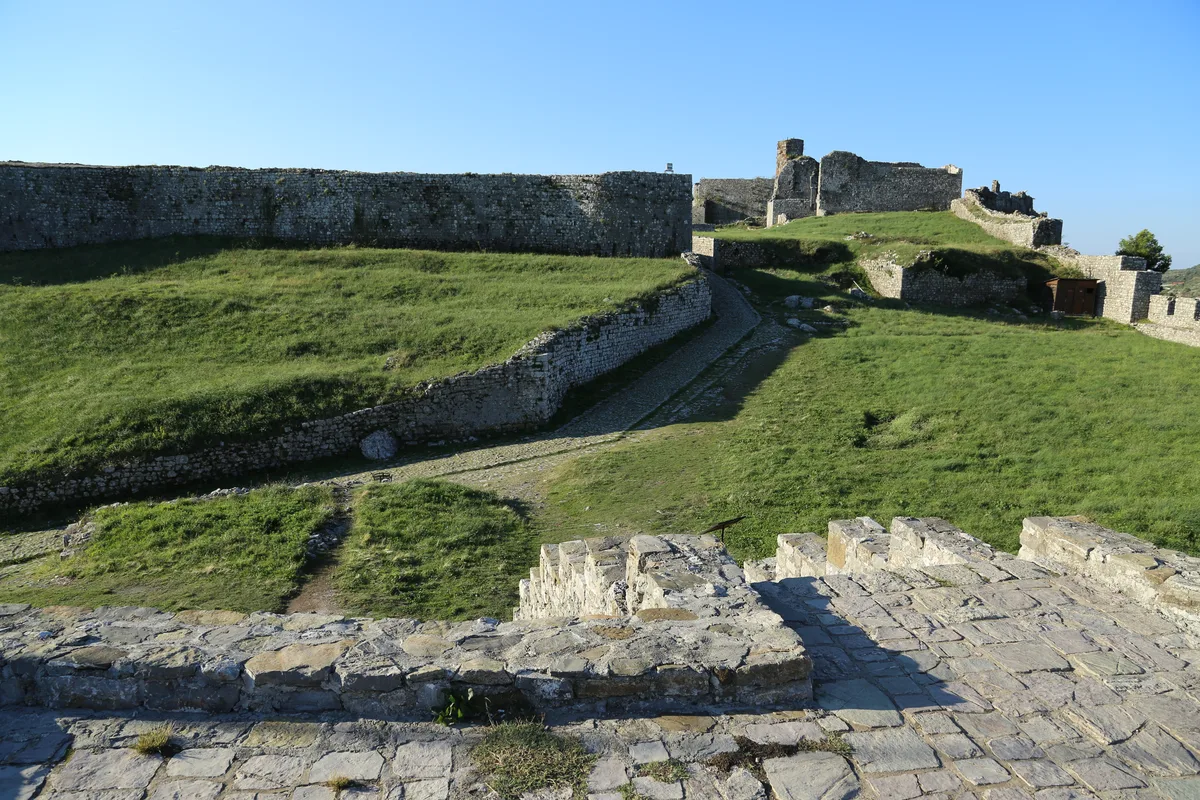
Inside Rozafa Castle – the grassed terraces between the courtyards, walls stepping up towards the citadel. Photo: Tobias Klenze, CC BY 3.0, via Wikimedia Commons
The walk has a natural grammar, because the castle was built as a sequence. The road climbs the southern slope to a parking area and the ticket point below the walls; from there the cobbled way rises to the main gate on the northern face — the fortified 15th-century entrance of gates and barbican described above. Pass through the vaulted gate passage and you are in the first courtyard, the buffer zone. Look first for the Illyrian wall: a tract of 4th-century BC masonry, the oldest structure in the grounds, its huge blocks unmistakable once you know to look. Around it stand the towers associated with the Balšić lords and the remains of Venetian residences — the entrance layer of the fortress, where every century’s doorkeepers lived.
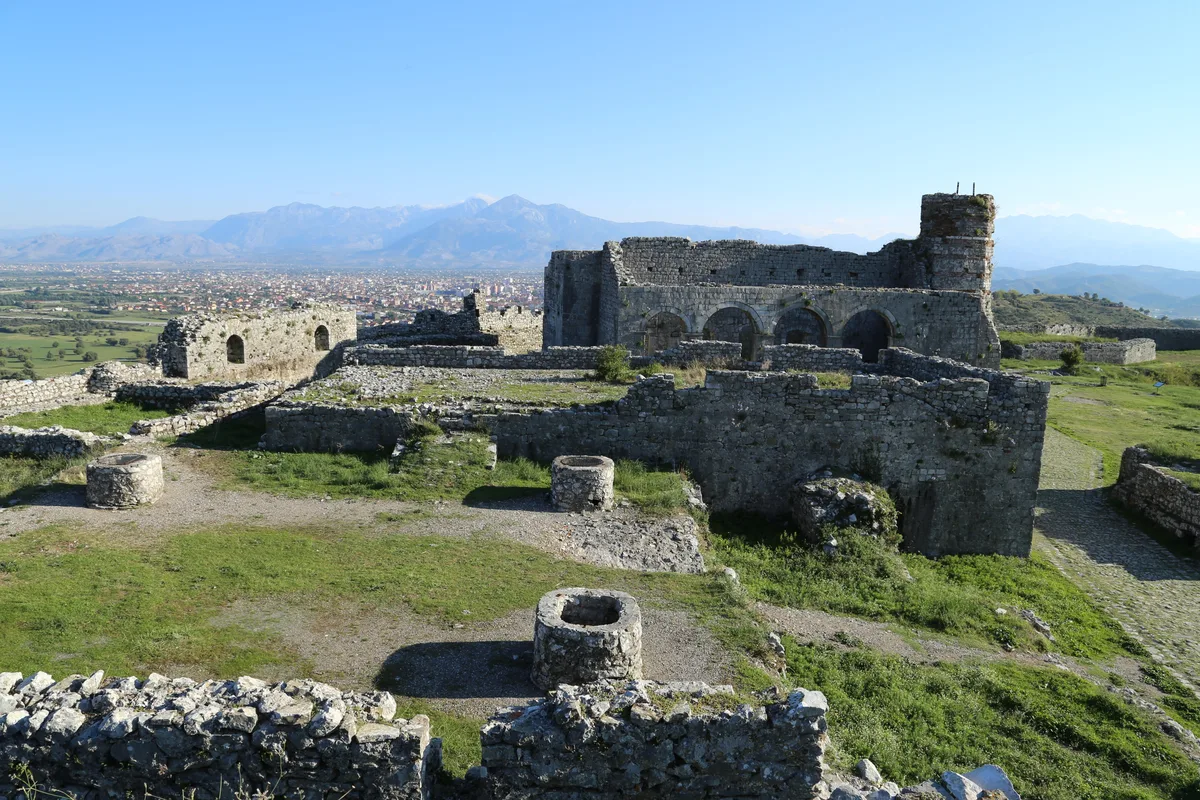
Cistern wellheads in the second courtyard, the church-mosque ruins behind – the water system that made the sieges survivable. Photo: Tobias Klenze, CC BY 3.0, via Wikimedia Commons
The second courtyard is the largest of the three and was the garrison’s working home. Its ground is a broad grassed terrace scattered with the footprints of the fortress town — warehouses, barrack and residential quarters, and the round stone mouths of the great cisterns. At its heart stand the ruins of the church-mosque, treated in the next section. The third courtyard, the citadel, crowns the hill: here is the three-storey Captain’s House with the museum inside, here are the highest ramparts, and here the view completes itself. The whole circuit is easily navigable — the courtyards step rather than sprawl — but it is not a manicured site. The ground is grass and worn stone, drops are not always fenced, and the castle is best walked in shoes with grip, at a pace that leaves time to read the information panels (provided in Albanian and English) rather than merely to reach the top.
Give the walk its due order: walls and views on the way up, the museum near the end, when the history is freshest, and the second courtyard’s church-mosque at whatever hour gives it the best light. In high summer the hilltop is exposed and hot by midday; the morning and the late afternoon are the castle’s hours, and the golden light on the western walls above the Buna is the view the featured photographs promise. A small café-restaurant operates inside the grounds in season, but carry water regardless — the Venetians stored rainwater here for a reason.
The Church That Became a Mosque – St Stephen’s and the Fatih Mosque
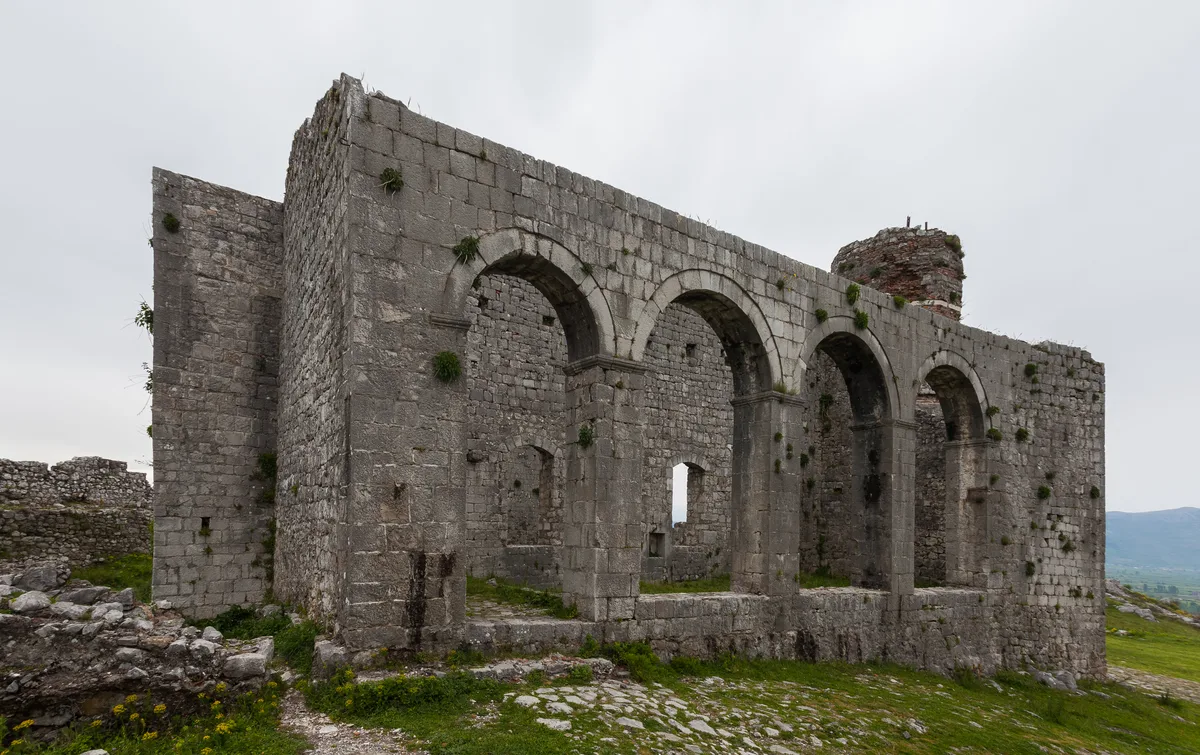
Rozafa Castle – St Stephen’s church, later the Fatih Sultan Mehmet Mosque, roofless since the 19th century. Photo: Diego Delso, CC BY-SA 3.0, via Wikimedia Commons
One building in the second courtyard carries the castle’s whole biography in a single set of walls. It was raised in the 13th century as a Catholic church in the Romanesque manner of its time — scholars generally identify it as the cathedral of St Stephen, the city’s patron — and it served the Venetian and Albanian congregation of the fortress town through the centuries of Catholic Shkodra. When the castle passed to the Ottomans in 1479, the church was converted into the mosque of the conqueror himself: the Fatih Sultan Mehmet Mosque. A minaret rose where the bell tower’s function had been, the interior was reordered for Muslim prayer, and the building continued in worship through the Ottoman centuries, between the 16th and the 19th.
The ruin was finally abandoned in 1865, and what stands today is a roofless shell — which is, paradoxically, the clearest possible state in which to read it. The Romanesque arches of the church still stride across the interior; the stump of the minaret still crowns the roofline; nothing has been restored into a false unity, and the two faiths of Shkodra’s past stand in one frame without either being tidied away. It is worth distinguishing this St Stephen from the city’s great 19th-century Catholic cathedral down in the town — a different building, of a different era, in a city that remained Albania’s Catholic heartland. The castle’s church-mosque is older, stranger and sadder: a frontier building that changed religion with the flag above it, and kept its people’s worship under both.
Local shorthand calls it simply Kisha-Xhamia — the church-mosque — and that compound name is the most honest label any building in Albania carries. Stand inside it at the quiet end of the day and the castle’s argument resolves: this was never only a fortress. It was a town’s worth of lives, prayers included, compressed onto a rock for safekeeping.
The Castle Museum – Inside the Captain’s House
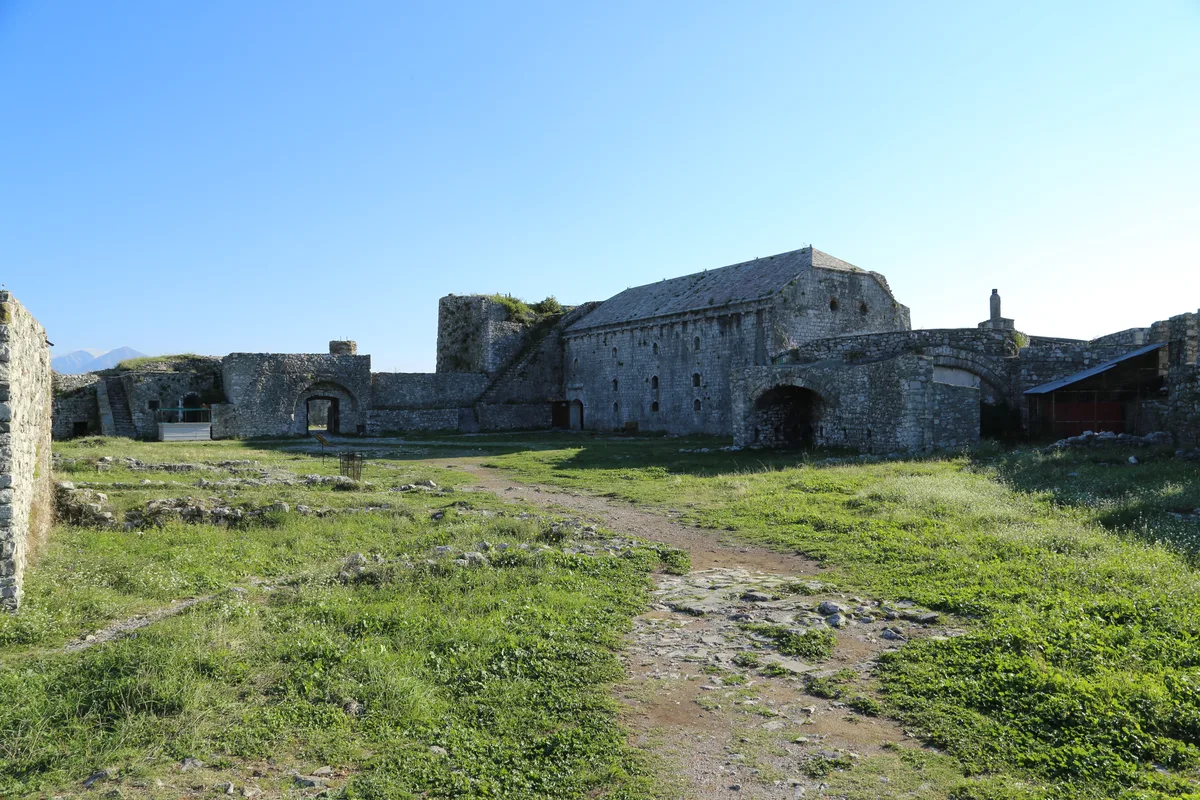
The Captain’s House, the Venetian governor’s residence inside the citadel, now the castle museum. Photo: Tobias Klenze, CC BY 3.0, via Wikimedia Commons
The best-preserved building in the castle is the one that governed it. In the third courtyard stands a solid three-storey Venetian house of the 15th century, known as the Capitaneria — the Captain’s House, residence of the Venetian captain who ruled Shkodra for the republic (some guides call it the Capitol). Today it holds the Museum of Rozafa Castle, and it is the natural final act of the visit: half an hour inside gives the courtyards outside their labels, dates and faces.
The museum begins, rightly, with the legend: the founding story of Rozafa is presented on the first floor, with the sculpture of the immured mother that has become one of the castle’s emblematic objects. Around it, the archaeological collection climbs the hill’s full timeline — vessels and ceramic fragments from the prehistoric, ancient and medieval periods, the oldest pieces reaching back to the Early Bronze Age settlement of around 2000 BC, and a run of metalwork beside them: tools, weapons, ornaments and coins. Three busts preside over the hall — Bardylis, Teuta and Gentius, the Illyrian kings and queen whose world the first courtyard’s wall belonged to — and the displays continue upstairs with further objects on the castle’s history and the medieval families of Shkodra. Interpretation is in Albanian and English.
The building is half the exhibit. A Venetian captain governed from these rooms — receiving, judging, watching the lake road and the river from the citadel’s height — and the house’s plain military domesticity, its thick walls and few grand gestures, says more about how Albania Veneta actually worked than any ducal palace in Venice itself. Read the displays, by all means, but also read the house: this was the office from which the 1458 cistern plans were administered and from which, in the last years, the defence of 1478 was directed.
Set expectations honestly: this is a small site museum, not a national collection, and its virtue is context rather than treasure. The coins, the pottery sequence and the kings’ busts are worth their half hour precisely because you have just walked the ground they came from. The museum carries its own modest separate ticket from the castle entry — a common arrangement at Albanian sites, and one more reason to carry small lek notes, as the practical section below advises.
The Views from the Walls – Lake, Three Rivers and the Alps
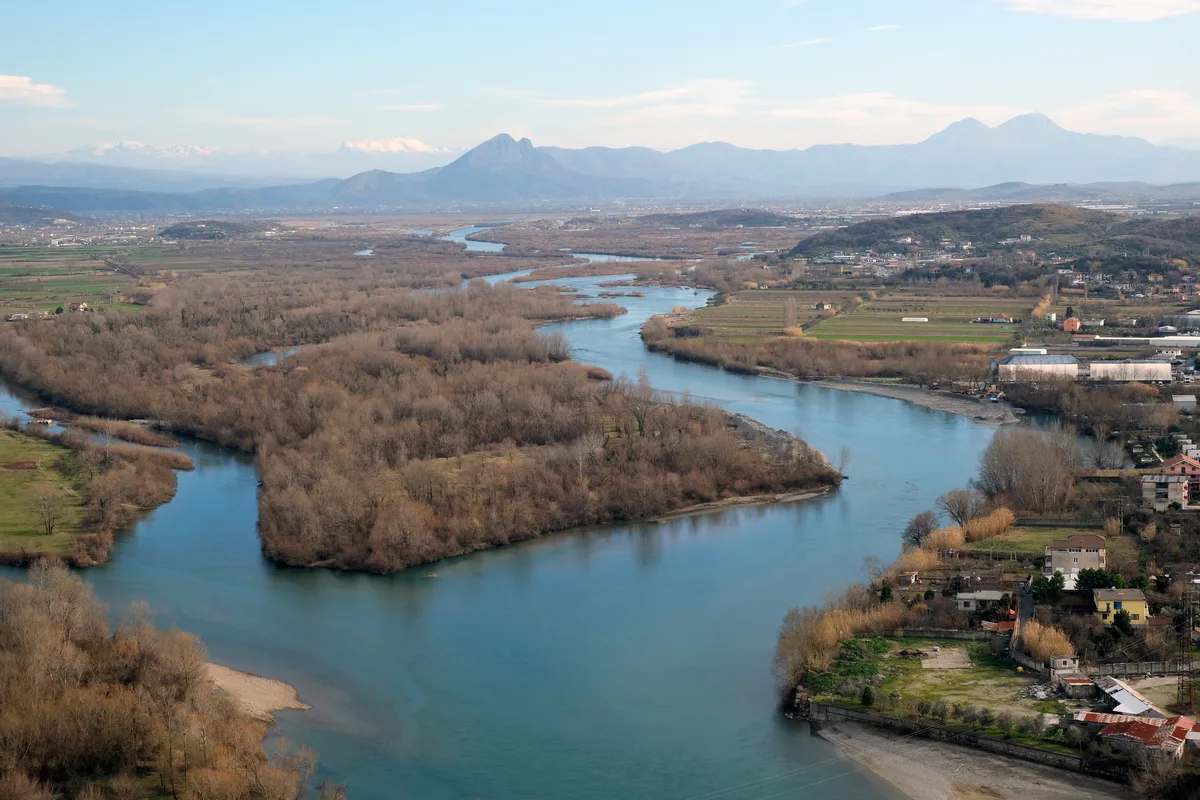
Rozafa Castle view – the Buna and Drin braiding together in the plain below the walls, the Albanian Alps on the horizon. Photo: kallerna, CC BY-SA 4.0, via Wikimedia Commons
Every fortress view promises a panorama; this one delivers an explanation. From the citadel ramparts the whole hydrography of the Albanian north performs below you, and it is the reason the castle exists. To the west lies Lake Shkodër — the largest lake in the Balkans, shared with Montenegro — with the steep wall of Mount Tarabosh standing over its far shore. Out of the lake at its southern tip flows the Buna (the Bojana in the older sources), one of Albania’s two navigable rivers, sliding past the castle hill on its short run to the Adriatic. From the east comes the Drin, the country’s longest river, and through the town runs the Kir; in the plain below the walls their channels braid, merge and split across a flood-meadow landscape that changes with the seasons and the rains.
Read the view as a defender read it and its logic sharpens. The castle commands the lake’s outlet, the river crossings and the land corridor between the water and the mountains — the passage every army, caravan and raiding party between the Adriatic and the interior had to use. North, Shkodër spreads across the plain, a city that began on this hill and spent two millennia walking away from it; beyond the town, on a clear day, the Albanian Alps stand along the horizon, the grey wall that made Shkodra the gateway to the mountains. One refinement the sources insist on: the waterscape is not timeless. The Drin shifted course dramatically in the 19th century and was later dammed for flood control and power, so the exact weaving of channels below the walls is partly a modern arrangement. The strategic picture — lake, outlet, crossing, corridor — is the one Gentius and Mehmed II both saw. The details of the braiding are newer than the castle.
Stay for the light if you can. The western walls above the Buna catch the evening sun full-face, the lake turns to metal, and the Lead Mosque’s domes show below the southern ramparts — the view the castle’s own pashas had from their residence, and the single best free spectacle in northern Albania.
Below the Castle – Combining Rozafa with Shkodër Town
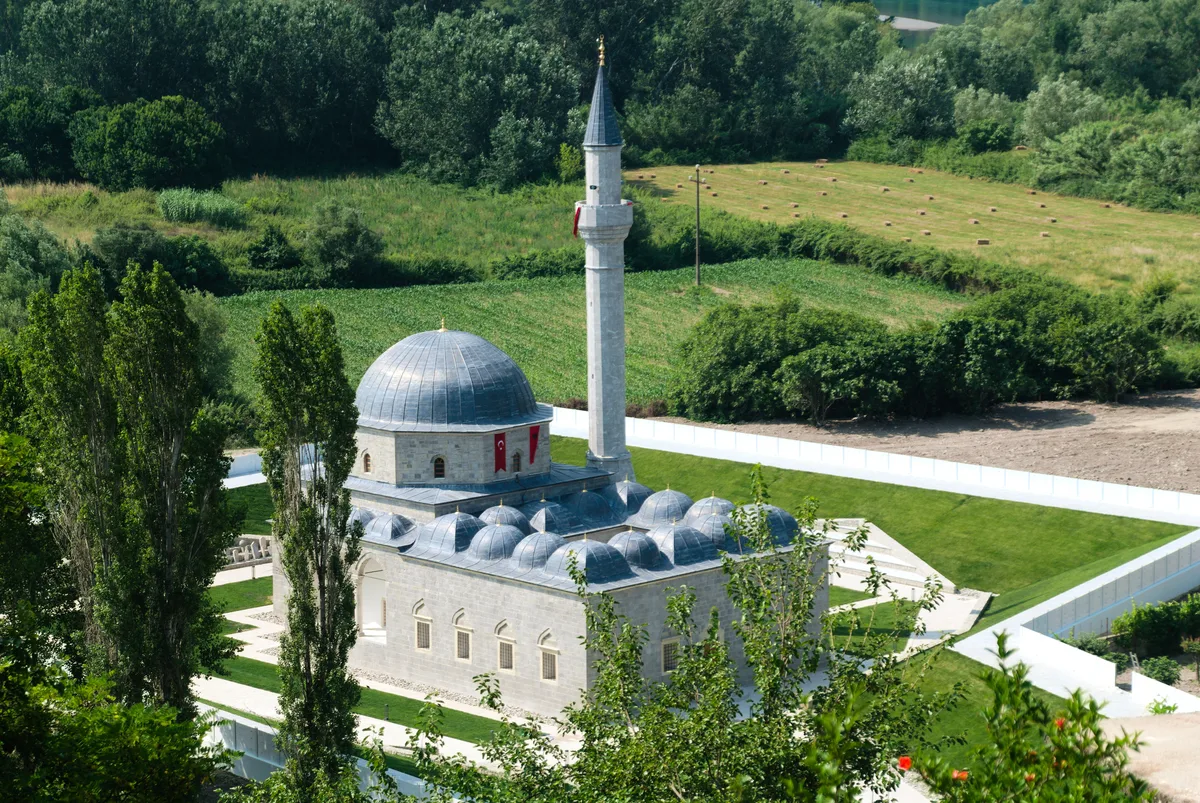
The Lead Mosque below the castle, restored in 2024-25 with its lead-covered domes renewed and its minaret rebuilt. Photo: SimchaAzad, CC0, via Wikimedia Commons
The castle stands a few kilometres south of Shkodër’s centre, close enough that the two belong to one day, and the natural order is castle first, town second — or, for drivers, the Lead Mosque on the way down. The mosque stands in the meadows directly below the castle hill, and it is the castle’s own epilogue: built in 1773 by Mehmed Pasha Bushati, whose residence was the fortress above, and named for the lead sheathing of its many domes. Its minaret was destroyed by lightning in 1967, the year Albania’s communist regime outlawed religion altogether; protected as a cultural monument it survived the decades as a roofless-looking landmark in a flood-prone field, and a major restoration completed in 2025 has returned its lead-covered domes and rebuilt minaret. It is a working mosque, not a ticketed museum, so visits fit around prayer times and dress should be modest; seen from the ramparts before you descend, it composes with the castle into one picture — fortress above, faith below, exactly as the pasha arranged it.
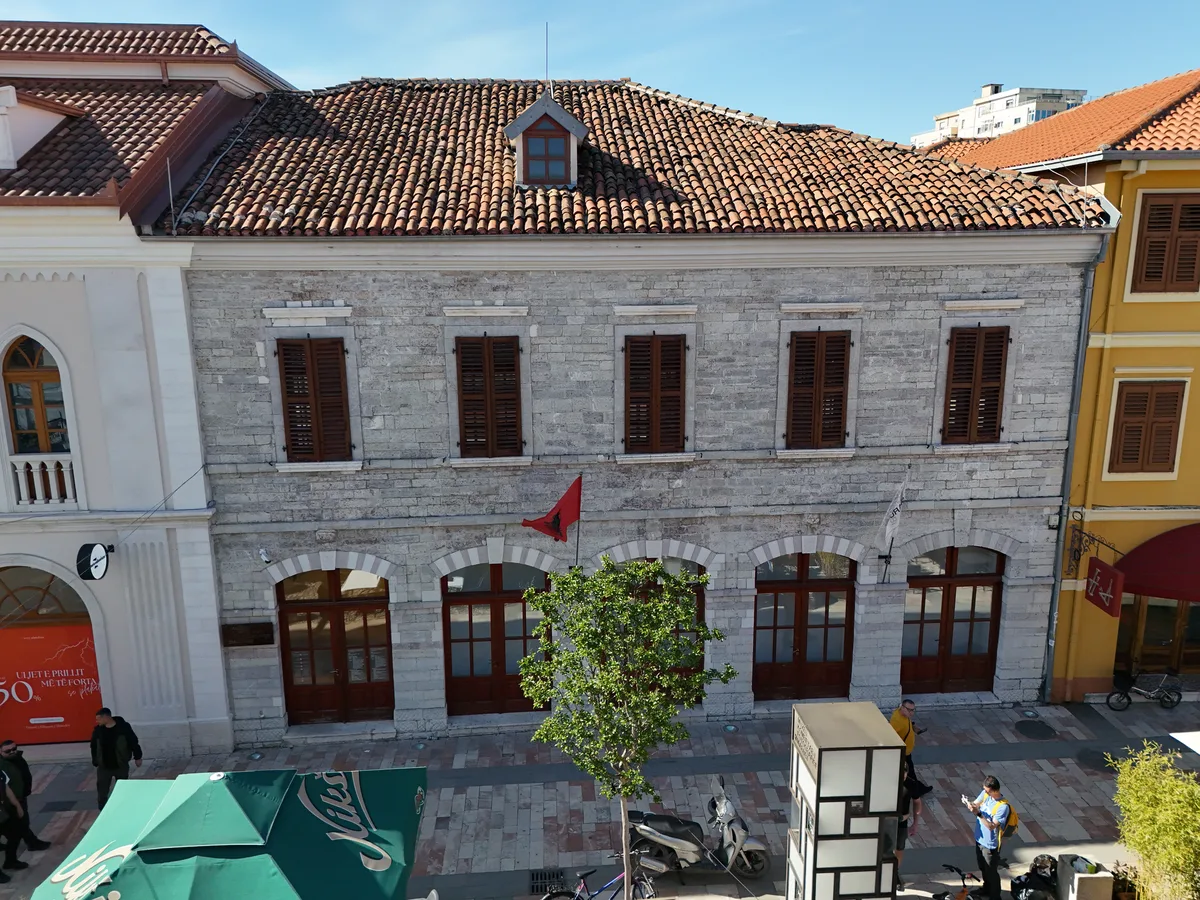
The Marubi National Museum of Photography in Shkodër, housed in the stone building designed by Kolë Idromeno on the street that bears his name. Photo: Arianit, CC BY-SA 4.0, via Wikimedia Commons
In town, the one unmissable interior is the Marubi National Museum of Photography, on the pedestrianised Rruga Kolë Idromeno — the Pedonalja, Shkodër’s café-lined evening stage. The museum preserves the archive of the Marubi studio, founded in 1856 by Pietro Marubbi, an Italian painter-photographer who settled here and began a dynasty: three generations of Marubis photographed northern Albania — highland chiefs, weddings, markets, occupations, independence — until the early 1950s, leaving an archive of around half a million negatives that is now the visual memory of a nation. The museum, opened in 2016, displays it in the restored stone house designed by Kolë Idromeno himself — Shkodër’s own Renaissance man, Marubbi’s pupil, and the namesake of the street outside. Around it, the town repays a wander: the great Catholic cathedral and the Ebu Bekr Mosque anchoring its two historic faiths, the Shkodra Historical Museum in an Ottoman house, and the sobering Site of Witness and Memory, the former communist-era prison turned memorial, for those who want the 20th century with the rest. Do the wandering the Shkodran way if you can — this is famously a cycling city, flat and threaded with bike lanes, and the gentle circuit from the Pedonalja down to the castle road and the lake shore is the town’s own favourite ride.
Drivers with an hour more should add the Mesi Bridge, a few kilometres northeast at the village of Mes: an Ottoman bridge of thirteen arches stepping 108 metres across the Kir, built around 1770 under the same Bushati pashas who ruled from the castle — in summer the river shrinks to green pools beneath it, and the bridge makes the castle day into a small, complete circuit of Bushati Shkodra. And sleep in Shkodër, rather than day-tripping, if the trip allows: the town is stop nine in our best places to visit in Albania, the natural night before the road north to the Koman ferry and the Alps, and it earns its evening — the xhiro on the Pedonalja, dinner, and the castle lit on its hill above the dark plain.
Visiting Rozafa Castle – the Practical Notes
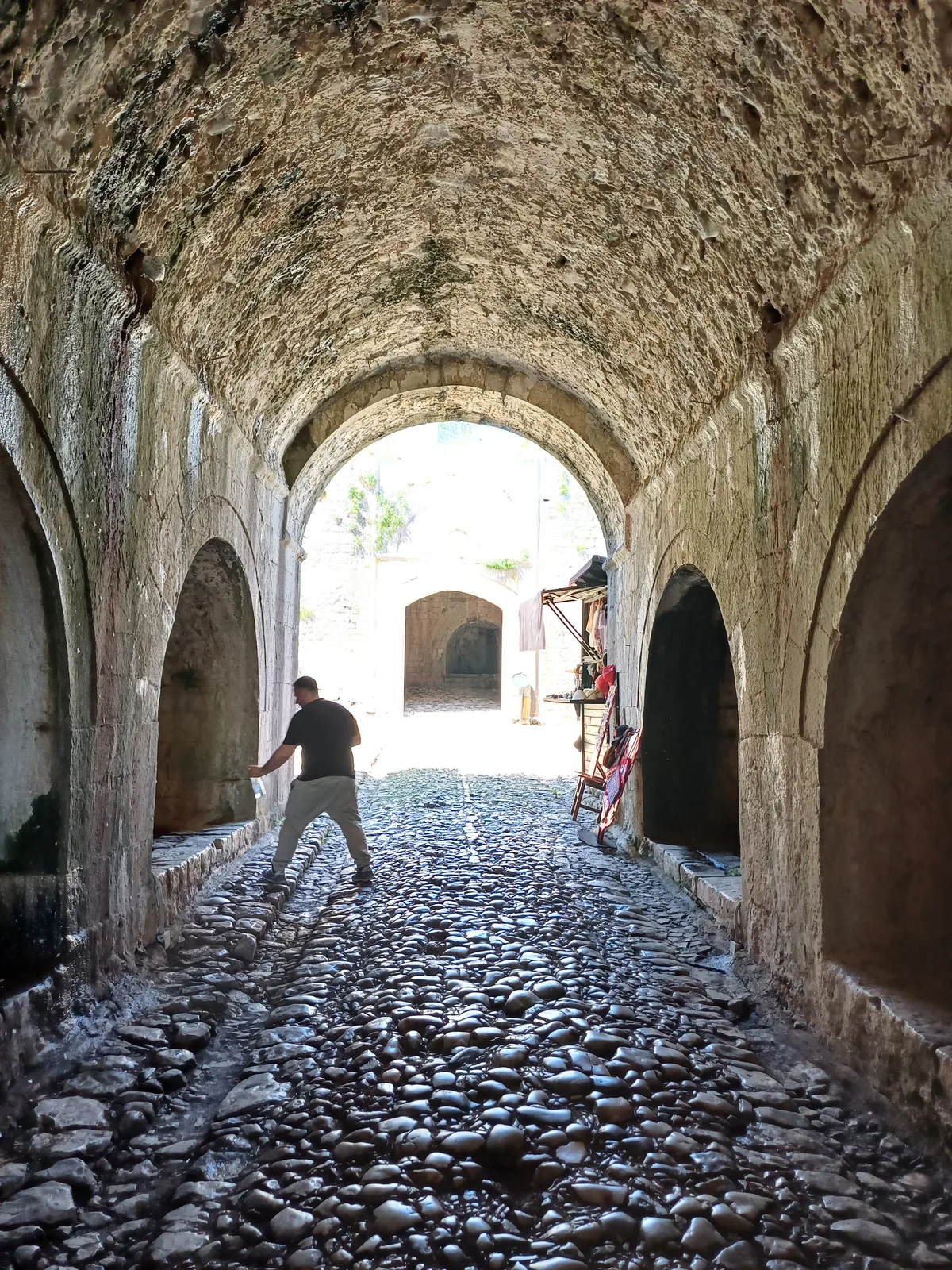
The vaulted passage through the main gate – every visit to the castle funnels through the Venetians’ layered entrance. Photo: Edukatori, CC BY 4.0, via Wikimedia Commons
Getting up is the first practical fact. The castle stands a few kilometres south of the centre, across the Buna; fit walkers can reach it on foot in roughly half an hour to forty-five minutes from the old town, following Rruga Rozafa, but the final ascent is a steep cobbled climb that is slippery when wet — treat the walk as part of the experience and wear shoes that grip. A road climbs most of the hill to parking near the gate, so driving or taking a taxi up and walking down is the arrangement many visitors choose; city buses heading towards Bahçallëk pass the foot of the hill, from where the climb remains. As everywhere in Albania, confirm the day’s local arrangements rather than trusting any timetable in print — including this one.
Tickets and hours follow the same honest rule. An entry fee is charged at the gate, and the museum inside the Captain’s House carries its own small separate ticket; both sums are modest, but they change often enough that no figure belongs in an article, and aggregator listings that print one are quoting each other’s snapshots. Carry lek in cash — cards are not a safe assumption at a gate booth. The castle is open to visitors daily through the year, with the day’s hours varying by season; listings disagree with one another on the exact times, which tells you to check locally rather than to memorise any of them. What can be planned is the shape of a visit: allow around two hours for the courtyards and walls, another half hour for the museum, and come in the morning or late afternoon — for the light, for the heat, and for the quiet. The courtyards offer almost no shade and the summit catches whatever wind the lake sends, so dress for exposure in both directions; and if a sunset from the walls is the plan, confirm that day’s closing time before you climb, since the seasonal hours, not the sunset, have the final word. After heavy winter rain the low ground below the hill, the Lead Mosque’s meadows included, can flood; the castle itself, being a castle, stays dry and open above it all.
Frequently Asked Questions
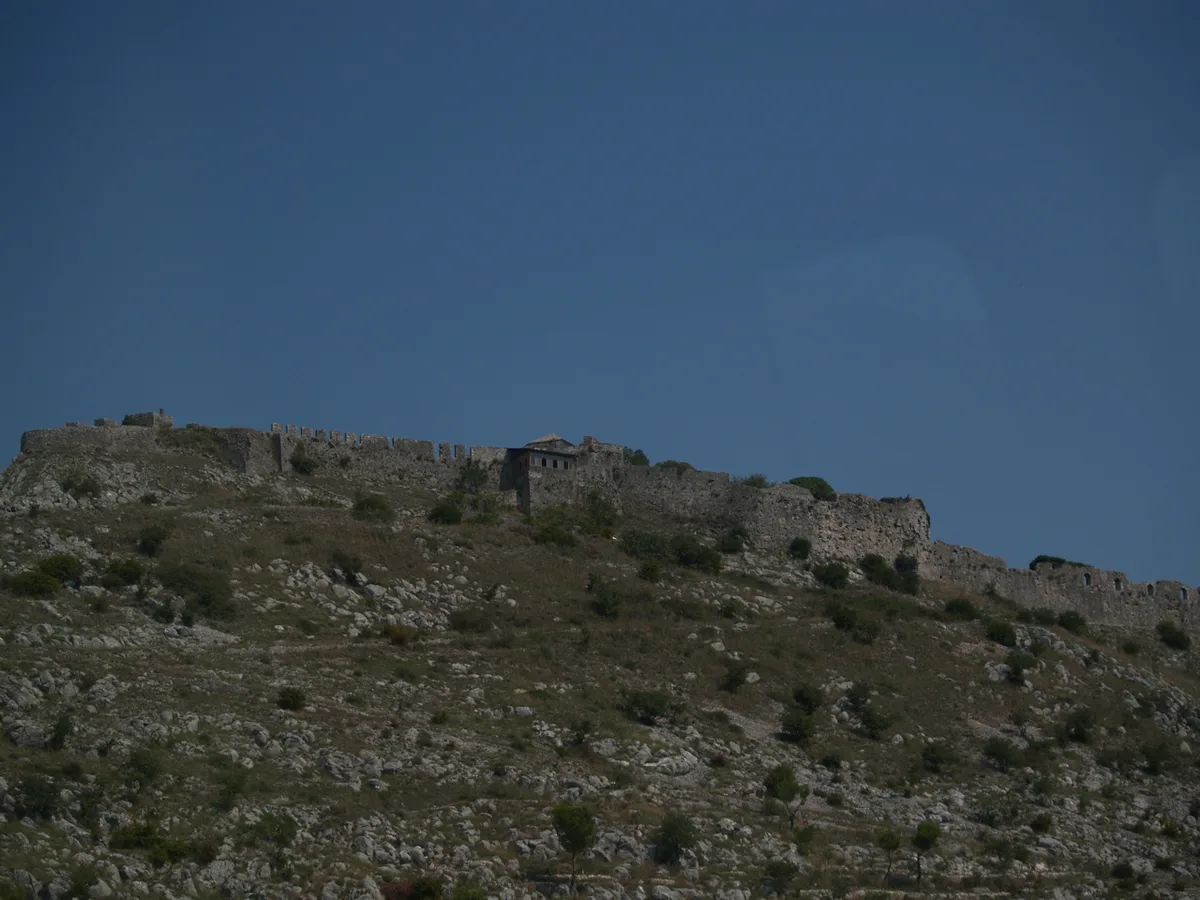
The castle walls at dusk – the hour the fortress, and the legend, feel closest. Photo: d_proffer, CC BY 2.0, via Wikimedia Commons
Is the legend of Rozafa true? No document supports it, and this guide files it where it belongs — as legend. The immurement story is attested in print from 1505, belongs to a family of Balkan foundation ballads studied by folklorists, and is presented at the castle museum as the city’s founding myth. Its truth is cultural rather than historical: it is what Shkodër has chosen to remember about its walls.
Was Rozafa Castle ever taken by storm? Not in its defining siege. In 1478-79 Mehmed II’s army bombarded the castle and launched five general assaults, all repelled; the fortress passed to the Ottomans by the Treaty of Constantinople in January 1479, not by breach. Earlier and later sieges — 1474 and 1912-13 among them — frame that central fact.
How long does a visit to Rozafa Castle take? Around two hours covers the three courtyards, the walls and the views at a proper pace; add half an hour for the museum in the Captain’s House. Combined with the Lead Mosque below and Shkodër town, the castle is the first half of a full and satisfying day.
Is the castle museum included in the entry ticket? No — the museum in the Captain’s House carries its own small separate ticket, bought on site. Both fees are modest and both change; carry lek in cash and check the day’s prices at the gate rather than trusting any figure in print.
Can you drive to Rozafa Castle? Yes — a road climbs most of the hill to parking near the entrance. What no vehicle removes is the final cobbled ascent through the gate and the walking inside, so the castle is never a no-walking visit; the climb, and shoes that grip, are part of the arrangement.
When is the best time to visit? Morning and late afternoon, for light on the walls and relief from the hilltop heat; spring and autumn give the clearest long views towards the Alps. In July and August come early or late in the day, carry water, and expect the exposed courtyards to be hot by midday.
Is Shkodër worth a night, or just a stop for the castle? A night, if the trip allows. The castle is the headline, but the Marubi Museum, the Lead Mosque, the Mesi Bridge and the evening life of the Pedonalja make Shkodër a destination in itself — and it is the necessary staging post for the Koman ferry and the Albanian Alps beyond.
The Short Version
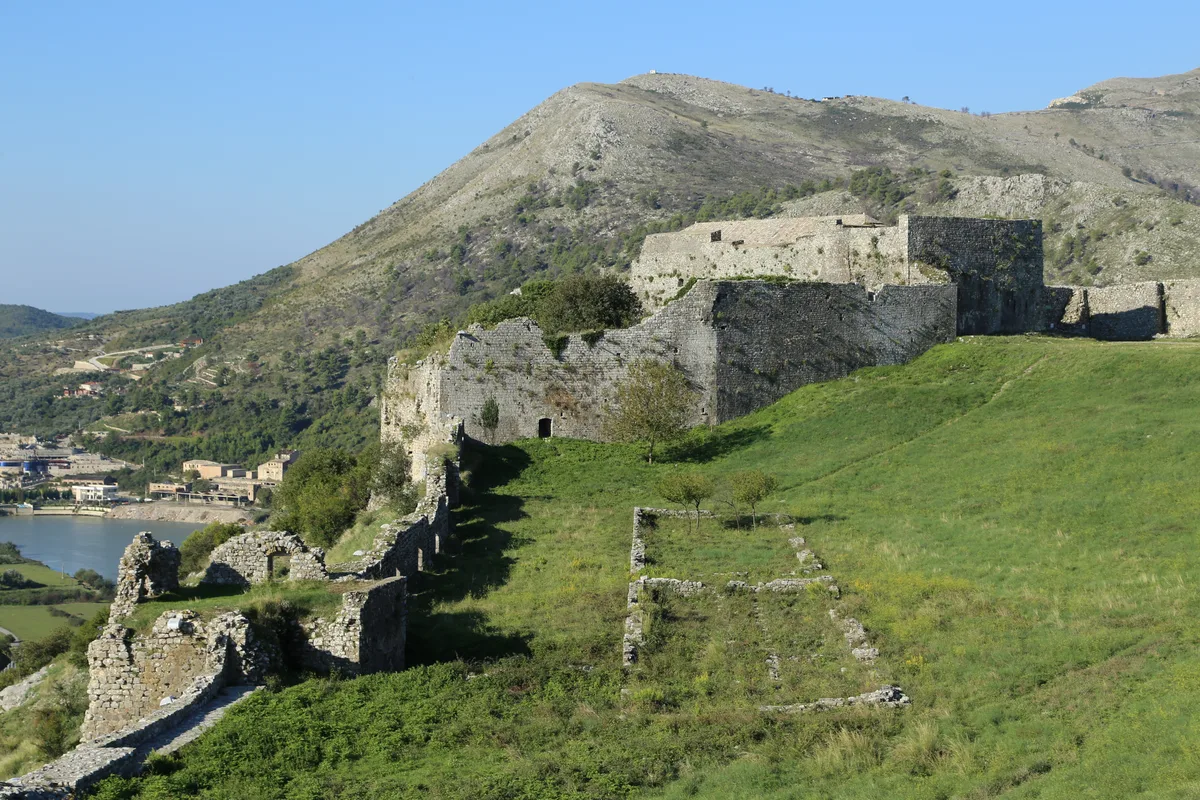
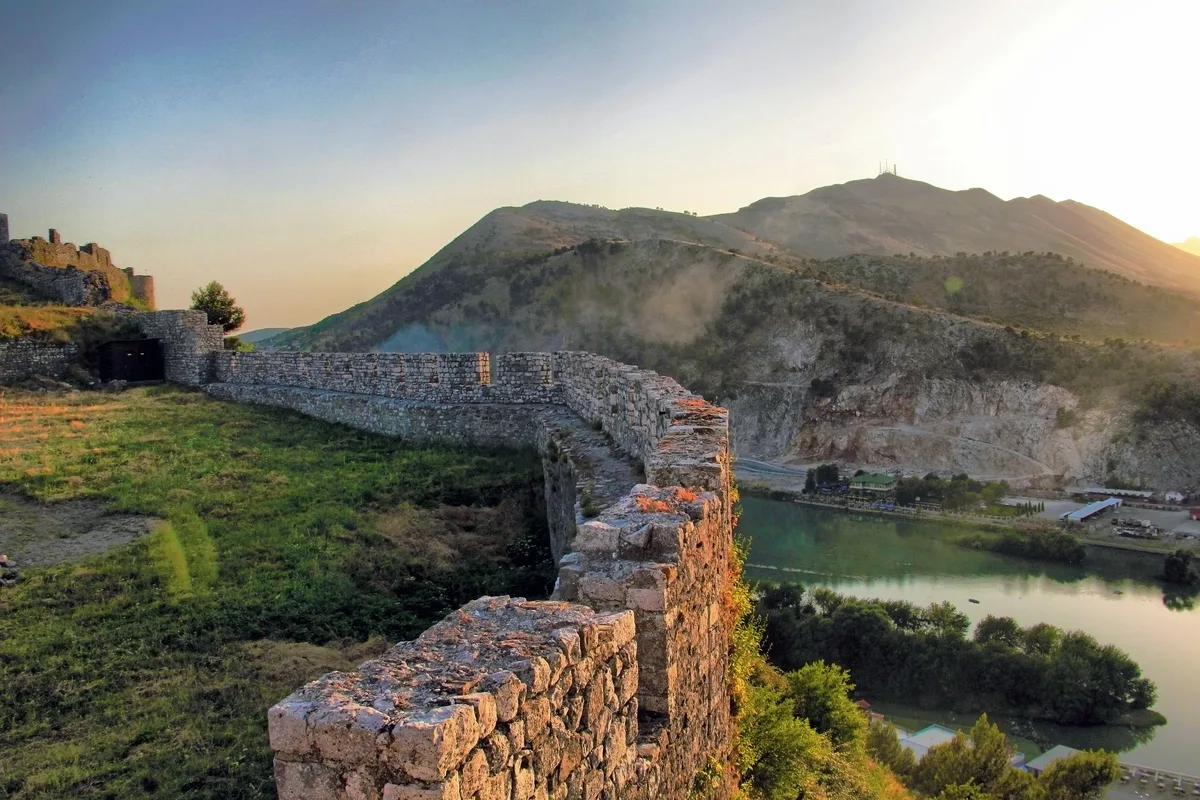
The walls stepping down the eastern slope of the hill, the Buna river and the lakeside shore below. Photo: Tobias Klenze, CC BY 3.0, via Wikimedia Commons
Rozafa Castle is northern Albania in one hilltop: an Illyrian wall from the age of King Gentius, a Venetian fortress engineered with gates, barbican and cisterns for the siege it famously survived, a church that served four centuries as a mosque, and a captain’s house turned museum telling the whole story — including the legend of Rozafa, the wife the ballads say is walled inside, told there and here as the legend it is. Climb through the three courtyards in the morning, read the lake and the three rivers from the citadel walls, then go down to the Lead Mosque and give Shkodër town the rest of the day. Few castles in Europe pack this much documented history — and one truly great story — into a single walkable hill.