Fes Travel Guide – Inside the World’s Greatest Living Medina
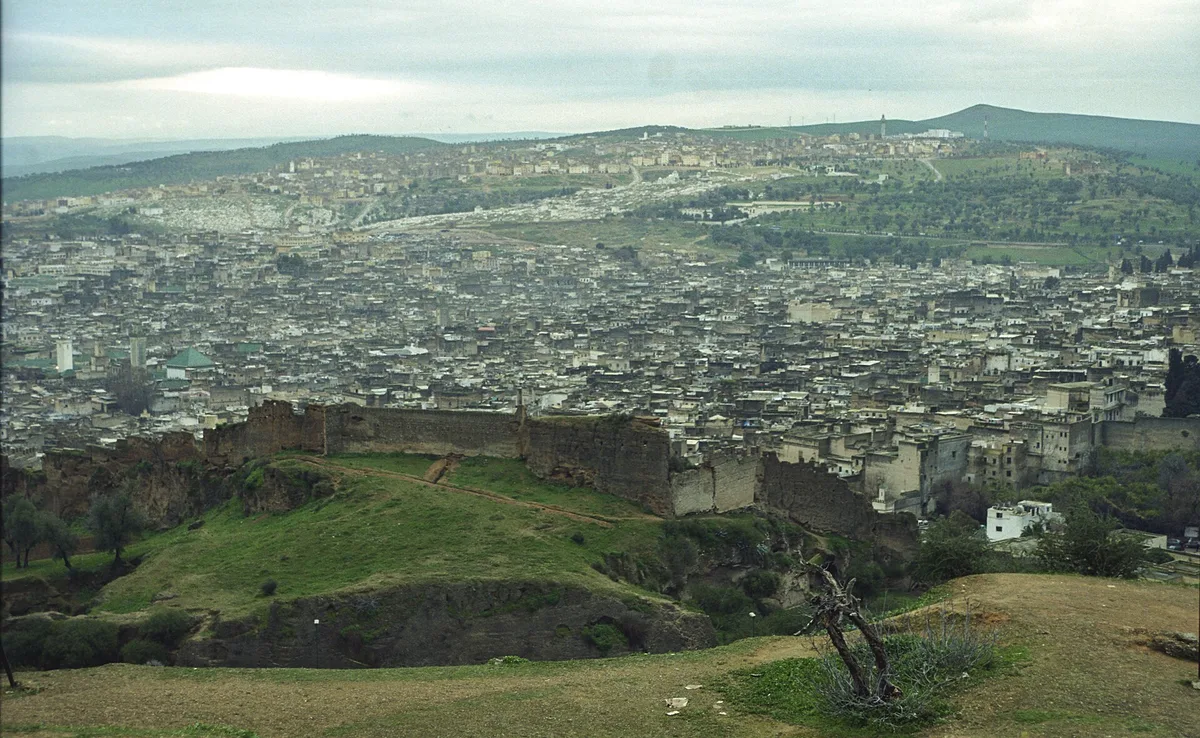
Every old city in Morocco claims to be the real one, but Fes does not have to argue very hard. Its medina, Fes el Bali, is the largest car-free urban area in the world that is still a functioning city rather than a preserved exhibit — a walled bowl of more than nine thousand lanes, souks, mosques, workshops and houses where the goods still arrive by donkey, the bread still goes to communal ovens, and a university founded in 859 has never stopped teaching. UNESCO inscribed the Medina of Fez on the World Heritage List in 1981 and calls it one of the most extensive and best conserved historic towns of the Arab-Muslim world; as their account at whc.unesco.org makes clear, the listing covers not just monuments but a way of life that has kept renewing itself in the same streets for twelve centuries.
That is the pleasure of Fes and also the problem with it, because a living medieval city was never designed to be convenient for visitors. The lanes follow no grid, the famous sights hide behind unmarked doors, the mosques at its heart are closed to non-Muslims, and you will get lost — not might, will. This fes travel guide is written around those truths rather than against them: how the medina is organised so the getting lost becomes manageable, the guide question dealt with honestly, the tanneries, madrasas and souks given their space, and the two decisions that shape a stay — where to sleep, and whether Fes or Marrakech deserves your medina days if you only have room for one.
At a Glance
Short on time? Here is Fes on one screen — what there is, why each part earns its place, and the time each one asks for. Nothing in this guide prints a price, deliberately: fees, guide rates and riad tariffs in Fes change often enough that any printed figure should be treated as a claim to re-check on the day.
| Place or thing | Why it earns its place | Time character |
|---|---|---|
| Fes el Bali medina | The whole point — a living medieval city, UNESCO-listed since 1981 | Two full days, minimum, on foot |
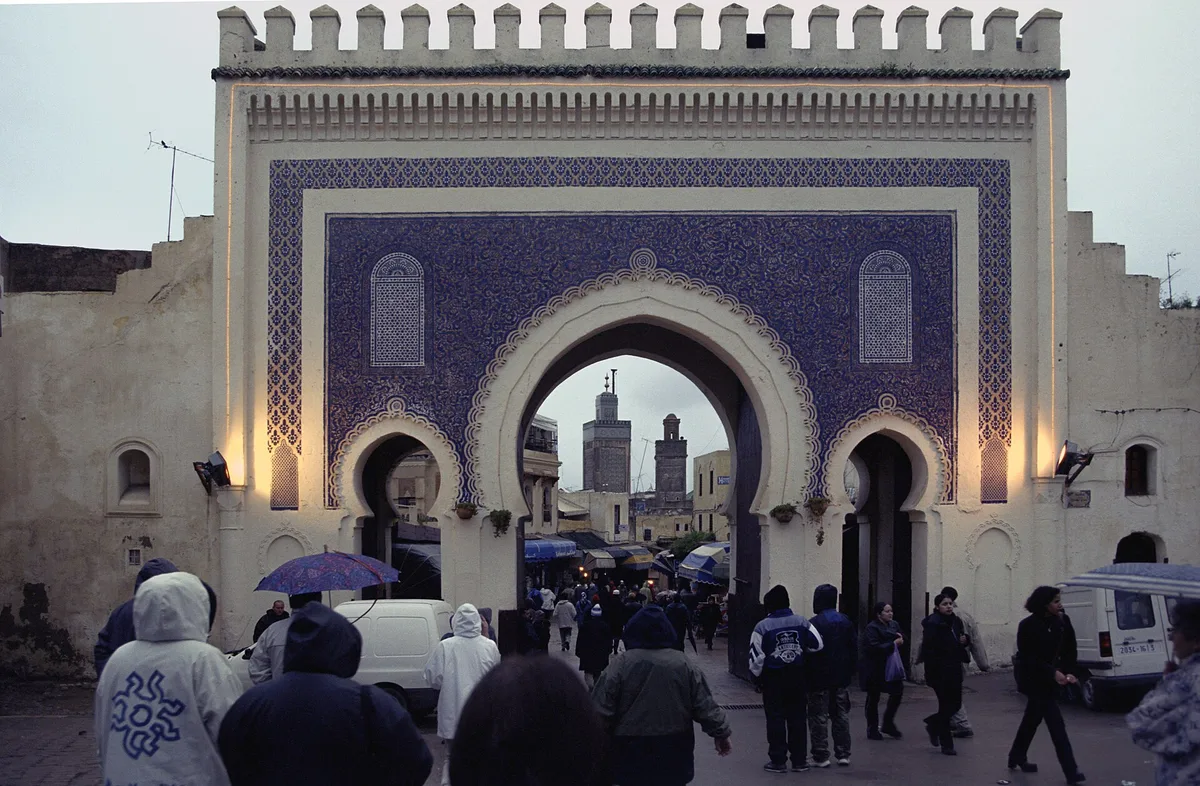
| Bab Bou Jeloud | The Blue Gate, main western entrance and the medina’s front door | Ten minutes, then every arrival and exit |
| The two Talaas | The medina’s only two through-streets — your lifelines for navigation | Where most of day one happens |
| Chouara Tannery | The great stone dye vats, seen from the leather shops’ terraces | An hour, late morning for the light |
| Bou Inania Madrasa | The Marinid masterpiece, and one of the few religious buildings open to all | An hour, early in the day |
| Al-Attarine Madrasa | Smaller, finer, at the medina’s holy and commercial heart | Half an hour, paired with the souks around it |
| Al-Qarawiyyin | Mosque and university founded in 859 — admired from doors and rooftops | Woven through the whole medina day |
| Fes el Jdid | The royal quarter of 1276 — palace gates, the Mellah, the gardens | Half a day, and a change of pace |
| Merenid Tombs hill | The sunset viewpoint over the entire medina bowl | The end of a day, unhurried |
| Meknes and Volubilis | Imperial city and Morocco’s great Roman ruins, side by side | A full day trip by train and taxi |
Two judgements sit behind that table. First, Fes rewards a base, not a stopover: travellers who sleep in or beside the medina and give it two full days consistently rate it among the great city experiences in Africa, while day-trippers mostly remember being lost and hassled. Second, the medina has a working day of its own — deliveries in the morning, the craft quarters humming before lunch, a lull in the heat, then the food souks and cafes towards evening — and an itinerary that follows that rhythm beats one that fights it. Spring and autumn are the comfortable seasons; the detail is in the questions at the end.
Fes el Bali – a City That Still Runs on Foot and Hoof
Start with the shape of the place, because everything else in Fes follows from it. The city was founded by the Idrisid dynasty between 789 and 808 as two fortified quarters facing each other across the Oued Fes river — one settled by refugees from Cordoba, the other by families from Kairouan in modern Tunisia — and was stitched into a single walled town by the Almoravids in the 11th century. Under the Almohads it grew to roughly the size you walk today, and it has been densely lived in ever since: the medina is not the old town next to the real city, it is the original city entire, with the modern districts spread out on the plateau above it. Its two banks still show in the street plan, and its quarters are still organised the way medieval cities were — by trade, by faith and by water.
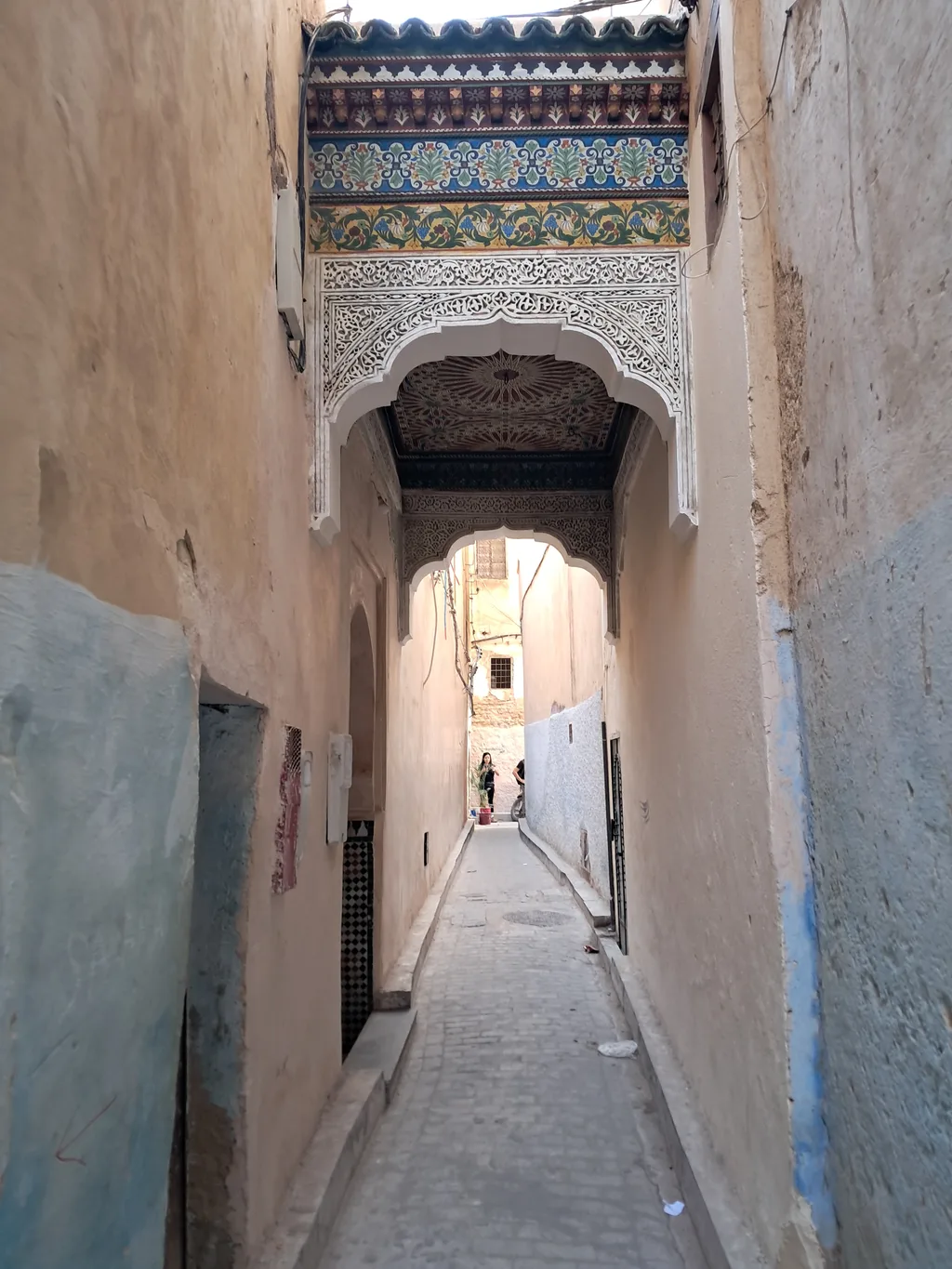
The practical consequence is a street plan with exactly two threads through it. From Bab Bou Jeloud at the western wall, two main streets descend towards the Qarawiyyin mosque at the medina’s heart: Talaa Kebira, the Big Slope, and Talaa Seghira, the Small Slope. Almost every famous sight stands on or just off one of these two streets, and almost every lane that leaves them ends, sooner or later, in a residential cul-de-sac. That single fact is the traveller’s map of Fes el Bali. Walk downhill and you are heading for the centre; walk uphill and you are heading back to the gate; leave the two Talaas and you are in somebody’s neighbourhood, where the lanes narrow, the doors multiply and the city is at its most beautiful and its least navigable.
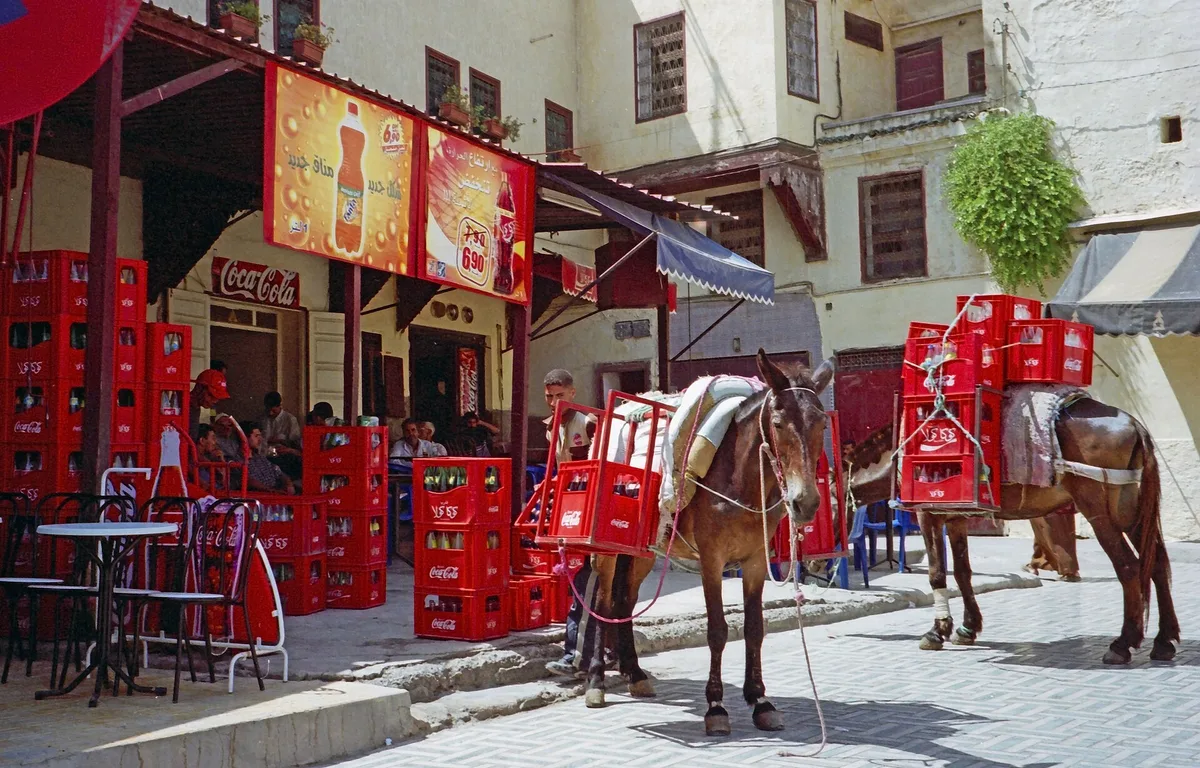
Everything in this city moves the way it moved five hundred years ago, because nothing else fits. There are no cars inside the walls — the lanes are too narrow, too stepped and too crowded — so goods travel on donkeys and mules, on handcarts and on men’s backs, and the cry of balek, mind your back, is the medina’s traffic warning, meaning step into a doorway now. Bread dough goes to the neighbourhood oven on boards carried by children, and the craftsmen still cluster by trade — dyers near the river, metalworkers around Seffarine Square, carpenters in the Nejjarine quarter — because that is how the water, the waste and the customers have always run. Fes el Bali is not a museum with residents in it. It is a medieval economy that never quite stopped, and the visitor who reads it that way enjoys it far more than the one hunting for photo spots.
Getting Lost Is Part of the Visit – and the Guide Question, Answered Straight
Let us deal with the thing every Fes guide mentions and few explain properly. You will get lost in Fes el Bali, probably within the first hour, and the experience divides visitors precisely according to what they expected. The medina’s lanes branch, double back, dive under houses and end without warning; phone maps lose their nerve in the deep lanes; and once you leave the two Talaas the few street signs are in Arabic. None of this is a flaw in the city. It is what a city built for pedestrians, privacy and defence actually looks like, and the travellers who treat an hour of being pleasantly lost as part of the ticket tend to have the best time in Fes. The ones who needed to be somewhere at two o’clock have the worst.
The recovery method matters more than the prevention. Work uphill and you will eventually reach a wall, a gate or one of the two main streets; ask a shopkeeper rather than a bystander, because a shopkeeper has a fixed address and no reason to walk you anywhere; and treat a residential dead end with respect — those lanes are effectively shared courtyards, and the residents are entitled to their privacy. What you should plan around, honestly, is the unofficial-guide economy at the medina’s edges. Young men near the gates will offer directions, fall into step, and present the walk as a favour that ends at a cousin’s shop; the line that a particular street is “closed today” is a sales technique, not information. None of it is dangerous, and most of it evaporates with a polite la shukran, no thank you, said while still walking. But it is real, it is persistent around Bab Bou Jeloud, and a guide that pretends otherwise is not helping you.
So, hire a proper guide or not? The honest answer is: for your first half day, yes, if you can — an official, licensed guide, booked through your riad or the tourist office rather than picked up at the gate, converts the medina from a maze into a legible city. A good guide puts the quarters in order, gets you to the tannery terraces and the madrasas without the detours, explains what you are looking at in the souks, and — this is the underrated part — provides a social shield, because the touts and shopkeepers leave a guided visitor largely alone. Then, on day two, go back in alone with the two Talaas in your head and get lost on purpose, in the morning, with nowhere you have to be. Guided first, lost second: that order, rather than either on its own, is how Fes is best done.
The Chouara Tannery – Beautiful, Brutal and Impossible to Miss
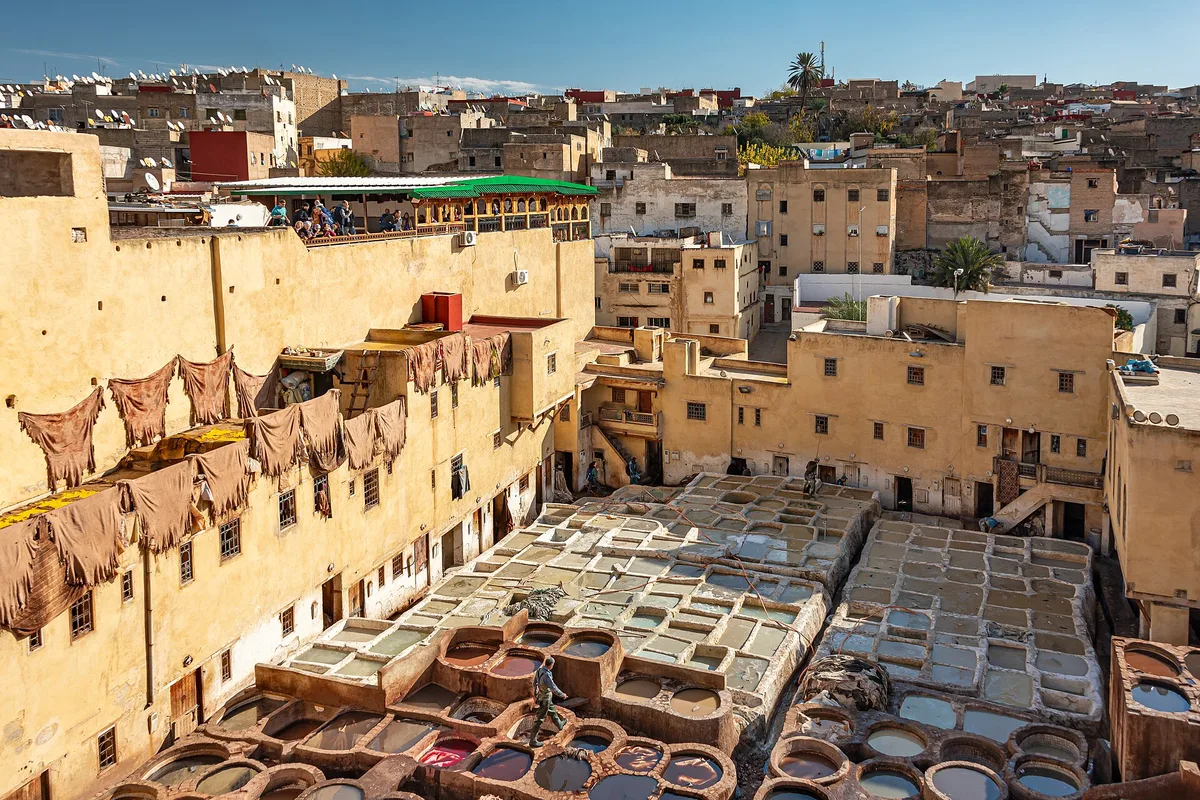
The Chouara Tannery is the largest of Fes’s three tanneries and the one image of the city everybody has seen before they arrive: a honeycomb of stone vats in a courtyard deep in the medina, the round ones holding dyes in saffron yellow, poppy red and indigo, the square ones pale with the softening mixtures, workers standing waist-deep among the hides as their trade has stood for centuries. Leather has been worked in this quarter since the city’s early centuries, and the process is still done essentially by hand — skins softened, dyed in the vats with traditional natural colourings, then hauled up to dry on the surrounding walls and rooftops, the whole courtyard turning slowly from wet chemistry to a hillside of coloured leather. It is genuinely one of the great industrial sights of the pre-industrial world, precisely because it is not yet post-industrial.
You watch it, as everyone watches it, from above. The tannery is a workplace, not an attraction with a ticket desk, and the viewing terraces belong to the leather shops built into the houses around the courtyard — you climb through a shop, take the mint sprig you will be handed, and look down from the balcony while the shop’s stock waits behind you. The famous smell is real and strong, a by-product of the softening process, and the mint is no gimmick; hold it under your nose and the terrace becomes bearable, then fascinating. Nobody sensible pretends the visit is free of commerce: a look around the leather afterwards is expected, and the first prices quoted are opening positions, not conclusions. But the exchange is fair. The shops get their audience, you get the finest view in Morocco of a craft that built this city’s wealth, and if a pair of slippers or a bag earns its place in your luggage, this is the city to buy it in.
Go in the late morning if you can choose. The light is on the vats, the day’s work is fully under way, and the colours read as colours rather than shadows. And spare a thought, standing on the terrace, for the men in the vats: the work is hard, wet and chemical, done in the sun, and the tannery’s beauty from above and its brutality at ground level are the same fact seen from two heights. The other two tanneries, Sidi Moussa and Ain Azliten, work the same way on a smaller scale and see a fraction of the visitors — if Chouara’s terraces are heaving, ask your riad about them rather than writing the tanneries off.
The Madrasas – Bou Inania and Al-Attarine
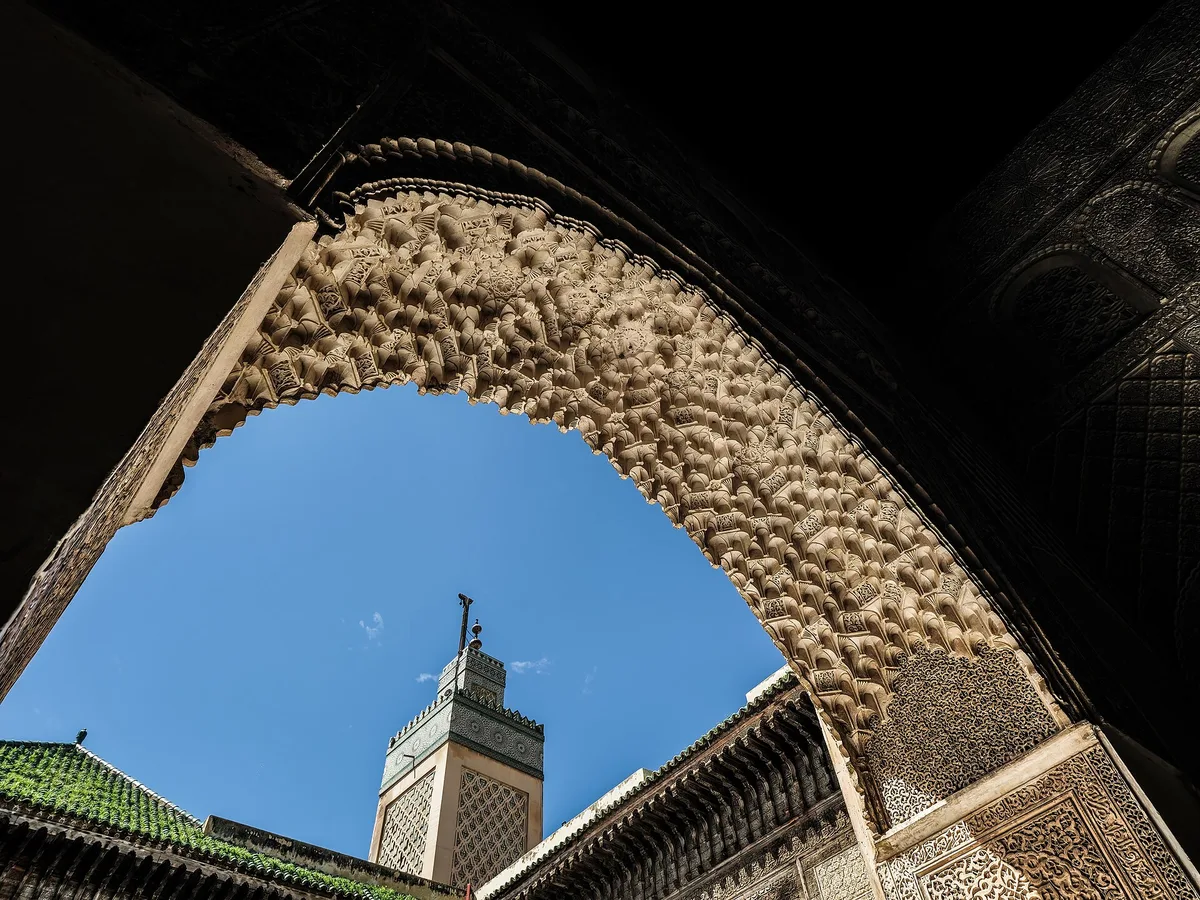
If you can enter only two buildings in Fes, make them these. A madrasa is a religious college — student cells around a courtyard, a prayer hall, teaching in Islamic law and theology — and in 14th-century Fes the Marinid sultans built a series of them so fine that they became the city’s architectural signature. The greater of the pair is the Bou Inania, raised between 1350 and 1355 by the sultan Abu Inan just inside Bab Bou Jeloud on Talaa Kebira. It was the last and grandest of the Marinid madrasas, and it is unusual in a way that matters to visitors: alone among Morocco’s madrasas it also functioned as a congregational mosque, complete with minaret — the green-tiled tower you can frame through the arch of the Blue Gate as you arrive. Its courtyard is the full Marinid vocabulary in one room: zellige mosaic underfoot and at eye level, carved plaster above it as fine as lace, carved cedar above that, and onyx and marble carried in for the prayer hall. Across the street stands the Dar al-Magana of 1357, the house of the famous water clock built to regulate the city’s prayers, its mechanism long gone but its facade still facing the madrasa it served.
The Al-Attarine, at the far end of Talaa Kebira near the Qarawiyyin, is a generation older and a register finer. Built in 1323 to 1325 and named for the perfumers’ and spice souk beside it, it is smaller than the Bou Inania and more concentrated — a single courtyard in which the zellige, the plaster and the cedar carving sit closer together and reward a slower look. Student cells rise around it, and the whole building has the feel of a jewel box made by a dynasty at its most confident. Between the two, you can read the Marinid century in an afternoon: the Attarine’s intimacy first or the Bou Inania’s grandeur first is a genuine choice, but do not skip either on the theory that one madrasa covers both. They are the same language spoken at two different volumes.
Practicalities, briefly. Both madrasas admit visitors of all faiths — which, in a city whose mosques are closed to non-Muslims, makes them the one place to stand inside sacred Fes architecture rather than admire it from a doorway. The Bou Inania still functions as a mosque, so its prayer hall closes at prayer times, and the building asks for a religious site’s quiet and modest dress. Go early, when the courtyard is empty and the carving has the light to itself, and give the pair an hour each rather than twenty minutes: these buildings disclose themselves slowly, in a tile panel or a cedar beam, and rushing them is the one reliable way to underrate Fes.
Al-Qarawiyyin – the University Older Than Oxford
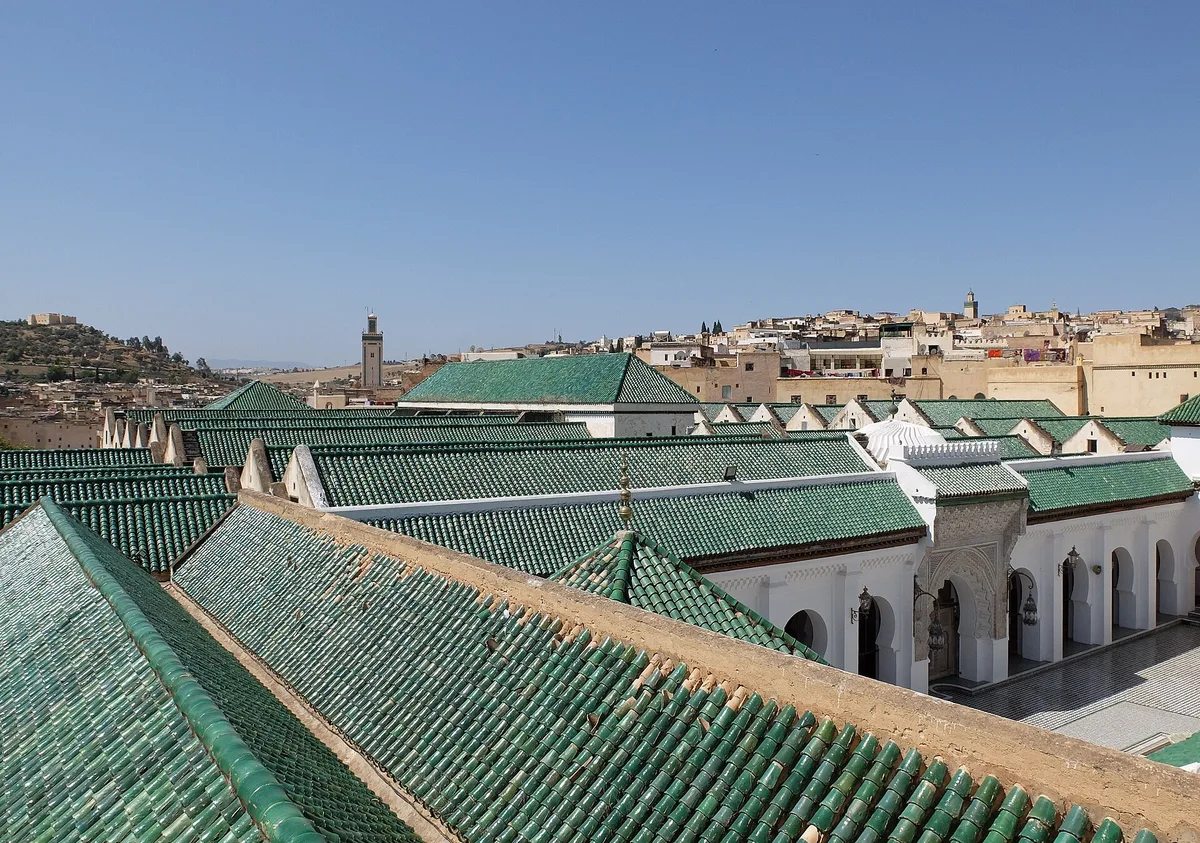
At the bottom of the two Talaas, where the medina’s commercial streets give way to its holy core, stands the institution the city grew around. Al-Qarawiyyin was founded in 859 by Fatima al-Fihri, a woman of a wealthy merchant family originally from Kairouan — the same city that gave Fes its second founding quarter — who spent her inheritance on a mosque and place of learning for her community. It grew into a university in the full sense, teaching theology, law, grammar, mathematics and astronomy, drawing scholars from across the Islamic world and beyond, and it has operated ever since: it is recognised as the oldest continuously operating educational institution in the world, older than Bologna or Oxford by more than two centuries. The complex you pass today — its green-tiled roofs spreading over a whole district of the medina, its square minaret among the oldest in Morocco — is the accumulation of twelve centuries of dynasties adding their halls, courtyards and libraries to the founder’s mosque.
The honest visitor information is that, as a non-Muslim, you will experience Al-Qarawiyyin from its edges. In Fes, as in almost all of Morocco, mosques are reserved for Muslim worshippers, and the Qarawiyyin is first of all a working congregational mosque. What you can do is stand at its open doors and look into the courtyard, walk its perimeter as the two Talaas divide around it, and see its roofs from the surrounding terraces. Beside it stands the Zawiya of Moulay Idris II, the shrine of the city’s founder, the most sacred place in Fes, which non-Muslims view from the barrier at its entrance while a quiet stream of Moroccan pilgrims flows past. Neither restriction should read as a disappointment. The holy core was not built for sightseeing, and the medina arranged around it — the open madrasas, the brass-workers of Seffarine at its shoulder, the perfume souk at its gate — is the working city that grew up to serve it.
The Souks – a City Organised by What It Makes
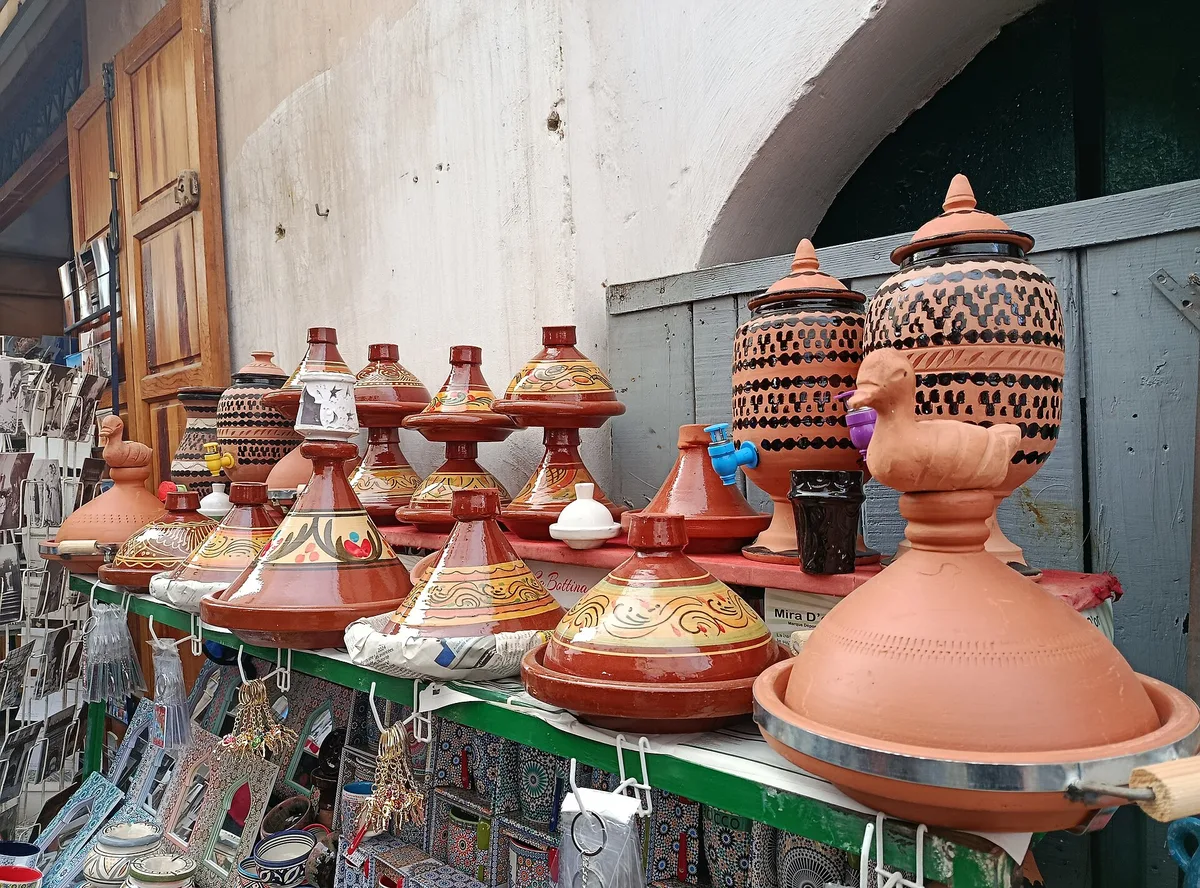
Shopping in Fes is not an activity added to the medina; it is most of what the medina is for. The souks are organised by trade in the old way, each craft with its quarter and its street: the Attarine by the madrasa for perfumes, spices and henna; Seffarine Square ringing with the hammering of copper and brass-workers shaping trays and teapots by hand; the Nejjarine quarter for the carpenters, its 18th-century fondouk — a merchants’ inn built around a courtyard — now a museum of wooden arts and crafts with a carved public fountain outside; the dyers’ souk down towards the river, where skeins of wool dry in colours above the lane; and leather everywhere downstream of the tanneries, worked into slippers, bags and jackets in workshops you can watch through open doors. Fes pottery, painted in the city’s cobalt blue on white, is the other signature — the potters themselves now work mostly in a dedicated quarter outside the walls, where the kilns and workshops can be visited, while the medina shops carry the finished ware.
What sets Fes apart from Morocco’s other shopping cities is that so much of it is made here, within walking distance of where it is sold. That changes the transaction: in the workshops and the better shops you are often buying from the maker’s own city, sometimes the maker’s own family, and quality runs accordingly — the zellige is cut by hand, the brass is hammered by hand, the leather was a hide in the Chouara vats a few streets away. Fes is the place in Morocco to buy ceramics, carved cedar, metalwork, leather and traditional textiles, because in each case you are at the source. Bargaining is expected and is part of the social fabric rather than a contest — the first price is an opening, and walking away politely settles most numbers. Fixed-price cooperatives near the gates exist for travellers who hate the process; their prices are higher, a fair trade for certainty. Either way, buy the thing you watched being made, in the quarter that makes it, and the souks stop being a gauntlet and become what they are — the city’s working heart, which happens to sell things.
Eating in Fes – the Kitchen Morocco Learned From
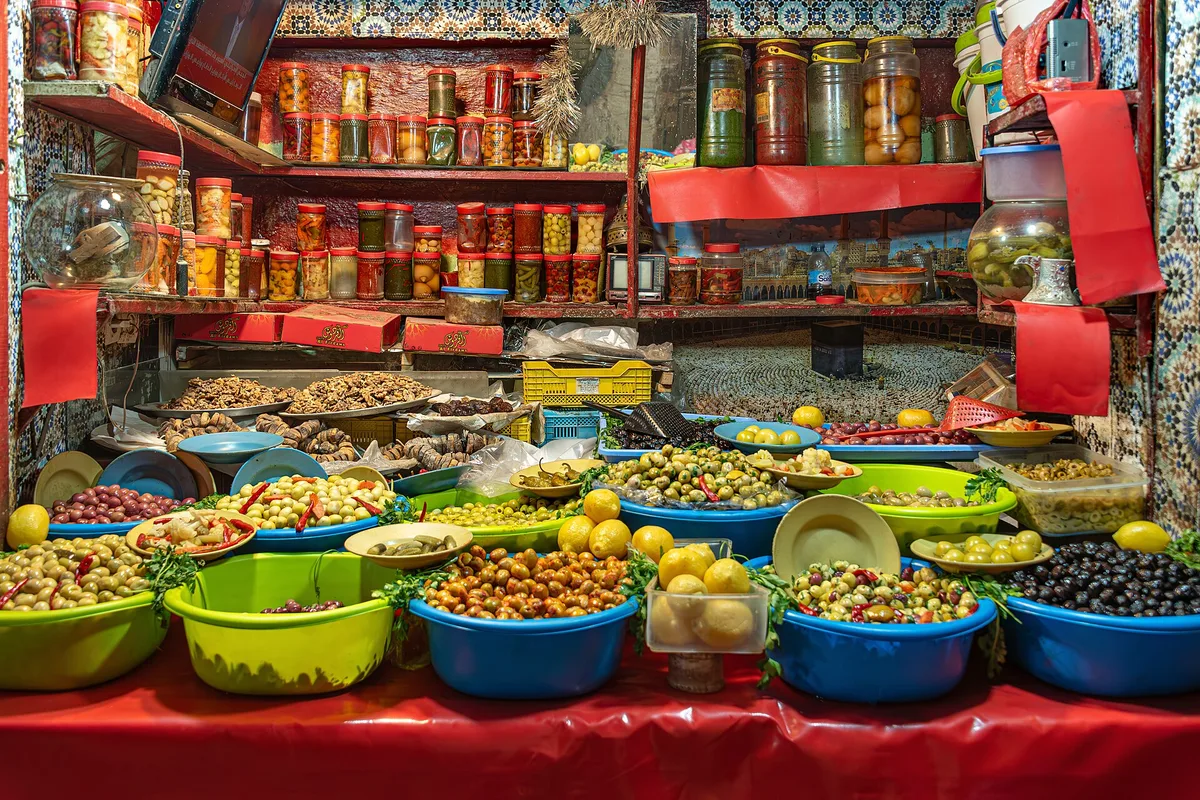
Fassis will tell you, with complete confidence, that Morocco’s great cuisine is theirs — that the country’s celebrated dishes were refined in the kitchens of Fes, where Andalusian, Arab and Jewish traditions met in wealthy merchants’ houses and were fussed over for centuries. It is a claim with substance. Pastilla, the extraordinary pie of crisp pastry, spiced meat, egg, almonds and cinnamon sugar, is the Fassi dish above all others, served in versions that run from pigeon to chicken to seafood. Harira, the tomato and lentil soup that breaks fasts and starts meals, is at its richest here; the tagines run sweeter and more spiced than in the south; and the patisserie fills the stalls near the food markets, where olives are stacked in pyramids and preserved lemons sit in brine by the barrel.
Where you eat it follows the medina’s own geography. Inside the walls, the honest options layer by depth: cafes and grill stalls around Bab Bou Jeloud for the passing trade (one cafe by the gate built its reputation on a camel burger, and it is better than the joke suggests), family-run restaurants in converted medina houses on and off the two Talaas for the full traditional menu, and the grand riad and palace restaurants for the set-piece Fassi dinner in a courtyard of tile and cedar. Many visitors eat their best meal in their own riad, where the cooking is a family’s rather than a kitchen line’s, ordered in the morning and served on the roof or in the courtyard at night. Two honest notes. Restaurant recommendations in the medina rot faster than anywhere — places change hands and cooks move — so ask your riad what is good this season rather than trusting any printed list, this one included. And eat at medina hours: lunch is the main restaurant meal, the souks feed their own all day, and after dark the old city’s eating thins out and moves to the cafes at its gates and the avenues of the Ville Nouvelle above.
Where to Stay – a Riad in the Medina or a Hotel in the Ville Nouvelle
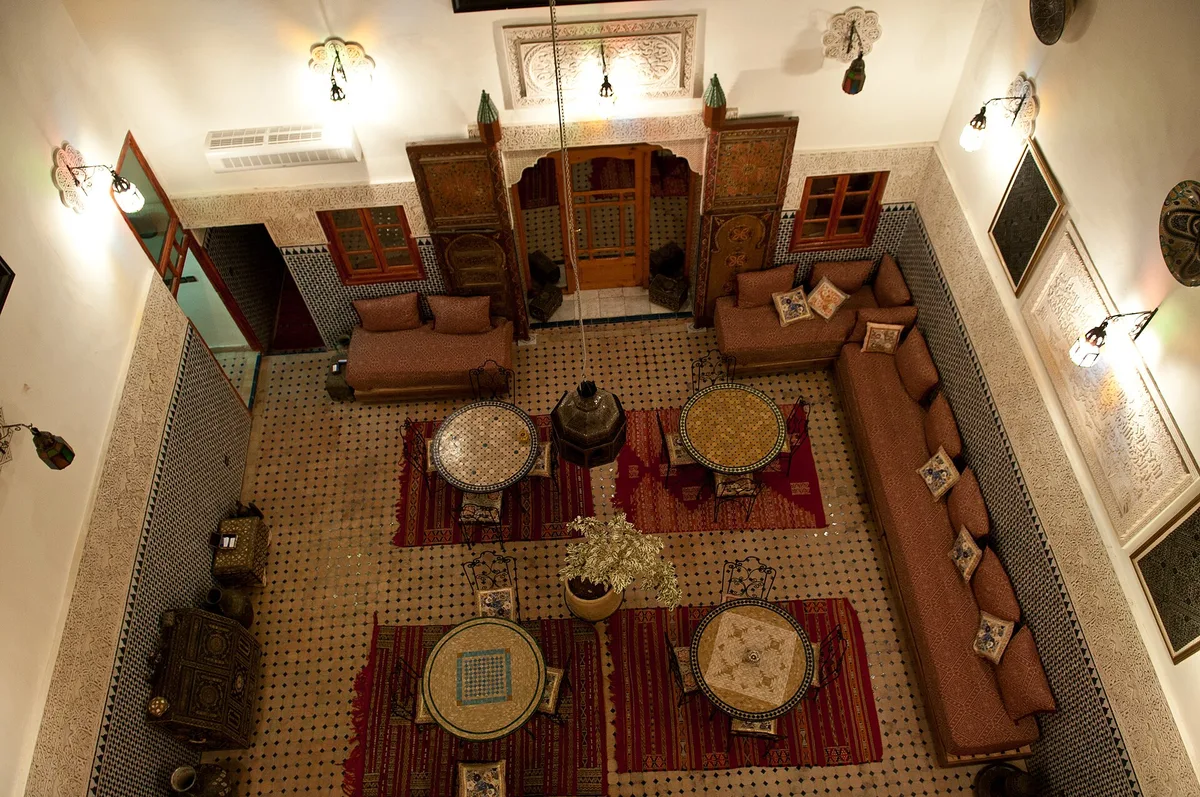
Fes offers the clearest either-or in Moroccan travel, and the choice shapes the whole stay. On one side are the riads and dars of the medina: traditional houses built inward around a courtyard, their street doors giving nothing away, their interiors all carved plaster, zellige and cedar, converted into guesthouses that range from simple family dars to some of the most beautiful small hotels in Africa. On the other side, up on the plateau, is the Ville Nouvelle — the French-built new town of avenues and apartment blocks — with the larger modern hotels, the pools, the parking, the lifts and the remaining apparatus of an ordinary international city stay. Neither is the wrong answer. They are different trips wearing the same city’s name.
In the medina is the choice this guide recommends for most first-time visitors, on one condition: pick your position in it carefully. The medina riad puts the city at your door literally — you wake to its sounds, walk out into its lanes, and come home through streets that were old when most capitals were fields. The finest are destinations in themselves, with rooftop terraces over the medina bowl and cooking worth staying in for. The catch is access: a riad deep in the lanes means a walk from the nearest gate, bags following by porter and cart, which the houses arrange as routine — but midnight arrivals and early departures become small expeditions. The sweet spots are the riads near the accessible edges — around Bab Bou Jeloud and Batha at the western wall, or Bab Rcif on the east — where a taxi gets within a short walk of the door and the whole medina still opens downhill in front of you.
In the Ville Nouvelle trades atmosphere for ease, and for some travellers that trade is correct. You get a hotel that works like hotels elsewhere — car to the door, pool for the hot afternoons, a quieter and more predictable night — and the medina becomes a place you visit by taxi to its gates, a few minutes away, as often as you like. It suits travellers with mobility limits, those with a car on a longer road trip, families who need the pool, and anyone making Fes a one-night stop rather than the destination. A third option splits the difference: the Batha edge and Fes el Jdid, where a handful of larger landmark hotels sit beside the old walls with medina views and road access. Whichever you choose, choose deliberately. In Fes, your address is your itinerary.
Beyond Fes el Bali – the Palace, the Mellah and the Gardens
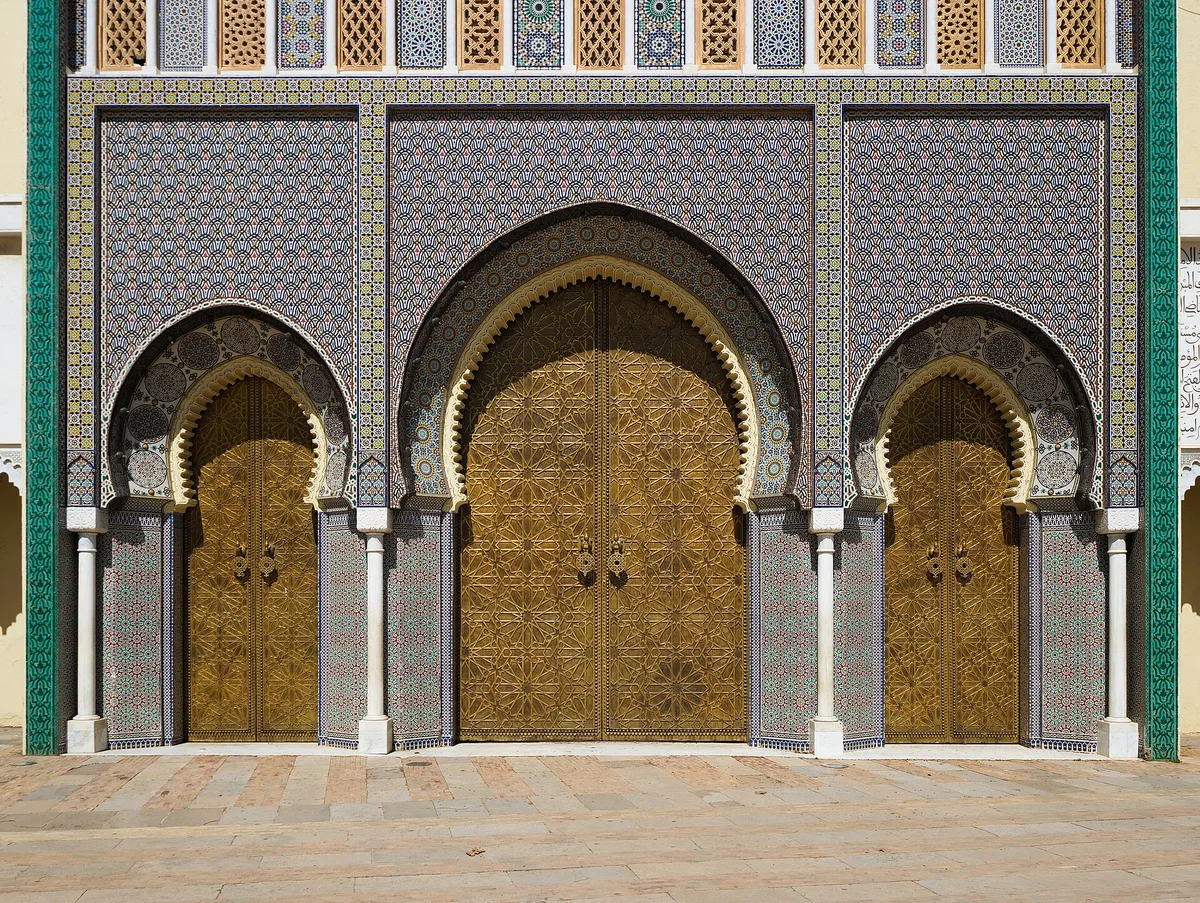
Fes is three cities, and most visitors see only one. West of Fes el Bali, on higher ground, the Marinids founded Fes el Jdid — the New Fes — in 1276 as their royal and military quarter, seven centuries ago and “new” ever since. Its centre is the Dar al-Makhzen, the Royal Palace, still a working residence of the King of Morocco and firmly closed to the public; what the public gets is its great ceremonial square and the palace’s famous brass gates, seven of them, covered in geometric patterning and polished to a shine that the gatekeepers maintain daily. As a sight it takes ten minutes. As a lesson in Morocco — that this is a living monarchy and Fes one of its historic capitals, not a heritage park — it is worth the walk.
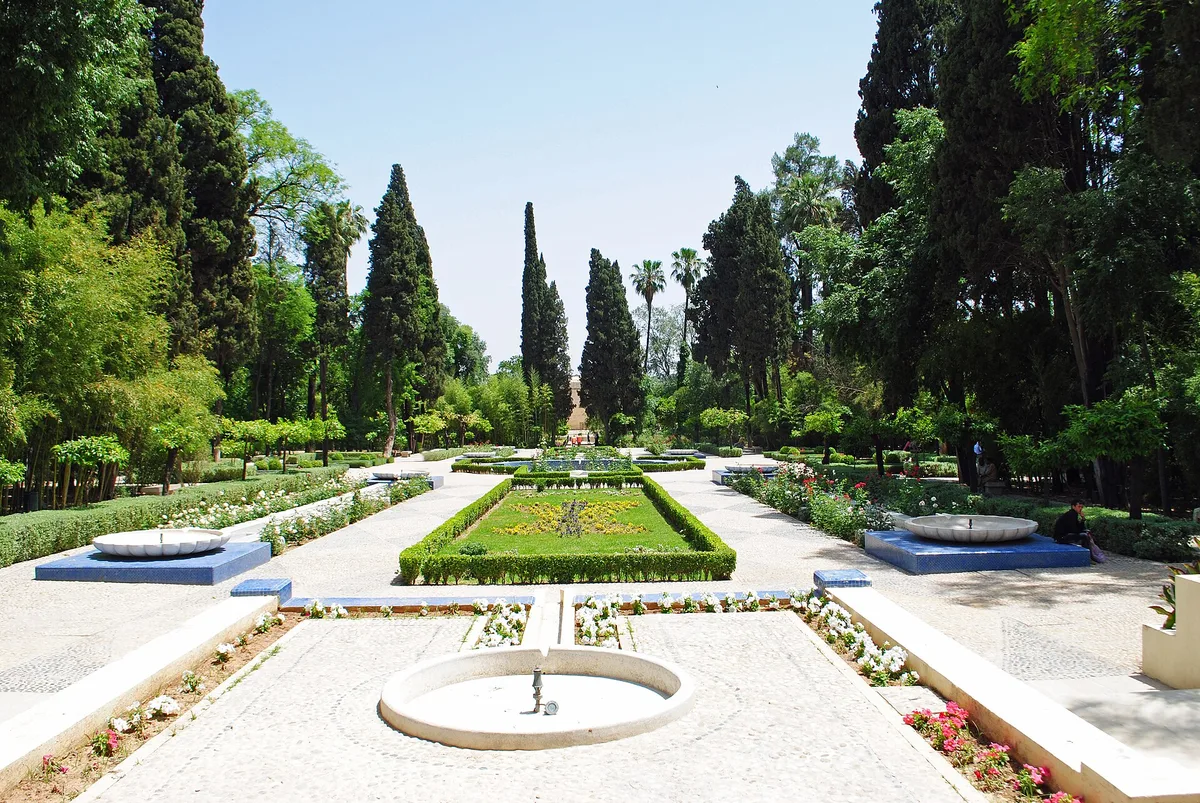
Below the palace runs the Mellah, the Jewish quarter established beside the royal walls in 1438 and often described as the first mellah in Morocco, its houses recognisable by their outward-facing balconies, so unlike the medina’s inward courtyards. The community it was built for has largely gone, but its cemetery remains, white and hillside-wide, and a 17th-century synagogue has been restored within the quarter; together they are the medina system’s necessary other half, evidence of the second culture that shared this city for five hundred years. Between Fes el Jdid and the old city lie the Jnan Sbil gardens, laid out as royal gardens in the 19th century and now the city’s beloved public park — avenues of palms and bamboo, a lake, fountains and shade, full of Fassi families in the late afternoon. After two days in the lanes, an hour in Jnan Sbil is the reset every Fes itinerary needs, and it is free in every sense.
The Viewpoints – Merenid Tombs and the Two Borjs
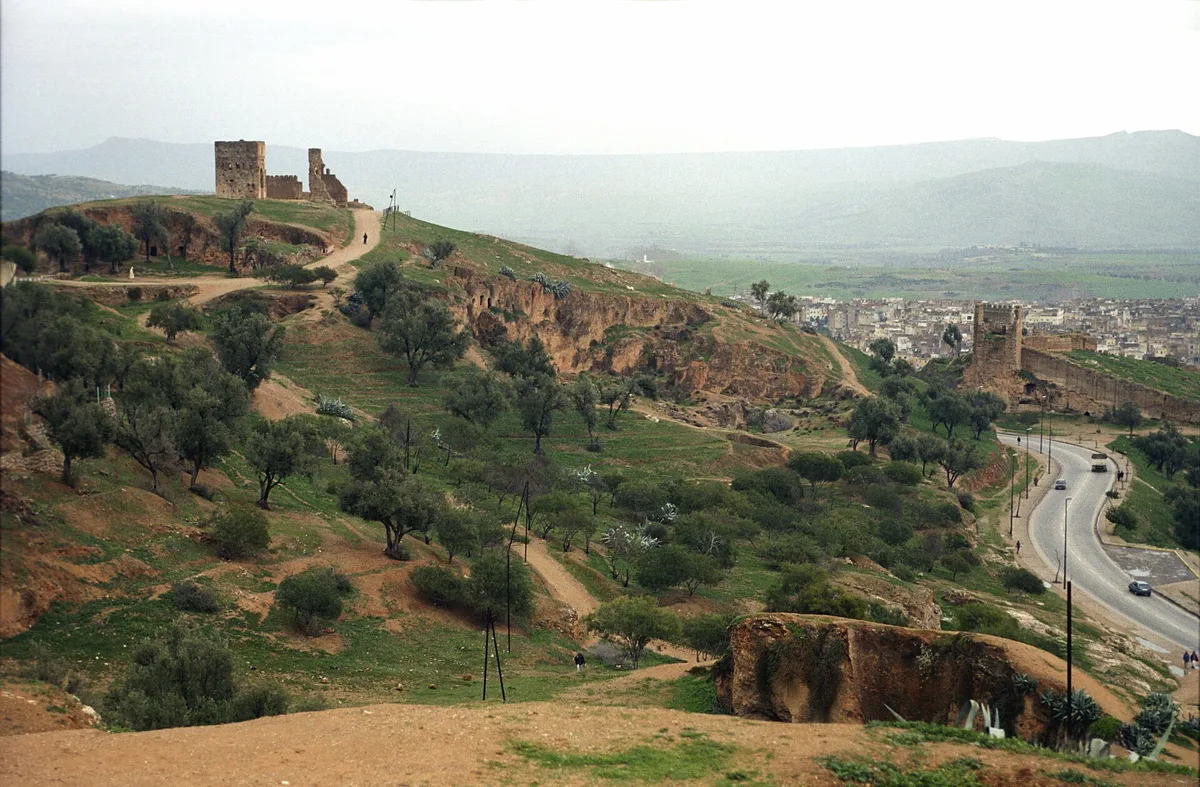
Fes el Bali sits in a bowl, and the bowl has a rim of viewpoints that make sense of everything you have been walking through. The essential one is the hill of the Merenid Tombs on the northern side, where the ruined towers of a 14th-century Marinid royal necropolis stand above the old city. The tombs themselves are fragments; the view is the monument — the entire medina spread below in a single sweep of rooftops, minarets and walls, the Qarawiyyin’s green roofs at its centre, exactly the panorama this guide opened with. Come in the last hour of the day, when the light rakes across the bowl and the call to prayer rises from a hundred minarets at once, and Fes explains itself to you in one look.
The hill is watched over by Borj Nord, the Saadian fortress of 1582 that now houses a museum of arms, and its twin Borj Sud keeps the southern rim; either bastion gives the same bowl from another angle, and the way up passes the medina’s great hillside cemeteries. Make the viewpoints a deliberate ending rather than an afterthought — the first day for orientation if you can, the last evening for the farewell if you cannot. Travellers remember Fes in two images, the tannery vats and this hillside. Get both.
Getting There, Getting Around and the Day Trips Worth Taking
Fes is one of Morocco’s transport crossroads, which is part of why it works so well as a base. Its airport, Fes-Saïss, receives flights from a spread of European cities; the rail network runs to Rabat, Casablanca and Tangier, while the line south to Marrakech makes that journey a full day’s travel — a fact worth knowing before you draw the route, and one reason our morocco itinerary runs the classic route from Marrakech to Fes as its finish rather than its start. CTM and Supratours coaches cover the rest, including Chefchaouen at about four hours by road. One money detail: the dirham is a closed currency, so you will be changing money or using an ATM after you arrive, not before you leave home.
Inside the city, the rule is simple: the medina is walked, everything else is a short taxi ride. Red petit taxis work the modern city and the roads around the walls, and set you down at the gates that matter — Bab Bou Jeloud on the west, Bab Rcif on the east, Bab Guissa on the north — from which you walk in. Agree the meter runs, or settle the fare before you set off, and remember that no taxi can take you into Fes el Bali; every address inside the walls is reached on foot from a gate. Riads arrange porters for bags at the gate as a matter of course, and that porter, on arrival day, is worth more than any map.
The day trips sort themselves by distance and worth. First and best is the pairing of Meknes and Volubilis: Meknes, a short train ride west, is the fourth imperial city — grander gates, a calmer medina, the vast royal quarter of Moulay Ismail — and a taxi onward reaches Volubilis, the Roman city whose mosaics and arches make it the finest ancient site in Morocco, inscribed by UNESCO in 1997 (whc.unesco.org). Together they fill a day without strain. Second, the Middle Atlas: the cedar country around Ifrane and Azrou, an hour or so into the hills, where the air is cool and the medina’s heat feels a world away — a genuine escape in high summer. Chefchaouen is the trip everyone asks about; at about four hours each way it is a punishing day return and a good overnight — give it the night or give it a miss. Desert tours leave Fes for Merzouga as they do from Marrakech; from here the dunes are closer, and Fes is the natural end-point of the classic desert crossing.
Fes or Marrakech – the Honest Answer
Most Morocco itineraries hold one medina properly, and the choice is usually this one. The two cities are both imperial capitals with UNESCO-listed medinas, and they are not interchangeable. Marrakech is the greater spectacle: a vast famous square working from morning to midnight, a medina that has been receiving visitors for a century and has arranged itself partly around them, grand hotels and gardens, and the High Atlas on its horizon. Fes is the greater city: older, denser, more learned and less performed, a medina that exists for its own residents and lets you watch, where the crafts are manufactured rather than merely retailed and the history runs five centuries deeper at street level.
So the answer depends on what you are travelling for, and it can be given plainly. Choose Fes if your interest is history, craft and the texture of a traditional city still running; if you have two full days or more to give a medina; and if you are untroubled by being lost, courted by shopkeepers and occasionally overwhelmed — Fes is the more demanding city and repays the demand. Choose Marrakech if your trip is short and you want the polished, legible version of Morocco, if comfort and hotel life are half the holiday, or if the Atlas and the square are the pictures you came for. And note what the rivalry obscures: the two are a natural pair, joined by the desert route in one direction and the train in the other, and the classic Moroccan journey does both — Marrakech for the show, Fes for the substance. Travellers who give Fes its two days rarely wish they had given them to anywhere else.
Frequently Asked Questions
Six questions decide most Fes stays.
How many days do you need in Fes?
Two full days in the medina is the honest minimum — one for the two Talaas, the madrasas, the tannery and the holy core, one for Fes el Jdid, the craft quarters, a second slower pass at the souks and the sunset hill. Three days is the comfortable version and buys the Meknes and Volubilis day trip. One day is possible with a guide and strong legs, and it will show you the sights while withholding the city; if one day is truly all you have, spend it guided and accept the highlights.
Do I need a guide for Fes el Bali?
Not legally and not for safety — the medina is a public city and you may wander it freely. Practically, an official licensed guide for your first half day is the single best purchase in Fes: it orders the maze, opens the context and quietens the hassle, and you can book one through your riad or the tourist office. What you do not need is the unofficial guide who finds you at the gate. After the guided pass, go back alone and get lost at leisure; that is the correct order.
Can non-Muslims visit the mosques and Al-Qarawiyyin?
No — in Fes, as in nearly all of Morocco, mosques are open to Muslim worshippers only, and Al-Qarawiyyin is a working mosque as well as a university. Non-Muslim visitors can look through its open doors into the courtyard, walk its perimeter and see its roofs from nearby terraces, and can enter the madrasas — the Bou Inania and Al-Attarine — which are Fes’s great sacred interiors open to everyone. The Zawiya of Moulay Idris II is viewed from its entrance barrier. Plan around it rather than against it; the madrasas alone justify the trip.
When is the best time of year to visit Fes?
Spring, from March to May, and autumn, from late September into November, bring the walking weather the medina demands. Summer is genuinely hot — Fes sits inland in a bowl and the lanes hold the heat — though the medina’s shade and an early-start rhythm keep it workable. Winter is cold by Moroccan standards, with chilly nights and rain that makes the lanes slick, but the city is at its emptiest and its most local. The Fes Festival of World Sacred Music, held in late spring in most years, is the one event worth planning dates around; book rooms early if your visit meets it.
Is Fes safe, and how bad is the hassle?
Fes is a big working city and asks for big-city sense: awareness in crowds, money kept unflashy, care on the unlit lanes late at night, when the main streets or a riad escort home are the better choice. Violent crime against visitors is rare; the daily reality is commercial pressure — shopkeepers’ invitations, unofficial guides, opening prices — persistent around the gates and fading quickly on a polite refusal. Most travellers adjust within a day. Treat it as the city’s noise, not its nature.
Fes or Fez – and how do I get to Chefchaouen?
Same city, two spellings: Fes follows the French and Moroccan usage, Fez the older English one, and you will see both, sometimes on the same map. For Chefchaouen, the blue town in the Rif mountains north of Fes, coaches run from the main bus station in about four hours each way; it works as an overnight or as the next stop on a route north to Tangier, and as a day trip only for travellers who enjoy buses more than towns.
The Short Version
Give Fes two days and your full attention. Come through Bab Bou Jeloud in the morning and let the two Talaas teach you the medina’s shape; take an official guide for the first half day and lose yourself happily on the second; stand over the Chouara vats with mint under your nose; give the Bou Inania and the Al-Attarine an hour each and read Al-Qarawiyyin from its doors and rooftops. Eat pastilla where your riad sends you, sleep inside the walls if you can, and end a day on the Merenid Tombs hill watching the light leave the bowl. Morocco has easier cities, and more famous ones. It does not have another like this.