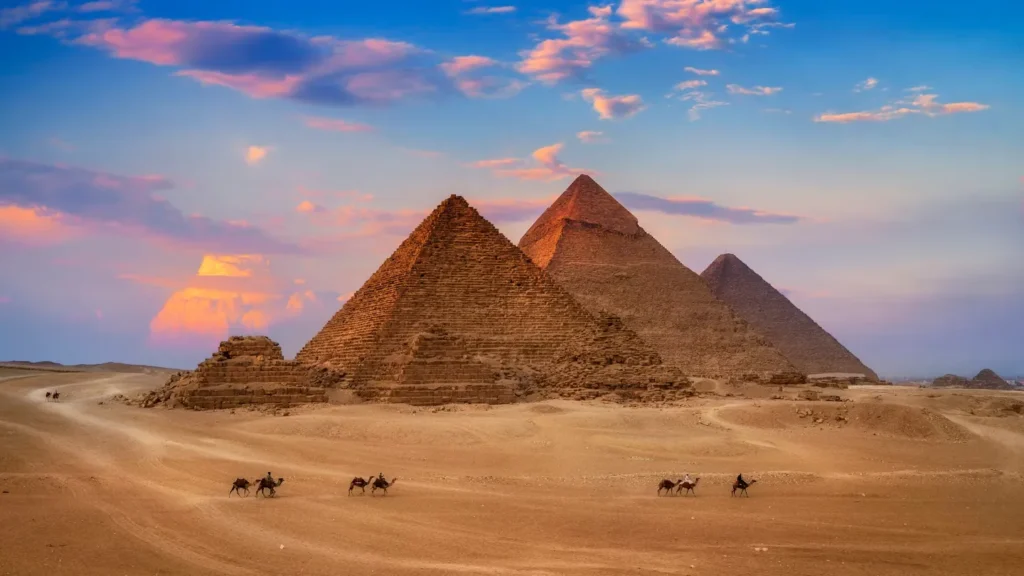
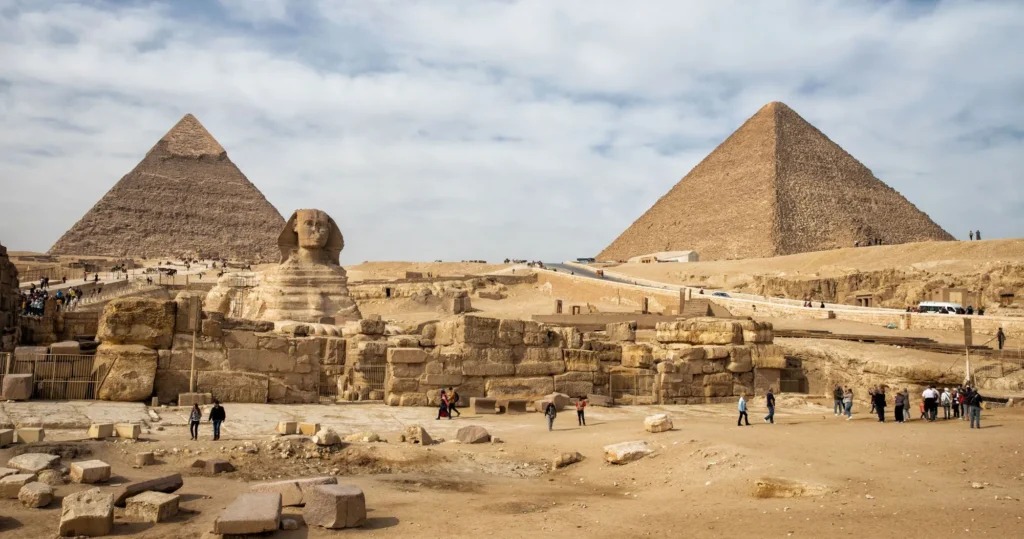
The Pyramids of Giza are not three isolated triangles in empty sand. They are one royal landscape on a limestone plateau on Cairo’s western edge: three Fourth Dynasty tombs, their temples and causeways, smaller queens’ pyramids, tombs of officials, a workers’ town — and, crouching at the edge of it all, the Great Sphinx. The Great Pyramid of Khufu is the only surviving Wonder of the Ancient World, but the plateau only makes sense when you walk it as a whole, from the panorama viewpoint down through the causeways to the Sphinx, because the whole complex was planned as a single funerary landscape rather than as three separate monuments. A pyramid’s mortuary temple stood on its eastern side, facing the rising sun, a covered causeway ran down from that temple to a valley temple near the edge of the floodplain, and around those structures spread the tombs of queens, family members, officials and priests, together with the settlement where the builders lived. The plateau sits on the west bank of the Nile, the side of sunset, which in Egyptian belief was the side of the afterlife, so the choice of ground was itself theological: the dead kings were placed where the sun dies each evening, in the direction of the underworld journey. Standing on the plateau today, with Cairo’s sprawl behind you and desert opening to the west, you can still read that logic in the ground, because the three pyramids are aligned along a diagonal, their causeways point east towards the river, and the Sphinx looks east towards the sunrise, guarding the approach. This guide gives you that walk, the builders and dates without the myths, and the practical decisions that make or break a day here, and it keeps its focus deliberately on Giza itself, rather than trying to cover every pyramid in Egypt in one article.
For the wider pyramid story beyond this one plateau, the natural companion is our guide to the fascinating Egyptian pyramids, which follows the pyramid tradition from Giza to Dahshur and beyond, and which is the right place to go when you want to compare Giza’s Fourth Dynasty tombs with earlier experiments and later, smaller pyramids elsewhere. That companion guide exists precisely so this one does not have to repeat the full story of Saqqara or Dahshur, and so that a visitor who has walked Giza can decide, with a clear sense of what Giza already showed them, whether a second pyramid field is worth a second day. Within Giza itself, the visit rewards a particular order and a particular pace, and the sections below are written in that order: first the history and the built dates that let you tell the three kings apart, then each pyramid and the Sphinx in turn, then the practical route, timing and transport decisions, and finally the questions every first-time visitor asks. Dates throughout are given as circa, because Egyptologists differ by decades, and the sources rest on reign lengths, radiocarbon evidence and king lists rather than on a single foundation inscription, so any guide that gives you a single year for a pyramid without a “c.” is pretending to a precision the evidence does not support. For entry fees, interior access and opening times, check the official site before visiting, because those details change by season and by conservation work, and a plan built on last year’s ticket rules may not survive this year’s gate.
At a Glance
| Monument | Builder | Built (circa) | What stands out |
|---|---|---|---|
| Great Pyramid | Khufu (Cheops) | c. 2560 BCE, reign 2589–2566 BCE in timeline summaries | Largest pyramid in Egypt; originally about 146 m tall; estimated 2.3 million blocks |
| Pyramid of Khafre | Khafre, son of Khufu | c. 2530 BCE | Looks tallest because it sits on higher ground; retains casing stones at its apex |
| Pyramid of Menkaure | Menkaure, grandson of Khufu | c. 2510 BCE | Smallest of the three; lower courses once clad in red granite |
| Great Sphinx | Most likely Khafre | c. 2500 BCE | Lion’s body, king’s face, carved from living bedrock |
Dates vary between sources by a few decades because they rest on reign lengths, radiocarbon evidence and king lists rather than a single foundation inscription. Treat every year here as circa. For entry fees, interior access and opening times, check the official site before visiting.
History and Built Dates: Three Generations, One Plateau
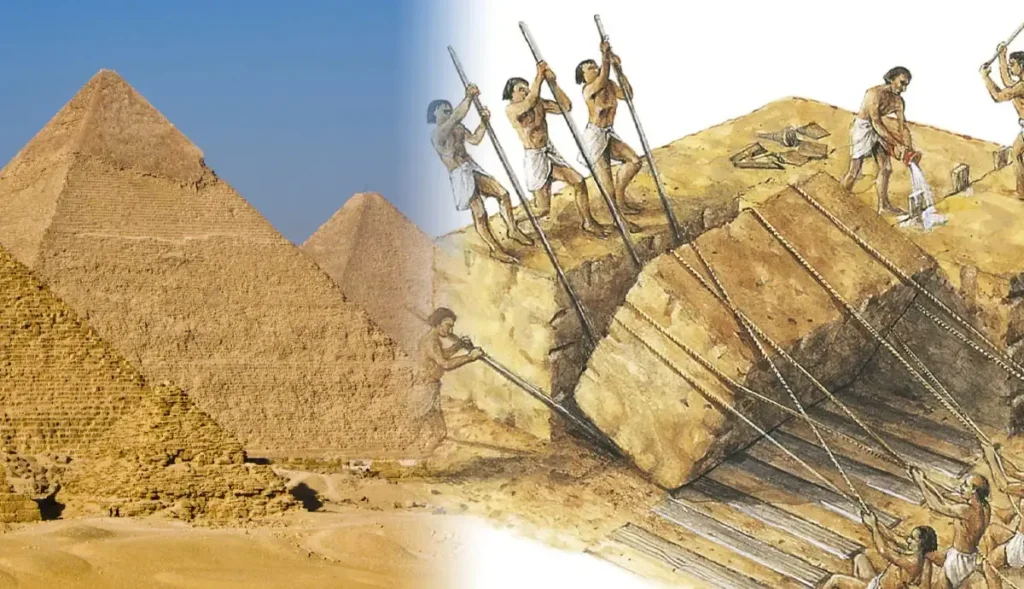
Giza served as the necropolis for Old Kingdom royalty on the west bank of the Nile — the side of sunset, and in Egyptian belief, of the afterlife — and the three great pyramids belong to three generations of a single dynasty, the Fourth Dynasty, which is why they must be understood together rather than as three unrelated wonders. Khufu chose the plateau first. His Great Pyramid, begun around 2580 BCE and completed around 2560 BCE in the most commonly cited summaries, held the record as the tallest human-made structure for more than 3,700 years, and it was originally sheathed in polished white limestone that gleamed across the Nile valley. Most of that casing was later stripped for building stone in Cairo, leaving the stepped core we see today, which is why the modern pyramid looks rough and terraced rather than smooth, and why visitors who imagine a gleaming white triangle are really imagining the pyramid as it was, not as it is. Khufu’s pyramid is estimated to contain about 2.3 million blocks, most averaging around 2.5 tonnes, and its sides are aligned to the cardinal points with a precision that still impresses surveyors, because the builders laid out a square base more than 230 metres on each side with an error of only centimetres. That precision, achieved without modern instruments, tells you more about Old Kingdom organisation than any single statistic, because it required surveyors, quarrymen, hauliers and masons working to a single plan over decades, coordinated by a state that could feed and direct a workforce on that scale. The pyramid was not a pile of stone but a machine for the afterlife, with a burial chamber, passages, a mortuary temple, a causeway and a valley temple, all arranged so that the dead king’s cult could be maintained and his journey to the afterlife could be ritually supported.
Khafre followed, building slightly smaller but on higher rock and at a steeper angle — the optical trick that still fools first-time visitors into naming his pyramid the largest — and then Menkaure, a generation later, built markedly smaller, a shift scholars read as a change in royal resources, priorities or both, and possibly as a sign that the enormous expenditure of Khufu’s reign could not be sustained indefinitely. Each pyramid anchored a complex: a mortuary temple on its east side, a covered causeway running down to a valley temple near the Nile floodplain, boat pits, and mastaba tombs for family and officials, and the Sphinx, carved beside Khafre’s causeway, belongs to this same landscape, not to a separate attraction. Two old stories deserve retiring before you arrive, because they distort everything else you will see. The pyramids were not built by slaves in the Hollywood sense, and no credible archaeological evidence supports alien or lost-civilisation builders. Excavations of the workers’ settlement at Giza, together with administrative papyri such as the Merer diary, which records the transport of limestone for Khufu’s pyramid, point to organised state labour: permanent skilled crews plus rotating workers, housed, fed and buried near the site, working especially during the Nile flood season when farm work paused, and organised into gangs with names, supervisors and rations that are recorded in graffiti and in papyri. Herodotus, writing some two thousand years later, preserved garbled oral tradition — including his famous 100,000-men claim — not an eyewitness account, and his account should be read as folklore about a distant past rather than as history. The real story is more impressive than the myths, because it shows a state capable of planning, feeding and directing a workforce over decades, and a workforce that left behind its own town, its own bakeries, its own cemeteries and its own names, rather than an anonymous mass of slaves.
The Great Pyramid of Khufu — Inside and Out
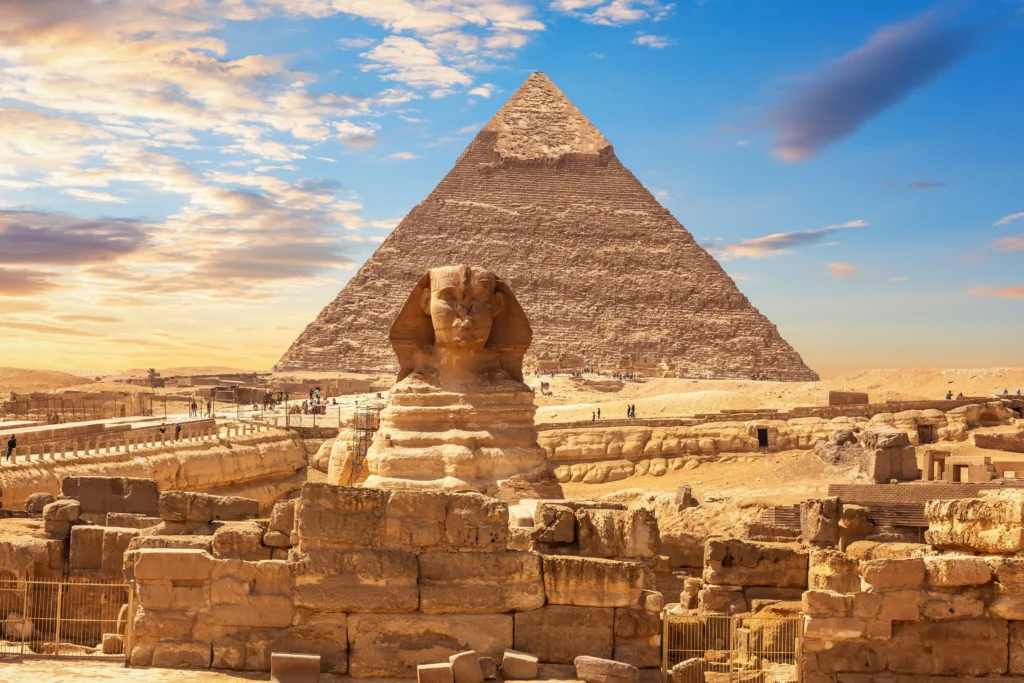
From the outside, the Great Pyramid rewards a slow circuit rather than a single photograph, because its scale only becomes real when you walk beside it and realise that each block is larger than a person, that the base is longer than two football pitches, and that the stepped core, stripped of its casing, still rises to about 137 metres, down from its original height of about 146 metres. Walk its base to grasp the scale of the blocks — most around 2.5 tonnes, some far heavier — and notice how precisely the sides align to the cardinal points, a feat that required careful astronomical observation and surveying. Look for the remains of the casing at the base, where a few polished blocks survive, and imagine the whole surface shining white, because that imagined surface is the key to understanding why the pyramid was built where it was: visible from the Nile, gleaming across the valley, it announced the king’s power and his afterlife journey to everyone who travelled the river. The surrounding plateau adds context that a single viewpoint misses, because the Great Pyramid’s mortuary temple, causeway, boat pits and the tombs of officials and family members show that the pyramid was the centre of a working funerary complex, not a solitary monument, and the boat pits in particular, including the pit that held the reconstructed solar boat now displayed nearby, remind you that the king was expected to travel in the afterlife just as he had travelled on the Nile in life. Take time at the panorama viewpoint as well, because it is the only place where all three pyramids can be seen together in their diagonal alignment, and where the relationship between the plateau, the desert and the city becomes clear in a single view.
Inside, the classic route runs through a low, sloping passage to the Grand Gallery, a tall corbelled corridor whose stepped ceiling rises more than eight metres, and then the King’s Chamber with its granite sarcophagus, a room built of massive red granite beams hauled from Aswan, hundreds of kilometres south, and fitted with extraordinary precision. There are also lower and so-called Queen’s chambers, names given by early explorers that do not always match original use, and guides will explain which spaces are open on your day, because interior access rotates for conservation and crowd management, and not every passage is open to every visitor on every day. Be honest with yourself about the interior: passages are narrow, steep and warm, and claustrophobic visitors often enjoy the plateau more from outside, because the experience of crawling up a low, sloping corridor in heat and close air is very different from the experience of looking at the pyramid from the desert. If you do go in, go early, carry only what you need, and follow the guide’s pace rather than rushing, because the passages are one-way in places, the air is warm, and a visitor who hurries will miss the Grand Gallery’s extraordinary corbelled ceiling, which is the interior’s real architectural achievement. Interior entry is separately controlled from plateau entry, so check the official site before visiting for what is open and whether an additional ticket applies on your date, and do not assume that a plateau ticket guarantees entry to the King’s Chamber, because the two are managed separately and the interior has a daily visitor limit. For many visitors, the best compromise is to enter one pyramid, usually Khufu’s, and to spend the rest of the morning outside, walking the plateau, the causeways and the Sphinx, where the air is open and the scale of the whole complex can be appreciated without the constraints of a narrow passage.
Pyramid of Khafre and the Great Sphinx — The Pair to See Together
Khafre’s pyramid is the one to study for casing, because it is the only one of the three that still wears a cap of its original polished limestone at the apex, and looking up to that smooth, white crown lets you imagine the whole plateau shining white, as it would have done when all three pyramids were complete. Its position adds to the illusion: Khafre built on higher rock than his father, and at a slightly steeper angle, so from many viewpoints his pyramid appears taller than Khufu’s, even though it is in fact slightly smaller, and that optical trick still fools first-time visitors, which is itself a useful lesson in how the plateau was designed to be seen. Its valley temple, near the Sphinx, is built of massive granite and limestone blocks and is one of the best-preserved temple structures at Giza — a quieter, cooler interior that many rushed tours skip, and that rewards the visitor who enters it, because its huge, undecorated stonework shows a different kind of temple architecture from the carved and painted temples of later periods. The valley temple was the point where the dead king’s body was received and prepared, at the end of the causeway from the mortuary temple, and its granite pillars and alabaster floor give a sense of the weight and solidity that Old Kingdom builders valued, a solidity that contrasts sharply with the more delicate carving of later Egyptian temples. Walking from Khafre’s pyramid down its causeway to the valley temple and then to the Sphinx is the most coherent single walk on the plateau, because it follows the route the funeral procession itself would have taken, from the mortuary temple beside the pyramid down to the valley temple at the edge of the floodplain, and it lets you experience the complex as a sequence rather than as isolated monuments.
Then walk to the Sphinx viewpoint, and give the statue the same unhurried ten minutes you would give a temple interior, because the Sphinx is less a photo stop than the plateau’s guardian in the literal Egyptian sense, placed to watch the rising sun over the causeway. The statue, about 73 metres long and carved from living bedrock rather than built from blocks, combines a lion’s body with a royal head, most scholars identifying it as Khafre, and its scale is deceptive from a distance, because only when you stand before it do you realise that its head alone is about nine metres tall and its paws stretch far enough to enclose a small temple between them. Its nose and beard are long gone, its paint almost entirely weathered away, and its paws have been restored more than once across millennia, because the Sphinx has been buried in sand, excavated, restored and reburied repeatedly since ancient times, and each restoration has left its own mark on the stone. The popular story that Napoleon’s soldiers shot off its nose is a myth, because drawings made before Napoleon’s expedition already show the nose missing, and the damage is far older, probably from deliberate defacement in a later period. Seen from the front, low against Khafre’s pyramid behind it, the Sphinx gains a power that no photograph quite captures, because its gaze is fixed east towards the sunrise, its lion body suggests strength and protection, and its royal face suggests the king himself in guardian form, watching over his father’s and his own funerary complexes. The small temple between its paws, and the Dream Stela of Thutmose IV, which records a dream in which the Sphinx promised the young prince the kingship if he cleared the sand, add a later layer to the story, showing that the Sphinx was already ancient and already venerated more than a thousand years after it was carved.
Pyramid of Menkaure and the Queens’ Pyramids
Menkaure’s pyramid, at about 65 metres, is easy to dismiss beside its neighbours — do not, because its smaller scale makes its construction details legible in a way that the vast, stripped cores of Khufu and Khafre do not, and because it tells a different story about the Fourth Dynasty’s later years. Its lower courses were once clad in red granite, brought from Aswan, a far more expensive and harder stone than the local limestone, and the surviving granite casing at the base, with its rough, unfinished surface in places, shows the labour involved in dressing granite, a task that required stone tools and abrasives rather than metal chisels, and that gives a vivid sense of the effort behind even a “small” pyramid. Three small subsidiary pyramids for queens stand on its south side, and a mortuary temple that shows how a royal complex was actually used, with courtyards, offering chapels and storerooms, completes a picture of a functioning funerary establishment rather than a bare monument. The queens’ pyramids also correct a common impression that Giza was only about kings, because royal women, officials and priests had their own tombs, chapels and offering places across the plateau, and the plateau’s eastern and western cemeteries, with their rows of mastaba tombs, show a whole society buried around its kings, from queens and princes to the officials who administered the kingdom and the priests who maintained the royal cults. Menkaure’s pyramid is also the one most associated with later history, because its interior was explored by early archaeologists, and because its granite sarcophagus, lost at sea while being shipped to Britain in the nineteenth century, has become a small legend of its own, a reminder that Giza’s modern history of exploration and loss is part of the site’s story too.
This southern end of the plateau is also where the crowds thin, and that quiet is itself a reason to walk here, because the plateau’s southern edge offers views back across all three pyramids, with the desert opening to the west and Cairo behind you, that are calmer and more contemplative than the crowded viewpoints near the entrance. If your time is short, prioritise Khufu and the Sphinx, but if you have a full morning, the walk to Menkaure and back along the plateau edge gives you the best sense of Giza as a city of the dead, not a theme park of three shapes, because you pass the mastaba fields, the queens’ pyramids and the workers’ areas that make the plateau a landscape rather than a set of isolated monuments. The walk also shows the scale of the plateau itself, which is far larger than the familiar postcard view suggests, stretching from the Sphinx in the east to the desert in the west, and from the panorama viewpoint in the north to Menkaure’s complex in the south, with tombs and causeways filling the ground between. For visitors who want to understand how Giza fits into the longer pyramid tradition, the contrast with later, smaller pyramids elsewhere is instructive, and our guide to the fascinating Egyptian pyramids sets out that wider story, from the early experiments that preceded Giza to the pyramids built after the Fourth Dynasty’s peak. At Giza itself, however, the lesson of Menkaure is simpler and more immediate: a smaller pyramid, examined closely, can teach you more about construction, about royal family structure and about the changing fortunes of a dynasty than a larger pyramid seen only from a distance, and a morning that includes Menkaure is a morning that has understood Giza as a place rather than as a photograph.
How to Visit: Route, Best Time and Practical Tips
| Decision | Recommendation |
|---|---|
| Order of visit | Panorama viewpoint → Great Pyramid → Khafre → Menkaure → Sphinx and valley temple, or reverse if your entry gate dictates |
| Best time | At opening, October to April; summer visits need dawn starts, shade breaks and extra water |
| Time needed | Half a day minimum for the plateau; a full day with the Grand Egyptian Museum nearby |
| Getting there | Licensed taxi or ride-hailing from central Cairo, or a guided tour that includes transport; agree fares before setting off |
| What to carry | Sun hat, sunscreen, water, comfortable closed shoes, small cash for tips; light bag for pyramid interiors |
The route in the table works because it follows the plateau’s own logic rather than fighting it, starting at the panorama viewpoint where all three pyramids can be seen together and their diagonal alignment understood, then moving to the Great Pyramid for a slow circuit of its base, then to Khafre and its surviving casing, then south to Menkaure and the queens’ pyramids, and finally back east to the Sphinx and Khafre’s valley temple, where the visit ends with the plateau’s guardian looking east towards the sunrise. That order also manages heat and crowds sensibly, because the panorama and the Great Pyramid are best in early morning light, when the stone is golden and crowds are thinnest, while the Sphinx is rewarding in the late morning, when the sun lights the statue’s face fully. If your entry gate dictates the reverse order, the same logic applies in reverse: start with the Sphinx and valley temple, walk up the causeway to Khafre, continue to Menkaure, and finish at the panorama, because the point is not the direction but the sequence, moving from overview to detail to guardian, rather than hopping between viewpoints at random. Allow at least half a day for the plateau alone, because a rushed hour gives you photographs but not understanding, and a full day if you add the Grand Egyptian Museum, which stands nearby on the plateau’s edge and which fully opened in November 2025 and now holds the complete Tutankhamun collection, either the same day if you are energetic or the next morning if you want the museum unhurried. Summer visits need a different discipline altogether, with dawn starts, shade breaks, extra water and a midday retreat indoors, because the plateau offers almost no shade, the stone reflects heat, and a summer afternoon on the plateau is genuinely punishing for anyone who has not planned for it.
Do not rely on touts offering camel rides at inflated prices or “free” guiding that ends in a shop, because both waste the time and money that a good guide would have turned into understanding. A licensed Egyptologist guide transforms Giza — quarry marks, alignment, workers’ graffiti and temple reliefs are invisible without explanation — but agree the route, duration and total cost in advance, and confirm whether the price includes plateau entry, interior entry, transport and tips, because a guide who quotes only part of the cost will add the rest later, and a visitor who has not agreed the total in advance will spend the morning negotiating. Getting there is straightforward from central Cairo by licensed taxi or ride-hailing, or by a guided tour that includes transport, but agree fares before setting off, because the short journey’s fare is a frequent source of dispute, and a pre-agreed price removes the argument entirely. What to carry is simple but essential: a sun hat, sunscreen, water, comfortable closed shoes for uneven stone and sand, small cash for tips, and a light bag for pyramid interiors, because a heavy bag is a burden in a narrow, sloping passage, and because the plateau’s ground, a mix of paved paths, loose sand and rough stone, punishes sandals and heels. For all prices, opening days and interior access, check the official site before visiting, because ticket categories, interior rotations and opening hours change, and because a plan that assumes yesterday’s rules may fail at today’s gate. A well-planned Giza day, with an early start, a pre-agreed guide and transport, and a realistic half-day or full-day shape, is one of the great sightseeing days in the world, while a poorly planned one, arriving at midday without water, without a guide and without a route, is a day spent queuing, haggling and wondering why the most famous site in Egypt felt like a chore.
Further reading on this site: Egypt Travel Guide for fitting Giza into a Cairo–Luxor–Aswan route, Egypt Holiday Calendar for visiting around public holidays, Fascinating Egyptian Pyramids for the wider pyramid field, and Seven Wonders of India for another ancient-monument comparison. External context: Timeline: Giza, History of the Pyramids of Giza, and The Pyramids of Giza.
Conclusion
Giza endures not because the pyramids are big — though they are — but because they still form a coherent place: a plateau planned around kingship, death, the sun and the Nile, built by organised human labour over three generations, and still legible in its causeways, its temples and its tombs. Walk the causeways, stand before the Sphinx, and look back from the panorama, and the three pyramids stop being postcards and become what they were: a royal city, still standing, on the edge of a living one, with Cairo behind you and desert opening to the west, a juxtaposition that shows a 4,500-year-old necropolis surviving in the middle of a modern metropolis. The coherence is what separates Giza from a collection of impressive ruins, because the pyramids, the Sphinx, the temples, the causeways, the queens’ pyramids and the officials’ tombs were all placed in relation to one another, and that relationship can still be walked, from the panorama viewpoint down through the causeways to the Sphinx, in a single morning. A visitor who walks that route, who looks for the surviving casing on Khafre, who enters the valley temple, who stands before the Sphinx for ten unhurried minutes, and who finishes at Menkaure’s quieter southern end, will leave with a sense of the plateau as a place, not as three shapes in sand, and that sense is the real souvenir of a Giza visit. The myths — slaves, aliens, lost civilisations — fall away on the plateau itself, because the evidence of organised labour, of a workers’ town, of administrative papyri and of graffiti left by the gangs who built the pyramids, is more impressive than any myth, and it shows a state and a workforce capable of planning and executing a project over decades, with a precision and a scale that still command respect.
For a first visit, the simplest advice is also the best: arrive at opening, walk the plateau in the order set out above, enter one pyramid if you are comfortable in narrow, warm passages, give the Sphinx its unhurried ten minutes, and finish with the Grand Egyptian Museum either the same day or the next morning, because the museum’s Tutankhamun collection and its broader galleries give the objects that the plateau’s empty chambers can no longer show. Check the official site before visiting for current entry rules, interior access and opening times, carry water and sun protection, agree guide and transport prices in advance, and leave the plateau by midday in summer or by early afternoon in winter, with the panorama view as your last image rather than your first, because a view earned by walking the whole plateau means more than a view taken from a bus window. Giza rewards that patience in a way that few famous sites do, because it is not a single monument but a landscape, and landscapes reveal themselves slowly, through walking, through looking, and through the quiet moments between viewpoints, when the crowds thin, the stone warms, the desert light softens, and the scale of what three generations of kings and their workers achieved becomes, for a moment, fully real and fully human. That moment, standing on a limestone plateau on Cairo’s western edge, with the Sphinx at your back, the three pyramids in view and the desert ahead, is why the Great Pyramid is the only surviving Wonder of the Ancient World, and why, after more than four thousand years, it still draws visitors from every country on earth to stand where its builders stood.
FAQs
Q: Who built the Pyramids of Giza and when?
A: Three Fourth Dynasty pharaohs — Khufu (c. 2560 BCE), Khafre (c. 2530 BCE) and Menkaure (c. 2510 BCE) — each built his own pyramid as part of a larger funerary complex.
Q: Which pyramid is the largest?
A: Khufu’s Great Pyramid, originally about 146 m tall. Khafre’s looks taller because it stands on higher ground, but it is slightly smaller.
Q: Were the pyramids built by slaves?
A: No, in the modern scholarly view. Evidence from the workers’ settlement and administrative records points to organised, paid state labour, including skilled crews and rotating workers.
Q: Can you go inside the Great Pyramid?
A: Interior access is controlled separately and varies by day and conservation work. Check the official site before visiting, and expect narrow, steep passages.
Q: How long do I need at Giza?
A: Allow at least half a day for the plateau alone, and a full day if you add the Grand Egyptian Museum.
Q: What is the best time to visit?
A: At opening, from October to April. In summer, start at dawn, rest midday and carry extra water.