Jardin Majorelle Guide – Majorelle Blue, the Berber Museum and Marrakech’s Most Loved Garden
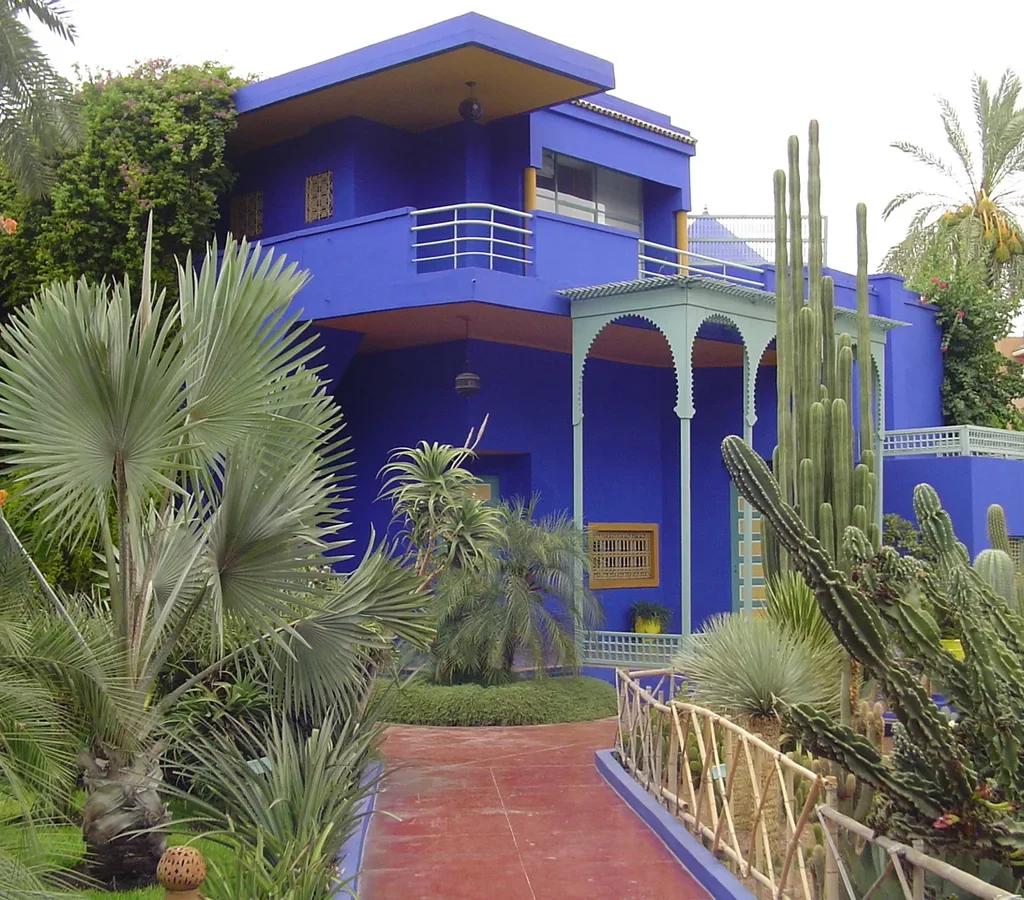
Most famous gardens are landscapes. This one is a painting that happens to be alive. The Jardin Majorelle, on the edge of Marrakech’s modern Guéliz district, is a single hectare of planted rooms built over almost forty years by a French artist who composed with cacti the way he composed with pigment — blocks of green against saturated colour, a red path run like a brushstroke through the middle, and over everything a cobalt blue so deliberate that its inventor patented it. The jardin majorelle is also two rescues and three museums deep: saved from developers in 1980 by Yves Saint Laurent and Pierre Bergé, it now holds the Berber Museum inside the painter’s own studio, a memorial to Saint Laurent among the palms, and a fashion museum next door. This guide takes it in the order the place itself suggests — the painter, the colour, the villa, the planting, the rescue, the museums — and then deals honestly with the one practical fact that decides most visits: this garden is booked ahead and timed, and the visitors who treat it that way are the ones who see it properly.
One promise governs the page, the same one this site keeps everywhere. Nothing here prints a price or an opening hour, because the garden’s own foundation revises both and third-party figures contradict each other wildly — two guides checked while researching this article disagreed about the entry price by a factor of more than two. What does not change is the shape of the place and the mechanism of visiting it: tickets are sold online only, through the garden’s own ticket office, for a chosen date and time slot. That mechanism is described where it belongs, in the How to Visit section, and everything else here is the part of the garden that no ticket table can tell you.
At a Glance
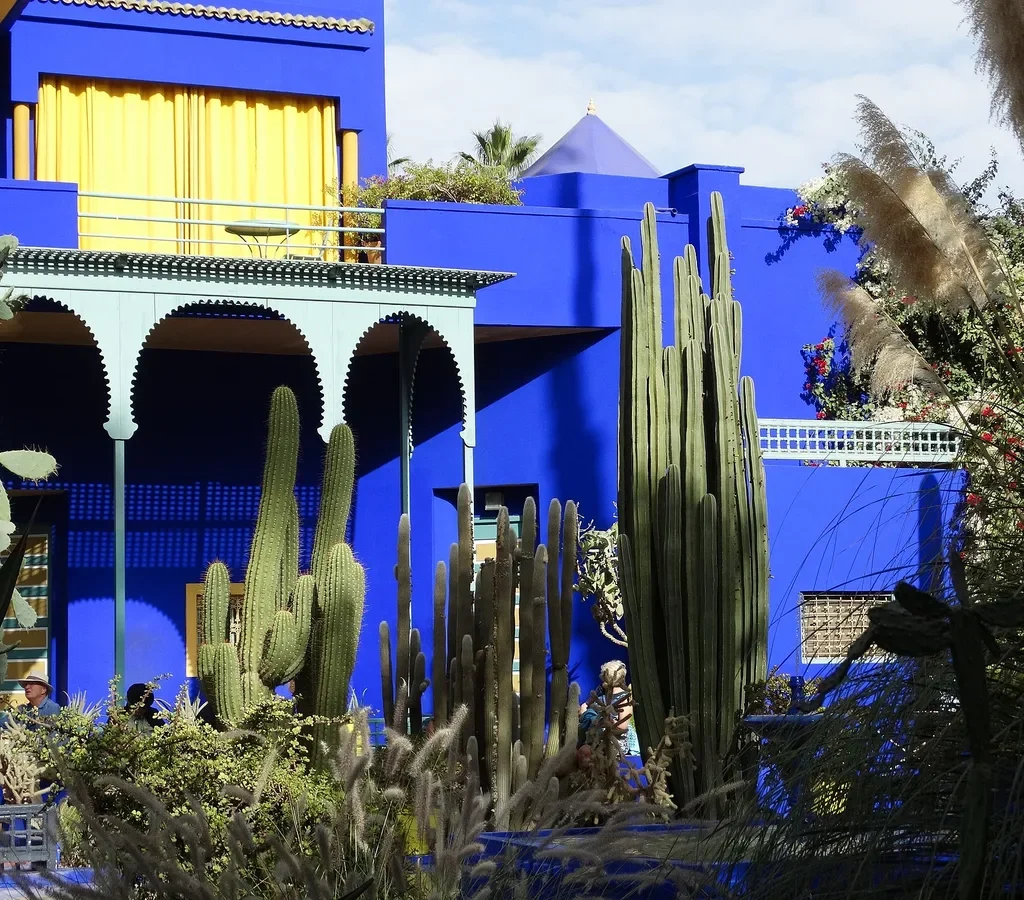
Short on time? Here is the garden on one screen — what there is, why each part earns its place, and the time each one honestly asks for.
| Part of the visit | Why it earns its place | Time character |
|---|---|---|
| The garden itself | A painter’s composition in plants – cacti, bamboo, palms and water, arranged as colour | An unhurried hour, more if you sit |
| Majorelle Blue | The patented cobalt on walls, pots, pergola and fountain – the garden’s signature | Everywhere, all visit long |
| The villa | Paul Sinoir’s Cubist studio-house of the 1930s, the composition’s centrepiece | Read from the paths; its ground floor is the museum |
| The Berber Museum | Six hundred Amazigh objects in Majorelle’s own studio – jewellery, costume, doors, tents | Half an hour to an hour, and worth it |
| The Saint Laurent memorial | A Roman column among the palms, where the designer’s ashes were scattered | Five quiet minutes |
| Villa Oasis garden | The private garden of Saint Laurent and Bergé’s home next door, visitable on the same ticket site | Twenty minutes or so |
| The Yves Saint Laurent Museum | The couturier’s work in a terracotta-brick building on the same street – separate ticket | An hour if fashion matters to you |
| Café and boutique | The garden’s own café terrace and shop, inside the walls | As long as the mint tea lasts |
Two judgements sit behind that table. First, the garden is small and its fame is not — the whole visit is an hour’s walk at most, stretched to two with the museum, and it rewards the slow reader over the completist. Second, the visit is won or lost before you arrive: this is the one Marrakech sight where the booking is part of the sightseeing, because a timed ticket at the day’s quiet end is a different garden from a midday slot in the crush. Everything below assumes you will book ahead and go early. The How to Visit section explains exactly how.
Jacques Majorelle – the Painter Who Came to Convalesce and Stayed
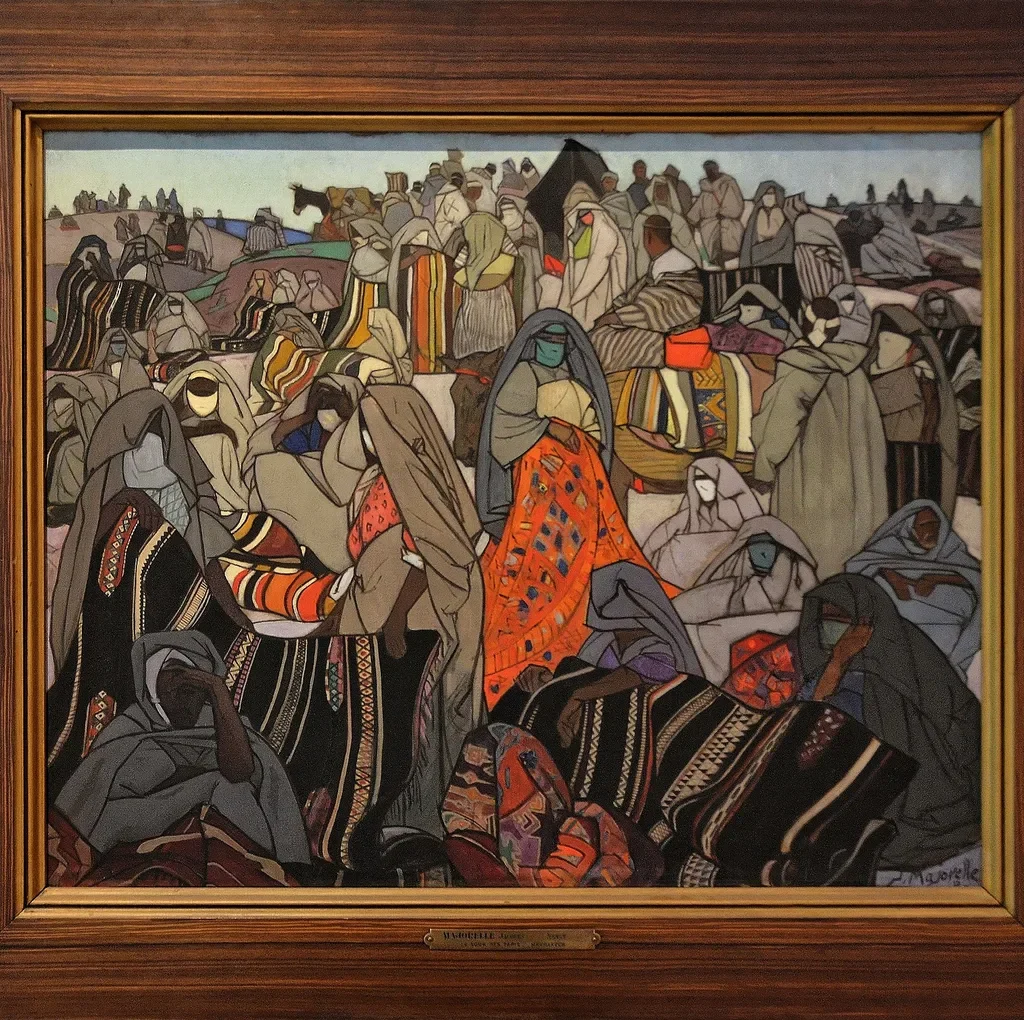
The garden begins with an illness. Jacques Majorelle (1886–1962) was born in Nancy, the son of Louis Majorelle, the great Art Nouveau cabinet-maker, and trained as a painter; around 1917 he was sent to Morocco to convalesce from a serious medical condition, travelled from Casablanca to Marrakech, and — in the pattern of so many arrivals in that city — never really left. He painted his way around North Africa and the Mediterranean before settling permanently, and he built a reputation as one of the celebrated Orientalist painters of his generation: flat, deliberate compositions of Moroccan life, souks and kasbahs and veiled crowds rendered in saturated colour with the pattern-sense of a man raised among his father’s inlaid furniture. The painting reproduced above, his carpet-souk scene of 1924, is the garden in embryo — the same flattened planes, the same woven geometry, the same confidence about which colours may sit side by side.
In 1923, four years after his marriage to Andrée Longueville, Majorelle bought a plot of about four acres on the border of a palm grove outside the medina walls, built a first house in the Moroccan style, and began to plant. He kept buying adjoining parcels as they came up, and over almost forty years the plot grew into the garden that carries his name — his life’s work, tended with a painter’s priorities and a perfectionist’s budget. The garden cost more than his painting earned. That arithmetic drives everything that follows in this article: the public opening of 1947, the slow sales of land to keep the plants watered, and the ruin that came when the money and the marriage both ended. Read the garden’s biography in that order and the place makes sense: it was never a rich man’s ornament. It was an artwork its maker could barely afford to keep.
Majorelle Blue – the Colour He Patented
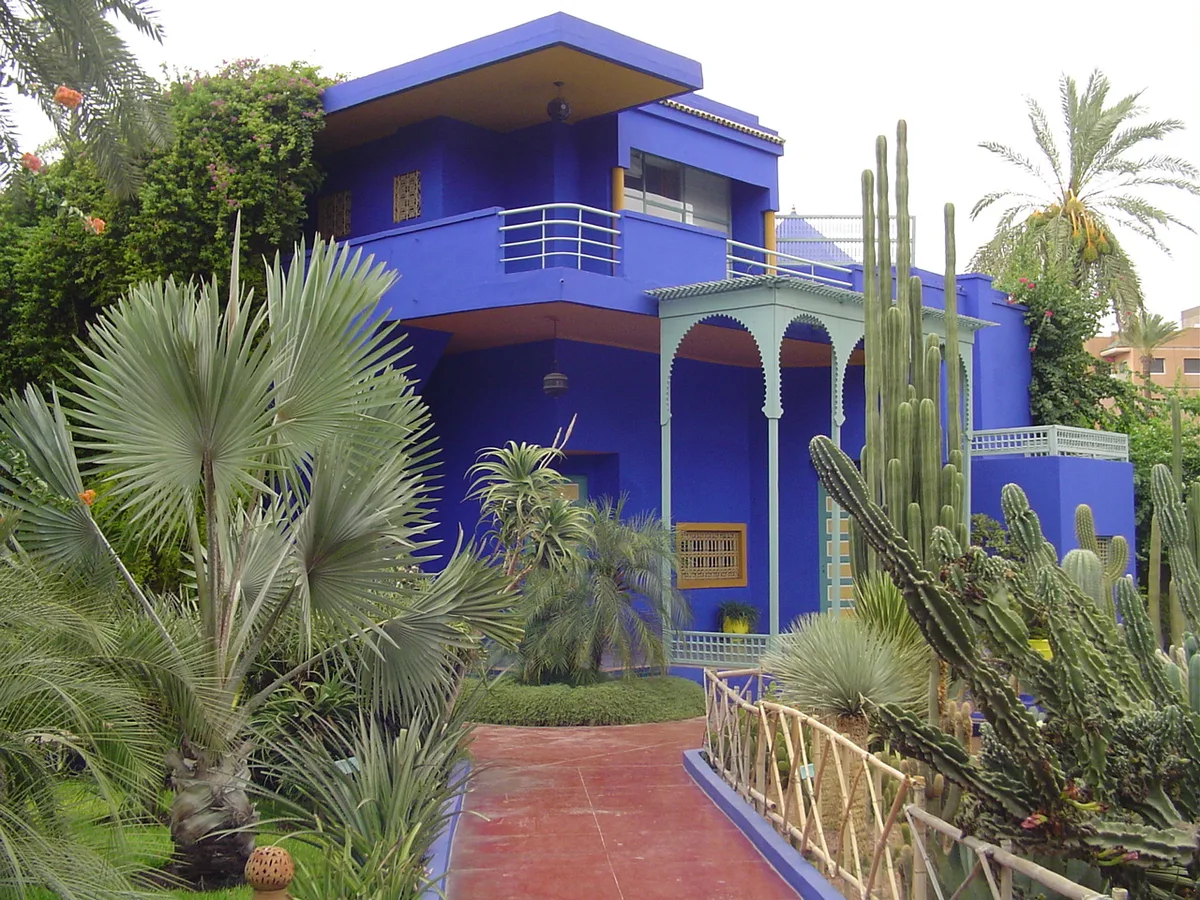
Every visitor arrives knowing one thing about this garden: the blue. It is on the villa’s walls, the pergola, the fountain basin, the plant pots, the gates — a saturated, slightly violet cobalt that reads almost electric against green foliage and red earth, and it was not found but invented. Majorelle developed the shade in the 1930s, drawing on the coloured tiles he had seen around Marrakech and on the blue of Berber burnouses, and before his death he patented the colour that now carries his name: bleu Majorelle, Majorelle Blue. A painter registering a colour as intellectual property sounds like vanity until you stand in the garden, where the blue is doing structural work — it is the fixed note against which every green is tuned, the frame that turns a collection of plants into a composition. Remove it, and this is a pleasant botanical garden. With it, the place is unmistakable from a single photograph, which is precisely what a patent is for.
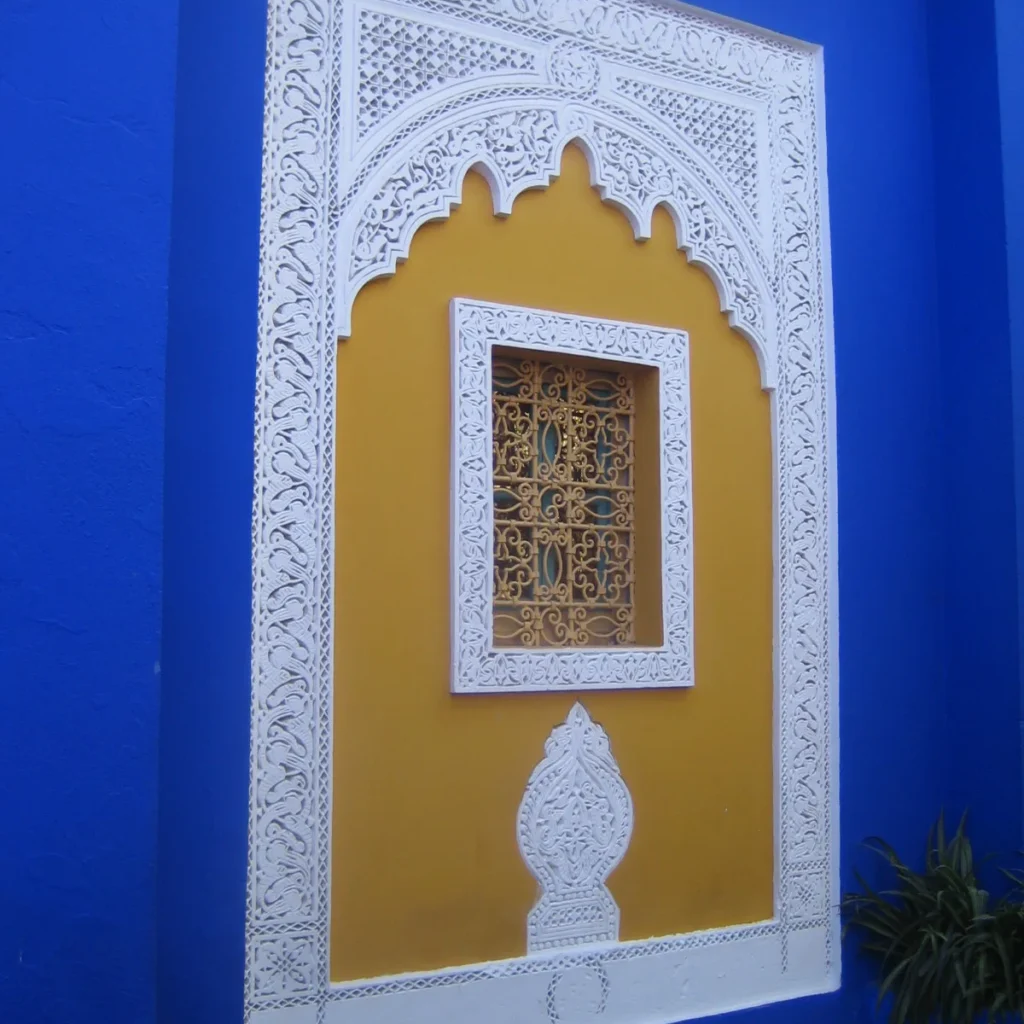
The blue does not work alone, and the garden’s secondary palette is the part most visitors feel without naming. Against the cobalt Majorelle set a clear, almost acidic yellow — on shutters, panels and pots — and kept a third register of white: carved plaster frames, latticework, the pergola’s painted wood. Blue, yellow, white, then the greens of the planting and the red-brown of the paths and the Marrakech earth: five notes, repeated in different octaves from the fountain court to the farthest cactus bed. It is the colour system of his paintings, built at garden scale, and it is why the garden photographs the way it does — the composition was resolved eighty years ago, by the man who designed both the view and its frame. When you reach the carved window panel in the photograph above, you are looking at the whole theory in one wall.
The Villa – a Cubist Studio in a Palm Grove
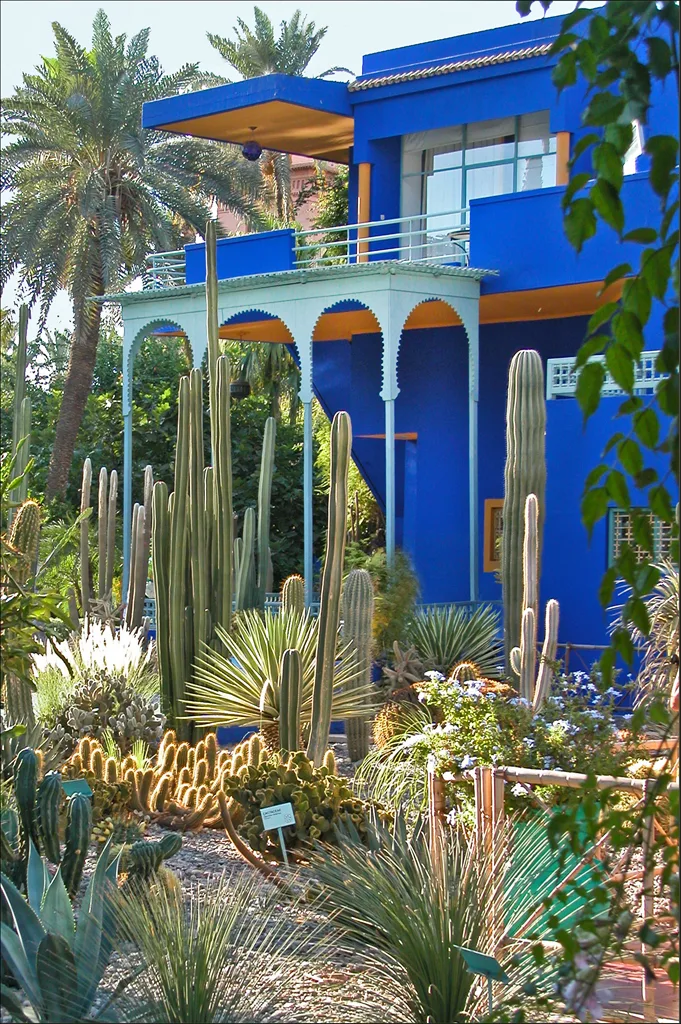
At the composition’s centre stands the building the garden was planted around. In 1931 Majorelle commissioned the architect Paul Sinoir to design him a villa, and Sinoir delivered one of the most distinctive houses of its decade in Morocco: a Cubist composition of flat roofs, clean volumes and a small tower, its modernist bones dressed with Moroccan detail — arched openings, painted wood, the blue rendered over everything like a signature. The ground floor was the painter’s studio, a working room with the north light an artist needs; the living quarters rose above it, looking out over the planting that was growing up to meet the walls. The house was residence, workplace and viewing platform at once, and it still organises the garden exactly as intended: paths converge on it, the fountain court sits before it, and the cactus beds arrange themselves as its foreground.
The villa’s second life is the reason most visitors now go inside it. The studio where Majorelle painted is today the Pierre Bergé Museum of Berber Arts — the Berber Museum, covered in its own section below — and the building also holds a collection of Majorelle’s own paintings, the garden’s maker present in his own house. Stand back on the path and read the facade once more before you go in: what you are looking at is a 1930s Parisian-modern house that has been entirely naturalised by colour, planting and ninety years of Moroccan sun, until the Cubism reads as simply another Marrakech style. That naturalisation was Majorelle’s real subject as an artist — the meeting of his two countries — and the villa is where he stated it most plainly.
Walking the Garden – a Painting You Move Through
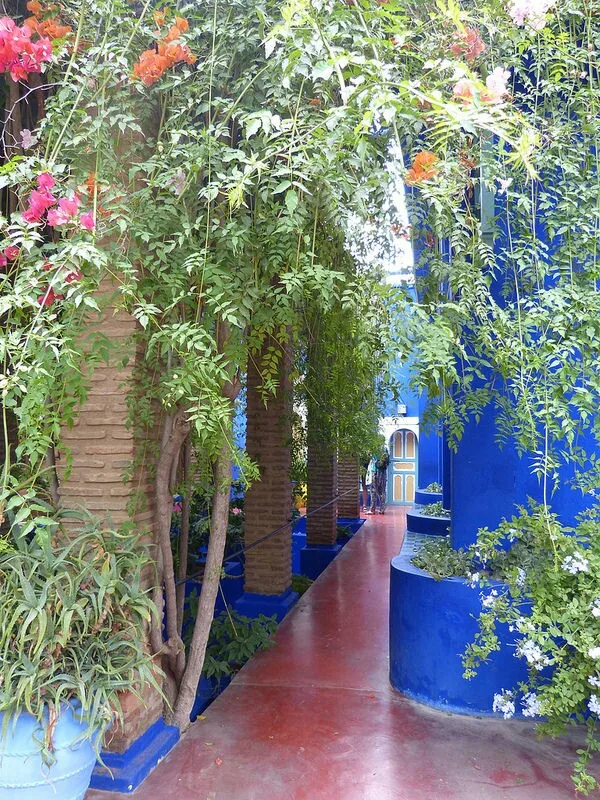
The practical question every visitor asks at the gate — which way round? — has a gentler answer here than at any major sight in Morocco: it hardly matters, because the garden is composed as a set of rooms rather than a route. Majorelle laid it out the way he laid out a canvas. Paths are the drawing, drawn in red-brown gravel and tile; planting is the colour, massed in beds rather than scattered; and each turn of a path frames a view that was plainly arranged to be seen from exactly there — the villa over the cactus beds, the fountain court through an arch of bougainvillea, a blue bench placed where the bamboo light falls. The garden covers only about a hectare, and you can walk its whole perimeter in minutes. The composition only reveals itself if you do the opposite: stop at the framed views, take the rooms one at a time, and let the density accumulate.
That density is the garden’s true scale. Within its small boundary Majorelle packed plants gathered from the world’s dry and warm places — cacti and succulents from the Americas and Africa, palms of many kinds, bamboo, bougainvillea, water lilies — and the mature garden layers them so thickly that the surrounding city disappears: inside the walls there is no traffic noise worth the name, only birdsong, water and the rustle of the bamboo. It helps to know that this effect was expensive and deliberate. A garden composed like a painting must be maintained like one — clipped, replanted, repainted — and the regime that keeps it looking inevitable is the work of the foundation that now runs it. What looks like nature arranging itself is a painting being continuously repainted, in living material, by gardeners.
The Cactus Collection – a Desert Brought Home
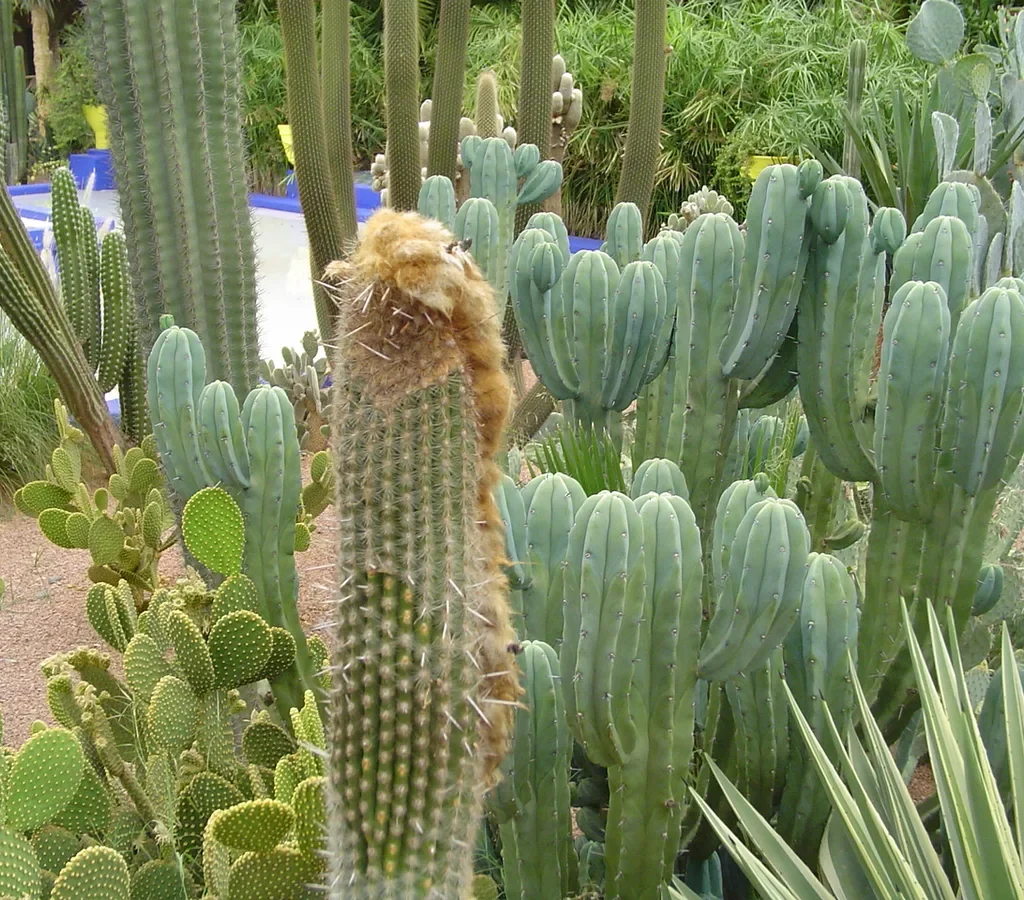
Of all the garden’s rooms, the cactus beds are the one that explains its maker best. Majorelle was a traveller in dry country — his painting expeditions crossed the Moroccan south and the Sahara’s edge — and he gardened the way he travelled: collecting. The cactus collection he assembled is one of the garden’s glories, an important planting of cacti and succulents from the deserts of several continents, set in gravel beds before the villa like a landscape reduced to its sculpture. Columnar cacti rise to the pergola’s height; prickly pears spread their paddles; agaves and aloes make their rosettes at ground level; golden barrels sit in clusters like something cast in brass. Planted in Marrakech’s climate, most of them are not enduring the desert. They are home in one, which is why they grow to sizes their wild cousins rarely reach.
The cacti are also where the garden’s central trick is easiest to see. A cactus is a plant that reads as an object — geometry first, biology second — and Majorelle, a painter of flat pattern, planted them as objects in a still life: silhouettes against the blue wall, spines catching the light, each bed a study in green-grey against cobalt and ochre. It is no accident that the villa’s most photographed view is the one across these beds, or that the cactus garden is the image on half the postcards in the medina. Give the beds their time. They are the driest, strangest and most Majorelle part of the whole composition — the desert he crossed as a young painter, brought home and arranged under his studio window.
Palms, Bamboo and Bougainvillea – the Green Architecture
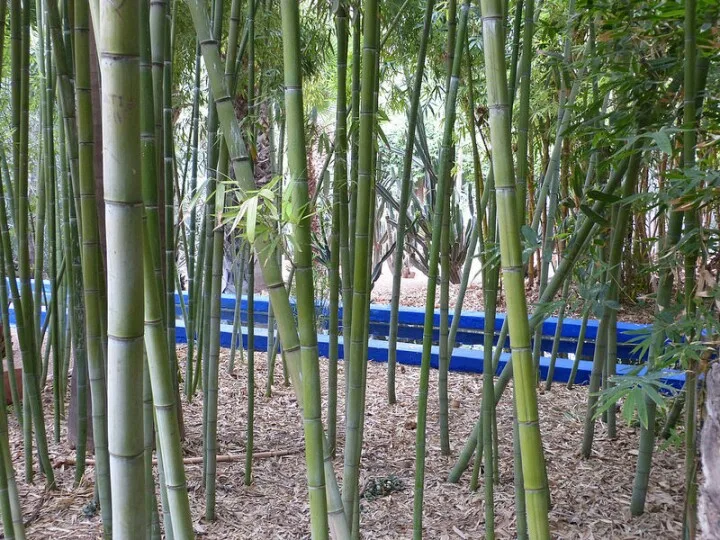
If the cacti are the garden’s sculpture, the palms and bamboo are its architecture — the vertical green structure that divides one room from the next and keeps a single hectare feeling like a world. The plot Majorelle bought in 1923 stood on the border of a palm grove, and palms remain the garden’s canopy: date palms and fan palms overhead, their shade dappling every path, their silhouettes closing the views. Beneath them he planted groves of bamboo, which do a different job — a bamboo stand is a wall that moves, filtering light into stripes, sighing in any breeze, and cooling the air of the paths that pass through it. On a hot Marrakech afternoon the temperature drop inside the bamboo is the garden’s most practical pleasure, and the blue bench placed in the grove’s shade, in the photograph above, is there because the painter understood exactly where a visitor would need to sit.
The third element of the green architecture is the one that supplies the garden’s colour between flowerings of everything else: bougainvillea, trained over pergolas, gateways and the villa’s own walls in magenta, coral and white. Bougainvillea is the Mediterranean garden’s great cheat — months of apparent bloom from a plant that asks little water — and Majorelle used it the way he used his blue, as a fixed note: wherever a view needed a hot colour against the cobalt, a bougainvillea was planted to provide it, permanently. Palms for the roof, bamboo for the walls, bougainvillea for the accents: the system is simple enough to state in a sentence, and the whole art of the garden is in its execution, bed by bed and view by view, over forty years.
Water – the Ponds, the Fountain and the Still Corners
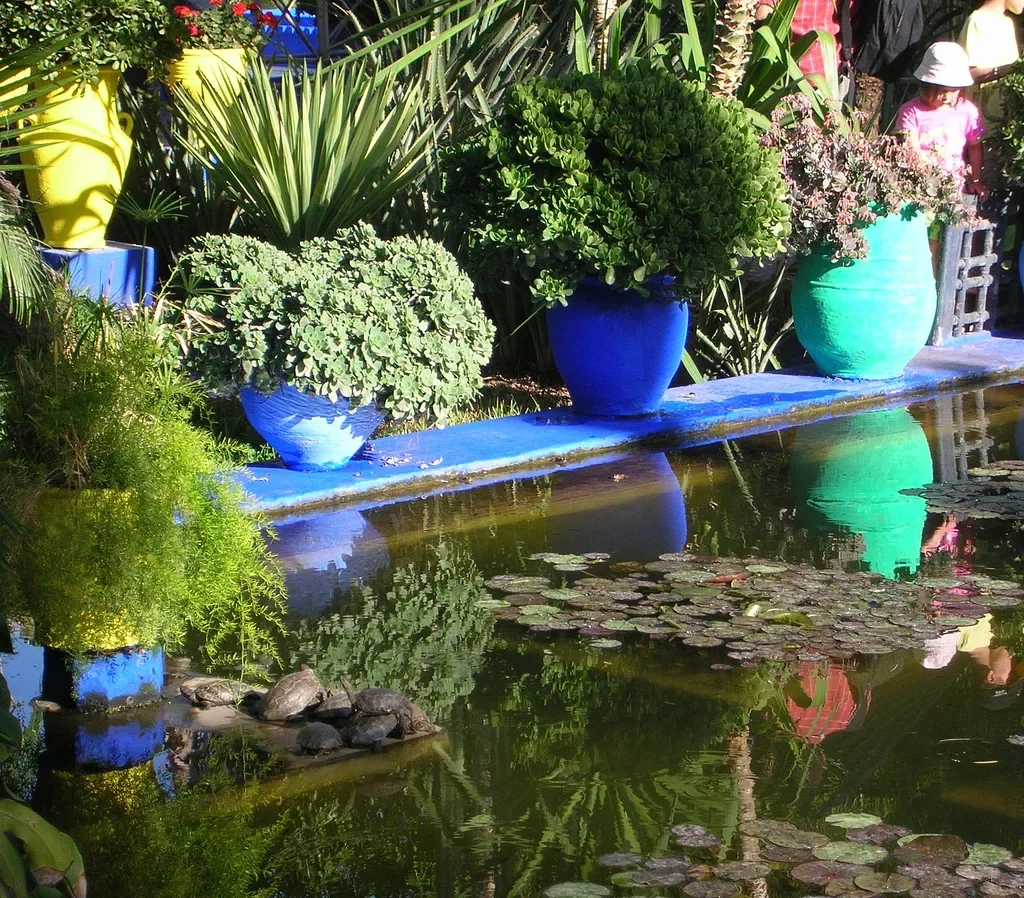
A garden in Marrakech is a machine for managing water, and Majorelle — painting in a city built on hidden channels, in a culture whose gardens had centred on water for a thousand years — made it his composition’s reflective element. The garden’s water is quiet water: a fountain court before the villa, where a blue basin and a small jet give the building its forecourt; channels and rills that carry the sound of moving water along the paths; and the lily pond, where water lilies spread over still water and the painted pots along its edge — blue, turquoise, yellow — are doubled by reflection into the garden’s calmest picture. Nothing here roars or cascades. In a dry city, water’s luxury is its presence and its sound, and the garden spends both carefully.
The ponds do biological work as well as pictorial. The garden is a small, dense, irrigated world in the middle of a dry city, and it behaves like one: birds come to the water and the planting — the garden hosts a notable population of birds, including species endemic to North Africa — and the shaded, watered corners hold the coolest air on the site. For the visitor, the water features are the garden’s punctuation: the fountain court is its opening statement, the pond its quiet paragraph, and the benches near both are where the unhurried hour this guide recommends actually gets spent. Sit by the lily pond at the day’s quiet end, with the pots doubled in the water and the bamboo sighing behind you, and the city’s most visited garden briefly becomes what its painter built it to be — a private one.
Decline and Rescue – the Garden Saint Laurent Saved
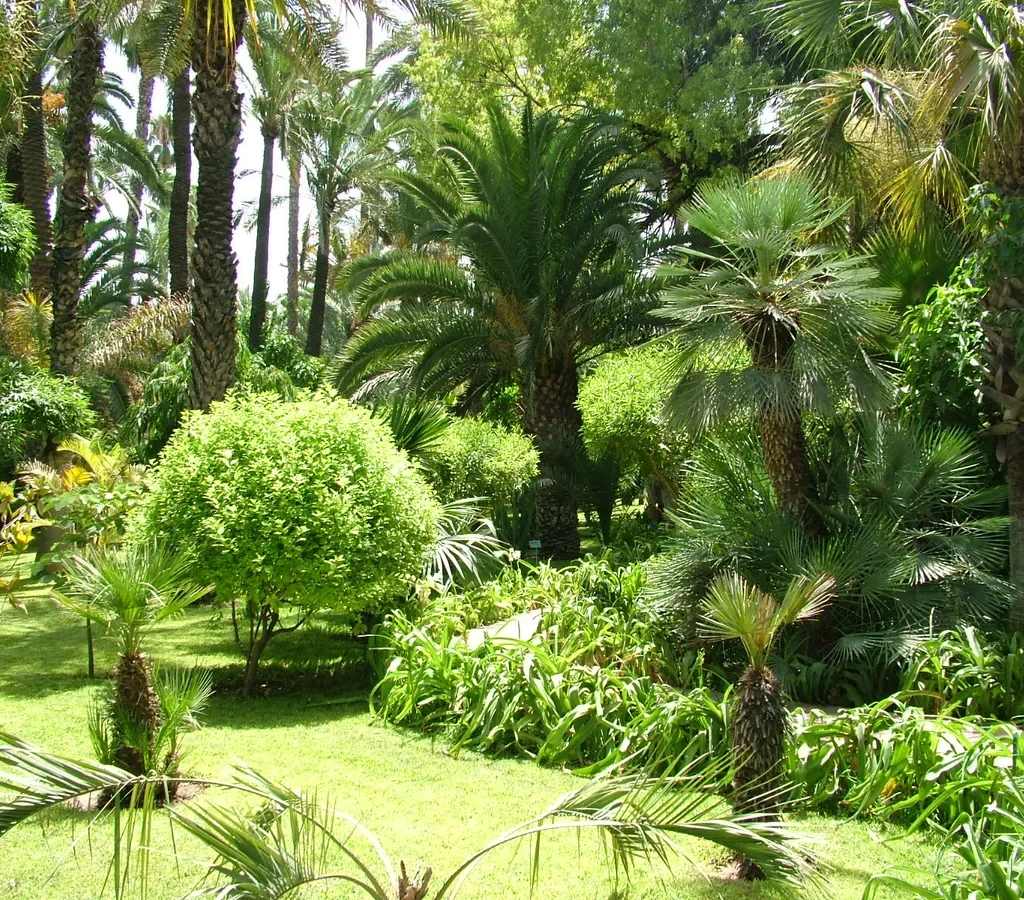
The garden very nearly did not survive its maker. It had always run at a loss: in 1947, with maintenance outrunning his income, Majorelle opened it to the public with an admission fee designed to defray the cost, and in lean years he sold off parcels of the land to fund the rest. Then, in the 1950s, his marriage ended in divorce and he was forced to sell the house and the land itself. Majorelle died in 1962, and the garden — an artwork whose medium was living plants and whose upkeep was a small fortune — passed into the neglect that kills gardens faster than any ruin: unwatered beds, unclipped growth, a villa sliding towards dereliction on a plot that developers, in a booming modern district, valued for everything except what grew on it.
The rescue is the second most famous story in Marrakech. Yves Saint Laurent and Pierre Bergé had discovered the city — and the garden — in 1966, on the first of the visits that made Marrakech their second home and one of Saint Laurent’s great sources of colour. In 1980, learning that the property was threatened with development, they bought it: the garden, the villa, and the house next door that became their Marrakech home, the Villa Oasis. Then they did the slow thing. The garden was restored plant by plant to Majorelle’s composition, the villa repaired, the studio kept as the painter’s shrine, and the whole property maintained at a standard its own inventor could rarely afford. Since 2010 the property has been owned by the Foundation Pierre Bergé – Yves Saint Laurent, and since 2011 it has been managed by the Fondation Jardin Majorelle, a Moroccan non-profit — the garden’s future now funded by its own visitors, which is the 1947 idea finally made to work. Every ticket bought at that official site is, among other things, the maintenance budget of the painting.
The Berber Museum – the Studio’s Second Life
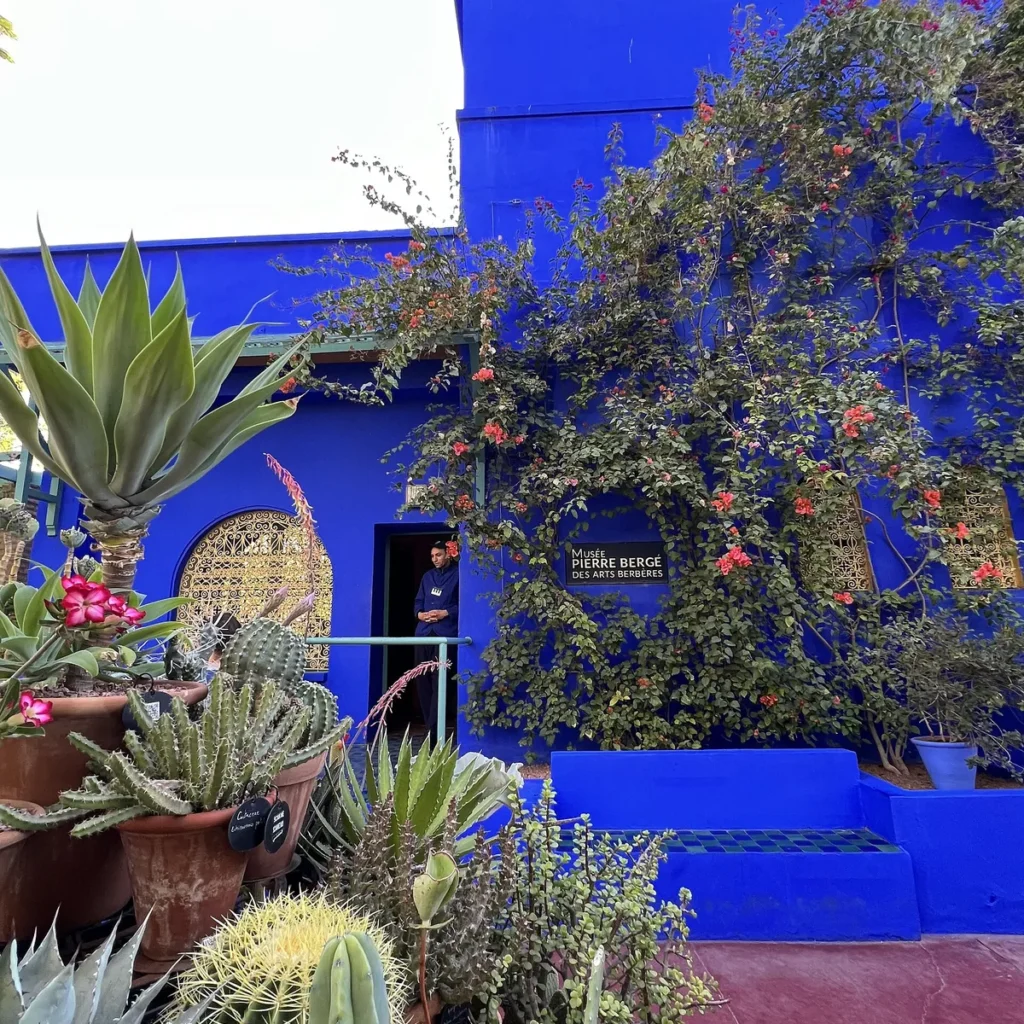
Go into the villa. The room where Majorelle painted — the ground-floor studio, the creative engine of the whole property — is today the Pierre Bergé Museum of Berber Arts, inaugurated in 2011 under the patronage of King Mohammed VI, and it is the most quietly serious museum in Marrakech. Its subject is the material culture of the Amazigh peoples, the Berbers: the Indigenous people of North Africa, whose crafts the souks sell in fragments and whose whole world is assembled here. The collection numbers more than six hundred objects, gathered over decades by Bergé and Saint Laurent themselves, from the Rif Mountains in the north to the Sahara in the south — the two collectors buying, as Bergé put it, out of a fascination that began with their arrival in Marrakech in 1966 and never left them.
The museum is arranged as an argument in four themed spaces, introduced by an overview of Amazigh history and a map of the major tribes across Morocco. What fills the rooms is the portable wealth of a mountain and desert culture: silver jewellery and fibulae, bridal ornaments and enamel work; woven carpets and tent bands in the geometric language Majorelle’s paintings borrowed; carved wooden doors and locks; leatherwork, pottery, weapons, tools and full regional costume, displayed with the lighting and restraint of a Paris gallery. The connection to the garden outside is the point of the building. The painter spent forty years painting these people’s world and planting their colours; the collectors who saved his garden spent the same decades gathering that world’s objects, and put them in his studio. Photography is not permitted inside, which keeps the small rooms dark, quiet and uncrowded in feeling even on a busy day. Give it the half hour to an hour it asks for. Visitors who skip it have seen the garden’s frame and missed half its picture.
The Memorials – Saint Laurent Among the Plants
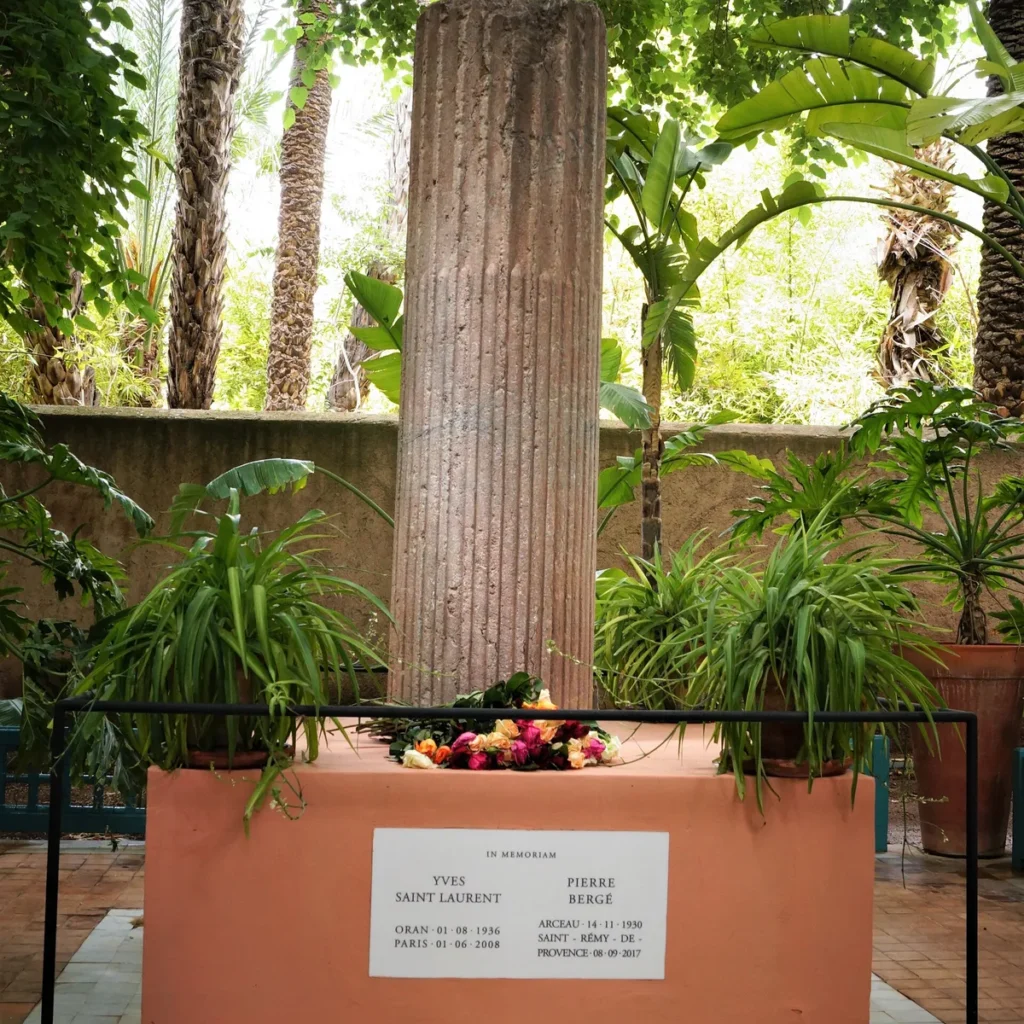
In a quiet corner of the planting stands the garden’s one formal monument, and it is deliberately plain: a Roman column, brought from Tangier, raised on a simple plinth. It is the memorial to Yves Saint Laurent, who died in 2008; his ashes were scattered in the garden he had saved, among the plants he had spent twenty-eight years tending, and the column marks the spot with the restraint of a man who designed by subtraction. Visitors leave small tributes; the gardeners keep it swept; and the whole arrangement — ancient stone, exotic planting, a French couturier’s name — states the garden’s layered identity more economically than any plaque could. Saint Laurent said that Marrakech taught him colour. The memorial is where the city keeps his side of that bargain.
Pierre Bergé, the rescuer who outlived his partner by nine years and ran the garden’s foundation until his own death in September 2017, is commemorated differently — by the institution rather than a monument. His name is on the Berber Museum, the Pierre Bergé Museum of Berber Arts, which was his creation and his collection as much as anyone’s, and the foundation structure he built is what now owns and manages the garden outright. Between the column in the greenery and the name over the studio door, the two men are filed exactly where each would have expected: the artist among the plants, the organiser in the institution. Take five minutes at the memorial before you leave the garden. It is the visit’s natural full stop — the corner is kept as the garden’s quietest, the planting closing around the plinth, the paths slowing as they pass, so that even at the day’s busiest the column stands in something like the privacy its designer guarded all his life.
Next Door – the Yves Saint Laurent Museum
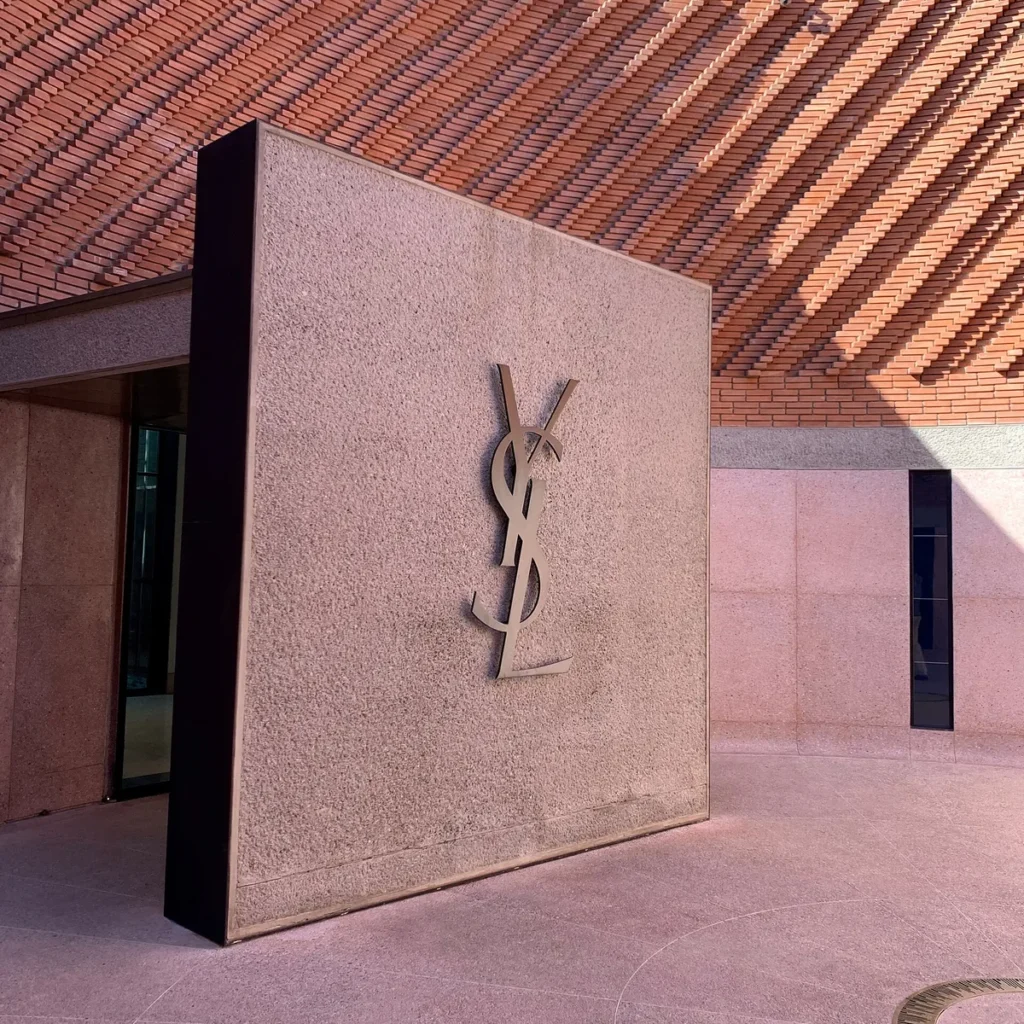
The garden stands on the Rue Yves Saint Laurent — the street itself renamed for the designer — and a few steps along it, since October 2017, stands the building that completes the story: the Musée Yves Saint Laurent Marrakech, designed by the French studio Studio KO. It is a separate museum with a separate ticket, and this guide treats it as what it is — a neighbour, not a part of the garden — but it is a neighbour most garden visitors will want to meet. The building itself is the first exhibit: a composition in terracotta brick, its facades woven like fabric in patterns that quote both Moroccan brickwork and the warp and weft of cloth, wrapped around a smooth, couture-lined interior. Outside, desert planting and the famous monogram at the entrance; inside, the work.
The museum’s permanent display draws on the foundation’s vast archive of Saint Laurent’s designs — the garments, accessories, sketches and photographs of a fifty-year career — and stages them in a dark, theatrical gallery that feels like the inside of a jewel box, with temporary exhibitions, a library, a bookshop and a café completing the building. Go if fashion is a language you speak; the collection is the real thing, chosen from the house’s own holdings, and Marrakech’s place in the designer’s imagination — the colours of this very garden, translated into silk — is its organising idea. If fashion is not your language, the garden plus its Berber Museum is a complete visit without it, and no honesty is served by pretending otherwise. Either way, the practical rule is the same as the garden’s: the museum’s tickets are sold through the same official ticket office, so both can be booked in one sitting, for timed slots that follow one another.
How to Visit – Book Ahead, Arrive Early, Go Slow
There is exactly one way to buy a ticket to this garden, and knowing it is worth more than any other practical fact in this article. Tickets are sold online only, through the garden’s own ticket office at tickets.jardinmajorelle.com, for a specific date and a specific entry time slot; the foundation states plainly that this is the only authorised seller, that a valid ticket carries its QR code, and that tickets bought on unauthorised websites will not be accepted at the gate. There is no ticket desk to fall back on. The same official office sells the garden, the Berber Museum and the Yves Saint Laurent Museum, so a combined day can be booked in one transaction, with slots arranged in sequence — and the garden’s official site, jardinmajorelle.com, is the only source this guide trusts for the current prices and hours, which is why neither is printed here.
With the mechanism fixed, the strategy is short. Book several days ahead in the busy seasons — slots at the day’s edges go first — and choose the earliest slot you will genuinely keep, because the garden’s first hour is a different place from its midday: the paths are passable, the cactus beds are empty of everyone but gardeners, and the blue photographs the way it looks in this article. Arriving later is not a failure; the garden is beautiful at every hour it opens, and the timed system caps the crush at something survivable. But the difference between the first slot and the busiest is the difference between a painting and a queue, and it costs nothing to choose the painting. Once inside, move slowly, sit on the benches, and let the timed slot do the opposite of hurrying you: everyone around you arrived by appointment too. The garden’s café and boutique sit inside the walls for afterwards, and the private garden of the Villa Oasis — Saint Laurent and Bergé’s own home garden, the third site on the official ticket office — is the connoisseur’s add-on, quieter than everything else on this page.
Pairing the Garden – the Medina Half of the Day
The garden sits in Guéliz, the modern town the French built beside the old city, and the walk or short taxi ride between the two is the seam of a Marrakech day: a 20th-century artist’s garden in the morning, a 12th-century city in the afternoon. The medina it faces was founded in 1070–1072 and inscribed by UNESCO in 1985 — some 700 hectares of living old town whose monuments, from the Koutoubia to the Bahia, are catalogued on UNESCO’s Medina of Marrakesh page. The two halves explain each other. The garden’s blue came out of the medina’s tiles and burnouses; its painter spent his career on the medina’s souks and crowds; and the Berber Museum’s objects are the originals of everything the souks will try to sell you afterwards. Garden first, medina second is not just a schedule. It is the order in which the material makes sense.
Where does the garden sit in a whole Moroccan journey? On most classic routes it belongs to the Marrakech days at the start — our morocco itinerary gives it the second morning, booked ahead and taken early, before the road days over the Atlas begin. That placement is deliberate: the garden is the gentlest possible second act after a first evening on Jemaa el-Fnaa, its quiet rooms resetting the traveller before the souks, the palaces and the long drive east. If Marrakech is your journey’s end rather than its start, the logic inverts and the garden becomes the decompression at the finish — the same hectare of blue and green, read with a week’s worth of Morocco behind you. Either way, book it before you fly. It is the one appointment in Marrakech that cannot be improvised — and the contrast is itself instructive: allow the two halves of the city their own pace, the garden by appointment and the medina by drift, because they were built for opposite kinds of attention and each is diminished by the other’s.
Frequently Asked Questions
Six questions decide most visits to this garden.
Do you have to book Jardin Majorelle tickets in advance?
Yes, in practice — and officially there is no other way. Tickets are sold online only, through the garden’s own ticket office, for a chosen date and entry time slot, and the foundation accepts no responsibility for tickets bought elsewhere, which will not be honoured at the gate. In the busy seasons the good slots — early in the day — sell out in advance, so book several days ahead rather than the night before. The same office sells the Berber Museum and the Yves Saint Laurent Museum, so the whole visit can be arranged in one booking.
How long do you need at the Jardin Majorelle?
The garden alone takes an unhurried hour — it is a single hectare, and its pleasure is density rather than distance. Add half an hour to an hour for the Berber Museum inside the villa, and another hour if you are also visiting the Yves Saint Laurent Museum next door. A garden-plus-Berber-Museum visit of about two hours is the shape most travellers settle on, and it is the shape this guide recommends: long enough to sit by the pond, short enough to leave the medina its afternoon.
Is the Berber Museum included, and is it worth it?
The Berber Museum stands inside the garden, in Majorelle’s own studio, and its tickets are sold through the same official office, on its own or in combination with the garden — the current combinations are on that site, and only there. Is it worth it? Emphatically, yes: more than six hundred Amazigh objects — jewellery, costume, carpets, carved doors — collected by Bergé and Saint Laurent themselves, in the room where the garden’s painter worked. It is the cultural explanation of everything the garden and the souks show you, and the visitors who skip it are the ones this guide most disagrees with.
What is the best time of day to visit?
The earliest entry slot you can keep. The timed system limits numbers all day, but the first hour has the emptiest paths, the softest light on the blue, and the cactus beds to yourself; by midday the garden is at its fullest and its most photographed-against. Late slots are the second-best choice, as the day’s crowds thin. Whichever you book, do not build the visit around a rigid hour inside: the garden rewards sitting still more than it rewards coverage.
Can you take photographs in the garden and the museums?
In the garden, yes — it is one of the most photographed places in Morocco, and the paths are full of people doing exactly that, though a little patience at the famous views is part of the etiquette. Inside the Berber Museum, no: photography is not permitted, which protects both the objects and the rooms’ quiet. The Yves Saint Laurent Museum applies its own rules in its galleries; check the signs on the day. Nowhere in the complex is a tripod or a commercial shoot a casual matter — ask first if your intentions go beyond the holiday snapshot.
Is the Yves Saint Laurent Museum part of the garden?
No — it is a separate museum, in its own building a few steps along the same street, with a separate ticket, and this guide lists it as a neighbour rather than a component. The garden, the Berber Museum inside the villa, and the Villa Oasis garden are the foundation’s sites within and beside the walls; the fashion museum stands on its own. That said, the two visits are made for each other, the same official office sells both, and timed slots can be booked to follow one another — garden in the first hour, couture after — which is the combination this guide would choose on a fashion-interested day.
The Short Version
Book ahead, go early, go slow. The Jardin Majorelle is a painter’s composition that happens to be planted — Majorelle Blue patented and spread over a Cubist villa, cacti arranged as sculpture, bamboo and bougainvillea for architecture, still ponds for reflection — rescued from developers in 1980 by Yves Saint Laurent and Pierre Bergé, and now kept by the foundation their rescue built. Walk the rooms of it in any order, sit by the lily pond, and then go inside the villa: the Berber Museum, in the painter’s own studio, holds six hundred Amazigh objects that explain both the garden and the souks. Stop at Saint Laurent’s memorial among the palms, and add the fashion museum next door if couture speaks to you. One hectare, two hours, booked online for the day’s first slot — that is the whole secret of Marrakech’s most loved garden, and it is enough.