Morocco defeats the usual list format because it is not one country to tick off but several countries laid on top of each other. A traveller who starts in Tangier, where Europe feels close enough to touch across the strait, and ends a fortnight later watching the sun drop behind the dunes at Merzouga has crossed a Rif mountain town painted blue, two imperial capitals built centuries apart, a Roman city left standing in open farmland, an Atlantic coast of fishing ports and surf beaches, a red city that never quite sleeps, and a mountain range that decides, by season, whether the road south is even open. No ranking of those places by “best” survives contact with a real itinerary, because the question is never which place is best in the abstract. It is which places belong on the trip you actually have, in an order the roads allow.
So this list of the best places to visit in morocco is arranged the way a first trip actually moves: down from the north, through the imperial cities, along the Atlantic coast, inland to Marrakech, over the Atlas, and east through the valleys to the Sahara. Each stop gets the same honest treatment — why it earns its place, how long to give it, and the caveat that the brochures leave out. The list is built for a traveller choosing between destinations, which is why every entry also says what it is best for and what it costs in days, and why the closing sections say plainly which stops to drop first when the calendar shrinks. Morocco’s World Heritage listings run through the whole route — the medinas of Fes and Marrakech, the ksar of Ait Benhaddou, the Roman city of Volubilis, the historic towns of Meknes and Essaouira, and the modern capital of Rabat are all inscribed by UNESCO, whose Morocco country page is the reliable starting point for checking what is listed and why.
What makes the order matter is geography with consequences. The north is green, mountainous and comparatively cool; the Atlantic coast is moderated by ocean wind; Marrakech and the south are hot, dry and intense; the High Atlas stands between the coast and the desert like a wall with a few passes through it; and the Sahara, at the far end of the route, is a different climate, landscape and pace altogether. A trip that respects that sequence — cool north first, coast second, heat and desert last — feels like a story with rising stakes. A trip that flies into Marrakech, dashes to the desert, doubles back to Fes and then squeezes in the coast spends its days retracing its own steps. The route below is the antidote to that, and the comparisons inside it are the point: Chefchaouen against Fes, Rabat against Casablanca, Essaouira against Agadir, and the three valley-and-desert stops against each other, so that a reader with ten days and a reader with three weeks can both use the same list and reach different, defensible answers.
At a Glance
Short on time? Here is the whole list on one screen — the fifteen stops in the order the route reaches them, what each one is best for, and the honest minimum time each needs to be more than a photograph. The sections below supply the reasoning, the detail and the caveats behind every line of it.
| # | Place | Best for | Time to give it |
|---|---|---|---|
| 1 | Tangier | Arrival, Strait views, literary ghosts | 1 day, or 1 night |
| 2 | Chefchaouen | The blue town, mountain calm | 1–2 nights |
| 3 | Fes | The great medina, crafts, history | 2 nights |
| 4 | Meknes | Imperial grandeur without the crowds | 1 day, or 1 night |
| 5 | Volubilis | Rome in open countryside | Half a day, from Meknes or Fes |
| 6 | Rabat | The calm capital, Atlantic light | 1 day, or 1 night |
| 7 | Casablanca | The mosque, the modern city | Half a day to 1 day |
| 8 | Essaouira | Wind, seafood, an easy medina | 1–2 nights |
| 9 | Agadir | Beach resort, surf, a soft landing | 1–2 nights, or skip for Essaouira |
| 10 | Marrakech | Intensity, souks, the great square | 2–3 nights |
| 11 | Atlas Mountains | Walking, Berber villages, air | 1–3 days, from Marrakech |
| 12 | Ouarzazate and Ait Benhaddou | The ksar, the film-town gateway | 1 night |
| 13 | Dades Valley | The road of a thousand kasbahs | Half a day, passing through |
| 14 | Todra Gorge | The great cleft, a morning walk | Half a day, passing through |
| 15 | Merzouga and the Sahara | Dunes, silence, the journey’s end | 1–2 nights |
Two patterns in that table are worth noticing before you set out. First, the nights cluster in the middle of the route — Fes, Essaouira and Marrakech carry the trip, because that is where Morocco’s density of things to see, eat and wander sits. Second, only the last three stops are truly linear: once you cross the Atlas towards Ouarzazate, the route narrows to a single road east through the valleys to the desert, and there is no sensible shortcut back. Everything before Marrakech can be rearranged around flights, weather and energy; the desert leg cannot, and that single constraint quietly shapes the whole route.
The 15 Places, in Route Order
A word on how to read the list. Every stop gets the same treatment: why it earns its place on a first trip, how long to give it, and the honest caveat — the wind that never stops, the medina that exhausts, the season that closes a pass — that the brochures leave out. The time budgets are minimums for experiencing a place rather than photographing it, and they assume ordinary travel friction: a slow breakfast, a wrong turn, a walk that runs long because the light is good. Treat them as floors, not targets.
If a stop’s budget does not fit the days you have, the fix is to drop a stop, not to shave every stop down until none of them works. Morocco punishes the half-day version of itself — Fes in three hours is a maze with no centre, Marrakech as a photo stop is a square without a city — and rewards the traveller who sees fewer places properly. The budgets also assume you sleep where the day ends: the nights are part of each stop, not an afterthought bolted onto it. Where a stop is most often rushed — Volubilis and Meknes above all — the entry below says so in terms.
The order is the route a first trip actually travels, and it follows the country’s own logic: south from the Strait through the Rif to the imperial north, down the Atlantic coast, inland to Marrakech, over the Atlas to the desert road, and east to the dunes. The desert comes last not because it matters least — for many travellers it is the single most memorable night of the trip — but because it sits at the end of the longest road, and a trip is sturdier when its most remote nights are not the first thing that can go wrong.
1. Tangier
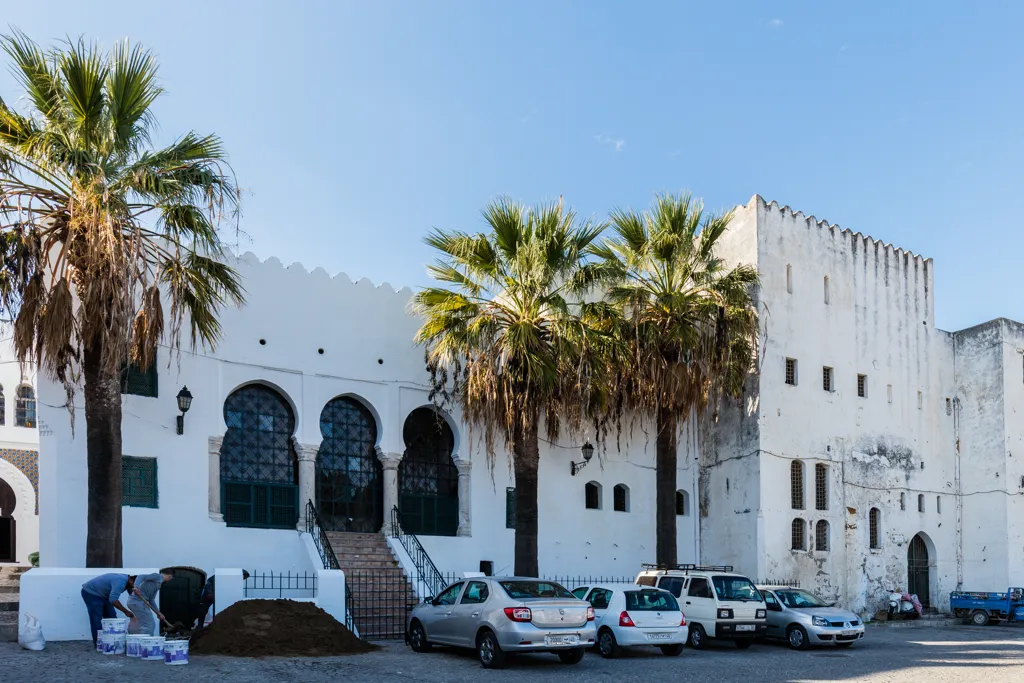
Tangier earns its place at the head of this list because it is where Morocco first explains itself. The city sits on the Strait of Gibraltar, with Spain visible across the water on a clear day, and it has spent centuries as a meeting point — Phoenician, Roman, Portuguese, Spanish, international-zone, Moroccan — without ever quite belonging to any single one of those stories. That layered, slightly restless character is still the city’s atmosphere: a whitewashed kasbah above a working port, a medina that is busy without being overwhelming, and a seafront promenade where the Atlantic and the Mediterranean effectively shake hands. Travellers who arrive by ferry from Spain meet Morocco here at its most cosmopolitan, and travellers who fly in elsewhere often wish, afterwards, that they had started here, because Tangier gives the rest of the country a northern frame that the imperial cities alone do not supply.
The pleasures of Tangier are atmospheric rather than monumental, and that is worth knowing before you arrive. The kasbah quarter, with its palace museum and its lanes dropping towards the sea, rewards slow wandering in a way that a checklist does not capture; the Grand Socco, the great market square at the foot of the medina, is where the old city and the new city negotiate with each other in real time; and the Cafe Hafa, perched on the cliff steps above the strait, has been the city’s open-air sitting room for generations of writers, musicians and ordinary Tangier residents watching the ferries come and go. Beyond the city, the Caves of Hercules and the headland at Cap Spartel, where the Atlantic meets the Mediterranean, make the classic half-day excursion — not because either sight is the finest in Morocco, but because standing at the meeting of two seas is the right prologue to a country defined by meetings. Tangier’s literary ghosts — the writers who lived, drank and wrote here in the twentieth century — are part of the texture too, but they are seasoning, not the meal: the city stands on its views, its light and its position.
Give it: one day, or one night if you arrive by ferry and want the city at dusk.
The honest caveat: Tangier is an arrival city and a mood, not a greatest-hits stop — travellers who give it three days usually short-change Fes or Marrakech. And its port area is a working port, not a postcard: judge the city from the kasbah and the cliff cafes, not from the ferry terminal.
2. Chefchaouen
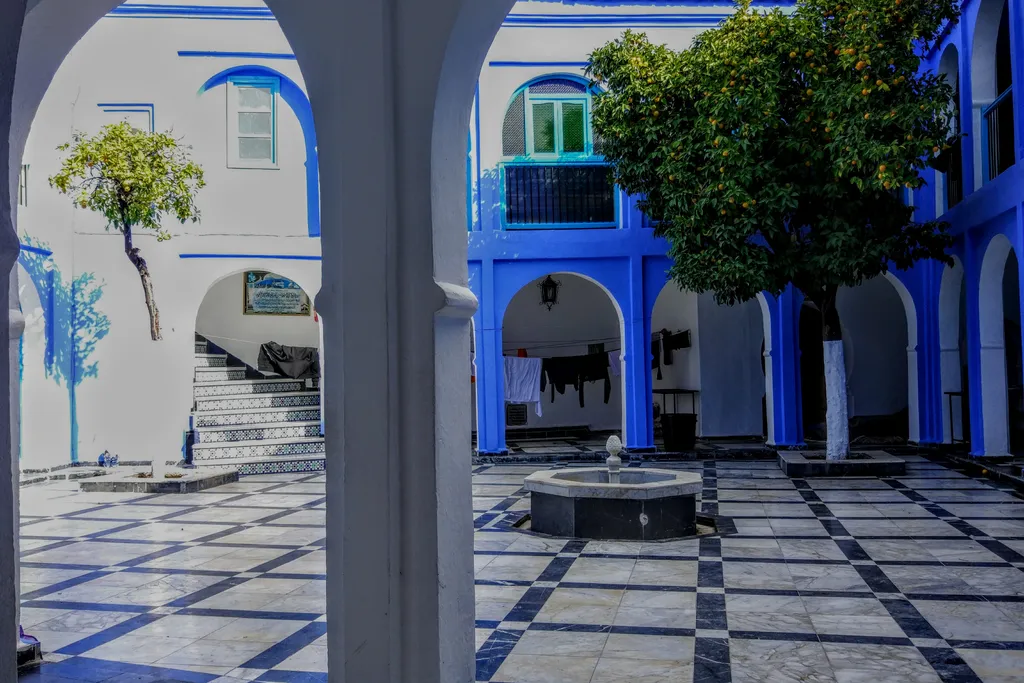
Chefchaouen is the most photographed town in Morocco and, unusually, the photographs are not lying. Set in the Rif Mountains south of Tangier, its old town is washed in shades of blue — walls, doors, steps, plant pots — that turn an ordinary walk into something close to wandering inside a painting. The colour has explanations, several of them, involving Andalusi refugees, Jewish traditions and later custom, and guides will offer you a confident version of each; the honest position is that the blue is now a living tradition maintained by the town itself, whatever its first cause. What matters for a traveller is the effect: Chefchaouen is calm where Fes is intense, small where Marrakech is sprawling, and cool where the lowland cities are hot, and that contrast is exactly why it belongs on a first trip rather than as a detour for photographers alone.
The town repays more than a photo walk, and the second day is where it earns its keep. The main square, Plaza Uta el-Hammam, with its kasbah and its cafes, is the social centre; the lanes above it grow quieter and bluer as they climb, and the best views are from the Spanish Mosque on the hill to the east, reached by a path that is the town’s classic evening walk. The Rif foothills around Chefchaouen offer waterfalls and valley walks for travellers who want a day outside the lanes, and the town’s weaving and craft workshops — blankets and textiles in particular — are worth more attention than the souvenir stalls at the square’s edge. Chefchaouen also works as a decompression chamber in the route: after Tangier’s port energy and before Fes’s medina intensity, a night or two in the blue town lets a trip breathe, and travellers who skip it often find their itinerary has no quiet centre at all.
Give it: one to two nights. One night gives you the lanes and the sunset walk; two give you the town at a pace that matches it.
The honest caveat: Chefchaouen is small and its fame is concentrated — the most photographed lanes are crowded in the middle of the day, and the town has far fewer major sights than Fes or Marrakech. Come for atmosphere and mountain air, not for a museum count, and walk early or late for the lanes to yourself.
3. Fes
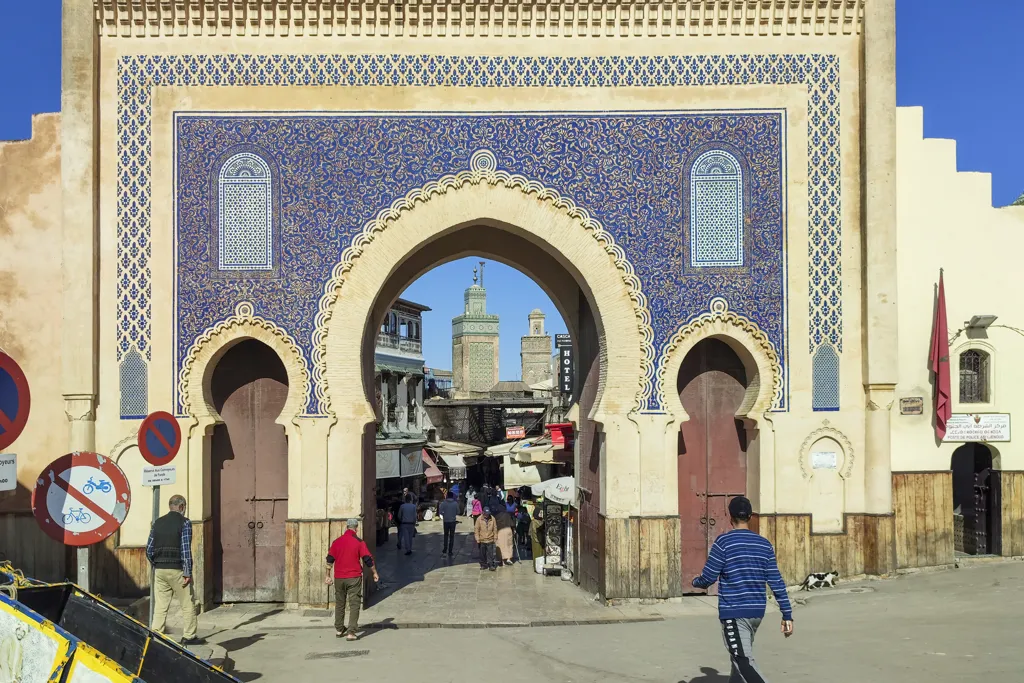
Fes is the stop that most rewards a first trip and most punishes a rushed one. Its old city, Fes el-Bali, is a UNESCO-listed medina that has been continuously inhabited for well over a thousand years, and it remains a working city rather than a museum district: tanners, dyers, metalworkers, bakers and booksellers ply trades in the same lanes where their predecessors did, and the University of al-Qarawiyyin, founded in the ninth century, still stands at its heart. To enter through the blue-tiled Bab Bou Jeloud gate is to step into a place that runs on its own logic — lanes narrow to shoulders, donkeys carry goods where no vehicle can pass, and the sound of the city is craft, bargaining and prayer rather than traffic. For travellers who want Morocco at its most historically dense, there is no substitute, and no other stop on this list teaches as much about how a Moroccan city actually works.
The medina needs a strategy, and the strategy is simple: take a guide for the first morning, then wander alone. A good guide decodes what an unguided walk cannot — the madrasas with their carved cedar and tilework, the Nejjarine fountain and foundouk, the tanneries viewed from the leather shops’ terraces, the difference between a working workshop and a shop dressed as one — and after that orientation, the lanes become navigable rather than merely overwhelming. Outside the old medina, Fes el-Jdid, the newer old city, holds the royal palace gates and the former Jewish quarter, the Mellah, with its own character and its cemetery on the hillside; and the Borj Nord and the Merenid tombs above the city give the panorama that puts the whole dense, brown-roofed expanse in perspective. Fes is also the best city in Morocco for buying craft with provenance — leather, ceramics, brass and textiles made in the workshops you can watch — provided you treat bargaining as conversation rather than combat and buy what you understand.
Give it: two nights. One full day for the medina with a guide, and a second for the medina alone, the Mellah and the viewpoints.
The honest caveat: Fes el-Bali is genuinely disorienting, steep in places, and exhausting in heat — it is not a city to “do” in a morning. Travellers who try leave with photographs of a gate and no sense of the place at all. Also, the tanneries smell exactly as tanneries have always smelled; the terraces that overlook them are worth it anyway.
4. Meknes
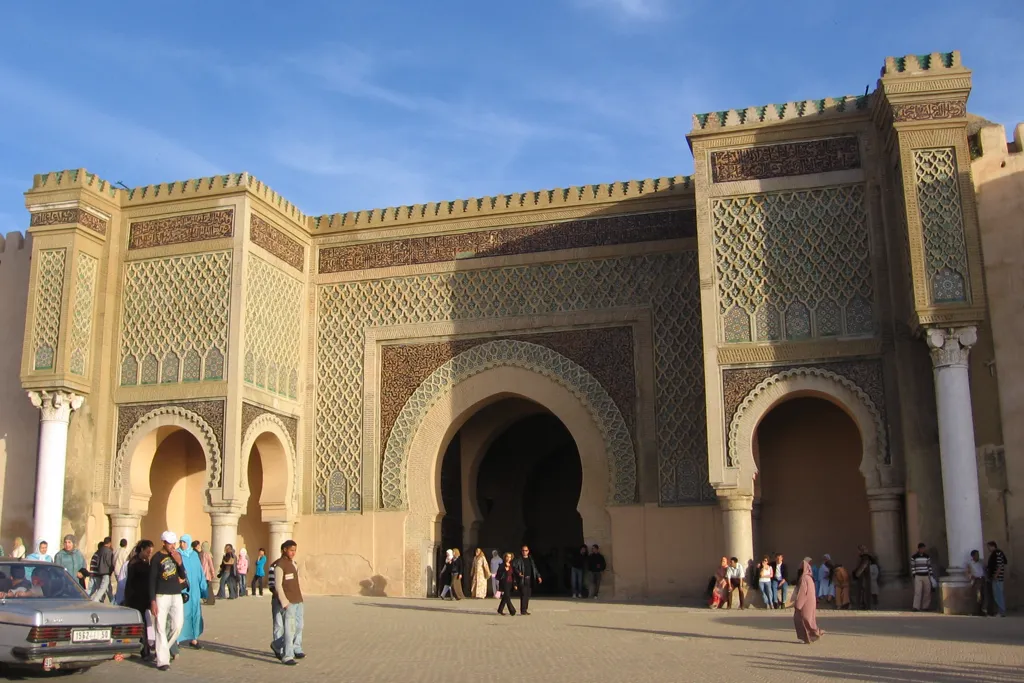
Meknes is the imperial city that the lists underrate, and underrating it is precisely its charm. Built up as the capital of Sultan Moulay Ismail in the late seventeenth and early eighteenth centuries, it was designed to impress on a monumental scale — vast granaries, enormous stables, a city wall with great gates — and much of that ambition is still standing, in a city that has never acquired the tourist pressure of Fes or Marrakech. The result is an imperial capital you can walk in relative calm: the great Bab Mansour gate, with its green tilework and marble columns, is one of the finest gates in North Africa and can be admired without a crowd; the medina behind it is compact, workable and genuinely local; and the whole city has the feeling of a place that was built for power and then quietly got on with being a provincial capital. For travellers comparing imperial cities, Meknes is the control in the experiment — the same history, a fraction of the fuss.
The sights reward a day taken at walking pace rather than a whistle-stop. Bab Mansour itself deserves unhurried looking, because its tilework and proportions repay it; the Place el-Hedim, the square before the gate, is Meknes’s social stage, with cafes on one side and the medina on the other; and the vast Heri es-Souani granaries and stables, built to provision the sultan’s horses and household on a scale that still startles, give the clearest sense of what imperial ambition meant in material terms. The Mausoleum of Moulay Ismail, serene and richly decorated, is the city’s spiritual centre and its most visited interior, and the medina’s souks — smaller and less aggressive than Fes’s — are a good place to buy without the full medina ordeal. Meknes also pairs naturally with Volubilis, the next stop, which is why the two are often done as a single day from Fes; but Meknes deserves a night of its own if the itinerary allows, because the city at evening, when the square fills and the gate is lit, is a different place from the city at noon.
Give it: one day, or one night if you want the evening square and an unhurried Volubilis morning.
The honest caveat: Meknes is quieter than its imperial siblings, and travellers chasing spectacle sometimes call it sleepy. That is a category error: Meknes is not a lesser Marrakech, it is a different kind of imperial city, and it should be judged on its gates, its granaries and its calm, not on its nightlife.
5. Volubilis
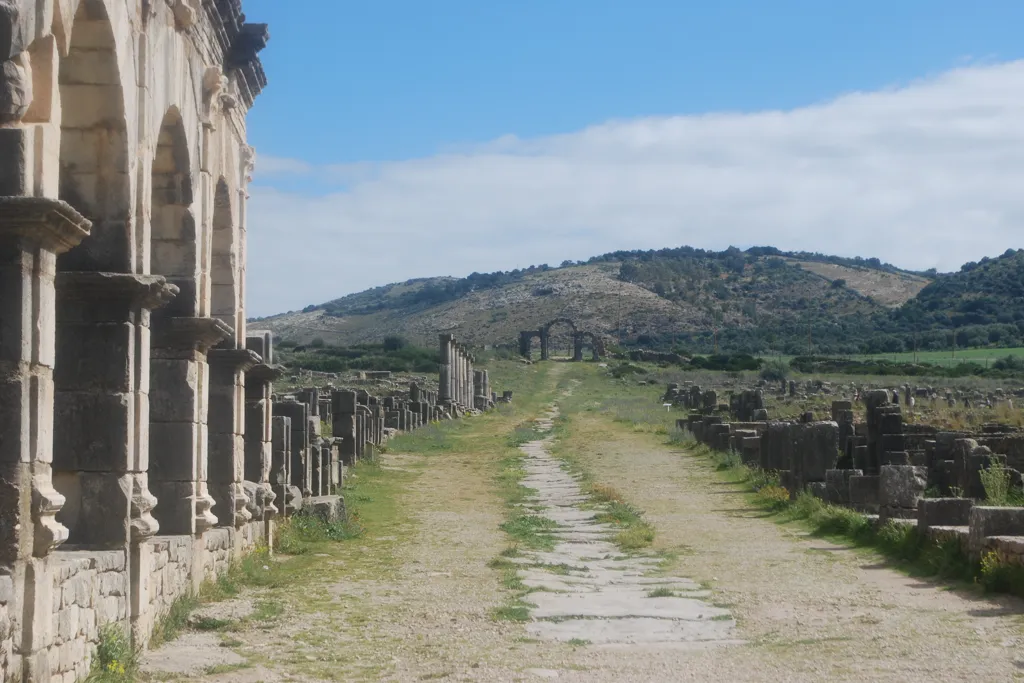
Volubilis is the most surprising stop on this list, because nothing in the Moroccan imagination prepares you for a Roman city standing in open farmland. Founded before the Roman period and developed under Rome as the capital of Mauretania Tingitana, it is now a UNESCO-listed archaeological site of streets, triumphal arch, basilica, capitol and houses whose mosaic floors — hunting scenes, mythological figures, geometric patterns — still lie where they were laid. The setting is half the experience: unlike a museum, Volubilis is walked in the open air, with olive groves and wheat fields around the ruins and the hills of the Zerhoun massif behind, so that the city feels less like an exhibit and more like a place that simply stopped being inhabited and never quite disappeared. For travellers who think Morocco is only medinas and desert, Volubilis quietly rearranges the whole trip.
The site rewards the same slow approach as any ruin, with one addition: a guide, or at least a good plan, matters more here than at most stops, because the interest of Volubilis is in its floors and its layout rather than in standing walls. The Decumanus Maximus, the main street, runs through the site and gives the walk its spine; the houses along it — the House of Orpheus, the House of the Athlete, the House of the Labours of Hercules among them — hold the mosaics that are the site’s real treasure; and the Triumphal Arch of Caracalla at the street’s end is the photograph everyone takes, for good reason. The small museum near the entrance helps, but the site itself is the museum, and the best hours are the early morning or late afternoon, when the light rakes across the stones and the tour groups thin out. Volubilis is also a useful lesson in Moroccan history: this country was Roman, and Berber, and Arab, and French-protected, in layers, and the route makes more sense once you have stood in a Roman street an hour from an imperial Islamic capital.
Give it: half a day, from Meknes or Fes, ideally in the morning before the heat and the groups.
The honest caveat: Volubilis is a ruin in open country, with little shade and long walks between mosaics — it is not a stop to bolt onto a long driving day at midday. And its mosaics are best appreciated with context: without a guide or a plan, a first-time visitor can walk the whole site and remember only columns.
6. Rabat
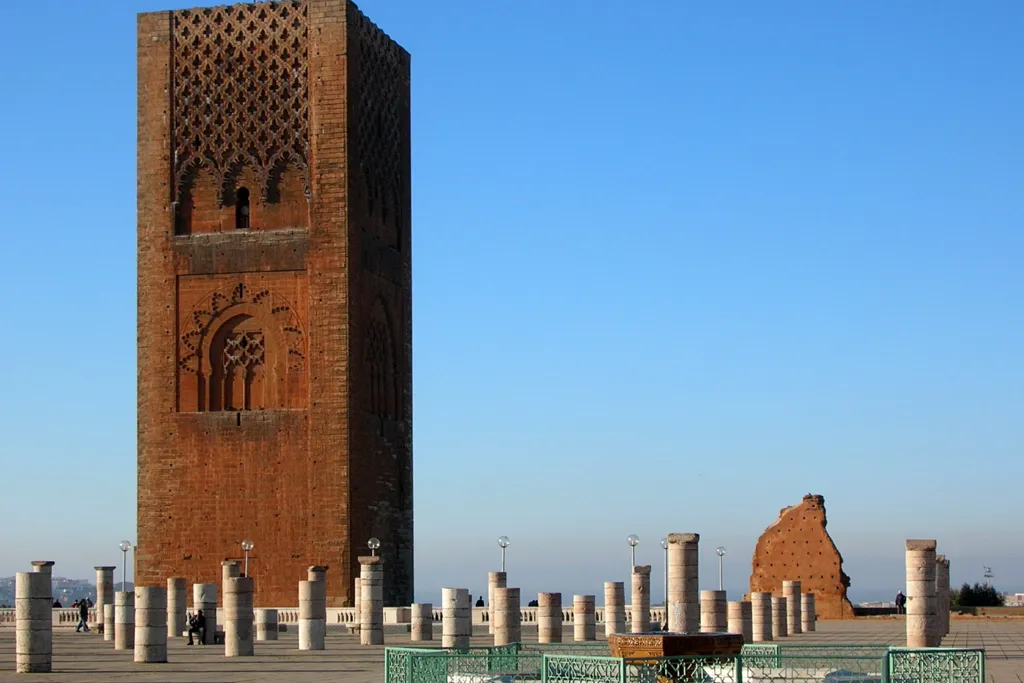
Rabat is the capital that travellers keep overlooking, and the overlooking is a mistake that this list exists to correct. As Morocco’s administrative capital and a UNESCO-listed historic city, Rabat combines a twelfth-century Almohad core with wide, tree-lined boulevards, a modern tramway and an Atlantic light that softens everything it touches. The result is the most liveable city on this list and, for many travellers, the most likeable: the medina is manageable rather than overwhelming, the kasbah of the Udayas is one of the prettiest quarters in the country, and the whole city runs at a pace that lets you actually see it rather than survive it. Travellers comparing capitals should put Rabat against Casablanca, the next stop, and notice what changes: Rabat is where Morocco governs itself, Casablanca is where Morocco does business, and the two cities feel as different as those two sentences suggest.
The sights cluster in a walkable arc that suits a single unhurried day. The Hassan Tower, the unfinished minaret of a great mosque begun in the twelfth century, stands with the forest of columns that was to have been its prayer hall — a ruin that is also a monument to ambition interrupted, and one of the most evocative sights in the country. Nearby, the Mausoleum of Mohammed V, with its white marble and green-tiled pyramid roof, is both a royal tomb and a masterclass in Moroccan craft, guarded with a formality that is itself worth watching. Across the Bou Regreg estuary lies Sale, Rabat’s older neighbour, with its own medina and pirate history; and back in Rabat, the Kasbah of the Udayas — blue-and-white lanes, an Andalusian garden, a cafe terrace over the river mouth — is the place to end the day, watching the Atlantic light turn the estuary gold. Rabat’s museums, including its archaeology museum with finds from Volubilis and elsewhere, tie the route together: the Roman city you walked in the morning of an earlier day is explained here, in the capital, by its objects.
Give it: one day, or one night if you want the kasbah at sunset and a slow medina morning.
The honest caveat: Rabat will not overwhelm you, and it is not trying to. Travellers who arrive expecting a second Marrakech find a dignified administrative city instead — its pleasures are light, space, gardens and a medina you can actually navigate, and they reward a traveller who has already had intensity elsewhere on the route.
7. Casablanca
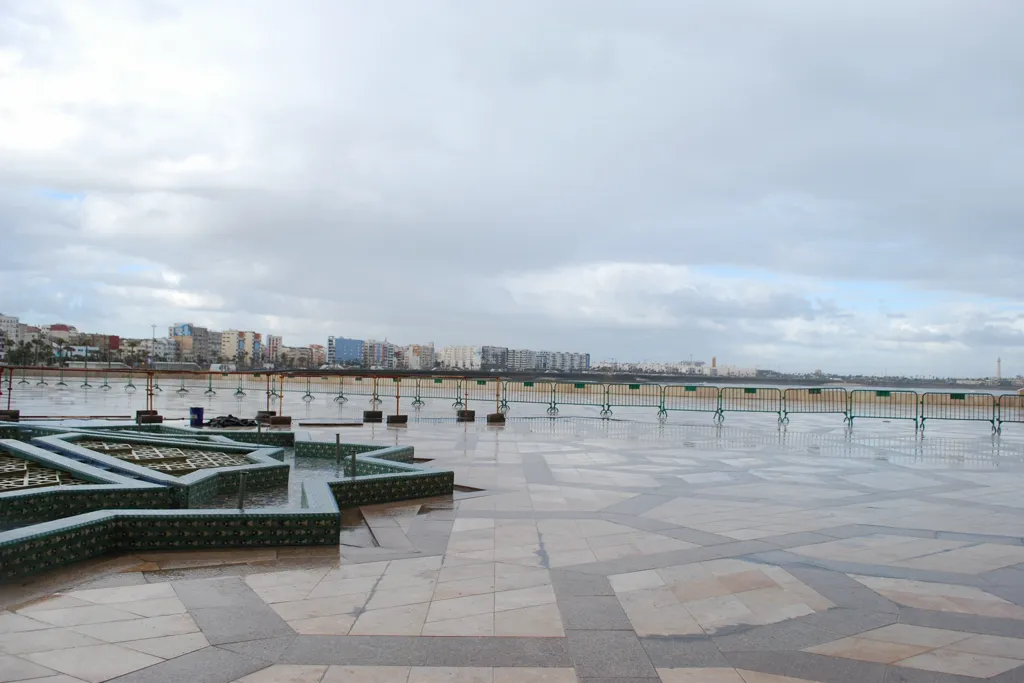
Casablanca is the stop that divides opinion most sharply on this list, and the division is instructive. Morocco’s largest city and economic capital is modern, sprawling and businesslike, and it lacks the medina romance of Fes or the colour of Chefchaouen — which is why some lists omit it and others include it for a single sight. That sight is the Hassan II Mosque, built on the Atlantic edge of the city and among the largest mosques in the world, and it is genuinely worth the detour: its minaret rises over the ocean, its prayer hall is a showcase of Moroccan craft on a monumental scale, and — unusually for a mosque in Morocco — it is open to non-Muslim visitors on guided tours, which makes it the one great mosque interior most travellers will ever see in the country. Everything else in Casablanca is context for that visit, and the city should be judged on that basis rather than as a rival to the imperial cities.
Beyond the mosque, Casablanca rewards the traveller who likes cities as they are rather than as they were. The Art Deco centre around Mohammed V Square, built under the French Protectorate, is one of the finest ensembles of its kind anywhere, and it is best appreciated on foot, looking up at facades that most visitors hurry past. The old medina, small and workaday beside the port, is a reminder that Casablanca was a modest town before the twentieth century made it a metropolis; the Corniche, the seafront boulevard, is where the city goes to walk, eat and watch the Atlantic; and the Central Market and the Habous quarter, the “new medina” built in the 1920s, offer a cleaner, calmer souk experience than Fes for travellers who want to shop without the labyrinth. Casablanca’s film fame — the city of the movie, which was filmed elsewhere — is a running joke the city itself seems mildly amused by; the real Casablanca is a port, a stock exchange and a skyline, and it is worth half a day of any honest itinerary for that reality alone.
Give it: half a day to one day, centred on the mosque tour, with the Art Deco walk as the second act.
The honest caveat: Casablanca is not a medina city and should not be visited as one. Travellers who come expecting old Morocco leave disappointed; travellers who come for the mosque, the Deco centre and the modern city leave satisfied. If days are short, Casablanca is the first imperial-coast stop to drop — but the mosque alone justifies the stop for most first trips.
8. Essaouira
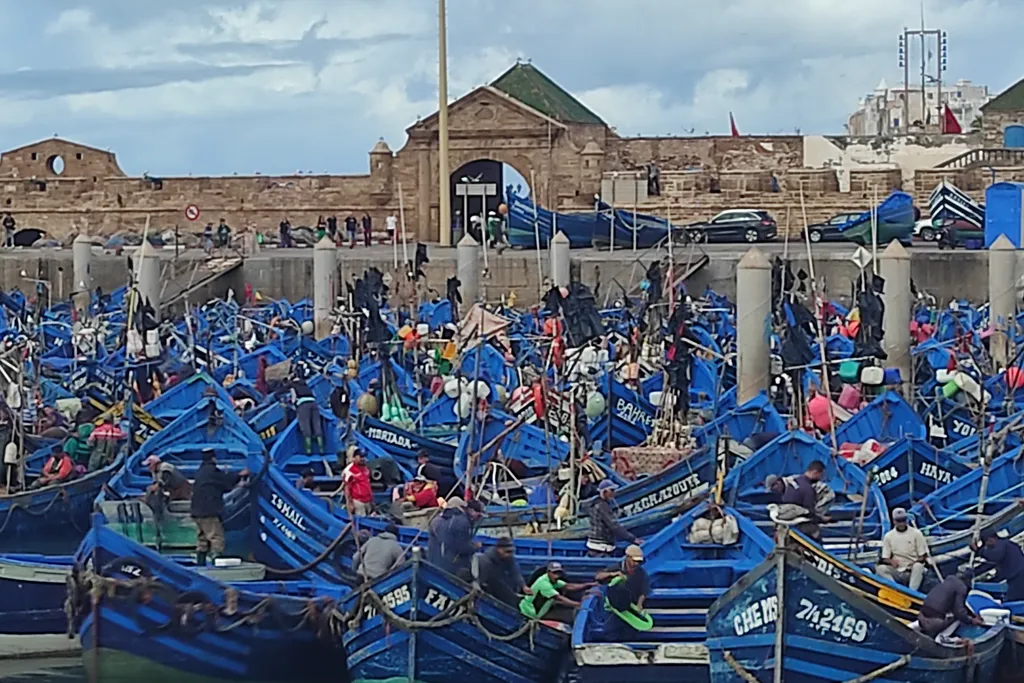
Essaouira is the coast at its most likeable. A UNESCO-listed Atlantic port town with eighteenth-century fortifications, a working fishing harbour, a medina that is whitewashed, grid-planned and easy to navigate, and a long beach that catches the Atlantic wind, Essaouira is where the route exhales. After the intensity of the imperial cities and the sprawl of Casablanca, Essaouira feels like a holiday inside a holiday: gulls over the ramparts, blue boats in the port, grilled fish eaten within sight of the boats that caught it, and a medina where you can actually find your way back to your hotel without a guide. The town’s history — as a trading port built under Sultan Sidi Mohammed ben Abdallah, with a Jewish merchant community and European trading houses — explains its openness: Essaouira was designed for trade with the outside world, and it still behaves that way, welcoming strangers more easily than any inland medina.
The town’s pleasures are simple and they fill two days without effort. The Skala de la Ville and Skala du Port, the sea bastions with their rows of cannons, give the classic views over the ramparts, the port and the town; the fishing port itself is a working spectacle, with boats unloading, nets mending and gulls competing for scraps, and it is at its best in the morning when the catch comes in. The medina’s souks are calmer than Fes’s and strong on craft — woodwork in thuya, textiles, jewellery — and the beach, long and windy, is better for walking, kitesurfing and watching the wind than for still-water swimming, which is a feature rather than a flaw once you accept it. Essaouira is also a music town, home to the Gnaoua World Music Festival, and its Gnawa heritage — the music of descendants of West African communities, with its guembri and qraqeb — is audible in the town’s squares and cafes year-round, not only at festival time. For travellers weighing the two Atlantic resort stops, Essaouira against Agadir is the central comparison of the coast: Essaouira wins on character, history and food, and loses only on beach-resort infrastructure.
Give it: one to two nights. One night gives you the port, the ramparts and a seafood dinner; two let the wind and the town set the pace.
The honest caveat: the wind is not a metaphor — Essaouira is famously windy, and the beach is not a sheltered swimming beach. Travellers who want calm water and resort hotels should read the Agadir entry next; travellers who want a town with a port, a medina and a soul should stay here.
9. Agadir
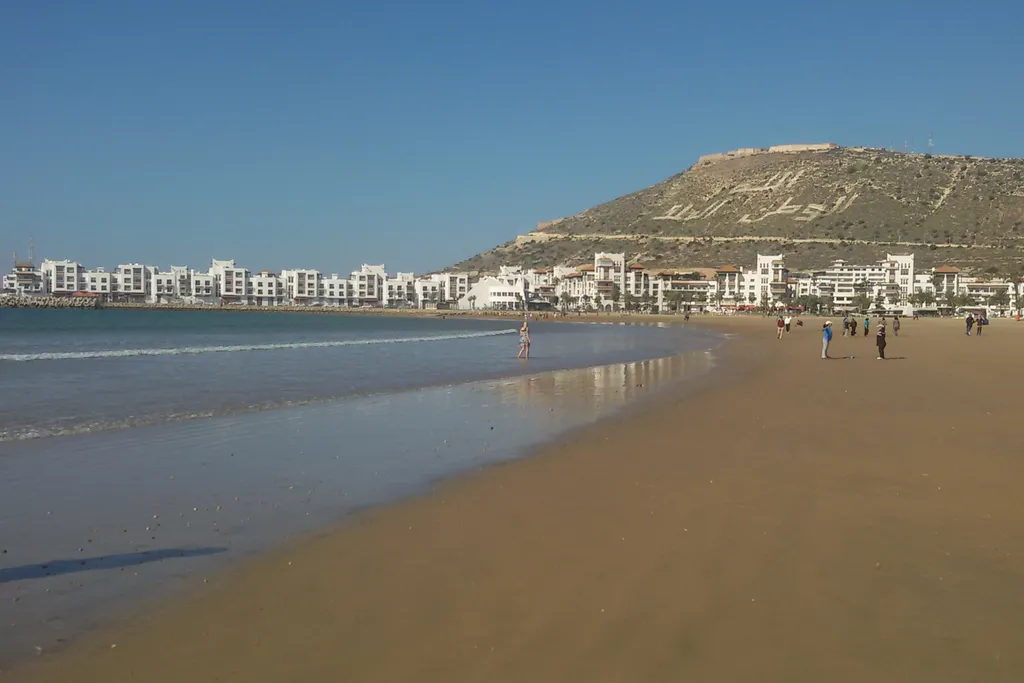
Agadir is the resort stop, and it should be judged as one rather than as a failed historic town. The modern city was rebuilt after a devastating earthquake in 1960, so it has almost no old quarter to speak of — and that absence is the point: Agadir is Morocco’s purpose-built beach city, with a long, crescent bay, a wide promenade, modern hotels and a surf culture that draws beginners and longboarders to its breaks. For families, for surf learners, for travellers who want a few days of sun and sand without a medina to navigate, and for anyone arriving tired from the imperial cities, Agadir is the soft landing the route otherwise lacks. It is also the gateway to the Souss region and to the Anti-Atlas beyond, which is why it sits where it does on this route: south of Essaouira, on the way inland to Marrakech, and within reach of a different, Berber south.
The city itself divides into two experiences that should not be confused. The beach and promenade are the resort: long walks, cafes, surf schools and a bay that is sheltered enough for swimming in a way Essaouira’s is not. The new medina, a reconstruction built as a craft and cultural quarter, and the kasbah hill above the city — where the old kasbah’s walls and gate survive and the view runs the whole length of the bay — supply the history and the panorama that the rebuilt city otherwise lacks. The souk, one of the largest in Morocco, is a genuinely local market rather than a tourist souk, and it rewards a morning of wandering for travellers who like markets for their own sake. Agadir also works as a base for the Souss-Massa region and for day trips into the Anti-Atlas, though those belong to a second trip rather than to a first-trip list that already has fifteen stops.
Give it: one to two nights as a beach break, or skip it entirely for Essaouira if character matters more than resort comfort.
The honest caveat: Agadir is a modern resort city, not a historic town, and travellers who come looking for old Morocco will be disappointed by design. Its strength is the beach, the surf and the ease; its weakness, beside Essaouira, is that it could be a resort almost anywhere. Choose it for what it is, not for what it is not.
10. Marrakech
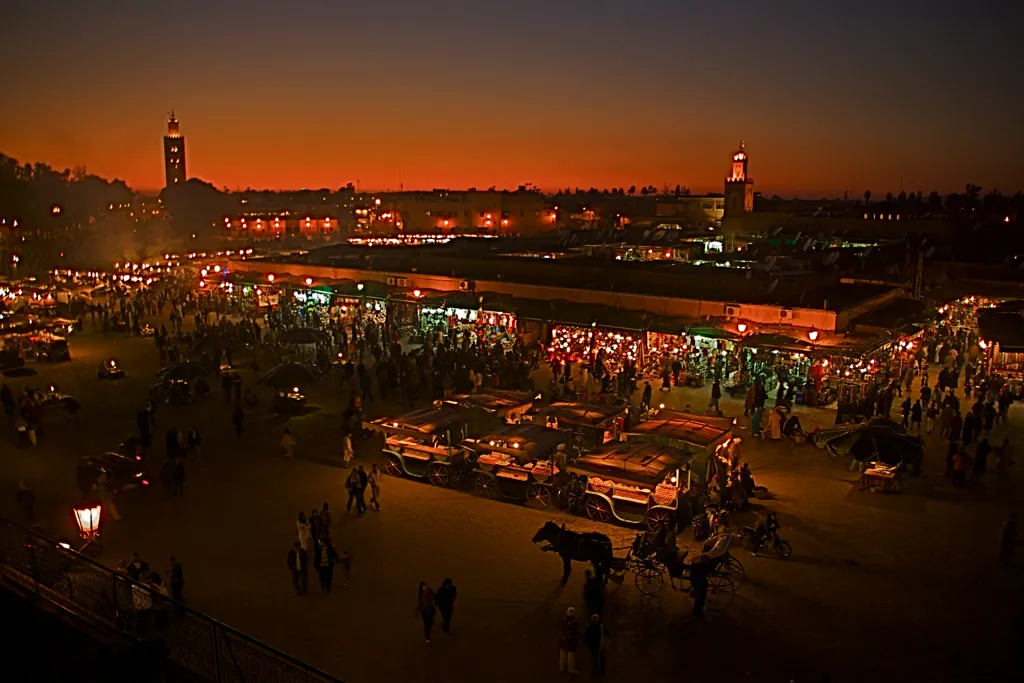
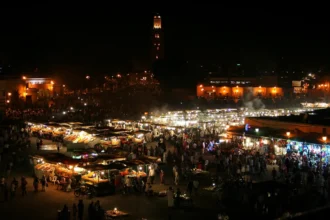
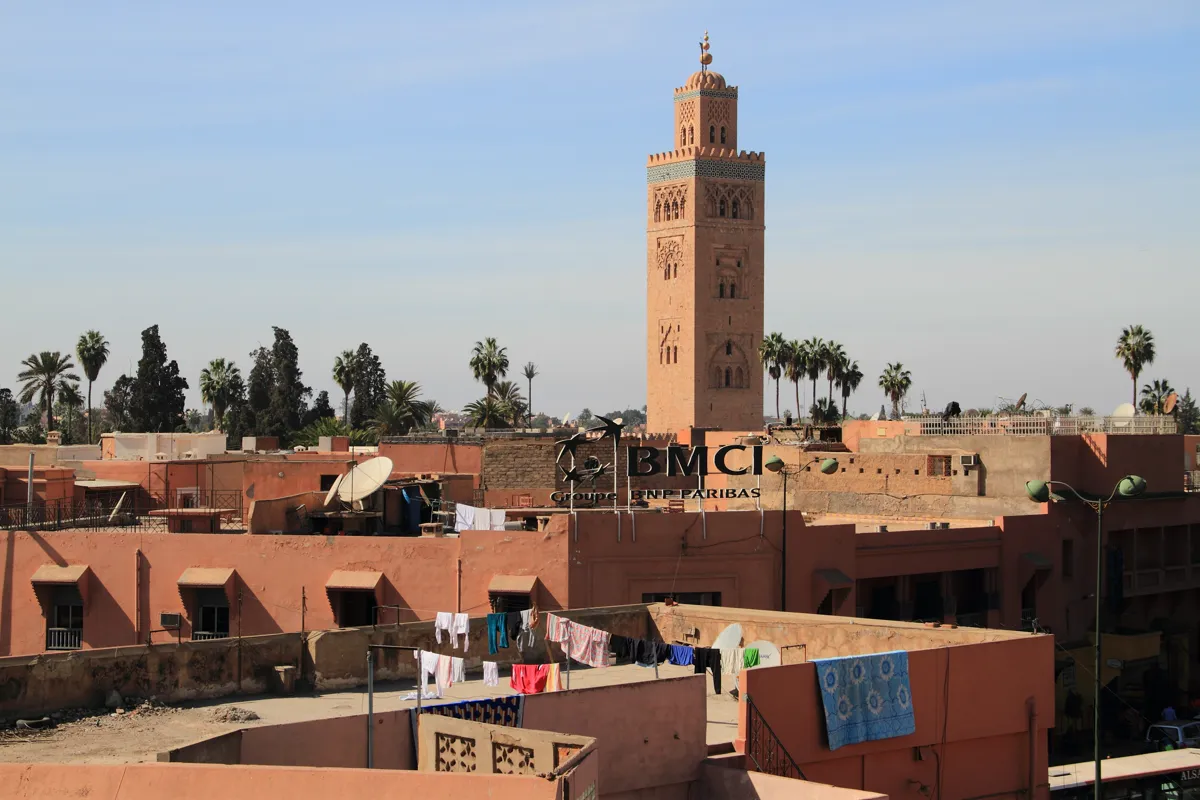
Marrakech is the city this list has been building towards, and it does not disappoint — it overwhelms, which is a different thing and should be planned for. The “Red City”, named for the rose-coloured earth of its walls and buildings, is Morocco’s great theatre: the medina and its souks, the Koutoubia minaret that orients the whole city, the palaces and gardens, and above all Jemaa el-Fna, the great square that UNESCO recognises as a masterpiece of oral and intangible heritage, where storytellers, musicians, food stalls and crowds create a nightly spectacle unlike anything else on this list. Marrakech is also the gateway to everything that follows — the Atlas, the desert road, the south — which is why it sits at the hinge of the route rather than at its end. A first trip to Morocco without Marrakech is possible, but it is hard to defend, and this list does not try.
The city needs to be taken in layers, because taken whole it is too much. The first layer is Jemaa el-Fna and the souks: arrive at the square in the late afternoon, watch it change from a daytime market to a nighttime food court, and treat the souks as a series of quarters — leather, metal, textiles, spices — rather than as a single maze to conquer. The second layer is the monuments: the Koutoubia and its gardens, the Bahia Palace with its courtyards and painted ceilings, the Saadian Tombs, and the Ben Youssef Madrasa, whose carved cedar and stucco are among the finest in the country. The third layer is the gardens and the new city: the Majorelle Garden, with its cobalt blue villa and its botanical collection, and the Menara gardens, are the city’s breathing spaces, and the Ville Nouvelle, Guéliz, is where modern Marrakech eats, drinks and shops. Each layer deserves its own half-day, which is why two nights is a minimum and three is kinder — and why the best Marrakech days end early, with a rooftop dinner over the square, rather than with one more souk.
Give it: two to three nights. Two nights give you the square, the souks and the main monuments; three give you the gardens and a day trip’s worth of breathing room.
The honest caveat: Marrakech is intense, hot in summer, and persistent in its souks — the attention of guides and sellers is part of the experience and part of the exhaustion. Travellers who plan Marrakech as a rest stop, or who try to see it in a day between the coast and the desert, get the worst of it. Give it nights, not hours.
11. Atlas Mountains
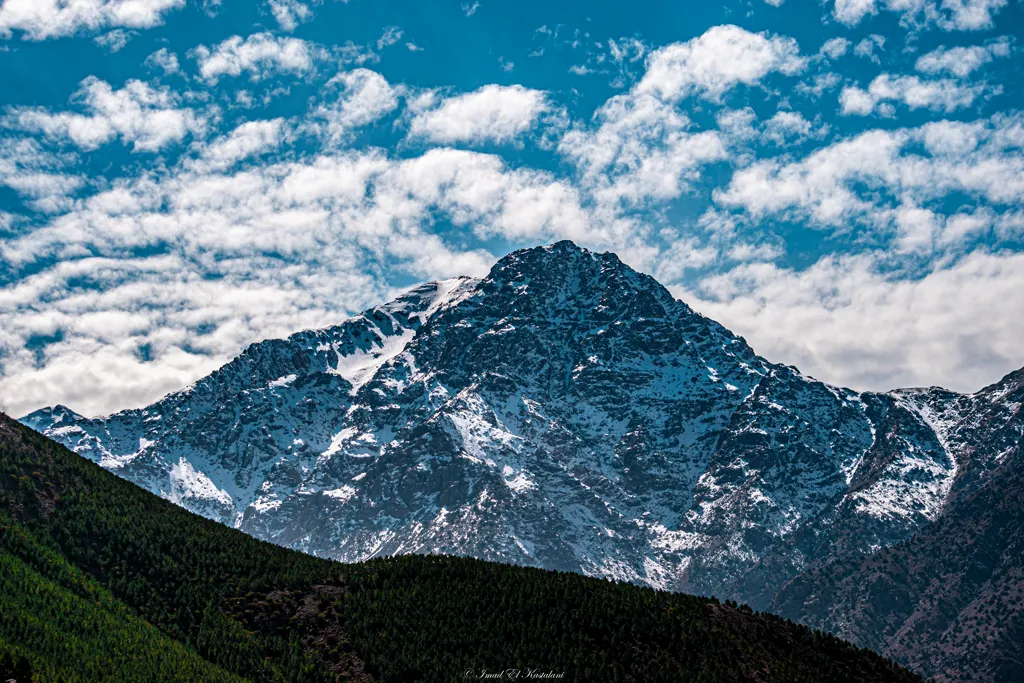
The Atlas Mountains are not a stop but a world, and treating them as a single entry is the list’s necessary simplification. The range runs across Morocco in three chains — Middle, High and Anti-Atlas — and the High Atlas, south of Marrakech, holds the country’s highest peaks, its most famous walking country and its most visited Berber villages. For a first trip, the Atlas means Imlil and the Toubkal region: a valley town that serves as the trailhead for walks from gentle village-to-village strolls to the multi-day ascent of Jebel Toubkal, the highest peak in North Africa, and a place where the air, the light and the pace change completely within an hour’s drive of Marrakech. The contrast is the point: Marrakech at its hottest and the Atlas at its coolest are the same day’s journey apart, and a trip that includes both understands Morocco in a way that a trip of cities alone cannot.
The Atlas rewards travellers who match the walk to their fitness and their days, honestly. The gentle version is a day walk from Imlil through Berber villages, with terraced fields, walnut groves and mountain streams, and a lunch in a village house or a mountain lodge — a day that needs no special equipment beyond good shoes and a willingness to climb. The serious version is the Toubkal ascent, a two-day trek with a mountain refuge overnight, which should only be attempted with a local guide, proper acclimatisation and respect for altitude and weather; it is the finest mountain objective in North Africa and also the one most often underestimated. Between those poles sit the valleys that make the Atlas a destination in its own right: the Ourika Valley, the closest to Marrakech and the most visited; the Ait Bouguemez, the “Happy Valley”, further east and quieter; and the passes themselves, above all the Tizi n’Tichka, the great road south to Ouarzazate, which is the route’s hinge — the moment the trip crosses from the green north and the coast into the dry, ochre south. The Berber, or Amazigh, culture of the mountains — language, craft, hospitality, village life — is not a backdrop but the substance of an Atlas visit, and the best days here are spent in villages rather than on viewpoints.
Give it: one to three days, from Marrakech. One day gives you Imlil and a village walk; three give you a proper trek or a valley stay.
The honest caveat, and it is absolute: the High Atlas is a mountain range, not a theme park. Passes close in winter snow, weather changes fast at altitude, and the Toubkal ascent should never be attempted lightly or unguided. Check conditions before you cross, and build the Atlas into the trip in its walking season rather than as an afterthought.
12. Ouarzazate and Ait Benhaddou
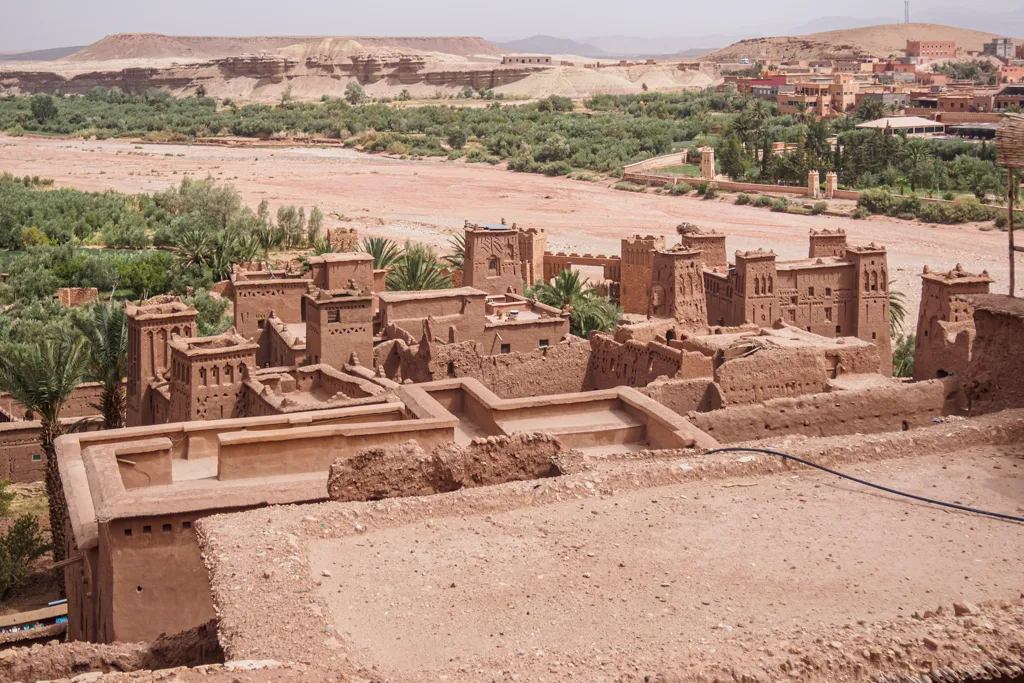
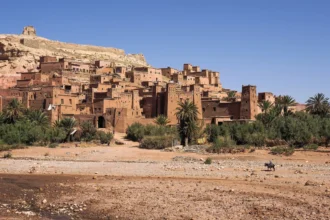
Cross the Atlas by the Tizi n’Tichka pass and the country changes colour, and Ouarzazate is where the new country announces itself. The town, built as a French garrison and grown into the gateway of the south, is known as the film capital of Morocco — its studios and its desert light have drawn productions for decades — but its real claim on this list is the ksar a short drive to its north-west: Ait Benhaddou, a UNESCO-listed fortified village of earthen towers, alleyways and a hilltop granary, standing above a riverbed and a palm grove in one of the most photographed compositions in North Africa. The ksar was once a stop on the caravan route between the Sahara and Marrakech, and it still reads as a caravan stop: a place built for defence, for trade and for the water of its palms, whose earthen architecture glows amber in the late light. For travellers comparing desert-road stops, Ait Benhaddou is the essential one — the ksar that justifies the Atlas crossing on its own.
The town and the ksar make a natural pair, and the pairing matters. Ouarzazate itself offers the Taourirt Kasbah, a vast, labyrinthine former residence of the Glaoui family that is worth an hour precisely because it shows the other side of southern power — not the village ksar but the palace of the pasha who controlled the passes — and its film studios and museum explain why this light and this landscape have been borrowed by cinema so often. Ait Benhaddou, by contrast, is best walked slowly and late: cross the riverbed, climb through the ksar’s lanes to the granary at the top, and look back over the palms and the river to the Atlas you crossed that morning. The ksar is still partly inhabited, and its lanes are a living village as well as a set, which is worth remembering when the camera comes out — the families who live there are not extras. Staying the night in Ouarzazate, or in Ait Benhaddou itself, gives you the ksar at dawn and dusk, when the light does the work and the day visitors have gone, and that is the version of the place worth travelling for.
Give it: one night, centred on Ait Benhaddou at golden hour, with Ouarzazate’s kasbah as the second act.
The honest caveat: Ait Benhaddou is famous, and fame brings crowds to its main lane in the middle of the day — arrive late, stay the night, and walk the upper lanes rather than the main street. And Ouarzazate town itself is a gateway, not a destination in the ksar’s league: judge the stop by the ksar, not by the town’s film studios alone.
13. Dades Valley
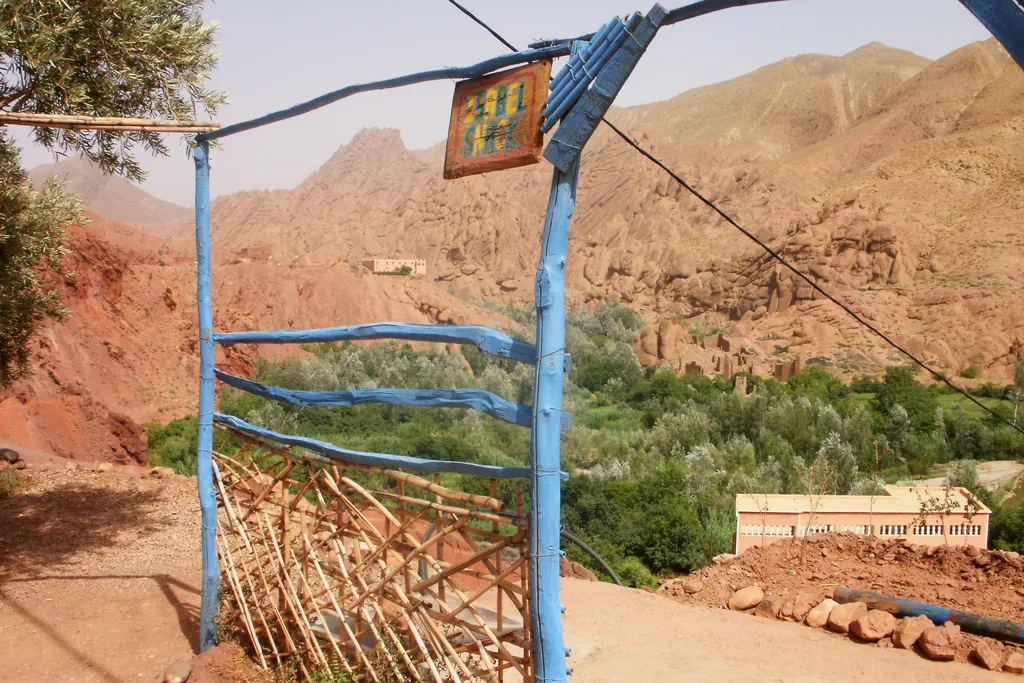
East of Ouarzazate, the road follows the Dades River through a valley that travellers call the Valley of Roses and the road of a thousand kasbahs, and both nicknames are earned. The Dades Valley is a long, green ribbon of irrigated fields, rose gardens and palm groves cut through red rock, with ruined and restored kasbahs standing along it like punctuation — some crumbling back into the earth they were built from, some converted into guesthouses, all of them testifying to a valley that was once a corridor of wealth between the Atlas and the desert. For a first trip, the Dades is not a destination to base in but a landscape to drive through slowly, stopping where the valley opens, and it is the stretch of the desert road where the journey itself becomes the sight. Travellers who rush it, ticking off a viewpoint and driving on, miss the point: the Dades is a valley to inhabit for a day, not a viewpoint to photograph.
The valley’s pleasures are cumulative rather than singular. The town of Kelaat M’Gouna, at the valley’s heart, is the centre of Morocco’s rose-growing country, and its rose products — water, oil, soap — are sold in shops along the road; the season of the roses, in spring, fills the valley with a scent that no photograph captures, and the annual rose festival, if your trip coincides with it, is a genuine local celebration rather than a tourist performance. Further east, the valley narrows into the Dades Gorges, where the road winds between rock walls and the river, and the famous switchback viewpoints above the gorge give the classic photographs of the valley — the road looping down through red rock like a drawn line. The kasbahs deserve attention as a group rather than individually: they are the architecture of a valley that had to defend its water and its trade, built of the same earth as the fields they overlook, and their decay is part of their honesty. A night in the valley, in a kasbah guesthouse, turns the drive into a stay, and for travellers with the days, it is the quietest, most atmospheric night of the desert leg.
Give it: half a day passing through, or one night in a valley guesthouse if the desert leg allows.
The honest caveat: the Dades is a valley, not a single sight, and travellers expecting one great monument will wonder what the fuss is about. Its value is the drive, the kasbahs in sequence, and the contrast between green valley floor and red rock — a landscape that rewards patience and punishes the checklist.
14. Todra Gorge
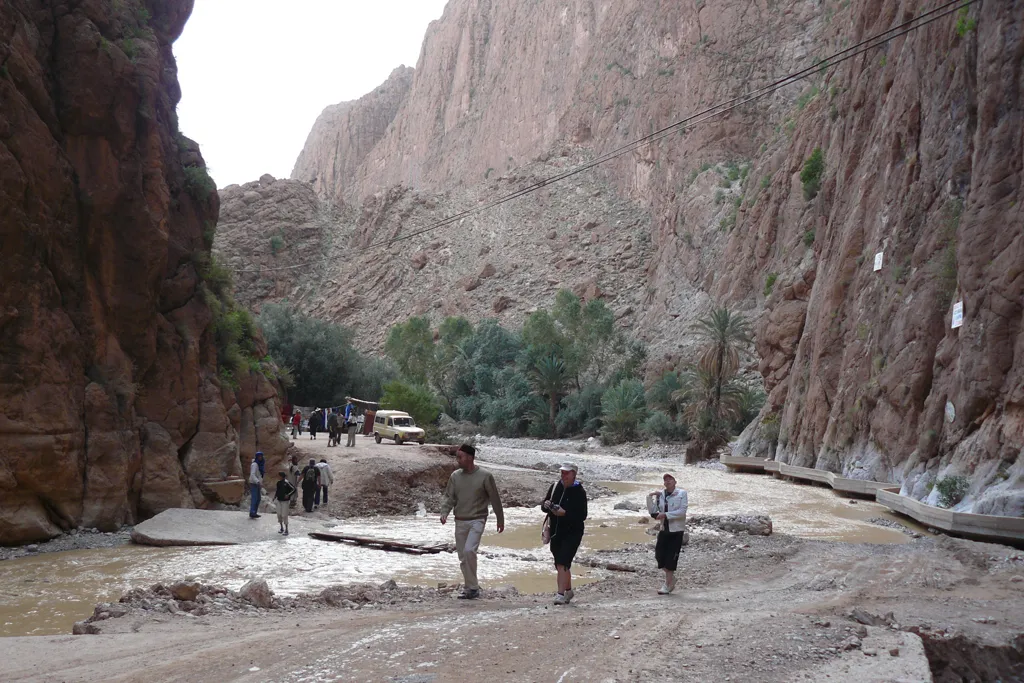
If the Dades is a valley to drive, Todra Gorge is a cleft to walk. Near the town of Tinghir, the Todra River has cut a narrow gorge through the limestone, and at its narrowest the walls rise sheer on either side of a road and a riverbed, creating one of the most dramatic short walks in Morocco. The gorge is short — the spectacular section is walked in well under an hour — but its scale is disorienting: the walls close overhead, the light narrows to a strip, and the temperature drops, so that a morning in the desert road’s heat becomes a cool, echoing passage between cliffs. For climbers, Todra is also one of Morocco’s great rock-climbing venues, with routes bolted into its walls; for everyone else, it is a walk, a photograph and a pause, and that modesty is its strength on a route that otherwise deals in grandeur. Todra does not need a day, and it should not be given one — it needs a morning, taken slowly.
The walk itself is simple and should be kept simple. Start at the gorge mouth and walk the road into the cleft, where the walls are at their highest and the river runs beside the tarmac; continue past the narrowest section to where the gorge opens again, and turn back, or continue into the palmeries and villages beyond if you have the time and a guide. The town of Tinghir, with its own palm grove — one of the largest in Morocco — and its Jewish quarter and kasbah, makes a good base for the gorge and a useful contrast: a living oasis town rather than a monument, with a market and lanes that reward an hour’s wandering. Todra pairs naturally with the Dades, the previous stop, as the two gorges of the desert road, and travellers often debate which is finer; the honest answer is that they are different kinds of beauty — the Dades a valley of kasbahs and roses, Todra a single, overwhelming cleft — and a route that includes both has understood the desert road’s range. Arrive early, when the light is in the gorge and the road is quiet, and the walk is one of the trip’s small masterpieces.
Give it: half a day, passing through, ideally in the morning before the heat and the groups.
The honest caveat: Todra is a short gorge, not a day’s hiking, and travellers who build a whole day around it will be back at their hotel by lunch wondering what to do. Pair it with Tinghir’s palmeries, or with the drive on to Merzouga, and it earns its place exactly.
15. Merzouga and the Sahara
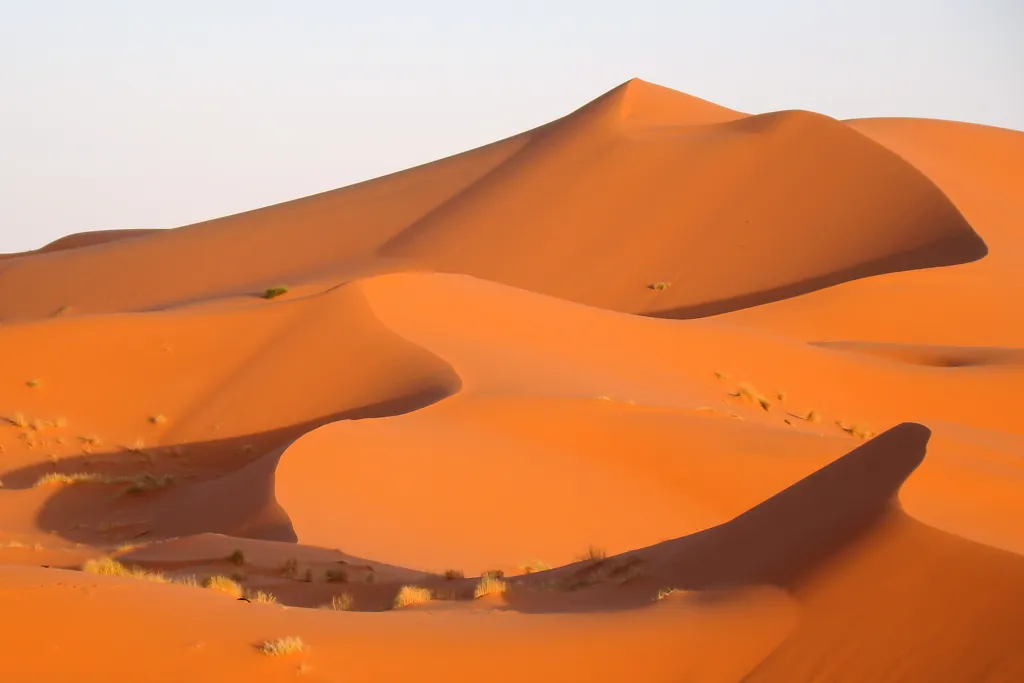
Merzouga is where the route ends and where, for many travellers, the trip finally makes sense. The small desert town on the edge of Erg Chebbi — a sea of orange dunes rising out of the flat hamada, some of them high enough to make the climb a proper effort — is the gateway to the Moroccan Sahara as most first trips experience it: a night in a desert camp, a camel ride at sunset or sunrise, and a sky full of stars in a silence that the rest of the route never offers. The Sahara is not a sight but a condition — heat, light, space and quiet on a scale that recalibrates everything that came before it — and Erg Chebbi delivers that condition within a day’s drive of the valleys, which is why it, rather than the more remote Erg Chigaga further west, is the first trip’s desert. Travellers who have crossed the Atlas, the valleys and the gorges to get here have earned the dunes, and the dunes repay the journey in a way that a flight straight to a camp never quite does.
The experience itself should be chosen with care, because not all desert nights are equal. The classic version — a camel ride from Merzouga into the dunes in the late afternoon, a night in a Berber camp with dinner and music around a fire, and a sunrise over the dunes before the ride back — is classic for a reason, and it works best when the camp is small, the group is small, and the night is spent actually looking at the sky rather than at a phone. The town of Merzouga itself, with its hotels and its lake — the seasonal Dayet Srji, which fills after rain and draws birds — is worth an hour before the dunes, and the village of Khamlia nearby, known for its Gnawa music, offers a cultural counterpoint to the dunes’ natural spectacle. The desert’s seasons matter more here than anywhere else on the list: the cooler months are the kind ones, the summer heat is serious and should be respected, and a sandstorm, when it comes, is a force of nature rather than an inconvenience. A second night in the desert — a day among the dunes, a visit to a nomad family, a night without an agenda — turns the experience from a tour into a memory, and for travellers with the days, it is the single best upgrade on the whole route.
Give it: one to two nights. One night gives you the sunset, the camp and the sunrise; two give you the desert itself.
The honest caveat: the Sahara is remote, hot and dependent on conditions — a camp night in high summer or in a sandstorm is a different experience from the postcard, and the camel ride is a means of transport, not a theme-park ride. Choose a reputable camp, respect the heat, and treat the desert as a place with its own terms, not as a backdrop for photographs.
How to Combine These 15 Stops
The list is already a route. In seven days, the northern and coastal core takes stops 1 to 8: Tangier, Chefchaouen, Fes, Meknes and Volubilis, Rabat, Casablanca and Essaouira. It is a full week, not a lazy one, and it is the trip most first-timers with a week should take — imperial cities, a blue town, a capital and a coast, without the desert leg that would hollow it out. The pacing rule inside that week matters as much as the route: Fes is the only two-night base in the north, deliberately, because its medina needs two days and every other northern stop works at one night or one day. If the week has to shrink to five days, the skeleton still survives two edits: make Meknes and Volubilis a single day from Fes, and pass through Casablanca for the mosque alone rather than sleeping there.
Add Marrakech and the Atlas and the trip becomes ten to twelve days: the coastal route plus two or three nights in Marrakech and a day or two in the mountains, which is the version of Morocco most travellers remember as their first real trip. Add the desert leg as well — Ouarzazate and Ait Benhaddou, the Dades Valley, Todra Gorge and Merzouga — and the whole trip becomes fourteen to sixteen days, because the desert road deserves its own days and the drive back from Merzouga is a journey in itself. The full day-by-day versions of these routes belong in the Morocco itinerary and pillar guides, which are scheduled to publish around this list; here, the comparison is the point, and the rule is simple — a week is a northern and coastal trip, twelve days is a northern, coastal and Marrakech trip, and sixteen days is the whole country done properly.
One seasonal truth governs the whole list: the north and the coast are kindest in spring and autumn, the Atlas passes are a summer and autumn proposition, and the Sahara is at its best in the cooler months. Spring and autumn are the windows when the most stops work at once — warm enough for the coast, cool enough for the desert, and open in the mountains — while high summer tests Marrakech and the desert, and winter tests the Atlas passes. Plan the trip around that overlap, not around any single stop’s peak, and the route will cooperate.
What We Left Off — and What to Add With More Time
A list of fifteen is a set of choices, and these are the near-misses. Asilah, the whitewashed Atlantic town south of Tangier with its murals and its ramparts, is a lovely half-day from Tangier and a quieter alternative to Essaouira for travellers who want a small coast town; it loses its place here only because Essaouira does the coastal-town job more completely. Ifrane, the “Little Switzerland” of the Middle Atlas with its alpine-style architecture and its cedar forests, is a curiosity worth an hour on the Fes-to-Marrakech road, but it is a curiosity rather than a destination. Ouzoud Falls, the waterfalls in the Middle Atlas and a popular day trip from Marrakech, are genuinely spectacular after rain and in spring, but they duplicate the Atlas entry’s water-and-mountain pleasures without adding a new region.
Erg Chigaga, the wilder dune sea south of M’Hamid, deserves more than a tail-end mention: it is larger, remoter and less visited than Erg Chebbi, and for travellers who have already done Merzouga it is the desert’s second act — a multi-day expedition rather than a night’s camp, reached by off-road driving rather than by a short camel ride. The Draa Valley, with its palm groves and kasbahs running south from Ouarzazate towards the desert, similarly anchors a whole southern circuit that this list only touches at its northern end. But both belong to a second trip, or to a longer first trip that trades some northern stops for southern depth, and grafting either onto the fifteen above turns a route into a zigzag — which is a planning flaw, not a reflection on the place. With extra days rather than a second trip, add Tetouan, the northern city with its Andalusi heritage and its UNESCO-listed medina, as a day from Chefchaouen or Tangier. None of these near-misses is a consolation prize: each is a genuine reason to come back, and a first trip that tried to hold everything would end up holding nothing properly.
Frequently Asked Questions
Five questions account for most first-trip planning, and the short answers are below. Each is argued in full in the sections above — the seasonality answer, in particular, is the thread that runs through the whole list.
How many of these 15 places can I see in one week?
Eight of them — the northern and coastal core from Tangier to Essaouira. Marrakech and the Atlas push the trip to ten or twelve days, and the desert leg pushes it to fourteen or sixteen. Anyone promising all fifteen in seven days is selling you transfers, not travel. Within those eight, the week only works because Fes is used as a two-night base rather than a one-night stop: the medina needs two days, and that single decision is what keeps the northern week a holiday instead of a commute.
The arithmetic is nights, not sights. The northern eight fit a week because the route is a line with one two-night base; you sleep in six or seven places at most, and no single drive dominates a day. Marrakech breaks the pattern — it needs its own nights and it sits at the hinge of the route — and the desert leg breaks it further, because the road east from Ouarzazate to Merzouga is a journey in itself and the drive back is another. A ten-day trip is the awkward middle: long enough to feel spacious, too short for all fifteen done properly. The best use of days eight to ten is depth rather than breadth — a second night in Essaouira, a slower Fes, a day in the Atlas — and the full fifteen-place version asks for fourteen days at the very least, with sixteen kinder. If your week is fixed and the desert is the priority, invert the trip entirely: Marrakech, the Atlas and Merzouga in a week, the north left for a return visit. Both halves stand alone; neither survives being halved.
Which is the single best place in Morocco?
There isn’t one — it depends on the trip. For history, Fes and Marrakech are the pair travellers describe years later; for a town with atmosphere, Chefchaouen or Essaouira; for landscape, the Sahara or the Atlas; for a single monument, Ait Benhaddou or the Hassan II Mosque. If a long weekend forces one choice, make it Marrakech plus the Atlas foothills — a city for intensity and mountains for air, an easy drive apart, with no season that ruins both of them at once.
Season bends the answer as much as taste does. Marrakech works in almost any month if you respect its summer heat; the Sahara’s claim collapses in high summer and peaks in the cooler months; the Atlas simply does not offer its high passes in deep winter. A traveller choosing one place for a winter weekend is really choosing between the imperial cities and the coast — both good answers, neither of them the desert one. If the choice is a single night rather than a single place, spend it in Essaouira or in a desert camp — the two stops whose atmosphere peaks after the day visitors leave, when the wind drops or the stars come out. Which is why this list refuses to crown a winner: the best place in Morocco is the one whose season and character match the trip you actually have.
Is the Sahara stop worth it on a first trip?
Yes, if your trip is fourteen days or longer, or if you are willing to build the trip around it — the desert night is the single most memorable night most visitors have in Morocco, and the dunes every other landscape in the country gets compared to afterwards. On a seven-day trip, no: the north and coast done properly beat the whole country done in a hurry, and a desert leg bolted onto a week costs you Fes, or Marrakech, or both.
Understand what the stop commits you to. The desert leg is a chain — Marrakech, the Atlas pass, Ouarzazate, the valleys, the gorges, Merzouga — and every link has to hold: the pass, the driving days, the camp. That chain is exactly why the Sahara cannot be sampled in a spare afternoon, and why travellers who force it into a short trip end up remembering the driving instead of the dunes. The Sahara is also the most book-ahead stop on this list in its best season: the good small camps fill, and the difference between a good camp and a crowded one is the difference between silence and a car park with dunes. Built properly into a longer journey, the balance reverses completely: the desert night becomes the night the rest of the trip is measured against.
When is the best time to visit all 15 places?
Spring and autumn, with the emphasis on the overlap rather than on any single month. The north and coast are at their kindest then, the Atlas passes are open, and the Sahara is in its cooler, more comfortable season — the spans when every stop on the list is simultaneously reachable and enjoyable. Summer adds heat to Marrakech and the desert that many travellers underestimate, and winter adds snow to the Atlas passes that can close the road south altogether.
The trade-offs inside those windows are worth knowing. Spring brings roses to the Dades Valley and green to the Atlas foothills; autumn brings warm sea water to the coast and thinner crowds to the medinas. A summer trip is not a write-off — the coast is moderated by Atlantic wind, and the mountains are cool — but it should be planned as a coast-and-mountains trip with the desert handled carefully, not as a desert trip. Winter, for the record, is not a write-off for a different kind of trip — the imperial cities and the coast in the quiet months make a fine week — but it cannot deliver this list of fifteen, and no honest version of the list pretends otherwise.
Do I need a car to visit these places?
Not strictly — trains connect the main northern and coastal cities, and buses and grand taxis connect the towns, on routes built for locals, which means they run where this route runs — but a car, or a car with a driver, makes the Atlas crossing, the valley stops and the desert leg’s pacing far easier. The desert road in particular is a driver’s route: the Dades, Todra and Merzouga stops are strung along one road, and public transport along it is infrequent and inflexible.
Where the car earns its money is specific: the Atlas pass, where stopping where the view is best is the point; the valleys, where the best kasbahs sit between bus stops; and the desert leg generally, where one-way pacing beats retracing legs by bus. Where it earns nothing is inside the medinas, where a car is a parking problem with seats, and on the Tangier-to-Casablanca rail line, where the train is faster and easier than driving. Many travellers split the difference — train at the northern and coastal end, a car with a driver collected in Marrakech for the Atlas and desert leg alone. If you do drive, two habits pay: keep the Atlas crossing and the desert road for daylight, and build slack into every driving day, because the mountain and valley legs set their own pace — which, as the budgets above keep insisting, is the whole theme of travelling in this country.
The Short Version
Pick the trip your days honestly allow: the northern and coastal eight in a week, the Marrakech and Atlas version in ten to twelve days, and all fifteen in fourteen to sixteen days, with spring or autumn if you want the whole list at its best. The route itself is simple — south from Tangier through Chefchaouen and the imperial cities, down the Atlantic coast, inland to Marrakech, over the Atlas, and east through the valleys and gorges to the dunes at Merzouga. Then plan the legs between the places as carefully as the places themselves — in Morocco, the route is half the experience.
Two decisions matter more than everything else combined. The first is the season: spring or autumn if you want all fifteen, the coast and mountains if summer forces your hand, and never the Atlas passes without checking winter conditions. The second is honesty about days — a week is a northern and coastal trip, sixteen days is a whole-country trip, and pretending otherwise is how good places get wasted on windscreen time. Everything else — which beach, which camp, what order inside a medina — can safely be settled on the day.
Beyond that, the trip is forgiving. Morocco is compact for its variety, the route is a line rather than a maze, and almost every stop can absorb a changed plan, a slow morning or a longer lunch without the trip unravelling. Build that slack in deliberately — the unplanned swim, the extra night where the light is good, the gorge walked twice — and the country will do the rest.